Results for "Fourcès+|+127"
4842 results found.
Circuit avec Kuoni en Inde du sud (ou Sri Lanka) + Maldives English translation pending
🙂
Bonjour à tous,
J'envisage de faire un circuit Inde du sud (ou Sri lanka) + Maldives avec KUONI ou NF l'hiver prochain.
Certains d'entre vous ont-ils déjà fait de tels circuits avec ces TO?
Que pensez-vous de leur rapport qualité/prix? de la qualité des hôtels? du type de moyen de locomotion - mini bus ou bus? des autres voyageurs?
D'avance, merci!
Bonjour à tous,
J'envisage de faire un circuit Inde du sud (ou Sri lanka) + Maldives avec KUONI ou NF l'hiver prochain.
Certains d'entre vous ont-ils déjà fait de tels circuits avec ces TO?
Que pensez-vous de leur rapport qualité/prix? de la qualité des hôtels? du type de moyen de locomotion - mini bus ou bus? des autres voyageurs?
D'avance, merci!
Aller en Chine en voiture English translation pending
Je suis dans à la recherche d'information concernant
Les conditions administratives et financières pour rentrer avec son propre véhicule en Chine
Le choix de la route pour aller en Chine de façon à faire le meilleur compromis entre les contraintes administratives, la sécurité et l'intérêt. Quelqu'un a t il l'expérience d'un des trois routes suivantes
1Russie Mongolie, Chine 2Iran Turkmenistan, Ouzbekistan, Kazakhstan, Russie, Mongolie, Chine 3Iran, Pakistan, Inde, Sud Est asiatique et Chine
Les conditions administratives et financières pour rentrer avec son propre véhicule en Chine
Le choix de la route pour aller en Chine de façon à faire le meilleur compromis entre les contraintes administratives, la sécurité et l'intérêt. Quelqu'un a t il l'expérience d'un des trois routes suivantes
1Russie Mongolie, Chine 2Iran Turkmenistan, Ouzbekistan, Kazakhstan, Russie, Mongolie, Chine 3Iran, Pakistan, Inde, Sud Est asiatique et Chine
Rando en Irlande English translation pending
Bonjour tt le monde,
Je cherche des randos à faire en Irlande, connaissez-vous des coins magnifiques à ne pas manquer ?
Je cherche des randos à faire en Irlande, connaissez-vous des coins magnifiques à ne pas manquer ?
Problèmes à Cuba!!! English translation pending
Je viens d'apprendre que notre cher Fidel Castro national vient de décréter une loi qui oblige tout les magasins en dollars américains à fermer leur portes.(Bien entendu pas ceux dans les hotels).
Suite au message de M. Bush à l'encontre de Cuba cette semaine, le gouvernement cubain à décider de bien garder ces devises américaines afin qu'il ne sortent pas du pays.
Ce qui veux dire qu'a partir d'aujourd'hui aucun cubain ne peux se procurer quoi que ce soit en dollars américain. Ce qui reste alors sont des miettes en pesos cubain.Selon mon beau frère "CUBA ESTA DE PINGA" Cuba est en délabrement total. Les femmes ne peuvent même plus acheter de serviettes sanitaire. Les pharmacies en devises cubaine sont maintenant vides. Ils ne meurent pas de faim bien entendu parce que les mercados fournissent encore la viande, poisson, riz, etc mais tout les articles de bases sont rarissimes. Il faut maintenant se battre afin d'obtenir un savon pour se laver.
Une autre nouvelle de notre cher Fidel, "si je ré-ouvre les magasins en devises américaines, les prix seront du double".
Bien que les cubains ont l'habitude de lutter sans se plaindre, certain commencent réellement à en avoir marre et cette semaine plusieurs groupes ce sont amassé devant les "Tiendas" afin de crier leur mécontentement, sans résultats d'après ce que j'ai entendu. Même les 'Oro negro" Station service vendant des produits en dollars US ont été fermés. Donc cher touristes, si vous loué une voiture pour visiter hors des sites touristiques, n'allez pas trop loin car il se pourrait que vous ayez de la difficulté à vous ravitailler en pétrole.
Et tout ça pour que Bush tente à nouveau de se faire réélire...
Suite au message de M. Bush à l'encontre de Cuba cette semaine, le gouvernement cubain à décider de bien garder ces devises américaines afin qu'il ne sortent pas du pays.
Ce qui veux dire qu'a partir d'aujourd'hui aucun cubain ne peux se procurer quoi que ce soit en dollars américain. Ce qui reste alors sont des miettes en pesos cubain.Selon mon beau frère "CUBA ESTA DE PINGA" Cuba est en délabrement total. Les femmes ne peuvent même plus acheter de serviettes sanitaire. Les pharmacies en devises cubaine sont maintenant vides. Ils ne meurent pas de faim bien entendu parce que les mercados fournissent encore la viande, poisson, riz, etc mais tout les articles de bases sont rarissimes. Il faut maintenant se battre afin d'obtenir un savon pour se laver.
Une autre nouvelle de notre cher Fidel, "si je ré-ouvre les magasins en devises américaines, les prix seront du double".
Bien que les cubains ont l'habitude de lutter sans se plaindre, certain commencent réellement à en avoir marre et cette semaine plusieurs groupes ce sont amassé devant les "Tiendas" afin de crier leur mécontentement, sans résultats d'après ce que j'ai entendu. Même les 'Oro negro" Station service vendant des produits en dollars US ont été fermés. Donc cher touristes, si vous loué une voiture pour visiter hors des sites touristiques, n'allez pas trop loin car il se pourrait que vous ayez de la difficulté à vous ravitailler en pétrole.
Et tout ça pour que Bush tente à nouveau de se faire réélire...
Inde: élections: Sonia premier ministre English translation pending
Re coucou,
Ca se précise de minute en minute : sur 524 de connus, 212 / 180.
Ca se précise de minute en minute : sur 524 de connus, 212 / 180.
Chili, Bolivie, Aconcagua English translation pending
Salut à tous,
je pars au Chili et en Bolivie en août prochain (yahoo!), et un certain nombre de questions me taraudent. Si vous avez des réponses, de bonnes adresses de sites etc... surtout n'hésitez pas!
😮 J'ai un billet Paris/Santiago/ Paris, est-il possible en 1 mois de visiter le pérou, la Bolivie et le nord du Chili (pas tout, bien sûr, mais le principal)?
😮 Quelle est la meilleure manière de rejoindre la paz depuis Santiago?
😮 Peut-on faire l'aconcagua quand on est en bonne santé mais un pro de la haute montagne?
😮 A cette saison, peut-on descendre jusqu'au parc torres del paine, ou fait-il trop froid?
😮 Quelle sont les endroits les plus sympa à faire dans la partie du Chili au dessus de Santiago?
Voilà quelques interrogations parmi les nombreuses qui m'assaillent, merci beaucoup pour vos futures réponses§
Florent
je pars au Chili et en Bolivie en août prochain (yahoo!), et un certain nombre de questions me taraudent. Si vous avez des réponses, de bonnes adresses de sites etc... surtout n'hésitez pas!
😮 J'ai un billet Paris/Santiago/ Paris, est-il possible en 1 mois de visiter le pérou, la Bolivie et le nord du Chili (pas tout, bien sûr, mais le principal)?
😮 Quelle est la meilleure manière de rejoindre la paz depuis Santiago?
😮 Peut-on faire l'aconcagua quand on est en bonne santé mais un pro de la haute montagne?
😮 A cette saison, peut-on descendre jusqu'au parc torres del paine, ou fait-il trop froid?
😮 Quelle sont les endroits les plus sympa à faire dans la partie du Chili au dessus de Santiago?
Voilà quelques interrogations parmi les nombreuses qui m'assaillent, merci beaucoup pour vos futures réponses§
Florent
Pérou-Chili-Bolivie: probleme d'agression ou de vol? English translation pending
bonsoir
aux personnes ayant dans l'un de ces 3 pays, avez vous eu echo de racket, vol ou d'agression sur touriste ?
le fait d'avoir des lunettes de soleil colorees ou un appareil photo en bandouillere est il tenter le diable ?
merci
aux personnes ayant dans l'un de ces 3 pays, avez vous eu echo de racket, vol ou d'agression sur touriste ?
le fait d'avoir des lunettes de soleil colorees ou un appareil photo en bandouillere est il tenter le diable ?
merci
Hôtel Bella Costa à Varadero English translation pending
🙂Bonjour vous tous !
J'aimerais recevoir des infos sur l'hôtel Iberostar Bella Costa, des photos seraient le bienvenue...
Est-ce un bon choix pour 2 gars dans la jeune trentaine cherchant un bel hôtel, service, ambiance de jour comme de nuit et pour la nourriture. Nous partons sur 2 semaines le 15 mai.
Nous hésitons entre le Bella Costa, le Bahia principe et le Tuxpan ???
Merci d'avance !
Ciao 😎
J'aimerais recevoir des infos sur l'hôtel Iberostar Bella Costa, des photos seraient le bienvenue...
Est-ce un bon choix pour 2 gars dans la jeune trentaine cherchant un bel hôtel, service, ambiance de jour comme de nuit et pour la nourriture. Nous partons sur 2 semaines le 15 mai.
Nous hésitons entre le Bella Costa, le Bahia principe et le Tuxpan ???
Merci d'avance !
Ciao 😎
Bons plans à Bayahibe en République Dominicaine English translation pending
Bjr,
Nous partons pour la RD (bayahibe et la proche region) à la fin du mois de mars, pouvez vous me conseiller des bons plans... visites, restos (langoustes), sorties, snorkeling... enfin je vous fais confiance.
Merci pour vos conseils😉
Nous partons pour la RD (bayahibe et la proche region) à la fin du mois de mars, pouvez vous me conseiller des bons plans... visites, restos (langoustes), sorties, snorkeling... enfin je vous fais confiance.
Merci pour vos conseils😉
Conseils sur itinéraire de 7 semaines en Inde et au Népal English translation pending
Hello,
Nous poursuivons notre tour du monde par 7 semaines en Inde et au Nepal (5 en Inde et 2 au Nepal). Notre itineraire : arrivee par avion a Delhi le 22/03, puis nous avons l'intention d'aller a Kathmandou, Pokhara et Chitwan pour le Nepal (2 semaines), puis retour sur l'Inde avec dans les grandes lignes Varanasi, Khajuraho, Delhi, Agra, Jaipur, Pushkar, Jodhpur, Udaipur, Ahmedabad et Mumbai (5 semaines). Puis depart de Mumbai pour Bangkok le 10/05.
Plusieurs petites questions : * pour le passage de l'Inde au Nepal et vice-versa : on comptait faire ca en bus mais on nous a plutot conseille l'avion. Qu'en pensez-vous ? Apparemment il y a aussi des possibilites train + bus ? * on voudrait faire 4 a 5 jours de marche/trek au Nepal. Certains d'entre vous ont-ils des conseils ? * en general, pour ceux qui sont deja alles en Inde, que pensez-vous de l'itineraire prevu ?
Merci d'avance a tous !
Marie et Christophe
Nous poursuivons notre tour du monde par 7 semaines en Inde et au Nepal (5 en Inde et 2 au Nepal). Notre itineraire : arrivee par avion a Delhi le 22/03, puis nous avons l'intention d'aller a Kathmandou, Pokhara et Chitwan pour le Nepal (2 semaines), puis retour sur l'Inde avec dans les grandes lignes Varanasi, Khajuraho, Delhi, Agra, Jaipur, Pushkar, Jodhpur, Udaipur, Ahmedabad et Mumbai (5 semaines). Puis depart de Mumbai pour Bangkok le 10/05.
Plusieurs petites questions : * pour le passage de l'Inde au Nepal et vice-versa : on comptait faire ca en bus mais on nous a plutot conseille l'avion. Qu'en pensez-vous ? Apparemment il y a aussi des possibilites train + bus ? * on voudrait faire 4 a 5 jours de marche/trek au Nepal. Certains d'entre vous ont-ils des conseils ? * en general, pour ceux qui sont deja alles en Inde, que pensez-vous de l'itineraire prevu ?
Merci d'avance a tous !
Marie et Christophe
Recherchons médecins et infirmier(e)s English translation pending
La Mauritanie fait partie des pays les plus pauvres du monde, l’Adrar en est une région désertique très pauvre, et la sècheresse qui y sévissait depuis 4 ans (ruinant les bergers-nomades), s’est finie par des tornades qui ont ruiné des jardiniers en détruisant leur palmeraie.
Pour nous aider voir sur le site de l’association « Liberté par Les Chamelles » http://libertechamelles.free.fr
plus de 80 photos réalisées lors de mes 2 missions la-bas dont une en méharée.
Anne.
Pour nous aider voir sur le site de l’association « Liberté par Les Chamelles » http://libertechamelles.free.fr
plus de 80 photos réalisées lors de mes 2 missions la-bas dont une en méharée.
Anne.
Grève générale en République Dominicaine English translation pending
Article paru aujourd'hui 30/01/2004.
La grève générale en République dominicaine a fait huit morts
Les grévistes demandent un moratoire sur le remboursement de la dette dominicaine, le contrôle de l'importation des biens de luxe, la suppression d'un nouvel impôt sur les produits pétroliers et d'autres mesures ayant fait augmenter les prix des produits de base.
La grève générale de 48 heures organisée depuis mercredi 28 janvier en République dominicaine contre la politique économique du gouvernement de Hipolito Mejia a fait huit morts et plusieurs dizaines de blessés dans des violences, selon les derniers chiffres des autorités et des syndicats.
Jeudi soir, le responsable d'une association, Joselito Vasquez Castro, 24 ans, a été mortellement blessé par deux balles dans sa maison de Saint-Domingue. Les dirigeants syndicaux imputent le meurtre à une organisation paramilitaire soutenant le président Mejia et la police a ouvert une enquête. Par ailleurs, Clemente Reynoso, 24 ans, chef du parti de gauche Nueva Alternativa, a été tué par des coups de feu, dans des circonstances également imprécises, dans la ville de Bonao (à 85 km à l'ouest de la capitale dominicaine).
A San Francisco de Macoris, à 135 km au nord-ouest de Saint-Domingue, Ramon Almanzar Paulino Reyes, 24 ans, a été mortellement blessé d'une balle dans la tête alors qu'il jouait à la pelote dans la rue, selon ses proches. La police a indiqué pour sa part qu'elle avait été amenée à repousser des manifestants agressifs et que c'est dans ces circonstances que le jeune homme avait reçu une balle.
Les trois victimes de jeudi s'ajoutent aux cinq morts de la nuit de mercredi, selon les mêmes sources. Pour la plupart, les victimes sont des hommes jeunes. En dépit de ce lourd bilan, le porte-parole de la présidence, Luis Gonzalez Fabra, a affirmé mercredi soir que le comportement de la population avait été "excellent".
SITUATION TENDUE EN PROVINCE
Jeudi, M. Mejia a appelé les protestataires à cesser leur mouvement, arguant qu'"avec la grève nous perdons tout". Il avait estimé mardi que les revendications des grévistes n'étaient pas recevables dans les circonstances actuelles et "préjudiciables" pour les secteurs productifs.
Après une paralysie totale mercredi, les rues de Saint-Domingue avaient retrouvé un peu d'activité jeudi, mais la circulation restait réduite et les commerces du centre étaient fermés. En province, la situation était tendue, surtout dans le nord, et les patrouilles mixtes de policiers et de militaires ont été intensifiées à travers tout le pays. Les forces de l'ordre sont équipées d'armes lourdes.
Les grévistes demandent un moratoire sur le remboursement de la dette dominicaine, le contrôle de l'importation des biens de luxe, la suppression d'un nouvel impôt sur les produits pétroliers et d'autres mesures ayant fait augmenter les prix des produits de base. Ils ont qualifié le premier jour de grève de "succès total", mais ont déploré l'arrestation de plusieurs dirigeants de gauche. Le ministre de l'intérieur et de la police, Pedro Franco Badia, a justifié ces interpellations en affirmant : "Nous voulons éviter des attentats contre ces dirigeants syndicaux."
Une grève générale de 24 heures avait déjà eu lieu début novembre et s'était soldée par la mort d'au moins sept personnes.
Les Etats-Unis ont demandé au personnel de leur ambassade à Saint-Domingue de ne pas quitter la capitale et d'éviter de voyager dans le pays.
La grève générale en République dominicaine a fait huit morts
Les grévistes demandent un moratoire sur le remboursement de la dette dominicaine, le contrôle de l'importation des biens de luxe, la suppression d'un nouvel impôt sur les produits pétroliers et d'autres mesures ayant fait augmenter les prix des produits de base.
La grève générale de 48 heures organisée depuis mercredi 28 janvier en République dominicaine contre la politique économique du gouvernement de Hipolito Mejia a fait huit morts et plusieurs dizaines de blessés dans des violences, selon les derniers chiffres des autorités et des syndicats.
Jeudi soir, le responsable d'une association, Joselito Vasquez Castro, 24 ans, a été mortellement blessé par deux balles dans sa maison de Saint-Domingue. Les dirigeants syndicaux imputent le meurtre à une organisation paramilitaire soutenant le président Mejia et la police a ouvert une enquête. Par ailleurs, Clemente Reynoso, 24 ans, chef du parti de gauche Nueva Alternativa, a été tué par des coups de feu, dans des circonstances également imprécises, dans la ville de Bonao (à 85 km à l'ouest de la capitale dominicaine).
A San Francisco de Macoris, à 135 km au nord-ouest de Saint-Domingue, Ramon Almanzar Paulino Reyes, 24 ans, a été mortellement blessé d'une balle dans la tête alors qu'il jouait à la pelote dans la rue, selon ses proches. La police a indiqué pour sa part qu'elle avait été amenée à repousser des manifestants agressifs et que c'est dans ces circonstances que le jeune homme avait reçu une balle.
Les trois victimes de jeudi s'ajoutent aux cinq morts de la nuit de mercredi, selon les mêmes sources. Pour la plupart, les victimes sont des hommes jeunes. En dépit de ce lourd bilan, le porte-parole de la présidence, Luis Gonzalez Fabra, a affirmé mercredi soir que le comportement de la population avait été "excellent".
SITUATION TENDUE EN PROVINCE
Jeudi, M. Mejia a appelé les protestataires à cesser leur mouvement, arguant qu'"avec la grève nous perdons tout". Il avait estimé mardi que les revendications des grévistes n'étaient pas recevables dans les circonstances actuelles et "préjudiciables" pour les secteurs productifs.
Après une paralysie totale mercredi, les rues de Saint-Domingue avaient retrouvé un peu d'activité jeudi, mais la circulation restait réduite et les commerces du centre étaient fermés. En province, la situation était tendue, surtout dans le nord, et les patrouilles mixtes de policiers et de militaires ont été intensifiées à travers tout le pays. Les forces de l'ordre sont équipées d'armes lourdes.
Les grévistes demandent un moratoire sur le remboursement de la dette dominicaine, le contrôle de l'importation des biens de luxe, la suppression d'un nouvel impôt sur les produits pétroliers et d'autres mesures ayant fait augmenter les prix des produits de base. Ils ont qualifié le premier jour de grève de "succès total", mais ont déploré l'arrestation de plusieurs dirigeants de gauche. Le ministre de l'intérieur et de la police, Pedro Franco Badia, a justifié ces interpellations en affirmant : "Nous voulons éviter des attentats contre ces dirigeants syndicaux."
Une grève générale de 24 heures avait déjà eu lieu début novembre et s'était soldée par la mort d'au moins sept personnes.
Les Etats-Unis ont demandé au personnel de leur ambassade à Saint-Domingue de ne pas quitter la capitale et d'éviter de voyager dans le pays.
Aller en Turquie en camping-car English translation pending
nous pensons partir en vacances 5 semaines en Turquie cet été en Camping car à partir de Lyon.
Ou prendre le ferry (venise, brindisi ou ancône) Quel chaleur fait-il en été sur la côte et à l'intérieur du pays? Où camper(campings, camping sauvage, à la ferme, sur la plage...) Quel est le prix du Gas oil la-bàs quel est l'état des routes et le prix des autoroutes(de icel à ankara) Ou vaut-il mieux débarquer, quel circuit peut on faire pour avoir un aperçu de ce pays. Merci pour les infos
Ou prendre le ferry (venise, brindisi ou ancône) Quel chaleur fait-il en été sur la côte et à l'intérieur du pays? Où camper(campings, camping sauvage, à la ferme, sur la plage...) Quel est le prix du Gas oil la-bàs quel est l'état des routes et le prix des autoroutes(de icel à ankara) Ou vaut-il mieux débarquer, quel circuit peut on faire pour avoir un aperçu de ce pays. Merci pour les infos
Documentaire Amérique Centrale English translation pending
Bonjour à tous! Je suis à la recherche d'informations sur l'Amérique Centrale.Plus précisément, quelqu'un m'a parlé des différentes influences qui existeraient entre la côte ouest et la côte est (influences plutot africaines d'un coté, espagnoles de l'autre). Si quelqu'un connait bien cette région, j'aimerais avoir tous les renseignements possibles, savoir si cette information est vraie et si cela pourrait faire l'objet d'un documentaire vidéo intéressant.
D'avance merci!🙂 kéké
Le bus: un voyage a lui tout seul! Bulgarie English translation pending
"hey stef qu'est ce qu'on fait, on y va apres les cours???ouais ok tu passes chez moi est on va a la gare routiere"
On n'en parlait depuis l'annee derniere mais c'est decidé on ira en bulgarie a la toussain, en bus, tout le monde nous prend pour des fous, mais le probleme s'est qu'on est des fous!!!!!!!!!😎
24/10/2003: "putain c'est pire que la SNCF 45 minutes de retard" 12h45 "ahhhhhhhh enfin là, bise mon amour et a dans 10 jours si je meurs pas en route😛" (Malheureusement je n'ai pas du toucher du bois a ce moment là!!) Pas grand monde dans le bus, on doit etre une dizaine tous a l'avant, des gitans dont le visa gratuit de trois mois expire et donc sont obligés de rentrer au pays ainsi que des etudiants rentrant aussi aux pays. C'est parti pour 30 heures de bus et 5 pays a traverser.
Tout se passe bien, un arret d'une heure sur nice, le temps de boire un petit café et c'est reparti sur milan. Siege confortable, espacé, on se croirait dans la classe affaire d'air france!!!.
17h30 frontiere franco italienne avec sa belle autoroute, tres dangereuse car n'ayant pas de bande d'arret d'urgence avec ces milliers de pont et de tunnels sur pres de 300 km, toute a coups 100km apres avoir traversée la frontiere le car ralenti, et s'arrete totalement sur la voie de droite (car pas de bande d'arret d'urgence): "merde on est en panne" oui mais panne d'essence, j'en crois pas mes yeux, on est en panne d'essence, depuis que j'utilise le bus c'est la premiere fois que cela m'arrive!!! Les chauffeurs pas affolés du tout, sortent du bus, prennent un gericane de 5 l d'essence et le verse dans le réservoir et op on repart jusqu'a la prochaine aire de repos.
19h00: Les gens roulent vitent, surtout les italiens, nous aussi on roule tres vite, le temps passe tranquilement je me lis un bon SAS sur la serbie histoire de passer un peu le temps. Tout a coups dans un virage on aperçoit une voiture en travers de la route, le bus commence a piler, on touche personne, une voiture passe a coté de nous et par chance ne touche personne non plus, par reflexe je pose mes bras sur le siege avant et les tend de toutes mes forces au cas ou quelqu'un viendrait nous percuter. 2 seconds apres un camoin nous tape de plein fouet dernier nous, je tourne la tete et je vois le chauffeur je trimbaler comme un pantin, comme un con je cris "il est mort", il ne bougait plus, la moitier de sa cabine est encastrée dans l'arriere de notre bus, auquelle il manque tout l'arriere et son moteur est parterre. Pas d'affolement dans le bus, de tout façon on peut pas sortir car les portent sont bloquées par le rail de sécurité, aucun blessé dans le car, et on entend a l'arriere des voitures qui s'encastrent encore. 10 minutes sont passés ma mere m'appelle pour venir aux nouvelles, elle prend, sur la nouvelle 10 ans de vieux dans la tête, on casse une vitre et on commence a sortir. Les sercours sont la, ils ferment l'autoroute totalement, dans les 2 sens. Sur la macadam c'est l'apocalypse des voitures encastrées les unes contre les autres, on s'occupe du chauffeur de camion, a coups de scie pour enlever le tableau de bord, il parle, ouf, mais bon il a ete sectionné au niveau des jambes, cela a ete un choc psychologique, chaques fois que je vois un accident je me rappelle de ce mec. 4heures apres la route est degagé, on est sur le coté, un autre car qui etait dans l'embouteillage recupere quelques personnes mais la plupart du monde attend, dont mon pote et moi, sur le bord de la route. La croix rouge arrive, il fait pas loin de 4 degres, il distribue des couvertures de survie et des gateaux. Un autre bus arrive, il va sur munich mais nous depose a milan, il est 23h30 et je m'endors jusqu'a milan.
1h30: On arrive a milan, des bus d'intercars sont la ils nous attendent, on a le choix entre un bus pour zagreb ou un bus pour bucarest mais qui fera un detour sur zagreb pour nous. Il reste 3 places dans ce dernier, aller on est go, 2 places a l'arriere, c'est pire que le cirque bouglione, mais cela ne m'empeche pas de m'endormir...
25/10/2003 "waouh on est en laponie????non juju on arrive en autriche" La neige vient juste de s'arreter de tomber, tout est blanc, on se croirait voler !!!!!!!!!!La frontiere avec la slovenie approche:7h00.
8h00 frontiere slovenienne: autre probleme: on ne peut rentrer en territoire slovenne, des gens dans le bus avait ete expulsés de slovenie et donc ne peuvent entrer sur le territoire. On attend deux heures, un autre bus arrive, tous les passagers pour sofia sont priés de descendre. On monte dans l'autre bus, pendant ce temps le bus de bucarest reprend son itineraire normal. Malheureusement le bus ne peut rouler a l'internationnal, on nous signal qu'un autre bus arrive pour nous recuperer.
!!!!!!!!!!La frontiere avec la slovenie approche:7h00.
8h00 frontiere slovenienne: autre probleme: on ne peut rentrer en territoire slovenne, des gens dans le bus avait ete expulsés de slovenie et donc ne peuvent entrer sur le territoire. On attend deux heures, un autre bus arrive, tous les passagers pour sofia sont priés de descendre. On monte dans l'autre bus, pendant ce temps le bus de bucarest reprend son itineraire normal. Malheureusement le bus ne peut rouler a l'internationnal, on nous signal qu'un autre bus arrive pour nous recuperer.
15h30 apres 7h d'attente on repart, on a juste un retard de 10 heures, on arive a zagreb vers les 20h00 pour recuperer les autres passagers laissés à milan et qui nous sont attendus pendant 7 heures.
21h00 je me suis caller au fond avec mon pote, c'est mieux pour dormir, juste devant moi, une jeune fille, 18 ans, avec un gitan a coté, celui ci donne 30 euros et op elle est a lui pendant tout le reste du trajet, mon pote bulgare est degouté, comme la plupart des bulgares il n'aime pas les gitans. Devant ce spectacle je prefere m'endormir!!
26/10/2003
5h00: PROUUUUUUUUUUUUUUUUUUUUUUUUUUUUU je me reveil en sursaut "ne me dit pas qu'on a crevé???non c'est la route entre Nîs et la frontiere bulgare, elle est encore pavée.a ok" et op je me rendors jusqu'a l'arrivé sur sofia et cette magnifique ville pour un magnifique séjour.
Peut etre que je vous mettrais mon recit en ligne, si je me sens un jour de tout ecrire!!!
a+ et bonne fêtes
24/10/2003: "putain c'est pire que la SNCF 45 minutes de retard" 12h45 "ahhhhhhhh enfin là, bise mon amour et a dans 10 jours si je meurs pas en route😛" (Malheureusement je n'ai pas du toucher du bois a ce moment là!!) Pas grand monde dans le bus, on doit etre une dizaine tous a l'avant, des gitans dont le visa gratuit de trois mois expire et donc sont obligés de rentrer au pays ainsi que des etudiants rentrant aussi aux pays. C'est parti pour 30 heures de bus et 5 pays a traverser.
Tout se passe bien, un arret d'une heure sur nice, le temps de boire un petit café et c'est reparti sur milan. Siege confortable, espacé, on se croirait dans la classe affaire d'air france!!!.
17h30 frontiere franco italienne avec sa belle autoroute, tres dangereuse car n'ayant pas de bande d'arret d'urgence avec ces milliers de pont et de tunnels sur pres de 300 km, toute a coups 100km apres avoir traversée la frontiere le car ralenti, et s'arrete totalement sur la voie de droite (car pas de bande d'arret d'urgence): "merde on est en panne" oui mais panne d'essence, j'en crois pas mes yeux, on est en panne d'essence, depuis que j'utilise le bus c'est la premiere fois que cela m'arrive!!! Les chauffeurs pas affolés du tout, sortent du bus, prennent un gericane de 5 l d'essence et le verse dans le réservoir et op on repart jusqu'a la prochaine aire de repos.
19h00: Les gens roulent vitent, surtout les italiens, nous aussi on roule tres vite, le temps passe tranquilement je me lis un bon SAS sur la serbie histoire de passer un peu le temps. Tout a coups dans un virage on aperçoit une voiture en travers de la route, le bus commence a piler, on touche personne, une voiture passe a coté de nous et par chance ne touche personne non plus, par reflexe je pose mes bras sur le siege avant et les tend de toutes mes forces au cas ou quelqu'un viendrait nous percuter. 2 seconds apres un camoin nous tape de plein fouet dernier nous, je tourne la tete et je vois le chauffeur je trimbaler comme un pantin, comme un con je cris "il est mort", il ne bougait plus, la moitier de sa cabine est encastrée dans l'arriere de notre bus, auquelle il manque tout l'arriere et son moteur est parterre. Pas d'affolement dans le bus, de tout façon on peut pas sortir car les portent sont bloquées par le rail de sécurité, aucun blessé dans le car, et on entend a l'arriere des voitures qui s'encastrent encore. 10 minutes sont passés ma mere m'appelle pour venir aux nouvelles, elle prend, sur la nouvelle 10 ans de vieux dans la tête, on casse une vitre et on commence a sortir. Les sercours sont la, ils ferment l'autoroute totalement, dans les 2 sens. Sur la macadam c'est l'apocalypse des voitures encastrées les unes contre les autres, on s'occupe du chauffeur de camion, a coups de scie pour enlever le tableau de bord, il parle, ouf, mais bon il a ete sectionné au niveau des jambes, cela a ete un choc psychologique, chaques fois que je vois un accident je me rappelle de ce mec. 4heures apres la route est degagé, on est sur le coté, un autre car qui etait dans l'embouteillage recupere quelques personnes mais la plupart du monde attend, dont mon pote et moi, sur le bord de la route. La croix rouge arrive, il fait pas loin de 4 degres, il distribue des couvertures de survie et des gateaux. Un autre bus arrive, il va sur munich mais nous depose a milan, il est 23h30 et je m'endors jusqu'a milan.
1h30: On arrive a milan, des bus d'intercars sont la ils nous attendent, on a le choix entre un bus pour zagreb ou un bus pour bucarest mais qui fera un detour sur zagreb pour nous. Il reste 3 places dans ce dernier, aller on est go, 2 places a l'arriere, c'est pire que le cirque bouglione, mais cela ne m'empeche pas de m'endormir...
25/10/2003 "waouh on est en laponie????non juju on arrive en autriche" La neige vient juste de s'arreter de tomber, tout est blanc, on se croirait voler
!!!!!!!!!!La frontiere avec la slovenie approche:7h00.
8h00 frontiere slovenienne: autre probleme: on ne peut rentrer en territoire slovenne, des gens dans le bus avait ete expulsés de slovenie et donc ne peuvent entrer sur le territoire. On attend deux heures, un autre bus arrive, tous les passagers pour sofia sont priés de descendre. On monte dans l'autre bus, pendant ce temps le bus de bucarest reprend son itineraire normal. Malheureusement le bus ne peut rouler a l'internationnal, on nous signal qu'un autre bus arrive pour nous recuperer.15h30 apres 7h d'attente on repart, on a juste un retard de 10 heures, on arive a zagreb vers les 20h00 pour recuperer les autres passagers laissés à milan et qui nous sont attendus pendant 7 heures.
21h00 je me suis caller au fond avec mon pote, c'est mieux pour dormir, juste devant moi, une jeune fille, 18 ans, avec un gitan a coté, celui ci donne 30 euros et op elle est a lui pendant tout le reste du trajet, mon pote bulgare est degouté, comme la plupart des bulgares il n'aime pas les gitans. Devant ce spectacle je prefere m'endormir!!
26/10/2003
5h00: PROUUUUUUUUUUUUUUUUUUUUUUUUUUUUU je me reveil en sursaut "ne me dit pas qu'on a crevé???non c'est la route entre Nîs et la frontiere bulgare, elle est encore pavée.a ok" et op je me rendors jusqu'a l'arrivé sur sofia et cette magnifique ville pour un magnifique séjour.
Peut etre que je vous mettrais mon recit en ligne, si je me sens un jour de tout ecrire!!!
a+ et bonne fêtes
Un sourire ne coûte rien! English translation pending
Une petit pensée a appliquer ici ou en voyage......
Un sourire ne coute rien et produit beaucoup😊 Il enrichit ceux qui le recoivent😊 Sans appauvrir ceux qui le donnent😊 Il ne dure qu'un instant😊 Mais son souvenir est parfois eternel😊 Personne n'est assez riche pour s'en passer😊 Personne n'est assez pauvre pour ne pas le mériter😊 Il crée le bonheur au foyer, soutient les affaires😊 Il est le signe sensible de l'amitié😊 Un sourire donne du repos à l'être fatigué😊 Rend du courage aux plus decouragés😊 Il ne peut ni s'acheter, ni se preter, ni se voler😊 Car c'est une chose qui n'a de valeur Qu'a partir du moment où elle se donne😊 Et si quelquefois vous rencontrez une personne qui ne sait plus avoir le sourire😊 Soyez généreux, donnez lui le votre😊 Car nul n'a autant besoin d'un sourire que celui qui ne peut en donner aux autres....🙂
MOHANDAS KARAMCHAND GANDHI
🙂🙂🙂🙂🙂🙂🙂🙂🙂🙂🙂🙂🙂🙂
Un sourire ne coute rien et produit beaucoup😊 Il enrichit ceux qui le recoivent😊 Sans appauvrir ceux qui le donnent😊 Il ne dure qu'un instant😊 Mais son souvenir est parfois eternel😊 Personne n'est assez riche pour s'en passer😊 Personne n'est assez pauvre pour ne pas le mériter😊 Il crée le bonheur au foyer, soutient les affaires😊 Il est le signe sensible de l'amitié😊 Un sourire donne du repos à l'être fatigué😊 Rend du courage aux plus decouragés😊 Il ne peut ni s'acheter, ni se preter, ni se voler😊 Car c'est une chose qui n'a de valeur Qu'a partir du moment où elle se donne😊 Et si quelquefois vous rencontrez une personne qui ne sait plus avoir le sourire😊 Soyez généreux, donnez lui le votre😊 Car nul n'a autant besoin d'un sourire que celui qui ne peut en donner aux autres....🙂
MOHANDAS KARAMCHAND GANDHI
🙂🙂🙂🙂🙂🙂🙂🙂🙂🙂🙂🙂🙂🙂
Expo Destins Croisés, Reza, Luxembourg English translation pending
Bonjour à tous les membres de VF (c'est ainsi qu'ils se nomment, apparemment...).
Tout d'abord merci François d'avoir ouvert ce topic.
Je voudrais ensuite parler de l'expo qui se déroule actuellement sur les grilles du Luxembourg à Paris (eh oui, encore et toujours, désolé pour les chanceux qui ne respirent pas le périph à longueur de journée). Elle est dans l'esprit de celles de La Terre Vue du Ciel (Yann Arthus Bertrand), et des Volcans et des Hommes. Cette fois-ci, c'est Reza, le célèbre photographe iranien, qui nous expose ses plus forts et ses plus beaux clichés, accompagnés de textes bouleversants.
Si vous avez un coup de bluz, n'y allez pas! Il faut avoir une dose très remplie de bonne humeur, de bonnes dispositions envers la vie. A chaque photo, cette dose est amputée de plusieurs unités. Dès la troisième photo (et le troisième texte qui va avec), on se sent l'envie de pleurer, ou de vomir. Mais, malgré cela, plus rien ne peut nous empêcher de continuer, tant son oeuvre toute entière est profondément humaine. Dans ses textes, dans ses cadrages, ses couleurs, le choix des portraits pris, des compositions des scènes, les regards des gens, tout transpire de sa propre personnalité, et on n'a qu'une phrase en tête: "j'aimerais bien le connaître, ce gars là!".
L'idée directrice de cette exposition, qui se nomme Destins Croisés, est qu'au delà des maux, des souffrances de tant de peuples, de tant de classes sociales, de tant d'enfants, de tant de cultures, de mers, de fleuves, la vie est la plus forte. Ces gens si malheureux trouvent encore le moyen d'être heureux, je ne sais pas comment ils font, et c'est montré avec beaucoup de pudeur, d'authenticité, de simplicité. Rien que d'écrire cela maintenant, j'en ai les larmes aux yeux en y repensant. Les gens que Reza montre, ce sont des gens qui n'ont plus rien, et qui trouvent encore la force de danser, de sourire, de jouer, de se débrouiller, de s'aimer, d'aimer. Ce sont ces photos là qui font le plus pleurer.
Devant les grilles du Luxembourg, en ce moment, rare sont ceux qui éclatent de rire, vraiment.
J'ai cru bon de parler de cette expo ici, dans ce Forum, parce que d'une part, je pense que ses membres, par ce qu'ils ont pu voir lors de leurs voyages, ont acquis une certaine sensibilité (où l'avaient et c'est pour cela qu'ils voyagent), et d'autre part parce que Reza est le type même du Globe Trotter qui a passé sa vie en voyages. Et ce n'était pas tous les jours les vacances, croyez le.
Après une expo comme celle-ci, on arête de raler, de se plaindre tout le temps, même un français. Ce n'est pas possible autrement!
Bon courage à ceux qui iront, et merci Reza!
Tout d'abord merci François d'avoir ouvert ce topic.
Je voudrais ensuite parler de l'expo qui se déroule actuellement sur les grilles du Luxembourg à Paris (eh oui, encore et toujours, désolé pour les chanceux qui ne respirent pas le périph à longueur de journée). Elle est dans l'esprit de celles de La Terre Vue du Ciel (Yann Arthus Bertrand), et des Volcans et des Hommes. Cette fois-ci, c'est Reza, le célèbre photographe iranien, qui nous expose ses plus forts et ses plus beaux clichés, accompagnés de textes bouleversants.
Si vous avez un coup de bluz, n'y allez pas! Il faut avoir une dose très remplie de bonne humeur, de bonnes dispositions envers la vie. A chaque photo, cette dose est amputée de plusieurs unités. Dès la troisième photo (et le troisième texte qui va avec), on se sent l'envie de pleurer, ou de vomir. Mais, malgré cela, plus rien ne peut nous empêcher de continuer, tant son oeuvre toute entière est profondément humaine. Dans ses textes, dans ses cadrages, ses couleurs, le choix des portraits pris, des compositions des scènes, les regards des gens, tout transpire de sa propre personnalité, et on n'a qu'une phrase en tête: "j'aimerais bien le connaître, ce gars là!".
L'idée directrice de cette exposition, qui se nomme Destins Croisés, est qu'au delà des maux, des souffrances de tant de peuples, de tant de classes sociales, de tant d'enfants, de tant de cultures, de mers, de fleuves, la vie est la plus forte. Ces gens si malheureux trouvent encore le moyen d'être heureux, je ne sais pas comment ils font, et c'est montré avec beaucoup de pudeur, d'authenticité, de simplicité. Rien que d'écrire cela maintenant, j'en ai les larmes aux yeux en y repensant. Les gens que Reza montre, ce sont des gens qui n'ont plus rien, et qui trouvent encore la force de danser, de sourire, de jouer, de se débrouiller, de s'aimer, d'aimer. Ce sont ces photos là qui font le plus pleurer.
Devant les grilles du Luxembourg, en ce moment, rare sont ceux qui éclatent de rire, vraiment.
J'ai cru bon de parler de cette expo ici, dans ce Forum, parce que d'une part, je pense que ses membres, par ce qu'ils ont pu voir lors de leurs voyages, ont acquis une certaine sensibilité (où l'avaient et c'est pour cela qu'ils voyagent), et d'autre part parce que Reza est le type même du Globe Trotter qui a passé sa vie en voyages. Et ce n'était pas tous les jours les vacances, croyez le.
Après une expo comme celle-ci, on arête de raler, de se plaindre tout le temps, même un français. Ce n'est pas possible autrement!
Bon courage à ceux qui iront, et merci Reza!
Livre: "Aux voyageurs du monde" English translation pending
Bonjour à tous les voyageurs du monde! :-)
J'ai une suggestion de livre très intéressant à vous faire: "Aux voyageurs du monde" écrit par Geneviève Clastres
Vous pouvez trouvez ce livre à Paris, Lyon, Rennes, Toulouse, Fougères et Saint-Malo aux adresses suivantes: La cité des voyageurs
55, rue Sainte Anne 75002 Paris tél: 01.42.86.16.00.
5, quai Jules Courmont 69002 Lyon tél: 04.72.56.94.56.
2, rue Jules Simon BP 10206 35102 Rennes Cedex tél: 02.99.79.16.16.
26, rue des Marchands 31000 Toulouse tél: 05.34.31.72.72.
19, rue Châteaubriand 35300 Fougères tél: 02.99.94.21.91.
17, avenue Jean Jaurès BP 206 35409 Saint Malo Cedex tél: 02.99.40.27.27.
P.S.: Ce livre m'a coûté a l'époque 60F
Bonne lecture à tous!
J'ai une suggestion de livre très intéressant à vous faire: "Aux voyageurs du monde" écrit par Geneviève Clastres
Vous pouvez trouvez ce livre à Paris, Lyon, Rennes, Toulouse, Fougères et Saint-Malo aux adresses suivantes: La cité des voyageurs
55, rue Sainte Anne 75002 Paris tél: 01.42.86.16.00.
5, quai Jules Courmont 69002 Lyon tél: 04.72.56.94.56.
2, rue Jules Simon BP 10206 35102 Rennes Cedex tél: 02.99.79.16.16.
26, rue des Marchands 31000 Toulouse tél: 05.34.31.72.72.
19, rue Châteaubriand 35300 Fougères tél: 02.99.94.21.91.
17, avenue Jean Jaurès BP 206 35409 Saint Malo Cedex tél: 02.99.40.27.27.
P.S.: Ce livre m'a coûté a l'époque 60F
Bonne lecture à tous!
"Il faut évacuer Madame! le feu approche trop" English translation pending
28 juillet, 21h.
'Il faut évacuer Madame" me dit le pompier.
"Mais on va où" ? C'est bizarre comme ces mots "on va où" prennent une toute autre dimension en quelques secondes.
"Prenez vos affaires et allez au village".
Je rentre à la maison. Mes enfants ont déjà préparé leurs sacs, "jai pris tous mes souvenirs" me dit ma fille. Je les regarde faire, porter des sacs dans la voiture. Mon fils me remue . "Tu emmènes quoi?" Je n'en sais rien, oui, les papiers de la maison, les documents, les albums photos. Mon amie m'appelle, le feu est encore plus prêt de chez elle, elle m'ammène les chevaux. Instant de panique, mon mari ouvre les tuyaux d'eau, le feu semble pourtant encore loin et pourtant des flammiches arrivent, en même temps, mon fils dirige ma copine et les chevaux à l'aide d'une lampe électrique.
Il fait nuit noire, sur la colline, du feu, vision d'apocalypse.
"Qu'est ce qu'on fait Maman, on y va ?"
Je regarde encore le coffre de la voiture, plein à craquer : mais c'est toute ma vie qui tiendrait dans ce coffre ?
On a attendu toute la nuit, le feu semble se calmer ce matin. Notre maison semble sauvée.
Je pense à tous ces gens qui ont eu les mêmes gestes que nous. Ils ont dû quitter leur maison. Et lorsqu'ils vont revenir chez eux, ils n'auront plus rien. Rien qu'un coffre rempli de toute une vie.
J'ai mal pour eux.
Sandrine
'Il faut évacuer Madame" me dit le pompier.
"Mais on va où" ? C'est bizarre comme ces mots "on va où" prennent une toute autre dimension en quelques secondes.
"Prenez vos affaires et allez au village".
Je rentre à la maison. Mes enfants ont déjà préparé leurs sacs, "jai pris tous mes souvenirs" me dit ma fille. Je les regarde faire, porter des sacs dans la voiture. Mon fils me remue . "Tu emmènes quoi?" Je n'en sais rien, oui, les papiers de la maison, les documents, les albums photos. Mon amie m'appelle, le feu est encore plus prêt de chez elle, elle m'ammène les chevaux. Instant de panique, mon mari ouvre les tuyaux d'eau, le feu semble pourtant encore loin et pourtant des flammiches arrivent, en même temps, mon fils dirige ma copine et les chevaux à l'aide d'une lampe électrique.
Il fait nuit noire, sur la colline, du feu, vision d'apocalypse.
"Qu'est ce qu'on fait Maman, on y va ?"
Je regarde encore le coffre de la voiture, plein à craquer : mais c'est toute ma vie qui tiendrait dans ce coffre ?
On a attendu toute la nuit, le feu semble se calmer ce matin. Notre maison semble sauvée.
Je pense à tous ces gens qui ont eu les mêmes gestes que nous. Ils ont dû quitter leur maison. Et lorsqu'ils vont revenir chez eux, ils n'auront plus rien. Rien qu'un coffre rempli de toute une vie.
J'ai mal pour eux.
Sandrine
Budget, weather, and accommodation in Greece in December
Hi there.
I’d like to know what the daily budget is for Greece in December. I’ll be landing in Athens and staying there for a week, then heading to some other islands—I don’t have a set itinerary yet. Also, I’ve heard that in December, or early January, the temperature is around 11–16°C. Is that accurate?
Finally, does anyone have a good recommendation for a cheap but clean hotel near the tourist sites? I don’t need a TV or any other extras. Also, is Greece gay-friendly?
Thanks in advance for your replies. Best regards
Finally, does anyone have a good recommendation for a cheap but clean hotel near the tourist sites? I don’t need a TV or any other extras. Also, is Greece gay-friendly?
Thanks in advance for your replies. Best regards
Off on a winter adventure in the American West!
Day 1 – February 14
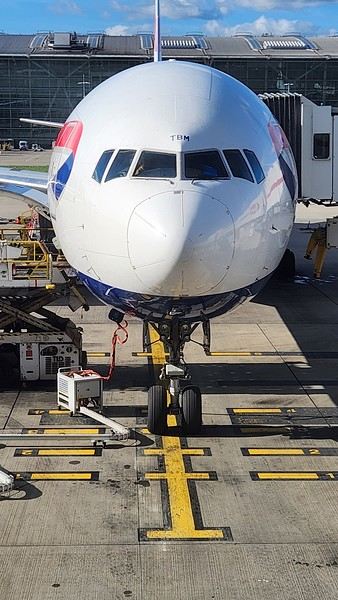
We all have two lives. And the second one kicks off the day you realize you only have one, with the determination to spend the time you have left on what truly adds sparkle to your life, Kevin! I like to elegantly introduce a trip with a philosophical quote. First, it gives you the illusion that I’m some kind of deep thinker, and second, it lets me fill up the first few lines of my blank page when I don’t know how to tell you I’m diving back into what really lights up my life: another adventure beyond the horizon! And nearly every other year, like a toxic relationship, my horizon tends to take shape in Uncle Sam’s backyard. And this, despite his cousin Donald calling the shots. Speaking of which, it was partly that impulsive guy who pushed us to be just as impulsive and snag our four flight tickets at a ridiculously low price—a direct result of foreign tourism taking a hit from BetaMax’s repeated antics... Four tickets? Who are the other lucky ones? In this case, our lucky ones are actually lucky ladies: My Flo, always up for exploring the world with me on foot, camelback, or scooter, is obviously in on the fun. The other two seats went to our daughters, Sasha and Luna, both thrilled to be part of this new American adventure...
But what’s the American West like in February?... A gamble. Let’s call it Russian roulette since we’re not landing during peak weather season. That’s why we encouraged our transportation and accommodation to get cozy and produce a little camper van, so we can stay ultra-flexible in the face of any weather tantrums. We’ll be roaming in Kara the van with the motto "Follow the sun!" Bad weather? We bolt. Snow? We speed up. Sunny? We act like it was the plan all along and soak it up.
"Okay, but why keep coming back to the same corner of the globe? After ten American adventures, you must be tired of seeing the same things, right?" But I’m not crazy, you know!... The American West is like making love to your gorgeous wife over and over, always enjoying it just as much. And contrary to what you might think, the American West isn’t just the Grand Canyon, Monument Valley, Las Vegas, and Bryce Canyon. Proof is, after ten trips to the U.S., my retinas are still untouched by three-quarters of the places I scribbled on a napkin for this adventure... Oh, and add to that my wife, who I’ve easily converted to my religion, and boom... relapse is even easier! Because yes, we’ve landed in Los Angeles after a sunny flight over Greenland, still under Danish flag for now. And we’re already heading east through the XXL traffic of L.A.’s eight-lane highways, eager to dive into our first discoveries. But first, night is taking over the sky, and second, we’ve been officially awake for 24 hours, so I suggest wrapping up this intro. I’ll tell you more tomorrow morning. Sound good?

We all have two lives. And the second one kicks off the day you realize you only have one, with the determination to spend the time you have left on what truly adds sparkle to your life, Kevin! I like to elegantly introduce a trip with a philosophical quote. First, it gives you the illusion that I’m some kind of deep thinker, and second, it lets me fill up the first few lines of my blank page when I don’t know how to tell you I’m diving back into what really lights up my life: another adventure beyond the horizon! And nearly every other year, like a toxic relationship, my horizon tends to take shape in Uncle Sam’s backyard. And this, despite his cousin Donald calling the shots. Speaking of which, it was partly that impulsive guy who pushed us to be just as impulsive and snag our four flight tickets at a ridiculously low price—a direct result of foreign tourism taking a hit from BetaMax’s repeated antics... Four tickets? Who are the other lucky ones? In this case, our lucky ones are actually lucky ladies: My Flo, always up for exploring the world with me on foot, camelback, or scooter, is obviously in on the fun. The other two seats went to our daughters, Sasha and Luna, both thrilled to be part of this new American adventure...
But what’s the American West like in February?... A gamble. Let’s call it Russian roulette since we’re not landing during peak weather season. That’s why we encouraged our transportation and accommodation to get cozy and produce a little camper van, so we can stay ultra-flexible in the face of any weather tantrums. We’ll be roaming in Kara the van with the motto "Follow the sun!" Bad weather? We bolt. Snow? We speed up. Sunny? We act like it was the plan all along and soak it up.
"Okay, but why keep coming back to the same corner of the globe? After ten American adventures, you must be tired of seeing the same things, right?" But I’m not crazy, you know!... The American West is like making love to your gorgeous wife over and over, always enjoying it just as much. And contrary to what you might think, the American West isn’t just the Grand Canyon, Monument Valley, Las Vegas, and Bryce Canyon. Proof is, after ten trips to the U.S., my retinas are still untouched by three-quarters of the places I scribbled on a napkin for this adventure... Oh, and add to that my wife, who I’ve easily converted to my religion, and boom... relapse is even easier! Because yes, we’ve landed in Los Angeles after a sunny flight over Greenland, still under Danish flag for now. And we’re already heading east through the XXL traffic of L.A.’s eight-lane highways, eager to dive into our first discoveries. But first, night is taking over the sky, and second, we’ve been officially awake for 24 hours, so I suggest wrapping up this intro. I’ll tell you more tomorrow morning. Sound good?
South Africa in safari mode: February/March 2026
Hi everyone,
With my girlfriend Christelle, we’ve chosen South Africa for our first trip to Southern Africa, focusing on safaris—after a long debate with a Cape Town/Kruger combo. But that would’ve meant cutting out St Lucia, which would’ve been harder to fit into another trip. And St Lucia—thanks to Michel and all those travel journals—we really wanted to go there.
So our 11-night itinerary ended up like this, mostly shaped by school holidays: - 3 nights in St Lucia - 1 night in Hluhluwe - 1 night at Mkhaya Game Reserve (Eswatini) - 1 night at Hlane Royal National Park (Eswatini) - 3 nights in Kruger (Berg en Dal / Satara / Tamboti) - 1 night at Shindzela Tented Camp in the Timbavati private reserve - 1 final night in Kruger at Lower Sabie
All of this in the off-season and rainy season, just a month after catastrophic floods that killed over 150 people and seriously damaged Kruger’s infrastructure.
I’ll jump straight to St Lucia and skip the loooong journey to get there (with a layover in Frankfurt, landing in Johannesburg, a domestic flight to Durban, and the rest by rental SUV—First Car Rental, perfect, no complaints).
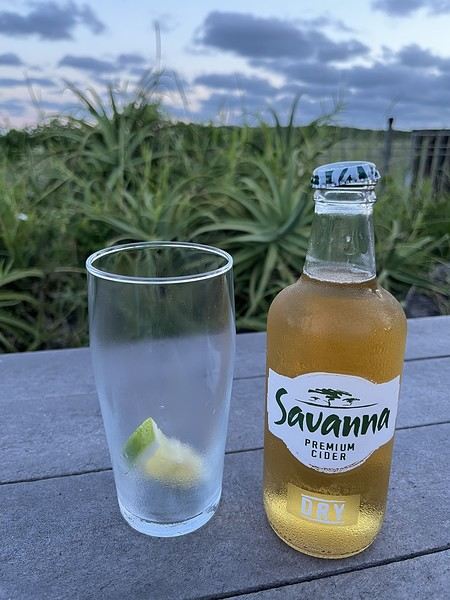
To motivate readers—especially some familiar faces here—I’ll drop in a first photo.
With my girlfriend Christelle, we’ve chosen South Africa for our first trip to Southern Africa, focusing on safaris—after a long debate with a Cape Town/Kruger combo. But that would’ve meant cutting out St Lucia, which would’ve been harder to fit into another trip. And St Lucia—thanks to Michel and all those travel journals—we really wanted to go there.
So our 11-night itinerary ended up like this, mostly shaped by school holidays: - 3 nights in St Lucia - 1 night in Hluhluwe - 1 night at Mkhaya Game Reserve (Eswatini) - 1 night at Hlane Royal National Park (Eswatini) - 3 nights in Kruger (Berg en Dal / Satara / Tamboti) - 1 night at Shindzela Tented Camp in the Timbavati private reserve - 1 final night in Kruger at Lower Sabie
All of this in the off-season and rainy season, just a month after catastrophic floods that killed over 150 people and seriously damaged Kruger’s infrastructure.
I’ll jump straight to St Lucia and skip the loooong journey to get there (with a layover in Frankfurt, landing in Johannesburg, a domestic flight to Durban, and the rest by rental SUV—First Car Rental, perfect, no complaints).
To motivate readers—especially some familiar faces here—I’ll drop in a first photo.
From Avignon to Casamance Without Flying
Hi there,
Last February, I made a trip using "public transport" from France to southern Senegal via Spain, Morocco, Western Sahara, and Mauritania.
It’s a journey of about 5,000 km, where I took trains (as far as Marrakech), ferries (to cross Gibraltar and then to reach Casamance from Dakar), and mostly buses on the long desert straightaways. I hadn’t planned any stops in advance or booked any hotels, except for the very first train to Spain, which left plenty of room for the unexpected. Why travel by land and sea? In recent years, flight-free travel has been gaining popularity. On social media, posts explaining how to cross Europe by train as quickly as possible go viral. Traveling without flying—and making sure people know about it—has become a great way to earn a badge of eco-responsibility: an essential totem for anyone wanting to prove both their dedication to the ecological cause and the wisdom of slow travel. I haven’t flown in years, and this journey to West Africa could easily be filed under "responsible travel." But it wouldn’t be honest to say that: in reality, it wasn’t really my aversion to flying that motivated this long trek. I see overland travel primarily as a way to experience the world’s geography at a grounded, earthly pace—the pace of the locals. Besides, I’ll be flying back, which disqualifies any claim to being a model of sustainability. So no eco-badge, and no adventurer’s badge either: you won’t find any heroic tales of camel rides in lost lands or mineral train wagons in this account (popular with influencers, the Mauritania iron ore train now attracts tourists from all over the world, turning "the experience" into something you "have to do at least once in your life"). This five-part story, written on the road, has no other ambition than to recount a journey through places and people, and to share the thoughts they inspire in me. As simply and, I hope, as humbly as possible.
I’m posting the episodes here, which you can also find on my blog (with more photos) at the following links:
Episode 1: Spain, from Avignon to Algeciras
Episode 2: Morocco, from Tangier to Tarfaya
Episode 3: Western Sahara, from Tarfaya to Guerguerat
Episode 4: Mauritania, from Guerguerat to Nouakchott
Episode 5: Senegal, from Rosso to Saloulou
To help those who might want to make the same trip, I’ve also put together a summary of the route with recommendations—you can read it at the end of the story and on the blog: From France to Senegal Without Flying: Route and Itinerary Recommendations
Happy reading, and safe travels!
Last February, I made a trip using "public transport" from France to southern Senegal via Spain, Morocco, Western Sahara, and Mauritania.
It’s a journey of about 5,000 km, where I took trains (as far as Marrakech), ferries (to cross Gibraltar and then to reach Casamance from Dakar), and mostly buses on the long desert straightaways. I hadn’t planned any stops in advance or booked any hotels, except for the very first train to Spain, which left plenty of room for the unexpected. Why travel by land and sea? In recent years, flight-free travel has been gaining popularity. On social media, posts explaining how to cross Europe by train as quickly as possible go viral. Traveling without flying—and making sure people know about it—has become a great way to earn a badge of eco-responsibility: an essential totem for anyone wanting to prove both their dedication to the ecological cause and the wisdom of slow travel. I haven’t flown in years, and this journey to West Africa could easily be filed under "responsible travel." But it wouldn’t be honest to say that: in reality, it wasn’t really my aversion to flying that motivated this long trek. I see overland travel primarily as a way to experience the world’s geography at a grounded, earthly pace—the pace of the locals. Besides, I’ll be flying back, which disqualifies any claim to being a model of sustainability. So no eco-badge, and no adventurer’s badge either: you won’t find any heroic tales of camel rides in lost lands or mineral train wagons in this account (popular with influencers, the Mauritania iron ore train now attracts tourists from all over the world, turning "the experience" into something you "have to do at least once in your life"). This five-part story, written on the road, has no other ambition than to recount a journey through places and people, and to share the thoughts they inspire in me. As simply and, I hope, as humbly as possible.
I’m posting the episodes here, which you can also find on my blog (with more photos) at the following links:
Episode 1: Spain, from Avignon to Algeciras
Episode 2: Morocco, from Tangier to Tarfaya
Episode 3: Western Sahara, from Tarfaya to Guerguerat
Episode 4: Mauritania, from Guerguerat to Nouakchott
Episode 5: Senegal, from Rosso to Saloulou
To help those who might want to make the same trip, I’ve also put together a summary of the route with recommendations—you can read it at the end of the story and on the blog: From France to Senegal Without Flying: Route and Itinerary Recommendations
Happy reading, and safe travels!
A Bold Combo: Southern Peru, Bolivia, and Northern Chile
Hello everyone,
For our latest 3-week family trip (yes, the kids are growing up, and two of them are about to enter the working world), we’re heading to South America! For our first time on this continent, I had planned a classic 3-week loop in Peru.
But since we won’t be returning to this part of the world anytime soon, I thought: why not follow in the footsteps of Franck, aka Bibouns51, who, in 18 days, didn’t just stick to Peru but also added two of the planet’s most stunning landscapes to his itinerary... the Salar de Uyuni in Bolivia and its neighbor, the fabulous Atacama Desert in northern Chile !!
So, I set about the tricky task of limiting the regions we’d visit in Peru to those we considered must-sees, to avoid rushing too much. The visit schedules were optimized, including several comfortable overnight buses that have the huge advantage of letting us hop between regions.
So, we’re off on a somewhat adventurous trip with three domestic flights (two on the first day and one on the last), two overnight buses for quick hops, several car rentals, the services of a few drivers to make the trip more comfortable, and even a tour operator for crossing the Salar...
Our main concern is altitude sickness, and we’re bringing Diamox, aspirin, etc., just in case.
Our second worry before departure was not even getting off the ground... Yes, for once, we’re leaving from France—Marseille, to be exact. The week before our departure, with the surprise air traffic controllers’ strike, I remembered why we usually prefer to leave from abroad, like Turin or Barcelona... In the end, it wasn’t the air traffic controllers who made us nervous but the early July wildfires that paralyzed the airport a few days before our departure. Fortunately, the fires were quickly brought under control, and on the big day, everything was smooth sailing!
Detailed itinerary (which changed on Day 1 due to departure hiccups): Day 0: Flight Marseille - Madrid - Lima PERU Theoretical and abandoned Day 1: Flight Lima - Cuzco and visit Cuzco (Puka Pukara, Tambomachay, Cristo Blanco Observatory, Sacsayhuaman sunset) - Night in Cuzco Day 2: Taxi -> Chinchero - Moray - Maras Salt Mines - Ollantaytambo - Train to Aguas Calientes Day 3: Machu Picchu - Return train to Ollantaytambo Day 4: 2-day taxi -> Pisac - Tipon - Andahuaylillas - Huaro - Night in San Pedro Day 5: Palcoyo - Checacupe - Vinicunca - Return and night in Cuzco Day 6: Day in Cuzco (catch-up on Sacsayhuaman, San Blas district, Temple of the Sun) - Overnight bus to Arequipa Day 7: Rental car -> On the road to Colca Canyon, night in Cabanaconde Day 8: Descent to the bottom of Colca Canyon, night at Oasis Sangalle Day 9: Ascent from the canyon - Maca - Chivay - Return and night in Arequipa Day 10: Visit Arequipa (Santa Catalina Convent, La Recoleta Church and Monastery, La Compañía Church, Cathedral) - Overnight bus to Puno Day 11: Lake Titicaca - Night in Puno BOLIVIA Day 12: Shared taxi -> Road to La Paz, visit downtown La Paz - Night 1 in La Paz Day 13: Moon Valley and Las Animas Valley - Night 2 in La Paz Day 14: Day in La Paz - Night 3 in La Paz Day 15: Flight to Uyuni - Day 1 of Salar de Uyuni tour - Night at the edge of the Salar Day 16: Crossing the Lipez region and lagoons - Night near Laguna Colorada Day 17: Sol de Mañana CHILE Day 17 cont.: Pre-booked transfer to SPDA - 4x4 rental - Pukara de Quitor - Stargazing tour - Night 1 in SPDA Day 18: Death Valley and Moon Valley - Night 2 in SPDA Day 19: Miscanti and Miniques Lagoons, Salar de Aguas Calientes and its Piedra Roja, Tebenquiche Lagoon and Quebrada del Diablo - Night 3 in SPDA Day 20: Rainbow Valley and swim in the Puritama River - Night 4 in SPDA Day 21: Tebenquiche Lagoon - Bus to Calama - Flight to Santiago Day 22: Return Santiago - Madrid - Marseille
Day 0 - 11/07: Destination Lima
Our first flight from Marseille went smoothly to our Iberia layover in Madrid.
In Madrid, just after getting off the plane around 8 PM, and as we were walking through the terminal, we got a rude awakening!!
We saw the word "Cancelled" next to our flight number on the display boards. Thinking it must be a glitch, we checked another screen, but the system was stubborn, and the same dreaded word appeared !
So, we headed to the Iberia counter, where an agent confirmed that our Friday evening flight was canceled and rescheduled for the next morning. The reason? A breakdown and no replacement plane, even though we were in Madrid, Iberia’s home base!
To make matters worse, I remembered our super-tight schedule, planned to the minute, with no buffer day in Lima. Since I’m a bit phobic of megacities and hadn’t found anything appealing in the Peruvian capital in our guidebooks, we’d planned to leave Lima as soon as possible for Cusco, the heart of the Sacred Valley, to spend our first day there.
Bad idea, because we already knew the 4-hour buffer wouldn’t be enough, and we’d miss the domestic flight, which was, of course, non-refundable and non-changeable. So, we had to call LATAM from Madrid to find another flight for Saturday evening and negotiate a rate to recover some of our initial outlay.
After an hour on the phone with customer service, several endless holds, and three failed attempts to dictate our credit card number over the phone to a Spaniard speaking English with a thick accent, we finally managed to confirm the transaction, securing our new flight tickets for a moderate extra cost of just 150 € total.
At first, we were pretty bummed about losing a day and incurring extra fees to reschedule the domestic flight, but then, when we learned from an Iberia customer service rep that we’d receive the max compensation of 600 € per traveler, we even ended up grinning... because 3000 € in refunds for only losing the first day in Cusco? We’d sign up for that 10 times over!!
Iberia then took care of us, putting us up in a hotel where we had dinner before a short 5-hour night and an early morning departure. I took the opportunity to improvise a quick day of sightseeing in Lima, focusing on the Barranco and Miraflores districts.
For our latest 3-week family trip (yes, the kids are growing up, and two of them are about to enter the working world), we’re heading to South America! For our first time on this continent, I had planned a classic 3-week loop in Peru.
But since we won’t be returning to this part of the world anytime soon, I thought: why not follow in the footsteps of Franck, aka Bibouns51, who, in 18 days, didn’t just stick to Peru but also added two of the planet’s most stunning landscapes to his itinerary... the Salar de Uyuni in Bolivia and its neighbor, the fabulous Atacama Desert in northern Chile !!
So, I set about the tricky task of limiting the regions we’d visit in Peru to those we considered must-sees, to avoid rushing too much. The visit schedules were optimized, including several comfortable overnight buses that have the huge advantage of letting us hop between regions.
So, we’re off on a somewhat adventurous trip with three domestic flights (two on the first day and one on the last), two overnight buses for quick hops, several car rentals, the services of a few drivers to make the trip more comfortable, and even a tour operator for crossing the Salar...
Our main concern is altitude sickness, and we’re bringing Diamox, aspirin, etc., just in case.
Our second worry before departure was not even getting off the ground... Yes, for once, we’re leaving from France—Marseille, to be exact. The week before our departure, with the surprise air traffic controllers’ strike, I remembered why we usually prefer to leave from abroad, like Turin or Barcelona... In the end, it wasn’t the air traffic controllers who made us nervous but the early July wildfires that paralyzed the airport a few days before our departure. Fortunately, the fires were quickly brought under control, and on the big day, everything was smooth sailing!
Detailed itinerary (which changed on Day 1 due to departure hiccups): Day 0: Flight Marseille - Madrid - Lima PERU Theoretical and abandoned Day 1: Flight Lima - Cuzco and visit Cuzco (Puka Pukara, Tambomachay, Cristo Blanco Observatory, Sacsayhuaman sunset) - Night in Cuzco Day 2: Taxi -> Chinchero - Moray - Maras Salt Mines - Ollantaytambo - Train to Aguas Calientes Day 3: Machu Picchu - Return train to Ollantaytambo Day 4: 2-day taxi -> Pisac - Tipon - Andahuaylillas - Huaro - Night in San Pedro Day 5: Palcoyo - Checacupe - Vinicunca - Return and night in Cuzco Day 6: Day in Cuzco (catch-up on Sacsayhuaman, San Blas district, Temple of the Sun) - Overnight bus to Arequipa Day 7: Rental car -> On the road to Colca Canyon, night in Cabanaconde Day 8: Descent to the bottom of Colca Canyon, night at Oasis Sangalle Day 9: Ascent from the canyon - Maca - Chivay - Return and night in Arequipa Day 10: Visit Arequipa (Santa Catalina Convent, La Recoleta Church and Monastery, La Compañía Church, Cathedral) - Overnight bus to Puno Day 11: Lake Titicaca - Night in Puno BOLIVIA Day 12: Shared taxi -> Road to La Paz, visit downtown La Paz - Night 1 in La Paz Day 13: Moon Valley and Las Animas Valley - Night 2 in La Paz Day 14: Day in La Paz - Night 3 in La Paz Day 15: Flight to Uyuni - Day 1 of Salar de Uyuni tour - Night at the edge of the Salar Day 16: Crossing the Lipez region and lagoons - Night near Laguna Colorada Day 17: Sol de Mañana CHILE Day 17 cont.: Pre-booked transfer to SPDA - 4x4 rental - Pukara de Quitor - Stargazing tour - Night 1 in SPDA Day 18: Death Valley and Moon Valley - Night 2 in SPDA Day 19: Miscanti and Miniques Lagoons, Salar de Aguas Calientes and its Piedra Roja, Tebenquiche Lagoon and Quebrada del Diablo - Night 3 in SPDA Day 20: Rainbow Valley and swim in the Puritama River - Night 4 in SPDA Day 21: Tebenquiche Lagoon - Bus to Calama - Flight to Santiago Day 22: Return Santiago - Madrid - Marseille
Day 0 - 11/07: Destination Lima
Our first flight from Marseille went smoothly to our Iberia layover in Madrid.
In Madrid, just after getting off the plane around 8 PM, and as we were walking through the terminal, we got a rude awakening!!
We saw the word "Cancelled" next to our flight number on the display boards. Thinking it must be a glitch, we checked another screen, but the system was stubborn, and the same dreaded word appeared !
So, we headed to the Iberia counter, where an agent confirmed that our Friday evening flight was canceled and rescheduled for the next morning. The reason? A breakdown and no replacement plane, even though we were in Madrid, Iberia’s home base!
To make matters worse, I remembered our super-tight schedule, planned to the minute, with no buffer day in Lima. Since I’m a bit phobic of megacities and hadn’t found anything appealing in the Peruvian capital in our guidebooks, we’d planned to leave Lima as soon as possible for Cusco, the heart of the Sacred Valley, to spend our first day there.
Bad idea, because we already knew the 4-hour buffer wouldn’t be enough, and we’d miss the domestic flight, which was, of course, non-refundable and non-changeable. So, we had to call LATAM from Madrid to find another flight for Saturday evening and negotiate a rate to recover some of our initial outlay.
After an hour on the phone with customer service, several endless holds, and three failed attempts to dictate our credit card number over the phone to a Spaniard speaking English with a thick accent, we finally managed to confirm the transaction, securing our new flight tickets for a moderate extra cost of just 150 € total.
At first, we were pretty bummed about losing a day and incurring extra fees to reschedule the domestic flight, but then, when we learned from an Iberia customer service rep that we’d receive the max compensation of 600 € per traveler, we even ended up grinning... because 3000 € in refunds for only losing the first day in Cusco? We’d sign up for that 10 times over!!
Iberia then took care of us, putting us up in a hotel where we had dinner before a short 5-hour night and an early morning departure. I took the opportunity to improvise a quick day of sightseeing in Lima, focusing on the Barranco and Miraflores districts.
Review of an expedition cruise to the Seychelles with Ponant from January 25 to February 2, 2026
Hi everyone,
It was totally by chance that I found this cruise while chatting with Alfred in November 2024. It wasn’t planned, but the price was attractive—one of those "great deals" from Ponant that I love and that don’t exist anymore. Since everyone’s wondering, here’s the answer without waiting for the end of the story: after my various loyalty discounts, I paid **3,250 € per person** for 8 nights/9 days on the expedition cruise *The Essentials of the Seychelles*.
Expedition cruises are by far our favorites. The outings are done by Zodiac with the ship’s naturalist guides, everything’s included, and there’s no need to add any excursions or prepare anything.
We’re liking long flights less and less, so to break up the trip, we decided to stop over in Doha for four days on the way there and one day on the way back.
I’m happy to share the good and not-so-good moments, the great surprises, and the disappointments of this trip with you.
It was totally by chance that I found this cruise while chatting with Alfred in November 2024. It wasn’t planned, but the price was attractive—one of those "great deals" from Ponant that I love and that don’t exist anymore. Since everyone’s wondering, here’s the answer without waiting for the end of the story: after my various loyalty discounts, I paid **3,250 € per person** for 8 nights/9 days on the expedition cruise *The Essentials of the Seychelles*.
Expedition cruises are by far our favorites. The outings are done by Zodiac with the ship’s naturalist guides, everything’s included, and there’s no need to add any excursions or prepare anything.
We’re liking long flights less and less, so to break up the trip, we decided to stop over in Doha for four days on the way there and one day on the way back.
I’m happy to share the good and not-so-good moments, the great surprises, and the disappointments of this trip with you.
From the Awakening to Travel to Morocco in the 90s
As I’ve mentioned elsewhere, I inherited my love of travel from my parents and some of my grandparents. A strong passion, but one that was unfortunately limited by our family’s modest resources. Back then, living in northern Alsace, a simple trip to the southern part of the region—with the Wine Route as our destination—felt like an extraordinary journey to a land of plenty for the little boy I was in the late 60s and early 70s.
Everything seemed so huge when you were still just a kid.
Back then, I was overwhelmed by countless sensations—I was already highly sensitive, with a keen mind and a nose and taste buds that were developing like a pro’s. Which, as I’d later realize, wasn’t always an advantage.
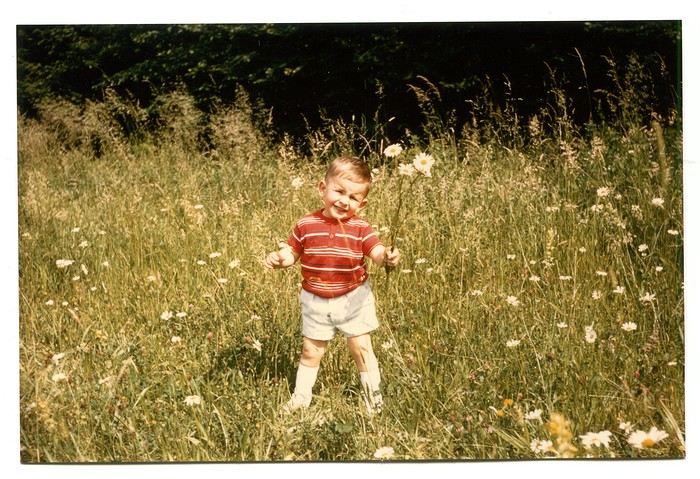
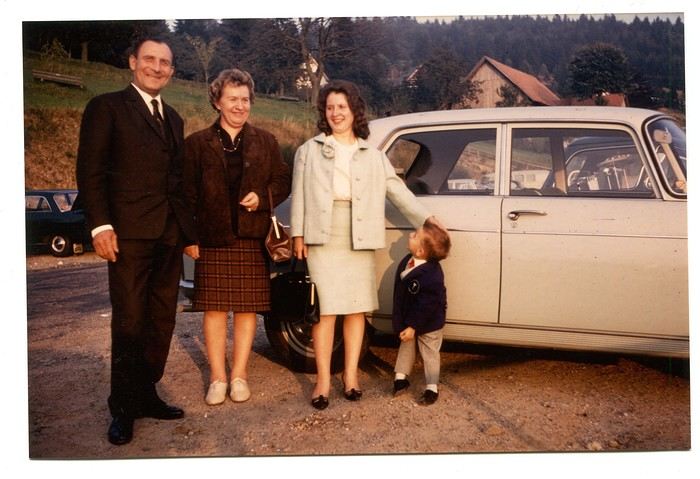
Those magical days always began with a gentle late-spring or midsummer morning. The interior of the white Peugeot 404, license plate 210 LZ 67, had already soaked up the sun before the engine purred to life, and the cabin gave off a scent I could still recognize today—a fragrance I found so pleasant. Back then, I had no idea it was just the smell of warm plastic from the car’s interior. Yes, the scents of the 404 on sunny days became my madeleine de Proust... What’s more, the whole family was unusually cheerful because those moments of relaxation and leisure were rare. Everyone worked, and no one had an easy job or was well paid. Without the *Trente Glorieuses*, these experiences might never have happened.
Once we crossed the canton’s borders, I felt like I was light-years away from my everyday surroundings, and every kilometer plunged me deeper into *terra incognita*. It was thrilling. Far from my so-called "medium-sized" town, wheat fields, cornfields, and cabbage patches stretched out, punctuated by tall poles connected by long wires and topped with vegetation—like giant clotheslines without laundry, where magical beanstalks might grow to touch the sky. Back then, I was still far from tasting their product, which was simply beer. At the time, there was still a significant local hop production. Fun fact: it wasn’t until 2002 that Anglo-Saxon scientists proved hops and cannabis belong to the same biological family.
After the fields, the landscape took another step up as it rolled past the little boy’s eyes, often glued to the windows. First came modest hills, then a succession of rolling slopes that soon formed an unbroken chain. Their 700 meters in altitude felt like Himalayan peaks to me—impressive, inert giants, a whole new world. Gazing at them, an intense emotion welled up somewhere between my stomach and lungs, nearly taking my breath away. What mysteries, what treasures did these heights hold? And then there were the cherries on top—the crowning touch that made the scene even more magical: proud, majestic castles perched on the summits like impassive sentinels. Monuments from the past, yet firmly rooted in the present on their rocky spurs. The little boy’s eyes sparkled—he’d been given a castle for Christmas, complete with battlements, towers, a drawbridge, and fully armed knights. He’d watched and lived *Ivanhoe* on the only French TV channel that existed back then.
Only once did my paternal grandfather join us on one of these trips. A tall, intelligent man with a face that could shift from stern to mischievous, clearly full of humor and charisma. Sadly, his relationship with alcohol had taken a toll on his life and, by extension, those of his loved ones. He had a strong personality—if his boss crossed the line, he wouldn’t hesitate to punch him, which meant he went through a lot of different jobs. Back then, you could quit one job and easily find another. It was quite something to see him in his final stages, hallucinating pink elephants and even drinking perfume when he had nothing else left. The last time I saw him, he’d slipped away from the doctors and nurses while hospitalized in pretty bad shape—at least, I assume his liver was the issue. We were sitting down for a family lunch when the door burst open, and there he stood in his pajamas, eyes twinkling with mischief, clearly pleased with the dramatic entrance. That theatrical moment didn’t spare us from burying him a few months later at the age of 71. One day, my mother told me the family doctor had quietly remarked that it was a shame—with his robust constitution, he could’ve lived to be a hundred. Yes, the family doctor—this was the man who’d come treat you any day, at almost any hour, just for a phone call. It really existed, it’s not a myth!
That day, his wife—my paternal grandmother—was also along for the ride. Everyone agreed that Jeannette was a good woman. She worked as a waitress at *Le Tigre*, the biggest brasserie in town, right in the center. Most customers preferred to be served by her, including local dignitaries and even the mayor. As a kid, I didn’t find her very fun, open, or warm—she seemed a bit stern. Back then, women in their fifties already had the face and build of grandmothers. Same went for men, don’t get me wrong. I had no idea about the struggles she faced because of her husband. I didn’t know that 30 years earlier, she’d had to flee Alsace while pregnant, under threat from Nazi fighter-bombers. I didn’t know she’d had several miscarriages, and that my father—her only surviving child, born prematurely in March 1940 at the other end of France—weighed less than a kilo at birth and was so tiny he could fit in a shoebox. Hard to imagine he’d grow into a strapping man nearly 1.80 meters tall, tipping the scales at 100 kilos. When you come back from summer camp in early August and ask why she didn’t pick you up with your parents, and they gently tell you she’s "in heaven," you don’t realize she passed away at 54 after suffering greatly from stomach cancer that had spread.
Back to that family outing, that enchanted parenthesis. I even remembered where we’d had lunch when I passed through Dambach-la-Ville decades later. One of those charming, flower-filled towns Alsace produces in abundance—and preserves so well. This one sits high on a hill, and I was a bit stunned on the parking lot because the view stretched far, revealing the Alsace plain below—its fields, villages, hills, and forests. The world seemed so vast and enticing that day, even though I was only glimpsing a tiny fraction of it.
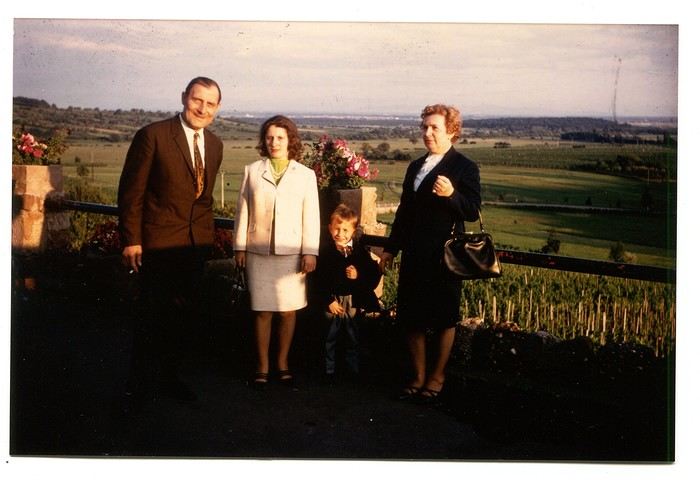
The region was already very touristy, but I wouldn’t notice the downsides until much later. That Sunday noon, I discovered a large restaurant filled with diners. I can still see the enormous piece of meat they served me, decorated with a little wooden skewer topped with a flag. I kept that one for a long time. Those were the golden days of rich, flowing, thick sauces—so flavorful—and the era of the world’s best fries, made on the spot with the best potatoes. To top it off, I was *exceptionally* allowed a small bottle of apple juice, Orangina, or—even better if possible—Sinalco. Yes, Sinalco—like Orangina, but better. A brand that must’ve disappeared in the 70s, but why, and what a shame! Since then, Orangina’s little bubbles have taken the brand to the other side of the planet—it’s now Japanese.
Year after year, I’d eagerly await that ecstatic moment when the most beautiful castle in Alsace, the Haut-Koenigsbourg, appeared in my field of vision. The perfect model, the archetype that blended into the landscape at the height of a child’s dreams. The trip home always felt like a reality check—less jarring than an alarm clock, but more diffuse and melancholic. From then on, there was only one wish: *When do we leave again?*
Those magical days always began with a gentle late-spring or midsummer morning. The interior of the white Peugeot 404, license plate 210 LZ 67, had already soaked up the sun before the engine purred to life, and the cabin gave off a scent I could still recognize today—a fragrance I found so pleasant. Back then, I had no idea it was just the smell of warm plastic from the car’s interior. Yes, the scents of the 404 on sunny days became my madeleine de Proust... What’s more, the whole family was unusually cheerful because those moments of relaxation and leisure were rare. Everyone worked, and no one had an easy job or was well paid. Without the *Trente Glorieuses*, these experiences might never have happened.
Once we crossed the canton’s borders, I felt like I was light-years away from my everyday surroundings, and every kilometer plunged me deeper into *terra incognita*. It was thrilling. Far from my so-called "medium-sized" town, wheat fields, cornfields, and cabbage patches stretched out, punctuated by tall poles connected by long wires and topped with vegetation—like giant clotheslines without laundry, where magical beanstalks might grow to touch the sky. Back then, I was still far from tasting their product, which was simply beer. At the time, there was still a significant local hop production. Fun fact: it wasn’t until 2002 that Anglo-Saxon scientists proved hops and cannabis belong to the same biological family.
After the fields, the landscape took another step up as it rolled past the little boy’s eyes, often glued to the windows. First came modest hills, then a succession of rolling slopes that soon formed an unbroken chain. Their 700 meters in altitude felt like Himalayan peaks to me—impressive, inert giants, a whole new world. Gazing at them, an intense emotion welled up somewhere between my stomach and lungs, nearly taking my breath away. What mysteries, what treasures did these heights hold? And then there were the cherries on top—the crowning touch that made the scene even more magical: proud, majestic castles perched on the summits like impassive sentinels. Monuments from the past, yet firmly rooted in the present on their rocky spurs. The little boy’s eyes sparkled—he’d been given a castle for Christmas, complete with battlements, towers, a drawbridge, and fully armed knights. He’d watched and lived *Ivanhoe* on the only French TV channel that existed back then.
Only once did my paternal grandfather join us on one of these trips. A tall, intelligent man with a face that could shift from stern to mischievous, clearly full of humor and charisma. Sadly, his relationship with alcohol had taken a toll on his life and, by extension, those of his loved ones. He had a strong personality—if his boss crossed the line, he wouldn’t hesitate to punch him, which meant he went through a lot of different jobs. Back then, you could quit one job and easily find another. It was quite something to see him in his final stages, hallucinating pink elephants and even drinking perfume when he had nothing else left. The last time I saw him, he’d slipped away from the doctors and nurses while hospitalized in pretty bad shape—at least, I assume his liver was the issue. We were sitting down for a family lunch when the door burst open, and there he stood in his pajamas, eyes twinkling with mischief, clearly pleased with the dramatic entrance. That theatrical moment didn’t spare us from burying him a few months later at the age of 71. One day, my mother told me the family doctor had quietly remarked that it was a shame—with his robust constitution, he could’ve lived to be a hundred. Yes, the family doctor—this was the man who’d come treat you any day, at almost any hour, just for a phone call. It really existed, it’s not a myth!
That day, his wife—my paternal grandmother—was also along for the ride. Everyone agreed that Jeannette was a good woman. She worked as a waitress at *Le Tigre*, the biggest brasserie in town, right in the center. Most customers preferred to be served by her, including local dignitaries and even the mayor. As a kid, I didn’t find her very fun, open, or warm—she seemed a bit stern. Back then, women in their fifties already had the face and build of grandmothers. Same went for men, don’t get me wrong. I had no idea about the struggles she faced because of her husband. I didn’t know that 30 years earlier, she’d had to flee Alsace while pregnant, under threat from Nazi fighter-bombers. I didn’t know she’d had several miscarriages, and that my father—her only surviving child, born prematurely in March 1940 at the other end of France—weighed less than a kilo at birth and was so tiny he could fit in a shoebox. Hard to imagine he’d grow into a strapping man nearly 1.80 meters tall, tipping the scales at 100 kilos. When you come back from summer camp in early August and ask why she didn’t pick you up with your parents, and they gently tell you she’s "in heaven," you don’t realize she passed away at 54 after suffering greatly from stomach cancer that had spread.
Back to that family outing, that enchanted parenthesis. I even remembered where we’d had lunch when I passed through Dambach-la-Ville decades later. One of those charming, flower-filled towns Alsace produces in abundance—and preserves so well. This one sits high on a hill, and I was a bit stunned on the parking lot because the view stretched far, revealing the Alsace plain below—its fields, villages, hills, and forests. The world seemed so vast and enticing that day, even though I was only glimpsing a tiny fraction of it.
The region was already very touristy, but I wouldn’t notice the downsides until much later. That Sunday noon, I discovered a large restaurant filled with diners. I can still see the enormous piece of meat they served me, decorated with a little wooden skewer topped with a flag. I kept that one for a long time. Those were the golden days of rich, flowing, thick sauces—so flavorful—and the era of the world’s best fries, made on the spot with the best potatoes. To top it off, I was *exceptionally* allowed a small bottle of apple juice, Orangina, or—even better if possible—Sinalco. Yes, Sinalco—like Orangina, but better. A brand that must’ve disappeared in the 70s, but why, and what a shame! Since then, Orangina’s little bubbles have taken the brand to the other side of the planet—it’s now Japanese.
Year after year, I’d eagerly await that ecstatic moment when the most beautiful castle in Alsace, the Haut-Koenigsbourg, appeared in my field of vision. The perfect model, the archetype that blended into the landscape at the height of a child’s dreams. The trip home always felt like a reality check—less jarring than an alarm clock, but more diffuse and melancholic. From then on, there was only one wish: *When do we leave again?*
Tunisian Impressions (Live)
Hi there,
I arrived in Tunisia this afternoon for a full 14-day stay.
I took a direct Tunisair flight from Nice, which departed about thirty minutes late (that’s nothing compared to the "nightmares" I’ve had on some of my recent trips).
The flight lasts around 1 hour and 20 minutes, and a small snack was served on board (a sort of quiche with chickpea purée, a small bread roll, a portion of cheese like La Vache qui rit, and a small chocolate cake). It’s worth mentioning because it’s becoming increasingly rare on short flights. I was seated between two Tunisian gentlemen who gave me some great tips for my trip, especially about negotiating prices. One of them is a former cameraman for France Télévisions, very cultured and well-traveled—his daughter is a journalist at France Télévisions (I found some of her articles online). In short, the flight was very pleasant and quick.

I’m staying at the Hôtel Royal Victoria. I booked it yesterday afternoon by email without providing my credit card number. The room costs 241 TND (71 €) with breakfast included. It has heating, a small fridge, a safe, a hairdryer, Wi-Fi, and a TV with international channels. There’s a police van permanently parked in the square where the hotel is located.
This hotel is housed in the former British consulate and later embassy. It has a lot of charm with its painted wood ceilings and doors, and its bathroom covered in ceramic tiles. The tiny elevator is from another era. The main advantage of the hotel is its location between the medina and Avenue Bourguiba. Nearby, there’s the Magasin Général, where you can find groceries and some typical products like rose water, geranium water, and tons of halwa (a customer kindly explained how to eat it and which is the best).
After nightfall, I took a short stroll down Avenue Bourguiba. There weren’t many people around—it’s windy and cold.
I’ve already noticed the warm welcome from Tunisians. The supermarket cashier welcomed me to Tunisia, and a gentleman I asked for directions to the Magasin Général (I was about to climb stairs leading to a mosque!) insisted on inviting me for coffee, but I declined.
The rest of my itinerary will depend on the weather. If it doesn’t rain tomorrow, I might visit Carthage since the Bardo Museum is closed on Mondays, as are the museums in Sidi Bou Said.
TO BE CONTINUED...


I arrived in Tunisia this afternoon for a full 14-day stay.
I took a direct Tunisair flight from Nice, which departed about thirty minutes late (that’s nothing compared to the "nightmares" I’ve had on some of my recent trips).
The flight lasts around 1 hour and 20 minutes, and a small snack was served on board (a sort of quiche with chickpea purée, a small bread roll, a portion of cheese like La Vache qui rit, and a small chocolate cake). It’s worth mentioning because it’s becoming increasingly rare on short flights. I was seated between two Tunisian gentlemen who gave me some great tips for my trip, especially about negotiating prices. One of them is a former cameraman for France Télévisions, very cultured and well-traveled—his daughter is a journalist at France Télévisions (I found some of her articles online). In short, the flight was very pleasant and quick.
I’m staying at the Hôtel Royal Victoria. I booked it yesterday afternoon by email without providing my credit card number. The room costs 241 TND (71 €) with breakfast included. It has heating, a small fridge, a safe, a hairdryer, Wi-Fi, and a TV with international channels. There’s a police van permanently parked in the square where the hotel is located.
This hotel is housed in the former British consulate and later embassy. It has a lot of charm with its painted wood ceilings and doors, and its bathroom covered in ceramic tiles. The tiny elevator is from another era. The main advantage of the hotel is its location between the medina and Avenue Bourguiba. Nearby, there’s the Magasin Général, where you can find groceries and some typical products like rose water, geranium water, and tons of halwa (a customer kindly explained how to eat it and which is the best).
After nightfall, I took a short stroll down Avenue Bourguiba. There weren’t many people around—it’s windy and cold.
I’ve already noticed the warm welcome from Tunisians. The supermarket cashier welcomed me to Tunisia, and a gentleman I asked for directions to the Magasin Général (I was about to climb stairs leading to a mosque!) insisted on inviting me for coffee, but I declined.
The rest of my itinerary will depend on the weather. If it doesn’t rain tomorrow, I might visit Carthage since the Bardo Museum is closed on Mondays, as are the museums in Sidi Bou Said.
TO BE CONTINUED...
Back to RUAHA and SELOUS (Southern Tanzania).
...
" We’re ALL different, and so are our expectations when it comes to travel or leisure ". There are—without a doubt—as many ways to experience a trip as there are travelers!! For the two of us, it’s only our love of wild nature that guides us to East Africa. The stated goal of this trip was purely wildlife-focused, and NOT about discovering the country or its people.
...
Hello everyone,
Previously, I shared the account of a trip/safari in southern Tanzania in June 2024, in the Mikumi and Selous reserves.
This time, still in southern Tanzania, I invite you to join us in Ruaha National Park. (Then, depending on the number of images allowed in my quota, at the end of my story, we’ll return to Selous for the second part of the same trip.)
- This trip/safari took place in November 2022. - Our flight started in Marseille, heading to Addis Ababa, then Dar es Salaam (via Ethiopian Airlines). In Dar, we spent one night at a hotel near the airfield.
-1- During the layover in Addis Ababa. The Airbus A-350 in the early morning mist.
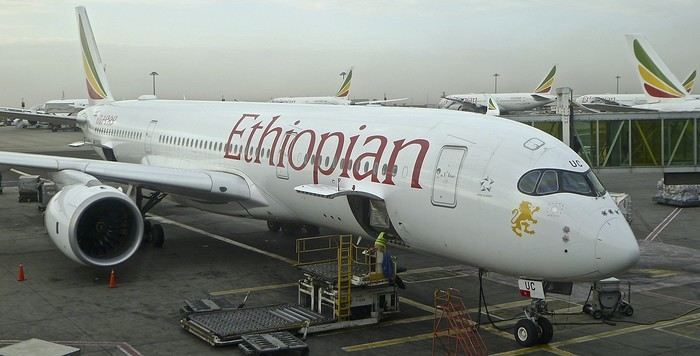
Reminder: Click on each image to enlarge it, if needed. .
From Dar es Salaam, if you want to go by road to Ruaha, it’ll take a very long and tiring day. 🤪
On previous trips, we’ve always taken a bush plane for this route. In this case, it took just over an hour and a half, with two short intermediate stops to drop off passengers at other bush airstrips.
Since I’m also passionate about aviation, I love these flights where you can admire the landscapes from low altitude while sitting right behind the pilot 🙂.
-2- These routes mainly use Cessna 208 Caravans.
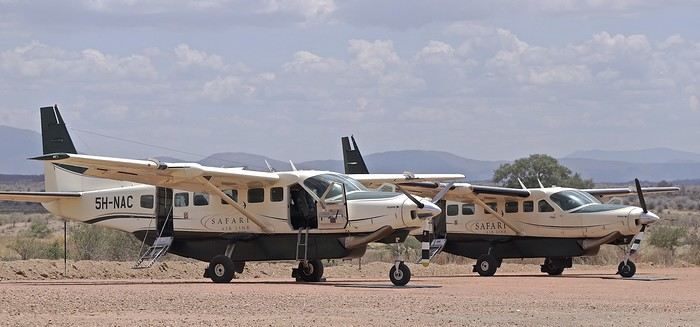
At the Msembe airstrip, we’re greeted around 1:30 PM by a guide and a driver from our chosen lodge. They brought a picnic basket, which we enjoy at a nearby picnic area. We’re by the Ruaha River, completely dry—it’s scorching hot.
-3- The first mammals we encounter are a pair of female impalas, accompanied by a young male.
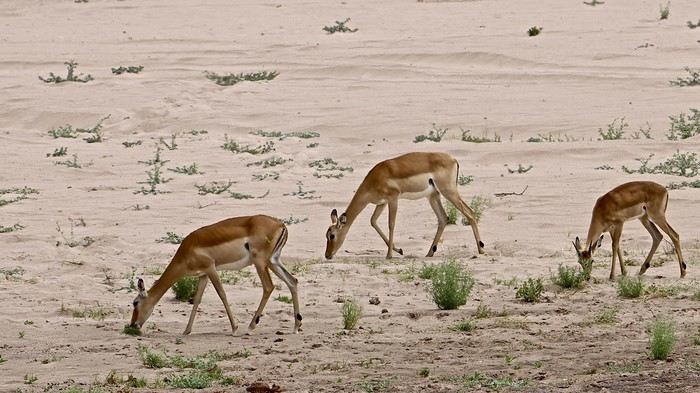
Reminder: Click on the image to view it in larger size. 😉
-4- To save the hippopotamus populations from certain death, rangers had to dig holes in the sand with bulldozers. Fortunately, water is present beneath the sand layer.
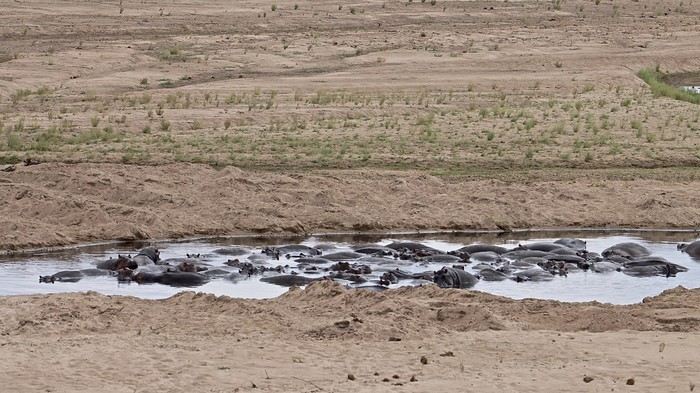
-5- This crocodile doesn’t seem to have been accepted as a swimming neighbor by the hippos...
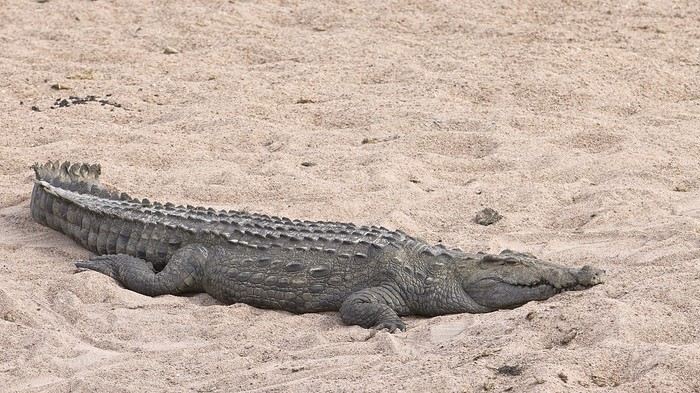
We’ll explore along the river for 2-3 hours before crossing it at a ford toward the southern part of the reserve.
-6- The typical landscape of Ruaha, with its many baobabs.
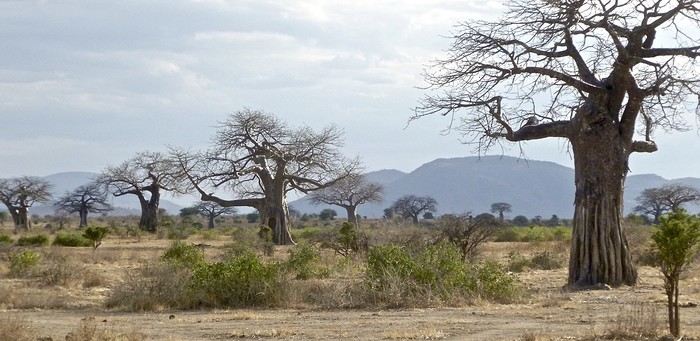
-7- My buddy the R.L.B. is also here to welcome me.... 🙂 🙂
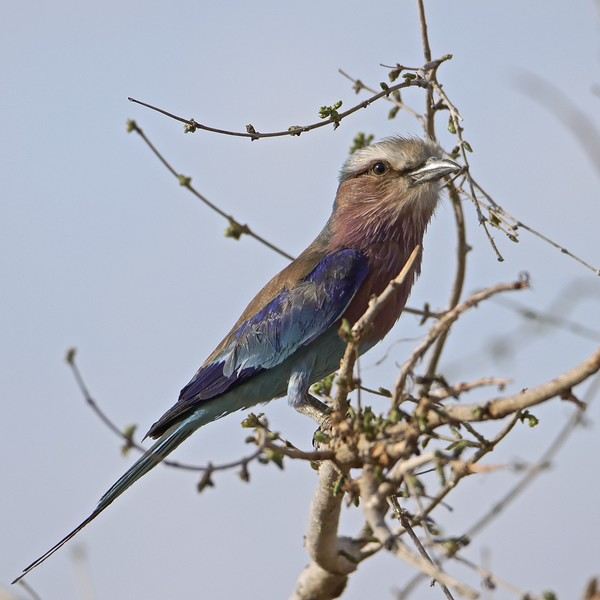
-8- As well as this little bee-eater... 😎
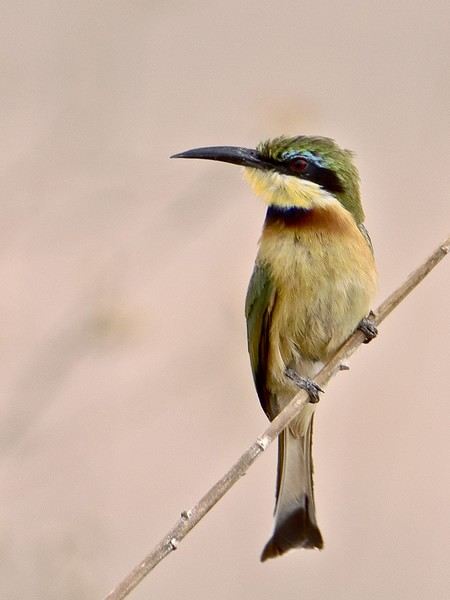
-9- ...which reminds us of the origin of its name...!
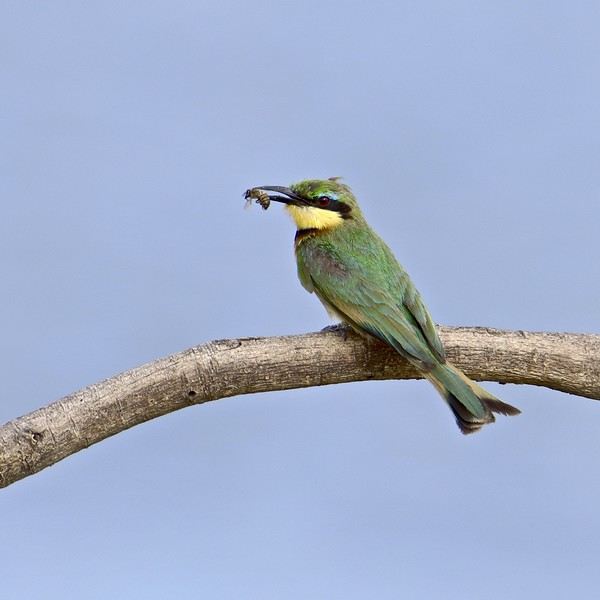
-10- Above a rare waterhole, a fish eagle keeps watch for fish...
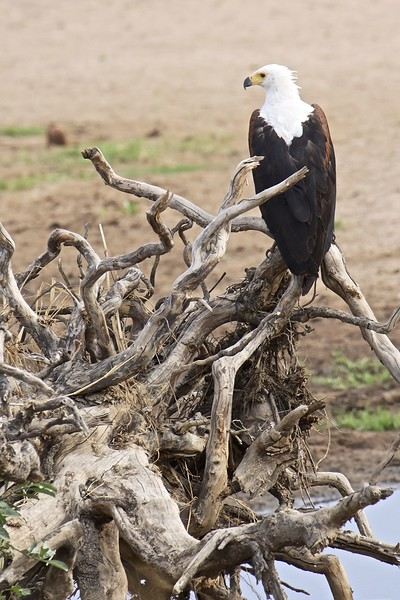
...
*** Please wait until the end of the story for any questions or to share your own experiences in Ruaha. (Or via PM.) Thanks in advance for keeping this account smooth and enjoyable. 😉
...
*** I’m not an ornithologist, but birds are an important and unavoidable part of safari discoveries. You’ll find quite a few in the images of my story. 😎
...
" We’re ALL different, and so are our expectations when it comes to travel or leisure ". There are—without a doubt—as many ways to experience a trip as there are travelers!! For the two of us, it’s only our love of wild nature that guides us to East Africa. The stated goal of this trip was purely wildlife-focused, and NOT about discovering the country or its people.
...
Hello everyone,
Previously, I shared the account of a trip/safari in southern Tanzania in June 2024, in the Mikumi and Selous reserves.
This time, still in southern Tanzania, I invite you to join us in Ruaha National Park. (Then, depending on the number of images allowed in my quota, at the end of my story, we’ll return to Selous for the second part of the same trip.)
- This trip/safari took place in November 2022. - Our flight started in Marseille, heading to Addis Ababa, then Dar es Salaam (via Ethiopian Airlines). In Dar, we spent one night at a hotel near the airfield.
-1- During the layover in Addis Ababa. The Airbus A-350 in the early morning mist.
Reminder: Click on each image to enlarge it, if needed. .
From Dar es Salaam, if you want to go by road to Ruaha, it’ll take a very long and tiring day. 🤪
On previous trips, we’ve always taken a bush plane for this route. In this case, it took just over an hour and a half, with two short intermediate stops to drop off passengers at other bush airstrips.
Since I’m also passionate about aviation, I love these flights where you can admire the landscapes from low altitude while sitting right behind the pilot 🙂.
-2- These routes mainly use Cessna 208 Caravans.
At the Msembe airstrip, we’re greeted around 1:30 PM by a guide and a driver from our chosen lodge. They brought a picnic basket, which we enjoy at a nearby picnic area. We’re by the Ruaha River, completely dry—it’s scorching hot.
-3- The first mammals we encounter are a pair of female impalas, accompanied by a young male.
Reminder: Click on the image to view it in larger size. 😉
-4- To save the hippopotamus populations from certain death, rangers had to dig holes in the sand with bulldozers. Fortunately, water is present beneath the sand layer.
-5- This crocodile doesn’t seem to have been accepted as a swimming neighbor by the hippos...
We’ll explore along the river for 2-3 hours before crossing it at a ford toward the southern part of the reserve.
-6- The typical landscape of Ruaha, with its many baobabs.
-7- My buddy the R.L.B. is also here to welcome me.... 🙂 🙂
-8- As well as this little bee-eater... 😎
-9- ...which reminds us of the origin of its name...!
-10- Above a rare waterhole, a fish eagle keeps watch for fish...
...
*** Please wait until the end of the story for any questions or to share your own experiences in Ruaha. (Or via PM.) Thanks in advance for keeping this account smooth and enjoyable. 😉
...
*** I’m not an ornithologist, but birds are an important and unavoidable part of safari discoveries. You’ll find quite a few in the images of my story. 😎
...
Naha & Osaka, Japan - June 2025
It’s an understatement to say that Japan is a world apart. All around me, people exclaim: "How lucky you are to be able to go there! I’ve always dreamed of visiting, of finding myself in that culture blending tradition and technology!" Yes, they’re right. Until the moment their dreams become reality and things appear as they truly are, without the filter of fantasized preconceptions. Because in the collective unconscious, Japan indeed seems like a civilization—if not neutral—at least stripped of any social maturation. As if it had emerged all at once from its canonical ages, offering only the best of its traditions, and as if those traditions were undoubtedly the foundation of its extraordinary discipline. Yet, as always, the truth is far more complex. Modern Japan is likely shaped by its millennia-old traditions. But that Japan is also the result of its own uncertainties and contradictions. I’ve always been wary. I’ve never understood why the cleaning women on the platform bow when the train arrives. At some point, too much discipline, too much deference—it makes you smile, it raises questions.
Finally, thanks to F., a dream is coming true! Not the dream of going to Japan—a country I’ve visited more than any other, except for Réunion and the UK—but the dream of completing the fastest round-the-world trip of my career. Indeed, due to the restrictions imposed by the Russians*, the plane flies over the Caucasus and China on the way there; on the return, it gracefully heads toward the Arctic after skirting the Aleutian Islands, Alaska, and Greenland. So, in nearly 26 hours of flight, I complete my 6th round-the-world trip. A round-the-world trip with just one stopover. Or two, if you count our impromptu detour to Okinawa.
(* In response to Western sanctions, Russia closed its airspace to Western airlines on February 28, 2022, except for Air Serbia, Turkish Airlines, Pegasus, and Belavia. This decision adds 2 to 3 hours to flight times and, incidentally, increases operating costs.)
The empire of noise. The empire that dazzles. In Japan, the auditory and visual space is constantly fed. No respite. You have to be strong. Navigating public transport feels like playing the most advanced video game: moving between language barriers and a different organization, the hero tries to ignore the numerous visual and auditory distractions. Mostly auditory, though. Because in Japan, there’s a culture of noise that has undoubtedly inspired our national railways. Everything must be announced. So, here and there, all along the route, we find agents whose sole role is to endlessly repeat safety messages through megaphones more or less suited to the situation. The result is a constant murmur, a kind of tinnitus, a subtle but incessant buzz that fades only at bedtime and returns with a vengeance at first light, when we descend back into the supposedly sterile depths of Osaka’s subway. "To go right, please turn right, kudasaï. When descending the stairs, please mind the steps, kudasaï. To go straight, please take the left corridor, kudasaï." That *kudasaï* ("please" in Japanese), I assure you, has permanently lodged itself in my auditory cells.
Screens are no exception; the brain is constantly stimulated. But paradoxically, passengers massively retreat into their own worlds via their screens. Literally glued to their phones, earbuds firmly in place, people escape into the virtual aisles of a furniture store, a game, a movie... In the train cars, raised voices are rare. The field is clear for announcements and other jingles. Each stop is announced by a little tune unique to each station. Simply incredible.
If we usually judge a country by the welcome its inhabitants offer, in Japan, we’re left wanting. Indeed, the Lost in Translation* spirit doesn’t just apply to verbal exchanges—it applies to everything, especially non-verbal communication. In Japan, me, the slightly North African Corsican, I’m at a loss. I speak loudly, I gesture, in front of a hotel concierge just as lost. Each for our own reasons. Yes, he speaks some English, but we can’t seem to connect. It’s a losing battle trying to find a bit of compassion from a local who’s far from familiar with Western concerns. I try to buy tickets for the World Expo? I run into a systematization as rigid as it is abrupt, which the concierge can’t seem to navigate. While we might still have a shred of common sense, here in Japan, everything is digitized. Soon, no one will be surprised that a QR code becomes essential just to go to the bathroom.
(* Film by Sofia Coppola, released in 2003, which explores isolation, unease, Japanese culture, and language through the experiences of two protagonists.)
In the end, we get that ticket for the Expo. After providing personal information on yet another account created for the occasion, we buy electronic tickets—a QR code, then—to regulate the comings and goings, the souls and aspirations of all these wandering beings scattered across the globe. And it’s probably for the best... Because we’ll be tens of thousands of visitors—100,000 to 150,000 per day—walking the aisles of this enormous improvised amusement park, a kind of delirious superstructure surrounded by the Grand Ring, the largest wooden construction in the world. Inside the park, the pavilions, flagship vessels of their respective countries, compete in ingenuity, proportionate to their GDP, to attract visitors. But you have to wait up to two hours to visit the most popular ones! Fortunately, about a hundred countries can be explored without waiting in shared, more spacious areas. What will I remember from this adventure? The beauty of that wooden structure, despite any environmental or financial considerations—200M € for barely renewable elements; a certain poetry, even magic, in the expression of this event—conversing with Juliette Petit, the splendid representative of Vanuatu, had something indescribable; a close-up experience of Japanese discipline when it came time to return to the subway after that epic evening—thousands upon thousands of people converging at the same time toward a single place without any interruption in the flow.
But my real passion is the countryside. So, I’ll especially remember that brief escape, on the very first day, to the Mino-o waterfall, where the journey itself was already enchanting. Quickly leaving the underground lines, our train speeds through the city’s endless expanse and drops us at the foot of a hill, the abrupt edge of the urban sprawl. The slope was too steep to build anything? We leave behind an impressive hotel, a capitalist eyesore defying the laws of elevation to tackle the climb toward the waterfall. A bucolic walk where the stroller can choose between a paved path or more epic trails. Here and there, stalls, temples, everywhere, a certain serenity. The city’s pulse gives way to a magnificent spectacle magnified by giant sequoias. From the depths of a ravine, we try to glimpse the sky beyond the foliage. Everything is oversized. Here, you can breathe.
***
In reality, Japan has never undertaken any real work of memory. Aside from a few feeble gestures to appease Washington in its choice of Asian partners, one wonders if the Japanese have ever truly grasped the horror they were forced to participate in. While our Judeo-Christian society has more or less assimilated the notions of forgiveness and self-questioning, where does Japanese society stand, juggling a millennia-old Zen philosophy and the unabashed Machiavellianism of an emperor utterly possessed? Is it just me, or does there float in the atmosphere a kind of unease, a malaise, an awkward relationship with reality? For me, bowing to a train as it enters the station is just the result of a poorly directed moral dilemma...
Ah, how distant is the time of sakoku, that closure of the country—both concrete and ideological—that was in vogue for two centuries. Because if no one could enter, no one could leave either! A boon for neighboring countries. But from 1854, following the skirmishes of Commodore Matthew Perry, who demanded Japan’s participation in trade, the country suddenly became aware of the disparities separating it from the West. Bring Japan up to the level of other nations? Industrialization, competition, search for raw materials... Hirohito (1901–1989) emerges on the scene, a bit expansionist and willing to stop at nothing to achieve his goals. Above all, he knew how to use, in his own way, the incredible capacity for self-sacrifice of his people...
We protest, we condemn, we all rally behind an acceptable discourse when it comes to discussing the use of the atomic bomb. Yet, we forget one essential thing: Hiroshima wasn’t enough to make Hirohito yield. While we’re bombarded with anti-fascist elements, as if the sole purpose of school curricula were to prevent us from voting for the National Rally, we completely overlook those events of rare cruelty that took place on the other side of the globe at a time contemporary with Nazi atrocities. Why? Because it was farther away, on the other side of the world? Because we must both condemn the use of nuclear weapons and Nazism? What a dangerous game. Killing civilians is beyond comprehension, everyone agrees on that. But hasn’t Japan ever been guilty of such atrocities? Our empathy is legitimate; it won’t, however, remove from my mind the idea that there was no other solution. Nagasaki is the most telling proof of that.
At least in France, in school textbooks, Hitler will have completely overshadowed the existence of people crueler and more abject than him. Certainly, Adolf was a deeply disturbed man whom events propelled to power. But I’m justified in believing that his approach was probably more humane than that of Joseph Stalin at the height of his art*. And if Hirohito followed the same line as Hitler, in the sense that he represented the superior race, he would apply with conviction what was Stalin’s credo: contempt for his own people when sending them to slaughter, and an even fiercer contempt for the human race when it didn’t have the good fortune to be Japanese. Just look at how China was invaded and by what means millions of Chinese were annihilated, burned, deported, buried alive! Operation Scorched Earth or Three Alls Policy for kill all, burn all, loot all? No comment. Even today, the Japanese are convinced they waged a patriotic war, when clearly, that war served only vague ideological (and certainly economic) interests.
(* "In many ways, Hitler’s National Socialism was far more humane than Communism: it wasn’t unthinkable to speak to the SS or the Gestapo, and dissuading them from sending you to a prison camp wasn’t utopian. To some extent (compared to the Communists), you could still expect a semblance of justice. All those who lived under Hitler and under Communism will tell you: as the front lines shifted, they always managed to end up in Germany, where, though it was a strange place ruled by a madman, life went on. Under Communism, there was no life; totalitarianism was absolute. Probably, Hitler’s conservatism prevented him from fully imitating Bolshevism." Seraphim Rose in The Revolutions of the 19th and 20th Centuries (circa 1970))
In Naha, we visit two strategic sites: the Imperial Navy headquarters and Maeda Escarpment, in Urasoe, better known as Hacksaw Ridge. I love this confrontation with history. In the hand-dug tunnels of the headquarters, we meet Japanese people seeking information. They’re not responsible for this tragedy. Neither are we. I would have liked to tell them that, to hug them, to move on. To finally believe in those peace messages displayed here and there. Yes, it’s curious to read those calls for peace* when no real work of memory** has been undertaken. Two civilizations, two perspectives, a profound misunderstanding. When I analyze the waste of that war—and particularly the waste of those Pacific battles—like Peleliu in autumn 1944 and Okinawa in spring 1945—I can’t bring myself to share in the pathological patriotism that reigns within these walls. There, the room where the last message of Admiral Minoru Ōta was transmitted in Morse, praising the merits of the archipelago’s people. A tangled mix that, yes, is charged with positive emotions but, no, won’t remove from my mind the idea that this people was completely conditioned, completely disconnected from reality. Allying with the Axis powers? Invading the South Pacific? And finding that noble! Everyone sees things through their own lens.
(* Peace Declaration by Denny Tamaki, Governor of Okinawa, June 2020. ** "Recognizing the atrocities committed by one’s country requires a mix of democratic culture and self-confidence that is more the exception than the rule." Dominique Moïsi in Les Échos, April 30, 2015)
Okinawa. 200,000 dead. Stemming from bushido, the way of the warrior, this conditioning reached its peak with the kamikaze philosophy in particular and suicide in general. So, schematically, here’s how things went: as the island was encircled—Peleliu, Iwo Jima, Okinawa—and all hope was lost, the order was given to kill ten American soldiers before taking one’s own life. The deceit of this system, where surrender is synonymous with dishonor, involves creating tunnels and secret pockets where Japanese soldiers hide and from which they emerge. Long before the atomic bomb, the knell of their war had sounded. Hiroshima and Nagasaki are just the result of human pride, of which Hirohito’s reign is the finest example. Why was this henchman of Satan left in place until his death? I don’t understand. While the humiliation inflicted on Germany repeatedly was abject, especially for its people, the absence of any real and pressing accountability for Hirohito in this large-scale carnage he instigated leaves room for the wildest interpretations. As if to underscore my point, Emperor Naruhito visited Okinawa the same day we did, paying his respects to the inhabitants who fell in battle. I looked at the faces in the monorail serving the south of the island. There were elderly people who undoubtedly lost their parents eighty years ago. To what extent can they blame this tragedy on the delusional visions of their leaders?
On Maeda Escarpment, I salute the courage of Desmond Doss, that conscientious objector who fought to serve his country while refusing to ever carry a weapon. There, at the top of a steep ridge, you can see to the north the Allies’ advance, while to the south, the slope is gentler down to Shuri, in front of the headquarters. The underground is a Swiss cheese filled with enemies. Desmond works as a medic. He manages to save 75 wounded from certain death by evacuating them at night from the battlefield using makeshift ropes. Back in Osaka, far from the somewhat dilapidated tropical islands, I rediscover the splendor and grandeur of Japan’s second-largest city. To tell the truth, and this applies to Okinawa too, the density is so insane on this archipelago that you sometimes wonder if it’s not just one giant city spread across the vast territory. Because between Tokyo and Osaka, while there are some mountains and forests, it’s the city that dominates; during rush hour, a rapid train connects the two cities every five minutes. We get lost in rather quiet alleys parallel to the main streets, only to find ourselves in the covered and lively galleries of Dōtonbori. We’re looking for a place to eat—above all, we’re trying to navigate the unlimited options stretching endlessly along the sidewalks. It’s absolutely mind-blowing. And while I introduce F. to a part of history that our Western societies have quickly forgotten, he initiates me into Japanese gastronomy despite my well-known aversion to Asian food. But nothing beats having a master in the field! We feast on okonomiyaki, Japanese pancakes expertly prepared and served on a teppan embedded in our table.
Night falls on Japan, and I still haven’t found the answer. Like in Singapore, one can praise the calm and serenity of human relationships, the delicacy that may just be hypocrisy, the politeness, the discipline. But above all, we notice that in the absence of freedom, in the absence of madness, poetry struggles to take root, boredom looms, as does real madness. Bushido still exists, honor is there and must be preserved. But the youth drowns in electronics and in willingly sterile cults (otaku), unable to discern what’s essential, failing to believe in their dreams. You have to succeed? Young people commit suicide because of school bullying, the slightly older ones because of work-related difficulties or marital problems. Nothing exceptional, we might say—average*—but you’d expect better from a country so well-organized, a country that makes so many Westerners dream. Yes, night falls on Japan. Empire of noise, empire of the senses, a very strange land where you find clean toilets in subway corridors but where the very meaning of life seems stifled by the mirages of technology. Above all, a civilization deprived of a penance that would prove salutary. We’re caught between two waters. Those of a shallow modernity without depth or anchor; those of a past that was majestic but irreparably tainted by the demonic madness of an overly adored emperor.
How can one fully thrive when guilt has no outlet?
(* France and Japan share a common statistic of 17 suicides per 100,000 inhabitants, which, depending on density, means 30 per day in France and 70 in Japan...)
Finally, thanks to F., a dream is coming true! Not the dream of going to Japan—a country I’ve visited more than any other, except for Réunion and the UK—but the dream of completing the fastest round-the-world trip of my career. Indeed, due to the restrictions imposed by the Russians*, the plane flies over the Caucasus and China on the way there; on the return, it gracefully heads toward the Arctic after skirting the Aleutian Islands, Alaska, and Greenland. So, in nearly 26 hours of flight, I complete my 6th round-the-world trip. A round-the-world trip with just one stopover. Or two, if you count our impromptu detour to Okinawa.
(* In response to Western sanctions, Russia closed its airspace to Western airlines on February 28, 2022, except for Air Serbia, Turkish Airlines, Pegasus, and Belavia. This decision adds 2 to 3 hours to flight times and, incidentally, increases operating costs.)
The empire of noise. The empire that dazzles. In Japan, the auditory and visual space is constantly fed. No respite. You have to be strong. Navigating public transport feels like playing the most advanced video game: moving between language barriers and a different organization, the hero tries to ignore the numerous visual and auditory distractions. Mostly auditory, though. Because in Japan, there’s a culture of noise that has undoubtedly inspired our national railways. Everything must be announced. So, here and there, all along the route, we find agents whose sole role is to endlessly repeat safety messages through megaphones more or less suited to the situation. The result is a constant murmur, a kind of tinnitus, a subtle but incessant buzz that fades only at bedtime and returns with a vengeance at first light, when we descend back into the supposedly sterile depths of Osaka’s subway. "To go right, please turn right, kudasaï. When descending the stairs, please mind the steps, kudasaï. To go straight, please take the left corridor, kudasaï." That *kudasaï* ("please" in Japanese), I assure you, has permanently lodged itself in my auditory cells.
Screens are no exception; the brain is constantly stimulated. But paradoxically, passengers massively retreat into their own worlds via their screens. Literally glued to their phones, earbuds firmly in place, people escape into the virtual aisles of a furniture store, a game, a movie... In the train cars, raised voices are rare. The field is clear for announcements and other jingles. Each stop is announced by a little tune unique to each station. Simply incredible.
If we usually judge a country by the welcome its inhabitants offer, in Japan, we’re left wanting. Indeed, the Lost in Translation* spirit doesn’t just apply to verbal exchanges—it applies to everything, especially non-verbal communication. In Japan, me, the slightly North African Corsican, I’m at a loss. I speak loudly, I gesture, in front of a hotel concierge just as lost. Each for our own reasons. Yes, he speaks some English, but we can’t seem to connect. It’s a losing battle trying to find a bit of compassion from a local who’s far from familiar with Western concerns. I try to buy tickets for the World Expo? I run into a systematization as rigid as it is abrupt, which the concierge can’t seem to navigate. While we might still have a shred of common sense, here in Japan, everything is digitized. Soon, no one will be surprised that a QR code becomes essential just to go to the bathroom.
(* Film by Sofia Coppola, released in 2003, which explores isolation, unease, Japanese culture, and language through the experiences of two protagonists.)
In the end, we get that ticket for the Expo. After providing personal information on yet another account created for the occasion, we buy electronic tickets—a QR code, then—to regulate the comings and goings, the souls and aspirations of all these wandering beings scattered across the globe. And it’s probably for the best... Because we’ll be tens of thousands of visitors—100,000 to 150,000 per day—walking the aisles of this enormous improvised amusement park, a kind of delirious superstructure surrounded by the Grand Ring, the largest wooden construction in the world. Inside the park, the pavilions, flagship vessels of their respective countries, compete in ingenuity, proportionate to their GDP, to attract visitors. But you have to wait up to two hours to visit the most popular ones! Fortunately, about a hundred countries can be explored without waiting in shared, more spacious areas. What will I remember from this adventure? The beauty of that wooden structure, despite any environmental or financial considerations—200M € for barely renewable elements; a certain poetry, even magic, in the expression of this event—conversing with Juliette Petit, the splendid representative of Vanuatu, had something indescribable; a close-up experience of Japanese discipline when it came time to return to the subway after that epic evening—thousands upon thousands of people converging at the same time toward a single place without any interruption in the flow.
But my real passion is the countryside. So, I’ll especially remember that brief escape, on the very first day, to the Mino-o waterfall, where the journey itself was already enchanting. Quickly leaving the underground lines, our train speeds through the city’s endless expanse and drops us at the foot of a hill, the abrupt edge of the urban sprawl. The slope was too steep to build anything? We leave behind an impressive hotel, a capitalist eyesore defying the laws of elevation to tackle the climb toward the waterfall. A bucolic walk where the stroller can choose between a paved path or more epic trails. Here and there, stalls, temples, everywhere, a certain serenity. The city’s pulse gives way to a magnificent spectacle magnified by giant sequoias. From the depths of a ravine, we try to glimpse the sky beyond the foliage. Everything is oversized. Here, you can breathe.
***
In reality, Japan has never undertaken any real work of memory. Aside from a few feeble gestures to appease Washington in its choice of Asian partners, one wonders if the Japanese have ever truly grasped the horror they were forced to participate in. While our Judeo-Christian society has more or less assimilated the notions of forgiveness and self-questioning, where does Japanese society stand, juggling a millennia-old Zen philosophy and the unabashed Machiavellianism of an emperor utterly possessed? Is it just me, or does there float in the atmosphere a kind of unease, a malaise, an awkward relationship with reality? For me, bowing to a train as it enters the station is just the result of a poorly directed moral dilemma...
Ah, how distant is the time of sakoku, that closure of the country—both concrete and ideological—that was in vogue for two centuries. Because if no one could enter, no one could leave either! A boon for neighboring countries. But from 1854, following the skirmishes of Commodore Matthew Perry, who demanded Japan’s participation in trade, the country suddenly became aware of the disparities separating it from the West. Bring Japan up to the level of other nations? Industrialization, competition, search for raw materials... Hirohito (1901–1989) emerges on the scene, a bit expansionist and willing to stop at nothing to achieve his goals. Above all, he knew how to use, in his own way, the incredible capacity for self-sacrifice of his people...
We protest, we condemn, we all rally behind an acceptable discourse when it comes to discussing the use of the atomic bomb. Yet, we forget one essential thing: Hiroshima wasn’t enough to make Hirohito yield. While we’re bombarded with anti-fascist elements, as if the sole purpose of school curricula were to prevent us from voting for the National Rally, we completely overlook those events of rare cruelty that took place on the other side of the globe at a time contemporary with Nazi atrocities. Why? Because it was farther away, on the other side of the world? Because we must both condemn the use of nuclear weapons and Nazism? What a dangerous game. Killing civilians is beyond comprehension, everyone agrees on that. But hasn’t Japan ever been guilty of such atrocities? Our empathy is legitimate; it won’t, however, remove from my mind the idea that there was no other solution. Nagasaki is the most telling proof of that.
At least in France, in school textbooks, Hitler will have completely overshadowed the existence of people crueler and more abject than him. Certainly, Adolf was a deeply disturbed man whom events propelled to power. But I’m justified in believing that his approach was probably more humane than that of Joseph Stalin at the height of his art*. And if Hirohito followed the same line as Hitler, in the sense that he represented the superior race, he would apply with conviction what was Stalin’s credo: contempt for his own people when sending them to slaughter, and an even fiercer contempt for the human race when it didn’t have the good fortune to be Japanese. Just look at how China was invaded and by what means millions of Chinese were annihilated, burned, deported, buried alive! Operation Scorched Earth or Three Alls Policy for kill all, burn all, loot all? No comment. Even today, the Japanese are convinced they waged a patriotic war, when clearly, that war served only vague ideological (and certainly economic) interests.
(* "In many ways, Hitler’s National Socialism was far more humane than Communism: it wasn’t unthinkable to speak to the SS or the Gestapo, and dissuading them from sending you to a prison camp wasn’t utopian. To some extent (compared to the Communists), you could still expect a semblance of justice. All those who lived under Hitler and under Communism will tell you: as the front lines shifted, they always managed to end up in Germany, where, though it was a strange place ruled by a madman, life went on. Under Communism, there was no life; totalitarianism was absolute. Probably, Hitler’s conservatism prevented him from fully imitating Bolshevism." Seraphim Rose in The Revolutions of the 19th and 20th Centuries (circa 1970))
In Naha, we visit two strategic sites: the Imperial Navy headquarters and Maeda Escarpment, in Urasoe, better known as Hacksaw Ridge. I love this confrontation with history. In the hand-dug tunnels of the headquarters, we meet Japanese people seeking information. They’re not responsible for this tragedy. Neither are we. I would have liked to tell them that, to hug them, to move on. To finally believe in those peace messages displayed here and there. Yes, it’s curious to read those calls for peace* when no real work of memory** has been undertaken. Two civilizations, two perspectives, a profound misunderstanding. When I analyze the waste of that war—and particularly the waste of those Pacific battles—like Peleliu in autumn 1944 and Okinawa in spring 1945—I can’t bring myself to share in the pathological patriotism that reigns within these walls. There, the room where the last message of Admiral Minoru Ōta was transmitted in Morse, praising the merits of the archipelago’s people. A tangled mix that, yes, is charged with positive emotions but, no, won’t remove from my mind the idea that this people was completely conditioned, completely disconnected from reality. Allying with the Axis powers? Invading the South Pacific? And finding that noble! Everyone sees things through their own lens.
(* Peace Declaration by Denny Tamaki, Governor of Okinawa, June 2020. ** "Recognizing the atrocities committed by one’s country requires a mix of democratic culture and self-confidence that is more the exception than the rule." Dominique Moïsi in Les Échos, April 30, 2015)
Okinawa. 200,000 dead. Stemming from bushido, the way of the warrior, this conditioning reached its peak with the kamikaze philosophy in particular and suicide in general. So, schematically, here’s how things went: as the island was encircled—Peleliu, Iwo Jima, Okinawa—and all hope was lost, the order was given to kill ten American soldiers before taking one’s own life. The deceit of this system, where surrender is synonymous with dishonor, involves creating tunnels and secret pockets where Japanese soldiers hide and from which they emerge. Long before the atomic bomb, the knell of their war had sounded. Hiroshima and Nagasaki are just the result of human pride, of which Hirohito’s reign is the finest example. Why was this henchman of Satan left in place until his death? I don’t understand. While the humiliation inflicted on Germany repeatedly was abject, especially for its people, the absence of any real and pressing accountability for Hirohito in this large-scale carnage he instigated leaves room for the wildest interpretations. As if to underscore my point, Emperor Naruhito visited Okinawa the same day we did, paying his respects to the inhabitants who fell in battle. I looked at the faces in the monorail serving the south of the island. There were elderly people who undoubtedly lost their parents eighty years ago. To what extent can they blame this tragedy on the delusional visions of their leaders?
On Maeda Escarpment, I salute the courage of Desmond Doss, that conscientious objector who fought to serve his country while refusing to ever carry a weapon. There, at the top of a steep ridge, you can see to the north the Allies’ advance, while to the south, the slope is gentler down to Shuri, in front of the headquarters. The underground is a Swiss cheese filled with enemies. Desmond works as a medic. He manages to save 75 wounded from certain death by evacuating them at night from the battlefield using makeshift ropes. Back in Osaka, far from the somewhat dilapidated tropical islands, I rediscover the splendor and grandeur of Japan’s second-largest city. To tell the truth, and this applies to Okinawa too, the density is so insane on this archipelago that you sometimes wonder if it’s not just one giant city spread across the vast territory. Because between Tokyo and Osaka, while there are some mountains and forests, it’s the city that dominates; during rush hour, a rapid train connects the two cities every five minutes. We get lost in rather quiet alleys parallel to the main streets, only to find ourselves in the covered and lively galleries of Dōtonbori. We’re looking for a place to eat—above all, we’re trying to navigate the unlimited options stretching endlessly along the sidewalks. It’s absolutely mind-blowing. And while I introduce F. to a part of history that our Western societies have quickly forgotten, he initiates me into Japanese gastronomy despite my well-known aversion to Asian food. But nothing beats having a master in the field! We feast on okonomiyaki, Japanese pancakes expertly prepared and served on a teppan embedded in our table.
Night falls on Japan, and I still haven’t found the answer. Like in Singapore, one can praise the calm and serenity of human relationships, the delicacy that may just be hypocrisy, the politeness, the discipline. But above all, we notice that in the absence of freedom, in the absence of madness, poetry struggles to take root, boredom looms, as does real madness. Bushido still exists, honor is there and must be preserved. But the youth drowns in electronics and in willingly sterile cults (otaku), unable to discern what’s essential, failing to believe in their dreams. You have to succeed? Young people commit suicide because of school bullying, the slightly older ones because of work-related difficulties or marital problems. Nothing exceptional, we might say—average*—but you’d expect better from a country so well-organized, a country that makes so many Westerners dream. Yes, night falls on Japan. Empire of noise, empire of the senses, a very strange land where you find clean toilets in subway corridors but where the very meaning of life seems stifled by the mirages of technology. Above all, a civilization deprived of a penance that would prove salutary. We’re caught between two waters. Those of a shallow modernity without depth or anchor; those of a past that was majestic but irreparably tainted by the demonic madness of an overly adored emperor.
How can one fully thrive when guilt has no outlet?
(* France and Japan share a common statistic of 17 suicides per 100,000 inhabitants, which, depending on density, means 30 per day in France and 70 in Japan...)
Trip to Thailand and Laos
Hello! 🙂
January 2026 Here we go again for new adventures and the pleasure of sharing them with you here! First of all, I’d like to thank everyone who helped me with the preparations, even with some last-minute improvisations just days before departure. Thanks to Montagnard74, Jojoone1, Songsam, Attila, Dennis2, NadegerFERM, and the authors whose travel journals about Laos inspired me (Montagnard74, Muriel18, Mavietongs...).
In this story, written by Richard and illustrated by me, we’ll tell you about the journey of four friends: Catherine, Richard, Nathalie, and Bruno. A reinvented but overall successful trip, filled with discoveries and surprises, the scents of spices and frangipani flowers, (too) spicy food, sunsets, and... one big mess.
January 2026 Here we go again for new adventures and the pleasure of sharing them with you here! First of all, I’d like to thank everyone who helped me with the preparations, even with some last-minute improvisations just days before departure. Thanks to Montagnard74, Jojoone1, Songsam, Attila, Dennis2, NadegerFERM, and the authors whose travel journals about Laos inspired me (Montagnard74, Muriel18, Mavietongs...).
In this story, written by Richard and illustrated by me, we’ll tell you about the journey of four friends: Catherine, Richard, Nathalie, and Bruno. A reinvented but overall successful trip, filled with discoveries and surprises, the scents of spices and frangipani flowers, (too) spicy food, sunsets, and... one big mess.