Results for "Norvegian+|+66"
3609 results found.
Papiers d'identité conservés par l'officier de bord: légal ou illégal? English translation pending
Je vais faire prochainement une croisière et je viens de voir dans le réglement qu'il est probable, dès l'arrivée sur le bateau, de remettre ses papiers d'identité à l'officier de bord qui les conservera pendant toute la durée du séjour. Ils peuvent être restitués temporerement pour les excursions. 
Est ce légal ou complétement illégal?
Peut on refuser de les remettre? Sinon pourquoi?
Merci.
Est ce légal ou complétement illégal?
Peut on refuser de les remettre? Sinon pourquoi?
Merci.
Bilan du tsunami pays par pays English translation pending
PHUKET (Thaïlande), 31 déc (AFP)
Des centaines de touristes étrangers tués par les tsunamis
Des centaines de touristes étrangers sont morts dans les tsunamis en Asie du Sud et du Sud-Est et des milliers d'autres étaient toujours portés manquants vendredi, cinq jours après la catastrophe qui a frappé dimanche huit pays de la région en pleine saison touristique.
En Thaïlande, 2.230 étrangers ont été tués (sur environ 4.510 morts recensés), a annoncé le ministère de l'Intérieur.
Selon les autorités, au moins la moitié des morts et des disparusdisparus au total) en Thaïlande sont des touristes étrangers.
Au Sri Lanka, 100 touristes étrangers sont morts et 60 autres sont portés disparus, selon le directeur général du tourisme, Kalai Selvam.
Voici la liste des pays situés hors de la région sinistrée et dont les autorités ont fourni un bilan de leurs ressortissants touchés par la catastrophe:
= EUROPE =
ALLEMAGNE: 34 morts identifiés (27 en Thaïlande, sept au Sri Lanka), "nettement plus d'un millier de disparus", selon le ministère allemand des affaires étrangères.
AUTRICHE: 20 morts, selon Europe Assistance Autriche. Le ministère des affaires étrangères n'a confirmé officiellement que cinq décès, mais le ministre, Ursula Plassnik, a déclaré que l'Autriche redoutait d'avoir perdu 130 ressortissants. Le ministère n'a pas encore réussi à entrer en contact avec 782 autres Autrichiens.
BELGIQUE: 6 décès confirmés, 215 disparus.
CHYPRE: Les 20 Chypriotes dont les autorités étaient sans nouvelles sont tous sains et saufs, selon le ministère chypriote des affaires étrangères.
CROATIE: La fille d'un couple croato-néerlandais est décédée en Thaïlande. La Croatie est sans nouvelles de deux touristes croates.
DANEMARK: 7 morts (dont 6 en Thaïlande), 490 manquants (dont 443 en Thaïlande).
ESPAGNE: 11 disparus.
ESTONIE: 14 disparus.
FRANCE: Au moins 122 morts, dont 23 victimes confirmées et 99 disparus identifiés qui, "sauf miracle", sont morts, selon le secrétaire d'Etat aux affaires étrangères Renaud Muselier. Il y a aussi "plusieurs centaines de familles dont nous sommes sans nouvelles", a déclaré M. Muselier.
FINLANDE: 4 morts (3 en Thaïlande, 1 au Sri Lanka). 263 Finlandais manquants.
GRANDE-BRETAGNE: au moins 29 morts (23 en Thaïlande, trois au Sri Lanka, trois aux Maldives, officiel). Le nombre des Britanniques portés disparus après les tsunamis "pourrait atteindre des centaines" (ambassadeur du Royaume-Uni à Bangkok).
GRECE: 10 disparus.
HONGRIE: 2 Hongrois blessés à Phuket (Thaïlande), dont un grièvement.
ITALIE: 14 morts, près de 700 personnes portées disparues (officiel).
LETTONIE: on est sans nouvelles de 23 personnes.
LITUANIE: pas de nouvelles de 18 personnes.
NORVEGE: 21 morts, 462 manquants et environ 980 personnes susceptibles de s'être trouvées en Asie du Sud ou du Sud-Est au moment de la catastrophe. Evoquant les disparus, le Premier ministre norvégien Kjell Magne Bondevik a prévenu qu'"il faut se préparer à l'idée que beaucoup d'entre eux sont morts".
PAYS-BAS: 10 morts.
POLOGNE: Cinq Polonais "probablement morts", 63 "portés disparus ou recherchés", selon le ministère des Affaires étrangères.
PORTUGAL: 8 disparus, pas de nouvelles de 22 autres personnes.
REPUBLIQUE TCHEQUE: un mort, neuf disparus en Thaïlande.
RUSSIE: Deux morts en Thaïlande. Moscou est sans nouvelles de 80 Russes qui se trouvaient en Thaïlande.
SUISSE: au moins 12 morts (9 en Thaïlande, 2 au Sri Lanka, un en Inde). Berne est sans nouvelles de 850 personnes, dont 380 en Thaïlande.
SUEDE: 60 morts, 3.500 personnes manquantes (officiel). Le Premier ministre Goeran Persson a estimé jeudi que le nombre de victimes suédoises pourrait se chiffrer par centaines, voire dépasser le millier.
TURQUIE: Une personne probablement morte, 55 personnes recherchées, selon le ministre des affaires étrangères Abdullah Gul.
= ASIE-OCEANIE =
AUSTRALIE: 10 morts (7 en Thaïlande, 3 au Sri Lanka), 41 disparus et 1.250 Australiens dont on est sans nouvelles.
CHINE: au moins dix blessés originaires de Chine continentale en Thaïlande.
COREE DU SUD: trois morts en Thaïlande, 12 disparus.
HONG KONG: un citoyen de Hong Kong mort à Phuket, près de 400 dont on est sans nouvelles.
JAPON: au moins 15 morts (8 au Sri Lanka, 7 en Thaïlande), 21 disparus.
NOUVELLE-ZELANDE: un mort en Thaïlande. On est sans nouvelles de quelque 720 Néo-Zélandais.
PHILIPPINES: trois Philippins tués, 20 disparus en Asie du Sud.
SINGAPOUR: 7 morts (dont 5 à Phuket), 18 autres portés disparus, 227 autres recherchés.
TAIWAN: deux morts, une disparue.
= AMERIQUES =
BRESIL: 2 morts en Thaïlande.
CANADA: 4 morts (trois en Thaïlande, un au Sri Lanka), 17 blessés hospitalisés, 13 disparus, 74 manquants.
CHILI: pas de nouvelles d'une Chilienne qui se trouvait en Thaïlande.
COLOMBIE: un mort en Thaïlande.
ETATS-UNIS: 14 morts (7 au Sri Lanka, 7 en Thaïlande), au moins 150 grièvement blessés en Thaïlande, le nombre des disparus reste impossible à chiffrer, selon l'ambassade des Etats-Unis à Bangkok.
MEXIQUE: 4 disparus en Thaïlande.
= AFRIQUE =
AFRIQUE DU SUD: au moins 4 morts, 12 disparus (10 en Thaïlande, deux en Birmanie).
= PROCHE-ORIENT =
ISRAEL: un mort et 30 portés manquants dans le sud de la Thaïlande
Pseudo Mot de passe je m'abonne l'opinion du jour En Asie, ne pas confondre l'aide et la charité dossiers d'actualité L’affaire Ioukos La guerre en Tchétchénie n° 738-739 - 23 déc. tous les dossiers les archives les fiches pays les dessins Imprimer dernières dépêches AFP NEW DELHI
01/01/2005-11:31
En dépit de la catastrophe, solidarité et espoir en Inde pour le Nouvel An PARIS
01/01/2005-11:27
Séisme: l'aide s'amplifie, difficultés pour l'acheminement en Indonésie ANKARA
01/01/2005-09:58
La Turquie s'est débarrassée d'une monnaie aux zéros encombrants HASBAYA (Liban)
01/01/2005-09:55
Les herbes des montagnes enneigées du Liban au secours des malades du cancer BANDA ACEH (Indonésie)
01/01/2005-09:52
Gros obstacles pour répartir l'aide en Indonésie BANGKOK
01/01/2005-09:51
Les Français, touristes et résidents en Thaïlande, "dans les larmes" PHUKET (Thaïlande)
01/01/2005-09:47
Les coraux de Thaïlande endommagés, mais pas détruits PHUKET (Thaïlande)
01/01/2005-09:46
La fastidieuse collecte de l'ADN des victimes en Thaïlande a commencé BANDA ACEH (Indonésie)
01/01/2005-09:35
Sur un tas de vêtements, Andian pleure et demande "de l'aide" CRAWFORD (Etats-Unis)
01/01/2005-09:08
Pour Bush, les raz-de-marée soulèvent la question délicate de l'aide autres dépêches
l'opinion du jour En Asie, ne pas confondre l'aide et la charité dossiers d'actualité L’affaire Ioukos La guerre en Tchétchénie n° 738-739 - 23 déc. tous les dossiers les archives les fiches pays les dessins Imprimer dernières dépêches AFP NEW DELHI
01/01/2005-11:31
En dépit de la catastrophe, solidarité et espoir en Inde pour le Nouvel An PARIS
01/01/2005-11:27
Séisme: l'aide s'amplifie, difficultés pour l'acheminement en Indonésie ANKARA
01/01/2005-09:58
La Turquie s'est débarrassée d'une monnaie aux zéros encombrants HASBAYA (Liban)
01/01/2005-09:55
Les herbes des montagnes enneigées du Liban au secours des malades du cancer BANDA ACEH (Indonésie)
01/01/2005-09:52
Gros obstacles pour répartir l'aide en Indonésie BANGKOK
01/01/2005-09:51
Les Français, touristes et résidents en Thaïlande, "dans les larmes" PHUKET (Thaïlande)
01/01/2005-09:47
Les coraux de Thaïlande endommagés, mais pas détruits PHUKET (Thaïlande)
01/01/2005-09:46
La fastidieuse collecte de l'ADN des victimes en Thaïlande a commencé BANDA ACEH (Indonésie)
01/01/2005-09:35
Sur un tas de vêtements, Andian pleure et demande "de l'aide" CRAWFORD (Etats-Unis)
01/01/2005-09:08
Pour Bush, les raz-de-marée soulèvent la question délicate de l'aide autres dépêches
Des centaines de touristes étrangers sont morts dans les tsunamis en Asie du Sud et du Sud-Est et des milliers d'autres étaient toujours portés manquants vendredi, cinq jours après la catastrophe qui a frappé dimanche huit pays de la région en pleine saison touristique.
En Thaïlande, 2.230 étrangers ont été tués (sur environ 4.510 morts recensés), a annoncé le ministère de l'Intérieur.
Selon les autorités, au moins la moitié des morts et des disparusdisparus au total) en Thaïlande sont des touristes étrangers.
Au Sri Lanka, 100 touristes étrangers sont morts et 60 autres sont portés disparus, selon le directeur général du tourisme, Kalai Selvam.
Voici la liste des pays situés hors de la région sinistrée et dont les autorités ont fourni un bilan de leurs ressortissants touchés par la catastrophe:
= EUROPE =
ALLEMAGNE: 34 morts identifiés (27 en Thaïlande, sept au Sri Lanka), "nettement plus d'un millier de disparus", selon le ministère allemand des affaires étrangères.
AUTRICHE: 20 morts, selon Europe Assistance Autriche. Le ministère des affaires étrangères n'a confirmé officiellement que cinq décès, mais le ministre, Ursula Plassnik, a déclaré que l'Autriche redoutait d'avoir perdu 130 ressortissants. Le ministère n'a pas encore réussi à entrer en contact avec 782 autres Autrichiens.
BELGIQUE: 6 décès confirmés, 215 disparus.
CHYPRE: Les 20 Chypriotes dont les autorités étaient sans nouvelles sont tous sains et saufs, selon le ministère chypriote des affaires étrangères.
CROATIE: La fille d'un couple croato-néerlandais est décédée en Thaïlande. La Croatie est sans nouvelles de deux touristes croates.
DANEMARK: 7 morts (dont 6 en Thaïlande), 490 manquants (dont 443 en Thaïlande).
ESPAGNE: 11 disparus.
ESTONIE: 14 disparus.
FRANCE: Au moins 122 morts, dont 23 victimes confirmées et 99 disparus identifiés qui, "sauf miracle", sont morts, selon le secrétaire d'Etat aux affaires étrangères Renaud Muselier. Il y a aussi "plusieurs centaines de familles dont nous sommes sans nouvelles", a déclaré M. Muselier.
FINLANDE: 4 morts (3 en Thaïlande, 1 au Sri Lanka). 263 Finlandais manquants.
GRANDE-BRETAGNE: au moins 29 morts (23 en Thaïlande, trois au Sri Lanka, trois aux Maldives, officiel). Le nombre des Britanniques portés disparus après les tsunamis "pourrait atteindre des centaines" (ambassadeur du Royaume-Uni à Bangkok).
GRECE: 10 disparus.
HONGRIE: 2 Hongrois blessés à Phuket (Thaïlande), dont un grièvement.
ITALIE: 14 morts, près de 700 personnes portées disparues (officiel).
LETTONIE: on est sans nouvelles de 23 personnes.
LITUANIE: pas de nouvelles de 18 personnes.
NORVEGE: 21 morts, 462 manquants et environ 980 personnes susceptibles de s'être trouvées en Asie du Sud ou du Sud-Est au moment de la catastrophe. Evoquant les disparus, le Premier ministre norvégien Kjell Magne Bondevik a prévenu qu'"il faut se préparer à l'idée que beaucoup d'entre eux sont morts".
PAYS-BAS: 10 morts.
POLOGNE: Cinq Polonais "probablement morts", 63 "portés disparus ou recherchés", selon le ministère des Affaires étrangères.
PORTUGAL: 8 disparus, pas de nouvelles de 22 autres personnes.
REPUBLIQUE TCHEQUE: un mort, neuf disparus en Thaïlande.
RUSSIE: Deux morts en Thaïlande. Moscou est sans nouvelles de 80 Russes qui se trouvaient en Thaïlande.
SUISSE: au moins 12 morts (9 en Thaïlande, 2 au Sri Lanka, un en Inde). Berne est sans nouvelles de 850 personnes, dont 380 en Thaïlande.
SUEDE: 60 morts, 3.500 personnes manquantes (officiel). Le Premier ministre Goeran Persson a estimé jeudi que le nombre de victimes suédoises pourrait se chiffrer par centaines, voire dépasser le millier.
TURQUIE: Une personne probablement morte, 55 personnes recherchées, selon le ministre des affaires étrangères Abdullah Gul.
= ASIE-OCEANIE =
AUSTRALIE: 10 morts (7 en Thaïlande, 3 au Sri Lanka), 41 disparus et 1.250 Australiens dont on est sans nouvelles.
CHINE: au moins dix blessés originaires de Chine continentale en Thaïlande.
COREE DU SUD: trois morts en Thaïlande, 12 disparus.
HONG KONG: un citoyen de Hong Kong mort à Phuket, près de 400 dont on est sans nouvelles.
JAPON: au moins 15 morts (8 au Sri Lanka, 7 en Thaïlande), 21 disparus.
NOUVELLE-ZELANDE: un mort en Thaïlande. On est sans nouvelles de quelque 720 Néo-Zélandais.
PHILIPPINES: trois Philippins tués, 20 disparus en Asie du Sud.
SINGAPOUR: 7 morts (dont 5 à Phuket), 18 autres portés disparus, 227 autres recherchés.
TAIWAN: deux morts, une disparue.
= AMERIQUES =
BRESIL: 2 morts en Thaïlande.
CANADA: 4 morts (trois en Thaïlande, un au Sri Lanka), 17 blessés hospitalisés, 13 disparus, 74 manquants.
CHILI: pas de nouvelles d'une Chilienne qui se trouvait en Thaïlande.
COLOMBIE: un mort en Thaïlande.
ETATS-UNIS: 14 morts (7 au Sri Lanka, 7 en Thaïlande), au moins 150 grièvement blessés en Thaïlande, le nombre des disparus reste impossible à chiffrer, selon l'ambassade des Etats-Unis à Bangkok.
MEXIQUE: 4 disparus en Thaïlande.
= AFRIQUE =
AFRIQUE DU SUD: au moins 4 morts, 12 disparus (10 en Thaïlande, deux en Birmanie).
= PROCHE-ORIENT =
ISRAEL: un mort et 30 portés manquants dans le sud de la Thaïlande
Pseudo Mot de passe je m'abonne
l'opinion du jour En Asie, ne pas confondre l'aide et la charité dossiers d'actualité L’affaire Ioukos La guerre en Tchétchénie n° 738-739 - 23 déc. tous les dossiers les archives les fiches pays les dessins Imprimer dernières dépêches AFP NEW DELHI
01/01/2005-11:31
En dépit de la catastrophe, solidarité et espoir en Inde pour le Nouvel An PARIS
01/01/2005-11:27
Séisme: l'aide s'amplifie, difficultés pour l'acheminement en Indonésie ANKARA
01/01/2005-09:58
La Turquie s'est débarrassée d'une monnaie aux zéros encombrants HASBAYA (Liban)
01/01/2005-09:55
Les herbes des montagnes enneigées du Liban au secours des malades du cancer BANDA ACEH (Indonésie)
01/01/2005-09:52
Gros obstacles pour répartir l'aide en Indonésie BANGKOK
01/01/2005-09:51
Les Français, touristes et résidents en Thaïlande, "dans les larmes" PHUKET (Thaïlande)
01/01/2005-09:47
Les coraux de Thaïlande endommagés, mais pas détruits PHUKET (Thaïlande)
01/01/2005-09:46
La fastidieuse collecte de l'ADN des victimes en Thaïlande a commencé BANDA ACEH (Indonésie)
01/01/2005-09:35
Sur un tas de vêtements, Andian pleure et demande "de l'aide" CRAWFORD (Etats-Unis)
01/01/2005-09:08
Pour Bush, les raz-de-marée soulèvent la question délicate de l'aide autres dépêches Croisière en novembre? English translation pending
Pour fêter mon 50 ème anniversaire, j'aimerais beaucoup faire une croisière. Mon anniversaire étant en novembre, quelles destinations me recommandez-vous pour cette période?
Rencontre à Lyon le samedi 3 juillet 2004 English translation pending
Bonjour à tous!
A la demande de plusieurs personnes on a décidé d'avancer la rencontre du 17juillet au samedi 3 juillet.
Alors on espère avoir plus de réponses positives!!
Veuillez donner votre réponse par privé à Neil ou moi même ou alors répondez à ce post!!!!
Merci et à bientôt🙂
A la demande de plusieurs personnes on a décidé d'avancer la rencontre du 17juillet au samedi 3 juillet.
Alors on espère avoir plus de réponses positives!!
Veuillez donner votre réponse par privé à Neil ou moi même ou alors répondez à ce post!!!!
Merci et à bientôt🙂
Tour du monde chasse-photo English translation pending
X cherche equipier/e pour tour du monde debut octobre.
X preparation serieuse depuis environ 8 mois...
X tour du monde exclusivement en train et bateau.(jamais realise jusqu'a maintenant, C donc une premiere)
X travailler sur le trajet (guide adresses, contacts...)
X budjet de depart : pas grand chose.
X galere et esclavage du voyage interdit
X BONS PLANS POUR OBTENIR VISAS (SURTOUT VISA RUSSE)
X TDM RASSURANT::::::::::::::::::::::::::::::::::::::
soyez sympa et donner moi votre avis...
xavier 92. 33 ans
Megacom SIM card, how does it work?
Hi there,
I’ve never bought a SIM card abroad or even used prepaid cards in France...
So I’m wondering how it all works?
You buy a SIM card and pop it into your phone. Okay, so far so good... 😏
But after that?
I can’t find the price of prepaid cards or how they work with MegaCom.
If someone could give me a step-by-step guide... 😊
Thanks! 🙂
I’ve never bought a SIM card abroad or even used prepaid cards in France...
So I’m wondering how it all works?
You buy a SIM card and pop it into your phone. Okay, so far so good... 😏
But after that?
I can’t find the price of prepaid cards or how they work with MegaCom.
If someone could give me a step-by-step guide... 😊
Thanks! 🙂
Single Russia-Belarus visa and new train routes
Since last year, the unification of the Russian visa with Belarus has been in effect.
For reference, EU citizens haven’t needed a visa for Belarus for two years. However, it wasn’t possible to travel to Russia. Only Belarusian and Russian citizens could move freely within the union.
With the unified system, if you enter one of the two countries with a visa from either, you can now travel between them freely.
In the case of a Russian visa, it must be a paper visa glued into your passport—not an electronic visa.
This opens up the possibility of traveling to Russia from Lithuania via Minsk, for example, starting from Vilnius.
It also allows for travel circuits that would otherwise be difficult, despite the proximity of the cities.
So, I’m leaving on June 12th for Vilnius. A one-hour flight for around thirty euros with a carry-on bag, and from Vilnius Airport, there’s a bus to Minsk. My planned route for now is Vilnius-Minsk-Smolensk-Vitebsk-Polotsk-Pskov-Riga.
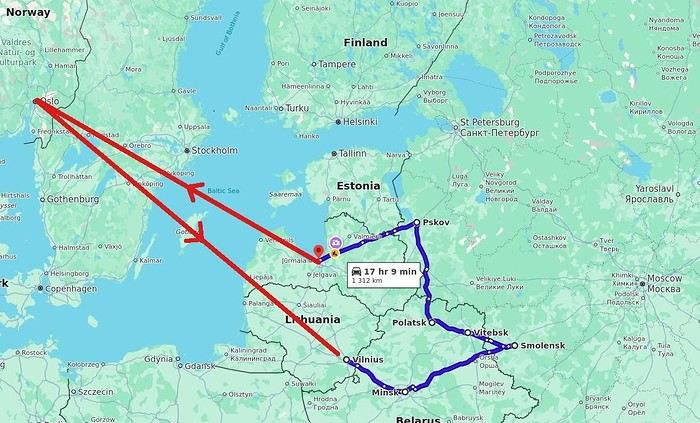
This crosses the Belarus-Russia border three times: from Minsk to Smolensk, then from Smolensk to Vitebsk, and finally from Polotsk to Pskov.
The region of this itinerary was, a thousand years ago, essentially that of the Krivichs, a local Slavic political entity. The term comes from "blood," *krew* in Polish, *krov* in Russian—basically "blood brothers." In Latvian, the word for Russians is *krievu*, by the way. Historically, the region corresponds to some of the old Russian principalities. Later, what marks Belarusian regions in general is, after the Great Schism of 1054, the division between Catholic and Orthodox zones, particularly as the Polish-Lithuanian Commonwealth expanded and contracted. In architecture, this corresponds to variations in Baroque styles, for example.
Vitebsk is known in France as the birthplace of Chagall. Born Russian, he first trained at the art school in Vitebsk, which was also attended by Malevich and Lissitzky, before completing his studies in Saint Petersburg, then moving to Berlin and later Paris. In Paris, Chagall met Cendrars, who had spent three years in Russia before and spoke enough Russian to help the newcomer get by a bit.
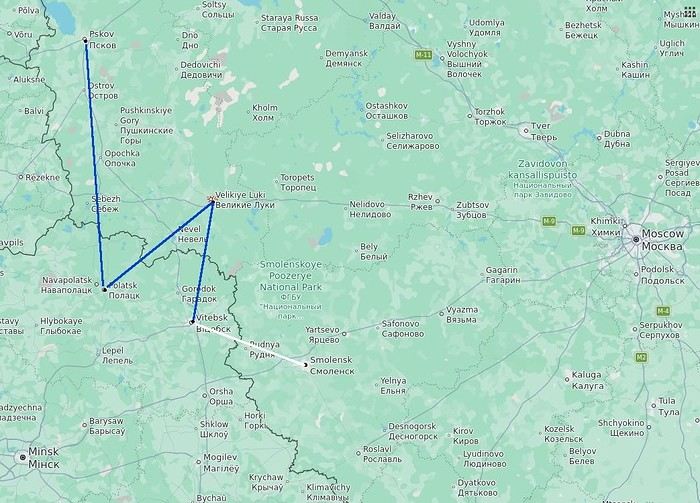
Back to the practical travel aspects: a local Pskov newspaper mentions that the Russian and Belarusian governments have a project for a Pskov-Polotsk train line. Previously, there were also plans for lines between Veliky Luki and Vitebsk, and Polotsk. A recently launched railway is Smolensk-Vitebsk, shown in white on the map, with projected lines in blue. https://pln-pskov.ru/society/583817.html https://pln-pskov.ru/society/578335.html
These will likely be "Hirondelle"—that is, *Lastochka*—the fast, spacious regional trains in Russia. Currently, all of this is done by bus, so the train is a very appealing and comfortable option. We’ll see how it goes.
With the unified system, if you enter one of the two countries with a visa from either, you can now travel between them freely.
In the case of a Russian visa, it must be a paper visa glued into your passport—not an electronic visa.
This opens up the possibility of traveling to Russia from Lithuania via Minsk, for example, starting from Vilnius.
It also allows for travel circuits that would otherwise be difficult, despite the proximity of the cities.
So, I’m leaving on June 12th for Vilnius. A one-hour flight for around thirty euros with a carry-on bag, and from Vilnius Airport, there’s a bus to Minsk. My planned route for now is Vilnius-Minsk-Smolensk-Vitebsk-Polotsk-Pskov-Riga.
This crosses the Belarus-Russia border three times: from Minsk to Smolensk, then from Smolensk to Vitebsk, and finally from Polotsk to Pskov.
The region of this itinerary was, a thousand years ago, essentially that of the Krivichs, a local Slavic political entity. The term comes from "blood," *krew* in Polish, *krov* in Russian—basically "blood brothers." In Latvian, the word for Russians is *krievu*, by the way. Historically, the region corresponds to some of the old Russian principalities. Later, what marks Belarusian regions in general is, after the Great Schism of 1054, the division between Catholic and Orthodox zones, particularly as the Polish-Lithuanian Commonwealth expanded and contracted. In architecture, this corresponds to variations in Baroque styles, for example.
Vitebsk is known in France as the birthplace of Chagall. Born Russian, he first trained at the art school in Vitebsk, which was also attended by Malevich and Lissitzky, before completing his studies in Saint Petersburg, then moving to Berlin and later Paris. In Paris, Chagall met Cendrars, who had spent three years in Russia before and spoke enough Russian to help the newcomer get by a bit.
Back to the practical travel aspects: a local Pskov newspaper mentions that the Russian and Belarusian governments have a project for a Pskov-Polotsk train line. Previously, there were also plans for lines between Veliky Luki and Vitebsk, and Polotsk. A recently launched railway is Smolensk-Vitebsk, shown in white on the map, with projected lines in blue. https://pln-pskov.ru/society/583817.html https://pln-pskov.ru/society/578335.html
These will likely be "Hirondelle"—that is, *Lastochka*—the fast, spacious regional trains in Russia. Currently, all of this is done by bus, so the train is a very appealing and comfortable option. We’ll see how it goes.
Choosing Packages on the "Renaissance" (CFC) - "Jewels of Vestlandet" Circuit
Hello,
We’ll be sailing on the Renaissance with CFC to southern Norway from July 4 to 11, 2026, departing from Dunkirk (the cruise was booked through "Planète Croisière").
When entering some personal details or pre-selecting options on the CFC website, I’m wondering about the "optional" categories for drinks and WiFi.
I’m actually a bit surprised by these extra charges, as we weren’t used to them on other cruises (Australis in Patagonia; Hurtigruten’s Coastal Express in Norway and Alaska; Rivages du Monde in the Arctic or on the Douro River; a Nile river cruise in Egypt), where we sometimes had access to basic drinks at meals and free WiFi when near land.
Anyway, for those who’ve already taken a CFC cruise on the Renaissance, could you share some advice? Specifically about the most basic drink package, called "Fraîcheur" (238 € for two), which doesn’t seem to be described anywhere. The "Premium" package seems excessive (490 € for two for the week) for light drinkers.
As for WiFi, it’s 10 € per day per person. While I find that price acceptable for parking our car in Dunkirk, it feels overpriced here (especially since it was free on the Nordlys "Coastal Express" just 3 or 4 years ago).
So, I’d love to hear from experienced cruisers who’ve been on this ship!
Looking forward to seeing the excursion prices, which should be available soon! 😐
Thanks in advance!
Thanks in advance!
Testing an AI prompt to plan a trip to Bali
I spent 3 weeks in Bali last summer (+ 3 nights on Gili Meno and a day trip to Kawah Ijen in Java). So I wanted to see what ChatGPT could suggest for comparison...
Here’s the prompt I gave:
"You’re a local expert guide for Bali.
- Plan a 20-day itinerary for Bali with a side trip to Gili Meno and a day trip to Kawah Ijen in Java without staying overnight.
- I’m traveling with my wife, and I love visiting historical sites, hiking, relaxing at the beach, snorkeling, and exploring rice terraces...
- For the duration of the stay, I don’t want more than 8 places to sleep, and I’d like to stay at least 2 days at each stop to avoid unpacking too often. Except for the last night, where I’m okay with just one night near the airport.
- I prefer neighborhoods that are walkable and try to avoid typical tourist traps, though I don’t want to miss the must-see spots. So suggest a mix of iconic sites and hidden gems.
- Recommend hotels or guesthouses with a budget of 50 to 100 € per night, including breakfast. Make suggestions in areas popular with travelers, specifying the vibe (I prefer quiet), and consider safety and proximity to attractions.
- For lunch and dinner, suggest two to three restaurants that are well-rated by customers.
- Give me a day-by-day program with details on travel times, visiting times for each point of interest, and recommendations for transportation (taxi, train, bike, etc.). Estimate the total cost of the trip, including accommodations, food, transportation, and activities, and suggest two tips for saving money in each category.
- Don’t make anything up—be realistic about travel times, take into account the opening dates and hours of sites, and give me the entry fees for places to visit.
- Ask me all the questions until you’re 95% sure you understand what’s being asked. Don’t generate your response until you’ve understood."
The AI asked for a few clarifications:
"Great request—I can build you a really optimized and enjoyable itinerary, but to be 95% sure I hit the mark, I need a few key clarifications (this will really influence the pace, areas, and accommodations)."
In the end, it proposed a program very close to what we actually did. I’ll skip its accommodation and restaurant suggestions...
Its proposal:
"Ubud (4 nights) => we did 5 nights Sidemen (2 nights) Amed (3 nights) => we’d planned 2 nights Gili Meno (3 nights) => we did Gili between Sidemen and Amed Munduk (3 nights) => we did 2 nights before Pemuteran Pemuteran (3 nights) with Ijen => we did 4 nights Sanur (2 nights + 1 last night) => we chose Jatiluwih instead of Sanur
It suggested "activities" (and accommodations too):
IN UBUD: - Walk around central Ubud (1–2h) - Campuhan Ridge Walk - Tegalalang Rice Terrace - Tirta Empul - Gunung Kawi - Massage / market / slow café
IN SIDEMEN: - Rice terrace hike (2–3h) - Cooking class
IN AMED: - Snorkeling - Japanese Shipwreck - Beach + relaxation - Volcano sunset
ON GILI: - Snorkeling at Gili Meno Turtle Point, Nest Underwater Statues
IN MUNDUK: - Jungle & waterfall hike - Munduk Waterfall + Melanting Waterfall - Loop: 3–4h (perfect for your level) - Ulun Danu Bratan Temple - Twin Lakes
IN PEMUTERAN - Snorkeling: Menjangan Island
For Kawah Ijen, it detailed the day well: 👍 from Pemuteran = best possible option 12 PM: leave hotel (we left at 10 PM) 1 PM: ferry 3 PM: arrival in Java + transfer 11 PM: start ascent 2 AM–6 AM: volcano Return to Bali around 11 AM–12 PM (we got back at 4 PM) 👍 still very intense, but doable with an agency 💰 ~80–120 €/person all-inclusive
IN SANUR: - Relaxation - Quiet beach - Proximity to airport (30 min)"
BUDGET: "3,000 – 3,900 € for 2 people" (We paid 3,200 €)
In conclusion, it’s not (yet) enough, but it’s (already) pretty impressive!
Here’s the prompt I gave:
"You’re a local expert guide for Bali.
- Plan a 20-day itinerary for Bali with a side trip to Gili Meno and a day trip to Kawah Ijen in Java without staying overnight.
- I’m traveling with my wife, and I love visiting historical sites, hiking, relaxing at the beach, snorkeling, and exploring rice terraces...
- For the duration of the stay, I don’t want more than 8 places to sleep, and I’d like to stay at least 2 days at each stop to avoid unpacking too often. Except for the last night, where I’m okay with just one night near the airport.
- I prefer neighborhoods that are walkable and try to avoid typical tourist traps, though I don’t want to miss the must-see spots. So suggest a mix of iconic sites and hidden gems.
- Recommend hotels or guesthouses with a budget of 50 to 100 € per night, including breakfast. Make suggestions in areas popular with travelers, specifying the vibe (I prefer quiet), and consider safety and proximity to attractions.
- For lunch and dinner, suggest two to three restaurants that are well-rated by customers.
- Give me a day-by-day program with details on travel times, visiting times for each point of interest, and recommendations for transportation (taxi, train, bike, etc.). Estimate the total cost of the trip, including accommodations, food, transportation, and activities, and suggest two tips for saving money in each category.
- Don’t make anything up—be realistic about travel times, take into account the opening dates and hours of sites, and give me the entry fees for places to visit.
- Ask me all the questions until you’re 95% sure you understand what’s being asked. Don’t generate your response until you’ve understood."
The AI asked for a few clarifications:
"Great request—I can build you a really optimized and enjoyable itinerary, but to be 95% sure I hit the mark, I need a few key clarifications (this will really influence the pace, areas, and accommodations)."
In the end, it proposed a program very close to what we actually did. I’ll skip its accommodation and restaurant suggestions...
Its proposal:
"Ubud (4 nights) => we did 5 nights Sidemen (2 nights) Amed (3 nights) => we’d planned 2 nights Gili Meno (3 nights) => we did Gili between Sidemen and Amed Munduk (3 nights) => we did 2 nights before Pemuteran Pemuteran (3 nights) with Ijen => we did 4 nights Sanur (2 nights + 1 last night) => we chose Jatiluwih instead of Sanur
It suggested "activities" (and accommodations too):
IN UBUD: - Walk around central Ubud (1–2h) - Campuhan Ridge Walk - Tegalalang Rice Terrace - Tirta Empul - Gunung Kawi - Massage / market / slow café
IN SIDEMEN: - Rice terrace hike (2–3h) - Cooking class
IN AMED: - Snorkeling - Japanese Shipwreck - Beach + relaxation - Volcano sunset
ON GILI: - Snorkeling at Gili Meno Turtle Point, Nest Underwater Statues
IN MUNDUK: - Jungle & waterfall hike - Munduk Waterfall + Melanting Waterfall - Loop: 3–4h (perfect for your level) - Ulun Danu Bratan Temple - Twin Lakes
IN PEMUTERAN - Snorkeling: Menjangan Island
For Kawah Ijen, it detailed the day well: 👍 from Pemuteran = best possible option 12 PM: leave hotel (we left at 10 PM) 1 PM: ferry 3 PM: arrival in Java + transfer 11 PM: start ascent 2 AM–6 AM: volcano Return to Bali around 11 AM–12 PM (we got back at 4 PM) 👍 still very intense, but doable with an agency 💰 ~80–120 €/person all-inclusive
IN SANUR: - Relaxation - Quiet beach - Proximity to airport (30 min)"
BUDGET: "3,000 – 3,900 € for 2 people" (We paid 3,200 €)
In conclusion, it’s not (yet) enough, but it’s (already) pretty impressive!
Review of the CFC RENAISSANCE's 'EN VOGUE' experience
😉Hi there,
A few months ago, CFC put the EN VOGUE experience on sale, departing from Dunkirk.
I booked this package to test the boat and onboard services for myself.
I’d read a lot of reviews mentioning numerous issues on board, so I wanted to see for myself what it was really like…
Okay, I’ll stop rambling… The package included boarding at 6 PM on Friday, dinner, a show, an overnight stay, and breakfast. We chose an interior cabin for this experience—since the boat wasn’t leaving the dock, we didn’t see the point in paying more… All in all, it cost 130 € per person. My mom joined us; she got the same cabin for 130 € with no single occupancy supplement.
We’d checked in online to board faster. We took the train to DUNKIRK, then a taxi to the shuttle pavilion—7 € for the ride. When we arrived at the pavilion, we were told to wait because there was a connection issue with check-in. Great start… After about ten minutes, we were finally allowed to proceed. At the counter, they said they didn’t have our cabin cards and no record of our check-in… Very odd. With no solution, they put us on the bus and said we’d sort it out at reception. Perfect. We went through security, and they confiscated our water bottles—never seen that before! Then they said my mom had a corkscrew in her bag, so they searched it… but there was no corkscrew. Total amateur hour… They eventually dropped it.
We got on the bus for a ten-minute ride… We boarded the ship with a crew member and headed to reception. Turns out, we weren’t the only ones in this situation. The nightmare began… Only two staff members were handling all the issues, and everything seemed complicated. They told my mom her cabin had been given to someone else 😲. That was the last straw…
It took forever—they had to redo the entire check-in. Finally, they told my mom her cabin was good to go; they’d mixed her up with someone else… After a solid half-hour, we could finally head to our cabin.
I’m determined to test everything: the pool, jacuzzi, show, restaurant, spa, etc… TO BE CONTINUED
Okay, I’ll stop rambling… The package included boarding at 6 PM on Friday, dinner, a show, an overnight stay, and breakfast. We chose an interior cabin for this experience—since the boat wasn’t leaving the dock, we didn’t see the point in paying more… All in all, it cost 130 € per person. My mom joined us; she got the same cabin for 130 € with no single occupancy supplement.
We’d checked in online to board faster. We took the train to DUNKIRK, then a taxi to the shuttle pavilion—7 € for the ride. When we arrived at the pavilion, we were told to wait because there was a connection issue with check-in. Great start… After about ten minutes, we were finally allowed to proceed. At the counter, they said they didn’t have our cabin cards and no record of our check-in… Very odd. With no solution, they put us on the bus and said we’d sort it out at reception. Perfect. We went through security, and they confiscated our water bottles—never seen that before! Then they said my mom had a corkscrew in her bag, so they searched it… but there was no corkscrew. Total amateur hour… They eventually dropped it.
We got on the bus for a ten-minute ride… We boarded the ship with a crew member and headed to reception. Turns out, we weren’t the only ones in this situation. The nightmare began… Only two staff members were handling all the issues, and everything seemed complicated. They told my mom her cabin had been given to someone else 😲. That was the last straw…
It took forever—they had to redo the entire check-in. Finally, they told my mom her cabin was good to go; they’d mixed her up with someone else… After a solid half-hour, we could finally head to our cabin.
I’m determined to test everything: the pool, jacuzzi, show, restaurant, spa, etc… TO BE CONTINUED
Gosuslugi with biometrics: for SIM cards and banks, among others.
Gosuslugi / Госуслуги is the Russian administrative portal. EBS / ЕБС is the unified biometric system.
Since 2025, foreigners (residents or not) must have a biometric profile in addition to a Gosuslugi profile to obtain SIM cards and open a bank account.
Administrative services are mostly centralized in MFCs, МФЦ (Multi-Functional Center), nicknamed "My Documents" Мои документы.
A non-resident foreigner can register with the pension fund, which provides a social security number, SNILS / СНИЛС. To do this, you must present your passport and a notarized translation at an MFC. The SNILS can be issued on the spot or within a maximum of five days. If not issued immediately, you receive a receipt, and the deadline is communicated by the administrative agent. You return to the MFC after the deadline to collect the certificate with the SNILS.
Once the SNILS is obtained, you revisit an MFC counter to register on the Gosuslugi portal. You must present your passport and notarized translation again, along with a phone number and email. The Gosuslugi portal authenticates users with three pieces of data: SNILS, email or phone number, and password. The agent creates the profile and completes the initial email and SMS confirmations on your phone.
After the Gosuslugi profile is active, you register on the biometric portal. If last year’s law centralization measures are fully implemented, you can do this at any MFC; otherwise, you go to a SBERBANK (or VTB) branch. Again, as always for foreigners, you must present your passport with its translation and show your open Gosuslugi profile on your phone. The employee records your voice (reading a series of numbers) and takes a photo of your face.
After that, you can go to a telecom agency to buy a SIM card. The staff will take your passport details with the translation and your Gosuslugi profile info. Then, they’ll take a photo with their webcam, which is verified by the online EBS biometric portal. However, procedures may vary depending on the provider (Megafon, MTS, Beeline), and some employees may not be familiar with the process.
Potential delays can be caused by network maintenance or slowdowns due to peaks in administrative activity.
I’ll illustrate this process as I experienced it in February and April 2025 in the next post. Just need to gather the photos I took on the spot.
Since 2025, foreigners (residents or not) must have a biometric profile in addition to a Gosuslugi profile to obtain SIM cards and open a bank account.
Administrative services are mostly centralized in MFCs, МФЦ (Multi-Functional Center), nicknamed "My Documents" Мои документы.
A non-resident foreigner can register with the pension fund, which provides a social security number, SNILS / СНИЛС. To do this, you must present your passport and a notarized translation at an MFC. The SNILS can be issued on the spot or within a maximum of five days. If not issued immediately, you receive a receipt, and the deadline is communicated by the administrative agent. You return to the MFC after the deadline to collect the certificate with the SNILS.
Once the SNILS is obtained, you revisit an MFC counter to register on the Gosuslugi portal. You must present your passport and notarized translation again, along with a phone number and email. The Gosuslugi portal authenticates users with three pieces of data: SNILS, email or phone number, and password. The agent creates the profile and completes the initial email and SMS confirmations on your phone.
After the Gosuslugi profile is active, you register on the biometric portal. If last year’s law centralization measures are fully implemented, you can do this at any MFC; otherwise, you go to a SBERBANK (or VTB) branch. Again, as always for foreigners, you must present your passport with its translation and show your open Gosuslugi profile on your phone. The employee records your voice (reading a series of numbers) and takes a photo of your face.
After that, you can go to a telecom agency to buy a SIM card. The staff will take your passport details with the translation and your Gosuslugi profile info. Then, they’ll take a photo with their webcam, which is verified by the online EBS biometric portal. However, procedures may vary depending on the provider (Megafon, MTS, Beeline), and some employees may not be familiar with the process.
Potential delays can be caused by network maintenance or slowdowns due to peaks in administrative activity.
I’ll illustrate this process as I experienced it in February and April 2025 in the next post. Just need to gather the photos I took on the spot.
The Foam of Days
Now that the curtain has fallen on the past year, it’s time to see what’s happening around here.
It seems pretty quiet, but I’ll read more in detail later.
First, I need to tell you all an anecdote.
My eldest little girl, in her third year of law school, was really scared she wouldn’t pass the year. I told her: “Trust yourself, you’ve worked so hard, and worst case, if you fail, you’ll just redo the year.” “But I don’t think I’ll make it—they changed the rules, and if I mess up even one unit, I have to start all over.” I knew her grades weren’t exactly stellar, and with what I was about to say, I wasn’t taking much of a risk. “Here’s the deal, sweetheart: if you pass, I promise I’ll take you to India, just the two of us.” I have to admit, India is a country I’ve talked about so much to all my grandchildren that in their minds, it’s become a magical, mythical place (hmm).
July had barely begun when my phone rang, her name flashing on the screen. “Mamido, I did it!” My promise came rushing back—oh no, oh no, oh no! “Congratulations, sweetheart!” A little shyly, she said: “Is the India trip still on?”
And me, replying: “Of course it is!”
And that’s that—a promise is a promise, or you risk losing that precious trust that keeps hearts warm and at peace.
We’re leaving in February. Only 8 days—yikes, the carbon footprint! But we can’t miss her tutorials, or she’ll be kicked out. Personally, that works just fine for me.
Going to India has become a challenge for me. It’s far, it’s exhausting, I sweat, I hate mosquitoes, the spices bother my mouth when I used to love them. There’s noise all the time—at night, the dogs bark nonstop, and we almost get run over. I’ll get lost in the streets because my sense of direction has vanished. I don’t like rice anymore. All that chaos and those cultural differences that once enchanted me now just overwhelm me. But I promised.
The upside—and it’s a big one—Raman, the same driver I’ve had forever, will be at the airport with a sign with our names. We’ll stop at the same little shop for chai (or tea, plain and simple) with that aroma that intoxicates me, halfway through the trip.
It’ll be a tiny trip—staying with friends, I’ll show her a few places I love: Chidambaram, Mamallapuram, and the clinic where I worked. Then we’ll head back. My little girl will go home to her parents.
As for me, I’ll leave right away for our Scottish island with Homme for our chilly winter.
How can you love a country so much you want to live there, then suddenly reject it, no longer able to appreciate what once made it special? That’s the mystery of love, I guess.
First, I need to tell you all an anecdote.
My eldest little girl, in her third year of law school, was really scared she wouldn’t pass the year. I told her: “Trust yourself, you’ve worked so hard, and worst case, if you fail, you’ll just redo the year.” “But I don’t think I’ll make it—they changed the rules, and if I mess up even one unit, I have to start all over.” I knew her grades weren’t exactly stellar, and with what I was about to say, I wasn’t taking much of a risk. “Here’s the deal, sweetheart: if you pass, I promise I’ll take you to India, just the two of us.” I have to admit, India is a country I’ve talked about so much to all my grandchildren that in their minds, it’s become a magical, mythical place (hmm).
July had barely begun when my phone rang, her name flashing on the screen. “Mamido, I did it!” My promise came rushing back—oh no, oh no, oh no! “Congratulations, sweetheart!” A little shyly, she said: “Is the India trip still on?”
And me, replying: “Of course it is!”
And that’s that—a promise is a promise, or you risk losing that precious trust that keeps hearts warm and at peace.
We’re leaving in February. Only 8 days—yikes, the carbon footprint! But we can’t miss her tutorials, or she’ll be kicked out. Personally, that works just fine for me.
Going to India has become a challenge for me. It’s far, it’s exhausting, I sweat, I hate mosquitoes, the spices bother my mouth when I used to love them. There’s noise all the time—at night, the dogs bark nonstop, and we almost get run over. I’ll get lost in the streets because my sense of direction has vanished. I don’t like rice anymore. All that chaos and those cultural differences that once enchanted me now just overwhelm me. But I promised.
The upside—and it’s a big one—Raman, the same driver I’ve had forever, will be at the airport with a sign with our names. We’ll stop at the same little shop for chai (or tea, plain and simple) with that aroma that intoxicates me, halfway through the trip.
It’ll be a tiny trip—staying with friends, I’ll show her a few places I love: Chidambaram, Mamallapuram, and the clinic where I worked. Then we’ll head back. My little girl will go home to her parents.
As for me, I’ll leave right away for our Scottish island with Homme for our chilly winter.
How can you love a country so much you want to live there, then suddenly reject it, no longer able to appreciate what once made it special? That’s the mystery of love, I guess.
Requirements for travel to Russia and Mongolia
Hi there,
I’m planning a trip to Russia and Mongolia, starting from France.
Crossing the border at Poland/Belarus or Georgia/Russia—other borders seem either closed or complicated.
Tourist visas for 3 months with multiple entries.
Do you have any info on Russian companies that cover a 4x4 vehicle for 3 months, and what prices in rubles or euros you’ve paid?
Which bank did you use for expenses? (EuroMastercard and Visa cards no longer work.)
Regarding Russian SIM cards, a new system called "Gosuslugi" has been introduced. How long did it take you to get one, and what steps did you follow?
Thanks
Which bank did you use for expenses? (EuroMastercard and Visa cards no longer work.)
Regarding Russian SIM cards, a new system called "Gosuslugi" has been introduced. How long did it take you to get one, and what steps did you follow?
Thanks
Exploring Senja Island and the Lofoten Archipelago
Hi everyone,
We traveled to Norway in the summer of 2025, from July 17 to 29, to visit Senja Island and the Lofoten archipelago with a rental car. The common thread of these twelve days was clearly hiking, along with a few visits and experiences, and nights spent in a tent or in the car (which made it possible). We chose Narvik Airport for both arrival and departure for several complementary reasons: the desire to visit nearby Senja Island, slightly more affordable airfare, and finally, the rental price of the vehicle—especially the car model we were looking for. We only made one reservation, for the first campsite, as sleeping in a tent made things much easier. But we had the whole structure of the trip planned, a flexible outline that could adapt to the weather conditions we’d encounter. Senja Island isn’t part of the Lofoten archipelago, and during the early stages of planning this trip, we hadn’t planned to visit it. But its relative proximity to Narvik Airport and, above all, its unique geography definitely made us change our minds. We arrived in Evenes, where Narvik Airport is located, nearly 60 km from the city itself. Our first stop was 40 km further in Bjerkvik on the way to Senja, where there’s a Rema 1000 (a very common supermarket chain in Norway). We needed to buy some food and a gas cartridge for our stove. I’d emailed the store manager beforehand, who told me they didn’t sell them but that the two gas stations in the village were likely to have some in stock.
It was only at the Esso station that I found what I needed, but unfortunately, only one cartridge. Luckily, we quickly realized that most campsites (like in Iceland) have a shared kitchen with hotplates. That single small cartridge was just enough for the few nights we spent outside of campsites... We got our first taste of Norway’s characteristic landscapes: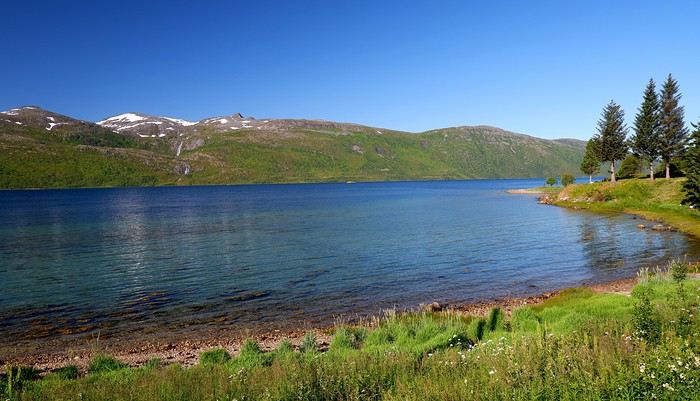
When we arrived at the Senja campsite, it was already 9:30 PM. A sign announced it was full, but luckily, I’d booked it 10 days earlier. By 10:30 PM, as we settled in to eat, it was still broad daylight, and the thermometer read 25°C—despite being at a latitude of 69° North! We went to bed around midnight, exhausted but under the light of a sun that was still very much present. Thanks to Earth’s tilted axis. We’d anticipated this by buying opaque sleep masks because, yes, at this time of year, it’s daylight all the time.
Friday, July 18:
Today, we planned two hikes on the island and a few stops along the way. The map clearly shows that the deepest fjords are in the north and west. Due to time and accessibility, we focused on the northern part of the island. Our first stop was at the viewing platform in Bergbotn:
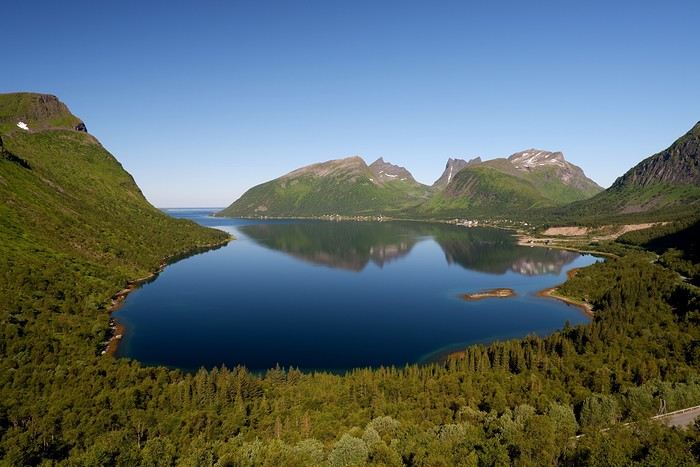
Then we headed toward Skaland, the starting point for our first hike. Along the way, we found plenty of reasons to stop—especially since, on this first day of travel, our thirst for Nordic landscapes was far from quenched.
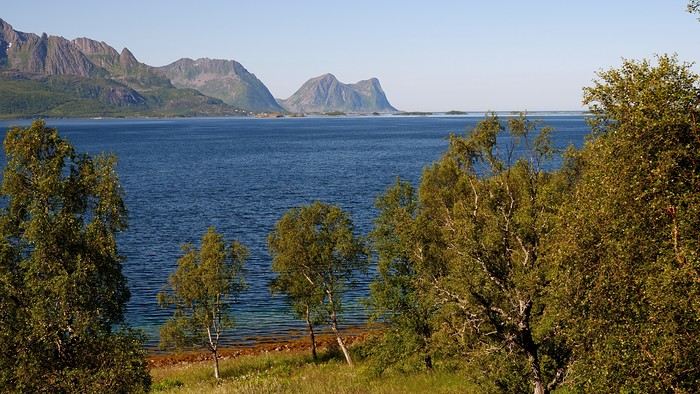
The town of Skaland is very practical: free parking, picnic tables for after the hike, and a Joker convenience store right next door. Our goal was the summit of Husfjellet: 670 m of elevation gain, between 8 and 9 km in length, and an estimated 4 hours and 30 minutes.
This hike offers two major viewpoints. The first overlooks the Bergsoyan islands to the west:
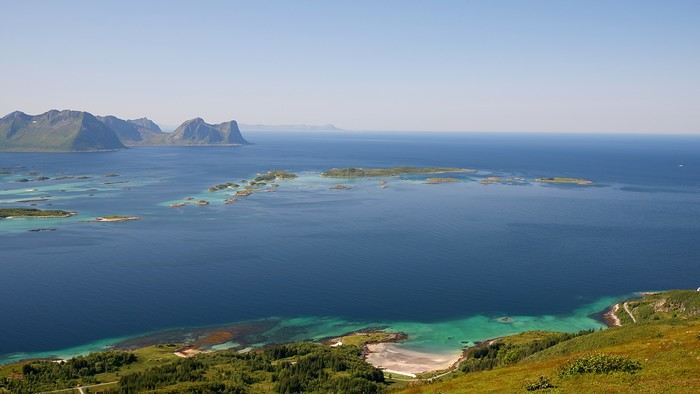
At the summit, the view shifts to the Steinfjorden fjord:
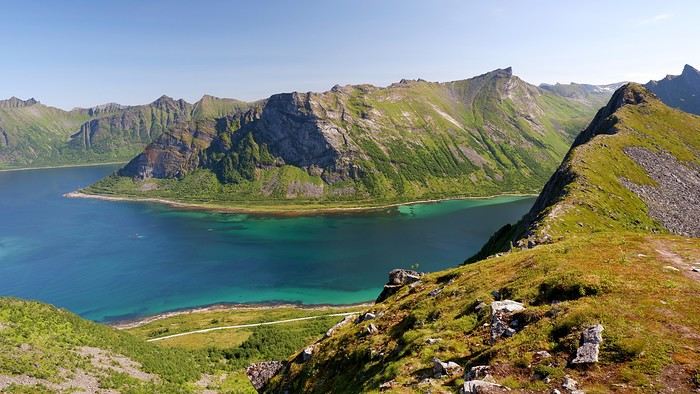
You can even clearly see the "Devil’s Teeth," which we’d see from below later:
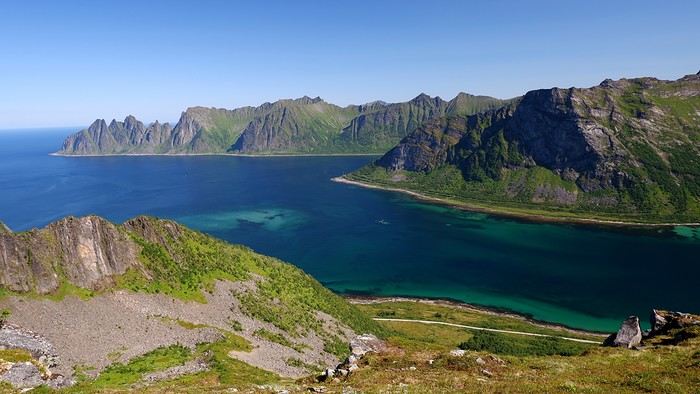
In total, the hike took us 4 hours and 30 minutes, including all the breaks. We treated ourselves to an ice cream in Skaland to recharge for the next hike. We hit the road again and stopped at Tungeneset to get a closer look at the Devil’s Teeth:
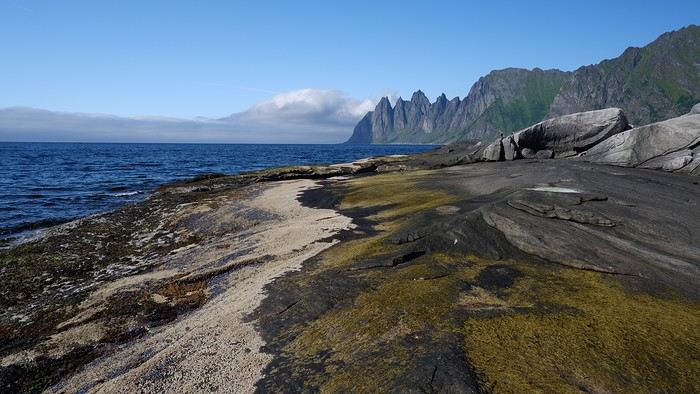
We continued to Fjordgard, the starting point for our second hike. Fjordgard isn’t very welcoming. There was a time when you could park right at the start of the hike up Mount Segla. Now, everything’s blocked off, and locals have even taken to blocking all possible parking spots nearby. You now have to park outside the town at a paid parking lot (90 NOK for 3 hours), adding an extra 2 km (round trip) of walking. Still, that was just a minor inconvenience because the hike that followed quickly made us forget all about it. The hike is fairly short (2 hours) but still has 520 m of elevation gain. This hike was a stark contrast to the first. This morning, we had sweeping views of the vast landscape. Here, Mount Segla, perched on the edge of the cliff, dominates the foreground:
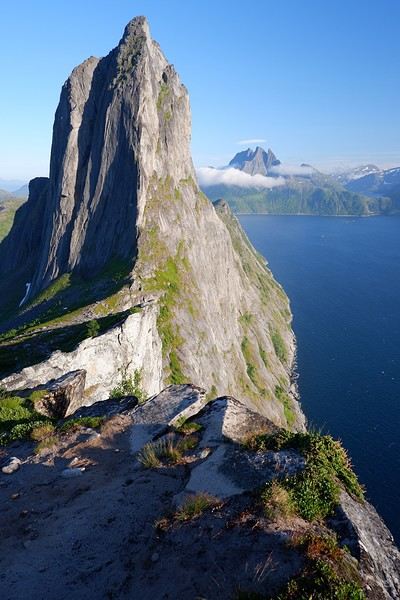
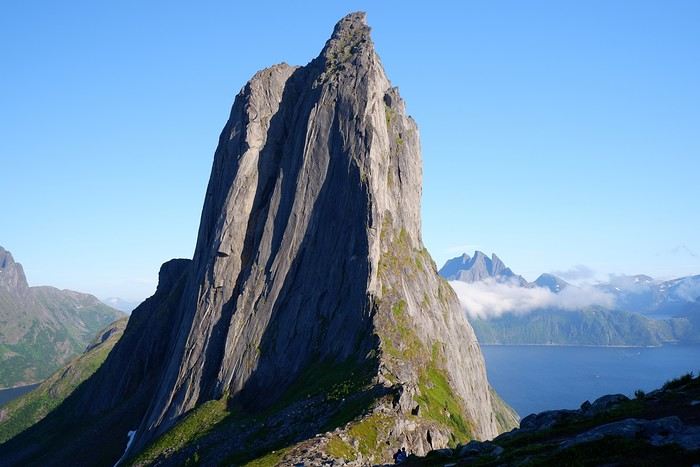
For those prone to vertigo, it might be best to stay at the foot of the mountain, as the trail climbs right along the cliff edge. And from that point on, you quickly understand what verticality really means...
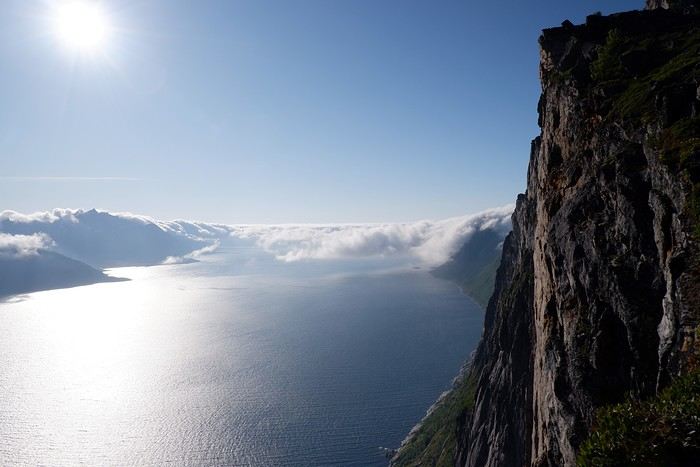
In total, we took 2 hours and 50 minutes, including breaks and the extra walk to the parking lot. The day was already well underway, and with 1,200 m of cumulative elevation gain, it was time to find a spot to eat and sleep. Since we hadn’t made any reservations, we’d planned to bivouac for the night. We weren’t too picky—just practical—so we decided to sleep in the car at the parking lot for tomorrow morning’s hike, just 5 km from Fjordgard.
We traveled to Norway in the summer of 2025, from July 17 to 29, to visit Senja Island and the Lofoten archipelago with a rental car. The common thread of these twelve days was clearly hiking, along with a few visits and experiences, and nights spent in a tent or in the car (which made it possible). We chose Narvik Airport for both arrival and departure for several complementary reasons: the desire to visit nearby Senja Island, slightly more affordable airfare, and finally, the rental price of the vehicle—especially the car model we were looking for. We only made one reservation, for the first campsite, as sleeping in a tent made things much easier. But we had the whole structure of the trip planned, a flexible outline that could adapt to the weather conditions we’d encounter. Senja Island isn’t part of the Lofoten archipelago, and during the early stages of planning this trip, we hadn’t planned to visit it. But its relative proximity to Narvik Airport and, above all, its unique geography definitely made us change our minds. We arrived in Evenes, where Narvik Airport is located, nearly 60 km from the city itself. Our first stop was 40 km further in Bjerkvik on the way to Senja, where there’s a Rema 1000 (a very common supermarket chain in Norway). We needed to buy some food and a gas cartridge for our stove. I’d emailed the store manager beforehand, who told me they didn’t sell them but that the two gas stations in the village were likely to have some in stock.
It was only at the Esso station that I found what I needed, but unfortunately, only one cartridge. Luckily, we quickly realized that most campsites (like in Iceland) have a shared kitchen with hotplates. That single small cartridge was just enough for the few nights we spent outside of campsites... We got our first taste of Norway’s characteristic landscapes:
When we arrived at the Senja campsite, it was already 9:30 PM. A sign announced it was full, but luckily, I’d booked it 10 days earlier. By 10:30 PM, as we settled in to eat, it was still broad daylight, and the thermometer read 25°C—despite being at a latitude of 69° North! We went to bed around midnight, exhausted but under the light of a sun that was still very much present. Thanks to Earth’s tilted axis. We’d anticipated this by buying opaque sleep masks because, yes, at this time of year, it’s daylight all the time.
Friday, July 18:
Today, we planned two hikes on the island and a few stops along the way. The map clearly shows that the deepest fjords are in the north and west. Due to time and accessibility, we focused on the northern part of the island. Our first stop was at the viewing platform in Bergbotn:
Then we headed toward Skaland, the starting point for our first hike. Along the way, we found plenty of reasons to stop—especially since, on this first day of travel, our thirst for Nordic landscapes was far from quenched.
The town of Skaland is very practical: free parking, picnic tables for after the hike, and a Joker convenience store right next door. Our goal was the summit of Husfjellet: 670 m of elevation gain, between 8 and 9 km in length, and an estimated 4 hours and 30 minutes.
This hike offers two major viewpoints. The first overlooks the Bergsoyan islands to the west:
At the summit, the view shifts to the Steinfjorden fjord:
You can even clearly see the "Devil’s Teeth," which we’d see from below later:
In total, the hike took us 4 hours and 30 minutes, including all the breaks. We treated ourselves to an ice cream in Skaland to recharge for the next hike. We hit the road again and stopped at Tungeneset to get a closer look at the Devil’s Teeth:
We continued to Fjordgard, the starting point for our second hike. Fjordgard isn’t very welcoming. There was a time when you could park right at the start of the hike up Mount Segla. Now, everything’s blocked off, and locals have even taken to blocking all possible parking spots nearby. You now have to park outside the town at a paid parking lot (90 NOK for 3 hours), adding an extra 2 km (round trip) of walking. Still, that was just a minor inconvenience because the hike that followed quickly made us forget all about it. The hike is fairly short (2 hours) but still has 520 m of elevation gain. This hike was a stark contrast to the first. This morning, we had sweeping views of the vast landscape. Here, Mount Segla, perched on the edge of the cliff, dominates the foreground:
For those prone to vertigo, it might be best to stay at the foot of the mountain, as the trail climbs right along the cliff edge. And from that point on, you quickly understand what verticality really means...
In total, we took 2 hours and 50 minutes, including breaks and the extra walk to the parking lot. The day was already well underway, and with 1,200 m of cumulative elevation gain, it was time to find a spot to eat and sleep. Since we hadn’t made any reservations, we’d planned to bivouac for the night. We weren’t too picky—just practical—so we decided to sleep in the car at the parking lot for tomorrow morning’s hike, just 5 km from Fjordgard.
From Southern Shikoku, between land and sea, to the blue waters of Miyakojima and finally the Tokyo metropolis
From Southern Shikoku, between land and sea, to the blue waters of Miyakojima and finally Tokyo’s megacity
Hi everyone,
I have to admit, I really hesitated before deciding to write this travel journal... Writing one takes a lot of time and energy, and since this is my 4th trip, I wondered if it would even interest anyone other than myself (both for the discovery and the writing). But after a few people asked, "Are you going to write a journal?" and especially after rediscovering the joy of reading other travelers’ journals about Japan or elsewhere on this forum, I’ve decided to share my 4th installment in the Land of the Rising Sun here.
The itinerary: 27 full days, from late May to late June 2025, right in the middle of the rainy season, including:
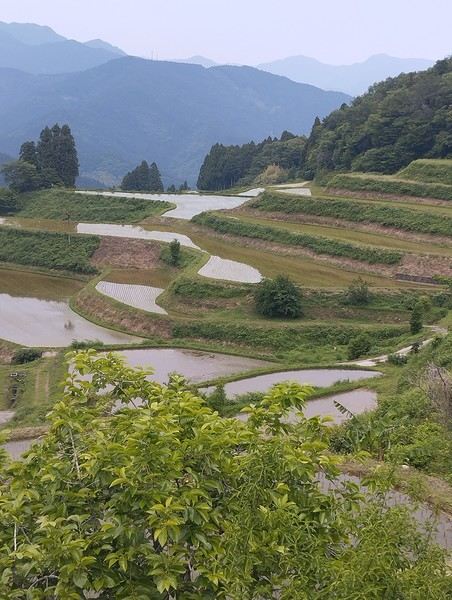
-->13 days in Shikoku, from Kochi (Kochi Prefecture) to Matsuyama (Ehime Prefecture)
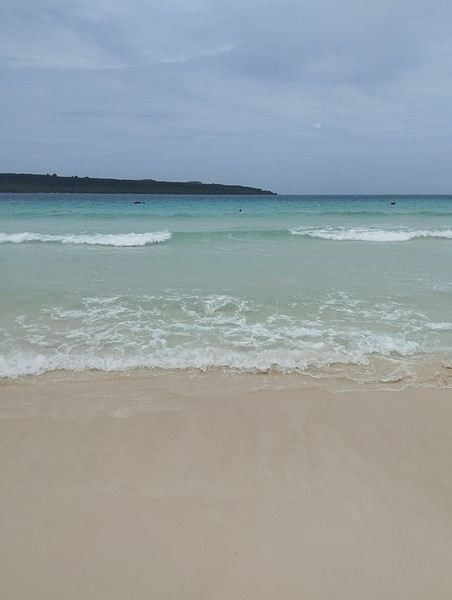
-->7 days in Miyakojima (Okinawa Prefecture)
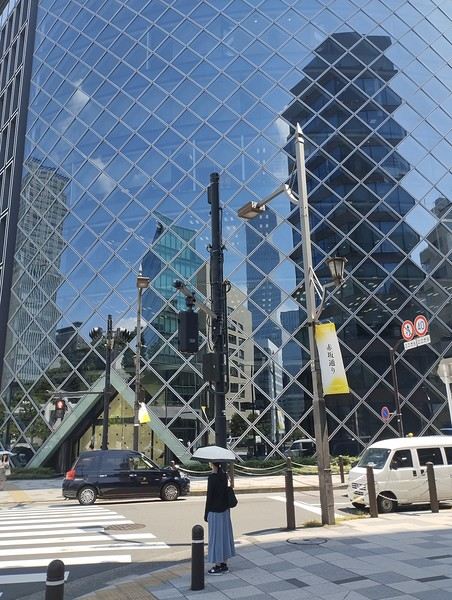
-->7 days in Tokyo
The trip was decided on fairly last-minute again this year.
Since I regularly check flight prices to track fluctuations for this destination even without concrete plans, stumbling upon a slightly cheaper direct flight (900 €) than what I’d seen in previous months (around 1,200–1,400 € on average) for a Paris-Tokyo route with Japanese airline ANA was too tempting to resist the urge to return to this enchanting country. After much hesitation between exploring the San’in region (Matsue, Tottori, Yamaguchi) and Southern Shikoku, the decision was made—I took the plunge! The ticket is booked: Paris to Kochi with a layover in Tokyo, all with ANA, the airline I’d been dreaming of... for 1,120 € per person. Okay, it’s not cheap, but it’s better than in 2023.
Departure in 2 weeks! Now I just have to get everything ready!
Intense prep work over these next 2 weeks to:
finalize a more precise itinerary and reach an agreement—yep, because even though we both love Japan, our preferences differ slightly, and we have to choose between exploring new places or revisiting beloved spots... decide how much time to spend in each area without rushing while still exploring research places that might interest us and watch videos about Japan book accommodations: yes, it’s possible to do this on the spot, but last year, we realized that last-minute options were pretty expensive, so we’re booking ahead—though we’ll keep a few options open in case better deals pop up later reserve rental cars order yen check the weather regularly and wonder if choosing the *tsuyu* (rainy season) was really a good idea—are we going to be drenched the whole time???
"What hard work," you might say! Going to Japan for a month—what a tough life! Despite this being my 4th trip, the excitement is just as intense as the first time.
The only small downside is that when we booked the flight, there weren’t many seats left, so we’re only sitting together on the international return flight. Plus, on the way there, we have middle seats. Another lingering question: what French-language films will be available? According to the internet, the selection seems limited. Oh well, these are just minor details—it’s already time to fly! PS: I’ll be posting slowly and irregularly... so for those interested, be patient, and maybe set an alert...
Hi everyone,
I have to admit, I really hesitated before deciding to write this travel journal... Writing one takes a lot of time and energy, and since this is my 4th trip, I wondered if it would even interest anyone other than myself (both for the discovery and the writing). But after a few people asked, "Are you going to write a journal?" and especially after rediscovering the joy of reading other travelers’ journals about Japan or elsewhere on this forum, I’ve decided to share my 4th installment in the Land of the Rising Sun here.
The itinerary: 27 full days, from late May to late June 2025, right in the middle of the rainy season, including:
-->13 days in Shikoku, from Kochi (Kochi Prefecture) to Matsuyama (Ehime Prefecture)
-->7 days in Miyakojima (Okinawa Prefecture)
-->7 days in Tokyo
The trip was decided on fairly last-minute again this year.
Since I regularly check flight prices to track fluctuations for this destination even without concrete plans, stumbling upon a slightly cheaper direct flight (900 €) than what I’d seen in previous months (around 1,200–1,400 € on average) for a Paris-Tokyo route with Japanese airline ANA was too tempting to resist the urge to return to this enchanting country. After much hesitation between exploring the San’in region (Matsue, Tottori, Yamaguchi) and Southern Shikoku, the decision was made—I took the plunge! The ticket is booked: Paris to Kochi with a layover in Tokyo, all with ANA, the airline I’d been dreaming of... for 1,120 € per person. Okay, it’s not cheap, but it’s better than in 2023.
Departure in 2 weeks! Now I just have to get everything ready!
Intense prep work over these next 2 weeks to:
finalize a more precise itinerary and reach an agreement—yep, because even though we both love Japan, our preferences differ slightly, and we have to choose between exploring new places or revisiting beloved spots... decide how much time to spend in each area without rushing while still exploring research places that might interest us and watch videos about Japan book accommodations: yes, it’s possible to do this on the spot, but last year, we realized that last-minute options were pretty expensive, so we’re booking ahead—though we’ll keep a few options open in case better deals pop up later reserve rental cars order yen check the weather regularly and wonder if choosing the *tsuyu* (rainy season) was really a good idea—are we going to be drenched the whole time???
"What hard work," you might say! Going to Japan for a month—what a tough life! Despite this being my 4th trip, the excitement is just as intense as the first time.
The only small downside is that when we booked the flight, there weren’t many seats left, so we’re only sitting together on the international return flight. Plus, on the way there, we have middle seats. Another lingering question: what French-language films will be available? According to the internet, the selection seems limited. Oh well, these are just minor details—it’s already time to fly! PS: I’ll be posting slowly and irregularly... so for those interested, be patient, and maybe set an alert...
A Scandinavian Tour - Summer 2025
Off on new adventures!!!
For my wife’s 60th birthday, I’m really making her happy. While I usually pick warm, sunny destinations, she’s more tempted by places where you don’t suffer from the heat.
So, it’s off to Norway!! A real challenge for me—a southern guy who’s as cold-sensitive as they come.
I keep telling anyone who’ll listen (well, just myself, really) that these aren’t the countries for me, that rain will be our travel companion, that we’ll have to face polar bears, navigate between icebergs, that there are still Vikings around, and all sorts of other things.
Of course, not wanting to make it easy, we’re driving from the Lyon area where we live.
Friends who’ve visited the country told us it’s pretty expensive to eat out (among other things), so we’re bringing supplies—especially enough for apéritifs the whole trip!!!
It’s not a camper van, but a "hotel-car" we’ll be doing! We’ll see how it goes!
As usual, I’ll try to narrate the journey with my two-cent comments, plus some little tips to avoid our mistakes—assuming I don’t lose any fingers to the cold!
Every night, I’ll count them to make sure I still have all ten! We’re not in *Ch’tis* territory but even farther Noooorth (as Galabru would say).
Note that I’m traveling with a synovial effusion in my knee! The old man’s not in great shape!!
Here we go!!
PS: As always, I’m a filmmaker, so I’ve made an effort with a few photos from my phone.
PS: As always, I’m a filmmaker, so I’ve made an effort with a few photos from my phone.
Review of a Norway cruise on the Emerald Princess in June 2025 (1)
Hello everyone,
I’ve wanted to take this Norway cruise for a very long time. The first time I booked it was in July 2020 with Azamara. Unfortunately, it was canceled, as everyone remembers. When I tried to book it again, the prices (already a bit high with Azamara) had simply doubled. So, since then, I’ve been keeping an eye out every year for any opportunities...
The last time we sailed with Princess was eleven years ago, and things didn’t go very well. I came back pretty unhappy with their service and quite disappointed. Despite the $600 they gave me as credit for a future cruise, I’d never set foot on one of their ships again.
But this time, the opportunity arose—a fantastic itinerary with lots of stops, a reasonable price for 16 nights (I’ll share the details in the conclusion), and a ship that’s not too big, so to speak, with only 3,000 passengers. I’m not expecting much from the cruise line this time and am boarding the ship with low expectations beyond the itinerary.
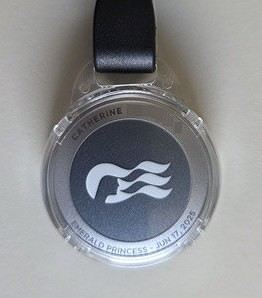
Princess has introduced an app to download before the cruise. It’s essential because online check-in is no longer available, and the agency doesn’t send a travel journal. Everything is done through the app. After completing the check-in on the app, we only know that we’ll need to pick up our key, the Medallion, at embarkation by following the blue line in the terminal and presenting our passport.
Up until our departure, the weather forecast for the coming week in Norway is disastrous—rain, rain, and more rain. It was pretty much the same two years ago before our Iceland cruise, and in the end, the weather turned out fine.
If you’re ready to embark on the Emerald Princess to discover this beautiful cruise and the stunning landscapes of Norway, let’s go!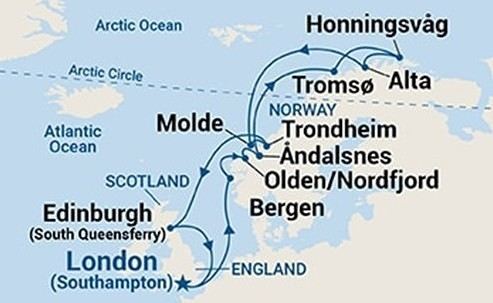
Southampton - Sea day - Bergen - Olden - Åndalsnes - Sea day - Tromsø - Honningsvåg (North Cape) - Alta - Sea day - Molde - Trondheim - Two sea days - Edinburgh - Sea day - Southampton
I’ve wanted to take this Norway cruise for a very long time. The first time I booked it was in July 2020 with Azamara. Unfortunately, it was canceled, as everyone remembers. When I tried to book it again, the prices (already a bit high with Azamara) had simply doubled. So, since then, I’ve been keeping an eye out every year for any opportunities...
The last time we sailed with Princess was eleven years ago, and things didn’t go very well. I came back pretty unhappy with their service and quite disappointed. Despite the $600 they gave me as credit for a future cruise, I’d never set foot on one of their ships again.
But this time, the opportunity arose—a fantastic itinerary with lots of stops, a reasonable price for 16 nights (I’ll share the details in the conclusion), and a ship that’s not too big, so to speak, with only 3,000 passengers. I’m not expecting much from the cruise line this time and am boarding the ship with low expectations beyond the itinerary.
Princess has introduced an app to download before the cruise. It’s essential because online check-in is no longer available, and the agency doesn’t send a travel journal. Everything is done through the app. After completing the check-in on the app, we only know that we’ll need to pick up our key, the Medallion, at embarkation by following the blue line in the terminal and presenting our passport.
Up until our departure, the weather forecast for the coming week in Norway is disastrous—rain, rain, and more rain. It was pretty much the same two years ago before our Iceland cruise, and in the end, the weather turned out fine.
If you’re ready to embark on the Emerald Princess to discover this beautiful cruise and the stunning landscapes of Norway, let’s go!
Southampton - Sea day - Bergen - Olden - Åndalsnes - Sea day - Tromsø - Honningsvåg (North Cape) - Alta - Sea day - Molde - Trondheim - Two sea days - Edinburgh - Sea day - Southampton
Kattegat Tour and Norway’s Majestic Fjords – 32 Days (Denmark, Sweden, Norway)
Kattegat isn’t just the name of the village in the TV series *Vikings*—it’s also the stretch of water separating Denmark from Sweden... the sea, basically! And further north, you’ve got Norway and its fjords!
Originally, I’d planned to just do a loop around Kattegat, with the *Under* restaurant in Lindesnes as our anniversary treat... but along the way, we thought, why not "push" a little further north, keeping an eye on the budget since we’d chosen to travel by car in June 2025 through Scandinavia.
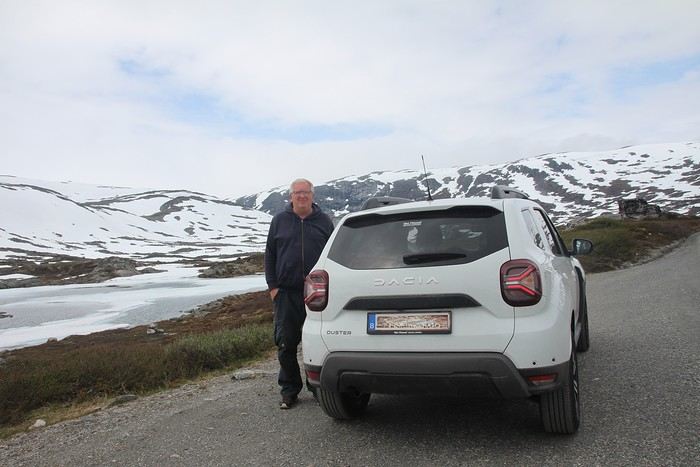
Why by car when most travelers opt for a camper van, while others prefer the comfort of cruises? Well, because we don’t own a camper van, renting one is pricey, and then you’ve got to add fuel costs (those things guzzle gas!), ferry fees, and other "tolls." All things considered, we went for mostly rentals—especially since there were four of us at the start of the trip. We spent the first week in Denmark with our daughter and son-in-law. Then they flew back to Belgium, and we continued our adventure as a couple. For accommodation, we mainly booked Airbnb apartments, which helped keep costs down and, most importantly, let us prepare our own meals (diet, diet!). In this travel journal, you’ll discover (or rediscover, for those who followed my older ones) our unbridled love for theme parks, museums, unique experiences, and—especially in Denmark—Legos! Unfortunately, we didn’t do any hikes this year because the unpredictable weather had made the trails slippery, and since I’d already taken three tumbles during the trip, I didn’t want to risk another! In the end, we traveled for 32 days, covered 6,200 km, and most importantly, discovered the charming country of Denmark, marveled at Norway’s breathtaking fjords—all without suffering the heatwave that hit France and Belgium that June! If you’ve got any questions, don’t hesitate to ask!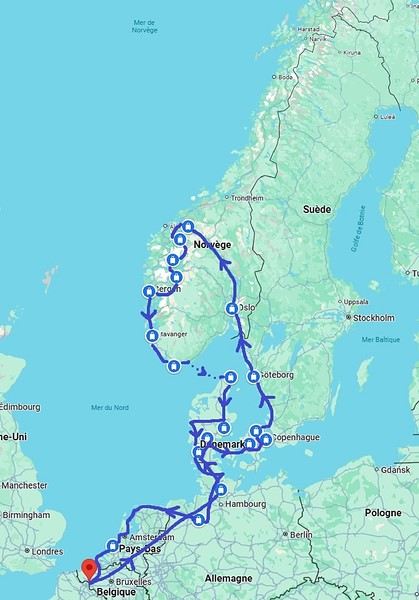
Why by car when most travelers opt for a camper van, while others prefer the comfort of cruises? Well, because we don’t own a camper van, renting one is pricey, and then you’ve got to add fuel costs (those things guzzle gas!), ferry fees, and other "tolls." All things considered, we went for mostly rentals—especially since there were four of us at the start of the trip. We spent the first week in Denmark with our daughter and son-in-law. Then they flew back to Belgium, and we continued our adventure as a couple. For accommodation, we mainly booked Airbnb apartments, which helped keep costs down and, most importantly, let us prepare our own meals (diet, diet!). In this travel journal, you’ll discover (or rediscover, for those who followed my older ones) our unbridled love for theme parks, museums, unique experiences, and—especially in Denmark—Legos! Unfortunately, we didn’t do any hikes this year because the unpredictable weather had made the trails slippery, and since I’d already taken three tumbles during the trip, I didn’t want to risk another! In the end, we traveled for 32 days, covered 6,200 km, and most importantly, discovered the charming country of Denmark, marveled at Norway’s breathtaking fjords—all without suffering the heatwave that hit France and Belgium that June! If you’ve got any questions, don’t hesitate to ask!
3 weeks in Kazakhstan and Kyrgyzstan, preliminary travel questions
Hi there, 🙂
I’m thinking of taking a trip to these two countries in 2026 (late spring to early summer).
I’d arrive in Almaty and leave from Bishkek, and I’d be driving myself.
I plan to spend 1 week in Kazakhstan and 2 in Kyrgyzstan. The itinerary isn’t set yet.
My preliminary questions are about formalities, hassle levels, and the car.
From what I understand, no visa is needed, the passport must be valid for 6 months after entry, and there’s no longer a requirement to register with the authorities at each stop. In short, once you’re in, no administrative headaches.
Except for permits needed to drive in certain regions?
---/---
About crossing between the two countries:
- On foot - In a rental car
Quick? Easy?
---/---
Are both countries safe? (Meaning you don’t have to stay on guard all the time.) Are the cops corrupt? (A little, a lot, passionately, not at all?)
---/---
Is it better to rent a car for both countries or rent a vehicle in each country?
A 4x4 or something else?
Is accommodation plentiful enough that I can skip a rooftop tent, or is it better to rent a 4x4 with one?
I’ll definitely have more questions later...😉
Thanks for your answers !
I’m thinking of taking a trip to these two countries in 2026 (late spring to early summer).
I’d arrive in Almaty and leave from Bishkek, and I’d be driving myself.
I plan to spend 1 week in Kazakhstan and 2 in Kyrgyzstan. The itinerary isn’t set yet.
My preliminary questions are about formalities, hassle levels, and the car.
From what I understand, no visa is needed, the passport must be valid for 6 months after entry, and there’s no longer a requirement to register with the authorities at each stop. In short, once you’re in, no administrative headaches.
Except for permits needed to drive in certain regions?
---/---
About crossing between the two countries:
- On foot - In a rental car
Quick? Easy?
---/---
Are both countries safe? (Meaning you don’t have to stay on guard all the time.) Are the cops corrupt? (A little, a lot, passionately, not at all?)
---/---
Is it better to rent a car for both countries or rent a vehicle in each country?
A 4x4 or something else?
Is accommodation plentiful enough that I can skip a rooftop tent, or is it better to rent a 4x4 with one?
I’ll definitely have more questions later...😉
Thanks for your answers !
Review of a cruise on the Celebrity Infinity in Greece
Hi there,
Here’s a little recap of my cruise on the CELEBRITY INFINITY from February 14th to 23rd.
Itinerary: Athens / Thessaloniki / Thessaloniki / Kusadasi / AT SEA / Cyprus / AT SEA / Rhodes / Heraklion / Athens / Athens
Since the cruise ended on Monday, we had to leave the ship on Sunday to go back to work on Monday 😕 Bring on retirement!
This was our 34th cruise, and the price was around 1,300 € per person for AQUACLASS.
Just to remind you, AQUACLASS includes spa access, a cabin with a hydro-massage shower, and a dedicated restaurant.
For once, I have to say we didn’t get a good deal—prices dropped two months before departure, and we could’ve had AQUACLASS in a guaranteed cabin for 1,000 € per person. So, I think for January/February cruises, it’s better to book last-minute.
We arrived in Piraeus on the 12th in the evening. The hotel was great—"Phidias Piraeus Hotel"—close to the center, with a spacious room (upgraded by Booking to a junior suite). The breakfast was decent, and the price was 125 € for two nights, all included. The cherry on top? The hotel offers free shuttles to the cruise ship on departure day—really awesome!
We’d never visited Piraeus before, and it was a lovely surprise. Not only was the weather gorgeous, but the walk was really pleasant—the port, the beach, the little streets. It was way nicer than I’d imagined!
TO BE CONTINUED: BOARDING 😉
The Verb That Guides
It’s nighttime and 3 degrees in Tashkent.
Hi there,
Reflection: an act of thought that revisits an object to examine it. The object here is travel (or tourist movement, it doesn’t really matter) and the desire to examine it from the particular angle of the verb that drives it came from reading a sentence by Xrctn in the introduction to his travel journal about Turkmenistan.
Part of that strange category of travelers who like ticking boxes...
Ticking I have no idea how strange that is—I actually get the impression it might be pretty common when I see the diverse mix of trips some people here take. But maybe it’s a different approach that drives these compulsive travelers.
Still, it wouldn’t even occur to me. What does it add?
Connecting Or chaining, assembling, linking. These are my verbs. If I can’t do it—either because finances are tight (I live in one of Europe’s pigsties—a PIIGS country, where the virtuous northern barbarians sent the G&S troika to "nurse us back to health" through austerity, making it all the more pleasant to spend every summer among civilized folks on the terrace of my little white house in Kalymnos overlooking the Aegean), or because I’ve chosen a tricky, unstable direction (Lebanon had to be canceled in summer 2006, Syria too, and Iran right now)—I don’t really feel like traveling. I might just tag along to be nice, but it doesn’t mean anything to me.
If I think about the need behind my verbs—this continuous, meticulous, patient way of traveling—it’s about stripping away sudden, artificial exoticism, weaving small, successive changes, and feeling the presence of the knots too. About understanding, integrating something a little different from the image on a screen.
And you? What’s your guiding verb?
Catherine
Hi there,
Reflection: an act of thought that revisits an object to examine it. The object here is travel (or tourist movement, it doesn’t really matter) and the desire to examine it from the particular angle of the verb that drives it came from reading a sentence by Xrctn in the introduction to his travel journal about Turkmenistan.
Part of that strange category of travelers who like ticking boxes...
Ticking I have no idea how strange that is—I actually get the impression it might be pretty common when I see the diverse mix of trips some people here take. But maybe it’s a different approach that drives these compulsive travelers.
Still, it wouldn’t even occur to me. What does it add?
Connecting Or chaining, assembling, linking. These are my verbs. If I can’t do it—either because finances are tight (I live in one of Europe’s pigsties—a PIIGS country, where the virtuous northern barbarians sent the G&S troika to "nurse us back to health" through austerity, making it all the more pleasant to spend every summer among civilized folks on the terrace of my little white house in Kalymnos overlooking the Aegean), or because I’ve chosen a tricky, unstable direction (Lebanon had to be canceled in summer 2006, Syria too, and Iran right now)—I don’t really feel like traveling. I might just tag along to be nice, but it doesn’t mean anything to me.
If I think about the need behind my verbs—this continuous, meticulous, patient way of traveling—it’s about stripping away sudden, artificial exoticism, weaving small, successive changes, and feeling the presence of the knots too. About understanding, integrating something a little different from the image on a screen.
And you? What’s your guiding verb?
Catherine
Three weeks in Norway (July 2022): fantastic memories despite the rain
Our trip to Norway was two years ago already, but I thought it might still be of interest—and it’ll let me relive it a bit by proxy.
Before booking our flight tickets, we debated the route: should we prioritize the north with the Lofoten and Senja islands, or the south with its countless fjords? I was tempted to stay in the south—the country is so vast, and the drive north is long... but my husband really didn’t want to miss the Lofoten. In the end, we figured that since Norway is known for being expensive, we might only visit once (funny how we said the same thing before our first trip to the American West, and look how that turned out 😎), so we didn’t want to skip anything. That meant a 2–3 day drive up north. With 22 days on the ground, it was doable. Especially since, as usual, we skip big cities and gave Oslo a pass.
Practical details: - Flight tickets: 1195 € for 4 with Air France (Paris–Oslo outbound, Tromsø–Bergen–Paris return) - Car rental: 2020 € for 21 days (including the outrageous drop-off fee between Oslo and Tromsø—about 1000 €) - Tolls and ferries: 250 € for the portion billed directly by the rental company. Some ferries required advance booking and payment at the time of reservation—I’ll note their prices as I go through the story. - Hotels: 4135 €, averaging 188 € per night. We blew past our usual budgets from trips to the U.S., but oh well... - Food: 1570 €, averaging 71 € per day for 4 in a country where everything’s expensive... How’d we manage? We rarely ate out, mostly grocery shopped, and even packed half a suitcase with non-perishables: pasta, rice, a few cans, and even some cured sausage! We also stayed 3 nights at Clarion Collection hotels, where an evening buffet was included in the room rate.
Before booking our flight tickets, we debated the route: should we prioritize the north with the Lofoten and Senja islands, or the south with its countless fjords? I was tempted to stay in the south—the country is so vast, and the drive north is long... but my husband really didn’t want to miss the Lofoten. In the end, we figured that since Norway is known for being expensive, we might only visit once (funny how we said the same thing before our first trip to the American West, and look how that turned out 😎), so we didn’t want to skip anything. That meant a 2–3 day drive up north. With 22 days on the ground, it was doable. Especially since, as usual, we skip big cities and gave Oslo a pass.
Practical details: - Flight tickets: 1195 € for 4 with Air France (Paris–Oslo outbound, Tromsø–Bergen–Paris return) - Car rental: 2020 € for 21 days (including the outrageous drop-off fee between Oslo and Tromsø—about 1000 €) - Tolls and ferries: 250 € for the portion billed directly by the rental company. Some ferries required advance booking and payment at the time of reservation—I’ll note their prices as I go through the story. - Hotels: 4135 €, averaging 188 € per night. We blew past our usual budgets from trips to the U.S., but oh well... - Food: 1570 €, averaging 71 € per day for 4 in a country where everything’s expensive... How’d we manage? We rarely ate out, mostly grocery shopped, and even packed half a suitcase with non-perishables: pasta, rice, a few cans, and even some cured sausage! We also stayed 3 nights at Clarion Collection hotels, where an evening buffet was included in the room rate.
Retour aux Marquises: les îles méridionales Hiva Oa, Tahuata et Fatu Iva English translation pending
INTRO
En ces temps épidémiques troublés, la Polynésie Française - et en particulier l' archipel des Marquises - ont des atouts exceptionnels en matière de tourisme. A ce jour, l' épidémie de Coronavirus a juste effleuré le Territoire -presque uniquement Tahiti et Moorea - dont les îles éloignées ont été strictement confinées dès le départ, les offres sanitaires et hospitalières sur place étant très limitées. Pour l' instant, la situation est sous contrôle.
Le tourisme retrouve lentement ses marques depuis la mi-juillet. Il s'agit actuellement plus de tourisme local que de tourisme international, bien que la destination Polynésie / Marquises soit attirante : beauté et unicité des paysages, authenticité d'un archipel, certes situé à 4 heures d'avion ATR de Tahiti, mais que l' on peut facilement découvrir en solo et donc en dehors de la très onéreuse croisière sur l' Aranui, sécurité physique mais aussi sanitaire. Les Européens - dont une majorité de Français - arrivent... Ils avaient déjà leurs billets depuis des mois et l' entrée sur le territoire est facilitée.
Nous devions faire ce second voyage aux Marquises en mai dernier, mais il fut annulé jusqu'à la reprise progressive des vols en interne.
Nous avons simplement acheté un billet Air Tahiti en ligne, sans utiliser le Pass Marquises qui ne permet pas de visiter les deux îles les plus méridionales, à savoir Tahuata et Fatu Iva, dépourvues d'aéroport. On ne peut y aller qu' en bateau, en excursion à la journée ( ou plus bien sur ) pour Tahuata et en navette municipale au départ de Hiva Oa pour aller à Fatu Iva.
Les horaires changeant fréquemment, la première chose à faire est de se renseigner sur les jours de passage vers Fatu Iva. En ce moment, il y en a trois : le lundi ( départ à 2 heures du matin ), le mardi ( départ à 6 heures ) et le samedi ( départ à 6 heures également ). Mais tout cela aura peut-être changé dans 3 mois. Il faut donc une stratégie d'approche !
On peut rajouter la visite de ces deux îles à celles qui sont incluses dans le Pass, à savoir Nuku Hiva, Ua Pou, Ua Huka et Hiva Oa. Prévoir alors une extension de 8 jours environ, à partir de Hiva Oa.
Pourquoi vouloir absolument visiter ces deux îles peu accessibles ? Justement parce qu'il faut les mériter ! Elles demeurent très différentes.
L' une, Tahuata, a un lagon, des plages de sable blanc, des falaises abruptes, des baies échancrées ourlées d'une végétation luxuriante, des couleurs uniques dans les bleus et turquoise et culmine à plus de 1000 mètres.
L' autre, Fatu Iva , est une beauté sauvage et altière avec ses à-pics qui dévalent vers l' océan bleu outremer ( ou 'moana' en tahitien ), connue surtout pour sa fameuse baie des Vierges, considérée par beaucoup - en particulier les navigateurs - comme la plus belle île de Polynésie.
Dans mon premier carnet sur les Marquises, j' avais déjà mentionné notre séjour à Hiva Oa, un peu trop court. Cette fois, entre notre arrivée et notre retour, nous passerons 4 nuits à Hiva Oa et 4 nuits à Fatu Iva. Une journée et demie sera consacrée aussi à Hiva Oa.
Avant de partir à la découverte de ces îles polynésiennes lointaines et peu visitées, quelques chiffres édifiants qui montrent que les Marquises ont échappé de peu à l' oubli, à la perte de leur identité singulière et à la disparition de leur culture. L' archipel comptait 20000 habitants en 1842, seulement 2000 en 1920, environ 8000 actuellement en 2020. Au début des années 1920, c'est grâce à la politique nataliste du Dr Rollin, administrateur des Marquises de l' époque, que la situation commença lentement à s' améliorer. Ensuite et paradoxalement, ce fut un évêque, Mgr Lecleac'h, qui s'érigea en animateur engagé du réveil identitaire, via la sauvegarde du patrimoine, la reconnaissance de la langue marquisienne ( et non tahitienne ), les danses ( jugées trop lascives par les missionnaires ), les chants, le tatouage, enfin l' artisanat inspiré des motifs et des symboles de la culture ancienne. L' icône du renouveau marquisien est sans conteste le tiki, demi-dieu et créateur de l' homme. En lui réside la divinité et les ancêtres légendaires.

TAHUATA ou Île Lumière
DANS LA LEGENDE DES MARQUISES C' est la plus petite île habitée des Marquises dont le nom signifie l' aube en marquisien. J' aurai, plus tard, l' occasion de revenir sur la légende de la création des Marquises : dans cette légende, Tahuata représente le dernier acte de la construction avant l' aube. La symbolique de son nom est liée à l' arrivée de la lumière du jour, signifiant la fin de la construction de la 'Grande Maison', alias l' archipel des Marquises.
UN PEU DE GEOLOGIE Tahuata et Fatu Iva sont soeurs géologiquement parlant. Ce sont des îles plus jeunes que celles du nord de l' archipel ( de 5, 5 millions d'années au Nord-Ouest à seulement 1,2 million d'années au Sud-Est ) L' activité volcanique passée s' est matérialisée sous la forme de volcans dits boucliers, différents des volcans hawaiïens ou tahitiens, qui , suite à des secousses sismiques violentes et répétées, se sont peu à peu effondrés, disparaissant sous les flots de la moitié voire davantage des boucliers initiaux. Résultat : les calderas sont imbriquées l'une dans l' autre , la caldeira initiale étant dotée d'un volcan interne plus petit et plus récent. C 'est le cas à Fatu Iva par exemple.
UN PEU DE GEOGRAPHIE
Située à seulement 4 kms de Hiva Oa , on ne peut rejoindre Tahuata que par mer après 40 à 60 mn de navigation selon le temps ( il existe un catamaran communal, le Tahuata Nui mais qui est souvent en panne pour une durée indéterminée... ). On choisira entre l' excursion à la journée ou le passage simple en speedboat privé, assez cher. Ou si l' on doit résider à Tahuata, on s'arrangera au préalable avec la pension de famille choisie pour discuter des modalités et du prix de la course aller-retour entre Tahuata et Hiva Oa. Le canal dit du Bordelais qui est emprunté par les bateaux peut être extrêmement agité par des courants violents et rallonger un peu la course. (Petite digression sur ce fameux canal du Bordelais... Qui est donc ce Bordelais ? Un certain Joseph Capri ( ou Kabri ou Kabris ), originaire de Bordeaux même, initialement matelot de son état sur un bâtiment baleinier qui fait naufrage sur la côte de Nuku Hiva. Kabri , capturé par les guerriers du roi anthropophage de NH, s'apprête à mourir et à finir rôti à la broche, mais est sauvé in extremis par la fille du roi qui demande sa grâce. Celle-ci est accordée, il épouse la belle dans la foulée, le roi tatoue son gendre lui-même, lui offre des parures en tapa et mousse et le nomme grand juge du pays. Il tue, torture, garrotte, découpe en morceaux. Il pacifie à sa manière ! La vie est douce et belle, il a six enfants de sa princesse marquisienne ... Et puis un jour où il sommeille dans la nature, il est kidnappé par le navigateur russe Krunsenstern qui, à coups de knout, le ramène au navire puis à St Petersbourg pour y être interrogé et jugé. Kabri parvient à s' échapper vers Paris, demande à rencontrer Louis XVIII qu'il traite comme son cousin. Ce dernier - contre toute attente - le reçoit et lui donne un peu d'argent, mais la chance a définitivement tourné pour Kabri qui se retrouve à Valenciennes, gagnant son pain comme bête de foire. Il mourra à 42 ans, épuisé et sans avoir pu repartir vers son île marquisienne et vers sa famille nombreuse. Les autorités lui éviteront post mortem l' infamie d'une exhumation et d'un empaillage, son tatouage corporel et facial ayant conquis un amateur !!! JB Kabri le Tatoué, dessin publié dans le livre de Von Langsdorff
Retour à Tahuata... L' île n'est entourée que partiellement de récifs coralliens ( comme Mangareva aux îles Gambier ) , et est agrémentée de magnifiques plages de sable blanc, en particulier celle de Hanamoenoa. Avec ses versants escarpés se terminant en falaises, des vallées étroites et profondes ouvrant sur des baies échancrées à la végétation dense telles celles jumelles de Iva Iva Nui et de Iva Iva Iti, Tahuata surprend et attire. ' C'est une des rares fois où j' eus le désir de posséder de la terre ', écrivit en son temps le navigateur Alain Gerbault, conquis par une île qu'il qualifiait d'enchanteresse. Son relief est très accidenté et les communications terrestres - sur des pistes improbables - entre les vallées sont difficiles. L' île culmine au Mont Tumu-Mea-Ufa à 1050 m. Sa superficie est de 60 km2, avec une population de 650 à 700 habitants environ. L' île comporte 4 villages : Vaitahu, petit port historique, avec son église aux murs de galets et un magnifique vitrail, son musée d'art et d'histoire, et sa proximité avec des sites archéologiques; Hapatoni, autre village avec sa voie pavée ou ' allée de la reine ', construite sur ordre de la reine Vaekehu II au 19ème siècle, bordée d'arbres centenaires de tamanu plantés par les anciens , et ses ' me'ae ' ( ou ' marae ' en tahitien). Egalement Motopu et Hanatetena, deux plus petits villages. Il y a d'autres chemins pavés dans l' île, à Hapatoni en particulier, et des pétroglyphes à Hanatahua. On peut donc passer plus d'une journée à Tahuata, y séjourner dans l' une de ses pensions. Les chemins et pistes de l' île se prêtent parfaitement à la randonnée pédestre.
UN PEU D HISTOIRE
Plusieurs édifices du village de Vaitahu commémorent un passé souvent tragique. On peut y voir les trois stèles érigées en souvenir de l' arrivée des Espagnols en 1595, puis de celle de militaires français en 1838 et enfin de la prise de possession de l' archipel par l' amiral Abel Dupetit-Thouars en 1842. Alvaro de Mendaña y Neira jeta l' ancre à Vaitahu en 1595, un premier contact avec ceux que l' on appelait à l' époque dans les mers du Sud et ailleurs ' les naturels ' qui tourna rapidement au massacre par les soldats espagnols de 200 villageois, guerriers et civils mélangés. On peut comprendre, dans ce contexte, que l' arrivée d'Occidentaux au 18ème siècle et au début du 19ème siècle ait suscité beaucoup de méfiance, d'animosité et d'hostilité de la part des habitants de Tahuata, et des autres îles également. Les premières tentatives d' évangélisation protestante d'abord en 1797 puis catholique en 1839 se soldèrent par un échec retentissant ( le gouvernement français avait l' habitude d'envoyer les missionnaires en éclaireurs afin de tâter le terrain.. ). Le religieux ayant failli à sa mission, il restait donc le politique et le militaire : l' expédition Dupetit-Thouars arrive en vue de Tahuata mi - avril 1842. Les Français sont dans un premier temps plutôt bien reçus par le chef / roi Iotete qui a récemment subi la pression de la marine américaine et qui se dit que la France le protégera. On attribue donc un terrain en hauteur aux Français pour la construction d'un fortin et d'une garnison. Dupetit-Thouars veut aller vite et propose à Iotete de se mettre sous la protection du roi de France, Louis-Philippe. Iotete accepte et, le 1er mai, est organisée une cérémonie pour la prise de possession officielle des îles Sud de l' archipel des Marquises - et par extension de tout l' archipel - par la France en présence des missionnaires et du neveu de Iotete, Maheono, également chef de Hanatetena. Et puis rapidement, un malaise grandissant s'installe, l' ambiance se dégrade, Iotete devient peu accommodant et versatile, ne supportant pas de se voir privé de son autorité de chef incontesté. Il fugue dans la montagne, organise la résistance aux Français que l' on vient pourtant de fêter, et finit par assiéger le fortin à moitié achevé avec ses guerriers. Résultat : des morts et des blessés des deux côtés et un chaos inattendu. Après palabres et promesses, l' amiral, fidèle à sa stratégie initiale, convainc Iotete - contacté et ramené à la raison par son neveu - de revenir à la table des négociations, et les termes d' une paix durable sont établis définitivement. Iotete a tenté de lutter mais a perdu et la guerre et son pouvoir, son ' mana '. Il mourra l' année suivante, une fin triste et sans avenir pour un chef qui ne sera pas élevé au rang de dieu le jour de ses funérailles.
 Prise de possession officielle de Tahuata
De g. à d. : Maheono, Iotete ( en habit militaire d'apparat à galons d'or époque Louis XV ), le père Baudichon, Abel Dupetit-Thouars
Prise de possession officielle de Tahuata
De g. à d. : Maheono, Iotete ( en habit militaire d'apparat à galons d'or époque Louis XV ), le père Baudichon, Abel Dupetit-Thouars
 Iotete le 1er Mais 1842 ( portrait par Max Radiguet )
 Iotete le 1er mai 1842 ( portrait par Max Radiguet )
 Maheono, neveu de Iotete et son saisissant tatouage facial
 Guerriers marquisiens 19ème siècle
L' amiral repart bientôt sur son navire La Reine Blanche vers Tahiti où il va obtenir le 9 septembre 1842 de la reine Pomaré IV son acceptation formelle de placer son île sous protectorat français. C' est ainsi que Les Marquises alias La Terre des Hommes ( ou Te Fenua Enata en marquisien ) devient la première colonie française dans le Pacifique Sud un peu avant Tahiti.
FAUNE ET FLORE Depuis sa disparition de Hiva Oa, suite à l' introduction malheureuse d'un rapace nocturne, le grand-duc de Virginie ( ou Bubo Virginiasus en latin ), la seule population survivante de ' pahi ' ou martin-chasseur des Marquises, vit à Tahuata, en grand danger d'extinction, car en déclin lent mais constant. il ne resterait que 300 individus au mieux. La destruction du grand-duc est autorisée à cause de son impact fatal sur la faune aviaire locale. Des excursions à pied et à cheval, en excursion à la demi-journée ou à la journée entière, à la découverte du ' pahi ' sont possibles. Contacter le comité de tourisme de Tahuata.
ACTIVITES TRADITIONNELLES
Il y a à Tahuata plusieurs centres d'artisanat et ce dernier est le plus réputé des Marquises, en particulier pour la sculpture sur os. Dans l' île, on est souvent sculpteur de père en fils; les hommes travaillent le bois de rose, l' os de cheval, de chèvre et de mouton et le rostre d'espadon. Dans la vallée d'Hapatoni, ce sont surtout d' expertes sculptrices qui sont à l' oeuvre, souvent depuis des années. Au travail de l' os ou du rostre d'espadon, elles ajoutent la confection de bijoux originaux. La culture du coprah est bien présente à Tahuata et permet aux agriculteurs de gagner un revenu fixe. Les cultures vivrières et les récoltes d'agrumes tels les pamplemousses, très réputés permettent l' autosuffisance alimentaire des habitants de l' île et un peu d'exportation vers le marché et les supermarchés de Papeete ( via la diaspora marquisienne installée à Tahiti ). Pêche et chasse participent également, pleinement, de ce désir d'autosuffisance. La nature est généreuse et tout pousse à profusion et l' on vit simplement mais plutôt bien à Tahuata comme ailleurs aux Marquises, d'autant que désormais, les cargos mixtes apportent régulièrement de Tahiti ce qui manque aux îliens.
Fatu Iva L' île de tous les superlatifs / L'île érotique

Guerrier marquisien tatoué originaire de Fatu Iva 19ème siècle On notera sur sa poitrine les motifs reconstitués d'une tête de tiki, que l' on retrouve aussi sur la crosse du casse-tête ( ou ' u'u ' en marquisien ), arme réservée au guerrier. Cette tête est supposée augmenter le ' mana ' ( alias la puissance ), les yeux en amande évoquent cette puissance surnaturelle tandis que la bouche étirée où apparaissent parfois langue et dents, est censée défier l' adversaire.
SELON LA LEGENDE Dans la légende de la construction de l' archipel des Marquises, selon laquelle chaque île est partie intégrante de la Maison des Dieux, Fatu Iva représente la toiture faite de 9 ( Iva ) tresses ( Fatu ) de feuilles de palmier. Elle s'est aussi appelée Santa Magdalena, nom donné par Alvaro de Mendaña en l' honneur de la sainte du même nom.
UN PEU DE GEOGRAPHIE Fatu Iva est une île située à 75 kms de Hiva Oa, d'une superficie de 84 km2. Longue de 10 kilomètres et large de 4, elle a la forme d'un croissant ou d'un haricot. Elle culmine au Mont Touaouoho à 960 mètres et héberge une population d'environ 600 habitants. C' est l' île la plus australe de l' archipel, la plus isolée aussi car il est impossible d'y construire un aéroport en raison du relief accidenté ou même un aérodrome comme à Ua Pou par exemple. C' est aussi la plus pluvieuse, étant la plus proche du tropique du Capricorne. Les pluies étant abondantes, l' île est recouverte d'une végétation luxuriante en particulier en son centre où prospère une forêt primaire tropicale dense. C' est aussi l'île la plus sauvage et la plus spectaculaire de l' archipel. Géologiquement parlant, elle est constituée de deux caldeiras volcaniques enchâssées l' une dans l' autre. La première date de 2 millions d'années environ, la seconde, deux fois plus petite est née d'une énorme éruption, comme en témoignent les massives chandelles basaltiques qui montent au ciel tout autour de la baie de Hanavave, dite baie des Vierges. Initialement appelée baie des Verges par les Marquisiens, elle a été rebaptisée par de pudibonds missionnaires, effarouchés par l' imagerie locale et ses sous-entendus. Fatu Iva n' a que deux villages situées chacun sur le bord extérieur des deux caldeiras : Hanavave aux colonnes basaltiques et Omoa, chef-lieu de l' île , village surplombé par un piton rocheux qui surprend par son profil rappelant la tête d'un moai de l' île de Pâques.
UN PEU D'HISTOIRE Comme les autres îles de l' archipel, Fatu Iva fut initialement peuplée par des Polynésiens venus de l' ouest. Les rivalités entre tribus étaient au départ incessantes et donnèrent lieu à des batailles sanglantes. C' est en juillet 1595 que l'île - tout comme celle de Tahuata - fut abordée pour la première fois par un occidental, le navigateur espagnol Alvaro de Mendaña de Neira , le premier du genre à avoir établi des contacts avec des populations polynésiennes. Mais il n' y débarqua pas. Il crût tout d'abord avoir découvert les Iles Salomon, le but ultime de son voyage, mais se rendit rapidement compte qu' il avait découvert une nouvelle terre dans un archipel d' îles auxquelles il donna le nom de ' Marquesas de Mendoza ' pour remercier le Vice-Roi du Pérou - alias Garcia Hurtado de Mendoza y Maurique, IV marquis de Cañete - qui l' avait aidé à monter et financer son expédition, et pour honorer en même temps son épouse et ses filles. En 1935, l' anthropologue norvégien Thor Heyerdahl - et futur aventurier du Kon Tiki - aborda Fatu Iva avec l' idée bien ancrée d' en faire son éden. Il y vécut un an avec sa femme, d'abord à Omoa, puis à Ouia, une vallée inconfortablement située sur la côte au vent et désormais retournée à l' état naturel, ayant été abandonnée par ses quelques habitants. Heyerdahl avait à l' époque avancé l' hypothèse erronée que les Maori descendaient des Indiens d'Amérique du Sud alors qu'ils sont originellement arrivés en pirogue de l' Asie du Sud-Est, et plus particulièrement de Taïwan. ( Je vous renvoie à mon carnet sur Taïwan où j' aborde ce sujet )
De 1960 à 1966, une majorité d'hommes de Fatu Iva partirent travailler au CEP de Mururoa, participant ainsi de l' émigration économique ayant commencé à l' époque, et s'étant poursuivie jusqu'à nos jours, les perspectives en termes d' emploi étant plus que limitées si l' on ne veut pas rester ou devenir agriculteur ou coprahculteur comme ses parents ou grands-parents.
FAUNE ET FLORE L' île est une terre d'abondance pour les agrumes, les fruits en général et les fleurs... Tout pousse ou presque. Elle possède une espèce endémique très menacée aujourd'hui : le Monarque ( ou oma'o ke'eke'e en marquisien ', dont il ne restait il y a peu que 6 couples au monde ! Le rat noir et le chat haret ont littéralement décimé cette espèce, dévorant oeufs, oisillons et même femelles en couvaison. Un programme de sauvegarde de l' espèce a été mis en place, avec des résultats encourageants, le nombre de couples ayant augmenté ces dernières années.
ECONOMIE L' île est ravitaillée uniquement par bateau. Une unique route partiellement bétonnée des deux côtés, et partiellement à l' état de piste, et longue de 17 kilomètres relie les deux villages. On peut également aller d'un village à l' autre par la mer en un quart d'heure de navigation. Le secteur primaire prévaut à Fatu Iva, en particulier la culture du coprah, et puis la pêche au thon, à l' espadon et au thazard. On y a cultivé le noni à outrance à une certaine époque mais celle-ci est un peu révolue, les bienfaits miraculeux du noni n' ayant pas vraiment été prouvés scientifiquement. Comme à Rurutu, on a abandonné la culture du café qui était pourtant prometteuse il y a une quarantaine d'années. En revanche, on trouve davantage de vergers et des vanillières. La chasse aux cochons et aux chèvres permet l' auto-suffisance en viande quand le ravitaillement venu de Tahiti vient à manquer ou arrive irrégulièrement. L' artisanat s'est développé grâce au tourisme et aux expositions semestrielles organisées à Papeete. La spécialité - principalement féminine - de Fatu Iva est le tapa dont les dessins s'inspirent des anciens tatouages marquisiens. La sculpture sur bois ou os ou noix de coco est plutôt réservée aux hommes, nourrie des anciennes figures et des symboles centenaires : tikis sculptés en bois de rose ou en bois noir, casse-tête, plats de présentation.
Suivez-moi en page 2.....
TAHUATA ou Île Lumière
DANS LA LEGENDE DES MARQUISES C' est la plus petite île habitée des Marquises dont le nom signifie l' aube en marquisien. J' aurai, plus tard, l' occasion de revenir sur la légende de la création des Marquises : dans cette légende, Tahuata représente le dernier acte de la construction avant l' aube. La symbolique de son nom est liée à l' arrivée de la lumière du jour, signifiant la fin de la construction de la 'Grande Maison', alias l' archipel des Marquises.
UN PEU DE GEOLOGIE Tahuata et Fatu Iva sont soeurs géologiquement parlant. Ce sont des îles plus jeunes que celles du nord de l' archipel ( de 5, 5 millions d'années au Nord-Ouest à seulement 1,2 million d'années au Sud-Est ) L' activité volcanique passée s' est matérialisée sous la forme de volcans dits boucliers, différents des volcans hawaiïens ou tahitiens, qui , suite à des secousses sismiques violentes et répétées, se sont peu à peu effondrés, disparaissant sous les flots de la moitié voire davantage des boucliers initiaux. Résultat : les calderas sont imbriquées l'une dans l' autre , la caldeira initiale étant dotée d'un volcan interne plus petit et plus récent. C 'est le cas à Fatu Iva par exemple.
UN PEU DE GEOGRAPHIE
Située à seulement 4 kms de Hiva Oa , on ne peut rejoindre Tahuata que par mer après 40 à 60 mn de navigation selon le temps ( il existe un catamaran communal, le Tahuata Nui mais qui est souvent en panne pour une durée indéterminée... ). On choisira entre l' excursion à la journée ou le passage simple en speedboat privé, assez cher. Ou si l' on doit résider à Tahuata, on s'arrangera au préalable avec la pension de famille choisie pour discuter des modalités et du prix de la course aller-retour entre Tahuata et Hiva Oa. Le canal dit du Bordelais qui est emprunté par les bateaux peut être extrêmement agité par des courants violents et rallonger un peu la course. (Petite digression sur ce fameux canal du Bordelais... Qui est donc ce Bordelais ? Un certain Joseph Capri ( ou Kabri ou Kabris ), originaire de Bordeaux même, initialement matelot de son état sur un bâtiment baleinier qui fait naufrage sur la côte de Nuku Hiva. Kabri , capturé par les guerriers du roi anthropophage de NH, s'apprête à mourir et à finir rôti à la broche, mais est sauvé in extremis par la fille du roi qui demande sa grâce. Celle-ci est accordée, il épouse la belle dans la foulée, le roi tatoue son gendre lui-même, lui offre des parures en tapa et mousse et le nomme grand juge du pays. Il tue, torture, garrotte, découpe en morceaux. Il pacifie à sa manière ! La vie est douce et belle, il a six enfants de sa princesse marquisienne ... Et puis un jour où il sommeille dans la nature, il est kidnappé par le navigateur russe Krunsenstern qui, à coups de knout, le ramène au navire puis à St Petersbourg pour y être interrogé et jugé. Kabri parvient à s' échapper vers Paris, demande à rencontrer Louis XVIII qu'il traite comme son cousin. Ce dernier - contre toute attente - le reçoit et lui donne un peu d'argent, mais la chance a définitivement tourné pour Kabri qui se retrouve à Valenciennes, gagnant son pain comme bête de foire. Il mourra à 42 ans, épuisé et sans avoir pu repartir vers son île marquisienne et vers sa famille nombreuse. Les autorités lui éviteront post mortem l' infamie d'une exhumation et d'un empaillage, son tatouage corporel et facial ayant conquis un amateur !!!
JB Kabri le Tatoué, dessin publié dans le livre de Von LangsdorffRetour à Tahuata... L' île n'est entourée que partiellement de récifs coralliens ( comme Mangareva aux îles Gambier ) , et est agrémentée de magnifiques plages de sable blanc, en particulier celle de Hanamoenoa. Avec ses versants escarpés se terminant en falaises, des vallées étroites et profondes ouvrant sur des baies échancrées à la végétation dense telles celles jumelles de Iva Iva Nui et de Iva Iva Iti, Tahuata surprend et attire. ' C'est une des rares fois où j' eus le désir de posséder de la terre ', écrivit en son temps le navigateur Alain Gerbault, conquis par une île qu'il qualifiait d'enchanteresse. Son relief est très accidenté et les communications terrestres - sur des pistes improbables - entre les vallées sont difficiles. L' île culmine au Mont Tumu-Mea-Ufa à 1050 m. Sa superficie est de 60 km2, avec une population de 650 à 700 habitants environ. L' île comporte 4 villages : Vaitahu, petit port historique, avec son église aux murs de galets et un magnifique vitrail, son musée d'art et d'histoire, et sa proximité avec des sites archéologiques; Hapatoni, autre village avec sa voie pavée ou ' allée de la reine ', construite sur ordre de la reine Vaekehu II au 19ème siècle, bordée d'arbres centenaires de tamanu plantés par les anciens , et ses ' me'ae ' ( ou ' marae ' en tahitien). Egalement Motopu et Hanatetena, deux plus petits villages. Il y a d'autres chemins pavés dans l' île, à Hapatoni en particulier, et des pétroglyphes à Hanatahua. On peut donc passer plus d'une journée à Tahuata, y séjourner dans l' une de ses pensions. Les chemins et pistes de l' île se prêtent parfaitement à la randonnée pédestre.
UN PEU D HISTOIRE
Plusieurs édifices du village de Vaitahu commémorent un passé souvent tragique. On peut y voir les trois stèles érigées en souvenir de l' arrivée des Espagnols en 1595, puis de celle de militaires français en 1838 et enfin de la prise de possession de l' archipel par l' amiral Abel Dupetit-Thouars en 1842. Alvaro de Mendaña y Neira jeta l' ancre à Vaitahu en 1595, un premier contact avec ceux que l' on appelait à l' époque dans les mers du Sud et ailleurs ' les naturels ' qui tourna rapidement au massacre par les soldats espagnols de 200 villageois, guerriers et civils mélangés. On peut comprendre, dans ce contexte, que l' arrivée d'Occidentaux au 18ème siècle et au début du 19ème siècle ait suscité beaucoup de méfiance, d'animosité et d'hostilité de la part des habitants de Tahuata, et des autres îles également. Les premières tentatives d' évangélisation protestante d'abord en 1797 puis catholique en 1839 se soldèrent par un échec retentissant ( le gouvernement français avait l' habitude d'envoyer les missionnaires en éclaireurs afin de tâter le terrain.. ). Le religieux ayant failli à sa mission, il restait donc le politique et le militaire : l' expédition Dupetit-Thouars arrive en vue de Tahuata mi - avril 1842. Les Français sont dans un premier temps plutôt bien reçus par le chef / roi Iotete qui a récemment subi la pression de la marine américaine et qui se dit que la France le protégera. On attribue donc un terrain en hauteur aux Français pour la construction d'un fortin et d'une garnison. Dupetit-Thouars veut aller vite et propose à Iotete de se mettre sous la protection du roi de France, Louis-Philippe. Iotete accepte et, le 1er mai, est organisée une cérémonie pour la prise de possession officielle des îles Sud de l' archipel des Marquises - et par extension de tout l' archipel - par la France en présence des missionnaires et du neveu de Iotete, Maheono, également chef de Hanatetena. Et puis rapidement, un malaise grandissant s'installe, l' ambiance se dégrade, Iotete devient peu accommodant et versatile, ne supportant pas de se voir privé de son autorité de chef incontesté. Il fugue dans la montagne, organise la résistance aux Français que l' on vient pourtant de fêter, et finit par assiéger le fortin à moitié achevé avec ses guerriers. Résultat : des morts et des blessés des deux côtés et un chaos inattendu. Après palabres et promesses, l' amiral, fidèle à sa stratégie initiale, convainc Iotete - contacté et ramené à la raison par son neveu - de revenir à la table des négociations, et les termes d' une paix durable sont établis définitivement. Iotete a tenté de lutter mais a perdu et la guerre et son pouvoir, son ' mana '. Il mourra l' année suivante, une fin triste et sans avenir pour un chef qui ne sera pas élevé au rang de dieu le jour de ses funérailles.
Prise de possession officielle de Tahuata
De g. à d. : Maheono, Iotete ( en habit militaire d'apparat à galons d'or époque Louis XV ), le père Baudichon, Abel Dupetit-Thouars
Iotete le 1er Mais 1842 ( portrait par Max Radiguet )
Iotete le 1er mai 1842 ( portrait par Max Radiguet )
Maheono, neveu de Iotete et son saisissant tatouage facial
Guerriers marquisiens 19ème siècleL' amiral repart bientôt sur son navire La Reine Blanche vers Tahiti où il va obtenir le 9 septembre 1842 de la reine Pomaré IV son acceptation formelle de placer son île sous protectorat français. C' est ainsi que Les Marquises alias La Terre des Hommes ( ou Te Fenua Enata en marquisien ) devient la première colonie française dans le Pacifique Sud un peu avant Tahiti.
FAUNE ET FLORE Depuis sa disparition de Hiva Oa, suite à l' introduction malheureuse d'un rapace nocturne, le grand-duc de Virginie ( ou Bubo Virginiasus en latin ), la seule population survivante de ' pahi ' ou martin-chasseur des Marquises, vit à Tahuata, en grand danger d'extinction, car en déclin lent mais constant. il ne resterait que 300 individus au mieux. La destruction du grand-duc est autorisée à cause de son impact fatal sur la faune aviaire locale. Des excursions à pied et à cheval, en excursion à la demi-journée ou à la journée entière, à la découverte du ' pahi ' sont possibles. Contacter le comité de tourisme de Tahuata.
ACTIVITES TRADITIONNELLES
Il y a à Tahuata plusieurs centres d'artisanat et ce dernier est le plus réputé des Marquises, en particulier pour la sculpture sur os. Dans l' île, on est souvent sculpteur de père en fils; les hommes travaillent le bois de rose, l' os de cheval, de chèvre et de mouton et le rostre d'espadon. Dans la vallée d'Hapatoni, ce sont surtout d' expertes sculptrices qui sont à l' oeuvre, souvent depuis des années. Au travail de l' os ou du rostre d'espadon, elles ajoutent la confection de bijoux originaux. La culture du coprah est bien présente à Tahuata et permet aux agriculteurs de gagner un revenu fixe. Les cultures vivrières et les récoltes d'agrumes tels les pamplemousses, très réputés permettent l' autosuffisance alimentaire des habitants de l' île et un peu d'exportation vers le marché et les supermarchés de Papeete ( via la diaspora marquisienne installée à Tahiti ). Pêche et chasse participent également, pleinement, de ce désir d'autosuffisance. La nature est généreuse et tout pousse à profusion et l' on vit simplement mais plutôt bien à Tahuata comme ailleurs aux Marquises, d'autant que désormais, les cargos mixtes apportent régulièrement de Tahiti ce qui manque aux îliens.
Fatu Iva L' île de tous les superlatifs / L'île érotique
Guerrier marquisien tatoué originaire de Fatu Iva 19ème siècle On notera sur sa poitrine les motifs reconstitués d'une tête de tiki, que l' on retrouve aussi sur la crosse du casse-tête ( ou ' u'u ' en marquisien ), arme réservée au guerrier. Cette tête est supposée augmenter le ' mana ' ( alias la puissance ), les yeux en amande évoquent cette puissance surnaturelle tandis que la bouche étirée où apparaissent parfois langue et dents, est censée défier l' adversaire.
SELON LA LEGENDE Dans la légende de la construction de l' archipel des Marquises, selon laquelle chaque île est partie intégrante de la Maison des Dieux, Fatu Iva représente la toiture faite de 9 ( Iva ) tresses ( Fatu ) de feuilles de palmier. Elle s'est aussi appelée Santa Magdalena, nom donné par Alvaro de Mendaña en l' honneur de la sainte du même nom.
UN PEU DE GEOGRAPHIE Fatu Iva est une île située à 75 kms de Hiva Oa, d'une superficie de 84 km2. Longue de 10 kilomètres et large de 4, elle a la forme d'un croissant ou d'un haricot. Elle culmine au Mont Touaouoho à 960 mètres et héberge une population d'environ 600 habitants. C' est l' île la plus australe de l' archipel, la plus isolée aussi car il est impossible d'y construire un aéroport en raison du relief accidenté ou même un aérodrome comme à Ua Pou par exemple. C' est aussi la plus pluvieuse, étant la plus proche du tropique du Capricorne. Les pluies étant abondantes, l' île est recouverte d'une végétation luxuriante en particulier en son centre où prospère une forêt primaire tropicale dense. C' est aussi l'île la plus sauvage et la plus spectaculaire de l' archipel. Géologiquement parlant, elle est constituée de deux caldeiras volcaniques enchâssées l' une dans l' autre. La première date de 2 millions d'années environ, la seconde, deux fois plus petite est née d'une énorme éruption, comme en témoignent les massives chandelles basaltiques qui montent au ciel tout autour de la baie de Hanavave, dite baie des Vierges. Initialement appelée baie des Verges par les Marquisiens, elle a été rebaptisée par de pudibonds missionnaires, effarouchés par l' imagerie locale et ses sous-entendus. Fatu Iva n' a que deux villages situées chacun sur le bord extérieur des deux caldeiras : Hanavave aux colonnes basaltiques et Omoa, chef-lieu de l' île , village surplombé par un piton rocheux qui surprend par son profil rappelant la tête d'un moai de l' île de Pâques.
UN PEU D'HISTOIRE Comme les autres îles de l' archipel, Fatu Iva fut initialement peuplée par des Polynésiens venus de l' ouest. Les rivalités entre tribus étaient au départ incessantes et donnèrent lieu à des batailles sanglantes. C' est en juillet 1595 que l'île - tout comme celle de Tahuata - fut abordée pour la première fois par un occidental, le navigateur espagnol Alvaro de Mendaña de Neira , le premier du genre à avoir établi des contacts avec des populations polynésiennes. Mais il n' y débarqua pas. Il crût tout d'abord avoir découvert les Iles Salomon, le but ultime de son voyage, mais se rendit rapidement compte qu' il avait découvert une nouvelle terre dans un archipel d' îles auxquelles il donna le nom de ' Marquesas de Mendoza ' pour remercier le Vice-Roi du Pérou - alias Garcia Hurtado de Mendoza y Maurique, IV marquis de Cañete - qui l' avait aidé à monter et financer son expédition, et pour honorer en même temps son épouse et ses filles. En 1935, l' anthropologue norvégien Thor Heyerdahl - et futur aventurier du Kon Tiki - aborda Fatu Iva avec l' idée bien ancrée d' en faire son éden. Il y vécut un an avec sa femme, d'abord à Omoa, puis à Ouia, une vallée inconfortablement située sur la côte au vent et désormais retournée à l' état naturel, ayant été abandonnée par ses quelques habitants. Heyerdahl avait à l' époque avancé l' hypothèse erronée que les Maori descendaient des Indiens d'Amérique du Sud alors qu'ils sont originellement arrivés en pirogue de l' Asie du Sud-Est, et plus particulièrement de Taïwan. ( Je vous renvoie à mon carnet sur Taïwan où j' aborde ce sujet )
De 1960 à 1966, une majorité d'hommes de Fatu Iva partirent travailler au CEP de Mururoa, participant ainsi de l' émigration économique ayant commencé à l' époque, et s'étant poursuivie jusqu'à nos jours, les perspectives en termes d' emploi étant plus que limitées si l' on ne veut pas rester ou devenir agriculteur ou coprahculteur comme ses parents ou grands-parents.
FAUNE ET FLORE L' île est une terre d'abondance pour les agrumes, les fruits en général et les fleurs... Tout pousse ou presque. Elle possède une espèce endémique très menacée aujourd'hui : le Monarque ( ou oma'o ke'eke'e en marquisien ', dont il ne restait il y a peu que 6 couples au monde ! Le rat noir et le chat haret ont littéralement décimé cette espèce, dévorant oeufs, oisillons et même femelles en couvaison. Un programme de sauvegarde de l' espèce a été mis en place, avec des résultats encourageants, le nombre de couples ayant augmenté ces dernières années.
ECONOMIE L' île est ravitaillée uniquement par bateau. Une unique route partiellement bétonnée des deux côtés, et partiellement à l' état de piste, et longue de 17 kilomètres relie les deux villages. On peut également aller d'un village à l' autre par la mer en un quart d'heure de navigation. Le secteur primaire prévaut à Fatu Iva, en particulier la culture du coprah, et puis la pêche au thon, à l' espadon et au thazard. On y a cultivé le noni à outrance à une certaine époque mais celle-ci est un peu révolue, les bienfaits miraculeux du noni n' ayant pas vraiment été prouvés scientifiquement. Comme à Rurutu, on a abandonné la culture du café qui était pourtant prometteuse il y a une quarantaine d'années. En revanche, on trouve davantage de vergers et des vanillières. La chasse aux cochons et aux chèvres permet l' auto-suffisance en viande quand le ravitaillement venu de Tahiti vient à manquer ou arrive irrégulièrement. L' artisanat s'est développé grâce au tourisme et aux expositions semestrielles organisées à Papeete. La spécialité - principalement féminine - de Fatu Iva est le tapa dont les dessins s'inspirent des anciens tatouages marquisiens. La sculpture sur bois ou os ou noix de coco est plutôt réservée aux hommes, nourrie des anciennes figures et des symboles centenaires : tikis sculptés en bois de rose ou en bois noir, casse-tête, plats de présentation.
Suivez-moi en page 2.....
Plan de reprise des croisières Costa English translation pending
Bonjour
Voilà ce qui serait prévu à partir de la mi-août :
http://crew-center.com/costa-cruises-plans-re-start-voyages-7-ships-5-phases
Cordialement
Voilà ce qui serait prévu à partir de la mi-août :
http://crew-center.com/costa-cruises-plans-re-start-voyages-7-ships-5-phases
Cordialement
Ouverture des frontières aux États-Unis pour les Européens English translation pending
Bonjour ma famille et moi même devont partir le 09 juillet pour faire un trip en Californie pour 3 semaines le souci je n’arrive pas à voir des informations sur l’ouverture des frontières américaines pour nous les européens. Quelqu’un aurait il une réponse à me donner . Merci
Assurance voyage pour senior aux États-Unis English translation pending
Bonjour,
J'emmène mes grands-parents en voyage aux États-Unis à la fin du mois de décembre 2020. J'ai imaginé que ça pouvait être une très bonne idée de souscrire à une assurance voyage. Mon assurance CB ne couvre que "les ascendants et descendants, vivant sous le même toit", ce qui exclu de jure mes grands parents (ils auront 74 et 75 ans à la date du voyage).
Avez-vous des conseils ? Je peine un peu à me faire un avis, et je ne sais pas juger quelle police pourrait être "raisonnable". J'ai navigué sur le forum sans succès...
Merci beaucoup,
J'emmène mes grands-parents en voyage aux États-Unis à la fin du mois de décembre 2020. J'ai imaginé que ça pouvait être une très bonne idée de souscrire à une assurance voyage. Mon assurance CB ne couvre que "les ascendants et descendants, vivant sous le même toit", ce qui exclu de jure mes grands parents (ils auront 74 et 75 ans à la date du voyage).
Avez-vous des conseils ? Je peine un peu à me faire un avis, et je ne sais pas juger quelle police pourrait être "raisonnable". J'ai navigué sur le forum sans succès...
Merci beaucoup,
Prêts de 10 milliards d'euros pour Air France-KLM English translation pending
7 milliards par l' état Français sous diverses formes.
Info supplémentaire sur cette aide partie Néerlandaise.https://www.boursier.com/actualites/reuters/air-france-klm-pourrait-recevoir-jusqu-a-4-milliards-d-euros-des-pays-bas-243038.html
Info supplémentaire sur cette aide partie Néerlandaise.https://www.boursier.com/actualites/reuters/air-france-klm-pourrait-recevoir-jusqu-a-4-milliards-d-euros-des-pays-bas-243038.html
Croisières, à quand la reprise? English translation pending
Bonsoir,
beaucoup se posent la question, parfois avec un optimisme surprenant ! Voici un petit rappel :
Pour qu'il y ait des croisières il faut au moins réunir 3 conditions principales (et d'autres aussi) :
- 1 un bateau DÉSINFECTÉ avec son équipage au complet et opérationnel. Pour l'instant les équipages sont disséminés dans le monde. Il faudra les retrouver, les convaincre, certains auront peur. Les convaincus devront trouver des vols pour revenir ; enfin venant de pays "exotiques" ils devront être acceptés à l'entrée des pays où seront les bateaux. Pas gagné avec toutes ces contraintes !!
- 2 un minimum de passagers car en mer un bateau armé coûte beaucoup plus cher que désarmé dans 1 port ou au mouillage !!! Comment vont-ils arriver au port d'embarquement s'ils viennent de loin ? Et mêmes remarques que pour l'équipage, ils faudra qu'ils puissent entrer dans le pays de départ...
- 3 des ports qui acceptent les bateaux. Ce que diront les gouvernements est une chose, ce que décideront les locaux qui, déjà avant l'épidémie ne voyaient plus les croisiéristes d'un très bon œil en est une autre ! Pas gagné non plus pour beaucoup d'endroits où les populations risquent de très très mal réagir à l'arrivée de milliers de personnes potentiellement porteuses du virus même si elles ne sont pas malades.
On peut rêver, mais il faut aussi parfois revenir sur terre à défaut d'être en mer. Pour moi il y aura extrêmement peu de départs avant l'automne en étant très optimiste !!! Je prépare déjà un plan B pour notre départ du 17/10 depuis le Japon Nous avons heureusement des vols reportables. Qui vivra verra.... Qu'en pensez-vous ?
beaucoup se posent la question, parfois avec un optimisme surprenant ! Voici un petit rappel :
Pour qu'il y ait des croisières il faut au moins réunir 3 conditions principales (et d'autres aussi) :
- 1 un bateau DÉSINFECTÉ avec son équipage au complet et opérationnel. Pour l'instant les équipages sont disséminés dans le monde. Il faudra les retrouver, les convaincre, certains auront peur. Les convaincus devront trouver des vols pour revenir ; enfin venant de pays "exotiques" ils devront être acceptés à l'entrée des pays où seront les bateaux. Pas gagné avec toutes ces contraintes !!
- 2 un minimum de passagers car en mer un bateau armé coûte beaucoup plus cher que désarmé dans 1 port ou au mouillage !!! Comment vont-ils arriver au port d'embarquement s'ils viennent de loin ? Et mêmes remarques que pour l'équipage, ils faudra qu'ils puissent entrer dans le pays de départ...
- 3 des ports qui acceptent les bateaux. Ce que diront les gouvernements est une chose, ce que décideront les locaux qui, déjà avant l'épidémie ne voyaient plus les croisiéristes d'un très bon œil en est une autre ! Pas gagné non plus pour beaucoup d'endroits où les populations risquent de très très mal réagir à l'arrivée de milliers de personnes potentiellement porteuses du virus même si elles ne sont pas malades.
On peut rêver, mais il faut aussi parfois revenir sur terre à défaut d'être en mer. Pour moi il y aura extrêmement peu de départs avant l'automne en étant très optimiste !!! Je prépare déjà un plan B pour notre départ du 17/10 depuis le Japon Nous avons heureusement des vols reportables. Qui vivra verra.... Qu'en pensez-vous ?
Voyage 5 mois et 3 semaines en Amérique du Sud English translation pending
Bonjour,
Il n'est jamais trop tard pour rendre compte de son voyage. Le confinement me laisse enfin du temps pour le faire.
Je suis parti le 17 août 2017 et je suis rentré le 7 février 2018. Entre temps, je suis allé en Argentine par cargo puis une fois sur ce continent, j'ai visité l'Uruguay, l'Argentine et le Chili.
Durant tout ce voyage, j'ai tenu un carnet journalier.
Je me propose de vous le livrer.
Retour d'une magnifique croisière en Antarctique à bord du Boreal du 26 février au 7 mars 2020 English translation pending
Bonjour à tou(te)s,
Tout d'abord, un grand merci 😉 à Joska, Sarnia, Toilapol, 4yne, Musclass, Maclaro et les autres membres VF dont j'ai regardé les CR et qui m'ont aidé dans la préparation et l'attente de ce voyage.
Je me lance donc dans un petit résumé de notre croisière en Antarctique à bord du Boreal qui s’est déroulée du 26 février au 7 mars 2020. Cette croisière était en partenariat avec National Geographic.
Nous sommes revenus émerveillés de ce voyage 😇 qui s’est très bien passé. Nous avons eu une équipe de naturalistes et un équipage formidables à tous les points de vue 😎 : navigation, hôtellerie/restauration, animation…
Nous avons eu une traversée du Drake très mouvementée 🏴☠️ à l’aller (creux de 7 mètres, vent à 60 nœuds) mais nous avons été récompensés par une météo exceptionnelle 😄 en Antarctique.
Nous avons pu faire tous les jours deux sorties (sauf en Mer de Weddell, un seul débarquement), voire quatre pour nous 😇 l’avant-dernier jour en Péninsule car nous avons eu la chance de pouvoir faire du kayak sans supplément de prix.
La faune était au rendez-vous : manchots bien sûr, baleines très nombreuses, orques, phoques de Weddell, crabier, léopard, otaries, damiers du Cap…Un bonheur !
La carte de la croisière :
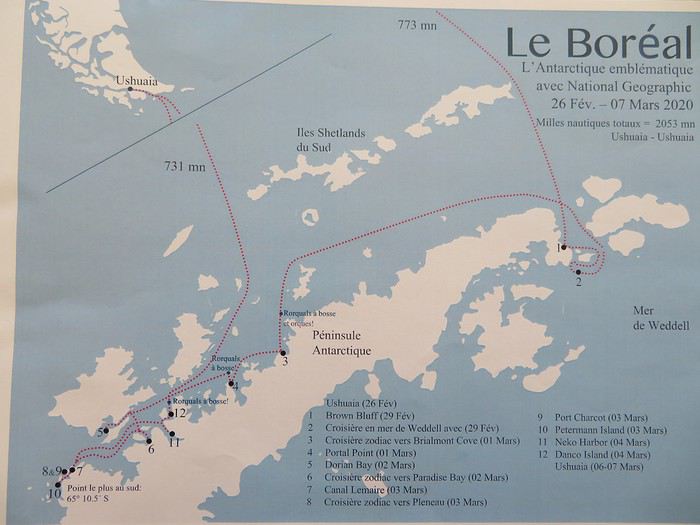
Brown Bluff
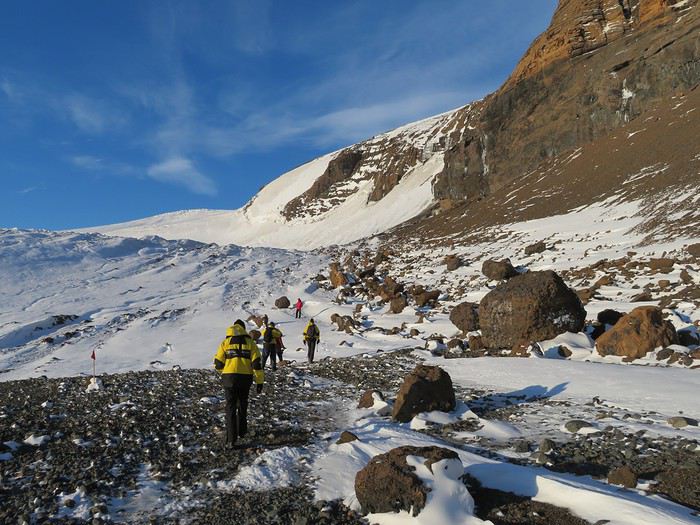
Balade en zodiac, Baie de Brialmont
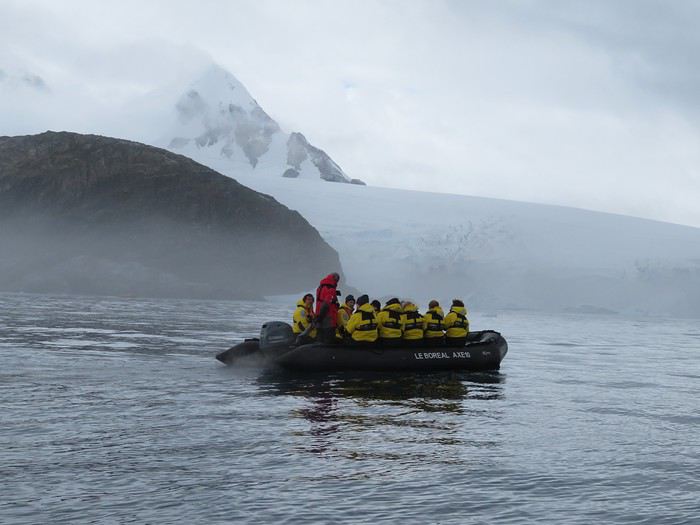
Rorqual à bosse
Baie de la Salpétrière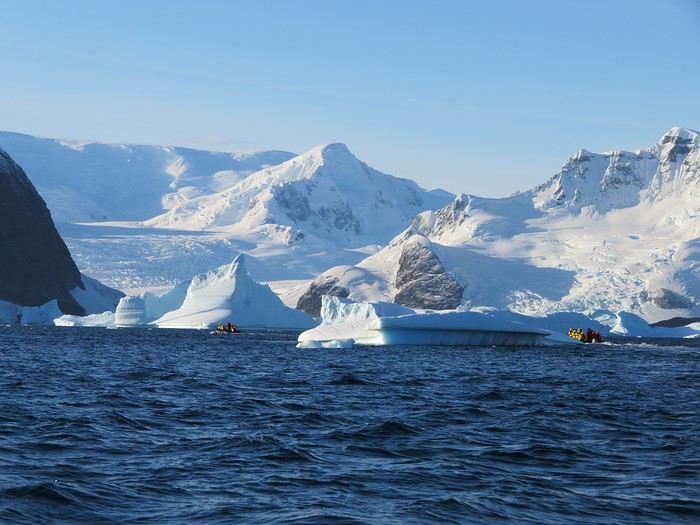
Port Charcot
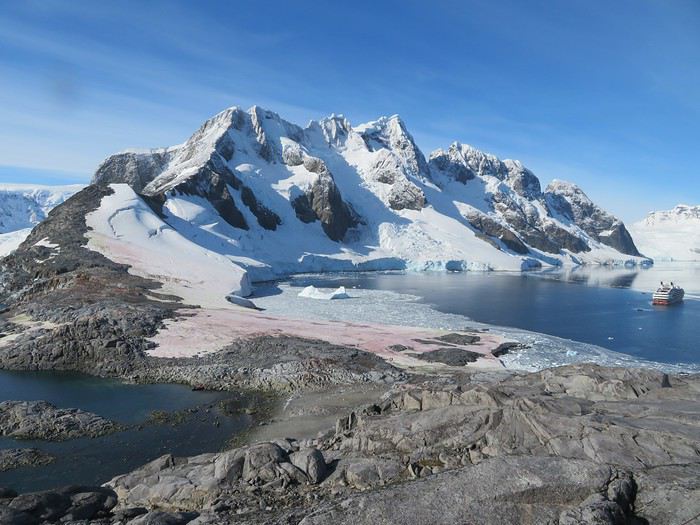
A bientôt pour la suite...😉
Tout d'abord, un grand merci 😉 à Joska, Sarnia, Toilapol, 4yne, Musclass, Maclaro et les autres membres VF dont j'ai regardé les CR et qui m'ont aidé dans la préparation et l'attente de ce voyage.
Je me lance donc dans un petit résumé de notre croisière en Antarctique à bord du Boreal qui s’est déroulée du 26 février au 7 mars 2020. Cette croisière était en partenariat avec National Geographic.
Nous sommes revenus émerveillés de ce voyage 😇 qui s’est très bien passé. Nous avons eu une équipe de naturalistes et un équipage formidables à tous les points de vue 😎 : navigation, hôtellerie/restauration, animation…
Nous avons eu une traversée du Drake très mouvementée 🏴☠️ à l’aller (creux de 7 mètres, vent à 60 nœuds) mais nous avons été récompensés par une météo exceptionnelle 😄 en Antarctique.
Nous avons pu faire tous les jours deux sorties (sauf en Mer de Weddell, un seul débarquement), voire quatre pour nous 😇 l’avant-dernier jour en Péninsule car nous avons eu la chance de pouvoir faire du kayak sans supplément de prix.
La faune était au rendez-vous : manchots bien sûr, baleines très nombreuses, orques, phoques de Weddell, crabier, léopard, otaries, damiers du Cap…Un bonheur !
La carte de la croisière :
Brown Bluff
Balade en zodiac, Baie de Brialmont
Rorqual à bosse
Baie de la Salpétrière
Port Charcot
A bientôt pour la suite...😉