Results for "Candé+|+127"
8278 results found.
Cherche documents sur les mariages traditionnels dans le monde English translation pending
bonjour, je suis à la recherche de tous documents, études, expériences, images, sites internet, etc.....traitant des mariages traditionnels à travers le monde.
merci à ceux qui me feront partager connaissance ou expérience.
Coin tranquille en Thaïlande English translation pending
bonjour
si tt va bien cf message précédent, on part en Thailande ds une dizaine de jours.
Dans l'idéal, on voulait rayonner autour de chang mai (1 semaine) + trouver une île calme mais av suffisamment d'infrastructure pr trouver un club de plongée : quelqu'1 a-t-il 1 idée ? Koh Tao ? j'ai un peu peur d'1 île trop connue comme Koh samui ? mais p être y-a-t-il des endroits calmes partout ?
merci par avance
si tt va bien cf message précédent, on part en Thailande ds une dizaine de jours.
Dans l'idéal, on voulait rayonner autour de chang mai (1 semaine) + trouver une île calme mais av suffisamment d'infrastructure pr trouver un club de plongée : quelqu'1 a-t-il 1 idée ? Koh Tao ? j'ai un peu peur d'1 île trop connue comme Koh samui ? mais p être y-a-t-il des endroits calmes partout ?
merci par avance
Excursion Bavaro Runnes Safarie Aventure English translation pending
😊je vais à punta cana du 15 février au 29
j'ai entendu parlé d'une excursion Bavaro Runners Safarie Aventure. y-t-il quelqu'un qui connaît çà.
commentaires plus prix si possible
à bientôt
j'ai entendu parlé d'une excursion Bavaro Runners Safarie Aventure. y-t-il quelqu'un qui connaît çà.
commentaires plus prix si possible
à bientôt
Excursions à Punta cana? English translation pending
Quelle excursion me conseillez-vous depuis Punta Cana (H10 Bavaro)
Nous partons le 26 janvier avec Marsans.
D'avance Merci
Nous partons le 26 janvier avec Marsans.
D'avance Merci
Précautions pour la République Dominicaine? English translation pending
Merci à ceux qui sont déjà part en RD pour leurs conseils en matière de santé ???
Quelles sont les précautions à prendre (je sais qu'il ne faut surtout pas boire de l'eau si elle n'est pas en bouteille fermée).
Que faut il emmener comme type de médicament au cas où ???
Quels sont les meilleurs précautions contre les moustiques ???
Merci d'avance pour vos conseils
Nat😉
Merci d'avance pour vos conseils
Nat😉
Recrutement moniteur et monitrice de ski ou snow English translation pending
Bonjour à tous,
Ceux qui désireraient enseigner au Québec cet hiver peuvent me contacter. Je suis moniteur au Mont Ste Anne il y une ambiance super sympa. J'aimerai que plus d'étrangers viennent travailler avec nous. Plus on est de fou plus rit😉
Alors n'hésité pas à me contacter
Laurent
Ceux qui désireraient enseigner au Québec cet hiver peuvent me contacter. Je suis moniteur au Mont Ste Anne il y une ambiance super sympa. J'aimerai que plus d'étrangers viennent travailler avec nous. Plus on est de fou plus rit😉
Alors n'hésité pas à me contacter
Laurent
Quel hôtel en République Dominicaine (novembre) English translation pending
Bonjour, nous souhaitons partir en républic dominicaine la première semaine de Novembre mais il y'a tellement d'hotels que l'on ne sait lequel choisir.
Nous cherchons un bon confort, une belle plage, de bons restaurants et des excursions sympa. Les activités ne sont pas notre priorité.
Merci de vos conseils.
Nous cherchons un bon confort, une belle plage, de bons restaurants et des excursions sympa. Les activités ne sont pas notre priorité.
Merci de vos conseils.
Quoi faire au Népal? English translation pending
je compte partir au Népal en avril 04, pour 1 mois. Je suis trés intéressée par le côté voyage culturel, et quelques petits trekks ne me rebutent pas. j'aimerai aussi des infos sur le Chitwan Park. merci
Voyage au Québec English translation pending
Bonsoir Didier, 🙂
J'ai consulté mon bouquin.
Voici quelques suggestions pour ton prochain voyage au Québec.
Premièrement, je te suggère fortement d'aller dans les parcs nationaux. Ils sont de toute beauté. Si tu aimes la nature, je te jure que tu ne seras pas déçue. Si tu veux avoir un bref apperçu, tu peux consulter mon site web. J'y ai mis quelques photos. Tu m'en donneras des nouvelles.
Pour ma part, je suis allée à plusieurs reprises au Parc national de la Mauricie, y faire du canoê-camping. C'est génial!! Une expérience inoubliable à renouveler n'importe quand!
J'ai aussi fait de la randonnée pédestre en montagnes à Baie St-Paul. Les paysages sont à couper le souffle. J'ai quelques photos, mais elle ne sont pas scannée encore.
A part ça, j'ai passé un mois aux îles-de-la-Madeleine. C'est extraordinaire. Juste un petit conseil: je te suggère d'y aller durant la période estivale, car hors de cette période tout est fermé. Ah oui j'oubliai... Comment ai-je pu??? J'ai jamais vu un endroit où le vent est aussi fort et présent. Les Madelinois sont des gens très accueillant.
Les Laurentides est aussi une très belle région. Je la conseille surtout à l'automne, car les feulles des érables sont colorées de jaune et de rouge. C'est magnifique. Sinon, il y a l'hiver, où c'est aussi pas mal, si tu aimes les sports d'hiver, tel que le ski alpin.
La Gaspésie, est aussi très belle. Malheureusement, je n'ai pas eu l'occasion de la visiter. Mais je me promets de la faire un de ces jours.
Le Lac St-Jean est également à visiter. J'ai eu plusieurs amis qui venaient du Lac St-Jean. Ils m'ont dit que c'était magnifique. Et si ma mémoire est bonne, il me semble qu'on peut y voir des baleines. Une très belle expérience à vivre.
Voilà, je crois que c'est tout pour le moment.
Je te conseille d'aller à "La librairie du Québec" à Paris avant ton départ. Tu pourras y trouver une foule de livres, de CD (de musique québécoise; le choix y est excellent!). Tu trouveras les coordonnées de cette librairie dans "livres..." et "musique du monde".
De plus, les parcs nationaux ont un site internet. Je te le conseille fortement. Il est très bien fait. Et tu pourras voir des photos magnifiques!
J'espère avoir répondu à ta question.
Ah oui, j'oubliai... il y a également un site sur le tourisme au Québec sur internet. Je crois qu'il se nomme: "bonjour Québec" ou quelque chose du genre.
Je te souhaite un très beau voyage!
Et pourrais-tu copier ce message et le mettre dans "Amérique du Nord" pour en faire profiter les autres voyageurs s'il te plaît? Merci à l'avance de ta collaboration.
Josée
J'ai consulté mon bouquin.
Voici quelques suggestions pour ton prochain voyage au Québec.
Premièrement, je te suggère fortement d'aller dans les parcs nationaux. Ils sont de toute beauté. Si tu aimes la nature, je te jure que tu ne seras pas déçue. Si tu veux avoir un bref apperçu, tu peux consulter mon site web. J'y ai mis quelques photos. Tu m'en donneras des nouvelles.
Pour ma part, je suis allée à plusieurs reprises au Parc national de la Mauricie, y faire du canoê-camping. C'est génial!! Une expérience inoubliable à renouveler n'importe quand!
J'ai aussi fait de la randonnée pédestre en montagnes à Baie St-Paul. Les paysages sont à couper le souffle. J'ai quelques photos, mais elle ne sont pas scannée encore.
A part ça, j'ai passé un mois aux îles-de-la-Madeleine. C'est extraordinaire. Juste un petit conseil: je te suggère d'y aller durant la période estivale, car hors de cette période tout est fermé. Ah oui j'oubliai... Comment ai-je pu??? J'ai jamais vu un endroit où le vent est aussi fort et présent. Les Madelinois sont des gens très accueillant.
Les Laurentides est aussi une très belle région. Je la conseille surtout à l'automne, car les feulles des érables sont colorées de jaune et de rouge. C'est magnifique. Sinon, il y a l'hiver, où c'est aussi pas mal, si tu aimes les sports d'hiver, tel que le ski alpin.
La Gaspésie, est aussi très belle. Malheureusement, je n'ai pas eu l'occasion de la visiter. Mais je me promets de la faire un de ces jours.
Le Lac St-Jean est également à visiter. J'ai eu plusieurs amis qui venaient du Lac St-Jean. Ils m'ont dit que c'était magnifique. Et si ma mémoire est bonne, il me semble qu'on peut y voir des baleines. Une très belle expérience à vivre.
Voilà, je crois que c'est tout pour le moment.
Je te conseille d'aller à "La librairie du Québec" à Paris avant ton départ. Tu pourras y trouver une foule de livres, de CD (de musique québécoise; le choix y est excellent!). Tu trouveras les coordonnées de cette librairie dans "livres..." et "musique du monde".
De plus, les parcs nationaux ont un site internet. Je te le conseille fortement. Il est très bien fait. Et tu pourras voir des photos magnifiques!
J'espère avoir répondu à ta question.
Ah oui, j'oubliai... il y a également un site sur le tourisme au Québec sur internet. Je crois qu'il se nomme: "bonjour Québec" ou quelque chose du genre.
Je te souhaite un très beau voyage!
Et pourrais-tu copier ce message et le mettre dans "Amérique du Nord" pour en faire profiter les autres voyageurs s'il te plaît? Merci à l'avance de ta collaboration.
Josée
Vacances au Portugal English translation pending
salut a tous
je pars dans 3 semaines et je souhaiterais connaitre quelques bons coins (plages, camping, chez l habitant)
sachant que je compte faire du nord au sud alternant visites et plages
je pars dans 3 semaines et je souhaiterais connaitre quelques bons coins (plages, camping, chez l habitant)
sachant que je compte faire du nord au sud alternant visites et plages
Les révélations qu'on peut avoir lors d'un voyage English translation pending
J'ouvre un nouveau sujet:
on a tous connu des moments plus ou moins marquants lors de nos voyages. Certains instants étaient même si forts qu'ils ont contribué à une révélation. Par exemple untel a compris que le plus important, finalement, était de rester en vie, un autre qu'il devait se mettre à tel instrument, un autre enfin qu'en Occident, on était quand même gâtés, par rapport à plein d'autres endroits. Il peut s'agir d'une prise de conscience sur soi, ou sur le monde, ou les deux...
Je vous invite donc à nous faire part de vos récits de "révélations". Racontez l'évènement vécu, et le déclic qu'il a produit en vous. Ces moments de forte émotions passionneront, j'en suis sûr, beaucoup de personnes du forum. Voire, les interpelleront parce qu'elles auront senti les choses d'une façon similaire.
on a tous connu des moments plus ou moins marquants lors de nos voyages. Certains instants étaient même si forts qu'ils ont contribué à une révélation. Par exemple untel a compris que le plus important, finalement, était de rester en vie, un autre qu'il devait se mettre à tel instrument, un autre enfin qu'en Occident, on était quand même gâtés, par rapport à plein d'autres endroits. Il peut s'agir d'une prise de conscience sur soi, ou sur le monde, ou les deux...
Je vous invite donc à nous faire part de vos récits de "révélations". Racontez l'évènement vécu, et le déclic qu'il a produit en vous. Ces moments de forte émotions passionneront, j'en suis sûr, beaucoup de personnes du forum. Voire, les interpelleront parce qu'elles auront senti les choses d'une façon similaire.
looking for hiking & discovery buddies 24.08 - 14.09
Hi there,
Here comes the time for well-deserved holidays. Breathing in the fresh air, swimming, hiking... and enjoying an apéro 😎
I’m looking for travel buddies to co-create a getaway around Lake Annecy.
The idea is to explore with day hikes (no pressure, no performance vibes) and discover stunning views, local history... Try canoeing, mountain biking; check out street art performances, music festivals, art exhibitions—anything that makes for a good time.
I’m also open to other suggestions: the Pyrenees, Crete, Sardinia, Lanzarote, or anywhere else here or there 🙂
Holidays in a zen, laid-back spirit—no stress, no grumpiness, no ambiguity.
Energy. Culture. Sharing. Respect. Curiosity to discover the world. Chill vibes.
If you’ve got ideas for trips mixing cultural walks, heritage, music, arts, hiking, etc. (in France or abroad), hit me up to chat. Dates, locations, activities... we’ll figure it out together.
We can discuss via messaging and/or over coffee/ice cream in Paris, Marne-la-Vallée, or Meaux.
Marc,
(already 54 years old! *sigh*. From Seine-et-Marne)
Here comes the time for well-deserved holidays. Breathing in the fresh air, swimming, hiking... and enjoying an apéro 😎
I’m looking for travel buddies to co-create a getaway around Lake Annecy.
The idea is to explore with day hikes (no pressure, no performance vibes) and discover stunning views, local history... Try canoeing, mountain biking; check out street art performances, music festivals, art exhibitions—anything that makes for a good time.
I’m also open to other suggestions: the Pyrenees, Crete, Sardinia, Lanzarote, or anywhere else here or there 🙂
Holidays in a zen, laid-back spirit—no stress, no grumpiness, no ambiguity.
Energy. Culture. Sharing. Respect. Curiosity to discover the world. Chill vibes.
If you’ve got ideas for trips mixing cultural walks, heritage, music, arts, hiking, etc. (in France or abroad), hit me up to chat. Dates, locations, activities... we’ll figure it out together.
We can discuss via messaging and/or over coffee/ice cream in Paris, Marne-la-Vallée, or Meaux.
Marc,
(already 54 years old! *sigh*. From Seine-et-Marne)
Java itinerary ideas (excluding Yogyakarta, Bromo, and Ijen)
We’ve already explored Bali, eastern Java, and its volcanoes back in 2013, and we’d love to return to Java to discover other spots that aren’t so "mainstream." There’ll be three of us—a couple and our 25-year-old son. We love nature, small towns, villages, beautiful landscapes, and a bit of beach time... We’re used to backpacking around Southeast Asia. Any tips for exploring some great spots in Java in a coherent way, with 3 or 4 bases for a 3-week trip from late June to mid-July? We don’t want to revisit Bromo or Ijen (they seem way too crowded compared to 2013), and we might swing by Djogja but won’t redo Borobudur or Prambanan (same issue...). Looking forward to your tips! Thanks 🙂
Two weeks in Santo Antão and São Vicente – trip report
Hi everyone!
The forum has been a huge help during my moments of doubt, and since Cape Verde isn’t a destination with many discussions, I felt I had to share my trip report 🙂
First, the EASE: I could never validate it from my phone—I tried 50 times without success, and on the computer, it worked the first time. Then, Cabo Verde Airlines: forget online check-in. I went to the airport early to get my window seat (and in the end, the plane wasn’t full—I had three seats to myself, so I could finish my night peacefully). No in-flight entertainment for those who don’t sleep on planes.
Monday 9: Flight + arrival at Antonio’s (Oia Mindelo Guesthouse). Antonio’s apartment is up on the hill, but really, it’s only a 10-minute walk to the beach and 10 minutes to the city center (depending on where in the center). He picked me up at the airport (1000$). I continued relaxing by doing... nothing on the beach. Dinner in town at Café Mindelo: a pretty place, but otherwise meh—expensive and not necessarily good (2100$ for a beer and a fish that didn’t seem freshly caught as advertised). Tuesday 10: Antonio offered to do a tour of the island (for cheap), and we left with his other guests (a lovely English couple, 76 and 77 years old). Stops at Salamansa (I felt something special on that beach—I could’ve stayed there for an hour doing nothing), then another scenic spot, a restaurant, and Baias das Gatas (I took a quick dip, but to me, it had less charm than Salamansa). Then we crossed the island to return to São Pedro (beautiful but windy; the village looks cute). Exhausted, I went to bed early because of the ferry to Santo Antão the next day. Wednesday 11: Antonio took me to the ferry, and we’ll see each other again since he’s hosting me at his aunt’s place during Carnival. On the ferry, I had a Booking.com reservation for what I thought was in Ribeira Grande (the town), but it was actually *in* the ribeira—specifically in Manta Velha (aluguer to Cruzinha ~600$). I thought I’d fallen into a hole, but I ended up loving it—Casa Familiar Gilda. Gilda is a divine cook (dinner for 1000$—don’t eat lunch, or there won’t be room), the village has a typical rural Santo Antão vibe, the place has great energy, and you can get around easily by aluguer. Thursday 12: I left early by aluguer to Ribeira Grande (250$), then another aluguer to Ponta do Sol (100$)—a sleepy beauty at that hour—to do the Ponta do Sol-Cruzinha hike, finishing in Cha de Igreja. Departure at 8:22 AM from the cemetery in Ponta do Sol, passing through Fontainhas (those doing it the other way will have a fabulous climb at the end 😏), and let’s go! I loved this glimpse of rural life—past or present—the sea is stunning, and we were shaded most of the way (though it goes up and down, it’s manageable). The arrival at Cha de Mar is breathtaking, and Cruzinha is a charming little town (arrived at 12:30 PM). I’d brought my swimsuit after reading there was a beach, but I packed it back up—too many waves and big pebbles. I continued to Cha de Igreja (25 more minutes) after a short break (ask for the path that doesn’t go by the road). It’s adorable with its church square (you don’t see this layout much elsewhere). I might’ve stayed longer to enjoy the place, but a taxi driver asked if I wanted to return to Manta Velha (1000$), and like a fool, I said yes (it was 2:30 PM—I could’ve waited for the 4:30 PM aluguer for 100$, but oh well). But since I still had energy, I decided to see if I could find a grog distillery. I ran into a French guy arriving at Gilda’s, and we ended up talking to Rodrigo, who explained everything from A to Z about how they make grog (the simple cane juice is amazingly good—but the work is clearly tough). Friday 13: Transfer to Xoxo on Djalma’s advice 😉, where I’d booked a room at Casa Xoxo. I did the hike to Rabo Crusto... it’s tough, but I kept quiet when I saw a pregnant woman doing it with her two little ones 😄. There’s also a distillery I didn’t linger in, and I took a tea break with that wonderful landscape before heading back. I couldn’t find the path Jean-Michel had told me about (take a right at the village entrance), so I went back down to the water reservoir to turn off and take the waterfall path (anyone can point it out if needed). The bedding at Casa Xoxo was perfect, but the dinner atmosphere was less family-like. Saturday 14: No one at Casa Xoxo could tell me when the aluguer passed, so I scarfed down my breakfast and headed down a bit. I found one (not sure if he’d planned to work, but there were three of us, so he left). Arrived in Ribeira Grande, an aluguer driver told me the coastal road to Porto Novo was closed and we had to take the Corde road—but no one was leaving, so we’d have to charter... Sometimes, you just have to say it: aluguer drivers say there’s no ride just to make you pay the private price (3500$). But this time, it was true! With another French couple, we wanted to go to Tarrafal. Our driver called the Porto Novo-Tarrafal aluguer to wait for us. The Corde road is stunning—more different landscapes (thorny forest, misty peaks...). Changed aluguers in Porto Novo and headed to Tarrafal. Another world—lunar landscape on the way. Arrived in Tarrafal and relaxed. Sunday 15: Hike from Tarrafal to Monte Trigo, left at 8 AM, and I’m glad I did—I was in the shade until about 9:30 AM, then the sun got strong. Beautiful walk, arrived in Monte Trigo around 11:30 AM. The people weren’t particularly friendly, but oh well. Swam at the little beach in Monte Trigo (the water is *so* good). I waited for other French people who had “booked” a boat for the return. Came back with Javi (50 min—1000$ each), who lent us masks and snorkels for some snorkeling. Had grog with Ludo, Estelle’s husband, who was waiting at the bar, then filled my grog bottle at the *mercearia*. I admit, it’s delicious, but I don’t remember much of that evening 😇🤪. Except Javi put on a show saying he’d been robbed, had no money, and needed to pay the boat owner, etc. People paid again (apparently not me, since Ludo, Estelle, and I arrived at the restaurant after Javi’s drama). FYI, Javi does this often—my host had warned the couple renting the other room to watch out for him because he scams people for money. So Javi is 35 with hazel/special-colored eyes. But if you don’t repay the “service,” the day was still great. Monday 16: Several of us were taking the late-afternoon boat, so we chartered an aluguer (7000$) to avoid the 6 AM one—trip—boat to Mindelo. Antonio picked me up at the ferry, and boom—Carnival! I found a spot on Rua de Lisboa. My neighbor was from Santo Antão just for Carnival, spoke French, and explained that last year’s Carnival started 3 hours late because a float couldn’t fit under the power lines 😏 (like they don’t know the height by now hahaha). On Monday, it’s the teachers (nice—kind of a warm-up) and the Madingas. Once they passed my spot, I followed them along the route—I LOVED it! By midnight, they still hadn’t reached Praça Nova, and the police told them to speed up, but I loved that energy! Tuesday 17—Mardi Gras: Beach day, then Carnival! Antonio had bought me a seated ticket just in case (300$). Ended up in front of a punch stand, where I ran into two French women I’d met in Manta Velha. Two guys from Mindelo talked to us, and we did Carnival with them. And what was bound to happen, happened: a float couldn’t pass because... it was taller than the power lines 😏😏😏. The dancers kept dancing while the crowd tried to lift the cable. Finally, a guy in a tree climbed higher and used a pole to lift it... and the parade could continue 😉. Around 12:30–1:30 AM, when the concert was supposed to start, the power went out. I went home and later learned the concert started around 3 AM. Wednesday 18: I went home because I was taking the boat back to Santo Antão, heading to Casa Familiar Gilda. Walked the loop from Manta Velha. Thursday 19: Left early for Ribeira da Paul to do the loop to Sandra’s House. It’s truly breathtaking! Back at Gilda’s, I chilled. I wanted to go to Sinagoga’s natural pools, but the hike had worn me out. Friday 20: Return to Mindelo on the red company’s ferry—no comparison: way more comfortable than the blue company’s, especially for someone prone to seasickness. Beach. Exhausted, I struggled to sleep because the shop on the ground floor of my rental had a party until 3 AM (and the windows aren’t double-glazed—*hi*—but that’s common in Mindelo). Saturday 21: Ran into Estelle and Ludo by chance (the city’s small), and we arranged to share a taxi the next day since we had the same return flight. Beach (I tried Lazaretto Beach, but nope—not great—dead fish + weird smell = bad signs). So Laginhia was fine, and in the evening, a restaurant with singers, then Caravelle (the ground-floor shop didn’t bother me since I got home when they were saying goodbye 😏). Too bad—I dance salsa, bachata, kompa, zouk, but not kizomba hahaha, but it was still fun. Sunday 22: Took a taxi with Ludo and Estelle (1200$). Arrived *ages* before takeoff (no exchange office—get escudos in town if you have any left). Boom—CDG, boom—RER... home.
There you go—a super long trip report. Not sure if it’ll help, but the digital detox was amazing. These two islands are very different but so beautiful. I only got a glimpse, but they’re worth the trip. I was lucky to see Carnival (what joy in that city!) and happy the Cambodia ticket (my first idea) was way too expensive 😉
First, the EASE: I could never validate it from my phone—I tried 50 times without success, and on the computer, it worked the first time. Then, Cabo Verde Airlines: forget online check-in. I went to the airport early to get my window seat (and in the end, the plane wasn’t full—I had three seats to myself, so I could finish my night peacefully). No in-flight entertainment for those who don’t sleep on planes.
Monday 9: Flight + arrival at Antonio’s (Oia Mindelo Guesthouse). Antonio’s apartment is up on the hill, but really, it’s only a 10-minute walk to the beach and 10 minutes to the city center (depending on where in the center). He picked me up at the airport (1000$). I continued relaxing by doing... nothing on the beach. Dinner in town at Café Mindelo: a pretty place, but otherwise meh—expensive and not necessarily good (2100$ for a beer and a fish that didn’t seem freshly caught as advertised). Tuesday 10: Antonio offered to do a tour of the island (for cheap), and we left with his other guests (a lovely English couple, 76 and 77 years old). Stops at Salamansa (I felt something special on that beach—I could’ve stayed there for an hour doing nothing), then another scenic spot, a restaurant, and Baias das Gatas (I took a quick dip, but to me, it had less charm than Salamansa). Then we crossed the island to return to São Pedro (beautiful but windy; the village looks cute). Exhausted, I went to bed early because of the ferry to Santo Antão the next day. Wednesday 11: Antonio took me to the ferry, and we’ll see each other again since he’s hosting me at his aunt’s place during Carnival. On the ferry, I had a Booking.com reservation for what I thought was in Ribeira Grande (the town), but it was actually *in* the ribeira—specifically in Manta Velha (aluguer to Cruzinha ~600$). I thought I’d fallen into a hole, but I ended up loving it—Casa Familiar Gilda. Gilda is a divine cook (dinner for 1000$—don’t eat lunch, or there won’t be room), the village has a typical rural Santo Antão vibe, the place has great energy, and you can get around easily by aluguer. Thursday 12: I left early by aluguer to Ribeira Grande (250$), then another aluguer to Ponta do Sol (100$)—a sleepy beauty at that hour—to do the Ponta do Sol-Cruzinha hike, finishing in Cha de Igreja. Departure at 8:22 AM from the cemetery in Ponta do Sol, passing through Fontainhas (those doing it the other way will have a fabulous climb at the end 😏), and let’s go! I loved this glimpse of rural life—past or present—the sea is stunning, and we were shaded most of the way (though it goes up and down, it’s manageable). The arrival at Cha de Mar is breathtaking, and Cruzinha is a charming little town (arrived at 12:30 PM). I’d brought my swimsuit after reading there was a beach, but I packed it back up—too many waves and big pebbles. I continued to Cha de Igreja (25 more minutes) after a short break (ask for the path that doesn’t go by the road). It’s adorable with its church square (you don’t see this layout much elsewhere). I might’ve stayed longer to enjoy the place, but a taxi driver asked if I wanted to return to Manta Velha (1000$), and like a fool, I said yes (it was 2:30 PM—I could’ve waited for the 4:30 PM aluguer for 100$, but oh well). But since I still had energy, I decided to see if I could find a grog distillery. I ran into a French guy arriving at Gilda’s, and we ended up talking to Rodrigo, who explained everything from A to Z about how they make grog (the simple cane juice is amazingly good—but the work is clearly tough). Friday 13: Transfer to Xoxo on Djalma’s advice 😉, where I’d booked a room at Casa Xoxo. I did the hike to Rabo Crusto... it’s tough, but I kept quiet when I saw a pregnant woman doing it with her two little ones 😄. There’s also a distillery I didn’t linger in, and I took a tea break with that wonderful landscape before heading back. I couldn’t find the path Jean-Michel had told me about (take a right at the village entrance), so I went back down to the water reservoir to turn off and take the waterfall path (anyone can point it out if needed). The bedding at Casa Xoxo was perfect, but the dinner atmosphere was less family-like. Saturday 14: No one at Casa Xoxo could tell me when the aluguer passed, so I scarfed down my breakfast and headed down a bit. I found one (not sure if he’d planned to work, but there were three of us, so he left). Arrived in Ribeira Grande, an aluguer driver told me the coastal road to Porto Novo was closed and we had to take the Corde road—but no one was leaving, so we’d have to charter... Sometimes, you just have to say it: aluguer drivers say there’s no ride just to make you pay the private price (3500$). But this time, it was true! With another French couple, we wanted to go to Tarrafal. Our driver called the Porto Novo-Tarrafal aluguer to wait for us. The Corde road is stunning—more different landscapes (thorny forest, misty peaks...). Changed aluguers in Porto Novo and headed to Tarrafal. Another world—lunar landscape on the way. Arrived in Tarrafal and relaxed. Sunday 15: Hike from Tarrafal to Monte Trigo, left at 8 AM, and I’m glad I did—I was in the shade until about 9:30 AM, then the sun got strong. Beautiful walk, arrived in Monte Trigo around 11:30 AM. The people weren’t particularly friendly, but oh well. Swam at the little beach in Monte Trigo (the water is *so* good). I waited for other French people who had “booked” a boat for the return. Came back with Javi (50 min—1000$ each), who lent us masks and snorkels for some snorkeling. Had grog with Ludo, Estelle’s husband, who was waiting at the bar, then filled my grog bottle at the *mercearia*. I admit, it’s delicious, but I don’t remember much of that evening 😇🤪. Except Javi put on a show saying he’d been robbed, had no money, and needed to pay the boat owner, etc. People paid again (apparently not me, since Ludo, Estelle, and I arrived at the restaurant after Javi’s drama). FYI, Javi does this often—my host had warned the couple renting the other room to watch out for him because he scams people for money. So Javi is 35 with hazel/special-colored eyes. But if you don’t repay the “service,” the day was still great. Monday 16: Several of us were taking the late-afternoon boat, so we chartered an aluguer (7000$) to avoid the 6 AM one—trip—boat to Mindelo. Antonio picked me up at the ferry, and boom—Carnival! I found a spot on Rua de Lisboa. My neighbor was from Santo Antão just for Carnival, spoke French, and explained that last year’s Carnival started 3 hours late because a float couldn’t fit under the power lines 😏 (like they don’t know the height by now hahaha). On Monday, it’s the teachers (nice—kind of a warm-up) and the Madingas. Once they passed my spot, I followed them along the route—I LOVED it! By midnight, they still hadn’t reached Praça Nova, and the police told them to speed up, but I loved that energy! Tuesday 17—Mardi Gras: Beach day, then Carnival! Antonio had bought me a seated ticket just in case (300$). Ended up in front of a punch stand, where I ran into two French women I’d met in Manta Velha. Two guys from Mindelo talked to us, and we did Carnival with them. And what was bound to happen, happened: a float couldn’t pass because... it was taller than the power lines 😏😏😏. The dancers kept dancing while the crowd tried to lift the cable. Finally, a guy in a tree climbed higher and used a pole to lift it... and the parade could continue 😉. Around 12:30–1:30 AM, when the concert was supposed to start, the power went out. I went home and later learned the concert started around 3 AM. Wednesday 18: I went home because I was taking the boat back to Santo Antão, heading to Casa Familiar Gilda. Walked the loop from Manta Velha. Thursday 19: Left early for Ribeira da Paul to do the loop to Sandra’s House. It’s truly breathtaking! Back at Gilda’s, I chilled. I wanted to go to Sinagoga’s natural pools, but the hike had worn me out. Friday 20: Return to Mindelo on the red company’s ferry—no comparison: way more comfortable than the blue company’s, especially for someone prone to seasickness. Beach. Exhausted, I struggled to sleep because the shop on the ground floor of my rental had a party until 3 AM (and the windows aren’t double-glazed—*hi*—but that’s common in Mindelo). Saturday 21: Ran into Estelle and Ludo by chance (the city’s small), and we arranged to share a taxi the next day since we had the same return flight. Beach (I tried Lazaretto Beach, but nope—not great—dead fish + weird smell = bad signs). So Laginhia was fine, and in the evening, a restaurant with singers, then Caravelle (the ground-floor shop didn’t bother me since I got home when they were saying goodbye 😏). Too bad—I dance salsa, bachata, kompa, zouk, but not kizomba hahaha, but it was still fun. Sunday 22: Took a taxi with Ludo and Estelle (1200$). Arrived *ages* before takeoff (no exchange office—get escudos in town if you have any left). Boom—CDG, boom—RER... home.
There you go—a super long trip report. Not sure if it’ll help, but the digital detox was amazing. These two islands are very different but so beautiful. I only got a glimpse, but they’re worth the trip. I was lucky to see Carnival (what joy in that city!) and happy the Cambodia ticket (my first idea) was way too expensive 😉
Currency on Île aux Nattes
Hi everyone, I’m heading to Île aux Nattes in a few weeks and I’d like to know if euros are accepted in the island’s restaurants.
At the hotel where I’ll be staying, they take card payments, but for activities, I can’t find any reliable info.
Could anyone tell me the approximate cost in euros and/or ariary for a week (food outside the hotel) on the island for two people?
Also, has anyone ever exchanged money at the Paris Magenta exchange bureau? Thanks!
Also, has anyone ever exchanged money at the Paris Magenta exchange bureau? Thanks!
Havana, Cuba / January 2026
I got into music with the will
To light up many hearths like Che could do,
To circulate ideas, to advance utopia
Alternating barricades, sharp thought, and poetry.
Mc Solaar, Guérilla
Subscribing without a fight to the slightest line of my itinerary sometimes feels like an illusion. Because there are countries where, despite the fever and enthusiasm, despite the triumphant revolution, certain elements block my path. And if I had planned, for F. and me, a beautiful ascent up Tabouret Hill (Loma del Taburete, 453m), it was without accounting for vegetation as dense as it was thorny, which barred our way after just a few quarters of an hour of walking. Exhausted, I had to face the facts: we wouldn’t go any further. I needed to come up with some kind of Plan B.
But what is this country, an unwitting laboratory of the worst that white civilization has done during its reign? What is this magnificent place—yet another—entrusted to the care of oblivion, just 150 km from the land of freedom? According to Donald Trump, a country supporting terrorism; according to the locals, the vast battlefield of 20th-century ideologies; according to the average tourist, a hot country, a beautiful country, a country where the last illusions of a lost paradise are dying.
On the other side of Havana Bay, we love that statue of Christ blessing the city. There’s something gentle, soothing, in that patriarchal gesture. You’d almost be tempted to forget that at the dawn of the 16th century, those who claimed to represent the Church had no scruples about eradicating the Ciboney and Taíno populations. Worse, you’ll find magnificent this cathedral dedicated to the Virgin Mary, right in the heart of the old city. Under the guise of a civilizing necessity, Havana became, like so many other places, the gilded seat of European pretensions, at the expense of local populations doomed to extermination, then enslaved populations—more or less indigenous—who, you can imagine, didn’t often set foot in this holy place.
Lost in my thoughts, I try to push through this tangled vegetation. Nature reclaims its rights; nature abhors a vacuum. Yes, the well-trodden path of revolution couldn’t stay free of weeds! The road is buried. We give up and turn back, until that fork I’d noted before leaving, which would let us reach the top of the hill by skirting its northern slope.
So the white man arrives, settles, and gets rid of everything that bothers him. He has two unstoppable forces at his disposal: gunpowder and the spiritual certainty of being on the side of an all-powerful god. While the first gives him an unmatched material advantage over his new enemy, the second lets him use the first without feeling too guilty. That’s the magic of this supreme Church: it condemns all forms of pleasure—calling them impurity—while promoting plunder and crime under the cover of evangelization.
Walking through the city, you find a bit of Algiers, except that here, the decay is almost irreversible. You feel the splendor of the past, a disconcerting image of all vanity, from an era when men knew how to build beauty—especially if they didn’t have to share it. We’ll debate the benefits of colonialism for a long time, while glossing over the fact that those benefits often stopped at the city limits, limits all too obvious to the indigenous people. Havana isn’t just one or a few buildings; it’s an impressive collection of works of art built one after another, in what I think was a spirit of healthy competition. Yes, you find Algiers in this exuberance. As if these distant cities were the receptacle of everything that was best in the lands of origin. Atlantes and lintels, golds, blues, ogives, and monumental windows—exceptional architecture in an exceptional place.
Some streets are clean, swept with care; others are not, scattered here and there with potholes filled with water. A rather persistent smell of urine invades us regularly. We move on. And we look up: Havana is visited with your nose in the air. Because the beauty is truly up there, on those magnificent balconies and terracotta arches. Also because it’s not impossible that a piece of that balcony might suddenly detach, hurling our ends into an overseas tragedy we’d rather avoid. On the ground, here and there, rubble. Inexorably, this city is returning to dust.
My Plan B turns out to be no more successful than the first attempt. After a cheerful progression of a few hundred meters, same outcome, same struggle—the vegetation opposes any revolution: impossible to go around the hill! Once again, we have to turn back. We’ll try Plan C. I reassure myself by convincing myself to stay in the logic of this country: Cuba has been searching for itself for five centuries.
Coffee, tobacco, and sugarcane—the green gold of the colonies—so that money could flow and Europe could enjoy itself. Cuba’s history isn’t original. In reality, all the hot lands at these latitudes suffer the same fate: to serve the white man. While waiting for the awakening of consciences, UN Resolution 1514 and more or less affirmed revolutionary desires. Except that—and this reflection is just my own—if the awakening of consciences and the revolutionary will don’t play into what Resolution 1514 hides, there’s a good chance the said state will become a pariah. Those who don’t follow the American doctrine risk a lot; those who decide to follow Moscow risk everything. Independence was only the barely discreet instrument of American views. Patrice Lumumba will gladly enlighten us on the subject.
Turning back is good. Setting up Plan C is better. I won’t deviate from my goal: we will reach the top of Tabouret, whatever the cost! Near a small country road, I hesitate to change the program. Time is ticking—is it really reasonable to attempt the ascent? Then a tricycle taxi appears, a kind of tuk-tuk powered by an electric moped. I take it as a sign from fate, and we board for the starting point of Plan C.
In Cuba, even before Resolution 1514, independence was assured by a pawn of the United States, Fulgencio Batista. There’s no need to go over the whole history here; we’ll just remember that if you know how to give without counting to your former masters, you can enjoy a facade of freedom. Fidel Castro, on the other hand, didn’t know how to give. It never even occurred to him. That’s why the United States harbors such terrible hatred for this rebellious state, opposed to capitalist values and political prostitution. From there to slowly killing its people for nearly seventy years, one can legitimately cry injustice. But there are other priorities. Oh yes! Greenland...
Do Cubans eat their fill? Does seeing overweight people mean opulence? Food grows, no doubt about it. The soil is fertile, the climate favorable. No, what shocks here is the absolute precarity, the feeling of a people living in survival mode, and the decay of both goods and hope. Where to go? What’s the point? The stubbornness of the United States in wanting to impose its views on the Cuban government is felt much more by an overwhelmed people than by those few elites—caricatures of communism—who instill their vision of happiness with a crowbar. The embargo imposed in 1960; the false-flag attacks—American planes flying the colors of the Cuban revolution during the Bay of Pigs invasion in 1961—the exasperation of placing Cuba on the list of countries supporting terrorism. More recently, Donald Trump decided to heavily tax countries supplying Cuba with fuel. The last time I saw such long lines near gas stations was during my first trip to Romania... in 1991. It’s not for me to judge whether Raúl and his clique are playing fair by thumbing their noses at the West. I don’t hold the ins and outs of this war of egos that keeps the world’s great powers awake. I only caught a glimpse of the poverty of an island in 2026, while we in Europe are buried under an avalanche of the useless and superficial.
At the start of the San Juan baths, we find the trailhead. It climbs steeply. But the weather is relatively mild, thanks to a cold wave hitting higher up in the United States. Dallas is under snow; we’re walking in 16°C, a stroke of luck. We climb over rocks, under fairly decent vegetation, sometimes low but passable. And we succeed in the ascent in an hour. Up there, the top of the hill is somewhat maintained, at a minimum, but maintained, as if to honor Che through an awful monument erected in his glory—a stubborn specimen from those years when good taste was inversely proportional to the delusional ideas of those being honored. Birds of prey (raptors?) circle overhead; the monument is dying, crumbling, falling into ruin. *Hasta siempre*—forever—will be for the words. Nature, erosion, life itself will have the last word over all revolutions.
Back at the foot of the hill, just before a memorable swim, we talk with a family living there in miserable shacks whose stability wasn’t unlike that of the Leaning Tower of Pisa. The grandmother holds an animal, a rodent, by its feet. The grandfather has just killed it; she’s plucking its fur. A few steps away, water boils in a pot. She plunges the beast into the container. Tonight, the family will eat ragondin stew. Further on, another shack where, in a disorder rivaling the filth, a mother breastfeeds while sitting on the edge of a bed. Then, on the way down, we’ll meet a middle-aged man carrying a large jerrycan of water on his shoulder. Are these people happy here, far from the cities and their stakes? Is it too much to ask that they at least have access to electricity, running water, and decent, safe housing?
Outside the old city, Havana reveals wide avenues serving imposing institutions here and there. But whether in the colorful alleys of the old town or on the majestic and austere Plaza de la Revolución, the same feeling moves me: sadness. Seeing that only chaos has come from ideas crushes me. We praise, we sing the revolution—above all, we impose it in people’s minds as a necessity, when it’s nothing of the sort. Revolution is just the fruit of a few tortured minds who, once in power, do nothing better than all those before them. Enjoy power. Impose their views. It’s just a matter of color. Fidel saw red and knew how to persuade—or silence forever—his many detractors. The West sees everything in white, through the prism of human rights, and also knows how to persuade and silence its slightest detractors forever.
Paradoxically, Cuba survives largely thanks to tourism, a key element—let’s not be afraid to say it—of capitalism. And when a few players pick up the crumbs from transactions, the lion’s share and the foreign currency go to the government. So we won’t go to Varadero, the high place of relaxation overrun by Canadians. Instead, we’ll limit ourselves to crossing the ocean 30 minutes from the capital, at Santa María del Mar, to get an idea of cheaper tourism and to splash around for a few minutes in turquoise water invaded by sargassum. At the heart of the tourist season, we’ll meet few people. Like Havana, and according to its inhabitants, the high season is rather dead. But we won’t have come for nothing: we particularly love this return where, feverish, the taxi driver pushes his Moskvitch 2140 to the max on the highway, singing karaoke versions of hits at the top of his lungs from an onboard DVD player. East/West, the culture clash with a hint of Latino.
It’s time to leave this country of resourcefulness where extremes are very present. We’re leaving a 5-star hotel in front of yet another crumbling building. We’ve known restaurants at 40,000 pesos while in the street people eat for 400. We’ve seen those countless cars from another era and another culture—Pontiac, Lada, Chevrolet, Moskvitch—being overtaken by gleaming Mercedes and other Porsche Cayennes, the prerogative—if it still needed to be demonstrated—of the newly rich in search of recognition. Boarding the plane, we also understand that we’re not just traveling with tourists: there’s undoubtedly a rich and prosperous diaspora, just as there are relatively wealthy Cubans—well, wealthy enough to travel comfortably in the front of the aircraft. Meanwhile, on all the country’s roads, other Cubans try hitchhiking, their wives and children perched on a suitcase by the roadside. The father holds out his arm and holds a few bills in his hand like a card game. Where are they going? Who will pick them up?
Behind me, the gold of the Capitol. I’m told this gold comes from Russia. Like Marx and Lenin’s smoky theories? Like Stalin’s subtle and delicate paternalism? Let’s bet that, like the other buildings crumbling around it, the Capitol will also collapse one day, to avenge the Indians who perished from the diseases and guns of the whites, to avenge the Africans who obliterated their lives so Europeans could enjoy themselves, finally, to avenge all this abandoned people, left to the arbitrariness of democratic or non-democratic elections.
A sign in the street: We understand history. This is the revolution! We understand history. That’s the revolution.
No comment.
Subscribing without a fight to the slightest line of my itinerary sometimes feels like an illusion. Because there are countries where, despite the fever and enthusiasm, despite the triumphant revolution, certain elements block my path. And if I had planned, for F. and me, a beautiful ascent up Tabouret Hill (Loma del Taburete, 453m), it was without accounting for vegetation as dense as it was thorny, which barred our way after just a few quarters of an hour of walking. Exhausted, I had to face the facts: we wouldn’t go any further. I needed to come up with some kind of Plan B.
But what is this country, an unwitting laboratory of the worst that white civilization has done during its reign? What is this magnificent place—yet another—entrusted to the care of oblivion, just 150 km from the land of freedom? According to Donald Trump, a country supporting terrorism; according to the locals, the vast battlefield of 20th-century ideologies; according to the average tourist, a hot country, a beautiful country, a country where the last illusions of a lost paradise are dying.
On the other side of Havana Bay, we love that statue of Christ blessing the city. There’s something gentle, soothing, in that patriarchal gesture. You’d almost be tempted to forget that at the dawn of the 16th century, those who claimed to represent the Church had no scruples about eradicating the Ciboney and Taíno populations. Worse, you’ll find magnificent this cathedral dedicated to the Virgin Mary, right in the heart of the old city. Under the guise of a civilizing necessity, Havana became, like so many other places, the gilded seat of European pretensions, at the expense of local populations doomed to extermination, then enslaved populations—more or less indigenous—who, you can imagine, didn’t often set foot in this holy place.
Lost in my thoughts, I try to push through this tangled vegetation. Nature reclaims its rights; nature abhors a vacuum. Yes, the well-trodden path of revolution couldn’t stay free of weeds! The road is buried. We give up and turn back, until that fork I’d noted before leaving, which would let us reach the top of the hill by skirting its northern slope.
So the white man arrives, settles, and gets rid of everything that bothers him. He has two unstoppable forces at his disposal: gunpowder and the spiritual certainty of being on the side of an all-powerful god. While the first gives him an unmatched material advantage over his new enemy, the second lets him use the first without feeling too guilty. That’s the magic of this supreme Church: it condemns all forms of pleasure—calling them impurity—while promoting plunder and crime under the cover of evangelization.
Walking through the city, you find a bit of Algiers, except that here, the decay is almost irreversible. You feel the splendor of the past, a disconcerting image of all vanity, from an era when men knew how to build beauty—especially if they didn’t have to share it. We’ll debate the benefits of colonialism for a long time, while glossing over the fact that those benefits often stopped at the city limits, limits all too obvious to the indigenous people. Havana isn’t just one or a few buildings; it’s an impressive collection of works of art built one after another, in what I think was a spirit of healthy competition. Yes, you find Algiers in this exuberance. As if these distant cities were the receptacle of everything that was best in the lands of origin. Atlantes and lintels, golds, blues, ogives, and monumental windows—exceptional architecture in an exceptional place.
Some streets are clean, swept with care; others are not, scattered here and there with potholes filled with water. A rather persistent smell of urine invades us regularly. We move on. And we look up: Havana is visited with your nose in the air. Because the beauty is truly up there, on those magnificent balconies and terracotta arches. Also because it’s not impossible that a piece of that balcony might suddenly detach, hurling our ends into an overseas tragedy we’d rather avoid. On the ground, here and there, rubble. Inexorably, this city is returning to dust.
My Plan B turns out to be no more successful than the first attempt. After a cheerful progression of a few hundred meters, same outcome, same struggle—the vegetation opposes any revolution: impossible to go around the hill! Once again, we have to turn back. We’ll try Plan C. I reassure myself by convincing myself to stay in the logic of this country: Cuba has been searching for itself for five centuries.
Coffee, tobacco, and sugarcane—the green gold of the colonies—so that money could flow and Europe could enjoy itself. Cuba’s history isn’t original. In reality, all the hot lands at these latitudes suffer the same fate: to serve the white man. While waiting for the awakening of consciences, UN Resolution 1514 and more or less affirmed revolutionary desires. Except that—and this reflection is just my own—if the awakening of consciences and the revolutionary will don’t play into what Resolution 1514 hides, there’s a good chance the said state will become a pariah. Those who don’t follow the American doctrine risk a lot; those who decide to follow Moscow risk everything. Independence was only the barely discreet instrument of American views. Patrice Lumumba will gladly enlighten us on the subject.
Turning back is good. Setting up Plan C is better. I won’t deviate from my goal: we will reach the top of Tabouret, whatever the cost! Near a small country road, I hesitate to change the program. Time is ticking—is it really reasonable to attempt the ascent? Then a tricycle taxi appears, a kind of tuk-tuk powered by an electric moped. I take it as a sign from fate, and we board for the starting point of Plan C.
In Cuba, even before Resolution 1514, independence was assured by a pawn of the United States, Fulgencio Batista. There’s no need to go over the whole history here; we’ll just remember that if you know how to give without counting to your former masters, you can enjoy a facade of freedom. Fidel Castro, on the other hand, didn’t know how to give. It never even occurred to him. That’s why the United States harbors such terrible hatred for this rebellious state, opposed to capitalist values and political prostitution. From there to slowly killing its people for nearly seventy years, one can legitimately cry injustice. But there are other priorities. Oh yes! Greenland...
Do Cubans eat their fill? Does seeing overweight people mean opulence? Food grows, no doubt about it. The soil is fertile, the climate favorable. No, what shocks here is the absolute precarity, the feeling of a people living in survival mode, and the decay of both goods and hope. Where to go? What’s the point? The stubbornness of the United States in wanting to impose its views on the Cuban government is felt much more by an overwhelmed people than by those few elites—caricatures of communism—who instill their vision of happiness with a crowbar. The embargo imposed in 1960; the false-flag attacks—American planes flying the colors of the Cuban revolution during the Bay of Pigs invasion in 1961—the exasperation of placing Cuba on the list of countries supporting terrorism. More recently, Donald Trump decided to heavily tax countries supplying Cuba with fuel. The last time I saw such long lines near gas stations was during my first trip to Romania... in 1991. It’s not for me to judge whether Raúl and his clique are playing fair by thumbing their noses at the West. I don’t hold the ins and outs of this war of egos that keeps the world’s great powers awake. I only caught a glimpse of the poverty of an island in 2026, while we in Europe are buried under an avalanche of the useless and superficial.
At the start of the San Juan baths, we find the trailhead. It climbs steeply. But the weather is relatively mild, thanks to a cold wave hitting higher up in the United States. Dallas is under snow; we’re walking in 16°C, a stroke of luck. We climb over rocks, under fairly decent vegetation, sometimes low but passable. And we succeed in the ascent in an hour. Up there, the top of the hill is somewhat maintained, at a minimum, but maintained, as if to honor Che through an awful monument erected in his glory—a stubborn specimen from those years when good taste was inversely proportional to the delusional ideas of those being honored. Birds of prey (raptors?) circle overhead; the monument is dying, crumbling, falling into ruin. *Hasta siempre*—forever—will be for the words. Nature, erosion, life itself will have the last word over all revolutions.
Back at the foot of the hill, just before a memorable swim, we talk with a family living there in miserable shacks whose stability wasn’t unlike that of the Leaning Tower of Pisa. The grandmother holds an animal, a rodent, by its feet. The grandfather has just killed it; she’s plucking its fur. A few steps away, water boils in a pot. She plunges the beast into the container. Tonight, the family will eat ragondin stew. Further on, another shack where, in a disorder rivaling the filth, a mother breastfeeds while sitting on the edge of a bed. Then, on the way down, we’ll meet a middle-aged man carrying a large jerrycan of water on his shoulder. Are these people happy here, far from the cities and their stakes? Is it too much to ask that they at least have access to electricity, running water, and decent, safe housing?
Outside the old city, Havana reveals wide avenues serving imposing institutions here and there. But whether in the colorful alleys of the old town or on the majestic and austere Plaza de la Revolución, the same feeling moves me: sadness. Seeing that only chaos has come from ideas crushes me. We praise, we sing the revolution—above all, we impose it in people’s minds as a necessity, when it’s nothing of the sort. Revolution is just the fruit of a few tortured minds who, once in power, do nothing better than all those before them. Enjoy power. Impose their views. It’s just a matter of color. Fidel saw red and knew how to persuade—or silence forever—his many detractors. The West sees everything in white, through the prism of human rights, and also knows how to persuade and silence its slightest detractors forever.
Paradoxically, Cuba survives largely thanks to tourism, a key element—let’s not be afraid to say it—of capitalism. And when a few players pick up the crumbs from transactions, the lion’s share and the foreign currency go to the government. So we won’t go to Varadero, the high place of relaxation overrun by Canadians. Instead, we’ll limit ourselves to crossing the ocean 30 minutes from the capital, at Santa María del Mar, to get an idea of cheaper tourism and to splash around for a few minutes in turquoise water invaded by sargassum. At the heart of the tourist season, we’ll meet few people. Like Havana, and according to its inhabitants, the high season is rather dead. But we won’t have come for nothing: we particularly love this return where, feverish, the taxi driver pushes his Moskvitch 2140 to the max on the highway, singing karaoke versions of hits at the top of his lungs from an onboard DVD player. East/West, the culture clash with a hint of Latino.
It’s time to leave this country of resourcefulness where extremes are very present. We’re leaving a 5-star hotel in front of yet another crumbling building. We’ve known restaurants at 40,000 pesos while in the street people eat for 400. We’ve seen those countless cars from another era and another culture—Pontiac, Lada, Chevrolet, Moskvitch—being overtaken by gleaming Mercedes and other Porsche Cayennes, the prerogative—if it still needed to be demonstrated—of the newly rich in search of recognition. Boarding the plane, we also understand that we’re not just traveling with tourists: there’s undoubtedly a rich and prosperous diaspora, just as there are relatively wealthy Cubans—well, wealthy enough to travel comfortably in the front of the aircraft. Meanwhile, on all the country’s roads, other Cubans try hitchhiking, their wives and children perched on a suitcase by the roadside. The father holds out his arm and holds a few bills in his hand like a card game. Where are they going? Who will pick them up?
Behind me, the gold of the Capitol. I’m told this gold comes from Russia. Like Marx and Lenin’s smoky theories? Like Stalin’s subtle and delicate paternalism? Let’s bet that, like the other buildings crumbling around it, the Capitol will also collapse one day, to avenge the Indians who perished from the diseases and guns of the whites, to avenge the Africans who obliterated their lives so Europeans could enjoy themselves, finally, to avenge all this abandoned people, left to the arbitrariness of democratic or non-democratic elections.
A sign in the street: We understand history. This is the revolution! We understand history. That’s the revolution.
No comment.
Upper Antelope Canyon prices
Hi there. I'm shocked by the price of the Upper Antelope Canyon tour—$175 for less than an hour… You might say, "if you can’t afford it…" But the real question is whether it’s really worth it, because $350 for two makes me feel like I’m getting ripped off. For those who’ve done both Lower and Upper, can you tell me if the price difference is really justified? Thanks
Short video of our trip from northern Vietnam to Yunnan via Upper Laos
Here’s a little clip we filmed in November–December 2019 (just before Covid) of a trip from Hanoi to Cat Ba Bay and then on to Xishuangbanna via Luang Namtha.
https://youtu.be/suZYN3LvgkQ
https://youtu.be/suZYN3LvgkQ
Traveling Against the Grain in 2026: 8 Alternatives to Overcrowded Destinations
In 2026, traveling becomes a choice. While the same destinations are buckling under mass tourism, there are still preserved alternatives, often just a few hours away from the beaten path. This guide doesn’t ban any countries but suggests different practices and destinations that still breathe.
Here are 8 experiences to reinvent for better travel this year.
1. Tanzania: Swap the jeep safari for a walking safari The classic: Setting off to see the "Big Five" and the vast savanna from a 4x4. Why rethink this: You don’t go to see wild animals just to end up in a traffic jam of Toyota Land Cruisers. The noise of engines and exhaust fumes stress the wildlife. Some observation points look like parking lots. The alternative: A walking safari in the Ngorongoro Highlands or the Serengeti, accompanied by Maasai guides. On foot, your senses sharpen: it’s an immersion that a car window blocks.
Practical tip: Opt for mobile bush camps rather than fixed lodges. Look into walking safaris that include bivouacs.
2. India: Skip Kerala’s houseboats for kayaking on secret lagoons The classic: Cruising the famous Backwaters in a houseboat. Why rethink this: Houseboats pollute and destroy the fragile ecosystem of the lagoons. Overcrowding in Alleppey drains the experience of its magic. Not to mention the noise of the engines. The alternative: Munroe Island or Valiyaparamba by canoe or kayak. These northern lagoons remain preserved. You can organize trips with local fishermen, spend a day with families from the area, and sleep in the heart of biodiversity instead of floating resorts.
Good to know: The famous Kettuvallams (houseboats) aren’t that old. Originally, they were rice transport barges. It was only in the 1990s that someone had the idea to add rooms. Authenticity is sometimes a marketing invention!
3. Portugal: Forget Lisbon and the Algarve for the Alentejo The classic: The charm of Lisbon’s azulejos and the golden beaches of the Algarve. Why rethink this: Lisbon is suffocating under Airbnbs, and the Algarve has become a forest of umbrellas and tourist complexes. The Portuguese soul is fading under mass tourism. The alternative: The Alentejo region, between Lisbon and the Algarve. Stay in a *Herdade* (traditional farm), taste amphora wine, and explore wild beaches where cliffs replace concrete. This is Portugal at a slower pace—the one with white villages and endless plains.
Good to know: The Alentejo is the world’s largest cork producer. Cork oaks are harvested only once every 9 years. It’s a region that sets its own rhythm, slow and respectful of nature.
4. Indonesia: Less Bali, more Sulawesi, Java, or Lombok The classic: Spirituality, rice terraces, and Bali’s beaches. Why rethink this: Between water shortages, "spiritual" traffic jams in Ubud, and beaches turned into clubs, Bali needs a break. The island is suffocating. The alternative: Sulawesi for the ancestral rites of the Toraja people, Java for the lunar volcanoes of the East and lost temples, or Lombok for a quieter version of Bali. You’ll rediscover Indonesia’s wild origins.
Good to know: Bali is the only predominantly Hindu island in the world’s largest Muslim country. Exploring Java or Sulawesi reveals a cultural diversity that Bali’s tourist bubble often overshadows.
5. South Korea: Shorten Seoul for Gyeongju and Suncheon Bay The classic: Futuristic modernity and K-Culture in Seoul. Why rethink this: Seoul is experiencing the "Kyoto effect." Historic neighborhoods like Bukchon are closing streets to protect residents’ privacy from the influx of tourists in rented hanboks. The alternative: Gyeongju and Suncheon Bay in the authentic south. Between Gyeongju’s millennia-old temples (the ancient capital) and Suncheon’s biosphere reserve, you’ll discover the real Korea—without the lines.
Good to know: Gyeongju is often called "the museum without walls." You’ll find tumuli (royal tombs shaped like grassy hills) right in the middle of the modern city. Ancient history coexists with the present.
6. Thailand: Escape Bangkok and the southern islands for Isan The classic: Bangkok, then off to Phuket, Phi Phi, or Koh Samui. Why rethink this: The southern islands are suffocating: marine pollution, crowded beaches, authenticity diluted in standardized resorts. The experience feels more like Ibiza than traditional Thailand. The alternative: The Northeast (Isan), the unknown region. Forgotten Khmer temples, authentic villages, colorful local markets, and preserved nature in parks like Phu Kradueng. Few Westerners, lots of authenticity.
Good to know: Isan makes up a third of Thailand but receives less than 5% of tourists. Yet it’s the birthplace of authentic Thai cuisine and preserved traditions. Prices are also two to three times lower.
7. Peru: Skip Machu Picchu for Kuelap and northern Peru The classic: Machu Picchu and the Sacred Valley. Why rethink this: Strict quotas, mandatory bookings months in advance, sky-high prices, and timed tourist flows. The experience has become administrative before it’s spiritual. The alternative: Northern Peru with Kuelap, the "Machu Picchu of the north" without the crowds. The Gocta Canyon, the Chachapoyas region, and lesser-known but equally fascinating pre-Inca cultures. The modern cable car makes access easy without the hordes.
Good to know: Kuelap is larger and older than Machu Picchu but receives 100 times fewer visitors. Its cyclopean walls reach 20 meters high, and the fortress remains shrouded in mystery.
8. Iceland: Ditch the Golden Circle for the northern fjords The classic: The Iceland tour via the Ring Road and the famous Golden Circle. Why rethink this: The Ring Road has become a single-file line of rental vans. Iconic sites (Golden Circle, Solheimasandur plane wreck, Reynisfjara Beach) are saturated, turning the quest for Icelandic solitude into a crowded parking lot experience. The alternative: The Tröllaskagi Peninsula and the northern fjords. Forget the clock to rediscover the Iceland of the sagas. This is the kingdom of mountains plunging into the sea, secret hot springs accessible only on foot, and fjords where silence reigns.
Good to know: In Iceland, you don’t "own" nature—you borrow it. Over 50% of Icelanders still believe in the existence of *Huldufólk* (the hidden people), elves who live in the rocks. To catch a glimpse of them, they say, you must leave the noise of Route 1’s engines and learn to listen to the silence of the fjords.
1. Tanzania: Swap the jeep safari for a walking safari The classic: Setting off to see the "Big Five" and the vast savanna from a 4x4. Why rethink this: You don’t go to see wild animals just to end up in a traffic jam of Toyota Land Cruisers. The noise of engines and exhaust fumes stress the wildlife. Some observation points look like parking lots. The alternative: A walking safari in the Ngorongoro Highlands or the Serengeti, accompanied by Maasai guides. On foot, your senses sharpen: it’s an immersion that a car window blocks.
Practical tip: Opt for mobile bush camps rather than fixed lodges. Look into walking safaris that include bivouacs.
2. India: Skip Kerala’s houseboats for kayaking on secret lagoons The classic: Cruising the famous Backwaters in a houseboat. Why rethink this: Houseboats pollute and destroy the fragile ecosystem of the lagoons. Overcrowding in Alleppey drains the experience of its magic. Not to mention the noise of the engines. The alternative: Munroe Island or Valiyaparamba by canoe or kayak. These northern lagoons remain preserved. You can organize trips with local fishermen, spend a day with families from the area, and sleep in the heart of biodiversity instead of floating resorts.
Good to know: The famous Kettuvallams (houseboats) aren’t that old. Originally, they were rice transport barges. It was only in the 1990s that someone had the idea to add rooms. Authenticity is sometimes a marketing invention!
3. Portugal: Forget Lisbon and the Algarve for the Alentejo The classic: The charm of Lisbon’s azulejos and the golden beaches of the Algarve. Why rethink this: Lisbon is suffocating under Airbnbs, and the Algarve has become a forest of umbrellas and tourist complexes. The Portuguese soul is fading under mass tourism. The alternative: The Alentejo region, between Lisbon and the Algarve. Stay in a *Herdade* (traditional farm), taste amphora wine, and explore wild beaches where cliffs replace concrete. This is Portugal at a slower pace—the one with white villages and endless plains.
Good to know: The Alentejo is the world’s largest cork producer. Cork oaks are harvested only once every 9 years. It’s a region that sets its own rhythm, slow and respectful of nature.
4. Indonesia: Less Bali, more Sulawesi, Java, or Lombok The classic: Spirituality, rice terraces, and Bali’s beaches. Why rethink this: Between water shortages, "spiritual" traffic jams in Ubud, and beaches turned into clubs, Bali needs a break. The island is suffocating. The alternative: Sulawesi for the ancestral rites of the Toraja people, Java for the lunar volcanoes of the East and lost temples, or Lombok for a quieter version of Bali. You’ll rediscover Indonesia’s wild origins.
Good to know: Bali is the only predominantly Hindu island in the world’s largest Muslim country. Exploring Java or Sulawesi reveals a cultural diversity that Bali’s tourist bubble often overshadows.
5. South Korea: Shorten Seoul for Gyeongju and Suncheon Bay The classic: Futuristic modernity and K-Culture in Seoul. Why rethink this: Seoul is experiencing the "Kyoto effect." Historic neighborhoods like Bukchon are closing streets to protect residents’ privacy from the influx of tourists in rented hanboks. The alternative: Gyeongju and Suncheon Bay in the authentic south. Between Gyeongju’s millennia-old temples (the ancient capital) and Suncheon’s biosphere reserve, you’ll discover the real Korea—without the lines.
Good to know: Gyeongju is often called "the museum without walls." You’ll find tumuli (royal tombs shaped like grassy hills) right in the middle of the modern city. Ancient history coexists with the present.
6. Thailand: Escape Bangkok and the southern islands for Isan The classic: Bangkok, then off to Phuket, Phi Phi, or Koh Samui. Why rethink this: The southern islands are suffocating: marine pollution, crowded beaches, authenticity diluted in standardized resorts. The experience feels more like Ibiza than traditional Thailand. The alternative: The Northeast (Isan), the unknown region. Forgotten Khmer temples, authentic villages, colorful local markets, and preserved nature in parks like Phu Kradueng. Few Westerners, lots of authenticity.
Good to know: Isan makes up a third of Thailand but receives less than 5% of tourists. Yet it’s the birthplace of authentic Thai cuisine and preserved traditions. Prices are also two to three times lower.
7. Peru: Skip Machu Picchu for Kuelap and northern Peru The classic: Machu Picchu and the Sacred Valley. Why rethink this: Strict quotas, mandatory bookings months in advance, sky-high prices, and timed tourist flows. The experience has become administrative before it’s spiritual. The alternative: Northern Peru with Kuelap, the "Machu Picchu of the north" without the crowds. The Gocta Canyon, the Chachapoyas region, and lesser-known but equally fascinating pre-Inca cultures. The modern cable car makes access easy without the hordes.
Good to know: Kuelap is larger and older than Machu Picchu but receives 100 times fewer visitors. Its cyclopean walls reach 20 meters high, and the fortress remains shrouded in mystery.
8. Iceland: Ditch the Golden Circle for the northern fjords The classic: The Iceland tour via the Ring Road and the famous Golden Circle. Why rethink this: The Ring Road has become a single-file line of rental vans. Iconic sites (Golden Circle, Solheimasandur plane wreck, Reynisfjara Beach) are saturated, turning the quest for Icelandic solitude into a crowded parking lot experience. The alternative: The Tröllaskagi Peninsula and the northern fjords. Forget the clock to rediscover the Iceland of the sagas. This is the kingdom of mountains plunging into the sea, secret hot springs accessible only on foot, and fjords where silence reigns.
Good to know: In Iceland, you don’t "own" nature—you borrow it. Over 50% of Icelanders still believe in the existence of *Huldufólk* (the hidden people), elves who live in the rocks. To catch a glimpse of them, they say, you must leave the noise of Route 1’s engines and learn to listen to the silence of the fjords.
7 weeks and 150 years between us on a southern Morocco road trip
We arrive in the evening in Marrakesh, and a taxi arranged by our friendly Riad is waiting for us. The driver takes us to the door, where we’re briefly greeted by our hosts. The room is heated—phew—because it’s really cold on this January 17th for our arrival. Riad Alisma, where we’re staying for 2 nights. The next morning, it’s pouring rain when we wake up, but after a good breakfast, the rain has calmed down. Off we go to the medersa, which allows for a relatively sheltered visit. We’d visited this palace 15 years ago—it’s been renovated since then.
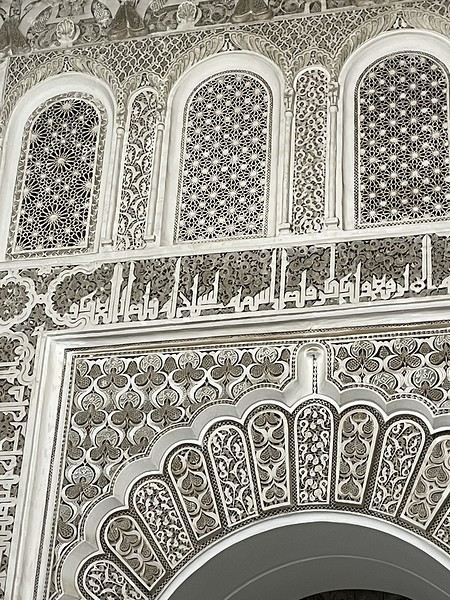
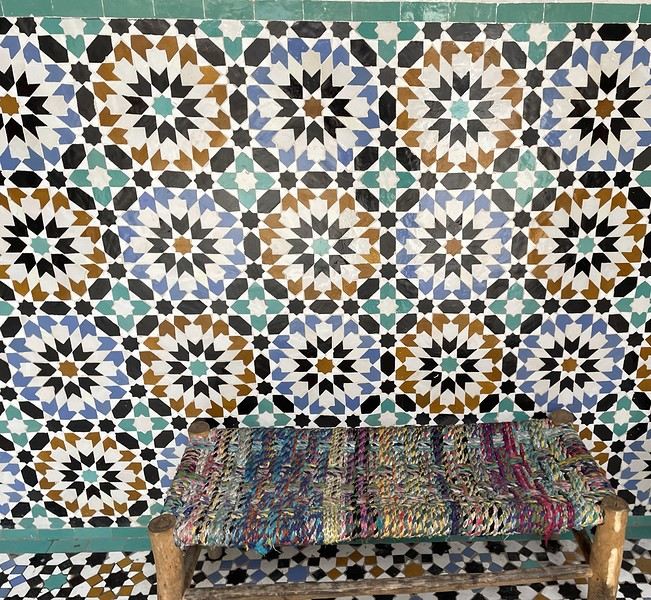
From there, without the rain, we wander aimlessly and eventually end up near the tanneries, but it’s Sunday, and there’s very little activity. Of course, we get hassled by a tout.
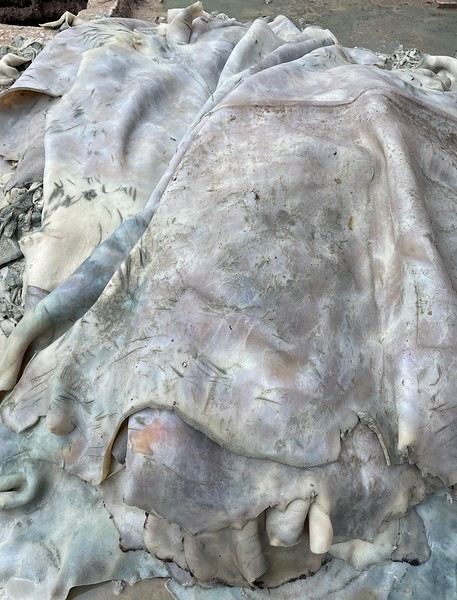
Here, the hides after being treated with lime—I love the colors.
We part ways a bit annoyed. He gets a little revenge by giving us bad directions, and we end up outside the city walls. We decide to take a taxi to the new modern art museum—60 dirhams for the 5 km, which is nothing when you think about it. That tout, who we didn’t ask for anything and made it clear we weren’t buying anything, dragged us into a shop supposedly only open that day and demanded 50 dirhams for his "services"! Let’s forget that bad moment and enjoy the exhibition at the MACAL.
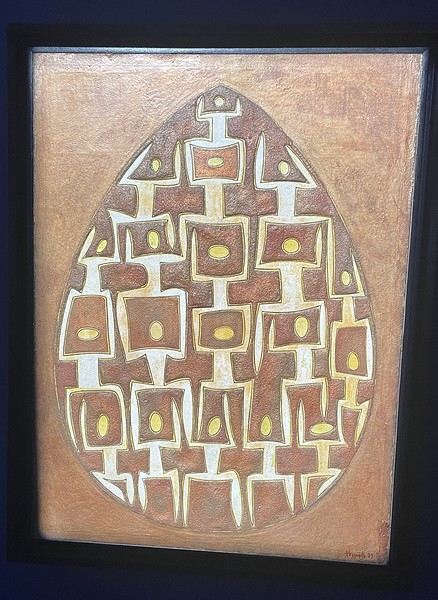
The taxi on the way back drops us off at Place des Ferblantiers, not far from our Riad. We’re a little peckish—it’s worth mentioning that at lunchtime, we only ate a plate of beans from a street vendor. So, we buy a bunch of little sweets, each more delicious than the last, at Ajar. We snack while sipping mint tea and watching life go by around us. A final visit to the Museum of Moroccan Cuisine on our way back helps us dodge a few more showers. Then it’s back to the Riad. The atmosphere in the city is heating up—it’s the AFCON final tonight. The temperatures, though? Not so much. We ordered a meal at the Riad, and it was a good call—not only was it really tasty, but the rain also picked up again. Our day in Marrakesh ends under the covers with a good book and some photo sorting. Still, we managed 10,750 steps. View of our Riad
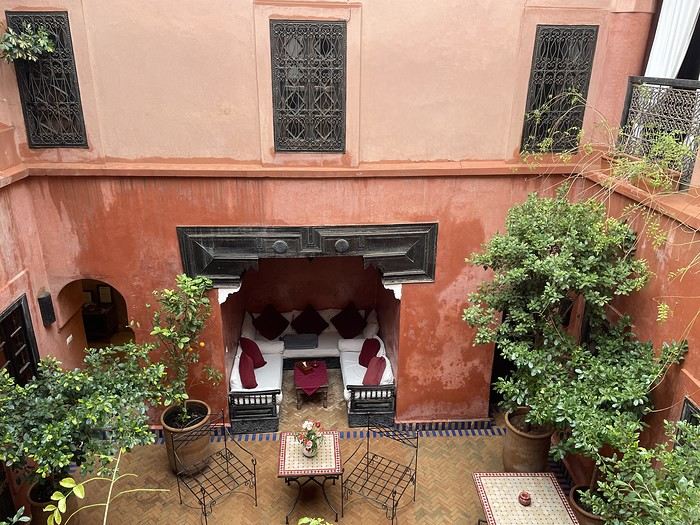
Tomorrow, we’ll pick up our rental car from Medloc and head to Essaouira.
From there, without the rain, we wander aimlessly and eventually end up near the tanneries, but it’s Sunday, and there’s very little activity. Of course, we get hassled by a tout.
Here, the hides after being treated with lime—I love the colors.
We part ways a bit annoyed. He gets a little revenge by giving us bad directions, and we end up outside the city walls. We decide to take a taxi to the new modern art museum—60 dirhams for the 5 km, which is nothing when you think about it. That tout, who we didn’t ask for anything and made it clear we weren’t buying anything, dragged us into a shop supposedly only open that day and demanded 50 dirhams for his "services"! Let’s forget that bad moment and enjoy the exhibition at the MACAL.
The taxi on the way back drops us off at Place des Ferblantiers, not far from our Riad. We’re a little peckish—it’s worth mentioning that at lunchtime, we only ate a plate of beans from a street vendor. So, we buy a bunch of little sweets, each more delicious than the last, at Ajar. We snack while sipping mint tea and watching life go by around us. A final visit to the Museum of Moroccan Cuisine on our way back helps us dodge a few more showers. Then it’s back to the Riad. The atmosphere in the city is heating up—it’s the AFCON final tonight. The temperatures, though? Not so much. We ordered a meal at the Riad, and it was a good call—not only was it really tasty, but the rain also picked up again. Our day in Marrakesh ends under the covers with a good book and some photo sorting. Still, we managed 10,750 steps. View of our Riad
Tomorrow, we’ll pick up our rental car from Medloc and head to Essaouira.
Hesitating between Crete or Menorca
Hi! We’d like to go away for 10 days around May 15th, either to Menorca or Crete—we don’t know either place. We love hiking, unspoiled nature, good food, swimming, and, if possible, avoiding crowds. We enjoy getting off the beaten track. Menorca seems ideal because it’s not far by plane from Lyon, but if Crete is really wilder and more beautiful in terms of landscapes, we can add an extra hour of flight time. Can you help us out? Thanks!
Traveling in France off-season: what to prioritize?
Hi everyone,
I’m thinking about planning several short trips in France outside peak tourist seasons, especially in spring and autumn.
The idea would be to prioritize:
- fewer crowds at tourist sites - more affordable accommodation prices - a more local atmosphere
However, I also have some concerns about:
- attractions or restaurants sometimes being closed - more unpredictable weather depending on the region - less frequent transportation in certain areas
For those of you who’ve traveled in France off-season before, what do you think were the main pros and cons? Are there any regions or specific times that are particularly worth prioritizing?
Thanks in advance for your experiences! 😊
I’m thinking about planning several short trips in France outside peak tourist seasons, especially in spring and autumn.
The idea would be to prioritize:
- fewer crowds at tourist sites - more affordable accommodation prices - a more local atmosphere
However, I also have some concerns about:
- attractions or restaurants sometimes being closed - more unpredictable weather depending on the region - less frequent transportation in certain areas
For those of you who’ve traveled in France off-season before, what do you think were the main pros and cons? Are there any regions or specific times that are particularly worth prioritizing?
Thanks in advance for your experiences! 😊
Recommendations for accommodation in Guadeloupe
Hi! We’re visiting Guadeloupe for the first time in January. We’re looking for accommodation near Deshaies to start our trip. A quiet spot, not too far from the sea so we can walk there. Any suggestions are welcome!
Have a great day!
Have a great day!
Your tips and recommendations for a trip through southern Morocco
Hello VF friends!
We’re planning to leave Marrakesh by rental car—this will be our second trip to Morocco. While we want to revisit some places, we also hope to explore new regions. Here’s the start of our itinerary, which could take 2 to 3 weeks. We don’t want to cover too many kilometers each day.
- Depart Marrakech for Essaouira, stopping to visit the Inzerki beehive. We’ll stay 3 nights in Essaouira to explore the city and the surrounding area. - Head toward Tamanar or that region for another 3 nights, exploring on a star-shaped route. We’d like to see the Paradise Valley and the coast. Not really keen on stopping in Agadir.
We’ve been to Tafraoute before, but I’d love to see some *greniers* (granaries) again, so we’re considering 1 or 2 nights there.
- Tiznit for 2 nights, making our way to Plage Blanche. - Guelmin and the Tighmert oasis for 2 nights. - Tata for 2 nights, visiting Akka Iguane and other villages.
After that, we’ll head east.
We’d love to hear about your experiences, great tips, and recommendations!
Thanks so much, and happy holidays!
- Depart Marrakech for Essaouira, stopping to visit the Inzerki beehive. We’ll stay 3 nights in Essaouira to explore the city and the surrounding area. - Head toward Tamanar or that region for another 3 nights, exploring on a star-shaped route. We’d like to see the Paradise Valley and the coast. Not really keen on stopping in Agadir.
We’ve been to Tafraoute before, but I’d love to see some *greniers* (granaries) again, so we’re considering 1 or 2 nights there.
- Tiznit for 2 nights, making our way to Plage Blanche. - Guelmin and the Tighmert oasis for 2 nights. - Tata for 2 nights, visiting Akka Iguane and other villages.
After that, we’ll head east.
We’d love to hear about your experiences, great tips, and recommendations!
Thanks so much, and happy holidays!
KERALA - 3 weeks with a Driver - December 2025
For those planning a trip to Kerala, here’s a quick, practical summary.
For the most part: the stunning landscapes, the natural kindness of the locals, their cuisine, and their culture—you’ll get to enjoy all of that once you’re there...
Flight (arrival and departure to/from Cochin)
Avoid Air India and opt for flights via the Middle East: Saudi Arabia, Qatar, United Arab Emirates, Oman, etc.
Price: between 500 € and 600 €
Accommodations
Average price: 20 € per night for a couple (max: 40 €, min: 10 €, often including breakfast), via the usual booking sites.
Homestays (staying in the owner’s house) are of a higher standard.
Only 2 nights were spent in questionable cleanliness. The rest were good, even very good, or even *very* very good.
Car with Driver
All-inclusive daily price: tolls, fuel, driver’s lodging and meals... and of course, we often shared our meals with our driver too.
Toyota sedan (e.g., Corolla) for 4 travelers (1 in front, 3 in the back): 50 € / day,
Toyota SUV (e.g., Innova) for up to 6 travelers: 60 € / day
DM me if you’d like more details.
Overall budget (excluding flights and shopping) Around 1500 € for 1 couple for the 3 weeks... in "2-couple mode"! (i.e., sharing the driver’s cost). Itinerary
Night 1: Arrival in Cochin in the morning, departure for Attirappily Beautiful waterfalls
Night 2: Thrissur Via Vallachira, not much tourist interest, a stop to ease into the trip and shorten the journey to Wayanad
Nights 3, 4, 5: Wayanad, staying in Sultan Battery Coffee and tea plantations, dam lake, URAVU (bamboo craft workshop), ...
Night 6: Ooty Botanical garden, then a really fun tourist train the next afternoon to Metupalaiyam
Night 7: Toward Coimbatore
Nights 8, 9, 10: Munnar City visit, stunning tea plantations
Nights 11, 12: Thekkady/Kumilly Amazing tea plantations, sightseeing, Jeep ride, not-so-interesting boat tour on Periyar Lake, trekking options
Night 13: Marari Beach (near Alleppey) 4-hour backwaters tour, then beach (swimming, dinner)
Nights 14, 15, 16: Munroe Island Super chill, walks around the island (small coir rope factory), sunrise by boat or canoe, sunset
Night 17: Varkala Gorgeous beaches, shopping
Night 18: Trivandrum City center visit, then train back to Cochin the next day in 3 hours.
Night 19: Cochin Fort Kochi is a lovely way to wrap up the trip
Have a great trip in this incredible region, so unique in India!
Overall budget (excluding flights and shopping) Around 1500 € for 1 couple for the 3 weeks... in "2-couple mode"! (i.e., sharing the driver’s cost). Itinerary
Night 1: Arrival in Cochin in the morning, departure for Attirappily Beautiful waterfalls
Night 2: Thrissur Via Vallachira, not much tourist interest, a stop to ease into the trip and shorten the journey to Wayanad
Nights 3, 4, 5: Wayanad, staying in Sultan Battery Coffee and tea plantations, dam lake, URAVU (bamboo craft workshop), ...
Night 6: Ooty Botanical garden, then a really fun tourist train the next afternoon to Metupalaiyam
Night 7: Toward Coimbatore
Nights 8, 9, 10: Munnar City visit, stunning tea plantations
Nights 11, 12: Thekkady/Kumilly Amazing tea plantations, sightseeing, Jeep ride, not-so-interesting boat tour on Periyar Lake, trekking options
Night 13: Marari Beach (near Alleppey) 4-hour backwaters tour, then beach (swimming, dinner)
Nights 14, 15, 16: Munroe Island Super chill, walks around the island (small coir rope factory), sunrise by boat or canoe, sunset
Night 17: Varkala Gorgeous beaches, shopping
Night 18: Trivandrum City center visit, then train back to Cochin the next day in 3 hours.
Night 19: Cochin Fort Kochi is a lovely way to wrap up the trip
Have a great trip in this incredible region, so unique in India!
Cambodia Itinerary Feedback
Alright, I’m scaling back the kilometers thanks to the relevance and patience of our Cambodia experts!
Here’s yet another hesitation /\
When I arrive early on 01/12 in PP, I have the choice between spending a day in PP (booking a convenience room for half a day and leaving by night bus), sleeping in PP and taking the bus to SR the next morning, or hiring a driver to head back up to PP with a nice little stop and maybe sleeping in Kampong Thom or Kampong Chhnang, then heading to SP on the 13th.
Then from the 13th to the 17th or 18th, exploring Angkor.
I continue to Kampong Thom and stay for 2 nights (if I didn’t do it on the way there), but I might be templed-out by then.
I head to Kampong Cham, where I’ll spend 2 nights—one on the island and one on the mainland.
Next, I go to Kampot and Kep: probably 2 nights in Kampot, 2 in Kep, and 1 night on Tonsay Island.
On 01/28, I return to PP until 01/29.
One detail: how long does it take to get from downtown PP to the new airport? Because I leave on 01/29 around 7:50 PM...
Anyway, I’m ready to read your unfiltered reactions 🤓 and thank you in advance for your help!
Feedback on a Florida road trip
Hi there,
I’m planning a road trip for July 2026 in northern Florida. Could you let me know if my itinerary makes sense? Day 1: Orlando Day 2: Amelia Island Day 3: Amelia Island Day 4: Tallahassee Day 5: Panama City Beach Day 6: Panama City Beach (visit to Destin) Day 7: Crystal River (stop in Cedar Key on the way) Day 8: Crystal River Day 9: Anna Maria (stop in Clearwater) Day 10: Anna Maria (St. Pete) Day 11: Anna Maria Day 12: Orlando Day 13: Orlando Day 14: Orlando Day 15: Departure
Thanks in advance for your tips!
I’m planning a road trip for July 2026 in northern Florida. Could you let me know if my itinerary makes sense? Day 1: Orlando Day 2: Amelia Island Day 3: Amelia Island Day 4: Tallahassee Day 5: Panama City Beach Day 6: Panama City Beach (visit to Destin) Day 7: Crystal River (stop in Cedar Key on the way) Day 8: Crystal River Day 9: Anna Maria (stop in Clearwater) Day 10: Anna Maria (St. Pete) Day 11: Anna Maria Day 12: Orlando Day 13: Orlando Day 14: Orlando Day 15: Departure
Thanks in advance for your tips!
Transport, accommodation, and great spots for a month in Cambodia
Hello!
We’re heading to Cambodia for a month in March. We’re planning to visit Phnom Penh, Battambang, Siem Reap, the Angkor temples, Kompong Luong, then head down to Kampot, Kep, and finish our trip on the islands of Koh Rong. Has anyone done this trip recently?
Any great spots to recommend? Neighborhoods to stay in Phnom Penh (lively but not too touristy)?
Tips for getting around between the major cities—bus, train, boat, motorbike?
Thanks for all the advice!
Fabienne
Cambodia and Indonesia in summer: ideal itinerary with kids?
Hi everyone,
After letting our backpacks gather dust for several years, we’ve decided to set off on another adventure—this time as a family, with our 10- and 12-year-old kids! We’re planning a trip from mid-June to the end of July, with two stops: Cambodia (2 weeks) and Indonesia (4 weeks). But before diving into the details, we’ve got quite a few questions and doubts.
About Cambodia: We know this period is the rainy season. Is it really a good idea to go then? And if so, is it better to start with Cambodia and then move on to Indonesia, or does the order not matter from a climate perspective? Here are the activities and sites we’ve shortlisted: · The Mekong and Irrawaddy dolphins: do we actually have a chance of seeing them? · The Mondulkiri Project (elephant sanctuary): is this an ethical project? We want to avoid any form of animal exploitation. · The temples of Angkor: are 2 or 3 days enough to fully enjoy them? · Floating villages: where should we go for an authentic experience? Is it possible to spend the night there? · Hikes with waterfalls, lakes, etc.: are there any must-do treks? · And most importantly, what activities or sites would appeal to kids?
For Indonesia: We were there 15 years ago and loved our itinerary: Yogyakarta / Borobudur → Bromo → Kawah Ijen → Bali → Gili Trawangan. This time, we’re torn: · Retracing part of that route to share it with our kids (even if revisiting the same places isn’t super appealing), · Or exploring new regions. What’s almost certain is that we’d like to spend about two weeks in Raja Ampat. For the other two weeks, we’re undecided. We’re looking for kid-friendly ideas for places and activities, while avoiding too many connections for budget and environmental reasons. Since we’ll already see temples in Cambodia, we’d like to mix things up.
And finally… On our last trip to the region, we traveled without kids and went super free-spirited: only the round-trip tickets were booked, and we improvised the rest day by day without any major issues finding accommodation, food, or accessing the activities we’d spotted. Do you think this style of travel is still doable with two kids? Or has it become too risky or stressful? Are there regions where the "backpacker" approach is still possible, and others where it’s better to book in advance? And for certain activities or sites, is it recommended to hire guides?
Thanks in advance for your tips and experiences!
After letting our backpacks gather dust for several years, we’ve decided to set off on another adventure—this time as a family, with our 10- and 12-year-old kids! We’re planning a trip from mid-June to the end of July, with two stops: Cambodia (2 weeks) and Indonesia (4 weeks). But before diving into the details, we’ve got quite a few questions and doubts.
About Cambodia: We know this period is the rainy season. Is it really a good idea to go then? And if so, is it better to start with Cambodia and then move on to Indonesia, or does the order not matter from a climate perspective? Here are the activities and sites we’ve shortlisted: · The Mekong and Irrawaddy dolphins: do we actually have a chance of seeing them? · The Mondulkiri Project (elephant sanctuary): is this an ethical project? We want to avoid any form of animal exploitation. · The temples of Angkor: are 2 or 3 days enough to fully enjoy them? · Floating villages: where should we go for an authentic experience? Is it possible to spend the night there? · Hikes with waterfalls, lakes, etc.: are there any must-do treks? · And most importantly, what activities or sites would appeal to kids?
For Indonesia: We were there 15 years ago and loved our itinerary: Yogyakarta / Borobudur → Bromo → Kawah Ijen → Bali → Gili Trawangan. This time, we’re torn: · Retracing part of that route to share it with our kids (even if revisiting the same places isn’t super appealing), · Or exploring new regions. What’s almost certain is that we’d like to spend about two weeks in Raja Ampat. For the other two weeks, we’re undecided. We’re looking for kid-friendly ideas for places and activities, while avoiding too many connections for budget and environmental reasons. Since we’ll already see temples in Cambodia, we’d like to mix things up.
And finally… On our last trip to the region, we traveled without kids and went super free-spirited: only the round-trip tickets were booked, and we improvised the rest day by day without any major issues finding accommodation, food, or accessing the activities we’d spotted. Do you think this style of travel is still doable with two kids? Or has it become too risky or stressful? Are there regions where the "backpacker" approach is still possible, and others where it’s better to book in advance? And for certain activities or sites, is it recommended to hire guides?
Thanks in advance for your tips and experiences!
15 days in La Palma, a hidden gem with a thousand contrasts
Hello,
First attempt at a travel journal for me and first post after 7 years away from this forum. 😮 I went to the island of La Palma for 15 days in September 2025. After visiting Lanzarote in February, I was looking for a different and greener island. Well, I wasn’t disappointed. 😎
We stayed in Breña Baja on the east coast of the island, 5 minutes from the airport. This choice was mainly motivated by the desire not to change accommodation during the stay and to be in a "central" location close to amenities. It worked out well, but if I were to do it again, I’d split the stay in two by getting another place in the north of the island to explore that area, which really appeals to me. Note that the island is "climatically divided in two": the west coast is sunnier and drier, while the east coast is often foggy or cloudy. It’s quite impressive when you come out of the LP-3 road tunnel connecting the two sides—you feel like you’ve changed regions even though it’s less than 3 km apart.
Flight options weren’t plentiful (no direct flights from France), so I went with Iberia, connecting in Madrid for 250 € round-trip per person excluding checked baggage (80 € round-trip for one 23 kg suitcase on this route). Make sure to buy the checked baggage at the same time as your flight, as it’ll cost about 15 € more if you add it later. I booked the tickets 5 months in advance directly on Iberia’s website. You could also take a low-cost airline to Tenerife or Gran Canaria and then a flight with a Canarian carrier, but in my opinion, that only makes sense if you’re visiting one of those islands first, as the connection isn’t "guaranteed." The ferry is an option from Tenerife (about 2.5 hours crossing).
Our departure from Lyon was initially scheduled for 6 AM but took off at 9 AM so the crew could rest after the late arrival of the previous flight. This let us grab breakfast on the airline’s dime—thanks, EU Regulation (EC) No 261/2004. 😉 Iberia took a week to reimburse me after I submitted my passport, receipts, and bank details via their online claim form.
Our small but spacious CRJ-1000 Air Nostrum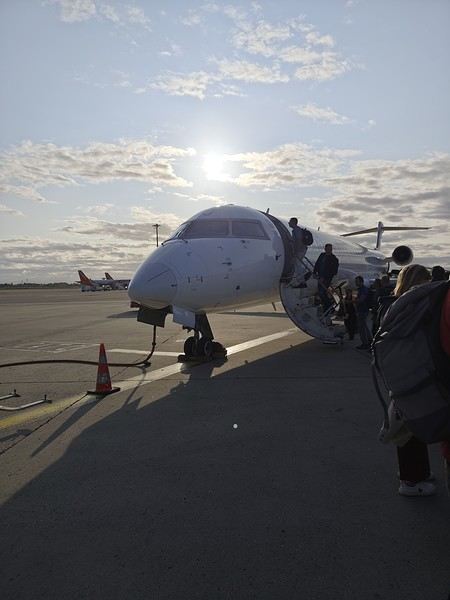 Bye-bye, Bugey nuclear plant
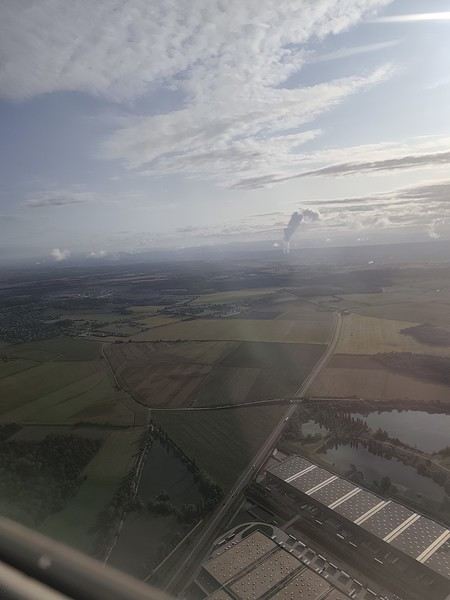 And hello, Madrid—or rather, its very dry region.
Our layover was initially 4 hours but shrank to 1 hour due to the previous flight’s delay. That worked out for us because Terminal 4 at Barajas is way less comfortable for resting than Lyon’s T1.
And hello, Madrid—or rather, its very dry region.
Our layover was initially 4 hours but shrank to 1 hour due to the previous flight’s delay. That worked out for us because Terminal 4 at Barajas is way less comfortable for resting than Lyon’s T1.
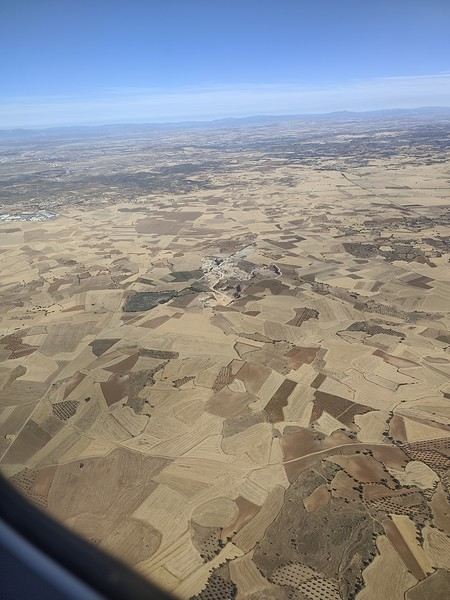
Landing with a view of Playa de la Cangrejera and del Pozo. When I say the east coast is often cloudy... 😇 First sight of "plátano" plantations. Banana farming makes up 50% of the island’s GDP!
More to come soon. [;]
First attempt at a travel journal for me and first post after 7 years away from this forum. 😮 I went to the island of La Palma for 15 days in September 2025. After visiting Lanzarote in February, I was looking for a different and greener island. Well, I wasn’t disappointed. 😎
We stayed in Breña Baja on the east coast of the island, 5 minutes from the airport. This choice was mainly motivated by the desire not to change accommodation during the stay and to be in a "central" location close to amenities. It worked out well, but if I were to do it again, I’d split the stay in two by getting another place in the north of the island to explore that area, which really appeals to me. Note that the island is "climatically divided in two": the west coast is sunnier and drier, while the east coast is often foggy or cloudy. It’s quite impressive when you come out of the LP-3 road tunnel connecting the two sides—you feel like you’ve changed regions even though it’s less than 3 km apart.
Flight options weren’t plentiful (no direct flights from France), so I went with Iberia, connecting in Madrid for 250 € round-trip per person excluding checked baggage (80 € round-trip for one 23 kg suitcase on this route). Make sure to buy the checked baggage at the same time as your flight, as it’ll cost about 15 € more if you add it later. I booked the tickets 5 months in advance directly on Iberia’s website. You could also take a low-cost airline to Tenerife or Gran Canaria and then a flight with a Canarian carrier, but in my opinion, that only makes sense if you’re visiting one of those islands first, as the connection isn’t "guaranteed." The ferry is an option from Tenerife (about 2.5 hours crossing).
Our departure from Lyon was initially scheduled for 6 AM but took off at 9 AM so the crew could rest after the late arrival of the previous flight. This let us grab breakfast on the airline’s dime—thanks, EU Regulation (EC) No 261/2004. 😉 Iberia took a week to reimburse me after I submitted my passport, receipts, and bank details via their online claim form.
Our small but spacious CRJ-1000 Air Nostrum
Bye-bye, Bugey nuclear plant
And hello, Madrid—or rather, its very dry region.
Our layover was initially 4 hours but shrank to 1 hour due to the previous flight’s delay. That worked out for us because Terminal 4 at Barajas is way less comfortable for resting than Lyon’s T1.
Landing with a view of Playa de la Cangrejera and del Pozo. When I say the east coast is often cloudy... 😇
First sight of "plátano" plantations. Banana farming makes up 50% of the island’s GDP!
More to come soon. [;]