Results for "art+et+Orgosolo+|+9+>+215"
12960 results found.
Bungalows du Viva Wyndham Samana et excursions English translation pending
Bonjour
Nous allons en mars 2007 au viva samana. J'ai déjà demandé des info à propos des langoustes et je remercie tous ceux qui ont pris la peine de me répondre. Cette fois-ci j'aimerais avoir des renseignements concernant les bungalows dont beaucoup parlent. Nous sommes deux familles avec chacune 2 ados. Nous aimerions savoir à quoi ressemblent les bungalows, est-ce qu'il y a deux chambres? Les lits doubles ou simples? etc.
De plus, comme nous partons seulement pour une semaine, nous ne voulons pas passer notre temps en excursion, quelles sont celles que nous devrions faire absolument? Est-ce qu'il y a un village près du viva. Les filles veulent absolument rapporter des souvenirs, donc faut trouver une place pour les satisfaire 😉.
On m'a dit que près du El Portillo, il y aurait un genre de mini centre, est-ce que le El Portillo est loin du viva, nous avons des connaissances qui s'y rendent.
C'est beaucoup de questions, mais je remercie d'avance ceux qui auront la gentillesse d'y répondre.
Bonne journée!
Nous allons en mars 2007 au viva samana. J'ai déjà demandé des info à propos des langoustes et je remercie tous ceux qui ont pris la peine de me répondre. Cette fois-ci j'aimerais avoir des renseignements concernant les bungalows dont beaucoup parlent. Nous sommes deux familles avec chacune 2 ados. Nous aimerions savoir à quoi ressemblent les bungalows, est-ce qu'il y a deux chambres? Les lits doubles ou simples? etc.
De plus, comme nous partons seulement pour une semaine, nous ne voulons pas passer notre temps en excursion, quelles sont celles que nous devrions faire absolument? Est-ce qu'il y a un village près du viva. Les filles veulent absolument rapporter des souvenirs, donc faut trouver une place pour les satisfaire 😉.
On m'a dit que près du El Portillo, il y aurait un genre de mini centre, est-ce que le El Portillo est loin du viva, nous avons des connaissances qui s'y rendent.
C'est beaucoup de questions, mais je remercie d'avance ceux qui auront la gentillesse d'y répondre.
Bonne journée!
Crocodiles à Darwin (Australie) et aller en barque dans la Mangove (Sihanoukville)? English translation pending
bonjour
j'ai une phobie terrible : les crocodiles (meme à la tv j'ai de l'eau qui me coule dans le dos de trouille, un enfer. Il est impossible pour moi d'aller voir ma mère à Darwin en australie!!!)
On m'a proposé d'aller en barque dans la mangrove près de Sihanoukville, y en a t'il ? (pas de blague, je risque la crise cardiaque) pour info j'ai pas du tout peur des serpents, arraignées, insectes....
amicalement valérie
j'ai une phobie terrible : les crocodiles (meme à la tv j'ai de l'eau qui me coule dans le dos de trouille, un enfer. Il est impossible pour moi d'aller voir ma mère à Darwin en australie!!!)
On m'a proposé d'aller en barque dans la mangrove près de Sihanoukville, y en a t'il ? (pas de blague, je risque la crise cardiaque) pour info j'ai pas du tout peur des serpents, arraignées, insectes....
amicalement valérie
Habiter à Hô-Chi-Minh-Ville au Vietnam English translation pending
Bonjour. En espérant que tout se déroule bien pour tout le monde.
Après avoir lu quelques récits de voyageurs, je me suis aperçu qu'il y avait parmis vous des spécialistes (enfin des passionnés 😉) du Vietnam et notamment de Ho Shi Minh Ville. Etant actuellement étudiant en école d'art appliqué je désire découvrir la culture asiatique. J'ai donc choisi d'effectuer un stage long au Vietnam (Ho Shi Minh Ville car en fait je rejoins mon amie qui elle aussi effectuera son stage 😛).
Comme tout début de voyage, je me suis procuré un routard, un hors série géo, j'ai passé des heures sur le net 😕... Des livres très informatifs mais qui répondent aux attentes du voyageur tourist qui ne reste que peu de temps. Je vais sûrement rester entre 4 et 6 mois dans la ville...🙂
Une personne du forum vivrait elle dans Ho Shi Minh l'année? Je cherche des témoignages d'intégrations, de souvenirs heureux (aussi malheureux)... La location d'appartement est elle facile, accessible? Quels sont les conseils pratiques de tous les jours? (c'est des questions bêtes... mais j'apréhende un peu 😮) Qui est allé au théâtre vietnamien, car j'ai eu vent des opéras de Pékin, du théâtre Nô... il existe un théâtre vietnamien mais qui mélange tous les arts, mais je n'arrive pas à obtenir beaucoup d'informations. Il y a aussi le célèbre festival de Hué (c'est pas à coté je sais....)
Voilà tout commentaire, ou témoignage seront les bienvenus. Dans l'attente de réponse, amicalement, voyageusement Jé.
Après avoir lu quelques récits de voyageurs, je me suis aperçu qu'il y avait parmis vous des spécialistes (enfin des passionnés 😉) du Vietnam et notamment de Ho Shi Minh Ville. Etant actuellement étudiant en école d'art appliqué je désire découvrir la culture asiatique. J'ai donc choisi d'effectuer un stage long au Vietnam (Ho Shi Minh Ville car en fait je rejoins mon amie qui elle aussi effectuera son stage 😛).
Comme tout début de voyage, je me suis procuré un routard, un hors série géo, j'ai passé des heures sur le net 😕... Des livres très informatifs mais qui répondent aux attentes du voyageur tourist qui ne reste que peu de temps. Je vais sûrement rester entre 4 et 6 mois dans la ville...🙂
Une personne du forum vivrait elle dans Ho Shi Minh l'année? Je cherche des témoignages d'intégrations, de souvenirs heureux (aussi malheureux)... La location d'appartement est elle facile, accessible? Quels sont les conseils pratiques de tous les jours? (c'est des questions bêtes... mais j'apréhende un peu 😮) Qui est allé au théâtre vietnamien, car j'ai eu vent des opéras de Pékin, du théâtre Nô... il existe un théâtre vietnamien mais qui mélange tous les arts, mais je n'arrive pas à obtenir beaucoup d'informations. Il y a aussi le célèbre festival de Hué (c'est pas à coté je sais....)
Voilà tout commentaire, ou témoignage seront les bienvenus. Dans l'attente de réponse, amicalement, voyageusement Jé.
Les voyages et le futur... English translation pending
Dans quelques années il sera dificile de voyager loin, Les prix du pétrole vont augmenter et les billets d'avions avec !
De la documentation sur le pic à petrolier a venir :
http://wolf.readinglitho.co.uk/francais/index.html
http://fr.wikipedia.org/wiki/Pic_p%C3%A9trolier
http://www.oleocene.org/index.php?page=accueil
Que pensez vous de tout ca !!
De la documentation sur le pic à petrolier a venir :
http://wolf.readinglitho.co.uk/francais/index.html
http://fr.wikipedia.org/wiki/Pic_p%C3%A9trolier
http://www.oleocene.org/index.php?page=accueil
Que pensez vous de tout ca !!
Recherche bénévolat Amérique du Sud, Asie, Australie English translation pending
bonjour a tous, j ai 25 ans et je cheche des missions pour lesquelles je pourrais aider je n ai pas beaucoup de ressources ni de formation particulieres mais je suis motivé etant disponible de suite je souhaiterai obtenir des information sur les demarches a suivre pour intégrer une mission en vous remerciant
Bollywood: films indiens English translation pending
bonjour bonjour!
je suis fan de Bollywood, ces films indiens qui durent au minimum 3 heures et qui sont tout en musique, couleurs, danses, chants...
je n'en connais pas beaucoup mais si vous avez quelques bons titres à me proposer pour que je puisse continuer à écarquiller les yeux devant mon poste de télé, ça serait super sympa!
merci a tous (ttes)!
France-Ulan Ude (Sibérie) par la route et contacts English translation pending
Bonjour !
Nous partons dans le cadre d'un projet associatif faire des spectacles itinérants du sud de la France à Ulan Ude (Sibérie). Nous aimerions savoir : quelle route est recommandée (par la Kakakhstan ou pas?), et faire une estimation de budget (visas, douanes, gazole...). Si certains ont des contacts dans des écoles, orphelinats ou centre culturels sur la route (donc entre la France et la Sibérie) et enfin et surtout, nous recherchons un contact à Ulan Ude (c'est le plus important car le but est d'arriver là-bas et d'y construire quelque chose de durable, contrairement aux autres lieux ou nous ne ferons que des spectacles). Nous recherchons particulièrement des contacts liés à l'enfance, l'art et/ou l'écologie... Merci par avance !!
Nous avons quelques renseignements déjà, évidemment, et grace, entre autes à ce forum, mais nous recherchons le maximum de sources, et surtout au niveau "contacts locaux", nous en manquons énormément.
Si vous avez aussi des conseils "divers", tout est bienvenu. (saison, climat, équipement de base...)
Nous avons déjà traversé une bonne partie de l'Afrique et des Balkans en Camions, mais à chaque fois, c'est une nouvelle aventure ! fO bien se préparer ;)
merci !!!!!!! 🙂
Nous partons dans le cadre d'un projet associatif faire des spectacles itinérants du sud de la France à Ulan Ude (Sibérie). Nous aimerions savoir : quelle route est recommandée (par la Kakakhstan ou pas?), et faire une estimation de budget (visas, douanes, gazole...). Si certains ont des contacts dans des écoles, orphelinats ou centre culturels sur la route (donc entre la France et la Sibérie) et enfin et surtout, nous recherchons un contact à Ulan Ude (c'est le plus important car le but est d'arriver là-bas et d'y construire quelque chose de durable, contrairement aux autres lieux ou nous ne ferons que des spectacles). Nous recherchons particulièrement des contacts liés à l'enfance, l'art et/ou l'écologie... Merci par avance !!
Nous avons quelques renseignements déjà, évidemment, et grace, entre autes à ce forum, mais nous recherchons le maximum de sources, et surtout au niveau "contacts locaux", nous en manquons énormément.
Si vous avez aussi des conseils "divers", tout est bienvenu. (saison, climat, équipement de base...)
Nous avons déjà traversé une bonne partie de l'Afrique et des Balkans en Camions, mais à chaque fois, c'est une nouvelle aventure ! fO bien se préparer ;)
merci !!!!!!! 🙂
Travailer en Nouvelle-Zélande et en Australie English translation pending
J'ai décidé de partir 4 mois (entre novembre 2005 et Mars 2006) du côté de l'Australie. En vue de ce voyage, j'ai obtenu un working Holiday Visa pour l'Australie et la Nouvelle Zélande.
Mais voilà, je me demande comment exploiter au mieux ces quatre mois...
1°) Savez vous si il est plus simple de trouver des petits boulots dans l'un ou l'autre des pays ?
2°) est il concevable de ne faire que la Nouvelle Zélande et de zapper l'Australie ?
3°) est il préférable de passer 1 mois en australie pour visiter et de se poser 3 mois en nouvelle zélande pour travailler...
Que de questions !!!
J'attends avec impatience votre éclairage.
Une apprentie voyageuse
Une apprentie voyageuse
Visa "Working Holiday" et visa touriste pour l'Australie English translation pending
Bonjour à tous,
Je suis tout nouveau sur ce forum, et espère trouver des rnseignements que j'ai déjà communiqués aux organismes suceptibles de me répondre, mais en vain... Ainsi, je souhaite partir en Australie, de préférence dans le Queensland et/ou le Victoria, certes pour découvrir ce pays mais aussi pour perfectionner mon anglais, lequel est indispensable pour travailler dans le tourisme. Je sais que le visa WH semble appropié pour une expérience d'une année. Cependant, savez-vous si sur le territoire australien il est possible de modifier ce visa en un permanent dans le cas où je trouverais un emploi sur une période supérieure à 3 mois? Aussi, peut-on prolonger ce visa working holiday toujours en étant sur le territoire australien? Puis, connaissez-vous les périodes les plus propices pour arriver en Australie? Peut-on partir en Australie avec un visa touriste, et chercher du travail, si travail il y a faire une demande de visa permanent (je pense que c'est ce type de visa qu'il faut lorsqu'on a du travail)?
J'aimerais savoir pas mal d'autres choses, mais pour l'instant je vais en rester là...
Je vous remercie pour m'apporter un max d'infos.
Philippe.
Je suis tout nouveau sur ce forum, et espère trouver des rnseignements que j'ai déjà communiqués aux organismes suceptibles de me répondre, mais en vain... Ainsi, je souhaite partir en Australie, de préférence dans le Queensland et/ou le Victoria, certes pour découvrir ce pays mais aussi pour perfectionner mon anglais, lequel est indispensable pour travailler dans le tourisme. Je sais que le visa WH semble appropié pour une expérience d'une année. Cependant, savez-vous si sur le territoire australien il est possible de modifier ce visa en un permanent dans le cas où je trouverais un emploi sur une période supérieure à 3 mois? Aussi, peut-on prolonger ce visa working holiday toujours en étant sur le territoire australien? Puis, connaissez-vous les périodes les plus propices pour arriver en Australie? Peut-on partir en Australie avec un visa touriste, et chercher du travail, si travail il y a faire une demande de visa permanent (je pense que c'est ce type de visa qu'il faut lorsqu'on a du travail)?
J'aimerais savoir pas mal d'autres choses, mais pour l'instant je vais en rester là...
Je vous remercie pour m'apporter un max d'infos.
Philippe.
Les guides (Lonely, Routard) et leurs inconvénients... English translation pending
Je reviens d'un voyage au chili et bolivie pendant lequel, pour une raison de manque d'organisation et pas par choix nous avions le Lonely Planet au Chili et pas de guide en Bolivie (car on avait pas prévu d'y aller au début).
Nous nous sommes fait quelques réflexions sur les guides de voyages en général (qui d'ailleurs n'ont rien d'extraordinaire, certains forumeurs en ont deja parlé ici).
D'abord est-ce qu'un guide ça sert vraiment ? Pas vraiment en fait. Le plus génant sans guide ce sont les informations pratiques (plans de ville, horaires des bus ou des trains, etc...). C'est plus confortable de les avoir à l'avance mais en tous cas dans des pays touristiques et/ou on peut baragouiner en anglais ou dans la langue locale on s'en sort sans aucun probleme ni vraiment de perte de temps. C'est vrai qu'en papouasie nouvelle guinée ou au soudan c'est peut-etre moins facile de trouver ce genre de renseignements...
C'est pour le reste que ça se corse. Les seuls hotels qu'on a pris qui étaient dans le Lonely ont été les pires du séjour. Ben ouais sachant que quand on est qualifié de meilleur hotel de la ville dans le lonely on est complet, pour peu que l'endroit soit touristique, jusqu'à la prochaine édition (voire plus si elle n'est pas mise à jour) c'est pas dur à comprendre. Par contre à chaque fois que quelqu'un nous attendait à la sortie du bus pour nous proposer une chambre et malgré notre prudence, c'était toujours bien voire super (à une ou deux exceptions pres évidemment). A noter qu'en face d'un hotel lonely planet il y a bien souvent un hotel pas lonely planet mieux et moins cher.
Mais jusque là me direz vous rien de bien grave.
Sauf que là ou le bat blesse c'est dans les conséquences de ces guides. On peut être sûr que si le rédacteur du Lonely "découvre", par exemple un petit marché typique pas touristique, 5 ans après des dizaines d'agences ont fleuri pour y emmener les gens. Et si il y a un autre marché équivalentà 5 km de là vous pouvez être sûr que personne n'ira. Tout le monde est un peu à blamer. Nous tous, pauvres touristes, qui manquont parfois cruellement d'initiative et d'imagination, les agences qui ne se font pas chier à explorer d'autres sites, etc... Exemples boliviens : le marché de Tarabuco près de Sucre ou on trouve presque plus de merdes à touristes que d'articles destinés à la population locale, ou la descente en VTT de la route vers Coroico qui n'a strcitement aucun intéret vu la circulation et qui pourtant a un succès d'enfer (assez rigolo de voir tous ces jeunes abrutis arborer fièrement leur T-shirt grotesque du type "I've ridden the death road and I'm still alive" dans La Paz) alors que sans doute quelques km plus loin il y a de magnifiques routes désertes ou bien sur on ne croise aucun VTT)...
Certes avec ou sans guides, du moment qu'il y a tourisme, certains sites exceptionnels seront de toutes façons modifiés et rarement en bien par le tourisme. C'est le cas de l'isla del sol (lac titicaca) ou toutes les petites filles n'ont qu'un mot à la bouche et c'est "comprame" alors qu'ailleurs en bolivie on rencontre plutot des sourires timides, de rares "de donde viene?" et le reste du temps de l'indifférence (dans le sens positif du terme). Là ce n'est pas vraiment la faute du Lonely Planet vu la célébrité du site.
Voila personnellement je ne pense pas que j'achèterai un guide dorénavant. Et vous qu'en pensez-vous ?
D'abord est-ce qu'un guide ça sert vraiment ? Pas vraiment en fait. Le plus génant sans guide ce sont les informations pratiques (plans de ville, horaires des bus ou des trains, etc...). C'est plus confortable de les avoir à l'avance mais en tous cas dans des pays touristiques et/ou on peut baragouiner en anglais ou dans la langue locale on s'en sort sans aucun probleme ni vraiment de perte de temps. C'est vrai qu'en papouasie nouvelle guinée ou au soudan c'est peut-etre moins facile de trouver ce genre de renseignements...
C'est pour le reste que ça se corse. Les seuls hotels qu'on a pris qui étaient dans le Lonely ont été les pires du séjour. Ben ouais sachant que quand on est qualifié de meilleur hotel de la ville dans le lonely on est complet, pour peu que l'endroit soit touristique, jusqu'à la prochaine édition (voire plus si elle n'est pas mise à jour) c'est pas dur à comprendre. Par contre à chaque fois que quelqu'un nous attendait à la sortie du bus pour nous proposer une chambre et malgré notre prudence, c'était toujours bien voire super (à une ou deux exceptions pres évidemment). A noter qu'en face d'un hotel lonely planet il y a bien souvent un hotel pas lonely planet mieux et moins cher.
Mais jusque là me direz vous rien de bien grave.
Sauf que là ou le bat blesse c'est dans les conséquences de ces guides. On peut être sûr que si le rédacteur du Lonely "découvre", par exemple un petit marché typique pas touristique, 5 ans après des dizaines d'agences ont fleuri pour y emmener les gens. Et si il y a un autre marché équivalentà 5 km de là vous pouvez être sûr que personne n'ira. Tout le monde est un peu à blamer. Nous tous, pauvres touristes, qui manquont parfois cruellement d'initiative et d'imagination, les agences qui ne se font pas chier à explorer d'autres sites, etc... Exemples boliviens : le marché de Tarabuco près de Sucre ou on trouve presque plus de merdes à touristes que d'articles destinés à la population locale, ou la descente en VTT de la route vers Coroico qui n'a strcitement aucun intéret vu la circulation et qui pourtant a un succès d'enfer (assez rigolo de voir tous ces jeunes abrutis arborer fièrement leur T-shirt grotesque du type "I've ridden the death road and I'm still alive" dans La Paz) alors que sans doute quelques km plus loin il y a de magnifiques routes désertes ou bien sur on ne croise aucun VTT)...
Certes avec ou sans guides, du moment qu'il y a tourisme, certains sites exceptionnels seront de toutes façons modifiés et rarement en bien par le tourisme. C'est le cas de l'isla del sol (lac titicaca) ou toutes les petites filles n'ont qu'un mot à la bouche et c'est "comprame" alors qu'ailleurs en bolivie on rencontre plutot des sourires timides, de rares "de donde viene?" et le reste du temps de l'indifférence (dans le sens positif du terme). Là ce n'est pas vraiment la faute du Lonely Planet vu la célébrité du site.
Voila personnellement je ne pense pas que j'achèterai un guide dorénavant. Et vous qu'en pensez-vous ?
Conseils sur itinéraire Karnataka et Goa English translation pending
Après le Tamil Nadu, le Kérala et le Rajasthan nous projetons un voyage d'1 mois dans le Karnataka en janvier 2006. Que pensez vous de cet itinéraire :
Bombay, Badami, Hampi, Mysore, Hassan, Mangalore, Gokarna et pour finir une semaine à Goa. Nous cherchons
comment aller de Bombay à Badami, un hôtel à Bombay, une agence de voyage à Bombay.
Est-ce une bonne idée de rester une semaine à Gokarna pour rayonner ?
Y-a-t-il beaucoup de monde à Benaulim à cette époque, si oui connaissez vous une plage + tranquille.
Merci pour vos réponses
Bombay, Badami, Hampi, Mysore, Hassan, Mangalore, Gokarna et pour finir une semaine à Goa. Nous cherchons
comment aller de Bombay à Badami, un hôtel à Bombay, une agence de voyage à Bombay.
Est-ce une bonne idée de rester une semaine à Gokarna pour rayonner ?
Y-a-t-il beaucoup de monde à Benaulim à cette époque, si oui connaissez vous une plage + tranquille.
Merci pour vos réponses
films latino-americains English translation pending
Salut,
Quels films latino-américains vous ont le plus plu??
Merci pour vos réponses!! 😉
Quels films latino-américains vous ont le plus plu??
Merci pour vos réponses!! 😉
Amis canadiens (et d'ailleurs) connaissez-vous Julie Doiron? English translation pending
Il y a une semaine, coincé dans les embouteillages parisiens depuis plus d'une heure, je tombe en zappant les stations de radio sur une musique qui me fait un effet énorme : No money makers, chanté par une artiste canadienne du nom de Julie Doiron (imaginez une sorte de mélange de Neil Young période Harvest et de Nico). Son dernier album (Goodnight nobody) est vraiment très, très beau. Si vous aimez le folk ultra épuré, vous allez adorer. Julie Doiron à non seulement une des plus jolies voix qui soit mais en plus elle est auteur compositeur et guitariste de talent.
Comme je suis bon, je vous donne le lien vers son site, sur lequel vous pourrez télécharger gratuitement (si, si !) quelques-uns de ses titres. Je vous conseille de commencer par la chanson "explain" (album Loneliest in the morning). Si vous n'aimez pas, alors je ne peux plus rien faire pour vous.
Comme je suis bon, je vous donne le lien vers son site, sur lequel vous pourrez télécharger gratuitement (si, si !) quelques-uns de ses titres. Je vous conseille de commencer par la chanson "explain" (album Loneliest in the morning). Si vous n'aimez pas, alors je ne peux plus rien faire pour vous.
Hôtel El Présidente et hôtel Barlovento et budget nourriture à la Havane English translation pending
Bonjour, Je pars une semaine à La Havane (Hotel El Presidente) et une semaine à Varadero(Barlovento) auriez-vous des infos sur ces hotels?
Je me demandais aussi quel budget il fallait compter pour 2 pdt une semaine à La Havane pour se nourrir.
Merci
Je me demandais aussi quel budget il fallait compter pour 2 pdt une semaine à La Havane pour se nourrir.
Merci
1 mois au Chili en bus et en train: quelles recommandations de visites? English translation pending
Bonjour
Nous pensons partir 1 mois au Chili , faire une boucle peut etre ?
Du 23 /12 au 22/01
Quelles sont les visites à faire sachant que nous sommes intéressés par l'aspect culturel du pays et non par les plages.
Merci
Martine from DD in Arizona and New Mexico
Good evening everyone! 🙂
We’re back from our September 2025 road trip, this time to explore Arizona and New Mexico, and it’s time for me to start my travel journal—especially since everything’s already booked for another trip in September 2026 (to California), and I need to get started on the planning.
I was a little worried this new visit to Uncle Sam’s country might not be as "wow" as the others, but we still discovered some incredible places.
For those who don’t know us, we’re a couple in our seventies who speak very little English, but that didn’t stop us from fully enjoying our stay.
For this 6th road trip in the U.S., we spent 21 nights there, drove 4,160 km by car, and walked nearly 160 km in a loop starting from Phoenix.
We’d been to Arizona before (but not this side) and never to New Mexico. This whole road trip was a huge discovery for us.
In the prices mentioned (some in euros, others in dollars), bank fees and exchange charges are included. The flights, car rental, and parking were all paid for in December 2024 when we booked.
We’d downloaded the MPC (Mobile Passport Control) app, but there wasn’t a dedicated line at Phoenix Airport. Still, we got through quickly with friendly, smiling agents.
I don’t drive at all (I hate it), so the stops were chosen based on activities but also, for some, to limit daily mileage for the sole driver. The kilometers listed in the itinerary are the daily distances.
We traveled from September 9th to 22nd, unfortunately once again without our dear friends Mimi and Maumau.
The itinerary
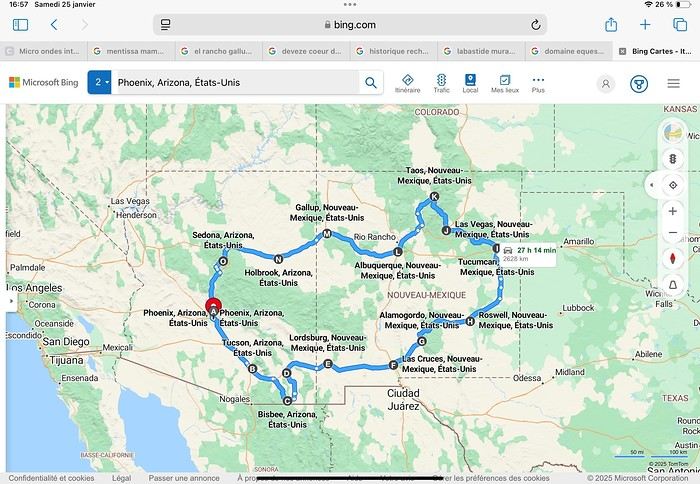
Day 1: Flight Marseille-Paris-Phoenix, then Gold Canyon (133 km) Day 2: Tucson (271 km) Lost Dutchman State Park Day 3: Tucson (155 km) Day 4: Tucson (34 km) Day 5: Bisbee (182 km) Day 6: Lordsburg (345 km) Day 7: Las Cruces (253 km) Day 8: Alamogordo (162 km) Day 9: Roswell (264 km) Day 10: Tucumcari (369 km) Day 11: Las Vegas (281 km) – the one in New Mexico Day 12: Taos (213 km) Day 13: Santa Fe (224 km) Day 14: Albuquerque (123 km) Day 15: Gallup (246 km) Day 16: Holbrook (224 km) Day 17: Flagstaff (179 km) Day 18: Sedona (118 km) Day 19: Sedona (48 km) Day 20: Sedona (41 km) Day 21: Phoenix (256 km) Day 22: Phoenix Airport (35 km)
📊 **Budget**: A little over 7,500 € for both of us, all included. The exchange rate was in our favor (1.17 dollars to 1 €). 📊 **Flights**: Marseille-Paris Charles de Gaulle-Phoenix: 1,787 € for two, with one checked bag each (Air France) 📊 **ESTA**: $42 📊 **America the Beautiful Pass**: $80 📊 **Parking**: 134 € (super eco at Marseille) 📊 **Car rental (Hertz)**: 865 €. Since there were no SUVs left in the reserved category (Nissan Rogue), we got an upgrade (4x4 Ford Explorer). We booked through Air France (15% discount). We’d originally reserved it in December for 1,140 €, but since prices dropped in March, we canceled and rebooked for 865 €. Hertz offers a free Hertz Gold Plus Rewards program, which gives you priority counter service when picking up the car. 📊 **Accommodation**: 2,400 € We stayed in hotels and motels of varying standards (from 60 to 203 € per night, depending on the city), all booked through Booking.com or Hotels.com. Out of 21 nights, only two didn’t include breakfast in the price. Booking.com sometimes offers slightly cheaper rates if you book by phone using the mobile app, and our Genius 3 status on the site also got us some preferential rates. 📊 **Supplementary insurance**: AVA 200 € for medical care if needed 📊 **Cash**: $2,078. We left with 1,000 € exchanged before departure and made two withdrawals of $500. This cash covered: - Evening restaurants and tips - Midday picnics - Gas: $298 for 4,160 km - Museum and private park entries (per person): - Lost Dutchman: $10 - Arizona-Sonora Desert Museum: $28 - Bird Cage Theater: $16 - Tombstone Shootout: $8 - New Mexico Farm & Ranch Museum: $12 - Roswell International UFO Museum: $5 - Billy the Kid Museum: $7 - Rancho de Taos: $22 - West Fork Oak Creek Trail entry: $15 We got a few discounts thanks to our senior age (+65). - Souvenirs and little treats
Like on our previous road trips, we didn’t rent a GPS. We got around using offline GPS apps Here WeGo and Organic Maps, with maps of the states we visited downloaded before we left (on our phones).
❤️❤️❤️ **Highlights** (there are so many!) 📍 Goldfield Ghost Town (even if it’s a reconstruction) 📍 The standing army of Saguaro cacti at Saguaro National Park West 📍 Diving into the cowboy universe of Tombstone 📍 The welcome from Rick and Henry at our guesthouse in Bisbee (Garden at Mile High Ranch) 📍 The tangled rocks of Chiricahua National Monument 📍 The flavored pistachios from Dwayne’s Fresh Jerky and Mac Ginnis Pistachioland 📍 Restaurants: La Posta (Las Cruces), Diner 66 (Albuquerque), and the Haunted Hamburger (Jerome) 📍 The old plazas of New Mexico 📍 The solitude and beauty of the white dunes at White Sands National Park 📍 Stepping back in time at the Billy the Kid Museum (Fort Stanton) 📍 Sections of historic Route 66 and the old motels of Tucumcari, especially at night when all the neon lights are on 📍 Taos Pueblo and diving into Native American culture 📍 After the Rio Grande Bridge, the descent via NM 567 to the very bottom of the Rio Grande Gorge, then the road along the riverbanks to Taos 📍 The tranquility of the Chimayo Sanctuary 📍 Discovering the ingenious native dwellings at Bandelier National Monument and Walnut Canyon National Park 📍 The small towns along the Turquoise Trail 📍 The red rocks of Red Rock Park and the Painted Desert 📍 The extraordinary colors of the petrified trees at Petrified Forest National Park 📍 Sedona, its red rocks, and the reward of the viewpoints at the end of hikes (Devil’s Bridge, The Subway, and West Fork Oak Creek) 📍 The immersion in Mexico when visiting Tlaquepaque 📍 The almost-ghost town of Jerome and its terraced streets 📍 The incredible kindness of Americans, always ready to help and up for a chat ❤️
☹️☹️☹️ **Flops** (there are very few) 📍 Several museums and churches being closed, so we couldn’t visit them 📍 Some museums and visitor centers opening late (10 AM) and closing early (4 PM) 📍 A 64 € phone roaming charge because we got near the Mexican border and picked up their cell tower 📍 The outrageous price ($5.99) for a gallon of gas at the Shell near Phoenix Airport
I hope this helps! Anyway, thanks for reading my long post. Don’t hesitate to reach out, even via PM, if you see I haven’t replied and you’d like more details. Have a great evening, everyone! 🙂
We’re back from our September 2025 road trip, this time to explore Arizona and New Mexico, and it’s time for me to start my travel journal—especially since everything’s already booked for another trip in September 2026 (to California), and I need to get started on the planning.
I was a little worried this new visit to Uncle Sam’s country might not be as "wow" as the others, but we still discovered some incredible places.
For those who don’t know us, we’re a couple in our seventies who speak very little English, but that didn’t stop us from fully enjoying our stay.
For this 6th road trip in the U.S., we spent 21 nights there, drove 4,160 km by car, and walked nearly 160 km in a loop starting from Phoenix.
We’d been to Arizona before (but not this side) and never to New Mexico. This whole road trip was a huge discovery for us.
In the prices mentioned (some in euros, others in dollars), bank fees and exchange charges are included. The flights, car rental, and parking were all paid for in December 2024 when we booked.
We’d downloaded the MPC (Mobile Passport Control) app, but there wasn’t a dedicated line at Phoenix Airport. Still, we got through quickly with friendly, smiling agents.
I don’t drive at all (I hate it), so the stops were chosen based on activities but also, for some, to limit daily mileage for the sole driver. The kilometers listed in the itinerary are the daily distances.
We traveled from September 9th to 22nd, unfortunately once again without our dear friends Mimi and Maumau.
The itinerary
Day 1: Flight Marseille-Paris-Phoenix, then Gold Canyon (133 km) Day 2: Tucson (271 km) Lost Dutchman State Park Day 3: Tucson (155 km) Day 4: Tucson (34 km) Day 5: Bisbee (182 km) Day 6: Lordsburg (345 km) Day 7: Las Cruces (253 km) Day 8: Alamogordo (162 km) Day 9: Roswell (264 km) Day 10: Tucumcari (369 km) Day 11: Las Vegas (281 km) – the one in New Mexico Day 12: Taos (213 km) Day 13: Santa Fe (224 km) Day 14: Albuquerque (123 km) Day 15: Gallup (246 km) Day 16: Holbrook (224 km) Day 17: Flagstaff (179 km) Day 18: Sedona (118 km) Day 19: Sedona (48 km) Day 20: Sedona (41 km) Day 21: Phoenix (256 km) Day 22: Phoenix Airport (35 km)
📊 **Budget**: A little over 7,500 € for both of us, all included. The exchange rate was in our favor (1.17 dollars to 1 €). 📊 **Flights**: Marseille-Paris Charles de Gaulle-Phoenix: 1,787 € for two, with one checked bag each (Air France) 📊 **ESTA**: $42 📊 **America the Beautiful Pass**: $80 📊 **Parking**: 134 € (super eco at Marseille) 📊 **Car rental (Hertz)**: 865 €. Since there were no SUVs left in the reserved category (Nissan Rogue), we got an upgrade (4x4 Ford Explorer). We booked through Air France (15% discount). We’d originally reserved it in December for 1,140 €, but since prices dropped in March, we canceled and rebooked for 865 €. Hertz offers a free Hertz Gold Plus Rewards program, which gives you priority counter service when picking up the car. 📊 **Accommodation**: 2,400 € We stayed in hotels and motels of varying standards (from 60 to 203 € per night, depending on the city), all booked through Booking.com or Hotels.com. Out of 21 nights, only two didn’t include breakfast in the price. Booking.com sometimes offers slightly cheaper rates if you book by phone using the mobile app, and our Genius 3 status on the site also got us some preferential rates. 📊 **Supplementary insurance**: AVA 200 € for medical care if needed 📊 **Cash**: $2,078. We left with 1,000 € exchanged before departure and made two withdrawals of $500. This cash covered: - Evening restaurants and tips - Midday picnics - Gas: $298 for 4,160 km - Museum and private park entries (per person): - Lost Dutchman: $10 - Arizona-Sonora Desert Museum: $28 - Bird Cage Theater: $16 - Tombstone Shootout: $8 - New Mexico Farm & Ranch Museum: $12 - Roswell International UFO Museum: $5 - Billy the Kid Museum: $7 - Rancho de Taos: $22 - West Fork Oak Creek Trail entry: $15 We got a few discounts thanks to our senior age (+65). - Souvenirs and little treats
Like on our previous road trips, we didn’t rent a GPS. We got around using offline GPS apps Here WeGo and Organic Maps, with maps of the states we visited downloaded before we left (on our phones).
❤️❤️❤️ **Highlights** (there are so many!) 📍 Goldfield Ghost Town (even if it’s a reconstruction) 📍 The standing army of Saguaro cacti at Saguaro National Park West 📍 Diving into the cowboy universe of Tombstone 📍 The welcome from Rick and Henry at our guesthouse in Bisbee (Garden at Mile High Ranch) 📍 The tangled rocks of Chiricahua National Monument 📍 The flavored pistachios from Dwayne’s Fresh Jerky and Mac Ginnis Pistachioland 📍 Restaurants: La Posta (Las Cruces), Diner 66 (Albuquerque), and the Haunted Hamburger (Jerome) 📍 The old plazas of New Mexico 📍 The solitude and beauty of the white dunes at White Sands National Park 📍 Stepping back in time at the Billy the Kid Museum (Fort Stanton) 📍 Sections of historic Route 66 and the old motels of Tucumcari, especially at night when all the neon lights are on 📍 Taos Pueblo and diving into Native American culture 📍 After the Rio Grande Bridge, the descent via NM 567 to the very bottom of the Rio Grande Gorge, then the road along the riverbanks to Taos 📍 The tranquility of the Chimayo Sanctuary 📍 Discovering the ingenious native dwellings at Bandelier National Monument and Walnut Canyon National Park 📍 The small towns along the Turquoise Trail 📍 The red rocks of Red Rock Park and the Painted Desert 📍 The extraordinary colors of the petrified trees at Petrified Forest National Park 📍 Sedona, its red rocks, and the reward of the viewpoints at the end of hikes (Devil’s Bridge, The Subway, and West Fork Oak Creek) 📍 The immersion in Mexico when visiting Tlaquepaque 📍 The almost-ghost town of Jerome and its terraced streets 📍 The incredible kindness of Americans, always ready to help and up for a chat ❤️
☹️☹️☹️ **Flops** (there are very few) 📍 Several museums and churches being closed, so we couldn’t visit them 📍 Some museums and visitor centers opening late (10 AM) and closing early (4 PM) 📍 A 64 € phone roaming charge because we got near the Mexican border and picked up their cell tower 📍 The outrageous price ($5.99) for a gallon of gas at the Shell near Phoenix Airport
I hope this helps! Anyway, thanks for reading my long post. Don’t hesitate to reach out, even via PM, if you see I haven’t replied and you’d like more details. Have a great evening, everyone! 🙂
15-Day Road Trip Recap: Colorado and New Mexico
Hello, here’s a totally subjective recap of our 15-day road trip between Colorado and New Mexico, from late September to mid-October.
Our main interests are culture, museums, and landscapes—no hiking or trails for us. Personally, I’m pretty contemplative, and luckily, there’s always something to see out there! We’re pretty used to the US; we’ve been going there often for a long time (let’s just say we’re not exactly young anymore).
Budget: Even though we don’t set a strict budget beforehand, we try to keep costs as low as possible. This time, we managed to spend around 4000 € for two, all included. To do this: avoid expensive accommodations, staying between 60 and 120 € per night with an average of 90 €/night, mixing Airbnb and motels. And skip the “real” restaurants, which are pretty pricey in the US: sandwiches for lunch, takeout or cooking in the Airbnb in the evening. We shop at Sprouts or Whole Foods—organic-style chains that are pricier than Walmart but better. In the evenings, Sprouts has discounts on items that didn’t sell during the day. Also, avoid toll roads, paid parking, and overly expensive attractions or sites. The dispensary budget is separate…
Route: Denver/Colorado Springs/Alamosa/Raton/Santa Fe/Cuba/Cortez/Grand Junction/Glenwood Springs/Denver This wasn’t too planned in advance—we booked a few nights upon arrival and went with the flow. Flight from CDG to Denver with AF/Delta, car rental at Dollar for a standard SUV. The guy at the Dollar counter upsold me on extra insurance for flat tires (and since I knew we’d be off-roading, I took it). Without telling me, he upgraded me to a Jeep Sahara 4X4 Hybrid. Nice.
Listening to the news upon arrival, the anchor announced, “It’s officially fall now.” We hadn’t really thought about that before leaving, but yeah—it’s the time when the trees turn fluorescent yellow and red. Amazing.
Colorado Springs: Garden of the Gods is a free park with paved trails winding through red/orange rock formations. Magical at sunrise—groups of deer roam around, along with birds and rabbits. It’s small but wow! Didn’t try the Manitou Incline in Manitou Springs, a staircase with thousands of steps going straight up the mountain. Impressive from the bottom, but the parking is paid, which is a downside for those willing to tackle it. The Cog Railway goes up to the summit of Pikes Peak—around $100 when we were there. No thanks. And of course, the parking is paid too. For fans, Maggie’s Farm dispensary is great.
On Route 24, Eleven Mile Canyon Recreation Area is fly-fishing paradise—just like in the movie *A River Runs Through It*. Entry is $11, and a trail follows the river at the bottom of the canyon to the dam. Dozens of people in waders are in the water, casting their lines over and over. You can see the salmon in the clear water, and we had a picnic in the sun, imagining Brad Pitt catching a fish.
Buena Vista: A cute little tourist town with an Outdoor Fair that day—some pretty impressive vehicles for sale, set up for mountain living (like Juniper outfitting a RAM).
Alamosa: The closest town to Great Sand Dunes National Park, crossed by the Rio Grande (and let’s be real—it’s more of a stream than a river!). Park access was free because it was National Park Day. A park with massive dunes—climbing them is pretty exhausting, with lots of wind and sinking sand. Glad we didn’t do it in summer; I can’t imagine how tough it’d be in the heat. It’s a bit deceptive: it looks easy to get to the top of a dune, but it’s really not. The campsites were nice, and it was busy that weekend. We passed the “Point of No Return,” a sandy trail winding through the hills and connecting to Route 559 from above. Didn’t go all the way, but it’s possible the entrance is free from that side. However, you need a 4X4 with good ground clearance. After 1 or 2 km on the trail, you’re alone between the dunes and hills—hardly anyone around. But tricky to turn around or pass other vehicles; the trail isn’t wide. We crossed paths with a Hanomag (registered in the Netherlands—impressive!) coming down without stopping, or risking getting stuck.
On the way out, we took the small Route 403, which quickly turns into a trail crossing the mountain. Entire sections of forest were turning fluorescent yellow with patches of green and red—an incredible sight.
Raton: A small town that probably peaked in the late 19th century and has been in slow decline ever since. The Raton Pass Motor Inn is the kind of place that makes the US legendary—entirely 50s and 60s decor, really well done. I had the Betty Page room—too cool. Felt like we were on Route 66. Even better.
Santa Fe: A small city with no high-rises—almost all low-rise buildings, many in adobe, blending perfectly into the landscape. The old downtown is touristy but nice, with its plaza and church. There’s a really cool vibe—we loved it. For drinks, the bar at the top of La Fonda Hotel was packed for sunset, with a diverse crowd. Not overpriced for the location. SITE Santa Fe is a contemporary art space near the train station. It’s free, and the temporary exhibit was really good—high quality. Museum Hill is, as the name suggests, where several museums are located. We visited the Museum of Indian Art and Culture—great if you’re into “First Nations” history. Saw The Dandy Warhols at The Bridge—an outdoor venue, one of the last concerts of the season before winter makes it too cold. Oddly, there was no bag check, just an ID required (even though it was obvious we were over 21!). Tickets were reasonable, around $30 (concerts in the US can be crazy expensive). The band was good, with fewer than 300 people in front. A sign at the bar warned: Don’t forget you’re at 1,500 meters—alcohol hits harder up here!
Albuquerque: A sprawling city with an old historic center that feels a bit like Disneyland—too perfect for my taste. The real highlight is the Sandia Peak Tramway, which goes up to the old ski resort above the city. Tickets are around $35, and it’s worth it—the ride over the canyons is pretty wild. The ski resort is a bit abandoned; apparently, like elsewhere, there’s no snow anymore. I asked several people about the lack of snow, and the answer was always the same: “It’s cyclical.” Okay then. We arrived for the start of the International Balloon Fiesta (one of the world’s largest hot-air balloon gatherings), hoping to see hundreds of balloons in the sky. Nope—windy today, so no one took off. Bummer.
Las Vegas: New Mexico has its own Las Vegas, but it’s nothing like the other one—a sleepy little town with a perfectly preserved 19th-century Historic Plaza Hotel, brick buildings, and vintage streetlights. Everything is so well-preserved it’s often used as a filming location. NM attracts a lot of productions thanks to tax incentives and its Western landscapes—and it’s cheaper than California! That day, a huge Texas flag was flying in the wind: they were filming the second season of *Ransom Canyon* for Netflix in the town center. If we’d been dressed more “Western,” we could’ve been extras.
Jemez Springs: Its Jemez Hot Springs is super cute—several thermal pools at different temperatures, a New Age vibe. The pools are surrounded by big rocks, and you’re asked to speak softly. A place where you could spend hours. $50 for two hours for two.
Los Alamos: A town made legendary by the bomb, the movie, etc. Heads up: It’s still a research center, and to cross part of the town, you need to show ID. No stopping or taking photos allowed. Other than the Oppenheimer House (currently closed—only the neighboring house is open to visitors), there’s not much to see. There’s a replica of the camp entrance, but it’s been turned into restrooms.
Georgia O’Keeffe Trail (American painter, 1887–1986): Her museum in Santa Fe is pretty good, even if they don’t have tons of works. Entry is $20. Her house in Abiquiu is open for visits, but it’s way overpriced at $65. So we skipped it. You can get an idea of it by stopping at the Welcome Center on Route 84. Further down the same road, Ghost Ranch is worth a visit—beautiful setting, free to enter, with trails to explore and a great atmosphere.
Chaco Culture National Historical Park: A pretty isolated park—25 km of trails to get there, with only a small section paved. The road is decent except for the last few kilometers, which have potholes. I can’t imagine it being accessible after rain, though that doesn’t happen often! This park, in the middle of a desert plain with a few canyons, is one of the rare places where you can find multi-story structures from pre-Columbian civilizations—so, before the “current” tribes. But cruel disappointment: it’s been shut down for a few days. We met a Native ranger—tall, with long hair—who explained that even though he wasn’t being paid, he was still guarding the park and had closed all access to the sites. Darn. Turned around and headed back down the trail.
Same story in the next town, Aztec (a funny name, right?): Aztec Ruins National Monument was closed too.
We passed Ship Rock, the Navajo’s sacred mountain—really impressive. Couldn’t find a trail to get closer, but it’s better from a distance anyway! The town of Shiprock itself is pretty depressing—poor living conditions for some Natives, with rundown mobile homes and piles of junk cars.
Stopped in Cortez to visit Mesa Verde National Park. Ate at Denny’s—hadn’t been there in ages (though it’s the kind of place I should feel at home in!). The customers all looked like they’d stepped out of *The Addams Family*—a little creepy. Or funny, depending on your perspective. For Mesa Verde, after discussing it on this forum with the honorable member Caussat (who didn’t find it that amazing), we were on the fence. Problem solved: it was closed too. Back on the road.
Durango: Really nice with its Main Ave and its shops, cafés—touristy but with local life. Famous for its tourist train to Silverton, but we didn’t do it—way too expensive. Choice between a steam locomotive or diesel (which belches black, stinky smoke—yuck). The diesel should be replaced with electric as soon as they get the funds.
Million Dollar Highway: The road winds through the mountains, and every turn (and there are a lot) is breathtaking—unbelievable landscapes with fluorescent yellow, green, and snow-capped mountains. Just wow.
Silverton: A Western town nestled between two mountains, preserved in its original state despite the tourists arriving by train. Around it, abandoned mines and old wooden ties—must’ve been tough for the 19th-century miners.
Grand Junction: The city is surrounded by giant mesas—pretty impressive. The old downtown is *too* clean—almost sterile.
Colorado National Monument: Just outside the city, a winding road climbs between stunning canyons, with sweeping views of the valley. Entry was free that day due to the shutdown.
Route 330, which we took to get back to the highway, passes through a place called “Cowboy Country”—and it’s true. We saw guys in Stetsons with huge pickups, the road turned into a trail with cows wandering on it, and we had to honk to get them to move. The trail to I-70 was full of potholes—the 4X4 came in handy. Had a picnic by Vega Reservoir: the booth at the entrance was empty, but people left cash in envelopes for camping fees. Anyone passing by could’ve taken it, but it’s an example of US trust and honesty!
Glenwood Springs: A small town famous for its hot springs pool—they claim it’s the largest in the world. I don’t know about that, but it has a great look. Unfortunately, it was closed for maintenance those days! Blew our budget by staying at the Hotel Colorado, a huge 1893 building with a real atmosphere in its grand lobby and fake fireplaces. Fire pits in front of wooden chairs in the garden with mountain views—just really great.
Aspen: The billionaires’ ski resort, but surprisingly, parking was free for 2 hours. Rare to see a place for the super-rich that doesn’t scream “not for you” (like Palm Beach, for example). A former mining town completely redone, every shop occupied by a luxury brand. There’s even a thrift shop run by sweet retirees—funny as hell. Two ski lifts to start directly with your skis, but we didn’t see the price—they were still closed. Lots of houses that aren’t huge but are cute, though looking at real estate prices made us think, “Is there an extra zero on that listing?” A 6-bedroom villa for $52 million? Wow. The mountains around are gorgeous—no wonder it became what it is.
Another fancy resort nearby: Vail, more modern in its construction. The restaurants opted for a “Schwarzwald” decor—kind of odd.
Denver: Nothing really stood out for us in this city, except the Design Museum—the Kirkland, where a local painter collected furniture and supplies from Arts and Crafts to Postmodern. Just really great. Entry is included with a visit to the Denver Art Museum, which has diverse collections—from Impressionism (they have a Manet, a Van Gogh, a Cézanne, several Sisleys) to photography. The best part for me was the “Ancient Americas” totems—huge, impressive wooden sculptures, painted, the kind you’re more used to seeing in Polynesia or Easter Island. Personally, I didn’t know Natives made them too. That’s what museums are for!
Back at the airport, where I had to tag my own luggage (you have to do everything yourself with these US airlines). The tag said SLC/CDG! But we were supposed to connect through JFK. Turns out, they’d put us on a DEN/SLC/CDG flight without telling us. In the end, we gained 30 minutes on our original arrival time in Paris!
There you go—hope this inspires other travelers! !
Our main interests are culture, museums, and landscapes—no hiking or trails for us. Personally, I’m pretty contemplative, and luckily, there’s always something to see out there! We’re pretty used to the US; we’ve been going there often for a long time (let’s just say we’re not exactly young anymore).
Budget: Even though we don’t set a strict budget beforehand, we try to keep costs as low as possible. This time, we managed to spend around 4000 € for two, all included. To do this: avoid expensive accommodations, staying between 60 and 120 € per night with an average of 90 €/night, mixing Airbnb and motels. And skip the “real” restaurants, which are pretty pricey in the US: sandwiches for lunch, takeout or cooking in the Airbnb in the evening. We shop at Sprouts or Whole Foods—organic-style chains that are pricier than Walmart but better. In the evenings, Sprouts has discounts on items that didn’t sell during the day. Also, avoid toll roads, paid parking, and overly expensive attractions or sites. The dispensary budget is separate…
Route: Denver/Colorado Springs/Alamosa/Raton/Santa Fe/Cuba/Cortez/Grand Junction/Glenwood Springs/Denver This wasn’t too planned in advance—we booked a few nights upon arrival and went with the flow. Flight from CDG to Denver with AF/Delta, car rental at Dollar for a standard SUV. The guy at the Dollar counter upsold me on extra insurance for flat tires (and since I knew we’d be off-roading, I took it). Without telling me, he upgraded me to a Jeep Sahara 4X4 Hybrid. Nice.
Listening to the news upon arrival, the anchor announced, “It’s officially fall now.” We hadn’t really thought about that before leaving, but yeah—it’s the time when the trees turn fluorescent yellow and red. Amazing.
Colorado Springs: Garden of the Gods is a free park with paved trails winding through red/orange rock formations. Magical at sunrise—groups of deer roam around, along with birds and rabbits. It’s small but wow! Didn’t try the Manitou Incline in Manitou Springs, a staircase with thousands of steps going straight up the mountain. Impressive from the bottom, but the parking is paid, which is a downside for those willing to tackle it. The Cog Railway goes up to the summit of Pikes Peak—around $100 when we were there. No thanks. And of course, the parking is paid too. For fans, Maggie’s Farm dispensary is great.
On Route 24, Eleven Mile Canyon Recreation Area is fly-fishing paradise—just like in the movie *A River Runs Through It*. Entry is $11, and a trail follows the river at the bottom of the canyon to the dam. Dozens of people in waders are in the water, casting their lines over and over. You can see the salmon in the clear water, and we had a picnic in the sun, imagining Brad Pitt catching a fish.
Buena Vista: A cute little tourist town with an Outdoor Fair that day—some pretty impressive vehicles for sale, set up for mountain living (like Juniper outfitting a RAM).
Alamosa: The closest town to Great Sand Dunes National Park, crossed by the Rio Grande (and let’s be real—it’s more of a stream than a river!). Park access was free because it was National Park Day. A park with massive dunes—climbing them is pretty exhausting, with lots of wind and sinking sand. Glad we didn’t do it in summer; I can’t imagine how tough it’d be in the heat. It’s a bit deceptive: it looks easy to get to the top of a dune, but it’s really not. The campsites were nice, and it was busy that weekend. We passed the “Point of No Return,” a sandy trail winding through the hills and connecting to Route 559 from above. Didn’t go all the way, but it’s possible the entrance is free from that side. However, you need a 4X4 with good ground clearance. After 1 or 2 km on the trail, you’re alone between the dunes and hills—hardly anyone around. But tricky to turn around or pass other vehicles; the trail isn’t wide. We crossed paths with a Hanomag (registered in the Netherlands—impressive!) coming down without stopping, or risking getting stuck.
On the way out, we took the small Route 403, which quickly turns into a trail crossing the mountain. Entire sections of forest were turning fluorescent yellow with patches of green and red—an incredible sight.
Raton: A small town that probably peaked in the late 19th century and has been in slow decline ever since. The Raton Pass Motor Inn is the kind of place that makes the US legendary—entirely 50s and 60s decor, really well done. I had the Betty Page room—too cool. Felt like we were on Route 66. Even better.
Santa Fe: A small city with no high-rises—almost all low-rise buildings, many in adobe, blending perfectly into the landscape. The old downtown is touristy but nice, with its plaza and church. There’s a really cool vibe—we loved it. For drinks, the bar at the top of La Fonda Hotel was packed for sunset, with a diverse crowd. Not overpriced for the location. SITE Santa Fe is a contemporary art space near the train station. It’s free, and the temporary exhibit was really good—high quality. Museum Hill is, as the name suggests, where several museums are located. We visited the Museum of Indian Art and Culture—great if you’re into “First Nations” history. Saw The Dandy Warhols at The Bridge—an outdoor venue, one of the last concerts of the season before winter makes it too cold. Oddly, there was no bag check, just an ID required (even though it was obvious we were over 21!). Tickets were reasonable, around $30 (concerts in the US can be crazy expensive). The band was good, with fewer than 300 people in front. A sign at the bar warned: Don’t forget you’re at 1,500 meters—alcohol hits harder up here!
Albuquerque: A sprawling city with an old historic center that feels a bit like Disneyland—too perfect for my taste. The real highlight is the Sandia Peak Tramway, which goes up to the old ski resort above the city. Tickets are around $35, and it’s worth it—the ride over the canyons is pretty wild. The ski resort is a bit abandoned; apparently, like elsewhere, there’s no snow anymore. I asked several people about the lack of snow, and the answer was always the same: “It’s cyclical.” Okay then. We arrived for the start of the International Balloon Fiesta (one of the world’s largest hot-air balloon gatherings), hoping to see hundreds of balloons in the sky. Nope—windy today, so no one took off. Bummer.
Las Vegas: New Mexico has its own Las Vegas, but it’s nothing like the other one—a sleepy little town with a perfectly preserved 19th-century Historic Plaza Hotel, brick buildings, and vintage streetlights. Everything is so well-preserved it’s often used as a filming location. NM attracts a lot of productions thanks to tax incentives and its Western landscapes—and it’s cheaper than California! That day, a huge Texas flag was flying in the wind: they were filming the second season of *Ransom Canyon* for Netflix in the town center. If we’d been dressed more “Western,” we could’ve been extras.
Jemez Springs: Its Jemez Hot Springs is super cute—several thermal pools at different temperatures, a New Age vibe. The pools are surrounded by big rocks, and you’re asked to speak softly. A place where you could spend hours. $50 for two hours for two.
Los Alamos: A town made legendary by the bomb, the movie, etc. Heads up: It’s still a research center, and to cross part of the town, you need to show ID. No stopping or taking photos allowed. Other than the Oppenheimer House (currently closed—only the neighboring house is open to visitors), there’s not much to see. There’s a replica of the camp entrance, but it’s been turned into restrooms.
Georgia O’Keeffe Trail (American painter, 1887–1986): Her museum in Santa Fe is pretty good, even if they don’t have tons of works. Entry is $20. Her house in Abiquiu is open for visits, but it’s way overpriced at $65. So we skipped it. You can get an idea of it by stopping at the Welcome Center on Route 84. Further down the same road, Ghost Ranch is worth a visit—beautiful setting, free to enter, with trails to explore and a great atmosphere.
Chaco Culture National Historical Park: A pretty isolated park—25 km of trails to get there, with only a small section paved. The road is decent except for the last few kilometers, which have potholes. I can’t imagine it being accessible after rain, though that doesn’t happen often! This park, in the middle of a desert plain with a few canyons, is one of the rare places where you can find multi-story structures from pre-Columbian civilizations—so, before the “current” tribes. But cruel disappointment: it’s been shut down for a few days. We met a Native ranger—tall, with long hair—who explained that even though he wasn’t being paid, he was still guarding the park and had closed all access to the sites. Darn. Turned around and headed back down the trail.
Same story in the next town, Aztec (a funny name, right?): Aztec Ruins National Monument was closed too.
We passed Ship Rock, the Navajo’s sacred mountain—really impressive. Couldn’t find a trail to get closer, but it’s better from a distance anyway! The town of Shiprock itself is pretty depressing—poor living conditions for some Natives, with rundown mobile homes and piles of junk cars.
Stopped in Cortez to visit Mesa Verde National Park. Ate at Denny’s—hadn’t been there in ages (though it’s the kind of place I should feel at home in!). The customers all looked like they’d stepped out of *The Addams Family*—a little creepy. Or funny, depending on your perspective. For Mesa Verde, after discussing it on this forum with the honorable member Caussat (who didn’t find it that amazing), we were on the fence. Problem solved: it was closed too. Back on the road.
Durango: Really nice with its Main Ave and its shops, cafés—touristy but with local life. Famous for its tourist train to Silverton, but we didn’t do it—way too expensive. Choice between a steam locomotive or diesel (which belches black, stinky smoke—yuck). The diesel should be replaced with electric as soon as they get the funds.
Million Dollar Highway: The road winds through the mountains, and every turn (and there are a lot) is breathtaking—unbelievable landscapes with fluorescent yellow, green, and snow-capped mountains. Just wow.
Silverton: A Western town nestled between two mountains, preserved in its original state despite the tourists arriving by train. Around it, abandoned mines and old wooden ties—must’ve been tough for the 19th-century miners.
Grand Junction: The city is surrounded by giant mesas—pretty impressive. The old downtown is *too* clean—almost sterile.
Colorado National Monument: Just outside the city, a winding road climbs between stunning canyons, with sweeping views of the valley. Entry was free that day due to the shutdown.
Route 330, which we took to get back to the highway, passes through a place called “Cowboy Country”—and it’s true. We saw guys in Stetsons with huge pickups, the road turned into a trail with cows wandering on it, and we had to honk to get them to move. The trail to I-70 was full of potholes—the 4X4 came in handy. Had a picnic by Vega Reservoir: the booth at the entrance was empty, but people left cash in envelopes for camping fees. Anyone passing by could’ve taken it, but it’s an example of US trust and honesty!
Glenwood Springs: A small town famous for its hot springs pool—they claim it’s the largest in the world. I don’t know about that, but it has a great look. Unfortunately, it was closed for maintenance those days! Blew our budget by staying at the Hotel Colorado, a huge 1893 building with a real atmosphere in its grand lobby and fake fireplaces. Fire pits in front of wooden chairs in the garden with mountain views—just really great.
Aspen: The billionaires’ ski resort, but surprisingly, parking was free for 2 hours. Rare to see a place for the super-rich that doesn’t scream “not for you” (like Palm Beach, for example). A former mining town completely redone, every shop occupied by a luxury brand. There’s even a thrift shop run by sweet retirees—funny as hell. Two ski lifts to start directly with your skis, but we didn’t see the price—they were still closed. Lots of houses that aren’t huge but are cute, though looking at real estate prices made us think, “Is there an extra zero on that listing?” A 6-bedroom villa for $52 million? Wow. The mountains around are gorgeous—no wonder it became what it is.
Another fancy resort nearby: Vail, more modern in its construction. The restaurants opted for a “Schwarzwald” decor—kind of odd.
Denver: Nothing really stood out for us in this city, except the Design Museum—the Kirkland, where a local painter collected furniture and supplies from Arts and Crafts to Postmodern. Just really great. Entry is included with a visit to the Denver Art Museum, which has diverse collections—from Impressionism (they have a Manet, a Van Gogh, a Cézanne, several Sisleys) to photography. The best part for me was the “Ancient Americas” totems—huge, impressive wooden sculptures, painted, the kind you’re more used to seeing in Polynesia or Easter Island. Personally, I didn’t know Natives made them too. That’s what museums are for!
Back at the airport, where I had to tag my own luggage (you have to do everything yourself with these US airlines). The tag said SLC/CDG! But we were supposed to connect through JFK. Turns out, they’d put us on a DEN/SLC/CDG flight without telling us. In the end, we gained 30 minutes on our original arrival time in Paris!
There you go—hope this inspires other travelers! !
Kattegat Tour and Norway’s Majestic Fjords – 32 Days (Denmark, Sweden, Norway)
Kattegat isn’t just the name of the village in the TV series *Vikings*—it’s also the stretch of water separating Denmark from Sweden... the sea, basically! And further north, you’ve got Norway and its fjords!
Originally, I’d planned to just do a loop around Kattegat, with the *Under* restaurant in Lindesnes as our anniversary treat... but along the way, we thought, why not "push" a little further north, keeping an eye on the budget since we’d chosen to travel by car in June 2025 through Scandinavia.
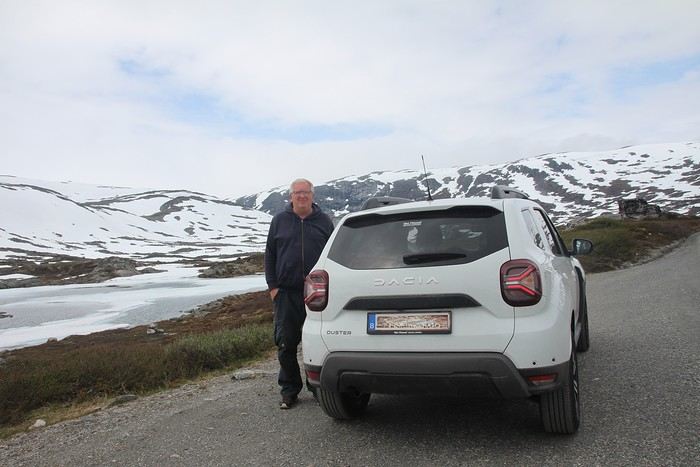
Why by car when most travelers opt for a camper van, while others prefer the comfort of cruises? Well, because we don’t own a camper van, renting one is pricey, and then you’ve got to add fuel costs (those things guzzle gas!), ferry fees, and other "tolls." All things considered, we went for mostly rentals—especially since there were four of us at the start of the trip. We spent the first week in Denmark with our daughter and son-in-law. Then they flew back to Belgium, and we continued our adventure as a couple. For accommodation, we mainly booked Airbnb apartments, which helped keep costs down and, most importantly, let us prepare our own meals (diet, diet!). In this travel journal, you’ll discover (or rediscover, for those who followed my older ones) our unbridled love for theme parks, museums, unique experiences, and—especially in Denmark—Legos! Unfortunately, we didn’t do any hikes this year because the unpredictable weather had made the trails slippery, and since I’d already taken three tumbles during the trip, I didn’t want to risk another! In the end, we traveled for 32 days, covered 6,200 km, and most importantly, discovered the charming country of Denmark, marveled at Norway’s breathtaking fjords—all without suffering the heatwave that hit France and Belgium that June! If you’ve got any questions, don’t hesitate to ask!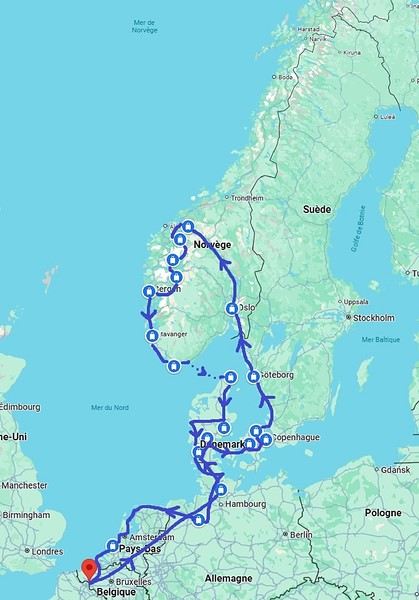
Why by car when most travelers opt for a camper van, while others prefer the comfort of cruises? Well, because we don’t own a camper van, renting one is pricey, and then you’ve got to add fuel costs (those things guzzle gas!), ferry fees, and other "tolls." All things considered, we went for mostly rentals—especially since there were four of us at the start of the trip. We spent the first week in Denmark with our daughter and son-in-law. Then they flew back to Belgium, and we continued our adventure as a couple. For accommodation, we mainly booked Airbnb apartments, which helped keep costs down and, most importantly, let us prepare our own meals (diet, diet!). In this travel journal, you’ll discover (or rediscover, for those who followed my older ones) our unbridled love for theme parks, museums, unique experiences, and—especially in Denmark—Legos! Unfortunately, we didn’t do any hikes this year because the unpredictable weather had made the trails slippery, and since I’d already taken three tumbles during the trip, I didn’t want to risk another! In the end, we traveled for 32 days, covered 6,200 km, and most importantly, discovered the charming country of Denmark, marveled at Norway’s breathtaking fjords—all without suffering the heatwave that hit France and Belgium that June! If you’ve got any questions, don’t hesitate to ask!
Skyscrapers, Markets, Ice Cubes, Tourism, and Waterfalls... Thailand's Excesses
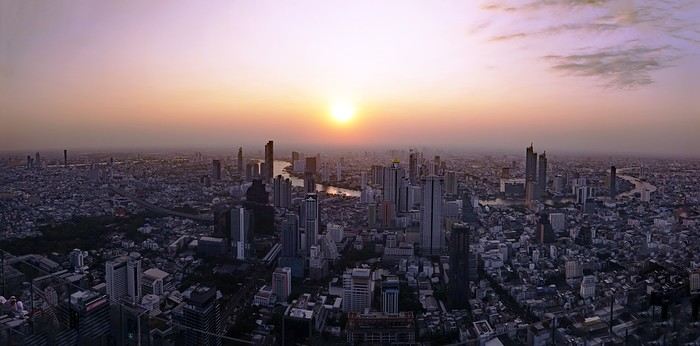
A somewhat lengthy title... I could have simply written: from Bangkok to Chiang Rai, via Chiang Mai, since that was my route. But when poets embellish our travel journals with their verbal flourishes, you’ve got to try not to be too ordinary.
Skyscrapers of excess? You’ll have gathered that from the photo illustrating this journal—though it might change as the trip goes on.
The excess of markets—not so much in their size, though... Chatuchak... But in their sheer number. Day markets, night markets, floating markets, fresh produce markets, fish markets, meat markets, spice markets, fabric markets... and even... amulet markets... For luck, good fortune, protection. Not to mention, sadly, the market for girls—and boys, incidentally. I’ve even heard they’re displayed in windows. I’ve heard about that one, like you have, but I didn’t set foot in it, so I can’t say anything about it. Some even claim there’s a black-market trade in children. Disgusting! It reminded me of the book *The Parcel* by Anosh Irani, which I recommended in another journal. The story is set in India, but I’ve been told it exists in Thailand too. So, the "famous Thai markets" we’re bombarded with in paper and online guides—sure, they amazed me in the first few days, and I don’t regret visiting them. But no matter how big they were, I quickly got my fill since you saw the same things at every stall...
I had a market overdose.
Excess of tourism? I should say *tourists*, since I saw them literally swarming in the streets and those famous markets. I’d forgotten about them. I’d lost the habit, living in an Indian city for so long...
Waterfalls are a bit like markets. At this time of year, they’re not particularly spectacular, but they’re everywhere. There are the ones everyone goes to see. For example, Erawan, which I decided to skip even though it was in my original itinerary—I guessed it’d be a nightmare with the selfie circus. On the other hand, you come across them all over the place, hidden in the mountains and forests, not listed in any guide. Not to mention the ones you can find in temples or even private homes... Yes, really! Thais love waterfalls, so they install them in their gardens—and I even saw one in the middle of the city, right on the street! Sometimes they’re tiny, but very photogenic.
But what do ice cubes have to do with this? Why the excess of ice cubes? Not only are they everywhere by the ton, but they put them in *everything* you drink. You’d think they’d even put them in soup! And it’s not just one or two ice cubes—no! They fill the container to the brim, whatever it is, then pour the liquid on top to fill the gaps. They’ll make you an excellent coffee right in front of you, piping hot, then—bam! An avalanche of ice cubes in the glass. Okay, I’m exaggerating a little. They *do* sometimes ask if you prefer your coffee—or tea—hot. Everything edible, and especially everything drinkable, is refrigerated: vegetables, fruit, hot drinks (I mean, drinks that are *usually* hot), but meat and fish are left out in the open. They just wave a little whisk to shoo away the flies when they get too eager. Mind you, I never put fruit, cheese, eggs, or water in the fridge in France, but I do in India. And I refrigerate meat and fish too... Though sometimes one of those little flies sneaks into the fridge...
You won’t find practical or technical details in this journal, like addresses or prices. Others do that better than me. You also won’t find the names of obscure or unknown places I discovered, or directions to get there.
I don’t really feel like recounting what I saw day by day, following my schedule and route. There might be flashbacks, projections into the future. It’ll depend on my memories, what I felt, what I hated, what comes back to me—and maybe your questions and our exchanges. And for those who’ve never read me before, you’ll have to get used to my parentheses and digressions, maybe on a completely different subject, as my thoughts wander. Stories within stories. There’ll also be long, endless sentences—but still punctuated, so you can follow along. Though I used to curse Proust and his sentences that started on one page and ended on the next, sometimes even further. I’d have to reread them twenty times to follow and understand what he was saying. I hated Proust. But hey, I was 20. Maybe I’d like him now?
See? The digressions are starting already. Forgive me.
You’ll find few photos here. First, the number is limited, and second, photos aren’t the main purpose of either VF or a travel journal. They’re too often used to mask the poverty of the text. And, sorry to say it, but so many of them are just plain ugly! If you really want to see photos, I’ll share some links where you can browse them at your leisure
Itinéraire 10 jours entre Bordeaux et Saint-Sébastien sur la côte basque en août English translation pending
Bonjour,
Notre idée: 10 jours entre Bordeaux et San Sébastian (vol du Québec facile et faible cout)
Nos Envies: visites centre ville, fariente, plages, plaisirs gastronomique, et si on peut ajouter un peu de jogging se serait bien.
Besoin de votre aide sur itinéraire : (le tout en bus ou train)
Bordeaux 3 nuits (St-Emilion visite) St Jean de Luz (? optionnel 1-2 nuits?) San Sébastian- Donostian (3 ou 4 nuits) visite Bilbao pour le musée seulement. (ou dormir là ??) Pamplona (2 nuits) Retour Bordeaux
Questions: Est-ce que je devrais sauter St Jean Luz et prendre plus de temps villages sur la cote espagnole ? Et est ce possible ou trop grosse journée de faire aller retour à Bilbao (musée) de San Sébastian ? Est ce que San Sébastian est trop 4 nuits (je peux voir des touristes mais aurais envie de me tirer les cheveux en aout?) et c'est la Great Week en plus ! Devrions nous louer voiture pour aller à Pamplona ? ESt ce que l'on doit réserver d'avance nos billets de bus et train pour aout ?
Merci grandement de vos conseils !!
Besoin de votre aide sur itinéraire : (le tout en bus ou train)
Bordeaux 3 nuits (St-Emilion visite) St Jean de Luz (? optionnel 1-2 nuits?) San Sébastian- Donostian (3 ou 4 nuits) visite Bilbao pour le musée seulement. (ou dormir là ??) Pamplona (2 nuits) Retour Bordeaux
Questions: Est-ce que je devrais sauter St Jean Luz et prendre plus de temps villages sur la cote espagnole ? Et est ce possible ou trop grosse journée de faire aller retour à Bilbao (musée) de San Sébastian ? Est ce que San Sébastian est trop 4 nuits (je peux voir des touristes mais aurais envie de me tirer les cheveux en aout?) et c'est la Great Week en plus ! Devrions nous louer voiture pour aller à Pamplona ? ESt ce que l'on doit réserver d'avance nos billets de bus et train pour aout ?
Merci grandement de vos conseils !!
Tahiti - Croisière aux Iles Marquises et Huahine English translation pending
Bonjour tout le monde
Je viens partager avec vous le magnifique voyage que nous avons fait en Polynésie Française du 3 au 23 Novembre 2019
Depuis de très nombreuses années nous avions envie d’aller en Polynésie Française, mais le nombre d’heures de voyage pour y arriver ainsi que le décalage horaire nous rebutait un peu, voir beaucoup. L’an passé nous avons fait 18 heures de voyage ça c’est très bien passé, alors pourquoi pas aller en Polynésie.
Des personnes rencontrées au cours de nos différents voyages, nous parlaient d’une croisière qu’ils avaient faite aux Iles Marquises sur un cargo mixte L’Aranui et qu’ils en étaient revenus enchantés. Une croisière sur ce bateau nous tentait bien. Régulièrement on reparlait de ce voyage, donc courant 2018 je ressors donc les guides, me renseigne sur le trajet du bateau, sa durée, etc.. Nous aimerions aussi passer 4 nuits et 3 jours pleins à Papeete pour nous remettre du voyage, du décallage horaire, visiter l’île tranquillement, ensuite nous ferions la croisière aux Iles Marquises et finirions par 2 nuits et une journée complète à Huahine. Yapuka à articuler tout ça.
Début Octobre 2018 je me renseigne auprès de Voyageurs du Monde pour avoir un devis. nous pensions faire ce voyage en Septembre 2019 mais il n’y avait plus de place dans la catégorie de cabine que je voulais, ce sera donc pour début Novembre 2019. Bon nous allons casser la tirelire, mais c’est maintenant où jamais.
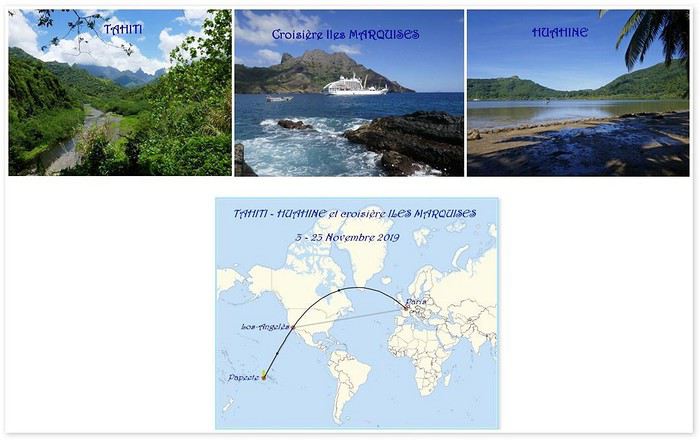 Voilà notre trajet
Paris – Papeete (Tahiti) Iles de la Société Papeete Vallée de la Papenoo Tour de l’ile Embarquement sur l’Aranui Fakarava Iles des Tuamotu En mer Hiva Oa – Tahuata Iles Marquises Fatu Hiva (Omoa-Hananave) Hiva Oa – (Tahuata (plage) Ua Huka (Vaipaee – Hokatu) Nuku-Hiva Ua Pou En mer Rangiroa Iles Tuamotu Bora-Bora Iles de la Société Papeete – Huahine Huahine Huhaine – Papeete Papeete - Paris
Pour plus de photos c'est ici.
à suivre
Je viens partager avec vous le magnifique voyage que nous avons fait en Polynésie Française du 3 au 23 Novembre 2019
Depuis de très nombreuses années nous avions envie d’aller en Polynésie Française, mais le nombre d’heures de voyage pour y arriver ainsi que le décalage horaire nous rebutait un peu, voir beaucoup. L’an passé nous avons fait 18 heures de voyage ça c’est très bien passé, alors pourquoi pas aller en Polynésie.
Des personnes rencontrées au cours de nos différents voyages, nous parlaient d’une croisière qu’ils avaient faite aux Iles Marquises sur un cargo mixte L’Aranui et qu’ils en étaient revenus enchantés. Une croisière sur ce bateau nous tentait bien. Régulièrement on reparlait de ce voyage, donc courant 2018 je ressors donc les guides, me renseigne sur le trajet du bateau, sa durée, etc.. Nous aimerions aussi passer 4 nuits et 3 jours pleins à Papeete pour nous remettre du voyage, du décallage horaire, visiter l’île tranquillement, ensuite nous ferions la croisière aux Iles Marquises et finirions par 2 nuits et une journée complète à Huahine. Yapuka à articuler tout ça.
Début Octobre 2018 je me renseigne auprès de Voyageurs du Monde pour avoir un devis. nous pensions faire ce voyage en Septembre 2019 mais il n’y avait plus de place dans la catégorie de cabine que je voulais, ce sera donc pour début Novembre 2019. Bon nous allons casser la tirelire, mais c’est maintenant où jamais.
Voilà notre trajetParis – Papeete (Tahiti) Iles de la Société Papeete Vallée de la Papenoo Tour de l’ile Embarquement sur l’Aranui Fakarava Iles des Tuamotu En mer Hiva Oa – Tahuata Iles Marquises Fatu Hiva (Omoa-Hananave) Hiva Oa – (Tahuata (plage) Ua Huka (Vaipaee – Hokatu) Nuku-Hiva Ua Pou En mer Rangiroa Iles Tuamotu Bora-Bora Iles de la Société Papeete – Huahine Huahine Huhaine – Papeete Papeete - Paris
Pour plus de photos c'est ici.
à suivre
Deux semaines en Provence et Côte d'Azur au départ de Marseille English translation pending
bonjour,
Nous partons de Montréal, J'ai besoin de conseils pour préparer mon voyage 2020, 2 semaines, Provence et Côte d'Azur. Arrivée à Marseille, faire la Provence et Côte d'Azur: Questions: Juin ou septembre? Location de maison ou condo (5 jours chacun)? dans 2 villes, lesquelles? où louer une voiture et quand? Quoi visiter? Si qqn a déjà fait ce voyage et a adorer, j'aimerais qu'il partage son expérience, ses endroits.
Merci
Gauga1959
Two Sides of China: Urban Shanghai and Rural Yangshuo
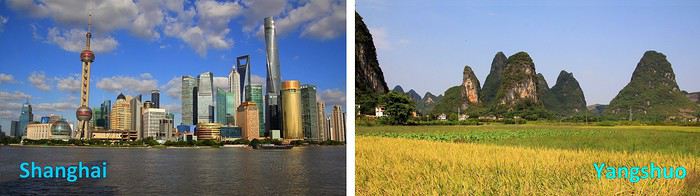
Vast, diverse, and multifaceted China! During a recent journey across part of this fascinating country, I enthusiastically discovered so many aspects of it. But such variety seems hard to condense into a single story. So, for this travel journal, I’ve focused on two main facets of China. First, a modern and urban China—the sprawling city of Shanghai—and then, in a second part, a China that’s the complete opposite: a rural and more traditional side explored around Yangshuo, where nature is absolutely stunning. Ready for a tour of China, city first, then countryside? Travel stories, descriptions, and impressions are on the program, with plenty of room for photos. Enjoy the journey and happy reading!
--
Urban China: Shanghai
As soon as you explore the city, it’s clear: the Chinese wanted to turn Shanghai—once a small fishing village—into a showcase of a modern, powerful, and forward-looking China. The megacity is immense, with around 24 million people bustling through its avenues or stuck in monstrous traffic jams at the foot of some of the world’s tallest skyscrapers. Towers so high they almost touch the sky—well, almost. But this gigantism is just one side of this southern metropolis in the Middle Kingdom.
Away from the towers and business districts, you discover another side of Shanghai—more traditional and, some would say, more human. This is where my travel story begins: on a quiet morning among smiling, relaxed locals. We’re in one of the city’s parks, specifically Fuxing Park.
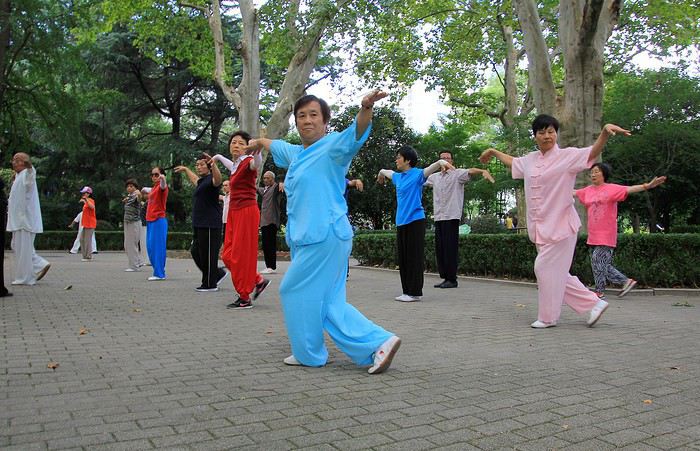
As everyone knows, the Chinese love practicing Tai Chi Chuan, in groups or solo, so it’s no surprise to see so many here, moving slowly and precisely through their sequences. Here’s a first group, their movements and postures perfectly coordinated.
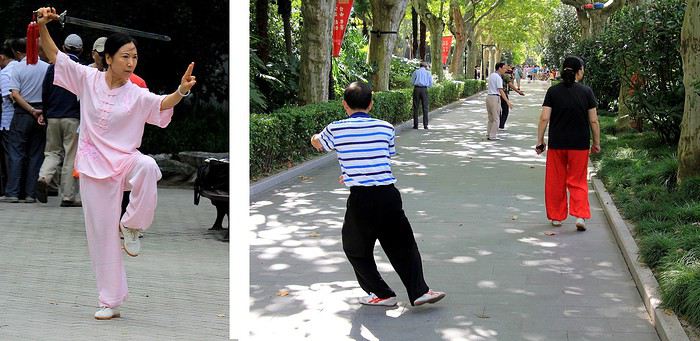
In another alley, a lone practitioner is deep in concentration, executing his movements with focus. I watch him for a few moments, discreetly and from a distance, so as not to disturb him. To his right, a woman in bright red pants keeps walking, almost as if she’s marching in place. A strange ballet: a series of steps forward, then backward, and so on...
Nearby, this elegant athlete (or artist) performs Tai Chi with a sword—almost like a choreography, her movements resembling a true sword dance.
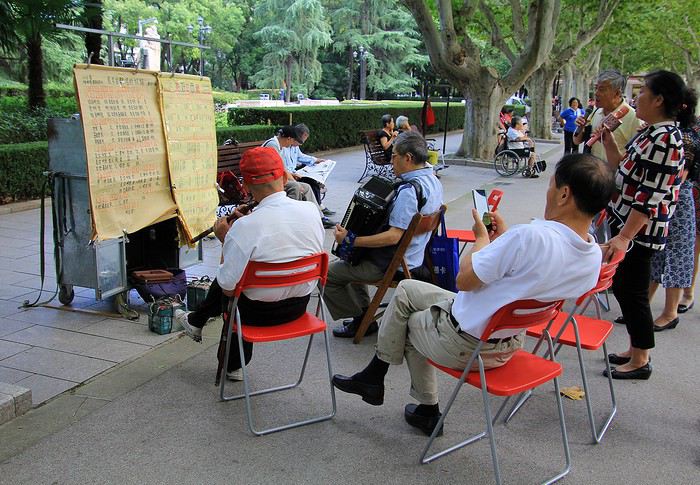
Further on, the atmosphere is more relaxed and melodic. People are playing music and dancing joyfully, like this woman with her colorful, original hairstyle, all smiles with maracas in hand. You almost want to clap along—her energy is so contagious!
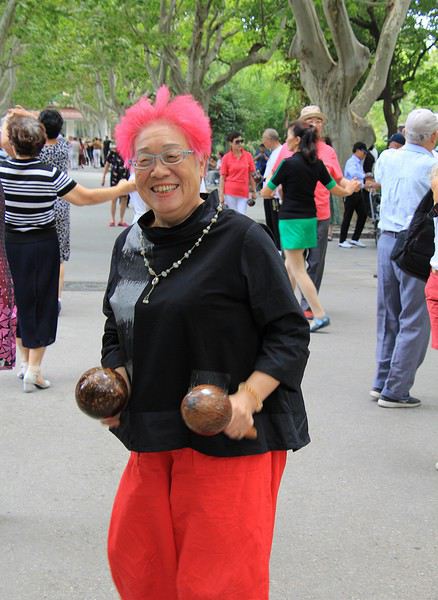
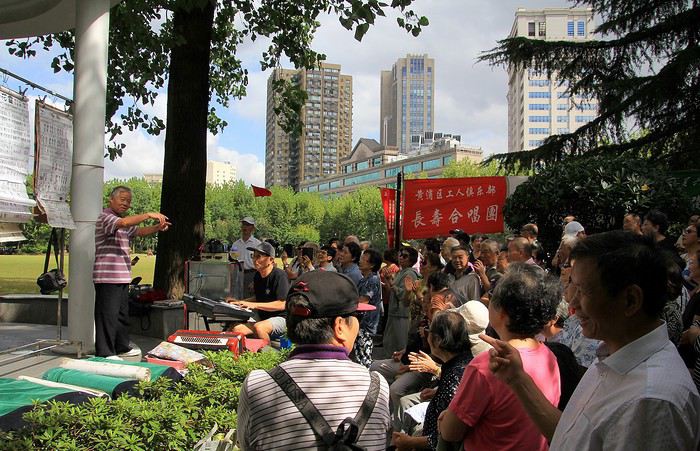
The mood is lighthearted among this group of retirees. Their choir alternates between patriotic hymns and lighter songs. Someone must have told them some French people were watching, because suddenly they start singing an old French tune: « Vive le vent, vive le vent d’hiver... » And the cheerful choir leader invites us to sing along—all together! The result was a fun cacophony: us in French, them in Chinese. But it was so charming!
These Chinese locals definitely passed on their good mood. It’s a joy to see all these retirees—you can imagine them leaving their small apartments to get some fresh air and meet up in the park for these morning activities. But let’s not kid ourselves: while they seem so happy and content with those big smiles, most of them probably didn’t have an easy life. Food shortages, draconian regulations, propaganda, the one-child policy—just to name a few! No, what many endured in their daily lives didn’t always give them reason to smile so brightly. But now, they’re making the most of it, and as I wrote earlier, it’s wonderful to see them like this.
Encouraged by these shared moments, I decide to keep going. Without hesitation, I join a Tai Chi session. I tried my best to follow the movements of my neighbors practicing this traditional exercise, but I’ll admit—it wasn’t easy!
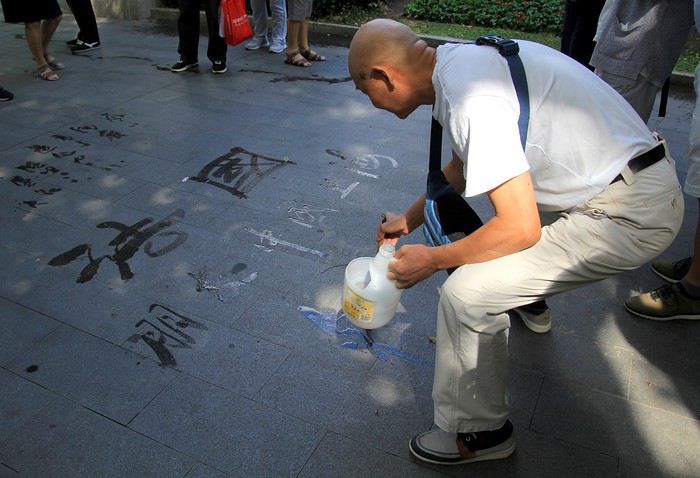
This artist, especially attentive, rewards us with a calligraphed phrase about France. A lover of Chinese calligraphy, he writes these sinograms in ancient characters directly on the ground. Is it writing or drawing? It’s hard to say—the result is so aesthetic. An ephemeral phrase, written in water that slowly fades as it dries, before disappearing entirely.
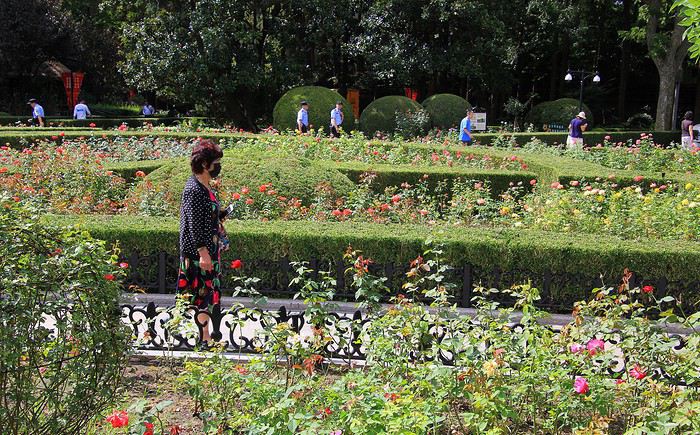
As we walk, we approach one of the park’s exits—so beautifully flowered. These flowerbeds and their blooms hint at the name of this charming place: Parc des Roses—and it’s even written in French!
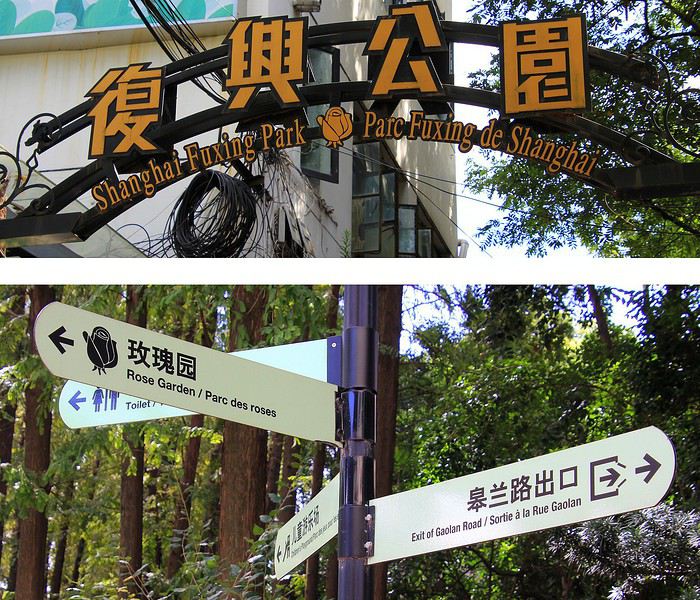
--
We’re now in the former French Concession of Shanghai, which explains the French inscriptions. The era of foreign concessions in Shanghai is an old story, dating back to the 1840s—a time when China opened its market to international trade. Several nations, including European ones, established trading posts in the city. There were British, American, Japanese, Russian, Italian, German, and French communities. This part of Shanghai was under French administration for a time, starting in 1846.
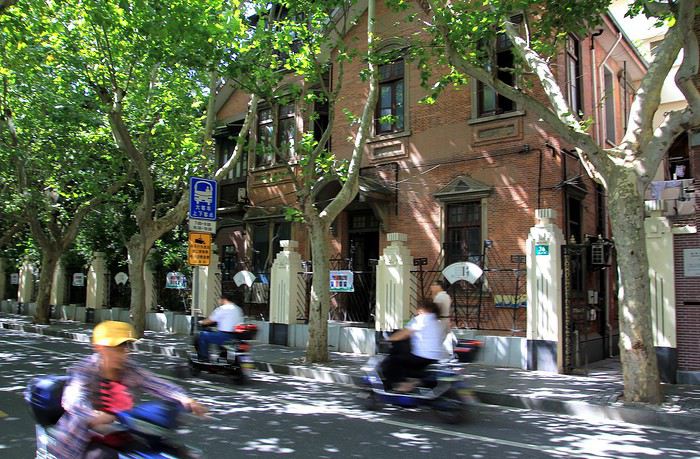
Some buildings in the area still bear witness to that time, like these ones, with bikes and scooters passing by. The architecture popular at the time blended European influences with the style of Shanghai’s elegant residences: stone arches above entrances, brick walls, and pleasant inner courtyards. Large homes often divided into several apartments today.
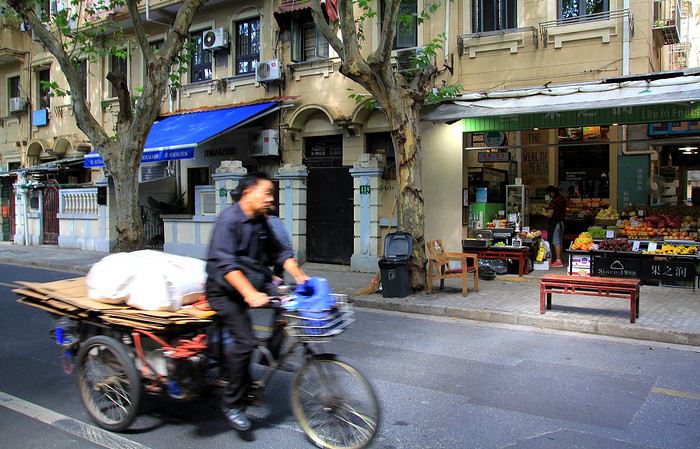
--
Traditional Chinese architecture shines in all its splendor at this tea house. With pagoda-style roofs—corners turned up toward the sky—refined colors and decorations, and a small corner tower on the right, this Huxinting Pavilion dates back to 1784. It was built in the middle of a pond, offering beautiful reflections. A truly charming spot where you can savor the subtle flavors of Oriental teas in the interior rooms.
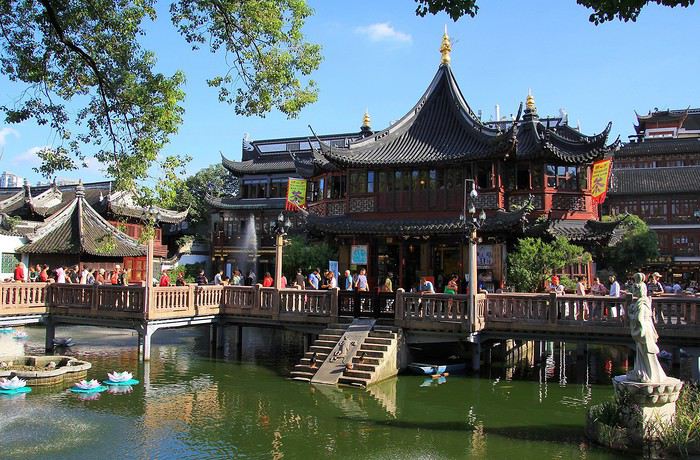
Just steps from this picturesque spot, don’t miss the Yuyuan Pavilions and Garden. The whole complex is stunning and gives a glimpse of imperial-era homes and parks from the Ming Dynasty.
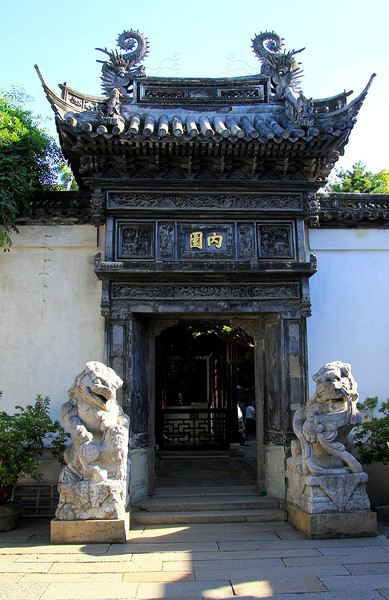
Pass through the entrance gate to enter this opulent property, well protected by a high surrounding wall. On one of them, a dragon sculpture sprawled at full length—about 7 meters—is impressive. The symbol represents power but also happiness.
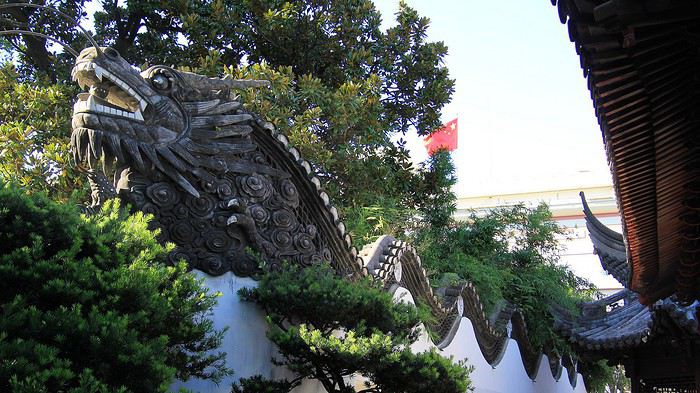
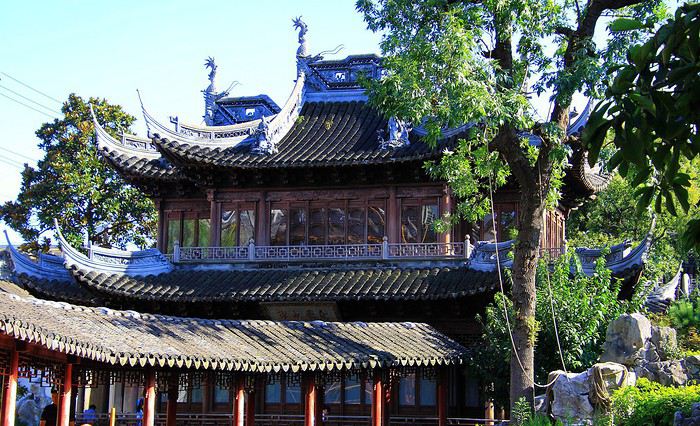
Created in 1577 by the Pan family, wealthy dignitaries of the time, the visit takes you from pavilions with poetic names like the Pavilion of Three Ears to the Pavilion of Spring’s Announcement. Charming!
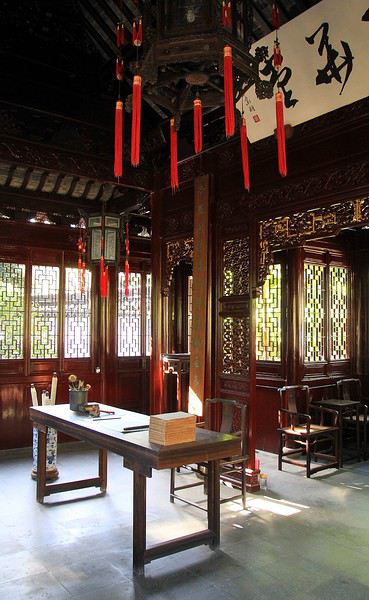
The interiors are decorated with woodwork from walls to ceilings, where beautiful Asian lanterns hang. But the real charm is outside. These shaded gardens, rustling with bamboo, are adorned with several ponds surrounded by impressive rock formations. A world that recreates (in miniature) the mountain and water landscapes of rural China.
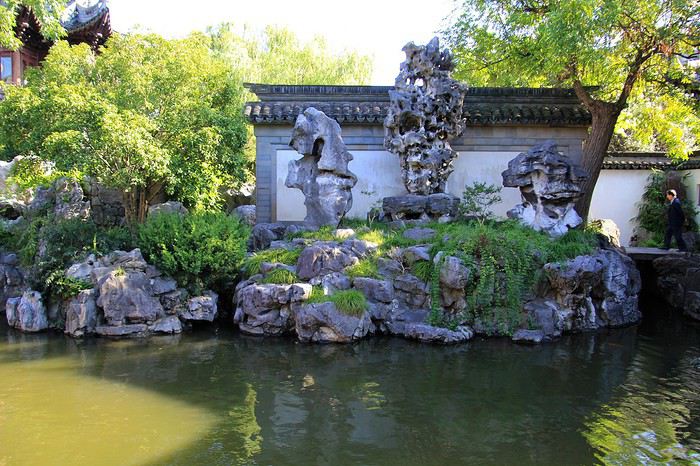
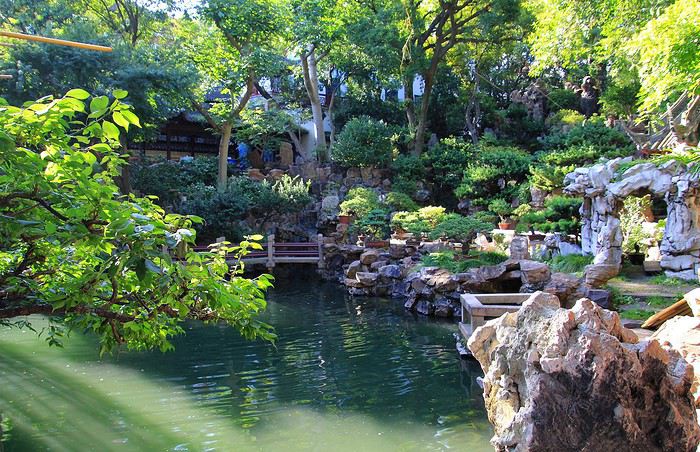
This historic Yuyuan Garden, in the heart of the city, took about 18 years to design and build (pavilions and gardens). Its current appearance is the result of a faithful renovation—much needed, because in 1942, during the so-called Opium War, British officers made it one of their residences. It was partly destroyed by bombings, and later, French troops ransacked it after an attack on their concession.
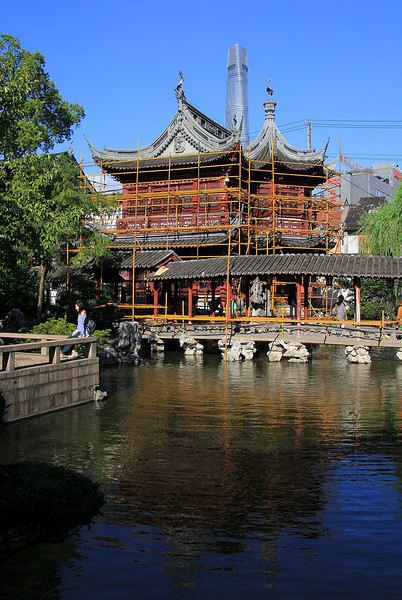
The site is still under construction—maintenance and renovation—with scaffolding as proof. The garden’s enclosure was set to close for work the day after our visit (for a few weeks, until the end of October 2019). That’s probably why crowds of visitors were rushing in, making the atmosphere a bit less peaceful than this beautiful architectural ensemble might suggest. For the photos, I had to be a bit clever, avoiding the crowds to give an impression of tranquility—this historic place deserves it.
--
To be continued in the next post...
Hésite entre 3 nuits à Chefchaouen et 2 nuits à Tétouan English translation pending
bonsoir,
j'hésite entre 3 nuits à Chefchaouen et 2 nuits à Tetouan ou inversement ..... ?
Ce sera fin octobre. Merci de vos réponses
j'hésite entre 3 nuits à Chefchaouen et 2 nuits à Tetouan ou inversement ..... ?
Ce sera fin octobre. Merci de vos réponses
Loger à proximité de la gare et du quartier chinois de Bangkok English translation pending
Bonjour.
Je commence à faire quelques petites recherches sur le forum pour préparer un voyage en Thaïlande courant novembre. On arriverait sur Bangkok et loger à proximité de la gare et du quartier chinois nous plairait bien. Avez-vous des adresses dans ce secteur ? Merci.
Itinéraire de 22 jours en Californie et Disneyland Resort English translation pending
Bonjour
Apres notre road trip dans l'ouest en 2016 ( voir en signature ) et notre voyage de Seattle à Yellowstone en 2018 nous voila décidé a repartir aux USA mais cette fois en Californie. On avait évité cette partie en 2016 pour mieux profiter de nos trois semaines dans l'ouest. Etant Fan de Disney une partie de ce voyage sera consacré a Disneyland Resort.
Ci dessous un debut de planification, je n'ai pas encore tout fait car j'ai le temps mais il vaut mieux être prêt tot pour profiter d'hotel moins cher des que j'ai les dates exactes. Le voyage ce fera a partir de mi septembre 2020. Quelques remarques avant vos suggestions : -les 3 jours a Disney ne sont pas négociables 😛 -On ne passe pas par Las Vegas car déjà fait -Je sais le premier jour on fait un peu de Km en arrivant, bon a peine plus que de l'aéroport a chez nous en fait. (suivant l'heure d'arrivée du vol a LA on prévoira moins de Km).
Donc des questions : journée trop chargées ? Des hotels à conseiller ? ( 100€ idéalement avec un grand max a 150€ / nuit ) Des oublies ? Des incohérences ? Etc ..
La planification :
Jour Km Activité Emplacement
J1 160Km Trajet total Los Angeles - Victorville Arrivée Los Angeles 160Km Trajet aéroport - victorville Hotel Victorville
J2 530Km Trajet total Victorville - Henderson (Route 66) Visite Bottle Tree ranch Outlet Barstow ( outlet) ouvre à 9h Arrêt photo Bagdad café/Amboy(cratère) /Chambless/Essex/Goffs/Needles Visite Oatman Arrêt photo Sitgreaves pass/Cool Springs historic Visite Kingman Repas Kingman Mr DZ Dinner Hôtel Henderson Railroad pass and casino
J3 413Km Trajet total Henderson - Armagosa Valley Soleil 6h25 / 18h42 (Death Valley) Scenic drive Badwater Visite Badwater Lit de sel Marche Natural bridge 1,5 Km AR Facile Marche Golden canyon 3km AR Facile Repas Furnace Creek Timbisha tacos Point de vue Devil’s golf course Scenic drive Artist’s drive / artist’s palette Différent point de vue sur route a sens unique Scenic drive Twenty mule team canyon road Piste facile à sens unique Point de vue Dantes’s view Route difficile Hotel Armagosa Valley Longstreet hôtel
J4 470Km Trajet total Armagosa Valley - Lee Vining Soleil 6h26 / 18h57 (Death valley) Sunrise Zabriskie point Visite Mesquite flat sand dunes Marche Mosaïque canyon 1,6 km AR Facile Marche Darwin falls 3 km AR Moyen Point de vue Fâther Crowley vista Scenic road Alabama hills ( Lone pine ) Marche Mono Lake south Tufa area 3 km facile Hotel Lee vining
J5 225Km Trajet total Lee vining - El Portal (Yosemite) Visite Bodie state historic park Tioga pass entrance - El Portal Repas Lambert dôme pique-nique area Pique-nique Marche Soda springs and persons mémorial lodge 2,4 km AR Facile Points de vue Tuolumne meadows / Lac Tenya/Olmsted point Hôtel El portal
J6 150Km Trajet total (Yosemite) Points de vue Valley view Marche Bridalveil falls 1 km AR Facile Marche Yosemite falls 1,6 Km AR Facile Marche Mist trail AR Jusqu’à Vernal fall Moyen Repas Sentinel beach / swinging bridge Pique-nique Point de vue Glacier point Point de vue Washburn point Marche Taft point 3,5 Km AR Facile Hôtel El portal
J7 85Km Trajet total El Portal - Oakhurst (Yosemite) Marche Mariposa grove Trail 12,5 Km Boucle Difficile Repas En cours de randonnée Pique-nique Hôtel Oakhurst
J8 255Km Trajet total Oakhurst - Three Rivers Soleil 6h46 / 18h49 ( Sequoia ) Marche Général Grant tree trail 1 Km Boucle Facile Point de vue Panoramique point Repas Bing stump pique-nique area Point de vue Big Stump area Marche Buena vista peak trail 3 Km AR Facile Marche Takopah falls trail 7 Km AR Moyen a faire avant 16h30 Hotel Three rivers
J9 90Km Trajet total (Sequoia ) Points de vue Tunnel rock/amphithéâtre point Marche Général sherman trail / séquoia tunnel 1,5 Km Boucle Facile Marche Congress trail 4,5 Km Boucle Facile Repas Pinewood pique-nique area Marche Big tree Trail 1,5 Km Boucle Facile Point de vue Tunnel log Marche Crescent meadows trail 3 Km Boucle Facile Marche Moro rock trail 0,5 Km 400 marches Moyen Marche Hanging rock trail 0,8 Km AR Facile Hôtel Three Rivers
J10 430Km Trajet Séquoia NP - San Francisco (Passer par Sausalito et Golden Gâte Bridge) Point de vue Fort Baker point / Hawk hill Visite Palace of fine art et Walt Disney museum fammily Sunset Baker Beach ou China Beach Prendre voiture parking gratuit Hôtel Motel sur lombard street ou Airbnb
J11 San Francisco Visite Alcatraz Visite Pier 39 Repas Quartiers Lombart street/macondray lane Visite San Francisco muséum câble car Quartier Chinatown Quartier Financial district Quartier Union square Retour en câble car jusqu’à Fisherman Wharf Hotel
J12 San Francisco Golden gâte park Visite Japanese tea garden Quartier Haight Ashbury Quartier Alamo square Painted laidies Quartier Castro Quartier Mission district Point de vue Twin peaks Prendre voiture sunset ou photo de nuit suivant heure
J13 200Km Trajet San Francisco - monterey Visite A planifier Hotel Monterey
J14 220Km Trajet Monterey - San Luis Obispo Visite A planifier Hotel San Luis Obispo
J15 350Km Trajet San louis Obispo - Los Angeles Visite A planifier Hotel Los angeles
J16 Parc attraction Universal studios Hollywood Hotel Los Angeles
J17 Visite Los Angeles Visite A planifier Hotel Los Angeles
J18 Visite Los angeles Visite A planifier Hotel Anaheim
J19 Parc attraction Disneyland resort Hotel Anaheim
J20 Parc attraction Disneyland resort Hotel Anaheim
J21 Parc attraction Disneyland resort Hotel Anaheim
J22 Retour France Merci
Pat 😉
Apres notre road trip dans l'ouest en 2016 ( voir en signature ) et notre voyage de Seattle à Yellowstone en 2018 nous voila décidé a repartir aux USA mais cette fois en Californie. On avait évité cette partie en 2016 pour mieux profiter de nos trois semaines dans l'ouest. Etant Fan de Disney une partie de ce voyage sera consacré a Disneyland Resort.
Ci dessous un debut de planification, je n'ai pas encore tout fait car j'ai le temps mais il vaut mieux être prêt tot pour profiter d'hotel moins cher des que j'ai les dates exactes. Le voyage ce fera a partir de mi septembre 2020. Quelques remarques avant vos suggestions : -les 3 jours a Disney ne sont pas négociables 😛 -On ne passe pas par Las Vegas car déjà fait -Je sais le premier jour on fait un peu de Km en arrivant, bon a peine plus que de l'aéroport a chez nous en fait. (suivant l'heure d'arrivée du vol a LA on prévoira moins de Km).
Donc des questions : journée trop chargées ? Des hotels à conseiller ? ( 100€ idéalement avec un grand max a 150€ / nuit ) Des oublies ? Des incohérences ? Etc ..
La planification :
Jour Km Activité Emplacement
J1 160Km Trajet total Los Angeles - Victorville Arrivée Los Angeles 160Km Trajet aéroport - victorville Hotel Victorville
J2 530Km Trajet total Victorville - Henderson (Route 66) Visite Bottle Tree ranch Outlet Barstow ( outlet) ouvre à 9h Arrêt photo Bagdad café/Amboy(cratère) /Chambless/Essex/Goffs/Needles Visite Oatman Arrêt photo Sitgreaves pass/Cool Springs historic Visite Kingman Repas Kingman Mr DZ Dinner Hôtel Henderson Railroad pass and casino
J3 413Km Trajet total Henderson - Armagosa Valley Soleil 6h25 / 18h42 (Death Valley) Scenic drive Badwater Visite Badwater Lit de sel Marche Natural bridge 1,5 Km AR Facile Marche Golden canyon 3km AR Facile Repas Furnace Creek Timbisha tacos Point de vue Devil’s golf course Scenic drive Artist’s drive / artist’s palette Différent point de vue sur route a sens unique Scenic drive Twenty mule team canyon road Piste facile à sens unique Point de vue Dantes’s view Route difficile Hotel Armagosa Valley Longstreet hôtel
J4 470Km Trajet total Armagosa Valley - Lee Vining Soleil 6h26 / 18h57 (Death valley) Sunrise Zabriskie point Visite Mesquite flat sand dunes Marche Mosaïque canyon 1,6 km AR Facile Marche Darwin falls 3 km AR Moyen Point de vue Fâther Crowley vista Scenic road Alabama hills ( Lone pine ) Marche Mono Lake south Tufa area 3 km facile Hotel Lee vining
J5 225Km Trajet total Lee vining - El Portal (Yosemite) Visite Bodie state historic park Tioga pass entrance - El Portal Repas Lambert dôme pique-nique area Pique-nique Marche Soda springs and persons mémorial lodge 2,4 km AR Facile Points de vue Tuolumne meadows / Lac Tenya/Olmsted point Hôtel El portal
J6 150Km Trajet total (Yosemite) Points de vue Valley view Marche Bridalveil falls 1 km AR Facile Marche Yosemite falls 1,6 Km AR Facile Marche Mist trail AR Jusqu’à Vernal fall Moyen Repas Sentinel beach / swinging bridge Pique-nique Point de vue Glacier point Point de vue Washburn point Marche Taft point 3,5 Km AR Facile Hôtel El portal
J7 85Km Trajet total El Portal - Oakhurst (Yosemite) Marche Mariposa grove Trail 12,5 Km Boucle Difficile Repas En cours de randonnée Pique-nique Hôtel Oakhurst
J8 255Km Trajet total Oakhurst - Three Rivers Soleil 6h46 / 18h49 ( Sequoia ) Marche Général Grant tree trail 1 Km Boucle Facile Point de vue Panoramique point Repas Bing stump pique-nique area Point de vue Big Stump area Marche Buena vista peak trail 3 Km AR Facile Marche Takopah falls trail 7 Km AR Moyen a faire avant 16h30 Hotel Three rivers
J9 90Km Trajet total (Sequoia ) Points de vue Tunnel rock/amphithéâtre point Marche Général sherman trail / séquoia tunnel 1,5 Km Boucle Facile Marche Congress trail 4,5 Km Boucle Facile Repas Pinewood pique-nique area Marche Big tree Trail 1,5 Km Boucle Facile Point de vue Tunnel log Marche Crescent meadows trail 3 Km Boucle Facile Marche Moro rock trail 0,5 Km 400 marches Moyen Marche Hanging rock trail 0,8 Km AR Facile Hôtel Three Rivers
J10 430Km Trajet Séquoia NP - San Francisco (Passer par Sausalito et Golden Gâte Bridge) Point de vue Fort Baker point / Hawk hill Visite Palace of fine art et Walt Disney museum fammily Sunset Baker Beach ou China Beach Prendre voiture parking gratuit Hôtel Motel sur lombard street ou Airbnb
J11 San Francisco Visite Alcatraz Visite Pier 39 Repas Quartiers Lombart street/macondray lane Visite San Francisco muséum câble car Quartier Chinatown Quartier Financial district Quartier Union square Retour en câble car jusqu’à Fisherman Wharf Hotel
J12 San Francisco Golden gâte park Visite Japanese tea garden Quartier Haight Ashbury Quartier Alamo square Painted laidies Quartier Castro Quartier Mission district Point de vue Twin peaks Prendre voiture sunset ou photo de nuit suivant heure
J13 200Km Trajet San Francisco - monterey Visite A planifier Hotel Monterey
J14 220Km Trajet Monterey - San Luis Obispo Visite A planifier Hotel San Luis Obispo
J15 350Km Trajet San louis Obispo - Los Angeles Visite A planifier Hotel Los angeles
J16 Parc attraction Universal studios Hollywood Hotel Los Angeles
J17 Visite Los Angeles Visite A planifier Hotel Los Angeles
J18 Visite Los angeles Visite A planifier Hotel Anaheim
J19 Parc attraction Disneyland resort Hotel Anaheim
J20 Parc attraction Disneyland resort Hotel Anaheim
J21 Parc attraction Disneyland resort Hotel Anaheim
J22 Retour France Merci
Pat 😉
Vol Ryanair annulé et indemnisation English translation pending
Bonjour,
Voici mon énigme : le 15 décembre le vol au départ de TOURS 9h55 et à destination de Marseille a été annulé . Cause invoquée la météo !!!! Bizarre car 2 avions ont pu atterrir sur la seule piste de l aéroport le matin plutôt.?????
Nous avons embarqué et sommes restés dans l avion jusqu'à 11h20 pour ensuite nous faire débarquer après avoir fait un tour de piste gratuit 😕. Considérant la piste non praticable, cette même piste qui a vu atterrir 2 avions!!! Et le pompon c'est que le vol pour Marrakech qui devait décoller à 11h20 a quand même pu partir, certes avec du retard mais est parti !!!!! Les passagers avaient embarqué juste après nous.
Sur Tours il n y a que Ryanair.
Je vais être remboursée mais je voulais savoir quels seraient les recours pour un insémination svp, please 🙂?
Pour information, je vais appeler l aéroport car Ryanair est dans l incapacité de me donner une réponse.
Merci à vous pour vos réponses. 🙂
Merci à vous pour vos réponses. 🙂
La pagode But Thap, la pagode Dâu et le temple Si Nhiep English translation pending
Une bien intéressante excursion dans les environs de Hanoi. Vous traversez le fleuve Rouge sur le pont Chuong Đuong, direction Bac Ninh, le berceau de la race Viêt, et, juste avant l’entrée du pont sur la rivière Đuong, vous tourner à droite. Vous suivez la rivière sur 20 km et un grand panneau indique la pagode But Thap. Vous tournez à droite au panneau et suivez les indications. La pagode date du XIIIe siècle et a une particularité presqu’unique au Vietnam, un petit pont en dos d’âne reliant 2 des 3 bâtiments. Il y avait une des plus vieilles statues en bois du Buddha, mais elle est maintenant dans un musée et je n’ai pas trouvé lequel. Vous verrez des collines à l'horizon, avec au sommet une gigantesque statue du Buddha ; c'est la fameuse et remarquable pagode de Phat Tich.
Vous reprenez la petite route sur 10 km au petit bourg de Dâu. Là, vous avez la pagode Dâu (Chua Dâu), la plus ancienne pagode du Vietnam du nord, construite vers 190 alors que le remarquable Chinois Si Nhiêp gouvernait le nord du Vietnam (province chinoise du Giao Chi). Elle a été construite par des moines indiens venus de Chine du Nord sans s’arrêter au sud, car guerres civiles à l’époque. Le village de Luy Lâu, dont il ne reste que quelques fondations de bâtiments et qui est maintenant intégré à Dâu, était alors un grand centre confucianiste (on a retrouvé dans ce très ancien village des artefacts de l’âge du Bronze). C’est à Dâu qu’a été rédigé un des premiers textes buddhistes en chinois, le Ly hoac luân (Traité des Illusions et Erreurs). Au VIe siècle, le moine indien Vinitaruci arrive de Chine et s’installe à Luy Lâu, où il y ouvre la première école de bouddhisme zen du nord du Vietnam.
500 mètres plus loin, le temple Si Nhiep (Den Si Nhiep), construit à la même époque et avec également une particularité unique, une grande tour centrale édifíee en 1737.
Vous reprenez la petite route sur 10 km au petit bourg de Dâu. Là, vous avez la pagode Dâu (Chua Dâu), la plus ancienne pagode du Vietnam du nord, construite vers 190 alors que le remarquable Chinois Si Nhiêp gouvernait le nord du Vietnam (province chinoise du Giao Chi). Elle a été construite par des moines indiens venus de Chine du Nord sans s’arrêter au sud, car guerres civiles à l’époque. Le village de Luy Lâu, dont il ne reste que quelques fondations de bâtiments et qui est maintenant intégré à Dâu, était alors un grand centre confucianiste (on a retrouvé dans ce très ancien village des artefacts de l’âge du Bronze). C’est à Dâu qu’a été rédigé un des premiers textes buddhistes en chinois, le Ly hoac luân (Traité des Illusions et Erreurs). Au VIe siècle, le moine indien Vinitaruci arrive de Chine et s’installe à Luy Lâu, où il y ouvre la première école de bouddhisme zen du nord du Vietnam.
500 mètres plus loin, le temple Si Nhiep (Den Si Nhiep), construit à la même époque et avec également une particularité unique, une grande tour centrale édifíee en 1737.
Trois semaines Singapour et Malaisie English translation pending
Bonjour à toutes et à tous. Peut être m'avez-vous déjà lu dans de précédents carnets, je vais essayer de vous raconter ce que nous avons vu, entendu, ressenti durant ce voyage. Maladroitement, ce récit ne représentera que peu ce que nous avons vécu. Les mots glissent et s'échappent avec les souvenirs non piégés par les photos, mais une bonne partie sera là.
Nous voyageons comme les années précédents, en famille. Romane, notre fille (qui nous sert maintenant d'interprète en anglais), ma femme Magali et moi, Thomas. Depuis cet hiver nous préparons ce voyage. Petit à petit. Magali est très forte pour trouver les lieux des étapes et les choses à voir autour. Les quelques jours avant le départ, nous avons fait nos sacs. Pas trop chargés pour l'aller, s'il nous manque des choses nous pourrons les acheter sur place, mais l’essentiel tout de même.
Pour le reste, je vous laisse lire.
Nous voyageons comme les années précédents, en famille. Romane, notre fille (qui nous sert maintenant d'interprète en anglais), ma femme Magali et moi, Thomas. Depuis cet hiver nous préparons ce voyage. Petit à petit. Magali est très forte pour trouver les lieux des étapes et les choses à voir autour. Les quelques jours avant le départ, nous avons fait nos sacs. Pas trop chargés pour l'aller, s'il nous manque des choses nous pourrons les acheter sur place, mais l’essentiel tout de même.
Pour le reste, je vous laisse lire.
Trois semaines entre Montréal, Québec et la Nouvelle-Angleterre English translation pending
Après avoir lu quelques retours des uns et des autres sur cette région , je me décide enfin à écrire ce carnet de voyage qui s’est déroulé du 18 Juillet au 8 Août 2017.
Merci à ceux qui ont eu le courage de faire des carnets dans lesquels j’ai pu piocher des idées de parcours et de centres d’interêt, j’espere Qu’ils se reconnaîtront vu qu’il n’y en a pas beaucoup 😐 et c’est aussi pour cette raison que je vais essayer d’apporter ma pierre à cet édifice 😛
On a décidé de prendre un aller-retour Paris Montréal pour une question de budget -615 € le billet X 4 personnes, billets achetés début Mars.
Les voyageurs : mon mari, notre fille 21 ans , le petit dernier 18 ans à l'époque et moi même.
La voiture a été réservée dans une agence Avis dans le quartier d’Outremont : Jeep Grand Cherokee pour 920 €.
Les hôtels ont été réservés soit sur des sites de voyage bien connus soit directement , avec un mélange de chaînes et de petits hôtels - motels.
En gros : 2 jours Montréal 2 jours Québec 6 jours entre Acadia NP et Boston 2 jours Boston 2 jours Cape Cod 6 jours pour rallier Montréal 2 jours Montréal J1 Paris-Montréal par Air Canada . Avion à l’heure , arrivée à l’heure , repas comme dans un avion , beaucoup de film ... nickel .
Arrivée à 12h, achat des tickets de bus sur une borne dans l’espace des arrivées internationales .
L'arrêt de la navette 747 est bien indiqué.Par contre les arrêts ne sont pas indiqués , il faut guetter !! Facile quand on connaît pas la ville . Bref on rate notre arrêt mais le chauffeur bien sympathique nous a déposés quelques mètres plus loin.
L’ hôtel choisi en Mars est le Comfort Suite Downtown, il ne casse pas trois pattes à un canard mais il est super bien placé : navette , métro, rue Sainte Catherine , rue Crescent .
Chambre pour 4 , 2 nuits , petit déjeuner compris : 335 €.
J1 Paris-Montréal par Air Canada . Avion à l’heure , arrivée à l’heure , repas comme dans un avion , beaucoup de film ... nickel .
Arrivée à 12h, achat des tickets de bus sur une borne dans l’espace des arrivées internationales .
L'arrêt de la navette 747 est bien indiqué.Par contre les arrêts ne sont pas indiqués , il faut guetter !! Facile quand on connaît pas la ville . Bref on rate notre arrêt mais le chauffeur bien sympathique nous a déposés quelques mètres plus loin.
L’ hôtel choisi en Mars est le Comfort Suite Downtown, il ne casse pas trois pattes à un canard mais il est super bien placé : navette , métro, rue Sainte Catherine , rue Crescent .
Chambre pour 4 , 2 nuits , petit déjeuner compris : 335 €.
Pose des bagages et départ pour la rue Ste Catherine et ses boutiques ´ enfin Sa boutique : Victoria S...eh oui le paradis pour ma fille et une interminable attente pour les deux garçons 😂😂. Puis « errance » à travers la ville : la gare Windsor, la basilique Marie Reine du Monde, l’esplanade des Canadiens de Montréal, la place Ville Marie, un peu dans la ville souterraine...
Retour à l’hôtel vers 18h30-petite pause des petons puis direction un restaurant à 3 mn à pieds, rue Crescent : le Dundees Deli bar et grill. Bien posés en terrasse à regarder les kékés faire des aller-retour avec leurs voitures. Dodo à 21h comme des bébés
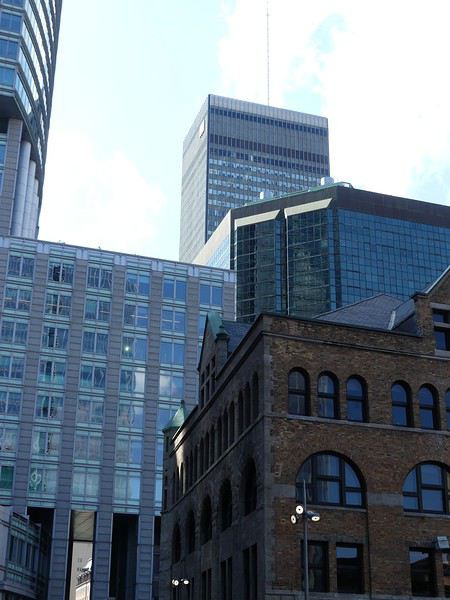
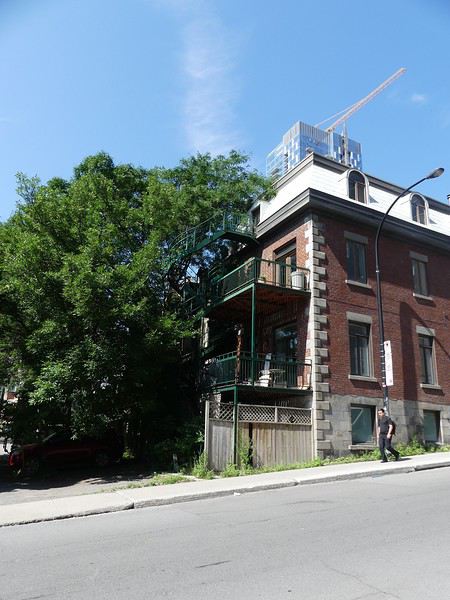
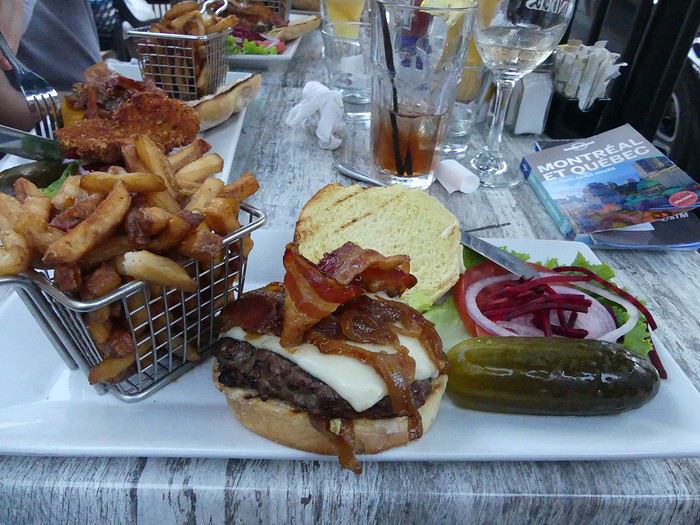
En gros : 2 jours Montréal 2 jours Québec 6 jours entre Acadia NP et Boston 2 jours Boston 2 jours Cape Cod 6 jours pour rallier Montréal 2 jours Montréal
J1 Paris-Montréal par Air Canada . Avion à l’heure , arrivée à l’heure , repas comme dans un avion , beaucoup de film ... nickel .
Arrivée à 12h, achat des tickets de bus sur une borne dans l’espace des arrivées internationales .
L'arrêt de la navette 747 est bien indiqué.Par contre les arrêts ne sont pas indiqués , il faut guetter !! Facile quand on connaît pas la ville . Bref on rate notre arrêt mais le chauffeur bien sympathique nous a déposés quelques mètres plus loin.
L’ hôtel choisi en Mars est le Comfort Suite Downtown, il ne casse pas trois pattes à un canard mais il est super bien placé : navette , métro, rue Sainte Catherine , rue Crescent .
Chambre pour 4 , 2 nuits , petit déjeuner compris : 335 €.Pose des bagages et départ pour la rue Ste Catherine et ses boutiques ´ enfin Sa boutique : Victoria S...eh oui le paradis pour ma fille et une interminable attente pour les deux garçons 😂😂. Puis « errance » à travers la ville : la gare Windsor, la basilique Marie Reine du Monde, l’esplanade des Canadiens de Montréal, la place Ville Marie, un peu dans la ville souterraine...
Retour à l’hôtel vers 18h30-petite pause des petons puis direction un restaurant à 3 mn à pieds, rue Crescent : le Dundees Deli bar et grill. Bien posés en terrasse à regarder les kékés faire des aller-retour avec leurs voitures. Dodo à 21h comme des bébés