Results for "Forts+Rajasthan+|+7+>+8"
78755 results found.
Itinérance Festival 2026 – April 24–26, 2026
Itinérance Festival in Cornimont, Vosges, will return from April 24 to 26, 2026. The success of the 2025 edition confirmed the desire to continue the adventure.
Dedicated to human-powered travel, this year’s festival will feature a smaller but highly complementary lineup of speakers. A single guest may discuss bike or foot journeys, long-distance trekking across major European or remote mountain ranges, or even mountaineering. The sea will also be a key theme.
Most speakers are travel writers, and storytelling will take center stage—especially with Pierre Herant, a sought-after author among publishers. Among the standout topics, resilience in the face of illness will be explored through Alexandra Husta’s epic cycling journeys. Extreme travel will also be highlighted, driven by Blandine Dupuis’s physical and moral commitment. Hugo Faivre is biking across France to meet bears in the Pyrenees. Luc Devors will delve into the bonds formed with companions during demanding projects, while Julien Humbert will discuss the challenges of leaving home and being away for years. Sailors Gilles Jaulet will share his sailing experiences, and Guy Lecointre will recount his solo sea-kayak expedition to Cape Horn with total autonomy. All speakers will also share their solo travel experiences.
A special family session on Friday afternoon will let kids ask questions and chat freely with the speakers. Photographic exhibitions will round out the program, including one on Vosges mountain wildlife by a Cornimont native, whose close connection with wild animals is striking.
True to the 2025 edition, sunrise hikes will return on Saturday, April 25, and Sunday, April 26, to the town’s high points. These unique moments will combine landscape discovery—guided by a local expert—with readings from works by attending travel writers.
Cornimont’s town hall will provide its spacious polyactivity center, and admission will remain free, as in 2025. The association Cook’ Events Services, led by Nadège Perrier, will run the bar and catering, with proceeds supporting initiatives for people with disabilities.
Whether scaling rock faces, thriving on trails, hitting the road, or sailing the seas, the festival’s celebration of travel reminds us that age is never a barrier to exploring our world.
Dedicated to human-powered travel, this year’s festival will feature a smaller but highly complementary lineup of speakers. A single guest may discuss bike or foot journeys, long-distance trekking across major European or remote mountain ranges, or even mountaineering. The sea will also be a key theme.
Most speakers are travel writers, and storytelling will take center stage—especially with Pierre Herant, a sought-after author among publishers. Among the standout topics, resilience in the face of illness will be explored through Alexandra Husta’s epic cycling journeys. Extreme travel will also be highlighted, driven by Blandine Dupuis’s physical and moral commitment. Hugo Faivre is biking across France to meet bears in the Pyrenees. Luc Devors will delve into the bonds formed with companions during demanding projects, while Julien Humbert will discuss the challenges of leaving home and being away for years. Sailors Gilles Jaulet will share his sailing experiences, and Guy Lecointre will recount his solo sea-kayak expedition to Cape Horn with total autonomy. All speakers will also share their solo travel experiences.
A special family session on Friday afternoon will let kids ask questions and chat freely with the speakers. Photographic exhibitions will round out the program, including one on Vosges mountain wildlife by a Cornimont native, whose close connection with wild animals is striking.
True to the 2025 edition, sunrise hikes will return on Saturday, April 25, and Sunday, April 26, to the town’s high points. These unique moments will combine landscape discovery—guided by a local expert—with readings from works by attending travel writers.
Cornimont’s town hall will provide its spacious polyactivity center, and admission will remain free, as in 2025. The association Cook’ Events Services, led by Nadège Perrier, will run the bar and catering, with proceeds supporting initiatives for people with disabilities.
Whether scaling rock faces, thriving on trails, hitting the road, or sailing the seas, the festival’s celebration of travel reminds us that age is never a barrier to exploring our world.
Where to stay for a week and explore Oman with a guide?
Hello, we’re two senior couples who often travel with a guide and driver. For this trip to Oman, though, we’d like (for various reasons) to have a fixed base and visit the must-sees with a local guide but on a hub-and-spoke basis. Do you think that’s possible, and what would be the best place to stay?
We’ll be in Oman for 7 days in March 2026.
Thanks in advance for your suggestions.
Tips and addresses for backpackers traveling from Tanzania to South Africa
Since Voyage Forum is restarting after a few years of hiatus, I couldn’t find any recent info about my trip between late November 2024 and January 20, 2025, going from DAR ES SALAAM to the Cape Town area via ZAMBIA and BOTSWANA.
I’m really happy the site is back up, but I’ve noticed more and more people planning their trips down to the day, mentioning what they’ve scheduled and asking for technical advice for their 4x4 routes.
That’s not how I travel at all—I prefer to leave a lot to the unexpected, like public transport (and the weather) and the people you meet along the way.
The tips I’m sharing below come from the current situation, the randomness that makes unplanned trips special, and the strong connections you can make when you take your time without knowing what tomorrow will bring.
😏 TANZANIA: I had booked a TAZARA train ticket via WhatsApp before leaving to go from DAR ES SALAAM to MBEYA near the Zambian border. I’d contacted the station manager in Dar at +255 713 413 141, who kindly confirmed my reservation. Unfortunately, the train was out of service for an indefinite period, so I had to take the bus from the new Mwenge bus station on the city’s outskirts (allow extra time to get there—traffic is heavy). There’s no longer a direct train to ZAMBIA. You have to get off at MBEYA, then take a bus to the TUNDUMA border (2 hours to the bus station, then a 2 km taxi ride to the border). Crossing is easy—visa is free, no no-man’s-land, and you arrive directly in NAKONDE, Zambia. Exchange money on the Zambian side, but don’t change with the first person you see—check the rate first. I preferred to stop for the night in IRINGA since I took the bus at 4 PM. I arrived at 2 AM at Georges’ place, who picked me up directly from the bus station (several km from town). I’d booked the accommodation via Booking under Travellers Backpackers and Free City Tours. Georges and his employee were extremely helpful—they organized my bus trip to MBEYA the next day (bought the ticket and dropped me off, no commission). The place is decent, clean, and comfortable (10 € per night). Georges also organizes tours and safaris in the area (+255 679 529 700 direct). In MBEYA, I stayed at Karibuni Center Hotel (a quiet evangelical convent, very friendly and open to everyone, 13 € per night with breakfast). You can eat at a restaurant across the street. The rooms are clean and quiet (contact +255 754 510 174). To head to Lake MALAWI or the tea fields in TUKUYU, it’s best to take a moto-taxi from MBEYA to the Uyole junction. From there, you’ll find minibuses heading south frequently—change buses in TUKUYU (the tea fields are 4-5 km away).
😏 ZAMBIA: In NAKONDE, I highly recommend Izukanji Lodge—very quiet and clean, 2 km from the station (take a moto-taxi). The main building’s rooms are pricier than the annex across the street (where the restaurant and pool are). The rooms are just as clean and quiet but only 10 €, breakfast included. Contact the manager directly on WhatsApp at +260 979 649 452. If it’s full, try Divine Guest House (+260 973 127 816). The train isn’t always on time—if you catch it on the scheduled day, consider yourself lucky. The stationmaster, Mr. Chulu, is lovely. Contact him on WhatsApp at +260 777 550 302 for real-time updates. First-class berths are great (4 per compartment), 15 € one-way to KAPIRI MPOSHI. There always seems to be space. Book two berths if you want extra comfort. No need to bring food—the dining car serves decent meals, and there’s a bar. In KAPIRI MPOSHI, I stayed at Kapiri Council Lodge, 2 km from the train station. It’s okay, but there are often power outages in the evening, which means no water either. You’ll have to wait until 8 PM. Breakfast is very basic. For LUSAKA, there are plenty of buses in the morning from the downtown bus station (2-3 hours). The best companies are Power Tools (yellow buses) or UBZ if you can find it (the best in Zambia—Western comfort). In LUSAKA, use Yango taxis (download the app—it’s like Uber in Zambia, very affordable). I stayed at Natwange (Hostelworld chain), reachable at +260 966 303 816. It’s a beautiful, quiet place 3-4 km from downtown, very shady, with a pool. The rooms are clean and comfortable, and the food is excellent (great salads). The staff is super friendly, as they are everywhere in the country. There’s also a mini-supermarket nearby with everything, including takeout meals. Book your bus ticket to LIVINGSTONE at least the day before (UBZ). The trip is pleasant. In LIVINGSTONE, many backpackers stay at Jolly Boys—it’s a nice place to relax by the pool with a beer at the end of the day, but it’s mostly a party hostel for young people doing rafting or canyoning on the Zambezi (pricier than elsewhere). For those who prefer peace and quiet, I highly recommend Likute Guest House on the same street, right near Jolly Boys. The rooms are decent for 10 €, breakfast included (same price as a dorm at JB). You can order dinner in advance. The staff is friendly. Great value at Da Canton restaurant on the main road (pizza, pasta, meat, salads, etc.). The Livingstone Museum is worth a visit if you have time. At the bottom of Kapondo Street, you can take a shared taxi to Victoria Falls or even to KAZUNGULA at the Botswana border (cheap—the taxi leaves when full). People short on time often compare the views of Victoria Falls from the Zambian side (20 $) and the Zimbabwean side (30 $). Honestly, they’re very different, and it’s worth seeing the falls from Zimbabwe even if it’s pricier (visa required, easy to get at the border—everything is done on foot). Cross the bridge where you can bungee jump. Take your time at the falls—it’s truly stunning. You can visit Zimbabwe for half a day and stay in Zambia (cheaper, since everything in Zimbabwe is paid in dollars). There’s more water on the Zimbabwean side, but the Zambian side is beautiful too.
😏 BOTSWANA: Crossing the border at KAZUNGULA from Zambia is quick and easy (brand-new bridge over the Zambezi). Visa is free. Don’t exchange money at the border. There’s a shopping center 1 km away (Choppies store) with an ATM (no commission). I hitched a ride with tourists to the bank since they had a car. In the shopping center parking lot, you can easily find a shared taxi to KASANE. In the area, you can get around easily by shared taxi (just give the name of your guesthouse, and the drivers will tell you which vehicle to take). The fare is fixed (0.50 €). I stayed at Elephant Trail GH and Backpackers—a great spot where you can stay in a 4-bed dorm for 10 €. There are also huts for two in the garden (clean and comfortable) with a pool. You can order dinner (great food) or cook your own meals. The place is quiet and friendly (they organize safaris with early-morning pickups for Chobe and evening boat trips in the Kwando marshes to see animals). I preferred flying (Air Botswana) with a friend to MAUN (55 €) instead of taking an 8-10 hour bus (tickets can be bought directly at the airport). In MAUN, I stayed at Jayla Homestay with Mapula (+267 71 658 737)—a wonderful, kind woman always ready to help. The homestay is in a beautiful family home 3-4 km from downtown, past the Kwanokeng gas station. It’s easy to get there by shared taxi from the downtown taxi stand near Shoprite. Mapula cooks refined, varied meals on request. She also organizes safaris in the OKAVANGO with morning pickups from the guesthouse (picnic included) at a great price. Her rooms are comfortable and very clean (microwave, coffee/tea, and kettle available). The day trip by canoe in the OKAVANGO marshes is a must. However, we saw very few animals because the rainy season had started (zebras, giraffes, buffaloes, hippos). The atmosphere, serenity, and changing light throughout the day were remarkable. Direct flight from MAUN to CAPE TOWN with Airlink for 280 € on December 24.
😏 SOUTH AFRICA: In Cape Town, I stayed at Sunflower Stop Backpackers in the Green Point neighborhood—very quiet and safe. This hostel is perfect for meeting travelers of all ages. Everything is nearby (supermarkets, bars, restaurants, the sea, the park, tourist areas, the stadium, Sea Point, and the Waterfront). I spent 13 days in Cape Town and always found something to do—this city is so pleasant to live in, welcoming, and packed with sports and cultural activities. Don’t miss the Minstrel Carnival in early January if you’re in the area. Kalk Bay beach (with its colorful beach huts) is worth the detour on the way to SIMON’S TOWN and Boulders Beach. Stop for lunch at Salt in FISH HOEK—the homemade ravioli and fish are amazing. Everything is excellent there. At Boulders Beach, when you arrive at the main beach after the entrance gate, don’t hesitate to wade into the water up to your waist if the tide is high and head straight past the northern end of the beach—the penguins are farther out. Beautiful beach and sunset at Scarborough Beach. I took the 8-day Bazbus pass (134 €) for the Garden Route and stopped in STELLENBOSCH on the last day of my loop back to Cape Town. This lets you extend the trip to 10 days if you stay 2 nights in STELLENBOSCH, since it’s easy and cheap to get back to Cape Town with an Uber. I really liked this Bazbus option—it’s convenient because they drop you off and pick you up directly at your chosen hostel or hotel. I loved HERMANUS, even though I didn’t see any whales. The atmosphere is very British and classy. The coastline is beautiful and rugged. Don’t miss the walk to Mosselberg, which overlooks the entire bay. MOSSEL BAY is more working-class and run-down—nothing particularly interesting, in my opinion. In WILDERNESS, try to stay at Beach House Backpackers Lodge. The sea view is stunning, even from the dorm. In KNYSNA, Thesen Island is overrated—it’s full of soulless new buildings. Prefer Leisure Island, which is just as busy with wealthy owners but nice for walks and swimming. Head to The Heads to wander the coastal trails with incredible views of the bay. Don’t hesitate to explore the heart of the artistic Concordia neighborhood (Rastafarian) to Judah Square on your own. The locals are warm and laid-back. No need to go through a tour operator. Anchorage restaurant is excellent for refined dishes and a great variety of food. In STELLENBOSCH, I stayed at Just a Bed (booked for one person on Booking). Don’t hesitate to contact the owner—she has several rooms in her guesthouse. The place is cozy and charming. The town is pleasant but feels disconnected from the surrounding population. You can walk to the Lanzerac vineyard, but don’t miss Boschendal a few kilometers away on the way to FRANSCHHOEK. People talk a lot about safety in South Africa, but as long as you respect the local norms, everything goes smoothly—the people are really welcoming, no matter their social background.
😏 TANZANIA: I had booked a TAZARA train ticket via WhatsApp before leaving to go from DAR ES SALAAM to MBEYA near the Zambian border. I’d contacted the station manager in Dar at +255 713 413 141, who kindly confirmed my reservation. Unfortunately, the train was out of service for an indefinite period, so I had to take the bus from the new Mwenge bus station on the city’s outskirts (allow extra time to get there—traffic is heavy). There’s no longer a direct train to ZAMBIA. You have to get off at MBEYA, then take a bus to the TUNDUMA border (2 hours to the bus station, then a 2 km taxi ride to the border). Crossing is easy—visa is free, no no-man’s-land, and you arrive directly in NAKONDE, Zambia. Exchange money on the Zambian side, but don’t change with the first person you see—check the rate first. I preferred to stop for the night in IRINGA since I took the bus at 4 PM. I arrived at 2 AM at Georges’ place, who picked me up directly from the bus station (several km from town). I’d booked the accommodation via Booking under Travellers Backpackers and Free City Tours. Georges and his employee were extremely helpful—they organized my bus trip to MBEYA the next day (bought the ticket and dropped me off, no commission). The place is decent, clean, and comfortable (10 € per night). Georges also organizes tours and safaris in the area (+255 679 529 700 direct). In MBEYA, I stayed at Karibuni Center Hotel (a quiet evangelical convent, very friendly and open to everyone, 13 € per night with breakfast). You can eat at a restaurant across the street. The rooms are clean and quiet (contact +255 754 510 174). To head to Lake MALAWI or the tea fields in TUKUYU, it’s best to take a moto-taxi from MBEYA to the Uyole junction. From there, you’ll find minibuses heading south frequently—change buses in TUKUYU (the tea fields are 4-5 km away).
😏 ZAMBIA: In NAKONDE, I highly recommend Izukanji Lodge—very quiet and clean, 2 km from the station (take a moto-taxi). The main building’s rooms are pricier than the annex across the street (where the restaurant and pool are). The rooms are just as clean and quiet but only 10 €, breakfast included. Contact the manager directly on WhatsApp at +260 979 649 452. If it’s full, try Divine Guest House (+260 973 127 816). The train isn’t always on time—if you catch it on the scheduled day, consider yourself lucky. The stationmaster, Mr. Chulu, is lovely. Contact him on WhatsApp at +260 777 550 302 for real-time updates. First-class berths are great (4 per compartment), 15 € one-way to KAPIRI MPOSHI. There always seems to be space. Book two berths if you want extra comfort. No need to bring food—the dining car serves decent meals, and there’s a bar. In KAPIRI MPOSHI, I stayed at Kapiri Council Lodge, 2 km from the train station. It’s okay, but there are often power outages in the evening, which means no water either. You’ll have to wait until 8 PM. Breakfast is very basic. For LUSAKA, there are plenty of buses in the morning from the downtown bus station (2-3 hours). The best companies are Power Tools (yellow buses) or UBZ if you can find it (the best in Zambia—Western comfort). In LUSAKA, use Yango taxis (download the app—it’s like Uber in Zambia, very affordable). I stayed at Natwange (Hostelworld chain), reachable at +260 966 303 816. It’s a beautiful, quiet place 3-4 km from downtown, very shady, with a pool. The rooms are clean and comfortable, and the food is excellent (great salads). The staff is super friendly, as they are everywhere in the country. There’s also a mini-supermarket nearby with everything, including takeout meals. Book your bus ticket to LIVINGSTONE at least the day before (UBZ). The trip is pleasant. In LIVINGSTONE, many backpackers stay at Jolly Boys—it’s a nice place to relax by the pool with a beer at the end of the day, but it’s mostly a party hostel for young people doing rafting or canyoning on the Zambezi (pricier than elsewhere). For those who prefer peace and quiet, I highly recommend Likute Guest House on the same street, right near Jolly Boys. The rooms are decent for 10 €, breakfast included (same price as a dorm at JB). You can order dinner in advance. The staff is friendly. Great value at Da Canton restaurant on the main road (pizza, pasta, meat, salads, etc.). The Livingstone Museum is worth a visit if you have time. At the bottom of Kapondo Street, you can take a shared taxi to Victoria Falls or even to KAZUNGULA at the Botswana border (cheap—the taxi leaves when full). People short on time often compare the views of Victoria Falls from the Zambian side (20 $) and the Zimbabwean side (30 $). Honestly, they’re very different, and it’s worth seeing the falls from Zimbabwe even if it’s pricier (visa required, easy to get at the border—everything is done on foot). Cross the bridge where you can bungee jump. Take your time at the falls—it’s truly stunning. You can visit Zimbabwe for half a day and stay in Zambia (cheaper, since everything in Zimbabwe is paid in dollars). There’s more water on the Zimbabwean side, but the Zambian side is beautiful too.
😏 BOTSWANA: Crossing the border at KAZUNGULA from Zambia is quick and easy (brand-new bridge over the Zambezi). Visa is free. Don’t exchange money at the border. There’s a shopping center 1 km away (Choppies store) with an ATM (no commission). I hitched a ride with tourists to the bank since they had a car. In the shopping center parking lot, you can easily find a shared taxi to KASANE. In the area, you can get around easily by shared taxi (just give the name of your guesthouse, and the drivers will tell you which vehicle to take). The fare is fixed (0.50 €). I stayed at Elephant Trail GH and Backpackers—a great spot where you can stay in a 4-bed dorm for 10 €. There are also huts for two in the garden (clean and comfortable) with a pool. You can order dinner (great food) or cook your own meals. The place is quiet and friendly (they organize safaris with early-morning pickups for Chobe and evening boat trips in the Kwando marshes to see animals). I preferred flying (Air Botswana) with a friend to MAUN (55 €) instead of taking an 8-10 hour bus (tickets can be bought directly at the airport). In MAUN, I stayed at Jayla Homestay with Mapula (+267 71 658 737)—a wonderful, kind woman always ready to help. The homestay is in a beautiful family home 3-4 km from downtown, past the Kwanokeng gas station. It’s easy to get there by shared taxi from the downtown taxi stand near Shoprite. Mapula cooks refined, varied meals on request. She also organizes safaris in the OKAVANGO with morning pickups from the guesthouse (picnic included) at a great price. Her rooms are comfortable and very clean (microwave, coffee/tea, and kettle available). The day trip by canoe in the OKAVANGO marshes is a must. However, we saw very few animals because the rainy season had started (zebras, giraffes, buffaloes, hippos). The atmosphere, serenity, and changing light throughout the day were remarkable. Direct flight from MAUN to CAPE TOWN with Airlink for 280 € on December 24.
😏 SOUTH AFRICA: In Cape Town, I stayed at Sunflower Stop Backpackers in the Green Point neighborhood—very quiet and safe. This hostel is perfect for meeting travelers of all ages. Everything is nearby (supermarkets, bars, restaurants, the sea, the park, tourist areas, the stadium, Sea Point, and the Waterfront). I spent 13 days in Cape Town and always found something to do—this city is so pleasant to live in, welcoming, and packed with sports and cultural activities. Don’t miss the Minstrel Carnival in early January if you’re in the area. Kalk Bay beach (with its colorful beach huts) is worth the detour on the way to SIMON’S TOWN and Boulders Beach. Stop for lunch at Salt in FISH HOEK—the homemade ravioli and fish are amazing. Everything is excellent there. At Boulders Beach, when you arrive at the main beach after the entrance gate, don’t hesitate to wade into the water up to your waist if the tide is high and head straight past the northern end of the beach—the penguins are farther out. Beautiful beach and sunset at Scarborough Beach. I took the 8-day Bazbus pass (134 €) for the Garden Route and stopped in STELLENBOSCH on the last day of my loop back to Cape Town. This lets you extend the trip to 10 days if you stay 2 nights in STELLENBOSCH, since it’s easy and cheap to get back to Cape Town with an Uber. I really liked this Bazbus option—it’s convenient because they drop you off and pick you up directly at your chosen hostel or hotel. I loved HERMANUS, even though I didn’t see any whales. The atmosphere is very British and classy. The coastline is beautiful and rugged. Don’t miss the walk to Mosselberg, which overlooks the entire bay. MOSSEL BAY is more working-class and run-down—nothing particularly interesting, in my opinion. In WILDERNESS, try to stay at Beach House Backpackers Lodge. The sea view is stunning, even from the dorm. In KNYSNA, Thesen Island is overrated—it’s full of soulless new buildings. Prefer Leisure Island, which is just as busy with wealthy owners but nice for walks and swimming. Head to The Heads to wander the coastal trails with incredible views of the bay. Don’t hesitate to explore the heart of the artistic Concordia neighborhood (Rastafarian) to Judah Square on your own. The locals are warm and laid-back. No need to go through a tour operator. Anchorage restaurant is excellent for refined dishes and a great variety of food. In STELLENBOSCH, I stayed at Just a Bed (booked for one person on Booking). Don’t hesitate to contact the owner—she has several rooms in her guesthouse. The place is cozy and charming. The town is pleasant but feels disconnected from the surrounding population. You can walk to the Lanzerac vineyard, but don’t miss Boschendal a few kilometers away on the way to FRANSCHHOEK. People talk a lot about safety in South Africa, but as long as you respect the local norms, everything goes smoothly—the people are really welcoming, no matter their social background.
Cape Town to KTP Route
Hi there,
We're considering the following route:
- Cape Town
- West Coast National Park
- Lambert's Bay
- Springbok
- Upington
- KTP
That’s about 1,250 km in total.
We’ve already visited the West Coast National Park.
Is covering such a distance to reach KTP (the main goal of our trip) really worth it—does it offer enough to justify the detour?
Thanks for your input!
Average drink prices in restaurants and hotels in Brazil
Hi, I’m heading to Brazil soon and wanted to know the price of drinks in restaurants/hotels—like wine, beers, or cocktails—just to budget. Also, is there any risk with ice cubes? Thanks!
How to handle large expenses in Thailand?
Hi everyone, thanks so much for all your great tips!
Now for expenses: should we pay "big expenses" by card, the rest in cash, or exchange a large sum at the airport (with the risks that involves)? We’re staying for a month, mostly in the countryside rather than the city.
Thanks a bunch!
Layovers in Muscat and Doha: Organized Excursions or Independent Exploration?
Hi everyone,
So happy to be back on this forum.
We’re going on a cruise with stops in Muscat and Doha, and I was wondering if it’s better to book an excursion or if it’s possible to explore on our own.
Thanks in advance for your help.
Verbatim
Lake Chiew Lan in Khao Sok National Park
Hi,
I’m heading to Thailand (first time!) in a week. We planned to be in Khao Sok National Park on February 1st and 2nd.
I got a message yesterday saying it wouldn’t be possible to do any activities on Lake Chiew Lan as planned because of “weather conditions.” Despite all my research, I can’t find any info that supports this. Does anyone have recent updates? Is it really impossible to visit the lake, and if so, are there any alternatives?
They’re offering a walk to Bang Hua Rad waterfall instead. Any thoughts?
We’re really disappointed—the lake looked amazing 😢
Travel: A Right for All? Reflections on Global Freedoms and Inequalities
Hello fellow travel enthusiasts! 🌍
As a traveler and blogger, I’ve often been struck by the huge inequalities tied to freedom of movement. While some cross borders with ease, others face major obstacles due to their nationality, background, or the restrictive policies of certain countries.
On the occasion of International Human Rights Day, I wrote an article reflecting on this issue: 📖 Travelers' Rights: A Reflection on Freedom of Movement and Global Inequalities
In this article, I cover topics like:
Inequalities between passports ("strong" vs. "weak" passports). The specific challenges faced by travelers from marginalized communities. How to take action to promote more inclusive and equitable travel.
I’d love to hear your thoughts! 😊 Have you ever experienced these inequalities while traveling? How do you think we could raise more awareness about this issue? Feel free to share your experiences or ask questions in this thread. I can’t wait to discuss this with you!
Travel is also about building bridges between cultures. So let’s make sure it becomes a reality for everyone. ✈️🌎 Thanks for reading, and I look forward to exchanging ideas with you!
On the occasion of International Human Rights Day, I wrote an article reflecting on this issue: 📖 Travelers' Rights: A Reflection on Freedom of Movement and Global Inequalities
In this article, I cover topics like:
Inequalities between passports ("strong" vs. "weak" passports). The specific challenges faced by travelers from marginalized communities. How to take action to promote more inclusive and equitable travel.
I’d love to hear your thoughts! 😊 Have you ever experienced these inequalities while traveling? How do you think we could raise more awareness about this issue? Feel free to share your experiences or ask questions in this thread. I can’t wait to discuss this with you!
Travel is also about building bridges between cultures. So let’s make sure it becomes a reality for everyone. ✈️🌎 Thanks for reading, and I look forward to exchanging ideas with you!
Vaccines for a trip to Kerala (India)
Hi,
My family and I (2 kids and 2 adults) are planning to travel to Kerala, India, in February. What vaccines should we get for this region?
Thanks,
Have a great day,
Ophélie
My family and I (2 kids and 2 adults) are planning to travel to Kerala, India, in February. What vaccines should we get for this region?
Thanks,
Have a great day,
Ophélie
Cycling the Douro (Portugal) by bike
Hi there!!
We’re planning a bike trip down the Douro from the Spanish border to Porto in May 2025. We’re looking for any info on possible routes and trails, as well as camping options and/or homestays. Thanks so much!!
We’re planning a bike trip down the Douro from the Spanish border to Porto in May 2025. We’re looking for any info on possible routes and trails, as well as camping options and/or homestays. Thanks so much!!
L'oasis de Tighmert a subi un important incendie (Maroc) English translation pending
https://www.facebook.com/TigHmErT-%D8%AA%D9%8A%D8%BA%D9%85%D8%B1%D8%AA-287902721235177/?__tn__=%2CdkCH-R-R&eid=ARAqRF3BXMqjkgUN3AOcb07sEqlCzr8LTaYuzCaGrvEOOF8u8DCIfQXjAPk5fE57XX5R_plM2b9KhqkV&hc_ref=ARTLlzrK1vaMRjpIcTINE_rqCbWSIuOMeDZePYxh4HBQ725sD33nXKZFPXFuTnKiwuM&fref=tag&hc_location=group
Je suis surpris qu'avec tout les amoureux du Maroc personne n'ait fait mention de la catastrophe survenue a l'oasis bien connue de tous de Tighmert.
Je suis surpris qu'avec tout les amoureux du Maroc personne n'ait fait mention de la catastrophe survenue a l'oasis bien connue de tous de Tighmert.
Visa canadien pour un Cubain English translation pending
Bonjour!
Je voudrais savoir si quelqu'un a de l'expérience pour l'obtention d'un visa canadien pour un cubain.
Mon mari est Cubain et a immigré au Quebec il y a 14 ans. Nous avons tenté à 2 reprises d'inviter mon beau-frère afin qu'il séjourne temporairement au Canada, mais les 2 demandes ont été refusées.
Savez-vous quel autre moyen nous pourrions utiliser ou si vous avez des stratégies pour que la demande de visa touristique soit acceptée?
Merci!
Adventures of a Bygone Era: The Philippines in 1984
After several discussions on VF about travel journals from the Philippines, I decided to write this curiosity: a trip report from a journey made in 1984, when traveling to the Philippines was still an adventure.
A curiosity because writing a travel journal about a trip 35 years later isn’t common, but also (mostly?) because exploring the Philippines at that time had little in common with traveling there today.
Obviously, I’ve forgotten a number of facts, most of the details, but with the help of a few notes from that time and a stack of slides (yes, there was life before digital 😊), many memories came back and added to the highlights I’d never forgotten. The scanned slides aren’t always great quality, but there are still quite a few to brighten up this chatter. Back then, we didn’t snap photos like we do now—film was too expensive—so I don’t have pictures of every place we visited... too bad, comparing some of those spots to how they look today would’ve been interesting.
Why "Adventures"? Why call it "Adventures" in the Philippines in 1984, a word so often used for a simple exotic trip? - Because the lack of information (no *Guide du Routard*, no *Lonely Planet*, no *Michelin Guide*, nothing, and obviously no internet) gave this trip what’s at the heart of adventure: the unknown. - Because the political situation made the stay sometimes dangerous. - Because transportation conditions were always epic, often perilous. - Because the question of where we’d spend the night came up almost every evening. - And for... quite a few other reasons.
That said, we weren’t exactly explorers!
Why the Philippines? First of all, why go to the Philippines in 1984—a country not exactly set up for tourism and about which we knew very little? How could we get an idea of the beauty of the Philippines and its points of interest when we had no guides or photos?
The idea came to us from Thailand a year earlier, during our first long-haul trip. After touring the north of the country, we met a Frenchman living in Phuket, where there were only a few tourists in Patong, with just a few small hotels and guesthouses. Kata and Karon had no buildings or roads, Rawai only had three palm-thatched bungalows, including ours, and the other islands were unknown to tourists. There was plenty to discover, and we wanted to return to this beautiful country... but the Frenchman made us dream about the Philippines—a country to explore, with wild landscapes.
Long evenings of discussion over multiple Sprite-Mekong cocktails (what memories of those headaches!) finally convinced us we had to go to the Philippines.
Episode 0: Before Departure The decision was made: we’d go to the Philippines in May 1984. Our friends and family were surprised when we announced we were going on vacation to the Philippines (a bit like saying today we were going paddleboarding in the Kerguelen Islands 🤪).
These days, preparing for each of our trips takes long evenings of research, planning, and noting down good addresses... etc. But for the Philippines in 1984, preparation was quick: we had very little information about the country, we were leaving almost at random, and the discovery would only be more exciting.
We still had a few bits of info gathered here and there: the rice terraces in northern Luzon, volcanoes, Negros where we were supposed to visit an acquaintance, Cebu and its marine life (we ended up going elsewhere), and absolutely avoid Mindanao, which was practically at war with the regime. That was about it, but it was already a great itinerary.
Nothing was organized in advance; we’d see day by day. We had no idea about travel times or even the existence of transportation options. The main (and sometimes only) way to connect two islands was by overloaded, rusty ferry. Only the big cities had airports.
Let’s Go: Episode 1: Paris to Manila My travel journals always start after arriving at the airport—the Europe-to-“Other Continent” trip isn’t interesting—but the flight to the Philippines was already an adventure, so I’ll make an exception.
This was the era when only a few Asian airlines were on par with Western ones: Thai, Singapore Airlines, and Philippine Airlines. They had beautiful, brand-new planes, and to attract customers (almost exclusively “businessmen”) from the usual airlines (Air France, Lufthansa, British Airways), there was opulence on board: unlimited champagne, all sorts of cocktails... Compared to today’s long-haul flights, there was still one small difference: no personal screens, just one screen at the front of the cabin with one mandatory movie. And I don’t know why, but we only got James Bond films, both ways... that must’ve been the trend at the time.
The tourism boom to Southeast Asia hadn’t started yet, and the “Asian Tigers” weren’t a thing, so there weren’t many business trips. That meant long-haul flights made stops everywhere to fill the planes. Our Philippine Airlines Boeing 747 left London, picked us up in Paris, then stopped in Frankfurt to take on a few Germans. I don’t know why we then made a stop in Dubai—a totally exotic place at the time. There was nothing to do there... things have changed a lot since. It was a small town lost in the desert. The airport was tiny, with just one or two buildings and a supermarket. During the stopover, everyone had to get off the plane and walk to the supermarket. Photo and electronic equipment were dirt cheap—I guess that was the only reason for the stop. Maybe it was their first commercial move. Emirates didn’t exist yet, as I checked online, but anyway, the idea that such a remote place could have its own airline was unthinkable.
Online, I found this photo of Dubai Airport in 1980. Anyone who’s transited through today’s massive airport with its rows of A380s will appreciate it: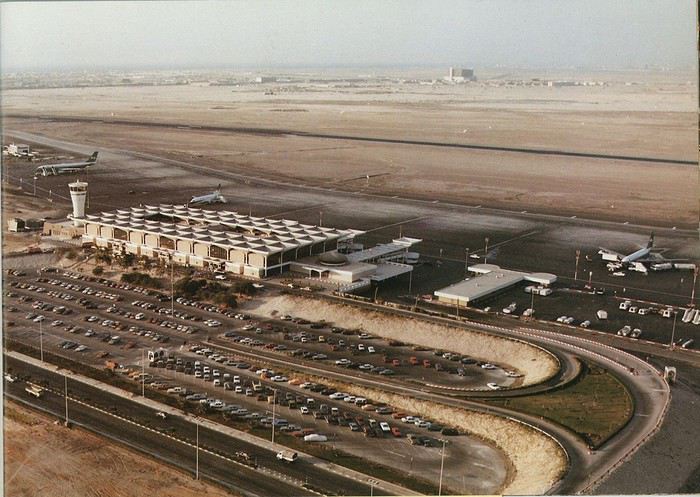
Next stop: New Delhi to drop off some Europeans and pick up a few Indians, and finally, the terminus: Manila. I don’t remember how long the trip took with its five stops—an unimaginable journey today. Despite all those stops to fill the plane, there was still enough space to stretch out on the four center seats of the 747, something that never happens these days despite all the flights in every direction.
So here we are, finally at Manila Airport around midnight.
Episode 1: Manila and Baguio To start, a quick note on the political and economic situation in the Philippines in 1984, which had consequences for us as tourists, as we’d soon realize upon arrival.
After several centuries of Spanish colonization, the Philippines became American at the start of the 20th century, then independent. In 1966, Marcos took power, and little by little, his regime sank into corruption and mismanagement, becoming a dictatorship with martial law, all for the benefit of his family and friends, who enriched themselves endlessly. The peak was the assassination of opposition leader Benigno Aquino in August 1983, which triggered harshly repressed protests. So we arrived a few months later in a very poor country, with omnipresent corruption and an extremely tense political situation, as we’d soon see for ourselves. Major protests took place in the main cities during our trip—I’ll come back to that. Two years later, Marcos fled to Hawaii after being forced out of power following rigged elections. This historical context explains a lot of the situations we found ourselves in over the following weeks.
Arriving in the middle of the night isn’t very cheerful. Manila was already a huge city with many slums, where you could find a few business hotels like the Hilton or Intercontinental—way out of our budget—and plenty of run-down hotels. Luckily, two Indians we’d chatted with on the plane offered to take us to their usual hotel. They came to Manila twice a year for business. We accepted their offer, relieved not to have to look for a place to stay in the middle of the night, figuring the address must be good since they came back every time... we were wrong 🙁
We left the airport and immediately got a taste of the local vibe when we got into the taxi: the police asked for our passports. We thought: what’s more normal than police in a dictatorship?
But that wasn’t it at all. Our two Indian friends explained that the police were noting our names along with the taxi number and time. Crime in Manila was so bad that the taxi driver would be held responsible if anything happened to us... welcome to the Philippines 😎 😎
Historically, the Philippines was a very violent country, where everything was settled with guns or machetes. Previous governments had banned carrying weapons, but Marcos later allowed the free sale and carrying of guns, and disputes were settled with pistols again (or worse, as we’d discover later). Since he’d released most of the criminals from prison to form a paramilitary militia at his service (I’ll talk about our encounter with these “heroes” later), it was pretty dangerous to go into many parts of Manila, where these “tonton macoutes” ruled.
We arrived at our hotel without incident... and then things started badly. The room was infested with big cockroaches—exactly what I hate most in those kinds of countries. No way to find another hotel at that hour. After the long flight, the urge to take a shower was so strong that we squeezed into the bathroom as best we could. After that, I don’t remember—I guess we must’ve fallen asleep exhausted under the sheets in the heat... air conditioning wasn’t widespread yet.
The next day, we just wanted to leave that dump as soon as possible. So we decided to head north right away, stopping in Baguio, and we’d visit Manila a bit on the way back.
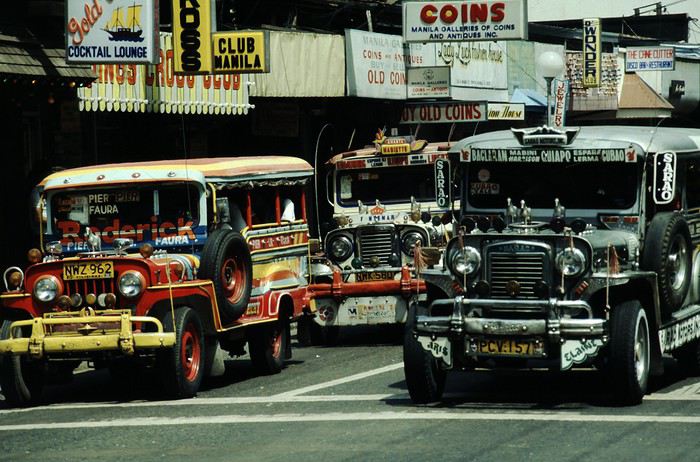
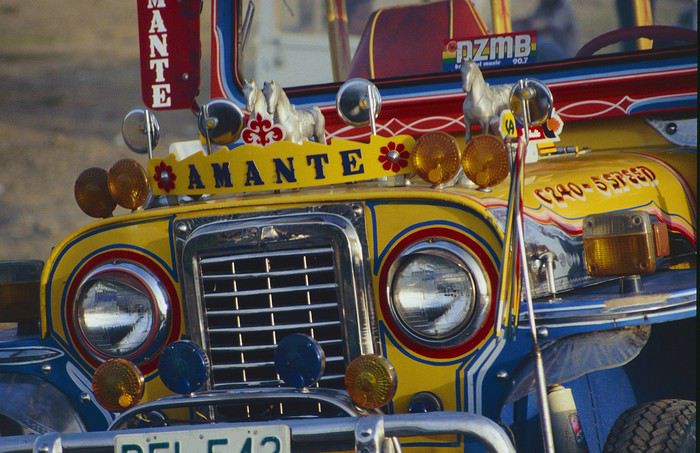
When we stepped outside, we discovered a pretty run-down neighborhood with potholed streets. But we also discovered the jeepneys. They were everywhere, flooding the streets.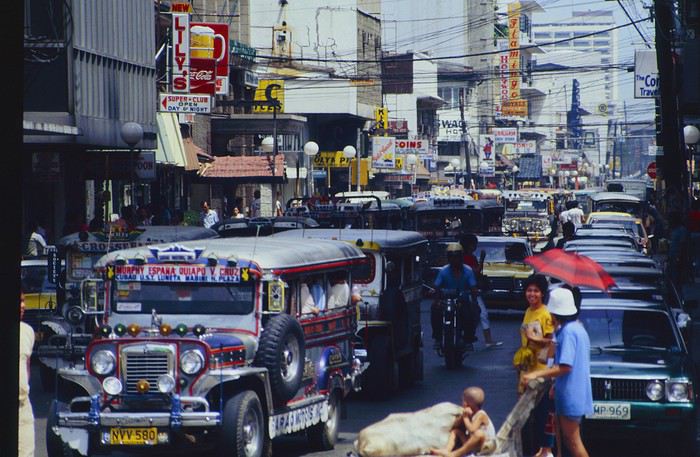
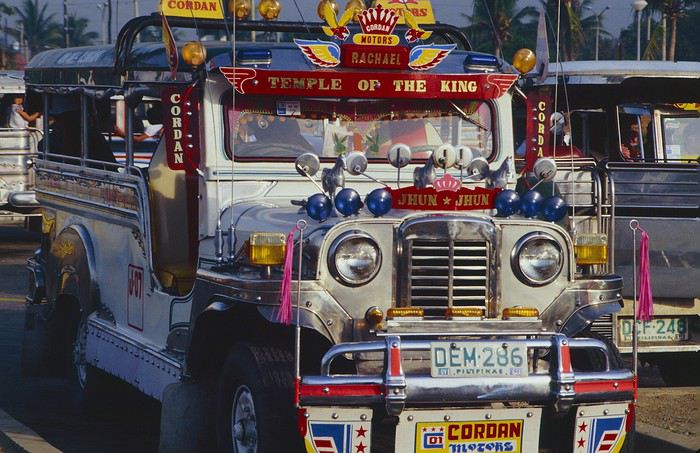
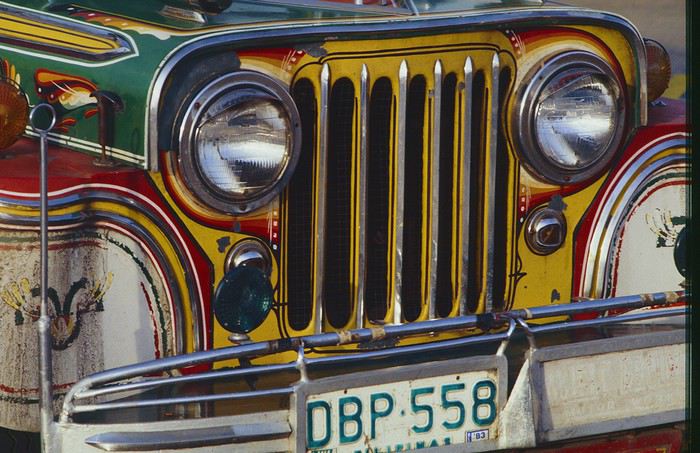
They had crazy sound systems, each one blasting louder than the last. The interiors were kitschy but fun. There weren’t many private cars—almost all transportation was by jeepney, with buses reserved for intercity trips.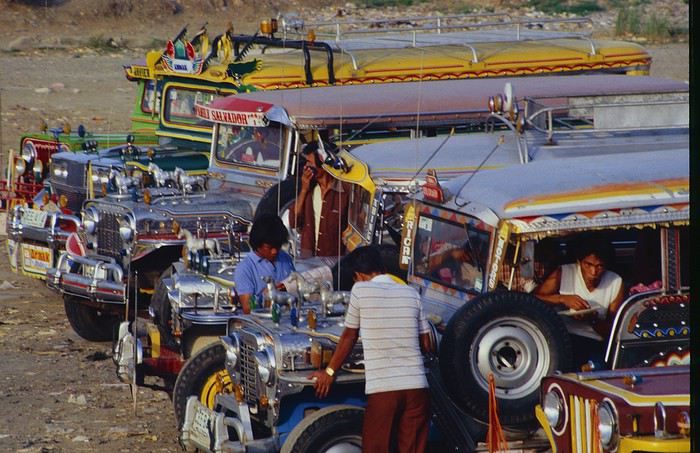
Before heading to the bus terminal for the north, somewhere on the outskirts of the city, we needed to exchange some money. I don’t remember how we ended up in a policeman’s jeep who offered his services: - Exchange money on the black market at a better rate than the banks. - Take us wherever we wanted, in this case, the bus terminal.
We accepted both offers (we’d still checked the official exchange rate from dollars to pesos). So we found ourselves in his jeep. After exchanging money, we left in his vehicle and stopped for gas. Without turning off the engine, he calmly smoked a cigarette while filling up. Since we were in a jeep with no doors or roof, we were ready to jump out if things went south, our travel bag in hand.
But we weren’t done with surprises yet. Once we left the small streets, we ended up in a neighborhood with wide avenues and not much traffic, which didn’t justify his incredible behavior. At every intersection, he made the sign of the cross, closed his eyes, and crossed without looking. I was more stunned than terrified! It wasn’t until we got out of the car later that I told Anne-Marie what had happened. I’d seen everything because the cop had put me in the front seat. Luckily, A-Marie hadn’t noticed anything from the back. Crossing Manila by trusting God rather than the rules of the road was ultimately effective. We were lucky—the trip was off to a good start. 🙂 🙂
We then passed through a neighborhood where slums stretched on for a while, and we left our policeman—friendly but a bit crazy—with relief.
A few hours by bus later, here we are in Baguio, cool in the mountains. My memories of Baguio are pretty fuzzy. I remember a small town. After some research while writing this journal, I found that the population was 120,000 in 1980. Given the population density in each home, that confirms my memory of a smallish town. Outside the “official” district with the president’s summer residence and government buildings, there were two or three paved streets with nice houses. The rest was very dirty and very poor, with lots of slums and dirt roads.
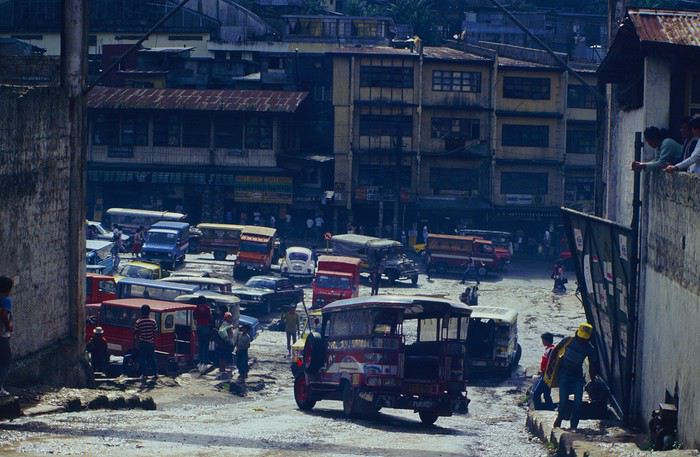
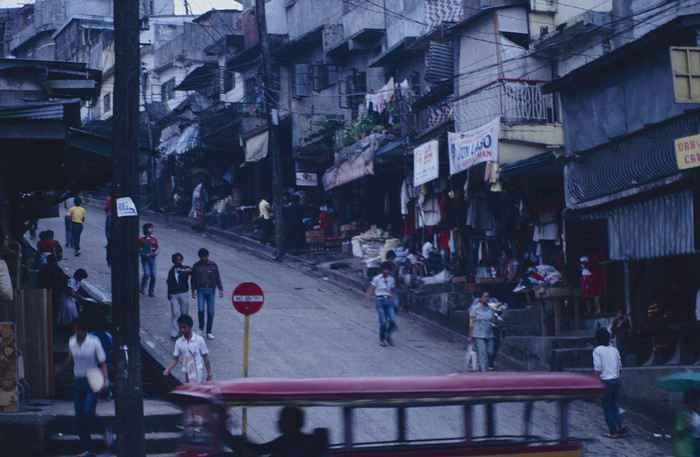
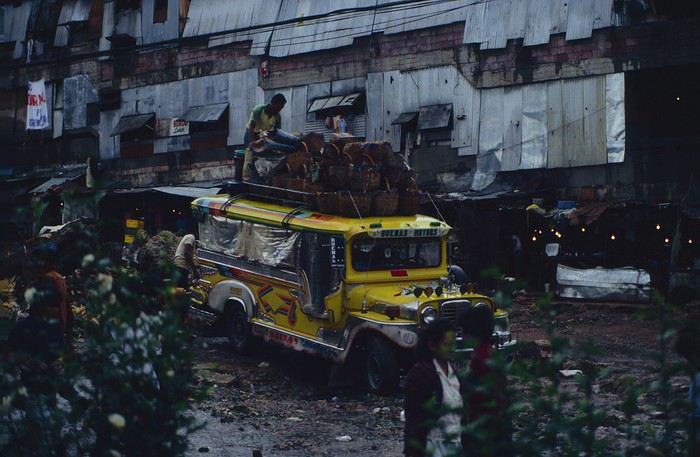
People we met on the street invited us to stay with them. These days, we wouldn’t just show up at strangers’ houses, which we should’ve done in Baguio—it would’ve saved us from an unimaginable and dangerous situation... which I won’t say anything about... !😊
The simple wooden house was on stilts at the edge of a hill with a view of the mountains. Since it was the start of the rainy season in a city that gets a lot of rain, we saw a lot of water. Our outings in town happened between downpours.
View from our lodging: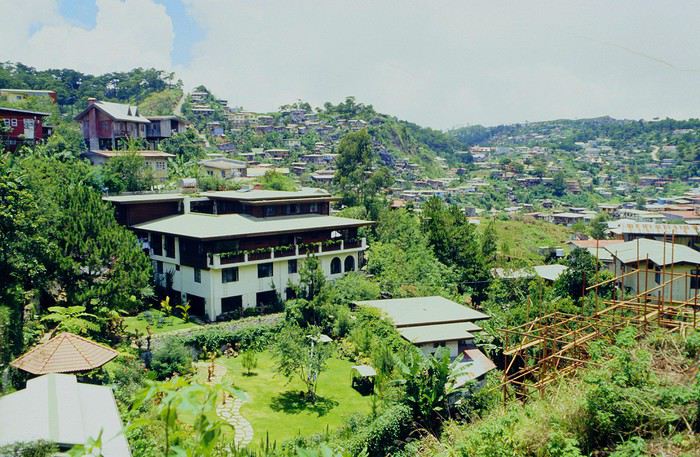
Episode 2: Baguio to Bontoc Aside from the situation briefly mentioned above, it was on the next leg to Bontoc that the adventure really began: an endless and dangerous road, a bus from another era, breathtaking landscapes, and surprising people.
We didn’t know the distance or how long it would take to get to Bontoc. When we arrived after about ten hours, we learned that Baguio to Bontoc was 140 km.
We got on a bus with wooden seats and settled in, two to a seat meant for two. As the bus filled up, passengers squeezed in three or four per seat, with chickens and baskets full of all sorts of things in the aisle. A little embarrassed, we didn’t know if we should squeeze in three on our seat. The seats were super tight (luckily, Filipinos are small), and I didn’t know where to put my legs given my height. I don’t remember if we stayed alone on our bench or if we ended up sharing with others.
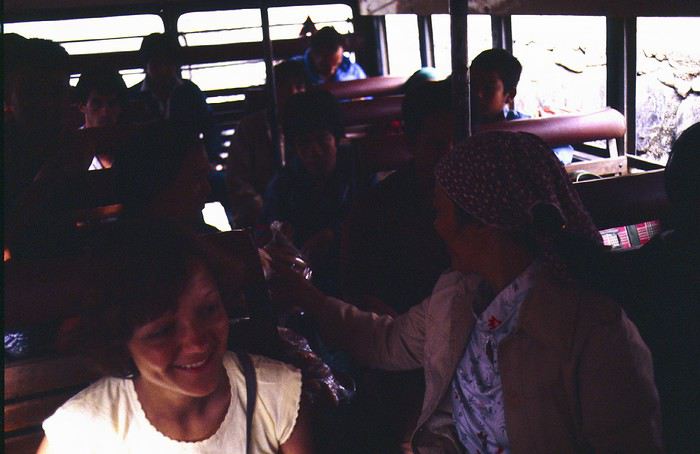
The “road” was a dirt track (or rather, a mud track) with endless turns. We held on as best we could to our slippery wooden seats—it was shaking in every direction. The woman behind us was carsick and throwing up... gross... but what were we doing there? Then we plunged into the Sierra Madre... just the name is dreamy!
Rice terraces started to appear: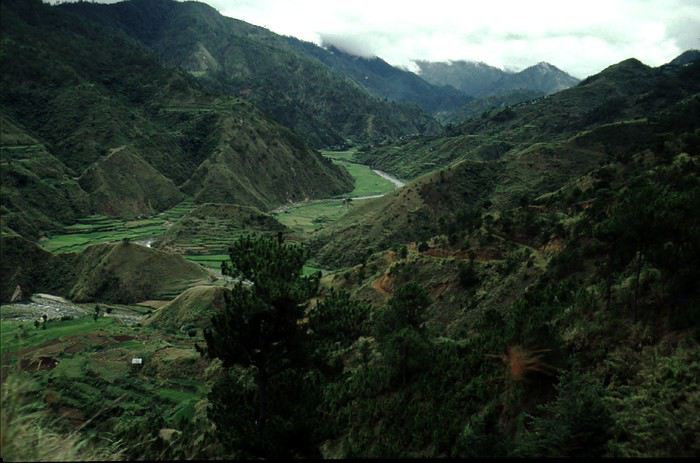
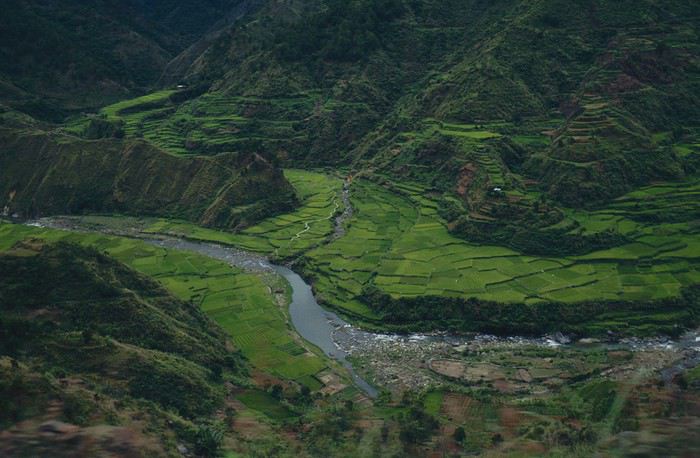
they took up more and more space along cliffs where we weren’t always reassured,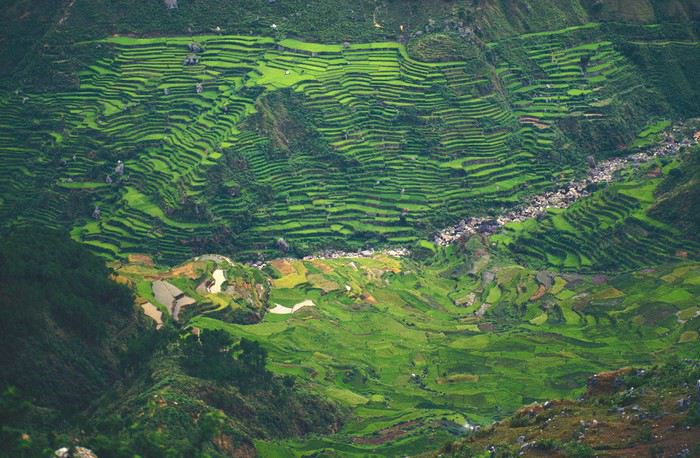
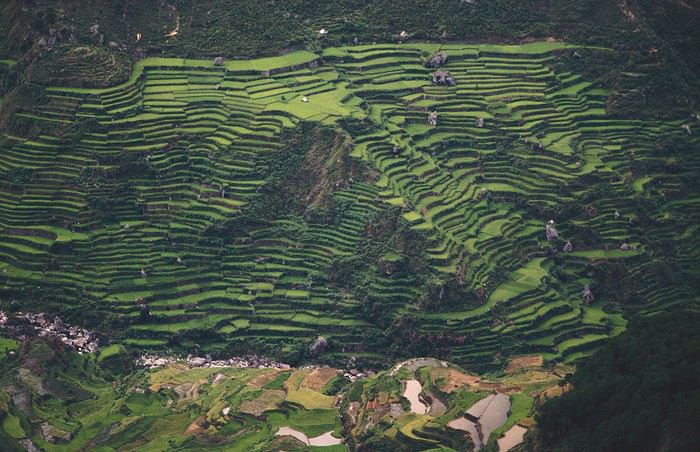
with lots of waterfalls (all that water had to go somewhere).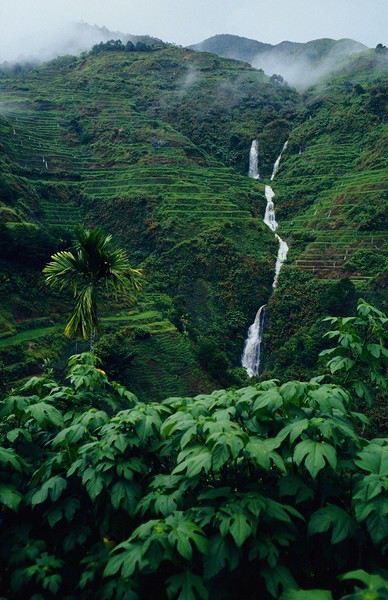
A few miserable villages stretched along the track, most often just a few houses balancing between the road and the drop. The bus stopped in every village—people got on or off and settled inside or on the roof. Street vendors offered their products to the bus passengers—a common sight in Asia, even today.
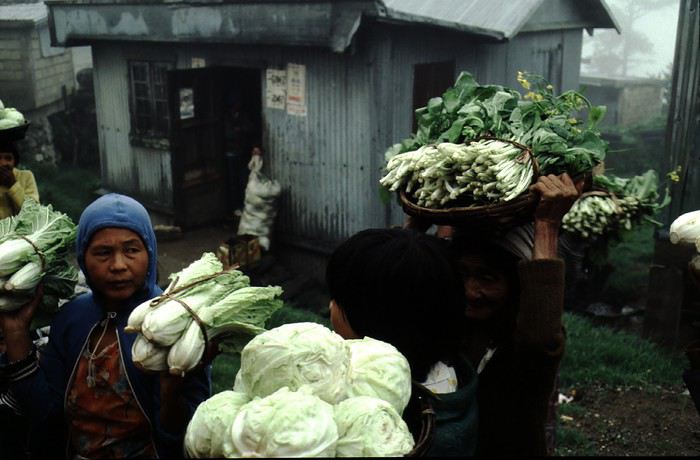
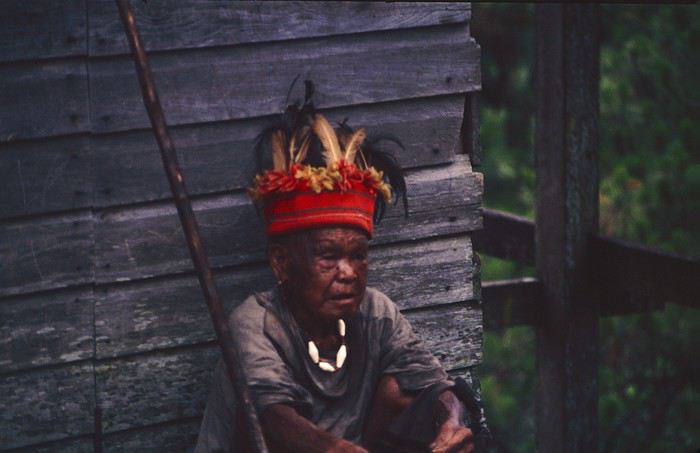
We were in another world—villagers were in loincloths, others had spears. The atmosphere was strange... but all good, we wanted exoticism, and we got it: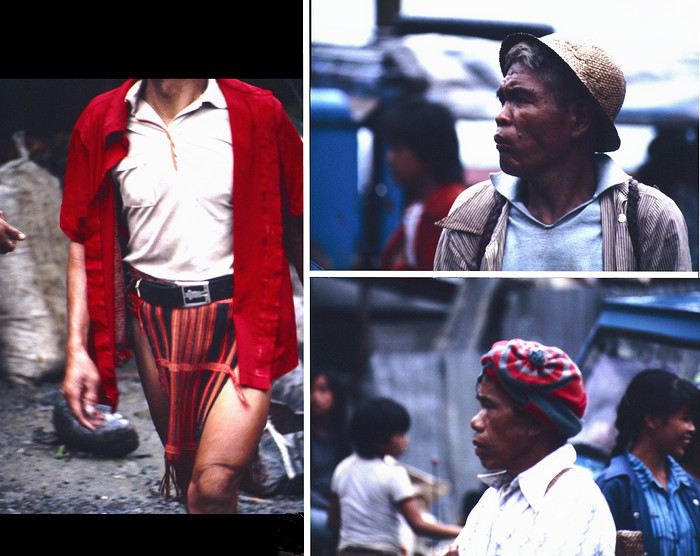
This so-called traditional outfit was everyday wear—it wasn’t for tourists since there weren’t any.
A curiosity because writing a travel journal about a trip 35 years later isn’t common, but also (mostly?) because exploring the Philippines at that time had little in common with traveling there today.
Obviously, I’ve forgotten a number of facts, most of the details, but with the help of a few notes from that time and a stack of slides (yes, there was life before digital 😊), many memories came back and added to the highlights I’d never forgotten. The scanned slides aren’t always great quality, but there are still quite a few to brighten up this chatter. Back then, we didn’t snap photos like we do now—film was too expensive—so I don’t have pictures of every place we visited... too bad, comparing some of those spots to how they look today would’ve been interesting.
Why "Adventures"? Why call it "Adventures" in the Philippines in 1984, a word so often used for a simple exotic trip? - Because the lack of information (no *Guide du Routard*, no *Lonely Planet*, no *Michelin Guide*, nothing, and obviously no internet) gave this trip what’s at the heart of adventure: the unknown. - Because the political situation made the stay sometimes dangerous. - Because transportation conditions were always epic, often perilous. - Because the question of where we’d spend the night came up almost every evening. - And for... quite a few other reasons.
That said, we weren’t exactly explorers!
Why the Philippines? First of all, why go to the Philippines in 1984—a country not exactly set up for tourism and about which we knew very little? How could we get an idea of the beauty of the Philippines and its points of interest when we had no guides or photos?
The idea came to us from Thailand a year earlier, during our first long-haul trip. After touring the north of the country, we met a Frenchman living in Phuket, where there were only a few tourists in Patong, with just a few small hotels and guesthouses. Kata and Karon had no buildings or roads, Rawai only had three palm-thatched bungalows, including ours, and the other islands were unknown to tourists. There was plenty to discover, and we wanted to return to this beautiful country... but the Frenchman made us dream about the Philippines—a country to explore, with wild landscapes.
Long evenings of discussion over multiple Sprite-Mekong cocktails (what memories of those headaches!) finally convinced us we had to go to the Philippines.
Episode 0: Before Departure The decision was made: we’d go to the Philippines in May 1984. Our friends and family were surprised when we announced we were going on vacation to the Philippines (a bit like saying today we were going paddleboarding in the Kerguelen Islands 🤪).
These days, preparing for each of our trips takes long evenings of research, planning, and noting down good addresses... etc. But for the Philippines in 1984, preparation was quick: we had very little information about the country, we were leaving almost at random, and the discovery would only be more exciting.
We still had a few bits of info gathered here and there: the rice terraces in northern Luzon, volcanoes, Negros where we were supposed to visit an acquaintance, Cebu and its marine life (we ended up going elsewhere), and absolutely avoid Mindanao, which was practically at war with the regime. That was about it, but it was already a great itinerary.
Nothing was organized in advance; we’d see day by day. We had no idea about travel times or even the existence of transportation options. The main (and sometimes only) way to connect two islands was by overloaded, rusty ferry. Only the big cities had airports.
Let’s Go: Episode 1: Paris to Manila My travel journals always start after arriving at the airport—the Europe-to-“Other Continent” trip isn’t interesting—but the flight to the Philippines was already an adventure, so I’ll make an exception.
This was the era when only a few Asian airlines were on par with Western ones: Thai, Singapore Airlines, and Philippine Airlines. They had beautiful, brand-new planes, and to attract customers (almost exclusively “businessmen”) from the usual airlines (Air France, Lufthansa, British Airways), there was opulence on board: unlimited champagne, all sorts of cocktails... Compared to today’s long-haul flights, there was still one small difference: no personal screens, just one screen at the front of the cabin with one mandatory movie. And I don’t know why, but we only got James Bond films, both ways... that must’ve been the trend at the time.
The tourism boom to Southeast Asia hadn’t started yet, and the “Asian Tigers” weren’t a thing, so there weren’t many business trips. That meant long-haul flights made stops everywhere to fill the planes. Our Philippine Airlines Boeing 747 left London, picked us up in Paris, then stopped in Frankfurt to take on a few Germans. I don’t know why we then made a stop in Dubai—a totally exotic place at the time. There was nothing to do there... things have changed a lot since. It was a small town lost in the desert. The airport was tiny, with just one or two buildings and a supermarket. During the stopover, everyone had to get off the plane and walk to the supermarket. Photo and electronic equipment were dirt cheap—I guess that was the only reason for the stop. Maybe it was their first commercial move. Emirates didn’t exist yet, as I checked online, but anyway, the idea that such a remote place could have its own airline was unthinkable.
Online, I found this photo of Dubai Airport in 1980. Anyone who’s transited through today’s massive airport with its rows of A380s will appreciate it:
Next stop: New Delhi to drop off some Europeans and pick up a few Indians, and finally, the terminus: Manila. I don’t remember how long the trip took with its five stops—an unimaginable journey today. Despite all those stops to fill the plane, there was still enough space to stretch out on the four center seats of the 747, something that never happens these days despite all the flights in every direction.
So here we are, finally at Manila Airport around midnight.
Episode 1: Manila and Baguio To start, a quick note on the political and economic situation in the Philippines in 1984, which had consequences for us as tourists, as we’d soon realize upon arrival.
After several centuries of Spanish colonization, the Philippines became American at the start of the 20th century, then independent. In 1966, Marcos took power, and little by little, his regime sank into corruption and mismanagement, becoming a dictatorship with martial law, all for the benefit of his family and friends, who enriched themselves endlessly. The peak was the assassination of opposition leader Benigno Aquino in August 1983, which triggered harshly repressed protests. So we arrived a few months later in a very poor country, with omnipresent corruption and an extremely tense political situation, as we’d soon see for ourselves. Major protests took place in the main cities during our trip—I’ll come back to that. Two years later, Marcos fled to Hawaii after being forced out of power following rigged elections. This historical context explains a lot of the situations we found ourselves in over the following weeks.
Arriving in the middle of the night isn’t very cheerful. Manila was already a huge city with many slums, where you could find a few business hotels like the Hilton or Intercontinental—way out of our budget—and plenty of run-down hotels. Luckily, two Indians we’d chatted with on the plane offered to take us to their usual hotel. They came to Manila twice a year for business. We accepted their offer, relieved not to have to look for a place to stay in the middle of the night, figuring the address must be good since they came back every time... we were wrong 🙁
We left the airport and immediately got a taste of the local vibe when we got into the taxi: the police asked for our passports. We thought: what’s more normal than police in a dictatorship?
But that wasn’t it at all. Our two Indian friends explained that the police were noting our names along with the taxi number and time. Crime in Manila was so bad that the taxi driver would be held responsible if anything happened to us... welcome to the Philippines 😎 😎
Historically, the Philippines was a very violent country, where everything was settled with guns or machetes. Previous governments had banned carrying weapons, but Marcos later allowed the free sale and carrying of guns, and disputes were settled with pistols again (or worse, as we’d discover later). Since he’d released most of the criminals from prison to form a paramilitary militia at his service (I’ll talk about our encounter with these “heroes” later), it was pretty dangerous to go into many parts of Manila, where these “tonton macoutes” ruled.
We arrived at our hotel without incident... and then things started badly. The room was infested with big cockroaches—exactly what I hate most in those kinds of countries. No way to find another hotel at that hour. After the long flight, the urge to take a shower was so strong that we squeezed into the bathroom as best we could. After that, I don’t remember—I guess we must’ve fallen asleep exhausted under the sheets in the heat... air conditioning wasn’t widespread yet.
The next day, we just wanted to leave that dump as soon as possible. So we decided to head north right away, stopping in Baguio, and we’d visit Manila a bit on the way back.
When we stepped outside, we discovered a pretty run-down neighborhood with potholed streets. But we also discovered the jeepneys. They were everywhere, flooding the streets.
They had crazy sound systems, each one blasting louder than the last. The interiors were kitschy but fun. There weren’t many private cars—almost all transportation was by jeepney, with buses reserved for intercity trips.
Before heading to the bus terminal for the north, somewhere on the outskirts of the city, we needed to exchange some money. I don’t remember how we ended up in a policeman’s jeep who offered his services: - Exchange money on the black market at a better rate than the banks. - Take us wherever we wanted, in this case, the bus terminal.
We accepted both offers (we’d still checked the official exchange rate from dollars to pesos). So we found ourselves in his jeep. After exchanging money, we left in his vehicle and stopped for gas. Without turning off the engine, he calmly smoked a cigarette while filling up. Since we were in a jeep with no doors or roof, we were ready to jump out if things went south, our travel bag in hand.
But we weren’t done with surprises yet. Once we left the small streets, we ended up in a neighborhood with wide avenues and not much traffic, which didn’t justify his incredible behavior. At every intersection, he made the sign of the cross, closed his eyes, and crossed without looking. I was more stunned than terrified! It wasn’t until we got out of the car later that I told Anne-Marie what had happened. I’d seen everything because the cop had put me in the front seat. Luckily, A-Marie hadn’t noticed anything from the back. Crossing Manila by trusting God rather than the rules of the road was ultimately effective. We were lucky—the trip was off to a good start. 🙂 🙂
We then passed through a neighborhood where slums stretched on for a while, and we left our policeman—friendly but a bit crazy—with relief.
A few hours by bus later, here we are in Baguio, cool in the mountains. My memories of Baguio are pretty fuzzy. I remember a small town. After some research while writing this journal, I found that the population was 120,000 in 1980. Given the population density in each home, that confirms my memory of a smallish town. Outside the “official” district with the president’s summer residence and government buildings, there were two or three paved streets with nice houses. The rest was very dirty and very poor, with lots of slums and dirt roads.
People we met on the street invited us to stay with them. These days, we wouldn’t just show up at strangers’ houses, which we should’ve done in Baguio—it would’ve saved us from an unimaginable and dangerous situation... which I won’t say anything about... !😊
The simple wooden house was on stilts at the edge of a hill with a view of the mountains. Since it was the start of the rainy season in a city that gets a lot of rain, we saw a lot of water. Our outings in town happened between downpours.
View from our lodging:
Episode 2: Baguio to Bontoc Aside from the situation briefly mentioned above, it was on the next leg to Bontoc that the adventure really began: an endless and dangerous road, a bus from another era, breathtaking landscapes, and surprising people.
We didn’t know the distance or how long it would take to get to Bontoc. When we arrived after about ten hours, we learned that Baguio to Bontoc was 140 km.
We got on a bus with wooden seats and settled in, two to a seat meant for two. As the bus filled up, passengers squeezed in three or four per seat, with chickens and baskets full of all sorts of things in the aisle. A little embarrassed, we didn’t know if we should squeeze in three on our seat. The seats were super tight (luckily, Filipinos are small), and I didn’t know where to put my legs given my height. I don’t remember if we stayed alone on our bench or if we ended up sharing with others.
The “road” was a dirt track (or rather, a mud track) with endless turns. We held on as best we could to our slippery wooden seats—it was shaking in every direction. The woman behind us was carsick and throwing up... gross... but what were we doing there? Then we plunged into the Sierra Madre... just the name is dreamy!
Rice terraces started to appear:
they took up more and more space along cliffs where we weren’t always reassured,
with lots of waterfalls (all that water had to go somewhere).
A few miserable villages stretched along the track, most often just a few houses balancing between the road and the drop. The bus stopped in every village—people got on or off and settled inside or on the roof. Street vendors offered their products to the bus passengers—a common sight in Asia, even today.
We were in another world—villagers were in loincloths, others had spears. The atmosphere was strange... but all good, we wanted exoticism, and we got it:
This so-called traditional outfit was everyday wear—it wasn’t for tourists since there weren’t any.
British Airways ne veut pas rembourser les billets pour les USA English translation pending
je viens d'avoir british airways (j'ai une ligne non surtaxée si besoin pour quelqu'un en MP pas eu trop d'attente mais ne pas lâcher quand c'est occupé recommencer multiples fois)!! et bien peanuts. L'agent que j'ai eu au tel stipule qu' ils ne remboursent pas à ce jour les billets pour les USA qui sont avant le 13 avril 2020 achetés l'année dernière dont les conditions ne sont pas remboursables....le coronavirus c'est pas leur soucis. Alors que d'autres compagnies aériennes font des gestes forts pour aider les clients...et même AGODA dont les chambres d'hôtels n'étaient pas remboursables remboursent sans problème dès aujourd'hui...
Alors la raison "à la trump" invoquée aujourd’hui les billets achetés à compter du 3 mars (on connaissait les dangers du virus) donc on peut obtenir changement ou bon avoir... les billets achetés avant le 3 mars on ne connaissait pas les dangers du virus donc c'est perdu vous n'avez droit à aucun remboursement (bon on sait que les taxes c'est remboursable).
je vais m'empresser d'inonder de messages les réseaux sociaux pour donner l'info. et faire un post bien voyant ici...sur VF Le gars il dit pour le moment n'annulez pas par vous même attendez peut être que ça va changer d'ici là....c'est clair que je vais attendre du coup....
je vais mettre un cierge à la bonne mère que soit les USA reviennent à la raison et qu'ils annulent l'interdiction pour les européens.. ou que BA fasse geste commercial digne de ce nom pour tous les voyageurs européens qui n'y sont pour rien
Alors la raison "à la trump" invoquée aujourd’hui les billets achetés à compter du 3 mars (on connaissait les dangers du virus) donc on peut obtenir changement ou bon avoir... les billets achetés avant le 3 mars on ne connaissait pas les dangers du virus donc c'est perdu vous n'avez droit à aucun remboursement (bon on sait que les taxes c'est remboursable).
je vais m'empresser d'inonder de messages les réseaux sociaux pour donner l'info. et faire un post bien voyant ici...sur VF Le gars il dit pour le moment n'annulez pas par vous même attendez peut être que ça va changer d'ici là....c'est clair que je vais attendre du coup....
je vais mettre un cierge à la bonne mère que soit les USA reviennent à la raison et qu'ils annulent l'interdiction pour les européens.. ou que BA fasse geste commercial digne de ce nom pour tous les voyageurs européens qui n'y sont pour rien
Voyage en Irlande avec notre fils de 5 ans, hébergements et lieux à visiter English translation pending
Bonjour,
Je suis nouvelle sur ce forum que j'ai découvert grâce à une amie voyageuse. J'y ai déjà trouvé plein d'informations ! C'est un super forum ! Merci à tous ! 😉
J'essaye de planifier notre voyage en Irlande avec mon compagnon et notre fils (qui aura presque 5 ans) Nous avons déjà pris les billets d'avion : nous atterrissons à Dublin le 2 juillet à 13h45 et nous en repartons le 12 juillet à 10h50. Nous prévoyons de louer une voiture.
Maintenant il me faut réserver les hébergements...
J'ai donc déjà lu plusieurs autres discussions sur le sujet ainsi que des carnets de voyages forts inspirants... J'ai aussi un peu potassé le Routard.
Ça sera notre 1er séjour en Irlande, j'en rêve depuis gamine, étant passionnée de chevaux depuis l'enfance, et fan de U2 depuis l'adolescence... Mes 40 ans seront une bonne occasion de réaliser ce rêve... Je pense donc opter plutôt pour les grands classiques incontournables pour ce 1er séjour, espérant pouvoir y revenir pour voir d'autres coins une autre fois...
Nous avons privilégié les paysages de carte postale, le dépaysement, la nature, les belles pierres, plutôt les petits villages typiques... Pas trop de musées ou visite de monuments car notre fils est encore un peu petit pour le côté historique et nous ne sommes pas hyper-férus d'histoire non plus. Mais nous aimons bien quand même apprendre des choses sur les lieux que nous visitons. Et puis des visites de beaux jardins, fermes, et sites ludiques.... Notre fils est dynamique et capable de marcher 2 à 3h selon la difficulté (chez nous sur le littoral varois on promène souvent en colline) donc nous prévoyons de faire quelques belles balades.
J'aimerais beaucoup avoir vos avis et conseils sur le programme que j'ai "établi". J'ai conscience que le pays est vaste, les routes pas toujours faciles et qu'il faut faire des choix, surtout avec un enfant. Mais pas évident de savoir ce qui peut être fait en 1 journée, ce qui nécessite plus de temps, surtout que la météo risque de perturber le programme...
Voilà notre programme, à ajuster avant de réserver les hébergements :
Jour 1 : arrivée à 13h45 à Dublin, récupération de valise et de voiture de loc et en route vers le Connemara. Je pense faire une halte à Clonmacnoise pour couper la route (on sera dans les transports depuis le matin donc une halte sera bienvenue ! ) Puis tracer vers notre hébergement dans le Connemara, si beau temps et si nous avons le temps peut être profiter en fin de journée pour une balade près d'un lac ou un joli point de vue. Peut être vers Cong ?
Je ne sais pas quel serait le point de chute idéal pour visiter la région ? Je pensais rester 2 nuits
Jour 2 : Le parc national du Connemara et ses balades, j'ai lu qu'il y en a 4 balisées, 3 faciles et 1 plus dure (2h30) je ne sais pas si elle est faisable avec note fils ? + L'abbaye de Kylemore et la Killary sheep farm ? Tout cela peut-il se faire en 1 journée ? (si il fait beau bien sûr) Le programme du jour 2 peut être inversé pour le lendemain selon la météo...
Jour 3 : Sky road et visites de Clifden, Ballyconnelly, Roundstone, plages (Dog's bay...) peut être un tour par Galway si on a le temps mais j'en doute... puis direction Ballyvaughan
J'hésite à rester 1 ou 2 nuits à Ballyvaughan pour visiter le Burren Peut être 2 nuits en partant vers Dingle le 5eme jour vers midi ?
Jour 4 : Visite du Burren par la côte (et/ou l'intérieur selon météo...) Ballyvaughan - Lisdoonvarna par Black head Doolin et Cliffs of Moher J'ai noté l'Aillwee Cave à visiter dans ce coin selon le déroulement des visites et la météo
Jour 5 : Burren "intérieur" en descendant vers Corofin, s'arrêter voir qq sites, j'ai noté les village de Noughaval et de Kilfenora et les sites de Cahercutteen et Ballyganner, ainsi que le dolmen de Poulnabrone... Beaucoup de choses à voir dans cette région, j'ai eu du mal à décider, je ne sais pas si mon programme est bien, si il y a "mieux" ? Puis on descendrait vers Killimer pour traverser par le Ferry vers Tarbert et direction Dingle Si beau temps et pas trop tard, peut être un saut au Connor Pass en fin de journée ? Je pense rester 1 nuit à Dingle mais c'est peut être juste ? En même temps je veux garder de la marge pour la visite du Kerry... Ou alirs il nous faut rester 1 nuit dans le Burren pour avoir 2 nuits à Dingle...
Jour 6 : visite de Dingle (si pas eu le tps la veille en fin d'aprem), Slea Head Drive, Gallarus Oratory, si on a le temps passage par Cloghane, Brandon ? Puis redescendre vers Killarney en passant par Inch (j'ai lu qu'il y a une belle plage) Prochain hébergement à proximité de Killarney pour 3 nuits
Jour 7, 8 et 9 : selon météo on aimerait faire Killarney et le parc national, les beaux points de vue et beaux sites : Ross Castle, Ladies view, Torc waterfall, Moll's gap, une partie de Gap of Dunloe (je ne sais pas ce qui est faisable avec notre loulou dans le gap of dunloe ? ), ring of Kerry, ring of Skellig, Valentia Island, si on a le temps Derrynane house & gardens...
Question : la boucle du Ring of Kerry + ring of Skellig + Valentia Island peut elle se faire dans la journée ? Ça me parait bcp et donc j'hésite à passer une nuit vers Portmagee pour avoir plus de temps
Et le 9eme jour "finir" notre visite du Kerry puis l'aprem retour vers Dublin avec halte à Kilkenny et éventuellement au National Irish Stud & gardens ?
Jour 10 : Visite de Dublin pour mes 40 ans...
Jour 11 : on rentre...
Je pensais voir si cela est possible, de rendre la voiture de loc en arrivant à Dublin pour être "tranquille" et prendre une navette pour aller à l'aéroport le lendemain ?
Voilà... Merci d'avoir lu mon pavé ! 😄 Toutes les idées d'hébergements, lieux à rajouter ou enlever de notre programme sont les bienvenus !
Je suis nouvelle sur ce forum que j'ai découvert grâce à une amie voyageuse. J'y ai déjà trouvé plein d'informations ! C'est un super forum ! Merci à tous ! 😉
J'essaye de planifier notre voyage en Irlande avec mon compagnon et notre fils (qui aura presque 5 ans) Nous avons déjà pris les billets d'avion : nous atterrissons à Dublin le 2 juillet à 13h45 et nous en repartons le 12 juillet à 10h50. Nous prévoyons de louer une voiture.
Maintenant il me faut réserver les hébergements...
J'ai donc déjà lu plusieurs autres discussions sur le sujet ainsi que des carnets de voyages forts inspirants... J'ai aussi un peu potassé le Routard.
Ça sera notre 1er séjour en Irlande, j'en rêve depuis gamine, étant passionnée de chevaux depuis l'enfance, et fan de U2 depuis l'adolescence... Mes 40 ans seront une bonne occasion de réaliser ce rêve... Je pense donc opter plutôt pour les grands classiques incontournables pour ce 1er séjour, espérant pouvoir y revenir pour voir d'autres coins une autre fois...
Nous avons privilégié les paysages de carte postale, le dépaysement, la nature, les belles pierres, plutôt les petits villages typiques... Pas trop de musées ou visite de monuments car notre fils est encore un peu petit pour le côté historique et nous ne sommes pas hyper-férus d'histoire non plus. Mais nous aimons bien quand même apprendre des choses sur les lieux que nous visitons. Et puis des visites de beaux jardins, fermes, et sites ludiques.... Notre fils est dynamique et capable de marcher 2 à 3h selon la difficulté (chez nous sur le littoral varois on promène souvent en colline) donc nous prévoyons de faire quelques belles balades.
J'aimerais beaucoup avoir vos avis et conseils sur le programme que j'ai "établi". J'ai conscience que le pays est vaste, les routes pas toujours faciles et qu'il faut faire des choix, surtout avec un enfant. Mais pas évident de savoir ce qui peut être fait en 1 journée, ce qui nécessite plus de temps, surtout que la météo risque de perturber le programme...
Voilà notre programme, à ajuster avant de réserver les hébergements :
Jour 1 : arrivée à 13h45 à Dublin, récupération de valise et de voiture de loc et en route vers le Connemara. Je pense faire une halte à Clonmacnoise pour couper la route (on sera dans les transports depuis le matin donc une halte sera bienvenue ! ) Puis tracer vers notre hébergement dans le Connemara, si beau temps et si nous avons le temps peut être profiter en fin de journée pour une balade près d'un lac ou un joli point de vue. Peut être vers Cong ?
Je ne sais pas quel serait le point de chute idéal pour visiter la région ? Je pensais rester 2 nuits
Jour 2 : Le parc national du Connemara et ses balades, j'ai lu qu'il y en a 4 balisées, 3 faciles et 1 plus dure (2h30) je ne sais pas si elle est faisable avec note fils ? + L'abbaye de Kylemore et la Killary sheep farm ? Tout cela peut-il se faire en 1 journée ? (si il fait beau bien sûr) Le programme du jour 2 peut être inversé pour le lendemain selon la météo...
Jour 3 : Sky road et visites de Clifden, Ballyconnelly, Roundstone, plages (Dog's bay...) peut être un tour par Galway si on a le temps mais j'en doute... puis direction Ballyvaughan
J'hésite à rester 1 ou 2 nuits à Ballyvaughan pour visiter le Burren Peut être 2 nuits en partant vers Dingle le 5eme jour vers midi ?
Jour 4 : Visite du Burren par la côte (et/ou l'intérieur selon météo...) Ballyvaughan - Lisdoonvarna par Black head Doolin et Cliffs of Moher J'ai noté l'Aillwee Cave à visiter dans ce coin selon le déroulement des visites et la météo
Jour 5 : Burren "intérieur" en descendant vers Corofin, s'arrêter voir qq sites, j'ai noté les village de Noughaval et de Kilfenora et les sites de Cahercutteen et Ballyganner, ainsi que le dolmen de Poulnabrone... Beaucoup de choses à voir dans cette région, j'ai eu du mal à décider, je ne sais pas si mon programme est bien, si il y a "mieux" ? Puis on descendrait vers Killimer pour traverser par le Ferry vers Tarbert et direction Dingle Si beau temps et pas trop tard, peut être un saut au Connor Pass en fin de journée ? Je pense rester 1 nuit à Dingle mais c'est peut être juste ? En même temps je veux garder de la marge pour la visite du Kerry... Ou alirs il nous faut rester 1 nuit dans le Burren pour avoir 2 nuits à Dingle...
Jour 6 : visite de Dingle (si pas eu le tps la veille en fin d'aprem), Slea Head Drive, Gallarus Oratory, si on a le temps passage par Cloghane, Brandon ? Puis redescendre vers Killarney en passant par Inch (j'ai lu qu'il y a une belle plage) Prochain hébergement à proximité de Killarney pour 3 nuits
Jour 7, 8 et 9 : selon météo on aimerait faire Killarney et le parc national, les beaux points de vue et beaux sites : Ross Castle, Ladies view, Torc waterfall, Moll's gap, une partie de Gap of Dunloe (je ne sais pas ce qui est faisable avec notre loulou dans le gap of dunloe ? ), ring of Kerry, ring of Skellig, Valentia Island, si on a le temps Derrynane house & gardens...
Question : la boucle du Ring of Kerry + ring of Skellig + Valentia Island peut elle se faire dans la journée ? Ça me parait bcp et donc j'hésite à passer une nuit vers Portmagee pour avoir plus de temps
Et le 9eme jour "finir" notre visite du Kerry puis l'aprem retour vers Dublin avec halte à Kilkenny et éventuellement au National Irish Stud & gardens ?
Jour 10 : Visite de Dublin pour mes 40 ans...
Jour 11 : on rentre...
Je pensais voir si cela est possible, de rendre la voiture de loc en arrivant à Dublin pour être "tranquille" et prendre une navette pour aller à l'aéroport le lendemain ?
Voilà... Merci d'avoir lu mon pavé ! 😄 Toutes les idées d'hébergements, lieux à rajouter ou enlever de notre programme sont les bienvenus !
Drame en motoneige pour 8 touristes Français au lac Saint-Jean English translation pending
Le 22 janvier 2020
Une sortie en motoneige a viré au drame pour huit touristes français et leur guide québécois hier au Lac-Saint-Jean, quand des membres du groupe ont traversé la glace recouvrant le plan d’eau avec leurs motoneiges.
Le corps de leur guide, Benoit L’Espérance, 42 ans, a été retrouvé. Ceux de deux touristes également, tard ce soir… Et, bien que trois visiteurs aient été retrouvés sains et saufs, trois autres manquent encore à l’appel.
La SQ a déployé deux hélicoptères, deux équipes de plongeurs et plusieurs patrouilleurs à motoneige dans le cadre de leurs recherches. Mais, comble du malheur, un des deux hélicoptères s’est écrasé sur la surface du lac en après-midi — sans toutefois mettre en danger la vie de son pilote.
Le groupe serait tombé à l’eau près de la Grande Décharge, l’un des endroits où le lac Saint-Jean se déverse pour devenir la rivière Saguenay. En temps normal, les motoneiges ne s’aventurent pas dans ce secteur, loin des sentiers balisés, qui est jugé trop dangereux en raison des forts courants qui rendent la glace très mince.
https://www.ledevoir.com/societe/571298/un-motoneigiste-est-mort-et-cinq-autres-sont-portes-disparus-au-lac-saint-jean
Une sortie en motoneige a viré au drame pour huit touristes français et leur guide québécois hier au Lac-Saint-Jean, quand des membres du groupe ont traversé la glace recouvrant le plan d’eau avec leurs motoneiges.
Le corps de leur guide, Benoit L’Espérance, 42 ans, a été retrouvé. Ceux de deux touristes également, tard ce soir… Et, bien que trois visiteurs aient été retrouvés sains et saufs, trois autres manquent encore à l’appel.
La SQ a déployé deux hélicoptères, deux équipes de plongeurs et plusieurs patrouilleurs à motoneige dans le cadre de leurs recherches. Mais, comble du malheur, un des deux hélicoptères s’est écrasé sur la surface du lac en après-midi — sans toutefois mettre en danger la vie de son pilote.
Le groupe serait tombé à l’eau près de la Grande Décharge, l’un des endroits où le lac Saint-Jean se déverse pour devenir la rivière Saguenay. En temps normal, les motoneiges ne s’aventurent pas dans ce secteur, loin des sentiers balisés, qui est jugé trop dangereux en raison des forts courants qui rendent la glace très mince.
https://www.ledevoir.com/societe/571298/un-motoneigiste-est-mort-et-cinq-autres-sont-portes-disparus-au-lac-saint-jean
Meilleures plages pour le snorkeling à Big Island (Hawaï) English translation pending
Bonjour à tous,
Je serai à Hawaii (Big Island) en février 2020. Quelles so nt les meilleures plages pour le snorkeling ? Nous allons resider à Ocean View (S.O.) Merci à l'avance de vos infos. Mariejo45
Je serai à Hawaii (Big Island) en février 2020. Quelles so nt les meilleures plages pour le snorkeling ? Nous allons resider à Ocean View (S.O.) Merci à l'avance de vos infos. Mariejo45
"Alerte rouge" de neige abondante en Catalogne (météo) English translation pending
Ce n'est pas une malédiction mais ça y ressemble pour catalans .la tempête gloria arrive en Catalogne sud puis nord et il est demande à tous d éviter des déplacements jusqu'à à jeudi.avec vents à 130kls/h en Catalogne sud neige abondante en plaine vagues 6m et risque de submersion.
En Catalogne nord les pyrenees orientales la situation risque d être pire avec vents très forts risques de submersions..pluies diluviennes mardi mercredi.2m de neige sur les hauteurs.et inondations pour les rivières tech tête Agly..
Le passage en montagne est déjà interdit pour les poids lourds il le sera dans les heures qui arrivent pour les voitures.
Le calme avant la tempête: il y a depuis hier soir un calme extraordinaire.le vent a cessé net.les oiseaux ont cessé de chanter
ce calme est anormal et ne prédit rien de bon.
Plutôt Rotorua ou Tongariro? (voyage en Nouvelle-Zélande) English translation pending
Bonjour,
je commence mes recherches pour un voyage en NZ en novembre.
J'ai bien compris que la météo est très changeante donc je pensais plutôt passer plusieurs jours sur un même site pour avoir plus de chances de faire les sorties et randos, au cas où une journée ou 2 seraient moches... et ne pas perdre trop de temps en déplacements.
Quels seraient les points forts/inconvénients qui feraient que vous choisiriez quelques jours vers le Tongariro, ou au contraire vers Rotorua ?
Tout le monde parle de Tongariro Alpine Crossing et Northern Circuit, mais en regardant les cartes de plus près, on voit plein d'autres sentiers, les connaissez-vous ? Je veux dire que si je peux éviter de suivre le flot de touristes, ça ne me dérange pas... 😉 même si pour voir certains sites (lacs Émeraude par ex.) je ne pourrai pas y couper.
Ne serait-il pas possible de rayonner depuis une seule ville, en faisant des A/R (avec nuit au même endroit à chaque fois) plutôt qu'une boucle ou une rando avec navette obligatoire au bout ?
De même, n'étant pas équipée pour le camping, le Northern circuit bien qu'il ait l'air superbe ne me convient pas vu qu'il y a plusieurs nuits en refuge sommaire...
Voilà mes premiers éléments de réflexion. Dans l'attente de vous lire... un grand merci. Sophie
Quels seraient les points forts/inconvénients qui feraient que vous choisiriez quelques jours vers le Tongariro, ou au contraire vers Rotorua ?
Tout le monde parle de Tongariro Alpine Crossing et Northern Circuit, mais en regardant les cartes de plus près, on voit plein d'autres sentiers, les connaissez-vous ? Je veux dire que si je peux éviter de suivre le flot de touristes, ça ne me dérange pas... 😉 même si pour voir certains sites (lacs Émeraude par ex.) je ne pourrai pas y couper.
Ne serait-il pas possible de rayonner depuis une seule ville, en faisant des A/R (avec nuit au même endroit à chaque fois) plutôt qu'une boucle ou une rando avec navette obligatoire au bout ?
De même, n'étant pas équipée pour le camping, le Northern circuit bien qu'il ait l'air superbe ne me convient pas vu qu'il y a plusieurs nuits en refuge sommaire...
Voilà mes premiers éléments de réflexion. Dans l'attente de vous lire... un grand merci. Sophie
Visites à faire en République Dominicaine à partir de Bayahibe English translation pending
Bonjour,
Mon mari et moi-même partons à Bayahibe les deux dernières semaines d'avril 2020.
Nous aimerions faire quelques excursions afin de visiter un peu le pays, telles que du quad, visite de fabriques de cigares, canne à sucre, îles aux alentours (tortues, village, plage), Saint Domingue etc. mais tout cela en dehors de la horde de touristes.
Seriez-vous à même de me renseigner auprès de quelle agence on peut trouver ce genre de prestations.
J'ai vu plusieurs agences mais aimerais être conseillée au mieux et sur les tarifs en vigueur.
J'ai vu qu'il y avait aussi des baleines, est-ce encore la saison ?...
Merci pour vos réponses.
Mon mari et moi-même partons à Bayahibe les deux dernières semaines d'avril 2020.
Nous aimerions faire quelques excursions afin de visiter un peu le pays, telles que du quad, visite de fabriques de cigares, canne à sucre, îles aux alentours (tortues, village, plage), Saint Domingue etc. mais tout cela en dehors de la horde de touristes.
Seriez-vous à même de me renseigner auprès de quelle agence on peut trouver ce genre de prestations.
J'ai vu plusieurs agences mais aimerais être conseillée au mieux et sur les tarifs en vigueur.
J'ai vu qu'il y avait aussi des baleines, est-ce encore la saison ?...
Merci pour vos réponses.
Algues sargasses à Basse-Terre (Guadeloupe) English translation pending
bonjour et bonne annee aux lecteurs qui vont peut-être me renseigner.
J'arrive en Guad pour la 7 eme fois le 30 janvier hélas que pour une petite semaine. Cette fois nous avons choisi petit bourg je préfére basse terre. La bonne question est de savoir si il y a autant de sargasses dans votre belle ile. Je sais qu'il y a bcp de plages et qu'apparemment vu les bulletins satélites elles ne sont pas toutes infectées mais si on suit l'info c'est pas super et on se dit mince aller au soleil pour ne pas pouvoir profiter des plages c'est ralant bien que nous sommes de grands randonneurs et que nous trouverons des activites autres.
Pouvez vous nous rassurer un temps soi peu ? Mille mercis
ck
Le japon de demain: vers une heureuse société de célibataires English translation pending
https://www.nippon.com/fr/in-depth/g00768/
un article très intéressant sur l'évolution de nos sociétés et sur le japon en particulier et où on apprend que le Japon d'autrefois avait aussi une culture du célibat.
Le point de vue de la bascule de la communauté d'appartenance à une communauté de connexion est très intéressante.
Cet article m'a fait penser au film de Kore Eda "une affaire de famille". un film où l'appartenance à une communauté (la famille) est remise en question.
Appartenir à une communauté de connexion me semble parfois plus important qu'appartenir à une communauté classique famille.
J 'aime beaucoup cette phrase "Plus encore que les personnes avec qui on a des liens forts, ce sont celles avec qui on a des liens faibles qui fournissent les stimulants les plus intenses et les plus profitables."
Bonne lecture si ça vous intéresse.
Circuit cyclo (EV6-EV8) Bâle - Passau - Salzbourg - Udine - Turin... English translation pending
Bonjour à tous,
j'aimerai envisager le circuit suivant pour 2020 :
Besançon – Bâle – Passau par EV6
Passau – Salzbourg (il semble qu'il y ait une piste cyclable) à confirmer.
Salzbourg – Udine par « Alpe Adria »
Udine – Turin *
Turin -France **
* il y aurait semble t-il une piste cyclable ? (voir plan ci-dessous....Bi12 http://www.bicitalia.org/it/bicitalia/gli-itinerari-bicitalia/137-bi12-ciclovia-pedemontana-alpina ) ou faut-il rattraper l'EV8 ?
** de Turin comment regagner la france ? Par monaco ? (col à franchir?) ou autre possibilité ? - toujours à vélo.
*** existe t-il un autre trajet/boucle ? Peut-être par la suisse ?
En vous remerciant vivement par avance de toute info sur ces trajets – difficultés – campings etc... cdt. joce
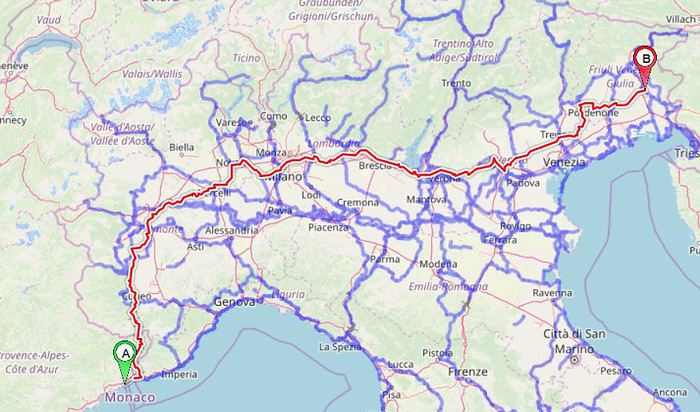
* il y aurait semble t-il une piste cyclable ? (voir plan ci-dessous....Bi12 http://www.bicitalia.org/it/bicitalia/gli-itinerari-bicitalia/137-bi12-ciclovia-pedemontana-alpina ) ou faut-il rattraper l'EV8 ?
** de Turin comment regagner la france ? Par monaco ? (col à franchir?) ou autre possibilité ? - toujours à vélo.
*** existe t-il un autre trajet/boucle ? Peut-être par la suisse ?
En vous remerciant vivement par avance de toute info sur ces trajets – difficultés – campings etc... cdt. joce
Khao Yai: Fatal fall for 6 wild elephants
Rescue operation saves two other elephants in danger after attempting to save a calf at Haew Narok
Six wild elephants died after falling into the Haew Narok waterfall in Khao Yai National Park early Saturday morning. A team of park rangers who were herding elephants back into the forest from Route 3077 in Prachin Buri heard loud elephant calls coming from Samor Poon creek, near the waterfall, around 3 a.m. Saturday. By 6 a.m., they went to check and found a calf, about 3 years old, that had drowned in the first tier of the waterfall. Two elephants were spotted trying to help it. They looked exhausted. Officials descended into the area below the waterfall and found five other drowned elephants, said Khanchit Srinoppawan, the national park chief. The waterfall was closed to the public following the incident. Mr. Khanchit said more park officials and rescuers were deployed, and ropes were used to help the two other struggling elephants at the waterfall. They were rescued at 2:30 p.m. Saturday, announced the Khao Yai Gaur nature protection group on its Facebook page. (...)
Haew Narok is the largest and one of the most beautiful waterfalls in Khao Yai National Park. Before the construction of the Prachin Buri-Khao Yai road, visitors had to walk at least six hours to reach the site.
www.bangkokpost.com/...t-khao-yai-waterfall
Six wild elephants died after falling into the Haew Narok waterfall in Khao Yai National Park early Saturday morning. A team of park rangers who were herding elephants back into the forest from Route 3077 in Prachin Buri heard loud elephant calls coming from Samor Poon creek, near the waterfall, around 3 a.m. Saturday. By 6 a.m., they went to check and found a calf, about 3 years old, that had drowned in the first tier of the waterfall. Two elephants were spotted trying to help it. They looked exhausted. Officials descended into the area below the waterfall and found five other drowned elephants, said Khanchit Srinoppawan, the national park chief. The waterfall was closed to the public following the incident. Mr. Khanchit said more park officials and rescuers were deployed, and ropes were used to help the two other struggling elephants at the waterfall. They were rescued at 2:30 p.m. Saturday, announced the Khao Yai Gaur nature protection group on its Facebook page. (...)
Haew Narok is the largest and one of the most beautiful waterfalls in Khao Yai National Park. Before the construction of the Prachin Buri-Khao Yai road, visitors had to walk at least six hours to reach the site.
www.bangkokpost.com/...t-khao-yai-waterfall
Avis sur le site Viator pour excursions de croisière English translation pending
Bonjour,
Nous sommes croisièristes, mais quelle que soit la cie prise, leurs excursions sont hors de prix. Nous voulons donc essayer de les prendre par nous mêmes. Quelqu'un a t il un avis bon ou mauvais sur le site VIATOR ? Merci pour votre aide.
Cordialement à tous
Patricia
Nous sommes croisièristes, mais quelle que soit la cie prise, leurs excursions sont hors de prix. Nous voulons donc essayer de les prendre par nous mêmes. Quelqu'un a t il un avis bon ou mauvais sur le site VIATOR ? Merci pour votre aide.
Cordialement à tous
Patricia
Cherche étape sympathique en Lorraine ou dans le nord de l'Alsace English translation pending
Bonjour à tous,
Ayant prévu de partir en Alsace du 18 au 23 juillet, mais l'hôtel envisagé ne pouvant pas nous accueillir avant le 19, je cherche un endroit sympa pour nous arrêter une nuit et visiter un peu sans dépenser une fortune. Nous faisons le voyage à partir de la Belgique. Merci d'avance pour vos suggestions.
Où séjourner en Guadeloupe English translation pending
Bonjour, à tous
je commence à organiser mes vacances en Gaudeloupe du 11 au 25 janvier 2020.
Je pense que nous allons rester baser les 2 semaines dans le meme logement et bouger avec la voiture. Nous allons alternez les journées visites de l'ile et plage.
Que me conseillez-vous : le Gosier, ste anne, st francois ?
ou autre lieu
merci pour vos conseils
Fany
Hôtel sympa près de Châtelet-Les Halles à Paris English translation pending
Est ce que quelqu un a un hotel sympa à me conseiller près de Chatelet-les Halles? tous les hotels que je trouve sont hors de prix…. ce serait pour cet automne ;)
Merci!
Ligurie et Toscane par la côte English translation pending
Du 16 au 28 avril, j'ai parcouru la côte de Ligurie à travers ses lieux emblématiques : Gênes, Portofino, Cinque Terre ainsi que la côte de Toscane avec Carrare et Pise.
Le vol Charleroi - Pise de 9h15 m'impose un réveil très matinal. J'ai 2 heures d'attente à Pise pour attraper le train de Gênes à 13h30 J'arrive à Gênes à 16h30. Après avoir parcouru les ruelles dans le quartier du port j'accède à mon logement Piazzale del Portello. Il s'agit d'une chambre spacieuse avec éléments de cuisine. J'ai une belle vue sur la Galleria Nino Bixio surmontée d'un centurion Romain.
Voici le sommaire des lieux qui ont jalonné mon séjour.
Circuit des forts de Gênes Sestri Ponante Portofino Gênes monumentale Portovenere Autour de la Spezia Carrare Cinque Terre : 5 villages Pise
Circuit des forts de Gênes Les collines qui entourent la partie continentale de Gênes et surmontées de plusieurs forts constituent le programme de cette journée. Je vais découvrir ces forts, aujourd'hui, abandonnés mais qui ont assuré la défense de la ville pendant des siècles. J'emprunte la Via Garibaldi bordée de nombreux palais et un détour par l'office du tourisme me permet d'acquérir un fascicule relatif à la randonnée du jour. La traversée de la ville par une large avenue me conduit à la gare centrale où une statue de Christophe Colomb accueille les voyageurs.
La route s'élève en direction de la périphérie et franchit la voie du funiculaire longée par un sentier pavé. Une vue panoramique de Gênes se dévoile.
Les forts se découpent sur l'horizon. J'arrive à la gare du funiculaire de Manarola sans avoir croisé une seule rame.
Le fort de Begato dissimulé dans la forêt se laisse deviner par ses hautes murailles du XIXème siècle.
Le sentier des remparts (parco delle murra) rejoint le fort Sperone, impressionnant avec plusieurs étages de fortifications. À 450 m d'altitude il fut édifié par les Savoie du XIV au XVIIIème siècles pour faire face à la guerre contre les Autrichiens.
La crête conduit au fort Puin, château fort du début du XIXeme siècle.
J'aborde la descente par un sentier en corniche qui se prolonge par un chemin dominant les anciens remparts et qui longe le fort de Castellaccio. L'ensemble est impressionnant : la ville était bien protégée. L'observatoire astronomique de Righi, récemment restauré peut tenter les amoureux des étoiles.
Sestri Ponente Dans la banlieue nord de Gênes se situe la petite ville de Sestri Ponente à laquelle j'accède en 15 minutes de train.
Son littoral est dominé par les installations portuaires de Gênes et par son aéroport.
Les hauteurs sont l'occasion de beaux panoramas et d'une visite au sanctuaire Eremo di San Alberto.
Portofino Je prends le train à Brignole, l'autre gare de Gênes. J'ai en vue la visite de Portofino. L'arrêt se trouve à San Margherita di Portofino. Cette station balnéaire ressemble à la côte d'azur française avec ses villages dispersées sur les collines dans une végétation typiquement méditerranéenne.
Je longe le littoral pendant deux kilomètres avant d'aborder le massif montagneux formant le parc naturel de Portofino. Une succession interminable de marches conduit à l'église San Giacomo di Corte, haut perchée.
Un sentier bien raide prolonge le parcours qui pénètre dans la forêt. De nombreux arbres sont déracinés et cela ne facilite pas la progression. Heureusement, des poteaux indicateurs renseignent régulièrement sur la direction à prendre.
Je passe insensiblement sur l'autre versant et le littoral se devine enfin à travers les branches.
J'amorce la descente pour rejoindre le sentier de Portofino. En ce vendredi Saint il y a du monde sur le chemin. Ça et là, un belvédère offre un joli point de vue.
Le village de Portofino et sa presqu'île découvrent finalement et c'est une impressionnante volée de marches qui permet de les rejoindre.
Je pénètre dans le village à l'heure du repas et les terrasses sont pleines. La route me conduit à la baie de Paraggi et, avisant un arrêt de bus, je n'attends pas 10 minutes pour rejoindre la gare.
Gênes monumentale Pour mon dernier jour à Gênes, je décide de parcourir la vieille ville riche d'un patrimoine qui a traversé les siècles. Logé à quelques mètres de la Via Garibaldi, je m'empresse de flâner devant les façades de ses nombreux palais. Certains sont ouverts et il est facile d'y pénétrer en compagnie d'un groupe de touristes.
Par endroits, les remparts demeurent flanqués de leurs portes monumentales d'accès à la cité. Intégrée aux remparts de 1155, la Porta Dei Vacca (porte des vaches) marquait la limite occidentale de la ville moyenâgeuse. Employée par la suite comme prison, la tour de droite fut englobée dans le palais Serra et celle de gauche entièrement refaite dans les années 1960.
Les ruelles piétonnes sont innombrables et en été elles garantissent des promenades ombragées.
Pas facile de photographier dans un environnement aussi exigu. Sur le port, un sous-marin semble assoupi tel un gros cétacé.
Plus loin, le Neptune, galion emblématique du film "Les pirates " attend les visiteurs.
L'aquarium est assailli par une armée de touristes.
La suite du séjour dans un prochain message.
Le vol Charleroi - Pise de 9h15 m'impose un réveil très matinal. J'ai 2 heures d'attente à Pise pour attraper le train de Gênes à 13h30 J'arrive à Gênes à 16h30. Après avoir parcouru les ruelles dans le quartier du port j'accède à mon logement Piazzale del Portello. Il s'agit d'une chambre spacieuse avec éléments de cuisine. J'ai une belle vue sur la Galleria Nino Bixio surmontée d'un centurion Romain.
Voici le sommaire des lieux qui ont jalonné mon séjour.
Circuit des forts de Gênes Sestri Ponante Portofino Gênes monumentale Portovenere Autour de la Spezia Carrare Cinque Terre : 5 villages Pise
Circuit des forts de Gênes Les collines qui entourent la partie continentale de Gênes et surmontées de plusieurs forts constituent le programme de cette journée. Je vais découvrir ces forts, aujourd'hui, abandonnés mais qui ont assuré la défense de la ville pendant des siècles. J'emprunte la Via Garibaldi bordée de nombreux palais et un détour par l'office du tourisme me permet d'acquérir un fascicule relatif à la randonnée du jour. La traversée de la ville par une large avenue me conduit à la gare centrale où une statue de Christophe Colomb accueille les voyageurs.
La route s'élève en direction de la périphérie et franchit la voie du funiculaire longée par un sentier pavé. Une vue panoramique de Gênes se dévoile.
Les forts se découpent sur l'horizon. J'arrive à la gare du funiculaire de Manarola sans avoir croisé une seule rame.
Le fort de Begato dissimulé dans la forêt se laisse deviner par ses hautes murailles du XIXème siècle.
Le sentier des remparts (parco delle murra) rejoint le fort Sperone, impressionnant avec plusieurs étages de fortifications. À 450 m d'altitude il fut édifié par les Savoie du XIV au XVIIIème siècles pour faire face à la guerre contre les Autrichiens.
La crête conduit au fort Puin, château fort du début du XIXeme siècle.
J'aborde la descente par un sentier en corniche qui se prolonge par un chemin dominant les anciens remparts et qui longe le fort de Castellaccio. L'ensemble est impressionnant : la ville était bien protégée. L'observatoire astronomique de Righi, récemment restauré peut tenter les amoureux des étoiles.
Sestri Ponente Dans la banlieue nord de Gênes se situe la petite ville de Sestri Ponente à laquelle j'accède en 15 minutes de train.
Son littoral est dominé par les installations portuaires de Gênes et par son aéroport.
Les hauteurs sont l'occasion de beaux panoramas et d'une visite au sanctuaire Eremo di San Alberto.
Portofino Je prends le train à Brignole, l'autre gare de Gênes. J'ai en vue la visite de Portofino. L'arrêt se trouve à San Margherita di Portofino. Cette station balnéaire ressemble à la côte d'azur française avec ses villages dispersées sur les collines dans une végétation typiquement méditerranéenne.
Je longe le littoral pendant deux kilomètres avant d'aborder le massif montagneux formant le parc naturel de Portofino. Une succession interminable de marches conduit à l'église San Giacomo di Corte, haut perchée.
Un sentier bien raide prolonge le parcours qui pénètre dans la forêt. De nombreux arbres sont déracinés et cela ne facilite pas la progression. Heureusement, des poteaux indicateurs renseignent régulièrement sur la direction à prendre.
Je passe insensiblement sur l'autre versant et le littoral se devine enfin à travers les branches.
J'amorce la descente pour rejoindre le sentier de Portofino. En ce vendredi Saint il y a du monde sur le chemin. Ça et là, un belvédère offre un joli point de vue.
Le village de Portofino et sa presqu'île découvrent finalement et c'est une impressionnante volée de marches qui permet de les rejoindre.
Je pénètre dans le village à l'heure du repas et les terrasses sont pleines. La route me conduit à la baie de Paraggi et, avisant un arrêt de bus, je n'attends pas 10 minutes pour rejoindre la gare.
Gênes monumentale Pour mon dernier jour à Gênes, je décide de parcourir la vieille ville riche d'un patrimoine qui a traversé les siècles. Logé à quelques mètres de la Via Garibaldi, je m'empresse de flâner devant les façades de ses nombreux palais. Certains sont ouverts et il est facile d'y pénétrer en compagnie d'un groupe de touristes.
Par endroits, les remparts demeurent flanqués de leurs portes monumentales d'accès à la cité. Intégrée aux remparts de 1155, la Porta Dei Vacca (porte des vaches) marquait la limite occidentale de la ville moyenâgeuse. Employée par la suite comme prison, la tour de droite fut englobée dans le palais Serra et celle de gauche entièrement refaite dans les années 1960.
Les ruelles piétonnes sont innombrables et en été elles garantissent des promenades ombragées.
Pas facile de photographier dans un environnement aussi exigu. Sur le port, un sous-marin semble assoupi tel un gros cétacé.
Plus loin, le Neptune, galion emblématique du film "Les pirates " attend les visiteurs.
L'aquarium est assailli par une armée de touristes.
La suite du séjour dans un prochain message.