Results for "Crète+ou+Héraklion+|+101+>+211"
31660 results found.
Recherche trajet de gare à gare pour rando dans les Pyrénées (France) English translation pending
😛Bonjour à tous randonneurs de France et de Navarre !
je recherche des itinéraires de 3 à 5 jours de randonnées dans les pyrénnées, d'une gare sncf à une autre gare sncf...
Ou alors une boucle de la meme durée départ et arrivée de la meme gare...
Ou encore troisième solution, un trajet sympa, tout simplement, avec départ et arrivée un endroit ou je peux laisser une voiture (car il n'est pas exclu que je puisse finalement avoir une voiture pour m'y rendre)...
Sachant que je partirais entre le 4 et le 12 septembre
Merci d'avance pour vos conseils !🙂
Titanne
je recherche des itinéraires de 3 à 5 jours de randonnées dans les pyrénnées, d'une gare sncf à une autre gare sncf...
Ou alors une boucle de la meme durée départ et arrivée de la meme gare...
Ou encore troisième solution, un trajet sympa, tout simplement, avec départ et arrivée un endroit ou je peux laisser une voiture (car il n'est pas exclu que je puisse finalement avoir une voiture pour m'y rendre)...
Sachant que je partirais entre le 4 et le 12 septembre
Merci d'avance pour vos conseils !🙂
Titanne
Villes de Toscane en Italie English translation pending
Bonjour!
Je prévois aller en Toscane au mois de Septembre. Je vais passer quelques jours à Florence et j'aimerais faire une excursion d'une journée vers une autre ville, comme Sienne, Montepulciano, Livorno ou San Gimignano. Je ne suis pas du tout une grande fan des musées ou d'architecture, mais j'aimerais plutôt voir des paysages à couper le souffle. Quelle ville me conseilleriez-vous? En passant, je dois voyager en train ou en bus à partir de Florence, car je n'ai pas d'automobile... Alors, quelle est la plus belle ville selon vous?
Merci!!!!😉
Sites web, publications et droit à l'image English translation pending
Bonjour à tous!
J’ai une passion pour la photographie et lors de mes voyages, je m’adonne pleinement à cette activité, en respectant du mieux que je peux les populations rencontrées. À maintes reprises, l’idée m’est venue de créer un site internet tourné vers la photo de voyage. Or je me pose plusieurs questions éthiques concernant le droit à l’image des personnes photographiées à l’étranger. Même si celles-ci ont accepté de se faire photographier, savaient-elles qu’elles se retrouveraient un jour dans les pages d’un site web ou d’une publication quelconque? A-t-on le droit de diffuser des photos de personnes reconnaissables sans leur consentement écrit? Le photographe court-il réellement un risque si la photo présente l’individu de façon correcte? Et qu’en est-il de la personne photographiée? Lui porte t-on préjudice en faisant cela? J’avais envie de vous poser cette question parce que j’ai eu l’occasion de visiter quantité de sites consacrés au voyage et à la photo (de personnes) sur ce forum, certains d’une grande beauté. J’imagine que beaucoup d’entre vous se sont posés ces questions avant de se lancer. Diffuser ou ne pas diffuser la photo de deux enfants jouant dans une rue de Cuzco ou d’une personne âgée tirant son âne en Crète? Pour ma part, je ne veux porter préjudice à quiconque et en même temps, je trouve dommage de garder ces photos pour moi seule et ne les montrer à personne.Vous qui avez publié des ouvrages sur le voyage, créé des sites internet, proposé vos œuvres à des magazines ou publié des cartes postales ou des cartes de souhaits faisant figurer vos rencontres du bout du monde, quelle opinion avez-vous sur le sujet? Et à ma place, que feriez-vous? Entre liberté d’expression et droit à l’image … je ne sais plus trop quoi penser!
Merci pour vos réponses que j’espère nombreuses … histoire de lancer le débat!
Takayalé.
J’ai une passion pour la photographie et lors de mes voyages, je m’adonne pleinement à cette activité, en respectant du mieux que je peux les populations rencontrées. À maintes reprises, l’idée m’est venue de créer un site internet tourné vers la photo de voyage. Or je me pose plusieurs questions éthiques concernant le droit à l’image des personnes photographiées à l’étranger. Même si celles-ci ont accepté de se faire photographier, savaient-elles qu’elles se retrouveraient un jour dans les pages d’un site web ou d’une publication quelconque? A-t-on le droit de diffuser des photos de personnes reconnaissables sans leur consentement écrit? Le photographe court-il réellement un risque si la photo présente l’individu de façon correcte? Et qu’en est-il de la personne photographiée? Lui porte t-on préjudice en faisant cela? J’avais envie de vous poser cette question parce que j’ai eu l’occasion de visiter quantité de sites consacrés au voyage et à la photo (de personnes) sur ce forum, certains d’une grande beauté. J’imagine que beaucoup d’entre vous se sont posés ces questions avant de se lancer. Diffuser ou ne pas diffuser la photo de deux enfants jouant dans une rue de Cuzco ou d’une personne âgée tirant son âne en Crète? Pour ma part, je ne veux porter préjudice à quiconque et en même temps, je trouve dommage de garder ces photos pour moi seule et ne les montrer à personne.Vous qui avez publié des ouvrages sur le voyage, créé des sites internet, proposé vos œuvres à des magazines ou publié des cartes postales ou des cartes de souhaits faisant figurer vos rencontres du bout du monde, quelle opinion avez-vous sur le sujet? Et à ma place, que feriez-vous? Entre liberté d’expression et droit à l’image … je ne sais plus trop quoi penser!
Merci pour vos réponses que j’espère nombreuses … histoire de lancer le débat!
Takayalé.
voyage en Grèce English translation pending
🙂 Nous préparons un voyage dans les iles grecs et on se demande s'il est facile de payer les commercants tel que restaurateur, boutique, épicerie, marché, boutique cadeau, tours, etc... avec une carte de crédit. Devrait-on plutôt s'apporter une somme importante d'Euro? Est ce quelqu'un saurait si ces commercants se prennent des frais d'utilisation lorsqu'on paie avec carte de crédit. MErci pour les informations.
Assomption
Assomption
Location d'une voiture en Grèce English translation pending
Bonjour
J'ai réservé mon sejour en grèce pour le mois et j'aimerais savoir si quelqu'un connait de bon endroit pour la location de voiture pour athenes, crête et rhode.J'ai regardé des sites mais je ne sais pas si je suis mieux d'attendre d'être sur place pour faire la location.
Merci a l'avance.
J'ai réservé mon sejour en grèce pour le mois et j'aimerais savoir si quelqu'un connait de bon endroit pour la location de voiture pour athenes, crête et rhode.J'ai regardé des sites mais je ne sais pas si je suis mieux d'attendre d'être sur place pour faire la location.
Merci a l'avance.
Les vieilles pierres... English translation pending
Salut à tertous,
J'ai bien aimé la discussion sur les églises et cathédrales préférrées de chacun. Et cette discussion m'a porté vers une autre réflexion: j'aime les vieilles pierres, sous de nombreuses formes, mais j'ai un petit faible pour les vieilles villes ayant encore leurs fortifications, ou tout du moins une partie. Etant né dans une ville chargée d'histoire (Tournai est une des deux plus vieilles villes de Belgique, disputant le titre à Tongres), je ne pouvais pas y être indifférent. Tournai dispose encore de certains morceaux de ses fortifications, dont le pont des trous, probablement le plus beau "reste" de ses murailles, mais ma préférence va à une ville d'Allemagne: Rothenburg ob der Tauber. Pour moi, celle-ci remporte la palme. Vient ensuite Dinkelsbühl, quelques kilomètres plus au sud... Carcassone est également célèbre pour ses murailles, mais je n'y ai pas encore mis les pieds... et il y en a encore tant d'autres...
Et vous? Quelles sont les plus belles "vieilles pierres" que vous connaissez?
Ben
J'ai bien aimé la discussion sur les églises et cathédrales préférrées de chacun. Et cette discussion m'a porté vers une autre réflexion: j'aime les vieilles pierres, sous de nombreuses formes, mais j'ai un petit faible pour les vieilles villes ayant encore leurs fortifications, ou tout du moins une partie. Etant né dans une ville chargée d'histoire (Tournai est une des deux plus vieilles villes de Belgique, disputant le titre à Tongres), je ne pouvais pas y être indifférent. Tournai dispose encore de certains morceaux de ses fortifications, dont le pont des trous, probablement le plus beau "reste" de ses murailles, mais ma préférence va à une ville d'Allemagne: Rothenburg ob der Tauber. Pour moi, celle-ci remporte la palme. Vient ensuite Dinkelsbühl, quelques kilomètres plus au sud... Carcassone est également célèbre pour ses murailles, mais je n'y ai pas encore mis les pieds... et il y en a encore tant d'autres...
Et vous? Quelles sont les plus belles "vieilles pierres" que vous connaissez?
Ben
Paris - Rome à vélo English translation pending
Bonjour,
Avec un copain on veut faire Paris - Rome à vélo entre le 26 février et le 6 mars en allant le plus vite possible. Pour cela, il faut passer les alpes en hiver, ce qui peut être assez rigolo. Mes questions sont les suivantes si vous l'avez déjà fait : par où passer au niveau des âlpes ? combien de kilomètres de Paris à Rome (environ 1600km je pense) ? il y a-t-il des coins à ne pas manquer ? Equipement contre le froid : un ou des trucs indispensables ?Merci par avance pour vos réponses.
A+
Lorenzozo
Avec un copain on veut faire Paris - Rome à vélo entre le 26 février et le 6 mars en allant le plus vite possible. Pour cela, il faut passer les alpes en hiver, ce qui peut être assez rigolo. Mes questions sont les suivantes si vous l'avez déjà fait : par où passer au niveau des âlpes ? combien de kilomètres de Paris à Rome (environ 1600km je pense) ? il y a-t-il des coins à ne pas manquer ? Equipement contre le froid : un ou des trucs indispensables ?Merci par avance pour vos réponses.
A+
Lorenzozo
Idée pour partir début mai English translation pending
Nous voulons partir avec un couple d'amis la 1ere semaine de mai pour trouver le soleil.
Quelle destination nous conseillez-vous ? 😉
Quelle destination nous conseillez-vous ? 😉
Hôtel Rhodos Maris Rhodes Grèce English translation pending
Bonjour,
Je pense me rendre à cet hôtel en juin prochain.
Qui y est allé?
Merci pour vos infos sur cet hôtel.
Je pense me rendre à cet hôtel en juin prochain.
Qui y est allé?
Merci pour vos infos sur cet hôtel.
Bons plans et hébergement en Argentine English translation pending
Bonjour à tous,
Je découvre ce site aujourd'hui alors que je prépare mon voyage en Argentine. Je pars dans un mois et demi, j'ai hâte!!!
Je cherche les endroits à ne pas manquer, visites d'une journée ou plus... qu'avez-vous à me suggérer?
Où acheter des tours à bon prix? Y a-t-il des auberges jeunesse ou des tours pour "backpackers" en Argentine?
Merci beaucoup d'avance pour vos suggestions.
Helentina
Je découvre ce site aujourd'hui alors que je prépare mon voyage en Argentine. Je pars dans un mois et demi, j'ai hâte!!!
Je cherche les endroits à ne pas manquer, visites d'une journée ou plus... qu'avez-vous à me suggérer?
Où acheter des tours à bon prix? Y a-t-il des auberges jeunesse ou des tours pour "backpackers" en Argentine?
Merci beaucoup d'avance pour vos suggestions.
Helentina
Photo animalière English translation pending
Tiens c'est un topic que je n'ai pas encore vu : les photos d'animaux. (ou alors je n'ai pas bien cherché ? )
Essayons donc : Petit squirrel au Grand Canyon et Bisons a Yellowstone Chameau a Turfan Le marché aux bestiaux de Kashgar et quelques habitants aux alentours du lac Karakul
Il y a bien quelqu'un qui a de jolies photos d'animaux africains (ou autres) a partager non ?
Essayons donc : Petit squirrel au Grand Canyon et Bisons a Yellowstone Chameau a Turfan Le marché aux bestiaux de Kashgar et quelques habitants aux alentours du lac Karakul
Il y a bien quelqu'un qui a de jolies photos d'animaux africains (ou autres) a partager non ?
Suggestion voyage juin 2005 English translation pending
Bonjour à tous,
Je songe doucement aux vacances pour l'annee prochaine et j'aimerais avoir plusieurs avis.
En fait, j'aimerais partir fin juin avec ma copine pour feter la fin de ses etudes et son anniversaire.
Mon budget tournerait autour de 400-500euros par personne.
Alors, je cherche plutot un voyage basé sur le soleil, des temperatures elevees si possible, la mer ( belle de preference pour faire de la plongee ), quelques balades, pas trop calme ni trop bruyant.
Qu'est ce que vous me suggerez?
Merci a tous.
Je songe doucement aux vacances pour l'annee prochaine et j'aimerais avoir plusieurs avis.
En fait, j'aimerais partir fin juin avec ma copine pour feter la fin de ses etudes et son anniversaire.
Mon budget tournerait autour de 400-500euros par personne.
Alors, je cherche plutot un voyage basé sur le soleil, des temperatures elevees si possible, la mer ( belle de preference pour faire de la plongee ), quelques balades, pas trop calme ni trop bruyant.
Qu'est ce que vous me suggerez?
Merci a tous.
L'Europe au mois de novembre English translation pending
Bonjour
Je suis nouveau sur le forum et je le trouve déjà très pratique.
Je cherche une destination pour la mi-novembre pour une durée 1 semaine.
On va partir à 2 couples d'environ 25 ans.
On a pas envie de dépenser des milles et des milles et pas forcément envie de passer la moitié des vacances à voyager.
Que nous conseillez-vous? (Très certainement en Europe...)
Merci
Je suis nouveau sur le forum et je le trouve déjà très pratique.
Je cherche une destination pour la mi-novembre pour une durée 1 semaine.
On va partir à 2 couples d'environ 25 ans.
On a pas envie de dépenser des milles et des milles et pas forcément envie de passer la moitié des vacances à voyager.
Que nous conseillez-vous? (Très certainement en Europe...)
Merci
La valeur n'attend pas... English translation pending
le nombre des années!!!!
Je visite ce site depuis qq jours et je m'aperçois que beaucoup de jeunes gens veulent du changement dans leur vie. Que vous avez bien raison! Il ne faut jamais vivre sur des regrets et c'est si facile de partir qd on a 20 ans.
Personnellement, dans la 1ére partie de ma vie, j'ai bcp bosser, gagné pas mal de blé, acheté 3 maisons, payé bcp d'impôts, etc...
Et à 38 ans, j'ai fait le bilan: je n'avais rien. J'ai divorcé (20 ans de mariage), je n'avais pas d'enfants, j'ai laissé (contre mon gré) tout les bénéfices à mon ex et je suis parti. J'ai quitté mon emploi du moment.
J'ai commencé par merder, à savoir, une suédoise trainait par là et.....ça à durer 2 ans mais ce fut une erreur car je recommençais la mm chose.
Et puis je suis tombé sur une autre âme -soeur et nous sommes partis: la Martinique, un bide total.
Les choses se sont arrangées ensuite: la Crète 3 années, un vrai régal. Les canaries depuis 3 ans et ça suffit et nous cherchons actuellement à nous installer en Australie ou en NZ.4 petites filles sont nées depuis au hasard de nos pérégrinations et tout va bien. ça n'est pas un problème de mener cette vie -là avec des petits enfants (7 mois à 8 ans). Elles étudient bien, en espagnol et on lgt parlé grec. Le français est notre langue maternelle et elles suivent les cours du CNED.
Pour le boulot, il y a tjs moyen de se débrouiller. On en trouve et on s'adapte surtout à 20 ans.
En crète par exemple, nous avons créer un business de photo sous marines alors que nous n'étions pas photographes. Nous en avons très bien vécu pdt 5 ans. Ma femme a été vendeuse et monitrice de plongée également. (la plongée est un très bon support pour voyager) .
Aux canaries, nous avons continué la photo 2 années et puis burn -out. Ma femme a trouvé un job d'instit à la MLF, donne des cours particuliers de français et moi, j'ai repris mon ancien job d'infirmier.
Tout ceci pour dire que, qd on a vraiment envie de partir, il ne faut pas se poser trop de questions. A 20 ans et seul on se débrouille tjs, le monde nous est ouvert. C'est le premier pas qui compte.FONCEZ!!!!!et de toutes les façons, qu'attendez vous encore de la France à l'heure actuelle. Aussi bien, y'a et mieux aussi.
Je visite ce site depuis qq jours et je m'aperçois que beaucoup de jeunes gens veulent du changement dans leur vie. Que vous avez bien raison! Il ne faut jamais vivre sur des regrets et c'est si facile de partir qd on a 20 ans.
Personnellement, dans la 1ére partie de ma vie, j'ai bcp bosser, gagné pas mal de blé, acheté 3 maisons, payé bcp d'impôts, etc...
Et à 38 ans, j'ai fait le bilan: je n'avais rien. J'ai divorcé (20 ans de mariage), je n'avais pas d'enfants, j'ai laissé (contre mon gré) tout les bénéfices à mon ex et je suis parti. J'ai quitté mon emploi du moment.
J'ai commencé par merder, à savoir, une suédoise trainait par là et.....ça à durer 2 ans mais ce fut une erreur car je recommençais la mm chose.
Et puis je suis tombé sur une autre âme -soeur et nous sommes partis: la Martinique, un bide total.
Les choses se sont arrangées ensuite: la Crète 3 années, un vrai régal. Les canaries depuis 3 ans et ça suffit et nous cherchons actuellement à nous installer en Australie ou en NZ.4 petites filles sont nées depuis au hasard de nos pérégrinations et tout va bien. ça n'est pas un problème de mener cette vie -là avec des petits enfants (7 mois à 8 ans). Elles étudient bien, en espagnol et on lgt parlé grec. Le français est notre langue maternelle et elles suivent les cours du CNED.
Pour le boulot, il y a tjs moyen de se débrouiller. On en trouve et on s'adapte surtout à 20 ans.
En crète par exemple, nous avons créer un business de photo sous marines alors que nous n'étions pas photographes. Nous en avons très bien vécu pdt 5 ans. Ma femme a été vendeuse et monitrice de plongée également. (la plongée est un très bon support pour voyager) .
Aux canaries, nous avons continué la photo 2 années et puis burn -out. Ma femme a trouvé un job d'instit à la MLF, donne des cours particuliers de français et moi, j'ai repris mon ancien job d'infirmier.
Tout ceci pour dire que, qd on a vraiment envie de partir, il ne faut pas se poser trop de questions. A 20 ans et seul on se débrouille tjs, le monde nous est ouvert. C'est le premier pas qui compte.FONCEZ!!!!!et de toutes les façons, qu'attendez vous encore de la France à l'heure actuelle. Aussi bien, y'a et mieux aussi.
Randonnées montagne-plage en Europe English translation pending
Salut,
On a deux mois cet été en europe. On prévois déjà traverser la Provence à pied (10 jours du mont Ventoux à St-Tropez) et ensuite aller dans les Appennies en Italie (une semaine).
Ensuite j'hésite entre Albanie-Grèce et l'Autriche. On craint qu'il y ait trop de gens en Grèce because les JO.
Quelles serait selon vous les plus beau endroits d'Europe pour marcher en montagne tout en s'arrêtant de temps en temps à la plage?
Je sais que la Corse et les chemins de compostelles sont très beau mais je préfère les sentier pas trop battus...😕
Pierre
On a deux mois cet été en europe. On prévois déjà traverser la Provence à pied (10 jours du mont Ventoux à St-Tropez) et ensuite aller dans les Appennies en Italie (une semaine).
Ensuite j'hésite entre Albanie-Grèce et l'Autriche. On craint qu'il y ait trop de gens en Grèce because les JO.
Quelles serait selon vous les plus beau endroits d'Europe pour marcher en montagne tout en s'arrêtant de temps en temps à la plage?
Je sais que la Corse et les chemins de compostelles sont très beau mais je préfère les sentier pas trop battus...😕
Pierre
Chypre, destination intéressante? English translation pending
😄 N'ayant pas beaucoup de vacances cette année, je ne veux pas aller trop loin et trop cher mais je voudrais quand même bien profiter de la mer et du soleil sans être noyée dans les bains de foule.
Est-ce que çà vaut le coup d'aller à Chypre? y a-t-il des choses intéressantes?
Merci
Est-ce que çà vaut le coup d'aller à Chypre? y a-t-il des choses intéressantes?
Merci
Qu'avez-vous déjà mangé de particulier? English translation pending
Juste une petite question de curiosité.
On entend toujours à travers le monde que les français mangent des choses "ragoutantes" comme les escargots ou les cuisses de grenouilles.
Mais vous, n'avez vous pas eu à manger, à l'occasion d'un voyage, quelque viande ou spécialité un peu "particulière" voire "ragoutante" au premier abord ?
A vos souvenirs et si vous avez en plus une façon de la cuisiner ....
nathalie
Mais vous, n'avez vous pas eu à manger, à l'occasion d'un voyage, quelque viande ou spécialité un peu "particulière" voire "ragoutante" au premier abord ?
A vos souvenirs et si vous avez en plus une façon de la cuisiner ....
nathalie
Bons plans en Grèce cet été? English translation pending
Bonjour et bonne année à tous !
Nous avons 2 garçons de 7 et 8 ans.
Nous essayons de passer des vacances qui plaisent à toute la famille (c'est à dire : plage et châteaux de sable pour les enfants, et découverte d'un pays, aventure et culture pour nous parents). Pour cette raison, nous avons utilisé jusqu'à présent la formule "hotel-club + excursions organisées par l'hôtel".
Nous sommes allés de cette façon : en Corse (bien), Tunisie (très bien), Sénégal (très très bien), Ténérife (beurk), Majorque (très beurk !), Turquie (très bien).
J'avoue qu'en tant qu'anciens voyageurs, nous commençons à saturer sérieusement !... D'autant que la majorité de la clientèle de ces hôtels-clubs ne nous ressemble pas. Nous ne sommes pas du tout du genre "bronzette à la plage-cocktail près de la piscine"...
J'ai sûrement été (trop) longue mais je souhaitais me situer.
Nous envisageons de partir en Grèce tous les 4, fin juillet ou début Août.
Je me pose quelques questions :
Faut-il réserver d'avance les hôtels (style : autotour proposé par les voyagistes) ou peut-on n'acheter que les billets d'avion et chercher des hébergements sur place (nous aimons changer d'endroit) ?
Les jeux olympiques à Athènes ne vont-il pas être génants (je n'envisage pas de visiter Athènes que je connais déjà) ? Dans l'affirmative, je pense que je me dirigerai peut-être plutôt vers la Crète. Mais j'ai l'impression que la Crète doit être moins jolie.
Ne fait-il pas trop chaud à cette époque ?
Merci de me répondre, de me faire partager vos avis et de me faire vos suggestions (sur la Grèce, ou ailleurs si vous avez d'autres idées).😉
Nous avons 2 garçons de 7 et 8 ans.
Nous essayons de passer des vacances qui plaisent à toute la famille (c'est à dire : plage et châteaux de sable pour les enfants, et découverte d'un pays, aventure et culture pour nous parents). Pour cette raison, nous avons utilisé jusqu'à présent la formule "hotel-club + excursions organisées par l'hôtel".
Nous sommes allés de cette façon : en Corse (bien), Tunisie (très bien), Sénégal (très très bien), Ténérife (beurk), Majorque (très beurk !), Turquie (très bien).
J'avoue qu'en tant qu'anciens voyageurs, nous commençons à saturer sérieusement !... D'autant que la majorité de la clientèle de ces hôtels-clubs ne nous ressemble pas. Nous ne sommes pas du tout du genre "bronzette à la plage-cocktail près de la piscine"...
J'ai sûrement été (trop) longue mais je souhaitais me situer.
Nous envisageons de partir en Grèce tous les 4, fin juillet ou début Août.
Je me pose quelques questions :
Faut-il réserver d'avance les hôtels (style : autotour proposé par les voyagistes) ou peut-on n'acheter que les billets d'avion et chercher des hébergements sur place (nous aimons changer d'endroit) ?
Les jeux olympiques à Athènes ne vont-il pas être génants (je n'envisage pas de visiter Athènes que je connais déjà) ? Dans l'affirmative, je pense que je me dirigerai peut-être plutôt vers la Crète. Mais j'ai l'impression que la Crète doit être moins jolie.
Ne fait-il pas trop chaud à cette époque ?
Merci de me répondre, de me faire partager vos avis et de me faire vos suggestions (sur la Grèce, ou ailleurs si vous avez d'autres idées).😉
Grèce: camping et bons plans English translation pending
mi Aout, je pars avec mon épouse et mes deux filles (11 et 13 ans) passer 15 jours en Grèce.
nous partons en voiture (bateau Italie/Grece) + petites tentes, et avons prévu de faire le tour du péloponèse et éventuellement plus si le temps nous le permet.
nous sommes à la recherche de bonnes adresses ou planter nos tentes, de terrains de campings sympas, de jolis petits ports à visiter, de plages sympas, de sites à ne pas manquer...etc...
notre dernier voyage en Grece remonte à... 1986, en moto!!!, 😕 j'imagine que ça a beaucoup changé!!!!🙂
nous sommes à la recherche de bonnes adresses ou planter nos tentes, de terrains de campings sympas, de jolis petits ports à visiter, de plages sympas, de sites à ne pas manquer...etc...
notre dernier voyage en Grece remonte à... 1986, en moto!!!, 😕 j'imagine que ça a beaucoup changé!!!!🙂
looking for hiking & discovery buddies 24.08 - 14.09
Hi there,
Here comes the time for well-deserved holidays. Breathing in the fresh air, swimming, hiking... and enjoying an apéro 😎
I’m looking for travel buddies to co-create a getaway around Lake Annecy.
The idea is to explore with day hikes (no pressure, no performance vibes) and discover stunning views, local history... Try canoeing, mountain biking; check out street art performances, music festivals, art exhibitions—anything that makes for a good time.
I’m also open to other suggestions: the Pyrenees, Crete, Sardinia, Lanzarote, or anywhere else here or there 🙂
Holidays in a zen, laid-back spirit—no stress, no grumpiness, no ambiguity.
Energy. Culture. Sharing. Respect. Curiosity to discover the world. Chill vibes.
If you’ve got ideas for trips mixing cultural walks, heritage, music, arts, hiking, etc. (in France or abroad), hit me up to chat. Dates, locations, activities... we’ll figure it out together.
We can discuss via messaging and/or over coffee/ice cream in Paris, Marne-la-Vallée, or Meaux.
Marc,
(already 54 years old! *sigh*. From Seine-et-Marne)
Here comes the time for well-deserved holidays. Breathing in the fresh air, swimming, hiking... and enjoying an apéro 😎
I’m looking for travel buddies to co-create a getaway around Lake Annecy.
The idea is to explore with day hikes (no pressure, no performance vibes) and discover stunning views, local history... Try canoeing, mountain biking; check out street art performances, music festivals, art exhibitions—anything that makes for a good time.
I’m also open to other suggestions: the Pyrenees, Crete, Sardinia, Lanzarote, or anywhere else here or there 🙂
Holidays in a zen, laid-back spirit—no stress, no grumpiness, no ambiguity.
Energy. Culture. Sharing. Respect. Curiosity to discover the world. Chill vibes.
If you’ve got ideas for trips mixing cultural walks, heritage, music, arts, hiking, etc. (in France or abroad), hit me up to chat. Dates, locations, activities... we’ll figure it out together.
We can discuss via messaging and/or over coffee/ice cream in Paris, Marne-la-Vallée, or Meaux.
Marc,
(already 54 years old! *sigh*. From Seine-et-Marne)
Naha & Osaka, Japan - June 2025
It’s an understatement to say that Japan is a world apart. All around me, people exclaim: "How lucky you are to be able to go there! I’ve always dreamed of visiting, of finding myself in that culture blending tradition and technology!" Yes, they’re right. Until the moment their dreams become reality and things appear as they truly are, without the filter of fantasized preconceptions. Because in the collective unconscious, Japan indeed seems like a civilization—if not neutral—at least stripped of any social maturation. As if it had emerged all at once from its canonical ages, offering only the best of its traditions, and as if those traditions were undoubtedly the foundation of its extraordinary discipline. Yet, as always, the truth is far more complex. Modern Japan is likely shaped by its millennia-old traditions. But that Japan is also the result of its own uncertainties and contradictions. I’ve always been wary. I’ve never understood why the cleaning women on the platform bow when the train arrives. At some point, too much discipline, too much deference—it makes you smile, it raises questions.
Finally, thanks to F., a dream is coming true! Not the dream of going to Japan—a country I’ve visited more than any other, except for Réunion and the UK—but the dream of completing the fastest round-the-world trip of my career. Indeed, due to the restrictions imposed by the Russians*, the plane flies over the Caucasus and China on the way there; on the return, it gracefully heads toward the Arctic after skirting the Aleutian Islands, Alaska, and Greenland. So, in nearly 26 hours of flight, I complete my 6th round-the-world trip. A round-the-world trip with just one stopover. Or two, if you count our impromptu detour to Okinawa.
(* In response to Western sanctions, Russia closed its airspace to Western airlines on February 28, 2022, except for Air Serbia, Turkish Airlines, Pegasus, and Belavia. This decision adds 2 to 3 hours to flight times and, incidentally, increases operating costs.)
The empire of noise. The empire that dazzles. In Japan, the auditory and visual space is constantly fed. No respite. You have to be strong. Navigating public transport feels like playing the most advanced video game: moving between language barriers and a different organization, the hero tries to ignore the numerous visual and auditory distractions. Mostly auditory, though. Because in Japan, there’s a culture of noise that has undoubtedly inspired our national railways. Everything must be announced. So, here and there, all along the route, we find agents whose sole role is to endlessly repeat safety messages through megaphones more or less suited to the situation. The result is a constant murmur, a kind of tinnitus, a subtle but incessant buzz that fades only at bedtime and returns with a vengeance at first light, when we descend back into the supposedly sterile depths of Osaka’s subway. "To go right, please turn right, kudasaï. When descending the stairs, please mind the steps, kudasaï. To go straight, please take the left corridor, kudasaï." That *kudasaï* ("please" in Japanese), I assure you, has permanently lodged itself in my auditory cells.
Screens are no exception; the brain is constantly stimulated. But paradoxically, passengers massively retreat into their own worlds via their screens. Literally glued to their phones, earbuds firmly in place, people escape into the virtual aisles of a furniture store, a game, a movie... In the train cars, raised voices are rare. The field is clear for announcements and other jingles. Each stop is announced by a little tune unique to each station. Simply incredible.
If we usually judge a country by the welcome its inhabitants offer, in Japan, we’re left wanting. Indeed, the Lost in Translation* spirit doesn’t just apply to verbal exchanges—it applies to everything, especially non-verbal communication. In Japan, me, the slightly North African Corsican, I’m at a loss. I speak loudly, I gesture, in front of a hotel concierge just as lost. Each for our own reasons. Yes, he speaks some English, but we can’t seem to connect. It’s a losing battle trying to find a bit of compassion from a local who’s far from familiar with Western concerns. I try to buy tickets for the World Expo? I run into a systematization as rigid as it is abrupt, which the concierge can’t seem to navigate. While we might still have a shred of common sense, here in Japan, everything is digitized. Soon, no one will be surprised that a QR code becomes essential just to go to the bathroom.
(* Film by Sofia Coppola, released in 2003, which explores isolation, unease, Japanese culture, and language through the experiences of two protagonists.)
In the end, we get that ticket for the Expo. After providing personal information on yet another account created for the occasion, we buy electronic tickets—a QR code, then—to regulate the comings and goings, the souls and aspirations of all these wandering beings scattered across the globe. And it’s probably for the best... Because we’ll be tens of thousands of visitors—100,000 to 150,000 per day—walking the aisles of this enormous improvised amusement park, a kind of delirious superstructure surrounded by the Grand Ring, the largest wooden construction in the world. Inside the park, the pavilions, flagship vessels of their respective countries, compete in ingenuity, proportionate to their GDP, to attract visitors. But you have to wait up to two hours to visit the most popular ones! Fortunately, about a hundred countries can be explored without waiting in shared, more spacious areas. What will I remember from this adventure? The beauty of that wooden structure, despite any environmental or financial considerations—200M € for barely renewable elements; a certain poetry, even magic, in the expression of this event—conversing with Juliette Petit, the splendid representative of Vanuatu, had something indescribable; a close-up experience of Japanese discipline when it came time to return to the subway after that epic evening—thousands upon thousands of people converging at the same time toward a single place without any interruption in the flow.
But my real passion is the countryside. So, I’ll especially remember that brief escape, on the very first day, to the Mino-o waterfall, where the journey itself was already enchanting. Quickly leaving the underground lines, our train speeds through the city’s endless expanse and drops us at the foot of a hill, the abrupt edge of the urban sprawl. The slope was too steep to build anything? We leave behind an impressive hotel, a capitalist eyesore defying the laws of elevation to tackle the climb toward the waterfall. A bucolic walk where the stroller can choose between a paved path or more epic trails. Here and there, stalls, temples, everywhere, a certain serenity. The city’s pulse gives way to a magnificent spectacle magnified by giant sequoias. From the depths of a ravine, we try to glimpse the sky beyond the foliage. Everything is oversized. Here, you can breathe.
***
In reality, Japan has never undertaken any real work of memory. Aside from a few feeble gestures to appease Washington in its choice of Asian partners, one wonders if the Japanese have ever truly grasped the horror they were forced to participate in. While our Judeo-Christian society has more or less assimilated the notions of forgiveness and self-questioning, where does Japanese society stand, juggling a millennia-old Zen philosophy and the unabashed Machiavellianism of an emperor utterly possessed? Is it just me, or does there float in the atmosphere a kind of unease, a malaise, an awkward relationship with reality? For me, bowing to a train as it enters the station is just the result of a poorly directed moral dilemma...
Ah, how distant is the time of sakoku, that closure of the country—both concrete and ideological—that was in vogue for two centuries. Because if no one could enter, no one could leave either! A boon for neighboring countries. But from 1854, following the skirmishes of Commodore Matthew Perry, who demanded Japan’s participation in trade, the country suddenly became aware of the disparities separating it from the West. Bring Japan up to the level of other nations? Industrialization, competition, search for raw materials... Hirohito (1901–1989) emerges on the scene, a bit expansionist and willing to stop at nothing to achieve his goals. Above all, he knew how to use, in his own way, the incredible capacity for self-sacrifice of his people...
We protest, we condemn, we all rally behind an acceptable discourse when it comes to discussing the use of the atomic bomb. Yet, we forget one essential thing: Hiroshima wasn’t enough to make Hirohito yield. While we’re bombarded with anti-fascist elements, as if the sole purpose of school curricula were to prevent us from voting for the National Rally, we completely overlook those events of rare cruelty that took place on the other side of the globe at a time contemporary with Nazi atrocities. Why? Because it was farther away, on the other side of the world? Because we must both condemn the use of nuclear weapons and Nazism? What a dangerous game. Killing civilians is beyond comprehension, everyone agrees on that. But hasn’t Japan ever been guilty of such atrocities? Our empathy is legitimate; it won’t, however, remove from my mind the idea that there was no other solution. Nagasaki is the most telling proof of that.
At least in France, in school textbooks, Hitler will have completely overshadowed the existence of people crueler and more abject than him. Certainly, Adolf was a deeply disturbed man whom events propelled to power. But I’m justified in believing that his approach was probably more humane than that of Joseph Stalin at the height of his art*. And if Hirohito followed the same line as Hitler, in the sense that he represented the superior race, he would apply with conviction what was Stalin’s credo: contempt for his own people when sending them to slaughter, and an even fiercer contempt for the human race when it didn’t have the good fortune to be Japanese. Just look at how China was invaded and by what means millions of Chinese were annihilated, burned, deported, buried alive! Operation Scorched Earth or Three Alls Policy for kill all, burn all, loot all? No comment. Even today, the Japanese are convinced they waged a patriotic war, when clearly, that war served only vague ideological (and certainly economic) interests.
(* "In many ways, Hitler’s National Socialism was far more humane than Communism: it wasn’t unthinkable to speak to the SS or the Gestapo, and dissuading them from sending you to a prison camp wasn’t utopian. To some extent (compared to the Communists), you could still expect a semblance of justice. All those who lived under Hitler and under Communism will tell you: as the front lines shifted, they always managed to end up in Germany, where, though it was a strange place ruled by a madman, life went on. Under Communism, there was no life; totalitarianism was absolute. Probably, Hitler’s conservatism prevented him from fully imitating Bolshevism." Seraphim Rose in The Revolutions of the 19th and 20th Centuries (circa 1970))
In Naha, we visit two strategic sites: the Imperial Navy headquarters and Maeda Escarpment, in Urasoe, better known as Hacksaw Ridge. I love this confrontation with history. In the hand-dug tunnels of the headquarters, we meet Japanese people seeking information. They’re not responsible for this tragedy. Neither are we. I would have liked to tell them that, to hug them, to move on. To finally believe in those peace messages displayed here and there. Yes, it’s curious to read those calls for peace* when no real work of memory** has been undertaken. Two civilizations, two perspectives, a profound misunderstanding. When I analyze the waste of that war—and particularly the waste of those Pacific battles—like Peleliu in autumn 1944 and Okinawa in spring 1945—I can’t bring myself to share in the pathological patriotism that reigns within these walls. There, the room where the last message of Admiral Minoru Ōta was transmitted in Morse, praising the merits of the archipelago’s people. A tangled mix that, yes, is charged with positive emotions but, no, won’t remove from my mind the idea that this people was completely conditioned, completely disconnected from reality. Allying with the Axis powers? Invading the South Pacific? And finding that noble! Everyone sees things through their own lens.
(* Peace Declaration by Denny Tamaki, Governor of Okinawa, June 2020. ** "Recognizing the atrocities committed by one’s country requires a mix of democratic culture and self-confidence that is more the exception than the rule." Dominique Moïsi in Les Échos, April 30, 2015)
Okinawa. 200,000 dead. Stemming from bushido, the way of the warrior, this conditioning reached its peak with the kamikaze philosophy in particular and suicide in general. So, schematically, here’s how things went: as the island was encircled—Peleliu, Iwo Jima, Okinawa—and all hope was lost, the order was given to kill ten American soldiers before taking one’s own life. The deceit of this system, where surrender is synonymous with dishonor, involves creating tunnels and secret pockets where Japanese soldiers hide and from which they emerge. Long before the atomic bomb, the knell of their war had sounded. Hiroshima and Nagasaki are just the result of human pride, of which Hirohito’s reign is the finest example. Why was this henchman of Satan left in place until his death? I don’t understand. While the humiliation inflicted on Germany repeatedly was abject, especially for its people, the absence of any real and pressing accountability for Hirohito in this large-scale carnage he instigated leaves room for the wildest interpretations. As if to underscore my point, Emperor Naruhito visited Okinawa the same day we did, paying his respects to the inhabitants who fell in battle. I looked at the faces in the monorail serving the south of the island. There were elderly people who undoubtedly lost their parents eighty years ago. To what extent can they blame this tragedy on the delusional visions of their leaders?
On Maeda Escarpment, I salute the courage of Desmond Doss, that conscientious objector who fought to serve his country while refusing to ever carry a weapon. There, at the top of a steep ridge, you can see to the north the Allies’ advance, while to the south, the slope is gentler down to Shuri, in front of the headquarters. The underground is a Swiss cheese filled with enemies. Desmond works as a medic. He manages to save 75 wounded from certain death by evacuating them at night from the battlefield using makeshift ropes. Back in Osaka, far from the somewhat dilapidated tropical islands, I rediscover the splendor and grandeur of Japan’s second-largest city. To tell the truth, and this applies to Okinawa too, the density is so insane on this archipelago that you sometimes wonder if it’s not just one giant city spread across the vast territory. Because between Tokyo and Osaka, while there are some mountains and forests, it’s the city that dominates; during rush hour, a rapid train connects the two cities every five minutes. We get lost in rather quiet alleys parallel to the main streets, only to find ourselves in the covered and lively galleries of Dōtonbori. We’re looking for a place to eat—above all, we’re trying to navigate the unlimited options stretching endlessly along the sidewalks. It’s absolutely mind-blowing. And while I introduce F. to a part of history that our Western societies have quickly forgotten, he initiates me into Japanese gastronomy despite my well-known aversion to Asian food. But nothing beats having a master in the field! We feast on okonomiyaki, Japanese pancakes expertly prepared and served on a teppan embedded in our table.
Night falls on Japan, and I still haven’t found the answer. Like in Singapore, one can praise the calm and serenity of human relationships, the delicacy that may just be hypocrisy, the politeness, the discipline. But above all, we notice that in the absence of freedom, in the absence of madness, poetry struggles to take root, boredom looms, as does real madness. Bushido still exists, honor is there and must be preserved. But the youth drowns in electronics and in willingly sterile cults (otaku), unable to discern what’s essential, failing to believe in their dreams. You have to succeed? Young people commit suicide because of school bullying, the slightly older ones because of work-related difficulties or marital problems. Nothing exceptional, we might say—average*—but you’d expect better from a country so well-organized, a country that makes so many Westerners dream. Yes, night falls on Japan. Empire of noise, empire of the senses, a very strange land where you find clean toilets in subway corridors but where the very meaning of life seems stifled by the mirages of technology. Above all, a civilization deprived of a penance that would prove salutary. We’re caught between two waters. Those of a shallow modernity without depth or anchor; those of a past that was majestic but irreparably tainted by the demonic madness of an overly adored emperor.
How can one fully thrive when guilt has no outlet?
(* France and Japan share a common statistic of 17 suicides per 100,000 inhabitants, which, depending on density, means 30 per day in France and 70 in Japan...)
Finally, thanks to F., a dream is coming true! Not the dream of going to Japan—a country I’ve visited more than any other, except for Réunion and the UK—but the dream of completing the fastest round-the-world trip of my career. Indeed, due to the restrictions imposed by the Russians*, the plane flies over the Caucasus and China on the way there; on the return, it gracefully heads toward the Arctic after skirting the Aleutian Islands, Alaska, and Greenland. So, in nearly 26 hours of flight, I complete my 6th round-the-world trip. A round-the-world trip with just one stopover. Or two, if you count our impromptu detour to Okinawa.
(* In response to Western sanctions, Russia closed its airspace to Western airlines on February 28, 2022, except for Air Serbia, Turkish Airlines, Pegasus, and Belavia. This decision adds 2 to 3 hours to flight times and, incidentally, increases operating costs.)
The empire of noise. The empire that dazzles. In Japan, the auditory and visual space is constantly fed. No respite. You have to be strong. Navigating public transport feels like playing the most advanced video game: moving between language barriers and a different organization, the hero tries to ignore the numerous visual and auditory distractions. Mostly auditory, though. Because in Japan, there’s a culture of noise that has undoubtedly inspired our national railways. Everything must be announced. So, here and there, all along the route, we find agents whose sole role is to endlessly repeat safety messages through megaphones more or less suited to the situation. The result is a constant murmur, a kind of tinnitus, a subtle but incessant buzz that fades only at bedtime and returns with a vengeance at first light, when we descend back into the supposedly sterile depths of Osaka’s subway. "To go right, please turn right, kudasaï. When descending the stairs, please mind the steps, kudasaï. To go straight, please take the left corridor, kudasaï." That *kudasaï* ("please" in Japanese), I assure you, has permanently lodged itself in my auditory cells.
Screens are no exception; the brain is constantly stimulated. But paradoxically, passengers massively retreat into their own worlds via their screens. Literally glued to their phones, earbuds firmly in place, people escape into the virtual aisles of a furniture store, a game, a movie... In the train cars, raised voices are rare. The field is clear for announcements and other jingles. Each stop is announced by a little tune unique to each station. Simply incredible.
If we usually judge a country by the welcome its inhabitants offer, in Japan, we’re left wanting. Indeed, the Lost in Translation* spirit doesn’t just apply to verbal exchanges—it applies to everything, especially non-verbal communication. In Japan, me, the slightly North African Corsican, I’m at a loss. I speak loudly, I gesture, in front of a hotel concierge just as lost. Each for our own reasons. Yes, he speaks some English, but we can’t seem to connect. It’s a losing battle trying to find a bit of compassion from a local who’s far from familiar with Western concerns. I try to buy tickets for the World Expo? I run into a systematization as rigid as it is abrupt, which the concierge can’t seem to navigate. While we might still have a shred of common sense, here in Japan, everything is digitized. Soon, no one will be surprised that a QR code becomes essential just to go to the bathroom.
(* Film by Sofia Coppola, released in 2003, which explores isolation, unease, Japanese culture, and language through the experiences of two protagonists.)
In the end, we get that ticket for the Expo. After providing personal information on yet another account created for the occasion, we buy electronic tickets—a QR code, then—to regulate the comings and goings, the souls and aspirations of all these wandering beings scattered across the globe. And it’s probably for the best... Because we’ll be tens of thousands of visitors—100,000 to 150,000 per day—walking the aisles of this enormous improvised amusement park, a kind of delirious superstructure surrounded by the Grand Ring, the largest wooden construction in the world. Inside the park, the pavilions, flagship vessels of their respective countries, compete in ingenuity, proportionate to their GDP, to attract visitors. But you have to wait up to two hours to visit the most popular ones! Fortunately, about a hundred countries can be explored without waiting in shared, more spacious areas. What will I remember from this adventure? The beauty of that wooden structure, despite any environmental or financial considerations—200M € for barely renewable elements; a certain poetry, even magic, in the expression of this event—conversing with Juliette Petit, the splendid representative of Vanuatu, had something indescribable; a close-up experience of Japanese discipline when it came time to return to the subway after that epic evening—thousands upon thousands of people converging at the same time toward a single place without any interruption in the flow.
But my real passion is the countryside. So, I’ll especially remember that brief escape, on the very first day, to the Mino-o waterfall, where the journey itself was already enchanting. Quickly leaving the underground lines, our train speeds through the city’s endless expanse and drops us at the foot of a hill, the abrupt edge of the urban sprawl. The slope was too steep to build anything? We leave behind an impressive hotel, a capitalist eyesore defying the laws of elevation to tackle the climb toward the waterfall. A bucolic walk where the stroller can choose between a paved path or more epic trails. Here and there, stalls, temples, everywhere, a certain serenity. The city’s pulse gives way to a magnificent spectacle magnified by giant sequoias. From the depths of a ravine, we try to glimpse the sky beyond the foliage. Everything is oversized. Here, you can breathe.
***
In reality, Japan has never undertaken any real work of memory. Aside from a few feeble gestures to appease Washington in its choice of Asian partners, one wonders if the Japanese have ever truly grasped the horror they were forced to participate in. While our Judeo-Christian society has more or less assimilated the notions of forgiveness and self-questioning, where does Japanese society stand, juggling a millennia-old Zen philosophy and the unabashed Machiavellianism of an emperor utterly possessed? Is it just me, or does there float in the atmosphere a kind of unease, a malaise, an awkward relationship with reality? For me, bowing to a train as it enters the station is just the result of a poorly directed moral dilemma...
Ah, how distant is the time of sakoku, that closure of the country—both concrete and ideological—that was in vogue for two centuries. Because if no one could enter, no one could leave either! A boon for neighboring countries. But from 1854, following the skirmishes of Commodore Matthew Perry, who demanded Japan’s participation in trade, the country suddenly became aware of the disparities separating it from the West. Bring Japan up to the level of other nations? Industrialization, competition, search for raw materials... Hirohito (1901–1989) emerges on the scene, a bit expansionist and willing to stop at nothing to achieve his goals. Above all, he knew how to use, in his own way, the incredible capacity for self-sacrifice of his people...
We protest, we condemn, we all rally behind an acceptable discourse when it comes to discussing the use of the atomic bomb. Yet, we forget one essential thing: Hiroshima wasn’t enough to make Hirohito yield. While we’re bombarded with anti-fascist elements, as if the sole purpose of school curricula were to prevent us from voting for the National Rally, we completely overlook those events of rare cruelty that took place on the other side of the globe at a time contemporary with Nazi atrocities. Why? Because it was farther away, on the other side of the world? Because we must both condemn the use of nuclear weapons and Nazism? What a dangerous game. Killing civilians is beyond comprehension, everyone agrees on that. But hasn’t Japan ever been guilty of such atrocities? Our empathy is legitimate; it won’t, however, remove from my mind the idea that there was no other solution. Nagasaki is the most telling proof of that.
At least in France, in school textbooks, Hitler will have completely overshadowed the existence of people crueler and more abject than him. Certainly, Adolf was a deeply disturbed man whom events propelled to power. But I’m justified in believing that his approach was probably more humane than that of Joseph Stalin at the height of his art*. And if Hirohito followed the same line as Hitler, in the sense that he represented the superior race, he would apply with conviction what was Stalin’s credo: contempt for his own people when sending them to slaughter, and an even fiercer contempt for the human race when it didn’t have the good fortune to be Japanese. Just look at how China was invaded and by what means millions of Chinese were annihilated, burned, deported, buried alive! Operation Scorched Earth or Three Alls Policy for kill all, burn all, loot all? No comment. Even today, the Japanese are convinced they waged a patriotic war, when clearly, that war served only vague ideological (and certainly economic) interests.
(* "In many ways, Hitler’s National Socialism was far more humane than Communism: it wasn’t unthinkable to speak to the SS or the Gestapo, and dissuading them from sending you to a prison camp wasn’t utopian. To some extent (compared to the Communists), you could still expect a semblance of justice. All those who lived under Hitler and under Communism will tell you: as the front lines shifted, they always managed to end up in Germany, where, though it was a strange place ruled by a madman, life went on. Under Communism, there was no life; totalitarianism was absolute. Probably, Hitler’s conservatism prevented him from fully imitating Bolshevism." Seraphim Rose in The Revolutions of the 19th and 20th Centuries (circa 1970))
In Naha, we visit two strategic sites: the Imperial Navy headquarters and Maeda Escarpment, in Urasoe, better known as Hacksaw Ridge. I love this confrontation with history. In the hand-dug tunnels of the headquarters, we meet Japanese people seeking information. They’re not responsible for this tragedy. Neither are we. I would have liked to tell them that, to hug them, to move on. To finally believe in those peace messages displayed here and there. Yes, it’s curious to read those calls for peace* when no real work of memory** has been undertaken. Two civilizations, two perspectives, a profound misunderstanding. When I analyze the waste of that war—and particularly the waste of those Pacific battles—like Peleliu in autumn 1944 and Okinawa in spring 1945—I can’t bring myself to share in the pathological patriotism that reigns within these walls. There, the room where the last message of Admiral Minoru Ōta was transmitted in Morse, praising the merits of the archipelago’s people. A tangled mix that, yes, is charged with positive emotions but, no, won’t remove from my mind the idea that this people was completely conditioned, completely disconnected from reality. Allying with the Axis powers? Invading the South Pacific? And finding that noble! Everyone sees things through their own lens.
(* Peace Declaration by Denny Tamaki, Governor of Okinawa, June 2020. ** "Recognizing the atrocities committed by one’s country requires a mix of democratic culture and self-confidence that is more the exception than the rule." Dominique Moïsi in Les Échos, April 30, 2015)
Okinawa. 200,000 dead. Stemming from bushido, the way of the warrior, this conditioning reached its peak with the kamikaze philosophy in particular and suicide in general. So, schematically, here’s how things went: as the island was encircled—Peleliu, Iwo Jima, Okinawa—and all hope was lost, the order was given to kill ten American soldiers before taking one’s own life. The deceit of this system, where surrender is synonymous with dishonor, involves creating tunnels and secret pockets where Japanese soldiers hide and from which they emerge. Long before the atomic bomb, the knell of their war had sounded. Hiroshima and Nagasaki are just the result of human pride, of which Hirohito’s reign is the finest example. Why was this henchman of Satan left in place until his death? I don’t understand. While the humiliation inflicted on Germany repeatedly was abject, especially for its people, the absence of any real and pressing accountability for Hirohito in this large-scale carnage he instigated leaves room for the wildest interpretations. As if to underscore my point, Emperor Naruhito visited Okinawa the same day we did, paying his respects to the inhabitants who fell in battle. I looked at the faces in the monorail serving the south of the island. There were elderly people who undoubtedly lost their parents eighty years ago. To what extent can they blame this tragedy on the delusional visions of their leaders?
On Maeda Escarpment, I salute the courage of Desmond Doss, that conscientious objector who fought to serve his country while refusing to ever carry a weapon. There, at the top of a steep ridge, you can see to the north the Allies’ advance, while to the south, the slope is gentler down to Shuri, in front of the headquarters. The underground is a Swiss cheese filled with enemies. Desmond works as a medic. He manages to save 75 wounded from certain death by evacuating them at night from the battlefield using makeshift ropes. Back in Osaka, far from the somewhat dilapidated tropical islands, I rediscover the splendor and grandeur of Japan’s second-largest city. To tell the truth, and this applies to Okinawa too, the density is so insane on this archipelago that you sometimes wonder if it’s not just one giant city spread across the vast territory. Because between Tokyo and Osaka, while there are some mountains and forests, it’s the city that dominates; during rush hour, a rapid train connects the two cities every five minutes. We get lost in rather quiet alleys parallel to the main streets, only to find ourselves in the covered and lively galleries of Dōtonbori. We’re looking for a place to eat—above all, we’re trying to navigate the unlimited options stretching endlessly along the sidewalks. It’s absolutely mind-blowing. And while I introduce F. to a part of history that our Western societies have quickly forgotten, he initiates me into Japanese gastronomy despite my well-known aversion to Asian food. But nothing beats having a master in the field! We feast on okonomiyaki, Japanese pancakes expertly prepared and served on a teppan embedded in our table.
Night falls on Japan, and I still haven’t found the answer. Like in Singapore, one can praise the calm and serenity of human relationships, the delicacy that may just be hypocrisy, the politeness, the discipline. But above all, we notice that in the absence of freedom, in the absence of madness, poetry struggles to take root, boredom looms, as does real madness. Bushido still exists, honor is there and must be preserved. But the youth drowns in electronics and in willingly sterile cults (otaku), unable to discern what’s essential, failing to believe in their dreams. You have to succeed? Young people commit suicide because of school bullying, the slightly older ones because of work-related difficulties or marital problems. Nothing exceptional, we might say—average*—but you’d expect better from a country so well-organized, a country that makes so many Westerners dream. Yes, night falls on Japan. Empire of noise, empire of the senses, a very strange land where you find clean toilets in subway corridors but where the very meaning of life seems stifled by the mirages of technology. Above all, a civilization deprived of a penance that would prove salutary. We’re caught between two waters. Those of a shallow modernity without depth or anchor; those of a past that was majestic but irreparably tainted by the demonic madness of an overly adored emperor.
How can one fully thrive when guilt has no outlet?
(* France and Japan share a common statistic of 17 suicides per 100,000 inhabitants, which, depending on density, means 30 per day in France and 70 in Japan...)
Veneto: Dolomites and Opera
I'm starting a new travel journal in Italy.
It's about a month-long trip (from September 3, 2025, to October 4, 2025), or rather a part of it. This section matches the title: an opera festival in Verona (one evening) and the Dolomites in the Veneto region.
I'm posting the part of the trip I think will interest French-speaking readers the most (since this is where I saw the most French travelers).
Here’s a quick summary:
- Trip in September 2025
- Solo travel with camping (caravan)
- Small geographic area: besides Verona, the surroundings of the Marmolada massif and Cortina d'Ampezzo.
- Main but not exclusive activity: hiking.
Since I have limited internet access where I am now, I’ll be writing slowly. Here we go!
Day 1: Thursday, September 4, 2025
I arrived in Veneto under the sun and with warm weather. I drove to Verona and tried to find a spot at the campsite (Verona Village) located south of the city. Unfortunately, it was full. Booking on the website was mandatory, but when I tried to reserve a few days ago, the site never moved from the "reservation" step to the "payment" step (I don’t know why—it’s always like that in these cases). I found another solution over the phone; the drive from southern Verona to the northeast was a bit long, but I finally settled at the "Oro Verde" campsite. It’s an "agricampeggio" (farm camping or rural campsite) on the outskirts of the city, and its name (green gold) suggests they produce olives there. Since it wasn’t late, I biked to the Adige River, following the recommended route into the city.
Since I have limited internet access where I am now, I’ll be writing slowly. Here we go!
Day 1: Thursday, September 4, 2025
I arrived in Veneto under the sun and with warm weather. I drove to Verona and tried to find a spot at the campsite (Verona Village) located south of the city. Unfortunately, it was full. Booking on the website was mandatory, but when I tried to reserve a few days ago, the site never moved from the "reservation" step to the "payment" step (I don’t know why—it’s always like that in these cases). I found another solution over the phone; the drive from southern Verona to the northeast was a bit long, but I finally settled at the "Oro Verde" campsite. It’s an "agricampeggio" (farm camping or rural campsite) on the outskirts of the city, and its name (green gold) suggests they produce olives there. Since it wasn’t late, I biked to the Adige River, following the recommended route into the city.
Exploring Senja Island and the Lofoten Archipelago
Hi everyone,
We traveled to Norway in the summer of 2025, from July 17 to 29, to visit Senja Island and the Lofoten archipelago with a rental car. The common thread of these twelve days was clearly hiking, along with a few visits and experiences, and nights spent in a tent or in the car (which made it possible). We chose Narvik Airport for both arrival and departure for several complementary reasons: the desire to visit nearby Senja Island, slightly more affordable airfare, and finally, the rental price of the vehicle—especially the car model we were looking for. We only made one reservation, for the first campsite, as sleeping in a tent made things much easier. But we had the whole structure of the trip planned, a flexible outline that could adapt to the weather conditions we’d encounter. Senja Island isn’t part of the Lofoten archipelago, and during the early stages of planning this trip, we hadn’t planned to visit it. But its relative proximity to Narvik Airport and, above all, its unique geography definitely made us change our minds. We arrived in Evenes, where Narvik Airport is located, nearly 60 km from the city itself. Our first stop was 40 km further in Bjerkvik on the way to Senja, where there’s a Rema 1000 (a very common supermarket chain in Norway). We needed to buy some food and a gas cartridge for our stove. I’d emailed the store manager beforehand, who told me they didn’t sell them but that the two gas stations in the village were likely to have some in stock.
It was only at the Esso station that I found what I needed, but unfortunately, only one cartridge. Luckily, we quickly realized that most campsites (like in Iceland) have a shared kitchen with hotplates. That single small cartridge was just enough for the few nights we spent outside of campsites... We got our first taste of Norway’s characteristic landscapes: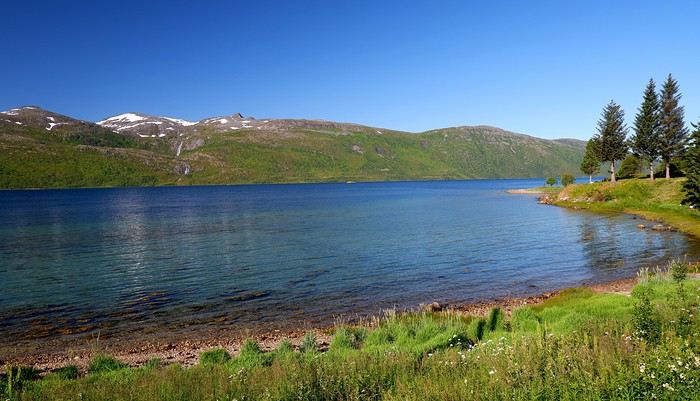
When we arrived at the Senja campsite, it was already 9:30 PM. A sign announced it was full, but luckily, I’d booked it 10 days earlier. By 10:30 PM, as we settled in to eat, it was still broad daylight, and the thermometer read 25°C—despite being at a latitude of 69° North! We went to bed around midnight, exhausted but under the light of a sun that was still very much present. Thanks to Earth’s tilted axis. We’d anticipated this by buying opaque sleep masks because, yes, at this time of year, it’s daylight all the time.
Friday, July 18:
Today, we planned two hikes on the island and a few stops along the way. The map clearly shows that the deepest fjords are in the north and west. Due to time and accessibility, we focused on the northern part of the island. Our first stop was at the viewing platform in Bergbotn:
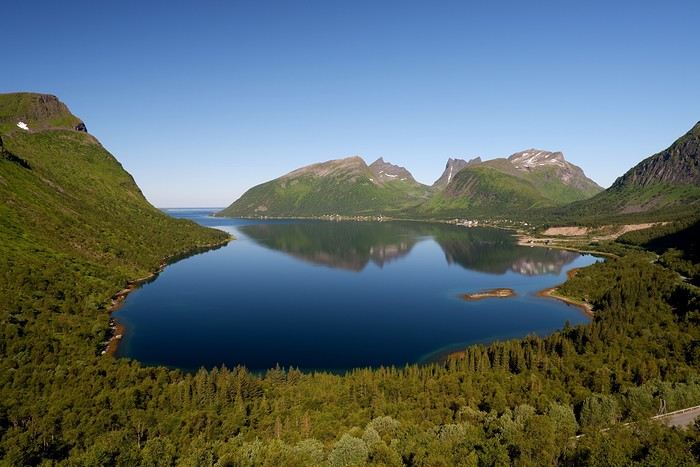
Then we headed toward Skaland, the starting point for our first hike. Along the way, we found plenty of reasons to stop—especially since, on this first day of travel, our thirst for Nordic landscapes was far from quenched.
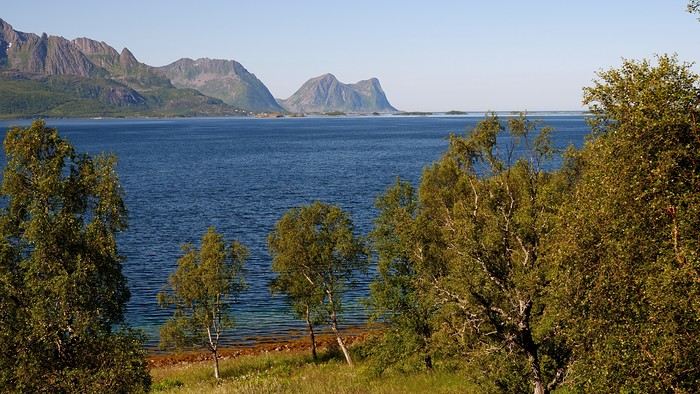
The town of Skaland is very practical: free parking, picnic tables for after the hike, and a Joker convenience store right next door. Our goal was the summit of Husfjellet: 670 m of elevation gain, between 8 and 9 km in length, and an estimated 4 hours and 30 minutes.
This hike offers two major viewpoints. The first overlooks the Bergsoyan islands to the west:
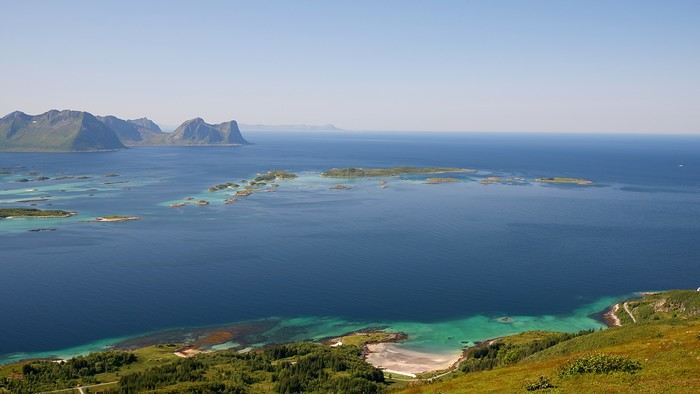
At the summit, the view shifts to the Steinfjorden fjord:
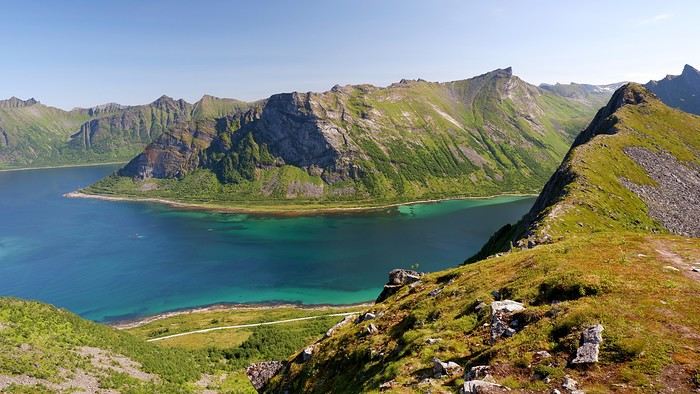
You can even clearly see the "Devil’s Teeth," which we’d see from below later:
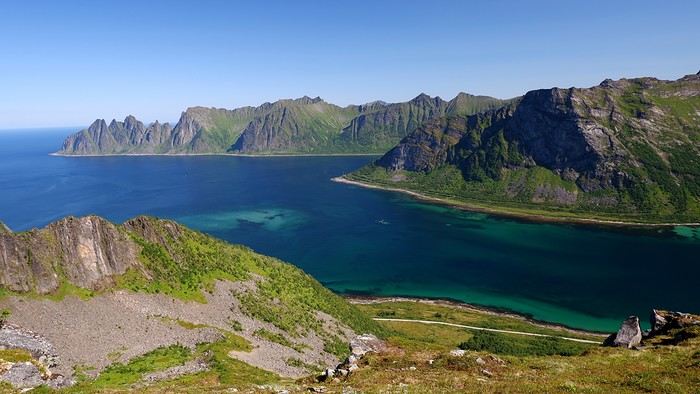
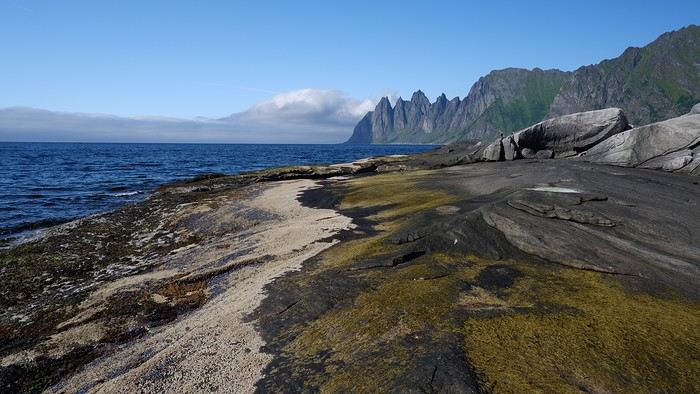
In total, the hike took us 4 hours and 30 minutes, including all the breaks. We treated ourselves to an ice cream in Skaland to recharge for the next hike. We hit the road again and stopped at Tungeneset to get a closer look at the Devil’s Teeth:
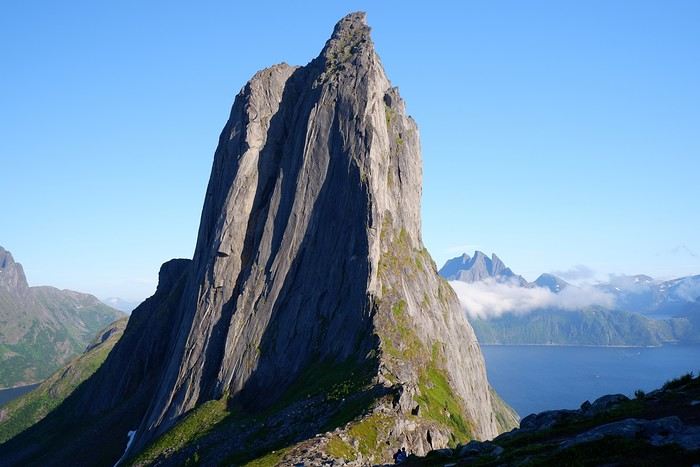
We continued to Fjordgard, the starting point for our second hike. Fjordgard isn’t very welcoming. There was a time when you could park right at the start of the hike up Mount Segla. Now, everything’s blocked off, and locals have even taken to blocking all possible parking spots nearby. You now have to park outside the town at a paid parking lot (90 NOK for 3 hours), adding an extra 2 km (round trip) of walking. Still, that was just a minor inconvenience because the hike that followed quickly made us forget all about it. The hike is fairly short (2 hours) but still has 520 m of elevation gain. This hike was a stark contrast to the first. This morning, we had sweeping views of the vast landscape. Here, Mount Segla, perched on the edge of the cliff, dominates the foreground:
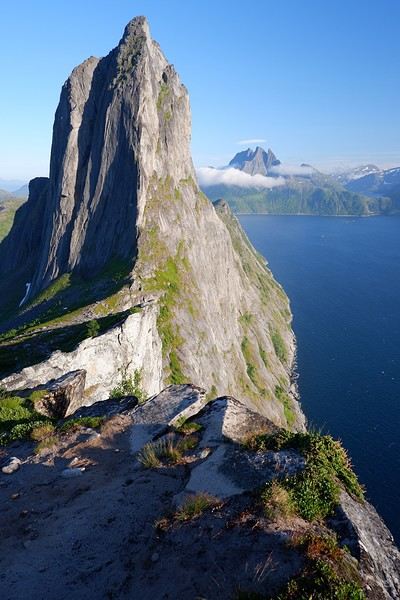
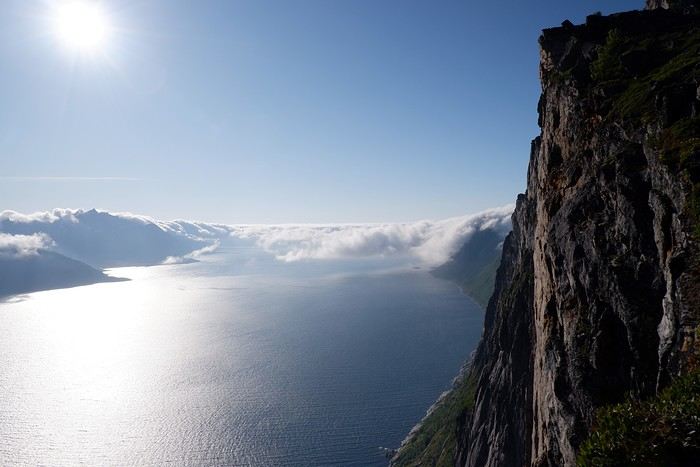
For those prone to vertigo, it might be best to stay at the foot of the mountain, as the trail climbs right along the cliff edge. And from that point on, you quickly understand what verticality really means...
In total, we took 2 hours and 50 minutes, including breaks and the extra walk to the parking lot. The day was already well underway, and with 1,200 m of cumulative elevation gain, it was time to find a spot to eat and sleep. Since we hadn’t made any reservations, we’d planned to bivouac for the night. We weren’t too picky—just practical—so we decided to sleep in the car at the parking lot for tomorrow morning’s hike, just 5 km from Fjordgard.
We traveled to Norway in the summer of 2025, from July 17 to 29, to visit Senja Island and the Lofoten archipelago with a rental car. The common thread of these twelve days was clearly hiking, along with a few visits and experiences, and nights spent in a tent or in the car (which made it possible). We chose Narvik Airport for both arrival and departure for several complementary reasons: the desire to visit nearby Senja Island, slightly more affordable airfare, and finally, the rental price of the vehicle—especially the car model we were looking for. We only made one reservation, for the first campsite, as sleeping in a tent made things much easier. But we had the whole structure of the trip planned, a flexible outline that could adapt to the weather conditions we’d encounter. Senja Island isn’t part of the Lofoten archipelago, and during the early stages of planning this trip, we hadn’t planned to visit it. But its relative proximity to Narvik Airport and, above all, its unique geography definitely made us change our minds. We arrived in Evenes, where Narvik Airport is located, nearly 60 km from the city itself. Our first stop was 40 km further in Bjerkvik on the way to Senja, where there’s a Rema 1000 (a very common supermarket chain in Norway). We needed to buy some food and a gas cartridge for our stove. I’d emailed the store manager beforehand, who told me they didn’t sell them but that the two gas stations in the village were likely to have some in stock.
It was only at the Esso station that I found what I needed, but unfortunately, only one cartridge. Luckily, we quickly realized that most campsites (like in Iceland) have a shared kitchen with hotplates. That single small cartridge was just enough for the few nights we spent outside of campsites... We got our first taste of Norway’s characteristic landscapes:
When we arrived at the Senja campsite, it was already 9:30 PM. A sign announced it was full, but luckily, I’d booked it 10 days earlier. By 10:30 PM, as we settled in to eat, it was still broad daylight, and the thermometer read 25°C—despite being at a latitude of 69° North! We went to bed around midnight, exhausted but under the light of a sun that was still very much present. Thanks to Earth’s tilted axis. We’d anticipated this by buying opaque sleep masks because, yes, at this time of year, it’s daylight all the time.
Friday, July 18:
Today, we planned two hikes on the island and a few stops along the way. The map clearly shows that the deepest fjords are in the north and west. Due to time and accessibility, we focused on the northern part of the island. Our first stop was at the viewing platform in Bergbotn:
Then we headed toward Skaland, the starting point for our first hike. Along the way, we found plenty of reasons to stop—especially since, on this first day of travel, our thirst for Nordic landscapes was far from quenched.
The town of Skaland is very practical: free parking, picnic tables for after the hike, and a Joker convenience store right next door. Our goal was the summit of Husfjellet: 670 m of elevation gain, between 8 and 9 km in length, and an estimated 4 hours and 30 minutes.
This hike offers two major viewpoints. The first overlooks the Bergsoyan islands to the west:
At the summit, the view shifts to the Steinfjorden fjord:
You can even clearly see the "Devil’s Teeth," which we’d see from below later:
In total, the hike took us 4 hours and 30 minutes, including all the breaks. We treated ourselves to an ice cream in Skaland to recharge for the next hike. We hit the road again and stopped at Tungeneset to get a closer look at the Devil’s Teeth:
We continued to Fjordgard, the starting point for our second hike. Fjordgard isn’t very welcoming. There was a time when you could park right at the start of the hike up Mount Segla. Now, everything’s blocked off, and locals have even taken to blocking all possible parking spots nearby. You now have to park outside the town at a paid parking lot (90 NOK for 3 hours), adding an extra 2 km (round trip) of walking. Still, that was just a minor inconvenience because the hike that followed quickly made us forget all about it. The hike is fairly short (2 hours) but still has 520 m of elevation gain. This hike was a stark contrast to the first. This morning, we had sweeping views of the vast landscape. Here, Mount Segla, perched on the edge of the cliff, dominates the foreground:
For those prone to vertigo, it might be best to stay at the foot of the mountain, as the trail climbs right along the cliff edge. And from that point on, you quickly understand what verticality really means...
In total, we took 2 hours and 50 minutes, including breaks and the extra walk to the parking lot. The day was already well underway, and with 1,200 m of cumulative elevation gain, it was time to find a spot to eat and sleep. Since we hadn’t made any reservations, we’d planned to bivouac for the night. We weren’t too picky—just practical—so we decided to sleep in the car at the parking lot for tomorrow morning’s hike, just 5 km from Fjordgard.
Two weeks in Corfu with the family – our feedback
Hi everyone,
Here’s a little account of our two-week family trip (with two boys aged 7 and 10) to Corfu. I hope it helps other travelers! We chose Corfu because there are direct flights from Paris, and we were looking for a destination where it’d be easy to swim with the kids. We were there from August 14 to 28.
Since I wasn’t sure about the distances and had read quite a bit about Greek driving and the state of the roads, I decided to split the trip into three parts: Corfu Town, the North, and the South.
Corfu Town (3 nights) Day 1: We landed in the late afternoon. Booked three nights via Booking on the edge of the old town (Sueno Garden Apartment), which is walkable from the airport—no need to rent a car for the first few days or stay in Corfu Town. First evening in the old town, dinner at Pane e Souvlaki on Dimarchiou Square. Touristy, but good vibes.
Day 2: Visited the Old Fort. Nice for the Church of St. George, which looks like an ancient Greek temple, and especially for the 360° view from the top. By 11 a.m., the sun was already beating down. Left the fort and strolled through the People’s Gardens. Lunch at Mouragia a bit further away, then backtracked to let the kids swim at Faliraki Bathing Beach.
Day 3: We took bus line 2A from Spinada (in front of the Old Fort) to the end of the runway (stop ΚΑΛΟΚΑΙΡΙ Ε). Poorly signposted when you’re at the top—you have to go down via the bar. Not well set up, which is a shame. The Panagia Vlacherna Monastery is pretty on its little island, but don’t turn around—the landings are impressive. Returned via the 2A with a stop at Mon Repos Beach, where the kids loved jumping off the pier.
North (6 nights) Day 4: Headed to Sidari, rented a small Fiat Panda from Europcar—no issues with this rental company (I booked late, so it’s probably possible to find cheaper). We’d also booked via Booking at Blue Dreams Apartment, just south of Sidari. A family-run hotel with a nice pool, we had a great stay (it’s just been taken over by Belgians who speak French). We wandered around Sidari to the Canal d’Amour. Not easy to access—you have to walk through all the bars, and the tiny beach is pretty dirty. Still, it’s fun for a swim and exploring the cave.
Day 5: Quick breakfast to be at Cap Drastis by 9 a.m. Parked at the top, but there’s very little space (we couldn’t park on the way back), and it’s a dirt road. The signs saying “To the sea” actually lead to a boat dock for a cape tour. You only see the cape from above, not below. A bit of a letdown, but since it was early and no one was down there yet, we treated ourselves to a quick swim. Brunch back in Sidari at Eviva—I recommend it: not Greek at all, but high quality. Agios Stefanos in the late afternoon after the heat. The port is awful (dirty and uninteresting), but there’s a swimming spot just before the beach, near the old port (park above, by the church). No one was there—great moment with the kids.
Day 6: Left around 9 a.m. for Mount Pantokrator. A bit of a climb at the end in the Fiat Panda—it’s steep! The road is long, but I think it’s worth it for the lunar landscape at the top, the monastery-antenna, and the 360° view. Then down to Kassiopi (we paid 5 euros for the Kassiopi Car Park—I think it’s the best option, as there’s no big free parking like in Sidari) and a swim at Paralia Mpataria (small but nice). Really relaxing in the late afternoon. Walked around the peninsula and saw several dolphin pods with amazing jumps. Unforgettable. Kassiopi is more family-friendly than Sidari and has more charm (Sidari has none, so that’s easy!).
Day 7: Morning off at the hotel, then afternoon at Paralia Kalamaki for the inflatable playground the kids had spotted on the way back from Kassiopi. 10 euros per person for an hour, not many people around 4 p.m., and we had a blast. Shallow sandy beach. Not much marine life, but safe for young kids. Note: free freshwater shower. Dinner at Nikos Family Restaurant in Roda. Great welcome and atmosphere. The stifado and soutzoukakia were delicious, and the Greek desserts were amazing too. Next door, at Roda Park restaurant, there was a Greek party with traditional dancing and plaster plate-smashing. Even though we didn’t eat there, everyone was invited to join in the street—it was fun. Probably touristy, but pretty spontaneous, and it was a good time.
Day 8: I’d booked two dives in Paleokastritsa with Achilleon Diving Center, directly via WhatsApp. Great international vibe, two easy but interesting dives (a barracuda school and a “cow” nudibranch at Colovri Reefs, cool crevasses and holes at Donald’s Place). In the afternoon, we visited the Paleokastritsa Monastery (well-maintained, pretty nice) and spent some time at the beach (very crowded).
Day 9: Day off—we enjoyed the hotel pool and went to Olea next door to buy a small olive wood souvenir. Note that the old man who works the wood doesn’t have many fingers left…
South (5 nights) Day 10: Headed to Lefkimmi. Stopped at Achilleion on the way. I knew from reviews that only the gardens were accessible, but I think it’s worth it, even at 7 euros. We passed by the French military cemetery nearby (nothing special, poorly signposted but quiet and peaceful) and ate at Elia Tavern right next door: super good, best calamari of the trip. We’d booked our accommodation at Villa Rosa South Corfu, a bit outside Lefkimmi, near Alikes. Pretty isolated, but the beach is a 3-minute walk away, right next to the old salt pans. On the way, we saw a poster (use Google Lens to translate) for a local festival near Linia. We went that evening: barbecue, concert, and local dancing. Lots of people, but only locals—it was a great time.
Day 11: Short “hike” to Arkoudilas. We parked at the exit of Kavos, just before The Rose Tree restaurant. Some people drive all the way to the beach, but it’s very rocky. We followed the “Monastery” path to see Cape Asprokavos and the ruins of the monastery nearby. To avoid backtracking, we continued through the woods after the monastery to reach Arkoudilas Beach. Nice shaded walk, but dusty road. Dinner at Agali on the Potami Canal (friendly family vibe, but long wait).
Day 12: Boat trip to Sivota with Pegasus. A wooden boat, human-sized. Crowded, but not cramped. Two swimming stops (Blue Lagoon in the morning and a beach in the afternoon) and a 2-hour stop at noon in Sivota. We knew it’d be touristy, but the vibe was good, with some dancing on the way back. Not too many people at the swimming stops.
Day 13: Kouris Museum in Lefkimmi. Okay, don’t go for the history—the guide cracks more jokes than gives rational explanations. Still, we laughed a lot and had a great time. Lunch at The Village on the main road: very fresh, very good. Perfect homemade dip platter. Not the best location since it’s right on the road, but it’s worth it. Free ice cream for the kids, super-friendly owner. Fresh ratatouille (finally, some veggies!). Afternoon at Paralia Issos. View of Korission Lagoon and a walk through the sand dunes, a bit like the Sahara in places (hard to do before 5 p.m., even 6 p.m., because of the heat).
Day 14: I’d booked a visit/tasting at Pontiglio Winery. Short tour of the small site and tasting of the 4 wines produced there: 2 whites, 1 red, 1 rosé. Fresh homemade snacks, fruit for the kids, great welcome. Then to Paralia Kanoula Beach. Mikro Nisi Bar, sunbeds at 20 euros—expensive. But a nice beach with some rocks, so a bit of marine life. We saw octopuses while snorkeling with the kids—great moment.
Honest take on Corfu The island is dirty—not just at the garbage sites, which aren’t collected often enough and overflow constantly, but everywhere. Not a single square meter without cigarette butts, even if you get off the main paths. Stray cats everywhere, wasps everywhere, sewage smells often.
The natural heritage is stunning but ruined by private encroachment on the coastline. Bars and restaurants take over the land right up to the sea. I’d only been to Santorini and Paros about ten years ago, and I don’t remember it being like this at all. Maybe the Cyclades are different now. From talking to a few tourists here and there, it seems Crete is better managed. We still had a good vacation, even if it was sometimes hard to overlook the dirtiness.
Here’s a little account of our two-week family trip (with two boys aged 7 and 10) to Corfu. I hope it helps other travelers! We chose Corfu because there are direct flights from Paris, and we were looking for a destination where it’d be easy to swim with the kids. We were there from August 14 to 28.
Since I wasn’t sure about the distances and had read quite a bit about Greek driving and the state of the roads, I decided to split the trip into three parts: Corfu Town, the North, and the South.
Corfu Town (3 nights) Day 1: We landed in the late afternoon. Booked three nights via Booking on the edge of the old town (Sueno Garden Apartment), which is walkable from the airport—no need to rent a car for the first few days or stay in Corfu Town. First evening in the old town, dinner at Pane e Souvlaki on Dimarchiou Square. Touristy, but good vibes.
Day 2: Visited the Old Fort. Nice for the Church of St. George, which looks like an ancient Greek temple, and especially for the 360° view from the top. By 11 a.m., the sun was already beating down. Left the fort and strolled through the People’s Gardens. Lunch at Mouragia a bit further away, then backtracked to let the kids swim at Faliraki Bathing Beach.
Day 3: We took bus line 2A from Spinada (in front of the Old Fort) to the end of the runway (stop ΚΑΛΟΚΑΙΡΙ Ε). Poorly signposted when you’re at the top—you have to go down via the bar. Not well set up, which is a shame. The Panagia Vlacherna Monastery is pretty on its little island, but don’t turn around—the landings are impressive. Returned via the 2A with a stop at Mon Repos Beach, where the kids loved jumping off the pier.
North (6 nights) Day 4: Headed to Sidari, rented a small Fiat Panda from Europcar—no issues with this rental company (I booked late, so it’s probably possible to find cheaper). We’d also booked via Booking at Blue Dreams Apartment, just south of Sidari. A family-run hotel with a nice pool, we had a great stay (it’s just been taken over by Belgians who speak French). We wandered around Sidari to the Canal d’Amour. Not easy to access—you have to walk through all the bars, and the tiny beach is pretty dirty. Still, it’s fun for a swim and exploring the cave.
Day 5: Quick breakfast to be at Cap Drastis by 9 a.m. Parked at the top, but there’s very little space (we couldn’t park on the way back), and it’s a dirt road. The signs saying “To the sea” actually lead to a boat dock for a cape tour. You only see the cape from above, not below. A bit of a letdown, but since it was early and no one was down there yet, we treated ourselves to a quick swim. Brunch back in Sidari at Eviva—I recommend it: not Greek at all, but high quality. Agios Stefanos in the late afternoon after the heat. The port is awful (dirty and uninteresting), but there’s a swimming spot just before the beach, near the old port (park above, by the church). No one was there—great moment with the kids.
Day 6: Left around 9 a.m. for Mount Pantokrator. A bit of a climb at the end in the Fiat Panda—it’s steep! The road is long, but I think it’s worth it for the lunar landscape at the top, the monastery-antenna, and the 360° view. Then down to Kassiopi (we paid 5 euros for the Kassiopi Car Park—I think it’s the best option, as there’s no big free parking like in Sidari) and a swim at Paralia Mpataria (small but nice). Really relaxing in the late afternoon. Walked around the peninsula and saw several dolphin pods with amazing jumps. Unforgettable. Kassiopi is more family-friendly than Sidari and has more charm (Sidari has none, so that’s easy!).
Day 7: Morning off at the hotel, then afternoon at Paralia Kalamaki for the inflatable playground the kids had spotted on the way back from Kassiopi. 10 euros per person for an hour, not many people around 4 p.m., and we had a blast. Shallow sandy beach. Not much marine life, but safe for young kids. Note: free freshwater shower. Dinner at Nikos Family Restaurant in Roda. Great welcome and atmosphere. The stifado and soutzoukakia were delicious, and the Greek desserts were amazing too. Next door, at Roda Park restaurant, there was a Greek party with traditional dancing and plaster plate-smashing. Even though we didn’t eat there, everyone was invited to join in the street—it was fun. Probably touristy, but pretty spontaneous, and it was a good time.
Day 8: I’d booked two dives in Paleokastritsa with Achilleon Diving Center, directly via WhatsApp. Great international vibe, two easy but interesting dives (a barracuda school and a “cow” nudibranch at Colovri Reefs, cool crevasses and holes at Donald’s Place). In the afternoon, we visited the Paleokastritsa Monastery (well-maintained, pretty nice) and spent some time at the beach (very crowded).
Day 9: Day off—we enjoyed the hotel pool and went to Olea next door to buy a small olive wood souvenir. Note that the old man who works the wood doesn’t have many fingers left…
South (5 nights) Day 10: Headed to Lefkimmi. Stopped at Achilleion on the way. I knew from reviews that only the gardens were accessible, but I think it’s worth it, even at 7 euros. We passed by the French military cemetery nearby (nothing special, poorly signposted but quiet and peaceful) and ate at Elia Tavern right next door: super good, best calamari of the trip. We’d booked our accommodation at Villa Rosa South Corfu, a bit outside Lefkimmi, near Alikes. Pretty isolated, but the beach is a 3-minute walk away, right next to the old salt pans. On the way, we saw a poster (use Google Lens to translate) for a local festival near Linia. We went that evening: barbecue, concert, and local dancing. Lots of people, but only locals—it was a great time.
Day 11: Short “hike” to Arkoudilas. We parked at the exit of Kavos, just before The Rose Tree restaurant. Some people drive all the way to the beach, but it’s very rocky. We followed the “Monastery” path to see Cape Asprokavos and the ruins of the monastery nearby. To avoid backtracking, we continued through the woods after the monastery to reach Arkoudilas Beach. Nice shaded walk, but dusty road. Dinner at Agali on the Potami Canal (friendly family vibe, but long wait).
Day 12: Boat trip to Sivota with Pegasus. A wooden boat, human-sized. Crowded, but not cramped. Two swimming stops (Blue Lagoon in the morning and a beach in the afternoon) and a 2-hour stop at noon in Sivota. We knew it’d be touristy, but the vibe was good, with some dancing on the way back. Not too many people at the swimming stops.
Day 13: Kouris Museum in Lefkimmi. Okay, don’t go for the history—the guide cracks more jokes than gives rational explanations. Still, we laughed a lot and had a great time. Lunch at The Village on the main road: very fresh, very good. Perfect homemade dip platter. Not the best location since it’s right on the road, but it’s worth it. Free ice cream for the kids, super-friendly owner. Fresh ratatouille (finally, some veggies!). Afternoon at Paralia Issos. View of Korission Lagoon and a walk through the sand dunes, a bit like the Sahara in places (hard to do before 5 p.m., even 6 p.m., because of the heat).
Day 14: I’d booked a visit/tasting at Pontiglio Winery. Short tour of the small site and tasting of the 4 wines produced there: 2 whites, 1 red, 1 rosé. Fresh homemade snacks, fruit for the kids, great welcome. Then to Paralia Kanoula Beach. Mikro Nisi Bar, sunbeds at 20 euros—expensive. But a nice beach with some rocks, so a bit of marine life. We saw octopuses while snorkeling with the kids—great moment.
Honest take on Corfu The island is dirty—not just at the garbage sites, which aren’t collected often enough and overflow constantly, but everywhere. Not a single square meter without cigarette butts, even if you get off the main paths. Stray cats everywhere, wasps everywhere, sewage smells often.
The natural heritage is stunning but ruined by private encroachment on the coastline. Bars and restaurants take over the land right up to the sea. I’d only been to Santorini and Paros about ten years ago, and I don’t remember it being like this at all. Maybe the Cyclades are different now. From talking to a few tourists here and there, it seems Crete is better managed. We still had a good vacation, even if it was sometimes hard to overlook the dirtiness.
2 weeks in the Cyclades
Hi everyone!
Blue skies (lots of them), whitewashed villages with steep alleyways, hundreds of churches, and... thousands of stairs? Welcome to the Cyclades! 🙂
We’d been dreaming about this for a while, but in July-August—with the crowds—no way! Now that I can travel outside school holidays, the Cyclades are back on the agenda. And so begins a loooong period of planning and second-guessing, with countless itinerary changes: the Cyclades, yes, but which ones? I was fixated on Folegandros (we won’t be going after all) and really wanted to visit Delos. So, for this first trip, it’ll be: Mykonos (and Delos)-Naxos-Amorgos-Santorini.
Saturday 24/05: Departure from Orly on a Transavia flight, arriving in Mykonos in the late afternoon. We found a hotel that offers free transfers (pretty rare and not insignificant—it’s 25 € each way for just a few kilometers 😠) and at a reasonable price (83 € per night for B&B). Time for dinner already: Greek salad and souvlaki (we’re in Greece, right?)
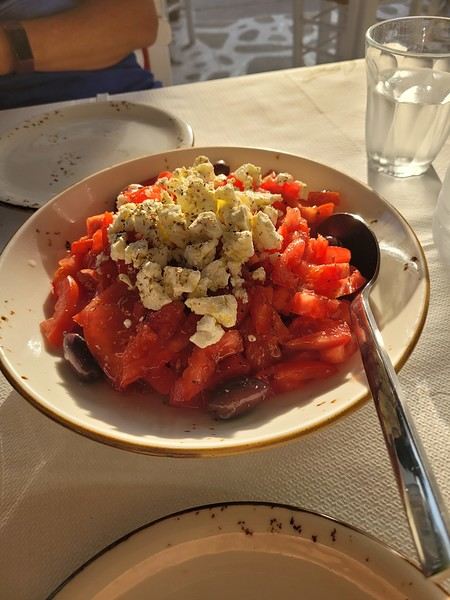 (Okay, this is actually a dakos with Naxos cheese, but I don’t have a photo of a Greek salad 😏).
Blue skies (lots of them), whitewashed villages with steep alleyways, hundreds of churches, and... thousands of stairs? Welcome to the Cyclades! 🙂
We’d been dreaming about this for a while, but in July-August—with the crowds—no way! Now that I can travel outside school holidays, the Cyclades are back on the agenda. And so begins a loooong period of planning and second-guessing, with countless itinerary changes: the Cyclades, yes, but which ones? I was fixated on Folegandros (we won’t be going after all) and really wanted to visit Delos. So, for this first trip, it’ll be: Mykonos (and Delos)-Naxos-Amorgos-Santorini.
Saturday 24/05: Departure from Orly on a Transavia flight, arriving in Mykonos in the late afternoon. We found a hotel that offers free transfers (pretty rare and not insignificant—it’s 25 € each way for just a few kilometers 😠) and at a reasonable price (83 € per night for B&B). Time for dinner already: Greek salad and souvlaki (we’re in Greece, right?)
(Okay, this is actually a dakos with Naxos cheese, but I don’t have a photo of a Greek salad 😏).Australia 2025: Discovering the 5th Continent
Hi everyone.
Because that’s also what sparks the desire in every traveler (well, at least for me) to set foot on Australian soil: discovering a new continent.
Right now, I’ve got some time on my hands—those who follow me know that. A nasty muscle tear (which really doesn’t want to heal) is keeping me grounded for another week, so I’ve decided to open a new travel journal, recounting my recent trip from December 14, 2024, to January 12, 2025, in Australia.
The origins of this trip started last May in Crete, an island I chose for a 10-day break. It’s really lovely, by the way, but that’s not the point… It’s around this time every year that we decide on our next winter destination, and Argentina was at the top of the list—Sydney wasn’t even on the radar… I’d been looking at flights to Buenos Aires for a while, and the prices were shocking… But by the pool one lazy afternoon, scrolling on my iPhone, a promo from Geneva to Sydney caught my eye. The deal ticked two boxes on my traveler’s bucket list: a flight to Australia and a flight with Singapore Airlines, often ranked as the world’s best airline. A quick chat with the missus (well, of course!) and the decision was made: off to the land of kangaroos! Now, once you add luggage and Economy Plus, it still comes to 1600 € per person, but that’s a reasonable price. Either way, we already know what we’re in for—Australia is a budget commitment!

Thanks to 123rf for the image loan 😛
Right now, I’ve got some time on my hands—those who follow me know that. A nasty muscle tear (which really doesn’t want to heal) is keeping me grounded for another week, so I’ve decided to open a new travel journal, recounting my recent trip from December 14, 2024, to January 12, 2025, in Australia.
The origins of this trip started last May in Crete, an island I chose for a 10-day break. It’s really lovely, by the way, but that’s not the point… It’s around this time every year that we decide on our next winter destination, and Argentina was at the top of the list—Sydney wasn’t even on the radar… I’d been looking at flights to Buenos Aires for a while, and the prices were shocking… But by the pool one lazy afternoon, scrolling on my iPhone, a promo from Geneva to Sydney caught my eye. The deal ticked two boxes on my traveler’s bucket list: a flight to Australia and a flight with Singapore Airlines, often ranked as the world’s best airline. A quick chat with the missus (well, of course!) and the decision was made: off to the land of kangaroos! Now, once you add luggage and Economy Plus, it still comes to 1600 € per person, but that’s a reasonable price. Either way, we already know what we’re in for—Australia is a budget commitment!
Thanks to 123rf for the image loan 😛
Planning a trip to Italy: practical questions about Rome, Tuscany, and guided tours
Hi there, I live in Quebec and I’m planning a trip to Italy. We’re thinking of visiting Rome, Florence, Venice, and Tuscany. Here are a few questions I haven’t been able to find clear answers to online. If anyone can help, I’d really appreciate it—thanks in advance!
- There are different City Passes for Rome. I’ve found the differences between them, but whenever I try to simulate a purchase, I’m always redirected to another site like Tiquet. Is there an official Tourism Office website for these?
- Is it easy to get around Tuscany by public transport, especially in the Chianti region?
- For guided tours (or not), which company do you prefer? Get Your Guide? Viator?
Looking forward to your recommendations—thanks again!
- There are different City Passes for Rome. I’ve found the differences between them, but whenever I try to simulate a purchase, I’m always redirected to another site like Tiquet. Is there an official Tourism Office website for these?
- Is it easy to get around Tuscany by public transport, especially in the Chianti region?
- For guided tours (or not), which company do you prefer? Get Your Guide? Viator?
Looking forward to your recommendations—thanks again!
Drakensberg in August: is it the right time?
Hi there,
We’re heading to South Africa in August 2025 and planning a classic loop that I’d love to finish with the Drakensberg (I’m a big hiking fan) before returning to Johannesburg to catch our flight.
I’ve got 3 nights for this part of our trip. But I’m wondering if it’s actually a good idea to hike in the Drakensberg in August, since it’s the Southern Hemisphere winter (I’m from Réunion and we hike year-round there, but I don’t know what the climate’s like in South Africa, especially the Drakensberg).
I’m particularly worried about getting stuck because of snow and missing our flight... ;)
I’ve read so many different things that I’m totally confused!
If it’s okay to hike at this time of year, what would you recommend? I’m torn between Champagne Valley and Royal Natal National Park.
Thanks in advance for your firsthand tips!
Malijp
Recommendations for a 3-week itinerary in Western Canada
Hi everyone,
Here’s the itinerary I’ve planned for this summer. I’d love to get your thoughts and recommendations on it. We’ll be 2 adults and a 15-year-old teen.
11/07 Calgary - arrival around 9 PM 12/07 Calgary - exploring the city 13/07 Calgary : Stampede 14/07 (Canmore) Banff - Kananaskis Valley - Town of Canmore - Banff Centre - Upper Hot Spring (pool) 15/07 Banff - Johnston Canyon - Lake Louise - Moraine Lake 16/07 Banff - Banff Gondola with ridge walk (1 km) - Lake Minnewanka 17/07 Yoho (Field) - Herbert Lake - Yoho Valley Road (before Field) - Field - Natural Bridge - Emerald Lake + hike to Takakkaw Falls - night at The Crossing 18/07 Jasper - Icefields Parkway - Herbert Lake - Bow Lake - Peyto Lake viewpoint (15 min from the parking lot) - Saskatchewan River Crossing - Columbia Icefield with the Skywalk - Sunwapta Falls - Goat and Glacier Lookout - Athabasca Falls 19/07 Jasper - Maligne Valley - Medicine Lake - Maligne Lake 20/07 Jasper - Whistlers Peak - Miette Hot Springs 21/07 Wells Gray - Yellowhead Highway 22/07 Wells Gray - Helmcken Falls - Dawson Falls - Spahats Falls - Clearwater Lake 23/07 Hat Creek Ranch 24/07 Whistler 25/07 Whistler 26/07 Nanaimo - Sea to Sky Highway - 1.5-hour ferry 27/07 Nanaimo - North Coast - Rathtrevor Beach Provincial Park - Old Country Market - Goats on Roof - McMillan Provincial Park - Cathedral Grove 28/07 Victoria - Kinsol Trestle - Malahat Skywalk 29/07 Victoria - whale watching 30/07 Victoria - Inner Harbour - Chinatown - Fisherman’s Wharf floating houses 31/07 Vancouver - 3-hour ferry 01/08 Vancouver 02/08 Departure
We’re being really careful not to spend more than 3 to 4 hours driving between stops. We want to take our time. Thanks for your input....
Here’s the itinerary I’ve planned for this summer. I’d love to get your thoughts and recommendations on it. We’ll be 2 adults and a 15-year-old teen.
11/07 Calgary - arrival around 9 PM 12/07 Calgary - exploring the city 13/07 Calgary : Stampede 14/07 (Canmore) Banff - Kananaskis Valley - Town of Canmore - Banff Centre - Upper Hot Spring (pool) 15/07 Banff - Johnston Canyon - Lake Louise - Moraine Lake 16/07 Banff - Banff Gondola with ridge walk (1 km) - Lake Minnewanka 17/07 Yoho (Field) - Herbert Lake - Yoho Valley Road (before Field) - Field - Natural Bridge - Emerald Lake + hike to Takakkaw Falls - night at The Crossing 18/07 Jasper - Icefields Parkway - Herbert Lake - Bow Lake - Peyto Lake viewpoint (15 min from the parking lot) - Saskatchewan River Crossing - Columbia Icefield with the Skywalk - Sunwapta Falls - Goat and Glacier Lookout - Athabasca Falls 19/07 Jasper - Maligne Valley - Medicine Lake - Maligne Lake 20/07 Jasper - Whistlers Peak - Miette Hot Springs 21/07 Wells Gray - Yellowhead Highway 22/07 Wells Gray - Helmcken Falls - Dawson Falls - Spahats Falls - Clearwater Lake 23/07 Hat Creek Ranch 24/07 Whistler 25/07 Whistler 26/07 Nanaimo - Sea to Sky Highway - 1.5-hour ferry 27/07 Nanaimo - North Coast - Rathtrevor Beach Provincial Park - Old Country Market - Goats on Roof - McMillan Provincial Park - Cathedral Grove 28/07 Victoria - Kinsol Trestle - Malahat Skywalk 29/07 Victoria - whale watching 30/07 Victoria - Inner Harbour - Chinatown - Fisherman’s Wharf floating houses 31/07 Vancouver - 3-hour ferry 01/08 Vancouver 02/08 Departure
We’re being really careful not to spend more than 3 to 4 hours driving between stops. We want to take our time. Thanks for your input....
Feedback on a 10-day road trip through the Norwegian fjords
Hi there!
I’m planning a road trip in a camper van around the fjords in Norway and would love to get some feedback and tips on the itinerary.
It’s a 10-day trip:
Day 1: Land in Bergen and drive to Odda
Day 2: Odda (full-day hike to Trolltunga)
Day 3: Kinsarvik (hike in Hardangervidda National Park)
Day 4: Geilo (hike in Hallingskarvet National Park)
Day 5: Hike in Jotunheimen National Park via the Gjendesheim ferry
Day 6: Fossbergom
Day 7: Luster and hike in Jostedalsbreen National Park
Day 8: Flam
Day 9: Bergen
Day 10: Bergen + departure
For the camper van rental, I’ve reached out to this site: https://campervanbergen.com, which seems pretty good with reasonable rates. If you have any comments or advice on the itinerary or the rental company, I’d love to hear them! Thanks in advance! Romain
For the camper van rental, I’ve reached out to this site: https://campervanbergen.com, which seems pretty good with reasonable rates. If you have any comments or advice on the itinerary or the rental company, I’d love to hear them! Thanks in advance! Romain