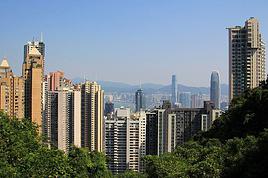
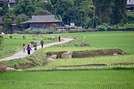
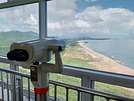
Hong Kong possède une telle scénicité qu'y arriver en beauté - c'est a dire par la mer - demande un petit effort.
Route : aéroport - Tung Chung (Lantau) - Mui Wo (Lantau) - bateau - Central (Hong Kong Island)
Du hall d'arrivée a l'aéroport prendre au fond a gauche la rampe qui descend aux différents arrets de bus. mais celui qui nous préoccupe (le S1 assez régulier ou le A35/N35 qui va directememnt a Mui Wo, pour 15 Dollars, ne circule qu'a 6h25, 6h55, 8h35, 18h20, 23h30, 1h30 et 4h30 !!!) n'est pas parmi eux.
Il faut au bas de la rampe prendre a droite a 180 degrés et faire environ 200 metres pour se retrouver pratiquement sous le hall des arrivée. C'est la que se situe l'arret du bus S1 qui va a Tung Chung en une dizaine de minutes pour 3, 50 Dollars.
De la gare des bus de Tung Chung prendre le bus 3M qui pour 16, 20 Dollars et une petite heure d'une belle route de montagne vous menera au port de Mui Wo d'ou un bateau part toutes les 40 minutes pour un prix de 19, 20 Dollars et arrive a Central une heure plus tard. S'asseoir au rez-de-chaussée sur la droite a l'avant pour la vue (et quelle vue !!) en arrivant a Central.
Trajet total d'environ 2h15 + les temps de changement.
Juste en face de l'arrivée du bateau il y a l'arret du bus numéro 10 qui pour environ 10 Dollars monte au Peak pour la vue sur l'ensemble du site.
De l'aéroport, en bus A21 c'est 1 heure par Nathan Road et 33 Dollars.
En train c'est encore plus rapide et - si j'ai bien vu - 55 Dollars.
Mais plus ca va vite et moins le paysage est intéressant. Notez que les 3/4 des gens dans le bateau ... roupillait !!!
"Nous ne sommes plus une communauté d'être humains qui se parlent mais un conglomérat de grappes de consommateurs en niches, séparés les uns des autres par des obsessions diverses et innombrables. Nous sommes de l'ère de la désintégration." Marc Moulin (1942-2008) in Humoeurs
Je m'autorise quelques rectificatifs sur ce que tu viens d'écrire :
si tu veux te rendre directement à Mui Wo depuis l'aéroport, le A35 part toutes les heures entre 06h25 et 00h25
le bus n°10 relie Kennedy Town à North Point. Pour se rendre au Peak c'est le n°15 qu'il faut prendre ou bien le 15C qui emmène les passagers jusqu'au départ du Tram
le bus A21 ne dessert que Kowloon et ne va ni à Central ni au Peak
le prix de 55 HKD en Airport Express c'est uniquement si on fait le trajet à 4 entre l'aéroport et Kowloon. Le prix pour une personne seule c'est 100 HKD jusqu'à Central
Je glisse toujours intentionnellement quelques erreurs pour amener les réactions 🤪
le A35/N35 : il y a un avis accroché au poteau en dessous du numéro disant que les horaires étaient mofdifiés comme je l'ai indiqué
tu as parfaitement raison il fallait lire 15 ou 15C et non pas 10 pour monter au Peak. Cette info pour ceux qui sont en transit de quelques heures et qui voudraient "voir' un peu Hong Kong en tirant unn parti maximum de leur quelques heures.
le bus A21 va - me semble-t'il - jusqu'au départ des Star Ferry qui traversent le chennal entre Kowloon et Hong Kong Island pour 2, 20 Dollars (pont supérieur) ou 1, 70 Dollars (pont inférieur)
en général je privilégie le train au bus mais dans le cas présent je ne pense pas que ce soit le mode de transport le plus adéquoit = rapport qualité/prix j'entend
Sinon que penses-tu de cet "exercice" que j'ai expérimenté avec succes hier avec toutefois quelques "petits problemes" au départ pour trouver l'arret du bus S1 a l'aéroport ?
Merci pour tes corrections et compléments d'informations
"Nous ne sommes plus une communauté d'être humains qui se parlent mais un conglomérat de grappes de consommateurs en niches, séparés les uns des autres par des obsessions diverses et innombrables. Nous sommes de l'ère de la désintégration." Marc Moulin (1942-2008) in Humoeurs
Et bien, je dirai que le trajet me semble un peu trop long et qu'après 12 heures d'avion on a hâte de se jeter sous la douche plutôt que passer deux heures dans les transports. 🤪
Le plus rapide sera le taxi. 30 minutes environ mais 300-400 HKD. Vaut le coup si l'on est plusieurs.
Le terminus du bus A21 se situe à Hung Hom Station, où je réside. Point de passage par le Star Ferry Pier. Le plus proche arrêt sera vers les Chunking Mansions.
Bah... en vacances, on a toujours le temps. Surtout le premier jour. Le bus est vraiment une bonne option : 33 HKD pour se rendre à Tsim Sha Tsui, 40 HKD (A11) pour se rendre à Central. Dans des sièges plutôt confortables. Rapport qualité / prix, c'est nickel.
PS : Iconozca, sais-tu ce que sont ces minibus qui s'arrêtent très tôt le matin (vers 5h30) sur Nathan Road, juste avant le passage de l'A21 ? Ils se rendent à l'aéroport et doivent travailler avec des hôtels (les passagers déjà installés sont transportés gratuitement). Ils demandent 40 HKD pour aller jusqu'à l'aéroport. Je l'ai pris deux fois, on est vraiment bien installé dans des fauteuils tous moelleux et on arrive bien plus vite qu'avec l'A21.
Ils s'arrangent en général pour passer juste avant le A21 pour débaucher les clients qui attendent sur le trottoir. Aucune idée si le chauffeur possède effectivement son permis 😄
Pour la question de la durée de trajet c'est pas le temps que mettra le A21 ou le A11 qui m'interpelle, c'est la combinaison Bus + re Bus + bateau que je trouve trop longue surtout si, a l'arrivée à Central, on est obligé de reprendre un autre moyen de transport pour se rendre à sa destination finale.
Je dois toutefois admettre que le bateau, ça a beaucoup de charme.
Ils s'arrangent en général pour passer juste avant le A21 pour débaucher les clients qui attendent sur le trottoir. Aucune idée si le chauffeur possède effectivement son permis 😄
Son permis... de conduire ?
Les bus dont je parle sont des petits bus très classes. Les fauteuils sont terriblement confortables, surtout à 5h30 du matin... J'ai eu l'impression qu'il s'agissait de bus qui opéraient les transferts hôtels de standing - aéroport : les passagers déjà installés étaient emmenés gratuitement à l'aéroport (dixit un monsieur américain avec qui j'ai échangé 3 mots). Je me suis demandée si les chauffeurs n'arrondissaient pas ainsi leur fin de mois en ramassant des passagers sur la route. Bon, personnellement ça m'est égal, j'avoue d'ailleurs préférer ce dernier même si un poil plus cher et sûrement pas très légal : plus rapide, plus confortable.
Lorsque j'ai pris ce bus, un autre bus s'est arrêté. Encore plus petit. Vide celui-là. Il y a du monde à 5h30 sur Nathan Road !! Mais personne n'est monté apparemment. Il proposait le même tarif (40 HKD). Peut-être est-ce fake bus dont tu parles ?
C'est essentiellement pour cette raison que je voulais absolument tester cette formule.
Il y a 5 ans quand j'étais venu pour la premiere fois a Hong Kong j'étais allé durant une de mes journées de séjour a Lantau et quand au retour j'ai re-découvert la ville avec cette approche lente je fus sous le charme et je me suis dit : voila comment il faut aborder Hong Kong.
Ce devait etre l'effet qu'en avait les premiers visiteurs, avant l'ere de l'aviation quand ils arrivaient a Hong Kong par bateau; le paysage urbain étant bien différent mais la magie du lieu, le genius loci, devait valoir les fatigues du voyage.
Quand on sait comment procéder je ne pense pas que les fatigues du voyage (12 heures de vol en provenance d'Europe) soient a prendre en compte par rapport au résultat c'est a dire a cette féerie.
Vouloir aller vite n'a plus guere de sens pour moi.
"Nous ne sommes plus une communauté d'être humains qui se parlent mais un conglomérat de grappes de consommateurs en niches, séparés les uns des autres par des obsessions diverses et innombrables. Nous sommes de l'ère de la désintégration." Marc Moulin (1942-2008) in Humoeurs
Merci ragga pour ce super plan. J'adore ! Ça doit être terrible effectivement d'arriver par le port.
Je ne sais pas si un jour j'irai à HK (tu as aimé ? je me demande bien ce qu'on peut aller faire à HK, alors si tu peux me convaincre…), mais c'est évident que ça va rester dans un coin d'un neurone 😉 Et ça doit être encore plus délirant en arrivant de nuit !
Je file sur tes posts du Vietnam…
Ah oui mais non, je n'écoute plus, j'aspire maintenant à un peu de calme. 🤪
Néanmoins, sur quelqu'un me traîne sur un concert, là oui bien sur, parce que en live, c'est assez impressionnant ! Tu fermes les yeux et le voyage commence; tu pars loin avec cette musique… et sans rien prendre bien sur. Magma, c'est trop pur pour être dénaturé. Un peu comme certains disques des Floyd. 😎
Bref, ça répond pas à ma question : quoi faire à HK, un ipod sur soi, Magma dans chaque oreille ? 😏😏
Je ne parle pas d'arpenter en long et en large les centres commerciaux. Non, la vraie. Dans la nature.
Les millions de visiteurs qui débarquent à Hong Kong ne s'en rendent pas compte mais sur 70% du territoire, c'est la campagne et 40% des réserves naturelles.
Là, effectivement tu me scotches ! 70% du territoire c'est de la campagne !!! IN CROY ABLE !!!
Bon, mais question rando/trek, y a une sérieuse concurrence avec l'Asie du SE !
Je pensais plus à de petits quartiers typiques à vivre. Genre tu te poses dans un coin quelques jours/une petite semaine et tu fais tes lessives, tu vas prendre un truc à boire… bref, tu regardes comment vivent les gens normaux dans une ville "anormale".
Nan ?
J'ai toujours lu et écrit qu'en Chine, il est impossible d'acheter un billet de train dans une gare autre que celle de départ ou d'arrivée. J'ai eu tout…
En me promenant dans les hutongs, un vieux monsieur a absolument voulu aller chercher cette calligraphie chez lui et me la montrer. Je ne parle pas chinois, il…
Partons avec Air china sur un multidestination Montréal Phnom pen et retour Manille Montréal. La correspondance À Pékin de 1 heure. Quelqu'un pourrait me…
Les gouvernements chinois et népalais ont prévu de construire (à une date non encore définie) une ligne de chemin de fer entre les deux pays à travers…
Notre voyage en Chine approche, même si encore quelques mois d attente... Nous allons être le 25 octobre sur Datong, pour faire les deux sites importants, le…
I could really use your help to finalize our trip to Japan.
We’re heading there for three weeks with my partner, starting November 10th. Our plan was to visit Tokyo, Kyoto, and a few stops in between (nothing too original so far…).
However, we’re more into nature and hiking, so even though we do want to explore Tokyo and Kyoto, we’d like to maximize nature stops between the two. Initially, we’d considered places like Kamikochi, but I understand it’s not accessible this late in the season.
Hi there,
I’d like to do this cycling route over 2 or 3 days. I’m struggling to figure out and find a (good) bike rental that lets me start in Onomichi and drop off in Imabari. Can anyone help with great tips for rentals and accommodations along the route? How do I get back to Onomichi afterward?
Next year, we’re celebrating 20 years of marriage (and travel 🙂), and we’re looking for something new, pretty legendary, and something the teens will enjoy too.
The family council has settled on Japan for now. And it’d have to be a summer trip—no choice there.
The catch: I keep reading that August isn’t the right season for southern Japan. It’s hot, humid, and there’s a risk of typhoons… Okay, but what does that *actually* mean in practice? Are there any travelers who’ve been there during this time? Is it *that* unbearable?
We’re pretty familiar with Southeast Asia—last year, we dealt with scorching heat in Vietnam and insane humidity, plus a typhoon we experienced from a distance, and visiting Angkor in the blazing sun. Is it worse than that?
I’m back with my detailed itinerary for 20 days in South Korea—it’s my first trip to the country. Our idea is to experience a more rural and cultural Korea. Here’s the rough plan: Seoul for 4 nights at the start and 1 night at the end, Gurye for 4 nights, Suncheon for 4 nights, Namhae for 4 nights, and Gyeongju for 2 nights. The goal is to pick a base and explore the surrounding areas. What do you think of this itinerary? Anything you’d change?
thanks
hi everyone, we're heading out for a 12-day trek in the Japanese Alps. We're bringing freeze-dried meals like we always do. We just found out that importing meat is banned, even freeze-dried. Is that true? We already bought them. They're commercially made freeze-dried meals. Online, it's not specified that they have to be "commercially made" because you can make your own freeze-dried food. And since we've heard they're really strict in Japan, can anyone confirm this for us? thanks
I haven’t found what I’m looking for despite my searches!
For a 15-day trip next spring, I’d like to buy a card (preferably an eSIM, but a physical SIM is fine too) that also lets me make calls in the country (to contact a hotel, a tourist spot, etc.).
You can easily find options just for data, but I haven’t come across any that include calls, texts, or even MMS.
Could you recommend something?
hi there
I’m planning a trip in September—here’s my rough itinerary. What do you think? Is it easy to rent a car to get around between my stops? Thanks so much!
Philippe
StopNightsFull daysSeoul44Gurye (Jirisan)43Suncheon43Namhae43Gyeongju21Seoul1—
Hi,
July 2026: I’m writing to you from Dali.
First, I got scammed on Booking—AI-retouched photos. No tourists at this hotel (Yishanju Designer Hotel), and the reality was horrible: dirty, with a disgusting breakfast. It’s better to use Trip.com here.
Next, the old town was an infernal cacophony, packed with tourists who shoved past without a care. Some vendors harassed you to buy things. All the stalls sold the same cheap plastic junk or other uninteresting stuff. The beautiful scenery was ruined by vendors lining 100% of the alleys. Impossible to walk, crushing heat, nothing good to eat except fresh fruit. Horrible experience.
Day 2: We went to Cangshan Mountain by cable car—the ride was short and nothing spectacular. We were at 2,600 m.
My plan was to see Erhai Lake. Unfortunately, I followed the advice of an AI chatbot: take the boat at Langkan Dock. The Didi dropped us off in the nearest area, which was full of charming little alleys but packed with Chinese tourists. The three-wheeled yellow cabs zoomed through the narrow streets, forcing you to hug the walls, on top of the scooters and other pedestrians to deal with. Crossing the neighborhood was hellish and suffocating. Once out, we hit the "corniche," which was also packed with Chinese tourists. The lake’s edge was all pebbles, and everyone was standing around taking photos. I was with my 5-year-old son. I would’ve liked to sit down and let him play with stones by the water, but it was clear we didn’t belong. They were even shoving each other for a shot! There were no boats in sight. In short, we’d had enough, and there was nothing interesting there either.
On the way back, we had to cross that maze again under the scorching sun. My son was braver than me—I even had a little dizzy spell from all the chaos. Add to that Dali’s altitude (2,200 m), so altitude insomnia, fatigue, and vulnerability during the day...
The restaurants weren’t inviting—the staff served sticky rice in a little bucket. The dishes were wrapped, and you had to figure it out yourself. After that, they ignored you completely, even if you were the only tourist.
On the 3rd day, it was time to leave for Shaxi. I hope to see beautiful villages. But honestly, I’m exhausted by this atmosphere where everything is complicated, communication is never smooth, noise is everywhere, and the behavior of some Chinese people is abusive...
Silver lining: not a drop of rain in 4 days and blue skies.
I couldn’t visit the villages in southern Yunnan because of rain and storms there...
But I was expecting to see a few more tourists.
We’re planning a 17-day trip to South Korea in October 2026 with my husband and our daughters, who’ll be 9 years old.
I’d love to get your thoughts on our draft itinerary.
First, some key details:
1/ Jeju Island is a must for us. I’ve personally dreamed of going there for years after reading a novel about it.
2/ Our girls are used to road-trip style travel since they were born, so this kind of trip won’t be an issue for them.
3/ We plan to travel by train, except on Jeju where we’ll rent a car (we already have an international driver’s permit).
Itinerary:
Seoul: 1 arrival day at 10 AM + 4 full days
Gyeongju: 2 days
Busan: 3 days
Jeju: 4 days
Seoul: 2 days
Hi there,
My girlfriend (23) and I (24) are heading to Japan for the first time from October 20th to November 6th. Here’s our itinerary:
6 nights in Tokyo
1 night in Hakone (ryokan already booked)
4 nights in Kyoto (hotel already booked)
2 nights in Osaka
4 nights back in Tokyo
I’d like to book hotels for Tokyo (both stays) and Osaka, but I’ve gotten so many different recommendations.
I’ve read that Shinjuku is the place to be for its huge hub, accessibility, and things to do, but I’ve also heard about Shibuya, Asakusa, and Ueno.
I’ve looked at hotels, and first off, I’m surprised by the prices compared to what I’ve seen on forums (I guess inflation’s hit here too… and maybe I’m late to the booking game?). I’m feeling a bit overwhelmed with all the options.
For our first stay in Tokyo, I’d prefer a hotel (not a residence or Airbnb) since we’ll be arriving at night, and it’s our first time in Japan. It’d be great to have a place with a reception, staff who speak at least a little English, and can give us some guidance. For the second stay, we could consider other options if it’s better.
Budget-wise, we can go up to 150–180 € per night, but if we can save some money to spend elsewhere, that’d be amazing!
I’m open to all recommendations, hotel suggestions, or any other tips for Tokyo (first stay), Osaka, and Tokyo (second stay).
I’m starting to look at neighborhoods in Seoul, and I’m leaning toward staying in a hotel in Insa-Dong—I’ve spotted one really close to Unhyeongung.
Is this a good area—nice and convenient for exploring the city?
Otherwise, I’ve also found another hotel in Yongsan-Gu, right near the station of the same name. Is that station useful for getting around Seoul?
Since I’ll be in South Korea for nearly two months, I plan to spend at least a week in Seoul to recover from jet lag (it takes me a while to adjust...). So, I’d love a neighborhood that’s pleasant and a hotel not too far from a subway station.
Hi there,
I’m getting ready for a classic tourist trip to China in May 2026.
The "Terres Lointaines" itinerary looks good to me, and the price is interesting.
Has anyone traveled with them before? Any feedback?
Is there a better option?
Thanks so much for sharing your experiences on this!
Michel
I just booked my hotel in Seoul—it’ll be near Unhyeongung, on Samil-Daero 30-Gil—and I’m wondering if there’s public transport from the airport to this address (bus or subway)? If not, what’s the taxi fare? I read it’s around 50 or 60 €.
I’m traveling to Japan with a young adult with autism (ASD) from July 28 to August 8, following a pretty classic route: Osaka, Hiroshima, Kyoto, and Tokyo. I’m looking for a schedule of the most spectacular fireworks displays during that time. So far, the dates for the major *hanabi* events aren’t available online yet. If anyone has them, I’d really appreciate it if you could share!
We’ll be doing a self-drive trip using public transport in May 2026.
On Day 6, we’ll arrive in Hakone by train from Tokyo in late morning. We’ll spend the night in Hakone before heading to Kyoto.
The main goal of this stop is clearly the view (no hiking) of Mount Fuji, not so much exploring Hakone, where the sights seem limited.
I’ve read on the forum that the view is great from Gotemba, but it also takes a good hour by bus to get there. And, apart from that view, there’s nothing else to see in Gotemba!
So, I’m not sure what to choose. Any thoughts? Or alternatives to suggest?
Maybe some spots in Hakone or Gotemba for a great view?
Hi everyone, I’m Julien!
This summer, from late June to late July, I’m planning a one-month solo trip to Japan—my first time!
I’d love to hear your thoughts and advice on the itinerary I’ve put together to explore this amazing country.
Here are the routes I’m considering:
**Option 1: More mountain and nature-focused**
Tokyo: 8 nights, with day trips to Nikko and maybe the Izu Peninsula
Kawaguchiko (Lake Kawaguchi/Mt. Fuji): 1 night. The place looks stunning, but I’m worried Mt. Fuji might not be visible due to the weather
Kyoto: 6–7 nights (including a trip to Nara)
Osaka: 1–2 nights, where I’d like to drop off my things to make the Kumano Kodo easier
Kumano Kodo: 3 nights—an experience I haven’t seen much elsewhere, but I thought it sounded really interesting
Hiroshima: 2 nights
Miyajima: 1 night
Takayama: 3 days
Kanazawa: 3 days (From what I understand, the Osaka–Takayama–Kanazawa–Tokyo route is convenient for transport)
Tokyo: 1 night (return)
**Option 2: More varied but a bit vague in parts**
Tokyo: 8 nights
Kyoto: 7 nights (+ Nara)
Osaka: 2 nights
Kobe + Himeji: just passing through—I’m not sure if it’s worth a night
Naoshima: 1 night—still pretty unclear for me
Takamatsu: 2 nights. An interesting city, but I’m not sure how long to stay
Shimanami Kaido: biking from Imabari to Onomichi, then heading to Hiroshima
Hiroshima: 2 nights
Miyajima: 1 night
Kyushu road trip (Aso + onsens + Fukuoka): 5 nights (also pretty vague—I could fly from Fukuoka back to Tokyo)
Tokyo: 1 night
**Option 3: More balanced/simplified**
Tokyo: 8 nights
Kawaguchiko: 1 night
Kyoto: 7 nights (+ Nara)
Osaka: 2 nights
Koya-san: 1 night
Kumano Kodo: 3 nights
Takayama: 3 nights
Kanazawa: 3 nights
Tokyo: 1 night
A few key points:
I haven’t made any reservations yet, except for the flight tickets.
I know my plans are too packed and will need to be adjusted.
I’m specifically looking for advice on which stops to cut or shorten.
Hello everyone,
Like Cedric13600, I’ve booked a flight ticket for 30 days / 29 nights in September 2026, from Beijing to Shanghai. We’re a couple in our sixties who love independent road trips.
I’d like to draw inspiration from the following private itinerary suggested by a travel agency:
Day 1: Arrival in Beijing
Day 2 to 4: Beijing
Day 5: Datong
Day 6 & 7: Pingyao
Day 8 to 10: Xi'an
Day 11: Luoyang
Day 12: Dengfeng
flight
Day 13 & 14: Chongqing
flight
Day 15 & 16: Lijiang
Day 17: Dali
Day 18: Kunming
Day 19: Jianshui
Day 20 & 21: Yuanyang
Day 22: Travel via Guilin
Day 23 & 24: Yangshuo
Day 25: Guilin
Day 26 & 27: Zhangjiajie
flight
Day 28 & 29: Shanghai
Day 30: Departure from Shanghai
But to do this itinerary independently:
1. This schedule seems very ambitious to me—what do you think?
2. If it’s too packed, what would you remove as a priority?
Thanks so much in advance for your help.
I’m planning a 5-week trip between Yunnan and Sichuan from mid-October to the end of November 2026:
Arriving in Kunming, I’ll do a loop in the far south of Yunnan via Thonghai, Jhiansu, Zhemi, Yuanyang, Nafa, Jinping, Mengzi, and Shilin (visiting markets, villages, and hiking), then head to northern Yunnan/southern Sichuan on the same theme (passing through Kunming again) via Dongchuan, Huize, Qiaojia, Puge, Xichang, Lanba, Butuo, Huolie, Dimo, Riha, Niuniuba, Meigu, Mabian, and Leshan, before arriving in Chengdu (where I’ll take my return flight to Paris).
This would be a trip with a strong ethnic/rural focus. Since I’ve never traveled in China, I’d love to hear your thoughts on doing this solo. Are there public transport options in the region? What tips do you have for traveling through this area as smoothly and enjoyably as possible? I’ve done quite a bit of backpacking in the mountains of northern Vietnam and really enjoyed using local motorbike drivers. Is something like that available in this region (through local tourist agencies or hotels)?
What should I be cautious about? Are local tourist agencies (or hotels) offering tours and guides reliable? If you know of any specialized sites sharing tips or experiences, or names of local agencies, hotels, etc., please don’t hesitate to share them! :)
In short, all your advice (on any topic that comes to mind!) is very welcome.
Thanks so much!
While researching South Korea, I came across the term "templestay," which refers to a Korean program that lets you stay in a traditional temple to discover Buddhism and Korean culture by living like the temple residents and doing activities like making lanterns.
A templestay isn’t just for foreign tourists—on the booking site, I saw that some temples are more geared toward foreigners, with English-speaking monks.
I was wondering if it’s still worth it, especially in temples where the monks don’t speak English?
I'm 69 years old and heading to China, where most tourist sites are free or discounted for me. However, trip.com either refuses to let me book because the sites are free or doesn’t apply the discount. Does WeChat apply this discount if I book through them? How can I just reserve without paying and pay on-site? Is that possible?
I’d love to get some feedback on our 30-day / 29-night itinerary in China. We’ll be there in September as a family with two kids (6 and 10 years old).
Do you think I should cut a few nights between Wulingyuan (Avatar Mountain) and Yangshuo? I’ve planned 15 nights total there.
We’ll be on a round-the-world trip starting May 2026 and will need to do schoolwork with the kids. Hoping to fit it in during train rides!!
Ever since I started planning this China itinerary, I’ve been discovering completely mind-blowing places I’d never heard of before—30 days feels way too short for China!!!
Here’s our itinerary:
Beijing - 4 nights
Forbidden City
Great Wall of China
Temple of Heaven
Xi’an - 3 nights
Terracotta Army
Muslim Quarter & Great Mosque
Chengdu - 3 nights
Zoo - Research Base of Giant Panda Breeding
Wenshu Yuan Temple
Hi there,
We just got back from a 2-week trip to China as a couple, and before we left, the budget was the hardest thing to picture concretely. We found plenty of info on visas, apps, transport, and itineraries, but way fewer detailed breakdowns of what you *actually* spend on the ground.
So, we took the time to share our real budget for 14 days. In our case, we spent around 1,800 € per person, with a big chunk of that going toward round-trip flights at about 600 € per person. We were also pretty surprised by how affordable China can be once you’re there—transport is often cheap, and a lot of everyday expenses stay reasonable.
The trickiest part, in the end, was figuring out how to pay while you’re there, since it’s not always obvious if you’re not prepared. But once everything’s set up and you get the hang of it, it’s really smooth.
If this can help other travelers get a better idea before they go, we’ve broken it all down here:
https://aventures-sans-mesaventure.com/budget-2-semaines-de-voyage-en-chine/
Hi everyone,
I’ve been planning several itineraries for a trip to Japan with my wife but would love your insights before we start booking!
In short, we want to go during Golden Week, see late-blooming cherry trees, and have the freedom to get around with a rental car.
Here’s the plan:
18-day itinerary in Japan (April 25 → May 12)
Goal: freedom, late cherry blossoms, culture & nature
---
Days 1–3: Tokyo (April 25–27)
Arrival and adjustment (no car needed yet).
Neighborhoods to visit: Shinjuku, Asakusa, Meiji Jingu, Shibuya, Odaiba.
Suggested activities: Ghibli Museum, Sumida River cruise, izakaya meals.
Late cherry blossoms (yaezakura) possible at Shinjuku Gyoen.
Pick up the rental car on the morning of April 27.
---
Days 4–5: Mount Fuji & Hakone (April 27–28)
Route: Tokyo → Kawaguchiko/Hakone (~2 h).
Activities:
Lake Kawaguchi, Chureito Pagoda (Fuji views + late cherry blossoms)
Onsen baths, Hakone Open-Air Museum.
Stay: ryokan with onsen and views of Mount Fuji.
Activities:
Preserved old town, sake breweries, UNESCO village of Shirakawa-go.
Stay: traditional minshuku (thatched-roof house).
Cherry blossoms are finishing at this altitude — beautiful mountain/nature contrasts.
---
Days 8–10: Kyoto & Nara (May 1–3)
Route: Takayama → Kyoto (~4 h 30).
Activities in Kyoto:
Fushimi Inari (red torii gates), Golden Pavilion, Arashiyama, Gion (geisha district).
Day trip to Nara:
Free-roaming deer in Nara Park, Todai-ji Temple, Kasuga Taisha Shrine.
Stay: Kyoto (3 nights).
---
Day 11: Osaka or Himeji (May 4)
Route: Kyoto → Osaka (~1 h) or Himeji (~1 h 30).
Option 1: Osaka → modern vibe, street food, castle.
Option 2: Himeji → stunning UNESCO-listed castle.
Stay: Osaka.
---
Days 12–13: Kanazawa (May 5–6)
Route: Osaka → Kanazawa (~4 h 30).
hi! Is it easy to use for paying for all the small purchases at the markets? INSTALLATION AND USE WITHOUT ISSUES—do you also need a VPN for China?
Secondly, for using phone and internet, I have Orange—is it reliable, or should I go with Airalo instead?
The info I found on the forum is a bit outdated, so I’m asking again!
1) What budget should I plan for 15 days, given that hotels with breakfast, transfers, and transport are already paid for? I know it depends on the person, but I’d love a rough idea. For meals, we’re thinking simple street food or small local restaurants.
2) I’ve heard that credit cards (we each have a Revolut + 1 Visa Premier) aren’t widely used and that it’s better to have cash. Can you confirm?
3) Are foreign credit cards still not accepted at bank ATMs? Still 7-Eleven or the Post Office? And what about American Express?
I'm planning a 19-day itinerary in Japan this summer.
For a first trip, Kyoto seems like a must. For the rest, I'm torn between:
- Matsumoto, Takayama, Kanazawa for 5 to 6 days
- Kyoto 4 days
- Nara 2 days
- Koyasan 1 day
- Hakone/Mount Fuji 2 to 3 days
- Tokyo 3 days
Or dedicating the first 6 days to Kyushu.
Maybe there’s less traditional Japan in Kyushu compared to the Japanese Alps?
Maybe Kyushu is less crowded?
Thanks for your thoughts!