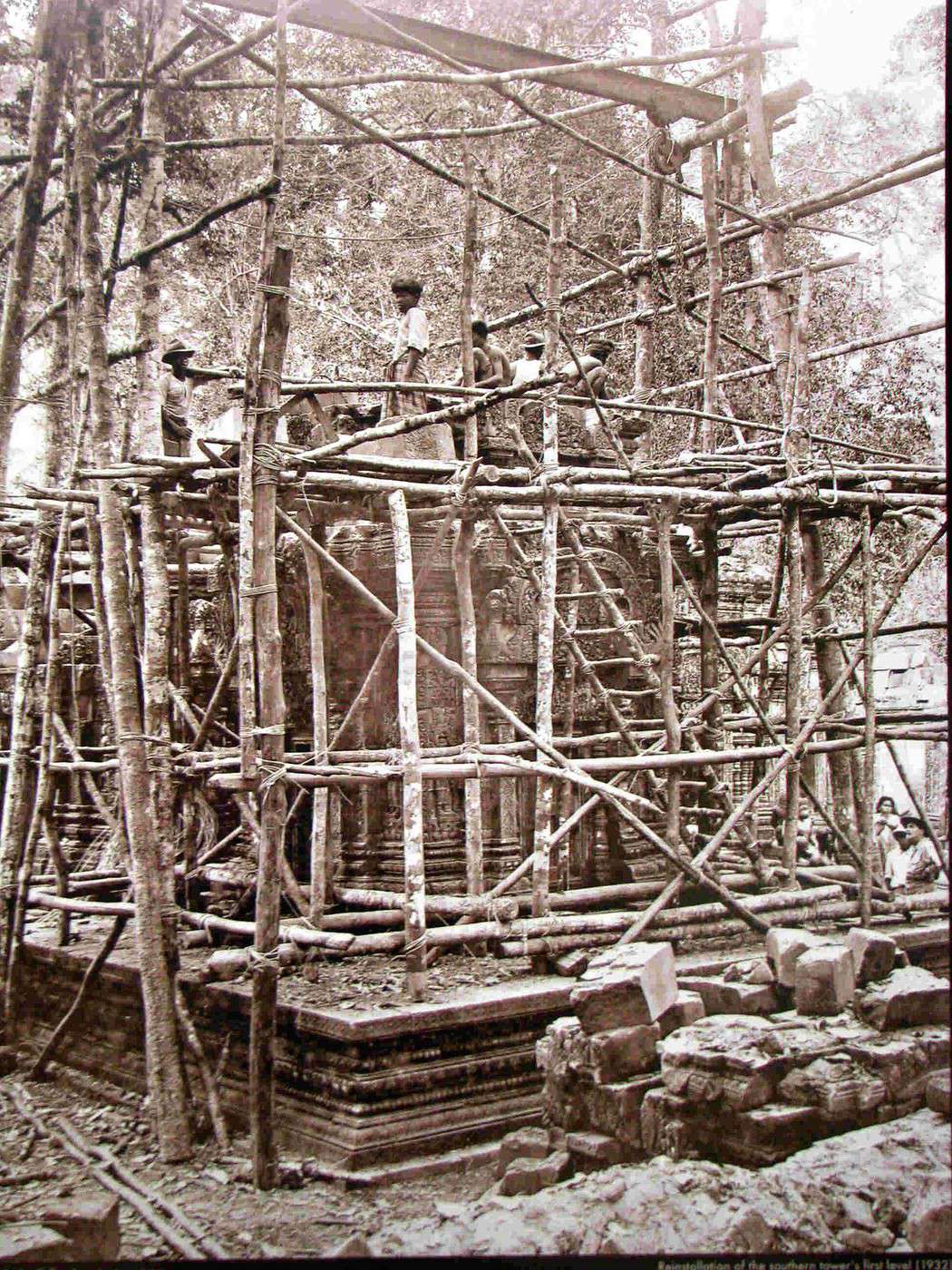
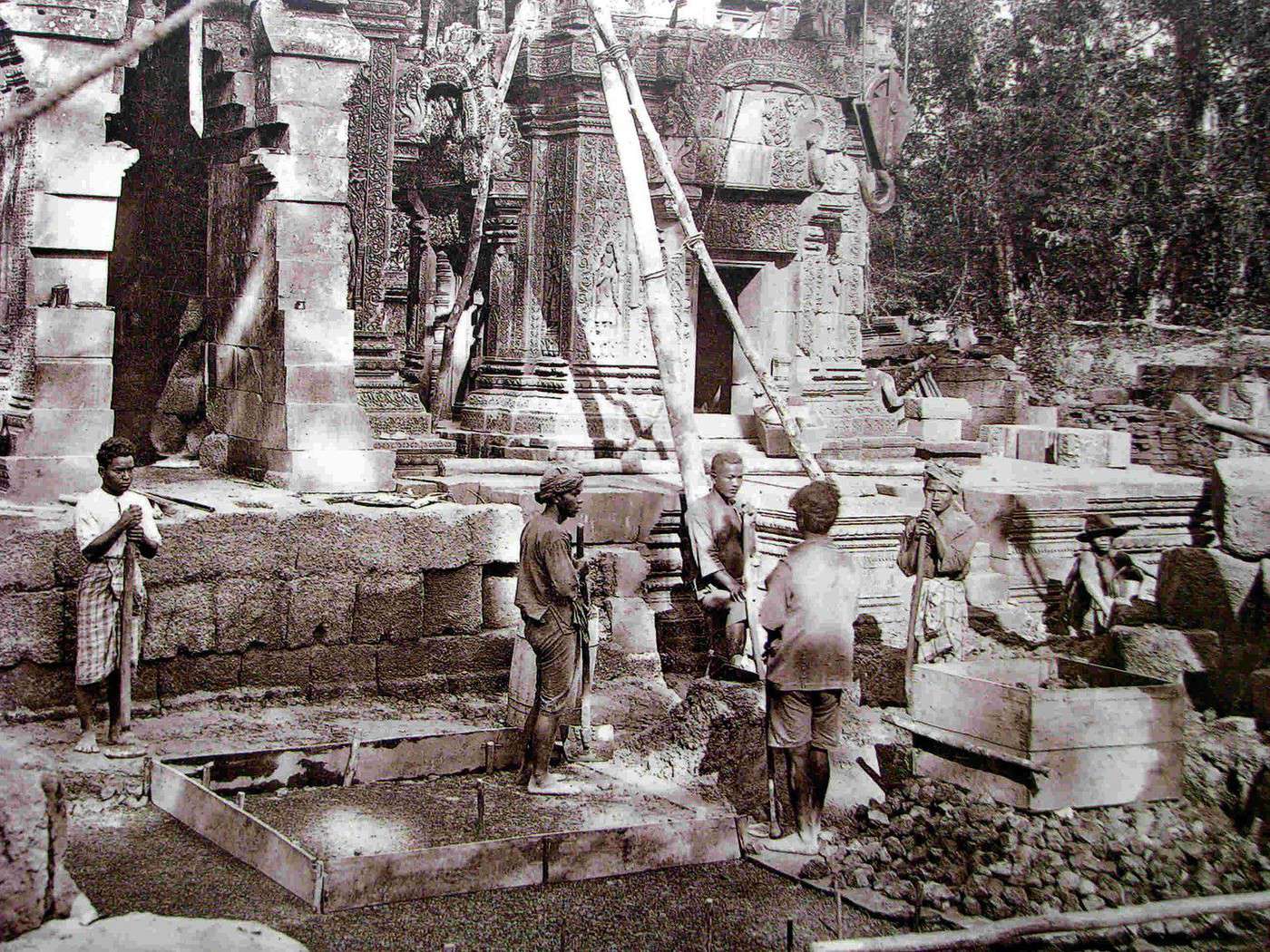
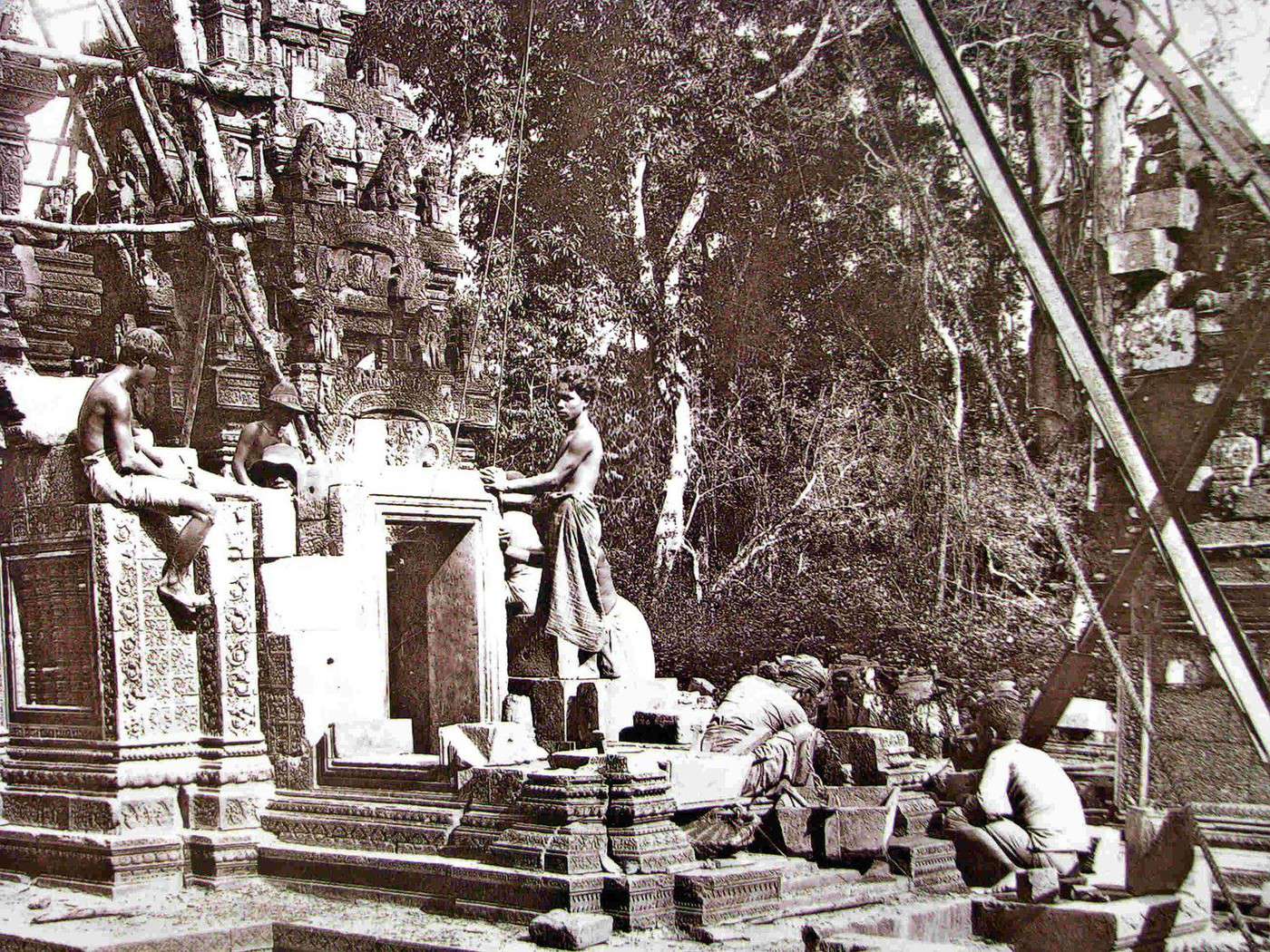
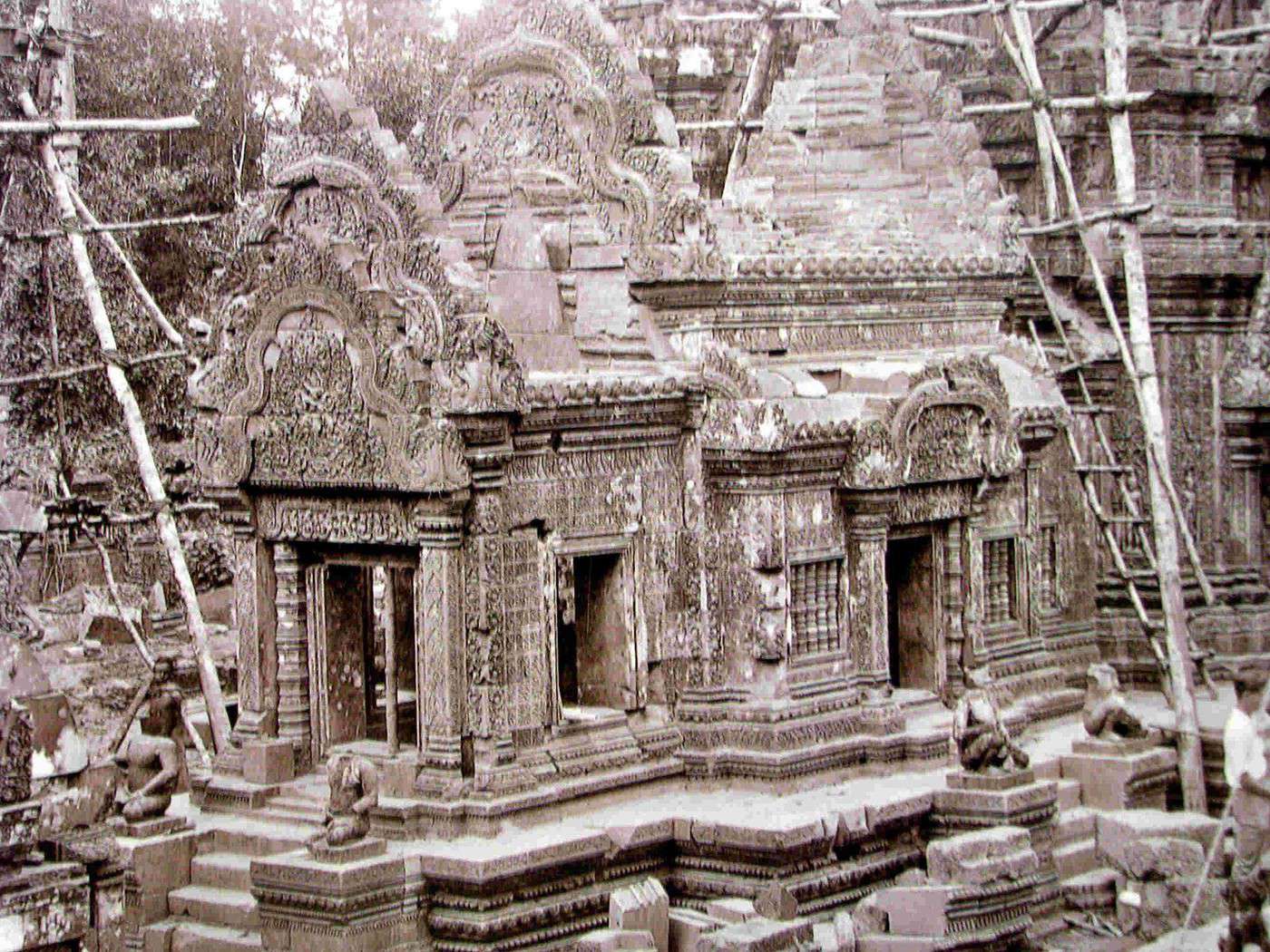
Bonjour
Dans plusieurs posts j'ai déjà parlé de détails particuliers – parfois originaux – que l'on peut voir en visitant les temples d'Angkor.
J'ai donc décidé de rassembler dans plusieurs posts successifs ces particularités.
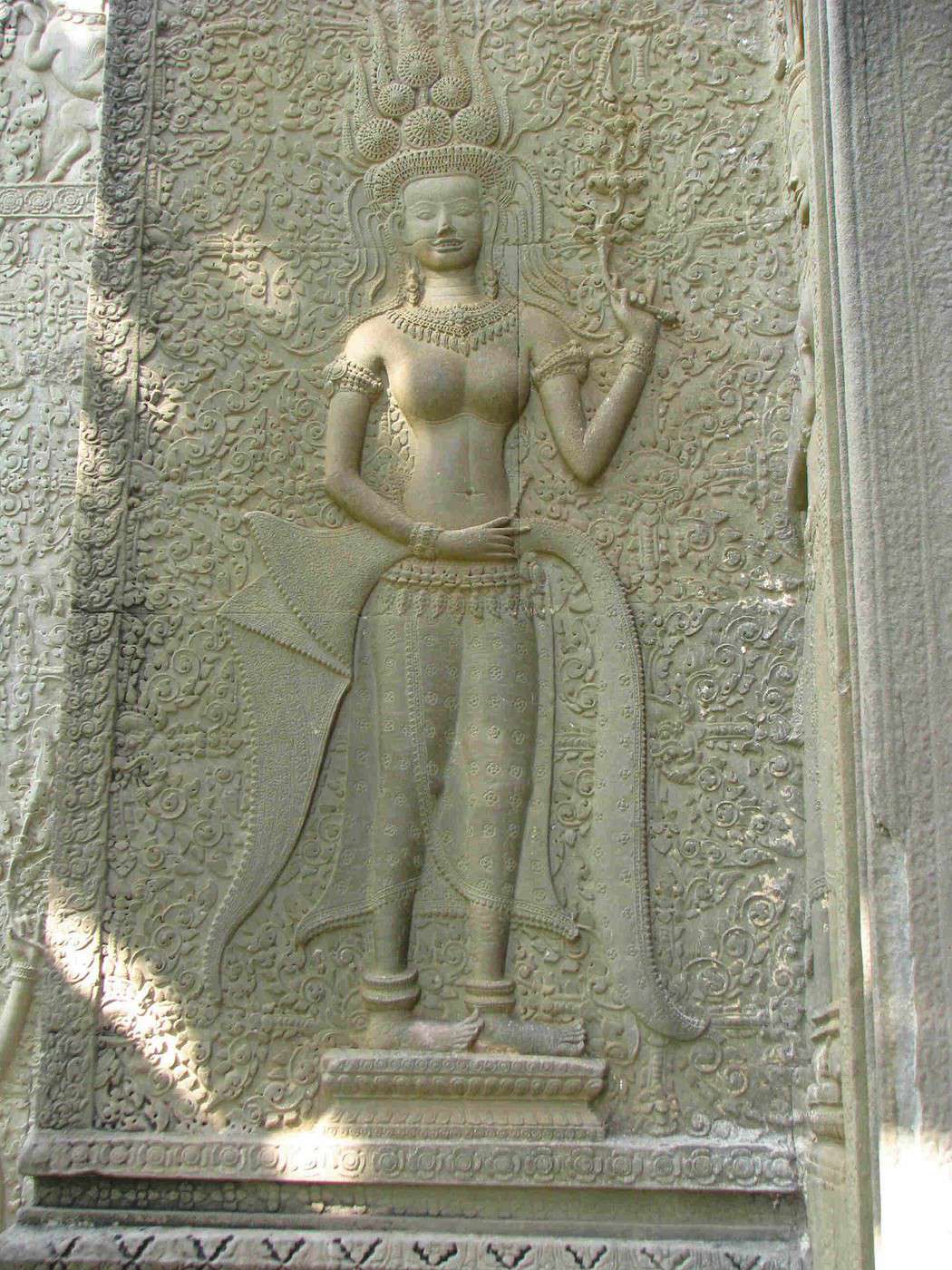
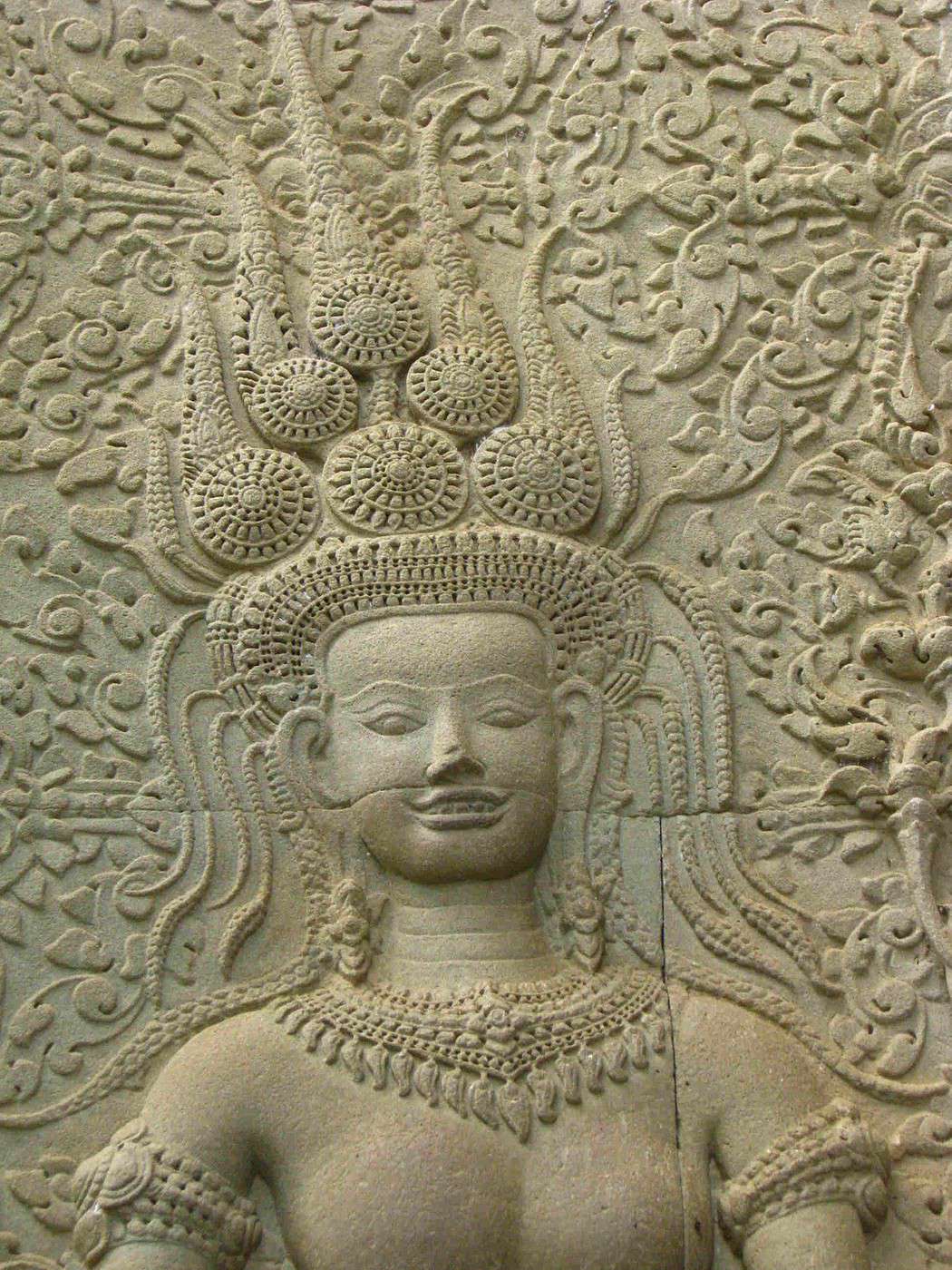
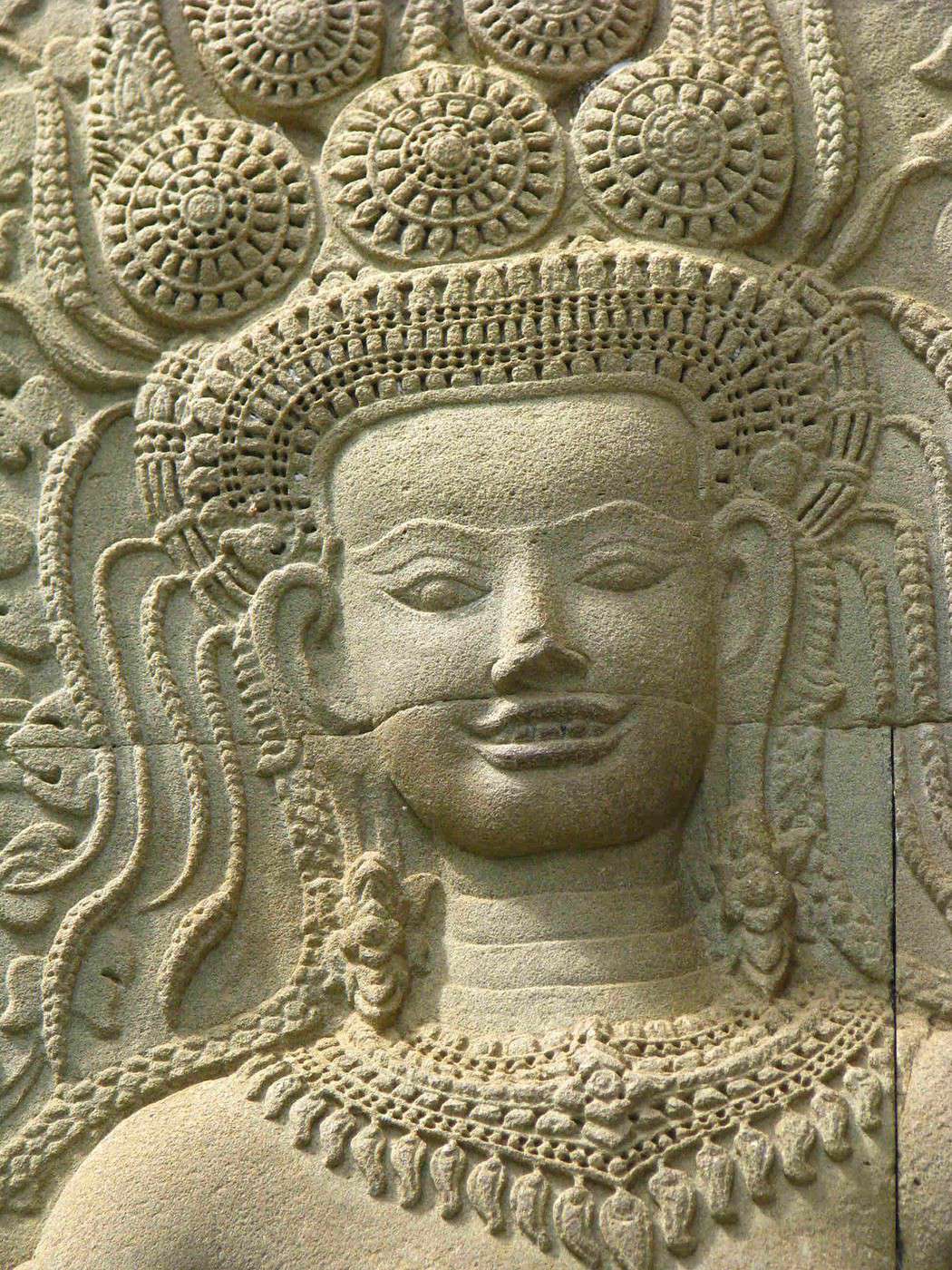
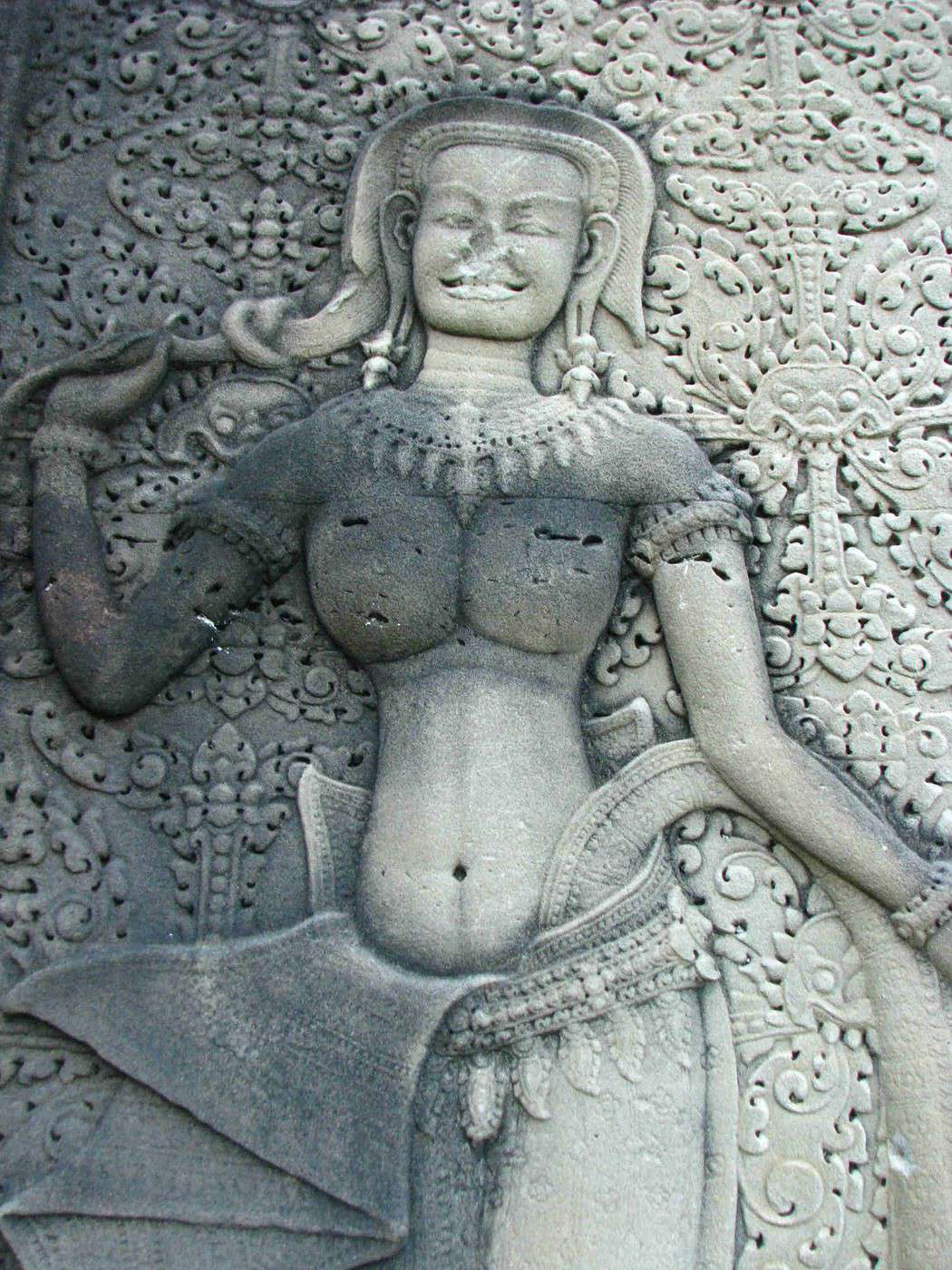
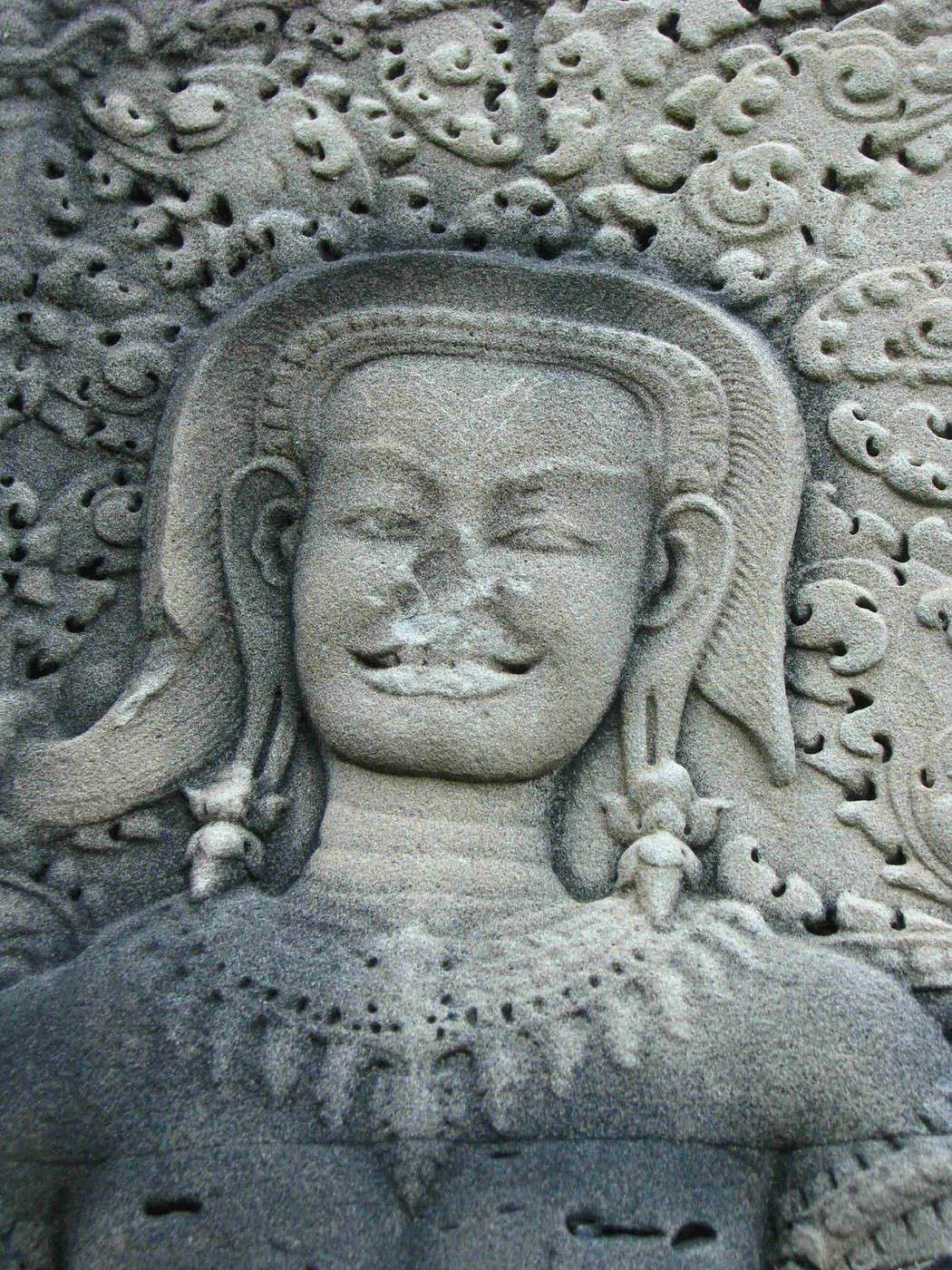
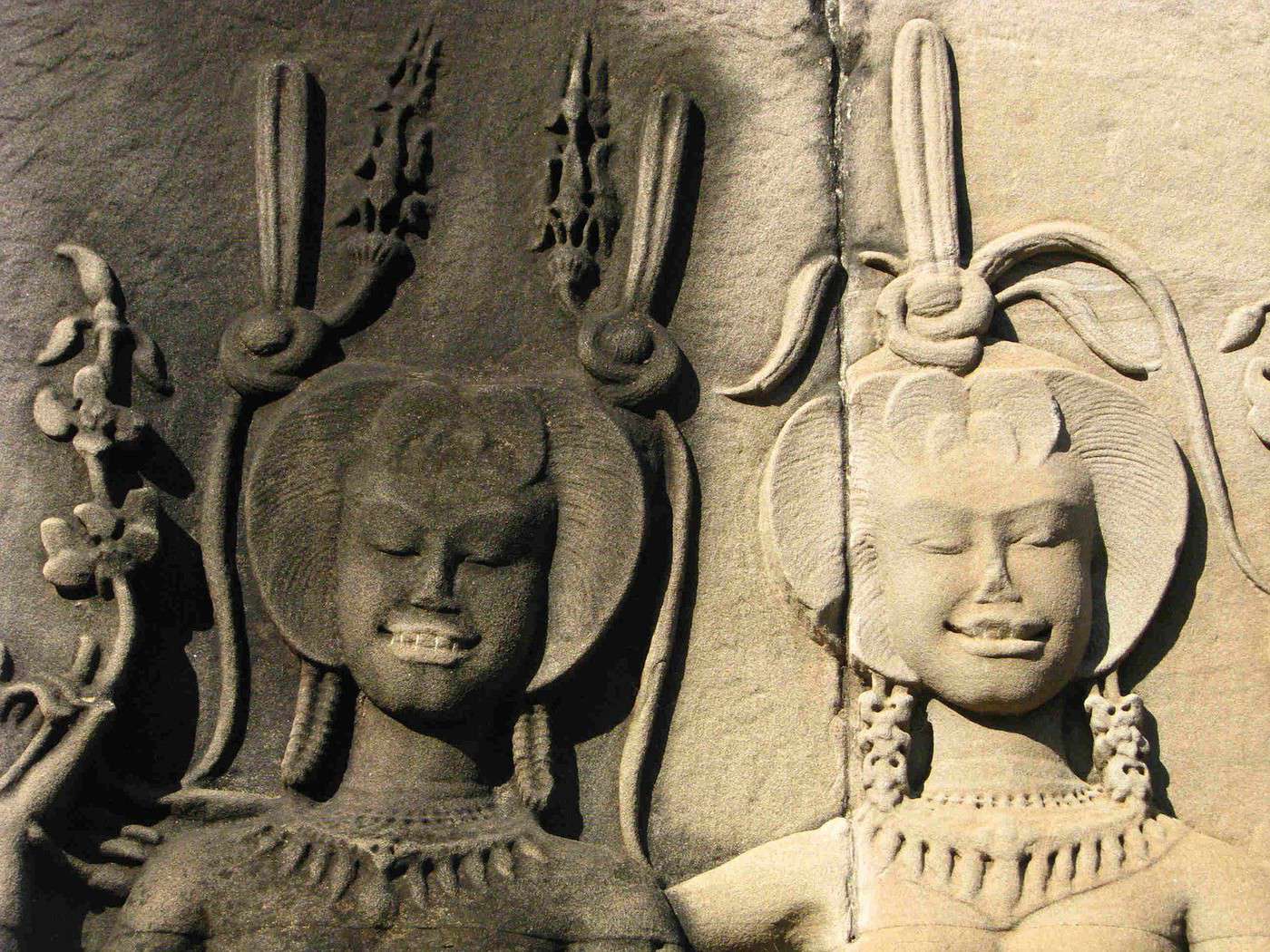
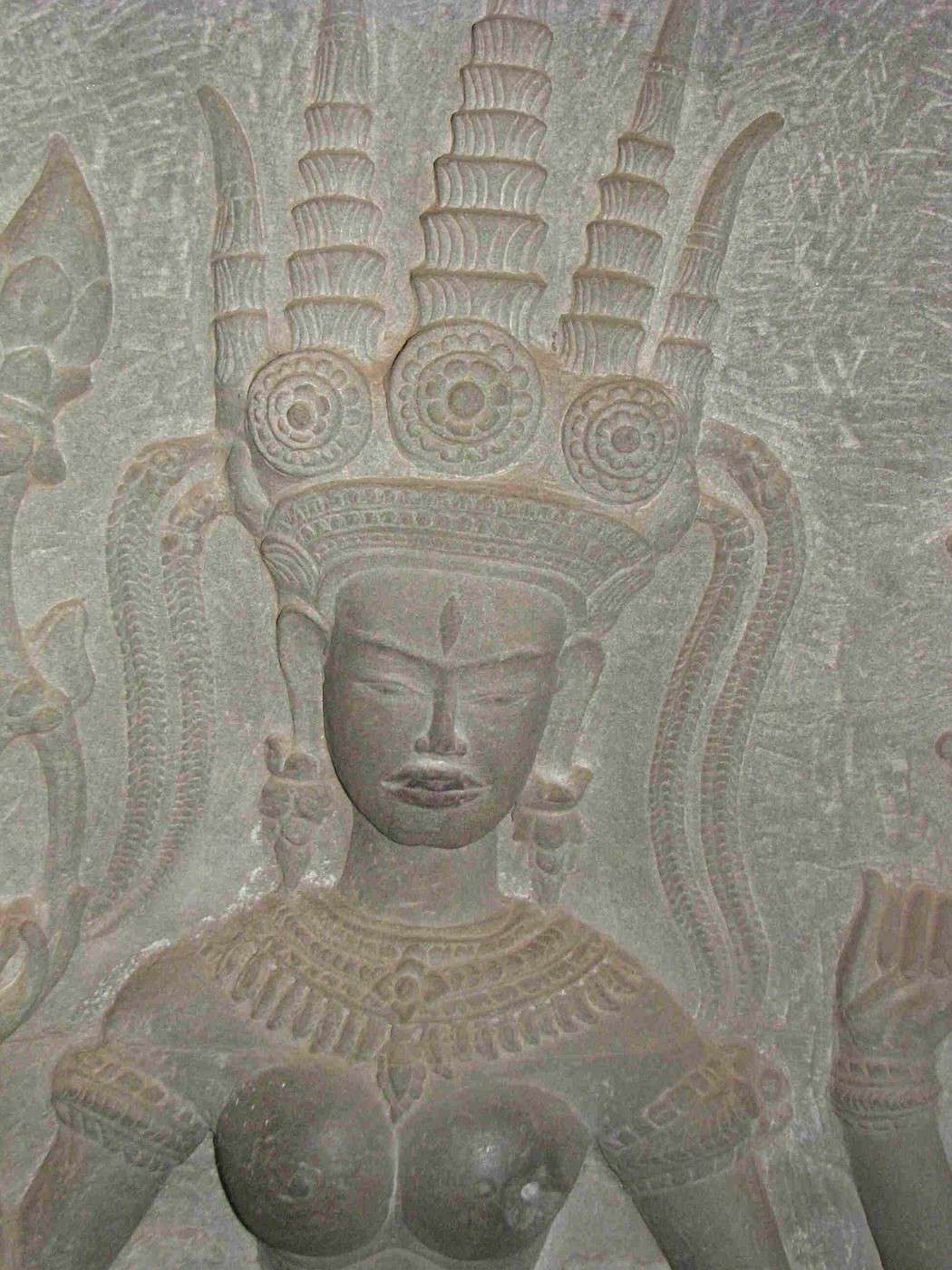
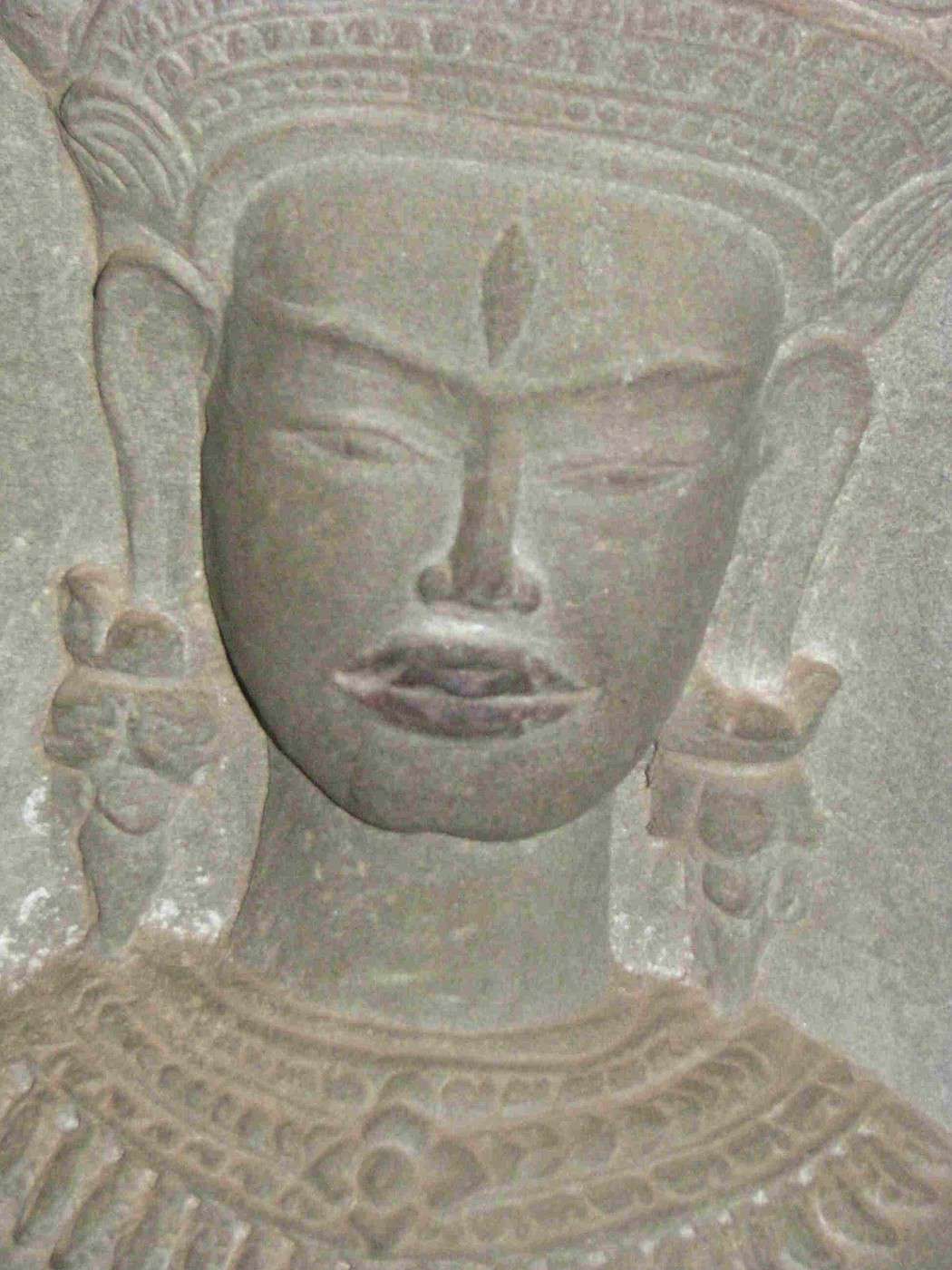
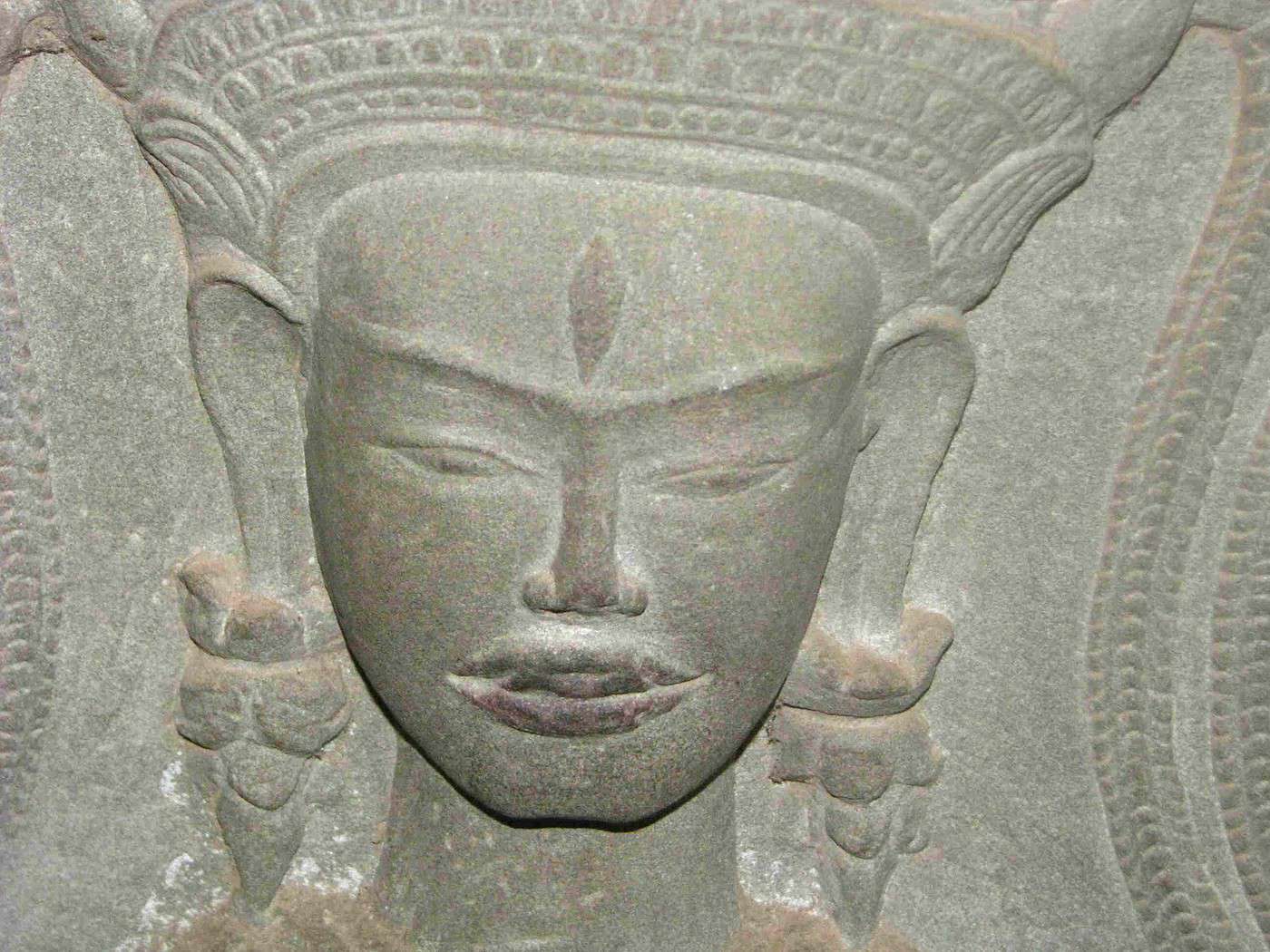
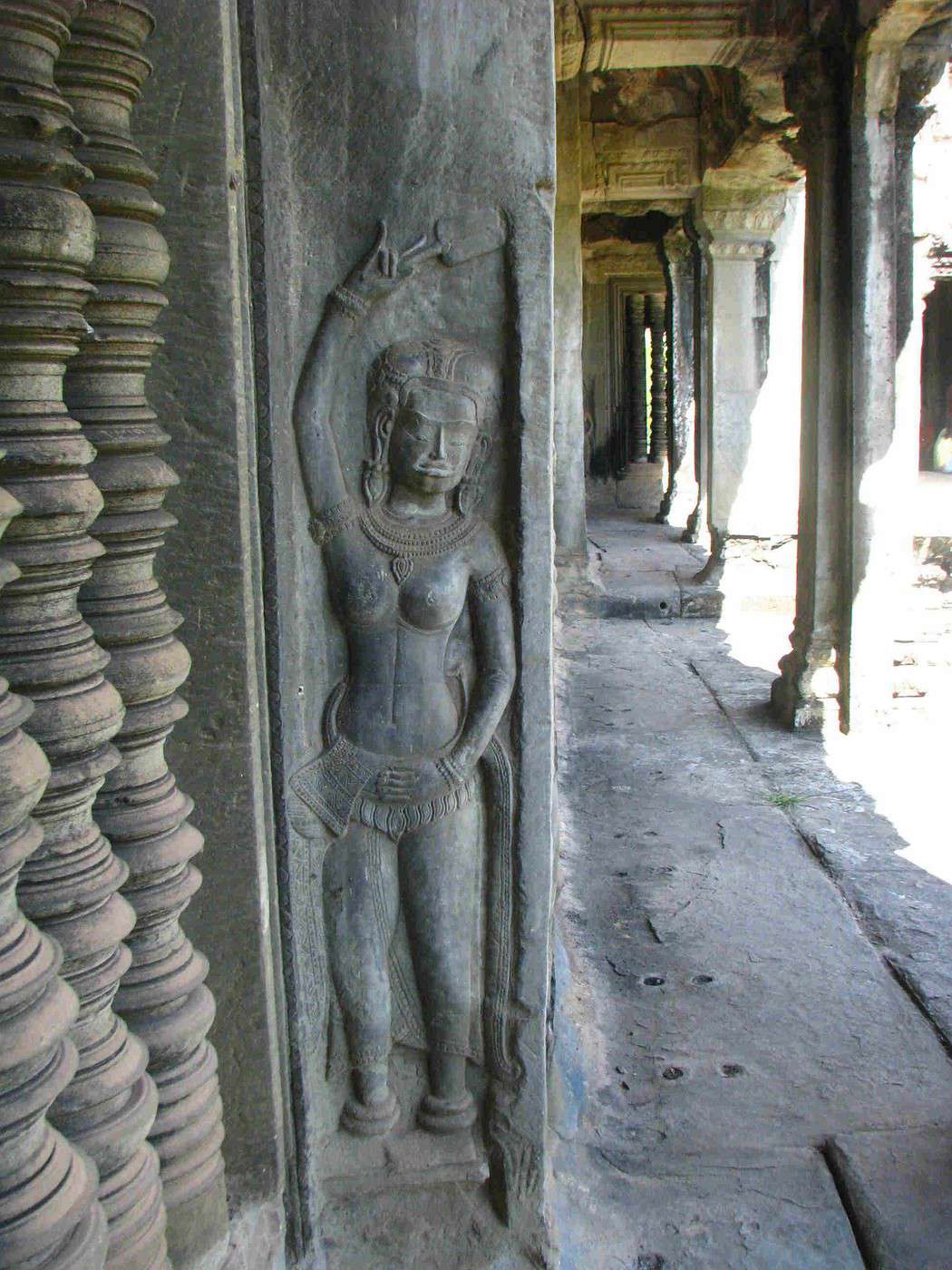
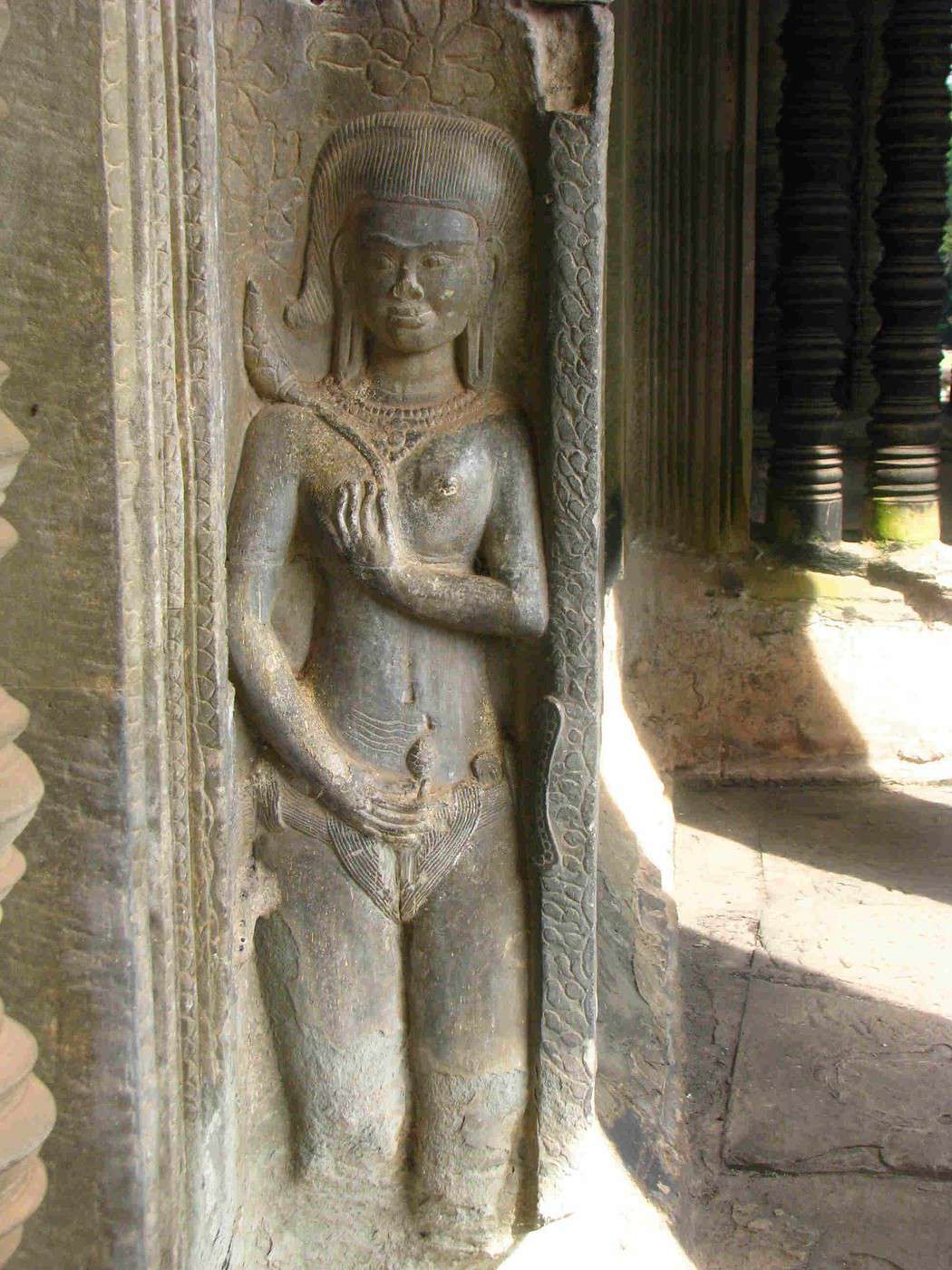
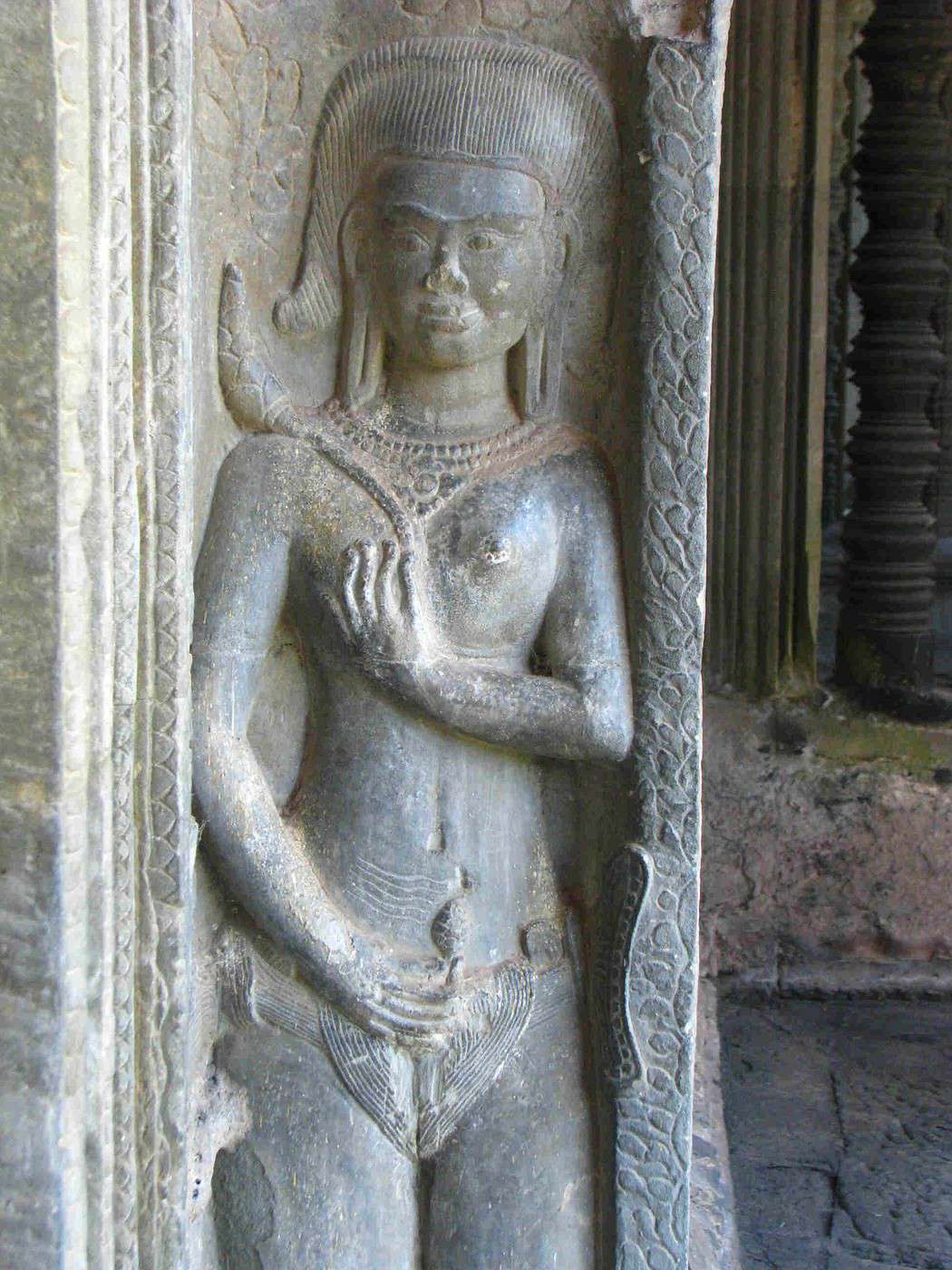
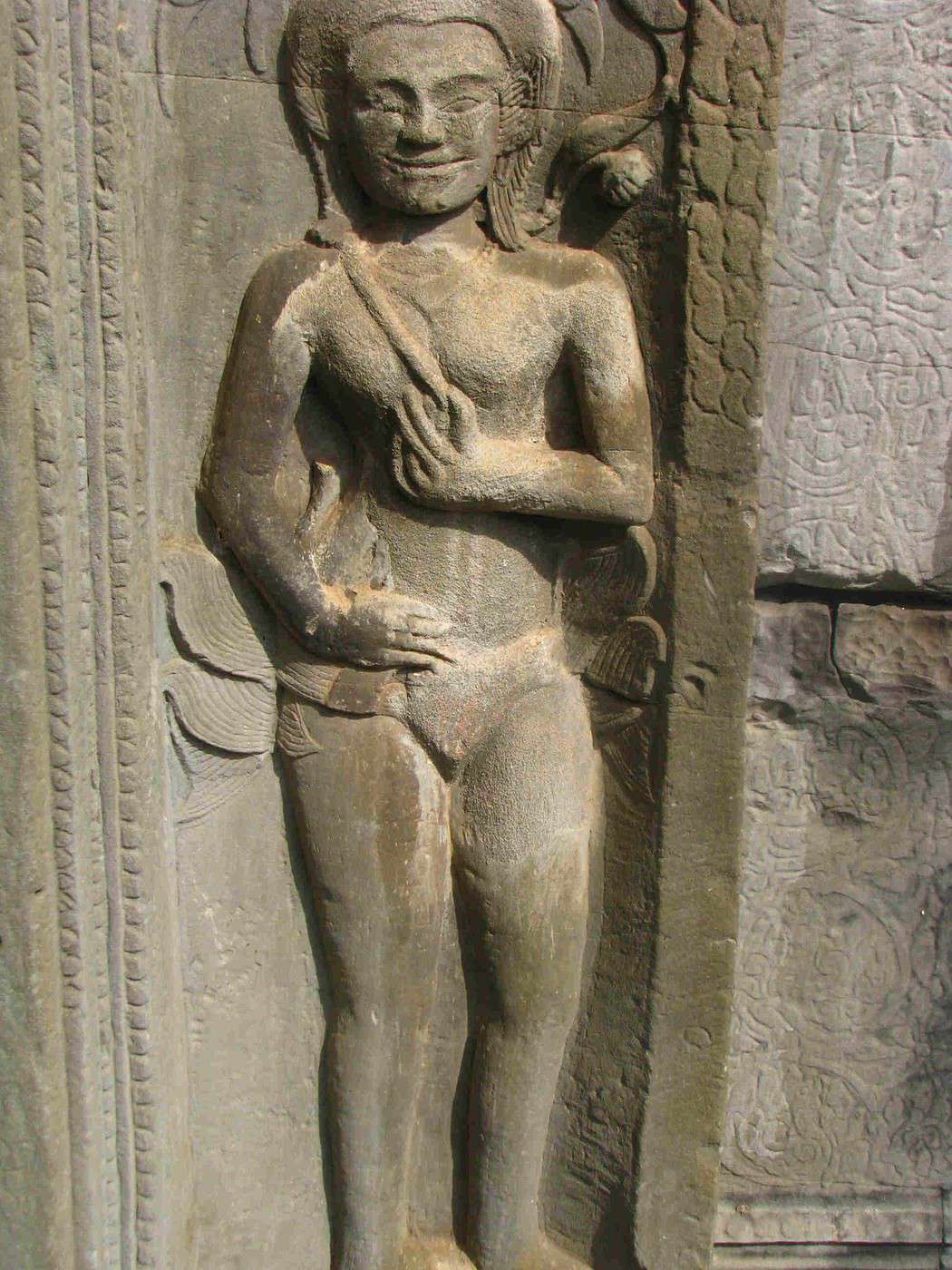
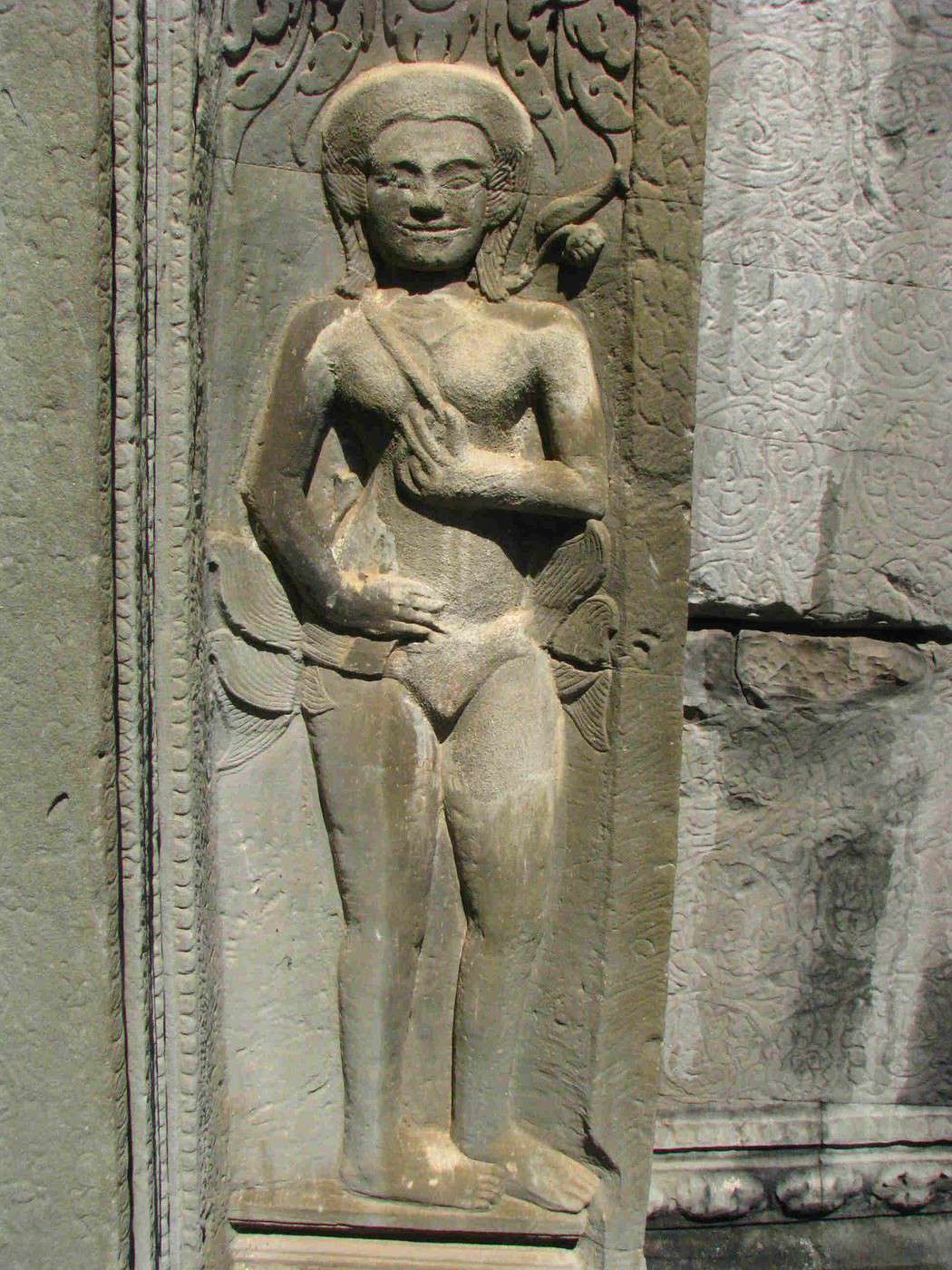
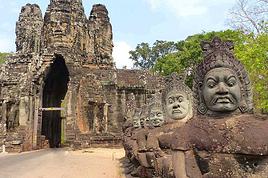
Les dévatas (divinité divines) qui montrent leurs dents :Claude Jacques dans son livre "Angkor cité khmère" mentionne qu'il n'existe qu'une seule dévata à Angkor Vat (la D 1) qui montre ses dents, or Michel Pétrotchenko dans son livre "Le guide des temples d'Angkor écrit qu'il en existe au moins une demi-douzaine… En 2008 j'en ai découvert deux, maintenant j'en connais cinq (D1 à D5).
LES DEVATAS 1 ET 2
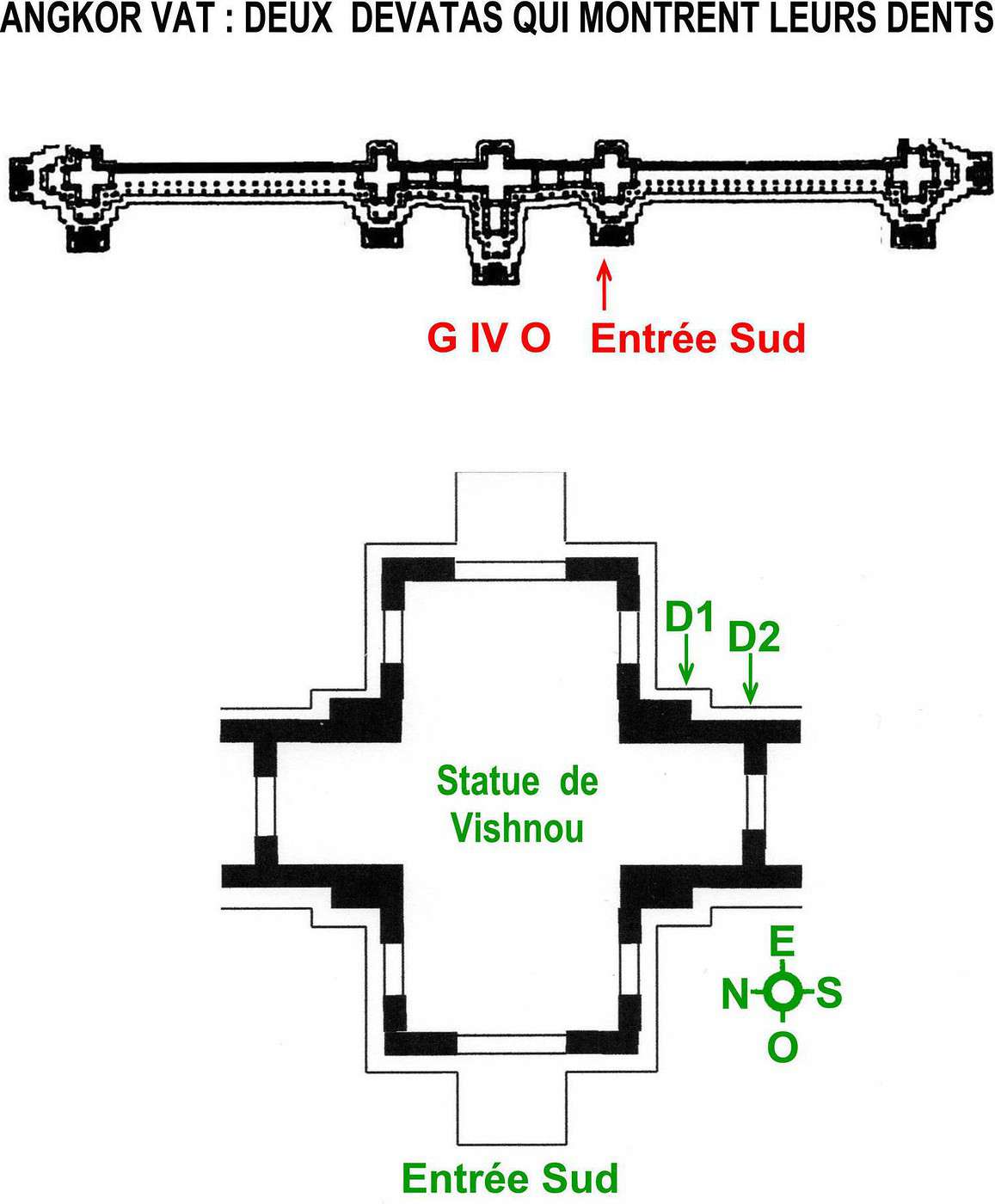
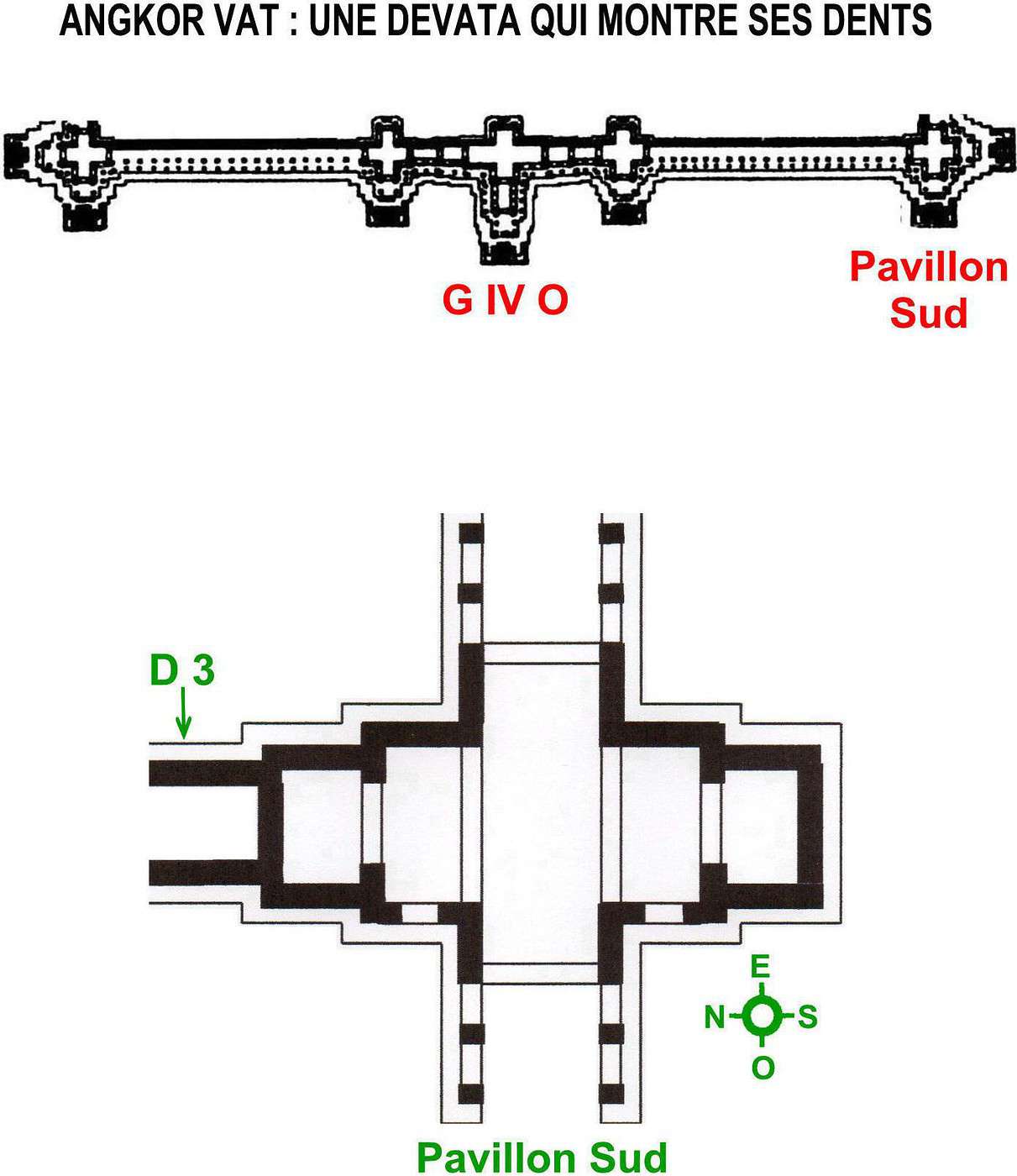
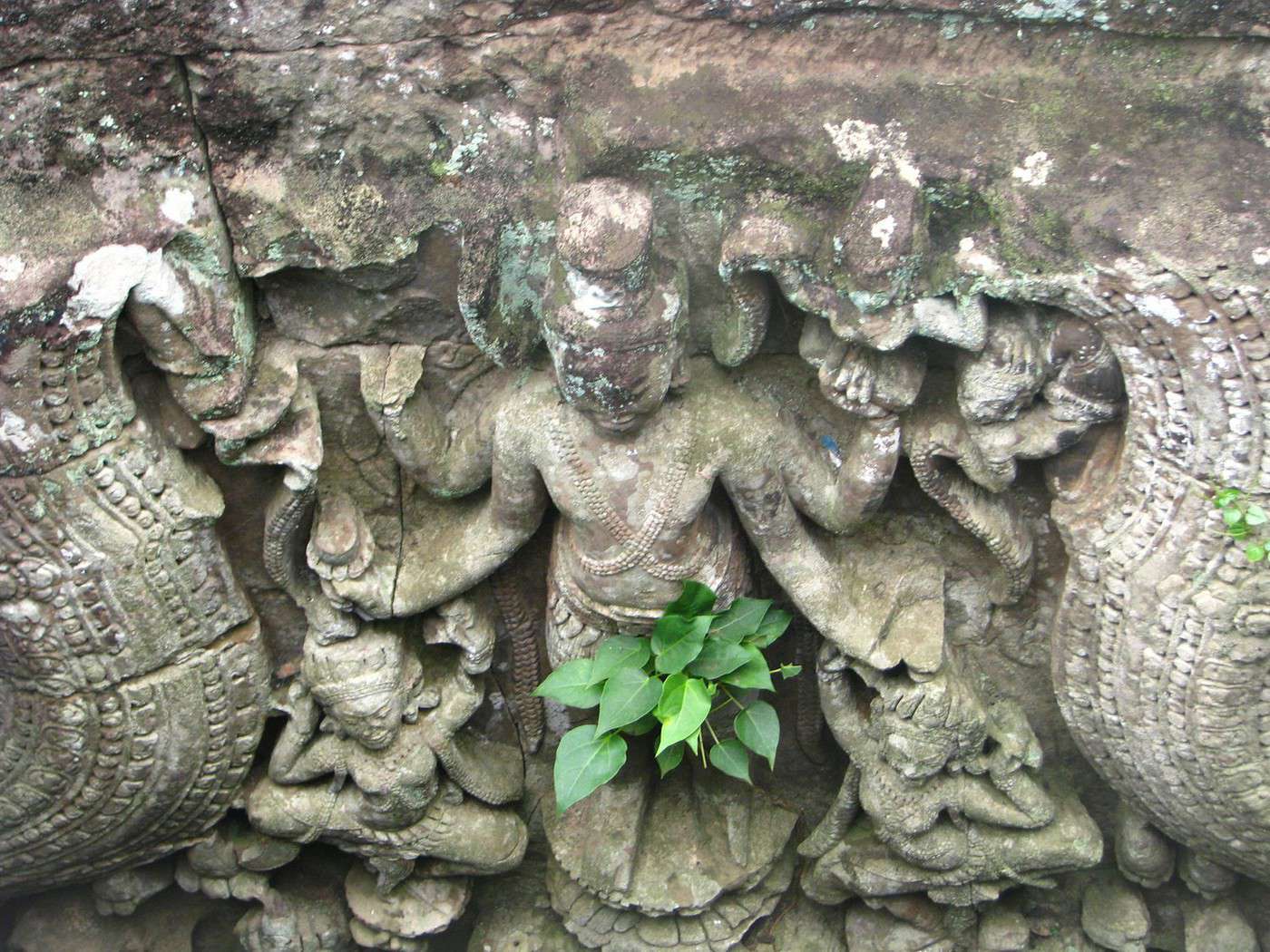
En commençant la visite d'Angkor Vat par l'Ouest, après avoir traversé la douve on arrive au G IV O (*). Ce gopura est composé de trois portes. Entrer par la porte Sud (à droite), on la reconnait facilement car il y a une grande statue de Vishnou à huit bras. Il s'agit peut-être de la statue qui était au sanctuaire central, à l'origine le temple était visnouite, il est devenu bouddhiste plus tard. Curieusement des khmers qui sont bouddhistes viennent prier devant cette statue hindouiste.
En se penchant à travers la fenêtre de droite, et en regardant vers la droite on voit une devata qui montre ses dents. Sortir et marcher à droite le long du mur pour voir de plus près cette Devata (D1).
A gauche de cette dévata il y en a une autre qui montre également ses dents (D2).
(*) Gopura : Les temples comprennent en général plusieurs enceintes ou galeries avec des passages (ou portails) que l'on nomme "gopura". En principe il y a quatre gopuras, un à chaque point cardinal (parfois deux, un à l'Est et l'autre à l'Ouest). Les enceintes sont numérotées, la première est celle qui est la plus près du sanctuaire central.
Dans les descriptions des temples on peut trouver ceci : G IV O qui veut dire "Gopura de la 4ème enceinte partie Ouest".
Ces gopuras peuvent avoir une porte, trois portes et plus rarement cinq portes comme le Gopura III E du Preah Khan.
ANGKOR VAT : AU PAVILLON SUD-OUEST LA DEVATA QUI MONTRE SES DENTS
C'est Véro et Eddy (Veroeddy) qui ont découvert cette dévata.
Les pavillons latéraux de la quatrième enceinte Ouest n'ont pas d'escaliers. C'étaient les seuls endroits permettant le passage des éléphants et des chariots.
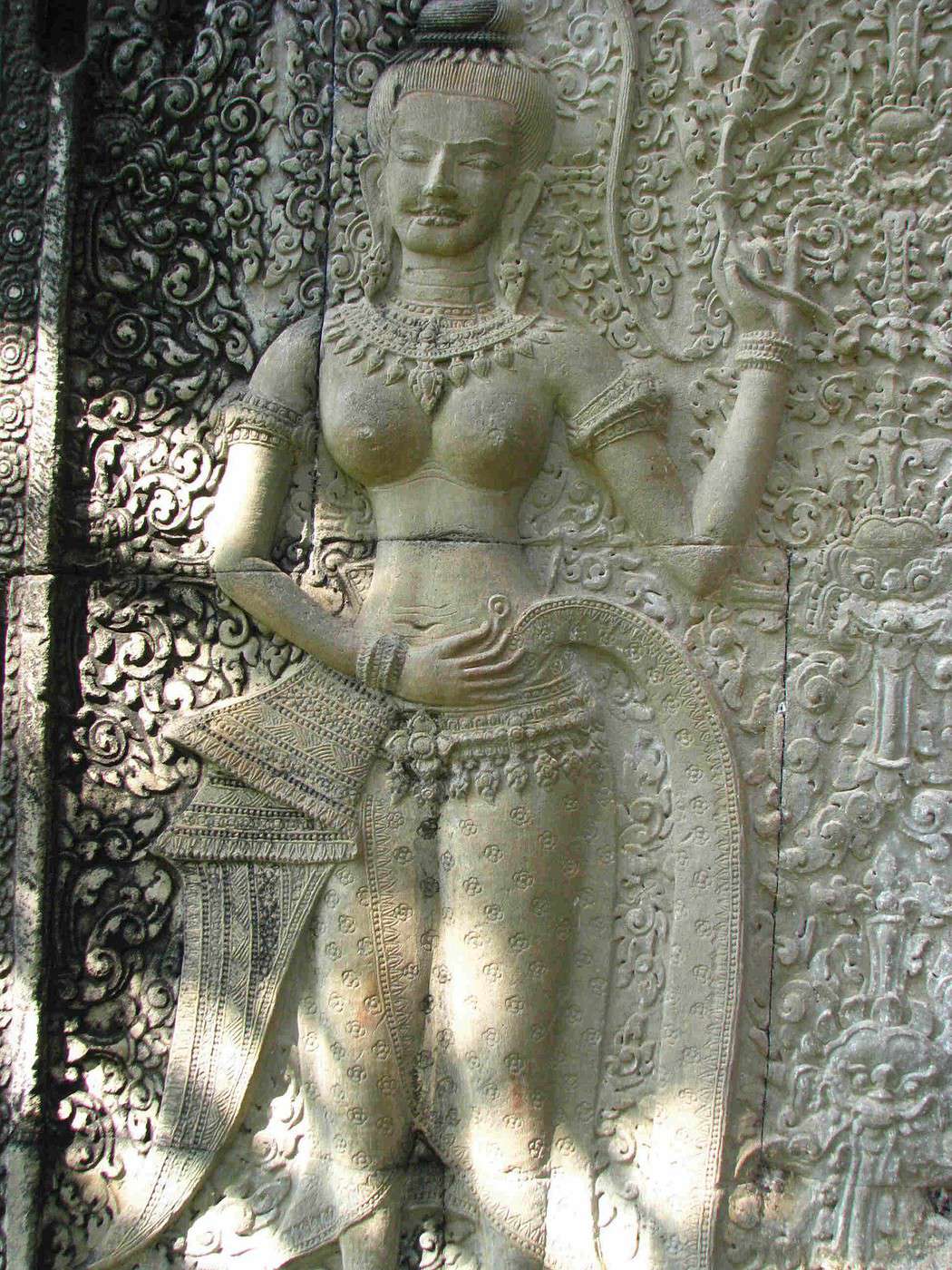
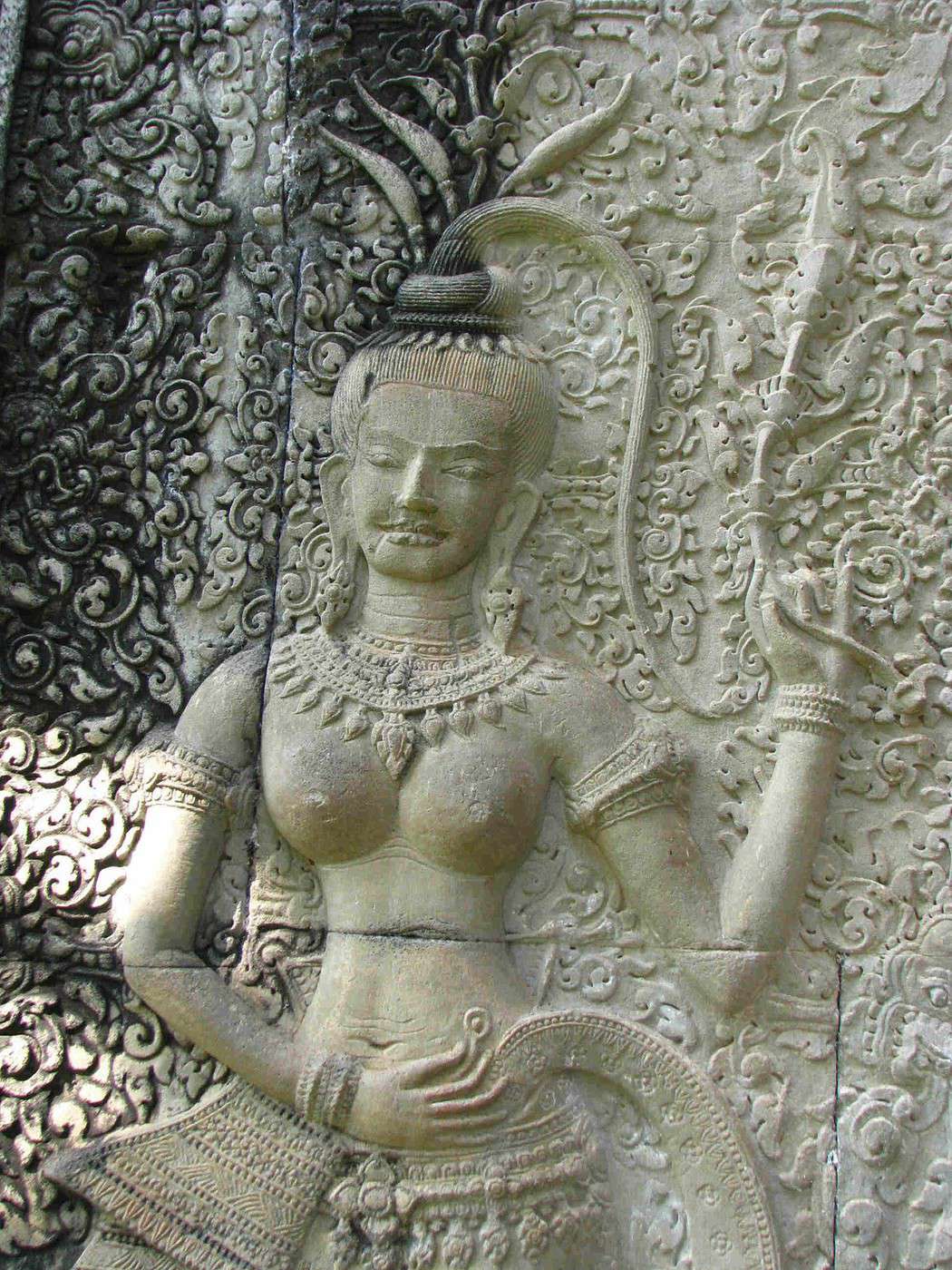
Du G IV O se diriger vers le Sud pour voir le pavillon Sud-Ouest. Sur la partie Nord-Est on peut voir une dévata qui montre ses dents (D 3).
J'ai cité Véro et Eddy (Veroeddy) et j'en profite pour mentionner leur excellent site :
http://www.veroeddy.be
Dans "Asie" puis "Cambodge" on trouve divers articles sur le site d'Angkor, "l'affaire Malraux", Angkor Vat…
Véro et Eddy se sont rendus pour la première fois au Cambodge en 1992 : "Sur les sites d’Angkor, l’armée avait dépêché des soldats pour assurer la sécurité des visiteurs. C’est dans ce climat de tension que s’est déroulé le voyage de 1992, au Cambodge"… "En 1992, il fallait s’acquitter d’une somme forfaitaire de 100 dollars par personne pour circuler sur l’ensemble des sites d’Angkor"….
Voir les photos d'Angkor Vat en 1992 : ttp://www.veroeddy.be/...ambodge/angkor-wat-4
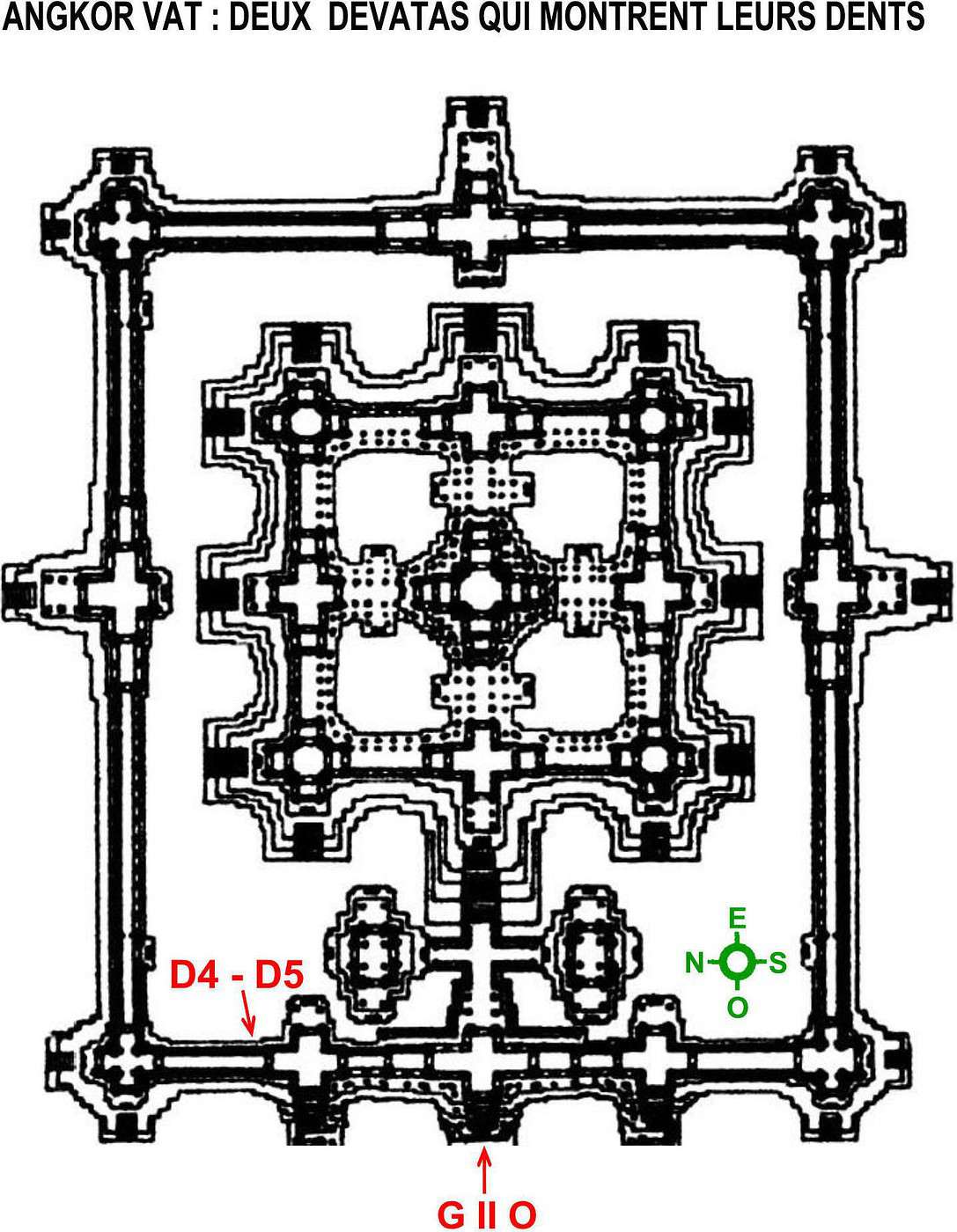
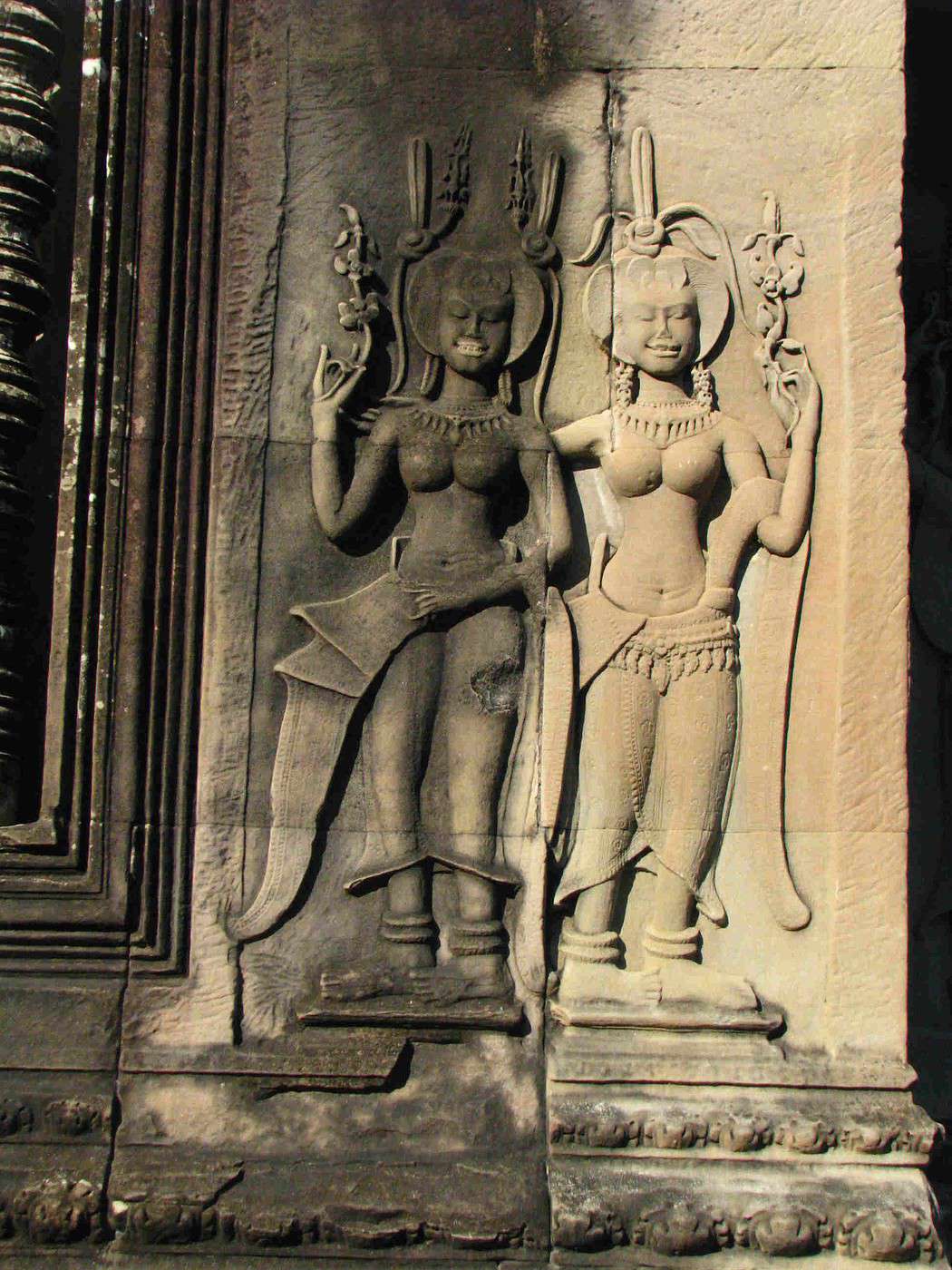
ANGKOR VAT : DEUX DEVATAS (D 4 et D5) QUI MONTRENT LEURS DENTS
J'ai trouvé ces dévatas grâce au livre de Michel Petrotchenko "Le guide des temples d'Angkor".
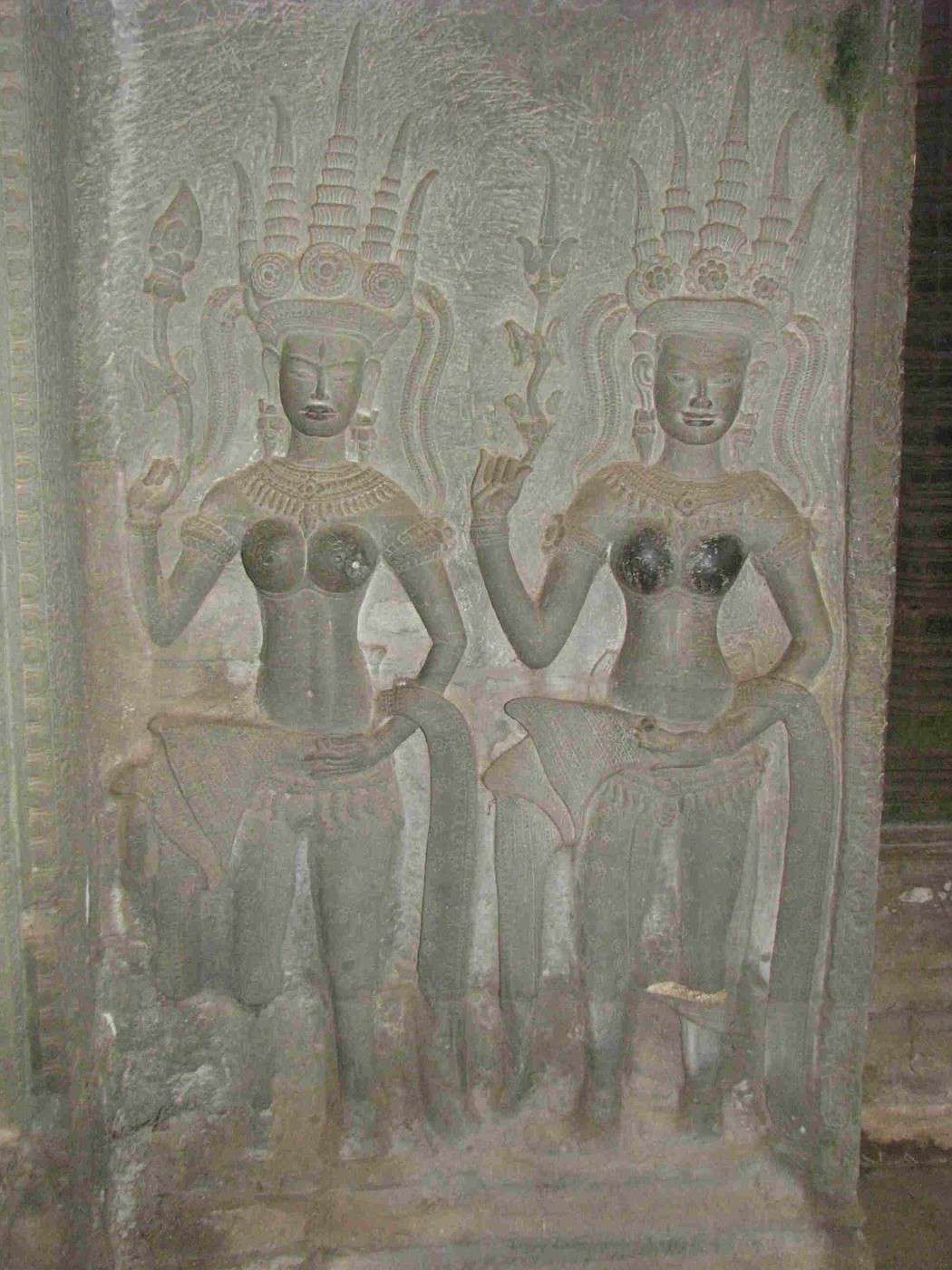
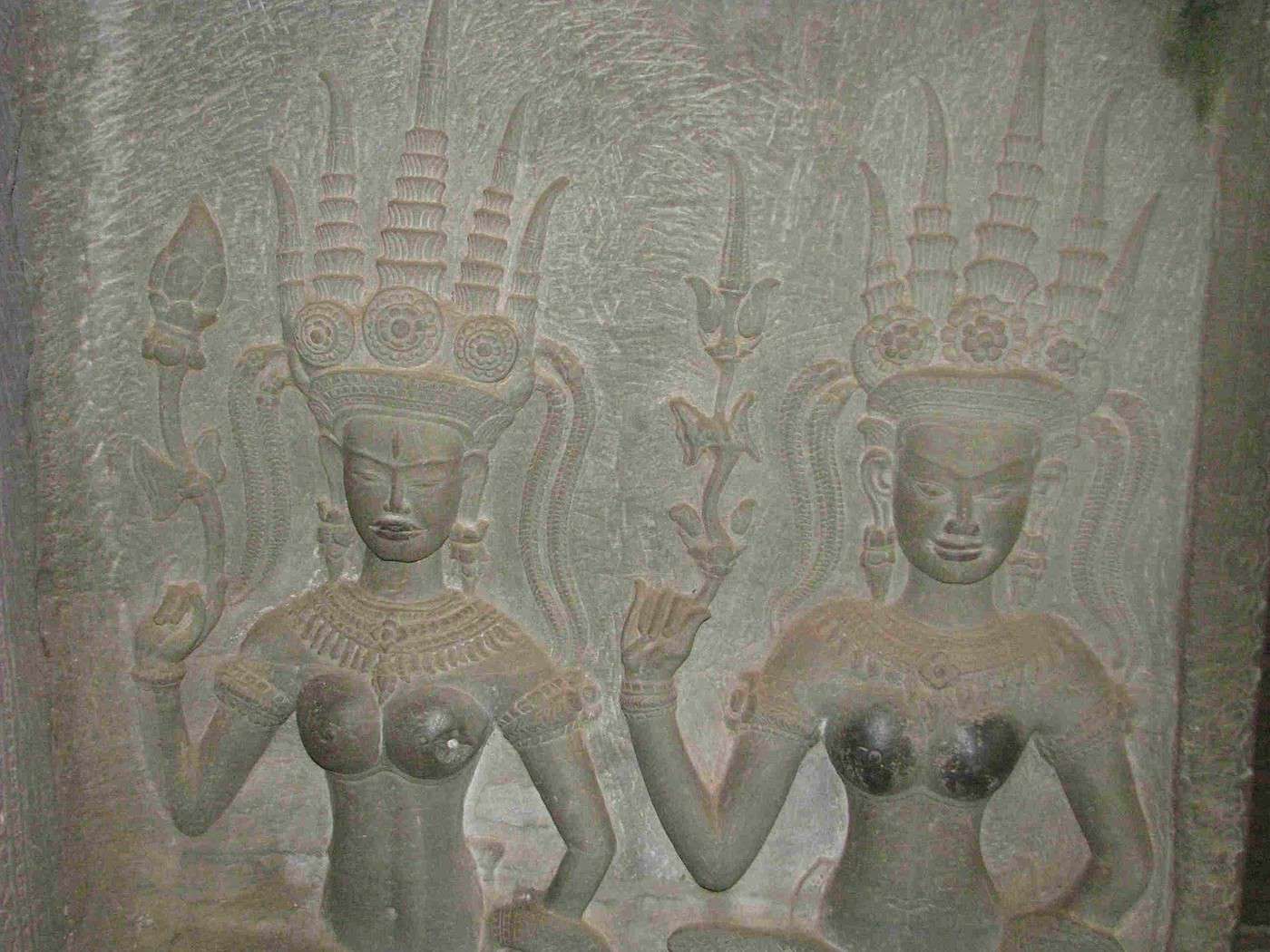
Après avoir quitté la troisième enceinte – galerie des bas-reliefs – on traverse les galeries cruciformes pour atteindre la seconde enceinte. On arrive au deuxième étage. Sur la gauche, sur la façade Est de l'enceinte Ouest, on peut voir deux dévatas qui montrent leurs dents.
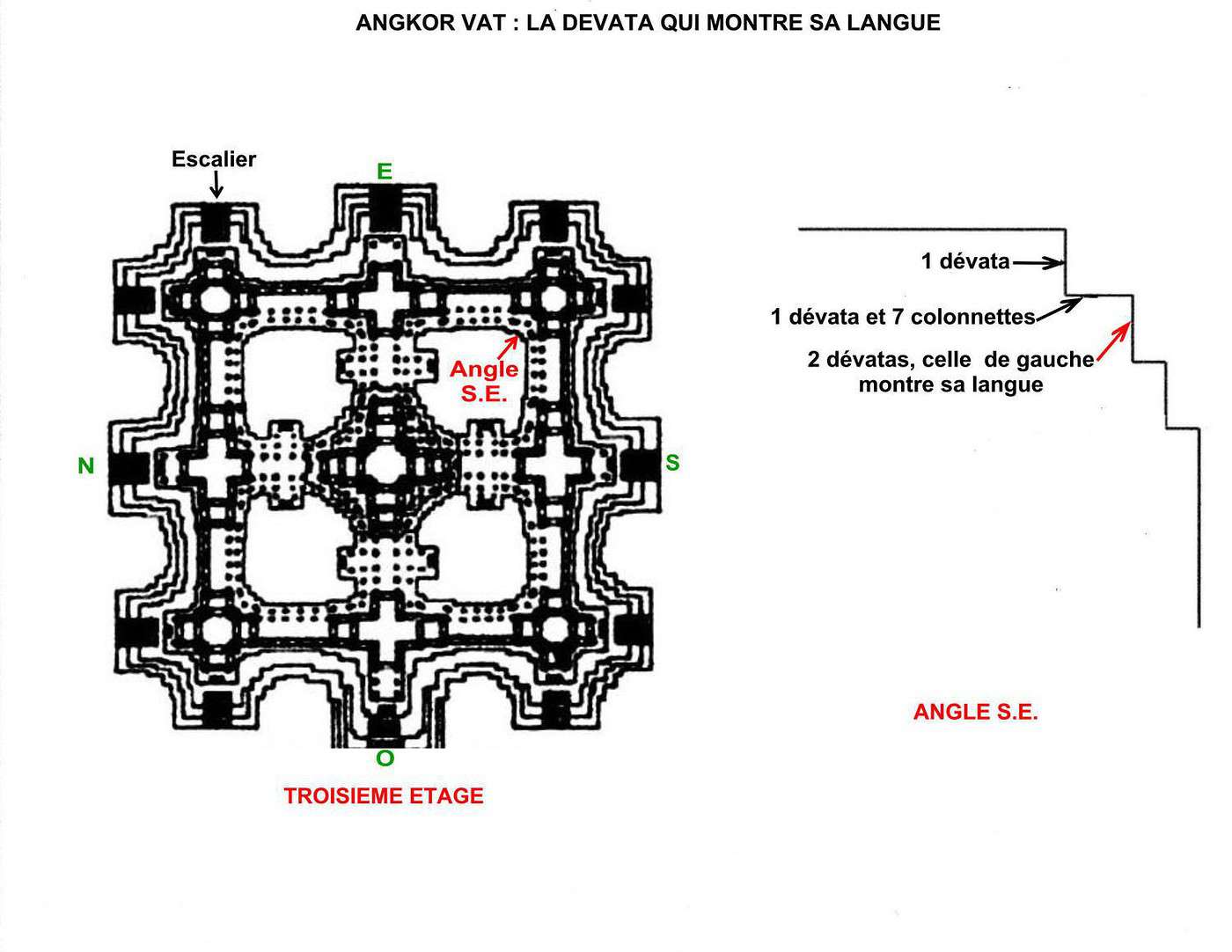
ANGKOR VAT : LA DEVATA QUI MONTRE SA LANGUE
En 2010 un guide m'avait montré une dévata qui montre sa langue.
Je suis revenu à Siem Reap, après avoir cherché longtemps, j'ai retrouvé cette dévata et j'ai alors fait un schéma pour pouvoir la retrouver facilement et en informer d'autres voyageurs.
Cette dévata se situe au troisième étage, là où il y a le sanctuaire central. Il faut se rendre dans la cour S.E. A l'angle S.E. de cette cour on trouve cette dévata.
Lors de ma dernière visite en Novembre 2014 il y avait un échafaudage dans cet angle et on pouvait quand même voir cette dévata.
Il faut s'approcher de très près pour voir le bout de sa langue
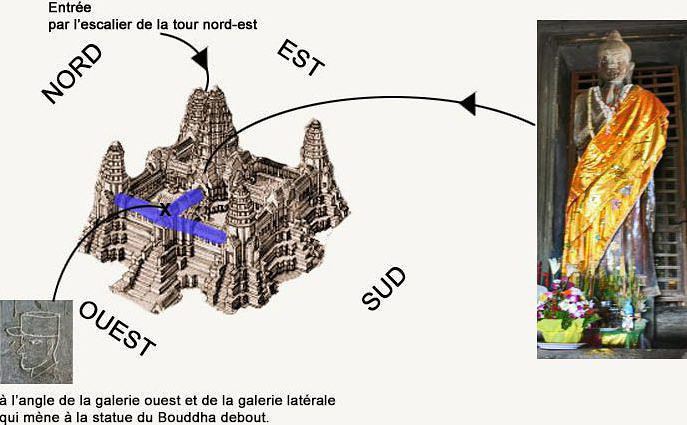
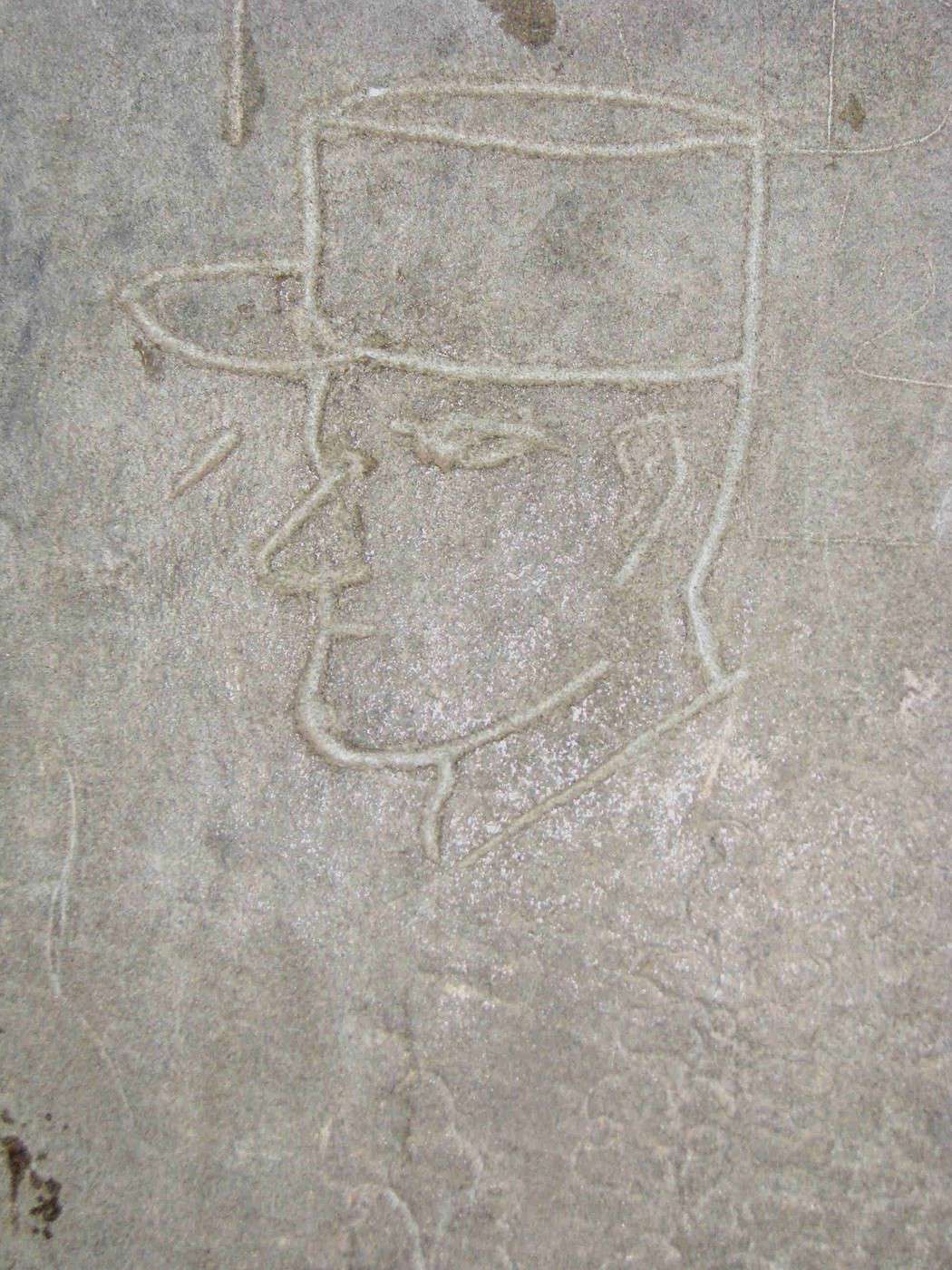
ANGKOR VAT : L'HOMME AU KEPI
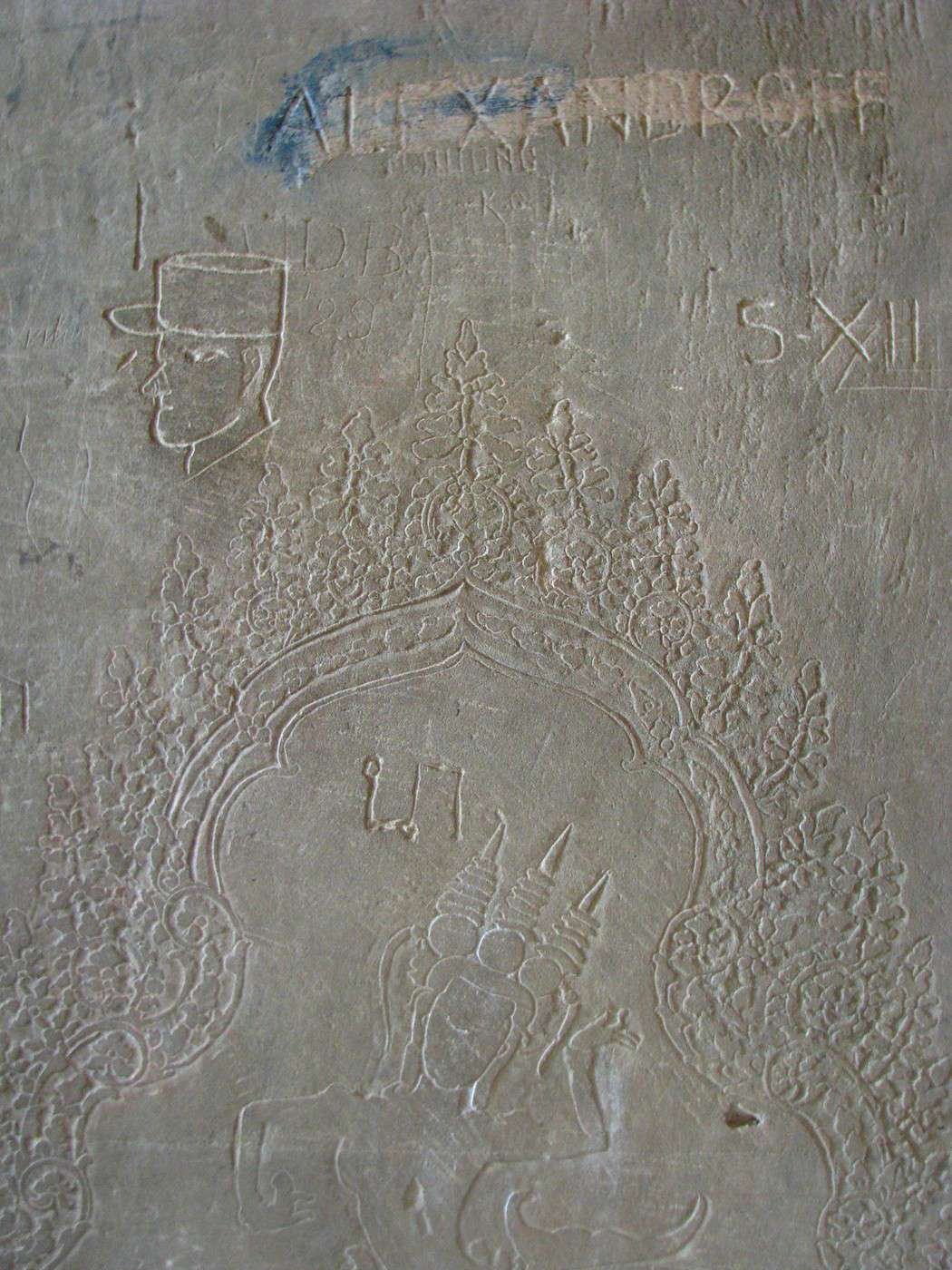
En 2010 lors de la visite du troisième étage d'Angkor Vat j'ai vu sur un pilier un graffiti représentant la tête d'un homme avec un képi.
Par la suite je n'ai pas retrouvé ce graffiti. J'en ai parlé dans le post "Livres sur les temples d'Angkor et l'histoire angkorienne"
http://voyageforum.com/discussion/livres-temples-angkor-histoire-angkorienne-d6305399/
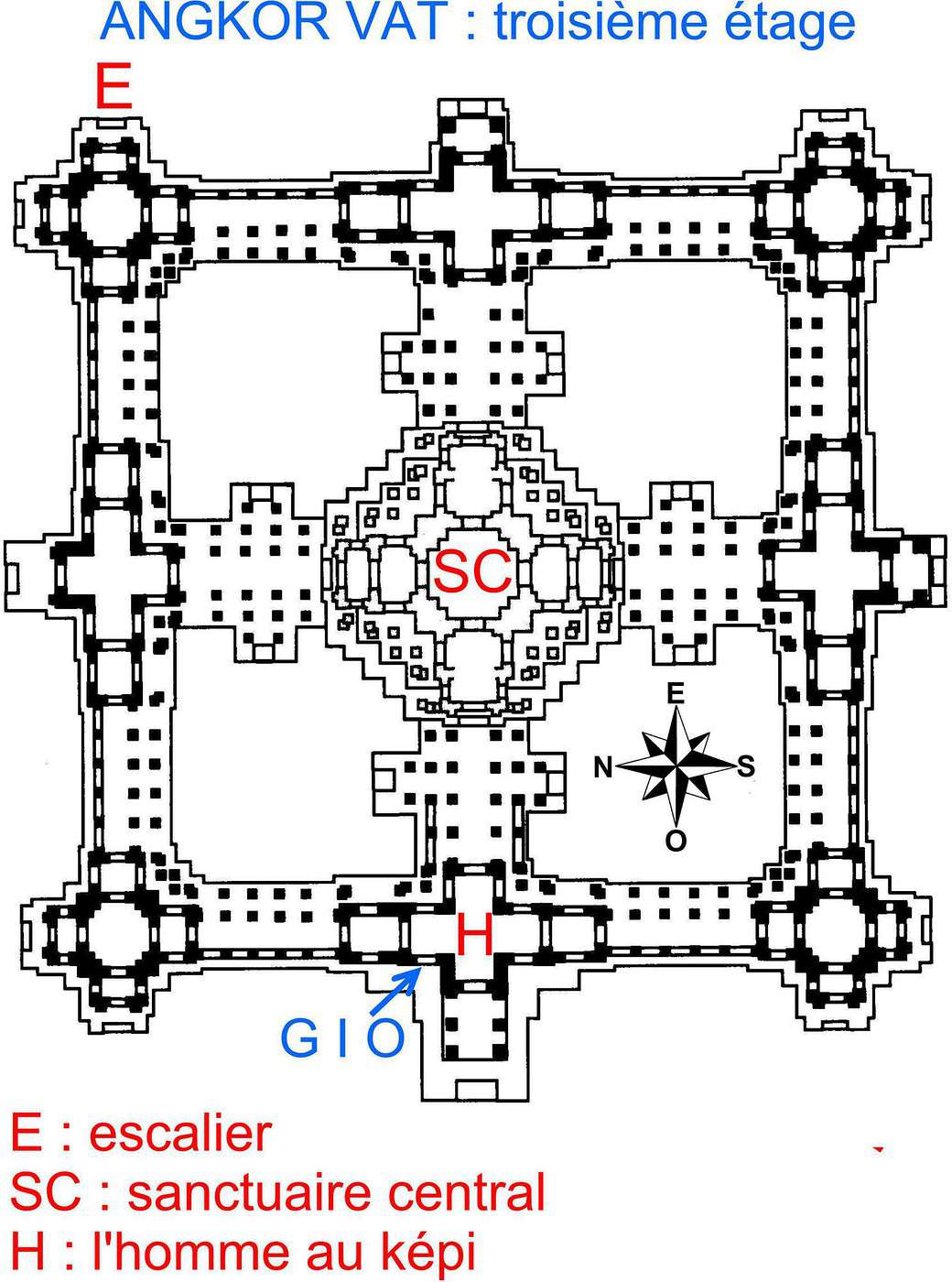
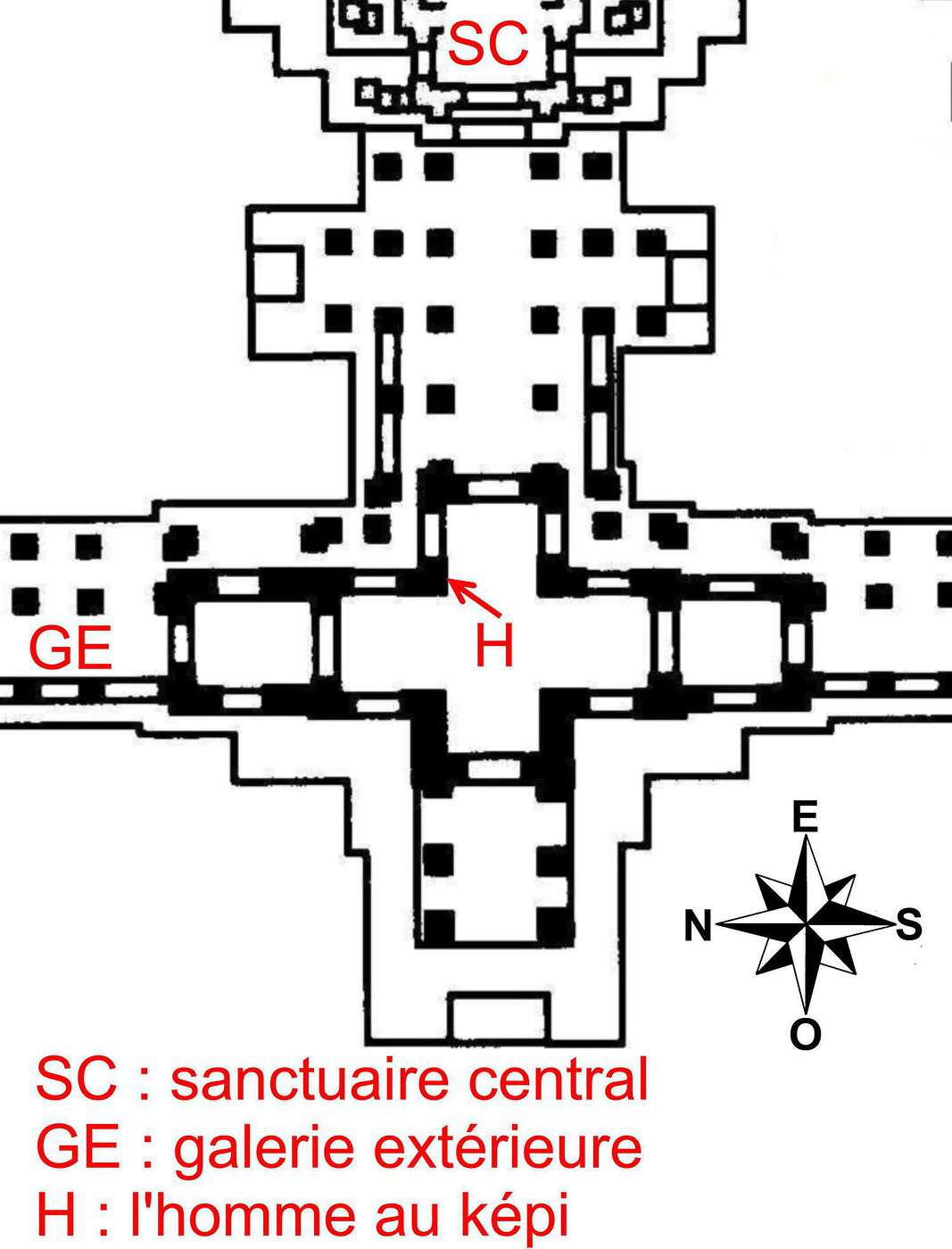
En Novembre 2014, Véro et Eddy (Veroeddy) (encore eux ) ont trouvé cet "homme au képi" et ils ont mis le post suivant. : http://voyageforum.com/v.f?post=6880723#6880723 avec le plan pour le situer. Ce plan est représenté à la fin de ce post.
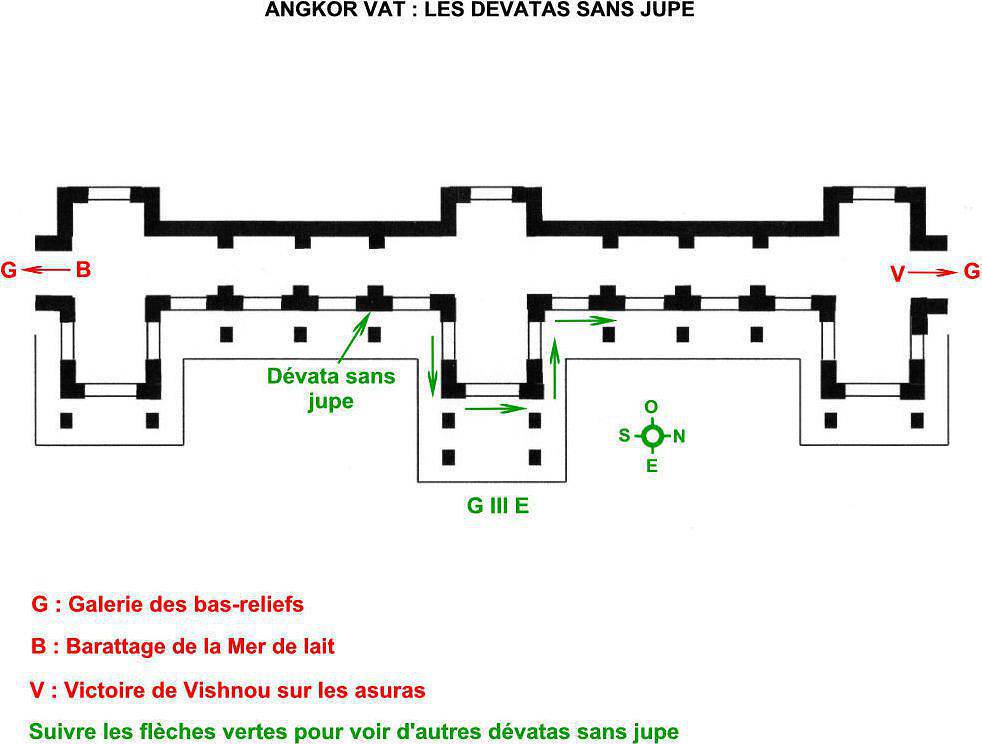
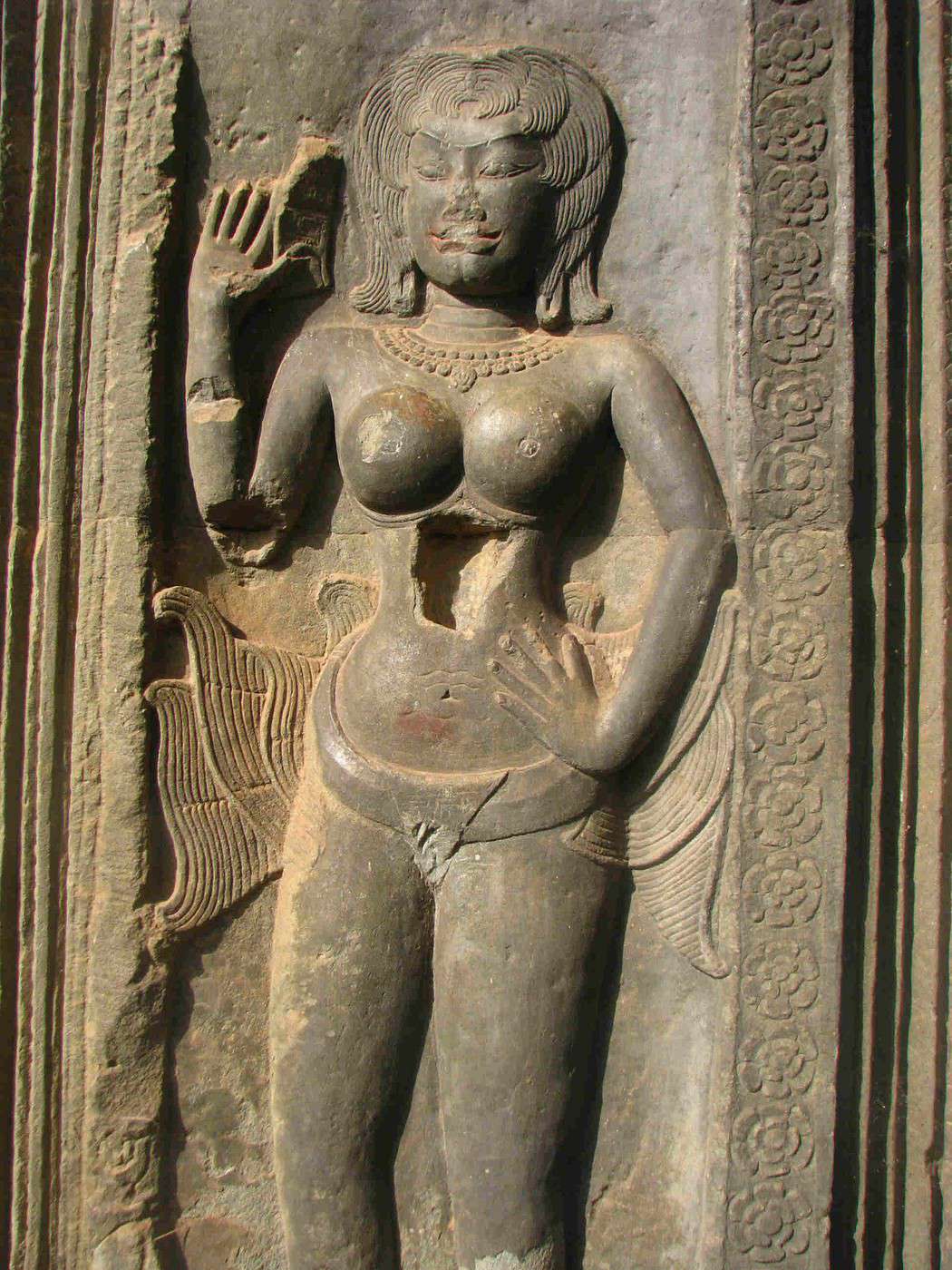
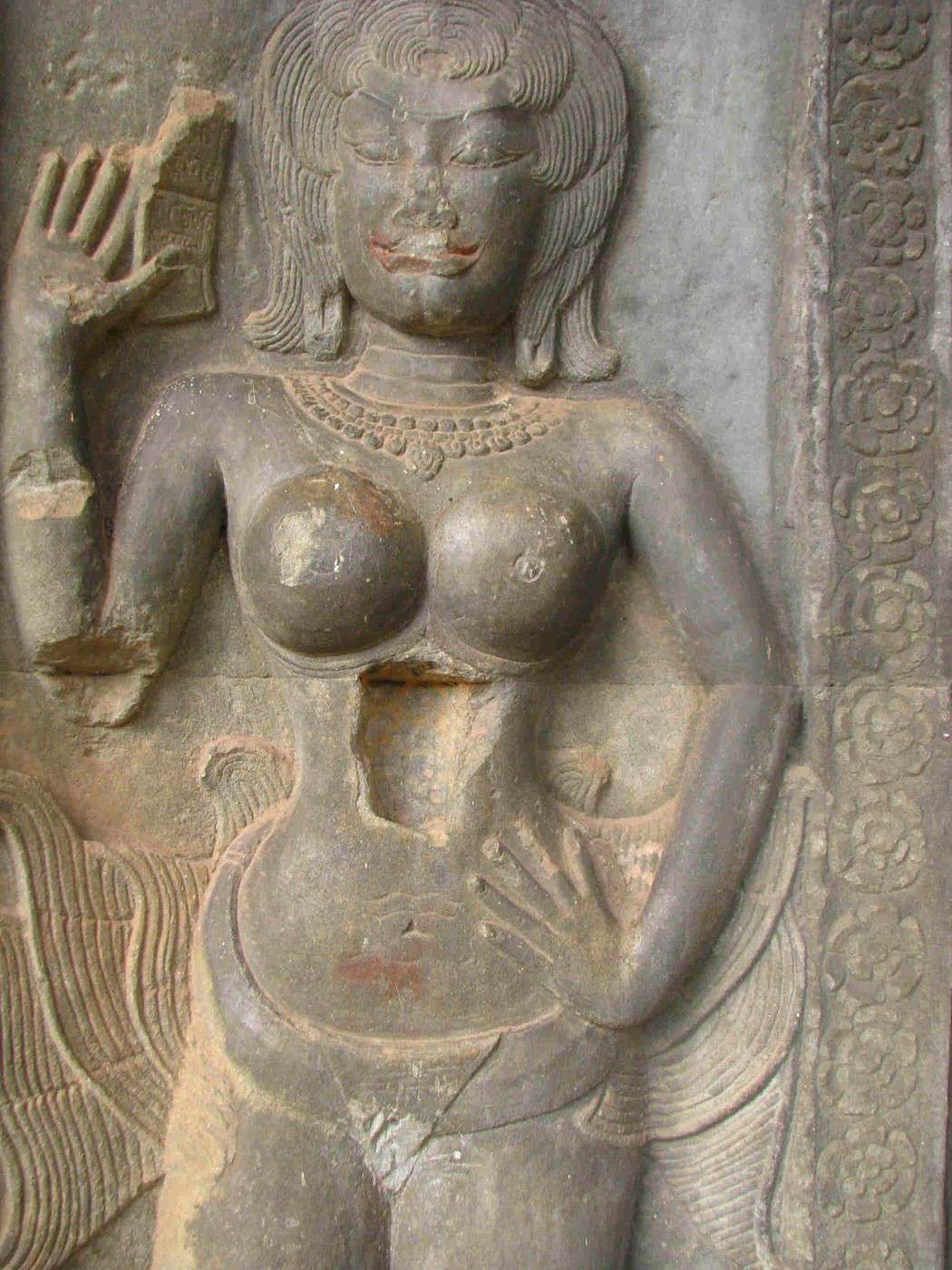
J'ai trouvé ces dévatas grâce au livre de Michel Petrotchenko "Le guide des temples d'Angkor".
Etant dans la galerie des bas-reliefs, après avoir vu le "Barattage la Mer de lait" on se rend sur la corniche du G III E face Est. En longeant cette corniche on peut voir plusieurs dévatas sans jupe.
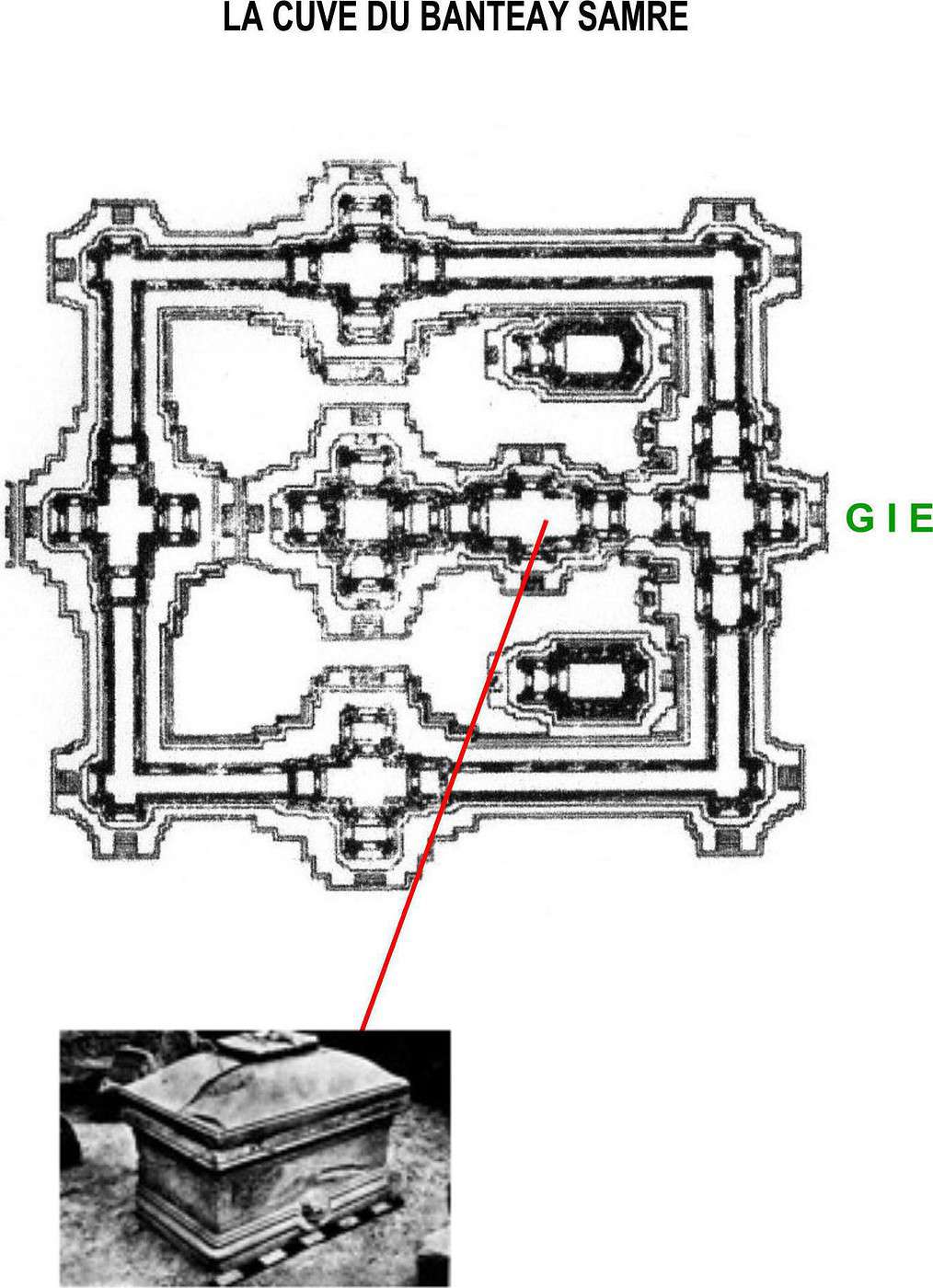
LA CUVE DU BANTEAY SAMRE
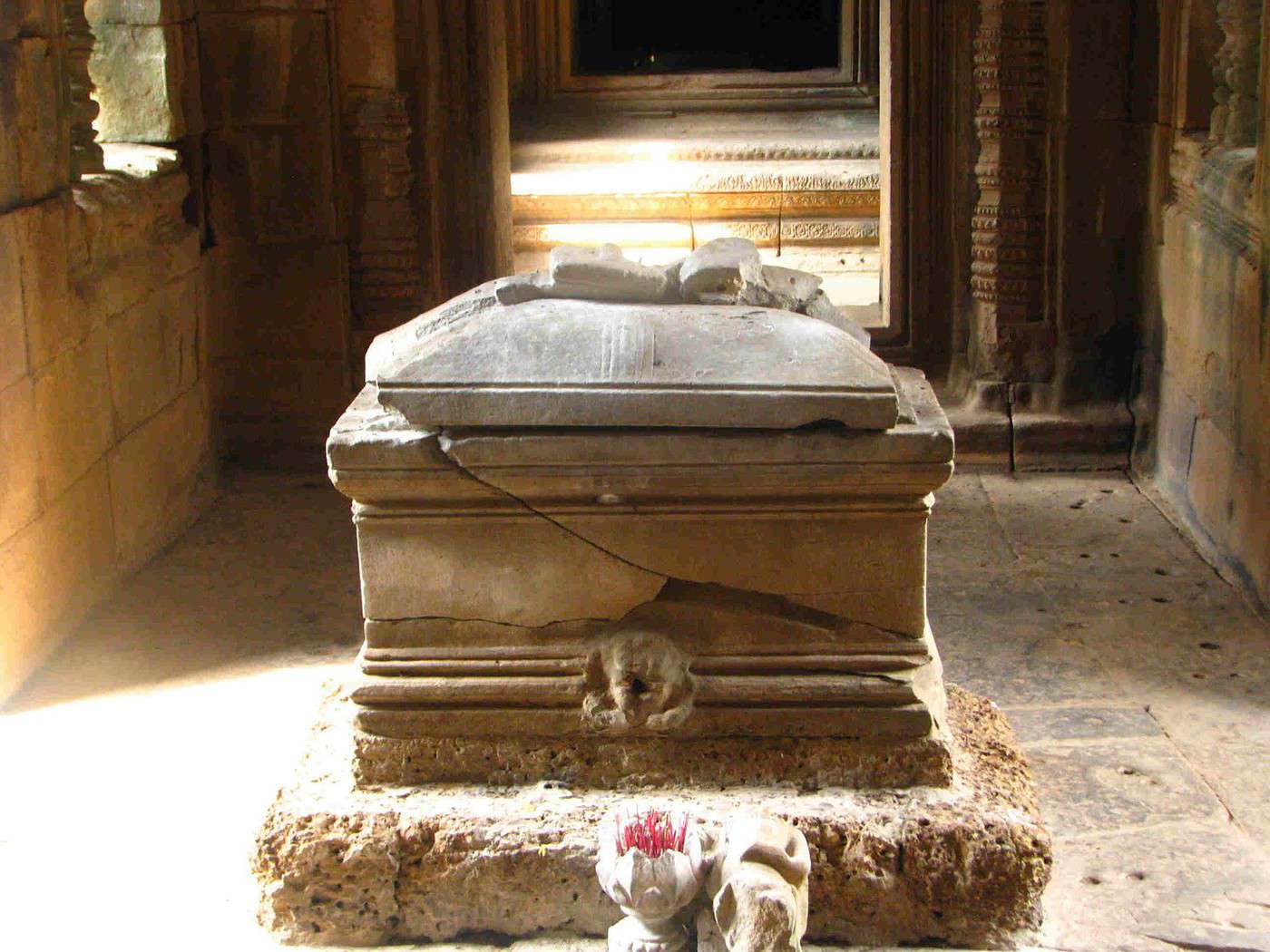
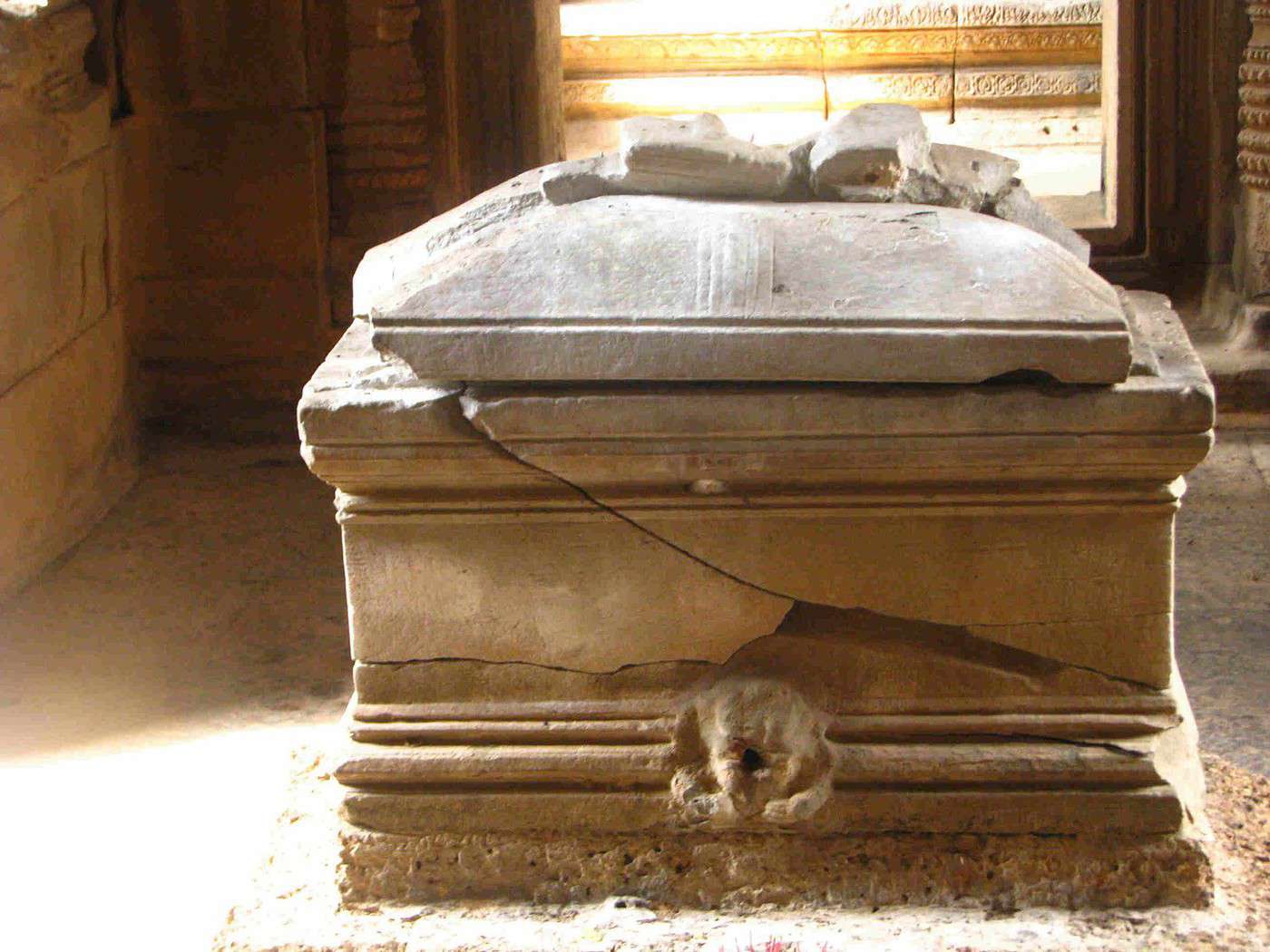
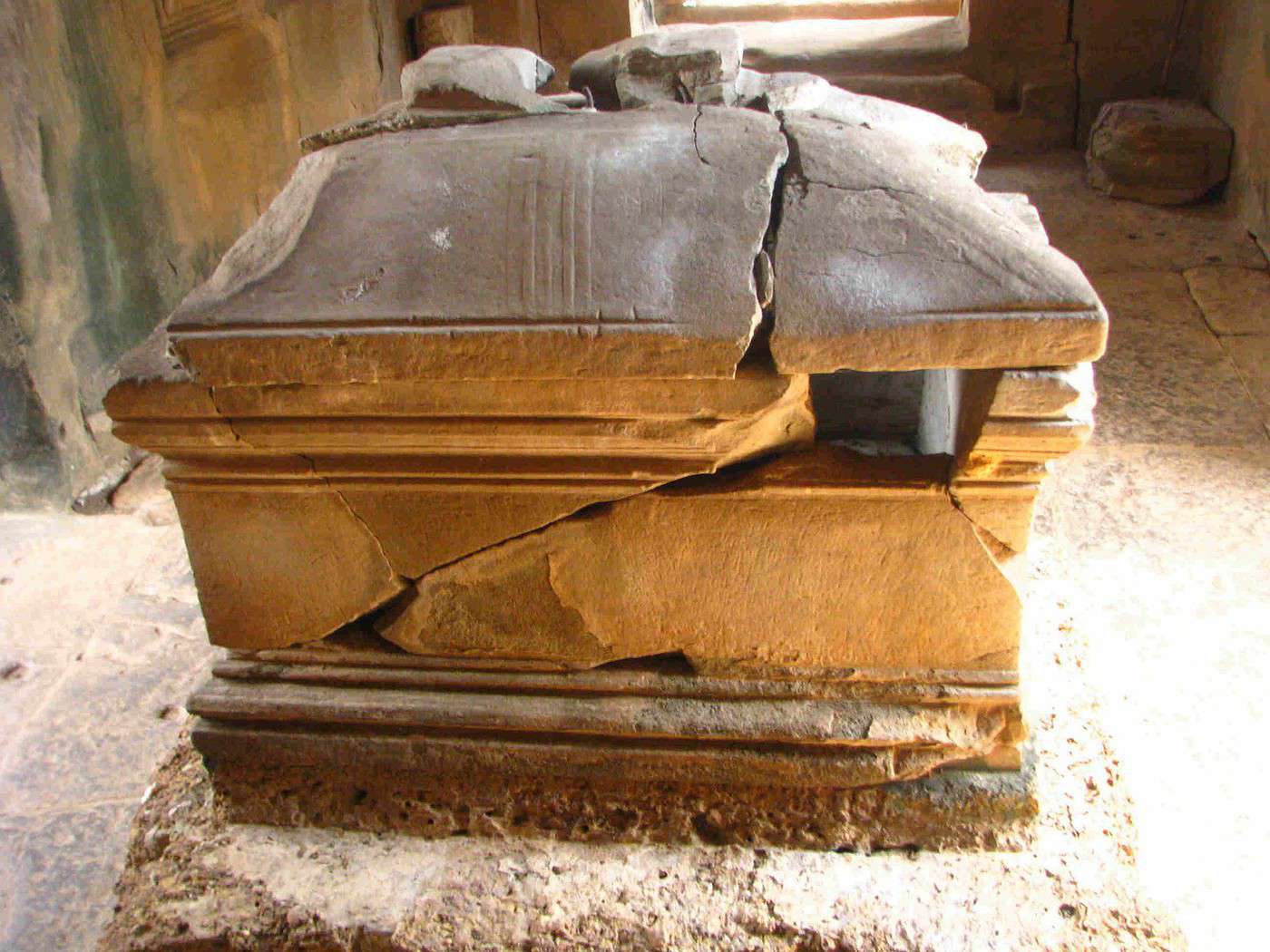
Différentes cuves ont été découvertes sur le site d'Angkor, elles ont été placées à la Conservation à l'exception de celle du Banteay Samre que l'on peut voir dans ce temple. C'est la seule cuve qui possède encore son couvercle.
George Cœdès (*) a écrit divers articles sans les BEFEO (Bulletin de l'Ecole française d'Extrême-Orient) sous le titre "Etudes cambodgiennes"
En 1940 il a écrit un article dans le BEFEO volume 40, N° 40-2 – pp. 315-349 : XXXIII – "La destination funéraire des grands monuments khmers"
Voir : http://www.persee.fr/..._1940_num_40_2_4797#
"Durant ces dernières années, les travaux de la Conservation d'Angkor ont ramené au jour une quinzaine de cuves en pierre : une seule possède encore son couvercle, et toutes celles dont la partie inférieure est conservée présentent, sauf une, la caractéristique d'être percées d'un trou d'écoulement"…
"La cuve du Banteay Samre a été découverte au pied des marches de l'entrée secondaire Sud du Gopura I Est
Dimensions extérieures : L : 0,97 m – l : 0,60 m – H : 0,50 m
Dimensions intérieures : L : 0,78 m – l : 0,39 m – H 0,39 m
Cuve complète avec couvercle percé d'un trou au centre.
Trou d'écoulement : décoré à l'extérieur d'une tête de Rahu ou de Kirtimukha sur une des grandes faces".
On ne connait pas la fonction de ces cuves. Toutes ces cuves ont été retrouvées vides. Se basant sur les rites funéraires indo-javanais, certains chercheurs pensent qu'il s'agit peut-être d'urnes funéraires ?
(*) George CŒDES :1886 - 1969. Membre de l'EFEO de 1911 à 1929, puis directeur de cet établissement de 1929 à 1947. Il est probablement le plus grand épigraphiste qui a travaillé sur les inscriptions des monuments du site d'Angkor. Il a produit une œuvre monumentale (8 volumes) sous le titre "Inscriptions du Cambodge" que l'on peut consulter à la bibliothèque de de l'EFEO de Siem Reap, il s'agit de la traduction de stèles et d'autres inscriptions retrouvées sur le site d'Angkor.
Pour plus de détails voir le site de l'EFEO : http://www.efeo.fr/ Dans "Chercheurs d'Asie" on trouve divers renseignements sur les membres de l'EFEO.
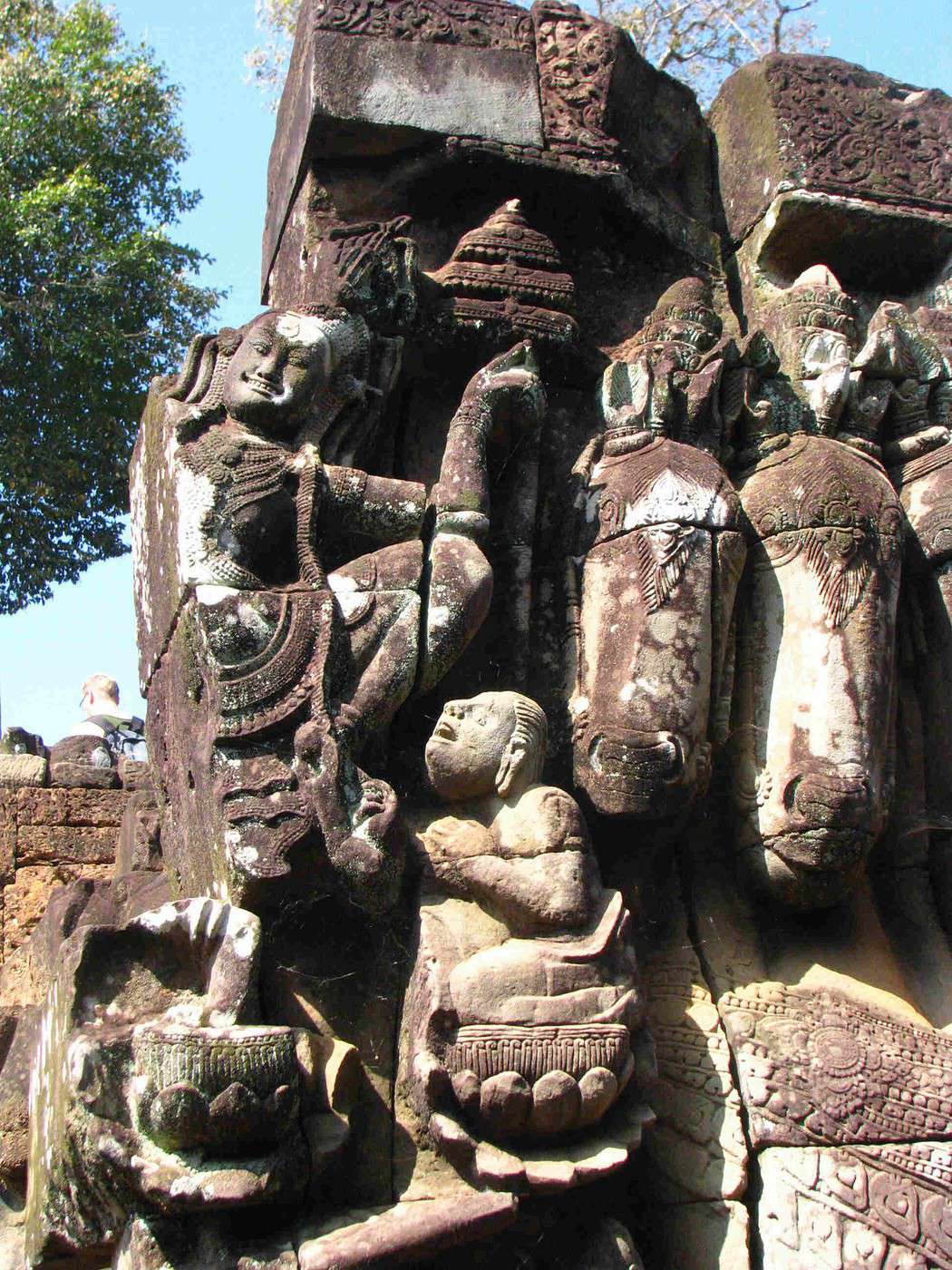
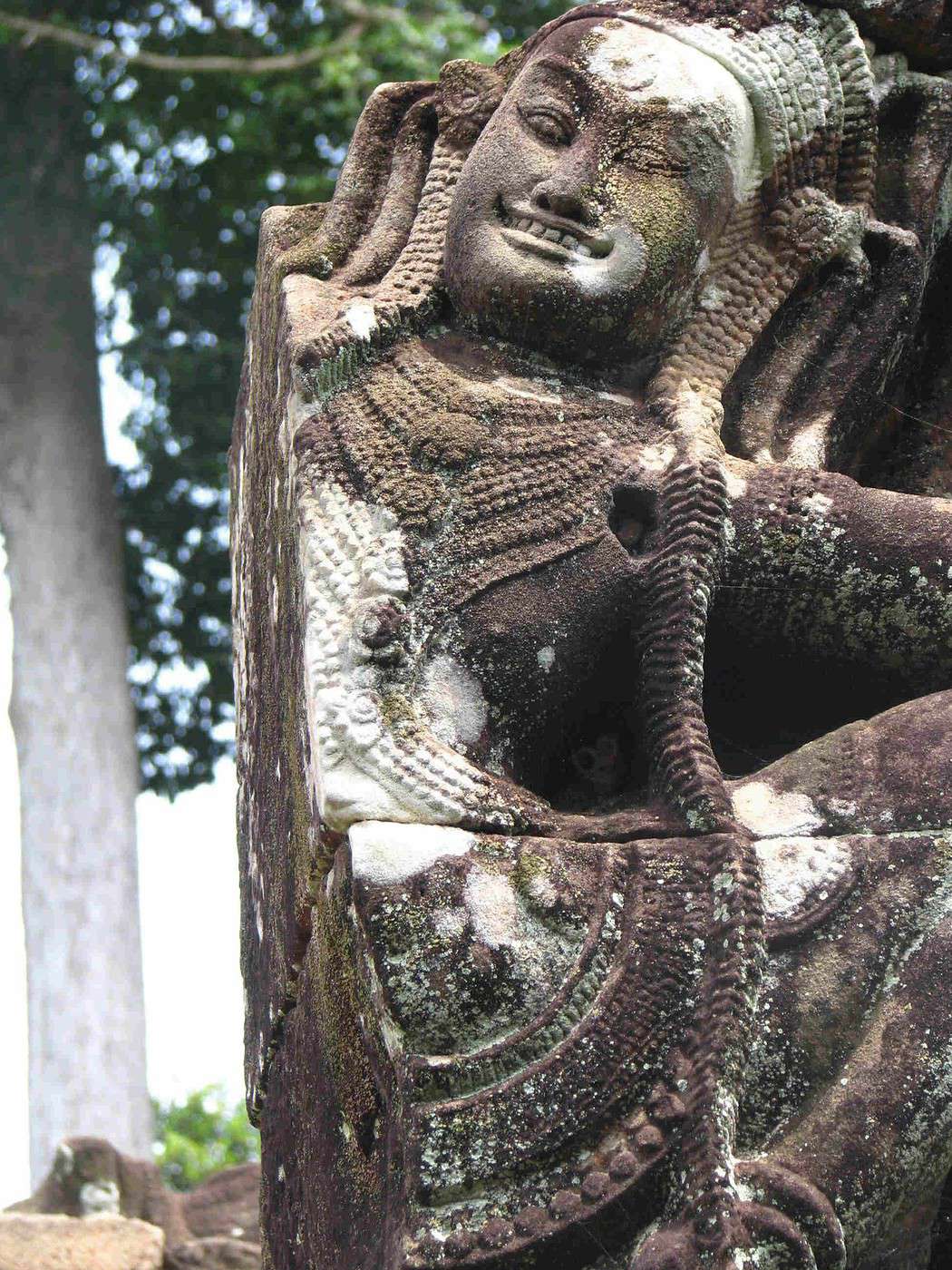
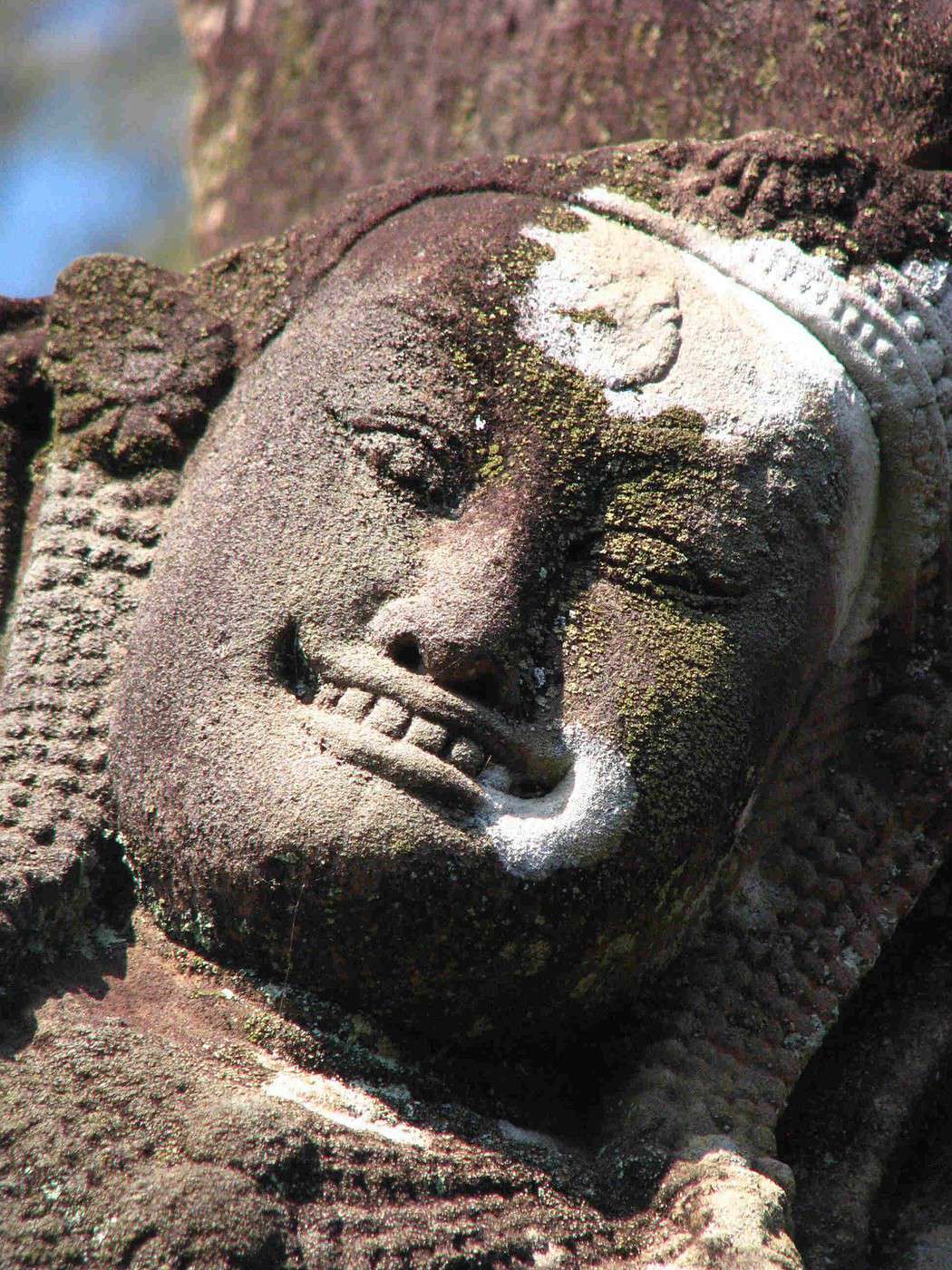
LA TERRASSE DES ELEPHANTS : L'APSARA (*) QUI MONTRE SES DENTS.
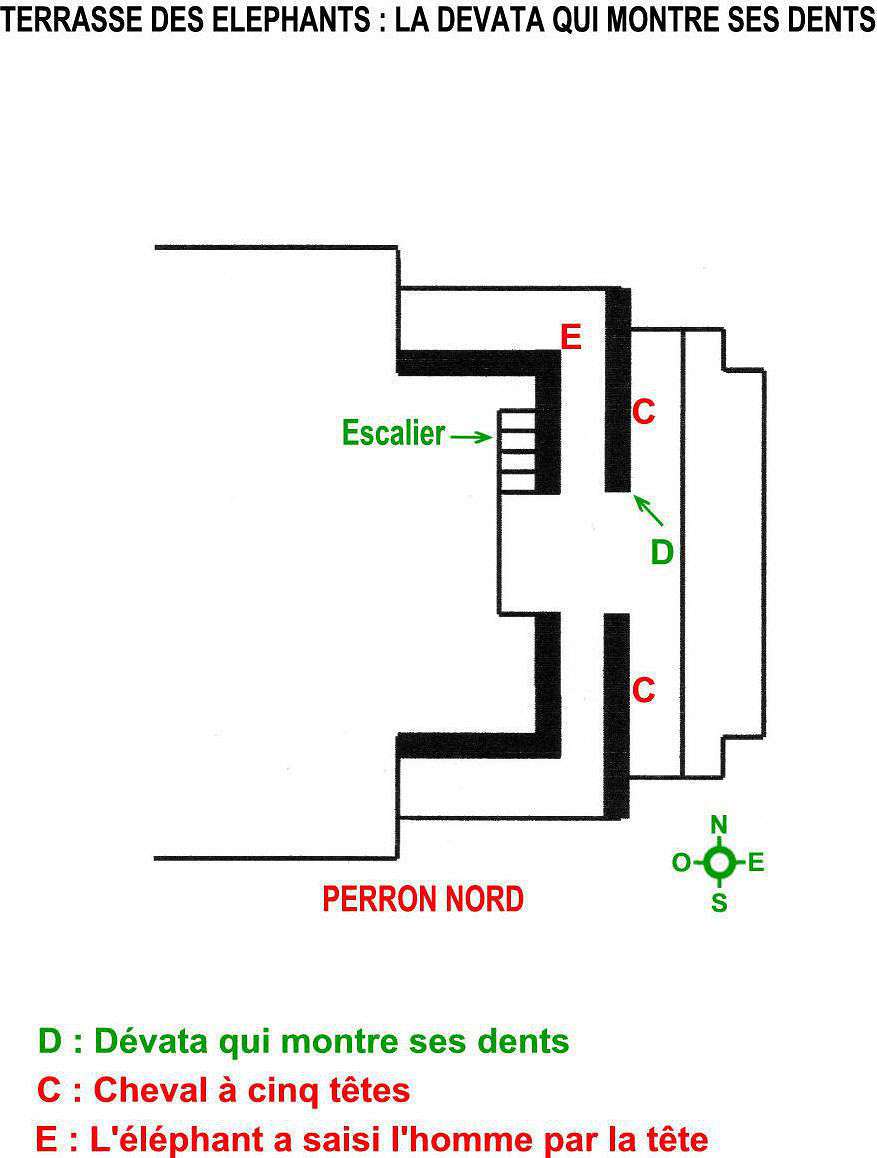
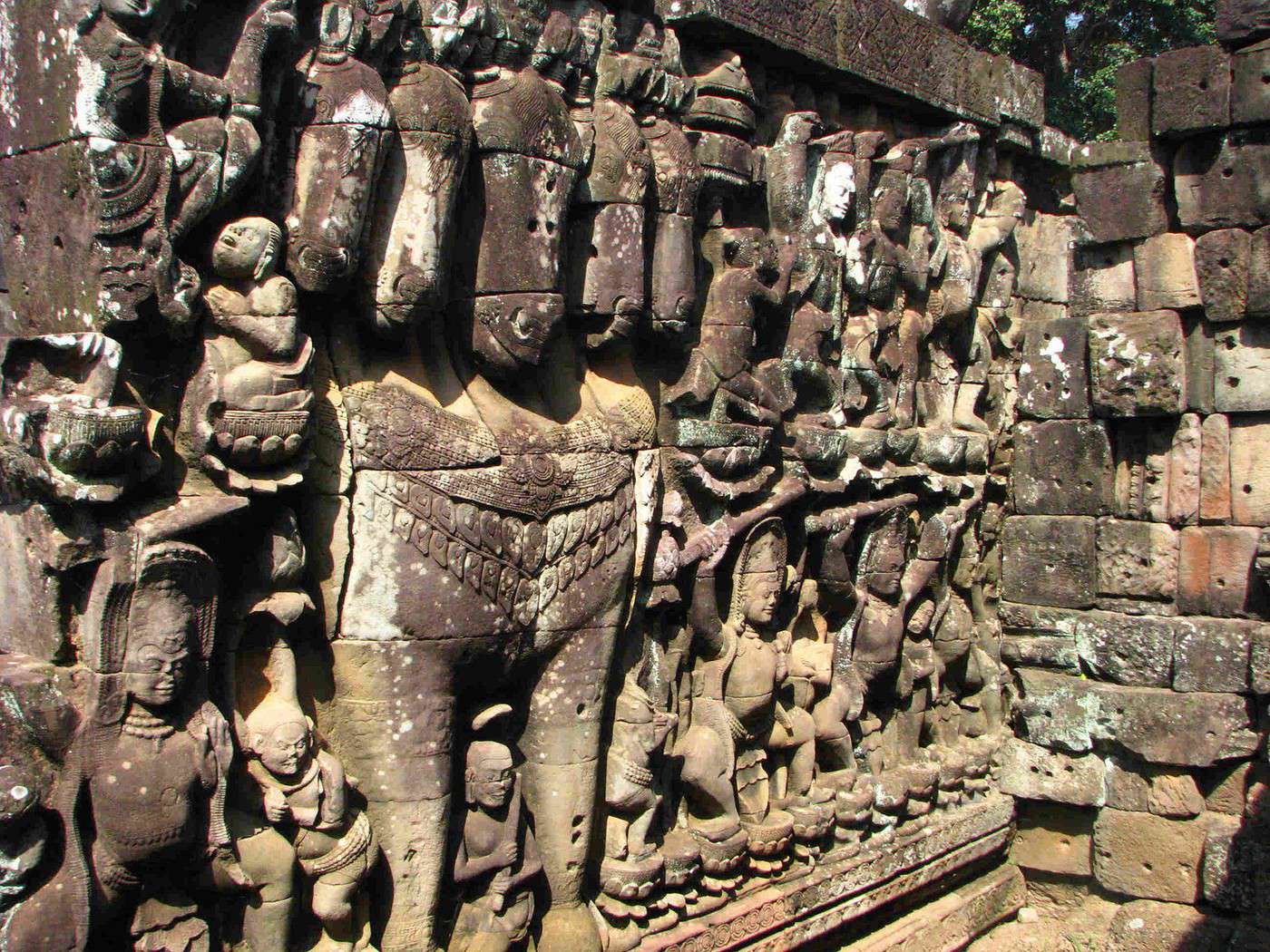
Etant sur le perron Nord de la Terrasse des Eléphants, se diriger vers l'Est et descendre l'escalier, au fond il y a deux murs avec des sculptures. Sur le mur de gauche (en regardant vers l'Ouest) il y a cheval divin à cinq têtes. Sur le mur de droite il y a également un cheval à cinq têtes. Sur la partie gauche de ce mur (à l'angle) on voit en haut du panneau une apsara qui rit de toutes ses dents.
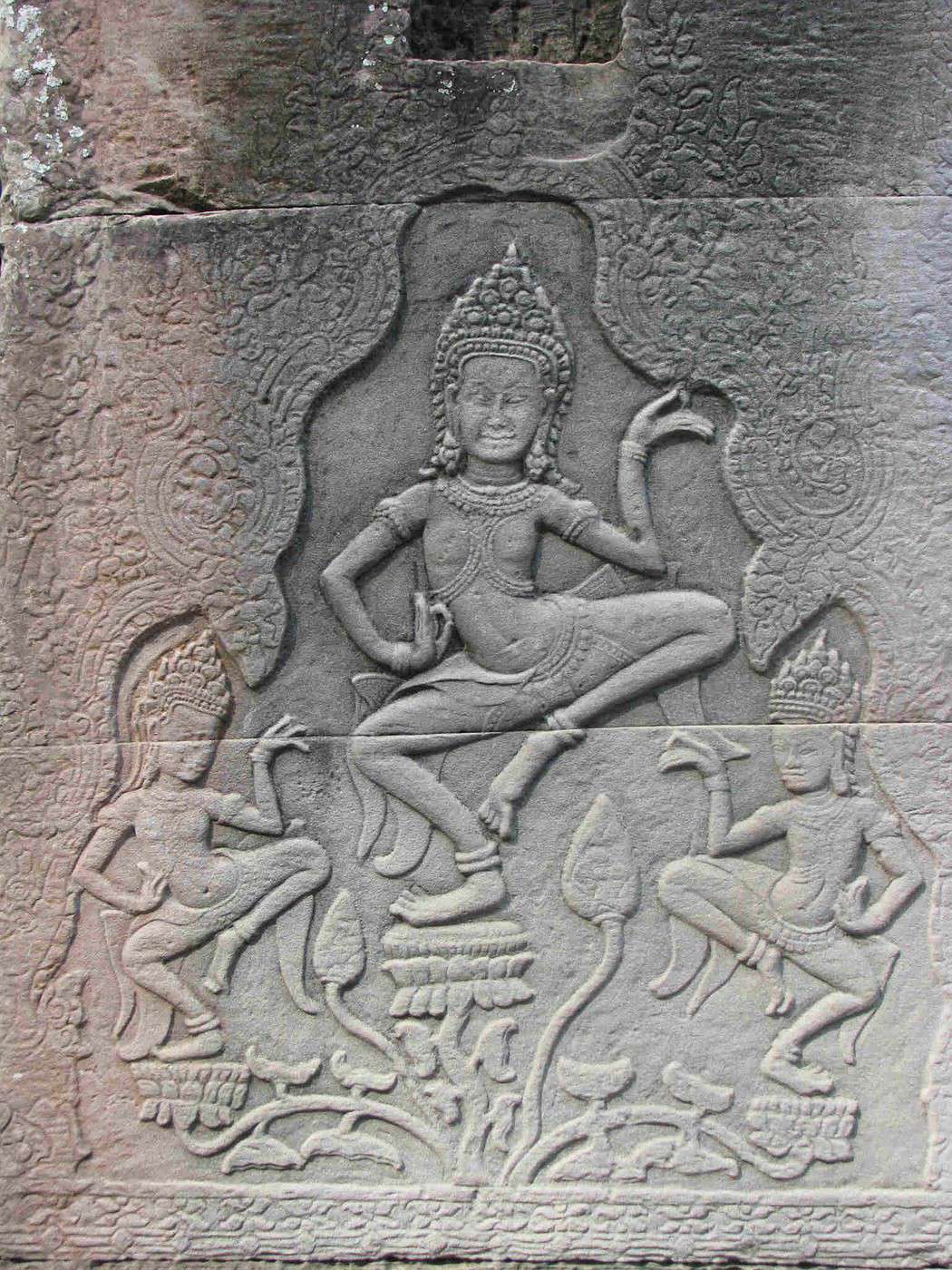
(*) Apsara:Il s'agit de danseuses célestes issues du Barattage de la Mer de Lait (voir les bas-reliefs d'Angkor Vat). On les reconnait très facilement, elles sont représentées en dansant les jambes pliées. Dans certains temples il y a "des salles de danses" (Banteay Kdei, Preah Khan…) il s'agit de pièces avec de nombreux piliers ou linteaux sur lesquels des apsaras sont représentées. Voir la sixième photo prise au Banteay Kdei.
EVACUATION DE L'EAU D'ANGKOR THOM
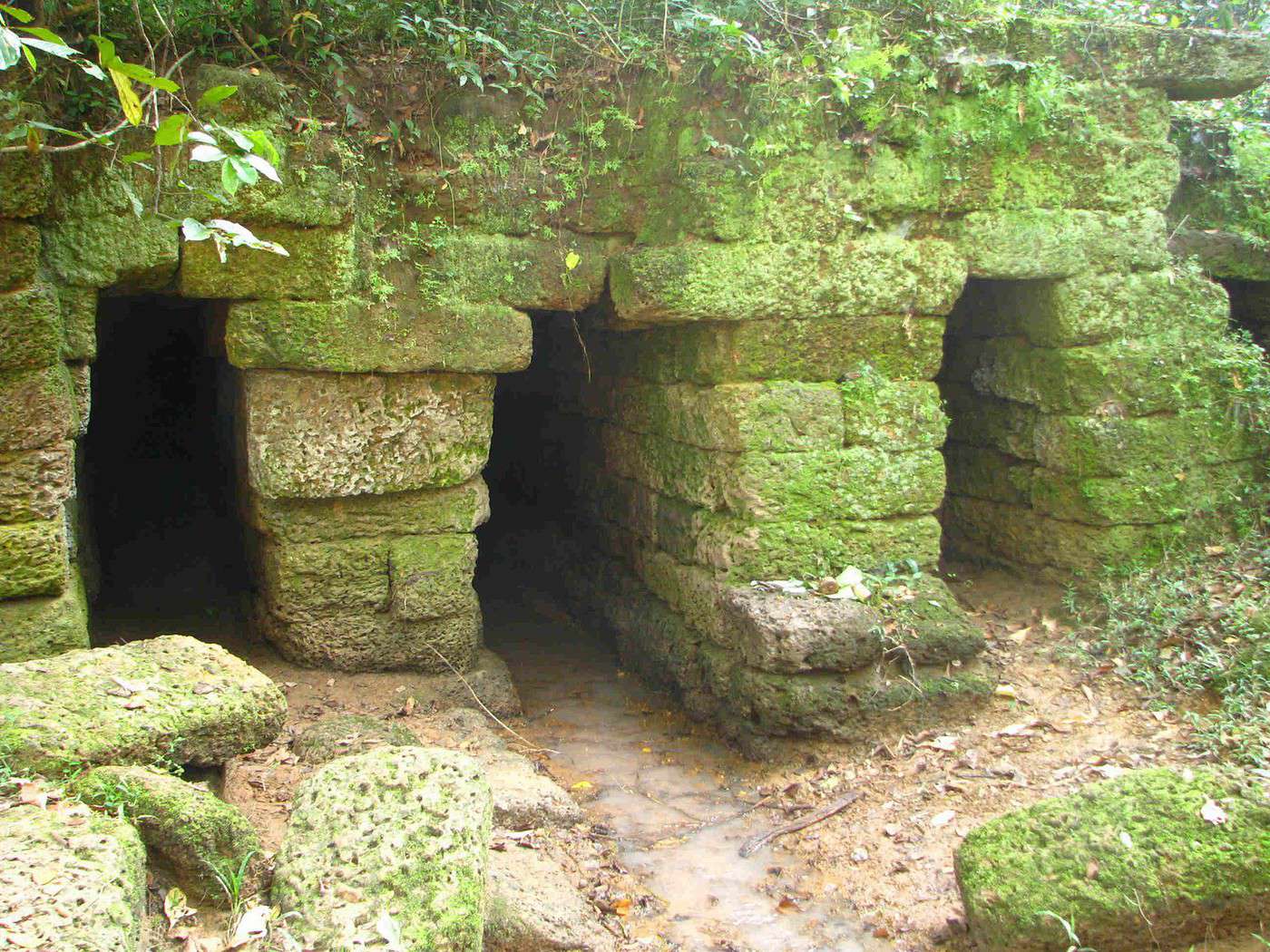
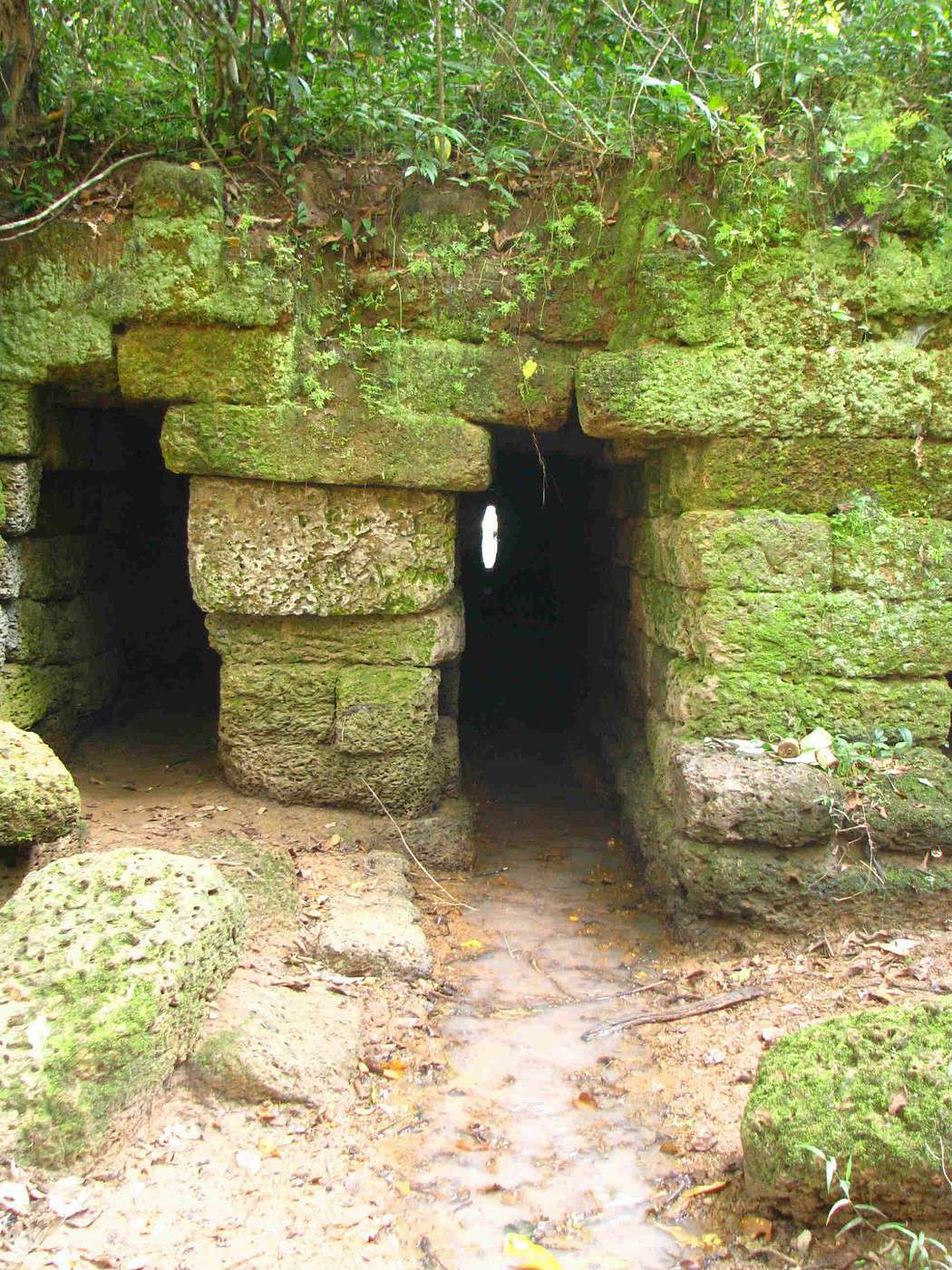
La pente naturelle du sol d'Angkor Thom va du Nord-Est au Sud-Ouest. C'est ainsi que l'eau pénètre dans la ville au travers de tunnels dans l'angle Nord-Est et est évacuée de la même façon dans l'angle Sud-Ouest ; ces tunnels, fort bien construits, et méritent une visite.
L'eau qui pénètre dans Angkor Thom permettait à l'origine le remplissage des différents canaux et bassins.
Après avoir franchi la porte Sud d'Angkor Thom, monter à gauche sur la muraille pour rejoindre le Prasat Chrung du Sud-Ouest (sur la muraille d'Angkor Thom, à chaque angle il y a un prasat). Avant d'arriver à ce Prasat, à une cinquantaine de mètres, il y a un petit chemin à droite qui descend pour rejoindre le tunnel. Selon la saison on peut voir de l'eau dans le ruisseau qui coule vers la douve.
Banteay Srei 1/3
"De l'avis unanime, Banteay Srei est un"bijou précieux", le "joyau de l'art Khmer". (Maurice Glaize : "Les monuments du groupe d'Angkor").
A la différence de la plupart des grands sites d'Angkor, Banteay Srei n'est pas un temple royal. Il a été construit par l'un des conseillers du roi Râjendravarman (944 - 968), Yajnavarâha, qui fut aussi le guru du futur roi Jayavarman V. C'est le roi qui fit don de cette terre près de la rivière de Siem Reap à Yajnavarâha ; avec son frère cadet, celui-ci ordonna la construction du temple, dont les divinités furent installées juste avant la mort de Râjendravarman.
Le Banteay Srei a été découvert seulement en 1914 par un officier du Service géographique, le Lieutenant Marec.
En 1916 quelques lignes dans un BEFEO ("Chronique" BEFEO 1916 – N° 16 p. 98-99) mentionnent ce temple : "le Bantài Srëi, peut compter parmi ce que l'art classique à ses débuts a exécuté de plus gracieux ; le monument très complet offre dans ses formes réduites une sculpture des plus variées et d'un haut intérêt archéologique".
Voir : http://www.persee.fr/...9_1916_num_16_1_5308
Pierre Baptiste ("L'art khmer dans les collections du Musée Guimet") mentionne qu'Henri Parmentier a écrit un article en 1919 sur le Banteay Srei sans préciser son titre ni la revue, il mentionne uniquement "Henri Parmentier, 1919, p. 66-79".
J'ai donc cherché et j'ai trouvé un article d'Henri Parmentier sous le titre "L'art d'Indravarman"…
Voir le BEFEO année 1919 – Volume 19, N° 1, pp. 1-98.Le Banteay Srei est décrit pages 66-79.
Voir : http://www.persee.fr/...9_1919_num_19_1_5647
"Ce texte n'avait pas échappé à la convoitise d'un érudit en mal d'argent, un certain André Malraux". (Pierre Baptiste).
Voir le site de Véro et Eddy sur "l'affaire Malraux" :
http://www.veroeddy.be/asie/cambodge/laffaire-malraux
Le dégagement de ce temple a été effectué en 1924 par Henri Parmentier et Victor Goloubew.
En 1930 Henri Marchal, membre permanent de L'EFEO, conservateur du groupe d'Angkor a été envoyé en mission à Java du 1er Juillet au 29 Octobre pour étudier la méthode de l'anastylose qui avait déjà été utilisée pour la restauration de temples. Il a procédé à la restauration du Banteay Srei entre 1931 et 1936, il y utilisa pour la première fois à Angkor la technique de l'anastylose.
La partie centrale du temple est entourée d'une corde pour empêcher son accès aux visiteurs… Si vous arrivez très tôt pour visiter le Banteay Srei (entre 6h00 et 6h30), des policiers chargés de la surveillance de ce temple vous proposeront peut-être de franchir la corde pour voir cette "partie non accessible"… En Novembre 2014 le policier m'a demandé 3 $ (tout augmente au Cambodge, en 2013 j'avais donné 2 $). Ce policier vous accompagnera et vous montrera de belles sculptures.
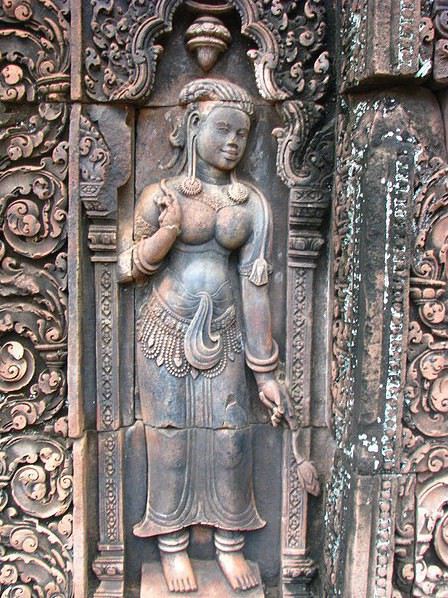
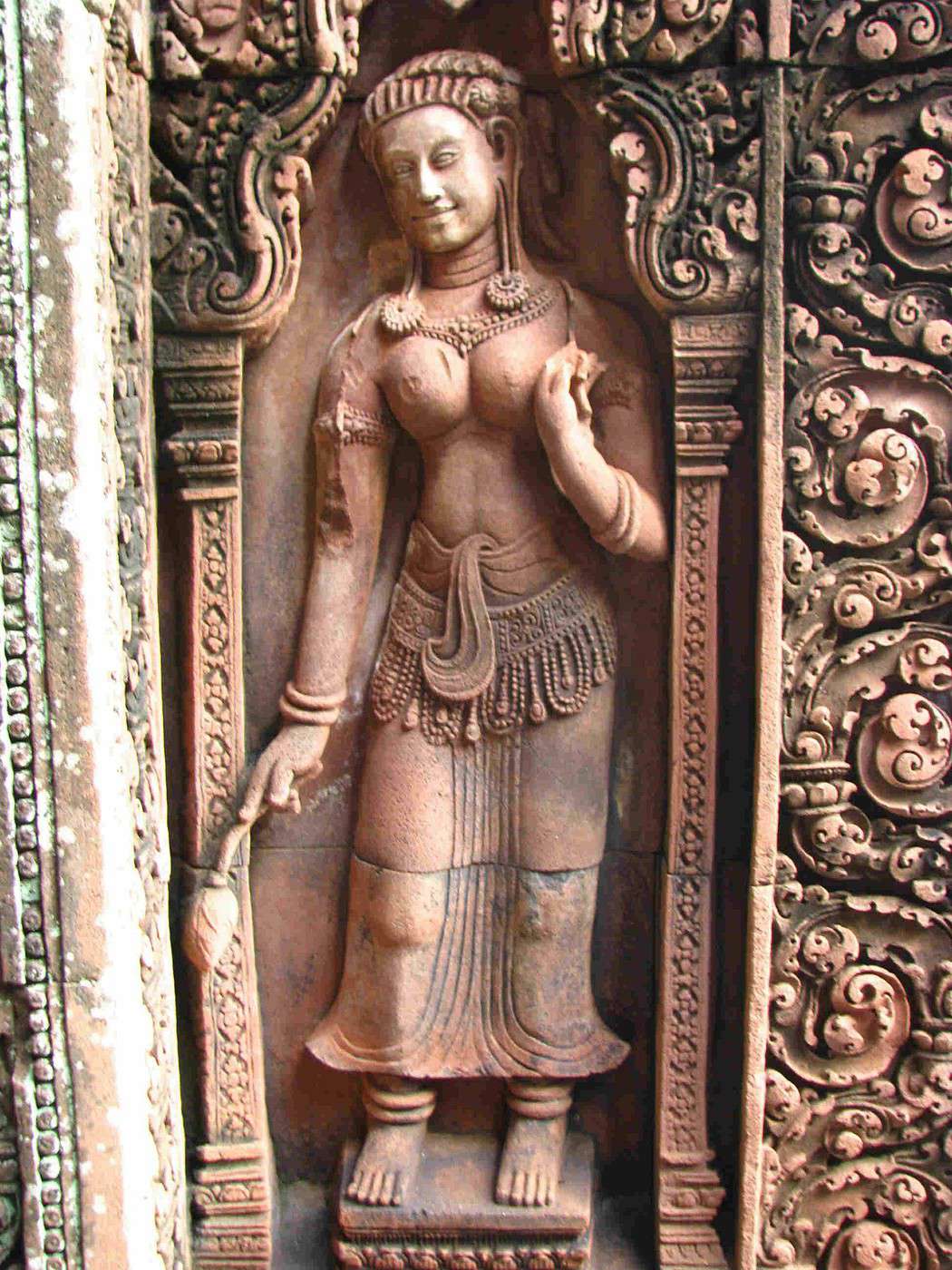
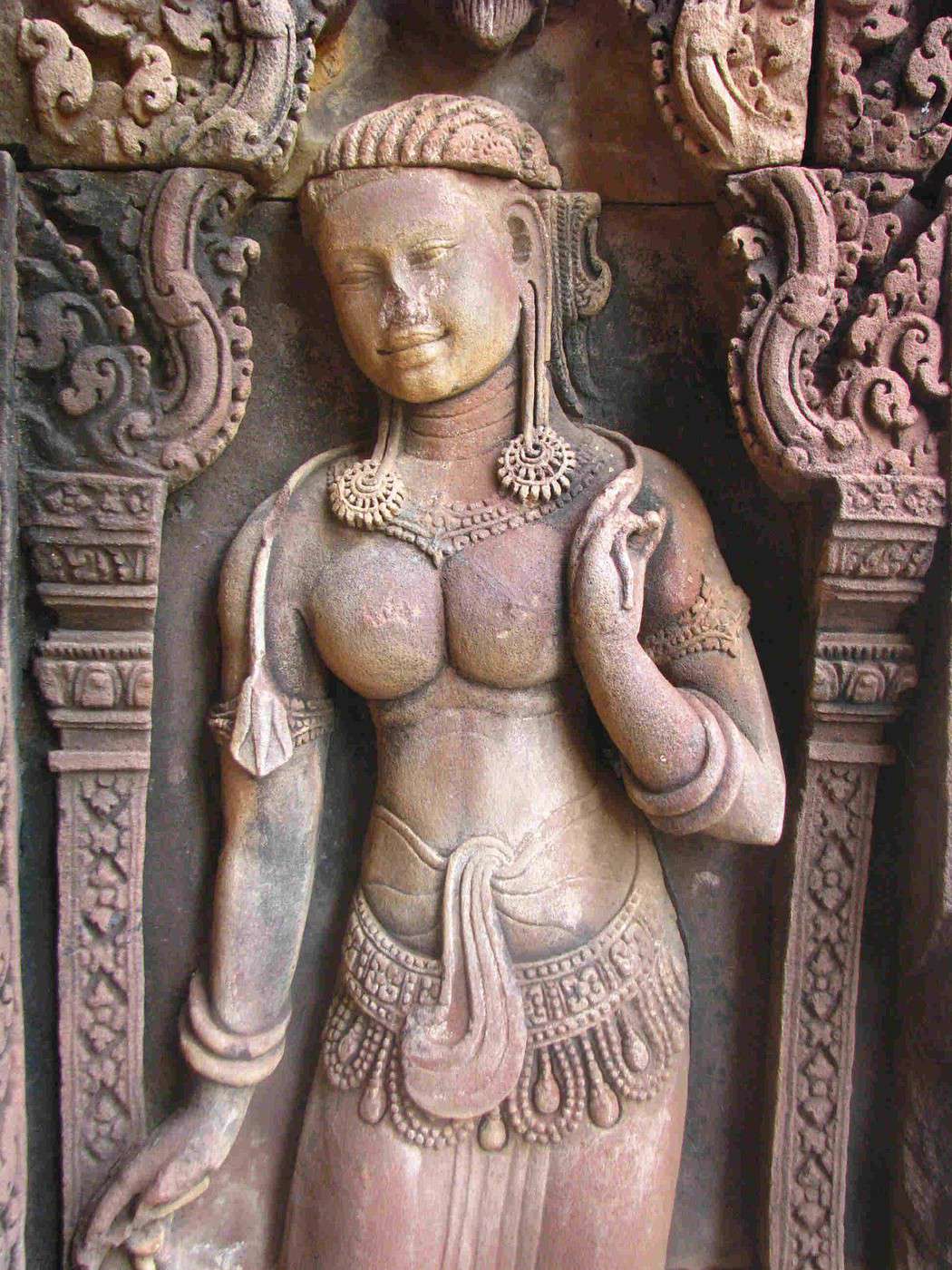
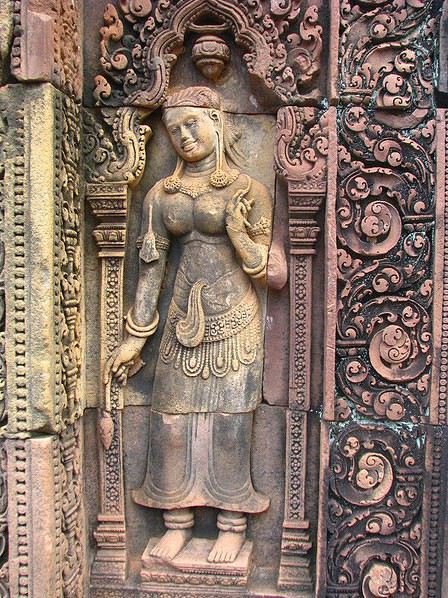
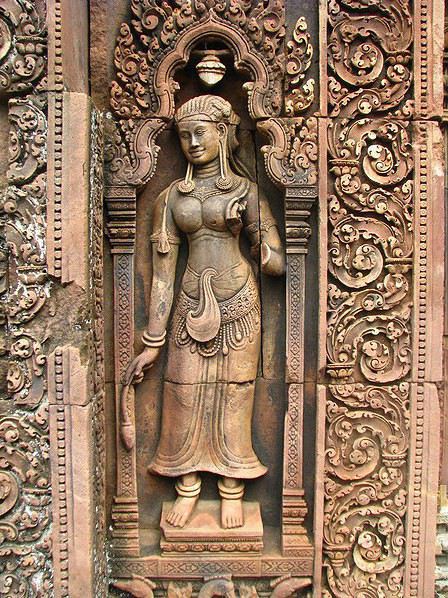
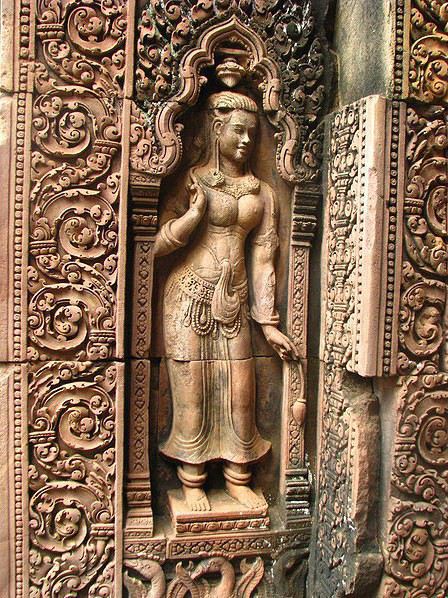
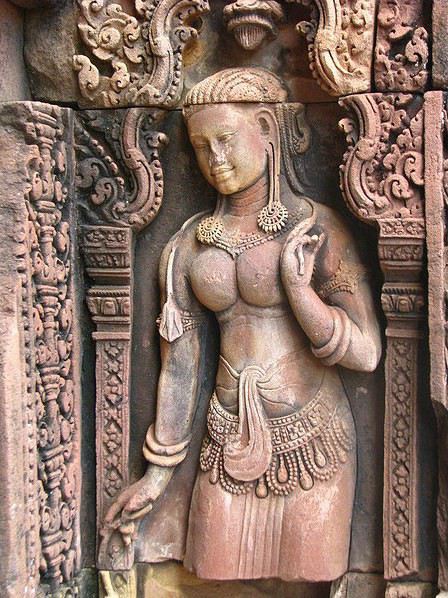
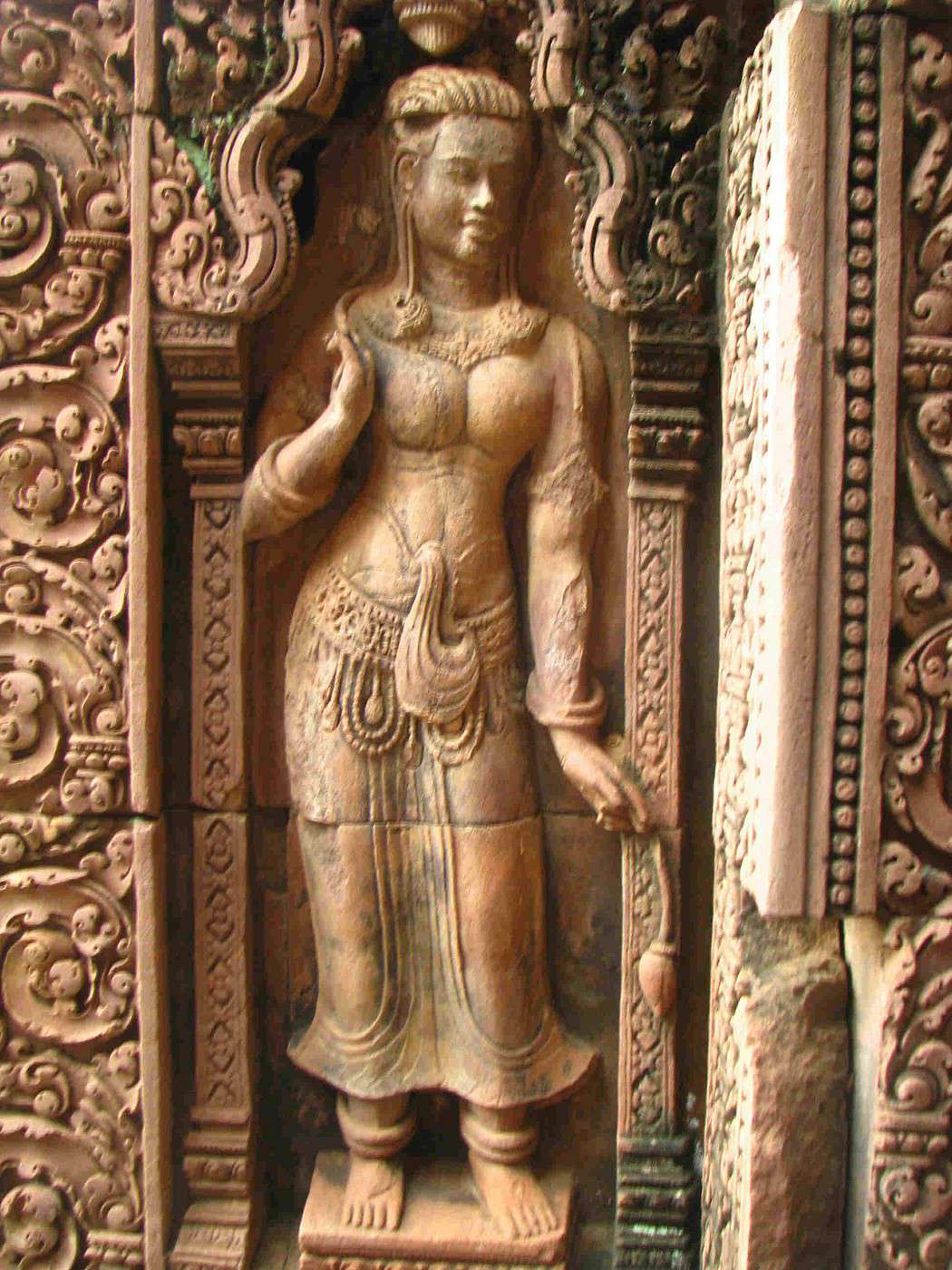
C'est à cet endroit que j'ai vu les plus belles et les plus fines sculptures du site d'Angkor. Voir photos jointes.
Banteay Srei 3/3
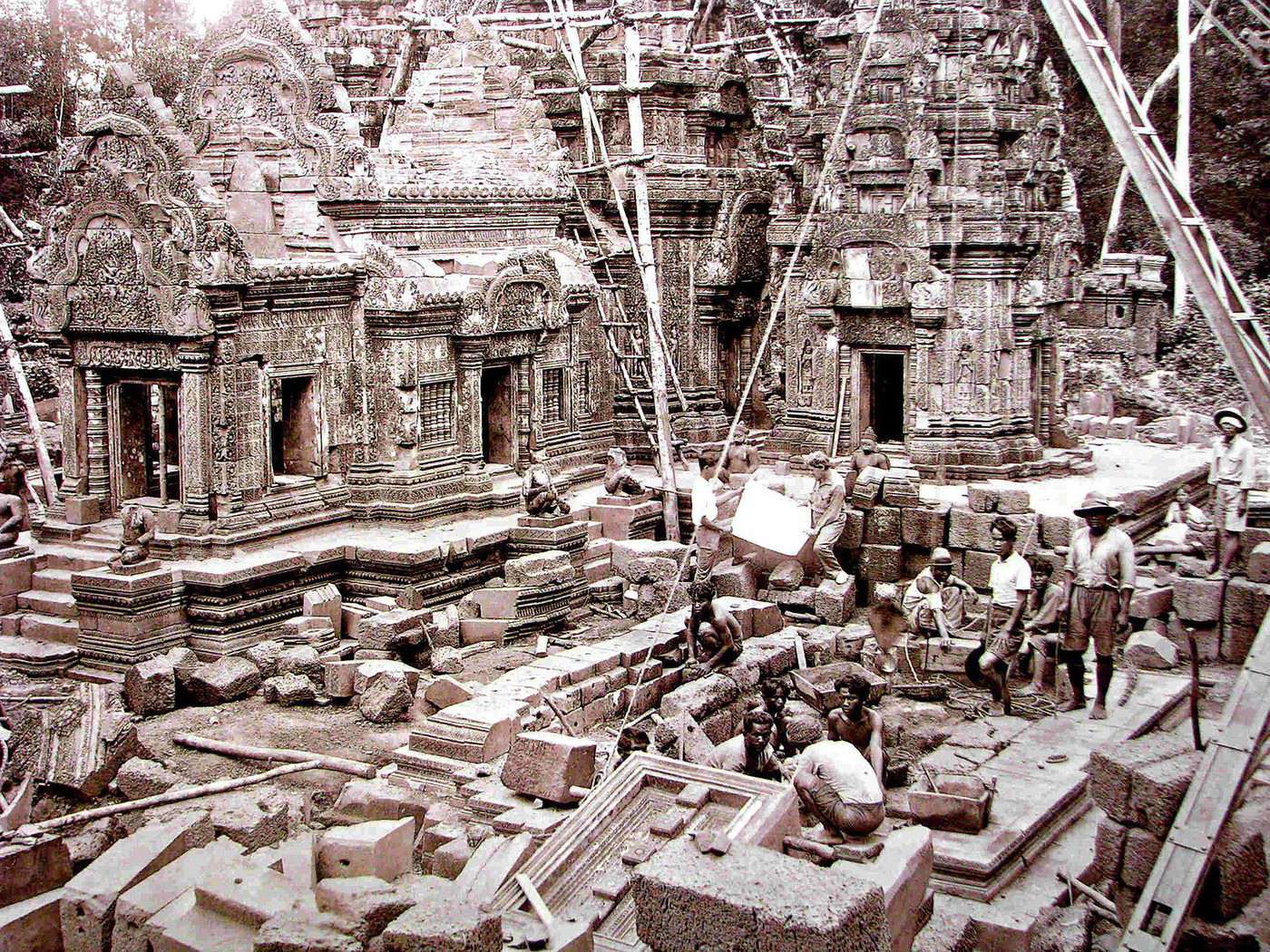
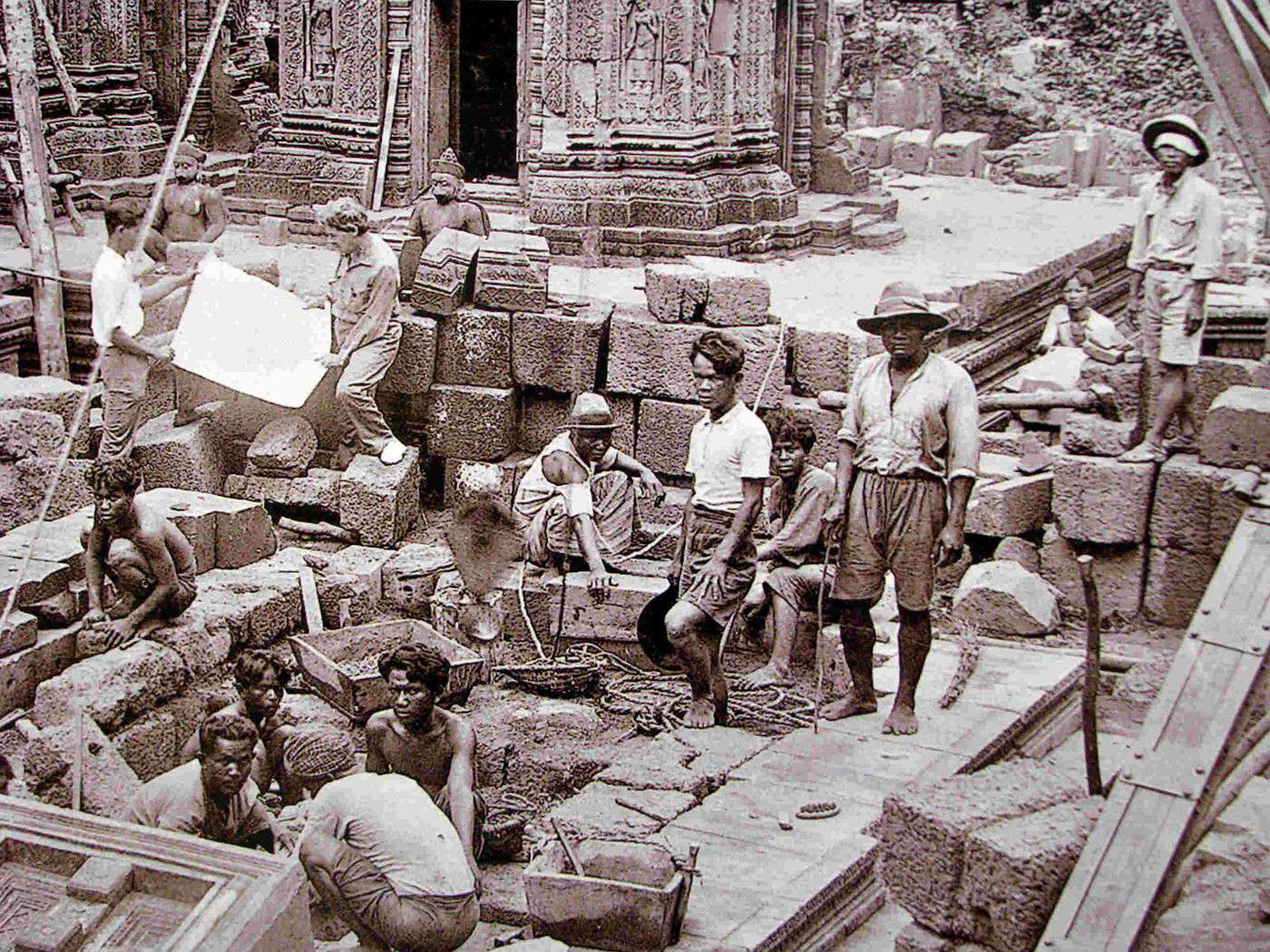
Après avoir visité le Banteay Srei, ne pas rejoindre le parking mais continuer tout droit. Il y a un petit pavillon dans lequel on trouve des explications sur les temples. On y voit plusieurs photographies prises lors de la restauration de ce temple de de 1931 et 1936.
Banteay Srei 2/3
Encore des photographies de la "partie non accessible" aux visiteurs
Merci Jacques pour ces superbes photos.
Sur la base des seuls décorations officiellement accessibles, je n'avais pas perçu le caractère exceptionnel de ces sculptures. Pas tant pour leur superbe état de conservation, mais pour leur style si original. Je n'ai pas souvenir d'avoir vu un tel naturel dans les autres temples angkoriens.
Encore merci !
Fabrice
S'exposer à l'Etranger lointain amène à mieux connaître et comprendre sa propre Culture.
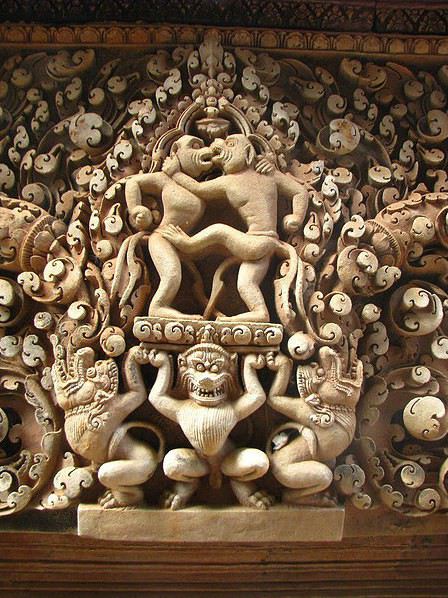
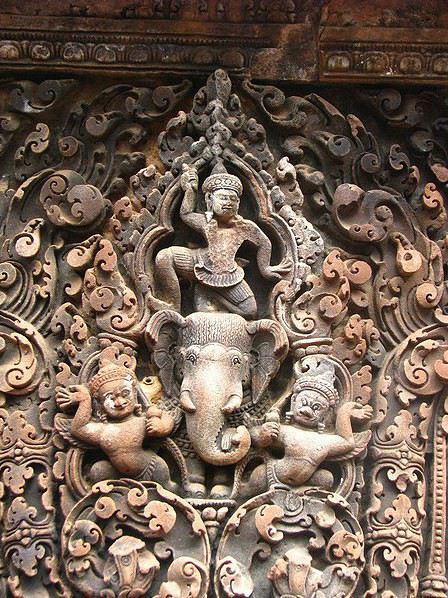
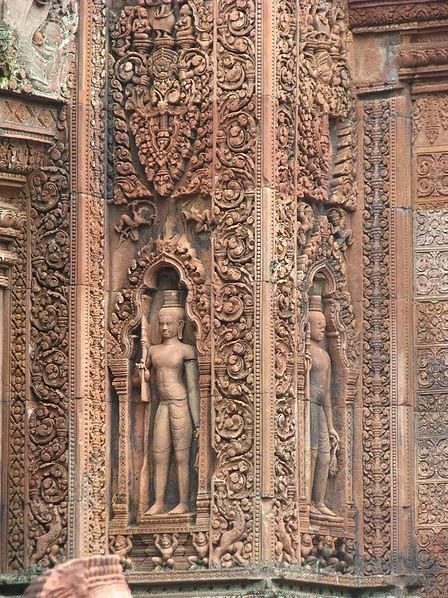
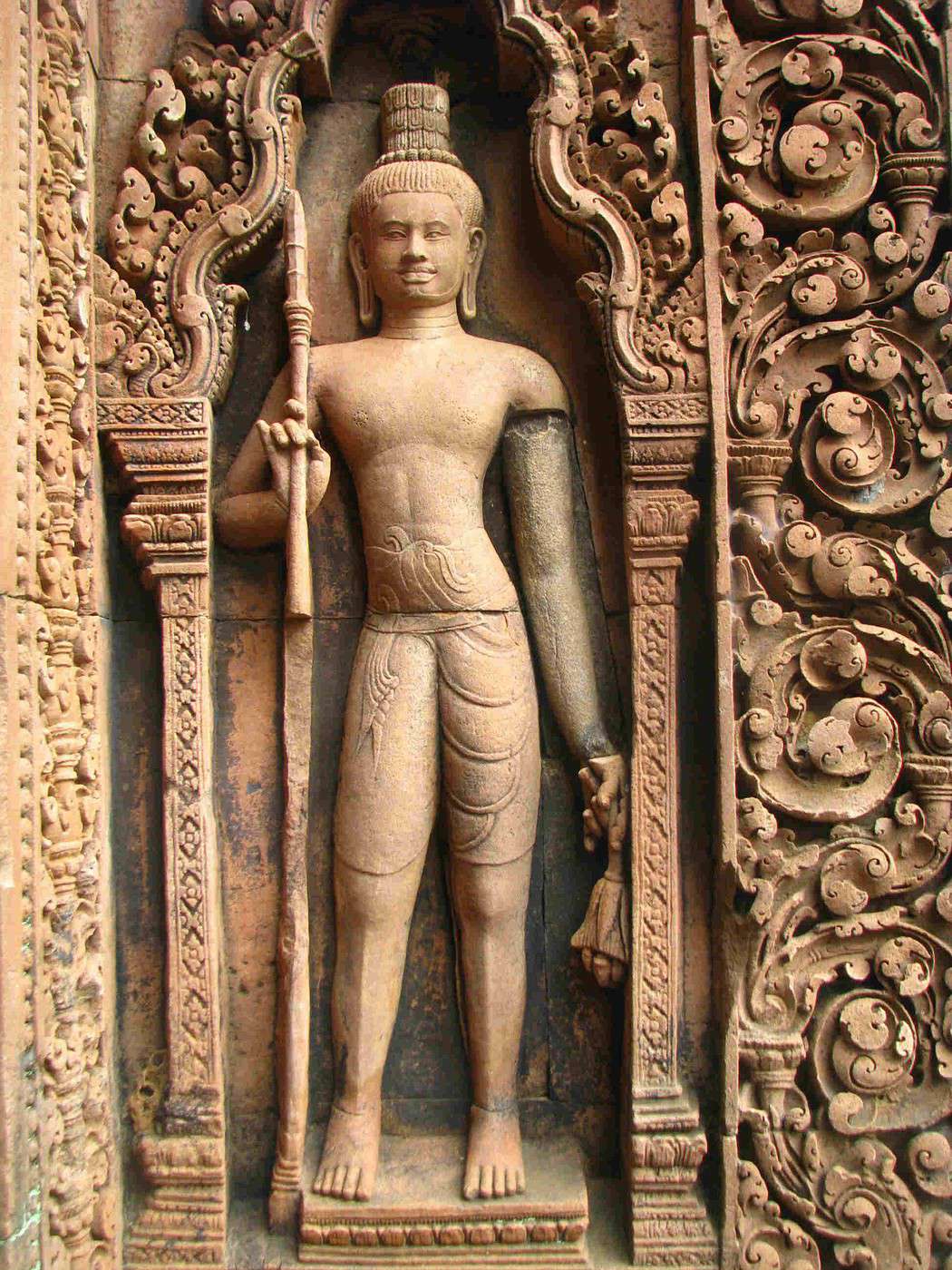
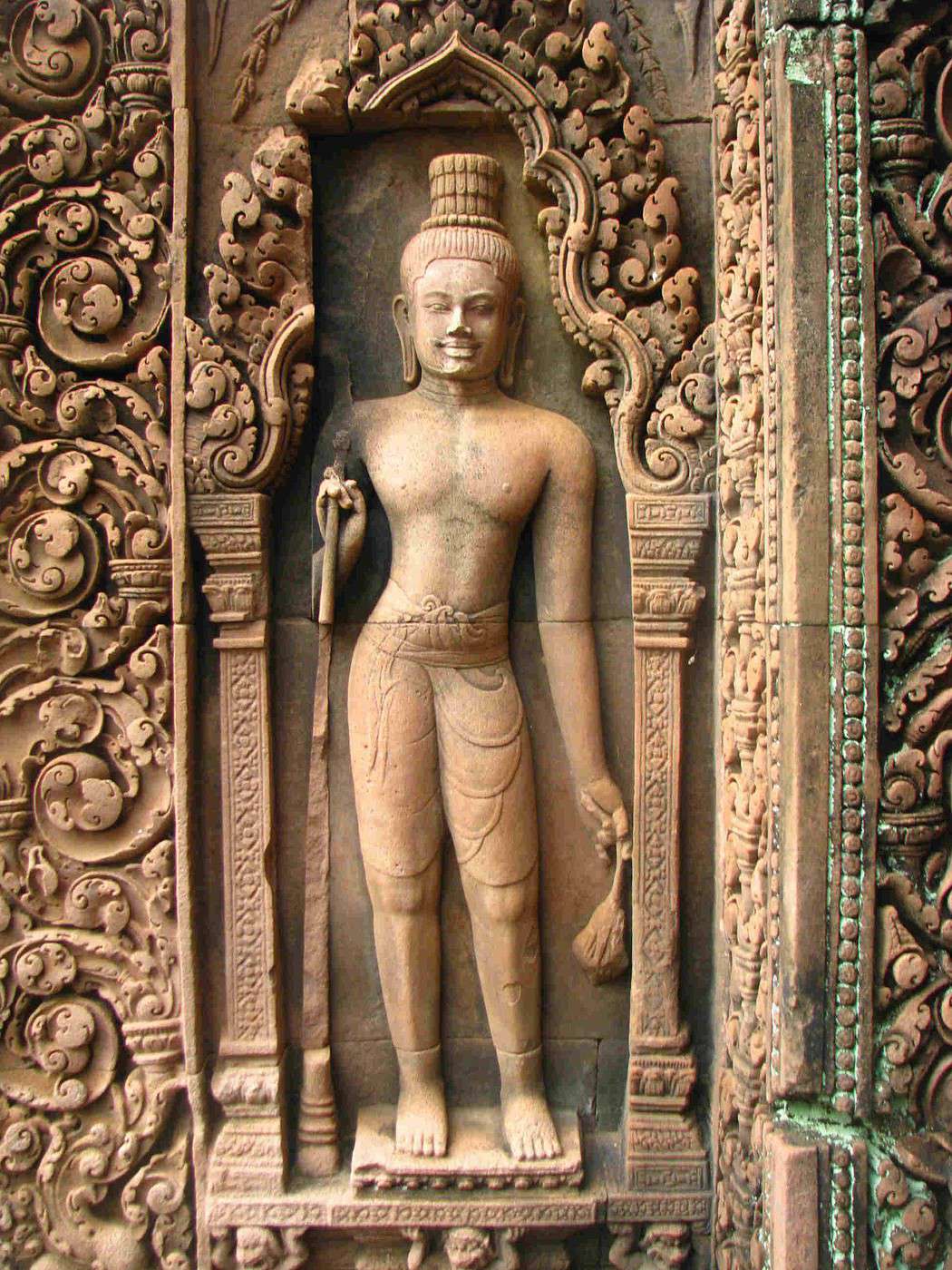
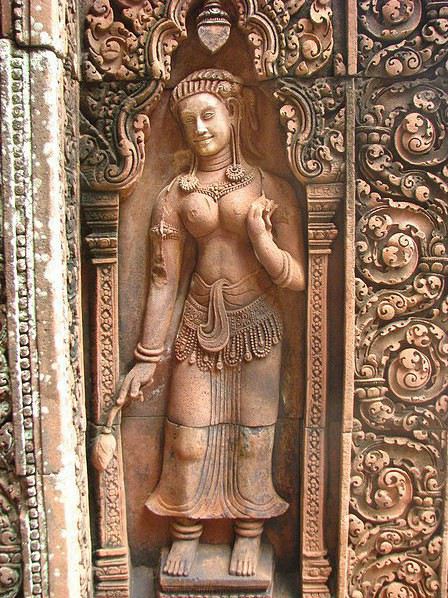
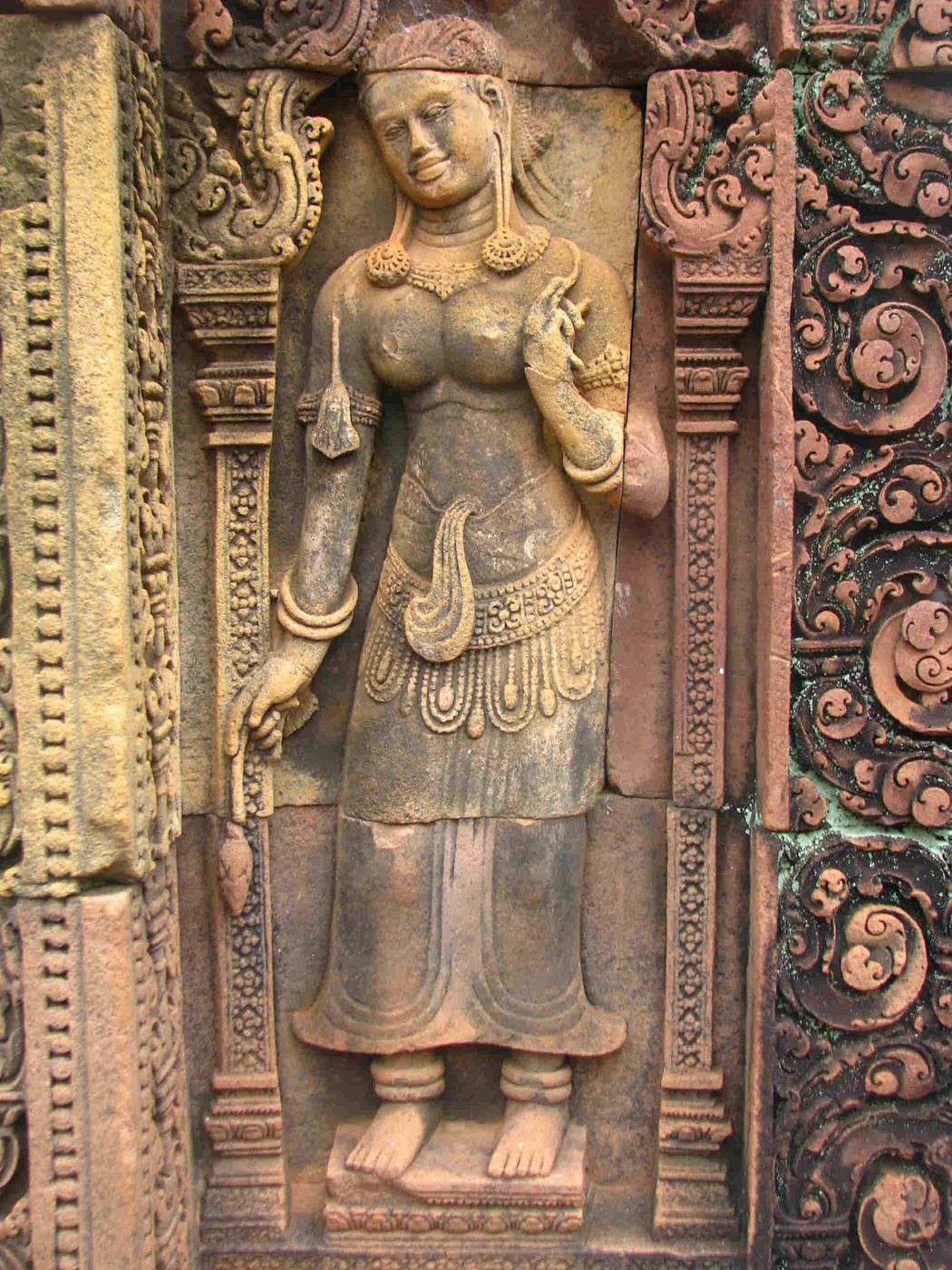
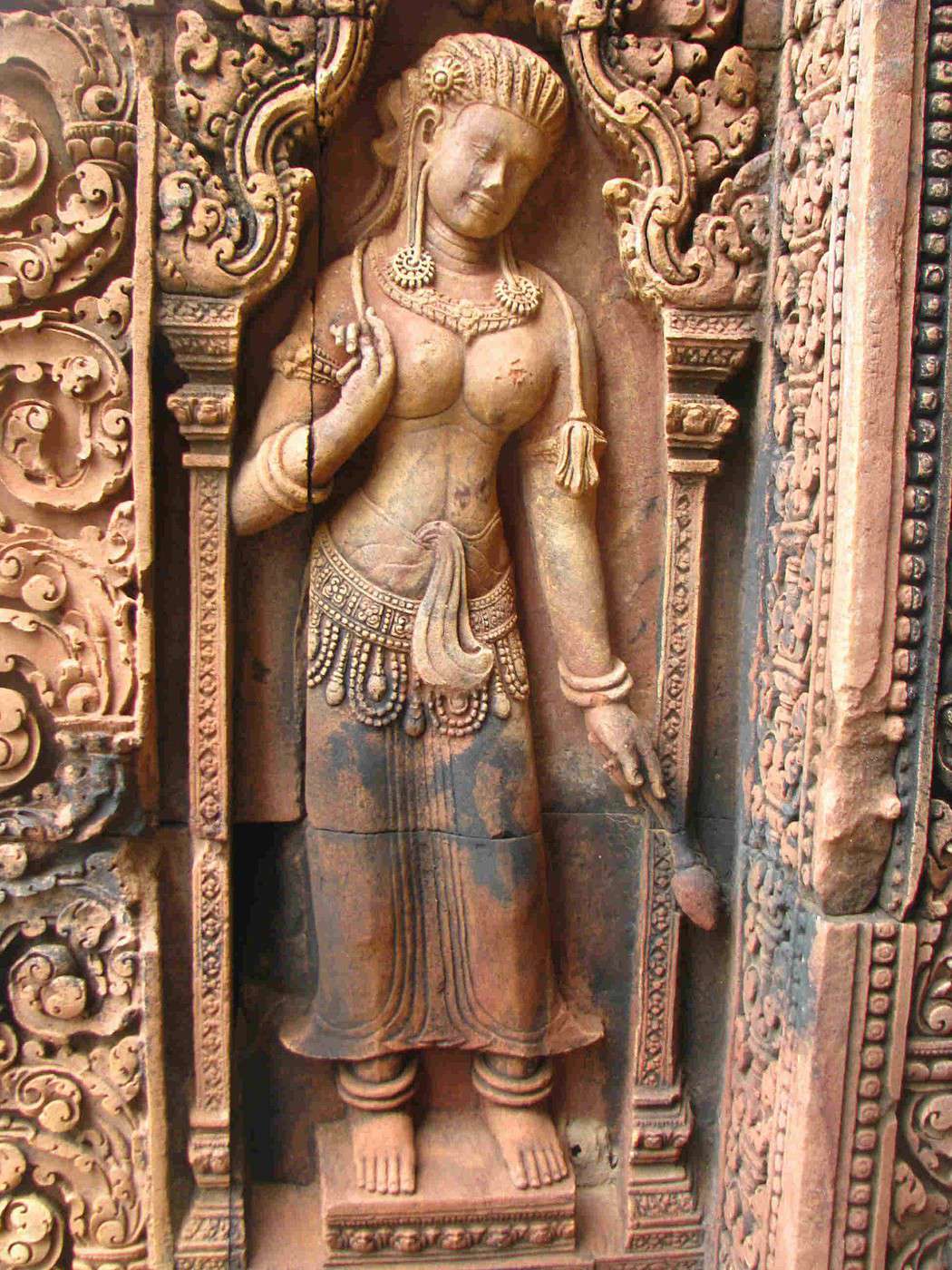
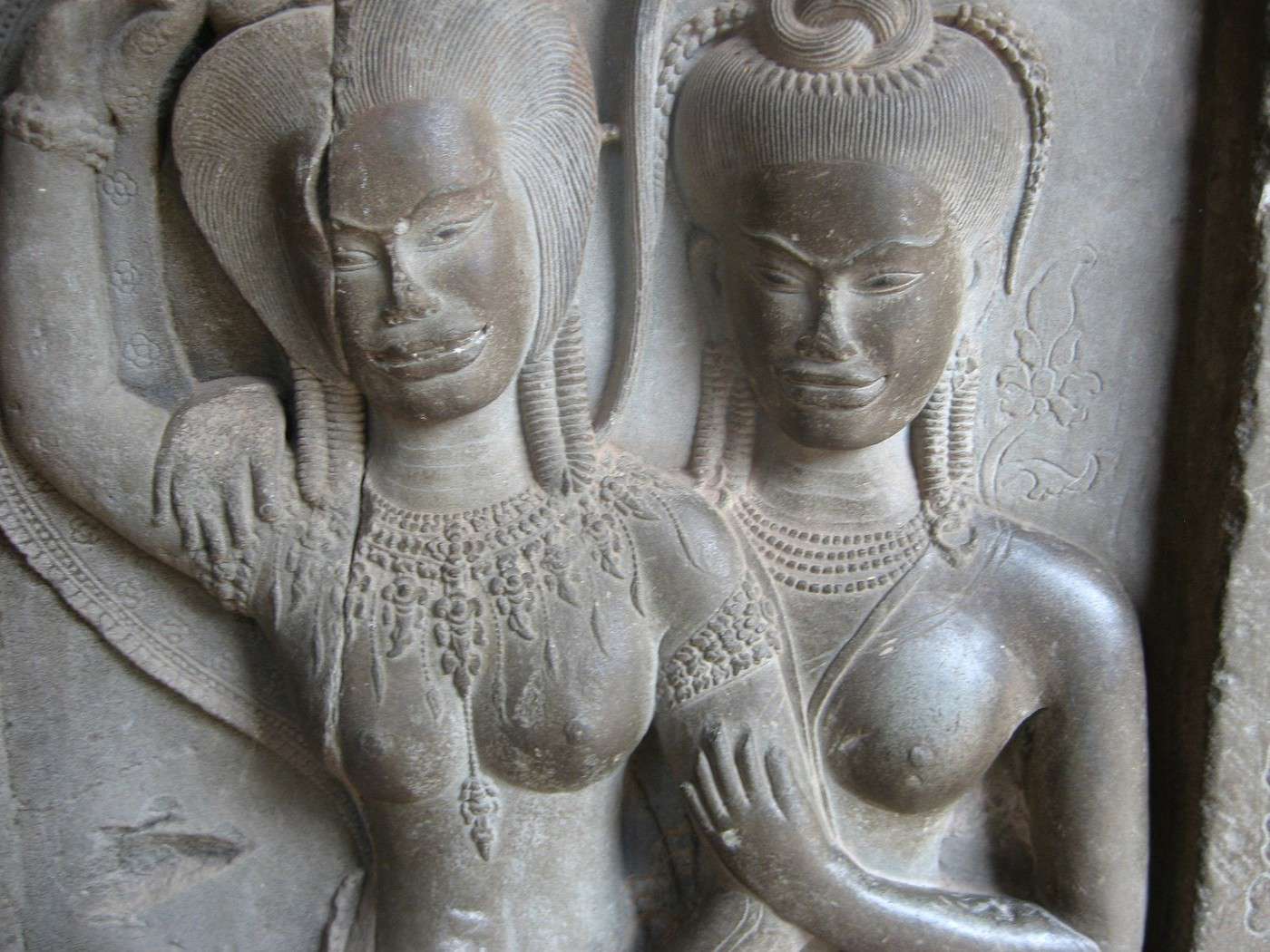
Très bien . Moi , touriste lambda , je ne savais pas que j'avais photographié des bas-reliefs exceptionnels : je suis comme monsieur Jourdain "de la prose ! " photo 1
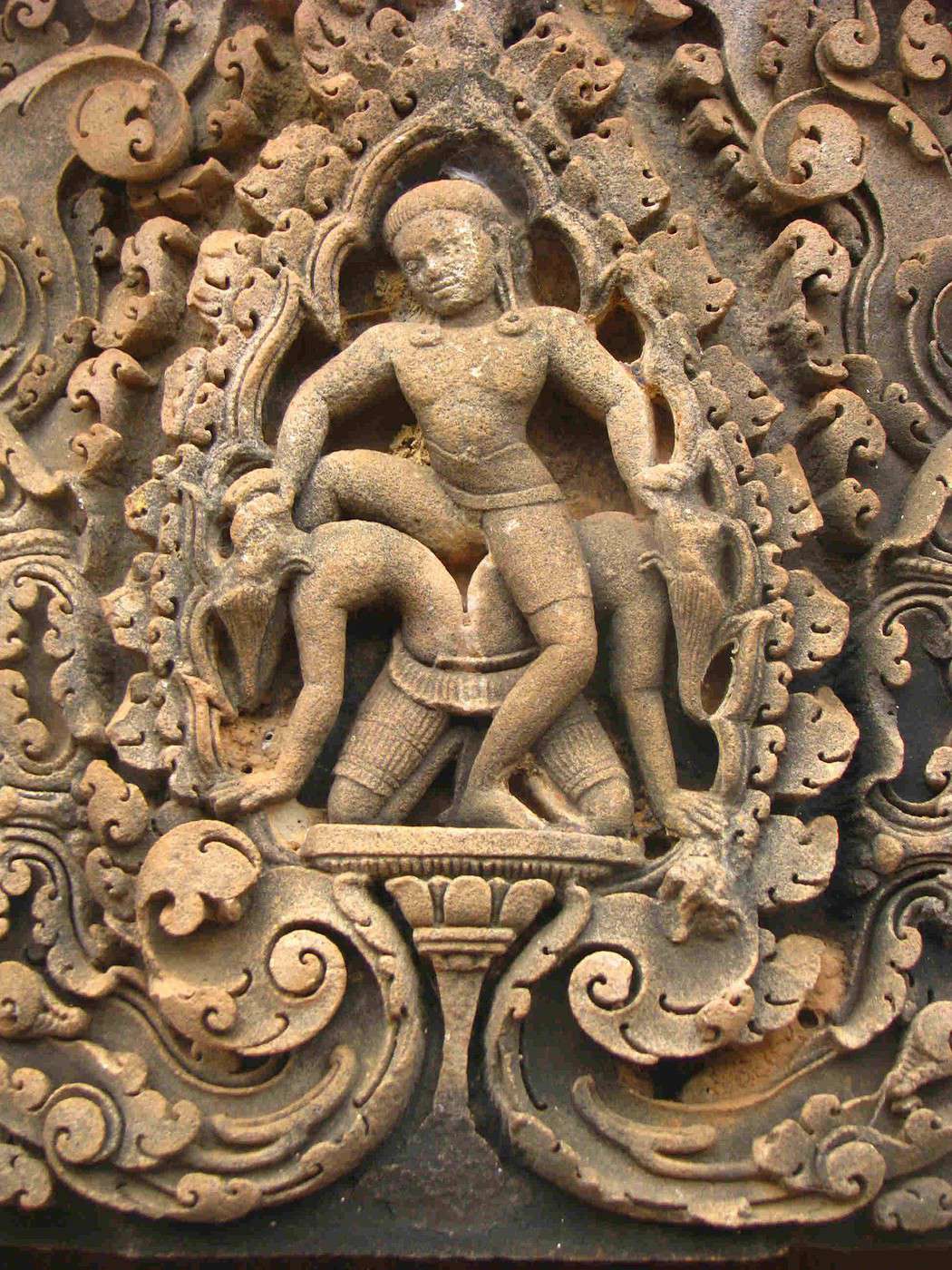
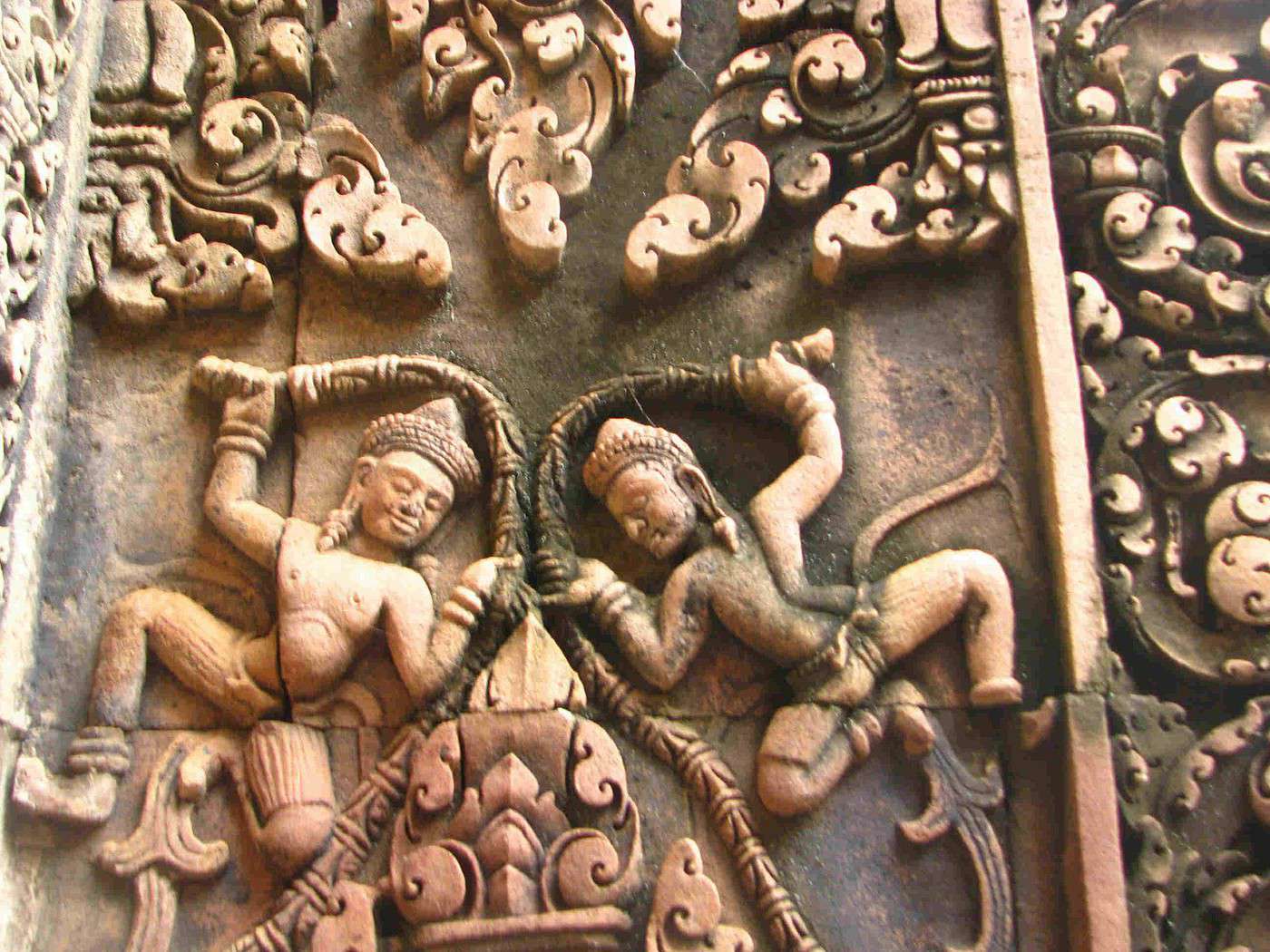
Les bas-reliefs les plus fins : c'est un peu injuste pour les linteaux de Banteay Samre , aussi exceptionnels mais "handicapés" par le grain de la pierre . photo 2
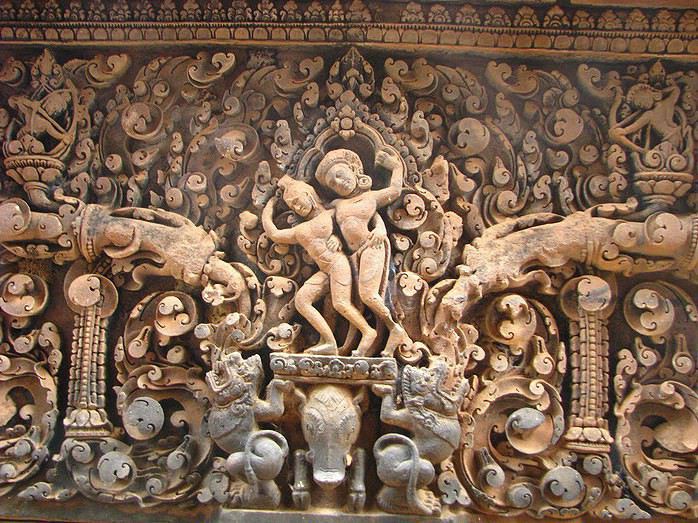
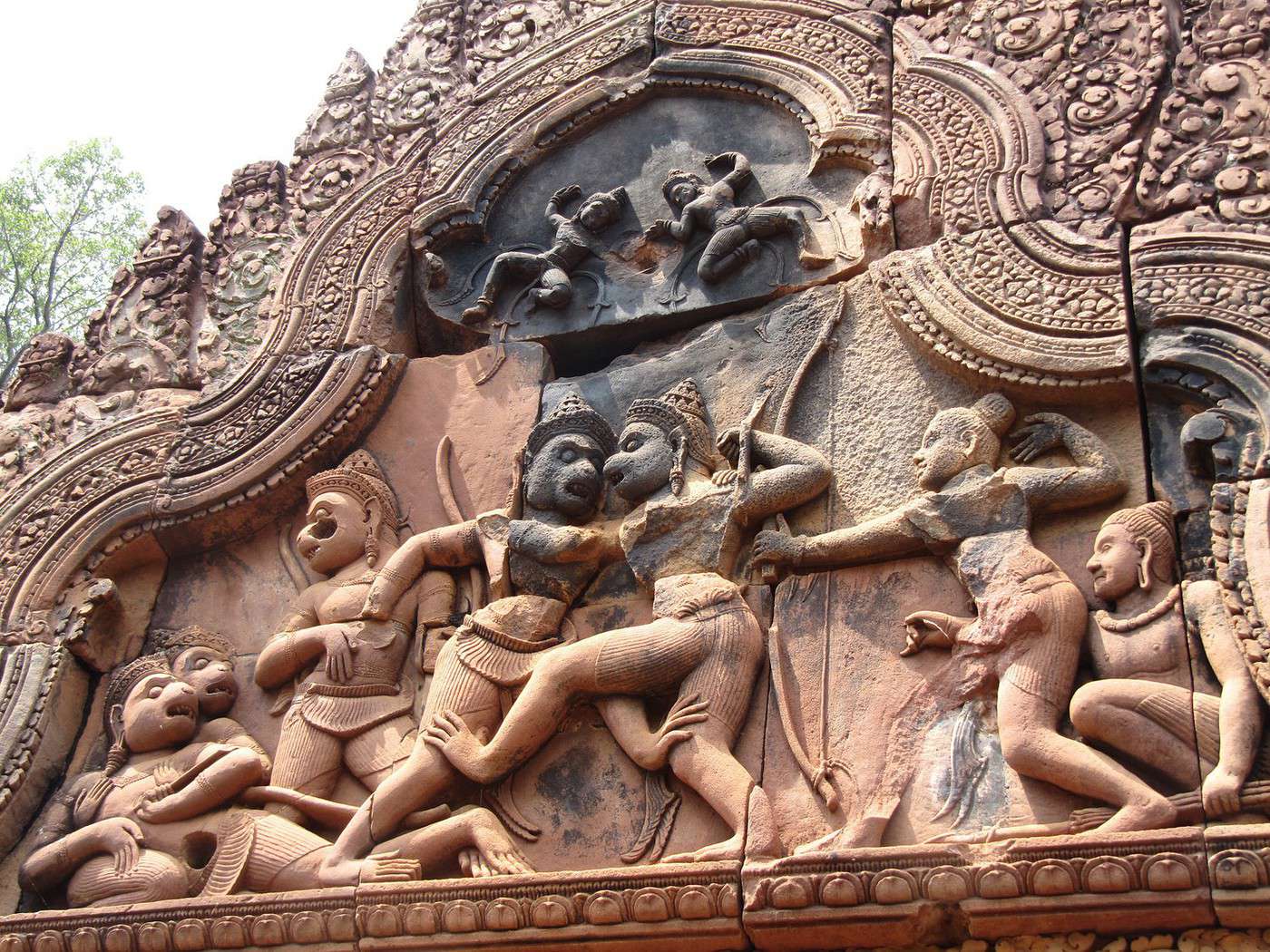
Mon bas relief préféré à Banteay Srei : photo 3 . Ce n'est pas de la guipure au centimètre mais il y a le souffle de cette empoignade .
Il y a une dizaine d'années , il n'y avait pas de cordes et des touristes de 100kg ou plus s'affalaient sur les statues pour y être pris en photo donc , on a bien fait .
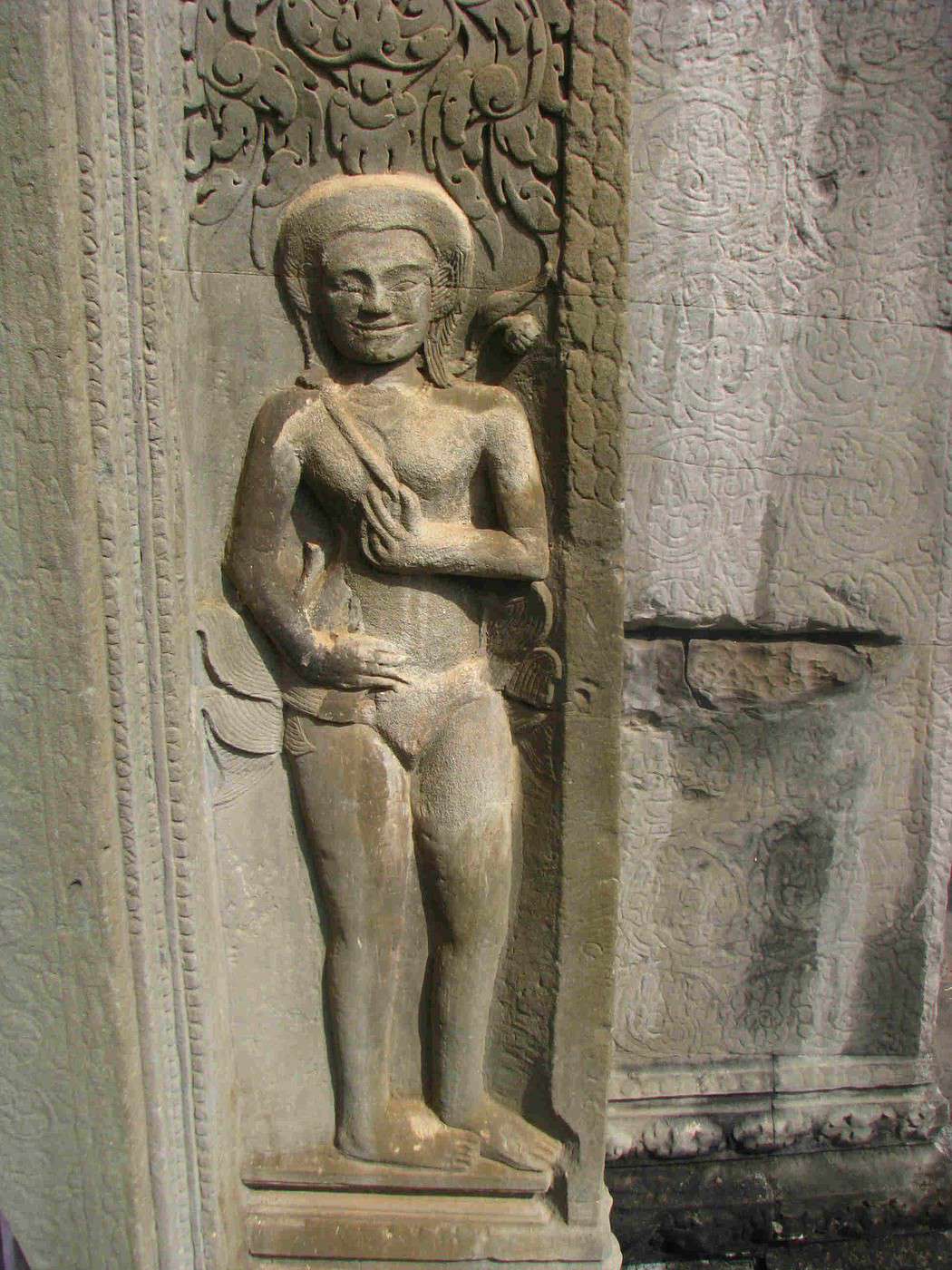
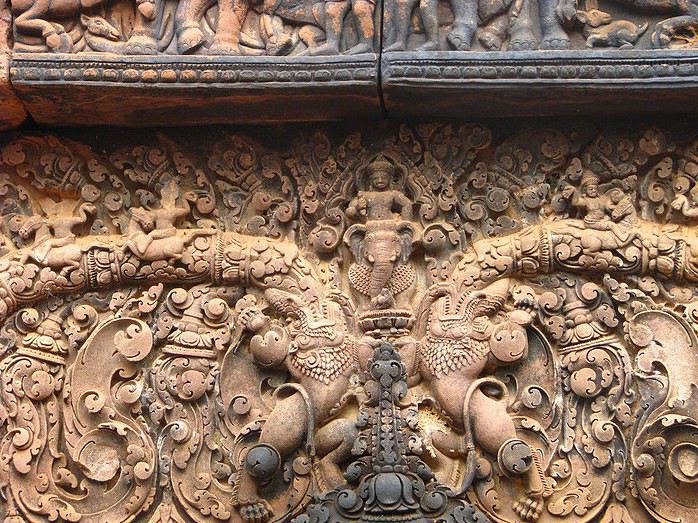
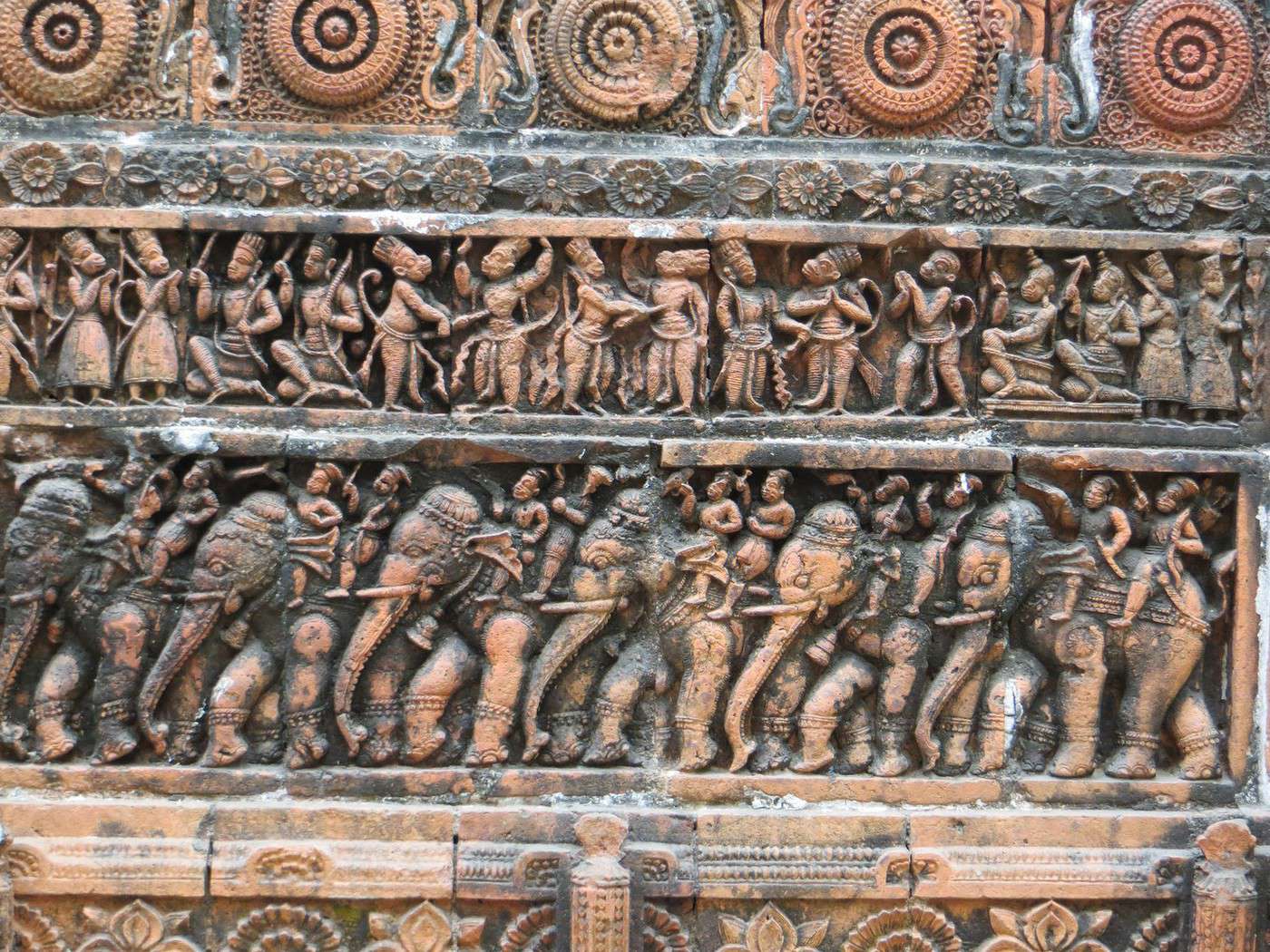
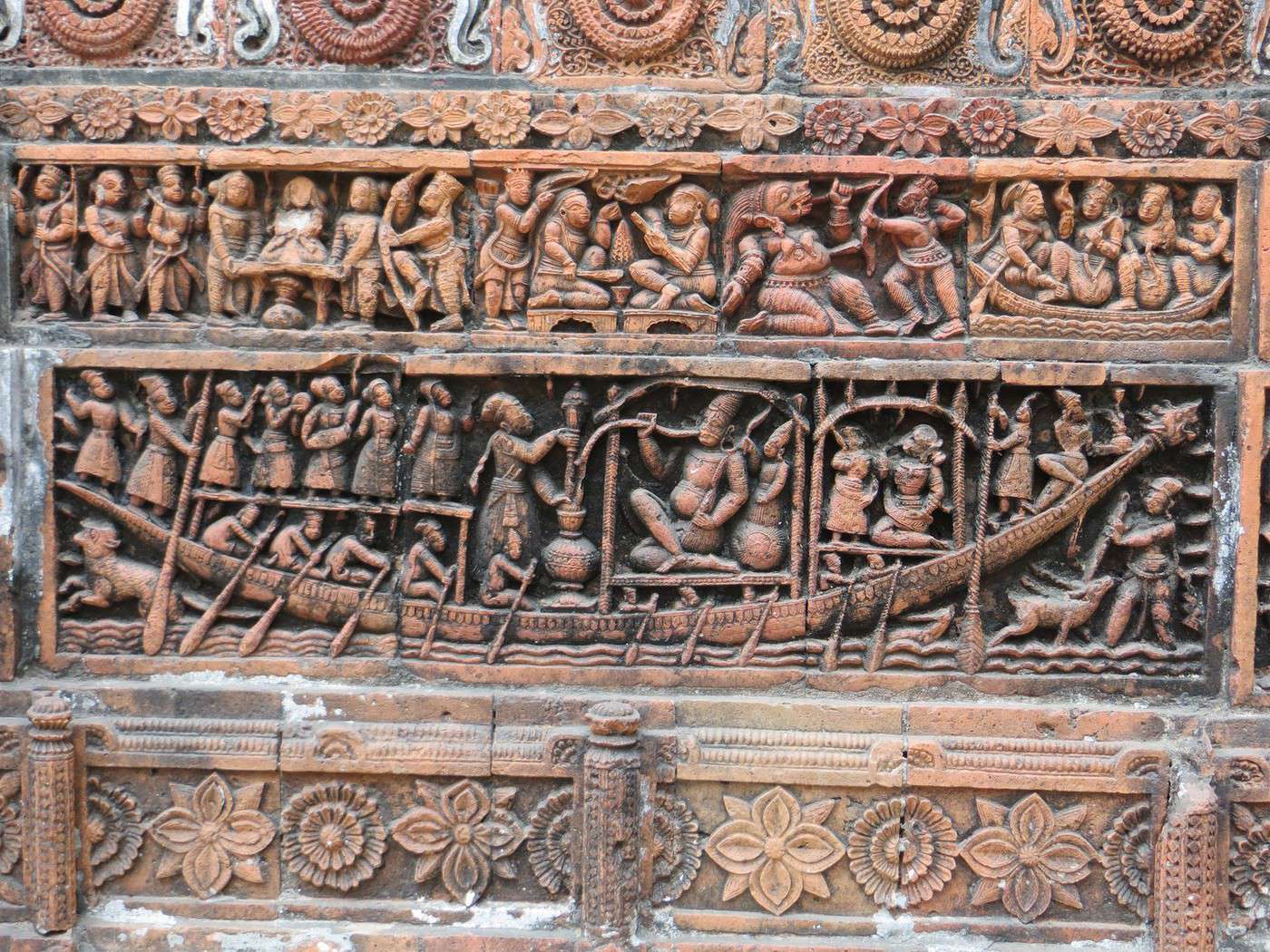
A propos de grès , photos 4 et 5 : où est-ce ? Pour vous aider , ce n'est ni en Inde , ni au Népal ni en Indonésie . Alors ?
Merci beaucoup pour cette riche documentation et ces précisions sur les temples d'Angkor. Dommage que je ne les aies pus lue avant notre séjour au Cambodge! 🙂
Pour faire suite à mon post du 31/01/2015 concernant "l'homme au képi" voici quelques précisions.
Je suis retourné à Siem Reap du 22/11/15 au 6/12 et je voulais revoir cet "homme au képi" (que je n'avais vu qu'une seule fois malgré mes recherches…).
Je me suis basé sur le schéma de Véro et Eddy. Dans un premier temps j'ai cherché à proximité du Bouddha debout figurant sur cette photo (*) et je n'ai pas trouvé.
J'ai persévéré dans mes recherches, je me suis alors rendu à l'Ouest de la galerie extérieure du troisième étage (là où se trouve le sanctuaire central d'Angkor Vat). Première photo
Au G I O, à l'angle de la galerie extérieure et de la galerie qui mène au sanctuaire central, sur le pilier de gauche (en regardant vers le sanctuaire central), deuxième photo, on peut voir "l'homme au képi" : troisième photo.
En espérant que mes explications soient claires et qu'elles puissent servir à d'autres visiteurs.
Merci à Véro et Eddy pour votre photo initiale qui m'a servie pour mes recherches.
(*) Le Bouddha debout de trouve au sanctuaire central partie Sud
Dès le début du 20ème siècle beaucoup de chercheurs pensaient que le Bayon était un temple bouddhiste.
En 1924 eut lieu au Bayon une découverte qui sembla devoir orienter la recherche dans une nouvelle direction. Les travaux de consolidation mirent au jour un fronton représentant Lokeçvara (*), le Bodhisattva compatissant du Grand Véhicule. C'est à ce moment-là qu'on a pensé que ce temple était bouddhiste.…
Ceci a été confirmé par la découverte en 1933 dans un puits du Bayon d'un Bouddha cassé.
Ce Bouddha a été reconstitué à un emplacement nommé Vihear Prampil Loveng qui se trouve à environ 300 m de la terrasse des Eléphants dans l'allée qui part de cette terrasse et qui va vers la Porte de la Victoire. Le Vihear Prampil Loveng est situé à une cinquantaine de mètres au Sud de cette allée.
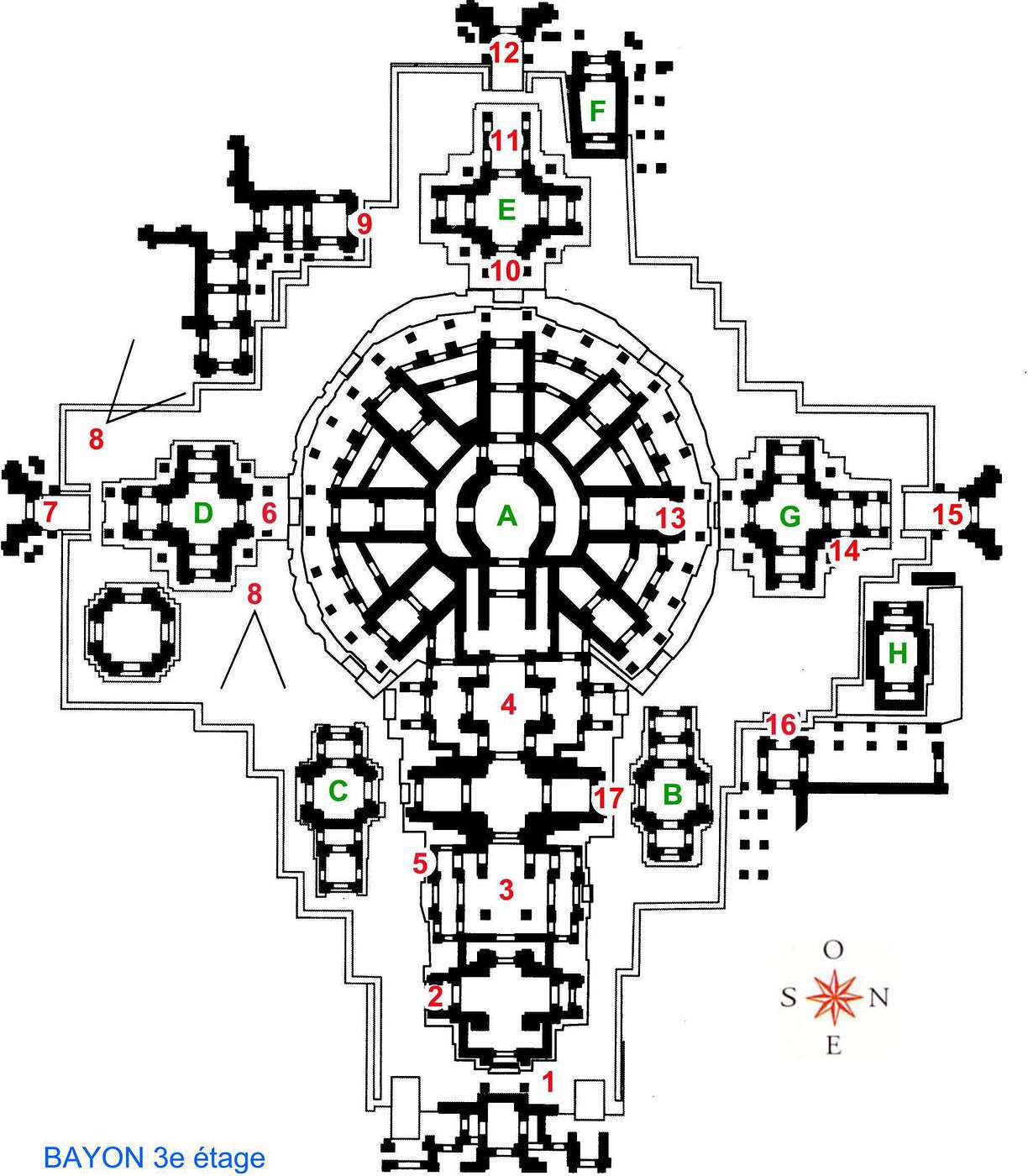
(*) Sur le plan du Bayon (Photo 1) en 16 on voit l'emplacement du Lokeçvara, il faut se pencher pour le voir. (Photo 2)
Ce temple mérite d'être visité, on y trouves quelques particularités.
Jayavarman VII a fait construire ce temple pour y placer l'image de son père sous la forme du Bodhisattva Lokeçvara (statue inaugurée en 1191). Il a également fait construire le Ta Prohm pour y placer l'image de sa mère sous la forme de Prajnapârâmita (mère spirituelle de tous les bouddhas).
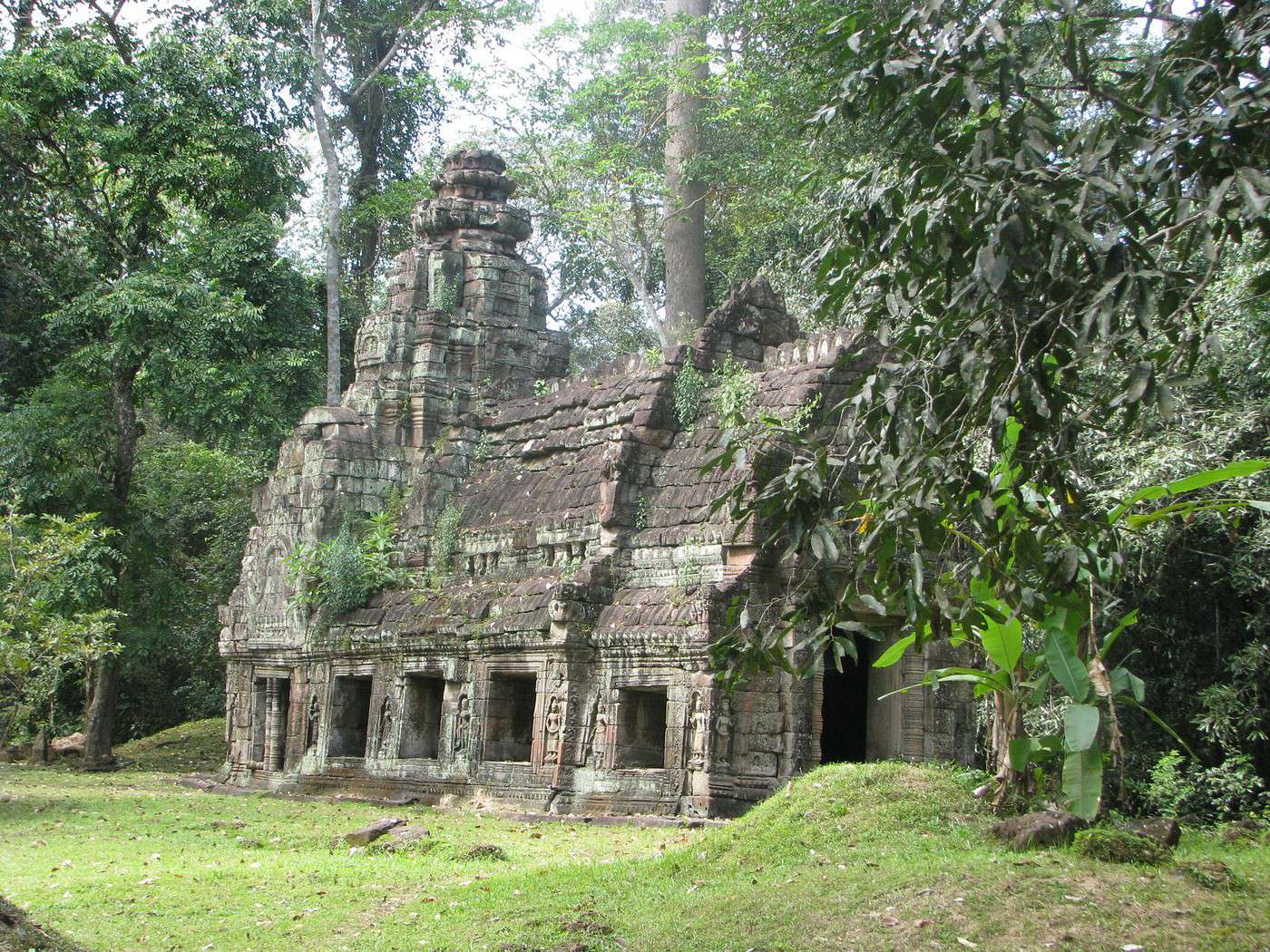
En venant de l'Est on longe une allée bordée de bornes, on traverse le Gopura IV à trois portes puis il y a une allée, sur la droite un voit un petit bâtiment (voir photo 1), il s'agit d'un Dharmaçâlâ ou gîte d'étape. Jayavarman VII en a fait construire 121, on peut en voir deux sur le site d'Angkor : celui-ci et un autre au Ta Prohm (moins bien conservé).
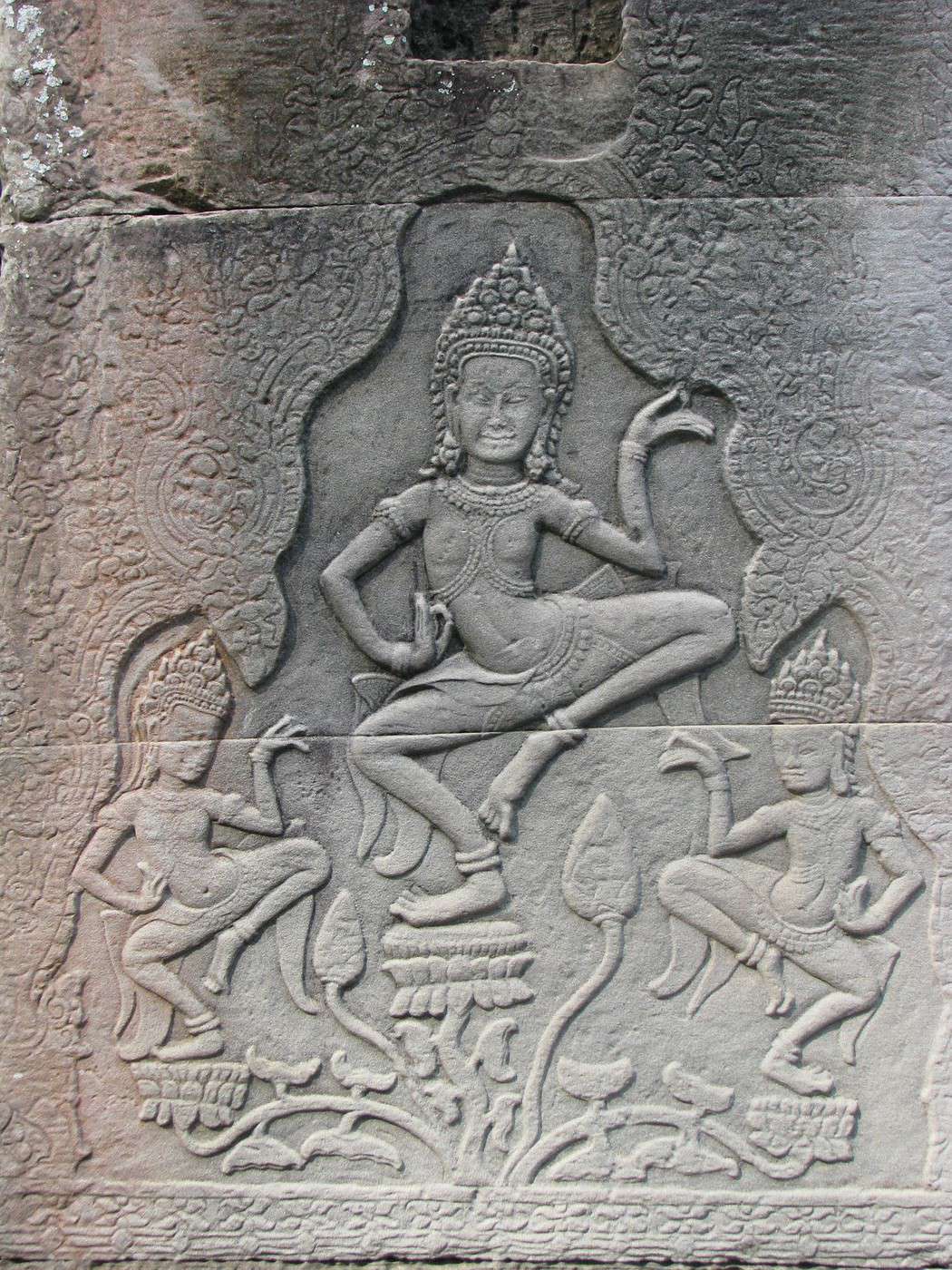
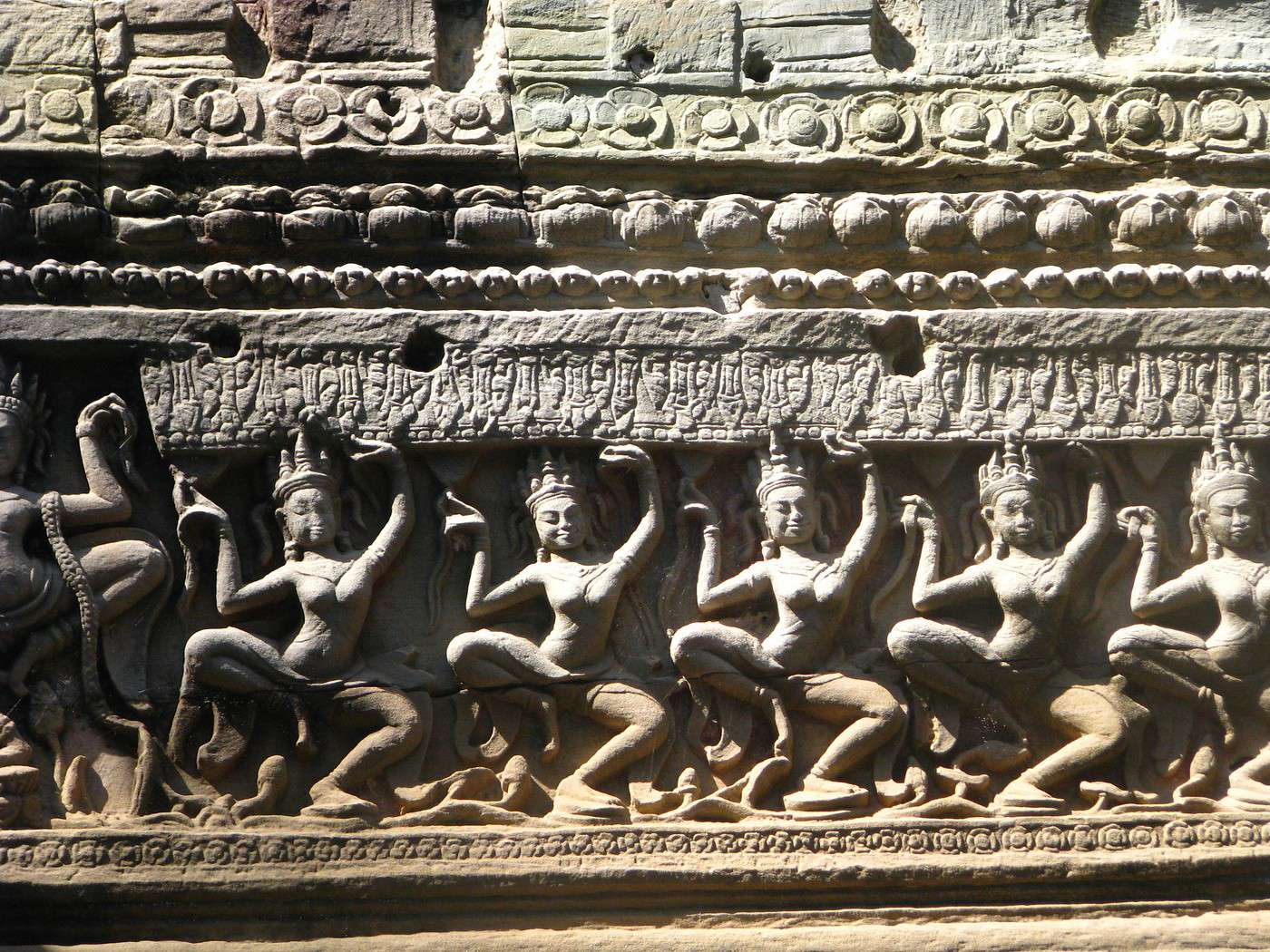
En continuant on traverse le Gopura III à cinq portes (ce qui est très rare). On arrive alors à "la salle des danseuses". Cette salle porte ce nom car on y trouve de nombreuses apsaras ("danseuses célestes") très souvent sculptés "en creux" sur les piliers carrés (photo 2). En levant la tête on peut voir sur plusieurs linteaux des sculptures "en relief" d'apsaras, ce qui rare (photo 3).
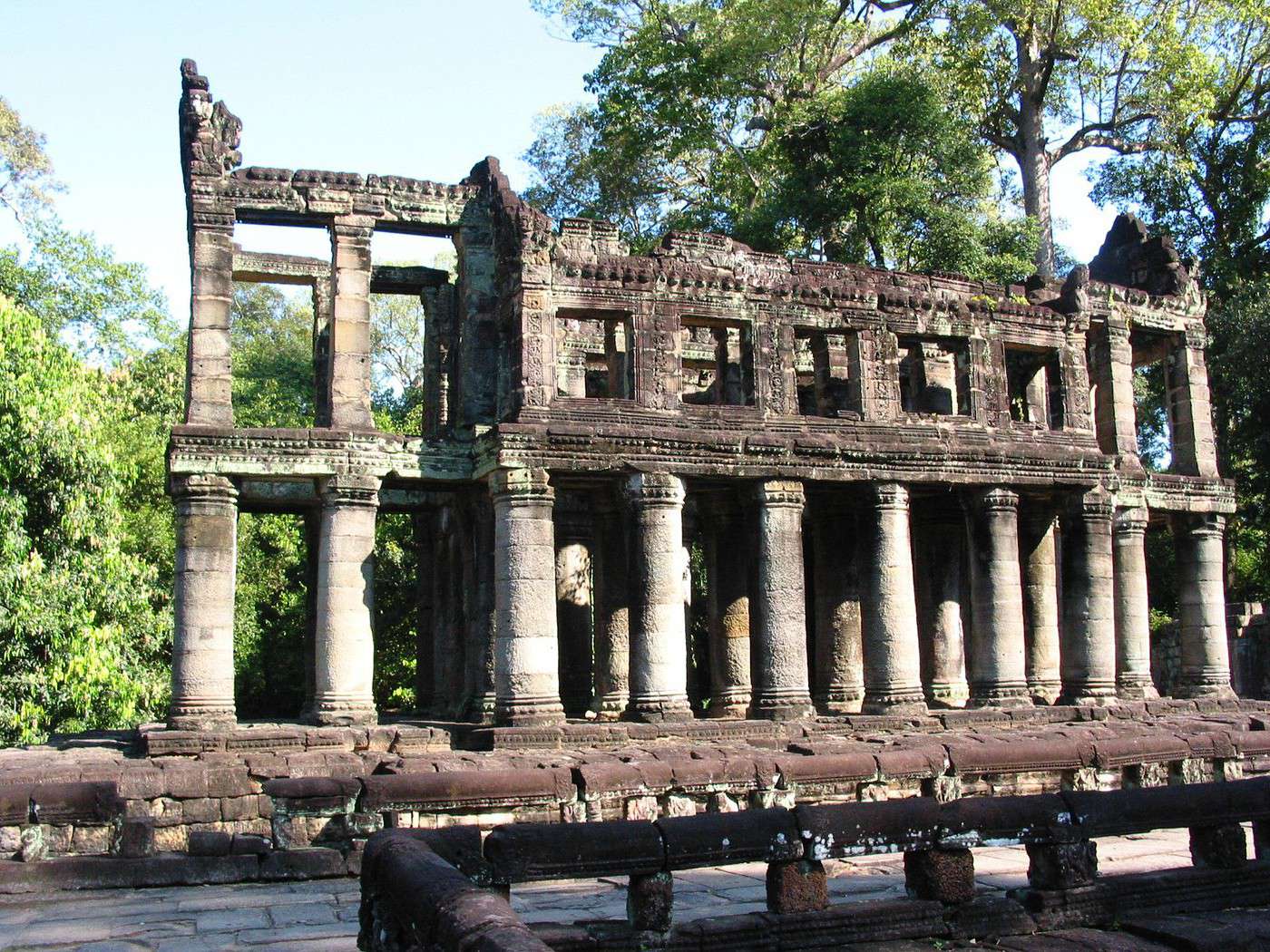
De cette salle en se dirigeant vers le Nord on peut voir un bâtiment dont l'étage repose sur des colonnes. Il s'agit d'une construction unique sur tout le site d'Angkor (photo 4)
De la salle des danseuses continuer vers l'Ouest, on traverser un petit bâtiment cruciforme : Gopura Est de la 2ème enceinte. Peu après on arrive à une intersection avec une allée perpendiculaire, au centre de ce "croisement" il y a une grande pierre carrée qu'il faut contourner.
En se dirigeant dans l'allée vers le Nord on voit une porte murée par des éboulements de pierres.
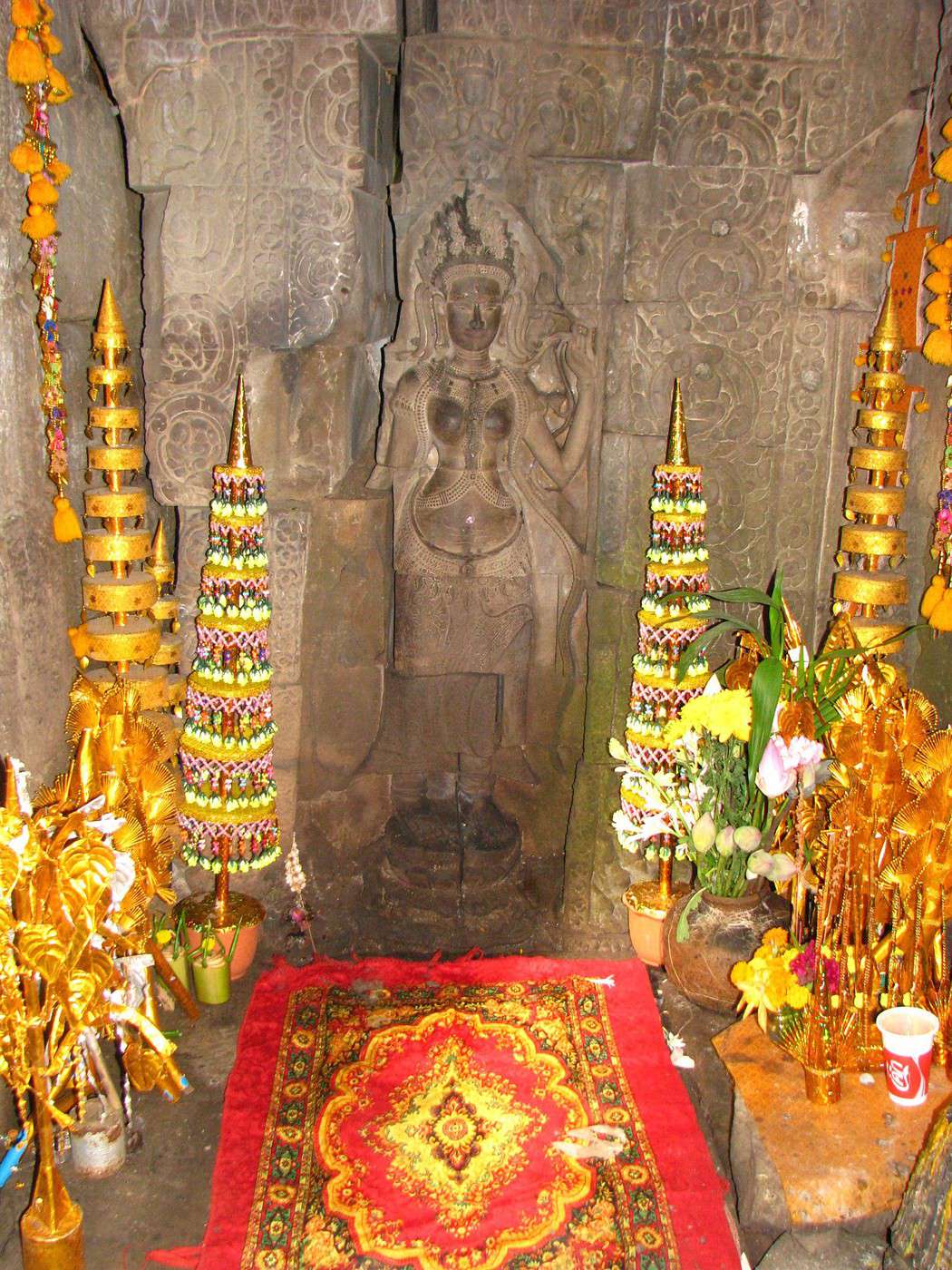
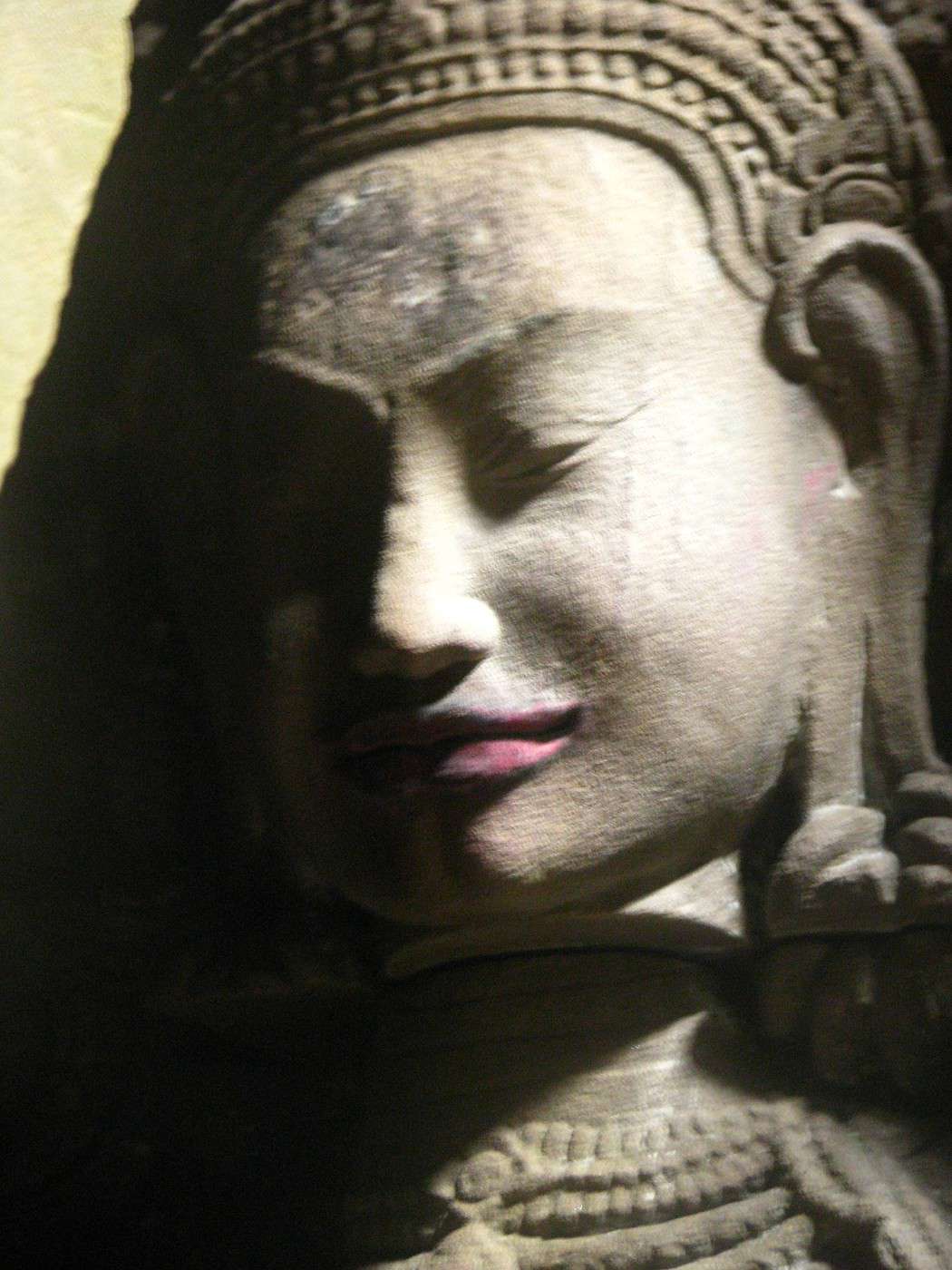
Prendre à droite puis à gauche, au fond de ce petit passage, on peut voir une sculpture d'une devata devant laquelle des personnes déposent des offrandes (photo 5). Selon une croyance populaire ces offrandes sont déposées par des femmes qui désirent avoir des enfants. Sur la droite il y a un petit passage, à gauche on voit une seconde dévata (photo 6). (*)
Beaucoup de khmers pensent que ces deux devatas représentent les épouses de Jayavarman VII. Il s'agit là d'une hypothèse qui peut être plausible, en effet Georges Cœdès dans son livre "Pour mieux comprendre Angkor" mentionne que dans les monuments construits par Jayavaman VII certaines statues étaient souvent des images de princes ou de dignitaires divinisés dont nous connaissons les noms gravés sur les portes des chapelles.
En continuant on arrive au sanctuaire central avec en son centre un stupa (probablement érigé au XVIème siècle), on constate la présence de trous dans les murs à proximité : il ne s'agit pas de trous destinés à recevoir une couche de stuc comme on peut voir dans différents temples (Mebon Oriental, Lolei, Preah Ko…), selon Claude Jacques ces trous étaient destinés à recevoir les chevilles servant à maintenir des plaques de bronze, en effet l'inscription sur la stèle mentionne que plus de 1500 tonnes de bronze ont été utilisées à cet effet dans ce temple.
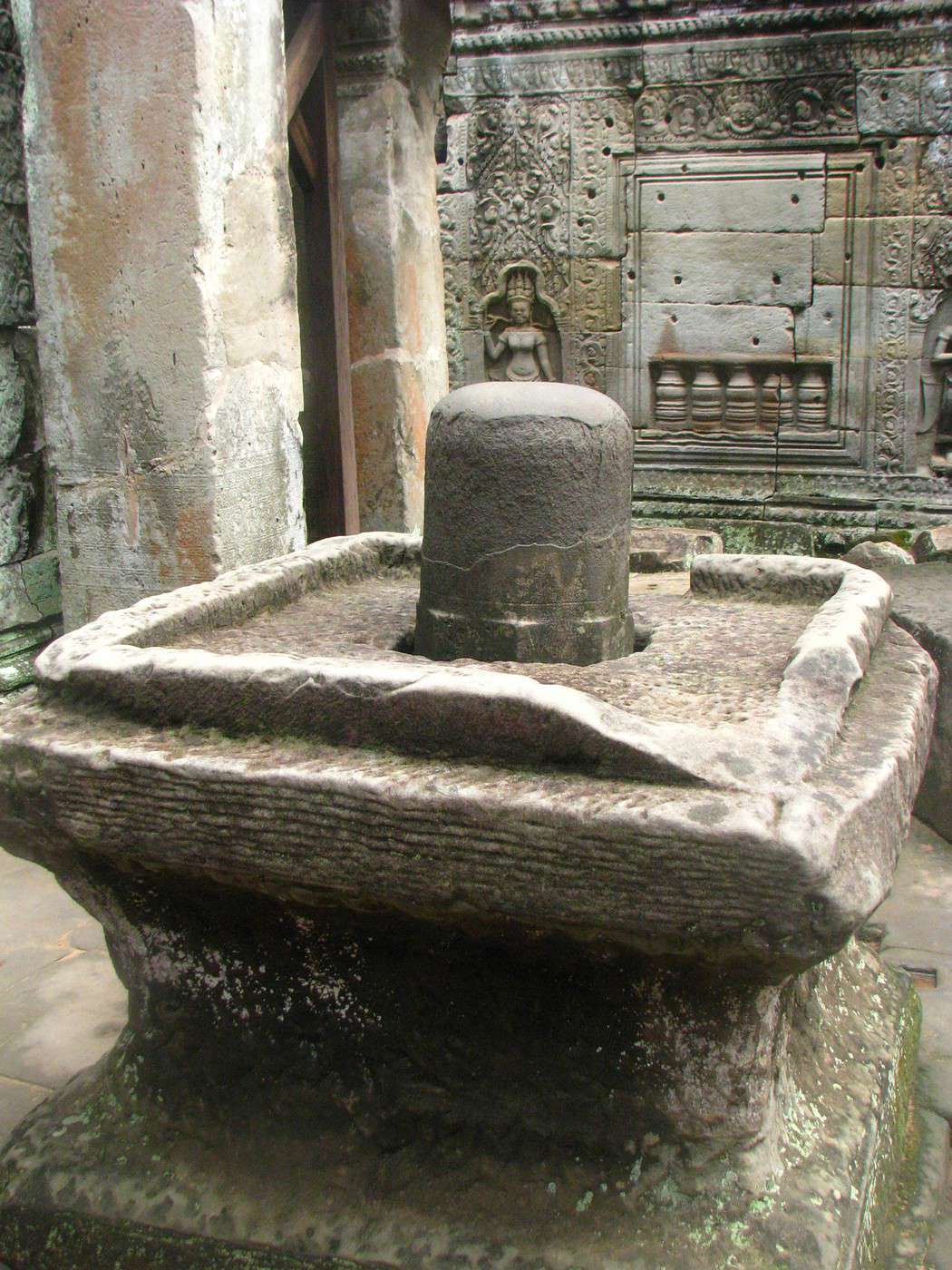
En continuant vers l'Ouest dans l'allée centrale il y a un linga avec son yoni. On peut voir en détail ce linga composé de trois formes : ronde (correspondant à Shiva) – octogonale (Vishnou) – carrée (Brahma). Il est très rare de voir ces trois formes, en général seule la partie supérieure ronde est visible. Photo 7
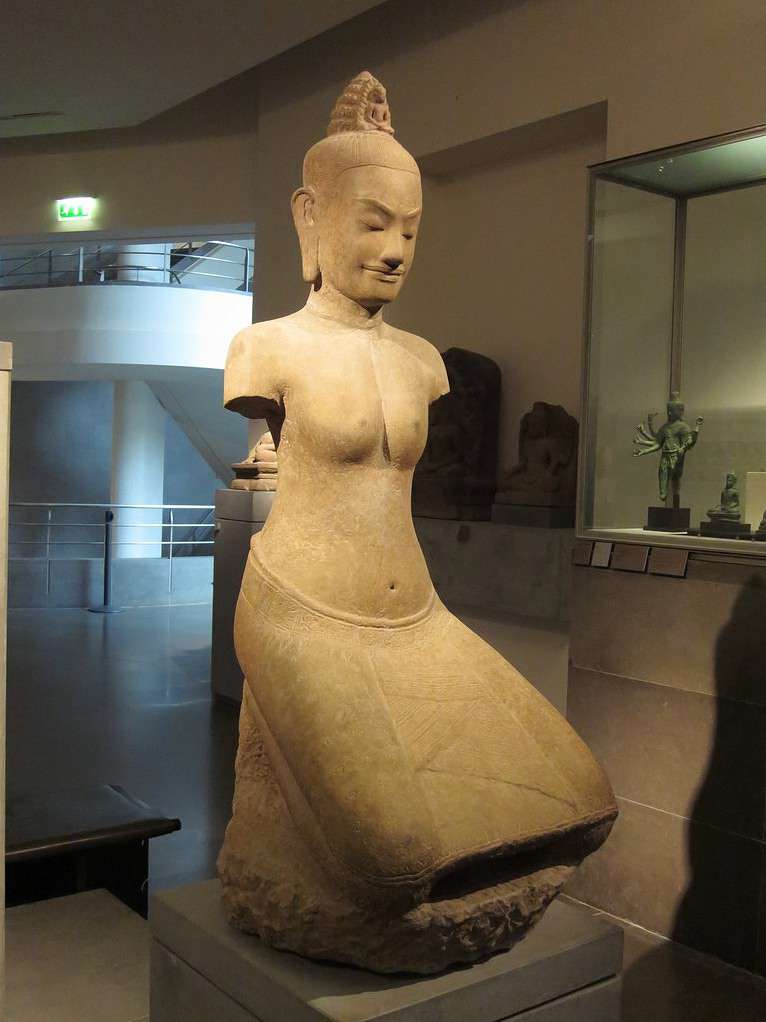
En 1929 une statue féminine a été trouvée au Preah Khan : selon le livre "L'art khmer dans les collections du Musée Guimet" (de Pierre Baptiste – conservateur en chef de ce musée pour la partie du Sud-est Asiatique – et Thierry Zephir) il s'agirait du portrait de la reine Jayaarajadevi (l'une des épouses de Jayavarman VII).
Cette statue est une représentation de Prajnapârâmita qui est le symbole de la Sagesse, mère spirituelle de tous les Bouddhas. Dans le Bouddhisme Mahayana (Grand Véhicule) il y a une Trimurti composée de Bouddha, Lokeshvara (Bodhisattva) et Prajnapârâmita.
Cette statue est exposée au Musée Guimet (Photo 8), on peut voir sa photo au Banteay Srei, dans le hall situé après les toilettes.
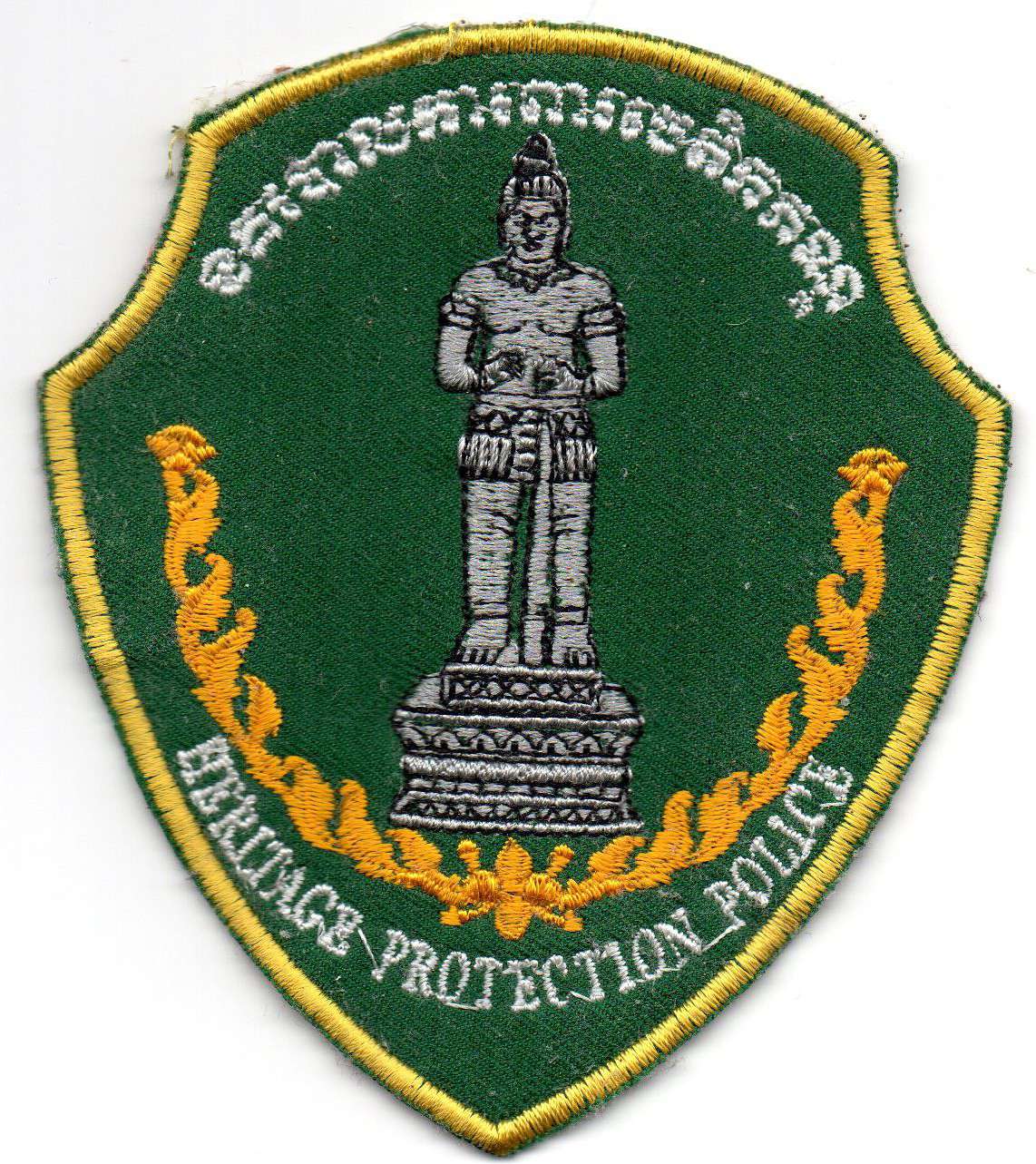
(*) Beaucoup de guides ne montrent pas ces devatas. Il y a parfois des policiers chargés de la surveillance des temples qui montrent ces dévatas (moyennant un petit don). On remarquera que sur la manche de ces policiers il y a un écusson vert avec une représentation en son centre d'un Dvârapâla (gardien de temple). Voir photo 9
Hi,
On September 1st, we're heading to Kalimantan for six weeks, probably from Pontianak to the Derawan Islands.
I've scoured this site, which is usually my go-to 😉, and others like VoyageForum, but recent info is pretty scarce.
I'd love any tips on places you've visited—our itinerary is still a work in progress.
We're two couples traveling with backpacks, using buses, boats, guesthouses, and homestays.
Thanks in advance!
After reading and researching, we're planning the following stops in Cambodia in January 2027:
- Phnom Penh
- Kampong Cham
- Kratie
- Siem Reap
- Battambang
- Kampot (round trip)
I'm wondering about the direction of these stops, which could also influence our international flights.
Either a round trip from Phnom Penh in the order above.
Or landing in Siem Reap with the following order:
This second option would save us the Battambang - PP - Kampot trip but means doing a round trip to Battambang from Siem Reap and placing the "highlight of the trip" (Angkor) at the beginning of our stay.
Bonjour
J'envisage un voyage en famille (ma femme et moi, 47 ans et nos 2 fils de 5 et 12 ans en juillet 2027) en Malaisie pour la dernière semaine de juin et les 2 premières de juillet 2027.
Nous avions l'habitude des road-trips à 2, puis à 3, mais depuis l'arrivée du 2ème, nous avons fait une parenthèse "camping village".
Voici venu le moment de reprendre nos bonnes vieilles habitudes, tout en adaptant le rythme avec des enfants.
Nous avons envie d'Asie. Nous avons déjà eu la chance de visiter auparavant la Thailande, l'Indonésie (Bali et Lombok) et le Sri Lanka.
Des amis nous ont bien vendu la Malaisie donc cela nous tente carrément.
Pour les fans et connaisseurs, quel pourrait être un bon itinéraire depuis Kuala Lumpur avec 3-4 points de chute maxi, combinant culture, nature et détente (je précise que nous ne sommes pas particulièrement fan de la plage). Le tout sans faire la course bien entendu.
We’ll be arriving in Phnom Penh this coming January and we’re thinking of starting our trip with a stop in Kampong Cham, then Kratie.
After Kratie, we’re considering heading toward Siem Reap with a stop in Kampong Thom.
That said, I’m not really sure how long the Kratie–Kampong Thom journey might take or how complicated it is.
Does this stop on the way to Siem Reap seem like a good idea to you?
If we don’t visit the Sambor Prei Kuk site, are there still any walks or sights worth checking out in Kampong Thom?
We’ll be arriving in Phnom Penh this coming January and we’re thinking of starting our trip with a stop in Kampong Cham, then Kratie.
After Kratie, we’re considering heading toward Siem Reap with a stop in Kampong Thom.
However, I’m not quite sure how long the Kratie–Kampong Thom journey might take or how complicated it is.
Does this stop on the way to Siem Reap seem like a good idea to you?
If we don’t visit the Sambor Prei Kuk site, are there still some walks and/or things to see in Kampong Thom?
Hi there,
We’re planning to travel from Chiang Rai to Luang Prabang next November.
We’d like to take a slow boat from Chiang Khong—or rather from Huay Xai in Laos—with an overnight stop in Pakbeng.
Could you let us know if the boat still leaves Huay Xai in the late morning? If so, what time roughly, and what’s the price for the trip?
Thanks for your help!
Alod
Hi everyone,
Could you share your thoughts on my 3-week itinerary?
We’re a small group (family + friends) of 12 people, planning to leave around January 21, 2027.
Here’s my itinerary:
3 nights in Bangkok
4 nights in Chiang Mai
3 nights on Koh Samui
3 nights on Koh Phangan
4 nights in Krabi
4 nights in Phuket
I’m also open to any great tips you might have...
Thanks, everyone! Alain.
We (3 adults: 68, 65, and 25 years old) are just back from a short trip to the Philippines, and I’d like to share a little summary of our journey. First of all, I’d like to thank everyone who contributes to this forum about this destination and answers the questions of those who aren’t familiar with it. I should also mention that my comments are personal and don’t reflect anyone else’s opinions. Since I don’t have any literary or photographic talent, I’ll stick to the facts and share a few details about the sights, hotels, and restaurants.
Preparations:
We chose this destination in December and quickly booked our flight tickets (540 € with Turkish Airlines) for a departure on February 16 and return on March 5, 2019. We then contacted two French-speaking tour operators based in Manila, asking them to put together an itinerary based on our wishes (places to visit, type of accommodation) and our budget. We wanted to see the rice terraces in northern Luzon, the hanging coffins in Sagada, before flying to the Visayas (Bohol, Siquijor, etc.), and the Taal Volcano, while limiting our nights in Manila as much as possible. In the end, we opted for Alize, whose itinerary and quote matched our request almost perfectly. Our exchanges helped us refine our circuit.
International flights:
The round-trip flights went smoothly. Turkish Airlines, while not at the level of Asian or Gulf airlines, does the job just fine.
Day 1:
We landed on time (6:15 PM) on Monday, February 16, at Terminal 3. We exchanged our euros (near the car rental counters), and I can confirm the exchange rate was very good. On the way to the St. Giles Hotel (decent and affordable for a transit night), we got our first glimpse of Manila’s dense traffic. The Makati district, where our hotel was located, offers a wide choice of restaurants, so we grabbed a quick bite to recover from the trip.
Day 2:
This day was dedicated to transferring to Banaue. Fortunately, we had a comfortable van and an excellent driver for this journey, which took all day (8 to 9 hours with stops). We got a taste of driving in the Philippines—and it’s terrifying. You wouldn’t want to drive on these roads. The first thing that struck us was the relatively good condition of the roads and the cleanliness (a change from other Southeast Asian countries). This impression lasted throughout our trip. Around 6 PM, we checked into our room at the Banaue Hotel (large, charm-free, but with a beautiful view of the rice terraces).
Day 3:
With the help of a local guide, we took a jeepney to Batad. And then—wow! The rice terraces form an amphitheater overlooking the small village. Under the sun, it’s simply spectacular and breathtaking! Even though we’re familiar with rice terraces (Sapa, Bali, Thailand, etc.), we were dazzled by so much beauty. We spent the day walking along the terrace walls. This place is timeless and fully deserves its UNESCO World Heritage status. However, we returned to the hotel exhausted (due to our ages and lack of exercise). We had dinner with our driver at the Las Vegas restaurant in the center of Banaue. The meal was decent, cheap, and the Filipino owner played the guitar to accompany our dinner.
Day 4:
Today, our driver took us to Sagada. The mountain road offered spectacular landscapes (about 1.5 to 2 hours). Along the way, we stopped in Bontoc to visit the small but interesting anthropological museum. It features old photos and various objects from the Ifugao tribes, as well as a reconstruction of primitive dwellings.
We then went on a short hike in Sagada with a very friendly local guide who explained the region’s funeral rites. The walk started at the communal cemetery before reaching “Echo Valley,” where we saw the first coffins hanging on the cliff. We continued to the “Underground River” and a small waterfall, ending our journey in the “Lumiang Cave” burial cave. All in all, this day was very interesting. On the way back, we made a few photo stops.
In the evening, on our driver’s recommendation, we ate at the “Bistro,” a French enclave in the center of Banaue (good pizza, roasted quail, homemade fries).
Day 5:
Today was a transfer day. To limit fatigue and nights in Manila, our tour operator arranged a flight from Clark to Tagbilaran (Bohol), saving us 2 to 3 hours of driving. But to catch our flight, we had to leave very early: 5:30 AM. Our kind driver dropped us off on time at the airport. To use it, we had to pay a 150 PHP tax per person. The Philippine Airlines flight (15 minutes) left early and was far from full. Upon arrival, we were taken to the Loboc River Hotel, on the banks of the river of the same name. A very charming lodge lost in a tropical garden. We stayed in a stilt cottage overlooking the river. We relaxed a bit in the lovely pool. This place is really great—the staff is charming, and the food is excellent for a reasonable price.
Day 6:
This day was dedicated to exploring Bohol. The program was classic, starting with the tarsier sanctuary. We saw a few specimens in a small garden, each pointed out by a staff member. It was both good and disappointing because the animals were in pseudo-freedom in a small enclosure. Then we went to the “Chocolate Hills” and climbed 240 steps to admire the panoramic view of the hills—but by 10 AM, it was crowded. On the way back, we stopped at the butterfly garden, which was uninteresting: tiny, with few butterflies. We consoled ourselves by photographing beautiful flowers. To please our teen, we stopped at the Loboc Eco Tourism Adventure Park and crossed the river lying down, suspended from a steel cable (300 PHP). Finally, we had the traditional lunch-cruise on the Loboc River. It was a factory-like experience, and the meal was unremarkable. The only good thing was the singer on each boat and the lush vegetation. Afterward, we visited colonial churches and the cathedral, remnants of the Spanish presence, before returning to the hotel for a well-deserved dip in the pool. Note that for those interested, there’s an arena near the hotel where cockfights are held every Sunday—something Filipinos are passionate (if not obsessed) about.
Day 8:
Very early departure for the port. We boarded a *banca* in search of dolphins. After about an hour of sailing, we were lucky enough to spot around a hundred dolphins. Our boat then headed to the small and charming island of Pamilacan. After a walk through the little village, we came across locals traditionally building a boat. They told us it takes about a month to finish their outrigger boat. Then we had to choose our snorkeling spot between the coral garden, the fish park, and the turtle enclosure. Note that a fee is charged for each spot: 150 PHP per place and per person. It felt a bit like we were being ripped off, especially since the spots weren’t amazing—we’d see much better on Apo for much less. We had lunch on the island at one of the many small eateries (350 PHP per person).
Days 9 and 10:
On our return, we were taken to the Bohol Sea Resort on Panglao Island, where we stayed for 2 nights. It’s a small, recent establishment in a quiet corner of the island. It’s relaxing—maybe a bit too much. It has a nice pool and access to Danao Beach, but the view is blocked by a flotilla of boats. We didn’t try their diving school. The meals were good. If we had to do it again, we’d skip this stop to spend more time in Negros.
Days 11 and 12:
We took a fast ferry (Ocean Jet) from Tagbilaran port to Dumaguete and were taken to the Thalatta Resort, about 20 km away near Zamboanguita. We stayed there for 2 nights. Let’s just say it was our favorite. It’s a small place facing Apo Island. The rooms are simple, and the pool, nestled in a magnificent tropical garden, is fantastic. The staff is friendly, and the meals are very good. The hotel has its own diving center (snorkeling gear provided) and its own boats. We booked the Apo Island excursion: 1,350 PHP per person, including lunch. It was incredible: magnificent corals, colorful fish, and turtles of all sizes. The crew was endlessly kind and didn’t hesitate to dive to guide us to the best spots. In short, a perfect day. This site is ranked among the top 5 diving spots in the Philippines.
Since we were lucky enough to be there on a Wednesday morning, we explored the surprising Malapay Market, a 10-minute walk from our hotel. You’ll find numerous stalls selling vegetables, fruits, live or dried fish, and handicrafts. Enclosures are set up for selling livestock (calves, zebu, pigs). There are also restaurants. We were lucky to see two pigs roasted traditionally on a spit. There are few Europeans, and the people are warm. A great moment.
We left this beautiful place with regret because we didn’t have time to visit the island or go swimming with whale sharks.
Days 12 to 15:
From Dumaguete port, we took a short crossing (1 hour with Ocean Jet) to Siquijor Island to reach the Coco Grove Beach Resort. A beautiful hotel nestled in a spacious tropical garden. Several restaurants and bars, 4 pools. Despite the size of the place, it remains intimate. You can snorkel (corals and fish) right in front of the beautiful beach. We stayed in a very pleasant duplex suite. For those interested, there’s a spa and a diving center. You can also take the Apo Island excursion (offered at 1,950 PHP).
We spent our days relaxing between the pool and the beach. In the evening, the sunsets over Negros and Apo were stunning.
We booked an island tour with a comfortable tricycle from the hotel (1,500 PHP). The circuit was classic and allowed us to go around the island. We discovered beaches, the famous 400-year-old ficus tree with its enormous roots, and its equally famous foot bath with its cleaning fish. Then we visited the St. Isidore Convent before heading to the Cambugahay waterfalls and their four pools. The setting is idyllic, and the water is surprisingly good—we had a lot of fun swimming. We had dinner at a restaurant overlooking the island, where you can see Apo, Cebu, and Negros. In the end, Siquijor turned out to be a real little tropical paradise.
Since the hotel restaurants were expensive, we dined at nearby establishments: Fuego (clean, good—excellent raw fish—and quiet), Chekesch (louder), and the very pleasant Baha Bar, which brews its own beer and offers more refined cuisine.
Days 15 to 16:
We left at dawn to return to Dumaguete and its airport by ferry. We had breakfast at the Coco Grande Hotel, an annex of the previous one. The Philippine Airlines flight went smoothly. A driver took us to the town of Taal. We stayed at Paradores Del Castillo, right in the heart of the old town. It’s a charming old house with only 6 rooms. The various rooms are decorated with antiques—a real little museum. The garden is pleasant and opens onto the town.
It’s an old early 19th-century house converted into a hotel, beautifully arranged with 6 rooms in the heart of the city. The restaurant in the garden is very pleasant and offers a panoramic view.
We visited an old Spanish house before heading to the beautiful Basilica of St. Martin of Tours, one of the most beautiful religious buildings in the Philippines. A mass was in progress, allowing us to gauge the Filipinos’ fervor before we could visit. When we left, it was dark, and we could admire the illuminated building. We ended our evening by exploring the night market with its many fruit and skewer stalls. A nice surprise.
In the morning, we were taken to the shores of Taal Lake, an ancient caldera where a second volcano has formed in the middle of the lake, which in turn contains another lake. We boarded a *banca* to reach the island in the middle of the lake. This was followed by an uphill walk, made difficult by the high temperature (36°C) and the dust on the path. The dust was worsened by the many horses carrying (or bringing back) the less courageous. To illustrate the difficulty of the climb, the trail is marked by the Stations of the Cross and its 14 stations. We were panting while our guide trotted far ahead. Our effort was rewarded when we reached the summit and its viewpoints over the inner lake and the surroundings. The wisps of smoke seen here and there confirmed we were on an active volcano. Inside the lake, there are supposedly 45 small volcanoes, one of which emerged during its last eruption in 1911.
On the way back, we had lunch by the lake before returning to Manila and the Bayleaf Hotel, whose main merit is its location in the Intramuros district. In the late afternoon, we walked along the walls of the old city.
We had dinner on the hotel’s panoramic terrace overlooking the city and the bay.
Day 17:
Last day! Our tour operator joined us for a tour of the Intramuros district. He enriched the visit with comments on the history, geopolitics, and economy of the Philippines. We visited the Manila Cathedral, destroyed 7 times in the past (6 earthquakes and the 1945 bombing). It’s beautiful, and its stained glass is magnificent. We couldn’t enter the San Agustin Church, the oldest Catholic building in Manila. We passed by the memorial to the Battle of Manila, which claimed over 100,000 lives. We visited the area around Casa Manila, which was closed on Monday, and had a drink at Barbara’s cabaret, located in a historic house. A very enriching morning.
Then we went to the Mall of Asia, the world’s largest shopping mall, to buy some souvenirs (Kultura store) before being taken to the airport. We exchanged our last pesos at the buying rate right after check-in.
The return flight went smoothly. We regretted not being able to use the facilities of Istanbul’s new airport, as its opening was delayed by another month.
Finances:
In the end, we spent 1,640 € for the international flights, 4,200 € for the stay (hotels, visits, various transports) with the agency (whose professionalism we can only praise), and about 700 € for meals, tips, and souvenirs.
Summary:
Luckily, we had beautiful weather throughout our stay, with temperatures between 26 and 35°C. Discovering the Philippines was a wonderful experience. The diversity of the landscapes, the kindness of the Filipinos, the cleanliness, and the truly delicious fruits (especially pineapples and mangoes). We were never harassed, unlike in many touristy countries. On the other hand, the food, though generally cheap, wasn’t exceptional.
Since this country is so vast, we might return in the near future.
Though I’m not a specialist on this destination, I’m happy to answer your questions based on my experience.
So, my flight tickets have just been booked for a trip to Cambodia from November 4th to 27th, 2025.
I’ll be traveling solo and want to explore this amazing country while getting a bit off the beaten path.
I’m arriving in Phnom Penh and also departing from Phnom Penh.
My goal is to travel as much as possible by bus and scooter.
What itinerary would you recommend?
What are the must-do things?
I’m open to all tips and info.
Thanks in advance for your help and responses.
We got back enchanted from a 6-week trip to Cambodia!
Our itinerary: Kampot - Kampong Chhnang - Battambang - Siem Reap - Kampong Cham - Sen Monorom (Mondulkiri) - Banlung (Ratanakiri) - Kratie - Kampong Thom - Phnom Penh.
We traveled by bus, minivan, boat (between Battambang and Siem Reap), overnight bus, scooter, tuk-tuk, and rickshaw for shorter distances. We stayed in guesthouses, homestays, and even in the jungle during a trek.
While the Angkor temples are fabulous, it’s the people you should visit Cambodia for—the "Land of Smiles" truly lives up to its nickname! Tourists gather in Angkor but are quite rare elsewhere, even though the country is easy to travel around.
I won’t describe our trip in detail but instead highlight a few favorite moments.
From Kampot, don’t hesitate to head out around 6 AM to see the fishermen return and their wives selling their catch (just 10 minutes away by the coast). Guaranteed picturesque!
In Battambang, known for its food scene, we discovered a cooking class with Smokin’ Pot (authentic Khmer cooking class). They pick you up from your guesthouse to shop for ingredients (we made fish amok and beef lok lak) at their village market, then cook and eat together. A private class—just the two of us! They also send the recipes via WhatsApp as a PDF. +855 12 821 400
In Siem Reap, I can recommend a francophone tuk-tuk driver who was very attentive to our wishes. We visited tourist spots but also more remote villages and local grilled-pork restaurants with him. He’s a wealth of information about local life, and chatting with him was a real pleasure—we left with regret! You can reach him on WhatsApp: Vung Hem, +855 96 614 0146.
We did a 2-day, 1-night trek in Mondulkiri. Don’t expect a super dense jungle—it looks more like a forest similar to ours. But Nara, our Bunong ethnic guide, made the experience adventurous and ultimately very immersive! WhatsApp +855 86 630 489
Bee Bee’s Chalets homestay: If you pass through Banlung in Ratanakiri, we *loved* this family and their budget-friendly bungalows. Playing Uno, enjoying Nita’s cooking (ask for her fish amok—amazing!), it was a true homestay experience! Contact Nita on WhatsApp: +855 88 818 5525.
In Kratie, rent a scooter and follow the Mekong north for 40 km at your own pace. Being so close to the locals was a treat! Same goes for heading south if you have time.
Kampong Thom: Head 25 km out to visit the pre-Angkorian temples of Sambor Prei Kuk. Around a hundred monuments spread across three sites… and hardly anyone there!
A few practical tips:
Though prices are often listed in dollars, you can always pay in riels (1 USD = 4000 riels), which is what we preferred.
PassApp: An app to book tuk-tuks or rickshaws (and most importantly, know the price upfront).
Virak Buntham: A bus company connecting several cities, bookable online.
Feel free to ask me questions about places, accommodations, etc.—I’d be happy to answer!
We’re planning our second trip to Thailand (2 weeks on-site, late April/early May) as a family with our 5- and 7-year-olds.
On our first trip, we visited Bangkok, Ayutthaya, the River Kwai, Koh Lipe, Koh Phi Phi, and Khao Lak. We especially loved Koh Phi Phi for its limestone cliffs and lush vegetation, as well as Koh Lipe for its crystal-clear waters and snorkeling.
This time, I’m thinking of spending 7 days on the islands. I was considering Koh Tao and Koh Phangan. We’d like some scenery, snorkeling right from the beach, and a bit of atmosphere—but not too much (just enough to grab dinner in the evening).
For the other part of the trip, we’re torn between Chiang Mai and Khao Sok. One or the other… or both? We don’t want to rush, but we’re really nature-focused, so we won’t be hitting too many temples…
Hi there, I’ll be on vacation in Malaysia in November and plan to spend 5 days in Penang. After that, I’d like to visit some temples and places in Butterworth or nearby, and also explore the city. Since I usually get around on foot, which neighborhood would be best for me—meaning within a 30-minute walk of attractions, street food stalls, bus lines, etc.? Thanks in advance for your help!
Françoise
Hi there,
We’re planning a 3-week family trip next summer with our three kids, who’ll be 8, 8, and 7 years old.
After some research, we’re leaning toward Malaysia to combine nature/forests and paradise beaches. The idea is to introduce our kids to the country’s culture, nature, and wildlife.
We want a great trip but without splurging on luxury options like high-end lodges and resorts. We’re looking for comfort with a touch of authenticity—basically, a good middle ground.
I’ve started putting together an itinerary and would love your expert advice and tips to help us build this amazing trip with our little ones.
Day 1: Departure from France
Day 2: Kuala Lumpur
Stay at a hotel near the airport or KL Sentral.
Just one night.
Day 3: Morning flight to Sandakan (Borneo).
Stay in Sepilok
Day 4: Sepilok:
* Orangutan Center
* Malayan Sun Bear Center
* Rainforest Discovery Centre
Day 5: Depart for Kinabatangan.
Boat safari in the late afternoon.
Day 6: Sunrise safari.
Jungle walk.
Evening safari.
Day 7: Final safari.
Return to Sandakan.
Flight to Kuala Lumpur, then to Kota Bharu (or overnight transit depending on schedules).
Day 8: Transfer to the port.
Boat to the Perhentian Islands.
Days 9 to 13: Perhentian Besar
5 full days.
* Snorkeling
* Hiking
* Turtle watching
* Wild beaches
* Relaxation
Day 14: Return to the mainland.
Bus or private car to Taman Negara.
Hello, it’s been a while since I last asked for your help on this forum—I’ve really missed it! I hope you’re all doing well, whether you're new or returning members.
I’m planning a trip from February 6 to 18, 2027, with my sister (we’re 47 and 50—time flies!). I’ve got my eye on a flight from Paris that lands in Bangkok on February 7 at 3 PM, with a return flight from Bangkok on February 18 at noon.
My sister has never been to this destination, and it’ll be her first time in Asia. Her priorities: beaches, sunshine, and cocktails by the shore. For me, I love that too, but I also enjoy exploring, nature, forests, and a bit of comfort (mixing guesthouses and higher-end hotels with pools). A little evening entertainment would be great, but not too much—good cocktails in a nice atmosphere rather than a rave party ;-). And I can’t help but dream of taking her on a little trek through a tropical forest (guaranteed memories and laughs, though she might curse me at the time) and showing her some karst landscapes.
I’ve been to Thailand before, but it was 15 years ago...
The idea is to give her a taste of Bangkok for 1 or 2 nights, a few days on an island (but which one...?), a tropical forest excursion with 1 or 2 nights on-site (Khao Sok?), and then back to Bangkok.
For the "main" island, even after reading the *Guide du Routard*, I’m still undecided. It’s hard to find a place that ticks all the boxes without feeling as crowded as the French Riviera in August: Koh Lanta? Khao Lak (though it’s not an island)? Koh Tao (I could maybe get my PADI certification, but I’m afraid she’d get bored, and it might be better to save that for a solo trip)? Koh Yao Yai (I worry we’d be bored in the evenings)? What a dilemma!
Thank you if you’ve read this far! Feel free to share any advice—it’ll all be warmly welcomed.
Here’s a rough outline of the itinerary (I’d rather skip a night in Bangkok if needed):
· Saturday, February 6, 2027: departure (overnight flight)
· Sunday, February 7, 2027: arrival at 3 PM, probably at the hotel by 6 PM, evening in Bangkok (overnight in Bangkok)
· Monday, February 8, 2027: day in Bangkok (Wat Pho and a floating market?) (overnight in Bangkok)
· Tuesday, February 9, 2027: travel to Koh Lanta or another island (flight to Phuket or Krabi?) (overnight on island "x")
· Wednesday, February 10, 2027: beach and walks (overnight on island "x")
· Thursday, February 11, 2027: beach and walks (overnight on island "x")
· Friday, February 12, 2027: beach and walks (overnight on island "x")
· Saturday, February 13, 2027: beach and walks (overnight on island "x")
· Sunday, February 14, 2027: beach and walks (overnight on island "x")
· Monday, February 15, 2027: travel to Khao Sok—nighttime excursion to Khao Sok (overnight in Khao Sok)
· Tuesday, February 16, 2027: exploration and hike in Khao Sok (overnight in Khao Sok)
· Wednesday, February 17, 2027: return trip to Bangkok (overnight in Bangkok)
· Thursday, February 18, 2027: return flight to Paris at noon
I’m planning a trip to Cambodia and was set on visiting the Ratanakiri region, which seemed to match what we love most in terms of landscapes: forests, jungle, greenery...
However, as I started looking into the area, I read that deforestation there is massive, and some of the info on the topic is years old—the situation hasn’t improved since, unfortunately.
So my question is: is Ratanakiri still worth visiting, and does it justify the long travel time and distance to get there?
I’ve seen that jungle treks are possible, but from experience, I know guides sometimes hesitate to venture deep into the forest and stick to shorter walks along the edges of parks.
Hi there,
I’ve found so many tips and reviews on this forum, so it’s my turn to contribute a little.
We spent just over two weeks with our family, with the following itinerary:
- Hanoi: 5 days
- Halong Bay: 3 days and 2 nights
- Tam Coc: 3 days
- Mai Chau: 2 days
- Sapa: 3 days
We got around by bike, scooter, Grab, and bus.
Our main accommodations were homestays and hotels in Hanoi.
We visited lots of museums, temples, and neighborhoods in Hanoi.
We did a 2-day, 1-night trek in Sapa with May, a Hmong local, without going through an agency.
A few small regrets: the weather was overcast, and we couldn’t make it to Fansipan, but nothing major 😅. We also couldn’t find transport to get from Sapa to Mu Cang Chai.
Other than that, this trip will stay in our memories for the kindness of the Vietnamese people, the connections we made, the food (street food, homestays...), the coffee 😋, the landscapes, and how easy it was to get around...
Our goal was to take our time and focus only on a small part of northern Vietnam.
If you need any tips or recommendations, don’t hesitate to ask.
Looking forward to hearing from you.
Cédric.
Hi there, we’re landing at Hanoi Airport and would like to head straight to Cao Bang without going into Hanoi. Does anyone know if there are buses that go directly from the airport to Cao Bang (especially in the early afternoon)? Thanks in advance!
Hi everyone,
I’m currently working on a 30-day itinerary for May/June 2027.
10 days in eastern Java (Malang, Bromo, waterfalls, Meru Beriti Park, Banyuwangi, and Ijen), a short transit in Ubud for a few days, then Flores before heading back to Jakarta.
We’ll spend 15 days in Flores (the classic route: Moni, Bajawa, Riung, Ruteng, ending in Labuan Bajo).
I’d love some firsthand feedback on flights to Maumere or Ende from Bali Denpasar. I know there are no direct routes and that you have to connect through Labuan Bajo or Timor (I think), which isn’t an issue in itself.
But I’ve read here and there that flights to these destinations can be delayed—or worse, canceled—and that it’s better to fly in and out of Labuan Bajo, which isn’t exactly ideal...
Thanks for any tips or experiences you can share!
hi everyone,
I want to travel in the north for 3 weeks in September-October 2026 to meet ethnic minorities, photograph mountain rice terraces and their harvest, and revisit Halong Bay—but maybe Lan Ha Bay instead. Can you recommend one or more local agencies?
Thanks, and happy holidays!
I need some expert advice on these two destinations for a 15-day trip. We land in KL and plan to stay for 2 days before heading to Borneo and finishing with an island for snorkeling.
For those who’ve been, what are your must-sees?
We were thinking of spending the last 3 days on the Perhentian Islands, unless you’ve got another island to recommend near Borneo.
Thanks for your tips and help!
I’d love to get some feedback on our itinerary—it’s probably pretty basic! This is our second trip to Asia and our first to Indonesia. We have three kids aged 20, 18, and 12. We land in Jakarta at 4 PM, spend 3 nights/2 days there, then take the train to Yogyakarta for 3 nights/2 days, followed by the train to Surabaya for 2 nights/1 day, then the train to Bromo for 1 day/1 night, a private driver to Ijen for 2 nights/2 days, then on to Bali (Ubud) for 4 nights/3 days, followed by Gili Air for 3 nights/2 days, Senggigi (Lombok) for 2 nights, and finally 5 nights in Kuta. I’m considering cutting the 2 nights in Senggigi to just keep Kuta and extend it to 7 nights. In Lombok, I’m not sure how to get around since I’m not comfortable with scooters... Your thoughts on all of this, and any advice, are more than welcome—don’t hesitate!
For those wondering why cities like Jakarta and Surabaya: we don’t often get the chance to visit big Asian cities, so we wanted to include that discovery in our trip. The trains between Jakarta and Yogyakarta, Surabaya and Probolinggo are booked. The return flight from Lombok to Jakarta is also set. Accommodations are booked but flexible (same for the trains).
Hi! I’m planning a 15-day trip to Malaysia. The idea is to visit KL for 2 or 3 days, then Borneo, and I’m wondering what to do with the rest of the time. I’d like to finish with the Perhentian Islands... What do you think? Any tips or advice would be great—I’d really appreciate it!
Hi everyone,
I’m looking for addresses for guesthouses or, even better, houseboats or rafting houses on the River Kwai, between Kanchanaburi and Sangkhlaburi, to spend a few weeks contemplating this beautiful river.
Thanks for your suggestions!
Premaria
Hi there,
we’re currently in Mai Chau and tomorrow we’re hitting the road back to Hanoi to head up toward Bac Ha and Sapa.
We haven’t really had a set plan since we arrived—we’ve already done the Halong Bay on land and by sea.
I’ve got 2 free days before heading to Bac Ha and Sapa.
Any tips?
Thanks, and looking forward to hearing from you.
Hi fellow travelers,
First trip to Vietnam.
We’ll be arriving in Ho Chi Minh City during Tet.
Is it complicated to find accommodation and get around during this period?
Any tips would be welcome.
Thanks for your replies.
Silly question—backpack or hard-shell suitcase for the Sepilok, Kinabatangan, Tioman, KL trip?
I’m struggling to fit all my son’s and my stuff into the 70L backpack... and I’m thinking a suitcase would be easier, but I’m not sure if it’ll work for getting around.
Hi there,
I didn’t plan to return to Thailand this year, but my health conditions mean it’ll be the best place for me to stay between two trips to India. The tourism setup there is so well-organized that it’s the most "comfortable" country for a short visit. Thailand feels too sanitized for my taste, and there’s too much religion, Buddha, and the King, but it’s still the best option given how my health has been evolving. I’d considered two weeks in ThaTon for hiking, but I got too sick from the burn-offs during my trips to the mountains around Chiang Rai. So I’m not sure where to go this year. Definitely not the sea, touristy spots, or the mountains with burn-offs...