Les trains en partance d'Ukraine (de Kiev ou Lviv vers Minsk) traversent t'ils la zone radioactive laissée par la catastrophe de Tchernobyl ?
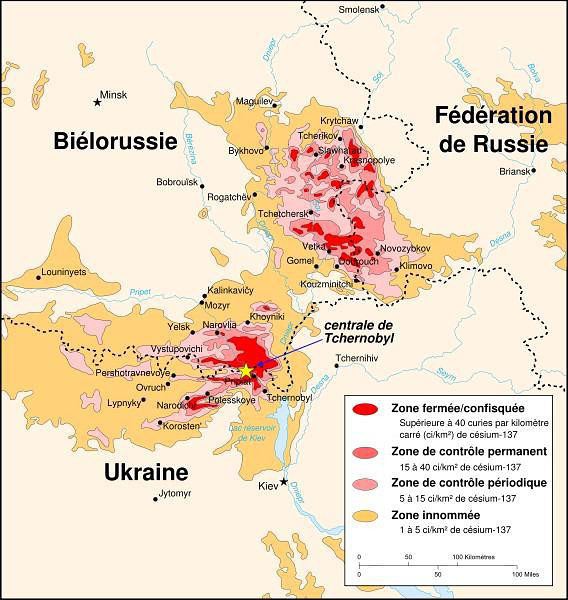
Sur la carte en pièce jointe on voit que Pripiat est pile-poil sur l'axe Kiev-Minsk. Je ne sais pas par où passe la voie ferrée qui relie ces deux villes mais ça a éveillé ma curiosité.
D'après Die Bahn (www.dbfrance.fr), le poste frontière traversé par la ligne directe Kiev-Minsk est Slovechno.
Alors il y a t'il des risques encore aujourd'hui à prendre un de ces trains pendant un voyage de seulement 15-18h ? Il me semble que le métal en général reste radioactif beaucoup longtemps que d'autre matériaux...
Les Soviétique avaient abandonné tous les véhicules militaires qui avaient été utilisés pour évacuer les habitants de Pripiat après la catastrophe. Aujourd'hui ils sont en train de rouiller sur un terrain vague dans la zone "interdite" et personne de ceux qui ont accès à la zone ne veut s'en approcher. Du coup ça fait un peu flipper en pensant aux voies de chemins de fers et aux trains biélorusses.
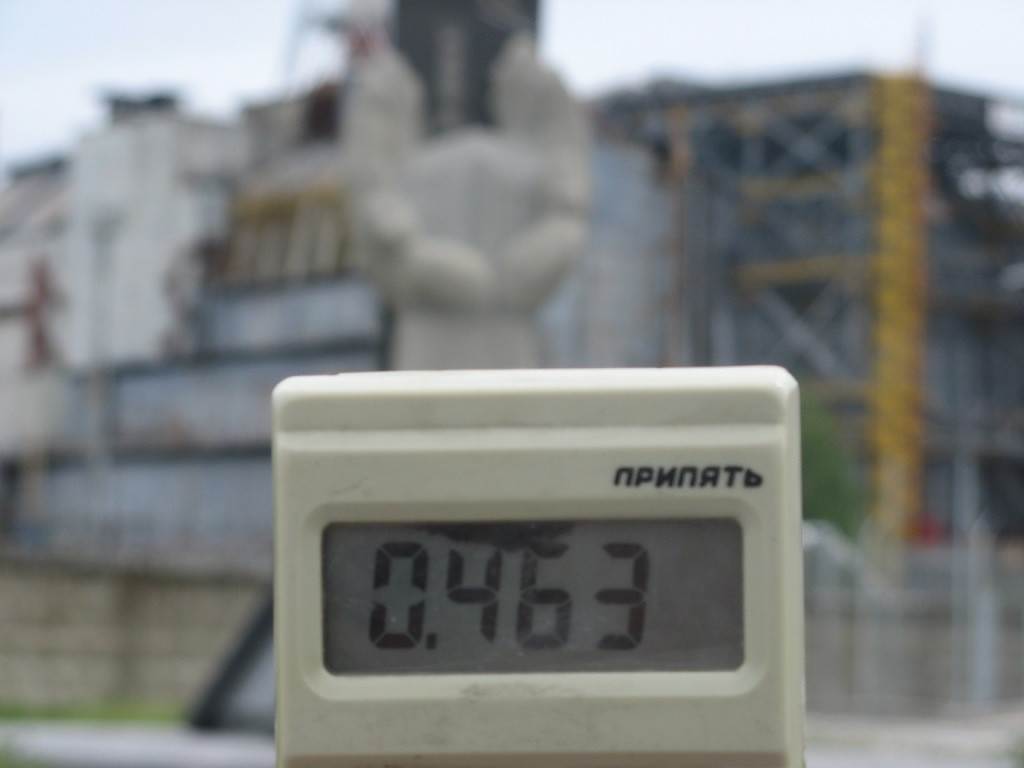
Voici une photo du reacteur N°4 qui a explosé avec le monument de commémoration devant que j'ai prise lors d'une visite de Tchornobil et de la ville de Pripiat.
La radioactivité est naturelle, elle est nocive qu'a forte dose ou a exposition de longue durée.
Cela n'a rien de rassurant mais tout ce qui etait recuperable a ete recupere et vendu dans toute l'ex-URSS et meme Europe, donc a part pour que les quelques touristes prennent des photos, il n'y a plus grand chose.
Sur le site internet ci-dessus tu verras meme des personnes volant des radiateurs en fonte.
http://files.pripyat.com/RadioPhobia.mpg
Sur ce film/documentaire, on y voit des gens qui vivent dans la zone interdite et qui cultive leur potager comme s'il ne s'etait rien passé.
Je ne pense pas que ce soit un probleme.
Juste un passage ne vous expose a mon avis pas a grand chose, d'autant que ce n'est pas tout pres du reacteur.
Ouep, j'avais déjà entendu parler de ces histoires de pillards et des quelques excursions touristiques qui s'organisent maintenant à Pripiat... mais ça me parait tout de même bien barré ... j'ai lu quelque part sur internet que seuls les vieux qui n'avaient plus rien à perdre étaient retournés vivre sur place
Il y a de plus en plus de site de photos comme celui que tu m'a filé sur internet, on dirait que le "tourisme Tchernobyl" se développe. Alors pourquoi appeler ça Zone Interdite si ce n'est qu'une passoire ? Les flics laissent passer les gens contre un peu de pognon ? A moins que cette zone soit ouverte aujourd'hui...
Et si il n'y a plus de danger pourquoi les autorités ukrainienne n'encouragent t'elles pas le "tourisme de mémoire", un peu sur le modèle de Aushwitz, pour les victimes de la catastrophe nucléaire ?
il me semble me souvenir qu'on peut aller a Pripiat tout a fait legalement, je m'etais meme pose la question a Kiev..... Par ailleurs, meme si c'est different, il y a a Kiev un musee de Tchernobyl interessant.
Je doute que les Ukrainiens aient pour l'instant beaucoup envie de developper le tourisme la-haut, mais pas forcement pour des questions de risque. il y a aussi l'image....
L'acces a la zone interdite est possible avec une autorisation a presenter au poste.
Les passeports sont controles et tout est enregistré.
Evidemment comme avec tous les flics il doit etre possible d'y acceder en payant le flic, mais je pense que ca doit etre tout de meme plus difficile.
Pour developper le tourisme, il faut evidemment qu'il n'y est aucun danger, or ce n'est pas une certitude meme si la radioactivité dans la ville meme de Tchernobil est la meme qu'a Paris.
Mais il faut aussi de l'argent, or en general il y a beaucoup d'intermediaires qui se servent au passage et il ne reste pas grand chose a l'arrivee.
Il faut surtout la volonté de le faire, ce qui d'une part n'est pas une priorité sur le site, et d'autre part les ukrainiens ont plutot tendance a vouloir oublier cette catastrophe plutot qu'a s'en rappeler.
Enfin, le fait que l'homme soit absent depuis plusieurs annees entraine quelques avantages puisque lors de notre visite nous avons vu un lynx et des troupeaux de chevaux de Przewalski qui sont en voie de disparition et qui vivent a l'etat sauvage.
meme si la radioactivité dans la ville meme de Tchernobil est la meme qu'a Paris.
Heu là j'ai du mal à le croire ... Apparement la ville ne pourra être habité sans danger avant au moins 300 ans ...
On trouve ça sur la Wikipédia (ok c'est une "source" un peu bidon mais bon...)
Les plus haut taux de radioactivité sont d'ailleurs atteints à Pripiat (et non à Tchernobyl ou le site de la centrale, en partie décontaminés : les autorités ont notamment enterré à un mètre de profondeur les souches les plus sensibles, comme l'herbe ou la mousse, ce qui n'est pas le cas à Pripiat). Le danger peut toutefois évoluer en fonction de la météo et des endroits : ainsi par temps de pluie, les poussières (qui transportent la radioactivité) restent au sol et l'endroit est « plus sûr ». À l'inverse, les zones envahies par la mousse atteignent des taux de 2 000 Bq (certaines pointes à 6 000 ont été enregistrées). À titre de comparaison, un humain moyen reçoit, par jour, une dose de 10 Bq.
Et aussi ça sur la version anglaise :
A natural concern is whether it is safe to visit Prypiat and the surrounding area. The Exclusion Zone is considered relatively safe to visit, and several Ukrainian companies offer guided tours of the area. The radiation levels have decreased from the high levels of April 1986 due to the decay of the shortlived isotopes released in the accident.
The city and the Exclusion Zone are now bordered with guards and police, but obtaining the necessary documents to enter the zone is not considered particularly difficult. A guide will accompany visitors to ensure nothing is vandalized or taken from the zone. The doors of most of the buildings are open to reduce the risk to visitors, and almost all of them can be visited when accompanied by your guide. The city of Chernobyl, located a few miles from Prypiat, has some accommodations including a hotel, many apartment buildings, and a local lodge, which are maintained as a permanent residence for watch-standing crew, and visitors.
Il n'y a rien de contradictoire.
Je le repete dans la ville meme de Tchornobil, la radioactivite est la meme qu'a Paris et inferieure a certaines regions de Bretagne ou le granit est fortement present. Nous avions notre propre compteur gegere qui le confirmait. Des gens travaillent a Tchornobil tous les jours.
Par contre, la ville de Pripiat ou travaillaient les ouvriers de la centrale reste tres fortement hyradiée. Cette ville possede un second poste de controle.
Elle est entierement vide, ces 50 000 habitants ayant ete evacues. Le temps y semble s'etre arreté, comme dans un film.
Je te conseille fortement le documentaire, disponible sur le lien cite plus haut.
classique confusion entre irradiation et contamination.
la ville de Pripiat n'est pas "irradiée" (=soumise une fois à un rayonnement ) mais "contaminée", c'est à dire polluée par des petites particules, des poussières, contenant des isotopes radio actifs, qui eux émettent des rayonnements et surtout peuvent penétrer dans les organismes (pour l'homme: en les avalant ou en les respirant), s'y concentrer et irradier de façon très précise et très proche les cellules. Les iodes radioactifs (qui attaquent la thyroïde) sont de demi-vie courte. Cs 137 (demi-vie 30ans) se fixe dans le sol, puis se concentre dans les plantes, puis dans l'organisme de ceux qui les mangent .Zone contaminée très vaste, dans toute l'Europe. Les transuraniens du coeur du réacteur ejectés lors de l'explosion sont restés plus près, on en aurait identifié jusqu'à 130 kms du site cependant.
Bref: Un compteur Geiger vous donnera des résultats rassurants (à moins d'être très proche dans une zone où le sol n'a pas été décontaminé). Sauf si vous testez des végétaux, où vous pouvez avoir des choses intéressantes.
Concernant le train: Pas de risque avec les métaux du train (sauf s'ils n'ont pas été lavés ou soumis à la pluie depuis l'accident !), risque très théorique avec des poussières soulevées par le vent (fermez les fenêtres...), prudence avec des fruits ou légumes cultivées dans la zone qui n'auraient pas été contrôlées avant la vente
Donc même dans la zone d'exclusion, à Pripiat ou près du reacteur 4, les risques d'irradiation sont minimes pour les gens qui se tiendraient à l'écart de la végétation (mousses, champignons...) et des objets métalliques situés dans les bâtiments (qui n'ont pas pu être "lavés" par la pluie) ?
A propos des "poussières radioactives", hier soir, j'ai regardé un reportage d'Arte sur un russe qui souhaitait développer le tourisme sur les anciens sites d'essais nucléaires soviétique au nord-est du Kazakhstan. Ils utilisaient de simples protections en plastiques au niveau des jambes pour se protéger de ces "poussières". Ils faisaient aussi attention à ne pas manger près des zones les plus contaminées (un lac créé par l'explosion d'une bombe nucléaire) pour éviter d'ingérer ces particules radioactives...
La météo joue t'elle aussi un rôle sur les risques encourus aujourd'hui sur ces zones irradiées (Tchernobyl ou les anciennes zones d'essais nucléaires) ? Un temps venteux et pluvieux par exemple ?
Un ex-médecin soviétique aujourdhui Kazakh dénonçait le fait que la population aux alentours avait servi de cobaye : les essais nucléaires étaient souvent pratiqués les jours d'ouragans et de pluie. Les gens n'étaient pas avertis et parfois ils étaient déplacés sur des camions "à ciel ouvert". La pluie favoriserait encore plus "l'asbsorption" de la radioactivité que l'ingestion des "poussières".
Je sais pas ce qu'il en est du développement "touristique" de cette zone du Kazakhstan aujourdhui... Le documentaire doit avoir quelques années. Apparement le tourisme nucléaire existe aussi aux USA sur les anciens sites du Manhattan Project. C'est dingue, j'ignorais que tout ça existait.
J'arrive a Odessa le 31 juillet. Je n'ai aucun autre impératif que d'être à Zagreb le 9 aout afin d'assister à un mariage (pas le mien ;)) Je pensais aller a…
Je parle du "fameux" train passant par la Transnistrie, interrompu pendant plusieurs années et dont la circulation a repris en octobre 2010, de mémoire... Je…
Je voulais avoir quelques renseignements sur un voyage en train de Bucarest, Roumanie vers la ville de Oujgorod dans le sud ouest de l'Ukraine. C'est assez…
Je suis un "vieux" de 55 ans, dont les racines se trouvent à Krementchoug, en Ukraine. Je souhaite m'y rendre pour la première fois l'été prochain. Ce voyage…
Hi! I’d like to make stops across France, starting from Reims, and travel by train using the Intercités. I want to discover the landscapes and picturesque villages, and make some stops along the way. Could you give me some tips? Thanks!
I’m planning our very first trip to mainland France in January 2027. There’ll be 2 adults and 2 kids, and we’ll mostly be traveling by train.
Here’s our itinerary:
Paris
Rouen (Normandy)
Lyon
Aix-les-Bains (with day trips to Annecy and Geneva)
Saint-Gervais-les-Bains (with Chamonix and a day in Aosta)
Back to Paris
Do you think this itinerary is well-balanced? Any tips, must-see spots, or mistakes to avoid for a first-time visit?
I can’t seem to complete the payment for my trip on the IRCTC (Indian Railways) site. No matter which payment method I choose, my Visa card isn’t accepted.
Has anyone here managed to do it, and if so, could you share the method you used?
Thanks in advance!
Charlie
I’m planning a family trip in a year. Our goal: traveling to China (and maybe Hong Kong) by train.
I’m all set with the route up to eastern Turkey.
However, I’m just starting my research for the rest of the journey—namely the Caucasus (no trains as far as I know, so buses and/or ferries), then Central Asia and China.
So, I’d love to hear any info or tips (general and forward-looking at this stage) about the train route through Central Asia and China to reach the east coast.
I’m particularly interested in details on:
- How far in advance to book / any potential difficulties with reservations
- Whether there are PASS systems (or equivalent) between countries and/or if some tickets allow stopovers, meaning you can hop on and off as you please
- Day trains vs. night trains (the latter option lets you explore cities between two legs of the journey)
- A rough idea of ticket costs
...
A huge thank you to anyone who can share some info or experiences. It’s also a great opportunity to chat about adventure after (way too) many years away from this forum.
I’m planning a trip around Italy using only trains or public transport in October (hoping the weather stays nice!).
I’d obviously like to see some tourist destinations, but I also want to get off the beaten path a bit, and I’m hoping to find some help here? I don’t plan to linger too long in the cities.
Starting in the north, I’d like to visit Lake Como or Lake Orta, pass through the Cinque Terre for some hiking, spend a few days in Naples and Rome, then head down to Sicily.
Hi there,
I’ll be traveling to Japan this coming August. We’ve finalized our itinerary and booked our flight tickets. Now I’m at the stage of buying train tickets for the few segments we’ll need to cover:
Tokyo - Hakone
Hakone - Kyoto
Kyoto - Osaka
Osaka - Tokyo
Here are my questions:
a) Is it possible to buy train tickets for these segments from Canada?
b) If so, which website should I use to do this?
c) And if it is possible, will we be able to print our tickets from Canada?
d) If it’s not possible, where in Tokyo should I go to buy these tickets when I arrive?
Hi everyone, I wanted to take the Paris-Berlin overnight train with a sleeper berth, the new service operated by European Sleepers.
24/05/2026 17:45 Paris-Nord (actually 16:00 from Paris Bercy Seine) -> 25/05/2026 9:59 (actually 7:30 in Berlin)
05/06/2026 18:31 Berlin (actually 20:00) -> 06/06/2026 10:00 Paris Nord (actually 12:30)
Part of the journey was operated by bus instead of the promised overnight train.
For 2 people: 340 € round trip
A total disaster. Never again. I was really looking forward to taking the overnight train, but we faced last-minute changes and truly unpleasant travel conditions. Here are the details:
1) 2 days before departure: email announcing a change of departure station for the outbound trip—Bercy Seine bus station instead of Gare du Nord.
2) Change of schedule: 4:00 PM from Bercy instead of 5:45 PM from Gare du Nord.
3) Change of transport mode!! A bus from Paris to Brussels, then an overnight train from Brussels to Berlin. No functional toilets on the bus. No children under 4 allowed on the bus.
4) On the sleeper train at 9:30 PM: no functional toilets in our carriage, so we had to go to other carriages, even in the middle of the night, to find working ones.
5) The onboard staff, though very friendly, were as lost as we were. In particular, they didn’t know how to handle the lower berths, so people using them had less space (armrests and backrests). Berth numbers weren’t respected, so some passengers had to move. The staff also didn’t know who was supposed to join the compartment during the journey.
6) Arrival at 7:30 AM in Berlin instead of 10:00 AM. No arrival announcement. Passengers had to search for staff to get breakfast and ended up with just a coffee (breakfast = 15 €, not bad for just a coffee).
7) Return trip: drastic schedule change announced by email on 26/05/2026—departure at 7:30 PM instead of 6:30 PM, with arrival between 12:00 PM and 1:00 PM in Paris instead of 10:00 AM. No change in transport mode announced.
8) Change in transport mode announced by email on the same day (05/06/2026)!! Overnight train from Brussels to Berlin, then a bus from Paris to Brussels. No functional toilets on the bus. Children under 4 banned from the bus, and families in this situation were asked to find another way—after being notified the same day.
9) The overnight train arrived at Berlin station with a 30-minute delay on top of its initial delay (scheduled for 6:31 PM, then 7:30 PM, finally arriving at 8:00 PM). The heating was blasting in the compartment with no way to turn it off. No functional toilets in the carriage. From that point on, customer service stopped responding to my messages.
10) Woken up at 5:00 AM with an announcement in all carriages about arrival in Liège.
11) Woken up again at 6:00 AM to be told we’d arrive in Brussels at 7:00 AM.
12) Arrival in Brussels at 7:00 AM and a one-hour wait for the bus to Paris. No functional toilets on the bus.
13) Arrival at Paris Nord at 12:30 PM, so 2.5 hours late compared to the originally scheduled time.
14) The overnight trains used are very old—I recognized the carriages from 20 years ago!! No functional power outlets, no Wi-Fi, no air conditioning. Five people per compartment is a bit cramped, but I consider these conditions expected (especially the air conditioning), so I’m not complaining about that. There’s already plenty to gripe about with the travel conditions.
I have little hope of getting even a partial refund. Customer service emails acknowledge the discomfort but only offer to reimburse the cost of a coffee on board if we send them the receipt... a bit weak.
I’m sharing this experience in the hope it might help others.
Hi there,
I’d like to take the Train of the Clouds from Lima to Huancayo.
I’ve heard it only runs during certain periods.
Does anyone have info on this?
Thanks!
HuancayoHuancayo
As part of my professional thesis, I’m conducting a study on the evolution of long-distance rail transport in France, particularly since it opened up to competition.
I’ve put together a very quick (about 5-minute) and completely anonymous questionnaire. Your answers will help me better understand users' expectations regarding pricing, frequency, and environmental impact.
We’re planning a 15-day trip to Uzbekistan in March—classic independent itinerary: Tashkent, Samarkand, Bukhara, Khiva. We’d like to take the train between each city, but I don’t want to lock down the whole trip before we leave.
So, my question is: is it absolutely necessary to book train tickets before departure, whether for the high-speed trains or the regional ones? Is booking really essential for the regional trains?
Hello,
We’re traveling as a family with two boys aged 10 and 12 to Cairo in February. During our trip, we’re planning to take an overnight train (with or without a sleeper) for the Cairo-Aswan route.
Do you know how I can book this remotely?
Also, I’m looking for:
- A local contact to sail the Nile by felucca for 3 days from Aswan
- A contact to guide us in Cairo
Looking forward to your tips, and thanks in advance!
Marie
Hi everyone,
I first traveled solo to Japan in 2019, exploring the Kyushu region (28 days), and I’m planning to return with my daughter (she’s an adult and it’ll be her first time in Asia) from April 25 to May 9.
I’m reaching out on this forum to ask for route ideas—this time north of Tokyo, but without heading to the Sapporo island (I’m saving that for a future trip).
I’d love to take advantage of the cherry blossom season and its festivities.
I’m looking to create a route that’s a little off the beaten path while staying within 5-6 hours by train from Tokyo to avoid spending too much time on transfers.
Thanks in advance for sharing your suggestions and experiences!
Michael
I'm heading to MEXICO IN NOVEMBER 2025. Since private guides and drivers are really expensive—over 300 € per day—I'm thinking of exploring the Yucatán by train. CAN YOU SHARE ANY INFO ON THIS? Thanks
Hi there!
We’re planning to visit Serbia (1 week) and then Montenegro (2nd week) with our kids from April 18 to May 4. We’d prefer to travel by train (overnight if possible), but we’re not sure which platform to book on or when to do it (is it too early?). If anyone has any tips, I’m all ears!!
I wanted to know if it’s possible to go from Tashkent to Almaty by train without passing through Kyrgyzstan. I’ve heard the border is often closed 😕 between Uzbekistan and Kazakhstan.
Thanks in advance!
Olivier
Hi there!
We’re planning to head back to Istanbul next year—obviously by plane—and then take the train from Istanbul to Antalya. Has anyone here already made this trip by train with TCDD?
I’d love any tips or info that could be useful for us!
I'd like to go to Montserrat on my own from Barcelona. Share your suggestions with me.
Which train should I take, where to get off, what to see once I arrive, etc.
I need to take a sleeper train from Bangkok to Vientiane in January.
I found some ticket options on 12Go Asia, but booking doesn’t seem possible at the moment. I’ve tried simulations for several dates, but no luck.
I’m wondering if it’s already fully booked, if they’ve stopped selling tickets… yet 12Go still features it every day 😕
Has anyone else run into this issue?
Can I find tickets on another site? (I tried Baolau, but no sleepers left for January 8th.)
Hi there,
I’m a bit late to be worrying about this, but hopefully someone can help me before I leave.
Tomorrow afternoon, I arrive at Lyon Part-Dieu on the TGV at 5:50 PM and take the TER to Mâcon at 6:16 PM. Is a 26-minute transfer doable? Are the TGV and TER on the same departure board? And are they on the same platforms too?
I’ve been to Lyon before but never had to make a connection after arriving.
Thanks
Starting November 15th, I’ll be arriving in Thailand, and during my stay, I plan to visit the north, around the Chiang Mai area, then head south to the Krabi region.
After Krabi, I’m planning to take an overnight train to Bangkok. I was wondering if there’s a train that leaves from Krabi or Trang, or if I absolutely have to go to Surat Thani?
Also, which official website can I use to book my ticket?
Next, since I’ll be arriving at dawn in Bangkok, I’ve planned to spend 2 days in Kanchanaburi. What’s the most convenient way to get there—bus or train? And if you know any companies or websites, that’d be great.
Hi there,
Does anyone know if there’s a bus from Luang Namtha to Boten to catch the train coming from China to Vientiane? If so, what’s the name of the company? Also, how long does the bus take to cover that distance? What’s the condition of the road like?
Thanks for your help!
Tom
I just realized there’s only one payment method accepted for booking the Mombasa-Nairobi express train ticket online: M-Pesa, a mobile money transfer service used in Africa. Would it be impossible to book as a European?
I’d love to know if any of you have recently eaten on the overnight train from Bangkok to Chiang Mai.
We’ve always ordered food on the train, and it was really good (and super convenient).
But in 2022, we ended up feeling like total idiots (with our 4-year-old daughter...) when we boarded the train only to find out that this service was no longer available... (It was the first time we’d traveled right after COVID.)
That’s also when we saw once again how kind Thai people are—they all offered to share their food with us, even though we were mortified. In the end, we managed to buy some instant noodles, which was better than nothing. Anyway, that’s the little story behind it.
In the following years, we’ve always brought our own meals.
I’ve read online that meal trays are back in service (could you confirm this, please?), but that the quality is really poor. I’ve also seen multiple reports that, even though you can eat well everywhere in Thailand, the train meal was the worst food travelers had during their trip...
Could you give me a recent opinion on this?
We’ll be departing from Krung Thep Aphiwat Central Station—do you know if there’s anywhere to buy a meal there before boarding the train?
Thanks so much for your help,
and have a great Sunday!
We’re heading to Thailand in February 2026 and we’d like to take the overnight train from Bangkok to Chiang Mai. Can we book two first-class tickets? I’m only seeing second-class options.
Hi everyone,
For traveling in Rajasthan by train and bus, could you give me some info: where to buy tickets, cost, purchase locations, websites, etc.?
Any tips you have would be super helpful.
Thanks
We’re traveling to Java on October 23, just the two of us.
I’ve read that it’s best to book train tickets in advance on tiket.com.
Is that true, and how far ahead do you recommend?
Are the tickets changeable?
Hi everyone,
I’m planning to travel from Ulaanbaatar to Irkutsk by train this summer but I’m a bit worried about crossing the borders. How does it work? Could anyone share their experience? (I’ve found quite a few accounts of people going *from* Russia *to* Mongolia, but entering a country is never the same as leaving it—especially in this context!)