Lors de mes prochaines vacances, du 10 au 20 février, j'aimerai entreprendre un voyage en vélo en partant de Caen et à destination de Nantes puis continuer en bretagne en fonction de la vitesse à laquelle j'avancerai.
J'ai déjà fait un voyage l'été dernier, il s'agissait de mon premier. Or, j'aimerai avoir quelques conseils sur le matériel nécessaire en hiver. J'aimerai utiliser warmshower ainsi que m'arrêter chez des amis pour dormir, mais je vais aussi, très certainement, être dans la nécessité de dormir en extérieur (tente).
Bien évidemment, les températures sont beaucoup moins agréables que l'été ... ihi et pour faire de bonnes nuits j'aimerai avoir quelques conseils pour l'achat de matériel (duvet, vêtements chauds, gants, bonnets etc.) qui soient confortables.
J'aimerai ne pas avoir à dépenser trop d'argent, notamment pour le duvet (même si il semblerait que le prix monte assez vite) et la matelas isolant du sol (ou si vous avez d'autres idées pour le couchage).
en hiver va plutôt faire du ski de fond dans le jura , c'est grandiose
de plus ils seront très content de te voir
claudio
Claudio de la Faverges.
Bonjour amis cyclotouristes, claude passionné de voyages à vélo favergien et défenseur du cycliste.
plus la carte bleue est foncée et plus le bagage est léger
en anglais "the more the card is blu the less the luggage is heavy"
J'ai déjà fait ce trajet l'hiver sans être super équipé ; j'ai survécu. Tu connais globalement cette région, il ne fait pas super froid. Mais humide. Le pire à vélo, c'est la pluie plusieurs jours de suite. Prends de quoi te changer et imperméabiliser tes sacoches ou leur contenu.
Si tu n'as pas du matos très cher (donc performant, léger et compact), il sera sûrement plus lourd et encombrant. Mais c'est pas si grave.
Regarde sur le bon coin, avec un peu de bol, tu trouveras du bon matos à pas trop cher.
À la fois, si tu sais que tu ré-éditeras ce genre d'expérience, ça peut valoir le coup, cette fois-ci d'investir dans un des équipements. Et la prochaine fois, dans un autre. Quand j'ai commencé, j'étais très mal équipé et j'ai investi petit à petit jusqu'à l'être relativement bien.
Ne néglige pas le tapis de sol. Et le fait de bien dormir en général.
Rouler l'hiver, c'est plus dur mais c'est gratifiant. C'est aussi l'occasion de demander à des agriculteurs de dormir dans une grange. Et souvent, les gens se montrent bien plus accueillants qu'ils ne l'auraient envisagé aux-mêmes. :)
Souvent dans les cafés, rien qu'à sortir une carte routière, les connexions se font, on se fait payer le café... l'été, c'est rarissime. :)
Bonne route
Le vélo, c'est bien, même pour celleux qui n'en font pas.
J'ai roulé une fois en hiver, toute une semaine, j'ai eu de la neige tous le jours, le soir je faisais un igloo pour dormir dedant ... nan j'déconne ! 😏
Salut,
tu risques en effet d'avoir plus à souffrir de la pluie que du froid, auquel cas gants d'hiver waterproof, surpantalon et guêtres ne me semblent pas être superflus ; à moins d'attendre au café que la pluie cesse...
Pour la nuit, un duvet synthétique imperméable aux températures de confort autour de -5° -10° permet de passer des nuits tranquilles sous la tente, associé à un matelas autogonflant de type thermarest.
Ce type de duvet peut être un peu volumineux, mais c'est moins gênant à transporter à vélo qu'à pied (pour moi, duvet Husky Emotion, autour de 120€).
Rouler en hiver en France est un bon entraînement pour envisager des destination plus exotiques, où même l'été les conditions météo peuvent être un peu fraîches.
Investir dès maintenant dans du bon matériel peut donc être une bonne idée.
On appelle cela non plus du Cyclotourisme mais du MasoTourisme
mais à chacun ses plaisirs
Pour sa part claudio a sombré dans le Tourisme de luxe
claudio de la Faverges les ecombettes
Claudio de la Faverges.
Bonjour amis cyclotouristes, claude passionné de voyages à vélo favergien et défenseur du cycliste.
plus la carte bleue est foncée et plus le bagage est léger
en anglais "the more the card is blu the less the luggage is heavy"
Merci à tous pour vos commentaires !
C'est vrai qu'à cette époque, le plus embêtant va être la pluie ! Je vais me renseigner sur le duvet que tu m'as envoyé ! Les températures indiquées semblent vraiment pas mal ! J'imagine qu'il doit exister des bâches plus ou moins isolantes que je pourrais sous mon matelas ? J'en ai un compact et plutôt bien confort... mais plutôt pour les belles saisons, il n'isole pas du tout du sol et avec l'achat du duvet et d'un peu de matériel pour mon vélo je ne pourrais pas me permettre d'en changer tout de suite !
Ce qui risque d'être le plus embêtant est de pouvoir faire sécher mes vêtements.. En cas d'intempéries (ou bien même pour les laver) cela risque de prendre pas mal de temps ! Auriez vous une solution (j'ai bien pensé à un lavomatique en cours de route mais certaines matières synthétiques risquent de ne pas trop apprécier..)
Pour les tenus, je vais essayer d'aller voir à décatcat, j'imagine qu'il est conseillé d'avoir des t-shirts synthétiques plutôt respirant ? Pareil, pour les chaussures, j'ai des chaussures de randonné confort, ce n'est pas très imperméable mais avec un imperméabilisant cela suffira peut être ?
J'imaginais utiliser 2-3 couches (t-shirt, vêtement de cyclisme d'hiver et en cas de pluie une veste qui m'as déjà bien dépanné pendant des gros orages), qu'en pensez vous ?
Merci beaucoup :p
Et sinon je ne suis pas un masotouriste mais c'est une expérience que j'avais envie d'essayer ! et bon, si jamais c'est compliqué y a toujours la marche arrière ! :p
n'écoute pas les rabat-joie : personnellement j'aime mieux rouler par temps froid qu'en plein été, sauf pour une chose : l'humidité. C'est effectivement le point potentiellement le + désagréable.
Il faut s'habiller "multi-couches" et enlever ou remettre une couche à mesure que les conditions changent (y compris en cours de journée), et surtout, garder soigneusement au moins une couche sèche pour la nuit, dans des sacs ou sacoches étanches.
Le choix synthétique versus laine est personnel : pour ma part, j'ai évolué du synthétique vers la laine mérino. Elle sèche un tout petit peu moins vite que certains synthétiques, mais reste agréable à porter sur une plus grande gamme de température. On prend moins vite froid dans un vêtement en laine humide que dans du synthétique humide. Et la laine prend moins l'odeur du cycliste qui sue.
Pour les chaussures, plutôt qu'un imperméabilisant qui n'empêchera pas l'eau de s'infiltrer par les jointures, je recommanderais plutôt une paire de chaussettes avec membrane imperméable, du genre Sealskinz. Ou des surchaussures. Dans les 2 cas, veiller à ce que le haut des chaussettes ou surchaussures soit un peu plus haut que le bas des surpantalons.
essayer donc de rouler aujourd’hui sous cette pluie
vous verrez si c'est rabat joie
claudio
Claudio de la Faverges.
Bonjour amis cyclotouristes, claude passionné de voyages à vélo favergien et défenseur du cycliste.
plus la carte bleue est foncée et plus le bagage est léger
en anglais "the more the card is blu the less the luggage is heavy"
j'ai déjà roulé par tous temps, je donne mon avis en connaissance de cause, en précisant bien que c'est subjectif. J'ai bien écrit qu'en hiver, ce n'est pas tant le froid qui pose problème, mais la gestion de l'humidité, car la question initiale portait juste sur le froid. Et je maintiens que personnellement, je préfère rouler par 0°C que par +30°C, mais je comprends tout-à-fait qu'on puisse ne pas être de cet avis !
plus jeune je roulai par tous temps, mais l'age arrivant je devient plus sage
cb
Claudio de la Faverges.
Bonjour amis cyclotouristes, claude passionné de voyages à vélo favergien et défenseur du cycliste.
plus la carte bleue est foncée et plus le bagage est léger
en anglais "the more the card is blu the less the luggage is heavy"
Le choix du lieu et des saisons où l'on voyage est une décision Personnelle, il n'y a ni règle ni limite... A chacun de faire ce qu'il a envie et d'en profiter au maximum... :-)
Pour le sol, j'utilise une grande bâche de jardinage que j'ai découpé aux dimensions de la tente. Après avoir ratissé le terrain de bivouac (enlèvement des racines, morceaux de bois ou épines) je pose la bâche et monte la tente par dessus : ça protège le tapis de sol de la tente d'éventuelles déchirures.
Mon matelas est suffisant pour m'isoler du froid ou de l'humidité ; peut-être qu'une couverture de survie glissée sous ton matelas suffira à l'isoler ... à essayer.
Chaque saison possède ses avantages. L'hiver, possibilité d'acheter des produits frais sans se soucier de leur conservation ; coins de bivouac plus faciles à trouver car peu de promeneurs ; et surtout, la lumière, même en pleine journée, est en cas de beau temps magnifique : idéale pour les photos ou juste admirer le paysage !
Il faut toujours voir le bon côté des choses 😉
claudio présentement, marche un peu à pieds en hiver :
de Faverges à Genève en passant par Annecy
on aurait facilement pu se la faire à bicyclette, mais 1 jours plus tard , non (15 cm de neige sur le parcours)
nous sommes passés entre les flocons donc
dormir dehors ? on aurait ou au col du mont Sion, dans un abri bus ! madame n'a pas voulu !
à 65 ans, on préfère un lit douillet avec ou sans David d’ailleurs, et notre statut de riches retraités le permet (même si manu nous ponctionne un peu de CSG !)
cbandiera.free.fr/recits/2019-pieds/
cbandiera.free.fr/recits/2019-pieds/v.php
claudio de la faverges la motte des écombettes
Claudio de la Faverges.
Bonjour amis cyclotouristes, claude passionné de voyages à vélo favergien et défenseur du cycliste.
plus la carte bleue est foncée et plus le bagage est léger
en anglais "the more the card is blu the less the luggage is heavy"
raison de plus pour ne pas dissuader les jeunes de profiter de ce vaste monde, y compris en hiver, pendant qu'ils supportent des conditions de bivouac un peu plus rudes !
Salut
Je n'ai aucune expérience de rando vélo en hiver , mais je sort la bête tout les matins pour mes petites affaires et ce qq soit le temps .
Chez D4 tu trouve des plaids isolé dessous pour le picnic ça peut être intéressant a mettre entre toi et le matelas la nuit pour bien dormir (isolation) https://www.decathlon.fr/plaid-nh-vert-id_8383789.html
Vu le mérinos plus haut . Je ne porte plus que ça depuis ça découverte été comme hiver . Pour raison de budget ils viennent de chez D4 . Manche longue gris , 150 grammes pour 20 euros . En ce moment au rayon mérinos tu trouve un model (chasse ) 190 grammes manches courtes a 14 euros c'est une belle affaire , tu peut le porter durant tout un périple sans problème ! https://www.decathlon.fr/tee-shirt-sg900-laine-mc-vert-id_8502515.html
A ta place j'opterai aussi le soir venu pour une micro doudoune , on en trouve vers les 25 euros toujours dans le même mag .
Gaffe aux chaussures , si elles prennent l'eau elle ne sécheront pas !
Pour 48 euros au lieux de 80 euros je viens de m'offrir des Quechua rando neige montante testé pour mes sorties vélo matinale ... et bien ça marche super bien , pas trés chaude mais bien isolé (pluie et vent) pas tropmassive , limite passe partout ; www.decathlon.fr/...leue-id_8502620.html
Bon trip et raconte nous ta belle aventure au retour
Pascal
reve de longues escapades en moto avec ma moitie , mais depuis le vélo est arrivé ...
En référence, je vous invite à lie le récit du tour du monde de 7 ans Claude Marthaler (le Chant des Roues) et notamment sa traversée du Kirghizistan en février 95. Ça fait relativiser. :)
Le vélo, c'est bien, même pour celleux qui n'en font pas.
J'habite comme toi en Normandie et comme tu as pu le constater ce début d'hiver
a été particulièrement clément....pas de froid et quasiment pas de pluies.
Il était donc tout à fait possible de cyclorandonner pendant toute cette période depuis
la fin de l'été.
Par contre en ce moment arrive le véritable hiver avec du vent, des températures guère au
dessus de zéro, une pluie glaciale et là je ne vois vraiment pas l'intérêt de prendre la route
dans ces conditions.
Donc pour moi rouler l'hiver oui, mais à condition de disposer de temps pour pouvoir faire un
break pendant une mauvaise période qui peut durer plusieurs jours ( semaines ). Ou un plan B
pour rentrer à la maison et attendre des jours meilleurs afin poursuivre....
Claudio de la Faverges.
Bonjour amis cyclotouristes, claude passionné de voyages à vélo favergien et défenseur du cycliste.
plus la carte bleue est foncée et plus le bagage est léger
en anglais "the more the card is blu the less the luggage is heavy"
Comme en Normandie, la Bretagne connaît en ce moment une vague de froid. Celle-ci est classique pour cette saison, mais les hivers étant de plus en plus cléments, elle nous paraît inhabituelle. Tu risques d'être agréablement surpris par ton voyage en Bretagne, surtout si tu t'aventures sur le littoral sud, de Pornic à Vannes par Guérande. Tu pourrais même échapper à la pluie: le climat change, mais pas l'image que les gens s'en font.
les routes sont vites dégagées en Savoie
pas question de s'aventurer sur les hauteurs même à mi pente ni les voies vertes (non dégagées)
mais sur les routes principales c'est assez vite dégagées
comme sta matin impossible mais stantot c'est bon, sauf après 16 h qd il gèle déjà
Claudio de la Faverges.
Bonjour amis cyclotouristes, claude passionné de voyages à vélo favergien et défenseur du cycliste.
plus la carte bleue est foncée et plus le bagage est léger
en anglais "the more the card is blu the less the luggage is heavy"
encore une fois
ici en savoie neige du matin n 'arrête pas le pèlerin
soleil a partir de 13 h mais thermomètre sous zero des 16 h , voies vertes non dégagées on pourrait rouler sur le grand route, mais pas très conseillés
claudio lui péripate (à pied) dans sa ville 5 km environ histoire de faire passer le panettone
Claudio de la Faverges.
Bonjour amis cyclotouristes, claude passionné de voyages à vélo favergien et défenseur du cycliste.
plus la carte bleue est foncée et plus le bagage est léger
en anglais "the more the card is blu the less the luggage is heavy"
Lors de mes prochaines vacances, du 10 au 20 février, j'aimerai entreprendre un voyage en vélo en partant de Caen et à destination de Nantes puis continuer en bretagne en fonction de la vitesse à laquelle j'avancerai.
J'ai déjà fait un voyage l'été dernier, il s'agissait de mon premier. Or, j'aimerai avoir quelques conseils sur le matériel nécessaire en hiver. https://pharmacie-relais.com/medicaments-pour-hiver J'aimerai utiliser warmshower ainsi que m'arrêter chez des amis pour dormir, mais je vais aussi, très certainement, être dans la nécessité de dormir en extérieur (tente).
Bien évidemment, les températures sont beaucoup moins agréables que l'été ... ihi et pour faire de bonnes nuits j'aimerai avoir quelques conseils pour l'achat de matériel (duvet, vêtements chauds, gants, bonnets etc.) qui soient confortables.
J'aimerai ne pas avoir à dépenser trop d'argent, notamment pour le duvet (même si il semblerait que le prix monte assez vite) et la matelas isolant du sol (ou si vous avez d'autres idées pour le couchage).
Bonjour,
Si tu passe du coté de Guenrouet (entre Nantes et Redon) sous le froid ou la pluie pour 15€ la nuit j'ai une adresse au chaud ici:
http://www.lespensionsdelabaraque.fr/
Hugh at all! Mon "trip" en Afrique smblant compromis, je cherche une soluce de secours. j'aimerais avoir vos impressions sur un Tour de France hivernale, en…
Je cherche un col dans les pyrenées à passer en vtt en hiver. Je souhaite que ce col soit fermé à la circulation auto (j'ai trouvé le site qui va bien) plutôt…
Voyager à vélo › Pays-Bas / Belgique / France › Nord · 0 replies
Veuillez trouver ci-dessous la planche topo construite, imprimée et plastifiée pour faire le voyage à vélo de Calais à Bruges à Amsterdam cet hiver 2018:…
Mon ami et moi souhaitons profiter de 4-5 jours disponibles entre Noël et le Nouvel an pour faire un petit voyage à vélo. Nous faisons généralement entre 50 et…
I’ve got my flight ticket sorted—departing in mid-November and returning in mid-March. I’ll arrive in Santiago and leave from Buenos Aires.
I’ve already been to southern Argentina, specifically Torres del Paine National Park, and I’d love to go back to do the full W trek (I only did the shorter version last time).
I also want to do some hiking and maybe even tackle a summit. I climb and occasionally do some mountaineering, so I’ll definitely be going with a guide.
I plan to start around Temuco in Chile, with the idea of heading toward the lakes, then taking the Carretera Austral.
I’m not sure if I’ll go all the way to Ushuaia—it’s supposed to not be *that* worth it, except for the bragging rights of saying you’ve been to the end of the world.
I saw there are lakes in Argentina too.
I don’t have a precise itinerary, but what I’d love is, once I reach the southernmost point of my trip, to take a mini-cruise to see some wildlife. Any tips for that?
What kind of sleeping bag did you take? Is a 0°C (32°F) one enough?
And one last question: white gas stove or can I get by with my gas stove?
Hi there,
I’ve been road cycling for several years, and I’m about to switch to gravel in the next few days—I’m waiting for my bike, which should arrive this week.
I’m planning a bikepacking trip in a few weeks along the Véloroute V81, also known as the Vélosud, from Biarritz to Le Barcarès.
Has anyone here already done this route? Any info is welcome, whether it’s about the route itself, gear, or accommodation. I’ll prioritize staying with locals as much as possible. On that note, I just signed up for the brand-new site *Guidon et Couette* ((www.guidon-et-couette.fr)), which offers free accommodation between cyclists across the country, but there’s almost no one listed along my route!
Thanks in advance.
Laurent.
I'm developing a free and open-source web app for planning walking and cycling trips (and even car trips). You can create a route by clicking directly on the map to add waypoints, and it can consist of multiple stages. The app provides tools to edit the stages and the overall route, and to display useful information (distances, altitudes, and elevation changes). A relief profile can be shown as a graph for a specific stage or the entire route.
Once the route is ready, it can be exported as a GPX file, which can then be used with a GPS or a mobile navigation app.
The app is built in JavaScript and runs entirely in the web browser. It uses the Leaflet library and several OpenStreetMap-based services. Initially developed for my personal needs (I enjoy hiking and cycle touring), I’d be happy to share it with anyone who might find it useful. It’s free to use, doesn’t require an account, and the source code is available.
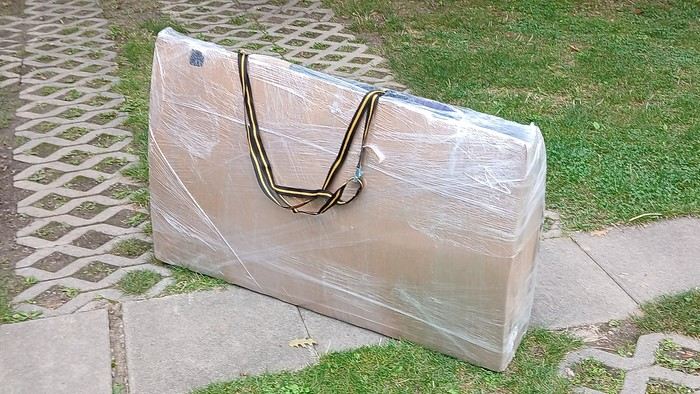
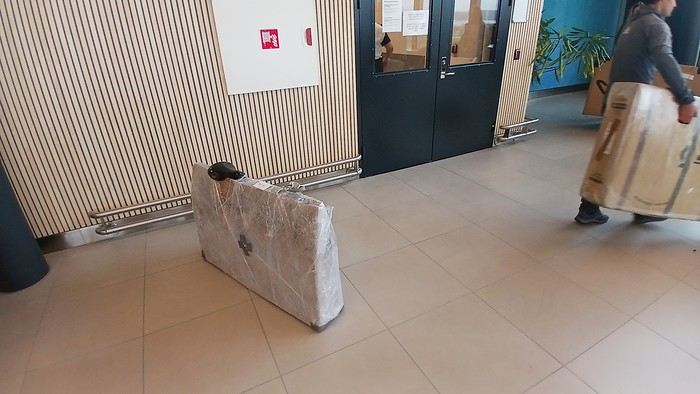
After testing it for three years across various modes of transport, I’m sharing this video of a bike packing case. It’s made from recycled cardboard and shrink-wrapped, with adjustable thickness and added bubble wrap depending on the level of protection you want.
Installing spacers at the fork and chainstays makes the packaging compact. With the fifteen-odd euros for shrink-wrapping at the airport, this case travels really well.
https://youtu.be/_GDJi-GqmkM
- Low bulk (1.10m x 0.70m x 0.25m for a large frame), it fits vertically in train luggage compartments and the total dimensions (x+y+z) don’t exceed 2.40m.
- Two carrying solutions for public transport and easy handling by airport staff (no more tears in the cardboard from openings).
- Discreet packaging when dealing with bus drivers and train conductors, as it looks like an ordinary parcel.
- No need to return to the starting point to retrieve the case from your outbound trip, which you’d otherwise have to store somewhere, or deal with a bulky cover to pack in your panniers.
- You can still check tire pressure through the plastic film without damaging the packaging too much.
Drawbacks: Around 3 hours for this lengthy and meticulous process—removing the wheels, pedals, handlebars, and derailleur without misaligning them, then securing all components to the frame.
If you get a chance to test it, send me your feedback for future improvements.
Hi there, I’m planning a cross-Canada bike trip, and I’ve got a question that might seem silly, but could someone tell me how to pack a bike (in a box, with a fragile sticker... I don’t know) for a flight? Thanks in advance!
This summer, we’re planning to cycle along the EV 19 that follows the Meuse River from Langres all the way to Rotterdam.
My question is about getting back to Nantes.
Do any of you know what the best return option might be? I’d love to hear about your experiences.
I saw that FlixBus doesn’t take bikes.
By train, I think it’s possible but would involve multiple local trains.
We were also wondering if there’s a boat from Rotterdam to Saint-Nazaire that could take passengers with bikes.
Any tips or experiences you can share would be really helpful—thanks in advance!
Have a great evening
I’ve gotten used to crossing Europe by bus to return by bike.
It was really convenient to take the bike without having to disassemble it.
But FlixBus no longer accepts bikes...
What alternatives do you know about?
Thanks.
Hi there,
I’m planning to ride the Dutch section of the EuroVelo 19, from Maastricht to Rotterdam.
Since it’s too complicated to bring my bike on the train, I’m looking to rent one locally.
I’d love any tips or bike rental shop recommendations—I’m struggling to find options even in Rotterdam.
The plan is to rent in Rotterdam, take the train to Maastricht with the bike, then cycle back to Rotterdam.
Thanks in advance for any advice or suggestions!
Nath
I’m planning to cycle from Morlaix to Brest (via Roscoff and the V45 coastal route). We’ll start riding on August 16th for 13 days (with stops for island visits, surfing, etc.). Is there a lot of traffic at this time of year? I’ve got two kids, 11 and 13, and we don’t like riding in the middle of cars (we’ve already done the Vélomaritime—Caen to Cherbourg—the Loire route from Orléans to Saumur, the Vélodyssée from Nantes to Royans, and the canals like the Nivernais and Bourgogne, where there were plenty of bike-only lanes, which isn’t the case on this route).
Thanks for your help if you’ve already done this route in late August!
Virginie
I’m planning to build a new touring bike.
I want to prioritize lightness.
That said, I’m tempted by a suspension fork that could offer some comfort on rougher roads.
The recent appearance of gravel suspension forks on the market might meet my needs—at least on paper.
I’m particularly considering the RockShox Rudy Ultimate XPLR fork.
Unlike MTB forks, its travel is short: either 30 mm or 40 mm.
It weighs 1400 g, which is 400/500 g more than a steel fork.
Any thoughts or real-world feedback on this?
I’m also wondering about the durability of magnesium (lower leg) for long-distance bike touring.
And what’s the impact of skipping the manufacturer-recommended maintenance every 50 and 200 hours? That’s bound to happen on a long trip unless you carry extra gear.
More generally, how reliable are these kinds of forks?
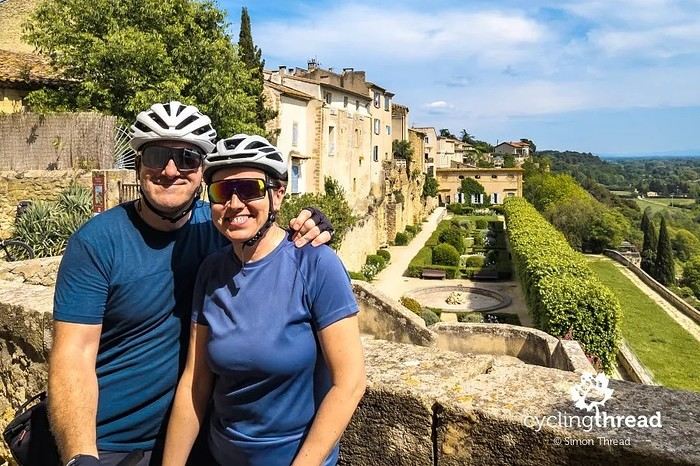
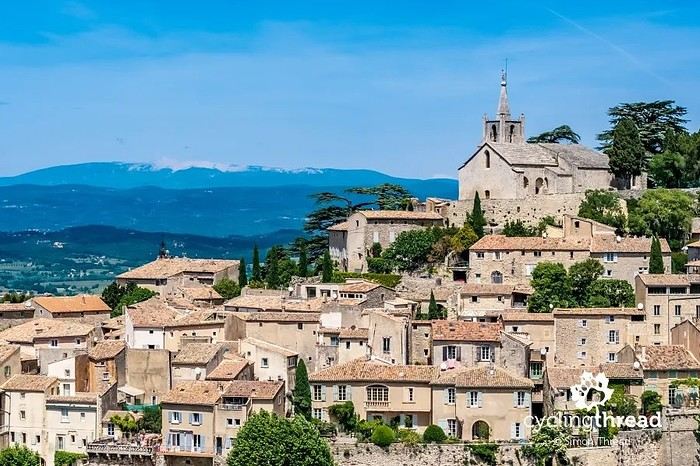
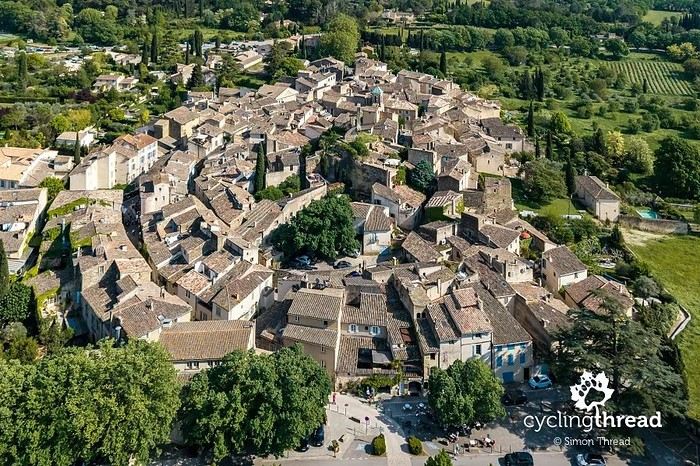
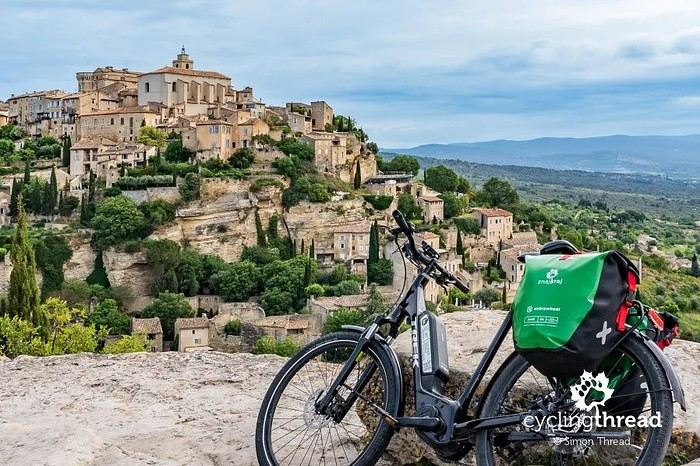
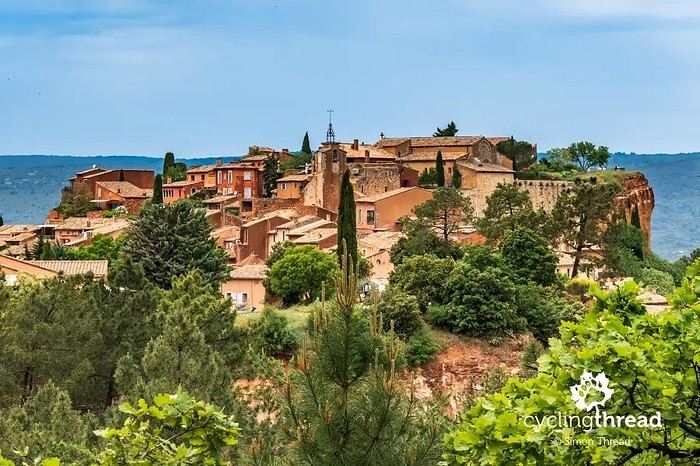
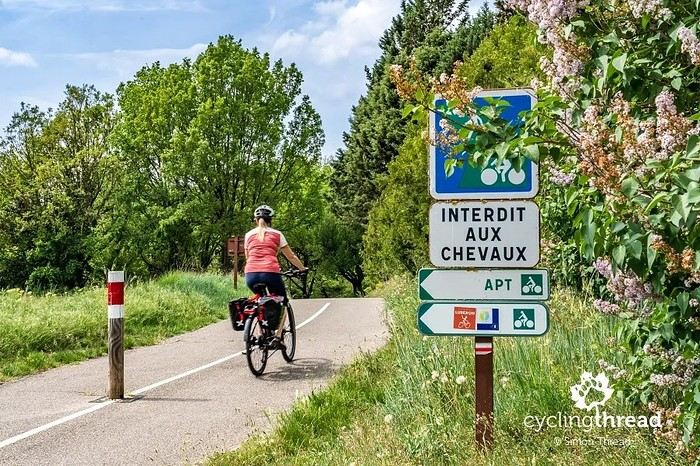
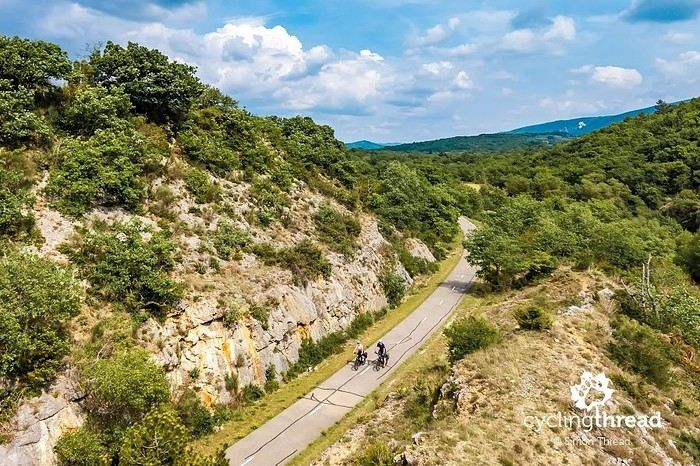
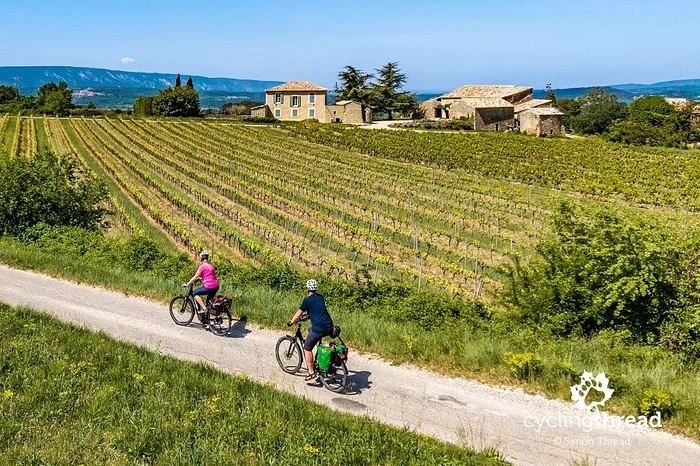
I’m making an exception and creating a separate post this time, since it’s all about France. In May, we spent a week in Provence, specifically in the Luberon, exploring the cycling routes *Autour du Luberon à Vélo*, the *Véloroute du Calavon* (part of EuroVelo 8), and the shorter *Les Ocres à Vélo* route. Together, they gave us an amazing journey through rolling hills, vineyards, lavender fields still green in spring, and some of the most stunning landscapes in southern France.
It was, of course, the perched villages that impressed us the most. We visited Gordes, Roussillon, Bonnieux, Lacoste, Lourmarin, Ménerbes, Oppède-le-Vieux, Cucuron, and Lauris. Many of them are among the most beautiful villages in Provence, and it’s hard not to agree with that reputation.
One interesting point is the route of EuroVelo 8 in this part of the region. The official path mainly follows the old railway line of the *Véloroute du Calavon*, which is very comfortable and safe. But in our opinion, cyclists traveling EuroVelo 8 around the Mediterranean would discover even more treasures if the route passed through villages like Bonnieux, Lacoste, or Oppède-le-Vieux.
We were also pleasantly surprised by how safe cycling felt. Most of the route takes small local roads, but traffic is light, drivers are respectful, and road design really takes cyclists into account. It’s one of those places where you can ride peacefully even without separated bike lanes.
Our full story:
Around Luberon by bicycle - the most beautiful villages of Provence
You can also find all our cycling travel stories on the forum:
Cycling Thread - Europe’s most beautiful bike routes
Hi there, we’re a group of 4 cyclists looking to get from Treviso in Italy to Munich with our 4 non-folding bikes. It seems complicated! Are there any solutions? Thanks so much.
hello fellow cycling enthusiasts
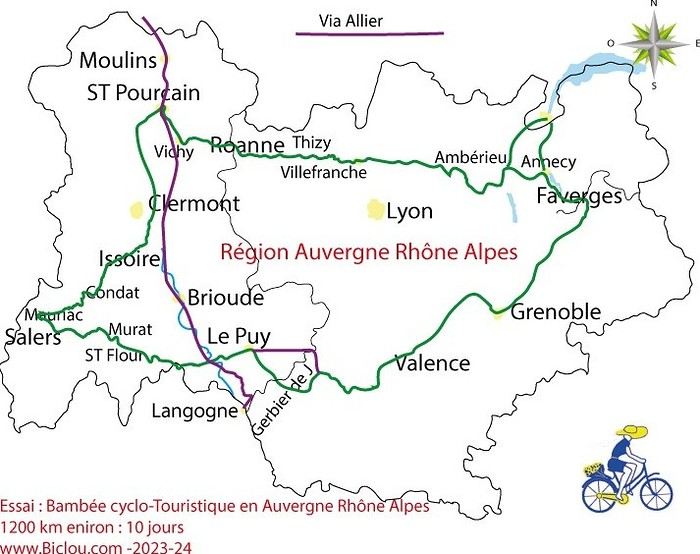
here’s a travel journal of the cycling tour through the Rhône-Alpes Auvergne region by Claudio
zouli
it was the plan
http://cbandiera.free.fr/parcours/auvergne-Ralpes/
the trip was completed
story being posted online soon
1100 km in 11 days
beautiful and varied regions
Hi there, we’re planning a Munich to Venice bike trip at the end of June 2026. Getting back from Venice to Toulouse by train with 4 bikes isn’t straightforward. What return options have others who’ve done this trip chosen? Any tips or great deals would be much appreciated. Thanks a bunch! !
Hi everyone,
Happy owner of a Pegasus Estremo bike with a Rohloff hub, which is giving me trouble with the SF11-NCX-FT-E-LITE 700C TS 300/0 fork (serial number TD01329060). It’s starting to show its age, and I’d like to repair it to extend the life of my beloved bike.
The suspension is gone, and there’s an oil leak from the seals.
Does anyone know how to repair it? Where can I find parts that are about fifteen years old? Or where to find an identical replacement fork? Just to clarify, the Magura HS11 brakes are mounted using Firm Tech, meaning they’re on pivots behind the fork, facing the frame.
Hi, I'd like to know if anyone has done this route recently or has reliable info.
Does the track exist, and most importantly, is there sand (for biking)?
Any info is welcome.
Cheers,
diego ambilobe: mangaoka, manondro, ramena
vohemar sambava: masondrono, tanambao
Hi there,
New to bike touring,
I’d love to start with a section of the Via Rhona to explore and share (route to be decided).
Looking forward to exchanging tips!
I’m landing in Madagascar with a buddy before the end of April 2026. We’re planning to bike around for about twenty days or so. We don’t have a specific goal other than exploring the country and meeting the locals.
Ideally, we’d prefer a loop route starting from Antananarivo with a good chunk of it along the coast. On the bike side, we’re used to riding 6 to 8 hours a day, depending on the needs, encounters, and mood 😉 Any feedback or tips from trips around this length?
A big thank you to Lazarou for all the info you share in this forum!
I'm passionate about Morocco, which I cycled through back in 2009.
Last year, my wife and I explored the High Atlas by tandem. Completely smitten, we're heading back in April (Anti Atlas) and May (High and Middle Atlas), still on our tandem.
Do you have any info on the track between Amezri and Ali Ait Nito? Are the river crossings in the Tessaout still there? It's not easy to navigate with a loaded tandem... especially if the river level is high due to this year's heavy snowmelt!
Thanks in advance for any tips you might have, and best wishes for health in this new year!
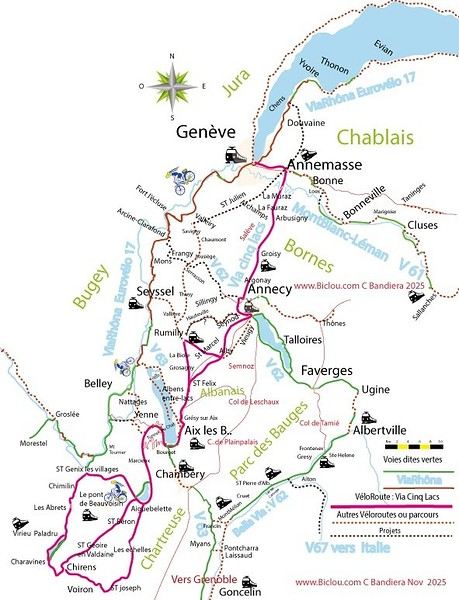
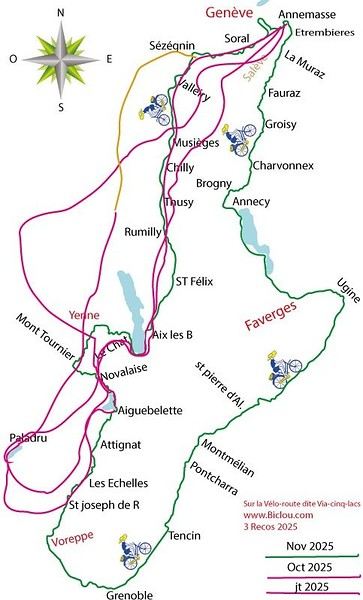
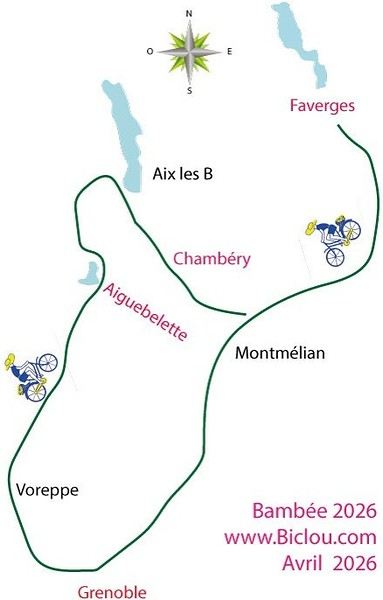
Claudio specializes in the route of the Savoie lakes
Here are his travels
Between Bornes, Chartreuse, the Savoie foothills, and Dauphiné
Five lakes: Léman, Annecy, Paladru, Aiguebelette, Bourget, not to mention a few ponds along the way
Plenty of accommodation options: camping, hotels, and more...
A lovely route not far from his place
Rural and quite peaceful
A road cycling route created by Serge B...
First of all... happy New Year! Wishing you great roads in 2017!
I’ve been traveling for a few years now with a high-quality mountain bike, but it’s equipped with hydraulic disc brakes. I live (pedal) with the constant worry of a breakdown (leak, air bubble, heat causing the fluid to...). My bike mechanic tells me it’s impossible to switch them out for V-brakes.
What do you all think? Am I taking a big risk continuing (alone) with these brakes? Thanks in advance for your great tips!
First post here to share a quick recap of our west-to-east bike trip along Algeria’s coast in January 2025.
It was just the two of us—my partner and I—with French passports and not a word of Arabic. No friends or welcoming hosts in the country.
Under those conditions, we’d strongly advise against going.
Our original plan was to follow the coast from Algiers to Tunis. We ended up cycling from Algiers to Béjaia, then took the train from Béjaia to Annaba (with a stop in Constantine), and finally biked to the border.
We were tailed by police the whole way—whether on our bikes, on the train, or even on foot while exploring towns. On top of that, we couldn’t wild camp and were limited to the few state-approved hotels that accept foreigners. Under those circumstances, connecting with locals was especially tough.
With such an omnipresent and intrusive police presence, we’d definitely recommend against this destination for bike touring. A really sad situation that completely cuts you off from the local population...
We’d been warned, we went to check it out, and we weren’t disappointed!
Hi there,
I’m planning the route to cycle from Lille to Nordkapp with my partner.
Duration: 3 months, from May 1st to July 31st, 2026.
In the attached details below, I need to add some "non-riding" days (rest days, basically).
So I’m looking to "shorten" the trip by taking ferries or trains for some stretches. Which areas could I skip?
Thanks in advance for your great tips.
Have a good evening.
https://www.komoot.com/fr-fr/collection/4023980/-lille-cap-nord-1er-mai-au-31-juillet-2026?ref=collection
I’m planning to bike back from Poland this summer. Does anyone know a way to ship it there without having to take it apart? Otherwise, it’s a real hassle to fine-tune all the settings before departure!
Thanks in advance.
Hi, has anyone recently bought Primus or Butagaz gas, possibly puncture-style, in Dubrovnik or the surrounding area? Same question for Albania... thanks. aichatou
Just a few words about the loop I did by bike in Yunnan.
Entry and exit
I entered China through the Sino-Vietnamese border crossing at Lào Cai / Hekou under the 30-day visa exemption currently available to French nationals and others.
The process was simple and quick. A Chinese police officer even helped me complete my electronic pre-registration at a computer kiosk. I wasn’t aware this formality was required—it’s similar to Thailand’s TM6.
No issues with the bike.
I left the country via the Sino-Laotian border crossing at Mohan / Boten.
The atmosphere was a bit chaotic there, but again, no problems with the bike.
The timing
I visited Yunnan in February 2026.
Weather-wise, at higher altitudes (between 1,500 and 2,000 meters), it was around ten degrees at night and in the mornings, and around twenty degrees at the hottest part of the day.
I had two days of rain, so I took the bus to keep moving. Otherwise, clear blue skies.
Culturally, Chinese New Year fell on February 17th (and the 15 days following), right in the middle of my trip. Because of this, my take on the traffic might be off.
Accommodation and food
I always found a hotel to stay in for prices ranging from 8 to 15 €. Except in Kunming (the capital), where many hotels were fully booked (Chinese New Year). I ended up at a 100 € hotel with great value for money.
A bowl of noodles costs about 1.5 € on average.
Onboard electronics
Since my smartphone doesn’t support eSIMs, I subscribed to a China plan with my carrier. Otherwise, for much cheaper, Alipay offers eSIMs for foreigners that allow access to services usually blocked for Chinese users (WhatsApp, Facebook, etc.).
An internet connection is essential for paying with Alipay or WeChat, as this payment method is widespread.
I only managed to use Alipay.
Either way, always carry cash because sometimes there’s no signal, or the merchant only accepts WeChat.
Also, it’s best to bring a power adapter when you arrive rather than struggling to find one.
Traffic and roads
The Chinese aren’t reckless drivers. They follow traffic rules and watch out for cyclists. This is slightly less true in Xishuangbanna (the region bordering Myanmar and Laos).
In urban areas, there are almost always wide bike lanes, separated from other roads, where bikes, electric mini-scooters, and scooters share the space pretty harmoniously.
The roads are in great condition, and traffic is generally manageable—even light—except for one stretch (Eshan -> Yangwu).
Most traffic is absorbed by expressways, China’s equivalent of highways: toll roads that are off-limits to slow vehicles.
You’re never far from these expressways; sometimes you even ride alongside them, which can be noisy at times.
The climbs are usually reasonable, around 5% to 6%. From what I remember, the steepest section was between Menglun and Mengla, with gradients of 8% to 10%, sometimes more.
Riding at these altitudes—though modest—took a bit of getting used to.
The route
I didn’t plan anything in advance. My only goal was to reach Kunming. I don’t know why, but just hearing the name of that city, like Yunnan, always felt dreamy to me.