Bonjour à tous,
je souhaite organiser des vacances avec mon épouse en août 2020.
Nous ne pouvons partir qu'à cette période là et ce n'est pas la meilleure il parait.
Nous sommes déjà partis en août en Martinique et à Cancun, il y a eu très peu de pluie. Mais comme c'est un autre coin du monde… on ne sait pas
On recherche des vacances en Asie car c'est moins cher qu'en France et en Europe.
Nous n'aimons pas l'Europe et nous partons souvent aux usa mais l'été prochain nous aurons un budget plus serré.
Nous recherchons le coté plages, mer chaude et visites.
Que nous recommandez-vous ?
Merci beaucoup
I really loved Thailand, but it was too touristy for my taste. So I'm hesitating about going back and wondering if Cambodia or Vietnam would be less crowded with tourists...
Je vous donne mon avis sincère de voyageur sur le Vietnam sachant que j'ai voyagé là-bas en février et que je ne suis pas allé au nord de Hanoï ni au sud de Nha Trang.
Pour juger un voyage, j'ai l'habitude de séparer l'aspect pratique d'un côté et l'intérêt des sites de l'autre.
Du côté « pratique », le Vietnam obtient un 19/20. Je n'entre pas dans le détail mais il est incroyablement facile et bon marché de voyager dans ce pays. Et avec des standards occidentaux voire meilleurs. Enormément de moyens de transport, hôtels d'excellente qualité et vraiment pas chers...
Entre l'aspect pratique et l'intérêt des sites, je mets la cuisine et le climat. Je ne vais pas écrire des lignes sur la cuisine qui fait tout simplement partie des tops mondiaux. Juste 2 bémols : les prix sont très élevés dans les restaus raffinés par rapport aux prix du pays. Et contrairement à la Chine, on peut tomber sur des restaus où on se moque des touristes. Résultat : un repas perdu alors que chaque repas peut se transformer en souvenir de rêve au Vietnam. Donc attention. Les guides touristiques écrits sont ici très utiles.
On est averti qu'au Vietnam le temps peu être gris. Et selon les sources, on peut reprendre espoir et se dire que finalement cette saison n'a pas l'air si mal. Pour ma part, je n'ai peut-être pas eu de chance mais alors j'en ai eu beaucoup dans les nombreux autres pays où je suis allé. Le ciel est souvent gris. Au nord, ça peut même être une attraction pour curieux de voir cette grisaille prête à vous tomber sur la tête. D'autre part, j'ai rarement vu une telle fraîcheur à une telle lattitude.
Les gens sont très sympas. Certains parlent anglais et il est très intéressant d'échanger avec les vietnamiens mais il faut savoir qu'ils ont un caractère trempé dans l'acier...
Les sites sont d'un intérêt limité. Le pays est surpeuplé et avide de développement. L'aspect traditionnel et religieux est quasi absent notamment par rapport à la Thaïlande. La nature est très très abîmée. Quand vous lisez les guides, vous vous dîtes que vous allez vous régaler à explorer les côtes ou qu'il y a des animaux à voir. C'est le problèmes des guides écrits qui ne comparent pas les pays entre eux. Ils vont utiliser les même adjectifs pour un pays moyen et pour les plus beaux pays. Oui, il y a des pays beaucoup mieux que d'autres ! En fait les côtes vietnamiennes ne sont pas terribles. Selon un guide les îles Cham sont un « époustouflant archipel ». Peut-être que si le Vietnam était le seul pays sur terre ce serait vrai mais il n'en est rien et il y a beaucoup mieux ailleurs. Les grottes de Phong Nha ouvertes au grand public sont d'un intérêt très limité et les autres sont vraiment très très chères d'accès et nécessitent souvent des réservations.
Mon but n'est pas de dénigrer le Vietnam mais d'éclairer les voyageurs car les guides ne le font pas. Je pense que le Vietnam est un pays idéal pour un retraité ou pour vivre quelques mois. Par contre si vous souhaitez découvrir ce qu'il y a de mieux en Asie du sud-est et que vous n'avez que quelques semaines par an, ne commencez pas par le Vietnam.
Pour juger un voyage, j'ai l'habitude de séparer l'aspect pratique d'un côté et l'intérêt des sites de l'autre.
Du côté « pratique », le Vietnam obtient un 19/20. Je n'entre pas dans le détail mais il est incroyablement facile et bon marché de voyager dans ce pays. Et avec des standards occidentaux voire meilleurs. Enormément de moyens de transport, hôtels d'excellente qualité et vraiment pas chers...
Entre l'aspect pratique et l'intérêt des sites, je mets la cuisine et le climat. Je ne vais pas écrire des lignes sur la cuisine qui fait tout simplement partie des tops mondiaux. Juste 2 bémols : les prix sont très élevés dans les restaus raffinés par rapport aux prix du pays. Et contrairement à la Chine, on peut tomber sur des restaus où on se moque des touristes. Résultat : un repas perdu alors que chaque repas peut se transformer en souvenir de rêve au Vietnam. Donc attention. Les guides touristiques écrits sont ici très utiles.
On est averti qu'au Vietnam le temps peu être gris. Et selon les sources, on peut reprendre espoir et se dire que finalement cette saison n'a pas l'air si mal. Pour ma part, je n'ai peut-être pas eu de chance mais alors j'en ai eu beaucoup dans les nombreux autres pays où je suis allé. Le ciel est souvent gris. Au nord, ça peut même être une attraction pour curieux de voir cette grisaille prête à vous tomber sur la tête. D'autre part, j'ai rarement vu une telle fraîcheur à une telle lattitude.
Les gens sont très sympas. Certains parlent anglais et il est très intéressant d'échanger avec les vietnamiens mais il faut savoir qu'ils ont un caractère trempé dans l'acier...
Les sites sont d'un intérêt limité. Le pays est surpeuplé et avide de développement. L'aspect traditionnel et religieux est quasi absent notamment par rapport à la Thaïlande. La nature est très très abîmée. Quand vous lisez les guides, vous vous dîtes que vous allez vous régaler à explorer les côtes ou qu'il y a des animaux à voir. C'est le problèmes des guides écrits qui ne comparent pas les pays entre eux. Ils vont utiliser les même adjectifs pour un pays moyen et pour les plus beaux pays. Oui, il y a des pays beaucoup mieux que d'autres ! En fait les côtes vietnamiennes ne sont pas terribles. Selon un guide les îles Cham sont un « époustouflant archipel ». Peut-être que si le Vietnam était le seul pays sur terre ce serait vrai mais il n'en est rien et il y a beaucoup mieux ailleurs. Les grottes de Phong Nha ouvertes au grand public sont d'un intérêt très limité et les autres sont vraiment très très chères d'accès et nécessitent souvent des réservations.
Mon but n'est pas de dénigrer le Vietnam mais d'éclairer les voyageurs car les guides ne le font pas. Je pense que le Vietnam est un pays idéal pour un retraité ou pour vivre quelques mois. Par contre si vous souhaitez découvrir ce qu'il y a de mieux en Asie du sud-est et que vous n'avez que quelques semaines par an, ne commencez pas par le Vietnam.
Bonjour,
Notre périple en Asie va nous emmener jusqu'à Con Dao mi-avril 2020. Nous avons vu que c'était un archipel d'îles. Est-il possible de trouver des bateaux pour se balader entre ces îles ? Quelle est la durée idéale pour y séjourner ? Nous hésitons entre 2 ou 3 jours pleins... Merci à tous !!
Notre périple en Asie va nous emmener jusqu'à Con Dao mi-avril 2020. Nous avons vu que c'était un archipel d'îles. Est-il possible de trouver des bateaux pour se balader entre ces îles ? Quelle est la durée idéale pour y séjourner ? Nous hésitons entre 2 ou 3 jours pleins... Merci à tous !!
Bonjour,
Je souhaite partir du 12 au 24 avril 2020 pour un premier voyage solo.
J'hésite entre 2 destinations qui sont la Thaïlande ou le Vietnam. J'aimerai savoir lequel des 2 me conseillez-vous svp. Merci beaucoup pour vos réponses.
Hi everyone,
I’m starting to plan my next trip to Southeast Asia this winter (2.5 months, leaving in early December), and here’s a rough outline of my route—I’d love to share it with you and hear your thoughts and tips.
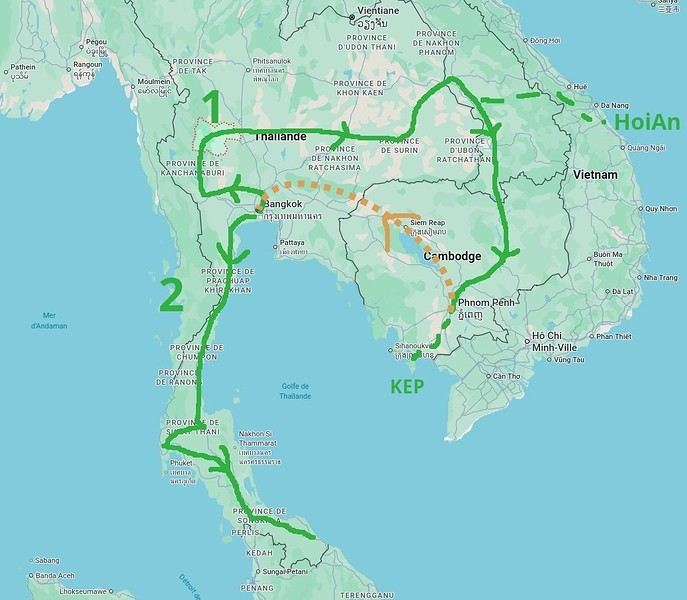
- I’ll start in Bangkok and already have three spots I’ve marked: Ayutthaya, Kanchanaburi, and Uthai Thani (I haven’t been to any of these places yet). - Next, I’d like to cross the country from west to east to reach the Laos border. I’d love suggestions for any interesting stops along this route—I don’t know this part of Thailand at all... - Then I’ll head into Laos, probably at Savannakhet (you can usually get a visa at the border). - > I’m tempted to spend a week in Hoi An, Vietnam, since I loved that city and the area when I visited two years ago. No visa needed for Vietnam now, so it could be a nice little detour. On the map, it doesn’t look too far, but I know you’ve got to be careful with these things, and I’m not sure if it’s a good idea. Any opinions on this? - Back to Laos (maybe via Dakta), and I’ll head south along the Mekong, probably doing the Bolaven Plateau loop that I missed last time. Then Paksé, the 4,000 Islands... I’ve been before, but I’d happily go back. - Crossing into Cambodia, I’ll follow the Mekong down to Phnom Penh (I know this area and love how untouristy it is). From there, I’ll probably spend a few days in Kep (quieter than Kampot). Still undecided, though. - Then back to Thailand (BKK), likely by plane from Phnom Penh since the borders between the two countries are currently closed (plus, let’s be honest, Cambodian roads... ;-). We’ll see how things look when the time comes. - After that, I’d like to explore southern Thailand, taking it slow with short hops. I’ve got my eye on Khao Sok National Park, and I’ve heard good things about Krabi... Again, I don’t know this region well, so any info or tips would be great.
So, I think this should be doable in 2.5 months, especially since I prefer short hops of 300 km max to avoid getting too tired, and I like staying 2-3 days in each place to explore. Plus, I’ll take a week off to relax if I find a spot I love—maybe by the sea for some real downtime.
Thanks for your feedback and for sharing your favorite spots! Pascal
- I’ll start in Bangkok and already have three spots I’ve marked: Ayutthaya, Kanchanaburi, and Uthai Thani (I haven’t been to any of these places yet). - Next, I’d like to cross the country from west to east to reach the Laos border. I’d love suggestions for any interesting stops along this route—I don’t know this part of Thailand at all... - Then I’ll head into Laos, probably at Savannakhet (you can usually get a visa at the border). - > I’m tempted to spend a week in Hoi An, Vietnam, since I loved that city and the area when I visited two years ago. No visa needed for Vietnam now, so it could be a nice little detour. On the map, it doesn’t look too far, but I know you’ve got to be careful with these things, and I’m not sure if it’s a good idea. Any opinions on this? - Back to Laos (maybe via Dakta), and I’ll head south along the Mekong, probably doing the Bolaven Plateau loop that I missed last time. Then Paksé, the 4,000 Islands... I’ve been before, but I’d happily go back. - Crossing into Cambodia, I’ll follow the Mekong down to Phnom Penh (I know this area and love how untouristy it is). From there, I’ll probably spend a few days in Kep (quieter than Kampot). Still undecided, though. - Then back to Thailand (BKK), likely by plane from Phnom Penh since the borders between the two countries are currently closed (plus, let’s be honest, Cambodian roads... ;-). We’ll see how things look when the time comes. - After that, I’d like to explore southern Thailand, taking it slow with short hops. I’ve got my eye on Khao Sok National Park, and I’ve heard good things about Krabi... Again, I don’t know this region well, so any info or tips would be great.
So, I think this should be doable in 2.5 months, especially since I prefer short hops of 300 km max to avoid getting too tired, and I like staying 2-3 days in each place to explore. Plus, I’ll take a week off to relax if I find a spot I love—maybe by the sea for some real downtime.
Thanks for your feedback and for sharing your favorite spots! Pascal
Bonjour,
J'envisage de faire mon premier voyage en solo et j'ai choisi le Cambodge et le Laos. Je pensais faire également le Vietnam mais je me suis vite aperçu que vouloir faire les 3 sans trop courir est un peu prétentieux.
Mon projet d'itinéraire au cambodge: Phnom Penh, Kep/Kampot, Battabang, Siam Reap Au Laos je voudrais le remonter du Sud au Nord : 4000 iles, Pakse et le plateau des Bolavens, Rivière souterraine de Kong Lor, Ventiane, Vang Vieng, Lulang Prabang, Nong Kiaw ou Muang Noi ou Phongsaly. Retour en France au départ de Lulang Prabang Je voudrais rejoindre le sud du Laos par la route via Kratie et Stung Treng
Possible tout ça en 1 mois ? Je voudrais aussi prendre mon temps et savourer chaque endroit.
Merci de vos retours
J'envisage de faire mon premier voyage en solo et j'ai choisi le Cambodge et le Laos. Je pensais faire également le Vietnam mais je me suis vite aperçu que vouloir faire les 3 sans trop courir est un peu prétentieux.
Mon projet d'itinéraire au cambodge: Phnom Penh, Kep/Kampot, Battabang, Siam Reap Au Laos je voudrais le remonter du Sud au Nord : 4000 iles, Pakse et le plateau des Bolavens, Rivière souterraine de Kong Lor, Ventiane, Vang Vieng, Lulang Prabang, Nong Kiaw ou Muang Noi ou Phongsaly. Retour en France au départ de Lulang Prabang Je voudrais rejoindre le sud du Laos par la route via Kratie et Stung Treng
Possible tout ça en 1 mois ? Je voudrais aussi prendre mon temps et savourer chaque endroit.
Merci de vos retours
Hi,
I’m planning to travel from April 12 to 24, 2025, for my first solo trip.
I’m torn between two destinations: Thailand or Vietnam. Which one would you recommend? Thanks so much for your advice!
Ce post se compose de trois parties
Première partie
Sources :
- "Les monuments du Groupe d'Angkor" de Maurice Glaize. Dans ce livre il y a le chapitre suivant : "L'œuvre de l'Ecole Française d'Extrême-Orient"
- "Angkor résidences des dieux", de Claude Jacques et Michael Freeman.
- "Un siècle d'histoire. L'Ecole Française d'Extrême-Orient et le Cambodge" (Editions Magellan & Cie – EFEO)
- Le site de l'EFEO
- Différents BEFEO (Bulletins de l'EFEO)
Le site de l'EFEO : https://www.efeo.fr/ - En haut dans la partie EFEO, dans ACCUEIL, cliquer sur CHERCHEURS D'ASIE, cliquer ensuite sur "Cliquez ici". On peut alors accéder aux différents membres (par pays ou index alphabétique). Pour chaque membre on y trouve une biographie et leurs publications avec des références :
• BEFEO, voir le site Persée BEFEO.
• Pour les Arts asiatiques : https://www.persee.fr/collection/arasi
• Comptes rendus des séances de l'Académie des Inscriptions et Belles-Lettres : https://www.persee.fr/collection/crai
• Journal des Savants : https://www.persee.fr/collection/jds
- En haut, dans la partie CENTRES on trouve la liste des villes où l'EFEO est présente
Le site Persée BEFEO : https://www.persee.fr/collection/befeo • Dans certains livres ou documents on trouve le nom de l'auteur, le titre, l'année de publication et éventuellement les numéros des pages. Cela facilite la recherche. Il en est de même pour les autres sites Persée (Arts asiatiques…). • Le BEFEO apparait sous forme de Pdf. En haut à gauche de l'article il y a plusieurs icônes. Cliquer sur l'icône en dessous de Pdf, on passe alors sur la "version texte", cela facilite la lecture de l'article et on peut alors faire un copier-coller (à mettre par exemple dans un document Word)
"En 1860, l’explorateur et naturaliste Henri Mouhot redécouvrit les temples d’Angkor au Cambodge. Cet événement fit alors grande impression sur l’opinion publique en Occident. Dès lors, la beauté et la majesté de ces monuments n’ont cessé de fasciner les amateurs d’art oriental. La cité khmère d’Angkor fut le centre d’une civilisation qui, au sommet de sa puissance, englobait une région allant, à l’Ouest, jusqu’à l’actuelle Birmane et, au Nord, jusqu’au Vat Phu, situé au Laos.…Il est vrai que l’Occident ignorait tout des ruines khmères, n’ayant pas prêté attention aux notes de voyage des Espagnols et des Portugais. Rien n’en transparaît dans les récits écrits par les français qui vinrent à Ayutthaya à la fin du XVIIème siècle. En fait le premier européen à signaler l’existence des monuments d’Angkor au XIXème siècle ne fut d’ailleurs pas le célèbre botaniste Henri Mouhot comme on le dit trop souvent, mais un missionnaire français, le père Charles-Emile Bouillevaux, établi à Battambang, alors sous la juridiction des Thaïs" ("Angkor résidences des dieux", de Claude Jacques et Michael Freeman).
- Décembre 1850 : Le Père Charles-Emile Bouillevaux (1823-1913), visita les ruines d'Angkor, qu'il signala à l'attention du monde savant. Il a écrit "Voyage en Indo-Chine, 1848 – 1856", édité en 1858, ce livre n'a pas eu un grand succès. Cet ouvrage a été réédité en 2012 aux éditions "Hachette – Livre BNF". Dans son livre, Charles-Emile Bouillevaux parle très peu des temples d'Angkor. Un peu décevant. Je ne recommande pas cet ouvrage.
- Henri MOUHOT (1826–1861) : naturaliste et explorateur français, en mission pour la British Royal Géographique Society. En Janvier 1860, Il arriva à Angkor Vat. Il fut le premier occidental à vanter auprès du grand public les merveilles d'Angkor. Ses descriptions publiées en France dans le journal le "Tour du Monde" et la "Bibliothèque Rose" après sa mort au Laos firent sensation. Ses écrits ont été rassemblés par Patrick Salès et publiés après sa mort en 1868 sous le titre "Voyage dans les royaumes de Siam, de Cambodge, de Laos, et autres parties centrales de l'Indochine, 1858-1861". Réédité à plusieurs reprises. Voir "Laos – Henri Mouhot, ce méconnu" http://www.souvenir-francais-asie.com/2009/12/04/laos-henri-mouhot-ce-meconnu/
- 1863 : début du protectorat français
- 1886-1868 : La mission Doudart de Lagrée - Garnier (1866-1868) : Le but principal de cette mission était de reconnaitre les voies navigables pour rejoindre la Chine. Au cours de cette mission les participants ont visité les ruines d'Angkor.
- Louis DELAPORTE a participé à la mission de Doudard de Lagrée. Il a été émerveillé par les temples d'Angkor. Il a fait connaitre l'art khmer. C'est aussi un peu grâce à lui et à l'intérêt qu'il a su éveiller pour les arts du Cambodge qu'en 1898 est fondée à Hanoï la M.A.I. (Mission Archéologique d'Indo-Chine) qui deviendra l'EFEO en 1900.
• Pour plus de détails voir mon post "L'art khmer dans les collections du Musée Guimet" https://voyageforum.com/v.f?post=6703899#6703899
• Les plâtres de Louis Delaporte D'Octobre 2013 à Janvier 2014 il y a eu une exposition au Musée Guimet "Angkor, naissance d'un mythe" où l'on pouvait voir une partie des plâtres que Louis Delaporte avait fait faire. Un livre avait alors été édité :"Angkor naissance d'un mythe, Louis Delaporte et le Cambodge" de Pierre Baptiste et Thierry Zéphir. J'ai trouvé ce livre très intéressant. Lors de cette exposition on pouvait voir l'excellent documentaire "Angkor redécouvert" Voir le post d'Enrodage https://voyageforum.com/v.f?post=6266628#6266628
- Etienne François AYMONIER (1844 – 1929). Officier et administrateur colonial français, spécialiste des cultures khmères et Cham. Il est l'auteur d'une étude en trois volumes sur le Cambodge qui donne pour la première fois les traductions des inscriptions trouvées sur le site. Il mène de multiples travaux épigraphiques, notamment des relevés systématiques d'inscriptions khmères qui précisent la chronologie des anciens royaumes. Il innove sur le plan technique en utilisant la méthode d'estampage (*) pour reproduire une inscription gravée dans la pierre
(*) L’estampage : une feuille de papier de soie est appliquée sur une pierre à l’aide d’une brosse humide, afin d’épouser la gravure dans ses moindres détails. On tamponne ensuite la surface redevenue sèche avec de l’encre : les parties qui ont épousé les creux de la gravure apparaîtront en blanc sur fond noir.
Il joue aussi un rôle en 1899 dans la fondation de la M.A.I. (EFEO)
Œuvres : "I – Le Cambodge. Le royaume actuel" : Editions Leroux, Paris, 1900-1904. Réédité en 2014 par la BNF. Disponible sur "Gallica": gallica.bnf.fr/...0s.r=cambodge.langEN "II – Le Cambodge. Les provinces siamoises". Réédité en 2014 par la BNF. Disponible sur "Gallica": gallica.bnf.fr/...14.r=cambodge.langEN "III - Le Cambodge. Le groupe d'Angkor et l'histoire, (Editions Leroux, 1900-1904). Réédité en 2014 par la BNF. Disponible sur "Gallica" : gallica.bnf.fr/...2g.r=cambodge.langEN Voir le BEFEO de George Cœdès : "Étienne-François Aymonier (1844-1929)". BEFEO, 1929, pp. 542-548
Voir le BEFEO année 1929 – 29 – pp. 542 548. De George Coedès "Etienne-François Aymonier (1844-1929) https://www.persee.fr/doc/befeo_0336-1519_1929_num_29_1_3305
Jacques
- "Angkor résidences des dieux", de Claude Jacques et Michael Freeman.
- "Un siècle d'histoire. L'Ecole Française d'Extrême-Orient et le Cambodge" (Editions Magellan & Cie – EFEO)
- Le site de l'EFEO
- Différents BEFEO (Bulletins de l'EFEO)
Le site de l'EFEO : https://www.efeo.fr/ - En haut dans la partie EFEO, dans ACCUEIL, cliquer sur CHERCHEURS D'ASIE, cliquer ensuite sur "Cliquez ici". On peut alors accéder aux différents membres (par pays ou index alphabétique). Pour chaque membre on y trouve une biographie et leurs publications avec des références :
• BEFEO, voir le site Persée BEFEO.
• Pour les Arts asiatiques : https://www.persee.fr/collection/arasi
• Comptes rendus des séances de l'Académie des Inscriptions et Belles-Lettres : https://www.persee.fr/collection/crai
• Journal des Savants : https://www.persee.fr/collection/jds
- En haut, dans la partie CENTRES on trouve la liste des villes où l'EFEO est présente
Le site Persée BEFEO : https://www.persee.fr/collection/befeo • Dans certains livres ou documents on trouve le nom de l'auteur, le titre, l'année de publication et éventuellement les numéros des pages. Cela facilite la recherche. Il en est de même pour les autres sites Persée (Arts asiatiques…). • Le BEFEO apparait sous forme de Pdf. En haut à gauche de l'article il y a plusieurs icônes. Cliquer sur l'icône en dessous de Pdf, on passe alors sur la "version texte", cela facilite la lecture de l'article et on peut alors faire un copier-coller (à mettre par exemple dans un document Word)
"En 1860, l’explorateur et naturaliste Henri Mouhot redécouvrit les temples d’Angkor au Cambodge. Cet événement fit alors grande impression sur l’opinion publique en Occident. Dès lors, la beauté et la majesté de ces monuments n’ont cessé de fasciner les amateurs d’art oriental. La cité khmère d’Angkor fut le centre d’une civilisation qui, au sommet de sa puissance, englobait une région allant, à l’Ouest, jusqu’à l’actuelle Birmane et, au Nord, jusqu’au Vat Phu, situé au Laos.…Il est vrai que l’Occident ignorait tout des ruines khmères, n’ayant pas prêté attention aux notes de voyage des Espagnols et des Portugais. Rien n’en transparaît dans les récits écrits par les français qui vinrent à Ayutthaya à la fin du XVIIème siècle. En fait le premier européen à signaler l’existence des monuments d’Angkor au XIXème siècle ne fut d’ailleurs pas le célèbre botaniste Henri Mouhot comme on le dit trop souvent, mais un missionnaire français, le père Charles-Emile Bouillevaux, établi à Battambang, alors sous la juridiction des Thaïs" ("Angkor résidences des dieux", de Claude Jacques et Michael Freeman).
- Décembre 1850 : Le Père Charles-Emile Bouillevaux (1823-1913), visita les ruines d'Angkor, qu'il signala à l'attention du monde savant. Il a écrit "Voyage en Indo-Chine, 1848 – 1856", édité en 1858, ce livre n'a pas eu un grand succès. Cet ouvrage a été réédité en 2012 aux éditions "Hachette – Livre BNF". Dans son livre, Charles-Emile Bouillevaux parle très peu des temples d'Angkor. Un peu décevant. Je ne recommande pas cet ouvrage.
- Henri MOUHOT (1826–1861) : naturaliste et explorateur français, en mission pour la British Royal Géographique Society. En Janvier 1860, Il arriva à Angkor Vat. Il fut le premier occidental à vanter auprès du grand public les merveilles d'Angkor. Ses descriptions publiées en France dans le journal le "Tour du Monde" et la "Bibliothèque Rose" après sa mort au Laos firent sensation. Ses écrits ont été rassemblés par Patrick Salès et publiés après sa mort en 1868 sous le titre "Voyage dans les royaumes de Siam, de Cambodge, de Laos, et autres parties centrales de l'Indochine, 1858-1861". Réédité à plusieurs reprises. Voir "Laos – Henri Mouhot, ce méconnu" http://www.souvenir-francais-asie.com/2009/12/04/laos-henri-mouhot-ce-meconnu/
- 1863 : début du protectorat français
- 1886-1868 : La mission Doudart de Lagrée - Garnier (1866-1868) : Le but principal de cette mission était de reconnaitre les voies navigables pour rejoindre la Chine. Au cours de cette mission les participants ont visité les ruines d'Angkor.
- Louis DELAPORTE a participé à la mission de Doudard de Lagrée. Il a été émerveillé par les temples d'Angkor. Il a fait connaitre l'art khmer. C'est aussi un peu grâce à lui et à l'intérêt qu'il a su éveiller pour les arts du Cambodge qu'en 1898 est fondée à Hanoï la M.A.I. (Mission Archéologique d'Indo-Chine) qui deviendra l'EFEO en 1900.
• Pour plus de détails voir mon post "L'art khmer dans les collections du Musée Guimet" https://voyageforum.com/v.f?post=6703899#6703899
• Les plâtres de Louis Delaporte D'Octobre 2013 à Janvier 2014 il y a eu une exposition au Musée Guimet "Angkor, naissance d'un mythe" où l'on pouvait voir une partie des plâtres que Louis Delaporte avait fait faire. Un livre avait alors été édité :"Angkor naissance d'un mythe, Louis Delaporte et le Cambodge" de Pierre Baptiste et Thierry Zéphir. J'ai trouvé ce livre très intéressant. Lors de cette exposition on pouvait voir l'excellent documentaire "Angkor redécouvert" Voir le post d'Enrodage https://voyageforum.com/v.f?post=6266628#6266628
- Etienne François AYMONIER (1844 – 1929). Officier et administrateur colonial français, spécialiste des cultures khmères et Cham. Il est l'auteur d'une étude en trois volumes sur le Cambodge qui donne pour la première fois les traductions des inscriptions trouvées sur le site. Il mène de multiples travaux épigraphiques, notamment des relevés systématiques d'inscriptions khmères qui précisent la chronologie des anciens royaumes. Il innove sur le plan technique en utilisant la méthode d'estampage (*) pour reproduire une inscription gravée dans la pierre
(*) L’estampage : une feuille de papier de soie est appliquée sur une pierre à l’aide d’une brosse humide, afin d’épouser la gravure dans ses moindres détails. On tamponne ensuite la surface redevenue sèche avec de l’encre : les parties qui ont épousé les creux de la gravure apparaîtront en blanc sur fond noir.
Il joue aussi un rôle en 1899 dans la fondation de la M.A.I. (EFEO)
Œuvres : "I – Le Cambodge. Le royaume actuel" : Editions Leroux, Paris, 1900-1904. Réédité en 2014 par la BNF. Disponible sur "Gallica": gallica.bnf.fr/...0s.r=cambodge.langEN "II – Le Cambodge. Les provinces siamoises". Réédité en 2014 par la BNF. Disponible sur "Gallica": gallica.bnf.fr/...14.r=cambodge.langEN "III - Le Cambodge. Le groupe d'Angkor et l'histoire, (Editions Leroux, 1900-1904). Réédité en 2014 par la BNF. Disponible sur "Gallica" : gallica.bnf.fr/...2g.r=cambodge.langEN Voir le BEFEO de George Cœdès : "Étienne-François Aymonier (1844-1929)". BEFEO, 1929, pp. 542-548
Voir le BEFEO année 1929 – 29 – pp. 542 548. De George Coedès "Etienne-François Aymonier (1844-1929) https://www.persee.fr/doc/befeo_0336-1519_1929_num_29_1_3305
Jacques
Bonjour, je vais aller voir en février des amis Vietnamiens qui vivent à HCMV, et je voulais en profiter pour passer une petite semaine de plage. J'aimerais avoir votre retour d'expérience pour choisir ma destination.
J'avais repéré la région de Quy Nhon et de Con Dao, mais vu la période, il me semble que le Sud est plus approprié, c'est bien cela? Je connais déjà Phu Coc et Mui Ne donc je voulais découvrir une autre zone, des suggestions?
Concernant Con Dao, pouvez-vous me donner des infos : - Il me semble qu'on peut y aller par bateau ou avion, est-ce facile d'y aller sans avoir réservé à l'avance? - Est-il facile d'y trouver des logements ? Quel type d'hébergement et pour quel budget ? - Quel est votre avis sur les plages? Sont-elles jolies, propres, calmes, fréquentées, baignade agréable, vagues, snorkeling possible? - A part la plage, comment sont ces îles et quelles sont les activités possibles et avec quels moyens de transport ?
J'arriverai à HCMV le 9 février et pense partir sur une plage vers le 13. L'agitation du Têt sera-t-elle passée? Est-ce encore une période de haute fréquentation des transports et hôtels ?
Un grand merci pour vos réponses.
J'avais repéré la région de Quy Nhon et de Con Dao, mais vu la période, il me semble que le Sud est plus approprié, c'est bien cela? Je connais déjà Phu Coc et Mui Ne donc je voulais découvrir une autre zone, des suggestions?
Concernant Con Dao, pouvez-vous me donner des infos : - Il me semble qu'on peut y aller par bateau ou avion, est-ce facile d'y aller sans avoir réservé à l'avance? - Est-il facile d'y trouver des logements ? Quel type d'hébergement et pour quel budget ? - Quel est votre avis sur les plages? Sont-elles jolies, propres, calmes, fréquentées, baignade agréable, vagues, snorkeling possible? - A part la plage, comment sont ces îles et quelles sont les activités possibles et avec quels moyens de transport ?
J'arriverai à HCMV le 9 février et pense partir sur une plage vers le 13. L'agitation du Têt sera-t-elle passée? Est-ce encore une période de haute fréquentation des transports et hôtels ?
Un grand merci pour vos réponses.
Nous arrivons au Vietnam et voulons passer 1semaine à 10 jours à la plage question de relaxer avant notre long voyage de trois mois!
Nous regardons trois destinations plage: Phu Quoc , ou l’ile De Con Dao et aussi l’ile De Cham ?
Que pensez vous de c’est îles ? Nous hésitons pour aller à Phu Quoc car nous craignions que ce soit trop touristique!!
Nous regardons trois destinations plage: Phu Quoc , ou l’ile De Con Dao et aussi l’ile De Cham ?
Que pensez vous de c’est îles ? Nous hésitons pour aller à Phu Quoc car nous craignions que ce soit trop touristique!!
Nous serons sur l’Iles de Phu Quoc au début de Janvier 2020. Nous aimerions relaxer près de la mer pour plus ou moins deux semaines. Avez vous des suggestions d’hotel D’appart. air BnB ou n’importe quoi qui est charmant, près de la mer.
We’re heading to Vietnam for 3 weeks from January 17th to February 6th. In addition to the Mekong Delta and the central region, we’d like to spend some time by the sea. We’re torn between visiting the islands of Hon Son/Nam Du/(+Phu Quoc?) or choosing Con Dao Island. We’re hesitant because we’ve read that the sea around Con Dao can be rough and not great for swimming at this time of year (and that boats might be canceled). Could you share your thoughts? Thanks
I'd love to get some suggestions for central Vietnam in February for seniors. We'd like to stay in one place, near a beach, and visit the surrounding areas. Then after a month, we'd head to the south of the country.
Hi there,
Here’s the itinerary I’ve planned for May with my partner—what do you think? I’m not entirely sure if my choices are the best. We’re traveling independently, no guide, no agency, and using public transport.
- Hanoi: Arrival at 10 AM – 1 day (05/09) - Mai Chau: 2 days (including visits to the Pa Co and Mai Chau markets) (05/10 and 05/11) - Pu Luong (Lang Bang): 2 days (05/12 and 05/13) - Tam Coc: 2 days (05/14 and 05/15) - Tu Long Bay: 2 days (05/16 and 05/17) - Hanoi: 1 day – Night train (05/18) - Hue: 2 days (05/19 and 05/20) - Hoi An: 2 days (05/21 and 05/22) - Da Nang: 1 day (05/23) - Flight from Da Nang to Can Tho (05/24 and 05/25) - Ben Tre: 2 days (05/26 and 05/27) - Ho Chi Minh City: 2 days (05/28 and 05/29)
Thanks for your feedback! Have a great day.
Here’s the itinerary I’ve planned for May with my partner—what do you think? I’m not entirely sure if my choices are the best. We’re traveling independently, no guide, no agency, and using public transport.
- Hanoi: Arrival at 10 AM – 1 day (05/09) - Mai Chau: 2 days (including visits to the Pa Co and Mai Chau markets) (05/10 and 05/11) - Pu Luong (Lang Bang): 2 days (05/12 and 05/13) - Tam Coc: 2 days (05/14 and 05/15) - Tu Long Bay: 2 days (05/16 and 05/17) - Hanoi: 1 day – Night train (05/18) - Hue: 2 days (05/19 and 05/20) - Hoi An: 2 days (05/21 and 05/22) - Da Nang: 1 day (05/23) - Flight from Da Nang to Can Tho (05/24 and 05/25) - Ben Tre: 2 days (05/26 and 05/27) - Ho Chi Minh City: 2 days (05/28 and 05/29)
Thanks for your feedback! Have a great day.
DANANG
A big city in the midst of an economic boom. The setting is stunning, with its large bay, the Son Tra Peninsula, and the Annamite Mountains on the horizon.
Where to stay and eat? Da Nang is a bustling business hub, so hotels are pricier and often fully booked. I was lucky to find a motorbike taxi driver who, after six full hotels, took me to Mai Son Hotel, 113 Nguyen Van Linh, a spotless 2-star place. Plus, right next door, there’s a great restaurant that seems popular with locals, and a good Chinese restaurant just a 5-minute walk away, Phi Lu (178 Nguyen Van Linh), recommended by the *Guide du Routard*. So, I’d definitely recommend this hotel. For a pricier option, the very Christian Dai A Hotel, near the tiny pink cathedral, is nice, but why pay more?
Actually, why stay in Da Nang when the gorgeous Hoi An is just 34 km to the south?
What to see? - The lovely Cham Museum (small, takes at most an hour) - The climb up Son Tra Peninsula (great views of the whole area) - The “tour” of the peninsula—quotation marks because the road stops two-thirds of the way. There’s an interesting little museum on the left before reaching the base of the huge statue, the Đong Đinh (large entrance on the left side of the hill), with traditional houses in the jungle holding artifacts over 2,000 years old (Sa Huynh culture; if you’re interested, check out the small Sa Huynh Museum in Hoi An, just before the Japanese Bridge). However, the big Linh Ung Pagoda is just colorful concrete! A beautiful resort, the Son Tra Beach Resort and Spa, sits on a pristine beach and isn’t too expensive: $120 for a garden room and $200–$270 for duplexes with a pool, where you can sleep six. Before reaching the resort, you’ll find two excellent seafood restaurants with large beachfront terraces on your right. - On the way to Hoi An, Marble Mountain, where I loved the village of marble sculpture workshops, the pretty pagodas and caves, and the stunning view from the top of the last promontory (the stairs are steep!). However, you can skip the famous China Beach and its resorts—all pretentious and expensive, not to mention the ones under construction on both sides of the road (they’re multiplying like crazy!). So, when traveling from Da Nang to Hoi An, I recommend two stops: the Cham Museum and Marble Mountain. - The beautiful drive to the Hai Van Pass (there weren’t any clouds!), offering spectacular views of the Da Nang region to the south and the coast to the north. The descent leads to the fishing village and beach of Lang Co, which is lovely but destined for rampant resort development, judging by the huge projects advertised on billboards along the road after the village. - Some affordable guesthouses ($15) and big resorts, including the lovely Lang Co Beach Resort, with a large pool and great value given the beautiful gardens and elegant bungalows. Recommended in Lang Co: lunch at one of the two stilt restaurants over the lagoon—great views and fresh seafood.
The public bus to Hoi An, 34 km south of Da Nang, takes 45 minutes for 50,000 dong. There’s one every half hour.
HOI AN This is a “must-see” for so many reasons: stunning old houses, temples, and pagodas; a colorful daily open-air and covered market near the bridge; charming little streets in the old quarter—especially at night, with all the multicolored lanterns and riverside restaurant terraces, it’s very romantic. The local food is delicious, the people are friendly and kind, there are two beautiful beaches, and attractions like the Cham ruins of My Son. Some say Hoi An is overrun with tourists and should be avoided. That’s true for the historic center and An Bang Beach, but not at all once you step outside.
WHERE TO STAY For a 2-star option, I recommend Ngo House Villa (99 Nguyen Phuc Tan St), very quiet on the island just across from the Old Quarter: 3-star rooms + suites, a large “Family” room, and a nice pool, all for $20 ($40 for the “Family” room). The same charming owner has a second hotel 20 meters away (No. 74), Phan Ngô, which is older but has a large terrace and a small pool—I prefer this one. For 3 stars, Thuy Duong 3 (92 Ba Trieu) is perfect, with a pool and garden ($40–$60). A bit pricier but great is A Han on Phan Bai Chau, with a large garden and terrace restaurant.
For those with a bigger budget, I recommend two riverside spots with rooms, suites, and pools, priced at $200–$350: the secluded Coco River Resort (formerly Ancient House River, with a large wooden terrace for romantic dinners by the river) and Anantara, (formerly Heritage), with bungalows close to the old town—but pricey.
Outside the city, my favorite hotel is Villa Loan, the new place from the famous Loan of Tam Coc, very quiet in the countryside, 15 minutes by bike from Old Hoi An and An Bang Beach. Beautiful rooms ($35), a Family room with two double beds ($55), two 65 m² twins that can sleep six (two large beds + two single beds—$80), a terrace restaurant, and a lovely pool. Prices include a buffet breakfast and a bike.
Also great is Daisy Anbang on An Bang Beach, elegant with a pool and beach just 50 meters away (skip the Aira next door—too expensive).
WHERE TO EAT Hoi An is Vietnam’s culinary capital. For Vietnamese food, I recommend Dao Tien, 21 Phan Bai Chau. No surprise—the chef is a former chef at the luxury 4-star Victoria Hoi An, a solid reference. The restaurant now has a beautiful terrace by the river (take the alley on the right side of the main street Dao Tien). Plus, you’re doing a good deed: a large part of the profits goes toward educating underprivileged children—one year of free hospitality, cooking, and English training, followed by job placement in local establishments. Madame Hien Hoi An (formerly Co Mai), 2 Nguyen Thai Hoc (left of the market), is another great spot—the chef is Didier Corlou, formerly of the famous *Porte d’Annam* and *Madame Hien* in Hanoi (closed in March 2022 due to COVID, so foreign tourists are still scarce). Also worth checking out is Secret Garden, in the Phuong Minh An alley (entrance at 60 Le Loi), set in a beautiful space. One of my favorites is Madam Kieu, 43 Nguyen Phuc Chu, right on the river across from the little bridge—very elegant with excellent Vietnamese cuisine. Unfortunately, all the restaurants on this esplanade blast “music” (boom boom boom yeah yeah yeah) in the evenings, so it’s impossible to talk—go for lunch instead.
For a break from Vietnamese food, try Good Morning Vietnam, a ridiculous name for an excellent Italian restaurant (11 Le Loi). The cheerful chef is from Bologna, the “Lyon of Italy”: lasagna like an Italian *mama*’s, delicious tagliatelle ai porcini (porcini mushrooms imported from Italy), and a divine homemade tiramisu (pro tip: order a grappa and drizzle a few drops on the tiramisu). It’s also one of the few places where you can get an excellent bottle of red wine for 350,000 dong instead of the usual 600,000–800,000 dong (South African Robertson Chapel). Another gem: the Japanese restaurant Samurai Kitchen (no sushi, but divine gyoza), 21 Phan Chau Trinh—the street on the right side of the market when you turn your back to the river. Finally, Ganesh, which I consider the best Indian restaurant in Vietnam (99 Tran Hung Dao St).
At An Bang, there are plenty of beachfront restaurants. The two best are the large one at the far right of the parking lot (huge seafood selection) and the fantastic La Luna d’Autumno, owned by the same person as the Italian restaurant of the same name, once considered the best in Vietnam but closed in 2020 due to COVID. Divine pizzas, including the vegetariana.
WHAT TO VISIT The Japanese Bridge and all the old Chinese houses, temples, and pagodas in the three historic streets. Don’t miss the extraordinary gallery-museum of the great French photographer Réhahn, the Precious Heritage Museum at 26 Phan Boi Chau. His remarkable photo collection—including the famous shot of the little Cham girl with clear blue eyes—has graced the covers of many magazines. His Montagnard Museum is a wonder, with a larger collection of tribal women’s costumes than the Museum of Ethnology in Hanoi. Free entry.
THE BEACHES Cua Dai Beach has mostly disappeared, a victim of the waves, except in a few spots. The beautiful An Bang Beach remains, with great beachfront restaurants, or you can head to Cham Island.
MY SON A beautiful complex of Cham ruins surrounded by mountains, 50 km southwest of Hoi An via a scenic road. You can rent a motorbike, take a motorbike taxi, or join a half-day organized tour. It’s best to go in the afternoon—less crowded than in the morning.
CHAM ISLANDS (Cu Lao Cham) Wow, I loved it! It reminded me of St. Barts 35 years ago. The archipelago, 19 km from Hoi An, consists of eight small islands within the Cu Lao Cham Marine Reserve, declared a “Biosphere Reserve” by UNESCO. The largest and only inhabited island, Hon Lao (Pearl Island), covers 1,317 hectares, and its highest peak reaches 517 meters. Hon Lao has two villages: Bai Lang, where the boats from Hoi An dock, and the charming little fishing port of Bai Huong. Part of the island is a military zone, so only the east coast is accessible to tourists.
To get there, you have three options: - The public boat (100,000 dong) that leaves from in front of Café des Amis at 7:30 AM. The catch is it returns to Hoi An at noon, so to enjoy the charm of the place, you’ll need to spend a night on the island (which I highly recommend). - Organized tours by Cham Diving Club, with two options: diving or snorkeling only. - A private speedboat, but it’s not cheap: $200 for the day!
Note: Even if the weather seems fine, the large public boat won’t leave if the sea is too rough. The only solution is to go to the port around 7:30 AM and check (easy, since it brings all the supplies for the island’s locals—if it’s leaving, it’ll be loading up). Avoid weekends—it gets swarmed with locals.
Small coves with dreamy beaches, as they say. Two are very close to Bai Lang: one to the left (facing the village), Bai Ong, lined with restaurants, and a tiny one to the right of the village. The other two beaches, including Bai Chong and the little fishing port of Bai Huong, are accessible by motorbike or boat. I recommend renting a motorbike (biking is tough due to steep hills) and taking the road that overlooks the coast—it’s stunning.
Great diving. The Cham Diving Club is superbly organized by a very friendly Italian, Lodovico, and two French guys (www.chamislanddiving.com).
When you arrive at Bai Lang’s pier, they’ll offer you TWO family-run guesthouses in the village. There are also homestays, but they’re really basic (usually bamboo mats on wooden planks as beds), no English or French is spoken, and locals speak a dialect that’s hard to understand even if you’re decent at Vietnamese. Anyway, I don’t recommend staying in Bai Lang because of the public loudspeakers. Two options if you want a quiet night: - A small guesthouse facing the tiny rice field on the way to Bai Ong Beach. Very clean rooms and a large terrace overlooking the “rice field.” 300,000 dong, with meals available on the terrace. Nha Nghi Vu Truong Tel: 235 386 4783 Mobile: 01 67 76 63 110. - Homestays in the little fishing port of Bai Huong.
Where to stay and eat? Da Nang is a bustling business hub, so hotels are pricier and often fully booked. I was lucky to find a motorbike taxi driver who, after six full hotels, took me to Mai Son Hotel, 113 Nguyen Van Linh, a spotless 2-star place. Plus, right next door, there’s a great restaurant that seems popular with locals, and a good Chinese restaurant just a 5-minute walk away, Phi Lu (178 Nguyen Van Linh), recommended by the *Guide du Routard*. So, I’d definitely recommend this hotel. For a pricier option, the very Christian Dai A Hotel, near the tiny pink cathedral, is nice, but why pay more?
Actually, why stay in Da Nang when the gorgeous Hoi An is just 34 km to the south?
What to see? - The lovely Cham Museum (small, takes at most an hour) - The climb up Son Tra Peninsula (great views of the whole area) - The “tour” of the peninsula—quotation marks because the road stops two-thirds of the way. There’s an interesting little museum on the left before reaching the base of the huge statue, the Đong Đinh (large entrance on the left side of the hill), with traditional houses in the jungle holding artifacts over 2,000 years old (Sa Huynh culture; if you’re interested, check out the small Sa Huynh Museum in Hoi An, just before the Japanese Bridge). However, the big Linh Ung Pagoda is just colorful concrete! A beautiful resort, the Son Tra Beach Resort and Spa, sits on a pristine beach and isn’t too expensive: $120 for a garden room and $200–$270 for duplexes with a pool, where you can sleep six. Before reaching the resort, you’ll find two excellent seafood restaurants with large beachfront terraces on your right. - On the way to Hoi An, Marble Mountain, where I loved the village of marble sculpture workshops, the pretty pagodas and caves, and the stunning view from the top of the last promontory (the stairs are steep!). However, you can skip the famous China Beach and its resorts—all pretentious and expensive, not to mention the ones under construction on both sides of the road (they’re multiplying like crazy!). So, when traveling from Da Nang to Hoi An, I recommend two stops: the Cham Museum and Marble Mountain. - The beautiful drive to the Hai Van Pass (there weren’t any clouds!), offering spectacular views of the Da Nang region to the south and the coast to the north. The descent leads to the fishing village and beach of Lang Co, which is lovely but destined for rampant resort development, judging by the huge projects advertised on billboards along the road after the village. - Some affordable guesthouses ($15) and big resorts, including the lovely Lang Co Beach Resort, with a large pool and great value given the beautiful gardens and elegant bungalows. Recommended in Lang Co: lunch at one of the two stilt restaurants over the lagoon—great views and fresh seafood.
The public bus to Hoi An, 34 km south of Da Nang, takes 45 minutes for 50,000 dong. There’s one every half hour.
HOI AN This is a “must-see” for so many reasons: stunning old houses, temples, and pagodas; a colorful daily open-air and covered market near the bridge; charming little streets in the old quarter—especially at night, with all the multicolored lanterns and riverside restaurant terraces, it’s very romantic. The local food is delicious, the people are friendly and kind, there are two beautiful beaches, and attractions like the Cham ruins of My Son. Some say Hoi An is overrun with tourists and should be avoided. That’s true for the historic center and An Bang Beach, but not at all once you step outside.
WHERE TO STAY For a 2-star option, I recommend Ngo House Villa (99 Nguyen Phuc Tan St), very quiet on the island just across from the Old Quarter: 3-star rooms + suites, a large “Family” room, and a nice pool, all for $20 ($40 for the “Family” room). The same charming owner has a second hotel 20 meters away (No. 74), Phan Ngô, which is older but has a large terrace and a small pool—I prefer this one. For 3 stars, Thuy Duong 3 (92 Ba Trieu) is perfect, with a pool and garden ($40–$60). A bit pricier but great is A Han on Phan Bai Chau, with a large garden and terrace restaurant.
For those with a bigger budget, I recommend two riverside spots with rooms, suites, and pools, priced at $200–$350: the secluded Coco River Resort (formerly Ancient House River, with a large wooden terrace for romantic dinners by the river) and Anantara, (formerly Heritage), with bungalows close to the old town—but pricey.
Outside the city, my favorite hotel is Villa Loan, the new place from the famous Loan of Tam Coc, very quiet in the countryside, 15 minutes by bike from Old Hoi An and An Bang Beach. Beautiful rooms ($35), a Family room with two double beds ($55), two 65 m² twins that can sleep six (two large beds + two single beds—$80), a terrace restaurant, and a lovely pool. Prices include a buffet breakfast and a bike.
Also great is Daisy Anbang on An Bang Beach, elegant with a pool and beach just 50 meters away (skip the Aira next door—too expensive).
WHERE TO EAT Hoi An is Vietnam’s culinary capital. For Vietnamese food, I recommend Dao Tien, 21 Phan Bai Chau. No surprise—the chef is a former chef at the luxury 4-star Victoria Hoi An, a solid reference. The restaurant now has a beautiful terrace by the river (take the alley on the right side of the main street Dao Tien). Plus, you’re doing a good deed: a large part of the profits goes toward educating underprivileged children—one year of free hospitality, cooking, and English training, followed by job placement in local establishments. Madame Hien Hoi An (formerly Co Mai), 2 Nguyen Thai Hoc (left of the market), is another great spot—the chef is Didier Corlou, formerly of the famous *Porte d’Annam* and *Madame Hien* in Hanoi (closed in March 2022 due to COVID, so foreign tourists are still scarce). Also worth checking out is Secret Garden, in the Phuong Minh An alley (entrance at 60 Le Loi), set in a beautiful space. One of my favorites is Madam Kieu, 43 Nguyen Phuc Chu, right on the river across from the little bridge—very elegant with excellent Vietnamese cuisine. Unfortunately, all the restaurants on this esplanade blast “music” (boom boom boom yeah yeah yeah) in the evenings, so it’s impossible to talk—go for lunch instead.
For a break from Vietnamese food, try Good Morning Vietnam, a ridiculous name for an excellent Italian restaurant (11 Le Loi). The cheerful chef is from Bologna, the “Lyon of Italy”: lasagna like an Italian *mama*’s, delicious tagliatelle ai porcini (porcini mushrooms imported from Italy), and a divine homemade tiramisu (pro tip: order a grappa and drizzle a few drops on the tiramisu). It’s also one of the few places where you can get an excellent bottle of red wine for 350,000 dong instead of the usual 600,000–800,000 dong (South African Robertson Chapel). Another gem: the Japanese restaurant Samurai Kitchen (no sushi, but divine gyoza), 21 Phan Chau Trinh—the street on the right side of the market when you turn your back to the river. Finally, Ganesh, which I consider the best Indian restaurant in Vietnam (99 Tran Hung Dao St).
At An Bang, there are plenty of beachfront restaurants. The two best are the large one at the far right of the parking lot (huge seafood selection) and the fantastic La Luna d’Autumno, owned by the same person as the Italian restaurant of the same name, once considered the best in Vietnam but closed in 2020 due to COVID. Divine pizzas, including the vegetariana.
WHAT TO VISIT The Japanese Bridge and all the old Chinese houses, temples, and pagodas in the three historic streets. Don’t miss the extraordinary gallery-museum of the great French photographer Réhahn, the Precious Heritage Museum at 26 Phan Boi Chau. His remarkable photo collection—including the famous shot of the little Cham girl with clear blue eyes—has graced the covers of many magazines. His Montagnard Museum is a wonder, with a larger collection of tribal women’s costumes than the Museum of Ethnology in Hanoi. Free entry.
THE BEACHES Cua Dai Beach has mostly disappeared, a victim of the waves, except in a few spots. The beautiful An Bang Beach remains, with great beachfront restaurants, or you can head to Cham Island.
MY SON A beautiful complex of Cham ruins surrounded by mountains, 50 km southwest of Hoi An via a scenic road. You can rent a motorbike, take a motorbike taxi, or join a half-day organized tour. It’s best to go in the afternoon—less crowded than in the morning.
CHAM ISLANDS (Cu Lao Cham) Wow, I loved it! It reminded me of St. Barts 35 years ago. The archipelago, 19 km from Hoi An, consists of eight small islands within the Cu Lao Cham Marine Reserve, declared a “Biosphere Reserve” by UNESCO. The largest and only inhabited island, Hon Lao (Pearl Island), covers 1,317 hectares, and its highest peak reaches 517 meters. Hon Lao has two villages: Bai Lang, where the boats from Hoi An dock, and the charming little fishing port of Bai Huong. Part of the island is a military zone, so only the east coast is accessible to tourists.
To get there, you have three options: - The public boat (100,000 dong) that leaves from in front of Café des Amis at 7:30 AM. The catch is it returns to Hoi An at noon, so to enjoy the charm of the place, you’ll need to spend a night on the island (which I highly recommend). - Organized tours by Cham Diving Club, with two options: diving or snorkeling only. - A private speedboat, but it’s not cheap: $200 for the day!
Note: Even if the weather seems fine, the large public boat won’t leave if the sea is too rough. The only solution is to go to the port around 7:30 AM and check (easy, since it brings all the supplies for the island’s locals—if it’s leaving, it’ll be loading up). Avoid weekends—it gets swarmed with locals.
Small coves with dreamy beaches, as they say. Two are very close to Bai Lang: one to the left (facing the village), Bai Ong, lined with restaurants, and a tiny one to the right of the village. The other two beaches, including Bai Chong and the little fishing port of Bai Huong, are accessible by motorbike or boat. I recommend renting a motorbike (biking is tough due to steep hills) and taking the road that overlooks the coast—it’s stunning.
Great diving. The Cham Diving Club is superbly organized by a very friendly Italian, Lodovico, and two French guys (www.chamislanddiving.com).
When you arrive at Bai Lang’s pier, they’ll offer you TWO family-run guesthouses in the village. There are also homestays, but they’re really basic (usually bamboo mats on wooden planks as beds), no English or French is spoken, and locals speak a dialect that’s hard to understand even if you’re decent at Vietnamese. Anyway, I don’t recommend staying in Bai Lang because of the public loudspeakers. Two options if you want a quiet night: - A small guesthouse facing the tiny rice field on the way to Bai Ong Beach. Very clean rooms and a large terrace overlooking the “rice field.” 300,000 dong, with meals available on the terrace. Nha Nghi Vu Truong Tel: 235 386 4783 Mobile: 01 67 76 63 110. - Homestays in the little fishing port of Bai Huong.
Bonjour,
De retour du Laos avec un vol sur Saïgon il me restera 3 ,4 ou 5 jours pour faire un tour dans le delta du Mékong . ( Aller retour sur Saïgon ) J'aimerais m'arrêter dans les lieux que vous pensez intéressants et parcourir, de- ci , de-là quand c'est possible, la campagne à vélo, loger si possible chez l'habitant ( "maison d'hôtes" homestays.) voir des marchés etc......Si vous avez un itinéraire à me suggérer des lieux à ne pas manquer et des adresses de homestays j'attends vos conseils. PS: J'utiliserai les transports en commun, bus et taxis...
De retour du Laos avec un vol sur Saïgon il me restera 3 ,4 ou 5 jours pour faire un tour dans le delta du Mékong . ( Aller retour sur Saïgon ) J'aimerais m'arrêter dans les lieux que vous pensez intéressants et parcourir, de- ci , de-là quand c'est possible, la campagne à vélo, loger si possible chez l'habitant ( "maison d'hôtes" homestays.) voir des marchés etc......Si vous avez un itinéraire à me suggérer des lieux à ne pas manquer et des adresses de homestays j'attends vos conseils. PS: J'utiliserai les transports en commun, bus et taxis...
Bonjour,
Après avoir glané beaucoup d'infos sur ce forum (merci en particulier à Asia7, Larsay, Kimtwo, et Henon21 avec qui j'ai échangé sur le forum Indonésie qui est plus ma spécialité😊), il me reste qqs questions sur notre voyage qui débutera le 19 sept a Hanoi et se terminera un mois plus tard à Ho Chi Minh Ville.
Comme d'habitude, le parcours est à peu prêt décidé dans ses grandes lignes, , sachant qu'il sera modifié au gré des rencontres, de la météo, des imprévus, On sautera aussi une ou plusieurs étapes si ce beau programme est trop chargé😛 Seul l'hotel à l'arrivée à Hanoi est réservé.
Voila donc le parcours prévu (pas très original) à la louche (ça va forcément bouger pendant le voyage) et les questions qui en découlent :
Hanoi 2j Cat Ba + baie de Lan Ha (+ Halong ?) 4j (dont 0,5j transport depuis Hanoi et 2j de "croisière") "Boucle" de Ha Giang-Dong Van-Meo Vac 3j Bac Ha 2j Tam Coc 2j Hue, 1 ou 2 j en fc de la météo Hoi An 1 ou 2j en fc de la météo Mui Ne ou Con Dao ( ou ... ?) 4j Delta du Mekong 2-3j suivant le temps restant HCV et environs 1 ou 2j suivant le temps restant On louera les services d'un chauffeur pour le nord (Ha Giang Dong Van) et peut-être dans le delta du Mekong Pour le reste, tous les billets de transports seront achetés sur place : billets combinés Hanoi->Cat Ba, Cat ->Ba-Ha Giang , Sapa ou Lao Cai -> Nonh Binh, puis train pour Hue et train ou bus pour le sud (Mui Ne ou autre ?)
Mes questions :
- baies de Lan Ha/Halong : la baie de Lan Ha est-elle aussi belle que Halong (la foule en moins) ? Est-il nécessaire de parcourir une partie de la baie d'Along en plus de la baie de Lan Ha en 2j (1 nuit a bord) depuis Bac Ha ? - j'ai lu qu'on peut réserver ss pb cette "croisière" dans de nombreuses agences à Cat Ba : avez-vous des agences a conseiller/éviter ? - achat à Cat Ba d'un billet combiné Cat Ba-Hanoi-Ha Giang : je suppose que les hotels ou des agences proposent ce service ?
- pour la boucle Ha Giang - Dong Van-Meo Vac" : * Est-il possible de prendre une voiture à Ha Giang et se faire déposer au retour à Bac Ha ? * La réservation d'une voiture avec chauffeur parlant anglais (ou français si cela existe) est-t-elle possible depuis Hanoi ? Connaissez-vous des agences ? On souhaiterait se faire récupérer a Ha Giang à la sortie du bus et se faire déposer à la fin à Bac Ha : est-ce possible ? - après la "boucle du nord-est", le détour pas Sapa vaut-il le coup pour les paysages ? les paysages de rizières sont-ils vraiment les plus beaux autour de Sapa, ou y en-a-t-il d'autres vers Bac Ha/Ha Giang/Dong Van ?
- on sait qu'on risque un temps (très ?) pluvieux à Hue-Hoi An fin septembre/début octobre : bien que la météo ne soit pas une science exacte, est-on sur d'etre sous un déluge ou peut-on avoir des journées seulement humide avec des pluies intermittentes ? Si on est certain d'etre sous l'eau du matin au soir, on ira au sud directement.
- Mui Ne : on aime bien se poser qqs jours en bord de mer pour snorkeling/repos en fin de voyage : j'avais envisagé d'aller à Con Dao mais la mer a l'air agitée a cette période, du coup j'ai pensé aller à Mui Ne qui a l'air au soleil et assez sympa (surtout les environs) malgré l'absence de snorkeling et la langue russe que je ne maitrise pas (!) : votre avis sur ces 2 destinations (ou autre ?) - Delta du Mekong : être basé à Can Tho 2 jours est-il un bon plan pour visiter les environs (avec agence ou chauffeur ? qu'est ce qui est le mieux ?) Sinon quel parcours conseillez-vous en 2-3 jours ? faut-il avoir un chauffeur ou peut-on se débrouiller sans perdre trop de temps et sans rater des bons plans (canaux, villages, ...)
Merci pour vos réponses et pour vos suggestions éventuelles
Après avoir glané beaucoup d'infos sur ce forum (merci en particulier à Asia7, Larsay, Kimtwo, et Henon21 avec qui j'ai échangé sur le forum Indonésie qui est plus ma spécialité😊), il me reste qqs questions sur notre voyage qui débutera le 19 sept a Hanoi et se terminera un mois plus tard à Ho Chi Minh Ville.
Comme d'habitude, le parcours est à peu prêt décidé dans ses grandes lignes, , sachant qu'il sera modifié au gré des rencontres, de la météo, des imprévus, On sautera aussi une ou plusieurs étapes si ce beau programme est trop chargé😛 Seul l'hotel à l'arrivée à Hanoi est réservé.
Voila donc le parcours prévu (pas très original) à la louche (ça va forcément bouger pendant le voyage) et les questions qui en découlent :
Hanoi 2j Cat Ba + baie de Lan Ha (+ Halong ?) 4j (dont 0,5j transport depuis Hanoi et 2j de "croisière") "Boucle" de Ha Giang-Dong Van-Meo Vac 3j Bac Ha 2j Tam Coc 2j Hue, 1 ou 2 j en fc de la météo Hoi An 1 ou 2j en fc de la météo Mui Ne ou Con Dao ( ou ... ?) 4j Delta du Mekong 2-3j suivant le temps restant HCV et environs 1 ou 2j suivant le temps restant On louera les services d'un chauffeur pour le nord (Ha Giang Dong Van) et peut-être dans le delta du Mekong Pour le reste, tous les billets de transports seront achetés sur place : billets combinés Hanoi->Cat Ba, Cat ->Ba-Ha Giang , Sapa ou Lao Cai -> Nonh Binh, puis train pour Hue et train ou bus pour le sud (Mui Ne ou autre ?)
Mes questions :
- baies de Lan Ha/Halong : la baie de Lan Ha est-elle aussi belle que Halong (la foule en moins) ? Est-il nécessaire de parcourir une partie de la baie d'Along en plus de la baie de Lan Ha en 2j (1 nuit a bord) depuis Bac Ha ? - j'ai lu qu'on peut réserver ss pb cette "croisière" dans de nombreuses agences à Cat Ba : avez-vous des agences a conseiller/éviter ? - achat à Cat Ba d'un billet combiné Cat Ba-Hanoi-Ha Giang : je suppose que les hotels ou des agences proposent ce service ?
- pour la boucle Ha Giang - Dong Van-Meo Vac" : * Est-il possible de prendre une voiture à Ha Giang et se faire déposer au retour à Bac Ha ? * La réservation d'une voiture avec chauffeur parlant anglais (ou français si cela existe) est-t-elle possible depuis Hanoi ? Connaissez-vous des agences ? On souhaiterait se faire récupérer a Ha Giang à la sortie du bus et se faire déposer à la fin à Bac Ha : est-ce possible ? - après la "boucle du nord-est", le détour pas Sapa vaut-il le coup pour les paysages ? les paysages de rizières sont-ils vraiment les plus beaux autour de Sapa, ou y en-a-t-il d'autres vers Bac Ha/Ha Giang/Dong Van ?
- on sait qu'on risque un temps (très ?) pluvieux à Hue-Hoi An fin septembre/début octobre : bien que la météo ne soit pas une science exacte, est-on sur d'etre sous un déluge ou peut-on avoir des journées seulement humide avec des pluies intermittentes ? Si on est certain d'etre sous l'eau du matin au soir, on ira au sud directement.
- Mui Ne : on aime bien se poser qqs jours en bord de mer pour snorkeling/repos en fin de voyage : j'avais envisagé d'aller à Con Dao mais la mer a l'air agitée a cette période, du coup j'ai pensé aller à Mui Ne qui a l'air au soleil et assez sympa (surtout les environs) malgré l'absence de snorkeling et la langue russe que je ne maitrise pas (!) : votre avis sur ces 2 destinations (ou autre ?) - Delta du Mekong : être basé à Can Tho 2 jours est-il un bon plan pour visiter les environs (avec agence ou chauffeur ? qu'est ce qui est le mieux ?) Sinon quel parcours conseillez-vous en 2-3 jours ? faut-il avoir un chauffeur ou peut-on se débrouiller sans perdre trop de temps et sans rater des bons plans (canaux, villages, ...)
Merci pour vos réponses et pour vos suggestions éventuelles
Hello and happy to be back on this forum!
We’re planning our trip to southern Vietnam in February. We visited central Vietnam two years ago. For now, based on reading various posts, we’ve drafted the following itinerary, keeping in mind that we travel by public transport and rent bikes or motorbikes when needed. We also like to take our time!
So far, we’ve only booked our flight tickets:
1 Paris – HO CHI MINH
2 & 3 Visit HO CHI MINH
4 Day trip to Cu Chi
5 Transfer Ho Chi Minh / Cat Tien
6 & 7 Cat Tien
8 Transfer Cat Tien / Cai Be
9 & 10 Cai Be
11 Transfer Cai Be / Vinh Long or Binh Island
12 Vinh Long or Binh Island
13 Day trip to Sa Dec
14 Bus transfer Vinh Long / Can Tho
15 & 16 Can Tho
17 Transfer Can Tho / Chau Doc
18 & 19 Chau Doc
20 Transfer Chau Doc / Ha Tien
21 & 22 Ha Tien
23 Boat transfer to PHU QUOC
24, 25 & 26 PHU QUOC
27 Flight to Paris
Actually, we’re on a rhythm of 1 transfer day and 2 visit days, which doesn’t fully satisfy us. That’s why we’re wondering: Is it possible to stay in one accommodation for visits to Cai Be, Binh Island, and Vinh Long (including our day trip to Sa Dec)? Do you see any other ways to adjust the itinerary? Any oversights? We also still need to look into the transfer details. Thanks for your tips! fg
Actually, we’re on a rhythm of 1 transfer day and 2 visit days, which doesn’t fully satisfy us. That’s why we’re wondering: Is it possible to stay in one accommodation for visits to Cai Be, Binh Island, and Vinh Long (including our day trip to Sa Dec)? Do you see any other ways to adjust the itinerary? Any oversights? We also still need to look into the transfer details. Thanks for your tips! fg
So, my flight tickets have just been booked for a trip to Cambodia from November 4th to 27th, 2025.
I’ll be traveling solo and want to explore this amazing country while getting a bit off the beaten path.
I’m arriving in Phnom Penh and also departing from Phnom Penh.
My goal is to travel as much as possible by bus and scooter.
What itinerary would you recommend?
What are the must-do things?
I’m open to all tips and info.
Thanks in advance for your help and responses.
Bonsoir tout le monde.
Nous organisons un voyage du 12 au 31 juillet au Cambodge avec chauffeur et guide pour certains sites.
Voici le programme en construction
Arrivée le 13 juillet à Siem Reap
J1 Angkor : petit circuit -
J2 Angkor : grand circuit
J3 Trajet : Temple de Beng Mealea et balade au Lac Tonlé Sap
J4 Trajet : Temple de Preah Vihear
J5 Chute d'au du mekong à Stoeung Trend
J6 Kampi visite des dauphins d'eau nuit à Kratie
J7 Visite de l'ile de Koh Rong
J8 Chute d'eau de Bou Sra et colline de Doh Kromom
J9 Trajet pour Phnom Penh avec promenade au bord du lac - visite
J10 Phnom Penh : palais royal, musée national, musée du génocide, marché central
J11 Kep - Kampot avec nuit à Kampot
J12 - 13 - 14 - 15 Sihanoukville
J16 Départ pour Battambang
J17 Battambang : production sauce de poisson, papier de riz, etc et visite chauve souris à Phnom Sampeou
J18 départ pour Siem Reap
Que pensez-vous de ce circuit ? Quelles sont vos suggestions pour l'améliorer ? Pensez-vous que ce soit mieux d'aller sur une île plutôt que rester sur Sihanoukville ? Merci d'avance Laurence
Que pensez-vous de ce circuit ? Quelles sont vos suggestions pour l'améliorer ? Pensez-vous que ce soit mieux d'aller sur une île plutôt que rester sur Sihanoukville ? Merci d'avance Laurence
Bonjour,
nous partons le 22/12 /2019 pour 18jours au Cambodge .
Voici le circuit que j'ai crée et j'aimerai avoir votre avis sachant que nous arrivons et repartons de Phnom Penh (PP)
PP : 2 nuits, visite des marchés et des pagodes.
Savez vous si la messe de Noël est célébrée et si oui , dans quelle église? (je n'ai rien trouvé sur ce sujet sur internet)
Kompong Cham: 2 nuits, peut être prendre un guide avec tuk tuk pour visiter la ville et les villages environnants, louer un vélo pour se rendre sur l'ile de Koh Pen
Kompong Thom: 2 nuits, visite des villages environnants.
Kampong Phluk ? pour être au bord du Tolé Sap.
Siem REap: 4 nuits, visites des temples d'Ankor et de la ville.
Puis prendre le bateau jusqu'à Battambang : 8 h de bateau
Battambang: 2 nuits , visite de la ville.
Puis bus jusquà Kep ou alors faire une escale dans une ville entre Batttambang et PP ?
A kep : louer une vespa et se ballader ,
Puis Kampot: louer une vespa, visiter une ferme de poivre Aller sur une ile?
retour sur PP
voilà plus ou moins notre périple . Le nombre de nuits n'est pas fixe.
Pensez vous que c'est jouable en 18jours ou bien est ce trop fatiguant?
Avez vous d'autres propositions?
En arrivant à PP quel est le transport le plus adapté pour se rendre en ville? J'ai lu que le train était gratuit.
Merci par avance pour vos conseils.
Bonsoir
Nous sommes 5 adultes pour un voyage de 3 semaines en thailande dont 4 jours au cambodge.
Combien etapes et ou et comment se rentre au cambodge.
merci
Hi everyone, we’ll be in Thailand from August 2nd to 21st, arriving in Bangkok on the 2nd for a visit.
From the 5th to the 8th: Angkor temples.
Then, starting on the 9th, we’re planning to head to Chiang Mai, and by the 14th or 15th, we’d like to be on an island until the 19th, when we return to Bangkok. Five days in Chiang Mai seems a bit long to us. What do you recommend between the 9th and 15th, and which island? We’re not big fans of sunbathing—we’d love to snorkel and explore the island. Ideally, I’d have liked to find a house to rent, but every time, I end up with places far from the beach, whereas we’d really like to be able to walk to the beach for strolls. By the way, are there a lot of shells? Can we collect them? It seems that in August, swimming can sometimes be tricky due to tides—is that true?
Thanks to all the contributors! 😊
Hi there,
I’m planning an itinerary and would love some feedback on whether it’s doable and if the number of days per destination is enough—or too much. I was also debating whether to add an extra night on an island or spend an extra night in Kampot to visit Kep or Battambang.
March 23: Arrival in Phnom Penh in the morning March 24: Phnom Penh March 25: Phnom Penh March 26: Depart for Kampot March 27: Kampot March 28: Depart for Battambang March 29: Battambang March 30: Tonlé SAP to Siem Reap March 31: Siem Reap April 1: Siem Reap April 2: Siem Reap April 3: Siem Reap April 4: Siem Reap April 5: Departure
Thanks for any suggestions or help!
March 23: Arrival in Phnom Penh in the morning March 24: Phnom Penh March 25: Phnom Penh March 26: Depart for Kampot March 27: Kampot March 28: Depart for Battambang March 29: Battambang March 30: Tonlé SAP to Siem Reap March 31: Siem Reap April 1: Siem Reap April 2: Siem Reap April 3: Siem Reap April 4: Siem Reap April 5: Departure
Thanks for any suggestions or help!
Hi everyone!
I’ve booked flights to Phnom Penh for August 26 (no layover in the Emirates as a precaution...). We arrive on Sunday, August 2 in the morning and leave on August 19 around 9 PM (also from Phnom Penh). We’re a couple traveling with three kids aged 9 to 16.
Among the many questions I have about our itinerary, a few are standing out:
If we arrive in Phnom Penh exhausted, I imagine we’ll need to stay one night there before heading to Siem Reap... but how much time should we spend there to enjoy Angkor in good conditions? Then, Mondulkiri or Battambang? (Because I don’t want it to be a total rush, changing accommodation every two days and praying that bus transfers or private drivers go as planned...). Where does Tonlé Sap Lake fit into all this? And if we end with a beach stay: is Koh Rong a must, or is there another spot? Also, what about the return logistics: should we spend the night before our flight in Phnom Penh to be safe... or do we do everything on August 19... like taking a boat and then the road from Sihanoukville to Phnom Penh, risking missing our flight if anything goes wrong?
Anyway, a huge thank you in advance for your valuable tips and feedback!
Bonjour à tous !
Mon amie et moi souhaitons nous rendre, dans deux semaines, sur l’île de Con Dao au sud du Vietnam ! On cherche à se loger sur les îlots qui entoure cette île, savez vous si c’est possible ? Avez vous des adresses à nous recommander ?
On vous remercie 😁
Hello!
We’re heading to Cambodia for a month in March. We’re planning to visit Phnom Penh, Battambang, Siem Reap, the Angkor temples, Kompong Luong, then head down to Kampot, Kep, and finish our trip on the islands of Koh Rong. Has anyone done this trip recently?
Any great spots to recommend? Neighborhoods to stay in Phnom Penh (lively but not too touristy)?
Tips for getting around between the major cities—bus, train, boat, motorbike?
Thanks for all the advice!
Fabienne
Hi there,
Does anyone know if it's possible to travel from Thailand to Cambodia by boat? If so, where do the boats depart from and arrive, and can you get a Cambodian visa on arrival?
Thanks (and happy travels)!
Martine
Does anyone know if it's possible to travel from Thailand to Cambodia by boat? If so, where do the boats depart from and arrive, and can you get a Cambodian visa on arrival?
Thanks (and happy travels)!
Martine
Hi there,
We’re heading to Cambodia for 15 days in February 2026. We’ll spend 3 nights in Siem Reap for the Angkor temples, then check out the floating markets. I’d love to know if Battambang is worth the detour. If so, we’re thinking of taking a ferry across the lake, staying one night, and then flying to the islands for the second week. Which islands would you recommend—Koh Rong or Koh Rong Samloem—or is there another that’s better for relaxation, downtime, and snorkeling? Thanks for your tips!