Bonjour,
Je souhaite partir avec ma famille(2 enfants-2 adultes) fin juillet et début août !!!
Est le bon moment?????
MERCI🙂
Hi everyone,
What do you think about visiting Tiger Leaping Gorge in Qiatou? Is it really worth doing? Is it overrated? And how difficult is the trek to get there? Thanks for your replies.
What do you think about visiting Tiger Leaping Gorge in Qiatou? Is it really worth doing? Is it overrated? And how difficult is the trek to get there? Thanks for your replies.
Bonjour à tous,
Je pars pour 1 mois en Chine fin septembre... et pour le moment la seule chose que j'ai c'est le billet d'entrée sur le territoire chinois! Nous arrivons à Pékin. Dans l'idée nous aimerions descendre jusqu'à X'ian après ça devient vite flou pour moi... nous pouvons repartir de Kunming ou de Shanghai... du coup je me demande, si il vaut mieux rester dans la région autour de Kunming ou remonter jusqu'à Shangai...
Je sais que pour le moment ce n'est pas très construit :) mais je suis preneur de vos avis pour étailler notre itinéraire!!
Merci par avance!
Guimiasse.
Je pars pour 1 mois en Chine fin septembre... et pour le moment la seule chose que j'ai c'est le billet d'entrée sur le territoire chinois! Nous arrivons à Pékin. Dans l'idée nous aimerions descendre jusqu'à X'ian après ça devient vite flou pour moi... nous pouvons repartir de Kunming ou de Shanghai... du coup je me demande, si il vaut mieux rester dans la région autour de Kunming ou remonter jusqu'à Shangai...
Je sais que pour le moment ce n'est pas très construit :) mais je suis preneur de vos avis pour étailler notre itinéraire!!
Merci par avance!
Guimiasse.
Bonjour,
Après quelques galères d'avion, je vais voyager avec china estern airlines. J'ai vu quelques commentaires mais qui datent un peu . Auriez-vous un avis plus récent? Autre petite question avez-vous une idée du coût du taxi de l'aéroport de Pékin au centre de Pékin?
Merci d'avance
Après quelques galères d'avion, je vais voyager avec china estern airlines. J'ai vu quelques commentaires mais qui datent un peu . Auriez-vous un avis plus récent? Autre petite question avez-vous une idée du coût du taxi de l'aéroport de Pékin au centre de Pékin?
Merci d'avance
Bonjour,
je voudrai faire la route de la Soie avec ma copine.
L'idée serait d'arriver à Tashkent et de traverser la Chine. D'où deux routes possibles : via le Kazakhstan en prenant le train (ou le bus) pour Almaty puis de là le train pour la Chine. via le Kirghizstan en bus jusqu'à Kashgar.
Quelle est à votre avis la meilleure route ?
L'idée serait d'arriver à Tashkent et de traverser la Chine. D'où deux routes possibles : via le Kazakhstan en prenant le train (ou le bus) pour Almaty puis de là le train pour la Chine. via le Kirghizstan en bus jusqu'à Kashgar.
Quelle est à votre avis la meilleure route ?
Le 23/09/08 au moment d'embarquer à Denpasar pour Hong Kong, la Cathay nous a indiqué que seules les personnes restant sur HK pouvaient embarquer, en raison d'un typhon.
Les voyageurs devant prendre une correspondance comme moi sommes donc restés à Denpasar.
2 heures 30 plus tard des cars nous avaient déposés dans différents hôtels (pour moi le Mercure à Kuta inclus transport, nuit, diner et dejeuner inclus + 3 min d'appels à l'international pour prévenir nos familles).
Dans la soirée on nous informe que nous partirons le matin.
Départ avec Air Malaysia. 7 heures d'attente à KL, mais la Cathay nous paie le lounge Plazza...
Chapeau bas la Cathay.
Cependant, à Denpasar, la Cathay nous avait indiqué que nos correspondances seraient prises en charge une fois arrivé sur Paris (vol nationaux Air France pour certains, pour moi TGV pour Nantes).
A Roissy, au comptoir de la Cathay, il nous a été indiqué le contraire. Dans la mesure où les billets des correspondances n'ont pas été acheté avec le vol, et qu'il s'agit d'un incident climatique indépendant de la volonté de la Cathay, les correspondances ne sont pas prises en charge.
On nous a invité à écrire au service clients, mais j'ai quelques scrupules à le faire, car cette compagnie a assuré. Mais d'un autre côté, on a pas annulé par nos propres moyens les correspondances, car on leur a confié une copie des billets et finalement ils n'ont rien fait.
Qu'en pensez-vous ?
Les voyageurs devant prendre une correspondance comme moi sommes donc restés à Denpasar.
2 heures 30 plus tard des cars nous avaient déposés dans différents hôtels (pour moi le Mercure à Kuta inclus transport, nuit, diner et dejeuner inclus + 3 min d'appels à l'international pour prévenir nos familles).
Dans la soirée on nous informe que nous partirons le matin.
Départ avec Air Malaysia. 7 heures d'attente à KL, mais la Cathay nous paie le lounge Plazza...
Chapeau bas la Cathay.
Cependant, à Denpasar, la Cathay nous avait indiqué que nos correspondances seraient prises en charge une fois arrivé sur Paris (vol nationaux Air France pour certains, pour moi TGV pour Nantes).
A Roissy, au comptoir de la Cathay, il nous a été indiqué le contraire. Dans la mesure où les billets des correspondances n'ont pas été acheté avec le vol, et qu'il s'agit d'un incident climatique indépendant de la volonté de la Cathay, les correspondances ne sont pas prises en charge.
On nous a invité à écrire au service clients, mais j'ai quelques scrupules à le faire, car cette compagnie a assuré. Mais d'un autre côté, on a pas annulé par nos propres moyens les correspondances, car on leur a confié une copie des billets et finalement ils n'ont rien fait.
Qu'en pensez-vous ?
J'aurais aimé savoir si il était possible depuis le Vietnam de se rendre en Chine à moto. Je programme de faire Hanoi - Paris en Minsk au mois de septembre prochain. Je cherche des sponsors et des infos. Merci de votre aide.
From Beijing to Khiva: China, Kyrgyzstan, Tajikistan, Uzbekistan
Chronicle of anecdotes, highlights, and other adventures that marked this eight-week journey in 2018.
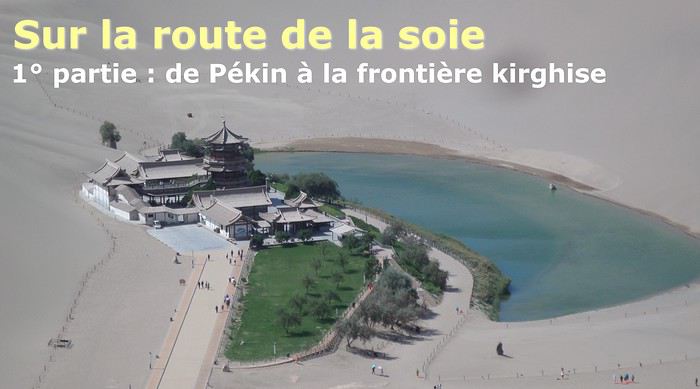
The Chinese Far West More than 30 years after my first trip to eastern China, I finally fulfilled an old dream: traveling solo from Beijing to the far west, discovering Xinjiang, the Uyghur people and the oppression they endure, the oases of Turpan and Kashgar, the Taklamakan Desert, the end of the Great Wall... The route was covered by train.
MENU PART 1: CHINA
1- Beijing (Jiankou) : the authentic Great Wall, without tourists 2- Cycling in Beijing, the best way to get around 3- Beijing : departure for the far west 4- Jiayuguan : getting by without English 5- Jiayuguan : scams and heritage 6- Dunhuang : abundance in the middle of the desert 7- Turpan : the Uyghurs under heavy surveillance 8- Kashgar : love at first sight for the old city 9- Kashgar : China’s recipe for controlling the populace 10- Tashkurgan : what on earth was I thinking going there! Kyrgyz border: a surreal epic Photo album from the 80s, contributions from other travelers (page 2)
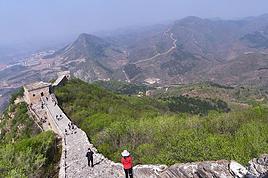
1- JIANKOU Finding the authentic Great Wall, without tourists or a guide Friday, August 24, 2018 Thirty years later, I didn’t feel like revisiting the Great Wall at Badaling or any other overcrowded site. I chose to explore it at Jiankou, in its wildest, most authentic, and unrestored section, starting from a lost village deep in a valley—though it wasn’t *that* lost, since it had everything for communication.
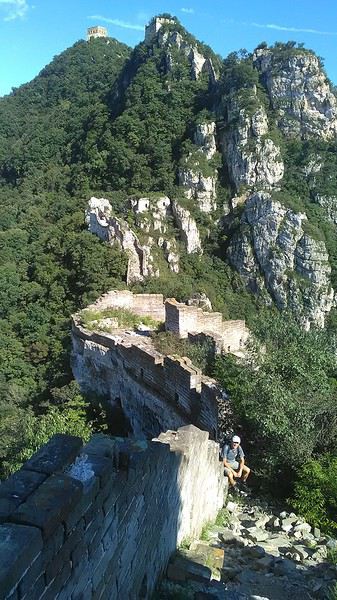
No need to pay for a taxi to get there—by timing it right, you can take the bus for just a few yuan. You have to get off at Xizhazi, the bus terminus. Be careful, there are only two buses a day in each direction. At the Xizhazi bus stop, I met a young couple who’d arrived with zero information about what to expect. We hiked the three of us toward the restored section of Mutianyu.
Still, be cautious With GPS and a topographic map (OpenTopoMap), you can set off without a problem or guide. The trail up to Jiankou is easy and well-marked. The trails down are too. But be careful—once you’re on the Wall, it’s real mountain hiking, with easy but dangerous climbing sections (over sheer drops). Not for amateurs or those afraid of heights! But what a reward. The Wall all to yourself, where it’s at its most daring. Truly mesmerizing.
More photos...
2- BEIJING The best way to get around the capital Sunday, August 26 The best way to explore the city is still by bike. Most are in a bike-share system, but you need to use an app—WeChat, the app that does everything, like monitoring your every move. No way I was installing that.
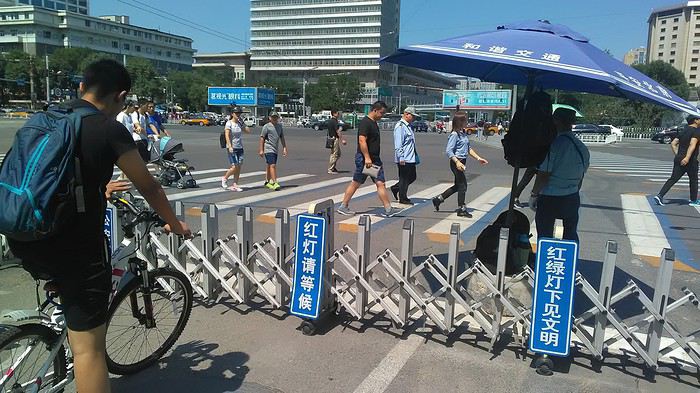
I found one at a rental shop near the hostel. The key is to quickly learn local traffic customs to minimize risks. Bike lanes are wide along the avenues.
But you still have to: - Watch out for anything parked on the bike paths—the most annoying are people napping or talking on the phone in their cars - Keep an eye on everything coming the wrong way—the list is long - The worst is right turns on red, which in Chinese traffic rules seem to have priority Once you get the hang of it, it’s fine. The city is huge but flat, so you can just wing it.
3- BEIJING By train to the far west Sunday, August 26 Beijing West Station is the size and operates like an airport. With your e-ticket from the agency, you first have to pick up your ticket at the special "English" counter, after passing through security. With your ticket in hand, you have to exit and enter through the boarding waiting area—not the platform—after a second security check.
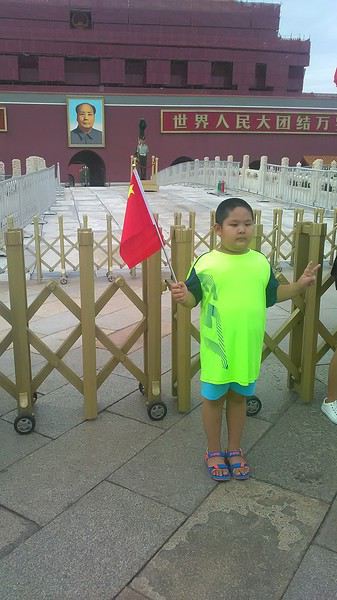 Then you find the right hall and wait for the sign to finally access the platform. In the end, it works pretty well given the incredible number of passengers to manage. Everywhere in Beijing, I saw that the Chinese have mastered crowd flow management.
Nice surprise: second-class carriages are clean, air-conditioned, and bright. Perfect, since I was in for 20 hours. One uniformed attendant per carriage, mobile meal service—luxury! Small downside: no luggage space. Hauling your suitcase up to the top bunk is quite a workout. I was in the middle, so it wasn’t too bad. The landscape, though, whether rural or urban, is pretty bleak. That should change once we leave the eastern plains.
Of course, I got my first police visit, with a thorough passport check and bag search. I was warned—going to the Chinese far west exposes you to this kind of hassle. But they were polite and respectful.
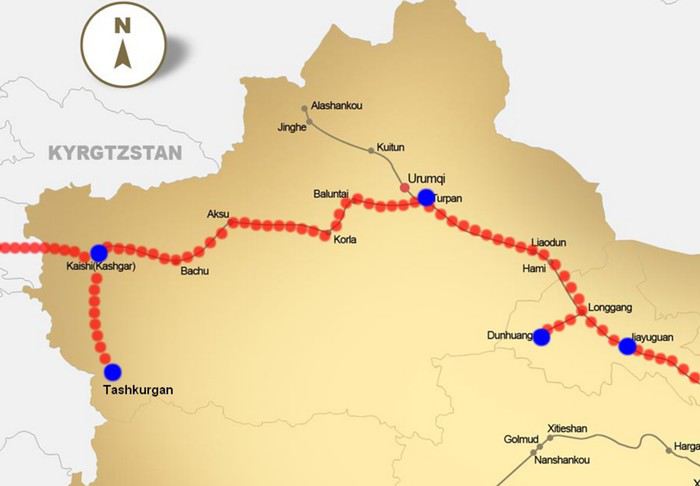 The Chinese Far West
4- JIAYUGUAN Getting by without English Monday, August 27 At the gates of two deserts (Gobi and Taklamakan) and at the foot of the Tibetan highlands, the Great Wall ends at Jiayuguan. Here, I found the deeper China I’d somewhat rediscovered during my bike ride, even if now everyone gets around on electric bikes and I’m no longer stared at like an alien.
Prices are nothing like Beijing: you can find a full meal for 2 €, and my bike cost 7 € for two days. Plus, few people speak English—neither the owner of the HI hostel where I stayed, nor the ticket sellers at the sites, let alone the servers at the small eateries where I ate. Everything is written in Chinese. So I had to use the little Chinese I know to communicate about essentials. It makes the locals laugh to see a European trying to speak their language, but it earns respect. With Google Translate’s help, I managed.
Rant: With their avenues blocked for construction for kilometers without warning, and new roads not yet on maps, I must’ve taken 15 km of detours. More photos...
5- JIAYUGUAN Scams and heritage Tuesday, August 28 The Great Wall doesn’t exactly end at the fort I visited yesterday but 10 km further, at the entrance to a river gorge at the foot of the mountains. All that’s left is a badly damaged tower (more like a mound of earth) and a section of clay wall, similar to the one I biked yesterday.
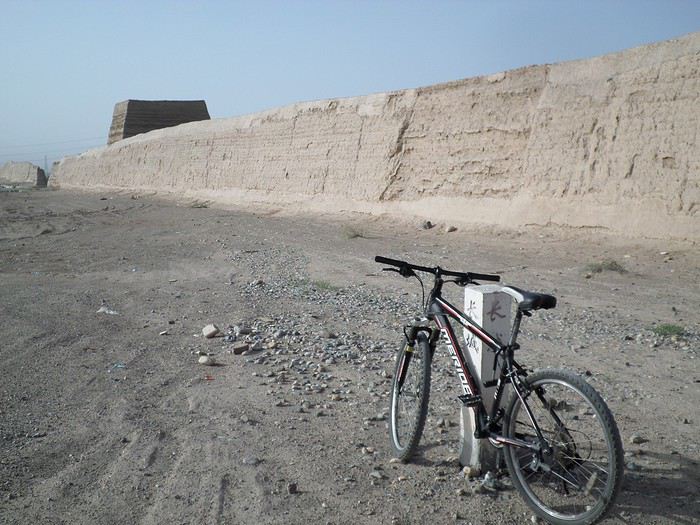
This morning, I hopped on my bike, determined to venture into the desert to see this highly symbolic site. First, you access it via a wide, brand-new road with not a soul in sight. Just before the site, I came across a grand welcome gate, very period-style, but it’s actually the inevitable toll booth.
Behind the gate, the road continues straight to the site, which you can see in the distance—at least 2 km away—the remains of the tower and wall. I had to leave my bike here. Fine. I went to the ticket counter and asked the price: 120 yuan! I couldn’t believe it—over 15 € for a simple mound of earth.
I showed my displeasure to the attendant, who couldn’t care less, and immediately turned back. 120 yuan—that’s the price for a new road, a fancy gate planted 2 km before the site just to force you to take a shuttle, and employees with nothing to do all day... Now I understand why I didn’t meet anyone!
Heritage China is a bit pricey Generally, sites are expensive for the country’s standard of living, but travelers are supposed to have money, so why hold back? I even gave up on the Forbidden City—reservations required days in advance (or on the black market at an impossible price). I prefer to keep the memory of my first visit, when entry must’ve cost a few dozen cents, and there were only a handful of visitors.
This morning, I took a taxi to see remarkable tombs of common people from the 3rd to 6th centuries. They’re small vaulted caves made of painted bricks, depicting scenes of daily life. Very pretty and moving. But even here, though the price was more reasonable, I was left wanting—only one of the 16 tombs is open to visitors, and it’s apparently not the most beautiful.
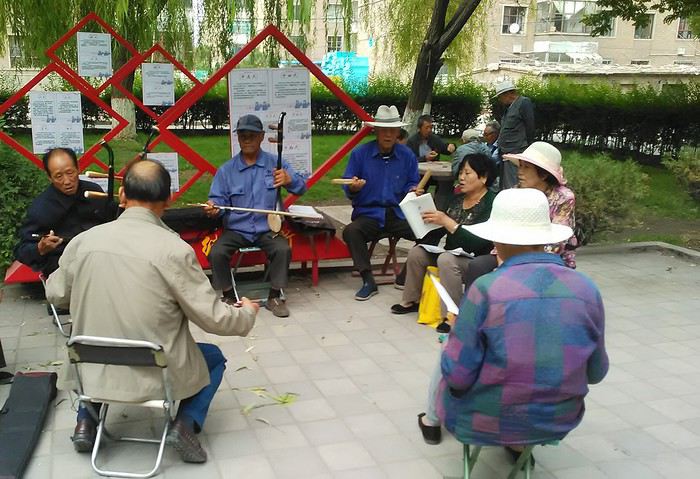
The authentic China—at least what’s left of it... Wandering the impersonal avenues of the city, you stumble upon a market. There, you still find traditional China—small shops with questionable hygiene, Go players, musicians, and even a dental prosthetist. The last refuge for those untouched by modernity. More photos...
6- DUNHUANG Abundance in the middle of the desert Wednesday, August 29 Well, I thought the landscape would be less bleak as I headed west. Nope. The only distraction in this expanse of dark, clayey sand is the forests of pylons and wind turbines, plus wild camels racing each other.
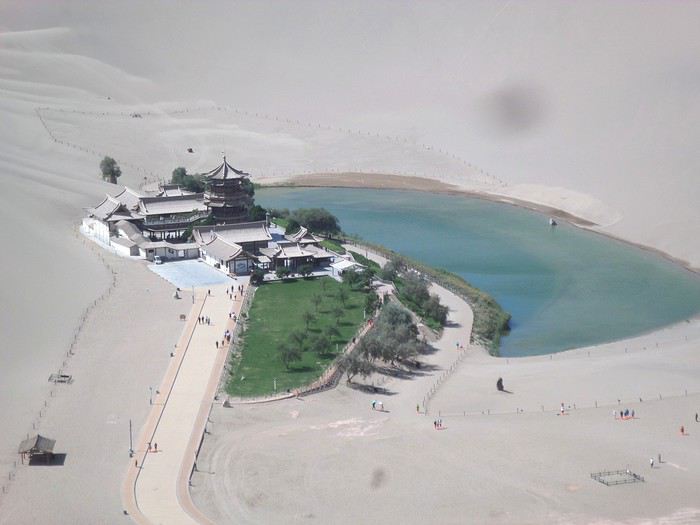 However, Dunhuang, the gateway to the Taklamakan, is by far the most pleasant Chinese city I know. There’s a real city center you can explore on foot. It’s hot but not unbearable, with a light, dry breeze. Much nicer than Beijing. The Han Chinese are still the majority, but the Muslim Uyghurs are more numerous, and the muezzin’s call to prayer echoes around the mosque.
The most surprising thing is the abundance and diversity of fruits and vegetables. You wonder how it all grows here. Well-irrigated, the desert sands are very fertile. Here, raisins have subtle, mysterious flavors, and the lamb really tastes like lamb.
Today, I visited the must-see Mingshashan, a dune complex next to which Pila is a molehill. The Basque Country, but covered in sand... More photos...
7- TURPAN The Uyghurs under heavy surveillance Friday, August 31 Surveillance cameras everywhere in the city, armed police stationed at intersections, in front of public buildings, at the entrance and inside tourist sites, police stations on every corner, patrols on foot or by car, khaki uniforms even for middle schoolers... here, the Han Chinese are in the minority, and you can feel it. Turpan feels like a city under siege.
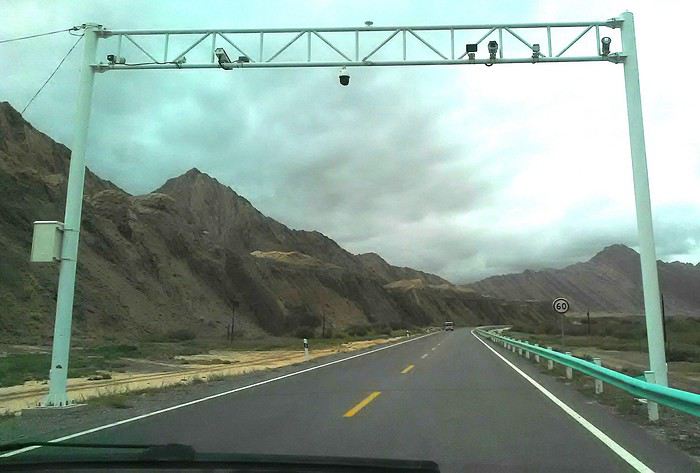
To enter the youth hostel where I stayed, there’s even a security gate, and the receptionist (a Han, like everyone in tourism) wears a bulletproof vest! Reassuring. Still, you don’t feel particularly threatened here, especially as a European. The troublemakers are the Chinese, not the Uyghurs. Generally, China is a very safe country for visitors.
Smile, you’re on camera! I was biking on an avenue when the car in front of me got flashed for driving slowly. I quickly understood why when I got flashed too.
Here, the official time is Beijing time, but it gets dark two hours later. It’ll be even worse in Kashgar. Trickier to manage: everything is displayed in Chinese and Arabic. Nothing in English. Choosing a menu is a shot in the dark. Apart from a few young Chinese, no one here speaks English, and my Chinese doesn’t seem very understandable...
Mogao, the end of the road for the Han Yesterday, near Dunhuang, I went to Mogao, a complex of decorated caves with Buddha sculptures and paintings. Stunning, but so crowded! Luckily, here in Turpan, Chinese tourists barely venture out. So I visited a Silk Road ghost town with only a handful of other visitors and under a howling wind.
The modern Chinese city is swallowing up the old Uyghur neighborhoods—only a museum-like district remains in the center, and pockets of resistance on the outskirts are doomed to disappear soon. More photos...
8- KASHGAR A (relative) love at first sight for the old city Sunday, September 2 After three overnight trains, here I am in the far west of China, nearly 4,000 km from the capital. Despite the omnipresent police and an old city preserved UNESCO-style, Kashgar is my Chinese love at first sight.
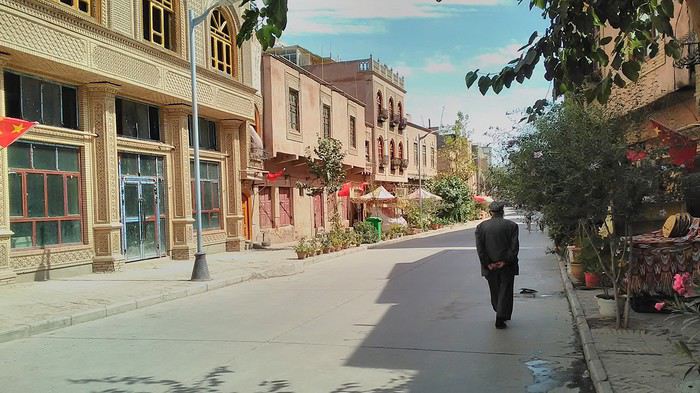
Finally, Chinese... well, sort of, because we’re in Uyghur territory here—a Turkic people with nothing culturally in common with the Han, the eastern Chinese. It started badly yesterday at Turfan station, where after three security gate passes, at least five passport checks, and a bag search, three adorable policewomen confiscated my antibacterial lotion because it had a flammable logo...
Then came the welcoming committee of armed cops at Kashgar station. Once all that was over, they left me alone—except you still have to go through security checks like everyone else to enter the old city, the bazaar, the livestock market... The further west you go, the more the siege mentality is evident. Luckily, the border isn’t far...
Despite the inevitable destruction-reconstruction, the city center has been well preserved. Thankfully, because it’s a very original style, a mix of local and colonial. I love it, even if it’s a bit too artificial, sanitized, and watered-down, and rather empty of residents. On the Silk Road, the city was famous for its great food. And it still is—rarely have I seen such richness and abundance of food! And not just scorpions or snakes. More photos...
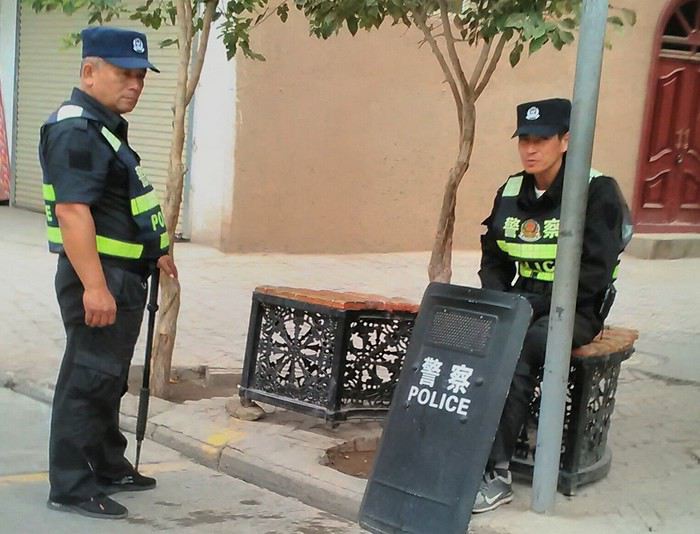
9- KASHGAR China’s recipe for controlling the populace Saturday, September 1 Xinjiang, along with Tibet, is a "sensitive" area of rebellion in the eyes of Chinese authorities. As a result, the state has these regions and their populations under total control. Tourists also feel the consequences, even if they’re not at risk of re-education camps.
 - Putting barbed wire and anti-ramming barriers around sensitive sites (schools, big hotels, government buildings...)
- Installing traffic surveillance gates with cameras and photo flashes (for all vehicles passing, including bikes) throughout the city and even in the countryside
- Posting uniformed guards with tasers, batons, or huge baseball bats every 100 meters
- Training the Han population (ethnic Chinese) in self-defense with sticks, preferably in the morning on the street. Men and women of all ages
- Starting school with the national anthem, doing military exercises, and receiving political indoctrination, all neatly lined up in the courtyard. (The dream school for any teacher)
- Placing a snitch in uniform (a pseudo-guard) in public gathering places, like youth hostels. Mine spends the day loafing around the courtyard
- Putting Chinese flags everywhere on the streets to remind everyone who’s in charge
- Installing security gates at every entrance to areas frequented by tourists (thanks for that) but not just there
- Never photographing cops, or else! I tried, but it’s not easy...
- Putting barbed wire and anti-ramming barriers around sensitive sites (schools, big hotels, government buildings...)
- Installing traffic surveillance gates with cameras and photo flashes (for all vehicles passing, including bikes) throughout the city and even in the countryside
- Posting uniformed guards with tasers, batons, or huge baseball bats every 100 meters
- Training the Han population (ethnic Chinese) in self-defense with sticks, preferably in the morning on the street. Men and women of all ages
- Starting school with the national anthem, doing military exercises, and receiving political indoctrination, all neatly lined up in the courtyard. (The dream school for any teacher)
- Placing a snitch in uniform (a pseudo-guard) in public gathering places, like youth hostels. Mine spends the day loafing around the courtyard
- Putting Chinese flags everywhere on the streets to remind everyone who’s in charge
- Installing security gates at every entrance to areas frequented by tourists (thanks for that) but not just there
- Never photographing cops, or else! I tried, but it’s not easy...
With all that, you can stroll around safely Not much crime! As for the amount the Chinese state spends to maintain such a system, it’s staggering! A third of the Han living in Xinjiang work in security. Today, I wandered freely around old Kashgar, which is quite large after all. More photos...
10- TASHKURGAN What on earth was I thinking going there! Wednesday, September 5 First, there’s the taxi—pretty crappy, with a driver who doesn’t speak a word of English and won’t stop smoking. Over six hours in that... shared with a completely out-of-it American.
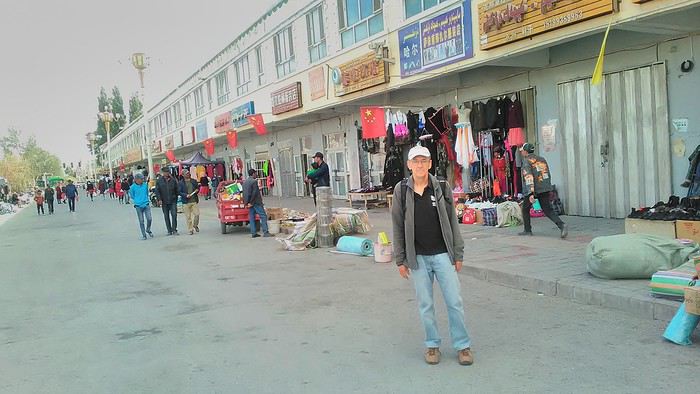
Then there are all the checkpoints along the way. I won’t go on—you know the drill by now.
After that, there’s Tashkurgan—a town with nothing to see, nothing to do. Deserted as soon as night falls. There’s this huge youth hostel and a few lost Chinese tapping away on their smartphones, chain-smoking. This lost American-European crowd, swapping tips on how to enter Pakistan or Tajikistan.
Luckily, there’s the Chinese Pamir Highway, lined with peaks over 7,000m. There’s the feeling of no longer being in China, with a population whose features are Middle Eastern. And these Tajik women with their stunning hairstyles and vibrant costumes. There’s the fact of having reached the westernmost Chinese city, far from crowds and tourist sites. A sort of end of the world. More photos...
11- KYRGYZ BORDER A surreal epic Thursday, September 6 The road from Kashgar to the Kyrgyzstan border is a little over 200 km and passes through beautiful landscapes of colorful, desert-like mountains with acrobatic folds. That’s the bucolic part of the trip.
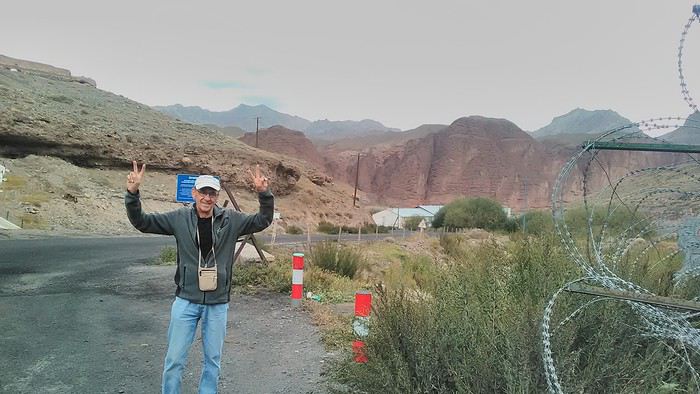 Yesterday, I managed to gather four people to rent a minibus to reach the border more easily: a Spaniard and an Argentine I’d already met in Turpan, and two New Zealanders who responded to the ad left at the hostel.
Absurdity and paranoia of Chinese authorities The highlight was crossing the town of Wuqia, 50 km past Kashgar. After tallying up with my fellow sufferers, we must’ve passed about ten checkpoints with: - Passport checks: 14 times, sometimes by two cops side by side - Bag checks: 4 times - Smartphone checks: 2 times, with deletion of "non-compliant" photos, and registration of your IMEI in the exit log!... Absurd and surreal at the same time, since my camera stayed in my bag, my apps are in French, and my photos have been online for ages...
With all that, we arrived just as the last checkpoint before the no man’s land marking the border between the two countries was on lunch break. And bam! Another 1.5-hour wait, alongside truckers who were much more used to this than we were.
What to think? The cops themselves aren’t fooled. They play the role they’re asked to, but sometimes you can coax a smile out of them—they realize how ridiculous the situation is.
What’s the point? That’s the big question my companions and I were tempted to answer with "to piss people off." To show you your place isn’t here, but with the other tourists, over there in the east, in Shanghai, Xi’an, or Guangzhou.
As for you, a traveler from a democratic country, you really experience this as aggression, humiliation, a violation of your private space. And yet, I’m respected, they speak to me properly. Today, I better understand what a Palestinian or a citizen of an occupied country might feel daily. A unique experience! Thanks, China.
And to top it off, the cherry on the cake! It’s still this glowing button you press to rate your passage after clearing the last obstacle before the exit stamp. I was so surprised it turned off before I could react. The Spaniard, with great humor and irony, had time to vote "excellent." In the end, he wasn’t wrong—you can hardly do better!
PS: I ditched my buddies at the border. They didn’t want to pay for a taxi to continue. So I took a direct taxi to Osh. The first 100 km are fabulous. I couldn’t take many photos, but I’ll be back on Monday to go to Tajikistan.
More photos...
The rest of the Silk Road, Part 2, in these travel journals: Kyrgyzstan, Tajikistan, Uzbekistan.
The Chinese Far West More than 30 years after my first trip to eastern China, I finally fulfilled an old dream: traveling solo from Beijing to the far west, discovering Xinjiang, the Uyghur people and the oppression they endure, the oases of Turpan and Kashgar, the Taklamakan Desert, the end of the Great Wall... The route was covered by train.
MENU PART 1: CHINA
1- Beijing (Jiankou) : the authentic Great Wall, without tourists 2- Cycling in Beijing, the best way to get around 3- Beijing : departure for the far west 4- Jiayuguan : getting by without English 5- Jiayuguan : scams and heritage 6- Dunhuang : abundance in the middle of the desert 7- Turpan : the Uyghurs under heavy surveillance 8- Kashgar : love at first sight for the old city 9- Kashgar : China’s recipe for controlling the populace 10- Tashkurgan : what on earth was I thinking going there! Kyrgyz border: a surreal epic Photo album from the 80s, contributions from other travelers (page 2)
1- JIANKOU Finding the authentic Great Wall, without tourists or a guide Friday, August 24, 2018 Thirty years later, I didn’t feel like revisiting the Great Wall at Badaling or any other overcrowded site. I chose to explore it at Jiankou, in its wildest, most authentic, and unrestored section, starting from a lost village deep in a valley—though it wasn’t *that* lost, since it had everything for communication.
No need to pay for a taxi to get there—by timing it right, you can take the bus for just a few yuan. You have to get off at Xizhazi, the bus terminus. Be careful, there are only two buses a day in each direction. At the Xizhazi bus stop, I met a young couple who’d arrived with zero information about what to expect. We hiked the three of us toward the restored section of Mutianyu.
Still, be cautious With GPS and a topographic map (OpenTopoMap), you can set off without a problem or guide. The trail up to Jiankou is easy and well-marked. The trails down are too. But be careful—once you’re on the Wall, it’s real mountain hiking, with easy but dangerous climbing sections (over sheer drops). Not for amateurs or those afraid of heights! But what a reward. The Wall all to yourself, where it’s at its most daring. Truly mesmerizing.
More photos...
2- BEIJING The best way to get around the capital Sunday, August 26 The best way to explore the city is still by bike. Most are in a bike-share system, but you need to use an app—WeChat, the app that does everything, like monitoring your every move. No way I was installing that.
I found one at a rental shop near the hostel. The key is to quickly learn local traffic customs to minimize risks. Bike lanes are wide along the avenues.
But you still have to: - Watch out for anything parked on the bike paths—the most annoying are people napping or talking on the phone in their cars - Keep an eye on everything coming the wrong way—the list is long - The worst is right turns on red, which in Chinese traffic rules seem to have priority Once you get the hang of it, it’s fine. The city is huge but flat, so you can just wing it.
3- BEIJING By train to the far west Sunday, August 26 Beijing West Station is the size and operates like an airport. With your e-ticket from the agency, you first have to pick up your ticket at the special "English" counter, after passing through security. With your ticket in hand, you have to exit and enter through the boarding waiting area—not the platform—after a second security check.
Then you find the right hall and wait for the sign to finally access the platform. In the end, it works pretty well given the incredible number of passengers to manage. Everywhere in Beijing, I saw that the Chinese have mastered crowd flow management.Nice surprise: second-class carriages are clean, air-conditioned, and bright. Perfect, since I was in for 20 hours. One uniformed attendant per carriage, mobile meal service—luxury! Small downside: no luggage space. Hauling your suitcase up to the top bunk is quite a workout. I was in the middle, so it wasn’t too bad. The landscape, though, whether rural or urban, is pretty bleak. That should change once we leave the eastern plains.
Of course, I got my first police visit, with a thorough passport check and bag search. I was warned—going to the Chinese far west exposes you to this kind of hassle. But they were polite and respectful.
The Chinese Far West4- JIAYUGUAN Getting by without English Monday, August 27 At the gates of two deserts (Gobi and Taklamakan) and at the foot of the Tibetan highlands, the Great Wall ends at Jiayuguan. Here, I found the deeper China I’d somewhat rediscovered during my bike ride, even if now everyone gets around on electric bikes and I’m no longer stared at like an alien.
Prices are nothing like Beijing: you can find a full meal for 2 €, and my bike cost 7 € for two days. Plus, few people speak English—neither the owner of the HI hostel where I stayed, nor the ticket sellers at the sites, let alone the servers at the small eateries where I ate. Everything is written in Chinese. So I had to use the little Chinese I know to communicate about essentials. It makes the locals laugh to see a European trying to speak their language, but it earns respect. With Google Translate’s help, I managed.
Rant: With their avenues blocked for construction for kilometers without warning, and new roads not yet on maps, I must’ve taken 15 km of detours. More photos...
5- JIAYUGUAN Scams and heritage Tuesday, August 28 The Great Wall doesn’t exactly end at the fort I visited yesterday but 10 km further, at the entrance to a river gorge at the foot of the mountains. All that’s left is a badly damaged tower (more like a mound of earth) and a section of clay wall, similar to the one I biked yesterday.
This morning, I hopped on my bike, determined to venture into the desert to see this highly symbolic site. First, you access it via a wide, brand-new road with not a soul in sight. Just before the site, I came across a grand welcome gate, very period-style, but it’s actually the inevitable toll booth.
Behind the gate, the road continues straight to the site, which you can see in the distance—at least 2 km away—the remains of the tower and wall. I had to leave my bike here. Fine. I went to the ticket counter and asked the price: 120 yuan! I couldn’t believe it—over 15 € for a simple mound of earth.
I showed my displeasure to the attendant, who couldn’t care less, and immediately turned back. 120 yuan—that’s the price for a new road, a fancy gate planted 2 km before the site just to force you to take a shuttle, and employees with nothing to do all day... Now I understand why I didn’t meet anyone!
Heritage China is a bit pricey Generally, sites are expensive for the country’s standard of living, but travelers are supposed to have money, so why hold back? I even gave up on the Forbidden City—reservations required days in advance (or on the black market at an impossible price). I prefer to keep the memory of my first visit, when entry must’ve cost a few dozen cents, and there were only a handful of visitors.
This morning, I took a taxi to see remarkable tombs of common people from the 3rd to 6th centuries. They’re small vaulted caves made of painted bricks, depicting scenes of daily life. Very pretty and moving. But even here, though the price was more reasonable, I was left wanting—only one of the 16 tombs is open to visitors, and it’s apparently not the most beautiful.
The authentic China—at least what’s left of it... Wandering the impersonal avenues of the city, you stumble upon a market. There, you still find traditional China—small shops with questionable hygiene, Go players, musicians, and even a dental prosthetist. The last refuge for those untouched by modernity. More photos...
6- DUNHUANG Abundance in the middle of the desert Wednesday, August 29 Well, I thought the landscape would be less bleak as I headed west. Nope. The only distraction in this expanse of dark, clayey sand is the forests of pylons and wind turbines, plus wild camels racing each other.
However, Dunhuang, the gateway to the Taklamakan, is by far the most pleasant Chinese city I know. There’s a real city center you can explore on foot. It’s hot but not unbearable, with a light, dry breeze. Much nicer than Beijing. The Han Chinese are still the majority, but the Muslim Uyghurs are more numerous, and the muezzin’s call to prayer echoes around the mosque.The most surprising thing is the abundance and diversity of fruits and vegetables. You wonder how it all grows here. Well-irrigated, the desert sands are very fertile. Here, raisins have subtle, mysterious flavors, and the lamb really tastes like lamb.
Today, I visited the must-see Mingshashan, a dune complex next to which Pila is a molehill. The Basque Country, but covered in sand... More photos...
7- TURPAN The Uyghurs under heavy surveillance Friday, August 31 Surveillance cameras everywhere in the city, armed police stationed at intersections, in front of public buildings, at the entrance and inside tourist sites, police stations on every corner, patrols on foot or by car, khaki uniforms even for middle schoolers... here, the Han Chinese are in the minority, and you can feel it. Turpan feels like a city under siege.
To enter the youth hostel where I stayed, there’s even a security gate, and the receptionist (a Han, like everyone in tourism) wears a bulletproof vest! Reassuring. Still, you don’t feel particularly threatened here, especially as a European. The troublemakers are the Chinese, not the Uyghurs. Generally, China is a very safe country for visitors.
Smile, you’re on camera! I was biking on an avenue when the car in front of me got flashed for driving slowly. I quickly understood why when I got flashed too.
Here, the official time is Beijing time, but it gets dark two hours later. It’ll be even worse in Kashgar. Trickier to manage: everything is displayed in Chinese and Arabic. Nothing in English. Choosing a menu is a shot in the dark. Apart from a few young Chinese, no one here speaks English, and my Chinese doesn’t seem very understandable...
Mogao, the end of the road for the Han Yesterday, near Dunhuang, I went to Mogao, a complex of decorated caves with Buddha sculptures and paintings. Stunning, but so crowded! Luckily, here in Turpan, Chinese tourists barely venture out. So I visited a Silk Road ghost town with only a handful of other visitors and under a howling wind.
The modern Chinese city is swallowing up the old Uyghur neighborhoods—only a museum-like district remains in the center, and pockets of resistance on the outskirts are doomed to disappear soon. More photos...
8- KASHGAR A (relative) love at first sight for the old city Sunday, September 2 After three overnight trains, here I am in the far west of China, nearly 4,000 km from the capital. Despite the omnipresent police and an old city preserved UNESCO-style, Kashgar is my Chinese love at first sight.
Finally, Chinese... well, sort of, because we’re in Uyghur territory here—a Turkic people with nothing culturally in common with the Han, the eastern Chinese. It started badly yesterday at Turfan station, where after three security gate passes, at least five passport checks, and a bag search, three adorable policewomen confiscated my antibacterial lotion because it had a flammable logo...
Then came the welcoming committee of armed cops at Kashgar station. Once all that was over, they left me alone—except you still have to go through security checks like everyone else to enter the old city, the bazaar, the livestock market... The further west you go, the more the siege mentality is evident. Luckily, the border isn’t far...
Despite the inevitable destruction-reconstruction, the city center has been well preserved. Thankfully, because it’s a very original style, a mix of local and colonial. I love it, even if it’s a bit too artificial, sanitized, and watered-down, and rather empty of residents. On the Silk Road, the city was famous for its great food. And it still is—rarely have I seen such richness and abundance of food! And not just scorpions or snakes. More photos...
9- KASHGAR China’s recipe for controlling the populace Saturday, September 1 Xinjiang, along with Tibet, is a "sensitive" area of rebellion in the eyes of Chinese authorities. As a result, the state has these regions and their populations under total control. Tourists also feel the consequences, even if they’re not at risk of re-education camps.
- Putting barbed wire and anti-ramming barriers around sensitive sites (schools, big hotels, government buildings...)
- Installing traffic surveillance gates with cameras and photo flashes (for all vehicles passing, including bikes) throughout the city and even in the countryside
- Posting uniformed guards with tasers, batons, or huge baseball bats every 100 meters
- Training the Han population (ethnic Chinese) in self-defense with sticks, preferably in the morning on the street. Men and women of all ages
- Starting school with the national anthem, doing military exercises, and receiving political indoctrination, all neatly lined up in the courtyard. (The dream school for any teacher)
- Placing a snitch in uniform (a pseudo-guard) in public gathering places, like youth hostels. Mine spends the day loafing around the courtyard
- Putting Chinese flags everywhere on the streets to remind everyone who’s in charge
- Installing security gates at every entrance to areas frequented by tourists (thanks for that) but not just there
- Never photographing cops, or else! I tried, but it’s not easy...With all that, you can stroll around safely Not much crime! As for the amount the Chinese state spends to maintain such a system, it’s staggering! A third of the Han living in Xinjiang work in security. Today, I wandered freely around old Kashgar, which is quite large after all. More photos...
10- TASHKURGAN What on earth was I thinking going there! Wednesday, September 5 First, there’s the taxi—pretty crappy, with a driver who doesn’t speak a word of English and won’t stop smoking. Over six hours in that... shared with a completely out-of-it American.
Then there are all the checkpoints along the way. I won’t go on—you know the drill by now.
After that, there’s Tashkurgan—a town with nothing to see, nothing to do. Deserted as soon as night falls. There’s this huge youth hostel and a few lost Chinese tapping away on their smartphones, chain-smoking. This lost American-European crowd, swapping tips on how to enter Pakistan or Tajikistan.
Luckily, there’s the Chinese Pamir Highway, lined with peaks over 7,000m. There’s the feeling of no longer being in China, with a population whose features are Middle Eastern. And these Tajik women with their stunning hairstyles and vibrant costumes. There’s the fact of having reached the westernmost Chinese city, far from crowds and tourist sites. A sort of end of the world. More photos...
11- KYRGYZ BORDER A surreal epic Thursday, September 6 The road from Kashgar to the Kyrgyzstan border is a little over 200 km and passes through beautiful landscapes of colorful, desert-like mountains with acrobatic folds. That’s the bucolic part of the trip.
Yesterday, I managed to gather four people to rent a minibus to reach the border more easily: a Spaniard and an Argentine I’d already met in Turpan, and two New Zealanders who responded to the ad left at the hostel.Absurdity and paranoia of Chinese authorities The highlight was crossing the town of Wuqia, 50 km past Kashgar. After tallying up with my fellow sufferers, we must’ve passed about ten checkpoints with: - Passport checks: 14 times, sometimes by two cops side by side - Bag checks: 4 times - Smartphone checks: 2 times, with deletion of "non-compliant" photos, and registration of your IMEI in the exit log!... Absurd and surreal at the same time, since my camera stayed in my bag, my apps are in French, and my photos have been online for ages...
With all that, we arrived just as the last checkpoint before the no man’s land marking the border between the two countries was on lunch break. And bam! Another 1.5-hour wait, alongside truckers who were much more used to this than we were.
What to think? The cops themselves aren’t fooled. They play the role they’re asked to, but sometimes you can coax a smile out of them—they realize how ridiculous the situation is.
What’s the point? That’s the big question my companions and I were tempted to answer with "to piss people off." To show you your place isn’t here, but with the other tourists, over there in the east, in Shanghai, Xi’an, or Guangzhou.
As for you, a traveler from a democratic country, you really experience this as aggression, humiliation, a violation of your private space. And yet, I’m respected, they speak to me properly. Today, I better understand what a Palestinian or a citizen of an occupied country might feel daily. A unique experience! Thanks, China.
And to top it off, the cherry on the cake! It’s still this glowing button you press to rate your passage after clearing the last obstacle before the exit stamp. I was so surprised it turned off before I could react. The Spaniard, with great humor and irony, had time to vote "excellent." In the end, he wasn’t wrong—you can hardly do better!
PS: I ditched my buddies at the border. They didn’t want to pay for a taxi to continue. So I took a direct taxi to Osh. The first 100 km are fabulous. I couldn’t take many photos, but I’ll be back on Monday to go to Tajikistan.
More photos...
The rest of the Silk Road, Part 2, in these travel journals: Kyrgyzstan, Tajikistan, Uzbekistan.
Bonjour
Je prépare actuellement un voyage d'au moins 1an en russie et en asie . Je prevois de partir uniquement avec un sac à dos.
Je souhaiterais acheter un mini ordinateur (pas de tablette ou pc hybride ) mais je n'y connais pas grand chose 🤪
Voici mes critères:
10 pouces dans l'ideal Une bonne autonomie SSD Assez solide qd mm.. .
Pour le syteme d'exploitation, je ne sais vraiment pas ce qui est mieux pour moi. sachant que l'ordinateur sera surtout pour donner des nouvelles et surfer. Mais j'aimerais aussi pouvoir consulter des cartes sans connexion (si qq'un connait qq chose!) Et dernière chose, je voudrais aussi avoir la possibilité d'insérer des cartes SIM prepayées que j'acheterai dans les differents pays ( cest pas cher à ce qu'il parait ...)pr avoir une connexion s'il n'y a pas la possibilité de capter un reseau wifi. Pour ça on m'a parlé d''une carte usb dans laquelle tu peux insérer une sim... Voila voilà! Je suis un peu perdue parmi ttes ces offres et mes critères, merci d'avance pr votre aide!
10 pouces dans l'ideal Une bonne autonomie SSD Assez solide qd mm.. .
Pour le syteme d'exploitation, je ne sais vraiment pas ce qui est mieux pour moi. sachant que l'ordinateur sera surtout pour donner des nouvelles et surfer. Mais j'aimerais aussi pouvoir consulter des cartes sans connexion (si qq'un connait qq chose!) Et dernière chose, je voudrais aussi avoir la possibilité d'insérer des cartes SIM prepayées que j'acheterai dans les differents pays ( cest pas cher à ce qu'il parait ...)pr avoir une connexion s'il n'y a pas la possibilité de capter un reseau wifi. Pour ça on m'a parlé d''une carte usb dans laquelle tu peux insérer une sim... Voila voilà! Je suis un peu perdue parmi ttes ces offres et mes critères, merci d'avance pr votre aide!
Bonjour,
J'arrive à Pékin le 12 octobre au soir et j'aurais besoin de vos avis/conseils avisés sur l'itinéraire que j'ai commencé à peaufiner. Il s'agit de mon premier voyage en Chine. Je précise que la découverte du Sichuan et du Yunnan feront l'objet d'un autre séjour d'un mois en Chine. Je compte me déplacer majoritairement en train (de nuit) et en bus et dormir en auberges de jeunesse. En gros ça donnerait ça :
12 au 19 : Pékin + grande muraille : 8 jours (7 jours sur place étant donné que j'arrive le 12 au soir) 20 au 22 : Pingyao : 3 jours 23 au 27 : Xian : 5 jours 28 au 31 : Zhangjiajie : 4 jours 01 au 03 : Fenghuang : 3 jours 04 au 09 : Guilin et sa région (Yangshuo, rizières du dos du dragon) : 6 jours 10 : fin de validité du visa donc départ en avion (sûrement vers la Thaïlande)
Qu'est-ce que vous en pensez ? Est-ce que j'oublie des coins qui valent vraiment le coup et qui ne me font pas faire un trop grand détour ? Au au contraire est-ce que je m'attarde dans des endroits qui n'en valent pas vraiment la peine ? J'ai préféré compter large à chaque endroit en me disant que les transports ne pourront peut-être pas toujours se faire de nuit. Mes incontournables sont Pékin, Xian, Zhangjiaje et la région de Guilin. De même, si certains ont des bons plans hébergements, visites, activités, je suis preneuse :-). Est-ce qu'il y a des réserves de pandas ailleurs qu'à Chengdu ? Merci d'avance !
Caroline
J'arrive à Pékin le 12 octobre au soir et j'aurais besoin de vos avis/conseils avisés sur l'itinéraire que j'ai commencé à peaufiner. Il s'agit de mon premier voyage en Chine. Je précise que la découverte du Sichuan et du Yunnan feront l'objet d'un autre séjour d'un mois en Chine. Je compte me déplacer majoritairement en train (de nuit) et en bus et dormir en auberges de jeunesse. En gros ça donnerait ça :
12 au 19 : Pékin + grande muraille : 8 jours (7 jours sur place étant donné que j'arrive le 12 au soir) 20 au 22 : Pingyao : 3 jours 23 au 27 : Xian : 5 jours 28 au 31 : Zhangjiajie : 4 jours 01 au 03 : Fenghuang : 3 jours 04 au 09 : Guilin et sa région (Yangshuo, rizières du dos du dragon) : 6 jours 10 : fin de validité du visa donc départ en avion (sûrement vers la Thaïlande)
Qu'est-ce que vous en pensez ? Est-ce que j'oublie des coins qui valent vraiment le coup et qui ne me font pas faire un trop grand détour ? Au au contraire est-ce que je m'attarde dans des endroits qui n'en valent pas vraiment la peine ? J'ai préféré compter large à chaque endroit en me disant que les transports ne pourront peut-être pas toujours se faire de nuit. Mes incontournables sont Pékin, Xian, Zhangjiaje et la région de Guilin. De même, si certains ont des bons plans hébergements, visites, activités, je suis preneuse :-). Est-ce qu'il y a des réserves de pandas ailleurs qu'à Chengdu ? Merci d'avance !
Caroline
Bonjour à tous
Je prépare mon premier voyage en Chine pour l'été prochain, et ma première question est simple : comment est-ce de voyager en Chine sans parler un traître mot de chinois, et a fortiori être incapable de lire le moindre caractère ? Je précise tout de suite mon parcours (envisagé) : entrer en Chine par la Russie au nord-est (Blagovevschensk->Heihe), descendre jusqu'à Harbin, virer à l'est vers Yanbian, descendre le long de la frontière avec la Corée du Nord jusqu'à Dandong, peut-être Dalian, puis Pékin, et ensuite rejoindre le Xinjiang tout à l'ouest (Urumqi au moins, peut-être Kashgar). Bref, pas que des coins hyper touristiques il me semble.
Merci d'avance pour vos éclaircissements
Stéphane
Je prépare mon premier voyage en Chine pour l'été prochain, et ma première question est simple : comment est-ce de voyager en Chine sans parler un traître mot de chinois, et a fortiori être incapable de lire le moindre caractère ? Je précise tout de suite mon parcours (envisagé) : entrer en Chine par la Russie au nord-est (Blagovevschensk->Heihe), descendre jusqu'à Harbin, virer à l'est vers Yanbian, descendre le long de la frontière avec la Corée du Nord jusqu'à Dandong, peut-être Dalian, puis Pékin, et ensuite rejoindre le Xinjiang tout à l'ouest (Urumqi au moins, peut-être Kashgar). Bref, pas que des coins hyper touristiques il me semble.
Merci d'avance pour vos éclaircissements
Stéphane
J arrive à Chengdu par le train et je voudrais rejoindre Kangding. A qu elle gare routiere dois je me rendre et quelqu un connait il les horaires des bus pour Kangding.
Combien de temps faut il pour le trajet.
Est il toujours necessaire de souscrire une assurance (PICC il me semble) pour voyager en bus dans le sichuan?
Qu el hotel choisir (pas cher) a Kangding et que faut il y voir?
Kangding litang, quelqu un connait il et a t il des tuyaux?
merci par avance.
thierry
Permettez moi de vous donner quelques informations nous concernant : nous sommes 2 amis (1 suisse et 1 allemand) qui allons partir pour un tour du monde de environ 18 mois, sac au dos. Départ le 9 juin 2011. Nous allons commencé par 15 jours en Jordanie puis 5 semaines en Inde (Spliti-Rajasthan) pour continuer notre aventure en Chine durant 2 mois (si nous obtenons le visa).
Nous avons déjà quelques idées pour nos 2 mois en Chine, que nous pourrions regrouper en 4 étapes :
1) De Pékin à Chengdu (via Datong, Pingyao, Xian) -> sur 10-12 jours / début août 2) Le Sichuan et le Kham County -> sur 20 jours / autour du 20 août 3) Le Yunnan -> sur 15-20 jours / autour du 15 septembre 4) La région de Guillin -> sur 15-20 jours / début octobre
Très attirés par la culture tibétaine et notamment sous le charme de Bayiu, nous avons fait des recherches sur le Kham afin de visiter cette région.
Selon nos recherches, le Kham et notamment la région de Bayiu est relativement compliquée à parcourir avec les transports locaux. De plus n'ayant aucune connaissance de chinois et bien que nous n'ayons pas peur du ridicule pour tenter de mimer les choses, c'est pour l'instant via une agence (voyage en groupe) que nous pourrions peut-être parcourir cette région.
Cependant après plusieurs échanges avec différentes agences basées à Chengdu et après lecture de certains récits (notamment ceux d'achem), la possibilité de voyage de manière plus ou moins indépendante semble toutefois possible sous certaines conditions. Le Lonely Planet Chine, dernière édition donne également quelques infos (assez vagues) sur les transports, hébergement, etc. dans cette région.
Si quelqu'un peut répondre à toutes ou certaines de nos questions ou à des conseils.... :
Idée de parcours: Chengdu-Rilong-Bamei-Ganzi-Dege-Baiyu-Litang -> Zhongdian Idée de budget : budget routard, max 7'500 RMB (env. 600 euros) Idée des voyageurs : 1ère fois en Chine, bon anglais, patient et bon négociateur. Très nature/culture, peu grandes villesQuelle(s) partie(s) pourraient-elles être faites en transport local ? Nous souhaiterions évités les agences et les voyages de groupes afin de pouvoir être "plus proches" des locaux, de découvrir cette région à notre rythme, et ne pas payer inutillement pour des grosses agences touristiques. Est-ce envisageable ? Est-ce mieux de louer une voiture avec chauffeur pour toute la durée ? Trouve-t-on facilement à se loger dans les villages ? Certaines agences pourraient nous organiser le transport avec chauffeur mais à nous de trouver la guesthouse. Est-ce tout de même possible de se faire comprendre sur place ? Quel est l'état des routes (les informations se contredisent parfois), notamment pour rejoindre Bayiu ? Avez-vous des suggestions de lieux à visiter ? Auriez-vous des contacts d'agence ou de personnes sur place ? Vos impressions générales, l'adéquation de "temps-distance-budget"Un grand merci à vous par avance !
Nous avons déjà quelques idées pour nos 2 mois en Chine, que nous pourrions regrouper en 4 étapes :
1) De Pékin à Chengdu (via Datong, Pingyao, Xian) -> sur 10-12 jours / début août 2) Le Sichuan et le Kham County -> sur 20 jours / autour du 20 août 3) Le Yunnan -> sur 15-20 jours / autour du 15 septembre 4) La région de Guillin -> sur 15-20 jours / début octobre
Très attirés par la culture tibétaine et notamment sous le charme de Bayiu, nous avons fait des recherches sur le Kham afin de visiter cette région.
Selon nos recherches, le Kham et notamment la région de Bayiu est relativement compliquée à parcourir avec les transports locaux. De plus n'ayant aucune connaissance de chinois et bien que nous n'ayons pas peur du ridicule pour tenter de mimer les choses, c'est pour l'instant via une agence (voyage en groupe) que nous pourrions peut-être parcourir cette région.
Cependant après plusieurs échanges avec différentes agences basées à Chengdu et après lecture de certains récits (notamment ceux d'achem), la possibilité de voyage de manière plus ou moins indépendante semble toutefois possible sous certaines conditions. Le Lonely Planet Chine, dernière édition donne également quelques infos (assez vagues) sur les transports, hébergement, etc. dans cette région.
Si quelqu'un peut répondre à toutes ou certaines de nos questions ou à des conseils.... :
Idée de parcours: Chengdu-Rilong-Bamei-Ganzi-Dege-Baiyu-Litang -> Zhongdian Idée de budget : budget routard, max 7'500 RMB (env. 600 euros) Idée des voyageurs : 1ère fois en Chine, bon anglais, patient et bon négociateur. Très nature/culture, peu grandes villesQuelle(s) partie(s) pourraient-elles être faites en transport local ? Nous souhaiterions évités les agences et les voyages de groupes afin de pouvoir être "plus proches" des locaux, de découvrir cette région à notre rythme, et ne pas payer inutillement pour des grosses agences touristiques. Est-ce envisageable ? Est-ce mieux de louer une voiture avec chauffeur pour toute la durée ? Trouve-t-on facilement à se loger dans les villages ? Certaines agences pourraient nous organiser le transport avec chauffeur mais à nous de trouver la guesthouse. Est-ce tout de même possible de se faire comprendre sur place ? Quel est l'état des routes (les informations se contredisent parfois), notamment pour rejoindre Bayiu ? Avez-vous des suggestions de lieux à visiter ? Auriez-vous des contacts d'agence ou de personnes sur place ? Vos impressions générales, l'adéquation de "temps-distance-budget"Un grand merci à vous par avance !
Tout avait pourtant bien commencé lors de ce petit voyage de dix jours dans le Yunnan:
J'ai remarqué une jolie fille qui n'arrêtait pas de me faire de l'oeil dans la salle d'embarquement et en sortant de l'avion... mais qui malheureusement ne descendait pas à Kunming comme moi, mais au terminus,
Je me suis détruit la bouche en ingurgitant un ananas entier à Kunming,
Je me suis fait avoir en achetant une grenade pas assez mure, toujours à Kunming,
Je me suis engueulé pendant plus d'une heure avec des chauffeurs de taxi à l'aéroport de Dali, pour économiser quelques yuans et sauver la face, aidé en cela par un couple rencontré dans l'avion et pressé d'en découdre avec les locaux,
Je me suis donc retrouvé comme un con sur le parking de l'aéroport sans aucun moyen de locomotion disponible (y a pas de bus à l'aéroport de Dali) avant que n'arrive un taxi providentiel,
Je me suis cassé le nez dans une dizaine d'hôtels complets à Dali, avant de trouver miraculeusement un lit pourri à 10 yuans la nuit,
Je me suis retrouvé sous un orage cataclysmique en pleine ascension d'une colline boisée et boueuse au dessus de Dali, et en ai profité pour initier mes vêtements à la couleur marron qu'ils ignoraient jusqu'alors,
J'ai subi les sarcasmes des chinois qui me passaient juste au-dessus en télésiège et qui criaient "eh l'étranger, t'as pas vu qu'il pleut? ah ah ah" ou bien "laisse tomber, tu n'y arriveras jamais". Et bien si bande d'imbéciles j'y suis arrivé, et même en un temps record. Vous avez même dû me féliciter à mon arrivée😠,
Je me suis retrouvé dans un petit temple des bords du lac Erhai... en compagnie d'une armée de touristes chinois dont les guides équipés des derniers hauts parleurs à la mode ont parfaitement réussi leur mission de décourager les voyageurs individuels,
J'ai dû minutieusement expliquer, sur le bateau du retour, à un groupe de nankinois pourquoi il est plus intéressant de voyager seul, et pourquoi la liberté est si importante quand on voyage... sans malheureusement réussir à les convaincre (mission impossible),
Je me suis retrouvé pendant trois heures de bus de Dali à Lijiang assis à côté d'un type qui empestait le crottin de cheval et qui, ayant malheureusement remarqué que je parlais chinois, s'est cru obligé de raconter des stupidités pendant tout le voyage,
Je suis tombé sur une menteuse hors pair qui voulait absolument m'emmener dans un hôtel minable du nouveau Lijiang, en me jurant sur tous les saints du monde qu'on était bien dans le vieux Lijiang (la différence c'est pas très compliqué: le vieux Lijiang, ce sont des ruelles pavées et des maisons basses de style traditionnel, le nouveau Lijiang... c'est la Chine moderne bruyante et sale)
Je me suis perdu dans les rues du vieux Lijiang, ce qui est tout à fait normal d'après le Lonely Planet, mais n'en représente pas moins un affront considérable à mon amour propre,
Le ventre vide et les pieds et les jambes détruits, j'ai dû déambuler pendant une heure et demi pour trouver un restaurant qui accepte d'offrir une table à un voyageur seul (Lijiang, c'est une des densités de touristes les plus importantes au monde après Disneyland),
Le lendemain, j'ai partagé la table avec des jeunes du Sichuan bien sympathiques, mais qui ne m'avaient pas dit d'où ils venaient en m'invitant à les rejoindre pour déjeuner. Je ne l'ai su que trop tard... quelques minutes avant de voir arriver les premiers insectes et doufus pimentés sous mes yeux ébahis. Bon, au moins je peux maintenant dire que j'ai mangé des larves de libellule. Ca fera bien sur mon CV.
(suite dans un instant)
J'ai remarqué une jolie fille qui n'arrêtait pas de me faire de l'oeil dans la salle d'embarquement et en sortant de l'avion... mais qui malheureusement ne descendait pas à Kunming comme moi, mais au terminus,
Je me suis détruit la bouche en ingurgitant un ananas entier à Kunming,
Je me suis fait avoir en achetant une grenade pas assez mure, toujours à Kunming,
Je me suis engueulé pendant plus d'une heure avec des chauffeurs de taxi à l'aéroport de Dali, pour économiser quelques yuans et sauver la face, aidé en cela par un couple rencontré dans l'avion et pressé d'en découdre avec les locaux,
Je me suis donc retrouvé comme un con sur le parking de l'aéroport sans aucun moyen de locomotion disponible (y a pas de bus à l'aéroport de Dali) avant que n'arrive un taxi providentiel,
Je me suis cassé le nez dans une dizaine d'hôtels complets à Dali, avant de trouver miraculeusement un lit pourri à 10 yuans la nuit,
Je me suis retrouvé sous un orage cataclysmique en pleine ascension d'une colline boisée et boueuse au dessus de Dali, et en ai profité pour initier mes vêtements à la couleur marron qu'ils ignoraient jusqu'alors,
J'ai subi les sarcasmes des chinois qui me passaient juste au-dessus en télésiège et qui criaient "eh l'étranger, t'as pas vu qu'il pleut? ah ah ah" ou bien "laisse tomber, tu n'y arriveras jamais". Et bien si bande d'imbéciles j'y suis arrivé, et même en un temps record. Vous avez même dû me féliciter à mon arrivée😠,
Je me suis retrouvé dans un petit temple des bords du lac Erhai... en compagnie d'une armée de touristes chinois dont les guides équipés des derniers hauts parleurs à la mode ont parfaitement réussi leur mission de décourager les voyageurs individuels,
J'ai dû minutieusement expliquer, sur le bateau du retour, à un groupe de nankinois pourquoi il est plus intéressant de voyager seul, et pourquoi la liberté est si importante quand on voyage... sans malheureusement réussir à les convaincre (mission impossible),
Je me suis retrouvé pendant trois heures de bus de Dali à Lijiang assis à côté d'un type qui empestait le crottin de cheval et qui, ayant malheureusement remarqué que je parlais chinois, s'est cru obligé de raconter des stupidités pendant tout le voyage,
Je suis tombé sur une menteuse hors pair qui voulait absolument m'emmener dans un hôtel minable du nouveau Lijiang, en me jurant sur tous les saints du monde qu'on était bien dans le vieux Lijiang (la différence c'est pas très compliqué: le vieux Lijiang, ce sont des ruelles pavées et des maisons basses de style traditionnel, le nouveau Lijiang... c'est la Chine moderne bruyante et sale)
Je me suis perdu dans les rues du vieux Lijiang, ce qui est tout à fait normal d'après le Lonely Planet, mais n'en représente pas moins un affront considérable à mon amour propre,
Le ventre vide et les pieds et les jambes détruits, j'ai dû déambuler pendant une heure et demi pour trouver un restaurant qui accepte d'offrir une table à un voyageur seul (Lijiang, c'est une des densités de touristes les plus importantes au monde après Disneyland),
Le lendemain, j'ai partagé la table avec des jeunes du Sichuan bien sympathiques, mais qui ne m'avaient pas dit d'où ils venaient en m'invitant à les rejoindre pour déjeuner. Je ne l'ai su que trop tard... quelques minutes avant de voir arriver les premiers insectes et doufus pimentés sous mes yeux ébahis. Bon, au moins je peux maintenant dire que j'ai mangé des larves de libellule. Ca fera bien sur mon CV.
(suite dans un instant)
Bonjour à tous,
Je pars samedi pour Lijiang et comme d'hab, je n'ai rien préparé du tout. Je resterai 9 jours dans le coin, dont 6 seul. Que faire pendant ces 6 jours? Aller à Dali et Lugu Hu probablement. Mais une randonnée de deux ou trois jours autour de Lijiang (ou ailleurs) ne serait pas non plus pour me déplaire.
Des suggestions d'itinéraires et/ou d'agence?
Merci d'avance!
Je pars samedi pour Lijiang et comme d'hab, je n'ai rien préparé du tout. Je resterai 9 jours dans le coin, dont 6 seul. Que faire pendant ces 6 jours? Aller à Dali et Lugu Hu probablement. Mais une randonnée de deux ou trois jours autour de Lijiang (ou ailleurs) ne serait pas non plus pour me déplaire.
Des suggestions d'itinéraires et/ou d'agence?
Merci d'avance!
Nous partons dimanche avec 3 enfants de 3 à 11 ans en Chine : atterrissage à Chengdu, nous pensons nous rendre auprès des pandas, puis à Kangding avant de descendre dans le Guizhou, à la recherche des villages des minorités. ensuite direction Yuangshuo puis île de Hainan, avant de décoller de Hong Kong.
en tout : 3 semaines et demi. Peu de temps pour un programme ambitieux...
avez-vs des conseils, surtout pour voir de belles fêtes de minorités ou des marchés hauts en couleurs ?
les pandas : nous pensons nous limiter au centre de préservation de Chengdu (la réserve de Wolong n'offrant que peu de chances de les voir), mais y a t-il un endroit sauvage où l'on a de vraies chances de les voir en liberté ?
L'île de Hainan : avez-vs des infos sur les macaques ?
Merci énormément !!!
Emmanuelle & Pierre