Hi,
A pretty serious issue has come up in the past few weeks for traveling to Tanzania.
What’s the deal with airlines in Tanzania?
https://www.capital.fr/economie-politique/ce-pays-est-tres-touristique-mais-ses-compagnies-aeriennes-sont-placees-sur-liste-noire-par-l-europe-1515325
https://www.charentelibre.fr/tourisme/la-tanzanie-sur-liste-noire-de-l-europe-des-vols-interieurs-a-haut-risque-pour-100-000-touristes-francais-25002566.php
Basically, all airlines have been blacklisted because they don’t meet European safety standards. They’re banned from flying in Europe but continue operating in Tanzania.
The main issue is that travel agencies’ civil liability no longer applies to blacklisted airlines.
So we can’t allow clients to fly with these carriers.
Of course, there’s huge pressure from European agencies, which are forced to disrupt their plans or even cancel trips because of this.
Personally, I’ve got a trip planned for February 2026 to the southern parks in Tanzania, so I’ll be keeping an eye on how this develops.
Do any of you have updates?
Thanks!
Loïc
This forum was closed for a long time after COVID, then due to its sale by the previous owner. Since 2022, there have been notable changes for Russia. It became possible to travel to Russia as a tourist again after COVID restrictions ended in summer 2022. But before that, in March 2022, the EU and member countries cut air links with Russia, as well as train lines. They also cut Russian banks off from the Euro-American banking network—meaning cards and wire transfers.
EU-based insurers stopped offering policies for Russia. The Green Card for cars in Russia was also discontinued. Then the EU abolished the simplified visa regime agreement with Russia. All in all, a summary of the current practical aspects would be helpful.
I’ve been traveling to Russia regularly for about twenty years, and after the long COVID break, I resumed in autumn 2022.
Visa
The usual paper visa is much more expensive. On one hand, because the previous regime was scrapped, and on the other, because invitations for multi-entry visas are pricier. A single-entry 30-day visa costs 80 €. The multi-entry one is 240 €. To be sure you’ll get a 12-month multi-entry, it’s best to buy a telex invitation from the MID (Russian Ministry of Foreign Affairs), though there are few resellers. Prices vary depending on the seller.
E-visas are now available for Schengen passport holders. A big simplification for trips up to 16 days within a 60-day validity period. You can apply from 40 days up to 5 days before your desired date. Issued in up to four days. The site is https://evisa.kdmid.ru/ Cost: 50 €. Processed through an Emirati bank (United Arab Emirates).
Medical Insurance
Medical insurance with repatriation is required to get a visa. So you’ll need to buy a policy. This brings up payment methods. If you’re already familiar with Russia and have a Russian bank account, you can pay with your Russian card. Otherwise, you’ll have to buy from a site that accepts payments via a Belarusian bank—which means your bank must work with Belarus—or go through https://goingrus.com/fr/insurance
Transport from the EU
Minibus (marshrutka) from Kirkenes (Norway) to Murmansk. Schedules are coordinated with flights from Oslo, which arrive between 11:00 and 12:00. They wait on the right as you exit the airport. Some are chartered by groups and leave directly, but may have space—ask the driver. Otherwise, two companies run the route, with a stop in town at the corner of the Scandic, where they depart around 14:00 or 15:00. Payment in cash (NOK or RUB) to the driver. Main operator: https://borodinbus.com Bus from Tallinn (Estonia) to St. Petersburg. The border crossing is on the Narva River. The Russian road checkpoint has been closed since January 2024 for construction expected to last 2.5 years, so reopening is possible in summer 2026. In the meantime, it’s a two-bus journey: Tallinn-Narva, then walk across the bridge between the Estonian and Russian checkpoints at Ivangorod, followed by another bus. Several companies: Luxexpress, Ecolines, Baltic Shuttle, Anniston, СКСавто. Bus from Riga to Pskov or St. Petersburg (final destination). Departs from Riga’s bus station (behind the train station) daily between 18:00 and 19:00. Arrives in Pskov between 01:00 and 02:00 (Russian time). Company: СКСавто. There’s another bus around 21:00 with Ecolines, but it’s longer, with a long stop at the border. Bus from Gdańsk to Kaliningrad. Several buses per day. From the PKS bus station, behind Gdańsk’s central station, on the other side of the boulevard. From Kaliningrad, a 1-hour flight to St. Petersburg costs around 5000 RUB.
Basically, unless you’re planning to go to Murmansk and the Kola Peninsula—and possibly from Murmansk, flights to Arkhangelsk, then Nenetsia (Naryan-Mar), etc.—the three main crossing points with airports are Tallinn, Riga, and Gdańsk.
The Gdańsk-Kaliningrad bus is the fastest, and the ticket to St. Petersburg is very reasonable.
The Narva-Ivangorod route is the riskiest in terms of potential queues and crossing time. Holiday periods are especially risky. Last mid-June, I took a 14:00 bus from Tallinn. I’d bought a single-berth compartment on the Grand Express St. Petersburg-Moscow train, leaving at 23:00, with the idea of a good night’s rest before a Moscow-Magadan flight. A 7-hour queue at the border meant I arrived at St. Petersburg’s bus station at 23:00—missed the train, had to book a room, and spent time finding a reasonably priced flight to Moscow the next day for the same airport as my Magadan flight.
The Riga-Pskov route is a bit long but relaxed. If you get off in Pskov, you can still get decent sleep between 02:00 and 12:00. The Oktyabrskaya Hotel is cheap. I’ve also stopped in Izborsk. You ask the driver when boarding in Riga. The stop is on the federal highway—cross the road, and the main inn is 200m away. You can explore the medieval site the next morning before taking a bus to Pskov (30 km).
From Pskov, there are fast regional Lastochka trains—three or four per day—to St. Petersburg, taking 3.5 hours. Very comfortable and affordable. Also, two daily flights with Azimuth to Moscow-Vnukovo from 5000 RUB. A one-hour flight. It’s a section of Pskov’s military airfield, just a few kilometers from the city center.
Money
Cash. The EU issued a nonsensical decree: a ban on importing EU currency (euros, zloty, kroner, forints, etc.) except for personal travel use. This doesn’t make sense because as a citizen of a eurozone country, you *have* to have euros—cash or electronic (card). You can’t travel without them. The stipulation about a limit for personal use is absurd because personal use can mean anything from a hostel bed to a luxury hotel room, plus transport (flight tickets, train tickets in Russia), restaurants, etc. Estonian customs officers ask about this at the border when leaving. They ask in Estonian, then Russian, then English, depending. Since I cross with a French passport, I just say, "Sorry, I don’t understand," no matter what. Then they ask with a questioning look, "Euro?" and I shake my head. I haven’t been searched, but they do ask to glance in your bag. Russians with large suitcases often get checked. Cards and phone apps: if you have a Russian bank account.
Telephony and Internet
Roaming works but is pricey. Okay for calls and SMS, but very expensive for data. In that case, use an e-SIM with your home carrier if your phone supports it. Otherwise, look into prepaid rechargeable SIMs in Russia for data only—like SIM cards for mobile modems.
Russian SIM: Since this year (2025), as of March, it’s mandatory to be registered in the EBS (Unified Biometric System) to buy a SIM card. For a non-resident foreigner, this means first registering for a SNILS at an MFC (Multifunctional Center)—also called "My Documents." The SNILS is the pension center, which doesn’t require residency. After getting your SNILS number and certificate, you register on the public services portal, Gosuslugi. Finally, you register in the EBS system (voice sample—you read numbers—and a biometric facial photo).
Personal Car
The Green Card no longer covers Russia, and neither do EU-based insurers. But third-party liability insurance (OSAGO) is mandatory. Since the closure of the Russian checkpoint at Ivangorod for construction and the Finnish border closure, the routes are from Kirkenes in Norway, the Estonia-Pskov route, and—since the Belarus-Russia joint visa this year—the Belarus route, e.g., Poland-Terespol-Brest or Lithuania-Belarus. No OSAGO sales if you cross via Kirkenes. I didn’t see any at Shumilkino, the Russian checkpoint after Estonia toward Pskov. If you have a Russian card, you can buy online, of course. Otherwise, pay in cash on-site at certain company offices (specific forms aren’t available at all agencies) or online by paying to a third-party account outside Russia—with added fees.
EU-based insurers stopped offering policies for Russia. The Green Card for cars in Russia was also discontinued. Then the EU abolished the simplified visa regime agreement with Russia. All in all, a summary of the current practical aspects would be helpful.
I’ve been traveling to Russia regularly for about twenty years, and after the long COVID break, I resumed in autumn 2022.
Visa
The usual paper visa is much more expensive. On one hand, because the previous regime was scrapped, and on the other, because invitations for multi-entry visas are pricier. A single-entry 30-day visa costs 80 €. The multi-entry one is 240 €. To be sure you’ll get a 12-month multi-entry, it’s best to buy a telex invitation from the MID (Russian Ministry of Foreign Affairs), though there are few resellers. Prices vary depending on the seller.
E-visas are now available for Schengen passport holders. A big simplification for trips up to 16 days within a 60-day validity period. You can apply from 40 days up to 5 days before your desired date. Issued in up to four days. The site is https://evisa.kdmid.ru/ Cost: 50 €. Processed through an Emirati bank (United Arab Emirates).
Medical Insurance
Medical insurance with repatriation is required to get a visa. So you’ll need to buy a policy. This brings up payment methods. If you’re already familiar with Russia and have a Russian bank account, you can pay with your Russian card. Otherwise, you’ll have to buy from a site that accepts payments via a Belarusian bank—which means your bank must work with Belarus—or go through https://goingrus.com/fr/insurance
Transport from the EU
Minibus (marshrutka) from Kirkenes (Norway) to Murmansk. Schedules are coordinated with flights from Oslo, which arrive between 11:00 and 12:00. They wait on the right as you exit the airport. Some are chartered by groups and leave directly, but may have space—ask the driver. Otherwise, two companies run the route, with a stop in town at the corner of the Scandic, where they depart around 14:00 or 15:00. Payment in cash (NOK or RUB) to the driver. Main operator: https://borodinbus.com Bus from Tallinn (Estonia) to St. Petersburg. The border crossing is on the Narva River. The Russian road checkpoint has been closed since January 2024 for construction expected to last 2.5 years, so reopening is possible in summer 2026. In the meantime, it’s a two-bus journey: Tallinn-Narva, then walk across the bridge between the Estonian and Russian checkpoints at Ivangorod, followed by another bus. Several companies: Luxexpress, Ecolines, Baltic Shuttle, Anniston, СКСавто. Bus from Riga to Pskov or St. Petersburg (final destination). Departs from Riga’s bus station (behind the train station) daily between 18:00 and 19:00. Arrives in Pskov between 01:00 and 02:00 (Russian time). Company: СКСавто. There’s another bus around 21:00 with Ecolines, but it’s longer, with a long stop at the border. Bus from Gdańsk to Kaliningrad. Several buses per day. From the PKS bus station, behind Gdańsk’s central station, on the other side of the boulevard. From Kaliningrad, a 1-hour flight to St. Petersburg costs around 5000 RUB.
Basically, unless you’re planning to go to Murmansk and the Kola Peninsula—and possibly from Murmansk, flights to Arkhangelsk, then Nenetsia (Naryan-Mar), etc.—the three main crossing points with airports are Tallinn, Riga, and Gdańsk.
The Gdańsk-Kaliningrad bus is the fastest, and the ticket to St. Petersburg is very reasonable.
The Narva-Ivangorod route is the riskiest in terms of potential queues and crossing time. Holiday periods are especially risky. Last mid-June, I took a 14:00 bus from Tallinn. I’d bought a single-berth compartment on the Grand Express St. Petersburg-Moscow train, leaving at 23:00, with the idea of a good night’s rest before a Moscow-Magadan flight. A 7-hour queue at the border meant I arrived at St. Petersburg’s bus station at 23:00—missed the train, had to book a room, and spent time finding a reasonably priced flight to Moscow the next day for the same airport as my Magadan flight.
The Riga-Pskov route is a bit long but relaxed. If you get off in Pskov, you can still get decent sleep between 02:00 and 12:00. The Oktyabrskaya Hotel is cheap. I’ve also stopped in Izborsk. You ask the driver when boarding in Riga. The stop is on the federal highway—cross the road, and the main inn is 200m away. You can explore the medieval site the next morning before taking a bus to Pskov (30 km).
From Pskov, there are fast regional Lastochka trains—three or four per day—to St. Petersburg, taking 3.5 hours. Very comfortable and affordable. Also, two daily flights with Azimuth to Moscow-Vnukovo from 5000 RUB. A one-hour flight. It’s a section of Pskov’s military airfield, just a few kilometers from the city center.
Money
Cash. The EU issued a nonsensical decree: a ban on importing EU currency (euros, zloty, kroner, forints, etc.) except for personal travel use. This doesn’t make sense because as a citizen of a eurozone country, you *have* to have euros—cash or electronic (card). You can’t travel without them. The stipulation about a limit for personal use is absurd because personal use can mean anything from a hostel bed to a luxury hotel room, plus transport (flight tickets, train tickets in Russia), restaurants, etc. Estonian customs officers ask about this at the border when leaving. They ask in Estonian, then Russian, then English, depending. Since I cross with a French passport, I just say, "Sorry, I don’t understand," no matter what. Then they ask with a questioning look, "Euro?" and I shake my head. I haven’t been searched, but they do ask to glance in your bag. Russians with large suitcases often get checked. Cards and phone apps: if you have a Russian bank account.
Telephony and Internet
Roaming works but is pricey. Okay for calls and SMS, but very expensive for data. In that case, use an e-SIM with your home carrier if your phone supports it. Otherwise, look into prepaid rechargeable SIMs in Russia for data only—like SIM cards for mobile modems.
Russian SIM: Since this year (2025), as of March, it’s mandatory to be registered in the EBS (Unified Biometric System) to buy a SIM card. For a non-resident foreigner, this means first registering for a SNILS at an MFC (Multifunctional Center)—also called "My Documents." The SNILS is the pension center, which doesn’t require residency. After getting your SNILS number and certificate, you register on the public services portal, Gosuslugi. Finally, you register in the EBS system (voice sample—you read numbers—and a biometric facial photo).
Personal Car
The Green Card no longer covers Russia, and neither do EU-based insurers. But third-party liability insurance (OSAGO) is mandatory. Since the closure of the Russian checkpoint at Ivangorod for construction and the Finnish border closure, the routes are from Kirkenes in Norway, the Estonia-Pskov route, and—since the Belarus-Russia joint visa this year—the Belarus route, e.g., Poland-Terespol-Brest or Lithuania-Belarus. No OSAGO sales if you cross via Kirkenes. I didn’t see any at Shumilkino, the Russian checkpoint after Estonia toward Pskov. If you have a Russian card, you can buy online, of course. Otherwise, pay in cash on-site at certain company offices (specific forms aren’t available at all agencies) or online by paying to a third-party account outside Russia—with added fees.
Hi,
My friend is supposed to leave on June 26th for Philadelphia. American Airlines called him last night to ask him to cancel or postpone his flight because they’re canceling around a hundred flights from Europe, mainly due to fears of retaliatory attacks after the bombings in Iran. Their offer is either to postpone with compensation (the amount would be known once he accepts) or to cancel completely with a refund and the standard compensation for flights departing from Europe. The airline gave him until 24 hours before departure to decide. Otherwise, he can still go to the airport for now with no obligation to board since he’s traveling alone—they’re prioritizing families in case of overbooking due to some flight cancellations. The same goes for the return flight. In short, it’s total chaos. We’re waiting until tonight or tomorrow to decide whether to cancel outright.
My friend is supposed to leave on June 26th for Philadelphia. American Airlines called him last night to ask him to cancel or postpone his flight because they’re canceling around a hundred flights from Europe, mainly due to fears of retaliatory attacks after the bombings in Iran. Their offer is either to postpone with compensation (the amount would be known once he accepts) or to cancel completely with a refund and the standard compensation for flights departing from Europe. The airline gave him until 24 hours before departure to decide. Otherwise, he can still go to the airport for now with no obligation to board since he’s traveling alone—they’re prioritizing families in case of overbooking due to some flight cancellations. The same goes for the return flight. In short, it’s total chaos. We’re waiting until tonight or tomorrow to decide whether to cancel outright.
The end of a golden age
For years, travel forums embodied the spirit of mutual aid on the web. Travelers generously shared their experiences, tips, and secret spots. This collective generosity seemed endless. But behind this altruistic facade lay a more complex reality.
The silent infiltration of forums Free travel forums have gradually become marketing hunting grounds. Under the guise of "experienced travelers," professionals in tourism, affiliates seeking commissions, or aspiring influencers testing monetization strategies now lurk.
These fake profiles master the community’s codes. They build credibility by answering dozens of basic questions before subtly slipping in their paid recommendations. A "favorite" hotel mentioned insistently, an "essential" guidebook systematically cited, an "extraordinary" local agency that keeps coming up in conversations.
New travelers can no longer tell the difference between selfless advice and disguised promotion. This informational pollution has gradually eroded the trust that gave these platforms their value.
The rise of paid Travel Planners Faced with this decline, a new profession has emerged: the independent Travel Planner. These professionals fully embrace their commercial status and charge for personalized advice.
The model is transparent: you pay for real expertise, tailor-made itineraries, and guaranteed availability. Some offer packages for 150-300 € to plan a two-week trip entirely. Others charge by the hour.
This professionalization marks a turning point. Travel advice is leaving the realm of volunteerism and entering the world of paid services. Paradoxically, this acknowledged monetization can restore a form of trust: you know what you’re paying for.
The irruption of artificial intelligence But now, a third option is emerging: generative AI. ChatGPT, Claude, Gemini, and others can now generate travel itineraries in seconds, for free, with no commercial agenda.
AI promises neutral, synthetic, endlessly customizable information. It compiles thousands of sources in real time, suggests alternatives, and adapts recommendations to your budget and time constraints. It doesn’t sell anything, earns no commissions, and has no hotels to promote.
But this apparent neutrality hides its own limitations. AI feeds on existing data, often from the same polluted forums or marketing content. It can invent restaurants that don’t exist, mix up tourist seasons, or ignore recent local realities. It has never walked a city’s streets, negotiated with a tuk-tuk driver, or felt the atmosphere of a neighborhood at nightfall.
The forgotten alternative: authentic local experts In this landscape saturated with dubious information, imperfect AI, and monetized services, one often-overlooked option remains: consulting real local professionals.
Not the agencies at the top of Google’s first page—often the most expensive and generic. But small local businesses, independent guides established for years, still-free municipal tourism offices, and cultural associations organizing themed tours.
These players offer what neither AI nor forums can: embodied, up-to-date, contextualized knowledge of the area. They know the newly opened restaurant, the museum temporarily closed for renovations, the impromptu weekend festival, or the alternative route to avoid construction.
Finding them takes extra effort. You have to search in the local language, look beyond the first page of results, check regional institutional websites, and join community Facebook groups. But this approach is often rewarded with free or low-cost advice of unmatched precision.
Toward an ecology of travel advice The future of travel advice likely won’t be binary but hybrid. AI can rough out itineraries, propose logistical options, and compare alternatives. Travel Planners can refine, personalize, and reassure anxious travelers. Local experts can enrich, correct, and ground advice in on-the-ground reality.
But for this ecosystem to work, we’ll need to develop new discernment. Learn to spot fake profiles on forums. Systematically verify AI suggestions. Assess the real value of a Travel Planner before paying. And, above all, rediscover the habit of contacting those who live there directly.
Travel has always been a school of discernment. It teaches us to distinguish the authentic from the fake, sincere advice from commercial manipulation. In the digital age, this skill becomes more crucial than ever.
Because ultimately, the real question isn’t which information source to prioritize, but how to cultivate our own ability to evaluate, cross-check, and ultimately make informed choices. The best travel guide may still be our critical thinking.
Photo credit: Arakis Travel
The silent infiltration of forums Free travel forums have gradually become marketing hunting grounds. Under the guise of "experienced travelers," professionals in tourism, affiliates seeking commissions, or aspiring influencers testing monetization strategies now lurk.
These fake profiles master the community’s codes. They build credibility by answering dozens of basic questions before subtly slipping in their paid recommendations. A "favorite" hotel mentioned insistently, an "essential" guidebook systematically cited, an "extraordinary" local agency that keeps coming up in conversations.
New travelers can no longer tell the difference between selfless advice and disguised promotion. This informational pollution has gradually eroded the trust that gave these platforms their value.
The rise of paid Travel Planners Faced with this decline, a new profession has emerged: the independent Travel Planner. These professionals fully embrace their commercial status and charge for personalized advice.
The model is transparent: you pay for real expertise, tailor-made itineraries, and guaranteed availability. Some offer packages for 150-300 € to plan a two-week trip entirely. Others charge by the hour.
This professionalization marks a turning point. Travel advice is leaving the realm of volunteerism and entering the world of paid services. Paradoxically, this acknowledged monetization can restore a form of trust: you know what you’re paying for.
The irruption of artificial intelligence But now, a third option is emerging: generative AI. ChatGPT, Claude, Gemini, and others can now generate travel itineraries in seconds, for free, with no commercial agenda.
AI promises neutral, synthetic, endlessly customizable information. It compiles thousands of sources in real time, suggests alternatives, and adapts recommendations to your budget and time constraints. It doesn’t sell anything, earns no commissions, and has no hotels to promote.
But this apparent neutrality hides its own limitations. AI feeds on existing data, often from the same polluted forums or marketing content. It can invent restaurants that don’t exist, mix up tourist seasons, or ignore recent local realities. It has never walked a city’s streets, negotiated with a tuk-tuk driver, or felt the atmosphere of a neighborhood at nightfall.
The forgotten alternative: authentic local experts In this landscape saturated with dubious information, imperfect AI, and monetized services, one often-overlooked option remains: consulting real local professionals.
Not the agencies at the top of Google’s first page—often the most expensive and generic. But small local businesses, independent guides established for years, still-free municipal tourism offices, and cultural associations organizing themed tours.
These players offer what neither AI nor forums can: embodied, up-to-date, contextualized knowledge of the area. They know the newly opened restaurant, the museum temporarily closed for renovations, the impromptu weekend festival, or the alternative route to avoid construction.
Finding them takes extra effort. You have to search in the local language, look beyond the first page of results, check regional institutional websites, and join community Facebook groups. But this approach is often rewarded with free or low-cost advice of unmatched precision.
Toward an ecology of travel advice The future of travel advice likely won’t be binary but hybrid. AI can rough out itineraries, propose logistical options, and compare alternatives. Travel Planners can refine, personalize, and reassure anxious travelers. Local experts can enrich, correct, and ground advice in on-the-ground reality.
But for this ecosystem to work, we’ll need to develop new discernment. Learn to spot fake profiles on forums. Systematically verify AI suggestions. Assess the real value of a Travel Planner before paying. And, above all, rediscover the habit of contacting those who live there directly.
Travel has always been a school of discernment. It teaches us to distinguish the authentic from the fake, sincere advice from commercial manipulation. In the digital age, this skill becomes more crucial than ever.
Because ultimately, the real question isn’t which information source to prioritize, but how to cultivate our own ability to evaluate, cross-check, and ultimately make informed choices. The best travel guide may still be our critical thinking.
Photo credit: Arakis Travel
Hi,
I’m traveling with a 5th-grade class next Wednesday.
We’re flying to Brussels with Brussels Airlines.
Then, 1 hour and 15 minutes after landing, we take off again with the same airline to Prague. (We’ll all have carry-on luggage.)
We have two different flight numbers since it’s two flights, but...
in 1 hour and 15 minutes, will we have to go through security again, or since it’s the same airline, will we just switch planes? Or maybe it’s even possible it’s the same aircraft?
Thanks for your answers.
Teacher Bérengère.
Hi there,
We're planning a trip to the Philippines but would love to spend 10 to 15 days in Vietnam to see what we missed due to bad weather a few years ago. Every simulation I've tried has turned out to be way too expensive... I know that for a departure around February 2026, it might be a bit early, but if anyone has a great tip.....? Thanks in advance
Hello,
As a senior woman, I’m planning a 3-week solo trip (late April or early May) to explore the country by public transport, visiting the main cities (Khiva, Bukhara, and Samarkand), the Ferghana Valley, and if possible, the Aral Sea.
I’m reaching out to the community to see if there are flights arriving in Urgench and returning from Tashkent—or the other way around?
Thanks in advance to anyone with insights! 😉
Hi there, I booked 4 flight tickets with China Eastern. Unfortunately, I swapped the first and last name for one of them. Do you know if I can contact them to get it corrected?
Thanks!
Hi there,
I just booked a round-trip flight from Brussels to Da Nang on eDreams, with a layover in Hong Kong on Cathay Pacific. Does anyone know the check-in procedure for these flights?
1) For flight CX294 BXL-HKG, I’ll need to check in on the Cathay Pacific website,
2) For the next flight CX5552 HKG-DAD, what should I do? I only have a 2h25 layover. Will I need to collect my luggage, go through immigration, and then recheck in at the airport counter, etc.?
I’m pretty worried about this layover—I thought check-in could be done on the airline’s website and that my luggage would be transferred automatically during the layover, like with most other airlines...
Thanks so much for any help from those who’ve been in this situation!
Hi there!
I’m planning to spend a few days in Hong Kong in April/May to visit my son, who’ll be doing an exchange program there. We’d also like to take the opportunity to spend a few days in Japan. Do you have any tips on airlines in the region? I’ve seen deals on Skyscanner for HK Express, which seems like the local Ryanair. But I have no idea what it’s like.
Thanks in advance!
Hello,
Since it came into force, Regulation 261/2004 of the European Parliament and Council, which defines air passenger rights, has faced fierce resistance from airlines, backed by IATA (the association representing almost all passenger airlines).
Beyond the airlines' often abusive—and even frequently bad-faith—resistance to passenger rights, IATA has been lobbying EU institutions for years, with the Council paying close attention for a long time.
As a result, the Council and the Commission have been proposing revisions to Regulation 261/2004 for years that are particularly unfavorable to passengers. The latest attempt nearly eliminated the right to compensation for delays of 3 hours or more upon arrival at the final destination.
However, since this is a regulation of both the European Parliament AND the Council, the two bodies had to agree.
But the European Parliament has always stood firm, consistently responding that passenger rights must be preserved.
After 11 years of struggle, it seems likely that we’re finally nearing the end of the match between the European Commission, the Council (the 27 heads of state or government), and the European Parliament.
Indeed, the Commission and the European Parliament have agreed on a text that will be debated again on Monday, July 6, 2026, with a vote scheduled for July 7, 2026. It’s very likely that this text, which would come into force in a year, will be adopted.
The main changes would be as follows: - Families with children will no longer be forced to pay to sit together on planes; - A flight will be considered canceled (not just delayed) if it departs more than one hour late; - Right to compensation for arrival at the final destination if the delay exceeds 3 hours (no longer "3 hours OR more"). The arrival time will be when the plane, having reached its parking spot, engages its parking brakes (no longer when the aircraft door opens); - Airlines can no longer refuse boarding or charge extra on the return flight for a passenger who didn’t take the outbound flight; - If a flight is canceled, the airline must, at the same time as informing passengers of the event, offer the choice between a refund and re-routing, and inform them of their rights to assistance and, if applicable, compensation; - The airline must, without undue delay, inform passengers of the reason; - In the case of a connecting flight, if the connection is missed and the delay at the final destination entitles the passenger to compensation, the responsible airline will be liable. This is very different from the current situation, where, under the KLM ruling, any airline operating a segment of the flight is liable for compensation. This promises more disputes that the Court of Justice of the European Union will have to resolve if two separate airlines operating segments of a connecting flight are both responsible for the delay. See this case for an example: https://retardimportantavion.wordpress.com/2026/04/18/swiss-international-air-lines-la-mauvaise-foi/ Moreover, this case demonstrates in advance another potential dispute: It could be argued that it wasn’t a missed connection since the flight was canceled before the first leg even departed. - Within 96 hours of a flight that could entitle passengers to compensation, the airline must contact them to inform them of their rights and explain the next steps. - Passengers must claim their right to compensation within 9 months. This is very different from the current situation, as Regulation 261/2004 sets no time limit. Currently, national law applies—in France, the limit is 5 years. The airline must respond within 30 days. If the airline refuses compensation on the grounds of "extraordinary circumstances," it must specify which type of case it refers to from the list in the annex of the new regulation. If the case isn’t on the list, the airline must explain what the event was, why it qualifies as extraordinary circumstances with "clear, substantial, and concise" explanations, and why it’s directly linked to the reason given. It must also declare what "reasonable measures" were taken to mitigate the issue. This is, of course, a huge change in the regulation, with the clear goal of preventing airlines from declaring just anything as "extraordinary circumstances" to avoid compensation. - If, within 3 hours of a last-minute canceled or delayed flight, the airline hasn’t offered re-routing under comparable transport conditions and as soon as possible—whether on one of its own flights or another airline’s—the passenger will have the right to arrange their own re-routing and demand a refund for the new ticket, up to 400% of the original ticket price. This is a significant improvement that would have likely prevented the case described here: https://retardimportantavion.wordpress.com/2024/01/12/reacheminement-catastrophique-droit-indemnisation-meme-circonstances-extraordinaires-2/ - If a flight is canceled due to "extraordinary circumstances," the airline will only be required to offer up to 3 nights in a hotel. This is a major change, as there’s currently no limit. Expect disputes if the extraordinary circumstances end while the passenger hasn’t been re-routed. - The price of a flight, as first displayed, must obligatorily include a cabin bag. This doesn’t prevent the airline from offering a price reduction if the passenger waives the cabin bag. This will put an end to abnormal practices, such as (just one example) Condor charging extra for a cabin bag on long-haul flights like Frankfurt (Germany)–Puerto Plata (Dominican Republic)–Santo Domingo (Dominican Republic)–Frankfurt. - Free correction of a passenger’s name if requested 48 hours before departure. Note: This can’t be used to replace one passenger with another—just to correct a typo, e.g., Dupont instead of Dpont. - Airlines’ websites and apps must include information on how to file a claim.
It’s clear that, despite a few details, these changes are very positive for upholding passenger rights. It remains to be seen whether this text will be definitively adopted on July 7, 2026, as is very likely, and, more importantly, whether IATA will encourage airlines to loyally respect these new rules or persist in their old habits.
Best regards,
Since it came into force, Regulation 261/2004 of the European Parliament and Council, which defines air passenger rights, has faced fierce resistance from airlines, backed by IATA (the association representing almost all passenger airlines).
Beyond the airlines' often abusive—and even frequently bad-faith—resistance to passenger rights, IATA has been lobbying EU institutions for years, with the Council paying close attention for a long time.
As a result, the Council and the Commission have been proposing revisions to Regulation 261/2004 for years that are particularly unfavorable to passengers. The latest attempt nearly eliminated the right to compensation for delays of 3 hours or more upon arrival at the final destination.
However, since this is a regulation of both the European Parliament AND the Council, the two bodies had to agree.
But the European Parliament has always stood firm, consistently responding that passenger rights must be preserved.
After 11 years of struggle, it seems likely that we’re finally nearing the end of the match between the European Commission, the Council (the 27 heads of state or government), and the European Parliament.
Indeed, the Commission and the European Parliament have agreed on a text that will be debated again on Monday, July 6, 2026, with a vote scheduled for July 7, 2026. It’s very likely that this text, which would come into force in a year, will be adopted.
The main changes would be as follows: - Families with children will no longer be forced to pay to sit together on planes; - A flight will be considered canceled (not just delayed) if it departs more than one hour late; - Right to compensation for arrival at the final destination if the delay exceeds 3 hours (no longer "3 hours OR more"). The arrival time will be when the plane, having reached its parking spot, engages its parking brakes (no longer when the aircraft door opens); - Airlines can no longer refuse boarding or charge extra on the return flight for a passenger who didn’t take the outbound flight; - If a flight is canceled, the airline must, at the same time as informing passengers of the event, offer the choice between a refund and re-routing, and inform them of their rights to assistance and, if applicable, compensation; - The airline must, without undue delay, inform passengers of the reason; - In the case of a connecting flight, if the connection is missed and the delay at the final destination entitles the passenger to compensation, the responsible airline will be liable. This is very different from the current situation, where, under the KLM ruling, any airline operating a segment of the flight is liable for compensation. This promises more disputes that the Court of Justice of the European Union will have to resolve if two separate airlines operating segments of a connecting flight are both responsible for the delay. See this case for an example: https://retardimportantavion.wordpress.com/2026/04/18/swiss-international-air-lines-la-mauvaise-foi/ Moreover, this case demonstrates in advance another potential dispute: It could be argued that it wasn’t a missed connection since the flight was canceled before the first leg even departed. - Within 96 hours of a flight that could entitle passengers to compensation, the airline must contact them to inform them of their rights and explain the next steps. - Passengers must claim their right to compensation within 9 months. This is very different from the current situation, as Regulation 261/2004 sets no time limit. Currently, national law applies—in France, the limit is 5 years. The airline must respond within 30 days. If the airline refuses compensation on the grounds of "extraordinary circumstances," it must specify which type of case it refers to from the list in the annex of the new regulation. If the case isn’t on the list, the airline must explain what the event was, why it qualifies as extraordinary circumstances with "clear, substantial, and concise" explanations, and why it’s directly linked to the reason given. It must also declare what "reasonable measures" were taken to mitigate the issue. This is, of course, a huge change in the regulation, with the clear goal of preventing airlines from declaring just anything as "extraordinary circumstances" to avoid compensation. - If, within 3 hours of a last-minute canceled or delayed flight, the airline hasn’t offered re-routing under comparable transport conditions and as soon as possible—whether on one of its own flights or another airline’s—the passenger will have the right to arrange their own re-routing and demand a refund for the new ticket, up to 400% of the original ticket price. This is a significant improvement that would have likely prevented the case described here: https://retardimportantavion.wordpress.com/2024/01/12/reacheminement-catastrophique-droit-indemnisation-meme-circonstances-extraordinaires-2/ - If a flight is canceled due to "extraordinary circumstances," the airline will only be required to offer up to 3 nights in a hotel. This is a major change, as there’s currently no limit. Expect disputes if the extraordinary circumstances end while the passenger hasn’t been re-routed. - The price of a flight, as first displayed, must obligatorily include a cabin bag. This doesn’t prevent the airline from offering a price reduction if the passenger waives the cabin bag. This will put an end to abnormal practices, such as (just one example) Condor charging extra for a cabin bag on long-haul flights like Frankfurt (Germany)–Puerto Plata (Dominican Republic)–Santo Domingo (Dominican Republic)–Frankfurt. - Free correction of a passenger’s name if requested 48 hours before departure. Note: This can’t be used to replace one passenger with another—just to correct a typo, e.g., Dupont instead of Dpont. - Airlines’ websites and apps must include information on how to file a claim.
It’s clear that, despite a few details, these changes are very positive for upholding passenger rights. It remains to be seen whether this text will be definitively adopted on July 7, 2026, as is very likely, and, more importantly, whether IATA will encourage airlines to loyally respect these new rules or persist in their old habits.
Best regards,
Hi,
I’m planning a trip to Australia—Paris to Melbourne.
I’m flying with Etihad and have a 1-hour connection in Abu Dhabi.
Does that seem doable to you?
Thanks for your feedback and experiences!
Hi there,
I’m heading to the United States for the first time, flying from Paris to Austin with a layover in Atlanta. I arrive at 8:55 PM and leave again at 10:30 PM. Air France told me I don’t need to collect my checked bags, but I keep reading that I *do* have to pick them up after immigration and customs—and that doing all that in 1 hour 30 minutes is basically impossible. I’m traveling with my son, and our English isn’t great. It’s making me a little anxious because the flight I need to catch is the last one of the day, and if I miss it, I’ll have to wait until the next morning.
Do you think this is doable?
Thanks so much
I’m heading to the United States for the first time, flying from Paris to Austin with a layover in Atlanta. I arrive at 8:55 PM and leave again at 10:30 PM. Air France told me I don’t need to collect my checked bags, but I keep reading that I *do* have to pick them up after immigration and customs—and that doing all that in 1 hour 30 minutes is basically impossible. I’m traveling with my son, and our English isn’t great. It’s making me a little anxious because the flight I need to catch is the last one of the day, and if I miss it, I’ll have to wait until the next morning.
Do you think this is doable?
Thanks so much
Hi there,
When I run searches on Skyscanner, I see that only Lufthansa has flights to Seoul with just one stop. Air France doesn’t show up, even though I thought the French airline served Seoul? I can’t even log into the Air France website—it keeps glitching.
When I run searches on Skyscanner, I see that only Lufthansa has flights to Seoul with just one stop. Air France doesn’t show up, even though I thought the French airline served Seoul? I can’t even log into the Air France website—it keeps glitching.
Which countries are flown over between Paris and Hanoi?
Ch2
Hi fellow travelers ;-)) 😎
(Flying Emirates A380 Economy Class)
This will be MY FIRST TIME on the A380 😎 in just under a month (I’m also an aviation enthusiast), and I’d really like a window seat.
But I want to fully enjoy the view—if it’s clear, of course—and I’d prefer to avoid the wings. From the available seats, there are quite a few at the back, but only 3 or 4 just ahead of the wings (though they’re more expensive!!). I’m hesitating because seats are selling fast, but if I end up choosing one toward the rear, will I still be blocked by the wings? (They’re so long and wide!!!) :-0
Thanks so much for your firsthand experiences!! 🙂
Hi!
Sri Lanka has announced it could run out of fuel in the coming weeks if the Strait of Hormuz remains blocked. The government has implemented a mandatory four-day workweek to save oil, and there are long lines at gas stations due to fears of an early shortage.
In Vietnam, the government has warned all airlines that flights will need to be reduced due to a lack of kerosene. The country imports two-thirds of its jet fuel from China and Thailand, but both countries have now banned exports out of fear of domestic shortages.
The state is asking airlines to plan ahead and park aircraft to drastically reduce operations, starting with domestic flights and then international ones. International carriers will also need to cut back on their rotations.
This will begin in the coming days. 🙁
Hi, after a flight delayed by more than 24 hours, can I file a compensation claim with the airline (where they told me they’re in financial trouble!) and at the same time with a specialized compensation claim website?
I'm planning a trip to Tunisia for March 2026. I ran some comparisons across different airlines, and Nouvelair is significantly cheaper than Transavia and Tunisair. That said, the reviews I’ve read are really negative. Could anyone share more recent feedback if possible?
Thanks
Hi there,
We're planning to visit Yellowstone between mid and late September (yes, I'm leaving it to the last minute for bookings...). I was initially planning to arrive and depart from Salt Lake City, which I’d also like to explore. It turns out that flights to SLC are 300 € more expensive than flights to Jackson Hole, even though the connection goes through... SLC! I’ve checked on several comparison sites from different locations, and these prices remain pretty consistent.
Does anyone know what it would cost if I skip the connection to Jackson Hole from SLC to take advantage of the cheaper fare and then fly back from JH instead?
Thanks in advance!
Sylvain.
We're planning to visit Yellowstone between mid and late September (yes, I'm leaving it to the last minute for bookings...). I was initially planning to arrive and depart from Salt Lake City, which I’d also like to explore. It turns out that flights to SLC are 300 € more expensive than flights to Jackson Hole, even though the connection goes through... SLC! I’ve checked on several comparison sites from different locations, and these prices remain pretty consistent.
Does anyone know what it would cost if I skip the connection to Jackson Hole from SLC to take advantage of the cheaper fare and then fly back from JH instead?
Thanks in advance!
Sylvain.
Hi there,
I’ve flown with all three, and they’re all great. Nowadays, for the same flight, the layover duration can vary depending on the airline.
Have a great trip!
Bernard
Hi there,
I booked a flight from Paris to Bangkok, with a 1h35 layover in Kuwait. On the site where I reserved my flight (trip.com), it says:
"A visa on arrival is required for transit in Kuwait" ...
That already seems surprising to me, but when I checked the site https://kuwait-evisa.org/kuwait-transit-visa/, I read:
If you are remaining within the international transit zone of the airport and your layover is short, you may not need a visa. Confirm this with your airline or Kuwaiti embassy.
So I contacted trip.com for confirmation, and they redirected me to the Kuwaiti embassy, which hasn’t responded yet.
Has anyone taken this flight before and can confirm that no transit visa is needed?
Thanks.
I booked a flight from Paris to Bangkok, with a 1h35 layover in Kuwait. On the site where I reserved my flight (trip.com), it says:
"A visa on arrival is required for transit in Kuwait" ...
That already seems surprising to me, but when I checked the site https://kuwait-evisa.org/kuwait-transit-visa/, I read:
If you are remaining within the international transit zone of the airport and your layover is short, you may not need a visa. Confirm this with your airline or Kuwaiti embassy.
So I contacted trip.com for confirmation, and they redirected me to the Kuwaiti embassy, which hasn’t responded yet.
Has anyone taken this flight before and can confirm that no transit visa is needed?
Thanks.
Hi everyone,
Since it’s a hot topic, yet rarely shown, and since there’s quite a bit of criticism and prejudice around it—and since I’ve had three in ten days—I’m going to talk about layovers at Istanbul Airport, especially with Turkish Airlines. This is a common scenario for forum members planning trips to Central Asia, the Caucasus, but also Japan, China, Australia, Africa, and more.
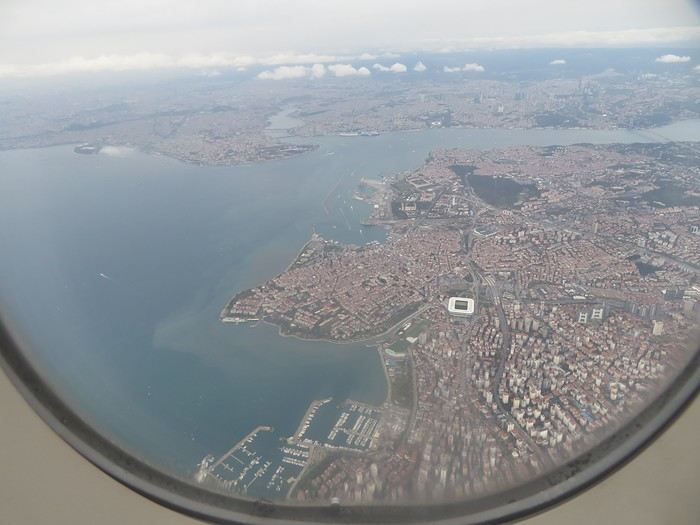
It all starts on a plane beginning its descent, knowing that the approach to Istanbul Airport is always quite long—about thirty minutes. Through the windows, if you’re lucky, you get a view of the city. You need to know a little to get your bearings, but here we’re on the side of Sabiha Gökçen Airport, south of Istanbul on the Asian side. You can spot the Bosphorus, the Golden Horn, and Fenerbahçe’s football stadium.

Landing over highways with three times four lanes, and then the airport tarmac for the taxi phase. This can take a while—sometimes nearly half an hour—but this morning, luck was on my side: barely more than 10 minutes. It’s rare now for Turkish Airlines planes to unload via pax buses, so we got a jet bridge. Avgeeks will immediately notice they’re not in Europe anymore but in another world: Pobeda, Belavia, and plenty of more exotic airlines. As the captain seriously put it in his final announcement after thanking the kids, it’s the “crossroads of the world.”
We suddenly step into a massive corridor, an endless, bright hall, usually deserted, and turn left or right—I think it’s always left for the flights I take, heading toward “transfers.” The walk is supposed to take a good ten minutes at worst. Watch out for airport vehicles—they come fast and don’t honk.
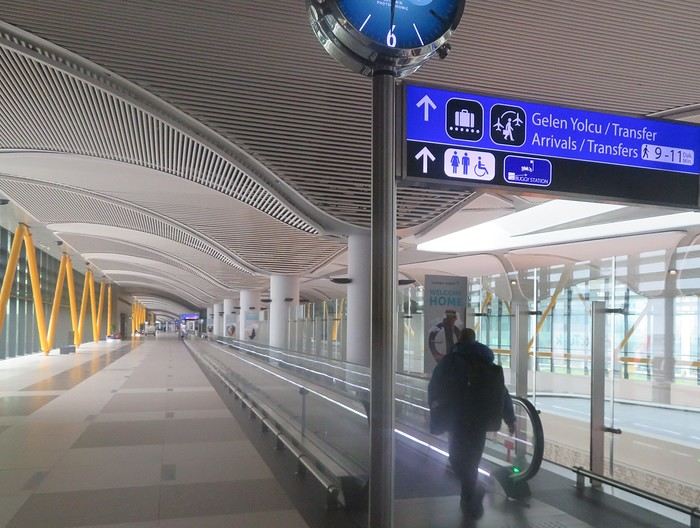
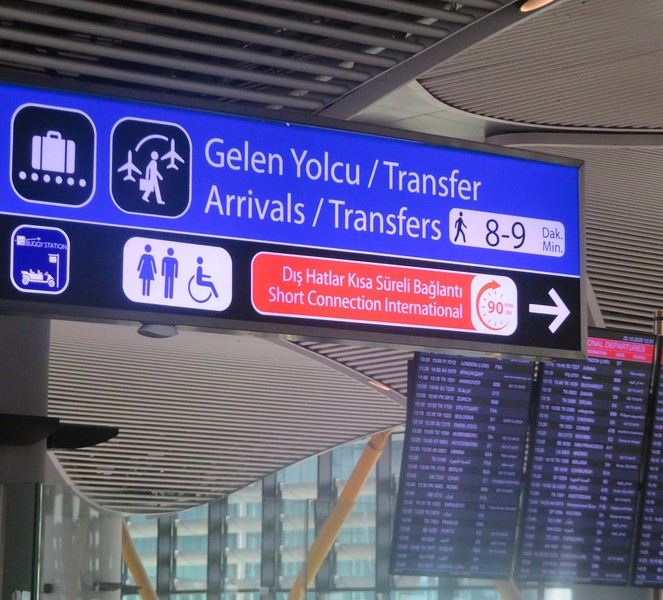
Here’s where it gets interesting: Istanbul has always had a bypass for short layovers, something you never hear about on forums. In the past, you had to bolt out of the jet bridge like a rocket and vaguely show your boarding pass to an attendant before sprinting. But now it’s institutionalized, and there’s signage that spares you from running all the way to the main security check. Until recently—at least the last time I did this—it even let you skip all formalities, dropping you like a wild dog into the departures area, which is spacious enough to stretch your legs!
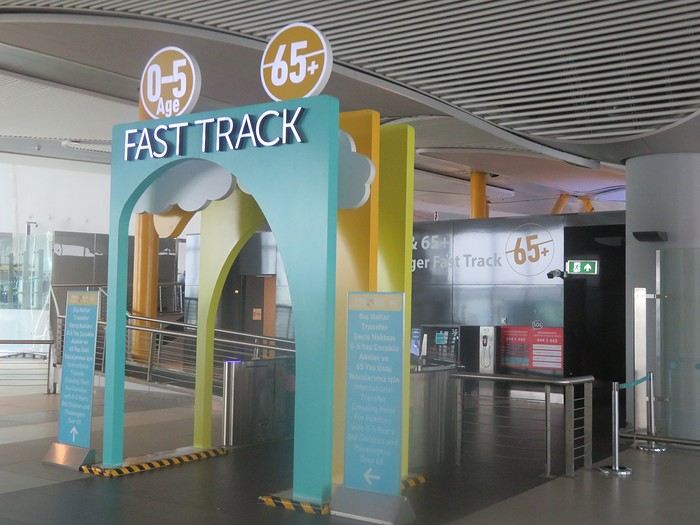
A heads-up for the young and the not-so-young: even without the bypass, if you’re under 5 (accompanied), over 65 (alone), you get fast track. That saves you a few hundred meters and possibly some waiting time, though I’m less sure about that. The entrance honestly looks like an amusement park, though.
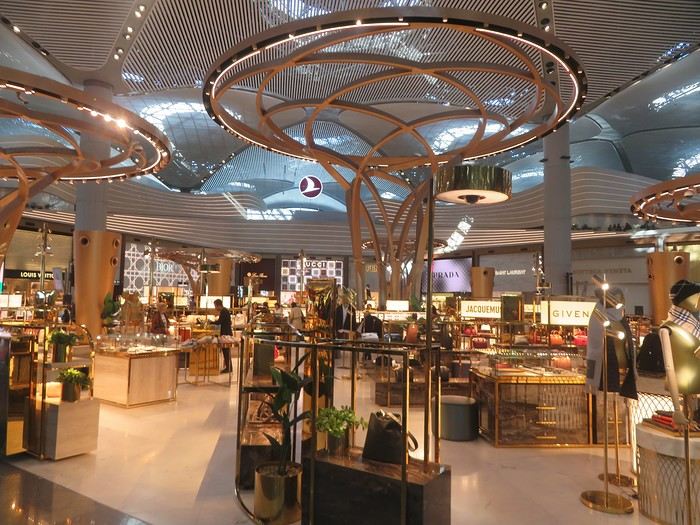
So, not young enough, not old enough, I keep going. I pass by dozens of passport control booths (in blue) and reach the transfer security checkpoint (in red). There’s a fast track for Business and Gold passengers—in my case, I’m both—but since it’s at the wrong end for my direction, it wouldn’t even be worth it. It’d just be a frivolous sprint. None of this is crowded at all; the wait lasted about a minute. You have to take out your laptop at this checkpoint—not all of them—but you haven’t had to take out liquids for a while in Istanbul. A hallway, an escalator, and then—bam—you’re in the Dubai-esque hall. One look says it all. Everything sparkles, everything’s expensive. *Very* expensive. Just for show, I spot a sandwich for around 12 €, and some simits for about 4 € (it’s in TL, but that’s roughly the conversion).
So, I head to the lounge—or one of the lounges—at Turkish Airlines, upstairs. Here too, there’s a priority entrance for families and people with reduced mobility, and an extra hundred meters for everyone else. A few of us seem to have had the same idea, and the twin lounges are under renovation for three months. One is for Business Class passengers, the other for Miles & Smiles and Gold members. They’re nearly identical. Needless to say, it’s packed—just as crowded in one as the other. There are *tons* of Business Class passengers on Turkish Airlines. I assume some other airlines’ passengers are mixed in, but not enough to explain the crowd. It’s as busy as Gare Montparnasse on a holiday departure day, and the 5 or 6 food counters, along with the salad and dessert buffets, are struggling to keep up. I didn’t dare ask to access the shower area, but I’ll admit the Wi-Fi works without the torturous maneuvers it required just a few months ago. Later, I’ll have to watch for the gate for my destination—Warsaw. With my usual luck, it’ll be in the F double-digits, the farthest ones, listed as 15 to 19 minutes away. That said, once you reach the end of that dead end, there’s plenty of quiet space with power outlets. Because here, there’s high demand for kilowatts.
My reporter’s conscience doesn’t go so far as to guide me here—I’ve covered the free access up to the iGA lounge, which has a good reputation but costs nearly 100 € for three hours. Maybe another time, on a promo day—I’ll keep an eye on their site. The piano starts playing “Bésame Mucho,” so I’ll pause my story here.

Michel
Since it’s a hot topic, yet rarely shown, and since there’s quite a bit of criticism and prejudice around it—and since I’ve had three in ten days—I’m going to talk about layovers at Istanbul Airport, especially with Turkish Airlines. This is a common scenario for forum members planning trips to Central Asia, the Caucasus, but also Japan, China, Australia, Africa, and more.
It all starts on a plane beginning its descent, knowing that the approach to Istanbul Airport is always quite long—about thirty minutes. Through the windows, if you’re lucky, you get a view of the city. You need to know a little to get your bearings, but here we’re on the side of Sabiha Gökçen Airport, south of Istanbul on the Asian side. You can spot the Bosphorus, the Golden Horn, and Fenerbahçe’s football stadium.
Landing over highways with three times four lanes, and then the airport tarmac for the taxi phase. This can take a while—sometimes nearly half an hour—but this morning, luck was on my side: barely more than 10 minutes. It’s rare now for Turkish Airlines planes to unload via pax buses, so we got a jet bridge. Avgeeks will immediately notice they’re not in Europe anymore but in another world: Pobeda, Belavia, and plenty of more exotic airlines. As the captain seriously put it in his final announcement after thanking the kids, it’s the “crossroads of the world.”
We suddenly step into a massive corridor, an endless, bright hall, usually deserted, and turn left or right—I think it’s always left for the flights I take, heading toward “transfers.” The walk is supposed to take a good ten minutes at worst. Watch out for airport vehicles—they come fast and don’t honk.
Here’s where it gets interesting: Istanbul has always had a bypass for short layovers, something you never hear about on forums. In the past, you had to bolt out of the jet bridge like a rocket and vaguely show your boarding pass to an attendant before sprinting. But now it’s institutionalized, and there’s signage that spares you from running all the way to the main security check. Until recently—at least the last time I did this—it even let you skip all formalities, dropping you like a wild dog into the departures area, which is spacious enough to stretch your legs!
A heads-up for the young and the not-so-young: even without the bypass, if you’re under 5 (accompanied), over 65 (alone), you get fast track. That saves you a few hundred meters and possibly some waiting time, though I’m less sure about that. The entrance honestly looks like an amusement park, though.
So, not young enough, not old enough, I keep going. I pass by dozens of passport control booths (in blue) and reach the transfer security checkpoint (in red). There’s a fast track for Business and Gold passengers—in my case, I’m both—but since it’s at the wrong end for my direction, it wouldn’t even be worth it. It’d just be a frivolous sprint. None of this is crowded at all; the wait lasted about a minute. You have to take out your laptop at this checkpoint—not all of them—but you haven’t had to take out liquids for a while in Istanbul. A hallway, an escalator, and then—bam—you’re in the Dubai-esque hall. One look says it all. Everything sparkles, everything’s expensive. *Very* expensive. Just for show, I spot a sandwich for around 12 €, and some simits for about 4 € (it’s in TL, but that’s roughly the conversion).
So, I head to the lounge—or one of the lounges—at Turkish Airlines, upstairs. Here too, there’s a priority entrance for families and people with reduced mobility, and an extra hundred meters for everyone else. A few of us seem to have had the same idea, and the twin lounges are under renovation for three months. One is for Business Class passengers, the other for Miles & Smiles and Gold members. They’re nearly identical. Needless to say, it’s packed—just as crowded in one as the other. There are *tons* of Business Class passengers on Turkish Airlines. I assume some other airlines’ passengers are mixed in, but not enough to explain the crowd. It’s as busy as Gare Montparnasse on a holiday departure day, and the 5 or 6 food counters, along with the salad and dessert buffets, are struggling to keep up. I didn’t dare ask to access the shower area, but I’ll admit the Wi-Fi works without the torturous maneuvers it required just a few months ago. Later, I’ll have to watch for the gate for my destination—Warsaw. With my usual luck, it’ll be in the F double-digits, the farthest ones, listed as 15 to 19 minutes away. That said, once you reach the end of that dead end, there’s plenty of quiet space with power outlets. Because here, there’s high demand for kilowatts.
My reporter’s conscience doesn’t go so far as to guide me here—I’ve covered the free access up to the iGA lounge, which has a good reputation but costs nearly 100 € for three hours. Maybe another time, on a promo day—I’ll keep an eye on their site. The piano starts playing “Bésame Mucho,” so I’ll pause my story here.
Michel
Travel is, above all, a story of encounters.
Those that inspire us, guide us, and make us dream.
That’s why we’re happy to announce a partnership between Petit Futé and VoyageForum, two worlds that share the same passion: travel experienced and recounted by those who truly set off.
In practical terms, you can now find VoyageForum directly on PetitFuté.com, through:
Over 190 destinations linked to the forum: on each “Discover the destination” page, a “Travelers’ Forum” tab lets you access discussions, tips, and testimonials from travelers just like you.
A link to the forum in the “Community” menu under “Discover the forum”, where you can chat, ask questions, or simply dream about your next getaway.
This partnership marks a new step in giving travelers even more of a voice. A way to connect practical information and lived experience, to share insights so everyone can plan their trips by relying on what’s most valuable: exchanges between enthusiasts.
Thanks to all of you who keep this wonderful community alive, day after day. Because travel is even more beautiful when it’s shared
In practical terms, you can now find VoyageForum directly on PetitFuté.com, through:
Over 190 destinations linked to the forum: on each “Discover the destination” page, a “Travelers’ Forum” tab lets you access discussions, tips, and testimonials from travelers just like you.
A link to the forum in the “Community” menu under “Discover the forum”, where you can chat, ask questions, or simply dream about your next getaway.
This partnership marks a new step in giving travelers even more of a voice. A way to connect practical information and lived experience, to share insights so everyone can plan their trips by relying on what’s most valuable: exchanges between enthusiasts.
Thanks to all of you who keep this wonderful community alive, day after day. Because travel is even more beautiful when it’s shared
Starting May 1, 2025, Thailand plans to introduce a Digital Arrival Card, an electronic arrival form to be completed before departure. Inspired by Cambodia’s system, this formality aims to digitize the collection of traveler information. The exact details (whether it will be mandatory, the form’s content, submission deadline) are still to be confirmed. In 2024, Thailand welcomed over 25 million visitors—a figure on the rise but still below the 2019 record (39 million).
Read more...
Hi,
Air Cairo offers good prices on domestic flights and schedules that work for us, but is this airline reliable?
Thanks in advance for your feedback.
Hi there.
I’m planning a trip to Chile, and the fares from the Colombian airline Avianca are really appealing.
Way cheaper than Air France, for example.
That said, the reviews I’ve seen online aren’t great.
What do you think of this airline?
Have any of you taken long-haul flights with Avianca?
Thanks in advance for your replies.
Eric
Hello,
We're heading to Peru at the end of July 2026 for 18 days. We're a couple with two teenagers aged 14 and 16. I'm considering booking our Paris - Lima - Paris flight with AVIANCA because the fare is very competitive compared to other airlines. The return trip would include a 15h30 stopover in Bogota, with the idea of spending the night in a hotel near the airport to catch the 1:30 PM flight the next day. The arrival and departure times in Bogota work well. Have any of you already flown with AVIANCA on a Paris - Lima route? What was your experience with this airline? Thanks in advance for sharing your thoughts. I'm hesitant to book with them, but the price difference with the cheapest alternative (Air France) is 1500 €, which is significant... thanks for your help! !
we have flights with Swiss and Lufthansa for January; our flights are still in our booking file. But after reading that the Cambodian ambassador in Paris advised against transiting through Bangkok (which is our case), I reached out to the airlines to potentially change our ticket via Singapore. However, both companies have canceled all flights to Cambodia, regardless of the day or airport. We’ll have our contact on the ground call us on Monday to figure out what to do, especially since no insurance covers war, conflict, etc. If anyone else is in the same situation with an upcoming departure, we can exchange tips
Hi there,
We’re heading to Mexico in May, and I’d love to know if any of you have flown with this airline before and what you thought of it.
Thanks for your feedback!