Africa: A Heartfelt Love for a Continent
FR

Translated into English.

Original post
TA
“When the Whites came to Africa, we had the land and they had the Bible. They taught us to pray with our eyes closed: when we opened them, the Whites had the land and we had the Bible.” Jomo Kenyatta (p.7)

The Maggi cube, an unchallenged hegemony, and so much more

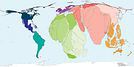
“The hopeless continent,” headlined The Economist, a British magazine, in July 2000 about Africa. Eleven years later, the same magazine headlined “Africa rising” instead. Images of Africa in the prosperous North constantly oscillate between apocalyptic scenarios and enthusiastic projections. A key issue with such images lies in the generalization they entail. If you look at the continent, considerable contrasts emerge depending on space and time. It’s no surprise that a region of the world encompassing such diverse ecological zones, maintaining such varied ties with other continents, comprising nearly fifty nation-states in sub-Saharan Africa alone, and characterized by a great diversity of languages, belief systems, and historical paths, doesn’t share a single destiny.

And yet, for many people outside Africa, as well as for many Africans, the continent constitutes a single entity, defined by criteria such as skin color, a colonial past, poverty, and the art of survival. Until now, these perspectives were generally accompanied by the idea that Africa had to—or should have—followed a single path together, sometimes called development, sometimes modernization, sometimes liberation, then a market economy. None of these paths delivered on their promises.

The two writers Alain Mabanckou and Abdourahman Waberi—one from Congo, the other raised in Djibouti, both long settled in France and now professors at renowned North American universities (Los Angeles, Washington)—have had enough of pessimistic scenarios: “We are aware that Africa is in the world and the world is in Africa. The same goes for all other continents, as our destinies are inextricably linked for better or worse. We refuse to see Africa as a reservoir of misfortunes or a continent cursed by atavistic misfortune and characterized by ethnic conflicts. [...] It’s this passionate flame we wanted to capture in a book [...] a kind of stroll through African cultures, without any demands, each letter of the alphabet leading us to a notion, a practice, a concept, a moment in history, literature, painting, politics, economics, cuisine, etc.” (p.10-11). Africa, they write, is on the verge of “imposing a signature, a style, a way of being in the world and in relation to the rest of the world.” (p.11) To put words to the continent’s diversity and dynamism, the two authors created a “rambling ABC,” a kind of portrait—or more precisely, a mythography—that lets you see and feel the pulse of a vast continent whose cultural power is unfolding before our eyes. Once marginalized or even mocked, the voice and importance of the Continent in global affairs are now undeniable” (p.11), containing over a hundred entries, mostly concise, written in a relaxed and casual style. The optimistic, even exuberant tone is set from the brief introduction. The duo of authors wants to “sing a love song to the cultures of our continent, to its inhabitants past and present, to its exceptional resources and its spectacular globalization despite a certain pollution that still clouds our skies due to the unmatched duration of dictatorships in some of our regions.” (p.12) In doing so, they don’t want to be too distracted by today’s Afewerki-Biya-Bongo-Déby & Co. ...

Of course, you’ll find tributes to great precursors like Frantz Fanon (“[...] it was a love story and admiration that wasn’t dimmed by the four decades separating his birth from ours. Let’s add that we were born while the native of Fort-de-France had left the world’s stage four years earlier, in the prime of life” p.141), Mongo Beti (“You must read and reread Mongo Beti, a genius who used his fame to support often just causes in Africa, like defending oppressed groups. His place is already in History. His oppressors, like the dictators Ahmadou Ahidjo and Paul Biya, can’t compete in the same category” p.64), the Malian Amadou Hampâté Bâ

(“Posterity remembers him mainly as an tireless defender of African cultures. His plea for the collection and preservation of traditional African knowledge remains a major event for all men and women of good will. One day in 1960, at the UNESCO podium, the native of Bandiagara sounded the alarm: ‘[...] Since we’ve admitted that the humanity of each people is the heritage of all humanity, if African traditions aren’t collected in time and written down, they’ll one day be missing from the universal archives of humanity.’” p.51),

Kwame Nkrumah, “one of the founders of Pan-Africanism, father of Ghana’s independence” (p.239), as well as the historian Cheikh Anta Diop, the writer, poet, and politician Aimé Césaire, and the economist and thinker Samir Amin, but also very warm tributes to certain contemporary African intellectuals like Souleymane Bachir Diagne and Achille Mbembe

(“A few years ago, in dominant economic circles, a rumor often resurfaced, usually disguised as a cold and scientifically proven analysis: Africa is useless. It’s a burden for the rest of the human community. With its 2% share in world trade, it would disappear from stock market radars without anyone noticing. So? Maybe it’ll be pulled up by other continents. Wanting to surpass itself is a crazy bet for Africans, they concluded. Arrogant or clueless, President Nicolas Sarkozy declared before an audience of students and teachers at Cheikh Anta Diop University in Dakar: ‘The African man hasn’t entered history enough [...] He only knows the eternal repetition of time marked by the endless repetition of the same gestures and words.’ That was in 2007. For decades, armed only with reason, an intellectual often steps up to debunk prejudices, lazy readings, and dishonest frameworks used as false fronts by those who, like Nicolas Sarkozy or former journalist Stephen Smith, out of ignorance, contempt, or condescension, distort African reality. This intellectual is none other than the historian and political scientist Achille Mbembe. This heir of Frantz Fanon, Amílcar Cabral, Jean-Marc Ela, and Fabien Eboussi-Boulaga was born in 1957 in Cameroon, in the Bassa region. Marked early by the upheavals of a fratricidal war, Achille Mbembe became the guardian of the memory of martyrs. After brilliant studies in Paris, he went on to teach at the best American universities, but the call of the Continent was stronger than anything else. In Dakar, he once directed CODESRIA (Council for the Development of Social Science Research in Africa) before joining the University of the Witwatersrand in Johannesburg, South Africa. Even though the author of *Critique of Black Reason* (Éditions La Découverte, 2015) spends a few months at Duke University in North Carolina, his observation post remains South Africa. From Johannesburg, Achille Mbembe scrutinizes Africa and the whole world. A lucid observer with an elegant and generous pen, Achille Mbembe knows how to blend big and small history: ‘I was born one day in July, as the month was drawing to a close. It was 1957, in that part of Africa recently named ‘Cameroon,’ a memory of the wonder that seized Portuguese sailors in the 15th century when, sailing up the river near Douala, they couldn’t help but note the presence of a multitude of crustaceans, and named it *Rio dos Camarões*, meaning ‘River of Shrimp.’ I grew up in the shadow of this nameless land, since, in a way, the name it bears is only the product of someone else’s astonishment: a lexical mistake, if you will.’ From this mistake or wound, he made leaven, a springboard to compose a rich work, recognized worldwide. To denounce barriers and barbarians too. But that’s not enough. Among his peers in circles of thought and action, Achille Mbembe passionately and consistently defends human dignity and the beauty of the world. In doing so, he fulfills the mission Frantz Fanon entrusted to him.” (p.227-229),

as well as entries dedicated to lesser-known artists and intellectuals, like the French journalist and activist Rokhaya Diallo, daughter of Senegalese and Gambian parents, or the Ethiopian filmmaker Haile Gerima, who has long lived in the United States. Other names from politics, sports, music, art, and literature: Kofi Annan, p.36; Barack Obama, p.243; Thomas Sankara, p.277; Ousmane Sow, p.285; Yambo Ouologuem, p.250; Léopold Sédar Senghor, p.282; Muhammad Ali, p.30; Nuruddin Farah, p.146; Salif Keita, p.203; Ahmadou Kourouma, p.206; Ngũgĩ wa Thiong’o, p.236; Winnie Mandela, p.224; Kylian Mbappé, p.226 ...

The authors, who resolutely commit to a “mythography” (p.11) of Africa, also pay special attention to local social movements, cultural events, and aspects of daily life. *Y’en a marre*, “which also meant ‘we’re fed up with sitting on our hands’” (p.320-321), emerged about a decade ago in Senegal as a citizen movement of peaceful resistance and symbolizes, the authors emphasize, the fact that African youth are increasingly fed up “with the political circus deployed in Africa since independence, as our parents would say, ‘since the White man left’...” (p.321). A full entry is dedicated to the Maggi bouillon cube, which has flooded African markets for about forty years and enjoys immense popularity (“It’s everywhere in Africa, from Dakar to Djibouti, and from Tangier to Cape Town. It’s in every pot, every stew. Little hands put it in every sauce, every local or adapted dish. An unchallenged hegemony! You’ll find it in diasporas too. The culinary strolls in Paris, in the [...] neighborhood” p.90). Critics blame it not only for impoverishing the aromatic diversity of local dishes but also for being harmful to health. And yet, “he poorest Africans, those who eat only once a day, a few spoonfuls of white beans and a ball of *foufou*, for example, are the most fervent users of the magic cube.” (p.92-93)

For *fonio*, “the new trendy cereal. [...] From the millet family, fonio is probably the oldest cereal cultivated in West Africa, and mainly in its sub-Saharan part, for millennia. [...] Easy to grow, water-efficient, fonio grows everywhere except on clay soils. Long neglected because it was considered the poor man’s crop, fonio is now a source of pride for the farmers who cultivate it and cherish it like the apple of their eye” (p.156-157), the authors immediately offer a detailed recipe, letting the reader know that “e can’t resist sharing this fonio with chicken recipe from Mali with you:

Ingredients: 1 chicken 3 large ripe red tomatoes 4 tbsp tomato paste 4 large onions 1 garlic clove 1/2 cup oil 2 Maggi cubes or salt 2 large carrots 1 turnip 1 large cabbage 2 large potatoes 1 celery stalk 1 packet pre-cooked fonio 4 okra (or okra powder) salt, pepper

Preparation: 1. Prepare the sauce: wash and cut the chicken. Peel the onions, garlic, and vegetables. 2. In a pot, fry the chicken pieces. 3. Dice the onions, tomatoes, carrots, and turnip very small and add them to the pot. 4. Add the tomato paste, salt, and pepper. 5. Simmer for 15 min, then add 2 L of water and the cooked chicken pieces. 6. Simmer for 30 min, then add the crushed garlic and celery, plus the cabbage cut into 4 and the potatoes cut in half. 7. Prepare the fonio: cover it with warm water, let it rest for 15 min, and cook it over low heat. 8. In a small pot, boil the okra and crush them. 9. Mix the crushed okra with the cooked fonio, then salt. Serve hot.” (p.158-159)

The comedy *Black Mic Mac*, released in French theaters in 1986 and addressing France’s increasingly restrictive immigration policy at the time, also gets an entry, as do *Tintin in the Congo*, the popular comic, and *Jip’s Café* (“[...] a little Africa in the heart of Paris, with passersby stopping to admire the ‘ambianceurs’ on the dance floor or attend the cultural events offered by the place” (p.194), an African establishment in Paris that Alain Mabanckou already immortalized in one of his novels.

The duo of authors also tackles thorny subjects like jihadism (p.119), the Rwandan genocide (p.272), the CFA franc (p.82), and dictatorship (p.110). While the two strike the right tone here, many entries leave a slightly bitter taste. Two examples: why doesn’t the text on Barack Obama mention the great disappointment of many people in Africa, who expected more from the African policy of the first U.S. president with African roots than just occasional warm words? Why do the comments on Winnie Mandela gloss over the fact that she was a highly controversial icon of the anti-apartheid movement due to her involvement in kidnappings, acts of torture, and murders of alleged apartheid collaborators? Instead, there’s a compassion that brings tears to the eyes: “She was often reduced to a secondary role, the wife of a great man” or “When victory came, she didn’t taste its fruits. Divorced, isolated. She would never be a ‘first lady’ in an evening gown, posing before a bed of chrysanthemums. They’d keep her far from the circles of power” (p.224-225). At this point, I would’ve liked the authors to take a slightly more critical stance...

That said, these “weaknesses” (if you can call them that) shouldn’t overshadow the book as a whole. It remains an informative, sometimes very entertaining, and often even original work in its own way.

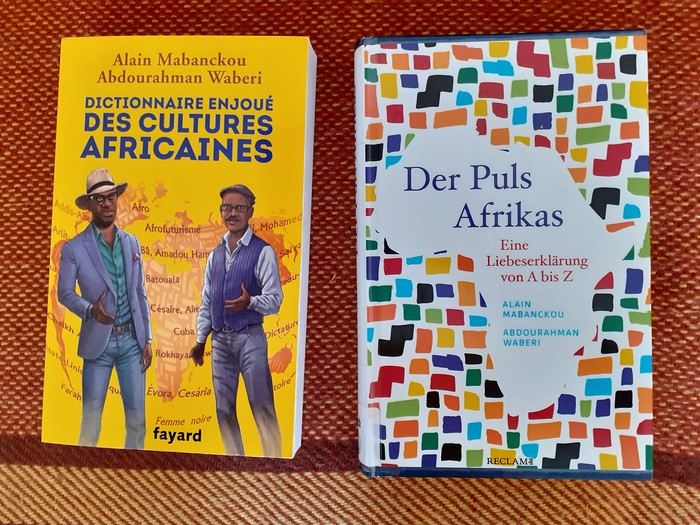
Book information (the original French and the German translation):

Alain Mabanckou/Abdourahman Waberi. Dictionnaire enjoué des cultures africaines. Fayard, 2019. Alain Mabanckou/Abdourahman Waberi. Der Puls Afrikas. Eine Liebeserklärung von A bis Z. Reclam, 2022.

Hery
VO Voyajou Globetrotter ·
Thanks so much for these reading notes.

Last year I reread Gaston Kelman’s *I Am Black and I Don’t Like Manioc*. He plays his part in the Black blues with undeniable talent.
TA Taamaden Veteran ·
Addendum to the initial post:

FOREWORD

In Search of the Magnetic Energy of the Continent

Our initiative to write a book together dates back a long time. We’ve known each other since the 1990s—one from Congo-Brazzaville, the other from Djibouti, both students in France. Back then, we witnessed Nelson Mandela’s release and the end of apartheid, while many African nations, following the Franco-African Summit of La Baule (which tied French aid to the establishment of democratic regimes), turned away from Marxism-Leninism or, at least on paper, opted for multiparty politics (Benin, Cape Verde, Côte d'Ivoire, Congo-Brazzaville, Gabon, Niger, former Zaire...). But this momentum, despite the optimism of African peoples, was quickly tarnished by the Tutsi genocide in Rwanda, the civil wars in Sierra Leone and Liberia, the conflict between Ethiopia and Eritrea, or the overthrow of Chad’s Hissène Habré regime by his military advisor Idriss Déby, backed by Libya’s Muammar Gaddafi... Despite these dark spots, we remained optimistic about our continent’s future, believing that understanding it was becoming increasingly urgent. Our exchanges revolved around our respective cultures—those of Abdourahman Waberi’s Horn of Africa, a region of the most diverse geopolitical stakes, and those of Alain Mabanckou’s Central Africa, the territory of Free France during the Occupation. In these discussions, some realities overlapped, while others were diametrically opposed. We had before us a vivid illustration of the diversity of our customs and traditions. Every time we returned to Africa, we loved hearing the urban vocabulary where French mingled with local languages, proving more than ever that our era was one of blending, of mixing, of the “bronze civilization,” to borrow a phrase from the Congolese poet Tchicaya U Tam'si.

We’re aware that Africa is in the world, and the world is in Africa. The same goes for all other continents, as our destinies are inextricably linked for better or worse. We refuse to see Africa as a reservoir of misfortunes or a continent cursed by atavistic woes and ethnic conflicts. We’re amazed by the passion of the “African diasporas.” It’s this fiery enthusiasm we wanted to capture in a book, though we had no clear idea of its form until one day, while having a drink in Paris’s 18th arrondissement—a habit of ours—we stumbled upon a kind of stroll through African cultures, with no constraints. Each letter of the alphabet led us to a notion, a practice, a concept, a moment in history, literature, painting, politics, economics, cuisine, etc. Needless to say, the Africa of our hearts and dreams is broader than the Continent itself, and its history deeper than a thousand Wakandas. All diasporas (from Canada to Argentina via Haiti, from the Swahili archipelagos and shores to Mauritius via Madagascar) and Black populations in major cities (from Paris to Singapore and Melbourne) surround it with affection.

This book is a meandering alphabet book, a kind of portrait—or more precisely, a mythography—that reveals and conveys the pulse of a vast continent whose cultural power is unfolding before our eyes. Once marginalized or even mocked, the voice and importance of the Continent in global affairs are now undeniable. Africa is on the verge of imposing its signature, its style, its way of being in the world and relating to it. Of course, there’s a strong initiatory dimension to our project, and we’d long discussed its distinct identity, as if it were a colorful, emotional film narrated by a duo of complicit actors, punctuated by bursts of laughter. We didn’t want to dress up in formal attire to tackle the task; we were casual, in jeans and sneakers, to follow the whims of our minds and draw on the experiences from our various travels when needed. We weren’t aiming for exhaustiveness; we simply wanted to sing a love song to our continent’s cultures, to its people past and present, to its exceptional resources, and to its spectacular globalization despite the lingering pollution of prolonged dictatorships in some regions. We gave our project a strong visual identity and tried to steer clear of clichés and other stereotypes about an “underdeveloped Africa” in search of bread or a white savior with a Hollywood halo. The echoes of our time’s questions are numerous, which made some choices more complex. Far from being an obstacle, the dictionary’s fragmented nature and its assumed sense of incompleteness give readers the freedom to explore where we couldn’t or didn’t linger. We intend to continue our collaboration, and this book is thus an invitation to open other dictionaries, to leaf through other works of fiction, theory, history, and images. It’s also, as you’ll quickly realize, the ripe fruit of a bond that’s never left us since our student days, when we were preparing to submit our first manuscripts to publishers. We hope its lively style will work like a camera electrified by the magnetic energy of our entire continent.

A. MABANCKOU, A. WABERI (pp. 9–13)

xxxxxxxxxxxxxxxxxxxxxxxxxxxxxxxxxxxxxxxx

One can only speculate about the criteria behind the selection of these entries. In any case, the result is a heterogeneous and eclectic mix covering a wide range of personalities, events, places, institutions, and themes. The African diaspora, to which the two authors belong, occupies a prominent place in this collection. Here’s the full list of entries, in alphabetical order:

A

Abacost – Addis Ababa – Adwa (Battle of) – Afro – Afrofuturism – Ali, Muhammad – Amin, Samir – Annan, Kofi – Arlit – Urban Adventure

B

Bâ, Amadou Hampâté – Bahia (São Salvador de Bahia, Black Brazil) – Balai Citoyen – Baobab – Batouala – Beti, Mongo – Bissap – Black Mic-Mac – Bloggers – Brazzaville

C

Coffee – Cowrie – Césaire, Aimé – CFA franc – Château-Rouge – Chéri Samba – Coetzee, John Maxwell – Cuba – Maggi Cube

D

Dadié, Bernard – Development – Diagne, Souleymane Bachir – Diallo, Rokhaya – Diawara, Manthia – Dictatorship – Diop, Birago – Diop, Cheikh Anta – Djebar, Assia – Jihadism

E

Writing (of History) – The Dark Child – Toward the United States of Africa – European – Évora, Cesária – Exhibit-B

F

Fanon, Frantz – Farah, Nuruddin – White Man’s Burden – “Black Woman” – Feymania – Fonio – Fufu – Black France

G

Gerima, Haile – Gide, André

H

Haiti – Herero

I

Ibrahim, Abdullah – “Independence Cha Cha” – Military Interventions

J

Youth (Amadou Hampâté Bâ’s Letter to the) – Jip’s Café

K

Si Kaddour Benghabrit – Kasàlà – Keita, Salif – Keur Samba – Kimpa Vita (or Dona Beatriz) – Kourouma, Ahmadou – Kwanzaa

L

Laâbi, Abdellatif – “Little Ethiopia”

M

Mami Wata – Mandela, Winnie – Mbappé, Kylian – Mbembe, Achille – Monument to the Black Army Heroes

N

Nardal, Paulette – Ngũgĩ, wa Thiong'o – Nkrumah, Kwame

O

Obama, Barack – Omar, Ibn Saïd – Ouologuem, Yambo

P

Pauline (Patrice Lumumba’s Letter to His Wife) – Présence Africaine

Q

Quinquéliba (or Kinkéliba)

R

Climate Refugees – Congolese Rumba – Rwanda (Tutsi Genocide)

S

The Wail of the Black Man – Sankara, Thomas – SAPE – Senghor, Léopold Sédar – Sharif, Omar – Sow, Ousmane – Sy, Omar

T

Land of Ebony – Tintin in the Congo – Senegalese Tirailleurs

U

Ubuntu – Uhuru

V

Valiha – Voodoo – Fan Dance or Leumbeul – Hottentot Venus (Saartjie Baartman)

W

Wainaina, Binyavanga – Wax

Y

“Y’a bon Banania” – Y’en a Marre

Z

Zembla – Zemidjian (Zem)

xxxxxxxxxxxxxxxxxxxxxxxxxxxxxxxxxxxxxxxx

https://www.monde-diplomatique.fr/2020/03/GALY/61524

https://www.lemonde.fr/afrique/article/2019/11/27/faux-dico-vrai-manifeste-mabanckou-et-waberi-redefinissent-l-afrique_6020777_3212.html

https://journals.openedition.org/trans/3464?lang=It#ftn84

Whether it’s a dictionary, a love letter, or a manifesto—as *Le Monde* puts it (“Fake Dictionary, Real Manifesto: Mabanckou and Waberi Redefine Africa”, Nov. 27, 2019)—doesn’t really matter. The two authors seem to have found an original and highly successful form to put into words the diversity of the African continent through over 100 short essays and reflections full of humor and insight. A book that’s often personal and always enlightening about an Africa whose rich tradition is only partially known to the world—and which is evolving at an impressive pace.

Hery
SI Sinforosa Veteran ·
Hi there,

Thanks so much for this reading suggestion—it made me want to order it!

Among the names mentioned, there are quite a few I don’t know.

Rokhaya Diallo is pretty well-known in France. For several years, she was part of a late-night show on RTL called *On refait le monde*, where journalists and "intellectuals" discussed French and international news. She often talked about her experiences in the U.S., where she spent part of the year, and she was frequently invited on TV to debate with people who had very different views from hers.
" Celui qui voyage sans rencontrer l'autre ne voyage pas , il se déplace " ( Alexandra David-Néel )

" Ahora todos quieren ser latinos , no , ey , pero les falta sazon , bateria y reggaeton " ( Bad Bunny )
TA Taamaden Veteran ·
Hello there!

Thanks for your reply!

To be honest, I didn’t know this person, except for their last name, Diallo (Jalo in Bambara/Bamanankan), which is very common in West Africa and beyond. It’s a Fulani name: the Fulani (Fula, Fulani, Pulo...) are traditionally cattle herders who, although mostly sedentary today, remain very mobile. Their language, Fulfulde (Fulfulde, Fulani, Ful, Peul, Pulaar...), is now spoken in about twenty African countries, roughly from Senegal to Sudan. This also explains the wide dispersion of the name Diallo. Of course, the name has long since spread to other ethnic groups; for example, my Bambara teacher was also named Diallo, even though he was a Bambara man (he sadly passed away).

It’s a bit like the German last name Müller (which becomes Muller in France, Miller in Britain, etc.)...

If you’re interested, I’d be happy to introduce you to this entry:

Diallo, Rokhaya

It’s easier for us to talk about the joys and struggles of Afro-European communities outside of Europe. Distance sharpens perspective and soothes the heart. We had the privilege of speaking at length with Rokhaya Diallo in Dallas, Texas, during the 38th congress of the African Literature Association (the oldest scholarly society on African literatures), held from April 11 to 15, 2012. Our discussion focused on the contours of what’s called “Black France” overseas and what we’ve seen emerge in recent decades. Far from the rushed, self-absorbed media persona some academics feared would show up in the halls of the grand Adolphus Hotel, we met an open and smiling woman, despite the jet lag. Over four long, studious days, she showed great humility and patience. She listened carefully before making an argument.

Born on April 10, 1978, in the 4th arrondissement of Paris, to Senegalese and Gambian parents, Rokhaya Diallo is a French journalist, producer, and activist known for her fight against all forms of racism and discrimination. This “Frenchwoman without comment,” as she often says with a little smile, has become the voice and face of a France long ignored and marginalized by the political class. The journalists from Libération who profiled her in 2009 met the same Rokhaya Diallo we saw in Dallas: “... Petite, she has both charm and edge. In jeans, without heels, with earrings and a fitted shirt, she’s feminine but not flashy. With her close-cropped hair, all you see is her angelic face.”

At the time, she was still president of the association “Les Invisibles,” which has been awarding a rather, how should I put it? *formidable* prize for four years: the “Y’a Bon Awards.” Our American students shared our enthusiasm for these awards, which honor the “worst racist remarks” made by public figures, like the three winners of the 6th edition in 2015: former National Front leader Jean-Marie Le Pen, comedian Dieudonné, and polemicist Alain Soral. The list of winners will interest political scientists and psychiatrists alike. Les Invisibles revitalized civic debate by using a very French weapon: laughter and song. Their goal? Nothing less than “deconstructing, especially through humor and irony, ethno-racial prejudices, starting with the one that denies or devalues the French identity of non-white French people,” as their website puts it.* This kind of humor is far more effective than the self-righteous moralizing of old-school anti-racist organizations like SOS-Racisme.

Rokhaya Diallo meets the public, travels across France, and does her job as a presenter or producer with talent and consistency. She also writes. Her latest book, À Nous la France! (Michel Lafon, 2012), is a clear, precise, and didactic analysis. In four chapters, she debunks many misconceptions. For over a decade, our Parisian has been gaining influence. Her fight against racism, sexism, and Islamophobia is recognized in France, Europe, and the United States. The new bogeyman of racists who vilify her on social media, Rokhaya Diallo’s work—bearing witness to the surge of racist, xenophobic, homophobic, and Islamophobic violence and bringing it into the public square—shows no signs of ending. With renewed effort and vigilance, Rokhaya Diallo expresses her hope that her country, dear and sweet France, will face the future with energy and serenity.

*https://www.helloasso.com/associations/les-indivisibles

pp. 105–107

Have a great weekend, Hery
SI Sinforosa Veteran ·
Hello again,

Indeed, as the book's authors write, Rokhaya Diallo is the "bête noire" of racists who accuse her of wokism, but she’s got a sharp comeback and knows how to defend herself.

I noticed there’s also an entry for "Cuba" and "Bahia"—I assume it’s about Santería, which is very present in Cuba, where every Virgin and Catholic saint corresponds to an orisha. This syncretism is also found in Brazil with Candomblé.

In Cachoeira, in the state of Bahia, I attended the Festa da Boa Morte, a beautiful example of syncretism between Catholicism and Candomblé. It’s led by women descended from enslaved people who organize the processions and ritual dances. Every year, this festival attracts groups of African-American women from the USA who come to witness it. The year I was there, the singer Carlinhos Brown was also in the crowd following the procession.

In Salvador da Bahia, I visited the "Casa do Benin" and learned that many descendants of enslaved people had returned to Africa. In Brazil, they’re called "os retornados," and in Africa, particularly in Benin, they’re known as "agoudas." I read that Brazilian roots can still be seen in certain family names and festivals there. This visit made me want to visit Benin to learn more—I’ve been thinking about it for a while (I was waiting to see what would happen after this year’s elections).

Thanks again for your very informative messages!
" Celui qui voyage sans rencontrer l'autre ne voyage pas , il se déplace " ( Alexandra David-Néel )

" Ahora todos quieren ser latinos , no , ey , pero les falta sazon , bateria y reggaeton " ( Bad Bunny )
TA Taamaden Veteran ·
Hello!

Thank you so much for these evocative accounts of your experiences in Bahia, for that connection with Africa that comes through in your words. I almost feel like you’ve anticipated Mabanckou/Waberi a little. Thank you, thank you!

The fact that the duo of authors specifically included « Bahia » as well as « Cuba » (or even « Haiti » (« No need to be a great traveler to emphasize that Haiti comes from the boiling womb of Africa. » p.173)), but especially « Bahia » (« Bahia is the pearl of Brazil, and to say Bahia is to say Black Africa. The presence of Africa there is dense. We’re talking about hundreds of millions of captives turned into slaves, into things. Layers of Africa, sedimented, agglomerated together. Millions of Ashanti, Fulani, Yoruba, Igbo, Bakongo, Ovimbundu, and other groups. We’ve been fortunate to visit many countries, and we must admit there’s no region in the New World where the word Africa resonates with such clarity as the bay of Salvador de Bahia. With clarity, but also with strength and joy, as some may have experienced in the novels of Jorge Amado, a native of Bahia, or in the photos of ethnologist Pierre Verger. » p.53 or « By one of history’s ironic twists, the presence of African spirits, peoples, and totems is more pronounced in Salvador de Bahia today—the famous São Salvador de Bahia de Todos Os Santos, as its official name goes, since Brazilians don’t skimp on long names—than in Luanda or Cotonou, where these spirits live secluded and neglected in dusty backyards or deep in the Angolan and Beninese bush. » p.54) in their selection speaks to their intelligence, but also their insight regarding the vast complex known as Africa. And in my opinion, this also shows that the book is built around a central idea—it’s far more than just a simple compilation of names, etc. On this point, I completely agree with the newspaper Le Monde. The opposite example is another dictionary, that of Hervé Bourges, Dictionnaire amoureux de l'Afrique, a collection (I’m almost tempted to say) of mostly random names—but no « Bahia », no « Cuba », no « Haiti », no « Frantz Fanon »... That says a lot, at least to me (without implying Bourges’ book is bad—far from it—but it doesn’t hold a candle to Mabanckou/Waberi, not by a long shot)...

Wishing you a beautiful Sunday, as lovely as back home!

Hery
SI Sinforosa Veteran ·
Hi there,

I can’t remember which Brazilian museum it was where I read this quote by the Jesuit Father Antonio Vieira: "O Brasil tem seu corpo na América e sua alma na Africa" (Brazil’s body is in America and its soul is in Africa). And it’s even more true in Bahia—just look at the population, festivals, cuisine, and so on.

In Salvador da Bahia, I bought some photography books by Pierre Verger (gorgeous black-and-white photos of the people, Candomblé ceremonies, etc.) and a cookbook featuring some of his photos along with texts explaining the myths of the orixás and the African origins of certain Bahian dishes, like acarajé, which was originally an offering to the orixás.

On YouTube, I watched documentaries by chef João Diamante. He’s from Salvador da Bahia and traveled to Benin to explore the roots of Bahian cuisine. There, he rediscovered the origins of acarajé and feijoada, Brazil’s national dish. He also met locals with Portuguese surnames—short but fascinating documentaries (João Diamante, *Origens - Um chef brasileiro no Benin*, YouTube).

At the Casa do Benin in Salvador da Bahia, I attended a lecture on quilombos, communities formed by escaped slaves in remote areas. Their descendants still live there today—poor but resilient towns.

Otherwise, in Brazilian museums, which often host remarkable exhibitions, the themes of slavery and the resistance of Black populations come up frequently.

Anyway, I’m going to buy this book—it looks really interesting! !
" Celui qui voyage sans rencontrer l'autre ne voyage pas , il se déplace " ( Alexandra David-Néel )

" Ahora todos quieren ser latinos , no , ey , pero les falta sazon , bateria y reggaeton " ( Bad Bunny )

Similar discussions

You might also like