J'ai le projet de partir pour plusieurs mois visiter l'asie du sud est en traversant l'europe de l'est avec un passage en inde (New Delhi à Calcutta), en Täïlande, Indonésie et Viet Nam. Selon ce type d'itinéraire, pour consolider mon cadre de vélo (trek), je souhaite installer une fourche en acier, avec des jantes particulièrement résistantes et des pneus shwalbe. J'ai entendu parler des fourches acier de chez Reynolds, qu'en pensez-vous? que me conseillez-vous d'autre en matière de solidité ? Je m'interroge également sur le choix des jantes, je crois que les Mavic sont de qualité pour ce type d'itinéraire. Enfin, et ça sera la dernière, j'hésite entre les pneux shwalbe marathon XR (moins roulants paraît-il) et les XS préconisés davantage pour la route, ce que je compte effectuer principalement si mon itinéraire le permet.
C'est vrai que les XR sont un peu moins roulants, ils sont également un plus bruyants. Par contre, en plus d'être très à l'aise sur chemin, ils ont aussi l'avantage d'être renforcés sur les côtés pour supporter des lourdes charges et durer plus longtemps...
Pour la fourche, pas de marque particuliere, en chromoly, je suis en rigide pour avoir moins de probleme technique, par contre elle est tres courbé sur l'avant ce qui amorti pas mal les chocs.
Merci à vous pour ces conseils, ça va me permettre d'y voir un peu plus clair. Une autre question quand-même, n'est-il pas plus intéressant (financièrement et du point de vue de la robustesse) de faire fabriquer, souder son porte bagage par un soudeur, artisan si cela se fait, que d'acheter les fameux tubus.
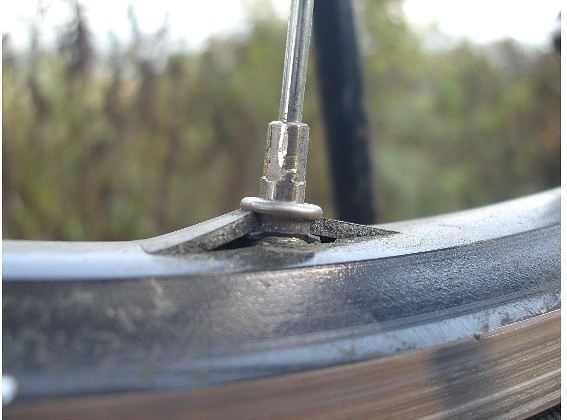
je déconseille mavic pour le cyclotourisme (cf photo d ema mavic cassée au laos), prends du 36 trous, 32 c'est pas asser!
Je sais il faut le faire pour casser un jante comme ça, merci les ponts en bois du laos!
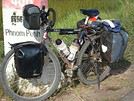
j'ai aussi mon porte bagages tubus cargo qui a cassé 4 fois, suite a un accident avec un tuk tuk a Phnom pehn (oui j'ai aps eu de bol lors de mon dernier voyage...)
Je te conseille les Schwalbe marathon en 26x1, 75.
j'ai fait 12000 bones avec sans aucun pb.
Pareil pour le tubus cargo ou Tara (devant).
C'est du bon matos.
Pour le casser, il faut vraiment forcer.
Je me demandais où tu avais fait réparer ou changer ta jante cassée, et si cela aurait été aussi facile avec des pneus de 700. Leur réparation est-elle aussi aisée que pour des pneus de 26 pouces (du point de vue du matériel disponible)?
En asie du sud est, a part bangkok, y'a juste un magason a vientiane au laos, mais qu eje ne conseil pas, le vendeur est un vrai con, y'a pas d'autre mots!! Le pire c'est qu'il est français! J'ai donc changé ma jante en Thailande!
je déconseille mavic pour le cyclotourisme (cf photo d ema mavic cassée au laos), prends du 36 trous, 32 c'est pas asser!
Ce type de phase n'a pas grand sens.
Chez la majorité des fabriquants, il existe de nombreux types de jantes adaptées à diverses utilisations.
Une mavic 521 destinée à la descente tiendra parfaitement la ou une 517, jante légère destinée à des utilisateurs légers pratiquants le cross country rendra rapidement l'âme. C'est vrai aussi pour la concurrence une sun rhynolyte c'est quai indestructible mais ça pèse 200 g de plus que les modèles légers de la marque.
Parler de 32 ou 36 rayons ne veut pas dire grand chose de plus. Interviennent également le type de rayon (un DT aerolyte est plus léger et plus solide qu'un DT champion par exemple), la qualité du rayon, la qualité du rayonnage (la plupart des rayons cassent à la fatigue cyclique parce qu'ils ne sont pas assez tendus), le type de rayonnage (direct, croisement à 3, à 4...)
Une roue est composée de nombreux éléments qu'il faut choisir en fonction de l'usage auquel on la destine.
Il est parfaitement possible de faire de très bonnes roues de voyage avec des jantes mavic comme avec celles de la concurrence à condition d'avoir un minimum de compétence et de de bon sens.
J'adore quand je dis des choses insensé!! Tout le monde me prend pour un fou de voyager en vélo, donc ça m'étonne pas que je marque des trucs bizarre sur ce site hein!!😛
J'suis bien d'accord avec toi tu sais, mais bon, encore entendu que mavic avait fait des sienne plusieurs fois ce week-end, gardé cette marque pour une autre pratique que le cyclovoyage je pense...a moi que Denrée ai la jante mavic idéal pour notre activité!
Je suis d'accord que les rayons, le moyeu, bref la roue en général peut etre complétement différente selon l'activité voulu, et je dirai aussi que je ne me suis pas posé la question de savoir si ma jante était pour ou non une utilisation de cyclovoyage en achetant mon vélo a Bangkok!
J'ai surtout parlé de mavic car le rayon aurai du cassé et non la jante!! C'est ça le plus fou!
Après je pense quand même qu'un rayonnage en 36 rayons est plus adapté a notre pratique (au moins pour l'arrière)
Mes excuses pour la tournure maladroite de la phrase. Je ne souhaitais pas être agressif.
Pour ce qui est de voyager à vélo, ici il me semble qu'on est nombreux à le faire, certains même depuis assez longtemps, alors ça perd un peu de son originalité.
Je n'ai pas d'action chez mavic. J'ai monté pas mal de roues pour des vélos de voyages avec diverses marques de jantes (pour des copains qui voyagent aussi, je ne suis pas un professionnel du cycle) et je n'ai pas eu plus de problèmes avec mavic qu'avec la concurrence.
Il y a des jantes à éviter chez mavic pour toute utilisation un peu intensive la série des 22x (220, 221...) ou 121 notamment mais c'est vrai aussi chez pour les zac de rigida, pas mal de Weimann de vuelta etc...
Mavic fait aussi des jantes reconnues comme de très bonne qualité mais qui du fait de leur légèreté conviennent mal au voyage à vélo on peut citer les 217, 517, 717. Ces jantes ont des équivalents chez DT (la XR 4.1), sun (la sub IV, la CR 18) ou rigida (XC 420, grizzly) qui ont les mêmes limites.
Pour un vélo moyennement chargé et cycliste pas trop brise tout, les mavic 819 font de très bonnes jantes solides tout en restant assez légères.
Si on veut des jantes à toutes épreuves, on peut prendre des mavic 521, des sun rhynolite, (voir des sun rhyno pour les brise tout) mais on est là dans du matériel un peu surdimensionné pour notre utilisation.
Il faut quand même ajouter qu'aucune des jantes citées ne fera une roue fiable si elle est mal montée. (Et les bons monteurs se font malheureusement rares)
Je ne me suis pas senti agressé rassure toi, un peu d'humour au contraire me permette juste de te taquiner un peu, si tu me le permet!😛
Très interessant finalement toute ses possibilités, je ne suis pas encore sûr de repartir en vélo (peut etre qu'une demoiselle se joindra à moi et alors ce sera en tandem) mais je retiens tes conseils notamment pour les jantes, surtout les sun rhyno car je suis un brise tout!😉
Pour info, ma jante était une mavic X717 et forcement j'ai changé la brisé par la même jante!!😄 (pas trop de choix!!)
Pour le tandem, il est nettement plus difficile de faire des roues qui tiennent. Ca vaut le coup de voir un bon monteur expérimenté.
Je ne sais pas si tu as essayé, personnellement je mets l'essentiel de la charge dans des sacoches avant surbaissées. Ca surprend souvent les gens pourtant c'est très "classique" (C'est ce qui se faisait à l'époque où le cyclo-camping était plus répandu) et beaucoup plus "mécanique"
Si la charge est bien placée (centre de gravité des sacoches sous l'axe de pivotement de la fourche) le vélo reste très facile à conduire (beaucoup plus qu'avec la charge à l'arrière). Par contre si la charge est trop haute ou trop avancée, elle se retrouve au dessus de l'axe de pivotement de la fourche et là le vélo devient difficile à tenir. (Dans la première config on obtient un équilibre stable, dans la 2ème on ne peut arriver qu'à un équilibre instable)
Le fait de placer la charge ainsi permet aussi de beaucoup moins solliciter la roue arrière qui a déjà à supporter les 2/3 du poids du cycliste.
Le choix des pneux influe aussi pas mal sur la tenue de la roue. On casse nettement moins avec des pneux de 1.75 à 2.0 pouces qu'avec des pneux de petit diamètre.
le plus difficile a trouver est certainement la Fourche adaptée! mais ce n'est pas impossible!
tu n'as pas précisé si ton Trek a des roues de 26" ou 700!, dans le cas d'un vtt il faut que tu précises quelle était sa fourche d'origine et l'année du cadre pour bien estimer la bonne longueur de fourche et ne pas trop modifier la géometrie, si les roues sont en 700, il faut que tu précises si ce sont des freins de route ou cantilever, si le pivot est lisse ou fileté, 1" ou 1"1/8eme, si tu veux mettre un porte bagage avant, un garde boue...
pour les roues: il y a des tas de bons moyeux, plus ou moins chers, et ton budget est un critère a prendre en compte car le prix des bons moyeux s'enflamment vite.
ensuite, la première chose a regarder me semble etre la qualité de la roue libre!!! avant les roulements eux mêmes.
personnellement j'aime beaucoup les Hope XC pour leur rusticité, solidité, simplicité, démontabilité aisée, maintenabilité aisée, leur grande performance, le cout des pieces de rechange raisonnable et aprovisionnables au détail, la standardisation de ces pieces, leur poids modéré....
mais des moyeux moins chers peuvent aussi trés bien convenir.
en rayons, j'aime bien les DTcomp 2-1, 8-2 qui me semblent etre un bon compromis solidité/performance, (s'ils sont bien montés... il en faut pour les casser!!!)
ensuite... ça dépend aussi du poids embarqué et du terrain!!!
pour les jantes, les conseils de la denrée (salut la denrée, en passant!) me semblent tout a fait pertinents!
pour du 26", une bonne mavic 719, (ou l'équivalent dans les nouvelles références qui doit etre la 819 je crois???!), me semble pas mal... !
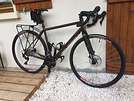
Mon vélo est un trek vtc (7200 avec fourche alu rigide, collection 2005) et les roues sont des 700 et je souhaite y monter des sacoches à l'avant. J'ai pu lire que les fourches en chromoly étaient conseillées, mais je suis un peu perdu sur le modèle à choisir, en me demandant si ma fourche d'origine (alu) ne coviendrait pas pour cette expédition tout compte fait, ayant lu que l'alu était plus rigide que l'acier même si non réparable en cas de casse. Alors quelle fourche choisir, de quel modèle et à quel prix, c'est un peu ma question du moment.
A+ Olivier
si je comprend bien, ton trek 7200 ressemble a celui-ci...
donc tu disposes, à mi hauteur des bras de la fourche, d'inserts M5 pour y fixer un porte bagage?
alors moi je ne m'embèterais pas plus!!! et je ne changerais pas la fourche!
en trouver une qui répond a tout tes critères s'avèrerait trés difficile, la solution la plus simple serait le "sur mesure" chez un cadreur, mais bon...
d'autant que ça te permet de mettre le paquet sur une paire de roues de bonne qualité et bien adaptée au voyage, et c'est bien là l'essentiel!
Merci pour ta réponse et ces quelques précieux conseils, j'aimerais te retourner la pareille mais faute de compétences suffisantes....ça sera limité, merci encore et bonne route.
Où peut-on trouver des roues déjà montées avec ce genre d'équipement ? Et le coût total doit se situer dans quelle fourchette pour avoir quelque chose correct à quelque chose d'indestructible ?
Sinon, comment apprendre à faire le rayonnage soit-même ?
Je me pose une question depuis un moment par rapport aux jantes: si je prend une jante de conception light et que j'y ajoute des rayons super rigides, est ce que je trouve face à la même chose qu'une jante rigide montée avec des rayons light? En somme, quels sont les efforts de resistance des rayons et les efforts de resistance de la jante? C'est par simple curiosité, car en vtt j'ai tendance à voiler mes roues.
on peut trouver d'excellentes roues autour de 200 à 300 euros environ.
bien sur, on peut aussi faire pour moins cher!
pour les conseils de montage, on peut aussi voir doc vélo
http://pages.globetrotter.net/docvelo/
je ne l'ai pas lu en détail, mais généralement les infos sont bonnes sur ce site.
sinon, je confirme, il suffit de s'y mettre, ce n'est pas trés compliqué.... à condition de ne pas avoir deux mais gauches et de bien réfléchir avant d'agir!
pour du tout fait, la meilleure solution reste le vélociste local, sinon on trouve du sur mesure en VPC a excellent prix, (mais je ne sais pas si "la pub" est autorisée ici! 😐 )
Bonjour Françonet, merci du lien sur les pages de Sheldon Brown.
As-tu réussi à joindre Dominique ?
Paspat toi qui a envie de construire tes vélos de voyage, je crois que tu as là un interlocuteur compétent et expériementé. D'après ce que je sais de chacun vous devriez vous bien entendre et bien vous comprendre sur l'approche technique vu vos formations respectives.
Paspat toi qui a envie de construire tes vélos de voyage, je crois que tu as là un interlocuteur compétent et expériementé. D'après ce que je sais de chacun vous devriez vous bien entendre et bien vous comprendre sur l'approche technique vu vos formations respectives.
volontier!
effectivement, a force de monter des vélos pour tout le monde... ça devait arriver, je me lance dans quelques réalisations "maison".... pour le plaisir uniquement!.
j'en suis à completer mon outillage, aménager une zone adaptée à la soudure, et je commence par réaliser quelques portes bagages "sur mesure", en tube d'acier cromo cet automne... a suivre! 😉
Si ce n'est pas très compliqué de monter sa roue soit-même, pourquoi on dit en même temps que le montage est le plus important ? Pourquoi les roues prémontées ne le sont pas bien ?
En tout cas ça me plairait beaucoup de le faire...
Est-ce que si je m'entraine sur une vieille roue je vais avoir du mal parceque ce ne sera pas de bons composants oubien est-ce très bien pour commencer ?
monter des roues, ça peut paraitre trés simple pour untel, ou insurmontable pour tel autre!
tout dépend de sa capacité a comprendre ce qui se passe quand on regle le voile, le saut, la symetrie, la tension, et les interactions entre chacune, ainsi que l'incidence du "parapluie" (surtout pour l'arrière).... c'est un peu de la géometrie "intuitive" dans l'espace.
bref, ça demande un minimum de concentration quand même. mais il ne faut pas s'en faire un monde... ça se passe bien.
il faut bien lire toutes les infos données sur les différents sites, et se lancer en prenant son temps et en observant bien. et généralement ça doit bien se passer en moins de 2 heures pour la première roue.
il vaut mieux commencer sur une roue AV, avec une jante et des rayons neufs, c'est plus simple! la jante ne sera pas voilée et les rayons seront tous strictement identiques.
il est aussi primordiale de bien "travailler" la roue en cours de reglage. c'est a dire la mettre en tension dans tous les sens pour que tout prenne sa place! (ne pas hésiter a la tordre et la contraindre tant que ça craque de partout!)
et ça, les machines automatiques ou les montages a la chaine ne le font pas!
c'est pourtant un gage de bonne stabilité de la roue dans le temps.
mes premières roues je les ai montés sur une fouche fixée dans un étau la tête en haut pour l'avant (obligé de retourner la roue régulièrement pour vérifier la symétrie), et sur un vieux cadre fixé pour l'arrière, avec un reglet, un pied a coulisse, une craie, un marqueur, un bon tourne vis et une clef a rayon de qualité... et zou!... je roule encore avec!
depuis je me suis équipé d'outillage spécialisé plus pratique et précis et qui fait gagner du temps. mais on peut faire sans.
et puis quelle satisfaction quand on roule avec sa première roue...! 🙂 fier comme un bar-tabac!!! 😎..bon courage! 😉
bonjour wilk,
je viens de voir ton site!
c'est toi qui t'es monté un Surly long haul trucker? tu en es satisfait? il m'a toujours plu ce cadre par son coté "rustique!" et parfaitement adapté au cyclocamping! 😎
un truc m'intrigue cependant... tu as monté un cargo a l'avant! pourquoi? un porte bagage surbaissé serait nettement plus favorable a la stabilité!! et tu disposes de tous les inserts necessaires sur ta fourche!
Le cadre surly est vraiment excellent, très stable, très confortable, mais assez nerveux quand même, certains s'en servent comme d'un vélo de course. Enfin, je ne peux plus être objectif a son sujet tellement je suis comblé avec, je ne suis pas sur un tour du monde mais je m'en sert tous les jours, c'est le genre de vélo une fois qu'on est dessus on ne peut plus s'arrêter 😇 . C'est pour ça que ma prochaine étape sera de lui monter des roues dignes de lui !
Le tubus cargo à l'avant c'est pour bénéficier de la plateforme et du fait que jusqu'à présent j'ai des saccoches qui se posent dessus et qui ne peuvent pas être accrochées sur les côtés. Lorsque je changerai de saccoches je bricolerai une tige horizontale pour les rabaisser effectivement.
Pour en revenir aux roues, je veux bien en privé les coordonnées de vpc pour les pièces... Est-ce qu'un moyeu dts vaut vraiment le coût ? c'est des roulements anulaires ?
Salut la Denrée,
J'ai un peu de mal à touver une jante "incassable". Dans le coin, hormis Mavic, Sun Ringlé et DT, je vais avoir du mal à commander chez mon vélociste.
J'ai donc quelques questions. La jante Mavic 521, semblait faire l'unanimité pour le voyage quant elle était encore en vente. Quelle serait sa remplaçante chez Mavic (j'ai cru comprendre que c'était l'EX721) ?
As tu des recommendations chez DT ?
Quel est le rapport entre la largeur du pneu et la largeur de la jante : je compte utiliser des pneus de section comprise en 1, 5 et 2" => quel est la largeur de jante requise ?
I’m landing in Madagascar with a buddy before the end of April 2026. We’re planning to bike around for about twenty days or so. We don’t have a specific goal other than exploring the country and meeting the locals.
Ideally, we’d prefer a loop route starting from Antananarivo with a good chunk of it along the coast. On the bike side, we’re used to riding 6 to 8 hours a day, depending on the needs, encounters, and mood 😉 Any feedback or tips from trips around this length?
Hi everyone,
I’m heading to Madagascar in early October to cycle from Tana to Diego along the east coast.
I really want to visit the Masoala Peninsula and its primary forest. If anyone’s interested, I’m open to company.
Maybe see you soon!
I’d been watching this ultra-light travel movement or trend for a while.
So I gave it a try—goodbye to the 5 panniers and rear racks.
A 15L saddle bag for clothes and a stove cookset.
Two cages on the fork blades: 2x5L—mattress on one side, tent on the other.
A 5L frame bag for miscellaneous items: battery, camera, small bits and pieces.
And one on the handlebar for the sleeping bag.
I tested it this summer on a crossing from Valence to Perpignan via the Massif Central.
My conclusions:
The obvious advantage is the reduced weight. In total, I had 12 kg on the bike, which makes climbing in the mountains much easier.
Another benefit I hadn’t considered is the significantly lower wind resistance compared to a traditional setup—you really feel it when the wind’s against you.
Of course, it’s not all perfect...
For example, it’s impossible to carry a food stock. You buy just enough before each meal or go to a restaurant!
You also have to accept a more spartan comfort level at stops.
In conclusion, I think for summer trips in regions where resupplying is easy, it’s an interesting option—especially if there’s significant elevation gain.
On the other hand, it doesn’t allow for enough autonomy, so some trips are off the table.
On the bike side, I swapped my Shimano 11/34 cassette for an 11/40. Even though Shimano doesn’t recommend it with a 105 derailleur and a 46/30 double chainring, it works really well.
The only limit is avoiding the 46/40 gear ratio.
Hi,
what are the easiest ways to get back from Nordkapp without pedaling—
train, boat, or plane?
Has anyone already done this?
Thanks for sharing your tips!
Hi, does anyone have recent info on the Shikoku pilgrimage? We’re traveling as a pair by bike, and I plan to camp whenever possible because from what I’ve seen, accommodations are pretty expensive, especially for long trips. I’d love any info or tips—thanks in advance! Aichatou
I’m planning to leave Nice for Toulouse around 10/15 and I’m looking for tips / great deals regarding:
- The route: I was thinking of taking Nice - Grasse - Draguignan - Salernes - Cadarache - Cavaillon - Arles, then the Camargue, Sète, and the Canal du Midi to Toulouse. The idea is to avoid high-traffic roads and too many steep climbs. Are there any spots to avoid or must-see stops? Since it’s been a while since I’ve been on the road, I was thinking that sleeping indoors might be preferable. If you have any budget-friendly accommodation suggestions along part of the route, don’t hesitate!
Thanks in advance, and if you’re in the area around that time, we could ride together... Ciao.
Hi,
I need to arrive in Thessaloniki by bike at the end of September and I plan to head to Istanbul along the coast.
Could anyone help me pick the best route? Safety, difficulty.
Thanks in advance.
Marc
Hi everyone! Thanks for welcoming me to the forum :)
I’m preparing for a long trip heading to Nepal, with stops along the way depending on my mood, work needs, and the season. I cycle a lot, but this will be my first big touring adventure. I’d like to camp regularly to keep costs down, so I’ll be riding on all kinds of surfaces: smooth and rough roads, main highways and rocky paths to find my camping spots, flat terrain and the occasional steep slopes.
For my bike model, I’m prioritizing durability, versatility, and repairability. From that perspective, I prefer a steel frame and fork with rim brakes since I’m used to them. I’ve narrowed my choices down to four models:
- The VSF Fahrradmanufaktur T-700 LTD (1400 €): steel frame, aluminum fork, hydraulic rim brakes, 28" wheels, 40mm tires, 36 spokes (2 mm), lightweight rear rack (max 20 kg), no front rack included, smallest gear ratio of 0.72, weight of 13.9 kg.
- The VSF Fahrradmanufaktur TX-400 (2200 €): steel frame and fork, hydraulic rim brakes, 26" wheels, 50mm tires, 36 spokes (2.34 mm), front and rear racks included (40+18 kg), smallest gear ratio of 0.71, weight of 15.9 kg.
- The Genesis Tour de Fer 30 (2150 €): steel frame and fork, mechanical disc brakes, 28" wheels, 36 spokes, 40mm tires, front and rear racks included (27+10 kg), smallest gear ratio of 0.77, weight of 15.9 kg.
- The Rockrider ADTV 900 from Decathlon (1700 €): aluminum frame and fork, mechanical disc brakes, USB port, 28" wheels, 47mm tires, 28 spokes, front and rear racks included (40+20 kg), smallest gear ratio of 0.71, weight of 17.1 kg. This is the successor to the Riverside Touring 900, which was a hit.
I’ve got a few questions:
1/ Should I go for 26" or 28" wheels for my trip? 26" wheels seem better for rough terrain, but 28" wheels feel more comfortable on roads. I’ve also read that 26" tires/tubes are easier to find.
2/ Do you recommend a steel frame and fork over aluminum? I’m guessing a high-quality aluminum frame and fork would be better than a low-quality steel one, right?
3/ Regarding the smallest gear ratio, is 0.71 a good number for a loaded bike in the mountains?
4/ Finally, what do you think of these four models for my project? My heart leans toward the TX-400—it seems to combine the versatility and robustness I’m looking for. But the price difference with the T-700 LTD is making me think twice!
Thanks so much for reading and sharing your thoughts!
17 days, 1,400 km, and 17,500 m of elevation gain cycling in northern Vietnam! 🇻🇳 🚴🇻🇳
From the misty Fansipan to the breathtaking landscapes of the Ha Giang Loop, from remote villages to vibrant markets...
I cycled through the north of the country, getting up close with its people—through mud, heat, endless mountain passes, and unforgettable encounters.
Most importantly, I discovered a Vietnam far different from the usual tourist circuits.
Join me on this adventure through a video that captures these 17 days of travel. :)
If Vietnam calls to you, come ride a stretch with me!
Hi,
can anyone give us some tips on how to get to North Cape from Lyon Gerland?
What’s the best route to join the EuroVelo 7?
How many kilometers is it from Lyon to North Cape via EuroVelo 7?
The best month to leave—we’re thinking early May.
Thanks for any advice!
Looking for a female travel companion for a cycling trip (arriving by plane in Porto Alegre, Brazil, and cycling toward Montevideo, Uruguay, returning by plane to France from Buenos Aires, Argentina) – 1,500 km
Hello everyone!
I’m planning a cycling trip across Brazil, Uruguay, and Argentina, with a departure set for late October, November, or December. I’m looking for a travel companion to share this long-distance adventure with.
Experience:
I already have solid experience in bicycle touring in Georgia, Kazakhstan, and Kyrgyzstan. Currently, I maintain excellent physical condition by cycling an average of 250 km over 3 days per week (4 hours a day at 20 km/h).
The trip & the pace:
Daily pace: Between 50 and 80 km per day, to make steady progress while taking time to explore.
Accommodation: Flexible and authentic. We’ll alternate between wild camping, campsites, Warmshowers, small guesthouses, and budget hotels depending on opportunities and the weather.
Looking forward to reading your message and planning this amazing journey together!
Another long-time dream of Claudio’s: the Petit Mont Cenis pass and the dam at the eponymous lake.
A place where many Italians, including my father, worked in the 1950s–60s.
Faverges → St-Michel-de-Maurienne → Lanslebourg → Petit Mont Cenis → return. 315 km, 3 days. Bivouac at St-Michel-de-M.
Brouter link
Leg One: Faverges → St-Michel-de-Maurienne
Leg Two: St-Michel → Lanslebourg → Mont Cenis Lake → St-Michel
Leg Three: St-Michel → Faverges
And it finally happened in August 2026: in the Maurienne Valley about the famous cycle route known as the V67
🇷🇼 Cycling in Rwanda: 4 episodes, an off-the-beaten-path adventure
After 3 weeks and nearly 1,200 km by bike across Rwanda, I made 4 videos to share this adventure in a different way: the landscapes, the encounters, the villages… but above all, all those incredible scenes of everyday life.
The 4 episodes are available here:
👉 https://www.youtube.com/playlist?list=PLGnfbxjccWAg
The 4th episode focuses on rural Rwandan life: simple, authentic, and sometimes surprising scenes that you only truly discover when you take the time to travel by bike.
If you have a few minutes, let yourself be transported to Rwanda…
Hi,
We bought the MSR bike tent model (2-person + large awning that can fit 2 bikes) back in 2005. It’s served us really well, especially during a year-long trip in Africa. Now, one of the poles is broken, and we’d love to replace it since that’s the only issue with the tent—we still love it! The poles are 9.35 mm in diameter, with 8 sections of 49 cm and 2 sections of 28 cm. Total length when assembled: 416 cm. Actually, two large sections are broken: one straight and one curved. It’s a pain to find replacements since this model is no longer sold anywhere.
Would anyone have this model lying around unused and be willing to sell me a pole?
Hi everyone,
In early April, I’m redoing the Vélo Francette (La Rochelle to Ouistreham), and then I’d like to cycle along the Cotentin Peninsula (which I don’t know at all), follow the coast up to Cherbourg, and then head back down to at least Saint-Malo. I’d love to know if it’s pleasant for cycling—are the roads nice? Not too windy? What are the must-see spots? Any great campsites? All your tips and advice are more than welcome, and I thank you in advance.
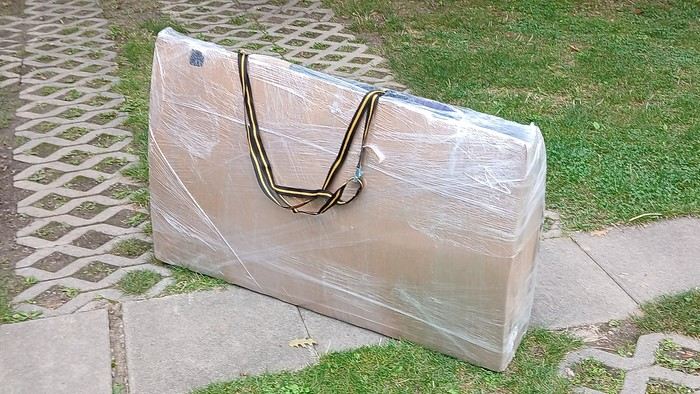
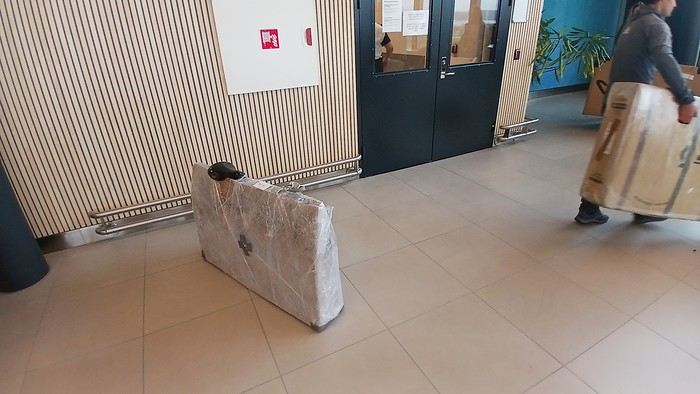
After testing it for three years across various modes of transport, I’m sharing this video of a bike packing case. It’s made from recycled cardboard and shrink-wrapped, with adjustable thickness and added bubble wrap depending on the level of protection you want.
Installing spacers at the fork and chainstays makes the packaging compact. With the fifteen-odd euros for shrink-wrapping at the airport, this case travels really well.
https://youtu.be/_GDJi-GqmkM
- Low bulk (1.10m x 0.70m x 0.25m for a large frame), it fits vertically in train luggage compartments and the total dimensions (x+y+z) don’t exceed 2.40m.
- Two carrying solutions for public transport and easy handling by airport staff (no more tears in the cardboard from openings).
- Discreet packaging when dealing with bus drivers and train conductors, as it looks like an ordinary parcel.
- No need to return to the starting point to retrieve the case from your outbound trip, which you’d otherwise have to store somewhere, or deal with a bulky cover to pack in your panniers.
- You can still check tire pressure through the plastic film without damaging the packaging too much.
Drawbacks: Around 3 hours for this lengthy and meticulous process—removing the wheels, pedals, handlebars, and derailleur without misaligning them, then securing all components to the frame.
If you get a chance to test it, send me your feedback for future improvements.
I just took a trip in Tunisia from Tozeur to Douz, skirting Chott el Jerid to the south. I’m back with the urge to keep going further south via the 4x4 tracks to connect Douz to Ksar Ghilane. Has anyone driven this route recently or explored southern Tunisia?
Thanks for your tips!
fix
😎Fellow traveling cyclists or not, all of you who love travel, the pleasure of physical effort, nature, beautiful machines, people with true passions they seek to fulfill, and who also enjoy reading great literature about all this—the *200* magazine is for you just as it is for me. I should mention I have no financial or other interest in this (in an era where we accuse our politicians of all sorts of vile interests, I prefer to take precautions). I’ve been subscribed since the beginning, and every three months, I get my 130 pages of dreams (the magazine just went from 110 to 130 pages).
It covers everything from the trans-America route to the TCR (Trans Continental Race) from Belgium to a small town in Turkey, with mind-blowing averages—4,000 km and 80,000 m of elevation gain in 8 days and 15 hours for the winner. Let that sink in, and all of it without assistance—accepting a patch could penalize you. There’s also a story about crossing Iran, encountering one of the world’s most welcoming populations, following in the footsteps of Nicolas Bouvier, as well as retirees leisurely traversing France. The common thread in all these stories? Beautiful writing. Take, for example, a stunning article: *"Passengers of the Cold: From Edinburgh to Thurso, at the very north of Scotland, 550 km of moors, coasts, and icy wind. In Thurso, the road ends at a quay, facing the Orkney Islands. We wanted a November trip, off-season. We wanted to surprise winter. Just before the snow."* A sublime piece on the experience of facing adversity and the chance encounters along the road and in the elements.
Before I embarked on my own bike trips, I dreamed a lot about them—from the Atacama to the Gobi, along the Mekong, and not forgetting France. And now, these 130 pages every quarter keep those dreamy vibes alive through stories written in the most beautiful prose.
I’ll stop here because it might sound like I’m advertising, but if you don’t know *200*, I invite you to discover it. It’ll give you wings for the most incredible challenges or simply reinforce your desire for slow rides with your eyes open to others and nature.
A little news to wrap up: Axel Carion and a friend just broke the record for crossing South America from Colombia to Ushuaia in 59 days. On its own, that doesn’t mean much, but I can’t help it—it makes me dream. You should see how he talks about it, the flashes of that wild nature he’s stored away: a snowstorm at Paso Jama and the surreal sight of the suddenly snow-covered Licancabur!
Luc
PS: The magazine is called *200* because a day’s ride starts at 200 km—well, I’ve never done a ride like that since my longest was 167 km (with 18 kg of luggage, mind you), but why not one day? The magazine will explain how to tackle your first 200, and then the question in conclusion: when will you do your first 300?😏
I’ve got my flight ticket sorted—departing in mid-November and returning in mid-March. I’ll arrive in Santiago and leave from Buenos Aires.
I’ve already been to southern Argentina, specifically Torres del Paine National Park, and I’d love to go back to do the full W trek (I only did the shorter version last time).
I also want to do some hiking and maybe even tackle a summit. I climb and occasionally do some mountaineering, so I’ll definitely be going with a guide.
I plan to start around Temuco in Chile, with the idea of heading toward the lakes, then taking the Carretera Austral.
I’m not sure if I’ll go all the way to Ushuaia—it’s supposed to not be *that* worth it, except for the bragging rights of saying you’ve been to the end of the world.
I saw there are lakes in Argentina too.
I don’t have a precise itinerary, but what I’d love is, once I reach the southernmost point of my trip, to take a mini-cruise to see some wildlife. Any tips for that?
What kind of sleeping bag did you take? Is a 0°C (32°F) one enough?
And one last question: white gas stove or can I get by with my gas stove?
I'm developing a free and open-source web app for planning walking and cycling trips (and even car trips). You can create a route by clicking directly on the map to add waypoints, and it can consist of multiple stages. The app provides tools to edit the stages and the overall route, and to display useful information (distances, altitudes, and elevation changes). A relief profile can be shown as a graph for a specific stage or the entire route.
Once the route is ready, it can be exported as a GPX file, which can then be used with a GPS or a mobile navigation app.
The app is built in JavaScript and runs entirely in the web browser. It uses the Leaflet library and several OpenStreetMap-based services. Initially developed for my personal needs (I enjoy hiking and cycle touring), I’d be happy to share it with anyone who might find it useful. It’s free to use, doesn’t require an account, and the source code is available.
hello fellow cycling enthusiasts
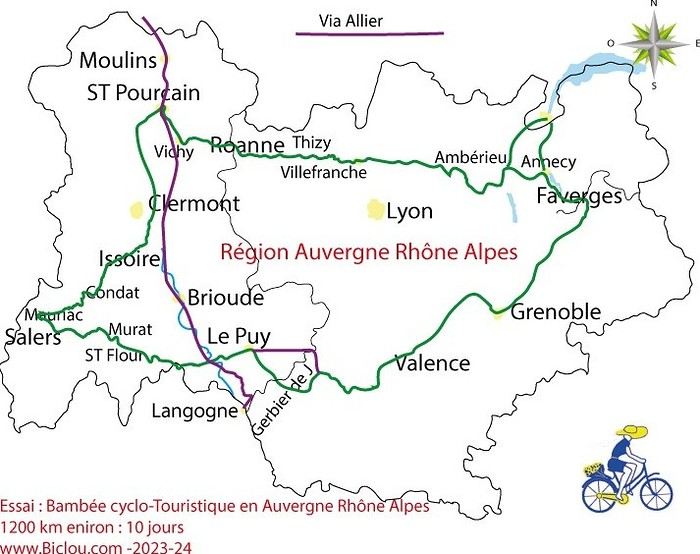
here’s a travel journal of the cycling tour through the Rhône-Alpes Auvergne region by Claudio
zouli
it was the plan
http://cbandiera.free.fr/parcours/auvergne-Ralpes/
the trip was completed
story being posted online soon
1100 km in 11 days
beautiful and varied regions
Hello,
We’d like to go on a 3- to 4-month bike trip starting in December, crossing from Assam (northeast India) to New Delhi via Nepal.
Are there routes with light traffic along the Brahmaputra and through Nepal?
We’re also looking for any info on accommodations, wild camping, local interactions, etc.
Thanks,
Michel
I’m planning to cycle from Morlaix to Brest (via Roscoff and the V45 coastal route). We’ll start riding on August 16th for 13 days (with stops for island visits, surfing, etc.). Is there a lot of traffic at this time of year? I’ve got two kids, 11 and 13, and we don’t like riding in the middle of cars (we’ve already done the Vélomaritime—Caen to Cherbourg—the Loire route from Orléans to Saumur, the Vélodyssée from Nantes to Royans, and the canals like the Nivernais and Bourgogne, where there were plenty of bike-only lanes, which isn’t the case on this route).
Thanks for your help if you’ve already done this route in late August!
Virginie
Hi there,
I’ve been road cycling for several years, and I’m about to switch to gravel in the next few days—I’m waiting for my bike, which should arrive this week.
I’m planning a bikepacking trip in a few weeks along the Véloroute V81, also known as the Vélosud, from Biarritz to Le Barcarès.
Has anyone here already done this route? Any info is welcome, whether it’s about the route itself, gear, or accommodation. I’ll prioritize staying with locals as much as possible. On that note, I just signed up for the brand-new site *Guidon et Couette* ((www.guidon-et-couette.fr)), which offers free accommodation between cyclists across the country, but there’s almost no one listed along my route!
Thanks in advance.
Laurent.
Hi there, I’m planning a cross-Canada bike trip, and I’ve got a question that might seem silly, but could someone tell me how to pack a bike (in a box, with a fragile sticker... I don’t know) for a flight? Thanks in advance!