My Battle with Excess Weight (How I Lost 5 Kilos in 2 Days, by Bike)
FR

Translated into English.

Original post
VF
New, seen on TV, you won't believe it. Click here.

During my recent trek, I found that my bike—and my luggage—were heavy. Until now, the weight of my gear hadn’t been an issue. Maybe I’m getting old, or maybe I just can’t handle the SNCF’s stairs anymore.

It hit me in Toulouse. A 3-minute stop turned into a 6-hour delay because of a fire that was hard to control between Toulouse and Montauban. Eventually, our train was canceled, and we were told to take another train that was also waiting for the same destination. It was my fourth train of the day. It was 9:30 PM, and I’d left at 9:30 AM that morning. Suddenly, exhaustion took over.

That’s when I met two bike-packers who, without hesitation, lifted their bikes with all their gear attached, carried them down the steps of the Corail train, and then down the stairs to the underground passage. They were young and fit (they smelled like warm sand), and I definitely wasn’t. It was in that scorching heat, struggling up and down all those stairs (Oh Toulouse, as Nougaro would say, may you be cursed for seven generations), that I decided to go on a diet.

It’s a diet anyone can do, it works, and it’s free. So I’m sharing it right away.

No need to exercise or restrict yourself. No, all you have to do is think and do some research. You need a chair, a table, a scale, a computer, and a spreadsheet. Make a list of everything you’ve brought and weigh it all. Set a goal based on the type of trek and your comfort level. Remove everything that doesn’t help you reach that goal.

My goal: - Trekking in France from May to September, in the plains or at most on a plateau like Mont Aubrac, where at 800 m altitude, it can drop to 10 °C at night even in the middle of summer.

- Sleeping in a tent on a good mattress in a sleeping bag (I’m not changing that). Someone suggested I could sleep under the stars on bubble wrap. No way, are you crazy?

- Not cooking. I buy lunch on the way in the morning and dinner on the way in the afternoon (I’m not changing that either). Someone suggested Ducasse delivers everywhere in France. Uh, have you been smoking lemon weed?

That’s how I lost 5 kg, going from 17.7 kg to 12.8 kg, including luggage but not food or water. But I also reduced the volume and quantity of my gear.

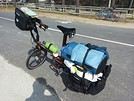
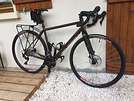
Here are the before photos:

https://photos.app.goo.gl/XDfKaoVvHFNxDXrq5

And after:

https://photos.app.goo.gl/STRVKaWuVcNVeCfS9

of my bike.

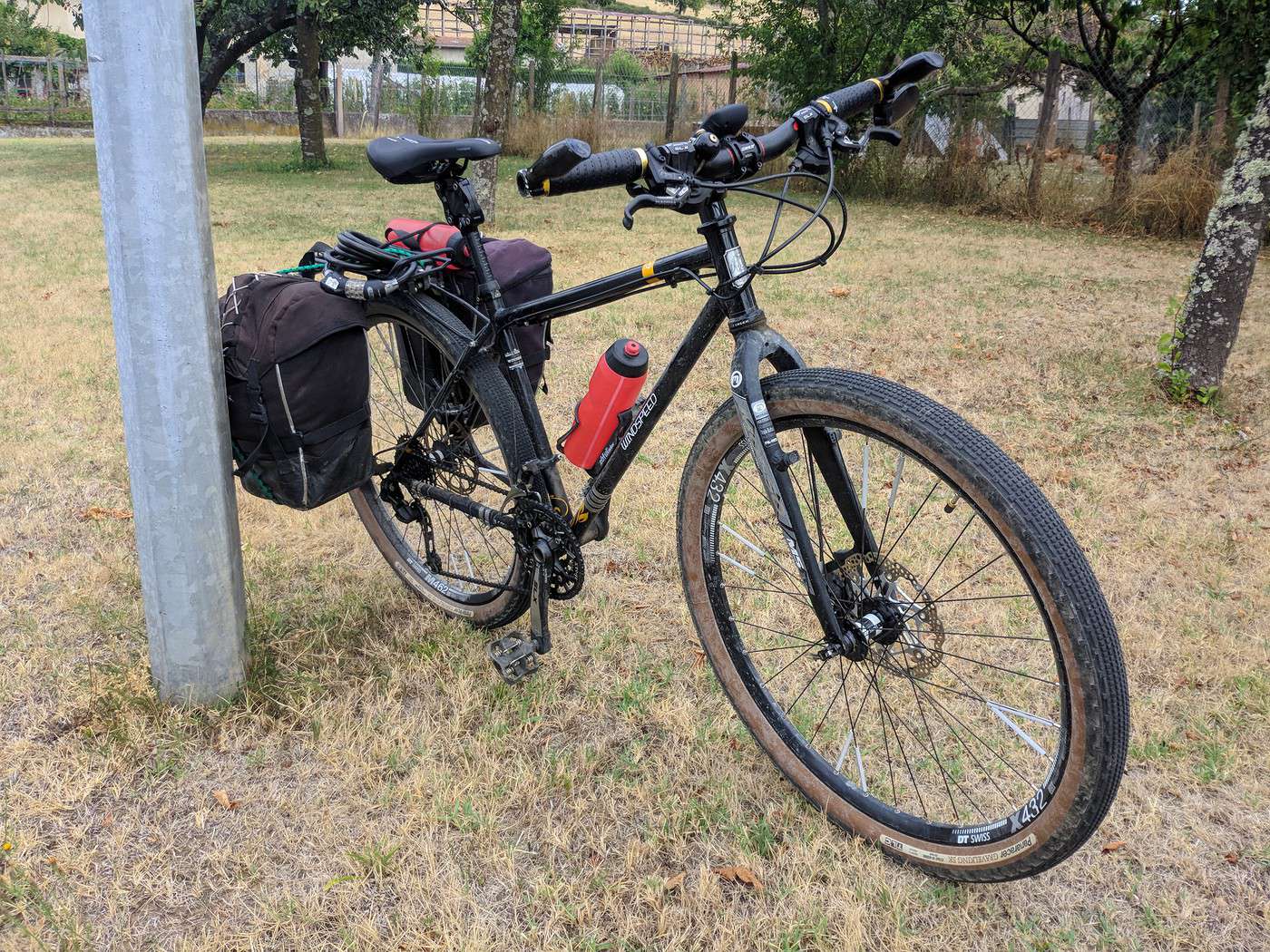
You can see that a duffel bag is gone, as well as the extra bags behind the panniers. I don’t even use the mesh pockets at the bottom of each pannier anymore. You can also see I’m still carrying my 1 kg U-lock. I know, it’s unforgivable. I’m on the verge of being banned.

So I might do another trek in September to validate my choices.

For the rear panniers, I can save between 1 and 1.5 kg depending on the solution: Arkel Dry-lites (28 L pair, 0.540 kg) or Vaude Aqua Light (38 L pair, 1.080 kg).

I also need to cut down on the tools I bring. I should be able to shave off about 0.5 kg.

And the bike? I’m thinking about it. Someone suggested the folding Savadeck Z2, which only weighs 10 kg. Carbon? Oh, don’t spread the word—it’s even more taboo than aluminum in some circles, and I won’t even mention the belt drive.
SM Smopy44 Regular ·
The question of how much weight to carry while cycling is important—I totally get you. I’ve started a diet, but it’s tough for me to lose weight quickly. I went from 86.5 kg to 79.5 kg in two months. My ideal weight is 71.75 kg for 1.80 m, so I was carrying an extra 14.75 kg. I still have at least 7.75 kg to lose—that’s like carrying over 5 one-and-a-half-liter water bottles, enough to fill a pannier! ^^ I’m paying close attention to everything said about bike gear weight in this section and taking notes. Really appreciate it.
LA Langenscheid Veteran ·
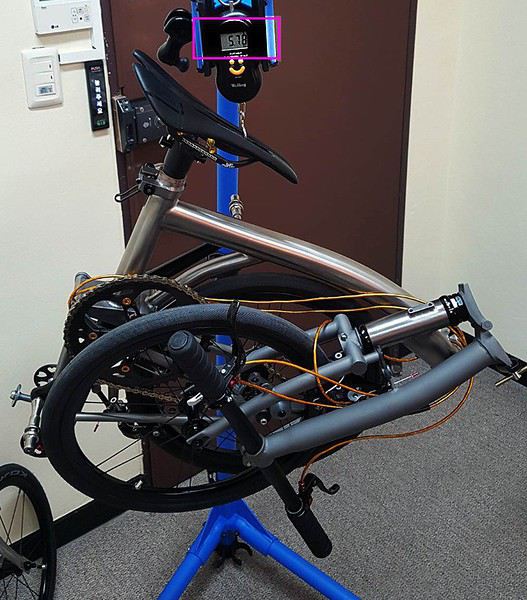
And the bike? We think about it, we think about it. Someone whispers that the Savadeck Z2 folding bike weighs only 10 kg. Carbon? Oh, don’t let that slip—it’s even more taboo than aluminum among some folks, and I won’t even mention the belt drive.

Just a matter of money :-)

https://www.cyclechat.net/threads/full-titanium-frame-brompton-clone-5-9kg.244401/
VF Vfpromeneur Veteran ·
The Tilt 9 used to cost 750 €.

The Z1 20" Shimano 3000 9-speed is 877 € on sale, otherwise 1,186 €.

The Z1 20" Shimano 105 R7000 System 22-speed is 1,067 € on sale, otherwise 1,440 €.

The prices seem more than reasonable to me.

Since I’m used to a 1-chainring and 8-speed setup, I’m leaning toward the "9-speed."

But I have some questions:

What’s the quality of the frame’s folding system and the handlebar stem?

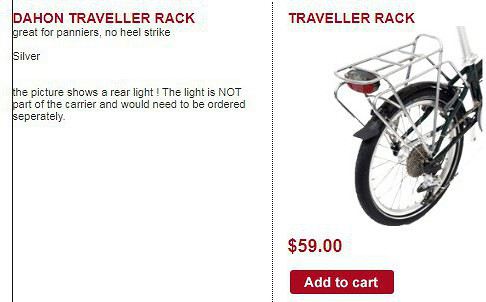
How do you attach a standard rear rack made for 622 mm wheels (so the 20 L panniers sit at the right height)?

How do you attach a kickstand? I’ve tried without one—it’s not practical. There isn’t always something to lean the bike against or lay it down without dirtying or damaging the pannier, even in the city. Plus, it’s heavy to lift a loaded bike every time. And I stop often to take photos or do other things.

Can you roll it like a golf caddy once it’s folded?

I’ve asked Savadeck these questions. I never got a response after a month. Does this hint at poor customer service? Savadeck (Chinese brand) has a foothold in Poland—that’s a plus.

Side note: I didn’t ask this many questions when I bought the Tilt 9.
VF Vfpromeneur Veteran ·
A look at lightweight non-folding bikes at Decathlon. No! Well, yes.

ROAD BIKE MEN'S CYCLOTOURING RC120, 450 €, V-brakes, drop handlebars, 10.9 kg Road Bike Cyclotouring RC120 Disc, 500 €, disc brakes (cable), drop handlebars, 11.25 kg Road Bike Cyclotouring RC120 Flat Bar Disc (cable), 500 €, flat handlebars, 11.25 kg ROAD BIKE CYCLOTOURIST TRIBAN RC500, 650 €, disc brakes (cable), drop handlebars, 10.6 kg ROAD BIKE CYCLOTOURIST TRIBAN RC520, 850 €, disc brakes (cable + hydraulic), drop handlebars, 10.4 kg

GRAVEL BIKE TRIBAN GRVL 120, 600 €, disc brakes (cable), drop handlebars, 10.95 kg GRAVEL BIKE TRIBAN RC520 GRAVEL, 999 €, disc brakes (cable + hydraulic), drop handlebars, 10.4 kg RC520 GRAVEL LTD2 SRAM APEX 1x11, 1000 €, disc brakes (cable + hydraulic), drop handlebars, 10.5 kg
8X 8xc Veteran ·
And don't forget that the three most effective levers to improve efficiency and thus save energy—especially if you're not a big athlete or you're past a certain age—are:

reducing the rotating mass (wheels and tires); frame stiffness; the cyclist's position.

Anyone who’s switched from a bike with super-heavy, rigid, thick tires to one with thin, supple tires feels like they’re riding a moped. The reverse is just as brutal—what a punishment when you’re used to an efficient bike and then rent a sluggish, heavy thing with truck-like tires.

Overall weight comes next, though usually everything goes hand in hand. Unless it’s an exception, a lightweight bike typically has lightweight wheels and tires, a quality (and thus stiff) frame, and a well-designed geometry. Brands that sell bikes costing them far less than the retail price often skimp on wheel and tire quality, offer basic frames (sometimes in just 3 or 4 sizes), and use odd geometries that force cyclists to opt for adjustable stems and positions that aren’t great for efficiency or health.

And unless you need to carry it up stairs, going for an ultra-light bike (under 6 or 7 kg) doesn’t offer much advantage over an 8 or 9 kg bike that already has lightweight wheels and tires, an efficient riding position, and a frame that’s stiff where it counts. It’s just your wallet that gets lighter. Reducing luggage weight and shedding a few cyclist pounds is easier and cheaper.
Pas de deuxième vague en Europe : https://tinyurl.com/y5ytqzej
VF Vfpromeneur Veteran ·
There’s also the Mini Cooper sold as an accessory for your Mini Cooper.

Fully compatible with Dahon accessories. Probably built by Dahon.

https://www.foldingbike20.com/mini-cooper-folding-bike-review/

10.9 kg

$535 (454 €) on Amazon US

It just lacks a rear rack and lights.
LA Langenscheid Veteran ·
Ordering 1) a bike in China 2) carbon 3) foldable is risky.

If you're willing to accept a larger folded size than a Brompton, a Dahon/Tern is a less risky option.

https://www.ternbicycles.com/fr/bikes/467
VF Vfpromeneur Veteran ·
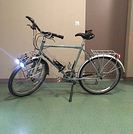
My current bike weighs 16-17 kg fully equipped (lights, dynamo, fenders, rear rack, kickstand).

I’m looking for a city-touring bike.

Losing 5 kg would be great. That means aiming for a bike that weighs 11-12 kg fully equipped.

I’ve spotted this dynamo as an option:

http://www.velogical-engineering.com/velogical-rim-dynamo--standard-bicycle-dynamo--smooth-running-lightweight-efficient

https://bike-cafe.fr/2017/05/dynamo-velogical-la-solution-lumineuse/

https://www.libertecycles.fr/boutique/dynamos-velogical/dynamos-velogical/

Weight of the dynamo? Around 200-300 g?

The fenders:

https://www.qbicle.com.tw/product_detail.php?psn=146

Weight: 180 g for the pair.

Rear rack: Pletscher Athlete system, 800 g (the only one compatible with my shopping caddy).

Front and rear lights: around 100-200 g?

Kickstand for folding bikes (like the one on the Tilt 9): 190 g.

That brings us to a maximum of 1.670 kg for all the gear.

So the bare bike needs to weigh no more than 10.5 kg.

The Savadeck Z1 and the Mini Cooper meet the 11-12 kg weight goal.

Savadeck Z1 max load: 110 kg (found online, but is this accurate?).

Mini Cooper max load: 105 kg (found online, but is this accurate?)
VF Vfpromeneur Veteran ·
You can see here that you can fit a rear rack for a large wheel. Since it’s compatible with all Dahon parts, is it a Dahon rack?

https://www.youtube.com/watch?v=nNkSxCcigBY
LA Langenscheid Veteran ·
The foldable Mini is very likely made by Dahon, the world's leading manufacturer of this type of bike.

For the raised rear rack—super ugly—for classic panniers:

http://www.thorusa.com/accessories/racks.htm

Personally, I’d try a low-mounted rack with a trunk bag + panniers like the Vincita Rackbag instead:


https://vincita.cc/products/b181b-nash-rackbag
VA Vapkse Regular ·
Anyone who’s switched from a bike with super-heavy, rigid, thick tires to one with thin, supple tires feels like they’re riding a moped. The reverse is just as bad—what a punishment when you’re used to an efficient bike and have to rent some flimsy, heavy thing with truck-tire treads.

Hi there,

I don’t entirely agree. I just got back from a trip from Saint-Jacques-de-Compostelle to Geneva (skipping Pau-Nîmes) via the Camino del Norte, so quite a bit of mountain biking, and finishing on the Via Rhôna, which is pretty smooth riding. I had new-generation tubeless tires: Panaracer Gravleking 27.5x2.10. You could call them thick treads—fairly rigid but not too heavy at 620g—and without the weight of an inner tube. Yet they roll just as well as a Marathon tire but can handle mountain biking too. They’re totally versatile. I inflated them to around 1.8 bars in Spain on the Camino and 3 bars on the Via Rhôna. I didn’t get a single flat, though maybe I was just lucky. Still, I rode over paths I wouldn’t have dared to take with a road or trekking tire. Tires have evolved, and the latest tubeless generations are nothing like the old ones in terms of efficiency or durability. On the Via Rhôna, I caught up with a cyclist on a Triban with the original thin tires. He was riding great, but he’d already had two flats that day. I don’t know if he’d checked his tires, but he got another flat a little further on.
NO Nomade743 Veteran ·
Anyone who's switched from a bike with super-heavy, rigid fat tires to one with thin, supple tires feels like they're riding a moped. The reverse is true too—what a punishment when you're used to an efficient bike and have to rent some sluggish, heavy thing with truck tires.

Hello,

I don’t entirely agree. I just got back from a trip from Saint-Jacques-de-Compostelle to Geneva (minus Pau-Nîmes), taking the Camino del Norte, so quite a bit of mountain biking, and finishing on the Via Rhôna, which is pretty smooth. I was using new-generation tubeless tires: Panaracer Gravleking 27.5x2.10. You could consider them big, fairly rigid tires, but not too heavy at 620g—plus no inner tube weight. Yet they roll just as well as Marathon tires but can handle mountain biking too. They’re completely versatile. I inflated them to around 1.8 bars in Spain on the Camino and 3 bars on the Via Rhôna. I didn’t get a single puncture, though maybe I was lucky. Still, I rode over paths I wouldn’t have dared with road or trekking tires. Tires have evolved, and the latest tubeless generations are nothing like older ones in terms of efficiency or durability. On the Via Rhôna, I caught up with a cyclist on a Triban with thin stock tires. He was riding really well, but he’d already had two punctures that day. I don’t know if he’d checked his tires, but he got another puncture a bit further on.

I totally agree that weight isn’t everything, but between Panaracer tires and the same size in Marathons, there’s still a 160g difference per tire. That’s not insignificant for performance. It’s also worth noting that Panaracers are 126 TPI, while Marathons are 67 TPI. The difference in flexibility—and therefore comfort—is huge. The rubber compound is different too. Having tried both, I can say there’s no comparison in terms of road grip and efficiency.

Light tires are definitely more efficient for acceleration or sprints. Do you sprint often while traveling?... On flat terrain at a steady pace, weight—whether from the bike or the tires—has very little impact on average speed. But as soon as the road climbs, it’s definitely easier to accelerate out of a hairpin turn, for example.

And when considering weight, don’t forget the cyclist’s. Trying to save 500g on the bike and luggage is great, but if the rider is carrying an extra 15 kg, there might be more effective (and free) ways to improve comfort in the mountains.

I’m in a good position to say this since I may have overdone it on the raclette during lockdown!
8X 8xc Veteran ·
You’re saying the same thing as me—your Panaracer Gravelking 27.5x2.10 tires are way more supple and significantly lighter than the 1 kg+ Marathons with their tubes, easily 400 g or even more difference per wheel. That’s huge—it’s even more than the difference between your tires and my 25 mm road endurance tires.

Pressure makes a big difference too when switching from wide to narrower tires. All rolling resistance curves drop as pressure increases, no matter the tire. The limit is losing grip on rough surfaces if the pressure’s too high, which is why super-supple tires are great—they stay grippy even at high pressure. Narrower tires handle higher pressures better, so mathematically, they’re more efficient than wider tires, despite what some manufacturers claim. Plus, you get a big reduction in rotating mass and the suppleness of the casing and rubber improves grip.

It’s super clear when you look at the graphs from the testers at bicyclerollingresistance.com. A 25 mm Michelin endurance tire (not a race tire at all) loses less than 15 W in their tests at typical pressures (say, between 7 and 8 bar), while a medium-width Gravelking (40 mm) already hits 20 W of loss at mid-range pressures, and a fat bike tire blows the charts with sometimes over 40 W lost per tire at recommended pressures, for the same tests.

When you’re not exactly young or powerful, it’s worth looking into this and choosing a lightweight tire that’s also supple and narrow to handle high pressures—within what you can personally tolerate. For me, that gain is way bigger than switching to a lighter frame.
Pas de deuxième vague en Europe : https://tinyurl.com/y5ytqzej
8X 8xc Veteran ·
On the Via-Rhôna, I caught up with a cyclist on a Triban with stock skinny tires. He was riding really well, but he’d already had two punctures that day. I don’t know if he’d checked his tires, but he got another flat a bit further on.

When it comes to punctures, it’s simple: the Michelin Pro4 Endurance or Hutchinson Fusion3 in 25 mm that I use never puncture (just once in two years outside of bike trips). So I’m not going to test every tire in the same category (road endurance-style), these work for me, and punctures aren’t really something I worry about. Plus, losing 15 minutes every 7,000 km is nothing compared to all the benefits of this choice. That cyclist must’ve had a thorn or a tack stuck in his tire.
Pas de deuxième vague en Europe : https://tinyurl.com/y5ytqzej
VA Vapkse Regular ·
Interesting site—it really confirms my feeling about dragging around with Marathons, and the performance of Gravel Kings. Too bad the model I used isn’t listed; it must still have better efficiency than a Marathon but less than the Gravel Kings on the site. I once rode with a traveler who had Marathons, and on a downhill freewheel, I gained a bit more speed than him with my tires at under 2 bars. I think he must’ve been well above my pressure, otherwise, he would’ve pinched his inner tubes. The challenge of this route was being able to handle some pretty technical MTB sections on the Saint-Jacques path—without breaking records on the descents, of course—and also manage long stages on the Via Rhôna.

About what you said regarding tire and wheel work, I completely agree. Whether it’s for performance or comfort, there are plenty of options with tires, especially tubeless or thermoplastic inner tubes, which let you run lower pressure without risking pinch flats. That really improves comfort and grip, rather than lugging around a dead-weight fork or tweaking the frame.
SM Smopy44 Regular ·
I was thinking about you and your folding bikes—this site has some that weigh 24 lbs less.

http://www.gepetto-velos.com/velos-pliants-dahon/dahon-qix-d8

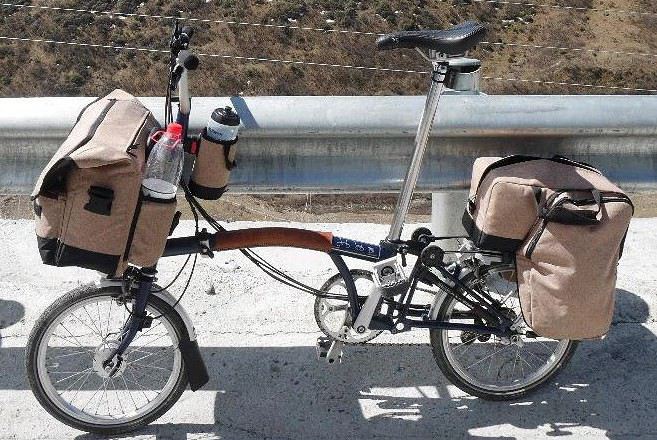
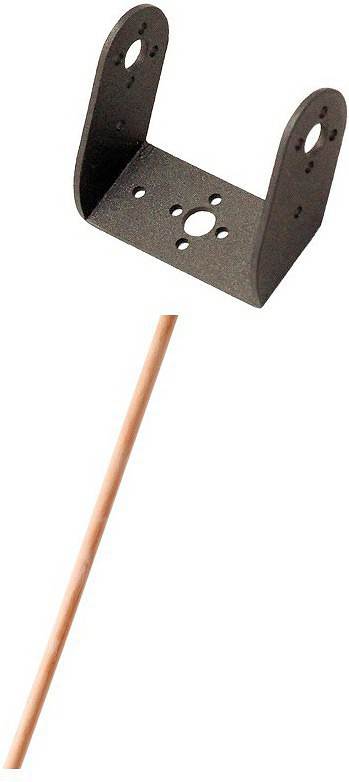
For your bike kickstand, if you can’t find one, you could make one yourself with a stick (like a wooden broom handle). Cut it to the height of your seat tube (under the saddle) and attach a U-shaped bracket. Roughly, it looks like the setup in the photo. I’m not making fun of you, lol! !
VF Vfpromeneur Veteran ·
Yes, that's an option.

I measured it—outside the tent and folding stool, I need about 40 L. So, you can definitely split that 40 L into two small panniers and a drawstring bag.

For example, two 15 L panniers and a drawstring bag with a volume of 10 L, plus extra space for the tent and stool.

Something to think about.
VF Vfpromeneur Veteran ·
Yes, it actually fits within my weight limits at 11 to 12 kg fully equipped.

Today, it’s been replaced by the Qix D9, which weighs 12 kg and has a max load of 105 kg.

https://eu.dahon.com/bikes/qix-d9-2/

The issue with Dahon bikes is that there’s no distributor in France. I’m keeping an eye on the Gepetto website.
VF Vfpromeneur Veteran ·
Thanks to everyone who makes this discussion so engaging and shares their knowledge with us.
LA Langenscheid Veteran ·
"Folds like the Brompton!" is a huge exaggeration, if only because this model, like the vast majority of folding bikes other than the Brompton, leaves the chain exposed instead of sandwiching it between the two wheels. Not to mention the bulk once folded.

For some unknown reason, Dahon, on its Curl model that tries to compete with the Brompton, didn’t weld a mount on the front of the frame for attaching a bag → you’re forced to use a backpack (!).

Such a shame, because with an 8-speed Nexus hub and a price of ~1,200 €, it could’ve been a perfectly valid alternative to the 6-speed Brompton at 1,500 €.
LE Lethieu Globetrotter ·
Lighter tires perform significantly better on accelerations or sprints. Do you sprint often while traveling? ... On flat terrain at a steady pace, weight—whether it's the bike or the tires—has very little impact on average speed.

When we talk about acceleration, don’t just think of the kind of sprint you see at the end of a Tour de France stage... "Accelerations" are part of every bike ride... All the irregularities in the road, changes in surface, bumps, or gradient shifts require "accelerating" the bike... In reality, there’s never perfect consistency in the effort required... and the constant—or near-constant—need for "mini accelerations" is why reducing rotating mass as much as possible is so useful... That’s where you can make a difference to avoid the unpleasant feeling of a "plow-bike" that only performs well on downhill sections...
michel mathieu www.lethieu39.fr
8X 8xc Veteran ·
I agree with you, ""relances" are part of any bike trip". When climbing, if you stop pedaling, the bike comes to an immediate halt, which shows that the "relance" (re-acceleration) is actually constant and not just limited to changes in pace. Unless you're only riding on perfectly flat, straight roads with no intersections, you’re inevitably faced with the downsides of heavy, rigid, and very wide tires on every outing, ride, or bike trip when the road surface doesn’t justify their use.

Personal anecdote: my first ascent of Mont Ventoux at 45 (a dry climb on the road with no luggage): an average speed of 7 km/h on a mountain bike with 2" Marathon tires weighing around 800 g each. Five years later: nearly 11 km/h on a road bike with 200 g tires (far from Froome-like speeds!). Since neither turning 50 nor just five years of casual riding magically increased my power by over 50%, it’s undeniable that reducing rotating mass and using thinner tires played a significant role in that speed improvement on the same climb. Or in reducing the effort needed to maintain the same speed.

Paradoxically, it’s on descents that the advantage of thin, lightweight tires really shows. There’s a top speed you can reach without pedaling, which depends on the slope, your position, and the combined weight of rider and bike—but personal experience clearly shows that this speed limit increases with lightweight, supple, thin, and properly inflated tires.

Reducing tire weight should be the first priority when trying to cut total weight, long before buying a super-light frame (with the same geometry). It’s simple, instant, cheap, and should be a top consideration if you want to move from bike trips limited to the summer heat of the plains to the joys, beauty, and coolness of mid-mountain stages. It’s not a night-and-day difference, but it does reduce the effort required, making what was once impossible now achievable.

We’re seeing the trend of super-heavy bikes with enormous, heavy, and rigid tires for road riding gradually lose popularity—I hope that in a few years, it’ll no longer be necessary to keep hammering these obvious points to the readers of this part of the forum (self-criticism included)! 😛
Pas de deuxième vague en Europe : https://tinyurl.com/y5ytqzej
NO Nomade743 Veteran ·
I agree with you, "restarts are part of any bike trip". When climbing, if you stop pedaling, the bike stops dead, which shows that the restart is actually constant and not limited to changes in pace. Unless you're only riding on perfectly flat, straight roads with no intersections, you're inevitably faced with the disadvantages of heavy, rigid, and very wide tires on every outing, ride, or bike trip when the road surface doesn’t justify their use.

Personal anecdote: my first ascent of Mont Ventoux at 45 (a dry climb on the road with no luggage): 7 km/h average with a mountain bike equipped with 2" Marathon tires weighing around 800 g each. Five years later: almost 11 km/h on a road bike with 200 g tires (far from Froome-like speeds!). Since neither turning 50 nor just five years of casual riding magically increased my power by over 50%, it’s undeniable that reducing rotating mass and using thinner tires explains a significant part of this speed improvement on the same climb. Or the reduction in effort needed to maintain the same speed.

And paradoxically, it’s on descents that you see the advantage of thin, lightweight tires. There’s a top speed you can reach without pedaling that depends on the slope, your position, and the combined weight of cyclist + bike, but personal experience clearly shows that this ceiling speed increases with lightweight, supple, thin, and well-inflated tires.

Reducing tire weight should therefore be a priority when trying to cut total weight, well before buying a super-light frame (with the same geometry). It’s simple, instant, cheap, and should be one of the top considerations if you want to move from bike trips limited to the summer heat of the plains to the joys, beauty, and coolness of mid-mountain stages. You won’t go from hell to paradise, but you’ll reduce the effort required, making what was once impossible now doable.

We’re seeing the trend of super-heavy bikes with enormous, heavy, and rigid tires for road riding gradually lose popularity—I hope that in a few years, it’ll no longer be necessary to keep hammering these obvious points to the readers of this part of the forum (self-criticism included)! 😛

Just a clarification: when I say that bike weight has little impact on average speed, I’m specifically talking about "flat terrain". Obviously, as soon as the road starts climbing, everything changes, and it’s definitely in your interest to reduce the weight of everything that rotates, especially what’s at the wheel’s periphery (rims, tubes, and tires).

However, you also have to consider the inertia effect generated by heavier wheels, which—contrary to what many think—is actually beneficial on flat or moderately hilly terrain.

This inertia helps maintain speed longer when approaching a climb, though the benefit is short-lived and requires starting the ascent with enough speed. You only have to look at time-trial bikes to see that they’re not particularly light because they’re designed to maintain as steady a pace as possible—the weight of their wheels becomes secondary compared to those on a mountain racing bike.

Okay, I admit I’m straying a bit from the "travel" use we’re interested in here!

Final thought on your famous aversion to fat tires! 😉 While I fully share your opinion on Marathons and other tire "anvils" that weigh as much as they’re stiff, I’d suggest—if you haven’t already—trying some higher-volume tires than 25mm, like René Herse in 32 or 38mm. You might be surprised by their efficiency. Not to mention that on long distances, comfort eventually takes priority over performance. I’m thinking of the last Paris-Brest-Paris ridden by a friend on 38mm Barlow Pass tires, chosen for their comfort after testing several others on qualifying brevets.
8X 8xc Veteran ·
However, you also need to consider the inertia effect generated by heavier wheels, which—contrary to what many people think—is actually beneficial on flat or moderately hilly terrain. [...] You only have to look at time-trial bikes to realize they aren’t particularly light, because they’re designed to maintain a steady pace. The weight of their wheels becomes secondary compared to those on a road bike used in the mountains.

Yes, you’re only talking about flat terrain, but even on the flat, lighter weight is an advantage at the speeds we ride.

The benefits of competition rims designed for time trials (speeds of 50 km/hor more)—which are heavier (1.5 kg for a pair of Bora Ultra 64 mm rims) than those for all-round use or mountain climbs (1.1 kg for a pair of Corima rims)—are due to their profile: very deep (up to 64 mm) and aerodynamic. The increased mass isn’t an advantage in itself, just an unfortunate trade-off from the deep rim profile. Otherwise, all time trials would be raced with aluminum or steel rims.

For us, reducing the weight of wheels and tires only brings advantages (who rides at 50 km/h while traveling?) as long as it doesn’t make the wheel fragile or too expensive.
Pas de deuxième vague en Europe : https://tinyurl.com/y5ytqzej
ME Meg2 Globetrotter ·
it’s paradoxically on descents that you see the advantage of thin, lightweight tires (.....)

The issue with thin, rock-hard tires is that you hit the grip limit faster in turns. Personally, I go downhill a little faster (and way more comfortably...) with wider, well-inflated tires. PS: I ride a recumbent bike, so I easily reach high speed limits on descents—it’s the turns that cap my average speed. That wasn’t quite as true before, when I rode an upright bike, but I still felt more confident on 35 or 40 mm tires than 25 mm ones.
VF Vfpromeneur Veteran ·
The problem is poorly framed. It can't be reduced to just the issue of rotating masses.

The problem is:

- I'm moving a mass (80 kg for me + 17 kg of luggage + 17 kg of bike = 114 kg) that has inertia. It's not just about the inertia of rotating masses. - On climbs, part of that 114 kg works against the movement. - In transport, those 114 kg require energy to haul around. - Many bikes are limited to a 105 kg max load. - Wind drag, due to the volume of the whole setup. - Friction forces. - Even if it's minor and over short distances, I regularly ride trails ranging from easy to difficult.

We need to tackle the whole thing.

Reducing mass helps address the entire problem. - 5 kg for me: my normal weight is 75 kg. - 5 kg for luggage, to get down to 12 kg. - 5 kg for the bike, to reach 12 kg fully equipped.

That sets a target of 99 kg instead of 114 kg.

For the wheels, going from 47 mm to 40 mm and using ultra-light inner tubes like Tubolito. But what’s the gain compared to the overall problem, and what’s the gain per 1 € spent?

Replacing 2 large panniers with 2 smaller ones and a handlebar bag placed longitudinally to reduce drag? Either way, that’s what I’m going to do, but first to reduce mass.
8X 8xc Veteran ·
Ironically, it's on descents that you really see the advantage of thin, lightweight tires (.....)

The issue with thin, rock-hard tires is that you hit the grip limit faster in turns. Personally, I go downhill a bit faster (and way more comfortably...) with wider, well-inflated tires. FYI: I ride a recumbent bike, so I easily reach high speeds on descents—it's the turns that limit my average speed. That wasn’t quite as true before when I rode an upright bike, but I still felt more confident on 35 or 40mm tires than 25mm ones.

Go figure—we’re all different. For me, it’s the complete opposite. I stick to the stats: the fastest road cyclists on descents all have bikes with thinner tires and tubulars than those who struggle and get scared.

For the details: the safest tires I’ve ever used for descents, letting me go *really* fast (up to 47 mph) despite my featherweight back then (123 lbs + 18 lb bike) because they gave perfect control in turns, were my awesome Veloflex Corsa tires—200g, 23mm of super-grippy rubber on an ultra-flexible 350 TPI casing. Almost as good as a tubular. Pure joy on road descents, as long as you only brake before big turns and let the bike glide or pedal hard elsewhere. The only downsides: you only get 1,800–2,500 miles out of the rear tire (you get 5,000–6,200 with an endurance tire), a bit more out of the front, and toward the end of their life, they puncture easily. So not ideal for touring or casual cycling without hassle, but for enjoying climbs and descents, they’re *amazing*—the sense of security and control is huge, and the line you take is perfect if you let the bike flow.

Totally different from the vague feeling and speed limit you get from MTB tires on pavement at high speeds (I’ve tried), and light-years ahead of what my old 2" Marathon Dureme tires were like 10 years ago—wide, heavy, and not grippy, really not made for gliding through descents or taking turns safely. But hey, nobody buys mailman tires to go fast. ;-)

Might be different on a recumbent or trike—I’ve never ridden one, so just to clarify, my cycling experience is limited to aluminum and carbon road bikes for leisure or touring, full-suspension and hardtail MTBs for off-road or road touring, and track bikes used on the road.
Pas de deuxième vague en Europe : https://tinyurl.com/y5ytqzej
8X 8xc Veteran ·
The problem is poorly framed. It can't be reduced to the issue of rotating masses.

Still, we should know that because of the moment of inertia of rotating masses, that's where weight reductions should focus.

It's better to lose 1 kg in wheels + tires + tubes than 2 or 3 kg in luggage, frame, or cyclist.

The price difference between thinner, lighter, more flexible tires and the wheels that go with them compared to their heavy, wide, stiff, and less grippy "competitors" is almost negligible—if not in favor of the higher-performance options.

And the same goes for bikes. Take just one example: a Trek Checkpoint AL4 at 10 kg, available in 6 truly different sizes, fitted with 500 g tires but compatible with high-performance 300 g tires, is cheaper than a VSF TX 400 at 15 or 16 kg, available in only 3 sizes (the smallest being unsuitable for cyclists 1.65 m and under) with its tank-like wheels and tires—sure, they're sturdy, but they're like something out of the Middle Ages when you have to haul them for 8 hours on the road, not to mention the sketchy grip in the wet. How can anyone still buy the latter for road and trail riding without feeling like they're getting ripped off and imposing a real punishment on themselves?
Pas de deuxième vague en Europe : https://tinyurl.com/y5ytqzej
GO Gobois64 ·
Yes, it actually fits within my 11 to 12 kg fully equipped limit.

Today, it’s been replaced by the Qix D9, 12 kg, max load 105 kg.

https://eu.dahon.com/bikes/qix-d9-2/

The issue with Dahon is there’s no distributor in France. I’m noting Gepetto’s site.

That one’s not bad, but it’s a bit over your weight goal: http://www.velo-montague.com/Navigator/Navigator.htm
LA Langenscheid Veteran ·
How can anyone still buy the second one to ride on roads and trails without feeling like they're getting ripped off big time and imposing a real punishment on themselves?

Because we don’t know any better?

If you haven’t already, it’d be great to suggest a type of touring bike (= not bikepacking: for real trips, with a real tent) that balances weight and price.

https://www.cyclable.com/16103-velo-gravel-trek-checkpoint-al4.html
SM Smopy44 Regular ·
I checked out your recommendation for the Vaude Aqua Light panniers—do you know if they can handle heavy use?
8X 8xc Veteran ·
If you haven't already, it'd be interesting to mention a type of touring bike (= not bikepacking: for real trips, with a real tent) that optimizes weight and price.

What's stopping you from taking a real tent with an aluminum Trek Checkpoint, the example I gave earlier? Just because we're in the "battle against excess weight" topic doesn't mean you have to go with a tarp in bikepacking. A pannier rack + 2 panniers is a simple and effective solution to keep the weight down.
Pas de deuxième vague en Europe : https://tinyurl.com/y5ytqzej
ME Meg2 Globetrotter ·
the safest tires I’ve ever used for descending, allowing me to go really fast (up to 75 km/h) (.......) Maybe it’s different on a recumbent or trike,

On a recumbent, you can easily exceed 75 km/h. I haven’t done it yet because I’m just starting out on a recumbent this year, but it’s coming—my bike handles turns really well. I haven’t optimized my tire choice yet (unfortunately, options are limited for the 20" front wheel), and I’m currently trying out tubeless tires, which I’m not super thrilled about, at least for bike touring.

On an upright bike, I once hit 84 km/h on a stunning descent from a major Swiss pass, with a perfect road and very light panniers (a 4-day trip without camping gear). I probably wouldn’t try going that fast with heavier panniers, especially if they’re high up on the back... I don’t remember which tires I had that day—maybe Continental GP4000s.

Trikes are completely different when descending. At least one wheel is always skidding, and the main effort for the rider is to avoid lifting a wheel by leaning into the turn. It’s fun, but way less ergonomic than handling a two-wheeler. I find it harder to descend fast on a trike than on a recumbent.
VF Vfpromeneur Veteran ·
I don’t know what type of fabric it is—you’d need to look it up:

- What fabric? - How many deniers? - Type of coating for waterproofing

You’d need to research and compare with classic panniers like Ortlieb.
VF Vfpromeneur Veteran ·
That’s why I did a deep dive on Decathlon’s touring and gravel bikes—they should be a great choice. Check out one of my posts above.
VF Vfpromeneur Veteran ·
Yes, thanks!

I saw that bike mentioned in the thread I started.

https://voyageforum.com/discussion/liste-velos-pliants-grande-roue-d10315442/
VF Vfpromeneur Veteran ·
********************************************************************************* You can see that the trend of super-heavy bikes with huge, heavy, and rigid tires for road cycling is gradually losing popularity. I hope that in a few years, it’ll be unnecessary to keep inflating the readers of this part of the forum by repeating these obvious points (self-criticism included)! **********************************************************************************

I agree there should be a limit. The gear should match the goal.

In my case, given the type of rides I do, when I started bike touring in 2003, it wasn’t just about trends. I would’ve loved a 22 lb bike. They existed. Stevens offered road bikes for touring between 22-24 lbs, even one at 20-22 lbs—but at what cost!

Today, Decathlon has a range of: - road bikes for touring weighing 22.9 lbs to 24.8 lbs, priced from 450 € to 850 € - gravel bikes weighing 22.9 lbs to 24.1 lbs, priced from 600 € to 1000 €

I wish I’d had access to bikes like these back in 2003.
VF Vfpromeneur Veteran ·
I just found the brother of the Sava Z1, the Dragon.

https://www.origamibicycles.com/product/dragon/

It’s no longer in stock.
VF Vfpromeneur Veteran ·
Progress report in my quest for lighter gear

By simply selecting only what’s strictly necessary, I’ve shed 5.8 kg—and it didn’t cost a cent.

The volume reduction is also significant. Apart from the two 20 L Ortlieb rear panniers and the 7 L Ortlieb handlebar bag, all I have left is the tent and folding chair to attach to the rack. No more need for the 35 L duffel bag.

By swapping items, the gains are: - Replacing a pair of Ortlieb 2x20 L panniers (2 kg) with a pair of Arkel-lites 2x14 L rear panniers (0.5 kg) for 90 €: a 1.5 kg saving - Swapping a Thermarest regular self-inflating mat (0.770 kg) for a Decathlon Trek 500 air mattress (0.510 kg) for 40 €: a 0.260 kg saving, but more than double the volume reduction

- Replacing a 1.5 L Decathlon aluminum water bottle (0.200 kg) with a simple 1.5 L Volvic plastic bottle (0.040 g): a 0.160 kg saving. It’s minor, but it costs nothing.

My experience packing with the Arkel panniers

By rolling the closure system just once instead of multiple times and compressing my gear as much as possible, I managed to fit everything that used to go into my two 20 L Ortlieb panniers into the 14 L Arkel panniers!

What was left in my hands: the tent, pump, folding chair, toolkit, products, and spare parts. That’s pretty extreme. So I reintroduced the 35 L Seatosummit duffel bag. I packed the tent, sleeping bag, mattress, warm clothes (sweater, wool sailing leggings, winter socks), and the chair in it. Now the panniers are moderately full, closed with three rolls, and fairly rigid. Plus, I’ve got space for food—at least one meal.

The results

Handlebar bag (7 L, packed): 1.978 kg

Right pannier (14 L, packed): 2.020 kg

Left pannier (14 L, packed): 1.840 kg

Duffel bag (35 L, packed): 5.100 kg

Total: 10.938 kg

Total weight saved: 6.5 kg

Other benefits:

- Lifting the back of the bike by the saddle: before, nearly impossible; now, easy

- Holding both panniers at arm’s length with one hand: before, a struggle; now, effortless

- To test: using escalators. Will it be less of a daredevil act?
VF Vfpromeneur Veteran ·
Arkel-lites panniers

I was pleasantly surprised by the Arkel panniers (this is the second generation—they’ve been reinforced). I was expecting fabric like my Seatosummit Big River Dry Sac 420D—pretty fragile and flexible compared to Ortlieb’s fabric—but no. Of course, the fabric isn’t Cordura like Ortlieb’s. I’m leaning toward ripstop nylon. The fabric is stiff and thick. I’d classify it as sturdy, but among the sturdy ones, it’s on the less robust side. Given what my Seatosummit has been through, I’m pretty confident.

Each pannier is reinforced at the bottom and top with a rigid rod in a sleeve. I’ve checked that they stay clear of the wheels and the fender stays.

See

The attachment system uses straps and a hook at the bottom. The hook is fixed to a tensioner to keep it taut once in place on the rack. I’m a bit doubtful about how well it’ll hold up on rough terrain where the panniers get jostled. Maybe I’ll need to shorten the tensioner by tying a knot. The pair comes with a carrying handle. There are rings to attach a shoulder strap (not included).

Because of the strap system, expect to spend some time putting them on and taking them off the rack.
VF Vfpromeneur Veteran ·
the bike with its load after the selection, still using the Ortlieb panniers

https://photos.app.goo.gl/kRNJbCZmLTcFzFwg7

the bike with its load after the selection and replacement with the Arkel + Lites panniers

https://photos.app.goo.gl/DSkfiNq1bDUcZn5H7

the panniers stay clear of the wheel and the mudguard stays

https://photos.app.goo.gl/WeAvmvinPL3aZfFR6
SM Smopy44 Regular ·
For the day when you can’t pedal as much anymore 😄, the cheapest foldable electric bikes. Since you probably know all the folding bikes on the market, I figured you might not know about these ones.

https://www.youtube.com/watch?v=_lxnPNh4wjo

https://www.youtube.com/watch?v=2B9R1brjCPc
VF Vfpromeneur Veteran ·
Way too heavy—25-28 kg!

But given the current electric bike wave, we should see progress on bike weight, aside from battery weight (we’ve been researching for so many years, lots of leads in labs but nothing from manufacturers yet).

Another wave is emerging from China: the democratization of carbon.
VF Vfpromeneur Veteran ·
Another indirect benefit from carrying less weight and volume: a lighter rear rack.

With the Ortlieb bags that had an additional pocket, in certain situations, they would touch the rear wheel. To fix the issue, I had added an accessory designed for the Pletscher Athlete System rack called a "lateral support." I no longer need it with the smaller Arkel-Lite panniers.

See the photo


I removed it. That’s 250 g less.
VF Vfpromeneur Veteran ·
I forgot to count the 2.2 lbs from the U-lock.

The final tally:

equipment total weight: 26.32 lbs

total weight lost: 12.1 lbs
VF Vfpromeneur Veteran ·
My Seatosummit "Big River Dry Sac" doesn’t have a shoulder strap. If anyone knows a model with straps and similar specs (35 L, 250 g, waterproof, just as tough), I’d appreciate the tip!

Thanks
VF Vfpromeneur Veteran ·
For the future, I’ve found some ultra-lightweight—and ultra-expensive—tents over $500.

A single-wall 1-person 3+ season tent, 550 g, $535

https://www.tarptent.com/product/aeon-li/

A review:

https://www.outdoorgearlab.com/reviews/camping-and-hiking/ultralight-tent/tarptent-aeon-li

A double-wall 1-person 3+ season tent with double vestibule and double door, 710 g

$599.00 – $789.00

This matches my Scarp 1:

https://www.tarptent.com/product/notch-li/

A double-wall 2-person 3+ season tent with double vestibule and double door, 828 g

$689.00 – $899.00

https://www.tarptent.com/product/stratospire-li/

A review:

https://www.outdoorgearlab.com/reviews/camping-and-hiking/ultralight-tent/tarptent-stratospire-li

None of them are freestanding.

The roof and floor of the inner tent are made of Dyneema. It’s not a fabric but a layer of polyethylene bonded to a layer of Mylar.

Tarptent Lithium products The Lithium product line uses Dyneema® fiber, a laminated fabric made from ultra-high molecular weight polyethylene fiber and mylar film. It is up to 15 times stronger than quality steel and up to 40% stronger than aramid fibers, both on a weight-for-weight basis. In addition, Dyneema® fiber floats on water and is extremely durable and resistant to moisture, UV light, and chemicals. In our testing, Dyneema® hydrostatic head exceeds 8,000mm. Fabrics with Dyneema® offer maximum strength and water resistance combined with minimum weight. Once pitched, a shelter made of Dyneema® will not stretch or sag when wet. Dyneema® should be rolled, not stuffed, for maximum longevity.
VF Vfpromeneur Veteran ·
Okay, so I took off for a few days in the Périgord to test my new setup.

Overall, I'm happy with it.

Weight

I really appreciated this new ease when: - boarding a train with a step at the entrance and having to lift and push the rear wheel. I'm well below my muscle power limit. - trying to lean the bike instead of putting it on its kickstand. No more multiple maneuvers to get it at the right angle. A rough approach, then a more precise adjustment by lifting the wheel, and you're done.

Riding on flat ground or uphill

It's hard to say—the Périgord is as hilly as the Trans-Mediterranean in PACA, but I already trained well on that first trip, so I can't really judge.

Balance

Before, I had to be careful not to lean the bike too much when stopping, or it was hard to catch. That problem is gone.

Gear

- The Decathlon Forclaz Trek 700 Air inflatable mattress (40 €)

Easy to inflate by mouth, about 10 breaths (the Thermarest self-inflating one takes 4). No pump needed. It has a valve for inflating and adjusting pressure and another for deflating. Folding it takes much less effort than the Thermarest self-inflating one.

Very comfortable, more so than my Thermarest. With the right pressure, my head is well supported—no need for a pillow—and my spine is well-aligned whether I'm on my back or side.

On several nights at 8–10 °C, while I could feel the cold through my sleeping bag, I didn’t feel it through the mattress.

- A warm winter outfit to make do with a 15 °C sleeping bag, keeping it lighter, and adding layers if the temperature drops to 10 °C.

The winter socks and the Decathlon Tribord Sailing 500 merino wool tights (40 €) did their job, but the fleece sweater was more of a summer one than a winter one. I slept poorly every night. I really need a proper winter sweater.

I approve of this solution because I’ve tested this warm outfit, and it’s really necessary in the morning at 8 a.m. when it’s cold and you’re packing up, as well as in the evening when the cold sets in for late layers.

- The Arkel-lites panniers (2x14 L)

Happy with their volume combined with a Decathlon Itiwit 40 L bag [1].

I thought I’d struggle to store food and might need a waist bag, but by organizing things, I managed to fit 4 tomatoes, 3 apples, a sausage, 150 g of ham, and a baguette.

I had to reattach the side reinforcements on the rack; otherwise, there was no way to hook the bottom clips of the panniers. Maybe you’ll have better luck with your rack.

Once you’ve practiced locking/unlocking the panniers with the Velcro straps a few times, it’s less of a hassle, but it’s still not very practical. It’s a trade-off. The joy of lightness wins out.

[1] I went back to this bag because it has a handle and shoulder straps. It’s more practical to carry. Maybe I could make do with the 30 L version. We’ll see.

- Replacing a Topeak XXL bottle cage (104 g) with a Decathlon Van Rysel Carbon 900 carbon bottle cage (20 €, 25 g)

Carbon works like wood but with a hacksaw and a metal file.

I removed the standard bottle locking tab and filed down the clamp’s tips to easily fit a 1.5 L plastic bottle with a large diameter. Luckily, this cage is flexible.

You *need* a round bottle. A square one won’t fit in the cage. There aren’t many options, especially with a real screw cap that holds up to bumps. I found a Schweppes bottle and a Pepsi Cola bottle at Lidl. The neck is narrow, making it harder to fill.

I added a strap that goes around the bottle and frame. I rode some bumpy trails, and it held up. Maybe for very rough trails like the Canal du Midi, a second bottle cage would help. This strap also lets you attach the bottle to the panniers during transport.

As an aside, the Decathlon 1.2–1.5 L insulated bag for hiking bottles works with these bottles.
SM Smopy44 Regular ·
Fishermen’s sweaters are great for keeping out the cold.

https://www.vetementpro.com/282-vetement-marin-pecheur-aquaculteur-pisciculteur

Similar discussions

You might also like