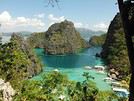
Il y a déjà plus de 11.600 posts sur la Thaïlande, et bien en voilà un de plus...
Ce pays ne se résume pas à ses îles de rêve ou à ses temples.
Les Festivals occupent une place importante, mais bien souvent, assister à ces festivités n'est pas la préoccupation première de la plupart des voyageurs qui se rendent là-bas...
Ce n'était pas la mienne non plus lors de mon premier voyage de 19 jours en Thaïlande en... 1985.
Pourtant, après Bangkok, Ayutthaya, le marché flottant, Chiang Mai, et avant la plage de rêve de Ko Samet (la vraie autoroute touristique,
je sais), de retour de mon trekking-rafting (😏), on m'a informé que j'avais de la chance, parce j'allais pouvoir assister au Festival des Fleurs...
Un vrai coup de bol. J'en ignorais jusqu'à l'existence...
Depuis plusieurs années maintenant, il est hors de question que je mette les pieds en Thaïlande sans assister à un Festival...
Défilés de chars, musique, nourriture oniprésente, élection de miss, concert le soir, ferveur populaire...
Parfois, ça ne va pas sans mal pour celui qui ne veut pas rater son coup.
Ca veut dire des heures sur Internet pour essayer de trouver LA bonne date, qui change chaque année.
Ca veut dire programmer son billet d'avion et son itinéraire en fonction de ces pseudo dates, avec quand même une marge de manoeuvre.
Ca veut dire quelques cheveux blancs à l'idée de ces hôtels peut-être complets.
Mais au bout du compte, c'est toujours une telle récompense de pouvoir assister à ce genre d'événement. Mieux, c'est un privilège.
Ce post s'intitule "Les Festivals en Thaïlande".
Leur liste est infinie. Festival des Fleurs à Chiang Mai, Festival des Elephants à Surin, Festival des Fusées, Fête des Singes à Lopburi, Festival
des Châteaux de Cire, Festival Végétarien à Phuket, Loy Kratong, Songkran (nouvel an)... Pour les plus connus.
Celles et ceux d'entre vous qui ont assisté au cours de leur séjour à un Festival quel qu'il soit en Thaïlande, si vous avez des anecdotes, des souvenirs, des photos, ce post est pour vous... C'est le moment de convaincre les autres que ça restera comme un des grands moments de leur voyage.
Un peu d'indulgence pour les photos, elles ont plus de 20 ans.
Festival des Fleurs de Chiang Mai
Je pense que c'est le premier week-end de février. C'est bientôt...
Je pars en Thaïlande avec pour seul compagnie mon sac à dos :) et j'essaye justement de trouver des festivals notamment de musique!
Une amie thaïlandaise m'a parlé du HuaHin Jazz Festival en Juin! Si qq un y est déjà passé je serais intéressé par tout commentaires!
Sinon si vous connaissez d'autres festivals pour la période avril-Juin n'hésitez pas à laisser un message
des festivals il y en a partout et tout le temps, il y a ceux organiser par le TOT, ceux cités, ils sont officiels, , enormes parfois, mais il y a ceux locaux, qui sont bien plus intéressants, et sanook, très conviviale, et pas de pubs partout,
pour cela ouvrir les quotidiens thais, dans la rebique festivités,
comme exemple la couses de chars a boeufs,
ou les différents compétitions de bateaux, dont le plus grand est a phichit,
mais un des préfères de thuan, ( il y a été 13 fois, , , , , le phitakon festival a loei,
Salut.vous connaissez, vous avez des photos du Festival du lâcher de Tortues à Phuket?(11/04/08), Cette cérémonie est englobée dans celle du Nouvel An. Ce jour est déclaré journée nationale de la pêche. Des bébés tortues sont relâchés dans la mer sur les plages de Phuket. Les tortues de mer sont devenues une espèce en voie de disparition, c'est la seule raison pour laquelle le gouvernement, parrain de la fête, espère ainsi augmenter leur nombre et sensibiliser le public sur l'importance de la protection de cette espèce. @+ merci
des festivals il y en a partout et tout le temps, il y a ceux organiser par le TOT, ceux cités, ils sont officiels, , enormes parfois, mais il y a ceux locaux, qui sont bien plus intéressants, et sanook, très conviviale, et pas de pubs partout,
pour cela ouvrir les quotidiens thais, dans la rebique festivités,
comme exemple la couses de chars a boeufs,
ou les différents compétitions de bateaux, dont le plus grand est a phichit,
mais un des préfères de thuan, ( il y a été 13 fois, , , , , le phitakon festival a loei,
__
Merci thuan pour les photos et les infos.
Du coup, j'ai fait des recherches sur ton préféré.
J'ai trouvé des photos du Phitakon ici (je dis ça pour les autres, ceux nombreux qui ne le connaissent pas) :
pour phitakon, il ne faut pas rater les tout débuts du festival ( voir photo ), c'est un festival très animiste et très ancien,
sinon dans le genre gore, il y a le festival végétarien, de phuket, ( entre autres ..) également ne pas rater les débuts dans les différents temples,
Quelques lignes sur le défilé des Bateaux illuminés à Nakhon Phanom.
Le festival dure plusieurs jours. Pleine lune d'octobre.
Mega marché le long du fleuve, fête foraine pour les enfants avec grosse musique... dans l'enceinte de temples.
Comme souvent, la pratique du mélange des genres est une seconde nature là-bas. J'adore ça. Le mélange des genres.
Dances et grande reconstitution historique sur scène avec de très nombreux figurants.
Les bateaux défilent le soir de la pleine lune.
Si on débarque assez tôt à Nakhon Phanom, on peut assister à la construction des bateaux qui défileront le grand soir.
Il s'agit d'immenses radeaux de bambous avec un échafaudage qui l'est tout autant. Sur celui-ci, on installe un montage en fil de fer qui représente un gigantesque dessin. On y accroche des milliers de petites bouteilles qui seront autant de lampes à huile.
Et vogue la galère. Le résultat est bleuffant !
Le grand soir, les abords du fleuve sont noirs de monde.
A un moment, on a vu une espèce de terrasse privée avec garde de sécurité. On a demandé si on pouvait entrer, il a accepté (privilège du farang ?...). On a sympathisé avec un gars qui était là, on nous a offert à boire. A un moment, il nous a dit : "je vais vous présenter mon boss".
C'était le maire de la ville.
C'était totalement surréaliste. La soirée était déjà bien avancée.
La tablée carburait au... Mekong (le whisky), ce qui était de circonstance, vu qu'on regardait tous le fleuve du même nom.
On lui a dit qu'on avait traversé la moitié de la planète pour voir le Festival dans sa ville. Il a eu l'air ravi.
Tout ça était filmé par un caméraman. On est peut-être passé aux infos du soir. Surréaliste, c'est le bon terme...
On a pu assister au défilé des bateaux dans les meilleures conditions alors que de l'autre côté des barrières, la foule était super compacte...
Chaque bateau balançait un feu d'artifice en passant juste devant le maire.
J'imagine un asiatique qui débarque en vacances en Europe. Pas sûr qu'il sera invité à partager la terrasse du premier maire venu pour mieux apprécier le spectacle, quel qu'il soit...
(la photo prise le soir n'est pas de moi, elle a été envoyée par voyageurasie sur VF il y a un an sur le post "le livre d'or de l'Isaan", merci à lui).
Bon, on dirait vu le nombre de lectures, que ça en intéresse quand même quelques uns.
Comme je suis sur le départ et que j'ai pas trop le temps, je vous fais un copier-coller d'un récit que j'ai envoyé il y a pas mal de temps dans une autre discussion. Noyé dans la masse.
Ce festival se déroule en même temps que le précédant.
La carte me dit qu'il y a 84 km entre les deux villes. Il est possible d'assister aux 2 festivals avec un peu d'organisation, ou plutôt avec un peu d'improvisation...
En 2005, ça donnait très exactement ceci :
Sakon Nakhon (chateaux de cire) : du 16 au 19 octobre. Défilé le 17.
Nakhon Phanom (bateaux Mekong) : du 13 au 19 octobre. Défilé le 18.
Se méfier des dates qu'on trouve sur le net, elles sont approximatives voire complètement foireuses, vu que parfois ce sont les dates de l'année précédante ! Quand je suis arrivé à Bangkok, je suis tombé sur une petite brochure gratuite à destination des touristes. Les bateaux illuminés faisaient la couverture. Et à l'intérieur, c'était rien moins qu'un copier-coller du site du TOT avec des dates bancales...
Les dates exactes se trouvent à l'office du tourisme LOCAL. Ou sur de grandes banderolles ou affiches quand on arrive EN VILLE.--
Copions-collons donc.
A la pleine lune d'octobre se déroule le Festival des Chateaux de Cire à SAKON NAKHON.
Pour y avoir assisté en 2005, je peux dire que c'est vraiment un spectacle magnifique, beaucoup plus impressionnant que ce que laisse supposer
les 2 ou 3 photos qu'on peut trouver sur certains sites, comme l'office du tourisme ou autre.
Ces festivités durent plusieurs jours, et la ville est en ébulition, surtout du côté du terrain de football où se déroule un immense 'Food Market', ainsi que des défilés de mode et de la musique sur une scène...
Et puis un beau jour, en début de soirée, les 'châteaux' débarquent sur des remorques afin d'être exposés côte à côte sur le parking du jouxte le terrain de foot. Pour autant que je me souvienne, il y en avait peut-être une quinzaine. Ces châteaux sont en réalité des maquettes représentant des temples plus splendides les uns que les autres, et intégralement en cire. Ca doit représenter des mois de travail.
C'était totalement magique de se ballader la nuit tombée entre ces remorques éclairées par des spots. Et pas de farang à l'horizon...
Le lendemain en début de soirée, ils défileront en ville, depuis un parc proche de la gare des bus jusqu'au Wat Phra That Choeng Chum.
Beaucoup de monde dans les rues, surtout aux 3 endroits stratégiques où les chars s'arrêtent pour que le public profite de la musique et du spectacle de danse qui accompagnent chaque 'château'.
A souligner également le côté bon enfant de ce genre de manifestation.
Aperçu quelques travestis sur les chars...
Salut. tous se qui parle de la Thaïlande m' intéresse et continuer comme ça de nous faire rêver avec vos trés beau Festivals et trés belles photos.merci et bonne route
Merci...
Tu dois être gâté avec VF !
Ceci dit, d'accord avec thuan sur l'intérêt qu'il faut porter aux "petits" festivals, moins connus et plus authentiques peut-être.
Jusqu'à présent, c'est surtout en fonction de MON CALENDRIER de vacances que je choisis les festivals...
J'ai pas la chance, comme certains sur VF, de vivre à l'année dans ce pays.
oui beaucoup de bon conseil que du bonheur merci à tous et toutes. de thuan à bardot.... et même aux plus raleurs sur VF😉😏😏longue et bonne vie à tous🙂🙂🙂
J'ai pas la chance, comme certains sur VF, de vivre à l'année dans ce pays.
😏on a quant même la chance d y aller en vacance😄
et maintenant place aux Festivals😏😏😏
Le top en voyage, c'est de se lever en ne sachant pas de quoi sera faite la journée. Cette fois-là, je prenais mon breakfast bien mérité dans
un des petits restos de Thanon Klang Meuang dans le centre de Khon Kaen. On était le 14 ou le 15 avril. En plein Songkran.
Faisait déjà chaud. J'avais quelques heures pour aller visiter 2 ou 3 temples superbes à proximité du lac, au Sud de la ville.
Avant qu'on ne sache plus faire un pas dehors sans être arrosé copieusement...
A ce moment là, une fanfare est passée dans la rue. J'ai fini mon café en catastrophe et je l'ai suivie. Une vraie visite de la partie Nord de la ville.
Un coup à gauche, un coup à droite. Je savais plus vraiment où je me trouvais. A chaque carrefour, d'autres fanfares se joignaient à la première.
Tout ça s'est terminé dans une cour d'école.
Les différents groupes se sont mis face à une rangée de chaises en plastique faisant office de 'tribune officielle'. Jai pris quelques photos.
Mais bon, un farang seul dans une cour d'école thaïe, pour la discrétion, faut repasser. On m'a proposé des rafraîchissements, on m'a présenté
un homme d'âge mûr en tenue de jogging, peut-être le directeur de l'école (?). Je sais pas. Il m'a proposé de m'asseoir à ses côtés pour assister au défilé des différents groupes avant le match. Parce que Khon Kaen est une ville très sportive. C'est marqué sur la carte qu'on distribue à l'office du tourisme local : 'Khon Kaen, sport city'. En fait, chaque fanfare représentait une école. Et tout ce petit monde allait s'affronter dans un match amical. De football ou de volley, je sais plus.
Donc comme tout le monde, je me suis levé pendant que les 'troupes' défilaient avec sérieux devant la 'tribune officielle'. Un autre moment assez surréaliste, mais tellement sympa. Après le défilé, j'ai remercié pour l'accueil et me suis éclipsé avant le match. Un début de journée ordinaire
en Isaan, finalement...
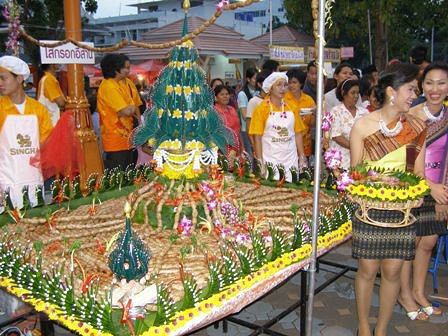
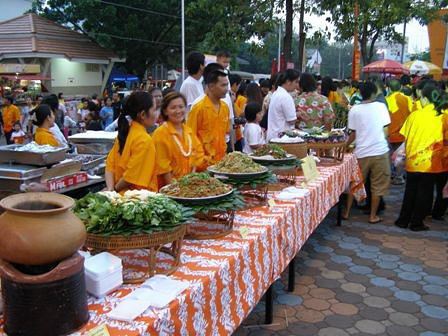
Udon Thani, 30 mars, fin d'après-midi. Je viens de terminer le tour du lac et du Nong Prajak Park. Sur l'esplanade qui fait face à la caserne des pompiers, il y a de l'animation. Des chaises sont installées, un orchestre, des spots, de la nourriture très 'travaillée'. Pas du tout un Night Market, plutôt un buffet traiteur. Les gens sont sur leur 31. Chacun porte une chemise orange. Après une petite démonstration de danse classique, on a droit à un discours trop long... En tous cas pour le farang qui ne pige pas un mot.
A ce moment là, j'aurais dû faire des photos du buffet, parce qu'il était magnifique. Par la suite, il sera un peu massacré. Façon Mandala.
On va dire que le gars qui est entouré de filles sublimes en costume traditionnel et qui déclare que le buffet est ouvert est le maire de la ville.
Je le vois bien comme ça.
Je me mêle à la foule orange. Cette petite manifestation est sponsorisée par la bière Léo, pourtant pas de bière à l'horizon. Quelques farangs, probablement des expats. Moi, je suis un peu poussiéreux et vêtu comme l'as de pique...
On ne va pas arrêter de me mettre de la nourriture en main. Sur la fin, une femme derrière son comptoir pousse un cri en me voyant passer à sa hauteur : "He you !". Puis elle constate avec horreur qu'elle n'a plus de nourriture et disparait (derrière son comptoir donc). Pendant ce temps, sa voisine me fournit en desserts... La première se redresse alors triomphalement en me tendant, tout sourire, deux saucisses...
Un peu plus tard, on a replié les chaises, les comptoirs, le décor. Le coup d'envoi des festivités de Songkran était terminé.
Juste la chance de m'être trouvé au bon endroit au bon moment. Une fois de plus, parce qu'il m'arrive tout le temps des trucs comme ça en Thaïlande.
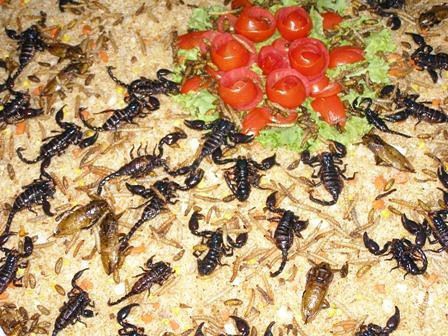
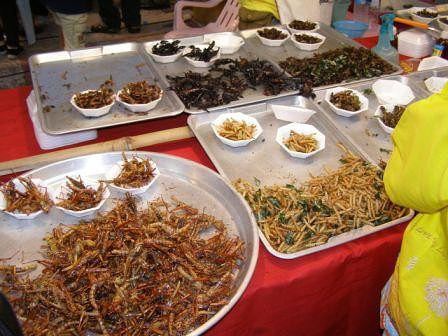
Et pourtant c'est le menu de l'ouverture de Songkram à Udon Thani en 2007...Encore une petite derniére, le stand de dégustation des différentes qualités de vers....grillés !
La Paella au scorpion, ma femme refuse que j'en mange. C'est aphrodisiaque parait il...
On voit beaucoup ça dans le Nord-Est. De toutes sortes...
Ca a un p'tit côté "Koh Lanta", cette émission débile qu'on nous passe chaque année sur les chaînes françaises et où les candidats sont obligés d'avaler toutes sortes de choses bizarres et visceuses... Non grillées pour eux...🙁
ho mais c une obsetion chez toi le durian !!!!! 😏😏😏😏
non je deconne 😛😛 c'etait facile
😮non moi je déconne pas😏😏 ce fruit ma tellement marqué🏴☠️ que je me suis dit qu il fallais que je lui rende un grand hommage.tellement de personne le déteste🙁, je le trouve magnifique en phot😮 longue vie au Durian 😉😉 .
dans le genre gore, il y a le festival végétarien, de phuket
😇😮 je suis pas végétarien, je laisse ce Festival au amateur😕😕😉
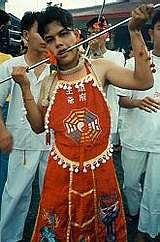
Evénement haut en couleur qui s'étend sur une période de 9 jours fin Septembre-début Octobre, qui célèbre la croyance de la communauté Chinoise que l'abstinence de viande et divers stimulants durant le neuvième mois lunaire du calendrier Chinois les aidera à jouir d'une bonne santé et de la paix de l'esprit.
Bien que les origines du festival ne soient pas clairement établies, il semble que celui-ci ait été apporté à Phuket par un groupe d'opéra nomade Chinois qui tomba malade de la malaria lors de leur prestation sur l'île. Ils décidèrent alors de suivre un régime végétarien strict et de prier les Neufs Dieux Empereur qui garantissent la purification de l'esprit et du corps. Lors de leur rétablissement, les gens célébrèrent cet événement en organisant un festival destiné à honorer les dieux en même temps que d'exprimer le bonheur des gens d'avoir survécu à ce qui, au dix-neuvième siècle, était une maladie mortelle.
Le festival se tient toujours les premiers jours du neuvième mois lunaire Chinois, et pendant neuf jours, les participants observent les engagements suivants:
Propreté du corps durant le festival
Les ustensiles de cuisine ne doivent pas être utilisés par d'autres personnes ne participant pas au festival
Porter du blanc durant le festival
Bonne conduite physique et mentale
Eviter de manger de la viande ou tout ce qui est issu de l'animal
Eviter le sexe
Eviter l'alcool
Les personnes en deuil ne doivent pas participer
Les femmes enceinte et celles ayant leurs menstruations ne doivent pas assister aux cérémonies
L'un des aspects les plus passionnants du festival réside dans la variété (et parfois l'horreur) des cérémonies qui ont lieu pour invoquer les dieux. Marcher sur le feu, se transpercer le corps et autres actes de mortification entrepris par les participants agissant en tant qu'intermédiaires des dieux, sont devenus plus spectaculaires et audacieux d'année en année. Hommes et femmes se percent les joues d'instruments divers tels que couteaux, broches, tiges métalliques, branches.......... Il semblerait que les dieux Chinois protègent ces personnes de la douleur, du sang qui coule ou des cicatrices qui résultent de tels actes de mutilation. Il est sans aucun doute déconseillé aux âmes sensibles d'y assister.
Les cérémonies du festival se tiennent dans les alentours des six temples Chinois dispersés à Phuket. Le temple principal est celui de Jui Tui Shrine, non loin du Marché de produits frais de Phuket Town. Le premier événement consiste en l'élévation du Mât à la Lanterne, un acte qui avertit les neuf dieux Chinois que le festival va commencer. Le mât mesure au moins dix mètres une fois dressé, les participants croyant que le dieu Hindou, Shiva, descend apporter sa force spirituelle sur l'événement.
Pour les quelques jours suivants, les membres de la communauté locale Chinoise/Thaï apportent les dieux de leur maison au temple, en plus de faire des offrandes de nourriture et boisson. Il est supposé que les dieux apportés bénéficieront d'une injection annuelle de l'énergie spirituelle qui emplit le temple. Les visiteurs peuvent observer et même participer à l'allumage des bâtons d'encens et bougies qui sont placés autour des divers dieux.
Généralement se déroulent des processions dans les rues de l'île, où les visiteurs peuvent voir les participants déambuler en transe. Parmi d'autres événements, vous pourrez voir des centaines de résidents locaux courir sur un lit de charbons ardents, ou encore grimper en transe une échelle de lames tranchantes de huit mètres de haut.
A part le spectacle visuel de ce festival, les visiteurs peuvent prendre part à la dégustation de la cuisine végétarienne spécialement préparée pour l'événement et disponible aux stands qui s'installent un peu partout sur l'île durant cette période. Les plats végétariens ne se distinguent pas facilement des autres plats habituels - des produits de substitution protéinés et à base de soja sont utilisés pour remplacer la viande selon les standards Thaï et ressemblent autant par l'aspect que par le goût étonnamment à la viande. Pour repérer les stands végétariens, regardez si vous apercevez un drapeau jaune avec des caractères rouges Chinois ou Thaï - et ayez votre appareil photo ou votre caméscope toujours prêt!!
Ce matin, je suis passe a Lopburi histoire d'obtenir des renseignements sur le deroulement du King Narai Festival, qui se deroule chaque annee a la mi fevrier. Je pensais peut-etre vous envoyer quelques impressions en live...
Et bien ce sera pour une autre fois, parce que le King Narai Festival de Lopburi ne se deroulera pas cette annee... En cause le deces recent de la soeur du Roi.
il m'a fait avec un grand sourire...
Une ferveur chez nos amis, les fantômes ou plutôt les esprits !
Chaque année au mois de juin (pleine lune), la fête de "Phi Ta Khon". Village de Dan Sai dans la province de Loei.
"Le Festival «Phi Ta Khon» qui fait partie de la fête bouddhiste de « Boun Phra Wat » constitue l'événement annuel le plus haut en couleurs et le plus original du pays.
Bien que son premier but soit de favoriser les pluies de la mousson et assurer la fertilité des terres cultivées, cet événement est l'occasion d'acquérir des mérites spirituels importants, et semble également servir de rite de passage à l'âge adulte pour les jeunes garçons qui assument le rôle des fameux «fantômes »."
Comme je le disais tout en haut de ce post, on doit se sentir vachement privilegie de pouvoir assister a un moment pareil...
Tiens, on dirait que l'Office du Tourisme le met en exergue dans sa News Letter de fevrier.
Est-ce que ca veut dire que dans les annees a venir, on pourrait commencer a voir de plus en plus de farangs a cette fete...
cette année j'éspere ne pas le louper
(c'est toujours comme çà quand on habite a côté)
Vrai de vrai.
Dans mon plat pays, jamais vu le Carnaval de Binche, pourtant depuis qu'il a pris ses galons Unesco, on debarque de toute la planete pour y assister...
Bon, après l'échec lopburien, il est temps de relancer ce post...
Pour les distraits, la semaine prochaine, c'est Songkran, le nouvel an thaï. Ce n'est pas que le 13 avril, ça déborde de plusieurs jours, parfois même d'une semaine... Utilisez le moteur de recherche, on en parle sur VF chaque année à pareille époque.
Des festivités tous azimuts. Défilés de chars, concerts en tout genre, défilés de mode, concours de cuisine, de miss, de mangeurs de crevettes, tout et parfois n'importe quoi. Toujours dans la bonne humeur. Et par dessus tout, de la musique, beaucoup de nourriture, et de l'eau, de l'eau, de l'eau...
Faut aussi savoir que l'alcool coule à flot, avec les excès que ça peut entraîner. Prudent sur les routes, les statistiques quant aux accidents mortels grimpent en flèche pendant cette période. Prévoyez large dans vos déplacements, vous aurez peut-être du mal à trouver place dans le train vu que tout le pays voyage en même temps...
Ce qui suit provient de Khon Kaen, dans le Nord-Est.
Sur les visages, c'est pas du Tanaka, on n'est pas en Birmanie, c'est du talc. Vous ressemblez plus à rien quand vous regagnez l'hôtel.
Miscellaneous › Turkey / Thailand / Cuba · 4 replies
What are your positive and negative experiences with dental implants in different countries around the world? Looking for something like 4-5 dental implants,…
Hello everyone! I’m heading off solo in February and wanted to share my rough itinerary with you. Does this sound doable?
PS: I’m not really into beaches.
D1 Departure on February 17, 2027
D2 Arrival in Kuala Lumpur – stroll through Chinatown and visit the Petronas Towers
D3: Kuala Lumpur – Chow Kit Market, Batu Caves, Little India, Bukit Bintang downtown area
D4: Early morning bus to Malacca. Explore Malacca in the afternoon and evening
D5: Another 2–3 hours in Malacca in the morning, then bus back to Kuala Lumpur. Merdeka Square area. Stay in Chinatown
D6: Bus trip to Kuala Tahan. Night tour
D7: Morning – canopy walk and Bukit Terisek hike. Afternoon – off to Lata Berkoh
D8 & D9: 2-day jungle trek in Taman Negara National Park
D10: Head to Cameron Highlands
D11: Morning hike through the plantations. Afternoon still to be decided
D12: Morning – excursion to Mossy Forest and Sungei Plantation. Afternoon bus to Ipoh
D13: Morning – Mirror Lake / Sam Poh Temple area. Afternoon – explore downtown Ipoh
D14: Morning train to Penang. Afternoon – wander around Georgetown
D15: Morning – Penang Hill and Keh Loh Temple. Afternoon – Georgetown
D16: Bus to Butterfly Garden and Spice Garden. Late afternoon – Burmese and Thai temples
D17: Morning flight to Singapore. Afternoon – Chinatown and Marina Bay tour
D18: Morning – Gardens by the Bay area. Afternoon – Boat Quay, Clarke Quay, Kampong Glam
D19: Morning – The Ridges area and Botanical Garden. Afternoon – Little India, then back to Chinatown before 11:15 PM return flight
D20: Morning arrival
Hi everyone,
I’ll be in western Malaysia for 20 days in January and February.
I’m coming from southern Thailand to Ipoh for the Thaipusam festivities.
Then it’s off to Pangkor Island.
I’ll finish up in Malacca for the Chinese New Year celebrations before heading to Singapore.
I’ve got a 6-day gap.
I was thinking of going to K.Lipis for the jungle train and heading to Dabong, but the caves might not be open.
Any suggestions around K.L.?
Day treks?
A stopover between K.L. and Malacca?
Thanks
Hi, I’ve read that these two volcanoes are super popular and that there are *tons* of people for sunrise, especially in July. I’m looking for firsthand accounts from anyone who’s done it later, around 9–10 a.m.
Thanks for your help!
Laëtitia
I’m heading to Cambodia at the end of December 2026 – January 2027 for 3-4 weeks. Since I’ve already visited Cambodia twice, my itinerary is a bit different this time—I’d love to explore Botum Sakor Park, Chi Pat, the Tatai region, and the Cardamom Mountains. I’m traveling solo. If you have any tips on transportation, excursions, treks, sights, or accommodations in the area, I’d really appreciate it. Thanks for your feedback!
Has anyone traveled with the Laos travel agency ADV ?
I’m planning a trip to Laos and have received several quotes. Among them, this agency’s seem very reasonable, and so far, the interactions have been positive.
I’ve found a few positive reviews online, but I’d love to hear from travelers who’ve actually booked with them: how’s the organization, guide quality, accommodations, on-the-ground responsiveness, etc.
Thanks for sharing your experiences!
First stop on our discovery of the peninsula: Amphawa. It’s our first night in Thailand (we arrived at Suvarnabhumi at 8:50 AM).
Our initial plan was to explore the area before heading further south. The Mae Klong Railway Market is tempting... but what else is there to do????
We’ll be there on a Wednesday, and from what I’ve read on the forum, some say there’s absolutely nothing to do during the week—no floating market, barely any shops open, no restaurants, etc.
Others, though, say the place is actually more charming without the weekend crowds.
Could you share your thoughts? Missing the floating market is one thing, but if it’s really a ghost town on Wednesdays, I might just drop our bags somewhere else.
Amphawa seemed like a good first stop, just 1.5 hours from the airport, but I’d still like to settle somewhere a bit lively for our first evening.
We’ll be there at the end of October.
Thanks!
Hi,
I wanted to visit the plantations in the morning with GetYourGuide or by just showing up.
How much time should I really plan for?
I’d like to catch either the 3 PM or 5 PM bus back to KL.
Thanks
Hi,
I wanted to get some info about the cable car and the bridge—I see lots of different options...
How much time should we allow for these two activities? If we arrive around 4 PM, will we have enough time to visit without rushing?
Thanks
Hi there,
I didn’t plan to return to Thailand this year, but my health conditions mean it’ll be the best place for me to stay between two trips to India. The tourism setup there is so well-organized that it’s the most "comfortable" country for a short visit. Thailand feels too sanitized for my taste, and there’s too much religion, Buddha, and the King, but it’s still the best option given how my health has been evolving. I’d considered two weeks in ThaTon for hiking, but I got too sick from the burn-offs during my trips to the mountains around Chiang Rai. So I’m not sure where to go this year. Definitely not the sea, touristy spots, or the mountains with burn-offs...
Hi,
On September 1st, we're heading to Kalimantan for six weeks, probably from Pontianak to the Derawan Islands.
I've scoured this site, which is usually my go-to 😉, and others like VoyageForum, but recent info is pretty scarce.
I'd love any tips on places you've visited—our itinerary is still a work in progress.
We're two couples traveling with backpacks, using buses, boats, guesthouses, and homestays.
Thanks in advance!
Hi fellow travelers,
First trip to Vietnam.
We’ll be arriving in Ho Chi Minh City during Tet.
Is it complicated to find accommodation and get around during this period?
Any tips would be welcome.
Thanks for your replies.
Hi! I’d like to split my trip into two parts: 15 days in Phuket and 15 days in Krabi. Do you know if I can rent a car and drop it off in Krabi when I fly back to France?
Thanks for your feedback!
Have a great Sunday!
Martine
Hello,
After 1 night in Khao Sok, I’d like to find a 2 Days 1 Night package on the lake.
After reading a lot, I decided to "break the bank" and treat ourselves to a private tour—mainly to avoid the crowds.
But after contacting several operators, they offer "private tours" that are very expensive (around 700 €), yet in the details, the boats can only leave from the pier at 10 AM like everyone else. (I was hoping to leave much earlier.) The morning program is the same for everyone too (private or not). They drop us off at noon at our floating hotel (I’d chosen Phupha Waree). Free afternoon (swimming or kayaking in front of the hotel). We head back by boat for a 1-hour sunset ride. And the next morning, we leave the hotel at 8 AM to be at the pier by 9:30 AM at the latest—end of the trip.
So basically, we’re paying a lot for a private tour just to do the same thing as everyone else at the same time.
Or maybe I just had bad luck in my search.
I contacted Panida Ladi, who’s very popular on forums. We’d agreed on a private tour that matched my request (departure from the pier at 8 AM, very personalized itinerary). We settled on the itinerary and price, she asked for a Wise transfer for a 30% deposit, confirmed receipt of the deposit. Then 30 minutes later, she messaged me to say she was canceling everything because it was impossible to do the requested tour—and promised a quick refund of my deposit.
So here’s my question: Who’s done a *real* private tour on this lake? Who can recommend a reliable agency? Is it even really possible to do a private tour here?
I’m searching for a real gem for my 3rd stay in Koh Lanta: a lovely, high-quality hotel right by an easily accessible beach in a lively spot.
If you know of anything that fits what I’m looking for and want to share, don’t hesitate!
Hi, is anyone there in Flores right now? According to some websites, everything is closed and the situation is tough. But our guide says it's fine. Who should we believe? We're supposed to leave on September 2nd. Thanks to anyone in Flores at the moment!
Hi dear community,
I'm planning to visit Cambodia this winter, right after Christmas, for my first solo trip and my first trip to Asia. For two weeks (yes, I know it's short, but I really can't do more...). I have two main desires: Siem Reap and the countryside, the villages, the Mekong...
What do you think of this itinerary? Arrival in Siem Reap, departure from Phnom Penh.
SR: 5 days (1 day for arrival, 3 for the temples, 1 for the lake and its villages)
Kratie (stop on the way to Mondolkiri): 3 days (1 day of travel, 2 days there)
Mondolkiri/Sen Monorom: 4 days (1 day of travel, 1 day there, 2 days of treks)
PP: 3 days (1 day of travel, 2 days of sightseeing)
I think I need to cut one day somewhere if I travel from Saturday to Saturday or Sunday to Sunday. In Kratie, maybe? Or in PP? And I'll miss the boat trip that everyone recommends (SR-Battambang), but I don't see where to fit it in. Unless I do a PP-PP loop starting in the east, skip Kratie or just stay one night, then SR, then PP.
In my timing, Mondolkiri seems closer than Ratanakiri, which also tempted me a lot! Will it be too complicated alone? I'm thinking of using local guides or a small local agency for a nature and village getaway.
I've read that Siem Reap is very crowded between Christmas and New Year's. I could also do the circuit in the opposite direction. But I thought it would be easier to get familiar with the country by arriving in a touristy area—I might be wrong...
Thanks for your advice and opinions!
Hi everyone.
I’m planning my trip, and based on all the posts I’ve read, this country is amazing.
Of course, I’ve got a ton of questions for you.
Here’s a possible itinerary: Vientiane - Vang Vieng - Phonsavan - Sam Neua - Nong Khiaw + villages - Phongsali - Luang Namtha and the area - Udomxai - Huay Xai - Luang Prabang and back to Vientiane.
What do you think?
We’re planning to prioritize local transport—is it possible to do this loop?
We’d also love to go kayaking, but I’m not sure if the season’s right or where the best spot is.
For trekking—I read that Phongsali is the most authentic spot to visit villages and see wildlife. Do you know of a reliable agency and a guesthouse with reasonable prices?
Is it worth taking a slow boat for a stretch on the Mekong, and if so, which route?
For accommodations, is it better to book through Booking.com and Agoda or look when we arrive?
Are mosquitoes bad in Laos, and should we take malaria prophylaxis?
What’s the average daily budget (accommodation, food, visits)?
Is renting scooters a good option for exploring towns, and if so, which ones?
From what I’ve read, it’s best to carry cash—euros or dollars? Is it risky to walk around with that much cash?
I’ve still got tons of questions. Thanks to anyone who can help, and I’m open to all tips, info, etc.
Thanks again
Hi there,
I’m planning a family trip (my wife and I, both 47, and our two sons, aged 5 and 12) to Malaysia for the last week of June and the first two weeks of July 2027.
We used to love road trips as a couple, then as a trio, but since our second child arrived, we’ve taken a break with "camping village" style trips.
Now feels like the right time to get back to our old habits, while adjusting the pace for the kids.
We’re craving Asia. We’ve been lucky enough to visit Thailand, Indonesia (Bali and Lombok), and Sri Lanka before.
Friends have raved about Malaysia, so we’re definitely tempted.
For those who know and love Malaysia, what would be a good itinerary starting from Kuala Lumpur, with a maximum of 3-4 stops? We’d like a mix of culture, nature, and relaxation (just to clarify, we’re not big beach fans). All of this without rushing, of course.
Hello,
We’re a family of four with two teens aged 16 and 18. We’re heading to Thailand this summer. We’ll arrive in Bangkok and plan to take a flight to Luang Prabang.
I’ve seen there are some great visits and excursions to do (temples, markets, waterfalls) and maybe even venture a bit north to places like Nong Khiaw, Muang Xay, Muang Ngoy, or Oudom Xay.
But I’ve also heard about the Bokeo region with the Gibbon Experience.
Since we won’t be able to do everything, I’d love to hear about your experiences, impressions, and advice on the two options I’m considering, especially since we’ll be meeting family in Chiang Mai, Thailand, afterward.
Option 1: A loop from Luang Prabang heading slightly north, then a flight from Luang Prabang to Chiang Mai.
Option 2: A few days in Luang Prabang, exploring within a few dozen kilometers around, then heading to Bokeo province for the 2-day/1-night Gibbon Experience. For this option, I saw on Rome2Rio that it’s possible to book a ferry trip on the Mekong from Luang Prabang to Huay Xay—they mention about 8 hours. But is that realistic? What type of boat is it?
Then, to get to Chiang Mai, there aren’t many options—bus or minivan—but how does crossing the border work?
Finally, for those of you who’ve been to Laos in August, what was the weather like?
We’ve already visited Thailand, Vietnam, and Cambodia during the same period over the past four years and weren’t really bothered by bad weather.
I’m starting a discussion about guides in the Mekong Delta because we’ve just finished our trip in this region and had a hard time finding a French-speaking guide. We had Thanh—she speaks French really well and travels all over the delta region, including Ho Chi Minh City. She’s super friendly and flexible. I recommend her wholeheartedly. If it can help someone...
Feel free to contact us for her number.
Hi everyone,
I couldn’t find any recent info on Kuching.
Can anyone recommend a hotel or guesthouse for under 100 RM that’s nice and affordable? No dorms, please.
Also, does it rain a lot in November, and is it still worth visiting Semenggoh or Bako?
We’ll be arriving in Phnom Penh this coming January and we’re thinking of starting our trip with a stop in Kampong Cham, then Kratie.
After Kratie, we’re considering heading toward Siem Reap with a stop in Kampong Thom.
That said, I’m not really sure how long the Kratie–Kampong Thom journey might take or how complicated it is.
Does this stop on the way to Siem Reap seem like a good idea to you?
If we don’t visit the Sambor Prei Kuk site, are there still any walks or sights worth checking out in Kampong Thom?
Silly question—backpack or hard-shell suitcase for the Sepilok, Kinabatangan, Tioman, KL trip?
I’m struggling to fit all my son’s and my stuff into the 70L backpack... and I’m thinking a suitcase would be easier, but I’m not sure if it’ll work for getting around.
After a stay on Koh Phayam this coming November, I’d like to spend 2 or 3 days on Koh Phra Thong before heading further south.
Do you think it’s doable to leave Koh Phayam early enough to catch the 10 AM boat from Khura Buri to Koh Phra Thong? The next one isn’t until 4 PM, which would cost me a whole day.
I’m planning a trip to Indonesia, specifically Sulawesi and Java, in September for 10 days.
I don’t know this part of the world at all—any advice is welcome!
I’ll be traveling solo and would also love tips on meeting other travelers or locals.
Hello everyone,
Not long ago, I used to travel as a couple, but my husband has since passed away, and I’ve decided to set off again. The trip I took to Cambodia in January 2025 did me a world of good.
I’m now considering Thailand, a destination we never included in our plans because even 15 years ago, people said it was too touristy. Still, I’m thinking about the itinerary below, but I don’t feel up to arranging buses, trains, or guides on my own while I’m there. I’m looking for one or more drivers and have been in touch with an agency, but their offers are just copy-paste group tours that I don’t want.
So, if you have any contacts, experiences, or advice, I’d be so grateful if you’d share them with me. Here’s my rough plan:
Arrival in Bangkok
Ayutthaya (2 nights)
Kanchanaburi (2 or 3 nights)
Sangkhlaburi/Sai Yok (3 nights)
Sukhothai (2 nights)
Lampang (I’ve planned 3 nights, but that might be a bit much—it depends on what time I arrive in the city)
Chiang Mai
Chiang Dao
Pai
Chiang Rai
I was thinking about the Mae Hong Son loop—thoughts?
What do you think about staying overnight at the Golden Triangle?
When I look online, of course, I can find agencies that organize tours to national parks, etc.
I’m retired but in great physical shape. I’d rather go hiking than sit in hot springs with crowds of tourists who’ve all arranged meet-ups. I don’t want to spend a day at an elephant camp, and I don’t want to visit Karen villages.
I’d love to hear your advice.
Thank you all,
Hi everyone,
Could you share your thoughts on my 3-week itinerary?
We’re a small group (family + friends) of 12 people, planning to leave around January 21, 2027.
Here’s my itinerary:
3 nights in Bangkok
4 nights in Chiang Mai
3 nights on Koh Samui
3 nights on Koh Phangan
4 nights in Krabi
4 nights in Phuket
I’m also open to any great tips you might have...
Thanks, everyone! Alain.
Hi there,
We’re planning a 3-week family trip next summer with our three kids, who’ll be 8, 8, and 7 years old.
After some research, we’re leaning toward Malaysia to combine nature/forests and paradise beaches. The idea is to introduce our kids to the country’s culture, nature, and wildlife.
We want a great trip but without splurging on luxury options like high-end lodges and resorts. We’re looking for comfort with a touch of authenticity—basically, a good middle ground.
I’ve started putting together an itinerary and would love your expert advice and tips to help us build this amazing trip with our little ones.
Day 1: Departure from France
Day 2: Kuala Lumpur
Stay at a hotel near the airport or KL Sentral.
Just one night.
Day 3: Morning flight to Sandakan (Borneo).
Stay in Sepilok
Day 4: Sepilok:
* Orangutan Center
* Malayan Sun Bear Center
* Rainforest Discovery Centre
Day 5: Depart for Kinabatangan.
Boat safari in the late afternoon.
Day 6: Sunrise safari.
Jungle walk.
Evening safari.
Day 7: Final safari.
Return to Sandakan.
Flight to Kuala Lumpur, then to Kota Bharu (or overnight transit depending on schedules).
Day 8: Transfer to the port.
Boat to the Perhentian Islands.
Days 9 to 13: Perhentian Besar
5 full days.
* Snorkeling
* Hiking
* Turtle watching
* Wild beaches
* Relaxation
Day 14: Return to the mainland.
Bus or private car to Taman Negara.





 (la photo prise le soir n'est pas de moi, elle a été envoyée par voyageurasie sur VF il y a un an sur le post "le livre d'or de l'Isaan", merci à lui).


 oui beaucoup de bon conseil que du bonheur merci à tous et toutes. de thuan à bardot.... et même aux plus raleurs sur VF😉😏😏longue et bonne vie à tous🙂🙂🙂


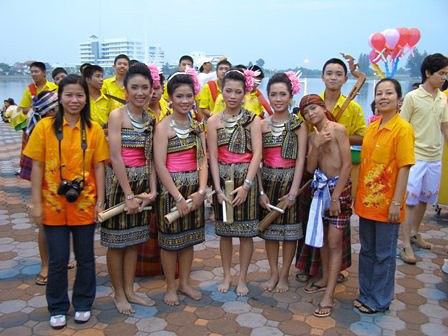

 vous pouvez regarder ce site avec c'est superbe photos en cliquant>>
  <<sur cette photo
 Bien que les origines du festival ne soient pas clairement établies, il semble que celui-ci ait été apporté à Phuket par un groupe d'opéra nomade Chinois qui tomba malade de la malaria lors de leur prestation sur l'île. Ils décidèrent alors de suivre un régime végétarien strict et de prier les Neufs Dieux Empereur qui garantissent la purification de l'esprit et du corps. Lors de leur rétablissement, les gens célébrèrent cet événement en organisant un festival destiné à honorer les dieux en même temps que d'exprimer le bonheur des gens d'avoir survécu à ce qui, au dix-neuvième siècle, était une maladie mortelle.
Le festival se tient toujours les premiers jours du neuvième mois lunaire Chinois, et pendant neuf jours, les participants observent les engagements suivants:
Propreté du corps durant le festival
Les ustensiles de cuisine ne doivent pas être utilisés par d'autres personnes ne participant pas au festival
Porter du blanc durant le festival
Bonne conduite physique et mentale
Eviter de manger de la viande ou tout ce qui est issu de l'animal
Eviter le sexe
Eviter l'alcool
Les personnes en deuil ne doivent pas participer
Les femmes enceinte et celles ayant leurs menstruations ne doivent pas assister aux cérémonies
Bien que les origines du festival ne soient pas clairement établies, il semble que celui-ci ait été apporté à Phuket par un groupe d'opéra nomade Chinois qui tomba malade de la malaria lors de leur prestation sur l'île. Ils décidèrent alors de suivre un régime végétarien strict et de prier les Neufs Dieux Empereur qui garantissent la purification de l'esprit et du corps. Lors de leur rétablissement, les gens célébrèrent cet événement en organisant un festival destiné à honorer les dieux en même temps que d'exprimer le bonheur des gens d'avoir survécu à ce qui, au dix-neuvième siècle, était une maladie mortelle.
Le festival se tient toujours les premiers jours du neuvième mois lunaire Chinois, et pendant neuf jours, les participants observent les engagements suivants:
Propreté du corps durant le festival
Les ustensiles de cuisine ne doivent pas être utilisés par d'autres personnes ne participant pas au festival
Porter du blanc durant le festival
Bonne conduite physique et mentale
Eviter de manger de la viande ou tout ce qui est issu de l'animal
Eviter le sexe
Eviter l'alcool
Les personnes en deuil ne doivent pas participer
Les femmes enceinte et celles ayant leurs menstruations ne doivent pas assister aux cérémonies
 L'un des aspects les plus passionnants du festival réside dans la variété (et parfois l'horreur) des cérémonies qui ont lieu pour invoquer les dieux. Marcher sur le feu, se transpercer le corps et autres actes de mortification entrepris par les participants agissant en tant qu'intermédiaires des dieux, sont devenus plus spectaculaires et audacieux d'année en année. Hommes et femmes se percent les joues d'instruments divers tels que couteaux, broches, tiges métalliques, branches.......... Il semblerait que les dieux Chinois protègent ces personnes de la douleur, du sang qui coule ou des cicatrices qui résultent de tels actes de mutilation. Il est sans aucun doute déconseillé aux âmes sensibles d'y assister.
Les cérémonies du festival se tiennent dans les alentours des six temples Chinois dispersés à Phuket. Le temple principal est celui de Jui Tui Shrine, non loin du Marché de produits frais de Phuket Town. Le premier événement consiste en l'élévation du Mât à la Lanterne, un acte qui avertit les neuf dieux Chinois que le festival va commencer. Le mât mesure au moins dix mètres une fois dressé, les participants croyant que le dieu Hindou, Shiva, descend apporter sa force spirituelle sur l'événement.
Pour les quelques jours suivants, les membres de la communauté locale Chinoise/Thaï apportent les dieux de leur maison au temple, en plus de faire des offrandes de nourriture et boisson. Il est supposé que les dieux apportés bénéficieront d'une injection annuelle de l'énergie spirituelle qui emplit le temple. Les visiteurs peuvent observer et même participer à l'allumage des bâtons d'encens et bougies qui sont placés autour des divers dieux.
Généralement se déroulent des processions dans les rues de l'île, où les visiteurs peuvent voir les participants déambuler en transe. Parmi d'autres événements, vous pourrez voir des centaines de résidents locaux courir sur un lit de charbons ardents, ou encore grimper en transe une échelle de lames tranchantes de huit mètres de haut.
L'un des aspects les plus passionnants du festival réside dans la variété (et parfois l'horreur) des cérémonies qui ont lieu pour invoquer les dieux. Marcher sur le feu, se transpercer le corps et autres actes de mortification entrepris par les participants agissant en tant qu'intermédiaires des dieux, sont devenus plus spectaculaires et audacieux d'année en année. Hommes et femmes se percent les joues d'instruments divers tels que couteaux, broches, tiges métalliques, branches.......... Il semblerait que les dieux Chinois protègent ces personnes de la douleur, du sang qui coule ou des cicatrices qui résultent de tels actes de mutilation. Il est sans aucun doute déconseillé aux âmes sensibles d'y assister.
Les cérémonies du festival se tiennent dans les alentours des six temples Chinois dispersés à Phuket. Le temple principal est celui de Jui Tui Shrine, non loin du Marché de produits frais de Phuket Town. Le premier événement consiste en l'élévation du Mât à la Lanterne, un acte qui avertit les neuf dieux Chinois que le festival va commencer. Le mât mesure au moins dix mètres une fois dressé, les participants croyant que le dieu Hindou, Shiva, descend apporter sa force spirituelle sur l'événement.
Pour les quelques jours suivants, les membres de la communauté locale Chinoise/Thaï apportent les dieux de leur maison au temple, en plus de faire des offrandes de nourriture et boisson. Il est supposé que les dieux apportés bénéficieront d'une injection annuelle de l'énergie spirituelle qui emplit le temple. Les visiteurs peuvent observer et même participer à l'allumage des bâtons d'encens et bougies qui sont placés autour des divers dieux.
Généralement se déroulent des processions dans les rues de l'île, où les visiteurs peuvent voir les participants déambuler en transe. Parmi d'autres événements, vous pourrez voir des centaines de résidents locaux courir sur un lit de charbons ardents, ou encore grimper en transe une échelle de lames tranchantes de huit mètres de haut.
 A part le spectacle visuel de ce festival, les visiteurs peuvent prendre part à la dégustation de la cuisine végétarienne spécialement préparée pour l'événement et disponible aux stands qui s'installent un peu partout sur l'île durant cette période. Les plats végétariens ne se distinguent pas facilement des autres plats habituels - des produits de substitution protéinés et à base de soja sont utilisés pour remplacer la viande selon les standards Thaï et ressemblent autant par l'aspect que par le goût étonnamment à la viande. Pour repérer les stands végétariens, regardez si vous apercevez un drapeau jaune avec des caractères rouges Chinois ou Thaï - et ayez votre appareil photo ou votre caméscope toujours prêt!!