un reportage diffusé ce dimanche 22 février sur 66 minutes "M6" nous montre l'envers du décor des mauvais traitements que subissent certains élephants de Thailande! "élephants martyrs"
Soit certains sont très bien traités, heuresement
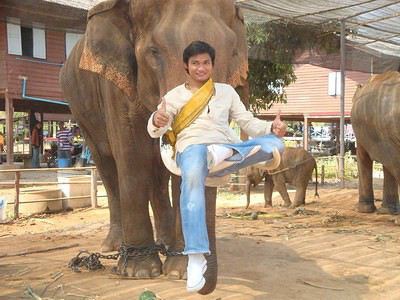
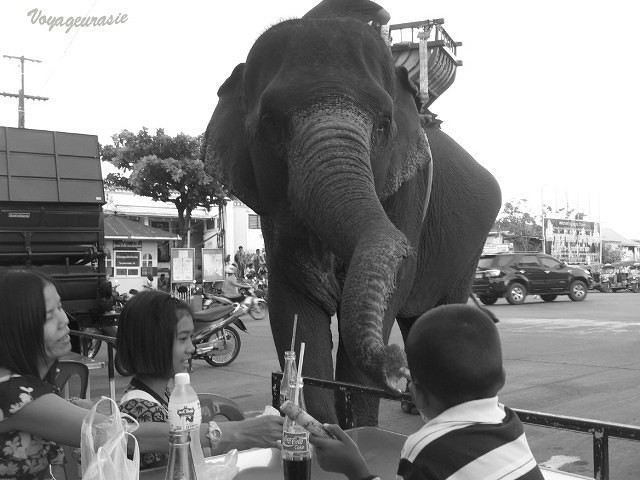
Mais si vous voyez un élephant dans BKK par exemple sur Khao san road ou dans Chiang mai en pleine rue, c'est un élephant malheureux, ne participez pas.
si vous voyez un élephant portant des marques de coups, ne cautionnez pas, refusez de coopérer a ce mauvais tourisme!
n'hesitez pas a manifester votre mécontentement devant un mauvais traitement.
il faut que les Thailandais comprennent que nous voulons voir des élephants heureux et en bonne santé.
c'est à nous de faire passer ce message.
Voir un elephant danser sur une musique avec des cerceaux, peindre une toile n a rien de naturel, c'est beau oui mais comment se passe le dressage quand le touriste n'est plus là ??
Le doux sourire que porte cet animal cache parfois une profonde tristesse, mais il fait plaisir à l'homme et il rapporte de l'argent, alors bon..........
N oublions pas que le tourisme, grand ami de l'homme est souvent le pire ami de l'annimal
enfin je le redis certains park prennent vraiment soin de ces animaux alors soyez juste observateurs.
voici le lien de l'association qui lutte contre la maltraitance de ces élephants
hélas oui, , mais plus grave les associations soit disant pour la protection ne font rien, et encourage ce type d'affaire, simplement plus il y a d'éléphants malheureux plus ils seront subventionner
comme preuve près de l'aéroport a bkk il y a un hopital rien que pour eux, or il est vide, ,
il faut pas accuser le tourisme de tout cela il est de tradition que toucher ou passer sous un elephant est signe de porte bonheur, les thaïes sont plus fautifs que les farangs, ,
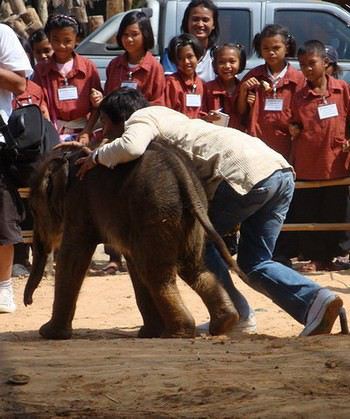
autre chose, c'est le scandale des bébés éléphants, qui sont séparer de leur mère pour divertir les touristes des grands hôtels, , un bébé éléphant soufre terriblement de la séparation des siens, , il perd tout repère social, ,
mais que faire ? la question est la,
Il est clair que ce sont des pratiques qui me hérissent les poils 😠
Justement en parlant de KSR, j'y ai vu un commerçant thai qui avait fait une affiche de la taille de son rideau de fer à l'attention des touristes les invitant à ne pas cautionner ses pratiques.
Salut à toi ami du tourisme durable et responsable,
Je monte actuellement un projet de circuits de tourisme durable en Thailande et j'avoue que c'est très complexe car tt est déja calé pour faire du gros business ..
Sur le circuit du NORD, j'ai integré l'elephant nature park...connais tu ds ce magnifique pays d'autres organisations qui mériteraient de faire partie d'un circuit touristique responsable ?
je connais de nom l'assos dans mon spot precedent, sinon je connais un camp d'élephant sur koh chang qui meme si ils organisent des trekking prenent soins des élephants et developpent il me semble un programme de protection
sinon il doit en effet exister d'autres association renseignes toi sur les forums
Tout à fait d'accord pour refuser de cautionner les promenades des éléphants dans les rues de Bangkok ou d'autres pratiques de ce genre.
Malheureusement, ces promenades où les mahouts vendent des bananes sont très lucratives, j'ai vu certains mahouts gagner jusqu'à 4000 b dans une seule soirée, c'est ce que'ils gagnent en un mois de travail par ailleurs !
Difficile donc de les dissuader.
Par contre, les éléphants qui font des numéros de cirque, c'est très différent :
Il y a quatre ans, j'avais une petite éléphante de trois ans à laquelle j'ai appris - tout en douceur - des tas de numéros qui impressionnaient tous les gens de passage. Les éléphants sont des animaux très intelligents qui comprennent ausii bien quand on leur parle avec amour qu'avec un bâton.
Et, j'ajouterai que les éléphants qui font de la peinture sont certainement mieux traités que ceux qui travaillaient dur dans les forêts il n'y a pas si longtemps, il en reste encore en Birmanie par exemple.
Bon, il y aura toujours des mahouts qui maltraiteront leur éléphant, je pense principalement à ceux qui abusent de la bière et qui terminent leur folie en martyrisant leur éléphant. Mais je sais aussi que les éléphants encaissent longtemps et qu'il leur arrive de se rebeller, et, dans ce cas, le mahout est toujours perdant, ce n'est que justice.
Parce que, lorsqu'on frappe un éléphant, il comprend vite quelle est notre limite, alors que lorsqu'on lui parle, il est impressionné...
Faites "elephant angry" sur Google video pour voir ce que ça donne, un éléphant en colère !
Vaste sujet !
Bon post de sensibilisation, mais, je rejoins François,
Difficile a comprendre pour un occidental et,
Encore + pour un journaliste qui doit faire du sensationnel pour accrocher son auditoire (audimat)
Pour que tu comprennes bien que ma réponse n a rien d agressive
Regarde le post que j avais fait sur ma rencontre avec une famille nomade Mahout et,
Les conseils de respect que je donnais :
http://voyageurasie.canalblog.com/...007/02/14/index.html
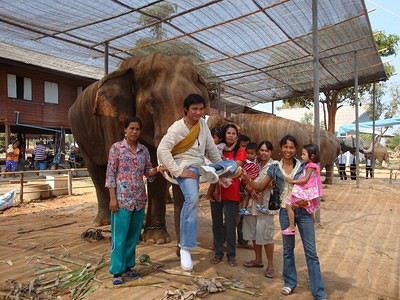
Depuis trois ans j assiste a la fête des éléphants a Surin et,
J ai côtoyé grâce un Français amoureux des éléphants de nombreux Mahout,
Tous en symbiose avec leur animal
A tu vu le banquet qu il leurs est offert ?
Alors gardons nous de généralités,
Certes il y a de mauvais Mahout,
Comme certains parents battent leurs enfants
Des questions à se poser :
Comment savoir l origine des traces de coups ?
Par le Mahout ?
Combat entre éléphants ?
Au cours de travaux ?
Est tu sur qu un éléphant peintre ou autre n y prend pas de plaisir ?
Les Thaïlandais l on comprit longtemps
Pour preuve : un extrait tiré du Voyage du comte de Forbin a Siam (1685 1688)
Récit qu il a récolté auprès de Phra Naraï roi des Siamois :
Celui que je monte actuellement me dit le prince peut être cité pour exemple.
Il avait il n y a pas longtemps un cornac ou palefrenier qui le faisait jeûner en lui retranchant la moitié de ce qui était destiné pour sa nourriture.
Cet animal qui n avait point d autres manières de se plaindre que ses cris, en fit d aussi horribles qu on les entendait dans tout le palais
Ne pouvant deviner pourquoi il criais si fort, je me doutais du fait, et je lui fit donner un nouveau cornac, qui étant plus fidèle, et qui lui ayant donné sans lui faire du tort, toute la mesure de riz, l éléphant la partagea en deux avec sa trompe et n en ayant mangé que la moitié, il se mit a crier tout de nouveau, indiquant par là, a tous ceux qui accoururent au bruit, l infidélité du premier cornac, qui avoua son crime,
Dont je le fis sévèrement châtier,
Les éléphants dans Bangkok, c'est interdit, donc, quand un éléphant rencontre un policier, le mahout dnne un peu d'argent et l'affaire est réglée
Si les personnes qui achètent des bananes étaient verbalisées, l'affaire s'arrêterait sûrement beaucoup plus vite, mais l'affaire est juteuse : les policiers et les mahouts s'y retrouvent parfatement et ce sont les éléphants qui trinquent....
Comme tous les reportages diffusés sur des chaines "commerciales", il y a toujours à boire et à manger.
Pour faire un parallèle et illustrer mon propos : il y a quelques jours j'ai vu un reportage sur les birmans exploités par les industriels de la crevette en Thailande.
Personne ne peut contester l'exploitation des réfugiés burmans, mais le journaliste dans le souci de faire "encore plus pleurer dans les chaumiéres" ajoute un commentaire bidon : "les birmans sont si pauvres que dans leur modeste bungalow, ils mangent par terre et dorment sur une natte, pas de matelas non plus................
Ceux qui connaissent un peu la Thailande profonde, savent bien que Tout le monde mange par terre assis sur une natte et même si il y a un lit et un matelas dans la maison, souvent, on dort par terre sur une natte ............
Alors ce genre de commentaire bidon met le doute sur tout le reste du reportage et lui enléve à mes yeux toute crédibilité.
J'ai vu le reportage sur les éléphants, certaines images étaient horribles. Notamment l'éléphant battu dans une cage......Mais, qui a déjà vu le dressage d'un cheval aux Marquises, si chéres à Monsieur Brel ? C'est exactement pareil ": Le cheval est attaché court à un arbre et il est battu avec un baton jusqu'a ce qu'il ne réagisse plus.
Alors donner des leçons, c'Est facile.....ouvrir les yeux un peu moins.
Ceci dit, je ne donne jamais d'Argent aux vendeurs de bananes, ni autres montreurs d'Animaux et je compatis vraiment à la cause animale.
OK on essayera avec les touristes farangs ! mais avec le tourisme asiatique comme les Japonais, Correen, Chinois ou autres, y'a du soucis a se faire...Eux c'est tout le contraire, pour eux l'animal est un objet de foire et ils ne veulent rien savoir de ce qui se passe en coulisse ..
La pire maltraitance est le triste resultat de la deforestation intensive de ces dernieres annees ...Pas seulement l'elephant en est la victime ...
On a oublie de parler de la pire maltraitance, la maltraitance passive qui consiste a laisser l'animal attache, enchaine au pied d'un arbre des jours et des jours, parfois en plain soleil.. et le manque de nourriture dont l'animal souffre...c'est assez courant et tres difficile a prouver et a compendre pour un touriste qui n'est que de passage quelque minute devant la bete...
Un elephant heureux doit avoir de l'espace, et au minimum un point d'eau pour se baigner et doit manger suffisemment, environ 200 kgs par jour et boire au moins 100 litre d'eau, meme s' il est parfois attache c'est normal, son mahout etant toujours a ses cotes.
En tout cas ne jamais cautionner les elephants bananes qui sont de veritables esclaves et proteges a la solde de quelques pouvoirs de l'ombre... vous ne voulez plus voir d'elephants souffrir trainant la nuit en ville, n'achetez plus de bananes a leur mahout corrompu, achetez des bananes au marche ou a cote et donnez a l'elephant, tout le monde comprendra ..
Quand aux associations, elles sont LE veritable danger...oubliez les ! comme pour plein d'autres sujets, elles ne sont jamais la par hazard, ni pour defendre aucune cause sinon la leur .D'ailleurs on retrouve souvent les memes personnes qui s'occupent de tout ce qui bouge pour leur compte...
Vaste sujet !
Bon post de sensibilisation, mais, je rejoins François,
Difficile a comprendre pour un occidental et,
Encore + pour un journaliste qui doit faire du sensationnel pour accrocher son auditoire (audimat)
Depuis trois ans j assiste a la fête des éléphants a Surin et,
J ai côtoyé de nombreux Mahout,
Tous en symbiose avec leur animal
Alors gardons nous de généralités,
+10🙂
Des equipes teles de toutes origines surtout occidentales, qui viennent faire des reportages a sensation, cherchant l'audimat on trouve leur sujet ..ce n'est pas ce qui manque ici ...
En tout cas ne jamais cautionner les elephants bananes qui sont de veritables esclaves et proteges a la solde de quelques pouvoirs de l'ombre...
JUSTE...Pour éradiquer l'offre, il suffit de supprimer la demande.
Mais pourquoi les associations sencés lutter contre la maltraitence des ces animaux, ne distribuent-ils pas, avec l'aval et l'aide du gouvernement des dépliants explicatifs, directement a l'arrivée des touristes a l'aeroport ou dans tous les hotels ???
Réponse 1: Tout le monde est mouillé dans la combine et touche sa part
Réponse 2: Les autres, les sincères, les motivés, ont trop peur de se faire fumer par la petite mafia qui gère l'affaire.
Dans les 2 cas, on encaisse, des dessous de table pour certains, et des subventions et contributions pour les autres.
dans les 2 cas, tout le monde à interet a fermer sa gueule, et a laisser pisser... l'éléphant
Dans la liste des reportages a sensation : Il manque encore les mangeurs de Chiens de Sakhon Nakhon, les prostituées fournies par les familles avides d'argent de l'Issan, les familles qui vendent leur progéniture, quoi encore ? Ah oui, les kwais abattus et dépecés au couteau derrière une haie, les gens tellement pauvres qu'ils mangent les pattes de poulet assis par terre et avec un seul plat pour tout le monde, etc...............😉
NB : C'est bien sur du xéme degré !!!! (je précise pour les Buisses, Selges et Canadiens du forum.........😏😏😏😏😏)
Tu te méprends ce ne sont pas des insultes mais simplement l humour d un autre forum très privé ou cela se pratique couramment,
Tellement couramment que la fondatrice femme trés raffinée, s est sauvée en courant et elle court encore,
Bien sur, sur VF qq fois cela part aussi en sucette mais sur des posts légers comme :
Quoi faire a Pattaya ou similaires,
Notre VFiste Bobcat j en doute pas se ressaisira,
Bien sur tout cela n est que du deuxième degré
Cordialement
10ème degré..., bien sûr! 🤪
Il n'y a que les Français qui soient assez naïf pour croire que rien de tout ça n'existe! 😏
Dans la liste des reportages a sensation : Il manque encore les mangeurs de Chiens de Sakhon Nakhon, les prostituées fournies par les familles avides d'argent de l'Issan, les familles qui vendent leur progéniture, quoi encore ? Ah oui, les kwais abattus et dépecés au couteau derrière une haie, les gens tellement pauvres qu'ils mangent les pattes de poulet assis par terre et avec un seul plat pour tout le monde, etc...............😉
NB : C'est bien sur du xéme degré !!!! (je précise pour les Buisses, Selges et Canadiens du forum.........😏😏😏😏😏)
Ceci dit, il y a du vrai dans l'intervention à la base ...
Perso, j'ai réagi en lisant un article au sujet d'une thaïlandaise mariée à
un français qui s'était enfuie (sic) de France en laissant sa petite fille ...
Puis l'ignoble personnage avait enlevé (sic) la petite à Samui où elle
était en vacances avec "sa grand'mère" pour l'emmener au village
avec elle, incroyable !
Mais surtout, la grand-mère (française) a été horrifiée de constater que
la mère indigne avait osé couper les beaux (longs) cheveux de la petiote ...
Elle ne disait pas ce qu'elle pensait des affreux vêtements (jupette
bleu-marine et "blouse" à col bateau ...) qu'on obligeait le petite à porter
pour aller dans un lieu de torture appelé école 😉
Eviter de faire visiter aux touristes ce genre de Jurassik park, je te propose d'aller dans le nord est de la Thailande dans des Parcs Nationaux sans animaux. LOEI (Phu Kradung) 1350 mètres de haut, MUKDAHAN, et j'en passe. et de faire visiter à tes touristes ces endroits magnifiques que très peu de touristes connaisent.
L'eco tourisme dans toute sa splendeur. Maintenant est ce bien rentable pour l'organisateur ??
Je suis le premier à condanner ces éléphants qui sont à Bangkok, Patong, dans des endroits où ils ont rien à y faire. mais qui cautionnent se genre de commerce??? LES TOURISTES qui se font prendrent en photo en plein BKK avec ses pachidermes. C'est LAMENTABLES.
Je pensais que depuis Coluche, nos amis Belges et Suissssssses avaient dépassé le stade de la réaction épidermique Nationaliste. Je m'aperçois qu'il n'en est rien(pour certains🤪). J'en conclus donc que ...............Coluche est parti trop tôt.😉
Désolé si j'ai pu peiner certains...........Mais il faut le dire haut et fort ! La Suisse ce ne sont pas que des banques et des fabriques de Chocolat ! Il y a aussi des gens !!!!
10ème degré..., bien sûr! 🤪
Il n'y a que les Français qui soient assez naïf pour croire que rien de tout ça n'existe! 😏
Dans la liste des reportages a sensation : Il manque encore les mangeurs de Chiens de Sakhon Nakhon, les prostituées fournies par les familles avides d'argent de l'Issan, les familles qui vendent leur progéniture, quoi encore ? Ah oui, les kwais abattus et dépecés au couteau derrière une haie, les gens tellement pauvres qu'ils mangent les pattes de poulet assis par terre et avec un seul plat pour tout le monde, etc...............😉
NB : C'est bien sur du xéme degré !!!! (je précise pour les Buisses, Selges et Canadiens du forum.........😏😏😏😏😏)
Ah bon parce que ca existe ??? incroyable l'imagination de certain, peut etre sous l'influence de produit interdit on aura tout lu ...Les fantomes aussi ca existe bien sur, mais ca c'est les thais qui en sont sur a 100% ..😮..Avec du Lao Khao😏
Y'en a pas qu'on vu E.T aussi ??? Surement a Khao San 😮 et pour cause...Et moi y'a un truc que j'ai jamais vu, ma belle mere qui joue a la loterie ...Elle me dit qu'elle ne joue jamais et qu'elle economise.😏
jai regarder moi aussi le reportage et depuis jai du mal a dormir ces horrible de voir des cruautés pareil que les hommes sont laches! je suis aller sur le cite de nature park et heureusement que cette thai aide ces élephants mais tout est une question d'argent il faudrer que les riches aide lek dans sa lutte mais quel star et capable de prendre 5 minuttes pour donner de l'argent a se combat quel tristesse de voir sa en2009 martine help a tous se qui on du coeur..................................
sans oublier les huitres bien vivantes.... un jet d'acide... une attaque à l'arme blanche...et hop...même pas un cri de la bête... déjà dans le tube digestif.
allez une autre 😛 ...
sans oublier les huitres bien vivantes.... un jet d'acide... une attaque à l'arme blanche...et hop...même pas un cri de la bête... déjà dans le tube digestif.
allez une autre 😛 ...
Là vous me rappelez un polonais qui était venu chez moi et à qui j'avais proposé des huîtres pour le dîner ...
Comme il était visiblement terrorisé à l'idée de manger "un truc vivant", il m'a demandé si "çà bougeait pendant qu'on avalait" 😉
J'ai alors complaisamment expliqué que oui, et qu'il ne fallait surtout pas mastiquer parce qu'alors la "bête" pouvait même crier 🏴☠️
J'ai mangé mes huîtres seul ce soir là ... 😛
J'avais aussi proposé des escargots au même visiteur, il a refusé tout net en affirmant bien fort que çà, il avait essayé d'en manger une fois alors qu'il se baladait en forêt !
jai regarder moi aussi le reportage et depuis jai du mal a dormir ces horrible de voir des cruautés pareil que les hommes sont laches! combat quel help a tous se qui on du coeur..................................
Je vais me repeter en disant que la pire des maltraitance est a la source, la deforestation qui engendre des consequences incontrolables et incontrolees, , et aussi la maltraitance passive qui consiste a laisser des elephants attaches des semaines sans aucune liberte et la malnutition ..
Faudrait un peu reagir autrement que de se lamenter et voir en face ou sont les vrais problemes et comment peut -on faire quelque chose pour les regler efficacement ..Mais comme dab on ne voit que l'apparence sans chercher a savoir ce qui se passe en coulisses...
IL faut regler les causes et non essayer soigner les effets qui va a contre sens du but recherche ...Les touristes farangs peuvent faire beaucoup en agissant de maniere intelligente et solidaire et non par des manifestations de sensibilite exacerbee ...
Quand aux touristes asiatiques( non Thais) ils en ont rien a peter de la condition des elephants et animaux en general, se qui compte c'est de prendre des fotos et de se mettre en valeur, parfois sans meme dessendre du bus ...
Quand vous observez un elephant bien traite, faite un geste de generosite envers son mahout, prenez exemple sur les Thais qui eux n'ont jamais des oursins dans la poche pour aider, ou alors faut la fermer..
Un elephant ca coute cher surtout une mere et son elephanteau...Les mahouts sont en general pauvres, leur elephant fait partie de la famille, alors agissez quand vous etes sur place, l'effet est porteur ..pour un elephant maltaite achetez beaucoup de bananes, mais pas a son mahout et donnez lui au lieu de raler et de montrer votre gene de la situation...Le symbolique est tres efficace au pays du sourire, , , ..
Une grande star du cinema Thai, TONY JAA heros du film ONG BAK fait beaucoup pour les elephants, il en inclu plus d'une trentaine dans ses films et est un grand et intelligent donateur pour aider au mieuc ces animaux a vivre dans les meilleures conditions naturelles ..Particulierement dans la province de Surin ou il est natif et vit...Il est lui meme issu de famille de mahout et en possede deux ..Son amour des elephants est grand, il est conscient des problemes et agit de son mieux partout dans le royaume ... ...D'ailleur grace a lui les choses commencent deja a changer car il est porteur et ambassadeur de toute une jeunesse qui commence a reagir.
.D'ailleur grace a lui les choses commencent deja a changer car il est porteur et ambassadeur de toute une jeunesse qui commence a reagir.
oui, et qui commence aussi a reconnaitre le touriste respectueux et le touriste prédateur
et qui commence a le faire savoir,
il n y a qu a voir les posts / plaintes des derniers cités d avoir été mal recus,
Combien de fois a-t-on lu :
J ai payé un tour d éléphant 600 bhts ! c est de l arnaque !
Les seuls éléphants auxquels j'ai eu "à faire" étaient deux ...
Le premier "défilait" dans les rues de RuSo, c'était un "travailleur" en congé ce jour-là, il était immense et imposait le respect.
Le second était plus petit et, sous une bâche (soleil !) servait de "présentoir" pour la vente de tout un tas de produits (dont des objets fait en "poil d'éléphant").
Celui-là me regardait de près et j'ai placé la paume de mes mains sur ses joues ...
Les thaïlandais n'ont pas "fini" de maîtriser leur nature, en Europe c'est déjà fait, on essaye même vainement de réintroduire des espèces éliminées depuis longtemps.
Ils suivent donc un chemin que nous avons suivi et que certains d'entre-nous savent être "mauvais" (pas les chasseurs des Pyrénées pour les ours en tous cas).
L'éléphant est un animal superbe, puissant et majestueux mais son entretien n'est pas vraiment à l'échelle du "monde moderne".
Dans ma Pologne natale, on adorait les chevaux, un bel attelage pour aller à la messe le dimanche matin était la fierté de chaque paysan "riche".
Mais ils ont disparu au profit des machines agricoles en tous genres ...
Encore une fois, je vois ici que la critique est aisée, savoir comment vraiment aider ce peuple à garder ses éléphants est très difficile, surtout pour nous qui avons été incapables de préserver nos "éléphants à nous" (aurochs, ours, loups, lynx etc ...).
je suis tout a fait d'accord avec vous !
J'ai une maison à Hua Hin, tout pres de l'hopital des éléphants ou je me rends de temps en temps benevolement pour "donner un coup de mains" je peux vous dire, qu'il ne faut pas generaliser car il y a fort heureusement des elephants heureux, choyes par des gens qui les respectent et qui les aiment. Il faut arreter de tomber dans les reportages à sensation, faits par des gens qui veulent faire de l'audience a n'importe quel prix, en emplifiant n'importe quoi, n'importe comment. Ce genre de reportages portent beaucoup atteinte à l'image de La Thailande où, comme dans tous les pays du monde, il y a du bien et du moins bien !
je suis d'acord avec vous mais moi aussi je donne se que je peux a lassociation elephantnaturepark.org mais si je pouvez j'irais en thailande mais je ne peux pas me vacciner contre la fievre jaune car je suis sous chimio mais ses mon voeux le plus chere d'aller voir les élephants dans un cadre naturel a bientot
Hello, Last year, we stayed for 3 months in Thailand, north of Khao Lak, and were able to benefit from the 2-month visa exemption, renewable for one month by…
hi fellow travelers, I'm "finalizing" a trip with my adventurous family (wife + 3 kids aged 16, 14, and 8) for this Easter break in Thailand (we'll be there…
Hello everyone! I’m heading off solo in February and wanted to share my rough itinerary with you. Does this sound doable?
PS: I’m not really into beaches.
D1 Departure on February 17, 2027
D2 Arrival in Kuala Lumpur – stroll through Chinatown and visit the Petronas Towers
D3: Kuala Lumpur – Chow Kit Market, Batu Caves, Little India, Bukit Bintang downtown area
D4: Early morning bus to Malacca. Explore Malacca in the afternoon and evening
D5: Another 2–3 hours in Malacca in the morning, then bus back to Kuala Lumpur. Merdeka Square area. Stay in Chinatown
D6: Bus trip to Kuala Tahan. Night tour
D7: Morning – canopy walk and Bukit Terisek hike. Afternoon – off to Lata Berkoh
D8 & D9: 2-day jungle trek in Taman Negara National Park
D10: Head to Cameron Highlands
D11: Morning hike through the plantations. Afternoon still to be decided
D12: Morning – excursion to Mossy Forest and Sungei Plantation. Afternoon bus to Ipoh
D13: Morning – Mirror Lake / Sam Poh Temple area. Afternoon – explore downtown Ipoh
D14: Morning train to Penang. Afternoon – wander around Georgetown
D15: Morning – Penang Hill and Keh Loh Temple. Afternoon – Georgetown
D16: Bus to Butterfly Garden and Spice Garden. Late afternoon – Burmese and Thai temples
D17: Morning flight to Singapore. Afternoon – Chinatown and Marina Bay tour
D18: Morning – Gardens by the Bay area. Afternoon – Boat Quay, Clarke Quay, Kampong Glam
D19: Morning – The Ridges area and Botanical Garden. Afternoon – Little India, then back to Chinatown before 11:15 PM return flight
D20: Morning arrival
Hi everyone,
I’ll be in western Malaysia for 20 days in January and February.
I’m coming from southern Thailand to Ipoh for the Thaipusam festivities.
Then it’s off to Pangkor Island.
I’ll finish up in Malacca for the Chinese New Year celebrations before heading to Singapore.
I’ve got a 6-day gap.
I was thinking of going to K.Lipis for the jungle train and heading to Dabong, but the caves might not be open.
Any suggestions around K.L.?
Day treks?
A stopover between K.L. and Malacca?
Thanks
Hi, I’ve read that these two volcanoes are super popular and that there are *tons* of people for sunrise, especially in July. I’m looking for firsthand accounts from anyone who’s done it later, around 9–10 a.m.
Thanks for your help!
Laëtitia
I’m heading to Cambodia at the end of December 2026 – January 2027 for 3-4 weeks. Since I’ve already visited Cambodia twice, my itinerary is a bit different this time—I’d love to explore Botum Sakor Park, Chi Pat, the Tatai region, and the Cardamom Mountains. I’m traveling solo. If you have any tips on transportation, excursions, treks, sights, or accommodations in the area, I’d really appreciate it. Thanks for your feedback!
Has anyone traveled with the Laos travel agency ADV ?
I’m planning a trip to Laos and have received several quotes. Among them, this agency’s seem very reasonable, and so far, the interactions have been positive.
I’ve found a few positive reviews online, but I’d love to hear from travelers who’ve actually booked with them: how’s the organization, guide quality, accommodations, on-the-ground responsiveness, etc.
Thanks for sharing your experiences!
First stop on our discovery of the peninsula: Amphawa. It’s our first night in Thailand (we arrived at Suvarnabhumi at 8:50 AM).
Our initial plan was to explore the area before heading further south. The Mae Klong Railway Market is tempting... but what else is there to do????
We’ll be there on a Wednesday, and from what I’ve read on the forum, some say there’s absolutely nothing to do during the week—no floating market, barely any shops open, no restaurants, etc.
Others, though, say the place is actually more charming without the weekend crowds.
Could you share your thoughts? Missing the floating market is one thing, but if it’s really a ghost town on Wednesdays, I might just drop our bags somewhere else.
Amphawa seemed like a good first stop, just 1.5 hours from the airport, but I’d still like to settle somewhere a bit lively for our first evening.
We’ll be there at the end of October.
Thanks!
Hi,
I wanted to visit the plantations in the morning with GetYourGuide or by just showing up.
How much time should I really plan for?
I’d like to catch either the 3 PM or 5 PM bus back to KL.
Thanks
Hi,
I wanted to get some info about the cable car and the bridge—I see lots of different options...
How much time should we allow for these two activities? If we arrive around 4 PM, will we have enough time to visit without rushing?
Thanks
Hi there,
I didn’t plan to return to Thailand this year, but my health conditions mean it’ll be the best place for me to stay between two trips to India. The tourism setup there is so well-organized that it’s the most "comfortable" country for a short visit. Thailand feels too sanitized for my taste, and there’s too much religion, Buddha, and the King, but it’s still the best option given how my health has been evolving. I’d considered two weeks in ThaTon for hiking, but I got too sick from the burn-offs during my trips to the mountains around Chiang Rai. So I’m not sure where to go this year. Definitely not the sea, touristy spots, or the mountains with burn-offs...
Hi,
On September 1st, we're heading to Kalimantan for six weeks, probably from Pontianak to the Derawan Islands.
I've scoured this site, which is usually my go-to 😉, and others like VoyageForum, but recent info is pretty scarce.
I'd love any tips on places you've visited—our itinerary is still a work in progress.
We're two couples traveling with backpacks, using buses, boats, guesthouses, and homestays.
Thanks in advance!
Hi fellow travelers,
First trip to Vietnam.
We’ll be arriving in Ho Chi Minh City during Tet.
Is it complicated to find accommodation and get around during this period?
Any tips would be welcome.
Thanks for your replies.
Hi! I’d like to split my trip into two parts: 15 days in Phuket and 15 days in Krabi. Do you know if I can rent a car and drop it off in Krabi when I fly back to France?
Thanks for your feedback!
Have a great Sunday!
Martine
Hello,
After 1 night in Khao Sok, I’d like to find a 2 Days 1 Night package on the lake.
After reading a lot, I decided to "break the bank" and treat ourselves to a private tour—mainly to avoid the crowds.
But after contacting several operators, they offer "private tours" that are very expensive (around 700 €), yet in the details, the boats can only leave from the pier at 10 AM like everyone else. (I was hoping to leave much earlier.) The morning program is the same for everyone too (private or not). They drop us off at noon at our floating hotel (I’d chosen Phupha Waree). Free afternoon (swimming or kayaking in front of the hotel). We head back by boat for a 1-hour sunset ride. And the next morning, we leave the hotel at 8 AM to be at the pier by 9:30 AM at the latest—end of the trip.
So basically, we’re paying a lot for a private tour just to do the same thing as everyone else at the same time.
Or maybe I just had bad luck in my search.
I contacted Panida Ladi, who’s very popular on forums. We’d agreed on a private tour that matched my request (departure from the pier at 8 AM, very personalized itinerary). We settled on the itinerary and price, she asked for a Wise transfer for a 30% deposit, confirmed receipt of the deposit. Then 30 minutes later, she messaged me to say she was canceling everything because it was impossible to do the requested tour—and promised a quick refund of my deposit.
So here’s my question: Who’s done a *real* private tour on this lake? Who can recommend a reliable agency? Is it even really possible to do a private tour here?
I’m searching for a real gem for my 3rd stay in Koh Lanta: a lovely, high-quality hotel right by an easily accessible beach in a lively spot.
If you know of anything that fits what I’m looking for and want to share, don’t hesitate!
Hi, is anyone there in Flores right now? According to some websites, everything is closed and the situation is tough. But our guide says it's fine. Who should we believe? We're supposed to leave on September 2nd. Thanks to anyone in Flores at the moment!
Hi dear community,
I'm planning to visit Cambodia this winter, right after Christmas, for my first solo trip and my first trip to Asia. For two weeks (yes, I know it's short, but I really can't do more...). I have two main desires: Siem Reap and the countryside, the villages, the Mekong...
What do you think of this itinerary? Arrival in Siem Reap, departure from Phnom Penh.
SR: 5 days (1 day for arrival, 3 for the temples, 1 for the lake and its villages)
Kratie (stop on the way to Mondolkiri): 3 days (1 day of travel, 2 days there)
Mondolkiri/Sen Monorom: 4 days (1 day of travel, 1 day there, 2 days of treks)
PP: 3 days (1 day of travel, 2 days of sightseeing)
I think I need to cut one day somewhere if I travel from Saturday to Saturday or Sunday to Sunday. In Kratie, maybe? Or in PP? And I'll miss the boat trip that everyone recommends (SR-Battambang), but I don't see where to fit it in. Unless I do a PP-PP loop starting in the east, skip Kratie or just stay one night, then SR, then PP.
In my timing, Mondolkiri seems closer than Ratanakiri, which also tempted me a lot! Will it be too complicated alone? I'm thinking of using local guides or a small local agency for a nature and village getaway.
I've read that Siem Reap is very crowded between Christmas and New Year's. I could also do the circuit in the opposite direction. But I thought it would be easier to get familiar with the country by arriving in a touristy area—I might be wrong...
Thanks for your advice and opinions!
Hi everyone.
I’m planning my trip, and based on all the posts I’ve read, this country is amazing.
Of course, I’ve got a ton of questions for you.
Here’s a possible itinerary: Vientiane - Vang Vieng - Phonsavan - Sam Neua - Nong Khiaw + villages - Phongsali - Luang Namtha and the area - Udomxai - Huay Xai - Luang Prabang and back to Vientiane.
What do you think?
We’re planning to prioritize local transport—is it possible to do this loop?
We’d also love to go kayaking, but I’m not sure if the season’s right or where the best spot is.
For trekking—I read that Phongsali is the most authentic spot to visit villages and see wildlife. Do you know of a reliable agency and a guesthouse with reasonable prices?
Is it worth taking a slow boat for a stretch on the Mekong, and if so, which route?
For accommodations, is it better to book through Booking.com and Agoda or look when we arrive?
Are mosquitoes bad in Laos, and should we take malaria prophylaxis?
What’s the average daily budget (accommodation, food, visits)?
Is renting scooters a good option for exploring towns, and if so, which ones?
From what I’ve read, it’s best to carry cash—euros or dollars? Is it risky to walk around with that much cash?
I’ve still got tons of questions. Thanks to anyone who can help, and I’m open to all tips, info, etc.
Thanks again
Hi there,
I’m planning a family trip (my wife and I, both 47, and our two sons, aged 5 and 12) to Malaysia for the last week of June and the first two weeks of July 2027.
We used to love road trips as a couple, then as a trio, but since our second child arrived, we’ve taken a break with "camping village" style trips.
Now feels like the right time to get back to our old habits, while adjusting the pace for the kids.
We’re craving Asia. We’ve been lucky enough to visit Thailand, Indonesia (Bali and Lombok), and Sri Lanka before.
Friends have raved about Malaysia, so we’re definitely tempted.
For those who know and love Malaysia, what would be a good itinerary starting from Kuala Lumpur, with a maximum of 3-4 stops? We’d like a mix of culture, nature, and relaxation (just to clarify, we’re not big beach fans). All of this without rushing, of course.
Hello,
We’re a family of four with two teens aged 16 and 18. We’re heading to Thailand this summer. We’ll arrive in Bangkok and plan to take a flight to Luang Prabang.
I’ve seen there are some great visits and excursions to do (temples, markets, waterfalls) and maybe even venture a bit north to places like Nong Khiaw, Muang Xay, Muang Ngoy, or Oudom Xay.
But I’ve also heard about the Bokeo region with the Gibbon Experience.
Since we won’t be able to do everything, I’d love to hear about your experiences, impressions, and advice on the two options I’m considering, especially since we’ll be meeting family in Chiang Mai, Thailand, afterward.
Option 1: A loop from Luang Prabang heading slightly north, then a flight from Luang Prabang to Chiang Mai.
Option 2: A few days in Luang Prabang, exploring within a few dozen kilometers around, then heading to Bokeo province for the 2-day/1-night Gibbon Experience. For this option, I saw on Rome2Rio that it’s possible to book a ferry trip on the Mekong from Luang Prabang to Huay Xay—they mention about 8 hours. But is that realistic? What type of boat is it?
Then, to get to Chiang Mai, there aren’t many options—bus or minivan—but how does crossing the border work?
Finally, for those of you who’ve been to Laos in August, what was the weather like?
We’ve already visited Thailand, Vietnam, and Cambodia during the same period over the past four years and weren’t really bothered by bad weather.
I’m starting a discussion about guides in the Mekong Delta because we’ve just finished our trip in this region and had a hard time finding a French-speaking guide. We had Thanh—she speaks French really well and travels all over the delta region, including Ho Chi Minh City. She’s super friendly and flexible. I recommend her wholeheartedly. If it can help someone...
Feel free to contact us for her number.
Hi everyone,
I couldn’t find any recent info on Kuching.
Can anyone recommend a hotel or guesthouse for under 100 RM that’s nice and affordable? No dorms, please.
Also, does it rain a lot in November, and is it still worth visiting Semenggoh or Bako?
We’ll be arriving in Phnom Penh this coming January and we’re thinking of starting our trip with a stop in Kampong Cham, then Kratie.
After Kratie, we’re considering heading toward Siem Reap with a stop in Kampong Thom.
That said, I’m not really sure how long the Kratie–Kampong Thom journey might take or how complicated it is.
Does this stop on the way to Siem Reap seem like a good idea to you?
If we don’t visit the Sambor Prei Kuk site, are there still any walks or sights worth checking out in Kampong Thom?
Silly question—backpack or hard-shell suitcase for the Sepilok, Kinabatangan, Tioman, KL trip?
I’m struggling to fit all my son’s and my stuff into the 70L backpack... and I’m thinking a suitcase would be easier, but I’m not sure if it’ll work for getting around.
After a stay on Koh Phayam this coming November, I’d like to spend 2 or 3 days on Koh Phra Thong before heading further south.
Do you think it’s doable to leave Koh Phayam early enough to catch the 10 AM boat from Khura Buri to Koh Phra Thong? The next one isn’t until 4 PM, which would cost me a whole day.
I’m planning a trip to Indonesia, specifically Sulawesi and Java, in September for 10 days.
I don’t know this part of the world at all—any advice is welcome!
I’ll be traveling solo and would also love tips on meeting other travelers or locals.
Hello everyone,
Not long ago, I used to travel as a couple, but my husband has since passed away, and I’ve decided to set off again. The trip I took to Cambodia in January 2025 did me a world of good.
I’m now considering Thailand, a destination we never included in our plans because even 15 years ago, people said it was too touristy. Still, I’m thinking about the itinerary below, but I don’t feel up to arranging buses, trains, or guides on my own while I’m there. I’m looking for one or more drivers and have been in touch with an agency, but their offers are just copy-paste group tours that I don’t want.
So, if you have any contacts, experiences, or advice, I’d be so grateful if you’d share them with me. Here’s my rough plan:
Arrival in Bangkok
Ayutthaya (2 nights)
Kanchanaburi (2 or 3 nights)
Sangkhlaburi/Sai Yok (3 nights)
Sukhothai (2 nights)
Lampang (I’ve planned 3 nights, but that might be a bit much—it depends on what time I arrive in the city)
Chiang Mai
Chiang Dao
Pai
Chiang Rai
I was thinking about the Mae Hong Son loop—thoughts?
What do you think about staying overnight at the Golden Triangle?
When I look online, of course, I can find agencies that organize tours to national parks, etc.
I’m retired but in great physical shape. I’d rather go hiking than sit in hot springs with crowds of tourists who’ve all arranged meet-ups. I don’t want to spend a day at an elephant camp, and I don’t want to visit Karen villages.
I’d love to hear your advice.
Thank you all,
Hi everyone,
Could you share your thoughts on my 3-week itinerary?
We’re a small group (family + friends) of 12 people, planning to leave around January 21, 2027.
Here’s my itinerary:
3 nights in Bangkok
4 nights in Chiang Mai
3 nights on Koh Samui
3 nights on Koh Phangan
4 nights in Krabi
4 nights in Phuket
I’m also open to any great tips you might have...
Thanks, everyone! Alain.
Hi there,
We’re planning a 3-week family trip next summer with our three kids, who’ll be 8, 8, and 7 years old.
After some research, we’re leaning toward Malaysia to combine nature/forests and paradise beaches. The idea is to introduce our kids to the country’s culture, nature, and wildlife.
We want a great trip but without splurging on luxury options like high-end lodges and resorts. We’re looking for comfort with a touch of authenticity—basically, a good middle ground.
I’ve started putting together an itinerary and would love your expert advice and tips to help us build this amazing trip with our little ones.
Day 1: Departure from France
Day 2: Kuala Lumpur
Stay at a hotel near the airport or KL Sentral.
Just one night.
Day 3: Morning flight to Sandakan (Borneo).
Stay in Sepilok
Day 4: Sepilok:
* Orangutan Center
* Malayan Sun Bear Center
* Rainforest Discovery Centre
Day 5: Depart for Kinabatangan.
Boat safari in the late afternoon.
Day 6: Sunrise safari.
Jungle walk.
Evening safari.
Day 7: Final safari.
Return to Sandakan.
Flight to Kuala Lumpur, then to Kota Bharu (or overnight transit depending on schedules).
Day 8: Transfer to the port.
Boat to the Perhentian Islands.
Days 9 to 13: Perhentian Besar
5 full days.
* Snorkeling
* Hiking
* Turtle watching
* Wild beaches
* Relaxation
Day 14: Return to the mainland.
Bus or private car to Taman Negara.









 Bonjour,