À la lumière de ce que j’avais lu à droite et à gauche dans les discussions, j’avais l’impression qu’il fallait être kamikaze pour conduire en Thaïlande. Jusqu’ici, j’ai conduit en Europe, en Australie, au Brésil et en Malaisie, y compris à Bornéo ; donc, à droite et à gauche, des voitures allant de la 2 CV au 4x4, à boîte manuelle et à boîte automatique.
Nous venons de passer trois semaines en Thaïlande, et nous avons parcouru en tout 3665 kilomètres avec une Toyota Vios à moteur essence et à boîte automatique louée et rapportée à Chiang Mai. Initialement, nous avions pensé laisser la voiture ailleurs, mais c’était plus cher. Comme nous avions plus ou moins l’intention de finir notre périple à Chiang Mai, c’est cette option que nous avons retenue.
Côté prix, cette voiture était à 1100 bahts/jour (environ €25) contre 2500 bahts (environ €55) minimum pour un véhicule de type 4x4. N’ayant pas l’intention de faire de la piste, la Toyota était très bien. Dans les pays où on roule à gauche, plus qu’ailleurs, je préfère une boîte automatique. Quand on est pris dans un embouteillage ou qu’on doit se dégager rapidement, on risque moins de cafouiller. De plus, la Toyota avait beaucoup de reprise, ce qui s’est avéré parfois très utile. Enfin, toujours pour parler sous, nous avons dépensé en tout et pour tout €105 en essence. Une misère.
Pour ce qui est du parcours, il a été le suivant : Chiang Mai – Chiang Rai – Triangle d’Or – Chiang Saen – Tak – Sukhotai – Phitsanulok – Khon Kaen – Nakhon Ratchasima – Lopburi – Khampaeng Phet – Chiang Mai. Je passe sur le détail des excursions en dehors des grands axes.
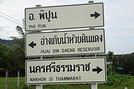
Première constatation : la signalisation routière est dans l’ensemble plutôt bonne, y compris hors des grands axes. Les grands panneaux ronds portant le numéro de la route, que l’on voit aux croisements principaux, sont très pratiques pour savoir où on est. Les directions principales sont indiquées sur des panneaux verts, en thaï et en caractères latins. Ensuite, il y a les panneaux blancs portant le nom des localités les plus proches avec la distance restant à parcourir. Ces panneaux sont également en thaï et en caractères latins. Enfin, il y a les panneaux bleus indiquant les lieux présentant un intérêt pour le touriste, tels que temples, cascades, parcs nationaux… Certains panneaux sont exclusivement en thaï, mais ils n’intéressent manifestement pas le touriste. Enfin, les « super highways » (abusivement appelées autoroutes par les francophones, alors qu’il s’agit simplement de voies rapides) présentent la même particularité que les « dual carriageways » anglaises : les demi-tours (U‑turns). Il vaut mieux avoir ces panneaux à l’œil si vous roulez sur la voie de droite et lever le pied en arrivant à proximité. N’empêche, ces demi-tours sont très pratiques.
Deuxième constatation : l’état des routes est généralement plus que correct. Certes, nous avons rencontré quelques tronçons un tantinet cahoteux, en particulier sur la voie de gauche de certaines quatre-voies, mais il n’y a pas de quoi crier au loup. À un ou deux endroits, notamment sur la petite route qui longe la frontière du côté du Triangle d’Or, nous avons trouvé des nids de poule dans les virages. Avec une voiture de tourisme, il suffisait de lever le pied et d’être un peu vigilant. Pas besoin de louer un 4x4 pour si peu. J’ai vu bien pire au Brésil.
Troisième constatation, et ce n’est pas la moindre : contrairement à ce que j’avais lu ici ou là dans les forums, j'ai trouvé les Thaïlandais très courtois sur la route. On ne s’énerve jamais, tout s’arrange toujours avec un sourire. Bien entendu, l’Européen qui conduit pour la première fois là-bas peut être un peu désorienté par la conduite à gauche et le fait que la priorité reste à droite (ce qui est d’ailleurs bien moins dangereux à un carrefour à faible visibilité que dans un pays où on roule à droite), mais au bout d’une demi-heure on n’y pense déjà plus. Les deux-roues ? Effectivement, il y en a partout, et il faut être vigilant. Mais ce n’est pas pire qu’à Paris sur le périphérique. La règle d’or : ne jamais s’énerver derrière un deux-roues ou un véhicule plus lent. S’il faut rouler à quarante à l’heure, eh bien on roule à quarante à l’heure et personne ne vous klaxonne. Finalement, on roule beaucoup plus détendu.
Petite parenthèse : nous avons même roulé de nuit à une ou deux reprises. À aucun moment je ne n’ai eu les craintes que j’ai habituellement au Brésil.
L’exception, car il y en a toujours une, ce sont les gros 4x4 du genre Toyota Vigo. Ils sont plus hauts que les 4x4 ordinaires et leurs propriétaires ont tendance à se comporter en gros butors. Sur les quatre-voies, ils slaloment volontiers entre les autres voitures. Ils veulent prouver qu’ils en ont une plus grosse ? Laissez-les donc faire : « Vigo dans le rétro, vas-y mollo » !
Les routiers sont en revanche beaucoup plus corrects. Sur les routes à deux voies, beaucoup appliquent la règle internationale : ils mettent le clignotant à gauche (bas-côté) pour indiquer qu’on peut dépasser quand on n’a pas de visibilité, et à droite (comme s’ils s’apprêtaient eux-mêmes à effectuer un dépassement) pour indiquer qu’il y a du monde en face.
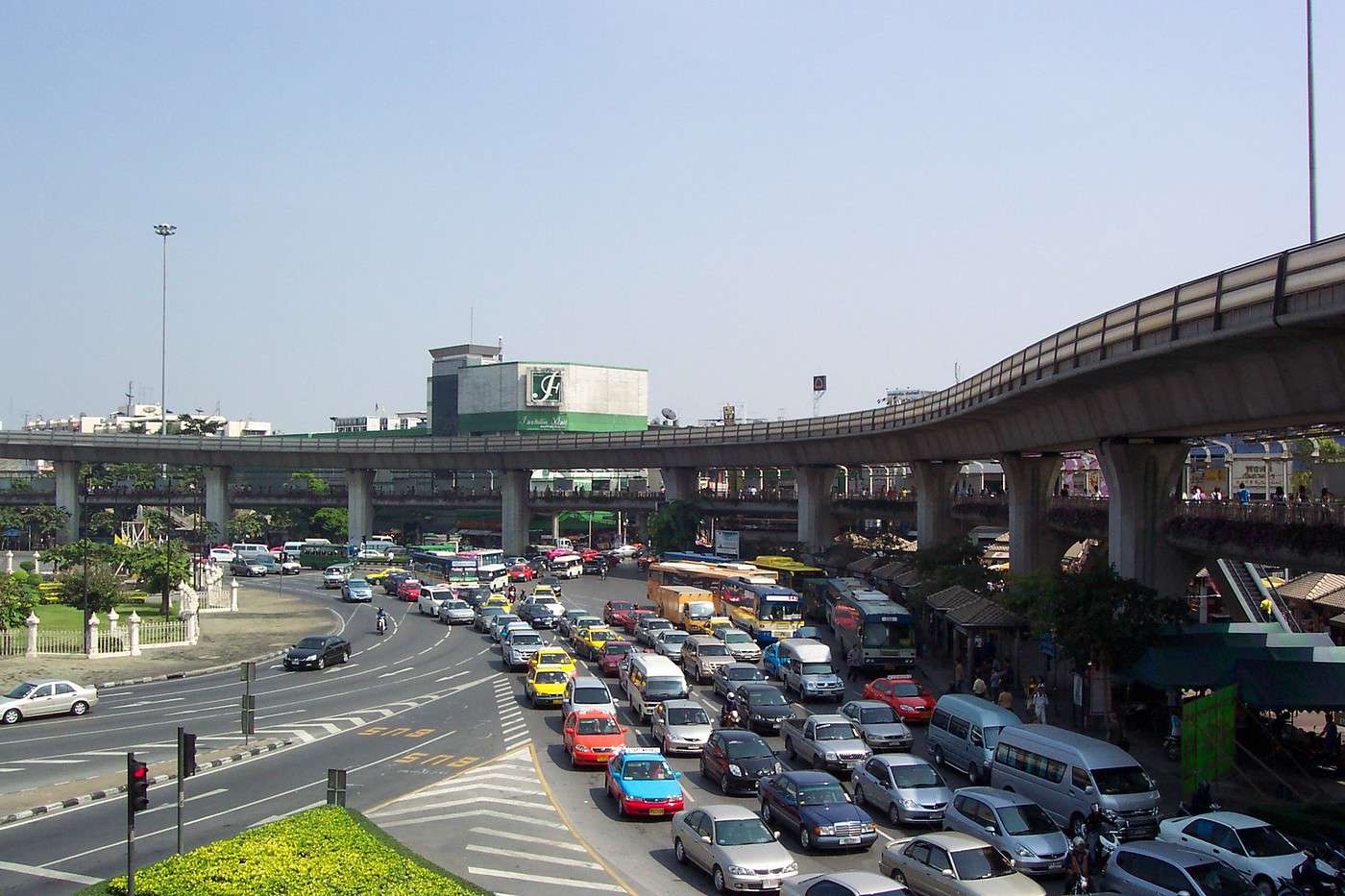
En ville, c’est parfois un peu plus compliqué. À Chiang Mai, par exemple, les sens uniques sont un peu agaçants, mais on pige vite le système. La vieille ville étant un carré, on se repère facilement. À Nakhon Ratchasima, j’ai pas mal pesté contre la signalisation pour ainsi dire inexistante sur la voie rapide : pas moyen d’entrer en ville ! Il a fallu essayer deux ou trois sorties différentes avant de trouver la bonne. Je ne parlerai pas de Bangkok : je ne m’y suis pas encore risqué et ça risque d’attendre encore un certain temps…
Pour conclure, je dirai que ce tour de Thaïlande en voiture s’est avéré bien plus agréable que je ne l’aurais imaginé. Donc, si vous envisagez de découvrir ou redécouvrir ce pays en voiture, ne vous ruinez pas en louant un 4x4 (une voiture de tourisme est bien plus facile à garer !), gardez votre calme et accrochez les élastiques derrière les oreilles pour rester souriant en toute circonstance. Ça paraît bête comme recette, mais ça marche plutôt bien.
Tuk-tuk et 4x4, c’est kif-kif… hum hum 😉😄😏😏😏😏😏 Sinon tu as raison, beaucoup de légendes "urbaines" sur les routes de Thailande, en faisant attention et pas le kakou, on s'en sort vivant 😉
Ben, moi aussi je voudrais un peu "casser l'optimisme" !
1.Il se vend 2 fois plus de pick-ups +4x4 que de voitures "urbaines" en Thaïlande !
Donc, sur les routes (et en dehors de Bangkok), vous verrez une majorité de "bullies" (esbrouffeurs).
2.L'automobiliste moyen ne respecte aucune règle, même pas sous le nez d'un flic, il faut s'attendre à des comportements erratiques !
J'ai vu personnellement trois voitures malaysiennes "pliées" par des pick-ups qui doublaient dans une côte ("on ne voit rien venir, donc on peut doubler" !).
NB:Les conducteurs malaysiens sont beaucoup plus "disciplinés".
3.Lorsqu'on est après une mousson, bien regarder le revêtement, des nids de poule peuvent apparaître en quelques heures seulement (vécu : une jante foutue en 2003 sur une "route superbe" près de Trang).
Pour résumer le tout, il faut toujours "y aller mollo", et se concentrer sur la conduite (pas de grandes discussions, pas de téléphone portable !) et en regardant beaucoup les autres (késs-ki-va-me-faire-sui-là ?).
NB:La Toyota VIOS est une très bonne voiture, seul défaut (en manuel) : un peu fatiguante en ville (moteur un peu "pointu", beaucoup de changements de vitesse).
joli post << j'ai fait ci j'ai ete la...., >> mais tu ne parle pas de l'essentiel, la sécurité, l'assurance le permis international obligatoire, et les maisons de location, ...........
ce sont ses détailles la qui pour moi sont le plus important, et primordiales,
1100 bt, c'est bien mais quelle sorte d'assurance on a avec ?
ne pas oublier que la premiere cause de mortalitee en thailande, est la route,
Pour ce qui est du permis international, effectivement je n'en ai pas parlé. Il me semble que ça va de soi. Enfin, pour ceux qui ne le sauraient pas, en Thaïlande comme dans la plupart des pays hors UE, il faut avoir un permis de conduire international qui s'obtient gratuitement sur simple demande à la mairie de la ville où on habite. Cette formalité est gratuite et ne prend habituellement que quelques jours. Le permis international est valable trois ans et renouvelable au-delà de cette période.
Quant à la sécurité, tu trouves que je n'en parle pas ? De quoi je parle alors ? Il faudrait que je hurle avec les loups en racontant mille et une anecdotes croustillantes sur des chauffeurs indélicats ou ce genre de choses ? Mais je pourrais en dire autant de la France ! D'ailleurs, je vais justement en dire autant de la France : j'habite en Sologne. Ici, les routes sont droites et il y a peu de circulation. Du coup, certains se prennent pour des champions de formule 1 et oublient qu'il y a d'autres usagers et... du gibier. Toujours au sujet de la France, à notre retour lundi matin, il y avait des bouchons partout autour de Paris et de nombreux accidents étaient signalés. Des Thaïlandais de passage, sans doute... Les deux-roues se faufilaient entre les files de voitures dans des conditions souvent risquées. Là encore, je suppose qu'il s'agissait de Thaïlandais de passage. Quant à la Thaïlande proprement dite, je ne nie pas qu'il y ait des accidents. J'en ai d'ailleurs vu un grave provoqué, justement, par un 4x4. J'ai vu aussi pas mal de véhicules trop lents sur la voe de droite alors qu'ils auraient dû rouler à gauche, etc. N'empêche, la Thaïlande n'a absolument rien d'exceptionnel dans ce domaine. Sur les autoroutes françaises, surtout le week-end, on trouve aussi plein de véhicules sur la voie de gauche ou du milieu alors qu'ils devraient être sur la voie de droite. Tous ces petits travers que d'aucuns semblent prendre pour des particularités thaïlandaises, je les ai vus un peu partout en Europe (quoique plutôt moins fréquemment en Europe du Nord), en Malaisie et au Brésil. J'imagine qu'on peut en dire autant de bien d'autres pays.
Toujours dans le registre de la sécurité (commence à me gonfler, cette dérive sécuritaire !), j'ai loué la bagnole dans une grande agence avec l'assurance tout-risque standard, etc. Je n'entre pas dans les détails, je n'ai pas le contrat sous les yeux, mais je ne suis pas idiot : je me suis adressé à une grande agence présente dans toutes les villes, pas chez un loueur de quartier inconnu qui vous refile la poubelle sur roues du beau-frère (cette connerie-là, je l'avais faite à Borneo...).
Cela étant, je dis simplement ce que m'a coûté la location de la voiture. Elle avait environ 35 000 km au compteur et elle était en parfait état. Puisqu'il faut parler sécurité, je répète que j'ai opté pour un modèle à boîte automatique précisément pour cette raison. La Toyota en questin a une excellente reprise et c'est très pratique quand on fait un demi-tour sur une quatre-voies, par exemple. Le seul bémol : elle n'avait pas l'ABS. Ça m'a un peu surpris. Toutes les voitures (et je ne loue en général que des bagnoles de ville) que j'ai louées en Malaisie en étaient équipées.
Enfin, quelqu'un fait remarquer à juste titre que pendant la mousson on ne voit pas les nids de poule. Effectivement, c'est un point que j'ai oublié. En saison des pluies au Brésil, il m'est arrivé de pester à ce sujet et la remarque faite à ce sujet est très utile. Il se trouve que je n'avais pas envie de retourner en Thaïlande en période de mousson. Je me suis coltiné deux ou trois moussons/saisons des pluies sous les tropiques ces dernières années, alors maintenant j'essaie de viser juste pour les dates de séjour... Donc, si vous allez en Thaïlande pendant la mousson, louez un 4x4. J'ai bon, là ?
tres bonne synthese,
rare les voyageurs qui comprennent du premier coup la conduite Thailandaise,
pour les accros de la securite, location dans des ets genre Budget:
assurances au top et, pour 300 bahts de + par jour suppresion totale des franchises en cas d accident a tord
Merci pour cette précision, Robert. J'en prends d'ailleurs bonne note pour la prochaine fois. Il me semble que mon contrat de loc comportait quelque chose comme 5000 bahts de franchise. Il faudra que je vérifie.
Je ne parlerai pas de Bangkok : je ne m’y suis pas encore risqué et ça risque d’attendre encore un certain temps…
A la lecture du titre de ton sujet...je me suis dis..wooo il est venu conduire à Bangkok...mais en faite non 😏, de toute façon je te le déconseil vivement, c'est hardcore, stress, ennuyant, dangereux, car si le nord est sympa, ici c'est l'enfer.
Perso je loue des voitures de locations depuis de nombreuses années (12 ans) chaque année et ce 2 fois par an,
1 Le permis de conduire international impérativement .
2 Je loue toujours chez Budget une maison très sérieuse et fiable, il y a 3 types d'assurances, 3 franchise, une à 10 000 baths de franchise, une à 5000 baths et une à 0 bath de franchise, Jamais mais jamais louer une voiture aux loueurs de rues jamais .
En conduisant logiquement en fonction de leur conduite pas de soucis, suffit d'être prudent en permanence, mais comme je vois que tu as rouler au Brésil je ne vois pas pourquoi tu ne pourrais pas rouler en Thaïlande .
Si tu veux plus d'infos pas de soucis .
Thuan, j'ai loué chez Avis à Bangkok le week end dernier une Vios manuelle pour 1100 baht, assurance incluse.
Je prends toujours en plus la super CDW pour 200 baht par jour, rine à payer en cas d'accident.
Ca m'est arrivé une fois de heurter l'arrière d'une dame 😛 . A peine une égratignure.
Elle a absolument voulu aller chez le garage. Celui ci voulait bien sûr changer le pare choc pour 8000 bahts.
J'ai appelé l'assureur d'Avis qui est arrivé dans le quart d'heure (et j'étais plus à Bkk). Il a noté le numéro de loc et je suis reparti illico presto.
Il me semble que mon contrat de loc comportait quelque chose comme 5000 bahts de franchise.
chez Budget c est 8000,
ils te propose l extention de garantie systematiquement
une petite anecdote amusante:
lors de ma derniere location (van toyota hiace/12 places, 5 jours)
j ai voulu laisser comme c est d usage la caution (25000 bahts) par empreinte CB,
le hic c est que la visa Bangkok Bank n a pas les numeros en relief,
pas grave toujours un ATM a proximite,
a mon retour de l ATM ayant choisis l option extention de garantie la caution est descendue a 20000
joli post << j'ai fait ci j'ai ete la...., >> mais tu ne parle pas de l'essentiel, la sécurité, l'assurance le permis international obligatoire, et les maisons de location, ...........
petite precision:
toujours chez Budget on te demande (sur les conditions ecrites de location)
le permis international OU, un permis en anglais
joli post << j'ai fait ci j'ai ete la...., >> mais tu ne parle pas de l'essentiel, la sécurité, l'assurance le permis international obligatoire, et les maisons de location, ...........
petite precision:
toujours chez Budget on te demande (sur les conditions ecrites de location)
le permis international OU, un permis en anglais
En théorie, oui. Pour l'anecdote, en pratique, chez Avis, je leur présente un permis international périmé depuis plusieurs mois sans qu'il s'apercoivent de quoi que ce soit.
Les petits loueurs se foutent royalement de savoir si tu as un permis. Du moment que tu as une carte de crédit, ca leur suffit. Le dernier à qui j'avais loué m'a juste précisé que la police fine s'élevait à 300 bahts en cas de contrôle !
Ouais, c'est sûr que BKK, je ne m'y risquerais pas pour le moment. Pas que j'aie peur, mais je pense qu'il faut surtout bien connaître la ville. Je ne la connais pas trop mal en tant que toutou lambda qui prend les bateaux sur la Chao Phraya et le MRT/BTS, mais ça s'arrête là.
Dans l'idéal, il faudrait sillonner la ville dans tous les sens, de nuit, pendant un mois pour la connaître par coeur puis s'y risquer de jour progressivement, mais bon, je n'ai pas l'intention d'y faire carrière comme chauffeur de taxi pour le moment...
Conduire en Thailande est un plaisir.comme on évolue dans un milieu "hostile" on est d'autant plus attentif et vigilant.Et puis les thais sont courtois et jamais agressif.Les carrefours, j'ai jamais trop compris la priorité mais ça passe toujours au feeling.C'est le premier engagé qui est prioritaire.
Et même lorsque vous circulez à vélo, jamais vous n'entendrez de klaxons derriére vous contrairement à de nombreux automobilistes français que la simple vue d'un cycliste sur leur trajectoire excite et énerve.
Il faut juste se méfier des mecs bourrés en cyclomoteur .
Salut "Le Tigre" et à tous ! c'est bien évident en France j'ai peur et suis stressé de conduire, j'ai conduit dans pas mal de pays, chacun a sa particularité, mais nul part j'ai rencontré aussi d'agressivité que la conduite en france, même Bangkok c'est du gateau par rapport à certaines villes françaises où en une journée j'ai eu 3 accrochages alors que 3 mois en Thailande avec 8 jours sur Bangkok = 0 accrochage,
alors ossez et vous vous renderez compte que ce n'est pas si terrible de conduire en Thailande c'est un tabou qu'il faut surmonter . ce qui n'est pas tabou c'est s'il y a accident corporel là ça peut terriblement se compliquer !!! Bye Bye et courage à ceux qui sont bloqués actuellement dans leur voyage .
apres le recit d'Aquiceara, Adaii fait bien de souligner """ ce qui n'est pas tabou c'est s'il y a accident corporel là ça peut terriblement se compliquer !!!
je ne conteste pas que dans 90% des cas tout baigne mais pour les 10% restants ...
en cas d'accident corporel, c'est "compliqué" et ca risque sériusement de gacher votre voyage
meme avec une location Avis ou budget, au mieux votre carte Gold vous donne droit a une assistance juridique ( attention c'est une avance sur frais plafonnée, a rembourser plus tard ! )
relisez attentivement votre contrat et votre couverture assurance et posez la question a votre assurance en rentrant dans les détail
mais nul part j'ai rencontré aussi d'agressivité que la conduite en france,
Vous avez de la chance !
Je me souviens fort bien d'une arrivée à Milan (Linate), me trouver dans une Fiat de location dont le chauffage ne marchait pas (pare-brise embué), dans une tempête de neige qui avait déjà créé des congères, à la tombée de la nuit, et devant trouver mon hôtel ...
Trois types derrière qui kalxonnaient comme des fous et lancaient des appels de phare car (n'y voyant rien) je ne roulais pas assez vite.
Au bout de 5 longues minutes de ce "manège", je me suis mis deux roues dans le fossé pour laisser passer une BMW, une Mercedès et une Alfa en trombe ...
Heureusement, il n'y avait pas de missile dans l'équipement du véhicule !
Cà ne m'est jamais arrivé ni en France, ni en Belgique (en route vers la Pologne) ni en Pologne ni dans aucun autre pays.
Salut "MengWan" oui oui, c'est exacte j'ai le même souvenir en Italie à l'époque des fiats 500, !!!
mais j'étais en grosse voiture et c'était les petites fiats 500 qui me claxonnaient continuellement : j'avoue qu'ils avaient peut être raison !!!! Bye Bye
Pour conclure, je dirai que ce tour de Thaïlande en voiture s’est avéré bien plus agréable que je ne l’aurais imaginé...................
__
alors tu n as jamais eu affaire avec des chauffeurs de bus completement félés qui roule a 130-140
( je n'exagère pas )avec de vieux tracassins et qui doublent avec un camion venant en face, ( il n'a qu'a se tirer de là) si si j'ai eu le cas du coté de surin, des automobilistes qui mobilisent la voie de gauche en roulant a la même vitesse que les autres sur les 2x2 voies, des chauffeurs de camions qui doublent sur des 2 voies en ayant rien a faire de ceux qui viennent en face, heureux qu'il y ait toujours des bas cotés large, des félés en motos qui slaloment entre les autos et sans casque et tres souvent ne regardent jamais dans les rétros. tu es bien le premier a trouver que les thais ne sont pas dangereux. pour moi quand je roule c'est le salaire de la peur a tout moment. et tout ça sans compter le racket des flics, pour en rajouter une couche.
Salut "MengWan" oui oui, c'est exacte j'ai le même souvenir en Italie à l'époque des fiats 500, !!!
mais j'étais en grosse voiture et c'était les petites fiats 500 qui me claxonnaient continuellement : j'avoue qu'ils avaient peut être raison !!!! Bye Bye C'était Mengwan qui te klaxonnait (pour faire plus italien qu'un italien) mais il n'avait pas raison... comme dab 😇😉😄😏😏😏😛
Meuh si j'ai vu tout ça. Et alors ? Tout à l'heure je suis allé à Romorantin et des fêlés qui font n'importe quoi j'en ai vu aussi. Pourtant, on était un après-midi en semaine et il y avait peu de circulation. J'ai aussi vu des gens faire n'importe quoi en Malaisie, au Brésil, en Turquie, en Allemagne, en France... La Thaïlande n'a pas l'apanage des imprudences routières ni de la corruption policière.
Les travers de certains usagers de la route sont de toute évidence plus flagrants à l'étranger que dans son propre pays. Pourtant, Dieu sait qu'il y a à redire sur la France dans ce domaine, même si la situation s'est grandement améliorée depuis les années 70.
Moi, je veux bien que vous compariez avec la France, sauf que ...
En Thaïlande, il y a de 16 à 20.000 morts par an sur les routes !
Soit beaucoup plus qu'en France, même si on ne tient pas compte du nombre de voitures qui est bien moindre.
Alors, "les doigts dans le nez", c'est pas prudent, il vaut mieux s'attendre au pire pour ne pas -dans le cas le plus "favorable"- risquer la crise cardiaque !
Meuh si j'ai vu tout ça. Et alors ? Tout à l'heure je suis allé à Romorantin et des fêlés qui font n'importe quoi j'en ai vu aussi. Pourtant, on était un après-midi en semaine et il y avait peu de circulation. J'ai aussi vu des gens faire n'importe quoi en Malaisie, au Brésil, en Turquie, en Allemagne, en France... La Thaïlande n'a pas l'apanage des imprudences routières ni de la corruption policière.
Les travers de certains usagers de la route sont de toute évidence plus flagrants à l'étranger que dans son propre pays. Pourtant, Dieu sait qu'il y a à redire sur la France dans ce domaine, même si la situation s'est grandement améliorée depuis les années
__
oui mais en france je n ai jamais vu des bus rouler a 130 et doubler en kamikaze, mais c est vrai que les jeunes fous en motos et autos ne manquent pas.
Moi, je veux bien que vous compariez avec la France, sauf que ...
En Thaïlande, il y a de 16 à 20.000 morts par an sur les routes !
Soit beaucoup plus qu'en France, même si on ne tient pas compte du nombre de voitures qui est bien moindre.
Alors, "les doigts dans le nez", c'est pas prudent, il vaut mieux s'attendre au pire pour ne pas -dans le cas le plus "favorable"- risquer la crise cardiaque !
C'est vrai et peut=etre meme beaucoup plus,
MAIS en France je n'ai encore jamais vu 15 gamins assis dans le Q d'un pick-up qui s'il a un accident a vive allure nous fera pas loin de 20 morts (les 15 de la benne et les au moins 5 de l'interieur);
en France, j'ai conduit des autocars Chausson 110 ou 150 CV, ca date, hein? c'etait en 1971 mais on avait deja le TELMA (ralentisseur electromagnetique); ici en Thailande, ils ne savent meme pas ce que c'est. Les espagnols fabriquent eux l'ILASA, meme principe que le TELMA.
En Europe, je conduisais des semi remorques (de 35 a 120 tonnes ) avec des puissances et des systemes de securite appropries; ici, c'est "va comme je te pousse, on verra bien a l'arrivee", s'il y a une arrivee.
J'ai encore jamais vu un controlographe en fonctionnement pourtant tous les PL du monde entier sont livres avec d'origine.
J'ai aussi constate que la plupart des autos neuves ne sont pas encore des "Tupperware", vous savez ces autos qu'on a en France avec des capots plastiques tout partout et qu'on ne peut reparer que chez le concessionnaire car les outils de reparation sont dedies et les petits garagistes ne peuvent se les procurer.
On en est encore loin en Thailande;
En fait, la Thailande c'est la France il y a 50 ans.
Pour TOUT : les autos, les outils de jardin, les appareils electro-menager (ou alors c'est le meme prix sinon plus cher qu'en Europe)....
MAIS en France je n'ai encore jamais vu 15 gamins assis dans le Q d'un pick-up qui s'il a un accident a vive allure nous fera pas loin de 20 morts (les 15 de la benne et les au moins 5 de l'interieur);
Lorsque j'ai acheté le pickup, en 2001, l'assurance était "offerte" pour un an ...
Quelle n'a pas été ma surpise de voir sur ce borderau d'assurance :
Nombre de passagers = 15
Sans doute parce qu'au-delà, ils ne remboursent plus ?
🤪🤪🤪🤪
NB:Je vous rassure, après cette année "gratuite", j'ai choisi AIG et le nombre de passagers assurés est de ... 5 !
ton post bouillone !
perso un cote que j adore c est le cote repression, beaucoup moins honereux qu en Occident,
meme si qq fois le PV n est pas justifier (fin de mois difficile pour les pauvres policiers, lloll)
un exces de vitesse ou 1 feu rouge grille, ou depassement ligne continue:
de 200 a 400 bahts suivant la region, avec recu,
100 bahts remis avec le permis sans recu,
un salut militaire apres les traditionelles questions:
d ou tu viens, on tu va ect... toujours bon enfant,
c est vrai aussi que certains bus VIP pour respecter l horaire te font parfois des sueurs froides, mais cela aussi s anticipe,
quand au prix des voitures cerise sur le gateau:
achat d un Toy VIGO: 12000 euros, regler a 10 heure, sortit a 13 heure, le temps de monter les accessoires commandes,
question qualite, a ce jour 90000 kilometres, j ai un ami qui est a 480000 kms, a part les revisions preconisees, aucun soucis,
revisions(sans RDV) entre 1200 et 1500 bahts ingredients compris, suivant prestations Toyota,
attente dans un salon vip, cafe, TV, internet haut debit, gratuit,
le meme au catalogue Toyota france: 22500 euros, revisions ? prefere pas y penser....
deja ecart de TVA, Thailande taux : 7 pour/100,
un autre cote agreable personne cognera ton vehicule en ouvrant sa portiere,
petite anecdote anti stress:
dernierement au contournement de BKK j ai vu mon echangeur a droite au dernier moment, etant dans la voie de gauche j ai bifurquer sans cligno,
un Thai en train de me depasser pour aller tout droit a ete contrait de prendre ma direction pour eviter l impact,
il s est arreter sur la bande d arret d urgence pour faire une marche arriere et reprendre sa bonne route,
il a du voir: plaque non BKK + Farang: meme pas un regard de reproche,
yen yen sabai....
Dans l'idéal, il faudrait sillonner la ville dans tous les sens, de nuit,
justement le contraire a faire, je m'explique, la nuit, il n'y a que la police corrompue ( en guet -append ) et s'occupe nulement de la circulation, puis comme il y a un peut moins de trafic, les timbrés de l'accélérateur, en profitent,
et ne pas se trouver devant un de ses personnages qui sorte de un kalaoke, ou de une bonne fête, bien arroser, la nuit tout le monde la sait c'est bien plus dangereux,
( les vendredis et samedis soir, être très attentif de la ou on est 🤪, il y a les courses de moto et la c'est vraiment dangereux .........., plus pour eux que pour notre petit corp, ,
( pour l'info, et comprendre la folie de ses courses, , la coupe du gagnant, est une de ses filles qui s'offre ....)
On ne conduit pas a bkk avec des principes, on conduit avec un style bkk, si on comprend cela, sa va très bien,
Hello everyone! I’m heading off solo in February and wanted to share my rough itinerary with you. Does this sound doable?
PS: I’m not really into beaches.
D1 Departure on February 17, 2027
D2 Arrival in Kuala Lumpur – stroll through Chinatown and visit the Petronas Towers
D3: Kuala Lumpur – Chow Kit Market, Batu Caves, Little India, Bukit Bintang downtown area
D4: Early morning bus to Malacca. Explore Malacca in the afternoon and evening
D5: Another 2–3 hours in Malacca in the morning, then bus back to Kuala Lumpur. Merdeka Square area. Stay in Chinatown
D6: Bus trip to Kuala Tahan. Night tour
D7: Morning – canopy walk and Bukit Terisek hike. Afternoon – off to Lata Berkoh
D8 & D9: 2-day jungle trek in Taman Negara National Park
D10: Head to Cameron Highlands
D11: Morning hike through the plantations. Afternoon still to be decided
D12: Morning – excursion to Mossy Forest and Sungei Plantation. Afternoon bus to Ipoh
D13: Morning – Mirror Lake / Sam Poh Temple area. Afternoon – explore downtown Ipoh
D14: Morning train to Penang. Afternoon – wander around Georgetown
D15: Morning – Penang Hill and Keh Loh Temple. Afternoon – Georgetown
D16: Bus to Butterfly Garden and Spice Garden. Late afternoon – Burmese and Thai temples
D17: Morning flight to Singapore. Afternoon – Chinatown and Marina Bay tour
D18: Morning – Gardens by the Bay area. Afternoon – Boat Quay, Clarke Quay, Kampong Glam
D19: Morning – The Ridges area and Botanical Garden. Afternoon – Little India, then back to Chinatown before 11:15 PM return flight
D20: Morning arrival
Hi everyone,
I’ll be in western Malaysia for 20 days in January and February.
I’m coming from southern Thailand to Ipoh for the Thaipusam festivities.
Then it’s off to Pangkor Island.
I’ll finish up in Malacca for the Chinese New Year celebrations before heading to Singapore.
I’ve got a 6-day gap.
I was thinking of going to K.Lipis for the jungle train and heading to Dabong, but the caves might not be open.
Any suggestions around K.L.?
Day treks?
A stopover between K.L. and Malacca?
Thanks
Hi, I’ve read that these two volcanoes are super popular and that there are *tons* of people for sunrise, especially in July. I’m looking for firsthand accounts from anyone who’s done it later, around 9–10 a.m.
Thanks for your help!
Laëtitia
I’m heading to Cambodia at the end of December 2026 – January 2027 for 3-4 weeks. Since I’ve already visited Cambodia twice, my itinerary is a bit different this time—I’d love to explore Botum Sakor Park, Chi Pat, the Tatai region, and the Cardamom Mountains. I’m traveling solo. If you have any tips on transportation, excursions, treks, sights, or accommodations in the area, I’d really appreciate it. Thanks for your feedback!
Has anyone traveled with the Laos travel agency ADV ?
I’m planning a trip to Laos and have received several quotes. Among them, this agency’s seem very reasonable, and so far, the interactions have been positive.
I’ve found a few positive reviews online, but I’d love to hear from travelers who’ve actually booked with them: how’s the organization, guide quality, accommodations, on-the-ground responsiveness, etc.
Thanks for sharing your experiences!
First stop on our discovery of the peninsula: Amphawa. It’s our first night in Thailand (we arrived at Suvarnabhumi at 8:50 AM).
Our initial plan was to explore the area before heading further south. The Mae Klong Railway Market is tempting... but what else is there to do????
We’ll be there on a Wednesday, and from what I’ve read on the forum, some say there’s absolutely nothing to do during the week—no floating market, barely any shops open, no restaurants, etc.
Others, though, say the place is actually more charming without the weekend crowds.
Could you share your thoughts? Missing the floating market is one thing, but if it’s really a ghost town on Wednesdays, I might just drop our bags somewhere else.
Amphawa seemed like a good first stop, just 1.5 hours from the airport, but I’d still like to settle somewhere a bit lively for our first evening.
We’ll be there at the end of October.
Thanks!
Hi,
I wanted to visit the plantations in the morning with GetYourGuide or by just showing up.
How much time should I really plan for?
I’d like to catch either the 3 PM or 5 PM bus back to KL.
Thanks
Hi,
I wanted to get some info about the cable car and the bridge—I see lots of different options...
How much time should we allow for these two activities? If we arrive around 4 PM, will we have enough time to visit without rushing?
Thanks
Hi there,
I didn’t plan to return to Thailand this year, but my health conditions mean it’ll be the best place for me to stay between two trips to India. The tourism setup there is so well-organized that it’s the most "comfortable" country for a short visit. Thailand feels too sanitized for my taste, and there’s too much religion, Buddha, and the King, but it’s still the best option given how my health has been evolving. I’d considered two weeks in ThaTon for hiking, but I got too sick from the burn-offs during my trips to the mountains around Chiang Rai. So I’m not sure where to go this year. Definitely not the sea, touristy spots, or the mountains with burn-offs...
Hi,
On September 1st, we're heading to Kalimantan for six weeks, probably from Pontianak to the Derawan Islands.
I've scoured this site, which is usually my go-to 😉, and others like VoyageForum, but recent info is pretty scarce.
I'd love any tips on places you've visited—our itinerary is still a work in progress.
We're two couples traveling with backpacks, using buses, boats, guesthouses, and homestays.
Thanks in advance!
Hi fellow travelers,
First trip to Vietnam.
We’ll be arriving in Ho Chi Minh City during Tet.
Is it complicated to find accommodation and get around during this period?
Any tips would be welcome.
Thanks for your replies.
Hi! I’d like to split my trip into two parts: 15 days in Phuket and 15 days in Krabi. Do you know if I can rent a car and drop it off in Krabi when I fly back to France?
Thanks for your feedback!
Have a great Sunday!
Martine
Hello,
After 1 night in Khao Sok, I’d like to find a 2 Days 1 Night package on the lake.
After reading a lot, I decided to "break the bank" and treat ourselves to a private tour—mainly to avoid the crowds.
But after contacting several operators, they offer "private tours" that are very expensive (around 700 €), yet in the details, the boats can only leave from the pier at 10 AM like everyone else. (I was hoping to leave much earlier.) The morning program is the same for everyone too (private or not). They drop us off at noon at our floating hotel (I’d chosen Phupha Waree). Free afternoon (swimming or kayaking in front of the hotel). We head back by boat for a 1-hour sunset ride. And the next morning, we leave the hotel at 8 AM to be at the pier by 9:30 AM at the latest—end of the trip.
So basically, we’re paying a lot for a private tour just to do the same thing as everyone else at the same time.
Or maybe I just had bad luck in my search.
I contacted Panida Ladi, who’s very popular on forums. We’d agreed on a private tour that matched my request (departure from the pier at 8 AM, very personalized itinerary). We settled on the itinerary and price, she asked for a Wise transfer for a 30% deposit, confirmed receipt of the deposit. Then 30 minutes later, she messaged me to say she was canceling everything because it was impossible to do the requested tour—and promised a quick refund of my deposit.
So here’s my question: Who’s done a *real* private tour on this lake? Who can recommend a reliable agency? Is it even really possible to do a private tour here?
I’m searching for a real gem for my 3rd stay in Koh Lanta: a lovely, high-quality hotel right by an easily accessible beach in a lively spot.
If you know of anything that fits what I’m looking for and want to share, don’t hesitate!
Hi, is anyone there in Flores right now? According to some websites, everything is closed and the situation is tough. But our guide says it's fine. Who should we believe? We're supposed to leave on September 2nd. Thanks to anyone in Flores at the moment!
Hi dear community,
I'm planning to visit Cambodia this winter, right after Christmas, for my first solo trip and my first trip to Asia. For two weeks (yes, I know it's short, but I really can't do more...). I have two main desires: Siem Reap and the countryside, the villages, the Mekong...
What do you think of this itinerary? Arrival in Siem Reap, departure from Phnom Penh.
SR: 5 days (1 day for arrival, 3 for the temples, 1 for the lake and its villages)
Kratie (stop on the way to Mondolkiri): 3 days (1 day of travel, 2 days there)
Mondolkiri/Sen Monorom: 4 days (1 day of travel, 1 day there, 2 days of treks)
PP: 3 days (1 day of travel, 2 days of sightseeing)
I think I need to cut one day somewhere if I travel from Saturday to Saturday or Sunday to Sunday. In Kratie, maybe? Or in PP? And I'll miss the boat trip that everyone recommends (SR-Battambang), but I don't see where to fit it in. Unless I do a PP-PP loop starting in the east, skip Kratie or just stay one night, then SR, then PP.
In my timing, Mondolkiri seems closer than Ratanakiri, which also tempted me a lot! Will it be too complicated alone? I'm thinking of using local guides or a small local agency for a nature and village getaway.
I've read that Siem Reap is very crowded between Christmas and New Year's. I could also do the circuit in the opposite direction. But I thought it would be easier to get familiar with the country by arriving in a touristy area—I might be wrong...
Thanks for your advice and opinions!
Hi everyone.
I’m planning my trip, and based on all the posts I’ve read, this country is amazing.
Of course, I’ve got a ton of questions for you.
Here’s a possible itinerary: Vientiane - Vang Vieng - Phonsavan - Sam Neua - Nong Khiaw + villages - Phongsali - Luang Namtha and the area - Udomxai - Huay Xai - Luang Prabang and back to Vientiane.
What do you think?
We’re planning to prioritize local transport—is it possible to do this loop?
We’d also love to go kayaking, but I’m not sure if the season’s right or where the best spot is.
For trekking—I read that Phongsali is the most authentic spot to visit villages and see wildlife. Do you know of a reliable agency and a guesthouse with reasonable prices?
Is it worth taking a slow boat for a stretch on the Mekong, and if so, which route?
For accommodations, is it better to book through Booking.com and Agoda or look when we arrive?
Are mosquitoes bad in Laos, and should we take malaria prophylaxis?
What’s the average daily budget (accommodation, food, visits)?
Is renting scooters a good option for exploring towns, and if so, which ones?
From what I’ve read, it’s best to carry cash—euros or dollars? Is it risky to walk around with that much cash?
I’ve still got tons of questions. Thanks to anyone who can help, and I’m open to all tips, info, etc.
Thanks again
Hi there,
I’m planning a family trip (my wife and I, both 47, and our two sons, aged 5 and 12) to Malaysia for the last week of June and the first two weeks of July 2027.
We used to love road trips as a couple, then as a trio, but since our second child arrived, we’ve taken a break with "camping village" style trips.
Now feels like the right time to get back to our old habits, while adjusting the pace for the kids.
We’re craving Asia. We’ve been lucky enough to visit Thailand, Indonesia (Bali and Lombok), and Sri Lanka before.
Friends have raved about Malaysia, so we’re definitely tempted.
For those who know and love Malaysia, what would be a good itinerary starting from Kuala Lumpur, with a maximum of 3-4 stops? We’d like a mix of culture, nature, and relaxation (just to clarify, we’re not big beach fans). All of this without rushing, of course.
Hello,
We’re a family of four with two teens aged 16 and 18. We’re heading to Thailand this summer. We’ll arrive in Bangkok and plan to take a flight to Luang Prabang.
I’ve seen there are some great visits and excursions to do (temples, markets, waterfalls) and maybe even venture a bit north to places like Nong Khiaw, Muang Xay, Muang Ngoy, or Oudom Xay.
But I’ve also heard about the Bokeo region with the Gibbon Experience.
Since we won’t be able to do everything, I’d love to hear about your experiences, impressions, and advice on the two options I’m considering, especially since we’ll be meeting family in Chiang Mai, Thailand, afterward.
Option 1: A loop from Luang Prabang heading slightly north, then a flight from Luang Prabang to Chiang Mai.
Option 2: A few days in Luang Prabang, exploring within a few dozen kilometers around, then heading to Bokeo province for the 2-day/1-night Gibbon Experience. For this option, I saw on Rome2Rio that it’s possible to book a ferry trip on the Mekong from Luang Prabang to Huay Xay—they mention about 8 hours. But is that realistic? What type of boat is it?
Then, to get to Chiang Mai, there aren’t many options—bus or minivan—but how does crossing the border work?
Finally, for those of you who’ve been to Laos in August, what was the weather like?
We’ve already visited Thailand, Vietnam, and Cambodia during the same period over the past four years and weren’t really bothered by bad weather.
I’m starting a discussion about guides in the Mekong Delta because we’ve just finished our trip in this region and had a hard time finding a French-speaking guide. We had Thanh—she speaks French really well and travels all over the delta region, including Ho Chi Minh City. She’s super friendly and flexible. I recommend her wholeheartedly. If it can help someone...
Feel free to contact us for her number.
Hi everyone,
I couldn’t find any recent info on Kuching.
Can anyone recommend a hotel or guesthouse for under 100 RM that’s nice and affordable? No dorms, please.
Also, does it rain a lot in November, and is it still worth visiting Semenggoh or Bako?
We’ll be arriving in Phnom Penh this coming January and we’re thinking of starting our trip with a stop in Kampong Cham, then Kratie.
After Kratie, we’re considering heading toward Siem Reap with a stop in Kampong Thom.
That said, I’m not really sure how long the Kratie–Kampong Thom journey might take or how complicated it is.
Does this stop on the way to Siem Reap seem like a good idea to you?
If we don’t visit the Sambor Prei Kuk site, are there still any walks or sights worth checking out in Kampong Thom?
Silly question—backpack or hard-shell suitcase for the Sepilok, Kinabatangan, Tioman, KL trip?
I’m struggling to fit all my son’s and my stuff into the 70L backpack... and I’m thinking a suitcase would be easier, but I’m not sure if it’ll work for getting around.
After a stay on Koh Phayam this coming November, I’d like to spend 2 or 3 days on Koh Phra Thong before heading further south.
Do you think it’s doable to leave Koh Phayam early enough to catch the 10 AM boat from Khura Buri to Koh Phra Thong? The next one isn’t until 4 PM, which would cost me a whole day.
I’m planning a trip to Indonesia, specifically Sulawesi and Java, in September for 10 days.
I don’t know this part of the world at all—any advice is welcome!
I’ll be traveling solo and would also love tips on meeting other travelers or locals.
Hello everyone,
Not long ago, I used to travel as a couple, but my husband has since passed away, and I’ve decided to set off again. The trip I took to Cambodia in January 2025 did me a world of good.
I’m now considering Thailand, a destination we never included in our plans because even 15 years ago, people said it was too touristy. Still, I’m thinking about the itinerary below, but I don’t feel up to arranging buses, trains, or guides on my own while I’m there. I’m looking for one or more drivers and have been in touch with an agency, but their offers are just copy-paste group tours that I don’t want.
So, if you have any contacts, experiences, or advice, I’d be so grateful if you’d share them with me. Here’s my rough plan:
Arrival in Bangkok
Ayutthaya (2 nights)
Kanchanaburi (2 or 3 nights)
Sangkhlaburi/Sai Yok (3 nights)
Sukhothai (2 nights)
Lampang (I’ve planned 3 nights, but that might be a bit much—it depends on what time I arrive in the city)
Chiang Mai
Chiang Dao
Pai
Chiang Rai
I was thinking about the Mae Hong Son loop—thoughts?
What do you think about staying overnight at the Golden Triangle?
When I look online, of course, I can find agencies that organize tours to national parks, etc.
I’m retired but in great physical shape. I’d rather go hiking than sit in hot springs with crowds of tourists who’ve all arranged meet-ups. I don’t want to spend a day at an elephant camp, and I don’t want to visit Karen villages.
I’d love to hear your advice.
Thank you all,
Hi everyone,
Could you share your thoughts on my 3-week itinerary?
We’re a small group (family + friends) of 12 people, planning to leave around January 21, 2027.
Here’s my itinerary:
3 nights in Bangkok
4 nights in Chiang Mai
3 nights on Koh Samui
3 nights on Koh Phangan
4 nights in Krabi
4 nights in Phuket
I’m also open to any great tips you might have...
Thanks, everyone! Alain.
Hi there,
We’re planning a 3-week family trip next summer with our three kids, who’ll be 8, 8, and 7 years old.
After some research, we’re leaning toward Malaysia to combine nature/forests and paradise beaches. The idea is to introduce our kids to the country’s culture, nature, and wildlife.
We want a great trip but without splurging on luxury options like high-end lodges and resorts. We’re looking for comfort with a touch of authenticity—basically, a good middle ground.
I’ve started putting together an itinerary and would love your expert advice and tips to help us build this amazing trip with our little ones.
Day 1: Departure from France
Day 2: Kuala Lumpur
Stay at a hotel near the airport or KL Sentral.
Just one night.
Day 3: Morning flight to Sandakan (Borneo).
Stay in Sepilok
Day 4: Sepilok:
* Orangutan Center
* Malayan Sun Bear Center
* Rainforest Discovery Centre
Day 5: Depart for Kinabatangan.
Boat safari in the late afternoon.
Day 6: Sunrise safari.
Jungle walk.
Evening safari.
Day 7: Final safari.
Return to Sandakan.
Flight to Kuala Lumpur, then to Kota Bharu (or overnight transit depending on schedules).
Day 8: Transfer to the port.
Boat to the Perhentian Islands.
Days 9 to 13: Perhentian Besar
5 full days.
* Snorkeling
* Hiking
* Turtle watching
* Wild beaches
* Relaxation
Day 14: Return to the mainland.
Bus or private car to Taman Negara.