Discussions similar to: Reprise forum
FR

526 similar discussions in English

12 days in Israel, before...
This trip took place in May 2023, a period of calm that later proved precarious. Day of May 17 Departure from Marseille on El Al (tickets booked by ourselves, while the stay itself was organized by Voyageurs du Monde). Before check-in, six or seven El Al staff members conduct a security check—quite understandable, but they do it in total chaos. They send people to the left, then block them, redirect them to the right, for no apparent reason. Most of the staff don’t speak French, which complicates things. They work at an incomprehensible slow pace, stopping the interview to do something else, then coming back and starting over... The flight goes smoothly, except for the meal service, which, for a four-hour flight that El Al delayed to lunchtime, is more than basic: a quarter-liter of water and a corned beef sandwich that’s absolutely disgusting and inedible. To get a coffee, you have to queue at the back of the plane. You end up missing Ryanair🙂 Arrival at Ben Gurion goes better than expected—the passport control is fairly quick, as is baggage delivery. Transfer to the Lily and Bloom hotel, Lilienblaum Street (easy to remember 🙂) As advised by Voyageurs du Monde, we book a table for the evening at the nearest restaurant, North Abraxas. Good atmosphere and decent food. We get a sense of the price level in Israeli restaurants. Around us, diners share dishes placed in the middle of the table. Much more convivial than our individual plates!! Day of May 18

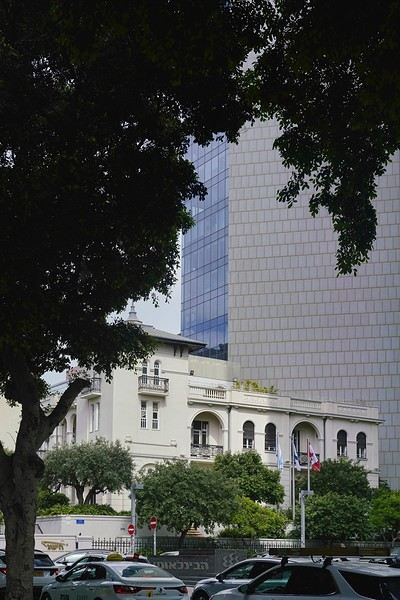
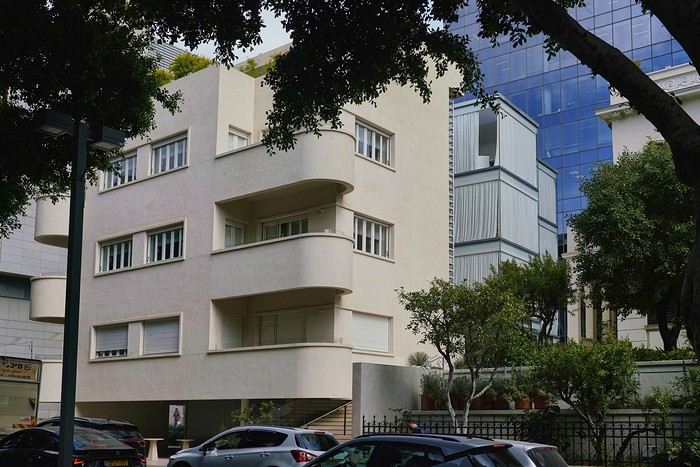
The next morning, we go down for breakfast at 7:30 AM—a late hour, but the setup is slow, with the two servers taking their time. We ask the bartender for a long coffee and a black tea... It must be a complicated order because it takes him over 10 minutes to make it. He serves us with the grace of a dancer. A good breakfast if you’re not in a hurry, followed by a little stroll in the neighborhood, since our meet-up with Patrick Arfi, our guide for the day, isn’t until 10 AM. P. Arfi is a former publishing house director in Paris who has lived in Israel for a long time and has a vast cultural knowledge. After an initial chat, we head toward Jaffa, focusing on the Bauhaus buildings preserved by a clever urban policy that allows high-rise construction while maintaining old architectural ensembles.


This policy keeps the streets looking more human-scale than the usual high-rise districts in modern cities.

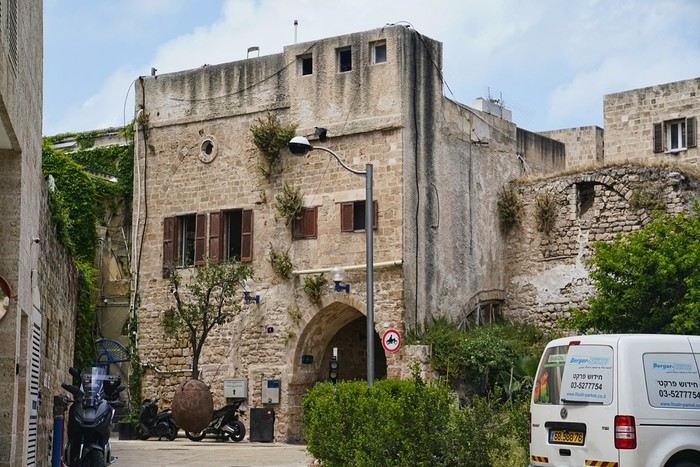
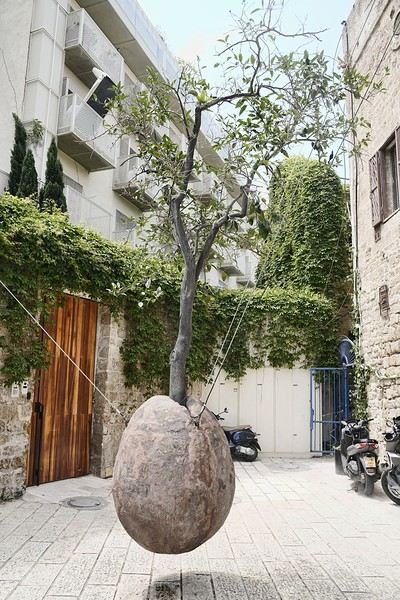
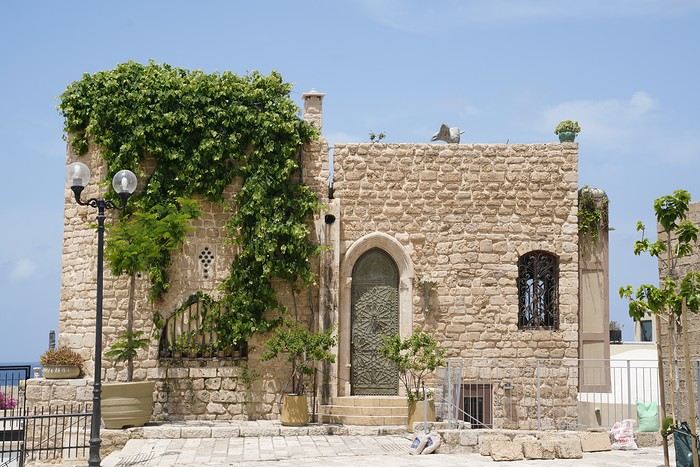
With the visit to Jaffa, Patrick introduces us to a fascinating slice of history, despite the temperature nearing 38°C. Jaffa, once an independent city, is now a neighborhood of Tel Aviv—a predominantly Muslim area. We notice a few buildings in poor condition. They belong to Palestinian families who left Tel Aviv. Otherwise, the city has been very well restored, apart from these few buildings.

A government agency rents out the ground floors of these buildings, which helps fund part of the security work. They also try to track down the owners and buy back the abandoned properties, but some refuse to sell. The visit is very touristy—most of the people we meet are tourists like us.


There’s very little local life, except in the lower part of the city. To be continued, as I’ve reached the allowed photo limit.
Open
23-Day Itinerary in the Pacific Northwest (USA) and Western Canada
Hi everyone,

We’re heading to the Pacific Northwest (USA) and Western Canada this summer. We’ve made some progress planning, but we still have a few questions.

Our trip is mostly nature-focused—hiking, wildlife spotting (ideally bears, orcas/whales, otters, etc.), mountains, forests—and a few days in cities, though we’re not big on museums.

We’re looking at flying into Seattle (cheaper than Vancouver), then renting a car and staying in Airbnbs.

A few years ago, we traveled through eastern Canada/USA (Halifax/Montréal/Boston/Halifax) and ended up driving *way* too much and switching accommodations too often. This time, we’d like to settle in a bit more.

Here’s our current plan:

- 2 nights in Seattle to avoid hitting the road right after the flight. One day for a quick city visit, then we’ll leave early after the second night. -> Heading to Olympic National Park from the south.

- 4 nights near Olympic National Park, likely around Forks. -> Then to Port Angeles and a ferry to Vancouver Island via Victoria (maybe 1 night there).

- 7 nights in Port Alberni, which seems like a central base for exploring Vancouver Island (Tofino, Pacific Rim, Cathedral Grove, etc.). We really want to enjoy the area without constantly packing and unpacking.

The issue is, that brings us to 13–14 nights, and we’d like to spend 2 in Vancouver.

We’re wondering if we should head farther north on the island and add a few more days, or reduce our stay in Port Alberni to explore the north as well.

After that, we’d have about a week left. We’re considering a detour near the Canadian Rockies, then slowly making our way back to Seattle via North Cascades National Park.

Anyway, we’d love your input on all this!

Thanks for your suggestions,

Emilie and Thomas
Open
Bangkok - Chiang Mai - Koh Samui in summer
Hi everyone, I’ve spent two solid months reading the Lonely Planet and pretty much every post about Thailand here, plus French and English blogs. Now I’d love to get your expert opinions on our itinerary. We’re heading off in August 2025 with our 7-year-old daughter. We only have a maximum of three weeks off, and I’m keeping an eye on flight prices before booking (1400 € per person really stings 😕). So here’s what I’ve planned—let me know if you spot any major issues or if I’ve been way too "optimistic."

D1 - Arrival in Bangkok / rest, quick visit, overnight stay D2 - More temple visits, etc. D3 - Morning flight to Chiang Mai D4 - More Chiang Mai sightseeing D5 - Day trip to Chiang Rai (guided tour to book: blue and white temple), return to Chiang Mai late in the evening D6 - More Chiang Mai visits / Elephant Nature Park in the afternoon D7 - Morning flight to Koh Samui, sightseeing D8 to D10 - More Koh Samui visits D11 to D13 - Ferry to Koh Phangan D14 to D15 - Ferry to Koh Tao D16 - Return to Koh Samui, then flight to Bangkok D17 - Day trip to Ayutthaya, return to Bangkok in the evening D18 - Flight back to France :(

I know a lot of you recommend heading straight to Chiang Mai to recover from the international flight, but my partner and I NEVER sleep on planes (personally, I’ve been flying to Taiwan since I was little and have never slept more than an hour on a 14-hour flight...), so it’s essential for us to rest upon arrival . That’s also why I opted for domestic flights instead of the sleeper train—I know we’d lose over 10 hours and wouldn’t be able to rest properly in those conditions. And I’m sure you’ll also say BKK > North > South is too much for three weeks, but I really want to see as much as possible. Given how much the flights will cost, I’m not sure when we’ll be able to come back 🏴‍☠️.

So, questions: 1. Since we’ll only be in Bangkok for a maximum of two nights and need to easily reach the airport with luggage (and a child), which neighborhood should we prioritize? We’d love to experience the evening vibe of Asian night markets, ideally within walking distance of the hotel or just a few metro stops away. I’ve looked at Chinatown, but the BTS seems far... Should we go for somewhere near BTS Saphan Taksin or BTS Krungthonburi? But is the area lively in the evening with food courts, etc.? We’d also like to treat ourselves to a hotel with a pool.

2. Have we planned too many days in the south? Should I skip Koh Tao and just do Koh Samui + Koh Phangan? My partner and daughter aren’t strong swimmers, so we’re looking for beautiful beaches without too much current. Crowded beaches don’t bother us—we just want stunning turquoise waters without killer waves . Going all the way to Koh Tao and then back to Koh Samui to catch the flight to Bangkok seems too stressful. Is it still possible these days (I haven’t seen any recent posts on this) to head to Koh Samui in August and decide on the spot how many nights to spend in Koh Phangan or Koh Tao based on how we feel, booking hotels as we go? Or is that too risky?

If you have any better suggestions for fitting all this in while reducing internal flights, I’m all ears for your great tips
Open
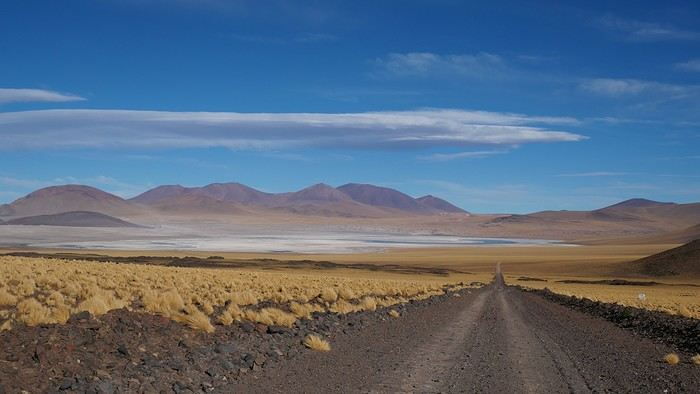
Northern Chile, Andean impressions.
Alright, this year, we're heading back to South America!

The initial plan was to retrace the route we imagined in the summer of 2020: a trip to northern Argentina starting from Córdoba.

Unfortunately, the flight to Córdoba no longer exists, and airfares to Javier Milei’s country are both outrageously priced and involve multiple layovers.

So, I tweaked Google Flights every which way and finally found a flight within my budget—departing from Clermont-Ferrand!

Not to Argentina, though...

Our transatlantic flight will cross the snow-capped Andes, landing in Santiago, Chile, with a return from Lima!

In between, two domestic flights and a big road trip loop starting from the coastal city of Arica to explore the treasures of northern Chile.

Our mode of transport: a pseudo 4x4 that won’t take us through sand dunes or devilish tracks but will let us tackle the entire secondary network, including unpaved main roads, while still being insured.

Is the suitcase packed with all-season clothes?

Are the driver’s license and passport ready?

Bank cards and a few euros too?

Off we go for just over 3 weeks of southern wanderings!


--/--

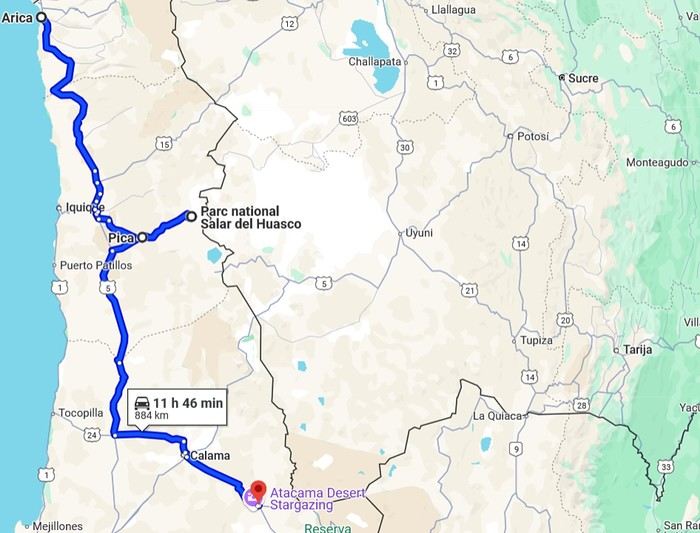
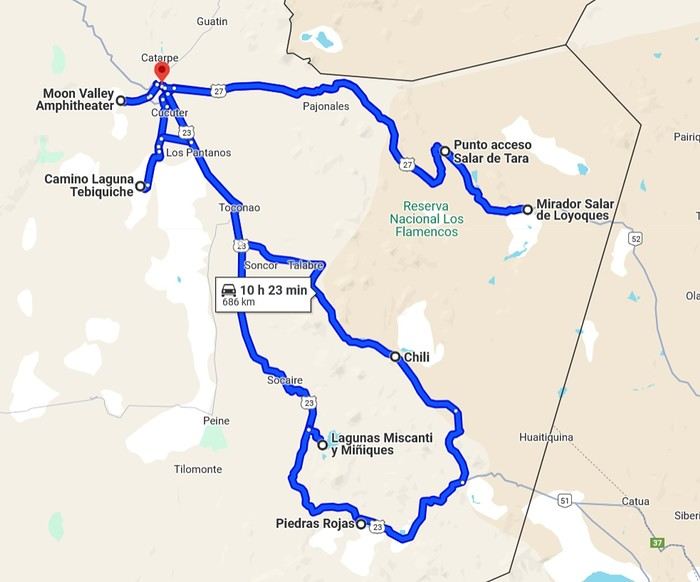
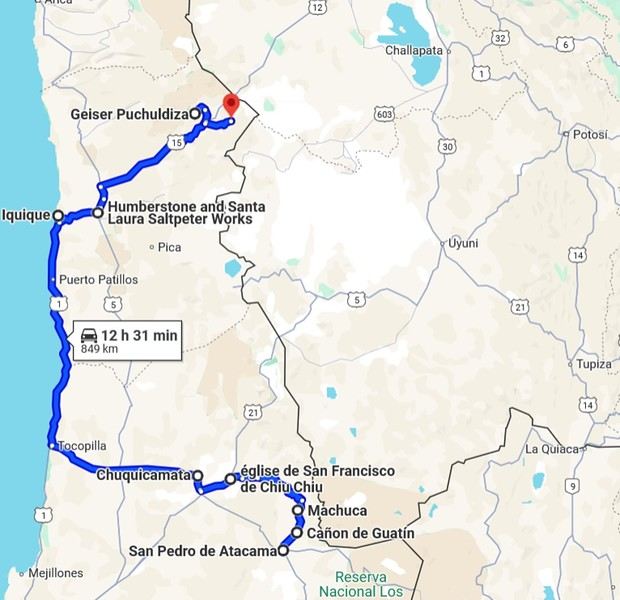
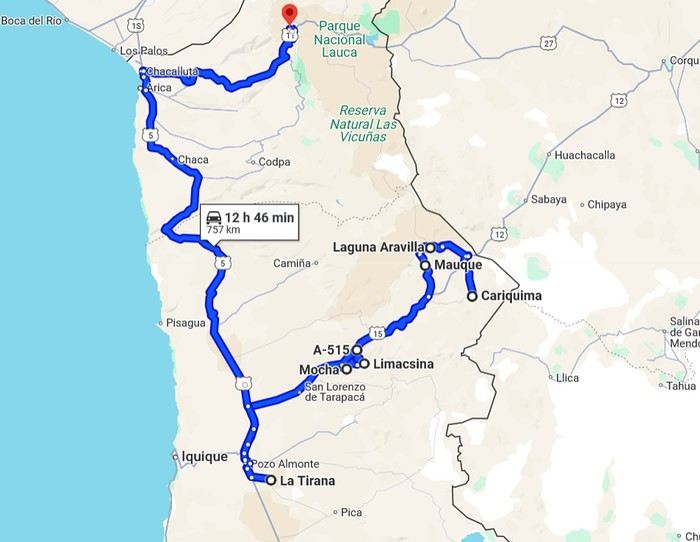
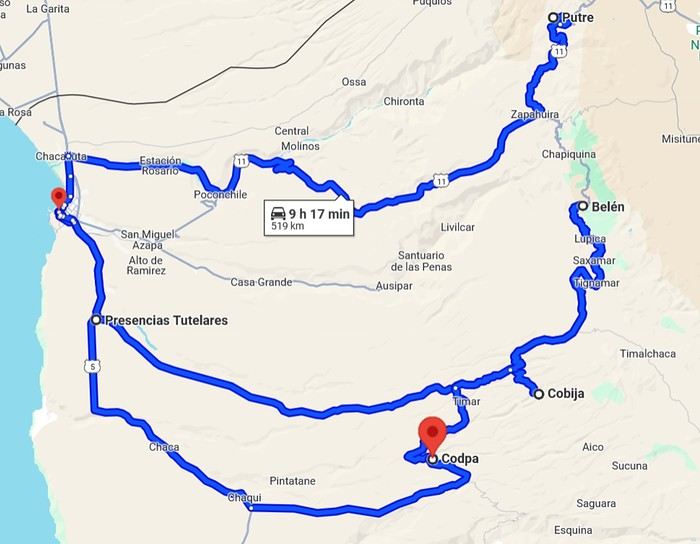
To keep all my esteemed readers on track, here are a few maps outlining the Arica-Arica loop!

1- From Arica to San Pedro de Atacama via Pica and the Salar de Huasco

2- Around San Pedro


3- From San Pedro to Cariquima


4- From Cariquima to Putre


5 - From Putre to Arica


Gas stations in this part of Chile are located in Arica, Iquique, Pozo Almonte, Pica, Calama, and San Pedro de Atacama.
Open
Three weeks in Norway (July 2022): fantastic memories despite the rain
Our trip to Norway was two years ago already, but I thought it might still be of interest—and it’ll let me relive it a bit by proxy.

Before booking our flight tickets, we debated the route: should we prioritize the north with the Lofoten and Senja islands, or the south with its countless fjords? I was tempted to stay in the south—the country is so vast, and the drive north is long... but my husband really didn’t want to miss the Lofoten. In the end, we figured that since Norway is known for being expensive, we might only visit once (funny how we said the same thing before our first trip to the American West, and look how that turned out 😎), so we didn’t want to skip anything. That meant a 2–3 day drive up north. With 22 days on the ground, it was doable. Especially since, as usual, we skip big cities and gave Oslo a pass.

Practical details: - Flight tickets: 1195 € for 4 with Air France (Paris–Oslo outbound, Tromsø–Bergen–Paris return) - Car rental: 2020 € for 21 days (including the outrageous drop-off fee between Oslo and Tromsø—about 1000 €) - Tolls and ferries: 250 € for the portion billed directly by the rental company. Some ferries required advance booking and payment at the time of reservation—I’ll note their prices as I go through the story. - Hotels: 4135 €, averaging 188 € per night. We blew past our usual budgets from trips to the U.S., but oh well... - Food: 1570 €, averaging 71 € per day for 4 in a country where everything’s expensive... How’d we manage? We rarely ate out, mostly grocery shopped, and even packed half a suitcase with non-perishables: pasta, rice, a few cans, and even some cured sausage! We also stayed 3 nights at Clarion Collection hotels, where an evening buffet was included in the room rate.
Open
Budget for Tanzania with a safari
Hi there, We’re planning a trip for 2 adults and 2 kids to Tanzania and Zanzibar. I’ve had a quick look, and the prices are starting to get pretty wild. We’ve got a budget of 8,000 €, and I was thinking of doing three or four days of safari and three or four days in Zanzibar, but even that seems like it might be over budget. Have you got any thoughts? I was also considering heading straight to Zanzibar and doing a one- or two-day excursion by plane instead—maybe that’d be cheaper than staying in a lodge. Anyway, thanks for sharing your experiences and any price tips, departing from Nice!
Open
4 friends discover a piece of North India
Hello fellow travelers!

I’m adding my small contribution to the reopening celebration by posting this travel journal from India, made in January 2024. We’re 4 friends (2 couples), and we did a 3-week loop in Rajasthan, stopping by Delhi and Agra (which, as everyone knows, aren’t in Rajasthan 😛). Delhi - Agra - Jaipur - Bundi - Udaipur - Jodhpur - Jaisalmer - Delhi

We rented a car with a driver from Agra to Jaisalmer, 550 € for 14 days. https://chauffeurpriveeninde.com/fr/

We took the train from Delhi to Agra and the plane (Spicejet) from Jaisalmer to Delhi.

Most of the accommodations were booked on Booking before we left.

I’m sharing this story written by Richard and illustrated by me. We dedicate it to Nathalie and Bruno, our amazing travel companions.

Open
Are there any promotions available for the MSC Yacht Club?
Hi,

Is it possible to get promotions on the MSC Yacht Club section? What strategy should I adopt to get the best prices: book in advance or at the last minute? Is it better to book directly with MSC or through a third-party provider to get the best value for money? Thanks
Open
To the Top West End
In this time of general travel-journal scarcity, I’m stepping up to tell you about a far-too-short getaway to the Top West End, a local term for the very northern part of Western Australia, right on the border ( ;) ) with the Northern Territory.

As usual, I didn’t manage to keep it short, but this time I’ve got photos to go with it!

August 2020. Since the opportunities to explore the world are extremely limited right now, all we (R&X) can do is explore our own island! Well, just a part of it, because with the state borders still closed, we’re stuck in Western Australia (WA).

Luckily, we’re pretty fortunate because this state is huge: over 2.5 million km² (that’s more than four times the size of France or 1.5 times Quebec). What’s more, stretching over 20 degrees of latitude between the Antarctic Ocean and the Timor Sea, you’ll find climates ranging from Mediterranean to arid to tropical. That’s actually why we decided to head as far north as possible. Sick of the endless rainy winter in Perth, bring on the heat of the Kimberley... way up Nooorth!

Friday. At the airport, the main terminal was closed (not enough flights), so we ended up in the annex (where flights to the various mines usually depart from). There was no crowd at the gate, and in this huge, single departure lounge, empty seats were plentiful. Only three flights were listed on the screens for the rest of the morning: the first to Coondewanna (?), the second to Darwin, and ours to Kununurra (code KNX).

A cool breeze swept through the half-open corridors along the runways. At the top of the walkway leading to the Fokker 100 (the Airbuses and Boeings are now parked!), a flight attendant greeted us with a basket full of sanitary masks. We were actually the only masked passengers (the staff weren’t wearing them either). With zero Covid-19 cases in WA at the time, the only rule was to maintain social distancing—something pretty hard to do on a full plane!

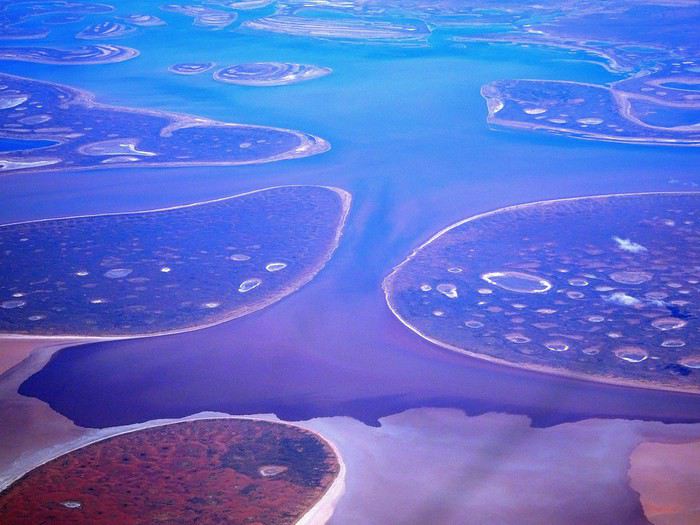
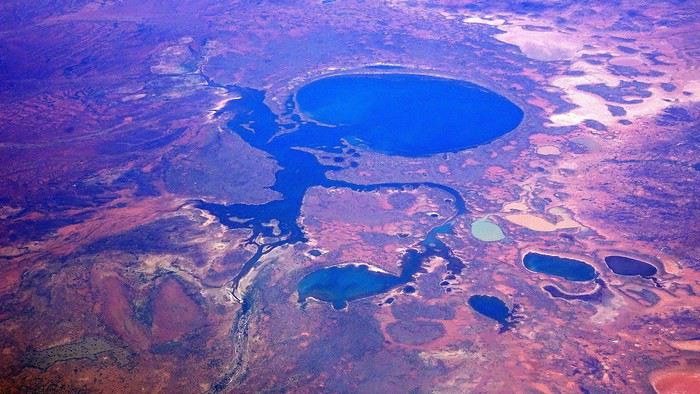
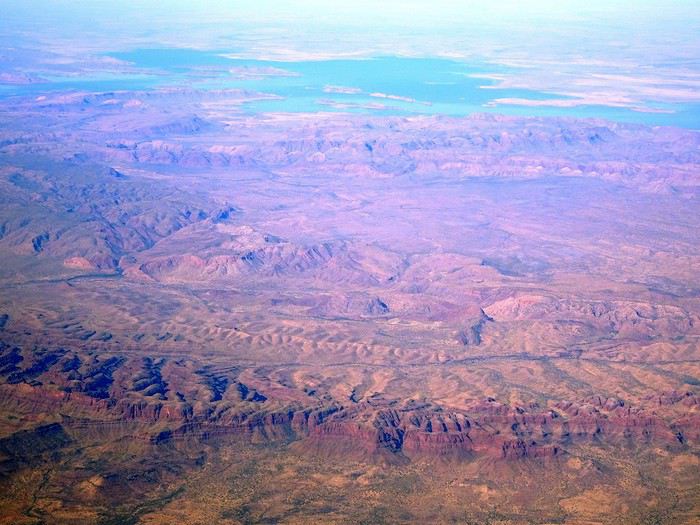
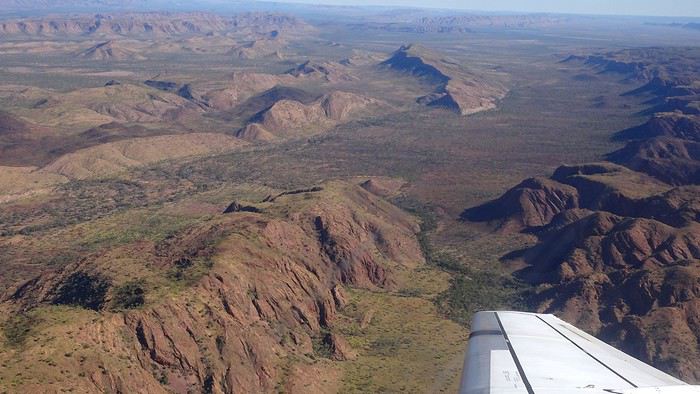
It was also my first time wearing a mask—it felt weird, pretty uncomfortable, and after a while, painful behind the ears. I really feel for those who have to wear one all day, every day. The flight lasted three long hours, but luckily, I had a good book. From the window, I watched an endless expanse of salt lakes in all shapes and sizes—round, elongated, gray, white, sometimes blue and green—and an infinity of winding, capricious meanders, along with long straight lines that led nowhere. The last half-hour got more interesting as rocky, swollen formations and long, sloping plateaus appeared. Against the vast ochre landscape, green patches became more frequent.


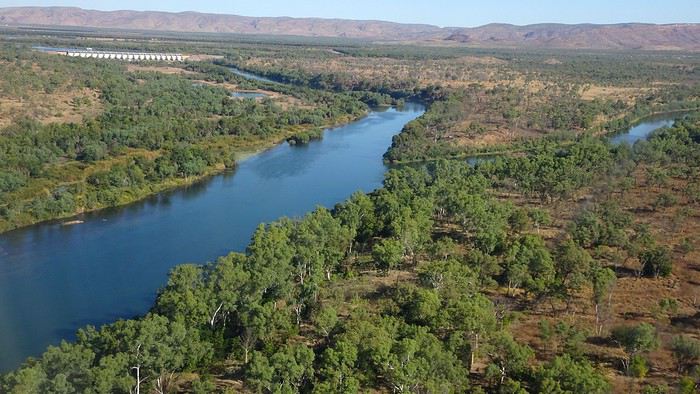
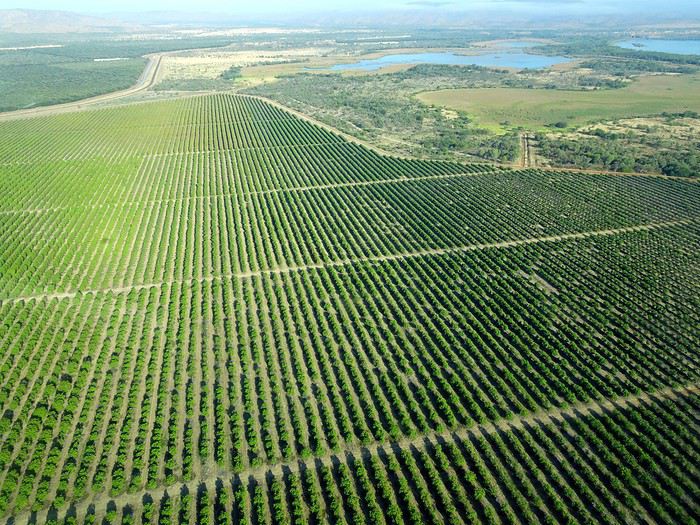
Just before landing, rows of green fields briefly appeared, along with an surprisingly wide river—but we were already rolling down the tarmac. A few hangars, a myriad of small, stationary planes, and a tiny terminal topped with a sign: “Welcome to Kununurra.”


We wanted heat, and here it was—34°C the moment we stepped off the plane! We felt alive again and totally ridiculous in our jeans and sweaters. We quickly grabbed our suitcase and picked up the 4x4 we’d rented—more out of necessity, since only that type of vehicle can access the national parks we planned to visit.

Just four kilometers separated us from Kununurra, a town of 5,000 people founded in 1961 during the construction of the Lake Argyle Dam and the development of the Ord River Irrigation Area Scheme (more on that later). On the horizon, mountain ranges (a bit of an exaggeration, since we know Mt. Meharry, WA’s highest ‘mountain,’ doesn’t even reach 1,250 meters!) and closer to the road, a few irrigation canals cutting through stretches of bush, then a huge park overlooking a small lake lined with reeds.

A row of baobabs (yes, there are baobabs in Australia too!), a series of motels with immaculate lawns, a gas station, and there’s the main street leading to the town center—that is, the parking lots of the two supermarkets, the bottleshop, the pub, the Town Hall, the municipal pool, and the Tourist Office (already closed!), and at the next roundabout, another park, the Presbyterian church, and a few other shops. In short, two or three green blocks that you can explore in no time.

One road leads to the small industrial area and one of the town’s three or four campgrounds, while another heads toward the residential neighborhoods, which look just like the typical suburbs you find in any Australian city—except with tropical vegetation. We stocked up at Coles, an identical copy of the one near our place, and—surprise—the prices were practically the same.

We checked into one of the motels. The receptionist listed the town’s three or four restaurants, insisting that it’s always better to book a table. She recommended the Pump House, a bit outside town on the lake’s edge. “Best spot to watch the sunset, but hurry up.” she told us. It was only 5:00 PM!

When we got there half an hour later, the place was packed, and the sun had already disappeared behind a row of trees! Sure enough, we’d see a few days later that the sunset can be a stunning spectacle—if you wait a bit for the sky (especially if it’s cloudy) to blaze and reflect in the lake’s calm waters. A little disappointed, we headed back into town, where we easily found the other lively spot in town: the pub (nothing like an old English pub). Above the long L-shaped bar, several giant screens (thankfully muted) were broadcasting live footy, rugby league, etc. In one corner, players circled the pool table, while in another, customers were digging into plates of the day’s special. Instead of rooms, there were various patios where groups of friends and coworkers (easily recognizable by the fluoro vests they were still wearing) were gathered. We found a table under a mango tree—unfortunately, a little too close to the guitarist strumming his entire Country Music repertoire, complete with Keith Urban-style tremolos. Guaranteed culture shock!

Since it’s the custom here, we called the Country Club to book a table before the kitchen closed! The CC is the town’s—and even the region’s—fancy spot. Dark decor, modern furniture, dim lighting, and the air conditioning blasting. The twenty or so customers had taken refuge on the vast terrace, lit by torches. The view of the tall eucalyptus trees, illuminated by spotlights shifting from red to blue, was breathtaking.

The menu was minimal, but the grilled salmon was excellent, and the Pavlova (the meringue dessert Kiwis and Aussies have been arguing over since 1906) with melon and watermelon was absolutely divine.

It wasn’t even 9:00 PM, and we were already in bed. Had we already adopted the Top West End’s chicken schedule?!

To be continued... Journal dedicated to Attila
Open
Uganda: 20 days discovering authenticity
Preamble:

For summer 2019, the idea was to return to Africa. We had already been to Namibia in 2017 (+ a few days in Botswana and the end of the trip at Victoria Falls), which we loved, and a trip to Asia in 2018 (Borneo, Perhentian, and Singapore), a nature-focused trip but a bit disappointing due to environmental destruction. The desire to return to Africa was very strong. We wanted a change of scenery, nature, discoveries, to step out of our little comfort zone (a bit, anyway!) and experience travel differently. In short, we dreamed of authenticity, and we weren’t disappointed.

We traveled as a family of four with our daughters, aged 19 and 17. When the urge for Africa hit, Uganda quickly stood out, especially for the chance to see rare animals, particularly the famous mountain gorillas. When I looked into the budget, I was quickly disheartened. It’s really expensive. Too expensive… Then, after reading a few trip reports on "VoyageForum" (thanks Muriel J!), I decided to ask a local agency for a quote. The first contact was very friendly and responsive, and the initial offer for two weeks fit our budget :). A few images gathered from the internet (especially Sipi Falls) finally convinced us all. I asked for an adapted offer with a few more sites to extend the trip to three weeks and cover a fairly complete visit to the country (which, of course, increased the budget! To stay within an acceptable range, we prioritized activities over accommodations and regularly chose the cheapest options, with 2-3 nice lodges in between). It’s booked! We were in October 2018, and the first thing to do was reserve permits to see the gorillas and chimpanzees. Then, the agency took care of all the bookings except for the international flights, which we booked with Ethiopian Airlines. A few months of waiting to look forward to… and a little worry too! Two events didn’t reassure us: the kidnapping of an American tourist by four men at the DRC border and the Ebola outbreak in Congo, with confirmed cases in Uganda by mid-June…

Here we are in July, and departure is approaching. The suitcases are packed (warm clothes, long, short, dark, light, practical, sun, rain, hiking/trekking shoes, flip-flops—clothes for every situation! Don’t forget: headlamp (essential!), binoculars, cameras), and we’re ready.

One day before departure, our agency Mpolampola, through its manager Paul, informs us that he won’t be the one taking care of us during the trip but another guide named Moses. He has a big problem with a vehicle and can’t do otherwise. For us, as long as everything is okay, no worries, especially since I had read glowing reviews about Moses, who turned out to be a very pleasant guide, cautious (most important) on the road, clear about all the activities, and an expert on birds, his specialty. We briefly met Paul in the middle of the trip, who is also very friendly. In short, we 100% recommend this agency. Flights to Entebbe went smoothly; we arrived around 10:30 AM, filled out health forms (Ebola information signs everywhere), visas, baggage claim, and met Moses, who took us directly to the vehicle. It was in pretty good condition with huge tires (we’d understand why later!), but it had quite a few miles (400,000 on the odometer!). Just missing a seatbelt… Okay, it’s Africa!

Now, here’s our day-by-day itinerary, which I’ll summarize briefly with ratings for each activity: ****TOPISSIME (Amazing) ***Very good **Good *Meh

Day 1) Departure from the airport at 11:45 AM for some currency exchange. Stop along the way at the equator for a meal and souvenir photo! Arrival at Lake Mburo Park *** around 5:00 PM. Even before entering the park, we saw lots of antelopes, zebras, elks, etc.—it’s magnificent. On the way, we had already encountered many goats and cows, and we were impressed by their enormous horns. We enjoyed a nice game drive until about 7:00 PM, when we reached our lodge, one of the nicest of the trip, Eagle’s Nest ****, with a magnificent view, a tent with a nice bathroom/shower, and a very good meal.

Day 2) Departure at 7:00 AM for a game drive; we encountered many animals again, especially antelopes, zebras, and birds. There are no giraffes, lions, or cheetahs in this park. We didn’t get lucky enough to see a leopard… :-) Then, we continued to Lake Bunyonyi ***, where the road and views are very beautiful, but we were shocked to see locals (mostly women and children) breaking stones by hand on the mountainside in very precarious safety conditions. There are regularly dramatic accidents because, over time, entire sections detach and cause landslides. These stones are then used for road construction… Another world… This was the only place we saw this. Lake Bunyonyi is a nice stop (but less exotic in our opinion since we have many lakes back home too!). We took a boat to our accommodation, Byoona Amagara ***, which has a lot of charm. We stayed in huts called "geodomes," completely open to nature, so it was very cool at night. To reach the toilets located below, you had to be brave! The meal consisted of lake shrimp—good but a bit bland.

Day 3) After a good breakfast, departure at 9:00 AM to visit three islands. We took several nice walks with beautiful views of the lake and islands. A local meal was served on the last island. At 1:00 PM, we met Moses for the rest of the program and headed to Ruhija in Bwindi Forest****. The landscapes are breathtaking. After two hours of driving and many photo stops, we arrived at our accommodation near the trekking starting point, Ruhija Gorilla Friends Resort **. We stayed in a room instead of the initially planned tents, which was just as well because there was a lot of wind during the night. We still had time for an activity and decided to meet the Bwata pygmies despite the bad reviews in the guide… The first part of the visit was quite nice, with a visit to a school where the children gave us a very joyful welcome. We had a great time listening to them sing and dance! Then we met the Bwata pygmies who live on the edge of the forest. When Bwindi Forest was declared a national park, they had to leave their habitat because their activities weren’t compatible with nature and wildlife protection. We left on a somewhat sad note… The visit ended with a local doctor explaining different medicinal plants, and we watched the making of local beer from sorghum. Good meal. We had butterflies in our stomachs—tomorrow was a big day! I admit I was a bit stressed, not entirely confident in my physical abilities…

Day 4) After a short night due to excitement, breakfast, and departure at 7:30 AM. First, it started calmly with singing and dancing. Then, a 15-minute briefing and group assignments. No one asked if we had any physical problems or anything (when booking, I had inquired a bit, and they told me groups were assigned based on physical abilities). We were assigned to the Mukiza group. At first, I was pretty happy—it was a fairly large group with babies :). The ranger explained that for now, they didn’t know where the gorillas were… the trackers couldn’t find them… Oh… (that’s not a good sign!!!) We set off at a good pace, first on a reasonably sloped path. We were accompanied by a family of four Italians and five porters (four for us!). After an hour, the ranger stopped us and informed us they still couldn’t find them—they had fought with another group the day before and scattered throughout the forest, so they were very far away, and we needed to move faster… Hmm… we picked up the pace (we weren’t going slowly before!!!) and walked for another good hour—down, up, down again, up again, we kept going, but always more or less on paths. Then another stop. A 10-minute break waiting for news. The news wasn’t very precise, it seemed! The ranger decided to cut through the forest—machetes were used to clear the path. We descended unimaginable slopes, then climbed back up. Our stick kept getting stuck; luckily, our porter helped us, held our hands, and the terrain was vertical! An hour later, another stop: we heard gorilla cries (yay!!!). False hope—we waited again for news from the trackers, who informed our ranger that it was a non-habituated family, so we couldn’t see them. Cold shower—we had to go all the way back up and return to the starting point to maybe see another group. But time was running out… We arrived around 1:30 PM; all the other groups had already left long ago. Our guide was worried because we still had a long drive ahead. We quickly ate a banana, and off we went for another trek (I was exhausted!). Luckily, this group was close—about 45 minutes of steep descent (I was already thinking about the climb back and considering being adopted by a gorilla ). The forest was sublime, with magnificent tree ferns—the place was truly splendid. Finally, we were there. The porters stayed behind, we grabbed our cameras, and followed the ranger. The progress wasn’t easy, but suddenly, a female was in front of us, curled up in a little ball, eating—so cute. The emotion overwhelmed us. But she moved away—it’s hard to observe them; they move constantly, and the terrain is very steep and uneven. We saw a female descending from a tree with a baby on her back—too adorable. Then, here was the silverback, enormous, incredible, yet so calm and peaceful. He ate quietly and gave us a nice demonstration of nostril exploration! We could observe them for a good hour, but photographing them wasn’t easy because they kept moving, and we could barely stand! Toward the end, a large male (black back) suddenly stood up and decided to pass right where I was! I ended up in the bushes, and the male passed in front of me just a few centimeters away (he stepped on one of my daughters’ feet!) followed by the whole family. Just an exceptional moment. It was time to leave; we had to climb back up. I dreaded it because, I admit, I was exhausted. We finished the hike after 4:00 PM, exhausted but happy. The ranger gave us diplomas, and we didn’t linger because we still had a long drive—we needed to reach Ishasha before nightfall. Our guide was a bit stressed. If we were to do it again, we’d spend an extra night in Bwindi. However, it seems finishing so late is exceptional—it never happens, according to our guide! The road between Bwindi and Ishasha is sublime, with extraordinary landscapes, and despite the late hour, we regularly asked our guide to stop for photos. We arrived at Enjojo *** Lodge around 6:00 PM. The huts are located quite far from the reception and the bathrooms, a bit far from the huts, but otherwise, it was very nice.

Day 5) Departure at 8:00 AM after a good breakfast with the hope of seeing tree-climbing lions (no luck!). Overall, there weren’t many animals, and we arrived around 12:45 PM at our next stop, Parkview Safari Lodge ****, with a magnificent view, a beautiful family bungalow, and a good meal. We enjoyed a short relaxation by the lovely pool. At 4:00 PM, we left to see Kyambura Gorge *** and hike there. Unfortunately, this activity is no longer available, so we walked around the area—it was very beautiful. Back at the hotel, a little rest after the previous day wasn’t a bad idea! Reading, swimming, meals, and dances made the end of the day enjoyable.

Day 6) Departure at 6:30 AM—one of our daughters was sick (stomachache, cold sweats…). Safari in Queen Elizabeth ** (Kaseny Plains)—a bit disappointing. Stop by the salt lake with a nice view. A small market, but we weren’t thrilled by the crafts (overall, apart from some beautiful baskets/plates, there wasn’t much, and the wooden objects were, in our opinion, much less pretty than in Namibia). Then we took the crater road (27 km long) **** with magnificent landscapes. However, you absolutely must close the windows because it’s infested with tsetse flies. At noon, we arrived at Mweya, where we stayed in basic rooms, but the restaurant was well-placed with a beautiful view of the Kazinga Channel. At 2:00 PM, we enjoyed a magnificent cruise **** on the channel. Elephants, antelopes, crocodiles, hippos (including adorable babies), buffaloes, all kinds of birds. Wow!!! Two hours of pure bliss. Quiet end of the day playing cards with a view of the channel and elephants.

Day 7) Departure at 6:00 AM—still sick, we weren’t sure if it was due to the preventive treatment (Malarone) or something else… Another game drive in Queen Elizabeth (Kaseny Plains) and breakfast by the salt lake. Overall, we were a bit disappointed by this park. Then we took the road to Crater Lakes***, again with very beautiful landscapes. A hike of about an hour and a half allowed us to discover these beautiful crater lakes (the water mainly comes from the Rwenzoris). We crossed pretty villages and had nice encounters. End of the day at Tinka’s Home ****, with a family. We loved this place—very welcoming, where we took a cooking class with our hosts. A really great time. After the meal, we enjoyed African stories and dances. Really awesome.

Day 8) Departure at 7:30 AM for another highly anticipated discovery—the chimpanzees in Kibale Forest ****. We went to the meeting point and were split into groups of six, each with a guide. We saw three different groups, and for the last group, we followed a chimpanzee (slightly more comfortable running in the forest than we were!) that led us to the group. Their cries are very impressive, and we could observe them well, even though they were often high up in the trees. We were lucky enough to see two on the ground, very close to us. It was magnificent. End of the encounter and return to the starting point—it was noon. We went back to Tinka’s Home for the meal (delicious!). At 2:00 PM, we hiked in Bigodi Swamp ***, a marsh surrounded by beautiful vegetation, especially huge papyrus, and inhabited by many birds and monkeys. We saw, among others, black-and-white colobus monkeys, red colobus monkeys, and vervet monkeys. We also visited a basket-weaving workshop where we bought two beautiful baskets. Then a short stop in Fort Portal, where we stayed for two nights at Ruwenzori View Guesthouse ***, a nice place with a family room and very good communal meals.

Day 9) Departure at 8:00 AM for a hike in the Rwenzori****—it was a bit chaotic today. First, we had to exchange shillings because we wouldn’t have another chance in the following days. At the bank, employees went to get the bills by motorcycle from other buildings—it was quite surreal! And it took time! Then there was a misunderstanding between the organizer and me… I really wanted to see the region where chameleons are found in the Rwenzori—this region is south of the mountain range, and we were in the north! Anyway, the program included an ascent in the northern part with a positive elevation gain of over 1,500 meters… Talking to the guide scheduled for this hike (Noah), we explained that we really wanted to discover the vegetation and these famous chameleons, not necessarily achieve a physical feat… (we’d had enough!). The decision was made to go south, which meant quite a bit of driving. The hike was really enjoyable, with magnificent vegetation by the river. We saw three of the four chameleon species present, including the famous three-horned chameleon. The region is superb. We ended with a drink at Ruboni Camp, which has a magnificent view of the region (ideally, we should have stayed there). Two hours of driving to finish, and a good meal :).

Day 10) Departure at 8:00 AM—we had a long drive to Ziwa Rhino Ranch****. We passed through Hoima, had lunch in Masindi, and arrived in time for the rhino tracking walk. We could approach them closely on foot—it was impressive. We saw eight. Since we were staying on-site in the guesthouse **, we received precise safety instructions for moving between the rooms and the restaurant. And we quickly understood why!

Day 11) Departure at 6:00 AM for breakfast—surprise, in front of our room, several large rhinos were sleeping (we had also heard a lot of animal noises during the night—rhinos but also what seemed to be predators). So we had to take a detour to reach the restaurant! Second surprise—next to the restaurant, just three meters away at most, two mothers and their baby were also sleeping! Memorable! Then we had an appointment for the shoebill trek and canoe ride **** (package with the previous day’s walk). So there we were, in our boots, splashing through 30 cm of water in search of the shoebill (I really wanted to see one :))! It was really fun, and luck was on our side—a shoebill had just landed in the distance! We approached as best we could and observed it from afar. What a strange bird! There are very few left, and Uganda is one of the countries where the chances of seeing one are quite good. The tour continued with a canoe cruise where we saw a herd of cows (the famous ones with enormous horns) being swum as a dowry to the father of the future bride! A funny spectacle. This stop wasn’t the most anticipated, but we all thought it was really worth the detour. Road to Murchison Falls Park, and arrival around noon at Red Chili Rest Camp **, where we stayed for two nights (family banda). Good meal. Then a cruise to Murchison Falls*** where we disembarked and continued on foot. It was pretty. Back to Red Chili.

Day 12) This morning, early departure for a cruise in search of the shoebill*** (booked in case we didn’t see one at Ziwa). The landscapes were pretty, but there weren’t many birds in the end. We spotted the chosen one from afar after the first 10 minutes—so the suspense didn’t last long :-) It was a nice activity but quite long—5 hours. In the afternoon, safari in Murchison Park****—this park is sublime, the landscapes fabulous. Really one of our favorite parts of the trip. Lots of animals and even a leopard spotted with binoculars because it was far away! Night at Red Chili.

Day 13) Departure for the first morning ferry—it was drizzling, the sky was threatening at first, so the landscape was spectacular! Beautiful contrasts. In the middle of the morning, we were lucky to observe a whole group of lions, first from afar, then with a little patience, the whole group approached until they passed beside and in front of our vehicle. What emotion and excitement! We could then observe large groups of giraffes. They were magnificent. The morning was incredible. Then we headed to our lodge, Fort Murchison ****, and on the way, we saw a whole group of elephants—the view was magnificent. We had a very good meal and enjoyed the pool a bit. We also met Paul, the organizer of our trip. Very nice :). In the late afternoon, off for a short safari in the park. We slept in very well-equipped tents.

Day 14) Today, we had a long drive to Kidepo Park. It was raining, which didn’t help our guide—according to him, the tracks near Kidepo turn to mud with rain and become difficult to navigate. We saw, among other things, a bus in a bad situation in the ditch. Some sections were really tricky, and we were glad to have a driver. The end of the trip—the landscape was spectacular and original, and we saw some traditional villages. We arrived at Kidepo quite late. Short safari in the park before reaching the accommodation. We booked two simple bandas in the park camp**. It was clean but didn’t hold up well in the rain . The restaurant was very nice, though.

Day 15) The day was dedicated to discovering Kidepo Park **** where the landscapes were again superb. First encounter with a lioness resting on a rock. We saw other lions later and observed them for a long time. There were almost no other tourists in the park. Our daughter wasn’t feeling well, and by the time we arrived at the lodge, she had a temperature of 39.5°C (103.1°F)… A nap was necessary. In the late afternoon, we returned to the spot where we had seen the lions that morning, and they were still there—they weren’t happy because rain was threatening! It was a great photo opportunity. Then came the downpour, and our driver urged us to return quickly because the tracks were becoming impassable. Indeed, a jeep was in the ditch… The return was eventful, and several times we slid without being able to do anything… Wow, what a day!

Day 16) No safari this morning because of impassable tracks—the road to Kotido*** was longer than expected as we had to take a detour. The landscapes along the way were surprising. We finally arrived around 1:00 PM at the accommodation and left at 3:00 PM to visit the largest manyatta in East Africa with two translators. It was incredible—a very beautiful experience. The manyatta is immense and has 28,000 inhabitants. Night at Karamojaarts guesthouse*—very average meal.

Day 17) Departure for Moroto****—on the way, we saw many bird species. Moroto doesn’t look like other Ugandan cities. Life there seems very pleasant. We arrived at Kara-Tunga and had a bite to eat. At 4:00 PM, we left to visit a Karamojong village. We enjoyed beautiful dances and watched communal games—it was fun and so authentic. Then we headed to a kraal (where shepherds and herds are) to set up our camp. Moses had to get used to the idea of sleeping in the tribe in a tent! It was incredible to find ourselves in this universe. The place was beautiful, and we had a great time with the Karamojong. Some had never seen white people… had never been in a car… Their culture is incredible. During the evening, around the fire, to our guide’s dismay (a bird enthusiast), they grilled hornbills! On our side, we ate a meal prepared by Kara-Tunga for our sensitive stomachs! Night in a tent.

Day 18) Dawn wake-up in the fog—the atmosphere was quite strange. Our daughter was attacked by a cow—fortunately, more fear than harm, but she ended up with a lot of thorns in her buttocks and thighs ! Then we left for the Mount Elgon region, specifically Sipi Falls****. Lacam Lodge****, perched on the edge of the cliff with a direct view of one of the falls, was just magnificent. The view and landscapes were fabulous. Big favorite. We had dinner and then went for a hike to visit the three falls in the region, partly in the rain. The landscapes were breathtaking! Sunset at Lacam Lodge with the sun setting over the waterfall. We couldn’t get enough and stayed to admire until nightfall!

Day 19) Visit to coffee plantations*** where we were given all the useful explanations to understand the culture and the incredible work required for this product, which is ultimately not very glorified. The visit was very interesting, and we drank very good coffee with the owners. Last photos at Lacam Lodge, and then departure for Jinja, where we arrived in the middle of the afternoon. We took a small cruise to see the source of the Nile*. Very touristy and not at all to our taste… Then a meal at Jinja Base Camp** where we enjoyed guacamole. Our guide Moses left us because another group was waiting for him!

Day 20) Road to Kampala***, the market, the Gaddafi Mosque. Short but interesting visit. Last meal in Entebbe by Lake Victoria, where we almost felt like we were by the sea. Transfer to the airport and return to Switzerland…

Epilogue: All four of us were enchanted by this trip, which will undoubtedly remain one of the most beautiful we’ve ever taken. Talking about it gives me chills and brings tears to my eyes. It was simply a magnificent experience. However, I wouldn’t recommend this trip to everyone because you often have to overlook small inconveniences like toilets (the worst of my life) and certain comfort details that, for us, remain details but could be important to others.

Our favorites: - The gorilla trek - The cruise on Kazinga Channel - The Fort Portal region - The Rwenzori Mountains - The chimpanzee trek - Murchison Falls - Kidepo - Spending time with the Karamojong tribe - The Sipi Falls region - The accommodations: Eagle’s Nest, Byonna Amagara, Parkview Lodge, Tinka’s Home, Rwenzori Guesthouse, Fort Murchison, Night in the kraal, and Lacam Lodge

What we liked less: - Queen Elizabeth Park - Jinja - The accommodations: Ziwa Rhino Ranch, Karamojaarts Guesthouse

I’ll try to post some photos later. If you have any questions about a future trip, I’d be happy to answer them.
Open
Six-week trip to Mexico
I recently took a six-week trip to Mexico with Y, my Thai partner. To be precise, we spent 43 days there plus a final half-day before heading to Mexico City Airport for our return flight to Europe.

I’d already been to Mexico about 40 years ago! But that was only for a week or so, between Mérida and the Belize border.

First off, I should mention that I’ve never seen a beach in Mexico. I say this because discussions about Mexico always seem to revolve around the Costa / Riviera Maya.

Let’s start with an overview of the trip. Our itinerary can be split into two halves:

- First half: Querétaro, San Miguel de Allende, Morelia, Guanajuato, Mexico City “CDMX” (the capital). - Second half: Palenque, San Cristóbal de Las Casas, Chiapa de Corzo, Oaxaca, Puebla, Cholula, and finally Mexico City CDMX.

To move from one part of the trip to the other, we took a flight from Mexico City CDMX to Villahermosa, then a bus to Palenque.

In six weeks, we visited maybe a quarter or a fifth of the country (see the attached maps). Mexico is about three times the size of France! And when I say “visited,” it was really just a quick stop—enough to get a first impression. I understand that some people can only spend one or two weeks on vacation in a given country, but that’s not my idea of travel. Personally, I’d say a country as rich in every way as Mexico deserves several months of travel before you can say you’ve “seen” it.

In my next post, I’ll break down the expenses. That might help future travelers plan their trips. You don’t go to a country for several weeks (or more) without thinking about the budget! Besides, one of those future travelers to Mexico is us—we were so thrilled by Mexico that we’re definitely going back.
Open
Autumn trip from Puglia to Naples via Basilicata...
Hi everyone!!!

I’m finally getting around to writing about this 20-day trip to southern Italy: we didn’t travel this summer, and luckily, we found beautiful light and dreamy weather there at the end of September.

First, here’s the context of the trip: we’re both "confirmed seniors" but still curious and alert enough to enjoy the itinerary we’d imagined! We wanted a mix of discoveries—culture, cities, and nature—with guaranteed sunshine and the occasional short hike... We’re flying to Naples, round-trip, because the flight times work better for us. We rented a car online, picked it up at the airport (details to come... and it won’t be the highlight of the trip!), and booked our hotels in advance.

A quick overview of the itinerary: leaving Naples on September 15th, early in the morning, we’ll drive straight across the boot of Italy to Bari. After 11 days in Puglia, we’ll head back toward our starting point, taking our time: Matera in Basilicata, Maratea by the sea, and finally Paestum with its incredible temples.

Day 1: Brussels-Naples flight (Brussels Airlines) went smoothly; it landed an hour early, and we were thrilled, thinking we could use that time for a quick visit or two... Everything went well until we left the airport. We took the shuttle to the car rental offices, and at first glance, we realized this wouldn’t be smooth sailing!!! In front of every office (they’re side by side), there were already lines and kids sitting on suitcases—everyone looked exhausted... We resigned ourselves to waiting: nothing moved until tempers flared at the counters, and two people nearly came to blows. Things sped up a little, and after 2 (two...) hours of waiting, we finally got our chariot: a black Fiat Tipo, dirty, with a few dents and scratches that we made sure to note in the contract... but it ran!

Off to Bari, then: no time for sightseeing along the way! From there, we headed straight to our hotel in the countryside near Polignano a Mare.


A recurring detail: this happened constantly during our travels. We’d installed our own GPS, fully updated... In recent years, many dirt roads have become drivable, and lots of hotels and hostels have opened in the outskirts of towns. It was extremely rare for our ‘guide’ to recognize the street—let alone the number—we entered. Often, we got by calling the hotel reception: it might seem like a small thing, but it happened so often it became frustrating. In hindsight, it seems like without Google Maps, we’d have been lost!

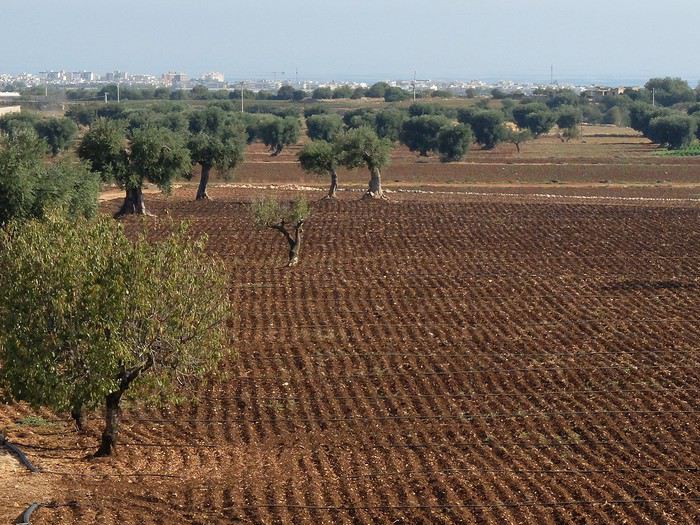
Anyway, we were beautifully settled, with a terrace overlooking olive groves and the sea in the distance: all was well.


To be continued...
Open
Currency exchange while traveling: why do some still carry wads of cash?
Hi everyone,

In this age of zero-commission cards and fee-free accounts, I’m curious why some travelers still prefer to set off with a wallet stuffed with bills and exchange money on the spot.

I get it for those whose income comes from undeclared activities, but what about everyone else?

Between the risk of theft, scams at exchange counters, and fees that often end up being higher, I’m really puzzled.

The last time I traveled with a wad of cash was because I had to pay for accommodation in cash only, the local currency was the dollar (easy to exchange at a very low cost), and I was still paying some fees.

I’m still wondering about my next trip to Argentina because the situation there is very specific, but otherwise?

Is it an allergy to modern payment methods?

A budget so tight that an extra 20 € (the fees some local banks charge for withdrawals) on a 2000 € budget would be impossible to manage?

Thanks for shedding some light on this!
Open
Istanbul, Men and Cats
Sunday, October 20, 2019

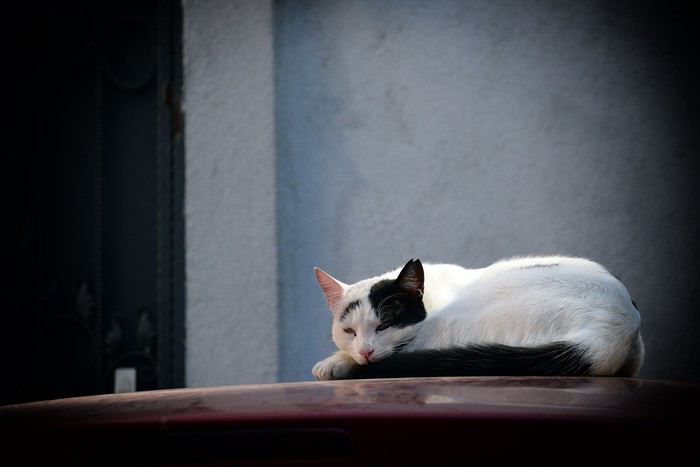
Glancing at the Bosphorus through the bay window of my room, I absentmindedly scatter my things while quietly settling in. Then I turn around, looking for my passport, my cash, my camera battery, eager to join the buzz of the street below. But for the past few minutes, I’ve felt a presence—something moved on the balcony. Suddenly, I spot a black-and-white furball half-hidden behind a pot, nearby. I approach to introduce myself: "Here, kitty, kitty..." I don’t know how to say "kitty" in Turkish, but the rather rude furball hisses in my face, and its ridiculous little tail doubles in size. Okay. Not friendly. I grab what’s within reach—a cream capsule—and offer it as a peace offering. It lunges at me, swipes the object away with a quick paw, and scratches me in the process.

I’m in Istanbul *


* For the title of my travel journal, I was inspired by the lovely film: "Kedi, Cats and Men" by Ceyda Torum
Open
Here and there... my walks in the land of pralines, couques, and gosettes..
Hello,

It often happens that we're asked what to visit in Belgium. And the answers usually point to Bruges, Ghent, Antwerp, and Brussels—and rightly so, as these cities are well worth visiting ;). However, Belgium, though small, isn’t just limited to these four cities.

I live in one of them (Brussels), enjoy spending time in the other three, but I’d like to highlight some lesser-known spots that could add to the trip for those who want to see a bit more or something different. Between trips, I like exploring one or two corners of the country where I live.

Hence the idea for a travel journal of walks.

Most of the places I’ll talk about can be visited as a day trip from Brussels, whether by public transport or car.

In chronological order of the topics covered:

- The Gileppe Dam (Liège province) - message 2, page 1 - The Domaine de La Hulpe (Walloon Brabant) - message 3, page 1 - Mechelen (Antwerp province) - message 4, page 1 - The coast - message 5, page 1 - The Westhoek, from De Panne - message 6, page 1 - The Zwin, from Knokke - message 7, page 1 - Lier (between Mechelen and Antwerp) - message 8, page 1 - Mons (Hainaut) - message 9, page 1 - The Florenville region - message 12, page 1 - The East Cantons - message 13, page 1 - Dinant - message 18, page 1 - The Japanese garden in Hasselt - message 24, page 2 - Leuven - message 29, page 2 - Louvain-la-Neuve - message 32, page 2 - Ostend - message 42 (page 3) and message 166 (page 9) - The floralies of Groot-Bijgaarden - message 43, page 3 - Halle Forest - message 44, page 3 - Pralines - message 54, page 3 - Charleroi - message 68, page 4 - Namur - message 92, page 5 - Le Bois du Cazier (Marcinelle) - message 95, page 5 - Couques and gosettes - message 96, page 5 - Liège - message 99, page 5 - Tournai - message 115, page 6 - Oudenaarde - message 121, page 7 - Meise Botanical Garden - message 124, page 7 - Tongeren - message 125, page 7 - Beersel Castle (Flemish Brabant) - message 126, page 7 - Brussels in lockdown (messages 150 and 154, page 8) - Notre-Dame à la Rose Hospital in Lessines (messages 161 and 162, page 9) - Westende (message 167, page 9) I’ll keep updating this list as the journal progresses...
Open
Masai Mara and Melting Pot Safari... So disappointed!
Hello everyone,

I imagine many of you have been captivated by the Masai Mara park and/or your safari experience with Tony Crocetta/Melting Pot Safari. Still, I’d like to share my perspective. First, I’m an avid traveler, especially in love with Africa, which my partner and I have explored a bit (Zambia, South Africa, Botswana, Kenya, Zimbabwe, Namibia...). That said, I want to express my deep disappointment with both the Masai Mara and Tony Crocetta’s camp, Melting Pot Safari, where we stayed last year.

First, about the park: it’s stunning, no doubt. But what a highly touristy place! I can’t find the words to describe the horror of being among 30 4x4 vehicles lined up in front of a lioness hunt, let alone encircling her right after her kill while her prey is still alive in her jaws... no respect for wildlife. The same goes for surrounding a young leopard playing with its small prey, a moment when I counted over 50 vehicles, most with their engines running... sickening. I turned away, both my gaze and my camera. What a disaster to see this natural wonder of Africa turned into a tourist hotspot.

Yes, I loved this place on Earth, but no, I won’t "promote" it anywhere or to anyone.

Next, I also wanted to share my dissatisfaction with Tony Crocetta’s famous camp, Melting Pot Safari: where to begin? We booked a private vehicle for four with two friends, and I have no complaints about the vehicle itself (though it obviously came at a cost). The windows and the vehicle weren’t very photo-friendly, but let’s move on. The trip between the sisters’ guesthouse (which was fine) and the camp went smoothly, except we arrived a bit too late. Result: "We’ll leave for the safari an hour later today because the driver has to respect his rest hours." Perfect—with park formalities, we only spent about an hour in the park that evening. The safari got off to a great start... During our 12-day stay, we saw some amazing things. Tony wasn’t at the camp—I don’t know what the atmosphere is like when he’s there, but it was rather cold during our trip. Sylvie, his wife, barely looked at us, never asking how our day, night, or game drive went (I think she spoke to us once during the stay, plus the day we arrived, of course). We felt invisible... (if I were mean, I’d say the money had already been deposited into Melting Pot’s bank account.) The evening meals, if I may say so, were a joke: not enough dessert (aside from fruit, but the few elaborate desserts—like 10 for 18 guests) for everyone, barely enough meat or sides. If you were unlucky like us and ended up with a group of 15 people who decided to skip the starter, you’d better hurry to get your main course, or there might not be any left—and no refills... We always ate our fill, but sometimes we had to serve ourselves in advance. Finally, I want to correct something about the quality of the meals: seriously, this buffet was really mediocre and far from the culinary standards I’d read about in my pre-trip research (see their Facebook page). Anyway, let’s move past the food—after all, the avocados were sublime, and we’re not there primarily to eat.

About the tent: the river views were beautiful, and the beds were very comfortable. No running water, individual showers outside the tent, and dry toilets—but it’s Africa, so we weren’t shocked. However, I’m disappointed that for this "modest" price, I wasn’t warned there’d be no soap (and no, I don’t travel with my own soap—and for the price, a little bar in the tent wouldn’t be a luxury). But let’s move on—the hippo views were fantastic. Oh, and to preserve the Masai Mara’s water (which makes sense) and for hygiene reasons, underwear isn’t washed by the camp staff—fair enough. But then what’s that little sign next to the bed? Oh right, for a hefty sum, underwear suddenly becomes "washable"...

Finally, my biggest gripe is about the essential part: the game drives. In France, they sell you a dream with a "photo safari" (what’s the difference, really? A room with a few more electrical outlets?). They promise guides especially suited for photography (not a given, sorry) and vehicles that can get close to animals and go off-road... but here’s the catch: the guides are bound by park laws and hounded by rangers looking to fine rule-breakers. Result: as soon as a white ranger vehicle is spotted, we have to abandon our spot for a wild chase through the grass. Fun once... The next day, we learned that another group’s guide got caught and had to pay $100 for breaking the rules—a sum he casually asked the travelers in his vehicle to cover... because of course, Melting Pot lures tourists with dreams, the poor rangers try to get close, all while breaking park laws... and they break those laws for Crocetta’s company, which, of course, won’t dip into its profits to pay the fines. Basically, it’s "keep the clients happy, but don’t get fined—or the fines are on you or you’ll have to ask the clients directly." Nice boss! Anyway, there were long discussions about this last year, especially among the guests in the fined vehicle. My partner and I found these practices unacceptable, and we were deeply disappointed by this attitude.

I know many people adore this park and/or this company—maybe you were luckier... or maybe you’re less demanding than we are when it comes to respecting rules, nature, and clients. But after traveling through much of southern Africa, I can tell you we personally came back frustrated from this experience and aren’t eager to return... You’ve been warned.
Open
Back from 3 weeks in Madagascar with the family
Hi everyone.

We’ve just returned from a trip with our 8- and 12-year-old sons, our eyes full of memories. We went to Analalava, a village that’s hard to reach by dirt road in the dry season and impossible during the rainy season. The upside is that there are few motorized vehicles—it’s really off the beaten path. Located at the mouth of a huge river, you have to travel 60 km by speedboat from Antsohihy to get there. This was our first trip of this kind as a family—pretty adventurous, with plenty of questions and even some worries from my wife (bugs, safety, amenities, etc.). We joined a friend who’s staying there, so we weren’t completely in the dark. I’ll give you the highlights without going into too much detail. After arriving in Tana, we spent the night at a "high-end" hotel (La Ribaudière) for 56 € a night in a mini-suite with all the European comforts, then we left early the next morning. We decided to hire a car and a guide for the trip from Tana, with a stop at Ankarafantsika Park. The guide accompanied us all the way to Antsohihy. Leaving Tana, we got our first shock driving through the city, then we crossed stunning high plateaus toward Majunga (RN4). We zigzagged between potholes, zebu-drawn carts, broken-down trucks, and *taxi-brousses*. We passed through countless villages, honking all the way—pedestrians just have to watch out. Rice fields and tropical greenery filled every valley, water didn’t seem scarce. Then came the savanna and bushfires everywhere! After a full day of travel and a few stops, we arrived in Andranofasika, the village at the park entrance. We thought the agency (Look Gazy) had booked us a room at the Blue Lodge, but there was a mix-up—no reservation, no space. So we headed to the park, which has about ten bungalows. It was amazing: right in the jungle with all the ambient sounds. Geckos in the room became our friends, frogs in the toilet, and HUGE spiders under the terrace roof—they didn’t budge. Comfort was still there, though. We did three park circuits in one day with a guide. It’s a bit pricey, but it’s an excellent introduction. We saw lemurs (makis), birds, snakes, crocodiles, and fishing eagles—maybe we were just lucky! On the third day, we headed to Antsohihy through more savanna and bushfires. The town was lively, but the Hotel Anaïs was a serious downgrade! Loud music late into the night, then dogs barking and howling for the rest of it. Bucket showers and squat toilets. The guide left us here. - Quick tip: guides charge by the day, excluding fuel, and the empty return trip is on you. When I got the quote, they offered 3 days of guiding, 2 days of return trips (about 700 km), plus fuel for 600 €! I turned it down—it wasn’t worth it. By the day plus fuel, it cost us 400 €. The next day, we took the speedboat (I’d call it an uncomfortable, noisy, slow raft!) for the 60 km river trip through the mangroves. - Tip: bring an umbrella to shield yourself from the sun, and maybe use your airplane earplugs! It was a long, peaceful river—absolutely stunning. We were diving even deeper into the African vibe. We arrived in Analalava at dusk. The sunsets over the nearby islands were incredible. It was 6:30 PM—back home, it stays light until 10 PM, so we’d have to get up early to make the most of the days. Here, it’s winter: "almost cool" at night (20–22°C) and 30–32°C in the shade during the day. A friend found us a bungalow to rent next to his (which he rents year-round). It’s solidly built with a palm-leaf roof, sheltered by huge mango trees. The bucket-and-squat toilets are outside, electricity comes and goes (when the neighborhood isn’t blacked out), and the view of the sea and islands is breathtaking (15,000 Ariary/day). Sometimes, the last pair of sifakas (that weren’t eaten 😕) passes by! A woman comes every day to fill the water bucket from the well and takes any laundry we want washed—for a few Ariary. It’s her livelihood, and she’s happy to have the work, though I feel bad seeing her make endless trips with buckets on her head. She charges 100 Ars per bucket or per piece of laundry. And there we were, deep in Africa, 8,000 km from our comfort zone. Surrounded by chickens, ducks, goats, and zebus roaming semi-freely. My wife was a bit overwhelmed by the "bathroom" at first, but she got used to it. The plan: *mora mora* (take it easy), fishing, walks around Analalava, island expeditions, and—most importantly to me—the Bay of Morambe. My friend on-site just got his own pirogue, built locally with an outboard motor—total luxury! He’s a great hunter-fisherman, so we ate amazing, ultra-fresh seafood during our stay, expertly prepared by his partner. But the pirogue that was supposed to take us to the islands (Nosy Lava, Ilane, and Fao) came with challenges. Though it’s called *Freedom*, it wasn’t that simple. July is windy—the *Varataz* (trade winds) blows every morning and usually shifts in the afternoon. Pirogues without keels can’t sail against the wind and don’t handle strong gusts well. You can’t reef the sail, and there’s a risk of capsizing despite the float—it’s intense. A local joined us to sail, and we waited for the right day. Fishermen weren’t going out because the wind was strong and didn’t shift. Then one morning, after a windless night, we set off for Ilane—a tiny island with coconut trees and fine sand, like playing *Survivor*. We ate the day’s catch and coconuts; the kids were in heaven, and so were we. :) Though small, you can walk around the island in 20 minutes. It’s home to fishermen and littered with turtle skeletons :( The return was more chaotic—like boat people at 4 AM in the waves before the strong wind picked up. We took the shortest route to shore and then hugged the coast with the motor. I wasn’t feeling great about it! For Morambe, we negotiated a private speedboat (350,000 Ars/day + fuel). A full day’s navigation to get there—paradise, no other word for it. I hope it stays that way! I won’t say more. Getting there is an adventure in itself! Originally, I just wanted to cross the Bay of Narinda by boat and reach Morambe on foot by crossing the peninsula, but the return wasn’t guaranteed. There’s little info about the place, and we didn’t know what to expect. After two or three weeks soaking in the vibe, we were ready for the Malagasy return trip. We’d taken the speedboat too many times and wanted to leave Analalava by 4x4—some people make the trip to Antsohihy, but it’s not regular. No luck: the 4x4 was stuck in Antsohihy the day we left. So we took the speedboat again, then hopped straight onto a night *taxi-brousse* to Tana, leaving a buffer day just in case. The trip went smoothly, with music and a screen playing music videos all night—you just have to deal with it! We arrived in Tana without any issues and had a day to explore the Analakelly market and buy some souvenirs. My wife splurged on a beautiful piece of Malagasy stone jewelry on Jewelry Street, right near the hotel (still La Ribaudière). She blew the budget! Finally, a taxi took us to the airport, taking shortcuts to avoid traffic and giving us a mini tour for a good price: 40,000 Ars. We left him a bag of clothes. This trip will leave us with unforgettable memories—and a few frustrations. We couldn’t enjoy the marine life because the water was murky from the constant wind during our stay—*maloutre*, as they say, even at Morambe and the islands. The failed 4x4 return was a bummer, too. We also wanted to do a big hike on the Narinda Peninsula, but it would’ve required more prep. Otherwise, no mosquito issues (fewer than in France!), no major digestive problems or other ailments. Safety? Didn’t see any issues, and we didn’t take unnecessary risks. We’ve set the bar high for our next trips!
Open
Beware of scams at Wakai port (Togean Islands, Sulawesi)
Hi everyone,

After years of traveling, I finally settled down a few years ago in the Togean Islands, Indonesia (on the main island of Sulawesi).

For those planning to visit the Togeans via Wakai (arriving either by ferry from Gorontalo or speedboat from Ampana), watch out for a person who goes by the name Bagong, also known as Farid.

This gentleman is a teacher and supplements his income with tourism-related activities. He often hangs around Wakai port looking for tourists to sell things to (a charter boat transfer, a cabin on the ferry, etc.), using dishonest methods and lining his pockets.

More recently, he was hired by the authorities of Togean Islands National Park (TNKT) to sell entry tickets. And this is even worse: in the name of the National Park, he outright scams tourists, either by selling tickets at a higher price, asking them to pay again, or charging children who are supposed to enter for free.

Here’s what you need to know: 1. Entry fee for the National Park: 150,000 IDR (ONLY FOR ADULTS, aged 18 and up)

2. This entry fee is only payable once, even if the ticket states it’s a daily price. These tickets were printed a long time ago, before tourists even had to pay anything, and since then the payment system has changed. So it’s indeed 150,000 IDR per person, payable once regardless of how long you stay in the Togeans.

3. Where to pay (depends on your entry point to the Togeans):

Ampana: entry fee payable when departing from Ampana port Gorontalo: entry fee payable upon arrival at Wakai port Bumbulan (Marisa): entry fee payable upon arrival at Dolong port

If you’re asked to pay these fees anywhere else or when leaving the Togeans, it’s a scam—don’t pay.

4. You should receive one receipt per person in exchange for the 150,000 IDR. If not, know that the money won’t go to the National Park but into the ticket seller’s pocket. If someone offers to charge you less (e.g., 100,000 IDR), you won’t get a receipt, so the money still won’t go to the National Park. Please don’t accept these practices, even if you think it’s good for your wallet (seriously, a 50,000 IDR discount is only about 3 €). The National Park needs these funds to protect the Togean Islands’ ecosystem. By saving 3 €, you’re just lining the pockets of a dishonest guy.

Several resorts have already reported Bagong’s (or Farid’s) dishonest practices to the National Park. The authorities are still struggling to find a trustworthy person to sell tickets in Wakai (no scams have been reported in the other two ports so far). We all hope this person will be replaced soon.

5. Contribution for the Ministry of Tourism: Since early 2019, every tourist staying in the Togean Islands must, in addition to the National Park entry fee, pay a 50,000 IDR contribution (regardless of the length of stay). These fees are to be paid at the same time as the 150,000 IDR for the National Park.

6. Price for renting a cabin on the ferry Wakai - Gorontalo (and vice versa): 500,000 IDR. If someone offers you 600,000 IDR, it’s a scam, and those extra 100,000 IDR will go into the same dishonest guy’s pocket (or one of his accomplices). Note that the 500,000 IDR already includes the commission for the person acting as an intermediary to rent the cabin.

7. Going rates for charter boats from Wakai to the various resorts (approximate prices, just to give you an idea—it may vary slightly from one boat operator to another or from one resort to another):

Wakai - Kadidiri (Harmony Bay, Kadidiri Paradise, Black Marlin, Pondo Lestari): usually free if the transfer is arranged by the resort (if you have a confirmed booking and stay more than one night), otherwise between 100,000 and 150,000 IDR Wakai - Una Una (Sanctum, Pristine Paradise): I’ll get back to you with the info, but you can also check with these two resorts. Wakai - Katupat (Fadhila Cottages and Bolilanga): 400,000 IDR Wakai - Bomba (Polyalisa, Poki-Poki, Araya Dive Resort, Island Retreat): 400,000 IDR Wakai - Malenge (Malenge Indah, Bahia Tomini, Sera Beach, Sandy Bay, Lestari Cottages): 600,000 IDR Wakai - Waleakodi (Lia Beach, Pulotiga Resort): 900,000 IDR

There you go, fellow travelers—my little contribution to help you avoid what’s known here as the "Wakai mafia."

I’ve included some photos of Bagong/Farid (found on Facebook) so you can recognize him. Note that he sometimes wears glasses, sometimes not, sometimes has a mustache, sometimes not, and sometimes wears his teacher’s uniform to appear more official or legitimate. Heh, the habit doesn’t make the monk ;)

Other shady individuals in Wakai:

Lamin: sometimes sells ferry tickets to Gorontalo, but mostly acts as a taxi to resorts, with shady deals and unfair prices. Uni: a seemingly charming woman, but not always honest. She offers cabin rentals on the ferry and arranges charter boat transfers to resorts.

And while I’m at it, if you meet "Miss Harbor" at Ampana port, run away like the plague. She doesn’t handle National Park ticket sales but will try to sell you a car rental for Toraja, Tentena, Luwuk, or Manado, a cabin rental on the ferry to Gorontalo, or other things. Her real name is Ulfa, and she’s a real scammer (on top of being an alcoholic and a bit unhinged). I’ll try to post something about her later.

Don’t worry, there are also plenty of great people in the Togean Islands :P :P

If, despite everything, you fall victim to these scammers’ schemes, be sure to report it to the resort where you’re staying. And of course, leave a comment here so I can report it to the National Park and the Ministry of Tourism (communications are difficult in the Togeans, and some resort owners don’t have many opportunities to contact the authorities). Together, we can put an end to these dishonest practices and make the Togean Islands even more beautiful :)

Have a great summer, travel safely, and return with your heart filled with the beauty of our world!
Open
Two weeks with a friend in southern Kazakhstan
Hello everyone!

I’m back from two weeks in southern Kazakhstan. I went with a friend, and we organized everything ourselves. We came back enchanted by this trip: stunning landscapes, lots of animals seen in the parks, and above all, top-notch hospitality and welcome... All of this makes me really want to go back and explore the other countries in the region. In the meantime, I’m sharing the story of these two weeks of travel... Don’t hesitate if you have any questions. And if you want more practical info and/or see more photos, you can check out my blog: https://smilingaroundtheworld.com/category/kazakhstan/

Day 1: First Kazakh steps in Shymkent

So here we are in Kazakhstan for two weeks. We had an excellent flight with Air Astana, which instantly made it into my top 3 best airlines! From the airport, the service was top-notch, with very friendly staff who went out of their way to ensure we both got vegetarian meals (my order hadn’t been taken into account when booking the tickets online). The flight to Nur-Sultan (the new name for the capital, formerly Astana, renamed last month in honor of the resigning president) was three-quarters empty, and we each got to stretch out over three seats. We were given an incredible travel kit, including a reversible sleep mask with phosphorescent writing: “Do not disturb” or “Wake me for meals.” Awesome! As for the lighting in the plane, I think the interior cycled through every color to simulate evening, early night, pitch-black night, and then dawn. It was even a bit surreal—those lights and everyone’s glowing masks ^^ The flight was a bit early and too short for us to sleep well, but it was still pleasant :-)

Upon arriving in Nur-Sultan, the atmosphere was a bit colder. There was staff everywhere, and we were under heavy surveillance. A camera even filmed us as we entered the terminal. We got our passports stamped and settled in to wait for our second flight. We eventually realized we were waiting in the wrong place... We were still in the international terminal, while our next flight was domestic. We finally found the right spot—saved! We started our trip in Shymkent, in the south of the country. We dropped our bags at the City Hostel, a super modern youth hostel offering double rooms. The decor is industrial-style, with very high ceilings—we loved it. When we arrived, it was too early for check-in, so we just left our luggage and went for a walk around the neighborhood. There was quite a bit of traffic, and the avenues were very wide. Despite that, there was also a lot of greenery and green spaces, which lightened things up a bit.

We had lunch (pizza + smoothie) on the top floor of a shopping mall, then headed to the pre-Russian quarter, a much quieter area with its little streets and individual houses.

Back at the hostel, after checking in, we treated ourselves to a two-hour nap—it felt great! In the late afternoon, we set out to find the Salman Bazaar. It wasn’t easy to organize—we realized Shymkent isn’t a very touristy destination—but we eventually managed with the help of the hostel receptionist, who called us a taxi. This bazaar is huge and has everything you could need for daily life: clothes, food, household products, toys... We did some shopping for dinner, then took another taxi to Independence Park, inaugurated in 2011 for the 20th anniversary of Kazakhstan’s independence. We really liked this park—it’s very wooded, and the late afternoon light was, as always, beautiful and pleasant... In the center, a large monument resembles the center of a yurt.

We then walked back to the hostel via Independence Square and several parks. We wanted to grab a drink along the way but didn’t find anything inspiring—oh well. We had dinner at the hostel and went straight to bed. Tomorrow, we’re getting up early... We’re heading out for two days to explore Aksou-Jabagly National Park. This park is famous for its landscapes at this time of year—it should be in full bloom, especially with tulips. We’ll see!

Days 2 & 3: Canyon, tulips, and wildlife in Aksou-Jabagly Park

Located two hours from Shymkent, Aksou-Jabagly Park is reputed to be one of the most beautiful in the region. We took a taxi from Shymkent, and upon arrival, we were warmly welcomed by Ruslan and his mother. They live at the entrance to the reserve, at the foot of the mountains, in a house surrounded by poplars. The setting is exceptional, and we immediately fell in love with the place. For our first day, we set off to explore the Aksou Canyon. Ruslan arranged a 4x4 with a driver and a ranger. The ranger speaks a few words of English, and with Coralie’s few words of Russian, we should manage! After a “viewpoint” stop, the road turns into a dirt track. It’s rained a lot lately, and the track is sometimes very muddy—at one point, we even had to cross a river. Four-wheel drive was definitely needed! The ranger pointed out some marmots by the side of the path—they were adorable.

We finally arrived at “Inspector’s House No. 1,” which overlooks the canyon. The view is magnificent, with high cliffs, wildflowers, conifers, and the Aksou River winding far below. While the driver chatted with the inspector, we descended to the bottom of the canyon with the ranger. The tulips I’d been hoping for were there—I was so happy! There were red, yellow, and even bicolor ones...

At the bottom of the canyon, we took a little break by the river. “Aksou” means “white waters” in Kazakh—the water does indeed have a very special color, a blue that’s both very light and very intense, like some South American lagoons. It bubbles around the rocks. The climb back up was easier than we feared. Once at the top, we continued along the canyon. The perspective changed as we progressed, and we never got tired of the view... Eagles circled above us.

After about 2 km, the driver picked us up, and we continued to a small kiosk at the foot of the mountains, where we had a picnic. Ruslan’s mother had prepared vegetarian “lunch boxes”—it was delicious and felt good to eat. However, it had gotten noticeably colder, so we put our jackets and scarves back on! After the meal, the driver walked off with a bucket—we figured he was going mushroom picking with Inspector No. 2, who had a house nearby.

We enjoyed the spot a bit longer while the driver gathered mushrooms, and then we headed back toward Ruslan’s place. Or so we thought... The return trip turned out to be quite long—the park wasn’t as deserted as it seemed, and the driver stopped every five minutes to chat with people we passed. At one point, we ran into Inspector No. 2 on horseback—it looked like there was a problem with a car further ahead... The driver and ranger bolted out of the car, headed toward the other vehicle, and we heard raised voices... When they came back, we tried to figure out what had happened, but no luck. We stopped again at Inspector No. 1’s house (are you following?), and they made us get out, telling us Inspector No. 2 needed the car for a few minutes... They left us stranded with Inspector No. 1, who went home, leaving us in the garden :-D We kept busy with the puppies, and I even took a little nap in the sun... Three-quarters of an hour later, we finally left—we didn’t fully understand what happened and never found out!

We got back (almost) without stopping to Ruslan’s house. Our room was ready, and we settled in quickly before dinner. It was already 6:30 PM, even though we were supposed to be back by 4 PM. Mushroom picking really slows things down ^^ Ruslan’s mother had prepared a delicious meal: vegetable soup, raw vegetable salad, and a mushroom, carrot, and potato stew. We loved it!

We spent the rest of the evening planning the rest of our trip while sipping tea. At one point, Ruslan and his mother signaled that there were wild boars right across from us—we could see them clearly! There were three adults and three piglets. We also took a little walk in the garden, watched the sunset, I did some blogging, and Coralie read... A lovely evening, and an equally lovely ten-hour night! The next morning, after a good breakfast, we set off on foot into the park. The trail starts right next to Ruslan’s house—so convenient! Today, we were with another ranger, two Germans (brother and sister), and their English-speaking guide (who didn’t guide much). We walked on a dirt road—there were even more tulips than yesterday, and the snow-capped mountains in the distance were stunning. After 5 km, we reached a small cabin, then continued another kilometer to Kishy Kaindy, a viewpoint overlooking the Jabagly River waterfalls (Jabagly means “year-old foal”). It was spectacular! We stayed a good while admiring this natural wonder. Like yesterday, the ranger didn’t rush us at all—it was really nice. We also saw eagles and an ibex perched on a ridge.

We had a picnic at the cabin before heading back the same way we came. This time, the snow-capped peaks were facing us—so beautiful! We picked up our bags and said goodbye to Ruslan’s mother. She was really happy today because her granddaughter was there. She told us she was a “babushka”—I understood that! Ruslan then drove us to Turar Ryskulov, where we took a shared taxi back to Shymkent.

In Shymkent, we struggled a bit with our Airbnb. We waited half an hour for the person who was supposed to let us in, then discovered the Wi-Fi wasn’t working—but we had a lot of bookings to make that evening. The lady finally lent us a Kazakh SIM card with data, which Coralie put in her phone in “hotspot” mode so I could get some internet too. All of that took nearly two hours. Phew! We then rushed to do some shopping at the supermarket. On the way back, some lights caught my eye—it was a pedestrian street all decorated with a funfair next to it. It was very lively, and we spent a good while strolling and people-watching! The rest of our evening was studious, between preparing dinner and booking our next stops.

Day 4: Turkestan, Yasawi Mausoleum, and Sauran ruins

This morning, after one last stroll in Shymkent, we headed to Turkestan. When we arrived at the bus station, we were told the next bus was in nearly three hours, but there were minibuses leaving when full. The system was well-oiled, and in just fifteen minutes, our minibus was ready to go. We each had a seat (and one for our luggage since there’s no trunk!), and the minibus was quite new—nothing like Madagascar ;-)

The trip went well despite a few driving scares—the driver was going a bit fast for my liking! Along the road, the fields were full of poppies—so pretty. When we arrived, we headed straight to the Edem hotel, where we wouldn’t be staying (we had a train to Almaty at midnight) but where we wanted to leave our luggage for the day. They agreed easily—great! Once we’d dropped off our bags and suitcases, we started our visits.

We began with the architectural gem and largest pilgrimage site in Kazakhstan: the mausoleum of Khodja Ahmad Yasawi, a great Sufi sage. Yasawi’s original tomb was already a pilgrimage site when Tamerlane ordered the construction of a larger mausoleum in 1390. It’s decorated with white and blue tiles and has a turquoise dome (currently under renovation). The main facade, unfinished at Tamerlane’s death, was left in earth with visible scaffolding. Impressive! The site is UNESCO-listed. Inside, the main hall displays a large cauldron, and other small rooms showcase plates, ancient coins, belts... Yasawi’s tomb is visible via two adjacent corridors.

We then strolled through the park, which includes many other mausoleums and tombs. We visited the old baths, the Friday Mosque, and then the history museum. The underground mosque, where Yasawi’s cell is located (where he retreated at the end of his life), was unfortunately closed for renovations.

We then went back to the Edem hotel to have them call us a taxi, and we set off to visit the ancient fortress of Sauran. This Silk Road city, once prosperous, is now reduced to ruins, with thousands of poppies blooming between them. High walls once surrounded a bustling and pleasant city. Many foundations remain visible. The place is vast, quiet, almost deserted, and imbued with a certain melancholy... The deep red poppies swayed in the wind, between the remnants of this city, reminding us how fleeting things are.

Back in Turkestan, we had dinner at the Edem hotel’s restaurant (we had to thank them somehow ;-)) and then rushed to the station to catch our train... 18 hours of travel awaited us to Almaty!

Day 5: From Turkestan to Almaty, 18 hours by train across the Kazakh steppe

We traveled from Turkestan to Almaty by train. We booked our tickets the day before departure, and only six seats were left: three in second class, not together at all, and three in first class, also not together but in the same carriage. We opted for first class! It was more expensive, but for such a long trip, a little comfort wouldn’t hurt... We wondered if we’d manage to switch cabins to be together, but it resolved itself: when we boarded, the conductor/carriage chief immediately noticed we weren’t together. He literally kicked a young man out of his berth so we could travel in the same cabin. We felt bad for the young man, even though he seemed to take it well... we thanked him with dried fruit (and I can confirm he took it well—the next day, he came to chat with us). In any case, we were really happy to have our own little cabin for this long journey, especially since we were the only foreigners and the only women in the carriage.

Eighteen hours by train might seem long, but these long trips while traveling aren’t wasted time—they’re the breathing space of the journey. They’re the essential moments for digesting what we’ve already experienced and preparing for future discoveries. They’re also privileged moments for reflection. Traveling slowly, to the rhythm of the train, means falling asleep in Turkestan’s outskirts, lulled by the train’s rocking and creaking, and waking up in the steppe. It’s feeling the train slow down and stop, stepping onto the platform for a moment, and watching the women sell food to passengers. It’s taking the time to write, read, think. It’s chatting with our neighbors and, despite the language barrier, managing to communicate a little. It’s picnicking at the little table in our cabin, with the landscape rolling by outside, and listening to music. It’s feeling privileged, imagining ourselves on the Orient Express or the Trans-Siberian. Reminding ourselves that one day, one day for real, we’ll take that Trans-Siberian. And smiling, thinking that in the meantime, in a few months, there’ll be the Trans-Canadian...

Days 6 & 7: Almaty, the “little apple”

The former capital of Kazakhstan, Almaty is known as the most Western and lively city in the country. At first, we had a bit of trouble identifying the city center—it’s more spread out and less dense than what we’re used to in Europe—but once we got our bearings, we really enjoyed strolling along the wide avenues lined with cafés and in the few pedestrian streets. The city’s emblem is the apple, which you’ll find in various forms around the city, from benches to statues to fountains. The original apple, from which all the apples we know today descend, is said to come from the mountains of Kazakhstan.

For nature, Almaty is a pretty green city. It has large parks, like Panfilov Park, which houses the Zenkov Cathedral. Some streets are also very tree-lined, so much so that they almost look like gardens. Often, high mountains peek out from behind the streets...

For shopping, traditional boutiques sit alongside big international brands. We really liked the Green Bazaar, a large market that sells everything. The food section was great, with stalls of pickled vegetables, dried fruits, and beautifully stacked fresh fruits... A feast for the eyes and lots of temptations for me!

For culture, Almaty has several museums. We visited two: the Fine Arts Museum and the National Museum. Both are housed in very Soviet-looking buildings on the outside, but the Fine Arts Museum turned out to be quite modern inside, with a pleasant museography. The National Museum, on the other hand, has stayed true to its roots ^^ Just walking through it was an experience in itself. And we did quite a bit of shopping there... The hall is a giant shop with lots of handicrafts—we treated ourselves.

The Arasan Baths are a must in Almaty. They’re said to be among the most beautiful baths in Central Asia... Architecturally, I didn’t find them amazing (nothing like Budapest’s, for example), but wow, did it feel good to relax there after a day of sightseeing! I happily moved between the sauna, hammam, and Russian sauna, with a preference for the latter—less dry than a traditional sauna and less humid than the hammam. You can buy bundles of leaves to slap yourself (or get slapped) with to boost circulation. The prices are very affordable too... On a weekday evening, we paid 1,800 tenge, or 4.5 euros, for an hour. Note that they add 20 minutes for changing, so you really get a full hour in the baths.

For restaurants, we didn’t try many because we preferred to limit our food budget by cooking ourselves. However, we did try and highly recommend Daredzhani, a great Georgian restaurant where we feasted. We didn’t know Georgian cuisine before, but we really liked it—vegetables cooked in various ways, cheese-filled breads, potato and/or egg-filled breads, and very thin fruit pastes made from grapes. We actually ate there twice because it was so good! We also loved Coffee Delia, where you can enjoy delicious pastries in a very cozy setting.

Besides being a pleasant place to live, Almaty is also a great base for exploring the surrounding area, and we were happy to stay eight days to discover more of the region!

Days 7, 8 & 9: Getting green around Almaty: Kok Tobe, Shymbulak, Medeo, and Big Almaty Lake

During our stay in Almaty, we used a rather unusual means of transport several times: the cable car! Here, it’s called a "gondola," and it allowed us to gain some altitude and breathe in the fresh mountain air surrounding Almaty ;-)

First cable car ride: Kok Tobe. The cable car starts in the city center and takes you to the top of a hill overlooking Almaty. At the top, it’s fairground vibes with an upside-down house, a Ferris wheel, rides, and the inevitable eagle trainer... There’s even a little corner dedicated to the Beatles, complete with music and a statue!

Second ride: Shymbulak. This time, you take a bus to Medeo, then three cable cars to the top of the mountain, at 3,200 meters altitude. Shymbulak is the largest ski resort in Central Asia. We went there to hike, but there was still snow and skiers, so we settled for admiring the view... With the blue sky and sun we had, it was gorgeous! We then treated ourselves to tea on the terrace—chalet vibes... At Paul’s, we weren’t completely out of place ;-)

Before taking the bus back, we stopped by Medeo, where there’s a large ice rink. With 10,000 m², it can host a thousand skaters in winter! This season, it’s closed; part of it is used as a go-kart track, and the other as a landing strip for paragliders.

Located an hour’s drive from the city center, Big Almaty Lake reveals itself at the last moment, around a bend, nestled in a setting of mountains and greenery. With the recent cold snap, it’s frozen, and the edges are snowy—a beautiful winter atmosphere! The ice was starting to melt, though—we could hear the water moving underneath, and when Coralie tried to walk on the ice, it collapsed under her feet. Unfortunately, it’s impossible to walk around it—a ranger keeps an eye out and blocks the adventurous (including us ;-)).

Days 10 & 11: Excursions around Almaty: Charyn Canyon, Issyk, and Turgen

Almaty’s tourism office is very active and organizes outings on weekends and holidays. We went to Charyn Canyon and then to Issyk and Turgen. A great way to discover the Almaty area at a modest cost (the outing costs about 6,000 tenge, or 15 euros per person).

Formed over millennia by erosion and wind, Charyn Canyon is reminiscent of the Colorado and the Grand Canyon. The most touristy part we visited is called the Valley of Castles, referring to the rock formations that resemble towers. We first walked along the ridge, where there are many viewpoints, then descended into the canyon. A three-kilometer walk leads to the banks of the Charyn River. The place seems to be a favorite relaxation spot for Kazakh families, who picnic, play ball, sunbathe... There’s also a hotel, bungalows, yurts, and a restaurant. Issyk is famous for its burial mounds and its Golden Man—maybe even a Golden Woman—found there. A small museum displays some artifacts. A little further on is Issyk Lake, once dried up but now reappearing... Whether naturally or not isn’t very clear!

As for Turgen, it’s a natural park known for its gorges and waterfalls. We didn’t have time to explore it in detail, but the bus drove through some beautiful landscapes, and we still walked to Bear Waterfall. It’s not incredible, but it’s still a nice little hike.

Besides the practical side of these organized excursions from Almaty, we appreciated being able to do an activity that Kazakhs do on weekends. During the Issyk/Turgen excursion, we really hit it off with Karina, a young student dragged there on vacation by her mother. She’s currently studying computer science at the best university in Astana and hopes to go to Europe eventually... A brilliant young woman, and a chance for us to chat in English ;-)

Days 12 & 13: The spectacular landscapes of Altyn-Emel Park

The last stop on our Kazakhstan trip was Altyn-Emel Park. This park is quite hard to access, so we opted for a car with a driver for two days—pure luxury!

Our driver’s name is Andrei. We met him at 7 AM outside our apartment on Wednesday morning. He doesn’t speak English, but a young man from the agency we booked through was also there, and we went over the itinerary together before leaving with Andrei.

Our first stop was Tamgaly Tas, two hours from Almaty. It’s a site where you can see 16th-century petroglyphs depicting Buddha. The place is also known for climbing—there were lots of young people harnessed up and/or climbing. It’s right in the middle of the Kazakh countryside, and we had a bit of trouble finding it!

Even with the language barrier, Andrei turned out to be very friendly. He suggested photo stops from time to time, didn’t rush us, and pointed out animals he saw... We even backed up on the road to see and help a tortoise cross!

It took another two and a half hours to reach Bashi, the “gateway” village to Altyn-Emel Park. After a quick stop at the rangers’, we arrived at the hotel. Our guidebook mentioned modest guesthouses, but things are changing... The hotel is large, brand new, and still being expanded. It reminded me of some Chinese hotels in Laos.

We had a quick lunch with Andrei—he explained that he’s a truck driver normally, delivering clothes and fabrics between Kazakhstan, Afghanistan, and Russia. He also showed us photos of his wife and son and told us he’s recently become a grandfather! We then headed to the park, grabbing a ranger on the way. Like in Aksou-Jabagly, he was dressed in full military gear. We first headed toward the Katutau Mountains. The rocks are reddish, sculpted by wind and erosion—the place reminded us a bit of Charyn Canyon. We had some “free time” to explore—we didn’t need to be told twice... Meanwhile, Andrei and the ranger chatted nonstop—it looked like they’d hit it off!

We got back in the car and continued along the track to the Aktau Mountains. Change of scenery! The mountains weren’t red anymore but white... Or so they appeared from afar. When we got closer, we realized they were actually multicolored, striped with yellow, pink, and ochre veins... It was magnificent, even more so with the late afternoon light. We had time to explore on our own again, and we walked with delight in this almost dreamlike landscape. We thought we’d made the right choice coming here ;-) We made one last stop before heading back to see a 700-year-old willow. It’s in an oasis where other tourists were camping—very tempting... I got the coordinates of their guide for next time ;-) The way back was in beautiful light, between sunset and a distant storm. Nature even treated us to a gorgeous sunset!

It was past 8 PM when we got back to the hotel, but our dinner was still waiting for us. We ate with Andrei, chatted a bit with a Polish woman who spoke both Russian and French (we put her to work chatting with Andrei ;-)), and then had a quiet evening with Wi-Fi, a shower, and reading in our room.

The next day, after breakfast, we met up with the same ranger and headed toward the singing dunes. These dunes are supposed to make a sound when you slide down their slopes. I was more than skeptical, but okay! When we arrived, we discovered a beautiful landscape—the main dune is gigantic, and when we reached the top, the view was extraordinary: it was the first time I’d seen a dune in the desert, snow-capped mountains, and a river all in one glance! A group of Chinese tourists was ahead of us on the dune, but they turned back quickly, and we were alone. After studying the terrain, I chose a slope that seemed good, and I started sliding down on my bottom... Quickly, I heard and felt a strong vibration, which turned into a hum. The dune really sings! It’s completely crazy... We did several tests—the most effective was sliding down side by side. But it works as long as there aren’t too many tourists doing it and the dune has time to rebuild between slides... There are about thirty singing dunes in the world. This phenomenon, already described by Marco Polo, comes from the synchronous movement of sand grains, which must be very round and covered with a varnish called “desert glaze”...

Covered in sand but delighted, we headed back to Bashi. The ranger stopped at a small spring so we could wash up, but it was almost dry. Along the way, we also saw the “Oshaktas,” a place where Genghis Khan’s expedition is said to have camped in 1219 during his conquest of Central Asia. The stones were apparently used to support the cauldron where food was prepared. A little further on, the ranger made us stop: there were antelopes!!! We saw one up close and a herd further away.

When we got back to the hotel, I took a quick shower to get rid of the sand—I felt like I had it everywhere! We had a quick lunch and then hit the road back to Almaty. Andrei drove very well, had a nice playlist, and I let myself be lulled while watching the landscape roll by outside...

For our last night in Kazakhstan, we booked a yurt in the hills above Almaty, not far from Medeo. For one night, we pretended to be nomads... The bed was a bit hard, and the air was a bit chilly, but we loved it! And the welcome was kind, the meal very good—only downside: the horse milk and camel milk, still warm... I almost threw up. Well, it was an experience, and all of this beautifully concluded our Kazakh stay!
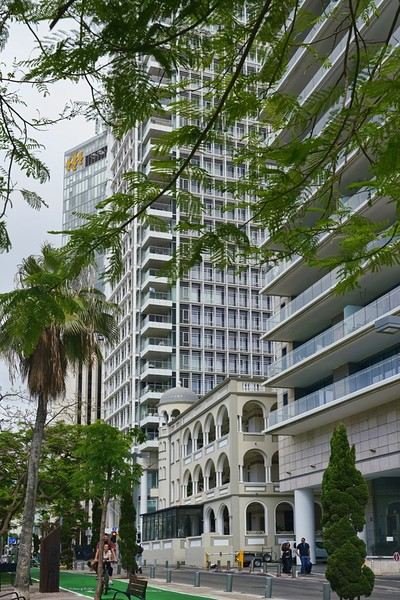
Open
In Search of Warmth in California, Utah, and Arizona in February
It all started last December, after another price alert from Gilou for United/Lufthansa flights at 250 € from Paris to San Francisco. Meanwhile, I was planning to spend a week alone with our three kids (Maxime, 14, Rachel, 12, and Timéo, 8) somewhere in France for the February break.

But this time, Gilou really outdid himself—way too tempting! 😮 His great tip worked for both the February and Easter breaks. I know April is the ideal month, especially if you love hiking! But for family reasons, only February would work for us.

Isn’t February a month to avoid for the Southwest? To keep our summer trip budget intact, I was thinking of camping as much as possible. After checking weather sites for temperature histories in key spots (Furnace Creek, Saint George, Page, Sedona), nighttime temps over the past two years ranged from +5 to -2°C. So, it seemed doable...

I started discussing (aka negotiating, even begging) with my better half. The kids caught on fast that there was a chance we’d go, and they were thrilled! She finally gave her consent to make the kids happy 😎. I quickly checked that our ESTAs were still valid, and 48 hours later, I had the tickets in hand 😎😎. But five days later, Laetitia changed her mind—her "Yes" turned back into a "No." No way were we going without her to her favorite country!!

Damn it 🤪! I had to tell her I’d already bought the four tickets (without bringing it up again, of course—a "Yes" is a "Yes," right?). And since the tickets were non-refundable, there was no going back... Apparently, with women, some "Yeses" mean *really* yes, but others mean, "I said yes in principle, but I wasn’t actually on board—and I never thought you’d have the nerve to buy the tickets without telling me!!" I had no idea 🤪!

Us guys? We’re way more straightforward—binary, even monetary... Yes means yes! And no can mean yes too 😏!! Anyway, in a lovely family atmosphere, I opened a thread to start planning and thanked Trois14 and Bluemesa for their help. On Trois14’s advice, I booked 5 nights in motels around St. George-Page at super tempting rates—around $35-40 a night...

On that note, Christmas cost me an arm and a leg... Gotta try to make up for it 😛!

Here’s the theoretical itinerary:

Death Valley (2 days) Valley of Fire The White Dome (hike up and down via Squirrel Canyon) 4 nights in the Kanab-Page area Sedona (2 days) Route 66 Alabama Hills / Trona Pinnacles Drive back to SFO via Highway 1

That’s the plan, at least...

In reality, it turned into a whole different story. I learned that in February, you’ve got to be flexible—*very* flexible sometimes—to dodge the weather. Halfway through, a cold snap made our second week (planned 100% camping) impossible, completely upending the itinerary.

So, a huge thanks to PapJ59, Noyellebis, and especially Caribou44 and Simonic. 🙂 A thousand thanks for your quick responses, availability, and sound advice, which let us have an original and unforgettable second week—Organ Pipe Cactus NM, Yuma, Salvation Mountain, Anza Borrego SP, a palm grove in Joshua Tree, then back to SFO!! Without you, we’d have been miserable on the spot, but instead... 😇

A big shout-out to Thibaut and his famous blog (rightfully praised on VF—it’s one of the few that details Organ Pipe), to travel journal writers for inspiration in general, and to those who helped me prep or during the trip (journals by Pong, Hiacinthe, Zitounet, and Laetitia).

Now, for the story...
Open
Collaborative travel journal for lovers of the American West!
Hi everyone!

So, I’m putting into action an idea I had two years ago... I’m inviting anyone who’s interested to help build a beautiful collaborative project—a shared travel journal!!!

The concept: one post =

a photo you’ve taken in the American West that means something to you and your thoughts on that photo or about it: where and when it was taken, the story behind it, why it’s special to you...

Grab your pens!!!! (And I hope this doesn’t flop, but if it does, at least I’ll have tried!!!)

And I’ll kick things off in the next post!
Open
Four weeks in Botswana
Saturday, September 22, 2018 This morning, we woke up at dawn at 6:00 AM. Headed to Letlhakeng, the last town where we could fill up on fuel before starting our crossing of the Kalahari. Our consumption since Johannesburg has been 11L/100 km. We took the direction of Khutse Game Reserve, whose entrance is about a hundred kilometers north of Letlhakeng. Access is via a gravel road along which we saw magnificent pink trees.


At Khutse Gate, we registered in the entry log and paid the access fees for 6 days: 120 Pulas/day/person and 50 Pulas/day/vehicle. Our stays at the Xaka and Deception Valley campsites had been reserved by our tour operator but not paid, contrary to what they’d told us. So we settled the 2 unpaid days of camping at 30 Pulas/day/person. The park rangers informed us that the southern triangle of Khutse Game Reserve, with its tip at Moreswe Pan, had burned. Note that these two campsites are government-run, which explains the low prices. Private campsites cost ten to fifteen times more. We headed to Khutse campsite, site 5. To enter the parks, you must have a reservation either at a lodge or a campsite. Since the number of spots in the campsites is limited, this means you have to book well in advance. We ate the salad we’d prepared the night before at our campsite. It was very hot—39°C. We made a round trip to Khankhe Pan. On the track, we encountered three South African cars, one of which was stuck in the sand and blocking the way. We helped push the car to get it unstuck. We saw very few animals at Khankhe Pan. We returned to the campsite, which has dry toilets and a shower you have to supply with your own water. We tried out the shower.


We witnessed our first Kalahari sunset. These sunsets are unmatched, and that didn’t change throughout the trip.


During the trip, we followed the solar rhythm—waking up at 6:00 AM, having dinner at sunset around 6:30 PM, and retiring to our tents by 8:30 PM.

Sunday, September 23, 2018 Up at 6:00 AM. It was 15°C. We were cold last night. Tonight, we’ll use blankets in addition to our sleeping bags. We headed southwest and, past Gwian Pan, turned northwest toward the Molose waterhole, where we saw our first elephants and our first raptor. Indeed, on the track leading to the Molose waterhole, we could see the traces of the massive fire that had ravaged the southern part of Khutse, as the park rangers had warned us.


Our first braai at Khankhe campsite.

Open
The Via Rhôna: 700 kilometers by bike from Lake Geneva to the sea! (Travel journal and video, July 2018)
Hey everyone, travelers! Here’s a little post to share our bike trip this summer. We did the Via Rhôna from Geneva all the way to the Mediterranean Sea. It was a truly amazing adventure—no hitches, lots of independent greenways, and we felt like we had the Rhône all to ourselves as our guide for 700 km over 7 days. That averages out to 100 km a day. We thought we’d do less, but the Via Rhôna is flat and not too tiring, which let us push to around 100 km each day!

Here’s the full video of our route: www.youtube.com/watch?v=x_cpBro6Df8

We’re not seasoned cyclists—we just love biking, and this trip was our first big bike touring adventure. As for our bikes (see photo), we had road bikes, sturdy ones with fairly large wheels and rear racks for our gear.

Speaking of gear, here’s what we brought: just the essentials for 7 days of biking and camping—1 tent for 2, two sleeping bags, a few clothes (not too many), 1 book each, toiletries, phone chargers, a basic bike repair kit... and maybe 2 or 3 things I’m forgetting. The idea is to travel light so you’re carrying as little as possible!

We camped every night. Along the Rhône, it’s pretty easy to find campgrounds, and they’re cheap too! Each morning, we’d decide on our destination for the evening (usually based on available campgrounds) and call during the day to book. We always managed to get a spot right away (except when we reached the Mediterranean coast, but we should’ve seen that coming 😛).

For expenses, we slept at campgrounds (between 15 and 25 € per site for 2) and either picnicked or ate at restaurants. Other than that, there weren’t really any other costs besides a few small souvenirs here and there. In total, we spent about 500 € for two over 7 days (so 35 € per person per day). I think it’s possible to spend even less—we decided not to restrict ourselves when it came to restaurants and campground prices.

For us, the most beautiful part was between Geneva and Lyon! The Rhône is still a bit wild there, as are its banks. Not too many roads, highways, trains, or factories around—just nature and peace. You gradually leave the Alps behind and head further south. It was truly stunning. We also loved the "Rhône Valley" after Lyon. The succession of dozens of suspension bridges and little villages, each more charming than the last, really enchanted us.

The trickiest part was leaving Lyon... The Via Rhôna disappears for a long stretch, forcing you to alternate between roads, traffic, danger, and pollution. We had to wait until Givors, further south, to finally get back to the quiet bike path and the Rhône showing us the way. Also, after Lyon, the Rhône becomes a bit more industrial—you pass by dams, factories, and power plants more often. But it’s really just a small detail, the exception that proves the rule of this magnificent Via Rhôna.

The Via Rhôna is a fantastic way to see how water from the mountains of Lake Geneva flows, travels, and winds its way for hundreds of kilometers to reach the sea. With this trip, you get closer to the Rhône—it becomes your accomplice, your guide. Plus, you cross a beautiful part of France, with its charm and little villages. It’s the France we love, and it’s great to explore your own country like a tourist.

That’s it for our little travel journal. I didn’t go into too much detail about our days since everyone will follow the same route, and everyone can go at their own pace :) But I’m happy to answer any questions (logistics, technical stuff, routes, etc.)—I’d be glad to help!

Here’s the video of our route again—I also composed the music, so I hope you’ll like it: www.youtube.com/watch?v=x_cpBro6Df8

Happy travels,

Flo
Open
The Moluccas: Splendors (and Struggles) of an Archipelago Unknown to Tourists
Hello everyone!

This travel journal aims to help future travelers (well, I hope so!), since there’s so little information available about this remote archipelago. Big thanks to Lolodesiles and Ayis for answering my questions while I planned this trip!


Context This is our fourth trip to Indonesia as a couple—after Java-Bali in 2011, Flores-Komodo in 2013, and Sulawesi in 2016—each time for three weeks. It’s also our tenth trip to Southeast Asia overall.

We’re traveling like we have in previous years: with a rough itinerary that often changes based on who we meet, tips from other travelers, how tired we are, or what we’re feeling in the moment. In the Moluccas, it’ll change constantly, mostly depending on transportation.

Our only accommodation booking: the first few nights in Ambon when we arrive.

Planned route (to be refined on the spot): Ambon - Banda Islands - Lease Islands - Ternate - Tidore - Halmahera (between Sofifi and Tobelo) - Morotai and the neighboring unnamed archipelago.

Flights: Lyon-Paris-Singapore on Air France (428 € round-trip), with good meals, champagne, and wine (we like our little comforts when going on vacation 😏). Then Singapore-Jakarta-Ambon on Air Asia and Garuda. Return flight: Ternate-Jakarta-Singapore on Lion Air, with a 3-day stopover in Singapore before heading home.

Episode 1: Ambon to Banda Our guesthouse, booked two days before departure, is 45 minutes from Ambon Airport, near Natsepa Beach (northeast of Leihitu). It’s a pretty average beach—quiet on weekdays but packed on Sundays (we saw the difference). It’s lined with warungs. This rainy day helps us readjust to the atmosphere of this country we love so much.

Our “Solim Guesthouse” is a lovely house with a living/dining room and garden, costing 15 € per night for two, including a hearty breakfast. Dinner is at Gaba Gaba, a great restaurant just a short walk away, right by the water, recommended by our host. Fun fact: it’s in the Lonely Planet, and it might be the only LP-listed spot in the Moluccas that actually matches the description (the others either don’t exist or have nothing to do with what’s advertised 😠).

For the next two days, the super-friendly owner lends us his scooter. We set off to explore the coastal villages in northern Leihitu (the western part of Ambon Island, which has a weird shape). Laundry and trucks washed in the same stream.
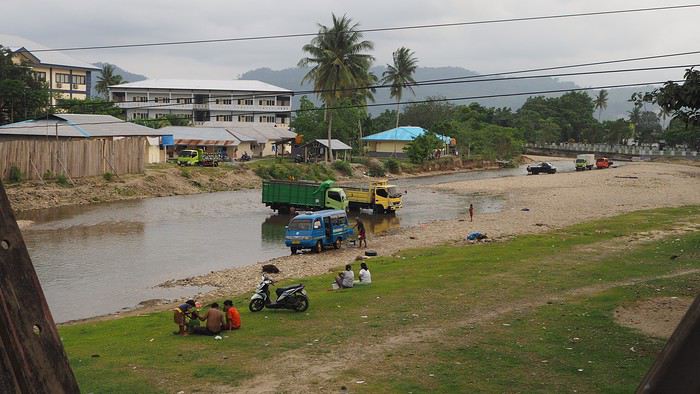
Liang Beach, described as the island’s most beautiful, is almost gone (climate change or something else?), but the colors are magical.

We continue 25 km toward a snorkeling spot our host recommended, taking a gorgeous, deserted little road through tiny villages in clove plantations (oh, those unforgettable scents!), stunning coves, and dense forest.


We’re greeted dozens of times with “Hello Mister”—a daily routine in the Moluccas. Every time we stop, we pose for photos to be saved on locals’ smartphones. They don’t see tourists often.
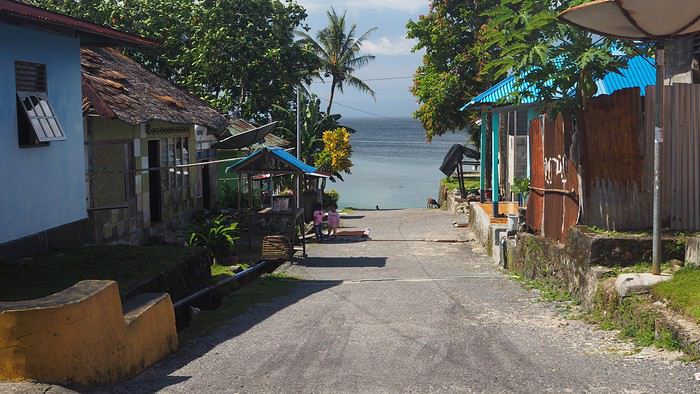
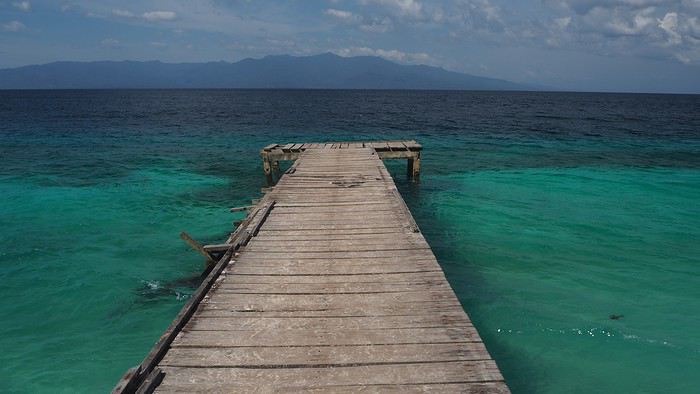
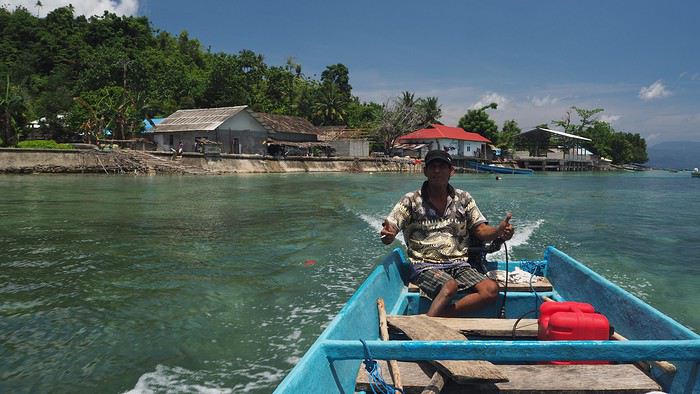
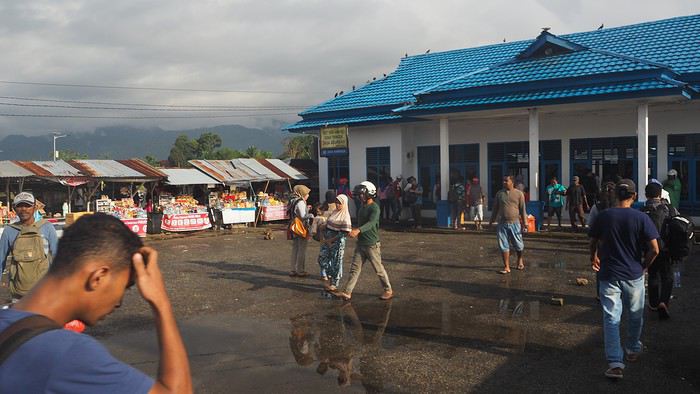
We ask for directions to the snorkeling spot (not easy—we only know basic Indonesian like *Selamat pagi*, *siang*, *sore*, and other polite phrases). Not many people know where it is (especially since we never know which village we’re in), but we eventually reach a small village that seems to be the right place. 🙂


We ask a local to take us there by boat (it’s not reachable by land).


The spot is at most 100 meters long, but the coral is in good condition (apparently not dynamited by fishermen, unlike in other parts of this beautiful country where fishing methods are destructive and nature pays the price 😠). The fish are plentiful and diverse. It’s a great start before heading to Banda. We’re happy to have the place to ourselves… though we don’t yet realize we won’t see a single tourist for the rest of the trip!

After two days of rest, we head to Tulehu Port in the morning, aiming for the Banda Islands. We know the journey is often tricky: the Pelni ferry runs twice a month but doesn’t match our dates, the 10-seat Suzi Air plane is always full (you can’t book—you have to show up on Mondays and Fridays), and it’s often canceled due to weather. So we opt for the Tuesday speedboat (which also gets canceled if there are waves or wind), with the next one on Saturday. We’re used to Indonesian ports—crowded, rusty boats, no English speakers—but we still feel lost. When I ask about the speedboat to Bandaneira, people gesture wildly, someone takes me to the “harbor office,” then tells me there’s no boat, others try to sell me tickets, and some just say, “No boat.”


Luckily, an English-speaking local approaches us and confirms the speedboat is broken. The next one will be Saturday *if* it’s fixed—otherwise, even later. 🤪 😠 We’re crushed. We came here for the Banda Islands… 🙁 We decide waiting five days for a maybe-boat isn’t an option, so we decide to head straight to North Moluccas, which was planned for later. We’re so disappointed we don’t even want to stay in the area. The Lease Islands don’t appeal to us despite what we’ve read, and Seram would deserve its own trip with its remote mountain tribes. Huge disappointment—we’d been dreaming of Banda for months, with its incredible drop-offs like Bunaken, its islands covered in nutmeg trees, etc. I’d read that Banda is in the world’s top 5, alongside Bunaken (amazing—we went in 2016), Komodo (incredible—we went in 2013), Sipadan, and another spot I’ve forgotten.

We take a taxi back to Ambon (45 minutes) to a travel agency to buy plane tickets to Ternate. There’s a daily ATR72 flight at noon—perfect timing. Ambon is the capital of South Moluccas (or Central, depending on who you ask!) with 300,000 people. The city doesn’t seem unpleasant, but we don’t stop. On the plane, there are only about ten passengers for 72 seats. The flight attendants are stunning, as always with Wings Air—clearly, they’re hired for their looks. 😊


Stopover in Bacan—a runway in the middle of coconut trees serving a tiny town—then we fly over countless volcanoes, the last one towering over Ternate.

Next episode coming soon: Ternate.
Open
Review of a disappointing cruise with Rivages du Monde in Iceland and Greenland


Hello everyone,

The itinerary was tempting, and we decided to take this cruise with friends. It also gave us a chance to discover this company, which offers many river cruises in a French-speaking atmosphere. The boat is only rated 3 stars, so we knew we wouldn’t have the same comfort or services as usual, but we accepted that. After all, the price is half that of a cruise with Ponant in the same area.

From the booking stage, this company was unlike any other. We later learned that Rivages du Monde isn’t a shipowner but just a service provider.

It operates in a somewhat outdated, old-fashioned, or even backward way, depending on how you see it. Information about the cruise, excursions, and the boat comes in the form of a very brief PDF. Documents, quotes, and invoices are sent by mail.

There’s no personal account on the company’s website, no passenger form to fill out, and no online check-in.

Fifteen days before the balance was due, I received the invoice with its share of surprises. I had to send my credit card details by mail (well, why not?), or pay by check.

The bad surprise was a fuel surcharge. The good one was that we were upgraded from category 3 to category 7, moving from deck 6 to deck 4. Since the information was so lacking, I had no idea what the benefits of this upgrade would be. I almost complained and asked to keep the cabin I had chosen, but I read in some comments that cabins on deck 6 were to be avoided due to loud creaking. So I said nothing.

Booking excursions, which had to be paid at the same time as the balance, was strongly recommended before departure. They were reserved by filling out an A4 sheet after reading a 3- or 4-line description in the PDF. The duration of the excursion and the departure time weren’t indicated. No information about disembarkation—would it be at the dock or by tender?

The boat. The MS Astoria is the oldest passenger ship in the world. Built in 1948, it started its career as a transatlantic liner until 1960. Often restored, it has retained an old-fashioned, vintage charm... or so the ads say. In the end, it didn’t look that old, as it had been modified and refurbished so much. Only its original bell remains in a display case. Its vintage look is more visible on the outside than inside. The outdoor decks are spacious, great for sightseeing. There weren’t too many passengers for the size of the ship. Inside, it’s not very modern or beautiful, but it was decent. A pleasant surprise—it handled the sea better than we expected.

The cabin was outdated and small, as we expected—no desk, no sofa, and two portholes that made it very bright. Well-equipped with new storage furniture, it even had a fridge. The bathroom would have been spacious if it didn’t have a bidet. The bed had a board instead of a proper base, but the mattress was good, and we slept well the whole cruise. Don’t look too closely at the finishing details, but overall, it was better than I expected. On deck 4, the cabin creaked a little at night, but it didn’t bother us. The cabins are different sizes on the plan, but in reality, they all have the same surface area.

Note the strange color of the hot water.


The buffet was tiny, with few choices and very basic, ordinary dishes. A few mixed industrial salads, some fresh salad and cold cuts. For the main course, chicken, pork, some kind of minced meat, or fish. Then potatoes, rice, pasta, or steamed vegetables (always the same ones). For dessert, flavorless pastries in various colors or fresh melon and watermelon salad. That was the sad, single menu for the entire cruise at the buffet. Note that the buffet was only open for 2 hours at lunchtime and 1 hour in the afternoon for a snack.

Tea, coffee, and water were available all day.

The restaurant. The table was nicely set and pretty, but the meals weren’t much better than at the buffet. The “beef fillet in pastry” was like boiled beef stew—it fell apart easily (even though we asked for it rare or at least medium-rare). The “asparagus velouté” was actually leek soup with “hay” that crunched under your teeth. The poire belle Hélène or profiteroles were sad, distant relatives of the well-known desserts—very skimpy. And those were just a few examples.

Drinks were included with meals: still or sparkling bottled water, white, red, or rosé wine, coffee, tea, or herbal tea.

The bar. The servers were nice but far from having the class and know-how you find on other cruise lines. We wanted to try the cocktails, but only once. The margarita was warm, with bottled chemical lemon, no ice, and no salt. The caipirinha was brown! And later, we noticed that in the Singapore Sling, they replaced the Champagne with soda!!! What a skill set!!!

The lectures were very popular. Almost all passengers eagerly attended the talks by the two naturalists.

The musical entertainment was French variety—good-natured and friendly most of the time. A little classical music, chamber music so sad it made you sleepy. Nothing like the pianos and violins you find elsewhere... (Princess or HAL).

The shows. With very limited resources, the dancers did their best. The outfits were very revealing in certain strategic areas, and that was the rule for all themes.

The “red vests.” The atmosphere on board was more like a company outing than a cruise. There was a lot of staff to run the excursions desk, assist and supervise passengers during stops, or act as guides during excursions. These “red vests” behaved like they were on a summer camp—they had a great time and gathered as often as possible to laugh and have fun. They didn’t hesitate to roll their eyes behind passengers’ backs. But the “group leaders” became very authoritarian and directive when addressing passengers.

One evening, our friend asked a “red vest” about the excursion time the next day. That was top-secret information, impossible to get (I’ll come back to that). The “red vest” replied that they wouldn’t tell him because, by the next day, he would have forgotten anyway. That shows the level of respect this staff had for the passengers.

Also worth noting: among the passengers was a man in a wheelchair. For the entire cruise, he couldn’t go ashore. No one ever offered to help his wife get him off the ship.

My perception of this cruise is inevitably shaped by my past experiences. Some passengers shared my opinion, but others were completely satisfied with everything and found the food good. They also swallowed all the bad excuses, cooked up with a security sauce, without question—reassured and delighted that “everything” was done for “their safety,” which is the most important thing, isn’t it?

To be continued—the stops and the organization, even more pitiful than the hospitality...
Open
Walks in the Kingdom of Siam
Sometimes a trip to Thailand starts in a hotel near an airport, where guests have misunderstood the meaning of the name easyJet...


We know all too well that this long flight will leave us a bit jet-lagged when we arrive...


all while hoping we won’t start our stay completely...


Still, we’re lucid enough to notice that they could’ve at least leveled the ground before adding the decor at the airport:


As always, our arrival is under the watchful eye of some...


under the frankly curious gaze of others...


but of course, there are plenty who couldn’t care less...


All that’s left is to set off exploring, while staying cautious so we don’t get caught off guard...

Open
Dubai, family vacation
After the wide-open spaces of the American West, we're off to a new destination: Dubai. Not just for a layover, but for a real family vacation!! The question that kept coming up was "why Dubai?" (after why Colorado this summer, people are going to think we're really weird 😅). So, why Dubai? First, because skiing isn’t really our thing anymore—so in winter, we want sunshine 😎. But not just any sunshine—warm enough to swim, which narrows things down a bit 😅. The second constraint this year: Franck can’t take more than a week off (and it’s unpaid), so we’re ruling out destinations with 12-hour flights and jet lag that knocks you out when you get back 😅. The options are getting tighter… So, against all odds, it’s me who ends up suggesting Dubai (my husband’s been nagging me for years about Atlantis and its mega water park—ah, the kids! 😉).

Actually, Dubai only has 2 days of rain a year (you’d have to be *really* unlucky!!), temperatures around 30°C in winter, the sea (oh yeah, I forgot—the sea was something we missed this summer, so it was on our list 😅), a 6/7-hour flight, just 3 hours of jet lag, reasonable family prices, and tons of activities for all tastes. Starting my research with a pretty negative bias, I’m now looking forward to this trip with excitement and impatience… and without spoiling the ending, I won’t be disappointed—our whole family will come back enthusiastic and ready to go back!!

So, I’m taking you along for a week in Dubai at the beginning of March.
Open
Major safety risks in Peru?
Hi everyone, Since the safety reports on Peru are sometimes a bit outdated, I got curious and checked the Ministry of Foreign Affairs website for travel advice. It’s honestly pretty worrying!! Here’s the link: https://www.diplomatie.gouv.fr/fr/conseils-aux-voyageurs/conseils-par-pays/perou/

Among other things, they don’t just mention fake taxis that rob you or express kidnappings (especially in Arequipa), but also drugs that can be slipped into your drink if left unattended, "with the risk of scopolamine being added."

They’ve marked the Cuzco region as a red zone (formally avoid!!) and central Lima as an orange zone, "to avoid after dark."

What do those who’ve been there recently think?
Open
January 2018 Photo Contest: "Laundry Day"
Laundry day...

... and once the clothes are washed, they need to be hung out to dry.

Show us washerwomen, laundry workers, "Mère Denis" types, or "Mr. Clean" figures—scrubbing, wringing, spinning. In a laundry room, at the washhouse, or by the water’s edge. In a tub, a wash boiler, or even in the river. Whites and colors all mixed together—soaking, sudsing, rinsing, and splashing!

Show us wet laundry, drying clothes... Clothespins on a line, socks and little (or big!) underwear flying in the sun, clothes hanging from windows, sheets spread out on the grass, outfits drying near the stove...

The photos can include people, but you can also just show laundry, tubs, bundles, modern laundromats, or ancient washhouses... Anything related to this age-old, universal chore—traditionally left to one half of humanity while the other half leaves their dirty laundry lying around!

I invite you to share your (clean!) images from around the world until Sunday, January 21st at midnight. Maximum of 3 photos per participant (😛), each numbered and posted in a separate message. A caption would be great... Voting from Monday, January 22nd at 00:00 to Sunday, January 28th at midnight (Paris time). Results announced Monday, January 29th...

Vote for 3 photos, assigning 1, 2, or 3 points. No half-points for this edition. The photo with the most points gives its creator the honor (or burden!) of proposing a theme for February’s contest.

In case of a tie between two or even three participants, I propose—a perk of my temporary role—a slight tweak to the rules for this contest:

Clause #10177: In the event of a tie, the winner will be the person who has never organized a contest before or who has fewer previous terms as organizer than their tied counterparts. (Read slowly if you need to ;-))

The images are here, with Mr. Clean at the slideshow controls... 😊 photos.app.goo.gl/n0avmXB1FEtsPOvH3

More words here: Chit-chat at the washhouse
Open
Thailand Travel Journal: From Chiang Mai to Bangkok, We Didn’t Buddha Our Fun


We’re excited to share our sixth travel journal with photos from Southeast Asia, this one entirely dedicated to Thailand. As a reminder, our previous travel journals can be accessed directly by clicking on the username "jojoone1" to the left of each post.

For a change, let’s start with the conclusion: our trip left us with an excellent memory. Very often, everything went like clockwork—short wait times, quick problem-solving, and the curious feeling of being pampered. Sometimes, life isn’t so cruel after all.

It’s only fair to admit that day after day, we encountered Thais who were smiling, helpful, kind, funny, and sometimes even touching. There were a few exceptions, but they were just the trees hiding the (tropical) forest. After this year’s experience, we won’t be the ones to tell you that Thailand isn’t the Land of Smiles or that laughter is just for business. We’ve witnessed so many kind behaviors and gestures that we no longer understand how anyone could complain about the people here—except for bad experiences in ultra-touristy spots packed with travelers lacking any finesse. It got to the point where it made us reflect. And we concluded that we probably have funny, friendly faces (?). We also know we’re the first to smile at them, and every day there, we show respect to everyone we meet. In any case, we have fond thoughts for many of the people we crossed paths with. Thanks to them, our trip took on a whole new human dimension.

A quick note about the photos: last year, the VoyageForum team made a change to how photos are uploaded. This gives us the choice between displaying high-definition photos (but losing ownership rights) or non-HD photos (less sharp, but the originals won’t be spread online without compensation or credit). We opted for the second solution, if only as a matter of principle. It does leave us with some regrets, especially since Françoise switched to the Canon EOS 7D Mark II, whose performance is notably better than the 7D.

Our first trip with Emirates was satisfying but left a mixed impression. Sure, it was the first time all four of our flights were on an Airbus A380. The crews were super friendly, and the meal trays were the best on the first two flights. On the return flights, the meals weren’t great and weren’t filling enough. Overall, the crews seemed disorganized and rushed—clearly some new recruits. The Doha-Paris flight, if memory serves, was on an A380-600, and in that configuration, we were packed in like it hadn’t been in years. In conclusion, it’s hard to say at this stage whether Qatar or Emirates comes out on top.

From our perspective, the journey from northern Thailand to Bangkok can be done via two different routes. This year, we took one of them, which allowed us to alternate between well-known destinations and original visits. Note that some of this year’s visits include cities we’ve already been to. So for a more complete view (Bangkok and Chiang Mai, for example), you’ll need to check out our previous travel journals.

We’ve improved our Thai vocabulary with a few more words and hope next year to move from kindergarten to first grade... For those reading us for the first time, we can only advise against visiting this country on an organized tour or looking for a French-speaking guide. The Thais have organized themselves well—they now have proven tourism practices. Maybe a guidebook for culture, a few basic English words, and a little organization are all you need for a great trip.

CHIANG MAI

Chiang Mai and its region are packed with treasures—so much so that one or two visits might not be enough.

At the airport, you go to a counter that provides a taxi ticket. The fare is 150 baht for a regular car and 200 baht for a larger vehicle. When our turn came, a large vehicle showed up, but we were only charged 150 baht. Okay, fine.

The hotels we’d selected three years ago had significantly increased their rates, so we had to find a new base. In the city center, hotels with large pools are overpriced, and despite the wide selection, it was hard to decide. We ended up at a hotel near the airport, the Baan U Sabai Boutique House. The superior room with a balcony can be negotiated for just under 40 €. It’s a beautiful, fairly new complex in traditional teak style, with very well-kept rooms and a long pool. Given the rather stormy weather in early July, it was the first time in Thailand we swam in cool water. It encouraged us to swim rather than just lounge...


At the end of the hotel street, you come out onto a busy main road where you can hail a songthaew (a kind of shared taxi). It’s easy to be offered a ride to the city center for 2 x 20 baht, but getting a return trip for less than 2 x 40 baht is tough, especially in the evening. Our red songthaew took us straight to Chiang Mai Gate, one of the city’s gates, located southeast of the historic square. We then took Phra Pok Khlao Road for a few dozen meters and chose the first little restaurant that looked nice. Within minutes, we had our dishes and smoothies for a total of 235 baht. Great quality, despite the place looking very touristy. The owner set the tone by handing out smiles left and right.

There’s an amazing spot in Chiang Mai to grab a coffee: Baan Phor Liang Meun. Once you reach Chiang Mai Gate, take Phra Pok Khlao Road for a few meters, then turn onto soi 2 (alley 2). It’s actually the first on the left. After a few dozen meters, you’ll find yourself walking alongside what looks like a Khmer temple.


When you enter, you’re in a vast space—like a temple-garden—where you can eat a small dish or sip a good café crème as if you were in Angkor. The tables are far apart, so you’re as close to birds and squirrels as you are to other customers.


In the small building where the staff works, they provide high-quality mosquito repellent for free—something we’ll now buy regularly at 7/11. They’re small plastic bottles, mostly pink or orange, with Thai writing and "floral fragrance" in English. The scent is actually pleasant. Remember to shake the bottle before opening and pressing, or you’ll end up with cream all over your shorts...

The creator of this space has been sculpting terracotta works since the early 1980s using clay from the Lamphun region—the most consistent clay found in all of Thailand. This café is like visiting an ancient temple, with its abundance of statues, high-reliefs, and bas-reliefs. It’s undeniably a romantic spot for couples—a haven of calm in a very lively city.


Open

You might also like