Six-week trip to Mexico
FR

Translated into English.

Original post
GE
I recently took a six-week trip to Mexico with Y, my Thai partner. To be precise, we spent 43 days there plus a final half-day before heading to Mexico City Airport for our return flight to Europe.

I’d already been to Mexico about 40 years ago! But that was only for a week or so, between Mérida and the Belize border.
First off, I should mention that I’ve never seen a beach in Mexico. I say this because discussions about Mexico always seem to revolve around the Costa / Riviera Maya.

Let’s start with an overview of the trip. Our itinerary can be split into two halves:

- First half: Querétaro, San Miguel de Allende, Morelia, Guanajuato, Mexico City “CDMX” (the capital). - Second half: Palenque, San Cristóbal de Las Casas, Chiapa de Corzo, Oaxaca, Puebla, Cholula, and finally Mexico City CDMX.

To move from one part of the trip to the other, we took a flight from Mexico City CDMX to Villahermosa, then a bus to Palenque.

In six weeks, we visited maybe a quarter or a fifth of the country (see the attached maps). Mexico is about three times the size of France! And when I say “visited,” it was really just a quick stop—enough to get a first impression. I understand that some people can only spend one or two weeks on vacation in a given country, but that’s not my idea of travel. Personally, I’d say a country as rich in every way as Mexico deserves several months of travel before you can say you’ve “seen” it.

In my next post, I’ll break down the expenses. That might help future travelers plan their trips. You don’t go to a country for several weeks (or more) without thinking about the budget! Besides, one of those future travelers to Mexico is us—we were so thrilled by Mexico that we’re definitely going back.
IN Intothetrees Regular ·
Hi there,

What a wonderful trip you had!

I’m really looking forward to the rest of your travel journal.

I think Mexico is my favorite country in so many ways—architecture, vibe, food, how friendly people are, etc.—but you’re right, it’s impossible to say you’ve "seen" Mexico when the country is so huge and there’s just so much to explore.
GE GeorgesOZ Globetrotter ·
Hello,

What a wonderful trip you had!

I’m eagerly waiting for the rest of your travel journal.

I truly think Mexico is my favorite country on so many levels (architecture, atmosphere, food, the kindness of the people, etc.), but it’s impossible to say you’ve "seen" Mexico—it’s such a vast country with so much to explore.

Hi Frédéric,

We can use the informal "you" if you’d like.

I completely agree with you: the kindness (and spontaneity) of the people, their joy for life and friendliness, the architecture, the cultural and ethnic diversity, the geography, and so on. The list goes on and on. After traveling extensively, I’d also say it’s my favorite country.

The rest of the story will come bit by bit…
GE GeorgesOZ Globetrotter ·
Regarding expenses.

Hotels

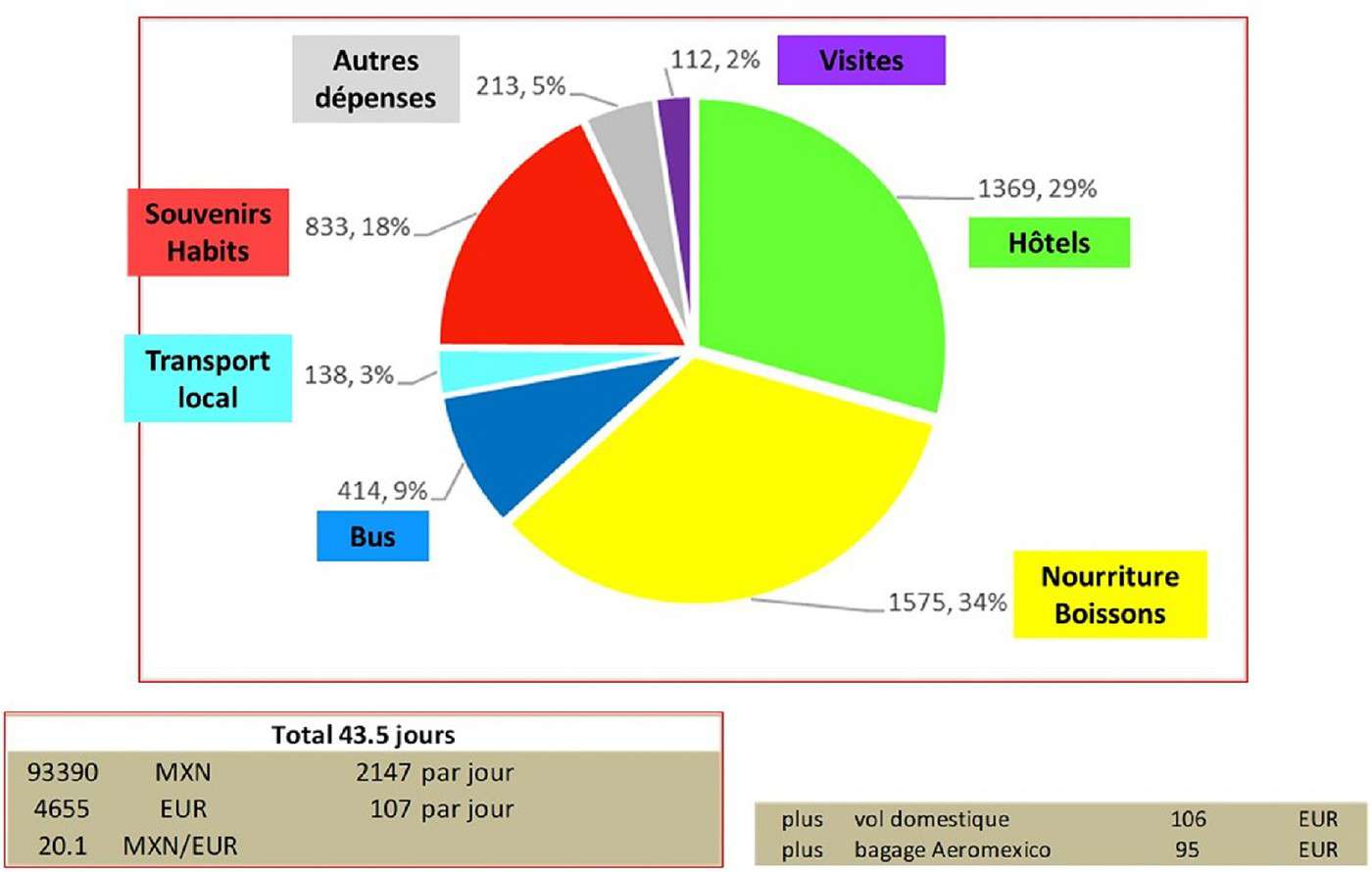
We had booked accommodations all along in decent hotels, but without looking for luxury. Lodging cost us an average of 30 €, typically between 30 and 35 €, making up about a third of our total expenses. It must be said that we stayed in some places that seemed significantly more expensive than others, namely:

- Querétaro – probably because it’s a pleasant city that attracts many visitors from the capital (domestic tourism in Mexico is very developed). - Guanajuato – a small but very popular city, especially during the famous "Cervantino" festival (it was packed). - Oaxaca – same comment as for Guanajuato, but it was during the famous "El Día de Muertos" celebration. In addition to Mexican tourists, foreign visitors were very noticeable. That’s also where we found the most expensive lodging for what we got. - Our last two nights in Mexico City, in a hotel slightly more "upscale" than usual, just to recharge before returning to Europe.

Except for these "expensive" spots, we usually paid around 25 to 30 € per night. A natural question is whether breakfast is included in hotel bookings. Most of the time, it wasn’t, and even when it was, it was almost always so basic (like weak coffee, "pan dulce" and/or cornflakes with no options) that we had to grab something outside the hotel to supplement.

Of course, I’m not talking about what might be the case for stays in Riviera Maya hotels or higher-standard accommodations.

Meals and Drinks

This accounts for roughly another third of our expenses. But it’s hard to break down because we skipped meals. For example, when we left in the morning by bus, we made do with snacks bought at bus terminals (which are usually pretty meager). Also, we bought food here and there instead of eating at restaurants. We ate at markets but also went to "decent" restaurants a few times (never splurging).

If we exclude bus station snacks, we spent an average of around 8 € on breakfast. You can easily eat for 10-12 €. At lunch, 10-15 €, and in the evening, 12-20 €. Never more than 30 €. All of this, of course, for two people.

Then there are drinks outside of meals. Without being heavy drinkers, we do enjoy a little drink (or more) – not every day, but still fairly often. We’re on vacation, after all! How could we not try the local beers (not great, except sometimes the "cervezas de barril")? How could we resist the temptation of a few good margaritas? (Though they weren’t all that great.) And how could we not explore the famous "mezcal"? I really liked mezcal, but it quickly adds up!

In short, drinks, snacks, and food purchases outside of meals cost us around 10 € per day on average.

Total "meals + drinks" per day: it hovered just under 1000 MXN (pesos), or around 45 € per day on average. Looking back, I think we didn’t deprive ourselves. You can certainly spend less—I think you can always find food for under 30 € per day for two people (just a rough estimate), without suffering too much. And if you go easy on the margaritas and mezcal!
FR Frmi31 Veteran ·
That’s roughly what we’re spending without depriving ourselves since it’s vacation time!
Le Mexique pour toujours après de nomb Les chiens aboient la caravane passe
GE GeorgesOZ Globetrotter ·
I’m continuing with "travel budgeting." I know this might bore some of you, but as I’ve said, I’m doing this primarily for myself. Now that I’ve started the topic, I might as well keep going. Later, I promise, I’ll move on to our travel impressions with a few photos. Hang in there!

Buses and local transport

Buses and local transport = 12% of our expenses. We often took buses from Primera Plus and ADO, which are among the best—if not *the* best—you can find. In total, we traveled about 2,500 km by bus, and for two people, that cost us 8,300 MXN, or just over 400 €. On top of that, we had the flight from Mexico City to Villahermosa, which cost 106 € for two. That flight (with Interjet) took 1.5 hours to cover 750 km. We *could* have done it by bus, but it would’ve taken a whole day and probably cost around 80–120 € for two. So flying made sense.

Of course, there are other ways to travel—spending more or less time in each place, which means fewer or more transport costs for a set trip duration. On average, we spent 3 days per place, but sometimes just 1 day, or up to 5 days, like in Mexico City and Oaxaca. You *can* move faster… but then it turns into a race. Too many people show up on VF with insane itineraries (I see this a lot on the India forum, for example). Well, to each their own. Y and I prefer to take it easy, have time to do laundry, soak in the local vibe, etc.

For local transport (taxis, short-distance local buses), we spent about 3 € per day on average. Again, this depends on our travel pace. But either way, it’s clear this isn’t a major expense. Taxis are super cheap. The metro in Mexico City costs next to nothing. Of course, if you’re traveling for several weeks or even months, it adds up.

Someone might ask: *What about taxi safety?* We mostly ordered taxis through our hotels, so they were pretty much guaranteed. But we also hailed taxis on the street and never had any issues. Except for one time when we felt like we were being "taken for a ride" to inflate the fare, we found the drivers to be perfectly honest. That said, it might be a different story late at night or in remote neighborhoods of a big city…

In short, all this transport cost us an average of 12–13 € per day.

Have a great day, readers!
FR Frmi31 Veteran ·
Transportation is cheaper than renting a car, which has the advantage of giving you more freedom of movement.
Le Mexique pour toujours après de nomb Les chiens aboient la caravane passe
GE GeorgesOZ Globetrotter ·
Public transport is cheaper than a rental car, which has the advantage of giving you more freedom of movement

That’s true, and I’m seriously considering it for my next trip.
RO Rouquine38 Globetrotter ·
Hi Georges, I’ll be following your journey because so far I’ve only been to the Yucatán Peninsula, and the rest of Mexico really appeals to me 🙂.
"Voyager est un triple plaisir : l'attente, l'éblouissement et le souvenir." Ilka Chase
OU Ouvergnate ·
Hi Georges, I'm heading to Mexico and Guatemala for 2 months soon with two friends, and I can't wait to read your travel journal—thank you in advance! It's true that Mexico is huge, and I'm a bit worried about spending too much time on transportation. Our itinerary includes Mexico City, three colonial cities, then a "descent" to Oaxaca, San Cristobal, etc., all the way to Cancun, where we’ll say goodbye to a friend (poor thing, she has to work!) before continuing to Guatemala as a duo. But rushing isn’t our travel motto—we can always scale back if needed once we're there. As you said, it’s important to soak in the atmosphere and know when to slow down! See you on the forum soon, and don’t think all your details are boring—they’re super helpful for planning. That’s what the forum is for! I’ll add that your budget looks similar to what we’re expecting too.
GE GeorgesOZ Globetrotter ·
Hi Georges, I’ll be following your journey because so far I’ve only been to the Yucatán Peninsula, and the rest of Mexico really appeals to me 🙂.

Yes, it’s high time we realize that Mexico isn’t just about the Yucatán—though the Yucatán is fascinating. But on the other hand, the fewer foreigners there are elsewhere, the better!
GE GeorgesOZ Globetrotter ·
Hello Georges, I'm heading to Mexico and Guatemala for 2 months soon with two friends, and I can't wait to read your travel journal—thank you in advance! It's true that Mexico is huge, and I'm a bit worried about spending too much time on transportation since our itinerary includes Mexico City, three colonial cities, then a "descent" to Oaxaca, San Cristobal, etc., all the way to Cancun. There, we’ll say goodbye to a friend (poor thing, she has to work!) so we can continue to Guatemala as a duo. But rushing isn’t our travel motto—we can always adjust our plans on the spot, as you said. It’s important to soak in the atmosphere and know when to slow down! See you on the forum soon, and don’t think all your details are boring—they’re super helpful for planning. That’s what the forum is for! I’ll add that your budget looks a lot like what we’re planning too.

Oh, there you go! That sounds a lot like what we did in 6 weeks (plus, of course, the stop in Guatemala). Nothing but happiness ahead!
RO Rouquine38 Globetrotter ·
Hello Georges, I’ll be following your journey because so far I’ve only been to the Yucatán Peninsula, and the rest of Mexico really appeals to me 🙂.

Yes, it’s high time we realize that there’s more to Mexico than just the Yucatán—though the Yucatán is fascinating in its own right. But on the other hand, the fewer foreigners elsewhere, the better!

Absolutely, but for a first taste of Mexico, the Yucatán is a great choice 😊. Plus, it’s easy to rent a car and plan your own route. I looked into driving from Mexico City to Cancún, but it seemed trickier 😕.

I’m really looking forward to your travel journal to start imagining a future trip to Mexico 😍.
"Voyager est un triple plaisir : l'attente, l'éblouissement et le souvenir." Ilka Chase
GE GeorgesOZ Globetrotter ·
Clothing and souvenirs

Clothing and souvenirs = 18% of our expenses. This is a part of the budget that varies enormously, almost by definition, from one person to another. Some won’t spend a kopek, while others will happily splurge entire fortunes on everything there is to buy in a country as rich as Mexico.

I’ll try to break down our expenses to help those who are interested. Let’s say we spent money on the following categories:

Clothing and shoes: cheap, with perfectly acceptable quality, and there’s a huge selection. 2 or 3 pairs of pants and shirts, 1 hat each, shoes for my wife (including a pricier pair to handle the bad weather back in Europe), etc. All of that came to 190 Euros. The biggest item was the swimsuits we bought stupidly just to spend 1 or 2 hours in a thermal "resort" (whose entry fee was pretty steep, on top of that). Oh well, they might still come in handy later, so I’ll count them the same as the rest.

Jewelry: there’s silver everywhere! How can you resist? But we stayed reasonable. Only 130 Euros in total, the biggest item being a silver bracelet for 100 Euros.

Handicrafts: I’m including the Indian-style shirts here, i.e., with those typical floral embroideries. Why here and not with Clothing? Because they’re significantly more expensive (though you can still avoid breaking the bank). Plus blankets, drapes, shawls, a hammock, and who knows what else? Oh right, I’m also tossing in the 2 bottles of mezcal we bought at the airport. That’s pretty artisanal too, right? Anyway, the whole lot came to a friendly price: just a hair under 500 Euros.

Since you all went to elementary school (I hope, at least), you’ll easily get to the grand total of 820 Euros. As I said, it’s very easy to spend less or more—I’ll leave that to your discretion.
GE GeorgesOZ Globetrotter ·
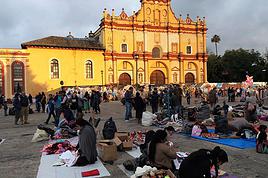
I realize that so far I haven’t posted any photos in my travel journal, and it’s getting a bit dry. So, as a down payment on the photos to come (when I get around to sharing day-by-day experiences), here’s a clothes stall in Oaxaca, a view of Oaxaca’s main square with—yes, you guessed it—more clothes stalls, hats, and all sorts of trinkets. I can’t say it enough: Mexico is a giant Aladdin’s cave!

Drinks are part of the memories, right? Here’s a glass of mezcal next to a drink I can’t remember the name of (the glass rimmed with "sal de gusano"); Something solid for the road, eh? (Hic!!!!)

And what about food, you ask? It’s not bad at all—there’s variety, and it’s super cheap. My favorite breakfast (still in Oaxaca): "tacos de coloradito". So good and really filling for the start of the day.

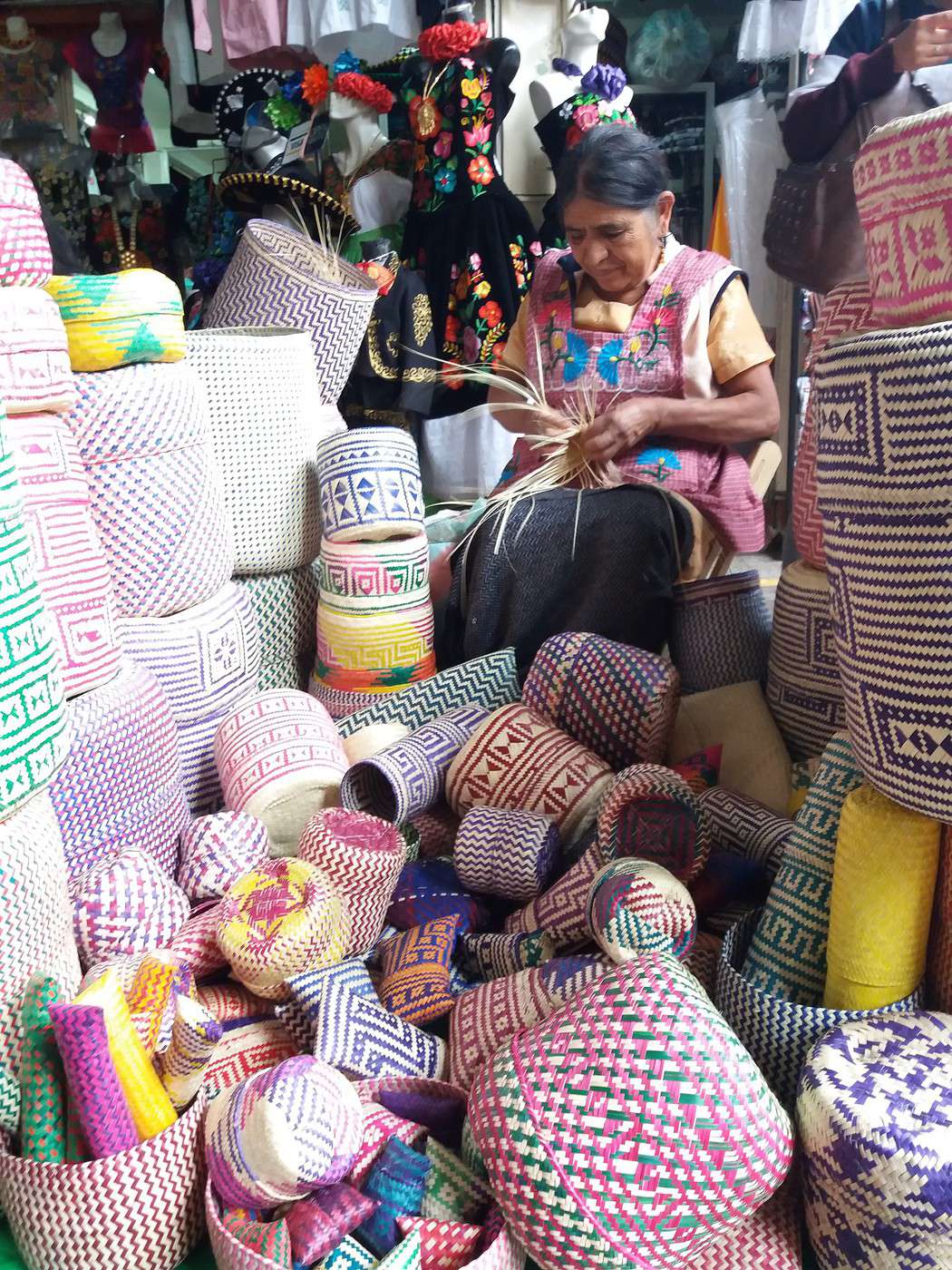
Alright, I’ve been stingy with photos so far, so here are a few more, still in Oaxaca: a woman (probably Zapotec) weaving baskets at the market; a big glass of fresh "chocomio", amazing; the cathedral square in the late afternoon.

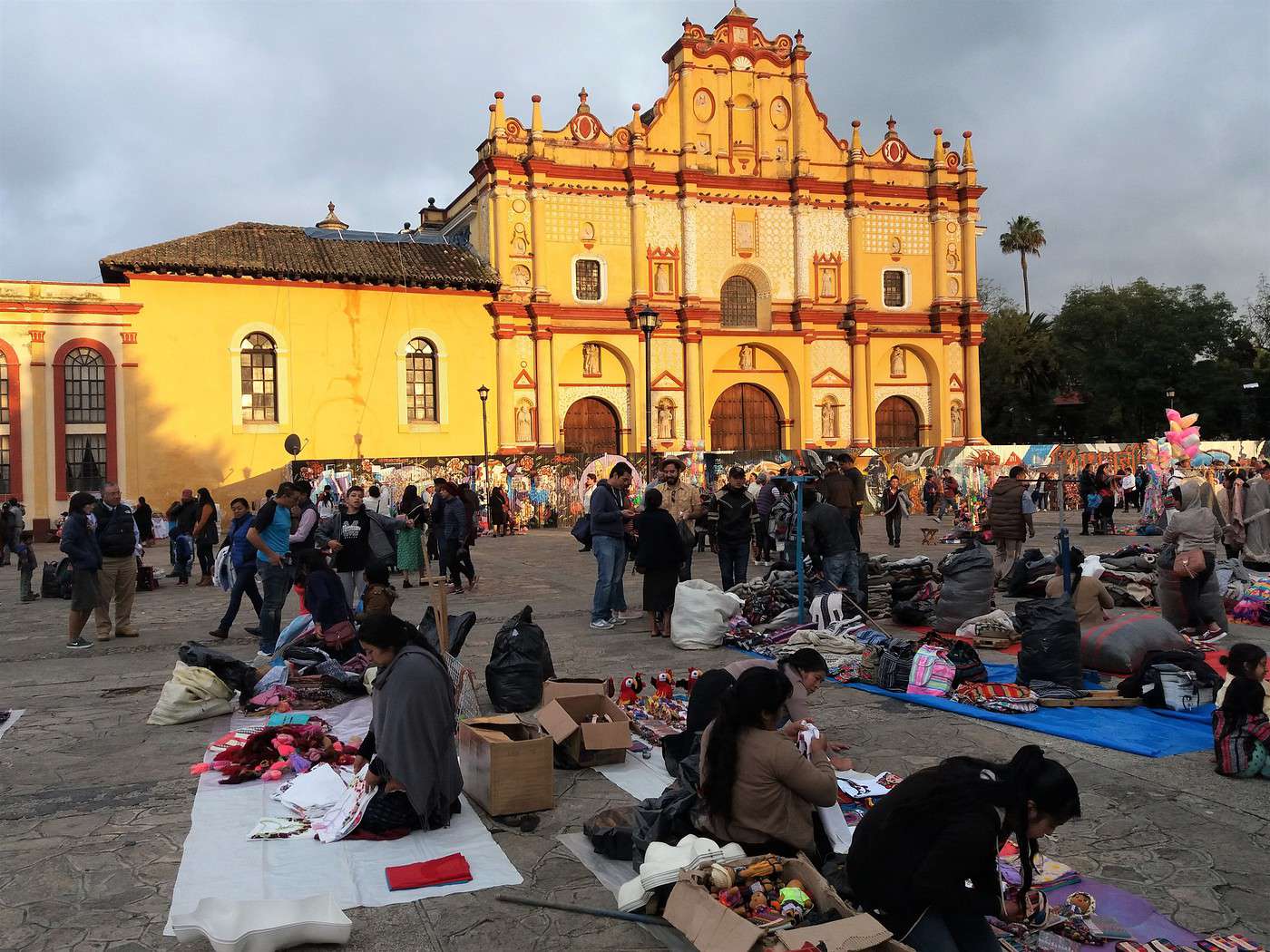
And then, for a change, the Indian market in front of the cathedral in San Cristóbal de las Casas. It was pretty chilly and raining…
GE GeorgesOZ Globetrotter ·
Querétaro

I’ve spent quite a bit of time breaking down our expenses. We had a few small extra costs, but it’s fair to say they were just that—"small." Of course, it all adds up over time. Over six weeks, it came to around 200 euros for toiletries, laundry, and especially bags to stuff all the odds and ends we bought along the way—even a Samsonite suitcase on our last day in Mexico City. As for archaeological sites and museums, they’re really affordable in Mexico, so no need to worry. Many museums are even free! The most expensive visit by far was Sumidero Canyon (750 pesos for two).

There’s often talk on VF about exchange rates. I checked our total expenses in euros, including everything: withdrawals, as they appeared on the two bank accounts I used, averaged 20.0 MXN per euro. Credit card payments averaged 20.2 MXN per euro. As they say, "it’s six of one, half a dozen of the other!" Just note that withdrawal fees vary *a lot* from one bank to another. The worst I saw was an 81 MXN fee per withdrawal at HSBC or BBVA—withdrawals I *didn’t* make! Meanwhile, Citibank or City Banamex only charge 31 MXN. I made 11 withdrawals in Mexico, and that 50-peso difference per withdrawal would’ve cost me an extra 11*50 = 550 pesos, or about 27.5 euros—enough for a nice meal for two at a decent restaurant. Not exactly trivial!

All in all, we averaged around a hundred euros per day for two people. For those interested, I’ll share a pie chart breakdown of all our expenses.

Now, onto the travel story itself. When we arrived in Mexico City, we immediately took the bus to Querétaro (850 pesos for two, from the airport). This city, in the so-called "colonial" region of Mexico, is 220 km from Mexico City. It’s a pretty city of nearly a million people, perfect for exploring on foot. The center is easy to define, between Jardín Zenea, Plaza de Armas, and Plaza Constitución, and includes highlights like the Templo de San Francisco de Asís and right next door, the Museo Regional. The term "templo" seems to be used often for churches. But before stepping into either, you’ll inevitably come across the statue of a dancing Indigenous man.

There was a festival happening when we arrived—music, dancing, and fireworks in the evening. Actually, nothing out of the ordinary, since it seemed like there was a festival, celebration, or event *everywhere* we went in Mexico!

On the small square by the "Dancing Indian," a sign outside a shop advertised "pedos de monja." Sure enough, those must be "nun’s farts," the little donuts we have in France too, right? Feels like familiar territory—nice! Since I’m curious, I looked up the "official" Spanish term: it’s "buñuelos de viento," or "wind donuts," and apparently dates back to the 10th century and Sephardic Jews, who were numerous in Spain at the time.

You’ll probably notice in the photo a heavily armed policewoman. It’s true—this isn’t uncommon in Mexico…

We spotted the Templo de San Francisco, but hunger led us to the stalls at Plaza de Armas first. We sat down with a ton of options in front of us and no idea what would hit the spot. We ended up eating 2 or 3 "sopes" filled with who-knows-what, but they were *really* good. "Sopes" are tortillas topped with whatever’s in the pots in front of you—you pick. With two large glasses of horchata, it cost us 115 pesos.

After six weeks in the country, I’ve got the impression that *everything* is based on tortillas—whether it’s tacos, quesadillas, or "chilaquiles." Mexico is a country with millions of *everything*, including millions of tortillas. Everywhere you go, they’re making tortillas—by hand or by machine to keep up with demand. Millions every day! They’re corn flatbreads, the Mexican equivalent of Indian "chapatis."

Oh, I can already hear the question: "Aren’t you afraid to eat at markets?" I can put your mind at ease—we ate at markets *a lot* and never had a single issue. The infamous "Montezuma’s revenge," if it even exists, must’ve been targeting someone else!

We spent three days in Querétaro, a gentle introduction to our trip. We eventually made it into the Templo de San Francisco. My Catholic childhood came rushing back (yes, I’ve drifted since…), helping me appreciate it. I, who swore I’d only care about Romanesque and Gothic, have to admit: I found the church stunning, and I’ll confess—I was moved. Meanwhile, Y, who’s Buddhist, doesn’t overthink it: anything that moves (or doesn’t) and resembles a god, saint, or idol gets a Thai "wâi" or a prayer. She loved the architecture and decor just as much as I did.

The Museo Regional is right next to the Templo. If I remember correctly, entry is free. I love museums where the building itself is part of the exhibit. I got my fill: check out this courtyard with its large arches (a style you’ll see elsewhere) and the tower in the back—that’s the Templo. Inside, you’ll find explanations about indígenas (not "indio," which is somewhat pejorative, and definitely not "indiano," which means something else entirely)—their origins, customs, and way of life. In this region, it’s mostly the Otomís (Hñahñu or Ñano) and Pames. We got our first taste of Indigenous life: the stunning embroidery you’ll see *everywhere*, even in Central America, and those demon masks, which deserve their own chapter.

Part of the museum covers the city’s important role in Mexico’s post-Hispanic history. We didn’t spend too much time there (Y isn’t big on deep dives), but it’s worth a couple of hours.

There are also reproductions of local church facades. Really interesting—I’ll give you an example.

So, those first three days in Mexico were smooth and incredibly enriching. "Impressed" doesn’t even cover it! The beauty of the squares and churches, the clean streets, the kindness, the smiles, the spontaneity of the people…

Oh, before leaving Querétaro, I have to mention our visit to a shoe store—yes, you can’t miss how *everywhere* shoes are in Mexico! And I know someone for whom they’re just as important as churches and museums!

The morning we left for San Miguel de Allende, we grabbed breakfast at a "tacos" stall in a local market… for next to nothing: 61 pesos!
GE GeorgesOZ Globetrotter ·
I forgot to paste the "pie chart" summary of expenses. Here it is. Those who like to carefully prepare their travel budget will be well served!
OU Ouvergnate ·
We're here in Queretaro now, and I'm following your journey step by step because for us too, this will be the first stop after Mexico City!

Looks like we won't be disappointed! I've already booked a hotel, but comparisons are always interesting. Do you remember where you stayed? And if the accommodation was good... or not?

Thanks, and see you soon for the next episodes.
GE GeorgesOZ Globetrotter ·
That’s it, we’re in Querétaro now, and I’m following your journey step by step because for us, too, it’ll be the first stop after Mexico City! Looks like we won’t be disappointed! I’ve already booked a hotel, but comparisons are always helpful. Do you remember where you stayed? And whether the accommodation was good… or not? Thanks, and see you soon for the next updates.

Hi Martine,

How perfectly timed! You’re going to love it, I’m sure.

We stayed in a pretty modest hotel about 10-15 minutes from the center (on foot, of course), somewhere at the end of Calle 5 de Mayo. Closer to the center, along that same street, there are several hotels that looked appealing but were probably more expensive than the 42 € per night we paid for a tiny room with hallway noise and a skimpy breakfast. Like I said, Querétaro is pretty pricey for lodging, no doubt because of its proximity to the capital.
GE GeorgesOZ Globetrotter ·
San Miguel de Allende - 1

San Miguel is only 60-70 km from Querétaro. The bus costs us 190 pesos for two, a steal. However, the taxi that picked us up at the hotel in Querétaro charged us 150 pesos, which seems excessive to me, even considering the distance to the bus terminal, which is quite far from the city center, I must admit. But what can you do? 😐

No problem buying our bus tickets at the counter. There are several buses a day, and no need to book in advance. Bus terminals in Mexico are generally very well organized. They're clean, there are places to sit, and there are always clean restrooms for 4 to 6 pesos per entry. My only complaint is that there's usually not much choice when it comes to drinks or food. Take note! Stock up before heading to the terminals. It's true that they almost always give you a drink and a snack when you board the bus, but it's really not much.

This gives me an excuse to "line up" one of my many comments in the section "In Mexico, there are thousands of this and that":

"In Mexico, there are thousands of public restrooms". Even in small towns, you can always find plenty of "Baños" or "Sanitorios", sometimes for only 3 pesos. It's pretty handy, isn't it? How many times have we found ourselves in France or other European countries, in the middle of a city with an urgent need, searching for a department store where, with a bit of luck, you might find free restrooms? Note that the "seat" is amusingly called an "inodoro" in Spanish. No need to translate, I hope? As for urinals, they're called "mingitorio". Wow, Mexicans are sophisticated people! 😏

San Miguel is a smaller city than Querétaro. From one end to the other of the "useful part" of the city, it takes a maximum of 30 minutes. There are several churches, several squares, and on the squares, several benches:

"In Mexico, there are thousands of churches, thousands of squares, and thousands of public benches". This multitude of squares and public benches makes the country very sociable. It's pleasant to walk around everywhere; you come across so many nice spots to rest and watch the world go by. Plus, it's always clean, well-shaded, and there are lots of public fountains (I need to add public fountains to "my list"). And what's more, the fountains almost always work!

This cleanliness is remarkable. Clearly, the country is making an effort. And it creates jobs because... "there are thousands of people employed to clean public spaces" (I didn’t miss it this time!).

I don’t have any photos to show the squares, etc. But I’ll certainly have some when we get to the next cities. Believe me, San Miguel is very pretty.

In the center, there’s a very typical square with public benches, trees, fountains, and in the middle, a bandstand for concerts. A pattern you find almost everywhere. The square is dominated by the "Parroquia de San Miguel Arcángel", a church remarkable for its pinkish hues and its slightly "Gaudi-esque" style (it's neo-Gothic and dates from the 17th century). The interior is magnificent, as usual. These are the first two photos.

About 300 meters further, there’s another remarkable church, the "Templo de Nuestra Señora de La Salud" on the "Plaza de la Soledad". These are the next two photos: a beautiful wooden door on the left side of the first one, and the sumptuous cream colors of the altar crowned with several statues up to the vault (a frequent style).

Some might say I’m exaggerating a bit with the churches, but not visiting them while traveling in Mexico would be a serious mistake. They’re extraordinary. 😎 I’m much more impressed by the churches in Mexico than I was during my 5-week trip to Colombia last year. And not being Christian or a believer would be a stupid excuse not to visit them.

In the late afternoon of the first day, having eaten nothing since the morning, we enter a "cantina", the "21 Única" at a corner of Calle Jesús, 2 minutes from the central square. A "cantina" is a tavern or, better said, a "saloon" like you see in Western movies, with a two-swinging-door entrance. You might feel intimidated at first, not seeing much inside, but don’t hesitate—we’ve done it many times and never had a bad experience.

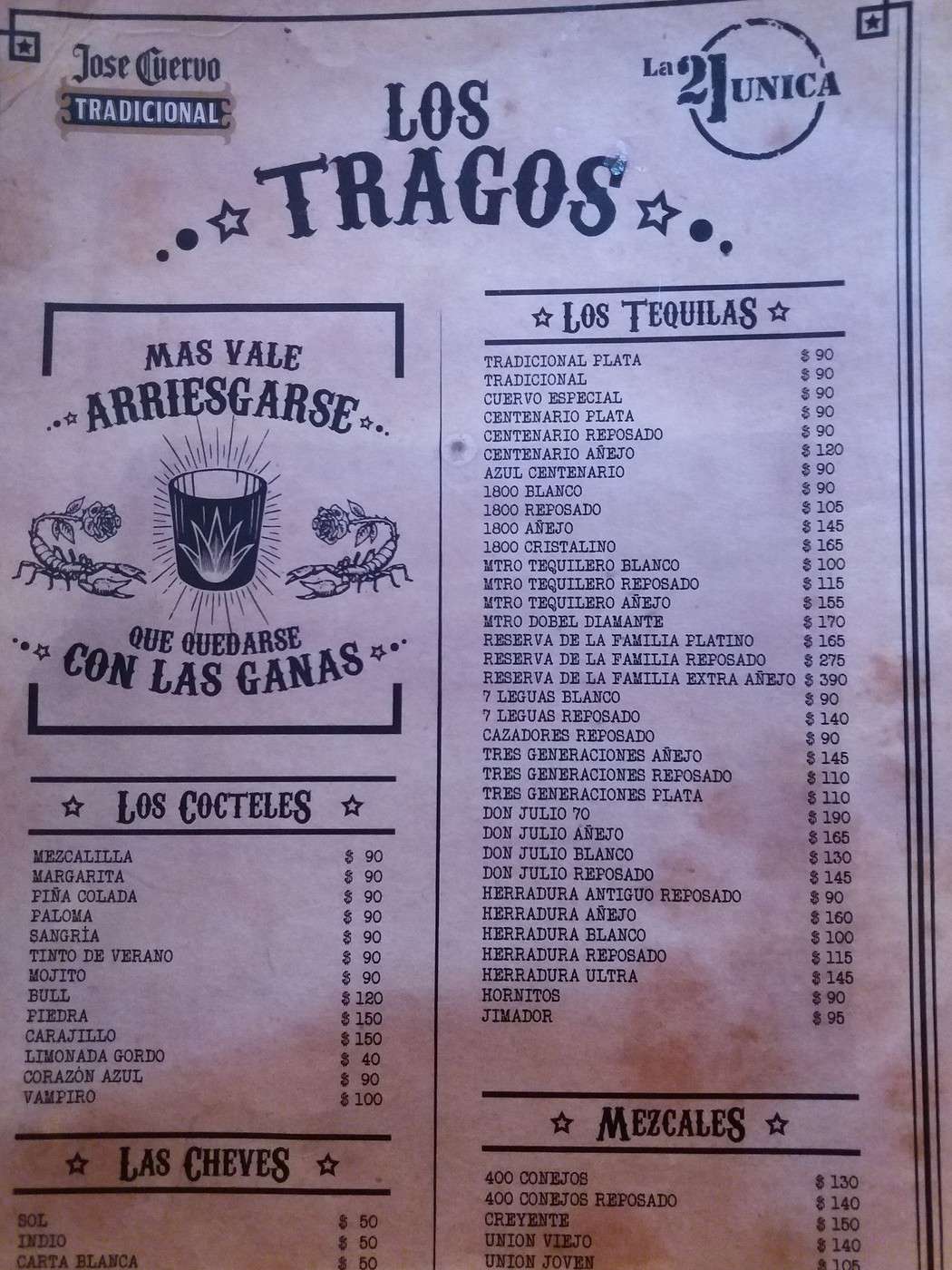
It’s early, and we’re the only customers. We order a soup that’s so good we each order a large bowl. 😛 Having satisfied our hunger, we take a second, more inquisitive look at the menu. Specifically, at the section with the promising title "Tragos"—Spanish for "shots". This section is richly developed. It starts with an ancient word of wisdom: "más vale arriesgarse que quedarse con las ganas"—"better to take a risk than to be left wanting". Yes, but what to choose? There are dozens of tequilas (note that it’s masculine, which wasn’t obvious at first) and mezcals. And the cheapest mezcal is 130 pesos! We settle for the cocktails section: Y gets a margarita, and I opt for a compromise—a "mezcalilla", which lets me indirectly try mezcal. We’re not disappointed; it’s good and well-balanced, and we have another.

We start to take better notice of our surroundings. The walls have several informative messages like "the properties of tequila": it’s good for insomnia, for better calcium absorption and thus stronger bones, for losing weight, for making friends. Joy without drinking isn’t real joy, we’re told, etc. Oh, there’s another customer, sitting at the bar! Here he comes to us; we invite him to sit down. He’s clearly not on his first drink but is friendly. And here he starts singing, mostly for Y’s benefit, who’s clearly caught his eye. He sings very well for his advanced state of intoxication. He has several "amigas", he says, but none as pretty. "Ah, those eyes, that hair, that mouth!" He doesn’t stop praising Y’s beauty but, he points out, "con respeto", with respect.

After a few good drinks and this pleasant musical interlude, we head back to our lodging, which takes us through a large part of the city again.

The next day is a quiet one; we wander here and there. We have a second breakfast on one of the terraces bordering the central square. At the next table, an older American couple is joined by 1, then 2, then several other Americans, all clearly familiar with the place and loud. What’s more, they practically forced us to move to make room for them, without a word of politeness. 😠 They’re living caricatures of gringos behaving like they own the place. We quickly finish our drinks and go elsewhere. It’s the best strategy.
GE GeorgesOZ Globetrotter ·
San Miguel de Allende - 2

This influx of Americans had almost ruined our little breakfast under the arches of the main square (coffee + huevos rancheros for 200 pesos). A few minutes wandering around the center and we’re back in good spirits. The colors red, ochre, and pink dominate, the streets are covered in cobblestones or large flat stones. Spotless cleanliness, as always. Around noon, we ate two dishes with half a liter of fresh orange juice at a snack bar on Collegio Street, right next to Plaza de la Soledad (150 pesos).

Speaking of Americans, we got in touch with some friends who are also American and live in San Miguel. Not all Americans are unbearable, of course! Our friends arranged to meet us in the evening on the Rosewood’s terrace. It’s a "classy" hotel located a bit outside the city center, which, given San Miguel’s size, is really only about a ten-minute walk from the main square. Since we had plenty of time, we took a little detour through Benito Juárez Park. A very pleasant spot, shaded and wooded, where people come to play, jog, picnic, sit on a bench ("thousands of them…", remember?), read a book, etc.

I recommend checking out the Rosewood—it’s a magnificent building with an original architecture I’d describe as Italian-inspired. Inside, a large circular hall features several high-quality works of art that are worth the detour. It’s almost like a museum! That’s where our friends were waiting for us.

There were a lot of people on the terrace ("rooftop"), but we found a good spot. After the usual small talk, we went to take some photos because the view was simply stunning. The warm colors of late afternoon, the red-tiled roofs, the pine trees piercing the greenery, the churches standing out in the background—it all felt very Mediterranean. Again, Italy came to mind.

Our friends took us to another "cantina", El Manantial, at the corner of Huertas and El Chorro. It would’ve only taken 10 minutes to walk there, but our friends insisted on taking a taxi (they *are* American, after all!). We tried one of the house specialties, ginger margaritas. Not bad, but Y and I agreed: we prefer classic margaritas. Since we’d only nibbled on appetizers at the Rosewood’s terrace, we ordered food. For four people, the bill came to the highest amount we’d seen during our six weeks in Mexico: 800 pesos (40 €). But that was for four.

The next day, following our friends’ advice, we took a local bus, a "camión", on Calzada de la Luz, at the end of Calle Relox. Destination: Atotonilco, about twenty kilometers away. It’s a village of fewer than a thousand people, famous for its church (and what else, we’re in Mexico!). The Santuario de Jesús Nazareno is a UNESCO World Heritage Site for its Baroque architecture and decoration (dating back to the 18th century). For Mexicans, it’s also a spiritual landmark: during Mexico’s War of Independence, Father Miguel Hidalgo took up the banner of the Virgin of Guadalupe to lead the insurgent army.

It’s nice, but we were a little disappointed by the naivety of the interior after all the wonders we’d seen in Querétaro and San Miguel. From the outside, it looks very "Mexican": bright sun, white and ochre colors, paved road… Oh, and public benches, of course!

Our American friends had raved about the charms of a spa just outside Atotonilco. "10 minutes on foot," the nuns running the café next to the church told us. It took us more than half an hour to reach Escondido Place under a sun that was gradually becoming relentless. We hugged the walls where there was a bit of vegetation. Still, it was pretty at times—check out these beautiful religious statues framed by tall cacti we came across along the way.

Entry to Escondido Place was 150 pesos each. Not cheap. Plus, we had to buy swimsuits. Not much choice in a tiny shop, and that’s how we ended up spending 1,000 pesos, even after a little haggling. We weren’t too tempted by the pool—the place was nice, but the water looked cold. And Y is really sensitive to the cold (she’s Thai). No problem, though—there were these "caves" with very hot water, naturally heated, if I understood correctly. The caves weren’t natural, though; they were built. Bare brick walls and vaults—it was quite pretty. We were almost alone enjoying the place. At the back, the water gushed out hot and in powerful jets. It was bliss to stand right in front and let it hit your face—like an intense massage. There was enough space to take a few strokes.

On the way back, which we were a little nervous about—it was almost 2 km and very hot—we were lucky enough to get a ride in a pickup truck. The driver must’ve been surprised when he realized we were foreigners! But it’s just one example among many of how kind the locals are.

In the "downtown" of Atotonilco (see the JPEG below), we had to wait a good half-hour for the "camión" that would take us back to San Miguel. We made a farmer’s day by buying his fruit. We paid 20 pesos for two delicious avocados—"there are millions of avocados in Mexico"—and 15 pesos for something weird but tasty called "camaca" if I remember correctly.

The "camión" literally took the scenic route back to San Miguel. There must’ve been about twenty teenagers on the bus, fresh out of school. The people’s features clearly showed the importance of indigena blood in the countryside. We passed through small roads in a few villages. The rural setting reminded me of Isaan, Y’s province in Thailand.

At the end of the day, we had a great meal at Café de la Parroquia. The place was nice, the service friendly, the food good, and the margaritas excellent. Y was happy—you can tell from the photo (though I’ve blurred her face for privacy). Out of our entire trip in Mexico, this was where we had our best margaritas. The ones at the "cantina 21 Única"—just a stone’s throw from Café de la Parroquia—were also fantastic.
OU Ouvergnate ·
Thanks for this really interesting episode! I have to admit I’m always eagerly waiting for the next one...😎
GE GeorgesOZ Globetrotter ·
Morelia 1

We take a local bus early in the morning on Calzada de la Luz to get to the bus terminal. Cost of the trip: 32 pesos for two, and as a bonus, the chance to get our backsides and spines massaged in a rickety bus. 🏴‍☠️ At the terminal, we buy our tickets to Morelia: 335 pesos per person for 170 km, with Primera Plus. Two departures a day: 7:30 and 19:30.

There are 2 or 3 fairly large lakes along the way, between what seem to be volcanoes. These lakes are certainly shallow since the road crosses them instead of going around. Maybe Mexico City and Tlaxcal-Puebla looked like this before becoming overpopulated? Morelia has roughly 1 million inhabitants and is the capital of the state of Michoacán. The historic city center is on a hill in the middle of a large valley. You can see the mountains all around.

After dropping off our meager luggage at the hotel, we head to the Plaza de Armas for lunch. We sit on the terrace of a restaurant with a park in front of us and the great Morelia Cathedral right behind. It’s on this kind of square that you almost always find decent restaurants and cafés in a Mexican city. Everyone around us clearly belongs to the city’s bourgeois class and are all white. This contrasts with all the street vendors, musicians, and other public entertainers who constantly pass by trying to make a little money—almost all of them darker-skinned and without a doubt mestizos or even indígenas of pure descent.

What I’m saying won’t surprise those who’ve traveled in Latin America. This social divide along physiological lines is something we also noticed in Colombia last year. A Spaniard we met later at a bus terminal (it was in Tuxtla) explained to me that no, of course, I’m not a gringo, but rather a « güero » or « güerito ». That’s how light-skinned people are referred to in Mexico. I’m not sure if gringos are also considered güeros; I don’t think so.

All these people trying to make money in public squares in Mexico can get a bit tiresome. Alright, you saw this coming:

« In Mexico, there are thousands of street vendors and people begging ».

Not far from the Plaza de Armas, the Mercado de Dulces y Artesanías is an interesting place to visit. Morelia seems, among other things, proud of its fruit pastes, and we don’t miss the chance to taste and buy some (Y is particularly fond of those made with tamarind). 😛 And we arrive at the Jardín de Las Rosas. It’s cute but not very big—we walk around it in just a few minutes. What we quickly notice on this tiny square is the statue of Cervantes. The commemorative plaque is dated 1947. It’s informative: « By creating the madness of Don Quixote of La Mancha, Cervantes forged the eternal monument of Hispanic genius. Castilian and very noble Morelia pays tribute, in this 4th century since its founding, to the eternal greatness of the soldier of Lepanto».

This quote opens several avenues for reflection. First, it’s remarkable that the city of Morelia so openly displays its "Castilian" pedigree. Doesn’t that feel a bit too Spanish and, dare I say, "conquistador"? Completely ignoring the conquered indígenas. Not even mentioning the 150,000 Purépechas in the state of Michoacán… It might be commonplace to say this nowadays, but personally, I feel a deep connection to all these peoples we Westerners have crushed. I know, I know, I might be falling into the well-known trap of the "noble savage" myth, but I can’t help finding a lot of beauty in these peoples (I’m attaching a JPEG of Purépechas I found on Wikipedia). And without a doubt, they were far from "savages"!

Second, I’ve often wondered what was so extraordinary about the story of Don Quixote. Now I’m starting to understand better. And at the same time, I’m beginning to grasp what lies at the heart of Spanish culture. You have to go to Latin America to better understand Spain…

Third, of Cervantes’ entire life—and apart from his literary work—Morelia mentions his presence as a soldier at the Battle of Lepanto. The Battle of the Holy League, Catholic of course, to block the expansion of the Ottomans, the Muslim enemies (that was certainly the spirit of the time). Morelia, like all of Mexico, is Catholic par excellence. You don’t see that much in Europe anymore…
GE GeorgesOZ Globetrotter ·
Morelia 2

More than the squares, public benches, and churches, it’s the grand arches of the buildings in the city center that really catch your eye in Morelia. Almost every house has them in their inner courtyards. You can see it clearly in the two photos I borrowed from Wikipedia. And then there are the magnificent doors. I’ll share a few examples below. Gorgeous doors are practically everywhere—pure delight for enthusiasts. Come on, all together now:

« In Mexico, there are thousands of stunning wooden doors ». 😎

Otherwise, it’s a beautiful city to explore, too. Inevitably, you end up back at the cathedral square, which is very lively. Today, there’s a market there in the name of a political protest movement, the FNLS, the « Frente Nacional de Lucha por el Socialismo » (no need to translate). This movement is active in several central and southern Mexican states (Michoacán, Hidalgo, Puebla, Chiapas). A large banner proclaims loudly, « 527 years of resistance and struggle against state terrorism and for socialism ». 527 years takes us back to the « discovery » of the « New World » by Christopher Columbus (he reached the Bahamas in October 1492). So it’s clear what this movement is standing against: colonization. It’s pretty surprising to see this displayed so openly in public, knowing that this kind of political movement can often lead to armed violence. 😕 Anyway, it’s very « Latin America ».

But we’re not here to dive into local politics. We move on and enter the cathedral. It dates back to the late 17th century and is known for being the largest cathedral in the country. A beautiful building, no doubt. The interior has a relatively understated style that’s far from unpleasant.

We found a great spot for lunch that’s both delicious and cheap. It’s at the Mercado San Juan, also called Mercado Revolución, about 1 km from the cathedral. The people inside are super friendly—we chat with several vendors and shoppers. Mexicans are very open, spontaneous, and generally quite charming. The « restaurant », if you can call it that, is on the side of the market where they sell fish (duh!). We sit at a counter and have two large bowls of « caldo pescado y camarón » prepared—fish and shrimp soup (Y is a shrimp fanatic). It’s excellent, especially with the spicy sauces on the counter—just pick the right bottle. We pay 160 pesos and get the owner’s big smile as a bonus. 😎

In the afternoon, we visit the Museo de Arte Colonial. It’s free, as usual. There are hundreds of crucifixes (no, I’m not singing my little song again this time). The Mexicans really go all out in this style—you can clearly see the influence of Spanish Catholicism. It’s not exactly what excites Y the most... or me, to be honest. I do stop in front of a painting depicting the Virgin Mary, though. We walk past so many paintings without trying to understand what they represent... Here, I stumbled upon a gem because there are explanations. On the left side of the painting, the Virgin Mary reaches out to rescue a soul from the flames of Purgatory. On the other side, a kneeling angel holds a basket where the Baby Jesus places flaming hearts (oh wow...). At the top of the painting, two cherubs place a crown of precious stones on the Virgin Mary’s head. Pretty mind-blowing, right?

A little diversion cools us down after that somewhat morbid religiosity: a model of the three nutshells Christopher Columbus used for his famous voyage. The irony? He never actually came to Mexico, a place Europe had never even heard of at the time.

To cool off even more, we head to the Jardín de Las Rosas, just 200 meters away, and treat ourselves to well-deserved margaritas on one of the terraces. 😉 Two each—clears the mind. And since it’s already the end of the day, we eat there, too. All for 550 pesos.
GE GeorgesOZ Globetrotter ·
Morelia 3

The next day, our last in Morelia, we visit the Casa de Artesanías del Estado de Michoacán. It’s right next to the Templo San Francisco, an imposing building on the square of the same name.

It’s a whole exhibition of handcrafted products from the state’s indígena communities, namely the Purépechas, Nahua, Mazahua, and Otomís. It’s impressive. Among other things, there’s a collection of figurines representing the dead. Yep, it’s everywhere—maybe because we’re getting closer to the famous « Día de los Muertos »? Besides that, there’s lots of wooden furniture, often richly colored, plenty of pottery, tableware, textiles, and I don’t even know what else—all really cool. 🙂

Everything’s for sale. We don’t check the prices, but we know that in general, things displayed so nicely in such a pleasant place are way more expensive than what you’d find in markets or shops. Still, it’s tempting. If I lived in Mexico, I’d love to furnish my place with this kind of stuff. But how do you buy anything when you’ve got to lug your luggage around for weeks, and when airlines limit your bags so much?

We were a little disappointed in the evening at Plaza Villalongin, 1 km from the cathedral. The guide (I actually used the Lonely Planet for once!) spoke highly of it. Sure, there’s a nice little park and the aqueduct avenue is well-shaded, but there aren’t many appealing spots to sit, have a drink, or grab a bite. If there are, they’re not obvious.

To be honest, we’re starting to get a bit bored. That might be putting it too strongly, but let’s just say this city isn’t as exciting for us as San Miguel, for example. No doubt, it’s a very pleasant and peaceful city, and if we had something specific to do here (like Spanish classes), we’d happily stay for a few weeks. There’s no sign of the troubles constantly talked about in Mexico. But in 3 days, we haven’t seen a single foreigner around here.

On the doorstep of our hotel, a skeleton with a giant scythe gives us a big grin, 😎 but it doesn’t stop us. Off to the bus terminal. Taxi: 70. Cookies and coffees: 60. On our way to Guanajuato!
GE GeorgesOZ Globetrotter ·
Guanajuato 1

If you look at the map of Mexico, you might wonder why we went from San Miguel to Morelia, then from Morelia to Guanajuato, which is close to San Miguel (San Miguel is in the state of Guanajuato). Morelia was quite a detour. The thing is, we found ourselves stuck between our booking dates and the Cervantino festival in Guanajuato—a bit of a logistics issue, really.

You should know that Guanajuato is nestled among a bunch of steep hills, and because of its "tortured" topography, the bus terminal is several kilometers from the city. We were a little nervous in the taxi—where on earth was he taking us? We’d booked a place in the Pastita neighborhood (neighborhoods or districts are called "colonias" in Mexico—odd, right?). Pastita is just outside the city center proper. The taxi driver struggled to find the address but kept at it, stopping several times to ask people for directions. We finally arrived at the top of a narrow alley that might spook some folks after dark. 😕

Getting around Guanajuato can be tricky. Several streets or roads pass under or over each other. Wrong turns are guaranteed, especially at night after a few drinks! But I’ll try to guide you a bit. At one point on the main road called Sostenes Rochas, you’ll reach Del Campanero: that’s the entrance to the pedestrian zone. If you turn your back to the pedestrian zone, you’ll see a small square where the street splits off and climbs toward Pastita. There’s the Sostene Rocha café—a nice spot to sit, grab a coffee, or something stronger. Just a little further down Sostenes Rochas, you’ll find Plaza Allende with the statues of Don Quixote and Sancho Panza, right in front of the Teatro Cervantes (obviously).

Take Del Campanero street and go under the Puente Campanero (you’ll see people sitting on the bridge above your head, on the terrace of a café on another level). You’ll come out at a triangle formed by two streets branching off in front of you. At the corner, there’s the first little restaurant where we ate in Guanajuato. It was delicious. We really enjoyed the large, lightly grilled peppers. With a beer each, we got away for 320 pesos, plus a friendly chat with the owner, who raved about his sauces.

Once we were full (it was midday), we continued down the left street, which leads to the Templo de San Francisco, a bright pink church that... well, we didn’t go inside. Right next to it is the Museo Iconográfico del Quijote. Another statue of Don Quixote: a photo stop is a must.

Two hundred meters further, you’ll reach the Jardín de la Unión. It might be the center of the city, though that’s debated—this city is so twisted. Before going further, we turned left along the Teatro Juarez (there’s a small market where I bought a hat for 150 pesos) and arrived at the funicular, which took us to the top of a hill where the Pípila monument stands. At the funicular exit, several shops await, offering all the best of local crafts. I already had a hat, thanks! But of course, Y fell in love with the silver jewelry! Long story short: a few moments later, Y was showing off a pretty silver bracelet... and our wallet was lighter by about 1000 pesos. Oh well, it’s not every day!

On the monument square, there were lots of people—mostly Mexican tourists, but also a few foreigners: Japanese, Americans, and some Europeans. The views of the city surrounded by hills were amazing. 😎
GE GeorgesOZ Globetrotter ·
Guanajuato 2

Guanajuato unfortunately made international news due to the deaths of 12 police officers in the span of a week. 🏴‍☠️ It’s well known that there are extremely violent criminal gangs in Mexico. But the truth is, it’s not as dangerous a country as many people say. What foreign visitor would think of spending a few days in Culiacán, in the state of Sinaloa, where El Chapo’s cartel seems to rule? You might say, "Yes, but that happened in Guanajuato, a major tourist spot!" True, but let’s clarify: most of these recent disturbances took place in the state of Guanajuato, not in the city of Guanajuato itself.

And ultimately, even if—what’s the risk of getting caught in the middle of a shootout between police or the military on one side and cartels on the other? Mexico sees nearly 40 million foreign visitors a year—far more than Thailand, for example. And how many foreigners end up in a bad situation, like a shootout or kidnapping?

In the end… There’s no "end of the story" because everyone can play with statistics, and everyone will interpret them based on their own travel philosophy. For me, I figure I’m just as likely to get mugged in Paris as in Mexico. Mexico is huge, and I don’t see why I’d go to Culiacán or near the U.S. border, areas known to be dangerous.

Back to Guanajuato. It’s a stunning city where you make interesting discoveries around every corner. 😎 Just look at the photos I’ve attached. When we arrived at the Jardín de la Unión, we noticed, for example, this huge intriguing statue standing between the Iglesia de San Diego and the Teatro Juarez. Some will love it, others won’t.

I don’t have a photo of the Jardín de la Unión itself. Probably because I was too caught up in everything happening in this space, which is actually quite small: fountains and public benches (!), mariachi groups playing their ballads for customers sitting at café and restaurant terraces, vendors of all kinds, and so on. It’s very lively. No doubt even more so than usual since the Cervantino Festival is in full swing.

Next time, I’ll talk a bit more about the festival and explore Guanajuato further, beyond the extraordinary basilica of Nuestra Señora de Guanajuato.
GE GeorgesOZ Globetrotter ·
Guanajuato 3

The Basilica of Nuestra Señora de Guanajuato is an absolute must-see. Built toward the end of the 17th century, it’s a relatively restrained example of Mexican Baroque. The statue of the Virgin, a gift from King Carlos I, actually dates back to the 16th century. I’ll say no more—I’ll let you judge from the photos.

To wrap up the churches, basilicas, cathedrals, etc. (at least for now), I have to share a few photos of the Temple of the Society of Jesus, right next to the university and just 200 meters behind the main artery where the Basilica of Nuestra Señora de Guanajuato is located. More recent (late 18th century), it’s said to be in the neoclassical style. I’m struck (!) by the depiction of the flagellated Christ. The Hispanic morbidity, isn’t it... yet it’s still magnificent.

The main artery—really just a slightly wider street—leads from the Jardín de la Unión and opens up at the basilica. That’s where Avenida Benito Juárez begins. In the late afternoon, it’s crowded. We had a few decent margaritas on one of the terraces. Further along, after a few twists in the avenue (Guanajuato really has a tortured topography), we found a cantina that felt more down-to-earth than the ones we’d “tested” in San Miguel. I think it’s just past the Mercado Hidalgo. “Los Barrilitos”: it was immediately a humbler Mexico. A dusty bar with a trough running along it where, someone explained, people used to piss back in the day. But these days, you go to a corner of the cantina to relieve yourself—it’s men-only. You’re barely separated from the room by a low wall. I’d seen this setup several times in Colombia. There were only men, by the way. You could’ve sworn you were in a Western, with the rough-looking, tough customers. Not at all! The people were really friendly. Surprisingly, after several Mexican songs, the jukebox played an Abba track! Well, you’ve got to come to Mexico to see that!

In this neighborhood, there are several hotels that might be worth trying next time. Still well-located in the city center, decent-looking, and probably cheaper than what you’d find in the fancier downtown areas.

Two nights in a row, we wandered around Plaza de San Fernando. It’s our favorite spot in Guanajuato. Really nice, with restaurants all around the square, lively terraces, and everything. There were shows every night as part of the Cervantino Festival. One performance I really liked: on either side of the stage, a Spanish singer and guitarist doing flamenco, contrasting with a folk group from the state of Guerrero. The steps of the Mexican dancers, a man and a woman, clearly echoed flamenco style, though much simpler... but the heel strikes were there! I regret not taking more photos.

On our way back to our lodging late in the evening, Don Quixote and Sancho Panza bid us farewell one last time: Guanajuato, even more than Morelia, is a city dedicated to Cervantes!
GE GeorgesOZ Globetrotter ·
Interlude: The Saints

My story might be a bit dry in places and may have discouraged readers, judging by the lack of interaction. So, I’ll take a break before continuing with Mexico City, the capital, and talk about something else. After visiting all these churches so far, you start to get the impression that Catholicism plays a big role in the lives of Mexicans. There’s always someone there praying or reflecting.

But who exactly are they praying to? To God, Jesus, and the Virgin Mary, of course (have you ever noticed that no one ever prays to the Holy Spirit?). But also to a whole bunch of saints—and let me tell you, if you ever find yourself in a tough spot, facing a particularly difficult situation, feeling lost and not knowing which saint to turn to, don’t despair! Mexicans are here to help because they’ll know exactly which saint to call on. They’ve got a whole lineup they can "consult" when needed. Here’s a little list that might come in handy someday:

San Judas Tadeo, for hopeless cases San Ramón Nonato, prayed to for protection against gossip San Pafnucio, to find lost or stolen items, and to save women who’ve gone astray Santa Úrsula, patron saint of little girls Santa Alodia, patron saint of suffering and abused children Santo Antonio de Padua, patron of lost people and also protector of women looking to get married San Rafael Arcángel, patron of roads, drivers, and travelers San Gerardo Mayela, patron of homemakers San Pascual Bailón, patron of homemakers San Francisco de Asís, patron of animals (including pets) Santo Niño de Atocha, who delivers us from violence and danger San Juan Soldado, only known in northern Mexico, near the U.S. border, protector of undocumented immigrants. Fitting for his specialty, this saint is himself "unofficial," if you will, since he’s not officially recognized by Rome. The Vatican should send a delegation to investigate around Tijuana or El Paso one day...

Also worth mentioning is the cult of the Virgen de Guadalupe, to whom women offer their hair as a sign of devotion.

If you can’t find the right saint for your particular situation in this little list, all that’s left is to book a flight to Mexico and ask the locals for advice. They’re so kind—they’ll definitely help you out since they seem well-prepared for this sort of thing! And if you’re unlucky with the church, you could always turn to the "brujos" (witch doctors)—some are said to be quite good.
MI Michant Veteran ·
Good evening,

My account is probably dry in places and may have discouraged readers, judging by the lack of interaction.

No, I’ve been following it from the start and was patiently waiting for the end to respond. I’m even more interested because your itinerary is more or less similar to my plan for an upcoming trip to Mexico, but in a maximum of four weeks. Initially, like you, I’m considering the colonial cities north of Mexico City, maybe as far as Zacatecas, then a flight to Chiapas OR Oaxaca. But I feel Oaxaca might be more interesting. What were your impressions on that?

That spiritual escapade to the Patron Saints was fascinating. I think some of them, stemming from syncretism with indigenous religions, aren’t recognized by the Vatican. In Bolivia, we noticed a multitude of Virgin cults: the Virgen of this, the Virgen of that—every little town seems to have its own Virgen. It’s amazing, this kind of syncretism between the ancient Incan gods and Catholicism.

As for the Holy Spirit, don’t be mistaken—it’s invoked in many prayers.

Thanks for sharing! 🙂
OU Ouvergnate ·
No worries, Georges! I’m following along ...diligently. My trip starts on February 8th in Mexico City. Same itinerary. Thanks for all the tips and varied stories!
GE GeorgesOZ Globetrotter ·
No worries, Georges! I’m following along ...diligently. My trip starts on February 8th in Mexico City. Same itinerary. Thanks for all the info and varied stories!

Hi Martine,

Thanks for reaching out. Wishing you an amazing trip!
GE GeorgesOZ Globetrotter ·
Good evening,

My account may be a bit dry in places and has discouraged readers, judging by the lack of interaction.

No, I’ve been following it from the start and was patiently waiting for the end to react. I’m following it with even more interest since your itinerary is more or less similar to my plan for an upcoming trip to Mexico, but in a maximum of four weeks. Initially, like you, I was thinking of the colonial cities north of Mexico City, maybe as far as Zacatecas, then a flight to Chiapas OR Oaxaca. But I have a feeling Oaxaca is more interesting. What were your impressions on that?

Interesting, this spiritual escapade to the Patron Saints. I believe some of them, stemming from syncretism with indigenous religions, aren’t recognized by the Vatican. In Bolivia, we noticed a multitude of cults dedicated to the Virgin: the Virgen of this, the Virgen of that—every little town seems to have its own Virgen. Fascinating, this kind of syncretism between the ancient Incan gods and Catholicism.

As for the Holy Spirit, don’t be mistaken—it’s invoked in many prayers.

Thanks for sharing. 🙂

Hello Michel and Chantal,

Nice to know you’re listening!

Four weeks for the colonial cities—just a few since there are so many—and either Chiapas or Oaxaca is doable, but it’ll be a bit of a rush with frequent moves. I think staying 2 nights in a place is okay now and then, but it shouldn’t be the rule or it gets tiring. 3 nights is more relaxing. Plus, there are places where it’s really a shame not to spend more time, like Oaxaca or Mexico City. So, four weeks is good, but you have to make choices—you can’t see everything.

Looking ahead to the rest of my story, we (Y and I) really liked San Cristobal de las Casas, but especially Oaxaca, which is worth 4 days or more. We spent 3 nights in Palenque, and that was too much. The town has absolutely no interest—it’s a recent city that only exists because the ruins were "discovered." Palenque is only worth visiting for the ruins. At most, one night would’ve been enough: after visiting the ruins the next morning, we could’ve taken the minibus to San Cristobal in the afternoon, stopping by the waterfalls (Misool Ha and Agua Azul). We also could’ve spent one less night in Morelia.

Regarding the religious questions, the cult of the Virgin is obviously prominent in these deeply Catholic Latin American countries. The Virgin of Guadalupe is perhaps the flagship, if I may say so, of Mexican Catholicism. She allegedly appeared to an indigenous Mexican in 1531. The Basilica of Our Lady of Guadalupe in Mexico City is supposedly the most visited Catholic place of devotion in the world after the Vatican—that says it all.

The list of saints I mentioned earlier comes from the Mexican novel "Santitos." The author, María Amparo Escandón, tackles the subject with a lot of humor, quite dryly. Like the story of the "illegal" saint San Juan Soldado.

I have no intention of imposing my views, but coming from a Catholic background, I don’t recall any prayers addressed to the Holy Spirit. As far as I know, there’s no mention of such prayers in the Scriptures. Since I’m quite curious, I looked it up online and found, for example, these lines: "These passages show the role of the Holy Spirit in praise or prayer. We don’t address Him directly, but it’s through Him that we speak to God or the Lord Jesus." https://www.bibliquest.net/JAM/JAM-Prier_Saint_Esprit.htm

I hope I won’t be criticized for spending time on these questions. But visiting Latin America while ignoring Catholicism means missing out on a lot. I’ll say it again—I have no intention of proselytizing. I’d say the same if I were talking about visiting Muslim or Buddhist countries.
FR Frmi31 Veteran ·
As a Protestant, I have no interest in Catholic churches, and the Mexico of the Spanish conquest—which I detest—doesn’t appeal to me either. I’m going for the MAYAS and what remains of their culture
Le Mexique pour toujours après de nomb Les chiens aboient la caravane passe
NI Nimou74 Veteran ·
Thanks for this travel journal on the colonial cities—it’s a refreshing change from the often-visited Yucatan! 🙂
GE GeorgesOZ Globetrotter ·
As a Protestant, I have no attraction to Catholic churches, and the Mexico of the Spanish conquest, which I detest, doesn’t appeal to me either. I’m going for the MAYAS and what remains of their culture.

Hello Marie Françoise,

Like you—and I think like many others—I regret all the destruction caused by Spanish colonialism (and not just that), and I feel a pang of nostalgia when thinking about all those cultures that were crushed, if not wiped out. That said, what followed, specifically what came after the Spanish conquest, also has its own cultural and artistic interest.

Otherwise, I’d say we should also boycott the Taj Mahal since it’s the ultimate expression of Indo-Persian art that followed the brutal conquest of much of India by the Mughals. The Mughals were Muslim and destroyed countless Hindu temples and monuments.

This would make a great topic for reflection to post in the Travelers’ Thoughts and Reflections section.

As for not appreciating Catholic churches because you’re Protestant, fair enough—that’s a personal viewpoint. All I can say is that I appreciate beautiful mosques just as much, especially those in the Persian style (Iran, Afghanistan, India), as well as the extraordinary mosque in Córdoba, Spain—or Hindu temples—even though I’m Christian by background (having moved beyond strict religious labels).

Also, my partner, who is Buddhist and has no preference for one Christian denomination over another, really enjoyed all the churches in Mexico.
GE GeorgesOZ Globetrotter ·
Thanks for this travel journal on the colonial cities—it’s refreshingly different from the Yucatán, which is so often visited. 🙂

You’re welcome, Anne-Claire
FR Frmi31 Veteran ·
I admit your travel journal is really well done and stands out. Happy holidays to you!
Le Mexique pour toujours après de nomb Les chiens aboient la caravane passe
GE GeorgesOZ Globetrotter ·
Mexico City CDMX 1

The bus from Guanajuato to Mexico City, the capital, leaves at 09:40 and arrives at 15:15 with Primera Plus (the schedules are generally respected to within a few minutes) and cost us 1360 pesos for two. From the bus terminal in Mexico City, we take a taxi that costs us 120 pesos. In bus terminals, you often find a kiosk where you can take a "secure" taxi at a fixed price (you pay at the kiosk). 120 pesos is 6 euros, which for a ride of a good hour is really cheap.

Here we are at the hotel, in the historic center. Simple but clean. We eat on the spot (220 pesos) then go for a walk. The historic center is "user friendly" (the recommended French translation "convivial" doesn’t quite capture the English expression), you can easily walk around the streets. Naturally, we start with a little reconnaissance tour toward the large central square, the Plaza de la Constitución or more simply the Zócalo. The term "zócalo," which refers to the central square in several Mexican cities, comes from the fact that in the 19th century, they wanted to erect a monument in the middle of this large square, but for economic reasons, the monument was never completed, leaving only... a large square, the base of the monument: "base" = "zócalo." It’s on this square that you’ll find the famous Mexico City Cathedral and right next to it, the ruins and museum of the Templo Mayor.

It’s drizzling and chilly, which isn’t surprising since the city is at over 2200 meters altitude. We take refuge with two margaritas each on a terrace somewhere between the Zócalo and the large park of Alameda Central. It was a promotion—2 margaritas for 100 pesos—and they weren’t good. She’s not shy. She gets up and goes to the counter to ask for an extra shot of tequila. She’s far from an alcoholic, but she doesn’t appreciate it when they skimp on the booze when she’s having a drink!

In the evening, we find a spot at the end of the hotel bar’s counter. There are only Mexicans in the bar, and only men. It’s a popular vibe—exactly what we need. To forget the mediocre margaritas from the afternoon, we order two more. These ones are excellent and (hic!) well-poured. The bartender is generous, or maybe he just took a liking to us right away! We eat a dish, still at the counter. It’s good. All in all, 300 pesos—no complaints. We’ll be back to the hotel bar; it’s a friendly spot. When we’re not chatting with the neighbors, there’s even stuff to read. The popular magazines on the counter fit the place perfectly—judge for yourselves: a cocktail (hic!) of racy photos and gory reports that remind us we’re in Mexico, in case we’d forgotten...
GE GeorgesOZ Globetrotter ·
Mexico CDMX 2

The next day, we return to the Zócalo, but this time we go inside the cathedral. It’s a massive building, supposedly designed after the concept of Seville Cathedral but even larger. Having covered enough about religious buildings, I’ll just share a few photos and let you enjoy them… or skip ahead if you’ve really had your fill of Mexico’s religious structures.

So: a beautiful wooden entrance door, the first altar you come across, covered in gilding (maybe or definitely a lot of real gold?); the grand altar at the back, which is truly overloaded with gold; two overall views; a statue of the Virgin.

Right next to it, we visit the ruins of the Templo Mayor. There’s a large model showing what the Templo Mayor originally looked like before the Spanish destroyed it.

Another model represents the city of Tenochtitlan as it stood in the middle of the lake that once occupied almost the entire Valley of Mexico. You can clearly see how the city was accessed by several long causeways. Here, we should mention Bernal Díaz del Castillo, a companion of Cortés, who wrote in 1568 his True History of the Conquest of New Spain, the most important and perhaps the most realistic source for understanding the circumstances of the conquest:

« and we saw the great square and the multitude of people there, some buying, others selling, and the noise of voices and words (of these people) carried for more than a league. Among us, there were several soldiers who had been to many parts of the world, and whether in Constantinople or Rome or elsewhere in Italy, they said they had never seen a square of such size and with so many people »

It’s quite something to imagine, isn’t it? 😮

Another model gives an overview of the Valley of Mexico: the lake, now filled in and swallowed by the megacity, is prominent, and in the background to the southeast (the direction I took the photo) you can clearly see the Popocatépetl volcano and its neighbor, the Iztaccíhuatl volcano.

Truth be told, not much remains of the Templo Mayor, but it’s still an interesting visit. And we certainly haven’t uncovered everything yet. What else might be found if they could excavate under the cathedral?
ME Memphre Globetrotter ·
I hope I won’t get flogged for spending time on these questions. But visiting Latin America while knowing nothing about Catholicism means missing out on so much. Let me repeat, I have no intention of proselytizing.

Totally agree with you... It’s a nice change from all those “travel journals” about the Yucatán and that so-called Maya Riviera—all as bland and repetitive as each other.
Great reference to Bernal, the only biographer of Cortés, whose arrival in VERACRUZ was an exploit in itself—overlooked and never mentioned. 🤪

A few words about this ''encomienda'' system practiced everywhere by all the Spanish “conquistadores” for the greater good of the Most Holy Catholic Church, dear to Isabella.

No matter what you think or say, it was still a grand era: the time when Spain owned two-thirds of all known lands. 😛
On met longtemps à devenir jeune...
GE GeorgesOZ Globetrotter ·
…. A few words about this ''encomienda'' practiced everywhere by all the Spanish ''conquistadores'' for and by the greatest good of the Most Holy Catholic Church dear to Isabella….
About those "few words," I don’t quite follow you—was your message complete, or did you forget to add something?

As for the "greatest good," things didn’t improve after Isabella. It seems Charles V pushed very hard to extract maximum revenue from these new territories. He had huge debts from his perpetual wars and European ambitions. He really "squeezed the burnous" out of everyone, starting with Spain, where he wasn’t very popular. Not to mention the colonies, where he simply encouraged crime.

As for the 2/3 of known lands, the Spanish quickly faced unexpected competition from Portugal. In fact, they already had it—you could say that at the very moment of the conquest of Mexico, Portugal had become masters of the Indian Ocean.

Thanks for your appreciation of my story. 🙂
ME Memphre Globetrotter ·
About these “few words,” I don’t follow you—was your message actually complete or did you forget to add something?

Not at all. I simply don’t want to get involved in your account. It’s well done, well written, but mentioning that it was on the principle of l’encomienda that the most beautiful religious buildings were constructed by the indigenous peoples under Spanish rule, of course, for the greater glory of the Catholic Church and the religious communities—right up until the expulsion of the Jesuits by a certain Benito Juárez😎 (La Reforma).
On met longtemps à devenir jeune...
AQ Aquilegia Globetrotter ·
Actually, after 6 weeks in the country, I get the feeling that everything is based on tortillas, whether it's tacos, quesadillas, or "chilaquiles" etc. Mexico is a country where there are thousands or millions of everything you could want, including millions of tortillas. Everywhere you go, tortillas are being made, by hand or by machine to go faster and make them in bulk… millions every day! They’re corn flatbreads, the Mexican equivalent of Indian "chapatis".

Hello,

It’s not really accurate to say that "everything is based on tortillas", but you could maybe say that everything in Mexico is based on masa. Masa is corn dough, mixed with a tiny bit of limestone powder. For example, the shape and preparation of tamales and gorditas are completely different from that of a tortilla, but their base is still masa.

I find the itinerary you took way more interesting than the 100% Yucatán routes we often see on this forum.
GE GeorgesOZ Globetrotter ·
It’s not entirely accurate that "everything is made with tortillas," but you could say that maybe everything is made with masa in Mexico.

Thanks for the clarification! From a distance, everything looks a bit the same. So to be more accurate, I’d say there are millions of things made with masa every day in Mexico!

"Masa" is "dough," right?
MI Michant Veteran ·
Good evening,

But visiting Latin America without knowing anything about Catholicism means missing out on so much.

Of course! Are there any travel journals about Burma that don’t mention Buddhism, or about Iran that ignore Shia Islam?

It really is a change from all those "travel journals" about the Yucatán and that so-called Maya Riviera—all as bland and repetitive as each other.

Totally agree, and that’s what makes this travel journal so interesting! 🙂
GE GeorgesOZ Globetrotter ·
Mexico CDMX 3

Since there are fans of Bernal Díaz del Castillo here, I’ll share another quote that really resonates, taken once again from his True History of the Conquest of New Spain, which captures the astonishment and wonder of the Spaniards when they arrived in Tenochtitlan. The Spanish prose is beautiful—almost poetic—so I’ll start by quoting the original text:

« Y de que vimos cosas tan admirables no sabíamos que decir, o si era verdad lo que adelante parecía, que por una parte en tierra había grandes ciudades, y en la laguna otras muchas, y veíamoslo todo lleno de canoas, y en la calzada muchas puentes de trecho a trecho, y por delante estaba la gran ciudad de Mexico »

« And when we saw such marvelous things, we didn’t know what to say, or if what lay before us was real. On the mainland, there were great cities, and in the lagoon many others. And we saw it all filled with canoes, and on the causeway many bridges at intervals, and ahead of us was the great city of Mexico »

When I showed my mom a small selection of my 2,000 photos after returning from this trip to Mexico, she had this thought: « And it was the Spaniards who deprived us of this culture? ». Because, indeed, you can’t forget what was here before... In 2019, 500 years after Cortés’ arrival, Mexico asked Spain twice to apologize for the conquest—something Spain never did.

After visiting the ruins of the Templo Mayor, under a light but unobtrusive drizzle, we enter the adjacent museum. You could spend hours there, not just looking at the exhibits but also reading the extensive annotations. To give you an idea, here are a few highlights from the photos:

- What’s found in the excavations: skulls, among other things—perhaps some of the 10,000 to 80,000 people sacrificed for the site’s inauguration in 1487? - Examples of Aztec art, some truly intriguing. Turtle-spoon-men? Brazier-heads for burning copal, the aromatic resin, Mexico’s incense... - Depictions of what the inhabitants of Tenochtitlan might have looked like. Nobles wearing improbable feathered headdresses.

There are several reproductions of animals typical of the country, and explanations of how they were divinized by the Aztecs. The jaguar holds a place of honor—wasn’t it the most respected, perhaps even revered, animal across all Mesoamerican cultures? For the Aztecs, under the name Tepeyollohtli, the “heart of the mountain,” it gave courage to the jaguar-warriors, the “océlotl”—the Nahuatl word that, of course, gave us “ocelot.”

Snakes, crocodiles, turtles, and others—animals were offered to the gods. There was even an organized commercial network to procure crocodiles from other regions of Mexico.

These practices around animals—and the pyramids—aren’t unlike those of ancient Egyptian civilization. Curious, right?

The museum’s centerpiece is a recent discovery. In 2006, during repair work after an earthquake, a massive stela (12 tons!) depicting Tlaltecuhtli, an earth deity, was found. It’s displayed flat in a kind of inaccessible pit, and I had to edit my photo to see the head roughly as if it were facing forward.

We’re back outside now. It was a fantastic visit, and honestly, for 75 pesos—just under 4 €—it’s absolutely worth the detour. One last photo of a beautiful door near the Templo Mayor (remember, in Mexico there are thousands of stunning doors!), and I’ll leave you for today.
GE GeorgesOZ Globetrotter ·
Mexico CDMX 4 - Teotihuacán

We took the bus to Teotihuacán early in the morning. The round trip costs 104 pesos per person, and it takes about an hour to get there. It’s around 50 km northeast of Mexico City. Entry to the site costs 75 pesos, which is a real steal considering it’s undoubtedly one of the most famous archaeological sites in the world. Mexico isn’t expensive at all.

The site is huge. At the entrance on the right, there’s a museum we save for later since it’s better to visit the ruins before it gets too hot. We start with the Pirámide de la Serpiente Emplumada on the right. In terms of size, it’s the third-largest structure on the site and dates back nearly 2,000 years. It’s also called the Temple of Quetzalcoatl, but you should know that Quetzalcoatl is a Nahua word (the language of the Aztecs) and over a thousand years later—the Aztecs were a relatively recent people on the pre-Columbian scene. In fact, we know almost nothing about the people who built the city of Teotihuacán (another Aztec name). Some suggest they were the ancestors of the Otomís, or the Totonacs, or the Nahuas… But roughly speaking, the site is thought to be later than the Olmecs and earlier than the Toltecs.

In a gallery beneath the temple, the remains of 200 sacrificed people were discovered, likely for its inauguration. These Mesoamerican peoples definitely had some customs that wouldn’t fly today. 🏴‍☠️ Can you imagine if the day Notre-Dame is finally repaired, there’s a big ceremony and a few hundred of our fellow citizens are sacrificed? Well, the idea *might* have some appeal—after all, there are so many people we’d love to get rid of! 😉😠

The first four photos show the Temple of Quetzalcoatl. You can tell it must have been richly painted originally. Speaking of colors, here’s a friendly local in my fifth photo, basking in the morning sun. No, it’s neither an Otomí nor a Totonac, and certainly not an Aztec. But this little reptile definitely has a rightful place in the Temple of the Feathered Serpent! 🙂

Further on—much further (it’s a gigantic site)—after walking under a sun that’s really starting to heat up (the tall cacti don’t provide much shade), we reach the Pyramid of the Sun. It’s the largest pyramid in the Americas after the one in Cholula (southeast of Mexico City). Climbing it is quite the workout… “Come on, Y, one more push!” (Thais aren’t big fans of physical exertion…). At the top of the pyramid, we’re rewarded for our effort with stunning views of the surroundings. The Pyramid of the Moon marks the end of the Avenue of the Dead in the distance.

It’s not even noon, but there are more and more people, and it’s getting really hot. We’ve been exploring for a good three hours. Back to the entrance. Crowds of visitors are pouring between the shops (Y buys a nice hat for 250 pesos). Y points at someone in the crowd coming toward us and says, “Look, that guy looks like E., our American friend from San Miguel!”. Yeah, yeah, okay, there’s a resemblance… I keep walking, then stop: where’s Y? Another shop, maybe? No, she’s stopped to chat with the guy—and it *is* E., unbelievable but true. He’s here to show some friends around a site he’s already visited several times, no doubt. What are the odds of running into friends like that in such a crowd? 😎😮

We want to visit the museum but can’t find it right away, so we decide to take the return bus. You can have too much of a good thing, and it’ll be something new to see if we ever come back to Teotihuacán. On the way back to Mexico City, there are museums there too… but mostly ice-cold beers! 😉😛
GE GeorgesOZ Globetrotter ·
Mexico CDMX 5

This is our 4th day in Mexico City. We’ve already checked off the major tourist must-sees with the cathedral, Templo Mayor, and the ruins of Teotihuacán, so now it’s time to see what everyday life in the city is like. There’s nothing better for that than visiting a market. La Merced market is well located, in the historic center and just a half-hour walk from our hotel.

The whole neighborhood between the main square and the market is very lively and bustling. You can find everything in thousands of shops (no, I won’t start that little refrain again!) not to mention what’s sold on the sidewalks. With all the people loading and unloading their cars and pedestrians walking in the middle of the street, it’s not an easy area to get around in.

We arrive at La Merced market, meaning the covered one. It’s huge and really something to see. Piles of all these typical Mexican products: several kinds of peppers, different sizes and qualities of avocados, tons of limes (great for margaritas!), bags of dark brown or even black "mole" sauces—I think you buy this "dry" and dilute it with other ingredients when you cook—at very reasonable prices. You can tell this is a country that produces everything. So many things we eat came from Mexico; we wonder how people in Europe ate before its discovery. 😮

Of course, there are little restaurants inside the market. In the photo where my plate has chicken in a brown sauce, there are these green leaves that look like celery branches. The people next to us tell us it’s "pápalo". I forgot what it "tasted" like. The two of us ate for 80 pesos: 4 euros for two—wow, they might suspect we’re saving money to afford those margaritas! 😉 But Y didn’t find it fantastic; she’s getting picky! Luckily, we can always fall back on the hotel bar. We’re making friends there over a few beers or margaritas, and oh yeah, I almost forgot, the food’s good too. And I have to mention, I’ve found the perfect breakfast: "chilaquiles". I order them "rojos con huevos estrellados"; they’re spicy and super flavorful. 😛
GE GeorgesOZ Globetrotter ·
Mexico CDMX 6 – Museo de Arte Popular

We spent 5 days in Mexico City and, apart from our trip to Teotihuacán, we didn’t venture out of the historic center. Some might say there’s so much to see in other parts of the city, and I don’t doubt it for a second. But the historic center is already big enough to spend a few days there without getting bored. We’re not the type to try to see everything, rushing around from morning to night just to tick off boxes. Anyway, you can never see it all!

I left you last time at the Mercado de la Merced. Another market we visited was the Mercado de San Juan. It’s just a few hundred meters from the Balderas and Salto del Agua metro stations. We ate at a counter in the back—a ceviche and a caldo de camarón with two lemonades—for 250 pesos. There was a rodeo show on a TV screen in front of us, from a place called Rancho La Misión in the state of Guerrero (see the copy of a promotional poster). It was in a really convincing cowboy style, quite spectacular. Makes you wonder if you should go to Mexico to see that instead of the U.S.! Apart from that entertainment, we weren’t as impressed as we were at the Mercado de la Merced. It’s much smaller and can be crossed in just a few minutes.

From the Mercado San Juan, we walked up to the Museo de Arte Popular. Free, if I remember correctly. I recommend going—it’s really well done. We spent a good two enjoyable hours there. You’ll see traditional women’s costumes from different regions of the country, beautiful pottery (recent), textiles like this vibrant Huichol tapestry, and above all, devils and demons of all kinds and skeletons used in every possible way. Wow, Mexicans have an interesting psyche! 😇 Here’s a little selection for you. I’m sure you’ll appreciate some of these:

- The arena: the spectators, the bullfighter, and even the bull itself are skeletons! - The little skeleton mermaid - The skeleton musicians - The oxcart called “The 7 Deadly Sins.” The demons riding the oxen are rejoicing!

- The “Mask of Purgatory”—I’ll give you a close-up showing a female soul being devoured by flames while another is snatched by the demon’s fangs. And at the top (another close-up), sitting among the flames with a napkin around its neck, a demon is about to feast on a soul lying on a plate surrounded by carrots and other vegetables. It’s called the “Mask of Purgatory”… Scary to think what hell might look like! 🏴‍☠️

There’s also a lot of information about Spanish and Moorish influences (via the Spanish), with plenty of maps showing the evolution of Iberian populations over time. It’s really worth stopping to read, but I just took photos and saved the “study” for later.

Finally, at the exit (or entrance, your choice), you can explore the diversity of indigenous languages, most of which are still spoken in Mexico, through two simple phrases: “thank you” and “welcome.”

Similar discussions

You might also like