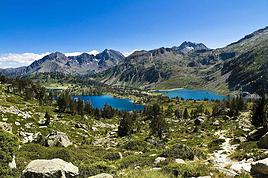
A Soupente, dans les Montagnes bleues, la canicule frappait fort...Pénélope continuait de filer le lin de sa boutique, tandis qu'Ulysse préparait activement sa traversée de juillet...
Son sac le démangeait...il l'avait fait et refait plusieurs fois...(symptôme déclencheur chez le marcheur au long cours...)
L'horizon des Montagnes bleues le narguait chaque matin et bien qu'il ait épuisé les sentiers de moyenne altitude environnants, il sentait son addiction le démanger: il fallait qu'il reprenne la route.
Le compostelle passait à huit kilomètres de soupente, il eût été facile de remettre ses pas dans ses traces, mais il n'avait pas l'habitude de répéter deux fois le même itinéraire...
D'autres arguments le faisaient réfléchir: Juillet-Août est l'époque où les sentiers sont surpeuplés: il lui fallait dénicher un GR suffisamment austère et rébarbatif pour éloigner le vacancier, suffisamment désertique et "grands espaces" pour lui rappeler l'Afrique et ses paysages désolés, suffisamment de moyenne altitude pour que la canicule ne l'atteigne pas...
Il profitait de la fraîcheur des matinées pour parcourir son kilomètre de bassins et entretenir ses muscles longs...mais il fallait toute la fraîcheur enfouie derrière les volets clos pour supporter les 34 degrés de ce juillet torride.
Grand Tour du Mercantour ou Grand Tour du Larzac ? il avait encore deux jours pour mûrir sa décision, la liste des refuges et des gîtes d'étape était prête, il fallait qu'il décide de l'orientation de ses réservations.
Autant il craignait le surbooking dans le Champsaur, autant il semblait rassuré de rêver de La Couvertoirade et de la Cavalerie...
Why bike (MTB) along the canal between the Two Seas: the lateral canal of the Garonne from Bordeaux to Toulouse, and the Midi Canal from Toulouse to the Mediterranean?
This canal was created to connect the Mediterranean to the Atlantic without going around Spain, and along its entire length, there’s an old towpath (used to pull barges). Since this path is closed to traffic (except for service vehicles from Voies Navigables de France), no cars drive on it—it’s dangerous, noisy, and polluting. The Canal between the Two Seas was built for transporting goods, so it passes through many towns you can explore without dealing with traffic. You can stock up on supplies or spend the night. You’ll discover the varied landscapes of the countryside, always in the serenity brought by the calm and slow flow of the canal’s water. Most of the time, you’ll be in the shade of trees planted to stabilize the banks with their roots. All you have to do is follow this blue—or rather green—ribbon without needing to consult a map. But the biggest advantage is that it’s flat! Of course, on the Canal du Midi, water flows from the watershed divide at Naurouze eastward to the Mediterranean and westward to Toulouse. On the lateral canal of the Garonne, water flows toward Bordeaux. But this slope is almost imperceptible, which is a huge plus when you want to travel by bike for several days with luggage.
When I say "bike," I really mean MTB because, while the towpath has been replaced in some places by a paved bike path, it mostly resembles a dirt trail—sometimes smooth, sometimes rocky, and often cluttered with roots from the magnificent trees lining it. Since the canal was classified as a UNESCO World Heritage site, improvements have been underway, but it won’t be tomorrow that you’ll be able to ride from Bordeaux to Sète on a road bike. And I’m afraid the first sections of the path will be worn out before the rest is finished. You might even run into construction work for this bike path. That’s what happened to me during the spring of 2007.
Sunday, 03/11 – Valence d'Agen 08:15 to Toulouse (Rangueil) 16:30 97 km in 8h15 (6h on the bike) I started on the recently paved path along the lateral canal of the Garonne. The first locks appeared, and as I approached Moissac, the path turned into a billiard table until Castelsarrasin. After the Cousteau port, I was back on the classic dirt towpath with its rocks, roots, and nutria holes. But not for long—soon, I hit ruts left by backhoes and bulldozers, which, fortunately, were resting for the Sunday. A pile of rubble taller than me blocked the entire width of the path. I didn’t want to turn back to find the previous bridge and ride on the other bank, which was just as impassable (dense grass). It wasn’t easy to carry a bike with full panniers, so I lifted it over several mounds. I kept going, sometimes on foot, unsure how far the construction extended. Another bulldozer—luckily, the ground was dry. The work went all the way to Montech, making the path impassable. I recommend taking the N113, which runs parallel (that’s what I did on the way back). In Montech, the famous water slope was at rest, waiting for tourists. For many kilometers, I was back on the traditional towpath. The closer I got to Toulouse, the better the surface became, and the more cyclists and pedestrians I saw—until the city center, where there was nonstop bike traffic, especially students heading to Rangueil.
Monday, 03/12 – Rangueil 09:10 to Revel 16:30 86 km in 7h20 (5h30 on the bike) As soon as you reach Toulouse, you make a 90° turn to follow the connection between the lateral canal and the Canal du Midi. Heading east, you pass the barge selling the famous Toulouse violet souvenirs. A real bike path has been built for 50 km to Port Lauragais. It’s a true joy for Toulousains and travelers. Restrooms have been installed or shared with highway rest areas, allowing you to refill water (of course, bikes are banned from ASF rest areas, but cleverly placed racks let you secure your bike and walk in). At Port Lauragais, it’s another rest area shared by highway users, cyclists, and boaters. You’ll find a cafeteria, restaurant, hotel, and a shop selling regional souvenirs. But the real pleasure is reaching the watershed divide at Naurouze, where water flows toward the Mediterranean on one side and the Atlantic on the other. There, I decided to leave the Canal du Midi, which continues toward Castelnaudary with a much rougher towpath, to follow the *Rigole* that feeds the canal with water from the Saint-Ferréol basin. For me, it was like returning to the source—a bit like a pilgrimage in honor of the brilliant Pierre-Paul Riquet, the designer of this magnificent work. I followed the service trail along the *Rigole*. It’s actually a variant of the GR 653, leading to Revel alongside this artificial waterway. It’s fed by water from the Montagne Noire, and I was worried about a steep climb. But that wasn’t the case—the *Rigole* winds for 40 km, flowing gently under the trees. It was better than a dream: a smooth dirt path with the crunch of pine needles under the wheels, where I only crossed paths with a few fishermen... And to soothe sore buns, the last kilometers were on packed earth—a paradise (ATVs, stay away!). More walkers and cyclists appeared there.
Tuesday, 03/13 After a restful night in Revel, I started the morning with a walk around Lake Saint-Ferréol. A very pleasant 10 km hike, but I don’t recommend it for mountain bikers unless you’re used to mountain terrain and have strong calves. Otherwise, you can take the road—there are at least two hotels near the lake. In the afternoon, I began the return trip to Tarn-et-Garonne via the same path, with the same pleasure.
Total: 378 km of suffering and bliss, for which I must thank the departmental and regional councils for their funding, Voies Navigables de France for maintenance, and the volunteers who mark the hiking trails. And don’t you think you’re exaggerating a bit with your 378 km of bliss and the paradise of the *Rigole*?
Okay, fine—it wasn’t always idyllic. Sometimes the path was downright *pierrique*... but I had great weather, and the landscapes were so beautiful (water, sun, vegetation). In the rain or mud, it would’ve been less fun. What does *pierrique* even mean?
*Pierrique* is worse than rocky. I know a Pierrick, and he’s tough. And why *Facteur4*?
It’s France’s goal to reduce greenhouse gas emissions by a factor of 4 by 2050. I’m doing my part by biking to work 3 out of 4 times. And your cassoulet?
Guilty as charged. I ate the best cassoulet of my life at the Hôtel du Midi in Revel. But it was very productive in methane. My stomach hurt so much I couldn’t sleep and ended up writing my postcards between 3 and 4 AM. So many great memories!
This canal was created to connect the Mediterranean to the Atlantic without going around Spain, and along its entire length, there’s an old towpath (used to pull barges). Since this path is closed to traffic (except for service vehicles from Voies Navigables de France), no cars drive on it—it’s dangerous, noisy, and polluting. The Canal between the Two Seas was built for transporting goods, so it passes through many towns you can explore without dealing with traffic. You can stock up on supplies or spend the night. You’ll discover the varied landscapes of the countryside, always in the serenity brought by the calm and slow flow of the canal’s water. Most of the time, you’ll be in the shade of trees planted to stabilize the banks with their roots. All you have to do is follow this blue—or rather green—ribbon without needing to consult a map. But the biggest advantage is that it’s flat! Of course, on the Canal du Midi, water flows from the watershed divide at Naurouze eastward to the Mediterranean and westward to Toulouse. On the lateral canal of the Garonne, water flows toward Bordeaux. But this slope is almost imperceptible, which is a huge plus when you want to travel by bike for several days with luggage.
When I say "bike," I really mean MTB because, while the towpath has been replaced in some places by a paved bike path, it mostly resembles a dirt trail—sometimes smooth, sometimes rocky, and often cluttered with roots from the magnificent trees lining it. Since the canal was classified as a UNESCO World Heritage site, improvements have been underway, but it won’t be tomorrow that you’ll be able to ride from Bordeaux to Sète on a road bike. And I’m afraid the first sections of the path will be worn out before the rest is finished. You might even run into construction work for this bike path. That’s what happened to me during the spring of 2007.
Sunday, 03/11 – Valence d'Agen 08:15 to Toulouse (Rangueil) 16:30 97 km in 8h15 (6h on the bike) I started on the recently paved path along the lateral canal of the Garonne. The first locks appeared, and as I approached Moissac, the path turned into a billiard table until Castelsarrasin. After the Cousteau port, I was back on the classic dirt towpath with its rocks, roots, and nutria holes. But not for long—soon, I hit ruts left by backhoes and bulldozers, which, fortunately, were resting for the Sunday. A pile of rubble taller than me blocked the entire width of the path. I didn’t want to turn back to find the previous bridge and ride on the other bank, which was just as impassable (dense grass). It wasn’t easy to carry a bike with full panniers, so I lifted it over several mounds. I kept going, sometimes on foot, unsure how far the construction extended. Another bulldozer—luckily, the ground was dry. The work went all the way to Montech, making the path impassable. I recommend taking the N113, which runs parallel (that’s what I did on the way back). In Montech, the famous water slope was at rest, waiting for tourists. For many kilometers, I was back on the traditional towpath. The closer I got to Toulouse, the better the surface became, and the more cyclists and pedestrians I saw—until the city center, where there was nonstop bike traffic, especially students heading to Rangueil.
Monday, 03/12 – Rangueil 09:10 to Revel 16:30 86 km in 7h20 (5h30 on the bike) As soon as you reach Toulouse, you make a 90° turn to follow the connection between the lateral canal and the Canal du Midi. Heading east, you pass the barge selling the famous Toulouse violet souvenirs. A real bike path has been built for 50 km to Port Lauragais. It’s a true joy for Toulousains and travelers. Restrooms have been installed or shared with highway rest areas, allowing you to refill water (of course, bikes are banned from ASF rest areas, but cleverly placed racks let you secure your bike and walk in). At Port Lauragais, it’s another rest area shared by highway users, cyclists, and boaters. You’ll find a cafeteria, restaurant, hotel, and a shop selling regional souvenirs. But the real pleasure is reaching the watershed divide at Naurouze, where water flows toward the Mediterranean on one side and the Atlantic on the other. There, I decided to leave the Canal du Midi, which continues toward Castelnaudary with a much rougher towpath, to follow the *Rigole* that feeds the canal with water from the Saint-Ferréol basin. For me, it was like returning to the source—a bit like a pilgrimage in honor of the brilliant Pierre-Paul Riquet, the designer of this magnificent work. I followed the service trail along the *Rigole*. It’s actually a variant of the GR 653, leading to Revel alongside this artificial waterway. It’s fed by water from the Montagne Noire, and I was worried about a steep climb. But that wasn’t the case—the *Rigole* winds for 40 km, flowing gently under the trees. It was better than a dream: a smooth dirt path with the crunch of pine needles under the wheels, where I only crossed paths with a few fishermen... And to soothe sore buns, the last kilometers were on packed earth—a paradise (ATVs, stay away!). More walkers and cyclists appeared there.
Tuesday, 03/13 After a restful night in Revel, I started the morning with a walk around Lake Saint-Ferréol. A very pleasant 10 km hike, but I don’t recommend it for mountain bikers unless you’re used to mountain terrain and have strong calves. Otherwise, you can take the road—there are at least two hotels near the lake. In the afternoon, I began the return trip to Tarn-et-Garonne via the same path, with the same pleasure.
Total: 378 km of suffering and bliss, for which I must thank the departmental and regional councils for their funding, Voies Navigables de France for maintenance, and the volunteers who mark the hiking trails. And don’t you think you’re exaggerating a bit with your 378 km of bliss and the paradise of the *Rigole*?
Okay, fine—it wasn’t always idyllic. Sometimes the path was downright *pierrique*... but I had great weather, and the landscapes were so beautiful (water, sun, vegetation). In the rain or mud, it would’ve been less fun. What does *pierrique* even mean?
*Pierrique* is worse than rocky. I know a Pierrick, and he’s tough. And why *Facteur4*?
It’s France’s goal to reduce greenhouse gas emissions by a factor of 4 by 2050. I’m doing my part by biking to work 3 out of 4 times. And your cassoulet?
Guilty as charged. I ate the best cassoulet of my life at the Hôtel du Midi in Revel. But it was very productive in methane. My stomach hurt so much I couldn’t sleep and ended up writing my postcards between 3 and 4 AM. So many great memories!
Bonjour
Nous envisageons un séjour à partir du 14 Juillet ou même un peu avant, aux alentours de Sarlat, à Daglan exactement. Outre tout ce que peut offrir ce coin qui à l'air superbe, et que j'ai hâte de découvrir, je voudrais savoir si le soir des animations de rues, des festivités musicales ou encore des marchés nocturnes sont présents ? quelques kilomètres en voiture ne nous dérangent pas disons dans un périmètre de 20km. Merci pour vos réponses.
Nous envisageons un séjour à partir du 14 Juillet ou même un peu avant, aux alentours de Sarlat, à Daglan exactement. Outre tout ce que peut offrir ce coin qui à l'air superbe, et que j'ai hâte de découvrir, je voudrais savoir si le soir des animations de rues, des festivités musicales ou encore des marchés nocturnes sont présents ? quelques kilomètres en voiture ne nous dérangent pas disons dans un périmètre de 20km. Merci pour vos réponses.
événement exceptionnel avec des musiques exceptionnelles sur une terre exceptionnelle Ariège terre courage, sans oublier un public exceptionnel,
diversité musicale, d'une qualité exceptionnelle, des musiques du monde aux musiques électroniques en passant par l'a Haute Egypte avec les musiciens du Nil, la Palestine, la chanson jazz Haiti, musiques gitanes avec "Titi "Robin, swing manouche, rock déjanté, rock folk irlandais des Booze Brozers, funk rock reggae, chanson rock néerlandais, jazz punk circus avec la Danse du Chien, fusion Gnawa avec Driss Boussena ...
les Arts de la rue et du cirque pendant 3 jours, avec Okupa Mobil et pleins d'autres
troupes de théâtre de rue théâtre pour enfants, fanfares, Batoucadas,
village associatif et Forums-débats sur l"économie sociale et solidaire autour du thème de la culture, .. produits bio et mise en place du développement local .. bonne bouffe camping gratuit
a DAUMAZAN sur ARIZE, le 22, 23, 24 juillet 2005,
3 jours dans la diversité sur un site convivial riche en lien social et en couleurs ...
a ne pas rater et pour en savoir plus, visitez le site :
http ://festival.terredecouleurs.asso.fr
"la beauté du monde n'a d'égale que sa diversité "
village associatif et Forums-débats sur l"économie sociale et solidaire autour du thème de la culture, .. produits bio et mise en place du développement local .. bonne bouffe camping gratuit
a DAUMAZAN sur ARIZE, le 22, 23, 24 juillet 2005,
3 jours dans la diversité sur un site convivial riche en lien social et en couleurs ...
a ne pas rater et pour en savoir plus, visitez le site :
http ://festival.terredecouleurs.asso.fr
"la beauté du monde n'a d'égale que sa diversité "
je cherche une messe de noêl au pays basque avec des chants basques
authentiques.
merci de votre aide
FESTIVAL DÉTOURS DU MONDE / 10ÈME ÉDITION
Festival des civilisations vivantes et populaires

18, 19 et 20 juillet 2013 à Chanac (Lozère)
« 10 ans d’activisme où la richesse naît à la rencontre des différences »
Festival libre, exigeant, citoyen, dynamique et populaire d'envergure nationale, Détours du Monde invite depuis 10 ans à un voyage des sens et de l’esprit, à la découverte des cultures de la terre et de l’humain en offrant des œuvres vivantes fortes, avec une vision cosmopolite, sans frontières sociales ni ethniques. A l'occasion de ce dixième anniversaire, de nombreux rendez-vous seront proposés aux festivaliers. Une conférence-débat menée par Pierre Rabhi ouvrira le festival. Tout au long des journées des 19 et 20 juillet, conférences-débats, solos du Monde, radio Rumeurs du Monde, arts de la rue, cirque, marché artisanal... et bien d'autres choses encore seront l'occasion de découvrir d'autres cultures et d'autres modes de pensée. Durant les soirées, une grande scène musicale festive et dansante sera investie par des musiciens venant des quatre coins du monde. Enfin, spécialement mise en place pour cette édition, une scène d'ici et d'ailleurs proposera aux festivaliers de découvrir différemment les artistes grâce à une scène de rencontres, en amont des concerts en soirée ; à la fois accessible, proche et éclectique, elle sera pour les spectateurs un lieu de générosité, d'écoute et de lâcher-prise…
Programme de cette 10ème édition
JEUDI 18 JUILLET
20h30 : Conférence de PIERRE RABHI, « Invitation à l'utopie et au faire ensemble »
VENDREDI 19 JUILLET
Scène d'ici et d'ailleurs : 18h30 : Lectures de et par MAGYD CHERFI
20H00 : Ouverture des portes du Champ de la Tour Inters scènes : HUGO MENDEZ / SOFRITO (UK/Tropical) 20H45 : ANTONIO RIVAS & JOAQUIN DIAZ (Création Régionale – Colombie/République Dominicaine) 22H30: BONGA (Angola/Portugal) 00H30: LA TROBA KUNG FU & GUEST (Catalogne) 01h30: HUGO MENDEZ / SOFRITO (UK/Tropical)
SAMEDI 20 JUILLET
Scène d'ici et d'ailleurs : 18h30 : FORABANDIT (Dialogue fertile entre troubadour occitan et asik anatolien) En partenariat avec le festival Radio France Montpellier et LR
20H00 : Ouverture des portes du Champ de la Tour Inters scènes : MATANZAS (Belgique/Latino) 20H45 : JUPITER & OKWESS INTERNATIONAL (République Démocratique du Congo) 22H30: MULATU ASTATKE & GUEST (Éthiopie) 00H30: VIOLONS BARBARES (Mongolie/Bulgarie) 1h30: MATANZAS (Belgique/Latino)
Pour plus d'informations sur la programmation, rendez-vous sur notre site : www.detoursdumonde.org (billetterie en ligne)
Tarifs :19&20 juillet : 1 soirée 21€ / Pass 2 jours 35€ Scènes d'ici et d'ailleurs : 1 entrée 5 € pour les spectateurs n’ayant pas acheté le billet du jour ou le pass 2 jours donnant accès aux concerts du soir Entrées gratuites pour les moins de 15 ans
18, 19 et 20 juillet 2013 à Chanac (Lozère)
« 10 ans d’activisme où la richesse naît à la rencontre des différences »
Festival libre, exigeant, citoyen, dynamique et populaire d'envergure nationale, Détours du Monde invite depuis 10 ans à un voyage des sens et de l’esprit, à la découverte des cultures de la terre et de l’humain en offrant des œuvres vivantes fortes, avec une vision cosmopolite, sans frontières sociales ni ethniques. A l'occasion de ce dixième anniversaire, de nombreux rendez-vous seront proposés aux festivaliers. Une conférence-débat menée par Pierre Rabhi ouvrira le festival. Tout au long des journées des 19 et 20 juillet, conférences-débats, solos du Monde, radio Rumeurs du Monde, arts de la rue, cirque, marché artisanal... et bien d'autres choses encore seront l'occasion de découvrir d'autres cultures et d'autres modes de pensée. Durant les soirées, une grande scène musicale festive et dansante sera investie par des musiciens venant des quatre coins du monde. Enfin, spécialement mise en place pour cette édition, une scène d'ici et d'ailleurs proposera aux festivaliers de découvrir différemment les artistes grâce à une scène de rencontres, en amont des concerts en soirée ; à la fois accessible, proche et éclectique, elle sera pour les spectateurs un lieu de générosité, d'écoute et de lâcher-prise…
Programme de cette 10ème édition
JEUDI 18 JUILLET
20h30 : Conférence de PIERRE RABHI, « Invitation à l'utopie et au faire ensemble »
VENDREDI 19 JUILLET
Scène d'ici et d'ailleurs : 18h30 : Lectures de et par MAGYD CHERFI
20H00 : Ouverture des portes du Champ de la Tour Inters scènes : HUGO MENDEZ / SOFRITO (UK/Tropical) 20H45 : ANTONIO RIVAS & JOAQUIN DIAZ (Création Régionale – Colombie/République Dominicaine) 22H30: BONGA (Angola/Portugal) 00H30: LA TROBA KUNG FU & GUEST (Catalogne) 01h30: HUGO MENDEZ / SOFRITO (UK/Tropical)
SAMEDI 20 JUILLET
Scène d'ici et d'ailleurs : 18h30 : FORABANDIT (Dialogue fertile entre troubadour occitan et asik anatolien) En partenariat avec le festival Radio France Montpellier et LR
20H00 : Ouverture des portes du Champ de la Tour Inters scènes : MATANZAS (Belgique/Latino) 20H45 : JUPITER & OKWESS INTERNATIONAL (République Démocratique du Congo) 22H30: MULATU ASTATKE & GUEST (Éthiopie) 00H30: VIOLONS BARBARES (Mongolie/Bulgarie) 1h30: MATANZAS (Belgique/Latino)
Pour plus d'informations sur la programmation, rendez-vous sur notre site : www.detoursdumonde.org (billetterie en ligne)
Tarifs :19&20 juillet : 1 soirée 21€ / Pass 2 jours 35€ Scènes d'ici et d'ailleurs : 1 entrée 5 € pour les spectateurs n’ayant pas acheté le billet du jour ou le pass 2 jours donnant accès aux concerts du soir Entrées gratuites pour les moins de 15 ans
Bonjour,
Après avoir regardé les destinations possibles par easyJet depuis Genève, j'ai vu qu'il était possible de me rendre mi-avril à Bordeaux, Nice et Toulouse, en à peine plus d'une heure d'avion, donc c'est quelque chose qui nous botte bien, ma copine et moi (21 ans).
A partir de là, je me pose donc une question fatidique : quelle destination privilégiée ? Je demande alors aux personnes qui résident, ou sont déjà parties là-bas, de me dresser un petit classement de ces trois villes en fonction du coût de la vie, du climat, du bien-être à cette période...
Veuillez noter que nous partirions pour 3/4 jours, et que nous ne comptons pas louer de voiture une fois sur place. Merci d'avance pour votre objectivité, et ne vous fiez pas au classement de L1 😄
PS : à savoir que l'aller-retour pour Bordeaux est 100€ plus cher que les deux autres déjà !
Après avoir regardé les destinations possibles par easyJet depuis Genève, j'ai vu qu'il était possible de me rendre mi-avril à Bordeaux, Nice et Toulouse, en à peine plus d'une heure d'avion, donc c'est quelque chose qui nous botte bien, ma copine et moi (21 ans).
A partir de là, je me pose donc une question fatidique : quelle destination privilégiée ? Je demande alors aux personnes qui résident, ou sont déjà parties là-bas, de me dresser un petit classement de ces trois villes en fonction du coût de la vie, du climat, du bien-être à cette période...
Veuillez noter que nous partirions pour 3/4 jours, et que nous ne comptons pas louer de voiture une fois sur place. Merci d'avance pour votre objectivité, et ne vous fiez pas au classement de L1 😄
PS : à savoir que l'aller-retour pour Bordeaux est 100€ plus cher que les deux autres déjà !
Bonjour,
nous avions envisagé pour Mai 2009 de traverser les départements des Landes et de la Gironde via les voies vertes de : Soustons à Pontenx-les-Forges Parentis en Born à Arcachon Biganos à Le Nizan
Voies vertes qui traversent le coeur du massif forestier landais
Mais, suite à la tempête Klaus de janvier 2009 et aux énormes dégâts causés sur la forêt landaise, sauriez-vous : si ça passe ? si ces axes verts font partie des axes prioritaires à déblayer ? si ces voies vont servir de "pistes de débardage" et de sortie des bois pour les forestiers et donc être interdites au publics ? si des déviations sont mises en place ? et si oui, par où ?
Merci aux locaux pour leur aide...
Mais, suite à la tempête Klaus de janvier 2009 et aux énormes dégâts causés sur la forêt landaise, sauriez-vous : si ça passe ? si ces axes verts font partie des axes prioritaires à déblayer ? si ces voies vont servir de "pistes de débardage" et de sortie des bois pour les forestiers et donc être interdites au publics ? si des déviations sont mises en place ? et si oui, par où ?
Merci aux locaux pour leur aide...