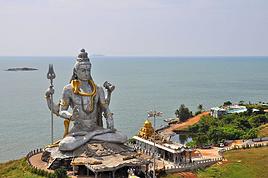
Hi everyone, I just got back from a trip to Northern India with my family. Given the time it took to organize, I thought future travelers might find this useful.
Context: First time in India. Dates: August 5 to August 23. 2 adults + 2 boys (17 and 11 years old). Itinerary: Delhi - Shekawati (Bagar, Mandawa) - Bikaner - Thar Desert (Kaku) - Jaisalmer - Jodhpur - Udaipur - Bundi - Jaipur - Agra - Delhi. High-end hotels, travel in a Toyota Innova (like a Renault Espace) with a driver. Agency: Atithi Travels, contact: Rajeev, Driver: William. Budget: 3112 € for flights (Air India chartered by Air France and booked through Go Voyages), 1080 US$ per person for hotels with breakfast, car with driver, full-board night in the desert, camel ride, boat on the lake in Udaipur, farewell dinner, 1000 € for on-site expenses (drinks and meals—1 per day / various tips including driver (150 rupees per day) / monuments and outings / personal shopping and gifts (including 2 carpets 1x2m, 1 bedspread, a pair of curtains, 10 shirts, 2 pairs of pants, 2 tablecloths, 5 scarves, 1 small piece of jewelry, and various trinkets...). In short, about 1900 € per person all-inclusive for 17 nights.
Review of Atithi Travels: Very professional and accommodating. They responded quickly to my many prep emails, accepted all my hotel choices—even those they weren’t used to working with (I picked them beforehand using TripAdvisor, VoyageForum, the *Routard* guide, and Ulysses’ Rajasthan guide). They were the only agency out of the nine I consulted that accepted all my choices. Their pricing was reasonable, in the first quartile of the agencies I contacted. They allowed payment in three installments (1/3 at booking by bank transfer, 1/3 upon arrival in India, 1/3 in Udaipur). They checked in throughout the trip to ensure everything was going well with the driver and local reps. They offered a great solution for the night in the desert. My direct contact (Rajeev) personally picked us up at Delhi airport on the evening of the 5th (a Sunday).
If I had to do it again, I’d go with Atithi again without hesitation—just negotiate the prices a bit.
Review of the Driver (William): He drove very cautiously (which is super important in this country). He kept his distance from his "guests," which worked perfectly for us. No hard sell to take us to shops or restaurants. Just so you know, the driver gets 150 rupees per day for lodging and meals. When he stops at a tourist restaurant, especially on the road, he eats for free (for you, if you eat there, it’s 2–3 times more expensive than elsewhere). Some shops, especially in Jaipur, give him commissions. Overall, we had an unspoken agreement. The driver would stop halfway through the journey at a tourist restaurant so we could use clean toilets, grab a Coke, and he could eat and rest (after 2.5 hours on the road in India, it’s well-deserved and necessary). After 30 minutes, we’d hit the road again. For shops, he didn’t pressure us, and we were very clear about stopping only at places we’d chosen (via Lonely Planet, for example). Overall, we were happy with his service.
Review of the Stops:
Generally speaking, in very touristy places, you’re constantly approached by touts and vendors. As soon as you move away from those spots, Indians are welcoming, friendly, and happy to chat with foreigners.
Between each stop, it’s 4–6 hours because the roads are tough—average speed is 50 km/h. Keep this in mind when planning your route. We chose to stay 2 nights in most places to avoid spending all our time in the car. Delhi: Worth seeing, but rough for a first impression—loud in some areas, aggressive, but we don’t regret it. For our first taste of Indian cuisine, we dined at United Coffee House on Connaught Place, a restaurant for the Indian middle class. It was delicious, really nice, and reassured us that we’d enjoy the food. Shekawati: Amazing, off the beaten path, not very touristy, and the people are friendly. Note: Bagar, which we picked after reading an article in *Ulysses*. It’s off the usual routes. Result: we were the only tourists in this small town and had a fantastic evening. Mandawa (just an hour from Bagar) is on all the Shekhawati circuits, so it’s more touristy. But still nice because of the colorful Havelis (go see them alone, without clingy guides trying to charge you extra for every visit without giving all the details—only the rupees matter to them). Note: there’s a great, affordable cobbler on the main street of Mandawa (Main Bazaar), just before Sonathia Gate on the right. Beautiful handmade slippers for 300 rupees. By the end of the trip, I regretted not buying more pairs—the leather is so soft and comfortable. I haven’t seen any as nice since. Bikaner: Good, a necessary stop before crossing the desert if you’re heading to Jaisalmer (recommended). It lets you see the Karni Mata Temple (Temple of the Rats), a camel farm, a first Jain temple, a quiet spice bazaar (take a rickshaw for a morning), and the well-maintained fort. Kaku (night in the Thar Desert): A highlight, absolutely must-do. Nothing like what you’ll find in Jaisalmer. Simple, remote, and wild—no tourist buses, just you and the few Indians taking care of you. Watching the sunset, the starry sky, shooting stars, and sleeping under the stars is unforgettable. It’s neither too cold nor too hot. The toilet facilities are basic but hygienic. It’s fantastic, and the whole family loved it. Jaisalmer: Very exotic, at the edge of Rajasthan, right out of the Thar Desert. A magical little town. Watch the sunset near the cenotaphs, visit Gadi Sagar for a picturesque stop with a temple by the lake, lots of Indians feeding huge catfish, and pedal boats for rent. Nearby, the best lassi of the trip at "Mohan Juice Center." Don’t miss the three Havelis—take the back streets if you want to avoid the touristy areas.
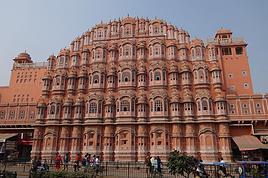
As for the classic camel ride at sunset, know that the dune spots are beautiful, but at the same spot, at the same time, hundreds (no exaggeration) of tourists arrive by the busload, each on their own camel (hundreds of them), with vendors selling drinks, trinkets, and impromptu shows. It kills the dream. Jodhpur: The Mehrangarh Fort is EXCEPTIONAL, very well maintained, with a great audio guide in French. The most beautiful fort/palace visit of the whole trip. The restaurant inside is excellent. Spend a morning there, and don’t forget to visit the temple at the end of the ramparts for a top-notch view of the Blue City. Around the Clock Tower, you can try delicious, fresh lassis at Shri Mishrilal Hotel, mostly frequented by locals, and grab a tasty masala omelet on the go at Vicky’s Omelette Shop—he’s always smiling and collects notebooks full of messages from his customers. We found beautiful cashmere scarves at Handloom House, a fixed-price shop with good prices. Ranakpur: Another highlight. An exceptional Jain temple in the middle of nature. We chatted with the high priest, ate in the refectory at 5 PM (meals at 5, 5:30, and 6 PM) with locals (super good, all-you-can-eat for 20 rupees per person). Our only regret: not staying overnight. For just 50 rupees more, you can sleep in simple but clean cells and attend the evening ceremony, see the temple at sunset (otherwise, it closes at 5 PM), and be alone in the middle of nowhere. It’s also a lush place full of non-aggressive monkeys that take what you give them from your hand. Don’t miss it under any circumstances. Udaipur: Unique and charming, our first glimpse of Ghats on this trip with Indians bathing in the morning and doing laundry. The lake is enchanting, and the Hindu temple is special. Dinner at Jagat Niwas Palace Hotel (where we were staying) with a stunning view of the lake. Very good food, reasonable prices, and an exceptional setting. Bundi: First regret. A charming little town off the tourist trail, but dull after Shekawati. Not much to see. Jaipur: Second regret. VERY aggressive, overcrowded, with glaring poverty in the streets, persistent beggars, relentless vendors, deafening traffic, and endless traffic jams. The Hawa Mahal is on a polluted main road, and the Amber Fort is a tourist trap. It’s poorly maintained, and the elephant ride is the ultimate tourist attraction: hundreds of tourists on elephants in a line, 550 rupees for 2 people for a 10-minute ride, with vendors shouting the whole way while the elephant handler reminds you 10 times to tip him. Tourism at its worst. Don’t go unless you’re with young kids who’ll remember riding an elephant forever. Even then, it’s possible in other cities like Udaipur. Don’t believe your driver if he says not to shop before Jaipur because that’s where the best selection and prices are. It’s false. There’s no more selection (except for jewelry), prices aren’t lower, and the quality isn’t better. It’s just a big city with lots of shops that pay commissions to touts. Still, there’s a beautiful textile shop that doesn’t look like much but has fixed prices, is affordable, and offers superb quality: SOMA (http://www.somashop.com/). The local middle and upper classes shop there for home textiles (tablecloths, bedspreads, sheets, curtains) and clothes. This shop is even mentioned by *Forbes* as one of the "World's Top Shops" (http://www.forbes.com/..._sb_1215feat_ls.html).
The one positive in Jaipur: Raj Mandir, a historic, stunning cinema. You can go with your eyes closed—guaranteed atmosphere with Indians cheering, laughing, and taking sides for the characters. Even without speaking the language, we understood everything and had a great family moment. Plus, there’s an intermission to grab a snack. It’s fantastic. The theater is often full, but you can reserve. Nearby, the Galta Temple is picturesque with hundreds of monkeys and kids bathing in the pools. Fun, especially in the late afternoon.
If we had to do it again, we’d skip Jaipur—too noisy, too aggressive. Agra: Just before Agra, stop at Fatehpur Sikri. The visit takes about 3 hours. It’s beautiful. I regret not staying overnight to admire Akbar the Great’s city at sunset.
In Agra, the Taj Mahal is king. Our best photos were taken from the Yamuna River. From there, the Taj is stunning (its back = its front), and you can stay as long as you want (it’s free). The next day, we visited at 6 AM and stayed for 4 hours—it was peaceful and gorgeous.
Overall, we would’ve liked one more night in Ranakpur, one more in Udaipur, one in Fatehpur Sikri, and just one in Jaipur to see the Hawa Mahal and go to the Raj Mandir.
Review of the Hotels
Delhi / Amaraya Haveli: Clean and nice, run by two French people in a quiet neighborhood of New Delhi. Comfortable rooms, good breakfast, clean, a bit pricey.
Satisfaction rating: 3 out of 5
Bagar / Piramal Haveli: A charming stop, a Haveli from the early 20th century, with very large rooms, warm and attentive service, and a GREAT dinner. All for a modest price since it’s off the tourist trail. Highly recommend.
Satisfaction rating: 5 out of 5
Mandawa / Desert Resort: Outside the city, at the edge of the desert. Rooms are in "traditional" huts with all the comforts. There’s a pool, and it’s very quiet. Breakfast is mediocre. Avoid dinner—it’s a rip-off (three times more expensive than elsewhere and not good).
Satisfaction rating: 4 out of 5
Bikaner / Lallgarh Palace: Former maharaja’s palace, well maintained, gorgeous rooms with marble everywhere, a large art-deco indoor pool, good restaurant, very classy. Worth the price.
Satisfaction rating: 5 out of 5
Jaisalmer / Gorbandh Palace: Large modern hotel mimicking local architecture. Big pool, but the rooms are poor—noisy and small. Mediocre breakfast.
Satisfaction rating: 2 out of 5
Jodhpur / Ajit Bhawan: Former residence, very classy, Hollywood-style pool with waterfalls and fountains, comfortable rooms tastefully decorated. Great breakfast.
Satisfaction rating: 5 out of 5
Udaipur / Jagat Niwas Palace: By the lake, very charming, good food, restaurant with an exceptional view, very romantic, but the room amenities are mediocre.
Satisfaction rating: 5 out of 5
Bundi / Braj Bhushanjee: The best hotel in Bundi, in a beautifully decorated old Haveli. The rooms are mediocre and very noisy. Breakfast is average, but the welcome is warm.
Satisfaction rating: 2 out of 5
Jaipur / Samode Haveli: Exceptional, very comfortable, gorgeous pool, spacious rooms, attentive and non-pushy service, free Wi-Fi, beautiful restaurant, great breakfast.
Satisfaction rating: 5 out of 5
Agra / Howard Park Plaza: A mid-range chain hotel with a small pool. Comfortable enough, limited service, terrible breakfast.
Satisfaction rating: 1 out of 5
If this feedback was helpful, feel free to leave me a message.
Thierry
42 similar discussions in English
For those planning a trip to Kerala, here’s a quick, practical summary.
For the most part: the stunning landscapes, the natural kindness of the locals, their cuisine, and their culture—you’ll get to enjoy all of that once you’re there...
Flight (arrival and departure to/from Cochin)
Avoid Air India and opt for flights via the Middle East: Saudi Arabia, Qatar, United Arab Emirates, Oman, etc.
Price: between 500 € and 600 €
Accommodations
Average price: 20 € per night for a couple (max: 40 €, min: 10 €, often including breakfast), via the usual booking sites.
Homestays (staying in the owner’s house) are of a higher standard.
Only 2 nights were spent in questionable cleanliness. The rest were good, even very good, or even *very* very good.
Car with Driver
All-inclusive daily price: tolls, fuel, driver’s lodging and meals... and of course, we often shared our meals with our driver too.
Toyota sedan (e.g., Corolla) for 4 travelers (1 in front, 3 in the back): 50 € / day,
Toyota SUV (e.g., Innova) for up to 6 travelers: 60 € / day
DM me if you’d like more details.
Overall budget (excluding flights and shopping) Around 1500 € for 1 couple for the 3 weeks... in "2-couple mode"! (i.e., sharing the driver’s cost). Itinerary
Night 1: Arrival in Cochin in the morning, departure for Attirappily Beautiful waterfalls
Night 2: Thrissur Via Vallachira, not much tourist interest, a stop to ease into the trip and shorten the journey to Wayanad
Nights 3, 4, 5: Wayanad, staying in Sultan Battery Coffee and tea plantations, dam lake, URAVU (bamboo craft workshop), ...
Night 6: Ooty Botanical garden, then a really fun tourist train the next afternoon to Metupalaiyam
Night 7: Toward Coimbatore
Nights 8, 9, 10: Munnar City visit, stunning tea plantations
Nights 11, 12: Thekkady/Kumilly Amazing tea plantations, sightseeing, Jeep ride, not-so-interesting boat tour on Periyar Lake, trekking options
Night 13: Marari Beach (near Alleppey) 4-hour backwaters tour, then beach (swimming, dinner)
Nights 14, 15, 16: Munroe Island Super chill, walks around the island (small coir rope factory), sunrise by boat or canoe, sunset
Night 17: Varkala Gorgeous beaches, shopping
Night 18: Trivandrum City center visit, then train back to Cochin the next day in 3 hours.
Night 19: Cochin Fort Kochi is a lovely way to wrap up the trip
Have a great trip in this incredible region, so unique in India!
Hello everyone!
We're off! After exploring the north, the four friends have now discovered the south. We’re excited to share this new travel journal, dedicated to our little group and our strong friendship, written by Richard and illustrated with Kate’s photos. I’ll chime in from time to time with practical tips.
First of all, a big thank you to everyone on VoyageForum who helped us plan this trip. It would’ve been quite different if we’d just relied on guidebooks.
The itinerary lasted just over 3 weeks: Mahabalipuram, Pondicherry, Thanjavur, the Chettinad region, Madurai, Munnar, Munroe Island, Cochin, and Chennai. We traveled by train, taxi, and private car with a driver, took a domestic flight, and stayed in guesthouses, Airbnb apartments, and hotels. For each of us, including flights, the total budget barely reached 2000 €, and we didn’t hold back—knowing we avoid resorts and love street food and small Indian restaurants.
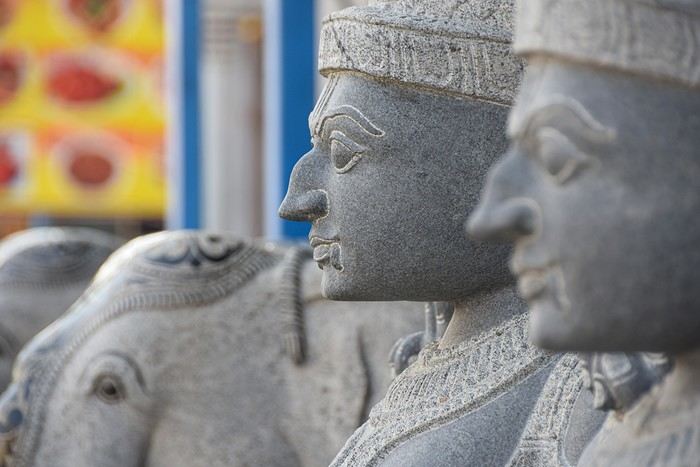
We're off! After exploring the north, the four friends have now discovered the south. We’re excited to share this new travel journal, dedicated to our little group and our strong friendship, written by Richard and illustrated with Kate’s photos. I’ll chime in from time to time with practical tips.
First of all, a big thank you to everyone on VoyageForum who helped us plan this trip. It would’ve been quite different if we’d just relied on guidebooks.
The itinerary lasted just over 3 weeks: Mahabalipuram, Pondicherry, Thanjavur, the Chettinad region, Madurai, Munnar, Munroe Island, Cochin, and Chennai. We traveled by train, taxi, and private car with a driver, took a domestic flight, and stayed in guesthouses, Airbnb apartments, and hotels. For each of us, including flights, the total budget barely reached 2000 €, and we didn’t hold back—knowing we avoid resorts and love street food and small Indian restaurants.
Prologue
This journal recounts a trip to Rajasthan that’s already over a year old and that I’ve only now found the chance to write about. The summer of 2024 marked my return to India—my tenth trip—after six long years away since my last solo wanderings in Tamil Nadu in 2018 (the journal of which is published on this site). That absence was partly (but not only) due to the long COVID and post-COVID period, which saw a complete halt and then a major slowdown in global tourism. To top it off, Voyage Forum announced its closure in an end-of-the-world atmosphere. A sad time for our favorite social activity…
A few weeks after returning from Rajasthan, I tried to motivate myself to start writing a journal to publish on a forum claiming to be VF’s successor, which I’d eventually signed up for out of desperation. But I kept hesitating and putting the project off because, for one, I no longer have the time I used to. For another, the vibe wasn’t really taking off on that forum—it was overrun with ads and not very active, contrary to what its host’s name suggested. Despite its good intentions and commendable role as a stopgap, it also turned out to be very impractical to use, especially when you don’t have much time like me. I’ll admit I’d occasionally check back on VF to see if anything was happening. But all the discussions remained frozen in time, stuck in that fateful year, 2020. Then, rumors swirled online about shady reasons behind its closure, leaving little room for hope.
And then, one fine morning, I got a message at work from Marien informing me that VF had reopened. What a huge surprise! Even though the forum’s “end” had played out in a somewhat apocalyptic atmosphere, the memories of passionate and heated discussions, the frank debates, and the useful exchanges that made this site a traveler’s goldmine and a unique hub of conviviality all came rushing back to me like a breath of fresh air. I finally saw a sign and tried to motivate myself to find the time to publish the journal of this tenth trip to India and fifth to Rajasthan. But in the end, I got bogged down in professional and family obligations and never managed to find the time to get started. That’s now fixed, though, because I had two reasons for wanting to do it: I find that looking back on a trip to tell others about it is a highly beneficial introspective exercise. Also, I thought this journal could be useful to other travelers on a few points.
Because, “do we really need yet another journal about Rajasthan?” you might rightly ask! Especially in a time when so many journals about the “Land of Kings” have been published since VF’s return, not to mention the countless stories you can already find online about this region, one of India’s most touristy. And I’d add, why go back to Rajasthan for a fifth time, where I’ve already dragged my feet more than enough—through its forts, deserts, temples, cities, villages, bumpy roads, train stations, tasty street food stalls, cheap guesthouses, and more? Where some might see just another overhyped tourist destination full of the same old *Arabian Nights* clichés, worn to a thread, that I mentioned earlier, when there’s so much else to see in India? Well, first because it’s a magnificent country I never tire of, where I started an academic study and made so many connections. It’s also packed with places where you won’t find a single tourist (right, Marie-Jo?), even in the heart of well-trodden paths and classic itineraries. And most importantly, as I said earlier, things have changed in recent years. First, after six years without traveling far, the urge to go back to India was getting stronger. But this time, no more solo trips (often) or duo adventures (sometimes)—now it’s a team of four that has to come along! And even if you can argue with that, what better place than Rajasthan to introduce India to people who’ve never seen it? To kids you want to amaze? Plus, traveling with your new little family to your favorite country isn’t the same as going solo in often spartan conditions that only affect you. It’s a different challenge, but ultimately probably much harder. So, is it really reasonable to take two kids to India, including a two-year-old baby? That’s one of the main goals of this journal (but not the only one)—to try to answer that question.
As you can tell, it’s not so much the destination but the slightly unusual setup of this trip that, in my opinion, will make this journal interesting. Despite my experience and expertise (yes, I dare say it) in India, there were plenty of questions before we finalized the plan and said, “Alright, let’s go!” The questions were flying for us parents. Is it wise to travel to India with a two-year-old? What would we do (it happened) if the kids got very sick? Would they be able to handle a road trip on Rajasthan’s bumpy, dusty roads using public transport? Could they handle the shock of such a different world—the dirt, poverty, pollution, noise (…and the smell, as they say), the spicy food, monkeys, mosquitoes, snakes, tigers, leopards, and so on? In short, all the clichés that I usually joke about suddenly became potential realities. Another concern: as a mixed Franco-African family (not me, but my partner and her oldest), wouldn’t we risk not always being well received, given what you sometimes hear about that in India? How would Indians react to seeing a mixed-race family, the ultimate taboo in a country of purity and social segregation, which would undoubtedly raise many questions for them? Of course, not everything went as expected… Because, as you know, with India—and what makes it charming for some—there are always complications: sometimes where you don’t expect them… and sometimes where you do. I’ll go into detail about that in the journal to come (not right away) and in the final review (even later). These experiences could be useful to travelers who find themselves in similar situations and have the same questions we did before embarking on such a journey. And maybe it’ll spark the curiosity of those who aren’t concerned and will read yet another Rajasthan journal, but with its own unique twists.
Despite my unchanged constraints, which mean I have little time to write this, I don’t want to rush the story, so I’ll take my time. There will probably be lulls. I hope that won’t stop people from coming to react, debate, share their impressions, or ask for information.
Hey there, forum friends 😉
Some of you have mentioned missing the activity on this Indian "page," so let’s try to liven things up a bit—with joy and good vibes (mandatory with me 😜). Plus, it’ll make Jojoone happy 😊.
As big lovers of India—we’ve been six times—my co-traveler husband and I decided to explore Rajasthan this time around. The reason we waited so long to come here? We were dreading the tourist crowds in this state. But thanks to the timing (late March to early April 2024, which is starting to get pretty hot) and Aleph’s great tips, we were *very* far from mass tourism.
We spent three weeks getting around on our own for transport: mostly taxis and trains.
And I’ll admit, we had a rather "Arabian Nights" experience, far from the "real" India (Marien, if you’re reading this 😉). So this travel journal makes no claims other than to share what we saw, experienced, and felt—with all our ignorance about this country (which I’m fully aware of).
But fair warning: I go overboard with emojis, and this journal is super casual because it’s the one I share, almost in "live" mode, with our loved ones.
So, if you’re here, consider yourself almost part of the family 😄.
See you soon and....
Hello,
We recently went to Rajasthan.
For the duration, I’d recommend about 3 weeks if you can, so you can explore the region at a relaxed pace.
We also wanted to experience "the real Indian life," and our driver showed us small markets, little temples, and his village near Ranakpur in the Marwar region.
For your info, here are some hotels where we stayed—there’s a huge hotel scene in Rajasthan. No need to book in advance; day by day works really well. You arrive, visit, and if you don’t like it, you just move on—it’s no problem in India. No upfront payment, and you can even negotiate on the spot with this approach, which gives you flexibility with your itinerary.
Here are some hotels we stayed at:
Madhuban in Jaipur (Haveli house) and also in Jaipur, the Khandela Haveli, which we preferred
In Jodhpur, the Kuchaman Haveli
In Ranakpur (Ranakpur Hill Resort) with a great pool
Bikaner: Hotel Laxmi Niwas
Udaipur: Hotel Savroopvilas
Jaisalmer: Hotel Rang Mahal
Here’s the itinerary we followed over nearly three weeks:
1 - When we arrived in Delhi, we headed straight north to Nawalgarh and Mandawa (towns with Havelis = painted houses). Along the way, we stopped in Jhunjhunu to see the Rani Sati Temple. We slept in Mandawa (we arrived in the evening and explored the next morning).
2 - Then we drove to Bikaner (Junagarh Fort, but if you have to choose, the forts in Jodhpur and Jaipur are more interesting in our opinion). After that, we took the road to Deshnoke (temple with sacred rats) and before that, we saw a small temple on the way with white rats. In Deshnoke, the rats move freely among people. We’re not too squeamish, so it was fine. Anyway, it was interesting to see.
3 - Next, we headed to Pushkar, where we took a camel ride (you have to negotiate the price; it varies depending on the camel’s quality, the saddle, and its decoration). One to two hours is more than enough. There’s always someone riding with you on the camel (at least that’s how it was for us). There are also things to see along the way.
4 - From Pushkar, we went to Jodhpur (Mehrangarh Fort, Clock Tower, Jaswant Thada). From Jodhpur, we visited villages (including our driver’s village, which was ideal for connecting with locals, having tea, and exploring the village with part of the community tagging along—I think we went into almost every house). We also did a train safari in the hills. Then Ranakpur (splendid Jain temple, Adinath Temple). With a bit of luck, you might spot Raikas, nomadic herders. Then Kumbhalgarh Fort, and after that, Udaipur. Along the way, we spent the night in a very small town called Jojawar at the Rawla Jojawar hotel, owned by the former Maharaja. A wonderful memory.
5 - In Udaipur (City Palace; Monsoon Palace = depends on the weather—if it’s not clear, you won’t see much, but if it is, the view is stunning).
6 - On the way to Jaipur: Sas-Bahu Temple; then in Jaipur: City Palace, Jantar Mantar, Hawa Mahal (Palace of the Winds), the Hanuman Temple, etc.
7 - Heading toward Agra, the Galta Valley with lots of monkeys. We finished with Fatehpur Sikri and then Agra. Agra is *very* touristy, so people are less friendly and can be pushy about selling things or offering their services as guides. You have to stay polite but firm and not let them sweet-talk you. Hotels are also pricier and there’s not always much choice. For the Taj Mahal (closed on Fridays), go very early in the morning when it opens. It’s best to arrive the evening before and spend the night at a hotel before visiting. Inside the Taj Mahal site, it’s already calmer. After that, we visited Akbar’s mausoleum (in Sikandra, near Agra) and the so-called "Baby Taj" (in Agra). For the Taj, I’ve heard they’re doing renovations, but it’s still a must-see.
8 - In Delhi, if you still have time, check out the Jama Masjid mosque and Mahatma Gandhi’s tomb. Also see Humayun’s Mausoleum (in the Nizamuddin East neighborhood).
In Jaisalmer (spend a night in the dunes after a camel ride), Chittorgarh, Bundi, Ranthambore Park, Orchha, and Khajuraho. Actually, you’ll have to make choices, or you’ll spend your whole vacation traveling. The average driving speed is about 50–60 km/h.
Our other trips in India: Gujarat (we love it and have been twice), Himachal Pradesh, Punjab, and also Haridwar and Varanasi. In the south, Kerala, Tamil Nadu, and Karnataka.
In some cities, we visited with a local guide (about two hours), and some spoke French or English.
One last thing that comes to mind: if you go to Jaisalmer, check out Gadi Sagar Lake. Also worth seeing: the Demoiselle Cranes in Kichan, not far from Jodhpur. These are thousands of common cranes that migrate near the region’s lakes during the winter months. A beautiful ornithological spectacle. And Kichan or Keechan.
Happy trip planning!
Jean
Hello,
We’d love some tips and suggestions for a trip to India we’re planning for February 2026:
We’re a couple in our 70s based in Canada (Montreal), and we’re planning a 3-week trip to India in February 2025.
We’re looking for a moderate pace, with comfortable but authentic and immersive accommodations, and good service.
Ideally:
Northern India (Delhi, Agra, Jaipur, Udaipur, Ranthambore) Southern India (Kerala): Cochin, backwaters (cruise), Munnar
Charming or traditional lodgings (haveli, guesthouse, small hotels), comfortable without being luxurious.
Travel by train where possible, and with a private driver for the rest, plus likely a domestic flight.
What do you think?
Hello,
We’ve already traveled to India twice before, but only for two-week stretches (2013, a loop from Mumbai including Hampi, and in 2019, Tamil Nadu). This time, we’re leaving at the end of October for nearly three months of travel—something completely new for us! We’ll arrive in Delhi and depart from Bangalore. Our goal is to explore Northern India and then head down to Kerala, taking a maximum of one flight and prioritizing trains.
Traveling for this long should let us plan longer stops to slow down the pace and fully enjoy our trip...
What are the places you’ve loved with this in mind? I’ve already thought of Gokarna... Do you have any other suggestions, especially in Northern India? Thanks in advance for your tips!
Traveling for this long should let us plan longer stops to slow down the pace and fully enjoy our trip...
What are the places you’ve loved with this in mind? I’ve already thought of Gokarna... Do you have any other suggestions, especially in Northern India? Thanks in advance for your tips!
Practical tips from my 105 days of erratic wandering in India
Day 1 (10/10/2006): arrived in Mumbai around noon. Bus No. 338 5 Rs + 5 Rs (bag) 20' to Andheri station. Train 6 Rs to Dadar. Train 41 Rs to Lonavla 2h30 Hotel Chandralok 500 Rs **
Day 2: bike rental 7 Rs/h (too expensive, normal price 2-3 Rs/h) visit to the caves of Bhaja and Karla.
Day 3: train 28 Rs to Pune 1h20 Hotel National 416 Rs *
Day 4: train 141 Rs (with reservation) to Satara 2h45 Hotel Sagar 364 Rs **
Day 5: bus 110 Rs to Pandharpur 4h Hotel Aishwarya 450 Rs ***
Day 6: bike rental 2 Rs/h
Day 7: bus 125 Rs to Ahmadnagar 4h20 Hotel Parijat 250 Rs *
Day 8: train 151 Rs (!ticket for a mini 600 km trip!) to Jalgaon 5h30 Hotel Plaza 200 Rs **
Day 9: round-trip bus 38 Rs to Ajanta 1h30 + shuttle 6 Rs 5' Site entrance 250 Rs
Day 10: train 47 Rs to Khandwa 3h + bus 40 Rs to Omkareshwar 2h Ganesh G.H. 150 Rs *
Day 11 to 13: Omkareshwar
Day 14: bus 35 Rs to Maheshwar 2h45 Akashdeep Rest House 200 Rs **
Day 15: bus 8 Rs to Dhamnod 20' bus 20 Rs to crossroads 14 km from Mandu 1h40 bus 9 Rs to Mandu 20' Ram Mandir Dharamshala 100 Rs + 5 Rs for hot water *
Day 16: bike rental 3 Rs/h
Day 17: bus 50 Rs to Indore 4h Hotel Neelam 209 Rs
Day 18 to 20: Indore + round-trip bus 30 Rs to Ujjain 1h45
Day 21: train 82 Rs to Bhopal 5h30 Hotel Ranjeet 358 Rs *
Day 22: train 10 Rs to Sanchi 1h20 Jaiswal Lodge 200 Rs + 15 Rs for hot water! *
Day 23 and 24: visit to Sanchi + bike rental to visit the caves of Udayagiri
Day 25: train 69 Rs to Jhansi 5h + tempo 5 Rs to bus station + tempo 10 Rs + 5 Rs (bag) to Orccha 25' Sri Mahant G.H. 200 Rs **
Day 26 and 27: bike rental + train 20 Rs to Datia 30' + bemo 6 Rs to city center. Return bus 15 Rs 1h15
Day 28: bus 100 Rs to Khajuraho 4h Yogi Lodge 150 Rs **
Day 29: bike rental 30 Rs/day to visit the temples
Day 30: bus 70 Rs to Satna 4h + train 56 Rs to Jabalpur 3h Hotel Banjara 350 Rs **
Day 31: bike rental 2 Rs/h and visit to the Marble Rocks (50 km round trip)
Day 32: bus 50 Rs to Mandla 3h Hotel Satyam 250 Rs ** Round-trip bus 15 Rs to Ramnagar 1h15
Day 33: bus 60 Rs to Dindori 4h + bus 45 Rs to Amarkantak 3h (hellish road) Sarvodya Lodge 250 Rs °
Day 34: Amarkantak
Day 35: bus 25 Rs to Pendra Road 1h30 + train 120 Rs + 109 Rs (reservation) to Nagpur 8h Hotel Grand 257 Rs **
Day 36 and 37: bike rental + round-trip 25 Rs to Ramtek 1h40
Day 38: train 141 Rs + 125 Rs to Hyderabad 10h Hotel 3 Castles 200 Rs ° + Hotel Suhail 200 Rs °
Day 39 to 41: stay in Hyderabad
Day 42: train 48 Rs to Warangal 3h30 Hotel Surya 410 Rs **
Day 43: 60 Rs to Vijayawada 4h15 Hotel Sindhuri 275 Rs **
Day 44: round-trip bus 21 Rs to Amaravati 2h
Day 45: train 98 Rs to Visakhapatnam 7h30! (normally 6h) Hotel Sri Sampath Residency 250 Rs **
Day 46: train 111 Rs + 95 Rs to Puri 11h30 Travellers Inn 100 Rs ° + Hotel Z 300 Rs ***
Day 47 to 52: Puri + round-trip to Konarak
Day 53: train 38 Rs to Bhubaneshwar 1h15 Hotel Upasana 275 Rs *
Day 54: train 70 Rs to Balasore 4h bus 26 Rs to Baripada 1h40 Hotel Ambika 225 Rs °
Day 55: bus 25 Rs to Balasore 1h40 train 66 Rs + 68 Rs to Calcutta 6h30 Hotel Paragon 270 Rs * Hotel Crystal 350 Rs **
Day 56 to 62: Calcutta
Day 63: 60 Rs to Bishnupur 5h Hotel Monalisa 200 Rs *
Day 64: stay in Bishnupur no bike rental!
Day 65: bus 20 Rs to Bankura 1h30 bus 20 Rs to Durgapur 1h15 bus 28 Rs to Bolpur 2h15 Hotel Nisa 150 Rs *
Day 66 and 67: visit to Bolpur/Shantiniketan. Refused bike rental at ... 100 Rs/day!!! (Communist state of Bengal!!!)
Day 68: bus 20 Rs to Sainthia bus 35 Rs to Baharampur 4h30 bus 7 Rs to Murshidabad 40' Hotel Manjusha 350 Rs **
Day 69: bike lent by the friendly hotel owner and visit to Murshidabad
Day 70: bus 8 Rs to Baharampur 35' bus 60 Rs to Malda 6h (hellish road) Hotel Pratapaditya 231 Rs **
Day 71: train 66 Rs + 70 Rs to New Jalpaiguri 4h Hotel Holydon 250 Rs °
Day 72: train 52 Rs to Darjeeling 9h30! (normally 7h) Hotel Pineridge 500 Rs **
Day 73 to 75: Darjeeling
Day 76: train to New Jalpaiguri 9h30 + overnight train 271 Rs
Day 77: Patna Hotel President 482 Rs **
Day 78: stay in Patna
Day 79: train 18 Rs to Gaya 3h10 tempo 10 Rs to Bodhgaya 30' Deep G.H. 400 Rs!! °°
Day 80: return to Patna
Day 81: round-trip train 36 Rs to Rajgir 4h! (normally 3h)
Day 82: train 75 Rs to Varanasi 5h! (normally 4h) Yogi Lodge 150 Rs *
Day 83 to 87: Varanasi
Day 88: overnight train 310 Rs to Jaipur Evergreen G.H. 250 Rs **
Day 89: bike rental 30 Rs/day round-trip to Amber
Day 90: bus 59 Rs to Sikar 2h30 bus 23 Rs to Fatehpur 1h30 Rajshri Rest House 300 Rs *
Day 91: round-trip bus 12 Rs to Mandawa 30'
Day 92: round-trip bus 17 Rs to Churu 1h30
Day 93: bus 80 Rs to Jaipur 3h30 Evergreen G.H.
Day 94: bus 105 Rs to Bundi 5h30 Shivam G.H. 200 Rs **
Day 95: bike rental 3 Rs/h
Day 96: auto-rickshaw to station 45 Rs 25' train 44 Rs + 50 Rs to Chittorgarh train 21 Rs to Udaipur (total trip 8h) Badi Haveli 330 Rs **
Day 97 to 99: Udaipur + round-trip bus 45 Rs to Ranakpur 3h30
Day 100: bus 143 Rs to Ahmedabad 5h30 Hotel Manila 300 Rs **
Day 101: Ahmedabad
Day 102: bus 99 Rs to Bhavnagar 4h30 Hotel Vrindavan 200 Rs *
Day 103: round-trip bus 22 Rs to Palitana 1h10
Day 104: bus 85 Rs! to Ahmedabad 5h30 + overnight train ? Rs (feels like the end of the trip!)
Day 105 (January 22, 2007): train 6 Rs from Dadar to Andheri 20' + bus 5 Rs + 5 Rs (bag) to International Airport 20'
More figures British Airways flight price Brussels-London-Mumbai-London-Brussels 576 € Exchange rate from 55 Rs to 58.6 Rs per euro Average room price 272 Rs/night Daily budget 11 € Chai from 1 Rs (Calcutta-Bengal) to 6/7 Rs (Rajasthan) Bottle of water from 6 Rs (Udaipur), 8 Rs (Varanasi) to 12/13 Rs Internet from 8 Rs (Warangal), 10 Rs (Calcutta, Indore, Hyderabad), 20 Rs (often) to 40/60 Rs!! (Rajasthan) Beer in a restaurant from 85/100 Rs (often) to 150/165 Rs (Varanasi/Udaipur) More details on request
More figures British Airways flight price Brussels-London-Mumbai-London-Brussels 576 € Exchange rate from 55 Rs to 58.6 Rs per euro Average room price 272 Rs/night Daily budget 11 € Chai from 1 Rs (Calcutta-Bengal) to 6/7 Rs (Rajasthan) Bottle of water from 6 Rs (Udaipur), 8 Rs (Varanasi) to 12/13 Rs Internet from 8 Rs (Warangal), 10 Rs (Calcutta, Indore, Hyderabad), 20 Rs (often) to 40/60 Rs!! (Rajasthan) Beer in a restaurant from 85/100 Rs (often) to 150/165 Rs (Varanasi/Udaipur) More details on request
Friday, November 4
My flight Barcelona - Abu Dhabi - Delhi went smoothly, it’s on time, and here I am back in India after 3 long years.
As I step off the plane, we head toward customs. It’s 3 AM, I’m tired but happy. The huge customs hall is below ground level and buzzing with people who’ve just arrived. In the end, they’re well organized—Indians to the left, foreigners to the right, and all along the hall, the customs officers’ posts, who remain very zen despite the crowd. It took me less than 2 hours to get out of the airport, which was pretty quick.
For this return trip, I got in touch with a driver from the "Lovers of India" group who was supposed to take me from the airport to Udaipur, passing through non-touristy villages like I love. This French-speaking driver had convinced me to travel by car, which was supposed to make moving from village to village easier. Two or three days before departure, I receive a message from the driver saying he was sick with a cold and sending another driver, his very kind brother who knows Rajasthan well but doesn’t speak French. I’m a bit disappointed by this message and doubtful about the driver’s sincerity, but I don’t have time to find another driver, so I stick to my plans, though I’m not at ease.
At the exit, the driver hasn’t arrived, and I wait half an hour before seeing him show up with a big smile, "Namaste." We don’t waste time and head to the car, which is clean and new.
We get to know each other in the car and hit the road toward Alwar. Along the way, we stop for lunch and to taste my first masala chai, which wakes up my taste buds.
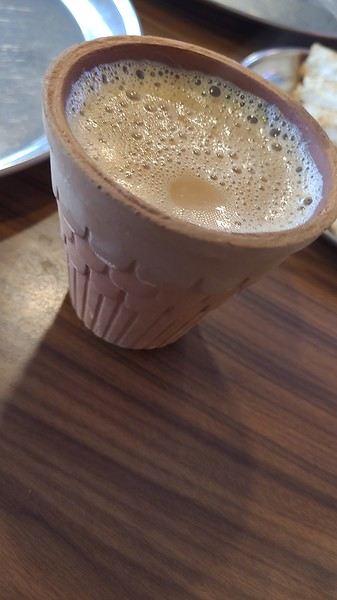
I doze off during the drive, and we arrive at the Atlantic Hotel in Alwar at 10:30 AM. My room is on the ground floor, and I settle in quickly. The Wi-Fi isn’t working, but the staff do everything they can to fix it. At noon, Gajender, the driver, suggests visiting the Qila Fort, which is on the heights of Alwar. The fort is closed for restoration, but safari tours are offered—jeep, guide, driver, and visit for 1600 Rs.
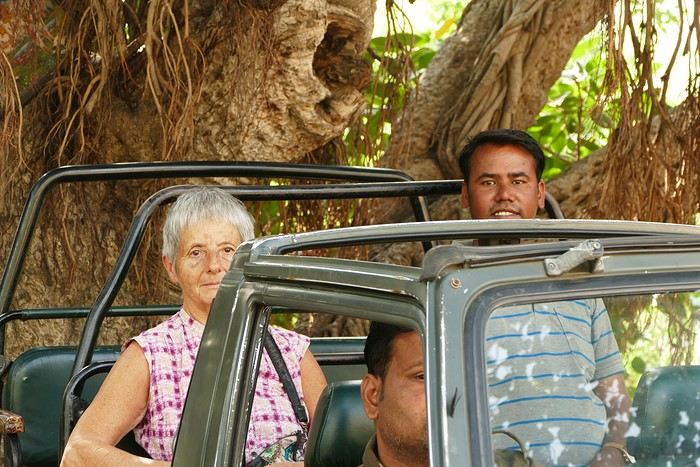
We follow the great wall, which is impressive—the second largest in India and the third in the world.
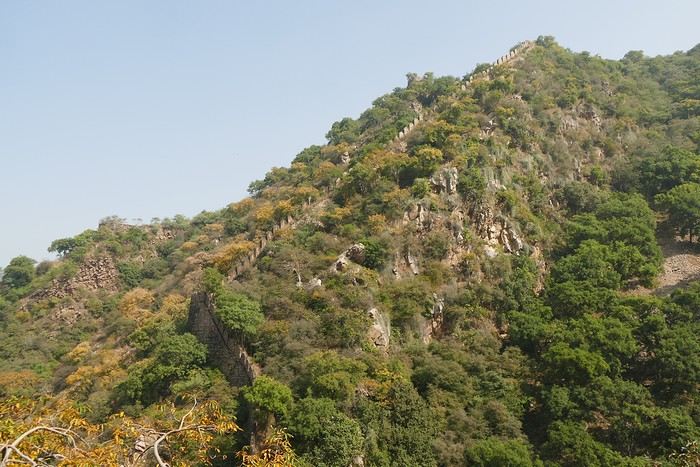
We spot peacocks and monkeys.
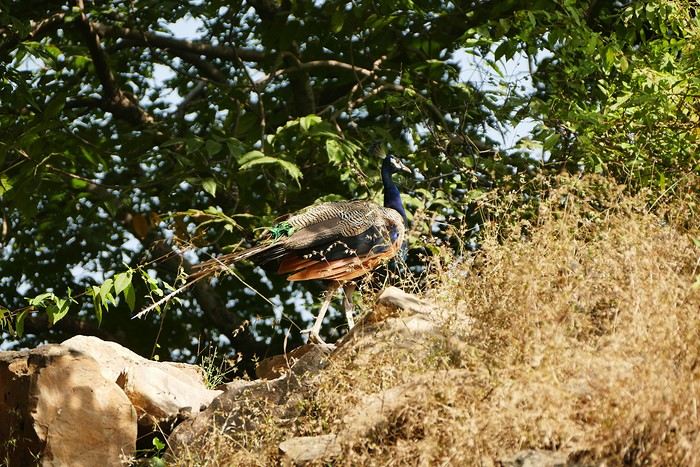
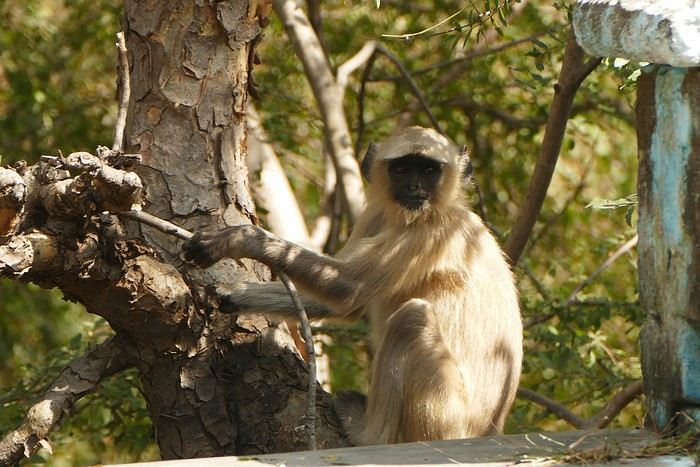
The guide shows me an old stepwell lost in nature. It’s always my thing to check out these baoris, which can be stunning, but this one isn’t anything special. We arrive at the palace overlooking the city.
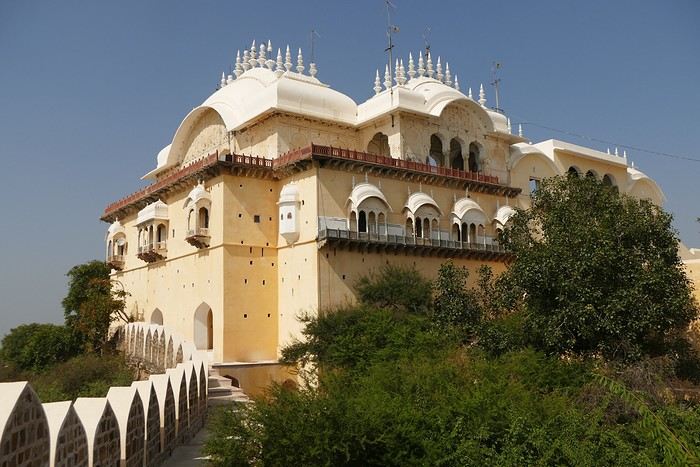
We walk around the palace, and I discover another stepwell that’s not worth lingering over.
The tour is over, and I had a great time despite the fatigue. We head back down to Alwar, near the City Palace, which has been turned into administrative offices. Gaju (the driver’s nickname) finds a parking spot near a dhaba where we have lunch (paneer masala, chapatis, chai)—it’s delicious. With my energy restored, we head to the palace. On the top floor is a museum that I visit.
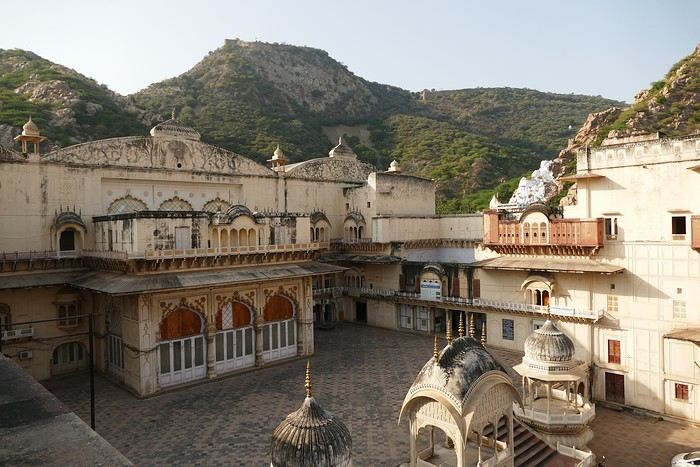
At the exit of the museum, we have to go back down and walk around the palace to get to the Moosi Maharani Chhatri. I’ve been here once before and really liked it, and the place is still the same—calm and relaxing.
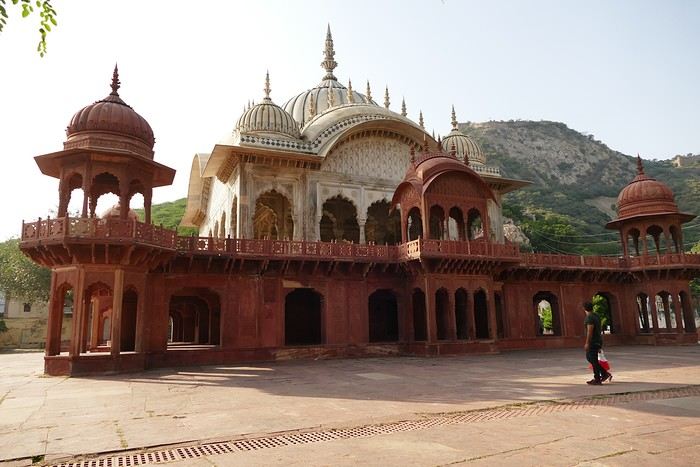
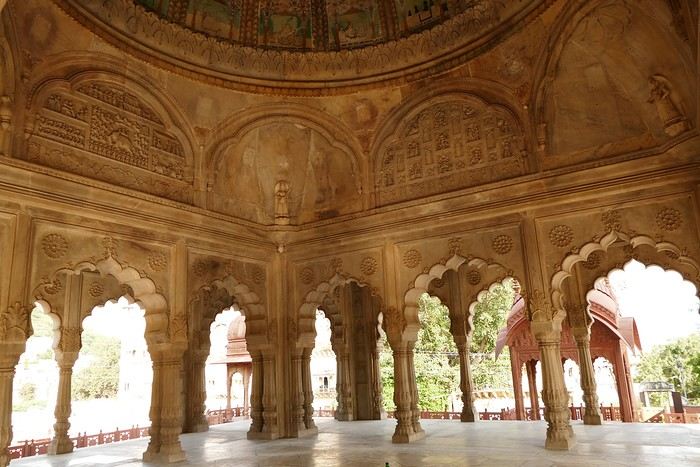
"This monument is the most artistic in Alwar and also the most royal, filled with fascinating history. Maharaja Vinay Singh of Alwar built this two-story cenotaph in 1815 in memory of his father, Maharaja Bakhtawar Singh. It’s also known as Moosi Maharani ki Chhatri, named after the king’s mistress, who performed sati upon his death. After the sati, she was accepted as the king’s wife. It’s an elegant monument, shaped like a flower and built with a mix of brown sandstone and white marble. The first floor is made of sandstone, while the upper floor and the chhatris (cenotaphs) are in white marble. Its sculpted pavilion has dome-shaped arches with intricate lace-like and exquisite floral patterns. There are complex motifs that shine brightly in the sunlight. The colorful circular ceiling is an important part of Moosi Maharani Ki Chhatri and is adorned with faded gold-leaf paintings of mythological figures and scenes. The footprints of Maharaja and Moosi Rani are engraved in marble inside the cenotaph, and locals pay their respects to them."
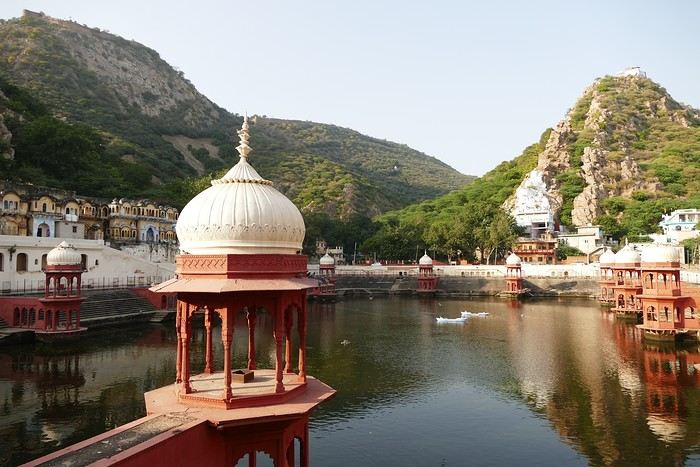
Near the chhatri, there’s a large water reservoir with a magnificent view. The place is peaceful and relaxing, and I stay here for a while, contemplating and daydreaming before heading back to the hotel for some well-deserved rest. The Wi-Fi is working now. I’m the only foreign guest, and since my room is near the entrance, I’ll be well taken care of throughout my stay.
I doze off during the drive, and we arrive at the Atlantic Hotel in Alwar at 10:30 AM. My room is on the ground floor, and I settle in quickly. The Wi-Fi isn’t working, but the staff do everything they can to fix it. At noon, Gajender, the driver, suggests visiting the Qila Fort, which is on the heights of Alwar. The fort is closed for restoration, but safari tours are offered—jeep, guide, driver, and visit for 1600 Rs.
We follow the great wall, which is impressive—the second largest in India and the third in the world.
We spot peacocks and monkeys.
The guide shows me an old stepwell lost in nature. It’s always my thing to check out these baoris, which can be stunning, but this one isn’t anything special. We arrive at the palace overlooking the city.
We walk around the palace, and I discover another stepwell that’s not worth lingering over.
The tour is over, and I had a great time despite the fatigue. We head back down to Alwar, near the City Palace, which has been turned into administrative offices. Gaju (the driver’s nickname) finds a parking spot near a dhaba where we have lunch (paneer masala, chapatis, chai)—it’s delicious. With my energy restored, we head to the palace. On the top floor is a museum that I visit.
At the exit of the museum, we have to go back down and walk around the palace to get to the Moosi Maharani Chhatri. I’ve been here once before and really liked it, and the place is still the same—calm and relaxing.
"This monument is the most artistic in Alwar and also the most royal, filled with fascinating history. Maharaja Vinay Singh of Alwar built this two-story cenotaph in 1815 in memory of his father, Maharaja Bakhtawar Singh. It’s also known as Moosi Maharani ki Chhatri, named after the king’s mistress, who performed sati upon his death. After the sati, she was accepted as the king’s wife. It’s an elegant monument, shaped like a flower and built with a mix of brown sandstone and white marble. The first floor is made of sandstone, while the upper floor and the chhatris (cenotaphs) are in white marble. Its sculpted pavilion has dome-shaped arches with intricate lace-like and exquisite floral patterns. There are complex motifs that shine brightly in the sunlight. The colorful circular ceiling is an important part of Moosi Maharani Ki Chhatri and is adorned with faded gold-leaf paintings of mythological figures and scenes. The footprints of Maharaja and Moosi Rani are engraved in marble inside the cenotaph, and locals pay their respects to them."
Near the chhatri, there’s a large water reservoir with a magnificent view. The place is peaceful and relaxing, and I stay here for a while, contemplating and daydreaming before heading back to the hotel for some well-deserved rest. The Wi-Fi is working now. I’m the only foreign guest, and since my room is near the entrance, I’ll be well taken care of throughout my stay.
Hey there, fellow travelers 😎
We’re back from 15 days in northern India.
For our 6th visit to this country, we traveled between Uttar Pradesh and Madhya Pradesh, and let’s just say it was an emotional rollercoaster!!
So if you’re up for it, we’re taking you to Varanasi, Chitrakoot, Khajuraho, Orchha, and Agra.
Ready for takeoff??
WELCOME TO VARANASI

When you leave your sanitized, rigid Western world behind, there’s nothing like diving back into the Indian chaos. And we nailed it—because when it comes to monumental madness, we couldn’t have picked a better place to start than Varanasi 😉!!
Here’s a little recap of our first day in this insane city.
It all starts with landing at the city’s airport.
As soon as we step out, hundreds of Indians stare at us like they’ve never seen white people before (I’d forgotten how intense that is!). There are lots of women covered in black fabric, only their eyes visible—pretty striking, I must say. Turns out they’re Indians working in the Middle East, heading back to "work" after a month’s vacation.
We hop in a taxi, but after a few kilometers, we’re stopped… by the passage of the "state minister." The roads are freshly paved and spotless for his convoy (you can *totally* tell the difference with the roads he didn’t use 😛). We didn’t manage to spot him in the middle of the 25 cars surrounding him, though!!
Then we arrive in front of the mythical Ganges—a peaceful spot, except for a boat full of Indian pilgrims who, once again, stare at us and take our pictures (the mutual curiosity is hilarious!!).
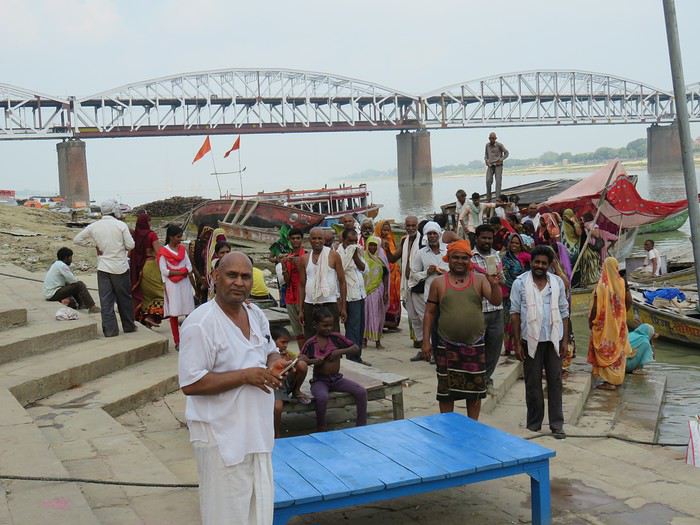
We board a boat, and almost immediately, we pass a cremation ghat!! Oh crap, I wasn’t expecting that so soon—it hits me hard (like, *really* hard 🤪)!! Huge piles of wood, eight massive fires with families gathered around. It lasts as long as the boat ride, and you think you must’ve imagined it… but no!!
You dock and wander through the tiny alleys.
It’s 36°C (97°F) with 90% humidity—you’re dripping.
Cows block the way sometimes. The air smells like incense, then urine, then a woman’s perfume, then rotten fruit, then amazing street food—all within two meters, and *everywhere*!!
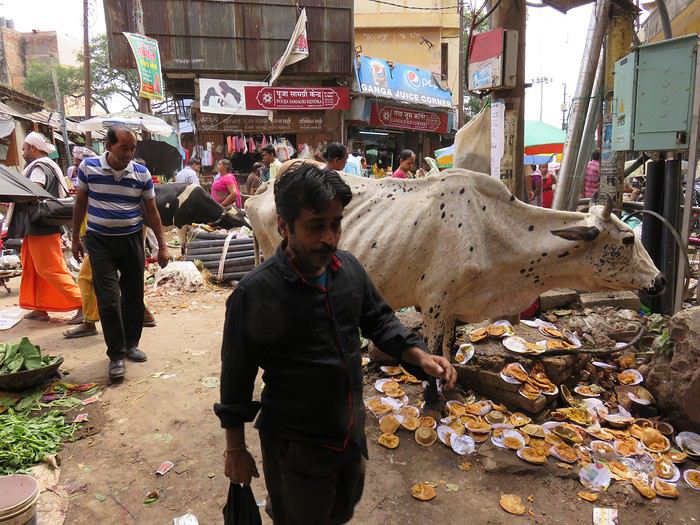
Then you step into the main street where pilgrims arrive (60,000 a day—Varanasi is the country’s holiest city!!). The chaos ramps up as you head toward the main road: nonstop honking, a bike whizzing past on your right, a scooter on your left, people brushing against you from all sides, air thick with dust and smoke (diesel *or* cremation!!), beggars of all kinds (kids, elderly, disabled) lined up to appeal to the pilgrims, the suffocating heat, and noise—*so much* noise…
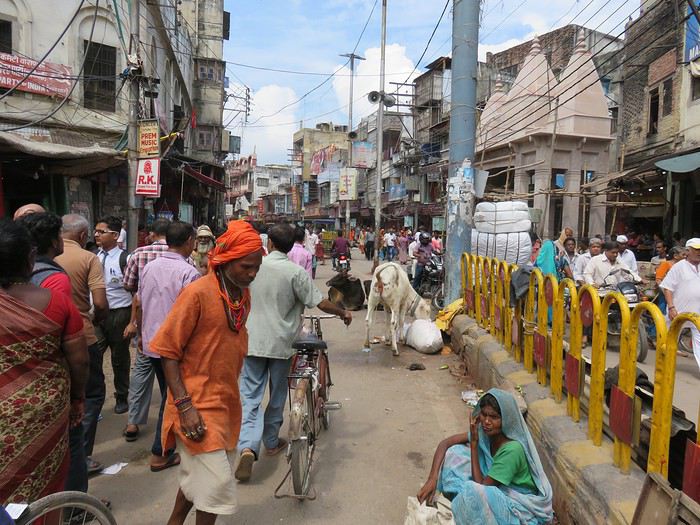
In some areas, people constantly approach you: "Come see my shop," "Need a taxi?" "Want to exchange money?" And then there’s the woman with her baby in her arms, following you for meters, repeating, "No money, milk; no money, milk…" And you’re *dying* inside, but you can’t stop. If you give in, ten more will come running!! You grit your teeth, keep walking, even talk to yourself out loud!!
After half an hour, it feels like you’ve run a marathon, and you don’t even know where you live anymore!
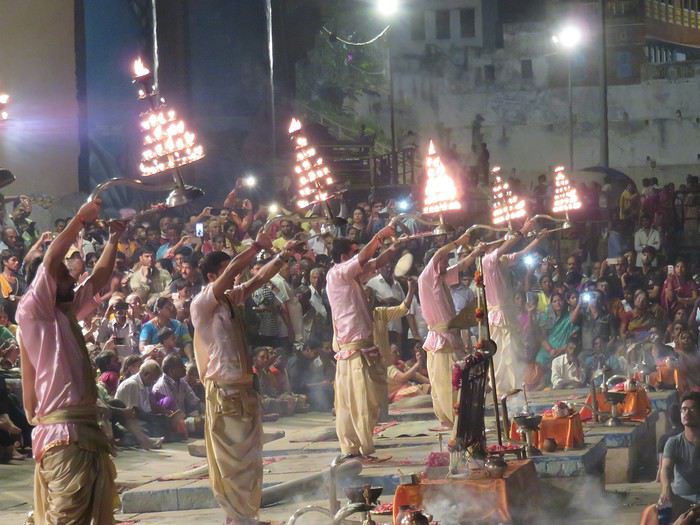
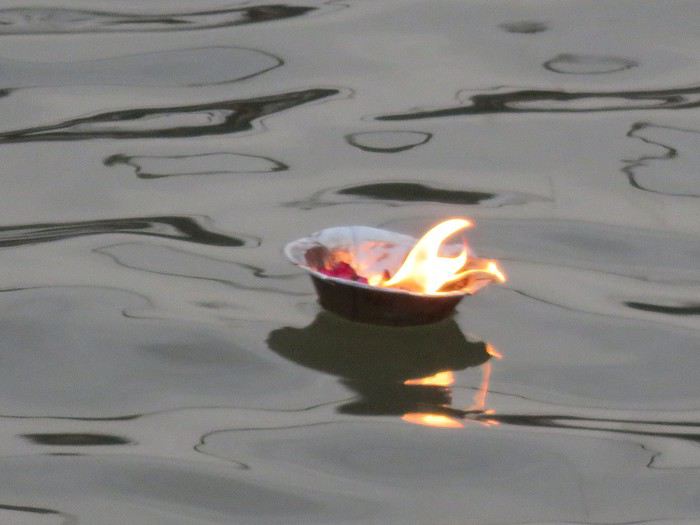
In the evening, you head to the PUJA (public prayers for all the pilgrims) on a boat in the middle of hundreds of others. Two ghats are competing—who can make the most noise. One side is singing, the other chanting, then they switch. They wave flames, the ghats are packed.
After dinner, you head back to your room around 9 PM and see hundreds of people sleeping on the scorching stones—with cows, dogs, and goats!!!!
A huge thank-you to our parents for giving us the mental balance to handle this, because *India drives you crazy*—and we’re right in the thick of it!!!
It’s an ex.tra.or.di.nary place in the truest sense of the word, with incredible beauty—especially in its human diversity—if you can look past what shocks you.
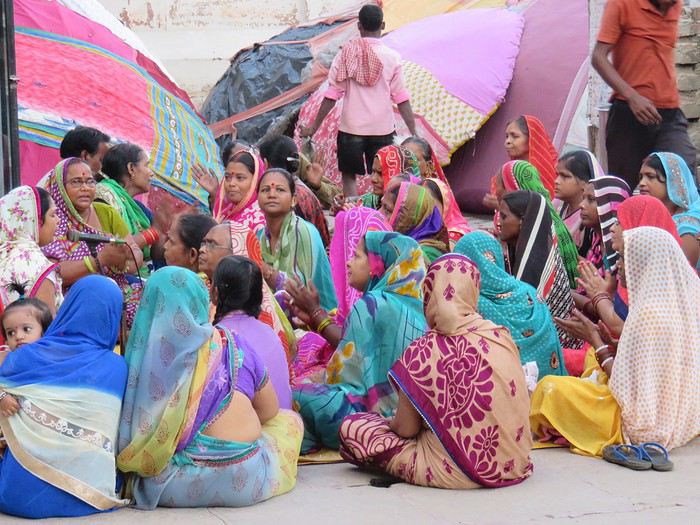
We stayed for 3 days—3 days of unmatched intensity, where the spectacle is *constant*.
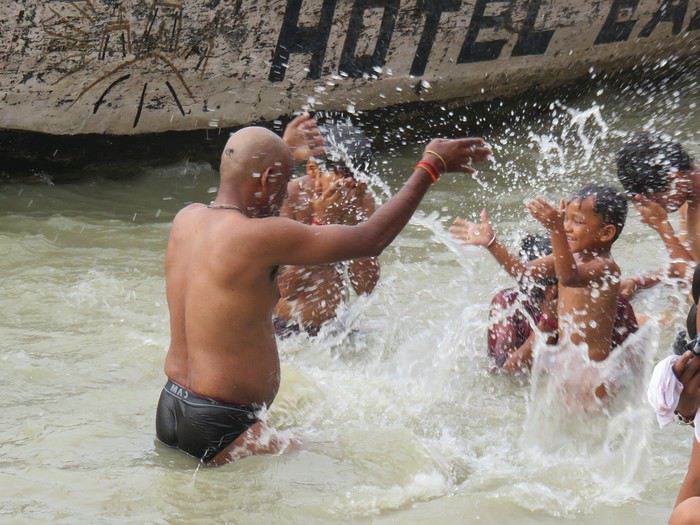
So I *highly* recommend it to all travel lovers, those who embrace difference, and the strange (for us, at least). But definitely *not* for anyone looking for a relaxing vacation!!
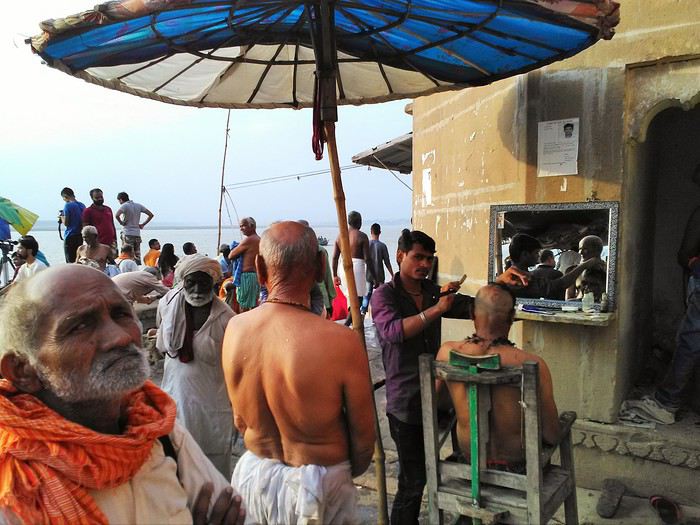
More to come soon if you’re interested!!
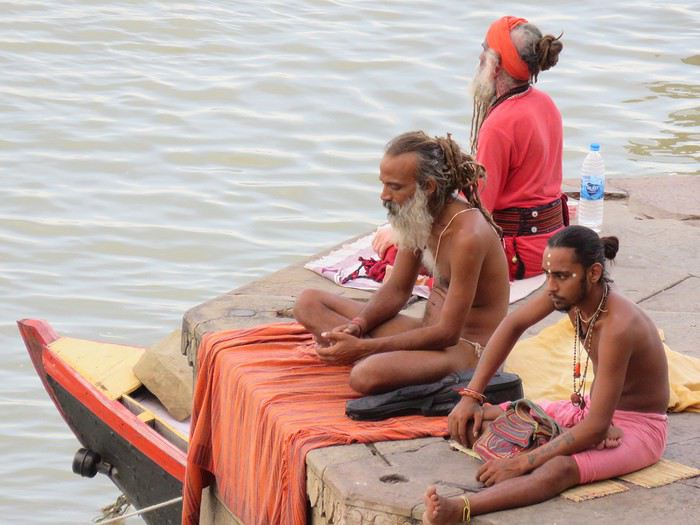
We’re back from 15 days in northern India.
For our 6th visit to this country, we traveled between Uttar Pradesh and Madhya Pradesh, and let’s just say it was an emotional rollercoaster!!
So if you’re up for it, we’re taking you to Varanasi, Chitrakoot, Khajuraho, Orchha, and Agra.
Ready for takeoff??
WELCOME TO VARANASI
When you leave your sanitized, rigid Western world behind, there’s nothing like diving back into the Indian chaos. And we nailed it—because when it comes to monumental madness, we couldn’t have picked a better place to start than Varanasi 😉!!
Here’s a little recap of our first day in this insane city.
It all starts with landing at the city’s airport.
As soon as we step out, hundreds of Indians stare at us like they’ve never seen white people before (I’d forgotten how intense that is!). There are lots of women covered in black fabric, only their eyes visible—pretty striking, I must say. Turns out they’re Indians working in the Middle East, heading back to "work" after a month’s vacation.
We hop in a taxi, but after a few kilometers, we’re stopped… by the passage of the "state minister." The roads are freshly paved and spotless for his convoy (you can *totally* tell the difference with the roads he didn’t use 😛). We didn’t manage to spot him in the middle of the 25 cars surrounding him, though!!
Then we arrive in front of the mythical Ganges—a peaceful spot, except for a boat full of Indian pilgrims who, once again, stare at us and take our pictures (the mutual curiosity is hilarious!!).
We board a boat, and almost immediately, we pass a cremation ghat!! Oh crap, I wasn’t expecting that so soon—it hits me hard (like, *really* hard 🤪)!! Huge piles of wood, eight massive fires with families gathered around. It lasts as long as the boat ride, and you think you must’ve imagined it… but no!!
You dock and wander through the tiny alleys.
It’s 36°C (97°F) with 90% humidity—you’re dripping.
Cows block the way sometimes. The air smells like incense, then urine, then a woman’s perfume, then rotten fruit, then amazing street food—all within two meters, and *everywhere*!!
Then you step into the main street where pilgrims arrive (60,000 a day—Varanasi is the country’s holiest city!!). The chaos ramps up as you head toward the main road: nonstop honking, a bike whizzing past on your right, a scooter on your left, people brushing against you from all sides, air thick with dust and smoke (diesel *or* cremation!!), beggars of all kinds (kids, elderly, disabled) lined up to appeal to the pilgrims, the suffocating heat, and noise—*so much* noise…
In some areas, people constantly approach you: "Come see my shop," "Need a taxi?" "Want to exchange money?" And then there’s the woman with her baby in her arms, following you for meters, repeating, "No money, milk; no money, milk…" And you’re *dying* inside, but you can’t stop. If you give in, ten more will come running!! You grit your teeth, keep walking, even talk to yourself out loud!!
After half an hour, it feels like you’ve run a marathon, and you don’t even know where you live anymore!
In the evening, you head to the PUJA (public prayers for all the pilgrims) on a boat in the middle of hundreds of others. Two ghats are competing—who can make the most noise. One side is singing, the other chanting, then they switch. They wave flames, the ghats are packed.
After dinner, you head back to your room around 9 PM and see hundreds of people sleeping on the scorching stones—with cows, dogs, and goats!!!!
A huge thank-you to our parents for giving us the mental balance to handle this, because *India drives you crazy*—and we’re right in the thick of it!!!
It’s an ex.tra.or.di.nary place in the truest sense of the word, with incredible beauty—especially in its human diversity—if you can look past what shocks you.
We stayed for 3 days—3 days of unmatched intensity, where the spectacle is *constant*.
So I *highly* recommend it to all travel lovers, those who embrace difference, and the strange (for us, at least). But definitely *not* for anyone looking for a relaxing vacation!!
More to come soon if you’re interested!!
During the 60s and 70s, thousands of travelers hit the road to India. Some were backpackers or hippies, but not all. In this collective anthology featuring around twenty contributors (including GeorgesOz), you’ll also find truth-seekers, a couple who went on their honeymoon to get married in Bengal... and "crazy" folks who set off on VéloSolex bikes...
Worth noting: all contributors donated their royalties to support the Céline Hegron clinic in a poor neighborhood of Varanasi.
Worth noting: all contributors donated their royalties to support the Céline Hegron clinic in a poor neighborhood of Varanasi.
Hi there.
We’re heading to India at the end of December for a month.
I planned an itinerary: Delhi, Nawalgarh, Sikar, Jodhpur, Udaipur, Chittaurgarh, Bundi, Jaipur, Bharatpur, and back to Delhi.
Our driver told us it’s not possible because there are no roads.
He’s suggesting the usual tourist circuit, which we don’t want to do.
What do you think of my route?
Any tips?
Thanks, community!
Hi,
I'm about to open an account (payment card) with N26 Black (seems more transparent in its presentation and explanations) or maybe Revolut (but it seems to hide quite a few things).
Has anyone here used either of these two cards (or both) in India?
Thanks for your feedback and experience with this payment method.
Hi there,
I’m a traveler who’s really passionate about India, and I’m planning to go back for a month in December 2025. I know the country and its culture well.
I travel as a backpacker—light, staying in small guest houses, and getting around by bus and train.
This time, I’d love to explore Goa and the surrounding region, including some less touristy states nearby.
I’m looking for a female travel companion, max 45 years old (around my age), who’s used to backpacking, resourceful, and ideally already familiar with India (to avoid culture shock).
Feel free to reach out via private message.
See you soon!
We traveled as a couple from October 20 to December 11, 2025, for our second trip to India and our first time in Rajasthan, plus Mathura and Agra, which are in Uttar Pradesh but right on the border, and a 4-day flight hop to Varanasi.
Here’s a non-detailed trip report—just to share some info we found useful for other travelers, along with a few places and addresses we particularly enjoyed.
First off, a big thank you to (I’m using usernames) Aleph240758, Solene40, Montagnard74, and Pagaljavab, who took the time to reply to me. Some of them even take the time to create detailed and illustrated travel stories. Since I only started planning the trip in mid-August, I didn’t have much time and used the trip reports on VoyageForum to build our itinerary.
One more note: everyone travels differently and has their own preferences... so I’ll just share our personal feelings, which are obviously subjective.
We bought a physical SIM card upon arriving at the airport. The Airtel stand only offers one package for 500 rupees (just under 5 €) for 28 days, with 1.5 GB of data, unlimited national SMS, and calls—more than enough. Contrary to what we’d read, we asked for activation at the counter, and it was active within 10 minutes. The SIM worked well everywhere. Watch out—like in all airports, there’s a tendency to take advantage of tourists. The Airtel counter offers to exchange money directly, and we saw people paying 20 € for the SIM.
Since we arrived at night, the metro wasn’t running anymore. Plus, if you don’t know the city, we’d recommend taking a prepaid taxi—the price is fixed, and the driver knows the destination. Be careful: the prepaid taxi counter is on the right as you exit the hall, with large fixed signs above. Many counters put out a card on the desk saying "prepaid taxi," and even the Airtel stand tries to offer supposedly prepaid taxis, which is completely false. The price they ask for could be double or triple.
Here’s an app that was super useful for us In most big cities, we used "Rapido," an Indian app like Uber, to book auto-rickshaws (you can also book motorbikes or cars). You need a local phone number for this. The big advantage? The price is fixed, though you can still leave a tip. It tracks your ride, and most importantly, the destination is entered—way more practical than hailing an auto-rickshaw on the street, where the driver says "yes, yes," gives a price, and then doesn’t know where to go once you’re on the way. No need to enter a credit card. There’s also OlaCabs, which is similar, but we couldn’t get it to work.
For transportation between stops, we used government buses (RSRTC, blue buses), sometimes taxis via apps or by asking the guesthouse for visits and hard-to-reach places. This choice was really personal and made on the spot. - **Pros:** Buses leave almost every 30 minutes everywhere, giving you a lot of freedom. Every time we left from the bus station (bus stand), we had seats. Several times, we even got to sit in the driver’s cabin! The trip takes longer than a taxi, but not *that* much longer. The price is ridiculously low—1.30 € for 100 km for men, 70 cents for women. The bus stations are in the city centers, unlike many private bus companies. We met some great people. - **Cons:** It’s not exactly clean, and you’re obviously not in the comfort of a taxi. It’s not door-to-door service, so you need to travel light. You can’t stop along the way. If you need to catch the bus mid-route, it’s usually full, and you’ll have to elbow your way in without hesitation. For a short trip, I think hiring a taxi for the whole stay makes sense. Like I said, there’s no one-size-fits-all choice, but there’s no need to be apprehensive about taking public buses.
Here’s our route map, showing the number of nights spent at each stop. Compared to our initial plan, we slept one night in Barmer instead of two because we had time to visit the market in the afternoon, saw the Kiradu site the next morning, and didn’t see the point in staying longer.
We cut two of the six nights in Shekhawati. After our flight to Varanasi was canceled, we had to stay in Delhi, which actually turned out well—it let us arrive in Varanasi earlier and more rested.
The timing worked well for us, with longer stops in Bundi and Udaipur.
I won’t go into detail about each stop here, but I’d be happy to answer any questions. The accommodations and restaurants mentioned are the ones that had that little something extra, and the hearts (❤️❤️❤️) mark the sites we particularly loved.
Tijana Fort Palace - Accommodation and recovery from the trip
Alwar - Palace with museum - Moosi Maharani Ki Chhatri - Large reservoir
Bharatpur Accommodation: Iora Guesthouse, 14 €/night without breakfast—great value, cheap, good meals, close to the reserve Morning at Keoladeo Reserve by bike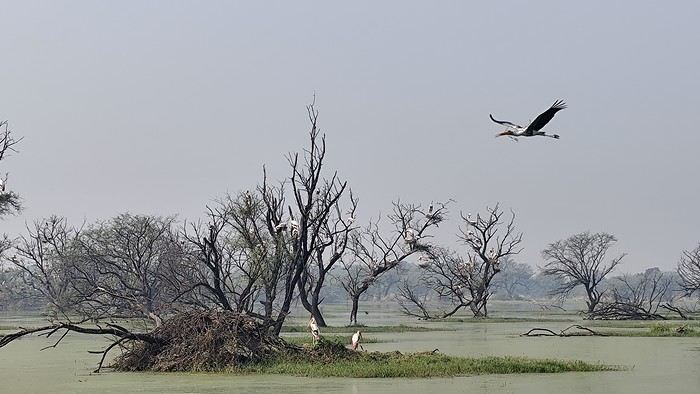
Mathura - Ghats (Yamuna Ghats, Vishram Ghat) to visit in the evening - Market (Chattu Bazar) - Hindu temple Shri Dwarkadheesh dedicated to Krishna - Vrindavan temple Banke Bihari, ❤️❤️❤️ a very important temple with incredible religious fervor - Vrindavan Hindu temple Balaram ISKCON
Agra Accommodation: Shivalayaa - The Divine Abode, 16 €/night with breakfast on Booking—welcoming, clean, close to the Taj Mahal - Mausoleum of Akbar the Great (in Sikandra) ❤️❤️❤️ - Mausoleum of Itimad-ud-Daulah (mini Taj) ❤️❤️❤️ - Visit the Taj early in the morning (closed on Fridays) ❤️❤️❤️ - Agra Fort ❤️❤️❤️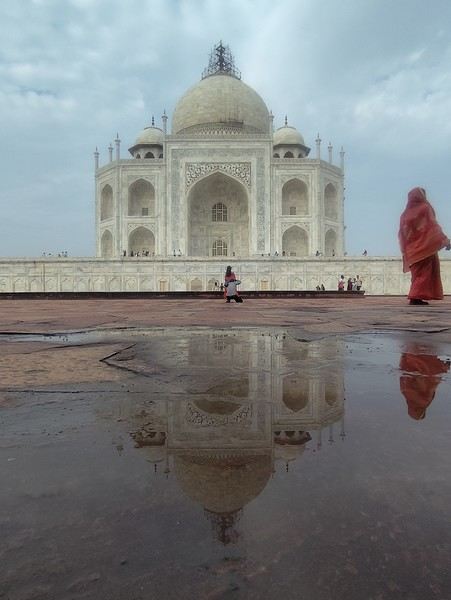
Dholpur - Machkund Temple with its water body - Clock Tower Ghanta Ghar - Royal stepwell Dhaulpur Bavdi
Karauli - City Palace, private visit with a guard ❤️❤️❤️ - Shri Madan Mohan Temple for the puja starting at 5:30 PM ❤️❤️❤️ - Wandering the streets We loved this stop, which is off the main tourist trail, for its pleasant atmosphere
Bhandarej This is a stop as a starting point to visit the Chand Baori stepwell in Abhaneri ❤️❤️❤️ Accommodation: Bhadrawati Palace, 53 €/night with breakfast in Bhandarej—nice, an old palace, warm welcome, booked via Hotels.com We were the only guests and had dinner with the current manager, the grandson of the Maharaja. There’s a pretty stepwell in the village, and we visited a tiny neighborhood temple where we were invited to join in the singing and dancing. Walking through the market was really enjoyable because of the kindness of the locals, who aren’t used to tourism ❤️❤️❤️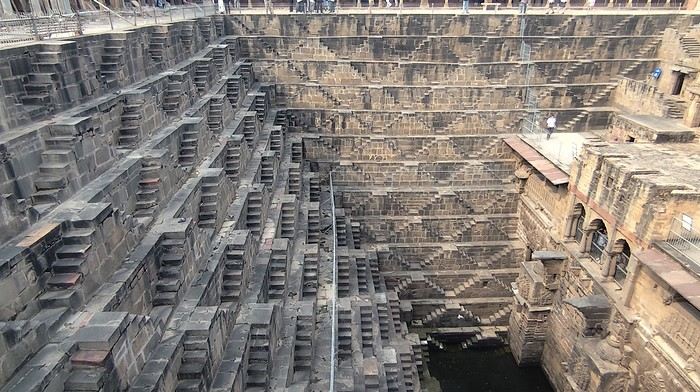
Jaipur - Hawa Mahal (Palace of Winds) - Jal Mahal - Gaitore Ki Chhatriyan ❤️❤️❤️ - Amber Fort ❤️❤️❤️ - Panna Meena Ka Kund stepwell - Galta Ji Temple (Monkey Temple) ❤️❤️❤️ - Bagru, 33 km away: visit to a fabric printing workshop with block prints (I’d noted some addresses on Google Maps). The first workshop wasn’t very welcoming and had no workers because of the humid weather. We were lucky to find another, more welcoming workshop. When the sun came out, the three female workers arrived and started their work—it was a great visit ❤️❤️❤️.
Bundi Accommodation: Hotel Bundi Inn, 25 €/night with breakfast—lovely room in a haveli, good meals with a rooftop view of the fort - Garh Palace Don’t miss: at the exit of the palace, to the left, you can access a beautiful garden with a pool and, at the back, a large hall called Chitrashala ❤️❤️❤️ - Raniji Ki Baori ❤️❤️❤️ - Nahar Dhunk Ki Baori - Chaurasi Khambun Ki Chhatri (cenotaph with 84 pillars) - Ksar Bagh, an interesting set of royal cenotaphs at the end of Jait Sagar Lake. On the other hand, we could’ve skipped Sukh Mahal and its museum. Bundi is still pleasant but is no longer a secret spot.
We bought a physical SIM card upon arriving at the airport. The Airtel stand only offers one package for 500 rupees (just under 5 €) for 28 days, with 1.5 GB of data, unlimited national SMS, and calls—more than enough. Contrary to what we’d read, we asked for activation at the counter, and it was active within 10 minutes. The SIM worked well everywhere. Watch out—like in all airports, there’s a tendency to take advantage of tourists. The Airtel counter offers to exchange money directly, and we saw people paying 20 € for the SIM.
Since we arrived at night, the metro wasn’t running anymore. Plus, if you don’t know the city, we’d recommend taking a prepaid taxi—the price is fixed, and the driver knows the destination. Be careful: the prepaid taxi counter is on the right as you exit the hall, with large fixed signs above. Many counters put out a card on the desk saying "prepaid taxi," and even the Airtel stand tries to offer supposedly prepaid taxis, which is completely false. The price they ask for could be double or triple.
Here’s an app that was super useful for us In most big cities, we used "Rapido," an Indian app like Uber, to book auto-rickshaws (you can also book motorbikes or cars). You need a local phone number for this. The big advantage? The price is fixed, though you can still leave a tip. It tracks your ride, and most importantly, the destination is entered—way more practical than hailing an auto-rickshaw on the street, where the driver says "yes, yes," gives a price, and then doesn’t know where to go once you’re on the way. No need to enter a credit card. There’s also OlaCabs, which is similar, but we couldn’t get it to work.
For transportation between stops, we used government buses (RSRTC, blue buses), sometimes taxis via apps or by asking the guesthouse for visits and hard-to-reach places. This choice was really personal and made on the spot. - **Pros:** Buses leave almost every 30 minutes everywhere, giving you a lot of freedom. Every time we left from the bus station (bus stand), we had seats. Several times, we even got to sit in the driver’s cabin! The trip takes longer than a taxi, but not *that* much longer. The price is ridiculously low—1.30 € for 100 km for men, 70 cents for women. The bus stations are in the city centers, unlike many private bus companies. We met some great people. - **Cons:** It’s not exactly clean, and you’re obviously not in the comfort of a taxi. It’s not door-to-door service, so you need to travel light. You can’t stop along the way. If you need to catch the bus mid-route, it’s usually full, and you’ll have to elbow your way in without hesitation. For a short trip, I think hiring a taxi for the whole stay makes sense. Like I said, there’s no one-size-fits-all choice, but there’s no need to be apprehensive about taking public buses.
Here’s our route map, showing the number of nights spent at each stop.
Compared to our initial plan, we slept one night in Barmer instead of two because we had time to visit the market in the afternoon, saw the Kiradu site the next morning, and didn’t see the point in staying longer.
We cut two of the six nights in Shekhawati. After our flight to Varanasi was canceled, we had to stay in Delhi, which actually turned out well—it let us arrive in Varanasi earlier and more rested.
The timing worked well for us, with longer stops in Bundi and Udaipur.I won’t go into detail about each stop here, but I’d be happy to answer any questions. The accommodations and restaurants mentioned are the ones that had that little something extra, and the hearts (❤️❤️❤️) mark the sites we particularly loved.
Tijana Fort Palace - Accommodation and recovery from the trip
Alwar - Palace with museum - Moosi Maharani Ki Chhatri - Large reservoir
Bharatpur Accommodation: Iora Guesthouse, 14 €/night without breakfast—great value, cheap, good meals, close to the reserve Morning at Keoladeo Reserve by bike
Mathura - Ghats (Yamuna Ghats, Vishram Ghat) to visit in the evening - Market (Chattu Bazar) - Hindu temple Shri Dwarkadheesh dedicated to Krishna - Vrindavan temple Banke Bihari, ❤️❤️❤️ a very important temple with incredible religious fervor - Vrindavan Hindu temple Balaram ISKCON
Agra Accommodation: Shivalayaa - The Divine Abode, 16 €/night with breakfast on Booking—welcoming, clean, close to the Taj Mahal - Mausoleum of Akbar the Great (in Sikandra) ❤️❤️❤️ - Mausoleum of Itimad-ud-Daulah (mini Taj) ❤️❤️❤️ - Visit the Taj early in the morning (closed on Fridays) ❤️❤️❤️ - Agra Fort ❤️❤️❤️
Dholpur - Machkund Temple with its water body - Clock Tower Ghanta Ghar - Royal stepwell Dhaulpur Bavdi
Karauli - City Palace, private visit with a guard ❤️❤️❤️ - Shri Madan Mohan Temple for the puja starting at 5:30 PM ❤️❤️❤️ - Wandering the streets We loved this stop, which is off the main tourist trail, for its pleasant atmosphere
Bhandarej This is a stop as a starting point to visit the Chand Baori stepwell in Abhaneri ❤️❤️❤️ Accommodation: Bhadrawati Palace, 53 €/night with breakfast in Bhandarej—nice, an old palace, warm welcome, booked via Hotels.com We were the only guests and had dinner with the current manager, the grandson of the Maharaja. There’s a pretty stepwell in the village, and we visited a tiny neighborhood temple where we were invited to join in the singing and dancing. Walking through the market was really enjoyable because of the kindness of the locals, who aren’t used to tourism ❤️❤️❤️
Jaipur - Hawa Mahal (Palace of Winds) - Jal Mahal - Gaitore Ki Chhatriyan ❤️❤️❤️ - Amber Fort ❤️❤️❤️ - Panna Meena Ka Kund stepwell - Galta Ji Temple (Monkey Temple) ❤️❤️❤️ - Bagru, 33 km away: visit to a fabric printing workshop with block prints (I’d noted some addresses on Google Maps). The first workshop wasn’t very welcoming and had no workers because of the humid weather. We were lucky to find another, more welcoming workshop. When the sun came out, the three female workers arrived and started their work—it was a great visit ❤️❤️❤️.
Bundi Accommodation: Hotel Bundi Inn, 25 €/night with breakfast—lovely room in a haveli, good meals with a rooftop view of the fort - Garh Palace Don’t miss: at the exit of the palace, to the left, you can access a beautiful garden with a pool and, at the back, a large hall called Chitrashala ❤️❤️❤️ - Raniji Ki Baori ❤️❤️❤️ - Nahar Dhunk Ki Baori - Chaurasi Khambun Ki Chhatri (cenotaph with 84 pillars) - Ksar Bagh, an interesting set of royal cenotaphs at the end of Jait Sagar Lake. On the other hand, we could’ve skipped Sukh Mahal and its museum. Bundi is still pleasant but is no longer a secret spot.
Hello,
my Indian fiancé and I are getting married in France in a few weeks. Like many couples before us, we had extreme difficulties finding out the steps to follow in India to obtain the necessary documents for our marriage. We received no useful information from the Indian Embassy in Paris. It took us hours of research on traveler forums to gather scattered information and piece together the puzzle. I decided to summarize here the steps that allowed my fiancé to obtain the required papers, so other couples can struggle a little less than we did in the future.
I hope this post helps!
Context reminder: the list of documents required for a non-EU national to marry in France (see also www.service-public.fr):
Certificate of Custom: This is an explanation in French of the rules governing marriage eligibility in your country of origin. I read that some countries include proof that the applicant is indeed eligible. This is not the case for India.
Single-status certificate/marital capacity certificate. This is simply proof that you are eligible to marry under the laws of your country of origin.
Birth certificate.
All these documents must be less than 6 months old at the date of the banns publication.
The birth certificate and the single-status certificate must be apostilled. This procedure is linked to the international Hague Convention, of which both France and India are members. The apostille is a kind of stamp affixed to an official document by the authorities of the country where it was issued, giving it legal value in a third country.
How we obtained these documents:
The certificate of custom is very easy to obtain if you already live in France. You just need to go to the Indian Embassy in Paris with the required documents and pay the fees. We received it by mail the next day. The instructions on the Indian Embassy in Paris website are very clear (spring 2019). See also the VFS Global website (the company to which the embassy outsources consular activities).
Obtaining the single-status certificate was much more complicated. In France, a birth certificate is enough to prove whether you are married or not, as annotations are added for every major life event. In contrast, the Indian administration, although it can prove that someone is already married, is unable to prove that someone is still single. The only way to resolve this is to produce an affidavit. It took several trials and errors before we succeeded, as the administrators we dealt with generally did not know the procedure. Here’s what finally worked:
Prepare the affidavit on 100-rupee bond paper (first party: signatory; second party: Sub-Divisional Magistrate) at the Sub-Divisional Magistrate’s office in your place of birth. See Model No. 1 below. It must be signed by you and the Sub-Divisional Magistrate. For my fiancé, the latter only agreed to sign after presenting a certificate from the Tahsildar of his birth Taluk stating that he knew my fiancé was still single. If you don’t know the Tahsildar well, it might be useful to first request such a certificate from the "village accountant" before approaching the Tahsildar. We don’t know if the process would be the same in other districts than my fiancé’s. Attestation at the Regional Commissioner’s (RC) office. The Ministry of External Affairs will only apostille documents that have been attested this way. In our case, we found clear information about the procedure on the Regional Commissioner’s website (required documents, cost, bond paper value). The RC asked us to justify why my fiancé needed a single-status certificate. Such certificates are usually requested by people wishing to join the army, in which case the RC receives a request letter. I asked the mayor of my village to sign such a letter (see Model No. 2, which I wrote myself). I come from a very small town, which was lucky here, as the mayor knows both of us personally and immediately agreed to do it. I have no idea if it would be as easy in a larger town. Once the document was submitted to the RC, it was sent back to the administrator who issued it for authentication. This back-and-forth should not take more than 25 days, but it may be useful to follow the progress of the procedure by calling or visiting the offices of both administrations regularly. Send the attested documents to the Ministry of External Affairs (MEA) for apostille. In 2019, the Indian MEA only accepts apostille requests through private operators, whose list is available on the MEA website.
The birth certificate, once obtained from the municipality of your place of birth, follows the same procedure as the single-status certificate: attestation by the Regional Commissioner, then apostille at the Ministry of External Affairs.
Note: The Indian Embassy in Paris offers to issue a birth certificate. We recommend NOT GOING THROUGH THEM. The procedure is expensive, and they simply copy the information available on your passport. We seriously doubt the validity of such a document for marriage.
A few tips:
Obtaining these documents in India will require a lot of time, patience, and creativity! For us, more than 4 months passed between the moment my fiancé signed his single-status certificate and the day we had it apostilled in hand. In the meantime, there were dozens of phone calls and visits to various local administrations, a lot of brainstorming, and money wasted on canceled flights due to the monsoon.
If you have contacts in the local administration, don’t hesitate to use them. Also, if possible, closely monitor the progress of the procedures by calling or visiting the offices regularly, as mistakes are very common.
I recommend only requesting the certificate of custom once you’re close to having the other documents in hand, as it’s expensive, its issuance is very quick (at least if you both live in France; otherwise, I don’t know), and it’s only valid for 6 months.
All the steps for the birth certificate and the single-status certificate must be done in person, which can be complicated if you already live outside India. Some companies offer to handle it for you if you’re willing to pay. My fiancé bypassed the problem by designating his brother as an "Authorised representative" (a step taken at the notary of his birth Taluk). Once the single-status certificate was established in person, my fiancé’s brother was able to take over and complete the rest of the steps on his behalf. Finally, we asked the service provider handling the apostille to send the documents to our address in France via DHL (we don’t trust the postal service, as we’ve had mail stuck at customs for several weeks before).
My fiancé first tried to establish his single-status certificate at the notary of his birth Taluk. It didn’t work because the Regional Commissioner categorically refused to attest it. Indeed, it is generally forbidden to make any modifications to a document signed by a notary.
Once the birth certificate and the single-status certificate arrive in France, you must have them translated by a sworn translator registered with the Court of Appeal in your area. You can find the list on your Court of Appeal’s website. There are no sworn translators for all Indian languages! So, check beforehand if one exists for the language in which your certificates will be issued, or ensure they are issued in English.
Model No. 1 - Single-status certificate, affidavit
I, (name of applicant), son of (name of father) and (name of mother), with permanent address (address in India), solemnly affirm and declare as follows: 1. That I am a citizen of India 2. That I was born in (place of birth) on the (date of birth) 3. That I am holding a valid Indian passport bearing the number (passport number) issued at (place of issue) and valid from (date of issue) to (date of expiry). 4. That I am unmarried (single) and have no living spouse at present either in India or abroad 5. That I am eligible to marry an Indian or a person of any other nationality according to law. 6. That I am of sound health and in mentally fit condition 7. I further state that whatever stated therein is correct to the best of my knowledge.
I am aware that suppression of facts or furnishing false/misleading information is punishable under Indian law, under section 193(2), 199, 200 of the Indian Penal Code.
Solemnly declared at (place of signature) on (date of signature).
(your signature) (the subdivisional magistrate’s signature)
Model No. 2 – Request letter from the French mayor to the Indian Regional Commissioner
Dear Sir/Madam, (English version below) I, the undersigned (Mayor’s name), Mayor of the Commune of xxx, department of xxx, France, certify as follows. Firstly, that Mr./Ms. (Name of the Indian future spouse), citizen of India, passport No. xxx, issued in xxx on xxx, valid until xxx, residing at (address), INDIA, and Ms./Mr. (Name of the French future spouse), citizen of France, passport No. xxx, residing at (address), FRANCE, have requested that I solemnize their marriage in my Commune under French law.
Secondly, that French law requires me to request from Mr./Ms. (Name of the Indian future spouse) a certificate attesting to their single status.
Issued for all legal purposes.
(Place, date, stamp, and signature of the mayor)
Note: Prepared on the town hall’s letterhead, directly in both French AND English to avoid needing a translator.
Hi everyone,
For traveling in Rajasthan by train and bus, could you give me some info: where to buy tickets, cost, purchase locations, websites, etc.?
Any tips you have would be super helpful.
Thanks
Good evening everyone.
I’m so glad VoyageForum is back up and running.
This forum has helped me plan so many trips thanks to all your contributions.
So, I’m turning to you for advice on a trip I’m planning for March 2025, from the 7th to the 21st.
I was thinking of a classic itinerary:
Arrival in Delhi at 12:05 AM on Saturday, then taking a train in the afternoon to Agra.
2 nights in Agra
2 nights in Jaipur
2 nights in Pushkar
2 nights in Jodhpur
3 nights in Udaipur
Then flying back to Delhi.
The trip would mostly be by train (which we love) and bus.
However, after reading various travelers’ comments, some cities seem less interesting, while others I hadn’t included—like Bundi and Jaisalmer—are catching my eye. But traveling by train and bus, I’m worried it might get really complicated.
I’m not sure how to organize my stay anymore, especially since we love nature and peace and quiet… and I’m afraid of too much hassle if everything isn’t planned.
Also, how can I book trains and buses in advance from France?
Thanks in advance for your help.
Magali
Hello,
Don’t stay in the cold and damp! I’m looking for one or more people (men or women, travel companions) to spend a few weeks in South India, Sri Lanka, or Mexico
from late October 2026 to early December.
I’m Jean Pierre, 74 years old, and I manage just fine when traveling. Phone: 0389812641 Cheers, Jean Pierre
I’m Jean Pierre, 74 years old, and I manage just fine when traveling. Phone: 0389812641 Cheers, Jean Pierre
Hi there,
We’d like to travel overland from Turkey to India in our converted van, but there are very few options these days. Crossing Iran seems risky and not particularly safe. Has anyone here done it? If so, which route did you take to minimize safety concerns?
Thanks for your replies, Julie 😎
We’d like to travel overland from Turkey to India in our converted van, but there are very few options these days. Crossing Iran seems risky and not particularly safe. Has anyone here done it? If so, which route did you take to minimize safety concerns?
Thanks for your replies, Julie 😎
Hi,
I’ve read that trains in India are packed and it’s pretty tough to find seats 2-3 days in advance... Apparently, there’s still a small tourist quota for available seats, but they’re limited. Would anyone have more specific info on this?
I’ve read that trains in India are packed and it’s pretty tough to find seats 2-3 days in advance... Apparently, there’s still a small tourist quota for available seats, but they’re limited. Would anyone have more specific info on this?
Hello everyone,
We’re a couple heading off in mid-October for 7 weeks to explore Rajasthan independently, with an extension to Varanasi.
We’re growing more skeptical about Booking.com reviews and would rather turn to fellow travelers for up-to-date recommendations on accommodations along our route. We’re looking for clean places—not necessarily luxurious—a good location preferably, and if there’s a special charm or character, even better. Budget-wise, up to 50 €, or more if needed. We’ve already gathered a few addresses from Solene and Aleph’s travel journals.
Here are our stops—we’ve already got a place for the starred cities but are still open to suggestions:
Delhi Airport*
Alwar
Bharatpur*
Mathura
Agra*
Dholpur
Karauli
Dausa*
Jaipur*
Bundi*
Kota
Udaipur*
Pushkar
Jodhpur
Barmer
Jaisalmer
Phalodi
Bikaner
Nawalgarh*
Varanasi
Central Delhi
Thanks for sharing your tips and favorites!
Hello everyone,
we got back from our trip to Kashmir and Ladakh three weeks ago.
We spent 4 weeks there, including one in Kashmir.
We’re really happy with our stay in Srinagar and Sonamarg. The Kashmiris gave us a very warm welcome and seemed pleased to see tourists who weren’t Indian. In fact, over the 4 days we spent in Srinagar, we only saw 4 people who looked European... Srinagar is stunning with its lakes and the lively Mughal gardens. No trouble getting around, whether by shikara, rickshaw, taxi, or on foot. The houseboats are gorgeous, unfortunately controlled by consortiums. We took a taxi to Sonamarg (20 €).
Sonamarg (two nights) and its glacier are easy to explore, either on horseback or on foot, but it’s becoming a leisure spot for Indians. To get to Ladakh afterward, we opted for a private taxi (quite expensive at 100 €, but the road is long). Since we’re a couple, it allowed us to stop whenever we wanted... and the route is beautiful all the way to Lamayuru, with our first snow-covered pass under snow when we crossed around May 21st. Then we stopped in Mulbek and Kargil before arriving in Lamayuru (three nights). We took another taxi to Alchi (26 €), spent one night there, and took the local bus at around 8 AM to Leh (3 €, a comfortable one-hour ride). We arrived in Leh around 9:30 AM, and Gyatsel from Tsarap Guesthouse came to pick us up with our backpacks. His guesthouse is located 500 meters from the market square in Leh, in a quiet little alley with no traffic. We highly recommend it because Gyatsel is invaluable for arranging taxis and organizing off-agency circuits...
His accommodation is super comfortable, and he cooks with vegetables from his garden. His wife also helps out... It’s Gyatsel’s mother who tends the garden. Through him, we arranged permits for the Nubra Valley up to Turtuk, then the Pangong and Tso Moriri lakes (we didn’t do the latter due to snow overnight!). We also crossed the Changtang (magnificent) to reach Thiksey, Stakna, Hemis, and returned to Leh. Six days in a private taxi (400 €). Since the roads were clear, we headed to Zanskar for 5 days in a shared taxi (28 € round trip for both of us). The route from Leh to Zangla follows the Zanskar gorges (impressive!).
We discovered Padum, Pibiting, Karsha, and Puktal, which you can reach via a small 7 km road and a 45-minute walk to finish, plus the sacred summit on the way to Manali.
Back in Leh, we extended our permit to visit the Aryan Valley by taxi (round trip, two days, 90 €). We spent our last two days resting in Leh—the altitude is really tiring...
I’m sharing these taxi prices as a guide for a couple. Accommodation ranged from 12 € in Leh to 30 € at Pangong Lake (the most expensive), but averaged around 15-17 € per night.
We’re not trekkers, but we love walks, discovery, and meeting people along the way. It was an amazing trip, and we even discovered a very old monastery a few kilometers before Lamayuru, where a monk took us—timeless...
I’m sharing these details because it’s hard to find precise information about Kashmir.
India is introducing an electronic arrival card for foreign travelers. The measure is effective for all travelers starting October 1st.
India is now adopting the electronic arrival card. Presenting this "e-Arrival Card" is now mandatory for all arrivals in India as of October 1, 2025. This formality replaces the paper card previously filled out on the plane or upon arrival. India aims to streamline traveler tracking. The requirement applies to travelers of all nationalities, both adults and minors, for all entry points into India. It’s an additional mandatory formality alongside the e-Visa or visa. The e-Arrival Card must be completed online within three days prior to arrival in the country. Available in English only, it’s free and can be done on the official Indian authorities' website. The document is valid only for the declared arrival day. "This means you’ll need to complete it for each new arrival," clarifies RapideVisa, an agency specializing in visa services. Travelers must provide standard information to obtain the document (passport number, purpose of stay, countries visited in the 6 days before arrival, etc.).
Once completed, a document with a QR code to present to authorities upon arrival is generated. With this new system, India aims to facilitate traveler tracking and reduce congestion at airport counters. Nearly 19 million international visitors traveled to India in 2023. Among them, 189,000 were French.
Source: https://www.lechotouristique.com/article/inde-une-nouvelle-formalite-obligatoire-pour-voyager
https://www.youtube.com/watch?v=1WaPqVyUmuY
Hi there,
I’m planning to do the Zanskar crossing from Lamayuru to Darcha in August 2026.
I know the route has changed quite a bit in recent years, and I’m struggling to find reliable info on whether it’s possible to do this trek independently with just two people—sleeping and eating with locals each day.
I’m also open to hiring a muleteer or going through an agency, so I’d love any recent and trustworthy recommendations on that too.
Thanks in advance,
Jean-Marc
Hi there! 🙂
Please, how can I get from:
- PATNEM to GOKARNA
- GOKARNA to UDUPI (or UDIPI)
- UDUPI to MANGALORE
- MANGALORE to KANNUR
What are the different transport options, the price (if possible, otherwise no worries), and the approximate travel time 😉
Thanks so much to those who take the time to reply!
Have a wonderful day!
Sandra
Hi there,
I’ve been reading conflicting info about whether an Indian visa might be required for a few-hour layover in Mumbai.
Do we need anything besides the Sri Lankan ETA if we’re just transiting through India without leaving Terminal 2 at the airport? We’re flying from Brussels via Frankfurt and then Mumbai with Lufthansa.
Thanks so much—I’m totally lost here! 😅
Hi there,
We’re a group of 7 people heading to SRI LANKA in March.
We’re transiting through Mumbai (Air India flight), then after a few hours, we’ll take a SriLankan Airlines flight to Colombo.
The return trip follows the same route 26 days later.
The issue is about the Indian visa.
1- Do we need an Indian visa since we’ll only be at Mumbai Airport for a few hours (no checked baggage)?
2- Do we need a double-entry visa?
Thanks for your help—everything I’ve read online is pretty unclear.
Hi there,
I can’t seem to complete the payment for my trip on the IRCTC (Indian Railways) site. No matter which payment method I choose, my Visa card isn’t accepted. Has anyone here managed to do it, and if so, could you share the method you used? Thanks in advance! Charlie
I can’t seem to complete the payment for my trip on the IRCTC (Indian Railways) site. No matter which payment method I choose, my Visa card isn’t accepted. Has anyone here managed to do it, and if so, could you share the method you used? Thanks in advance! Charlie