Bonjour,
Quand on fait un périple au kirghistan, comment se faire comprendre pour les destinations étant donné que les autochtones utilisent l'alphabet syrillique ?
Merci par avance de vos lumières.
Cordialement.
Bonjour,
Quelqu'un aurait-il des renseignements sur la ligne ferroviaire Bishkek-Tashkent ré-ouverte depuis 2018? Merci
Quelqu'un aurait-il des renseignements sur la ligne ferroviaire Bishkek-Tashkent ré-ouverte depuis 2018? Merci
Bonjour,
Nous partons à deux cet été au Kirghizstan ( tout le mois d'aout). Nous avons l'habitude de voyager juste sac aux dos et en prenant les bus locaux. Ne parlant ni russe ni Kirghize pensez vous que cela est possible dans ce pays.
Nous avons vu qu'il y avait une organisation de logement chez l'habitant (CBT) , est ce une bonne solution ?
Au niveau budget , sachant que nous ne sommes pas exigeant , combien estimez vous les dépenses pour un mois à deux ?
Nous sommes pas de grands randonneurs est ce que vous pensez qu'il existe des rando accessibles ?
et biens sur quelles sont les lieux que vous nous conseillez ?
Merci pour vos réponse et conseils qui nous aiderons à préparer notre voyage !
Océane
Nous partons à deux cet été au Kirghizstan ( tout le mois d'aout). Nous avons l'habitude de voyager juste sac aux dos et en prenant les bus locaux. Ne parlant ni russe ni Kirghize pensez vous que cela est possible dans ce pays.
Nous avons vu qu'il y avait une organisation de logement chez l'habitant (CBT) , est ce une bonne solution ?
Au niveau budget , sachant que nous ne sommes pas exigeant , combien estimez vous les dépenses pour un mois à deux ?
Nous sommes pas de grands randonneurs est ce que vous pensez qu'il existe des rando accessibles ?
et biens sur quelles sont les lieux que vous nous conseillez ?
Merci pour vos réponse et conseils qui nous aiderons à préparer notre voyage !
Océane
Vous me répondrez certainement le Kirghize, mais qu'en est il du Russe? J'ai entendu dire que c'était un peu comme l'Anglais en Inde ou le Français au Maroc, une langue enseignée à l'école, utilisée dans la plupart des démarches administratives, mais peu parlée par la plupart des personnes dans les campagnes.
Est ce que je me trompe?
Avant de partir, est ce qu'il vaut mieux essayer d'avoir quelques bases de Russe? (il y a pas mal de livres dispos) ou est ce que ça ne servira pas à grand chose et ça ne servira pas à grand chose et qu'il vaut mieux regarder un peu le Kirghize? ( le seul bouquin que je connaisse est le phrasebook central asia du lonely planet)
Merci d'avance.
Merci d'avance.
Bonjour à tous, je suis nouvelle sur ce forum et en suis émerveillée !
A propos du Kirghizistan et de l'Ouzbékistan, les discussions sont assez anciennes, et c'est donc pourquoi je relance le sujet.
J'ai plusieurs questions :
1) Tout d'abord, j'ai 19 ans et suis une femme, je suppose qu'une tenue vestimentaire descente est exigée, mais avez-vous des conseils quant aux habits à emmener ? J'ai vu que le climat y est très chaud en été, et je compte y aller au cours des mois de juillet et d’août, la température avoisinant les 40°C !
2) Ensuite, par rapport à la langue, je pense me mettre au Russe afin d'en connaître quelques rudiments. Autrement, comment est le contact avec la population locale lorsqu'on ne parle pas la langue ?
3) D'après le Ministère des Affaires Etrangères, la frontière entre le Kirghizistan et l'Ouzbékistan est à éviter car elle est minée. Avez-vous des conseils pour la traverser ? l'avion semble être la seule solution ? Connaissez-vous de bonnes compagnies fiables proposant des vols Ouzbékistan-Kirghizistan ?
4) Cavalière depuis un certain nombre d'années, je suis tentée par des rando à cheval, avez-vous des coups de coeur à partager ? Est-il indispensable d'être accompagnée d'un guide ?
5) Enfin, comment est l'hébergement ? J'aimerais m'orienter autant que possible vers du logement chez l'habitant, mais étant une femme seule j'ai conscience du danger que cela peut présenter...
Merci d'avance pour toutes vos réponses et n'hésitez pas à me donner d'autres conseils, je suis preneuse dans tous les cas !
Clara
Bonjour à tous,
Un grand merci pour les contributions de chacun. C'est un bonheur de préparer mon voyage à l'aide de ce forum. 🙂 Je le consulte souvent et l'ai précédemment utilisé pour d'autres destinations ! mais c'est aujourd'hui que j'y publie pour la première fois.
Mon ami et moi partons cet été (5 semaines) en Ouzbékistan et au Kirghizistan (arrivée à Tachkent, départ de Bishkek : avec Aeroflot). J'ai déjà plusieurs idées de parcours et nous pensons que les choix définitifs se feront une fois sur place, cependant on se pose quelques questions auxquelles il est préférable que nous trouvions des réponses avant notre départ.
1. Au sujet de la frontière Ouzbékistan > Kirghizistan (Andijan > Och) : j'ai lu ça et elle qu'elle est actuellement ouverte. Est-ce confirmé ?
2. Une autre possibilité que j'envisage peut-être est de faire le trajet Tachkent > Bishkek en train. j'ai vu que la train passe par le Kazakstan et qu'il faut donc un visa supplémentaire. Pouvez-vous m'indiquer la fréquence de ce train ? y-en-a-t-il tous les jours ? combien de temps met-il pour relier les 2 capitales ? Quel est le prix ? faut-il réserver ? Peut-on réserver à Tachkent facilement ? bref, je n'ai pas trouver d'infos ou au moins d'infos récentes au sujet de ce train.
3. Il semble qu'il y ai au Kirghizistan des "enclaves" Ouzbek. S'agit-il d'enclaves uniquement ethniques, ou bien ces endroits sont-ils gérer par l'ouzbékistan ? Je souhaite par ex. faire étape à Arslanbob. Faut-il dans ce cas des visas Ouzbeks et Kirghizes à entrées multiples ?
4. Je souhaite aussi éventuellement emprunter la route reliant Och à Bishkek. La route semble traverser à plusieurs reprises des parties du territoire Ouzbeks... là aussi faut-il des visas Ouzbeks et Kirghizes à entrées multiples ?
5. Le trajet Bishkek > Karakol (en taxi collectif) est-il long ? Peut-il être fait dans la journée ?
6. presque-dernière question...à laquelle vous répondrez peut-être à raison "ça dépend" : comment conduisent les chauffeurs de taxi-collectifs ? vite ? ces taxis sont-ils un minimum fiables en terme de sécurité ? y compris en route de montagne (je pense à la route qui semble très biscornue et vertigineuse entre Och et Bishkek !) ?
7. Quelles cartes (papier) avez-vous utilisé ? Nous avons trouvé une carte de l'Ouzbekistan (au 1 : 1,580,000). Y-en a-t-il des plus précises ?. Pour le Kirghizistan (en dehors du découpage des cartes Russes) et d'une carte regroupant "Turkménistan - Tadjikistan – Kirghizstan" je n'ai rien trouvé ... des conseils ?
Nos autres interrogations concerne des choix entre des étapes qui nous semblent toute intéressantes... peut-être me direz-vous que "les goûts et les couleurs... "
a) l'excursion au bord de la (non)mer d'Aral ça vaut le coup ? (grand détour tout de même)
b) Après avoir passé du temps à Samarcande (3 jours complets) et Boukhara (3 jours complets) est-il indispensable de voir Khiva ? ou bien c'est un peu overdose de "faïences bleu" !!?? (je suis archéologue donc j'aime ce type de visite mais je n'ai que 5 semaines et souhaite varier les plaisir !)
c) Y a-t-il une étape plus sympa qu'une autre entre Och et Bishkek ? A part Arslanbob qui est conseillé dans d'autres discussions.
Finalement, mises bout à bout ça fait plus que "quelques questions" ! Je remercie ceux qui ont eut la patience de lire ce post en intégralité ! et aussi ce qui peuvent y répondre, même partiellement !
Merci par avance ! 🙂
Un grand merci pour les contributions de chacun. C'est un bonheur de préparer mon voyage à l'aide de ce forum. 🙂 Je le consulte souvent et l'ai précédemment utilisé pour d'autres destinations ! mais c'est aujourd'hui que j'y publie pour la première fois.
Mon ami et moi partons cet été (5 semaines) en Ouzbékistan et au Kirghizistan (arrivée à Tachkent, départ de Bishkek : avec Aeroflot). J'ai déjà plusieurs idées de parcours et nous pensons que les choix définitifs se feront une fois sur place, cependant on se pose quelques questions auxquelles il est préférable que nous trouvions des réponses avant notre départ.
1. Au sujet de la frontière Ouzbékistan > Kirghizistan (Andijan > Och) : j'ai lu ça et elle qu'elle est actuellement ouverte. Est-ce confirmé ?
2. Une autre possibilité que j'envisage peut-être est de faire le trajet Tachkent > Bishkek en train. j'ai vu que la train passe par le Kazakstan et qu'il faut donc un visa supplémentaire. Pouvez-vous m'indiquer la fréquence de ce train ? y-en-a-t-il tous les jours ? combien de temps met-il pour relier les 2 capitales ? Quel est le prix ? faut-il réserver ? Peut-on réserver à Tachkent facilement ? bref, je n'ai pas trouver d'infos ou au moins d'infos récentes au sujet de ce train.
3. Il semble qu'il y ai au Kirghizistan des "enclaves" Ouzbek. S'agit-il d'enclaves uniquement ethniques, ou bien ces endroits sont-ils gérer par l'ouzbékistan ? Je souhaite par ex. faire étape à Arslanbob. Faut-il dans ce cas des visas Ouzbeks et Kirghizes à entrées multiples ?
4. Je souhaite aussi éventuellement emprunter la route reliant Och à Bishkek. La route semble traverser à plusieurs reprises des parties du territoire Ouzbeks... là aussi faut-il des visas Ouzbeks et Kirghizes à entrées multiples ?
5. Le trajet Bishkek > Karakol (en taxi collectif) est-il long ? Peut-il être fait dans la journée ?
6. presque-dernière question...à laquelle vous répondrez peut-être à raison "ça dépend" : comment conduisent les chauffeurs de taxi-collectifs ? vite ? ces taxis sont-ils un minimum fiables en terme de sécurité ? y compris en route de montagne (je pense à la route qui semble très biscornue et vertigineuse entre Och et Bishkek !) ?
7. Quelles cartes (papier) avez-vous utilisé ? Nous avons trouvé une carte de l'Ouzbekistan (au 1 : 1,580,000). Y-en a-t-il des plus précises ?. Pour le Kirghizistan (en dehors du découpage des cartes Russes) et d'une carte regroupant "Turkménistan - Tadjikistan – Kirghizstan" je n'ai rien trouvé ... des conseils ?
Nos autres interrogations concerne des choix entre des étapes qui nous semblent toute intéressantes... peut-être me direz-vous que "les goûts et les couleurs... "
a) l'excursion au bord de la (non)mer d'Aral ça vaut le coup ? (grand détour tout de même)
b) Après avoir passé du temps à Samarcande (3 jours complets) et Boukhara (3 jours complets) est-il indispensable de voir Khiva ? ou bien c'est un peu overdose de "faïences bleu" !!?? (je suis archéologue donc j'aime ce type de visite mais je n'ai que 5 semaines et souhaite varier les plaisir !)
c) Y a-t-il une étape plus sympa qu'une autre entre Och et Bishkek ? A part Arslanbob qui est conseillé dans d'autres discussions.
Finalement, mises bout à bout ça fait plus que "quelques questions" ! Je remercie ceux qui ont eut la patience de lire ce post en intégralité ! et aussi ce qui peuvent y répondre, même partiellement !
Merci par avance ! 🙂
Bonjour à tous,
Mon compagnon, notre fils de 6 ans et moi-même partons "trekker" en Kirghizie au mois d'Août. Nous recherchons un lieu confortable où passer une nuit à notre arrivée... J'ai lu pas mal de chouettes choses sur l'Alfa GuestHouse mais ne parviens pas à trouver un site internet afin d'effectuer une réservation. Quelqu'un aurait-il des infos à ce sujet ou un autre endroit à nous conseiller s'il vous plaît?
Au passage, j'en profite pour vous solliciter sur un autre point: voyageant avec Aeroflot, nous devrons passer une nuit à Moscou lors de notre retour. Après m'être renseignée, il semblerait que nous puissions passer une nuit dans un hôtel près de l'aéroport sans avoir besoin de visa. J'ai contacté Aeroflot pour plus d'infos mais la personne que j'ai eue au téléphone m'a confirmé sans toutefois avoir l'air convaincue de ce qu'elle avançait... Quelqu'un pourrait-il m'éclairer?
Merci par avance!!!
Mon compagnon, notre fils de 6 ans et moi-même partons "trekker" en Kirghizie au mois d'Août. Nous recherchons un lieu confortable où passer une nuit à notre arrivée... J'ai lu pas mal de chouettes choses sur l'Alfa GuestHouse mais ne parviens pas à trouver un site internet afin d'effectuer une réservation. Quelqu'un aurait-il des infos à ce sujet ou un autre endroit à nous conseiller s'il vous plaît?
Au passage, j'en profite pour vous solliciter sur un autre point: voyageant avec Aeroflot, nous devrons passer une nuit à Moscou lors de notre retour. Après m'être renseignée, il semblerait que nous puissions passer une nuit dans un hôtel près de l'aéroport sans avoir besoin de visa. J'ai contacté Aeroflot pour plus d'infos mais la personne que j'ai eue au téléphone m'a confirmé sans toutefois avoir l'air convaincue de ce qu'elle avançait... Quelqu'un pourrait-il m'éclairer?
Merci par avance!!!
Le Kirghisthan en 10 points. infos de mai 2014.
1- l'arrivée à l'aéroport.
Le terminal de Bishkek est situé à un peu plus de 30 kms du centre-ville. Les formalités administratives de Douanes sont très simples. Pas de visa pour les Français. C'est le cas pour 28 autres nationalités. Relance du tourisme. Par contre la livraison des bagages est très lente. Deux étages , le rez de chaussée pour les arrivées et le premier pour les départs. Possibilité d'y dormir sans problème en cas d'arrivée ou de départ nocturne. Banquettes assez confortables. Change Euros évidemment possible. Taux moins intéressants que ceux du centre ville mais cependant corrects pour un aéroport. Quelques restaurants. Les taxis attendent avec les rabatteurs. La course moyenne pour se rendre en ville vous sera proposée à 800 soms. Le juste prix est plus près de 500. A vous de négocier. C'est admis voire conseillé. La transaction moyenne s'établit souvent autour de 600 soms. Possibilité de prendre des minibus. Mais dans ce cas, il faut sortir de l'aéroport et se rendre sur la route principale. Pas de difficultés majeures car ce n'est pas trop loin. Quelques centaines de métres. Cependant on vous affirmera que ce n'est pas possible.
2- L'argent.
La monnaie nationale est le Som. La gestion de l'argent est simple car les billets se distinguent facilement. Taille et couleur. Coupures de 5000, 1000, 500, 200, 100, 50 et 20. Pièces de 10, 5, et 1 som. Possibilité de changer des Euros sans problème. A l'aéroport, comme toujours, le taux est bien sur inférieur à celui du centre- ville. Néanmoins la différence est moindre que dans bon nombre de capitales. Début mai 2014, l'euro se changeait entre 72 et 74 soms. N'oubliez pas que le taux est toujours plus avantageux dans la capitale. Il est préférable de changer chez les " changeurs " car le taux est légèrement supérieur à celui des banques. Donc il faut prendre du cash. Peu d'écarts de taux entre changeurs. Mais un point de différence peut vous faire gagner une nuit d'hôtel . Donc prenez le temps de comparer. Il existe beaucoup de changeurs en ville. Souvent regroupés.
On peut aussi sans grande difficulté utiliser des distributeurs de billets. Visa et MasterCard semblent bien acceptés y compris en dehors de la capitale.
3- les transports.
Partout, vous trouverez des fourgons Mercédes aménagés en mini- bus. Toujours en bon état et mécaniquement sains, ils sillonnent les villes et les campagnes. La conduite se fait à droite et généralement les chauffeurs sont plutôt prudents. Il faut dire qu'il y a une forte présence policière sur les routes. Surtout en milieu urbain. Ils sont à l'affut de la moindre infraction afin de remplir leurs propres poches. En ville une course en mini- bus vous coûtera 10 soms jusqu'à 22heures et 12 soms ensuite. Après minuit il vous faudra souvent prendre le taxi. Une course en ville tourne souvent autour de 100 soms. ( On vous demandera le double.. voire plus). Taxis en bon état également . Pas trop d'arnaque si vous avez pris soin de négocier le prix avant. Seulement si... Quelques bus trolley subsistent encore à Bishkek . Mêmes prix. Il faut toujours avoir des pièces de 5 ou 10 soms avec soi pour éviter les difficultés de paiement au chauffeur. Pas de convoyeur- receveur. Il existe aussi une ligne de trains . Mais elle ne dessert que peu l'intérieur du pays. ( Vous rendre à la gare, le bâtiment est à voir) Les bus normaux( grands) fonctionnent surtout pour l'international à partir de Bishkek .
4- La nourriture
Le Kirghisthan n'est pas un pays avec une gastronomie raffinée. On peut déplorer une nourriture peu variée et parfois trop grasse (Mantys) mais c'est généralement bien cuisiné et jamais trop épicé. Cependant il y a quelquefois de bonnes surprises.
 Excellentes pâtes maisons, fourrés à la pomme de terre et accompagnées dune sauce fromage..
Le " jarmat" plat national, est composé de gros spaghettis arrosés par un jus de viande bouillie , un peu de viande et des légumes. Les féculents sont nombreux dans l'alimentation usuelle. On trouve de l'eau plate et gazeuse sans problème. Le Coca et le Sprite sont présents. La bière aussi bien évidemment avec parfois un titrage en alcool élevé qui la rend peu goûteuse. Vins rouges, blancs.. Mais chers. Nescafé et thé. De plus en plus de restaurants de Biskek offrent de la bière pression. Plutôt bonne sauf celle d'entrée de gamme.
La moyenne du prix d'une pression se situe à 80 soms pour une 50cl.Une bouteille d'eau 20 soms. Gazeuse ou pas. Certains restaurants facturent le service en plus. Entre 10 et 15%.
Dernière chose, oubliez votre excellent pain français.. Le Tokoch, pain local rond ne le remplacera pas mais reste néanmoins succulent quand il est bien frais.

5- l'électricité
Pas de problème particulier. Les coupures ne sont pas fréquentes. Les prises, utilisables avec les connecteurs français sont en 220 volts. Donc aucun souci pour recharger vous précieux ordinateurs et téléphones... Nul besoin d'adaptateurs.
6- la police.
Plutôt corrompue. Vous pourrez vous faire arrêter sans motif précis avec l'intention non avouée de vous soutirer de l'argent. Ayez une copie de votre passeport et ne leur donnez jamais votre original. Prétextez qu'il est resté à votre hôtel. Leur scénario est bien rodé. D'emblée, ils se montreront cordiaux en vous serrant la main. Puis ils tenteront de vous intimider et vous fouiller. ( recherche de drogue) Résistez. Ne faiblissez pas..! Vous êtes un touriste en vacance et rien d'autre. S'ils vous menacent de vous emmener au poste, dites que vous êtes Ok. Ils ne le feront pas. S'ils le font, ( très rare) ne craquez pas pour autant. Ca s'arrange toujours. Ils sont corrompus mais pas stupides. Il faut jouer la montre. Ils lâcheront prise quand ils verront que vous n'avez pas peur et que vous ne céderez pas ..! Toujours pareil.!!! N'oubliez pas que vous jouez gagnant car vous n'avez rien à vous reprocher. Et puis ça fait toujours du bien de les voir repartir penauds.!! 😏
7- l'hébergement.
On peut trouver des chambres à petits budgets si on est pas trop exigeant sur le confort standard. Généralement les chambres sont propres avec une literie correcte. Quand le prix est modique les sanitaires sont souvent à l'extérieur de la chambre. Il y a aussi les hôtels de luxe dans la capitale dont on dit qu'ils sont chers pour la prestation offerte. Je ne peux pas en témoigner. Je ne fréquente pas ce type d'hôtels. Les prix sont toujours indiqués par personne. On peut donc trouver une chambre double pour 1000 soms. Soient 14 euros. A ce prix là, bien sur, ce seront souvent des Guest-houses style auberges. Possibilités de cuisiner. Prix hors saison touristique. Pas de petit déjeuner. Ambiance souvent sympa et détendue. Les dortoirs sont bien sur moins chers mais quand on est deux ça ne vaut financièrement plus la peine. A Bishkek le " SAKURA Guest-house " est tres couru. Très propre et assez bien situé. ( 1000 soms la double).
8- le téléphone
Très facile de vous procurer une carte Sim. Trois opérateurs principaux se partagent le marché. MegaCom , Beeline et ... Je sais plus. Le coût de la carte est de 50 soms même si partout on essayera de vous la vendre 100. MegaCom semble être une compagnie sérieuse et réputée. Ça fonctionne plutôt bien. Communications peu onéreuses. Nombreux marchands de téléphones pas chers si vous aviez oublié le votre. Mais attention. Veillez à ce que ce ne soit pas lisible qu'en cyrillique..!
9- l'architecture, les villes... Le réseau routier.
Bishkek n'offre pas un grand intérêt architectural mais, début mai, il fait bon s'y promener sous un soleil qui n'est pas encore trop ardent. La ville possède de nombreux parcs qui, à défaut d'être bien entretenus, sont cependant agréables. La ville est bien arborée et ses longues rues offrent des trottoirs propres et ombragés. La circulation n'est pas trop dense et cela ajoute une impression de calme. Il faut néanmoins admettre que l'attrait du pays ne réside pas dans les villes ou l'architecture. Le Kirghiztan est un pays de montagne et ce sont les paysages qui feront surtout la valeur du voyage.
 Pour les plus sportifs, les treks seront l'unique objectif.
Le réseau routier est globalement en bon état même si parfois, sur certains tronçons montagneux, les conditions climatiques sévères engendrent des nids de poule.
Pour les plus sportifs, les treks seront l'unique objectif.
Le réseau routier est globalement en bon état même si parfois, sur certains tronçons montagneux, les conditions climatiques sévères engendrent des nids de poule.

10- Aspects culturels.
J'ai trouvé les Kirghizes assez peu chaleureux. Les sourires n'arrivent pas spontanément. Influence passée des Soviétiques m'a -t-on affirmé. Cependant je n'ai jamais ressenti aucune agressivité. Je n'ai pas eu d'exemple frappant de délinquance et à aucun moment je ne me suis senti en insécurité.
Par ailleurs, les chauffeurs de taxi et voitures particulières ne brillent pas toujours par leur honnêteté. Soyez attentifs à bien confirmer le prix de la course avant le départ. Celui- ci à toujours tendance à augmenter dès que vous êtes partis..! Donc.. Soyez fermes une fois que vous savez que chacun a compris. Car, bien évidemment le langage reste une source de malentendus plus ou moins volontaires. On peut également parfois noter un manque de raffinement dans les attitudes quotidiennes. (Au restaurant par exemple) Dans la rue il n'est pas rare de voir cracher par terre. On regrettera aussi l'absence de prise de conscience quant à la propreté environnementale. Des milliers de bouteilles plastique jalonnent les routes. Le pays est à dominante musulmane mais, à part à proximité des mosquées, on a aucun problème pour trouver toutes sortes d'alcools.
Les femmes ne sont pas voilées et semblent plutôt libres dans leur tenue vestimentaire . Elles fument et boivent de l'alcool sans contrainte apparente. Le Kidnapping des jeunes fiancées existe encore bien qu'interdit par la loi. Mais il semblerait que cela devienne plus rare.
La France fait encore rêver bon nombre de gens qui, pour la plupart, ne sont jamais sortis de leur pays voire de leur ville.
1- l'arrivée à l'aéroport.
Le terminal de Bishkek est situé à un peu plus de 30 kms du centre-ville. Les formalités administratives de Douanes sont très simples. Pas de visa pour les Français. C'est le cas pour 28 autres nationalités. Relance du tourisme. Par contre la livraison des bagages est très lente. Deux étages , le rez de chaussée pour les arrivées et le premier pour les départs. Possibilité d'y dormir sans problème en cas d'arrivée ou de départ nocturne. Banquettes assez confortables. Change Euros évidemment possible. Taux moins intéressants que ceux du centre ville mais cependant corrects pour un aéroport. Quelques restaurants. Les taxis attendent avec les rabatteurs. La course moyenne pour se rendre en ville vous sera proposée à 800 soms. Le juste prix est plus près de 500. A vous de négocier. C'est admis voire conseillé. La transaction moyenne s'établit souvent autour de 600 soms. Possibilité de prendre des minibus. Mais dans ce cas, il faut sortir de l'aéroport et se rendre sur la route principale. Pas de difficultés majeures car ce n'est pas trop loin. Quelques centaines de métres. Cependant on vous affirmera que ce n'est pas possible.
2- L'argent.
La monnaie nationale est le Som. La gestion de l'argent est simple car les billets se distinguent facilement. Taille et couleur. Coupures de 5000, 1000, 500, 200, 100, 50 et 20. Pièces de 10, 5, et 1 som. Possibilité de changer des Euros sans problème. A l'aéroport, comme toujours, le taux est bien sur inférieur à celui du centre- ville. Néanmoins la différence est moindre que dans bon nombre de capitales. Début mai 2014, l'euro se changeait entre 72 et 74 soms. N'oubliez pas que le taux est toujours plus avantageux dans la capitale. Il est préférable de changer chez les " changeurs " car le taux est légèrement supérieur à celui des banques. Donc il faut prendre du cash. Peu d'écarts de taux entre changeurs. Mais un point de différence peut vous faire gagner une nuit d'hôtel . Donc prenez le temps de comparer. Il existe beaucoup de changeurs en ville. Souvent regroupés.
On peut aussi sans grande difficulté utiliser des distributeurs de billets. Visa et MasterCard semblent bien acceptés y compris en dehors de la capitale.
3- les transports.
Partout, vous trouverez des fourgons Mercédes aménagés en mini- bus. Toujours en bon état et mécaniquement sains, ils sillonnent les villes et les campagnes. La conduite se fait à droite et généralement les chauffeurs sont plutôt prudents. Il faut dire qu'il y a une forte présence policière sur les routes. Surtout en milieu urbain. Ils sont à l'affut de la moindre infraction afin de remplir leurs propres poches. En ville une course en mini- bus vous coûtera 10 soms jusqu'à 22heures et 12 soms ensuite. Après minuit il vous faudra souvent prendre le taxi. Une course en ville tourne souvent autour de 100 soms. ( On vous demandera le double.. voire plus). Taxis en bon état également . Pas trop d'arnaque si vous avez pris soin de négocier le prix avant. Seulement si... Quelques bus trolley subsistent encore à Bishkek . Mêmes prix. Il faut toujours avoir des pièces de 5 ou 10 soms avec soi pour éviter les difficultés de paiement au chauffeur. Pas de convoyeur- receveur. Il existe aussi une ligne de trains . Mais elle ne dessert que peu l'intérieur du pays. ( Vous rendre à la gare, le bâtiment est à voir) Les bus normaux( grands) fonctionnent surtout pour l'international à partir de Bishkek .
4- La nourriture
Le Kirghisthan n'est pas un pays avec une gastronomie raffinée. On peut déplorer une nourriture peu variée et parfois trop grasse (Mantys) mais c'est généralement bien cuisiné et jamais trop épicé. Cependant il y a quelquefois de bonnes surprises.
Excellentes pâtes maisons, fourrés à la pomme de terre et accompagnées dune sauce fromage..Le " jarmat" plat national, est composé de gros spaghettis arrosés par un jus de viande bouillie , un peu de viande et des légumes. Les féculents sont nombreux dans l'alimentation usuelle. On trouve de l'eau plate et gazeuse sans problème. Le Coca et le Sprite sont présents. La bière aussi bien évidemment avec parfois un titrage en alcool élevé qui la rend peu goûteuse. Vins rouges, blancs.. Mais chers. Nescafé et thé. De plus en plus de restaurants de Biskek offrent de la bière pression. Plutôt bonne sauf celle d'entrée de gamme.
La moyenne du prix d'une pression se situe à 80 soms pour une 50cl.Une bouteille d'eau 20 soms. Gazeuse ou pas. Certains restaurants facturent le service en plus. Entre 10 et 15%.
Dernière chose, oubliez votre excellent pain français.. Le Tokoch, pain local rond ne le remplacera pas mais reste néanmoins succulent quand il est bien frais.
5- l'électricité
Pas de problème particulier. Les coupures ne sont pas fréquentes. Les prises, utilisables avec les connecteurs français sont en 220 volts. Donc aucun souci pour recharger vous précieux ordinateurs et téléphones... Nul besoin d'adaptateurs.
6- la police.
Plutôt corrompue. Vous pourrez vous faire arrêter sans motif précis avec l'intention non avouée de vous soutirer de l'argent. Ayez une copie de votre passeport et ne leur donnez jamais votre original. Prétextez qu'il est resté à votre hôtel. Leur scénario est bien rodé. D'emblée, ils se montreront cordiaux en vous serrant la main. Puis ils tenteront de vous intimider et vous fouiller. ( recherche de drogue) Résistez. Ne faiblissez pas..! Vous êtes un touriste en vacance et rien d'autre. S'ils vous menacent de vous emmener au poste, dites que vous êtes Ok. Ils ne le feront pas. S'ils le font, ( très rare) ne craquez pas pour autant. Ca s'arrange toujours. Ils sont corrompus mais pas stupides. Il faut jouer la montre. Ils lâcheront prise quand ils verront que vous n'avez pas peur et que vous ne céderez pas ..! Toujours pareil.!!! N'oubliez pas que vous jouez gagnant car vous n'avez rien à vous reprocher. Et puis ça fait toujours du bien de les voir repartir penauds.!! 😏
7- l'hébergement.
On peut trouver des chambres à petits budgets si on est pas trop exigeant sur le confort standard. Généralement les chambres sont propres avec une literie correcte. Quand le prix est modique les sanitaires sont souvent à l'extérieur de la chambre. Il y a aussi les hôtels de luxe dans la capitale dont on dit qu'ils sont chers pour la prestation offerte. Je ne peux pas en témoigner. Je ne fréquente pas ce type d'hôtels. Les prix sont toujours indiqués par personne. On peut donc trouver une chambre double pour 1000 soms. Soient 14 euros. A ce prix là, bien sur, ce seront souvent des Guest-houses style auberges. Possibilités de cuisiner. Prix hors saison touristique. Pas de petit déjeuner. Ambiance souvent sympa et détendue. Les dortoirs sont bien sur moins chers mais quand on est deux ça ne vaut financièrement plus la peine. A Bishkek le " SAKURA Guest-house " est tres couru. Très propre et assez bien situé. ( 1000 soms la double).
8- le téléphone
Très facile de vous procurer une carte Sim. Trois opérateurs principaux se partagent le marché. MegaCom , Beeline et ... Je sais plus. Le coût de la carte est de 50 soms même si partout on essayera de vous la vendre 100. MegaCom semble être une compagnie sérieuse et réputée. Ça fonctionne plutôt bien. Communications peu onéreuses. Nombreux marchands de téléphones pas chers si vous aviez oublié le votre. Mais attention. Veillez à ce que ce ne soit pas lisible qu'en cyrillique..!
9- l'architecture, les villes... Le réseau routier.
Bishkek n'offre pas un grand intérêt architectural mais, début mai, il fait bon s'y promener sous un soleil qui n'est pas encore trop ardent. La ville possède de nombreux parcs qui, à défaut d'être bien entretenus, sont cependant agréables. La ville est bien arborée et ses longues rues offrent des trottoirs propres et ombragés. La circulation n'est pas trop dense et cela ajoute une impression de calme.
Il faut néanmoins admettre que l'attrait du pays ne réside pas dans les villes ou l'architecture. Le Kirghiztan est un pays de montagne et ce sont les paysages qui feront surtout la valeur du voyage.
Pour les plus sportifs, les treks seront l'unique objectif.
Le réseau routier est globalement en bon état même si parfois, sur certains tronçons montagneux, les conditions climatiques sévères engendrent des nids de poule.10- Aspects culturels.
J'ai trouvé les Kirghizes assez peu chaleureux. Les sourires n'arrivent pas spontanément. Influence passée des Soviétiques m'a -t-on affirmé. Cependant je n'ai jamais ressenti aucune agressivité. Je n'ai pas eu d'exemple frappant de délinquance et à aucun moment je ne me suis senti en insécurité.
Par ailleurs, les chauffeurs de taxi et voitures particulières ne brillent pas toujours par leur honnêteté. Soyez attentifs à bien confirmer le prix de la course avant le départ. Celui- ci à toujours tendance à augmenter dès que vous êtes partis..! Donc.. Soyez fermes une fois que vous savez que chacun a compris. Car, bien évidemment le langage reste une source de malentendus plus ou moins volontaires. On peut également parfois noter un manque de raffinement dans les attitudes quotidiennes. (Au restaurant par exemple) Dans la rue il n'est pas rare de voir cracher par terre. On regrettera aussi l'absence de prise de conscience quant à la propreté environnementale. Des milliers de bouteilles plastique jalonnent les routes. Le pays est à dominante musulmane mais, à part à proximité des mosquées, on a aucun problème pour trouver toutes sortes d'alcools.
Les femmes ne sont pas voilées et semblent plutôt libres dans leur tenue vestimentaire . Elles fument et boivent de l'alcool sans contrainte apparente. Le Kidnapping des jeunes fiancées existe encore bien qu'interdit par la loi. Mais il semblerait que cela devienne plus rare.
La France fait encore rêver bon nombre de gens qui, pour la plupart, ne sont jamais sortis de leur pays voire de leur ville.
Hi there, 🙂
I’m thinking of taking a trip to these two countries in 2026 (late spring to early summer).
I’d arrive in Almaty and leave from Bishkek, and I’d be driving myself.
I plan to spend 1 week in Kazakhstan and 2 in Kyrgyzstan. The itinerary isn’t set yet.
My preliminary questions are about formalities, hassle levels, and the car.
From what I understand, no visa is needed, the passport must be valid for 6 months after entry, and there’s no longer a requirement to register with the authorities at each stop. In short, once you’re in, no administrative headaches.
Except for permits needed to drive in certain regions?
---/---
About crossing between the two countries:
- On foot - In a rental car
Quick? Easy?
---/---
Are both countries safe? (Meaning you don’t have to stay on guard all the time.) Are the cops corrupt? (A little, a lot, passionately, not at all?)
---/---
Is it better to rent a car for both countries or rent a vehicle in each country?
A 4x4 or something else?
Is accommodation plentiful enough that I can skip a rooftop tent, or is it better to rent a 4x4 with one?
I’ll definitely have more questions later...😉
Thanks for your answers !
I’m thinking of taking a trip to these two countries in 2026 (late spring to early summer).
I’d arrive in Almaty and leave from Bishkek, and I’d be driving myself.
I plan to spend 1 week in Kazakhstan and 2 in Kyrgyzstan. The itinerary isn’t set yet.
My preliminary questions are about formalities, hassle levels, and the car.
From what I understand, no visa is needed, the passport must be valid for 6 months after entry, and there’s no longer a requirement to register with the authorities at each stop. In short, once you’re in, no administrative headaches.
Except for permits needed to drive in certain regions?
---/---
About crossing between the two countries:
- On foot - In a rental car
Quick? Easy?
---/---
Are both countries safe? (Meaning you don’t have to stay on guard all the time.) Are the cops corrupt? (A little, a lot, passionately, not at all?)
---/---
Is it better to rent a car for both countries or rent a vehicle in each country?
A 4x4 or something else?
Is accommodation plentiful enough that I can skip a rooftop tent, or is it better to rent a 4x4 with one?
I’ll definitely have more questions later...😉
Thanks for your answers !
Bjr,
Qq'un saurait il : Delai d'acheminement du courrier entre la France et Bishkek ? Adresse de la poste restante a Bishkek.
Merci
Ed
Qq'un saurait il : Delai d'acheminement du courrier entre la France et Bishkek ? Adresse de la poste restante a Bishkek.
Merci
Ed
Bonjour les voyageurs🙂
Nous partons, mon ami et moi, au Kirghizstan pour un mois (mi-juillet mi-aout). Nous envisageons de faire plusieurs treck de 6 ou 7 jours, voir plus. Sachant que nous ne parlons ni russe, et encore moins kirghize, est-il préférable, selon vous, de prendre un guide sur place? Auquel cas avez-vous des adresses sypa à nous communiquer?
Existe-t-il des cartes ou des bouquins de rando sur place en anglais?
Nous possédons actuellement le Lonely planet sur l'asie centrale, qui donne déjà un aperçu des trecks à faire. Avez-vous d'autre document ou site internet à me conseiller?
MERCI BEAUCOUP.
Ann.
From Beijing to Khiva: China, Kyrgyzstan, Tajikistan, Uzbekistan
Chronicle of anecdotes, highlights, and other adventures that marked this eight-week journey in 2018.
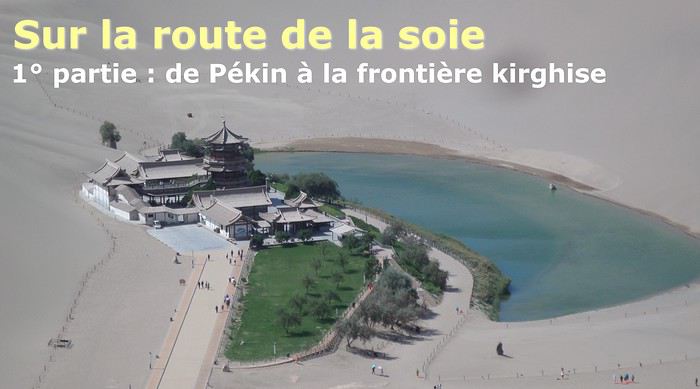
The Chinese Far West More than 30 years after my first trip to eastern China, I finally fulfilled an old dream: traveling solo from Beijing to the far west, discovering Xinjiang, the Uyghur people and the oppression they endure, the oases of Turpan and Kashgar, the Taklamakan Desert, the end of the Great Wall... The route was covered by train.
MENU PART 1: CHINA
1- Beijing (Jiankou) : the authentic Great Wall, without tourists 2- Cycling in Beijing, the best way to get around 3- Beijing : departure for the far west 4- Jiayuguan : getting by without English 5- Jiayuguan : scams and heritage 6- Dunhuang : abundance in the middle of the desert 7- Turpan : the Uyghurs under heavy surveillance 8- Kashgar : love at first sight for the old city 9- Kashgar : China’s recipe for controlling the populace 10- Tashkurgan : what on earth was I thinking going there! Kyrgyz border: a surreal epic Photo album from the 80s, contributions from other travelers (page 2)
1- JIANKOU Finding the authentic Great Wall, without tourists or a guide Friday, August 24, 2018 Thirty years later, I didn’t feel like revisiting the Great Wall at Badaling or any other overcrowded site. I chose to explore it at Jiankou, in its wildest, most authentic, and unrestored section, starting from a lost village deep in a valley—though it wasn’t *that* lost, since it had everything for communication.
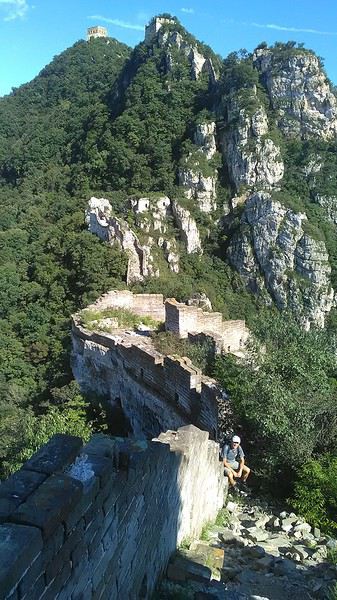
No need to pay for a taxi to get there—by timing it right, you can take the bus for just a few yuan. You have to get off at Xizhazi, the bus terminus. Be careful, there are only two buses a day in each direction. At the Xizhazi bus stop, I met a young couple who’d arrived with zero information about what to expect. We hiked the three of us toward the restored section of Mutianyu.
Still, be cautious With GPS and a topographic map (OpenTopoMap), you can set off without a problem or guide. The trail up to Jiankou is easy and well-marked. The trails down are too. But be careful—once you’re on the Wall, it’s real mountain hiking, with easy but dangerous climbing sections (over sheer drops). Not for amateurs or those afraid of heights! But what a reward. The Wall all to yourself, where it’s at its most daring. Truly mesmerizing.
More photos...
2- BEIJING The best way to get around the capital Sunday, August 26 The best way to explore the city is still by bike. Most are in a bike-share system, but you need to use an app—WeChat, the app that does everything, like monitoring your every move. No way I was installing that.
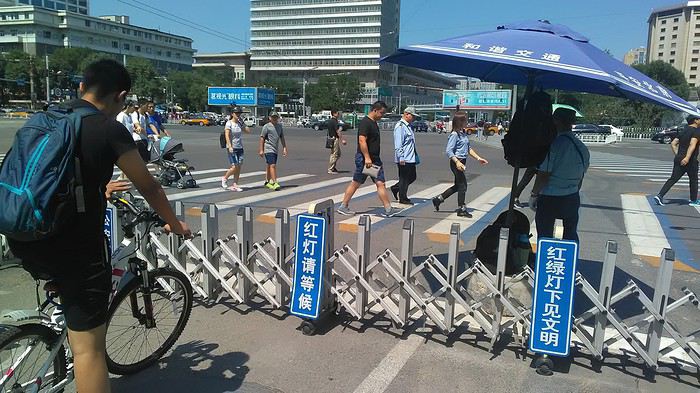
I found one at a rental shop near the hostel. The key is to quickly learn local traffic customs to minimize risks. Bike lanes are wide along the avenues.
But you still have to: - Watch out for anything parked on the bike paths—the most annoying are people napping or talking on the phone in their cars - Keep an eye on everything coming the wrong way—the list is long - The worst is right turns on red, which in Chinese traffic rules seem to have priority Once you get the hang of it, it’s fine. The city is huge but flat, so you can just wing it.
3- BEIJING By train to the far west Sunday, August 26 Beijing West Station is the size and operates like an airport. With your e-ticket from the agency, you first have to pick up your ticket at the special "English" counter, after passing through security. With your ticket in hand, you have to exit and enter through the boarding waiting area—not the platform—after a second security check.
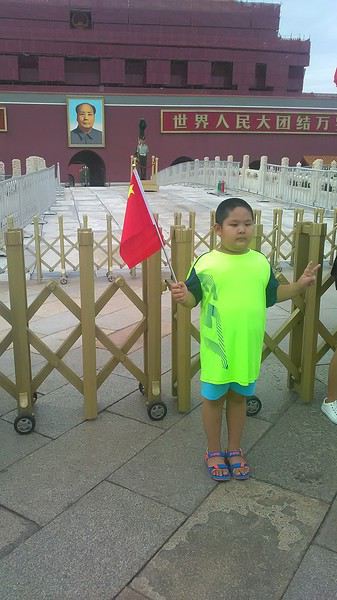 Then you find the right hall and wait for the sign to finally access the platform. In the end, it works pretty well given the incredible number of passengers to manage. Everywhere in Beijing, I saw that the Chinese have mastered crowd flow management.
Nice surprise: second-class carriages are clean, air-conditioned, and bright. Perfect, since I was in for 20 hours. One uniformed attendant per carriage, mobile meal service—luxury! Small downside: no luggage space. Hauling your suitcase up to the top bunk is quite a workout. I was in the middle, so it wasn’t too bad. The landscape, though, whether rural or urban, is pretty bleak. That should change once we leave the eastern plains.
Of course, I got my first police visit, with a thorough passport check and bag search. I was warned—going to the Chinese far west exposes you to this kind of hassle. But they were polite and respectful.
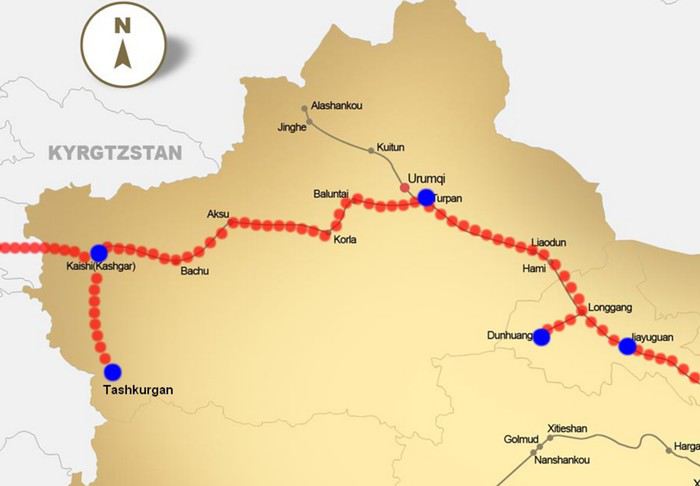 The Chinese Far West
4- JIAYUGUAN Getting by without English Monday, August 27 At the gates of two deserts (Gobi and Taklamakan) and at the foot of the Tibetan highlands, the Great Wall ends at Jiayuguan. Here, I found the deeper China I’d somewhat rediscovered during my bike ride, even if now everyone gets around on electric bikes and I’m no longer stared at like an alien.
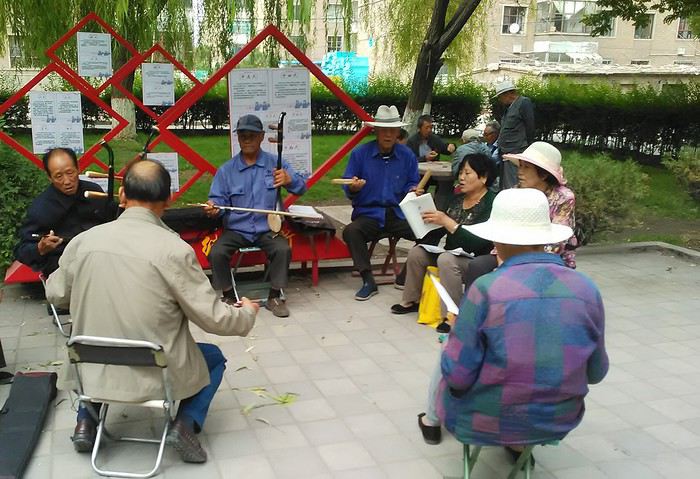
Prices are nothing like Beijing: you can find a full meal for 2 €, and my bike cost 7 € for two days. Plus, few people speak English—neither the owner of the HI hostel where I stayed, nor the ticket sellers at the sites, let alone the servers at the small eateries where I ate. Everything is written in Chinese. So I had to use the little Chinese I know to communicate about essentials. It makes the locals laugh to see a European trying to speak their language, but it earns respect. With Google Translate’s help, I managed.
Rant: With their avenues blocked for construction for kilometers without warning, and new roads not yet on maps, I must’ve taken 15 km of detours. More photos...
5- JIAYUGUAN Scams and heritage Tuesday, August 28 The Great Wall doesn’t exactly end at the fort I visited yesterday but 10 km further, at the entrance to a river gorge at the foot of the mountains. All that’s left is a badly damaged tower (more like a mound of earth) and a section of clay wall, similar to the one I biked yesterday.
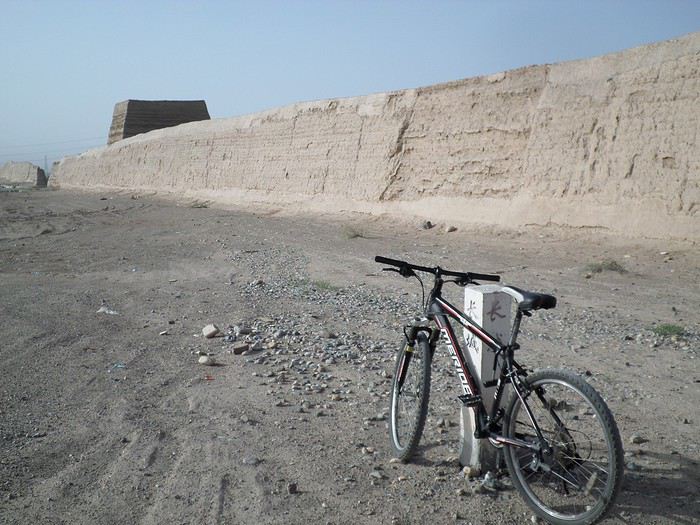
This morning, I hopped on my bike, determined to venture into the desert to see this highly symbolic site. First, you access it via a wide, brand-new road with not a soul in sight. Just before the site, I came across a grand welcome gate, very period-style, but it’s actually the inevitable toll booth.
Behind the gate, the road continues straight to the site, which you can see in the distance—at least 2 km away—the remains of the tower and wall. I had to leave my bike here. Fine. I went to the ticket counter and asked the price: 120 yuan! I couldn’t believe it—over 15 € for a simple mound of earth.
I showed my displeasure to the attendant, who couldn’t care less, and immediately turned back. 120 yuan—that’s the price for a new road, a fancy gate planted 2 km before the site just to force you to take a shuttle, and employees with nothing to do all day... Now I understand why I didn’t meet anyone!
Heritage China is a bit pricey Generally, sites are expensive for the country’s standard of living, but travelers are supposed to have money, so why hold back? I even gave up on the Forbidden City—reservations required days in advance (or on the black market at an impossible price). I prefer to keep the memory of my first visit, when entry must’ve cost a few dozen cents, and there were only a handful of visitors.
This morning, I took a taxi to see remarkable tombs of common people from the 3rd to 6th centuries. They’re small vaulted caves made of painted bricks, depicting scenes of daily life. Very pretty and moving. But even here, though the price was more reasonable, I was left wanting—only one of the 16 tombs is open to visitors, and it’s apparently not the most beautiful.
The authentic China—at least what’s left of it... Wandering the impersonal avenues of the city, you stumble upon a market. There, you still find traditional China—small shops with questionable hygiene, Go players, musicians, and even a dental prosthetist. The last refuge for those untouched by modernity. More photos...
6- DUNHUANG Abundance in the middle of the desert Wednesday, August 29 Well, I thought the landscape would be less bleak as I headed west. Nope. The only distraction in this expanse of dark, clayey sand is the forests of pylons and wind turbines, plus wild camels racing each other.
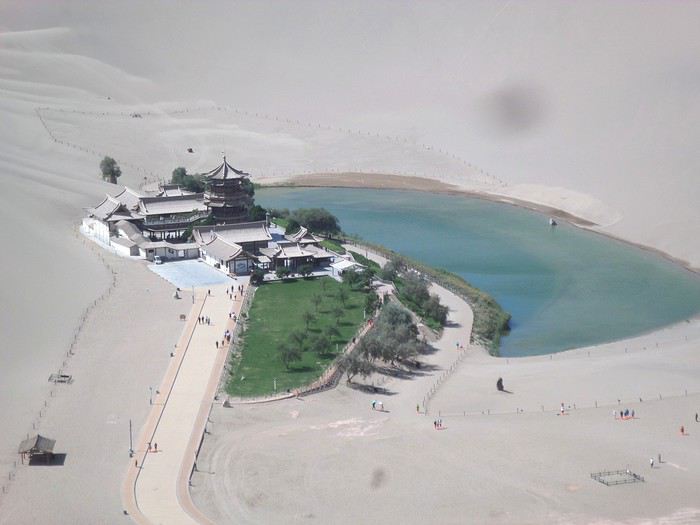 However, Dunhuang, the gateway to the Taklamakan, is by far the most pleasant Chinese city I know. There’s a real city center you can explore on foot. It’s hot but not unbearable, with a light, dry breeze. Much nicer than Beijing. The Han Chinese are still the majority, but the Muslim Uyghurs are more numerous, and the muezzin’s call to prayer echoes around the mosque.
The most surprising thing is the abundance and diversity of fruits and vegetables. You wonder how it all grows here. Well-irrigated, the desert sands are very fertile. Here, raisins have subtle, mysterious flavors, and the lamb really tastes like lamb.
Today, I visited the must-see Mingshashan, a dune complex next to which Pila is a molehill. The Basque Country, but covered in sand... More photos...
7- TURPAN The Uyghurs under heavy surveillance Friday, August 31 Surveillance cameras everywhere in the city, armed police stationed at intersections, in front of public buildings, at the entrance and inside tourist sites, police stations on every corner, patrols on foot or by car, khaki uniforms even for middle schoolers... here, the Han Chinese are in the minority, and you can feel it. Turpan feels like a city under siege.
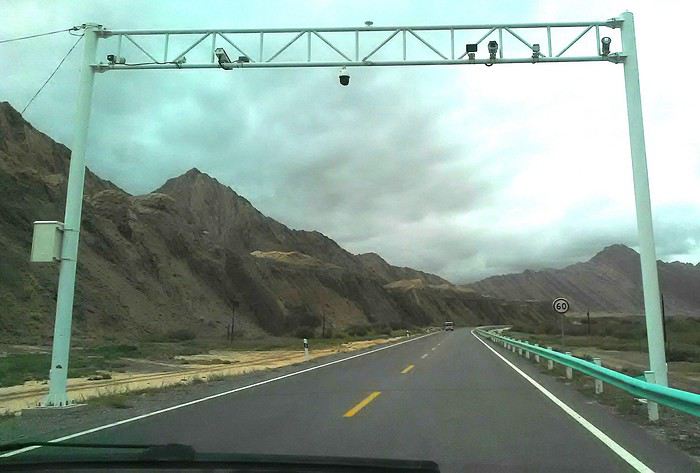
To enter the youth hostel where I stayed, there’s even a security gate, and the receptionist (a Han, like everyone in tourism) wears a bulletproof vest! Reassuring. Still, you don’t feel particularly threatened here, especially as a European. The troublemakers are the Chinese, not the Uyghurs. Generally, China is a very safe country for visitors.
Smile, you’re on camera! I was biking on an avenue when the car in front of me got flashed for driving slowly. I quickly understood why when I got flashed too.
Here, the official time is Beijing time, but it gets dark two hours later. It’ll be even worse in Kashgar. Trickier to manage: everything is displayed in Chinese and Arabic. Nothing in English. Choosing a menu is a shot in the dark. Apart from a few young Chinese, no one here speaks English, and my Chinese doesn’t seem very understandable...
Mogao, the end of the road for the Han Yesterday, near Dunhuang, I went to Mogao, a complex of decorated caves with Buddha sculptures and paintings. Stunning, but so crowded! Luckily, here in Turpan, Chinese tourists barely venture out. So I visited a Silk Road ghost town with only a handful of other visitors and under a howling wind.
The modern Chinese city is swallowing up the old Uyghur neighborhoods—only a museum-like district remains in the center, and pockets of resistance on the outskirts are doomed to disappear soon. More photos...
8- KASHGAR A (relative) love at first sight for the old city Sunday, September 2 After three overnight trains, here I am in the far west of China, nearly 4,000 km from the capital. Despite the omnipresent police and an old city preserved UNESCO-style, Kashgar is my Chinese love at first sight.
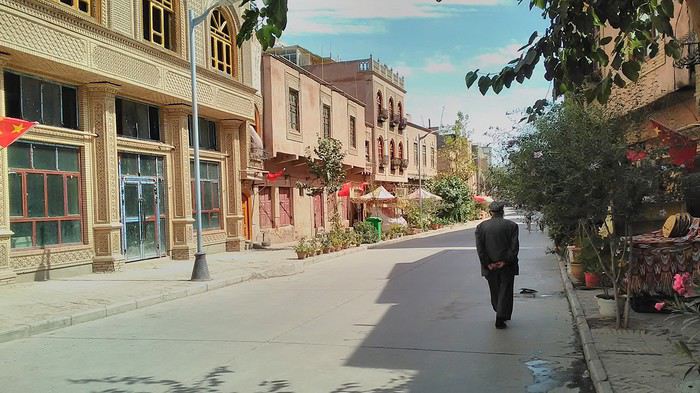
Finally, Chinese... well, sort of, because we’re in Uyghur territory here—a Turkic people with nothing culturally in common with the Han, the eastern Chinese. It started badly yesterday at Turfan station, where after three security gate passes, at least five passport checks, and a bag search, three adorable policewomen confiscated my antibacterial lotion because it had a flammable logo...
Then came the welcoming committee of armed cops at Kashgar station. Once all that was over, they left me alone—except you still have to go through security checks like everyone else to enter the old city, the bazaar, the livestock market... The further west you go, the more the siege mentality is evident. Luckily, the border isn’t far...
Despite the inevitable destruction-reconstruction, the city center has been well preserved. Thankfully, because it’s a very original style, a mix of local and colonial. I love it, even if it’s a bit too artificial, sanitized, and watered-down, and rather empty of residents. On the Silk Road, the city was famous for its great food. And it still is—rarely have I seen such richness and abundance of food! And not just scorpions or snakes. More photos...
9- KASHGAR China’s recipe for controlling the populace Saturday, September 1 Xinjiang, along with Tibet, is a "sensitive" area of rebellion in the eyes of Chinese authorities. As a result, the state has these regions and their populations under total control. Tourists also feel the consequences, even if they’re not at risk of re-education camps.
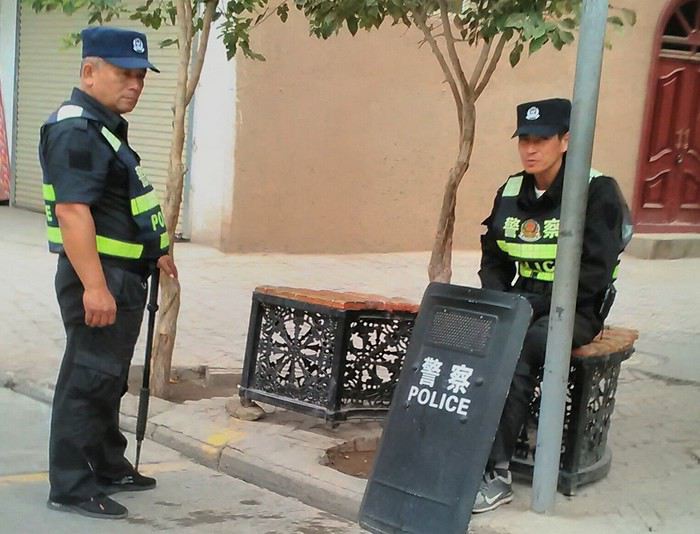 - Putting barbed wire and anti-ramming barriers around sensitive sites (schools, big hotels, government buildings...)
- Installing traffic surveillance gates with cameras and photo flashes (for all vehicles passing, including bikes) throughout the city and even in the countryside
- Posting uniformed guards with tasers, batons, or huge baseball bats every 100 meters
- Training the Han population (ethnic Chinese) in self-defense with sticks, preferably in the morning on the street. Men and women of all ages
- Starting school with the national anthem, doing military exercises, and receiving political indoctrination, all neatly lined up in the courtyard. (The dream school for any teacher)
- Placing a snitch in uniform (a pseudo-guard) in public gathering places, like youth hostels. Mine spends the day loafing around the courtyard
- Putting Chinese flags everywhere on the streets to remind everyone who’s in charge
- Installing security gates at every entrance to areas frequented by tourists (thanks for that) but not just there
- Never photographing cops, or else! I tried, but it’s not easy...
- Putting barbed wire and anti-ramming barriers around sensitive sites (schools, big hotels, government buildings...)
- Installing traffic surveillance gates with cameras and photo flashes (for all vehicles passing, including bikes) throughout the city and even in the countryside
- Posting uniformed guards with tasers, batons, or huge baseball bats every 100 meters
- Training the Han population (ethnic Chinese) in self-defense with sticks, preferably in the morning on the street. Men and women of all ages
- Starting school with the national anthem, doing military exercises, and receiving political indoctrination, all neatly lined up in the courtyard. (The dream school for any teacher)
- Placing a snitch in uniform (a pseudo-guard) in public gathering places, like youth hostels. Mine spends the day loafing around the courtyard
- Putting Chinese flags everywhere on the streets to remind everyone who’s in charge
- Installing security gates at every entrance to areas frequented by tourists (thanks for that) but not just there
- Never photographing cops, or else! I tried, but it’s not easy...
With all that, you can stroll around safely Not much crime! As for the amount the Chinese state spends to maintain such a system, it’s staggering! A third of the Han living in Xinjiang work in security. Today, I wandered freely around old Kashgar, which is quite large after all. More photos...
10- TASHKURGAN What on earth was I thinking going there! Wednesday, September 5 First, there’s the taxi—pretty crappy, with a driver who doesn’t speak a word of English and won’t stop smoking. Over six hours in that... shared with a completely out-of-it American.
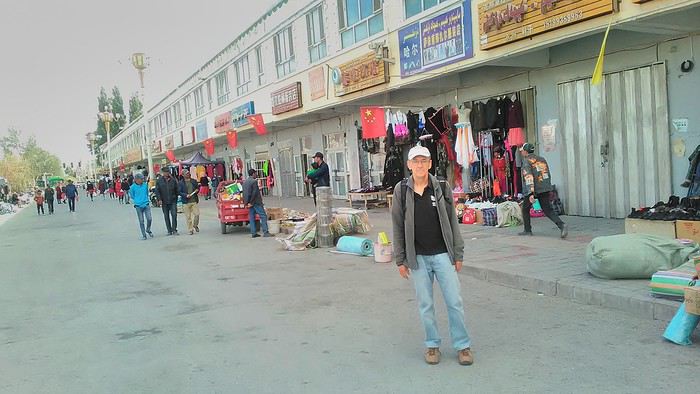
Then there are all the checkpoints along the way. I won’t go on—you know the drill by now.
After that, there’s Tashkurgan—a town with nothing to see, nothing to do. Deserted as soon as night falls. There’s this huge youth hostel and a few lost Chinese tapping away on their smartphones, chain-smoking. This lost American-European crowd, swapping tips on how to enter Pakistan or Tajikistan.
Luckily, there’s the Chinese Pamir Highway, lined with peaks over 7,000m. There’s the feeling of no longer being in China, with a population whose features are Middle Eastern. And these Tajik women with their stunning hairstyles and vibrant costumes. There’s the fact of having reached the westernmost Chinese city, far from crowds and tourist sites. A sort of end of the world. More photos...
11- KYRGYZ BORDER A surreal epic Thursday, September 6 The road from Kashgar to the Kyrgyzstan border is a little over 200 km and passes through beautiful landscapes of colorful, desert-like mountains with acrobatic folds. That’s the bucolic part of the trip.
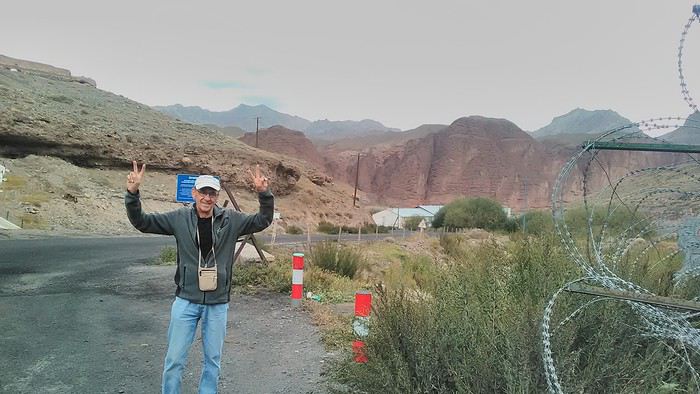 Yesterday, I managed to gather four people to rent a minibus to reach the border more easily: a Spaniard and an Argentine I’d already met in Turpan, and two New Zealanders who responded to the ad left at the hostel.
Absurdity and paranoia of Chinese authorities The highlight was crossing the town of Wuqia, 50 km past Kashgar. After tallying up with my fellow sufferers, we must’ve passed about ten checkpoints with: - Passport checks: 14 times, sometimes by two cops side by side - Bag checks: 4 times - Smartphone checks: 2 times, with deletion of "non-compliant" photos, and registration of your IMEI in the exit log!... Absurd and surreal at the same time, since my camera stayed in my bag, my apps are in French, and my photos have been online for ages...
With all that, we arrived just as the last checkpoint before the no man’s land marking the border between the two countries was on lunch break. And bam! Another 1.5-hour wait, alongside truckers who were much more used to this than we were.
What to think? The cops themselves aren’t fooled. They play the role they’re asked to, but sometimes you can coax a smile out of them—they realize how ridiculous the situation is.
What’s the point? That’s the big question my companions and I were tempted to answer with "to piss people off." To show you your place isn’t here, but with the other tourists, over there in the east, in Shanghai, Xi’an, or Guangzhou.
As for you, a traveler from a democratic country, you really experience this as aggression, humiliation, a violation of your private space. And yet, I’m respected, they speak to me properly. Today, I better understand what a Palestinian or a citizen of an occupied country might feel daily. A unique experience! Thanks, China.
And to top it off, the cherry on the cake! It’s still this glowing button you press to rate your passage after clearing the last obstacle before the exit stamp. I was so surprised it turned off before I could react. The Spaniard, with great humor and irony, had time to vote "excellent." In the end, he wasn’t wrong—you can hardly do better!
PS: I ditched my buddies at the border. They didn’t want to pay for a taxi to continue. So I took a direct taxi to Osh. The first 100 km are fabulous. I couldn’t take many photos, but I’ll be back on Monday to go to Tajikistan.
More photos...
The rest of the Silk Road, Part 2, in these travel journals: Kyrgyzstan, Tajikistan, Uzbekistan.
The Chinese Far West More than 30 years after my first trip to eastern China, I finally fulfilled an old dream: traveling solo from Beijing to the far west, discovering Xinjiang, the Uyghur people and the oppression they endure, the oases of Turpan and Kashgar, the Taklamakan Desert, the end of the Great Wall... The route was covered by train.
MENU PART 1: CHINA
1- Beijing (Jiankou) : the authentic Great Wall, without tourists 2- Cycling in Beijing, the best way to get around 3- Beijing : departure for the far west 4- Jiayuguan : getting by without English 5- Jiayuguan : scams and heritage 6- Dunhuang : abundance in the middle of the desert 7- Turpan : the Uyghurs under heavy surveillance 8- Kashgar : love at first sight for the old city 9- Kashgar : China’s recipe for controlling the populace 10- Tashkurgan : what on earth was I thinking going there! Kyrgyz border: a surreal epic Photo album from the 80s, contributions from other travelers (page 2)
1- JIANKOU Finding the authentic Great Wall, without tourists or a guide Friday, August 24, 2018 Thirty years later, I didn’t feel like revisiting the Great Wall at Badaling or any other overcrowded site. I chose to explore it at Jiankou, in its wildest, most authentic, and unrestored section, starting from a lost village deep in a valley—though it wasn’t *that* lost, since it had everything for communication.
No need to pay for a taxi to get there—by timing it right, you can take the bus for just a few yuan. You have to get off at Xizhazi, the bus terminus. Be careful, there are only two buses a day in each direction. At the Xizhazi bus stop, I met a young couple who’d arrived with zero information about what to expect. We hiked the three of us toward the restored section of Mutianyu.
Still, be cautious With GPS and a topographic map (OpenTopoMap), you can set off without a problem or guide. The trail up to Jiankou is easy and well-marked. The trails down are too. But be careful—once you’re on the Wall, it’s real mountain hiking, with easy but dangerous climbing sections (over sheer drops). Not for amateurs or those afraid of heights! But what a reward. The Wall all to yourself, where it’s at its most daring. Truly mesmerizing.
More photos...
2- BEIJING The best way to get around the capital Sunday, August 26 The best way to explore the city is still by bike. Most are in a bike-share system, but you need to use an app—WeChat, the app that does everything, like monitoring your every move. No way I was installing that.
I found one at a rental shop near the hostel. The key is to quickly learn local traffic customs to minimize risks. Bike lanes are wide along the avenues.
But you still have to: - Watch out for anything parked on the bike paths—the most annoying are people napping or talking on the phone in their cars - Keep an eye on everything coming the wrong way—the list is long - The worst is right turns on red, which in Chinese traffic rules seem to have priority Once you get the hang of it, it’s fine. The city is huge but flat, so you can just wing it.
3- BEIJING By train to the far west Sunday, August 26 Beijing West Station is the size and operates like an airport. With your e-ticket from the agency, you first have to pick up your ticket at the special "English" counter, after passing through security. With your ticket in hand, you have to exit and enter through the boarding waiting area—not the platform—after a second security check.
Then you find the right hall and wait for the sign to finally access the platform. In the end, it works pretty well given the incredible number of passengers to manage. Everywhere in Beijing, I saw that the Chinese have mastered crowd flow management.Nice surprise: second-class carriages are clean, air-conditioned, and bright. Perfect, since I was in for 20 hours. One uniformed attendant per carriage, mobile meal service—luxury! Small downside: no luggage space. Hauling your suitcase up to the top bunk is quite a workout. I was in the middle, so it wasn’t too bad. The landscape, though, whether rural or urban, is pretty bleak. That should change once we leave the eastern plains.
Of course, I got my first police visit, with a thorough passport check and bag search. I was warned—going to the Chinese far west exposes you to this kind of hassle. But they were polite and respectful.
The Chinese Far West4- JIAYUGUAN Getting by without English Monday, August 27 At the gates of two deserts (Gobi and Taklamakan) and at the foot of the Tibetan highlands, the Great Wall ends at Jiayuguan. Here, I found the deeper China I’d somewhat rediscovered during my bike ride, even if now everyone gets around on electric bikes and I’m no longer stared at like an alien.
Prices are nothing like Beijing: you can find a full meal for 2 €, and my bike cost 7 € for two days. Plus, few people speak English—neither the owner of the HI hostel where I stayed, nor the ticket sellers at the sites, let alone the servers at the small eateries where I ate. Everything is written in Chinese. So I had to use the little Chinese I know to communicate about essentials. It makes the locals laugh to see a European trying to speak their language, but it earns respect. With Google Translate’s help, I managed.
Rant: With their avenues blocked for construction for kilometers without warning, and new roads not yet on maps, I must’ve taken 15 km of detours. More photos...
5- JIAYUGUAN Scams and heritage Tuesday, August 28 The Great Wall doesn’t exactly end at the fort I visited yesterday but 10 km further, at the entrance to a river gorge at the foot of the mountains. All that’s left is a badly damaged tower (more like a mound of earth) and a section of clay wall, similar to the one I biked yesterday.
This morning, I hopped on my bike, determined to venture into the desert to see this highly symbolic site. First, you access it via a wide, brand-new road with not a soul in sight. Just before the site, I came across a grand welcome gate, very period-style, but it’s actually the inevitable toll booth.
Behind the gate, the road continues straight to the site, which you can see in the distance—at least 2 km away—the remains of the tower and wall. I had to leave my bike here. Fine. I went to the ticket counter and asked the price: 120 yuan! I couldn’t believe it—over 15 € for a simple mound of earth.
I showed my displeasure to the attendant, who couldn’t care less, and immediately turned back. 120 yuan—that’s the price for a new road, a fancy gate planted 2 km before the site just to force you to take a shuttle, and employees with nothing to do all day... Now I understand why I didn’t meet anyone!
Heritage China is a bit pricey Generally, sites are expensive for the country’s standard of living, but travelers are supposed to have money, so why hold back? I even gave up on the Forbidden City—reservations required days in advance (or on the black market at an impossible price). I prefer to keep the memory of my first visit, when entry must’ve cost a few dozen cents, and there were only a handful of visitors.
This morning, I took a taxi to see remarkable tombs of common people from the 3rd to 6th centuries. They’re small vaulted caves made of painted bricks, depicting scenes of daily life. Very pretty and moving. But even here, though the price was more reasonable, I was left wanting—only one of the 16 tombs is open to visitors, and it’s apparently not the most beautiful.
The authentic China—at least what’s left of it... Wandering the impersonal avenues of the city, you stumble upon a market. There, you still find traditional China—small shops with questionable hygiene, Go players, musicians, and even a dental prosthetist. The last refuge for those untouched by modernity. More photos...
6- DUNHUANG Abundance in the middle of the desert Wednesday, August 29 Well, I thought the landscape would be less bleak as I headed west. Nope. The only distraction in this expanse of dark, clayey sand is the forests of pylons and wind turbines, plus wild camels racing each other.
However, Dunhuang, the gateway to the Taklamakan, is by far the most pleasant Chinese city I know. There’s a real city center you can explore on foot. It’s hot but not unbearable, with a light, dry breeze. Much nicer than Beijing. The Han Chinese are still the majority, but the Muslim Uyghurs are more numerous, and the muezzin’s call to prayer echoes around the mosque.The most surprising thing is the abundance and diversity of fruits and vegetables. You wonder how it all grows here. Well-irrigated, the desert sands are very fertile. Here, raisins have subtle, mysterious flavors, and the lamb really tastes like lamb.
Today, I visited the must-see Mingshashan, a dune complex next to which Pila is a molehill. The Basque Country, but covered in sand... More photos...
7- TURPAN The Uyghurs under heavy surveillance Friday, August 31 Surveillance cameras everywhere in the city, armed police stationed at intersections, in front of public buildings, at the entrance and inside tourist sites, police stations on every corner, patrols on foot or by car, khaki uniforms even for middle schoolers... here, the Han Chinese are in the minority, and you can feel it. Turpan feels like a city under siege.
To enter the youth hostel where I stayed, there’s even a security gate, and the receptionist (a Han, like everyone in tourism) wears a bulletproof vest! Reassuring. Still, you don’t feel particularly threatened here, especially as a European. The troublemakers are the Chinese, not the Uyghurs. Generally, China is a very safe country for visitors.
Smile, you’re on camera! I was biking on an avenue when the car in front of me got flashed for driving slowly. I quickly understood why when I got flashed too.
Here, the official time is Beijing time, but it gets dark two hours later. It’ll be even worse in Kashgar. Trickier to manage: everything is displayed in Chinese and Arabic. Nothing in English. Choosing a menu is a shot in the dark. Apart from a few young Chinese, no one here speaks English, and my Chinese doesn’t seem very understandable...
Mogao, the end of the road for the Han Yesterday, near Dunhuang, I went to Mogao, a complex of decorated caves with Buddha sculptures and paintings. Stunning, but so crowded! Luckily, here in Turpan, Chinese tourists barely venture out. So I visited a Silk Road ghost town with only a handful of other visitors and under a howling wind.
The modern Chinese city is swallowing up the old Uyghur neighborhoods—only a museum-like district remains in the center, and pockets of resistance on the outskirts are doomed to disappear soon. More photos...
8- KASHGAR A (relative) love at first sight for the old city Sunday, September 2 After three overnight trains, here I am in the far west of China, nearly 4,000 km from the capital. Despite the omnipresent police and an old city preserved UNESCO-style, Kashgar is my Chinese love at first sight.
Finally, Chinese... well, sort of, because we’re in Uyghur territory here—a Turkic people with nothing culturally in common with the Han, the eastern Chinese. It started badly yesterday at Turfan station, where after three security gate passes, at least five passport checks, and a bag search, three adorable policewomen confiscated my antibacterial lotion because it had a flammable logo...
Then came the welcoming committee of armed cops at Kashgar station. Once all that was over, they left me alone—except you still have to go through security checks like everyone else to enter the old city, the bazaar, the livestock market... The further west you go, the more the siege mentality is evident. Luckily, the border isn’t far...
Despite the inevitable destruction-reconstruction, the city center has been well preserved. Thankfully, because it’s a very original style, a mix of local and colonial. I love it, even if it’s a bit too artificial, sanitized, and watered-down, and rather empty of residents. On the Silk Road, the city was famous for its great food. And it still is—rarely have I seen such richness and abundance of food! And not just scorpions or snakes. More photos...
9- KASHGAR China’s recipe for controlling the populace Saturday, September 1 Xinjiang, along with Tibet, is a "sensitive" area of rebellion in the eyes of Chinese authorities. As a result, the state has these regions and their populations under total control. Tourists also feel the consequences, even if they’re not at risk of re-education camps.
- Putting barbed wire and anti-ramming barriers around sensitive sites (schools, big hotels, government buildings...)
- Installing traffic surveillance gates with cameras and photo flashes (for all vehicles passing, including bikes) throughout the city and even in the countryside
- Posting uniformed guards with tasers, batons, or huge baseball bats every 100 meters
- Training the Han population (ethnic Chinese) in self-defense with sticks, preferably in the morning on the street. Men and women of all ages
- Starting school with the national anthem, doing military exercises, and receiving political indoctrination, all neatly lined up in the courtyard. (The dream school for any teacher)
- Placing a snitch in uniform (a pseudo-guard) in public gathering places, like youth hostels. Mine spends the day loafing around the courtyard
- Putting Chinese flags everywhere on the streets to remind everyone who’s in charge
- Installing security gates at every entrance to areas frequented by tourists (thanks for that) but not just there
- Never photographing cops, or else! I tried, but it’s not easy...With all that, you can stroll around safely Not much crime! As for the amount the Chinese state spends to maintain such a system, it’s staggering! A third of the Han living in Xinjiang work in security. Today, I wandered freely around old Kashgar, which is quite large after all. More photos...
10- TASHKURGAN What on earth was I thinking going there! Wednesday, September 5 First, there’s the taxi—pretty crappy, with a driver who doesn’t speak a word of English and won’t stop smoking. Over six hours in that... shared with a completely out-of-it American.
Then there are all the checkpoints along the way. I won’t go on—you know the drill by now.
After that, there’s Tashkurgan—a town with nothing to see, nothing to do. Deserted as soon as night falls. There’s this huge youth hostel and a few lost Chinese tapping away on their smartphones, chain-smoking. This lost American-European crowd, swapping tips on how to enter Pakistan or Tajikistan.
Luckily, there’s the Chinese Pamir Highway, lined with peaks over 7,000m. There’s the feeling of no longer being in China, with a population whose features are Middle Eastern. And these Tajik women with their stunning hairstyles and vibrant costumes. There’s the fact of having reached the westernmost Chinese city, far from crowds and tourist sites. A sort of end of the world. More photos...
11- KYRGYZ BORDER A surreal epic Thursday, September 6 The road from Kashgar to the Kyrgyzstan border is a little over 200 km and passes through beautiful landscapes of colorful, desert-like mountains with acrobatic folds. That’s the bucolic part of the trip.
Yesterday, I managed to gather four people to rent a minibus to reach the border more easily: a Spaniard and an Argentine I’d already met in Turpan, and two New Zealanders who responded to the ad left at the hostel.Absurdity and paranoia of Chinese authorities The highlight was crossing the town of Wuqia, 50 km past Kashgar. After tallying up with my fellow sufferers, we must’ve passed about ten checkpoints with: - Passport checks: 14 times, sometimes by two cops side by side - Bag checks: 4 times - Smartphone checks: 2 times, with deletion of "non-compliant" photos, and registration of your IMEI in the exit log!... Absurd and surreal at the same time, since my camera stayed in my bag, my apps are in French, and my photos have been online for ages...
With all that, we arrived just as the last checkpoint before the no man’s land marking the border between the two countries was on lunch break. And bam! Another 1.5-hour wait, alongside truckers who were much more used to this than we were.
What to think? The cops themselves aren’t fooled. They play the role they’re asked to, but sometimes you can coax a smile out of them—they realize how ridiculous the situation is.
What’s the point? That’s the big question my companions and I were tempted to answer with "to piss people off." To show you your place isn’t here, but with the other tourists, over there in the east, in Shanghai, Xi’an, or Guangzhou.
As for you, a traveler from a democratic country, you really experience this as aggression, humiliation, a violation of your private space. And yet, I’m respected, they speak to me properly. Today, I better understand what a Palestinian or a citizen of an occupied country might feel daily. A unique experience! Thanks, China.
And to top it off, the cherry on the cake! It’s still this glowing button you press to rate your passage after clearing the last obstacle before the exit stamp. I was so surprised it turned off before I could react. The Spaniard, with great humor and irony, had time to vote "excellent." In the end, he wasn’t wrong—you can hardly do better!
PS: I ditched my buddies at the border. They didn’t want to pay for a taxi to continue. So I took a direct taxi to Osh. The first 100 km are fabulous. I couldn’t take many photos, but I’ll be back on Monday to go to Tajikistan.
More photos...
The rest of the Silk Road, Part 2, in these travel journals: Kyrgyzstan, Tajikistan, Uzbekistan.
Bonjour,
Voici le récit de nos 2 semaines cet été à 5 dont 3 enfants 7/14/16 ans/ 3 semaines sous tente en camping sauvage, seulement la première et la dernière nuit en guest house à Bichkek. (carnet de voyage d'un de nos enfants).
Nous avons adoré ce pays et nous retournrons dans ce coin d'Asie de nouveau.
Nous avons loué le 4*4 à Travelland, avis mitigé: la voiture est en bon état 160000km, avec cependant la ventilation qui ne fonctionne pas, la communication très bonne, mais une mauvaise surprise, ils ont retenu 90€ sur la caution pour des rayures à peine visible et probablement d'origine...
NOTRE TRAJET :
JOUR 1-2 : Maison-Toulouse-Istanbul-Bishkek
JOUR 3 : Bishkek – Kokomeren
JOUR 4 : Kokomeren – col Tuzduu
JOUR 5 : vers Min Kush – Arslanbob
JOUR 6 : Arslanbob – vers Uzgen
JOUR 7 : vers Uzgen – Pic Lénine
JOUR 8 : Pic Lénine – vers Gulcha
JOUR 9 : vers Gulcha – Saimaluu Tash
JOUR 10: Saimaluu Tash – Son Kul
JOUR 11 : Son Kul – vers Baetov
JOUR 12 : vers Baetov – Tash Rabat
JOUR 13 : Tash Rabat – vers Naryn
JOUR 14 : vers Naryn – vers Kochkor
JOUR 15 : vers Kochkor – Issyk Kul
JOUR 16 : Issyk Kul – cascades Barksoon
JOUR 17 : cascade Barksoon – Issyk Kul
JOUR 18 : Issyk Kul – Altym Arashan
JOUR 19 : Altym Arashan - Issyk Kul (vers Karakol )
JOUR 20 : Issyk Kul (vers Karakol) – Issyk Kul
JOUR 21-22 : Issyk Kul – Bishkek – France
JOURS 1-2 :Maison-Toulouse- Istanbul-Bishkek (800m) Nous partons enfin pour le Kirghizstan. Nous faisons une étape à Istanbul et nous repartons à 0h40 pour Bishkek. Je dors tant et si bien que je loupe le repas. Après notre atterrissage, nous allons à la guesthouse avec notre gros 4X4. Nous visitons le Osh baazar avec ses multiples pains, épices...Il est beaucoup plus calme que celui de Marrakech mais il fait quand même très chaud. Un peu partout sur les trottoirs, des marchands vendent des boissons dans des bidons : lait fermenté (ayran), kumiz (mélange de lait et orge fermentés) et thé glacé. Nous essayons tout et recrachons le 2e. Nous poursuivons par un tour dans le centre ville et ses nombreux monuments, notamment la statue de Lénine et celle de MANAS. Nous nous promenons dans un grand parc qui est aussi un parc d'attraction mais sans bruit et sans monde. Pendant que les parents font les courses, je fais une petite sieste bien méritée. Nous finissons la journée au restaurant. Nous mangeons des raviolis à la viande (mantys) et 2 sortes de pâtes à la soupe , aux légumes et à la viande (lagman).
JOUR 3 : Bishkek – gorges de Kokomeren (2300m) Nous prenons le petit-déjeuner à la guesthouse. C'est copieux ! J'aime particulièrement les boules de brioche au chocolat. Il y a aussi de la ratatouille chaude avec des oeufs et de la ratatouille froide légèrement épicée. Je ne profite pas pleinement de ce petit-déjeuner car je n'ai pas faim (il est 5h du matin en France!) Nous suivons la plaine par une route bondée et en mauvais état qui va jusqu'au Kazakhstan. Nous bifurquons sur une petite route qui passe dans une gorge et qui zigzague jusqu'à un étroit tunnel pollué à 3000m d'altitude construit par les soviétiques. La route est maintenant bordée d’étales de miel et de fromages boules hyper secs et salés. Nous nous arrêtons visiter le cimetière musulman de Suusamyr et reprenons de l'essence Gazprom de façon rustique : le vendeur nous le verse par bidons de 5l.Nous nous arrêtons ensuite à Kojomkul voir le monument et la tombe du géant Kojomkul. Quelle drôle d'idée de s'appeler comme son village : c'est comme si je m'appelais Labroquère ! Il mesurait 2,30m et rendait beaucoup de services aux autres. Mon GPS indique un « sans nom » dans les monuments. Nous le recherchons. Il s'agit en fait d'une statue de mouton de Marco Polo bien abîmée. Nous suivons la Kokomaren tumultueuse dans sa belle gorge rouge. En nous approchant de la rivière, près d'un petit bosquet, nous rencontrons des gens qui nous font signe de les rejoindre. Ils nous invitent sur leurs tapis et nous proposent des salades, des fruits, des bonbons et du mouton qui a cuit au barbecue. Je fais trempette mais pas trop loin car il y a beaucoup de courant. Nous sommes assez limités dans nos échanges car le kirghize reste une langue inconnue de nous et ils ne maîtrisent ni l'anglais, ni le français. Mais nous passons un très bon moment. Nous échangeons nos adresses et téléphones dans nos alphabets respectifs et nous quittons notre presque nouvelle famille pour planter la tente un peu plus loin. Nous n'avons pas faim pour dîner.
JOURS 1-2 :Maison-Toulouse- Istanbul-Bishkek (800m) Nous partons enfin pour le Kirghizstan. Nous faisons une étape à Istanbul et nous repartons à 0h40 pour Bishkek. Je dors tant et si bien que je loupe le repas. Après notre atterrissage, nous allons à la guesthouse avec notre gros 4X4. Nous visitons le Osh baazar avec ses multiples pains, épices...Il est beaucoup plus calme que celui de Marrakech mais il fait quand même très chaud. Un peu partout sur les trottoirs, des marchands vendent des boissons dans des bidons : lait fermenté (ayran), kumiz (mélange de lait et orge fermentés) et thé glacé. Nous essayons tout et recrachons le 2e. Nous poursuivons par un tour dans le centre ville et ses nombreux monuments, notamment la statue de Lénine et celle de MANAS. Nous nous promenons dans un grand parc qui est aussi un parc d'attraction mais sans bruit et sans monde. Pendant que les parents font les courses, je fais une petite sieste bien méritée. Nous finissons la journée au restaurant. Nous mangeons des raviolis à la viande (mantys) et 2 sortes de pâtes à la soupe , aux légumes et à la viande (lagman).
JOUR 3 : Bishkek – gorges de Kokomeren (2300m) Nous prenons le petit-déjeuner à la guesthouse. C'est copieux ! J'aime particulièrement les boules de brioche au chocolat. Il y a aussi de la ratatouille chaude avec des oeufs et de la ratatouille froide légèrement épicée. Je ne profite pas pleinement de ce petit-déjeuner car je n'ai pas faim (il est 5h du matin en France!) Nous suivons la plaine par une route bondée et en mauvais état qui va jusqu'au Kazakhstan. Nous bifurquons sur une petite route qui passe dans une gorge et qui zigzague jusqu'à un étroit tunnel pollué à 3000m d'altitude construit par les soviétiques. La route est maintenant bordée d’étales de miel et de fromages boules hyper secs et salés. Nous nous arrêtons visiter le cimetière musulman de Suusamyr et reprenons de l'essence Gazprom de façon rustique : le vendeur nous le verse par bidons de 5l.Nous nous arrêtons ensuite à Kojomkul voir le monument et la tombe du géant Kojomkul. Quelle drôle d'idée de s'appeler comme son village : c'est comme si je m'appelais Labroquère ! Il mesurait 2,30m et rendait beaucoup de services aux autres. Mon GPS indique un « sans nom » dans les monuments. Nous le recherchons. Il s'agit en fait d'une statue de mouton de Marco Polo bien abîmée. Nous suivons la Kokomaren tumultueuse dans sa belle gorge rouge. En nous approchant de la rivière, près d'un petit bosquet, nous rencontrons des gens qui nous font signe de les rejoindre. Ils nous invitent sur leurs tapis et nous proposent des salades, des fruits, des bonbons et du mouton qui a cuit au barbecue. Je fais trempette mais pas trop loin car il y a beaucoup de courant. Nous sommes assez limités dans nos échanges car le kirghize reste une langue inconnue de nous et ils ne maîtrisent ni l'anglais, ni le français. Mais nous passons un très bon moment. Nous échangeons nos adresses et téléphones dans nos alphabets respectifs et nous quittons notre presque nouvelle famille pour planter la tente un peu plus loin. Nous n'avons pas faim pour dîner.
Hello,
Summer 2026 hasn’t even arrived yet, and I’m already thinking about summer 2027! We’re a family with two kids, who will be 9.5 and 4.5 years old next summer (turning 5 at the end of October 2027, actually). We’d love to spend 19 nights in Uzbekistan and Kyrgyzstan—a part of the world that’s completely new to us. We enjoy traveling, do it often, and the kids are used to it (though we still need a bit of organization and comfort!). Here’s the rough outline of our itinerary: Day 1 - Arrival in Tashkent (ideally in the late afternoon). Head to the train station (by taxi?) to take the overnight sleeper train to Urgench (1 night). Day 2 - Khiva (2 nights): Taxi transfer from the station to the city. Visit Itchan Kala, the walls, and sunset. Day 4 - Head to Bukhara (3 nights) by train (about 6 hours). Visit the historic center, domes, and workshops. Day 7 - On to Samarkand (2 nights), but this time with a private driver. Visit Registan, the necropolis, and local crafts. Day 9 - Head to Osh (1 night) in Kyrgyzstan with the private driver, who’ll drop us at the border. Long transition day (including border crossing). If it’s not too late, visit Osh’s market (otherwise, the next morning). Day 10 - Pick up our rental car (4x4 without a driver this time) and drive to Toktogul (2 nights) and the Suusamyr Valley. Day 12 - Head to the Kochkor region (350 km - 4 nights): Tash Rabat, Song-Kul Lake (yurt stay), and Aigliers. Day 16 - Depart for Karakol/Issyk-Kul (250 km - 4 nights): Jeti-Oguz, Altyn Arashan, beaches, and hot springs. Day 20: Fly home. TOTAL = 19 nights What do you think? Budget-wise:
Flight tickets: 3000 € Uzbekistan logistics (accommodation ideally with a pool for the kids and vehicle): 1600 € Kyrgyzstan logistics (accommodation and 4x4 vehicle like a Pajero/Land Cruiser): 1600 € Living & food: 800 € TOTAL: 7000 €
Does this seem reasonable? Not overestimated or underestimated? Thanks for any feedback or tips from your own experiences.
Summer 2026 hasn’t even arrived yet, and I’m already thinking about summer 2027! We’re a family with two kids, who will be 9.5 and 4.5 years old next summer (turning 5 at the end of October 2027, actually). We’d love to spend 19 nights in Uzbekistan and Kyrgyzstan—a part of the world that’s completely new to us. We enjoy traveling, do it often, and the kids are used to it (though we still need a bit of organization and comfort!). Here’s the rough outline of our itinerary: Day 1 - Arrival in Tashkent (ideally in the late afternoon). Head to the train station (by taxi?) to take the overnight sleeper train to Urgench (1 night). Day 2 - Khiva (2 nights): Taxi transfer from the station to the city. Visit Itchan Kala, the walls, and sunset. Day 4 - Head to Bukhara (3 nights) by train (about 6 hours). Visit the historic center, domes, and workshops. Day 7 - On to Samarkand (2 nights), but this time with a private driver. Visit Registan, the necropolis, and local crafts. Day 9 - Head to Osh (1 night) in Kyrgyzstan with the private driver, who’ll drop us at the border. Long transition day (including border crossing). If it’s not too late, visit Osh’s market (otherwise, the next morning). Day 10 - Pick up our rental car (4x4 without a driver this time) and drive to Toktogul (2 nights) and the Suusamyr Valley. Day 12 - Head to the Kochkor region (350 km - 4 nights): Tash Rabat, Song-Kul Lake (yurt stay), and Aigliers. Day 16 - Depart for Karakol/Issyk-Kul (250 km - 4 nights): Jeti-Oguz, Altyn Arashan, beaches, and hot springs. Day 20: Fly home. TOTAL = 19 nights What do you think? Budget-wise:
Flight tickets: 3000 € Uzbekistan logistics (accommodation ideally with a pool for the kids and vehicle): 1600 € Kyrgyzstan logistics (accommodation and 4x4 vehicle like a Pajero/Land Cruiser): 1600 € Living & food: 800 € TOTAL: 7000 €
Does this seem reasonable? Not overestimated or underestimated? Thanks for any feedback or tips from your own experiences.
Hi there,
I’ve never bought a SIM card abroad or even used prepaid cards in France...
So I’m wondering how it all works?
You buy a SIM card and pop it into your phone. Okay, so far so good... 😏
But after that?
I can’t find the price of prepaid cards or how they work with MegaCom.
If someone could give me a step-by-step guide... 😊
Thanks! 🙂
I’ve never bought a SIM card abroad or even used prepaid cards in France...
So I’m wondering how it all works?
You buy a SIM card and pop it into your phone. Okay, so far so good... 😏
But after that?
I can’t find the price of prepaid cards or how they work with MegaCom.
If someone could give me a step-by-step guide... 😊
Thanks! 🙂
Hi there,
I’m looking for half-day hikes near Karakol (not Jety-Oguz, since I’ll be heading there separately—max 30 minutes’ drive to the trailhead).
I can find longer treks, but nothing for a short outing!
So, if you’ve got any ideas...
Thanks! :)
I’m looking for half-day hikes near Karakol (not Jety-Oguz, since I’ll be heading there separately—max 30 minutes’ drive to the trailhead).
I can find longer treks, but nothing for a short outing!
So, if you’ve got any ideas...
Thanks! :)
Hi,
Planning a solo trip to Kyrgyzstan in May. Any tips or info?
Thanks
Planning a solo trip to Kyrgyzstan in May. Any tips or info?
Thanks
It’s never too late to live intensely.
I’m Guy, I’ve passed 70, and I’m looking for a female travel companion for an extraordinary adventure aboard OTONOMI—a solar-powered tandem I built with my own hands over two years.
My past is that of an unrepentant traveler: crossing the Atlantic in an ultralight aircraft, swimming across channels, and a high-level sailing record in major transatlantic races... OTONOMI isn’t a retiree’s whim—it’s the final chapter of a life of adventure, perhaps the most beautiful one.
Departure at the end of May. Route: Europe to Baku, crossing the Caspian by ferry, then Turkmenistan, Uzbekistan, Tajikistan, the Pamir, Kyrgyzstan, and return via Kazakhstan. At least 3-4 months.
No need to be athletic—a session of *longe côte* (coastal walking) requires more physical effort than a full day on OTONOMI. You don’t even have to pedal at all.
OTONOMI tows a foldable solar-powered caravan trailer—camping under the stars or staying in small local hotels, depending on your mood. Road expenses are shared simply.
I’m looking for a free-spirited woman, curious, passionate about genuine encounters and wide-open spaces—appearance or insecurities don’t matter. Just that flame still burning inside you.
A real-life test run is planned before departure—so we can meet naturally, without pressure.
📩 guy.otonomi@outlook.fr
Hi there! 🙂
I’m not planning to bring all my meals for the 3 weeks of travel, but I’d like to spice up my picnic lunches and a few dinners in this country that’s not exactly known for its cuisine...
I’ve seen that fruits and vegetables are easy to find. Bread is also no problem.
I’m a bit unsure about the local cheese, but I’ll manage.
Actually, it’s what I’d put in my sandwiches that I’d like to pack: cured sausage, pâtés.
Are these foods allowed through customs?
Also, I’m thinking that bringing 3-4 freeze-dried meals could be a good option. I’ve never bought any before. Which brands are the most flavorful?
I’ve also noticed that real coffee is rare. (Meaning Kyrgyz people drink Nescafé. Sacrilege!) Can I easily find coffee there to make my own?
Finally, which supermarket chain is the best? (Meaning the one with the most variety and, above all, quality!)
Last question: where can I buy a gas stove in Bishkek? (I’ve heard that local gas canisters aren’t compatible with the stove I already own)
Thanks!
I’m not planning to bring all my meals for the 3 weeks of travel, but I’d like to spice up my picnic lunches and a few dinners in this country that’s not exactly known for its cuisine...
I’ve seen that fruits and vegetables are easy to find. Bread is also no problem.
I’m a bit unsure about the local cheese, but I’ll manage.
Actually, it’s what I’d put in my sandwiches that I’d like to pack: cured sausage, pâtés.
Are these foods allowed through customs?
Also, I’m thinking that bringing 3-4 freeze-dried meals could be a good option. I’ve never bought any before. Which brands are the most flavorful?
I’ve also noticed that real coffee is rare. (Meaning Kyrgyz people drink Nescafé. Sacrilege!) Can I easily find coffee there to make my own?
Finally, which supermarket chain is the best? (Meaning the one with the most variety and, above all, quality!)
Last question: where can I buy a gas stove in Bishkek? (I’ve heard that local gas canisters aren’t compatible with the stove I already own)
Thanks!
Hello,
New year, new questions...😛
Since the Chinese highway isn’t finished yet (opening postponed year after year), I’m wondering what condition this track is in come June?
I’m a bit worried that the snowmelt might completely soak the track—or even that the snow might still be clinging to the mountainside near the pass...
Thanks 🙂
New year, new questions...😛
Since the Chinese highway isn’t finished yet (opening postponed year after year), I’m wondering what condition this track is in come June?
I’m a bit worried that the snowmelt might completely soak the track—or even that the snow might still be clinging to the mountainside near the pass...
Thanks 🙂
Hi there,
We're planning a trip from Astana to Dushanbe. By train across Kazakhstan, then using public transport in Kyrgyzstan (circling Lake Issyk-Kul) and Tajikistan, taking the northern route in the latter (from Khujand to Dushanbe).
Have any of you been to these regions recently, and what do you think about the safety aspect?
Thanks in advance! :)
Hey everyone, I'm copy-pasting a message I wrote in English elsewhere. Hoping to find some people here! :)
Topic: Searching for travel mates in Kyrgyzstan 2nd to 4th week of July (i.e. soon) Hi all, Due to some holiday change of plans, I’m reaching out to this group to put together a team of 2-4 people willing to travel around Kyrgyzstan during July. I’ll land in Bishkek on Tuesday. I’m 42 years old and live in Lausanne. I love trekking, so it’d be great if the trip included some over the 3 weeks.
Topic: Searching for travel mates in Kyrgyzstan 2nd to 4th week of July (i.e. soon) Hi all, Due to some holiday change of plans, I’m reaching out to this group to put together a team of 2-4 people willing to travel around Kyrgyzstan during July. I’ll land in Bishkek on Tuesday. I’m 42 years old and live in Lausanne. I love trekking, so it’d be great if the trip included some over the 3 weeks.
Hi there,
I’m leaving for Bishkek tomorrow for work. I’ve decided to extend my business trip by 3 days. What can I do during those 3 days, considering I’m a solo female traveler and don’t have a driver’s license? I’m looking for nature and I’m not sure I won’t get altitude sickness above 3,000 meters! ;) (I’m used to traveling on a budget and taking local transport)
So excited to be back on this forum!
Thanks for your great tips. Céline
I’m leaving for Bishkek tomorrow for work. I’ve decided to extend my business trip by 3 days. What can I do during those 3 days, considering I’m a solo female traveler and don’t have a driver’s license? I’m looking for nature and I’m not sure I won’t get altitude sickness above 3,000 meters! ;) (I’m used to traveling on a budget and taking local transport)
So excited to be back on this forum!
Thanks for your great tips. Céline
Hey everyone,
I’ve just set up an expedition group for those who love off-the-beaten-path travel. This year, I’m focusing on the Pamir region, a place I already know well.
The first leg would be driving from Bishkek to Osh around June 10, in a brand-new UAZ 452 (the legendary Soviet van). This trip will be slow, over 4 days, with several stops along the way. I’m not charging for the ride—just sharing costs (fuel, accommodation, food, etc.). We can also camp along the way if you’re up for it.
A bit about me: I’m Cory, a Belgian traveler, nomadic for 12 years, passionate about hiking, URBEX, cultures, and specializing in remote places.
After this first leg, for those who are interested, I’ll be on the mythical Pamir Highway and the Wakhan Valley from late June to late September (Osh – Dushanbe and Dushanbe – Osh). There are still spots available for these expeditions—I’ve got several dates open.
Drop me a message on WhatsApp if you’re interested: +32 476 37 82 73
See you soon!
I’ve just set up an expedition group for those who love off-the-beaten-path travel. This year, I’m focusing on the Pamir region, a place I already know well.
The first leg would be driving from Bishkek to Osh around June 10, in a brand-new UAZ 452 (the legendary Soviet van). This trip will be slow, over 4 days, with several stops along the way. I’m not charging for the ride—just sharing costs (fuel, accommodation, food, etc.). We can also camp along the way if you’re up for it.
A bit about me: I’m Cory, a Belgian traveler, nomadic for 12 years, passionate about hiking, URBEX, cultures, and specializing in remote places.
After this first leg, for those who are interested, I’ll be on the mythical Pamir Highway and the Wakhan Valley from late June to late September (Osh – Dushanbe and Dushanbe – Osh). There are still spots available for these expeditions—I’ve got several dates open.
Drop me a message on WhatsApp if you’re interested: +32 476 37 82 73
See you soon!
I’m giving it another shot to share a trip I’ve planned for next July. My itinerary starts in Almaty, Kazakhstan, with hikes around Lake Kaindy and Lake Kolsay, then the Charyn Canyon. After crossing the border into Kyrgyzstan, we’ll head to the southern shore of Lake Issyk-Kul and finally to Lake Song Kul. There’ll be walks at Fairy Tale Canyon, Seven Bulls, and Barskoon Gorge...
After a flight from Bishkek to Tashkent, we’ll visit the cities of Uzbekistan: Samarkand, Bukhara, and Khiva.
Transport will be by car with a driver.
We’re a couple in our sixties and would love to share this trip with another couple or two solo travelers.
If you have any questions, feel free to get in touch.
After a flight from Bishkek to Tashkent, we’ll visit the cities of Uzbekistan: Samarkand, Bukhara, and Khiva.
Transport will be by car with a driver.
We’re a couple in our sixties and would love to share this trip with another couple or two solo travelers.
If you have any questions, feel free to get in touch.
Hello,
I’m planning my return to Bishkek in March, where my Thai wife and I have parked our camper van. On our way back from Thailand, we’d love to connect with one or more French-speaking contacts who know Kyrgyzstan.
Best regards,
I’m planning my return to Bishkek in March, where my Thai wife and I have parked our camper van. On our way back from Thailand, we’d love to connect with one or more French-speaking contacts who know Kyrgyzstan.
Best regards,
Hi there! I’m planning a trip to Central Asia in July 2025. If two people are interested in joining us, we can share a car with a driver for the first part of the trip (Almaty, Charyn Canyon, and Kaindy Lake in Kazakhstan), then the southern shore of Issyk-Kul Lake and Son-Kul Lake, all the way to Bishkek in Kyrgyzstan. After a flight from Bishkek to Tashkent in Uzbekistan, we’ll explore Samarkand, Bukhara, and Khiva on our own (train tickets booked through a local agency). Thanks! 😊
J'ai un projet de voyage au Kirghizistan pour 2021. avez-vous des sites pour me procurer la carte du pays. . Quelle période la plus idéale. Merci de me donner vos astuces et idées de découverte. Adresse d'agence francophone correcte. Je privilégie l'hébergement chez l'habitant, être en contact avec les locaux.
Le Kirghizstan est un pays d'Asie Centrale qui faisait partie autrefois de l'URSS et qui en garde quelques attaches. La religion majoritaire y est l'Islam, mais souple et entachée de chamanisme, chez les nomades et dans les villages de campagne. Pas de voile pour les femmes et la vodka est la boisson dominante dans les supermarchés. On y parle russe et vraiment peu ou pas anglais.