Is hitchhiking in Thailand a good idea? A bad one? Safe or not?
Instead of sharing my thoughts on the subject, I’ll tell you about my four short hitchhiking "adventures" over 40 years of traveling there. Hopefully, this will help you form your own opinion.
First, a general rule I always follow in Southeast Asia: whether you're a woman or a man, in the city or the countryside, if you're a foreigner—even in a small group—never let yourself get completely isolated once night falls.
Okay, here we go.
My first time:
This happened in the late 80s in Kanchanaburi province, on route 3272/4088, somewhere between the charming Thong Pha Phum and that spot on the Burmese border where a gas pipeline—owned at the time by a major French company—crosses. I don’t remember why or how I ended up on that remote road, but since I love getting lost, it was fine. Except that it was already mid-afternoon, no songthaew had shown up after an hour of waiting, and I wanted to get back to T.P. Phum before dark. So I started walking, keeping an ear out for any approaching engine to flag down (hand flat, palm down, waving as if saying goodbye). Soon after, a slightly upscale car stopped—a high-end Japanese model. Inside was a couple in their thirties.
"You guys headin’ to Thong Pha Phum?"
"Sure, no problem, my good farang, hop in."
I was saved.
We drove for 20-30 kilometers, then the guy pulled over:
"Come on, let’s grab a drink..."
Later, I’d learn we were near the spot where they were spending a short vacation, south of the reservoir stretching from T.P.P. to Sangkhlaburi—a place (that part of the lake) known for its waterfront resorts for couples, families (next stop...), and other Thais out for a good time (I’d stay there myself a weekend a few years later, in a dorm room with about thirty Thai friends).
We had a drink. The woman barely sipped hers.
We had a second. She didn’t say anything, but I could read in her eyes what she was thinking (no language barrier for that kind of communication). Then he ordered a third. She shot her husband a disapproving, embarrassed look. As for me, aware I was still far from "home" and that night was falling, I started pretending to drink too.
You can guess the rest: the guy kept ordering, got drunker and drunker, and his wife didn’t dare scold him in front of me, but the looks she gave him—and her discomfort around the other people in the roadside joint—spoke volumes.
After a (very) long while, the woman couldn’t take it anymore and finally reminded him, I assume, that they still had to take me to T.P.P. But given his state, it was unanimously decided—by both of us—that there was no way he was driving. I felt stuck, especially since I don’t drive. And her? Oh, she could.
I helped the guy as best I could, and the joint’s owner, taking pity on me, lent a hand. We got him into the back seat, where he fell asleep almost immediately.
It was around 8 PM when, with her husband still snoring in the back, she dropped me off at the entrance of the guesthouse in Thong Pha Phum, near the market square.
I thanked her, feeling a pang of sympathy for the moment she’d have to haul her husband from the car to their room.
They drove off.
I was hungry. At the far end of the market square was a great restaurant with a direct view of the Mae Nam Khwae.
I headed that way.
395 similar discussions in English
Hi everyone,
I wanted to share a few tips that really helped me better prepare my carry-on luggage. After a few trips (and some mistakes too!), I’ve finally found a way to organize myself that makes life a lot easier. Maybe this can help other travelers here.
1. Choose a practical and sturdy bag
A good bag is the foundation. I’ve noticed that a model with a solid structure, sturdy wheels, and a well-thought-out interior really changes the experience. Hard-shell suitcases hold up better, especially when you’re hopping between flights. Personally, I use a Lambert suitcase because the interior is super well-divided, but the important thing is to find a model that works for you.
2. Rolling your clothes really works
It’s simple, but it saves so much space. Plus, it wrinkles less. I do this now for almost everything, especially lightweight clothes.
3. Keep everything in a small kit
100 ml liquids, toothbrush, cream, mini first-aid kit… Having all of that in one clear toiletry bag makes going through security much easier. It saves you from having to take everything out and put it back in a rush.
4. A pouch for essentials
Passport, headphones, charger, phone… I keep all of that in the same pouch. It saves so much stress when you need to find something quickly, especially on the plane.
5. Traveling lighter makes all the difference
Since I started choosing versatile clothes that mix and match well, I travel with a lot less. Less weight, fewer decisions to make, fewer things to lug around. It honestly makes traveling so much more enjoyable.
From the conversations I’ve had with other travelers (and several customers too), I’ve realized you can really simplify your trip just by organizing a little better and choosing good accessories.
If you have other tips or methods that work for you, I’d love to read them. We always learn from others on this forum.
Looking forward to exchanging with you all!
Hi there,
I can’t seem to complete the payment for my trip on the IRCTC (Indian Railways) site. No matter which payment method I choose, my Visa card isn’t accepted. Has anyone here managed to do it, and if so, could you share the method you used? Thanks in advance! Charlie
I can’t seem to complete the payment for my trip on the IRCTC (Indian Railways) site. No matter which payment method I choose, my Visa card isn’t accepted. Has anyone here managed to do it, and if so, could you share the method you used? Thanks in advance! Charlie
Hello,
I’m looking for people who’ve been very seriously ill or had major surgery in India (especially in Kerala). Thanks for sharing your experience.
And off we go again for what’s certainly our last trip to the American West... After the disaster of September 2022, the diabetes flare-up, and the pulmonary embolism, we’re spending ten days in the spots we missed and some unlikely places.
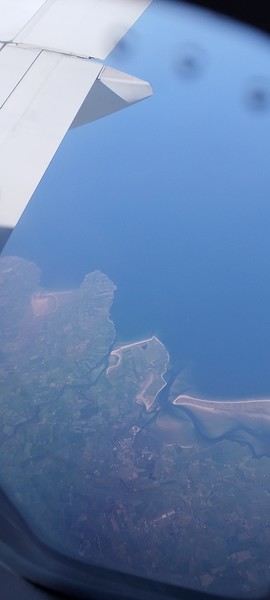
After flying over Scotland, still English,
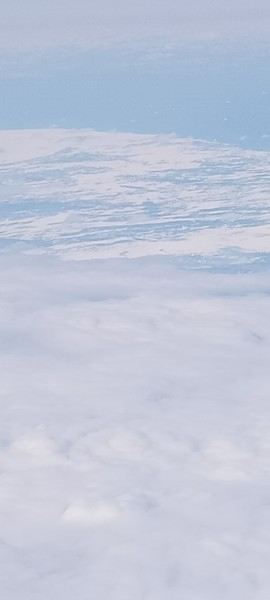
 Greenland, still Danish,
And Lake Huron, still half Canadian,
 We land early in Detroit... a nightmare of an airport. A long, dreadful baggage check process, but we still make it to gate A10 just in the nick of time—only for disaster to strike!
My passport has my first and last name, my boarding pass has my first and last name, BUT not on Delta’s computer—so we’re denied boarding!
We head to the Air France-Delta-KLM desk, where an employee listens to us sympathetically. He books us two seats on an 8:30 AM flight to SF...
Then passes us off to two colleagues who offer us a night in a hotel... and send a message to the baggage service to keep our checked luggage safe...
In the end, we go to bed earlier, wake up earlier, but since we’ll still get some sleep on the plane, we might be able to look back on this whole mess with a smile... well, we hope so, anyway.
10:17 PM in Detroit—time to sleep. Our clean clothes and toiletries are in the plane.
We’ll bounce back!!;
Greenland, still Danish,And Lake Huron, still half Canadian,
We land early in Detroit... a nightmare of an airport. A long, dreadful baggage check process, but we still make it to gate A10 just in the nick of time—only for disaster to strike!
My passport has my first and last name, my boarding pass has my first and last name, BUT not on Delta’s computer—so we’re denied boarding!
We head to the Air France-Delta-KLM desk, where an employee listens to us sympathetically. He books us two seats on an 8:30 AM flight to SF...
Then passes us off to two colleagues who offer us a night in a hotel... and send a message to the baggage service to keep our checked luggage safe...
In the end, we go to bed earlier, wake up earlier, but since we’ll still get some sleep on the plane, we might be able to look back on this whole mess with a smile... well, we hope so, anyway.
10:17 PM in Detroit—time to sleep. Our clean clothes and toiletries are in the plane.
We’ll bounce back!!;Hi,
My mom received an invitation for a free stay (though of course it comes with visits to carpet shops, jewelry stores, and other boutiques). She bought a carpet in Turkey about 10 years ago, and it was that carpet shop in Istanbul that sent this invitation. The whole thing is organized by a travel agency called "Habitat VIP Travel." Has anyone here heard of this agency and their "commercial tourism" practices? I’m not against the idea in principle—I just want to make sure it’s legit and not dangerous (I really don’t want to get kidnapped with my nearly 90-year-old mom!). Thanks for your feedback
My mom received an invitation for a free stay (though of course it comes with visits to carpet shops, jewelry stores, and other boutiques). She bought a carpet in Turkey about 10 years ago, and it was that carpet shop in Istanbul that sent this invitation. The whole thing is organized by a travel agency called "Habitat VIP Travel." Has anyone here heard of this agency and their "commercial tourism" practices? I’m not against the idea in principle—I just want to make sure it’s legit and not dangerous (I really don’t want to get kidnapped with my nearly 90-year-old mom!). Thanks for your feedback
Namaste everyone,
We went to Nepal last October and literally fell in love with this country (like so many others, it seems). During our trek, we had the chance to meet and travel with an incredible independent local guide, Apsara Luitel. She told us about a unique project she’s organizing starting mid-May, and we wanted to share it in case it interests anyone. We mentioned it on another travel forum, but just in case, we’re posting it here too to reach as many people as possible.
Apsara, who knows the Api mountain valley (a name as joyful as it is intriguing!) in Nepal’s Far West (on the border between India and Tibet, at the edge of the world) perfectly, is offering an off-the-beaten-path trek for a group of 3 to 8 people max. The program? An authentic and preserved itinerary combining homestays and small mountain lodges, all the way to the Api base camp. Once at base camp, locals will guide us to secret spots only they know, where we’ll harvest yarsagumba (those famous caterpillar-fungi, rare and prized for their medicinal properties in traditional Chinese medicine—they were going for $20,000 per kilo last year!).
Mid-May is the ideal time to discover this almost unexplored region and take part in harvesting these natural treasures. This kind of adventure, led by an inspiring young woman like Apsara, is rare, and we think it could appeal to Nepal lovers and those who enjoy authentic treks far from the usual tourist routes.
No matter how many participants there are (between 3 and 8), there will always be two guides: Apsara, who speaks English (and is learning French!), and a French-speaking guide. The dates are flexible around May 15th, depending on the availability of those who’d like to take on the adventure.
Hi,
I’d been told it was between 2,000 and 2,500 THB per day. 3,000 THB for Doi Inthanon...
The driver I found gave me different prices depending on my destinations: 5,000 THB for the waterfalls in Doi Inthanon National Park, which I negotiated down to 4,000. Then 2,000 for Lamphun, 3,000 for another day, and two times 3,500 for two other itineraries I showed him. In total, 16,000 THB, which I negotiated down to 14,000.
I’m wondering if I overpaid...
Since I’m planning two more outings, I’d like to have a solid baseline for negotiating...
I’m right in the middle of peak season, and everything’s gone up considerably in Thailand. So I don’t want to put my foot in it by pointing out he might’ve overcharged me if that’s not the case... Thanks
I’m right in the middle of peak season, and everything’s gone up considerably in Thailand. So I don’t want to put my foot in it by pointing out he might’ve overcharged me if that’s not the case... Thanks
Hi there,
I’m finally planning to spend 9 days/9 nights in Chiang Rai. What’s the best area to stay in?
Do you know any interesting spots within a 50–60 km radius? Preferably ones that aren’t overrun by mass tourism (sorry about that).
Thanks!
Joël—I’m reading your latest travel journal on this region...😉
Hi there,
My friend and I are heading to Thailand for three weeks between December 14th and January 4th.
After a week of relaxation in the south by the beach, we plan to explore northern Thailand to see the mountains and discover the country’s history before wrapping up in Bangkok.
I’m torn about which region to explore. For convenience, we’ll arrive in Chiang Mai, spend a few days in the area, then head to Lampang, followed by Sukhothai, and finally Bangkok.
After Chiang Mai (1 or 2 days—I’m worried the period might be too crowded and we won’t enjoy it much), we’ll have 3 days and could go to: Mae Hong Son (with a potential return flight); Chiang Dao and Fang; or Nan province, though that seems a bit far for just 3 days. We could also spend only one day in Chiang Mai and have 4 days instead.
For these 3 (or 4) days between Chiang Mai and Lampang, we’d love to do some beautiful hikes, preferably on our own, and see stunning landscapes, nature, and small villages.
Among my options, which would you recommend? Or where can we find great hikes that we can do independently and that aren’t overrun by mass tourism? I’ll admit, I’m struggling to find info—there are lots of small national parks, but details are scarce, and even AllTrails doesn’t have much for some of them...
Just to clarify, we’re considering hiring a car with a driver if needed.
Thanks so much to anyone who can help, and have a great weekend!
Leslie
Hi,
Has anyone else run into problems renting a car with a French credit card at Bangkok International Airport with international rental companies (like Avis, Budget, Europcar, Hertz)?
These international car rental companies require a "credit card" to hold the deposit when picking up the vehicle. However, in several countries, French credit cards are considered "debit" cards rather than "credit" cards (even if "credit" is printed on your Visa bank card, for example). The rental agencies can't "block" the deposit with certain bank cards (though paying for the rental itself isn’t an issue), and they’ll refuse to give you the vehicle even if the rental was already paid during booking.
I’ve already had this issue in several countries (Chile, Canada) with international rental companies that refused my bank card for holding the deposit, even though "credit" is clearly printed on my Visa Premier card.
Has anyone encountered this problem in Bangkok?
Thanks for your help!
P.S.: I have a valid international driver’s permit, and I’ve searched the forum for answers about Thailand.
Hi
Has anyone sailed with the French company CFC? What do you think?
Haven’t seen many reviews about this company.
Hi everyone,
Better late than never—I’m finally getting around to sharing our trip to Romania from last year.
Before I start, I have a personal history with this country: I lived there in 2004 for three and a half months during a student internship. I still have friends there and a decent grasp of Romanian. That helps. But more than anything, I’ve grown attached to the country. It’s well-deserved—Romania gives back just as much. That said, when I talk about it, maybe I see things differently than someone visiting for the first time.
This was my third trip to Romania. This time, I brought my wife and our two daughters. After years of wanting to take a family trip there, this was finally the right moment. My wife wasn’t exactly thrilled at first—she’d been hesitant for years. But she ended up loving it, and we’ll definitely go back together. For our 6- and 8-year-old girls, the trip was fascinating in so many ways: the sights, learning about communism and totalitarian regimes, the Roma community, how different religions coexist, the Saxon minorities...
We landed in Bucharest last July. We spent two and a half weeks in the country. We took off from Toulouse early in the morning and arrived at Bucharest airport around noon. We flew with Lufthansa because it’s a solid airline and the cheapest option we found.
We rented a car. I don’t remember the rental agency’s name, but we got scammed a bit. We’d booked insurance through Booking, but when we arrived, we couldn’t print a credit card receipt. The issue? We only had debit cards, not credit cards (or vice versa), and without one, we couldn’t pick up the car without buying their on-site insurance. It was buried in the fine print—I’d read it but naively assumed a gold card would work. So, we had to take extra insurance. Basically, we threw 120 € in insurance fees out the window. Still, we got a Dacia Logan, and it ran like a dream the whole trip.
Here’s our rough itinerary: - Bucharest Airport => Sinaia => Brasov - Brasov => Viscri => Sighișoara => Sovata - Sovata => Bicaz Gorge => Iași - Iași => Bucharest
**Sinaia** We started in Sinaia, in the Carpathians. It’s an old Romanian vacation spot from the country’s golden age. A really nice place with great hikes. The mountains are stunning, covered in tall fir trees. There are beautiful buildings and old houses—it’s all very charming. We took the cable car up to the summit (no time to hike with the kids). It’s an old 1960s cable car with two sections (there are also detachable chairlifts). The view from the top is amazing. Then, Peles Castle—a must-see.
**On the road to Brasov** We stayed in a homestay in the village of Purcareni (15 minutes from Brasov by car) through an association called "L’Arbre de Joie." We spent a few days there. The association was founded by a French woman in the 90s and runs local projects. The family we stayed with was Hungarian. The price was around 90 € per day, including breakfast and dinner. The host spoke a little French, and her 16-year-old daughter spoke English fluently. We had great conversations. This family lives like a typical French family—they work at a clinic and a factory, own a car, and have a small chalet in the nearby mountains. From Purcareni, we explored: - **Bran Castle**: The iconic castle. There are way more tourist stalls now than when I first visited in 2004, but it’s still charming and worth seeing. - **Zărnești Bear Reserve**: Interesting—you learn a lot about bears. But it’s expensive, and it’s sad to see these beautiful animals in captivity. - **Râșnov Citadel**: Right near Zărnești. We did Bran, the bears, and this citadel all in one day last year. It’s pretty—you hike up a trail to get there. The view is gorgeous, but the site feels a bit neglected (or not fully restored yet). Some people love it, others don’t, but at least it’s authentic and not some Disneyland with fry stands everywhere. - **Brasov**: Of course! We went twice. It’s beautiful and nothing like what you’d imagine Romania to look like. We hiked up the hill overlooking the city—about 45 to 60 minutes with the kids. The view from the top is incredible, especially over the medieval rooftops. I wasn’t expecting much—I thought we’d see rundown buildings, but the "new" part of town is built farther to the right, so you barely notice it. - One day, we took a horse-drawn carriage (a touristy thing to do for the kids) to our hosts’ second home. It was still really fun. The area is super wild—just a few kilometers from the village, so close to Brasov. We ate *amazingly* with them. Traditional Romanian food is best enjoyed in people’s homes, not restaurants. So, I’d recommend eating at small guesthouses or homestays as much as possible.
**On the road to Viscri** No stops—just straight to Viscri. I found Viscri just as I’d left it in 2004. Maybe a few more tourists, maybe one or two new restaurants. The road still isn’t paved in the village. Viscri is my favorite place in Romania—a simple village with colorful houses. We found a reasonably priced Airbnb and had a great evening with our hosts. They were fascinating people, and we talked about Romania, Saxon minorities, Europe... The next morning, I went for a run and found a trail in the nearby forest. I followed it for a while before turning back. We also visited the fortified church.
**Sighișoara** I’d been there in 2004 and wasn’t particularly moved or impressed. I felt the same way in 2019. But that’s just our take.
**Sovata** In Sovata, we traveled the way I love—arriving around 5 PM with nothing booked and finding a place to stay by asking around. We ended up in homestays for two nights, and both were great. It’s a Hungarian-Romanian thermal spa town. The place is nice but nothing extraordinary, except when you get closer (but not too close) to the thermal complexes. There, you’ll find beautiful mansions and hotels from the early 19th century. It’s touristy, but only Romanians go there. We visited a warm-water lake—it was fun for the folklore, though the water wasn’t exactly inviting. Apparently, there’s another lake higher up that’s so salty you float in it, but we didn’t go. In the afternoon, we took the tourist steam train ("mocăniță" in Romanian). It was a blast—we chatted with people in the carriage. The train covers about 20 kilometers, then turns around (the locomotive detaches, spins, and reattaches). Everyone gets off at the halfway point, where people grill corn on the cob. Then the train heads back. The scenery isn’t breathtaking, but the fields were full of flowers, and the ride was lovely.
**Toward Bicaz Gorge** The next day, we headed to Bicaz Gorge and the Ceahlău Massif in Neamț (pronounced "Nyamts"). We passed through Corund, a village known for local crafts. Whether it’s actually made there or not is always up for debate in a society where cutting corners is common. Still, we found some nice plates, dishes, and souvenirs to bring home. Funny story: I was chatting with a young saleswoman in Romanian and was shocked to realize she didn’t understand me—not because my Romanian was bad, but because she *didn’t speak Romanian at all*. She only spoke Hungarian. Mind-blowing: you’re Romanian and don’t speak Romanian? We crossed a mountain (or big hill) before reaching the Gheorgheni plain—a small town nestled in the mountains, feeling like the end of the world. Was it the season? We saw *so many* storks, and they were *so close*. It was adorable.
**Bicaz Gorge** We stopped at "Lacul Roșu" (Red Lake) to take a boat ride with the kids. (Yeah, we did things we don’t usually do—gotta keep everyone engaged! And maybe that’s why they have such great memories of the trip.) Then, the Bicaz Gorge—one of my favorite spots in Romania. We stayed at Pensiunea Paleu in Bicazu Ardelean, a place I already knew. I think the price for four people, half-board (with delicious home-cooked meals), was around 90 € per day. The rooms are clean and simple, and there’s a big garden with a vegetable patch, a cow, and a pig. Most of the food served comes straight from the garden.
In the afternoon, after much hesitation, we headed to Ceahlău National Park. About 30 minutes by car, we entered the park (after waking up the park ranger, who reeked of booze and was napping). We drove to the end of the road, and then—against all odds—the four of us made it to the summit of Toaca Peak. This peak towers over the surrounding mountains. It was a great hike—starting in the Carpathian fir forests, then crossing a plateau covered in flowers (mid-July). We stopped for a drink at Cabana Dochia before heading up. The summit is a bit unusual because they’ve installed a big metal staircase. It’s steep in places—straight up, and I wouldn’t want to fall. There’s a sturdy railing, though. Even if the "normal route" doesn’t seem too hard. The view from the top is stunning—you can see the entire Carpathian region, vast forests, and the Bicaz Lake below.
**Iași** I used to live in Iași. We stayed with my former internship supervisor and his family. It’s not the first time we’ve crashed at people’s places. In Iași, we visited: - **The Opera House**: A beautiful building from the early 20th century, if I’m not mistaken. Our friends arranged a tour with the firefighters, who let us in and showed us around. It was fun. - **The "Hall of Lost Steps"**: You enter a massive room with stunning woodwork. It’s a huge university library, home to around a million books. The whole place is meticulously decorated. Visiting this room makes you wonder how Romania could have such a grand image. This country, in its golden age, had universities and thinkers. When you build something like this for knowledge and science, you’ve come a long way. - **The Palace of Culture**: This building was completely run-down in 2004 but has since been fully renovated. Where it was once gray, dull, and dirty, it now shines in the sunlight. It’s magnificent.
Beyond these three sights, we explored parks, wandered the city, went treetop climbing, and spent time with friends. Sure, Iași is way over in the east on a map of Romania, but it’s worth the detour.
After Iași, we headed back.
**In conclusion**, we spent three weeks in Romania. Here’s a rough breakdown of expenses (in €, all taxes included): - Flight tickets: 660 € - Car rental for 2.5 weeks: 250 € - Everything else (accommodation, food, activities, etc.): around 1,500 €
All in all, the trip wasn’t exactly cheap—around 2,500 to 2,800 € total. But we had a blast, and that’s what matters.
I had tons of great photos and wanted to share some, but I couldn’t upload them. If anyone’s interested, I can send them along.
hi everyone,
where can we buy a GPS for driving in Argentina and which one: Garmin, TomTom?
THE REAL SRINAGAR BEHIND ITS BAD REPUTATION
Srinagar is a destination that’s hardly popular with tourists. Because of the ongoing war between India and Pakistan, we often hear about soldiers being killed in Srinagar.
I’d also heard that tourists weren’t welcome, but that wasn’t my experience at all.
I went there without listening to all the warnings people kept shouting in my ear, and I discovered a charming city where locals constantly approach you to have tea or chat. I was never alone during my 3 days there—I was always being approached or invited into someone’s home.
I’m creating this post to break the stereotypes about this incredible city and to share what I experienced during one of my best trips in India.
(Update July 2019): I just noticed that Srinagar is marked as a red zone (strongly discouraged) on the French Ministry of Foreign Affairs’ travel advisory map. That doesn’t change the fact that my best memories were in Srinagar and that nothing at all happened while I was there. However, some might not be as lucky as I was. Nothing’s stopping you from going, and I’m tempted to recommend it, but be aware that you’re entering an uncertain area. Safe travels!
Arriving in Srinagar When I arrived, I hurried to find a mechanic to weld the front fender that was scraping my wheel. I went from garage to garage, each one sending me to another and then another… It was pretty hard to find someone who could weld that fender since the screw thread was stripped.
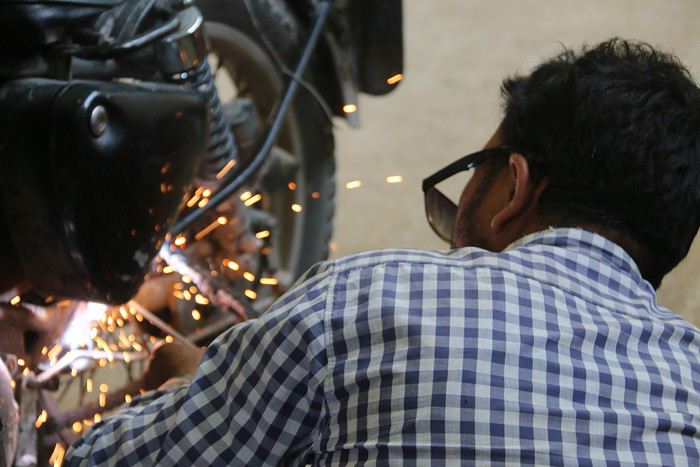
I kept searching until I came across this scrap dealer cutting metal with a hammer:
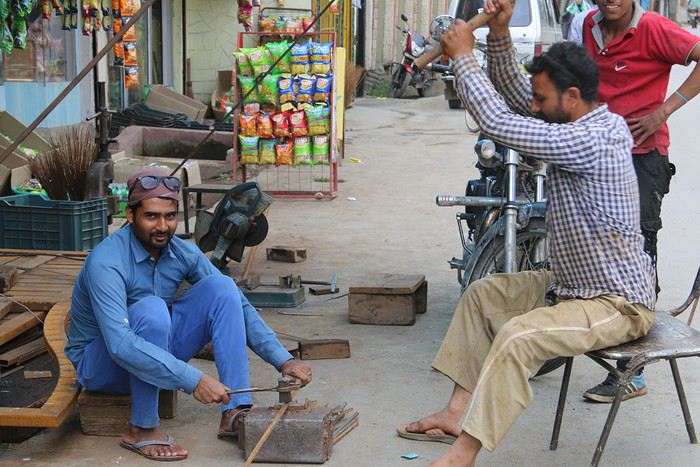
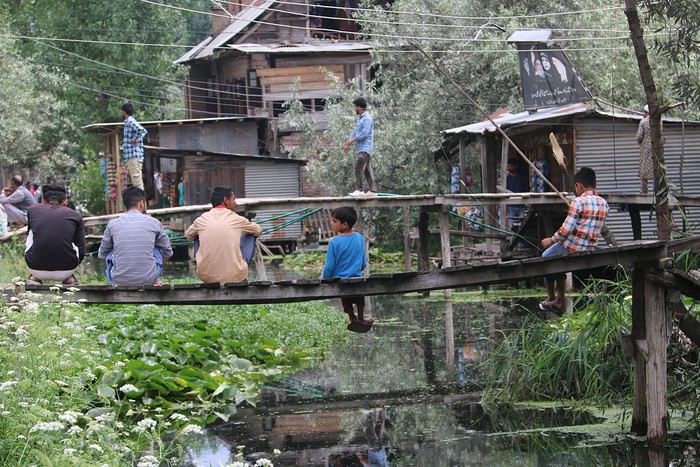
The man in the checkered shirt told me he could fix my bike, but I had to go with him to his place. So we went together, and I was invited to have tea with his family. He introduced me to everyone, and they seemed really happy to meet a tourist. They kept smiling at me and offering me local sweets. I have to admit, I was a little embarrassed—all I wanted was to get my bike fixed!
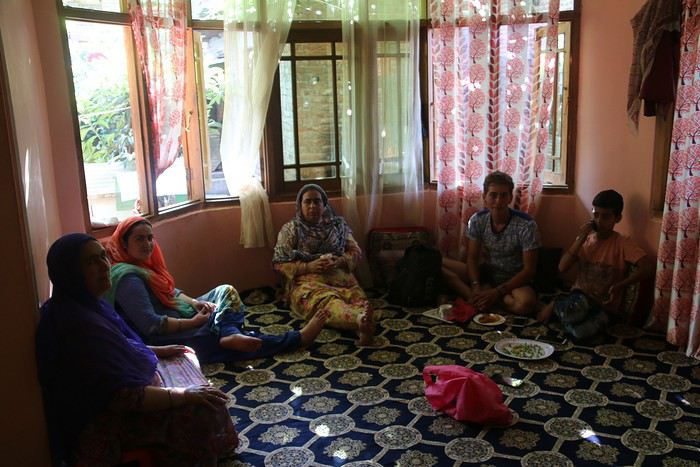
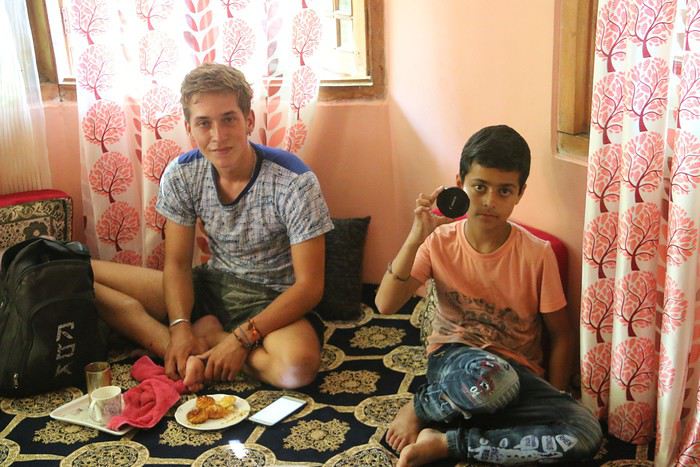
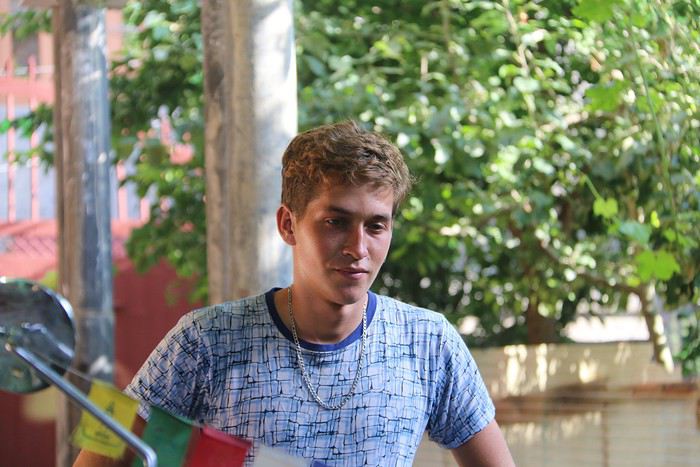
The scrap dealer’s nephew was very interested in my camera. I showed him how to use it and let him play around with it, which resulted in some great shots while they were fixing my bike—something I only found out later.
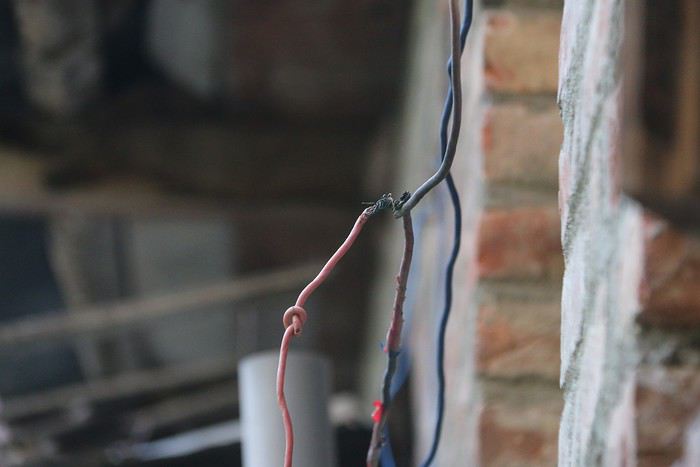
What really struck me were the cables connected to the battery he used for welding. They were just stripped, laid on top of each other, and suspended. When he needed to pass by, he’d lift a wire with his hand, walk under it, and put it back down. I wondered how he’d survived this long!
On top of that, here in India, all the welders in small garages weld with sunglasses, and I’m really not sure how effective those are.
Once the bike was fixed, I asked him how much I owed him. Very generously, he told me to decide for myself. I gave him a little more than I usually do for a weld. This family was incredibly kind—I’d just arrived, and I was already invited to eat with them.
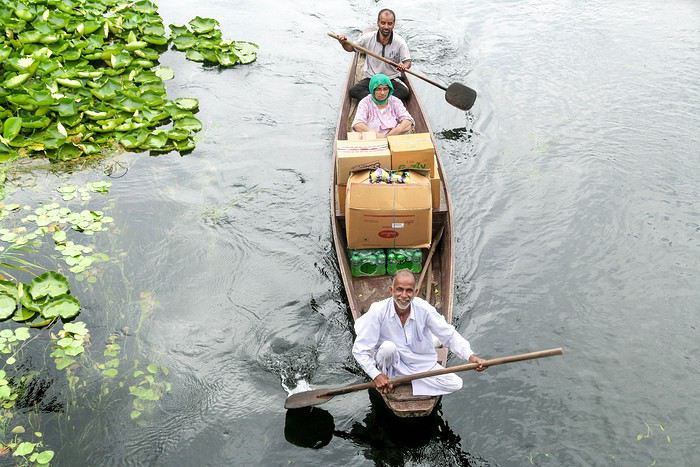
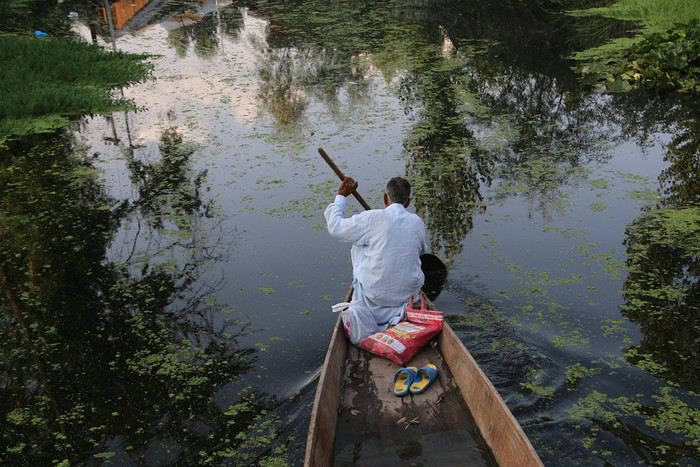
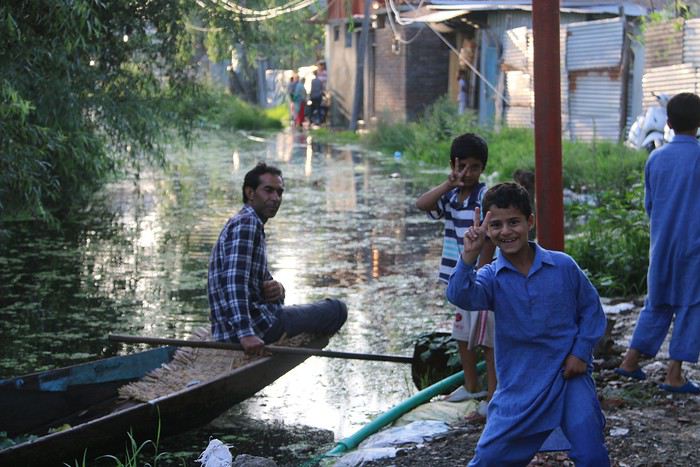
Exploring the City The whole city is crisscrossed by a network of streams where locals transport goods by boat, creating some truly magical moments:
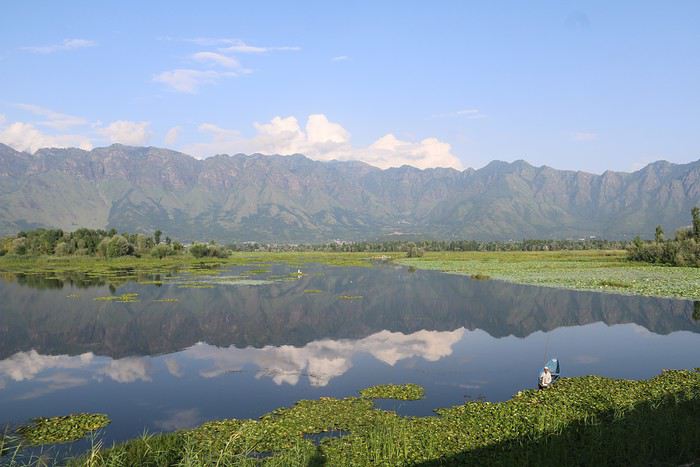
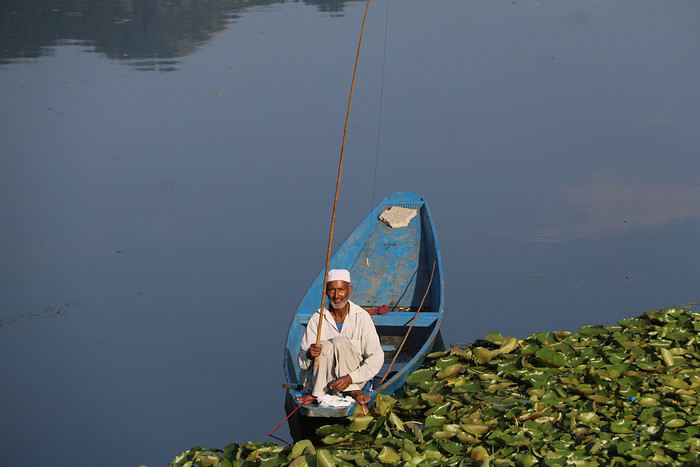
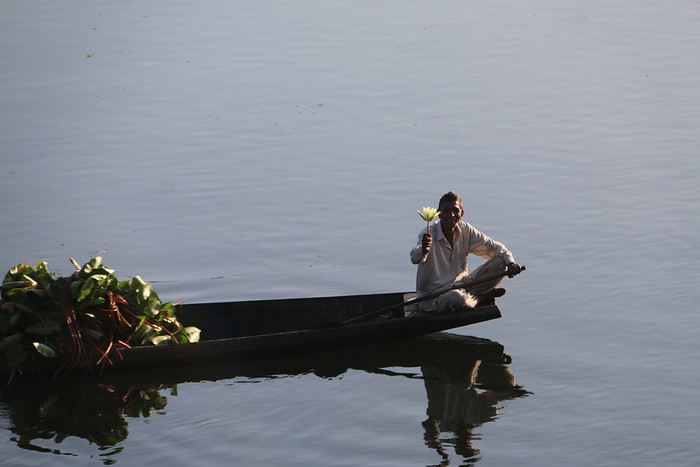
Following these streams, I reached the city center, where I met locals who were surprised to see me but thrilled to get to know me. A really rich social experience!
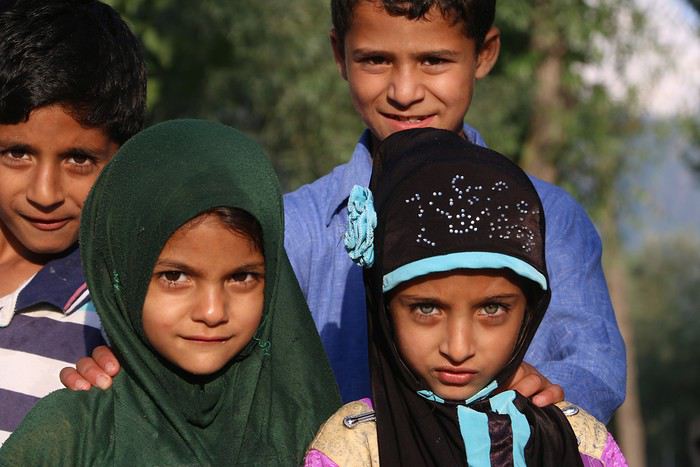
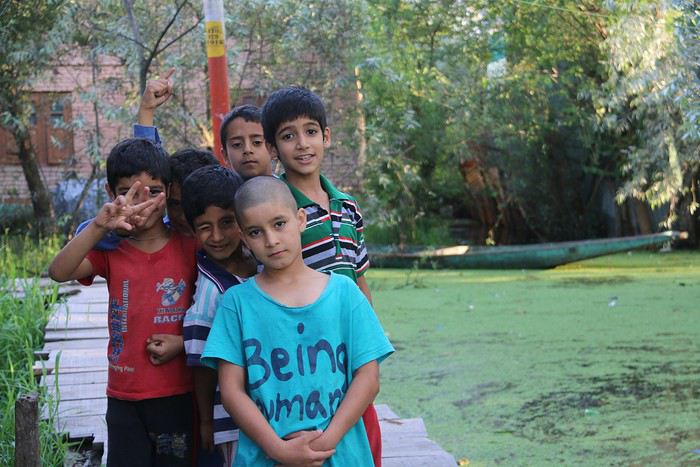
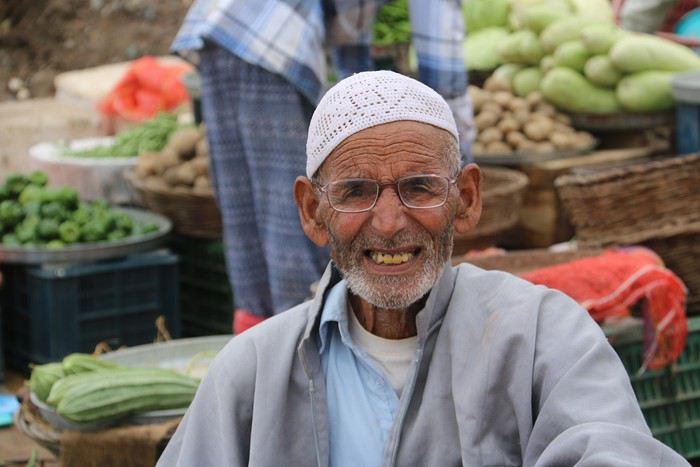
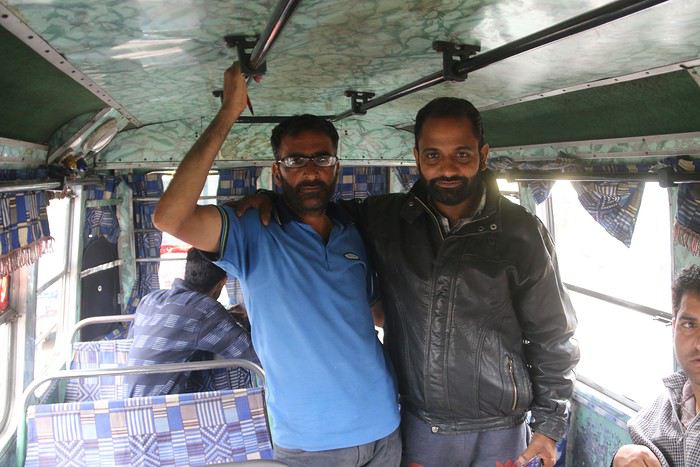
The Local Market A local market is always open near the mosque I mentioned earlier—it’s a must-visit! The market isn’t big, but it’s a social and cultural experience you shouldn’t miss.
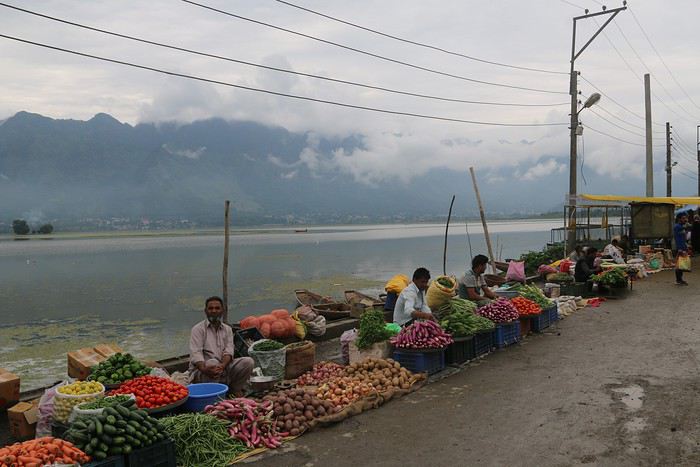
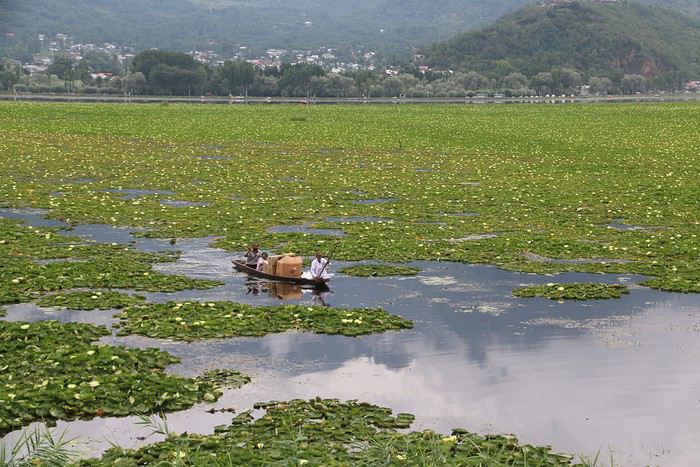
Taking the Road Across the Lake Across from Nishat Bagh Park, there’s a road that crosses Dal Lake, which is full of lotuses. The path is tough to take by bike—I know from experience—but what you’ll see is worth the detour!
It all started last December, after another price alert from Gilou for United/Lufthansa flights at 250 € from Paris to San Francisco. Meanwhile, I was planning to spend a week alone with our three kids (Maxime, 14, Rachel, 12, and Timéo, 8) somewhere in France for the February break.
But this time, Gilou really outdid himself—way too tempting! 😮 His great tip worked for both the February and Easter breaks. I know April is the ideal month, especially if you love hiking! But for family reasons, only February would work for us.
Isn’t February a month to avoid for the Southwest? To keep our summer trip budget intact, I was thinking of camping as much as possible. After checking weather sites for temperature histories in key spots (Furnace Creek, Saint George, Page, Sedona), nighttime temps over the past two years ranged from +5 to -2°C. So, it seemed doable...
I started discussing (aka negotiating, even begging) with my better half. The kids caught on fast that there was a chance we’d go, and they were thrilled! She finally gave her consent to make the kids happy 😎. I quickly checked that our ESTAs were still valid, and 48 hours later, I had the tickets in hand 😎😎. But five days later, Laetitia changed her mind—her "Yes" turned back into a "No." No way were we going without her to her favorite country!!
Damn it 🤪! I had to tell her I’d already bought the four tickets (without bringing it up again, of course—a "Yes" is a "Yes," right?). And since the tickets were non-refundable, there was no going back... Apparently, with women, some "Yeses" mean *really* yes, but others mean, "I said yes in principle, but I wasn’t actually on board—and I never thought you’d have the nerve to buy the tickets without telling me!!" I had no idea 🤪!
Us guys? We’re way more straightforward—binary, even monetary... Yes means yes! And no can mean yes too 😏!! Anyway, in a lovely family atmosphere, I opened a thread to start planning and thanked Trois14 and Bluemesa for their help. On Trois14’s advice, I booked 5 nights in motels around St. George-Page at super tempting rates—around $35-40 a night...
On that note, Christmas cost me an arm and a leg... Gotta try to make up for it 😛!
Here’s the theoretical itinerary:
Death Valley (2 days) Valley of Fire The White Dome (hike up and down via Squirrel Canyon) 4 nights in the Kanab-Page area Sedona (2 days) Route 66 Alabama Hills / Trona Pinnacles Drive back to SFO via Highway 1
That’s the plan, at least...
In reality, it turned into a whole different story. I learned that in February, you’ve got to be flexible—*very* flexible sometimes—to dodge the weather. Halfway through, a cold snap made our second week (planned 100% camping) impossible, completely upending the itinerary.
So, a huge thanks to PapJ59, Noyellebis, and especially Caribou44 and Simonic. 🙂 A thousand thanks for your quick responses, availability, and sound advice, which let us have an original and unforgettable second week—Organ Pipe Cactus NM, Yuma, Salvation Mountain, Anza Borrego SP, a palm grove in Joshua Tree, then back to SFO!! Without you, we’d have been miserable on the spot, but instead... 😇
A big shout-out to Thibaut and his famous blog (rightfully praised on VF—it’s one of the few that details Organ Pipe), to travel journal writers for inspiration in general, and to those who helped me prep or during the trip (journals by Pong, Hiacinthe, Zitounet, and Laetitia).
Now, for the story...
I’d heard—and rightly so—about the incredible kindness of Taiwanese people. I had just spent a few weeks in Korea, a country of teddy bears, where the locals loved telling me about a place full of… more teddy bears. It was going in circles.
So I arrived in Taipei with stars in my eyes, ready to face all that generosity. Yet, surprisingly, the guard posted in front of the presidential palace wasn’t exactly courteous. And then, the countless military vehicles really struck me. Have you ever seen a teddy bear driving a tank?
I spent most of my evenings in a bar along a very large avenue. I’d go alone and always find company—men, women, it didn’t matter as long as I could blend into this new country, discover its people, their culture, their history.
The heat made me sweat nonstop, my beard had grown back, I was wearing a black T-shirt as worn-out as possible, and my face bore the marks of several months in Russia and Korea. In short, I looked like the perfect globetrotter—the kind I’d probably dreamed of being as a kid.
So there I was, sitting at the bar, deep in conversation with a Taiwanese friend, when a fight broke out between an Italian and an American—two drunk, stupid beasts. Shouting, shoving, we kicked them out. Well, *we* didn’t. My friend didn’t move; I was the only one who reacted, letting my temper get the better of me. He looked at me and said, without malice, that white guys had also fought two days earlier. I turned my head toward the room—I was the only foreigner. I was used to it, but tonight was different. The looks in the mirror were full of distrust. I felt like an idiot for all the others. I felt like an idiot. I said goodbye to my friend; I was convinced I’d never see him again. As I headed toward my hostel, my brain was racing. Asia had confronted me with a side of travel I didn’t know. I’d always managed to blend in, to go unnoticed, but when your features and skin color prevent that, the game changes. And this hyper-globalization, this hyper-communication, the fact that poor guys like me can enjoy travel—is it really a good thing? Does it create an expectation, a need for a mass of tourists who couldn’t care less about the country they’re visiting? No, really, I felt like an idiot. And then all those damn tanks, and what’s with those dozen tents in front of the presidential palace? It intrigued me. It was late, but there was movement. Hey! Hey! How are you? Good, just a little drunk. Ha ah aha! What are you doing here? Why are there so many military personnel around you? Ha ha ah! You can come if you want! Oh really? Yeah, yeah!
I climbed over the fence and learned. I learned that in the mountains to the east of the island, the island’s natives still live. I learned that their culture is disappearing, that they themselves are disappearing. That nothing is being done to preserve the very origin of this country. That all those tanks and military personnel were there for about thirty cheerful troublemakers who had made the trip. Because by being there, they were announcing: *Yes, we’re still here.* I spent the rest of the evening with them until early morning. They showed me how to weave my own shoes (flip-flops), plied me with endless coffee, laughed when a cop took my picture and I shouted, *Yes, I’m a French spy*, and gave me a bracelet. I left with a new look in my eyes. This trip will end as it began, but the next one will be different. I’ll be prepared; it won’t just be an escape or an adventure. Travelers destroy more than they preserve—it’s not easy to tip the scales, but I’m going to try anyway.
Excellent bike path almost entirely off-road, with a really scenic route. We joined it in Bad Tölz after coming from Strasbourg and left it 100 km before Venice to stay in the mountains and connect with the end of the Via Claudia, which is probably on next year’s program. The trail is often on packed gravel, but even though some short sections aren’t great, our 32C tires were enough—though wider would’ve been better. Mostly wild camping, often by a lake or river. The signage is top-notch. The only downside is the noise from cars in some valleys—out of sight but not out of earshot.
Sites that explain it better than I can: https://italy-cycling-guide.info/ An English site—check the INTERNATIONAL CYCLE ROUTES section.
It’s almost *too* detailed—a 1:200,000 map is plenty.
And here’s a photo to inspire you!
Sites that explain it better than I can: https://italy-cycling-guide.info/ An English site—check the INTERNATIONAL CYCLE ROUTES section.
It’s almost *too* detailed—a 1:200,000 map is plenty.
And here’s a photo to inspire you!
Hello fellow travelers!!!!
I want to warn as many people as possible about what happened to me in Phnom Penh, Cambodia, during my trip across Southeast Asia.
I know there are already several posts on this forum about this topic, but I think one more won’t hurt—to help stop the activities of this gang of Filipinos operating across Asia.
I was extorted out of $4000 after being lured into an underground Black Jack game. They invite you to their place for some innocent reason, drug you, make you play, and then rob you.
To my great regret, this bad experience has happened to several people, but I realized it too late.
What happened to me is as much my fault as theirs: my naivety and their dishonesty. So, be careful when you travel—don’t trust people too quickly. I hope this post helps.
Cambodia remains a magnificent country for me, and most of the people are wonderful.
Big up!!!!! Travel safe, Julien
Just back from Georgia and Armenia.
Trip in April 2011 with a small Renault Trafic van.
No particular difficulties... except the GMR.
A few years ago, I went with a group of friends to lend a hand at a small rural school near Thiès, Senegal.
It was a relaxed but hardworking atmosphere—hands in the mortar, laughter, exchanges, and everything that a COOPERATION project can bring.
Today, the little project is flying on its own.
Wanting to explore Senegal’s riches, we set off for some tourism in the Siné Saloum. One girl in our group fell ill (a malaria attack), and we decided to take her to see a doctor at a large tourist complex nearby. Despite her condition, we had to "show our credentials" (if I may say so) just to get in. She was treated and has been fine since.
This "stop" at a Club Med-style resort with a Teutonic twist—resembling Le Grau-du-Roi but fancier—was a horror show for us: pools, massive artificial basins dyed blue, pink, or green (!!!!), animators shouting around wet T-shirt contests or coconut tree climbing, and sunburned (or sun-pinked) *toubabs*. The entire hotel was surrounded by a huge wall, behind which a small souvenir-seller slum had sprung up, worthy of Dakar’s outer neighborhoods. On leaving, we saw a minibus of guests returning from an "excursion," loaded with masks, fabrics, and djembés—African souvenirs? Maybe those will be *theirs*? What impression did the kids clustered at the hotel gates get? What about the Black servers in "traditional African costumes," serving cocktails and ice cream nonstop?
For me, who experienced Africa very young and in the bush, this remains a haunting image.
On VF, this kind of vacation doesn’t seem to be the norm among users, and that’s exactly why I signed up.
Have you ever experienced this kind of interstellar travel? Do you understand the Martians? Are their motivations peaceful?
Preamble
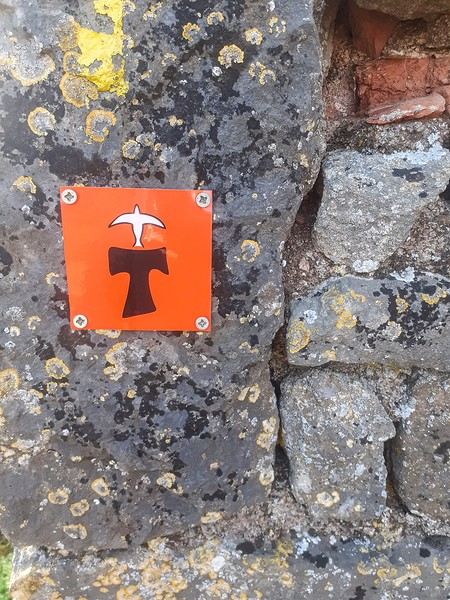
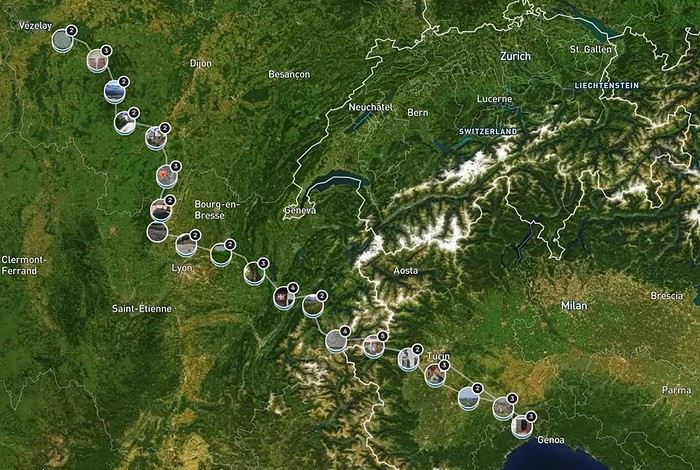
June 2024. While hiking with my brother on the GR 36 Tour du Morvan, I catch sight now and then of strange rectangular markers fixed to tree trunks. Against a bright orange background, a deep black Greek tau topped with a white dove. My first encounter with the Assisi Way. The Way of St. Francis: a pilgrimage route linking Vézelay in Burgundy to Assisi in Italy, covering nearly 1,800 km. It felt like an obvious next step—I immediately knew I’d take it on, attempt the adventure solo.
In the months that followed, I talked about my project to everyone—family, friends, my partner. An avalanche of comments, more or less the same but varying depending on each person’s character and life experiences. But deep down, it all boiled down to one legitimate question: why?
And the answers? Hesitant, awkward, partial, even confused. I quickly realized they weren’t so easy to find. It was as if my project seemed more like a whim, a kind of intimate caprice, rather than a well-thought-out plan. Of course, I knew the reasons that pushed me to leave—you always have to give some. Loved ones need to understand to feel reassured, and that’s understandable. But I fear that when I list them, they’ll sound like the same old checklist anyone embarking on this kind of journey might give. Of all the reasons I could mention, I’ll highlight just one here: the call of the road, the solo adventure that brings a powerful sense of freedom. A bit like Monsieur Seguin’s goat, who from her comfortable pen gazes longingly at the unconstrained horizon of the mountain. But if I’m being honest, I think I didn’t really know what I was looking for—or, more importantly, what I’d find. Deep down, when I reflect on it, one word keeps coming up that explains nothing and everything at once: desire.
Now well past sixty, I know that when I ask myself who I am or where I’m going, two things bring me fully back to myself: hiking and writing. And my intention was also to anchor this adventure through words, day by day. Writing down my feelings, emotions, discoveries, and reflections each evening. The famous travel journal that grounds the daily experience in reality. When I discovered the app "Polarstep," which was initially just meant to keep my loved ones updated and reassured, inform them of my progress, and maintain a connection, I found an opportunity to do it a little differently than usual. No retrospective notes polished up after returning, but spontaneous writing—recounting everything that crossed my mind during the day and publishing it immediately. A journey lived in real time.
This text is the exact transcription of my daily writings. Rereading them, I didn’t change a thing—just corrected a few mistakes and tweaked some awkward phrasing here and there. Short texts, fitting the format imposed by this kind of app. Writing as if addressing others.
Now, all that was left was to walk. April 18, 2026 – Vézelay.
June 2024. While hiking with my brother on the GR 36 Tour du Morvan, I catch sight now and then of strange rectangular markers fixed to tree trunks. Against a bright orange background, a deep black Greek tau topped with a white dove. My first encounter with the Assisi Way. The Way of St. Francis: a pilgrimage route linking Vézelay in Burgundy to Assisi in Italy, covering nearly 1,800 km. It felt like an obvious next step—I immediately knew I’d take it on, attempt the adventure solo.
In the months that followed, I talked about my project to everyone—family, friends, my partner. An avalanche of comments, more or less the same but varying depending on each person’s character and life experiences. But deep down, it all boiled down to one legitimate question: why?
And the answers? Hesitant, awkward, partial, even confused. I quickly realized they weren’t so easy to find. It was as if my project seemed more like a whim, a kind of intimate caprice, rather than a well-thought-out plan. Of course, I knew the reasons that pushed me to leave—you always have to give some. Loved ones need to understand to feel reassured, and that’s understandable. But I fear that when I list them, they’ll sound like the same old checklist anyone embarking on this kind of journey might give. Of all the reasons I could mention, I’ll highlight just one here: the call of the road, the solo adventure that brings a powerful sense of freedom. A bit like Monsieur Seguin’s goat, who from her comfortable pen gazes longingly at the unconstrained horizon of the mountain. But if I’m being honest, I think I didn’t really know what I was looking for—or, more importantly, what I’d find. Deep down, when I reflect on it, one word keeps coming up that explains nothing and everything at once: desire.
Now well past sixty, I know that when I ask myself who I am or where I’m going, two things bring me fully back to myself: hiking and writing. And my intention was also to anchor this adventure through words, day by day. Writing down my feelings, emotions, discoveries, and reflections each evening. The famous travel journal that grounds the daily experience in reality. When I discovered the app "Polarstep," which was initially just meant to keep my loved ones updated and reassured, inform them of my progress, and maintain a connection, I found an opportunity to do it a little differently than usual. No retrospective notes polished up after returning, but spontaneous writing—recounting everything that crossed my mind during the day and publishing it immediately. A journey lived in real time.
This text is the exact transcription of my daily writings. Rereading them, I didn’t change a thing—just corrected a few mistakes and tweaked some awkward phrasing here and there. Short texts, fitting the format imposed by this kind of app. Writing as if addressing others.
Now, all that was left was to walk. April 18, 2026 – Vézelay.
This travel journal summarizes a trip I took in March to Argentine and Chilean Patagonia. It starts in El Calafate and ends in Ushuaia. During my planning, I considered looking into the Australis cruise from Punta Arenas to Ushuaia, as well as the W trek in Torres del Paine National Park. In both cases, I was put off by the prices. Instead of the cruise, I found two interesting wildlife excursions from Punta Arenas: whale watching in the Strait of Magellan and observing king penguins in Tierra del Fuego. The journey to Ushuaia was by bus. For Torres del Paine, things were a bit confusing, so I reached out to two agencies. In the end, I went with a rental car option, overnight stays on-site, and day hikes. I shared my full itinerary with the agency and ended up being taken care of by a local Argentine agency and a Chilean one.
So, here we go...
I hesitated about writing this travel journal...
This summer, we only did the classics (the 3 northern parks and Zanzibar) and let a local agency take care of everything from start to finish.
No craziness, no risks, no sleeping under the stars, no self-drive, no venturing off the beaten path, no incidents, and not even any delays in the pre-planned itinerary...
But don’t think we were disappointed! The whole family (there were 6 of us) came back with smiles and memories of great moments spent together. So, if you're looking for a "classic" way to discover Tanzania, this is the place to be.
Our 2-week itinerary: - Arusha (1 night upon arrival) - Tarangire (1 night) - Ngorongoro (2 nights in Karatu then Irmisigiyo) - Serengeti (3 nights in Robanda, Togoro Plains, and Seronera) - Zanzibar Stone Town (1 night) - Zanzibar Matemwe (3 nights) - Zanzibar Jambiani (3 nights)
Hakuna matata!
No craziness, no risks, no sleeping under the stars, no self-drive, no venturing off the beaten path, no incidents, and not even any delays in the pre-planned itinerary...
But don’t think we were disappointed! The whole family (there were 6 of us) came back with smiles and memories of great moments spent together. So, if you're looking for a "classic" way to discover Tanzania, this is the place to be.
Our 2-week itinerary: - Arusha (1 night upon arrival) - Tarangire (1 night) - Ngorongoro (2 nights in Karatu then Irmisigiyo) - Serengeti (3 nights in Robanda, Togoro Plains, and Seronera) - Zanzibar Stone Town (1 night) - Zanzibar Matemwe (3 nights) - Zanzibar Jambiani (3 nights)
Hakuna matata!
Introduction:
For years, I’ve heard about Costa Rica, which seems like a country "made for me"—nature, not cities.
I almost went in 2019, but a family issue made me cancel.
Initially, I wanted to spend at least three weeks there, planning to go in our summer despite it being the rainy season. Then I realized what I wanted to do could fit into two weeks, so I ended up going in February.
Plus, January’s weather was so awful that some sunshine should do me good.
I found a flight at a decent price, but with two downsides.
The first is that it leaves from Paris CDG, and the second is that it’s with Air France—a airline I’d sworn off after my misadventures with them back in 2008. We’ll see how it goes!
Hey fellow travelers!
So, a new year has begun. It’s time to reconnect with the VF buddies and wish you all my best for 2026—a year I hope is obviously full of travel, since, as I just made up: "If travel’s good, everything’s good" 😄.
To celebrate, I’m inviting you into my new "travel journal," the one from our latest trip in November 2025, a little two-week adventure.
This time, we headed to The Gambia, a tiny country tucked right in the middle of Senegal, before making our way to Casamance.
The Gambia is English-speaking, Senegal is French-speaking, but the locals? They couldn’t care less—because in this part of the world, they mostly speak Wolof, Fula, Jola, or Mandinka. Hence the title: Senegambia 😉.
As usual, I’m sharing the live updates I sent to friends and family—super casual, of course.
I know this isn’t the kind of destination that draws crowds, but if you love adventure, laughter, and emotion, it might just be your thing 😊.
Hugs 😘
Hi there,
When I run searches on Skyscanner, I see that only Lufthansa has flights to Seoul with just one stop. Air France doesn’t show up, even though I thought the French airline served Seoul? I can’t even log into the Air France website—it keeps glitching.
When I run searches on Skyscanner, I see that only Lufthansa has flights to Seoul with just one stop. Air France doesn’t show up, even though I thought the French airline served Seoul? I can’t even log into the Air France website—it keeps glitching.
Hi everyone,
I hesitated for a long time before publishing this travel journal since it’s been 8 months now since I left Nisyros. But in the end, I found it too beautiful to keep quiet about. So here we go—I finally got around to writing it. Nisyros is a stunning little Greek island, and luckily, it’s well hidden. Located a good twenty hours by boat from Athens, its distance from the Greek mainland deters most tourists from visiting. That’s what makes it an off-the-beaten-path destination. So much for the general info.
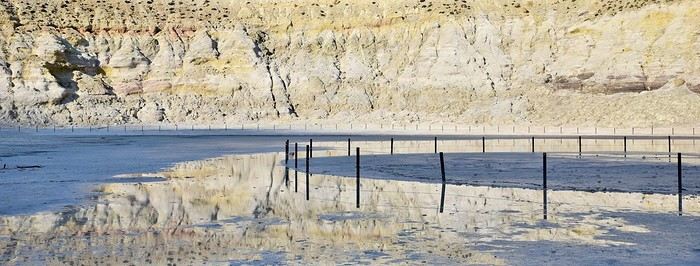
Before diving into the details, I should mention that I visited by bike (despite its severe and constant volcanic elevation) as part of a solo trip from France to Turkey. Why this detail? Because out of the ten countries I crossed and the dozens of sites I saw, Nisyros is one of my top three favorites (along with Pag Island, off-season, in Croatia, and Albania for its overall beauty—stunning natural landscapes and the incredible hospitality of its people). Anyway, welcome to this travel journal dedicated to the lovely little volcanic island of Nisyros…
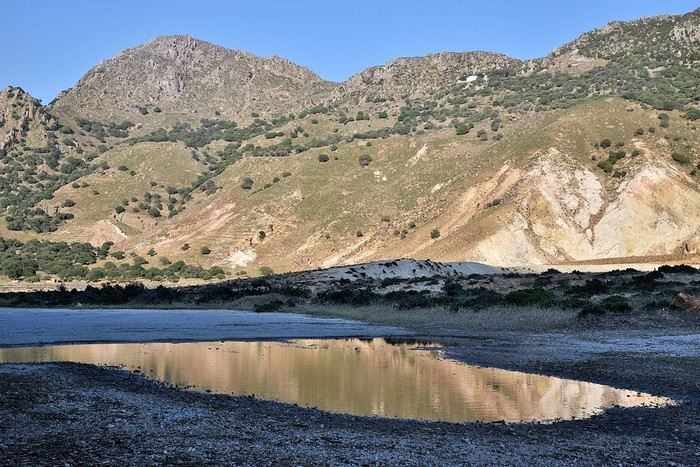
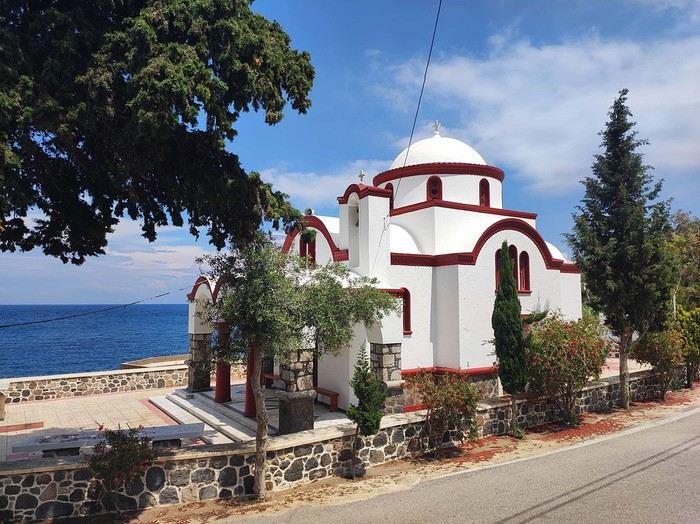
I arrived one beautiful morning in Mandraki, the island’s main port. The twenty-hour boat ride from Athens went by like a breeze. I slept on the deck for three or four hours, sprawled on a bench that was more or less sheltered from the wind. At this time of year (it’s May 2nd), tourists aren’t exactly flocking here, so the boat was far from full. My first glimpse of Nisyros is classic Greek island scenery: blazing sun, an azure sky, and an even deeper blue sea. The trip is off to a great start. I quickly found a small, out-of-the-way hotel (I’m one of those people who avoids crowds as much as possible when traveling, which is getting harder and harder to do). While everyone else from the boat turned right out of the port toward the center of Mandraki, I went left! My nice little hotel was just a hundred meters away, facing a pretty little Orthodox church whose red color contrasted beautifully with the deep blue sea.
I dropped off my panniers in my room so I could ride light for once, then headed toward the next village: Pali. It’s a small fishing village that apparently comes to life a bit in the summer with a few tourists.
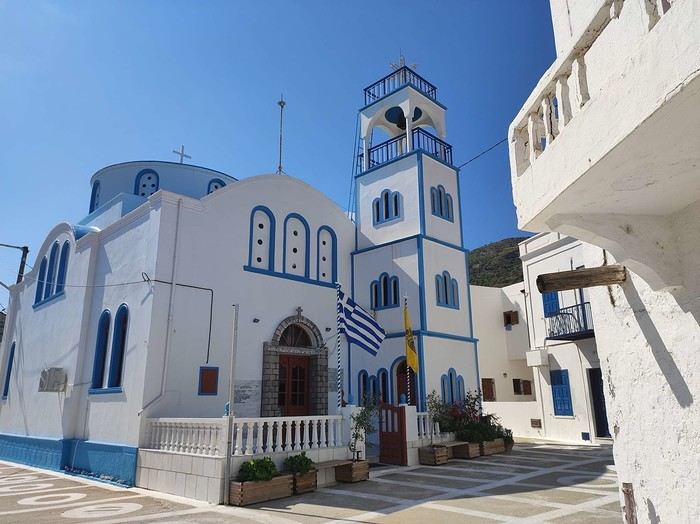
As I pedaled along the dock, I passed right by a guy sitting in a chair in full sun. Unfazed despite the sweat pouring down his forehead, he untangled his fishing net with a precision that commanded respect. I gave him the obligatory kalimera (good morning), but he reacted like a deaf-mute—no response at all. On the other hand, his employee answered me kindly from the trawler docked right next to him. Standing on deck, he was also untangling a mess of nets and invited me aboard to chat. That’s Mohamed.
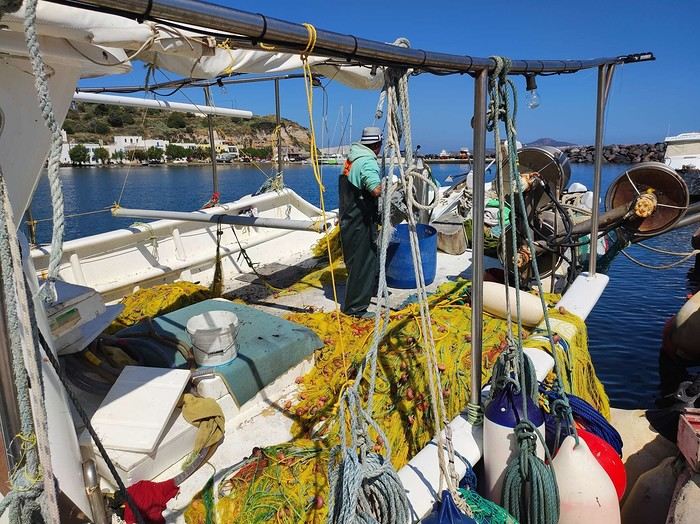
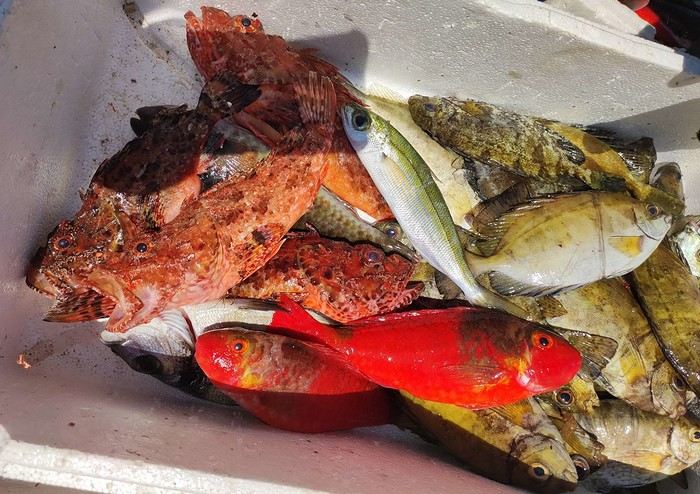
Communication wasn’t easy since he only spoke Greek and I didn’t, but he was cheerful, and his joy was contagious. He proudly showed off their catch of the day: two beautiful rays and a few brightly colored fish. We chatted like that for about fifteen minutes.
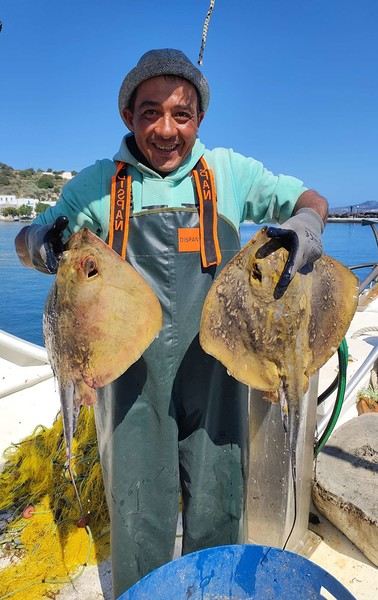
When it was time to hit the road again, I said goodbye to Mohamed, who smiled back. But this time, his boss—still dripping sweat in his chair under the scorching sun—greeted me too. Turns out he wasn’t deaf or mute after all.
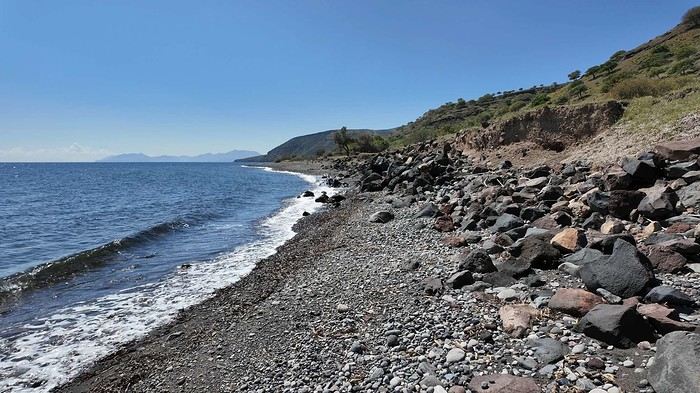
I continued along the coast since that’s where most of Nisyros’ beaches are. They start lining up just outside Pali. These are black sand beaches, which can’t hide their volcanic origins.
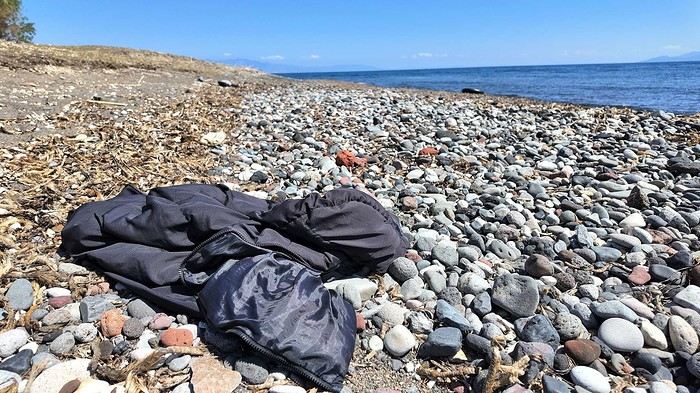
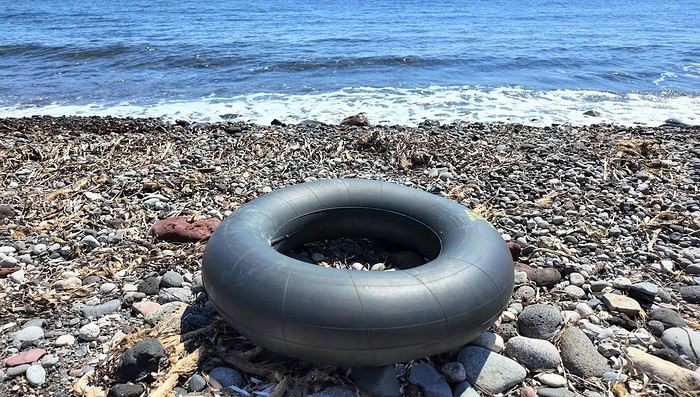
Yesterday afternoon in Athens, I met Peter and Michelle, a Dutch-French couple, while we were waiting for the ferry to depart. The Greek sailors were on strike, so we ended up waiting about twelve hours before setting off. Anyway, we had plenty of time to chat, and Peter, who’s lived on Tilos—a small island near Nisyros—for about twenty years, told me that many migrants pass through these two islands. Most come from Afghanistan and Syria, fleeing authoritarian regimes and the massacres that come with them. They’re looking for *anywhere* else where the future can’t possibly be worse. Peter explained that you often find their belongings on the local beaches. And sure enough, I didn’t have to look far to spot some—clothes, life jackets…
I glanced around, hoping to see one of them to maybe exchange a few words, but no—no one. I was completely alone.
I got back on my bike and spent the rest of the day wandering aimlessly, just exploring this beautiful part of Nisyros. I also picked up some supplies because tomorrow, I’d be heading inland for two days, deep into its four-kilometer-wide caldera to explore the volcano. I’d be sleeping in a tent, so I needed to stock up on food. After a restful night in a real bed—something rare on this bike trip (and I won’t even mention the shower…)—I finally set off for the volcano (I’ll share details about that charming little hotel with the amazing breakfasts at the end of the journal). To reach Stefanos (the name of the main crater), I had to climb to the top of the caldera. It was hot, and some of the slopes were between 10 and 15%, which is steep, especially with a 54 kg bike. But who cares? I was admiring the scenery, and I have to say, I was surprised by how green it was. The higher I climbed, the more beautiful the vegetation became. It stood out against the blue of the sea, and the landscapes inside the island were truly stunning. So, I stopped every five minutes to take photos. Every now and then, I’d come across cows in the middle of the road—or goats in the trees! They climbed with the agility of monkeys to munch on the leaves. I couldn’t get a photo of them because they’d all scatter before I got close. It was actually the noise they made climbing down that tipped me off to their presence. Two villages sit at the top of the caldera: Emporios and Nikia. I passed the first one without climbing up to it, then continued to the second. And let me tell you, Nikia was love at first sight! I found myself pedaling through tiny streets, some barely wider than my bike with its panniers. The walls were white, and the doors were painted in all sorts of colors—green, blue, red… The streets were empty, and silence reigned. But it wasn’t a dead silence. It was more like the kind you find in small, secret, peaceful places. The village exuded tranquility, calm, and well-being. I leaned my bike—with all its gear—against a wall without locking it. It was the first time on this trip that I’d done that. Sure, its weight made it more like a tank than a bike, so you’d have to be *really* motivated to steal it, but here, for some reason, I felt completely at ease. Maybe it wasn’t the smartest move, but I go a lot by instinct, and here, it felt right. So I left my bike there and went to eat a little farther away, at a small restaurant on the village’s main square. It’s famous all over Greece for the beautiful mosaic that covers and decorates the floor. Once I’d eaten and drunk my fill, I hopped back on my bike, which had waited patiently without running off. And the best part? After riding uphill all morning to reach the top of the caldera, all I had to do now was coast downhill to the volcano. Pure bliss in such breathtaking scenery.
I hesitated for a long time before publishing this travel journal since it’s been 8 months now since I left Nisyros. But in the end, I found it too beautiful to keep quiet about. So here we go—I finally got around to writing it. Nisyros is a stunning little Greek island, and luckily, it’s well hidden. Located a good twenty hours by boat from Athens, its distance from the Greek mainland deters most tourists from visiting. That’s what makes it an off-the-beaten-path destination. So much for the general info.
Before diving into the details, I should mention that I visited by bike (despite its severe and constant volcanic elevation) as part of a solo trip from France to Turkey. Why this detail? Because out of the ten countries I crossed and the dozens of sites I saw, Nisyros is one of my top three favorites (along with Pag Island, off-season, in Croatia, and Albania for its overall beauty—stunning natural landscapes and the incredible hospitality of its people). Anyway, welcome to this travel journal dedicated to the lovely little volcanic island of Nisyros…
I arrived one beautiful morning in Mandraki, the island’s main port. The twenty-hour boat ride from Athens went by like a breeze. I slept on the deck for three or four hours, sprawled on a bench that was more or less sheltered from the wind. At this time of year (it’s May 2nd), tourists aren’t exactly flocking here, so the boat was far from full. My first glimpse of Nisyros is classic Greek island scenery: blazing sun, an azure sky, and an even deeper blue sea. The trip is off to a great start. I quickly found a small, out-of-the-way hotel (I’m one of those people who avoids crowds as much as possible when traveling, which is getting harder and harder to do). While everyone else from the boat turned right out of the port toward the center of Mandraki, I went left! My nice little hotel was just a hundred meters away, facing a pretty little Orthodox church whose red color contrasted beautifully with the deep blue sea.
I dropped off my panniers in my room so I could ride light for once, then headed toward the next village: Pali. It’s a small fishing village that apparently comes to life a bit in the summer with a few tourists.
As I pedaled along the dock, I passed right by a guy sitting in a chair in full sun. Unfazed despite the sweat pouring down his forehead, he untangled his fishing net with a precision that commanded respect. I gave him the obligatory kalimera (good morning), but he reacted like a deaf-mute—no response at all. On the other hand, his employee answered me kindly from the trawler docked right next to him. Standing on deck, he was also untangling a mess of nets and invited me aboard to chat. That’s Mohamed.
Communication wasn’t easy since he only spoke Greek and I didn’t, but he was cheerful, and his joy was contagious. He proudly showed off their catch of the day: two beautiful rays and a few brightly colored fish. We chatted like that for about fifteen minutes.
When it was time to hit the road again, I said goodbye to Mohamed, who smiled back. But this time, his boss—still dripping sweat in his chair under the scorching sun—greeted me too. Turns out he wasn’t deaf or mute after all.
I continued along the coast since that’s where most of Nisyros’ beaches are. They start lining up just outside Pali. These are black sand beaches, which can’t hide their volcanic origins.
Yesterday afternoon in Athens, I met Peter and Michelle, a Dutch-French couple, while we were waiting for the ferry to depart. The Greek sailors were on strike, so we ended up waiting about twelve hours before setting off. Anyway, we had plenty of time to chat, and Peter, who’s lived on Tilos—a small island near Nisyros—for about twenty years, told me that many migrants pass through these two islands. Most come from Afghanistan and Syria, fleeing authoritarian regimes and the massacres that come with them. They’re looking for *anywhere* else where the future can’t possibly be worse. Peter explained that you often find their belongings on the local beaches. And sure enough, I didn’t have to look far to spot some—clothes, life jackets…
I glanced around, hoping to see one of them to maybe exchange a few words, but no—no one. I was completely alone.
I got back on my bike and spent the rest of the day wandering aimlessly, just exploring this beautiful part of Nisyros. I also picked up some supplies because tomorrow, I’d be heading inland for two days, deep into its four-kilometer-wide caldera to explore the volcano. I’d be sleeping in a tent, so I needed to stock up on food. After a restful night in a real bed—something rare on this bike trip (and I won’t even mention the shower…)—I finally set off for the volcano (I’ll share details about that charming little hotel with the amazing breakfasts at the end of the journal). To reach Stefanos (the name of the main crater), I had to climb to the top of the caldera. It was hot, and some of the slopes were between 10 and 15%, which is steep, especially with a 54 kg bike. But who cares? I was admiring the scenery, and I have to say, I was surprised by how green it was. The higher I climbed, the more beautiful the vegetation became. It stood out against the blue of the sea, and the landscapes inside the island were truly stunning. So, I stopped every five minutes to take photos. Every now and then, I’d come across cows in the middle of the road—or goats in the trees! They climbed with the agility of monkeys to munch on the leaves. I couldn’t get a photo of them because they’d all scatter before I got close. It was actually the noise they made climbing down that tipped me off to their presence. Two villages sit at the top of the caldera: Emporios and Nikia. I passed the first one without climbing up to it, then continued to the second. And let me tell you, Nikia was love at first sight! I found myself pedaling through tiny streets, some barely wider than my bike with its panniers. The walls were white, and the doors were painted in all sorts of colors—green, blue, red… The streets were empty, and silence reigned. But it wasn’t a dead silence. It was more like the kind you find in small, secret, peaceful places. The village exuded tranquility, calm, and well-being. I leaned my bike—with all its gear—against a wall without locking it. It was the first time on this trip that I’d done that. Sure, its weight made it more like a tank than a bike, so you’d have to be *really* motivated to steal it, but here, for some reason, I felt completely at ease. Maybe it wasn’t the smartest move, but I go a lot by instinct, and here, it felt right. So I left my bike there and went to eat a little farther away, at a small restaurant on the village’s main square. It’s famous all over Greece for the beautiful mosaic that covers and decorates the floor. Once I’d eaten and drunk my fill, I hopped back on my bike, which had waited patiently without running off. And the best part? After riding uphill all morning to reach the top of the caldera, all I had to do now was coast downhill to the volcano. Pure bliss in such breathtaking scenery.
Hey there, VF crew!
After wrapping up our travel journal on Java (link below), we’re now diving into our recent adventure in Puglia! Happy reading... Off we go on an adventure in Java (and a bit of Bali) | Travel journal > Indonesia | Voyage Forum
Day 1 - October 19
When you tell your friends and family you’re itching to escape to the other side of the planet to mingle with the Mongols, you can usually expect a barrage of questionable jokes and terrible puns. For this new adventure, it’s a different destination but the same old story—this time, we’re visiting the "pouilleux" (the "scruffy" ones). We’re taking off straight for Puglia! If you need a cheat sheet to remember where this oddly named place is on a world map, just think of it this way: Puglia is the maiden name on the ID card of the heel of the Italian boot! Personally, I prefer to remember it as the land of creamy burrata, the smell of focaccia fresh from the oven, orecchiette shaped by mamas, golden olive oil that shines like the sun (which beams down here 300 days a year), amaretto that makes you happy, and those famous trulli—those little hobbit-like dry-stone houses straight out of a movie set...
But I’ll stop spoiling the rest of our trip and focus on a factual rundown of this first Puglian day. So, are you joining us on this new adventure beyond our Gallic borders? Either way, Sasha (my youngest) and Luna (Flo’s daughter) didn’t need much convincing to stick with us and keep up the pace!
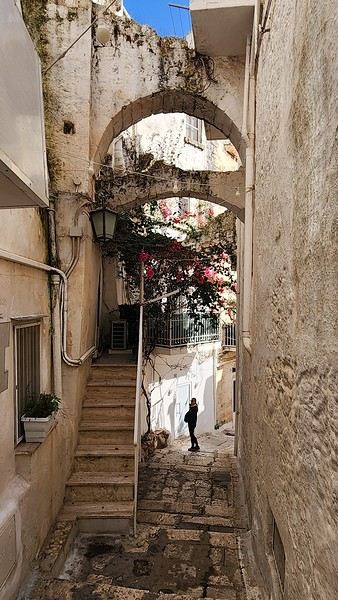
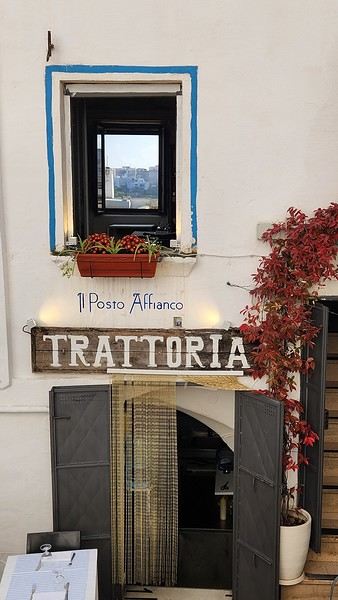
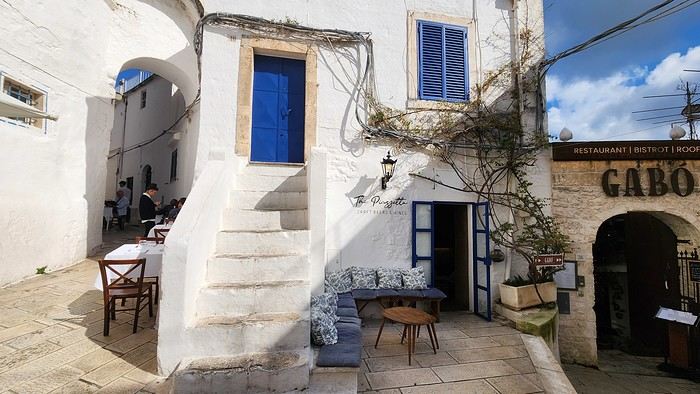
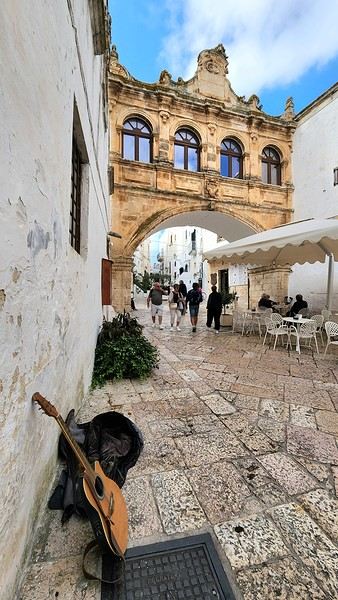
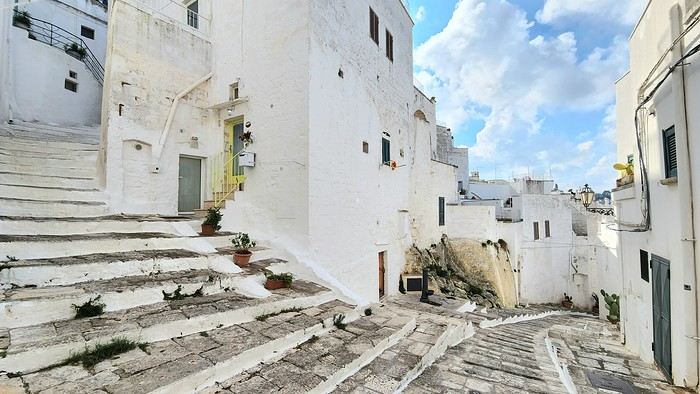
Our plane drops our little crew in Bari, the site of a famously tragic battle lost in 1991. But revenge is sweet! After renting a motorized carriage, we escape the landing zone and head to our military base of operations: Ostuni, a strategic little town where we’ll set up camp for the next four days. Why Ostuni? First, for its central location, which lets us explore a region packed with must-see gems. Second, for its vibe and beauty, which have earned it quite the reputation. Perched high on a hill, the *città bianca* (the "White City") lives up to its nickname. It literally dazzles visitors. The reason? The whitewashed facades of its houses, a testament to the region’s rich architectural heritage.
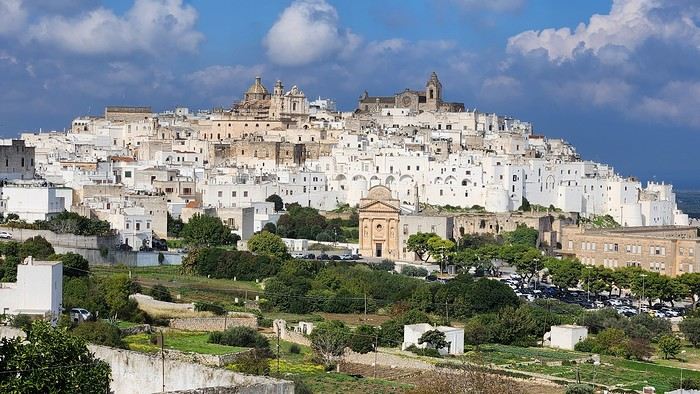
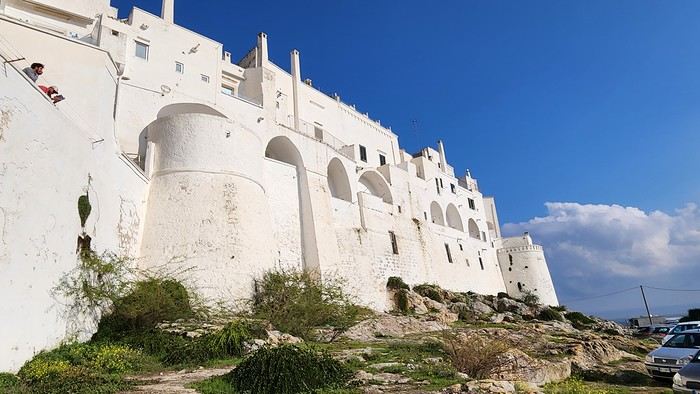
We arrived late last night, so only the two bravest soldiers volunteered to scout ahead at dawn, while the younger recruits stayed behind—for now. But not for long! After the first wave of streets and the next round of exploration, headquarters made the inevitable call to retreat. Reinforcements were needed! A few strategic errands, a breakfast ration, and our battalion marched in tight formation, flag held high, to conquer Ostuni the White! *Charge!* In my squadron leader’s memoirs, I’ll write that I didn’t expect Ostuni to put up such a fight. What I thought would take two hours to conquer turned into a humbling experience—we could only bow in respect to its beauty, its relentless charm. The alleys are whiter, more labyrinthine, narrower, and more photogenic than the last. *Veni, vidi, vici*—but what an entrance, my troops!
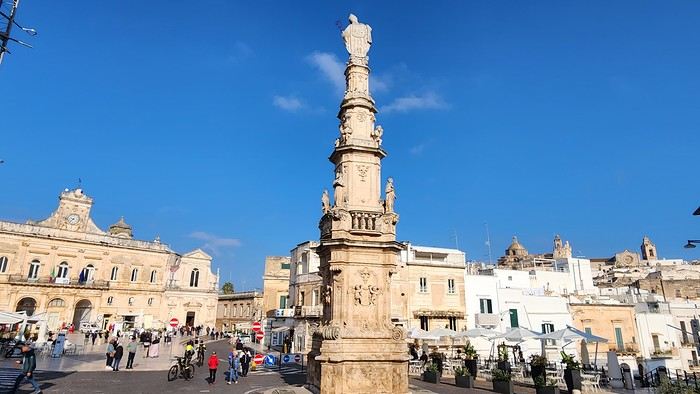
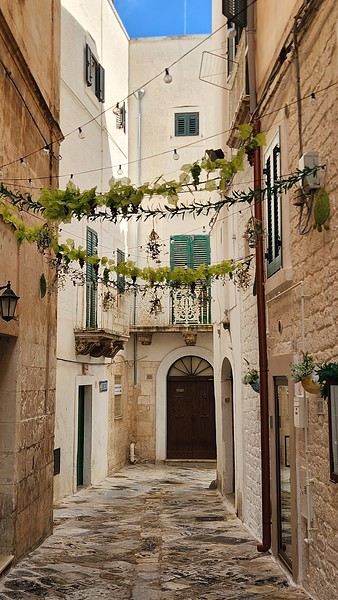
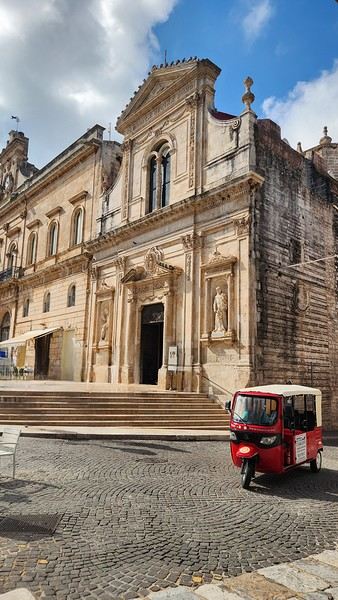
After wrapping up our travel journal on Java (link below), we’re now diving into our recent adventure in Puglia! Happy reading... Off we go on an adventure in Java (and a bit of Bali) | Travel journal > Indonesia | Voyage Forum
Day 1 - October 19
When you tell your friends and family you’re itching to escape to the other side of the planet to mingle with the Mongols, you can usually expect a barrage of questionable jokes and terrible puns. For this new adventure, it’s a different destination but the same old story—this time, we’re visiting the "pouilleux" (the "scruffy" ones). We’re taking off straight for Puglia! If you need a cheat sheet to remember where this oddly named place is on a world map, just think of it this way: Puglia is the maiden name on the ID card of the heel of the Italian boot! Personally, I prefer to remember it as the land of creamy burrata, the smell of focaccia fresh from the oven, orecchiette shaped by mamas, golden olive oil that shines like the sun (which beams down here 300 days a year), amaretto that makes you happy, and those famous trulli—those little hobbit-like dry-stone houses straight out of a movie set...
But I’ll stop spoiling the rest of our trip and focus on a factual rundown of this first Puglian day. So, are you joining us on this new adventure beyond our Gallic borders? Either way, Sasha (my youngest) and Luna (Flo’s daughter) didn’t need much convincing to stick with us and keep up the pace!
Our plane drops our little crew in Bari, the site of a famously tragic battle lost in 1991. But revenge is sweet! After renting a motorized carriage, we escape the landing zone and head to our military base of operations: Ostuni, a strategic little town where we’ll set up camp for the next four days. Why Ostuni? First, for its central location, which lets us explore a region packed with must-see gems. Second, for its vibe and beauty, which have earned it quite the reputation. Perched high on a hill, the *città bianca* (the "White City") lives up to its nickname. It literally dazzles visitors. The reason? The whitewashed facades of its houses, a testament to the region’s rich architectural heritage.
We arrived late last night, so only the two bravest soldiers volunteered to scout ahead at dawn, while the younger recruits stayed behind—for now. But not for long! After the first wave of streets and the next round of exploration, headquarters made the inevitable call to retreat. Reinforcements were needed! A few strategic errands, a breakfast ration, and our battalion marched in tight formation, flag held high, to conquer Ostuni the White! *Charge!* In my squadron leader’s memoirs, I’ll write that I didn’t expect Ostuni to put up such a fight. What I thought would take two hours to conquer turned into a humbling experience—we could only bow in respect to its beauty, its relentless charm. The alleys are whiter, more labyrinthine, narrower, and more photogenic than the last. *Veni, vidi, vici*—but what an entrance, my troops!
Hi there, I’ve been traveling for 18 years now, at least 6 months a year, and as the years go by, I actually enjoy coming back to France more and more—a feeling I struggled with at first. I mean, we always think the grass is greener elsewhere.
But in the end, I find meaning in that saying about how there’s no place like home. I still love traveling just as much, but now my trips are shorter, and I enjoy spending more time in our beautiful country, even though I don’t hesitate to criticize it.
How about you? How do you handle coming back from your travels?