Hello,
We’ll arrive in Hanoi on April 17, 2025, and plan to head to the Northwest (Sapa region) and Northeast starting on April 20. How many days do you recommend for this trip? We’re two couples and a 4-year-old child. Should we book through an agency in Hanoi and do the circuit by van, or can we manage with buses—like an overnight bus from Hanoi to Sapa, then 2–3 days in the Sapa region, followed by a bus from Sapa to Ha Giang for a 3-day loop?
Thanks in advance for your tips, itinerary ideas, accommodation suggestions, guesthouses, restaurants, and any great deals!
1,945 similar discussions in English
Hello! 🙂
January 2026 Here we go again for new adventures and the pleasure of sharing them with you here! First of all, I’d like to thank everyone who helped me with the preparations, even with some last-minute improvisations just days before departure. Thanks to Montagnard74, Jojoone1, Songsam, Attila, Dennis2, NadegerFERM, and the authors whose travel journals about Laos inspired me (Montagnard74, Muriel18, Mavietongs...).
In this story, written by Richard and illustrated by me, we’ll tell you about the journey of four friends: Catherine, Richard, Nathalie, and Bruno. A reinvented but overall successful trip, filled with discoveries and surprises, the scents of spices and frangipani flowers, (too) spicy food, sunsets, and... one big mess.
January 2026 Here we go again for new adventures and the pleasure of sharing them with you here! First of all, I’d like to thank everyone who helped me with the preparations, even with some last-minute improvisations just days before departure. Thanks to Montagnard74, Jojoone1, Songsam, Attila, Dennis2, NadegerFERM, and the authors whose travel journals about Laos inspired me (Montagnard74, Muriel18, Mavietongs...).
In this story, written by Richard and illustrated by me, we’ll tell you about the journey of four friends: Catherine, Richard, Nathalie, and Bruno. A reinvented but overall successful trip, filled with discoveries and surprises, the scents of spices and frangipani flowers, (too) spicy food, sunsets, and... one big mess.
Hi there,
This summer, we spent 3 weeks in northern Colombia. A vibrant trip that complemented our southern Peru adventure from the previous year perfectly. Two neighboring countries, but completely different.
To start, we had to make a choice because the country is vast.
So we focused on 3 different regions for our 3 weeks: - Week 1: Bogotá and the colonial villages (Villa de Leyva, Barichara) - Week 2: Medellín and the Coffee Region - Week 3: the Caribbean coast
We entrusted the organization to a small local agency that handled accommodations, guides, and transportation. Transportation is key. The country is large, the road network isn’t very efficient, and we spent a lot of time traveling (cars, planes, and boats...), but it was the price to pay to explore it.
The overall budget isn’t exactly "backpacker" level. We spent 7,500 € (excluding Air France) for our 3-week stay (hotels, drivers, guides, flights, visits, meals). But we treated ourselves to nice accommodations—you’ll see as we share more posts.
For vacations, I try to follow Philippe Noiret’s motto: "Travel is short. Let’s try to do it first class."
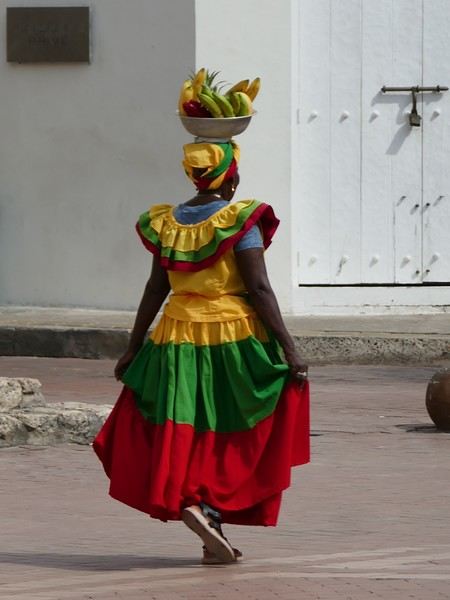
This summer, we spent 3 weeks in northern Colombia. A vibrant trip that complemented our southern Peru adventure from the previous year perfectly. Two neighboring countries, but completely different.
To start, we had to make a choice because the country is vast.
So we focused on 3 different regions for our 3 weeks: - Week 1: Bogotá and the colonial villages (Villa de Leyva, Barichara) - Week 2: Medellín and the Coffee Region - Week 3: the Caribbean coast
We entrusted the organization to a small local agency that handled accommodations, guides, and transportation. Transportation is key. The country is large, the road network isn’t very efficient, and we spent a lot of time traveling (cars, planes, and boats...), but it was the price to pay to explore it.
The overall budget isn’t exactly "backpacker" level. We spent 7,500 € (excluding Air France) for our 3-week stay (hotels, drivers, guides, flights, visits, meals). But we treated ourselves to nice accommodations—you’ll see as we share more posts.
For vacations, I try to follow Philippe Noiret’s motto: "Travel is short. Let’s try to do it first class."
Hello everyone,
I’m planning my upcoming trip from North to South Vietnam for May 2026. There’ll be two couples in their sixties and older... I’ve received proposals from three agencies with a driver and French-speaking guide. The one I’ve chosen, which is often mentioned in this forum, suggests this itinerary, and I’d love to hear your thoughts: HANOI, arrival on 04/29/26, 2 nights BAC HA, 1 night HA GIANG, 1 night NAM DAM, 1 night DONG VAN, 1 night BAO LAC, 1 night BA BE, 1 night HANOI, 1 night NINH BINH, 2 nights HALONG BAY (BAI TULONG), 1 night HUE, 2 nights HOI AN, 3 nights SAIGON, 1 night CAN THO, 1 night SAIGON, 1 night I’d like to know if the stop in Nam Dam is worth staying overnight or if we should just visit and continue to Dong Van. Also, would it make more sense to fly from Hoi An to Can Tho and finish with 2 nights in Saigon instead? That’s what I’d like your input on. Thanks in advance, and have a great summer! 🌞 Monique
I’m planning my upcoming trip from North to South Vietnam for May 2026. There’ll be two couples in their sixties and older... I’ve received proposals from three agencies with a driver and French-speaking guide. The one I’ve chosen, which is often mentioned in this forum, suggests this itinerary, and I’d love to hear your thoughts: HANOI, arrival on 04/29/26, 2 nights BAC HA, 1 night HA GIANG, 1 night NAM DAM, 1 night DONG VAN, 1 night BAO LAC, 1 night BA BE, 1 night HANOI, 1 night NINH BINH, 2 nights HALONG BAY (BAI TULONG), 1 night HUE, 2 nights HOI AN, 3 nights SAIGON, 1 night CAN THO, 1 night SAIGON, 1 night I’d like to know if the stop in Nam Dam is worth staying overnight or if we should just visit and continue to Dong Van. Also, would it make more sense to fly from Hoi An to Can Tho and finish with 2 nights in Saigon instead? That’s what I’d like your input on. Thanks in advance, and have a great summer! 🌞 Monique
Hi there,
We’re planning a trip to China from May 5th to June 3rd, 2025.
We’re traveling independently using local transport—this will be our third trip to China since the 15-day visa exemption and our first since the 30-day visa exemption in 2025. We’ve drafted an itinerary and would love to hear your thoughts on the destinations and the length of our stops. We’re also looking for hotel recommendations.
Day 1: Montpellier to Beijing with Air France, Beijing – 6 days, including a trip to the Great Wall at Badaling, Beijing to Datong, Datong – 2 days, Datong to Pingyao, Pingyao – 2 days, Pingyao to Xi’an, Xi’an – 3 days, Xi’an to Chengdu, Chengdu – 2 days, Chengdu to Chongqing, Chongqing – 2 days, Chongqing to Changsha, Changsha to Zhangjiajie – 2 days, Changsha to Shanghai, Shanghai – 2 days (we’ve already been to Shanghai in May 2024). Shanghai to Montpellier.
Thanks for your feedback and tips! Alod
Hi there! 😉
I’ve already created a post for our entire trip to Japan, but I’d love to focus specifically on our stay in Tokyo here. We (two couples of friends) will be spending 6 full days there in early November. Here’s what we’ve planned so far. We’d really appreciate your feedback to validate—or not—our schedule, and especially to hear your tips. Thanks in advance! 😉
DAY 0: Arrival in Tokyo in the evening, so rest and dinner near the hotel.
DAY 1:
09:00 – Shinjuku Gyoen Park
Must-see: ✔ Japanese garden (red bridge, pond) ✔ French garden (perspective and rose garden) ✔ English garden (lawns and maple trees) Photo spot: Red bridge + red maples (koyo).
11:00 – Harajuku & Takeshita Street
Walking route:
Start with Takeshita-dori (kawaii fashion, Japanese crepes). Walk up to Omotesandō (designer architecture: Dior, Prada).
Don’t miss: ✔ Kiddy Land (toys, souvenirs) ✔ Tokyu Plaza Omotesandō (entrance with escalators and mirrors → iconic photo)
12:30 – Lunch
Afuri Harajuku (yuzu ramen, light and fragrant). Alternative: Uogashi Nihon-Ichi (standing sushi, quick and fresh).
14:00 – Meiji-jingū (optional but recommended)
Access: From Omotesandō, enter through the large wooden torii. Must-see: ✔ Decorative sake barrels ✔ Forest path (zen atmosphere) ✔ Main pavilion (respect the purification ritual at the entrance). Duration: 45 min.
16:30 – Return to hotel / rest
JR Yamanote Line from Harajuku → Shinjuku (5 min).
18:30 – Evening in Yurakucho (Gado-shita)
DAY 2 09:00 – Visit to Asakusa
Walking route:
Kaminarimon Gate → photo under the large red lantern. Nakamise-dori → shopping street (souvenirs, snacks: melon pan, senbei). Sensō-ji Temple → main pavilion, five-story pagoda.
Don’t miss: ✔ Omikuji (fortune-telling draw) ✔ Photo with the pagoda and Tokyo Skytree in the background.
11:30 – Akihabara
Walking route: ✔ Yodobashi Camera (gadgets, electronics) ✔ Mandarake (figurines, manga) ✔ Super Potato (retro games)
13:00 – Lunch
Quick option: Ichiran Ramen (Akihabara). Local option: Tendon Tenya (affordable tempura).
14:30 – Free time / shopping
Explore the small alleys for anime shops, figurines, gashapon.
16:30 – Departure for Toyosu (teamLab Planets)
Transport:
JR Yamanote Line from Akihabara → Shimbashi (15 min) Yurikamome Line from Shimbashi → Shin-Toyosu (15 min)
Tip: Book a 6:30 PM slot to enjoy the evening atmosphere.
18:30 – teamLab Planets
Duration: 1.5 to 2 hours. Tip: Bring a towel (barefoot experience in water). Mandatory reservation: (official website).
20:30 – Dinner
Option on-site: DMM Café (Toyosu). Option back in Shinjuku: Izakaya (Torikizoku or Teyandei).
DAY 3:
Excursion to Mount Fuji (Kawaguchiko)
DAY 4:
09:00 – East Gardens of the Imperial Palace
Must-see: ✔ Ruins of Edo Castle ✔ Nijubashi Bridge (iconic photo) ✔ Museum of the Imperial Collections (free) Duration: 1h15. Tip: Open exceptionally this day (public holiday).
10:30 – Walk to Ginza
Walk: 15 min via Marunouchi Naka-dori (chic street with shops and cafés). Tip: Enjoy the autumn decorations and designer façades.
11:00 – Ginza
Must-see: ✔ Ginza Six (modern shopping center) ✔ Nissan Crossing (futuristic car exhibit) ✔ Wako Clock Tower (iconic photo)
14:30 – Shibuya
Walking route: ✔ Shibuya Crossing (photo from Starbucks Tsutaya) ✔ Hachikō Statue ✔ Shibuya Scramble Square → Shibuya Sky (panoramic view of Tokyo and Mount Fuji if the sky is clear). Shopping: Loft, Tokyu Hands, Shibuya 109 (fashion).
17:30 – Return to hotel / rest
JR Yamanote Line from Shibuya → Shinjuku (7 min).
19:30 – Dinner
Izakaya option: Izakaya Tofuro Shinjuku (traditional atmosphere). Modern option: Nabezo Shinjuku (all-you-can-eat shabu-shabu).
DAY 5:
10:00 – Ghibli Museum
Duration: 2 hours. Must-see: ✔ Permanent exhibits (Totoro, My Neighbor Totoro, Spirited Away) ✔ Exclusive short films (Saturn Theater) Tip: Photos are not allowed inside, but there are beautiful spots outside.
12:00 – Stroll in Inokashira Park
Must-see: ✔ Central pond (boat rental available) ✔ Benzaiten Shrine Duration: 30 min.
14:30 – Nakameguro & Daikanyama
Transport: JR Chuo Line from Mitaka → Shibuya, then Tokyu Toyoko Line → Nakameguro (40 min). Must-see: ✔ Walk along the Meguro River (trendy cafés, design shops) ✔ T-Site Daikanyama (magnificent architecture) Coffee break: Onibus Coffee Nakameguro (artisanal coffee).
17:30 – Return to Shinjuku
Transport: Tokyu Toyoko Line → Shibuya → JR Yamanote Line → Shinjuku.
DAY 6:
Free morning (shopping or relaxation)
Suggestions: ✔ Shopping at Lumine Shinjuku or Isetan ✔ Stop by Don Quijote for souvenirs ✔ Or Thermae-Yu Onsen (if you want a relaxing morning before departure).
14:45 – Arrival in Odaiba
Walking route: ✔ Aqua City (shopping, bay view) ✔ Statue of Liberty (photo with Rainbow Bridge) ✔ DiverCity Tokyo Plaza (giant Gundam statue) Immersive option: Immersive Fort Tokyo (if you want a fun indoor activity).
16:30 – Sunset over Rainbow Bridge
Best spot: Esplanade in front of Aqua City or Odaiba Beach. Photo tip: Wait for the bridge lights to turn on (around 5 PM).
18:30 – Dinner in Odaiba 20:00 – Departure for Tokyo Tower
Transport:
Yurikamome Line from Daiba → Shimbashi → Oedo Line → Akabanebashi (30 min).
Tokyo Tower: ✔ Incredible night view of illuminated Tokyo. ✔ Duration: 45 min to 1 hour.
21:30 – Return to Shinjuku
Transport: Oedo Line → Shinjuku (15 min).
And there you have it—I hope I didn’t go on too long! 😉 Thanks everyone for your advice....
Hi everyone
I’m currently planning my trip to China for next August.
I’m starting from scratch, so I’m counting on your advice and firsthand experiences!
For now, I only know that I’ll arrive in China via Beijing, Shanghai, or Hong Kong and leave 15 days later from another one of these three cities.
In between, I’d love to explore a mountainous and natural region in the countryside.
The Guilin area really appeals to me with its spectacular landscapes.
I still have tons of questions:
- What can you do during this often humid season?
- Is it better to go through a local agency or organize everything yourself?
- What itineraries would you recommend?
Anyway, everything’s still up in the air, and I can’t wait to read your opinions, suggestions, and great tips to help me build this trip!
Hi,
I’m starting to plan a great trip for the last three weeks of January 2027 (my first time in South Africa).
After spending a few hours (!) browsing this forum, here’s a rough first draft of my itinerary:
D0 Arrival at JNB D1, D2 Blyde River Canyon D3, D4, D5, D6, D7: Kruger D8, D9, D10: St Lucia and surrounding area D11, D12, D13, D14: Drakensberg + Lesotho
D15 A very long driving day to the south (hope the AC doesn’t break down!)
D16, D17, D18, D19 southwest coast (so far I’ve noted Oudtshoorn, Robberg Nature Reserve, Wilderness NP, De Hoop Reserve, and a bit of the wine route) D20, D21 Cape Town (peninsula and a bit of the city) + domestic flight and return flight (departure from JNB at 11 PM)
A few questions before refining this: - Do you see any major issues with this itinerary?
- We don’t have a choice on dates, and personally, I prefer green landscapes to desert ones anyway, but do you really see far fewer animals in January than in the dry season? Five days in Kruger should give us enough time to spot plenty of different animals despite the tall grass, right? As for the heat, we’re from Réunion, so we’re relatively used to it, even though I know it’s not the same type of heat.
- Can I trust the distances and driving times given by Google Maps?
- Picking up the vehicle in Johannesburg and dropping it off in Cape Town: how much might that cost us? I’m thinking it probably won’t be worse (in terms of time or money, since there are five of us—2 adults + 3 kids) than going back to Joburg after Lesotho, taking a flight to Cape Town, and renting another vehicle... but maybe I’m wrong.
- Finally, wouldn’t it be better to focus on just one of the two regions (either the northeast or Cape Town and the south coast)? If it were up to me, I’d stick to the first part and extend a few stops... but not everyone agrees! And we’re thinking that since it’ll be really hot, a second part of the trip that’s a bit """cooler""" would be welcome.
Thanks for your help
Hello,
We’re a family of 5 (2 adults and 3 kids who’ll be 2, 7, and 10 years old) planning to visit the islands of Santiago, Fogo, and Maio this summer. We’ll have 22 full days on the ground. It’s a shame (financially, logistically, and environmentally speaking!), but we’ll be taking 4 flights: a round-trip from Santiago to Fogo and another from Santiago to Maio. We’d like to position Maio toward the end of our stay since we enjoy ending our trips with a quieter beach phase.
For now, based on flight schedules and dates, we’re thinking of doing: 23/07: Arrival in Santiago 24/07 – 30/07: Fogo (5 full days) 30/07 – 05/08: Santiago (5 full days) 05/08 – 11/08: Maio (5 full days) 11/08 – 15/08: Santiago (3 full days) 15/08: Return to France
FOGO: Of course, we want to visit Cha das Caldeiras, where we’d like to spend 3 nights. We’d love to explore the valley and are also considering hiking the smaller Pico (the taller one seems too ambitious for us with the kids). Do you have any info on that hike? What else do you recommend doing on the other days? Where can we go for other walks? I’ve seen that it’s possible to descend from Cha das Caldeiras to Monteiros, but I’m worried it might still be too challenging. It looks amazing!! But how do we manage with our luggage? Otherwise, the north of the island intrigues me, though we’re not thrilled about São Filipe, even though we know we’ll have to spend at least one night there before returning to Santiago.
On this island, we initially thought about not renting a car, but I’m wondering if that’s a good idea for us with all the luggage. If we do rent one, is it easy to reach Cha das Caldeiras by car? Any advice is welcome!
MAIO: Here, I think renting a car will be essential for us to get around easily. We’d like to do an excursion to observe turtle nesting. I haven’t found much info on this—where and with whom should we go? Otherwise, the plan is to do some snorkeling directly from the beach, independently, since we’ll need to take turns so one adult can stay with our 2-year-old. Any spots you’d recommend?
Which towns would you suggest staying in? All options work for us—we’re fine with settling in one place or splitting our time (e.g., 3 nights in one spot and 3 nights elsewhere).
Basically, I’m open to all tips and recommendations for this little week on Maio (short walks, places to relax, beaches, etc.)!
SANTIAGO: Nothing too original, but for Santiago, we’re considering visiting Cidade Velha, Tarrafal, and Ribeira da Prata (for the black sand beach and natural pools), as well as Serra Malagueta for a hike. There must be so much more to do, especially with the time we have. What else would you recommend?
I’m struggling to figure out how to organize our time there since we’ll have 5 full days first, then 3 more. How would you do it?
Thanks,
Hello,
We’re heading to Thailand for 26 days (excluding flights) next July with our two teens (12 and 15 years old).
My husband and I have been there several times before they were born—so that’s 15 years ago—and I’m a bit worried about some of the changes that might have happened since, especially with the rise in tourism...
I’d also like to keep a pace that allows us to settle in a bit and enjoy local life beyond just the main sights. Plus, we’re pretty active.
For now, our plan looks like this:
Arrival in Bangkok, where we’re thinking of spending several days (minimum 4) Chiang Mai for about a week 2 or 3 islands in the Gulf Return to Bangkok for 2 days before departure.
We’re pretty set on Bangkok and Chiang Mai, but we’re unsure about which islands to visit—I’ve read such mixed things that I’m even wondering if we should consider the coast instead. Organization-wise, I’d love any tips or feedback on whether we need to book in advance at this time of year, which transport options to prioritize (train, bus, or plane), and of course, any suggestions for stops or routes. Thanks in advance to anyone kind enough to help us prepare for this amazing trip!
Hi everyone, I’m heading to Île aux Nattes in a few weeks and I’d like to know if euros are accepted in the island’s restaurants.
At the hotel where I’ll be staying, they take card payments, but for activities, I can’t find any reliable info.
Could anyone tell me the approximate cost in euros and/or ariary for a week (food outside the hotel) on the island for two people?
Also, has anyone ever exchanged money at the Paris Magenta exchange bureau? Thanks!
Also, has anyone ever exchanged money at the Paris Magenta exchange bureau? Thanks!
Hi,
On September 1st, we're heading to Kalimantan for six weeks, probably from Pontianak to the Derawan Islands.
I've scoured this site, which is usually my go-to 😉, and others like VoyageForum, but recent info is pretty scarce.
I'd love any tips on places you've visited—our itinerary is still a work in progress.
We're two couples traveling with backpacks, using buses, boats, guesthouses, and homestays.
Thanks in advance!
SIEM REAP
You can now rent scooters just about everywhere in Siem Reap, but at rip-off prices—$15–18 a day instead of $5–10 like everywhere else in Indochina. The best options are tuk-tuks or, even better, electric bikes ($12, but with a 50 km range, so they won’t let you go to Banteay Srei or the River of a Thousand Lingas in the Kulen Massif, which are too far). **WARNING:** Wear a helmet, or they *will* catch you. Scooters are banned from going from SR to the stunning temple of Koh Ker in the northeast and continuing to Battambang; no idea why!
My favorite little hotel in Siem Reap? The Neth Socheata, tucked in an alley off Thnou St near the market—lovely rooms, and the owner speaks great English. Then there’s the Ivy Guesthouse with its little garden, but it’s “always full,” according to the owner. For something upscale but still affordable, a fantastic spot is the Pavillon Indochine, tucked away on a quiet side street on the way to the airport—elegant, with incredible attention to decor, a terrace restaurant, garden, pool, etc. Everything you’d want for $70 including breakfast. I also spotted a hostel for backpackers, the Angkor Thom Hostel, with small 6-bed dorms for $4 with a fan or $6 with AC (18 Wat Bo St).
Food-wise, it’s all amazing! Pub Street has turned into a noise nightmare, with speakers blasting what’s supposed to be music but is just *boom, boom, boom, boom, boom*—run away, even though the pizzas at the Italian place Il Forno are really good. The famous and excellent Tigre de Papier has changed its name to Paper Tiger and is still just as good (lunch only, though, because across the street there’s a huge bar blasting *boom boom boom*, so you won’t be able to hear each other during dinner). On the other hand, the Italian-Cambodian El Toro on Pub Street is perfect, with fantastic pizzas and divine lasagna (go to the first-floor dining room—there’s a big bar across the street blasting *boom boom boom*, but at least you can still talk). Due to the lack of customers during COVID, all the French restaurants—Barrio (three times alas!), Les Deux Sœurs, Le Bel Air, and Le Mozart—have closed. The only one left is L’Olivier, which is pricey. I also discovered a great Moroccan restaurant (though run by a Sudanese man and his French wife), Le Tajine, on Strung Thmei St, 09 68 89 78 27. **WARNING:** For tagines and couscous, you need to order at least in the morning; wine and beer are fine. To get there, turn at the corner of the Cineplex behind the big market at the start of Sivatha Boulevard.
I finally went to the Khmer dance show. Beautiful dancers and dances, but **EAT BEFORE OR AFTER**—the meal is so awful that most Westerners leave it on their plates.
THE ANGKOR TEMPLES Use the excellent *Routard Cambodia* guide. Just a few tips: - Start with the pre-Angkorian Roluos group, 15 km before Siem Reap on the road to PP—it’s the “ancestor” of the temples.
- To avoid the big crowds at Angkor Wat, Bayon, and Ta Prohm, go between noon and 2 PM when everyone’s having lunch. - Speaking of lunch, the crowds flock to the hundred or so mediocre food stalls on the left side of Angkor Wat. Instead, head to Angkor Thom after the stunning Pre Rup temples, all the way to the small Sras Srang basin. Along the basin, there are several restaurants with terraces offering first-floor views of the water, and no crowds. Afterward, cross to the other side of the basin—you’ll end up in the countryside with charming villages where locals seem to live as they did during the temples’ golden age (at its peak, the population was estimated at 600,000–800,000, making it the largest city in the world. The theory for the abandonment is water shortages caused by overpopulation).
- I climbed Phnom Bakheng for the famous sunset, but the crowd was so ridiculous that instead of seeing the temple at sunset, you just see the heads and shoulders around you.
- There are tons of small temples that most people skip, and they’re missing out. My favorites: Thommanon, Neak Pean, Ta Som, and especially Pre Rup, an amazing brick complex with 14 towers.
**Big disappointment:** You can no longer climb to the first floor of Bayon, where you used to stand magically among the giant head statues. So, admire the beautiful bas-reliefs on the outside, but there’s no point going inside—you’ll just see a dark, square corridor with nothing interesting.
ANGKOR FURTHER AFIELD The wonderful Banteay Srei temple. A gem! I couldn’t find the bas-relief stolen by Malraux in the 1920s (fun fact: what he was doing in Indochina—stealing a bas-relief to sell for a fortune in France to cover his massive gambling debts on the stock market, where he ruined his very wealthy American wife—was an open secret. But the French authorities in Saigon, who hated him for his leftist views, decided to let him do it and catch him red-handed, which worked perfectly. He avoided jail only because all the leftist intellectuals in Saint-Germain, Sartre, Beauvoir, and co. cried scandal—though the real scandal was the looting).
30 km of excellent paved road further north, a great spot: the Kulen Massif and the River of a Thousand Lingas (at one point, you’ll come to a T-junction—turn left). Along the road at the foot of the massif, on your right, there’s a great restaurant, Bourey Sovann (where the food is excellent). The trail to the river starts just before it on the left. **Warning:** There are two sites for the River of a Thousand Lingas. One is accessible via a private road, so there’s a $20 toll, and you need to arrive before 11 AM because the road is narrow and traffic flows downhill after that. You’ll end up in a site full of shops, snack stalls, and two good restaurants, including one by a beautiful waterfall. However, the thousand lingas aren’t as spectacular there.
Banteay Srei + the River of a Thousand Lingas makes for a fantastic day. **WARNING:** You used to be able to go to the river and waterfall by scooter or tuk-tuk, but it’s now forbidden. So **go by taxi**—otherwise, you’ll be hiking 12 km round trip up a steep trail.
If you leave Siem Reap early, you can even add Beng Mealea temple on the way back, making a triangular route: SR-BS-Khulen-BM-SR (or the reverse).
If you have time, visit Banteay Samré temple, 10 km west of the Angkor Thom complex. A lovely site with very few visitors.
I’ve never been to the famous Preah Khan on a hill overlooking Thailand. There’s a big dispute between the two countries—the Thais insist the temple belongs to them because the entrance is in their country. There have been serious clashes in the recent past, and landmines are still abundant off the marked paths. They even claim the entire Siem Reap province is theirs and should be returned, arguing it was Thai in the past. It takes two days (6–7 hours each way), with an overnight stay in the nearby village (small hotels and one luxury option with a garden and pool, but it’s expensive).
TONLE SAP People talk about “floating villages,” but that’s a big mistake—these are actually villages of astonishing stilt houses, 4 meters high or more, due to the lake’s major floods. The most famous is Chong Khneas, which I skipped because it’s packed with tourists. Instead, I really liked Kampong Phluk, which is much quieter. To get there, continue on the road past the Roluos group until you reach a parking lot with pirogues lined up. They’ll take you down the river, stop at this amazing village for a walk, and then take you to the Tonle Sap, a true inland sea. At one point, you’ll pass through a flooded forest that you can explore by small boat. At the junction of the river and the Tonle Sap, and on the lake itself, there are floating restaurants where the food is great. Note that in the dry season, you can reach the village by scooter.
BACK TO PHNOM PENH AND ON TO SOUTHERN VIETNAM Since I’d planned at least 15 days in the Mekong Delta between Chau Doc and Saigon, I skipped Battambang, etc. With no desire to endure the dusty road from SR to PP again, I simply loaded my bike onto a bus with the great company Rith Monty (book at their office in SR on the small square at the start of Sivatha Boulevard—$10 for the bike and $6 for me), also known as Paramount. Their buses stop on 136 St right in the middle of PP. I’ll also mention the excellent Giant Ibis, with big modern buses that always leave on time—unlike the others.
I spent the night in PP, and the next morning took the fast boat from PP to Chau Doc with Hang Chau Tourist (buying the ticket the day before is recommended—$25—either at your hotel or the port, and they’ll pick you up at your hotel by tuk-tuk to take you to the port). Departure from PP at noon, arrival in Chau Doc around 4 PM. The boat is great—comfortable and fast. A crew member takes your passports for Cambodian exit formalities, and you handle Vietnamese immigration yourself—it all takes 15–20 minutes. The route isn’t on the Mekong but on the Bassac River to the border, then a wide north-south canal to Chau Doc (the arrival is really nice). In the Chau Doc-PP direction, the boat leaves Chau Doc at 7:30 AM.
Hi, I need to take a trip to Madeira from November 16th to 23rd and I'm looking for tips and advice. Thanks
Hello!
We’re heading to Cambodia for a month in March. We’re planning to visit Phnom Penh, Battambang, Siem Reap, the Angkor temples, Kompong Luong, then head down to Kampot, Kep, and finish our trip on the islands of Koh Rong. Has anyone done this trip recently?
Any great spots to recommend? Neighborhoods to stay in Phnom Penh (lively but not too touristy)?
Tips for getting around between the major cities—bus, train, boat, motorbike?
Thanks for all the advice!
Fabienne
Hi everyone,
I’m planning a family road trip in the Peloponnese in April, arriving and departing from Athens, with a focus on Greek mythology, beautiful hikes, and a balanced pace (we don’t want to spend our days in the car). Here’s our draft itinerary:
Day 1: Early arrival in Athens – visit Acrocorinth and overnight in Corinth
Days 2 & 3: Drive to Dimitsana – hike in the Lousios Gorge (and maybe a detour to Olympia?), mountain villages
Days 4 & 5: Drive to Areopoli (Mani Peninsula) with a stop in Mystras
Day 6: Kalamata, visit Ancient Messene
Days 7 & 8: Pylos, Voidokilia Beach, Palace of Nestor, Gialova Lagoon
Days 9 & 10: Drive to Nafplio (Epidaurus, Mycenae)
Days 11 & 12: Hydra from the port of Ermioni
Days 12–15: Athens I’d love to hear your thoughts and suggestions. Does the pace seem reasonable? Should we adjust any stops (too long or too short)? Any must-see mythological sites or hikes along the way, in addition to what I’ve mentioned? Is Olympia really worth the detour from Dimitsana?
Thanks so much for your valuable advice!
Hello everyone,
My wife Fanny and I, along with our three kids (ages 10, 12, and 14), are planning a two-week trip to Asia during the February break. This would be our first big family trip, and we’re looking to mix discovery, a change of scenery, some relaxation, and cultural immersion. We want to avoid overly organized tours or over-touristed destinations.
Over 20 years ago, Fanny and I used to travel as a couple with backpacks, especially in India and Mongolia, but things have surely changed a lot since then. Now, we’re torn between:
• Thailand: for its diversity (beaches, temples, nature) and accessibility for a first family trip.
• Laos-Cambodia combo: for a potentially more authentic immersion, but we’re wondering if it’s well-suited for kids.
- Sri Lanka: it seems amazing and family-friendly? Is the political situation stable enough?
We have a few questions:
Which destination would you recommend for this kind of family setup? What itineraries might work for two weeks without feeling too rushed?
Logistics-wise: can we travel with a round-trip flight ticket, book a few basic hotels, and improvise the rest once we’re there? Or do we need to plan everything in advance (transport, accommodations, activities) for this time of year?
Thanks in advance for your valuable tips! Mathieu
Hi there,
I’m planning my first trip to Asia next summer with my partner and our daughter, who’ll be 3 and a half at the time, for 4 weeks (maybe 5).
I’ve heard that the timing is better for visiting Indonesia, but I’m hesitant because Thailand seems more accessible, and I’m worried that traveling to Indonesia during high season might be less enjoyable and a lot more expensive due to the number of tourists. We love cultural sites as much as natural ones, and we’re big foodies. We’re not necessarily looking for luxury and tend to take our time, travel by public transport, and look for accommodations with a good value for money—though we do occasionally splurge on a high-end restaurant.
I’m also wondering when and where to buy flight tickets and how comfortable the journey will be (especially for our daughter) if we fly with Thai Airways or Garuda.
Thanks in advance for sharing your thoughts and tips!
Damien
Namaste everyone,
We went to Nepal last October and literally fell in love with this country (like so many others, it seems). During our trek, we had the chance to meet and travel with an incredible independent local guide, Apsara Luitel. She told us about a unique project she’s organizing starting mid-May, and we wanted to share it in case it interests anyone. We mentioned it on another travel forum, but just in case, we’re posting it here too to reach as many people as possible.
Apsara, who knows the Api mountain valley (a name as joyful as it is intriguing!) in Nepal’s Far West (on the border between India and Tibet, at the edge of the world) perfectly, is offering an off-the-beaten-path trek for a group of 3 to 8 people max. The program? An authentic and preserved itinerary combining homestays and small mountain lodges, all the way to the Api base camp. Once at base camp, locals will guide us to secret spots only they know, where we’ll harvest yarsagumba (those famous caterpillar-fungi, rare and prized for their medicinal properties in traditional Chinese medicine—they were going for $20,000 per kilo last year!).
Mid-May is the ideal time to discover this almost unexplored region and take part in harvesting these natural treasures. This kind of adventure, led by an inspiring young woman like Apsara, is rare, and we think it could appeal to Nepal lovers and those who enjoy authentic treks far from the usual tourist routes.
No matter how many participants there are (between 3 and 8), there will always be two guides: Apsara, who speaks English (and is learning French!), and a French-speaking guide. The dates are flexible around May 15th, depending on the availability of those who’d like to take on the adventure.
Hi everyone,
Since I had a fantastic week in Puglia, and it's such a nearby and easily accessible destination from France,
I invite you to check out the article I wrote about it on my blog: www.philippebasset.com/puglia.html
I highly recommend visiting this coastal region along the Adriatic Sea for so many reasons: diverse landscapes, refined and varied cuisine, a very pleasant climate, a discreet and welcoming population, no mafia (it’s sad to say, but many Italian cities are plagued by this scourge, which brings insecurity, filth, and extortion...), and apart from July-August, there’s no risk of mass tourism!
*Dolce vita* guaranteed!
I’m happy to help if you’d like tips or recommendations :)


And plenty more photos to discover—hopefully, it’ll make you want to book a flight to Bari!
Since I had a fantastic week in Puglia, and it's such a nearby and easily accessible destination from France,
I invite you to check out the article I wrote about it on my blog: www.philippebasset.com/puglia.html
I highly recommend visiting this coastal region along the Adriatic Sea for so many reasons: diverse landscapes, refined and varied cuisine, a very pleasant climate, a discreet and welcoming population, no mafia (it’s sad to say, but many Italian cities are plagued by this scourge, which brings insecurity, filth, and extortion...), and apart from July-August, there’s no risk of mass tourism!
*Dolce vita* guaranteed!
I’m happy to help if you’d like tips or recommendations :)
And plenty more photos to discover—hopefully, it’ll make you want to book a flight to Bari!
Hello everyone,
I’ve been to Morocco about fifteen times, but I’ve never posted a travel journal here on Voyage Forum. Why? I have no idea… Maybe because this section was so active, with lots of stories and photos. I thought sharing my adventures in *al Maghrib* wouldn’t be very original. Today, this space feels quieter, so what if I tried to give it a little life back, modestly? With some help…
This trip will be different. From the start of my relationship with Richard, I was determined to introduce him to *my* Morocco. But he was a bit reluctant… He’ll tell you about our 2022 meeting, and I’ll illustrate it with my photos, just like we did with our India travel journal.
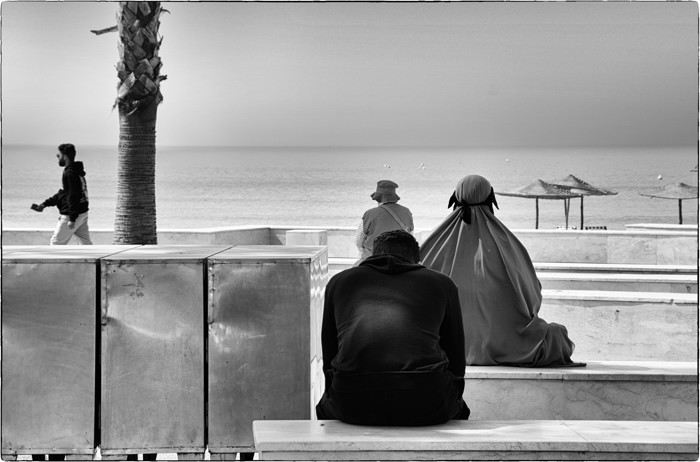
I’ve been to Morocco about fifteen times, but I’ve never posted a travel journal here on Voyage Forum. Why? I have no idea… Maybe because this section was so active, with lots of stories and photos. I thought sharing my adventures in *al Maghrib* wouldn’t be very original. Today, this space feels quieter, so what if I tried to give it a little life back, modestly? With some help…
This trip will be different. From the start of my relationship with Richard, I was determined to introduce him to *my* Morocco. But he was a bit reluctant… He’ll tell you about our 2022 meeting, and I’ll illustrate it with my photos, just like we did with our India travel journal.
We went to Morocco in April with our children and grandchildren.
We landed in Marrakech around 9 AM and took a bus to our small hotel in the Guéliz district. This was to avoid dealing with taxi drivers who might give our young travelers a very negative impression of Marrakech... The bus drops us off very close to the Hôtel Toulousain, which has always given us the warmest welcome for over 25 years. We settle into our rooms and head to the medina to have lunch first and then wander through the streets of the old city, introducing it to our little group.
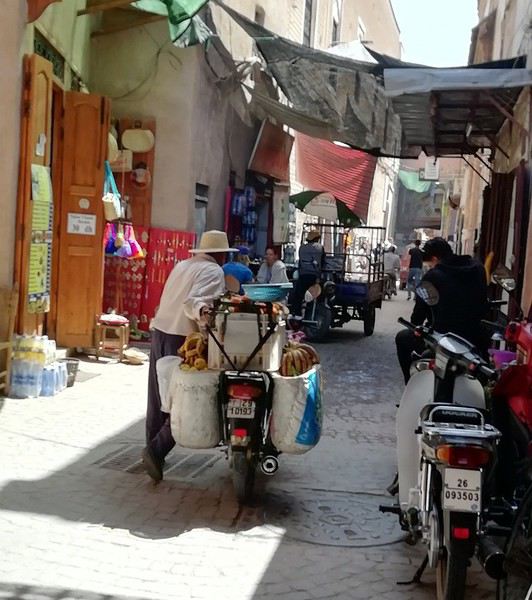
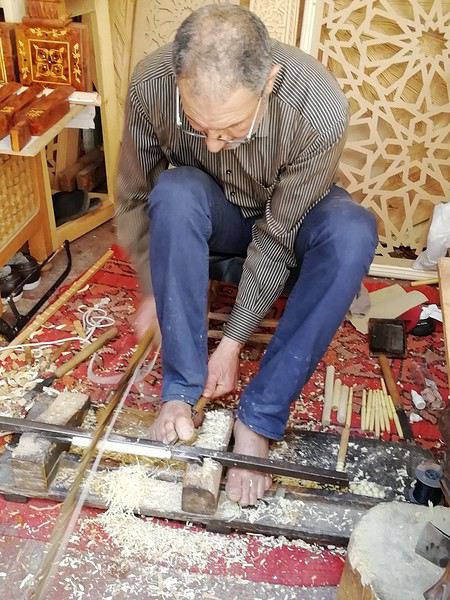
Young and old alike are amazed by the craftsmanship and attention to detail in the work done by the various artisans.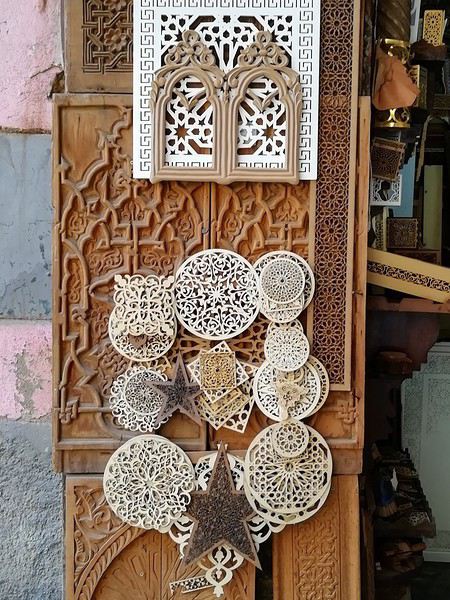
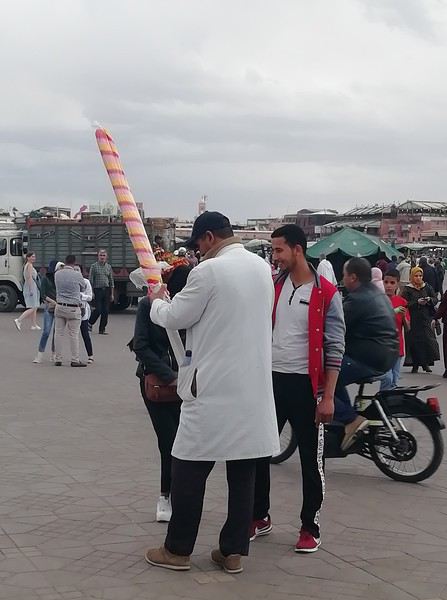
The souks also impress first-time visitors, both with their size and the sheer amount of goods on offer. For those visiting for the first time, it’s a real maze. Colorful chameleons everywhere... Will they survive for long in their cages under the scorching sun?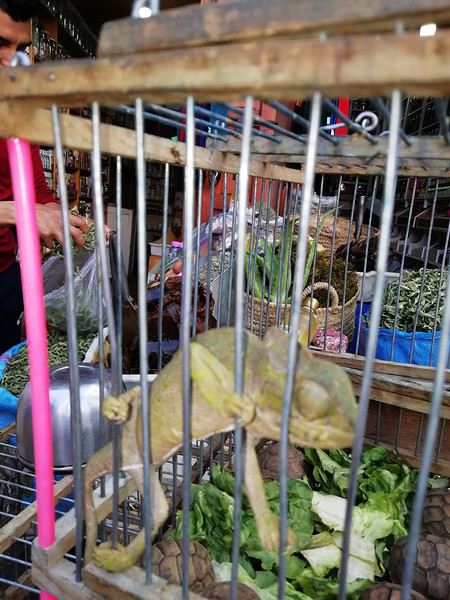 Another surprise for the kids: the lollipop vendor in Jemaa El Fna Square, with giant lollipops that really whet their appetites...
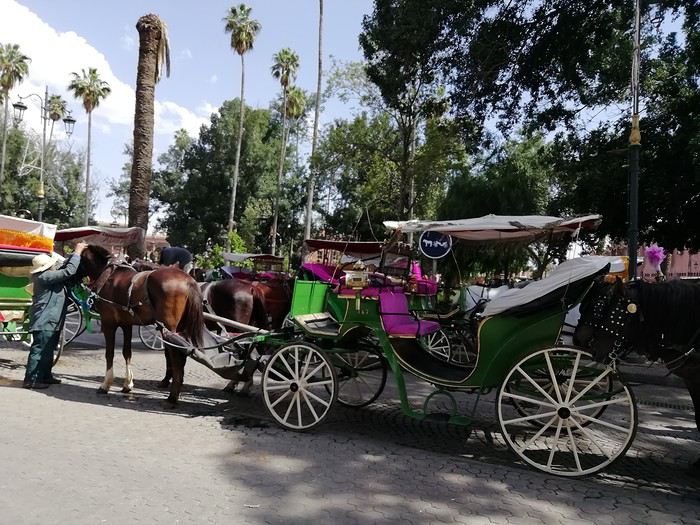
By late afternoon, little legs are tired, and horse-drawn carriages are a welcome way to get back to the hotel.
Young and old alike are amazed by the craftsmanship and attention to detail in the work done by the various artisans.
The souks also impress first-time visitors, both with their size and the sheer amount of goods on offer. For those visiting for the first time, it’s a real maze. Colorful chameleons everywhere... Will they survive for long in their cages under the scorching sun?
Another surprise for the kids: the lollipop vendor in Jemaa El Fna Square, with giant lollipops that really whet their appetites...By late afternoon, little legs are tired, and horse-drawn carriages are a welcome way to get back to the hotel.
Hello everyone,
It’s something we often notice in this forum—and many others—this behavioral shift.
A long-time member, or even a new one, asks a question. They get one or more answers, some brief, some detailed, and then... nothing???
Not even a simple thank you!!!
From what I’ve gathered, if the answers don’t align with what they wanted to hear, it seems natural for the asker to just disappear!! 😕 Unless—(and I fear this is the case)—basic politeness is no longer part of our society????
Please forgive my little rant.
Wishing everyone all the best. Cheers,
Puma2A

...
It’s something we often notice in this forum—and many others—this behavioral shift.
A long-time member, or even a new one, asks a question. They get one or more answers, some brief, some detailed, and then... nothing???
Not even a simple thank you!!!
From what I’ve gathered, if the answers don’t align with what they wanted to hear, it seems natural for the asker to just disappear!! 😕 Unless—(and I fear this is the case)—basic politeness is no longer part of our society????
Please forgive my little rant.
Wishing everyone all the best. Cheers,
Puma2A
...
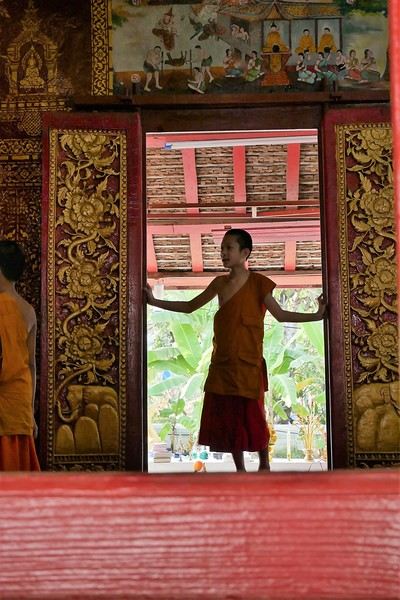 Come along, I'm taking you to this country where it's so nice to wander and slow down...
This trip was in 2023, but when I wanted to write my travel journal, VF was still closed to contributions... So, now that I've just finished my Japan travel journal here, I figured it was high time to honor this destination we came back from so enchanted. Disclaimer 1: This is a written travel journal. There’ll be text! Too much, for some! Disclaimer 2: This is an illustrated travel journal. There’ll be photos! Too many, for some!
I have to say, every time I try to discipline myself, to keep it shorter, to include fewer photos... I end up adding more. It feels like my dear Aunt Nicole, who exhausted us with her slide-show evenings in the 70s/80s, decided to take her revenge. The upside for you, readers, is that you can slip away anytime without offending Aunt Nicole. I won’t even notice!
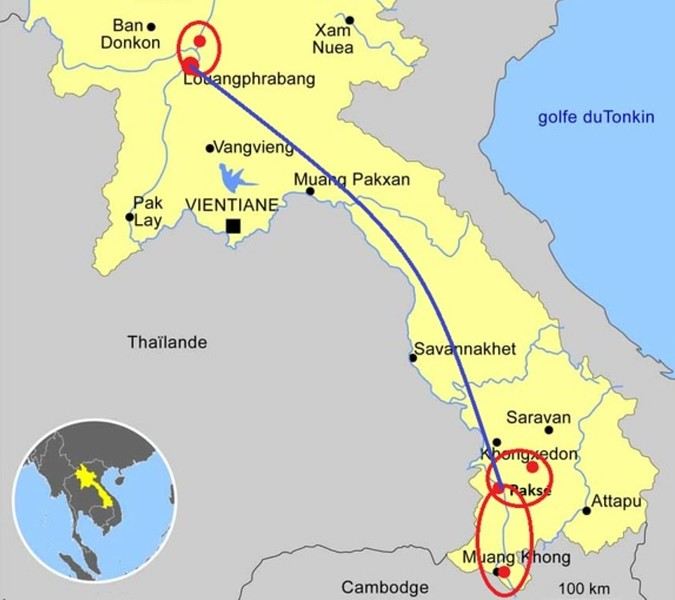
Anyway, since I love maps, here’s one to give you an idea of where I’m taking you. As you can see, we only saw a tiny part of Laos (the areas circled in red); we only had 3 weeks for ourselves (my husband’s newly retired, I still work), and we prefer taking our time over rushing around like crazy.
In broad strokes, it was very classic:
First, we “settled in” at Luang Prabang (8 days), because we wanted and needed to. From there, we took three days to venture a little further north—not far in kilometers, but as we know, distances aren’t just about km! Then we flew south to Paksé, letting ourselves drift down to the 4,000 Islands while stopping by the pre-Angkorian archaeological sites. We wrapped up with the Bolaven Plateau.
A few practical notes: We arrived via Bangkok, then took a Bangkok-Luang Prabang flight, having picked up our luggage in Bangkok to check it in for Luang Prabang. No issues—the Bangkok airport, which many of you know, is very well organized. We got our visas on arrival in Luang Prabang. Quick, but to be fair, we were on a “small” plane, and the big flights had arrived earlier, so we weren’t too crowded in line! At the end of our trip, we didn’t fly out of Paksé but from the nearby airport in Thailand, Ubon Ratchathani (a 2.5-hour drive from Paksé), then Bangkok and Paris. You’ll notice we skipped Vientiane to stay longer in Luang Prabang. That said, there’s now a high-speed train between Vientiane and Luang Prabang—good to know—and soon the (Chinese) train will go all the way to Bangkok and even Kuala Lumpur!
With that intro out of the way, let’s dive into the heart of the matter. To be continued: Slowing down the pace... in Luang Prabang
For once, given the destination, the author can’t set aside their religious beliefs, which inevitably shape this kind of journey.
The Trip
Early in the morning at Orly Airport, in the departure lounge for Tel Aviv, a group of about forty young men arrives, all looking identical! The same neatly trimmed beards, the same identical haircuts, the same outfits with a touch of whimsy… The effect of seeing these forty “clones” is striking and raises questions! Why such perfect uniformity among this group of guys? Do they belong to the same family, sports club, cultural association, or religious group? A mystery! At the same time, the waiting area fills up with men who are more expected, given our destination: they wear large felt hats and dress in black suits with white shirts—Hassidim? The ones I’ve glimpsed fleetingly in Paris or New York, who have always been a mystery to me. More discreet-looking women accompany them.
I’m already in Israel without even setting foot there! Plus, I witness the preparations for an improvised show.
The “clones” start a flash mob at seven in the morning in a Paris airport departure lounge! Some pull out musical instruments, others begin singing and dancing. A music with strange, unfamiliar sounds enchants the waiting passengers.
The flight crew finally arrives, cutting through the flash mob, bringing us back to the reality of the moment: waiting to take off soon for this so troubling and mysterious Middle East. We go through passport control, presenting our faces to the scanners that operate the exit gate. The group of “identical” young men gets held up by the system: logically, a scanner let the first one through but blocked the second because of his perfect resemblance to the first. To the machine, the same person shouldn’t be able to cross the border twice? But eventually, the whole group makes it through the glass doors, leaving the Republic behind. My simplistic explanation is left looking ridiculous.
At every new destination, I ask myself countless questions, revealing a certain anxiety tied to the unknown: fear of attacks (one just happened at a bus station in Jerusalem), possible police pressure, unexpected events. Israel isn’t known for being a relaxing destination. In reality, if I did face a serious difficulty in this country, it wasn’t one I had anticipated—and it wasn’t particularly tied to Israel!
I take my seat by the window, which is already occupied by a little girl. Her father, a Hassidic man, politely asks if I’d be willing to give up my seat for his daughter. I tell him I’d be happy to make her happy. Seeing me masked, he asks if I’d like him and his daughter to wear masks too. In response, I take off my mask so as not to impose any constraints on them and wish them a good flight.
It was the first time I’d approached and spoken to a Hassidic man. He didn’t speak the way I might have expected after watching *Rabbi Jacob* with Louis de Funès; he spoke perfectly without an accent, just like you and me! Beware of stereotypes! Throughout the flight, I sneak glances at my strange neighbor: he prayed silently without stopping for a minute. His daughter, as good as gold, never interrupted him. He used several religious accessories during his three-hour continuous prayer: a kippa, a prayer shawl, and a rosary?… I left that plane deeply impressed, me, who has a very distant relationship with my Creator and only prays now and then.
Preamble:
.
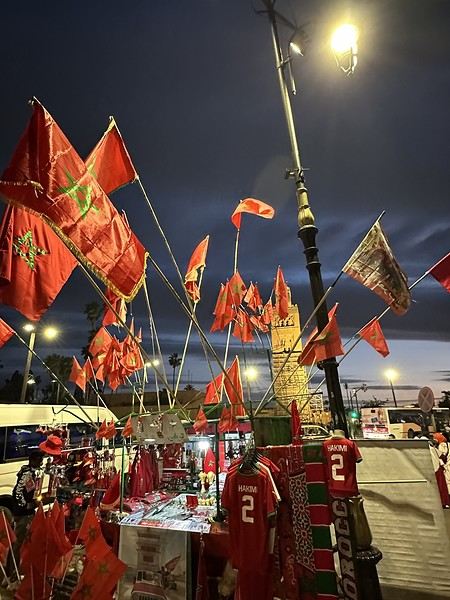
This isn’t about drumming up business for a new professional venture—just sharing, under pressure from eager Vf members hungry for juicy anecdotes, my 10-day trip to Marrakech with 10 friends.
I’d mentioned during the planning discussion for this trip ((https://voyageforum.com/forum/questions-excursions-autour-marrakech-d10685703/)) that there wouldn’t be a travel journal... And since I’m a man of my word—but also stuck with a nasty calf muscle tear at the end of the trip that’s keeping me immobile for 15 days (more on that later)—I’ve got some time to dedicate to this. So, after this preamble, off we go to the Medina!
 .
Day 1: Friday, May 2nd – The Day the Group Split
Before we dive in, let’s talk about the trip prep. Among my friends, I’ve got a rep as the go-to independent travel expert (thanks to a few trips, some with this same crew). So, naturally, the task of planning this one fell to me—and I took it on gladly (you’re never better served than by yourself, right?). The prep and itinerary were hashed out over multiple meet-ups (excuses?) during shared meals at one another’s places, guided by yours truly. Travel style, accommodation, sightseeing—all decisions were made together, trying to balance everyone’s wishes over a good bottle (generic term, not numerical!)
So, a group of five—including me and my girlfriend—set off for Geneva at 3 AM that Friday, while the rest would join us on Sunday due to family or work commitments. We’ll skip the EasyJet flight—it was nothing special, just a means to get us there safely (which, in itself, is already a win). We landed in Marrakech at 9 AM local time. There, a spotless Dacia Logan was waiting for us, chartered by MEDLOC, whose impeccable service I’ll praise here (thanks, friends, for the tip!). My first challenge, after loading the suitcases into the trunk: reaching the riad booked for our first two nights as the advance team. https://www.astradamusmarrakesh.top/fr/
I was a little nervous about driving here—Marrakech’s driving reputation precedes it. The hiccup? While setting up Google Maps for the route, I accidentally added a level-5 difficulty and enabled pedestrian mode... Imagine a rental car stubbornly trying for over half an hour to navigate the Medina (the riad was in the north), cursing all the pedestrians in streets too narrow for the car, and having to reverse multiple times because “it won’t fit,” ignoring the many Marrakechis waving to signal the street was impassable (but what are they trying to sell me now? 🤪)... Until my co-pilot, holding my phone, asked if it was “normal for the route to be dotted on Google Maps?” Yes, it’s normal—pedestrian mode was on.... We’ll still be laughing about this in the nursing home in 40 years, but at the time, I was genuinely surprised by what driving in Morocco had in store for me—and for good reason! After fixing the Google Maps settings, we arrived more calmly at the private parking lot (90 dirhams per night) and then at the riad, where we received a warm welcome while our rooms were being prepared.
After freshening up, we crossed the souks for the first time to have lunch at Jemaa el-Fna Square, at Zeitoun Café, where we enjoyed our first couscous or tagine on its terrace. We’d return to Jemaa el-Fna that evening after a restorative nap at the riad, another late afternoon in the souk, and an evening at this famous UNESCO World Heritage site. This time, it was the restaurant Lafarmacie (you can’t make this up!) that won us over, despite the lack of a rooftop. I recommend this place to everyone—the prices are great, the welcome is extraordinary, and the food is excellent...
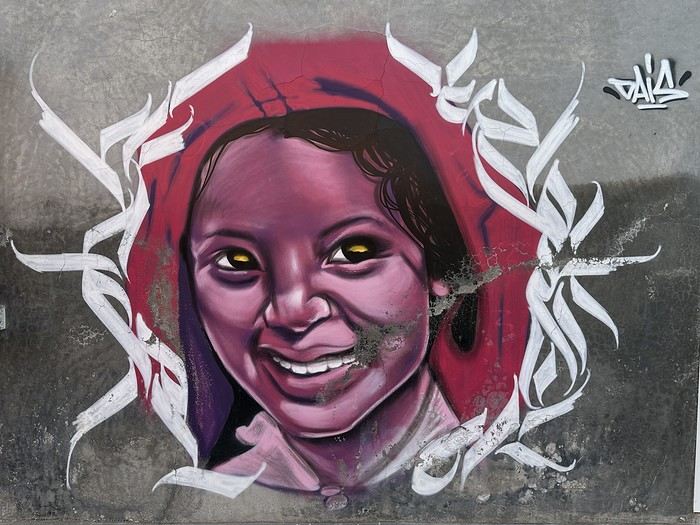
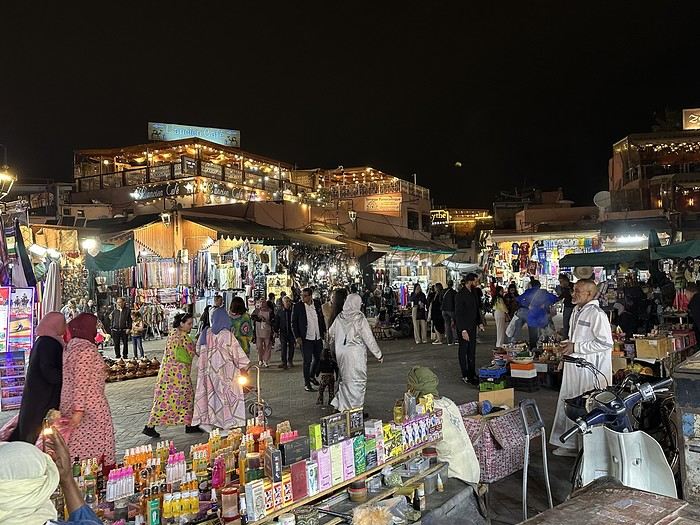
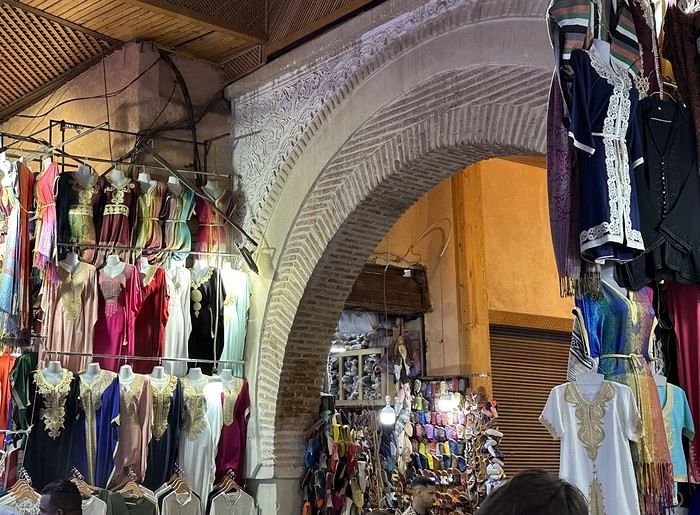
Returning after 11 PM, we learned the hard way that the souk has its own entry points and hours, and the path to our beds was full of detours and closed doors. Fortunately, we were guided by friendly locals who showed us the right way (in exchange for a fiercely negotiated tip each time...)
.Day 1: Friday, May 2nd – The Day the Group Split
Before we dive in, let’s talk about the trip prep. Among my friends, I’ve got a rep as the go-to independent travel expert (thanks to a few trips, some with this same crew). So, naturally, the task of planning this one fell to me—and I took it on gladly (you’re never better served than by yourself, right?). The prep and itinerary were hashed out over multiple meet-ups (excuses?) during shared meals at one another’s places, guided by yours truly. Travel style, accommodation, sightseeing—all decisions were made together, trying to balance everyone’s wishes over a good bottle (generic term, not numerical!)
So, a group of five—including me and my girlfriend—set off for Geneva at 3 AM that Friday, while the rest would join us on Sunday due to family or work commitments. We’ll skip the EasyJet flight—it was nothing special, just a means to get us there safely (which, in itself, is already a win). We landed in Marrakech at 9 AM local time. There, a spotless Dacia Logan was waiting for us, chartered by MEDLOC, whose impeccable service I’ll praise here (thanks, friends, for the tip!). My first challenge, after loading the suitcases into the trunk: reaching the riad booked for our first two nights as the advance team. https://www.astradamusmarrakesh.top/fr/
I was a little nervous about driving here—Marrakech’s driving reputation precedes it. The hiccup? While setting up Google Maps for the route, I accidentally added a level-5 difficulty and enabled pedestrian mode... Imagine a rental car stubbornly trying for over half an hour to navigate the Medina (the riad was in the north), cursing all the pedestrians in streets too narrow for the car, and having to reverse multiple times because “it won’t fit,” ignoring the many Marrakechis waving to signal the street was impassable (but what are they trying to sell me now? 🤪)... Until my co-pilot, holding my phone, asked if it was “normal for the route to be dotted on Google Maps?” Yes, it’s normal—pedestrian mode was on.... We’ll still be laughing about this in the nursing home in 40 years, but at the time, I was genuinely surprised by what driving in Morocco had in store for me—and for good reason! After fixing the Google Maps settings, we arrived more calmly at the private parking lot (90 dirhams per night) and then at the riad, where we received a warm welcome while our rooms were being prepared.
After freshening up, we crossed the souks for the first time to have lunch at Jemaa el-Fna Square, at Zeitoun Café, where we enjoyed our first couscous or tagine on its terrace. We’d return to Jemaa el-Fna that evening after a restorative nap at the riad, another late afternoon in the souk, and an evening at this famous UNESCO World Heritage site. This time, it was the restaurant Lafarmacie (you can’t make this up!) that won us over, despite the lack of a rooftop. I recommend this place to everyone—the prices are great, the welcome is extraordinary, and the food is excellent...
Returning after 11 PM, we learned the hard way that the souk has its own entry points and hours, and the path to our beds was full of detours and closed doors. Fortunately, we were guided by friendly locals who showed us the right way (in exchange for a fiercely negotiated tip each time...)
Hi everyone, after a stay in the South and one in the North, I’m planning a mini road trip in Corsica (Bastia-Bastia) in June to explore places I haven’t seen yet. Since we’re heading to the mountains later this year, we’ve deliberately skipped the Corsican mountains. Could you share your thoughts and, most importantly, suggest things to see? We love nature, reasonable hikes, peaceful spots, and small villages. No cities. No boat excursions (yes, that includes Piana and Scandola). We already know the area between Bastia and Calvi.
June 7 Flight arrival in Bastia and night at the hotel
June 8 Drive to Calvi (beach and/or fortress) Meal at Les Boucaniers restaurant Night in Calvi
June 9 Walk from Calvi fortress to Alga beach Charcuterie platter at A Casetta Calvi Night in Calvi
June 10 Drive from Calvi to Piana Buvette du col de la Croix and visit the orientation table Chemin des muletiers (Muleteers’ Path) Or Sentier de la source des roches bleues (Blue Rocks Spring Trail) counterclockwise Or (less scenic) Tête du chien (Dog’s Head, starting at the parking lot) Dinner at Épicerie Castellani in Piana Night in Piana
June 11 Drive from Piana to Propriano Arone beach and meal at Le Café de la plage Drive along the coast, stopping wherever we like Night in Propriano
June 12 Hike starting from Campomoro in the Jardin du Vent (Wind Garden), and visit the Genoese tower of Campomoro Meal in Campomoro: restaurant Chez Pierre Paul U spuntinu Night in Propriano
June 13 Around Propriano (avoid Capu Laurosu beach—sewage treatment plant...) Night in Propriano
June 14 Drive from Propriano to Bastia airport Meal at L’Éternisula in Zonza Aiguilles de Bavella (Hole of the Bomb) Night at the same hotel as arrival
June 15 Departure
Excellent bike path almost entirely off-road, with a really scenic route. We joined it in Bad Tölz after coming from Strasbourg and left it 100 km before Venice to stay in the mountains and connect with the end of the Via Claudia, which is probably on next year’s program. The trail is often on packed gravel, but even though some short sections aren’t great, our 32C tires were enough—though wider would’ve been better. Mostly wild camping, often by a lake or river. The signage is top-notch. The only downside is the noise from cars in some valleys—out of sight but not out of earshot.
Sites that explain it better than I can: https://italy-cycling-guide.info/ An English site—check the INTERNATIONAL CYCLE ROUTES section.
It’s almost *too* detailed—a 1:200,000 map is plenty.
And here’s a photo to inspire you!
Sites that explain it better than I can: https://italy-cycling-guide.info/ An English site—check the INTERNATIONAL CYCLE ROUTES section.
It’s almost *too* detailed—a 1:200,000 map is plenty.
And here’s a photo to inspire you!
Hi everyone!
We’re planning a 15-day road trip to Scotland this summer, specifically to explore and hike on Lewis and Harris—places we’ve never been before. We’ve visited other islands on previous road trips in Scotland (we usually go in April for a week). This would be our first time in Scotland in the summer and for 15 days. We’re looking at late August to early September.
I’m currently drafting the itinerary. We’d be crossing from Ullapool and were thinking of spending 3 nights on Harris and 4 nights on Lewis.
Does that sound balanced to you? Is it better to keep the same accommodation on Harris and the same on Lewis to explore the area? I’d love to hear about any past experiences you’ve had on these islands. Thanks!
Hi there,
We’re planning a 17-day trip to Indonesia starting on April 22nd and would love to hear your suggestions. We’re looking for itinerary ideas or places to see monkeys, birds, and beautiful rice terraces, as well as interesting natural spots like lakes or waterfalls. We’d also like to avoid overly long distances and limit ourselves to a maximum of one internal flight. For the last three days, we’d love to end the trip on a stunning beach with the chance to swim with manta rays. If you have any recommendations, must-see spots, or experiences not to miss, we’d be thrilled to hear them. Thanks in advance for your help! 😊
We’re planning a 17-day trip to Indonesia starting on April 22nd and would love to hear your suggestions. We’re looking for itinerary ideas or places to see monkeys, birds, and beautiful rice terraces, as well as interesting natural spots like lakes or waterfalls. We’d also like to avoid overly long distances and limit ourselves to a maximum of one internal flight. For the last three days, we’d love to end the trip on a stunning beach with the chance to swim with manta rays. If you have any recommendations, must-see spots, or experiences not to miss, we’d be thrilled to hear them. Thanks in advance for your help! 😊











