Results for "Danemark+souvenir+artisanat"
About 2,675 results.
More options
Many results are in French, the community’s main language. English translations are added over time.
Search results
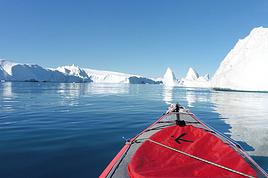
Kayaking in Greenland - Disko Bay: Circumnavigation of Arve Princess Island
After two rather rainy kayaking experiences in Alaska at the end of summer in recent years, we chose a slightly drier destination for this late August 2018: the west coast of Greenland. The temperature will certainly be a bit colder, especially at this time of year, but we’re betting on a beautiful end to the season. According to temperature charts, it should be around 5 to 10°C with a few night frosts. The tundra will already have its autumn colors, and by the end of the trip, we might be lucky enough to see the northern lights when the nights get darker.
We’re setting off as a group of three in two inflatable double-seater kayaks (Gumotex) brought from France. The plan is to spend two weeks circumnavigating Arve Princess Island, located north of Ilulissat in Disko Bay, with a possible boat drop-off at the southern tip of the island.
This seems like a fairly classic route in the area—we found several descriptions online (thanks to the authors). With their help and Google Earth, we identified all potential campsites and entered their coordinates into a GPS. The western part of the island, facing the bay, seems ideal for whale watching, while the more rugged eastern side offers access to several glacial walls. We’re somewhat familiar with the area from two winter expeditions on skis and pulkas.
Plus, the commitment is limited due to the island’s proximity to several small villages, including Qeqertaq, Oqaatsut, and even Ilulissat. In fact, we saw fishing boats almost every day. The distance suits us well: 200 kilometers in 16 full days on site, which should leave some leeway in case of bad weather or for hiking.
We booked our flights in June with Air Greenland to Ilulissat for the last week of August and the first week of September. On both the outbound and return trips, we stayed overnight in Copenhagen. The France-Copenhagen flight was with Air France.
We were allowed 3 x 20 kg in the hold. Each kayak with its accessories fits into a 20 kg bag; the last hold bag is for shared gear: tent, stoves, dry bags… We only brought 1.5 kg of semolina for food. In the end, we had 61 kg of gear, and no excess baggage was charged.
Individual gear (clothes and sleeping bags…) was distributed in the cabin luggage.
For the boat transfer, we contacted an agency: Blue Jay, which gave us a number to call upon arrival.
Day 0: Wednesday, August 22 Departure day. After work, I drove from Gap to Marseille’s Marignane Airport for the first leg of the trip to Copenhagen. I enjoyed the rather mild local temperatures: 35°C in the shade. After a layover in Paris, I arrived at the Copenhagen hotel, located two train stops from the airport, where my companions were already settled. No issues—everyone was on time with their luggage.
Day 1 The flight to Greenland was at 9 AM. We had a layover in Kangerlussuaq, where we changed planes, then stopped in Aasiaat before reaching Ilulissat Airport at 3 PM under beautiful sunshine.
We called Blue Jay for the boat transfer: they could take us to the island as early as 6 PM; otherwise, we’d have to wait until the next day. That left us 3 hours to prepare our gear and, most importantly, do our shopping for the two-week trip—it seemed tight, but we gave it a shot.
A quick taxi ride took us to Pisiffik, where we easily found everything we needed: bread, butter, cheese, cold cuts, rice, pasta, jam, muesli… There was no C fuel or methylated spirits for the stoves, but this time we knew the trick: at Stark, a bit uphill from the town, we found the precious liquids. Two hours later, we filled our dry bags and containers with our purchases, and by 5:30 PM, we met Klaus, the Blue Jay manager, directly at the port.
The vacation seemed to truly begin as we sped by boat through the icebergs toward Arve Princess Island. Forty-five minutes later, we spotted a beach lined with rocks where Klaus dropped us off quickly (he had another transfer to make right after).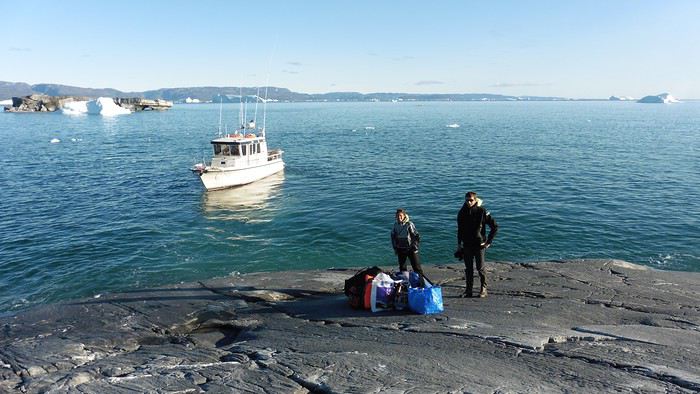
Here we were on the island, in the middle of nowhere, with all our luggage and food to organize, the tent to set up, and the kayaks to inflate—just 10 hours after leaving the Copenhagen hotel. We got to work, bothered by the flies. Despite our head nets, it was barely tolerable—there were so many of them. They swarmed by the dozens into every bag we opened. It was quite mild: 10°C.
Everything was ready by evening, and we were very happy to have completed all these transfers (planes and boat in a single day) as we slipped into our sleeping bags.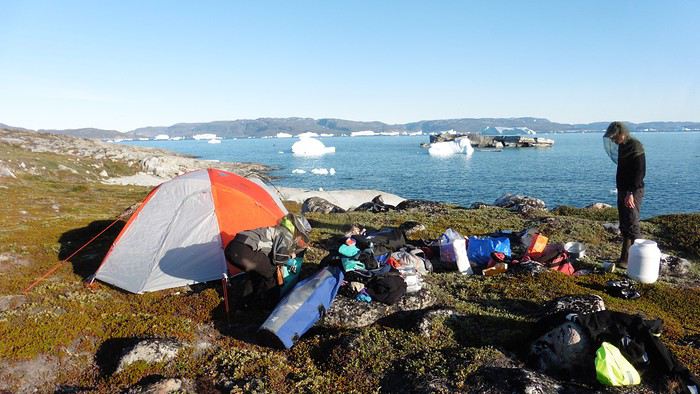
During the night, the wind picked up, and we went out several times to check the tent and kayak anchors. We noticed how bright it was—it was still quite twilight even at 1 AM.
Day 2 5:30 AM wake-up—the south wind was still strong, but since we were heading north, we decided to give it a try anyway.
This was also the moment we loaded the kayaks: since there were only three of us for two double-seater kayaks, we filled the hatch of one kayak, which allowed us to fit all our food. It would have been very difficult if there had been four of us for two kayaks.
Finally, we set off north along the western coast of the island. The conditions were far from ideal—the sea was rough, and the kayaks had a lot of wind resistance. But the main problem was the spray skirt: the gear on deck weighed it down, and the skirt kept coming off… We’d have to deal with it. Barely underway, and whales were already breaking the surface—it was our first time seeing them, and we were very impressed. Too bad the wind didn’t allow for longer contemplation; stopping paddling was impossible with such strong gusts.
We passed a few headlands and even considered stopping due to the conditions. To find some semblance of shelter, we had to hug the coast closely without cutting across the numerous bays, which significantly lengthened the journey. But as the morning went on, the wind died down, and the sea calmed. We spotted several whales and our first seals. It was almost pleasant during the picnic break. By late afternoon, we reached Kangerup Sarqâ Bay, where we had identified a great campsite with a very large beach and a river. But the wind had shifted—it was now coming from the north, making the last hour difficult due to fatigue and headwinds.
The campsite was ideal and beautiful, facing numerous icebergs grounded in the bay.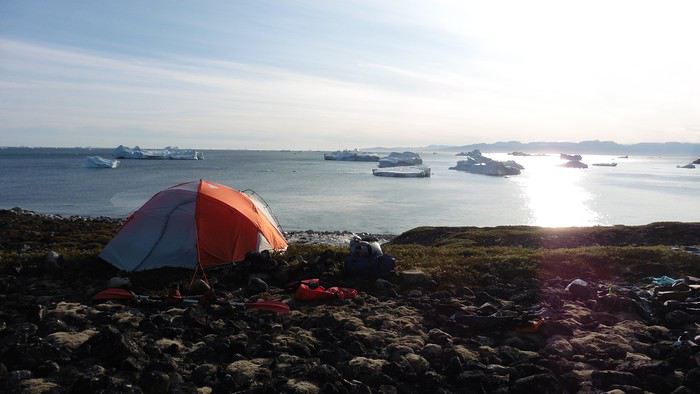
The GPS alerted us to another major drawback of inflatable kayaks: their slowness. It took us 7.5 hours of actual paddling (excluding breaks) to cover 28 km, averaging 3.7 km/h—somewhat disappointing. But we knew this before leaving, and once again, we’d have to make do!
Day 3 Surprise: at 6 AM wake-up, it was raining, foggy, with a south wind, and the sea was choppy even in the bay. It seemed wise to skip paddling, even though stopping on the second day was tough on morale. We went back to sleep, especially since the travel fatigue and the harsh conditions of the previous day had taken their toll.
At 11 AM, the navigation conditions weren’t any better—at the ends of the bay, we saw huge waves crashing onto the rocks, and giving up for the day became obvious. However, the rain had stopped, so we set off for a hike along the large lake bordering the bay. The wind hadn’t let up, and it was quite cold.
The tundra was starting to take on its autumn colors, and the contrast between the white lichens and the red vegetation was stunning. At the lake, we took out the fishing rods and quickly caught two beautiful Arctic char over 50 cm long.
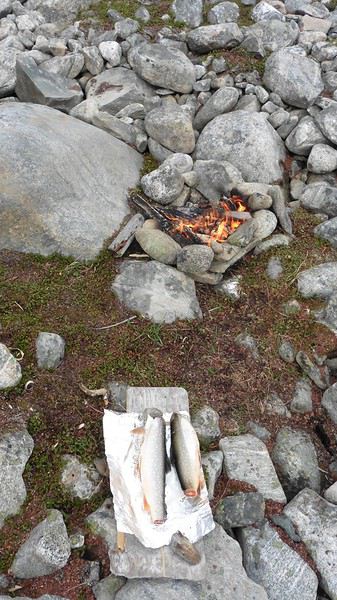
As the afternoon wore on, the sun seemed closer. Along the beach, we gathered driftwood (mostly old planks) to cook our catch in foil over a fire. Eating our own food in such a beautiful place next to a good fire was comforting after the day’s setback.
In the middle of the night, an Arctic fox entered the tent’s rear awning. It seemed barely intimidated when we shooed it away with loud shouts and then with stones.
Day 4 6:15 AM wake-up—3°C. We were on the water by 8 AM. The wind had dropped significantly, but the sea was shrouded in fog, and it was very cold in these damp conditions.
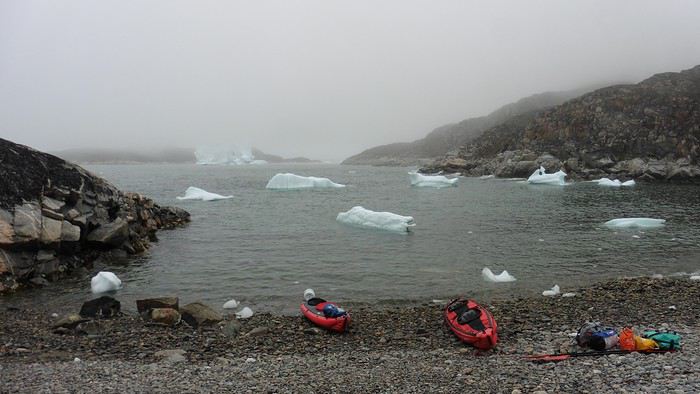
We passed the bay’s headland, Kangea, and headed toward the abandoned village of Agpat. The atmosphere was very austere—we hugged black rocks in fog that limited visibility to 50 meters, revealing large icebergs as we went.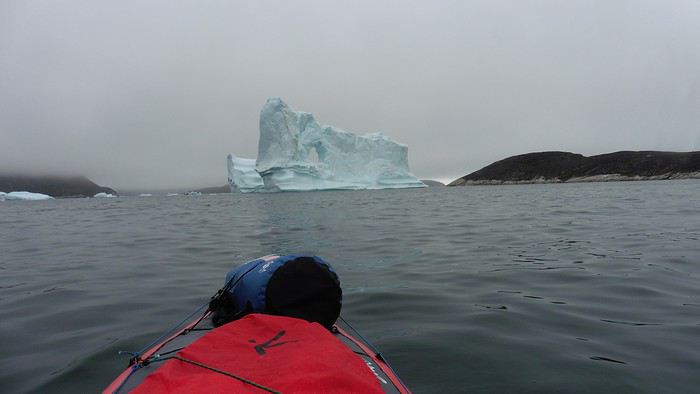
Suddenly, the water’s surface stirred in front of my kayak, and a huge gray back emerged from the sea. The collision was inevitable, but the whale seemed to understand and dove immediately, passing under the kayak and resurfacing a few meters away. I felt the kayak rock in the white foam and quickly paddled to escape the turbulence. What an emotion!
A light wind began to clear the fog, and the sun made beautiful appearances. Despite the cold, we stopped to visit the abandoned village, which left a strange impression. All the houses were still in good condition and wide open—some must have been very spacious in their time. We went back to sea, and in front of the large Kaangerdluk Bay, we hesitated—the headwind was strong, and large waves split the water. The next beach, from the island of Nua where we stopped to think, was over 8 km away. It was barely 2 PM, but caution led us to stop here for the day. We had covered 12 km—exactly the distance needed to stay on schedule. The afternoon was spent hiking on the island’s hills and gathering mussels and wood.
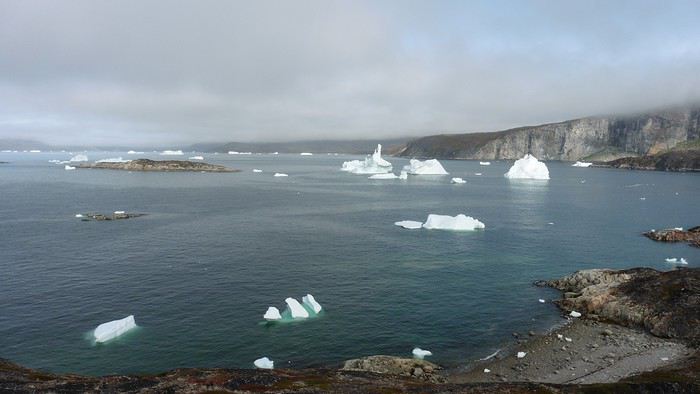
In the evening, we cooked these large Greenlandic mussels over a wood fire and savored them under the beautiful evening light. The weather was now fine, but the thermometer read -5°C in the sun…
Day 5 Bright sunshine, a glassy sea, and -8°C at 6 AM. Everything was green for setting off, even if putting on damp kayaking gear was a bit unpleasant in the cold. It was the first time we’d paddled on a flat sea since the start of the trip, and our average speed increased slightly.
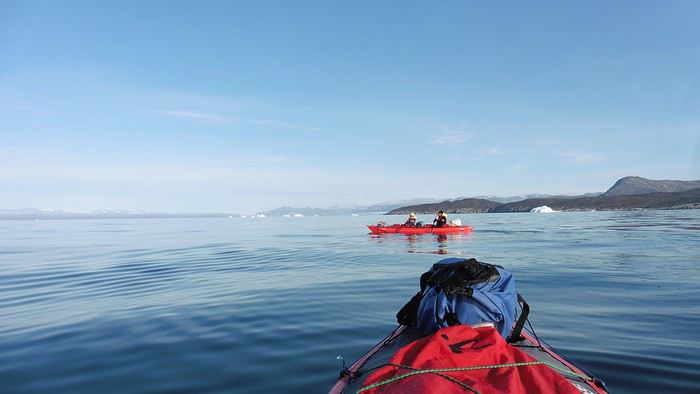
We entered the Smallesund Strait, marking the end of the island’s west coast. We were close to the large Torssukatak Fjord, where two glaciers flow. The access pass to the fjord was very narrow, and numerous ice chunks blocked access to the beaches. The wind had picked up and was now hitting us head-on (again). Just before entering the fjord, we landed on a steep beach made of large pebbles on Oqaitsut Island. It was very cold with the wind, and moving forward became difficult. We decided to stop for the day both because of the conditions and because the next campsite was far away, given how rugged the fjord was.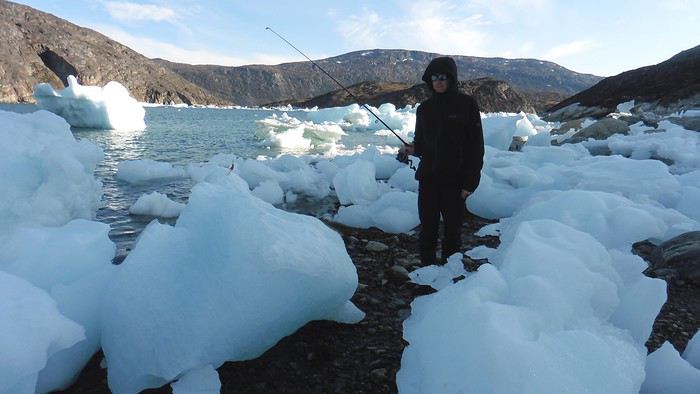
We eventually found a flat spot for the tent despite the steep slope. Even with the wind, the weather was beautiful, and we set off on foot for the northeastern cape of the island, overlooking the fjord. The view was far-reaching and exceptional—up close, the large fjord filled with ice and its steep granite cliffs, and in the distance, the ice cap and glacial walls.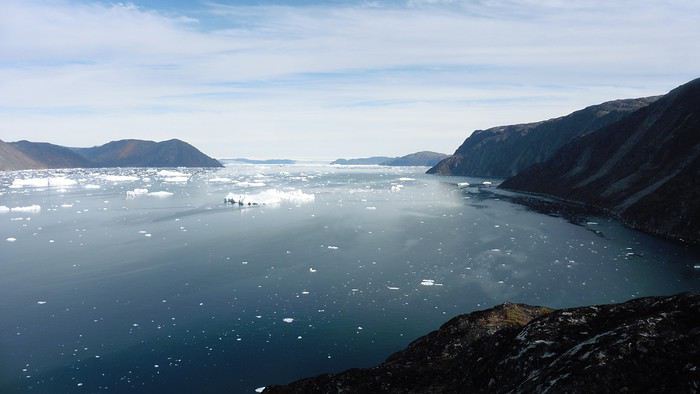
We spotted the village of Qeqertaq, whose network we could pick up, allowing us to check the weather forecast, which was rather good. While securing the kayaks in the evening, I noticed the strange behavior of one kayak at the end of the stage was due to the loss of the skeg—impossible to know where it detached. We’d have to do without it.
Day 6 Still that icy headwind from the northeast. We set off anyway for a long stage to reach the large pass connecting the Torssukatak and Ata Fjords.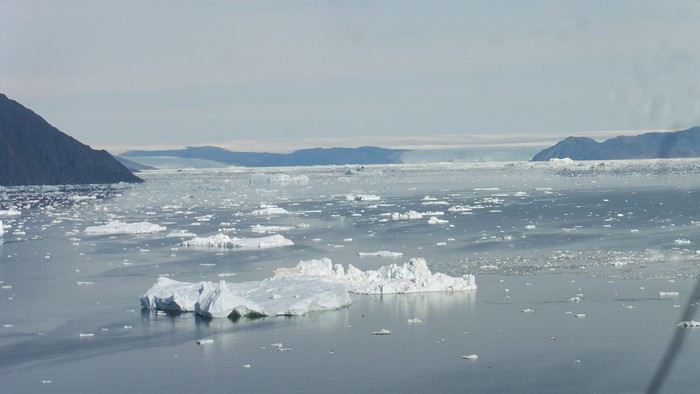
We advanced laboriously along the high cliffs of the fjord’s southern shore. They faced due north and blocked the sun. We felt the cold and dampness of the rock. It was really cold, especially in the extremities. We picnicked on the western cape of Qeqertakavasak Island. The cold didn’t allow us to stop for more than 20 minutes… But the wind dropped, and the sea was now very smooth. It was heavily cluttered with ice between the icebergs and old pack ice. The goal was to reach the large rocky promontory of Anapnuna, wedged between the Kujatdleq and Kangilerngata Glaciers, but the ice made progress difficult. We stopped to gain height on a small island and spot a passage of open water, but all we saw was white—passing seemed impossible. The currents were very complex, and entire sections of ice were being swept in one direction and then another at an impressive speed.
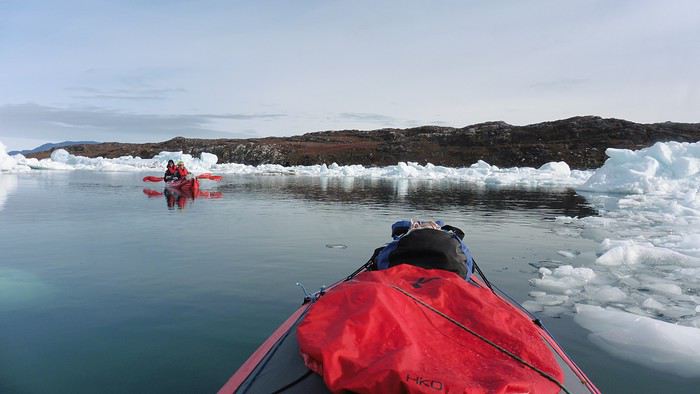
We wandered through this labyrinth until landing on a beach on the small island of Takissut, where we set up camp, exhausted from the 30 km covered and the vigilance required by the abundance of ice. The place was sublime under the evening sun—we were surrounded by ice and mountains, with the Kangilerngata Glacier in the distance. The summer contrasts were striking between the water, icebergs, sky, and flaming tundra—all colors were represented. Absolute calm reigned.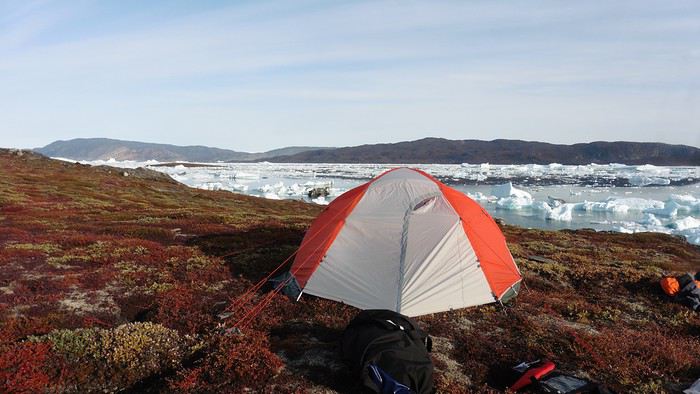
The lack of drinking water at this spot wasn’t too much of a constraint: as soon as we arrived on the beach, we placed containers under the icebergs stranded in the intertidal zone. They were all full by the time we finished setting up.
Day 7 We had to change our plans: we wouldn’t reach the rocky promontory, too well protected by the ice. We set off under the sun for Igdluluarssuit Island. Although we had spotted a passage just before launching, we quickly found ourselves surrounded by ice. It was everywhere, and finding water to paddle became complicated. We tried to force our way in every direction, even retracing our steps. Everything moved at an impressive speed—we were in the middle of a whirlpool of ice.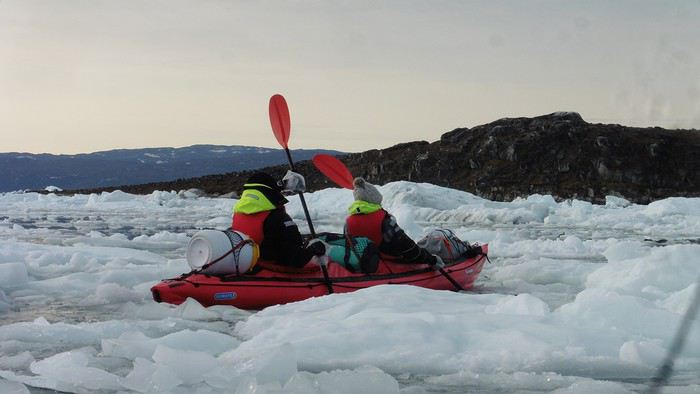
The tension rose, and each boat had its share of big scares. I was trapped against ice floes that dragged me toward an iceberg—the pressure on the kayak was enormous; it was going to capsize or puncture! But with a few strong strokes and paddling against the ice, I managed to free myself from the trap. Barely 10 minutes later, my companions were sandwiched perpendicularly between two icebergs that were closing in. The situation was desperate—the kayak was bending and twisting more and more, but with some strong paddle strokes, it finally freed itself. After these particularly unpleasant moments, we were completely blocked. The drifting ice floes had tightened, and the kayaks were no longer even in the water… The only solution: wait with the kayaks on these floes, which were too thin to walk on (even though we didn’t try). Within minutes, the situation cleared—a waterway opened, and we rushed into it. We paddled with one goal: find a larger pool of water. After going back and forth, our path took shape—we had to force the passage several times, attacking the ice directly with the kayaks, and finally, we escaped the worst of the labyrinth. We reached land on the west side of the island and saw that the rest would be easier. To reach the island, we just had to cross the Arsiviup Ikera Strait, which was lightly cluttered. We reached the eastern cape of the island, ideal for camping, even though we had only paddled for 3 hours. We set up camp and hiked to the island’s summit, which overlooks the entire pass and the glaciers.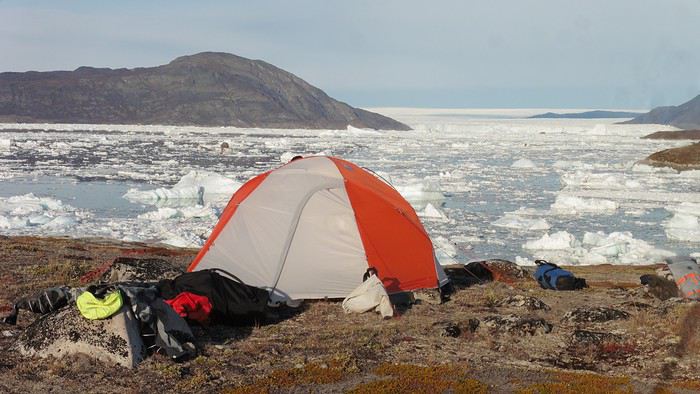
Everything was magnificent, no matter the direction. At 2 PM, we were at the summit—the beauty of the place and the picnic facing the glacier in the sun without wind made us forget the near-disaster from a few hours earlier. It would be impossible to approach the glacier by kayak, but from our summit on foot, it seemed so close, and contemplating it safely on solid ground was a great moment.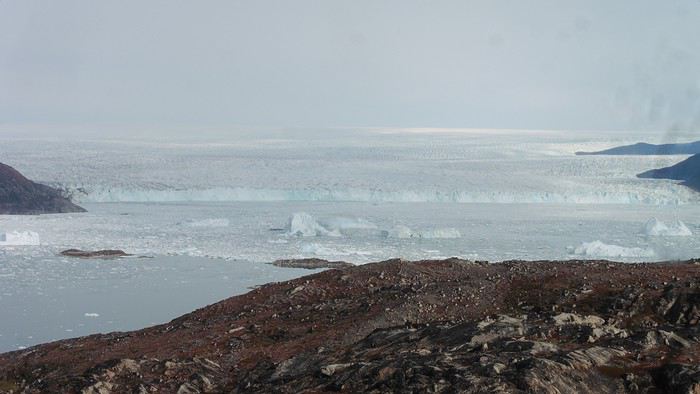
The pass was incredibly complex—everything was in motion, and an impassable passage could become open water within minutes. We were delighted when we returned to camp. A slightly lost whale among the ice accompanied us along the shore. The place was truly beautiful, but the temperature dropped again under the clear sky, preventing us from eating outside.
Day 8 Clear and cold at wake-up: -9°C. The sea had frozen in many places. We hesitated about the rest of the trip—should we start heading back to Ilulissat or linger in the pass, especially to approach the Eqi Glacier? After the incidents of the previous day, we decided to think carefully and paddled to the southern cape of our island to check the ice conditions toward Eqi. The weather had clouded over in the meantime, and the sky was quite gray. At the cape, we spotted the glacier’s wall, still 15 km away.
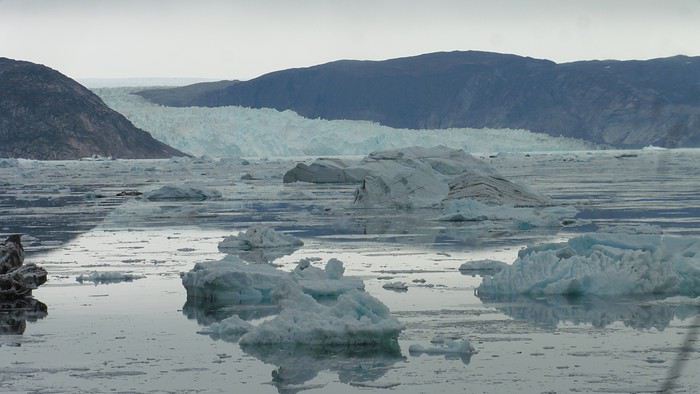
The fjord was quite cluttered, but it seemed passable. However, there was no guarantee the view would be much better 1 km from the glacier than 15 km away, especially since the front was quite active and therefore dangerous. We decided to head south without passing by the glacier. The cold temperatures encountered in the pass also motivated us to move away from the glaciers and the ice cap. We navigated under a threatening sky but without wind. The kayaks cut through the thin layer of ice on the surface with a crinkling paper sound. We reached the Ata campsite in the late afternoon after 5 hours of rowing without a single break…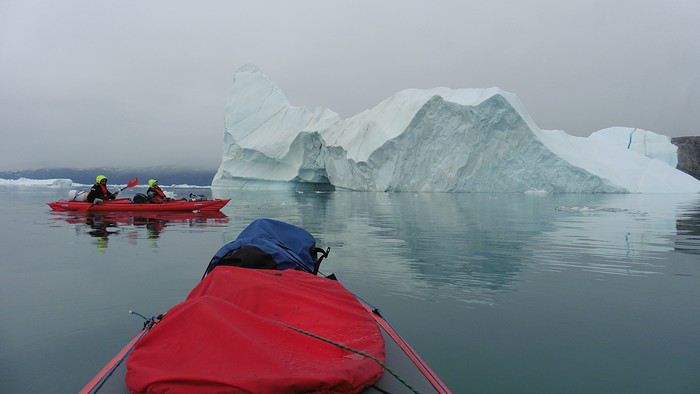
The wind had picked up, and we discovered a nice surprise: a refuge with a table and a comfortable bench lined with mattresses. Facing the worsening weather, we settled in comfortably. The kerosene stove was too complex for our three brains—we couldn’t get it started, too bad, as it was 0°C inside. The rest of the afternoon was spent fishing in the large lake, where we landed a beautiful Arctic char, more than enough for three. A good night’s sleep without the risk of foxes or the sound of a tent shaking in the wind.
Day 9 6 AM wake-up to the sound of rain hitting the cabin. The decision was made looking out the window—wind, rain, and fog obscured the sea: we went back to sleep.
New wake-up, and the rain had stopped—we could go out and stock up on fish. We set off on foot toward the lake, following its western shore. It was very overcast, and the wind encouraged us to keep moving. We made our way to a smaller lake at the end of the large one, where we caught a huge Arctic char. A small clearing brightened the picnic, and we headed back to our cabin.
This 20 km hike kept us busy all day: walking on slippery scree and the micro-relief of the peat bogs took time.
Day 10 The sky was clear, but a light south wind made paddling intense. We set off southeast to reach the opposite shore of the fjord. It was very cold, and it was impossible to stop paddling for even a moment without immediately losing ground due to the wind. We crossed the Kangerluarsuk Fjord. I recognized the cape I had reached on skis in the winter of 2017. We found a nice campsite on the southern shore of the fjord: Uiartag. It wasn’t even noon, but facing this headwind, we preferred to stop here rather than exhaust ourselves for a few extra kilometers. Like the previous ones, this campsite was very comfortable: the ground was covered with a thick layer of lichens and mosses, very pleasant to lie on.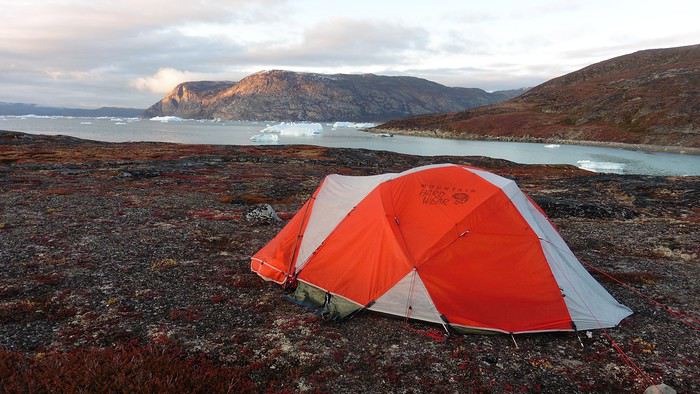
We set off on a hike to the heights of the cape, where the weather alternated between large clearings and snow showers. We noticed the loss of the thermometer, poorly attached to the backpack. On the way back, in the small bay of our beach, a whale swam calmly 10 meters from the shore—a beautiful surprise.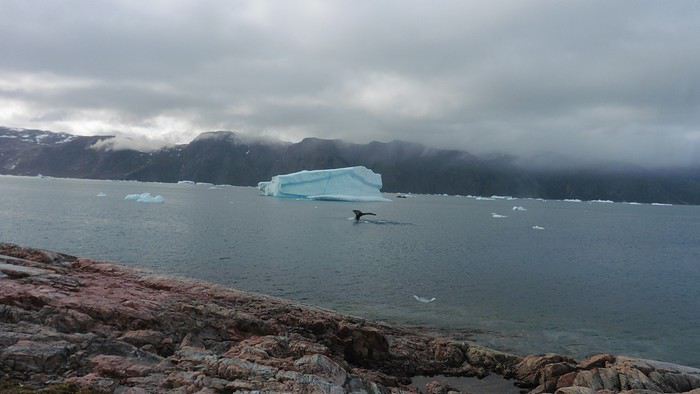
The sky cleared completely, and the temperature dropped as night approached.
We’re setting off as a group of three in two inflatable double-seater kayaks (Gumotex) brought from France. The plan is to spend two weeks circumnavigating Arve Princess Island, located north of Ilulissat in Disko Bay, with a possible boat drop-off at the southern tip of the island.
This seems like a fairly classic route in the area—we found several descriptions online (thanks to the authors). With their help and Google Earth, we identified all potential campsites and entered their coordinates into a GPS. The western part of the island, facing the bay, seems ideal for whale watching, while the more rugged eastern side offers access to several glacial walls. We’re somewhat familiar with the area from two winter expeditions on skis and pulkas.
Plus, the commitment is limited due to the island’s proximity to several small villages, including Qeqertaq, Oqaatsut, and even Ilulissat. In fact, we saw fishing boats almost every day. The distance suits us well: 200 kilometers in 16 full days on site, which should leave some leeway in case of bad weather or for hiking.
We booked our flights in June with Air Greenland to Ilulissat for the last week of August and the first week of September. On both the outbound and return trips, we stayed overnight in Copenhagen. The France-Copenhagen flight was with Air France.
We were allowed 3 x 20 kg in the hold. Each kayak with its accessories fits into a 20 kg bag; the last hold bag is for shared gear: tent, stoves, dry bags… We only brought 1.5 kg of semolina for food. In the end, we had 61 kg of gear, and no excess baggage was charged.
Individual gear (clothes and sleeping bags…) was distributed in the cabin luggage.
For the boat transfer, we contacted an agency: Blue Jay, which gave us a number to call upon arrival.
Day 0: Wednesday, August 22 Departure day. After work, I drove from Gap to Marseille’s Marignane Airport for the first leg of the trip to Copenhagen. I enjoyed the rather mild local temperatures: 35°C in the shade. After a layover in Paris, I arrived at the Copenhagen hotel, located two train stops from the airport, where my companions were already settled. No issues—everyone was on time with their luggage.
Day 1 The flight to Greenland was at 9 AM. We had a layover in Kangerlussuaq, where we changed planes, then stopped in Aasiaat before reaching Ilulissat Airport at 3 PM under beautiful sunshine.
We called Blue Jay for the boat transfer: they could take us to the island as early as 6 PM; otherwise, we’d have to wait until the next day. That left us 3 hours to prepare our gear and, most importantly, do our shopping for the two-week trip—it seemed tight, but we gave it a shot.
A quick taxi ride took us to Pisiffik, where we easily found everything we needed: bread, butter, cheese, cold cuts, rice, pasta, jam, muesli… There was no C fuel or methylated spirits for the stoves, but this time we knew the trick: at Stark, a bit uphill from the town, we found the precious liquids. Two hours later, we filled our dry bags and containers with our purchases, and by 5:30 PM, we met Klaus, the Blue Jay manager, directly at the port.
The vacation seemed to truly begin as we sped by boat through the icebergs toward Arve Princess Island. Forty-five minutes later, we spotted a beach lined with rocks where Klaus dropped us off quickly (he had another transfer to make right after).
Here we were on the island, in the middle of nowhere, with all our luggage and food to organize, the tent to set up, and the kayaks to inflate—just 10 hours after leaving the Copenhagen hotel. We got to work, bothered by the flies. Despite our head nets, it was barely tolerable—there were so many of them. They swarmed by the dozens into every bag we opened. It was quite mild: 10°C.
Everything was ready by evening, and we were very happy to have completed all these transfers (planes and boat in a single day) as we slipped into our sleeping bags.
During the night, the wind picked up, and we went out several times to check the tent and kayak anchors. We noticed how bright it was—it was still quite twilight even at 1 AM.
Day 2 5:30 AM wake-up—the south wind was still strong, but since we were heading north, we decided to give it a try anyway.
This was also the moment we loaded the kayaks: since there were only three of us for two double-seater kayaks, we filled the hatch of one kayak, which allowed us to fit all our food. It would have been very difficult if there had been four of us for two kayaks.
Finally, we set off north along the western coast of the island. The conditions were far from ideal—the sea was rough, and the kayaks had a lot of wind resistance. But the main problem was the spray skirt: the gear on deck weighed it down, and the skirt kept coming off… We’d have to deal with it. Barely underway, and whales were already breaking the surface—it was our first time seeing them, and we were very impressed. Too bad the wind didn’t allow for longer contemplation; stopping paddling was impossible with such strong gusts.
We passed a few headlands and even considered stopping due to the conditions. To find some semblance of shelter, we had to hug the coast closely without cutting across the numerous bays, which significantly lengthened the journey. But as the morning went on, the wind died down, and the sea calmed. We spotted several whales and our first seals. It was almost pleasant during the picnic break. By late afternoon, we reached Kangerup Sarqâ Bay, where we had identified a great campsite with a very large beach and a river. But the wind had shifted—it was now coming from the north, making the last hour difficult due to fatigue and headwinds.
The campsite was ideal and beautiful, facing numerous icebergs grounded in the bay.
The GPS alerted us to another major drawback of inflatable kayaks: their slowness. It took us 7.5 hours of actual paddling (excluding breaks) to cover 28 km, averaging 3.7 km/h—somewhat disappointing. But we knew this before leaving, and once again, we’d have to make do!
Day 3 Surprise: at 6 AM wake-up, it was raining, foggy, with a south wind, and the sea was choppy even in the bay. It seemed wise to skip paddling, even though stopping on the second day was tough on morale. We went back to sleep, especially since the travel fatigue and the harsh conditions of the previous day had taken their toll.
At 11 AM, the navigation conditions weren’t any better—at the ends of the bay, we saw huge waves crashing onto the rocks, and giving up for the day became obvious. However, the rain had stopped, so we set off for a hike along the large lake bordering the bay. The wind hadn’t let up, and it was quite cold.
The tundra was starting to take on its autumn colors, and the contrast between the white lichens and the red vegetation was stunning. At the lake, we took out the fishing rods and quickly caught two beautiful Arctic char over 50 cm long.
As the afternoon wore on, the sun seemed closer. Along the beach, we gathered driftwood (mostly old planks) to cook our catch in foil over a fire. Eating our own food in such a beautiful place next to a good fire was comforting after the day’s setback.
In the middle of the night, an Arctic fox entered the tent’s rear awning. It seemed barely intimidated when we shooed it away with loud shouts and then with stones.
Day 4 6:15 AM wake-up—3°C. We were on the water by 8 AM. The wind had dropped significantly, but the sea was shrouded in fog, and it was very cold in these damp conditions.
We passed the bay’s headland, Kangea, and headed toward the abandoned village of Agpat. The atmosphere was very austere—we hugged black rocks in fog that limited visibility to 50 meters, revealing large icebergs as we went.
Suddenly, the water’s surface stirred in front of my kayak, and a huge gray back emerged from the sea. The collision was inevitable, but the whale seemed to understand and dove immediately, passing under the kayak and resurfacing a few meters away. I felt the kayak rock in the white foam and quickly paddled to escape the turbulence. What an emotion!
A light wind began to clear the fog, and the sun made beautiful appearances. Despite the cold, we stopped to visit the abandoned village, which left a strange impression. All the houses were still in good condition and wide open—some must have been very spacious in their time. We went back to sea, and in front of the large Kaangerdluk Bay, we hesitated—the headwind was strong, and large waves split the water. The next beach, from the island of Nua where we stopped to think, was over 8 km away. It was barely 2 PM, but caution led us to stop here for the day. We had covered 12 km—exactly the distance needed to stay on schedule. The afternoon was spent hiking on the island’s hills and gathering mussels and wood.
In the evening, we cooked these large Greenlandic mussels over a wood fire and savored them under the beautiful evening light. The weather was now fine, but the thermometer read -5°C in the sun…
Day 5 Bright sunshine, a glassy sea, and -8°C at 6 AM. Everything was green for setting off, even if putting on damp kayaking gear was a bit unpleasant in the cold. It was the first time we’d paddled on a flat sea since the start of the trip, and our average speed increased slightly.
We entered the Smallesund Strait, marking the end of the island’s west coast. We were close to the large Torssukatak Fjord, where two glaciers flow. The access pass to the fjord was very narrow, and numerous ice chunks blocked access to the beaches. The wind had picked up and was now hitting us head-on (again). Just before entering the fjord, we landed on a steep beach made of large pebbles on Oqaitsut Island. It was very cold with the wind, and moving forward became difficult. We decided to stop for the day both because of the conditions and because the next campsite was far away, given how rugged the fjord was.
We eventually found a flat spot for the tent despite the steep slope. Even with the wind, the weather was beautiful, and we set off on foot for the northeastern cape of the island, overlooking the fjord. The view was far-reaching and exceptional—up close, the large fjord filled with ice and its steep granite cliffs, and in the distance, the ice cap and glacial walls.
We spotted the village of Qeqertaq, whose network we could pick up, allowing us to check the weather forecast, which was rather good. While securing the kayaks in the evening, I noticed the strange behavior of one kayak at the end of the stage was due to the loss of the skeg—impossible to know where it detached. We’d have to do without it.
Day 6 Still that icy headwind from the northeast. We set off anyway for a long stage to reach the large pass connecting the Torssukatak and Ata Fjords.
We advanced laboriously along the high cliffs of the fjord’s southern shore. They faced due north and blocked the sun. We felt the cold and dampness of the rock. It was really cold, especially in the extremities. We picnicked on the western cape of Qeqertakavasak Island. The cold didn’t allow us to stop for more than 20 minutes… But the wind dropped, and the sea was now very smooth. It was heavily cluttered with ice between the icebergs and old pack ice. The goal was to reach the large rocky promontory of Anapnuna, wedged between the Kujatdleq and Kangilerngata Glaciers, but the ice made progress difficult. We stopped to gain height on a small island and spot a passage of open water, but all we saw was white—passing seemed impossible. The currents were very complex, and entire sections of ice were being swept in one direction and then another at an impressive speed.
We wandered through this labyrinth until landing on a beach on the small island of Takissut, where we set up camp, exhausted from the 30 km covered and the vigilance required by the abundance of ice. The place was sublime under the evening sun—we were surrounded by ice and mountains, with the Kangilerngata Glacier in the distance. The summer contrasts were striking between the water, icebergs, sky, and flaming tundra—all colors were represented. Absolute calm reigned.
The lack of drinking water at this spot wasn’t too much of a constraint: as soon as we arrived on the beach, we placed containers under the icebergs stranded in the intertidal zone. They were all full by the time we finished setting up.
Day 7 We had to change our plans: we wouldn’t reach the rocky promontory, too well protected by the ice. We set off under the sun for Igdluluarssuit Island. Although we had spotted a passage just before launching, we quickly found ourselves surrounded by ice. It was everywhere, and finding water to paddle became complicated. We tried to force our way in every direction, even retracing our steps. Everything moved at an impressive speed—we were in the middle of a whirlpool of ice.
The tension rose, and each boat had its share of big scares. I was trapped against ice floes that dragged me toward an iceberg—the pressure on the kayak was enormous; it was going to capsize or puncture! But with a few strong strokes and paddling against the ice, I managed to free myself from the trap. Barely 10 minutes later, my companions were sandwiched perpendicularly between two icebergs that were closing in. The situation was desperate—the kayak was bending and twisting more and more, but with some strong paddle strokes, it finally freed itself. After these particularly unpleasant moments, we were completely blocked. The drifting ice floes had tightened, and the kayaks were no longer even in the water… The only solution: wait with the kayaks on these floes, which were too thin to walk on (even though we didn’t try). Within minutes, the situation cleared—a waterway opened, and we rushed into it. We paddled with one goal: find a larger pool of water. After going back and forth, our path took shape—we had to force the passage several times, attacking the ice directly with the kayaks, and finally, we escaped the worst of the labyrinth. We reached land on the west side of the island and saw that the rest would be easier. To reach the island, we just had to cross the Arsiviup Ikera Strait, which was lightly cluttered. We reached the eastern cape of the island, ideal for camping, even though we had only paddled for 3 hours. We set up camp and hiked to the island’s summit, which overlooks the entire pass and the glaciers.
Everything was magnificent, no matter the direction. At 2 PM, we were at the summit—the beauty of the place and the picnic facing the glacier in the sun without wind made us forget the near-disaster from a few hours earlier. It would be impossible to approach the glacier by kayak, but from our summit on foot, it seemed so close, and contemplating it safely on solid ground was a great moment.
The pass was incredibly complex—everything was in motion, and an impassable passage could become open water within minutes. We were delighted when we returned to camp. A slightly lost whale among the ice accompanied us along the shore. The place was truly beautiful, but the temperature dropped again under the clear sky, preventing us from eating outside.
Day 8 Clear and cold at wake-up: -9°C. The sea had frozen in many places. We hesitated about the rest of the trip—should we start heading back to Ilulissat or linger in the pass, especially to approach the Eqi Glacier? After the incidents of the previous day, we decided to think carefully and paddled to the southern cape of our island to check the ice conditions toward Eqi. The weather had clouded over in the meantime, and the sky was quite gray. At the cape, we spotted the glacier’s wall, still 15 km away.
The fjord was quite cluttered, but it seemed passable. However, there was no guarantee the view would be much better 1 km from the glacier than 15 km away, especially since the front was quite active and therefore dangerous. We decided to head south without passing by the glacier. The cold temperatures encountered in the pass also motivated us to move away from the glaciers and the ice cap. We navigated under a threatening sky but without wind. The kayaks cut through the thin layer of ice on the surface with a crinkling paper sound. We reached the Ata campsite in the late afternoon after 5 hours of rowing without a single break…
The wind had picked up, and we discovered a nice surprise: a refuge with a table and a comfortable bench lined with mattresses. Facing the worsening weather, we settled in comfortably. The kerosene stove was too complex for our three brains—we couldn’t get it started, too bad, as it was 0°C inside. The rest of the afternoon was spent fishing in the large lake, where we landed a beautiful Arctic char, more than enough for three. A good night’s sleep without the risk of foxes or the sound of a tent shaking in the wind.
Day 9 6 AM wake-up to the sound of rain hitting the cabin. The decision was made looking out the window—wind, rain, and fog obscured the sea: we went back to sleep.
New wake-up, and the rain had stopped—we could go out and stock up on fish. We set off on foot toward the lake, following its western shore. It was very overcast, and the wind encouraged us to keep moving. We made our way to a smaller lake at the end of the large one, where we caught a huge Arctic char. A small clearing brightened the picnic, and we headed back to our cabin.
This 20 km hike kept us busy all day: walking on slippery scree and the micro-relief of the peat bogs took time.
Day 10 The sky was clear, but a light south wind made paddling intense. We set off southeast to reach the opposite shore of the fjord. It was very cold, and it was impossible to stop paddling for even a moment without immediately losing ground due to the wind. We crossed the Kangerluarsuk Fjord. I recognized the cape I had reached on skis in the winter of 2017. We found a nice campsite on the southern shore of the fjord: Uiartag. It wasn’t even noon, but facing this headwind, we preferred to stop here rather than exhaust ourselves for a few extra kilometers. Like the previous ones, this campsite was very comfortable: the ground was covered with a thick layer of lichens and mosses, very pleasant to lie on.
We set off on a hike to the heights of the cape, where the weather alternated between large clearings and snow showers. We noticed the loss of the thermometer, poorly attached to the backpack. On the way back, in the small bay of our beach, a whale swam calmly 10 meters from the shore—a beautiful surprise.
The sky cleared completely, and the temperature dropped as night approached.
Vols Ryanair annulés
Ryanair: les pilotes allemands rejoignent la grève
Le mouvement social concerne 400 pilotes basés dans dix aéroports allemands. Ils rejoindront vendredi la grève des pilotes basés en Irlande, Suède et Belgique.
Les pilotes allemands de la compagnie à bas coûts Ryanair rejoindront vendredi la grève des pilotes basés en Irlande, Suède et Belgique, a annoncé mercredi le principal syndicat allemand. «Nous ne voyons pas chez Ryanair la volonté de s'engager dans de réelles négociations salariales», a déclaré Martin Locher, président du syndicat Vereinigung Cockpit, qui demande de meilleures conditions contractuelles et une hausse des salaires. Le principe de la grève avait été approuvé fin juillet par un vote des membres de Cockpits à 96% qui avait aussi fixé un ultimatum à Ryanair qui a expiré dans la nuit de lundi à mardi sans qu'un compromis n'ait été trouvé. 400 pilotes Le mouvement social, qui concerne quelque 400 pilotes basés dans dix aéroports allemands, débutera vendredi à 01h01 GMT (03h01 locale) et s'achèvera samedi à 00h59 GMT (02h59 locale). «Ryanair a exclu toute hausse des dépenses de personnel. Parallèlement Ryanair n'a donné aucune indication sur les marges de manoeuvre pour trouver une solution. Ryanair est donc totalement responsable de l'escalade», a martelé Martin Locher. Ryanair a prévu pour sa part une conférence de presse mercredi à 11h30 GMT (13h30 locale) à Francfort et pourrait y détailler l'ampleur des perturbations attendues vendredi au départ de l'Allemagne mais aussi des autres pays européens concernés. 146 vols déjà annulés Selon l'agence allemande dpa, 146 vols des 2400 prévus en Europe vendredi avaient déjà été annulés avant l'annonce des pilotes allemands en raison des grèves annoncées en Irlande, Suède et Belgique ce jour-là. Cockpit «regrette les conséquences (de la grève) pour les passagers, les équipages en cabines, le personnel au sol», a-t-il indiqué dans son communiqué, «les passagers peuvent s'adresser directement à Ryanair concernant leurs vols, car seule l'entreprise peut dire quels vols auront lieu». Le malaise au sein du groupe a éclaté au grand jour à la suite d'un sérieux problème de planning de pilotes en septembre 2017, qui a entraîné un grave conflit social et des annulations portant au total sur 20'000 vols dans les mois qui ont suivi. Cette crise a poussé Ryanair à négocier un virage à 180 degrés en entamant des négociations avec des syndicats dans plusieurs pays, alors que la compagnie avait toujours refusé de les reconnaître. En raison de la crise et des annulations de vols, le directeur général du groupe Michael O'Leary a renoncé à son bonus au titre de 2018, qui aurait pu atteindre un million d'euros.
Les pilotes allemands de la compagnie à bas coûts Ryanair rejoindront vendredi la grève des pilotes basés en Irlande, Suède et Belgique, a annoncé mercredi le principal syndicat allemand. «Nous ne voyons pas chez Ryanair la volonté de s'engager dans de réelles négociations salariales», a déclaré Martin Locher, président du syndicat Vereinigung Cockpit, qui demande de meilleures conditions contractuelles et une hausse des salaires. Le principe de la grève avait été approuvé fin juillet par un vote des membres de Cockpits à 96% qui avait aussi fixé un ultimatum à Ryanair qui a expiré dans la nuit de lundi à mardi sans qu'un compromis n'ait été trouvé. 400 pilotes Le mouvement social, qui concerne quelque 400 pilotes basés dans dix aéroports allemands, débutera vendredi à 01h01 GMT (03h01 locale) et s'achèvera samedi à 00h59 GMT (02h59 locale). «Ryanair a exclu toute hausse des dépenses de personnel. Parallèlement Ryanair n'a donné aucune indication sur les marges de manoeuvre pour trouver une solution. Ryanair est donc totalement responsable de l'escalade», a martelé Martin Locher. Ryanair a prévu pour sa part une conférence de presse mercredi à 11h30 GMT (13h30 locale) à Francfort et pourrait y détailler l'ampleur des perturbations attendues vendredi au départ de l'Allemagne mais aussi des autres pays européens concernés. 146 vols déjà annulés Selon l'agence allemande dpa, 146 vols des 2400 prévus en Europe vendredi avaient déjà été annulés avant l'annonce des pilotes allemands en raison des grèves annoncées en Irlande, Suède et Belgique ce jour-là. Cockpit «regrette les conséquences (de la grève) pour les passagers, les équipages en cabines, le personnel au sol», a-t-il indiqué dans son communiqué, «les passagers peuvent s'adresser directement à Ryanair concernant leurs vols, car seule l'entreprise peut dire quels vols auront lieu». Le malaise au sein du groupe a éclaté au grand jour à la suite d'un sérieux problème de planning de pilotes en septembre 2017, qui a entraîné un grave conflit social et des annulations portant au total sur 20'000 vols dans les mois qui ont suivi. Cette crise a poussé Ryanair à négocier un virage à 180 degrés en entamant des négociations avec des syndicats dans plusieurs pays, alors que la compagnie avait toujours refusé de les reconnaître. En raison de la crise et des annulations de vols, le directeur général du groupe Michael O'Leary a renoncé à son bonus au titre de 2018, qui aurait pu atteindre un million d'euros.
Grève chez Ryanair: 600 vols concernés
Grève chez Ryanair: 600 vols concernés Les 25 et 26 juillet prochains, quelque 100'000 personnes seront touchées par la grève de la compagnie aérienne à bas coût irlandaise.
La compagnie aérienne irlandaise à bas coût Ryanair a annoncé mercredi l'annulation de 600 vols en Europe les 25 et 26 juillet, en raison d'une grève des personnels de cabine en Espagne, Portugal et Belgique. Ces annulations vont toucher un total de 100'000 passagers sur les deux jours, selon la compagnie. Appel à la grève lancé Début juillet, cinq syndicats ont lancé un appel à la grève pour les personnels de cabine de Ryanair en Belgique, Espagne, Portugal et Italie. Dans ce dernier pays, la compagnie s'attend en revanche à ce que son activité se déroule «comme prévu», a indiqué un porte-parole de Ryanair. Ryanair dit avoir offert aux 100'000 passagers affectés «la possibilité d'être réaffectés sur un vol alternatif opérant dans les sept jours avant ou après les 25 et 26 juillet». Les clients «pourront aussi recevoir le remboursement complet de leurs billets».
La compagnie aérienne irlandaise à bas coût Ryanair a annoncé mercredi l'annulation de 600 vols en Europe les 25 et 26 juillet, en raison d'une grève des personnels de cabine en Espagne, Portugal et Belgique. Ces annulations vont toucher un total de 100'000 passagers sur les deux jours, selon la compagnie. Appel à la grève lancé Début juillet, cinq syndicats ont lancé un appel à la grève pour les personnels de cabine de Ryanair en Belgique, Espagne, Portugal et Italie. Dans ce dernier pays, la compagnie s'attend en revanche à ce que son activité se déroule «comme prévu», a indiqué un porte-parole de Ryanair. Ryanair dit avoir offert aux 100'000 passagers affectés «la possibilité d'être réaffectés sur un vol alternatif opérant dans les sept jours avant ou après les 25 et 26 juillet». Les clients «pourront aussi recevoir le remboursement complet de leurs billets».
Annulation vol Ryanair
Bonjour,
Je fais suite à mon vol du jeudi 07/06 au départ de Bruxelles Charleroi et à destination de Prague. 3h avant le départ alors que je suis en route pour Lille (avant de prendre un bus pour l'aéroport), je reçois un texto de Ryanair m'informant de l'annulation du vol.
Quelques minutes plus tard, je reçois un mail m'offrant 2 possibilités: - un remboursement de vol (pas intéressant pour moi, le billet d'avion m'a coûté 19.99E...) - un changement de vol pour lequel il est indiqué: "Si vous avez besoin d'options de réacheminement, comme par exemple si vous voulez être transféré sur un vol Ryanair qui part d'un autre aéroport (si un vol Ryanair n'est pas disponible), sur une autre compagnie aérienne, un train, un bus ou une location de voiture, veuillez contacter notre équipe du service clientèle (aux heures d'ouverture) Si vous bénéficiez d'un réacheminement via un aéroport alternatif, vous aurez droit au remboursement des frais raisonnables de transfert vers cet aéroport. De plus, si vous avez recours au réacheminement et, par conséquent, engagez des dépenses pour l'hébergement, les repas ou les rafraîchissements, vous aurez droit au remboursement de ces frais pourvu qu’ils soient raisonnables." Le service clientèle est joignable jusqu'à 19h, il est 19h15, j'appelle quand même, sans surprise personne ne répond... Je regarde les prochains vols Ryanair vers Prague depuis Bruxelles ou Charleroi, rien avant le samedi matin, pour rappel, nous sommes jeudi soir... Rien le vendredi donc, que ce soit sur des vols Ryanair ou non, depuis Lille, Bruxelles, Charleroi. J'étends ma recherche à Paris, le vol le moins cher le vendredi est à 6h40, ayant fait plusieurs réservations durant mon week-end à Prague, à commencer par le logement, c'est ma seule solution pour rejoindre ma destination dans des délais raisonnables. Je réserve le vol puis un train de Lille pour Paris, transferts de Paris Nord jusqu'à Orly et une chambre à proximité de l'aéroport...
Profitant d'un moment de répit pendant le we, je contacte la compagnie par téléphone durant ses horaires d'ouvertures, une personne me guide par téléphone vers un formulaire dédié sur le site internet. Je remplis le formulaire me demandant les frais engagés (236.74E) + les justificatifs.
Réponse en anglais 5 jours plus tard, l'annulation est due "à un problème de créneau à l'aéroport de Charleroi, une situation en dehors de notre contrôle". Pourtant l'ensemble des vols prévus le jeudi soir ont bien eu lieu sans aucune autre annulation. Étonnant... Refus de remboursement donc et je ne suis pas éligible à l'indemnisation selon eux car pas de leur faute. La compagnie m'indique aussi "nos enregistrements montrent que vous n'avez pas contacté Ryanair en vue d'un réacheminement"... Faux !! Leur service client était seulement injoignable car fermé le soir de l'annulation.
Entre temps, la compagnie s'est dépêchée de procéder au remboursement du billet d'avion...
Quelle solution pour exiger de la compagnie le remboursement des frais engagés ?
Merci de votre aide,
Ger
Je fais suite à mon vol du jeudi 07/06 au départ de Bruxelles Charleroi et à destination de Prague. 3h avant le départ alors que je suis en route pour Lille (avant de prendre un bus pour l'aéroport), je reçois un texto de Ryanair m'informant de l'annulation du vol.
Quelques minutes plus tard, je reçois un mail m'offrant 2 possibilités: - un remboursement de vol (pas intéressant pour moi, le billet d'avion m'a coûté 19.99E...) - un changement de vol pour lequel il est indiqué: "Si vous avez besoin d'options de réacheminement, comme par exemple si vous voulez être transféré sur un vol Ryanair qui part d'un autre aéroport (si un vol Ryanair n'est pas disponible), sur une autre compagnie aérienne, un train, un bus ou une location de voiture, veuillez contacter notre équipe du service clientèle (aux heures d'ouverture) Si vous bénéficiez d'un réacheminement via un aéroport alternatif, vous aurez droit au remboursement des frais raisonnables de transfert vers cet aéroport. De plus, si vous avez recours au réacheminement et, par conséquent, engagez des dépenses pour l'hébergement, les repas ou les rafraîchissements, vous aurez droit au remboursement de ces frais pourvu qu’ils soient raisonnables." Le service clientèle est joignable jusqu'à 19h, il est 19h15, j'appelle quand même, sans surprise personne ne répond... Je regarde les prochains vols Ryanair vers Prague depuis Bruxelles ou Charleroi, rien avant le samedi matin, pour rappel, nous sommes jeudi soir... Rien le vendredi donc, que ce soit sur des vols Ryanair ou non, depuis Lille, Bruxelles, Charleroi. J'étends ma recherche à Paris, le vol le moins cher le vendredi est à 6h40, ayant fait plusieurs réservations durant mon week-end à Prague, à commencer par le logement, c'est ma seule solution pour rejoindre ma destination dans des délais raisonnables. Je réserve le vol puis un train de Lille pour Paris, transferts de Paris Nord jusqu'à Orly et une chambre à proximité de l'aéroport...
Profitant d'un moment de répit pendant le we, je contacte la compagnie par téléphone durant ses horaires d'ouvertures, une personne me guide par téléphone vers un formulaire dédié sur le site internet. Je remplis le formulaire me demandant les frais engagés (236.74E) + les justificatifs.
Réponse en anglais 5 jours plus tard, l'annulation est due "à un problème de créneau à l'aéroport de Charleroi, une situation en dehors de notre contrôle". Pourtant l'ensemble des vols prévus le jeudi soir ont bien eu lieu sans aucune autre annulation. Étonnant... Refus de remboursement donc et je ne suis pas éligible à l'indemnisation selon eux car pas de leur faute. La compagnie m'indique aussi "nos enregistrements montrent que vous n'avez pas contacté Ryanair en vue d'un réacheminement"... Faux !! Leur service client était seulement injoignable car fermé le soir de l'annulation.
Entre temps, la compagnie s'est dépêchée de procéder au remboursement du billet d'avion...
Quelle solution pour exiger de la compagnie le remboursement des frais engagés ?
Merci de votre aide,
Ger
Voyager en Espagne sans papiers d’identité valides
Bonjour,
Voilà tout, ce week end j’ai un avion pour Barcelone le retour le mardi. Le soucis étant que je me suis rendu compte que mon passeport étant périmé je ne trouvais plus ma carte d’identité. Je possède un récépissé de ma future carte d’identité, une déclaration de perte, un passeport périmé de 3 mois, une vomit du livret de famille, de ma carte d’identité.
Puis-je passer la douane pour mon voyage ? Puis-je trouver un autre document (laisser-passer ou autre) pour faciliter mon passage svp ? ça urge svp vraiment
Indemnisations pour retards de vols
Retard supérieur à 5 Heures qui donne droit à indemnisation:
Ce fut le cas pour moi il y a presque 18 mois. et on m'avait prévenu qu' AIGLE AZUR est la compagnie la plus réticente à acquitter cette indemnisation. J'avais un doute, je ne l'ai plus!!! J'ai fait intervenir une compagnie spécialisée dans ce genre de problème et elle "férraille" pour moi depuis ce temps. Ils ont tout essayé pour éviter d'obtempérer, essayant même de franchir la date de forclusion, nous ne lâcherons pas! Donc, ne vous laissez pas faire et faites vous défendre si vous n'avez pas le temps de le faire vous même.Vous trouverez sur le net ces compagnies de défense sur les "retards de vols".
PS/ j'ai fait la même démarche pour un autre sinistre sur une autre compagnie: j'ai été indemnisé en 3 mois!!
Calendrier des départs en croisière des membres VF 2020
Bonsoir à tous,
Après les tours du monde MSC ou COSTA, les catalogues commencent à sortir pour le début 2020, il est donc temps d'ouvrir ce calendrier!
Mise à jour N°0 –CALENDRIER DES DEPARTS EN CROISIERE VF 2020
Vous pouvez signalez votre croisière sur ce post ou en MP bien sûr en respectant au possible le format du calendrier lors de votre inscription (date–pseudo (nationalité) / compagnie + nom du bateau / nombre de jours / secteur de la croisière (départ de la croisière).
Merci par avance, cela facilite grandement le travail!
Nombre total croisières VF 2020 : 0
JANVIER
FÉVRIER
MARS
AVRIL
MAI
JUIN
JUILLET
AOÛT
SEPTEMBRE
OCTOBRE
NOVEMBRE
DECEMBRE
Après les tours du monde MSC ou COSTA, les catalogues commencent à sortir pour le début 2020, il est donc temps d'ouvrir ce calendrier!
Mise à jour N°0 –CALENDRIER DES DEPARTS EN CROISIERE VF 2020
Vous pouvez signalez votre croisière sur ce post ou en MP bien sûr en respectant au possible le format du calendrier lors de votre inscription (date–pseudo (nationalité) / compagnie + nom du bateau / nombre de jours / secteur de la croisière (départ de la croisière).
Merci par avance, cela facilite grandement le travail!
Nombre total croisières VF 2020 : 0
JANVIER
FÉVRIER
MARS
AVRIL
MAI
JUIN
JUILLET
AOÛT
SEPTEMBRE
OCTOBRE
NOVEMBRE
DECEMBRE
Embarquer sans papier d'identité? (vol Palerme)
Bonsoir qui pourrais m'aider je dois prendre l'avion à 6 h du matin demain et je viens de m'apercevoir que je trouve plus ma carte d'identité .je devais faire un voyage en Sicile à palermo .je n'ai pas de passeport ni permis de conduire je suis vraiment mal .quelqu'un peux m'aider ?
Se faire refouler à la frontière d'un pays membre de l'Europe?
Salut,
Question purement théorique. En lisant les textes européens, un pays membre de l'Europe ne peut expulser ou interdire l'entrée à un citoyens membres de l'Europe que dans certains cas comme "trouble à l'ordre publique" ... enfin nous allons dire des raisons relativement grave.
Donc comme c'est théorique, imaginons que demain je dois me rendre en Irlande ou en Tchéquie par avion, et que le douanier n'aime pas ma tête et trouve une éraflure sur mon passeport et me refuse l'entrée. En tant qu'européen à t-on des droits, il y a t-il des procédures pour refuser d'être expulser ?
Question purement théorique. En lisant les textes européens, un pays membre de l'Europe ne peut expulser ou interdire l'entrée à un citoyens membres de l'Europe que dans certains cas comme "trouble à l'ordre publique" ... enfin nous allons dire des raisons relativement grave.
Donc comme c'est théorique, imaginons que demain je dois me rendre en Irlande ou en Tchéquie par avion, et que le douanier n'aime pas ma tête et trouve une éraflure sur mon passeport et me refuse l'entrée. En tant qu'européen à t-on des droits, il y a t-il des procédures pour refuser d'être expulser ?
Le Portugal en hiver en camping-car
bonjour,
que de discussion diverses et variées sur le Portugal en cc en hiver !!!difficile de se faire une idée ...trop de cc aucun interet à mon avis...mais il doit bien exister des endroits un peu plus calme non?.nous souhaiterions partir 2 mois au Portugal (decembre-janvier-fevrier) si vous pouvez nous donner des infos (lieux à visiter, endroits ou dormir..etc...)nous souhaiterions pour ce premier périple partir en compagnie de plusieurs camping-caristes...si vous tetes intérressé........
merci de vos réponses
Transport collectifs & vélo
bonjour,
Ce retour de Weekend prolongé j'ai encore râlè devant la misère des transports collectifs de vélo.
C'est pas la première fois ...
nous prenons le TER avec les vélos chargés de le pin du lac a Aix les bains pour retrouver ma voiture. On aurait bien pris un des cars a moitiés vides qui font la liaison mais il ne prennent pas les velos bien que les soutes soit quasi vides... pour infos il y a plein de pays ou l'on peu charger un vélo dans la soute d'un car moyennant ou pas un supplément mais en France manifestement c'est trop compliqué ...
Consultation des horaires : a priori seuls les TER acceptent les velos , et encore s'il y a de la place c'est le contrôleur qui juge ... curieux mais pour les passagers il n'y a pas de restrictions... Le comble c'est que tous les horaires je les ai trouvé sur le site de la Deutch Bahn car sur sncf voyage il en manquant la moitié !
Évidement en gare il n'est indiqué nulle part dans quelle partie de la rame se trouve le compartiment vélo , ce serait trop simple ! du coup quand la rame arrive c'est la course sur le quai pour pouvoir charger en 2 mn chrono !
Le train arrive, 4 marches à gravir très raides, autant dire que ma femme seule avec son vélo chargé n'aurait pas eu la force de le monter.
Le compartiment est blindé, visiblement pour un grand weekend de printemps mettre un second compartiment vélo sur la rame relevait de l'utopie.
on a pas pu prendre de billet car la gare est fermée le dimanche après midi et mettre un distributeur de billet ça doit être trop compliqué aussi ! quand au contrôleur , je le cherche encore...
Ce matin j'entends que la sncf se recentre sur le TGV qu'elle va désormais appeler INOUIT ou INUIT ou peut être INNOUI (je n'ai pas bien compris) en vue de la privatisation en 2020.
en conclusion je me demande si c'est pas un peu fait exprès tout ça . On commence par dégouter les gens de prendre le train, on fait en sorte de diminuer les recettes (absence de distributeur de billet) et au final on supprime la ligne car non rentable.
ps: quand j'ai commencé le cyclotourisme il y a trente ans on pouvait amener son vélo dans n'importe quelle gare et moyennant la modique somme de 12 francs (2 euros) il était livré dans n'importe quelle gare de son choix. (il fallait simplement l'amener un jour ou deux avant pour être sur qu'il soit bien présent à l'arrivée)
C'est beau le progrès ...
nous prenons le TER avec les vélos chargés de le pin du lac a Aix les bains pour retrouver ma voiture. On aurait bien pris un des cars a moitiés vides qui font la liaison mais il ne prennent pas les velos bien que les soutes soit quasi vides... pour infos il y a plein de pays ou l'on peu charger un vélo dans la soute d'un car moyennant ou pas un supplément mais en France manifestement c'est trop compliqué ...
Consultation des horaires : a priori seuls les TER acceptent les velos , et encore s'il y a de la place c'est le contrôleur qui juge ... curieux mais pour les passagers il n'y a pas de restrictions... Le comble c'est que tous les horaires je les ai trouvé sur le site de la Deutch Bahn car sur sncf voyage il en manquant la moitié !
Évidement en gare il n'est indiqué nulle part dans quelle partie de la rame se trouve le compartiment vélo , ce serait trop simple ! du coup quand la rame arrive c'est la course sur le quai pour pouvoir charger en 2 mn chrono !
Le train arrive, 4 marches à gravir très raides, autant dire que ma femme seule avec son vélo chargé n'aurait pas eu la force de le monter.
Le compartiment est blindé, visiblement pour un grand weekend de printemps mettre un second compartiment vélo sur la rame relevait de l'utopie.
on a pas pu prendre de billet car la gare est fermée le dimanche après midi et mettre un distributeur de billet ça doit être trop compliqué aussi ! quand au contrôleur , je le cherche encore...
Ce matin j'entends que la sncf se recentre sur le TGV qu'elle va désormais appeler INOUIT ou INUIT ou peut être INNOUI (je n'ai pas bien compris) en vue de la privatisation en 2020.
en conclusion je me demande si c'est pas un peu fait exprès tout ça . On commence par dégouter les gens de prendre le train, on fait en sorte de diminuer les recettes (absence de distributeur de billet) et au final on supprime la ligne car non rentable.
ps: quand j'ai commencé le cyclotourisme il y a trente ans on pouvait amener son vélo dans n'importe quelle gare et moyennant la modique somme de 12 francs (2 euros) il était livré dans n'importe quelle gare de son choix. (il fallait simplement l'amener un jour ou deux avant pour être sur qu'il soit bien présent à l'arrivée)
C'est beau le progrès ...
Visa exemption / touristique (Vietnam)
Hello a tous,
N ayant pas d informations sur de futur exemptions de visa, mon cas est francais avec une mere d'origine vietnamienne mais qui est naturalisé francaise . le mieux est il de faire le visa touristique ou le visa d'exemption 5 ans?le prix exacte de chacun des visas( car on me sort 25 eur , 50 euros , 70eur.. ) et le 5 ans est il valable pour ma femme et enfants? sur le visa touristique , il demande la relation familiale(parents, frere/soeur etc.. ) =>doit on etre obliger de remplir cette partie (avec adresse et profession etc... )
Merci de vos retours Sufyan
N ayant pas d informations sur de futur exemptions de visa, mon cas est francais avec une mere d'origine vietnamienne mais qui est naturalisé francaise . le mieux est il de faire le visa touristique ou le visa d'exemption 5 ans?le prix exacte de chacun des visas( car on me sort 25 eur , 50 euros , 70eur.. ) et le 5 ans est il valable pour ma femme et enfants? sur le visa touristique , il demande la relation familiale(parents, frere/soeur etc.. ) =>doit on etre obliger de remplir cette partie (avec adresse et profession etc... )
Merci de vos retours Sufyan
WOW Air: annulation du vol à Boston
Bonjour à tous !
Nous sommes moi et ma compagne bloqués a Boston depuis hier suite à un vol annulé par la compagnie wow air (Boston -> Reykjavik -> Paris) Ce fut dur (voir très très dur) mais nous avons réussis à nous faire héberger par un hôtel sur Boston et a nous faire remplacer les billets. Nous partons dimanche (soit 3 jours après notre départ initial). Je passe les détails sur la difficulté de joindre la compagnie aérienne, etc.
J'ai vu sur le forum que c'était déjà arrivé a plusieurs personnes, et j'avais des questions à vous poser par rapport aux éventuels dédommagements que l'on pourrait attendre de la part de wow air :
Remboursement des billets de train à Paris pour rentrer chez nous Jour de travail Et ma compagne devait accompagner un voyage scolaire pour l'Espagne, un voyage qui va peut-être être annulé (manque d'accompagnateur)
Avez-vous des expériences à me faire partager, ou tout autre chose qui pourrait être utile ?
Un GRAND merci d'avance !
À bientôt.
Nous sommes moi et ma compagne bloqués a Boston depuis hier suite à un vol annulé par la compagnie wow air (Boston -> Reykjavik -> Paris) Ce fut dur (voir très très dur) mais nous avons réussis à nous faire héberger par un hôtel sur Boston et a nous faire remplacer les billets. Nous partons dimanche (soit 3 jours après notre départ initial). Je passe les détails sur la difficulté de joindre la compagnie aérienne, etc.
J'ai vu sur le forum que c'était déjà arrivé a plusieurs personnes, et j'avais des questions à vous poser par rapport aux éventuels dédommagements que l'on pourrait attendre de la part de wow air :
Remboursement des billets de train à Paris pour rentrer chez nous Jour de travail Et ma compagne devait accompagner un voyage scolaire pour l'Espagne, un voyage qui va peut-être être annulé (manque d'accompagnateur)
Avez-vous des expériences à me faire partager, ou tout autre chose qui pourrait être utile ?
Un GRAND merci d'avance !
À bientôt.
Points Costa sur le point d'expirer
Bonjour,
J'ai plus de 2000 points Costa qui vont expirer en Juin. Si je réserve une croisière maintenant pour juillet 2018, puis-je sauver ces points ? Ou sont-ils complètement perdus ? Comment faire pour ne pas les perdre ?
J'ai plus de 2000 points Costa qui vont expirer en Juin. Si je réserve une croisière maintenant pour juillet 2018, puis-je sauver ces points ? Ou sont-ils complètement perdus ? Comment faire pour ne pas les perdre ?
Téléphone gratuit toute l'année des États-Unis vers la France et 5 Go par mois
Pour les abonnées FREE a 15,99 € , le Roaming Free passe de 35 jours et 3 Go de Data a tel gratuit illimité toute l'année et 5 Go/mois de data a partir de 35 pays USA et CANADA inclus. Effet immédia
Voyager enceinte et avec enfant de 2 1/2 ans (Japon et Chine)
Bonjour,
Nous sommes Québécois et nous aimons beaucoup voyager. Nous avions prévu aller au Japon cet été, mais je viens d'apprendre que je suis enceinte. Aussi, comme notre coco aura plus de 2 ans il faut payer son billet d'avion et nous réalisons que c'est dispendieux!
Les billets les moins chers que nous avons trouvés passent par la Chine. J'ai de la difficulté à me dire que nous arrêterons en Chine sans y passer les trois jours permis sans visa.
Selon vous, est-ce que la Chine et le Japon sont sûrs enceinte? Et je ne sais pas trop quoi penser des nombreuses heures de vol..
Lorsque nous partirons, je serai enceinte de 22 semaines. Nous partons environ 3 semaines. Nous ne pouvons pas partir beaucoup plus tard car je ne serai plus couverte par mon assurance en cas de pépins. Et nous ne pouvons pas vraiment partir plus tôt car j'ai des tests en génétique à passer puisque notre première enfant avait un syndrome génétique qui la rendait lourdement handicapée..
Notre fils aura 2 ans et 4 mois à notre départ. Il faut aussi considérer cela dans notre décision. Il est toutefois un excellent voyageur. Quand il avait 4 mois, nous sommes partis 5 semaines au Pays-Bas, en Belgique, en France et un peu en Espagne. A 10 mois, nous sommes allés une semaine à Cuba (Varadero et Havane). Quand il avait 16 mois nous sommes partis 4 semaines en Finlande, Estonie, Lettonie, Suède et Islande. Puis à 20 mois nous sommes allés une semaines aux USA dans l'état devNew-York.
L'Europe serait peut-être plus sûre enceinte et le vol serait moins long. Mais nous avons vu plusieurs pays en Europe (nous avons aussi beaucoup voyagé avant d'avoir les enfants) et nous vous envie de faire changement. Aussi, il y a des endroits je trouverais trop difficile de ne pas pouvoir goûter au vin, à la bière ou au fromage au lait cru!! Quoique je devrai me priver de sushis au Japon... :/
Il faut aussi choisir une destination sans Zika..
Merci pour vos avis!
Nous sommes Québécois et nous aimons beaucoup voyager. Nous avions prévu aller au Japon cet été, mais je viens d'apprendre que je suis enceinte. Aussi, comme notre coco aura plus de 2 ans il faut payer son billet d'avion et nous réalisons que c'est dispendieux!
Les billets les moins chers que nous avons trouvés passent par la Chine. J'ai de la difficulté à me dire que nous arrêterons en Chine sans y passer les trois jours permis sans visa.
Selon vous, est-ce que la Chine et le Japon sont sûrs enceinte? Et je ne sais pas trop quoi penser des nombreuses heures de vol..
Lorsque nous partirons, je serai enceinte de 22 semaines. Nous partons environ 3 semaines. Nous ne pouvons pas partir beaucoup plus tard car je ne serai plus couverte par mon assurance en cas de pépins. Et nous ne pouvons pas vraiment partir plus tôt car j'ai des tests en génétique à passer puisque notre première enfant avait un syndrome génétique qui la rendait lourdement handicapée..
Notre fils aura 2 ans et 4 mois à notre départ. Il faut aussi considérer cela dans notre décision. Il est toutefois un excellent voyageur. Quand il avait 4 mois, nous sommes partis 5 semaines au Pays-Bas, en Belgique, en France et un peu en Espagne. A 10 mois, nous sommes allés une semaine à Cuba (Varadero et Havane). Quand il avait 16 mois nous sommes partis 4 semaines en Finlande, Estonie, Lettonie, Suède et Islande. Puis à 20 mois nous sommes allés une semaines aux USA dans l'état devNew-York.
L'Europe serait peut-être plus sûre enceinte et le vol serait moins long. Mais nous avons vu plusieurs pays en Europe (nous avons aussi beaucoup voyagé avant d'avoir les enfants) et nous vous envie de faire changement. Aussi, il y a des endroits je trouverais trop difficile de ne pas pouvoir goûter au vin, à la bière ou au fromage au lait cru!! Quoique je devrai me priver de sushis au Japon... :/
Il faut aussi choisir une destination sans Zika..
Merci pour vos avis!
Professeur tunisien recherche emploi en France
je suis un professeur tunisien et je cherche un contrat de travail régulier france
L'Allemagne, ici et là, en quelques photos
Bonjour à tous,
Quelques clichés d'Allemagne pris ces derniers jours. Évidemment, critique bienvenue (pour ne pas dire souhaitée) si elle est formulée cordialement ....😉
1) Munich

2) Andechs

3) Munich

4) Münster

5) Münster

6) Bottrop

7) Duisbourg

8) Vallée du Rhin

9) Soest

1) Munich
2) Andechs
3) Munich
4) Münster
5) Münster
6) Bottrop
7) Duisbourg
8) Vallée du Rhin
9) Soest
Arrivée Charles-de-Gaulle - gare TGV: temps
Hello !
Je me pose une petite question lors de l’atterrissage de mon vol à CDG en décembre. Je dois prendre le train après mais j'ai peur que le timing soit trop court.
- atterrissage : 16h25
- train : 18h47, sachant que c'est le dernier en partance de CDG donc si je le loupe je serais obligée de prendre le RER et rejoindre la gare montparnasse pour prendre un train là bas.
Combien de temps faut-il a peu près pour sortir de l'aéroport (bagage, douane) et rejoindre la gare TGV sachant que je serais au terminal 1 ?
Vous pensez que 2h15 c'est faisable ?
Merci de votre aide !
Vers une officialisation des langues nationales (Mali)
Vers une officialisation des langues nationales (Mali)
Bonjour,
je tiens à vous présenter une nouvelle qui suscite beaucoup d’espoir dans les milieux d’alphabétisation et chez les promoteurs des langues africaines. Voici le communiqué du Conseil des Ministres du Gouvernement malien (14 septembre 2016) :
AU TITRE DU MINISTERE DE L’EDUCATION NATIONALE :
Sur le rapport du ministre de l’Education nationale, le Conseil des Ministres a adopté un projet de loi fixant les modalités de promotion et d’officialisation des langues nationales.
La Constitution prévoit que la loi fixe les modalités de promotion et d’officialisation des langues nationales au Mali.
La loi du 23 août 1996 a fixé ces modalités pour treize (13) langues nationales.*
Le projet de loi adopté, qui abroge et remplace la loi du 23 août 1996, s’inscrit dans le cadre de la mise en œuvre de la politique linguistique du Mali adoptée en décembre 2014.
Il prévoit que l’Etat assurera la promotion des langues nationales dans le cadre de la sauvegarde et du développement du patrimoine linguistique et de la diversité culturelle.
Il reconnaît aux collectivités territoriales et aux citoyens le droit de promouvoir les treize langues nationales.
Il consacre l’égalité de traitement entre les langues nationales dans le strict respect de la diversité culturelle et de l’unité nationale.
Il institue un Bureau du Médiateur de la Politique Linguistique chargé de contribuer à la promotion équitable des langues nationales et à leur utilisation dans les administrations publiques et privées.
(http://www.maliweb.net/politique/conseil-des-ministres/communique-conseil-ministres-mercredi-14-septembre-2016-1781232.html)
++++++++++++++++
On peut se demander pourquoi cette décision juste à cette heure-là. Quelles sont les préoccupations socio-politiques du gouvernement malien pour prendre cette décision ?! Est-ce que cette décision de promouvoir treize langues nationales aide à résoudre un seul des problèmes dramatiques auxquels le Mali se trouve face actuellement (http://www.humanite.fr/bamako-instantanes-dun-quotidien-de-plus-en-plus-dur-613644) ?! Ou est-ce un leurre, de la poudre aux yeux pour détourner l'attention des vrais problèmes ?!
Peut-être.
Mais : la négligence des langues nationales engendre-t-elle en fait des problèmes plus petits qu’on peut sans crainte remettre à plus tard … ou même aucuns ?! Nullement.
La langue d’enseignement est dans toutes les sociétés aussi la langue de l’hégémonie et du pouvoir. Elle est un médium où le savoir est « diffusé » et « accumulé ». Là où la langue maternelle et la langue d’enseignement se correspondent, en résulte la confiance dans les « propres fonds culturels ». Dans les sociétés libres, le transfert de savoir a lieu dans les langues des masses. Tant que la langue d’enseignement se distingue de ce que les hommes parlent dans leur quotidien, la liberté culturelle et l’émancipation africaine ne peuvent jamais se développer. L'enseignement dans la langue maternelle démystifie le savoir et fait de lui une « chose pour tout le monde ».
Le Mali est un pays polyglotte. Le multilinguisme raccorde la société malienne. Absolument. Les langues font partie du « réseau social ». La seule langue parlée au Mali qui marginalise, c’est le français. Là où il est parlé, rien d’autre ne peut y aller – au parlement malien, il est interdit de s’exprimer dans une langue véhiculaire…
VIVE LE MALI !
Hery
*les treize (13) langues nationales sont : le bamanankan (bambara), le bomu (bobo), le bozo, le dɔgɔsɔ (dogon), le fulfuldé (peul), le hasanya (maure), le mamara (minyanka), le maninkakan (maninka), le soninké (sarakolé), le soŋoy (sonraï), le syenara (sénoufo), le tamasayt (tamasheq), le xaasongaxanŋo (khassonké)
Bonjour,
je tiens à vous présenter une nouvelle qui suscite beaucoup d’espoir dans les milieux d’alphabétisation et chez les promoteurs des langues africaines. Voici le communiqué du Conseil des Ministres du Gouvernement malien (14 septembre 2016) :
AU TITRE DU MINISTERE DE L’EDUCATION NATIONALE :
Sur le rapport du ministre de l’Education nationale, le Conseil des Ministres a adopté un projet de loi fixant les modalités de promotion et d’officialisation des langues nationales.
La Constitution prévoit que la loi fixe les modalités de promotion et d’officialisation des langues nationales au Mali.
La loi du 23 août 1996 a fixé ces modalités pour treize (13) langues nationales.*
Le projet de loi adopté, qui abroge et remplace la loi du 23 août 1996, s’inscrit dans le cadre de la mise en œuvre de la politique linguistique du Mali adoptée en décembre 2014.
Il prévoit que l’Etat assurera la promotion des langues nationales dans le cadre de la sauvegarde et du développement du patrimoine linguistique et de la diversité culturelle.
Il reconnaît aux collectivités territoriales et aux citoyens le droit de promouvoir les treize langues nationales.
Il consacre l’égalité de traitement entre les langues nationales dans le strict respect de la diversité culturelle et de l’unité nationale.
Il institue un Bureau du Médiateur de la Politique Linguistique chargé de contribuer à la promotion équitable des langues nationales et à leur utilisation dans les administrations publiques et privées.
(http://www.maliweb.net/politique/conseil-des-ministres/communique-conseil-ministres-mercredi-14-septembre-2016-1781232.html)
++++++++++++++++
On peut se demander pourquoi cette décision juste à cette heure-là. Quelles sont les préoccupations socio-politiques du gouvernement malien pour prendre cette décision ?! Est-ce que cette décision de promouvoir treize langues nationales aide à résoudre un seul des problèmes dramatiques auxquels le Mali se trouve face actuellement (http://www.humanite.fr/bamako-instantanes-dun-quotidien-de-plus-en-plus-dur-613644) ?! Ou est-ce un leurre, de la poudre aux yeux pour détourner l'attention des vrais problèmes ?!
Peut-être.
Mais : la négligence des langues nationales engendre-t-elle en fait des problèmes plus petits qu’on peut sans crainte remettre à plus tard … ou même aucuns ?! Nullement.
La langue d’enseignement est dans toutes les sociétés aussi la langue de l’hégémonie et du pouvoir. Elle est un médium où le savoir est « diffusé » et « accumulé ». Là où la langue maternelle et la langue d’enseignement se correspondent, en résulte la confiance dans les « propres fonds culturels ». Dans les sociétés libres, le transfert de savoir a lieu dans les langues des masses. Tant que la langue d’enseignement se distingue de ce que les hommes parlent dans leur quotidien, la liberté culturelle et l’émancipation africaine ne peuvent jamais se développer. L'enseignement dans la langue maternelle démystifie le savoir et fait de lui une « chose pour tout le monde ».
Le Mali est un pays polyglotte. Le multilinguisme raccorde la société malienne. Absolument. Les langues font partie du « réseau social ». La seule langue parlée au Mali qui marginalise, c’est le français. Là où il est parlé, rien d’autre ne peut y aller – au parlement malien, il est interdit de s’exprimer dans une langue véhiculaire…
VIVE LE MALI !
Hery
*les treize (13) langues nationales sont : le bamanankan (bambara), le bomu (bobo), le bozo, le dɔgɔsɔ (dogon), le fulfuldé (peul), le hasanya (maure), le mamara (minyanka), le maninkakan (maninka), le soninké (sarakolé), le soŋoy (sonraï), le syenara (sénoufo), le tamasayt (tamasheq), le xaasongaxanŋo (khassonké)