Results for "Roumanie+hébergement"
About 3,909 results.
More options
Many results are in French, the community’s main language. English translations are added over time.
Search results
Ghost Traveling
Récemment, j'ai lu des textes sur le Ghost Traveling, c'est-à-dire voyager comme un fantôme, sans passer par les douanes, sans papiers d'identité, etc. Je trouvais ça intéressant, et ce qui était écrit avait l'air réalisable. Je suis donc tenté d'essayer. Je voudrais savoir si quelqu'un parmi vous a déjà vécu une telle aventure, ou si vous envisagez d'essayer. Il faut sans doute une très grande résistance et une excellente capacité d'adaptation, et j'ai les deux. Je voulais donc connaître votre avis là-dessus...
Jazz manouche
je suis une fan de jazz manouche, de musique tzigane et de tout ce qui s'en approche.
J'aime bien sûr Django Reinhardt, mais aussi Gilles Apap, Sanseverino, la musique du film "chat noir, chat blanc"...mais je ne suis pas très compétente dans le domaine.
Auriez vous des groupes, des musiciens à me faire connaître?
Qui a également ce goût?
Personnellement il n'y a pas que leur musique qui m'attire mais également leur culture, leur mode de vie.
Comme pour toute minorité contre laquelle la majorité des gens a des a priori et des préjugés, cette population m'attire et me les rend encore plus intéressant.
Si vous avez les mêmes goûts, le même intérêt pour ceux que l'on nomme "les gens du voyage" et leur musique, je serai contente que vous m'en fassiez part.
Kénavo
J'aime bien sûr Django Reinhardt, mais aussi Gilles Apap, Sanseverino, la musique du film "chat noir, chat blanc"...mais je ne suis pas très compétente dans le domaine.
Auriez vous des groupes, des musiciens à me faire connaître?
Qui a également ce goût?
Personnellement il n'y a pas que leur musique qui m'attire mais également leur culture, leur mode de vie.
Comme pour toute minorité contre laquelle la majorité des gens a des a priori et des préjugés, cette population m'attire et me les rend encore plus intéressant.
Si vous avez les mêmes goûts, le même intérêt pour ceux que l'on nomme "les gens du voyage" et leur musique, je serai contente que vous m'en fassiez part.
Kénavo
Quel budget pour partir?
Je réfléchis à tout laisser tomber pour partir une bonne fois pour toute pour des raisons personnelles.
Je dispose d'un budget au mieux de 6000 euros.
Je ne sais pas combien de tps partir ( le plus lgtps possible ) et encore moins comment m'y prendre, mais je me renseigne.
A combien s'élevait vos dépenses par mois ? Sachant que je ne suis pas du tout exigent sur la nourriture et les nuités.
Merci
Je dispose d'un budget au mieux de 6000 euros.
Je ne sais pas combien de tps partir ( le plus lgtps possible ) et encore moins comment m'y prendre, mais je me renseigne.
A combien s'élevait vos dépenses par mois ? Sachant que je ne suis pas du tout exigent sur la nourriture et les nuités.
Merci
Auto-stop en Europe
Allô !
Je me demandais si certaines parmi vous ont déjà fait ''du pouce'' seule en Europe, ou encore connaissent quelqu'un qui l'a fait ... et ça s'est bien passé ?
Avez-vous des réserves ? Des conseils ?
Merci.
Je me demandais si certaines parmi vous ont déjà fait ''du pouce'' seule en Europe, ou encore connaissent quelqu'un qui l'a fait ... et ça s'est bien passé ?
Avez-vous des réserves ? Des conseils ?
Merci.
Budget pour deux semaines en Croatie?
je n'ai pas peur des bobos 🏴☠️ ni des rencontres un peu étranges 🤪 ...je pense (sans ne rien connaitre au sujet cependant) que je pourrais me débrouiller en CROATIE . MAIS LE SEUL BUDGET ME fait un peu peur ... Pour 2 semaines, vous qui avez voyagé entre campings et auberges de jeunesse, mais qui vous êtes offert le luxe de quelques grenadines et d'un nouveau chapeau de paille (à la dernière mode à ZAGREB), combien me conseillez vous de prévoir?
SACHANT QUE BILLET DE CAR =130 euros
je vous remercie vraiment, car mon avenir de baroudeuse en culotte courte en dépend!!! laureen
😎
SACHANT QUE BILLET DE CAR =130 euros
je vous remercie vraiment, car mon avenir de baroudeuse en culotte courte en dépend!!! laureen
😎
Cybercafés photo au Cambodge et Vietnam
je pars pour deux mois au Cambodge, puis au Vietnam, j'ai avec moi un ixux 400 numérique et une carte 256 mo, il faudra tout de même que je vide cette dernière de temps à autres; et je me pose les questions suivantes: y a t il des cyber cafés dans ces pays, si oui y'en a t il aussi ailleurs que dans les grandes villes ? sont ils équipés de prise USB ? ou d'équipement pour graver? le débit est il suffisant ? existe t-il une autre solution?
merci d'avance, et bon voyage à tous
merci d'avance, et bon voyage à tous
Voyage en train de la France à Moscou
salut a tous..
y a til quelqu'un qui a deja fait ce genre de voyage ? faut il des visas pour chaque pays que lon traverse et par ou est il plus simple de passer...je pensais aller jusque vienne puis partir par les pays de l'est..qu'en pensez vous ?
j'aimerais eviter de prendre l'aeroflot..cest pour ca..
a bientot
marrotte
y a til quelqu'un qui a deja fait ce genre de voyage ? faut il des visas pour chaque pays que lon traverse et par ou est il plus simple de passer...je pensais aller jusque vienne puis partir par les pays de l'est..qu'en pensez vous ?
j'aimerais eviter de prendre l'aeroflot..cest pour ca..
a bientot
marrotte
Les premiers voyages...
Comment était la toute première fois, qu'avez vous ressenti en mettant votre sac sur le dos? Quel choix pour un premier voyage, dans quelles conditions? juste pour le plaisir de partager ces petits instants qui sont des grands moments de nos vies 🙂
Lilou
Lilou
Carte routière du Turkmenistan et Ouzbekistan, infos diverses
Bonjour,
En 2004 - septembre pour être précis - j'ai l'intention de me rendre avec mon amie à Boukhara, Samarkande en 2cv.
Je suis à la recherche de plusieurs informations. D'abord je voudrais envoyer ma voiture à Istambul par le train pour démarrer de là bas, la traversée de l'Europe ne me tentant plus trop. D'ailleurs cet été je vais à Istambul en descendant le long de la cote adriatique puis en repartant en remontant le long de la mer noire, puis Bucarest et Vienne.
Deuxièmement quelles sont les formalités pour la voiture au Turkmenistan et en Ouzbekistan.
Il s'agit d'une 2cv préparée raid -> renforts de chassis et de suspensions, moteur de visa, etc etc.
D'autre part toutes informations seront les bienvenues pour le trajet Istamboul, Bakou, Turkmenbashi ( par le ferry), Ashgabat, Mary, Chärjew, Boukhara, Samarkande.
De plus je cherche une carte routière du Turkmenistan et de l'Ouzbekistan.
Merci d'avance.
Vieux
En 2004 - septembre pour être précis - j'ai l'intention de me rendre avec mon amie à Boukhara, Samarkande en 2cv.
Je suis à la recherche de plusieurs informations. D'abord je voudrais envoyer ma voiture à Istambul par le train pour démarrer de là bas, la traversée de l'Europe ne me tentant plus trop. D'ailleurs cet été je vais à Istambul en descendant le long de la cote adriatique puis en repartant en remontant le long de la mer noire, puis Bucarest et Vienne.
Deuxièmement quelles sont les formalités pour la voiture au Turkmenistan et en Ouzbekistan.
Il s'agit d'une 2cv préparée raid -> renforts de chassis et de suspensions, moteur de visa, etc etc.
D'autre part toutes informations seront les bienvenues pour le trajet Istamboul, Bakou, Turkmenbashi ( par le ferry), Ashgabat, Mary, Chärjew, Boukhara, Samarkande.
De plus je cherche une carte routière du Turkmenistan et de l'Ouzbekistan.
Merci d'avance.
Vieux
Pistes cyclables d'Europe
Salut la cyber-compagnie,
Je débarque à Paris vers la mi-août. Mon billet d'avion est un aller-simple et j'ai un peu d'argent de côté, alors bonjour l'aventure. J'entretiens le rêve de me rendre jusqu'en Asie, mais je ne me fais pas d'illusions car je suis un cycliste de promenade plutôt qu'un athlète. Je me suis donc donné pour premier objectif de faire Paris-Prague-Budapest-Istanbul. Je préconise un mode de voyage très économique, c'est pourquoi j'aurai tout le nécessaire pour le camping.
Voici les questions que j'adresse aujourd'hui:
1. Est-il raisonnable de penser à pédaler dès mon arrivée à l'aéroport Charles-de-Gaules? C'est-à-dire, est-ce que je tomberai rapidement sur des paysages hospitaliers et propices à dresser une tente, ou alors est-ce que je rêve en couleur et que je devrais plutôt prendre un train pour un petit bout de chemin?
2. Comment puis-je m'informer sur le réseau de pistes cyclable d'europe?
Je suis ouvert à faire un bout de chemin avec d'autres s'il y a des intéressés. Mon itinéraire est loin d'être coulé dans le béton. J'ai toute la vie devant moi, mes seules limites son budgétaires!
Au Plaisir!😏
Ulysse
Je débarque à Paris vers la mi-août. Mon billet d'avion est un aller-simple et j'ai un peu d'argent de côté, alors bonjour l'aventure. J'entretiens le rêve de me rendre jusqu'en Asie, mais je ne me fais pas d'illusions car je suis un cycliste de promenade plutôt qu'un athlète. Je me suis donc donné pour premier objectif de faire Paris-Prague-Budapest-Istanbul. Je préconise un mode de voyage très économique, c'est pourquoi j'aurai tout le nécessaire pour le camping.
Voici les questions que j'adresse aujourd'hui:
1. Est-il raisonnable de penser à pédaler dès mon arrivée à l'aéroport Charles-de-Gaules? C'est-à-dire, est-ce que je tomberai rapidement sur des paysages hospitaliers et propices à dresser une tente, ou alors est-ce que je rêve en couleur et que je devrais plutôt prendre un train pour un petit bout de chemin?
2. Comment puis-je m'informer sur le réseau de pistes cyclable d'europe?
Je suis ouvert à faire un bout de chemin avec d'autres s'il y a des intéressés. Mon itinéraire est loin d'être coulé dans le béton. J'ai toute la vie devant moi, mes seules limites son budgétaires!
Au Plaisir!😏
Ulysse
Voyage romantique pas trop cher?
Bonjour à vous tous, avec mon ami, nous ne sommes jamais partis, en 10 ans, en voyage, faute de moyens malheureusement.
Mais nous voulons faire un enfant et profiter au moins une fois avant bébé d'un beau voyage, et peut-être même le concevoir à ce moment là? 😊
Je recherche donc des idées de destinations romantiques, pas trop chères, pour fin juillet ou août, si vous avez des idées, vite vite, je serais vraiment ravie de les connaître!😉
Merci pour votre attention.
Mais nous voulons faire un enfant et profiter au moins une fois avant bébé d'un beau voyage, et peut-être même le concevoir à ce moment là? 😊
Je recherche donc des idées de destinations romantiques, pas trop chères, pour fin juillet ou août, si vous avez des idées, vite vite, je serais vraiment ravie de les connaître!😉
Merci pour votre attention.
Idées pour vacances sympas en Europe
Bonjour!
Je suis à la recherche d'idées de destinations sympas et originales ( France ou Europe) pour partir cet été entre amis.
Petites précisions ( qui peuvent avoir leur importance! ;-)): nous avons en moyenne 25 ans, notre budget est limité, et nous n'aimons pas trop les coins à touristes...
Je suis à la recherche d'idées de destinations sympas et originales ( France ou Europe) pour partir cet été entre amis.
Petites précisions ( qui peuvent avoir leur importance! ;-)): nous avons en moyenne 25 ans, notre budget est limité, et nous n'aimons pas trop les coins à touristes...
Any itinerary suggestions for Bosnia - Montenegro - Kosovo?
Over the past twenty-five years, I’ve traveled the roads between France and Moldova a good ten times, sometimes via Central Europe, other times via the Balkans.
It was while traveling like this—what I call "hitting the road the slow way"—that I realized something simple: our neighbors' neighbors are very clearly our neighbors too. And that’s not insignificant.
Proof: https://etreounepasetrebretillien.com/2018/03/19/moldova-mea/ 🤓
After a break of a few years, I’m planning to hit the road again in September, this time heading to Kosovo, crossing through Bosnia-Herzegovina and Montenegro.
Having gotten a bit older, I’ve no intention of rushing—no need to speed ahead of the music! 😄
I’d rather take my time.
I’m not looking to see everything, but to soak in the atmosphere of the places, always leaving room for the unexpected and for encounters.
I’m especially drawn to culturally immersive, authentic, and welcoming regions: lively villages, backroads, preserved landscapes, markets, local festivals, traditions that are still very much alive... and, why not, a few offbeat, forgotten, or slightly secret spots.
If any of you know Bosnia-Herzegovina, Montenegro, or Kosovo a little, I’d love to hear your suggestions for itineraries, stops, backroads, homestays, village festivals, or local contacts, for example.
Thanks in advance for your tips!
It was while traveling like this—what I call "hitting the road the slow way"—that I realized something simple: our neighbors' neighbors are very clearly our neighbors too. And that’s not insignificant.
Proof: https://etreounepasetrebretillien.com/2018/03/19/moldova-mea/ 🤓
After a break of a few years, I’m planning to hit the road again in September, this time heading to Kosovo, crossing through Bosnia-Herzegovina and Montenegro.
Having gotten a bit older, I’ve no intention of rushing—no need to speed ahead of the music! 😄
I’d rather take my time.
I’m not looking to see everything, but to soak in the atmosphere of the places, always leaving room for the unexpected and for encounters.
I’m especially drawn to culturally immersive, authentic, and welcoming regions: lively villages, backroads, preserved landscapes, markets, local festivals, traditions that are still very much alive... and, why not, a few offbeat, forgotten, or slightly secret spots.
If any of you know Bosnia-Herzegovina, Montenegro, or Kosovo a little, I’d love to hear your suggestions for itineraries, stops, backroads, homestays, village festivals, or local contacts, for example.
Thanks in advance for your tips!
August 2026 Photo Contest Theme: Religious Buildings
Since I don’t have time to come up with an original theme, I’m suggesting a broad, international topic: religious buildings around the world. Given how vast the subject is, I’d like us to focus on photos of exteriors—wide shots or details. Interiors, which are just as varied, could be the subject of another contest.
A few of my own photos, just to give you an idea: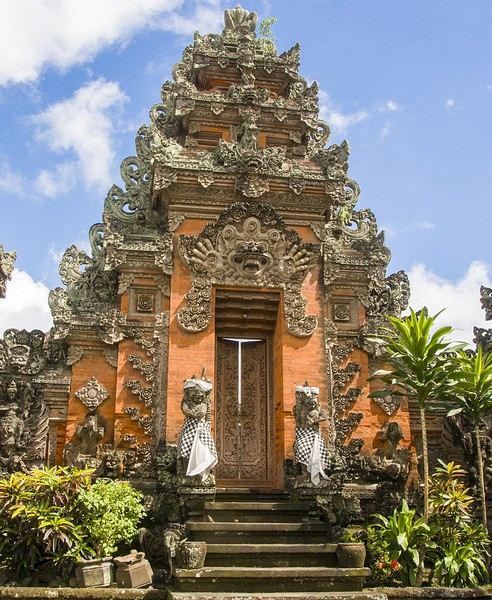
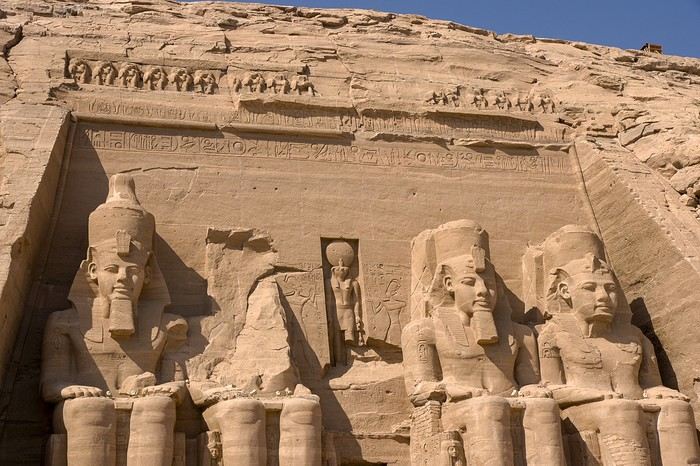
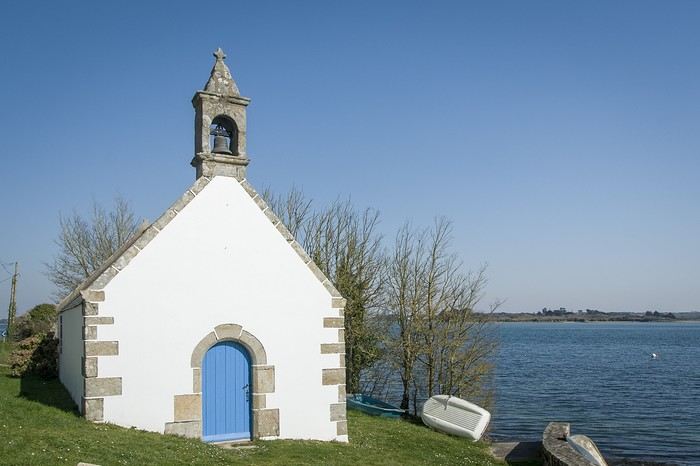
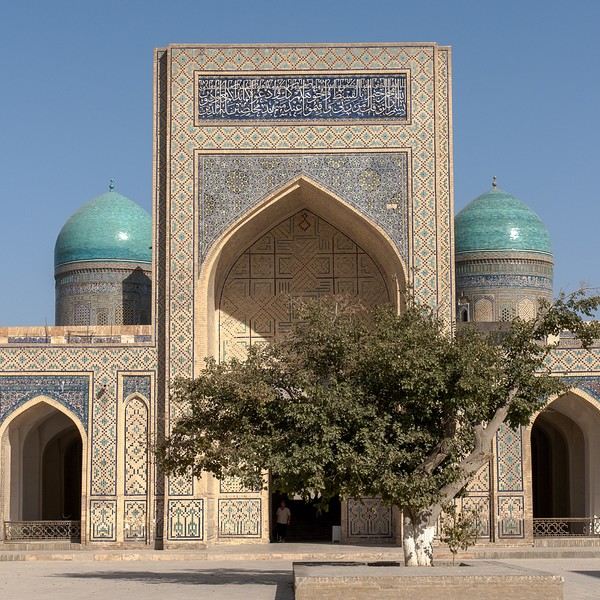
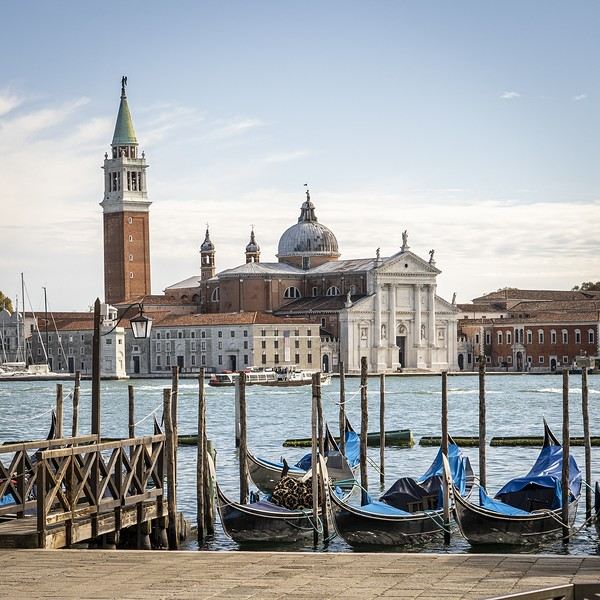

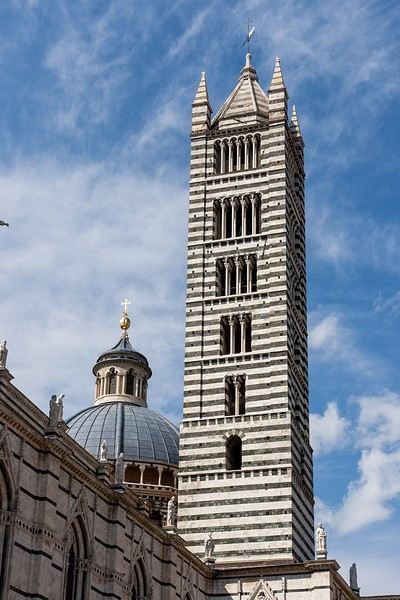
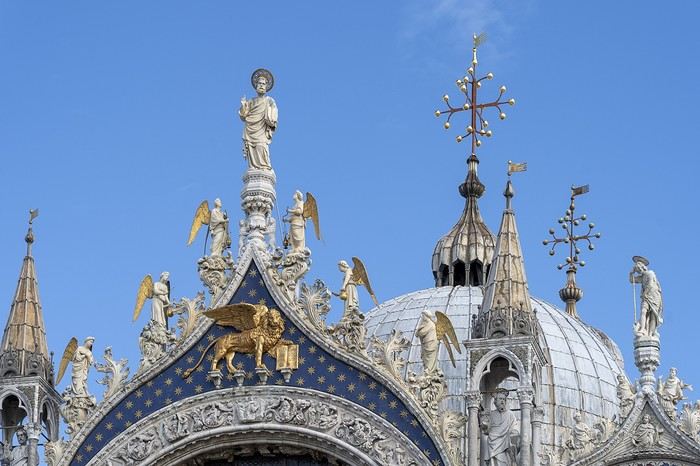
A few of my own photos, just to give you an idea:
June 2026 Theme Thread: Such a Beautiful Landscape
This is where we chat.
Best destinations for a first solo trip?
Hi there! I’m in the middle of planning my first solo trip (as a woman). Do you have any ideal destinations with activities like hiking, diving, sightseeing, and easy ways to meet locals—all on a small budget?
I’d love to hear from anyone who’s had this experience before! :)
I’d love to hear from anyone who’s had this experience before! :)
Practical aspects spring 2026: border to Murmansk, to Pskov, SIM cards, internet.
I took a few days to get some fresh air outside the Schengen-NATO prison. Between March 18, 2026, and March 25, 2026, as shown by the passport stamps:
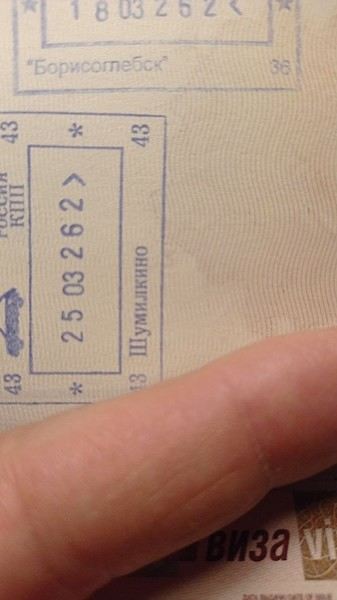
Borisoglebsk is the Russian border checkpoint after Kirkenes, on the road to Murmansk.
Kirkenes is a tiny town with a correspondingly small airport. Nothing has changed there: the minibuses to Murmansk wait on the right as you exit the airport. They’re synchronized with the two daily flights from Oslo—the SAS around 11:00 AM and Norwegian around 11:30 AM. They stop in Kirkenes at the corner of the Scandic for an hour, where other passengers can board, then head straight to the nearby border.
This is the least hassle Frontex/Schengen border. The Norwegian agent quickly scans your passport, and that’s it. No customs, since Norway is Schengen but not in the EU. On the Russian side, there’s a passport check and a quick customs inspection. All in all, crossing both the Norwegian and Russian checkpoints takes about 15 minutes.
A paper visa is required; e-visas aren’t accepted.
Two companies run the route: Avto Ekspress and Borodin: https://ae51.ru/routes/kirkenes-murmansk/ https://borodinbus.com/
The one-way fare is 5,500 ₽. You can either buy it online in rubles with a MIR card or make a formal reservation and pay in NOK cash to the driver. I took Borodin, and the price in NOK was much more expensive than in ₽.
=========================
On March 25, I left from Pskov via the Estonian border post at Luhaama. I spent three days in Murmansk, flew to St. Petersburg (SPB), stayed there for two days, then took an evening train to Pskov.
Since the end of February—and reportedly until the end of May—the Estonians have restricted the opening hours of the two border crossings near Pskov: Koidula (Pechory on the Russian side) and Luhaama (Izborsk on the Russian side). They’re closed at night between 7:00 PM and 7:00 AM. Right now, there’s a bus from Pskov at 7:00 AM to the border. It drops you off at the end of the road where truckers—many Kazakh and Serbian—are parked on the side. You finish the rest on foot to the barrier, where there’s a quick initial check for Ukrainian stamps in passports. Then you walk to the customs building, followed by passport control at the kiosk for motorists. After that, it’s a 500-meter walk to the Estonian checkpoint. At the moment, things seem calmer. Passport control is quick. The usual silly questions in English: "Where were you? Where are you going?" I just gave my most clueless smile: "Sorry, I don’t understand." Yeah, right—I don’t speak English, especially not at an Estonian border with a French passport. If they’re in a mood, though... A very quick bag inspection. Once you exit the Estonian post, walk to the bus stop sign by the road where another coach takes you to Riga.
The catch: in my case, last Wednesday, there were two passengers (Russians) with old Ukrainian stamps in their passports. The bus from the Estonian post to Riga was supposed to leave around 9:30 AM. We ended up leaving around noon after the two were grilled by the FSB. Since it was a weekday outside of holidays, the bus was half-empty. The fuller the bus and the more people with Ukrainian stamps, the worse the nightmare. Don’t book a same-day flight from Riga. I had a flight at 6:00 PM, so it worked out.
=============
The Kirkenes-Murmansk route is still clearly the easiest and fastest. But it’s not the most convenient since it’s way up north.
Next, I’d say the Gdansk-Kaliningrad route in the middle of the week. Avoid weekends and holiday departures/returns.
Avoid the Narva-Ivangorod route during Christmas, Easter, May 9, and *all* summer.
==============
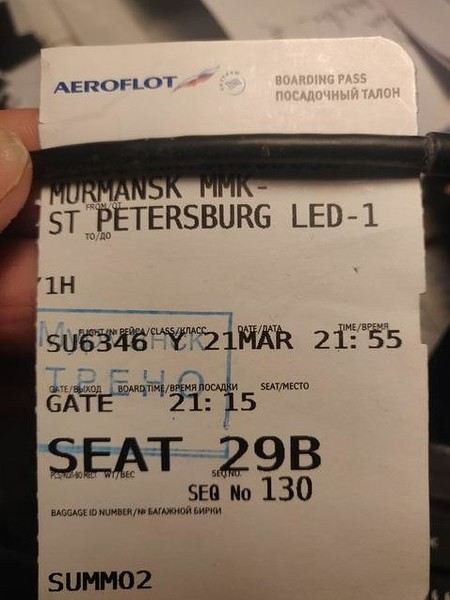
About flights from Murmansk to St. Petersburg: prices are good. I bought my ticket the day before departure on Rossiya for 7,500 ₽, including 10 kg of luggage + a handbag.
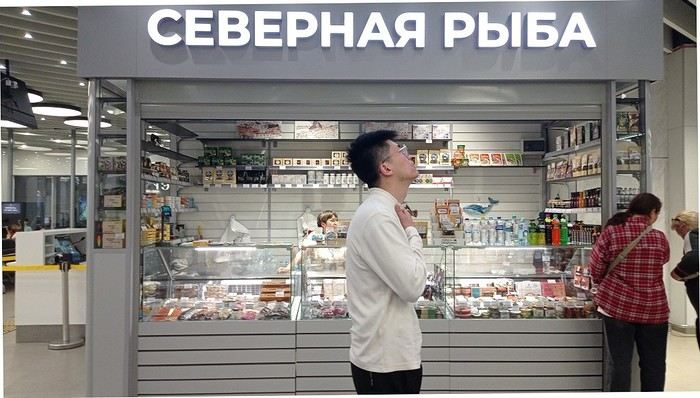
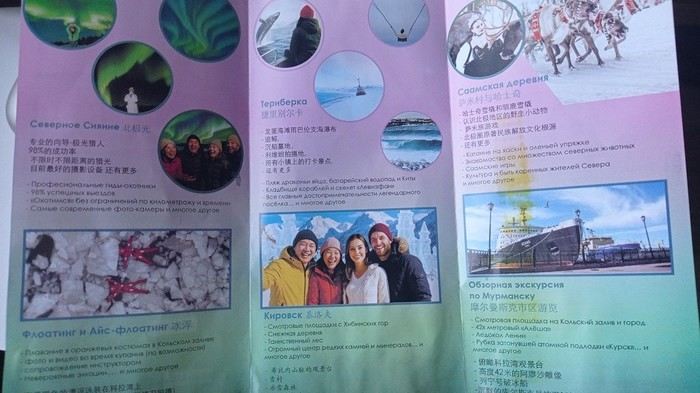
It’s the tail end of the northern lights season, and there were still crowds of Chinese tourists.
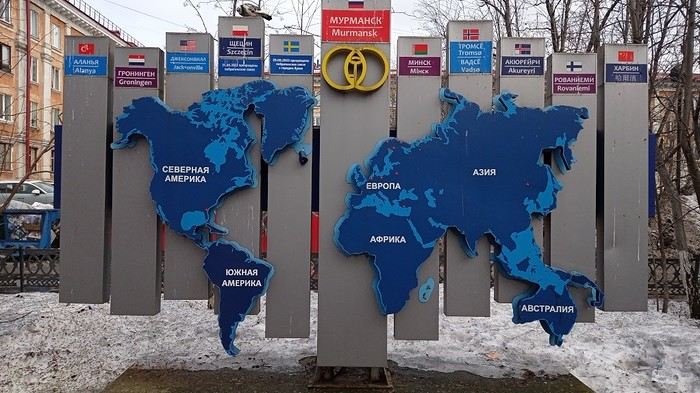
By the way, Murmansk is twinned with Harbin:
Chinese tourists are the largest foreign group, followed by Indians, then a mix of others from the Far East, Turks, Arabs, etc. Brochures are bilingual—Russian and Chinese:
============================
But let’s talk practical stuff. --
My domestic SIM card was restricted for SMS and internet for 24 hours. After that, if you want to keep using SMS, don’t turn off your phone—restarting triggers another 24-hour purgatory.
My Russian SIM cards (Megafon, MTS, Beeline) were activated as soon as I logged into their respective apps with my credentials.
Internet --
Telegram is heavily slowed down by authorities. To use it, you need to connect through proxy servers, which you load into the latest version of the app. Traffic is then rerouted internally within Telegram to servers outside Russia (Germany, Poland, Sweden, etc.). You can find these proxies on various channels. One is ChatVPN—check their website too.
For general internet use, like browsing the web, VPNs that work right now use the VLESS protocol. You can find several on Telegram by searching "VPN." A few free days, then payment in rubles or crypto.
Rozkomnadzor’s team are experts at this, so things can change. It’s a constant cat-and-mouse game.
Pskov is a special case. The city is near Estonia and has a large military base. Depending on NATO drone swarms launched from the Baltics, Wi-Fi can be completely suspended except for the most essential mobile apps. The drone swarms use the 4G network, and the powerful electronic jamming and drone suppression systems cause periods without Wi-Fi—including in hotels. Wired connections aren’t affected.
Borisoglebsk is the Russian border checkpoint after Kirkenes, on the road to Murmansk.
Kirkenes is a tiny town with a correspondingly small airport. Nothing has changed there: the minibuses to Murmansk wait on the right as you exit the airport. They’re synchronized with the two daily flights from Oslo—the SAS around 11:00 AM and Norwegian around 11:30 AM. They stop in Kirkenes at the corner of the Scandic for an hour, where other passengers can board, then head straight to the nearby border.
This is the least hassle Frontex/Schengen border. The Norwegian agent quickly scans your passport, and that’s it. No customs, since Norway is Schengen but not in the EU. On the Russian side, there’s a passport check and a quick customs inspection. All in all, crossing both the Norwegian and Russian checkpoints takes about 15 minutes.
A paper visa is required; e-visas aren’t accepted.
Two companies run the route: Avto Ekspress and Borodin: https://ae51.ru/routes/kirkenes-murmansk/ https://borodinbus.com/
The one-way fare is 5,500 ₽. You can either buy it online in rubles with a MIR card or make a formal reservation and pay in NOK cash to the driver. I took Borodin, and the price in NOK was much more expensive than in ₽.
=========================
On March 25, I left from Pskov via the Estonian border post at Luhaama. I spent three days in Murmansk, flew to St. Petersburg (SPB), stayed there for two days, then took an evening train to Pskov.
Since the end of February—and reportedly until the end of May—the Estonians have restricted the opening hours of the two border crossings near Pskov: Koidula (Pechory on the Russian side) and Luhaama (Izborsk on the Russian side). They’re closed at night between 7:00 PM and 7:00 AM. Right now, there’s a bus from Pskov at 7:00 AM to the border. It drops you off at the end of the road where truckers—many Kazakh and Serbian—are parked on the side. You finish the rest on foot to the barrier, where there’s a quick initial check for Ukrainian stamps in passports. Then you walk to the customs building, followed by passport control at the kiosk for motorists. After that, it’s a 500-meter walk to the Estonian checkpoint. At the moment, things seem calmer. Passport control is quick. The usual silly questions in English: "Where were you? Where are you going?" I just gave my most clueless smile: "Sorry, I don’t understand." Yeah, right—I don’t speak English, especially not at an Estonian border with a French passport. If they’re in a mood, though... A very quick bag inspection. Once you exit the Estonian post, walk to the bus stop sign by the road where another coach takes you to Riga.
The catch: in my case, last Wednesday, there were two passengers (Russians) with old Ukrainian stamps in their passports. The bus from the Estonian post to Riga was supposed to leave around 9:30 AM. We ended up leaving around noon after the two were grilled by the FSB. Since it was a weekday outside of holidays, the bus was half-empty. The fuller the bus and the more people with Ukrainian stamps, the worse the nightmare. Don’t book a same-day flight from Riga. I had a flight at 6:00 PM, so it worked out.
=============
The Kirkenes-Murmansk route is still clearly the easiest and fastest. But it’s not the most convenient since it’s way up north.
Next, I’d say the Gdansk-Kaliningrad route in the middle of the week. Avoid weekends and holiday departures/returns.
Avoid the Narva-Ivangorod route during Christmas, Easter, May 9, and *all* summer.
==============
About flights from Murmansk to St. Petersburg: prices are good. I bought my ticket the day before departure on Rossiya for 7,500 ₽, including 10 kg of luggage + a handbag.
It’s the tail end of the northern lights season, and there were still crowds of Chinese tourists.
By the way, Murmansk is twinned with Harbin:
Chinese tourists are the largest foreign group, followed by Indians, then a mix of others from the Far East, Turks, Arabs, etc. Brochures are bilingual—Russian and Chinese:
============================
But let’s talk practical stuff. --
My domestic SIM card was restricted for SMS and internet for 24 hours. After that, if you want to keep using SMS, don’t turn off your phone—restarting triggers another 24-hour purgatory.
My Russian SIM cards (Megafon, MTS, Beeline) were activated as soon as I logged into their respective apps with my credentials.
Internet --
Telegram is heavily slowed down by authorities. To use it, you need to connect through proxy servers, which you load into the latest version of the app. Traffic is then rerouted internally within Telegram to servers outside Russia (Germany, Poland, Sweden, etc.). You can find these proxies on various channels. One is ChatVPN—check their website too.
For general internet use, like browsing the web, VPNs that work right now use the VLESS protocol. You can find several on Telegram by searching "VPN." A few free days, then payment in rubles or crypto.
Rozkomnadzor’s team are experts at this, so things can change. It’s a constant cat-and-mouse game.
Pskov is a special case. The city is near Estonia and has a large military base. Depending on NATO drone swarms launched from the Baltics, Wi-Fi can be completely suspended except for the most essential mobile apps. The drone swarms use the 4G network, and the powerful electronic jamming and drone suppression systems cause periods without Wi-Fi—including in hotels. Wired connections aren’t affected.
Havana, Cuba / January 2026
I got into music with the will
To light up many hearths like Che could do,
To circulate ideas, to advance utopia
Alternating barricades, sharp thought, and poetry.
Mc Solaar, Guérilla
Subscribing without a fight to the slightest line of my itinerary sometimes feels like an illusion. Because there are countries where, despite the fever and enthusiasm, despite the triumphant revolution, certain elements block my path. And if I had planned, for F. and me, a beautiful ascent up Tabouret Hill (Loma del Taburete, 453m), it was without accounting for vegetation as dense as it was thorny, which barred our way after just a few quarters of an hour of walking. Exhausted, I had to face the facts: we wouldn’t go any further. I needed to come up with some kind of Plan B.
But what is this country, an unwitting laboratory of the worst that white civilization has done during its reign? What is this magnificent place—yet another—entrusted to the care of oblivion, just 150 km from the land of freedom? According to Donald Trump, a country supporting terrorism; according to the locals, the vast battlefield of 20th-century ideologies; according to the average tourist, a hot country, a beautiful country, a country where the last illusions of a lost paradise are dying.
On the other side of Havana Bay, we love that statue of Christ blessing the city. There’s something gentle, soothing, in that patriarchal gesture. You’d almost be tempted to forget that at the dawn of the 16th century, those who claimed to represent the Church had no scruples about eradicating the Ciboney and Taíno populations. Worse, you’ll find magnificent this cathedral dedicated to the Virgin Mary, right in the heart of the old city. Under the guise of a civilizing necessity, Havana became, like so many other places, the gilded seat of European pretensions, at the expense of local populations doomed to extermination, then enslaved populations—more or less indigenous—who, you can imagine, didn’t often set foot in this holy place.
Lost in my thoughts, I try to push through this tangled vegetation. Nature reclaims its rights; nature abhors a vacuum. Yes, the well-trodden path of revolution couldn’t stay free of weeds! The road is buried. We give up and turn back, until that fork I’d noted before leaving, which would let us reach the top of the hill by skirting its northern slope.
So the white man arrives, settles, and gets rid of everything that bothers him. He has two unstoppable forces at his disposal: gunpowder and the spiritual certainty of being on the side of an all-powerful god. While the first gives him an unmatched material advantage over his new enemy, the second lets him use the first without feeling too guilty. That’s the magic of this supreme Church: it condemns all forms of pleasure—calling them impurity—while promoting plunder and crime under the cover of evangelization.
Walking through the city, you find a bit of Algiers, except that here, the decay is almost irreversible. You feel the splendor of the past, a disconcerting image of all vanity, from an era when men knew how to build beauty—especially if they didn’t have to share it. We’ll debate the benefits of colonialism for a long time, while glossing over the fact that those benefits often stopped at the city limits, limits all too obvious to the indigenous people. Havana isn’t just one or a few buildings; it’s an impressive collection of works of art built one after another, in what I think was a spirit of healthy competition. Yes, you find Algiers in this exuberance. As if these distant cities were the receptacle of everything that was best in the lands of origin. Atlantes and lintels, golds, blues, ogives, and monumental windows—exceptional architecture in an exceptional place.
Some streets are clean, swept with care; others are not, scattered here and there with potholes filled with water. A rather persistent smell of urine invades us regularly. We move on. And we look up: Havana is visited with your nose in the air. Because the beauty is truly up there, on those magnificent balconies and terracotta arches. Also because it’s not impossible that a piece of that balcony might suddenly detach, hurling our ends into an overseas tragedy we’d rather avoid. On the ground, here and there, rubble. Inexorably, this city is returning to dust.
My Plan B turns out to be no more successful than the first attempt. After a cheerful progression of a few hundred meters, same outcome, same struggle—the vegetation opposes any revolution: impossible to go around the hill! Once again, we have to turn back. We’ll try Plan C. I reassure myself by convincing myself to stay in the logic of this country: Cuba has been searching for itself for five centuries.
Coffee, tobacco, and sugarcane—the green gold of the colonies—so that money could flow and Europe could enjoy itself. Cuba’s history isn’t original. In reality, all the hot lands at these latitudes suffer the same fate: to serve the white man. While waiting for the awakening of consciences, UN Resolution 1514 and more or less affirmed revolutionary desires. Except that—and this reflection is just my own—if the awakening of consciences and the revolutionary will don’t play into what Resolution 1514 hides, there’s a good chance the said state will become a pariah. Those who don’t follow the American doctrine risk a lot; those who decide to follow Moscow risk everything. Independence was only the barely discreet instrument of American views. Patrice Lumumba will gladly enlighten us on the subject.
Turning back is good. Setting up Plan C is better. I won’t deviate from my goal: we will reach the top of Tabouret, whatever the cost! Near a small country road, I hesitate to change the program. Time is ticking—is it really reasonable to attempt the ascent? Then a tricycle taxi appears, a kind of tuk-tuk powered by an electric moped. I take it as a sign from fate, and we board for the starting point of Plan C.
In Cuba, even before Resolution 1514, independence was assured by a pawn of the United States, Fulgencio Batista. There’s no need to go over the whole history here; we’ll just remember that if you know how to give without counting to your former masters, you can enjoy a facade of freedom. Fidel Castro, on the other hand, didn’t know how to give. It never even occurred to him. That’s why the United States harbors such terrible hatred for this rebellious state, opposed to capitalist values and political prostitution. From there to slowly killing its people for nearly seventy years, one can legitimately cry injustice. But there are other priorities. Oh yes! Greenland...
Do Cubans eat their fill? Does seeing overweight people mean opulence? Food grows, no doubt about it. The soil is fertile, the climate favorable. No, what shocks here is the absolute precarity, the feeling of a people living in survival mode, and the decay of both goods and hope. Where to go? What’s the point? The stubbornness of the United States in wanting to impose its views on the Cuban government is felt much more by an overwhelmed people than by those few elites—caricatures of communism—who instill their vision of happiness with a crowbar. The embargo imposed in 1960; the false-flag attacks—American planes flying the colors of the Cuban revolution during the Bay of Pigs invasion in 1961—the exasperation of placing Cuba on the list of countries supporting terrorism. More recently, Donald Trump decided to heavily tax countries supplying Cuba with fuel. The last time I saw such long lines near gas stations was during my first trip to Romania... in 1991. It’s not for me to judge whether Raúl and his clique are playing fair by thumbing their noses at the West. I don’t hold the ins and outs of this war of egos that keeps the world’s great powers awake. I only caught a glimpse of the poverty of an island in 2026, while we in Europe are buried under an avalanche of the useless and superficial.
At the start of the San Juan baths, we find the trailhead. It climbs steeply. But the weather is relatively mild, thanks to a cold wave hitting higher up in the United States. Dallas is under snow; we’re walking in 16°C, a stroke of luck. We climb over rocks, under fairly decent vegetation, sometimes low but passable. And we succeed in the ascent in an hour. Up there, the top of the hill is somewhat maintained, at a minimum, but maintained, as if to honor Che through an awful monument erected in his glory—a stubborn specimen from those years when good taste was inversely proportional to the delusional ideas of those being honored. Birds of prey (raptors?) circle overhead; the monument is dying, crumbling, falling into ruin. *Hasta siempre*—forever—will be for the words. Nature, erosion, life itself will have the last word over all revolutions.
Back at the foot of the hill, just before a memorable swim, we talk with a family living there in miserable shacks whose stability wasn’t unlike that of the Leaning Tower of Pisa. The grandmother holds an animal, a rodent, by its feet. The grandfather has just killed it; she’s plucking its fur. A few steps away, water boils in a pot. She plunges the beast into the container. Tonight, the family will eat ragondin stew. Further on, another shack where, in a disorder rivaling the filth, a mother breastfeeds while sitting on the edge of a bed. Then, on the way down, we’ll meet a middle-aged man carrying a large jerrycan of water on his shoulder. Are these people happy here, far from the cities and their stakes? Is it too much to ask that they at least have access to electricity, running water, and decent, safe housing?
Outside the old city, Havana reveals wide avenues serving imposing institutions here and there. But whether in the colorful alleys of the old town or on the majestic and austere Plaza de la Revolución, the same feeling moves me: sadness. Seeing that only chaos has come from ideas crushes me. We praise, we sing the revolution—above all, we impose it in people’s minds as a necessity, when it’s nothing of the sort. Revolution is just the fruit of a few tortured minds who, once in power, do nothing better than all those before them. Enjoy power. Impose their views. It’s just a matter of color. Fidel saw red and knew how to persuade—or silence forever—his many detractors. The West sees everything in white, through the prism of human rights, and also knows how to persuade and silence its slightest detractors forever.
Paradoxically, Cuba survives largely thanks to tourism, a key element—let’s not be afraid to say it—of capitalism. And when a few players pick up the crumbs from transactions, the lion’s share and the foreign currency go to the government. So we won’t go to Varadero, the high place of relaxation overrun by Canadians. Instead, we’ll limit ourselves to crossing the ocean 30 minutes from the capital, at Santa María del Mar, to get an idea of cheaper tourism and to splash around for a few minutes in turquoise water invaded by sargassum. At the heart of the tourist season, we’ll meet few people. Like Havana, and according to its inhabitants, the high season is rather dead. But we won’t have come for nothing: we particularly love this return where, feverish, the taxi driver pushes his Moskvitch 2140 to the max on the highway, singing karaoke versions of hits at the top of his lungs from an onboard DVD player. East/West, the culture clash with a hint of Latino.
It’s time to leave this country of resourcefulness where extremes are very present. We’re leaving a 5-star hotel in front of yet another crumbling building. We’ve known restaurants at 40,000 pesos while in the street people eat for 400. We’ve seen those countless cars from another era and another culture—Pontiac, Lada, Chevrolet, Moskvitch—being overtaken by gleaming Mercedes and other Porsche Cayennes, the prerogative—if it still needed to be demonstrated—of the newly rich in search of recognition. Boarding the plane, we also understand that we’re not just traveling with tourists: there’s undoubtedly a rich and prosperous diaspora, just as there are relatively wealthy Cubans—well, wealthy enough to travel comfortably in the front of the aircraft. Meanwhile, on all the country’s roads, other Cubans try hitchhiking, their wives and children perched on a suitcase by the roadside. The father holds out his arm and holds a few bills in his hand like a card game. Where are they going? Who will pick them up?
Behind me, the gold of the Capitol. I’m told this gold comes from Russia. Like Marx and Lenin’s smoky theories? Like Stalin’s subtle and delicate paternalism? Let’s bet that, like the other buildings crumbling around it, the Capitol will also collapse one day, to avenge the Indians who perished from the diseases and guns of the whites, to avenge the Africans who obliterated their lives so Europeans could enjoy themselves, finally, to avenge all this abandoned people, left to the arbitrariness of democratic or non-democratic elections.
A sign in the street: We understand history. This is the revolution! We understand history. That’s the revolution.
No comment.
Subscribing without a fight to the slightest line of my itinerary sometimes feels like an illusion. Because there are countries where, despite the fever and enthusiasm, despite the triumphant revolution, certain elements block my path. And if I had planned, for F. and me, a beautiful ascent up Tabouret Hill (Loma del Taburete, 453m), it was without accounting for vegetation as dense as it was thorny, which barred our way after just a few quarters of an hour of walking. Exhausted, I had to face the facts: we wouldn’t go any further. I needed to come up with some kind of Plan B.
But what is this country, an unwitting laboratory of the worst that white civilization has done during its reign? What is this magnificent place—yet another—entrusted to the care of oblivion, just 150 km from the land of freedom? According to Donald Trump, a country supporting terrorism; according to the locals, the vast battlefield of 20th-century ideologies; according to the average tourist, a hot country, a beautiful country, a country where the last illusions of a lost paradise are dying.
On the other side of Havana Bay, we love that statue of Christ blessing the city. There’s something gentle, soothing, in that patriarchal gesture. You’d almost be tempted to forget that at the dawn of the 16th century, those who claimed to represent the Church had no scruples about eradicating the Ciboney and Taíno populations. Worse, you’ll find magnificent this cathedral dedicated to the Virgin Mary, right in the heart of the old city. Under the guise of a civilizing necessity, Havana became, like so many other places, the gilded seat of European pretensions, at the expense of local populations doomed to extermination, then enslaved populations—more or less indigenous—who, you can imagine, didn’t often set foot in this holy place.
Lost in my thoughts, I try to push through this tangled vegetation. Nature reclaims its rights; nature abhors a vacuum. Yes, the well-trodden path of revolution couldn’t stay free of weeds! The road is buried. We give up and turn back, until that fork I’d noted before leaving, which would let us reach the top of the hill by skirting its northern slope.
So the white man arrives, settles, and gets rid of everything that bothers him. He has two unstoppable forces at his disposal: gunpowder and the spiritual certainty of being on the side of an all-powerful god. While the first gives him an unmatched material advantage over his new enemy, the second lets him use the first without feeling too guilty. That’s the magic of this supreme Church: it condemns all forms of pleasure—calling them impurity—while promoting plunder and crime under the cover of evangelization.
Walking through the city, you find a bit of Algiers, except that here, the decay is almost irreversible. You feel the splendor of the past, a disconcerting image of all vanity, from an era when men knew how to build beauty—especially if they didn’t have to share it. We’ll debate the benefits of colonialism for a long time, while glossing over the fact that those benefits often stopped at the city limits, limits all too obvious to the indigenous people. Havana isn’t just one or a few buildings; it’s an impressive collection of works of art built one after another, in what I think was a spirit of healthy competition. Yes, you find Algiers in this exuberance. As if these distant cities were the receptacle of everything that was best in the lands of origin. Atlantes and lintels, golds, blues, ogives, and monumental windows—exceptional architecture in an exceptional place.
Some streets are clean, swept with care; others are not, scattered here and there with potholes filled with water. A rather persistent smell of urine invades us regularly. We move on. And we look up: Havana is visited with your nose in the air. Because the beauty is truly up there, on those magnificent balconies and terracotta arches. Also because it’s not impossible that a piece of that balcony might suddenly detach, hurling our ends into an overseas tragedy we’d rather avoid. On the ground, here and there, rubble. Inexorably, this city is returning to dust.
My Plan B turns out to be no more successful than the first attempt. After a cheerful progression of a few hundred meters, same outcome, same struggle—the vegetation opposes any revolution: impossible to go around the hill! Once again, we have to turn back. We’ll try Plan C. I reassure myself by convincing myself to stay in the logic of this country: Cuba has been searching for itself for five centuries.
Coffee, tobacco, and sugarcane—the green gold of the colonies—so that money could flow and Europe could enjoy itself. Cuba’s history isn’t original. In reality, all the hot lands at these latitudes suffer the same fate: to serve the white man. While waiting for the awakening of consciences, UN Resolution 1514 and more or less affirmed revolutionary desires. Except that—and this reflection is just my own—if the awakening of consciences and the revolutionary will don’t play into what Resolution 1514 hides, there’s a good chance the said state will become a pariah. Those who don’t follow the American doctrine risk a lot; those who decide to follow Moscow risk everything. Independence was only the barely discreet instrument of American views. Patrice Lumumba will gladly enlighten us on the subject.
Turning back is good. Setting up Plan C is better. I won’t deviate from my goal: we will reach the top of Tabouret, whatever the cost! Near a small country road, I hesitate to change the program. Time is ticking—is it really reasonable to attempt the ascent? Then a tricycle taxi appears, a kind of tuk-tuk powered by an electric moped. I take it as a sign from fate, and we board for the starting point of Plan C.
In Cuba, even before Resolution 1514, independence was assured by a pawn of the United States, Fulgencio Batista. There’s no need to go over the whole history here; we’ll just remember that if you know how to give without counting to your former masters, you can enjoy a facade of freedom. Fidel Castro, on the other hand, didn’t know how to give. It never even occurred to him. That’s why the United States harbors such terrible hatred for this rebellious state, opposed to capitalist values and political prostitution. From there to slowly killing its people for nearly seventy years, one can legitimately cry injustice. But there are other priorities. Oh yes! Greenland...
Do Cubans eat their fill? Does seeing overweight people mean opulence? Food grows, no doubt about it. The soil is fertile, the climate favorable. No, what shocks here is the absolute precarity, the feeling of a people living in survival mode, and the decay of both goods and hope. Where to go? What’s the point? The stubbornness of the United States in wanting to impose its views on the Cuban government is felt much more by an overwhelmed people than by those few elites—caricatures of communism—who instill their vision of happiness with a crowbar. The embargo imposed in 1960; the false-flag attacks—American planes flying the colors of the Cuban revolution during the Bay of Pigs invasion in 1961—the exasperation of placing Cuba on the list of countries supporting terrorism. More recently, Donald Trump decided to heavily tax countries supplying Cuba with fuel. The last time I saw such long lines near gas stations was during my first trip to Romania... in 1991. It’s not for me to judge whether Raúl and his clique are playing fair by thumbing their noses at the West. I don’t hold the ins and outs of this war of egos that keeps the world’s great powers awake. I only caught a glimpse of the poverty of an island in 2026, while we in Europe are buried under an avalanche of the useless and superficial.
At the start of the San Juan baths, we find the trailhead. It climbs steeply. But the weather is relatively mild, thanks to a cold wave hitting higher up in the United States. Dallas is under snow; we’re walking in 16°C, a stroke of luck. We climb over rocks, under fairly decent vegetation, sometimes low but passable. And we succeed in the ascent in an hour. Up there, the top of the hill is somewhat maintained, at a minimum, but maintained, as if to honor Che through an awful monument erected in his glory—a stubborn specimen from those years when good taste was inversely proportional to the delusional ideas of those being honored. Birds of prey (raptors?) circle overhead; the monument is dying, crumbling, falling into ruin. *Hasta siempre*—forever—will be for the words. Nature, erosion, life itself will have the last word over all revolutions.
Back at the foot of the hill, just before a memorable swim, we talk with a family living there in miserable shacks whose stability wasn’t unlike that of the Leaning Tower of Pisa. The grandmother holds an animal, a rodent, by its feet. The grandfather has just killed it; she’s plucking its fur. A few steps away, water boils in a pot. She plunges the beast into the container. Tonight, the family will eat ragondin stew. Further on, another shack where, in a disorder rivaling the filth, a mother breastfeeds while sitting on the edge of a bed. Then, on the way down, we’ll meet a middle-aged man carrying a large jerrycan of water on his shoulder. Are these people happy here, far from the cities and their stakes? Is it too much to ask that they at least have access to electricity, running water, and decent, safe housing?
Outside the old city, Havana reveals wide avenues serving imposing institutions here and there. But whether in the colorful alleys of the old town or on the majestic and austere Plaza de la Revolución, the same feeling moves me: sadness. Seeing that only chaos has come from ideas crushes me. We praise, we sing the revolution—above all, we impose it in people’s minds as a necessity, when it’s nothing of the sort. Revolution is just the fruit of a few tortured minds who, once in power, do nothing better than all those before them. Enjoy power. Impose their views. It’s just a matter of color. Fidel saw red and knew how to persuade—or silence forever—his many detractors. The West sees everything in white, through the prism of human rights, and also knows how to persuade and silence its slightest detractors forever.
Paradoxically, Cuba survives largely thanks to tourism, a key element—let’s not be afraid to say it—of capitalism. And when a few players pick up the crumbs from transactions, the lion’s share and the foreign currency go to the government. So we won’t go to Varadero, the high place of relaxation overrun by Canadians. Instead, we’ll limit ourselves to crossing the ocean 30 minutes from the capital, at Santa María del Mar, to get an idea of cheaper tourism and to splash around for a few minutes in turquoise water invaded by sargassum. At the heart of the tourist season, we’ll meet few people. Like Havana, and according to its inhabitants, the high season is rather dead. But we won’t have come for nothing: we particularly love this return where, feverish, the taxi driver pushes his Moskvitch 2140 to the max on the highway, singing karaoke versions of hits at the top of his lungs from an onboard DVD player. East/West, the culture clash with a hint of Latino.
It’s time to leave this country of resourcefulness where extremes are very present. We’re leaving a 5-star hotel in front of yet another crumbling building. We’ve known restaurants at 40,000 pesos while in the street people eat for 400. We’ve seen those countless cars from another era and another culture—Pontiac, Lada, Chevrolet, Moskvitch—being overtaken by gleaming Mercedes and other Porsche Cayennes, the prerogative—if it still needed to be demonstrated—of the newly rich in search of recognition. Boarding the plane, we also understand that we’re not just traveling with tourists: there’s undoubtedly a rich and prosperous diaspora, just as there are relatively wealthy Cubans—well, wealthy enough to travel comfortably in the front of the aircraft. Meanwhile, on all the country’s roads, other Cubans try hitchhiking, their wives and children perched on a suitcase by the roadside. The father holds out his arm and holds a few bills in his hand like a card game. Where are they going? Who will pick them up?
Behind me, the gold of the Capitol. I’m told this gold comes from Russia. Like Marx and Lenin’s smoky theories? Like Stalin’s subtle and delicate paternalism? Let’s bet that, like the other buildings crumbling around it, the Capitol will also collapse one day, to avenge the Indians who perished from the diseases and guns of the whites, to avenge the Africans who obliterated their lives so Europeans could enjoy themselves, finally, to avenge all this abandoned people, left to the arbitrariness of democratic or non-democratic elections.
A sign in the street: We understand history. This is the revolution! We understand history. That’s the revolution.
No comment.
Looking for info on a campervan road trip in Eastern Europe
Hi everyone,
I’m planning a campervan road trip and would love some tips from those who know these countries: Slovenia, Bosnia and Herzegovina, Croatia, Montenegro, and Slovenia again. At the moment, nothing’s set in stone, but for example, is it better to visit Slovenia or Bosnia? My preferences lean toward landscapes (rivers, sea, lakes)—basically anywhere there’s water! :) Wild camping, cheap or even free spots, and a *very* tight budget—it’s the discovery, curiosity, and meeting locals that drive me. I’ll visit cities and sites only if access is easy (by bike, for example, or by train from an affordable campsite) and if visitors aren’t treated like cash cows. Just reasonable stuff, really. So, any advice is welcome—like swimming spots or easy hikes along coasts or rivers. I love caves and offbeat visits (salt mines in Poland, La Roque Saint-Christophe in France, etc.). Castles and old ruins? Not really my thing... Thanks for your help! Sylvia
I’m planning a campervan road trip and would love some tips from those who know these countries: Slovenia, Bosnia and Herzegovina, Croatia, Montenegro, and Slovenia again. At the moment, nothing’s set in stone, but for example, is it better to visit Slovenia or Bosnia? My preferences lean toward landscapes (rivers, sea, lakes)—basically anywhere there’s water! :) Wild camping, cheap or even free spots, and a *very* tight budget—it’s the discovery, curiosity, and meeting locals that drive me. I’ll visit cities and sites only if access is easy (by bike, for example, or by train from an affordable campsite) and if visitors aren’t treated like cash cows. Just reasonable stuff, really. So, any advice is welcome—like swimming spots or easy hikes along coasts or rivers. I love caves and offbeat visits (salt mines in Poland, La Roque Saint-Christophe in France, etc.). Castles and old ruins? Not really my thing... Thanks for your help! Sylvia
Requirements for travel to Russia and Mongolia
Hi there,
I’m planning a trip to Russia and Mongolia, starting from France.
Crossing the border at Poland/Belarus or Georgia/Russia—other borders seem either closed or complicated.
Tourist visas for 3 months with multiple entries.
Do you have any info on Russian companies that cover a 4x4 vehicle for 3 months, and what prices in rubles or euros you’ve paid?
Which bank did you use for expenses? (EuroMastercard and Visa cards no longer work.)
Regarding Russian SIM cards, a new system called "Gosuslugi" has been introduced. How long did it take you to get one, and what steps did you follow?
Thanks
Which bank did you use for expenses? (EuroMastercard and Visa cards no longer work.)
Regarding Russian SIM cards, a new system called "Gosuslugi" has been introduced. How long did it take you to get one, and what steps did you follow?
Thanks