Results for "Comores"
About 5,138 results.
More options
Many results are in French, the community’s main language. English translations are added over time.
Search results
Riviera Maya en juillet
En juillet 2004, on envisage d'aller à la Riviera Maya une semaine dans un Tout Compris avec ma conjointe et mes 2 ados de 13 et 15 ans. On veut d'abord se reposer, profiter de belles plages et de belle végétation luxuriante, très bien manger et faire quelques visites (Ixcaret, Tulum, Cozumel, Chichen Itza etc.).
On recherche un très bon hôtel. Avec quelques belles visites, peut-on s'en tirer avec un budget de 8 000$ CAN pour la semaine, sans se priver de rien???
Avez-vous des complexes hôteliers en particulier à nous proposer? Rien en bas de 4 étoiles cependant.
Ce serait notre premier voyage au Mexique. On connaît mieux Cuba et la Floride. Y-a-t-il des choses à savoir avant de partir? La température, la bouffe, les petits coins de paradis cachés etc.
Merci de vos suggestions
Inde du Nord (Rajasthan) - Novembre 2000
Voici quelques infos pratiques concernant un voyage de 4 semaines au Rajasthan en Novembre 2000 (ça date un peu ...). Voyage en couple, en individuel et en itinérant. Sauf pour les hôtels, les prix indiqués sont toujours par personne.
Je répondrai avec plaisir à toutes vos questions complémentaires.
NOTRE PERIPLE EN 4 SEMAINES : (nous avons couvert ce programme sans jamais courir)
Mer 1er/11/2000 : vol Paris --> New Dehli (avion - 3 900 F l'A/R) - Nuit à New Dehli Jeu : New Dehli (prise de contact - résa du train Shatabdi Express pour Agra - Main Bazar) - Nuit à New Dehli Ven : Train pour Agra (2h - 10$ - voir § transport) - Fathepur Skiri (1h de bus = 17 Rs) - Taj Mahal (gratuit le vendredi - profitons-en !) au coucher du soleil - Nuit à Agra Sam : Taj Mahal - Tombeau d'Akbar à Sikandara - Fort Rouge - Journée coûteuse mais inoubliable - Nuit à Agra Dim : Bus pour Jaipur (5h - 117 Rs) - Palais des Vents (Hawa Mahal) - Nuit à Jaipur Lun : Rickshaw à la journée (300 Rs) pour les environs de Jaipur : Cénotaphes de Gaïtor - Amber Palace - Fort de Jaigarh - Temple de Shiromani - Nuit à Jaipur Mar : Jaipur : City Palace - Observatoire - Nuit à Jaipur Mer : Bus pour Ajmer (3h - 66 Rs) - Bus pour Pushkar (1/2 h - 7 Rs) - Foire de Puskar - Nuit à Pushkar Jeu : Pushkar : la foire et la ville - Nuit à Pushkar Ven : Bus pour Udaipur (7h30- 150 Rs) - Nuit à Udaipur Sam : Udaipur : City Palace - Marché tibétain - Nuit à Udaipur Dim : Bus A/R pour Chittorgarh (2X 2h - 45 Rs par voyage) - Nuit à Udaipur Lun : En voiture avec chauffeur (3, 75 Rs/km - je n'ai pas noté le coût total ... dommage ...- voir § transport) : Ranakpur - Kumbhalgarh - Eklingji - Nuit à Udaipur Mar : Bus pour Abu Road (6h - 62 Rs) - Bus pour Mount Abu (1h - 13 Rs) - nuit à Mount Abu Mer : Mount Abu : temples jaïns de Delwara - Nuit à Mount Abu Jeu : Bus pour Jodhpur (6h30 - 130 Rs) - Nuit à Jodhpur Ven : Jodhpur : Fort Mehrangarh - Clock Tower - Marché - Nuit à Jodhpur Sam : En jeep (1/2 journée - 400 Rs - voir § transport) : villages bishnois - Nuit à Jodhpur Dim : Bus pour Jaisalmer (5h prévues - 7h30 avec la panne ... - 100 Rs) - Nuit à Jaisalmer Lun : Jaisalmer : Citadelle - Ville haute - Temples jaïns - Ville basse - Havelis - Nuit à Jaisalmer Mar : En jeep (1/2 journée - 750 Rs - voir § transport) - Safari dans le désert : Cénotaphes - temples jaïns, village médiéval - Dunes de Khuri et tour à dos de chameau ... - Nuit à Jaisalmer Mer : Bus pour Bikaner (10h - 150 Rs) - Beaux paysages en route - Nuit à Bikaner Jeu : Bus A/R pour Deshnoke (2X1h - 13 Rs par voyage) - Bikaner : Junagarth Fort - Vieille ville - Temples jaïns - Nuit à Bikaner Ven : En voiture privée (nous profitons d'une opportunité - 4h - voir § transport) pour Mandawa - Nuit à Mandawa Sam : En jeep (1/2 journée - 300 Rs) : Shekhawati - Nuit à Mandawa Dim : Jeep-taxi pour Junjunhu (1h - 10 Rs) - Bus pour Dehli (6h - 100 Rs) - Nuit à New Dehli Lun : New Dehli : Tombeaux de Nizamuddin - Nuit à New Dehli Mar 28/11/2000 : Avion pour Paris ....... les meilleures choses ont une fin .......
BUDGET :
L'Euro n'était pas encore d'actualité. En Novembre 2000, 1F = 6 Roupies ; 10 Rs = 1, 74 F Niveau de vie très peu élevé.
TRANSPORT :
1. Vols Billets achetés auprès de Voyageurs du Monde (Jagmohan SHARMA 01.42.86.17.33) : http://www.vdm.com/vdm/index.asp - 3, 5 mois à l'avance. Vol Air France/Air India - direct - arrivée à New Dehli à 23h - Prix : 3900 F l'AR
2. Sur place New Dehli - Agra : train Shatabdi Express - 10$ via une agence locale - Je pense qu'on s'est fait arnaquer 😕 comme des bleus ! Quand on a demandé au rickshaw de nous déposer à la gare, il a pretexté qu'il n'y avait plus de train pour Agra et nous a déposé dans une agence qui nous a vendu un billet de train pour le surlendemain ... Soyez plus méfiants que nous ....😉 Départ à 6h00 - durée : 2 heures -
Pour tout le reste, nous avons privilégié le bus au train ... sans vraiment de raison, ça s'est fait comme ça ... Les bus sont fréquents, facile d'utilisation, et partent à l'heure. Deluxe (siège individuel) ou express (banquette), nous avons toujours voyagé assis - confort simple - Nous achetions nos billets le jour même, au guichet ou directement dans le bus. Les trajets sont longs et épuisants mais donnent l'occasion d'approcher les locaux, de s'arrêter dans les villages de campagne, de manger au coin d'une route ... Ces transferts restent parmi mes plus forts souvenirs 🙂 ! Pour les grands transferts, il est prudent d'y consacrer la journée sans espérer visiter quoi que ce soit à l'arrivée. Nous avons souffert de 2 pannes : tout le monde descend sur le bas côté et attend le prochain bus qui ne tarde généralement pas à arriver ... seul ennui : on est alors 2 fois plus nombreux dans le même espace 🤪 !!
Autour d'Udaipur : location d'une voiture avec chauffeur - Ambassador non A/C pour 1 journée, négociée à 3, 75 Rs/km - apporte souplesse et confort lors de l'excursion : possibilité de s'arrêter en pleine campagne pour faire des photos notamment ...
Jeep avec chauffeur : villages bishnois - 1/2 journée - Agence Poly Travel à Jodhpur - 400 Rs / p
Jeep avec chauffeur : safari dans le désert aux environs de Jaisalmer -1/2 journée + camel ride - Agence Satyam Tours - 750 Rs / p
Voiture privée ... le transfert Bikaner-Mandawa s'est fait avec un Indien qui rentrait à Dehli et nous a proposé de nous déposer, pour le prix du bus ....
Rickshaws : de 10 à 40 Rs la course.
HEBERGEMENT :
Les prix indiqués sont par nuit (pour nous 2), généralement hors petit déjeuner. A la descente du bus, des auto rickshaws attendent le touriste. Ils sont nombreux, les touristes rares .... d'où une certaine frénésie ... Il vaut donc mieux savoir où l'on veut aller avant d'arriver et réclamer fermement d'y être emmenés même si le rickshaw wallah vous assure que c'est fermé, que c'est trop cher, qu'il connait qqchose de mieux .... Cela dit, la fermeté et la gentillesse paient : il n'y a jamais d'embrouille après s'être mis d'accord (sur la destination et le prix).
Nous recherchons toujours des hôtels de petite taille, typique, avec du charme ; à défaut, on veut au minimum avoir des sanitaires privés, draps et couvertures (nous voyageons sans sac de couchage). Nous n'avons jamais eu de problèmes pour trouver. Généralement, on faisait notre sélection dans le bus avant d'arriver (Lonely Planet et Guide du Routard).
New Dehli : nuit du 1er nov réservée auprès de Voyageurs du Monde : Connaught Palace - 820 F - Petit déj buffet inclus - Super mais ... cher.
nuit du 2 : Sun Star Residency - 2400 Rs (CB) - un certain charme mais bruyant et sentant la fumée (dans les rideaux ou par le clim ...?)
nuit des 26 et 27 : Hotel Marina (ref LP et GR) - 3100 Rs (CB) - sur Connaught Circus - simple - petit dej inclus - bonne adresse -
Agra : Hotel Atithi (ref LP) - 2000 Rs (CB) - bien situé à 1km du Taj - chambre spacieuse mais sanitaires très vieillots - bonne adresse
Jaipur : Hotel Meghniwas (ref LP et GR) - 1100 Rs (CB) - calme, jardin, piscine propre - loin de la ville - sans charme - sombre
Pushkar : JP's Village Resort (ref LP) - 117 $ (n'accepte pas la CB) - réservé par mail depuis la France - Une véritable arnaque !!! Très loin du centre (et pas de rickshaw - taxi obligatoire qui réclame 100 Rs !!) - pas du tout au niveau du prix ! piscine boueuse impratiquable (à mon avis depuis des années, vu son état !) - sanitaires privés très sommaires - volonté de décoration typique mais effet raté - A FUIR 😠 !!! Cela dit, attention en période de foire, il vaut mieux réserver. Mais pas chez JP !
Udaipur : Hotel Caravanserai (ref LP) - 800 Rs (n'accepte pas la CB) - très bien situé - superbe vue sur le lac - propre et spacieux - accueil convivial - une EXCELLENTE ADRESSE 🙂. Notre meilleur rapport qualité/prix.
Mount Abu : Hotel Hilltone (ref LP) - 1675 Rs (CB) - calme, sympa - chambre très agréable et bon restau - vraie belle piscine
Jodhpur : Ajit Bhawan (ref LP et GR) - 3000 Rs (CB) - le COUP de COEUR 🙂🙂 du voyage - superbe grande chambre, décorée avec soin et originalité, salle de bain impeccable - grand jardin - piscine avec noria et arcades - beaucoup de charme - petit dej buffet à 200 Rs
Jaisalmer : Rang Mahal (ref LP) - 2900 Rs (CB) - manque d'ambiance - moderne et froid - à l'écart de la ville - belle piscine -
Bikaner : Hotel Sagar (ref LP et GR) - 1200 Rs (CB) - patron charmant et restau EXCELLENT mais chambre décrépie ...
Mandawa : The Desert Resort (ref LP et GR) - 3000 Rs (CB) - superbe complexe 🙂 de petits bungalows en terre battue - propre, soigné, bien entretenu et décoré avec beaucoup de goût - au milieu du désert, calme - excentré -
REPAS :
dans la rue : 1 coca = 10 Rs - 1 l d'eau (Bisleri) = 13 Rs ; 2 litres = 17 Rs - 1 samossa = 3 Rs - 1 kg de bananes = 10 à 12 Rs (1 Rs la banane) - 1 lassi au Lassiwala de Jaipur (ref GR) : 10 Rs le petit, 20 le grand ! délicieux et inouliable !
au restau : 1 chapati = 3 Rs - 1 nan = 10 Rs - 1 dal fry = 25 Rs - 1 plain rice = 18 Rs - 1 repas (1 plat + 1 raïta + 1 nan + 1 coca et du riz bien sûr) = moins de 90 Rs, 40 à 45 Rs pour 1 repas végétarien - 1 repas dans un restau "chic" = envciron 250 Rs
SITES :
Fathepur Skiri - Mosquée : gratuite - Palais : 10$ - superbe site où nous avons passé plus de 3 heures - belle couleur rouge
Agra - Taj Mahal (gratuit le vendredi sinon 20$, évidemment c'est très cher mais ça les mérite) - y aller tôt pour profiter du site à la fraîche et au calme -à partir de 8h30, beaucoup de touristes indiens - les saris colorés ressortent sur le marbre blanc - effet superbe ! nous y avons passé 5 heures.
Agra - Fort Rouge (10$) Grandiose - 1 après-midi pour Sikandara et Fort Rouge
Sikandara - Tombeau d'Akbar (5$) - Belles mosaïques -
Jaipur - Hawa Mahal (2Rs + 30/app photos) - nous retrouvons des prix raisonnables - l'appareil photo est toujours taxé (20 à 30 Rs généralement), le caméscope également (100 Rs généralement) - très beau palais qui se visite assez rapidement.
Gaïtor - Cénotaphes (10 Rs/app ph) - Superbement sculptés - visite à ne pas rater !
Jaipur - Amber Palace (50 Rs + 25/app ph) - Vieillit : la pierre noircit - après les merveilles précédentes, on est un peu déçu par ce palais
Fort de Jaigarh (20 Rs + 20/app ph) - peu d'intérêt ...
Jaipur - Shiromani Temple - à côté de l'Amber Palace - Superbe temple hindou qui nous a beaucoup plu (d'autant que c'était le premier que l'on voyait).
Pushkar : foire bruyante, poussiéreuse, colorée et chaleureuse. Beaucoup de touristes. Beaucoup d'Indiens aussi et beaucoup de chameaux - Amateurs de photos, c'est le lieu idéal pour les portraits ! Les turbans sont colorés, les visages tanés et expressifs, l'environnement est magnifique ... - Par ailleurs, en dehors de la foire, la ville aussi vaut la visite : ville sainte près d'un lac très agréable où il fait bon flâner - Ghats (escaliers descendant vers l'eau) impressionnants (photo interdite). C'est une journée hors du temps ...
Udaipur - City Palace (40 Rs + 75 Rs/app ph) - ràs -
Chittorgarh : nous avons fait cette excursion en bus dans la journée. Nous sommes partis à 6h00. Arrivés à Chittorgarh à 8h00 - Rickshaw pour la visite complète négocié à 150 Rs - 4 heures de visite (+ 50 Rs l'entrée du site) - Vestiges extraordinaires - sculptures très fines - temples superbes - un des plus beaux sites du voyage.
Ranakpur (40 Rs/app ph) - Extraordinaire ! A ne surtout pas rater - Temples jaïns - Forêt de piliers de marbre blanc finement ciselé.
Kumbhalgarh : 36 km de remparts à travers les monts Arawelli - Après Ranakpur, on passe de la finesse au gigantisme ! Ranakpur et Kumbhalgarh justifient une petite journée depuis Udaipur.
Eklingji : temple en activité près d'Udaipur - bôf ... on peut s'en passer ....
Mount Abu : petite ville autour d'un lac - ambiance quasi balnéaire ... - Temples de Delwara : gratuit, photo interdite - plus petit que Ranakpur mais d'une plus grande finesse encore.
Jodhpur - Fort Mehrangarh (50 Rs + 50 Rs/App ph) : absolument superbe, domine la ville bleue de Jodhpur - le plus beau palais qu'on ait vu, agréablement transformé en musée.
Jodhpur - le marché : authentique, peu de touristes, haut en couleurs et vivant.
Environs de Jodhpur - villages bishnois : visite sympa (1 après midi) d'une communauté végétarienne qui respecte 29 principes (dont celui de respecter encore plus qu'ailleurs les animaux) - Intéressant certes, mais rien de vraiment différent de ce que l'on voit en prenant le bus tous les 2-3 jours .... A mon avis, cette excursion s'adresse davantage aux tours organisés qui n'approchent pas la campagne autrement ... Pour ceux qui ont des contraintes de temps ou de budget, je conseille l'impasse ....
Jaisalmer : ma ville préférée, calme, paisible, aux couleurs chaudes et douces du désert, propre, moins polluée que d'autres ... Temples jaïns coincés dans la ville. Jolis mais après Ranakpur et Mount Abu, on devient exigeant ... Jolies havelis (anciennes maisons de riches marchands, aux balcons ciselés et aux façades couvertes de décorations peintes)
Jaisalmer : safari dans le désert - Vraiment sympa, le désert est magnifique, les sites visités sont intéressants (surtout de par leur situation) - Le tour à dos de chameau nous a bien amusés ... bon, d'accord, c'est un peu tourisitique ... On avait chacun son chameau et son guide (sur le chameau), ce qui a permis un peu d'allure (amis cavaliers, c'est le moment de montrer que vous avez de l'assiette !) et même de faire la course !! On termine cette balade aux dunes de Khuri pour y attendre le coucher de soleil ... On n'y est pas seuls .... Un après-midi agréable et ludique. On a décliné le diner foklorique avec danses et musiques indiennes (ça nous a paru trop touristique et d'une qualité moyenne). Nous avons préféré retourner diner au restaurant très agréable The Trio de Jaisalmer.
Environs de Bikaner - temple de Deshnoke où les rats sont vénérés (phobiques, abstenez-vous !). Comme tous les temples, celui-ci se visite pieds nus ... pensez donc à apporter une paire de chaussettes si vous redoutez de voir les rats vous grimper sur les orteils ... ils sont hardis ! Ce temple n'a d'intérêt que ces rats. Si vous les supportez, c'est incroyable et ça mérite les 2 heures de bus ! Cette excursion prend 1 matinée.
Bikaner - Fort Junagarth (50 Rs) : bonne surprise à l'intérieur, plafond de bois sculpté, murs peints. Ambiance chaude. Belles havelis en ville
Mandawa : petit village du Shekhawati, pas de rickshaws ... à visiter à pied (1/2 journée) pour ses havelis
Shekhawati : Fort-hôtel de Mukundgarh (50 Rs) : on paie -cher, en plus !- pour visiter un hôtel totalement décrépi sans aucun intérêt ! Dundlod Castle (10 Rs), pas mal - Nawalgarh et ses havelis - Cette matinée de visite, qui nécessite la location d'une jeep, n'est pas indispensable ... on peut se contenter de la visite de Mandawa, par soi-même, ce que nous avons fait l'après-midi. Le Shekhawati présente un visage de l'Inde moins touristique, désertique, rural et rustique. Chameaux et ânes omniprésents, pas de voiture, routes en terre battue parfois complètement ensablées ...
New Dehli : la fin proche du voyage, une bonne turista pour moi, la pluie, la fatigue après 1 mois de pérégrinations et le prix exhorbitant des monuments de New Dehli nous ont amenés à limiter nos visites ... Tombeaux de Nizamuddin (je n'ai plus le prix), pieds nus sous la pluie, drôle d'ambiance ...
Quelques remarques :
Les Indiens ont le sens du service ... rémunéré. Tout est sujet à pourboire. Il faut donc avoir en permanence dans sa poche quelques roupies à distribuer ... il faut comprendre et accepter ce principe pour bien le vivre.
A propos des ennuis de santé : rien de méchant. Seule précaution à laquelle on ne déroge jamais : l'eau en bouteille. Pour le reste, on ne s'est privé de rien ... mais progressivement ... ni de se laver les dents à l'eau du robinet, ni des fruits, ni des glaçons, ni de manger n'importe quoi n'importe où ... Un Coca (potion magique du voyageur) par jour pour désinfecter. Cela dit, nous n'y avons pas échappé : Philippe a eu un petit coup de fatigue au milieu du voyage et j'ai eu une bonne tourista à la fin. Ercefuryl et Imodium ont tout réglé aussitôt.
Transports locaux ou voiture avec chauffeur ? : nous avions beaucoup hésité lors de la préparation du voyage, pour finalement choisir les transports locaux. Sur place, nous avons utilisé une voiture avec chauffeur pour une excursion. Certes, c'est plus confortable, plus souple, plus facile, ... mais ce n'est plus le même voyage. On devient spectateur, alors qu'en bus, on partage, on fait partie de la pièce ... Je ne regrette vraiment pas mon choix. Les souvenirs rapportés valent bien un peu d'inconfort.
Le climat en Novembre était ensoleillé, chaud sans être caniculaire, sec. Un peu plus frais en fin de mois. L'équivalent chez nous d'un 15 Août - 15 Septembre (quand la saison est belle !).
Pour nous aider dans notre voyage, nous avions 3 guides. Pour assurer la logistique : Guide du Routard et Lonely Planet (sur place, nous avons, cette fois, préféré le GR) ; pour les commentaires plus culturels sur les sites, le Guide Bleu. Nécessaire et suffisant.
On a beaucoup aimé : 🙂
Les balades en ville sont assez fatigantes en raison des longues distances, de la chaleur, des rickshaws qui raccolent, de la pollution, du bruit ...Néanmoins, le spectacle de la rue est inoubliable et en fait oublier toutes ces difficultés ! Jaisalmer et Jodhpur sont les villes les plus agréables.
Les voyages en bus qui nous permettaient, le temps d'un transfert, de partager totalement la vie des locaux.
La gentillesse des Indiens, leur sourire, la variété des couleurs des saris, tous plus beaux et plus éclatants les uns que les autres, les photos faciles ... Les Indiens et les Indiennes adorent se faire photographier. Nous n'avons essuyé aucun refus et n'avons jamais eu à payer la photo (pratique que, par principe, je refuse). Quelques-uns nous ont demandé de leur envoyer la photo, ce qu'on a fait bien volontiers !...
Les vaches dans les rues et d'une façon générale, le respect des Indiens envers les animaux.
La nourriture, végétarienne la plupart du temps, variée, épicée sans être trop pimentée.
Au niveau des sites, les temples jaïns de Ranakpur et Mount Abu ont eu ma préférence ... Le Taj Mahal est hors compétition.
On a moins aimé ... : 😕
La nuée de rabatteurs en rickshaws qui vous assaille à l'arrivée du bus (parfois après 10 h de voyage) ... cela dit, il y a de l'effervescence mais jamais d'agressivité.
En ville, les rickshaws raccolent énormément et resteront à vos côtés si vous avez décidé de vous balader à pied dans la ville ... jusqu'à ce que vous cédiez ... Ca rend les balades parfois lourdes ...
Les Sikhs (on les reconnait facilement à leur turban savamment enroulé). Les seuls à ne pas sourire ...
Après les monuments spectaculaires du sud, nous avons été un peu déçus par les havélis du Shekhawati. Mais ça, c'est affaire de goût ...
Conclusion : 🙂🙂🙂
L'Inde est un merveilleux voyage qui mérite, peut-être plus que tout autre, qu'on lui consacre du temps. Le temps de perdre ses repères d'Occidentaux, le temps d'en trouver d'autres, le temps de se laisser imprégner des ambiances, le temps de voyager en individuel ....Le voyage organisé n'apporte absolument pas la même vision du pays que le voyage individuel. Ici, le partage, ou tout au moins l'approche du mode de vie local est tout aussi (certains diraient même plus) important que l'aspect culturel, lui même très riche. Je suis venue en Inde pour voir des temples, j'ai maintenant envie d'y retourner pour retrouver les Indiens !
Même si l'Inde a depuis toujours fait partie de nos rêves de voyage, nous avons attendu d'être prêts et aguerris avant de l'entreprendre ... C'est un voyage fort où l'on perd totalement ses marques. On y côtoie une misère qu'il faut être prêt à supporter ...
C'est, à ce jour, le voyage qui m'a le plus marquée, qui m'a laissé le plus grand nombre d'impressions fortes. J'y retournerai. 🙂
NOTRE PERIPLE EN 4 SEMAINES : (nous avons couvert ce programme sans jamais courir)
Mer 1er/11/2000 : vol Paris --> New Dehli (avion - 3 900 F l'A/R) - Nuit à New Dehli Jeu : New Dehli (prise de contact - résa du train Shatabdi Express pour Agra - Main Bazar) - Nuit à New Dehli Ven : Train pour Agra (2h - 10$ - voir § transport) - Fathepur Skiri (1h de bus = 17 Rs) - Taj Mahal (gratuit le vendredi - profitons-en !) au coucher du soleil - Nuit à Agra Sam : Taj Mahal - Tombeau d'Akbar à Sikandara - Fort Rouge - Journée coûteuse mais inoubliable - Nuit à Agra Dim : Bus pour Jaipur (5h - 117 Rs) - Palais des Vents (Hawa Mahal) - Nuit à Jaipur Lun : Rickshaw à la journée (300 Rs) pour les environs de Jaipur : Cénotaphes de Gaïtor - Amber Palace - Fort de Jaigarh - Temple de Shiromani - Nuit à Jaipur Mar : Jaipur : City Palace - Observatoire - Nuit à Jaipur Mer : Bus pour Ajmer (3h - 66 Rs) - Bus pour Pushkar (1/2 h - 7 Rs) - Foire de Puskar - Nuit à Pushkar Jeu : Pushkar : la foire et la ville - Nuit à Pushkar Ven : Bus pour Udaipur (7h30- 150 Rs) - Nuit à Udaipur Sam : Udaipur : City Palace - Marché tibétain - Nuit à Udaipur Dim : Bus A/R pour Chittorgarh (2X 2h - 45 Rs par voyage) - Nuit à Udaipur Lun : En voiture avec chauffeur (3, 75 Rs/km - je n'ai pas noté le coût total ... dommage ...- voir § transport) : Ranakpur - Kumbhalgarh - Eklingji - Nuit à Udaipur Mar : Bus pour Abu Road (6h - 62 Rs) - Bus pour Mount Abu (1h - 13 Rs) - nuit à Mount Abu Mer : Mount Abu : temples jaïns de Delwara - Nuit à Mount Abu Jeu : Bus pour Jodhpur (6h30 - 130 Rs) - Nuit à Jodhpur Ven : Jodhpur : Fort Mehrangarh - Clock Tower - Marché - Nuit à Jodhpur Sam : En jeep (1/2 journée - 400 Rs - voir § transport) : villages bishnois - Nuit à Jodhpur Dim : Bus pour Jaisalmer (5h prévues - 7h30 avec la panne ... - 100 Rs) - Nuit à Jaisalmer Lun : Jaisalmer : Citadelle - Ville haute - Temples jaïns - Ville basse - Havelis - Nuit à Jaisalmer Mar : En jeep (1/2 journée - 750 Rs - voir § transport) - Safari dans le désert : Cénotaphes - temples jaïns, village médiéval - Dunes de Khuri et tour à dos de chameau ... - Nuit à Jaisalmer Mer : Bus pour Bikaner (10h - 150 Rs) - Beaux paysages en route - Nuit à Bikaner Jeu : Bus A/R pour Deshnoke (2X1h - 13 Rs par voyage) - Bikaner : Junagarth Fort - Vieille ville - Temples jaïns - Nuit à Bikaner Ven : En voiture privée (nous profitons d'une opportunité - 4h - voir § transport) pour Mandawa - Nuit à Mandawa Sam : En jeep (1/2 journée - 300 Rs) : Shekhawati - Nuit à Mandawa Dim : Jeep-taxi pour Junjunhu (1h - 10 Rs) - Bus pour Dehli (6h - 100 Rs) - Nuit à New Dehli Lun : New Dehli : Tombeaux de Nizamuddin - Nuit à New Dehli Mar 28/11/2000 : Avion pour Paris ....... les meilleures choses ont une fin .......
BUDGET :
L'Euro n'était pas encore d'actualité. En Novembre 2000, 1F = 6 Roupies ; 10 Rs = 1, 74 F Niveau de vie très peu élevé.
TRANSPORT :
1. Vols Billets achetés auprès de Voyageurs du Monde (Jagmohan SHARMA 01.42.86.17.33) : http://www.vdm.com/vdm/index.asp - 3, 5 mois à l'avance. Vol Air France/Air India - direct - arrivée à New Dehli à 23h - Prix : 3900 F l'AR
2. Sur place New Dehli - Agra : train Shatabdi Express - 10$ via une agence locale - Je pense qu'on s'est fait arnaquer 😕 comme des bleus ! Quand on a demandé au rickshaw de nous déposer à la gare, il a pretexté qu'il n'y avait plus de train pour Agra et nous a déposé dans une agence qui nous a vendu un billet de train pour le surlendemain ... Soyez plus méfiants que nous ....😉 Départ à 6h00 - durée : 2 heures -
Pour tout le reste, nous avons privilégié le bus au train ... sans vraiment de raison, ça s'est fait comme ça ... Les bus sont fréquents, facile d'utilisation, et partent à l'heure. Deluxe (siège individuel) ou express (banquette), nous avons toujours voyagé assis - confort simple - Nous achetions nos billets le jour même, au guichet ou directement dans le bus. Les trajets sont longs et épuisants mais donnent l'occasion d'approcher les locaux, de s'arrêter dans les villages de campagne, de manger au coin d'une route ... Ces transferts restent parmi mes plus forts souvenirs 🙂 ! Pour les grands transferts, il est prudent d'y consacrer la journée sans espérer visiter quoi que ce soit à l'arrivée. Nous avons souffert de 2 pannes : tout le monde descend sur le bas côté et attend le prochain bus qui ne tarde généralement pas à arriver ... seul ennui : on est alors 2 fois plus nombreux dans le même espace 🤪 !!
Autour d'Udaipur : location d'une voiture avec chauffeur - Ambassador non A/C pour 1 journée, négociée à 3, 75 Rs/km - apporte souplesse et confort lors de l'excursion : possibilité de s'arrêter en pleine campagne pour faire des photos notamment ...
Jeep avec chauffeur : villages bishnois - 1/2 journée - Agence Poly Travel à Jodhpur - 400 Rs / p
Jeep avec chauffeur : safari dans le désert aux environs de Jaisalmer -1/2 journée + camel ride - Agence Satyam Tours - 750 Rs / p
Voiture privée ... le transfert Bikaner-Mandawa s'est fait avec un Indien qui rentrait à Dehli et nous a proposé de nous déposer, pour le prix du bus ....
Rickshaws : de 10 à 40 Rs la course.
HEBERGEMENT :
Les prix indiqués sont par nuit (pour nous 2), généralement hors petit déjeuner. A la descente du bus, des auto rickshaws attendent le touriste. Ils sont nombreux, les touristes rares .... d'où une certaine frénésie ... Il vaut donc mieux savoir où l'on veut aller avant d'arriver et réclamer fermement d'y être emmenés même si le rickshaw wallah vous assure que c'est fermé, que c'est trop cher, qu'il connait qqchose de mieux .... Cela dit, la fermeté et la gentillesse paient : il n'y a jamais d'embrouille après s'être mis d'accord (sur la destination et le prix).
Nous recherchons toujours des hôtels de petite taille, typique, avec du charme ; à défaut, on veut au minimum avoir des sanitaires privés, draps et couvertures (nous voyageons sans sac de couchage). Nous n'avons jamais eu de problèmes pour trouver. Généralement, on faisait notre sélection dans le bus avant d'arriver (Lonely Planet et Guide du Routard).
New Dehli : nuit du 1er nov réservée auprès de Voyageurs du Monde : Connaught Palace - 820 F - Petit déj buffet inclus - Super mais ... cher.
nuit du 2 : Sun Star Residency - 2400 Rs (CB) - un certain charme mais bruyant et sentant la fumée (dans les rideaux ou par le clim ...?)
nuit des 26 et 27 : Hotel Marina (ref LP et GR) - 3100 Rs (CB) - sur Connaught Circus - simple - petit dej inclus - bonne adresse -
Agra : Hotel Atithi (ref LP) - 2000 Rs (CB) - bien situé à 1km du Taj - chambre spacieuse mais sanitaires très vieillots - bonne adresse
Jaipur : Hotel Meghniwas (ref LP et GR) - 1100 Rs (CB) - calme, jardin, piscine propre - loin de la ville - sans charme - sombre
Pushkar : JP's Village Resort (ref LP) - 117 $ (n'accepte pas la CB) - réservé par mail depuis la France - Une véritable arnaque !!! Très loin du centre (et pas de rickshaw - taxi obligatoire qui réclame 100 Rs !!) - pas du tout au niveau du prix ! piscine boueuse impratiquable (à mon avis depuis des années, vu son état !) - sanitaires privés très sommaires - volonté de décoration typique mais effet raté - A FUIR
😠 !!! Cela dit, attention en période de foire, il vaut mieux réserver. Mais pas chez JP ! Udaipur : Hotel Caravanserai (ref LP) - 800 Rs (n'accepte pas la CB) - très bien situé - superbe vue sur le lac - propre et spacieux - accueil convivial - une EXCELLENTE ADRESSE 🙂. Notre meilleur rapport qualité/prix.
Mount Abu : Hotel Hilltone (ref LP) - 1675 Rs (CB) - calme, sympa - chambre très agréable et bon restau - vraie belle piscine
Jodhpur : Ajit Bhawan (ref LP et GR) - 3000 Rs (CB) - le COUP de COEUR 🙂🙂 du voyage - superbe grande chambre, décorée avec soin et originalité, salle de bain impeccable - grand jardin - piscine avec noria et arcades - beaucoup de charme - petit dej buffet à 200 Rs
Jaisalmer : Rang Mahal (ref LP) - 2900 Rs (CB) - manque d'ambiance - moderne et froid - à l'écart de la ville - belle piscine -
Bikaner : Hotel Sagar (ref LP et GR) - 1200 Rs (CB) - patron charmant et restau EXCELLENT mais chambre décrépie ...
Mandawa : The Desert Resort (ref LP et GR) - 3000 Rs (CB) - superbe complexe 🙂 de petits bungalows en terre battue - propre, soigné, bien entretenu et décoré avec beaucoup de goût - au milieu du désert, calme - excentré -
REPAS :
dans la rue : 1 coca = 10 Rs - 1 l d'eau (Bisleri) = 13 Rs ; 2 litres = 17 Rs - 1 samossa = 3 Rs - 1 kg de bananes = 10 à 12 Rs (1 Rs la banane) - 1 lassi au Lassiwala de Jaipur (ref GR) : 10 Rs le petit, 20 le grand ! délicieux et inouliable !
au restau : 1 chapati = 3 Rs - 1 nan = 10 Rs - 1 dal fry = 25 Rs - 1 plain rice = 18 Rs - 1 repas (1 plat + 1 raïta + 1 nan + 1 coca et du riz bien sûr) = moins de 90 Rs, 40 à 45 Rs pour 1 repas végétarien - 1 repas dans un restau "chic" = envciron 250 Rs
SITES :
Fathepur Skiri - Mosquée : gratuite - Palais : 10$ - superbe site où nous avons passé plus de 3 heures - belle couleur rouge
Agra - Taj Mahal (gratuit le vendredi sinon 20$, évidemment c'est très cher mais ça les mérite) - y aller tôt pour profiter du site à la fraîche et au calme -à partir de 8h30, beaucoup de touristes indiens - les saris colorés ressortent sur le marbre blanc - effet superbe ! nous y avons passé 5 heures.
Agra - Fort Rouge (10$) Grandiose - 1 après-midi pour Sikandara et Fort Rouge
Sikandara - Tombeau d'Akbar (5$) - Belles mosaïques -
Jaipur - Hawa Mahal (2Rs + 30/app photos) - nous retrouvons des prix raisonnables - l'appareil photo est toujours taxé (20 à 30 Rs généralement), le caméscope également (100 Rs généralement) - très beau palais qui se visite assez rapidement.
Gaïtor - Cénotaphes (10 Rs/app ph) - Superbement sculptés - visite à ne pas rater !
Jaipur - Amber Palace (50 Rs + 25/app ph) - Vieillit : la pierre noircit - après les merveilles précédentes, on est un peu déçu par ce palais
Fort de Jaigarh (20 Rs + 20/app ph) - peu d'intérêt ...
Jaipur - Shiromani Temple - à côté de l'Amber Palace - Superbe temple hindou qui nous a beaucoup plu (d'autant que c'était le premier que l'on voyait).
Pushkar : foire bruyante, poussiéreuse, colorée et chaleureuse. Beaucoup de touristes. Beaucoup d'Indiens aussi et beaucoup de chameaux - Amateurs de photos, c'est le lieu idéal pour les portraits ! Les turbans sont colorés, les visages tanés et expressifs, l'environnement est magnifique ... - Par ailleurs, en dehors de la foire, la ville aussi vaut la visite : ville sainte près d'un lac très agréable où il fait bon flâner - Ghats (escaliers descendant vers l'eau) impressionnants (photo interdite). C'est une journée hors du temps ...
Udaipur - City Palace (40 Rs + 75 Rs/app ph) - ràs -
Chittorgarh : nous avons fait cette excursion en bus dans la journée. Nous sommes partis à 6h00. Arrivés à Chittorgarh à 8h00 - Rickshaw pour la visite complète négocié à 150 Rs - 4 heures de visite (+ 50 Rs l'entrée du site) - Vestiges extraordinaires - sculptures très fines - temples superbes - un des plus beaux sites du voyage.
Ranakpur (40 Rs/app ph) - Extraordinaire ! A ne surtout pas rater - Temples jaïns - Forêt de piliers de marbre blanc finement ciselé.
Kumbhalgarh : 36 km de remparts à travers les monts Arawelli - Après Ranakpur, on passe de la finesse au gigantisme ! Ranakpur et Kumbhalgarh justifient une petite journée depuis Udaipur.
Eklingji : temple en activité près d'Udaipur - bôf ... on peut s'en passer ....
Mount Abu : petite ville autour d'un lac - ambiance quasi balnéaire ... - Temples de Delwara : gratuit, photo interdite - plus petit que Ranakpur mais d'une plus grande finesse encore.
Jodhpur - Fort Mehrangarh (50 Rs + 50 Rs/App ph) : absolument superbe, domine la ville bleue de Jodhpur - le plus beau palais qu'on ait vu, agréablement transformé en musée.
Jodhpur - le marché : authentique, peu de touristes, haut en couleurs et vivant.
Environs de Jodhpur - villages bishnois : visite sympa (1 après midi) d'une communauté végétarienne qui respecte 29 principes (dont celui de respecter encore plus qu'ailleurs les animaux) - Intéressant certes, mais rien de vraiment différent de ce que l'on voit en prenant le bus tous les 2-3 jours .... A mon avis, cette excursion s'adresse davantage aux tours organisés qui n'approchent pas la campagne autrement ... Pour ceux qui ont des contraintes de temps ou de budget, je conseille l'impasse ....
Jaisalmer : ma ville préférée, calme, paisible, aux couleurs chaudes et douces du désert, propre, moins polluée que d'autres ... Temples jaïns coincés dans la ville. Jolis mais après Ranakpur et Mount Abu, on devient exigeant ... Jolies havelis (anciennes maisons de riches marchands, aux balcons ciselés et aux façades couvertes de décorations peintes)
Jaisalmer : safari dans le désert - Vraiment sympa, le désert est magnifique, les sites visités sont intéressants (surtout de par leur situation) - Le tour à dos de chameau nous a bien amusés ... bon, d'accord, c'est un peu tourisitique ... On avait chacun son chameau et son guide (sur le chameau), ce qui a permis un peu d'allure (amis cavaliers, c'est le moment de montrer que vous avez de l'assiette !) et même de faire la course !! On termine cette balade aux dunes de Khuri pour y attendre le coucher de soleil ... On n'y est pas seuls .... Un après-midi agréable et ludique. On a décliné le diner foklorique avec danses et musiques indiennes (ça nous a paru trop touristique et d'une qualité moyenne). Nous avons préféré retourner diner au restaurant très agréable The Trio de Jaisalmer.
Environs de Bikaner - temple de Deshnoke où les rats sont vénérés (phobiques, abstenez-vous !). Comme tous les temples, celui-ci se visite pieds nus ... pensez donc à apporter une paire de chaussettes si vous redoutez de voir les rats vous grimper sur les orteils ... ils sont hardis ! Ce temple n'a d'intérêt que ces rats. Si vous les supportez, c'est incroyable et ça mérite les 2 heures de bus ! Cette excursion prend 1 matinée.
Bikaner - Fort Junagarth (50 Rs) : bonne surprise à l'intérieur, plafond de bois sculpté, murs peints. Ambiance chaude. Belles havelis en ville
Mandawa : petit village du Shekhawati, pas de rickshaws ... à visiter à pied (1/2 journée) pour ses havelis
Shekhawati : Fort-hôtel de Mukundgarh (50 Rs) : on paie -cher, en plus !- pour visiter un hôtel totalement décrépi sans aucun intérêt ! Dundlod Castle (10 Rs), pas mal - Nawalgarh et ses havelis - Cette matinée de visite, qui nécessite la location d'une jeep, n'est pas indispensable ... on peut se contenter de la visite de Mandawa, par soi-même, ce que nous avons fait l'après-midi. Le Shekhawati présente un visage de l'Inde moins touristique, désertique, rural et rustique. Chameaux et ânes omniprésents, pas de voiture, routes en terre battue parfois complètement ensablées ...
New Dehli : la fin proche du voyage, une bonne turista pour moi, la pluie, la fatigue après 1 mois de pérégrinations et le prix exhorbitant des monuments de New Dehli nous ont amenés à limiter nos visites ... Tombeaux de Nizamuddin (je n'ai plus le prix), pieds nus sous la pluie, drôle d'ambiance ...
Quelques remarques :
Les Indiens ont le sens du service ... rémunéré. Tout est sujet à pourboire. Il faut donc avoir en permanence dans sa poche quelques roupies à distribuer ... il faut comprendre et accepter ce principe pour bien le vivre.
A propos des ennuis de santé : rien de méchant. Seule précaution à laquelle on ne déroge jamais : l'eau en bouteille. Pour le reste, on ne s'est privé de rien ... mais progressivement ... ni de se laver les dents à l'eau du robinet, ni des fruits, ni des glaçons, ni de manger n'importe quoi n'importe où ... Un Coca (potion magique du voyageur) par jour pour désinfecter. Cela dit, nous n'y avons pas échappé : Philippe a eu un petit coup de fatigue au milieu du voyage et j'ai eu une bonne tourista à la fin. Ercefuryl et Imodium ont tout réglé aussitôt.
Transports locaux ou voiture avec chauffeur ? : nous avions beaucoup hésité lors de la préparation du voyage, pour finalement choisir les transports locaux. Sur place, nous avons utilisé une voiture avec chauffeur pour une excursion. Certes, c'est plus confortable, plus souple, plus facile, ... mais ce n'est plus le même voyage. On devient spectateur, alors qu'en bus, on partage, on fait partie de la pièce ... Je ne regrette vraiment pas mon choix. Les souvenirs rapportés valent bien un peu d'inconfort.
Le climat en Novembre était ensoleillé, chaud sans être caniculaire, sec. Un peu plus frais en fin de mois. L'équivalent chez nous d'un 15 Août - 15 Septembre (quand la saison est belle !).
Pour nous aider dans notre voyage, nous avions 3 guides. Pour assurer la logistique : Guide du Routard et Lonely Planet (sur place, nous avons, cette fois, préféré le GR) ; pour les commentaires plus culturels sur les sites, le Guide Bleu. Nécessaire et suffisant.
On a beaucoup aimé : 🙂
Les balades en ville sont assez fatigantes en raison des longues distances, de la chaleur, des rickshaws qui raccolent, de la pollution, du bruit ...Néanmoins, le spectacle de la rue est inoubliable et en fait oublier toutes ces difficultés ! Jaisalmer et Jodhpur sont les villes les plus agréables.
Les voyages en bus qui nous permettaient, le temps d'un transfert, de partager totalement la vie des locaux.
La gentillesse des Indiens, leur sourire, la variété des couleurs des saris, tous plus beaux et plus éclatants les uns que les autres, les photos faciles ... Les Indiens et les Indiennes adorent se faire photographier. Nous n'avons essuyé aucun refus et n'avons jamais eu à payer la photo (pratique que, par principe, je refuse). Quelques-uns nous ont demandé de leur envoyer la photo, ce qu'on a fait bien volontiers !...
Les vaches dans les rues et d'une façon générale, le respect des Indiens envers les animaux.
La nourriture, végétarienne la plupart du temps, variée, épicée sans être trop pimentée.
Au niveau des sites, les temples jaïns de Ranakpur et Mount Abu ont eu ma préférence ... Le Taj Mahal est hors compétition.
On a moins aimé ... : 😕
La nuée de rabatteurs en rickshaws qui vous assaille à l'arrivée du bus (parfois après 10 h de voyage) ... cela dit, il y a de l'effervescence mais jamais d'agressivité.
En ville, les rickshaws raccolent énormément et resteront à vos côtés si vous avez décidé de vous balader à pied dans la ville ... jusqu'à ce que vous cédiez ... Ca rend les balades parfois lourdes ...
Les Sikhs (on les reconnait facilement à leur turban savamment enroulé). Les seuls à ne pas sourire ...
Après les monuments spectaculaires du sud, nous avons été un peu déçus par les havélis du Shekhawati. Mais ça, c'est affaire de goût ...
Conclusion : 🙂🙂🙂
L'Inde est un merveilleux voyage qui mérite, peut-être plus que tout autre, qu'on lui consacre du temps. Le temps de perdre ses repères d'Occidentaux, le temps d'en trouver d'autres, le temps de se laisser imprégner des ambiances, le temps de voyager en individuel ....Le voyage organisé n'apporte absolument pas la même vision du pays que le voyage individuel. Ici, le partage, ou tout au moins l'approche du mode de vie local est tout aussi (certains diraient même plus) important que l'aspect culturel, lui même très riche. Je suis venue en Inde pour voir des temples, j'ai maintenant envie d'y retourner pour retrouver les Indiens !
Même si l'Inde a depuis toujours fait partie de nos rêves de voyage, nous avons attendu d'être prêts et aguerris avant de l'entreprendre ... C'est un voyage fort où l'on perd totalement ses marques. On y côtoie une misère qu'il faut être prêt à supporter ...
C'est, à ce jour, le voyage qui m'a le plus marquée, qui m'a laissé le plus grand nombre d'impressions fortes. J'y retournerai. 🙂
L'île Maurice... y'a pas que la plage!
Voici mes "impressions"de l'île Maurice, si vous désirez voir des photos, allez à l'adresse suivante http://www.mysterra.org/reportage/ile-maurice.html (plus de 900 photos de Maurice vous attendent!).--
Maurice est un paradis! Ce leitmotiv revient sans cesse depuis que Mark Twain se permit d’écrire: “Dieu s’est inspiré de Maurice pour créer le Jardin d’Eden”. Je l’admets, ce n’est pas qu’un cliché! Bercé par le vent, mon hamac entame un langoureux va-et-vient, j’observe les nombreux oiseaux multicolores qui s’ébattent dans les filaos. J’entends la mer, le bruit indolent des vagues qui se brisent au loin sur la barrière de corail et s'écroulent, anéanties, dans le lagon pour achever leur course sur le sable fin d’une plage idyllique. Une immense quiétude m’envahit...
Convaincu par la beauté des plages mauriciennes et de ses lagons aux bienfaits relaxants, il est temps de découvrir l’envers de ce décor paradisiaque: les terres, les gens, la vie réelle, sans les artifices proposés par les hôtels luxueux. Pour cela, il me faut quitter les zones touristiques où le légendaire accueil mauricien empreint d’une extrême gentillesse est guidé par l’appât du gain, dénaturé, voire agressif... rien que de bien normal face aux richesses qui s’exposent sans vergogne!
Dès lors, j’éviterai les régions de Flic en Flac, du Morne Brabant, de Belle Mare et du Nord-Ouest (Trou-aux-Biches, Grand Baie, Péreybère) et rejoindrai les terres et les petits villages oubliés du tourisme aux doux noms si chantant: Mamzelle Jeanne, Bois Mangue, Bois des Amourettes, Petit Gamin, Grande Rosalie, Petite Julie, Poudre d'Or, Sans Souci, Pomponette, Bel Ombre, Beau Champ, Bon Air...
Petits coins si différents et dépaysants, merveilleux villages aux cachets étonnants, amalgame de cultures et de traditions, nature rebelle aux charmes envoûtants, montagnes magiques étrangement sculptées, falaises qui surplombent une mer déchaînée si inhabituelle dans cette île au lagon omniprésent, plage sauvage et déserte à laisser rêveur les âmes romantiques. L’île est déconcertante. Je roule à gauche, la signalisation est en anglais mais tout le monde me parle en français. Dans une rue, un marchand ambulant vend des beignets et des dholl puri (sorte de crêpes), une senteur de curry parfume l’air, des femmes en sari aux couleurs chatoyantes flânent, des bâtons d’encens brûlent dans un petit temple de Shiva, je m’imagine en Inde... Puis soudain, l’appel du muezzin me sort brusquement de mes songes, une mosquée, des femmes voilées, des petites échoppes encombrées, tout évoque l’Orient. Plus loin, une épicerie déborde de marchandises, me voici “chez le Chinois” où le commerce bat son plein! Au fond d’une allée, des palissades de tôles ondulées cachent aux regards de modestes cases d’où proviennent un séga tonitruant. Une rangée de bougainvillées et des flamboyants à la florescence majestueuse ajoutent une touche de gaieté dans ce quartier créole un peu triste. Quel dépaysement d’observer dans un même village autant de cultures et de traditions si différentes!
Toutes ces communautés vivent ensemble et acceptent leurs différences sans trop de heurts. A l’égard de l’étranger que je suis, les Mauriciens font preuve de la même tolérance. Ils sont d’un contact facile et engagent souvent le dialogue pour me parler de leur vie, des coutumes de Maurice, mais aussi pour me connaître. S’ensuit un bombardement de questions, d’où viens-tu? que fais-tu comme travail? es-tu marié? Il y a une curiosité naturelle chez le Mauricien, une envie de découvrir l’autre. Maintes fois j’ai eu l’occasion de m’entretenir avec eux et chaque fois leur disponibilité et leur gentillesse m’ont surpris. Que ce soit pour m’indiquer un chemin, me conseiller de visiter un lieu, m'inviter à un mariage, me faire découvrir leur culture, m’aider spontanément à pousser ma voiture qui ne voulait plus démarrer ou simplement pour échanger quelques mots. Pourquoi font-ils cela? Pour rien! Juste pour le plaisir de discuter un bref instant. C’est dans ces moment-là que je me suis rendu compte à quel point, nous, occidentaux pressés et soucieux de productivité, avons perdu le sens de la gratuité et du partage. Fiers de leur île, les gens me demandent souvent si j’aime l’île Maurice et sont ravis de constater que je m’intéresse à leur pays et à leurs traditions. Ici, je réapprends à m’ouvrir aux autres, j’ai l’impression fort agréable que je suis le bienvenu! A Maurice l’hospitalité n’est pas un vain mot.
Au gré de mes pérégrinations, l’évidence m’a sauté aux yeux: le rapide développement économique de l’île, si envié de ses proches voisins africains, n’a pas supprimé les inégalités. Pour de nombreux Mauriciens la vie est dure. Tous les moyens sont bons pour survivre, on cultive un petit lopin de terre, on élève quelques poules et des chèvres, on fait pousser quelques arbres fruitiers, on pêche... Compte tenu des petits salaires, il est pratiquement impossible d’habiter seul. C’est certainement en partie pour cela que les Mauriciens ont développé un sens profond de la famille, tous les membres s’aident fidèlement et apportent les deniers nécessaires au bon fonctionnement de la vie familiale. Soudé, le clan se réunit le dimanche pour faire la fête sur une plage publique. Oncles, tantes, cousins, cousines, amis... chacun est le bienvenu et tout le monde se regroupe dans la bonne humeur, savourant le moment présent sans se préoccuper du lendemain qui ne sera peut-être pas rose. En dépit des épreuves par lesquelles ils ont passé, je n’entends pas une plainte, seul l’enthousiasme prédomine et un goût profond pour la vie. Un agriculteur, chanteur de séga à ses heures perdues, m’a dit dans un créole mélodieux: “Ena cass, péna cass, pas faire nan-nyé! L’importance profite la vie, dansé, chanté, bien manzé, boire et amizé quand nou tou ensemble! (Riche ou pauvre, cela n’a pas d’importance, l’essentiel est de profiter de la vie, de danser, de chanter, de bien manger, de boire et de s’amuser quand on est tous ensemble). Une belle leçon de vie!
Mais, si il y a un endroit où l’on ne rigole pas c’est sur la route! Bien que le Mauricien soit d’une nature plutôt calme et courtoise, ces qualités s’effacent subitement lorsqu’il se retrouve sur le bitume. Tel un pilote de Formule 1, la route lui appartient: il klaxonne à qui mieux mieux, coupe les virages, ne respecte pas les priorités, pulvérise allègrement les limitations de vitesse, dépasse sans visibilité, se rabat à l’ultime moment et, bien entendu, fait une queue de poisson! Comme le disait très justement un chauffeur de taxi: à Maurice on ne roule pas à gauche... ni à droite... mais au milieu! Ces perpétuels dangers ne semblent pas particulièrement affecter les Mauriciens, je n’ai que rarement observé un conducteur insulter ou menacer d’un geste rageur le fautif. Le côté “zen”, typiquement mauricien, reprend le dessus et c’est tant mieux ainsi!
Pour calmer mes émotions rien de mieux que de se prélasser dans le magnifique jardin botanique de Pamplemousse, tranquillité garantie. Je redoute en général les attractions touristiques, mais cette fois, il convient d’admettre que j’ai été agréablement surpris. Je découvre derrière un splendide portail en fer forgé un véritable “musée du végétal”, d’une richesse incomparable. A travers les allées de palmiers qui m’emmènent jusqu’au bassin des lotus, puis des nénuphars géants, je me laisse envahir par un agréable sentiment de sérénité. Au détour des chemins, je découvre des arbres séculaires jusqu’à présent totalement inconnus. Les sens en éveil, j’aperçois de jolies libellules, écoute les ébats aquatiques d’un héron cendré, hume une effluve de cannelle, touche l’écorce rugueuse d'un acajou et goûte à la saveur sucrée et si rafraîchissante d’une mangue-pomme. Flâner à travers cette oasis de verdure serait un bonheur parfait si les nombreux visiteurs respectaient ces lieux et n’y abandonnaient pas les vestiges de leur pique-nique aux quatre coins du jardin...
Il est temps de quitter cet éden tropical et de rejoindre ma belle plage délaissée depuis quelques jours. C’est dans mon hamac face à la mer, tel un vrai touriste, que je pourrai repenser aux magnifiques trésors dont regorge Maurice... non je ne pense pas à son littoral idyllique envahi d’hôtels luxueux mais bien à ses terres qui abritent une population modeste mais si riche en spontanéité et en gentillesse!
Les révélations qu'on peut avoir lors d'un voyage
J'ouvre un nouveau sujet:
on a tous connu des moments plus ou moins marquants lors de nos voyages. Certains instants étaient même si forts qu'ils ont contribué à une révélation. Par exemple untel a compris que le plus important, finalement, était de rester en vie, un autre qu'il devait se mettre à tel instrument, un autre enfin qu'en Occident, on était quand même gâtés, par rapport à plein d'autres endroits. Il peut s'agir d'une prise de conscience sur soi, ou sur le monde, ou les deux...
Je vous invite donc à nous faire part de vos récits de "révélations". Racontez l'évènement vécu, et le déclic qu'il a produit en vous. Ces moments de forte émotions passionneront, j'en suis sûr, beaucoup de personnes du forum. Voire, les interpelleront parce qu'elles auront senti les choses d'une façon similaire.
Turkey 2026: Riviera, Antalya, and Cappadocia
Hi everyone!
If you're looking for great tips and offbeat spots, if you love exploring uncharted parts of a country, if the exotic is your adrenaline, then move along!
Our 15 days in early May in this part of Turkey (a country I first discovered during a city trip to Istanbul in 2017) will only tread well-worn paths and revisit popular routes. Simply because I kept hoping until the very end that our flight to Jordan wouldn’t be canceled. Events in the Gulf proved me wrong, so we left with: Zero preparation. Not a single hotel booked (well, except the first one), no visits planned, just a flight ticket bought three weeks earlier. No guidebook, no app—just the desire to explore southern Turkey and Cappadocia, whose images and the chance to stretch our legs had caught my eye.
Oh, wait—I did bring along a new guide: Gemini! Yes, my friends, generative AI was my chief advisor throughout the trip for sites to visit, accommodations, routes, and even restaurants! An experiment I wanted to try to form my own opinion on using this new technology. And what better way to test it than a Turkish getaway?
The verdict? You’ll have to wait for the trip recap to find out!
The main idea of the trip is also relaxation.
So, the plan is Antalya for a few days, the Turkish Riviera for a few more, Cappadocia as the highlight, and a return via Antalya to wrap up the trip. And it was all planned by AI!
So, if you're ready, fasten your seatbelts—cabin crew, doors to automatic and cross check—boarding for Turkey now!
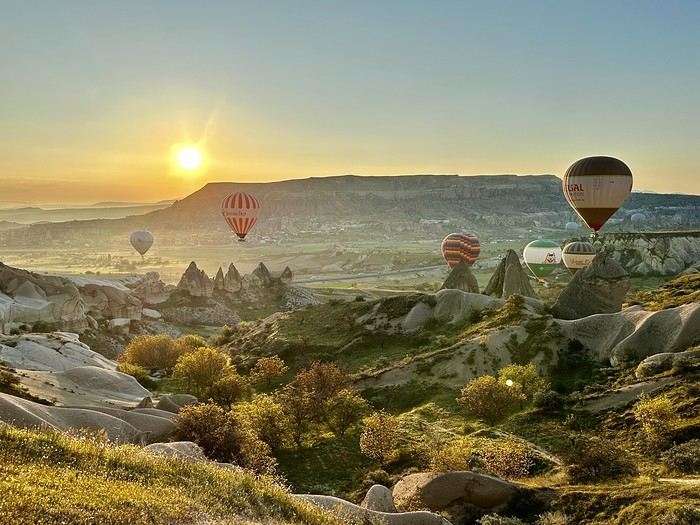 A little sneak peek?
If you're looking for great tips and offbeat spots, if you love exploring uncharted parts of a country, if the exotic is your adrenaline, then move along!
Our 15 days in early May in this part of Turkey (a country I first discovered during a city trip to Istanbul in 2017) will only tread well-worn paths and revisit popular routes. Simply because I kept hoping until the very end that our flight to Jordan wouldn’t be canceled. Events in the Gulf proved me wrong, so we left with: Zero preparation. Not a single hotel booked (well, except the first one), no visits planned, just a flight ticket bought three weeks earlier. No guidebook, no app—just the desire to explore southern Turkey and Cappadocia, whose images and the chance to stretch our legs had caught my eye.
Oh, wait—I did bring along a new guide: Gemini! Yes, my friends, generative AI was my chief advisor throughout the trip for sites to visit, accommodations, routes, and even restaurants! An experiment I wanted to try to form my own opinion on using this new technology. And what better way to test it than a Turkish getaway?
The verdict? You’ll have to wait for the trip recap to find out!
The main idea of the trip is also relaxation.
So, the plan is Antalya for a few days, the Turkish Riviera for a few more, Cappadocia as the highlight, and a return via Antalya to wrap up the trip. And it was all planned by AI!
So, if you're ready, fasten your seatbelts—cabin crew, doors to automatic and cross check—boarding for Turkey now!
A little sneak peek?Breathtaking Kyrgyzstan!
This trip had been on my mind for about fifteen years.
But the discomfort of overnight stays, the difficulty of communication, and the prices of the few car rental options kept making me postpone the project.
And then, everything suddenly fell into place—I told myself, it’s time!
The preparations took longer than usual; the destination is still far from mainstream.
A bit of Kazakhstan? Not in the end.
The south or not the south? Yes, in the end.
Pre-book or go with the flow? Only two stops were a leap into the unknown.
To help me find the ideal route, I made great use of this forum (thanks to everyone for patiently answering my questions!), pored over travel journals and blogs (Christian, Jeff), zoomed in on Google Maps and Yandex, and bought the guide published by OunTravela about this destination (the guide has been updated since).
---/---
You’ve got your passport, international driver’s license, bank cards, and euros?
Off we go to Lyon—just one night left before our early morning flight.
Tomorrow night, we’ll be sleeping in Bishkek! (Steak for my partner’s mischievous nephews...)
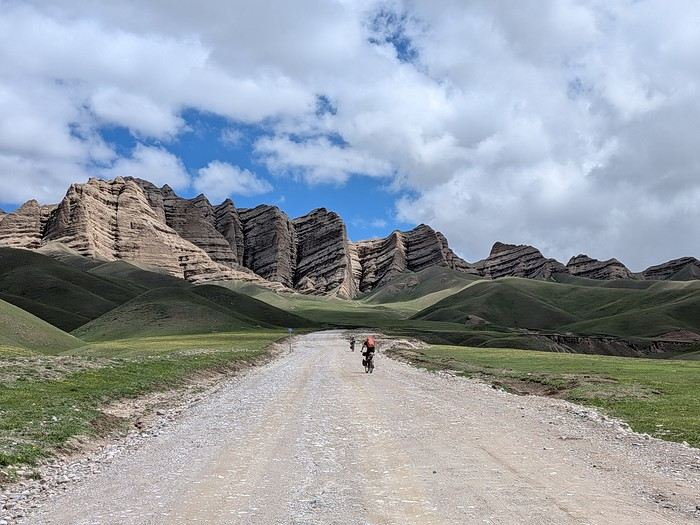
You’ll find here a post with some practical information.
And here, the version of the travel journal without comments.
---/---
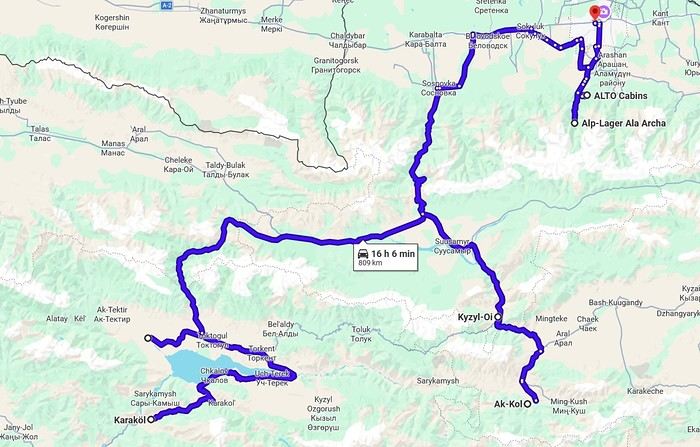
As a supplement, the route track. Not necessarily ultra-accurate since Google has serious gaps for this destination...
From Bishkek to Karakol:
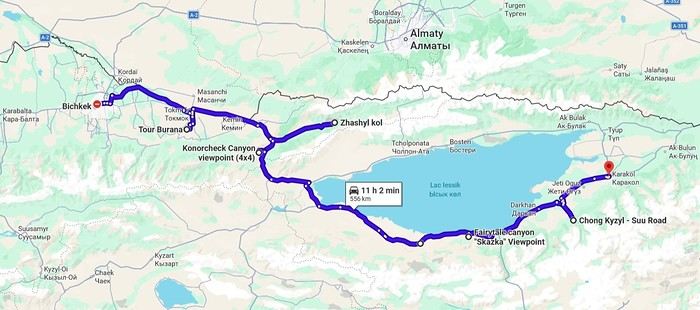
From Karakol to Kochkor:
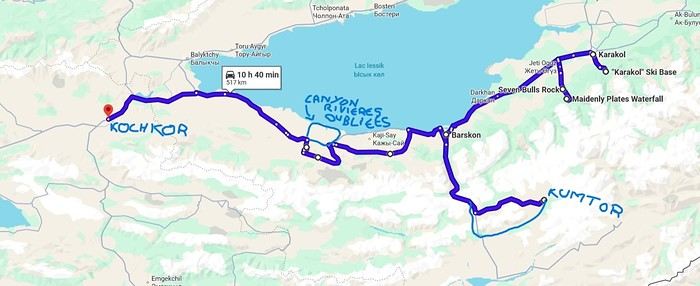
From Kochkor to Baetov:
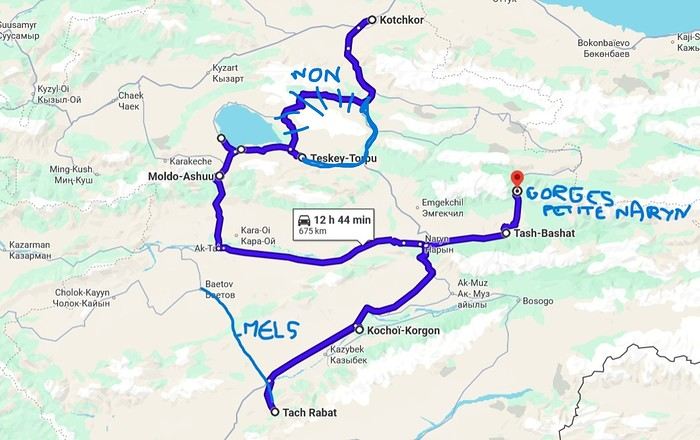
From Baetov to Kara-Köl:
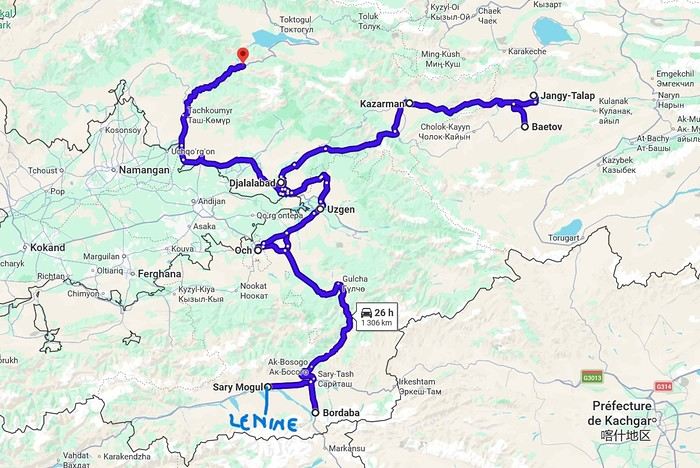
From Kara-Köl to Bishkek:

But the discomfort of overnight stays, the difficulty of communication, and the prices of the few car rental options kept making me postpone the project.
And then, everything suddenly fell into place—I told myself, it’s time!
The preparations took longer than usual; the destination is still far from mainstream.
A bit of Kazakhstan? Not in the end.
The south or not the south? Yes, in the end.
Pre-book or go with the flow? Only two stops were a leap into the unknown.
To help me find the ideal route, I made great use of this forum (thanks to everyone for patiently answering my questions!), pored over travel journals and blogs (Christian, Jeff), zoomed in on Google Maps and Yandex, and bought the guide published by OunTravela about this destination (the guide has been updated since).
---/---
You’ve got your passport, international driver’s license, bank cards, and euros?
Off we go to Lyon—just one night left before our early morning flight.
Tomorrow night, we’ll be sleeping in Bishkek! (Steak for my partner’s mischievous nephews...)
You’ll find here a post with some practical information.
And here, the version of the travel journal without comments.
---/---
As a supplement, the route track. Not necessarily ultra-accurate since Google has serious gaps for this destination...
From Bishkek to Karakol:
From Karakol to Kochkor:
From Kochkor to Baetov:
From Baetov to Kara-Köl:
From Kara-Köl to Bishkek:
Advice on a classic Indonesia itinerary for summer 2026
I’d love to get some feedback on our itinerary—it’s probably pretty basic! This is our second trip to Asia and our first to Indonesia. We have three kids aged 20, 18, and 12. We land in Jakarta at 4 PM, spend 3 nights/2 days there, then take the train to Yogyakarta for 3 nights/2 days, followed by the train to Surabaya for 2 nights/1 day, then the train to Bromo for 1 day/1 night, a private driver to Ijen for 2 nights/2 days, then on to Bali (Ubud) for 4 nights/3 days, followed by Gili Air for 3 nights/2 days, Senggigi (Lombok) for 2 nights, and finally 5 nights in Kuta. I’m considering cutting the 2 nights in Senggigi to just keep Kuta and extend it to 7 nights. In Lombok, I’m not sure how to get around since I’m not comfortable with scooters... Your thoughts on all of this, and any advice, are more than welcome—don’t hesitate!
For those wondering why cities like Jakarta and Surabaya: we don’t often get the chance to visit big Asian cities, so we wanted to include that discovery in our trip. The trains between Jakarta and Yogyakarta, Surabaya and Probolinggo are booked. The return flight from Lombok to Jakarta is also set. Accommodations are booked but flexible (same for the trains).
Thanks!
Villages around Hazaribagh in West Bengal
Wednesday, April 1st
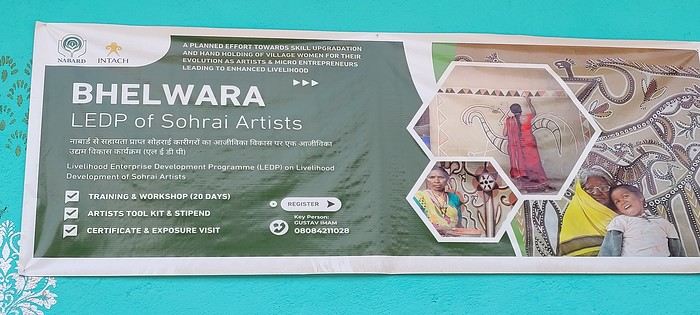
Hazaribagh I’ve got a meet-up with Adam Iman, a guide and painter. He picks me up from the hotel at 10 AM. Another traveler from Bangalore is supposed to join us, but while we wait for him to arrive, Adam takes me to see the paintings his mother and sister created at Hazaribagh station. The town became famous thanks to these murals, which can also be found in several surrounding villages. This art form has earned recognition and is now protected, a sign of its cultural importance. Once the visit is over, we go to pick up the other traveler and then head to our first village: Belwara, where Sohrai art is practiced. At the entrance, a sign proudly announces that we’re entering an artists’ village, where this art is created by women organized into micro-enterprises. Some even offer workshops for those who’d like to learn this tradition.
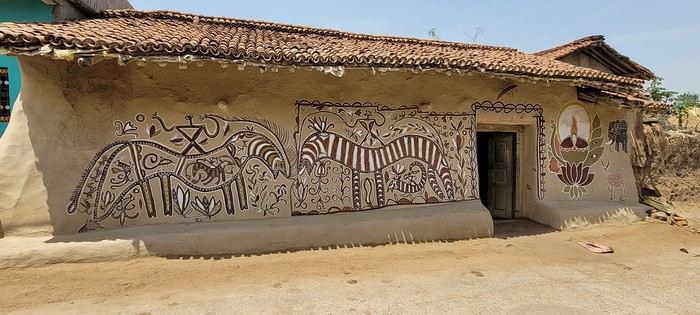
Sohrai art is tied to the harvest season, from October to mid-November. The motifs, in natural colors, celebrate fertility and abundance. The artists use pigments from the earth: red oxides, ochre, white kaolin, and black manganese. On the walls, you’ll see animals, fish, birds—all symbols of life and prosperity. As I look closer at the murals, I start to realize that each motif tells a story. Large animals like cows or bulls often take center stage. Their bodies are filled with intricate, almost hypnotic patterns. They symbolize wealth and prosperity for the household, as well as the deep respect for cattle, which are essential to daily life. On some facades, elephants stand out—massive and decorated with the same precision. They evoke quiet strength and protection. But it’s when I stop in front of one of the houses that I really take the time to look. The wall, a soft ochre, is entirely covered in murals. Two large animals stretch out on either side of the door, their elongated bodies fitting the length of the wall. Their silhouettes are filled with geometric patterns and incredibly fine curved lines, as if every space was patiently filled. Around them, stylized plants, flowers, and small decorative elements fill every gap. The door, dark and worn, becomes almost the silent center of the composition, framed by these living, protective forms. To the right, a more colorful motif catches the eye—a flower or a stylized lamp—like a touch of light on the earth. The whole thing gives an impression of perfect balance, between the rigor of the patterns and the freedom of the gesture.
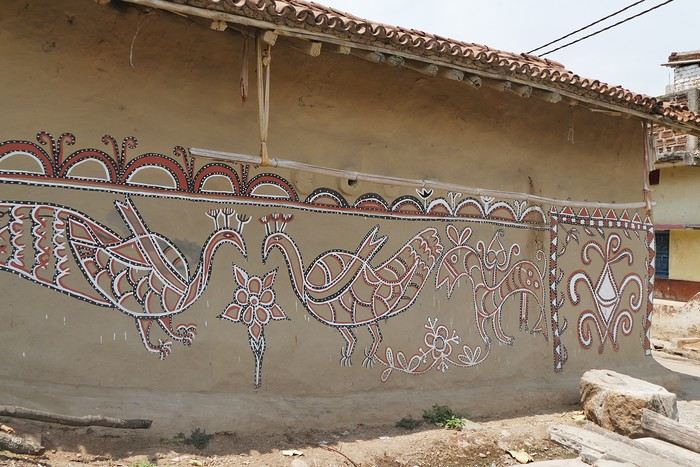
Elsewhere, birds and freer forms bring movement. Peacocks, recognizable by their stylized silhouettes, embody beauty and vitality, while fish symbolize water, fertility, and the continuity of life.
 On some paintings, the scenes become almost narrative: you can make out figures, everyday gestures, like a memory of the village inscribed in the walls. The decorative frames around the doors aren’t left to chance either—they symbolically protect the house, like a boundary between the inside and the outside world.
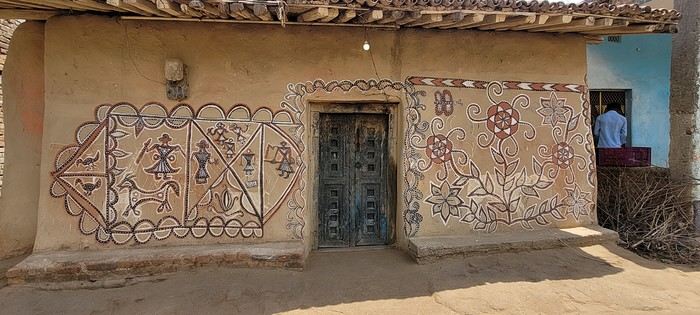
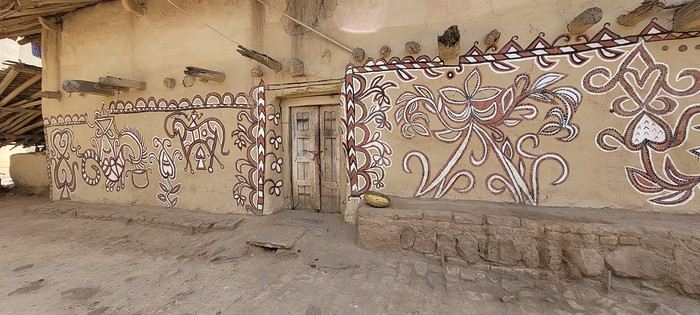
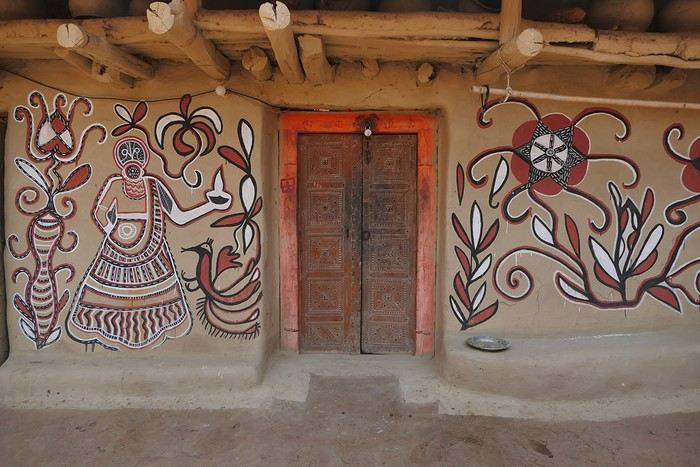
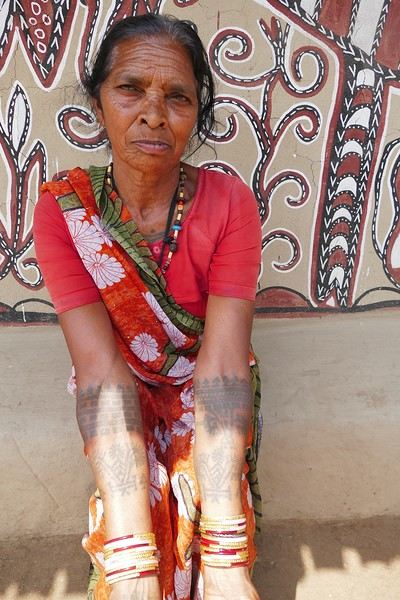
During the Sohrai festival, cattle are led into the jungle in the morning. Meanwhile, the women finish the *aripans*—these floor paintings—and continue the wall murals. Around noon, the animals return to the village, and the bulls’ horns are anointed with oil and vermilion in a gesture of gratitude, amid the vibrant colors adorning the houses. We visit several artists, including Parvat Devi, a well-known woman who has received many awards. Her arms are adorned with intriguing tattoos, which I’ll talk about in more detail later.
On another wall, the style changes completely. Here, no massive animals—just birds occupying the space, light and graceful, as if caught in mid-movement. Two silhouettes face each other, their long necks arched almost like mirrors, while their outstretched wings seem to vibrate with the patterns that compose them.
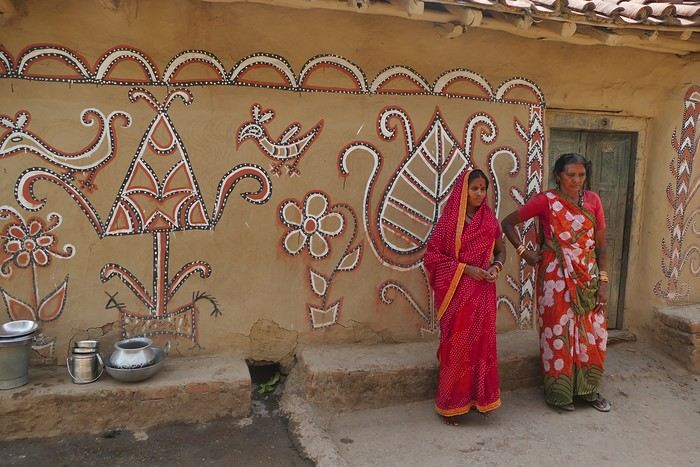
The design is more graphic, almost airy. The lines are smoother, more fluid, as if drawn in one confident stroke. The birds’ bodies aren’t solid—they’re filled with repetitive motifs like scales, stylized feathers, and spirals, giving a sense of continuous movement. Around them, everything comes to life: flowers burst open, arabesques swirl, and even the simplest shapes seem alive. What strikes me here is the sense of lightness. Where the large animals evoked stability and grounding, these birds bring something freer, almost joyful. They seem to embody movement, the circulation of life, like a breath flowing through the village.
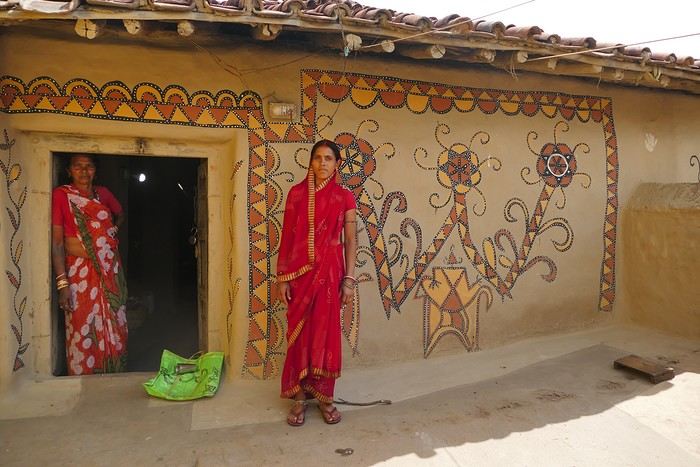
The colors remain the same—deep reds, intense blacks, and chalky white—but the rhythm is different. Faster, more spontaneous. As if each wall had its own personality, while still speaking the same language.
That’s probably why I’m so moved. I’d heard about these paintings from my friend Raja, and last year, I saw an exhibition in a village near my home. That first encounter made me want to come here. But seeing them in person is a whole different experience. These paintings are unique. This ancient art is passed down from mother to daughter, or mother-in-law to daughter-in-law, in a quiet, deeply living continuity. At first glance, it might seem almost childlike in its simplicity and pared-down forms. And yet, everything is thought out, balanced, mastered. Nothing is left to chance.
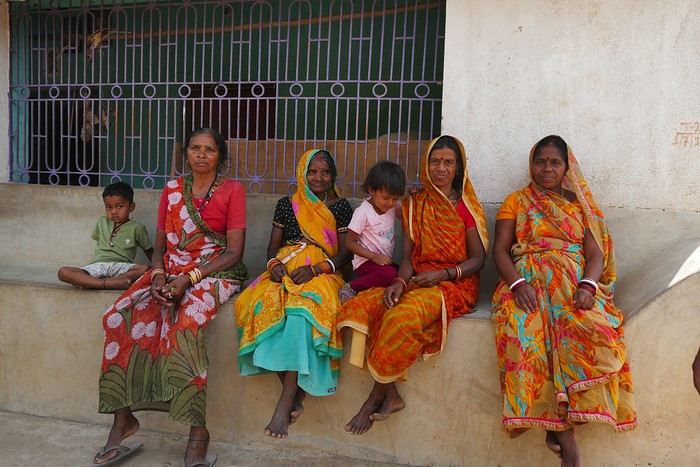
That apparent simplicity, combined with such rich symbolism, touches me deeply. There’s something sincere and essential in these walls—and that’s what moves me.
Hazaribagh I’ve got a meet-up with Adam Iman, a guide and painter. He picks me up from the hotel at 10 AM. Another traveler from Bangalore is supposed to join us, but while we wait for him to arrive, Adam takes me to see the paintings his mother and sister created at Hazaribagh station. The town became famous thanks to these murals, which can also be found in several surrounding villages. This art form has earned recognition and is now protected, a sign of its cultural importance. Once the visit is over, we go to pick up the other traveler and then head to our first village: Belwara, where Sohrai art is practiced. At the entrance, a sign proudly announces that we’re entering an artists’ village, where this art is created by women organized into micro-enterprises. Some even offer workshops for those who’d like to learn this tradition.
Sohrai art is tied to the harvest season, from October to mid-November. The motifs, in natural colors, celebrate fertility and abundance. The artists use pigments from the earth: red oxides, ochre, white kaolin, and black manganese. On the walls, you’ll see animals, fish, birds—all symbols of life and prosperity. As I look closer at the murals, I start to realize that each motif tells a story. Large animals like cows or bulls often take center stage. Their bodies are filled with intricate, almost hypnotic patterns. They symbolize wealth and prosperity for the household, as well as the deep respect for cattle, which are essential to daily life. On some facades, elephants stand out—massive and decorated with the same precision. They evoke quiet strength and protection. But it’s when I stop in front of one of the houses that I really take the time to look. The wall, a soft ochre, is entirely covered in murals. Two large animals stretch out on either side of the door, their elongated bodies fitting the length of the wall. Their silhouettes are filled with geometric patterns and incredibly fine curved lines, as if every space was patiently filled. Around them, stylized plants, flowers, and small decorative elements fill every gap. The door, dark and worn, becomes almost the silent center of the composition, framed by these living, protective forms. To the right, a more colorful motif catches the eye—a flower or a stylized lamp—like a touch of light on the earth. The whole thing gives an impression of perfect balance, between the rigor of the patterns and the freedom of the gesture.
Elsewhere, birds and freer forms bring movement. Peacocks, recognizable by their stylized silhouettes, embody beauty and vitality, while fish symbolize water, fertility, and the continuity of life.
On some paintings, the scenes become almost narrative: you can make out figures, everyday gestures, like a memory of the village inscribed in the walls. The decorative frames around the doors aren’t left to chance either—they symbolically protect the house, like a boundary between the inside and the outside world.During the Sohrai festival, cattle are led into the jungle in the morning. Meanwhile, the women finish the *aripans*—these floor paintings—and continue the wall murals. Around noon, the animals return to the village, and the bulls’ horns are anointed with oil and vermilion in a gesture of gratitude, amid the vibrant colors adorning the houses. We visit several artists, including Parvat Devi, a well-known woman who has received many awards. Her arms are adorned with intriguing tattoos, which I’ll talk about in more detail later.
On another wall, the style changes completely. Here, no massive animals—just birds occupying the space, light and graceful, as if caught in mid-movement. Two silhouettes face each other, their long necks arched almost like mirrors, while their outstretched wings seem to vibrate with the patterns that compose them.
The design is more graphic, almost airy. The lines are smoother, more fluid, as if drawn in one confident stroke. The birds’ bodies aren’t solid—they’re filled with repetitive motifs like scales, stylized feathers, and spirals, giving a sense of continuous movement. Around them, everything comes to life: flowers burst open, arabesques swirl, and even the simplest shapes seem alive. What strikes me here is the sense of lightness. Where the large animals evoked stability and grounding, these birds bring something freer, almost joyful. They seem to embody movement, the circulation of life, like a breath flowing through the village.
The colors remain the same—deep reds, intense blacks, and chalky white—but the rhythm is different. Faster, more spontaneous. As if each wall had its own personality, while still speaking the same language.
That’s probably why I’m so moved. I’d heard about these paintings from my friend Raja, and last year, I saw an exhibition in a village near my home. That first encounter made me want to come here. But seeing them in person is a whole different experience. These paintings are unique. This ancient art is passed down from mother to daughter, or mother-in-law to daughter-in-law, in a quiet, deeply living continuity. At first glance, it might seem almost childlike in its simplicity and pared-down forms. And yet, everything is thought out, balanced, mastered. Nothing is left to chance.
That apparent simplicity, combined with such rich symbolism, touches me deeply. There’s something sincere and essential in these walls—and that’s what moves me.
A Slightly Less Touristy Japan
Hi everyone, I’m Patrick, 67 years old, a seasoned traveler (already 22 trips outside Europe).
In autumn 2025, I took my first 3-week trip to Japan, with stops in Tokyo, Kamakura, Matsumoto, Kamikochi, Takayama, Kanazawa, Kyoto, Nara, Osaka, Koyasan, Tokyo again, and Nikko.
I wanted to go back in May 2026 and explore some lesser-known places to complement my first trip.
Last year, there were four of us traveling together to discover Japan (a fairly classic itinerary). This time, I’ll be traveling solo for part of the trip and with a couple of French friends for the rest.
The weather was gorgeous in May, averaging around 25°C, with two very hot days in Kyoto and only two rainy days.
As usual, I organized everything myself, gathering plenty of information from various sites, including this one.
Transportation: An ICOCA card is essential. I got a 5-day Kansai-Hiroshima pass because I took the shinkansen between Hiroshima and Osaka three times, and it paid for itself quickly.
Accommodations: Mostly through Booking. No issues at all. Average cost was 46 € per night.
Meals: For breakfast, I alternated between buying food at a konbini to eat in my room or on the train and grabbing something at local cafés. For lunch and dinner, I tried to vary my meals as much as possible—lots of sashimi, sushi, and ramen. Okonomiyaki in Osaka and Hiroshima. Oysters in every form (raw, grilled, fried) in Onomichi and Hiroshima. A variety of seafood (shrimp, shellfish) in Hiroshima and Matsumoto. Fish whose names often escaped me, but notably mackerel and eel (unagi). Tempura and gyoza. Chicken skewers (yakitori) and one teppanyaki meal. One omakase meal (9 different dishes). In the end, not much meat aside from a few yakitori skewers. No splurges on super expensive wagyu or Kobe beef. Average dinner cost: 4,800 yen, drinks included.
The Itinerary: Day 1: Departure from Brussels Day 2: Arrival in Osaka Day 3: To Himeji, then Kurashiki Day 4: To Fukuyama, then Tomo no Ura, then Onomichi Day 5: Cycling the Shimanami Kaido Day 6: To Takahara, then Hiroshima Day 7: To Kyoto to attend the Aoi Matsuri parade Day 8: To Miyajima Day 9: Hiroshima, then Kyoto Day 10: Southern Kyoto Day 11: Northern Kyoto Day 12: Final day in Kyoto, then to Nagatsugawa Day 13: Start of the Nakasendo Trail (Magome to Tsumago) Day 14: Second day of the trail (Kiso Fukushima) Day 15: Third day of the trail (Narai), then Matsumoto Day 16: To Mt. Fuji (Kawaguchiko) Day 17: To Tokyo Day 18: Excursion to Enoshima and Kamakura Day 19: Flight home, with a 10-hour layover in Hong Kong Day 20: Arrival in Brussels
August 2026 Photo Contest Theme: Religious Buildings
Since I don’t have time to come up with an original theme, I’m suggesting a broad, international topic: religious buildings around the world. Given how vast the subject is, I’d like us to focus on photos of exteriors—wide shots or details. Interiors, which are just as varied, could be the subject of another contest.
A few of my own photos, just to give you an idea: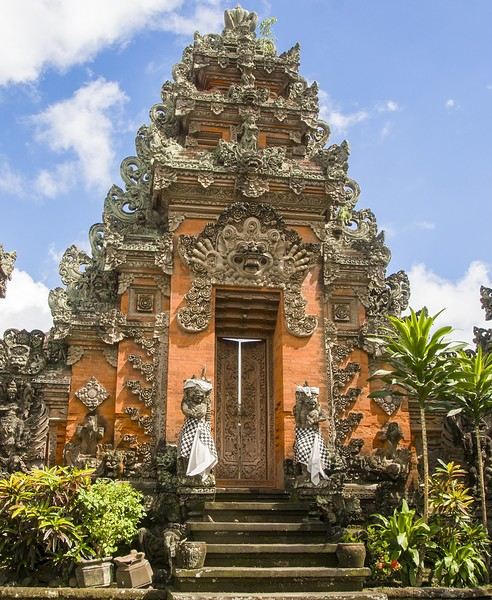
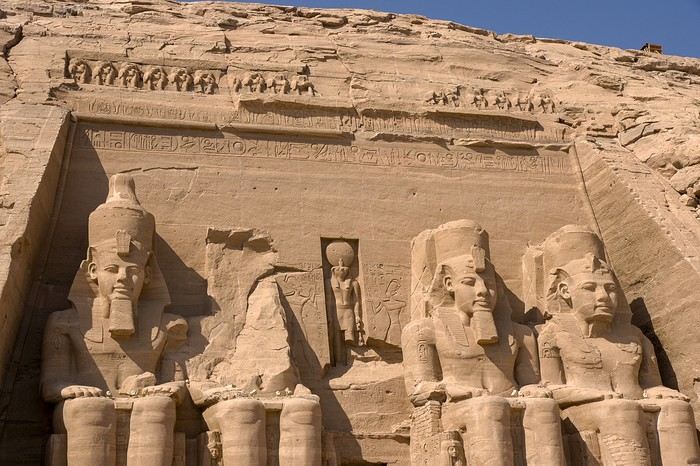
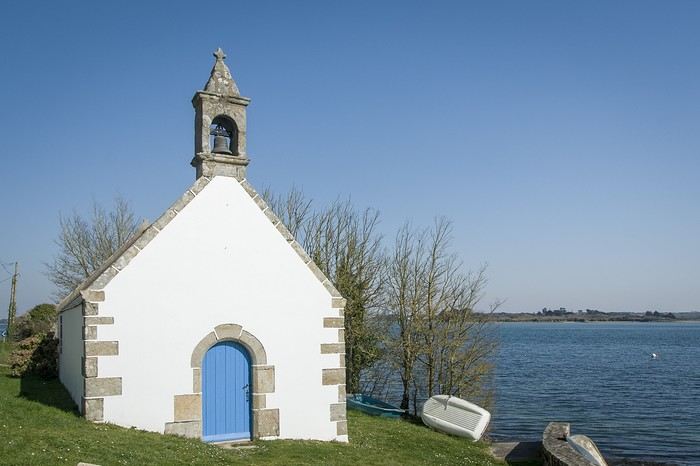
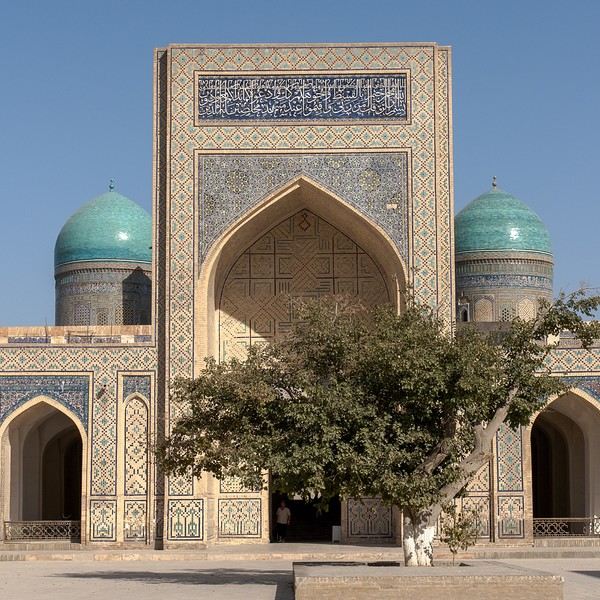
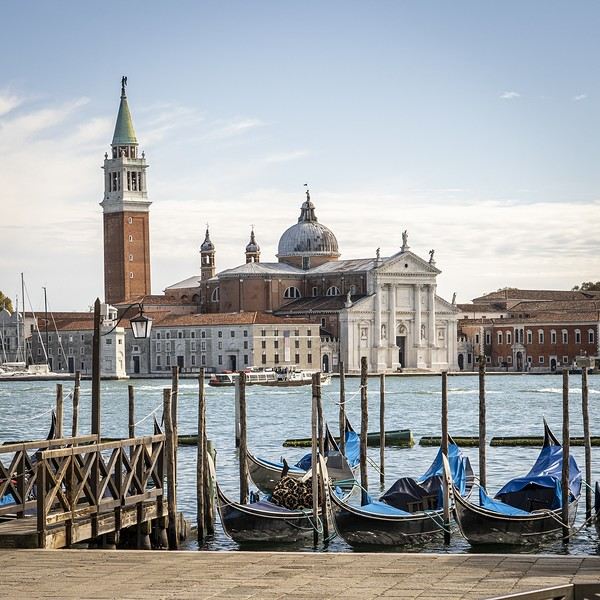

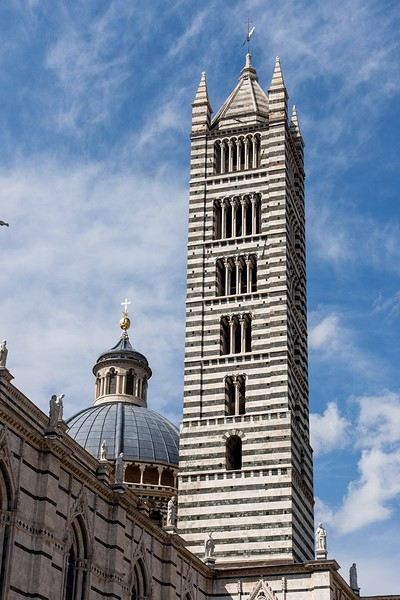
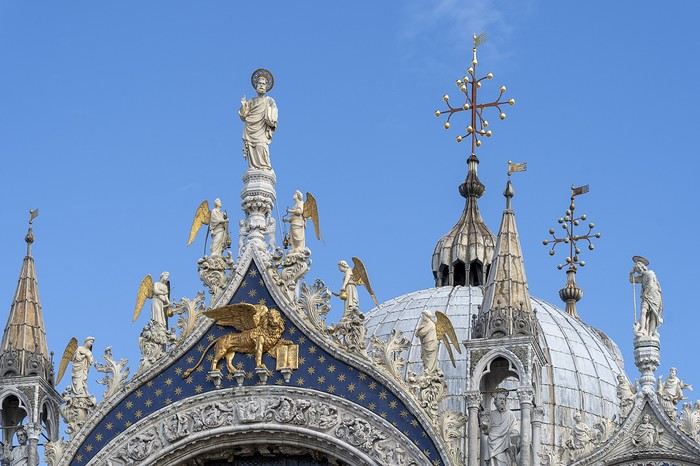
A few of my own photos, just to give you an idea:
Peru: A Childhood Dream Finally Fulfilled
Preamble
I could have titled my travel journal like Carmen: "Some trips are born twice." Indeed, we had considered this destination back in February 2020. However, an honest tour operator advised us against traveling at that time due to the climate. So, we gave up and opted for Guatemala instead (see "On the Mayan Lands" on this site).
So, why this title? When I was in primary school, over 65 years ago, the illustrations in my history books (Machu Picchu) and geography books (Lake Titicaca) made me dream, and those images stayed in my mind. It took until 2026 to finally make this dream come true!
We prepared our trip with Tout Pérou, a French-speaking "agency." Everything was handled via email and WhatsApp exchanges with our contact: Laurent, who was both competent, friendly, and full of good advice. For 200 €, Tout Pérou provided us with drivers and guides whenever we wanted, helped us buy our domestic flights (cheaper when purchased in Peru), booked shuttles between airports and hotels, and got us a discount on the train ride to Aguas Calientes, as well as on the buses between Chivay and Puno and between Puno and Cusco. In short, Laurent took care of all the logistics and the Machu Picchu tickets. It was up to us to book our hotels. Tout Pérou provided a list, but we weren’t obliged to follow it. Another advantage of the package: we didn’t have to pay in advance; we paid the service providers directly day by day.
We didn’t meet Laurent in person because he was on vacation in Europe. Before his departure, he gave us a briefing, provided a summary table with the entire program, the service providers, their phone numbers, their fees, the schedules, and gave us plenty of advice (money, exchange, safety, etc.). After returning at the end of our stay, he kept checking in on us.
Lastly, we had also gathered information from Arnaud Lagadec, who runs a hotel in Cusco and offers tours of the region. He gave us a lot of useful information. Another contact: Thomas Montaigne, very friendly, who runs an agency in Arequipa (Agence Pérou Exclusif).
Day 1 – Paris to Lima
Foreword I’ll share our trip without any pretension—I don’t have the talent of some contributors on this forum—and I’ll illustrate it with a few photos (taken with an ordinary smartphone). My comments are personal and only reflect my own views. So, please be kind! Feel free to comment on my story as you like, but let’s avoid pointless debates.
Even though we live in the south of the Paris region, true to our habits when the flight is in the morning, we chose to spend the night before our departure in a hotel near CDG and parked our car in a parking lot in Garches. This way, we avoid the stress that often comes with traveling around Paris (accidents, roadworks, traffic jams, etc.).
Check-in and border control went smoothly on that Sunday morning. Our Air France flight was uneventful. In Lima, border control took a particularly long time, and for the first time, we didn’t get an entry visa stamped in our passports.
As planned, a driver took us to the Miraflores district, where our hotel was located. We were surprised by the numerous signs about possible tsunamis, having forgotten that Peru is prone to such events and regularly experiences earthquakes. We’d see the consequences of these during our journey.
Exhausted from the early wake-up, the 13-hour flight, and the 7-hour time difference, we had dinner at the hotel before a restful night.
Note that this day was Peru’s presidential election day. As a result, we weren’t served beer—the sale of alcohol was banned that Sunday.
Travel Journal - 28 Days in China in August 2026
Hi everyone,
I’m sharing a little recap of this new 4-week trip to China—nothing fancy, just my experience.
We’re taking advantage of the extended visa exemption to return to China for the 4th time. I loved last summer’s trip so much that I’m a bit worried about being disappointed this year. Plus, I’ve had a few hiccups before this departure: my WeChat account got blocked, and I couldn’t recover it (luckily, Alipay still works fine); I couldn’t verify my 12306 account for weeks; Trip.com failed to book our second train; and I’ve got an injury that’ll slow me down during the trip... Ugh, I hate starting a trip with these kinds of issues. Then, oh surprise! Just before leaving, my 12306 account got verified! Super easy to use from that point on—I could book a few train tickets without fees.
We’re sticking with Free’s e-SIMs, which work great in China.
August 2–3
Anyway, on the morning of August 2nd, we took the RER to CDG. As usual, we couldn’t check in online. It’s always a bit frustrating, especially since we didn’t have any checked luggage. We flew with Air China. We arrived at the check-in counter at 9:50 AM, 2 hours and 40 minutes before the flight. The line for our check-in stretched 300 meters across the airport in both directions. What a joke!! We spent 1 hour and 45 minutes in that line just to reach the counter and get our boarding passes. By then, it was 11:35 AM, and boarding had already started at 11:20 AM. The screens showed a 25-minute walk to our gate—on the other side of the airport, of course—plus we had to go through passport control and security... Long story short, the plane didn’t leave without us 🙂 We boarded among the last passengers, and we took off at 12:30 PM. We’d flown Air China four times before, but this time, it felt *really* low-cost. The check-in chaos, the cramped seats (12 seats per row), no music by artists known outside China, mediocre food, and a boarding area at Beijing Airport with only 10 seats—worthy of Ryanair or EasyJet. And yet, the price was sky-high. Again, D.’s vacation requests were denied outside of July and August, so we’re traveling from August 2nd to 30th. We couldn’t have picked a worse time for inflated prices, and with the situation in Iran, we got hit with a 390 € fuel surcharge. I’ve never paid so much for flights—I felt like I’d bought business class, but nope, far from it!!
We landed in Beijing around 4:15 AM. It was 28°C with thick fog. We drove and drove and drove for 20 minutes, as usual in Beijing. Then we went through a first check, a second check, a third check, and waited for our connecting flight at 6:40 AM. A small Airbus A320, but way more space than in the Boeing 777 from the first flight. We landed in Kunming, Yunnan, around 10:15 AM in the rain.
We headed to the subway. You can’t pay at the machines with Alipay here either, so we set up the transport QR code directly in Alipay to scan at the subway gates. The process is a bit long the first time if you haven’t entered your info before, but once it’s done, it’s *so* much easier! We took Line 6 to the terminus for 6 yuan each.
We’d booked a hotel nearby, on the 16th floor. It’s actually studios on different floors of a huge residential building. The view’s pretty nice from here. We settled in quickly—back to those wooden beds, or rather, mattresses as hard as wood, which we *hadn’t* missed... Then we went out for our first bowl of noodles of the trip and wandered through the shopping streets of the old town.

It was crowded, and the weather was cool—around 19–20°C. We tried a local specialty: milk skin, thick, dried, then grilled with rose jam. Yeah... we won’t be having that again. The taste and texture of the milk skin... no thanks.

We saw a lot of wild mushroom hotpot too. It’s on our list for later. We also passed through the Jinma and Biji gates, where I played with reflections in puddles. I *love* doing that 🙂

At the end of the day, we headed to a temple advertised as open 24/7 on Amap. Of course, when we got there, it was closed. We’ll go back tomorrow. That was the first of many disappointments with Amap this trip—I hadn’t had that issue on previous visits.
We were exhausted after that sleepless flight. Night was falling, and we decided to grab a quick bite without much appetite. We shared a delicious vegetable fried rice for 12 yuan—we even left half of it. The portions are *huge*.
After a couple of small purchases, we headed back at 9 PM, wiped out, after walking 17 km between the airports and these first steps in Kunming. I expected to see quite a few Western travelers here, but we didn’t spot a single one. Instead, we met lots of curious Chinese people, many of them super friendly and helpful—almost *too* eager, like when they’d run to serve us as fast as possible. It’s a bit much, but it’s great to be back!
I’m sharing a little recap of this new 4-week trip to China—nothing fancy, just my experience.
We’re taking advantage of the extended visa exemption to return to China for the 4th time. I loved last summer’s trip so much that I’m a bit worried about being disappointed this year. Plus, I’ve had a few hiccups before this departure: my WeChat account got blocked, and I couldn’t recover it (luckily, Alipay still works fine); I couldn’t verify my 12306 account for weeks; Trip.com failed to book our second train; and I’ve got an injury that’ll slow me down during the trip... Ugh, I hate starting a trip with these kinds of issues. Then, oh surprise! Just before leaving, my 12306 account got verified! Super easy to use from that point on—I could book a few train tickets without fees.
We’re sticking with Free’s e-SIMs, which work great in China.
August 2–3
Anyway, on the morning of August 2nd, we took the RER to CDG. As usual, we couldn’t check in online. It’s always a bit frustrating, especially since we didn’t have any checked luggage. We flew with Air China. We arrived at the check-in counter at 9:50 AM, 2 hours and 40 minutes before the flight. The line for our check-in stretched 300 meters across the airport in both directions. What a joke!! We spent 1 hour and 45 minutes in that line just to reach the counter and get our boarding passes. By then, it was 11:35 AM, and boarding had already started at 11:20 AM. The screens showed a 25-minute walk to our gate—on the other side of the airport, of course—plus we had to go through passport control and security... Long story short, the plane didn’t leave without us 🙂 We boarded among the last passengers, and we took off at 12:30 PM. We’d flown Air China four times before, but this time, it felt *really* low-cost. The check-in chaos, the cramped seats (12 seats per row), no music by artists known outside China, mediocre food, and a boarding area at Beijing Airport with only 10 seats—worthy of Ryanair or EasyJet. And yet, the price was sky-high. Again, D.’s vacation requests were denied outside of July and August, so we’re traveling from August 2nd to 30th. We couldn’t have picked a worse time for inflated prices, and with the situation in Iran, we got hit with a 390 € fuel surcharge. I’ve never paid so much for flights—I felt like I’d bought business class, but nope, far from it!!
We landed in Beijing around 4:15 AM. It was 28°C with thick fog. We drove and drove and drove for 20 minutes, as usual in Beijing. Then we went through a first check, a second check, a third check, and waited for our connecting flight at 6:40 AM. A small Airbus A320, but way more space than in the Boeing 777 from the first flight. We landed in Kunming, Yunnan, around 10:15 AM in the rain.
We headed to the subway. You can’t pay at the machines with Alipay here either, so we set up the transport QR code directly in Alipay to scan at the subway gates. The process is a bit long the first time if you haven’t entered your info before, but once it’s done, it’s *so* much easier! We took Line 6 to the terminus for 6 yuan each.
We’d booked a hotel nearby, on the 16th floor. It’s actually studios on different floors of a huge residential building. The view’s pretty nice from here. We settled in quickly—back to those wooden beds, or rather, mattresses as hard as wood, which we *hadn’t* missed... Then we went out for our first bowl of noodles of the trip and wandered through the shopping streets of the old town.
It was crowded, and the weather was cool—around 19–20°C. We tried a local specialty: milk skin, thick, dried, then grilled with rose jam. Yeah... we won’t be having that again. The taste and texture of the milk skin... no thanks.
We saw a lot of wild mushroom hotpot too. It’s on our list for later. We also passed through the Jinma and Biji gates, where I played with reflections in puddles. I *love* doing that 🙂
At the end of the day, we headed to a temple advertised as open 24/7 on Amap. Of course, when we got there, it was closed. We’ll go back tomorrow. That was the first of many disappointments with Amap this trip—I hadn’t had that issue on previous visits.
We were exhausted after that sleepless flight. Night was falling, and we decided to grab a quick bite without much appetite. We shared a delicious vegetable fried rice for 12 yuan—we even left half of it. The portions are *huge*.
After a couple of small purchases, we headed back at 9 PM, wiped out, after walking 17 km between the airports and these first steps in Kunming. I expected to see quite a few Western travelers here, but we didn’t spot a single one. Instead, we met lots of curious Chinese people, many of them super friendly and helpful—almost *too* eager, like when they’d run to serve us as fast as possible. It’s a bit much, but it’s great to be back!
Getting to Palermo from Paris on a budget
Hello everyone,
This is my first time traveling to Italy
For a short cultural trip
From October 8th to 17th
Solo as a senior woman
I booked my one-way ticket with FlixBus
From Lille Europe
On October 8th at 11:55 PM
I arrive at Porte de Maillot (Paris Pershing)
At 3:05 AM
And I’d like to get to Palermo, Italy
Starting October 9th
I’ve checked tickets—prices are sky-high everywhere, and there are even scams
Can you advise me on how to get to this city
Affordably
By train, plane, or bus
I need to arrive by October 9th
For my hostel room
Which is located at
Address provided
5.4K followers • 426 following
Travel, meet, be surprised, and fall in love with Palermo
Book at: www.acasadiamici.com
Via Dante 57, Palermo | +39 091 7654650
Palermo
acasadiamicihostel
+39 328 317 2205
A Casa di Amici, a place to live!
And from Palermo, how do I get to the hostel where I’ve booked? I’m counting on your support and understanding To make things easier before I arrive And to recommend the best ways to get there Safely Can I count on you? Thanks for your trust. Looking forward to your advice, best regards.
And from Palermo, how do I get to the hostel where I’ve booked? I’m counting on your support and understanding To make things easier before I arrive And to recommend the best ways to get there Safely Can I count on you? Thanks for your trust. Looking forward to your advice, best regards.
Marrakech – Dakar by Motorcycle for September 2027 – Tips and Travel Companions
Hi everyone,
I’m starting to plan a motorcycle trip from Marrakech to Dakar for September 2027.
The idea is to cross southern Morocco, then Mauritania, and finally Senegal all the way to Dakar, taking the time to explore the regions we pass through.
I’m especially looking for advice and feedback from people who’ve already done all or part of this route: recommended itinerary, road and track conditions, border crossings, formalities, safety, fuel, accommodations, must-see stops, things to avoid, etc.
I’d also love to hear your thoughts on traveling in September for this trip.
If any motorcyclists want to join the adventure, that’d be great! The idea is to form a small group, each covering their own expenses, and plan the trip together.
All your tips, experiences, and good addresses are welcome!
Thanks in advance for your help.
Khalid Marrakech
Road Trip to the Yukon: The Adventure of a Lifetime Across Canada
For a long time, the Yukon had been one of those dream travel destinations for us. Its vast wilderness, majestic mountains, and fascinating history tied to the gold rush irresistibly drew us in.
We finally made this ambitious project a reality: a road trip across Canada heading toward the Yukon.
Since the journey from Quebec is considerable, we chose to turn the trip itself into a series of adventures.
Instead of just racking up the kilometers, we made plenty of stops to discover several tourist attractions spread across different provinces.
Along the way, each province offered its share of landscapes and discoveries. We crossed vast forests, admired beautiful lakes, explored historic sites, and visited several local attractions that helped us better appreciate Canada’s diversity.
These breaks made the trip much more enjoyable and allowed us to take the time to fully enjoy each region we visited.
One of the great pleasures of a road trip is the freedom it provides. We could adjust our itinerary based on our mood, extend a visit we particularly enjoyed, or stop spontaneously at a spectacular viewpoint.
Often, it’s these unexpected discoveries that become the best memories.
As we moved northwest, the landscapes became more and more impressive. The roads seemed endless, the mountains drew closer, and nature took on an even greater presence. Traffic gradually thinned out, giving way to a sense of freedom that’s hard to describe.
Arriving in the Yukon marked the culmination of several days of travel. From the first kilometers, we were amazed by the vastness of the territory.
The breathtaking panoramas, the wildlife everywhere, and the unique atmosphere of the Canadian North more than made up for all the kilometers we’d covered.
This road trip to the Yukon reminded us that the destination is important, but the journey is just as much a part of it.
The many stops we made along the way allowed us to discover extraordinary places we probably never would’ve visited otherwise.
Every province we crossed helped make this adventure even more memorable.
The Yukon will certainly remain one of the highlights of our travels, but the memories we gathered along the way hold a special place in our hearts too.
That’s what makes a great Canadian road trip so magical: every kilometer tells a story.
In the upcoming posts, you’ll discover the places that caught our attention throughout this road trip.
Don’t hesitate to watch the videos to complete the experience and explore these attractions as if you were there.
To jump to a specific post, here are the appropriate links:
Roland Lake Falls - Lac-Pythonga (Quebec) | First Stop on the Way to the Yukon Must-See Stops in Ontario Stop at the Center of Canada | Manitoba Stop in Winnipeg (Manitoba) Discovering Regina (Saskatchewan) Stops in Moose Jaw, Chaplin & Saskatoon (Saskatchewan) Stops in Vegreville & Edmonton (Alberta) Stop at West Edmonton Mall, a World of Attractions Under One Roof Stops in Beaverlodge (AB) & Dawson Creek (BC) Adventure on the Alaska Highway: Between Dawson Creek and Liard River (BC) Discovering Liard River Hot Springs (BC) The Sign Post Forest (Watson Lake) Stops at Rancheria Falls, Teslin, and Tagish Discovering Carcross and Its Must-See Spots Carcross Desert Yukon: A Surprising Desert in the Heart of Canada Must-See Stop at Emerald Lake (Yukon) Hike at Miles Canyon (Whitehorse) - Yukon Discovering Whitehorse Spectacular Northern Lights - Fish Lake - Whitehorse (Yukon) Must-See Stops Between Whitehorse and Dawson City Road Trip on the Dempster Highway (Yukon) - 100 km of Adventure Complete Visit of the Historic Town of Dawson City in the Yukon Midnight Dome Dawson City - Magical Northern Lights in the Yukon
Northern Morocco, the kingdom of kif?
My first trip to Morocco dates back to the early 90s.
Four more followed...
I’d never gone further north than Casablanca, Volubilis, or Fez—it was time to fix that!
So I planned a route that would fill in the gaps while revisiting a few places.
This route is pretty classic—if you’re looking for something original, you might want to skip it!
The starting point of the trip: the city of Rabat.
The stops?
Azrou, Fez, Al Hoceïma, Akchour, Tetouan, Tangier, Asilah, and finally Rabat.
Mostly an urban trip, then.
Too much?
We’ll see at the end of the travel journal!

Four more followed...
I’d never gone further north than Casablanca, Volubilis, or Fez—it was time to fix that!
So I planned a route that would fill in the gaps while revisiting a few places.
This route is pretty classic—if you’re looking for something original, you might want to skip it!
The starting point of the trip: the city of Rabat.
The stops?
Azrou, Fez, Al Hoceïma, Akchour, Tetouan, Tangier, Asilah, and finally Rabat.
Mostly an urban trip, then.
Too much?
We’ll see at the end of the travel journal!
Morocco: Four Medinas for One Enchantment
Hello everyone! 🙂
No wonder Tangier has inspired so many artists, writers, painters, and musicians… The "Pearl of the North" will be the first stop on a 12-day journey that will take us through Rabat, Fez, and Meknes.
This is my 15th trip to Morocco, and I’d never been to Tangier before! A round-trip flight from Carcassonne for just 55 € sealed the deal, and here we are, landing two hours later.
Four medinas, four perspectives—an enchantment that remains untouched. Once again, Richard and I will combine our viewpoints in a travel journal, sharing them with you—his through words, mine through images.
No wonder Tangier has inspired so many artists, writers, painters, and musicians… The "Pearl of the North" will be the first stop on a 12-day journey that will take us through Rabat, Fez, and Meknes.
This is my 15th trip to Morocco, and I’d never been to Tangier before! A round-trip flight from Carcassonne for just 55 € sealed the deal, and here we are, landing two hours later.
Four medinas, four perspectives—an enchantment that remains untouched. Once again, Richard and I will combine our viewpoints in a travel journal, sharing them with you—his through words, mine through images.
Great Divide Mountain Bike Route
Hello,
Following our trip on the Great Divide Mountain Bike Route this summer, we’re sharing our experience in this travel journal.
We’re Richard and Bernadette, both 64 years old, and we’re gravel bike-packing cyclists.
We’ve completed several gravel bike trips in France and neighboring countries, and Richard has also done some in South America.
We left on July 22, 2026, from Geneva to Calgary via Frankfurt with our bikes carefully packed in boxes, and we returned on October 8 from El Paso to Geneva via Chicago and Frankfurt.
The GDMBR is a mountain route that closely follows the Pacific/Atlantic continental divide, starting in Banff, Canada, and ending at the Mexican border in Antelope Wells, New Mexico. This crossing of the American West is one of the longest mountain biking routes in the world, winding through wild valleys, mountain ranges, and desert plateaus. It stretches about 4,400 km with a total elevation gain of around 60,000 m. The average altitude is 2,000 m, and the highest point reaches 3,600 m. The route is 80% off-pavement (gravel roads, dirt, and a few trail segments). It’s also known for the annual Tour Divide race, which brings together the best riders in the discipline every June and follows roughly the same route.
We prepared for this trip over several months, using a few websites and an older guidebook (the 2013 English edition).

With this, we were able to organize our journey with as much information as possible, a GPS track, and gear suited to the weather conditions, terrain, and sparse resupply points in remote areas.
Once we arrived in Banff, we picked up bear spray to handle a particular challenge: the wildlife we weren’t familiar with.

After landing in Calgary, we assembled and equipped our bikes at the airport. That first evening, we were welcomed by Mike, who invited us to his place when we were looking for a spot to pitch our tent. Then we made our way to Banff over two days, taking a fairly quiet road to Canmore and then a bike path.

A visit to Banff, a charming tourist town in the national park. Its famous Fairmont Hotel.

The starting point of the GDMBR at the arch of this hotel complex.

Here we are, immersed in the wilderness—just a few pedal strokes away from the town, the contrast is striking. Powerful rivers, vast landscapes, and our first encounter with a mule deer.

Spray Lake, our first basic campsite: no showers, dry toilets, no water fountain—we filter lake water. Most GDMBR campsites are like this.


We took the west side of the lake—a longer and wilder route. A few fallen trees blocked the path, forcing us to carry our bikes. But the stunning landscapes made it all worth it!

Our first single track through a forest marked by past wildfires.


Most campgrounds have tables and metal fire rings for safe campfires, which makes setting up camp much easier—especially nice after a long, tiring day! During this trip, we mostly slept in our tent, either in established campgrounds or wild bivouacs.
To be continued...
The GDMBR is a mountain route that closely follows the Pacific/Atlantic continental divide, starting in Banff, Canada, and ending at the Mexican border in Antelope Wells, New Mexico. This crossing of the American West is one of the longest mountain biking routes in the world, winding through wild valleys, mountain ranges, and desert plateaus. It stretches about 4,400 km with a total elevation gain of around 60,000 m. The average altitude is 2,000 m, and the highest point reaches 3,600 m. The route is 80% off-pavement (gravel roads, dirt, and a few trail segments). It’s also known for the annual Tour Divide race, which brings together the best riders in the discipline every June and follows roughly the same route.
We prepared for this trip over several months, using a few websites and an older guidebook (the 2013 English edition).
With this, we were able to organize our journey with as much information as possible, a GPS track, and gear suited to the weather conditions, terrain, and sparse resupply points in remote areas.
Once we arrived in Banff, we picked up bear spray to handle a particular challenge: the wildlife we weren’t familiar with.
After landing in Calgary, we assembled and equipped our bikes at the airport. That first evening, we were welcomed by Mike, who invited us to his place when we were looking for a spot to pitch our tent. Then we made our way to Banff over two days, taking a fairly quiet road to Canmore and then a bike path.
A visit to Banff, a charming tourist town in the national park. Its famous Fairmont Hotel.
The starting point of the GDMBR at the arch of this hotel complex.
Here we are, immersed in the wilderness—just a few pedal strokes away from the town, the contrast is striking. Powerful rivers, vast landscapes, and our first encounter with a mule deer.
Spray Lake, our first basic campsite: no showers, dry toilets, no water fountain—we filter lake water. Most GDMBR campsites are like this.
We took the west side of the lake—a longer and wilder route. A few fallen trees blocked the path, forcing us to carry our bikes. But the stunning landscapes made it all worth it!
Our first single track through a forest marked by past wildfires.
Most campgrounds have tables and metal fire rings for safe campfires, which makes setting up camp much easier—especially nice after a long, tiring day! During this trip, we mostly slept in our tent, either in established campgrounds or wild bivouacs.
To be continued...