Results for "Nauru"
About 1,041 results.
More options
Many results are in French, the community’s main language. English translations are added over time.
Search results
Visa ETA pour l'Australie
J'ai obtenu un visa ETA pour l'Australie directement sur Internet. C'est très facile, aucune formalité n'est demandée, juste le numéro de passport et 20 AUD. Il est valable 3 mois à partir de la date d'entrée sur le territoire et est renouvellable facilement sur Internet en indiquant juste le numéro d'autorisation du premier ETA. J'envisage de passer 6 mois en Australie.
Petite question simple: Dois-je sortir du pays pour renouveller ce visa ETA ?
Il semblerait que oui mais ça m'embete de faire un aller-retour pour la Nouvelle-Calédonie juste pour ça.
Si qqun a déjà fait cette expérience, ces infos sont les bienvenues. 🙂
Merci d'avance ...
Petite question simple: Dois-je sortir du pays pour renouveller ce visa ETA ?
Il semblerait que oui mais ça m'embete de faire un aller-retour pour la Nouvelle-Calédonie juste pour ça.
Si qqun a déjà fait cette expérience, ces infos sont les bienvenues. 🙂
Merci d'avance ...
Trek au Kilimanjaro en Tanzanie
bonjour,
l'ascension du kili me parait tres interessante mais n'ayant pas encore dépassé les 3500 m lors de mes autres randos, je voudrais avoir le recit de plusieurs experiences pour connaitre le niveau du trek .
merci a tous ceux qui me repondront !🙂
De retour de Playa Pesquero
bonjour nous sommes aller a playa pesquero du 15 au 22 janvier 2005 et nous avons adorer!!!!!les chambres sont super belle et tres propre bien que je sois dédaigneuse!!!les gens y sont sympatique mais pas pressé!!!nous sommes en vacance et on na parfois l impression qu eux autres aussi!!!mais cest pas grave on tombe vite a leur bite et cest correct.la plage est super belle l eau y est vraiment clair quand tu a de leau au coup tu te vois encore tres bien les pieds! les chaises nont pas de coussin mais tu y met ta servitte et cest correct l important cest de ne pas manquer de chaises et il en manque rarement!la biere est bonne la bouffe aussi moins au buffet mais il y a tellement de choix que tu te trouve quelque chose...je suis végé et je me suis trouvé quelque chose alors...je la recommande vraiment jy retournerai demain matin!!!!!
Seule à Agadir (Maroc)
😎voila je part le 5 fevrier au maroc a agadir pour rencontrer quelqu'un, on me dit des chose négative sur ce pays au niveau des lois, une femme qui voyage seul et qui est avec un marocain serait tres mal vu🙁??? est ce vrai??? je part vraiment a l'inconnu!!je ne vais pas a l'hotel c'est lui qui s'occupe du logement.quel sont les risque a part celle qui sont évidente!! il parait qu'il devra avoir une autorisation pour m'accompagné.est ce vraiment le cas?et quoi sert vraiment cette autorisation ? que dois je prévoir pour assurer ma securité?😕
Itinéraire sympa en vélo France ou Europe
Bonjour à tous !
Je cherche un itinéraire sympa à réaliser en France en 1 ou 2 semaines (ou pourquoi pas Europe) en vélo
Je pensais un peu Bretagne ou Massif Central...
Par contre j'aimerais éviter les axes trop fréquentés (surtout que ce serait en haute saison ) et préfère de loin les petites routes de traverses un peu oublié des camping car et autres mastodondes inodorants ...😠
D'autres part j'ai entendu parlé des voix vertes qui serait des sortes de pistes cyclables trans-région mais je n'en sais pas plus ...?
Alors si quelqu'un connait un itinéraire sympas, répondant à mes exigences 😇, je suis preneur ...
Merci pour vos conseils
Je cherche un itinéraire sympa à réaliser en France en 1 ou 2 semaines (ou pourquoi pas Europe) en vélo
Je pensais un peu Bretagne ou Massif Central...
Par contre j'aimerais éviter les axes trop fréquentés (surtout que ce serait en haute saison ) et préfère de loin les petites routes de traverses un peu oublié des camping car et autres mastodondes inodorants ...😠
D'autres part j'ai entendu parlé des voix vertes qui serait des sortes de pistes cyclables trans-région mais je n'en sais pas plus ...?
Alors si quelqu'un connait un itinéraire sympas, répondant à mes exigences 😇, je suis preneur ...
Merci pour vos conseils
Mar del Plata ou L'Argentine à la plage!
Bonjour a tous !
Apres le post sur les plages de Villa Gesell, en voyant les photos ci dessous vous comprendrez pourquoi ne pas aller a Mar del Plata en janvier et fevrier et plutot aller du cote de Carilo ou de Villa Gesell (meme si c'est un peu plus cher !) Aujourd'hui a Mar del Plata ! Ou peut on encore planter son parasol ? 1.500.000 touristes argentins en ce moment sur la cote et la grooooooosse majorite a Mar del Plata ! Un truc a comprendre : L argentin va a la plage non pas pour se baigner, mais pour bronzer mais surtout pour etre vu et voir ! Donc une plage deserte ne l interresse pas ! A 40 ou 50 km de cet endroit il y en a ! oui, oui !
  Une autre petite plage de Mar del Plata ce dimanche 16 fev.! Il faut que l argentin soit toujours entouré, il vit en famille a Buenos Aires, il part en vacance en famille, entre amis, entre collegue de travail, entre voisins ou meme tout en meme temps (oui, oui j en suis sur, j'ai deja vu !) ils se deplacent toujours en groupes, en bande, en clan ...mais attention pas en couple...non ! en bande de couples ! Bref, il n est jamais seul, donc il descend dans un hotel le plus chic possible ( pour ceux qui peuvent ) car l important aussi a Bsas de retour des vacances c'est de dire combien on a depensé (il faut que ca soit le plus haut possible, quitte a exagerer un peu ...de toute facon en donnant le nom de l hotel, les noms des boites branchees et les nom des restos ou ils seront alles, suffiront a faire comprendre qu'ils ont depensé beaucoup !!!! ). On peut le lire avec sourire, mais vous ne pouvez pas savoir comme c'est reel et comme c'est important pour eux...n oubliez pas que pour l argentin tout est dans le parraitre et dans la frime ! (cote italien qu ils auront garde!...et encore les italiens que je connais ne sont pas comme ca!).
  Donc tout comme le palais de Versailles: on doit y etre vu ! La plage de Mar del Plata ( tout comme la plage de Punta del este pour la classe superieure) c est le podium 24h sur 24h ou tout le monde defile.......
  Y en a qui aime ! c est sur, mais bon ...on est loin des petites plages bien tranquille du nord de la Bretagne !
  Maintenant vous savez, si vous allez a Mar del Plata, ce ne st pas pour vous baigner....ne soyez pas hypocrites ! ( les argentins disent "para descansar", ben tiens ! )
  Ca c est le croisement de ceux qui partent et de ceux qui reviennent a Bsas, hier samedi a la terminal de Retiro ! Toujours en masses, comme de fourmis...c est ca oui, ce sont des colonies de fourmis en transumance .
  Mar del Plata ou Bsas ? perdu : Mar del Plata ! Un paseo le long de la promenade pendant un dimanche tranquille ! Bon je vous laisse......je vais faire un tour dans Buenos Aires vide ! Herge!
Apres le post sur les plages de Villa Gesell, en voyant les photos ci dessous vous comprendrez pourquoi ne pas aller a Mar del Plata en janvier et fevrier et plutot aller du cote de Carilo ou de Villa Gesell (meme si c'est un peu plus cher !)
Aujourd'hui a Mar del Plata ! Ou peut on encore planter son parasol ? 1.500.000 touristes argentins en ce moment sur la cote et la grooooooosse majorite a Mar del Plata ! Un truc a comprendre : L argentin va a la plage non pas pour se baigner, mais pour bronzer mais surtout pour etre vu et voir ! Donc une plage deserte ne l interresse pas ! A 40 ou 50 km de cet endroit il y en a ! oui, oui ! Une autre petite plage de Mar del Plata ce dimanche 16 fev.! Il faut que l argentin soit toujours entouré, il vit en famille a Buenos Aires, il part en vacance en famille, entre amis, entre collegue de travail, entre voisins ou meme tout en meme temps (oui, oui j en suis sur, j'ai deja vu !) ils se deplacent toujours en groupes, en bande, en clan ...mais attention pas en couple...non ! en bande de couples ! Bref, il n est jamais seul, donc il descend dans un hotel le plus chic possible ( pour ceux qui peuvent ) car l important aussi a Bsas de retour des vacances c'est de dire combien on a depensé (il faut que ca soit le plus haut possible, quitte a exagerer un peu ...de toute facon en donnant le nom de l hotel, les noms des boites branchees et les nom des restos ou ils seront alles, suffiront a faire comprendre qu'ils ont depensé beaucoup !!!! ). On peut le lire avec sourire, mais vous ne pouvez pas savoir comme c'est reel et comme c'est important pour eux...n oubliez pas que pour l argentin tout est dans le parraitre et dans la frime ! (cote italien qu ils auront garde!...et encore les italiens que je connais ne sont pas comme ca!). Donc tout comme le palais de Versailles: on doit y etre vu ! La plage de Mar del Plata ( tout comme la plage de Punta del este pour la classe superieure) c est le podium 24h sur 24h ou tout le monde defile....... Y en a qui aime ! c est sur, mais bon ...on est loin des petites plages bien tranquille du nord de la Bretagne ! Maintenant vous savez, si vous allez a Mar del Plata, ce ne st pas pour vous baigner....ne soyez pas hypocrites ! ( les argentins disent "para descansar", ben tiens ! ) Ca c est le croisement de ceux qui partent et de ceux qui reviennent a Bsas, hier samedi a la terminal de Retiro ! Toujours en masses, comme de fourmis...c est ca oui, ce sont des colonies de fourmis en transumance . Mar del Plata ou Bsas ? perdu : Mar del Plata ! Un paseo le long de la promenade pendant un dimanche tranquille ! Bon je vous laisse......je vais faire un tour dans Buenos Aires vide ! Herge!Ocean Bavaro H10
🙂 Nous sommes revenus le 27 décembre de République Dominicaine. Nous avons séjourné 8 jours à l'hotel H10 Ocean Bavaro. C'est vraimant génial. Si des personnes sont intéressées pour des infos concernant l'hotel, les excursions..., c'est avec plaisir que j'y répondrai. 😎
Transsibérien, transmongolien et visas
salut les gens !
je projette de partir en stop-bus-train jusqu'à Moscou pour prendre le transib en direction du lac baikal, car j'ai un point de chute à Cita vers Ulan Ude. Ensuite, je prendrai plein Sud vers Oulan Bator via le transmongolien. Looongue pause en Mongolie, puis départ vers la Chine. Et j'ai tout plein de questions : pour les billets de train, au mois de mai prochain, est-il faisable de les prendre sur place, ou vaut-il mieux réserver à l'avance (donc en passant par une agence de voyage dispendieuse !) pour le visa russe : faut-il montrer son titre de transport lors de la demande de visa et lors de l'entrée sur le territoire ? et faut-il déjà avoir prévu une date de sortie du pays, avec un ticket de train comme preuve ? l'idée serait naturellement de prendre mon billet plus tard sur place, moins cher et plus malléable... je serai en Mongolie deux mois et demi après mon départ : est-il possible de faire un visa en entrant dans le pays, en se pointant à l'office de l'immigration à UB, ou faut-il se le procurer avant le départ ? le souci est le temps de validité du visa, puisque je ne me rends pas directement là-bas... il semblerait qu'il soit possible de se procurer un visa pour la chine à UB, est-ce toujours vrai ? sinon, c'est le même souci de date de péremption du maudit visa, comme pour les yaourts... est-il possible de sortir de la Mongolie vers la Chine par la route, la vraie, en bus ou en stop, en camion ou en charrette, enfin sans reprendre le train ? je souhaiterai éviter de filer jusqu'à Pékin, puisque ma destination finale est le Népal... quelle est la situation aux différents postes-frontières ?
voilà, that's all folks ! merci d'avance pour votre aide et bon vent à tous sourire-
tom
je projette de partir en stop-bus-train jusqu'à Moscou pour prendre le transib en direction du lac baikal, car j'ai un point de chute à Cita vers Ulan Ude. Ensuite, je prendrai plein Sud vers Oulan Bator via le transmongolien. Looongue pause en Mongolie, puis départ vers la Chine. Et j'ai tout plein de questions : pour les billets de train, au mois de mai prochain, est-il faisable de les prendre sur place, ou vaut-il mieux réserver à l'avance (donc en passant par une agence de voyage dispendieuse !) pour le visa russe : faut-il montrer son titre de transport lors de la demande de visa et lors de l'entrée sur le territoire ? et faut-il déjà avoir prévu une date de sortie du pays, avec un ticket de train comme preuve ? l'idée serait naturellement de prendre mon billet plus tard sur place, moins cher et plus malléable... je serai en Mongolie deux mois et demi après mon départ : est-il possible de faire un visa en entrant dans le pays, en se pointant à l'office de l'immigration à UB, ou faut-il se le procurer avant le départ ? le souci est le temps de validité du visa, puisque je ne me rends pas directement là-bas... il semblerait qu'il soit possible de se procurer un visa pour la chine à UB, est-ce toujours vrai ? sinon, c'est le même souci de date de péremption du maudit visa, comme pour les yaourts... est-il possible de sortir de la Mongolie vers la Chine par la route, la vraie, en bus ou en stop, en camion ou en charrette, enfin sans reprendre le train ? je souhaiterai éviter de filer jusqu'à Pékin, puisque ma destination finale est le Népal... quelle est la situation aux différents postes-frontières ?
voilà, that's all folks ! merci d'avance pour votre aide et bon vent à tous sourire-
tom
Tour des Annapurnas en novembre
Bonjour,
Nouvelle sur le forum, je me pose des questions sur le trek du Tour des Annapurnas. Nous partons mon ami et moi en novembre et nous nous demandons : si c'est prudent de partir seuls avec nos sacs à dos pour faire ce trek (sans guide/porteur) car nous n'avons rien organisé (vol sec et organisation du reste sur place), si c'est possible de faire le trek en moins de 20 jours (y compris le trajet en bus aller-retour à Pokhara), quels vêtements prendre à cette période (vêtements chauds ou des T-shirts suffisent)
et tout autre conseil serait bienvenu.
Merci.
Diana
Nouvelle sur le forum, je me pose des questions sur le trek du Tour des Annapurnas. Nous partons mon ami et moi en novembre et nous nous demandons : si c'est prudent de partir seuls avec nos sacs à dos pour faire ce trek (sans guide/porteur) car nous n'avons rien organisé (vol sec et organisation du reste sur place), si c'est possible de faire le trek en moins de 20 jours (y compris le trajet en bus aller-retour à Pokhara), quels vêtements prendre à cette période (vêtements chauds ou des T-shirts suffisent)
et tout autre conseil serait bienvenu.
Merci.
Diana
Safari au Kenya
Salut,
Je pars pour trois semaines au Kenya fin septembre.😎 Ayant un budget serré, je pense partir en safari camping avec Primetime safari (60 dollars par jour). Connaissez-vous la réputation de cette agence ?
Ou avez-vous d'autres bons tuyaux à me repasser ?
Merci
@+
Lilo
Je pars pour trois semaines au Kenya fin septembre.😎 Ayant un budget serré, je pense partir en safari camping avec Primetime safari (60 dollars par jour). Connaissez-vous la réputation de cette agence ?
Ou avez-vous d'autres bons tuyaux à me repasser ?
Merci
@+
Lilo
Découvrir les musiques du monde en voyageant: est-ce réalisable?
Bonjour à tous, mélomanes!
Je suis une musicienne passionnée de musique et de découvertes. J'adore la musique du monde entier, et j'ai un rêve depuis longtemps: découvrir les musiques du monde en voyageant. Cependant, ce n'est pas particulièrement évident, tout dépendant des pays, d'entendre des musiques traditionnelles "Live" . Par exemple, dans des pays asiatiques comme la Chine ou l'Inde qui s'ouvrent de plus en plus à l'occident, on peut entendre ce mélange de pop asiatique qui envahit les radios...
Comment repérer les petites réunions de musiciens et y prendre part? Comment découvrir la musique "pure" des pays visités, comment saisir les bonnes opportunités ? Comment réaliser un voyage musical réussi?
J'aimerais avoir des suggestions, des commentaires ou bien des expériences sur le sujet...Que pensez vous de ce genre de voyage? J'avoue que ca fait longtemps que je me demande si un tel voyage est réalisable, et j'aimerais avoir des opinions sur le sujet:)
Merci :)
Lynda, bohémienne urbaine
Je suis une musicienne passionnée de musique et de découvertes. J'adore la musique du monde entier, et j'ai un rêve depuis longtemps: découvrir les musiques du monde en voyageant. Cependant, ce n'est pas particulièrement évident, tout dépendant des pays, d'entendre des musiques traditionnelles "Live" . Par exemple, dans des pays asiatiques comme la Chine ou l'Inde qui s'ouvrent de plus en plus à l'occident, on peut entendre ce mélange de pop asiatique qui envahit les radios...
Comment repérer les petites réunions de musiciens et y prendre part? Comment découvrir la musique "pure" des pays visités, comment saisir les bonnes opportunités ? Comment réaliser un voyage musical réussi?
J'aimerais avoir des suggestions, des commentaires ou bien des expériences sur le sujet...Que pensez vous de ce genre de voyage? J'avoue que ca fait longtemps que je me demande si un tel voyage est réalisable, et j'aimerais avoir des opinions sur le sujet:)
Merci :)
Lynda, bohémienne urbaine
Cherche site proposant des safaris au Kenya
je part au kenya et cherche prix safari
merci d avance pour l aide
daniel
merci d avance pour l aide
daniel
Kenya en hôtel 3 étoiles
Fanas des bons plans voyage, salut !
Nous souhaitons partir au Kenya cet hiver à 1 couple et 1 personne seule. Nous ne comptons pas partager une seule chambre à trois pour raisons d'intimité mais pour éviter que la personne "solitaire" ne paie des suppléments canon pour usage de chambre double en single, nous pensions nous "rabattre" sur des hotels de catégorie inférieure. Nous avons l'habitude de loger dans des 5 étoiles (qui ne le valent pas toujours) et n'avons pas lu des critiques très favorables quant au confort des hotels 3 étoiles en Afrique (eau, électricité coupées à certaines heures)😕. Pourtant, lorsque je parcours certaines brochures, je constate que certains trois étoiles offrent plus de facilités que d'autres hotels dits supérieurs. Pour nous ce qui importe, c'est un hotel propre sans plus, un staff sympa et serviable et la possibilité de faire pas mal d'activités vu que nous pensons rester 2 semaines. La taille des chambres et leur situation, on s'en f... un peu. Sauf si bien sûr, elles sont juste devant un dépotoir !😉
Quelqu'un aurait-il déjà séjourné dans un trois étoiles à Mombasa, Diani... ? Ou avez-vous des adresses à recommander ?
Merci à tous
Bye
Lepse
Nous souhaitons partir au Kenya cet hiver à 1 couple et 1 personne seule. Nous ne comptons pas partager une seule chambre à trois pour raisons d'intimité mais pour éviter que la personne "solitaire" ne paie des suppléments canon pour usage de chambre double en single, nous pensions nous "rabattre" sur des hotels de catégorie inférieure. Nous avons l'habitude de loger dans des 5 étoiles (qui ne le valent pas toujours) et n'avons pas lu des critiques très favorables quant au confort des hotels 3 étoiles en Afrique (eau, électricité coupées à certaines heures)😕. Pourtant, lorsque je parcours certaines brochures, je constate que certains trois étoiles offrent plus de facilités que d'autres hotels dits supérieurs. Pour nous ce qui importe, c'est un hotel propre sans plus, un staff sympa et serviable et la possibilité de faire pas mal d'activités vu que nous pensons rester 2 semaines. La taille des chambres et leur situation, on s'en f... un peu. Sauf si bien sûr, elles sont juste devant un dépotoir !😉
Quelqu'un aurait-il déjà séjourné dans un trois étoiles à Mombasa, Diani... ? Ou avez-vous des adresses à recommander ?
Merci à tous
Bye
Lepse
S'habiller pour l'hiver à Montréal
Bonjour,
Quelqu'un aurait il quelques bons plans pour acheter des vêtements d'hiver à Montréal (adresse de magasins)
merci
Cherche agence pour safari au Kenya
Bonjour,
Je pars très prochainement au Kenya et je souhaite trouver un safari en arrivant à Nairobi.
Quelqu'un aurait-il des tuyaux sur les agences à contacter et sur les parcs Nationaux à ne pas manquer ?
Merci
Sébastien
Je pars très prochainement au Kenya et je souhaite trouver un safari en arrivant à Nairobi.
Quelqu'un aurait-il des tuyaux sur les agences à contacter et sur les parcs Nationaux à ne pas manquer ?
Merci
Sébastien
From Mexico to the Wonderful Chiapas
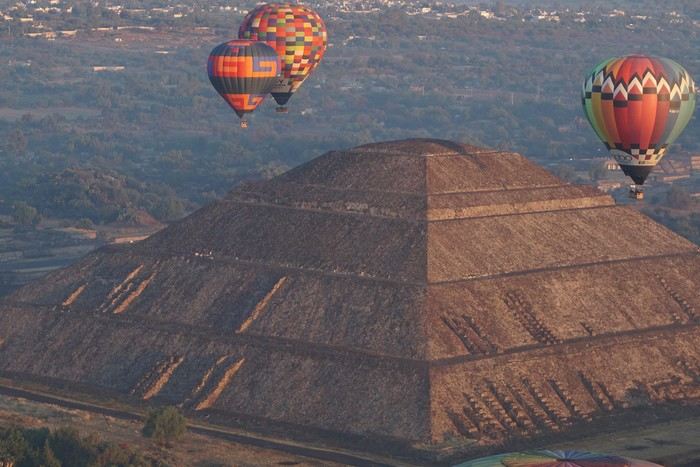
This one-month trip, from January 18 to February 17, 2026, allowed us to visit Mexico City and travel through the states of Puebla, Oaxaca, and Chiapas. We mainly used buses (ADO company) for medium and long distances and colectivos or taxis (or Uber) for shorter trips. Before leaving, I had contacted several people on the ground: Harry, a Vendéan settled in Oaxaca offering, among other things, discoveries of artisan villages or the Monte Albán site, and Oscar in Comitán de Domínguez. I’ll come back to our meeting with Oscar, who runs a local agency (CVL Travel Turismo Alternativo & Corre la voz) and owns a very pleasant hostel, a real highlight of our trip. Our journey took place in 8 stages on a loop starting from Mexico City. The connections between each were made by day or night buses depending on the trip duration. I had booked our seats in advance, either directly on the ADO company’s website or through booking platforms depending on the rates offered. Note that by planning ahead, I was able to benefit from very interesting "Early Booking" rates. There are several comfort classes. For all our trips, I had booked seats in Primera class buses, except for two in GL (Grand Luxe) class. The rates are very reasonable, and the buses turned out to be comfortable or even very comfortable (only the basic seat recline might surprise you).
Our itinerary and number of days per stage: Stage 1 – Mexico City: 4 days Stage 2 – Puebla: 2 days Stage 3 – Oaxaca: 4 days Stage 4 – San Agustinillo: 4 days Stage 5 – San Cristóbal de las Casas: 3 days Stage 6 – Comitán de Domínguez: 6 days Stage 7 – Palenque: 4 days Stage 8 – Mexico City: 2 days If I were to do it again, I’d remove one day from Palenque and add it either to Puebla or San Cristóbal to visit nearby sites or villages, or to San Agustinillo to enjoy one more day by the Pacific Ocean.
Stage 1: Mexico City (2,200 m / 9.2 million inhabitants) We arrived in the Mexican capital around 10:00 PM. The simplified customs process was very quick. After exchanging some money at the airport, we took a taxi to our youth hostel. We got around the capital on foot, of course, but also by metro. Signs are very rare, and we took the train in the wrong direction several times. After a few mistakes, we systematically asked on the platform if we were going the right way. The metro is very affordable. You need to get a rechargeable card (the Tarjeta de Movilidad Integrada) and top it up as needed. This card (less than 1 €) isn’t personal, so there’s no need to get one per person.
Mexico City: Day 1.
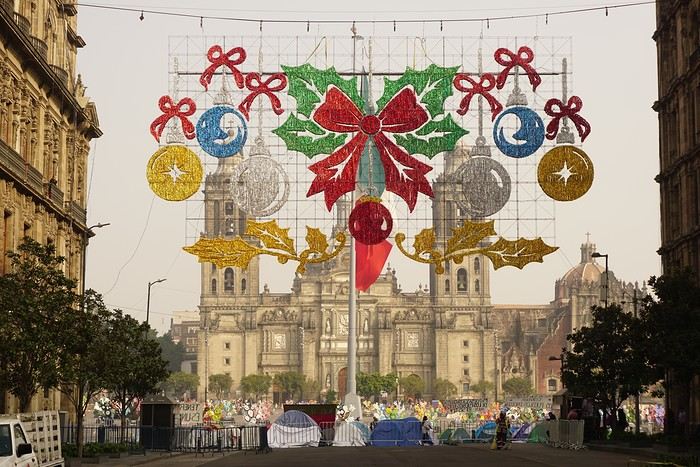
Visits and walks of the day (note: many museums are closed on Mondays): The Zócalo or Constitution Square: it’s one of the most beautiful, largest (195m x 240m), and oldest squares in the world. This is where Cortés decided to build the center of the new Spanish city on the site of the former Tenochtitlan market. Stones from the pyramids were used to pave the esplanade and build the surrounding colonial churches and buildings. During our visit, the huge square was covered with (resin) cacti, the theme of the temporary exhibition at the time. Indeed, temporary events or exhibitions take place here throughout the year. It’s also the endpoint for many protest marches.
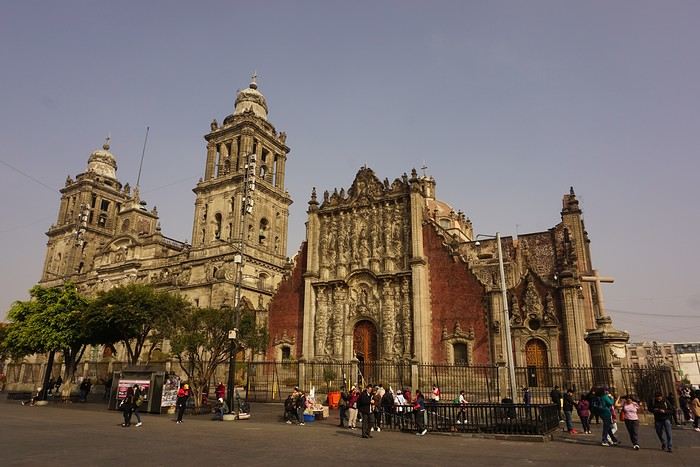
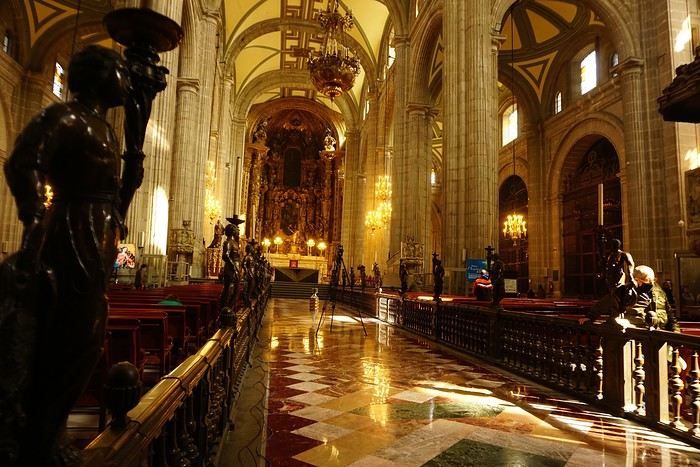


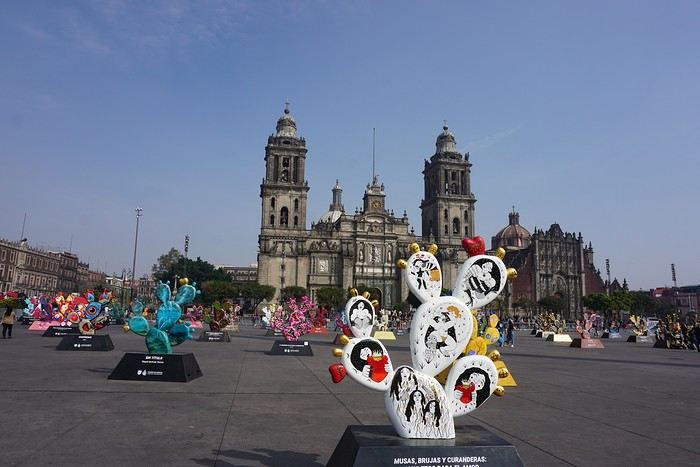
The cathedral: it’s sinking by one centimeter per year despite massive stabilization work (the collapse of many Mexican buildings—30 cm/year—is due to groundwater pumping). It was built starting in 1571 and completed in... 1813. The modest remains of the Templo Mayor (exterior view): they have high symbolic value, as this monument was the most important in the Mexica Empire.
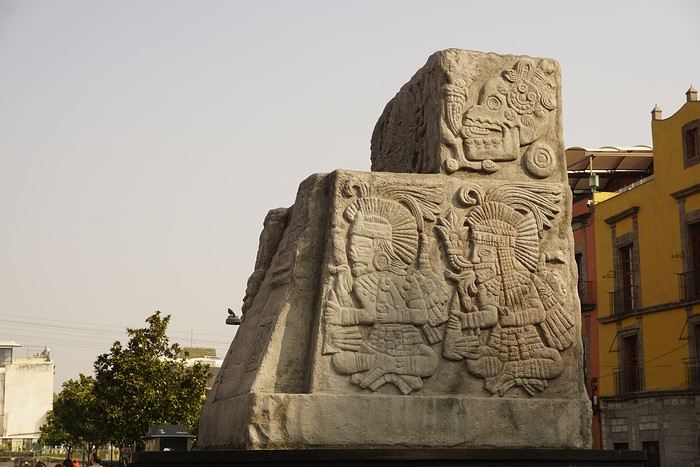 We then walked through the streets of the historic center to the Santísima Church, unfortunately closed for renovation work.
Next, we took the metro to visit one of Mexico’s most important pilgrimage sites: the Insigne y Nacional Basílicas de Santa María de Guadalupe, as well as the Capilla del Cerrito on the hill.
The first, dating from the colonial era, is really leaning a lot.
We then walked through the streets of the historic center to the Santísima Church, unfortunately closed for renovation work.
Next, we took the metro to visit one of Mexico’s most important pilgrimage sites: the Insigne y Nacional Basílicas de Santa María de Guadalupe, as well as the Capilla del Cerrito on the hill.
The first, dating from the colonial era, is really leaning a lot.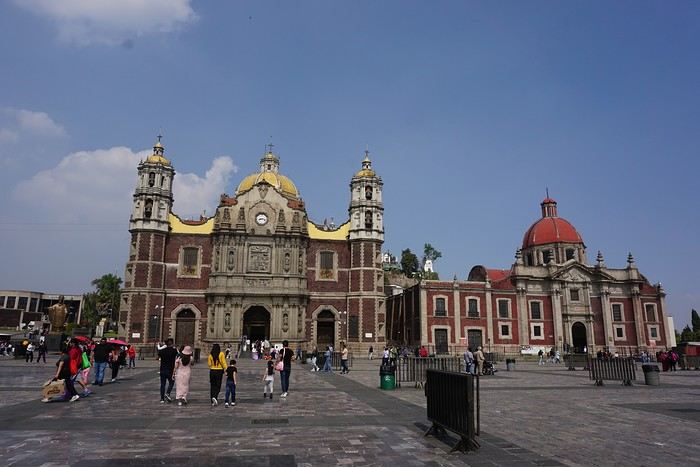
The second, shaped like a rotunda, is very impressive from the inside.
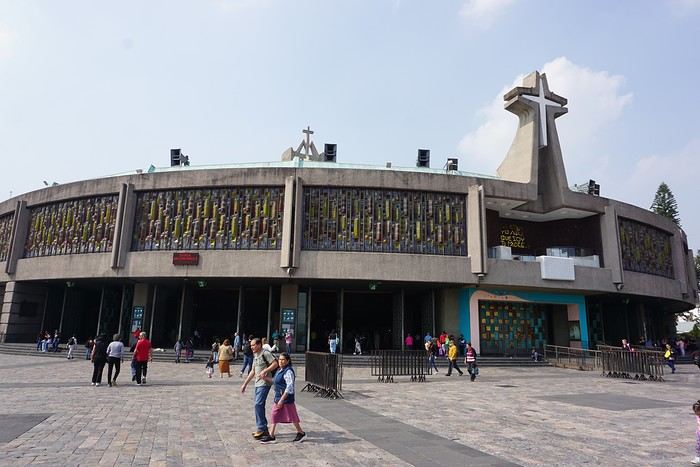
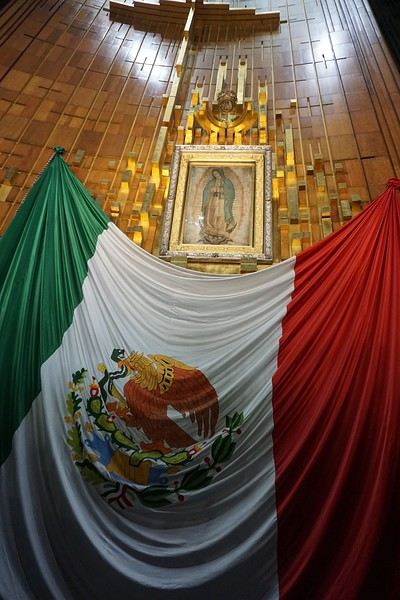
In the basement, there’s a sacred tunic where, in 1531, an image of the Virgin Mary is said to have appeared. A real mystery for scientists, the garment has never deteriorated since that date. Slow-moving conveyor belts allow pilgrims to admire it, preventing crowds from gathering in front of the image for hours. Well thought out!
 From the top of the Capilla del Cerrito, you get beautiful views of huge Mexico City.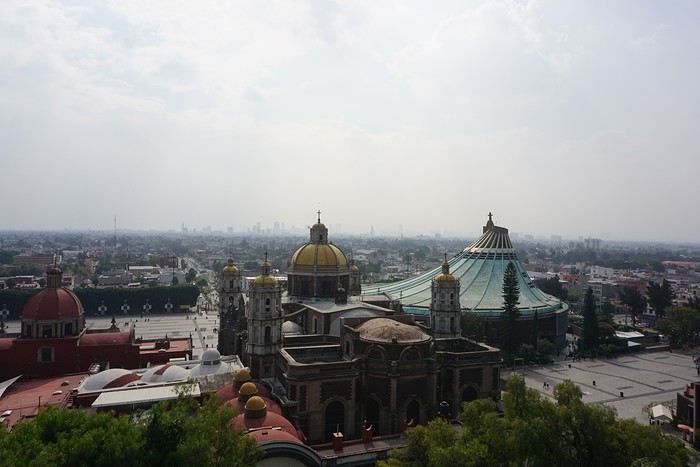
Naha & Osaka, Japan - June 2025
It’s an understatement to say that Japan is a world apart. All around me, people exclaim: "How lucky you are to be able to go there! I’ve always dreamed of visiting, of finding myself in that culture blending tradition and technology!" Yes, they’re right. Until the moment their dreams become reality and things appear as they truly are, without the filter of fantasized preconceptions. Because in the collective unconscious, Japan indeed seems like a civilization—if not neutral—at least stripped of any social maturation. As if it had emerged all at once from its canonical ages, offering only the best of its traditions, and as if those traditions were undoubtedly the foundation of its extraordinary discipline. Yet, as always, the truth is far more complex. Modern Japan is likely shaped by its millennia-old traditions. But that Japan is also the result of its own uncertainties and contradictions. I’ve always been wary. I’ve never understood why the cleaning women on the platform bow when the train arrives. At some point, too much discipline, too much deference—it makes you smile, it raises questions.
Finally, thanks to F., a dream is coming true! Not the dream of going to Japan—a country I’ve visited more than any other, except for Réunion and the UK—but the dream of completing the fastest round-the-world trip of my career. Indeed, due to the restrictions imposed by the Russians*, the plane flies over the Caucasus and China on the way there; on the return, it gracefully heads toward the Arctic after skirting the Aleutian Islands, Alaska, and Greenland. So, in nearly 26 hours of flight, I complete my 6th round-the-world trip. A round-the-world trip with just one stopover. Or two, if you count our impromptu detour to Okinawa.
(* In response to Western sanctions, Russia closed its airspace to Western airlines on February 28, 2022, except for Air Serbia, Turkish Airlines, Pegasus, and Belavia. This decision adds 2 to 3 hours to flight times and, incidentally, increases operating costs.)
The empire of noise. The empire that dazzles. In Japan, the auditory and visual space is constantly fed. No respite. You have to be strong. Navigating public transport feels like playing the most advanced video game: moving between language barriers and a different organization, the hero tries to ignore the numerous visual and auditory distractions. Mostly auditory, though. Because in Japan, there’s a culture of noise that has undoubtedly inspired our national railways. Everything must be announced. So, here and there, all along the route, we find agents whose sole role is to endlessly repeat safety messages through megaphones more or less suited to the situation. The result is a constant murmur, a kind of tinnitus, a subtle but incessant buzz that fades only at bedtime and returns with a vengeance at first light, when we descend back into the supposedly sterile depths of Osaka’s subway. "To go right, please turn right, kudasaï. When descending the stairs, please mind the steps, kudasaï. To go straight, please take the left corridor, kudasaï." That *kudasaï* ("please" in Japanese), I assure you, has permanently lodged itself in my auditory cells.
Screens are no exception; the brain is constantly stimulated. But paradoxically, passengers massively retreat into their own worlds via their screens. Literally glued to their phones, earbuds firmly in place, people escape into the virtual aisles of a furniture store, a game, a movie... In the train cars, raised voices are rare. The field is clear for announcements and other jingles. Each stop is announced by a little tune unique to each station. Simply incredible.
If we usually judge a country by the welcome its inhabitants offer, in Japan, we’re left wanting. Indeed, the Lost in Translation* spirit doesn’t just apply to verbal exchanges—it applies to everything, especially non-verbal communication. In Japan, me, the slightly North African Corsican, I’m at a loss. I speak loudly, I gesture, in front of a hotel concierge just as lost. Each for our own reasons. Yes, he speaks some English, but we can’t seem to connect. It’s a losing battle trying to find a bit of compassion from a local who’s far from familiar with Western concerns. I try to buy tickets for the World Expo? I run into a systematization as rigid as it is abrupt, which the concierge can’t seem to navigate. While we might still have a shred of common sense, here in Japan, everything is digitized. Soon, no one will be surprised that a QR code becomes essential just to go to the bathroom.
(* Film by Sofia Coppola, released in 2003, which explores isolation, unease, Japanese culture, and language through the experiences of two protagonists.)
In the end, we get that ticket for the Expo. After providing personal information on yet another account created for the occasion, we buy electronic tickets—a QR code, then—to regulate the comings and goings, the souls and aspirations of all these wandering beings scattered across the globe. And it’s probably for the best... Because we’ll be tens of thousands of visitors—100,000 to 150,000 per day—walking the aisles of this enormous improvised amusement park, a kind of delirious superstructure surrounded by the Grand Ring, the largest wooden construction in the world. Inside the park, the pavilions, flagship vessels of their respective countries, compete in ingenuity, proportionate to their GDP, to attract visitors. But you have to wait up to two hours to visit the most popular ones! Fortunately, about a hundred countries can be explored without waiting in shared, more spacious areas. What will I remember from this adventure? The beauty of that wooden structure, despite any environmental or financial considerations—200M € for barely renewable elements; a certain poetry, even magic, in the expression of this event—conversing with Juliette Petit, the splendid representative of Vanuatu, had something indescribable; a close-up experience of Japanese discipline when it came time to return to the subway after that epic evening—thousands upon thousands of people converging at the same time toward a single place without any interruption in the flow.
But my real passion is the countryside. So, I’ll especially remember that brief escape, on the very first day, to the Mino-o waterfall, where the journey itself was already enchanting. Quickly leaving the underground lines, our train speeds through the city’s endless expanse and drops us at the foot of a hill, the abrupt edge of the urban sprawl. The slope was too steep to build anything? We leave behind an impressive hotel, a capitalist eyesore defying the laws of elevation to tackle the climb toward the waterfall. A bucolic walk where the stroller can choose between a paved path or more epic trails. Here and there, stalls, temples, everywhere, a certain serenity. The city’s pulse gives way to a magnificent spectacle magnified by giant sequoias. From the depths of a ravine, we try to glimpse the sky beyond the foliage. Everything is oversized. Here, you can breathe.
***
In reality, Japan has never undertaken any real work of memory. Aside from a few feeble gestures to appease Washington in its choice of Asian partners, one wonders if the Japanese have ever truly grasped the horror they were forced to participate in. While our Judeo-Christian society has more or less assimilated the notions of forgiveness and self-questioning, where does Japanese society stand, juggling a millennia-old Zen philosophy and the unabashed Machiavellianism of an emperor utterly possessed? Is it just me, or does there float in the atmosphere a kind of unease, a malaise, an awkward relationship with reality? For me, bowing to a train as it enters the station is just the result of a poorly directed moral dilemma...
Ah, how distant is the time of sakoku, that closure of the country—both concrete and ideological—that was in vogue for two centuries. Because if no one could enter, no one could leave either! A boon for neighboring countries. But from 1854, following the skirmishes of Commodore Matthew Perry, who demanded Japan’s participation in trade, the country suddenly became aware of the disparities separating it from the West. Bring Japan up to the level of other nations? Industrialization, competition, search for raw materials... Hirohito (1901–1989) emerges on the scene, a bit expansionist and willing to stop at nothing to achieve his goals. Above all, he knew how to use, in his own way, the incredible capacity for self-sacrifice of his people...
We protest, we condemn, we all rally behind an acceptable discourse when it comes to discussing the use of the atomic bomb. Yet, we forget one essential thing: Hiroshima wasn’t enough to make Hirohito yield. While we’re bombarded with anti-fascist elements, as if the sole purpose of school curricula were to prevent us from voting for the National Rally, we completely overlook those events of rare cruelty that took place on the other side of the globe at a time contemporary with Nazi atrocities. Why? Because it was farther away, on the other side of the world? Because we must both condemn the use of nuclear weapons and Nazism? What a dangerous game. Killing civilians is beyond comprehension, everyone agrees on that. But hasn’t Japan ever been guilty of such atrocities? Our empathy is legitimate; it won’t, however, remove from my mind the idea that there was no other solution. Nagasaki is the most telling proof of that.
At least in France, in school textbooks, Hitler will have completely overshadowed the existence of people crueler and more abject than him. Certainly, Adolf was a deeply disturbed man whom events propelled to power. But I’m justified in believing that his approach was probably more humane than that of Joseph Stalin at the height of his art*. And if Hirohito followed the same line as Hitler, in the sense that he represented the superior race, he would apply with conviction what was Stalin’s credo: contempt for his own people when sending them to slaughter, and an even fiercer contempt for the human race when it didn’t have the good fortune to be Japanese. Just look at how China was invaded and by what means millions of Chinese were annihilated, burned, deported, buried alive! Operation Scorched Earth or Three Alls Policy for kill all, burn all, loot all? No comment. Even today, the Japanese are convinced they waged a patriotic war, when clearly, that war served only vague ideological (and certainly economic) interests.
(* "In many ways, Hitler’s National Socialism was far more humane than Communism: it wasn’t unthinkable to speak to the SS or the Gestapo, and dissuading them from sending you to a prison camp wasn’t utopian. To some extent (compared to the Communists), you could still expect a semblance of justice. All those who lived under Hitler and under Communism will tell you: as the front lines shifted, they always managed to end up in Germany, where, though it was a strange place ruled by a madman, life went on. Under Communism, there was no life; totalitarianism was absolute. Probably, Hitler’s conservatism prevented him from fully imitating Bolshevism." Seraphim Rose in The Revolutions of the 19th and 20th Centuries (circa 1970))
In Naha, we visit two strategic sites: the Imperial Navy headquarters and Maeda Escarpment, in Urasoe, better known as Hacksaw Ridge. I love this confrontation with history. In the hand-dug tunnels of the headquarters, we meet Japanese people seeking information. They’re not responsible for this tragedy. Neither are we. I would have liked to tell them that, to hug them, to move on. To finally believe in those peace messages displayed here and there. Yes, it’s curious to read those calls for peace* when no real work of memory** has been undertaken. Two civilizations, two perspectives, a profound misunderstanding. When I analyze the waste of that war—and particularly the waste of those Pacific battles—like Peleliu in autumn 1944 and Okinawa in spring 1945—I can’t bring myself to share in the pathological patriotism that reigns within these walls. There, the room where the last message of Admiral Minoru Ōta was transmitted in Morse, praising the merits of the archipelago’s people. A tangled mix that, yes, is charged with positive emotions but, no, won’t remove from my mind the idea that this people was completely conditioned, completely disconnected from reality. Allying with the Axis powers? Invading the South Pacific? And finding that noble! Everyone sees things through their own lens.
(* Peace Declaration by Denny Tamaki, Governor of Okinawa, June 2020. ** "Recognizing the atrocities committed by one’s country requires a mix of democratic culture and self-confidence that is more the exception than the rule." Dominique Moïsi in Les Échos, April 30, 2015)
Okinawa. 200,000 dead. Stemming from bushido, the way of the warrior, this conditioning reached its peak with the kamikaze philosophy in particular and suicide in general. So, schematically, here’s how things went: as the island was encircled—Peleliu, Iwo Jima, Okinawa—and all hope was lost, the order was given to kill ten American soldiers before taking one’s own life. The deceit of this system, where surrender is synonymous with dishonor, involves creating tunnels and secret pockets where Japanese soldiers hide and from which they emerge. Long before the atomic bomb, the knell of their war had sounded. Hiroshima and Nagasaki are just the result of human pride, of which Hirohito’s reign is the finest example. Why was this henchman of Satan left in place until his death? I don’t understand. While the humiliation inflicted on Germany repeatedly was abject, especially for its people, the absence of any real and pressing accountability for Hirohito in this large-scale carnage he instigated leaves room for the wildest interpretations. As if to underscore my point, Emperor Naruhito visited Okinawa the same day we did, paying his respects to the inhabitants who fell in battle. I looked at the faces in the monorail serving the south of the island. There were elderly people who undoubtedly lost their parents eighty years ago. To what extent can they blame this tragedy on the delusional visions of their leaders?
On Maeda Escarpment, I salute the courage of Desmond Doss, that conscientious objector who fought to serve his country while refusing to ever carry a weapon. There, at the top of a steep ridge, you can see to the north the Allies’ advance, while to the south, the slope is gentler down to Shuri, in front of the headquarters. The underground is a Swiss cheese filled with enemies. Desmond works as a medic. He manages to save 75 wounded from certain death by evacuating them at night from the battlefield using makeshift ropes. Back in Osaka, far from the somewhat dilapidated tropical islands, I rediscover the splendor and grandeur of Japan’s second-largest city. To tell the truth, and this applies to Okinawa too, the density is so insane on this archipelago that you sometimes wonder if it’s not just one giant city spread across the vast territory. Because between Tokyo and Osaka, while there are some mountains and forests, it’s the city that dominates; during rush hour, a rapid train connects the two cities every five minutes. We get lost in rather quiet alleys parallel to the main streets, only to find ourselves in the covered and lively galleries of Dōtonbori. We’re looking for a place to eat—above all, we’re trying to navigate the unlimited options stretching endlessly along the sidewalks. It’s absolutely mind-blowing. And while I introduce F. to a part of history that our Western societies have quickly forgotten, he initiates me into Japanese gastronomy despite my well-known aversion to Asian food. But nothing beats having a master in the field! We feast on okonomiyaki, Japanese pancakes expertly prepared and served on a teppan embedded in our table.
Night falls on Japan, and I still haven’t found the answer. Like in Singapore, one can praise the calm and serenity of human relationships, the delicacy that may just be hypocrisy, the politeness, the discipline. But above all, we notice that in the absence of freedom, in the absence of madness, poetry struggles to take root, boredom looms, as does real madness. Bushido still exists, honor is there and must be preserved. But the youth drowns in electronics and in willingly sterile cults (otaku), unable to discern what’s essential, failing to believe in their dreams. You have to succeed? Young people commit suicide because of school bullying, the slightly older ones because of work-related difficulties or marital problems. Nothing exceptional, we might say—average*—but you’d expect better from a country so well-organized, a country that makes so many Westerners dream. Yes, night falls on Japan. Empire of noise, empire of the senses, a very strange land where you find clean toilets in subway corridors but where the very meaning of life seems stifled by the mirages of technology. Above all, a civilization deprived of a penance that would prove salutary. We’re caught between two waters. Those of a shallow modernity without depth or anchor; those of a past that was majestic but irreparably tainted by the demonic madness of an overly adored emperor.
How can one fully thrive when guilt has no outlet?
(* France and Japan share a common statistic of 17 suicides per 100,000 inhabitants, which, depending on density, means 30 per day in France and 70 in Japan...)
Finally, thanks to F., a dream is coming true! Not the dream of going to Japan—a country I’ve visited more than any other, except for Réunion and the UK—but the dream of completing the fastest round-the-world trip of my career. Indeed, due to the restrictions imposed by the Russians*, the plane flies over the Caucasus and China on the way there; on the return, it gracefully heads toward the Arctic after skirting the Aleutian Islands, Alaska, and Greenland. So, in nearly 26 hours of flight, I complete my 6th round-the-world trip. A round-the-world trip with just one stopover. Or two, if you count our impromptu detour to Okinawa.
(* In response to Western sanctions, Russia closed its airspace to Western airlines on February 28, 2022, except for Air Serbia, Turkish Airlines, Pegasus, and Belavia. This decision adds 2 to 3 hours to flight times and, incidentally, increases operating costs.)
The empire of noise. The empire that dazzles. In Japan, the auditory and visual space is constantly fed. No respite. You have to be strong. Navigating public transport feels like playing the most advanced video game: moving between language barriers and a different organization, the hero tries to ignore the numerous visual and auditory distractions. Mostly auditory, though. Because in Japan, there’s a culture of noise that has undoubtedly inspired our national railways. Everything must be announced. So, here and there, all along the route, we find agents whose sole role is to endlessly repeat safety messages through megaphones more or less suited to the situation. The result is a constant murmur, a kind of tinnitus, a subtle but incessant buzz that fades only at bedtime and returns with a vengeance at first light, when we descend back into the supposedly sterile depths of Osaka’s subway. "To go right, please turn right, kudasaï. When descending the stairs, please mind the steps, kudasaï. To go straight, please take the left corridor, kudasaï." That *kudasaï* ("please" in Japanese), I assure you, has permanently lodged itself in my auditory cells.
Screens are no exception; the brain is constantly stimulated. But paradoxically, passengers massively retreat into their own worlds via their screens. Literally glued to their phones, earbuds firmly in place, people escape into the virtual aisles of a furniture store, a game, a movie... In the train cars, raised voices are rare. The field is clear for announcements and other jingles. Each stop is announced by a little tune unique to each station. Simply incredible.
If we usually judge a country by the welcome its inhabitants offer, in Japan, we’re left wanting. Indeed, the Lost in Translation* spirit doesn’t just apply to verbal exchanges—it applies to everything, especially non-verbal communication. In Japan, me, the slightly North African Corsican, I’m at a loss. I speak loudly, I gesture, in front of a hotel concierge just as lost. Each for our own reasons. Yes, he speaks some English, but we can’t seem to connect. It’s a losing battle trying to find a bit of compassion from a local who’s far from familiar with Western concerns. I try to buy tickets for the World Expo? I run into a systematization as rigid as it is abrupt, which the concierge can’t seem to navigate. While we might still have a shred of common sense, here in Japan, everything is digitized. Soon, no one will be surprised that a QR code becomes essential just to go to the bathroom.
(* Film by Sofia Coppola, released in 2003, which explores isolation, unease, Japanese culture, and language through the experiences of two protagonists.)
In the end, we get that ticket for the Expo. After providing personal information on yet another account created for the occasion, we buy electronic tickets—a QR code, then—to regulate the comings and goings, the souls and aspirations of all these wandering beings scattered across the globe. And it’s probably for the best... Because we’ll be tens of thousands of visitors—100,000 to 150,000 per day—walking the aisles of this enormous improvised amusement park, a kind of delirious superstructure surrounded by the Grand Ring, the largest wooden construction in the world. Inside the park, the pavilions, flagship vessels of their respective countries, compete in ingenuity, proportionate to their GDP, to attract visitors. But you have to wait up to two hours to visit the most popular ones! Fortunately, about a hundred countries can be explored without waiting in shared, more spacious areas. What will I remember from this adventure? The beauty of that wooden structure, despite any environmental or financial considerations—200M € for barely renewable elements; a certain poetry, even magic, in the expression of this event—conversing with Juliette Petit, the splendid representative of Vanuatu, had something indescribable; a close-up experience of Japanese discipline when it came time to return to the subway after that epic evening—thousands upon thousands of people converging at the same time toward a single place without any interruption in the flow.
But my real passion is the countryside. So, I’ll especially remember that brief escape, on the very first day, to the Mino-o waterfall, where the journey itself was already enchanting. Quickly leaving the underground lines, our train speeds through the city’s endless expanse and drops us at the foot of a hill, the abrupt edge of the urban sprawl. The slope was too steep to build anything? We leave behind an impressive hotel, a capitalist eyesore defying the laws of elevation to tackle the climb toward the waterfall. A bucolic walk where the stroller can choose between a paved path or more epic trails. Here and there, stalls, temples, everywhere, a certain serenity. The city’s pulse gives way to a magnificent spectacle magnified by giant sequoias. From the depths of a ravine, we try to glimpse the sky beyond the foliage. Everything is oversized. Here, you can breathe.
***
In reality, Japan has never undertaken any real work of memory. Aside from a few feeble gestures to appease Washington in its choice of Asian partners, one wonders if the Japanese have ever truly grasped the horror they were forced to participate in. While our Judeo-Christian society has more or less assimilated the notions of forgiveness and self-questioning, where does Japanese society stand, juggling a millennia-old Zen philosophy and the unabashed Machiavellianism of an emperor utterly possessed? Is it just me, or does there float in the atmosphere a kind of unease, a malaise, an awkward relationship with reality? For me, bowing to a train as it enters the station is just the result of a poorly directed moral dilemma...
Ah, how distant is the time of sakoku, that closure of the country—both concrete and ideological—that was in vogue for two centuries. Because if no one could enter, no one could leave either! A boon for neighboring countries. But from 1854, following the skirmishes of Commodore Matthew Perry, who demanded Japan’s participation in trade, the country suddenly became aware of the disparities separating it from the West. Bring Japan up to the level of other nations? Industrialization, competition, search for raw materials... Hirohito (1901–1989) emerges on the scene, a bit expansionist and willing to stop at nothing to achieve his goals. Above all, he knew how to use, in his own way, the incredible capacity for self-sacrifice of his people...
We protest, we condemn, we all rally behind an acceptable discourse when it comes to discussing the use of the atomic bomb. Yet, we forget one essential thing: Hiroshima wasn’t enough to make Hirohito yield. While we’re bombarded with anti-fascist elements, as if the sole purpose of school curricula were to prevent us from voting for the National Rally, we completely overlook those events of rare cruelty that took place on the other side of the globe at a time contemporary with Nazi atrocities. Why? Because it was farther away, on the other side of the world? Because we must both condemn the use of nuclear weapons and Nazism? What a dangerous game. Killing civilians is beyond comprehension, everyone agrees on that. But hasn’t Japan ever been guilty of such atrocities? Our empathy is legitimate; it won’t, however, remove from my mind the idea that there was no other solution. Nagasaki is the most telling proof of that.
At least in France, in school textbooks, Hitler will have completely overshadowed the existence of people crueler and more abject than him. Certainly, Adolf was a deeply disturbed man whom events propelled to power. But I’m justified in believing that his approach was probably more humane than that of Joseph Stalin at the height of his art*. And if Hirohito followed the same line as Hitler, in the sense that he represented the superior race, he would apply with conviction what was Stalin’s credo: contempt for his own people when sending them to slaughter, and an even fiercer contempt for the human race when it didn’t have the good fortune to be Japanese. Just look at how China was invaded and by what means millions of Chinese were annihilated, burned, deported, buried alive! Operation Scorched Earth or Three Alls Policy for kill all, burn all, loot all? No comment. Even today, the Japanese are convinced they waged a patriotic war, when clearly, that war served only vague ideological (and certainly economic) interests.
(* "In many ways, Hitler’s National Socialism was far more humane than Communism: it wasn’t unthinkable to speak to the SS or the Gestapo, and dissuading them from sending you to a prison camp wasn’t utopian. To some extent (compared to the Communists), you could still expect a semblance of justice. All those who lived under Hitler and under Communism will tell you: as the front lines shifted, they always managed to end up in Germany, where, though it was a strange place ruled by a madman, life went on. Under Communism, there was no life; totalitarianism was absolute. Probably, Hitler’s conservatism prevented him from fully imitating Bolshevism." Seraphim Rose in The Revolutions of the 19th and 20th Centuries (circa 1970))
In Naha, we visit two strategic sites: the Imperial Navy headquarters and Maeda Escarpment, in Urasoe, better known as Hacksaw Ridge. I love this confrontation with history. In the hand-dug tunnels of the headquarters, we meet Japanese people seeking information. They’re not responsible for this tragedy. Neither are we. I would have liked to tell them that, to hug them, to move on. To finally believe in those peace messages displayed here and there. Yes, it’s curious to read those calls for peace* when no real work of memory** has been undertaken. Two civilizations, two perspectives, a profound misunderstanding. When I analyze the waste of that war—and particularly the waste of those Pacific battles—like Peleliu in autumn 1944 and Okinawa in spring 1945—I can’t bring myself to share in the pathological patriotism that reigns within these walls. There, the room where the last message of Admiral Minoru Ōta was transmitted in Morse, praising the merits of the archipelago’s people. A tangled mix that, yes, is charged with positive emotions but, no, won’t remove from my mind the idea that this people was completely conditioned, completely disconnected from reality. Allying with the Axis powers? Invading the South Pacific? And finding that noble! Everyone sees things through their own lens.
(* Peace Declaration by Denny Tamaki, Governor of Okinawa, June 2020. ** "Recognizing the atrocities committed by one’s country requires a mix of democratic culture and self-confidence that is more the exception than the rule." Dominique Moïsi in Les Échos, April 30, 2015)
Okinawa. 200,000 dead. Stemming from bushido, the way of the warrior, this conditioning reached its peak with the kamikaze philosophy in particular and suicide in general. So, schematically, here’s how things went: as the island was encircled—Peleliu, Iwo Jima, Okinawa—and all hope was lost, the order was given to kill ten American soldiers before taking one’s own life. The deceit of this system, where surrender is synonymous with dishonor, involves creating tunnels and secret pockets where Japanese soldiers hide and from which they emerge. Long before the atomic bomb, the knell of their war had sounded. Hiroshima and Nagasaki are just the result of human pride, of which Hirohito’s reign is the finest example. Why was this henchman of Satan left in place until his death? I don’t understand. While the humiliation inflicted on Germany repeatedly was abject, especially for its people, the absence of any real and pressing accountability for Hirohito in this large-scale carnage he instigated leaves room for the wildest interpretations. As if to underscore my point, Emperor Naruhito visited Okinawa the same day we did, paying his respects to the inhabitants who fell in battle. I looked at the faces in the monorail serving the south of the island. There were elderly people who undoubtedly lost their parents eighty years ago. To what extent can they blame this tragedy on the delusional visions of their leaders?
On Maeda Escarpment, I salute the courage of Desmond Doss, that conscientious objector who fought to serve his country while refusing to ever carry a weapon. There, at the top of a steep ridge, you can see to the north the Allies’ advance, while to the south, the slope is gentler down to Shuri, in front of the headquarters. The underground is a Swiss cheese filled with enemies. Desmond works as a medic. He manages to save 75 wounded from certain death by evacuating them at night from the battlefield using makeshift ropes. Back in Osaka, far from the somewhat dilapidated tropical islands, I rediscover the splendor and grandeur of Japan’s second-largest city. To tell the truth, and this applies to Okinawa too, the density is so insane on this archipelago that you sometimes wonder if it’s not just one giant city spread across the vast territory. Because between Tokyo and Osaka, while there are some mountains and forests, it’s the city that dominates; during rush hour, a rapid train connects the two cities every five minutes. We get lost in rather quiet alleys parallel to the main streets, only to find ourselves in the covered and lively galleries of Dōtonbori. We’re looking for a place to eat—above all, we’re trying to navigate the unlimited options stretching endlessly along the sidewalks. It’s absolutely mind-blowing. And while I introduce F. to a part of history that our Western societies have quickly forgotten, he initiates me into Japanese gastronomy despite my well-known aversion to Asian food. But nothing beats having a master in the field! We feast on okonomiyaki, Japanese pancakes expertly prepared and served on a teppan embedded in our table.
Night falls on Japan, and I still haven’t found the answer. Like in Singapore, one can praise the calm and serenity of human relationships, the delicacy that may just be hypocrisy, the politeness, the discipline. But above all, we notice that in the absence of freedom, in the absence of madness, poetry struggles to take root, boredom looms, as does real madness. Bushido still exists, honor is there and must be preserved. But the youth drowns in electronics and in willingly sterile cults (otaku), unable to discern what’s essential, failing to believe in their dreams. You have to succeed? Young people commit suicide because of school bullying, the slightly older ones because of work-related difficulties or marital problems. Nothing exceptional, we might say—average*—but you’d expect better from a country so well-organized, a country that makes so many Westerners dream. Yes, night falls on Japan. Empire of noise, empire of the senses, a very strange land where you find clean toilets in subway corridors but where the very meaning of life seems stifled by the mirages of technology. Above all, a civilization deprived of a penance that would prove salutary. We’re caught between two waters. Those of a shallow modernity without depth or anchor; those of a past that was majestic but irreparably tainted by the demonic madness of an overly adored emperor.
How can one fully thrive when guilt has no outlet?
(* France and Japan share a common statistic of 17 suicides per 100,000 inhabitants, which, depending on density, means 30 per day in France and 70 in Japan...)
February contest theme: lakes and ponds around the world
Let’s stick with the water theme—it’s definitely the season (maybe a bit *too* much for some of those dealing with floods 😕).
After the flowing waters (with varying energy levels), let’s take it easy with still waters:
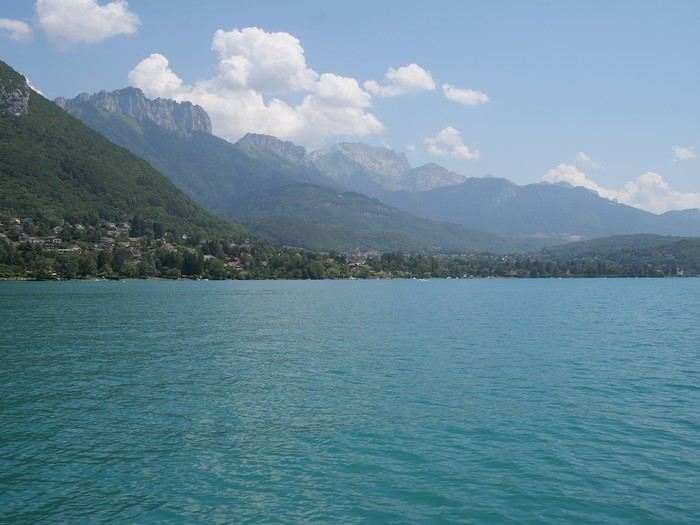 Lakes (Annecy)
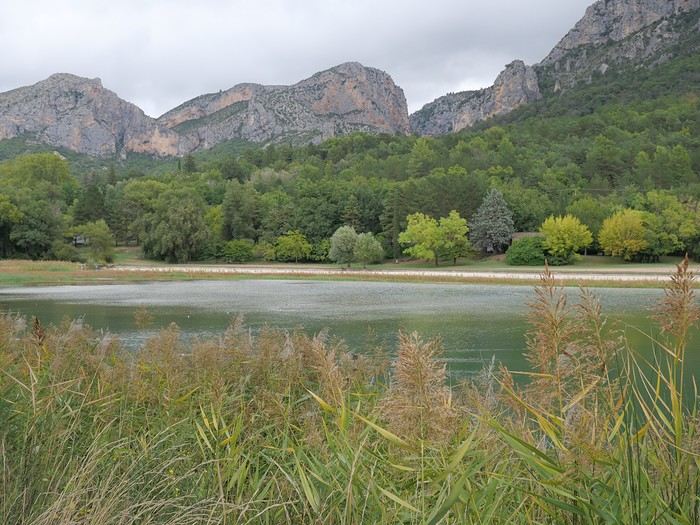 Ponds (near Moustiers Saint Marie)
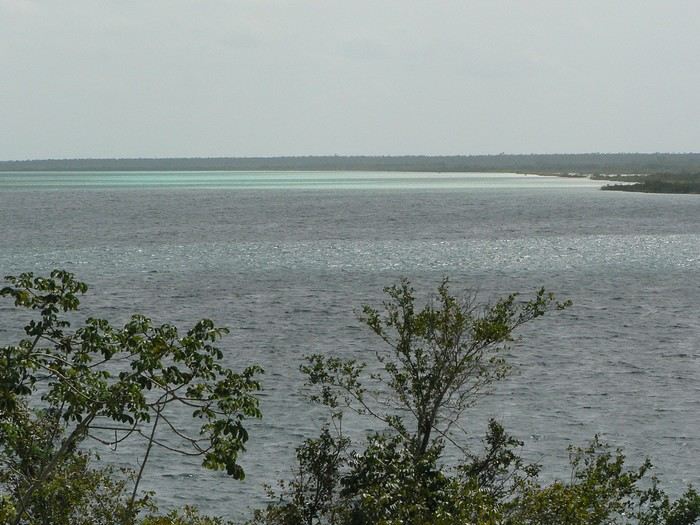 Lagoons (Bacalar)
If you’ve got nice photos of a pond—or even a puddle—why not? Natural bodies of water only: no pools or fountains (reservoir lakes are accepted… because they often look like natural lakes ).
The contest rules are the same as always 😉: Up to 3 photos per member, one photo per post (a little explanation is better), and past winning photos from other VF contests aren’t allowed. You have until Sunday, February 22nd at 11:59 PM (Paris time) to post your photos. Voting starts Monday the 23rd at midnight—rank your top 3 photos in order (3, 2, and 1 points). Voting ends Saturday, February 28th at 11:59 PM. Results will be announced on March 1st. The winning photo is the one with the most points (in case of a tie, the photo ranked first the most times wins). The lucky winner gets to organize March’s contest 😎.
Dig into your archives…
Lakes (Annecy)
Ponds (near Moustiers Saint Marie)
Lagoons (Bacalar)If you’ve got nice photos of a pond—or even a puddle—why not? Natural bodies of water only: no pools or fountains (reservoir lakes are accepted… because they often look like natural lakes ).
The contest rules are the same as always 😉: Up to 3 photos per member, one photo per post (a little explanation is better), and past winning photos from other VF contests aren’t allowed. You have until Sunday, February 22nd at 11:59 PM (Paris time) to post your photos. Voting starts Monday the 23rd at midnight—rank your top 3 photos in order (3, 2, and 1 points). Voting ends Saturday, February 28th at 11:59 PM. Results will be announced on March 1st. The winning photo is the one with the most points (in case of a tie, the photo ranked first the most times wins). The lucky winner gets to organize March’s contest 😎.
Dig into your archives…
From Southern Shikoku, between land and sea, to the blue waters of Miyakojima and finally the Tokyo metropolis
From Southern Shikoku, between land and sea, to the blue waters of Miyakojima and finally Tokyo’s megacity
Hi everyone,
I have to admit, I really hesitated before deciding to write this travel journal... Writing one takes a lot of time and energy, and since this is my 4th trip, I wondered if it would even interest anyone other than myself (both for the discovery and the writing). But after a few people asked, "Are you going to write a journal?" and especially after rediscovering the joy of reading other travelers’ journals about Japan or elsewhere on this forum, I’ve decided to share my 4th installment in the Land of the Rising Sun here.
The itinerary: 27 full days, from late May to late June 2025, right in the middle of the rainy season, including:
-->13 days in Shikoku, from Kochi (Kochi Prefecture) to Matsuyama (Ehime Prefecture)
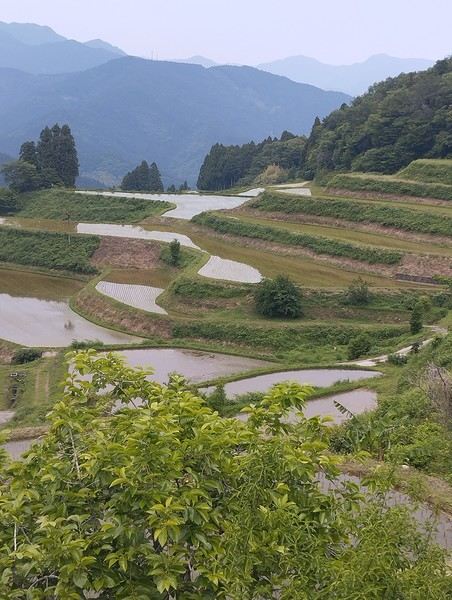
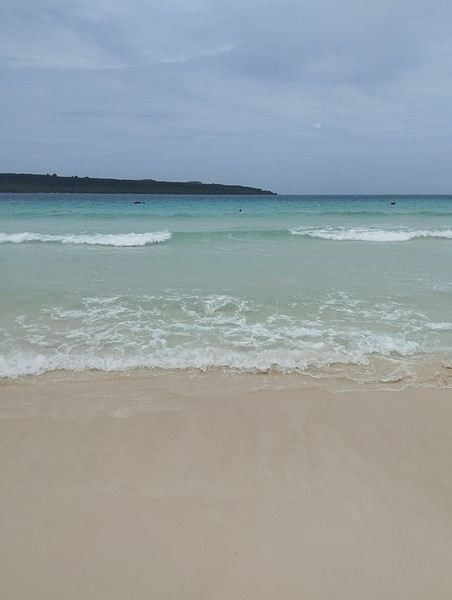
-->7 days in Miyakojima (Okinawa Prefecture)
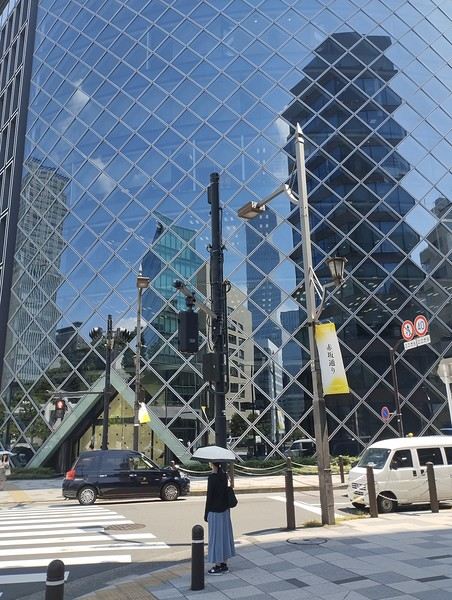
-->7 days in Tokyo
The trip was decided on fairly last-minute again this year.
Since I regularly check flight prices to track fluctuations for this destination even without concrete plans, stumbling upon a slightly cheaper direct flight (900 €) than what I’d seen in previous months (around 1,200–1,400 € on average) for a Paris-Tokyo route with Japanese airline ANA was too tempting to resist the urge to return to this enchanting country. After much hesitation between exploring the San’in region (Matsue, Tottori, Yamaguchi) and Southern Shikoku, the decision was made—I took the plunge! The ticket is booked: Paris to Kochi with a layover in Tokyo, all with ANA, the airline I’d been dreaming of... for 1,120 € per person. Okay, it’s not cheap, but it’s better than in 2023.
Departure in 2 weeks! Now I just have to get everything ready!
Intense prep work over these next 2 weeks to:
finalize a more precise itinerary and reach an agreement—yep, because even though we both love Japan, our preferences differ slightly, and we have to choose between exploring new places or revisiting beloved spots... decide how much time to spend in each area without rushing while still exploring research places that might interest us and watch videos about Japan book accommodations: yes, it’s possible to do this on the spot, but last year, we realized that last-minute options were pretty expensive, so we’re booking ahead—though we’ll keep a few options open in case better deals pop up later reserve rental cars order yen check the weather regularly and wonder if choosing the *tsuyu* (rainy season) was really a good idea—are we going to be drenched the whole time???
"What hard work," you might say! Going to Japan for a month—what a tough life! Despite this being my 4th trip, the excitement is just as intense as the first time.
The only small downside is that when we booked the flight, there weren’t many seats left, so we’re only sitting together on the international return flight. Plus, on the way there, we have middle seats. Another lingering question: what French-language films will be available? According to the internet, the selection seems limited. Oh well, these are just minor details—it’s already time to fly! PS: I’ll be posting slowly and irregularly... so for those interested, be patient, and maybe set an alert...
Hi everyone,
I have to admit, I really hesitated before deciding to write this travel journal... Writing one takes a lot of time and energy, and since this is my 4th trip, I wondered if it would even interest anyone other than myself (both for the discovery and the writing). But after a few people asked, "Are you going to write a journal?" and especially after rediscovering the joy of reading other travelers’ journals about Japan or elsewhere on this forum, I’ve decided to share my 4th installment in the Land of the Rising Sun here.
The itinerary: 27 full days, from late May to late June 2025, right in the middle of the rainy season, including:
-->13 days in Shikoku, from Kochi (Kochi Prefecture) to Matsuyama (Ehime Prefecture)
-->7 days in Miyakojima (Okinawa Prefecture)
-->7 days in Tokyo
The trip was decided on fairly last-minute again this year.
Since I regularly check flight prices to track fluctuations for this destination even without concrete plans, stumbling upon a slightly cheaper direct flight (900 €) than what I’d seen in previous months (around 1,200–1,400 € on average) for a Paris-Tokyo route with Japanese airline ANA was too tempting to resist the urge to return to this enchanting country. After much hesitation between exploring the San’in region (Matsue, Tottori, Yamaguchi) and Southern Shikoku, the decision was made—I took the plunge! The ticket is booked: Paris to Kochi with a layover in Tokyo, all with ANA, the airline I’d been dreaming of... for 1,120 € per person. Okay, it’s not cheap, but it’s better than in 2023.
Departure in 2 weeks! Now I just have to get everything ready!
Intense prep work over these next 2 weeks to:
finalize a more precise itinerary and reach an agreement—yep, because even though we both love Japan, our preferences differ slightly, and we have to choose between exploring new places or revisiting beloved spots... decide how much time to spend in each area without rushing while still exploring research places that might interest us and watch videos about Japan book accommodations: yes, it’s possible to do this on the spot, but last year, we realized that last-minute options were pretty expensive, so we’re booking ahead—though we’ll keep a few options open in case better deals pop up later reserve rental cars order yen check the weather regularly and wonder if choosing the *tsuyu* (rainy season) was really a good idea—are we going to be drenched the whole time???
"What hard work," you might say! Going to Japan for a month—what a tough life! Despite this being my 4th trip, the excitement is just as intense as the first time.
The only small downside is that when we booked the flight, there weren’t many seats left, so we’re only sitting together on the international return flight. Plus, on the way there, we have middle seats. Another lingering question: what French-language films will be available? According to the internet, the selection seems limited. Oh well, these are just minor details—it’s already time to fly! PS: I’ll be posting slowly and irregularly... so for those interested, be patient, and maybe set an alert...
Kenya - January 2025 - Tsavo East - Tsavo West - Samburu - Meru NP - Aberdare NP
Hello everyone,
I’d like to invite you on a new adventure in Kenya.
Back in 2010, my husband Ben and I fell in love with Kenya, and we’ve been traveling there regularly ever since. This 2025 safari marked the first weeks of an important milestone in my life: retirement.
Of course, Felix—our guide and friend for all these years, whom some of you may even know from this forum—joined us again.
We chose an itinerary that takes us through the parks and reserves we particularly love in Kenya: Tsavo East (3 nights), Tsavo West (2 nights), a transition day in Embu, Samburu (5 nights), Meru NP (4 nights), Nanuyki to visit the Mount Kenya Animal Orphanage (https://mountkenyawildlifeconservancy.org/) (1 night), and Aberdare NP (2 nights).
This safari wasn’t our most prolific in terms of wildlife sightings and photos (all taken by Ben), but I still think it’s worth sharing our experiences and impressions of the places we visited. Maybe other travelers will find useful information here to help them fulfill their dream of a Kenyan safari one day...
Living in Brittany, we left from Nantes on Wednesday, January 8, 2025, on the 6 AM Air France flight to CDG, then took the direct flight to Nairobi at 10:50 AM. No issues this time on either flight (unlike in October 2023...).
We arrived in Nairobi at 9:20 PM local time (there’s a two-hour time difference with France at this time of year). Going through passport control and collecting our luggage went smoothly. The hotel shuttle (https://67airporthotel.co.ke/) was waiting for us. We shared it with a friendly Swiss couple who were there to climb Mount Kenya. We arrived at the hotel around midnight. The 67 Airport Hotel is 10-15 minutes from Jomo Kenyatta Airport and offers great value for money. Plus, it’s close to the Mombasa road, which is handy when heading that way the next morning.
On Thursday, January 9, we had breakfast at the hotel restaurant at 6:30 AM, and as planned, Felix arrived around 7 AM. We got to check out his brand-new 4x4 Nissan—we’d be the first to test it! 🙂
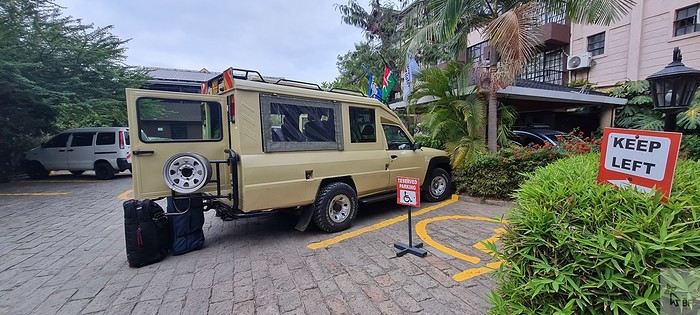
We set off for Voi, making our usual stop in Mtito Andei. Traffic was heavy on the Mombasa road, with lots of trucks.
We arrived at the entrance of Tsavo East around 1 PM and made it to Sentrim Camp (https://www.sentrim-hotels.com/sentrim-tsavo.html) just in time for lunch.
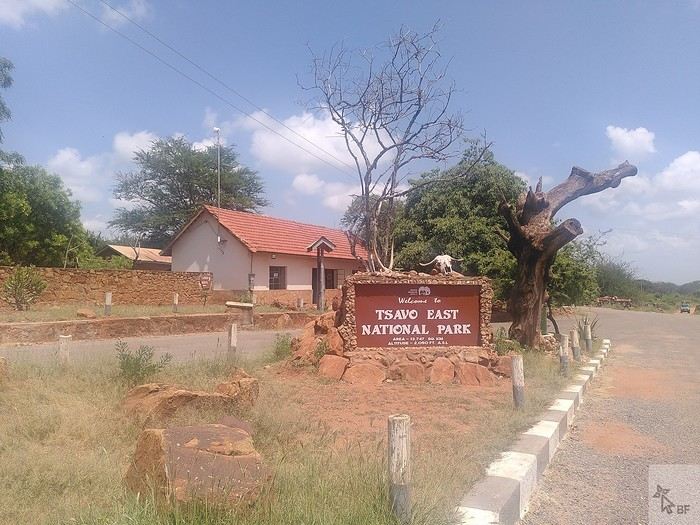
We found Tsavo East unusually green—there had been heavy rains in December, which isn’t typical. As a result, the animals were scattered and harder to spot. The watering hole visible from the camp’s dining area was completely deserted, whereas it’s usually bustling with herds of elephants and other mammals.
Our tent, No. 9, for 3 nights.
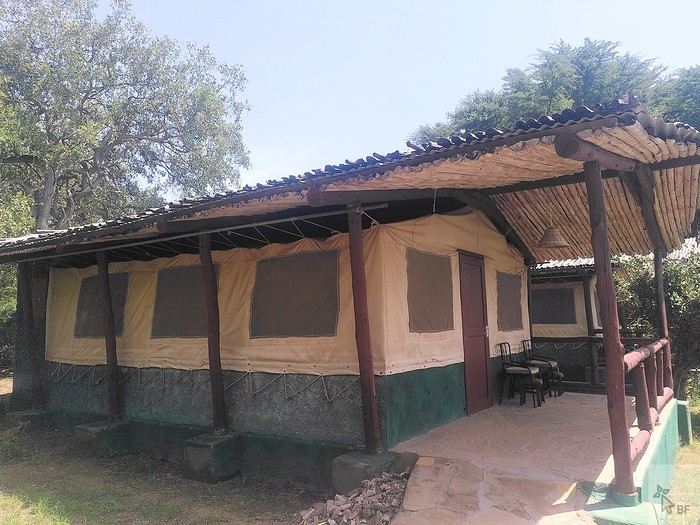
This camp is well-located inside the park. It’s simple but comfortable enough for our tastes, the staff is super friendly (as is often the case in Kenya), and the buffet-style meals are varied and good. Tsavo is the main destination for tourists staying on the coast who come for a night or two on safari. In January, some days at the camp are very quiet, while some evenings, the restaurant is packed with groups (lots of Italians, in particular).
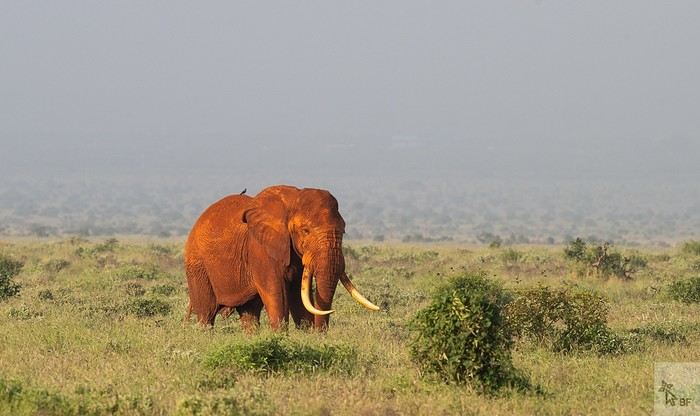
Tsavo is, of course, famous for its elephants. This time, we didn’t see many large herds, but we did have some great encounters with solitary males.
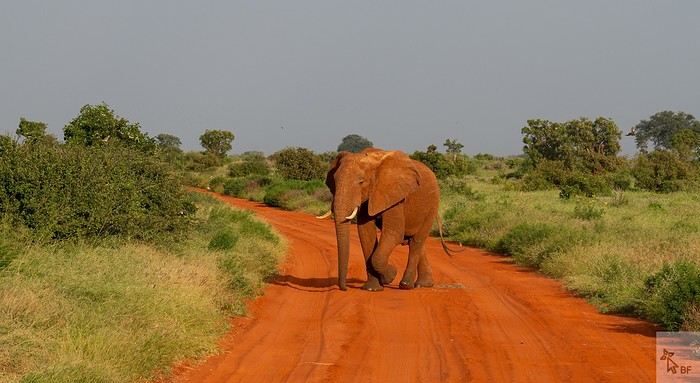
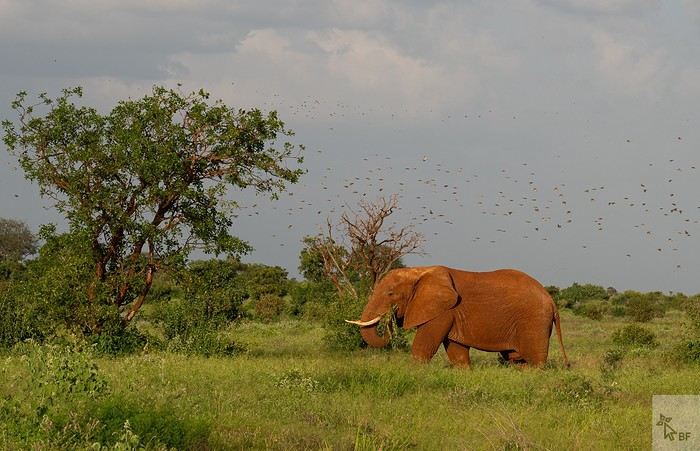
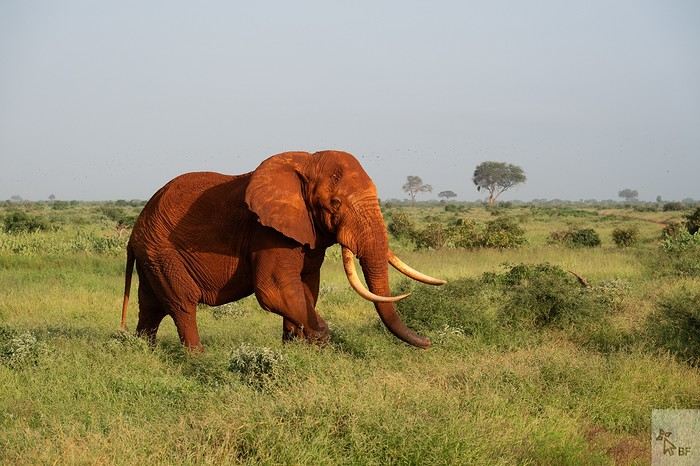
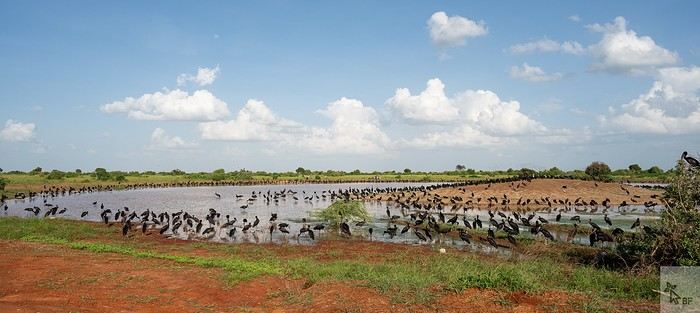
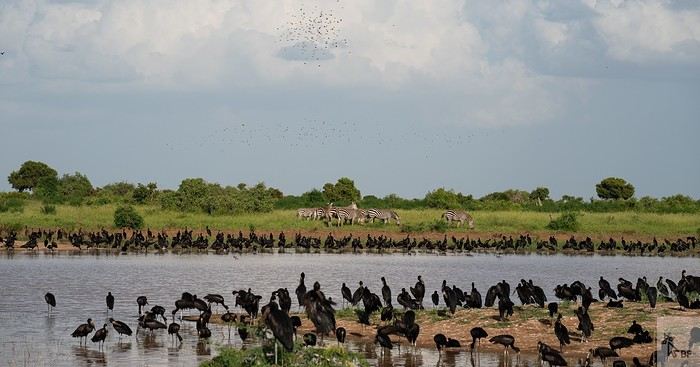
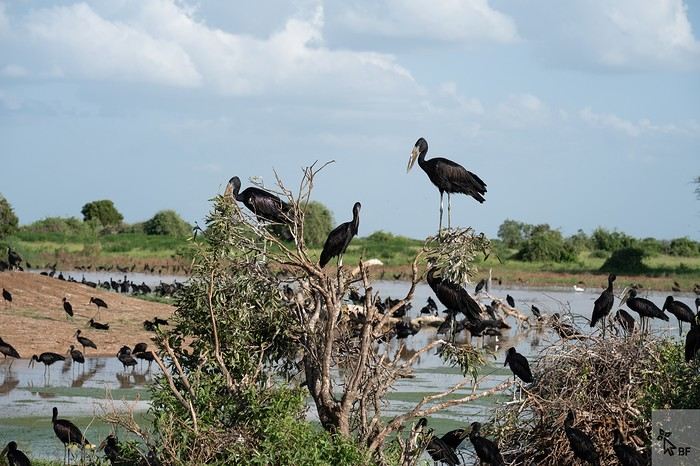
Around this small watering hole, we saw a gathering of African open-billed storks—we’d never seen so many before!
I’d like to invite you on a new adventure in Kenya.
Back in 2010, my husband Ben and I fell in love with Kenya, and we’ve been traveling there regularly ever since. This 2025 safari marked the first weeks of an important milestone in my life: retirement.
Of course, Felix—our guide and friend for all these years, whom some of you may even know from this forum—joined us again.
We chose an itinerary that takes us through the parks and reserves we particularly love in Kenya: Tsavo East (3 nights), Tsavo West (2 nights), a transition day in Embu, Samburu (5 nights), Meru NP (4 nights), Nanuyki to visit the Mount Kenya Animal Orphanage (https://mountkenyawildlifeconservancy.org/) (1 night), and Aberdare NP (2 nights).
This safari wasn’t our most prolific in terms of wildlife sightings and photos (all taken by Ben), but I still think it’s worth sharing our experiences and impressions of the places we visited. Maybe other travelers will find useful information here to help them fulfill their dream of a Kenyan safari one day...
Living in Brittany, we left from Nantes on Wednesday, January 8, 2025, on the 6 AM Air France flight to CDG, then took the direct flight to Nairobi at 10:50 AM. No issues this time on either flight (unlike in October 2023...).
We arrived in Nairobi at 9:20 PM local time (there’s a two-hour time difference with France at this time of year). Going through passport control and collecting our luggage went smoothly. The hotel shuttle (https://67airporthotel.co.ke/) was waiting for us. We shared it with a friendly Swiss couple who were there to climb Mount Kenya. We arrived at the hotel around midnight. The 67 Airport Hotel is 10-15 minutes from Jomo Kenyatta Airport and offers great value for money. Plus, it’s close to the Mombasa road, which is handy when heading that way the next morning.
On Thursday, January 9, we had breakfast at the hotel restaurant at 6:30 AM, and as planned, Felix arrived around 7 AM. We got to check out his brand-new 4x4 Nissan—we’d be the first to test it! 🙂
We set off for Voi, making our usual stop in Mtito Andei. Traffic was heavy on the Mombasa road, with lots of trucks.
We arrived at the entrance of Tsavo East around 1 PM and made it to Sentrim Camp (https://www.sentrim-hotels.com/sentrim-tsavo.html) just in time for lunch.
We found Tsavo East unusually green—there had been heavy rains in December, which isn’t typical. As a result, the animals were scattered and harder to spot. The watering hole visible from the camp’s dining area was completely deserted, whereas it’s usually bustling with herds of elephants and other mammals.
Our tent, No. 9, for 3 nights.
This camp is well-located inside the park. It’s simple but comfortable enough for our tastes, the staff is super friendly (as is often the case in Kenya), and the buffet-style meals are varied and good. Tsavo is the main destination for tourists staying on the coast who come for a night or two on safari. In January, some days at the camp are very quiet, while some evenings, the restaurant is packed with groups (lots of Italians, in particular).
Tsavo is, of course, famous for its elephants. This time, we didn’t see many large herds, but we did have some great encounters with solitary males.
Around this small watering hole, we saw a gathering of African open-billed storks—we’d never seen so many before!