Results for "Singapour+souvenir+artisanat"
About 11,396 results.
More options
Many results are in French, the community’s main language. English translations are added over time.
Search results
Formalités administratives pour Bali
Bonjour toute nouvelle sur le forum..
Je désire partir pourle mois d'avril à Bali... quelq'un pourrai me dire quels formalités administratives faut-il? merci à très bientôt
Pulci
Malaisie ou Indonésie?
bonjour, j'envisage de partir seule été 2006 en Malaisie ou Indonésie pour une quinzaine de jours. Que me conseillez vous sachant que je suis seule, que je préfère les rencontres avec la population et les paysages, qu'une multitude de temples. Que pensez-vous de la facilité des transports, des infrastructures... Finir sur une belle plage me branche aussi. Quid de ces pays musulmans pour une femme ? ok sans débardeur sexy avec nombril à l'air.
j'ai pensé à ces destinations parce qu'il semble que question météo, ce soit mieux que la Thaïlande par exemple en été (le sud de la Thaïlande, phuket et cie ne me branche pas)
merci pour vos réponses
Compagnie Qatar Airways
je part dans quelques jours avec le cie qatar airways, aimerait des infos sur cette cie et sur l'aeroport de doha duty free nottamment
merci a tous
En train en Égypte
Bonjour,
Il y eut pendant ce voyage en Égypte au cours de ce mois qui s'achève trois déplacements en train desquels j'ai tiré quelques observations. Pour le cas où on penserait que j'en étais à mes premiers balbutiements sur rails voici une courte présentation.
Fils et petit-fils de guichetier aux chemins de fer canadiens, j’ai eu pendant longtemps dans mon enfance et tard dans mon adolescence ce privilège de pouvoir voyager gratuitement en trains au Canada. Cependant, mon expérience des voyages en trains sur le continent européen est plus limitée… dans le temps.
En 1987, un Paris-Hanovre-Berlin en wagon-lits (TEN :Trans Europe Nuit) avec passage obligé en RDA évidemment; puis un Berlin-Munchen; Munchen-Wien; Wien-Sargans; le Glacier-Express avec repas au chic wagon-restaurant; deux passages en TGV sans compter d’autres déplacements chez les CFF et autres trains régionaux de Suisse. Enfin en 2001, Istanboul-Denizli-Istamboul en wagon-lits (les yatakli-wagons) et wagon-resto.
Il allait donc de soi que j’allais aussi au cours de ce voyage en solo en Égypte fréquenter les trains égyptiens. Ce fut hélas une grande déception. Rien de comparable avec ce à quoi je m’attendais. J’aurai probablement fait une mauvaise lecture des avis parus sur les forums. Et mon attente était probablement à un niveau trop élevée au départ.
Les trains égyptiens ne tiennent pas la comparaison avec ce que j’ai connu ado ni même seulement vingt ans en arrière avec ce que j’ai expérimenté sur le continent européen.
D'abord dès l'arrivée sur le quai d’une gare on ne peut s’empêcher de remarquer la malpropreté extérieure de tous les wagons; parfois même c’est le revêtement du wagon qui est détérioré. On devient vite songeur sur ce qui nous attend à l’intérieur.
Une fois dans le wagon, c’est vrai qu’il y a beaucoup d’espace, mais ça s’arrête là. Point. La propreté et l’aspect général du wagon, sans demander le niveau de qualité suisse, laissent place à beaucoup, beaucoup d’améliorations. Les trains égyptiens ont beaucoup de vécu comme on dit.
Déplacements effectués :
Caire-Assouan: train # 980, 1ère cl.; départ 07 :40 arrivée en Basse-Nubie 13 heures plus tard. Coût; 77 LE
La banquette était à ce point confortable qu’elle restait à peine enclanchée dans son support; c’est dire si je ne l’ai pas trop basculée vers l’arrière pour m’allonger. Si c’était à refaire, je sacrifierais la beauté des paysages vus le long du Nil (on peut les revoir ailleurs) pour plus de confort dans une couchette Abela. Malgré tout, heureux de ne pas avoir passé ces treize longues heures assis à transpirer et/ou à geler sur une banquette de vinyle comme celles aperçues dans d’autres wagons du même train.
Les toilettes…pouach! On apporte son papier-cul et on ferme les yeux et on se pince le nez...si on peut.
Le préposé aux bagages a passé un temps fou à trouver un truc pour garder fermée la porte du compartiment à bagages. Elle n'est probablement pas réparée aujourd'hui.
Je revois encore cette Française sortir sur le quai avant le départ pour nettoyer la vitre de sa fenêtre avec un papier-mouchoir dans l’espoir vain de pouvoir faire quelques photos !
Assouan-Louxor : train # 903, 1ère cl.; départ 18 :00 et à destination trois heures plus tard. Coût : 30 LE
Sur une échelle de 1 à 5, ce wagon se mérite une note seulement de plus que le wagon 03 du # 980 précédent.
Louxor-Caire : train # 85, wagon-lits; départ 21 :30 et rendu à destination au petit matin. Coût 53$ us.
C’est ce qu’on aura connu de plus propre et de plus confortable; le cabinet des toilettes… on a beau garder le pied pesamment appuyé sur la pédale, l'eau ne viendra jamais et comme l’effet succion n’est pas aussi puissant que celui des toilettes d’un avion, vous devinez le reste.
Le wagon-bar ( on disait ici dans le temps le club-car ou le parlor-car) offre peu à consommer, on y empeste la fumée du préposé, eh oui, et le wagon pourrait être plus propre. Décalage évident entre la pub sur internet et la réalité. Note de passage un petit 3, 0 pas plus, car les TEN même en 1987 (voir plus haut) étaient encore pas mal plus nickel (souvenir photographique l’appui)
Alexandrie-Caire : train # 916, 1ère cl.; départ 14 :00, arrivée gare Ramsès 16 :30. Coût : 34 LE
Le Lonely Planet vante ce train pour sa rapidité et c’est vrai. Mais ce n’est ni la propreté ni le confort d’un TGV Paris-Lausanne. Je regrette. Deux anecdotes :Le verre protecteur d’un des phares de la locomotive de queue était carrément disparu et le revêtement de certains wagons s’était effrité. Le préposé aux bagages a posé le pied sur l’appui-bras pour s’aider à placer les bagages sur le rail du dessus. Difficile de blâmer des passagers qui feraient pareil.
Mais le plus important dans tous ces déplacements, c’était de se rendre à destination… presqu’à temps, ce fut fait, presque tout le temps.
Et encore comment se rendre du Caire à Assouan autrement? En avion? Mais il faut se lever en milieu de nuit et ça je ne voulais pas le refaire.
Il y eut pendant ce voyage en Égypte au cours de ce mois qui s'achève trois déplacements en train desquels j'ai tiré quelques observations. Pour le cas où on penserait que j'en étais à mes premiers balbutiements sur rails voici une courte présentation.
Fils et petit-fils de guichetier aux chemins de fer canadiens, j’ai eu pendant longtemps dans mon enfance et tard dans mon adolescence ce privilège de pouvoir voyager gratuitement en trains au Canada. Cependant, mon expérience des voyages en trains sur le continent européen est plus limitée… dans le temps.
En 1987, un Paris-Hanovre-Berlin en wagon-lits (TEN :Trans Europe Nuit) avec passage obligé en RDA évidemment; puis un Berlin-Munchen; Munchen-Wien; Wien-Sargans; le Glacier-Express avec repas au chic wagon-restaurant; deux passages en TGV sans compter d’autres déplacements chez les CFF et autres trains régionaux de Suisse. Enfin en 2001, Istanboul-Denizli-Istamboul en wagon-lits (les yatakli-wagons) et wagon-resto.
Il allait donc de soi que j’allais aussi au cours de ce voyage en solo en Égypte fréquenter les trains égyptiens. Ce fut hélas une grande déception. Rien de comparable avec ce à quoi je m’attendais. J’aurai probablement fait une mauvaise lecture des avis parus sur les forums. Et mon attente était probablement à un niveau trop élevée au départ.
Les trains égyptiens ne tiennent pas la comparaison avec ce que j’ai connu ado ni même seulement vingt ans en arrière avec ce que j’ai expérimenté sur le continent européen.
D'abord dès l'arrivée sur le quai d’une gare on ne peut s’empêcher de remarquer la malpropreté extérieure de tous les wagons; parfois même c’est le revêtement du wagon qui est détérioré. On devient vite songeur sur ce qui nous attend à l’intérieur.
Une fois dans le wagon, c’est vrai qu’il y a beaucoup d’espace, mais ça s’arrête là. Point. La propreté et l’aspect général du wagon, sans demander le niveau de qualité suisse, laissent place à beaucoup, beaucoup d’améliorations. Les trains égyptiens ont beaucoup de vécu comme on dit.
Déplacements effectués :
Caire-Assouan: train # 980, 1ère cl.; départ 07 :40 arrivée en Basse-Nubie 13 heures plus tard. Coût; 77 LE
La banquette était à ce point confortable qu’elle restait à peine enclanchée dans son support; c’est dire si je ne l’ai pas trop basculée vers l’arrière pour m’allonger. Si c’était à refaire, je sacrifierais la beauté des paysages vus le long du Nil (on peut les revoir ailleurs) pour plus de confort dans une couchette Abela. Malgré tout, heureux de ne pas avoir passé ces treize longues heures assis à transpirer et/ou à geler sur une banquette de vinyle comme celles aperçues dans d’autres wagons du même train.
Les toilettes…pouach! On apporte son papier-cul et on ferme les yeux et on se pince le nez...si on peut.
Le préposé aux bagages a passé un temps fou à trouver un truc pour garder fermée la porte du compartiment à bagages. Elle n'est probablement pas réparée aujourd'hui.
Je revois encore cette Française sortir sur le quai avant le départ pour nettoyer la vitre de sa fenêtre avec un papier-mouchoir dans l’espoir vain de pouvoir faire quelques photos !
Assouan-Louxor : train # 903, 1ère cl.; départ 18 :00 et à destination trois heures plus tard. Coût : 30 LE
Sur une échelle de 1 à 5, ce wagon se mérite une note seulement de plus que le wagon 03 du # 980 précédent.
Louxor-Caire : train # 85, wagon-lits; départ 21 :30 et rendu à destination au petit matin. Coût 53$ us.
C’est ce qu’on aura connu de plus propre et de plus confortable; le cabinet des toilettes… on a beau garder le pied pesamment appuyé sur la pédale, l'eau ne viendra jamais et comme l’effet succion n’est pas aussi puissant que celui des toilettes d’un avion, vous devinez le reste.
Le wagon-bar ( on disait ici dans le temps le club-car ou le parlor-car) offre peu à consommer, on y empeste la fumée du préposé, eh oui, et le wagon pourrait être plus propre. Décalage évident entre la pub sur internet et la réalité. Note de passage un petit 3, 0 pas plus, car les TEN même en 1987 (voir plus haut) étaient encore pas mal plus nickel (souvenir photographique l’appui)
Alexandrie-Caire : train # 916, 1ère cl.; départ 14 :00, arrivée gare Ramsès 16 :30. Coût : 34 LE
Le Lonely Planet vante ce train pour sa rapidité et c’est vrai. Mais ce n’est ni la propreté ni le confort d’un TGV Paris-Lausanne. Je regrette. Deux anecdotes :Le verre protecteur d’un des phares de la locomotive de queue était carrément disparu et le revêtement de certains wagons s’était effrité. Le préposé aux bagages a posé le pied sur l’appui-bras pour s’aider à placer les bagages sur le rail du dessus. Difficile de blâmer des passagers qui feraient pareil.
Mais le plus important dans tous ces déplacements, c’était de se rendre à destination… presqu’à temps, ce fut fait, presque tout le temps.
Et encore comment se rendre du Caire à Assouan autrement? En avion? Mais il faut se lever en milieu de nuit et ça je ne voulais pas le refaire.
B777 le record le plus américain
Le Record le plus Américain du monde,
Et oui une fois de plus les ricains nous ont montré leur débilité ils ont envoyé un B777-200 LR (Long range) pour un HONG KONG--LONDRE soit 21.500 kilomètres. L'appareil est parti hier à 15h30 de Hong Kong et devrait se poser hier à Londres à 14h30 étrange, il faudrait quand même voir à pas nous prendre pour des billes ! La ligne Hong Kong-Londres mesure exactement 9.740 kilomètres.??? Certes par l'ouest seulement, ils passent par l'est. Ah bon ? Et à quoi sert-cela ? A faire un essai de très long courrier, sûrement... Mais alors à quoi bon faire 21500km ba a rien!!!! si on compare à la circonférence de notre planète par l’équateur. Coluche prétendait-il, du temps où sévissait à l'Est la dictature communiste, que le Russe le plus malchanceux était Youri Gagarine car, ayant fait dix-sept fois le tour de la Terre, il était retombé en URSS... Et quel plaisir de rester dans un avion +de 20H on en redemande...
Et oui une fois de plus les ricains nous ont montré leur débilité ils ont envoyé un B777-200 LR (Long range) pour un HONG KONG--LONDRE soit 21.500 kilomètres. L'appareil est parti hier à 15h30 de Hong Kong et devrait se poser hier à Londres à 14h30 étrange, il faudrait quand même voir à pas nous prendre pour des billes ! La ligne Hong Kong-Londres mesure exactement 9.740 kilomètres.??? Certes par l'ouest seulement, ils passent par l'est. Ah bon ? Et à quoi sert-cela ? A faire un essai de très long courrier, sûrement... Mais alors à quoi bon faire 21500km ba a rien!!!! si on compare à la circonférence de notre planète par l’équateur. Coluche prétendait-il, du temps où sévissait à l'Est la dictature communiste, que le Russe le plus malchanceux était Youri Gagarine car, ayant fait dix-sept fois le tour de la Terre, il était retombé en URSS... Et quel plaisir de rester dans un avion +de 20H on en redemande...
Acheter ses billets sur internet
Avec toutes les histoires d'arnaques qui apparaissent ici je commence à me poser des questions. Je n'ai jusqu'à présent effectué qu'une seule réservation sur Expedia.fr (vol sec sur Iberia) et tout s'est bien passé.
J'envisage de réitérer l'expérience, mais pour un voyage plus long et plus lointain que le précédent. Il s'agit d'un mois au Brésil, j'ai trouvé de bons prix avec les compagnies TAP et Varig, via Expedia. En outre il me semble que leur combinaison de réservation d'un vol + les premières nuitées d'hôtel est assez intéressante.
Le prix d'Expedia est inférieur de 100 € au prix de mon agence de voyages, alors qu'il s'agit exactement du même vol, mais je suppose que la classe de réservation n'est pas la même ou qu'ils ont des tarifs négociés.
Quelqu'un a-t-il des commentaires à émettre ?
Merci de me donner vos avis
J'envisage de réitérer l'expérience, mais pour un voyage plus long et plus lointain que le précédent. Il s'agit d'un mois au Brésil, j'ai trouvé de bons prix avec les compagnies TAP et Varig, via Expedia. En outre il me semble que leur combinaison de réservation d'un vol + les premières nuitées d'hôtel est assez intéressante.
Le prix d'Expedia est inférieur de 100 € au prix de mon agence de voyages, alors qu'il s'agit exactement du même vol, mais je suppose que la classe de réservation n'est pas la même ou qu'ils ont des tarifs négociés.
Quelqu'un a-t-il des commentaires à émettre ?
Merci de me donner vos avis
Situation à Sulawesi en Indonésie
Bonjour à tous,
Est ce que l'un d'entre vous revient de cette ile Indonésienne ? J'aimerais recueillir quelques infos quant à la situation actuelle, et à l'élaboration d'un itinéraire. merci yann
Est ce que l'un d'entre vous revient de cette ile Indonésienne ? J'aimerais recueillir quelques infos quant à la situation actuelle, et à l'élaboration d'un itinéraire. merci yann
Route Lhassa (Tibet)-Katmandou
ok salut à tous...
Je ne suis pas du style à planifier mes voyages mais là... il faut un minimum. J'aurai aimé avoir quelques renseignements sur les possibilités qui s'offrent à moi afin que je ne reste pas bloqué à Lathse...
En fait, nous seront en couple et nous aimerions ne pas avoir à jouer les américains en 4x4 aprés la fin des transport "public" à Lathse. Si jamais un de vous a déjà effectuer la route de l'amitié avec des moyens de transport similaires, nous serions heureux qu'il nous fasse part de son expérience.
Merci d'avance.
ps: des renseignements sur l'entrée au Tibet (Golmud ou chengdu) son aussi les bienvenus.
ciao
Conseils sur voyage de noces en Nouvelle-Zélande
Bonjour à tous,
Je m'étais inscrite y'a quelques mois avant de partir en Inde....magnifique pays sois dit en passant🙂. Mais là je reviens avec un autre projet de voyage. Avec mon très futur et tendre nous avons programmé de partir en Nouvelle Zélande en Février 2006. Mais à part ça, nous ne savons pas où aller, quoi y faire. Si nous savons que nous voulous y rester entre 4/5 semaines, et que nous voulons faire un stop à San Francisco ( en espérant que Andréa ne se réveille pas 😕). L'aventure nous tente, mais nous avons du mal à choisir entre louer un camping-car ou faire un tour dans des B&B's tout au long de notre parcours!? Au fait nous voulons faire le tour des deux îles...autant pas venir pour rien 😉!
Alors vous spécialistes du voyage, que nous conseillez vous???
Merci
Je m'étais inscrite y'a quelques mois avant de partir en Inde....magnifique pays sois dit en passant🙂. Mais là je reviens avec un autre projet de voyage. Avec mon très futur et tendre nous avons programmé de partir en Nouvelle Zélande en Février 2006. Mais à part ça, nous ne savons pas où aller, quoi y faire. Si nous savons que nous voulous y rester entre 4/5 semaines, et que nous voulons faire un stop à San Francisco ( en espérant que Andréa ne se réveille pas 😕). L'aventure nous tente, mais nous avons du mal à choisir entre louer un camping-car ou faire un tour dans des B&B's tout au long de notre parcours!? Au fait nous voulons faire le tour des deux îles...autant pas venir pour rien 😉!
Alors vous spécialistes du voyage, que nous conseillez vous???
Merci
Combien sommes-nous à préparer un tour du monde?
Bonjour à Tous,
Comme nombreux d’entre vous ici, je prépare un Tour du Monde, en lisant les différents forums, je constate que nous sommes vraiment beaucoup à partir dans les 12 prochains mois, alors ce serait sympa de recenser tous les projets de tour du monde en préparation, en donnant quelques infos,
Je me lance :
Dates de départ...................................env 15 janvier 2006 Nombres de mois, années....................env 2 ans En solo, duo, voir plus ........................solo Continent par ordre de passage ..........Asie, Océanie, Amérique du Sud et Centrale, Afrique Premier pays ......................................Inde Dernier pays ......................................Israel Nombre de vols prévus ......................entre 12 et 20 Site Web de votre tour .......................oui en construction
Et le LIEU incontournable de votre tour : ( si vous arrivez à répondre )
Voila pour moi, j’attend vos merveilleux projets ....
Mpolo57
« Il arriva à la croisée de 2 chemins, et là il décida d’aller là où il n’allait pas «
Comme nombreux d’entre vous ici, je prépare un Tour du Monde, en lisant les différents forums, je constate que nous sommes vraiment beaucoup à partir dans les 12 prochains mois, alors ce serait sympa de recenser tous les projets de tour du monde en préparation, en donnant quelques infos,
Je me lance :
Dates de départ...................................env 15 janvier 2006 Nombres de mois, années....................env 2 ans En solo, duo, voir plus ........................solo Continent par ordre de passage ..........Asie, Océanie, Amérique du Sud et Centrale, Afrique Premier pays ......................................Inde Dernier pays ......................................Israel Nombre de vols prévus ......................entre 12 et 20 Site Web de votre tour .......................oui en construction
Et le LIEU incontournable de votre tour : ( si vous arrivez à répondre )
Voila pour moi, j’attend vos merveilleux projets ....
Mpolo57
« Il arriva à la croisée de 2 chemins, et là il décida d’aller là où il n’allait pas «
Choisir une île en Malaisie
Bonjour,
si vous deviez choisir une île une seule (en Malaisie) laquelle serait- elle ?
nous partons début juillet en Malaisie et Bornéo, je nous connais nous allons pas mal bouger au moins tous les 2 ou 3 jours, nous partons avec nos enfants et pendant une petite semaine au moins, nous aimerions trouver une belle plage tranquille pour se reposer, magnifique, bungalow au bord de l'eau, enfin le paradis !😉
pour le moment notre choix se porte sur l'île de Tioman
qu'en pensez vous ?
A Vous ....
si vous deviez choisir une île une seule (en Malaisie) laquelle serait- elle ?
nous partons début juillet en Malaisie et Bornéo, je nous connais nous allons pas mal bouger au moins tous les 2 ou 3 jours, nous partons avec nos enfants et pendant une petite semaine au moins, nous aimerions trouver une belle plage tranquille pour se reposer, magnifique, bungalow au bord de l'eau, enfin le paradis !😉
pour le moment notre choix se porte sur l'île de Tioman
qu'en pensez vous ?
A Vous ....
Restaurant 2 euros à volonté à Bangkok
un des nombreux restaurant ( non touristiques ) a Bangkok ou l'on peut manger a volonté
Pour moins de 2 euros par personne .. ( sans les boissons )
il y a un principe a respecter .. est que il faut manger tout ce que vous prenez .. si il y a des restes sur la table il y a forcement amende ... le plus près de kaosan se trouve de l'autre cote de la rivière a 15 20 minutes a pied ...
( pas besoin de vraiment parler thaïe .. il faut choisir une table .. commander la boisson .. puis aller du cote du buffet et faire son choix .. ne pas oublier les petites différentes sauces qui l'accompagne ...
dans un coin il y a glace a volonté .. également .... bon appétit ...
voir photos
Pour moins de 2 euros par personne .. ( sans les boissons )
il y a un principe a respecter .. est que il faut manger tout ce que vous prenez .. si il y a des restes sur la table il y a forcement amende ... le plus près de kaosan se trouve de l'autre cote de la rivière a 15 20 minutes a pied ...
( pas besoin de vraiment parler thaïe .. il faut choisir une table .. commander la boisson .. puis aller du cote du buffet et faire son choix .. ne pas oublier les petites différentes sauces qui l'accompagne ...
dans un coin il y a glace a volonté .. également .... bon appétit ...
voir photos
Thaïlande, Cambodge, Vietnam: en combien de temps?
coucou
jarrive a singapoure le 8juillet 2005 et mon tiket de depart est le 6septembre.
cela me laisse donc deux mois pr voyager en asie du sud est!!
jai lu pas mal de conversation et apparement la thaillande est un bon debut mais je voudrais savoir si en 2 mois jaurais le temps de faire thaillande cambodge vietnam ou alors si ca sera trop le ruch!!!
dans ce cas quels pays me conseillez vous de faire en priorite pendant ces 2 mois
merci pour tt vos conseils
jarrive a singapoure le 8juillet 2005 et mon tiket de depart est le 6septembre.
cela me laisse donc deux mois pr voyager en asie du sud est!!
jai lu pas mal de conversation et apparement la thaillande est un bon debut mais je voudrais savoir si en 2 mois jaurais le temps de faire thaillande cambodge vietnam ou alors si ca sera trop le ruch!!!
dans ce cas quels pays me conseillez vous de faire en priorite pendant ces 2 mois
merci pour tt vos conseils
Vos plus beaux souvenirs en avion
bonjour à tous
Nombreux d'entre vous ont eu des retards, bagages perdus, correspondances loupées. Mais j'en suis sûr, vous avez tous eu de très agréables moments pendant un ou plusieurs vols. Quels sont vos plus beaux souvenirs ???
Nombreux d'entre vous ont eu des retards, bagages perdus, correspondances loupées. Mais j'en suis sûr, vous avez tous eu de très agréables moments pendant un ou plusieurs vols. Quels sont vos plus beaux souvenirs ???
Cafards, rats lézards et autres z'amis... vos rencontres
Pour faire suite à l’excellent post d’Alan(http://voyageforum.com/voyage/indonesie_terreur_sumatra_D73106/) nous narrant le terrible siège qu’il a dû subir, je vous propose de collecter ici toutes vos rencontres d’infortune avec la faune locale.
Y êtes-vous sensible ou etes-vous capable de dormi du sommeil du juste dans un wagon grouillant de blattes ? Devenez-vous absolument hystérique à la simple vue d’un lézard ou d’un insecte… Racontez nous vos anecdotes…
Pour ma part je ne m’explique toujours pas comment j’ai pu autant de fois me rendre en Asie avec une telle peur de la Blatte. Par bonheur, les rencontres malheureuse furent plutôt rares, mais épiques !
21 heures / Krabi / Thaïlande
Nous devons passer la nuit dans cette charmante guest house avant de prendre le bateau pour les îles. C’est rustique, mais agréable. Nos bungalows sont blottis au fonds d’une épaisse végétation.
De retour de dîner nous trouvons une adorable chienne rachitique allaitant son petit sur le perron de notre porte. J’ai toujours penser que nous pourrions nous préoccuper des animaux quant tous les enfants vivront dans des conditions décentes… Mais je n’ai jamais réussit à l’appliquer. Ma femme et moi-même cherchons dans notre sac ce qui pourrai remplir ce frêle estomac. L’animal est adorable et son petit nous fend le cœur… Il sont maintenant repus… Et commencent à somnoler… Nous allons faire de même.
Nous rentrons nous coucher le cœur allégé par ce spectacle.
le ventilo est resté allumé la veille et j’ai encore attrapé froid. La fièvre monte doucement… la toux aussi. Je me relève prendre une aspirine. J’allume la lumière à tâtons et porte la main à ma trousse de toilette.
Quelque chose à bougé… Là juste derrière le gel douche.
J’ai à peine eut le temps de le voir. C’est derrière le flacon j’en suis certain ! Je ne bouge plus… Ma femme s’est assoupie… Et je ne peux pas sortir de la salle de bain sans en avoir le cœur net. Je ne bouge toujours pas et scrute très attentivement tout autour de moi. Je sens des fourmillements me parcourir le dos… Je ne dois pas céder à la panique… La présence éventuelle de cet insecte m’interdit d’ouvrir la bouche. Je respire fortement par le nez.
Je prend ma brosse à dent pour manipuler la bouteille de savon liquide… L’instrument est court, mais je n’ai rien d’autre à ma portée. Il bouge ! s’en est un… Il est monstrueux… 4 cm… Peut être 5… Il agite doucement ses antennes et son corps marront noir strillé d'une carapace à l'aspect huileux, semble prêt à se glisser dans n'importe quel trou crasseux... Je suis tétanisé… Je sort doucement en ne quittant pas cette horreur du regard. Si je ferme la porte… J’aurai le sentiment d’être en sécurité. Mais un autre occupe le cadre de la porte de la salle de bain! L'idée que cette rencontre n'est pas fortuite, mais que le lieu est un repert grouillant m'angoisse! Je suis cerné.
Si je ferme la porte je l’écrase… Pour bien des gens c’est une occasion inespérée de se libérer de l’occupant… Pour moi c’est un traumatisme supplémentaire… La simple idée du bruit de cette carcasse explosant pour libérer une pulpe immonde, infestée de milliers d’œuf prêt à éclore… Impossible !
Je suis en sueur et je tousse, la fièvre monte d’un cran… Je n’ai plus le choix. Ma virilité va encore en prendre un coup, mais il faut que je réveille ma femme… Elle seule pourra me sortir de cette antichambre de la psychose qui me guette. A peine 2 mios que nous sommes marriés, et déja minable... Ca promet. Mon cœur… Hommmpff Y’a des cafards Où…. Rrrhh Dans la salle d’eau Bon bah dors, qu’est-ce que tu veux que je fasse ? ? ? Tu veux pas aller fermer la porte de la salle d’eau ? Ohhh tu m’emmerde avec tes bestioles elles vont pas te bouffer…Je retourne apeuré devant la porte de la salle de bain…L’occupant de la porte a disparu… Je souffle et ferme la porte…
Mais les éléments sont contre moi… C’est un mauvais film… La porte ne se ferme pas. Elle se rouvre paresseusement à chaque fois que je la renvoi dans ses gons. Je cherche une solution en la tenant. une ficelle… Mais je n’ai rien pour l’accrocher… Une chaise… Mais la porte s’ouvre sur l’intérieur de la salle de bain, il faudrait la bloquer de l’intérieur… C’est impossible. Voilà 5 min. que je tiens cette porte qui est mon unique rempart contre la crise de panique. Ma femme se lève sans rien dire… L’air furieuse… Je vais peut être passer un mauvais quart d’heure, mais le simple sentiment d’être moins seul me redonne du courage. Elle Prend un bout de ficelle. Rapproche une lourde chaise et accroche la poignée de la porte au dossier de la chaise.. Cela semble tenir…
Je suis fébrile et des frissons me parcours le corps… Je n’en pouvais plus… Je tente de m’endormir la bouche fermée… Je les imaginent rampant sur moi à la recherche de n’importe quelle cavité corporelle pour s’y loger et pondre… Au moins Alien vous offre une chance de mourir avant d’être parasité.
La nuit se passe et l’aube apporte son flot de lumière rassurante… Ces misérables insectes inoffensifs ne sont plus qu’une idée lointaine… Seule ma femme est là pour se souvenir… "Mais t’es vraiment pas bien ! Qu’est-ce qui t’a prit de faire un foin pareil pour un cafard…"…
Y êtes-vous sensible ou etes-vous capable de dormi du sommeil du juste dans un wagon grouillant de blattes ? Devenez-vous absolument hystérique à la simple vue d’un lézard ou d’un insecte… Racontez nous vos anecdotes…
Pour ma part je ne m’explique toujours pas comment j’ai pu autant de fois me rendre en Asie avec une telle peur de la Blatte. Par bonheur, les rencontres malheureuse furent plutôt rares, mais épiques !
21 heures / Krabi / Thaïlande
Nous devons passer la nuit dans cette charmante guest house avant de prendre le bateau pour les îles. C’est rustique, mais agréable. Nos bungalows sont blottis au fonds d’une épaisse végétation.
De retour de dîner nous trouvons une adorable chienne rachitique allaitant son petit sur le perron de notre porte. J’ai toujours penser que nous pourrions nous préoccuper des animaux quant tous les enfants vivront dans des conditions décentes… Mais je n’ai jamais réussit à l’appliquer. Ma femme et moi-même cherchons dans notre sac ce qui pourrai remplir ce frêle estomac. L’animal est adorable et son petit nous fend le cœur… Il sont maintenant repus… Et commencent à somnoler… Nous allons faire de même.
Nous rentrons nous coucher le cœur allégé par ce spectacle.
le ventilo est resté allumé la veille et j’ai encore attrapé froid. La fièvre monte doucement… la toux aussi. Je me relève prendre une aspirine. J’allume la lumière à tâtons et porte la main à ma trousse de toilette.
Quelque chose à bougé… Là juste derrière le gel douche.
J’ai à peine eut le temps de le voir. C’est derrière le flacon j’en suis certain ! Je ne bouge plus… Ma femme s’est assoupie… Et je ne peux pas sortir de la salle de bain sans en avoir le cœur net. Je ne bouge toujours pas et scrute très attentivement tout autour de moi. Je sens des fourmillements me parcourir le dos… Je ne dois pas céder à la panique… La présence éventuelle de cet insecte m’interdit d’ouvrir la bouche. Je respire fortement par le nez.
Je prend ma brosse à dent pour manipuler la bouteille de savon liquide… L’instrument est court, mais je n’ai rien d’autre à ma portée. Il bouge ! s’en est un… Il est monstrueux… 4 cm… Peut être 5… Il agite doucement ses antennes et son corps marront noir strillé d'une carapace à l'aspect huileux, semble prêt à se glisser dans n'importe quel trou crasseux... Je suis tétanisé… Je sort doucement en ne quittant pas cette horreur du regard. Si je ferme la porte… J’aurai le sentiment d’être en sécurité. Mais un autre occupe le cadre de la porte de la salle de bain! L'idée que cette rencontre n'est pas fortuite, mais que le lieu est un repert grouillant m'angoisse! Je suis cerné.
Si je ferme la porte je l’écrase… Pour bien des gens c’est une occasion inespérée de se libérer de l’occupant… Pour moi c’est un traumatisme supplémentaire… La simple idée du bruit de cette carcasse explosant pour libérer une pulpe immonde, infestée de milliers d’œuf prêt à éclore… Impossible !
Je suis en sueur et je tousse, la fièvre monte d’un cran… Je n’ai plus le choix. Ma virilité va encore en prendre un coup, mais il faut que je réveille ma femme… Elle seule pourra me sortir de cette antichambre de la psychose qui me guette. A peine 2 mios que nous sommes marriés, et déja minable... Ca promet. Mon cœur… Hommmpff Y’a des cafards Où…. Rrrhh Dans la salle d’eau Bon bah dors, qu’est-ce que tu veux que je fasse ? ? ? Tu veux pas aller fermer la porte de la salle d’eau ? Ohhh tu m’emmerde avec tes bestioles elles vont pas te bouffer…Je retourne apeuré devant la porte de la salle de bain…L’occupant de la porte a disparu… Je souffle et ferme la porte…
Mais les éléments sont contre moi… C’est un mauvais film… La porte ne se ferme pas. Elle se rouvre paresseusement à chaque fois que je la renvoi dans ses gons. Je cherche une solution en la tenant. une ficelle… Mais je n’ai rien pour l’accrocher… Une chaise… Mais la porte s’ouvre sur l’intérieur de la salle de bain, il faudrait la bloquer de l’intérieur… C’est impossible. Voilà 5 min. que je tiens cette porte qui est mon unique rempart contre la crise de panique. Ma femme se lève sans rien dire… L’air furieuse… Je vais peut être passer un mauvais quart d’heure, mais le simple sentiment d’être moins seul me redonne du courage. Elle Prend un bout de ficelle. Rapproche une lourde chaise et accroche la poignée de la porte au dossier de la chaise.. Cela semble tenir…
Je suis fébrile et des frissons me parcours le corps… Je n’en pouvais plus… Je tente de m’endormir la bouche fermée… Je les imaginent rampant sur moi à la recherche de n’importe quelle cavité corporelle pour s’y loger et pondre… Au moins Alien vous offre une chance de mourir avant d’être parasité.
La nuit se passe et l’aube apporte son flot de lumière rassurante… Ces misérables insectes inoffensifs ne sont plus qu’une idée lointaine… Seule ma femme est là pour se souvenir… "Mais t’es vraiment pas bien ! Qu’est-ce qui t’a prit de faire un foin pareil pour un cafard…"…
Air France
salut
avez-vous deja pris cette compagnie ? Moi, oui, mais le moins possible. Sur les vols pour La Réunion, le service est le même que corsair. Même pas d'écran individuel. Quand on a goûté à Singapor Airlines en classe éco, tres difficile de voyager sur notre compagnie: hotesses qui se prennent pour des déesses, bouffe médiocre ( poulet ou poisson ?), aucun service pendant la nuit: si tu as soif, va te servir au fonds de l'avion près des hotesses qui lisent maxi, ici paris ou biba...Sans parler des vieux 747 pour les antilles où l'on accroche les bébés entre les sièges et les lampes ( le couffin et accroché près des ventilateurs. Su un vol pour saint denis, mes voisins de devant avaient un bébé:la mère été obligée de grimper sur le siège pour voir bébé qui se trouvait au dessus de ma tête, donc attention en se levant...Merci de réagir.
Kiwidam
avez-vous deja pris cette compagnie ? Moi, oui, mais le moins possible. Sur les vols pour La Réunion, le service est le même que corsair. Même pas d'écran individuel. Quand on a goûté à Singapor Airlines en classe éco, tres difficile de voyager sur notre compagnie: hotesses qui se prennent pour des déesses, bouffe médiocre ( poulet ou poisson ?), aucun service pendant la nuit: si tu as soif, va te servir au fonds de l'avion près des hotesses qui lisent maxi, ici paris ou biba...Sans parler des vieux 747 pour les antilles où l'on accroche les bébés entre les sièges et les lampes ( le couffin et accroché près des ventilateurs. Su un vol pour saint denis, mes voisins de devant avaient un bébé:la mère été obligée de grimper sur le siège pour voir bébé qui se trouvait au dessus de ma tête, donc attention en se levant...Merci de réagir.
Kiwidam
Megacom SIM card, how does it work?
Hi there,
I’ve never bought a SIM card abroad or even used prepaid cards in France...
So I’m wondering how it all works?
You buy a SIM card and pop it into your phone. Okay, so far so good... 😏
But after that?
I can’t find the price of prepaid cards or how they work with MegaCom.
If someone could give me a step-by-step guide... 😊
Thanks! 🙂
I’ve never bought a SIM card abroad or even used prepaid cards in France...
So I’m wondering how it all works?
You buy a SIM card and pop it into your phone. Okay, so far so good... 😏
But after that?
I can’t find the price of prepaid cards or how they work with MegaCom.
If someone could give me a step-by-step guide... 😊
Thanks! 🙂
Africa: A Heartfelt Love for a Continent
“When the Whites came to Africa, we had the land and they had the Bible. They taught us to pray with our eyes closed: when we opened them, the Whites had the land and we had the Bible.” Jomo Kenyatta (p.7)
The Maggi cube, an unchallenged hegemony, and so much more
“The hopeless continent,” headlined The Economist, a British magazine, in July 2000 about Africa. Eleven years later, the same magazine headlined “Africa rising” instead. Images of Africa in the prosperous North constantly oscillate between apocalyptic scenarios and enthusiastic projections. A key issue with such images lies in the generalization they entail. If you look at the continent, considerable contrasts emerge depending on space and time. It’s no surprise that a region of the world encompassing such diverse ecological zones, maintaining such varied ties with other continents, comprising nearly fifty nation-states in sub-Saharan Africa alone, and characterized by a great diversity of languages, belief systems, and historical paths, doesn’t share a single destiny.
And yet, for many people outside Africa, as well as for many Africans, the continent constitutes a single entity, defined by criteria such as skin color, a colonial past, poverty, and the art of survival. Until now, these perspectives were generally accompanied by the idea that Africa had to—or should have—followed a single path together, sometimes called development, sometimes modernization, sometimes liberation, then a market economy. None of these paths delivered on their promises.
The two writers Alain Mabanckou and Abdourahman Waberi—one from Congo, the other raised in Djibouti, both long settled in France and now professors at renowned North American universities (Los Angeles, Washington)—have had enough of pessimistic scenarios: “We are aware that Africa is in the world and the world is in Africa. The same goes for all other continents, as our destinies are inextricably linked for better or worse. We refuse to see Africa as a reservoir of misfortunes or a continent cursed by atavistic misfortune and characterized by ethnic conflicts. [...] It’s this passionate flame we wanted to capture in a book [...] a kind of stroll through African cultures, without any demands, each letter of the alphabet leading us to a notion, a practice, a concept, a moment in history, literature, painting, politics, economics, cuisine, etc.” (p.10-11). Africa, they write, is on the verge of “imposing a signature, a style, a way of being in the world and in relation to the rest of the world.” (p.11) To put words to the continent’s diversity and dynamism, the two authors created a “rambling ABC,” a kind of portrait—or more precisely, a mythography—that lets you see and feel the pulse of a vast continent whose cultural power is unfolding before our eyes. Once marginalized or even mocked, the voice and importance of the Continent in global affairs are now undeniable” (p.11), containing over a hundred entries, mostly concise, written in a relaxed and casual style. The optimistic, even exuberant tone is set from the brief introduction. The duo of authors wants to “sing a love song to the cultures of our continent, to its inhabitants past and present, to its exceptional resources and its spectacular globalization despite a certain pollution that still clouds our skies due to the unmatched duration of dictatorships in some of our regions.” (p.12) In doing so, they don’t want to be too distracted by today’s Afewerki-Biya-Bongo-Déby & Co. ...
Of course, you’ll find tributes to great precursors like Frantz Fanon (“[...] it was a love story and admiration that wasn’t dimmed by the four decades separating his birth from ours. Let’s add that we were born while the native of Fort-de-France had left the world’s stage four years earlier, in the prime of life” p.141), Mongo Beti (“You must read and reread Mongo Beti, a genius who used his fame to support often just causes in Africa, like defending oppressed groups. His place is already in History. His oppressors, like the dictators Ahmadou Ahidjo and Paul Biya, can’t compete in the same category” p.64), the Malian Amadou Hampâté Bâ
(“Posterity remembers him mainly as an tireless defender of African cultures. His plea for the collection and preservation of traditional African knowledge remains a major event for all men and women of good will. One day in 1960, at the UNESCO podium, the native of Bandiagara sounded the alarm: ‘[...] Since we’ve admitted that the humanity of each people is the heritage of all humanity, if African traditions aren’t collected in time and written down, they’ll one day be missing from the universal archives of humanity.’” p.51),
Kwame Nkrumah, “one of the founders of Pan-Africanism, father of Ghana’s independence” (p.239), as well as the historian Cheikh Anta Diop, the writer, poet, and politician Aimé Césaire, and the economist and thinker Samir Amin, but also very warm tributes to certain contemporary African intellectuals like Souleymane Bachir Diagne and Achille Mbembe
(“A few years ago, in dominant economic circles, a rumor often resurfaced, usually disguised as a cold and scientifically proven analysis: Africa is useless. It’s a burden for the rest of the human community. With its 2% share in world trade, it would disappear from stock market radars without anyone noticing. So? Maybe it’ll be pulled up by other continents. Wanting to surpass itself is a crazy bet for Africans, they concluded. Arrogant or clueless, President Nicolas Sarkozy declared before an audience of students and teachers at Cheikh Anta Diop University in Dakar: ‘The African man hasn’t entered history enough [...] He only knows the eternal repetition of time marked by the endless repetition of the same gestures and words.’ That was in 2007. For decades, armed only with reason, an intellectual often steps up to debunk prejudices, lazy readings, and dishonest frameworks used as false fronts by those who, like Nicolas Sarkozy or former journalist Stephen Smith, out of ignorance, contempt, or condescension, distort African reality. This intellectual is none other than the historian and political scientist Achille Mbembe. This heir of Frantz Fanon, Amílcar Cabral, Jean-Marc Ela, and Fabien Eboussi-Boulaga was born in 1957 in Cameroon, in the Bassa region. Marked early by the upheavals of a fratricidal war, Achille Mbembe became the guardian of the memory of martyrs. After brilliant studies in Paris, he went on to teach at the best American universities, but the call of the Continent was stronger than anything else. In Dakar, he once directed CODESRIA (Council for the Development of Social Science Research in Africa) before joining the University of the Witwatersrand in Johannesburg, South Africa. Even though the author of *Critique of Black Reason* (Éditions La Découverte, 2015) spends a few months at Duke University in North Carolina, his observation post remains South Africa. From Johannesburg, Achille Mbembe scrutinizes Africa and the whole world. A lucid observer with an elegant and generous pen, Achille Mbembe knows how to blend big and small history: ‘I was born one day in July, as the month was drawing to a close. It was 1957, in that part of Africa recently named ‘Cameroon,’ a memory of the wonder that seized Portuguese sailors in the 15th century when, sailing up the river near Douala, they couldn’t help but note the presence of a multitude of crustaceans, and named it *Rio dos Camarões*, meaning ‘River of Shrimp.’ I grew up in the shadow of this nameless land, since, in a way, the name it bears is only the product of someone else’s astonishment: a lexical mistake, if you will.’ From this mistake or wound, he made leaven, a springboard to compose a rich work, recognized worldwide. To denounce barriers and barbarians too. But that’s not enough. Among his peers in circles of thought and action, Achille Mbembe passionately and consistently defends human dignity and the beauty of the world. In doing so, he fulfills the mission Frantz Fanon entrusted to him.” (p.227-229),
as well as entries dedicated to lesser-known artists and intellectuals, like the French journalist and activist Rokhaya Diallo, daughter of Senegalese and Gambian parents, or the Ethiopian filmmaker Haile Gerima, who has long lived in the United States. Other names from politics, sports, music, art, and literature: Kofi Annan, p.36; Barack Obama, p.243; Thomas Sankara, p.277; Ousmane Sow, p.285; Yambo Ouologuem, p.250; Léopold Sédar Senghor, p.282; Muhammad Ali, p.30; Nuruddin Farah, p.146; Salif Keita, p.203; Ahmadou Kourouma, p.206; Ngũgĩ wa Thiong’o, p.236; Winnie Mandela, p.224; Kylian Mbappé, p.226 ...
The authors, who resolutely commit to a “mythography” (p.11) of Africa, also pay special attention to local social movements, cultural events, and aspects of daily life. *Y’en a marre*, “which also meant ‘we’re fed up with sitting on our hands’” (p.320-321), emerged about a decade ago in Senegal as a citizen movement of peaceful resistance and symbolizes, the authors emphasize, the fact that African youth are increasingly fed up “with the political circus deployed in Africa since independence, as our parents would say, ‘since the White man left’...” (p.321). A full entry is dedicated to the Maggi bouillon cube, which has flooded African markets for about forty years and enjoys immense popularity (“It’s everywhere in Africa, from Dakar to Djibouti, and from Tangier to Cape Town. It’s in every pot, every stew. Little hands put it in every sauce, every local or adapted dish. An unchallenged hegemony! You’ll find it in diasporas too. The culinary strolls in Paris, in the [...] neighborhood” p.90). Critics blame it not only for impoverishing the aromatic diversity of local dishes but also for being harmful to health. And yet, “he poorest Africans, those who eat only once a day, a few spoonfuls of white beans and a ball of *foufou*, for example, are the most fervent users of the magic cube.” (p.92-93)
For *fonio*, “the new trendy cereal. [...] From the millet family, fonio is probably the oldest cereal cultivated in West Africa, and mainly in its sub-Saharan part, for millennia. [...] Easy to grow, water-efficient, fonio grows everywhere except on clay soils. Long neglected because it was considered the poor man’s crop, fonio is now a source of pride for the farmers who cultivate it and cherish it like the apple of their eye” (p.156-157), the authors immediately offer a detailed recipe, letting the reader know that “e can’t resist sharing this fonio with chicken recipe from Mali with you:
Ingredients: 1 chicken 3 large ripe red tomatoes 4 tbsp tomato paste 4 large onions 1 garlic clove 1/2 cup oil 2 Maggi cubes or salt 2 large carrots 1 turnip 1 large cabbage 2 large potatoes 1 celery stalk 1 packet pre-cooked fonio 4 okra (or okra powder) salt, pepper
Preparation: 1. Prepare the sauce: wash and cut the chicken. Peel the onions, garlic, and vegetables. 2. In a pot, fry the chicken pieces. 3. Dice the onions, tomatoes, carrots, and turnip very small and add them to the pot. 4. Add the tomato paste, salt, and pepper. 5. Simmer for 15 min, then add 2 L of water and the cooked chicken pieces. 6. Simmer for 30 min, then add the crushed garlic and celery, plus the cabbage cut into 4 and the potatoes cut in half. 7. Prepare the fonio: cover it with warm water, let it rest for 15 min, and cook it over low heat. 8. In a small pot, boil the okra and crush them. 9. Mix the crushed okra with the cooked fonio, then salt. Serve hot.” (p.158-159)
The comedy *Black Mic Mac*, released in French theaters in 1986 and addressing France’s increasingly restrictive immigration policy at the time, also gets an entry, as do *Tintin in the Congo*, the popular comic, and *Jip’s Café* (“[...] a little Africa in the heart of Paris, with passersby stopping to admire the ‘ambianceurs’ on the dance floor or attend the cultural events offered by the place” (p.194), an African establishment in Paris that Alain Mabanckou already immortalized in one of his novels.
The duo of authors also tackles thorny subjects like jihadism (p.119), the Rwandan genocide (p.272), the CFA franc (p.82), and dictatorship (p.110). While the two strike the right tone here, many entries leave a slightly bitter taste. Two examples: why doesn’t the text on Barack Obama mention the great disappointment of many people in Africa, who expected more from the African policy of the first U.S. president with African roots than just occasional warm words? Why do the comments on Winnie Mandela gloss over the fact that she was a highly controversial icon of the anti-apartheid movement due to her involvement in kidnappings, acts of torture, and murders of alleged apartheid collaborators? Instead, there’s a compassion that brings tears to the eyes: “She was often reduced to a secondary role, the wife of a great man” or “When victory came, she didn’t taste its fruits. Divorced, isolated. She would never be a ‘first lady’ in an evening gown, posing before a bed of chrysanthemums. They’d keep her far from the circles of power” (p.224-225). At this point, I would’ve liked the authors to take a slightly more critical stance...
That said, these “weaknesses” (if you can call them that) shouldn’t overshadow the book as a whole. It remains an informative, sometimes very entertaining, and often even original work in its own way.
Book information (the original French and the German translation):
Alain Mabanckou/Abdourahman Waberi. Dictionnaire enjoué des cultures africaines. Fayard, 2019. Alain Mabanckou/Abdourahman Waberi. Der Puls Afrikas. Eine Liebeserklärung von A bis Z. Reclam, 2022.
Hery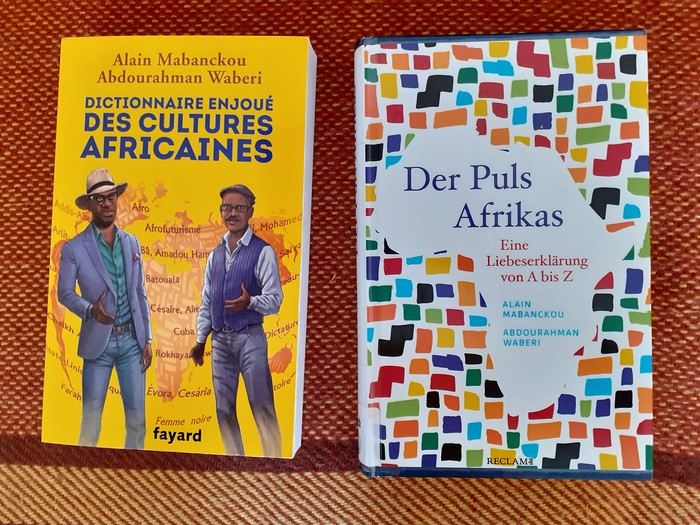
The Maggi cube, an unchallenged hegemony, and so much more
“The hopeless continent,” headlined The Economist, a British magazine, in July 2000 about Africa. Eleven years later, the same magazine headlined “Africa rising” instead. Images of Africa in the prosperous North constantly oscillate between apocalyptic scenarios and enthusiastic projections. A key issue with such images lies in the generalization they entail. If you look at the continent, considerable contrasts emerge depending on space and time. It’s no surprise that a region of the world encompassing such diverse ecological zones, maintaining such varied ties with other continents, comprising nearly fifty nation-states in sub-Saharan Africa alone, and characterized by a great diversity of languages, belief systems, and historical paths, doesn’t share a single destiny.
And yet, for many people outside Africa, as well as for many Africans, the continent constitutes a single entity, defined by criteria such as skin color, a colonial past, poverty, and the art of survival. Until now, these perspectives were generally accompanied by the idea that Africa had to—or should have—followed a single path together, sometimes called development, sometimes modernization, sometimes liberation, then a market economy. None of these paths delivered on their promises.
The two writers Alain Mabanckou and Abdourahman Waberi—one from Congo, the other raised in Djibouti, both long settled in France and now professors at renowned North American universities (Los Angeles, Washington)—have had enough of pessimistic scenarios: “We are aware that Africa is in the world and the world is in Africa. The same goes for all other continents, as our destinies are inextricably linked for better or worse. We refuse to see Africa as a reservoir of misfortunes or a continent cursed by atavistic misfortune and characterized by ethnic conflicts. [...] It’s this passionate flame we wanted to capture in a book [...] a kind of stroll through African cultures, without any demands, each letter of the alphabet leading us to a notion, a practice, a concept, a moment in history, literature, painting, politics, economics, cuisine, etc.” (p.10-11). Africa, they write, is on the verge of “imposing a signature, a style, a way of being in the world and in relation to the rest of the world.” (p.11) To put words to the continent’s diversity and dynamism, the two authors created a “rambling ABC,” a kind of portrait—or more precisely, a mythography—that lets you see and feel the pulse of a vast continent whose cultural power is unfolding before our eyes. Once marginalized or even mocked, the voice and importance of the Continent in global affairs are now undeniable” (p.11), containing over a hundred entries, mostly concise, written in a relaxed and casual style. The optimistic, even exuberant tone is set from the brief introduction. The duo of authors wants to “sing a love song to the cultures of our continent, to its inhabitants past and present, to its exceptional resources and its spectacular globalization despite a certain pollution that still clouds our skies due to the unmatched duration of dictatorships in some of our regions.” (p.12) In doing so, they don’t want to be too distracted by today’s Afewerki-Biya-Bongo-Déby & Co. ...
Of course, you’ll find tributes to great precursors like Frantz Fanon (“[...] it was a love story and admiration that wasn’t dimmed by the four decades separating his birth from ours. Let’s add that we were born while the native of Fort-de-France had left the world’s stage four years earlier, in the prime of life” p.141), Mongo Beti (“You must read and reread Mongo Beti, a genius who used his fame to support often just causes in Africa, like defending oppressed groups. His place is already in History. His oppressors, like the dictators Ahmadou Ahidjo and Paul Biya, can’t compete in the same category” p.64), the Malian Amadou Hampâté Bâ
(“Posterity remembers him mainly as an tireless defender of African cultures. His plea for the collection and preservation of traditional African knowledge remains a major event for all men and women of good will. One day in 1960, at the UNESCO podium, the native of Bandiagara sounded the alarm: ‘[...] Since we’ve admitted that the humanity of each people is the heritage of all humanity, if African traditions aren’t collected in time and written down, they’ll one day be missing from the universal archives of humanity.’” p.51),
Kwame Nkrumah, “one of the founders of Pan-Africanism, father of Ghana’s independence” (p.239), as well as the historian Cheikh Anta Diop, the writer, poet, and politician Aimé Césaire, and the economist and thinker Samir Amin, but also very warm tributes to certain contemporary African intellectuals like Souleymane Bachir Diagne and Achille Mbembe
(“A few years ago, in dominant economic circles, a rumor often resurfaced, usually disguised as a cold and scientifically proven analysis: Africa is useless. It’s a burden for the rest of the human community. With its 2% share in world trade, it would disappear from stock market radars without anyone noticing. So? Maybe it’ll be pulled up by other continents. Wanting to surpass itself is a crazy bet for Africans, they concluded. Arrogant or clueless, President Nicolas Sarkozy declared before an audience of students and teachers at Cheikh Anta Diop University in Dakar: ‘The African man hasn’t entered history enough [...] He only knows the eternal repetition of time marked by the endless repetition of the same gestures and words.’ That was in 2007. For decades, armed only with reason, an intellectual often steps up to debunk prejudices, lazy readings, and dishonest frameworks used as false fronts by those who, like Nicolas Sarkozy or former journalist Stephen Smith, out of ignorance, contempt, or condescension, distort African reality. This intellectual is none other than the historian and political scientist Achille Mbembe. This heir of Frantz Fanon, Amílcar Cabral, Jean-Marc Ela, and Fabien Eboussi-Boulaga was born in 1957 in Cameroon, in the Bassa region. Marked early by the upheavals of a fratricidal war, Achille Mbembe became the guardian of the memory of martyrs. After brilliant studies in Paris, he went on to teach at the best American universities, but the call of the Continent was stronger than anything else. In Dakar, he once directed CODESRIA (Council for the Development of Social Science Research in Africa) before joining the University of the Witwatersrand in Johannesburg, South Africa. Even though the author of *Critique of Black Reason* (Éditions La Découverte, 2015) spends a few months at Duke University in North Carolina, his observation post remains South Africa. From Johannesburg, Achille Mbembe scrutinizes Africa and the whole world. A lucid observer with an elegant and generous pen, Achille Mbembe knows how to blend big and small history: ‘I was born one day in July, as the month was drawing to a close. It was 1957, in that part of Africa recently named ‘Cameroon,’ a memory of the wonder that seized Portuguese sailors in the 15th century when, sailing up the river near Douala, they couldn’t help but note the presence of a multitude of crustaceans, and named it *Rio dos Camarões*, meaning ‘River of Shrimp.’ I grew up in the shadow of this nameless land, since, in a way, the name it bears is only the product of someone else’s astonishment: a lexical mistake, if you will.’ From this mistake or wound, he made leaven, a springboard to compose a rich work, recognized worldwide. To denounce barriers and barbarians too. But that’s not enough. Among his peers in circles of thought and action, Achille Mbembe passionately and consistently defends human dignity and the beauty of the world. In doing so, he fulfills the mission Frantz Fanon entrusted to him.” (p.227-229),
as well as entries dedicated to lesser-known artists and intellectuals, like the French journalist and activist Rokhaya Diallo, daughter of Senegalese and Gambian parents, or the Ethiopian filmmaker Haile Gerima, who has long lived in the United States. Other names from politics, sports, music, art, and literature: Kofi Annan, p.36; Barack Obama, p.243; Thomas Sankara, p.277; Ousmane Sow, p.285; Yambo Ouologuem, p.250; Léopold Sédar Senghor, p.282; Muhammad Ali, p.30; Nuruddin Farah, p.146; Salif Keita, p.203; Ahmadou Kourouma, p.206; Ngũgĩ wa Thiong’o, p.236; Winnie Mandela, p.224; Kylian Mbappé, p.226 ...
The authors, who resolutely commit to a “mythography” (p.11) of Africa, also pay special attention to local social movements, cultural events, and aspects of daily life. *Y’en a marre*, “which also meant ‘we’re fed up with sitting on our hands’” (p.320-321), emerged about a decade ago in Senegal as a citizen movement of peaceful resistance and symbolizes, the authors emphasize, the fact that African youth are increasingly fed up “with the political circus deployed in Africa since independence, as our parents would say, ‘since the White man left’...” (p.321). A full entry is dedicated to the Maggi bouillon cube, which has flooded African markets for about forty years and enjoys immense popularity (“It’s everywhere in Africa, from Dakar to Djibouti, and from Tangier to Cape Town. It’s in every pot, every stew. Little hands put it in every sauce, every local or adapted dish. An unchallenged hegemony! You’ll find it in diasporas too. The culinary strolls in Paris, in the [...] neighborhood” p.90). Critics blame it not only for impoverishing the aromatic diversity of local dishes but also for being harmful to health. And yet, “he poorest Africans, those who eat only once a day, a few spoonfuls of white beans and a ball of *foufou*, for example, are the most fervent users of the magic cube.” (p.92-93)
For *fonio*, “the new trendy cereal. [...] From the millet family, fonio is probably the oldest cereal cultivated in West Africa, and mainly in its sub-Saharan part, for millennia. [...] Easy to grow, water-efficient, fonio grows everywhere except on clay soils. Long neglected because it was considered the poor man’s crop, fonio is now a source of pride for the farmers who cultivate it and cherish it like the apple of their eye” (p.156-157), the authors immediately offer a detailed recipe, letting the reader know that “e can’t resist sharing this fonio with chicken recipe from Mali with you:
Ingredients: 1 chicken 3 large ripe red tomatoes 4 tbsp tomato paste 4 large onions 1 garlic clove 1/2 cup oil 2 Maggi cubes or salt 2 large carrots 1 turnip 1 large cabbage 2 large potatoes 1 celery stalk 1 packet pre-cooked fonio 4 okra (or okra powder) salt, pepper
Preparation: 1. Prepare the sauce: wash and cut the chicken. Peel the onions, garlic, and vegetables. 2. In a pot, fry the chicken pieces. 3. Dice the onions, tomatoes, carrots, and turnip very small and add them to the pot. 4. Add the tomato paste, salt, and pepper. 5. Simmer for 15 min, then add 2 L of water and the cooked chicken pieces. 6. Simmer for 30 min, then add the crushed garlic and celery, plus the cabbage cut into 4 and the potatoes cut in half. 7. Prepare the fonio: cover it with warm water, let it rest for 15 min, and cook it over low heat. 8. In a small pot, boil the okra and crush them. 9. Mix the crushed okra with the cooked fonio, then salt. Serve hot.” (p.158-159)
The comedy *Black Mic Mac*, released in French theaters in 1986 and addressing France’s increasingly restrictive immigration policy at the time, also gets an entry, as do *Tintin in the Congo*, the popular comic, and *Jip’s Café* (“[...] a little Africa in the heart of Paris, with passersby stopping to admire the ‘ambianceurs’ on the dance floor or attend the cultural events offered by the place” (p.194), an African establishment in Paris that Alain Mabanckou already immortalized in one of his novels.
The duo of authors also tackles thorny subjects like jihadism (p.119), the Rwandan genocide (p.272), the CFA franc (p.82), and dictatorship (p.110). While the two strike the right tone here, many entries leave a slightly bitter taste. Two examples: why doesn’t the text on Barack Obama mention the great disappointment of many people in Africa, who expected more from the African policy of the first U.S. president with African roots than just occasional warm words? Why do the comments on Winnie Mandela gloss over the fact that she was a highly controversial icon of the anti-apartheid movement due to her involvement in kidnappings, acts of torture, and murders of alleged apartheid collaborators? Instead, there’s a compassion that brings tears to the eyes: “She was often reduced to a secondary role, the wife of a great man” or “When victory came, she didn’t taste its fruits. Divorced, isolated. She would never be a ‘first lady’ in an evening gown, posing before a bed of chrysanthemums. They’d keep her far from the circles of power” (p.224-225). At this point, I would’ve liked the authors to take a slightly more critical stance...
That said, these “weaknesses” (if you can call them that) shouldn’t overshadow the book as a whole. It remains an informative, sometimes very entertaining, and often even original work in its own way.
Book information (the original French and the German translation):
Alain Mabanckou/Abdourahman Waberi. Dictionnaire enjoué des cultures africaines. Fayard, 2019. Alain Mabanckou/Abdourahman Waberi. Der Puls Afrikas. Eine Liebeserklärung von A bis Z. Reclam, 2022.
Hery
Travel Journal - 28 Days in China in August 2025
Hi everyone! I’m sharing a modest travel journal from my trip to China in August 2025.
There wasn’t much room for improvisation on this trip—everything was planned in advance. Since August is peak season, I decided to book train tickets early, and once that was set, I reserved all the accommodations too. I got everything on Trip.com.
I bought the flight tickets back in March from Hainan Airlines. They were super expensive, but with these travel dates, I couldn’t exactly dream of a bargain!
I picked up e-SIMs valid for a month from Free just before departure: 10 € for the e-SIM + 19.90 € for a one-month plan with 35 GB of data abroad.
No need for a VPN with these e-SIMs, but D. still got one—a multi-device plan for 5 € with a discount from Let’s VPN, valid for a month. It was for evenings at the hotel on Wi-Fi to avoid burning through the 35 GB with video.
I downloaded Alipay, WeChat, Amap (Baidu Maps), and Trip.com. We also have Google Translate and Maps.me—absolute must-haves.
We’re ready to go!
I’ve been waiting for this day for nearly 15 years!! I travel a lot, but this one—this is MY TRIP 🙂 It’s been postponed so many times: because I wanted to do it with the right person, because I have a Turkish stamp in my passport and heard they don’t issue visas with that, because of COVID... and then China introduced a 30-day visa exemption, and that was the green light! Ugh, they forced us to take our vacation in August this year—far from ideal—but no more delays. Saturday, August 2, 2025: it’s finally the big day!
Days 1 and 2: We got dropped off at Charles de Gaulle at 9:30 AM. I supposedly checked in online, but only for the first flight and without getting the boarding pass... Might as well scrap online check-in in that case. So, we spent over an hour in line at the counter to get them. We didn’t have any checked luggage—just our backpacks as carry-ons—so this was a step we’d never had to deal with before, but whatever, it’s done. No wait at passport control, 5 minutes through security, a quick walk around the terminal, 10 minutes in the boarding area, and it was already time to board. Departure around 12:45 PM, arrival in Chongqing at 4:50 AM. We had a few hours of layover before our next flight. Went through immigration, connecting flight control, and security. Pro tip: check your next flight’s boarding gate right after immigration. We never saw it displayed again anywhere in the terminal.
The Free e-SIMs work—phew!
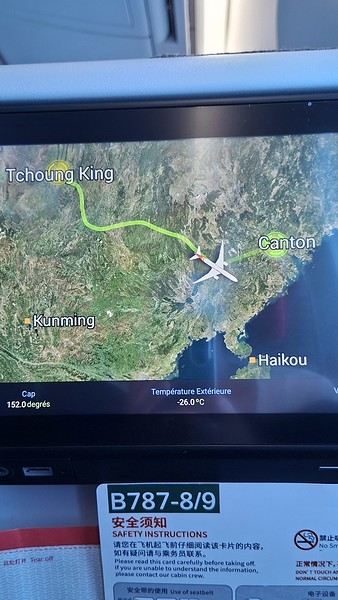
Took off at 9:30 AM, arrived in Guangzhou (Canton) at 11:20 AM in the rain. I love how Chongqing is translated as "Tchoung King" on the screens in the plane—very French!
During my first two trips to China, we paid for everything in cash, but this time, we’re going all-in on Alipay and WeChat. I still brought the leftover change from previous trips—it might come in handy. At the metro station, they showed us a QR code to buy tickets via WeChat. There were probably machines and even a ticket counter, but we didn’t see them, and buying via WeChat was pretty simple. 8 yuan to Changshu Lu, which is 22 stops. So far, so good. Then, we had to find the hotel, which wasn’t on Google Maps, Maps.me, or Amap... Easy 😎! We found it without too much hassle, though. Dropped off our stuff and went out to eat. 55 yuan for two claypots with fish/eel, rice, cabbage, and purple eggplant. When we left, it was pouring. We grabbed our umbrellas and set off to explore the neighborhood: Enning Road (we’ll come back later to check out a specific spot), Shangxiajiu (the pedestrian shopping street), Baohua Road... The area is pretty diverse—one street to the next, it’s like stepping into a different world.

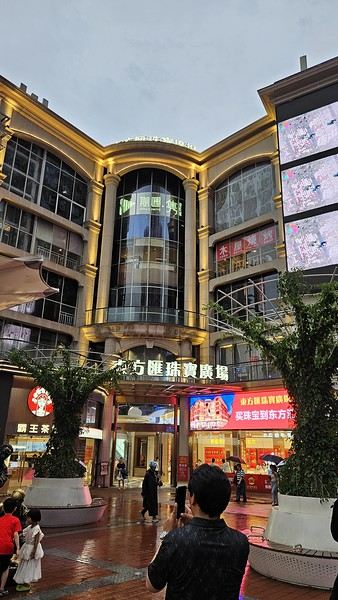
There weren’t many people around, probably because of the rain. We grabbed a quick street food dinner and went to bed—we were exhausted. We struggled to stay awake until 11 PM to adjust to the time change as quickly as possible. There’s a 6-hour time difference.
There wasn’t much room for improvisation on this trip—everything was planned in advance. Since August is peak season, I decided to book train tickets early, and once that was set, I reserved all the accommodations too. I got everything on Trip.com.
I bought the flight tickets back in March from Hainan Airlines. They were super expensive, but with these travel dates, I couldn’t exactly dream of a bargain!
I picked up e-SIMs valid for a month from Free just before departure: 10 € for the e-SIM + 19.90 € for a one-month plan with 35 GB of data abroad.
No need for a VPN with these e-SIMs, but D. still got one—a multi-device plan for 5 € with a discount from Let’s VPN, valid for a month. It was for evenings at the hotel on Wi-Fi to avoid burning through the 35 GB with video.
I downloaded Alipay, WeChat, Amap (Baidu Maps), and Trip.com. We also have Google Translate and Maps.me—absolute must-haves.
We’re ready to go!
I’ve been waiting for this day for nearly 15 years!! I travel a lot, but this one—this is MY TRIP 🙂 It’s been postponed so many times: because I wanted to do it with the right person, because I have a Turkish stamp in my passport and heard they don’t issue visas with that, because of COVID... and then China introduced a 30-day visa exemption, and that was the green light! Ugh, they forced us to take our vacation in August this year—far from ideal—but no more delays. Saturday, August 2, 2025: it’s finally the big day!
Days 1 and 2: We got dropped off at Charles de Gaulle at 9:30 AM. I supposedly checked in online, but only for the first flight and without getting the boarding pass... Might as well scrap online check-in in that case. So, we spent over an hour in line at the counter to get them. We didn’t have any checked luggage—just our backpacks as carry-ons—so this was a step we’d never had to deal with before, but whatever, it’s done. No wait at passport control, 5 minutes through security, a quick walk around the terminal, 10 minutes in the boarding area, and it was already time to board. Departure around 12:45 PM, arrival in Chongqing at 4:50 AM. We had a few hours of layover before our next flight. Went through immigration, connecting flight control, and security. Pro tip: check your next flight’s boarding gate right after immigration. We never saw it displayed again anywhere in the terminal.
The Free e-SIMs work—phew!
Took off at 9:30 AM, arrived in Guangzhou (Canton) at 11:20 AM in the rain. I love how Chongqing is translated as "Tchoung King" on the screens in the plane—very French!
During my first two trips to China, we paid for everything in cash, but this time, we’re going all-in on Alipay and WeChat. I still brought the leftover change from previous trips—it might come in handy. At the metro station, they showed us a QR code to buy tickets via WeChat. There were probably machines and even a ticket counter, but we didn’t see them, and buying via WeChat was pretty simple. 8 yuan to Changshu Lu, which is 22 stops. So far, so good. Then, we had to find the hotel, which wasn’t on Google Maps, Maps.me, or Amap... Easy 😎! We found it without too much hassle, though. Dropped off our stuff and went out to eat. 55 yuan for two claypots with fish/eel, rice, cabbage, and purple eggplant. When we left, it was pouring. We grabbed our umbrellas and set off to explore the neighborhood: Enning Road (we’ll come back later to check out a specific spot), Shangxiajiu (the pedestrian shopping street), Baohua Road... The area is pretty diverse—one street to the next, it’s like stepping into a different world.
There weren’t many people around, probably because of the rain. We grabbed a quick street food dinner and went to bed—we were exhausted. We struggled to stay awake until 11 PM to adjust to the time change as quickly as possible. There’s a 6-hour time difference.
AI, the Holy Grail of Travel and Travel Journals?
Three of our grandchildren came to spend the last weekend of the holidays at our house.
With her driver’s license just in hand, the oldest took her sister and a cousin along.
I was talking about VoyageForum, and the conversation turned to AI, which finds writing travel journals a breeze—churning out amazing ads for this or that country and even nudging tourists to visit one place over another.
Jules: "It’s crazy, you can plan and organize everything, then just add your photos and the AI’s text, and boom—you’ve got something great." Héloïse: "What a cheat for yourself and for others." (She’s so wise!) Gaïané: "Ugh, no more surprises. It even picks the restaurants—so lame."
I had this idea to stay on the theme of travel journals:
I found an excerpt from a book (I’ll let you guess the title and author—of course, the kids figured it out in two seconds with their phones), then I wrote my own version, and finally, the AI generated its own using a few keywords.
Here they are:
"We walked at dusk through the thick, dark forest. Sometimes, a clearing would reveal a dreamlike landscape. A magical world, far from humans. A world of frozen waterfalls, stiff fir trees, and sharp peaks slicing through the blinding whiteness of the air.
We gazed, dazzled, at the spectacle, imagining we’d left the human world behind and joined that of the spirits."
"For days, we walked through the half-darkness of dense, untouched forests, then suddenly, a clearing would unveil landscapes you only see in dreams. Sharp peaks piercing the sky, icy torrents, giant waterfalls—an entire fantastical world, blindingly white, rising above the dark line traced by the giant fir trees. We stared at this extraordinary sight, speechless, awestruck, ready to believe we’d reached the limits of the human world and stood at the threshold of the spirits’ realm."
"We walked through the mountain, wild and unyielding, its sharp peaks tearing the sky like honed blades. Giant waterfalls roared and foamed, as if the earth’s hidden forces were pouring out. Higher still, the blinding whiteness belonged to the world of spirits—capricious beings whispering to lost travelers. Faced with this silent vastness, we felt tiny, uninvited guests meditating on the invisible that dwells in these forbidden peaks."
And, amazingly, they unanimously agreed that the author’s excerpt was a thousand times more poetic. Héloïse, my history buff, said: "Nothing replaces the real travel experience." Jules said: "Yeah, but it does the job. Even if the excerpt is cool." And our oldest added: "It makes you want to go there—not at all like the other two versions. Sorry, Mamido."
And then, miracle—Jules asks: "Do you have the book? Can I borrow it?"
I’m so relieved—young people aren’t completely devoured by technology yet. And the forum will keep its charm and usefulness for a long time. Phew!
You agree, right?
Jules: "It’s crazy, you can plan and organize everything, then just add your photos and the AI’s text, and boom—you’ve got something great." Héloïse: "What a cheat for yourself and for others." (She’s so wise!) Gaïané: "Ugh, no more surprises. It even picks the restaurants—so lame."
I had this idea to stay on the theme of travel journals:
I found an excerpt from a book (I’ll let you guess the title and author—of course, the kids figured it out in two seconds with their phones), then I wrote my own version, and finally, the AI generated its own using a few keywords.
Here they are:
"We walked at dusk through the thick, dark forest. Sometimes, a clearing would reveal a dreamlike landscape. A magical world, far from humans. A world of frozen waterfalls, stiff fir trees, and sharp peaks slicing through the blinding whiteness of the air.
We gazed, dazzled, at the spectacle, imagining we’d left the human world behind and joined that of the spirits."
"For days, we walked through the half-darkness of dense, untouched forests, then suddenly, a clearing would unveil landscapes you only see in dreams. Sharp peaks piercing the sky, icy torrents, giant waterfalls—an entire fantastical world, blindingly white, rising above the dark line traced by the giant fir trees. We stared at this extraordinary sight, speechless, awestruck, ready to believe we’d reached the limits of the human world and stood at the threshold of the spirits’ realm."
"We walked through the mountain, wild and unyielding, its sharp peaks tearing the sky like honed blades. Giant waterfalls roared and foamed, as if the earth’s hidden forces were pouring out. Higher still, the blinding whiteness belonged to the world of spirits—capricious beings whispering to lost travelers. Faced with this silent vastness, we felt tiny, uninvited guests meditating on the invisible that dwells in these forbidden peaks."
And, amazingly, they unanimously agreed that the author’s excerpt was a thousand times more poetic. Héloïse, my history buff, said: "Nothing replaces the real travel experience." Jules said: "Yeah, but it does the job. Even if the excerpt is cool." And our oldest added: "It makes you want to go there—not at all like the other two versions. Sorry, Mamido."
And then, miracle—Jules asks: "Do you have the book? Can I borrow it?"
I’m so relieved—young people aren’t completely devoured by technology yet. And the forum will keep its charm and usefulness for a long time. Phew!
You agree, right?