Results for "Sri+Lanka+hébergement"
About 7,624 results.
More options
Many results are in French, the community’s main language. English translations are added over time.
Search results
Nice Acte VII - Samedi 3 décembre 2005
A la demande de VILCANOTA .... 😉, et vu que mon humeur s'est retrouvé beaucoup plus joyeuse aprés la rencontre de Marseille, trop bien ......, j'officialise une nouvelle rencontre sur Nice le Samedi 3 décembre ......
Pour à nouveau échanger dans le calme, et également s'amuser un peu, je vais faire " classique " comme en décembre 2004, prévoir une rencontre en début d'aprés midi avec un RDV à l'hôtel le Petit Palais où on se trouve bien pour pouvoir discuter de notre passion en toute décontraction, libre à certains membres de se retrouver en petits comités pour déjeuner auparavant ..... on prévoiera un petit goûter quand même, et puis une sortie au restau le soir, certainement de nouveau à la cigale orientale qui avait ravi bon nombre d'entre nous ......
Et le Dimanche, nous tenterons de mettre quelquechose sur pied afin de pouvoir continuer la rencontre sur tout le week end .....
Avis à ceux qui ont des idées, à ceux qui peuvent héberger des membres, le Petit Palais mettra des chambres à disposition suivant un tarif avantageux pour les membres, mais plus sympa d'être hébergé chez les membres locaux...... Yann, je t'attend avec ta famille à la maison comme promis et si ta petite femme peut se libérer .....
Ce serait sympa que des belges, des canadiens, des parisiens, des lyonnais, et surtout des marseillais, etc ..... soient présents ........
A bientôt de vous rencontrer .....
Pour à nouveau échanger dans le calme, et également s'amuser un peu, je vais faire " classique " comme en décembre 2004, prévoir une rencontre en début d'aprés midi avec un RDV à l'hôtel le Petit Palais où on se trouve bien pour pouvoir discuter de notre passion en toute décontraction, libre à certains membres de se retrouver en petits comités pour déjeuner auparavant ..... on prévoiera un petit goûter quand même, et puis une sortie au restau le soir, certainement de nouveau à la cigale orientale qui avait ravi bon nombre d'entre nous ......
Et le Dimanche, nous tenterons de mettre quelquechose sur pied afin de pouvoir continuer la rencontre sur tout le week end .....
Avis à ceux qui ont des idées, à ceux qui peuvent héberger des membres, le Petit Palais mettra des chambres à disposition suivant un tarif avantageux pour les membres, mais plus sympa d'être hébergé chez les membres locaux...... Yann, je t'attend avec ta famille à la maison comme promis et si ta petite femme peut se libérer .....
Ce serait sympa que des belges, des canadiens, des parisiens, des lyonnais, et surtout des marseillais, etc ..... soient présents ........
A bientôt de vous rencontrer .....
3 semaines au Rajasthan...
Déjà finies...🙁
Mais pour y repartir un peu je vais vous relater notre parcours dans les grandes lignes. On approfondira ensemble !
En 19 jours complets sur place (21 avec les trajets France - Inde AR):-- 1er jour Delhi (Arrivée 7h20) => Agra Taxi prépaid de l'aéroport à la gare de New Delhi (250 Rs) pour aller réserver nos billets de train au Tourist Office qui se trouve au 1er étage (c toujours ouvert et pas de commission, ne pas croire les embrouilleurs de tout poil).
Direction Namaskar Hôtel ds le Main Bazar, juste en face de la gare, pour se rafraîchir et poser les sacs (200 Rs). Train de la gare Nizamuddin (il y a 3 gares à New Delhi) à 14h50 pour arrivée à Agra cant vers 17h.
NUIT au Sheela Hôtel 🙂: à 50 mètres de la porte Est du Taj Mahal ce qui est très important puisqu'il faut y aller à 6 h pour éviter la foule, au fond d'un petit jardin, calme dans cette ville de fous (qui ne vaut vraiment que pour le Taj; le fort rouge ne vaut pas le détour si vous allez dans le Rajasthan vous verrez 10 x mieux, peut être juste pour la vue sur le Taj ?). Il est prudent de réserver car il est très demandé.
2ème jour Agra => Nawalgar Visite du Taj et du fort Rouge le matin dès 6h..😎
Départ après le repas pour Nawalgar dans le Shekawati avec un taxi (compter au moins 5 h. de route)
NUIT à l'écolo farm Apani Dhani 🙂🙂🙂 de Nawalgar (800 Rs chbre double avec sdb): génial, dans des petits bungalows en pisé à la déco sobre et agréable, très propre et fonctionnant écologiquement (chauffe-eau et lumière solaire, tri des déchets), repas maison végétariens pris avec le maître de maison, un brahmane qui a vécu en Europe et parle très couramment le français. Une adresse à ne pas louper !!! Y passer au moins 2 nuits pour en profiter.
3ème jour Nawalgar => Mandawa => Old Parsrampura (cénotaphe) Visite du Shekawati avec l'association Apani Dhani ie grâce au "salarié" de l'écolo farm qui nous a expliqué les fresques des havelis et la mythologie hindouiste dans un cénotaphe particulièrement intéressant (ça vaut le coup de prendre cette formule, c'est un très bon guide fort instructif, et puis il vaut mieux être accompagné pour pouvoir entrer dans les havelis).
NUIT à Apani Dhani
4ème jour Nawalgar => Fathepur => Bikaner Départ en taxi avec stop à Fathepur pour visiter de nouvelles havelis (un gamin nous propose ses services pour la visite). Trajet d'environ 4h.
NUIT au Bhairon Vilas 🙂 (1000 Rs pour les chambres doubles les + chères) : bâtisse de 120 ans décorée de bric à brac ancien et de vieilles photos, jardin agréable ds lequel on sirote une bière en regardant un spectacle de marionnettes et où l'on peut manger (pas mal). Notre chambre double était immense avec vieux fauteuils etc., un certain charme mais j'ai préféré celle de nos amis (avec un lit à baldaquin !), donc en visiter plusieurs. NB : ne pas acheter de miniatures dans la boutique d'artiste de l'hôtel, vous trouverez aussi bien après et moins cher.
5ème jour Bikaner => Jaisalmer Visite du fort de Bikaner le matin sous une chaleur écrasante, pas mal.
Départ en taxi après le repas (5 h de route). Le taxi nous quitte ici.
NUIT au Jawahar Niwas Palace 🤪 (3000 Rs) : belle architecture, belle vue sur le désert et la ville mais trop cher pour ce que c : déco à l'anglaise un peu décatie et froide, sans grand charme, belle piscine… avec des algues ! (bah, on prend une douche après !). Par contre, le resto est excellent.
6ème jour Jaisalmer Ballade dans le fort, visite des temples jaïns (intimistes, très agréables, et rigolo de regarder les centaines de chauve-souris faire leur toilette…attention ça ferme à 12h !), shopping (là vous pouvez vous lâcher ! à condition de bien négocier.. vous aurez l'embarras du choix : couvertures de lit, patchwork, sacs, cuir, boutons de porte en céramique, carnet de route / photos recouverts de cuir, objets de "bronze" reproduisant anciennes serrures, lampes à huile, etc.) Vous pouvez aussi vous faire faire des habits par Dungar Ram le tourist tailor du marché (Pansari Bazar): il est adorable, adore bavarder avec les étrangers et travaille très très bien (il a pleins de modèles issus des commandes des touristes divers et pleins de tissus en réserve même si ça boutique fait 2 m2 !!!).
NUIT au Paradise Hotel 🙂 (1000 Rs pour la + belle chambre mais ça démarre vers les 200Rs) dans la citadelle : très sympa et bon accueil malgré ce qu'en dit le GdR (bonne connexion internet), les chambres ont des fenêtres avec vue sur le désert, le vent s'y engouffre pour vous rafraîchir ! Toit-terrasse pas mal. Le seul pb mais ce n'est pas du à cet hôtel, ce sont les chiens qui aboient toute la nuit en bas de la citadelle et les klaxons qui déchirent la nuit…et votre sommeil !
7ème jour Jaisalmer Départ le matin pour un camel safari de ….18 km ! On est partis direct de Jaisalmer pour ne pas payer la jeep qui est svt proposée (et prise des chameaux + loin) et profiter plus de la ballade… Mauvaise pioche ! On a "balladé" pendant 5 km au milieu d'une décharge à ciel ouvert (en fait chacun vient vider son petit camion et fait son petit tas au lieu d'en faire un gros… résultat ça s'étale sur des kms…) et passage à forte proximité du vaste champ d'éoliennes (pas terrible dans le paysage… et pourtant j'aime les éoliennes). Arrêt au groupe de cénotaphes de Bada Bagh, sympa. Continuation vers Amar Sagar (petit village avec temple jaïn), là on était complètement morts de chaud et mal au cul (12 km ds les pattes), on a même pas eu le courage de visiter… Retour vers Jaisalmer… OUF !🤪 Je conseille donc de faire maxi 5km à chameaux et d'aller plutôt aux dunes de Khuri et d'y passer la nuit (même si c touristique et même si vous paierez la jeep pour y aller). C'est dommage d'être passés à côté des dunes, faute de temps… 🙁🙁🙁
NUIT au Paradise Hotel
8ème jour Jaisalmer On garde la chambre jusqu'au train de nuit pour Jodhpur (départ à 23h15, arrivée à 5h15 en 3ème AC, très confortable, propre et calme). Attention ! Il faut quitter les hôtesl vers 9/10h sinon il vous font payer un espèce de prorata temporis voire un nuit en plus ! (au Paradise ils nous ont fait payer ½ prix) Visite de deux havelis : Patwah-ki-haveli (à ne pas louper) et Salam Singh Haveli (sympa aussi si vous avez la chance d'avoir le bon guide qui vous raconte pleins de trucs…). Shopping
9ème jour Jodhpur Notre nouveau chauffeur vient nous récupérer à la gare (sincèrement on aurait pu le prendre qu'à partir du lendemain, pas très utile rétrospectivement et on aurait gagné des sous parce que si c'était compté au km il y a aussi le calcul de la journée…).
Repos dans un heritage hôtel 🤪 (cad les vieilles havelis soit disant de caractère) conseillé par des frenchies : un peu cher pour une déco pas terrible (il nous ont fait payer une demi-journée en + pour notre arrivée à 5h30 ! Le seul atout : tout près du fort.
Shopping le matin, visite du Sardar bazar (il y a pas mal de boutiques d'antiquaires mais bien ouvrir l'œil et marchander !), ballade dans la ville bleue. Visite de la forteresse de Mehrangarh avec l'audio-guide : extra !!! Avec l'audio-guide on est replongé à l'époque des maharadjahs, au temps du faste, un voyage dans le temps exceptionnel, le fort est très bien conservé, belles pièces et bcp de mobilier, objets d'époque. Si vous ne visitez qu'un fort, c'est celui là !
Repas au resto "On the Rocks" : trés bon, trés beau cadre (jardin, romantique), chouette deco (pas que touristes étrangers ms aussi indiens), reposant… et on peut même y guincher ! (un bon point pour le GdR). NUIT au Harassar Haveli (qque chose ds le genre)
10ème jour Jodhpur => Ranakpur => Narlai Visite du petit Taj, le Jaswant Tada, sur la route du départ (joli, ¾ d'heure grand maxi de visite). Route vers Ranakpur en passant par le territoire des villages vishnois où les animaux se baladent tranquilles puisqu'on ne les dérange pas, virée sympa et reposante (rien à visiter, juste le paysages et les daims, etc.) Visite du temple jaïn de Ranakpur : impressionnant surtout avec ses colonnades, un peu trop touristique à mon goût (accueil pas sympa et blasé).
NUIT à l'hôtel Rawla Narlai 🙂🙂🙂🙂🙂, dans le village de Narlai : féerique, notre coup de cœur (3000 Rs petit déj' compris, ce qui n'est jamais le cas : et petit déj' pantagruélique…vs me comprendrez une fois en Inde) –merci le GdR ce coup-ci même si le commentaire n'est pas à la hauteur du lieu : chambre des 1001 nuits magnifiquement décorée, hyper romantique, sdb de marbre, sofas devant les chambres pour siroter le tchai en regardant la colline de granit, accueil très gentil, personnel empressé ms sympa en habits traditionnels, jardin très agréable avec sofas… Le soir repas du maharadjah dans un thali en argent sur le toit de l'hôtel à la bougie… (on était 3 couples ds l'hôtel… 3 tables seulement !) En y arrivant, thé de bienvenue puis pèlerinage en haut de la colline de granit (570 marches) pour rejoindre l'éléphant blanc qui la surmonte et contempler le superbe panorama (jusqu'au fort de Kumbalgarh). Ce fut un moment d'une grande spiritualité et de bcp de sérénité : on est revenus sur un petit nuage à l'hôtel… Si vous cherchez un palace de charme à l'écart des touristes (qui pullulent à Ranakpur), n'hésitez pas à faire le détour, je suis persuadée que vous ne le regretterez pas (ns on a regretté de n'y passer qu'une nuit !!!)
11ème jour Narlai => Khumphalgarh => Udaipur Départ pour Udaipur et stop à Khumbalgarh : fort impressionnant et vide de visiteurs, assez étrange, perdu ds les montagnes, différent.
NUIT au Jagat Niwas Hotel 🙂🤪 à Udaipur en bordure du lac Pichola et ds la vieille ville : on a pris une chambre avec alcôve donnant sur le lac… ne vaut pas le prix tant la déco est kitsh et sans charme (bravo aux commentaires du GdR et du LP souvent bcp trop laudatifs !). Si vous n'êtes pas argentés, prenez un truc + simple, voire tout proche de la vieille ville, ds le même ordre de prix, essayer l'Udai Kothi (avec lequel ns avons hésité et qui, selon des frenchies, était pas mal du tout (avec piscine). Si vous avez du budget palace n'hésitez pas à aller au Shiv Niwas Palace (chambres splendides avec vue sur le lac, piscine réellement fabuleuse) : un couple de jeunes français a réussi à bien négocier le prix de la chambre à cette époque.
12ème jour Udaipur Ballade sur les bords du lacs pour voir les enfants se baigner, les lavandières… Visite de la ville et du City Palace (pas terrible, à moins d'avoir du temps et de l'argent à dépenser…). Ballade au coucher du soleil sur le lac : très sympa, ça ça vaut le coup d'autant qu'on traverse le parc du City palace (y aller pour le dernier bateau de 18h, c là que c vraiment bien). Shopping : c'est ici que vous aurez le + grand choix de bijoux en argent (à Jaipur c plutôt les pierres, après ce sera à Delhi… plutôt dans le Main Bazar à Pahar Ganj', ce que j'ai du faire car rien acheté à Udaipur… j'ai bien failli le regretter !).
NUIT au Jagat Niwas Hotel
13ème jour Udaipur => Bundi Départ à 9h pour 4 heures de trajet sur une route pourrie (vraiment !) Petite ville charmante, peu touristique. Visite du Garh Palace ouvert depuis 3 ans… très peu de touristes… si on demande (et moyennant un petit backchich) on vous amène dans une partie couverte de fresques murales magnifiques non encore ouverte au public… Un grand moment de découverte… seul au monde ! (avec les singes envahissant les lieux)
NUIT au Haveli Braj Bushanjee : assez de charme mais pas exceptionnel (pas "superbement aménagé" comme exagère encore le GdR)
14ème jour Bundi => Jaipur Départ à 13h, arrivée vers 16/17h à Jaipur par route pourrie.
NUIT au Diggi Palace 🙂🙂: sans conteste la meilleure adresse de Jaipur, pour toutes les bourses, resto très bon, grand jardin très agréable et calme dans cette ville de fous (internet).
15ème jour Jaipur Visite de la ville : palais des vents, observatoire, city palace : sympa ms on y passe pas la journée. Le reste de la journée, invités ds une famille, c pour ça qu'on est resté un jour de + : on peut aisément y passer un jour de moins que ns (en courant un peu +).
NUIT au Diggi Palace
16ème jour Jaipur Visite du fort d'Amber : on a fait la montée à dos d'éléphants : complètement toutous mais c'est sympa… pourquoi se priver ! Soir : ciné au Raj Mandir (le plus grand ciné de l'Inde : très kitsh !) pour voir la superprod. du moment "Mangal Pandey, the rising" (c'est l'histoire du début du soulèvement des indiens contre l'occupation britannique : très chouette fresque historique et compréhensible puisque qques passages en anglais –sinon en hindi- et histoire somme tout simple, même si ça dure 3heures avec entracte. Un grand moment que je vous conseille fortement ! Les séances sont à 21h30, prendre ses billets dans l'après-midi (ou demander à son chauffeur de s'en charger si on veut gagner du temps).
NUIT au Diggi Palace
17ème jour Jaipur => Barathpur Visite le matin du Monkey Temple aux environs de Jaipur, pour voir les indiens prendre leurs bains (les femmes d'un côté, les hommes de l'autre) et laisser les singes venir prendre les cacahouètes dans notre main… Sur le chemin, visite de la ville morte de Fatehpur Sikri : il y a un morceau payant et un gratuit. Si l'entrée n'est pas donnée, le site vaut la peine de le voir en entier. Lorsqu'on arrive dans la partie gratuite où se trouve la grande mosquée et un mausolée de marbre, on est assailli par des guides et vendeurs en tout genre extrémement collants et pénibles...ça ns a presque gaché la fin de la visite...la première partie est elle trés reposante, on ballade tranquillement dans la ville abandonnée.
Arrivée à Barathpur, ville de la réserve des oiseaux Keoladeo Ghana national Park. Couchés tôt car visite le lendemain à 6h (pour voir un max d'oiseaux).
NUIT à l'hôtel The Birder's Inn 🙂: pas mal
18ème jour Barathpur => Delhi Visite de la réserve en vélo avec un guide ( c mieux car il vous montre les oiseaux que l'on ne distingue pas en passant trop vite : il a l'œil quoi !, prix fixes). Y aller tôt le matin pour voir un max d'animaux (mammifères aussi) et éviter la foule. Plutôt en vélo qu'en pousse pousse pour prendre les petits chemins.
Retour à Delhi, arrivée vers 16h à la guesthouse Yatri House 🤪: chaudement recommandée par le GdR… encore une fois exagéré (plutôt cher pour ce que c'est et je ne sais pas où ils ont trouvé le "certain cachet"…!). Un avantage : internet gratuit ! (mais pour ce que ça coute là bas… environ 40 Rs l'heure).
Repas au resto "The Spice Route" de l'Imperial Hôtel 🤪: très cher pour l'Inde, assez bon mais ne vaut pas le prix d'après nous (encore un mauvais point pour le GdR). Par contre, si vs avez 5 mn, déambuler dans l'hôtel est assez surprenant pour des routards… le très très grand luxe, très très cher !
19ème jour : Delhi Dernier shopping dans le Main Bazar à Pahar Ganj, tout ce que vous n'aurez pas trouvé avant est là. Virée à Connaught Place : rien d'intéressant, + cher qu'ailleurs, sauf pour la boutique Levis où les jeans et pantalons Dockers sont très peu chers par rapport à l'Europe (environ 1700 Rs).
Retour à l'hôtel pour finir les sacs…. Départ en taxi à 23h pour décoller à 2h15 le 20ème jour… si si il faut y aller 3 heures avant… vous verrez il y a 36 queues à faire ! Attention, c ravitaillé par les corbeaux, il n'y a rien dans la salle d'embarquement à part qques pauvres sandwichs à 100 Rs ! Pour le duty free pensez y avant de passer les douanes (on s'est fait avoir !).🙁🙁🙁--
Voilà vous savez tout ! Quelques astuces au passage: prix de la bouteille d'eau : de 10 à 20 Rs grand maximum (on a trouvé 8 Rs à Jaisalmer !) taxi prepaid aéroport-Delhi : 250 Rs pour trouver le prix en euros : enlever deux 0 et multiplier par 2 (1000 Rs ça fait 20 € environ).
Nous avons fait ce circuit sans courir comme des dingues, que les temps de transport étaient fort corrects (je conseille ce qu'on a fait, ni plus ni moins ds la journée à moins que vous ayez bcp de temps). Nous avons bien pris le temps dans chaque ville et sur chaque lieu de visite. Nous avons eu le temps de rencontrer les indiens qui nous ont invités par 3 fois chez eux. Ils sont trés ouverts et curieux des autres, trés accueillants. Si ça vous intéresse je vous raconterai la rencontre avec la famille du tailleur Dungar, la fête de la naissance de Khrishna dans la famille Soni de Bundi, les répétitions de musique du groupe des gitans du Rajasthan, la Dhoad... On est encore émus de ces rencontres. Il y eu aussi la mission OO7 pour le compte de Mister Phil, les diverses visites, la bonne cuisine et la tourista !
Bref, tout ce qui a fait de ces 3 semaines un voyage formidable !😉 Il nous tarde de revenir en Inde...🙂
Il nous tarde d'y retourner !
Mais pour y repartir un peu je vais vous relater notre parcours dans les grandes lignes. On approfondira ensemble !
En 19 jours complets sur place (21 avec les trajets France - Inde AR):-- 1er jour Delhi (Arrivée 7h20) => Agra Taxi prépaid de l'aéroport à la gare de New Delhi (250 Rs) pour aller réserver nos billets de train au Tourist Office qui se trouve au 1er étage (c toujours ouvert et pas de commission, ne pas croire les embrouilleurs de tout poil).
Direction Namaskar Hôtel ds le Main Bazar, juste en face de la gare, pour se rafraîchir et poser les sacs (200 Rs). Train de la gare Nizamuddin (il y a 3 gares à New Delhi) à 14h50 pour arrivée à Agra cant vers 17h.
NUIT au Sheela Hôtel 🙂: à 50 mètres de la porte Est du Taj Mahal ce qui est très important puisqu'il faut y aller à 6 h pour éviter la foule, au fond d'un petit jardin, calme dans cette ville de fous (qui ne vaut vraiment que pour le Taj; le fort rouge ne vaut pas le détour si vous allez dans le Rajasthan vous verrez 10 x mieux, peut être juste pour la vue sur le Taj ?). Il est prudent de réserver car il est très demandé.
2ème jour Agra => Nawalgar Visite du Taj et du fort Rouge le matin dès 6h..😎
Départ après le repas pour Nawalgar dans le Shekawati avec un taxi (compter au moins 5 h. de route)
NUIT à l'écolo farm Apani Dhani 🙂🙂🙂 de Nawalgar (800 Rs chbre double avec sdb): génial, dans des petits bungalows en pisé à la déco sobre et agréable, très propre et fonctionnant écologiquement (chauffe-eau et lumière solaire, tri des déchets), repas maison végétariens pris avec le maître de maison, un brahmane qui a vécu en Europe et parle très couramment le français. Une adresse à ne pas louper !!! Y passer au moins 2 nuits pour en profiter.
3ème jour Nawalgar => Mandawa => Old Parsrampura (cénotaphe) Visite du Shekawati avec l'association Apani Dhani ie grâce au "salarié" de l'écolo farm qui nous a expliqué les fresques des havelis et la mythologie hindouiste dans un cénotaphe particulièrement intéressant (ça vaut le coup de prendre cette formule, c'est un très bon guide fort instructif, et puis il vaut mieux être accompagné pour pouvoir entrer dans les havelis).
NUIT à Apani Dhani
4ème jour Nawalgar => Fathepur => Bikaner Départ en taxi avec stop à Fathepur pour visiter de nouvelles havelis (un gamin nous propose ses services pour la visite). Trajet d'environ 4h.
NUIT au Bhairon Vilas 🙂 (1000 Rs pour les chambres doubles les + chères) : bâtisse de 120 ans décorée de bric à brac ancien et de vieilles photos, jardin agréable ds lequel on sirote une bière en regardant un spectacle de marionnettes et où l'on peut manger (pas mal). Notre chambre double était immense avec vieux fauteuils etc., un certain charme mais j'ai préféré celle de nos amis (avec un lit à baldaquin !), donc en visiter plusieurs. NB : ne pas acheter de miniatures dans la boutique d'artiste de l'hôtel, vous trouverez aussi bien après et moins cher.
5ème jour Bikaner => Jaisalmer Visite du fort de Bikaner le matin sous une chaleur écrasante, pas mal.
Départ en taxi après le repas (5 h de route). Le taxi nous quitte ici.
NUIT au Jawahar Niwas Palace 🤪 (3000 Rs) : belle architecture, belle vue sur le désert et la ville mais trop cher pour ce que c : déco à l'anglaise un peu décatie et froide, sans grand charme, belle piscine… avec des algues ! (bah, on prend une douche après !). Par contre, le resto est excellent.
6ème jour Jaisalmer Ballade dans le fort, visite des temples jaïns (intimistes, très agréables, et rigolo de regarder les centaines de chauve-souris faire leur toilette…attention ça ferme à 12h !), shopping (là vous pouvez vous lâcher ! à condition de bien négocier.. vous aurez l'embarras du choix : couvertures de lit, patchwork, sacs, cuir, boutons de porte en céramique, carnet de route / photos recouverts de cuir, objets de "bronze" reproduisant anciennes serrures, lampes à huile, etc.) Vous pouvez aussi vous faire faire des habits par Dungar Ram le tourist tailor du marché (Pansari Bazar): il est adorable, adore bavarder avec les étrangers et travaille très très bien (il a pleins de modèles issus des commandes des touristes divers et pleins de tissus en réserve même si ça boutique fait 2 m2 !!!).
NUIT au Paradise Hotel 🙂 (1000 Rs pour la + belle chambre mais ça démarre vers les 200Rs) dans la citadelle : très sympa et bon accueil malgré ce qu'en dit le GdR (bonne connexion internet), les chambres ont des fenêtres avec vue sur le désert, le vent s'y engouffre pour vous rafraîchir ! Toit-terrasse pas mal. Le seul pb mais ce n'est pas du à cet hôtel, ce sont les chiens qui aboient toute la nuit en bas de la citadelle et les klaxons qui déchirent la nuit…et votre sommeil !
7ème jour Jaisalmer Départ le matin pour un camel safari de ….18 km ! On est partis direct de Jaisalmer pour ne pas payer la jeep qui est svt proposée (et prise des chameaux + loin) et profiter plus de la ballade… Mauvaise pioche ! On a "balladé" pendant 5 km au milieu d'une décharge à ciel ouvert (en fait chacun vient vider son petit camion et fait son petit tas au lieu d'en faire un gros… résultat ça s'étale sur des kms…) et passage à forte proximité du vaste champ d'éoliennes (pas terrible dans le paysage… et pourtant j'aime les éoliennes). Arrêt au groupe de cénotaphes de Bada Bagh, sympa. Continuation vers Amar Sagar (petit village avec temple jaïn), là on était complètement morts de chaud et mal au cul (12 km ds les pattes), on a même pas eu le courage de visiter… Retour vers Jaisalmer… OUF !🤪 Je conseille donc de faire maxi 5km à chameaux et d'aller plutôt aux dunes de Khuri et d'y passer la nuit (même si c touristique et même si vous paierez la jeep pour y aller). C'est dommage d'être passés à côté des dunes, faute de temps… 🙁🙁🙁
NUIT au Paradise Hotel
8ème jour Jaisalmer On garde la chambre jusqu'au train de nuit pour Jodhpur (départ à 23h15, arrivée à 5h15 en 3ème AC, très confortable, propre et calme). Attention ! Il faut quitter les hôtesl vers 9/10h sinon il vous font payer un espèce de prorata temporis voire un nuit en plus ! (au Paradise ils nous ont fait payer ½ prix) Visite de deux havelis : Patwah-ki-haveli (à ne pas louper) et Salam Singh Haveli (sympa aussi si vous avez la chance d'avoir le bon guide qui vous raconte pleins de trucs…). Shopping
9ème jour Jodhpur Notre nouveau chauffeur vient nous récupérer à la gare (sincèrement on aurait pu le prendre qu'à partir du lendemain, pas très utile rétrospectivement et on aurait gagné des sous parce que si c'était compté au km il y a aussi le calcul de la journée…).
Repos dans un heritage hôtel 🤪 (cad les vieilles havelis soit disant de caractère) conseillé par des frenchies : un peu cher pour une déco pas terrible (il nous ont fait payer une demi-journée en + pour notre arrivée à 5h30 ! Le seul atout : tout près du fort.
Shopping le matin, visite du Sardar bazar (il y a pas mal de boutiques d'antiquaires mais bien ouvrir l'œil et marchander !), ballade dans la ville bleue. Visite de la forteresse de Mehrangarh avec l'audio-guide : extra !!! Avec l'audio-guide on est replongé à l'époque des maharadjahs, au temps du faste, un voyage dans le temps exceptionnel, le fort est très bien conservé, belles pièces et bcp de mobilier, objets d'époque. Si vous ne visitez qu'un fort, c'est celui là !
Repas au resto "On the Rocks" : trés bon, trés beau cadre (jardin, romantique), chouette deco (pas que touristes étrangers ms aussi indiens), reposant… et on peut même y guincher ! (un bon point pour le GdR). NUIT au Harassar Haveli (qque chose ds le genre)
10ème jour Jodhpur => Ranakpur => Narlai Visite du petit Taj, le Jaswant Tada, sur la route du départ (joli, ¾ d'heure grand maxi de visite). Route vers Ranakpur en passant par le territoire des villages vishnois où les animaux se baladent tranquilles puisqu'on ne les dérange pas, virée sympa et reposante (rien à visiter, juste le paysages et les daims, etc.) Visite du temple jaïn de Ranakpur : impressionnant surtout avec ses colonnades, un peu trop touristique à mon goût (accueil pas sympa et blasé).
NUIT à l'hôtel Rawla Narlai 🙂🙂🙂🙂🙂, dans le village de Narlai : féerique, notre coup de cœur (3000 Rs petit déj' compris, ce qui n'est jamais le cas : et petit déj' pantagruélique…vs me comprendrez une fois en Inde) –merci le GdR ce coup-ci même si le commentaire n'est pas à la hauteur du lieu : chambre des 1001 nuits magnifiquement décorée, hyper romantique, sdb de marbre, sofas devant les chambres pour siroter le tchai en regardant la colline de granit, accueil très gentil, personnel empressé ms sympa en habits traditionnels, jardin très agréable avec sofas… Le soir repas du maharadjah dans un thali en argent sur le toit de l'hôtel à la bougie… (on était 3 couples ds l'hôtel… 3 tables seulement !) En y arrivant, thé de bienvenue puis pèlerinage en haut de la colline de granit (570 marches) pour rejoindre l'éléphant blanc qui la surmonte et contempler le superbe panorama (jusqu'au fort de Kumbalgarh). Ce fut un moment d'une grande spiritualité et de bcp de sérénité : on est revenus sur un petit nuage à l'hôtel… Si vous cherchez un palace de charme à l'écart des touristes (qui pullulent à Ranakpur), n'hésitez pas à faire le détour, je suis persuadée que vous ne le regretterez pas (ns on a regretté de n'y passer qu'une nuit !!!)
11ème jour Narlai => Khumphalgarh => Udaipur Départ pour Udaipur et stop à Khumbalgarh : fort impressionnant et vide de visiteurs, assez étrange, perdu ds les montagnes, différent.
NUIT au Jagat Niwas Hotel 🙂🤪 à Udaipur en bordure du lac Pichola et ds la vieille ville : on a pris une chambre avec alcôve donnant sur le lac… ne vaut pas le prix tant la déco est kitsh et sans charme (bravo aux commentaires du GdR et du LP souvent bcp trop laudatifs !). Si vous n'êtes pas argentés, prenez un truc + simple, voire tout proche de la vieille ville, ds le même ordre de prix, essayer l'Udai Kothi (avec lequel ns avons hésité et qui, selon des frenchies, était pas mal du tout (avec piscine). Si vous avez du budget palace n'hésitez pas à aller au Shiv Niwas Palace (chambres splendides avec vue sur le lac, piscine réellement fabuleuse) : un couple de jeunes français a réussi à bien négocier le prix de la chambre à cette époque.
12ème jour Udaipur Ballade sur les bords du lacs pour voir les enfants se baigner, les lavandières… Visite de la ville et du City Palace (pas terrible, à moins d'avoir du temps et de l'argent à dépenser…). Ballade au coucher du soleil sur le lac : très sympa, ça ça vaut le coup d'autant qu'on traverse le parc du City palace (y aller pour le dernier bateau de 18h, c là que c vraiment bien). Shopping : c'est ici que vous aurez le + grand choix de bijoux en argent (à Jaipur c plutôt les pierres, après ce sera à Delhi… plutôt dans le Main Bazar à Pahar Ganj', ce que j'ai du faire car rien acheté à Udaipur… j'ai bien failli le regretter !).
NUIT au Jagat Niwas Hotel
13ème jour Udaipur => Bundi Départ à 9h pour 4 heures de trajet sur une route pourrie (vraiment !) Petite ville charmante, peu touristique. Visite du Garh Palace ouvert depuis 3 ans… très peu de touristes… si on demande (et moyennant un petit backchich) on vous amène dans une partie couverte de fresques murales magnifiques non encore ouverte au public… Un grand moment de découverte… seul au monde ! (avec les singes envahissant les lieux)
NUIT au Haveli Braj Bushanjee : assez de charme mais pas exceptionnel (pas "superbement aménagé" comme exagère encore le GdR)
14ème jour Bundi => Jaipur Départ à 13h, arrivée vers 16/17h à Jaipur par route pourrie.
NUIT au Diggi Palace 🙂🙂: sans conteste la meilleure adresse de Jaipur, pour toutes les bourses, resto très bon, grand jardin très agréable et calme dans cette ville de fous (internet).
15ème jour Jaipur Visite de la ville : palais des vents, observatoire, city palace : sympa ms on y passe pas la journée. Le reste de la journée, invités ds une famille, c pour ça qu'on est resté un jour de + : on peut aisément y passer un jour de moins que ns (en courant un peu +).
NUIT au Diggi Palace
16ème jour Jaipur Visite du fort d'Amber : on a fait la montée à dos d'éléphants : complètement toutous mais c'est sympa… pourquoi se priver ! Soir : ciné au Raj Mandir (le plus grand ciné de l'Inde : très kitsh !) pour voir la superprod. du moment "Mangal Pandey, the rising" (c'est l'histoire du début du soulèvement des indiens contre l'occupation britannique : très chouette fresque historique et compréhensible puisque qques passages en anglais –sinon en hindi- et histoire somme tout simple, même si ça dure 3heures avec entracte. Un grand moment que je vous conseille fortement ! Les séances sont à 21h30, prendre ses billets dans l'après-midi (ou demander à son chauffeur de s'en charger si on veut gagner du temps).
NUIT au Diggi Palace
17ème jour Jaipur => Barathpur Visite le matin du Monkey Temple aux environs de Jaipur, pour voir les indiens prendre leurs bains (les femmes d'un côté, les hommes de l'autre) et laisser les singes venir prendre les cacahouètes dans notre main… Sur le chemin, visite de la ville morte de Fatehpur Sikri : il y a un morceau payant et un gratuit. Si l'entrée n'est pas donnée, le site vaut la peine de le voir en entier. Lorsqu'on arrive dans la partie gratuite où se trouve la grande mosquée et un mausolée de marbre, on est assailli par des guides et vendeurs en tout genre extrémement collants et pénibles...ça ns a presque gaché la fin de la visite...la première partie est elle trés reposante, on ballade tranquillement dans la ville abandonnée.
Arrivée à Barathpur, ville de la réserve des oiseaux Keoladeo Ghana national Park. Couchés tôt car visite le lendemain à 6h (pour voir un max d'oiseaux).
NUIT à l'hôtel The Birder's Inn 🙂: pas mal
18ème jour Barathpur => Delhi Visite de la réserve en vélo avec un guide ( c mieux car il vous montre les oiseaux que l'on ne distingue pas en passant trop vite : il a l'œil quoi !, prix fixes). Y aller tôt le matin pour voir un max d'animaux (mammifères aussi) et éviter la foule. Plutôt en vélo qu'en pousse pousse pour prendre les petits chemins.
Retour à Delhi, arrivée vers 16h à la guesthouse Yatri House 🤪: chaudement recommandée par le GdR… encore une fois exagéré (plutôt cher pour ce que c'est et je ne sais pas où ils ont trouvé le "certain cachet"…!). Un avantage : internet gratuit ! (mais pour ce que ça coute là bas… environ 40 Rs l'heure).
Repas au resto "The Spice Route" de l'Imperial Hôtel 🤪: très cher pour l'Inde, assez bon mais ne vaut pas le prix d'après nous (encore un mauvais point pour le GdR). Par contre, si vs avez 5 mn, déambuler dans l'hôtel est assez surprenant pour des routards… le très très grand luxe, très très cher !
19ème jour : Delhi Dernier shopping dans le Main Bazar à Pahar Ganj, tout ce que vous n'aurez pas trouvé avant est là. Virée à Connaught Place : rien d'intéressant, + cher qu'ailleurs, sauf pour la boutique Levis où les jeans et pantalons Dockers sont très peu chers par rapport à l'Europe (environ 1700 Rs).
Retour à l'hôtel pour finir les sacs…. Départ en taxi à 23h pour décoller à 2h15 le 20ème jour… si si il faut y aller 3 heures avant… vous verrez il y a 36 queues à faire ! Attention, c ravitaillé par les corbeaux, il n'y a rien dans la salle d'embarquement à part qques pauvres sandwichs à 100 Rs ! Pour le duty free pensez y avant de passer les douanes (on s'est fait avoir !).🙁🙁🙁--
Voilà vous savez tout ! Quelques astuces au passage: prix de la bouteille d'eau : de 10 à 20 Rs grand maximum (on a trouvé 8 Rs à Jaisalmer !) taxi prepaid aéroport-Delhi : 250 Rs pour trouver le prix en euros : enlever deux 0 et multiplier par 2 (1000 Rs ça fait 20 € environ).
Nous avons fait ce circuit sans courir comme des dingues, que les temps de transport étaient fort corrects (je conseille ce qu'on a fait, ni plus ni moins ds la journée à moins que vous ayez bcp de temps). Nous avons bien pris le temps dans chaque ville et sur chaque lieu de visite. Nous avons eu le temps de rencontrer les indiens qui nous ont invités par 3 fois chez eux. Ils sont trés ouverts et curieux des autres, trés accueillants. Si ça vous intéresse je vous raconterai la rencontre avec la famille du tailleur Dungar, la fête de la naissance de Khrishna dans la famille Soni de Bundi, les répétitions de musique du groupe des gitans du Rajasthan, la Dhoad... On est encore émus de ces rencontres. Il y eu aussi la mission OO7 pour le compte de Mister Phil, les diverses visites, la bonne cuisine et la tourista !
Bref, tout ce qui a fait de ces 3 semaines un voyage formidable !😉 Il nous tarde de revenir en Inde...🙂
Il nous tarde d'y retourner !
Combien de pays avez-vous visités?
Bonjour à tous!
Simple curiosité: combien de pays avez-vous visité? Et quels sont les pays que vous avez visité plusieurs fois, tellement c'était bien?
Bonne journée
Marliese
Simple curiosité: combien de pays avez-vous visité? Et quels sont les pays que vous avez visité plusieurs fois, tellement c'était bien?
Bonne journée
Marliese
Recherche d'organismes pour voyage humanitaire
Bonjour.
Je suis un jeune homme de 17 ans, Prochainement 18 ans. Je suis très impliqué socialement ainsi que moralement dans plusieur cause qui me tienne réellement à coeur. Mais maintenant, je voudrais élargir encore plus mes Horizons, et faire de l'aide humanitaire Dans les Pays défavorisés de l'amérique du sud. Je ne parle présentement pas l'espagnol, Mais cette année, je vais étudier cette langue au cégep et je vais faire de mon mieux pour le parler du moins, essayer. Je recherche donc des organismes dans lesquels, je pourrais m'inscrire pour aller faire de l'aide humanitaire. J'aimerais bcp aller au Pérou, Mais tout autre pays serais bien pour moi. Ce que je recherche avant tout, c'est aider les autres.
Alors merci d'avance pour tout ceux qui pourront me répondre.
Dernier truc, Je prévoit partir vers le mois de juin 2006, et aucune limite de temps après. Alors, Merci encore !!
Combien sommes-nous à préparer un tour du monde?
Bonjour à Tous,
Comme nombreux d’entre vous ici, je prépare un Tour du Monde, en lisant les différents forums, je constate que nous sommes vraiment beaucoup à partir dans les 12 prochains mois, alors ce serait sympa de recenser tous les projets de tour du monde en préparation, en donnant quelques infos,
Je me lance :
Dates de départ...................................env 15 janvier 2006 Nombres de mois, années....................env 2 ans En solo, duo, voir plus ........................solo Continent par ordre de passage ..........Asie, Océanie, Amérique du Sud et Centrale, Afrique Premier pays ......................................Inde Dernier pays ......................................Israel Nombre de vols prévus ......................entre 12 et 20 Site Web de votre tour .......................oui en construction
Et le LIEU incontournable de votre tour : ( si vous arrivez à répondre )
Voila pour moi, j’attend vos merveilleux projets ....
Mpolo57
« Il arriva à la croisée de 2 chemins, et là il décida d’aller là où il n’allait pas «
Comme nombreux d’entre vous ici, je prépare un Tour du Monde, en lisant les différents forums, je constate que nous sommes vraiment beaucoup à partir dans les 12 prochains mois, alors ce serait sympa de recenser tous les projets de tour du monde en préparation, en donnant quelques infos,
Je me lance :
Dates de départ...................................env 15 janvier 2006 Nombres de mois, années....................env 2 ans En solo, duo, voir plus ........................solo Continent par ordre de passage ..........Asie, Océanie, Amérique du Sud et Centrale, Afrique Premier pays ......................................Inde Dernier pays ......................................Israel Nombre de vols prévus ......................entre 12 et 20 Site Web de votre tour .......................oui en construction
Et le LIEU incontournable de votre tour : ( si vous arrivez à répondre )
Voila pour moi, j’attend vos merveilleux projets ....
Mpolo57
« Il arriva à la croisée de 2 chemins, et là il décida d’aller là où il n’allait pas «
Tsunami 6 mois après
Je viens de voir une emmision qui parlait de l'après tsunami et de l'argent des ong.
Une chose à dire: C'est pas gagner, voila ce qui me fait réfléchir quant à ma destination dans le pays
Une chose à dire: C'est pas gagner, voila ce qui me fait réfléchir quant à ma destination dans le pays
Différence de notion de voyage entre Québécois et Européens
La définition de ''voyager'' n'a pas l'air d'avoir la même signification pour la majorité des Québécois et les Européens.
Je m'explique : lorsque je parcours les forums ou que je lis les profils, je constate que pour beaucoup de Québécois, la notion de voyager signifie les Tout-inclus situé directement sur la plage sur une île du sud, alors que les récits des Européens sont plutôt du genre aventuriers, explorateurs et sur une période plus longue (ce n'est pas rare de lire qu'un Européen est parti pour une période de plus de 3 mois pour un voyage, destination dont je ne connaissais même pas l'existance).
Ou se situe la différence, je veux dire pourquoi avons-nous une notion si éloignée lorsqu'on parle de voyage?
Les Québécois semblent confondre les voyages avec les vacances. Pourquoi? Est-ce parce que nous avons peu de congé par rapport avec les Européens (à les lire, ils travaillent 1 semaine par année lol) alors que nous n'avons, pour la plupart, que 2 semaines durant l'été et 2 semaines durant l'hiver? Ou sommes-nous carrément pantouflards et ''Américanisés''? Les Québécois ont si peu envie de découvrir, à part de voir les plages et d'en comparer la couleur avec la plage précédente (je ne ris pas, dans ma famille ils font ça : ils ne jurent que par la couleur du sable!!)
Je me pose cette question car lorsque je lis des gens qui écrivent : J'ai voyagé dans tel et tel tout-inclus... pour moi cette personne n'a pas voyagé réellement, elle a pris des vacances. Il n'y a que moi que ça agace? C'est vrai que j'ai un vilain défaut : j'aime les gens précis lol
Ceci dit, je ne veux insulter personne (j'ai moi même déjà pris des vacances dans un tout inclus à Cuba)... ça reste une légère réflexion sans conséquence ;)
Je m'explique : lorsque je parcours les forums ou que je lis les profils, je constate que pour beaucoup de Québécois, la notion de voyager signifie les Tout-inclus situé directement sur la plage sur une île du sud, alors que les récits des Européens sont plutôt du genre aventuriers, explorateurs et sur une période plus longue (ce n'est pas rare de lire qu'un Européen est parti pour une période de plus de 3 mois pour un voyage, destination dont je ne connaissais même pas l'existance).
Ou se situe la différence, je veux dire pourquoi avons-nous une notion si éloignée lorsqu'on parle de voyage?
Les Québécois semblent confondre les voyages avec les vacances. Pourquoi? Est-ce parce que nous avons peu de congé par rapport avec les Européens (à les lire, ils travaillent 1 semaine par année lol) alors que nous n'avons, pour la plupart, que 2 semaines durant l'été et 2 semaines durant l'hiver? Ou sommes-nous carrément pantouflards et ''Américanisés''? Les Québécois ont si peu envie de découvrir, à part de voir les plages et d'en comparer la couleur avec la plage précédente (je ne ris pas, dans ma famille ils font ça : ils ne jurent que par la couleur du sable!!)
Je me pose cette question car lorsque je lis des gens qui écrivent : J'ai voyagé dans tel et tel tout-inclus... pour moi cette personne n'a pas voyagé réellement, elle a pris des vacances. Il n'y a que moi que ça agace? C'est vrai que j'ai un vilain défaut : j'aime les gens précis lol
Ceci dit, je ne veux insulter personne (j'ai moi même déjà pris des vacances dans un tout inclus à Cuba)... ça reste une légère réflexion sans conséquence ;)
Y a t-il de belles plages au Costa Rica?
Je ne me suis pas encore plongée dans la préparation de mon voyage. J'aimerais savoir si au costa rica il y a de belles plages 😉
Arnaque au Vietnam!
salut a tous,
je suis actuellement au vietnam et je reviens de hoi an(centre vietnam).lors de mon passage dans cette ville je suis alle a la vietcombank pour echanger 100 euros en cheque voyage.cette somme est equivalente a 2 000 000 de dong.la femme de la banque me compte rapidement les billets sous le nez, et me donne la somme que je m'enpresse de mettre dans mes poches pour eviter d'etaler une telle somme au nez de tout le monde.(celle ci me me donne pas le recu, mais machinalement je lui demande et je l'obtient).a mon retour immediat a l'hotel je decide de ranger correctement la somme mais a ma grande surprise je m'apercois qu'il manque 100 000 dong!!je recompte 3 fois(en l'etalant sur le lit), mon amie egalement, on y croit pas on s'est fait enfler !?degoute!!deja que dans ce pays il faut toujours etre vigilant..on se dit qu on la dans l'os mais on va tout de meme se plaindre pour le principe.a peine arrive la femme nous reconnais, je commence a lui parler et sa collegue(sans que je puisse finir ma phrase)me demande la somme que j'ai dans la main, la prend rapidement, la manipule et la repasse immediatement a la personne qui me fait face .embrouille!?!?elle me recompte les sous sous le nez, tranquillement, et on tombe sur le compte!!!!!!!!!!!!elle nous dit que les billets etaient colles.depuis quand les vieux billets ( il y avait que des vieux)se collent ensembles??pur elles tout est ok mais on comprend bien qu'elles ont ete tres malines, pour eviter le scandale, d'un tour de passe passe(on se croirait a st ouen!)elles ont remis deux billets de 50 000 milles..
alors attention!!!!!!!!!!!!!!!!!!on dois pas etre les seuls.recompter de suite ou demander lui de vous compter la somme doucement.la vigilance est de rigeur dans ce pays et j'en suis bien desole...
yo
je suis actuellement au vietnam et je reviens de hoi an(centre vietnam).lors de mon passage dans cette ville je suis alle a la vietcombank pour echanger 100 euros en cheque voyage.cette somme est equivalente a 2 000 000 de dong.la femme de la banque me compte rapidement les billets sous le nez, et me donne la somme que je m'enpresse de mettre dans mes poches pour eviter d'etaler une telle somme au nez de tout le monde.(celle ci me me donne pas le recu, mais machinalement je lui demande et je l'obtient).a mon retour immediat a l'hotel je decide de ranger correctement la somme mais a ma grande surprise je m'apercois qu'il manque 100 000 dong!!je recompte 3 fois(en l'etalant sur le lit), mon amie egalement, on y croit pas on s'est fait enfler !?degoute!!deja que dans ce pays il faut toujours etre vigilant..on se dit qu on la dans l'os mais on va tout de meme se plaindre pour le principe.a peine arrive la femme nous reconnais, je commence a lui parler et sa collegue(sans que je puisse finir ma phrase)me demande la somme que j'ai dans la main, la prend rapidement, la manipule et la repasse immediatement a la personne qui me fait face .embrouille!?!?elle me recompte les sous sous le nez, tranquillement, et on tombe sur le compte!!!!!!!!!!!!elle nous dit que les billets etaient colles.depuis quand les vieux billets ( il y avait que des vieux)se collent ensembles??pur elles tout est ok mais on comprend bien qu'elles ont ete tres malines, pour eviter le scandale, d'un tour de passe passe(on se croirait a st ouen!)elles ont remis deux billets de 50 000 milles..
alors attention!!!!!!!!!!!!!!!!!!on dois pas etre les seuls.recompter de suite ou demander lui de vous compter la somme doucement.la vigilance est de rigeur dans ce pays et j'en suis bien desole...
yo
Bons plans Lima - Pérou
Bonjour à tous,
Je vois que tout le monde se pose toujours les mêmes questions pour préparer son voyage 😉 Moi je suis a Lima depuis déjà presqu’un an, je travaille chez un opérateur de téléphonie mobile, c’est beaucoup de boulot mais la vie ici est agréable malgré le manque de soleil en hiver et la pollution.
Enfin installée, j’ai un peu plus de temps à moi, alors si vous avez des questions sur le Pérou ou sur Lima n’hésitez pas a m’écrire. J’ai plein de bons conseils à donner.
A très bientôt Charline
A très bientôt Charline
2 adultes et 3 enfants au chaud, où aller?
Bonjour à tous,
Je suis nouvelle sur le site... C'est même la première fois que j'utilise un forum de discussion! Je me lance donc dans l'aventure en espérant ne pas commettre de bévus. Enfin, voici mes interrogations. Nous sommes une famille de 5 personnes. 2 adultes et 3 enfants âgé de 4, 5 et 7 ans. Nous avons le goût de partir au chaud cet hiver sans dépenser une fortune. Mais voilà que nous sommes confronté au fait que la plupart des hôtels acceptent que 2 enfants par chambre! Ce qui veut dire le double du prix ou presque pour les 3 enfants. Cela ne serait vraiment pas gentil d'en laisser un derrière... Sans blague, je me demandais si certains avaient des suggestions ou même, des noms d'hôtels ou encore, tout autre bonne idée! Un gros merci à l'avance.
Bagage
Je suis nouvelle sur le site... C'est même la première fois que j'utilise un forum de discussion! Je me lance donc dans l'aventure en espérant ne pas commettre de bévus. Enfin, voici mes interrogations. Nous sommes une famille de 5 personnes. 2 adultes et 3 enfants âgé de 4, 5 et 7 ans. Nous avons le goût de partir au chaud cet hiver sans dépenser une fortune. Mais voilà que nous sommes confronté au fait que la plupart des hôtels acceptent que 2 enfants par chambre! Ce qui veut dire le double du prix ou presque pour les 3 enfants. Cela ne serait vraiment pas gentil d'en laisser un derrière... Sans blague, je me demandais si certains avaient des suggestions ou même, des noms d'hôtels ou encore, tout autre bonne idée! Un gros merci à l'avance.
Bagage
Orphelinat au Népal cherche volontaires
bonjour a tous, j'avais precedement laiseer une anoce concernant le volontariat au nepal pour un orphelinat, les personnes qui s'occupent de cet endroit sont des volontaires nepalais et ont besoin de volontaires pour enseigner l'anglais a ces enfants, il n'est pas necessaie d'avoir un diplome superieur pour pouvoir enseigner, il s'agit d'un anglais basique et surtout de les faire communiquer en anglais et les aider a s'ouvrir a parler car bien souvent ils ont une petite idee de l'anglais mais il faut deja avt tout leur apprendre a s'exterioriser, la mise en confiance est primordiale avant d'obtenir des resultats c'est donc a des volontaires disponible sur au moins un mois a qui je m'adresse, ils sont 60 enfants de 3 a 13 ans, je les cotoient tus les jours et je dois dire qu'en deux mois ils ont enormement changes, je suis la premiere volntaire qu'ils aient vu et j'aimerais que d'autres puissent venir pour ne pas laisser de vide s'installer, pour eux votre visite est un grand bonheur, alors pro ou moins pro on s'en tape, l'important pour le moment c'est d'engager une conversation et des liens affectifs, le reste suivra en bonne intelligence, les gosses font beaucoup de progres par amour, ils sont genereux.voila j'espere qu'un de vous projette de venir au nepal bientot moi j'y serai jusqu'au mois d'avril, contactez moi et je vous dnnerai de plus amples informations sur l'endroit et les projets prevu pour cet orphelinat, merci .
Envie de partir en Australie
je lance un appel à ceux qui ont eu la chance d'aller en australie ou qui projetent de le faire
Je souhaiterai partir là bas pdt quelques mois pour travailler et visiter
si vous avez une expérience à me raconter...ou des sites à me conseiller
Je souhaiterai partir là bas pdt quelques mois pour travailler et visiter
si vous avez une expérience à me raconter...ou des sites à me conseiller
Pérou, le volcan Misti
😛La semaine dernière j'ai effectué, en individuel, l'ascension du volcan MISTI situé à Arequipa au Pérou. Il culmine à 5822 mètres d'altitude. Si vous souhaitez des infos pour y accéder, je me ferais un plaisir de vous répondre. Aussi si vous voulez des infos d'hôtel, circuit sur le Pérou ou autres, prix des bus, budget à prévoir... je me ferais un plaisir de vous aider dans vos recherches. Je suis un ancien routard, français et vivant au Pérou.
Inde: adresses de centres d'ayurveda?
Bonjour à tous,
Je m'appelle Jean, 25 ans. Je suis atteint d'une maladie génétique rare : l'ataxie de Friedreich. Celle-ci me cloue au fauteuil roulant... Mais ne m'empêche pas de voyager ! (Canada, Uruguay, Sénégal, Mali, Birmanie, et autres...)
En septembre, j'ai été en Inde (au Kérala) invité à un mariage. Grâce à ma famille d'acceuil, j'ai été consulter un médecin Ayurvedique (science que je ne connaissais pas), je lui ai acheter quelques médicaments que j'ai raportés en France. Et j'en tire quelques effets positifs sur ma maladie !
Aujourd'hui, je n'ai qu'une envie : y retourner pour faire une cure d'Ayurveda thérapeutique (yoga, massages, bains d'huile, médicament, régime alimentaire ...)
Donc si vous connaissez un tel centre en Inde, faites-moi signe !
Travel: A Right for All? Reflections on Global Freedoms and Inequalities
Hello fellow travel enthusiasts! 🌍
As a traveler and blogger, I’ve often been struck by the huge inequalities tied to freedom of movement. While some cross borders with ease, others face major obstacles due to their nationality, background, or the restrictive policies of certain countries.
On the occasion of International Human Rights Day, I wrote an article reflecting on this issue: 📖 Travelers' Rights: A Reflection on Freedom of Movement and Global Inequalities
In this article, I cover topics like:
Inequalities between passports ("strong" vs. "weak" passports). The specific challenges faced by travelers from marginalized communities. How to take action to promote more inclusive and equitable travel.
I’d love to hear your thoughts! 😊 Have you ever experienced these inequalities while traveling? How do you think we could raise more awareness about this issue? Feel free to share your experiences or ask questions in this thread. I can’t wait to discuss this with you!
Travel is also about building bridges between cultures. So let’s make sure it becomes a reality for everyone. ✈️🌎 Thanks for reading, and I look forward to exchanging ideas with you!
On the occasion of International Human Rights Day, I wrote an article reflecting on this issue: 📖 Travelers' Rights: A Reflection on Freedom of Movement and Global Inequalities
In this article, I cover topics like:
Inequalities between passports ("strong" vs. "weak" passports). The specific challenges faced by travelers from marginalized communities. How to take action to promote more inclusive and equitable travel.
I’d love to hear your thoughts! 😊 Have you ever experienced these inequalities while traveling? How do you think we could raise more awareness about this issue? Feel free to share your experiences or ask questions in this thread. I can’t wait to discuss this with you!
Travel is also about building bridges between cultures. So let’s make sure it becomes a reality for everyone. ✈️🌎 Thanks for reading, and I look forward to exchanging ideas with you!
Transsibérien et suite (Japon-Asie)
Bonjour
Pour août 21, nous souhaiterions partir pour 6 mois; d'abord avec le Transsiberien et ensuite le Japon (1 mois si correct du Nord au Sud) et enfin terminer par Asie du SE , type Indonésie
Pour le Transsiberien, quelles sont vos recommandations pour les arrêts d'étapes (que voir et durées ) , comment acheter les billets directement (par internet ?) et prix; autres infos ?
On pensait aussi faire en suivant le Japon du Nord au Sud ; quel meilleur moyen de transport: train? ou voiture louée, ou les deux (train + voiture pour étages) ; pareil , quels sont vos "incontournables"
On pensait terminer par l'Indonésie (on a déjà fait Bali ); autres conseils de pays dans la région
Après retour en avion (on peut pas tout se faire ecolo !)
Merci pour vos infos
Bruno
15 jours en road-trip dans la région du Cap en novembre 2020
Et voilà...
Nous voilà repartis sur un nouveau voyage en perspective auquel on a pas pu résister. En effet, Qatar Airways avait lancé une offre de 10 000 billets gratuits (juste les taxes à payer) pour les soignants (je suis infirmière)
On n’a hélas pas réussi à avoir un code promotionnel mais quelques semaines plus tard on a reçu un code promotionnel à 50% et on a saisi l opportunité.
Sur le fil du rasoir, on a réussi à avoir deux billets aller retour et on s est décidé pour 15 jours dans la région du cap en Afrique du Sud du 16 au 30 novembre.
Il y a évidemment un risque d annulation si COVID-19 mais les billets seront alors reportés.
On part donc sur un road-trip en 4x4 avec matériel de camping pour alterner nuits en camping et hôtel. On va se concentrer sur la région du Sud et je suis donc preneuse de vos lumières...
A vos stylos !!!
Adventures of a Bygone Era: The Philippines in 1984
After several discussions on VF about travel journals from the Philippines, I decided to write this curiosity: a trip report from a journey made in 1984, when traveling to the Philippines was still an adventure.
A curiosity because writing a travel journal about a trip 35 years later isn’t common, but also (mostly?) because exploring the Philippines at that time had little in common with traveling there today.
Obviously, I’ve forgotten a number of facts, most of the details, but with the help of a few notes from that time and a stack of slides (yes, there was life before digital 😊), many memories came back and added to the highlights I’d never forgotten. The scanned slides aren’t always great quality, but there are still quite a few to brighten up this chatter. Back then, we didn’t snap photos like we do now—film was too expensive—so I don’t have pictures of every place we visited... too bad, comparing some of those spots to how they look today would’ve been interesting.
Why "Adventures"? Why call it "Adventures" in the Philippines in 1984, a word so often used for a simple exotic trip? - Because the lack of information (no *Guide du Routard*, no *Lonely Planet*, no *Michelin Guide*, nothing, and obviously no internet) gave this trip what’s at the heart of adventure: the unknown. - Because the political situation made the stay sometimes dangerous. - Because transportation conditions were always epic, often perilous. - Because the question of where we’d spend the night came up almost every evening. - And for... quite a few other reasons.
That said, we weren’t exactly explorers!
Why the Philippines? First of all, why go to the Philippines in 1984—a country not exactly set up for tourism and about which we knew very little? How could we get an idea of the beauty of the Philippines and its points of interest when we had no guides or photos?
The idea came to us from Thailand a year earlier, during our first long-haul trip. After touring the north of the country, we met a Frenchman living in Phuket, where there were only a few tourists in Patong, with just a few small hotels and guesthouses. Kata and Karon had no buildings or roads, Rawai only had three palm-thatched bungalows, including ours, and the other islands were unknown to tourists. There was plenty to discover, and we wanted to return to this beautiful country... but the Frenchman made us dream about the Philippines—a country to explore, with wild landscapes.
Long evenings of discussion over multiple Sprite-Mekong cocktails (what memories of those headaches!) finally convinced us we had to go to the Philippines.
Episode 0: Before Departure The decision was made: we’d go to the Philippines in May 1984. Our friends and family were surprised when we announced we were going on vacation to the Philippines (a bit like saying today we were going paddleboarding in the Kerguelen Islands 🤪).
These days, preparing for each of our trips takes long evenings of research, planning, and noting down good addresses... etc. But for the Philippines in 1984, preparation was quick: we had very little information about the country, we were leaving almost at random, and the discovery would only be more exciting.
We still had a few bits of info gathered here and there: the rice terraces in northern Luzon, volcanoes, Negros where we were supposed to visit an acquaintance, Cebu and its marine life (we ended up going elsewhere), and absolutely avoid Mindanao, which was practically at war with the regime. That was about it, but it was already a great itinerary.
Nothing was organized in advance; we’d see day by day. We had no idea about travel times or even the existence of transportation options. The main (and sometimes only) way to connect two islands was by overloaded, rusty ferry. Only the big cities had airports.
Let’s Go: Episode 1: Paris to Manila My travel journals always start after arriving at the airport—the Europe-to-“Other Continent” trip isn’t interesting—but the flight to the Philippines was already an adventure, so I’ll make an exception.
This was the era when only a few Asian airlines were on par with Western ones: Thai, Singapore Airlines, and Philippine Airlines. They had beautiful, brand-new planes, and to attract customers (almost exclusively “businessmen”) from the usual airlines (Air France, Lufthansa, British Airways), there was opulence on board: unlimited champagne, all sorts of cocktails... Compared to today’s long-haul flights, there was still one small difference: no personal screens, just one screen at the front of the cabin with one mandatory movie. And I don’t know why, but we only got James Bond films, both ways... that must’ve been the trend at the time.
The tourism boom to Southeast Asia hadn’t started yet, and the “Asian Tigers” weren’t a thing, so there weren’t many business trips. That meant long-haul flights made stops everywhere to fill the planes. Our Philippine Airlines Boeing 747 left London, picked us up in Paris, then stopped in Frankfurt to take on a few Germans. I don’t know why we then made a stop in Dubai—a totally exotic place at the time. There was nothing to do there... things have changed a lot since. It was a small town lost in the desert. The airport was tiny, with just one or two buildings and a supermarket. During the stopover, everyone had to get off the plane and walk to the supermarket. Photo and electronic equipment were dirt cheap—I guess that was the only reason for the stop. Maybe it was their first commercial move. Emirates didn’t exist yet, as I checked online, but anyway, the idea that such a remote place could have its own airline was unthinkable.
Online, I found this photo of Dubai Airport in 1980. Anyone who’s transited through today’s massive airport with its rows of A380s will appreciate it: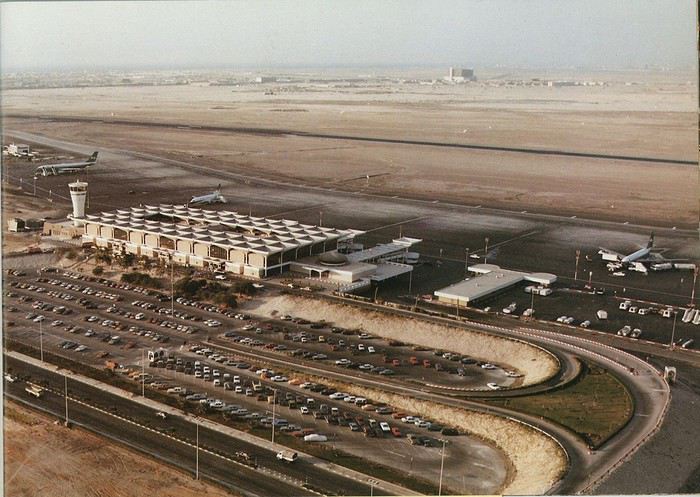
Next stop: New Delhi to drop off some Europeans and pick up a few Indians, and finally, the terminus: Manila. I don’t remember how long the trip took with its five stops—an unimaginable journey today. Despite all those stops to fill the plane, there was still enough space to stretch out on the four center seats of the 747, something that never happens these days despite all the flights in every direction.
So here we are, finally at Manila Airport around midnight.
Episode 1: Manila and Baguio To start, a quick note on the political and economic situation in the Philippines in 1984, which had consequences for us as tourists, as we’d soon realize upon arrival.
After several centuries of Spanish colonization, the Philippines became American at the start of the 20th century, then independent. In 1966, Marcos took power, and little by little, his regime sank into corruption and mismanagement, becoming a dictatorship with martial law, all for the benefit of his family and friends, who enriched themselves endlessly. The peak was the assassination of opposition leader Benigno Aquino in August 1983, which triggered harshly repressed protests. So we arrived a few months later in a very poor country, with omnipresent corruption and an extremely tense political situation, as we’d soon see for ourselves. Major protests took place in the main cities during our trip—I’ll come back to that. Two years later, Marcos fled to Hawaii after being forced out of power following rigged elections. This historical context explains a lot of the situations we found ourselves in over the following weeks.
Arriving in the middle of the night isn’t very cheerful. Manila was already a huge city with many slums, where you could find a few business hotels like the Hilton or Intercontinental—way out of our budget—and plenty of run-down hotels. Luckily, two Indians we’d chatted with on the plane offered to take us to their usual hotel. They came to Manila twice a year for business. We accepted their offer, relieved not to have to look for a place to stay in the middle of the night, figuring the address must be good since they came back every time... we were wrong 🙁
We left the airport and immediately got a taste of the local vibe when we got into the taxi: the police asked for our passports. We thought: what’s more normal than police in a dictatorship?
But that wasn’t it at all. Our two Indian friends explained that the police were noting our names along with the taxi number and time. Crime in Manila was so bad that the taxi driver would be held responsible if anything happened to us... welcome to the Philippines 😎 😎
Historically, the Philippines was a very violent country, where everything was settled with guns or machetes. Previous governments had banned carrying weapons, but Marcos later allowed the free sale and carrying of guns, and disputes were settled with pistols again (or worse, as we’d discover later). Since he’d released most of the criminals from prison to form a paramilitary militia at his service (I’ll talk about our encounter with these “heroes” later), it was pretty dangerous to go into many parts of Manila, where these “tonton macoutes” ruled.
We arrived at our hotel without incident... and then things started badly. The room was infested with big cockroaches—exactly what I hate most in those kinds of countries. No way to find another hotel at that hour. After the long flight, the urge to take a shower was so strong that we squeezed into the bathroom as best we could. After that, I don’t remember—I guess we must’ve fallen asleep exhausted under the sheets in the heat... air conditioning wasn’t widespread yet.
The next day, we just wanted to leave that dump as soon as possible. So we decided to head north right away, stopping in Baguio, and we’d visit Manila a bit on the way back.
When we stepped outside, we discovered a pretty run-down neighborhood with potholed streets. But we also discovered the jeepneys. They were everywhere, flooding the streets.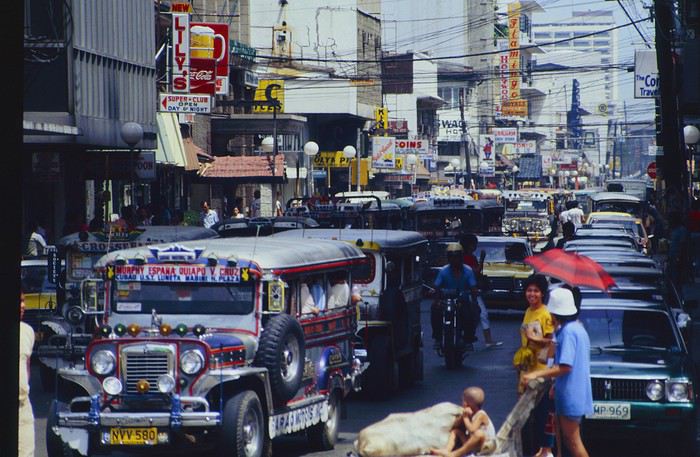
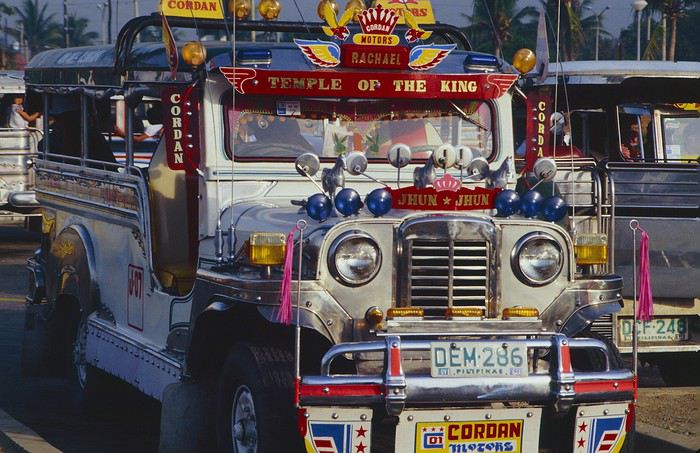
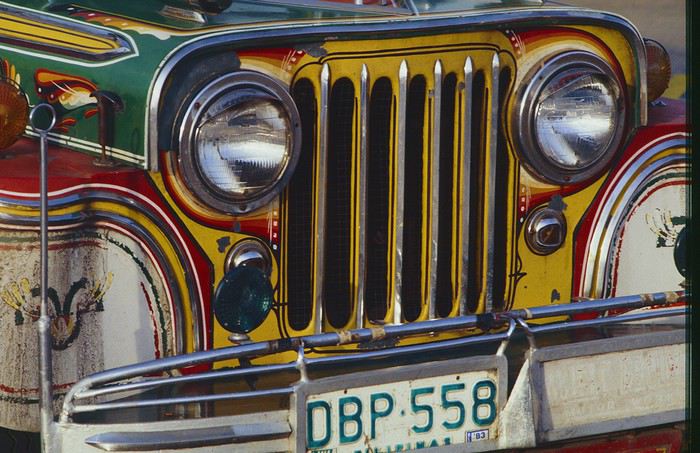
They had crazy sound systems, each one blasting louder than the last. The interiors were kitschy but fun. There weren’t many private cars—almost all transportation was by jeepney, with buses reserved for intercity trips.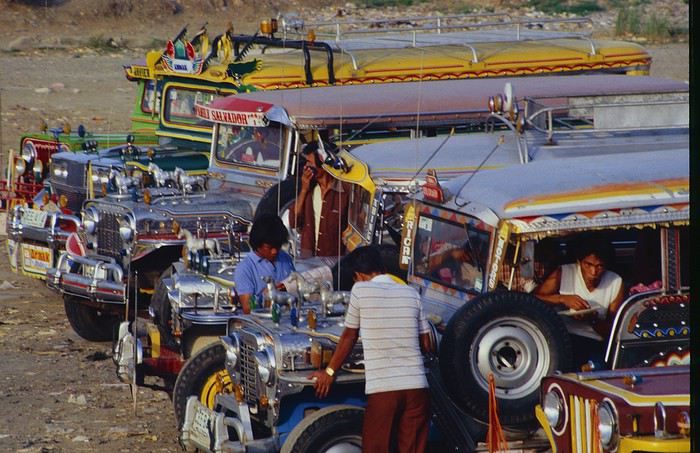
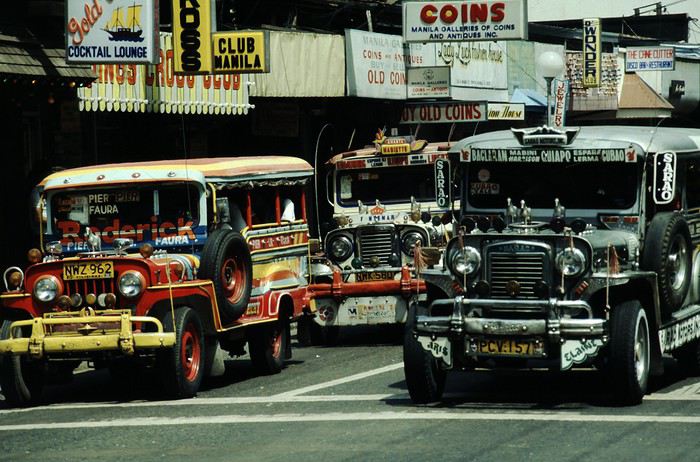
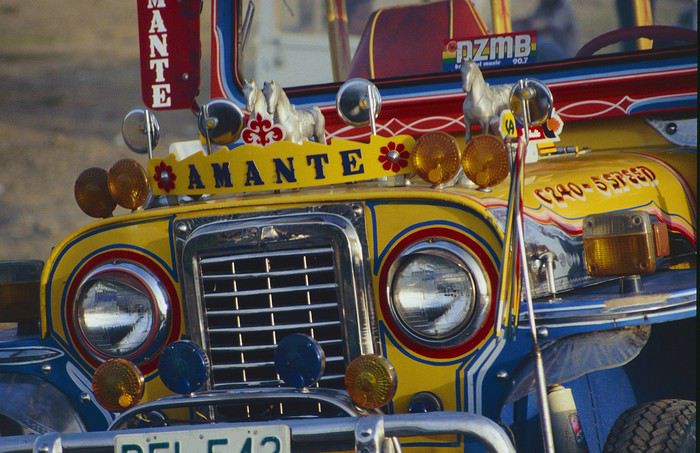
Before heading to the bus terminal for the north, somewhere on the outskirts of the city, we needed to exchange some money. I don’t remember how we ended up in a policeman’s jeep who offered his services: - Exchange money on the black market at a better rate than the banks. - Take us wherever we wanted, in this case, the bus terminal.
We accepted both offers (we’d still checked the official exchange rate from dollars to pesos). So we found ourselves in his jeep. After exchanging money, we left in his vehicle and stopped for gas. Without turning off the engine, he calmly smoked a cigarette while filling up. Since we were in a jeep with no doors or roof, we were ready to jump out if things went south, our travel bag in hand.
But we weren’t done with surprises yet. Once we left the small streets, we ended up in a neighborhood with wide avenues and not much traffic, which didn’t justify his incredible behavior. At every intersection, he made the sign of the cross, closed his eyes, and crossed without looking. I was more stunned than terrified! It wasn’t until we got out of the car later that I told Anne-Marie what had happened. I’d seen everything because the cop had put me in the front seat. Luckily, A-Marie hadn’t noticed anything from the back. Crossing Manila by trusting God rather than the rules of the road was ultimately effective. We were lucky—the trip was off to a good start. 🙂 🙂
We then passed through a neighborhood where slums stretched on for a while, and we left our policeman—friendly but a bit crazy—with relief.
A few hours by bus later, here we are in Baguio, cool in the mountains. My memories of Baguio are pretty fuzzy. I remember a small town. After some research while writing this journal, I found that the population was 120,000 in 1980. Given the population density in each home, that confirms my memory of a smallish town. Outside the “official” district with the president’s summer residence and government buildings, there were two or three paved streets with nice houses. The rest was very dirty and very poor, with lots of slums and dirt roads.
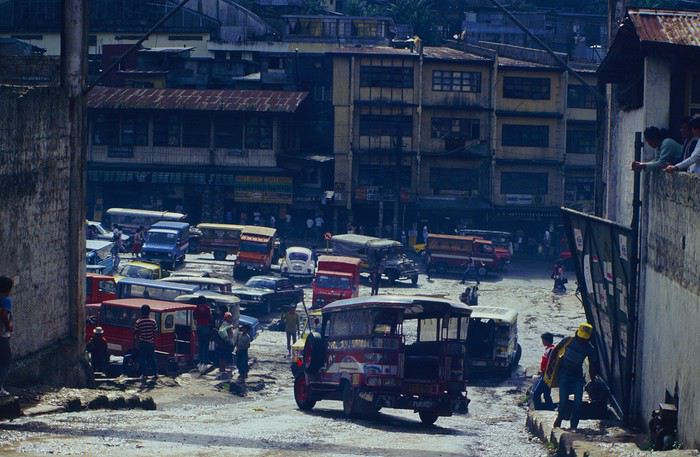
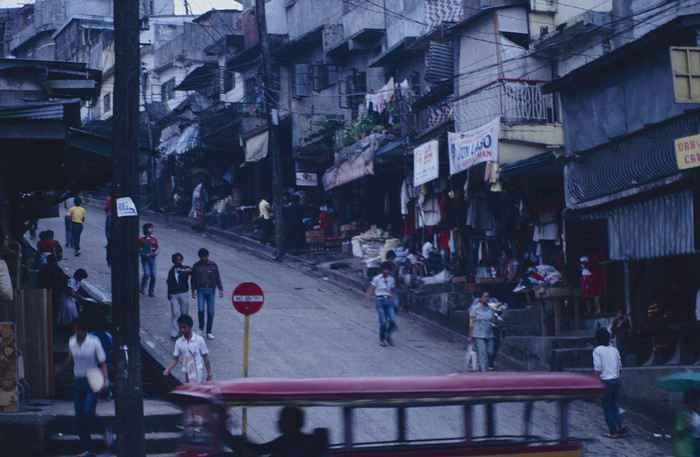
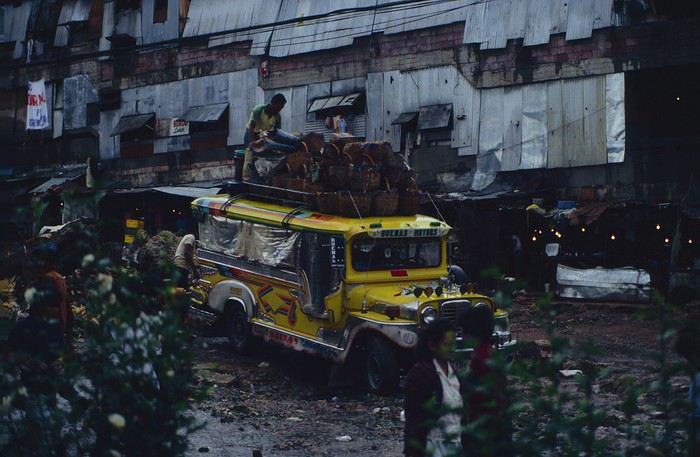
People we met on the street invited us to stay with them. These days, we wouldn’t just show up at strangers’ houses, which we should’ve done in Baguio—it would’ve saved us from an unimaginable and dangerous situation... which I won’t say anything about... !😊
The simple wooden house was on stilts at the edge of a hill with a view of the mountains. Since it was the start of the rainy season in a city that gets a lot of rain, we saw a lot of water. Our outings in town happened between downpours.
View from our lodging: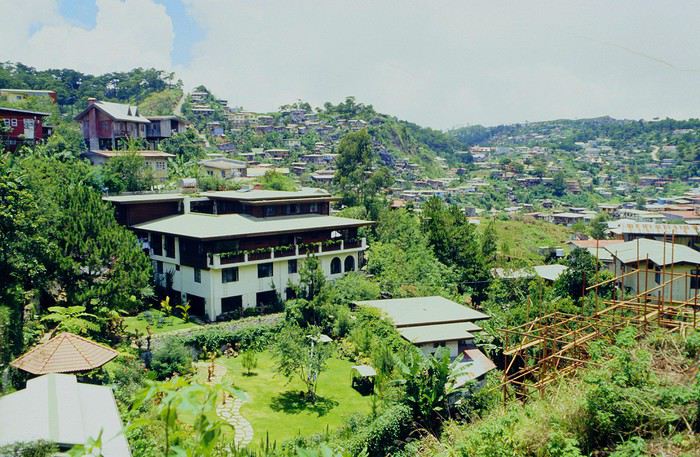
Episode 2: Baguio to Bontoc Aside from the situation briefly mentioned above, it was on the next leg to Bontoc that the adventure really began: an endless and dangerous road, a bus from another era, breathtaking landscapes, and surprising people.
We didn’t know the distance or how long it would take to get to Bontoc. When we arrived after about ten hours, we learned that Baguio to Bontoc was 140 km.
We got on a bus with wooden seats and settled in, two to a seat meant for two. As the bus filled up, passengers squeezed in three or four per seat, with chickens and baskets full of all sorts of things in the aisle. A little embarrassed, we didn’t know if we should squeeze in three on our seat. The seats were super tight (luckily, Filipinos are small), and I didn’t know where to put my legs given my height. I don’t remember if we stayed alone on our bench or if we ended up sharing with others.
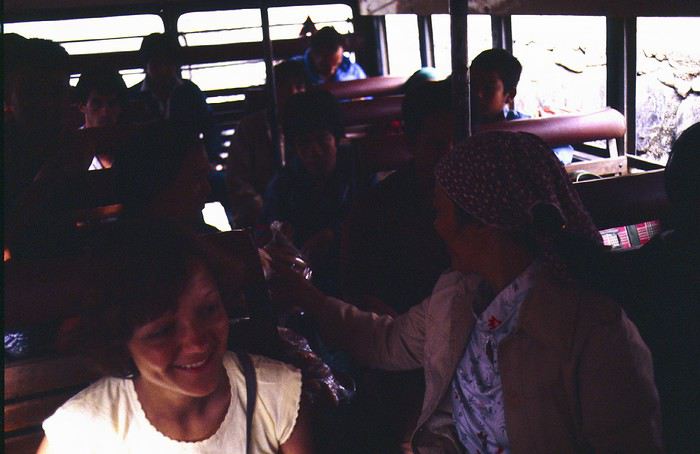
The “road” was a dirt track (or rather, a mud track) with endless turns. We held on as best we could to our slippery wooden seats—it was shaking in every direction. The woman behind us was carsick and throwing up... gross... but what were we doing there? Then we plunged into the Sierra Madre... just the name is dreamy!
Rice terraces started to appear: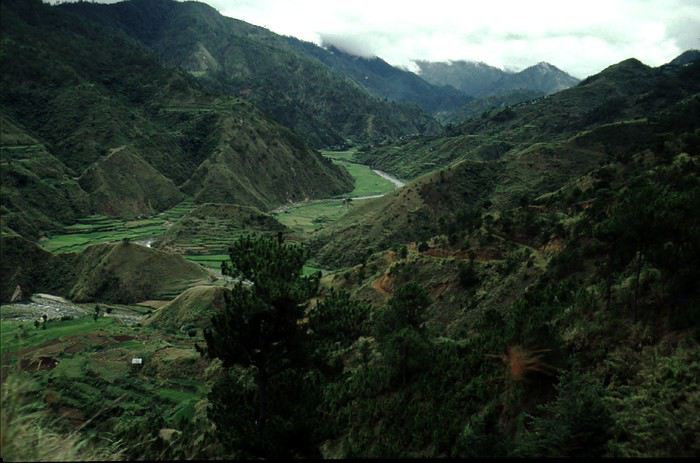
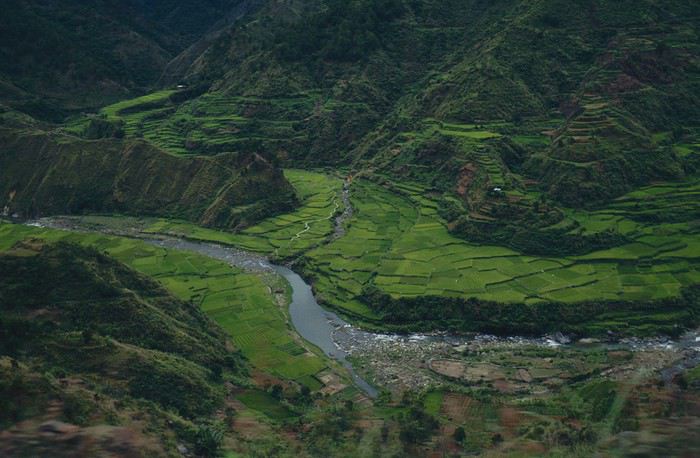
they took up more and more space along cliffs where we weren’t always reassured,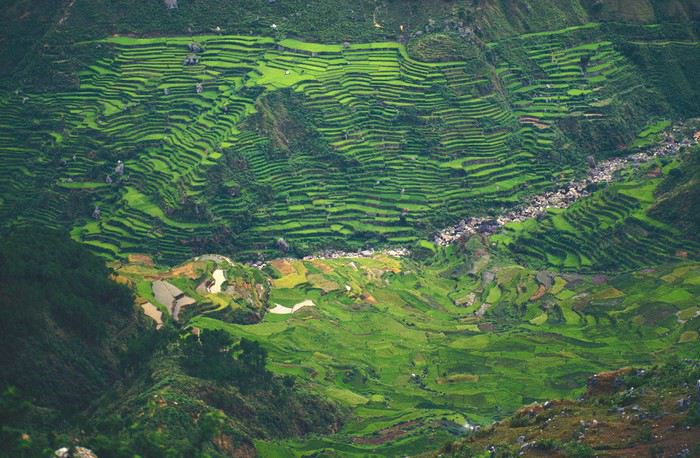
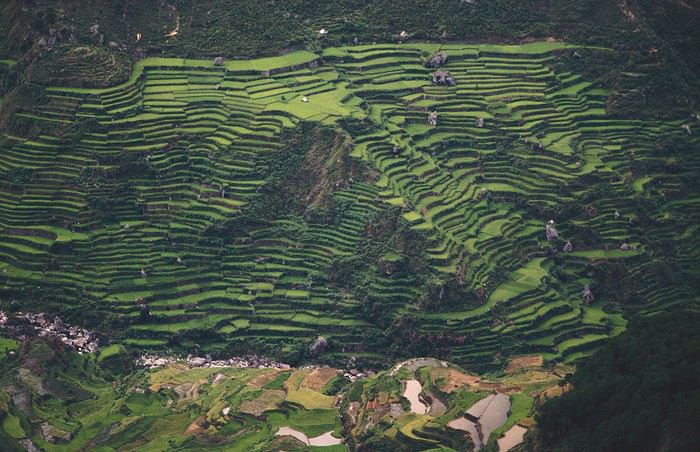
with lots of waterfalls (all that water had to go somewhere).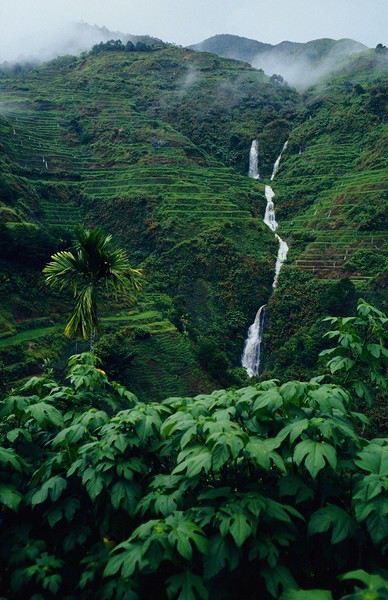
A few miserable villages stretched along the track, most often just a few houses balancing between the road and the drop. The bus stopped in every village—people got on or off and settled inside or on the roof. Street vendors offered their products to the bus passengers—a common sight in Asia, even today.
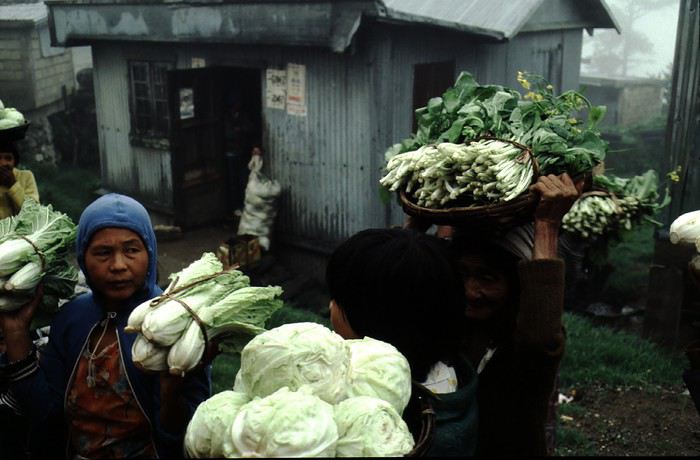
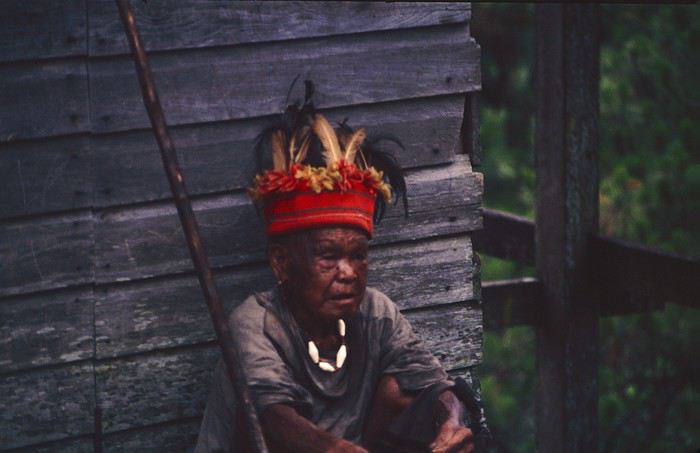
We were in another world—villagers were in loincloths, others had spears. The atmosphere was strange... but all good, we wanted exoticism, and we got it: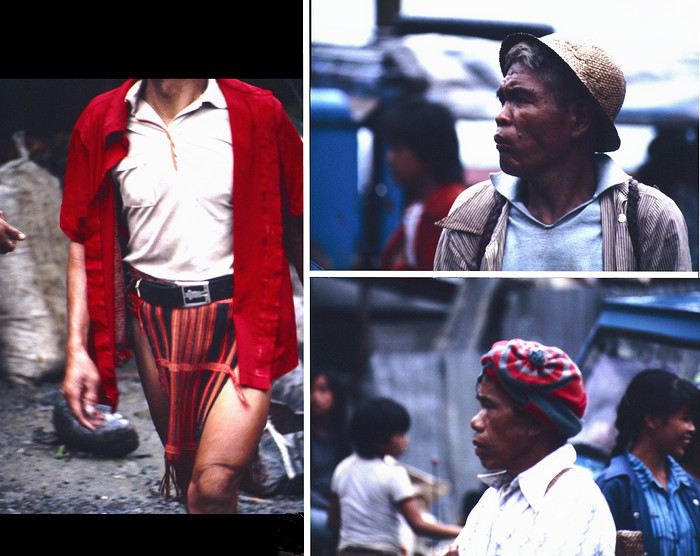
This so-called traditional outfit was everyday wear—it wasn’t for tourists since there weren’t any.
A curiosity because writing a travel journal about a trip 35 years later isn’t common, but also (mostly?) because exploring the Philippines at that time had little in common with traveling there today.
Obviously, I’ve forgotten a number of facts, most of the details, but with the help of a few notes from that time and a stack of slides (yes, there was life before digital 😊), many memories came back and added to the highlights I’d never forgotten. The scanned slides aren’t always great quality, but there are still quite a few to brighten up this chatter. Back then, we didn’t snap photos like we do now—film was too expensive—so I don’t have pictures of every place we visited... too bad, comparing some of those spots to how they look today would’ve been interesting.
Why "Adventures"? Why call it "Adventures" in the Philippines in 1984, a word so often used for a simple exotic trip? - Because the lack of information (no *Guide du Routard*, no *Lonely Planet*, no *Michelin Guide*, nothing, and obviously no internet) gave this trip what’s at the heart of adventure: the unknown. - Because the political situation made the stay sometimes dangerous. - Because transportation conditions were always epic, often perilous. - Because the question of where we’d spend the night came up almost every evening. - And for... quite a few other reasons.
That said, we weren’t exactly explorers!
Why the Philippines? First of all, why go to the Philippines in 1984—a country not exactly set up for tourism and about which we knew very little? How could we get an idea of the beauty of the Philippines and its points of interest when we had no guides or photos?
The idea came to us from Thailand a year earlier, during our first long-haul trip. After touring the north of the country, we met a Frenchman living in Phuket, where there were only a few tourists in Patong, with just a few small hotels and guesthouses. Kata and Karon had no buildings or roads, Rawai only had three palm-thatched bungalows, including ours, and the other islands were unknown to tourists. There was plenty to discover, and we wanted to return to this beautiful country... but the Frenchman made us dream about the Philippines—a country to explore, with wild landscapes.
Long evenings of discussion over multiple Sprite-Mekong cocktails (what memories of those headaches!) finally convinced us we had to go to the Philippines.
Episode 0: Before Departure The decision was made: we’d go to the Philippines in May 1984. Our friends and family were surprised when we announced we were going on vacation to the Philippines (a bit like saying today we were going paddleboarding in the Kerguelen Islands 🤪).
These days, preparing for each of our trips takes long evenings of research, planning, and noting down good addresses... etc. But for the Philippines in 1984, preparation was quick: we had very little information about the country, we were leaving almost at random, and the discovery would only be more exciting.
We still had a few bits of info gathered here and there: the rice terraces in northern Luzon, volcanoes, Negros where we were supposed to visit an acquaintance, Cebu and its marine life (we ended up going elsewhere), and absolutely avoid Mindanao, which was practically at war with the regime. That was about it, but it was already a great itinerary.
Nothing was organized in advance; we’d see day by day. We had no idea about travel times or even the existence of transportation options. The main (and sometimes only) way to connect two islands was by overloaded, rusty ferry. Only the big cities had airports.
Let’s Go: Episode 1: Paris to Manila My travel journals always start after arriving at the airport—the Europe-to-“Other Continent” trip isn’t interesting—but the flight to the Philippines was already an adventure, so I’ll make an exception.
This was the era when only a few Asian airlines were on par with Western ones: Thai, Singapore Airlines, and Philippine Airlines. They had beautiful, brand-new planes, and to attract customers (almost exclusively “businessmen”) from the usual airlines (Air France, Lufthansa, British Airways), there was opulence on board: unlimited champagne, all sorts of cocktails... Compared to today’s long-haul flights, there was still one small difference: no personal screens, just one screen at the front of the cabin with one mandatory movie. And I don’t know why, but we only got James Bond films, both ways... that must’ve been the trend at the time.
The tourism boom to Southeast Asia hadn’t started yet, and the “Asian Tigers” weren’t a thing, so there weren’t many business trips. That meant long-haul flights made stops everywhere to fill the planes. Our Philippine Airlines Boeing 747 left London, picked us up in Paris, then stopped in Frankfurt to take on a few Germans. I don’t know why we then made a stop in Dubai—a totally exotic place at the time. There was nothing to do there... things have changed a lot since. It was a small town lost in the desert. The airport was tiny, with just one or two buildings and a supermarket. During the stopover, everyone had to get off the plane and walk to the supermarket. Photo and electronic equipment were dirt cheap—I guess that was the only reason for the stop. Maybe it was their first commercial move. Emirates didn’t exist yet, as I checked online, but anyway, the idea that such a remote place could have its own airline was unthinkable.
Online, I found this photo of Dubai Airport in 1980. Anyone who’s transited through today’s massive airport with its rows of A380s will appreciate it:
Next stop: New Delhi to drop off some Europeans and pick up a few Indians, and finally, the terminus: Manila. I don’t remember how long the trip took with its five stops—an unimaginable journey today. Despite all those stops to fill the plane, there was still enough space to stretch out on the four center seats of the 747, something that never happens these days despite all the flights in every direction.
So here we are, finally at Manila Airport around midnight.
Episode 1: Manila and Baguio To start, a quick note on the political and economic situation in the Philippines in 1984, which had consequences for us as tourists, as we’d soon realize upon arrival.
After several centuries of Spanish colonization, the Philippines became American at the start of the 20th century, then independent. In 1966, Marcos took power, and little by little, his regime sank into corruption and mismanagement, becoming a dictatorship with martial law, all for the benefit of his family and friends, who enriched themselves endlessly. The peak was the assassination of opposition leader Benigno Aquino in August 1983, which triggered harshly repressed protests. So we arrived a few months later in a very poor country, with omnipresent corruption and an extremely tense political situation, as we’d soon see for ourselves. Major protests took place in the main cities during our trip—I’ll come back to that. Two years later, Marcos fled to Hawaii after being forced out of power following rigged elections. This historical context explains a lot of the situations we found ourselves in over the following weeks.
Arriving in the middle of the night isn’t very cheerful. Manila was already a huge city with many slums, where you could find a few business hotels like the Hilton or Intercontinental—way out of our budget—and plenty of run-down hotels. Luckily, two Indians we’d chatted with on the plane offered to take us to their usual hotel. They came to Manila twice a year for business. We accepted their offer, relieved not to have to look for a place to stay in the middle of the night, figuring the address must be good since they came back every time... we were wrong 🙁
We left the airport and immediately got a taste of the local vibe when we got into the taxi: the police asked for our passports. We thought: what’s more normal than police in a dictatorship?
But that wasn’t it at all. Our two Indian friends explained that the police were noting our names along with the taxi number and time. Crime in Manila was so bad that the taxi driver would be held responsible if anything happened to us... welcome to the Philippines 😎 😎
Historically, the Philippines was a very violent country, where everything was settled with guns or machetes. Previous governments had banned carrying weapons, but Marcos later allowed the free sale and carrying of guns, and disputes were settled with pistols again (or worse, as we’d discover later). Since he’d released most of the criminals from prison to form a paramilitary militia at his service (I’ll talk about our encounter with these “heroes” later), it was pretty dangerous to go into many parts of Manila, where these “tonton macoutes” ruled.
We arrived at our hotel without incident... and then things started badly. The room was infested with big cockroaches—exactly what I hate most in those kinds of countries. No way to find another hotel at that hour. After the long flight, the urge to take a shower was so strong that we squeezed into the bathroom as best we could. After that, I don’t remember—I guess we must’ve fallen asleep exhausted under the sheets in the heat... air conditioning wasn’t widespread yet.
The next day, we just wanted to leave that dump as soon as possible. So we decided to head north right away, stopping in Baguio, and we’d visit Manila a bit on the way back.
When we stepped outside, we discovered a pretty run-down neighborhood with potholed streets. But we also discovered the jeepneys. They were everywhere, flooding the streets.
They had crazy sound systems, each one blasting louder than the last. The interiors were kitschy but fun. There weren’t many private cars—almost all transportation was by jeepney, with buses reserved for intercity trips.
Before heading to the bus terminal for the north, somewhere on the outskirts of the city, we needed to exchange some money. I don’t remember how we ended up in a policeman’s jeep who offered his services: - Exchange money on the black market at a better rate than the banks. - Take us wherever we wanted, in this case, the bus terminal.
We accepted both offers (we’d still checked the official exchange rate from dollars to pesos). So we found ourselves in his jeep. After exchanging money, we left in his vehicle and stopped for gas. Without turning off the engine, he calmly smoked a cigarette while filling up. Since we were in a jeep with no doors or roof, we were ready to jump out if things went south, our travel bag in hand.
But we weren’t done with surprises yet. Once we left the small streets, we ended up in a neighborhood with wide avenues and not much traffic, which didn’t justify his incredible behavior. At every intersection, he made the sign of the cross, closed his eyes, and crossed without looking. I was more stunned than terrified! It wasn’t until we got out of the car later that I told Anne-Marie what had happened. I’d seen everything because the cop had put me in the front seat. Luckily, A-Marie hadn’t noticed anything from the back. Crossing Manila by trusting God rather than the rules of the road was ultimately effective. We were lucky—the trip was off to a good start. 🙂 🙂
We then passed through a neighborhood where slums stretched on for a while, and we left our policeman—friendly but a bit crazy—with relief.
A few hours by bus later, here we are in Baguio, cool in the mountains. My memories of Baguio are pretty fuzzy. I remember a small town. After some research while writing this journal, I found that the population was 120,000 in 1980. Given the population density in each home, that confirms my memory of a smallish town. Outside the “official” district with the president’s summer residence and government buildings, there were two or three paved streets with nice houses. The rest was very dirty and very poor, with lots of slums and dirt roads.
People we met on the street invited us to stay with them. These days, we wouldn’t just show up at strangers’ houses, which we should’ve done in Baguio—it would’ve saved us from an unimaginable and dangerous situation... which I won’t say anything about... !😊
The simple wooden house was on stilts at the edge of a hill with a view of the mountains. Since it was the start of the rainy season in a city that gets a lot of rain, we saw a lot of water. Our outings in town happened between downpours.
View from our lodging:
Episode 2: Baguio to Bontoc Aside from the situation briefly mentioned above, it was on the next leg to Bontoc that the adventure really began: an endless and dangerous road, a bus from another era, breathtaking landscapes, and surprising people.
We didn’t know the distance or how long it would take to get to Bontoc. When we arrived after about ten hours, we learned that Baguio to Bontoc was 140 km.
We got on a bus with wooden seats and settled in, two to a seat meant for two. As the bus filled up, passengers squeezed in three or four per seat, with chickens and baskets full of all sorts of things in the aisle. A little embarrassed, we didn’t know if we should squeeze in three on our seat. The seats were super tight (luckily, Filipinos are small), and I didn’t know where to put my legs given my height. I don’t remember if we stayed alone on our bench or if we ended up sharing with others.
The “road” was a dirt track (or rather, a mud track) with endless turns. We held on as best we could to our slippery wooden seats—it was shaking in every direction. The woman behind us was carsick and throwing up... gross... but what were we doing there? Then we plunged into the Sierra Madre... just the name is dreamy!
Rice terraces started to appear:
they took up more and more space along cliffs where we weren’t always reassured,
with lots of waterfalls (all that water had to go somewhere).
A few miserable villages stretched along the track, most often just a few houses balancing between the road and the drop. The bus stopped in every village—people got on or off and settled inside or on the roof. Street vendors offered their products to the bus passengers—a common sight in Asia, even today.
We were in another world—villagers were in loincloths, others had spears. The atmosphere was strange... but all good, we wanted exoticism, and we got it:
This so-called traditional outfit was everyday wear—it wasn’t for tourists since there weren’t any.
Uganda: 20 days discovering authenticity
Preamble:
For summer 2019, the idea was to return to Africa. We had already been to Namibia in 2017 (+ a few days in Botswana and the end of the trip at Victoria Falls), which we loved, and a trip to Asia in 2018 (Borneo, Perhentian, and Singapore), a nature-focused trip but a bit disappointing due to environmental destruction. The desire to return to Africa was very strong. We wanted a change of scenery, nature, discoveries, to step out of our little comfort zone (a bit, anyway!) and experience travel differently. In short, we dreamed of authenticity, and we weren’t disappointed.
We traveled as a family of four with our daughters, aged 19 and 17. When the urge for Africa hit, Uganda quickly stood out, especially for the chance to see rare animals, particularly the famous mountain gorillas. When I looked into the budget, I was quickly disheartened. It’s really expensive. Too expensive… Then, after reading a few trip reports on "VoyageForum" (thanks Muriel J!), I decided to ask a local agency for a quote. The first contact was very friendly and responsive, and the initial offer for two weeks fit our budget :). A few images gathered from the internet (especially Sipi Falls) finally convinced us all. I asked for an adapted offer with a few more sites to extend the trip to three weeks and cover a fairly complete visit to the country (which, of course, increased the budget! To stay within an acceptable range, we prioritized activities over accommodations and regularly chose the cheapest options, with 2-3 nice lodges in between). It’s booked! We were in October 2018, and the first thing to do was reserve permits to see the gorillas and chimpanzees. Then, the agency took care of all the bookings except for the international flights, which we booked with Ethiopian Airlines. A few months of waiting to look forward to… and a little worry too! Two events didn’t reassure us: the kidnapping of an American tourist by four men at the DRC border and the Ebola outbreak in Congo, with confirmed cases in Uganda by mid-June…
Here we are in July, and departure is approaching. The suitcases are packed (warm clothes, long, short, dark, light, practical, sun, rain, hiking/trekking shoes, flip-flops—clothes for every situation! Don’t forget: headlamp (essential!), binoculars, cameras), and we’re ready.
One day before departure, our agency Mpolampola, through its manager Paul, informs us that he won’t be the one taking care of us during the trip but another guide named Moses. He has a big problem with a vehicle and can’t do otherwise. For us, as long as everything is okay, no worries, especially since I had read glowing reviews about Moses, who turned out to be a very pleasant guide, cautious (most important) on the road, clear about all the activities, and an expert on birds, his specialty. We briefly met Paul in the middle of the trip, who is also very friendly. In short, we 100% recommend this agency. Flights to Entebbe went smoothly; we arrived around 10:30 AM, filled out health forms (Ebola information signs everywhere), visas, baggage claim, and met Moses, who took us directly to the vehicle. It was in pretty good condition with huge tires (we’d understand why later!), but it had quite a few miles (400,000 on the odometer!). Just missing a seatbelt… Okay, it’s Africa!
Now, here’s our day-by-day itinerary, which I’ll summarize briefly with ratings for each activity: ****TOPISSIME (Amazing) ***Very good **Good *Meh
Day 1) Departure from the airport at 11:45 AM for some currency exchange. Stop along the way at the equator for a meal and souvenir photo! Arrival at Lake Mburo Park *** around 5:00 PM. Even before entering the park, we saw lots of antelopes, zebras, elks, etc.—it’s magnificent. On the way, we had already encountered many goats and cows, and we were impressed by their enormous horns. We enjoyed a nice game drive until about 7:00 PM, when we reached our lodge, one of the nicest of the trip, Eagle’s Nest ****, with a magnificent view, a tent with a nice bathroom/shower, and a very good meal.
Day 2) Departure at 7:00 AM for a game drive; we encountered many animals again, especially antelopes, zebras, and birds. There are no giraffes, lions, or cheetahs in this park. We didn’t get lucky enough to see a leopard… :-) Then, we continued to Lake Bunyonyi ***, where the road and views are very beautiful, but we were shocked to see locals (mostly women and children) breaking stones by hand on the mountainside in very precarious safety conditions. There are regularly dramatic accidents because, over time, entire sections detach and cause landslides. These stones are then used for road construction… Another world… This was the only place we saw this. Lake Bunyonyi is a nice stop (but less exotic in our opinion since we have many lakes back home too!). We took a boat to our accommodation, Byoona Amagara ***, which has a lot of charm. We stayed in huts called "geodomes," completely open to nature, so it was very cool at night. To reach the toilets located below, you had to be brave! The meal consisted of lake shrimp—good but a bit bland.
Day 3) After a good breakfast, departure at 9:00 AM to visit three islands. We took several nice walks with beautiful views of the lake and islands. A local meal was served on the last island. At 1:00 PM, we met Moses for the rest of the program and headed to Ruhija in Bwindi Forest****. The landscapes are breathtaking. After two hours of driving and many photo stops, we arrived at our accommodation near the trekking starting point, Ruhija Gorilla Friends Resort **. We stayed in a room instead of the initially planned tents, which was just as well because there was a lot of wind during the night. We still had time for an activity and decided to meet the Bwata pygmies despite the bad reviews in the guide… The first part of the visit was quite nice, with a visit to a school where the children gave us a very joyful welcome. We had a great time listening to them sing and dance! Then we met the Bwata pygmies who live on the edge of the forest. When Bwindi Forest was declared a national park, they had to leave their habitat because their activities weren’t compatible with nature and wildlife protection. We left on a somewhat sad note… The visit ended with a local doctor explaining different medicinal plants, and we watched the making of local beer from sorghum. Good meal. We had butterflies in our stomachs—tomorrow was a big day! I admit I was a bit stressed, not entirely confident in my physical abilities…
Day 4) After a short night due to excitement, breakfast, and departure at 7:30 AM. First, it started calmly with singing and dancing. Then, a 15-minute briefing and group assignments. No one asked if we had any physical problems or anything (when booking, I had inquired a bit, and they told me groups were assigned based on physical abilities). We were assigned to the Mukiza group. At first, I was pretty happy—it was a fairly large group with babies :). The ranger explained that for now, they didn’t know where the gorillas were… the trackers couldn’t find them… Oh… (that’s not a good sign!!!) We set off at a good pace, first on a reasonably sloped path. We were accompanied by a family of four Italians and five porters (four for us!). After an hour, the ranger stopped us and informed us they still couldn’t find them—they had fought with another group the day before and scattered throughout the forest, so they were very far away, and we needed to move faster… Hmm… we picked up the pace (we weren’t going slowly before!!!) and walked for another good hour—down, up, down again, up again, we kept going, but always more or less on paths. Then another stop. A 10-minute break waiting for news. The news wasn’t very precise, it seemed! The ranger decided to cut through the forest—machetes were used to clear the path. We descended unimaginable slopes, then climbed back up. Our stick kept getting stuck; luckily, our porter helped us, held our hands, and the terrain was vertical! An hour later, another stop: we heard gorilla cries (yay!!!). False hope—we waited again for news from the trackers, who informed our ranger that it was a non-habituated family, so we couldn’t see them. Cold shower—we had to go all the way back up and return to the starting point to maybe see another group. But time was running out… We arrived around 1:30 PM; all the other groups had already left long ago. Our guide was worried because we still had a long drive ahead. We quickly ate a banana, and off we went for another trek (I was exhausted!). Luckily, this group was close—about 45 minutes of steep descent (I was already thinking about the climb back and considering being adopted by a gorilla ). The forest was sublime, with magnificent tree ferns—the place was truly splendid. Finally, we were there. The porters stayed behind, we grabbed our cameras, and followed the ranger. The progress wasn’t easy, but suddenly, a female was in front of us, curled up in a little ball, eating—so cute. The emotion overwhelmed us. But she moved away—it’s hard to observe them; they move constantly, and the terrain is very steep and uneven. We saw a female descending from a tree with a baby on her back—too adorable. Then, here was the silverback, enormous, incredible, yet so calm and peaceful. He ate quietly and gave us a nice demonstration of nostril exploration! We could observe them for a good hour, but photographing them wasn’t easy because they kept moving, and we could barely stand! Toward the end, a large male (black back) suddenly stood up and decided to pass right where I was! I ended up in the bushes, and the male passed in front of me just a few centimeters away (he stepped on one of my daughters’ feet!) followed by the whole family. Just an exceptional moment. It was time to leave; we had to climb back up. I dreaded it because, I admit, I was exhausted. We finished the hike after 4:00 PM, exhausted but happy. The ranger gave us diplomas, and we didn’t linger because we still had a long drive—we needed to reach Ishasha before nightfall. Our guide was a bit stressed. If we were to do it again, we’d spend an extra night in Bwindi. However, it seems finishing so late is exceptional—it never happens, according to our guide! The road between Bwindi and Ishasha is sublime, with extraordinary landscapes, and despite the late hour, we regularly asked our guide to stop for photos. We arrived at Enjojo *** Lodge around 6:00 PM. The huts are located quite far from the reception and the bathrooms, a bit far from the huts, but otherwise, it was very nice.
Day 5) Departure at 8:00 AM after a good breakfast with the hope of seeing tree-climbing lions (no luck!). Overall, there weren’t many animals, and we arrived around 12:45 PM at our next stop, Parkview Safari Lodge ****, with a magnificent view, a beautiful family bungalow, and a good meal. We enjoyed a short relaxation by the lovely pool. At 4:00 PM, we left to see Kyambura Gorge *** and hike there. Unfortunately, this activity is no longer available, so we walked around the area—it was very beautiful. Back at the hotel, a little rest after the previous day wasn’t a bad idea! Reading, swimming, meals, and dances made the end of the day enjoyable.
Day 6) Departure at 6:30 AM—one of our daughters was sick (stomachache, cold sweats…). Safari in Queen Elizabeth ** (Kaseny Plains)—a bit disappointing. Stop by the salt lake with a nice view. A small market, but we weren’t thrilled by the crafts (overall, apart from some beautiful baskets/plates, there wasn’t much, and the wooden objects were, in our opinion, much less pretty than in Namibia). Then we took the crater road (27 km long) **** with magnificent landscapes. However, you absolutely must close the windows because it’s infested with tsetse flies. At noon, we arrived at Mweya, where we stayed in basic rooms, but the restaurant was well-placed with a beautiful view of the Kazinga Channel. At 2:00 PM, we enjoyed a magnificent cruise **** on the channel. Elephants, antelopes, crocodiles, hippos (including adorable babies), buffaloes, all kinds of birds. Wow!!! Two hours of pure bliss. Quiet end of the day playing cards with a view of the channel and elephants.
Day 7) Departure at 6:00 AM—still sick, we weren’t sure if it was due to the preventive treatment (Malarone) or something else… Another game drive in Queen Elizabeth (Kaseny Plains) and breakfast by the salt lake. Overall, we were a bit disappointed by this park. Then we took the road to Crater Lakes***, again with very beautiful landscapes. A hike of about an hour and a half allowed us to discover these beautiful crater lakes (the water mainly comes from the Rwenzoris). We crossed pretty villages and had nice encounters. End of the day at Tinka’s Home ****, with a family. We loved this place—very welcoming, where we took a cooking class with our hosts. A really great time. After the meal, we enjoyed African stories and dances. Really awesome.
Day 8) Departure at 7:30 AM for another highly anticipated discovery—the chimpanzees in Kibale Forest ****. We went to the meeting point and were split into groups of six, each with a guide. We saw three different groups, and for the last group, we followed a chimpanzee (slightly more comfortable running in the forest than we were!) that led us to the group. Their cries are very impressive, and we could observe them well, even though they were often high up in the trees. We were lucky enough to see two on the ground, very close to us. It was magnificent. End of the encounter and return to the starting point—it was noon. We went back to Tinka’s Home for the meal (delicious!). At 2:00 PM, we hiked in Bigodi Swamp ***, a marsh surrounded by beautiful vegetation, especially huge papyrus, and inhabited by many birds and monkeys. We saw, among others, black-and-white colobus monkeys, red colobus monkeys, and vervet monkeys. We also visited a basket-weaving workshop where we bought two beautiful baskets. Then a short stop in Fort Portal, where we stayed for two nights at Ruwenzori View Guesthouse ***, a nice place with a family room and very good communal meals.
Day 9) Departure at 8:00 AM for a hike in the Rwenzori****—it was a bit chaotic today. First, we had to exchange shillings because we wouldn’t have another chance in the following days. At the bank, employees went to get the bills by motorcycle from other buildings—it was quite surreal! And it took time! Then there was a misunderstanding between the organizer and me… I really wanted to see the region where chameleons are found in the Rwenzori—this region is south of the mountain range, and we were in the north! Anyway, the program included an ascent in the northern part with a positive elevation gain of over 1,500 meters… Talking to the guide scheduled for this hike (Noah), we explained that we really wanted to discover the vegetation and these famous chameleons, not necessarily achieve a physical feat… (we’d had enough!). The decision was made to go south, which meant quite a bit of driving. The hike was really enjoyable, with magnificent vegetation by the river. We saw three of the four chameleon species present, including the famous three-horned chameleon. The region is superb. We ended with a drink at Ruboni Camp, which has a magnificent view of the region (ideally, we should have stayed there). Two hours of driving to finish, and a good meal :).
Day 10) Departure at 8:00 AM—we had a long drive to Ziwa Rhino Ranch****. We passed through Hoima, had lunch in Masindi, and arrived in time for the rhino tracking walk. We could approach them closely on foot—it was impressive. We saw eight. Since we were staying on-site in the guesthouse **, we received precise safety instructions for moving between the rooms and the restaurant. And we quickly understood why!
Day 11) Departure at 6:00 AM for breakfast—surprise, in front of our room, several large rhinos were sleeping (we had also heard a lot of animal noises during the night—rhinos but also what seemed to be predators). So we had to take a detour to reach the restaurant! Second surprise—next to the restaurant, just three meters away at most, two mothers and their baby were also sleeping! Memorable! Then we had an appointment for the shoebill trek and canoe ride **** (package with the previous day’s walk). So there we were, in our boots, splashing through 30 cm of water in search of the shoebill (I really wanted to see one :))! It was really fun, and luck was on our side—a shoebill had just landed in the distance! We approached as best we could and observed it from afar. What a strange bird! There are very few left, and Uganda is one of the countries where the chances of seeing one are quite good. The tour continued with a canoe cruise where we saw a herd of cows (the famous ones with enormous horns) being swum as a dowry to the father of the future bride! A funny spectacle. This stop wasn’t the most anticipated, but we all thought it was really worth the detour. Road to Murchison Falls Park, and arrival around noon at Red Chili Rest Camp **, where we stayed for two nights (family banda). Good meal. Then a cruise to Murchison Falls*** where we disembarked and continued on foot. It was pretty. Back to Red Chili.
Day 12) This morning, early departure for a cruise in search of the shoebill*** (booked in case we didn’t see one at Ziwa). The landscapes were pretty, but there weren’t many birds in the end. We spotted the chosen one from afar after the first 10 minutes—so the suspense didn’t last long :-) It was a nice activity but quite long—5 hours. In the afternoon, safari in Murchison Park****—this park is sublime, the landscapes fabulous. Really one of our favorite parts of the trip. Lots of animals and even a leopard spotted with binoculars because it was far away! Night at Red Chili.
Day 13) Departure for the first morning ferry—it was drizzling, the sky was threatening at first, so the landscape was spectacular! Beautiful contrasts. In the middle of the morning, we were lucky to observe a whole group of lions, first from afar, then with a little patience, the whole group approached until they passed beside and in front of our vehicle. What emotion and excitement! We could then observe large groups of giraffes. They were magnificent. The morning was incredible. Then we headed to our lodge, Fort Murchison ****, and on the way, we saw a whole group of elephants—the view was magnificent. We had a very good meal and enjoyed the pool a bit. We also met Paul, the organizer of our trip. Very nice :). In the late afternoon, off for a short safari in the park. We slept in very well-equipped tents.
Day 14) Today, we had a long drive to Kidepo Park. It was raining, which didn’t help our guide—according to him, the tracks near Kidepo turn to mud with rain and become difficult to navigate. We saw, among other things, a bus in a bad situation in the ditch. Some sections were really tricky, and we were glad to have a driver. The end of the trip—the landscape was spectacular and original, and we saw some traditional villages. We arrived at Kidepo quite late. Short safari in the park before reaching the accommodation. We booked two simple bandas in the park camp**. It was clean but didn’t hold up well in the rain . The restaurant was very nice, though.
Day 15) The day was dedicated to discovering Kidepo Park **** where the landscapes were again superb. First encounter with a lioness resting on a rock. We saw other lions later and observed them for a long time. There were almost no other tourists in the park. Our daughter wasn’t feeling well, and by the time we arrived at the lodge, she had a temperature of 39.5°C (103.1°F)… A nap was necessary. In the late afternoon, we returned to the spot where we had seen the lions that morning, and they were still there—they weren’t happy because rain was threatening! It was a great photo opportunity. Then came the downpour, and our driver urged us to return quickly because the tracks were becoming impassable. Indeed, a jeep was in the ditch… The return was eventful, and several times we slid without being able to do anything… Wow, what a day!
Day 16) No safari this morning because of impassable tracks—the road to Kotido*** was longer than expected as we had to take a detour. The landscapes along the way were surprising. We finally arrived around 1:00 PM at the accommodation and left at 3:00 PM to visit the largest manyatta in East Africa with two translators. It was incredible—a very beautiful experience. The manyatta is immense and has 28,000 inhabitants. Night at Karamojaarts guesthouse*—very average meal.
Day 17) Departure for Moroto****—on the way, we saw many bird species. Moroto doesn’t look like other Ugandan cities. Life there seems very pleasant. We arrived at Kara-Tunga and had a bite to eat. At 4:00 PM, we left to visit a Karamojong village. We enjoyed beautiful dances and watched communal games—it was fun and so authentic. Then we headed to a kraal (where shepherds and herds are) to set up our camp. Moses had to get used to the idea of sleeping in the tribe in a tent! It was incredible to find ourselves in this universe. The place was beautiful, and we had a great time with the Karamojong. Some had never seen white people… had never been in a car… Their culture is incredible. During the evening, around the fire, to our guide’s dismay (a bird enthusiast), they grilled hornbills! On our side, we ate a meal prepared by Kara-Tunga for our sensitive stomachs! Night in a tent.
Day 18) Dawn wake-up in the fog—the atmosphere was quite strange. Our daughter was attacked by a cow—fortunately, more fear than harm, but she ended up with a lot of thorns in her buttocks and thighs ! Then we left for the Mount Elgon region, specifically Sipi Falls****. Lacam Lodge****, perched on the edge of the cliff with a direct view of one of the falls, was just magnificent. The view and landscapes were fabulous. Big favorite. We had dinner and then went for a hike to visit the three falls in the region, partly in the rain. The landscapes were breathtaking! Sunset at Lacam Lodge with the sun setting over the waterfall. We couldn’t get enough and stayed to admire until nightfall!
Day 19) Visit to coffee plantations*** where we were given all the useful explanations to understand the culture and the incredible work required for this product, which is ultimately not very glorified. The visit was very interesting, and we drank very good coffee with the owners. Last photos at Lacam Lodge, and then departure for Jinja, where we arrived in the middle of the afternoon. We took a small cruise to see the source of the Nile*. Very touristy and not at all to our taste… Then a meal at Jinja Base Camp** where we enjoyed guacamole. Our guide Moses left us because another group was waiting for him!
Day 20) Road to Kampala***, the market, the Gaddafi Mosque. Short but interesting visit. Last meal in Entebbe by Lake Victoria, where we almost felt like we were by the sea. Transfer to the airport and return to Switzerland…
Epilogue: All four of us were enchanted by this trip, which will undoubtedly remain one of the most beautiful we’ve ever taken. Talking about it gives me chills and brings tears to my eyes. It was simply a magnificent experience. However, I wouldn’t recommend this trip to everyone because you often have to overlook small inconveniences like toilets (the worst of my life) and certain comfort details that, for us, remain details but could be important to others.
Our favorites: - The gorilla trek - The cruise on Kazinga Channel - The Fort Portal region - The Rwenzori Mountains - The chimpanzee trek - Murchison Falls - Kidepo - Spending time with the Karamojong tribe - The Sipi Falls region - The accommodations: Eagle’s Nest, Byonna Amagara, Parkview Lodge, Tinka’s Home, Rwenzori Guesthouse, Fort Murchison, Night in the kraal, and Lacam Lodge
What we liked less: - Queen Elizabeth Park - Jinja - The accommodations: Ziwa Rhino Ranch, Karamojaarts Guesthouse
I’ll try to post some photos later. If you have any questions about a future trip, I’d be happy to answer them.
For summer 2019, the idea was to return to Africa. We had already been to Namibia in 2017 (+ a few days in Botswana and the end of the trip at Victoria Falls), which we loved, and a trip to Asia in 2018 (Borneo, Perhentian, and Singapore), a nature-focused trip but a bit disappointing due to environmental destruction. The desire to return to Africa was very strong. We wanted a change of scenery, nature, discoveries, to step out of our little comfort zone (a bit, anyway!) and experience travel differently. In short, we dreamed of authenticity, and we weren’t disappointed.
We traveled as a family of four with our daughters, aged 19 and 17. When the urge for Africa hit, Uganda quickly stood out, especially for the chance to see rare animals, particularly the famous mountain gorillas. When I looked into the budget, I was quickly disheartened. It’s really expensive. Too expensive… Then, after reading a few trip reports on "VoyageForum" (thanks Muriel J!), I decided to ask a local agency for a quote. The first contact was very friendly and responsive, and the initial offer for two weeks fit our budget :). A few images gathered from the internet (especially Sipi Falls) finally convinced us all. I asked for an adapted offer with a few more sites to extend the trip to three weeks and cover a fairly complete visit to the country (which, of course, increased the budget! To stay within an acceptable range, we prioritized activities over accommodations and regularly chose the cheapest options, with 2-3 nice lodges in between). It’s booked! We were in October 2018, and the first thing to do was reserve permits to see the gorillas and chimpanzees. Then, the agency took care of all the bookings except for the international flights, which we booked with Ethiopian Airlines. A few months of waiting to look forward to… and a little worry too! Two events didn’t reassure us: the kidnapping of an American tourist by four men at the DRC border and the Ebola outbreak in Congo, with confirmed cases in Uganda by mid-June…
Here we are in July, and departure is approaching. The suitcases are packed (warm clothes, long, short, dark, light, practical, sun, rain, hiking/trekking shoes, flip-flops—clothes for every situation! Don’t forget: headlamp (essential!), binoculars, cameras), and we’re ready.
One day before departure, our agency Mpolampola, through its manager Paul, informs us that he won’t be the one taking care of us during the trip but another guide named Moses. He has a big problem with a vehicle and can’t do otherwise. For us, as long as everything is okay, no worries, especially since I had read glowing reviews about Moses, who turned out to be a very pleasant guide, cautious (most important) on the road, clear about all the activities, and an expert on birds, his specialty. We briefly met Paul in the middle of the trip, who is also very friendly. In short, we 100% recommend this agency. Flights to Entebbe went smoothly; we arrived around 10:30 AM, filled out health forms (Ebola information signs everywhere), visas, baggage claim, and met Moses, who took us directly to the vehicle. It was in pretty good condition with huge tires (we’d understand why later!), but it had quite a few miles (400,000 on the odometer!). Just missing a seatbelt… Okay, it’s Africa!
Now, here’s our day-by-day itinerary, which I’ll summarize briefly with ratings for each activity: ****TOPISSIME (Amazing) ***Very good **Good *Meh
Day 1) Departure from the airport at 11:45 AM for some currency exchange. Stop along the way at the equator for a meal and souvenir photo! Arrival at Lake Mburo Park *** around 5:00 PM. Even before entering the park, we saw lots of antelopes, zebras, elks, etc.—it’s magnificent. On the way, we had already encountered many goats and cows, and we were impressed by their enormous horns. We enjoyed a nice game drive until about 7:00 PM, when we reached our lodge, one of the nicest of the trip, Eagle’s Nest ****, with a magnificent view, a tent with a nice bathroom/shower, and a very good meal.
Day 2) Departure at 7:00 AM for a game drive; we encountered many animals again, especially antelopes, zebras, and birds. There are no giraffes, lions, or cheetahs in this park. We didn’t get lucky enough to see a leopard… :-) Then, we continued to Lake Bunyonyi ***, where the road and views are very beautiful, but we were shocked to see locals (mostly women and children) breaking stones by hand on the mountainside in very precarious safety conditions. There are regularly dramatic accidents because, over time, entire sections detach and cause landslides. These stones are then used for road construction… Another world… This was the only place we saw this. Lake Bunyonyi is a nice stop (but less exotic in our opinion since we have many lakes back home too!). We took a boat to our accommodation, Byoona Amagara ***, which has a lot of charm. We stayed in huts called "geodomes," completely open to nature, so it was very cool at night. To reach the toilets located below, you had to be brave! The meal consisted of lake shrimp—good but a bit bland.
Day 3) After a good breakfast, departure at 9:00 AM to visit three islands. We took several nice walks with beautiful views of the lake and islands. A local meal was served on the last island. At 1:00 PM, we met Moses for the rest of the program and headed to Ruhija in Bwindi Forest****. The landscapes are breathtaking. After two hours of driving and many photo stops, we arrived at our accommodation near the trekking starting point, Ruhija Gorilla Friends Resort **. We stayed in a room instead of the initially planned tents, which was just as well because there was a lot of wind during the night. We still had time for an activity and decided to meet the Bwata pygmies despite the bad reviews in the guide… The first part of the visit was quite nice, with a visit to a school where the children gave us a very joyful welcome. We had a great time listening to them sing and dance! Then we met the Bwata pygmies who live on the edge of the forest. When Bwindi Forest was declared a national park, they had to leave their habitat because their activities weren’t compatible with nature and wildlife protection. We left on a somewhat sad note… The visit ended with a local doctor explaining different medicinal plants, and we watched the making of local beer from sorghum. Good meal. We had butterflies in our stomachs—tomorrow was a big day! I admit I was a bit stressed, not entirely confident in my physical abilities…
Day 4) After a short night due to excitement, breakfast, and departure at 7:30 AM. First, it started calmly with singing and dancing. Then, a 15-minute briefing and group assignments. No one asked if we had any physical problems or anything (when booking, I had inquired a bit, and they told me groups were assigned based on physical abilities). We were assigned to the Mukiza group. At first, I was pretty happy—it was a fairly large group with babies :). The ranger explained that for now, they didn’t know where the gorillas were… the trackers couldn’t find them… Oh… (that’s not a good sign!!!) We set off at a good pace, first on a reasonably sloped path. We were accompanied by a family of four Italians and five porters (four for us!). After an hour, the ranger stopped us and informed us they still couldn’t find them—they had fought with another group the day before and scattered throughout the forest, so they were very far away, and we needed to move faster… Hmm… we picked up the pace (we weren’t going slowly before!!!) and walked for another good hour—down, up, down again, up again, we kept going, but always more or less on paths. Then another stop. A 10-minute break waiting for news. The news wasn’t very precise, it seemed! The ranger decided to cut through the forest—machetes were used to clear the path. We descended unimaginable slopes, then climbed back up. Our stick kept getting stuck; luckily, our porter helped us, held our hands, and the terrain was vertical! An hour later, another stop: we heard gorilla cries (yay!!!). False hope—we waited again for news from the trackers, who informed our ranger that it was a non-habituated family, so we couldn’t see them. Cold shower—we had to go all the way back up and return to the starting point to maybe see another group. But time was running out… We arrived around 1:30 PM; all the other groups had already left long ago. Our guide was worried because we still had a long drive ahead. We quickly ate a banana, and off we went for another trek (I was exhausted!). Luckily, this group was close—about 45 minutes of steep descent (I was already thinking about the climb back and considering being adopted by a gorilla ). The forest was sublime, with magnificent tree ferns—the place was truly splendid. Finally, we were there. The porters stayed behind, we grabbed our cameras, and followed the ranger. The progress wasn’t easy, but suddenly, a female was in front of us, curled up in a little ball, eating—so cute. The emotion overwhelmed us. But she moved away—it’s hard to observe them; they move constantly, and the terrain is very steep and uneven. We saw a female descending from a tree with a baby on her back—too adorable. Then, here was the silverback, enormous, incredible, yet so calm and peaceful. He ate quietly and gave us a nice demonstration of nostril exploration! We could observe them for a good hour, but photographing them wasn’t easy because they kept moving, and we could barely stand! Toward the end, a large male (black back) suddenly stood up and decided to pass right where I was! I ended up in the bushes, and the male passed in front of me just a few centimeters away (he stepped on one of my daughters’ feet!) followed by the whole family. Just an exceptional moment. It was time to leave; we had to climb back up. I dreaded it because, I admit, I was exhausted. We finished the hike after 4:00 PM, exhausted but happy. The ranger gave us diplomas, and we didn’t linger because we still had a long drive—we needed to reach Ishasha before nightfall. Our guide was a bit stressed. If we were to do it again, we’d spend an extra night in Bwindi. However, it seems finishing so late is exceptional—it never happens, according to our guide! The road between Bwindi and Ishasha is sublime, with extraordinary landscapes, and despite the late hour, we regularly asked our guide to stop for photos. We arrived at Enjojo *** Lodge around 6:00 PM. The huts are located quite far from the reception and the bathrooms, a bit far from the huts, but otherwise, it was very nice.
Day 5) Departure at 8:00 AM after a good breakfast with the hope of seeing tree-climbing lions (no luck!). Overall, there weren’t many animals, and we arrived around 12:45 PM at our next stop, Parkview Safari Lodge ****, with a magnificent view, a beautiful family bungalow, and a good meal. We enjoyed a short relaxation by the lovely pool. At 4:00 PM, we left to see Kyambura Gorge *** and hike there. Unfortunately, this activity is no longer available, so we walked around the area—it was very beautiful. Back at the hotel, a little rest after the previous day wasn’t a bad idea! Reading, swimming, meals, and dances made the end of the day enjoyable.
Day 6) Departure at 6:30 AM—one of our daughters was sick (stomachache, cold sweats…). Safari in Queen Elizabeth ** (Kaseny Plains)—a bit disappointing. Stop by the salt lake with a nice view. A small market, but we weren’t thrilled by the crafts (overall, apart from some beautiful baskets/plates, there wasn’t much, and the wooden objects were, in our opinion, much less pretty than in Namibia). Then we took the crater road (27 km long) **** with magnificent landscapes. However, you absolutely must close the windows because it’s infested with tsetse flies. At noon, we arrived at Mweya, where we stayed in basic rooms, but the restaurant was well-placed with a beautiful view of the Kazinga Channel. At 2:00 PM, we enjoyed a magnificent cruise **** on the channel. Elephants, antelopes, crocodiles, hippos (including adorable babies), buffaloes, all kinds of birds. Wow!!! Two hours of pure bliss. Quiet end of the day playing cards with a view of the channel and elephants.
Day 7) Departure at 6:00 AM—still sick, we weren’t sure if it was due to the preventive treatment (Malarone) or something else… Another game drive in Queen Elizabeth (Kaseny Plains) and breakfast by the salt lake. Overall, we were a bit disappointed by this park. Then we took the road to Crater Lakes***, again with very beautiful landscapes. A hike of about an hour and a half allowed us to discover these beautiful crater lakes (the water mainly comes from the Rwenzoris). We crossed pretty villages and had nice encounters. End of the day at Tinka’s Home ****, with a family. We loved this place—very welcoming, where we took a cooking class with our hosts. A really great time. After the meal, we enjoyed African stories and dances. Really awesome.
Day 8) Departure at 7:30 AM for another highly anticipated discovery—the chimpanzees in Kibale Forest ****. We went to the meeting point and were split into groups of six, each with a guide. We saw three different groups, and for the last group, we followed a chimpanzee (slightly more comfortable running in the forest than we were!) that led us to the group. Their cries are very impressive, and we could observe them well, even though they were often high up in the trees. We were lucky enough to see two on the ground, very close to us. It was magnificent. End of the encounter and return to the starting point—it was noon. We went back to Tinka’s Home for the meal (delicious!). At 2:00 PM, we hiked in Bigodi Swamp ***, a marsh surrounded by beautiful vegetation, especially huge papyrus, and inhabited by many birds and monkeys. We saw, among others, black-and-white colobus monkeys, red colobus monkeys, and vervet monkeys. We also visited a basket-weaving workshop where we bought two beautiful baskets. Then a short stop in Fort Portal, where we stayed for two nights at Ruwenzori View Guesthouse ***, a nice place with a family room and very good communal meals.
Day 9) Departure at 8:00 AM for a hike in the Rwenzori****—it was a bit chaotic today. First, we had to exchange shillings because we wouldn’t have another chance in the following days. At the bank, employees went to get the bills by motorcycle from other buildings—it was quite surreal! And it took time! Then there was a misunderstanding between the organizer and me… I really wanted to see the region where chameleons are found in the Rwenzori—this region is south of the mountain range, and we were in the north! Anyway, the program included an ascent in the northern part with a positive elevation gain of over 1,500 meters… Talking to the guide scheduled for this hike (Noah), we explained that we really wanted to discover the vegetation and these famous chameleons, not necessarily achieve a physical feat… (we’d had enough!). The decision was made to go south, which meant quite a bit of driving. The hike was really enjoyable, with magnificent vegetation by the river. We saw three of the four chameleon species present, including the famous three-horned chameleon. The region is superb. We ended with a drink at Ruboni Camp, which has a magnificent view of the region (ideally, we should have stayed there). Two hours of driving to finish, and a good meal :).
Day 10) Departure at 8:00 AM—we had a long drive to Ziwa Rhino Ranch****. We passed through Hoima, had lunch in Masindi, and arrived in time for the rhino tracking walk. We could approach them closely on foot—it was impressive. We saw eight. Since we were staying on-site in the guesthouse **, we received precise safety instructions for moving between the rooms and the restaurant. And we quickly understood why!
Day 11) Departure at 6:00 AM for breakfast—surprise, in front of our room, several large rhinos were sleeping (we had also heard a lot of animal noises during the night—rhinos but also what seemed to be predators). So we had to take a detour to reach the restaurant! Second surprise—next to the restaurant, just three meters away at most, two mothers and their baby were also sleeping! Memorable! Then we had an appointment for the shoebill trek and canoe ride **** (package with the previous day’s walk). So there we were, in our boots, splashing through 30 cm of water in search of the shoebill (I really wanted to see one :))! It was really fun, and luck was on our side—a shoebill had just landed in the distance! We approached as best we could and observed it from afar. What a strange bird! There are very few left, and Uganda is one of the countries where the chances of seeing one are quite good. The tour continued with a canoe cruise where we saw a herd of cows (the famous ones with enormous horns) being swum as a dowry to the father of the future bride! A funny spectacle. This stop wasn’t the most anticipated, but we all thought it was really worth the detour. Road to Murchison Falls Park, and arrival around noon at Red Chili Rest Camp **, where we stayed for two nights (family banda). Good meal. Then a cruise to Murchison Falls*** where we disembarked and continued on foot. It was pretty. Back to Red Chili.
Day 12) This morning, early departure for a cruise in search of the shoebill*** (booked in case we didn’t see one at Ziwa). The landscapes were pretty, but there weren’t many birds in the end. We spotted the chosen one from afar after the first 10 minutes—so the suspense didn’t last long :-) It was a nice activity but quite long—5 hours. In the afternoon, safari in Murchison Park****—this park is sublime, the landscapes fabulous. Really one of our favorite parts of the trip. Lots of animals and even a leopard spotted with binoculars because it was far away! Night at Red Chili.
Day 13) Departure for the first morning ferry—it was drizzling, the sky was threatening at first, so the landscape was spectacular! Beautiful contrasts. In the middle of the morning, we were lucky to observe a whole group of lions, first from afar, then with a little patience, the whole group approached until they passed beside and in front of our vehicle. What emotion and excitement! We could then observe large groups of giraffes. They were magnificent. The morning was incredible. Then we headed to our lodge, Fort Murchison ****, and on the way, we saw a whole group of elephants—the view was magnificent. We had a very good meal and enjoyed the pool a bit. We also met Paul, the organizer of our trip. Very nice :). In the late afternoon, off for a short safari in the park. We slept in very well-equipped tents.
Day 14) Today, we had a long drive to Kidepo Park. It was raining, which didn’t help our guide—according to him, the tracks near Kidepo turn to mud with rain and become difficult to navigate. We saw, among other things, a bus in a bad situation in the ditch. Some sections were really tricky, and we were glad to have a driver. The end of the trip—the landscape was spectacular and original, and we saw some traditional villages. We arrived at Kidepo quite late. Short safari in the park before reaching the accommodation. We booked two simple bandas in the park camp**. It was clean but didn’t hold up well in the rain . The restaurant was very nice, though.
Day 15) The day was dedicated to discovering Kidepo Park **** where the landscapes were again superb. First encounter with a lioness resting on a rock. We saw other lions later and observed them for a long time. There were almost no other tourists in the park. Our daughter wasn’t feeling well, and by the time we arrived at the lodge, she had a temperature of 39.5°C (103.1°F)… A nap was necessary. In the late afternoon, we returned to the spot where we had seen the lions that morning, and they were still there—they weren’t happy because rain was threatening! It was a great photo opportunity. Then came the downpour, and our driver urged us to return quickly because the tracks were becoming impassable. Indeed, a jeep was in the ditch… The return was eventful, and several times we slid without being able to do anything… Wow, what a day!
Day 16) No safari this morning because of impassable tracks—the road to Kotido*** was longer than expected as we had to take a detour. The landscapes along the way were surprising. We finally arrived around 1:00 PM at the accommodation and left at 3:00 PM to visit the largest manyatta in East Africa with two translators. It was incredible—a very beautiful experience. The manyatta is immense and has 28,000 inhabitants. Night at Karamojaarts guesthouse*—very average meal.
Day 17) Departure for Moroto****—on the way, we saw many bird species. Moroto doesn’t look like other Ugandan cities. Life there seems very pleasant. We arrived at Kara-Tunga and had a bite to eat. At 4:00 PM, we left to visit a Karamojong village. We enjoyed beautiful dances and watched communal games—it was fun and so authentic. Then we headed to a kraal (where shepherds and herds are) to set up our camp. Moses had to get used to the idea of sleeping in the tribe in a tent! It was incredible to find ourselves in this universe. The place was beautiful, and we had a great time with the Karamojong. Some had never seen white people… had never been in a car… Their culture is incredible. During the evening, around the fire, to our guide’s dismay (a bird enthusiast), they grilled hornbills! On our side, we ate a meal prepared by Kara-Tunga for our sensitive stomachs! Night in a tent.
Day 18) Dawn wake-up in the fog—the atmosphere was quite strange. Our daughter was attacked by a cow—fortunately, more fear than harm, but she ended up with a lot of thorns in her buttocks and thighs ! Then we left for the Mount Elgon region, specifically Sipi Falls****. Lacam Lodge****, perched on the edge of the cliff with a direct view of one of the falls, was just magnificent. The view and landscapes were fabulous. Big favorite. We had dinner and then went for a hike to visit the three falls in the region, partly in the rain. The landscapes were breathtaking! Sunset at Lacam Lodge with the sun setting over the waterfall. We couldn’t get enough and stayed to admire until nightfall!
Day 19) Visit to coffee plantations*** where we were given all the useful explanations to understand the culture and the incredible work required for this product, which is ultimately not very glorified. The visit was very interesting, and we drank very good coffee with the owners. Last photos at Lacam Lodge, and then departure for Jinja, where we arrived in the middle of the afternoon. We took a small cruise to see the source of the Nile*. Very touristy and not at all to our taste… Then a meal at Jinja Base Camp** where we enjoyed guacamole. Our guide Moses left us because another group was waiting for him!
Day 20) Road to Kampala***, the market, the Gaddafi Mosque. Short but interesting visit. Last meal in Entebbe by Lake Victoria, where we almost felt like we were by the sea. Transfer to the airport and return to Switzerland…
Epilogue: All four of us were enchanted by this trip, which will undoubtedly remain one of the most beautiful we’ve ever taken. Talking about it gives me chills and brings tears to my eyes. It was simply a magnificent experience. However, I wouldn’t recommend this trip to everyone because you often have to overlook small inconveniences like toilets (the worst of my life) and certain comfort details that, for us, remain details but could be important to others.
Our favorites: - The gorilla trek - The cruise on Kazinga Channel - The Fort Portal region - The Rwenzori Mountains - The chimpanzee trek - Murchison Falls - Kidepo - Spending time with the Karamojong tribe - The Sipi Falls region - The accommodations: Eagle’s Nest, Byonna Amagara, Parkview Lodge, Tinka’s Home, Rwenzori Guesthouse, Fort Murchison, Night in the kraal, and Lacam Lodge
What we liked less: - Queen Elizabeth Park - Jinja - The accommodations: Ziwa Rhino Ranch, Karamojaarts Guesthouse
I’ll try to post some photos later. If you have any questions about a future trip, I’d be happy to answer them.