Results for "Guyane"
About 3,184 results.
More options
Many results are in French, the community’s main language. English translations are added over time.
Search results
Itinéraire pour l'Amérique du Sud?
Bonjour à tous!
Je prepare avec mon amie un sejour de 6 à 8 mois en Amerique du Sud, à partir de mi-janvier 2005; alors je serai heureux de recevoir vos suggestions afin de concoter au mieux notre periple. Quels sont les endroits incontournables ou originaux que vous conseillez? Quel serait le meilleur parcours possible? en tenant compte des differents climats, en sachant que l'on souhaite prendre notre temps? Juste une chose, le point de depart de notre periple s'effectuera de Cayenne en Guyane Francaise, pays que nous allons rejoindre des la mi-juin pour y travailler.
Merci à tous pour votre aide.
M.
Je prepare avec mon amie un sejour de 6 à 8 mois en Amerique du Sud, à partir de mi-janvier 2005; alors je serai heureux de recevoir vos suggestions afin de concoter au mieux notre periple. Quels sont les endroits incontournables ou originaux que vous conseillez? Quel serait le meilleur parcours possible? en tenant compte des differents climats, en sachant que l'on souhaite prendre notre temps? Juste une chose, le point de depart de notre periple s'effectuera de Cayenne en Guyane Francaise, pays que nous allons rejoindre des la mi-juin pour y travailler.
Merci à tous pour votre aide.
M.
Transport en cargo vers l'Amérique du Sud
bonjour à tous
je recherche un cargo " roro" pour le transport d'un camping car et de 2 personnes
ver le brésil ou l'equateur
si vous avez des adresses cela m'interesse
merci
elpitchi
il n'y a pas besoin de someil autour lorsque l'on vit ses rêves
je recherche un cargo " roro" pour le transport d'un camping car et de 2 personnes
ver le brésil ou l'equateur
si vous avez des adresses cela m'interesse
merci
elpitchi
il n'y a pas besoin de someil autour lorsque l'on vit ses rêves
Tour du monde humanitaire
Bonjour,
partant un an en juin 2004 pour faire un tour du Monde, je cherche des "ONG" en Amérique du sud
et en Asie qui proposent de participer à des chantiers humanitaires de 3-4 semaines max.
Merci pour les tuyaux.
Mat
partant un an en juin 2004 pour faire un tour du Monde, je cherche des "ONG" en Amérique du sud
et en Asie qui proposent de participer à des chantiers humanitaires de 3-4 semaines max.
Merci pour les tuyaux.
Mat
Comment prévenir la dengue?
🙁 j'ai peur d'attraper la dengue je me suis renseigneé un peu sur le net
pour d'eventuelles lotions anti moustiques mais pour ceux qui sont deja partis quelques petits trucs et conseils serait bienvenus😮
merçi
pour d'eventuelles lotions anti moustiques mais pour ceux qui sont deja partis quelques petits trucs et conseils serait bienvenus😮
merçi
La Thaïlande hors des circuits touristiques
Re salut, pour ceux qui vienent de lire le post precedent.
Suis a hua Hin, c est gave de tourists. Je pars en courant.
Que me conseillez vous pour eviter cette horde ?
Sachant que je suis la 5 semaines et que je voudrais faire le tour de la Thailande.
Pour le sud : il faut peut etre attendre debut janvier ? et donc commencer par le Nord ?
Conseils pour Hua Hin:
1 Eviter la ville 2 la plage seulement a partir de 18h 3 Guest house AMMY 500b en face du Box Thail Center c est dans une petite ruelle
A+
Suis a hua Hin, c est gave de tourists. Je pars en courant.
Que me conseillez vous pour eviter cette horde ?
Sachant que je suis la 5 semaines et que je voudrais faire le tour de la Thailande.
Pour le sud : il faut peut etre attendre debut janvier ? et donc commencer par le Nord ?
Conseils pour Hua Hin:
1 Eviter la ville 2 la plage seulement a partir de 18h 3 Guest house AMMY 500b en face du Box Thail Center c est dans une petite ruelle
A+
Parle-t-on espagnol en Guyana?
Salut,
Je ne connais pas du tout l'ameriq latine, je souhaite faire un voyage, qui me serviri en même temps d'assouvir mon plaisir de la decouverte, mais egalement de travailler l'espagnol car je travail avec des compagnies de cirque moderne espagnol et c une cata lorsque l'onessai de communiquer.
J e cherche desesperement une" liste" des pays, iles ...
avec une population parlant essentiellement l'espagnol.
De plus, un pays plus riche q plage et sable fin et surtout praticable et interrsant pour une jeune femme seule avec son enfant.
merci d'avance poue les renseignement.
Anne
Quel voyage sac à dos serait intéressant à faire en Amérique du Sud?
A+
Canadien au Brésil sans visa: vos expériences?
bonjour je suis un canadien au bresil sans visa, experiences/conseils? Toutes anecdotes/pistes seraient apprecies, voici la situation brievement explique:
Rentre au bresil par l uruguay il y a 5 mois, sans visa, maintenant je veux retourner au canada, le hic cest qu il faut que je sorte du bresil pour prendre l avion ou cest beaucoup moins cher (voir Caracas(500$) ou bogota (550$) compare a Salvador/Rio(1400)) Alors voici mes interrogations/mes questions pour VOUS! lecteurs et personnes avec des experiences de vie(esperons dans cette region du monde et plus ou moins dans les memes circomstances) : Il y aurait-il moyen de sortir du Bresil pour la Colombie, Venezuela, Suriname, Guyanes sans se faire trop voir par les douanes bresiliennes et sans tomber face a face avec les guerillos? (haha) Rentrer de l Uruguay aura ete plutot facile...taxi...WOW!!!! les douanes hehe...mais bon sortir..je le sens moins!!!!! (bateau nord du bresil, plage des guyanes, suriname, trinindad?!?...je sais pas..bateau dans la jungle...dormir dans une caravane? couvert par un drap? hahah) Je m´adresse surtout au Canadiens ici, possibilite de faire un visa sans trop de trouble...au bresil apres 5 mois? le hic encore une fois cest que je suis au salvador..et rio..le bus..cest cher..cest long..je veux juste rentrer au Canada par Caracas ou Bogota..enfin par une connection aerienne qui ne coute pas les yeux de la tete
merci pour votre temps!!! je vous tiendrai au courant...si je suis sortit sans la prison!
Rentre au bresil par l uruguay il y a 5 mois, sans visa, maintenant je veux retourner au canada, le hic cest qu il faut que je sorte du bresil pour prendre l avion ou cest beaucoup moins cher (voir Caracas(500$) ou bogota (550$) compare a Salvador/Rio(1400)) Alors voici mes interrogations/mes questions pour VOUS! lecteurs et personnes avec des experiences de vie(esperons dans cette region du monde et plus ou moins dans les memes circomstances) : Il y aurait-il moyen de sortir du Bresil pour la Colombie, Venezuela, Suriname, Guyanes sans se faire trop voir par les douanes bresiliennes et sans tomber face a face avec les guerillos? (haha) Rentrer de l Uruguay aura ete plutot facile...taxi...WOW!!!! les douanes hehe...mais bon sortir..je le sens moins!!!!! (bateau nord du bresil, plage des guyanes, suriname, trinindad?!?...je sais pas..bateau dans la jungle...dormir dans une caravane? couvert par un drap? hahah) Je m´adresse surtout au Canadiens ici, possibilite de faire un visa sans trop de trouble...au bresil apres 5 mois? le hic encore une fois cest que je suis au salvador..et rio..le bus..cest cher..cest long..je veux juste rentrer au Canada par Caracas ou Bogota..enfin par une connection aerienne qui ne coute pas les yeux de la tete
merci pour votre temps!!! je vous tiendrai au courant...si je suis sortit sans la prison!
Un an pour l'Amérique Latine à vélo
Hello,
Ca y est, j'ai mon billet Nice<->Lima, valable un an, départ 18 juillet, ça m'a couté un bras, hélas, mais le voyage vaut bien quelques sacrifices. Objectif: Un an pour l'Amérique Latine à vélo en solo.
J'ai quelques interrogations telles que: 1. Est-ce facile de trouver des cartes routières partout, ou y a-t-il des pays où c'est plus difficiles? 2. Est-ce que la plupart des cyclos sur le tour des Amériques trouvent un toit et des couvertures au moins tous les 80km, ou mieux vaut-il prendre son sac de couchage? Le dilemme de la taille du sac et du poids... 3. La moustiquaire est-elle indispensable? (toujours le dillemme de la place, mais pas envie de choper la malaria non plus, d'autant que je ne prendrai pas de pré-traitement, ça rend malade).
Pour info, trajet prévisionnel (modifiable à tout moment sans préavis):
Fin juillet / août: Nord Pérou, Equateur. Septembre: Colombie si ça craint pas trop, à vélo (je ne me suis pas encore documenté à ce sujet), sinon Vénézuela direct. Octobre/Novembre/Décembre: Amérique Latine jusqu'au Yucatan. Je zappe si jamais je vois que je fais beaucoup de vélo et peu de bus (et donc pas le temps de faire l'Amérique Centrale). Ou alors je laisse le vélo de côté le temps de faire l'Amérique Centrale pour le récupérer au Vénézuela. Janvier/Février: Les Guyanes si j'ai le temps + Brésil (là c'est chaud, parce qu'il fait chaud justement, mais bon, y a le carnaval). Mars/Avril/Mai: Argentine, Chili, Bolivie Juin: Sud Pérou, retour à la case départ.
Nico
Ca y est, j'ai mon billet Nice<->Lima, valable un an, départ 18 juillet, ça m'a couté un bras, hélas, mais le voyage vaut bien quelques sacrifices. Objectif: Un an pour l'Amérique Latine à vélo en solo.
J'ai quelques interrogations telles que: 1. Est-ce facile de trouver des cartes routières partout, ou y a-t-il des pays où c'est plus difficiles? 2. Est-ce que la plupart des cyclos sur le tour des Amériques trouvent un toit et des couvertures au moins tous les 80km, ou mieux vaut-il prendre son sac de couchage? Le dilemme de la taille du sac et du poids... 3. La moustiquaire est-elle indispensable? (toujours le dillemme de la place, mais pas envie de choper la malaria non plus, d'autant que je ne prendrai pas de pré-traitement, ça rend malade).
Pour info, trajet prévisionnel (modifiable à tout moment sans préavis):
Fin juillet / août: Nord Pérou, Equateur. Septembre: Colombie si ça craint pas trop, à vélo (je ne me suis pas encore documenté à ce sujet), sinon Vénézuela direct. Octobre/Novembre/Décembre: Amérique Latine jusqu'au Yucatan. Je zappe si jamais je vois que je fais beaucoup de vélo et peu de bus (et donc pas le temps de faire l'Amérique Centrale). Ou alors je laisse le vélo de côté le temps de faire l'Amérique Centrale pour le récupérer au Vénézuela. Janvier/Février: Les Guyanes si j'ai le temps + Brésil (là c'est chaud, parce qu'il fait chaud justement, mais bon, y a le carnaval). Mars/Avril/Mai: Argentine, Chili, Bolivie Juin: Sud Pérou, retour à la case départ.
Nico
Coequipier pour traverser l'Atlantique en voilier
Salut les vagabundos.
Je serai bref. Je cherche un site ou un quelconque moyen pour traverser l'ocean Atlantique en voilier. Voila quatre ans que je suis en Amerique du sud et j'aimerais revoir ma famille pour revenir encore de nombreuses années. Je n'ai pas l'habitude de l'ordi et commence a desesperer face a cette machine. Por favor que celui ou celle qui sait de quoi je parle m'aiguille. Pour ma part je connais bien les guyanes et le Bresil. Je rentre juste en Bolivie. Je serais ravi de pouvoir aider.
Tcho les romanos
Tito MUXART, tchoukel@msn.com
Niveau d'espagnol nécessaire pour l'Amérique du Sud?
Bonjour,
J'ai découvert ce site web aujourd'hui, j'ai deja lu de nombreuse choses trés interessantes. Nous souhaitons avec mon amie partir l'été prochain, nous ne sommes pas vraiment limités par le temps. Nous avons commencé a apprendre l'espagnol il y a quelques mois, nous étions alors tout les deux débutants. Nous prévoyons de rester sur place au début de notre voyage pour apprendre intensivement l'Espagnol. Probablement pendant 1 mois en cour individuel. Ma question est de savoir combien de temps est il nécessaire de consacrer a cela? Est il préférable d'avoir une trés bonne compréhension de la langue avant de voyager? Une compréhension de base est elle suffisante, peut on ensuite parfaire ca communication/compréhension facilement aux contacts des populations locales? Sera t'il possible de communiquer en Francais/Anglais?
Voili, en gros si vous pouvez m'aider et me donner quelques informations je suis sur que cela me sera utile, donc n'hesitez pas.
Merci beaucoup.
flo
J'ai découvert ce site web aujourd'hui, j'ai deja lu de nombreuse choses trés interessantes. Nous souhaitons avec mon amie partir l'été prochain, nous ne sommes pas vraiment limités par le temps. Nous avons commencé a apprendre l'espagnol il y a quelques mois, nous étions alors tout les deux débutants. Nous prévoyons de rester sur place au début de notre voyage pour apprendre intensivement l'Espagnol. Probablement pendant 1 mois en cour individuel. Ma question est de savoir combien de temps est il nécessaire de consacrer a cela? Est il préférable d'avoir une trés bonne compréhension de la langue avant de voyager? Une compréhension de base est elle suffisante, peut on ensuite parfaire ca communication/compréhension facilement aux contacts des populations locales? Sera t'il possible de communiquer en Francais/Anglais?
Voili, en gros si vous pouvez m'aider et me donner quelques informations je suis sur que cela me sera utile, donc n'hesitez pas.
Merci beaucoup.
flo
A Brief A to Z of Peru
Foreword
This text has been proofread many times.
Sorry if some points in this A to Z have already been covered on this forum.
Text and drawings by the author.
Peru is still a very vast country, with so much to see, and obviously this text can't list all the attractions of the country.
*Abiseo (River) A national park that's very hard to access and doesn’t seem open to visitors. Includes the Gran Pajaten site (see below). Personally, it really sparks my imagination (not visited personally)
*Aguas Calientes the town next to Machu Picchu, more precisely below the archaeological site. As far as I know, you can only get there by train. Reminds me of the market where stalls line both sides of the tracks near Bangkok. I love it
*Altiplano: somewhere the "heart" of the Andes. I was able to trek across it on foot, starting from Caracollo in Bolivia, and of course, it’s vast plains to explore. This is where people live in a very rural way. Andean populations are quite austere compared to those in the lowlands or on the coast. You really have to appreciate the harshness of life to live there. Life is anything but superficial. I set a compass heading and found myself walking west toward the expanse of water near a place called La Joya. For pitching the tent, the nights were still chilly
*Canyon del Colca One of the deepest canyons in the world. Personally, I hiked down and back up on foot. The toughest stretch I’ve ever covered in my life.
*Ceviche More or less the national dish. A marinade of fish, shellfish, and lime. But you can find it in some restaurants in Europe, France, and certainly in Belgium or Switzerland. In the small restaurants of Pisco, you can eat excellent ceviche
*Cerro Sechín: Mostly bas-reliefs. A site little known to travelers in the Casma province. The first vestiges of a pre-Inca civilization with iconography similar to that of Chavín (not visited personally)
*Chan Chan A large city of the Chimú civilization and relatively vast to visit. You can see adobe walls with bas-reliefs. Visit from Trujillo, take a colectivo. Plan for the whole day
*Charango: a small guitar widely used in Andean music
*Chauchilla A necropolis near Nazca where you can see mummies exposed on the ground. YouTubers can do paranormal experiments there. And for anyone wondering about the fate of the soul and body after death, here’s the answer: the body remains after death. You can imagine your own flesh and body exposed to the winds of the Pampa and before eternity... (not visited personally)
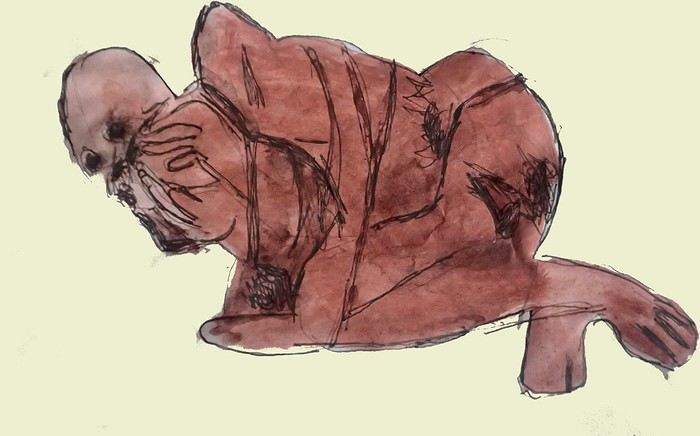
*Chavín de Huántar (Lanzón) The site’s appeal lies in its mountainous surroundings, the Lanzón stela, and the sculpted heads on the façades. What few people know is that the Chavín civilization began its expansion centuries before the Incas. Unfortunately, you can’t get too close to see the Lanzón—the day I was there, it was protected by grilles. To get there: minibus from Huaraz or trek from Olleros. Then cross a high pass (over 5,000m). If you do it solo on foot, be careful—the path isn’t obvious from Olleros
*Chullpa: funerary tower, notably at Sillustani in the Lake Titicaca region
*Chimú: pre-Inca civilization whose center was Chan Chan.
*Chola/Cholitas (Bolivia): typical clothing style of women from the Andean plateaus
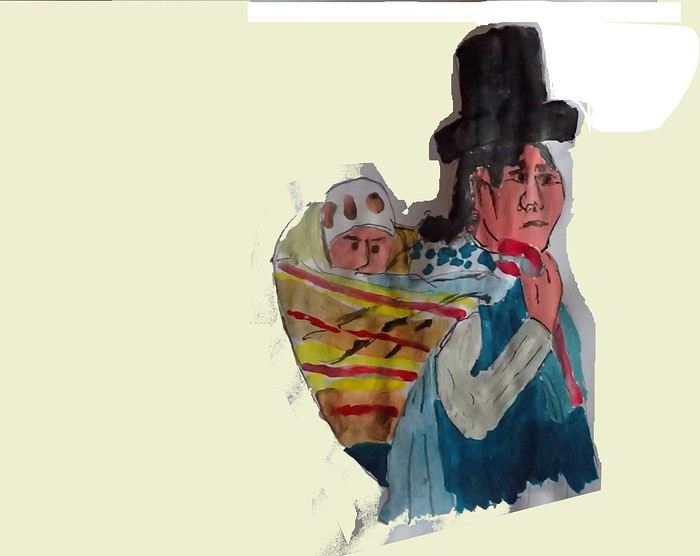
*Chompa: pronounce it *Chompaaa!* A common term for a wool sweater with vicuña patterns, often knitted from alpaca wool. If you dress like this, it’s a bit kitschy around the edges
*Cuy That one isn’t a guinea pig like in Guyana but an actual guinea pig. During a trip to Peru, I was hiking near a village north of Quillabamba (the terminus of the train line that passes through Aguas Calientes), and I was invited to stay in a house. The family raised a few of these pets. Apparently, the locals eat them. Since I’m not much of a meat-eater, it doesn’t really tempt me. How about you?
*Pacific Coast or how to talk about a place you haven’t visited? Except for the coast near Pisco and San Andrés, I haven’t visited any coastal cities. But that doesn’t mean these places lack interest or poetry. For fans of clichéd images, pelicans, seabirds, and fishing boats appear by the sea.
*Gran Pajaten: also closed to the public. Features anthropomorphic bas-reliefs. (not visited personally)
*Huaca. Visit the Huaca del Sol and Huaca de la Luna, especially near Trujillo. However, you can skip them—Chan Chan is still more interesting. Don’t forget to spend time visiting Chan Chan
*Huacachina A small oasis in the desert near Ica. Yes, we’re talking about an oasis because for those who’ve never traveled to Peru, the coastal strip along the Pacific is almost entirely desert, from north to south. Peru is territorially made up of three different regions: the desert coast, the Altiplano stretching north to south with mountain ranges (the Cordilleras), and the Amazon basin to the east. (not visited personally)
*Inca Kola It’s neither Coca-Cola nor Pepsi but a unique cola with a slightly orange color. Tastes like bubble gum
*Intiwatana: a carved rock shaped like a parallelepiped. Is it a sundial?
*Ballestas Islands: a highlight in Peru, though very touristy. You can only get there by boat from the port of San Andrés, a few kilometers from Pisco. It’s a surreal place to me—actually islets with cavities where sea lions and fur seals live. Since it’s a protected area, you’re not allowed to disembark. Guano is harvested there, which can be used as fertilizer.
*Kuelap: a fortress built by the Chachapoyas people. Rarely visited by travelers. (not visited personally)
*Larco Museum: an iconic museum in Lima with a large collection of pieces from archaeological and pre-Columbian sites. From what I remember, it has many pieces from the Moche civilization. As for the Moche statuettes, the prudish might look away. Probably a veneration of the god Priapus without knowing it.
*Nazca Lines Discovered by German archaeologist Maria Reiche, they stretch for kilometers. The designs in the desert around Nazca depict animals and cabalistic signs. The question I ask myself is why the creators of these lines represented a monkey and a hummingbird—species endemic to the tropical forest, not the desert plains around Nazca.
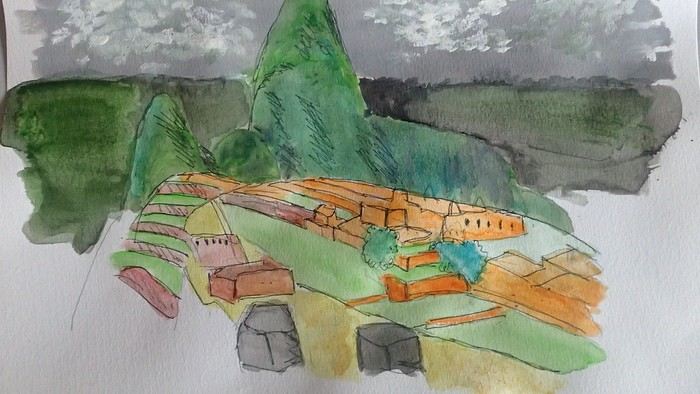
*Machu Picchu: means "old mountain" in Quechua. There’s also Wayna Picchu. The ruins of the site emerge from a sort of small plateau above Aguas Calientes. When the mist rises above the site and the bend of the Urubamba River, it’s truly magical... Also the starting point of the Inca Trail.
*Coca tea A decoction/infusion of the coca plant, meant to ease altitude sickness or *soroche*
*Chullo A rough translation would be a Peruvian wool hat.
*Moche: a civilization established in the Moche Valley, hence the term *Mochica*. What characterizes this civilization are the distinctive clay pieces representing faces and erotic statuettes
*Papa a la Huancaína A local potato dish
*Pisac: a typical market near Cusco
*Pisco Sour: perhaps the Peruvian equivalent of the *caipirinha* you drink in Brazil.
*Puya Raimondii A Bromeliaceae that still looks like a cactus, endemic to the Altiplano
*Quechua The language spoken by the indigenous people of the high plateaus (as well as Aymara in Bolivia)
*Quipu A knotted string used for counting. Widely used by the Inca administration.
*Sacsayhuamán (Q’enqo, Inca Bath) From Cusco’s Plaza de Armas, take the streets that climb above the city. Sacsayhuamán is called a fortress and is made up of large stone blocks. You wonder how the Incas could cut such huge blocks to assemble them—just like some streets in Cusco. The Q’enqo block is enigmatic; no one really knows what it represents.
*Savia Andina An Andean folk group.
*Tambo (=> Ollantaytambo) The Inca emperor (Atahualpa, Manco Capac) had the mission of controlling a vast empire. An empire that was still very extensive. Hence the importance of these *tambos* or relay stations. Napoleon created the civil code; the Incas invented the *tambos* and *quipus*.
*Tawantinsuyu: the Inca Empire
*Tinku: a warrior dance practiced mainly in Bolivia
*Golden Tumi: a sacrificial weapon. Often featured in Peru travel guides. See illustration
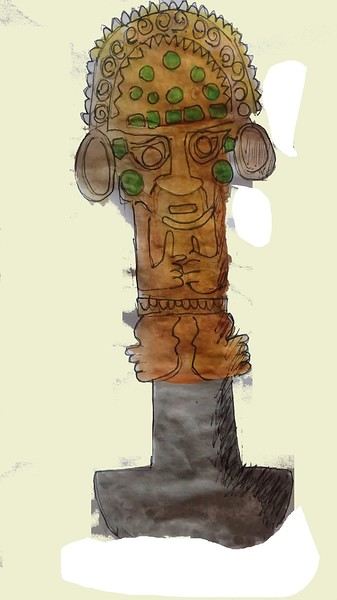
*Terra X: a documentary series from the German TV channel that aired on Arte. Some episodes focused on pre-Inca and Inca Peru. I must have some old recording tapes. In memory of Gottfried Kirchner as a source of inspiration.
*Uros: I checked—it actually refers to the people who live on these floating islands. Even if it’s touristy, it’s a must-visit because it’s incredible how people can live on islets made from nothing. Take the boat from Puno
*Vicuña, llama, guanaco: camelids characteristic of the Altiplano
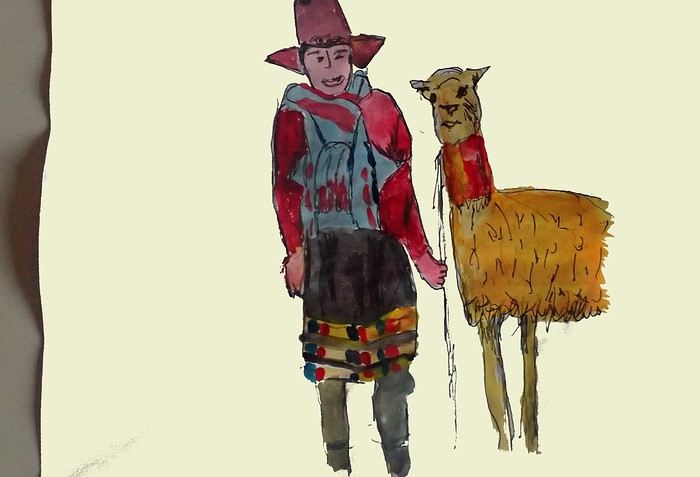
*Wayna Picchu The young Picchu mountain. In the first minutes of *Aguirre, the Wrath of God*, you see Klaus Kinski—well, Aguirre—making his way along the Inca Trail. Werner Herzog must have broken his back filming those sequences.
*Zampoña: pan flute
Peru is still a very vast country, with so much to see, and obviously this text can't list all the attractions of the country.
*Abiseo (River) A national park that's very hard to access and doesn’t seem open to visitors. Includes the Gran Pajaten site (see below). Personally, it really sparks my imagination (not visited personally)
*Aguas Calientes the town next to Machu Picchu, more precisely below the archaeological site. As far as I know, you can only get there by train. Reminds me of the market where stalls line both sides of the tracks near Bangkok. I love it
*Altiplano: somewhere the "heart" of the Andes. I was able to trek across it on foot, starting from Caracollo in Bolivia, and of course, it’s vast plains to explore. This is where people live in a very rural way. Andean populations are quite austere compared to those in the lowlands or on the coast. You really have to appreciate the harshness of life to live there. Life is anything but superficial. I set a compass heading and found myself walking west toward the expanse of water near a place called La Joya. For pitching the tent, the nights were still chilly
*Canyon del Colca One of the deepest canyons in the world. Personally, I hiked down and back up on foot. The toughest stretch I’ve ever covered in my life.
*Ceviche More or less the national dish. A marinade of fish, shellfish, and lime. But you can find it in some restaurants in Europe, France, and certainly in Belgium or Switzerland. In the small restaurants of Pisco, you can eat excellent ceviche
*Cerro Sechín: Mostly bas-reliefs. A site little known to travelers in the Casma province. The first vestiges of a pre-Inca civilization with iconography similar to that of Chavín (not visited personally)
*Chan Chan A large city of the Chimú civilization and relatively vast to visit. You can see adobe walls with bas-reliefs. Visit from Trujillo, take a colectivo. Plan for the whole day
*Charango: a small guitar widely used in Andean music
*Chauchilla A necropolis near Nazca where you can see mummies exposed on the ground. YouTubers can do paranormal experiments there. And for anyone wondering about the fate of the soul and body after death, here’s the answer: the body remains after death. You can imagine your own flesh and body exposed to the winds of the Pampa and before eternity... (not visited personally)
*Chavín de Huántar (Lanzón) The site’s appeal lies in its mountainous surroundings, the Lanzón stela, and the sculpted heads on the façades. What few people know is that the Chavín civilization began its expansion centuries before the Incas. Unfortunately, you can’t get too close to see the Lanzón—the day I was there, it was protected by grilles. To get there: minibus from Huaraz or trek from Olleros. Then cross a high pass (over 5,000m). If you do it solo on foot, be careful—the path isn’t obvious from Olleros
*Chullpa: funerary tower, notably at Sillustani in the Lake Titicaca region
*Chimú: pre-Inca civilization whose center was Chan Chan.
*Chola/Cholitas (Bolivia): typical clothing style of women from the Andean plateaus
*Chompa: pronounce it *Chompaaa!* A common term for a wool sweater with vicuña patterns, often knitted from alpaca wool. If you dress like this, it’s a bit kitschy around the edges
*Cuy That one isn’t a guinea pig like in Guyana but an actual guinea pig. During a trip to Peru, I was hiking near a village north of Quillabamba (the terminus of the train line that passes through Aguas Calientes), and I was invited to stay in a house. The family raised a few of these pets. Apparently, the locals eat them. Since I’m not much of a meat-eater, it doesn’t really tempt me. How about you?
*Pacific Coast or how to talk about a place you haven’t visited? Except for the coast near Pisco and San Andrés, I haven’t visited any coastal cities. But that doesn’t mean these places lack interest or poetry. For fans of clichéd images, pelicans, seabirds, and fishing boats appear by the sea.
*Gran Pajaten: also closed to the public. Features anthropomorphic bas-reliefs. (not visited personally)
*Huaca. Visit the Huaca del Sol and Huaca de la Luna, especially near Trujillo. However, you can skip them—Chan Chan is still more interesting. Don’t forget to spend time visiting Chan Chan
*Huacachina A small oasis in the desert near Ica. Yes, we’re talking about an oasis because for those who’ve never traveled to Peru, the coastal strip along the Pacific is almost entirely desert, from north to south. Peru is territorially made up of three different regions: the desert coast, the Altiplano stretching north to south with mountain ranges (the Cordilleras), and the Amazon basin to the east. (not visited personally)
*Inca Kola It’s neither Coca-Cola nor Pepsi but a unique cola with a slightly orange color. Tastes like bubble gum
*Intiwatana: a carved rock shaped like a parallelepiped. Is it a sundial?
*Ballestas Islands: a highlight in Peru, though very touristy. You can only get there by boat from the port of San Andrés, a few kilometers from Pisco. It’s a surreal place to me—actually islets with cavities where sea lions and fur seals live. Since it’s a protected area, you’re not allowed to disembark. Guano is harvested there, which can be used as fertilizer.
*Kuelap: a fortress built by the Chachapoyas people. Rarely visited by travelers. (not visited personally)
*Larco Museum: an iconic museum in Lima with a large collection of pieces from archaeological and pre-Columbian sites. From what I remember, it has many pieces from the Moche civilization. As for the Moche statuettes, the prudish might look away. Probably a veneration of the god Priapus without knowing it.
*Nazca Lines Discovered by German archaeologist Maria Reiche, they stretch for kilometers. The designs in the desert around Nazca depict animals and cabalistic signs. The question I ask myself is why the creators of these lines represented a monkey and a hummingbird—species endemic to the tropical forest, not the desert plains around Nazca.
*Machu Picchu: means "old mountain" in Quechua. There’s also Wayna Picchu. The ruins of the site emerge from a sort of small plateau above Aguas Calientes. When the mist rises above the site and the bend of the Urubamba River, it’s truly magical... Also the starting point of the Inca Trail.
*Coca tea A decoction/infusion of the coca plant, meant to ease altitude sickness or *soroche*
*Chullo A rough translation would be a Peruvian wool hat.
*Moche: a civilization established in the Moche Valley, hence the term *Mochica*. What characterizes this civilization are the distinctive clay pieces representing faces and erotic statuettes
*Papa a la Huancaína A local potato dish
*Pisac: a typical market near Cusco
*Pisco Sour: perhaps the Peruvian equivalent of the *caipirinha* you drink in Brazil.
*Puya Raimondii A Bromeliaceae that still looks like a cactus, endemic to the Altiplano
*Quechua The language spoken by the indigenous people of the high plateaus (as well as Aymara in Bolivia)
*Quipu A knotted string used for counting. Widely used by the Inca administration.
*Sacsayhuamán (Q’enqo, Inca Bath) From Cusco’s Plaza de Armas, take the streets that climb above the city. Sacsayhuamán is called a fortress and is made up of large stone blocks. You wonder how the Incas could cut such huge blocks to assemble them—just like some streets in Cusco. The Q’enqo block is enigmatic; no one really knows what it represents.
*Savia Andina An Andean folk group.
*Tambo (=> Ollantaytambo) The Inca emperor (Atahualpa, Manco Capac) had the mission of controlling a vast empire. An empire that was still very extensive. Hence the importance of these *tambos* or relay stations. Napoleon created the civil code; the Incas invented the *tambos* and *quipus*.
*Tawantinsuyu: the Inca Empire
*Tinku: a warrior dance practiced mainly in Bolivia
*Golden Tumi: a sacrificial weapon. Often featured in Peru travel guides. See illustration
*Terra X: a documentary series from the German TV channel that aired on Arte. Some episodes focused on pre-Inca and Inca Peru. I must have some old recording tapes. In memory of Gottfried Kirchner as a source of inspiration.
*Uros: I checked—it actually refers to the people who live on these floating islands. Even if it’s touristy, it’s a must-visit because it’s incredible how people can live on islets made from nothing. Take the boat from Puno
*Vicuña, llama, guanaco: camelids characteristic of the Altiplano
*Wayna Picchu The young Picchu mountain. In the first minutes of *Aguirre, the Wrath of God*, you see Klaus Kinski—well, Aguirre—making his way along the Inca Trail. Werner Herzog must have broken his back filming those sequences.
*Zampoña: pan flute
Precautions and Vaccines for Madagascar Starting in February
Hello,
We’re planning to spend 3 months in Madagascar starting in mid-February.
Areas: Mahajanga, Tulear, Diego Suarez, and Sainte Marie—the order isn’t set yet. We’ll either drive for part of the trip or take flights.
We’ve heard all sorts of things about required vaccines and medications (is anti-malarial mandatory?). What’s the exact situation for travelers?
I’ll come back to you for other topics (like finding a reliable driver, among others).
Thank you.
Best wishes to you all,
Nicole
A "relaxed" 16-day tour of Corsica in autumn 2024
CORSICA From September 24, 2024 to October 9, 2024
Thank you, thank you, thank you for reactivating my favorite forum, which has given me so many ideas for my trips since... 2008—it’s been ages, as they say!
So, to celebrate its return, I’m sharing this little travel journal from our latest road trip, not too long ago, since it was Corsica in the autumn.
Autumn is the ideal season to visit Corsica: fewer tourists, perfect temperatures around 25°C, and, most importantly, less stress on the roads. You can feel it everywhere. Servers and shopkeepers are more relaxed and have time to chat (yes, Corsicans do talk... but not all of them!)
09/24 Arrival in Erbalunga Whether you're from northern France or Belgium, like us, the easiest way to reach the Isle of Beauty is by flying from Lille-Lesquin Airport. Volotea offers two destinations: Bastia and Ajaccio. Be careful, though—while the ticket prices are attractive, the airline makes up for it with baggage fees. A 25kg suitcase for 212 €—that really drives up the cost of transportation! For us, it’ll be Bastia. After this short flight and an arrival that lets you clearly see the east coast of Cap Corse, we’re welcomed by our friend Jean-Claude, who’s kindly hosting us for a few days. We met this Corsican and his wife during our four-year stay in French Guiana, and I have to say, he completely changed my opinion of Corsicans and even made me want to visit his island. The house, clinging to the rock above the sea, is stunning and offers a breathtaking view of the island of Elba. I’d always heard of Elba but must admit I wouldn’t have known where to place it before. We’ll stay here for five nights, long enough to explore the north of the island.
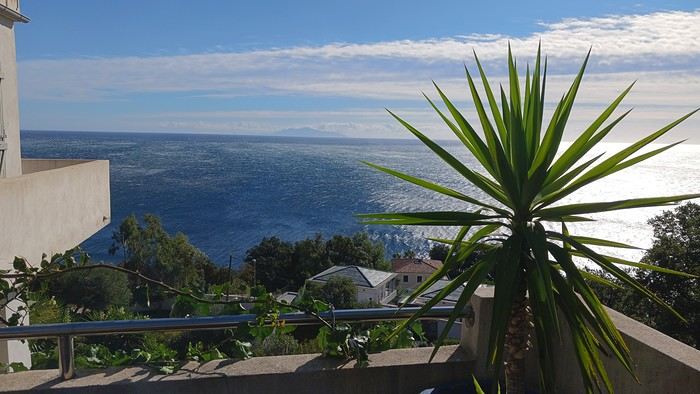
Since we’ve just arrived, Jean-Claude wants to show us his village, ERLALUNGA, a quiet little port, and the small village of CASTELLO above it, where he spent a lot of time in his childhood...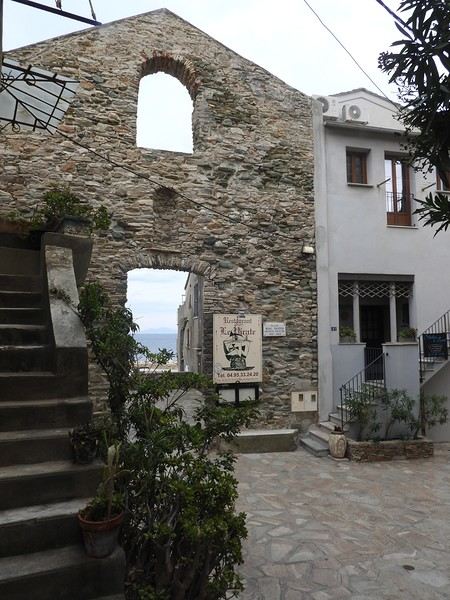
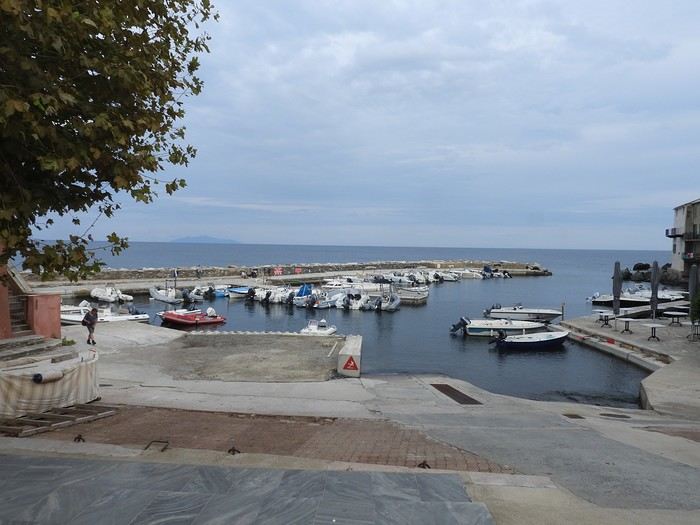
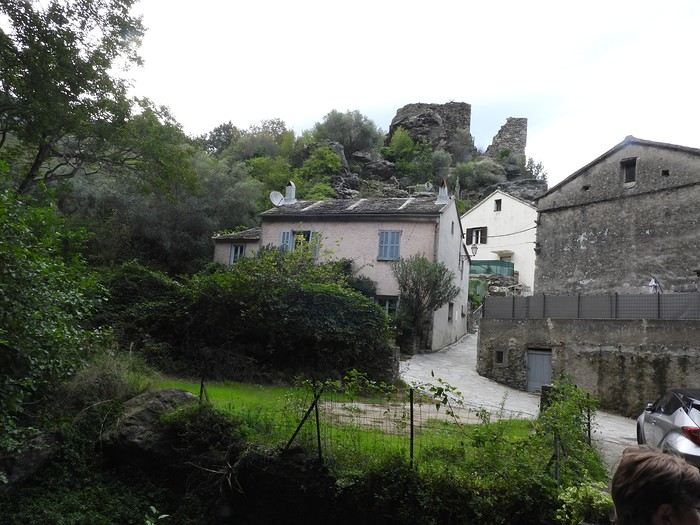
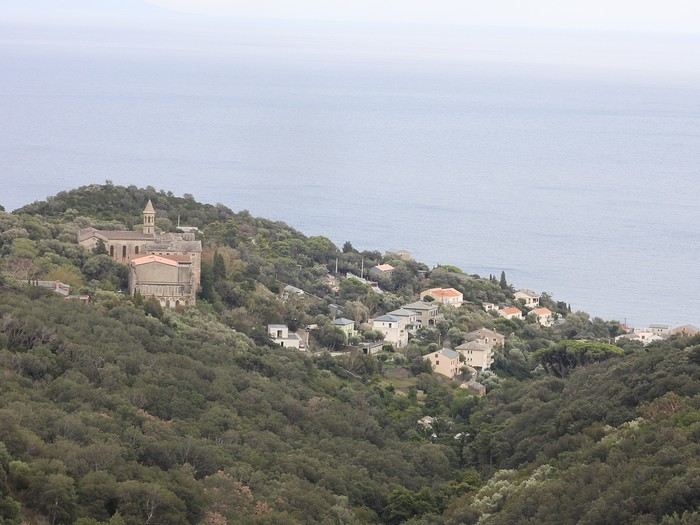

09/24 Arrival in Erbalunga Whether you're from northern France or Belgium, like us, the easiest way to reach the Isle of Beauty is by flying from Lille-Lesquin Airport. Volotea offers two destinations: Bastia and Ajaccio. Be careful, though—while the ticket prices are attractive, the airline makes up for it with baggage fees. A 25kg suitcase for 212 €—that really drives up the cost of transportation! For us, it’ll be Bastia. After this short flight and an arrival that lets you clearly see the east coast of Cap Corse, we’re welcomed by our friend Jean-Claude, who’s kindly hosting us for a few days. We met this Corsican and his wife during our four-year stay in French Guiana, and I have to say, he completely changed my opinion of Corsicans and even made me want to visit his island. The house, clinging to the rock above the sea, is stunning and offers a breathtaking view of the island of Elba. I’d always heard of Elba but must admit I wouldn’t have known where to place it before. We’ll stay here for five nights, long enough to explore the north of the island.
Since we’ve just arrived, Jean-Claude wants to show us his village, ERLALUNGA, a quiet little port, and the small village of CASTELLO above it, where he spent a lot of time in his childhood...
Transiter par la France pour aller en Italie
Bonjour,
Maintenant que toute la France sauf la Creuse est passée en zone rouge, savez-vous si je peux la traverser en voiture de Belgique pour me rendre en Italie ? Et accessoirement, dois-je signer la déclaration sur l'honneur pour rentrer en Italie (j'ai lu quelque part que ce n'était pas nécessaire pour un voyage en voiture ).
Merci de votre aide .
Idées pour deux semaines en Martinique puis une semaine à Sainte-Lucie
Bonjour a tous
Je suis a la recherche d idées pour le mois de janvier, peut être 2 semaines en Martinique puis Sainte lucie 1 semaine, pourquoi pas St Vincent 1 semaine ou autres choses.Nous recherchons des belles plages, quelques visites, restaurants pour le soir, le prendre cool sur peut être 2 mois.
Merci par avance pour vos idées, moyens de transport lieux incontournables etc......
Yanny
Je suis a la recherche d idées pour le mois de janvier, peut être 2 semaines en Martinique puis Sainte lucie 1 semaine, pourquoi pas St Vincent 1 semaine ou autres choses.Nous recherchons des belles plages, quelques visites, restaurants pour le soir, le prendre cool sur peut être 2 mois.
Merci par avance pour vos idées, moyens de transport lieux incontournables etc......
Yanny
Why not explore Brazil by camper van?
Hi,
After reading tons of posts, blogs, and travel journals... there’s almost nothing about exploring Brazil by camper van. All the RTW (round-the-world) trips seem to skip this country. So why? Safety seems to be the main (and only?) reason. But we cross Pakistan, for example. Looking forward to hearing your thoughts. PS: If you’ve got any links about this destination by camper van, I’d love to check them out.
After reading tons of posts, blogs, and travel journals... there’s almost nothing about exploring Brazil by camper van. All the RTW (round-the-world) trips seem to skip this country. So why? Safety seems to be the main (and only?) reason. But we cross Pakistan, for example. Looking forward to hearing your thoughts. PS: If you’ve got any links about this destination by camper van, I’d love to check them out.
Vivre au Brésil
Bonjour,
Depuis un certains temps j'envisage d'aller vivre au bresil, le projet c'est d'acheter une petite ferme de 12ha(120mille m2)
et vivre de la terre, totalement en autonomie, maison avec eletricité solaire et a roue à aubes, faire de l'agriculture, elevage d'animaux (vache, poule, cochon etc...) d'après mes calculs à partir de 170mille euros on peut réaliser tout ça, acheter une ferme avec le plus de choses possible. (il faut fare attention à la conversion de l'euro vers le real) , un euro = 6 real : 170.000 x 6 =1 020 000 reais
ma question c'est le côté administratif et les impots.
si je vends ma maison a 170 mille euros combien dois je payer des impots ?
je dois payer des impots pour envoyer une grande quantité d'argent vers un autre pays (bresil)
et une fois au bresil le coté administratif et les impots?
est ce que quelqu'un a de l'experience semblabe qui puisse m'aider un peu?
voici un exemple d'une ferme a vendre
https://ba.olx.com.br/regiao-de-feira-de-santana-e-alagoinhas/terrenos/fazenda-220-tarefas-740515984 et est que quelqu'un a déjà loué un container également?pour un déménagemnt à l'étranger?
Vol de retour de Guadeloupe
Bonjour a tous
J ai mon conjoint qui est bloqué en gouadeloupe, son vol de retour était prévu pour le 1er avril mais son vol à été annulé comme beaucoup, nous avons vu un vol via air France le 29 avril mais nous avons peur de reprendre un billet car il y a les attestations. Sa résidence principal est bien en métropole et elle est indiqué sur son passeport peut il rentre avant la fin du confinement ? Faut il une attestation ? Si oui quel motif doit on mettre ? Merci à tous pour vos retour
J ai mon conjoint qui est bloqué en gouadeloupe, son vol de retour était prévu pour le 1er avril mais son vol à été annulé comme beaucoup, nous avons vu un vol via air France le 29 avril mais nous avons peur de reprendre un billet car il y a les attestations. Sa résidence principal est bien en métropole et elle est indiqué sur son passeport peut il rentre avant la fin du confinement ? Faut il une attestation ? Si oui quel motif doit on mettre ? Merci à tous pour vos retour
Préparation de 3 semaines namibiennes en avril 2021
Hello la communauté,
De retour sur VF, j'entame donc la préparation de notre retour en Namibie prévu pour l'année prochaine, à priori en Avril 2021.
Après 2 voyages namibiens au mois d'Aout, nous avons maintenant hâte de découvrir la Namibie pendant la saison chaude et humide (enfin pas trop quand même hein ?!), c'est pourquoi nous voudrions partir au mois d'Avril, à la fin de la saison des pluies, pour pouvoir profiter des paysages verdoyants, des piscines des lodges et des soirées tempérées sous le ciel étoilé.
Nous serons entre 2 et 6 (Dépend de la fiabilité des amis 😇) et l'idée serait de louer un (ou plusieurs) 4x4 équipé et d'alterner nuit en camping et nuit en lodge.
Ayant déjà fait 2 séjours de 15 jours en Namibie nous voulons cette fois ci découvrir de nouvelles région (Kunene et Caprivi) et prendre un petit peu plus notre temps (mais ça on se le dit à chaque fois et au final on ne s'y tient jamais 😄)
Nous espérons disposer de 23 jours sur place. Et voici l'ébauche de notre programme :
J1 : Arrivée Windhoek tôt le matin -> Bagatelle Kalahari GR J2 : Bagatelle Kalahari GR -> Namibrand Family Hideout J3 : Namibrand Family Hideout J4 : Namibrand Family Hiedout -> Sossus Dune Lodge J5 : Sossus Dune Lodge J6 : Sossus Dune Lodge -> Rostock Ritz J7 : Rostock Ritz -> Swakopmund J8 : Swakopmund -> Brandberg White Lady J9 : Brandberg White Lady -> Palmwag J10 : Palmwag -> Grootberg Lodge J11: Grootberg Lodge J12 : Grootberg Lodge -> Epupa J13 : Epupa J14 : Epupa -> Dolomite Camp J15 : Dolomite Camp -> Okaukuejo J16 : Okaukuejo -> Halali J17 : Halali J18 : Halali -> Mahango GR (Caprivi) J19 : Mahango GR (Caprivi) J20 : Caprivi ? J21 : Caprivi ? J22 : Victoria Falls ? Retour Windhoek ? J23 : Remise du véhicule (Kasane ou Windhoek) et décollage (le soir de préférence)
En gros... Ce qui fait quand même un bon 4000km en un peu plus de 3 semaines. Sachant que les étapes incontournables de ce prochain voyage sont Epupa, Etosha et la bande de Caprivi.
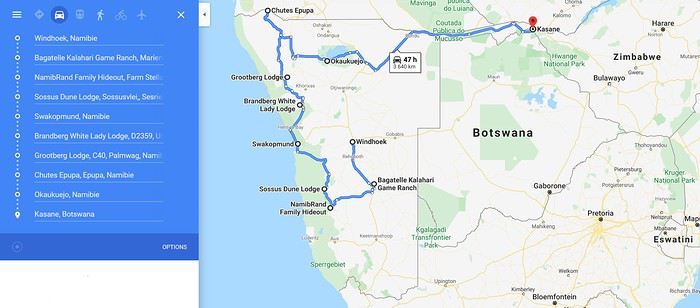
Alors, j'ai vu que beaucoup d'entre vous étiez allé, ou retourné, en Namibie ces dernières années. 🙂 J'ai lu la plupart des carnets récents concernant cet itinéraire (nombreux) et cette période de l'année (beaucoup moins nombreux 😇) et j'ouvre donc ce sujet pour regrouper un peu les informations et les conseils.
J'ai déjà beaucoup de questions 😊 Dans l'ordre,
Quelle compagnie relie l’Europe (Paris ou Francfort) et Windhoek à cette période avec arrivée tôt le matin ? Sans escale si possible.
Je voulais retourner à Bagatelle où nous avions dormi lors de notre premier voyage il y a 5 ans mais j'ai lu aussi beaucoup de retours positifs sur le Kalahari Anib Lodge, quelqu'un a t'il déjà comparé les deux ?
Plutot Ameib Ranch ou Bagatelle White Lady ? 😉 Vous savez si il y a des éléphants du coté du Brandberg à cette période ?
Pour la bande de Caprivi j'ai bien entendu noté la Mahango GR, et il nous resterait 2 jours. Y a t'il d'autre réserve sympa à visiter avec beaucoup de faune au bord du fleuve +/- balade en bateau ? Si vous avez des conseils coté botswanais je suis preneur aussi. 🙂
Dans l'état actuel du programme j'envisage fortement un drop off à Kasane avec pourquoi pas une journée aux chutes Victoria mais ce n'est pas obligatoire.
Merci par avance pour vos remarques, vos conseils et votre bonne humeur ! 🙂
De retour sur VF, j'entame donc la préparation de notre retour en Namibie prévu pour l'année prochaine, à priori en Avril 2021.
Après 2 voyages namibiens au mois d'Aout, nous avons maintenant hâte de découvrir la Namibie pendant la saison chaude et humide (enfin pas trop quand même hein ?!), c'est pourquoi nous voudrions partir au mois d'Avril, à la fin de la saison des pluies, pour pouvoir profiter des paysages verdoyants, des piscines des lodges et des soirées tempérées sous le ciel étoilé.
Nous serons entre 2 et 6 (Dépend de la fiabilité des amis 😇) et l'idée serait de louer un (ou plusieurs) 4x4 équipé et d'alterner nuit en camping et nuit en lodge.
Ayant déjà fait 2 séjours de 15 jours en Namibie nous voulons cette fois ci découvrir de nouvelles région (Kunene et Caprivi) et prendre un petit peu plus notre temps (mais ça on se le dit à chaque fois et au final on ne s'y tient jamais 😄)
Nous espérons disposer de 23 jours sur place. Et voici l'ébauche de notre programme :
J1 : Arrivée Windhoek tôt le matin -> Bagatelle Kalahari GR J2 : Bagatelle Kalahari GR -> Namibrand Family Hideout J3 : Namibrand Family Hideout J4 : Namibrand Family Hiedout -> Sossus Dune Lodge J5 : Sossus Dune Lodge J6 : Sossus Dune Lodge -> Rostock Ritz J7 : Rostock Ritz -> Swakopmund J8 : Swakopmund -> Brandberg White Lady J9 : Brandberg White Lady -> Palmwag J10 : Palmwag -> Grootberg Lodge J11: Grootberg Lodge J12 : Grootberg Lodge -> Epupa J13 : Epupa J14 : Epupa -> Dolomite Camp J15 : Dolomite Camp -> Okaukuejo J16 : Okaukuejo -> Halali J17 : Halali J18 : Halali -> Mahango GR (Caprivi) J19 : Mahango GR (Caprivi) J20 : Caprivi ? J21 : Caprivi ? J22 : Victoria Falls ? Retour Windhoek ? J23 : Remise du véhicule (Kasane ou Windhoek) et décollage (le soir de préférence)
En gros... Ce qui fait quand même un bon 4000km en un peu plus de 3 semaines. Sachant que les étapes incontournables de ce prochain voyage sont Epupa, Etosha et la bande de Caprivi.
Alors, j'ai vu que beaucoup d'entre vous étiez allé, ou retourné, en Namibie ces dernières années. 🙂 J'ai lu la plupart des carnets récents concernant cet itinéraire (nombreux) et cette période de l'année (beaucoup moins nombreux 😇) et j'ouvre donc ce sujet pour regrouper un peu les informations et les conseils.
J'ai déjà beaucoup de questions 😊 Dans l'ordre,
Quelle compagnie relie l’Europe (Paris ou Francfort) et Windhoek à cette période avec arrivée tôt le matin ? Sans escale si possible.
Je voulais retourner à Bagatelle où nous avions dormi lors de notre premier voyage il y a 5 ans mais j'ai lu aussi beaucoup de retours positifs sur le Kalahari Anib Lodge, quelqu'un a t'il déjà comparé les deux ?
Plutot Ameib Ranch ou Bagatelle White Lady ? 😉 Vous savez si il y a des éléphants du coté du Brandberg à cette période ?
Pour la bande de Caprivi j'ai bien entendu noté la Mahango GR, et il nous resterait 2 jours. Y a t'il d'autre réserve sympa à visiter avec beaucoup de faune au bord du fleuve +/- balade en bateau ? Si vous avez des conseils coté botswanais je suis preneur aussi. 🙂
Dans l'état actuel du programme j'envisage fortement un drop off à Kasane avec pourquoi pas une journée aux chutes Victoria mais ce n'est pas obligatoire.
Merci par avance pour vos remarques, vos conseils et votre bonne humeur ! 🙂