Results for "Syrie+hébergement"
About 11,270 results.
More options
Many results are in French, the community’s main language. English translations are added over time.
Search results
Vélo en Corse
bonjour
j aimerai partir en corse et utiliser le velo comme moyen de locomotion
j entends souvent la corse a velo mais t es folle !!😕 je pensais faire le tour par la cote a raison d environ 20/30 km par jour .
est ce que c est vraiment physique comme periple ou est ce que c est plutot accessible a une fille pas trop trop sportive comme moi ?
ca monte vraiment beaucoup ?
quelqun a t il deja tente l experience ?
merci de vos reponses
j aimerai partir en corse et utiliser le velo comme moyen de locomotion
j entends souvent la corse a velo mais t es folle !!😕 je pensais faire le tour par la cote a raison d environ 20/30 km par jour .
est ce que c est vraiment physique comme periple ou est ce que c est plutot accessible a une fille pas trop trop sportive comme moi ?
ca monte vraiment beaucoup ?
quelqun a t il deja tente l experience ?
merci de vos reponses
Remorque vélo pour voyager avec bébé
Bonjour,
Nous avons un petit garçon de 6 mois et souhaitons voyager avec lui à vélo.
Nous souhaitons avoir des retours d'expérience de parents ayant trimbalé leur enfant comme ça (sur de longs parcours). à partir de quel âge y avez-vous mis votre enfant, et avez-vous prévu un adaptateur pour un bébé qui ne tient pas encore bien assis ? votre remorque comporte-t-elle des amortisseurs, pour diminuer les vibrations ? est-ce mieux que l'ouverture regarde face ou dos à la route (poussières)? remorque tout tissu (légèreté) ou coque plastique (plus sécuritaire ?) ? quelle est la marque/modèle de votre remorque et à quel prix avez-vous déniché votre merveille ? quels inconvénients avez-vous noté : par temps de pluie, par grosses chaleurs... BB s'est-il ennuyé, et combien de temps rouliez-vous par jour ?
Merci beaucoup pour vos réponses.
Nous avons un petit garçon de 6 mois et souhaitons voyager avec lui à vélo.
Nous souhaitons avoir des retours d'expérience de parents ayant trimbalé leur enfant comme ça (sur de longs parcours). à partir de quel âge y avez-vous mis votre enfant, et avez-vous prévu un adaptateur pour un bébé qui ne tient pas encore bien assis ? votre remorque comporte-t-elle des amortisseurs, pour diminuer les vibrations ? est-ce mieux que l'ouverture regarde face ou dos à la route (poussières)? remorque tout tissu (légèreté) ou coque plastique (plus sécuritaire ?) ? quelle est la marque/modèle de votre remorque et à quel prix avez-vous déniché votre merveille ? quels inconvénients avez-vous noté : par temps de pluie, par grosses chaleurs... BB s'est-il ennuyé, et combien de temps rouliez-vous par jour ?
Merci beaucoup pour vos réponses.
Converting a heavy-duty bus/coach/truck into a motorhome
I'm currently converting a DAF/HEULIEZ MB205 bus.
Cheaper and more spacious than a regular vehicle, the paperwork (in France) isn't too difficult for approval.
I'm ready to help anyone who wants to tackle this kind of project. Those who know, help those who want to....
Cheaper and more spacious than a regular vehicle, the paperwork (in France) isn't too difficult for approval.
I'm ready to help anyone who wants to tackle this kind of project. Those who know, help those who want to....
Shanti India, welcome on board:)
Les portes de l'avion s'ouvrent, je respire, hume l'air, mais Goa n'est pas une grande ville aux milles odeurs pas toujours les meilleures.
Il est encore tôt, le temps est délicieux. Après quelques pas sur le bitume de la piste, brûlant de soleil déjà écrasant, me voilà dans la queue pour l'immigration. Bien quatre douaniers vérifient les passeports, le visa, la carte d'arrivée. Je demande à d'autres voyageurs pour partager un taxi vers des plages du sud ou j'ai rendez-vous avec un VFiste et un ami à lui. Sans succès. Le prepaid taxi revient à 357 roupies ( 7 euros) je l'obtiens à 200 rps :)
Me voilà dehors. Je regarde les gens, certains me sourient, je leur en envoie un à mon tour, et ... Waouh, en une fois, les bonnes vibrations, les bonnes énergies reçues de précédents voyages remontent à la surface, comme l'effet d'un massage et me revoilà dans une bulle de bien être, de bonheur total...
Une ambassador blanche arrive, le chauffeur me regarde, je le regarde, hop, direction Benaulim que je ne connais pas.
Je passe les descriptions de villages traversés pour plus tard, j'arrive à la plage, cherche le guest house ou ils se trouvent, et je m'installe à la terrasse.
Cherche après deux suisses, en trouve un! 😎
Commande un banana pineapple milk-shake et un lemon honey pancake, et me voilà à rêver et papoter devant l'Océan. Une heure à peine après être descendue de l'avion... 😎
Le temps de m'installer, retrouver un matelas bossu, une moustiquaire à seulement deux petits trous, une douche "à seau", enfiler mon maillot, et hop! Dans les vagues!!! YIIIIYOUUUUU!!!!!!!! Le bonheur... l'eau est absolument divine...
Je suis restée trois jours sur cette plage, j'étais bien impatiente de repartir sur les routes à l'intérieur du pays. Car la plage cocotier c'est bien beau, mais c'est pas vraiment l'Inde. Donc hop! Ed, un bel hollandais me dépose sur son Enfield toute blanche à la gare des bus de Margao, et me voilà inconfortable dans ce bus bondé. "Which country?" Me demande mon voisin "Belgium" "Atchaa" fait-il en dodelinant la tête. Me voilà en Inde. Le bus saute sur toutes les bosses qu'il voit comme pour s'amuser, et fonce à toute allure bien évidemment. Les banquettes sont dures comme du bois, les deux cm de mousses les recouvrant sont devenus deux mm... Mes fesses n'ont plus l'habitude... Heureusement que je voyage jusqu'a Mangalore en plusieurs étapes, le bus direct ne partant qu'a 16h, je n'avais pas envie de l'attendre, et après 3h dans ce vieux bus pourri, j'arrive à Kumta. Kumta est un petit village tout mignon, sans aucun touriste, tout le monde se concentrent à Gokarna à côté. J'ai trois ou quatre heures d'attente pour le bus de Mangalore, je les passe à déguster, avec plaisir retrouvé, un thali. Ce plat national fait de plusieurs petits pots de différents curry en sauce, riz et chapatis, petit yoghourt ensuite pour apaiser le feu des épices... Mmmh waouh. Je me lèche les doigts. Après un petit chai je passe à la caisse, 17 roupies… : Je me balade dans les chemins du village qui ne mènent nulle part, regarde une vieille femme cueillir des jack fruits dans l'arbre de son petit jardin. Respire le ciel bleu sans nuages, écoute les sons de la nature, oiseaux, criquets, et je ne sais quoi d’autre. A la gare des bus, une musulmane à qui on ne voit que ses yeux et moi nous nous regardons. "Not too hot ?" "No no" me répond elle, les yeux souriants.🙂 Et le bus arrive, je continue la jolie route jusque Mangalore, Hassan et enfin Belur, célèbre pour son joli temple. La route entre Mangalore et Hassan et extraordinaire...(voir j'tiens plus en place http://voyageforum.com/v.f?do=post_view_flat;post=44023;page=1;mh=-1;guest=2897325;sb=post_latest_reply;so=ASC posts du 6 avril)
A bientôt 😄
Je suis restée trois jours sur cette plage, j'étais bien impatiente de repartir sur les routes à l'intérieur du pays. Car la plage cocotier c'est bien beau, mais c'est pas vraiment l'Inde. Donc hop! Ed, un bel hollandais me dépose sur son Enfield toute blanche à la gare des bus de Margao, et me voilà inconfortable dans ce bus bondé. "Which country?" Me demande mon voisin "Belgium" "Atchaa" fait-il en dodelinant la tête. Me voilà en Inde. Le bus saute sur toutes les bosses qu'il voit comme pour s'amuser, et fonce à toute allure bien évidemment. Les banquettes sont dures comme du bois, les deux cm de mousses les recouvrant sont devenus deux mm... Mes fesses n'ont plus l'habitude... Heureusement que je voyage jusqu'a Mangalore en plusieurs étapes, le bus direct ne partant qu'a 16h, je n'avais pas envie de l'attendre, et après 3h dans ce vieux bus pourri, j'arrive à Kumta. Kumta est un petit village tout mignon, sans aucun touriste, tout le monde se concentrent à Gokarna à côté. J'ai trois ou quatre heures d'attente pour le bus de Mangalore, je les passe à déguster, avec plaisir retrouvé, un thali. Ce plat national fait de plusieurs petits pots de différents curry en sauce, riz et chapatis, petit yoghourt ensuite pour apaiser le feu des épices... Mmmh waouh. Je me lèche les doigts. Après un petit chai je passe à la caisse, 17 roupies… : Je me balade dans les chemins du village qui ne mènent nulle part, regarde une vieille femme cueillir des jack fruits dans l'arbre de son petit jardin. Respire le ciel bleu sans nuages, écoute les sons de la nature, oiseaux, criquets, et je ne sais quoi d’autre. A la gare des bus, une musulmane à qui on ne voit que ses yeux et moi nous nous regardons. "Not too hot ?" "No no" me répond elle, les yeux souriants.🙂 Et le bus arrive, je continue la jolie route jusque Mangalore, Hassan et enfin Belur, célèbre pour son joli temple. La route entre Mangalore et Hassan et extraordinaire...(voir j'tiens plus en place http://voyageforum.com/v.f?do=post_view_flat;post=44023;page=1;mh=-1;guest=2897325;sb=post_latest_reply;so=ASC posts du 6 avril)
A bientôt 😄
Cuba por la ultima vez...
Cuba por la ultima vez....
Apres une premiere experience à Varadero en 1987(ct juste avant la ghettoisation....) une seconde à Santiago en 1995 (le + beau voyage...), nous revenons d'un séjour de quatre semaines à travers Cuba...Cuba et ses incohérences...ses disparités....absurdités...sourires d'enfants...et des grands aussi ! Un questionnement perpétuel avec peu de réponses. Une seule constante: la lente agonie d'un système communiste qui n'en fini pas de mourrir.... Todos juntos...siempre.......venceremos.....Contre qui...?Toute la dérision des 45 dernieres années dans une seule phrase ! Un véritable génocide économique...Je me rappelle les paroles de Rigoberta Manchu lors d'un reportage de National Geographic sur le Guatemala :Ils nous ont tout enlevé mais il nous reste l'espoir... Quel espoir pour Cuba....?Fidel parti et remplacé par qui ? Raul, son frere à peine plus jeune ? Un quelconque ministre encore inconnu de tous ? Ou un téléguidé de Miami (via Washington) ? Voyager, c'est aussi comparer. Voir un progres quelque part....S'il y a changement et amélioration à Cuba c'est dans la liberté d'expression(sic...) : seul à seul ou en tres petit comité on peut maintenant discuter ouvertement de la vie cubaine ce qui n'était pas le cas il y a qq années . Le ras-le-bol est omniprésent.. . On s'accroche à n'importe quelle victoire...:A Guama une vendeuse de T-shirt était désolée que je n'accorde aucune attention à celui qu'elle voulait me vendre: Cuba campeon del mundo de beisbol.....Cuba c'est aussi le championnat mondial toutes categories de la course effrenée aux $$$. Nécessité fait loi...Sauf que la norme maintenant est de prendre les touristes pour des guichets automatiques ambulants....!!! J'avais loué une voiture pour 2 petites semaines afin de parcourir une partie du pays que ns ne connaissions pas du tout . Notamment la region de Pinar del rio et Santa Clara . Signalisation quasi-inexistante mais on s'y attendait. Peu de circulation, donc facile de conduire .Bonnes routes partout.....auto-stoppeurs fréquents : ne pas avoir peur de leur offrir un bout de conduite...ils vous serviront de guide à l'occasion et c'est un excellent moyen de mieux faire connaissance .Hors circuit touristique la connaissance de l'espagnol est indispensable. Au sujet de la langue, il est quand même effarant de constater que des touristes (d'où qu'ils viennent....) qui en sont à leur 4 e ou 5e voyage à Cuba ou tout autre pays hispanique soient tjs incapables de composer la moindre petite phrase en espagnol. A Cienfuegos, au Rancho Luna (un modeste "tout inclus" 3***) tout se fait en anglais avec le personnel....! Du même souffle je me suis demandé : Qui consulte un guide de voyage avant de partir vers ce genre de destination(tout inclus). J'ai posé la question par 2 fois pour avoir 2 x la même réponse: je fais confiance à mon agent de voyage....bin wiiiiiii ! QUE CHERCHEZ-VOUS À CUBA: il y a les amateurs de plages et à ce niveau Cuba n'a sans doute rien a envier à aucune autre destination soleil. Même au Rancho quoiqu'on en dise c'était pas si mal... Il y a ceux qui sont plutot...culture...découverte etc...A ce niveau-là La Havane est sans contredit la ville cubaine à visiter en priorité .On y est resté une semaine et ce n'est pas trop. Seule petite déception: les paladares; réputation de bonne cuisine surfaite .Rapport qualité/prix déficient: 50$ avec vin pour un plat "ordinaire"(cotes de porc) je trouve que c'est exagéré On s'est fait avoir 2 fois....mais à la 3e on a découvert une petite merveille dans le Vedado: restaurant La Roca avec spectacle a partir de 22h30(tres bon) A voir :le Capitolio, un incontournable, et m��me si toute la déco interieure a disparu il reste de tres belles fresques aux plafonds ainsi que du mobilier d'époque (bcp de reproduction louis XIV) Les musées : celui de la Révolution fait 3 etages ! Fidel et le Ché en long et en large.... J'oubliais: 2 salles consacrées à playa Giron :1ere défaite de l'impérialisme yankee...! Musee de la musique et des instruments . On a bien aimé, mais même là ils nous ramenent leur révolution en montrant qq instruments fabriques dans la sierra pour distraire el ejercito rebelde... Le paseo del prado à marcher de long en large...se laisser aborder par les gens et ...comploter ! Souvent décevant pcq finalement quand ils ns abordaient cela se terminait tjs par la quête de qqchose...! Un tour de ville en caleche; coup de chance notre cocher était un de ces nombreux ingenieurs diplomés qui a compris que c'est plus payant de faire affaire avec le touriste qu'avec une table à dessin... Lors de ce tour :arrêt devant ambassade d'Espagne : il y a foule de cubains tous avec documents en mains. On s'informe aupres du gardien:"Ils attendent le visa espagnol pour partir...." Notre ingenieur/cocher confirme: "ns pouvons sortir de l'île ce sont les pays -hôtes qui font des difficultés" et à ce niveau le Canada est le plus exigeant... La Havane, 4 jours à l'hotel Deauville(Galeano/Malecon) un autre modeste 3*** et 4 autres jours en casas particulares nous a laissé un tres bon souvenir.....mais c'est finalement une ville assez chère: La calèche :30$/2hr...(prix gouvernemental).Les coco-taxis: 2 à 3$ dépendant de la distance mais c'est sympa...
Playa Giron et village Tainos de Guama....Boffff... mais le croco servi au diner était excellent. La langouste aussi... Santa Clara et Remedios :commençons par Remedios. Je me suis laissé influencé par un de ses multiples carnets de voyages que l'on retrouve sur le net ;mal m'en a pris car il n'y a strictement rien à voir ou à faire là...Enfin... Santa Clara : la ville du Ché....On a vite compris qu'à Cuba Fidel est le boss mais le Ché est le modèle....D'ailleurs juste en face de sa statue...il y a un immense panneau- déclaration de Fidel:QUEREMOS QUE SEAN COMO EL CHE.... Le gouvernement cubain y a mit le paquet pour rendre hommage à Guevarra....Petit musée bien fait et visite "émotive" du mausolée. Que le plus cubain des argentins repose en paix... Toujours à Santa Clara faut voir "el Trein". Celui que Guevarra a arrêter au buldozzer et qui fut le tournant majeur de la révolution. Un ancien compagnon du Ché est là pour nous servir de guide. En fait on visite les qq wagons restés en place...nous sommes les seuls touristes, il nous consacre une bonne partie de l'aprem....quel délice! Il connait tout sur Cuba depuis le débarquement de Christophe Colomb du coté de Baracoa jusqu'à Castro et el Ché bien sur, en passant par Cortes...le marquis del Valle, de Cespedes, Marti etc....Quand je veux lui glisser un billet dans la main...il refuse:EL CHE N'AURAIT PAS APPRÉCIER.....!!!! bin la je suis soufflé....!!! PINAR DEL RIO ET VINALES :une agréable découverte, surtout Vinales: contacts tres chaleureux avec l'habitant, pas trop collant... visite de la grotte de l'indien(incontournable)plantation de tabac... Casa particular( chez René-rené Martinez) Acceuil tres tres familial(4 générations sous le même toit) .Excellente langouste(encore....) au même prix qu'un roti de porc (8$).Visite de la petite ecole.J'en profite pour laisser a la maestra les 100 derniers crayons qui me restent(merci DESJARDINS!).Mon épouse a apporté sa guitare: elle leur joue Narciso Yepes et Aranjuez sans trop de fausses-notes (me semble....) Le lendemain matin départ vers Pinar del Rio à +- 30km. On prend en stop 2 jeunes qui travaillent a la plantation Alejandro Robaina (celle décrite dans Le routard). Visite tres interessante: il nous font goûter à 2 sortes de cigares(moi qui ne fume pas...). faut bien leur dire qu'effectivement ils sont tres bons....(les cigares...)
Grosse déception pour le petit- fils du fondateur cependant pcq nous n'acheterons aucun cigare(Pour les offrir à qui....?). Il est midi il faut retrouver l'autopista qui ns ramenera d'abord à La Havane et ensuite à Cienfuegos. Arriée vers 2lhr...oufff une tres grosse journée. Il nous reste 2 jours à passer au Rancho....achat de qq bouteilles de rhum(6...) un peu de catamaran, un peu de plongée et c'est à nouveau le bus Viazul vers La Havane et aéroport José Marti... Ns avons bcp aimé: -Habana viega.Le Vedado un peu moinsSanta Clara( le guide surtout....)Vinales pour l'ambiance en générale et les proprios de la casa...les installations:hebergement/resto/acceuil au Rancho luna
Ns avons eu honte... parfois du manque de discrétion de certains touristes qbcois et italiens à ce même Rancho.......sommes restés estomaqués aussi de la désinvolture avec laquelle ces mêmes qbcois distribuaient leurs $$$...
Nous n'avons pas aimé....la quête insistante de $$ dans La Havane à Pinar ou à Cienfuegos.
Nous avons été tres déçu: de la ville de TRINIDAD....On se demande en quoi elle mérite de faire partie du patrimoine mondial de l'Unesco....On a été déçu et en y repensant on sait pkoi: cette ville que d'aucuns comparent avec Antigua au Guatémala ne lui arrive pas à la cheville.... Nous n, avons pas été surpris...du toutisme sexuel tel qu, il se pratique à La Havane!!!
Nous sommes heureux...d'avoir passé un mois à la chaleur et au soleil tout le temps....un peu moins heureux en se disant qu'on en a encore pour 2 mois à se geler les... ici au Quebec.
Memphre(qui compte ses sous pour repartir...mais plus à Cuba)
Apres une premiere experience à Varadero en 1987(ct juste avant la ghettoisation....) une seconde à Santiago en 1995 (le + beau voyage...), nous revenons d'un séjour de quatre semaines à travers Cuba...Cuba et ses incohérences...ses disparités....absurdités...sourires d'enfants...et des grands aussi ! Un questionnement perpétuel avec peu de réponses. Une seule constante: la lente agonie d'un système communiste qui n'en fini pas de mourrir.... Todos juntos...siempre.......venceremos.....Contre qui...?Toute la dérision des 45 dernieres années dans une seule phrase ! Un véritable génocide économique...Je me rappelle les paroles de Rigoberta Manchu lors d'un reportage de National Geographic sur le Guatemala :Ils nous ont tout enlevé mais il nous reste l'espoir... Quel espoir pour Cuba....?Fidel parti et remplacé par qui ? Raul, son frere à peine plus jeune ? Un quelconque ministre encore inconnu de tous ? Ou un téléguidé de Miami (via Washington) ? Voyager, c'est aussi comparer. Voir un progres quelque part....S'il y a changement et amélioration à Cuba c'est dans la liberté d'expression(sic...) : seul à seul ou en tres petit comité on peut maintenant discuter ouvertement de la vie cubaine ce qui n'était pas le cas il y a qq années . Le ras-le-bol est omniprésent.. . On s'accroche à n'importe quelle victoire...:A Guama une vendeuse de T-shirt était désolée que je n'accorde aucune attention à celui qu'elle voulait me vendre: Cuba campeon del mundo de beisbol.....Cuba c'est aussi le championnat mondial toutes categories de la course effrenée aux $$$. Nécessité fait loi...Sauf que la norme maintenant est de prendre les touristes pour des guichets automatiques ambulants....!!! J'avais loué une voiture pour 2 petites semaines afin de parcourir une partie du pays que ns ne connaissions pas du tout . Notamment la region de Pinar del rio et Santa Clara . Signalisation quasi-inexistante mais on s'y attendait. Peu de circulation, donc facile de conduire .Bonnes routes partout.....auto-stoppeurs fréquents : ne pas avoir peur de leur offrir un bout de conduite...ils vous serviront de guide à l'occasion et c'est un excellent moyen de mieux faire connaissance .Hors circuit touristique la connaissance de l'espagnol est indispensable. Au sujet de la langue, il est quand même effarant de constater que des touristes (d'où qu'ils viennent....) qui en sont à leur 4 e ou 5e voyage à Cuba ou tout autre pays hispanique soient tjs incapables de composer la moindre petite phrase en espagnol. A Cienfuegos, au Rancho Luna (un modeste "tout inclus" 3***) tout se fait en anglais avec le personnel....! Du même souffle je me suis demandé : Qui consulte un guide de voyage avant de partir vers ce genre de destination(tout inclus). J'ai posé la question par 2 fois pour avoir 2 x la même réponse: je fais confiance à mon agent de voyage....bin wiiiiiii ! QUE CHERCHEZ-VOUS À CUBA: il y a les amateurs de plages et à ce niveau Cuba n'a sans doute rien a envier à aucune autre destination soleil. Même au Rancho quoiqu'on en dise c'était pas si mal... Il y a ceux qui sont plutot...culture...découverte etc...A ce niveau-là La Havane est sans contredit la ville cubaine à visiter en priorité .On y est resté une semaine et ce n'est pas trop. Seule petite déception: les paladares; réputation de bonne cuisine surfaite .Rapport qualité/prix déficient: 50$ avec vin pour un plat "ordinaire"(cotes de porc) je trouve que c'est exagéré On s'est fait avoir 2 fois....mais à la 3e on a découvert une petite merveille dans le Vedado: restaurant La Roca avec spectacle a partir de 22h30(tres bon) A voir :le Capitolio, un incontournable, et m��me si toute la déco interieure a disparu il reste de tres belles fresques aux plafonds ainsi que du mobilier d'époque (bcp de reproduction louis XIV) Les musées : celui de la Révolution fait 3 etages ! Fidel et le Ché en long et en large.... J'oubliais: 2 salles consacrées à playa Giron :1ere défaite de l'impérialisme yankee...! Musee de la musique et des instruments . On a bien aimé, mais même là ils nous ramenent leur révolution en montrant qq instruments fabriques dans la sierra pour distraire el ejercito rebelde... Le paseo del prado à marcher de long en large...se laisser aborder par les gens et ...comploter ! Souvent décevant pcq finalement quand ils ns abordaient cela se terminait tjs par la quête de qqchose...! Un tour de ville en caleche; coup de chance notre cocher était un de ces nombreux ingenieurs diplomés qui a compris que c'est plus payant de faire affaire avec le touriste qu'avec une table à dessin... Lors de ce tour :arrêt devant ambassade d'Espagne : il y a foule de cubains tous avec documents en mains. On s'informe aupres du gardien:"Ils attendent le visa espagnol pour partir...." Notre ingenieur/cocher confirme: "ns pouvons sortir de l'île ce sont les pays -hôtes qui font des difficultés" et à ce niveau le Canada est le plus exigeant... La Havane, 4 jours à l'hotel Deauville(Galeano/Malecon) un autre modeste 3*** et 4 autres jours en casas particulares nous a laissé un tres bon souvenir.....mais c'est finalement une ville assez chère: La calèche :30$/2hr...(prix gouvernemental).Les coco-taxis: 2 à 3$ dépendant de la distance mais c'est sympa...
Playa Giron et village Tainos de Guama....Boffff... mais le croco servi au diner était excellent. La langouste aussi... Santa Clara et Remedios :commençons par Remedios. Je me suis laissé influencé par un de ses multiples carnets de voyages que l'on retrouve sur le net ;mal m'en a pris car il n'y a strictement rien à voir ou à faire là...Enfin... Santa Clara : la ville du Ché....On a vite compris qu'à Cuba Fidel est le boss mais le Ché est le modèle....D'ailleurs juste en face de sa statue...il y a un immense panneau- déclaration de Fidel:QUEREMOS QUE SEAN COMO EL CHE.... Le gouvernement cubain y a mit le paquet pour rendre hommage à Guevarra....Petit musée bien fait et visite "émotive" du mausolée. Que le plus cubain des argentins repose en paix... Toujours à Santa Clara faut voir "el Trein". Celui que Guevarra a arrêter au buldozzer et qui fut le tournant majeur de la révolution. Un ancien compagnon du Ché est là pour nous servir de guide. En fait on visite les qq wagons restés en place...nous sommes les seuls touristes, il nous consacre une bonne partie de l'aprem....quel délice! Il connait tout sur Cuba depuis le débarquement de Christophe Colomb du coté de Baracoa jusqu'à Castro et el Ché bien sur, en passant par Cortes...le marquis del Valle, de Cespedes, Marti etc....Quand je veux lui glisser un billet dans la main...il refuse:EL CHE N'AURAIT PAS APPRÉCIER.....!!!! bin la je suis soufflé....!!! PINAR DEL RIO ET VINALES :une agréable découverte, surtout Vinales: contacts tres chaleureux avec l'habitant, pas trop collant... visite de la grotte de l'indien(incontournable)plantation de tabac... Casa particular( chez René-rené Martinez) Acceuil tres tres familial(4 générations sous le même toit) .Excellente langouste(encore....) au même prix qu'un roti de porc (8$).Visite de la petite ecole.J'en profite pour laisser a la maestra les 100 derniers crayons qui me restent(merci DESJARDINS!).Mon épouse a apporté sa guitare: elle leur joue Narciso Yepes et Aranjuez sans trop de fausses-notes (me semble....) Le lendemain matin départ vers Pinar del Rio à +- 30km. On prend en stop 2 jeunes qui travaillent a la plantation Alejandro Robaina (celle décrite dans Le routard). Visite tres interessante: il nous font goûter à 2 sortes de cigares(moi qui ne fume pas...). faut bien leur dire qu'effectivement ils sont tres bons....(les cigares...)
Grosse déception pour le petit- fils du fondateur cependant pcq nous n'acheterons aucun cigare(Pour les offrir à qui....?). Il est midi il faut retrouver l'autopista qui ns ramenera d'abord à La Havane et ensuite à Cienfuegos. Arriée vers 2lhr...oufff une tres grosse journée. Il nous reste 2 jours à passer au Rancho....achat de qq bouteilles de rhum(6...) un peu de catamaran, un peu de plongée et c'est à nouveau le bus Viazul vers La Havane et aéroport José Marti... Ns avons bcp aimé: -Habana viega.Le Vedado un peu moinsSanta Clara( le guide surtout....)Vinales pour l'ambiance en générale et les proprios de la casa...les installations:hebergement/resto/acceuil au Rancho luna
Ns avons eu honte... parfois du manque de discrétion de certains touristes qbcois et italiens à ce même Rancho.......sommes restés estomaqués aussi de la désinvolture avec laquelle ces mêmes qbcois distribuaient leurs $$$...
Nous n'avons pas aimé....la quête insistante de $$ dans La Havane à Pinar ou à Cienfuegos.
Nous avons été tres déçu: de la ville de TRINIDAD....On se demande en quoi elle mérite de faire partie du patrimoine mondial de l'Unesco....On a été déçu et en y repensant on sait pkoi: cette ville que d'aucuns comparent avec Antigua au Guatémala ne lui arrive pas à la cheville.... Nous n, avons pas été surpris...du toutisme sexuel tel qu, il se pratique à La Havane!!!
Nous sommes heureux...d'avoir passé un mois à la chaleur et au soleil tout le temps....un peu moins heureux en se disant qu'on en a encore pour 2 mois à se geler les... ici au Quebec.
Memphre(qui compte ses sous pour repartir...mais plus à Cuba)
Carnet de voyage en Chine
Bonjour à tous,
J’ai décidé de vous faire partager mon périple en Asie et plus particulièrement en Chine mais aussi à Taiwan et au Japon. C’est un voyage que j’ai réalisé en 2001 d’une durée de 5 mois.
Tout d’abord je me présente, j’ai 36 ans et je travaille dans l’hôtellerie en réception, je suis également passionnée de cinéma mais depuis quelques années, j’ai envie de faire autre chose et cet “ autre chose “ c’est la réalisation de documentaire. Evidemment, on ne s’improvise pas du jour au lendemain réalisatrice, mais j’avais suivi un an auparavant un stage qui s’est avéré peu intéressant pour moi. Malgré un premier essai non fructueux en Amérique du sud avec une caméra non numérique, je ne me suis pas démontée.
Bref après avoir potassée des magazines et des bouquins sur le sujet, je me suis achetée une caméra vidéo et des accessoires notamment un micro et une bonnette (protection pour le micro ) très utiles pour les interviews. Je me suis entrainée chez moi 1 mois avant le départ.
Ce que j’aime dans les voyages, c’est de pouvoir rencontrer des gens et des modes de vie différents mais surtout de pouvoir vivre le quotidien de ces gens, c’est pour cette raison que je pars rarement ou jamais moins de 3 mois voire 6. Le summum du voyage pour moi c’est de pouvoir travailler dans le pays et pas forcément en tant que bénévole et c’est peut-être pour cela que je suis tombée par hasard dans l’hôtellerie qui était le moyen le plus facile pour travailler à l’étranger.
Il y a quelques années en 1997, je suis partie en Asie pour une durée indéterminée pour voyager et aussi faire du bénévolat. J’ai commencé par l’Inde, Le Népal, La Thailande, Le Myanmar, Le Laos, Hongkong, La Chine, Taiwan, Le Japon et retour par Les USA . Je me suis retrouvée à enseigner l’anglais au Japon puis à taiwan. Après presque 2 ans de voyage, je suis rentrée à paris avec l’intention de repartir pour parler de choses qui m’avaient titillées où intéressées durant ce voyage et notamment concernant La Chine et Taiwan.
J’avais envie de réaliser un documentaire sur les femmes de mon âge, célibataires mais en comparant la Chine et Taiwan. Car malgré leur différend, ces deux pays ont une une tradition commune. La plupart de mes étudiants à Taiwan étaient des femmes et en discutant avec elles, je me suis aperçue qu’elles étaient en même temps trés indépendantes mais aussi trés traditionnelles dans leur facon d’aborder les relations avec les hommes. Le mariage est trés idéalisé et en même temps elles sont trés diffiçiles . Elles ont des critères encore plus élevés que les miens et c’est peu dire.... Elles attendent le prince charmant et forcément elles se marient trés tard et j’avais aussi envie de voir le côté chinois. Voilà donc comment l’histoire a commencé. Sans avoir vraiment travaillé sur l’écriture du scénario, je suis partie en me disant qu’une fois sur place, j’aurai plus de temps pour y revenir.
Pour ce voyage, j’avais décidé de refaire le chemin à l’envers de ce que j’avais fait en 1998. Départ de HONGKONG, pour rejoindre la province du Yunnan, KUNMING, DALI, LIJIANG, ZHONDJIANG, la province du Sichuan, XIANCHENG, LITANG, KANDING, CHENGDU le tout en bus puis remonter vers la province du Gansu en bus ou en train LANZHOU puis direction le Xinjiang avec URUMQI, TURFAN, KASHGAR, de là, retour en sens inverse par YARKAND, HOTAN, le long du desert de TAKLAMATAN pour rejoindre GOLDMUD ou XINING puis LANZHOU et ensuite direction PEKIN, SHANGHAI puis GUILIN et YANGSHUO et de là, retour sur HONGKONG.
C’était à l’origine le trajet que je voulais suivre. Tout etait prêt pour le grand départ. A chaque fois que je pars je suis toujours excitée mais cette fois-ci j’étais aussi angoissée à l’idée de rater complèment et de me planter...
(à suivre...)
J’ai décidé de vous faire partager mon périple en Asie et plus particulièrement en Chine mais aussi à Taiwan et au Japon. C’est un voyage que j’ai réalisé en 2001 d’une durée de 5 mois.
Tout d’abord je me présente, j’ai 36 ans et je travaille dans l’hôtellerie en réception, je suis également passionnée de cinéma mais depuis quelques années, j’ai envie de faire autre chose et cet “ autre chose “ c’est la réalisation de documentaire. Evidemment, on ne s’improvise pas du jour au lendemain réalisatrice, mais j’avais suivi un an auparavant un stage qui s’est avéré peu intéressant pour moi. Malgré un premier essai non fructueux en Amérique du sud avec une caméra non numérique, je ne me suis pas démontée.
Bref après avoir potassée des magazines et des bouquins sur le sujet, je me suis achetée une caméra vidéo et des accessoires notamment un micro et une bonnette (protection pour le micro ) très utiles pour les interviews. Je me suis entrainée chez moi 1 mois avant le départ.
Ce que j’aime dans les voyages, c’est de pouvoir rencontrer des gens et des modes de vie différents mais surtout de pouvoir vivre le quotidien de ces gens, c’est pour cette raison que je pars rarement ou jamais moins de 3 mois voire 6. Le summum du voyage pour moi c’est de pouvoir travailler dans le pays et pas forcément en tant que bénévole et c’est peut-être pour cela que je suis tombée par hasard dans l’hôtellerie qui était le moyen le plus facile pour travailler à l’étranger.
Il y a quelques années en 1997, je suis partie en Asie pour une durée indéterminée pour voyager et aussi faire du bénévolat. J’ai commencé par l’Inde, Le Népal, La Thailande, Le Myanmar, Le Laos, Hongkong, La Chine, Taiwan, Le Japon et retour par Les USA . Je me suis retrouvée à enseigner l’anglais au Japon puis à taiwan. Après presque 2 ans de voyage, je suis rentrée à paris avec l’intention de repartir pour parler de choses qui m’avaient titillées où intéressées durant ce voyage et notamment concernant La Chine et Taiwan.
J’avais envie de réaliser un documentaire sur les femmes de mon âge, célibataires mais en comparant la Chine et Taiwan. Car malgré leur différend, ces deux pays ont une une tradition commune. La plupart de mes étudiants à Taiwan étaient des femmes et en discutant avec elles, je me suis aperçue qu’elles étaient en même temps trés indépendantes mais aussi trés traditionnelles dans leur facon d’aborder les relations avec les hommes. Le mariage est trés idéalisé et en même temps elles sont trés diffiçiles . Elles ont des critères encore plus élevés que les miens et c’est peu dire.... Elles attendent le prince charmant et forcément elles se marient trés tard et j’avais aussi envie de voir le côté chinois. Voilà donc comment l’histoire a commencé. Sans avoir vraiment travaillé sur l’écriture du scénario, je suis partie en me disant qu’une fois sur place, j’aurai plus de temps pour y revenir.
Pour ce voyage, j’avais décidé de refaire le chemin à l’envers de ce que j’avais fait en 1998. Départ de HONGKONG, pour rejoindre la province du Yunnan, KUNMING, DALI, LIJIANG, ZHONDJIANG, la province du Sichuan, XIANCHENG, LITANG, KANDING, CHENGDU le tout en bus puis remonter vers la province du Gansu en bus ou en train LANZHOU puis direction le Xinjiang avec URUMQI, TURFAN, KASHGAR, de là, retour en sens inverse par YARKAND, HOTAN, le long du desert de TAKLAMATAN pour rejoindre GOLDMUD ou XINING puis LANZHOU et ensuite direction PEKIN, SHANGHAI puis GUILIN et YANGSHUO et de là, retour sur HONGKONG.
C’était à l’origine le trajet que je voulais suivre. Tout etait prêt pour le grand départ. A chaque fois que je pars je suis toujours excitée mais cette fois-ci j’étais aussi angoissée à l’idée de rater complèment et de me planter...
(à suivre...)
Budget pour 5 semaines en Malaisie, que visiter?
J'ai besoin d'infos récentes sur la Malaisie. Quel budget prévoir pour 5 semaines ? Nous comptons passer du temps au Sarawak, puis aller faire de la plongée (masque et tuba) sur une île en Malaisie péninsulaire. Pas encore choisi où. Ce qui m'inquiète, c'est que cela paraît assez cher de se loger en Malaisie. par rapport à l'Indonésie ou le Vietnam que nous connaissons, qu'est-ce qu'il en est ? on cherche juste des chambres ou bungalows propres pas du grand luxe... Apparemment pour les repas, on peut manger local pour pas cher. Tant mieux.
Bref envoyez vos infos s'il vous plaît !
Bref envoyez vos infos s'il vous plaît !
Villages around Hazaribagh in West Bengal
Wednesday, April 1st
Hazaribagh I’ve got a meet-up with Adam Iman, a guide and painter. He picks me up from the hotel at 10 AM. Another traveler from Bangalore is supposed to join us, but while we wait for him to arrive, Adam takes me to see the paintings his mother and sister created at Hazaribagh station. The town became famous thanks to these murals, which can also be found in several surrounding villages. This art form has earned recognition and is now protected, a sign of its cultural importance. Once the visit is over, we go to pick up the other traveler and then head to our first village: Belwara, where Sohrai art is practiced. At the entrance, a sign proudly announces that we’re entering an artists’ village, where this art is created by women organized into micro-enterprises. Some even offer workshops for those who’d like to learn this tradition.
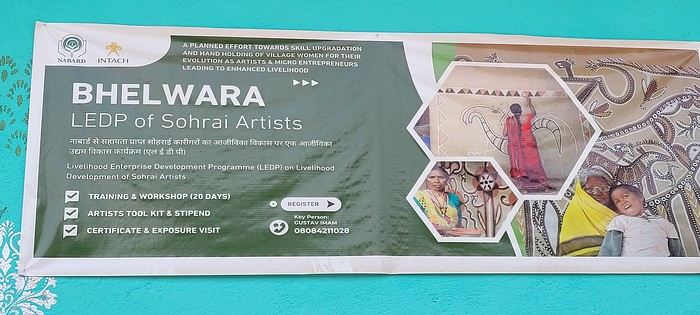
Sohrai art is tied to the harvest season, from October to mid-November. The motifs, in natural colors, celebrate fertility and abundance. The artists use pigments from the earth: red oxides, ochre, white kaolin, and black manganese. On the walls, you’ll see animals, fish, birds—all symbols of life and prosperity. As I look closer at the murals, I start to realize that each motif tells a story. Large animals like cows or bulls often take center stage. Their bodies are filled with intricate, almost hypnotic patterns. They symbolize wealth and prosperity for the household, as well as the deep respect for cattle, which are essential to daily life. On some facades, elephants stand out—massive and decorated with the same precision. They evoke quiet strength and protection. But it’s when I stop in front of one of the houses that I really take the time to look. The wall, a soft ochre, is entirely covered in murals. Two large animals stretch out on either side of the door, their elongated bodies fitting the length of the wall. Their silhouettes are filled with geometric patterns and incredibly fine curved lines, as if every space was patiently filled. Around them, stylized plants, flowers, and small decorative elements fill every gap. The door, dark and worn, becomes almost the silent center of the composition, framed by these living, protective forms. To the right, a more colorful motif catches the eye—a flower or a stylized lamp—like a touch of light on the earth. The whole thing gives an impression of perfect balance, between the rigor of the patterns and the freedom of the gesture.
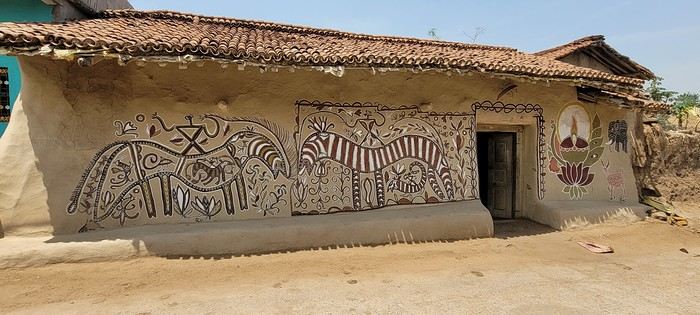
Elsewhere, birds and freer forms bring movement. Peacocks, recognizable by their stylized silhouettes, embody beauty and vitality, while fish symbolize water, fertility, and the continuity of life.
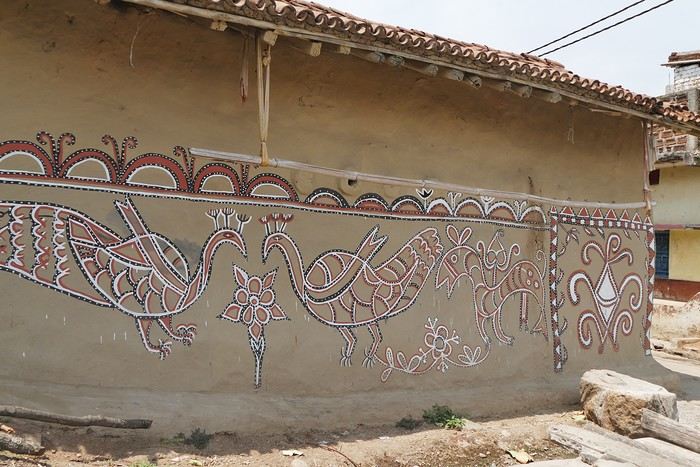 On some paintings, the scenes become almost narrative: you can make out figures, everyday gestures, like a memory of the village inscribed in the walls. The decorative frames around the doors aren’t left to chance either—they symbolically protect the house, like a boundary between the inside and the outside world.
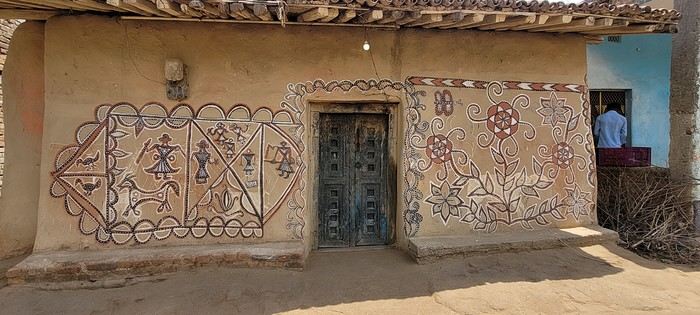
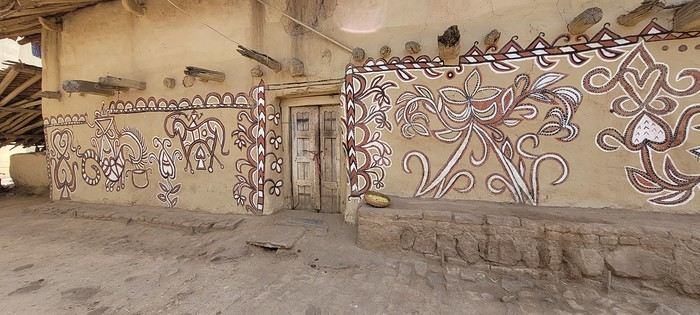
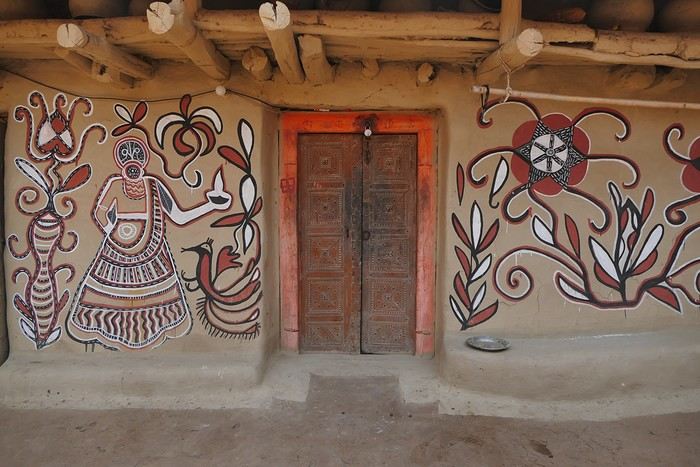
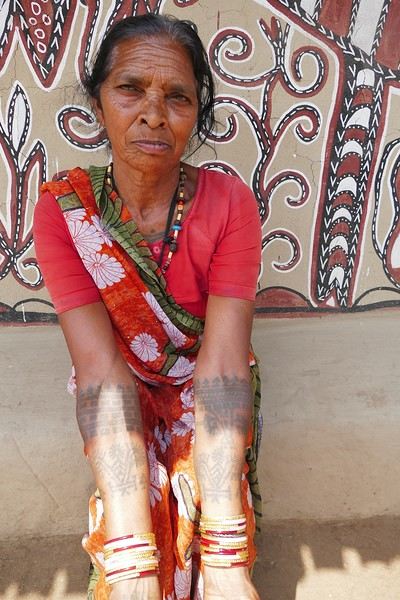
During the Sohrai festival, cattle are led into the jungle in the morning. Meanwhile, the women finish the *aripans*—these floor paintings—and continue the wall murals. Around noon, the animals return to the village, and the bulls’ horns are anointed with oil and vermilion in a gesture of gratitude, amid the vibrant colors adorning the houses. We visit several artists, including Parvat Devi, a well-known woman who has received many awards. Her arms are adorned with intriguing tattoos, which I’ll talk about in more detail later.
On another wall, the style changes completely. Here, no massive animals—just birds occupying the space, light and graceful, as if caught in mid-movement. Two silhouettes face each other, their long necks arched almost like mirrors, while their outstretched wings seem to vibrate with the patterns that compose them.
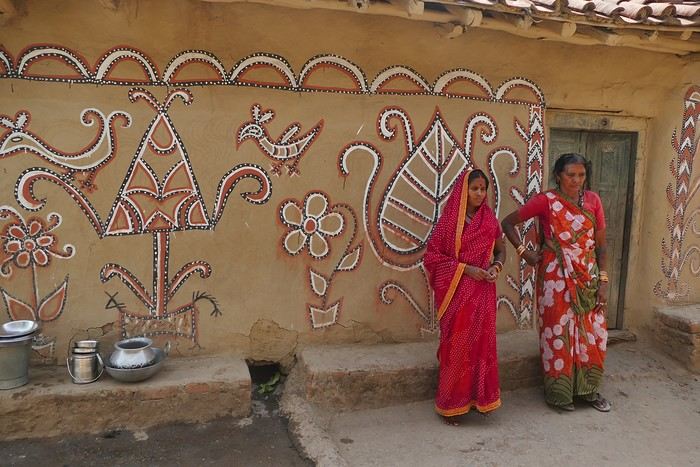
The design is more graphic, almost airy. The lines are smoother, more fluid, as if drawn in one confident stroke. The birds’ bodies aren’t solid—they’re filled with repetitive motifs like scales, stylized feathers, and spirals, giving a sense of continuous movement. Around them, everything comes to life: flowers burst open, arabesques swirl, and even the simplest shapes seem alive. What strikes me here is the sense of lightness. Where the large animals evoked stability and grounding, these birds bring something freer, almost joyful. They seem to embody movement, the circulation of life, like a breath flowing through the village.
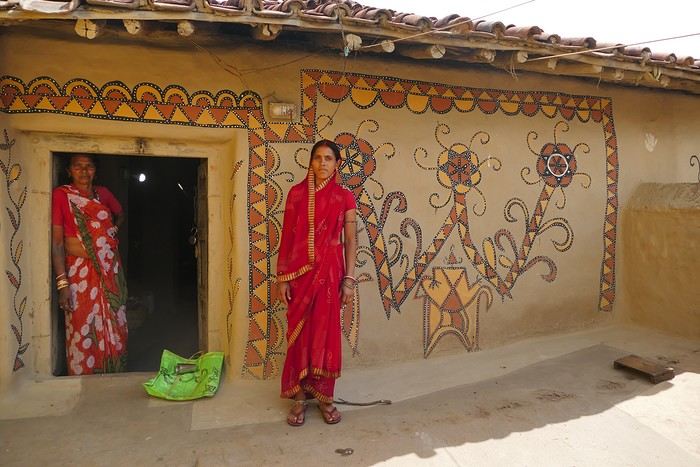
The colors remain the same—deep reds, intense blacks, and chalky white—but the rhythm is different. Faster, more spontaneous. As if each wall had its own personality, while still speaking the same language.
That’s probably why I’m so moved. I’d heard about these paintings from my friend Raja, and last year, I saw an exhibition in a village near my home. That first encounter made me want to come here. But seeing them in person is a whole different experience. These paintings are unique. This ancient art is passed down from mother to daughter, or mother-in-law to daughter-in-law, in a quiet, deeply living continuity. At first glance, it might seem almost childlike in its simplicity and pared-down forms. And yet, everything is thought out, balanced, mastered. Nothing is left to chance.
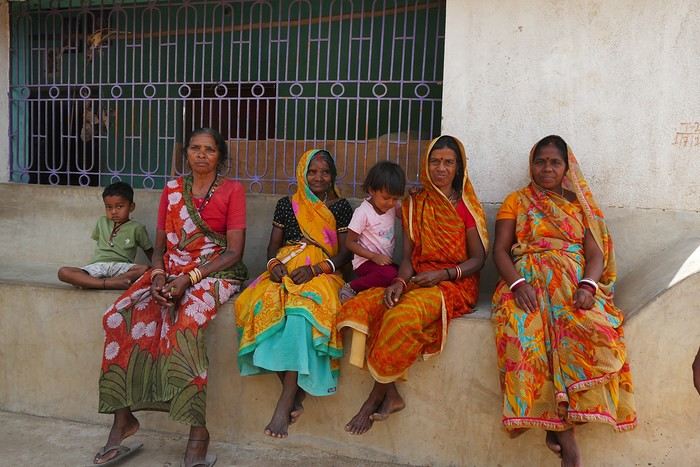
That apparent simplicity, combined with such rich symbolism, touches me deeply. There’s something sincere and essential in these walls—and that’s what moves me.
Hazaribagh I’ve got a meet-up with Adam Iman, a guide and painter. He picks me up from the hotel at 10 AM. Another traveler from Bangalore is supposed to join us, but while we wait for him to arrive, Adam takes me to see the paintings his mother and sister created at Hazaribagh station. The town became famous thanks to these murals, which can also be found in several surrounding villages. This art form has earned recognition and is now protected, a sign of its cultural importance. Once the visit is over, we go to pick up the other traveler and then head to our first village: Belwara, where Sohrai art is practiced. At the entrance, a sign proudly announces that we’re entering an artists’ village, where this art is created by women organized into micro-enterprises. Some even offer workshops for those who’d like to learn this tradition.
Sohrai art is tied to the harvest season, from October to mid-November. The motifs, in natural colors, celebrate fertility and abundance. The artists use pigments from the earth: red oxides, ochre, white kaolin, and black manganese. On the walls, you’ll see animals, fish, birds—all symbols of life and prosperity. As I look closer at the murals, I start to realize that each motif tells a story. Large animals like cows or bulls often take center stage. Their bodies are filled with intricate, almost hypnotic patterns. They symbolize wealth and prosperity for the household, as well as the deep respect for cattle, which are essential to daily life. On some facades, elephants stand out—massive and decorated with the same precision. They evoke quiet strength and protection. But it’s when I stop in front of one of the houses that I really take the time to look. The wall, a soft ochre, is entirely covered in murals. Two large animals stretch out on either side of the door, their elongated bodies fitting the length of the wall. Their silhouettes are filled with geometric patterns and incredibly fine curved lines, as if every space was patiently filled. Around them, stylized plants, flowers, and small decorative elements fill every gap. The door, dark and worn, becomes almost the silent center of the composition, framed by these living, protective forms. To the right, a more colorful motif catches the eye—a flower or a stylized lamp—like a touch of light on the earth. The whole thing gives an impression of perfect balance, between the rigor of the patterns and the freedom of the gesture.
Elsewhere, birds and freer forms bring movement. Peacocks, recognizable by their stylized silhouettes, embody beauty and vitality, while fish symbolize water, fertility, and the continuity of life.
On some paintings, the scenes become almost narrative: you can make out figures, everyday gestures, like a memory of the village inscribed in the walls. The decorative frames around the doors aren’t left to chance either—they symbolically protect the house, like a boundary between the inside and the outside world.During the Sohrai festival, cattle are led into the jungle in the morning. Meanwhile, the women finish the *aripans*—these floor paintings—and continue the wall murals. Around noon, the animals return to the village, and the bulls’ horns are anointed with oil and vermilion in a gesture of gratitude, amid the vibrant colors adorning the houses. We visit several artists, including Parvat Devi, a well-known woman who has received many awards. Her arms are adorned with intriguing tattoos, which I’ll talk about in more detail later.
On another wall, the style changes completely. Here, no massive animals—just birds occupying the space, light and graceful, as if caught in mid-movement. Two silhouettes face each other, their long necks arched almost like mirrors, while their outstretched wings seem to vibrate with the patterns that compose them.
The design is more graphic, almost airy. The lines are smoother, more fluid, as if drawn in one confident stroke. The birds’ bodies aren’t solid—they’re filled with repetitive motifs like scales, stylized feathers, and spirals, giving a sense of continuous movement. Around them, everything comes to life: flowers burst open, arabesques swirl, and even the simplest shapes seem alive. What strikes me here is the sense of lightness. Where the large animals evoked stability and grounding, these birds bring something freer, almost joyful. They seem to embody movement, the circulation of life, like a breath flowing through the village.
The colors remain the same—deep reds, intense blacks, and chalky white—but the rhythm is different. Faster, more spontaneous. As if each wall had its own personality, while still speaking the same language.
That’s probably why I’m so moved. I’d heard about these paintings from my friend Raja, and last year, I saw an exhibition in a village near my home. That first encounter made me want to come here. But seeing them in person is a whole different experience. These paintings are unique. This ancient art is passed down from mother to daughter, or mother-in-law to daughter-in-law, in a quiet, deeply living continuity. At first glance, it might seem almost childlike in its simplicity and pared-down forms. And yet, everything is thought out, balanced, mastered. Nothing is left to chance.
That apparent simplicity, combined with such rich symbolism, touches me deeply. There’s something sincere and essential in these walls—and that’s what moves me.
Some trips are born twice - Peru April - May 2025
Some trips are born twice.
Ours was supposed to happen in 2020. Everything was ready: the itinerary, the flight tickets, hotel reservations and Machu Picchu, the rental car, dreams of high altitudes and wide-open spaces. And then the world stopped.
Like so many other plans, our trip to Peru was put on hold. Disappointment was followed by a more concrete reality: paperwork, endless back-and-forth, and battles to recover some of the costs we’d already paid.
The years went by. Life moved on, with its shifting priorities and unexpected twists. Rescheduling this trip wasn’t possible until 2025.
The itinerary stayed mostly true to what we’d imagined five years earlier. One major difference, though—in 2020, we’d planned to rent a car and explore the roads completely independently. Most importantly, we hadn’t included the three-day Ausangate trek, due to lack of time.
For 2025, our plans evolved. 4x4 rental prices had skyrocketed, and when we looked at our schedule more closely, we realized quite a few days didn’t actually need a vehicle. So we made a different choice and opted for private drivers instead. A decision we never regretted. Always punctual, thoughtful, and available... they were so much more than just drivers.
All our reservations were made in January, except for the trek, which we booked in February.
Finding reliable drivers on our own was tough, so we asked Laurent from Tout Pérou to handle it for us. Going through Tout Pérou also gave us a discount on the train ride to Aguas Calientes, so Laurent booked those tickets too. He also bought our Machu Picchu entrance tickets at the same price we would’ve paid on the official website. When comparing domestic flight prices, we found it was cheaper to book from Peru, so Laurent took care of those as well.
This time, nothing was going to stop us. Peru was waiting. And we were ready. 🙂
Ours was supposed to happen in 2020. Everything was ready: the itinerary, the flight tickets, hotel reservations and Machu Picchu, the rental car, dreams of high altitudes and wide-open spaces. And then the world stopped.
Like so many other plans, our trip to Peru was put on hold. Disappointment was followed by a more concrete reality: paperwork, endless back-and-forth, and battles to recover some of the costs we’d already paid.
The years went by. Life moved on, with its shifting priorities and unexpected twists. Rescheduling this trip wasn’t possible until 2025.
The itinerary stayed mostly true to what we’d imagined five years earlier. One major difference, though—in 2020, we’d planned to rent a car and explore the roads completely independently. Most importantly, we hadn’t included the three-day Ausangate trek, due to lack of time.
For 2025, our plans evolved. 4x4 rental prices had skyrocketed, and when we looked at our schedule more closely, we realized quite a few days didn’t actually need a vehicle. So we made a different choice and opted for private drivers instead. A decision we never regretted. Always punctual, thoughtful, and available... they were so much more than just drivers.
All our reservations were made in January, except for the trek, which we booked in February.
Finding reliable drivers on our own was tough, so we asked Laurent from Tout Pérou to handle it for us. Going through Tout Pérou also gave us a discount on the train ride to Aguas Calientes, so Laurent booked those tickets too. He also bought our Machu Picchu entrance tickets at the same price we would’ve paid on the official website. When comparing domestic flight prices, we found it was cheaper to book from Peru, so Laurent took care of those as well.
This time, nothing was going to stop us. Peru was waiting. And we were ready. 🙂
A Scandinavian Tour - Summer 2025
Off on new adventures!!!
For my wife’s 60th birthday, I’m really making her happy. While I usually pick warm, sunny destinations, she’s more tempted by places where you don’t suffer from the heat.
So, it’s off to Norway!! A real challenge for me—a southern guy who’s as cold-sensitive as they come.
I keep telling anyone who’ll listen (well, just myself, really) that these aren’t the countries for me, that rain will be our travel companion, that we’ll have to face polar bears, navigate between icebergs, that there are still Vikings around, and all sorts of other things.
Of course, not wanting to make it easy, we’re driving from the Lyon area where we live.
Friends who’ve visited the country told us it’s pretty expensive to eat out (among other things), so we’re bringing supplies—especially enough for apéritifs the whole trip!!!
It’s not a camper van, but a "hotel-car" we’ll be doing! We’ll see how it goes!
As usual, I’ll try to narrate the journey with my two-cent comments, plus some little tips to avoid our mistakes—assuming I don’t lose any fingers to the cold!
Every night, I’ll count them to make sure I still have all ten! We’re not in *Ch’tis* territory but even farther Noooorth (as Galabru would say).
Note that I’m traveling with a synovial effusion in my knee! The old man’s not in great shape!!
Here we go!!
PS: As always, I’m a filmmaker, so I’ve made an effort with a few photos from my phone.
PS: As always, I’m a filmmaker, so I’ve made an effort with a few photos from my phone.
Voyage organisé en séjour tout compris au Japon
Bonjour
L'agence de voyage TUI organise des sejours tout compris au JAPON.pour 26 personnes max
Merci de faire des retours d'impression si vous avez des infos
bonne journée
Michel
La SNCF aime-t-elle le vélo?
Bonjour à tous
Cyclo de fraîche date, j'ai pour ambition d'amener mon vélo de Paris à Nice fin août et de démarrer mon voyage là-bas. Je pensais qu'il serait assez simple de trouver une place dans un train (quitte à payer un supplément). Comme j'étais naïf !! Je découvre qu'il n'y a absolument rien. L'alternative serait de démonter mon vélo et de le mettre dans une housse, sauf que la SNCF ne prête pas de housse. Or, sachant que je repartirai de Nice à vélo, je n'ai aucune intention de me trimballer une housse.
Bref, quelle solution voyez-vous ? Enchaîner les TER et mettre 2 jours pour aller de Paris à Nice ? Prendre l'avion, et tant pis pour la planète ?
Je suis à l'écoute de vos idées, mais vraiment je tombe de haut.
Merci !
Cyclo de fraîche date, j'ai pour ambition d'amener mon vélo de Paris à Nice fin août et de démarrer mon voyage là-bas. Je pensais qu'il serait assez simple de trouver une place dans un train (quitte à payer un supplément). Comme j'étais naïf !! Je découvre qu'il n'y a absolument rien. L'alternative serait de démonter mon vélo et de le mettre dans une housse, sauf que la SNCF ne prête pas de housse. Or, sachant que je repartirai de Nice à vélo, je n'ai aucune intention de me trimballer une housse.
Bref, quelle solution voyez-vous ? Enchaîner les TER et mettre 2 jours pour aller de Paris à Nice ? Prendre l'avion, et tant pis pour la planète ?
Je suis à l'écoute de vos idées, mais vraiment je tombe de haut.
Merci !
Adventures of a Bygone Era: The Philippines in 1984
After several discussions on VF about travel journals from the Philippines, I decided to write this curiosity: a trip report from a journey made in 1984, when traveling to the Philippines was still an adventure.
A curiosity because writing a travel journal about a trip 35 years later isn’t common, but also (mostly?) because exploring the Philippines at that time had little in common with traveling there today.
Obviously, I’ve forgotten a number of facts, most of the details, but with the help of a few notes from that time and a stack of slides (yes, there was life before digital 😊), many memories came back and added to the highlights I’d never forgotten. The scanned slides aren’t always great quality, but there are still quite a few to brighten up this chatter. Back then, we didn’t snap photos like we do now—film was too expensive—so I don’t have pictures of every place we visited... too bad, comparing some of those spots to how they look today would’ve been interesting.
Why "Adventures"? Why call it "Adventures" in the Philippines in 1984, a word so often used for a simple exotic trip? - Because the lack of information (no *Guide du Routard*, no *Lonely Planet*, no *Michelin Guide*, nothing, and obviously no internet) gave this trip what’s at the heart of adventure: the unknown. - Because the political situation made the stay sometimes dangerous. - Because transportation conditions were always epic, often perilous. - Because the question of where we’d spend the night came up almost every evening. - And for... quite a few other reasons.
That said, we weren’t exactly explorers!
Why the Philippines? First of all, why go to the Philippines in 1984—a country not exactly set up for tourism and about which we knew very little? How could we get an idea of the beauty of the Philippines and its points of interest when we had no guides or photos?
The idea came to us from Thailand a year earlier, during our first long-haul trip. After touring the north of the country, we met a Frenchman living in Phuket, where there were only a few tourists in Patong, with just a few small hotels and guesthouses. Kata and Karon had no buildings or roads, Rawai only had three palm-thatched bungalows, including ours, and the other islands were unknown to tourists. There was plenty to discover, and we wanted to return to this beautiful country... but the Frenchman made us dream about the Philippines—a country to explore, with wild landscapes.
Long evenings of discussion over multiple Sprite-Mekong cocktails (what memories of those headaches!) finally convinced us we had to go to the Philippines.
Episode 0: Before Departure The decision was made: we’d go to the Philippines in May 1984. Our friends and family were surprised when we announced we were going on vacation to the Philippines (a bit like saying today we were going paddleboarding in the Kerguelen Islands 🤪).
These days, preparing for each of our trips takes long evenings of research, planning, and noting down good addresses... etc. But for the Philippines in 1984, preparation was quick: we had very little information about the country, we were leaving almost at random, and the discovery would only be more exciting.
We still had a few bits of info gathered here and there: the rice terraces in northern Luzon, volcanoes, Negros where we were supposed to visit an acquaintance, Cebu and its marine life (we ended up going elsewhere), and absolutely avoid Mindanao, which was practically at war with the regime. That was about it, but it was already a great itinerary.
Nothing was organized in advance; we’d see day by day. We had no idea about travel times or even the existence of transportation options. The main (and sometimes only) way to connect two islands was by overloaded, rusty ferry. Only the big cities had airports.
Let’s Go: Episode 1: Paris to Manila My travel journals always start after arriving at the airport—the Europe-to-“Other Continent” trip isn’t interesting—but the flight to the Philippines was already an adventure, so I’ll make an exception.
This was the era when only a few Asian airlines were on par with Western ones: Thai, Singapore Airlines, and Philippine Airlines. They had beautiful, brand-new planes, and to attract customers (almost exclusively “businessmen”) from the usual airlines (Air France, Lufthansa, British Airways), there was opulence on board: unlimited champagne, all sorts of cocktails... Compared to today’s long-haul flights, there was still one small difference: no personal screens, just one screen at the front of the cabin with one mandatory movie. And I don’t know why, but we only got James Bond films, both ways... that must’ve been the trend at the time.
The tourism boom to Southeast Asia hadn’t started yet, and the “Asian Tigers” weren’t a thing, so there weren’t many business trips. That meant long-haul flights made stops everywhere to fill the planes. Our Philippine Airlines Boeing 747 left London, picked us up in Paris, then stopped in Frankfurt to take on a few Germans. I don’t know why we then made a stop in Dubai—a totally exotic place at the time. There was nothing to do there... things have changed a lot since. It was a small town lost in the desert. The airport was tiny, with just one or two buildings and a supermarket. During the stopover, everyone had to get off the plane and walk to the supermarket. Photo and electronic equipment were dirt cheap—I guess that was the only reason for the stop. Maybe it was their first commercial move. Emirates didn’t exist yet, as I checked online, but anyway, the idea that such a remote place could have its own airline was unthinkable.
Online, I found this photo of Dubai Airport in 1980. Anyone who’s transited through today’s massive airport with its rows of A380s will appreciate it: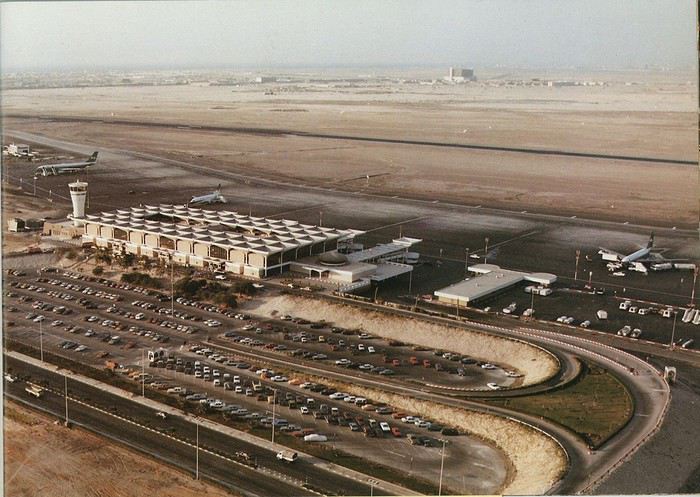
Next stop: New Delhi to drop off some Europeans and pick up a few Indians, and finally, the terminus: Manila. I don’t remember how long the trip took with its five stops—an unimaginable journey today. Despite all those stops to fill the plane, there was still enough space to stretch out on the four center seats of the 747, something that never happens these days despite all the flights in every direction.
So here we are, finally at Manila Airport around midnight.
Episode 1: Manila and Baguio To start, a quick note on the political and economic situation in the Philippines in 1984, which had consequences for us as tourists, as we’d soon realize upon arrival.
After several centuries of Spanish colonization, the Philippines became American at the start of the 20th century, then independent. In 1966, Marcos took power, and little by little, his regime sank into corruption and mismanagement, becoming a dictatorship with martial law, all for the benefit of his family and friends, who enriched themselves endlessly. The peak was the assassination of opposition leader Benigno Aquino in August 1983, which triggered harshly repressed protests. So we arrived a few months later in a very poor country, with omnipresent corruption and an extremely tense political situation, as we’d soon see for ourselves. Major protests took place in the main cities during our trip—I’ll come back to that. Two years later, Marcos fled to Hawaii after being forced out of power following rigged elections. This historical context explains a lot of the situations we found ourselves in over the following weeks.
Arriving in the middle of the night isn’t very cheerful. Manila was already a huge city with many slums, where you could find a few business hotels like the Hilton or Intercontinental—way out of our budget—and plenty of run-down hotels. Luckily, two Indians we’d chatted with on the plane offered to take us to their usual hotel. They came to Manila twice a year for business. We accepted their offer, relieved not to have to look for a place to stay in the middle of the night, figuring the address must be good since they came back every time... we were wrong 🙁
We left the airport and immediately got a taste of the local vibe when we got into the taxi: the police asked for our passports. We thought: what’s more normal than police in a dictatorship?
But that wasn’t it at all. Our two Indian friends explained that the police were noting our names along with the taxi number and time. Crime in Manila was so bad that the taxi driver would be held responsible if anything happened to us... welcome to the Philippines 😎 😎
Historically, the Philippines was a very violent country, where everything was settled with guns or machetes. Previous governments had banned carrying weapons, but Marcos later allowed the free sale and carrying of guns, and disputes were settled with pistols again (or worse, as we’d discover later). Since he’d released most of the criminals from prison to form a paramilitary militia at his service (I’ll talk about our encounter with these “heroes” later), it was pretty dangerous to go into many parts of Manila, where these “tonton macoutes” ruled.
We arrived at our hotel without incident... and then things started badly. The room was infested with big cockroaches—exactly what I hate most in those kinds of countries. No way to find another hotel at that hour. After the long flight, the urge to take a shower was so strong that we squeezed into the bathroom as best we could. After that, I don’t remember—I guess we must’ve fallen asleep exhausted under the sheets in the heat... air conditioning wasn’t widespread yet.
The next day, we just wanted to leave that dump as soon as possible. So we decided to head north right away, stopping in Baguio, and we’d visit Manila a bit on the way back.
When we stepped outside, we discovered a pretty run-down neighborhood with potholed streets. But we also discovered the jeepneys. They were everywhere, flooding the streets.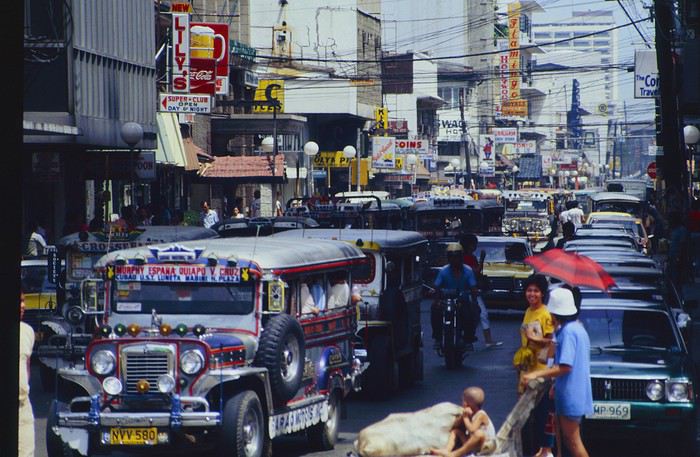
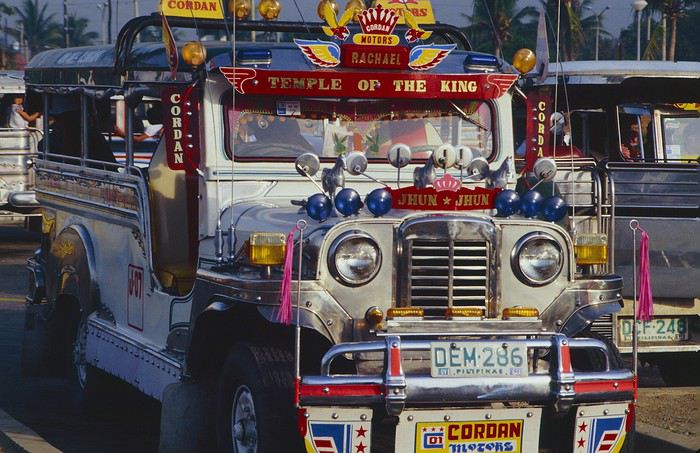
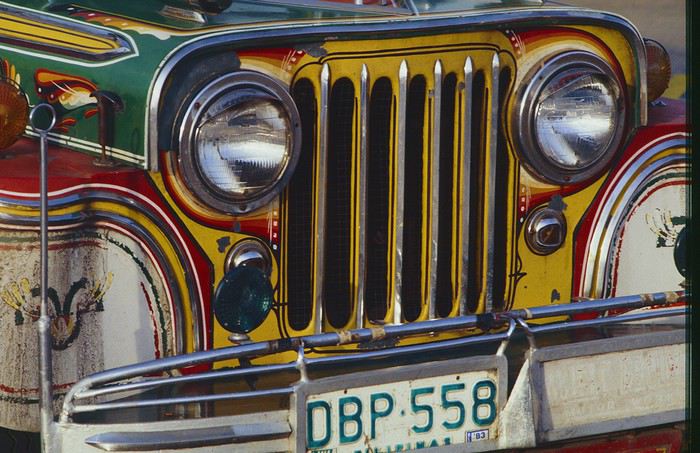
They had crazy sound systems, each one blasting louder than the last. The interiors were kitschy but fun. There weren’t many private cars—almost all transportation was by jeepney, with buses reserved for intercity trips.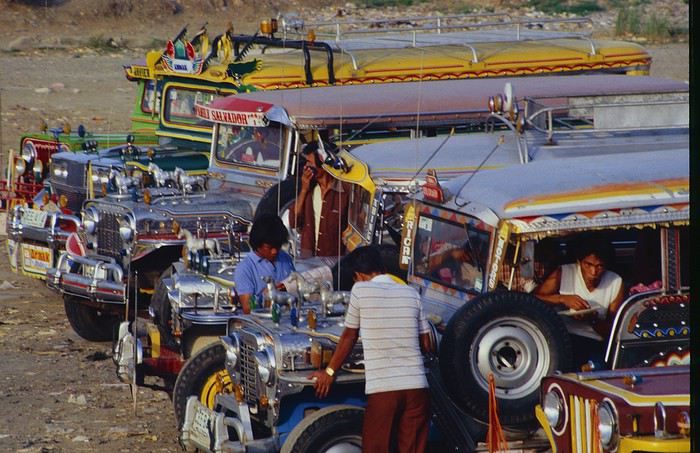
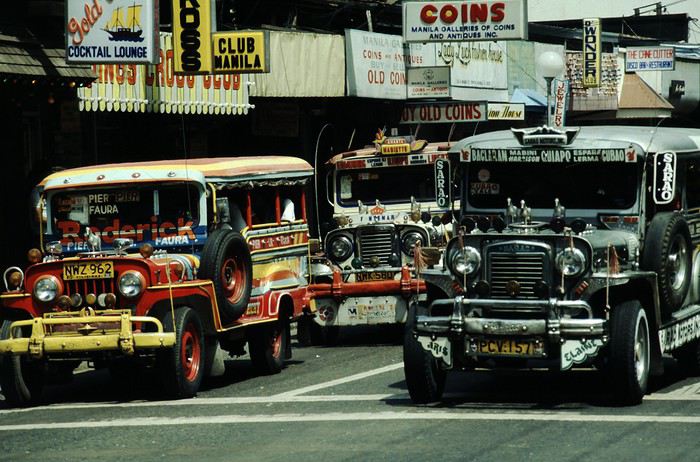
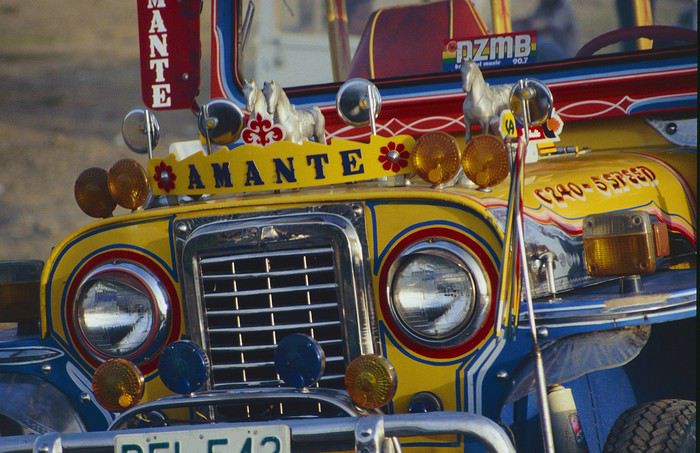
Before heading to the bus terminal for the north, somewhere on the outskirts of the city, we needed to exchange some money. I don’t remember how we ended up in a policeman’s jeep who offered his services: - Exchange money on the black market at a better rate than the banks. - Take us wherever we wanted, in this case, the bus terminal.
We accepted both offers (we’d still checked the official exchange rate from dollars to pesos). So we found ourselves in his jeep. After exchanging money, we left in his vehicle and stopped for gas. Without turning off the engine, he calmly smoked a cigarette while filling up. Since we were in a jeep with no doors or roof, we were ready to jump out if things went south, our travel bag in hand.
But we weren’t done with surprises yet. Once we left the small streets, we ended up in a neighborhood with wide avenues and not much traffic, which didn’t justify his incredible behavior. At every intersection, he made the sign of the cross, closed his eyes, and crossed without looking. I was more stunned than terrified! It wasn’t until we got out of the car later that I told Anne-Marie what had happened. I’d seen everything because the cop had put me in the front seat. Luckily, A-Marie hadn’t noticed anything from the back. Crossing Manila by trusting God rather than the rules of the road was ultimately effective. We were lucky—the trip was off to a good start. 🙂 🙂
We then passed through a neighborhood where slums stretched on for a while, and we left our policeman—friendly but a bit crazy—with relief.
A few hours by bus later, here we are in Baguio, cool in the mountains. My memories of Baguio are pretty fuzzy. I remember a small town. After some research while writing this journal, I found that the population was 120,000 in 1980. Given the population density in each home, that confirms my memory of a smallish town. Outside the “official” district with the president’s summer residence and government buildings, there were two or three paved streets with nice houses. The rest was very dirty and very poor, with lots of slums and dirt roads.
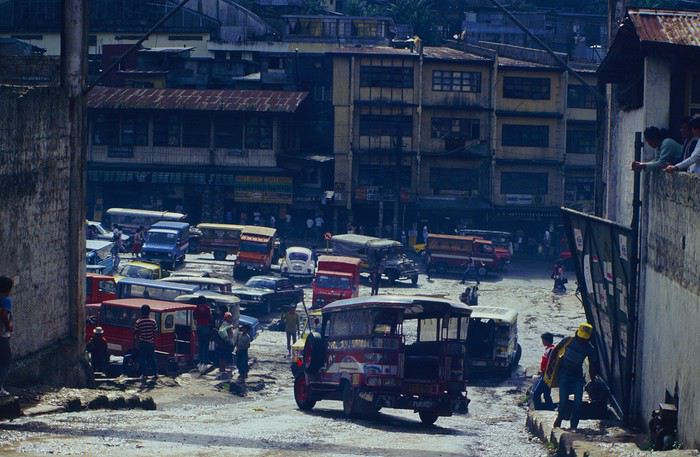
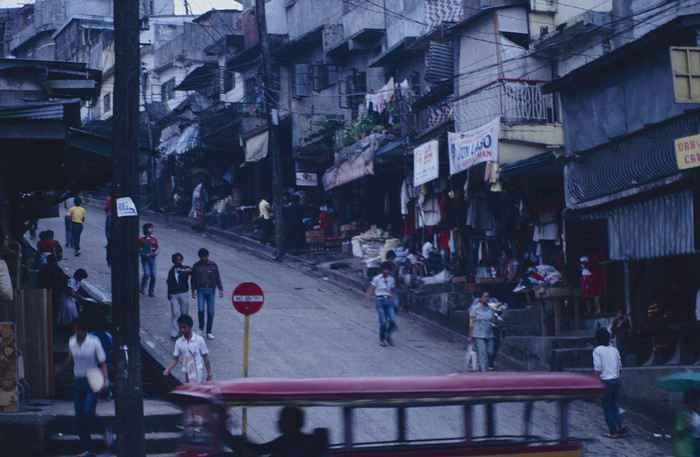
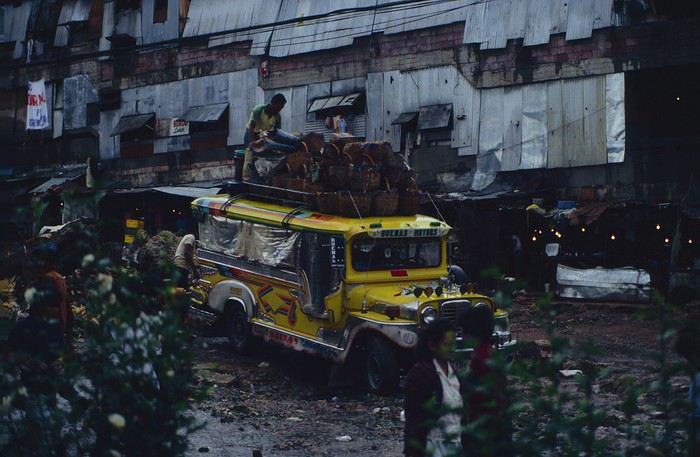
People we met on the street invited us to stay with them. These days, we wouldn’t just show up at strangers’ houses, which we should’ve done in Baguio—it would’ve saved us from an unimaginable and dangerous situation... which I won’t say anything about... !😊
The simple wooden house was on stilts at the edge of a hill with a view of the mountains. Since it was the start of the rainy season in a city that gets a lot of rain, we saw a lot of water. Our outings in town happened between downpours.
View from our lodging: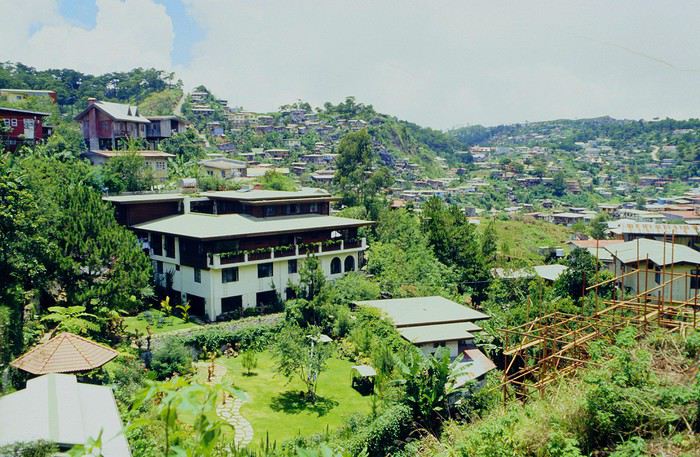
Episode 2: Baguio to Bontoc Aside from the situation briefly mentioned above, it was on the next leg to Bontoc that the adventure really began: an endless and dangerous road, a bus from another era, breathtaking landscapes, and surprising people.
We didn’t know the distance or how long it would take to get to Bontoc. When we arrived after about ten hours, we learned that Baguio to Bontoc was 140 km.
We got on a bus with wooden seats and settled in, two to a seat meant for two. As the bus filled up, passengers squeezed in three or four per seat, with chickens and baskets full of all sorts of things in the aisle. A little embarrassed, we didn’t know if we should squeeze in three on our seat. The seats were super tight (luckily, Filipinos are small), and I didn’t know where to put my legs given my height. I don’t remember if we stayed alone on our bench or if we ended up sharing with others.
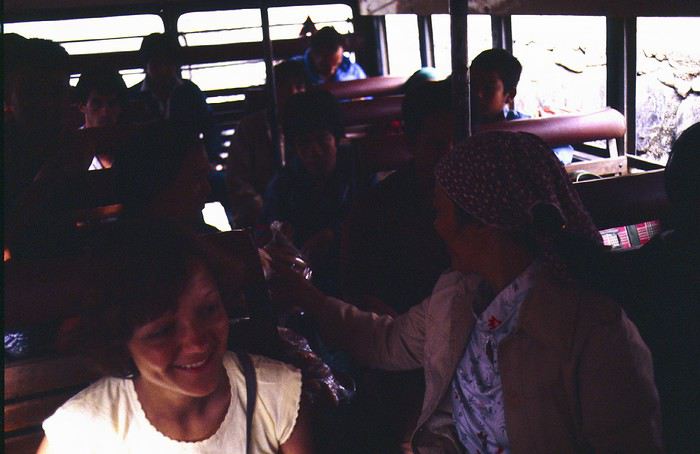
The “road” was a dirt track (or rather, a mud track) with endless turns. We held on as best we could to our slippery wooden seats—it was shaking in every direction. The woman behind us was carsick and throwing up... gross... but what were we doing there? Then we plunged into the Sierra Madre... just the name is dreamy!
Rice terraces started to appear: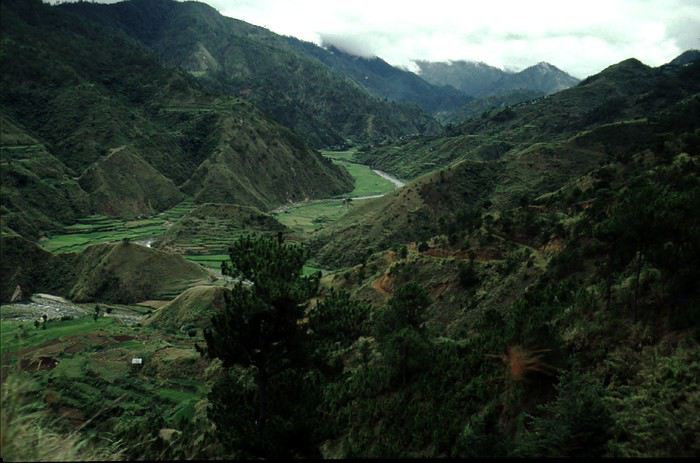
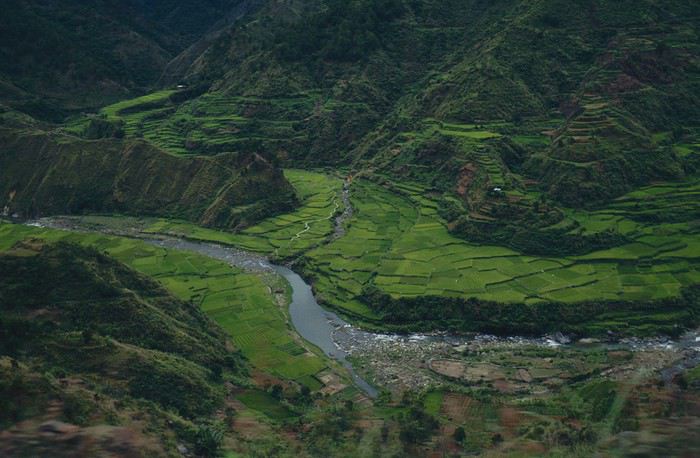
they took up more and more space along cliffs where we weren’t always reassured,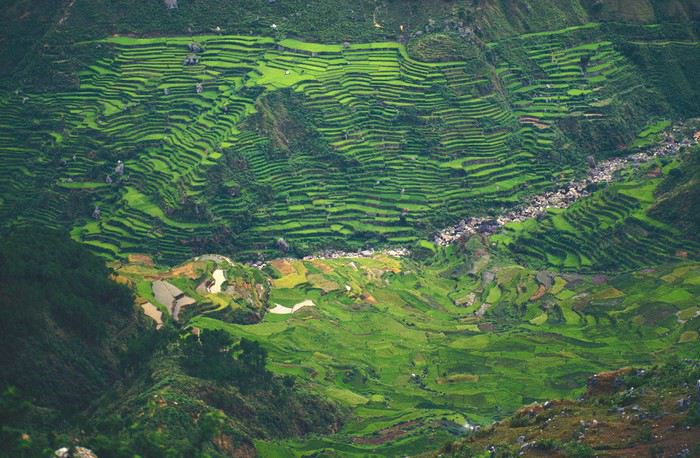
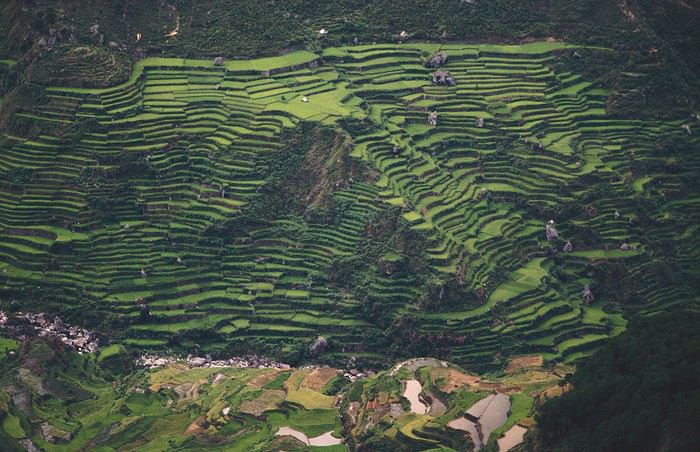
with lots of waterfalls (all that water had to go somewhere).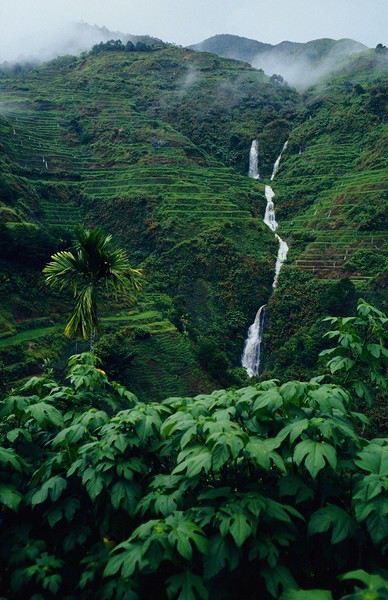
A few miserable villages stretched along the track, most often just a few houses balancing between the road and the drop. The bus stopped in every village—people got on or off and settled inside or on the roof. Street vendors offered their products to the bus passengers—a common sight in Asia, even today.
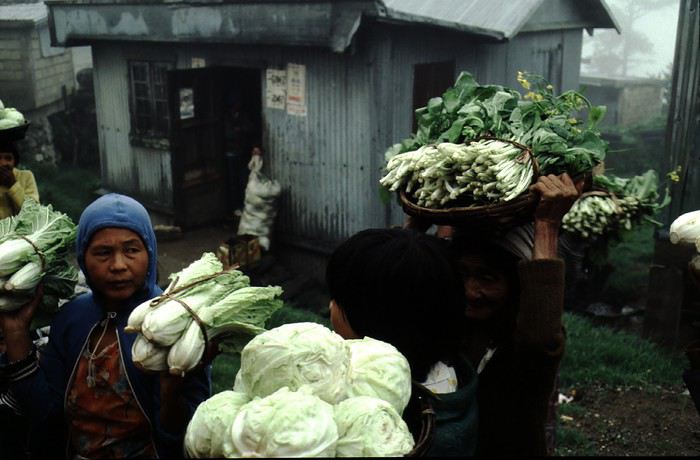
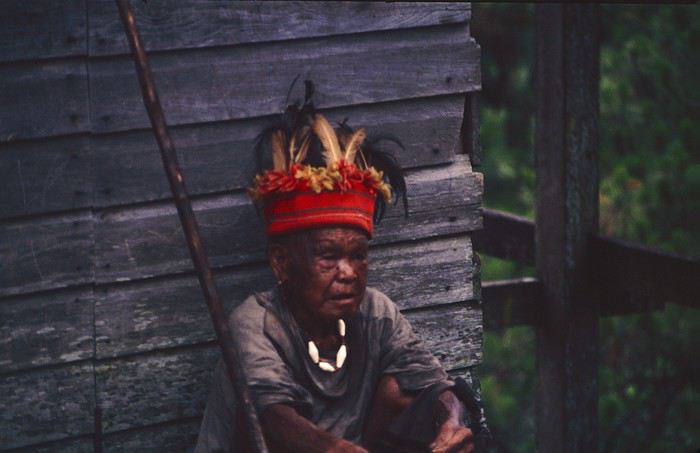
We were in another world—villagers were in loincloths, others had spears. The atmosphere was strange... but all good, we wanted exoticism, and we got it: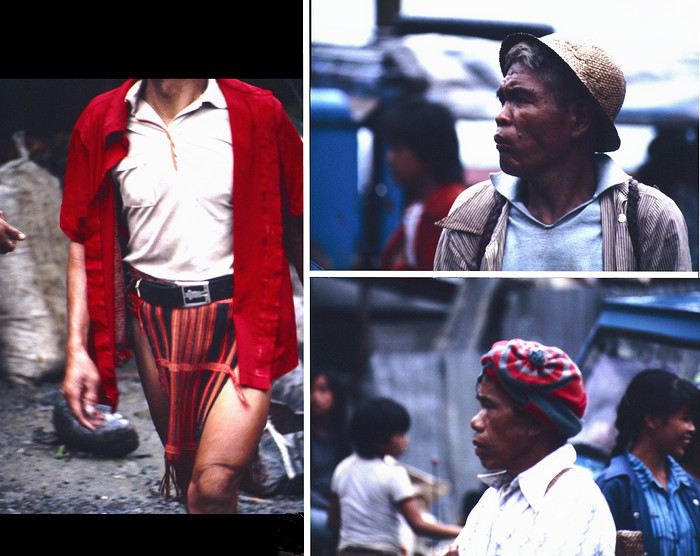
This so-called traditional outfit was everyday wear—it wasn’t for tourists since there weren’t any.
A curiosity because writing a travel journal about a trip 35 years later isn’t common, but also (mostly?) because exploring the Philippines at that time had little in common with traveling there today.
Obviously, I’ve forgotten a number of facts, most of the details, but with the help of a few notes from that time and a stack of slides (yes, there was life before digital 😊), many memories came back and added to the highlights I’d never forgotten. The scanned slides aren’t always great quality, but there are still quite a few to brighten up this chatter. Back then, we didn’t snap photos like we do now—film was too expensive—so I don’t have pictures of every place we visited... too bad, comparing some of those spots to how they look today would’ve been interesting.
Why "Adventures"? Why call it "Adventures" in the Philippines in 1984, a word so often used for a simple exotic trip? - Because the lack of information (no *Guide du Routard*, no *Lonely Planet*, no *Michelin Guide*, nothing, and obviously no internet) gave this trip what’s at the heart of adventure: the unknown. - Because the political situation made the stay sometimes dangerous. - Because transportation conditions were always epic, often perilous. - Because the question of where we’d spend the night came up almost every evening. - And for... quite a few other reasons.
That said, we weren’t exactly explorers!
Why the Philippines? First of all, why go to the Philippines in 1984—a country not exactly set up for tourism and about which we knew very little? How could we get an idea of the beauty of the Philippines and its points of interest when we had no guides or photos?
The idea came to us from Thailand a year earlier, during our first long-haul trip. After touring the north of the country, we met a Frenchman living in Phuket, where there were only a few tourists in Patong, with just a few small hotels and guesthouses. Kata and Karon had no buildings or roads, Rawai only had three palm-thatched bungalows, including ours, and the other islands were unknown to tourists. There was plenty to discover, and we wanted to return to this beautiful country... but the Frenchman made us dream about the Philippines—a country to explore, with wild landscapes.
Long evenings of discussion over multiple Sprite-Mekong cocktails (what memories of those headaches!) finally convinced us we had to go to the Philippines.
Episode 0: Before Departure The decision was made: we’d go to the Philippines in May 1984. Our friends and family were surprised when we announced we were going on vacation to the Philippines (a bit like saying today we were going paddleboarding in the Kerguelen Islands 🤪).
These days, preparing for each of our trips takes long evenings of research, planning, and noting down good addresses... etc. But for the Philippines in 1984, preparation was quick: we had very little information about the country, we were leaving almost at random, and the discovery would only be more exciting.
We still had a few bits of info gathered here and there: the rice terraces in northern Luzon, volcanoes, Negros where we were supposed to visit an acquaintance, Cebu and its marine life (we ended up going elsewhere), and absolutely avoid Mindanao, which was practically at war with the regime. That was about it, but it was already a great itinerary.
Nothing was organized in advance; we’d see day by day. We had no idea about travel times or even the existence of transportation options. The main (and sometimes only) way to connect two islands was by overloaded, rusty ferry. Only the big cities had airports.
Let’s Go: Episode 1: Paris to Manila My travel journals always start after arriving at the airport—the Europe-to-“Other Continent” trip isn’t interesting—but the flight to the Philippines was already an adventure, so I’ll make an exception.
This was the era when only a few Asian airlines were on par with Western ones: Thai, Singapore Airlines, and Philippine Airlines. They had beautiful, brand-new planes, and to attract customers (almost exclusively “businessmen”) from the usual airlines (Air France, Lufthansa, British Airways), there was opulence on board: unlimited champagne, all sorts of cocktails... Compared to today’s long-haul flights, there was still one small difference: no personal screens, just one screen at the front of the cabin with one mandatory movie. And I don’t know why, but we only got James Bond films, both ways... that must’ve been the trend at the time.
The tourism boom to Southeast Asia hadn’t started yet, and the “Asian Tigers” weren’t a thing, so there weren’t many business trips. That meant long-haul flights made stops everywhere to fill the planes. Our Philippine Airlines Boeing 747 left London, picked us up in Paris, then stopped in Frankfurt to take on a few Germans. I don’t know why we then made a stop in Dubai—a totally exotic place at the time. There was nothing to do there... things have changed a lot since. It was a small town lost in the desert. The airport was tiny, with just one or two buildings and a supermarket. During the stopover, everyone had to get off the plane and walk to the supermarket. Photo and electronic equipment were dirt cheap—I guess that was the only reason for the stop. Maybe it was their first commercial move. Emirates didn’t exist yet, as I checked online, but anyway, the idea that such a remote place could have its own airline was unthinkable.
Online, I found this photo of Dubai Airport in 1980. Anyone who’s transited through today’s massive airport with its rows of A380s will appreciate it:
Next stop: New Delhi to drop off some Europeans and pick up a few Indians, and finally, the terminus: Manila. I don’t remember how long the trip took with its five stops—an unimaginable journey today. Despite all those stops to fill the plane, there was still enough space to stretch out on the four center seats of the 747, something that never happens these days despite all the flights in every direction.
So here we are, finally at Manila Airport around midnight.
Episode 1: Manila and Baguio To start, a quick note on the political and economic situation in the Philippines in 1984, which had consequences for us as tourists, as we’d soon realize upon arrival.
After several centuries of Spanish colonization, the Philippines became American at the start of the 20th century, then independent. In 1966, Marcos took power, and little by little, his regime sank into corruption and mismanagement, becoming a dictatorship with martial law, all for the benefit of his family and friends, who enriched themselves endlessly. The peak was the assassination of opposition leader Benigno Aquino in August 1983, which triggered harshly repressed protests. So we arrived a few months later in a very poor country, with omnipresent corruption and an extremely tense political situation, as we’d soon see for ourselves. Major protests took place in the main cities during our trip—I’ll come back to that. Two years later, Marcos fled to Hawaii after being forced out of power following rigged elections. This historical context explains a lot of the situations we found ourselves in over the following weeks.
Arriving in the middle of the night isn’t very cheerful. Manila was already a huge city with many slums, where you could find a few business hotels like the Hilton or Intercontinental—way out of our budget—and plenty of run-down hotels. Luckily, two Indians we’d chatted with on the plane offered to take us to their usual hotel. They came to Manila twice a year for business. We accepted their offer, relieved not to have to look for a place to stay in the middle of the night, figuring the address must be good since they came back every time... we were wrong 🙁
We left the airport and immediately got a taste of the local vibe when we got into the taxi: the police asked for our passports. We thought: what’s more normal than police in a dictatorship?
But that wasn’t it at all. Our two Indian friends explained that the police were noting our names along with the taxi number and time. Crime in Manila was so bad that the taxi driver would be held responsible if anything happened to us... welcome to the Philippines 😎 😎
Historically, the Philippines was a very violent country, where everything was settled with guns or machetes. Previous governments had banned carrying weapons, but Marcos later allowed the free sale and carrying of guns, and disputes were settled with pistols again (or worse, as we’d discover later). Since he’d released most of the criminals from prison to form a paramilitary militia at his service (I’ll talk about our encounter with these “heroes” later), it was pretty dangerous to go into many parts of Manila, where these “tonton macoutes” ruled.
We arrived at our hotel without incident... and then things started badly. The room was infested with big cockroaches—exactly what I hate most in those kinds of countries. No way to find another hotel at that hour. After the long flight, the urge to take a shower was so strong that we squeezed into the bathroom as best we could. After that, I don’t remember—I guess we must’ve fallen asleep exhausted under the sheets in the heat... air conditioning wasn’t widespread yet.
The next day, we just wanted to leave that dump as soon as possible. So we decided to head north right away, stopping in Baguio, and we’d visit Manila a bit on the way back.
When we stepped outside, we discovered a pretty run-down neighborhood with potholed streets. But we also discovered the jeepneys. They were everywhere, flooding the streets.
They had crazy sound systems, each one blasting louder than the last. The interiors were kitschy but fun. There weren’t many private cars—almost all transportation was by jeepney, with buses reserved for intercity trips.
Before heading to the bus terminal for the north, somewhere on the outskirts of the city, we needed to exchange some money. I don’t remember how we ended up in a policeman’s jeep who offered his services: - Exchange money on the black market at a better rate than the banks. - Take us wherever we wanted, in this case, the bus terminal.
We accepted both offers (we’d still checked the official exchange rate from dollars to pesos). So we found ourselves in his jeep. After exchanging money, we left in his vehicle and stopped for gas. Without turning off the engine, he calmly smoked a cigarette while filling up. Since we were in a jeep with no doors or roof, we were ready to jump out if things went south, our travel bag in hand.
But we weren’t done with surprises yet. Once we left the small streets, we ended up in a neighborhood with wide avenues and not much traffic, which didn’t justify his incredible behavior. At every intersection, he made the sign of the cross, closed his eyes, and crossed without looking. I was more stunned than terrified! It wasn’t until we got out of the car later that I told Anne-Marie what had happened. I’d seen everything because the cop had put me in the front seat. Luckily, A-Marie hadn’t noticed anything from the back. Crossing Manila by trusting God rather than the rules of the road was ultimately effective. We were lucky—the trip was off to a good start. 🙂 🙂
We then passed through a neighborhood where slums stretched on for a while, and we left our policeman—friendly but a bit crazy—with relief.
A few hours by bus later, here we are in Baguio, cool in the mountains. My memories of Baguio are pretty fuzzy. I remember a small town. After some research while writing this journal, I found that the population was 120,000 in 1980. Given the population density in each home, that confirms my memory of a smallish town. Outside the “official” district with the president’s summer residence and government buildings, there were two or three paved streets with nice houses. The rest was very dirty and very poor, with lots of slums and dirt roads.
People we met on the street invited us to stay with them. These days, we wouldn’t just show up at strangers’ houses, which we should’ve done in Baguio—it would’ve saved us from an unimaginable and dangerous situation... which I won’t say anything about... !😊
The simple wooden house was on stilts at the edge of a hill with a view of the mountains. Since it was the start of the rainy season in a city that gets a lot of rain, we saw a lot of water. Our outings in town happened between downpours.
View from our lodging:
Episode 2: Baguio to Bontoc Aside from the situation briefly mentioned above, it was on the next leg to Bontoc that the adventure really began: an endless and dangerous road, a bus from another era, breathtaking landscapes, and surprising people.
We didn’t know the distance or how long it would take to get to Bontoc. When we arrived after about ten hours, we learned that Baguio to Bontoc was 140 km.
We got on a bus with wooden seats and settled in, two to a seat meant for two. As the bus filled up, passengers squeezed in three or four per seat, with chickens and baskets full of all sorts of things in the aisle. A little embarrassed, we didn’t know if we should squeeze in three on our seat. The seats were super tight (luckily, Filipinos are small), and I didn’t know where to put my legs given my height. I don’t remember if we stayed alone on our bench or if we ended up sharing with others.
The “road” was a dirt track (or rather, a mud track) with endless turns. We held on as best we could to our slippery wooden seats—it was shaking in every direction. The woman behind us was carsick and throwing up... gross... but what were we doing there? Then we plunged into the Sierra Madre... just the name is dreamy!
Rice terraces started to appear:
they took up more and more space along cliffs where we weren’t always reassured,
with lots of waterfalls (all that water had to go somewhere).
A few miserable villages stretched along the track, most often just a few houses balancing between the road and the drop. The bus stopped in every village—people got on or off and settled inside or on the roof. Street vendors offered their products to the bus passengers—a common sight in Asia, even today.
We were in another world—villagers were in loincloths, others had spears. The atmosphere was strange... but all good, we wanted exoticism, and we got it:
This so-called traditional outfit was everyday wear—it wasn’t for tourists since there weren’t any.
Tergiversations diverses à propos d'un périple en Polynésie
Bonjour 🙂
J'avais ouvert une discussion sur cette destination il y a un an, mais comme mes préoccupations ne sont plus tout à fait les mêmes, je préfère créer un nouveau post... Nous envisageons un voyage en PF pour l'été 2021 (en espérant que la situation s'améliorera d'ici là 😇). A vrai dire j'ai déjà réservé les 4 seules nuits disponibles au Maupiti Lodge début juillet. Maupiti est une priorité pour nous. Nous disposerons d'environ 3 semaines. Les billets ne sont bien sûr pas encore réservés. Donc s'il faut ajouter ou supprimer un jour par ci ou part la, cela ne pose pas vraiment de problème.
L'itinéraire serait le suivant: Arrivée Tahiti / Maupiti / Raiatea & Tahaa / Bora/ Fakarava (ou Fakarava + Tikehau)/ Moorea / Tahiti
En tenant compte de la rotation des vols d'îles en îles, je me heurte à plusieurs ( tout petits) problèmes et j'ai besoin de vos avis...
Rester 5 nuits à Raiatea n'est ce pas un peu trop long ? Ne serait il pas préférable de couper la poire en deux et de passer 2 nuits sur Tahaa, puis 3 (ou 2) nuits à Raiatea ? ou encore 4 nuits uniquement à Raiatea ? Nous aimerions bien avoir de la place au Sunset beach.
Nous envisageons 3 nuits à Bora. Peut être le Mataï ou encore le Blue Heaven... ?
Maintenant concernant Fakarava...Nous ne sommes pas plongeurs et J'ai lu des avis contraires sur cette destination. Certains disent qu'il vaut mieux être plongeurs et d'autres disent que la destination se prête bien aussi au snorkeling. C'est la beauté de cet atoll qui nous attire. Concernant le logement, nous avons pensé au Haivaki Lodge si nous restons 4 nuits . Une autre idée serait de rester 2 nuits à Tetamanu pension et Haïvaki 3 nuits. Qu'en pensez-vous ? ou encore Fakarava 3 nuits et Tikehau 3 nuits.
Nous comptons passer quelques jours à Moorea, probablement aux Tipaniers. 4 nuits sont-elles suffisantes ? Nous prévoyons 2 jours pleins à Tahiti avant le départ.
C'est un peu long et j'en suis désolée... Un grand merci d'avance !
J'avais ouvert une discussion sur cette destination il y a un an, mais comme mes préoccupations ne sont plus tout à fait les mêmes, je préfère créer un nouveau post... Nous envisageons un voyage en PF pour l'été 2021 (en espérant que la situation s'améliorera d'ici là 😇). A vrai dire j'ai déjà réservé les 4 seules nuits disponibles au Maupiti Lodge début juillet. Maupiti est une priorité pour nous. Nous disposerons d'environ 3 semaines. Les billets ne sont bien sûr pas encore réservés. Donc s'il faut ajouter ou supprimer un jour par ci ou part la, cela ne pose pas vraiment de problème.
L'itinéraire serait le suivant: Arrivée Tahiti / Maupiti / Raiatea & Tahaa / Bora/ Fakarava (ou Fakarava + Tikehau)/ Moorea / Tahiti
En tenant compte de la rotation des vols d'îles en îles, je me heurte à plusieurs ( tout petits) problèmes et j'ai besoin de vos avis...
Rester 5 nuits à Raiatea n'est ce pas un peu trop long ? Ne serait il pas préférable de couper la poire en deux et de passer 2 nuits sur Tahaa, puis 3 (ou 2) nuits à Raiatea ? ou encore 4 nuits uniquement à Raiatea ? Nous aimerions bien avoir de la place au Sunset beach.
Nous envisageons 3 nuits à Bora. Peut être le Mataï ou encore le Blue Heaven... ?
Maintenant concernant Fakarava...Nous ne sommes pas plongeurs et J'ai lu des avis contraires sur cette destination. Certains disent qu'il vaut mieux être plongeurs et d'autres disent que la destination se prête bien aussi au snorkeling. C'est la beauté de cet atoll qui nous attire. Concernant le logement, nous avons pensé au Haivaki Lodge si nous restons 4 nuits . Une autre idée serait de rester 2 nuits à Tetamanu pension et Haïvaki 3 nuits. Qu'en pensez-vous ? ou encore Fakarava 3 nuits et Tikehau 3 nuits.
Nous comptons passer quelques jours à Moorea, probablement aux Tipaniers. 4 nuits sont-elles suffisantes ? Nous prévoyons 2 jours pleins à Tahiti avant le départ.
C'est un peu long et j'en suis désolée... Un grand merci d'avance !
Le premier jour
Nous sommes le xx xx xxxx, jour de votre déconfinement, vous êtes guéri ou n'avez jamais été en contact avec le virus couronné.
Qu'imaginez-vous faire en premier ? 😛
(Par simplicité, nous allons partir du principe que votre région est redevenue comme avant à défaut du monde.)
(Par simplicité, nous allons partir du principe que votre région est redevenue comme avant à défaut du monde.)
Toadstool hoodoos
Bonjour,
Je suis revenues des States le dimanche, le mercredi, Trump annonçait la fermeture des frontières aux Européens. J'ai eu une profonde respiration en entendant la nouvelle!!!
Je ne raconterai pas tout mon voyage... J'aime autant le chemin qui conduit aux sites que les sites eux-mêmes.
J'ai eu un vrai coup de cœur pour pleins de sites dont j'ai profité dans le south west, mais ce qui m'a surtout marqué, c'est le fait que souvent, sur les carnets, on a parfois l'impression (à tort d'ailleurs) qu'un site c'est juste une succession de choses importantes à voir dont il faut faire la liste et puis c'est tout.
Je vais donc vous faire découvrir toadstool à ma façon, j'aimerais vous faire découvrir les différentes étapes de ma découverte de ce park gratuit..
Voici tout d'abord ce qu'on découvre de la route: des montagnes chocolatées. Le parking placé devant à notre arrivée ne comporte qu'une voiture noire en fin de matinée.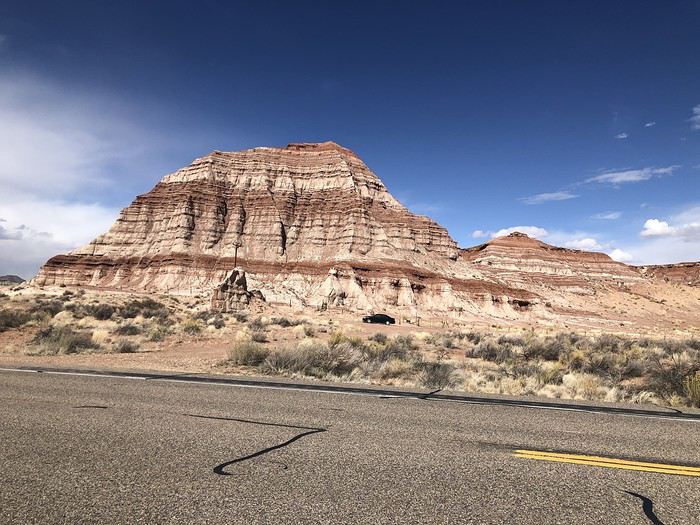
Puis sur le parking, ou se trouve la voiture noire, on voit le panneau qui vous rassure sur le nom du park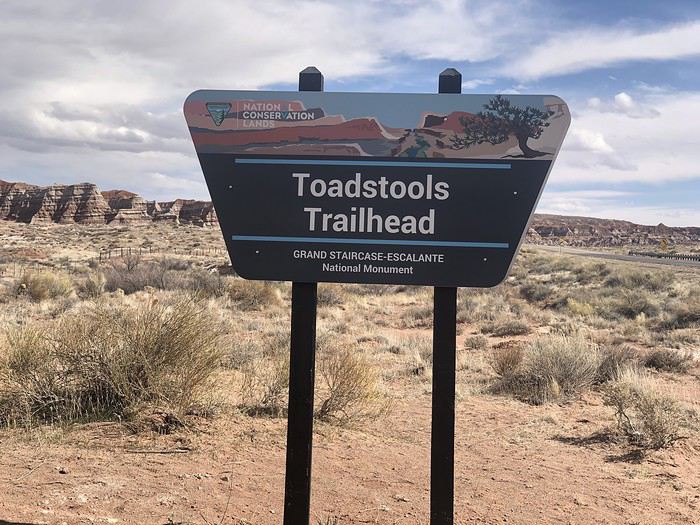
Il y a aussi un panneau qui vous informe sur ce qu'est un toadstool, c'est à-dire un champignon vénéneux, mais si vous allez sur place vous le verrez. Vous aurez toutes les infos sur la formation des toadstools, et aussi sur le fait que le chemin allé simple fait 0,8 miles et aller retour fait 1,6 miles. Je n'ai pas très bien compris l'intérêt de la distance aller simple et me suis demandée s'il y avait des gens qui comptaient rester la-bas définitivement??? 🤪
Ce panneau vous informe aussi du fait qu'en été il peut y faire terriblement chaud, et qu'il vaut mieux vous munir de litres d'eau, d'un chapeau..... A notre arrivée début mars, la température extérieure est de 15°C, le soleil éclaire juste ce qu'il faut, une petite bouteille d'eau pour chacun de nous est amplement suffisante, et de chapeau que nenni!
08 miles aller simple....Mais en fait, vous marcherez beaucoup plus que ça, car une fois sur le site il y aura tellement de coins qui vous attireront que vous y passerez facilement plus de 2 heures si vous vous donnez la peine d'aller découvrir les recoins qui sont derrière le site principal. Et surtout si vous vous donnez la peine de farfouiller un peu. C'est un vrai jeu de chasse au trésor auquel nous nous sommes livrés.
Donc une fois que nous avons complété le registre inséré dans une boite métallique noire qui permet aux rangers de savoir qui chercher s'il vous prenait l'envie d'y rester définitivement, et qu'ensuite nous avons franchi la barrière en barbelés qui laisse entrer les humains qui peuvent se faufiler, mais pas les bovins et les ovins qui ne pourraient pas tordre leur abdomen pour suivre le grillage, vous découvrez de plus près les massifs chocolatés.
Puis vous découvrez que vous avez le choix de marcher dans des washs (ce sont des lits de rivière à sec)
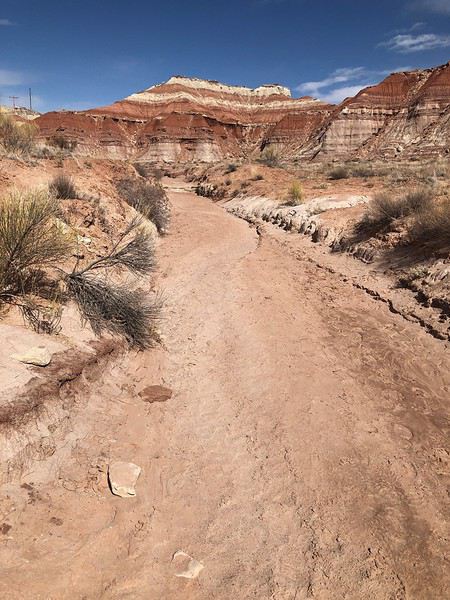
Les massifs chocolatés sont parfois ornés de chantilly, et parfois, le sentier semble sortir du wash pour venir s'incruster entre les mamelons. C'est ce que montre le petit poteau planté sur la droite. C'est une sorte de cairn civilisé, quoi.
Le sentier peut parfois devenir un peu étroit, et si vous n'êtes pas à l'aise, il vaut mieux retourner dans le wash.
Parfois, c'est carrément acrobatique. Je me suis bien aidée de mes bâtons de marche.
Parfois ce poteau soi disant indicateur m'a laissé perplexe. Tout droit semble-t-il dire... oui mais où est le tout droit en question?
Inutile de dire que s'il a plu les jours qui précèdent votre passage, ou s'il a neigé, alors c'est une vraie pataugeoire dans laquelle vous évoluez. De simples sandales comme j'ai vu des gens en porter, ou même les chaussures de randonnée peuvent conduire à des chutes rocambolesques, ou causer des blessures sérieuses... Nous avons eu la chance en fin d'hiver d'être à une période sèche.
Et puis, il arrive que vous vous trouviez devant une ouverture comme celle là. Et à ce moment précis, plus aucun poteau, sinon ce ne serait pas marrant. Vous sauriez où aller, ce qui n'est manifestement pas le but. Alors, vous suivez votre instinct. Plutôt à droite? Plutôt à gauche? non? au centre alors?
Et bien j'n'en sais rien. J'ai pris une direction au hasard, (ça fonctionne parfois) et j'ai atterri en face de ça.
Sur ma gauche se trouvait le fameux chameau qui est sur toutes les photos de photographes professionnels, d'ailleurs sur place, il y en avait un qui ne s'intéressait qu'à ce mastodonte. C'est comme s'il était hermétique à toute la magie du reste.
D'ailleurs, il s'est plein à mon mari du mauvais balisage des pistes qui lui avait fait perdre du temps. Il n'est resté qu'autour du chameau, le prenant sous toutes ses coutures, avec différents éclairages. Bon, comme ça, c'est un truc de vrai photographe et que je n'en suis pas, vous n'aurez donc pas la super photo avec le super éclairage qui fait rêver. Au lieu de ça, je suis partie sur la droite par rapport au chameau à la recherche d'un spot de hoodoos blancs, dont j'avais découvert l'existence sur un carnet. J'ai trouvé que ce mélange de blanc et de rouge était très beau.
Vraiment très photogénique.
J'ai fait la connaissance du sphinx dont on a coupé le nez
Puis j'ai continué à me diriger vers les massifs blancs qui sont sur la droite, curieuse de tout voir.
Je me suis retrouvée devant une paroi verticale que j'ai dû escalader, pour finalement, me retrouvée au milieu d'une alcove sans issue (enfin pour moi qui ne suis nullement cascadeuse). J'ai donc redescendu ma paroi verticale, et suis retournée sur mes pas.
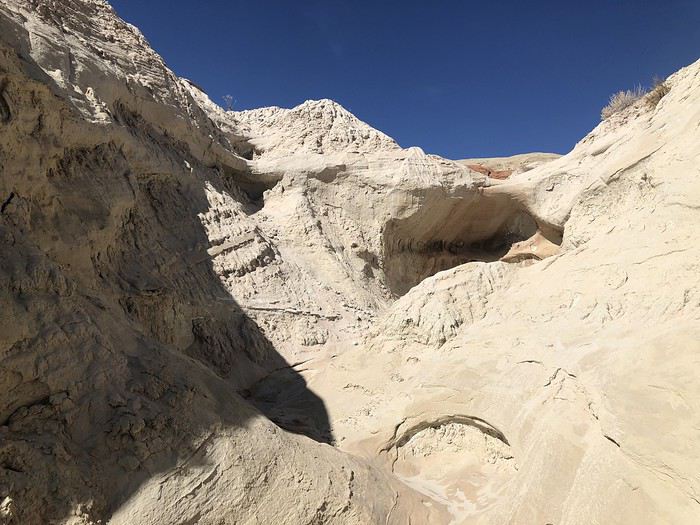
En revenant, je me suis retrouvée face à ce joli E.T. de Spielberg.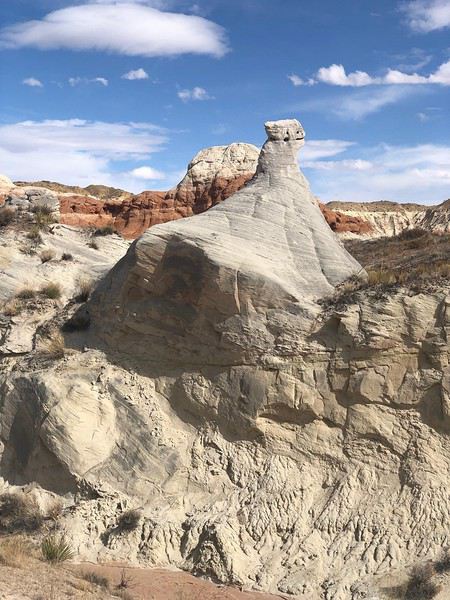
Puis après avoir laissé le chameau toujours sur ma gauche, je me suis retrouvée devant cette cour en rouge et blanc, avec quelques champignons qui émergeaient. Le tout entouré d'une paroi de colonnes blanches. C'est du plus bel effet.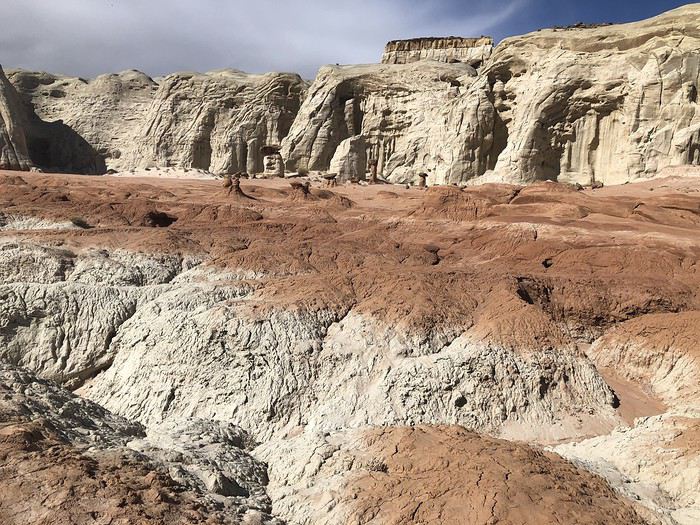
Le chameau au loin dans son environnement en rouge et blanc, a, je trouve, beaucoup plus d'assurance, surtout sous un ciel nuageux.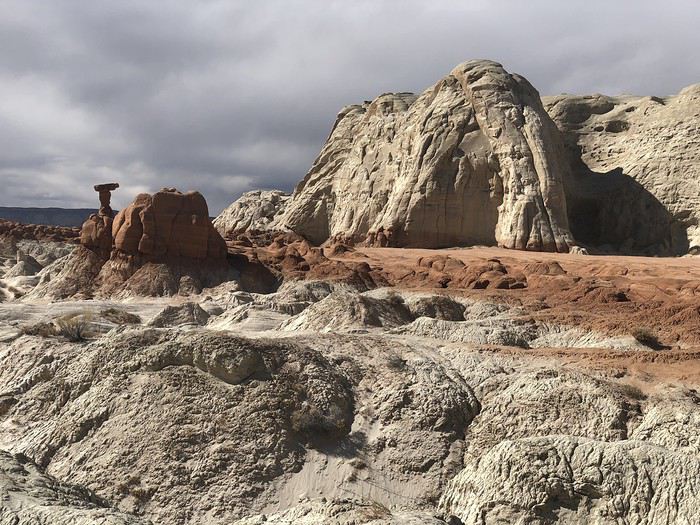
Il est une star parmi les autres, et ce personnage de Star wars ne me démentira pas.
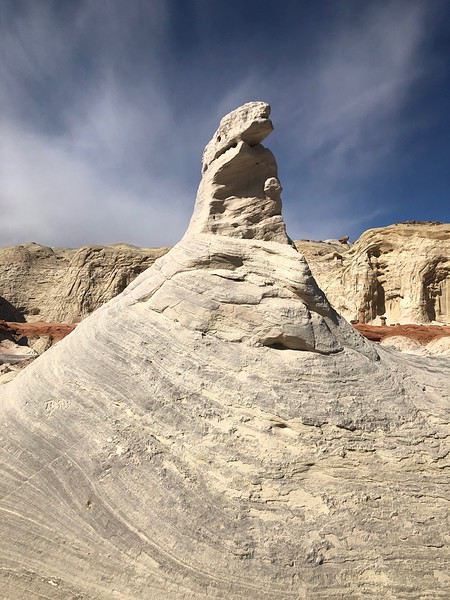
Je suis revenues des States le dimanche, le mercredi, Trump annonçait la fermeture des frontières aux Européens. J'ai eu une profonde respiration en entendant la nouvelle!!!
Je ne raconterai pas tout mon voyage... J'aime autant le chemin qui conduit aux sites que les sites eux-mêmes.
J'ai eu un vrai coup de cœur pour pleins de sites dont j'ai profité dans le south west, mais ce qui m'a surtout marqué, c'est le fait que souvent, sur les carnets, on a parfois l'impression (à tort d'ailleurs) qu'un site c'est juste une succession de choses importantes à voir dont il faut faire la liste et puis c'est tout.
Je vais donc vous faire découvrir toadstool à ma façon, j'aimerais vous faire découvrir les différentes étapes de ma découverte de ce park gratuit..
Voici tout d'abord ce qu'on découvre de la route: des montagnes chocolatées. Le parking placé devant à notre arrivée ne comporte qu'une voiture noire en fin de matinée.
Puis sur le parking, ou se trouve la voiture noire, on voit le panneau qui vous rassure sur le nom du park
Il y a aussi un panneau qui vous informe sur ce qu'est un toadstool, c'est à-dire un champignon vénéneux, mais si vous allez sur place vous le verrez. Vous aurez toutes les infos sur la formation des toadstools, et aussi sur le fait que le chemin allé simple fait 0,8 miles et aller retour fait 1,6 miles. Je n'ai pas très bien compris l'intérêt de la distance aller simple et me suis demandée s'il y avait des gens qui comptaient rester la-bas définitivement??? 🤪
Ce panneau vous informe aussi du fait qu'en été il peut y faire terriblement chaud, et qu'il vaut mieux vous munir de litres d'eau, d'un chapeau..... A notre arrivée début mars, la température extérieure est de 15°C, le soleil éclaire juste ce qu'il faut, une petite bouteille d'eau pour chacun de nous est amplement suffisante, et de chapeau que nenni!
08 miles aller simple....Mais en fait, vous marcherez beaucoup plus que ça, car une fois sur le site il y aura tellement de coins qui vous attireront que vous y passerez facilement plus de 2 heures si vous vous donnez la peine d'aller découvrir les recoins qui sont derrière le site principal. Et surtout si vous vous donnez la peine de farfouiller un peu. C'est un vrai jeu de chasse au trésor auquel nous nous sommes livrés.
Donc une fois que nous avons complété le registre inséré dans une boite métallique noire qui permet aux rangers de savoir qui chercher s'il vous prenait l'envie d'y rester définitivement, et qu'ensuite nous avons franchi la barrière en barbelés qui laisse entrer les humains qui peuvent se faufiler, mais pas les bovins et les ovins qui ne pourraient pas tordre leur abdomen pour suivre le grillage, vous découvrez de plus près les massifs chocolatés.
Puis vous découvrez que vous avez le choix de marcher dans des washs (ce sont des lits de rivière à sec)
Les massifs chocolatés sont parfois ornés de chantilly, et parfois, le sentier semble sortir du wash pour venir s'incruster entre les mamelons. C'est ce que montre le petit poteau planté sur la droite. C'est une sorte de cairn civilisé, quoi.
Le sentier peut parfois devenir un peu étroit, et si vous n'êtes pas à l'aise, il vaut mieux retourner dans le wash.
Parfois, c'est carrément acrobatique. Je me suis bien aidée de mes bâtons de marche.
Parfois ce poteau soi disant indicateur m'a laissé perplexe. Tout droit semble-t-il dire... oui mais où est le tout droit en question?
Inutile de dire que s'il a plu les jours qui précèdent votre passage, ou s'il a neigé, alors c'est une vraie pataugeoire dans laquelle vous évoluez. De simples sandales comme j'ai vu des gens en porter, ou même les chaussures de randonnée peuvent conduire à des chutes rocambolesques, ou causer des blessures sérieuses... Nous avons eu la chance en fin d'hiver d'être à une période sèche.
Et puis, il arrive que vous vous trouviez devant une ouverture comme celle là. Et à ce moment précis, plus aucun poteau, sinon ce ne serait pas marrant. Vous sauriez où aller, ce qui n'est manifestement pas le but. Alors, vous suivez votre instinct. Plutôt à droite? Plutôt à gauche? non? au centre alors?
Et bien j'n'en sais rien. J'ai pris une direction au hasard, (ça fonctionne parfois) et j'ai atterri en face de ça.
Sur ma gauche se trouvait le fameux chameau qui est sur toutes les photos de photographes professionnels, d'ailleurs sur place, il y en avait un qui ne s'intéressait qu'à ce mastodonte. C'est comme s'il était hermétique à toute la magie du reste.
D'ailleurs, il s'est plein à mon mari du mauvais balisage des pistes qui lui avait fait perdre du temps. Il n'est resté qu'autour du chameau, le prenant sous toutes ses coutures, avec différents éclairages. Bon, comme ça, c'est un truc de vrai photographe et que je n'en suis pas, vous n'aurez donc pas la super photo avec le super éclairage qui fait rêver. Au lieu de ça, je suis partie sur la droite par rapport au chameau à la recherche d'un spot de hoodoos blancs, dont j'avais découvert l'existence sur un carnet. J'ai trouvé que ce mélange de blanc et de rouge était très beau.
Vraiment très photogénique.
J'ai fait la connaissance du sphinx dont on a coupé le nez
Puis j'ai continué à me diriger vers les massifs blancs qui sont sur la droite, curieuse de tout voir.
Je me suis retrouvée devant une paroi verticale que j'ai dû escalader, pour finalement, me retrouvée au milieu d'une alcove sans issue (enfin pour moi qui ne suis nullement cascadeuse). J'ai donc redescendu ma paroi verticale, et suis retournée sur mes pas.
En revenant, je me suis retrouvée face à ce joli E.T. de Spielberg.
Puis après avoir laissé le chameau toujours sur ma gauche, je me suis retrouvée devant cette cour en rouge et blanc, avec quelques champignons qui émergeaient. Le tout entouré d'une paroi de colonnes blanches. C'est du plus bel effet.
Le chameau au loin dans son environnement en rouge et blanc, a, je trouve, beaucoup plus d'assurance, surtout sous un ciel nuageux.
Il est une star parmi les autres, et ce personnage de Star wars ne me démentira pas.
Oman, le pays des Mille moins Une Merveilles
Bonjour à tous,
Petit clin d'oeil au carnet d'Isabelle (Rouquine 38) quant au choix du titre 😉.
Pourquoi "mille moins une"? Tout simplement parce qu'en 10 jours, on en voit moins qu'en 14 et qu'en berline on en voit (un peu) moins qu'en 4x4. Exit donc le Dhofar et le Jebel Akhdar. Pour ce qui est des 999 autres merveilles, c'est pas faute de ne pas vous avoir prévenus: il va y avoir des redites!
C'est parti.... Muriel
Petit clin d'oeil au carnet d'Isabelle (Rouquine 38) quant au choix du titre 😉.
Pourquoi "mille moins une"? Tout simplement parce qu'en 10 jours, on en voit moins qu'en 14 et qu'en berline on en voit (un peu) moins qu'en 4x4. Exit donc le Dhofar et le Jebel Akhdar. Pour ce qui est des 999 autres merveilles, c'est pas faute de ne pas vous avoir prévenus: il va y avoir des redites!
C'est parti.... Muriel
Discussion autour du concours du mois de mars 2020: Seul(e) au monde ou la solitude
Bonjour 😉
C'est ici - et uniquement ici - qu'on discute à propos de la thématique du mois : Seul(e) au monde - concours photo du mois de Mars 2020
C'est ici - et uniquement ici - qu'on discute à propos de la thématique du mois : Seul(e) au monde - concours photo du mois de Mars 2020
Uganda: 20 days discovering authenticity
Preamble:
For summer 2019, the idea was to return to Africa. We had already been to Namibia in 2017 (+ a few days in Botswana and the end of the trip at Victoria Falls), which we loved, and a trip to Asia in 2018 (Borneo, Perhentian, and Singapore), a nature-focused trip but a bit disappointing due to environmental destruction. The desire to return to Africa was very strong. We wanted a change of scenery, nature, discoveries, to step out of our little comfort zone (a bit, anyway!) and experience travel differently. In short, we dreamed of authenticity, and we weren’t disappointed.
We traveled as a family of four with our daughters, aged 19 and 17. When the urge for Africa hit, Uganda quickly stood out, especially for the chance to see rare animals, particularly the famous mountain gorillas. When I looked into the budget, I was quickly disheartened. It’s really expensive. Too expensive… Then, after reading a few trip reports on "VoyageForum" (thanks Muriel J!), I decided to ask a local agency for a quote. The first contact was very friendly and responsive, and the initial offer for two weeks fit our budget :). A few images gathered from the internet (especially Sipi Falls) finally convinced us all. I asked for an adapted offer with a few more sites to extend the trip to three weeks and cover a fairly complete visit to the country (which, of course, increased the budget! To stay within an acceptable range, we prioritized activities over accommodations and regularly chose the cheapest options, with 2-3 nice lodges in between). It’s booked! We were in October 2018, and the first thing to do was reserve permits to see the gorillas and chimpanzees. Then, the agency took care of all the bookings except for the international flights, which we booked with Ethiopian Airlines. A few months of waiting to look forward to… and a little worry too! Two events didn’t reassure us: the kidnapping of an American tourist by four men at the DRC border and the Ebola outbreak in Congo, with confirmed cases in Uganda by mid-June…
Here we are in July, and departure is approaching. The suitcases are packed (warm clothes, long, short, dark, light, practical, sun, rain, hiking/trekking shoes, flip-flops—clothes for every situation! Don’t forget: headlamp (essential!), binoculars, cameras), and we’re ready.
One day before departure, our agency Mpolampola, through its manager Paul, informs us that he won’t be the one taking care of us during the trip but another guide named Moses. He has a big problem with a vehicle and can’t do otherwise. For us, as long as everything is okay, no worries, especially since I had read glowing reviews about Moses, who turned out to be a very pleasant guide, cautious (most important) on the road, clear about all the activities, and an expert on birds, his specialty. We briefly met Paul in the middle of the trip, who is also very friendly. In short, we 100% recommend this agency. Flights to Entebbe went smoothly; we arrived around 10:30 AM, filled out health forms (Ebola information signs everywhere), visas, baggage claim, and met Moses, who took us directly to the vehicle. It was in pretty good condition with huge tires (we’d understand why later!), but it had quite a few miles (400,000 on the odometer!). Just missing a seatbelt… Okay, it’s Africa!
Now, here’s our day-by-day itinerary, which I’ll summarize briefly with ratings for each activity: ****TOPISSIME (Amazing) ***Very good **Good *Meh
Day 1) Departure from the airport at 11:45 AM for some currency exchange. Stop along the way at the equator for a meal and souvenir photo! Arrival at Lake Mburo Park *** around 5:00 PM. Even before entering the park, we saw lots of antelopes, zebras, elks, etc.—it’s magnificent. On the way, we had already encountered many goats and cows, and we were impressed by their enormous horns. We enjoyed a nice game drive until about 7:00 PM, when we reached our lodge, one of the nicest of the trip, Eagle’s Nest ****, with a magnificent view, a tent with a nice bathroom/shower, and a very good meal.
Day 2) Departure at 7:00 AM for a game drive; we encountered many animals again, especially antelopes, zebras, and birds. There are no giraffes, lions, or cheetahs in this park. We didn’t get lucky enough to see a leopard… :-) Then, we continued to Lake Bunyonyi ***, where the road and views are very beautiful, but we were shocked to see locals (mostly women and children) breaking stones by hand on the mountainside in very precarious safety conditions. There are regularly dramatic accidents because, over time, entire sections detach and cause landslides. These stones are then used for road construction… Another world… This was the only place we saw this. Lake Bunyonyi is a nice stop (but less exotic in our opinion since we have many lakes back home too!). We took a boat to our accommodation, Byoona Amagara ***, which has a lot of charm. We stayed in huts called "geodomes," completely open to nature, so it was very cool at night. To reach the toilets located below, you had to be brave! The meal consisted of lake shrimp—good but a bit bland.
Day 3) After a good breakfast, departure at 9:00 AM to visit three islands. We took several nice walks with beautiful views of the lake and islands. A local meal was served on the last island. At 1:00 PM, we met Moses for the rest of the program and headed to Ruhija in Bwindi Forest****. The landscapes are breathtaking. After two hours of driving and many photo stops, we arrived at our accommodation near the trekking starting point, Ruhija Gorilla Friends Resort **. We stayed in a room instead of the initially planned tents, which was just as well because there was a lot of wind during the night. We still had time for an activity and decided to meet the Bwata pygmies despite the bad reviews in the guide… The first part of the visit was quite nice, with a visit to a school where the children gave us a very joyful welcome. We had a great time listening to them sing and dance! Then we met the Bwata pygmies who live on the edge of the forest. When Bwindi Forest was declared a national park, they had to leave their habitat because their activities weren’t compatible with nature and wildlife protection. We left on a somewhat sad note… The visit ended with a local doctor explaining different medicinal plants, and we watched the making of local beer from sorghum. Good meal. We had butterflies in our stomachs—tomorrow was a big day! I admit I was a bit stressed, not entirely confident in my physical abilities…
Day 4) After a short night due to excitement, breakfast, and departure at 7:30 AM. First, it started calmly with singing and dancing. Then, a 15-minute briefing and group assignments. No one asked if we had any physical problems or anything (when booking, I had inquired a bit, and they told me groups were assigned based on physical abilities). We were assigned to the Mukiza group. At first, I was pretty happy—it was a fairly large group with babies :). The ranger explained that for now, they didn’t know where the gorillas were… the trackers couldn’t find them… Oh… (that’s not a good sign!!!) We set off at a good pace, first on a reasonably sloped path. We were accompanied by a family of four Italians and five porters (four for us!). After an hour, the ranger stopped us and informed us they still couldn’t find them—they had fought with another group the day before and scattered throughout the forest, so they were very far away, and we needed to move faster… Hmm… we picked up the pace (we weren’t going slowly before!!!) and walked for another good hour—down, up, down again, up again, we kept going, but always more or less on paths. Then another stop. A 10-minute break waiting for news. The news wasn’t very precise, it seemed! The ranger decided to cut through the forest—machetes were used to clear the path. We descended unimaginable slopes, then climbed back up. Our stick kept getting stuck; luckily, our porter helped us, held our hands, and the terrain was vertical! An hour later, another stop: we heard gorilla cries (yay!!!). False hope—we waited again for news from the trackers, who informed our ranger that it was a non-habituated family, so we couldn’t see them. Cold shower—we had to go all the way back up and return to the starting point to maybe see another group. But time was running out… We arrived around 1:30 PM; all the other groups had already left long ago. Our guide was worried because we still had a long drive ahead. We quickly ate a banana, and off we went for another trek (I was exhausted!). Luckily, this group was close—about 45 minutes of steep descent (I was already thinking about the climb back and considering being adopted by a gorilla ). The forest was sublime, with magnificent tree ferns—the place was truly splendid. Finally, we were there. The porters stayed behind, we grabbed our cameras, and followed the ranger. The progress wasn’t easy, but suddenly, a female was in front of us, curled up in a little ball, eating—so cute. The emotion overwhelmed us. But she moved away—it’s hard to observe them; they move constantly, and the terrain is very steep and uneven. We saw a female descending from a tree with a baby on her back—too adorable. Then, here was the silverback, enormous, incredible, yet so calm and peaceful. He ate quietly and gave us a nice demonstration of nostril exploration! We could observe them for a good hour, but photographing them wasn’t easy because they kept moving, and we could barely stand! Toward the end, a large male (black back) suddenly stood up and decided to pass right where I was! I ended up in the bushes, and the male passed in front of me just a few centimeters away (he stepped on one of my daughters’ feet!) followed by the whole family. Just an exceptional moment. It was time to leave; we had to climb back up. I dreaded it because, I admit, I was exhausted. We finished the hike after 4:00 PM, exhausted but happy. The ranger gave us diplomas, and we didn’t linger because we still had a long drive—we needed to reach Ishasha before nightfall. Our guide was a bit stressed. If we were to do it again, we’d spend an extra night in Bwindi. However, it seems finishing so late is exceptional—it never happens, according to our guide! The road between Bwindi and Ishasha is sublime, with extraordinary landscapes, and despite the late hour, we regularly asked our guide to stop for photos. We arrived at Enjojo *** Lodge around 6:00 PM. The huts are located quite far from the reception and the bathrooms, a bit far from the huts, but otherwise, it was very nice.
Day 5) Departure at 8:00 AM after a good breakfast with the hope of seeing tree-climbing lions (no luck!). Overall, there weren’t many animals, and we arrived around 12:45 PM at our next stop, Parkview Safari Lodge ****, with a magnificent view, a beautiful family bungalow, and a good meal. We enjoyed a short relaxation by the lovely pool. At 4:00 PM, we left to see Kyambura Gorge *** and hike there. Unfortunately, this activity is no longer available, so we walked around the area—it was very beautiful. Back at the hotel, a little rest after the previous day wasn’t a bad idea! Reading, swimming, meals, and dances made the end of the day enjoyable.
Day 6) Departure at 6:30 AM—one of our daughters was sick (stomachache, cold sweats…). Safari in Queen Elizabeth ** (Kaseny Plains)—a bit disappointing. Stop by the salt lake with a nice view. A small market, but we weren’t thrilled by the crafts (overall, apart from some beautiful baskets/plates, there wasn’t much, and the wooden objects were, in our opinion, much less pretty than in Namibia). Then we took the crater road (27 km long) **** with magnificent landscapes. However, you absolutely must close the windows because it’s infested with tsetse flies. At noon, we arrived at Mweya, where we stayed in basic rooms, but the restaurant was well-placed with a beautiful view of the Kazinga Channel. At 2:00 PM, we enjoyed a magnificent cruise **** on the channel. Elephants, antelopes, crocodiles, hippos (including adorable babies), buffaloes, all kinds of birds. Wow!!! Two hours of pure bliss. Quiet end of the day playing cards with a view of the channel and elephants.
Day 7) Departure at 6:00 AM—still sick, we weren’t sure if it was due to the preventive treatment (Malarone) or something else… Another game drive in Queen Elizabeth (Kaseny Plains) and breakfast by the salt lake. Overall, we were a bit disappointed by this park. Then we took the road to Crater Lakes***, again with very beautiful landscapes. A hike of about an hour and a half allowed us to discover these beautiful crater lakes (the water mainly comes from the Rwenzoris). We crossed pretty villages and had nice encounters. End of the day at Tinka’s Home ****, with a family. We loved this place—very welcoming, where we took a cooking class with our hosts. A really great time. After the meal, we enjoyed African stories and dances. Really awesome.
Day 8) Departure at 7:30 AM for another highly anticipated discovery—the chimpanzees in Kibale Forest ****. We went to the meeting point and were split into groups of six, each with a guide. We saw three different groups, and for the last group, we followed a chimpanzee (slightly more comfortable running in the forest than we were!) that led us to the group. Their cries are very impressive, and we could observe them well, even though they were often high up in the trees. We were lucky enough to see two on the ground, very close to us. It was magnificent. End of the encounter and return to the starting point—it was noon. We went back to Tinka’s Home for the meal (delicious!). At 2:00 PM, we hiked in Bigodi Swamp ***, a marsh surrounded by beautiful vegetation, especially huge papyrus, and inhabited by many birds and monkeys. We saw, among others, black-and-white colobus monkeys, red colobus monkeys, and vervet monkeys. We also visited a basket-weaving workshop where we bought two beautiful baskets. Then a short stop in Fort Portal, where we stayed for two nights at Ruwenzori View Guesthouse ***, a nice place with a family room and very good communal meals.
Day 9) Departure at 8:00 AM for a hike in the Rwenzori****—it was a bit chaotic today. First, we had to exchange shillings because we wouldn’t have another chance in the following days. At the bank, employees went to get the bills by motorcycle from other buildings—it was quite surreal! And it took time! Then there was a misunderstanding between the organizer and me… I really wanted to see the region where chameleons are found in the Rwenzori—this region is south of the mountain range, and we were in the north! Anyway, the program included an ascent in the northern part with a positive elevation gain of over 1,500 meters… Talking to the guide scheduled for this hike (Noah), we explained that we really wanted to discover the vegetation and these famous chameleons, not necessarily achieve a physical feat… (we’d had enough!). The decision was made to go south, which meant quite a bit of driving. The hike was really enjoyable, with magnificent vegetation by the river. We saw three of the four chameleon species present, including the famous three-horned chameleon. The region is superb. We ended with a drink at Ruboni Camp, which has a magnificent view of the region (ideally, we should have stayed there). Two hours of driving to finish, and a good meal :).
Day 10) Departure at 8:00 AM—we had a long drive to Ziwa Rhino Ranch****. We passed through Hoima, had lunch in Masindi, and arrived in time for the rhino tracking walk. We could approach them closely on foot—it was impressive. We saw eight. Since we were staying on-site in the guesthouse **, we received precise safety instructions for moving between the rooms and the restaurant. And we quickly understood why!
Day 11) Departure at 6:00 AM for breakfast—surprise, in front of our room, several large rhinos were sleeping (we had also heard a lot of animal noises during the night—rhinos but also what seemed to be predators). So we had to take a detour to reach the restaurant! Second surprise—next to the restaurant, just three meters away at most, two mothers and their baby were also sleeping! Memorable! Then we had an appointment for the shoebill trek and canoe ride **** (package with the previous day’s walk). So there we were, in our boots, splashing through 30 cm of water in search of the shoebill (I really wanted to see one :))! It was really fun, and luck was on our side—a shoebill had just landed in the distance! We approached as best we could and observed it from afar. What a strange bird! There are very few left, and Uganda is one of the countries where the chances of seeing one are quite good. The tour continued with a canoe cruise where we saw a herd of cows (the famous ones with enormous horns) being swum as a dowry to the father of the future bride! A funny spectacle. This stop wasn’t the most anticipated, but we all thought it was really worth the detour. Road to Murchison Falls Park, and arrival around noon at Red Chili Rest Camp **, where we stayed for two nights (family banda). Good meal. Then a cruise to Murchison Falls*** where we disembarked and continued on foot. It was pretty. Back to Red Chili.
Day 12) This morning, early departure for a cruise in search of the shoebill*** (booked in case we didn’t see one at Ziwa). The landscapes were pretty, but there weren’t many birds in the end. We spotted the chosen one from afar after the first 10 minutes—so the suspense didn’t last long :-) It was a nice activity but quite long—5 hours. In the afternoon, safari in Murchison Park****—this park is sublime, the landscapes fabulous. Really one of our favorite parts of the trip. Lots of animals and even a leopard spotted with binoculars because it was far away! Night at Red Chili.
Day 13) Departure for the first morning ferry—it was drizzling, the sky was threatening at first, so the landscape was spectacular! Beautiful contrasts. In the middle of the morning, we were lucky to observe a whole group of lions, first from afar, then with a little patience, the whole group approached until they passed beside and in front of our vehicle. What emotion and excitement! We could then observe large groups of giraffes. They were magnificent. The morning was incredible. Then we headed to our lodge, Fort Murchison ****, and on the way, we saw a whole group of elephants—the view was magnificent. We had a very good meal and enjoyed the pool a bit. We also met Paul, the organizer of our trip. Very nice :). In the late afternoon, off for a short safari in the park. We slept in very well-equipped tents.
Day 14) Today, we had a long drive to Kidepo Park. It was raining, which didn’t help our guide—according to him, the tracks near Kidepo turn to mud with rain and become difficult to navigate. We saw, among other things, a bus in a bad situation in the ditch. Some sections were really tricky, and we were glad to have a driver. The end of the trip—the landscape was spectacular and original, and we saw some traditional villages. We arrived at Kidepo quite late. Short safari in the park before reaching the accommodation. We booked two simple bandas in the park camp**. It was clean but didn’t hold up well in the rain . The restaurant was very nice, though.
Day 15) The day was dedicated to discovering Kidepo Park **** where the landscapes were again superb. First encounter with a lioness resting on a rock. We saw other lions later and observed them for a long time. There were almost no other tourists in the park. Our daughter wasn’t feeling well, and by the time we arrived at the lodge, she had a temperature of 39.5°C (103.1°F)… A nap was necessary. In the late afternoon, we returned to the spot where we had seen the lions that morning, and they were still there—they weren’t happy because rain was threatening! It was a great photo opportunity. Then came the downpour, and our driver urged us to return quickly because the tracks were becoming impassable. Indeed, a jeep was in the ditch… The return was eventful, and several times we slid without being able to do anything… Wow, what a day!
Day 16) No safari this morning because of impassable tracks—the road to Kotido*** was longer than expected as we had to take a detour. The landscapes along the way were surprising. We finally arrived around 1:00 PM at the accommodation and left at 3:00 PM to visit the largest manyatta in East Africa with two translators. It was incredible—a very beautiful experience. The manyatta is immense and has 28,000 inhabitants. Night at Karamojaarts guesthouse*—very average meal.
Day 17) Departure for Moroto****—on the way, we saw many bird species. Moroto doesn’t look like other Ugandan cities. Life there seems very pleasant. We arrived at Kara-Tunga and had a bite to eat. At 4:00 PM, we left to visit a Karamojong village. We enjoyed beautiful dances and watched communal games—it was fun and so authentic. Then we headed to a kraal (where shepherds and herds are) to set up our camp. Moses had to get used to the idea of sleeping in the tribe in a tent! It was incredible to find ourselves in this universe. The place was beautiful, and we had a great time with the Karamojong. Some had never seen white people… had never been in a car… Their culture is incredible. During the evening, around the fire, to our guide’s dismay (a bird enthusiast), they grilled hornbills! On our side, we ate a meal prepared by Kara-Tunga for our sensitive stomachs! Night in a tent.
Day 18) Dawn wake-up in the fog—the atmosphere was quite strange. Our daughter was attacked by a cow—fortunately, more fear than harm, but she ended up with a lot of thorns in her buttocks and thighs ! Then we left for the Mount Elgon region, specifically Sipi Falls****. Lacam Lodge****, perched on the edge of the cliff with a direct view of one of the falls, was just magnificent. The view and landscapes were fabulous. Big favorite. We had dinner and then went for a hike to visit the three falls in the region, partly in the rain. The landscapes were breathtaking! Sunset at Lacam Lodge with the sun setting over the waterfall. We couldn’t get enough and stayed to admire until nightfall!
Day 19) Visit to coffee plantations*** where we were given all the useful explanations to understand the culture and the incredible work required for this product, which is ultimately not very glorified. The visit was very interesting, and we drank very good coffee with the owners. Last photos at Lacam Lodge, and then departure for Jinja, where we arrived in the middle of the afternoon. We took a small cruise to see the source of the Nile*. Very touristy and not at all to our taste… Then a meal at Jinja Base Camp** where we enjoyed guacamole. Our guide Moses left us because another group was waiting for him!
Day 20) Road to Kampala***, the market, the Gaddafi Mosque. Short but interesting visit. Last meal in Entebbe by Lake Victoria, where we almost felt like we were by the sea. Transfer to the airport and return to Switzerland…
Epilogue: All four of us were enchanted by this trip, which will undoubtedly remain one of the most beautiful we’ve ever taken. Talking about it gives me chills and brings tears to my eyes. It was simply a magnificent experience. However, I wouldn’t recommend this trip to everyone because you often have to overlook small inconveniences like toilets (the worst of my life) and certain comfort details that, for us, remain details but could be important to others.
Our favorites: - The gorilla trek - The cruise on Kazinga Channel - The Fort Portal region - The Rwenzori Mountains - The chimpanzee trek - Murchison Falls - Kidepo - Spending time with the Karamojong tribe - The Sipi Falls region - The accommodations: Eagle’s Nest, Byonna Amagara, Parkview Lodge, Tinka’s Home, Rwenzori Guesthouse, Fort Murchison, Night in the kraal, and Lacam Lodge
What we liked less: - Queen Elizabeth Park - Jinja - The accommodations: Ziwa Rhino Ranch, Karamojaarts Guesthouse
I’ll try to post some photos later. If you have any questions about a future trip, I’d be happy to answer them.
For summer 2019, the idea was to return to Africa. We had already been to Namibia in 2017 (+ a few days in Botswana and the end of the trip at Victoria Falls), which we loved, and a trip to Asia in 2018 (Borneo, Perhentian, and Singapore), a nature-focused trip but a bit disappointing due to environmental destruction. The desire to return to Africa was very strong. We wanted a change of scenery, nature, discoveries, to step out of our little comfort zone (a bit, anyway!) and experience travel differently. In short, we dreamed of authenticity, and we weren’t disappointed.
We traveled as a family of four with our daughters, aged 19 and 17. When the urge for Africa hit, Uganda quickly stood out, especially for the chance to see rare animals, particularly the famous mountain gorillas. When I looked into the budget, I was quickly disheartened. It’s really expensive. Too expensive… Then, after reading a few trip reports on "VoyageForum" (thanks Muriel J!), I decided to ask a local agency for a quote. The first contact was very friendly and responsive, and the initial offer for two weeks fit our budget :). A few images gathered from the internet (especially Sipi Falls) finally convinced us all. I asked for an adapted offer with a few more sites to extend the trip to three weeks and cover a fairly complete visit to the country (which, of course, increased the budget! To stay within an acceptable range, we prioritized activities over accommodations and regularly chose the cheapest options, with 2-3 nice lodges in between). It’s booked! We were in October 2018, and the first thing to do was reserve permits to see the gorillas and chimpanzees. Then, the agency took care of all the bookings except for the international flights, which we booked with Ethiopian Airlines. A few months of waiting to look forward to… and a little worry too! Two events didn’t reassure us: the kidnapping of an American tourist by four men at the DRC border and the Ebola outbreak in Congo, with confirmed cases in Uganda by mid-June…
Here we are in July, and departure is approaching. The suitcases are packed (warm clothes, long, short, dark, light, practical, sun, rain, hiking/trekking shoes, flip-flops—clothes for every situation! Don’t forget: headlamp (essential!), binoculars, cameras), and we’re ready.
One day before departure, our agency Mpolampola, through its manager Paul, informs us that he won’t be the one taking care of us during the trip but another guide named Moses. He has a big problem with a vehicle and can’t do otherwise. For us, as long as everything is okay, no worries, especially since I had read glowing reviews about Moses, who turned out to be a very pleasant guide, cautious (most important) on the road, clear about all the activities, and an expert on birds, his specialty. We briefly met Paul in the middle of the trip, who is also very friendly. In short, we 100% recommend this agency. Flights to Entebbe went smoothly; we arrived around 10:30 AM, filled out health forms (Ebola information signs everywhere), visas, baggage claim, and met Moses, who took us directly to the vehicle. It was in pretty good condition with huge tires (we’d understand why later!), but it had quite a few miles (400,000 on the odometer!). Just missing a seatbelt… Okay, it’s Africa!
Now, here’s our day-by-day itinerary, which I’ll summarize briefly with ratings for each activity: ****TOPISSIME (Amazing) ***Very good **Good *Meh
Day 1) Departure from the airport at 11:45 AM for some currency exchange. Stop along the way at the equator for a meal and souvenir photo! Arrival at Lake Mburo Park *** around 5:00 PM. Even before entering the park, we saw lots of antelopes, zebras, elks, etc.—it’s magnificent. On the way, we had already encountered many goats and cows, and we were impressed by their enormous horns. We enjoyed a nice game drive until about 7:00 PM, when we reached our lodge, one of the nicest of the trip, Eagle’s Nest ****, with a magnificent view, a tent with a nice bathroom/shower, and a very good meal.
Day 2) Departure at 7:00 AM for a game drive; we encountered many animals again, especially antelopes, zebras, and birds. There are no giraffes, lions, or cheetahs in this park. We didn’t get lucky enough to see a leopard… :-) Then, we continued to Lake Bunyonyi ***, where the road and views are very beautiful, but we were shocked to see locals (mostly women and children) breaking stones by hand on the mountainside in very precarious safety conditions. There are regularly dramatic accidents because, over time, entire sections detach and cause landslides. These stones are then used for road construction… Another world… This was the only place we saw this. Lake Bunyonyi is a nice stop (but less exotic in our opinion since we have many lakes back home too!). We took a boat to our accommodation, Byoona Amagara ***, which has a lot of charm. We stayed in huts called "geodomes," completely open to nature, so it was very cool at night. To reach the toilets located below, you had to be brave! The meal consisted of lake shrimp—good but a bit bland.
Day 3) After a good breakfast, departure at 9:00 AM to visit three islands. We took several nice walks with beautiful views of the lake and islands. A local meal was served on the last island. At 1:00 PM, we met Moses for the rest of the program and headed to Ruhija in Bwindi Forest****. The landscapes are breathtaking. After two hours of driving and many photo stops, we arrived at our accommodation near the trekking starting point, Ruhija Gorilla Friends Resort **. We stayed in a room instead of the initially planned tents, which was just as well because there was a lot of wind during the night. We still had time for an activity and decided to meet the Bwata pygmies despite the bad reviews in the guide… The first part of the visit was quite nice, with a visit to a school where the children gave us a very joyful welcome. We had a great time listening to them sing and dance! Then we met the Bwata pygmies who live on the edge of the forest. When Bwindi Forest was declared a national park, they had to leave their habitat because their activities weren’t compatible with nature and wildlife protection. We left on a somewhat sad note… The visit ended with a local doctor explaining different medicinal plants, and we watched the making of local beer from sorghum. Good meal. We had butterflies in our stomachs—tomorrow was a big day! I admit I was a bit stressed, not entirely confident in my physical abilities…
Day 4) After a short night due to excitement, breakfast, and departure at 7:30 AM. First, it started calmly with singing and dancing. Then, a 15-minute briefing and group assignments. No one asked if we had any physical problems or anything (when booking, I had inquired a bit, and they told me groups were assigned based on physical abilities). We were assigned to the Mukiza group. At first, I was pretty happy—it was a fairly large group with babies :). The ranger explained that for now, they didn’t know where the gorillas were… the trackers couldn’t find them… Oh… (that’s not a good sign!!!) We set off at a good pace, first on a reasonably sloped path. We were accompanied by a family of four Italians and five porters (four for us!). After an hour, the ranger stopped us and informed us they still couldn’t find them—they had fought with another group the day before and scattered throughout the forest, so they were very far away, and we needed to move faster… Hmm… we picked up the pace (we weren’t going slowly before!!!) and walked for another good hour—down, up, down again, up again, we kept going, but always more or less on paths. Then another stop. A 10-minute break waiting for news. The news wasn’t very precise, it seemed! The ranger decided to cut through the forest—machetes were used to clear the path. We descended unimaginable slopes, then climbed back up. Our stick kept getting stuck; luckily, our porter helped us, held our hands, and the terrain was vertical! An hour later, another stop: we heard gorilla cries (yay!!!). False hope—we waited again for news from the trackers, who informed our ranger that it was a non-habituated family, so we couldn’t see them. Cold shower—we had to go all the way back up and return to the starting point to maybe see another group. But time was running out… We arrived around 1:30 PM; all the other groups had already left long ago. Our guide was worried because we still had a long drive ahead. We quickly ate a banana, and off we went for another trek (I was exhausted!). Luckily, this group was close—about 45 minutes of steep descent (I was already thinking about the climb back and considering being adopted by a gorilla ). The forest was sublime, with magnificent tree ferns—the place was truly splendid. Finally, we were there. The porters stayed behind, we grabbed our cameras, and followed the ranger. The progress wasn’t easy, but suddenly, a female was in front of us, curled up in a little ball, eating—so cute. The emotion overwhelmed us. But she moved away—it’s hard to observe them; they move constantly, and the terrain is very steep and uneven. We saw a female descending from a tree with a baby on her back—too adorable. Then, here was the silverback, enormous, incredible, yet so calm and peaceful. He ate quietly and gave us a nice demonstration of nostril exploration! We could observe them for a good hour, but photographing them wasn’t easy because they kept moving, and we could barely stand! Toward the end, a large male (black back) suddenly stood up and decided to pass right where I was! I ended up in the bushes, and the male passed in front of me just a few centimeters away (he stepped on one of my daughters’ feet!) followed by the whole family. Just an exceptional moment. It was time to leave; we had to climb back up. I dreaded it because, I admit, I was exhausted. We finished the hike after 4:00 PM, exhausted but happy. The ranger gave us diplomas, and we didn’t linger because we still had a long drive—we needed to reach Ishasha before nightfall. Our guide was a bit stressed. If we were to do it again, we’d spend an extra night in Bwindi. However, it seems finishing so late is exceptional—it never happens, according to our guide! The road between Bwindi and Ishasha is sublime, with extraordinary landscapes, and despite the late hour, we regularly asked our guide to stop for photos. We arrived at Enjojo *** Lodge around 6:00 PM. The huts are located quite far from the reception and the bathrooms, a bit far from the huts, but otherwise, it was very nice.
Day 5) Departure at 8:00 AM after a good breakfast with the hope of seeing tree-climbing lions (no luck!). Overall, there weren’t many animals, and we arrived around 12:45 PM at our next stop, Parkview Safari Lodge ****, with a magnificent view, a beautiful family bungalow, and a good meal. We enjoyed a short relaxation by the lovely pool. At 4:00 PM, we left to see Kyambura Gorge *** and hike there. Unfortunately, this activity is no longer available, so we walked around the area—it was very beautiful. Back at the hotel, a little rest after the previous day wasn’t a bad idea! Reading, swimming, meals, and dances made the end of the day enjoyable.
Day 6) Departure at 6:30 AM—one of our daughters was sick (stomachache, cold sweats…). Safari in Queen Elizabeth ** (Kaseny Plains)—a bit disappointing. Stop by the salt lake with a nice view. A small market, but we weren’t thrilled by the crafts (overall, apart from some beautiful baskets/plates, there wasn’t much, and the wooden objects were, in our opinion, much less pretty than in Namibia). Then we took the crater road (27 km long) **** with magnificent landscapes. However, you absolutely must close the windows because it’s infested with tsetse flies. At noon, we arrived at Mweya, where we stayed in basic rooms, but the restaurant was well-placed with a beautiful view of the Kazinga Channel. At 2:00 PM, we enjoyed a magnificent cruise **** on the channel. Elephants, antelopes, crocodiles, hippos (including adorable babies), buffaloes, all kinds of birds. Wow!!! Two hours of pure bliss. Quiet end of the day playing cards with a view of the channel and elephants.
Day 7) Departure at 6:00 AM—still sick, we weren’t sure if it was due to the preventive treatment (Malarone) or something else… Another game drive in Queen Elizabeth (Kaseny Plains) and breakfast by the salt lake. Overall, we were a bit disappointed by this park. Then we took the road to Crater Lakes***, again with very beautiful landscapes. A hike of about an hour and a half allowed us to discover these beautiful crater lakes (the water mainly comes from the Rwenzoris). We crossed pretty villages and had nice encounters. End of the day at Tinka’s Home ****, with a family. We loved this place—very welcoming, where we took a cooking class with our hosts. A really great time. After the meal, we enjoyed African stories and dances. Really awesome.
Day 8) Departure at 7:30 AM for another highly anticipated discovery—the chimpanzees in Kibale Forest ****. We went to the meeting point and were split into groups of six, each with a guide. We saw three different groups, and for the last group, we followed a chimpanzee (slightly more comfortable running in the forest than we were!) that led us to the group. Their cries are very impressive, and we could observe them well, even though they were often high up in the trees. We were lucky enough to see two on the ground, very close to us. It was magnificent. End of the encounter and return to the starting point—it was noon. We went back to Tinka’s Home for the meal (delicious!). At 2:00 PM, we hiked in Bigodi Swamp ***, a marsh surrounded by beautiful vegetation, especially huge papyrus, and inhabited by many birds and monkeys. We saw, among others, black-and-white colobus monkeys, red colobus monkeys, and vervet monkeys. We also visited a basket-weaving workshop where we bought two beautiful baskets. Then a short stop in Fort Portal, where we stayed for two nights at Ruwenzori View Guesthouse ***, a nice place with a family room and very good communal meals.
Day 9) Departure at 8:00 AM for a hike in the Rwenzori****—it was a bit chaotic today. First, we had to exchange shillings because we wouldn’t have another chance in the following days. At the bank, employees went to get the bills by motorcycle from other buildings—it was quite surreal! And it took time! Then there was a misunderstanding between the organizer and me… I really wanted to see the region where chameleons are found in the Rwenzori—this region is south of the mountain range, and we were in the north! Anyway, the program included an ascent in the northern part with a positive elevation gain of over 1,500 meters… Talking to the guide scheduled for this hike (Noah), we explained that we really wanted to discover the vegetation and these famous chameleons, not necessarily achieve a physical feat… (we’d had enough!). The decision was made to go south, which meant quite a bit of driving. The hike was really enjoyable, with magnificent vegetation by the river. We saw three of the four chameleon species present, including the famous three-horned chameleon. The region is superb. We ended with a drink at Ruboni Camp, which has a magnificent view of the region (ideally, we should have stayed there). Two hours of driving to finish, and a good meal :).
Day 10) Departure at 8:00 AM—we had a long drive to Ziwa Rhino Ranch****. We passed through Hoima, had lunch in Masindi, and arrived in time for the rhino tracking walk. We could approach them closely on foot—it was impressive. We saw eight. Since we were staying on-site in the guesthouse **, we received precise safety instructions for moving between the rooms and the restaurant. And we quickly understood why!
Day 11) Departure at 6:00 AM for breakfast—surprise, in front of our room, several large rhinos were sleeping (we had also heard a lot of animal noises during the night—rhinos but also what seemed to be predators). So we had to take a detour to reach the restaurant! Second surprise—next to the restaurant, just three meters away at most, two mothers and their baby were also sleeping! Memorable! Then we had an appointment for the shoebill trek and canoe ride **** (package with the previous day’s walk). So there we were, in our boots, splashing through 30 cm of water in search of the shoebill (I really wanted to see one :))! It was really fun, and luck was on our side—a shoebill had just landed in the distance! We approached as best we could and observed it from afar. What a strange bird! There are very few left, and Uganda is one of the countries where the chances of seeing one are quite good. The tour continued with a canoe cruise where we saw a herd of cows (the famous ones with enormous horns) being swum as a dowry to the father of the future bride! A funny spectacle. This stop wasn’t the most anticipated, but we all thought it was really worth the detour. Road to Murchison Falls Park, and arrival around noon at Red Chili Rest Camp **, where we stayed for two nights (family banda). Good meal. Then a cruise to Murchison Falls*** where we disembarked and continued on foot. It was pretty. Back to Red Chili.
Day 12) This morning, early departure for a cruise in search of the shoebill*** (booked in case we didn’t see one at Ziwa). The landscapes were pretty, but there weren’t many birds in the end. We spotted the chosen one from afar after the first 10 minutes—so the suspense didn’t last long :-) It was a nice activity but quite long—5 hours. In the afternoon, safari in Murchison Park****—this park is sublime, the landscapes fabulous. Really one of our favorite parts of the trip. Lots of animals and even a leopard spotted with binoculars because it was far away! Night at Red Chili.
Day 13) Departure for the first morning ferry—it was drizzling, the sky was threatening at first, so the landscape was spectacular! Beautiful contrasts. In the middle of the morning, we were lucky to observe a whole group of lions, first from afar, then with a little patience, the whole group approached until they passed beside and in front of our vehicle. What emotion and excitement! We could then observe large groups of giraffes. They were magnificent. The morning was incredible. Then we headed to our lodge, Fort Murchison ****, and on the way, we saw a whole group of elephants—the view was magnificent. We had a very good meal and enjoyed the pool a bit. We also met Paul, the organizer of our trip. Very nice :). In the late afternoon, off for a short safari in the park. We slept in very well-equipped tents.
Day 14) Today, we had a long drive to Kidepo Park. It was raining, which didn’t help our guide—according to him, the tracks near Kidepo turn to mud with rain and become difficult to navigate. We saw, among other things, a bus in a bad situation in the ditch. Some sections were really tricky, and we were glad to have a driver. The end of the trip—the landscape was spectacular and original, and we saw some traditional villages. We arrived at Kidepo quite late. Short safari in the park before reaching the accommodation. We booked two simple bandas in the park camp**. It was clean but didn’t hold up well in the rain . The restaurant was very nice, though.
Day 15) The day was dedicated to discovering Kidepo Park **** where the landscapes were again superb. First encounter with a lioness resting on a rock. We saw other lions later and observed them for a long time. There were almost no other tourists in the park. Our daughter wasn’t feeling well, and by the time we arrived at the lodge, she had a temperature of 39.5°C (103.1°F)… A nap was necessary. In the late afternoon, we returned to the spot where we had seen the lions that morning, and they were still there—they weren’t happy because rain was threatening! It was a great photo opportunity. Then came the downpour, and our driver urged us to return quickly because the tracks were becoming impassable. Indeed, a jeep was in the ditch… The return was eventful, and several times we slid without being able to do anything… Wow, what a day!
Day 16) No safari this morning because of impassable tracks—the road to Kotido*** was longer than expected as we had to take a detour. The landscapes along the way were surprising. We finally arrived around 1:00 PM at the accommodation and left at 3:00 PM to visit the largest manyatta in East Africa with two translators. It was incredible—a very beautiful experience. The manyatta is immense and has 28,000 inhabitants. Night at Karamojaarts guesthouse*—very average meal.
Day 17) Departure for Moroto****—on the way, we saw many bird species. Moroto doesn’t look like other Ugandan cities. Life there seems very pleasant. We arrived at Kara-Tunga and had a bite to eat. At 4:00 PM, we left to visit a Karamojong village. We enjoyed beautiful dances and watched communal games—it was fun and so authentic. Then we headed to a kraal (where shepherds and herds are) to set up our camp. Moses had to get used to the idea of sleeping in the tribe in a tent! It was incredible to find ourselves in this universe. The place was beautiful, and we had a great time with the Karamojong. Some had never seen white people… had never been in a car… Their culture is incredible. During the evening, around the fire, to our guide’s dismay (a bird enthusiast), they grilled hornbills! On our side, we ate a meal prepared by Kara-Tunga for our sensitive stomachs! Night in a tent.
Day 18) Dawn wake-up in the fog—the atmosphere was quite strange. Our daughter was attacked by a cow—fortunately, more fear than harm, but she ended up with a lot of thorns in her buttocks and thighs ! Then we left for the Mount Elgon region, specifically Sipi Falls****. Lacam Lodge****, perched on the edge of the cliff with a direct view of one of the falls, was just magnificent. The view and landscapes were fabulous. Big favorite. We had dinner and then went for a hike to visit the three falls in the region, partly in the rain. The landscapes were breathtaking! Sunset at Lacam Lodge with the sun setting over the waterfall. We couldn’t get enough and stayed to admire until nightfall!
Day 19) Visit to coffee plantations*** where we were given all the useful explanations to understand the culture and the incredible work required for this product, which is ultimately not very glorified. The visit was very interesting, and we drank very good coffee with the owners. Last photos at Lacam Lodge, and then departure for Jinja, where we arrived in the middle of the afternoon. We took a small cruise to see the source of the Nile*. Very touristy and not at all to our taste… Then a meal at Jinja Base Camp** where we enjoyed guacamole. Our guide Moses left us because another group was waiting for him!
Day 20) Road to Kampala***, the market, the Gaddafi Mosque. Short but interesting visit. Last meal in Entebbe by Lake Victoria, where we almost felt like we were by the sea. Transfer to the airport and return to Switzerland…
Epilogue: All four of us were enchanted by this trip, which will undoubtedly remain one of the most beautiful we’ve ever taken. Talking about it gives me chills and brings tears to my eyes. It was simply a magnificent experience. However, I wouldn’t recommend this trip to everyone because you often have to overlook small inconveniences like toilets (the worst of my life) and certain comfort details that, for us, remain details but could be important to others.
Our favorites: - The gorilla trek - The cruise on Kazinga Channel - The Fort Portal region - The Rwenzori Mountains - The chimpanzee trek - Murchison Falls - Kidepo - Spending time with the Karamojong tribe - The Sipi Falls region - The accommodations: Eagle’s Nest, Byonna Amagara, Parkview Lodge, Tinka’s Home, Rwenzori Guesthouse, Fort Murchison, Night in the kraal, and Lacam Lodge
What we liked less: - Queen Elizabeth Park - Jinja - The accommodations: Ziwa Rhino Ranch, Karamojaarts Guesthouse
I’ll try to post some photos later. If you have any questions about a future trip, I’d be happy to answer them.
Conseils, itinéraire et sites à voir pour 12 jours au Rajasthan?
Bonjour
nous souhaitons partir en mars en Inde
nous serons du 1er mars au matin jusqu'au 13 mars départ 1h
soit 12 jours sur place
Nous souhaitons prendre voiture avec chauffeur voir guide si pas trop cher nous avons demandé des devis à des agences conseillés ici mais nous hésitons sur le circuit sachant que nous ne souhaitons pas faire que des forts mais variés avec des temples, de la nature et aussi la vie locale
aussi on nous a proposé la réserve de ranthambore est ce que çà vaut la peine ? Avec safari soir et matin ensuite pour les ghats vu le peu de jours nous pensions aller à Pushkar car on pense que vanarasi est trop loin bien qu'une agence nous a proposé de le faire en train de nuit est ce que Pushkar suffit pour s'imprégner de l'ambiance
pour les sites du rajahstan : jaipur, jodhpur, amber, jailsamer, udaipur est ce qu'ils valent tous le coup d'être visités ? différents ? sachant qu'il y a beaucoup de kms entre l'option serait de prendre ou des vols (mais souvent çà perd une journée ?) ou des trains de nuit je vous mentionne ici les sites que je pensais faire mais peut être enlever jailsamer qui est le plus loin ? Enfin s'il y a des villages à voir où on baigne dans l'ambiance locale je suis preneuse j'ai vu Bundi ?
DEHLI arrivée la nuit visite le 1er mars AGRA voiture ou train ? jaipur voiture ou train ? amber réservé de ranthambore Bundi pushkar udaipur ou/et jodhpur ??? Jailsamer retour avion train sur dehli ?
d'autres sites sont conseillés peut être moins bondés chittogarh ranakpur osyian
pour le désert je pense que de faire une nuit çà ne vaut pas la peine
voilà je vous remercie de vos suggestions d'itinéraires et de sites sachant qu'on ne souhaite pas forcément faire le circuit classique sauf ne pas manquer le taj mahal
Nous souhaitons prendre voiture avec chauffeur voir guide si pas trop cher nous avons demandé des devis à des agences conseillés ici mais nous hésitons sur le circuit sachant que nous ne souhaitons pas faire que des forts mais variés avec des temples, de la nature et aussi la vie locale
aussi on nous a proposé la réserve de ranthambore est ce que çà vaut la peine ? Avec safari soir et matin ensuite pour les ghats vu le peu de jours nous pensions aller à Pushkar car on pense que vanarasi est trop loin bien qu'une agence nous a proposé de le faire en train de nuit est ce que Pushkar suffit pour s'imprégner de l'ambiance
pour les sites du rajahstan : jaipur, jodhpur, amber, jailsamer, udaipur est ce qu'ils valent tous le coup d'être visités ? différents ? sachant qu'il y a beaucoup de kms entre l'option serait de prendre ou des vols (mais souvent çà perd une journée ?) ou des trains de nuit je vous mentionne ici les sites que je pensais faire mais peut être enlever jailsamer qui est le plus loin ? Enfin s'il y a des villages à voir où on baigne dans l'ambiance locale je suis preneuse j'ai vu Bundi ?
DEHLI arrivée la nuit visite le 1er mars AGRA voiture ou train ? jaipur voiture ou train ? amber réservé de ranthambore Bundi pushkar udaipur ou/et jodhpur ??? Jailsamer retour avion train sur dehli ?
d'autres sites sont conseillés peut être moins bondés chittogarh ranakpur osyian
pour le désert je pense que de faire une nuit çà ne vaut pas la peine
voilà je vous remercie de vos suggestions d'itinéraires et de sites sachant qu'on ne souhaite pas forcément faire le circuit classique sauf ne pas manquer le taj mahal