Results for "Nil+|+1+>+50"
6945 results found.
Hôtel à Shanghai? English translation pending
J'ai l'intention de partir pour une semaine à Shanghai en février. Pourriez-vous me conseiller un hotel, facile d'accès et situé dans "le centre commerçant" (le Bun, Nanjing road, etc...) - et très bien rapport qualité-prix - Merciiiiiiiiiiiii
Dogora: ouvrons les yeux English translation pending
Je ressors d'un pur moment de bonheur aprés la projection de ce film tourné au Cambodge par Patrice Leconte, la magie a opéré une fois de plus alors que j'étais loin de mon pays d'adoption ......
Ce film n'est pas une brochure touristique, ni un film d'aventure ..... non, simplement des moments du quotidien des gens de la rue, aucune mise en scène, rien que la vie de tous les jours sans dialogue aucun, mais les bruits de la rue, des objets de tous les jours accompagnés par l'orchestre harmonique et les choeurs de Sofia qui transcendent ce film et en font un grand moment de pure beautée ......
Cependant ce film ne s'adressera qu'aux personnes qui connaissent le peuple khmer, espérons que d'autres y trouveront l'émotion qui transparaît au fil des images, et on y verra non pas des gens qui dans leur regard transposent l'horreur d'une guerre civile qui a laissé certes des traces, mais tout simplement la difficulté d'une vie de chaque jour ou la majorité des personnes n'ont que l'unique pensée de vivre jour aprés jour, et à certains moments le film nous le rappelle avec force sans artifice nécéssaire tellement celà est criant ......
Béni soit Patrice Leconte de nous avoir fait ressentir avec autant d'émotion l'évocation journalière de la vie d'un peuple qui vit certes difficilement, et parfois tragiquement, mais qui à mille lieux de nos artifices tente de poursuivre un quotidien dans lequel il puise parfois quelques moments de bonheur simple .....
Décidemment ce mois de Novembre ne m'apporte que satisfaction dans mon besoin d'être au plus prés de ce pays, et quand on pense que dans quelques jours le film de Bertrand Tavernier " Holy Lola " sera également sur les écrans, celà fait au chaud au coeur de voir le Cambodge ainsi mis en avant .......
Courez voir ces deux films .......
Ce film n'est pas une brochure touristique, ni un film d'aventure ..... non, simplement des moments du quotidien des gens de la rue, aucune mise en scène, rien que la vie de tous les jours sans dialogue aucun, mais les bruits de la rue, des objets de tous les jours accompagnés par l'orchestre harmonique et les choeurs de Sofia qui transcendent ce film et en font un grand moment de pure beautée ......
Cependant ce film ne s'adressera qu'aux personnes qui connaissent le peuple khmer, espérons que d'autres y trouveront l'émotion qui transparaît au fil des images, et on y verra non pas des gens qui dans leur regard transposent l'horreur d'une guerre civile qui a laissé certes des traces, mais tout simplement la difficulté d'une vie de chaque jour ou la majorité des personnes n'ont que l'unique pensée de vivre jour aprés jour, et à certains moments le film nous le rappelle avec force sans artifice nécéssaire tellement celà est criant ......
Béni soit Patrice Leconte de nous avoir fait ressentir avec autant d'émotion l'évocation journalière de la vie d'un peuple qui vit certes difficilement, et parfois tragiquement, mais qui à mille lieux de nos artifices tente de poursuivre un quotidien dans lequel il puise parfois quelques moments de bonheur simple .....
Décidemment ce mois de Novembre ne m'apporte que satisfaction dans mon besoin d'être au plus prés de ce pays, et quand on pense que dans quelques jours le film de Bertrand Tavernier " Holy Lola " sera également sur les écrans, celà fait au chaud au coeur de voir le Cambodge ainsi mis en avant .......
Courez voir ces deux films .......
Hesperia Isla Margarita et Los Roques English translation pending
Bonjour, nous partons nous reposer une semaine au vénez, donc pas de tourisme (dommage dans un si beau pays, mais pas le temps ni l'énergie !). Nous allons passer 4 jours à Margarita et 3 à Los Roques. D'ailleurs première question : n'y a-t-il aucun moyen de faire Margarita-Los Roques en bateau ?
A Margarita j'ai repéré l'énorme hôtel Hesperia Isla Margarita. Est-ce que quelqu'un connait ? Est-il bien ou vaut-il mieux aller dans les hôtels juste un peu moins chers qui seraient aussi bien ou mieux ?
A Los Roques on m'a parlé de la posada Macanao Lodge, mais j'ai l'impression que c'est la plus chère (et ça a l'air d'être vraiment très cher !), quelqu'un aurait-il une posada sympa, un peu standing quand même mais plutôt à 150 euros la nuit pour deux, donc 75 par personne (Macanao Lodge je crois que c'est un truc du style 200 par nuit et par personne... à ce prix là ça peut être bien !).
Merci de votre aide
A Margarita j'ai repéré l'énorme hôtel Hesperia Isla Margarita. Est-ce que quelqu'un connait ? Est-il bien ou vaut-il mieux aller dans les hôtels juste un peu moins chers qui seraient aussi bien ou mieux ?
A Los Roques on m'a parlé de la posada Macanao Lodge, mais j'ai l'impression que c'est la plus chère (et ça a l'air d'être vraiment très cher !), quelqu'un aurait-il une posada sympa, un peu standing quand même mais plutôt à 150 euros la nuit pour deux, donc 75 par personne (Macanao Lodge je crois que c'est un truc du style 200 par nuit et par personne... à ce prix là ça peut être bien !).
Merci de votre aide
Je te quitte Pérou... English translation pending
(vu la discussion sur l'Inde je n'ai pas choisi le bon titre .... 😕)
Dans quelques jours. Je vais quitter le Perou pour descendre les marches du continent et me retrouver en Bolivie. Deux mois, si courte periode pour ce pays. Et je traine, je n'ai pas envie de partir, petite boulle la, qui ne descend ni ne monte.
J'etais venue ici surtout pour la nature : paysages et animaux. En fait de nature, j'ai trouve des Hommes.
La vue sublimes des sites archeologiques s'estompera dans ma memoire, le gout sur ma langue des mets delicieux se perdra, s'etioleront les sensations eprouvees lors d'un trek, le corps en sueur bien vivant. Mais le coeur a vif, "sans poitrine", le portant dans ce pays superbe, je n'oublierai pas.
Je n'oublierai pas ces noirs yeux d'enfants, ourles de cils tendres, qui brillent comme des etoiles. Je n'oublierai pas ces femmes a la peau tannee sur des joues rubicondes, quelques ephelides perdues sur un nez aquilin aux ailes bien dessinnees, ni le temps n'effacera leur expression timide lorsque farouchement elles detournent le regard, et leurs robes laborieusement brodees... Je n'oublierai pas cette bouche edentee de petit vieux ratatine, l'echine courbee qui grimpe le long du cañon et qui refuse une, deux fois l'eau que je lui propose avant d'accepter a contre-coeur parce que "Señorita" va en avoir besoin. Et je porterai dans ma memoire ce bapteme auquel je n'etais pas conviee mais auquel j'ai ete invitee lorsque ma curiosite m'a poussee a aller voir d'ou venait la musique, et ces heures passees a boire et danser avec citadins et paysans, curieux de ma tete blonde et de mon statut de celibataire (a mon age voyons ! 😎).
J'aime voir le coeur des gens, sa dichotomie, entre ombre et lumiere comme la lune. Et ces gens m'ont parle des heures durant, me faisant ainsi cadeau de ce que l'on a de plus precieux : le temps et la parole. Ils m'ont parle de leur famille, de politique, de leur religion, de leur vision du monde, des gringos, de leur histoire, du travail. J'ai questionne sur tout ce qu'ils pouvaient et voulaient me dire, et jamais dans leur reponses ils ne m'ont fait defaut. J'ai pris le temps de les apprivoiser et de me laisser apprivoiser, de passer a plusieurs reprises devant le meme magasin, de manger le meme menu a 3 soles dans le meme petit resto, rien que pour eux. Pour prendre le temps de connaitre et reconnaitre un visage. Pour laisser le temps au petit Gustavo de me montrer son livre sur les animaux, pour lui laisser le temps de me demander de revenir le lendemain, encore une fois ...
Merci a ces gens de m'avoir rendu dix fois le sourire, merci d'avoir ete au pire indifferents, au mieux de m'avoir apporte patience et douceur.
Si on cherche ce qui tape, la vie brute, la douleur qui dit son nom plutot que celle qui s'apaise avec force lenitifs, et ce bonheur que l'on eprouve lorsqu'on prend le risque de se briser, on recoit a la mesure de ce qu'on cherche ici.
Laconique serait un "les gens ici sont super-gentils et tres accueillants". Je dirais plutot qu'ici, on trouve du coeur aussi. Oui, cela depend de ce que l'on cherche lors d'un voyage, mais si l'on parle suffisamment des attractions touristiques de ce pays, on ne chante pas assez les louanges que l'humanite de ce pays meriterait.
Alors un hommage aux peruviens (que les VFistes vont se taper 🤪), qui ne se douteront probablement jamais de la tendresse et de la reconnaissance que je leur porte, j'ai eu la chance jusqu'a ce jour non seulement de ne pas faire de mauvaises rencontres (cela arrive ici comme ailleurs), mais aussi de capturer de mes yeux des moments de lumiere exceptionnels.
Les peruviens ...
Dans quelques jours. Je vais quitter le Perou pour descendre les marches du continent et me retrouver en Bolivie. Deux mois, si courte periode pour ce pays. Et je traine, je n'ai pas envie de partir, petite boulle la, qui ne descend ni ne monte.
J'etais venue ici surtout pour la nature : paysages et animaux. En fait de nature, j'ai trouve des Hommes.
La vue sublimes des sites archeologiques s'estompera dans ma memoire, le gout sur ma langue des mets delicieux se perdra, s'etioleront les sensations eprouvees lors d'un trek, le corps en sueur bien vivant. Mais le coeur a vif, "sans poitrine", le portant dans ce pays superbe, je n'oublierai pas.
Je n'oublierai pas ces noirs yeux d'enfants, ourles de cils tendres, qui brillent comme des etoiles. Je n'oublierai pas ces femmes a la peau tannee sur des joues rubicondes, quelques ephelides perdues sur un nez aquilin aux ailes bien dessinnees, ni le temps n'effacera leur expression timide lorsque farouchement elles detournent le regard, et leurs robes laborieusement brodees... Je n'oublierai pas cette bouche edentee de petit vieux ratatine, l'echine courbee qui grimpe le long du cañon et qui refuse une, deux fois l'eau que je lui propose avant d'accepter a contre-coeur parce que "Señorita" va en avoir besoin. Et je porterai dans ma memoire ce bapteme auquel je n'etais pas conviee mais auquel j'ai ete invitee lorsque ma curiosite m'a poussee a aller voir d'ou venait la musique, et ces heures passees a boire et danser avec citadins et paysans, curieux de ma tete blonde et de mon statut de celibataire (a mon age voyons ! 😎).
J'aime voir le coeur des gens, sa dichotomie, entre ombre et lumiere comme la lune. Et ces gens m'ont parle des heures durant, me faisant ainsi cadeau de ce que l'on a de plus precieux : le temps et la parole. Ils m'ont parle de leur famille, de politique, de leur religion, de leur vision du monde, des gringos, de leur histoire, du travail. J'ai questionne sur tout ce qu'ils pouvaient et voulaient me dire, et jamais dans leur reponses ils ne m'ont fait defaut. J'ai pris le temps de les apprivoiser et de me laisser apprivoiser, de passer a plusieurs reprises devant le meme magasin, de manger le meme menu a 3 soles dans le meme petit resto, rien que pour eux. Pour prendre le temps de connaitre et reconnaitre un visage. Pour laisser le temps au petit Gustavo de me montrer son livre sur les animaux, pour lui laisser le temps de me demander de revenir le lendemain, encore une fois ...
Merci a ces gens de m'avoir rendu dix fois le sourire, merci d'avoir ete au pire indifferents, au mieux de m'avoir apporte patience et douceur.
Si on cherche ce qui tape, la vie brute, la douleur qui dit son nom plutot que celle qui s'apaise avec force lenitifs, et ce bonheur que l'on eprouve lorsqu'on prend le risque de se briser, on recoit a la mesure de ce qu'on cherche ici.
Laconique serait un "les gens ici sont super-gentils et tres accueillants". Je dirais plutot qu'ici, on trouve du coeur aussi. Oui, cela depend de ce que l'on cherche lors d'un voyage, mais si l'on parle suffisamment des attractions touristiques de ce pays, on ne chante pas assez les louanges que l'humanite de ce pays meriterait.
Alors un hommage aux peruviens (que les VFistes vont se taper 🤪), qui ne se douteront probablement jamais de la tendresse et de la reconnaissance que je leur porte, j'ai eu la chance jusqu'a ce jour non seulement de ne pas faire de mauvaises rencontres (cela arrive ici comme ailleurs), mais aussi de capturer de mes yeux des moments de lumiere exceptionnels.
Les peruviens ...
Partir pour une durée indéterminée.... English translation pending
Hello everybody,
Je compte repartir en voyage le plus vite possible, mais je ne sais pas pour combien de temps (3 mois, un an, la vie entière ????) ni l'itinéraire exact (l'Indonésie, puis après... où le vent me portera). J'ai donc quelques questions d'ordre pratique :
1) Les assurances. Ok, j'ai une assurance/assistance visa pour les 3 premiers mois si je paye avec ma carte mon billet d'avion, mais après ???
2) Les billets d'avion.Si je sais pas où je vais, je ne peux pas prendre un billet TDM chez Star Alliance ou One World.... Y'a-t-il un moyen de profiter quand même d'un programme de fidélité quelconque ?
3) La santé.Faut-il que je me gave de malarone, ou vaut mieux que je ne prenne rien, au cas où je serais plus de trois mois dans des zones paludées ? Quels vaccins sont vraiment importants à faire ?
Si vous avez vécu une expérience similaire, je suis bien évidemment preneuse de tous les conseils possibles et inimaginables 😉 Merci
Je compte repartir en voyage le plus vite possible, mais je ne sais pas pour combien de temps (3 mois, un an, la vie entière ????) ni l'itinéraire exact (l'Indonésie, puis après... où le vent me portera). J'ai donc quelques questions d'ordre pratique :
1) Les assurances. Ok, j'ai une assurance/assistance visa pour les 3 premiers mois si je paye avec ma carte mon billet d'avion, mais après ???
2) Les billets d'avion.Si je sais pas où je vais, je ne peux pas prendre un billet TDM chez Star Alliance ou One World.... Y'a-t-il un moyen de profiter quand même d'un programme de fidélité quelconque ?
3) La santé.Faut-il que je me gave de malarone, ou vaut mieux que je ne prenne rien, au cas où je serais plus de trois mois dans des zones paludées ? Quels vaccins sont vraiment importants à faire ?
Si vous avez vécu une expérience similaire, je suis bien évidemment preneuse de tous les conseils possibles et inimaginables 😉 Merci
Bombay vu par Joseph Kessel English translation pending
- Bombay, disent les uns, est le seuil de l'Inde.
Bombay, disent les autres, n'a rien a voir avec l'Inde.
Qu'importe ! Bombay est une ville prodigieuse, sans forme ni fin, ou la mer étincelle, ou le soleil foudroie, ou hurlent les couleurs, ou, tantôt vêtues de vêtements flottants et tantôt le torse ascétique et nu, coiffées de calots, de bonnets d'astrakan, de turbans somptueux, et de chiffons sordides, ruissellent, ruissellent, ruissellent inépuisablement, inexorablement, les foules indiennes magnifiques et terrifiantes par leur masse, leur densité, leurs haillons éclatants, leurs yeux de feu noir, leurs fronts marques des signes religieux; […]
Bombay, c'est la ville ou les édifices publics ressemblent a des palais et a des cathédrales; ou, dans les gares immenses, les parcs, les rues, dorment des centaines de milliers d'hommes qui n'ont jamais et n'auront jamais d'autre logis, ou fument les usines, ou trottent les rickshaws ; ou s'épanouissent les fleurs violentes, ou grouillent, grouillent, grouillent les places, les marches, les bazars, les ruelles, les avenues et les temples ; ou, dans le quartier réservé, sous un éclairage féerique, en clair-obscur, venu de l'intérieur, se tiennent toute la nuit, aux portes et aux fenêtres de fragiles maisons ajourées et comme transparentes, les milliers de femmes qui semblent des figurines délicates jusqu'a l'irréel, ombres bleues, ombres mauves, ombres roses ; ou, dans le ciel meurtri de lumière tournoient sans cesse les vautours les plus gros du monde et que l'on voit, près de la Tour du Silence, tombeau des Parsis, dont les charognards dévorent les cadavres, couvrir entièrement les branches des arbres de leurs grappes immondes.
Joseph Kessel, La vallée des rubis.
C'est incroyable la capacite d'un ecrivain, a travers des phrases très longues, de enumerations et des répétitions, de réussir a refléter le rythme effréné d'une ville indienne. A souligner dans cette même phrase le meilleur et le pire, la beauté et l'horreur, les couleurs les odeurs et les gens.
Je ne connais pas Bombay, seulement une autre ville indienne, mais pour moi, c'est un tres fort resumé d'une entite tres importante de l'Inde.
Qu'en pensez vous?
Qu'importe ! Bombay est une ville prodigieuse, sans forme ni fin, ou la mer étincelle, ou le soleil foudroie, ou hurlent les couleurs, ou, tantôt vêtues de vêtements flottants et tantôt le torse ascétique et nu, coiffées de calots, de bonnets d'astrakan, de turbans somptueux, et de chiffons sordides, ruissellent, ruissellent, ruissellent inépuisablement, inexorablement, les foules indiennes magnifiques et terrifiantes par leur masse, leur densité, leurs haillons éclatants, leurs yeux de feu noir, leurs fronts marques des signes religieux; […]
Bombay, c'est la ville ou les édifices publics ressemblent a des palais et a des cathédrales; ou, dans les gares immenses, les parcs, les rues, dorment des centaines de milliers d'hommes qui n'ont jamais et n'auront jamais d'autre logis, ou fument les usines, ou trottent les rickshaws ; ou s'épanouissent les fleurs violentes, ou grouillent, grouillent, grouillent les places, les marches, les bazars, les ruelles, les avenues et les temples ; ou, dans le quartier réservé, sous un éclairage féerique, en clair-obscur, venu de l'intérieur, se tiennent toute la nuit, aux portes et aux fenêtres de fragiles maisons ajourées et comme transparentes, les milliers de femmes qui semblent des figurines délicates jusqu'a l'irréel, ombres bleues, ombres mauves, ombres roses ; ou, dans le ciel meurtri de lumière tournoient sans cesse les vautours les plus gros du monde et que l'on voit, près de la Tour du Silence, tombeau des Parsis, dont les charognards dévorent les cadavres, couvrir entièrement les branches des arbres de leurs grappes immondes.
Joseph Kessel, La vallée des rubis.
C'est incroyable la capacite d'un ecrivain, a travers des phrases très longues, de enumerations et des répétitions, de réussir a refléter le rythme effréné d'une ville indienne. A souligner dans cette même phrase le meilleur et le pire, la beauté et l'horreur, les couleurs les odeurs et les gens.
Je ne connais pas Bombay, seulement une autre ville indienne, mais pour moi, c'est un tres fort resumé d'une entite tres importante de l'Inde.
Qu'en pensez vous?
Partir vivre en République Dominicaine English translation pending
Bonsoir, je souhaiterai avoir des renseignments sur la vie en république dominicaine, plus précisemment par des personnes qui y vivent actuellement ou qui en sont revenu
Partez-vous toujours avec vos enfants? English translation pending
bonjour,
j'ai 2 enfants un petit de 3 ans 1/2 et une grande de 15 ans
nous avons fait un premier voyage avec le petit en Aout dernier (il avait 3 ans) je ne regrette absolument ce voyage ni l'accueil particulier avec un enfant....mais il y a eu des moments difficile parceque notre petit garçon n'a pas un caractère très facile
nous avons bien l'intention de faire un voyage tout les ans et cette année nous avons l'intention de partir sans eux, pendant 1 mois et 1 semaine, il est difficilement tenable et ça me paraît la meilleur des solutions cependant j'ai peur de regretter son absence tout au long de mon voyage .....
Ma question est la suivante :
(si vous voyagez souvent et que vous avez des enfants), partez vous tjs avec vos enfants en voyage ??
j'ai 2 enfants un petit de 3 ans 1/2 et une grande de 15 ans
nous avons fait un premier voyage avec le petit en Aout dernier (il avait 3 ans) je ne regrette absolument ce voyage ni l'accueil particulier avec un enfant....mais il y a eu des moments difficile parceque notre petit garçon n'a pas un caractère très facile
nous avons bien l'intention de faire un voyage tout les ans et cette année nous avons l'intention de partir sans eux, pendant 1 mois et 1 semaine, il est difficilement tenable et ça me paraît la meilleur des solutions cependant j'ai peur de regretter son absence tout au long de mon voyage .....
Ma question est la suivante :
(si vous voyagez souvent et que vous avez des enfants), partez vous tjs avec vos enfants en voyage ??
Travailler en Israël English translation pending
Bonjour à tous,
Je souhaiterais partir en Israël mais je ne sais absolument pas quel job je pourais exercer là-bas, je suis française, parle anglais mais ni l'hébreu ni l'arabe et j'ai mon bac.
Voilà, si quelqu'un peut me renseigner là-dessus je lui en serais vraiment reconnaissante car mon amour m'attend en Israël!
merci à tous
Je souhaiterais partir en Israël mais je ne sais absolument pas quel job je pourais exercer là-bas, je suis française, parle anglais mais ni l'hébreu ni l'arabe et j'ai mon bac.
Voilà, si quelqu'un peut me renseigner là-dessus je lui en serais vraiment reconnaissante car mon amour m'attend en Israël!
merci à tous
Erasmus in Ireland for a 13-year-old middle schooler
Hi everyone, my son’s school is offering him a one-month Erasmus trip to Ireland, but he has to find a junior cycle school that will accept him and a host family on his own. Honestly, we’re struggling—we’ve contacted two schools and haven’t heard back! If you have any leads...
Looking for a travel buddy for the Azores in September
Looking for a travel partner to visit the Azores for 2 to 3 weeks starting around September 14th. Simple hotels or even better, staying with locals, and a rental car to get around freely. Sharing costs, of course. A few easy hikes. Itinerary to be decided together—plenty of room for spontaneity. Good vibes guaranteed!
Information about the Ait Itchir region in Tizi-Gheniff, Kabylie
It's all in the title.
Thanks in advance
Java itinerary ideas (excluding Yogyakarta, Bromo, and Ijen)
We’ve already explored Bali, eastern Java, and its volcanoes back in 2013, and we’d love to return to Java to discover other spots that aren’t so "mainstream." There’ll be three of us—a couple and our 25-year-old son. We love nature, small towns, villages, beautiful landscapes, and a bit of beach time... We’re used to backpacking around Southeast Asia. Any tips for exploring some great spots in Java in a coherent way, with 3 or 4 bases for a 3-week trip from late June to mid-July? We don’t want to revisit Bromo or Ijen (they seem way too crowded compared to 2013), and we might swing by Djogja but won’t redo Borobudur or Prambanan (same issue...). Looking forward to your tips! Thanks 🙂
Looking for a beach spot near Bangkok
Hi there,
I’m looking for a beach spot within 3 hours max of Bangkok for the end of my trip (January). I know full well I won’t find that postcard-perfect vibe of the more remote islands! But I don’t have a choice. If you’ve got any ideas... no high-rises, obviously not Pattaya, somewhere quiet, swimming possible, a hotel right on the beach (and not too dirty, the beach itself!) I’ve looked at hotels around Ko Samet or, across from it, on the mainland. I spotted the Bann Pae Cabana. But nothing really exciting on either side. New ideas welcome! 🙂
I’m looking for a beach spot within 3 hours max of Bangkok for the end of my trip (January). I know full well I won’t find that postcard-perfect vibe of the more remote islands! But I don’t have a choice. If you’ve got any ideas... no high-rises, obviously not Pattaya, somewhere quiet, swimming possible, a hotel right on the beach (and not too dirty, the beach itself!) I’ve looked at hotels around Ko Samet or, across from it, on the mainland. I spotted the Bann Pae Cabana. But nothing really exciting on either side. New ideas welcome! 🙂
Questions about a trip to Paris around mid-February 2026
Hi everyone,
I’m looking into a trip to Paris around mid-February. I’d love to know more about the temperature (weather) in Paris, museum access (closures or anything else), how easy it is to get around on foot (slippery due to ice?), public transport, etc.
Also, are there any events or activities I absolutely shouldn’t miss? I could adjust my dates based on what you know.
On another note, I’d love to catch a hockey game. Are there any around Paris? I’m happy to watch a few games no matter the level 🏒🥅
FYI, I’m not afraid of the cold since I’m from Quebec 😁😆😆🧑🌾
Thanks in advance for your help! 👍😊❤️❤️
I’m looking into a trip to Paris around mid-February. I’d love to know more about the temperature (weather) in Paris, museum access (closures or anything else), how easy it is to get around on foot (slippery due to ice?), public transport, etc.
Also, are there any events or activities I absolutely shouldn’t miss? I could adjust my dates based on what you know.
On another note, I’d love to catch a hockey game. Are there any around Paris? I’m happy to watch a few games no matter the level 🏒🥅
FYI, I’m not afraid of the cold since I’m from Quebec 😁😆😆🧑🌾
Thanks in advance for your help! 👍😊❤️❤️
Looking for a driver for a 15-day Namibia road trip
Hi there,
I’m looking for a driver who can take my 77-year-old parents on a classic 15-day road trip.
Windhoek - Okonjima - Etosha - Khorixas - Swakopmund - Sesriem - Mariental
Having done this route myself last year, I didn’t see the point of joining an organized tour, and my parents are seasoned travelers but no longer feel 100% comfortable driving on rough roads with the risk of a flat tire or sandstorm (we didn’t encounter either, but it’s a 50/50 chance).
In Asia, this kind of arrangement is super easy to organize, but I get the feeling it’s less straightforward to find this type of service in Namibia.
The 4x4 rental would be handled through an agency in Windhoek (Safari Car Rental—great experience).
We’d book nights in lodges or hotels directly (no camping).
Thanks in advance for any tips or recommendations!
A week in the Algarve (Portugal): Faro and Lagos, good choice?
Hi everyone,
We’re thinking of spending a week in the Algarve in April or May.
I was planning to stay 3 days in Faro and 4 days in Lagos, and explore the surrounding areas. Do you think that’s a good idea?
All tips and advice are welcome.
Thanks
We’re thinking of spending a week in the Algarve in April or May.
I was planning to stay 3 days in Faro and 4 days in Lagos, and explore the surrounding areas. Do you think that’s a good idea?
All tips and advice are welcome.
Thanks
Entering Mexico without a return ticket
Hi, does anyone know if it’s necessary to have a return ticket to go to Mexico? I’d like to go there—I’ve bought a one-way ticket and plan to cross the border by bus to Guatemala. I’m worried they won’t let me board the plane if I don’t have a return ticket.
Ed
The rule of the three unities
"In one place, in one day, a single deed accomplished,
May hold the theater filled until the end."
- Sunday morning, a chilly dawn - The kitchen - Smell of coffee and toast, a jar of honey on the table.
- Tits pecking at sunflower seeds in the transparent feeder stuck to the window.
- France Musique on the radio: Brahms, violin concerto by the lovely Hilary Hahn - Characters: - An old man in a plush dark blue dressing gown - An old woman in a worn-out duck-blue dressing gown. They dance cheek to cheek, the woman’s head resting on the old man’s broad chest. The old man breathes in the tangled hair of the lady. She smiles. Happy. Tomorrow, they’re off on a trip.
- Sunday morning, a chilly dawn - The kitchen - Smell of coffee and toast, a jar of honey on the table.
- Tits pecking at sunflower seeds in the transparent feeder stuck to the window.
- France Musique on the radio: Brahms, violin concerto by the lovely Hilary Hahn - Characters: - An old man in a plush dark blue dressing gown - An old woman in a worn-out duck-blue dressing gown. They dance cheek to cheek, the woman’s head resting on the old man’s broad chest. The old man breathes in the tangled hair of the lady. She smiles. Happy. Tomorrow, they’re off on a trip.
Slow Travel or the Illusion of Authenticity
“Slow travel” is a concept that some tout as a philosophical revolution in travel. But on closer inspection, it’s nothing more than a marketing repackaging of an age-old practice.
This term is wrapped in an aura of intellectualism. It promises to reinvent the experience of travel by valuing slowness, contemplation, and cultural immersion.
The term “slow travel” claims to bring depth to travel, but it often relies on clichés.
Taking your time, meeting locals, avoiding quick visits—these practices have always existed and are nothing revolutionary.
Before the era of airplanes, high-speed trains, and express stays, traveling necessarily meant taking your time. Pilgrims, merchants, and explorers already practiced a form of “slow travel,” without hashtags or self-proclaimed spiritual guides.
Crossing lands on foot or by horse required total immersion in the landscapes, cultures, and unpredictability of the journey. Yet, no one attributed philosophical intentions to them: it was a necessity.
Slow travel, in its current version, may be less a philosophy than a reflection of the contradictions of an affluent class searching for meaning in a world they help overload.
So-called “slow” travel is presented as a privileged way to understand a culture, but this claim is debatable. A region never represents an entire country.
Immersing yourself in a community doesn’t guarantee a complete or more authentic understanding than any other way of traveling.
Slowness in itself doesn’t guarantee depth or ethics. You can immerse yourself in a place over a weekend, just as you can spend months in a country without grasping its subtleties.
By positioning itself as an antidote to “fast” tourism, slow travel fetishizes a temporality that only makes sense if it’s accompanied by real openness and an effort to integrate.
But this over-intellectualization often masks a desire to belong to a trend or a need to stand out socially.
Behind this posture sometimes lies a whim: the urge to reinvent one’s life elsewhere in an idealized form. But this quest for elsewhere remains fundamentally a way to escape or respond to unease, rather than a true commitment to the cultures visited.
When we talk about “encounters” while traveling, we often forget that these exchanges are facilitated by biased contexts. As a traveler, you’re seen as a temporary visitor, unattached, and that changes the dynamic.
Locals, whether curious or used to tourists, adopt a different stance than they would with a neighbor they see daily.
This interaction is also tinged with asymmetry: the traveler has the luxury of time and availability, while in daily life, personal concerns often take precedence over the desire to connect.
The flip side is that the openness displayed while traveling is often a facade. We boast about chatting with a fisherman or sharing a meal with a local family, but how many of these encounters lead to a real understanding of cultural differences or sincere reflection?
Once home, these moments become anecdotes, social trophies to show off, without fundamentally changing our relationship with others in our daily lives.
By imposing a definition, we push people to adapt their practices to fit an idealized model. This can lead to a paradoxical standardization: “slow travel” becomes a checklist of behaviors (meetings, immersion, slowness).
The “bobos” (bourgeois-bohemians), often in search of meaning in a world saturated with options, believe that giving a name to a practice grants it legitimacy or moral value. But this obsession with framing and theorizing travel only drains it of its spontaneity.
Someone who grew up at the crossroads of multiple cultures, on the other hand, doesn’t feel this need. For them, traveling isn’t a philosophical project but an intrinsic part of their life.
The very concept of “slow travel” can seem absurd: why glorify what’s simply natural?
Why try to turn into an ideology what should be a personal, intimate experience, free from semantic constraints?
Ultimately, this need for labeling, this frantic quest to name every gesture, reveals a society craving simplicity.
Travel, in its purest form, doesn’t need justification or slogans. It doesn’t need slowness or speed: it’s simply lived.
Perhaps the real challenge is to unlearn this Western habit of conceptualizing everything that should simply be felt.
For many, travel is a parenthesis, a temporary break from daily life. But if we reject this distinction between “home” and “elsewhere,” every human life becomes a continuous journey through varied environments.
From this perspective, “slow travel” loses all meaning, because living somewhere—whether for a week or five years—is part of the same experience of adaptation.
So, we ask the fans of marketing slogans: is travel a parenthesis or a journey?
“Slow travel” is often driven by a Western eco-bobo ideology, tinged with post-colonial guilt. This discourse promotes a supposedly virtuous way of traveling while forgetting that these practices remain a privilege.
Far from deconstructing power dynamics, it sometimes reinforces them by glorifying a different kind of consumption, still centered on comfort.
There’s also a condescending side to this rhetoric. By idealizing slowness, slow travel advocates imply that those who travel quickly or on a budget are less “authentic” in their approach.
Yet, isn’t that a form of contempt? Do those who leave for a well-deserved week after months of hard work deserve less consideration?
Concepts like “slow travel” or “sustainable tourism” seem hollow when reduced to marketing slogans or standardized behaviors. They confine travel to preconceived frameworks, stripping it of its spontaneous and unpredictable dimension.
Instead of categorizing, it would be more relevant to recognize the plurality of human experiences without trying to define them.
Slow travel doesn’t invent anything. It simply puts into words—and often slogans—what travel has always been for those who practice it with intention.
Maybe we should stop trying to theorize every movement and simply rediscover travel for what it is: a human experience, sometimes slow, sometimes fast, but always personal.
More info on our site
This term is wrapped in an aura of intellectualism. It promises to reinvent the experience of travel by valuing slowness, contemplation, and cultural immersion.
The term “slow travel” claims to bring depth to travel, but it often relies on clichés.
Taking your time, meeting locals, avoiding quick visits—these practices have always existed and are nothing revolutionary.
Before the era of airplanes, high-speed trains, and express stays, traveling necessarily meant taking your time. Pilgrims, merchants, and explorers already practiced a form of “slow travel,” without hashtags or self-proclaimed spiritual guides.
Crossing lands on foot or by horse required total immersion in the landscapes, cultures, and unpredictability of the journey. Yet, no one attributed philosophical intentions to them: it was a necessity.
Slow travel, in its current version, may be less a philosophy than a reflection of the contradictions of an affluent class searching for meaning in a world they help overload.
So-called “slow” travel is presented as a privileged way to understand a culture, but this claim is debatable. A region never represents an entire country.
Immersing yourself in a community doesn’t guarantee a complete or more authentic understanding than any other way of traveling.
Slowness in itself doesn’t guarantee depth or ethics. You can immerse yourself in a place over a weekend, just as you can spend months in a country without grasping its subtleties.
By positioning itself as an antidote to “fast” tourism, slow travel fetishizes a temporality that only makes sense if it’s accompanied by real openness and an effort to integrate.
But this over-intellectualization often masks a desire to belong to a trend or a need to stand out socially.
Behind this posture sometimes lies a whim: the urge to reinvent one’s life elsewhere in an idealized form. But this quest for elsewhere remains fundamentally a way to escape or respond to unease, rather than a true commitment to the cultures visited.
When we talk about “encounters” while traveling, we often forget that these exchanges are facilitated by biased contexts. As a traveler, you’re seen as a temporary visitor, unattached, and that changes the dynamic.
Locals, whether curious or used to tourists, adopt a different stance than they would with a neighbor they see daily.
This interaction is also tinged with asymmetry: the traveler has the luxury of time and availability, while in daily life, personal concerns often take precedence over the desire to connect.
The flip side is that the openness displayed while traveling is often a facade. We boast about chatting with a fisherman or sharing a meal with a local family, but how many of these encounters lead to a real understanding of cultural differences or sincere reflection?
Once home, these moments become anecdotes, social trophies to show off, without fundamentally changing our relationship with others in our daily lives.
By imposing a definition, we push people to adapt their practices to fit an idealized model. This can lead to a paradoxical standardization: “slow travel” becomes a checklist of behaviors (meetings, immersion, slowness).
The “bobos” (bourgeois-bohemians), often in search of meaning in a world saturated with options, believe that giving a name to a practice grants it legitimacy or moral value. But this obsession with framing and theorizing travel only drains it of its spontaneity.
Someone who grew up at the crossroads of multiple cultures, on the other hand, doesn’t feel this need. For them, traveling isn’t a philosophical project but an intrinsic part of their life.
The very concept of “slow travel” can seem absurd: why glorify what’s simply natural?
Why try to turn into an ideology what should be a personal, intimate experience, free from semantic constraints?
Ultimately, this need for labeling, this frantic quest to name every gesture, reveals a society craving simplicity.
Travel, in its purest form, doesn’t need justification or slogans. It doesn’t need slowness or speed: it’s simply lived.
Perhaps the real challenge is to unlearn this Western habit of conceptualizing everything that should simply be felt.
For many, travel is a parenthesis, a temporary break from daily life. But if we reject this distinction between “home” and “elsewhere,” every human life becomes a continuous journey through varied environments.
From this perspective, “slow travel” loses all meaning, because living somewhere—whether for a week or five years—is part of the same experience of adaptation.
So, we ask the fans of marketing slogans: is travel a parenthesis or a journey?
“Slow travel” is often driven by a Western eco-bobo ideology, tinged with post-colonial guilt. This discourse promotes a supposedly virtuous way of traveling while forgetting that these practices remain a privilege.
Far from deconstructing power dynamics, it sometimes reinforces them by glorifying a different kind of consumption, still centered on comfort.
There’s also a condescending side to this rhetoric. By idealizing slowness, slow travel advocates imply that those who travel quickly or on a budget are less “authentic” in their approach.
Yet, isn’t that a form of contempt? Do those who leave for a well-deserved week after months of hard work deserve less consideration?
Concepts like “slow travel” or “sustainable tourism” seem hollow when reduced to marketing slogans or standardized behaviors. They confine travel to preconceived frameworks, stripping it of its spontaneous and unpredictable dimension.
Instead of categorizing, it would be more relevant to recognize the plurality of human experiences without trying to define them.
Slow travel doesn’t invent anything. It simply puts into words—and often slogans—what travel has always been for those who practice it with intention.
Maybe we should stop trying to theorize every movement and simply rediscover travel for what it is: a human experience, sometimes slow, sometimes fast, but always personal.
More info on our site
Renting a vehicle in Los Angeles: book the GPS option in advance or not?
Hello,
After much hesitation about the direction, we finally bought our flight tickets (we splurged on Premium): it’ll be a 15-day road trip starting from Los Angeles in June 2025. We want to do our "farewell tour" by saying goodbye one last time to the landscapes of the "Grand Circle" that amazed and fascinated us during 4 trips between 2008 and 2012.
Practical question for choosing a vehicle (possibly a Toyota RAV4 from Alamo): should we opt for the GPS supplement (over 200 € for 15 days; they only "gift" the second driver)?
In our previous trips, we didn’t have one, and we don’t really remember struggling in L.A., San Francisco, Las Vegas, Salt Lake City, or Denver. It would mainly be useful for driving through Los Angeles at the start and end of the trip, but not really elsewhere...
On the other hand, I’m thinking that there must be few vehicles without GPS in service in the U.S. these days, and maybe an upgrade at pickup isn’t out of the question (?). If that doesn’t happen and we have last-minute regrets, can we change our minds and take the option without being too financially penalized compared to booking in advance?
That’s the (very 😉) little dilemma of the moment. Thanks for your insights and advice!
Lufthansa: Court Case and Refund
Hi,
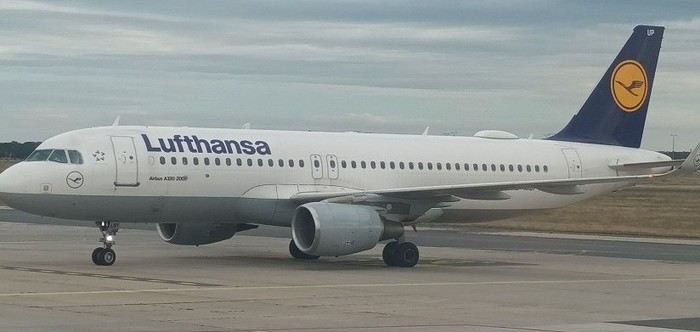
Lufthansa is really pushing it:
Cancellation of two flights with no rebooking options offered, even though rebooking is possible on the same dates with comparable travel times. Yet Lufthansa claims no rebooking is possible;
To get a refund for a flight canceled by the airline (well after the Covid crisis), you have to take legal action! A refund request was properly submitted, but Lufthansa hasn’t responded.
Lufthansa’s lawyer admitted in court that the refund request is valid and that the airline is willing to refund. But over a year later, the refund still hasn’t been issued! Clearly, Lufthansa prefers to wait for a court ruling, which is a sure thing given their own lawyer’s statement;
After a phone call initiated by the passenger, rebooking was agreed upon by both parties—only for Lufthansa to cancel it immediately without offering any alternative rebooking.
In a follow-up call initiated by the passenger, Lufthansa proposed a rebooking with a travel time of 31 hours instead of 21, even though faster rebooking options with comparable travel times exist.
The proposed 31-hour rebooking includes a nighttime layover of over 12 hours with no hotel or transportation coverage;
For the first rebooking that both parties agreed on (but Lufthansa immediately canceled), they refused to cover ground transportation from the arrival airport to the originally planned airport;
Refusal of other "prompt" rebooking options, even though they were available and proposed by the passenger;
Ongoing legal case: https://retardimportantavion.wordpress.com/2024/10/23/lufthansa-championne-du-refus-des-droits-des-passagers/ 2 Best regards,
Cancellation of two flights with no rebooking options offered, even though rebooking is possible on the same dates with comparable travel times. Yet Lufthansa claims no rebooking is possible;
To get a refund for a flight canceled by the airline (well after the Covid crisis), you have to take legal action! A refund request was properly submitted, but Lufthansa hasn’t responded.
Lufthansa’s lawyer admitted in court that the refund request is valid and that the airline is willing to refund. But over a year later, the refund still hasn’t been issued! Clearly, Lufthansa prefers to wait for a court ruling, which is a sure thing given their own lawyer’s statement;
After a phone call initiated by the passenger, rebooking was agreed upon by both parties—only for Lufthansa to cancel it immediately without offering any alternative rebooking.
In a follow-up call initiated by the passenger, Lufthansa proposed a rebooking with a travel time of 31 hours instead of 21, even though faster rebooking options with comparable travel times exist.
The proposed 31-hour rebooking includes a nighttime layover of over 12 hours with no hotel or transportation coverage;
For the first rebooking that both parties agreed on (but Lufthansa immediately canceled), they refused to cover ground transportation from the arrival airport to the originally planned airport;
Refusal of other "prompt" rebooking options, even though they were available and proposed by the passenger;
Ongoing legal case: https://retardimportantavion.wordpress.com/2024/10/23/lufthansa-championne-du-refus-des-droits-des-passagers/ 2 Best regards,
Voyage avec enfant de 8 ans et demi en fonction du climat de mi-février jusqu'à la mi-avril English translation pending
Bonjour à tous,
Nous sommes encore à l’étape de déterminer quelques endroits où nous aimerions voyager dans l’espace-temps de mi février jusqu’à la mi avril, question de climat le plus propice à voyager en sac à dos avec notre petite qui aura 8.5 ans à ce moment-là.
Ma conjointe aura 6 semaines alors que moi, j’en aurai 3 seulement. Nous prévoyons partir les 3 ensembles et je les laisserai continuer la deuxième partie toutes les deux.
L’Amérique du Sud nous attire ainsi que l’Asie du Sud-Est.
Sans être dans l’obligation de tout voir à tout prix, nous aimons bien prendre le temps de s’arrêter quelques jours à un endroit plutôt que d’être constamment en déplacement afin de profiter des endroits où nous poserons pieds.
Chacun de notre côté, avons visité quelques pays, et souhaiterions débuter le voyage dans un endroit où ni un ni l’autre n’avons fait.
Si nous allons en Asie du Sud-Est, nous avions pensé débuter le voyage en Indonésie et qu’elles pourraient continuer vers la Thaïlande et Cambodge (que j’ai déjà fait) alors que si nous allons en Amérique du Sud, l’Argentine, terre de feux, le Chili nous attirent comme début de voyage (j’ai fait le Pérou) et elles pourraient continuer dans ces régions par la suite.
Quels sont vos conseils et suggestions en terme de climat entre mi février et mi avril, laps de temps où nous serons les 3 et où elles seront les deux, distance à parcourir entre chaque destination, coûts etc. ?
Qu’en pensez-vous?
Gros merci !
Nous sommes encore à l’étape de déterminer quelques endroits où nous aimerions voyager dans l’espace-temps de mi février jusqu’à la mi avril, question de climat le plus propice à voyager en sac à dos avec notre petite qui aura 8.5 ans à ce moment-là.
Ma conjointe aura 6 semaines alors que moi, j’en aurai 3 seulement. Nous prévoyons partir les 3 ensembles et je les laisserai continuer la deuxième partie toutes les deux.
L’Amérique du Sud nous attire ainsi que l’Asie du Sud-Est.
Sans être dans l’obligation de tout voir à tout prix, nous aimons bien prendre le temps de s’arrêter quelques jours à un endroit plutôt que d’être constamment en déplacement afin de profiter des endroits où nous poserons pieds.
Chacun de notre côté, avons visité quelques pays, et souhaiterions débuter le voyage dans un endroit où ni un ni l’autre n’avons fait.
Si nous allons en Asie du Sud-Est, nous avions pensé débuter le voyage en Indonésie et qu’elles pourraient continuer vers la Thaïlande et Cambodge (que j’ai déjà fait) alors que si nous allons en Amérique du Sud, l’Argentine, terre de feux, le Chili nous attirent comme début de voyage (j’ai fait le Pérou) et elles pourraient continuer dans ces régions par la suite.
Quels sont vos conseils et suggestions en terme de climat entre mi février et mi avril, laps de temps où nous serons les 3 et où elles seront les deux, distance à parcourir entre chaque destination, coûts etc. ?
Qu’en pensez-vous?
Gros merci !
Where to eat well in Finistère?
Leaving in 15 days for Brittany, specifically the southern Finistère and Bénodet...
Tourists expected to boost the culinary restaurant industry!
Haven’t read the guide for latecomers yet, and I’m really wary of online reviews. Where can I eat without getting ripped off, enjoy quality food—crêperies, seafood, nice atmosphere... Thanks to all you savvy foodies!
Tourists expected to boost the culinary restaurant industry!
Haven’t read the guide for latecomers yet, and I’m really wary of online reviews. Where can I eat without getting ripped off, enjoy quality food—crêperies, seafood, nice atmosphere... Thanks to all you savvy foodies!
Qui a testé un auvent gonflable pour van ou camping-car? English translation pending
Salut les voyageurs,
Nous sommes sur le point d'entrer dans le mode #VanLife, nous avons fait l'acquisition d'un Citroën SpaceTourer tout récemment, et nous sommes en train de l'équiper doucement, dans l'optique de passer nos vacances désormais en roadtrip à travers la France afin de faire découvrir à nos 3 enfants les merveilles de chez nous. (et notre chien)(il fait aussi partie de la famille😇)
Un menuisier est en train de nous construire une chuckbox à l'australienne (cuisine box) pour mettre dans le coffre, qui sera combinée à un lit à poser sur les sièges arrière repliés. Ce sera notre couchage à nous.
Mais pour les enfants, on se posait la question : - soit une tente de toit sur laquelle on peut ajouter un auvent pour que notre chien puisse dormir, y entreposer quelques affaires du coffre à protéger pour la nuit.
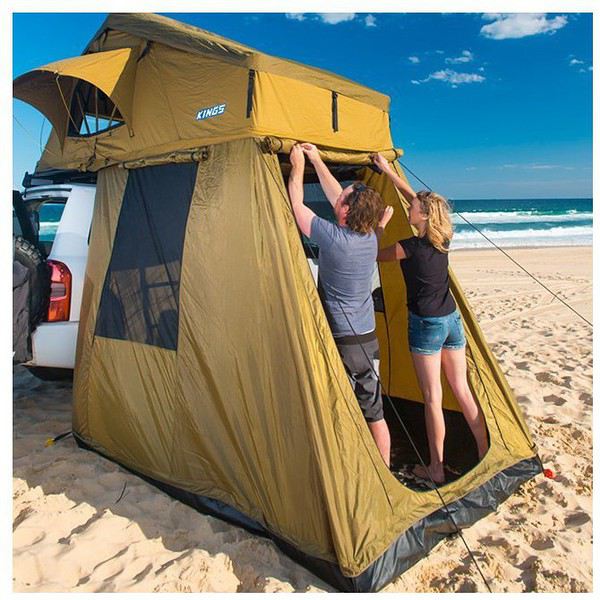
- soit un auvent gonflable qui ferait salon, avec sas d'accès à la porte latérale du van, qu'on pourrait même laisser ouverte s'il pleut, et possibilité d'ajouter une ou deux chambres un peu comme dans les tentes quechua.
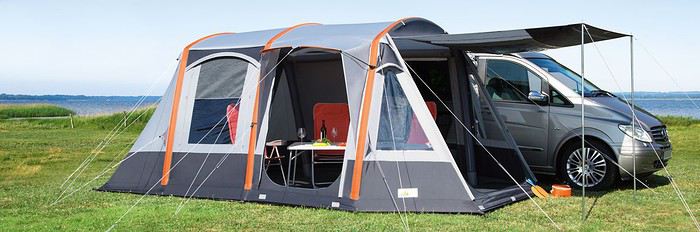
L'avantage de la tente de toit selon nous, c'est que l'on n'a pas de matelas gonflable ni de draps/duvets à stocker puisqu'ils restent dans la tente repliée. Mais je crains les secousses de la voiture à chaque mouvement de mes bébés hippopotames qui sont plutôt des déménageurs la nuit. L'avantage du auvent, c'est clairement sa surface en plus, on opte pour le mode gonflable pour la facilité de montage, et surtout la possibilité de le laisser sur place lors d'une halte en camping et qu'on veut partir en ballade. Ou d'y mettre des affaires du coffre quand on se pose en bivouac. Mais il faut des matelas gonflables, des duvets, des oreillers à stocker dans le coffre quand on bouge (ou éventuellement à mettre dans un coffre de toit aussi).
Tout est dans mon titre : qui a déjà testé les auvents gonflables ? quelle est la durée de vie des boudins à air, est-ce que ça résiste bien dans le temps ?
Je vous remercie sincèrement de vos retours d'expérience, qui nous orienteront dans nos choix. Et si vous avez été confronté au même dilemme que nous, puis que votre choix s'est finalement porté sur une tente de toit, ce serait sympa aussi de nous dire pourquoi 😉 Crebindiou.
Un menuisier est en train de nous construire une chuckbox à l'australienne (cuisine box) pour mettre dans le coffre, qui sera combinée à un lit à poser sur les sièges arrière repliés. Ce sera notre couchage à nous.
Mais pour les enfants, on se posait la question : - soit une tente de toit sur laquelle on peut ajouter un auvent pour que notre chien puisse dormir, y entreposer quelques affaires du coffre à protéger pour la nuit.
- soit un auvent gonflable qui ferait salon, avec sas d'accès à la porte latérale du van, qu'on pourrait même laisser ouverte s'il pleut, et possibilité d'ajouter une ou deux chambres un peu comme dans les tentes quechua.
L'avantage de la tente de toit selon nous, c'est que l'on n'a pas de matelas gonflable ni de draps/duvets à stocker puisqu'ils restent dans la tente repliée. Mais je crains les secousses de la voiture à chaque mouvement de mes bébés hippopotames qui sont plutôt des déménageurs la nuit. L'avantage du auvent, c'est clairement sa surface en plus, on opte pour le mode gonflable pour la facilité de montage, et surtout la possibilité de le laisser sur place lors d'une halte en camping et qu'on veut partir en ballade. Ou d'y mettre des affaires du coffre quand on se pose en bivouac. Mais il faut des matelas gonflables, des duvets, des oreillers à stocker dans le coffre quand on bouge (ou éventuellement à mettre dans un coffre de toit aussi).
Tout est dans mon titre : qui a déjà testé les auvents gonflables ? quelle est la durée de vie des boudins à air, est-ce que ça résiste bien dans le temps ?
Je vous remercie sincèrement de vos retours d'expérience, qui nous orienteront dans nos choix. Et si vous avez été confronté au même dilemme que nous, puis que votre choix s'est finalement porté sur une tente de toit, ce serait sympa aussi de nous dire pourquoi 😉 Crebindiou.
Voyage en solo à Majorque et coins fréquentés par les Allemands English translation pending
Bonjour, j ai bientot 40 ans et cet automne je compte voyager à Mallorca pour la premiere fois. Pour mon voyage , j aimerais aller dans les coins fréquentés par les Allemands , y faire la fete mais sans que ce soit des beuveries et debordements à outrance , aller dans les bars et aussi plage piscine farniente... Mais j aimerais aller dans les coins ou il y a beaucoups de solos comme moi et à partir de 40 ans et eviter les endroits ou il y a trop de familles, jeunes....
Merci à vous
Mais où donc est ce truc là? (5) English translation pending
Bonjour
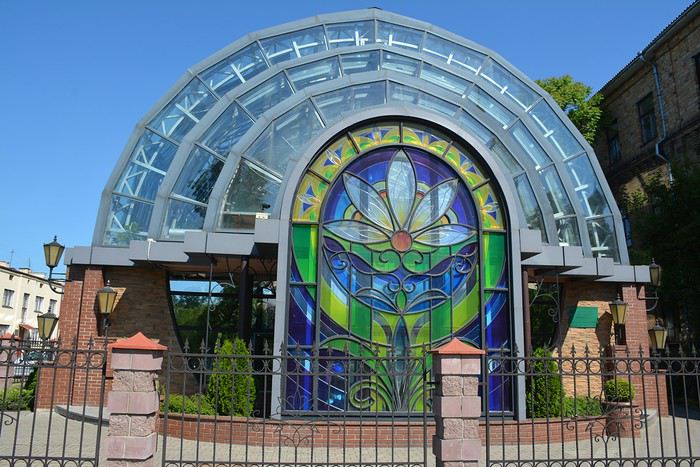
Où se trouve cette serre ?
En premier chercher le pays et ensuite la ville
Françoise
Adventures of a Bygone Era: The Philippines in 1984
After several discussions on VF about travel journals from the Philippines, I decided to write this curiosity: a trip report from a journey made in 1984, when traveling to the Philippines was still an adventure.
A curiosity because writing a travel journal about a trip 35 years later isn’t common, but also (mostly?) because exploring the Philippines at that time had little in common with traveling there today.
Obviously, I’ve forgotten a number of facts, most of the details, but with the help of a few notes from that time and a stack of slides (yes, there was life before digital 😊), many memories came back and added to the highlights I’d never forgotten. The scanned slides aren’t always great quality, but there are still quite a few to brighten up this chatter. Back then, we didn’t snap photos like we do now—film was too expensive—so I don’t have pictures of every place we visited... too bad, comparing some of those spots to how they look today would’ve been interesting.
Why "Adventures"? Why call it "Adventures" in the Philippines in 1984, a word so often used for a simple exotic trip? - Because the lack of information (no *Guide du Routard*, no *Lonely Planet*, no *Michelin Guide*, nothing, and obviously no internet) gave this trip what’s at the heart of adventure: the unknown. - Because the political situation made the stay sometimes dangerous. - Because transportation conditions were always epic, often perilous. - Because the question of where we’d spend the night came up almost every evening. - And for... quite a few other reasons.
That said, we weren’t exactly explorers!
Why the Philippines? First of all, why go to the Philippines in 1984—a country not exactly set up for tourism and about which we knew very little? How could we get an idea of the beauty of the Philippines and its points of interest when we had no guides or photos?
The idea came to us from Thailand a year earlier, during our first long-haul trip. After touring the north of the country, we met a Frenchman living in Phuket, where there were only a few tourists in Patong, with just a few small hotels and guesthouses. Kata and Karon had no buildings or roads, Rawai only had three palm-thatched bungalows, including ours, and the other islands were unknown to tourists. There was plenty to discover, and we wanted to return to this beautiful country... but the Frenchman made us dream about the Philippines—a country to explore, with wild landscapes.
Long evenings of discussion over multiple Sprite-Mekong cocktails (what memories of those headaches!) finally convinced us we had to go to the Philippines.
Episode 0: Before Departure The decision was made: we’d go to the Philippines in May 1984. Our friends and family were surprised when we announced we were going on vacation to the Philippines (a bit like saying today we were going paddleboarding in the Kerguelen Islands 🤪).
These days, preparing for each of our trips takes long evenings of research, planning, and noting down good addresses... etc. But for the Philippines in 1984, preparation was quick: we had very little information about the country, we were leaving almost at random, and the discovery would only be more exciting.
We still had a few bits of info gathered here and there: the rice terraces in northern Luzon, volcanoes, Negros where we were supposed to visit an acquaintance, Cebu and its marine life (we ended up going elsewhere), and absolutely avoid Mindanao, which was practically at war with the regime. That was about it, but it was already a great itinerary.
Nothing was organized in advance; we’d see day by day. We had no idea about travel times or even the existence of transportation options. The main (and sometimes only) way to connect two islands was by overloaded, rusty ferry. Only the big cities had airports.
Let’s Go: Episode 1: Paris to Manila My travel journals always start after arriving at the airport—the Europe-to-“Other Continent” trip isn’t interesting—but the flight to the Philippines was already an adventure, so I’ll make an exception.
This was the era when only a few Asian airlines were on par with Western ones: Thai, Singapore Airlines, and Philippine Airlines. They had beautiful, brand-new planes, and to attract customers (almost exclusively “businessmen”) from the usual airlines (Air France, Lufthansa, British Airways), there was opulence on board: unlimited champagne, all sorts of cocktails... Compared to today’s long-haul flights, there was still one small difference: no personal screens, just one screen at the front of the cabin with one mandatory movie. And I don’t know why, but we only got James Bond films, both ways... that must’ve been the trend at the time.
The tourism boom to Southeast Asia hadn’t started yet, and the “Asian Tigers” weren’t a thing, so there weren’t many business trips. That meant long-haul flights made stops everywhere to fill the planes. Our Philippine Airlines Boeing 747 left London, picked us up in Paris, then stopped in Frankfurt to take on a few Germans. I don’t know why we then made a stop in Dubai—a totally exotic place at the time. There was nothing to do there... things have changed a lot since. It was a small town lost in the desert. The airport was tiny, with just one or two buildings and a supermarket. During the stopover, everyone had to get off the plane and walk to the supermarket. Photo and electronic equipment were dirt cheap—I guess that was the only reason for the stop. Maybe it was their first commercial move. Emirates didn’t exist yet, as I checked online, but anyway, the idea that such a remote place could have its own airline was unthinkable.
Online, I found this photo of Dubai Airport in 1980. Anyone who’s transited through today’s massive airport with its rows of A380s will appreciate it: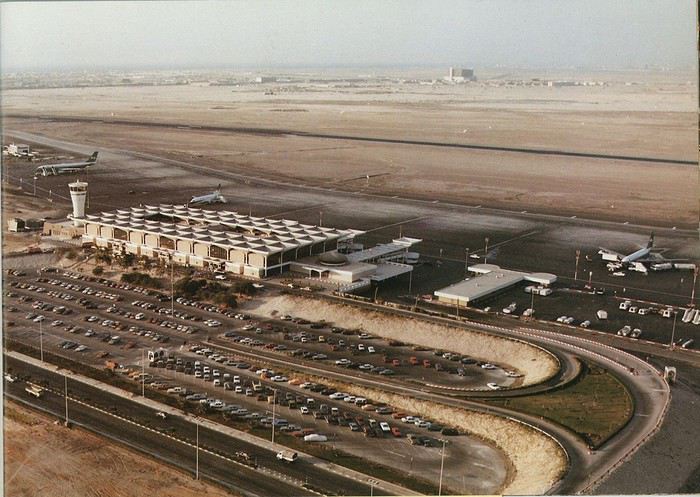
Next stop: New Delhi to drop off some Europeans and pick up a few Indians, and finally, the terminus: Manila. I don’t remember how long the trip took with its five stops—an unimaginable journey today. Despite all those stops to fill the plane, there was still enough space to stretch out on the four center seats of the 747, something that never happens these days despite all the flights in every direction.
So here we are, finally at Manila Airport around midnight.
Episode 1: Manila and Baguio To start, a quick note on the political and economic situation in the Philippines in 1984, which had consequences for us as tourists, as we’d soon realize upon arrival.
After several centuries of Spanish colonization, the Philippines became American at the start of the 20th century, then independent. In 1966, Marcos took power, and little by little, his regime sank into corruption and mismanagement, becoming a dictatorship with martial law, all for the benefit of his family and friends, who enriched themselves endlessly. The peak was the assassination of opposition leader Benigno Aquino in August 1983, which triggered harshly repressed protests. So we arrived a few months later in a very poor country, with omnipresent corruption and an extremely tense political situation, as we’d soon see for ourselves. Major protests took place in the main cities during our trip—I’ll come back to that. Two years later, Marcos fled to Hawaii after being forced out of power following rigged elections. This historical context explains a lot of the situations we found ourselves in over the following weeks.
Arriving in the middle of the night isn’t very cheerful. Manila was already a huge city with many slums, where you could find a few business hotels like the Hilton or Intercontinental—way out of our budget—and plenty of run-down hotels. Luckily, two Indians we’d chatted with on the plane offered to take us to their usual hotel. They came to Manila twice a year for business. We accepted their offer, relieved not to have to look for a place to stay in the middle of the night, figuring the address must be good since they came back every time... we were wrong 🙁
We left the airport and immediately got a taste of the local vibe when we got into the taxi: the police asked for our passports. We thought: what’s more normal than police in a dictatorship?
But that wasn’t it at all. Our two Indian friends explained that the police were noting our names along with the taxi number and time. Crime in Manila was so bad that the taxi driver would be held responsible if anything happened to us... welcome to the Philippines 😎 😎
Historically, the Philippines was a very violent country, where everything was settled with guns or machetes. Previous governments had banned carrying weapons, but Marcos later allowed the free sale and carrying of guns, and disputes were settled with pistols again (or worse, as we’d discover later). Since he’d released most of the criminals from prison to form a paramilitary militia at his service (I’ll talk about our encounter with these “heroes” later), it was pretty dangerous to go into many parts of Manila, where these “tonton macoutes” ruled.
We arrived at our hotel without incident... and then things started badly. The room was infested with big cockroaches—exactly what I hate most in those kinds of countries. No way to find another hotel at that hour. After the long flight, the urge to take a shower was so strong that we squeezed into the bathroom as best we could. After that, I don’t remember—I guess we must’ve fallen asleep exhausted under the sheets in the heat... air conditioning wasn’t widespread yet.
The next day, we just wanted to leave that dump as soon as possible. So we decided to head north right away, stopping in Baguio, and we’d visit Manila a bit on the way back.
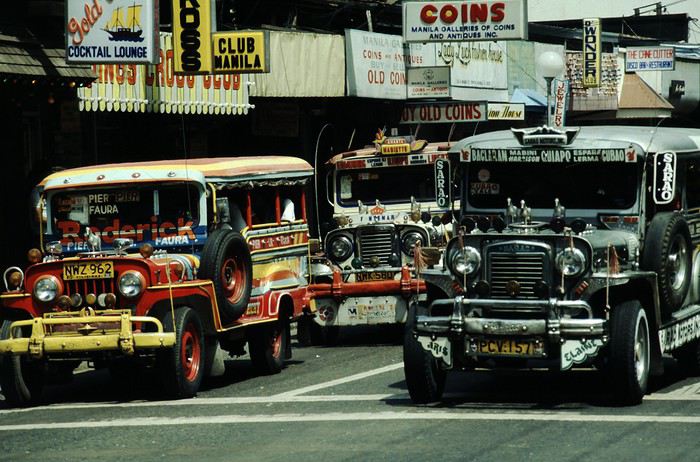
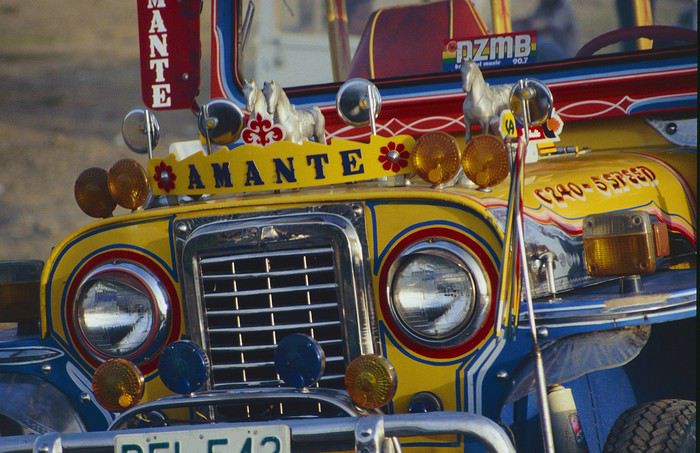
When we stepped outside, we discovered a pretty run-down neighborhood with potholed streets. But we also discovered the jeepneys. They were everywhere, flooding the streets.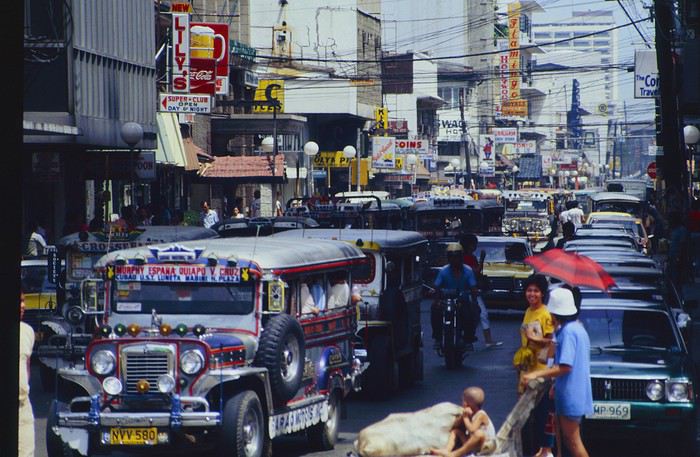
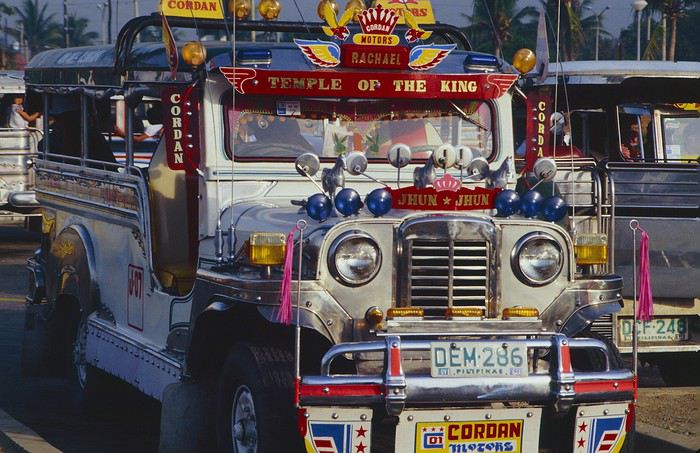
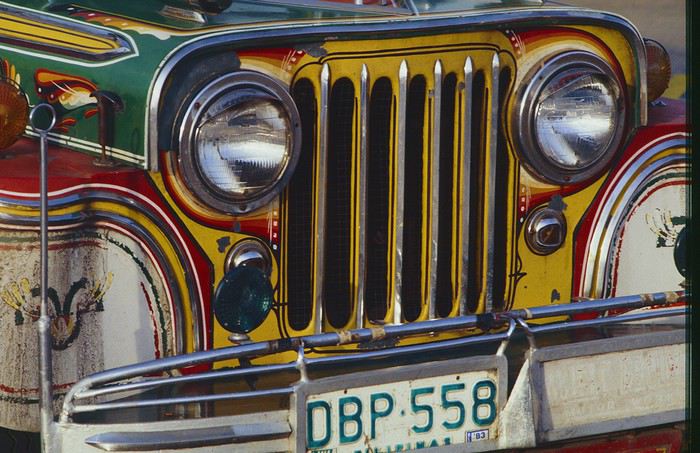
They had crazy sound systems, each one blasting louder than the last. The interiors were kitschy but fun. There weren’t many private cars—almost all transportation was by jeepney, with buses reserved for intercity trips.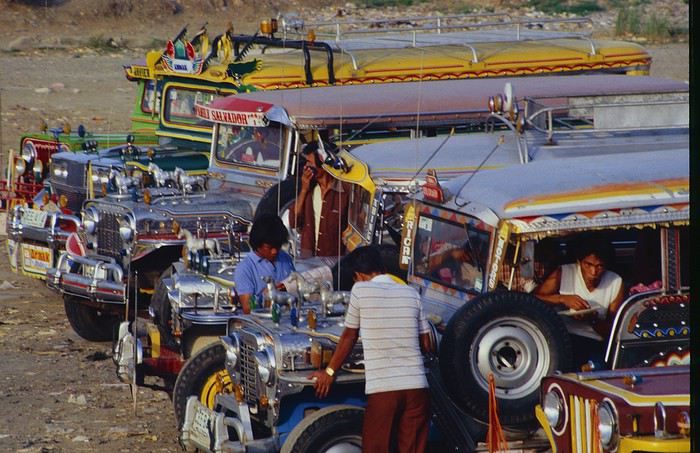
Before heading to the bus terminal for the north, somewhere on the outskirts of the city, we needed to exchange some money. I don’t remember how we ended up in a policeman’s jeep who offered his services: - Exchange money on the black market at a better rate than the banks. - Take us wherever we wanted, in this case, the bus terminal.
We accepted both offers (we’d still checked the official exchange rate from dollars to pesos). So we found ourselves in his jeep. After exchanging money, we left in his vehicle and stopped for gas. Without turning off the engine, he calmly smoked a cigarette while filling up. Since we were in a jeep with no doors or roof, we were ready to jump out if things went south, our travel bag in hand.
But we weren’t done with surprises yet. Once we left the small streets, we ended up in a neighborhood with wide avenues and not much traffic, which didn’t justify his incredible behavior. At every intersection, he made the sign of the cross, closed his eyes, and crossed without looking. I was more stunned than terrified! It wasn’t until we got out of the car later that I told Anne-Marie what had happened. I’d seen everything because the cop had put me in the front seat. Luckily, A-Marie hadn’t noticed anything from the back. Crossing Manila by trusting God rather than the rules of the road was ultimately effective. We were lucky—the trip was off to a good start. 🙂 🙂
We then passed through a neighborhood where slums stretched on for a while, and we left our policeman—friendly but a bit crazy—with relief.
A few hours by bus later, here we are in Baguio, cool in the mountains. My memories of Baguio are pretty fuzzy. I remember a small town. After some research while writing this journal, I found that the population was 120,000 in 1980. Given the population density in each home, that confirms my memory of a smallish town. Outside the “official” district with the president’s summer residence and government buildings, there were two or three paved streets with nice houses. The rest was very dirty and very poor, with lots of slums and dirt roads.
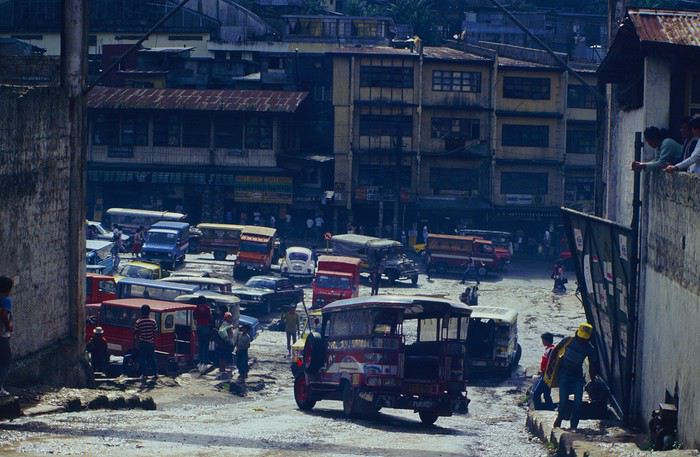
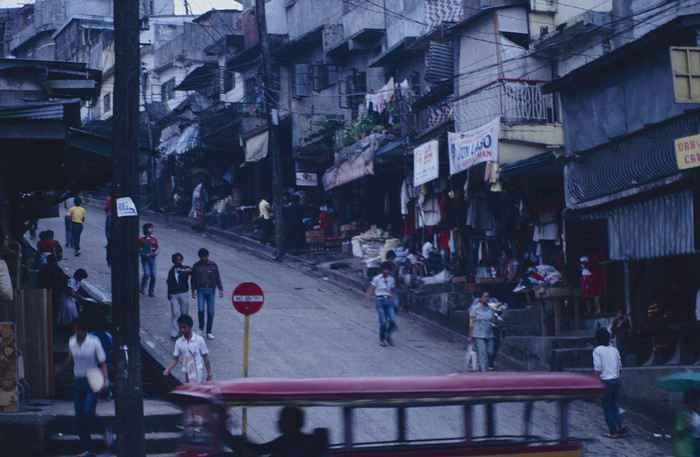
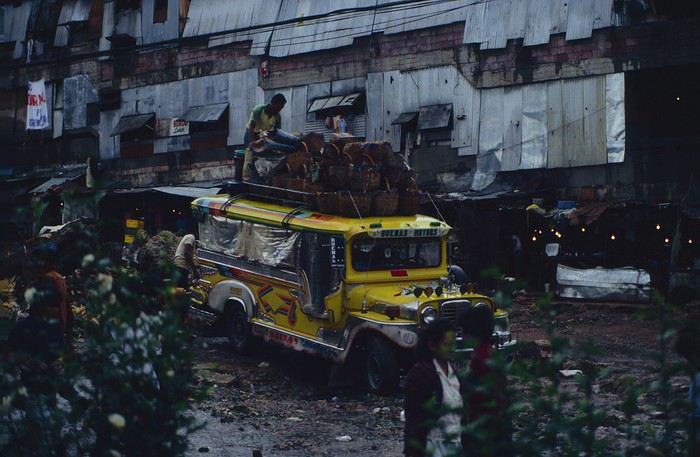
People we met on the street invited us to stay with them. These days, we wouldn’t just show up at strangers’ houses, which we should’ve done in Baguio—it would’ve saved us from an unimaginable and dangerous situation... which I won’t say anything about... !😊
The simple wooden house was on stilts at the edge of a hill with a view of the mountains. Since it was the start of the rainy season in a city that gets a lot of rain, we saw a lot of water. Our outings in town happened between downpours.
View from our lodging: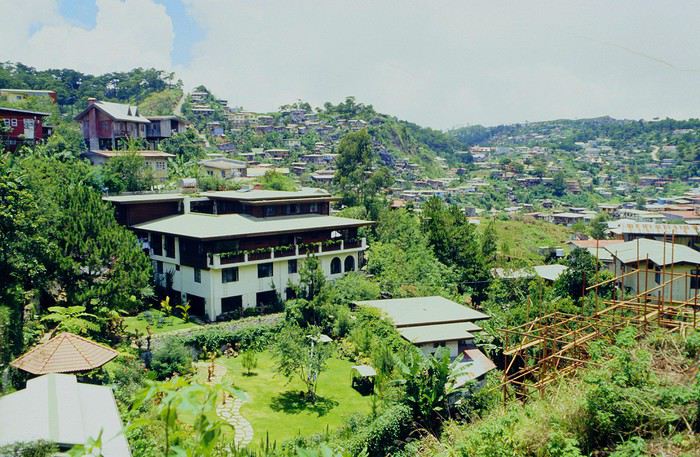
Episode 2: Baguio to Bontoc Aside from the situation briefly mentioned above, it was on the next leg to Bontoc that the adventure really began: an endless and dangerous road, a bus from another era, breathtaking landscapes, and surprising people.
We didn’t know the distance or how long it would take to get to Bontoc. When we arrived after about ten hours, we learned that Baguio to Bontoc was 140 km.
We got on a bus with wooden seats and settled in, two to a seat meant for two. As the bus filled up, passengers squeezed in three or four per seat, with chickens and baskets full of all sorts of things in the aisle. A little embarrassed, we didn’t know if we should squeeze in three on our seat. The seats were super tight (luckily, Filipinos are small), and I didn’t know where to put my legs given my height. I don’t remember if we stayed alone on our bench or if we ended up sharing with others.
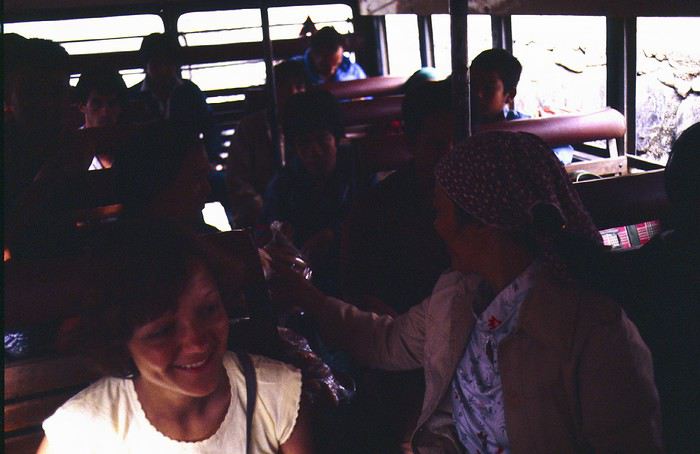
The “road” was a dirt track (or rather, a mud track) with endless turns. We held on as best we could to our slippery wooden seats—it was shaking in every direction. The woman behind us was carsick and throwing up... gross... but what were we doing there? Then we plunged into the Sierra Madre... just the name is dreamy!
Rice terraces started to appear: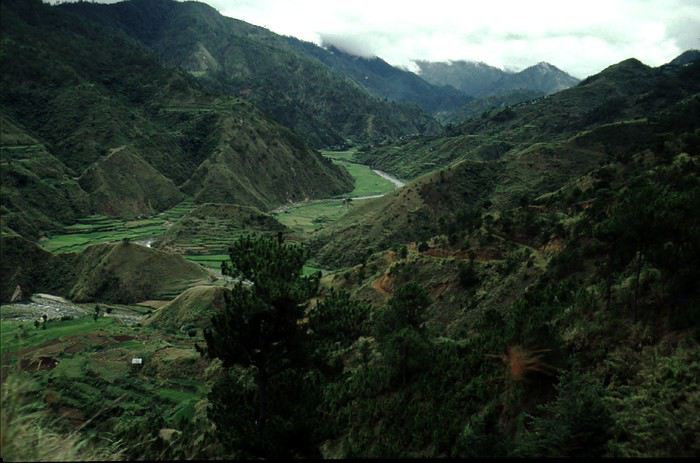
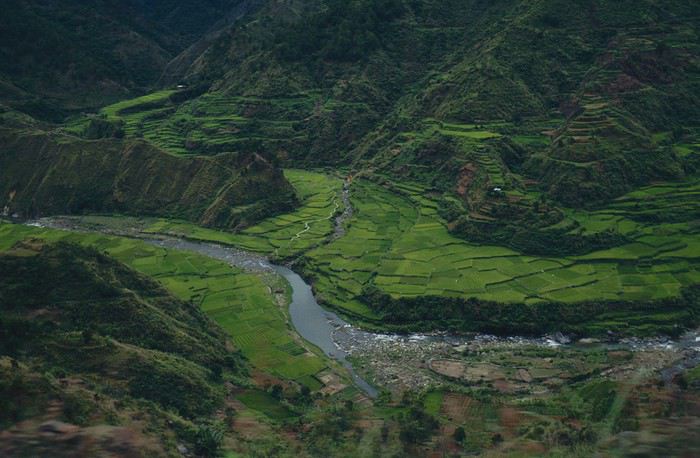
they took up more and more space along cliffs where we weren’t always reassured,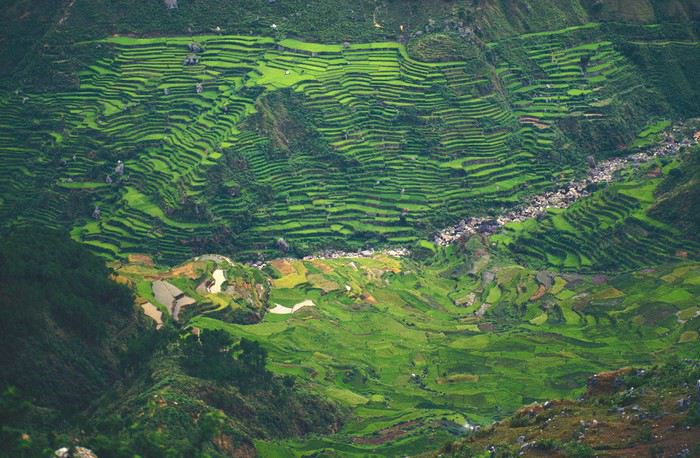
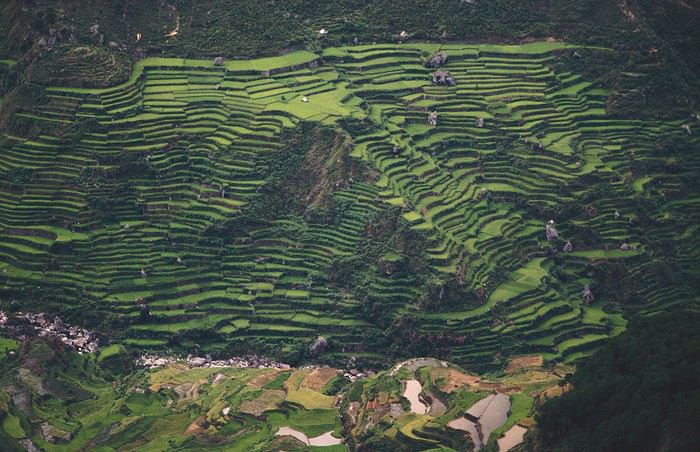
with lots of waterfalls (all that water had to go somewhere).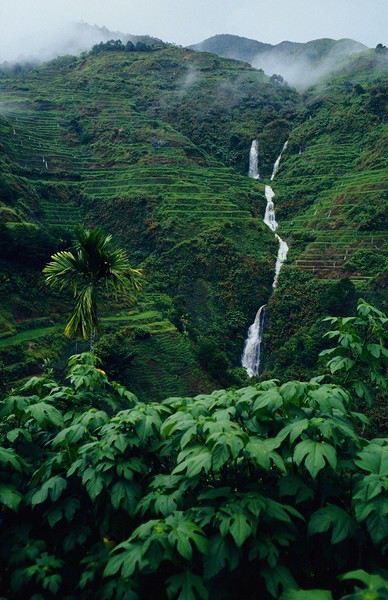
A few miserable villages stretched along the track, most often just a few houses balancing between the road and the drop. The bus stopped in every village—people got on or off and settled inside or on the roof. Street vendors offered their products to the bus passengers—a common sight in Asia, even today.
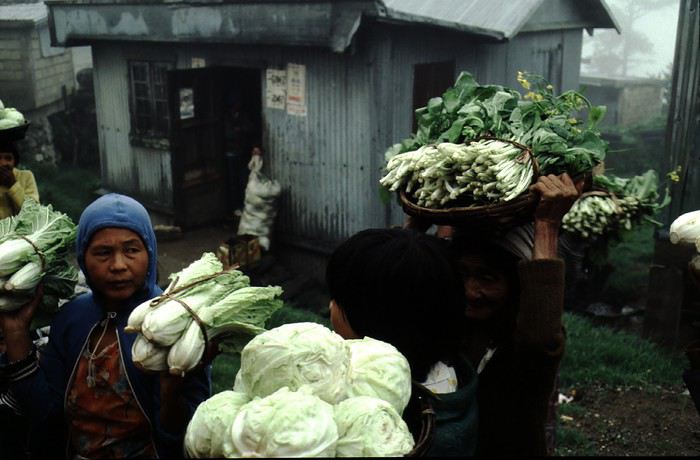
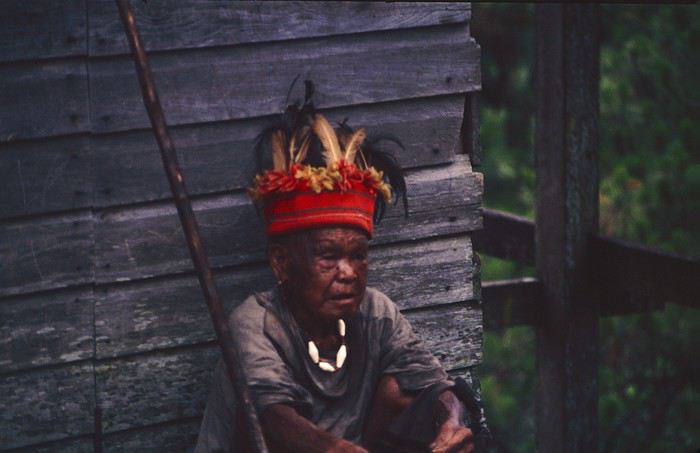
We were in another world—villagers were in loincloths, others had spears. The atmosphere was strange... but all good, we wanted exoticism, and we got it: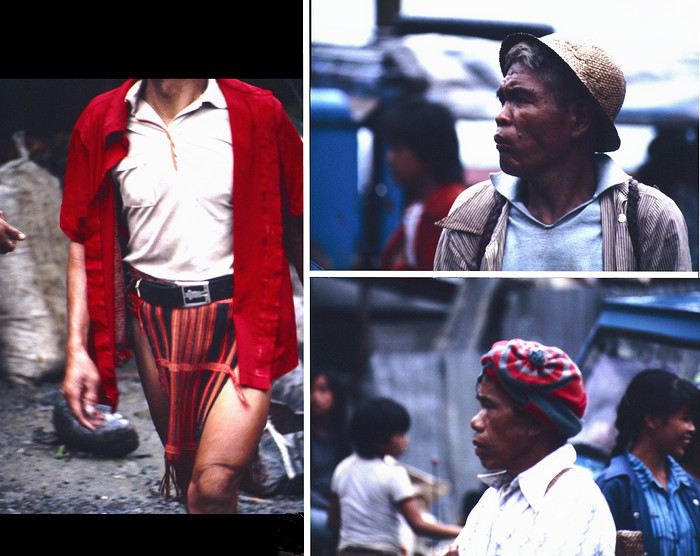
This so-called traditional outfit was everyday wear—it wasn’t for tourists since there weren’t any.
A curiosity because writing a travel journal about a trip 35 years later isn’t common, but also (mostly?) because exploring the Philippines at that time had little in common with traveling there today.
Obviously, I’ve forgotten a number of facts, most of the details, but with the help of a few notes from that time and a stack of slides (yes, there was life before digital 😊), many memories came back and added to the highlights I’d never forgotten. The scanned slides aren’t always great quality, but there are still quite a few to brighten up this chatter. Back then, we didn’t snap photos like we do now—film was too expensive—so I don’t have pictures of every place we visited... too bad, comparing some of those spots to how they look today would’ve been interesting.
Why "Adventures"? Why call it "Adventures" in the Philippines in 1984, a word so often used for a simple exotic trip? - Because the lack of information (no *Guide du Routard*, no *Lonely Planet*, no *Michelin Guide*, nothing, and obviously no internet) gave this trip what’s at the heart of adventure: the unknown. - Because the political situation made the stay sometimes dangerous. - Because transportation conditions were always epic, often perilous. - Because the question of where we’d spend the night came up almost every evening. - And for... quite a few other reasons.
That said, we weren’t exactly explorers!
Why the Philippines? First of all, why go to the Philippines in 1984—a country not exactly set up for tourism and about which we knew very little? How could we get an idea of the beauty of the Philippines and its points of interest when we had no guides or photos?
The idea came to us from Thailand a year earlier, during our first long-haul trip. After touring the north of the country, we met a Frenchman living in Phuket, where there were only a few tourists in Patong, with just a few small hotels and guesthouses. Kata and Karon had no buildings or roads, Rawai only had three palm-thatched bungalows, including ours, and the other islands were unknown to tourists. There was plenty to discover, and we wanted to return to this beautiful country... but the Frenchman made us dream about the Philippines—a country to explore, with wild landscapes.
Long evenings of discussion over multiple Sprite-Mekong cocktails (what memories of those headaches!) finally convinced us we had to go to the Philippines.
Episode 0: Before Departure The decision was made: we’d go to the Philippines in May 1984. Our friends and family were surprised when we announced we were going on vacation to the Philippines (a bit like saying today we were going paddleboarding in the Kerguelen Islands 🤪).
These days, preparing for each of our trips takes long evenings of research, planning, and noting down good addresses... etc. But for the Philippines in 1984, preparation was quick: we had very little information about the country, we were leaving almost at random, and the discovery would only be more exciting.
We still had a few bits of info gathered here and there: the rice terraces in northern Luzon, volcanoes, Negros where we were supposed to visit an acquaintance, Cebu and its marine life (we ended up going elsewhere), and absolutely avoid Mindanao, which was practically at war with the regime. That was about it, but it was already a great itinerary.
Nothing was organized in advance; we’d see day by day. We had no idea about travel times or even the existence of transportation options. The main (and sometimes only) way to connect two islands was by overloaded, rusty ferry. Only the big cities had airports.
Let’s Go: Episode 1: Paris to Manila My travel journals always start after arriving at the airport—the Europe-to-“Other Continent” trip isn’t interesting—but the flight to the Philippines was already an adventure, so I’ll make an exception.
This was the era when only a few Asian airlines were on par with Western ones: Thai, Singapore Airlines, and Philippine Airlines. They had beautiful, brand-new planes, and to attract customers (almost exclusively “businessmen”) from the usual airlines (Air France, Lufthansa, British Airways), there was opulence on board: unlimited champagne, all sorts of cocktails... Compared to today’s long-haul flights, there was still one small difference: no personal screens, just one screen at the front of the cabin with one mandatory movie. And I don’t know why, but we only got James Bond films, both ways... that must’ve been the trend at the time.
The tourism boom to Southeast Asia hadn’t started yet, and the “Asian Tigers” weren’t a thing, so there weren’t many business trips. That meant long-haul flights made stops everywhere to fill the planes. Our Philippine Airlines Boeing 747 left London, picked us up in Paris, then stopped in Frankfurt to take on a few Germans. I don’t know why we then made a stop in Dubai—a totally exotic place at the time. There was nothing to do there... things have changed a lot since. It was a small town lost in the desert. The airport was tiny, with just one or two buildings and a supermarket. During the stopover, everyone had to get off the plane and walk to the supermarket. Photo and electronic equipment were dirt cheap—I guess that was the only reason for the stop. Maybe it was their first commercial move. Emirates didn’t exist yet, as I checked online, but anyway, the idea that such a remote place could have its own airline was unthinkable.
Online, I found this photo of Dubai Airport in 1980. Anyone who’s transited through today’s massive airport with its rows of A380s will appreciate it:
Next stop: New Delhi to drop off some Europeans and pick up a few Indians, and finally, the terminus: Manila. I don’t remember how long the trip took with its five stops—an unimaginable journey today. Despite all those stops to fill the plane, there was still enough space to stretch out on the four center seats of the 747, something that never happens these days despite all the flights in every direction.
So here we are, finally at Manila Airport around midnight.
Episode 1: Manila and Baguio To start, a quick note on the political and economic situation in the Philippines in 1984, which had consequences for us as tourists, as we’d soon realize upon arrival.
After several centuries of Spanish colonization, the Philippines became American at the start of the 20th century, then independent. In 1966, Marcos took power, and little by little, his regime sank into corruption and mismanagement, becoming a dictatorship with martial law, all for the benefit of his family and friends, who enriched themselves endlessly. The peak was the assassination of opposition leader Benigno Aquino in August 1983, which triggered harshly repressed protests. So we arrived a few months later in a very poor country, with omnipresent corruption and an extremely tense political situation, as we’d soon see for ourselves. Major protests took place in the main cities during our trip—I’ll come back to that. Two years later, Marcos fled to Hawaii after being forced out of power following rigged elections. This historical context explains a lot of the situations we found ourselves in over the following weeks.
Arriving in the middle of the night isn’t very cheerful. Manila was already a huge city with many slums, where you could find a few business hotels like the Hilton or Intercontinental—way out of our budget—and plenty of run-down hotels. Luckily, two Indians we’d chatted with on the plane offered to take us to their usual hotel. They came to Manila twice a year for business. We accepted their offer, relieved not to have to look for a place to stay in the middle of the night, figuring the address must be good since they came back every time... we were wrong 🙁
We left the airport and immediately got a taste of the local vibe when we got into the taxi: the police asked for our passports. We thought: what’s more normal than police in a dictatorship?
But that wasn’t it at all. Our two Indian friends explained that the police were noting our names along with the taxi number and time. Crime in Manila was so bad that the taxi driver would be held responsible if anything happened to us... welcome to the Philippines 😎 😎
Historically, the Philippines was a very violent country, where everything was settled with guns or machetes. Previous governments had banned carrying weapons, but Marcos later allowed the free sale and carrying of guns, and disputes were settled with pistols again (or worse, as we’d discover later). Since he’d released most of the criminals from prison to form a paramilitary militia at his service (I’ll talk about our encounter with these “heroes” later), it was pretty dangerous to go into many parts of Manila, where these “tonton macoutes” ruled.
We arrived at our hotel without incident... and then things started badly. The room was infested with big cockroaches—exactly what I hate most in those kinds of countries. No way to find another hotel at that hour. After the long flight, the urge to take a shower was so strong that we squeezed into the bathroom as best we could. After that, I don’t remember—I guess we must’ve fallen asleep exhausted under the sheets in the heat... air conditioning wasn’t widespread yet.
The next day, we just wanted to leave that dump as soon as possible. So we decided to head north right away, stopping in Baguio, and we’d visit Manila a bit on the way back.
When we stepped outside, we discovered a pretty run-down neighborhood with potholed streets. But we also discovered the jeepneys. They were everywhere, flooding the streets.
They had crazy sound systems, each one blasting louder than the last. The interiors were kitschy but fun. There weren’t many private cars—almost all transportation was by jeepney, with buses reserved for intercity trips.
Before heading to the bus terminal for the north, somewhere on the outskirts of the city, we needed to exchange some money. I don’t remember how we ended up in a policeman’s jeep who offered his services: - Exchange money on the black market at a better rate than the banks. - Take us wherever we wanted, in this case, the bus terminal.
We accepted both offers (we’d still checked the official exchange rate from dollars to pesos). So we found ourselves in his jeep. After exchanging money, we left in his vehicle and stopped for gas. Without turning off the engine, he calmly smoked a cigarette while filling up. Since we were in a jeep with no doors or roof, we were ready to jump out if things went south, our travel bag in hand.
But we weren’t done with surprises yet. Once we left the small streets, we ended up in a neighborhood with wide avenues and not much traffic, which didn’t justify his incredible behavior. At every intersection, he made the sign of the cross, closed his eyes, and crossed without looking. I was more stunned than terrified! It wasn’t until we got out of the car later that I told Anne-Marie what had happened. I’d seen everything because the cop had put me in the front seat. Luckily, A-Marie hadn’t noticed anything from the back. Crossing Manila by trusting God rather than the rules of the road was ultimately effective. We were lucky—the trip was off to a good start. 🙂 🙂
We then passed through a neighborhood where slums stretched on for a while, and we left our policeman—friendly but a bit crazy—with relief.
A few hours by bus later, here we are in Baguio, cool in the mountains. My memories of Baguio are pretty fuzzy. I remember a small town. After some research while writing this journal, I found that the population was 120,000 in 1980. Given the population density in each home, that confirms my memory of a smallish town. Outside the “official” district with the president’s summer residence and government buildings, there were two or three paved streets with nice houses. The rest was very dirty and very poor, with lots of slums and dirt roads.
People we met on the street invited us to stay with them. These days, we wouldn’t just show up at strangers’ houses, which we should’ve done in Baguio—it would’ve saved us from an unimaginable and dangerous situation... which I won’t say anything about... !😊
The simple wooden house was on stilts at the edge of a hill with a view of the mountains. Since it was the start of the rainy season in a city that gets a lot of rain, we saw a lot of water. Our outings in town happened between downpours.
View from our lodging:
Episode 2: Baguio to Bontoc Aside from the situation briefly mentioned above, it was on the next leg to Bontoc that the adventure really began: an endless and dangerous road, a bus from another era, breathtaking landscapes, and surprising people.
We didn’t know the distance or how long it would take to get to Bontoc. When we arrived after about ten hours, we learned that Baguio to Bontoc was 140 km.
We got on a bus with wooden seats and settled in, two to a seat meant for two. As the bus filled up, passengers squeezed in three or four per seat, with chickens and baskets full of all sorts of things in the aisle. A little embarrassed, we didn’t know if we should squeeze in three on our seat. The seats were super tight (luckily, Filipinos are small), and I didn’t know where to put my legs given my height. I don’t remember if we stayed alone on our bench or if we ended up sharing with others.
The “road” was a dirt track (or rather, a mud track) with endless turns. We held on as best we could to our slippery wooden seats—it was shaking in every direction. The woman behind us was carsick and throwing up... gross... but what were we doing there? Then we plunged into the Sierra Madre... just the name is dreamy!
Rice terraces started to appear:
they took up more and more space along cliffs where we weren’t always reassured,
with lots of waterfalls (all that water had to go somewhere).
A few miserable villages stretched along the track, most often just a few houses balancing between the road and the drop. The bus stopped in every village—people got on or off and settled inside or on the roof. Street vendors offered their products to the bus passengers—a common sight in Asia, even today.
We were in another world—villagers were in loincloths, others had spears. The atmosphere was strange... but all good, we wanted exoticism, and we got it:
This so-called traditional outfit was everyday wear—it wasn’t for tourists since there weren’t any.
Une pensée pour ceux qui vivent de tourisme au Népal English translation pending
Namasté,
Bien sûr il a des milliers de morts dans le monde liés au COVD 19, bien sûr il y a bien plus de désastres dans les familles touchées par l’infection, mais je voulais juste avoir une pensée pour les Népalais qui subissent la double peine de cette pandémie.
J’ai des relations avec un responsable d’agence de treks à KTM, avec deux accompagnateurs de moyenne ( ?!) montagne et un guide de haute montagne. Pour eux l’avenir est très sombre et leur situation à court terme par le manque de touristes étrangers est quasi dramatique, mais je pense aussi à toutes ces personnes qui en vivent : porteurs, guesthouses, commerces etc etc..
Fait chier !
A++ Le Belu
Bien sûr il a des milliers de morts dans le monde liés au COVD 19, bien sûr il y a bien plus de désastres dans les familles touchées par l’infection, mais je voulais juste avoir une pensée pour les Népalais qui subissent la double peine de cette pandémie.
J’ai des relations avec un responsable d’agence de treks à KTM, avec deux accompagnateurs de moyenne ( ?!) montagne et un guide de haute montagne. Pour eux l’avenir est très sombre et leur situation à court terme par le manque de touristes étrangers est quasi dramatique, mais je pense aussi à toutes ces personnes qui en vivent : porteurs, guesthouses, commerces etc etc..
Fait chier !
A++ Le Belu
Quel pays bon marché pour décembre-janvier-février? English translation pending
bonjour,
je fais cette recherche pour un ami, car en ce qui me concerne, je voyage plutot dans des endroits confortables et pas forcement bon marché...
quel est l'endroit, mer et plages ou il peut aller se poser 3 mois, ou il peut aller dans une guest house, et normalement..pas bouger pendant ces 3 mois...cette année il est allé a madagascar mais ce n'est pas la bonne période et il a eu pas mal de pluie.
en revanche, il l'avait choisi car cil ne parle pas anglais, mais je pense qu'il peut s'organiser avec les quelques mots dont il aura besoin... un grand merci si vous pouvez m'aider a lui faire quelques propositions, jeanne
quel est l'endroit, mer et plages ou il peut aller se poser 3 mois, ou il peut aller dans une guest house, et normalement..pas bouger pendant ces 3 mois...cette année il est allé a madagascar mais ce n'est pas la bonne période et il a eu pas mal de pluie.
en revanche, il l'avait choisi car cil ne parle pas anglais, mais je pense qu'il peut s'organiser avec les quelques mots dont il aura besoin... un grand merci si vous pouvez m'aider a lui faire quelques propositions, jeanne