Results for "Sierra+Nevada+|+4+>+128"
5131 results found.
Coût d'un voyage en Europe English translation pending
Allo tous
j'aimerais avoir une idée qd'un budget qu'il faut pour voyage en Europe (France, Espagne, Italie, Suisse, Allemagne seraient les pays que j'aimerais aller voir) pour 2 mois cet été
j'aimerais avoir une idée qd'un budget qu'il faut pour voyage en Europe (France, Espagne, Italie, Suisse, Allemagne seraient les pays que j'aimerais aller voir) pour 2 mois cet été
Infos sur la Baja California English translation pending
Salut a tous,
La semaine prochaine je quitte Los Angeles pour le Mexique, mon periple au Mexique va durer 2 mois vu que j'ai deja passe 2 mois et visiter le sud la derniere fois je desire cette fois faire le nord, je commence par la Baja et j'aurais besoin de quelques infos sur cette partie du Mexique ( endroit a ne pas manquer, budget pour les posadas, bus..) et egalalement sur les destinations et les prix du ferry...
par la suite ce sera le Chili la Bolivie le Peroul'Argentine pour 6 mois si vous avez des recommandations je suis preneur
Je voyage avec des Travellers Cheques y a-t-il des soucis pour les changer en Amerique du sud???
Voila Merci bien de me consacrer quelques minutes
Fred
fredevero@hotmail.com
La semaine prochaine je quitte Los Angeles pour le Mexique, mon periple au Mexique va durer 2 mois vu que j'ai deja passe 2 mois et visiter le sud la derniere fois je desire cette fois faire le nord, je commence par la Baja et j'aurais besoin de quelques infos sur cette partie du Mexique ( endroit a ne pas manquer, budget pour les posadas, bus..) et egalalement sur les destinations et les prix du ferry...
par la suite ce sera le Chili la Bolivie le Peroul'Argentine pour 6 mois si vous avez des recommandations je suis preneur
Je voyage avec des Travellers Cheques y a-t-il des soucis pour les changer en Amerique du sud???
Voila Merci bien de me consacrer quelques minutes
Fred
fredevero@hotmail.com
Doxycycline pour le Togo? English translation pending
qq a deja testé ???
mon medecin specialiste maladies tropicale m'a prescrit ca .. est-ce efficace? pour le Togo, en brousse pour une durée d'un an.
Faut-il vraiment l'utiliser sur le long terme ? (>3mois??)
voili voilou ! merci pour vos reponses !
mon medecin specialiste maladies tropicale m'a prescrit ca .. est-ce efficace? pour le Togo, en brousse pour une durée d'un an.
Faut-il vraiment l'utiliser sur le long terme ? (>3mois??)
voili voilou ! merci pour vos reponses !
Se marier à Varadero English translation pending
😎bonjour je voudrais des renseignements au sujet de l`hotel brisas del caribe les repas, l`ambiance, le service.etc...
Nous sommes un groupe et nous voulons que ca bouge .
C'est pour un mariage, alors si vous avez deja ete dans un mariage a cuba ecrivé moi . merci.😛
Nous sommes un groupe et nous voulons que ca bouge .
C'est pour un mariage, alors si vous avez deja ete dans un mariage a cuba ecrivé moi . merci.😛
Bons plans pour l'Équateur English translation pending
Bonjour,
Nous prévoyons de passer 15 jours-3 semaines en equateur en juillet aout. Quel circuit nous recommandez-vous particulièrement?
Quels sont les endroits à éviter d'un point de vue insécurité?
Merci pour toute info!
Gigi & Pieter 🙂
Bons plans pour l'Equateur? English translation pending
Je vais partir pour un tdm en mars 2003 en commençant part l'Equateur. Alors ceux qui ont des bons plans de logement, excursions ou qui ont découvert des trucs extras, merci de me faire partager vos expériences.
J'aimerai savoir aussi si il est facile de changer les chèques de voyages ??😎
Recommended itinerary for Colombia's Caribbean coast
Hi everyone,
We're heading to Colombia soon for two weeks as a family with our two 10-year-old boys. I'm a bit behind on planning our itinerary and could really use your advice!
We arrive in Cartagena, where we'll spend 3 nights.
Next, we're heading to the Tayrona area for 3 nights. Could you recommend a nice hotel with a pool, ideally family-friendly? Unfortunately, Senda Watapuy and Senda Koguiwa are already fully booked for our dates.
After that, we were thinking of spending a few days in Minca. Is that a good idea in late July/early August? How many nights would you recommend?
Finally, we're looking for a last stop before returning to France. We've heard about Mompox, but we're hesitant because it seems like a big detour. We love nature, animals, beautiful landscapes, beaches, and authentic places. Do you think Mompox is worth the detour with two kids, or would you recommend another destination (Palomino, Barú, La Guajira...) instead?
We don’t want to take any domestic flights.
Thanks in advance for all your tips and experiences!
Africa: A Heartfelt Love for a Continent
“When the Whites came to Africa, we had the land and they had the Bible. They taught us to pray with our eyes closed: when we opened them, the Whites had the land and we had the Bible.” Jomo Kenyatta (p.7)
The Maggi cube, an unchallenged hegemony, and so much more
“The hopeless continent,” headlined The Economist, a British magazine, in July 2000 about Africa. Eleven years later, the same magazine headlined “Africa rising” instead. Images of Africa in the prosperous North constantly oscillate between apocalyptic scenarios and enthusiastic projections. A key issue with such images lies in the generalization they entail. If you look at the continent, considerable contrasts emerge depending on space and time. It’s no surprise that a region of the world encompassing such diverse ecological zones, maintaining such varied ties with other continents, comprising nearly fifty nation-states in sub-Saharan Africa alone, and characterized by a great diversity of languages, belief systems, and historical paths, doesn’t share a single destiny.
And yet, for many people outside Africa, as well as for many Africans, the continent constitutes a single entity, defined by criteria such as skin color, a colonial past, poverty, and the art of survival. Until now, these perspectives were generally accompanied by the idea that Africa had to—or should have—followed a single path together, sometimes called development, sometimes modernization, sometimes liberation, then a market economy. None of these paths delivered on their promises.
The two writers Alain Mabanckou and Abdourahman Waberi—one from Congo, the other raised in Djibouti, both long settled in France and now professors at renowned North American universities (Los Angeles, Washington)—have had enough of pessimistic scenarios: “We are aware that Africa is in the world and the world is in Africa. The same goes for all other continents, as our destinies are inextricably linked for better or worse. We refuse to see Africa as a reservoir of misfortunes or a continent cursed by atavistic misfortune and characterized by ethnic conflicts. [...] It’s this passionate flame we wanted to capture in a book [...] a kind of stroll through African cultures, without any demands, each letter of the alphabet leading us to a notion, a practice, a concept, a moment in history, literature, painting, politics, economics, cuisine, etc.” (p.10-11). Africa, they write, is on the verge of “imposing a signature, a style, a way of being in the world and in relation to the rest of the world.” (p.11) To put words to the continent’s diversity and dynamism, the two authors created a “rambling ABC,” a kind of portrait—or more precisely, a mythography—that lets you see and feel the pulse of a vast continent whose cultural power is unfolding before our eyes. Once marginalized or even mocked, the voice and importance of the Continent in global affairs are now undeniable” (p.11), containing over a hundred entries, mostly concise, written in a relaxed and casual style. The optimistic, even exuberant tone is set from the brief introduction. The duo of authors wants to “sing a love song to the cultures of our continent, to its inhabitants past and present, to its exceptional resources and its spectacular globalization despite a certain pollution that still clouds our skies due to the unmatched duration of dictatorships in some of our regions.” (p.12) In doing so, they don’t want to be too distracted by today’s Afewerki-Biya-Bongo-Déby & Co. ...
Of course, you’ll find tributes to great precursors like Frantz Fanon (“[...] it was a love story and admiration that wasn’t dimmed by the four decades separating his birth from ours. Let’s add that we were born while the native of Fort-de-France had left the world’s stage four years earlier, in the prime of life” p.141), Mongo Beti (“You must read and reread Mongo Beti, a genius who used his fame to support often just causes in Africa, like defending oppressed groups. His place is already in History. His oppressors, like the dictators Ahmadou Ahidjo and Paul Biya, can’t compete in the same category” p.64), the Malian Amadou Hampâté Bâ
(“Posterity remembers him mainly as an tireless defender of African cultures. His plea for the collection and preservation of traditional African knowledge remains a major event for all men and women of good will. One day in 1960, at the UNESCO podium, the native of Bandiagara sounded the alarm: ‘[...] Since we’ve admitted that the humanity of each people is the heritage of all humanity, if African traditions aren’t collected in time and written down, they’ll one day be missing from the universal archives of humanity.’” p.51),
Kwame Nkrumah, “one of the founders of Pan-Africanism, father of Ghana’s independence” (p.239), as well as the historian Cheikh Anta Diop, the writer, poet, and politician Aimé Césaire, and the economist and thinker Samir Amin, but also very warm tributes to certain contemporary African intellectuals like Souleymane Bachir Diagne and Achille Mbembe
(“A few years ago, in dominant economic circles, a rumor often resurfaced, usually disguised as a cold and scientifically proven analysis: Africa is useless. It’s a burden for the rest of the human community. With its 2% share in world trade, it would disappear from stock market radars without anyone noticing. So? Maybe it’ll be pulled up by other continents. Wanting to surpass itself is a crazy bet for Africans, they concluded. Arrogant or clueless, President Nicolas Sarkozy declared before an audience of students and teachers at Cheikh Anta Diop University in Dakar: ‘The African man hasn’t entered history enough [...] He only knows the eternal repetition of time marked by the endless repetition of the same gestures and words.’ That was in 2007. For decades, armed only with reason, an intellectual often steps up to debunk prejudices, lazy readings, and dishonest frameworks used as false fronts by those who, like Nicolas Sarkozy or former journalist Stephen Smith, out of ignorance, contempt, or condescension, distort African reality. This intellectual is none other than the historian and political scientist Achille Mbembe. This heir of Frantz Fanon, Amílcar Cabral, Jean-Marc Ela, and Fabien Eboussi-Boulaga was born in 1957 in Cameroon, in the Bassa region. Marked early by the upheavals of a fratricidal war, Achille Mbembe became the guardian of the memory of martyrs. After brilliant studies in Paris, he went on to teach at the best American universities, but the call of the Continent was stronger than anything else. In Dakar, he once directed CODESRIA (Council for the Development of Social Science Research in Africa) before joining the University of the Witwatersrand in Johannesburg, South Africa. Even though the author of *Critique of Black Reason* (Éditions La Découverte, 2015) spends a few months at Duke University in North Carolina, his observation post remains South Africa. From Johannesburg, Achille Mbembe scrutinizes Africa and the whole world. A lucid observer with an elegant and generous pen, Achille Mbembe knows how to blend big and small history: ‘I was born one day in July, as the month was drawing to a close. It was 1957, in that part of Africa recently named ‘Cameroon,’ a memory of the wonder that seized Portuguese sailors in the 15th century when, sailing up the river near Douala, they couldn’t help but note the presence of a multitude of crustaceans, and named it *Rio dos Camarões*, meaning ‘River of Shrimp.’ I grew up in the shadow of this nameless land, since, in a way, the name it bears is only the product of someone else’s astonishment: a lexical mistake, if you will.’ From this mistake or wound, he made leaven, a springboard to compose a rich work, recognized worldwide. To denounce barriers and barbarians too. But that’s not enough. Among his peers in circles of thought and action, Achille Mbembe passionately and consistently defends human dignity and the beauty of the world. In doing so, he fulfills the mission Frantz Fanon entrusted to him.” (p.227-229),
as well as entries dedicated to lesser-known artists and intellectuals, like the French journalist and activist Rokhaya Diallo, daughter of Senegalese and Gambian parents, or the Ethiopian filmmaker Haile Gerima, who has long lived in the United States. Other names from politics, sports, music, art, and literature: Kofi Annan, p.36; Barack Obama, p.243; Thomas Sankara, p.277; Ousmane Sow, p.285; Yambo Ouologuem, p.250; Léopold Sédar Senghor, p.282; Muhammad Ali, p.30; Nuruddin Farah, p.146; Salif Keita, p.203; Ahmadou Kourouma, p.206; Ngũgĩ wa Thiong’o, p.236; Winnie Mandela, p.224; Kylian Mbappé, p.226 ...
The authors, who resolutely commit to a “mythography” (p.11) of Africa, also pay special attention to local social movements, cultural events, and aspects of daily life. *Y’en a marre*, “which also meant ‘we’re fed up with sitting on our hands’” (p.320-321), emerged about a decade ago in Senegal as a citizen movement of peaceful resistance and symbolizes, the authors emphasize, the fact that African youth are increasingly fed up “with the political circus deployed in Africa since independence, as our parents would say, ‘since the White man left’...” (p.321). A full entry is dedicated to the Maggi bouillon cube, which has flooded African markets for about forty years and enjoys immense popularity (“It’s everywhere in Africa, from Dakar to Djibouti, and from Tangier to Cape Town. It’s in every pot, every stew. Little hands put it in every sauce, every local or adapted dish. An unchallenged hegemony! You’ll find it in diasporas too. The culinary strolls in Paris, in the [...] neighborhood” p.90). Critics blame it not only for impoverishing the aromatic diversity of local dishes but also for being harmful to health. And yet, “he poorest Africans, those who eat only once a day, a few spoonfuls of white beans and a ball of *foufou*, for example, are the most fervent users of the magic cube.” (p.92-93)
For *fonio*, “the new trendy cereal. [...] From the millet family, fonio is probably the oldest cereal cultivated in West Africa, and mainly in its sub-Saharan part, for millennia. [...] Easy to grow, water-efficient, fonio grows everywhere except on clay soils. Long neglected because it was considered the poor man’s crop, fonio is now a source of pride for the farmers who cultivate it and cherish it like the apple of their eye” (p.156-157), the authors immediately offer a detailed recipe, letting the reader know that “e can’t resist sharing this fonio with chicken recipe from Mali with you:
Ingredients: 1 chicken 3 large ripe red tomatoes 4 tbsp tomato paste 4 large onions 1 garlic clove 1/2 cup oil 2 Maggi cubes or salt 2 large carrots 1 turnip 1 large cabbage 2 large potatoes 1 celery stalk 1 packet pre-cooked fonio 4 okra (or okra powder) salt, pepper
Preparation: 1. Prepare the sauce: wash and cut the chicken. Peel the onions, garlic, and vegetables. 2. In a pot, fry the chicken pieces. 3. Dice the onions, tomatoes, carrots, and turnip very small and add them to the pot. 4. Add the tomato paste, salt, and pepper. 5. Simmer for 15 min, then add 2 L of water and the cooked chicken pieces. 6. Simmer for 30 min, then add the crushed garlic and celery, plus the cabbage cut into 4 and the potatoes cut in half. 7. Prepare the fonio: cover it with warm water, let it rest for 15 min, and cook it over low heat. 8. In a small pot, boil the okra and crush them. 9. Mix the crushed okra with the cooked fonio, then salt. Serve hot.” (p.158-159)
The comedy *Black Mic Mac*, released in French theaters in 1986 and addressing France’s increasingly restrictive immigration policy at the time, also gets an entry, as do *Tintin in the Congo*, the popular comic, and *Jip’s Café* (“[...] a little Africa in the heart of Paris, with passersby stopping to admire the ‘ambianceurs’ on the dance floor or attend the cultural events offered by the place” (p.194), an African establishment in Paris that Alain Mabanckou already immortalized in one of his novels.
The duo of authors also tackles thorny subjects like jihadism (p.119), the Rwandan genocide (p.272), the CFA franc (p.82), and dictatorship (p.110). While the two strike the right tone here, many entries leave a slightly bitter taste. Two examples: why doesn’t the text on Barack Obama mention the great disappointment of many people in Africa, who expected more from the African policy of the first U.S. president with African roots than just occasional warm words? Why do the comments on Winnie Mandela gloss over the fact that she was a highly controversial icon of the anti-apartheid movement due to her involvement in kidnappings, acts of torture, and murders of alleged apartheid collaborators? Instead, there’s a compassion that brings tears to the eyes: “She was often reduced to a secondary role, the wife of a great man” or “When victory came, she didn’t taste its fruits. Divorced, isolated. She would never be a ‘first lady’ in an evening gown, posing before a bed of chrysanthemums. They’d keep her far from the circles of power” (p.224-225). At this point, I would’ve liked the authors to take a slightly more critical stance...
That said, these “weaknesses” (if you can call them that) shouldn’t overshadow the book as a whole. It remains an informative, sometimes very entertaining, and often even original work in its own way.
Book information (the original French and the German translation):
Alain Mabanckou/Abdourahman Waberi. Dictionnaire enjoué des cultures africaines. Fayard, 2019. Alain Mabanckou/Abdourahman Waberi. Der Puls Afrikas. Eine Liebeserklärung von A bis Z. Reclam, 2022.
Hery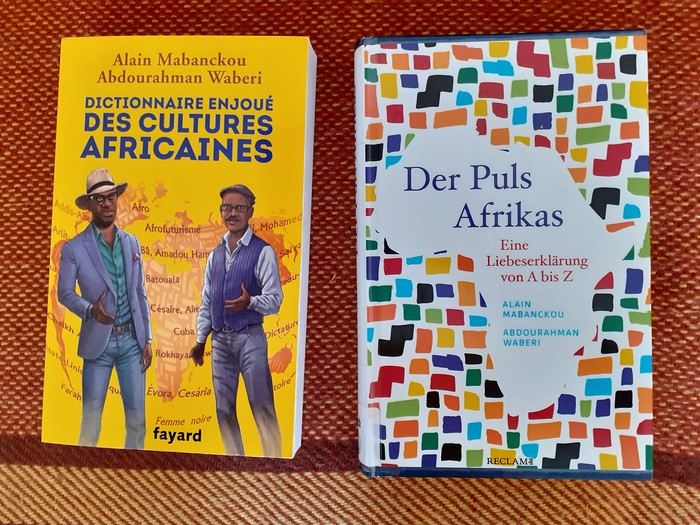
The Maggi cube, an unchallenged hegemony, and so much more
“The hopeless continent,” headlined The Economist, a British magazine, in July 2000 about Africa. Eleven years later, the same magazine headlined “Africa rising” instead. Images of Africa in the prosperous North constantly oscillate between apocalyptic scenarios and enthusiastic projections. A key issue with such images lies in the generalization they entail. If you look at the continent, considerable contrasts emerge depending on space and time. It’s no surprise that a region of the world encompassing such diverse ecological zones, maintaining such varied ties with other continents, comprising nearly fifty nation-states in sub-Saharan Africa alone, and characterized by a great diversity of languages, belief systems, and historical paths, doesn’t share a single destiny.
And yet, for many people outside Africa, as well as for many Africans, the continent constitutes a single entity, defined by criteria such as skin color, a colonial past, poverty, and the art of survival. Until now, these perspectives were generally accompanied by the idea that Africa had to—or should have—followed a single path together, sometimes called development, sometimes modernization, sometimes liberation, then a market economy. None of these paths delivered on their promises.
The two writers Alain Mabanckou and Abdourahman Waberi—one from Congo, the other raised in Djibouti, both long settled in France and now professors at renowned North American universities (Los Angeles, Washington)—have had enough of pessimistic scenarios: “We are aware that Africa is in the world and the world is in Africa. The same goes for all other continents, as our destinies are inextricably linked for better or worse. We refuse to see Africa as a reservoir of misfortunes or a continent cursed by atavistic misfortune and characterized by ethnic conflicts. [...] It’s this passionate flame we wanted to capture in a book [...] a kind of stroll through African cultures, without any demands, each letter of the alphabet leading us to a notion, a practice, a concept, a moment in history, literature, painting, politics, economics, cuisine, etc.” (p.10-11). Africa, they write, is on the verge of “imposing a signature, a style, a way of being in the world and in relation to the rest of the world.” (p.11) To put words to the continent’s diversity and dynamism, the two authors created a “rambling ABC,” a kind of portrait—or more precisely, a mythography—that lets you see and feel the pulse of a vast continent whose cultural power is unfolding before our eyes. Once marginalized or even mocked, the voice and importance of the Continent in global affairs are now undeniable” (p.11), containing over a hundred entries, mostly concise, written in a relaxed and casual style. The optimistic, even exuberant tone is set from the brief introduction. The duo of authors wants to “sing a love song to the cultures of our continent, to its inhabitants past and present, to its exceptional resources and its spectacular globalization despite a certain pollution that still clouds our skies due to the unmatched duration of dictatorships in some of our regions.” (p.12) In doing so, they don’t want to be too distracted by today’s Afewerki-Biya-Bongo-Déby & Co. ...
Of course, you’ll find tributes to great precursors like Frantz Fanon (“[...] it was a love story and admiration that wasn’t dimmed by the four decades separating his birth from ours. Let’s add that we were born while the native of Fort-de-France had left the world’s stage four years earlier, in the prime of life” p.141), Mongo Beti (“You must read and reread Mongo Beti, a genius who used his fame to support often just causes in Africa, like defending oppressed groups. His place is already in History. His oppressors, like the dictators Ahmadou Ahidjo and Paul Biya, can’t compete in the same category” p.64), the Malian Amadou Hampâté Bâ
(“Posterity remembers him mainly as an tireless defender of African cultures. His plea for the collection and preservation of traditional African knowledge remains a major event for all men and women of good will. One day in 1960, at the UNESCO podium, the native of Bandiagara sounded the alarm: ‘[...] Since we’ve admitted that the humanity of each people is the heritage of all humanity, if African traditions aren’t collected in time and written down, they’ll one day be missing from the universal archives of humanity.’” p.51),
Kwame Nkrumah, “one of the founders of Pan-Africanism, father of Ghana’s independence” (p.239), as well as the historian Cheikh Anta Diop, the writer, poet, and politician Aimé Césaire, and the economist and thinker Samir Amin, but also very warm tributes to certain contemporary African intellectuals like Souleymane Bachir Diagne and Achille Mbembe
(“A few years ago, in dominant economic circles, a rumor often resurfaced, usually disguised as a cold and scientifically proven analysis: Africa is useless. It’s a burden for the rest of the human community. With its 2% share in world trade, it would disappear from stock market radars without anyone noticing. So? Maybe it’ll be pulled up by other continents. Wanting to surpass itself is a crazy bet for Africans, they concluded. Arrogant or clueless, President Nicolas Sarkozy declared before an audience of students and teachers at Cheikh Anta Diop University in Dakar: ‘The African man hasn’t entered history enough [...] He only knows the eternal repetition of time marked by the endless repetition of the same gestures and words.’ That was in 2007. For decades, armed only with reason, an intellectual often steps up to debunk prejudices, lazy readings, and dishonest frameworks used as false fronts by those who, like Nicolas Sarkozy or former journalist Stephen Smith, out of ignorance, contempt, or condescension, distort African reality. This intellectual is none other than the historian and political scientist Achille Mbembe. This heir of Frantz Fanon, Amílcar Cabral, Jean-Marc Ela, and Fabien Eboussi-Boulaga was born in 1957 in Cameroon, in the Bassa region. Marked early by the upheavals of a fratricidal war, Achille Mbembe became the guardian of the memory of martyrs. After brilliant studies in Paris, he went on to teach at the best American universities, but the call of the Continent was stronger than anything else. In Dakar, he once directed CODESRIA (Council for the Development of Social Science Research in Africa) before joining the University of the Witwatersrand in Johannesburg, South Africa. Even though the author of *Critique of Black Reason* (Éditions La Découverte, 2015) spends a few months at Duke University in North Carolina, his observation post remains South Africa. From Johannesburg, Achille Mbembe scrutinizes Africa and the whole world. A lucid observer with an elegant and generous pen, Achille Mbembe knows how to blend big and small history: ‘I was born one day in July, as the month was drawing to a close. It was 1957, in that part of Africa recently named ‘Cameroon,’ a memory of the wonder that seized Portuguese sailors in the 15th century when, sailing up the river near Douala, they couldn’t help but note the presence of a multitude of crustaceans, and named it *Rio dos Camarões*, meaning ‘River of Shrimp.’ I grew up in the shadow of this nameless land, since, in a way, the name it bears is only the product of someone else’s astonishment: a lexical mistake, if you will.’ From this mistake or wound, he made leaven, a springboard to compose a rich work, recognized worldwide. To denounce barriers and barbarians too. But that’s not enough. Among his peers in circles of thought and action, Achille Mbembe passionately and consistently defends human dignity and the beauty of the world. In doing so, he fulfills the mission Frantz Fanon entrusted to him.” (p.227-229),
as well as entries dedicated to lesser-known artists and intellectuals, like the French journalist and activist Rokhaya Diallo, daughter of Senegalese and Gambian parents, or the Ethiopian filmmaker Haile Gerima, who has long lived in the United States. Other names from politics, sports, music, art, and literature: Kofi Annan, p.36; Barack Obama, p.243; Thomas Sankara, p.277; Ousmane Sow, p.285; Yambo Ouologuem, p.250; Léopold Sédar Senghor, p.282; Muhammad Ali, p.30; Nuruddin Farah, p.146; Salif Keita, p.203; Ahmadou Kourouma, p.206; Ngũgĩ wa Thiong’o, p.236; Winnie Mandela, p.224; Kylian Mbappé, p.226 ...
The authors, who resolutely commit to a “mythography” (p.11) of Africa, also pay special attention to local social movements, cultural events, and aspects of daily life. *Y’en a marre*, “which also meant ‘we’re fed up with sitting on our hands’” (p.320-321), emerged about a decade ago in Senegal as a citizen movement of peaceful resistance and symbolizes, the authors emphasize, the fact that African youth are increasingly fed up “with the political circus deployed in Africa since independence, as our parents would say, ‘since the White man left’...” (p.321). A full entry is dedicated to the Maggi bouillon cube, which has flooded African markets for about forty years and enjoys immense popularity (“It’s everywhere in Africa, from Dakar to Djibouti, and from Tangier to Cape Town. It’s in every pot, every stew. Little hands put it in every sauce, every local or adapted dish. An unchallenged hegemony! You’ll find it in diasporas too. The culinary strolls in Paris, in the [...] neighborhood” p.90). Critics blame it not only for impoverishing the aromatic diversity of local dishes but also for being harmful to health. And yet, “he poorest Africans, those who eat only once a day, a few spoonfuls of white beans and a ball of *foufou*, for example, are the most fervent users of the magic cube.” (p.92-93)
For *fonio*, “the new trendy cereal. [...] From the millet family, fonio is probably the oldest cereal cultivated in West Africa, and mainly in its sub-Saharan part, for millennia. [...] Easy to grow, water-efficient, fonio grows everywhere except on clay soils. Long neglected because it was considered the poor man’s crop, fonio is now a source of pride for the farmers who cultivate it and cherish it like the apple of their eye” (p.156-157), the authors immediately offer a detailed recipe, letting the reader know that “e can’t resist sharing this fonio with chicken recipe from Mali with you:
Ingredients: 1 chicken 3 large ripe red tomatoes 4 tbsp tomato paste 4 large onions 1 garlic clove 1/2 cup oil 2 Maggi cubes or salt 2 large carrots 1 turnip 1 large cabbage 2 large potatoes 1 celery stalk 1 packet pre-cooked fonio 4 okra (or okra powder) salt, pepper
Preparation: 1. Prepare the sauce: wash and cut the chicken. Peel the onions, garlic, and vegetables. 2. In a pot, fry the chicken pieces. 3. Dice the onions, tomatoes, carrots, and turnip very small and add them to the pot. 4. Add the tomato paste, salt, and pepper. 5. Simmer for 15 min, then add 2 L of water and the cooked chicken pieces. 6. Simmer for 30 min, then add the crushed garlic and celery, plus the cabbage cut into 4 and the potatoes cut in half. 7. Prepare the fonio: cover it with warm water, let it rest for 15 min, and cook it over low heat. 8. In a small pot, boil the okra and crush them. 9. Mix the crushed okra with the cooked fonio, then salt. Serve hot.” (p.158-159)
The comedy *Black Mic Mac*, released in French theaters in 1986 and addressing France’s increasingly restrictive immigration policy at the time, also gets an entry, as do *Tintin in the Congo*, the popular comic, and *Jip’s Café* (“[...] a little Africa in the heart of Paris, with passersby stopping to admire the ‘ambianceurs’ on the dance floor or attend the cultural events offered by the place” (p.194), an African establishment in Paris that Alain Mabanckou already immortalized in one of his novels.
The duo of authors also tackles thorny subjects like jihadism (p.119), the Rwandan genocide (p.272), the CFA franc (p.82), and dictatorship (p.110). While the two strike the right tone here, many entries leave a slightly bitter taste. Two examples: why doesn’t the text on Barack Obama mention the great disappointment of many people in Africa, who expected more from the African policy of the first U.S. president with African roots than just occasional warm words? Why do the comments on Winnie Mandela gloss over the fact that she was a highly controversial icon of the anti-apartheid movement due to her involvement in kidnappings, acts of torture, and murders of alleged apartheid collaborators? Instead, there’s a compassion that brings tears to the eyes: “She was often reduced to a secondary role, the wife of a great man” or “When victory came, she didn’t taste its fruits. Divorced, isolated. She would never be a ‘first lady’ in an evening gown, posing before a bed of chrysanthemums. They’d keep her far from the circles of power” (p.224-225). At this point, I would’ve liked the authors to take a slightly more critical stance...
That said, these “weaknesses” (if you can call them that) shouldn’t overshadow the book as a whole. It remains an informative, sometimes very entertaining, and often even original work in its own way.
Book information (the original French and the German translation):
Alain Mabanckou/Abdourahman Waberi. Dictionnaire enjoué des cultures africaines. Fayard, 2019. Alain Mabanckou/Abdourahman Waberi. Der Puls Afrikas. Eine Liebeserklärung von A bis Z. Reclam, 2022.
Hery
From Avignon to Casamance Without Flying
Hi there,
Last February, I made a trip using "public transport" from France to southern Senegal via Spain, Morocco, Western Sahara, and Mauritania.
It’s a journey of about 5,000 km, where I took trains (as far as Marrakech), ferries (to cross Gibraltar and then to reach Casamance from Dakar), and mostly buses on the long desert straightaways. I hadn’t planned any stops in advance or booked any hotels, except for the very first train to Spain, which left plenty of room for the unexpected. Why travel by land and sea? In recent years, flight-free travel has been gaining popularity. On social media, posts explaining how to cross Europe by train as quickly as possible go viral. Traveling without flying—and making sure people know about it—has become a great way to earn a badge of eco-responsibility: an essential totem for anyone wanting to prove both their dedication to the ecological cause and the wisdom of slow travel. I haven’t flown in years, and this journey to West Africa could easily be filed under "responsible travel." But it wouldn’t be honest to say that: in reality, it wasn’t really my aversion to flying that motivated this long trek. I see overland travel primarily as a way to experience the world’s geography at a grounded, earthly pace—the pace of the locals. Besides, I’ll be flying back, which disqualifies any claim to being a model of sustainability. So no eco-badge, and no adventurer’s badge either: you won’t find any heroic tales of camel rides in lost lands or mineral train wagons in this account (popular with influencers, the Mauritania iron ore train now attracts tourists from all over the world, turning "the experience" into something you "have to do at least once in your life"). This five-part story, written on the road, has no other ambition than to recount a journey through places and people, and to share the thoughts they inspire in me. As simply and, I hope, as humbly as possible.
I’m posting the episodes here, which you can also find on my blog (with more photos) at the following links:
Episode 1: Spain, from Avignon to Algeciras
Episode 2: Morocco, from Tangier to Tarfaya
Episode 3: Western Sahara, from Tarfaya to Guerguerat
Episode 4: Mauritania, from Guerguerat to Nouakchott
Episode 5: Senegal, from Rosso to Saloulou
To help those who might want to make the same trip, I’ve also put together a summary of the route with recommendations—you can read it at the end of the story and on the blog: From France to Senegal Without Flying: Route and Itinerary Recommendations
Happy reading, and safe travels!
Last February, I made a trip using "public transport" from France to southern Senegal via Spain, Morocco, Western Sahara, and Mauritania.
It’s a journey of about 5,000 km, where I took trains (as far as Marrakech), ferries (to cross Gibraltar and then to reach Casamance from Dakar), and mostly buses on the long desert straightaways. I hadn’t planned any stops in advance or booked any hotels, except for the very first train to Spain, which left plenty of room for the unexpected. Why travel by land and sea? In recent years, flight-free travel has been gaining popularity. On social media, posts explaining how to cross Europe by train as quickly as possible go viral. Traveling without flying—and making sure people know about it—has become a great way to earn a badge of eco-responsibility: an essential totem for anyone wanting to prove both their dedication to the ecological cause and the wisdom of slow travel. I haven’t flown in years, and this journey to West Africa could easily be filed under "responsible travel." But it wouldn’t be honest to say that: in reality, it wasn’t really my aversion to flying that motivated this long trek. I see overland travel primarily as a way to experience the world’s geography at a grounded, earthly pace—the pace of the locals. Besides, I’ll be flying back, which disqualifies any claim to being a model of sustainability. So no eco-badge, and no adventurer’s badge either: you won’t find any heroic tales of camel rides in lost lands or mineral train wagons in this account (popular with influencers, the Mauritania iron ore train now attracts tourists from all over the world, turning "the experience" into something you "have to do at least once in your life"). This five-part story, written on the road, has no other ambition than to recount a journey through places and people, and to share the thoughts they inspire in me. As simply and, I hope, as humbly as possible.
I’m posting the episodes here, which you can also find on my blog (with more photos) at the following links:
Episode 1: Spain, from Avignon to Algeciras
Episode 2: Morocco, from Tangier to Tarfaya
Episode 3: Western Sahara, from Tarfaya to Guerguerat
Episode 4: Mauritania, from Guerguerat to Nouakchott
Episode 5: Senegal, from Rosso to Saloulou
To help those who might want to make the same trip, I’ve also put together a summary of the route with recommendations—you can read it at the end of the story and on the blog: From France to Senegal Without Flying: Route and Itinerary Recommendations
Happy reading, and safe travels!
Join me in discovering Gran Canaria
Introduction
We stayed on the island of Gran Canaria during the first three months of 2024. It’s the third Canary Island we’ve visited, after Tenerife and Lanzarote.
We rented an apartment in Temisas. By staying in the same place for such a long period, the total price dropped by 50%.
We also rented a vehicle to make getting around the island easier.
Why the Canary Islands, and Gran Canaria in particular? For its pleasant climate, the nature and diversity of its landscapes, the charming villages, and especially the beauty of its many beaches.
In this travel journal, you’ll find a list of the many activities we did during our stay to explore the different attractions of this island.
These attractions are categorized to make it easier to find what interests you.
Videos are included throughout the summary. Click on the image to start the video.
To jump to a specific post, here are the relevant links:
HIKES:
Roque Nublo Maspalomas Dunes - Part 1 Maspalomas Dunes - Part 2 Los Azulejos de Veneguera Barranco de Las Vacas Ventana del Bentayga (Arco del Aserrador) Caves of the King Ventana de Morro (Ventana de la Ganifa) The Dog of Bentayga Cave of the Four Doors Ventana del Nublo Artenera - Caves of Acusa Seca Temisas - El Gigante Cave Fortress of Ansite Puerto de Las Nieves - Roque de Las Nieves Temisas - Cuevas de la Audiencia Roque Bentayga Guayadeque Ravine (Guayadeque Hermitage) Guayadeque Ravine (Cueva de Bartalo) El Zumacal - Barranco Tauco Casablanca Dam (Los Dolores Dam) Ayagaures - La Angostura Dam & Gambuesa Dam Santa Brígida - Alonso Ravine & Centennial Dragon Tree Pino Santo Hike in the Azuaje Ravine Gáldar - Red Lands of Samarrita Tejeda - Charco de La Paloma Bandama Boiler (Camino Borde de Caldera Bandama) Teror - Alamo Ravine Trail – SL-4 Telde - Calasio Caves Special Natural Reserve of Los Tilos de Moya Los Azulejos - Charco de Las Aneas Fataga Ravine Arinaga Military Battery Trail Maspalomas - Las Fuentes and del Canizo Ravines Mogán - Tauro Mountain Trail Tamabada - Llanos de La Mimbre & Sobre la Cueva Viewpoints Trail Hike to the Coronadero Arch via Barranco Hondo Barranco de Silva - Hike to the Jerez Caves Gáldar - Samson Cave - La Atalaya Peak Agaete - Roque Guayedra and Guayedra Ravine Artenara - Caballero Caves Arucas - Bufadero Salt Flats Barranco de Pino Gordo - Natural Pools Telde - Los Cernícalos Ravine Las Cruces - Toba Caves & Picón Puerto de Las Nieves - Moro Cave Agüimes - Morros de Ávila Caves Juncalillo del Sur - Laguna & Salinas de Abajo Caves of Camino de San Felipe Cruz de Tejeda, Cruz Chico and Degollada Viewpoint Hike on the Patalavaca Circuit Motor Grande - Puerto Rico Arch El Montañón - Los Hornos Dam Seafront Walk - Amadores Beach – Puerto Rico Beach Las Niñas Dam El Hornillo - Omega & Omicron Caves Arteara Necropolis Mogán - El Mulato Dam Las Garzas - El Regante Dam La Plata Route - Cho Flores Dam & El Charco Hondo Vega de Acusa - La Candelaria Dam Candelaria Hermitage – Acusa Seca Viewpoint Valsequillo de Gran Canaria – Roque La Vela Ayagaures Dam – GC-602 Lomo del Palo - Monte Pavón Trail Lugar La Laguna - Levada Fataga Dam & Ravine
BEACHES:
Mogán Beach Taurito Beach Tauro Beach Amadores Beach Puerto Rico Beach Anfi del Mar Beach Patalavaca Beach Meloneras Beach Maspalomas Beach English Beach (Playa del Inglés) Las Burras Beach San Agustin Beach Las Alcaravaneras Beach Las Canteras Beach (La Cicer) Las Canteras Beach (La Puntilla) Las Canteras Beach (Santa Catalina) Aquamarina Beach El Agujero - Bocabarranco Beach Hoya Del Pozo Beach Hoya Del Pozo Beach - Lizard with amputated tail El Cabron Beach Ojos de Garza Beach El Burrero Beach
NATURAL POOLS:
Charco Azul - El Risco Agaete Salt Flats Charco de Los Espejos - Sardina del Norte Natural Pools of Punta de Gáldar Snorkeling in the natural pool of Punta de Gáldar Natural Pool La Furnia o El Clavo - Gáldar Natural Pool of Los Dos Roques Emiliano Natural Pool - El Agujero Natural Pool of El Agujero Natural Pools of Roque Prieto Natural Pool El Altillo Los Charcones de Bañaderos – Arucas Natural Pools of El Charco de Las Palomas – Arucas Natural Pools of La Laja - Las Palmas de Gran Canaria Cueva de la Reina Mora - La Garita Natural Pools of Castillo del Romeral
TOWNS:
Center
Santa Brigida Vega de San Mateo Tejeda Artenara Vallesco Teror
Southwest
Santa Lucia de Tirajana Fataga San Bartolomé de Tirajana Puerto de Mogán La Aldea de San Nicolas
North
Arucas Firgas Moya Santa Maria de Guia Gáldar Agaete Puerto de Las Nieves
East
Vegueta - Las Palmas de Gran Canaria Triana - Las Palmas de Gran Canaria Ciudad Jardin - Las Palmas de Gran Canaria Canteras - Las Palmas de Gran Canaria Telde Valsequillo de Gran Canaria Ingenio Agüimes Temisas
VIEWPOINTS:
GC-60 Route (or nearby) GC-210 Route (or nearby) GC-210 Route between the tunnel and La Aldea de San Nicolás GC-215 & GC-65 Routes (or nearby) GC-200 Route (or nearby) GC-130 Route (or nearby) & GC-605 GC-70 Route (or nearby) & GC-21 Sheep herd on GC-70 Route GC-150, GC-240, GC-305, GC-350 & GC-301 Routes GC-606, GC-295, GC-231 and GC-41 Routes (or nearby) Viewpoints – GC-1 Route (or nearby) Viewpoints - Las Palmas de Gran Canaria Viewpoints - GC-2, GC-21, GC-15, GC-216 and GC-132 Routes (or nearby) Viewpoints - GC-503 & GC-217 Routes Viewpoints - GC-604, GC-505, GC-132, GC-42 and GC-802 Routes
MISCELLANEOUS:
San Rafael Aqueduct - Telde Abandoned San Rafael Estate - La Higuera Cenobio de Valerón La Cesta - Tejeda Puerto de la Aldea Scenic Route GC-671 to El Espinillo Scenic Route GC-607 to El Chorrillo The Galdar Cube (Santiago Quarry) Scenic Route GC-504 to Ayagaures Abandoned seaside resort in the Azuaje Ravine El Bufadero de La Garita – Telde GC-505 Route Abandoned Finca Las Haciendas (Los Mocanes) – Las Vegas de Valsequillo Ruins of San Juan Battery - Las Palmas de Gran Canaria Viera y Clavijo Canarian Botanical Garden - Las Palmas de Gran Canaria Tenefé Salt Flats Los Pérez, Lugarejos & Las Hoyas Dams Monte Pavón, Gran Canaria’s little Ireland Valleseco Lagoon Recreational Area Climbing - Fataga Ravine Surfing – El Agujero El Cairete Restaurant - Carrizal de Tejeda Paragliding flight observation - Los Giles La Cuevita Ayagaures Restaurant Statues and Murals - Cruce de Arinaga Aviation Monument (Las Majoreras) & Murals – Carrizal Artistic recycling by Antonio Peñita - Ojos de Garza Rainbows
We stayed on the island of Gran Canaria during the first three months of 2024. It’s the third Canary Island we’ve visited, after Tenerife and Lanzarote.
We rented an apartment in Temisas. By staying in the same place for such a long period, the total price dropped by 50%.
We also rented a vehicle to make getting around the island easier.
Why the Canary Islands, and Gran Canaria in particular? For its pleasant climate, the nature and diversity of its landscapes, the charming villages, and especially the beauty of its many beaches.
In this travel journal, you’ll find a list of the many activities we did during our stay to explore the different attractions of this island.
These attractions are categorized to make it easier to find what interests you.
Videos are included throughout the summary. Click on the image to start the video.
To jump to a specific post, here are the relevant links:
HIKES:
Roque Nublo Maspalomas Dunes - Part 1 Maspalomas Dunes - Part 2 Los Azulejos de Veneguera Barranco de Las Vacas Ventana del Bentayga (Arco del Aserrador) Caves of the King Ventana de Morro (Ventana de la Ganifa) The Dog of Bentayga Cave of the Four Doors Ventana del Nublo Artenera - Caves of Acusa Seca Temisas - El Gigante Cave Fortress of Ansite Puerto de Las Nieves - Roque de Las Nieves Temisas - Cuevas de la Audiencia Roque Bentayga Guayadeque Ravine (Guayadeque Hermitage) Guayadeque Ravine (Cueva de Bartalo) El Zumacal - Barranco Tauco Casablanca Dam (Los Dolores Dam) Ayagaures - La Angostura Dam & Gambuesa Dam Santa Brígida - Alonso Ravine & Centennial Dragon Tree Pino Santo Hike in the Azuaje Ravine Gáldar - Red Lands of Samarrita Tejeda - Charco de La Paloma Bandama Boiler (Camino Borde de Caldera Bandama) Teror - Alamo Ravine Trail – SL-4 Telde - Calasio Caves Special Natural Reserve of Los Tilos de Moya Los Azulejos - Charco de Las Aneas Fataga Ravine Arinaga Military Battery Trail Maspalomas - Las Fuentes and del Canizo Ravines Mogán - Tauro Mountain Trail Tamabada - Llanos de La Mimbre & Sobre la Cueva Viewpoints Trail Hike to the Coronadero Arch via Barranco Hondo Barranco de Silva - Hike to the Jerez Caves Gáldar - Samson Cave - La Atalaya Peak Agaete - Roque Guayedra and Guayedra Ravine Artenara - Caballero Caves Arucas - Bufadero Salt Flats Barranco de Pino Gordo - Natural Pools Telde - Los Cernícalos Ravine Las Cruces - Toba Caves & Picón Puerto de Las Nieves - Moro Cave Agüimes - Morros de Ávila Caves Juncalillo del Sur - Laguna & Salinas de Abajo Caves of Camino de San Felipe Cruz de Tejeda, Cruz Chico and Degollada Viewpoint Hike on the Patalavaca Circuit Motor Grande - Puerto Rico Arch El Montañón - Los Hornos Dam Seafront Walk - Amadores Beach – Puerto Rico Beach Las Niñas Dam El Hornillo - Omega & Omicron Caves Arteara Necropolis Mogán - El Mulato Dam Las Garzas - El Regante Dam La Plata Route - Cho Flores Dam & El Charco Hondo Vega de Acusa - La Candelaria Dam Candelaria Hermitage – Acusa Seca Viewpoint Valsequillo de Gran Canaria – Roque La Vela Ayagaures Dam – GC-602 Lomo del Palo - Monte Pavón Trail Lugar La Laguna - Levada Fataga Dam & Ravine
BEACHES:
Mogán Beach Taurito Beach Tauro Beach Amadores Beach Puerto Rico Beach Anfi del Mar Beach Patalavaca Beach Meloneras Beach Maspalomas Beach English Beach (Playa del Inglés) Las Burras Beach San Agustin Beach Las Alcaravaneras Beach Las Canteras Beach (La Cicer) Las Canteras Beach (La Puntilla) Las Canteras Beach (Santa Catalina) Aquamarina Beach El Agujero - Bocabarranco Beach Hoya Del Pozo Beach Hoya Del Pozo Beach - Lizard with amputated tail El Cabron Beach Ojos de Garza Beach El Burrero Beach
NATURAL POOLS:
Charco Azul - El Risco Agaete Salt Flats Charco de Los Espejos - Sardina del Norte Natural Pools of Punta de Gáldar Snorkeling in the natural pool of Punta de Gáldar Natural Pool La Furnia o El Clavo - Gáldar Natural Pool of Los Dos Roques Emiliano Natural Pool - El Agujero Natural Pool of El Agujero Natural Pools of Roque Prieto Natural Pool El Altillo Los Charcones de Bañaderos – Arucas Natural Pools of El Charco de Las Palomas – Arucas Natural Pools of La Laja - Las Palmas de Gran Canaria Cueva de la Reina Mora - La Garita Natural Pools of Castillo del Romeral
TOWNS:
Center
Santa Brigida Vega de San Mateo Tejeda Artenara Vallesco Teror
Southwest
Santa Lucia de Tirajana Fataga San Bartolomé de Tirajana Puerto de Mogán La Aldea de San Nicolas
North
Arucas Firgas Moya Santa Maria de Guia Gáldar Agaete Puerto de Las Nieves
East
Vegueta - Las Palmas de Gran Canaria Triana - Las Palmas de Gran Canaria Ciudad Jardin - Las Palmas de Gran Canaria Canteras - Las Palmas de Gran Canaria Telde Valsequillo de Gran Canaria Ingenio Agüimes Temisas
VIEWPOINTS:
GC-60 Route (or nearby) GC-210 Route (or nearby) GC-210 Route between the tunnel and La Aldea de San Nicolás GC-215 & GC-65 Routes (or nearby) GC-200 Route (or nearby) GC-130 Route (or nearby) & GC-605 GC-70 Route (or nearby) & GC-21 Sheep herd on GC-70 Route GC-150, GC-240, GC-305, GC-350 & GC-301 Routes GC-606, GC-295, GC-231 and GC-41 Routes (or nearby) Viewpoints – GC-1 Route (or nearby) Viewpoints - Las Palmas de Gran Canaria Viewpoints - GC-2, GC-21, GC-15, GC-216 and GC-132 Routes (or nearby) Viewpoints - GC-503 & GC-217 Routes Viewpoints - GC-604, GC-505, GC-132, GC-42 and GC-802 Routes
MISCELLANEOUS:
San Rafael Aqueduct - Telde Abandoned San Rafael Estate - La Higuera Cenobio de Valerón La Cesta - Tejeda Puerto de la Aldea Scenic Route GC-671 to El Espinillo Scenic Route GC-607 to El Chorrillo The Galdar Cube (Santiago Quarry) Scenic Route GC-504 to Ayagaures Abandoned seaside resort in the Azuaje Ravine El Bufadero de La Garita – Telde GC-505 Route Abandoned Finca Las Haciendas (Los Mocanes) – Las Vegas de Valsequillo Ruins of San Juan Battery - Las Palmas de Gran Canaria Viera y Clavijo Canarian Botanical Garden - Las Palmas de Gran Canaria Tenefé Salt Flats Los Pérez, Lugarejos & Las Hoyas Dams Monte Pavón, Gran Canaria’s little Ireland Valleseco Lagoon Recreational Area Climbing - Fataga Ravine Surfing – El Agujero El Cairete Restaurant - Carrizal de Tejeda Paragliding flight observation - Los Giles La Cuevita Ayagaures Restaurant Statues and Murals - Cruce de Arinaga Aviation Monument (Las Majoreras) & Murals – Carrizal Artistic recycling by Antonio Peñita - Ojos de Garza Rainbows
Une semaine au départ de San Francisco English translation pending
Bonjour , nous somme une famille de 4 : parents et 2 enfants de 13 et 9 ans. Théoriquement nous irons à San Francisco fin avril. Nous avons avons de la famille sur place ( les enfants sont plus jeunes). Premier séjour aux États-Unis. Pour cause professionnelle la durée sur place est limitée.
les vols sont achetés aux horaires qui nous conviennent:
arrivée à SF dimanche 13h35 , départ le mardi 23h00. Après un road trip Nous souhaitons être de retour à SF le samedi soir: visites avec les 2 familles le dimanche, puis entre nous le lundi et mardi
j'envisage cet esquisse de programme:
dimanche soir :nuit à Midpines
Lundi visite de Yosemite park , nuit à Fresno
mardi visite de Sequoia park nuit à Three Rivers
mercredi route et visite de Trona Pinnacles nuit à Ridgecrest
jeudi visite Death Valley Furnace Creek nuit à Las Végas
pour le vendredi : le Grand Canyon donne vraiment envie d''être visité , nuit au Grand Canyon?
samedi retour vers Las Vegas puis vol vers SF en fin d’après-midi ( je ne prends pas le risque de réserver ce vol plusieurs semaines à l'avance) ou route toute la journée vers SF.
votre avis trop chargé , je supprime soit Death Valley , soit le Grand Canyon , les 2 ?
j'ai regardé pour arriver directement à Las Vegas plutôt que San Francisco le premier jour mais il faut ajouté presque 600€ ( j'ai eu les 4 aller-retour Paris SF à 1240€). Si le premier jour je vais à LV en avion en partant de SF quelle marge prendre entre le départ du 2eme vol et l'arrivée du premier? Pour les hébergements j'essaie de trouver sur hotel.com car j'ai un programme fidélité lors de mes déplacements pro. Merci pour vos conseils William
j'ai regardé pour arriver directement à Las Vegas plutôt que San Francisco le premier jour mais il faut ajouté presque 600€ ( j'ai eu les 4 aller-retour Paris SF à 1240€). Si le premier jour je vais à LV en avion en partant de SF quelle marge prendre entre le départ du 2eme vol et l'arrivée du premier? Pour les hébergements j'essaie de trouver sur hotel.com car j'ai un programme fidélité lors de mes déplacements pro. Merci pour vos conseils William
Chorizo ou pas dans la paëlla? English translation pending
Tout fout le camp...
Chorizo ou pas ? Un illustre chef espagnol ravive le «paellagate»
(Mais moi j'en ai toujours mis... 😛 )
American Airlines rajoute des escales à mon vol pour le Pérou English translation pending
Bonjour a tous
Nous avons reservé il y a quelques des billets d'avions pour le Perou au mois de septembre avec la compagnie America Airlines. Nous avions choisi un départ de Paris avec une escale a Miami puis vol Lima. Maintenant on me modifie mon vol avec une escale a Londre puis a Miami.
-Les compagnies ont t'elle le droit de faire ce genre de chose sans modifier ses tarifs vu que c'est pas ce que j'avais choisi dans la multitude de proposition?
-Les liaisons entre le France et les USA étant surrement supendue en septembre, c'est pas un risque d'accepter de partir dans ses conditions?
Merci d'avance pour vos conseils
Nous avons reservé il y a quelques des billets d'avions pour le Perou au mois de septembre avec la compagnie America Airlines. Nous avions choisi un départ de Paris avec une escale a Miami puis vol Lima. Maintenant on me modifie mon vol avec une escale a Londre puis a Miami.
-Les compagnies ont t'elle le droit de faire ce genre de chose sans modifier ses tarifs vu que c'est pas ce que j'avais choisi dans la multitude de proposition?
-Les liaisons entre le France et les USA étant surrement supendue en septembre, c'est pas un risque d'accepter de partir dans ses conditions?
Merci d'avance pour vos conseils
Adventures of a Bygone Era: The Philippines in 1984
After several discussions on VF about travel journals from the Philippines, I decided to write this curiosity: a trip report from a journey made in 1984, when traveling to the Philippines was still an adventure.
A curiosity because writing a travel journal about a trip 35 years later isn’t common, but also (mostly?) because exploring the Philippines at that time had little in common with traveling there today.
Obviously, I’ve forgotten a number of facts, most of the details, but with the help of a few notes from that time and a stack of slides (yes, there was life before digital 😊), many memories came back and added to the highlights I’d never forgotten. The scanned slides aren’t always great quality, but there are still quite a few to brighten up this chatter. Back then, we didn’t snap photos like we do now—film was too expensive—so I don’t have pictures of every place we visited... too bad, comparing some of those spots to how they look today would’ve been interesting.
Why "Adventures"? Why call it "Adventures" in the Philippines in 1984, a word so often used for a simple exotic trip? - Because the lack of information (no *Guide du Routard*, no *Lonely Planet*, no *Michelin Guide*, nothing, and obviously no internet) gave this trip what’s at the heart of adventure: the unknown. - Because the political situation made the stay sometimes dangerous. - Because transportation conditions were always epic, often perilous. - Because the question of where we’d spend the night came up almost every evening. - And for... quite a few other reasons.
That said, we weren’t exactly explorers!
Why the Philippines? First of all, why go to the Philippines in 1984—a country not exactly set up for tourism and about which we knew very little? How could we get an idea of the beauty of the Philippines and its points of interest when we had no guides or photos?
The idea came to us from Thailand a year earlier, during our first long-haul trip. After touring the north of the country, we met a Frenchman living in Phuket, where there were only a few tourists in Patong, with just a few small hotels and guesthouses. Kata and Karon had no buildings or roads, Rawai only had three palm-thatched bungalows, including ours, and the other islands were unknown to tourists. There was plenty to discover, and we wanted to return to this beautiful country... but the Frenchman made us dream about the Philippines—a country to explore, with wild landscapes.
Long evenings of discussion over multiple Sprite-Mekong cocktails (what memories of those headaches!) finally convinced us we had to go to the Philippines.
Episode 0: Before Departure The decision was made: we’d go to the Philippines in May 1984. Our friends and family were surprised when we announced we were going on vacation to the Philippines (a bit like saying today we were going paddleboarding in the Kerguelen Islands 🤪).
These days, preparing for each of our trips takes long evenings of research, planning, and noting down good addresses... etc. But for the Philippines in 1984, preparation was quick: we had very little information about the country, we were leaving almost at random, and the discovery would only be more exciting.
We still had a few bits of info gathered here and there: the rice terraces in northern Luzon, volcanoes, Negros where we were supposed to visit an acquaintance, Cebu and its marine life (we ended up going elsewhere), and absolutely avoid Mindanao, which was practically at war with the regime. That was about it, but it was already a great itinerary.
Nothing was organized in advance; we’d see day by day. We had no idea about travel times or even the existence of transportation options. The main (and sometimes only) way to connect two islands was by overloaded, rusty ferry. Only the big cities had airports.
Let’s Go: Episode 1: Paris to Manila My travel journals always start after arriving at the airport—the Europe-to-“Other Continent” trip isn’t interesting—but the flight to the Philippines was already an adventure, so I’ll make an exception.
This was the era when only a few Asian airlines were on par with Western ones: Thai, Singapore Airlines, and Philippine Airlines. They had beautiful, brand-new planes, and to attract customers (almost exclusively “businessmen”) from the usual airlines (Air France, Lufthansa, British Airways), there was opulence on board: unlimited champagne, all sorts of cocktails... Compared to today’s long-haul flights, there was still one small difference: no personal screens, just one screen at the front of the cabin with one mandatory movie. And I don’t know why, but we only got James Bond films, both ways... that must’ve been the trend at the time.
The tourism boom to Southeast Asia hadn’t started yet, and the “Asian Tigers” weren’t a thing, so there weren’t many business trips. That meant long-haul flights made stops everywhere to fill the planes. Our Philippine Airlines Boeing 747 left London, picked us up in Paris, then stopped in Frankfurt to take on a few Germans. I don’t know why we then made a stop in Dubai—a totally exotic place at the time. There was nothing to do there... things have changed a lot since. It was a small town lost in the desert. The airport was tiny, with just one or two buildings and a supermarket. During the stopover, everyone had to get off the plane and walk to the supermarket. Photo and electronic equipment were dirt cheap—I guess that was the only reason for the stop. Maybe it was their first commercial move. Emirates didn’t exist yet, as I checked online, but anyway, the idea that such a remote place could have its own airline was unthinkable.
Online, I found this photo of Dubai Airport in 1980. Anyone who’s transited through today’s massive airport with its rows of A380s will appreciate it: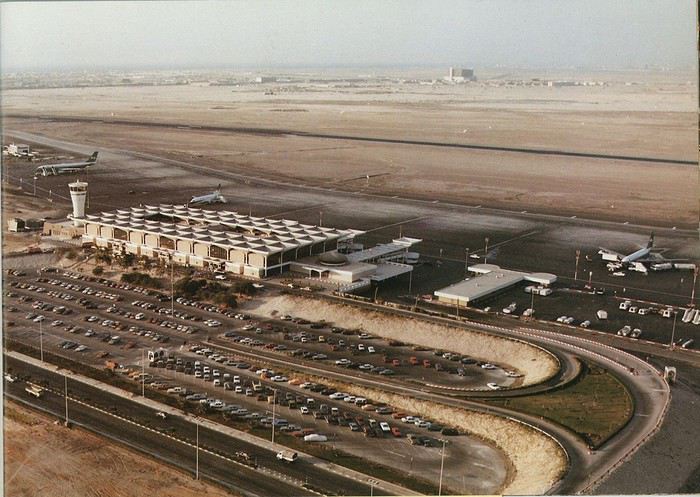
Next stop: New Delhi to drop off some Europeans and pick up a few Indians, and finally, the terminus: Manila. I don’t remember how long the trip took with its five stops—an unimaginable journey today. Despite all those stops to fill the plane, there was still enough space to stretch out on the four center seats of the 747, something that never happens these days despite all the flights in every direction.
So here we are, finally at Manila Airport around midnight.
Episode 1: Manila and Baguio To start, a quick note on the political and economic situation in the Philippines in 1984, which had consequences for us as tourists, as we’d soon realize upon arrival.
After several centuries of Spanish colonization, the Philippines became American at the start of the 20th century, then independent. In 1966, Marcos took power, and little by little, his regime sank into corruption and mismanagement, becoming a dictatorship with martial law, all for the benefit of his family and friends, who enriched themselves endlessly. The peak was the assassination of opposition leader Benigno Aquino in August 1983, which triggered harshly repressed protests. So we arrived a few months later in a very poor country, with omnipresent corruption and an extremely tense political situation, as we’d soon see for ourselves. Major protests took place in the main cities during our trip—I’ll come back to that. Two years later, Marcos fled to Hawaii after being forced out of power following rigged elections. This historical context explains a lot of the situations we found ourselves in over the following weeks.
Arriving in the middle of the night isn’t very cheerful. Manila was already a huge city with many slums, where you could find a few business hotels like the Hilton or Intercontinental—way out of our budget—and plenty of run-down hotels. Luckily, two Indians we’d chatted with on the plane offered to take us to their usual hotel. They came to Manila twice a year for business. We accepted their offer, relieved not to have to look for a place to stay in the middle of the night, figuring the address must be good since they came back every time... we were wrong 🙁
We left the airport and immediately got a taste of the local vibe when we got into the taxi: the police asked for our passports. We thought: what’s more normal than police in a dictatorship?
But that wasn’t it at all. Our two Indian friends explained that the police were noting our names along with the taxi number and time. Crime in Manila was so bad that the taxi driver would be held responsible if anything happened to us... welcome to the Philippines 😎 😎
Historically, the Philippines was a very violent country, where everything was settled with guns or machetes. Previous governments had banned carrying weapons, but Marcos later allowed the free sale and carrying of guns, and disputes were settled with pistols again (or worse, as we’d discover later). Since he’d released most of the criminals from prison to form a paramilitary militia at his service (I’ll talk about our encounter with these “heroes” later), it was pretty dangerous to go into many parts of Manila, where these “tonton macoutes” ruled.
We arrived at our hotel without incident... and then things started badly. The room was infested with big cockroaches—exactly what I hate most in those kinds of countries. No way to find another hotel at that hour. After the long flight, the urge to take a shower was so strong that we squeezed into the bathroom as best we could. After that, I don’t remember—I guess we must’ve fallen asleep exhausted under the sheets in the heat... air conditioning wasn’t widespread yet.
The next day, we just wanted to leave that dump as soon as possible. So we decided to head north right away, stopping in Baguio, and we’d visit Manila a bit on the way back.
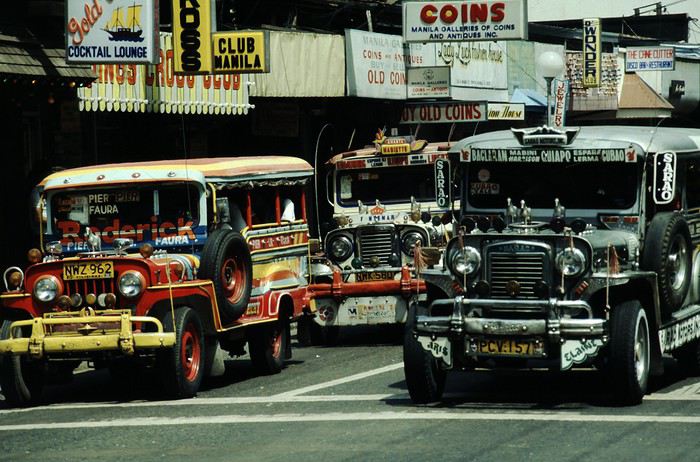
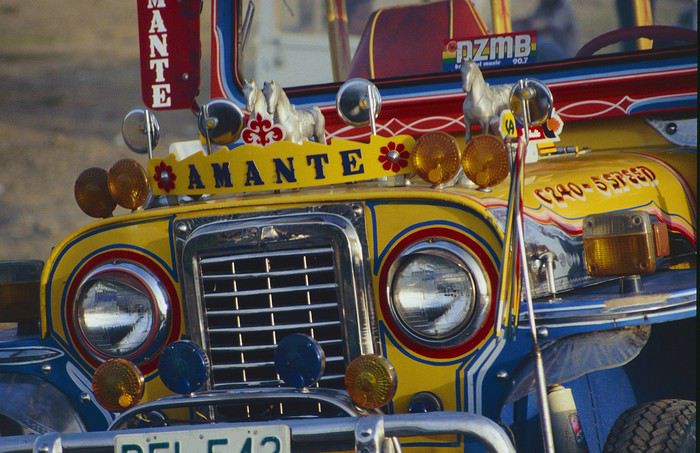
When we stepped outside, we discovered a pretty run-down neighborhood with potholed streets. But we also discovered the jeepneys. They were everywhere, flooding the streets.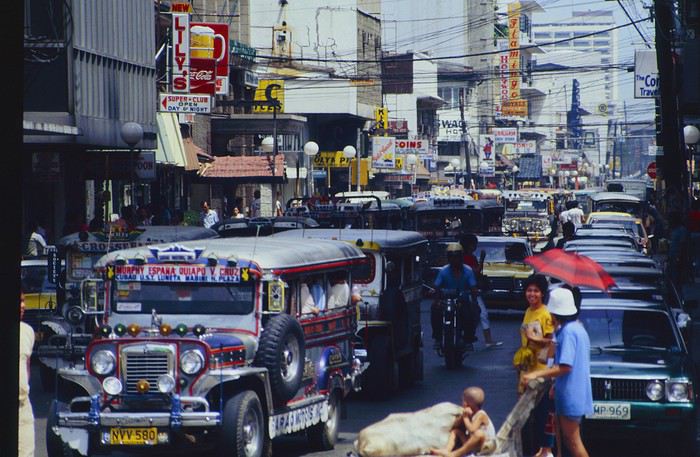
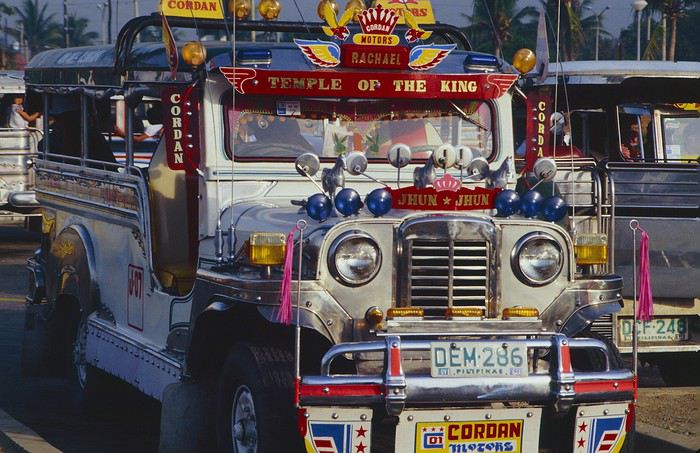
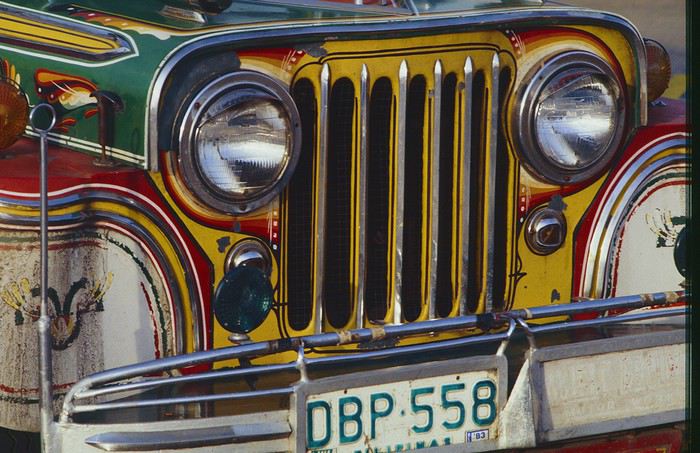
They had crazy sound systems, each one blasting louder than the last. The interiors were kitschy but fun. There weren’t many private cars—almost all transportation was by jeepney, with buses reserved for intercity trips.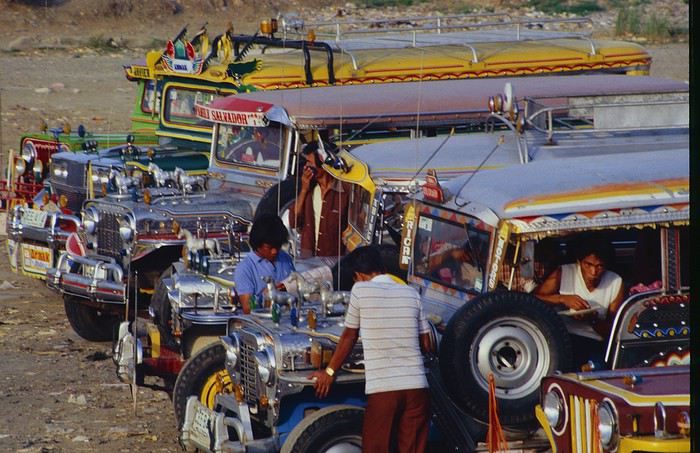
Before heading to the bus terminal for the north, somewhere on the outskirts of the city, we needed to exchange some money. I don’t remember how we ended up in a policeman’s jeep who offered his services: - Exchange money on the black market at a better rate than the banks. - Take us wherever we wanted, in this case, the bus terminal.
We accepted both offers (we’d still checked the official exchange rate from dollars to pesos). So we found ourselves in his jeep. After exchanging money, we left in his vehicle and stopped for gas. Without turning off the engine, he calmly smoked a cigarette while filling up. Since we were in a jeep with no doors or roof, we were ready to jump out if things went south, our travel bag in hand.
But we weren’t done with surprises yet. Once we left the small streets, we ended up in a neighborhood with wide avenues and not much traffic, which didn’t justify his incredible behavior. At every intersection, he made the sign of the cross, closed his eyes, and crossed without looking. I was more stunned than terrified! It wasn’t until we got out of the car later that I told Anne-Marie what had happened. I’d seen everything because the cop had put me in the front seat. Luckily, A-Marie hadn’t noticed anything from the back. Crossing Manila by trusting God rather than the rules of the road was ultimately effective. We were lucky—the trip was off to a good start. 🙂 🙂
We then passed through a neighborhood where slums stretched on for a while, and we left our policeman—friendly but a bit crazy—with relief.
A few hours by bus later, here we are in Baguio, cool in the mountains. My memories of Baguio are pretty fuzzy. I remember a small town. After some research while writing this journal, I found that the population was 120,000 in 1980. Given the population density in each home, that confirms my memory of a smallish town. Outside the “official” district with the president’s summer residence and government buildings, there were two or three paved streets with nice houses. The rest was very dirty and very poor, with lots of slums and dirt roads.
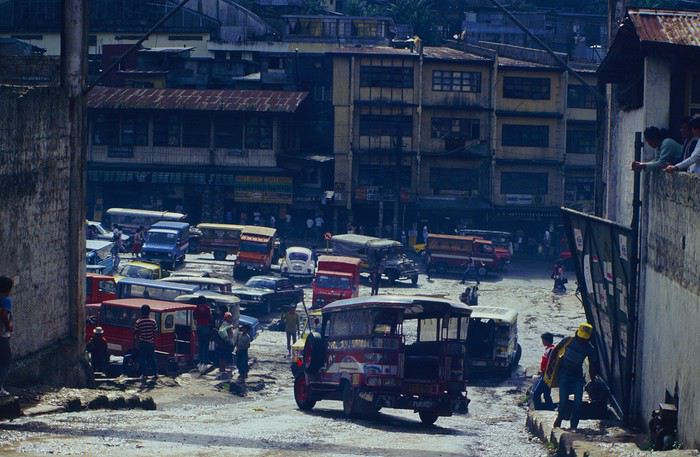
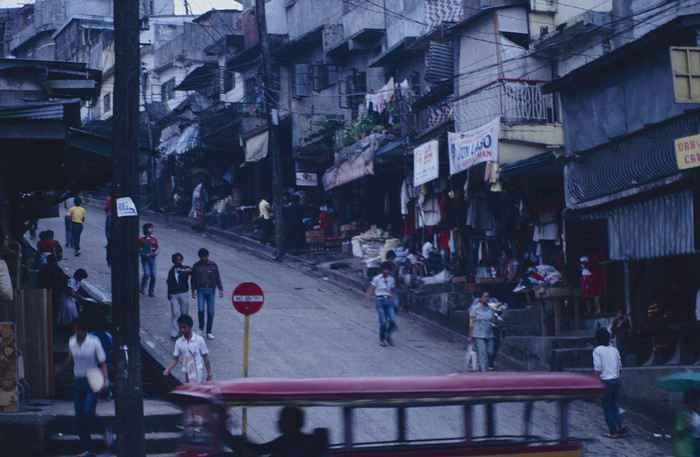
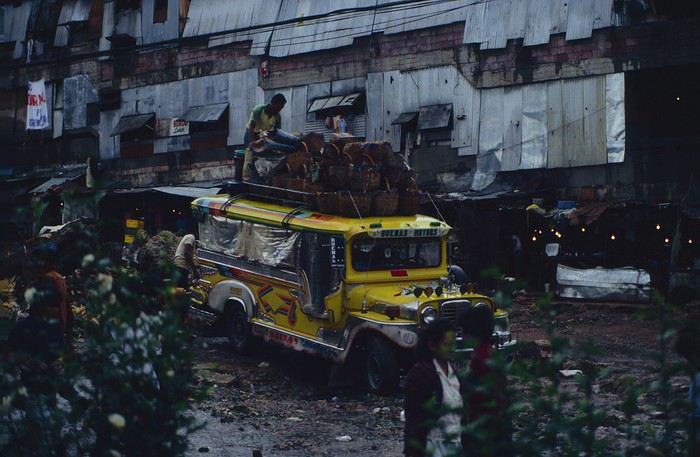
People we met on the street invited us to stay with them. These days, we wouldn’t just show up at strangers’ houses, which we should’ve done in Baguio—it would’ve saved us from an unimaginable and dangerous situation... which I won’t say anything about... !😊
The simple wooden house was on stilts at the edge of a hill with a view of the mountains. Since it was the start of the rainy season in a city that gets a lot of rain, we saw a lot of water. Our outings in town happened between downpours.
View from our lodging: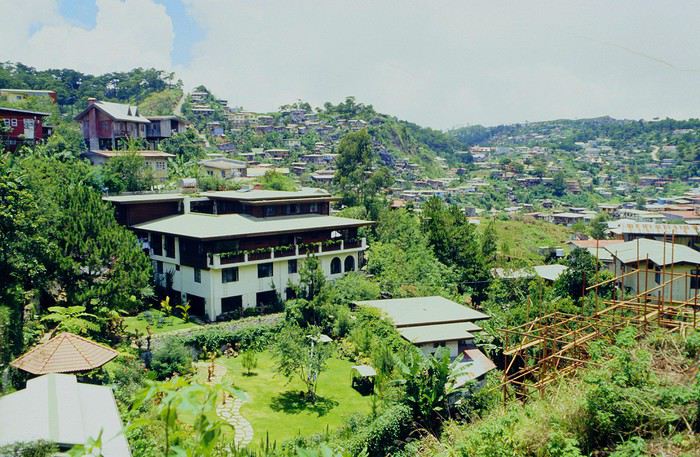
Episode 2: Baguio to Bontoc Aside from the situation briefly mentioned above, it was on the next leg to Bontoc that the adventure really began: an endless and dangerous road, a bus from another era, breathtaking landscapes, and surprising people.
We didn’t know the distance or how long it would take to get to Bontoc. When we arrived after about ten hours, we learned that Baguio to Bontoc was 140 km.
We got on a bus with wooden seats and settled in, two to a seat meant for two. As the bus filled up, passengers squeezed in three or four per seat, with chickens and baskets full of all sorts of things in the aisle. A little embarrassed, we didn’t know if we should squeeze in three on our seat. The seats were super tight (luckily, Filipinos are small), and I didn’t know where to put my legs given my height. I don’t remember if we stayed alone on our bench or if we ended up sharing with others.
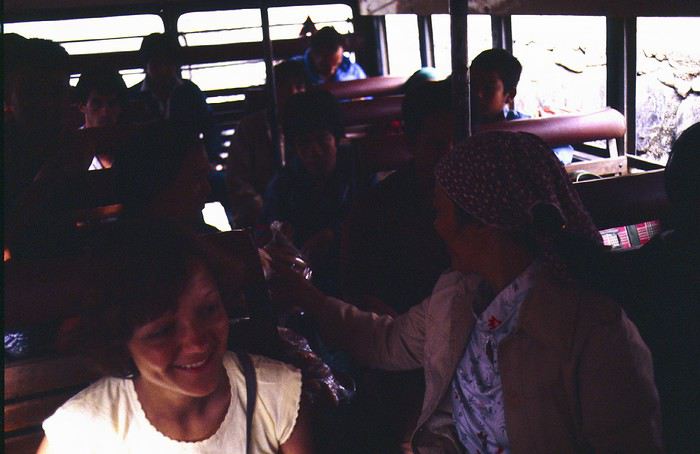
The “road” was a dirt track (or rather, a mud track) with endless turns. We held on as best we could to our slippery wooden seats—it was shaking in every direction. The woman behind us was carsick and throwing up... gross... but what were we doing there? Then we plunged into the Sierra Madre... just the name is dreamy!
Rice terraces started to appear: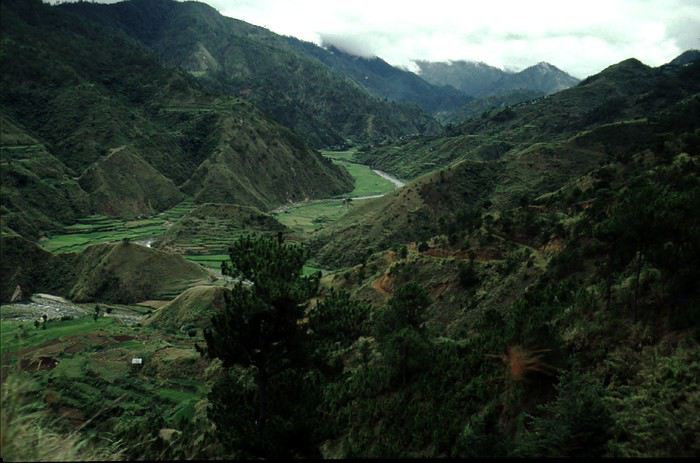
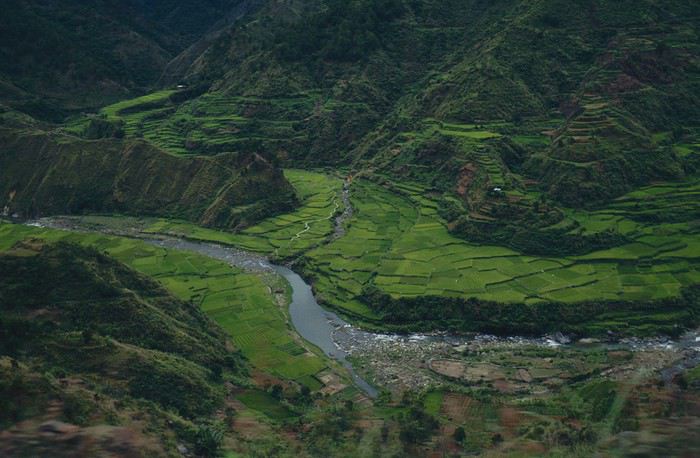
they took up more and more space along cliffs where we weren’t always reassured,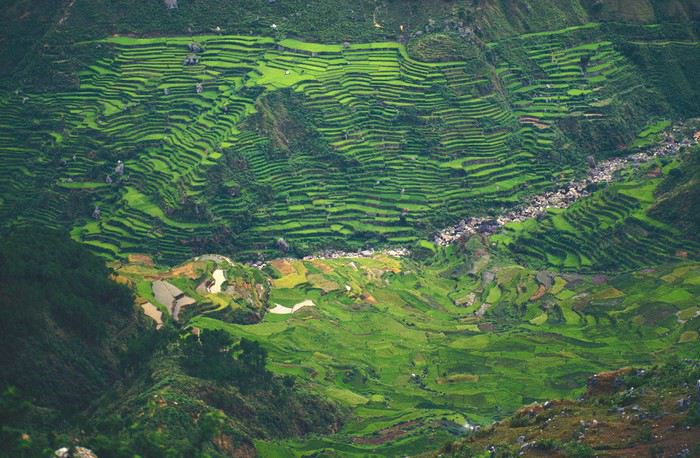
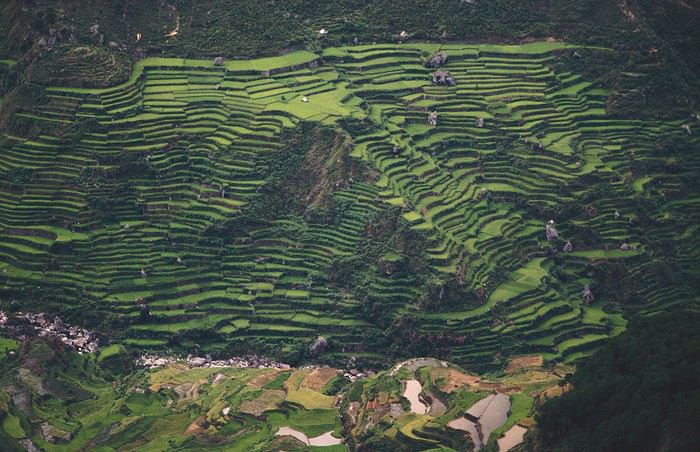
with lots of waterfalls (all that water had to go somewhere).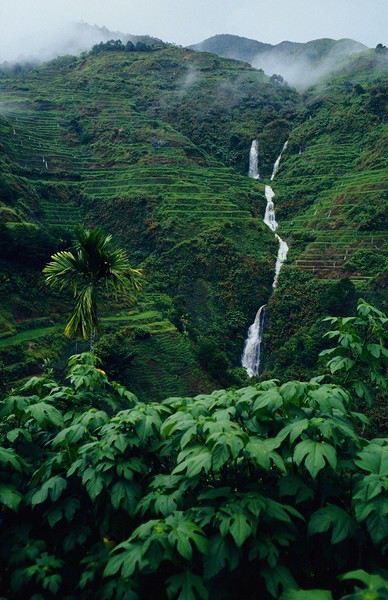
A few miserable villages stretched along the track, most often just a few houses balancing between the road and the drop. The bus stopped in every village—people got on or off and settled inside or on the roof. Street vendors offered their products to the bus passengers—a common sight in Asia, even today.
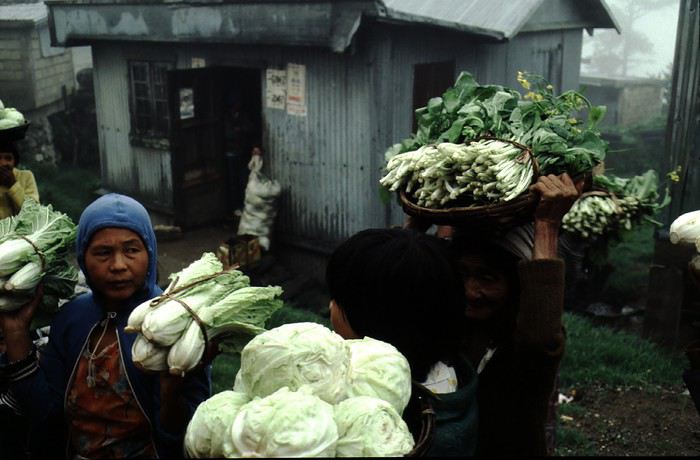
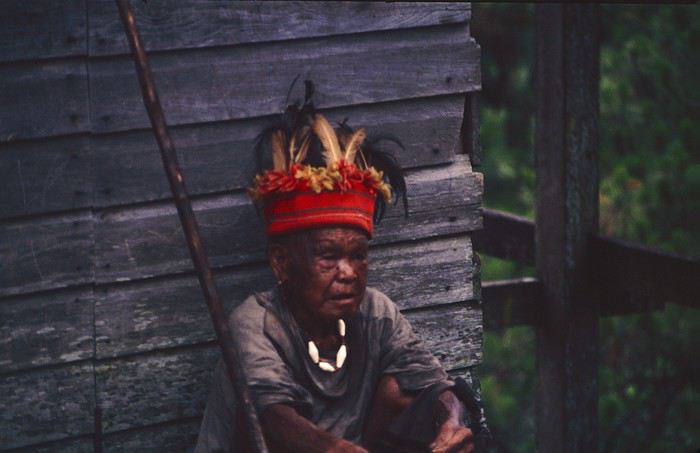
We were in another world—villagers were in loincloths, others had spears. The atmosphere was strange... but all good, we wanted exoticism, and we got it: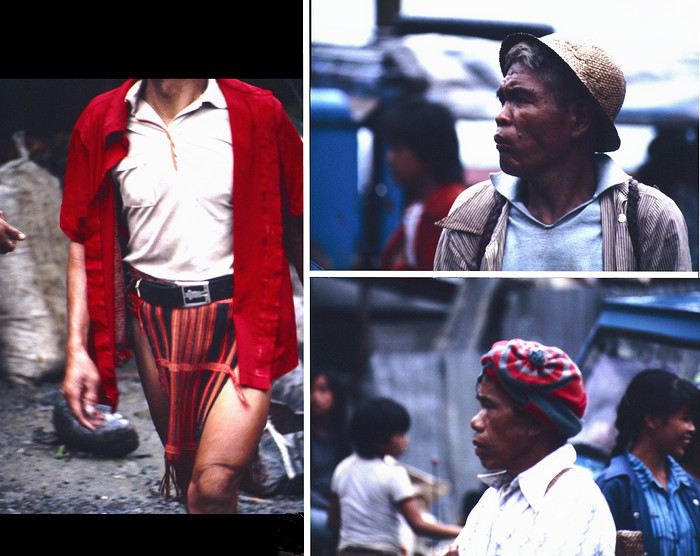
This so-called traditional outfit was everyday wear—it wasn’t for tourists since there weren’t any.
A curiosity because writing a travel journal about a trip 35 years later isn’t common, but also (mostly?) because exploring the Philippines at that time had little in common with traveling there today.
Obviously, I’ve forgotten a number of facts, most of the details, but with the help of a few notes from that time and a stack of slides (yes, there was life before digital 😊), many memories came back and added to the highlights I’d never forgotten. The scanned slides aren’t always great quality, but there are still quite a few to brighten up this chatter. Back then, we didn’t snap photos like we do now—film was too expensive—so I don’t have pictures of every place we visited... too bad, comparing some of those spots to how they look today would’ve been interesting.
Why "Adventures"? Why call it "Adventures" in the Philippines in 1984, a word so often used for a simple exotic trip? - Because the lack of information (no *Guide du Routard*, no *Lonely Planet*, no *Michelin Guide*, nothing, and obviously no internet) gave this trip what’s at the heart of adventure: the unknown. - Because the political situation made the stay sometimes dangerous. - Because transportation conditions were always epic, often perilous. - Because the question of where we’d spend the night came up almost every evening. - And for... quite a few other reasons.
That said, we weren’t exactly explorers!
Why the Philippines? First of all, why go to the Philippines in 1984—a country not exactly set up for tourism and about which we knew very little? How could we get an idea of the beauty of the Philippines and its points of interest when we had no guides or photos?
The idea came to us from Thailand a year earlier, during our first long-haul trip. After touring the north of the country, we met a Frenchman living in Phuket, where there were only a few tourists in Patong, with just a few small hotels and guesthouses. Kata and Karon had no buildings or roads, Rawai only had three palm-thatched bungalows, including ours, and the other islands were unknown to tourists. There was plenty to discover, and we wanted to return to this beautiful country... but the Frenchman made us dream about the Philippines—a country to explore, with wild landscapes.
Long evenings of discussion over multiple Sprite-Mekong cocktails (what memories of those headaches!) finally convinced us we had to go to the Philippines.
Episode 0: Before Departure The decision was made: we’d go to the Philippines in May 1984. Our friends and family were surprised when we announced we were going on vacation to the Philippines (a bit like saying today we were going paddleboarding in the Kerguelen Islands 🤪).
These days, preparing for each of our trips takes long evenings of research, planning, and noting down good addresses... etc. But for the Philippines in 1984, preparation was quick: we had very little information about the country, we were leaving almost at random, and the discovery would only be more exciting.
We still had a few bits of info gathered here and there: the rice terraces in northern Luzon, volcanoes, Negros where we were supposed to visit an acquaintance, Cebu and its marine life (we ended up going elsewhere), and absolutely avoid Mindanao, which was practically at war with the regime. That was about it, but it was already a great itinerary.
Nothing was organized in advance; we’d see day by day. We had no idea about travel times or even the existence of transportation options. The main (and sometimes only) way to connect two islands was by overloaded, rusty ferry. Only the big cities had airports.
Let’s Go: Episode 1: Paris to Manila My travel journals always start after arriving at the airport—the Europe-to-“Other Continent” trip isn’t interesting—but the flight to the Philippines was already an adventure, so I’ll make an exception.
This was the era when only a few Asian airlines were on par with Western ones: Thai, Singapore Airlines, and Philippine Airlines. They had beautiful, brand-new planes, and to attract customers (almost exclusively “businessmen”) from the usual airlines (Air France, Lufthansa, British Airways), there was opulence on board: unlimited champagne, all sorts of cocktails... Compared to today’s long-haul flights, there was still one small difference: no personal screens, just one screen at the front of the cabin with one mandatory movie. And I don’t know why, but we only got James Bond films, both ways... that must’ve been the trend at the time.
The tourism boom to Southeast Asia hadn’t started yet, and the “Asian Tigers” weren’t a thing, so there weren’t many business trips. That meant long-haul flights made stops everywhere to fill the planes. Our Philippine Airlines Boeing 747 left London, picked us up in Paris, then stopped in Frankfurt to take on a few Germans. I don’t know why we then made a stop in Dubai—a totally exotic place at the time. There was nothing to do there... things have changed a lot since. It was a small town lost in the desert. The airport was tiny, with just one or two buildings and a supermarket. During the stopover, everyone had to get off the plane and walk to the supermarket. Photo and electronic equipment were dirt cheap—I guess that was the only reason for the stop. Maybe it was their first commercial move. Emirates didn’t exist yet, as I checked online, but anyway, the idea that such a remote place could have its own airline was unthinkable.
Online, I found this photo of Dubai Airport in 1980. Anyone who’s transited through today’s massive airport with its rows of A380s will appreciate it:
Next stop: New Delhi to drop off some Europeans and pick up a few Indians, and finally, the terminus: Manila. I don’t remember how long the trip took with its five stops—an unimaginable journey today. Despite all those stops to fill the plane, there was still enough space to stretch out on the four center seats of the 747, something that never happens these days despite all the flights in every direction.
So here we are, finally at Manila Airport around midnight.
Episode 1: Manila and Baguio To start, a quick note on the political and economic situation in the Philippines in 1984, which had consequences for us as tourists, as we’d soon realize upon arrival.
After several centuries of Spanish colonization, the Philippines became American at the start of the 20th century, then independent. In 1966, Marcos took power, and little by little, his regime sank into corruption and mismanagement, becoming a dictatorship with martial law, all for the benefit of his family and friends, who enriched themselves endlessly. The peak was the assassination of opposition leader Benigno Aquino in August 1983, which triggered harshly repressed protests. So we arrived a few months later in a very poor country, with omnipresent corruption and an extremely tense political situation, as we’d soon see for ourselves. Major protests took place in the main cities during our trip—I’ll come back to that. Two years later, Marcos fled to Hawaii after being forced out of power following rigged elections. This historical context explains a lot of the situations we found ourselves in over the following weeks.
Arriving in the middle of the night isn’t very cheerful. Manila was already a huge city with many slums, where you could find a few business hotels like the Hilton or Intercontinental—way out of our budget—and plenty of run-down hotels. Luckily, two Indians we’d chatted with on the plane offered to take us to their usual hotel. They came to Manila twice a year for business. We accepted their offer, relieved not to have to look for a place to stay in the middle of the night, figuring the address must be good since they came back every time... we were wrong 🙁
We left the airport and immediately got a taste of the local vibe when we got into the taxi: the police asked for our passports. We thought: what’s more normal than police in a dictatorship?
But that wasn’t it at all. Our two Indian friends explained that the police were noting our names along with the taxi number and time. Crime in Manila was so bad that the taxi driver would be held responsible if anything happened to us... welcome to the Philippines 😎 😎
Historically, the Philippines was a very violent country, where everything was settled with guns or machetes. Previous governments had banned carrying weapons, but Marcos later allowed the free sale and carrying of guns, and disputes were settled with pistols again (or worse, as we’d discover later). Since he’d released most of the criminals from prison to form a paramilitary militia at his service (I’ll talk about our encounter with these “heroes” later), it was pretty dangerous to go into many parts of Manila, where these “tonton macoutes” ruled.
We arrived at our hotel without incident... and then things started badly. The room was infested with big cockroaches—exactly what I hate most in those kinds of countries. No way to find another hotel at that hour. After the long flight, the urge to take a shower was so strong that we squeezed into the bathroom as best we could. After that, I don’t remember—I guess we must’ve fallen asleep exhausted under the sheets in the heat... air conditioning wasn’t widespread yet.
The next day, we just wanted to leave that dump as soon as possible. So we decided to head north right away, stopping in Baguio, and we’d visit Manila a bit on the way back.
When we stepped outside, we discovered a pretty run-down neighborhood with potholed streets. But we also discovered the jeepneys. They were everywhere, flooding the streets.
They had crazy sound systems, each one blasting louder than the last. The interiors were kitschy but fun. There weren’t many private cars—almost all transportation was by jeepney, with buses reserved for intercity trips.
Before heading to the bus terminal for the north, somewhere on the outskirts of the city, we needed to exchange some money. I don’t remember how we ended up in a policeman’s jeep who offered his services: - Exchange money on the black market at a better rate than the banks. - Take us wherever we wanted, in this case, the bus terminal.
We accepted both offers (we’d still checked the official exchange rate from dollars to pesos). So we found ourselves in his jeep. After exchanging money, we left in his vehicle and stopped for gas. Without turning off the engine, he calmly smoked a cigarette while filling up. Since we were in a jeep with no doors or roof, we were ready to jump out if things went south, our travel bag in hand.
But we weren’t done with surprises yet. Once we left the small streets, we ended up in a neighborhood with wide avenues and not much traffic, which didn’t justify his incredible behavior. At every intersection, he made the sign of the cross, closed his eyes, and crossed without looking. I was more stunned than terrified! It wasn’t until we got out of the car later that I told Anne-Marie what had happened. I’d seen everything because the cop had put me in the front seat. Luckily, A-Marie hadn’t noticed anything from the back. Crossing Manila by trusting God rather than the rules of the road was ultimately effective. We were lucky—the trip was off to a good start. 🙂 🙂
We then passed through a neighborhood where slums stretched on for a while, and we left our policeman—friendly but a bit crazy—with relief.
A few hours by bus later, here we are in Baguio, cool in the mountains. My memories of Baguio are pretty fuzzy. I remember a small town. After some research while writing this journal, I found that the population was 120,000 in 1980. Given the population density in each home, that confirms my memory of a smallish town. Outside the “official” district with the president’s summer residence and government buildings, there were two or three paved streets with nice houses. The rest was very dirty and very poor, with lots of slums and dirt roads.
People we met on the street invited us to stay with them. These days, we wouldn’t just show up at strangers’ houses, which we should’ve done in Baguio—it would’ve saved us from an unimaginable and dangerous situation... which I won’t say anything about... !😊
The simple wooden house was on stilts at the edge of a hill with a view of the mountains. Since it was the start of the rainy season in a city that gets a lot of rain, we saw a lot of water. Our outings in town happened between downpours.
View from our lodging:
Episode 2: Baguio to Bontoc Aside from the situation briefly mentioned above, it was on the next leg to Bontoc that the adventure really began: an endless and dangerous road, a bus from another era, breathtaking landscapes, and surprising people.
We didn’t know the distance or how long it would take to get to Bontoc. When we arrived after about ten hours, we learned that Baguio to Bontoc was 140 km.
We got on a bus with wooden seats and settled in, two to a seat meant for two. As the bus filled up, passengers squeezed in three or four per seat, with chickens and baskets full of all sorts of things in the aisle. A little embarrassed, we didn’t know if we should squeeze in three on our seat. The seats were super tight (luckily, Filipinos are small), and I didn’t know where to put my legs given my height. I don’t remember if we stayed alone on our bench or if we ended up sharing with others.
The “road” was a dirt track (or rather, a mud track) with endless turns. We held on as best we could to our slippery wooden seats—it was shaking in every direction. The woman behind us was carsick and throwing up... gross... but what were we doing there? Then we plunged into the Sierra Madre... just the name is dreamy!
Rice terraces started to appear:
they took up more and more space along cliffs where we weren’t always reassured,
with lots of waterfalls (all that water had to go somewhere).
A few miserable villages stretched along the track, most often just a few houses balancing between the road and the drop. The bus stopped in every village—people got on or off and settled inside or on the roof. Street vendors offered their products to the bus passengers—a common sight in Asia, even today.
We were in another world—villagers were in loincloths, others had spears. The atmosphere was strange... but all good, we wanted exoticism, and we got it:
This so-called traditional outfit was everyday wear—it wasn’t for tourists since there weren’t any.
Cuba, Cuba, si... English translation pending
Confinement aidant, la décantation est opérée, comme disent mes voisins vignerons, notre récent voyage à Cuba en début d’année peut désormais être dégusté : Le cru de ce voyage 2020 est excellent !!!
Une volonté de changer de cap pour renouer avec une zone régionale, une culture latino et une histoire politique et sociale, négligées depuis plus de 3 décennies me titillait depuis quelques temps….
Alors, direction les Caraïbes, le pays de Cespedes et Marti pour 24 jours entre janvier et février.
Comme d’habitude, pas mal de lectures, sur VF notamment (grands mercis à Jeeaan, https://voyageforum.com/v.f?post=7694939;#7694939, à Ming2 pour ses 2 carnets en particulier https://voyageforum.com/v.f?post=6977052;#6977052et https://voyageforum.com/v.f?post=7425832;#7425832; à Anne42 https://voyageforum.com/discussion/trois-semaines-havane-baracoa-d8719358/ ainsi quà Stbeat), de blogs, d’articles divers, et de guides avaient permis de fixer un planning très général, avec pour commencer après une courte découverte de La Havane, direction l'Oriente et Baracoa par un vol intérieur pour une petite semaine.
Seules les 2 premières nuits à La Havane en "casa particular", avec vue sur le mythique Malecon, étaient réservées, ainsi que les 6 jours suivants chez Roberto et Manuel à Baracoa.
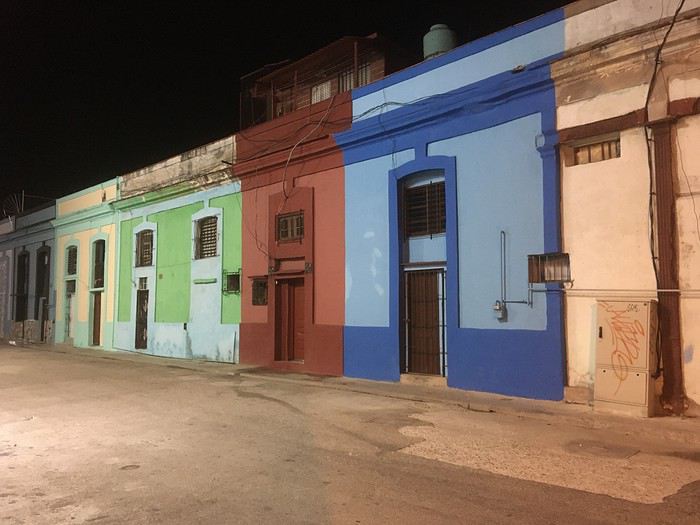
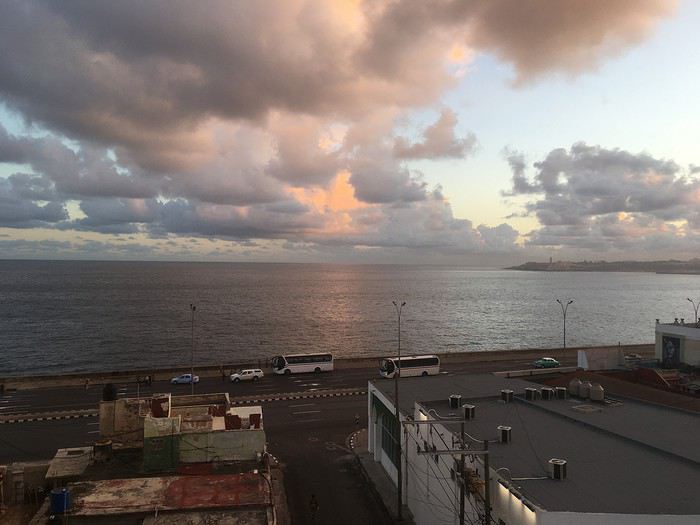
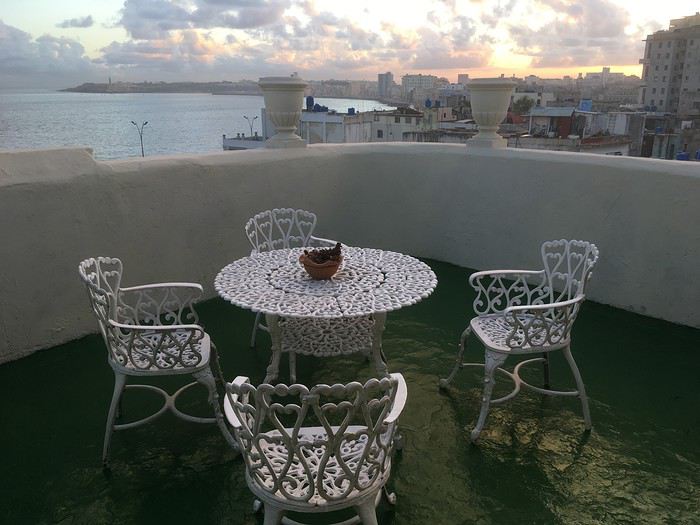
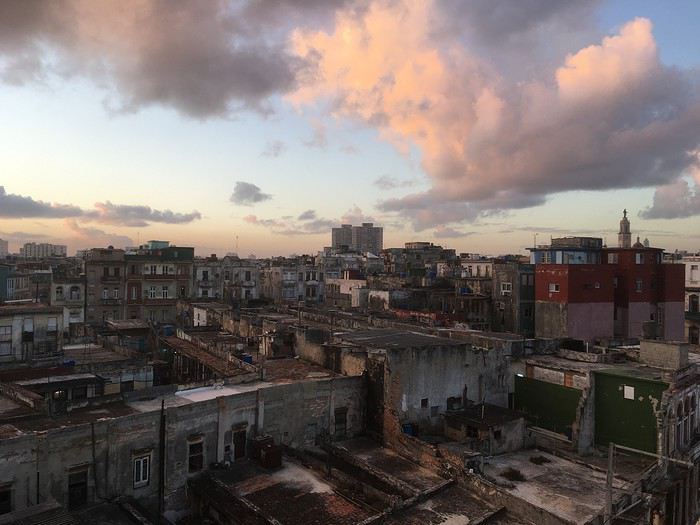
Premier réveil (dur, dur) cubain depuis la terrasse de la casa, après une très courte nuit (et jetlag) , dont la première partie fut passée à la Fabrica del Arte (http://www.fac.cu/) où le festival de jazz attirait une foule très éclectique !
Une volonté de changer de cap pour renouer avec une zone régionale, une culture latino et une histoire politique et sociale, négligées depuis plus de 3 décennies me titillait depuis quelques temps….
Alors, direction les Caraïbes, le pays de Cespedes et Marti pour 24 jours entre janvier et février.
Comme d’habitude, pas mal de lectures, sur VF notamment (grands mercis à Jeeaan, https://voyageforum.com/v.f?post=7694939;#7694939, à Ming2 pour ses 2 carnets en particulier https://voyageforum.com/v.f?post=6977052;#6977052et https://voyageforum.com/v.f?post=7425832;#7425832; à Anne42 https://voyageforum.com/discussion/trois-semaines-havane-baracoa-d8719358/ ainsi quà Stbeat), de blogs, d’articles divers, et de guides avaient permis de fixer un planning très général, avec pour commencer après une courte découverte de La Havane, direction l'Oriente et Baracoa par un vol intérieur pour une petite semaine.
Seules les 2 premières nuits à La Havane en "casa particular", avec vue sur le mythique Malecon, étaient réservées, ainsi que les 6 jours suivants chez Roberto et Manuel à Baracoa.
Premier réveil (dur, dur) cubain depuis la terrasse de la casa, après une très courte nuit (et jetlag) , dont la première partie fut passée à la Fabrica del Arte (http://www.fac.cu/) où le festival de jazz attirait une foule très éclectique !
Mais où qu'il est ce truc là (4) English translation pending
Voyage 5 mois et 3 semaines en Amérique du Sud English translation pending
Bonjour,
Il n'est jamais trop tard pour rendre compte de son voyage. Le confinement me laisse enfin du temps pour le faire.
Je suis parti le 17 août 2017 et je suis rentré le 7 février 2018. Entre temps, je suis allé en Argentine par cargo puis une fois sur ce continent, j'ai visité l'Uruguay, l'Argentine et le Chili.
Durant tout ce voyage, j'ai tenu un carnet journalier.
Je me propose de vous le livrer.
L'Andalousie à vélo, le top c'est au printemps English translation pending
Printemps 2019 : De Séville à Séville par les villes et villages blancs, une Andalousie encore verte et vide de touristes. Séville, Cordoue, Gibraltar, Maroc (Tétouan, Tanger), Cadix, plus de 1500 km sur les pistes blanches de la vallée du Guadalquivir et les belles routes bosselées de montagne. Chroniques d'un sexagénaire en totale liberté.
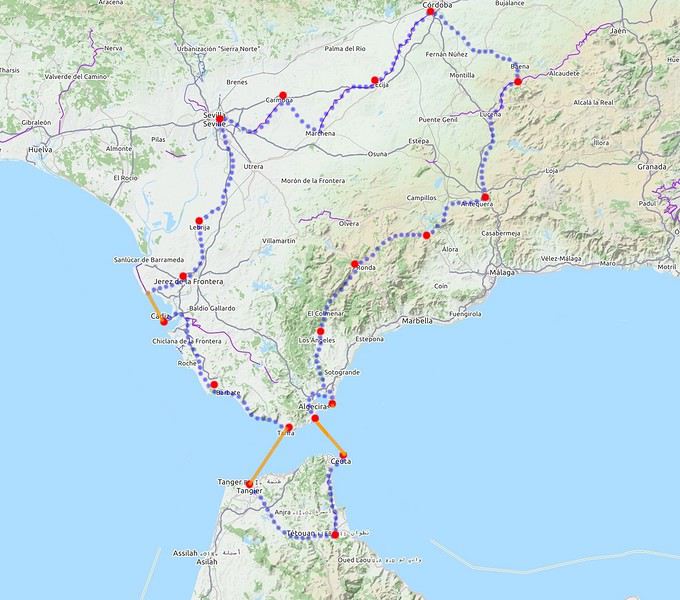
Compte rendu Cuba 2020 English translation pending
🙂
En ces temps difficiles, rien que une bonne lecture évasive à la maison CUBA 2020
>>>14 jours >>>5 villes coloniale >>>1500 kms en Ford 195 >>>4 sites UNESCO >>>8 casas particulares utilisées >>>beaucoup de langoustes
Références : Application MAPS.ME Page FB : Je pars à Cuba Page FB : Les français à Cuba Page FB : Cuba : conseils pour bien préparer son voyage www.cubanoscope.com www.jeparsacuba.com Carte Cuba 1.1000000 BORCH plastifiée Guide du Routard CUBA 2019
JOUR 1 : PARIS>>>LA HAVANE 10h de vol 25° (samedi 18/01/2020) Voilà c’est le départ tant attendu, direction l’aéroport d’Orly pour un vol direct à destination de la Havane, capitale de CUBA. Nous sommes à l’aéroport vers 08h00 pour un décollage à 10h00 sur la compagnie Air Caraïbes que nous testons pour la première fois. Nous sommes dans une boutique DutyFree, pour quelques achats, lorsqu’une annonce retentit et nous concerne. Notre vol est retardé de 2h30 ! Bon bin, il va falloir attendre, on finit nos achats, qui seront gardés à Orly, jusqu’à notre retour (pratique). Nous sommes en salle d’embarquement F21, on nous remet une attestation de retard de la part de la compagnie, et on nous sert un petit piquenique. La raison invoquée par Air Caraïbes, est qu’ils ont dû changer d’appareil, alors que depuis 08h00 que nous sommes là, en porte F21, il y a un avion Air Caraïbes qui est au stationnement, il y restera jusqu’à notre décollage qui sera effectif à 13h20, soit 3h20 de retard au décollage (ce changement d’appareil a-t-il eu lieu>>>mystère….).
J’ai eu le temps de prévenir 2 personnes à La Havane, de notre retard, une qui doit nous donner des réservations faites en ligne, et notre chauffeur Pavel, qui nous attend à l’aéroport. Les 10h30 de vol se passent très bien, on a trouvé les services à bord d’un bon niveau, équipage agréable et divertissements très variés. On se pose donc à 17h30 heure locale au lieu de 14h40. Il y a pas mal de monde aux guichets immigration, mais nous passons assez rapidement la douane munis de notre carte de tourisme (visa) en main, un tampon de plus dans le passeport et nous passons (notre assurance rapatriement ne nous a pas été demandée, mais elle est obligatoire). Nous n’avons pas de bagages en soute, alors nous nous dirigeons vers la sortie, tout en constatant qu’il faudrait un papier bleu rempli, que nous n’avons pas. Une personne récupère ce papier, un papier pour une famille, un peu perdus, on suit un peu tout le monde, la personne est un peu submergée, et nous passons avec d’autres personnes.
Un fois sortis, nous repérons facilement Pavel (notre chauffeur privé pour 2 semaines) avec la pancarte à nos noms. Nous allons directement échanger en espagnol, et cela pour toute la durée du voyage. Voulant faire du change, je lui demande où cela est possible, et il y a un guichet à droite en sortant. Mais, il me propose de le faire avec lui, et au même taux, c’est parfait. Il m’expliquera que cela l’intéresse d’avoir des euros ou des dollars pour acheter des pièces de voitures au cas où, et qu’il paie cela dans une de ces deux monnaies.
FOCUS MONNAIE A CUBA : Bon à savoir, à Cuba il existe 2 monnaies en vigueur, un peso national (CUP) pour les cubains et un peso convertible (CUC) pour les touristes, ces 2 monnaies ne sont pas récupérables en dehors du territoire cubain, donc il faut arriver avec des espèces, attention une commission supplémentaire est prise en cas de change avec des dollars américains. Et avoir sa CB pour des retraits possibles en ville.
Et un des moments tant attendus arrive, nous découvrons notre voiture, une FORD 1953 Customline Sedan bleu, Pavel la tient de son père, et elle a été entièrement refaite. Et nous voici partis vers la ville, on voit déjà énormément de voitures américaines des années 50 et 60, il y en a partout en fait. La nuit tombe maintenant, puisque nous sommes arrivés en retard, et Pavel gentiment nous propose un tour de ville vers les spots illuminés de La Havane, on est vraiment dans le bain, le Capitolio, le théâtre national, nous remontons le Paseo del Prado, on en avait rêvé, on y est !!!
Pavel nous dépose ensuite à notre hébergement, nous sommes chez l’habitant (et cela durera 2 semaines). Nous sommes à la Casa Esperanza, chez Henri, français et Esperanza, cubaine sa femme. Il s’agit d’une maison de 1910 entièrement rénovée en 11 mois !
FOCUS HEBERGEMENT A CUBA : Cuba étant pendant longtemps un pays assez fermé, l’offre en hébergement touristique est restée faible et d’état, l’hôtellerie n’est pas dans le meilleur des états et n’est pas bien rénovée faute d’argent. Ainsi, face à la demande touristique grandissante, dès 1997, Fidel Castro a ainsi autorisé les particuliers à louer deux chambres maximum à des étrangers. En 2011, le régime a dû libéraliser cette location. Il est désormais légal de louer plus de deux chambres par logement voire même une maison entière. (Tarifs moyens 15 à 40 CUC par nuit, environ 13,50 à 36€). Il y a environ aujourd’hui à La Havane plus de 800 casa particular.
Nous laissons Pavel pour ce soir et nous le retrouverons lundi matin. Henri nous indique un petit itinéraire pour aller se restaurer. Notre hébergement est dans le quartier de la vieille Havane, pratique où tout peut se faire à pied. Nous allons donc partir à pied, il fait nuit, les cubains sont très souvent dehors et dans la rue, ce que nous remarquons de suite, c’est l’état déplorable, ou en ruine, de pas mal de maisons coloniales ou début XXème. A pied, on peut vraiment avoir l’impression d’être en insécurité, il fait nuit, on voit de tout, ruines, animaux et cubains, et en fait il n’en est rien du tout, c’est très sécuritaire malgré la vision que nous percevons. A 5mn, nous rejoignons la Plaza Vieja, superbe place coloniale rénovée aux façades authentiques, plusieurs restaurants, et surtout ce que nous rêvions aussi, on est samedi soir, la musique cubaine est là, dans les maisons ou dans la rue, on y est !!! On trouve un petit resto et notre premier mojito ! Retour à l’hébergement, il est 21h30, on commence à absorber le jetlag, bonne nuit.
>>>14 jours >>>5 villes coloniale >>>1500 kms en Ford 195 >>>4 sites UNESCO >>>8 casas particulares utilisées >>>beaucoup de langoustes
Références : Application MAPS.ME Page FB : Je pars à Cuba Page FB : Les français à Cuba Page FB : Cuba : conseils pour bien préparer son voyage www.cubanoscope.com www.jeparsacuba.com Carte Cuba 1.1000000 BORCH plastifiée Guide du Routard CUBA 2019
JOUR 1 : PARIS>>>LA HAVANE 10h de vol 25° (samedi 18/01/2020) Voilà c’est le départ tant attendu, direction l’aéroport d’Orly pour un vol direct à destination de la Havane, capitale de CUBA. Nous sommes à l’aéroport vers 08h00 pour un décollage à 10h00 sur la compagnie Air Caraïbes que nous testons pour la première fois. Nous sommes dans une boutique DutyFree, pour quelques achats, lorsqu’une annonce retentit et nous concerne. Notre vol est retardé de 2h30 ! Bon bin, il va falloir attendre, on finit nos achats, qui seront gardés à Orly, jusqu’à notre retour (pratique). Nous sommes en salle d’embarquement F21, on nous remet une attestation de retard de la part de la compagnie, et on nous sert un petit piquenique. La raison invoquée par Air Caraïbes, est qu’ils ont dû changer d’appareil, alors que depuis 08h00 que nous sommes là, en porte F21, il y a un avion Air Caraïbes qui est au stationnement, il y restera jusqu’à notre décollage qui sera effectif à 13h20, soit 3h20 de retard au décollage (ce changement d’appareil a-t-il eu lieu>>>mystère….).
J’ai eu le temps de prévenir 2 personnes à La Havane, de notre retard, une qui doit nous donner des réservations faites en ligne, et notre chauffeur Pavel, qui nous attend à l’aéroport. Les 10h30 de vol se passent très bien, on a trouvé les services à bord d’un bon niveau, équipage agréable et divertissements très variés. On se pose donc à 17h30 heure locale au lieu de 14h40. Il y a pas mal de monde aux guichets immigration, mais nous passons assez rapidement la douane munis de notre carte de tourisme (visa) en main, un tampon de plus dans le passeport et nous passons (notre assurance rapatriement ne nous a pas été demandée, mais elle est obligatoire). Nous n’avons pas de bagages en soute, alors nous nous dirigeons vers la sortie, tout en constatant qu’il faudrait un papier bleu rempli, que nous n’avons pas. Une personne récupère ce papier, un papier pour une famille, un peu perdus, on suit un peu tout le monde, la personne est un peu submergée, et nous passons avec d’autres personnes.
Un fois sortis, nous repérons facilement Pavel (notre chauffeur privé pour 2 semaines) avec la pancarte à nos noms. Nous allons directement échanger en espagnol, et cela pour toute la durée du voyage. Voulant faire du change, je lui demande où cela est possible, et il y a un guichet à droite en sortant. Mais, il me propose de le faire avec lui, et au même taux, c’est parfait. Il m’expliquera que cela l’intéresse d’avoir des euros ou des dollars pour acheter des pièces de voitures au cas où, et qu’il paie cela dans une de ces deux monnaies.
FOCUS MONNAIE A CUBA : Bon à savoir, à Cuba il existe 2 monnaies en vigueur, un peso national (CUP) pour les cubains et un peso convertible (CUC) pour les touristes, ces 2 monnaies ne sont pas récupérables en dehors du territoire cubain, donc il faut arriver avec des espèces, attention une commission supplémentaire est prise en cas de change avec des dollars américains. Et avoir sa CB pour des retraits possibles en ville.
Et un des moments tant attendus arrive, nous découvrons notre voiture, une FORD 1953 Customline Sedan bleu, Pavel la tient de son père, et elle a été entièrement refaite. Et nous voici partis vers la ville, on voit déjà énormément de voitures américaines des années 50 et 60, il y en a partout en fait. La nuit tombe maintenant, puisque nous sommes arrivés en retard, et Pavel gentiment nous propose un tour de ville vers les spots illuminés de La Havane, on est vraiment dans le bain, le Capitolio, le théâtre national, nous remontons le Paseo del Prado, on en avait rêvé, on y est !!!
Pavel nous dépose ensuite à notre hébergement, nous sommes chez l’habitant (et cela durera 2 semaines). Nous sommes à la Casa Esperanza, chez Henri, français et Esperanza, cubaine sa femme. Il s’agit d’une maison de 1910 entièrement rénovée en 11 mois !
FOCUS HEBERGEMENT A CUBA : Cuba étant pendant longtemps un pays assez fermé, l’offre en hébergement touristique est restée faible et d’état, l’hôtellerie n’est pas dans le meilleur des états et n’est pas bien rénovée faute d’argent. Ainsi, face à la demande touristique grandissante, dès 1997, Fidel Castro a ainsi autorisé les particuliers à louer deux chambres maximum à des étrangers. En 2011, le régime a dû libéraliser cette location. Il est désormais légal de louer plus de deux chambres par logement voire même une maison entière. (Tarifs moyens 15 à 40 CUC par nuit, environ 13,50 à 36€). Il y a environ aujourd’hui à La Havane plus de 800 casa particular.
Nous laissons Pavel pour ce soir et nous le retrouverons lundi matin. Henri nous indique un petit itinéraire pour aller se restaurer. Notre hébergement est dans le quartier de la vieille Havane, pratique où tout peut se faire à pied. Nous allons donc partir à pied, il fait nuit, les cubains sont très souvent dehors et dans la rue, ce que nous remarquons de suite, c’est l’état déplorable, ou en ruine, de pas mal de maisons coloniales ou début XXème. A pied, on peut vraiment avoir l’impression d’être en insécurité, il fait nuit, on voit de tout, ruines, animaux et cubains, et en fait il n’en est rien du tout, c’est très sécuritaire malgré la vision que nous percevons. A 5mn, nous rejoignons la Plaza Vieja, superbe place coloniale rénovée aux façades authentiques, plusieurs restaurants, et surtout ce que nous rêvions aussi, on est samedi soir, la musique cubaine est là, dans les maisons ou dans la rue, on y est !!! On trouve un petit resto et notre premier mojito ! Retour à l’hébergement, il est 21h30, on commence à absorber le jetlag, bonne nuit.
Idées circuit et étapes dans l'Ouest américain et ses parcs English translation pending
Bonjour,
Je prépare notre futur voyage (3 couples) pour septembre prochain (16 Sept - 15 Oct).
Il se déroulera en 2 temps, un couple rentrant en France le 3 Oct.
J'ai beaucoup lu posts et carnets de voyages (Merci à tous 🙂🙂) et je commence à y voir plus clair.
Une idée est un circuit "lent" avec des étapes courtes et du temps pour explorer les parcs (Las Vegas- Grand Canyon- Page- Monument Valley- Mesa Verde- Moab- Capitol Reef- Bryce Canyon- Zion- Death Valley- Las Vegas) J'ai un doc détaillé avec ce circuit établi à la lecture de vos expériences, mais cela serait trop long. Si c'est vers celui-ci que notre choix se porte, je reviendrai vers vous ;-)
L'autre idée est d'alléger ce circuit en supprimant certaines étapes et en passant moins de temps sur certains lieux afin d'intégrer Yellowstone (loin, mais si beau) pour compléter la découverte de l'Ouest pour nos amis qui partent le 3. Plus de route bien sûr. J'aimerai beaucoup avoir votre avis. Est-ce réalisable ? Des suggestions ?
Nous sommes prêts à faire quelques étapes longues mais pas tous les jours. Nous ferons des randonnées dans les parcs, mais pas trop et surtout des pas trop longues ni trop difficiles pour s'adapter à tout le monde. Merci beaucoup de votre aide
J1 arrivée Las Vegas J2 Las Vegas - Grand Canyon nuit Tusayane J3 Grand Canyon - Page J4 Antelope canyon, etc... Monument Valley nuit Mexican Hat J5Mexican Hat - Moab J6 Moab J7 Moab - direction Grand teton, arrêt à Evanston ou Rock Springs J8 Evanston ou Rock Springs - Jackson Hole le 23/09 J9 Grand Teton - Yellowstone nuit parc ou West Yellowstone J10 Yellowstone nuit West ou Gardiner J11 Yellowstone nuit West Yellowstone (mieux pour par vers SLC ?) J12 Yellowstone - Salt Lake City nuit SLC J13 SLC - Capitol Reef nuit Torrey J14 Torrey - Bryce Canyon nuit tropic J15 Journée Bryce Canyon nuit tropic J16 Tropic - Zion nuit Springdale ou Kanarraville J17 Zion - Las Vegas probablement via Valley of fire nuit Las Vegas J18 Vol Retour pour 1 couple
Une idée est un circuit "lent" avec des étapes courtes et du temps pour explorer les parcs (Las Vegas- Grand Canyon- Page- Monument Valley- Mesa Verde- Moab- Capitol Reef- Bryce Canyon- Zion- Death Valley- Las Vegas) J'ai un doc détaillé avec ce circuit établi à la lecture de vos expériences, mais cela serait trop long. Si c'est vers celui-ci que notre choix se porte, je reviendrai vers vous ;-)
L'autre idée est d'alléger ce circuit en supprimant certaines étapes et en passant moins de temps sur certains lieux afin d'intégrer Yellowstone (loin, mais si beau) pour compléter la découverte de l'Ouest pour nos amis qui partent le 3. Plus de route bien sûr. J'aimerai beaucoup avoir votre avis. Est-ce réalisable ? Des suggestions ?
Nous sommes prêts à faire quelques étapes longues mais pas tous les jours. Nous ferons des randonnées dans les parcs, mais pas trop et surtout des pas trop longues ni trop difficiles pour s'adapter à tout le monde. Merci beaucoup de votre aide
J1 arrivée Las Vegas J2 Las Vegas - Grand Canyon nuit Tusayane J3 Grand Canyon - Page J4 Antelope canyon, etc... Monument Valley nuit Mexican Hat J5Mexican Hat - Moab J6 Moab J7 Moab - direction Grand teton, arrêt à Evanston ou Rock Springs J8 Evanston ou Rock Springs - Jackson Hole le 23/09 J9 Grand Teton - Yellowstone nuit parc ou West Yellowstone J10 Yellowstone nuit West ou Gardiner J11 Yellowstone nuit West Yellowstone (mieux pour par vers SLC ?) J12 Yellowstone - Salt Lake City nuit SLC J13 SLC - Capitol Reef nuit Torrey J14 Torrey - Bryce Canyon nuit tropic J15 Journée Bryce Canyon nuit tropic J16 Tropic - Zion nuit Springdale ou Kanarraville J17 Zion - Las Vegas probablement via Valley of fire nuit Las Vegas J18 Vol Retour pour 1 couple
Voyage en Espagne (Madrid, Séville, Valence...) English translation pending
Bonjour à tous,
Pour l'été prochain nous envisageons, ma femme et moi, une petite virée en Espagne. Ayant déjà fait la Sicile et le Portugal en plein été, on peut dire qu'on ne craint pas trop la chaleur. En tout cas on fait avec... Voila donc ce que l'on a prévu. Qu'en pensez-vous ? Est ce réaliste ? D'autres suggestions ? Nous ne passons ni à Tarragone, ni à Barcelone que nous connaissons déjà. Merci pour vos contributions !
dimanche 2 août 2020 Montpellier - Saragosse lundi 3 août 2020 Saragosse mardi 4 août 2020 Saragosse - Madrid mercredi 5 août 2020 Madrid jeudi 6 août 2020 Madrid vendredi 7 août 2020 Madrid - Tolede samedi 8 août 2020 Tolede dimanche 9 août 2020 Tolede - Cordoue lundi 10 août 2020 Cordoue mardi 11 août 2020 Cordoue - Seville mercredi 12 août 2020 Seville jeudi 13 août 2020 Seville vendredi 14 août 2020 Sevile - Cadix samedi 15 août 2020 Cadix - Malaga via Ronda dimanche 16 août 2020 Malaga lundi 17 août 2020 Malaga - Grenade mardi 18 août 2020 Grenade mercredi 19 août 2020 Grenade jeudi 20 août 2020 Grenade - Valence vendredi 21 août 2020 Valence samedi 22 août 2020 Valence dimanche 23 août 2020 Valence - Montpellier
Pour l'été prochain nous envisageons, ma femme et moi, une petite virée en Espagne. Ayant déjà fait la Sicile et le Portugal en plein été, on peut dire qu'on ne craint pas trop la chaleur. En tout cas on fait avec... Voila donc ce que l'on a prévu. Qu'en pensez-vous ? Est ce réaliste ? D'autres suggestions ? Nous ne passons ni à Tarragone, ni à Barcelone que nous connaissons déjà. Merci pour vos contributions !
dimanche 2 août 2020 Montpellier - Saragosse lundi 3 août 2020 Saragosse mardi 4 août 2020 Saragosse - Madrid mercredi 5 août 2020 Madrid jeudi 6 août 2020 Madrid vendredi 7 août 2020 Madrid - Tolede samedi 8 août 2020 Tolede dimanche 9 août 2020 Tolede - Cordoue lundi 10 août 2020 Cordoue mardi 11 août 2020 Cordoue - Seville mercredi 12 août 2020 Seville jeudi 13 août 2020 Seville vendredi 14 août 2020 Sevile - Cadix samedi 15 août 2020 Cadix - Malaga via Ronda dimanche 16 août 2020 Malaga lundi 17 août 2020 Malaga - Grenade mardi 18 août 2020 Grenade mercredi 19 août 2020 Grenade jeudi 20 août 2020 Grenade - Valence vendredi 21 août 2020 Valence samedi 22 août 2020 Valence dimanche 23 août 2020 Valence - Montpellier
Hiking in Arizona, just Arizona English translation pending
Les mois ont passé….
Ma demande en mariage à Dirty Devil Overlook (vers Hanksville, au fin fond de l’Utah) un soir de juin 2017, s’est concrétisée.... "Chérie", ma dame est devenue Madame.
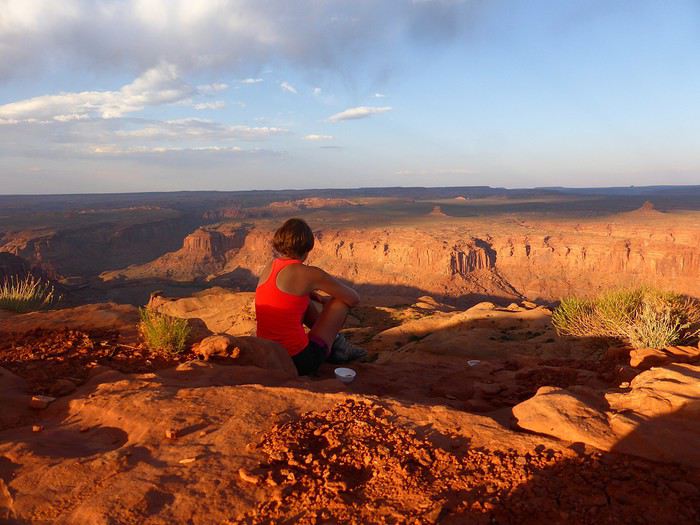 ..
..
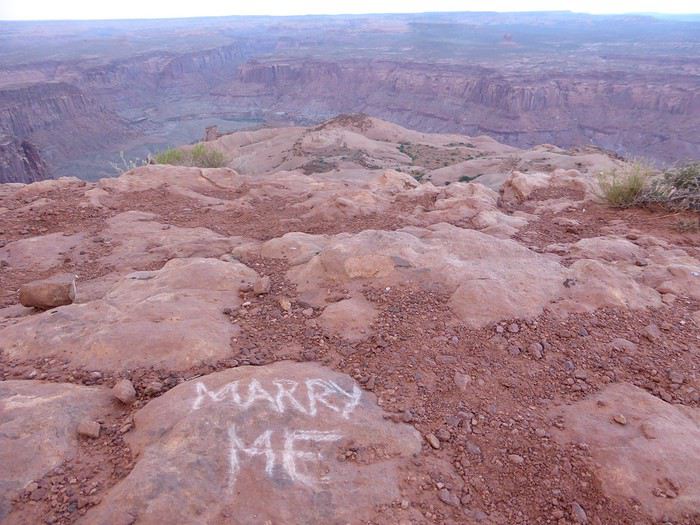
C'était un voyage sensationnel, le meilleur. A peine rentrés, on savait qu'on repartirait...et le plus rapidement possible. Un mariage à organiser, la vente de la maison, l'acquisition d'une autre, un an de travaux et l'arrivée d'Utah notre Border Collie.... Voilà le contexte... (ce qui explique la longue absence sur VF et le délai pour s'occuper du carnet 😉)
Mais premier point noir: Au moment du peaufinage du roadbook, les USA sont plongés en plein Shutdown. Et ça dure, ça dure. …On suit alors ça de ‘’près’’. Le shutdown le plus long de l’histoire à ce jour s’est terminé 5 semaines avant le départ… Or le programme était de partir de Phoenix/ Tucson Saguaro NP/ Organ mountain / White Sands / Bisti Badlands / Canyon de Chelly / Painted desert / Walnut canyon / Grand Canyon avec boucle South kaibab Bright Angel / Sedona 4 nuits / puis retour Phoenix. Donc une grosse dominante de parcs nationaux cette année et peu de Wilderness; donc des coins potentiellement fermés et peu de plan B proches. Pas envie de prendre le risque si l’épisode reprend.
Deuxième point noir : quelques semaines avant le départ, double ernie discale et méchant lumbago lors des travaux dans la nouvelle maison. Arrêt de travail, kiné, ostéo, massages, etc. Grosse incertitude sur la capacité de partir, à tenir 10 heures dans l’avion, à pouvoir randonner… bref le doute domine.
Troisième point noir : Il nous est désormais impossible pour des raisons professionnelles de partir entre avril et septembre. Or en vérifiant la météo avant le départ (longtemps avant !!), la météo est détraquée dans le Southwest. Il fait anormalement froid….. et ça dure. Sauf vers Phoenix et Tucson où la météo est correcte.
Tous ces éléments nous font modifier le parcours peu de temps avant de partir. D’autres hôtels sont alors réservés, tout en gardant le plan A au cas où une éclaircie pointerait le bout de son nez…
Une chose est sûre, on part pour une boucle au départ de Phoenix, pour randonner en Arizona... A suivre ...
..
C'était un voyage sensationnel, le meilleur. A peine rentrés, on savait qu'on repartirait...et le plus rapidement possible. Un mariage à organiser, la vente de la maison, l'acquisition d'une autre, un an de travaux et l'arrivée d'Utah notre Border Collie.... Voilà le contexte... (ce qui explique la longue absence sur VF et le délai pour s'occuper du carnet 😉)
Mais premier point noir: Au moment du peaufinage du roadbook, les USA sont plongés en plein Shutdown. Et ça dure, ça dure. …On suit alors ça de ‘’près’’. Le shutdown le plus long de l’histoire à ce jour s’est terminé 5 semaines avant le départ… Or le programme était de partir de Phoenix/ Tucson Saguaro NP/ Organ mountain / White Sands / Bisti Badlands / Canyon de Chelly / Painted desert / Walnut canyon / Grand Canyon avec boucle South kaibab Bright Angel / Sedona 4 nuits / puis retour Phoenix. Donc une grosse dominante de parcs nationaux cette année et peu de Wilderness; donc des coins potentiellement fermés et peu de plan B proches. Pas envie de prendre le risque si l’épisode reprend.
Deuxième point noir : quelques semaines avant le départ, double ernie discale et méchant lumbago lors des travaux dans la nouvelle maison. Arrêt de travail, kiné, ostéo, massages, etc. Grosse incertitude sur la capacité de partir, à tenir 10 heures dans l’avion, à pouvoir randonner… bref le doute domine.
Troisième point noir : Il nous est désormais impossible pour des raisons professionnelles de partir entre avril et septembre. Or en vérifiant la météo avant le départ (longtemps avant !!), la météo est détraquée dans le Southwest. Il fait anormalement froid….. et ça dure. Sauf vers Phoenix et Tucson où la météo est correcte.
Tous ces éléments nous font modifier le parcours peu de temps avant de partir. D’autres hôtels sont alors réservés, tout en gardant le plan A au cas où une éclaircie pointerait le bout de son nez…
Une chose est sûre, on part pour une boucle au départ de Phoenix, pour randonner en Arizona... A suivre ...
Solo en sac a dos en Asie centrale English translation pending
Bonjour a tous
Je projette d aller découvrir une partie de l Asie centrale, en y allant par voie terrestre et en rentrant par avion depuis Tachkent.
Des témoignages sur des virées similaires ?
Les possibilités, les impasses, ... ?
Merci de vos avis.
Béatrice
Je projette d aller découvrir une partie de l Asie centrale, en y allant par voie terrestre et en rentrant par avion depuis Tachkent.
Des témoignages sur des virées similaires ?
Les possibilités, les impasses, ... ?
Merci de vos avis.
Béatrice
Obtention du visa touriste pour le Ghana English translation pending
Bonjour,
Bien que je sois une habituée du Ghana ou j’allais tous les ans, me voici forcée de demander des renseignements sur l'obtention du visa touriste car je n'y comprend plus rien.
Avant il suffisait d'envoyer son passeport à Paris avec les justificatifs demandés. Maintenant ils ont "simplifié " la procédure. Il semblerait qu'il faut faire une demande sur leur site électronique et prendre rendez-vous? D'après Action-visa? L'ambassade semble avoir changé d'adresse... L'ancien formulaire papier se promène encore sur certains sites.
Merci de m’éclairer si vous avez fait une demande de visa récemment.
Sinon je me rabattrai comme l’année dernière sur le Togo et le Bénin ou là au moins ces démarches sont très faciles!
Françoise
Six-week trip to Mexico
I recently took a six-week trip to Mexico with Y, my Thai partner. To be precise, we spent 43 days there plus a final half-day before heading to Mexico City Airport for our return flight to Europe.
I’d already been to Mexico about 40 years ago! But that was only for a week or so, between Mérida and the Belize border.
First off, I should mention that I’ve never seen a beach in Mexico. I say this because discussions about Mexico always seem to revolve around the Costa / Riviera Maya.
Let’s start with an overview of the trip. Our itinerary can be split into two halves:
- First half: Querétaro, San Miguel de Allende, Morelia, Guanajuato, Mexico City “CDMX” (the capital). - Second half: Palenque, San Cristóbal de Las Casas, Chiapa de Corzo, Oaxaca, Puebla, Cholula, and finally Mexico City CDMX.
To move from one part of the trip to the other, we took a flight from Mexico City CDMX to Villahermosa, then a bus to Palenque.
In six weeks, we visited maybe a quarter or a fifth of the country (see the attached maps). Mexico is about three times the size of France! And when I say “visited,” it was really just a quick stop—enough to get a first impression. I understand that some people can only spend one or two weeks on vacation in a given country, but that’s not my idea of travel. Personally, I’d say a country as rich in every way as Mexico deserves several months of travel before you can say you’ve “seen” it.
In my next post, I’ll break down the expenses. That might help future travelers plan their trips. You don’t go to a country for several weeks (or more) without thinking about the budget! Besides, one of those future travelers to Mexico is us—we were so thrilled by Mexico that we’re definitely going back.
I’d already been to Mexico about 40 years ago! But that was only for a week or so, between Mérida and the Belize border.
First off, I should mention that I’ve never seen a beach in Mexico. I say this because discussions about Mexico always seem to revolve around the Costa / Riviera Maya.
Let’s start with an overview of the trip. Our itinerary can be split into two halves:
- First half: Querétaro, San Miguel de Allende, Morelia, Guanajuato, Mexico City “CDMX” (the capital). - Second half: Palenque, San Cristóbal de Las Casas, Chiapa de Corzo, Oaxaca, Puebla, Cholula, and finally Mexico City CDMX.
To move from one part of the trip to the other, we took a flight from Mexico City CDMX to Villahermosa, then a bus to Palenque.
In six weeks, we visited maybe a quarter or a fifth of the country (see the attached maps). Mexico is about three times the size of France! And when I say “visited,” it was really just a quick stop—enough to get a first impression. I understand that some people can only spend one or two weeks on vacation in a given country, but that’s not my idea of travel. Personally, I’d say a country as rich in every way as Mexico deserves several months of travel before you can say you’ve “seen” it.
In my next post, I’ll break down the expenses. That might help future travelers plan their trips. You don’t go to a country for several weeks (or more) without thinking about the budget! Besides, one of those future travelers to Mexico is us—we were so thrilled by Mexico that we’re definitely going back.
Avis sur projet de road trip d'Egypte en Tanzanie English translation pending
Bonjour,
J'ai réfléchi à un projet de road trip en Afrique et j'aimerais bien avoir des avis sur sa faisabilité pour savoir si je m'enflamme un peu trop ou pas😄.
Je souhaite partir pendant 2 à 3 mois l'été prochain avec 2 amis avec comme itinéraire : Egypte - Soudan - Ethiopie - Kenya - Tanzanie, tout ça en voiture. J'avais pensé à acheter un 4x4 soit en France soit en Egypte puis à la fin du voyage le revendre, donc en Tanzanie si possible. Donc déjà est ce qu'il est possible de faire cet itinéraire en voiture, au niveau de la sécurité, de l'état des routes etc ? Ensuite est ce que l'achat et la revente d'une voiture en Afrique ça semble crédible ?
Aussi concernant le Kenya et la Tanzanie, nous n'aurons pas forcément le budget pour passer beaucoup de temps dans les réserves naturelles (encore étudiants🏴☠️), et j'ai peur que cela ne réduise le plaisir du voyage. Même plus généralement nous essaierons de réduire les dépenses au maximum, donc j'aimerais savoir si vous pensez que ces destinations ont beaucoup à offrir même sans les parcs naturels et s'il est possible d'en profiter sans se ruiner, ou alors s'il vaut peut être mieux attendre d'avoir plus de moyens pour en profiter au maximum.
Merci beaucoup, si quelqu'un a quelques réponses ce serait super !!
Dim
J'ai réfléchi à un projet de road trip en Afrique et j'aimerais bien avoir des avis sur sa faisabilité pour savoir si je m'enflamme un peu trop ou pas😄.
Je souhaite partir pendant 2 à 3 mois l'été prochain avec 2 amis avec comme itinéraire : Egypte - Soudan - Ethiopie - Kenya - Tanzanie, tout ça en voiture. J'avais pensé à acheter un 4x4 soit en France soit en Egypte puis à la fin du voyage le revendre, donc en Tanzanie si possible. Donc déjà est ce qu'il est possible de faire cet itinéraire en voiture, au niveau de la sécurité, de l'état des routes etc ? Ensuite est ce que l'achat et la revente d'une voiture en Afrique ça semble crédible ?
Aussi concernant le Kenya et la Tanzanie, nous n'aurons pas forcément le budget pour passer beaucoup de temps dans les réserves naturelles (encore étudiants🏴☠️), et j'ai peur que cela ne réduise le plaisir du voyage. Même plus généralement nous essaierons de réduire les dépenses au maximum, donc j'aimerais savoir si vous pensez que ces destinations ont beaucoup à offrir même sans les parcs naturels et s'il est possible d'en profiter sans se ruiner, ou alors s'il vaut peut être mieux attendre d'avoir plus de moyens pour en profiter au maximum.
Merci beaucoup, si quelqu'un a quelques réponses ce serait super !!
Dim
Un grand week-end de novembre en Espagne English translation pending
Afin d’échapper à la grisaille de ce début novembre, nous avons décidé d’aller voir s’il fait meilleur de l’autre côté des Pyrénées.
Nous aimons beaucoup l’Espagne et cela fait plusieurs années que nous n’y avons pas mis les pieds, nous allons donc y remédier le week-end du 1er Novembre.
Alors où aller! Une destination s’impose, Madrid pour aller déguster les Churros con Chocalate 😊. Mais aussi Bardenas Real, annulé il y a deux ans et qui nous tient à cœur. Comme d’habitude, j’ai beaucoup utilisé les retours publiés sur le forum pour préparer mon séjour, je vous en remercie bien et je vais donc essayer d’y ajouter ma contribution.
Voilà le programme un peu speed que j’ai concocté pour ces quelques jours 😮.
01/11 Lyon / Madrid 02/11 Madrid / Tudela 03/11 Las Bardenas 04/11 Tudela / Saragosse 05/11 Saragosse / Barcelone / Lyon
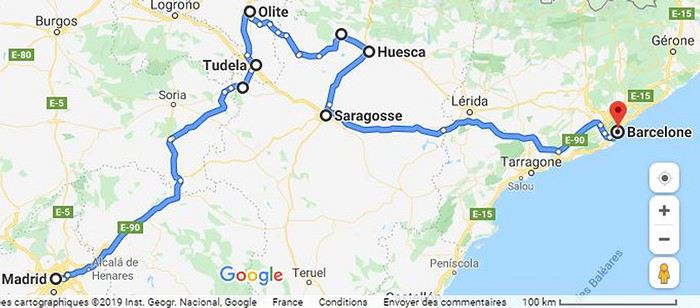
Afin de vous donner un peu envie de nous suivre, voici quelques photos…
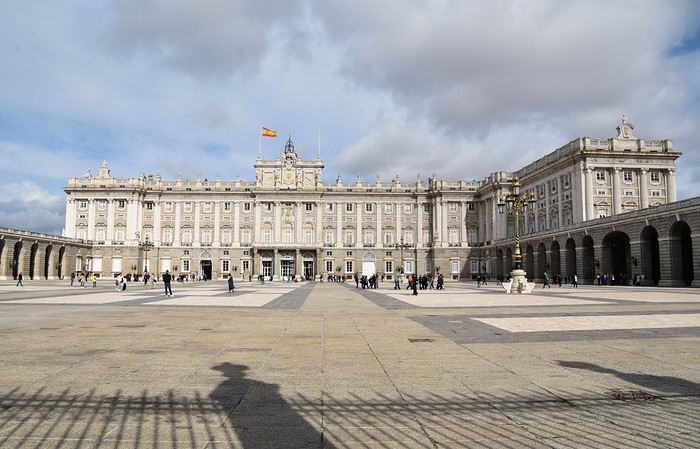 Palais Royal à Madrid
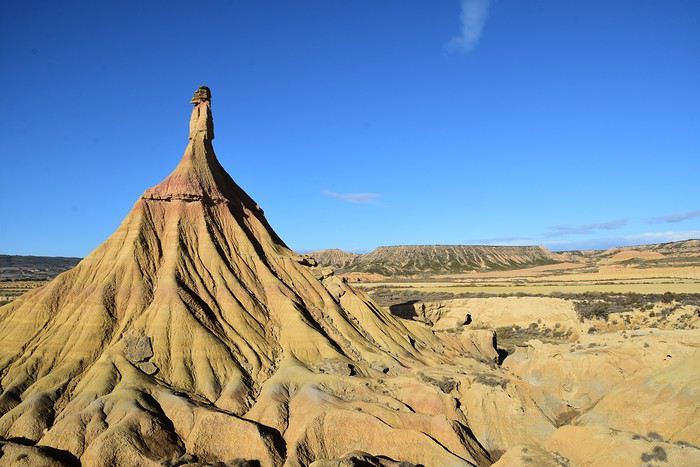 Castildetierra de Las Bardenas
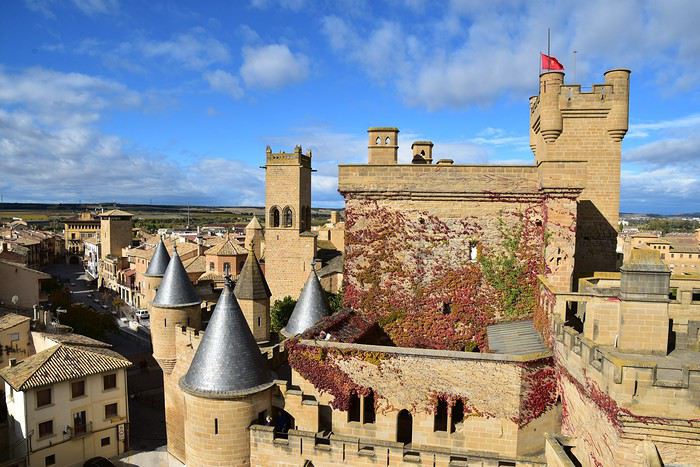 Palais des rois de Navarre à Olite
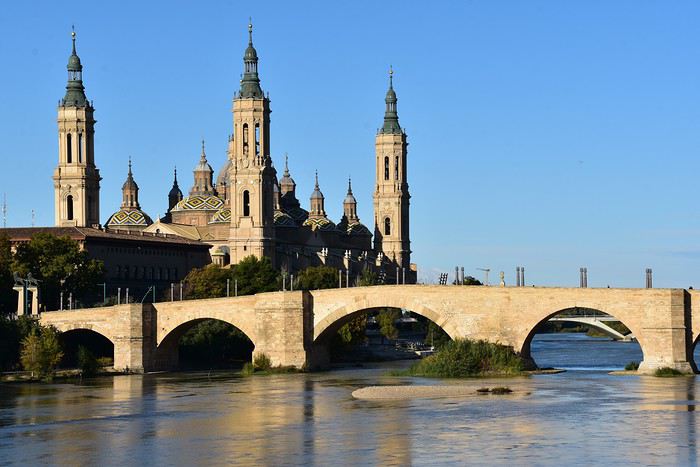 Basilique de Saragosse
Allez! C'est parti... par ici
Alors où aller! Une destination s’impose, Madrid pour aller déguster les Churros con Chocalate 😊. Mais aussi Bardenas Real, annulé il y a deux ans et qui nous tient à cœur. Comme d’habitude, j’ai beaucoup utilisé les retours publiés sur le forum pour préparer mon séjour, je vous en remercie bien et je vais donc essayer d’y ajouter ma contribution.
Voilà le programme un peu speed que j’ai concocté pour ces quelques jours 😮.
01/11 Lyon / Madrid 02/11 Madrid / Tudela 03/11 Las Bardenas 04/11 Tudela / Saragosse 05/11 Saragosse / Barcelone / Lyon
Afin de vous donner un peu envie de nous suivre, voici quelques photos…
Palais Royal à Madrid
Castildetierra de Las Bardenas
Palais des rois de Navarre à Olite
Basilique de SaragosseAllez! C'est parti... par ici
Le taux de change en Argentine actuellement English translation pending
Bonjour à tous
Nous avions essayé d'avoir des informations sur le taux de change il y a quelques jours, mais n'avions pas eu d'informations précises. Comme nous sommes maintenant sur place voici quelques nouvelles Le meilleur taux de change officiel , la banque de la nación : vendredi 8 novembre 65,9 ars pour 1€ mais au noir dans le centre de Buenos Aires ( Florida ou Lavalle) le taux est bien supérieur : 70,00 ars pour 1€ Eviter les cuevas officielles, le cours était à 62 ars pour 1 € et bien sur éviter de faire des retraits dans des DAB. Pour nous touristes l'Argentine est très peu chère actuellement juste un ex. à la même époque l'année dernière le litre de super à Salta était de 42,3 ars cette année le litre de super est à 52,90 ars , la seule différence c'est que l'année dernière nous avions 40ars pour 1€ et cette année nous avons autour de 66 ars pour 1€ et même 70 ars pour 1€ au noir. Même si l'ex que l'on donne ne permet pas une totale vision du taux de l'inflation ( car le prix de l'essence n'a pas subi la même hausse que d'autres produits) Autre ex les repas au restaurant sont pour nous beaucoup moins chers que l'année derniere pour une même prestation. Cordialement
Nous avions essayé d'avoir des informations sur le taux de change il y a quelques jours, mais n'avions pas eu d'informations précises. Comme nous sommes maintenant sur place voici quelques nouvelles Le meilleur taux de change officiel , la banque de la nación : vendredi 8 novembre 65,9 ars pour 1€ mais au noir dans le centre de Buenos Aires ( Florida ou Lavalle) le taux est bien supérieur : 70,00 ars pour 1€ Eviter les cuevas officielles, le cours était à 62 ars pour 1 € et bien sur éviter de faire des retraits dans des DAB. Pour nous touristes l'Argentine est très peu chère actuellement juste un ex. à la même époque l'année dernière le litre de super à Salta était de 42,3 ars cette année le litre de super est à 52,90 ars , la seule différence c'est que l'année dernière nous avions 40ars pour 1€ et cette année nous avons autour de 66 ars pour 1€ et même 70 ars pour 1€ au noir. Même si l'ex que l'on donne ne permet pas une totale vision du taux de l'inflation ( car le prix de l'essence n'a pas subi la même hausse que d'autres produits) Autre ex les repas au restaurant sont pour nous beaucoup moins chers que l'année derniere pour une même prestation. Cordialement
Circuit aux Visayas: horaires bateaux, hébergements et bagages English translation pending
Bonjour,
Nous sommes 4, 2 adultes et 2 enfants, qui auront 10 et 8 ans lors de notre voyage aux Philippines. Nous arrivons le 14 février 2020 en début d’après-midi et repartons le 27 février en début de soirée. J’ai beaucoup de mal à établir un circuit. C’est pourquoi j’ai besoin de vos avis.
Vendredi après-midi: Arrivée aéroport de Mactan, direction Moalboal Samedi : Moalboal et ses alentours. Dimanche: direction Malatapay visite de Dumaguete Lundi: Apo Island Mardi: Apo Island direction Siquijor Mercredi, jeudi: Siquijor Vendredi: Siquijor direction Tagbilaran - Bohol Samedi, dimanche, lundi: Bohol, Panglao, Balicasag Lundi: direction Mactan pour aller à Malapascua Mardi: Malapascua. Mercredi: Malapascua direction Mactan Jeudi: départ de Mactan.
Je n’ai pas les horaires des bateaux, ni même établie exactement les temps de parcours entre chaque destination. Si vous pouviez également me conseiller.
Concernant les hébergements sur chaque lieu que me conseillez-vous?
Dernière question, pour les bagages, j’ai le droit à 1 bagage en soute de 30 kg. Je comptais prendre une grosse valise. 4 petites en bagage à main plus 2 sac à dos. Je cherche le côté pratique lors des déplacements aussi ne vaut il pas mieux que des sacs?
Je vous remercie par avance pour vos suggestions.
Virginie
Nous sommes 4, 2 adultes et 2 enfants, qui auront 10 et 8 ans lors de notre voyage aux Philippines. Nous arrivons le 14 février 2020 en début d’après-midi et repartons le 27 février en début de soirée. J’ai beaucoup de mal à établir un circuit. C’est pourquoi j’ai besoin de vos avis.
Vendredi après-midi: Arrivée aéroport de Mactan, direction Moalboal Samedi : Moalboal et ses alentours. Dimanche: direction Malatapay visite de Dumaguete Lundi: Apo Island Mardi: Apo Island direction Siquijor Mercredi, jeudi: Siquijor Vendredi: Siquijor direction Tagbilaran - Bohol Samedi, dimanche, lundi: Bohol, Panglao, Balicasag Lundi: direction Mactan pour aller à Malapascua Mardi: Malapascua. Mercredi: Malapascua direction Mactan Jeudi: départ de Mactan.
Je n’ai pas les horaires des bateaux, ni même établie exactement les temps de parcours entre chaque destination. Si vous pouviez également me conseiller.
Concernant les hébergements sur chaque lieu que me conseillez-vous?
Dernière question, pour les bagages, j’ai le droit à 1 bagage en soute de 30 kg. Je comptais prendre une grosse valise. 4 petites en bagage à main plus 2 sac à dos. Je cherche le côté pratique lors des déplacements aussi ne vaut il pas mieux que des sacs?
Je vous remercie par avance pour vos suggestions.
Virginie
Nouveauté et innovation: cours de grammaire Bambara (Mali) English translation pending
Une révolution dans les méthodes d'apprentissage des langues !
Exit les cassettes audio, les CDs, les téléchargements, etc. Entrez dans l'aire de la réalité augmentée en cours de langue : Les Presses l'Inalco (Paris) ouvrent une étape nouvelle ! Pour la première fois dans l'édition scientifique universitaire, un livre est enrichi de plus de 1.500 fichiers audio. En effet, dans ce Cours de Grammaire Bambara, des pages entières sont à écouter... Pour ça, on n’a besoin que de son appli smartphone qui les trouve facilement : il suffit de lui présenter la page ! Grâce à ce format innovant, les apprenant(e)s dépassent alors la simple lecture du texte et leur enrichissent les exemples écrits par des enregistrements vocaux qui rendent l’apprentissage plus vivant et qui leur permettent d’apprendre les correctes prononciations. En fait, de nos jours, une telle approche tournée vers l’oralité est essentielle dans l’apprentissage des langues.
PRÉSENTATION
Le format de ce manuel représente un compromis entre celui d’un manuel pratique et celui d’une grammaire de référence (un manuel "traditionnel" devrait comporter davantage d’exercices, des textes bambara adaptés et d’autres éléments didactiques, par contre, dans une grammaire de référence, on devrait présupposer un appareil scientifique plus élaboré).
Le cours est subdivisé en 38 leçons, toutes agrémentées de réalité augmentée. La composition des leçons varie : le plus souvent, un sujet grammatical constitue une leçon. En règle, une leçon correspond à un cours de 90 ou 120 minutes, mais il y a plusieurs leçons qui dépassent nécessairement cette règle car certains sujets de grammaire (p.ex. système tonal, participes et converbes, infinitif, constructions relatives, focalisation et topicalisation, etc.) sont trop volumineux, et ces leçons importantes demandent deux, sinon trois cours en classe.
Le cours s’appuie sur les résultats des recherches de terrain par l’auteur, mais aussi sur les publications sur la langue bambara qui se comptent aujourd’hui par centaines. Il faut mentionner en particulier la Grammaire fondamentale du bambara de Gérard Dumestre (2003) et sa thèse de doctorat d’État, sous le titre Le Bambara du Mali: essais de description linguistique (2 tomes, 1987/1992), ainsi que de nombreuses publications de Denis Creissels, professeur émérite de l’Université Lumière (Lyon 2). Une bibliographie linguistique du bambara – vaste mais pas exhaustive – se trouve à la fin du livre.
Dans la quasi-totalité des cas, les exemples phrastiques en bambara sont présentés en trois lignes. La première ligne contient une transciption superficielle, où les tons de réalisations sont marqués sur chaque syllabe, et les assimilations vocaliques sont représentées ; la marque du pluriel apparaît comme -u (plutôt que -w , ce qui correspondrait à la convention orthographique). La nasalisation vocalique est cependant marquée par un -n (ce qui correspond bien à la convention orthographique bambara), sauf là où la voyelle nasale est suivie par la marque du pluriel. Dans la deuxième ligne, la transcription est plus ou moins en accord avec l’orthographe malienne toutefois elle s’en distingue par la notation tonale et la séparation des mots en morphèmes (indiquée par des traits d’unions). La troisième ligne est celle des gloses (traductions mot par mot et morphème par morphème). Les exemples illustratifs sont, pour la plupart, tirés de textes naturels. En outre, une traduction libre est donnée, suivie de référence à la source entre crochets.
Comme exposé ci-dessus, le cours de grammaire est accompagné des fichiers sonores. Les enregistrements ont été faits par l’auteur sur place (à Bamako) entre juin et juillet 2017, en collaboration principalement avec Zoumana Dembélé, Malien de 37 ans (en 2017) qui est né et a grandi à Fama (cercle de Sikasso).

QUELQUES TRAITS TYPOLOGIQUES DU BAMBARA
Comme la plupart des langues africaines, le bambara est une langue à tons (opposition de deux tons lexicaux et phénomènes de downstep et downdrift). Sur le plan morphologique, le bambara et les langues mandé en total sont considérés comme type isolant : ils ne disposent ni de classes nominales ni d’opposition de genre. Au domaine de la flexion, en bambara, l’affixation, tant verbale que nominale, ne joue qu’un rôle marginal, mais elle est très productive quant à la dérivation (beaucoup de suffixes, peu de préfixes, pas d’infixes). L’ordre des mots du bambara est très rigide : sujet – marque prédicatif – complément d’objet – verbe – supplément postverbal). Même dans des phrases interrogatives et propositions relatives, l’ordre des mots reste intact. A l’exception du parfait affirmatif intransitif, le verbe reste toujours sous la forme de base. Dans le syntagme génitival, l’ordre est déterminant-déterminé, alors que dans les autres syntagmes de détermination, l’ordre est dans l’autre sens, à savoir déterminé-déterminant (nom + adjectif, nom + participe, nom + défini).
LE NOM « BAMBARA »
La langue bambara s’est formée sur la base des dialectes mandingues orientaux grâce à l’existence du royaume précolonial de Ségou (18e-19e siècles), et dans une moindre mesure, du Kaarta. Le nom du groupe ethnique est bámàna ou bámànan, et celui de la langue est bámanankan (kán veut dire 'cou, gorge ; voix, parole ; bruit, son ; langue parlée'), on utilise le terme bambara en français et dans les langues voisines (foulfouldé, soninké, maninka). En anglais, allemand, russe etc., les formes bambara et bamana sont utilisées.
De plus, le terme bambara (ou bámàna) est polysémique et peut exprimer deux notions : (a) le groupe ethnique parlant la langue en question comme première langue, (b) le païen (non-musulman), terme évidemment originel et jusqu’à nos jours très courant au sud du Mali et au nord-est de la Côte d’Ivoire où les "Bambaras" sont des Sénoufos non-islamisés (leur langue compte parmi les langues gur), à la différence des Dioulas (islamisés et mandingophones).
Il existe de nombreuses autres étymologies du mot bambara/bamana ("ceux qui refusent", "insoumis à Dieu", "enfants de crocodile", etc.), mais ce ne sont que des étymologies populaires, parfois reprises et répandues par des missionaires, chercheurs et autres. Cependant, elles ne résistent en aucune manière à une analyse sérieuse phonétique-phonologique ...
LE BAMBARA AUJOURD’HUI
Le bambara a environ 4.000.000 de locuteurs natifs, un nombre qui augmente jusqu’à 13-14 millions si on y rajoute les locuteurs L2 (80-90% de la population du Mali).
La zone de diffusion du bambara peut être subdivisée en cinq catégories :
(a) la zone compacte du groupe ethnique bambara au Mali; (b) les enclaves compactes bambara au Kaarta, autour de Kayes et à l’est de Mopti; (c) des groupes importants de locuteurs natifs du bambara dans toutes les grandes villes du Mali, sauf dans les régions de Tombouctou, Gao et Kidal à l’est du Mali; (d) le bambara est la lingua franca (langue de communication interethnique) partout au Mali (sauf dans les régions du nord, à savoir celles de Tombouctou, Gao, et Kidal), surtout dans les grandes et moyennes villes, mais aussi au Sénégal le long du chemin de fer Dakar-Bamako (surtout dans la ville de Tambacounda); (e) le bambara est la langue de la diaspora malienne en Afrique (Kinshasa, Libreville, Dakar, Abidjan, Bouaké, Yamoussoukrou) et en Europe (Paris, Montreuil, Rouen, …)
LA CLASSIFICATION
Dire que la langue bambara est la langue mandé la plus connue, n’est certainement pas faux. La totalité des langues mandé occupe la plus grande partie de la moitié occidentale de l’Afrique. Elles sont parlées par une large proportion de la population du Mali, de la Côte d’Ivoire, de la Guinée, de la Sierra Leone et de la Liberia. Elles sont également présentées au Burkina Faso, au Sénégal, en Gambie et en Guinée-Bissau, et plus sporadiquement en Mauritanie, au Bénin, au Ghana, au Togo et au Nigeria. Parmi les langues mandé, la langue bambara appartient au groupe linguistique mandingue (connu aussi sous le terme "cluster mandingue") qui comporte, en outre, les variétés maninka, mandinka, dioula, khassonké et beaucoup beaucoup d’autres. Les plus génétiquement éloignées des autres variétés mandingues sont celles du groupe nord-ouest, avant tout le mandinka, parlé au Sénégal, en Gambie et en Guinée-Bissau; dans leur cas, il s’agit nettement des langues différentes du bambara, malgré leur parenté étant évidente même pour des non-linguistes. Le nombre des locuteurs de toutes les langues/dialectes mandingues dépasse 30 millions, et peut même arriver jusqu‘au nombre de 40 millions.
Le bambara, le dioula et, en un sens, même le maninka de la Guinée pourraient être compris comme des dialectes d’une seule langue. Cependant, l’existence des frontières étatiques et l’établissement des normes écrites pour chaque pays servent de facteur important à l’évolution divergente des variétés mandingues et à la formation des langues différentes.
Il existe de nombreux dialectes du bambara, ceux du nord (banamba, mesekele, …), du centre (jitumu, segu, jamaladugu), du sud (cakadugu, jalakadugu, ganadugu, etc.), de l’ouest (kaarta, parler de Tambacounda (Sénégal)), de l’est (kala, kuruma, saro, dialectes au nord-ouest de Mopti), et du sud-est (zegedugu, etc.).
LE « BAMBARA STANDARD » ET SON STATUT
Le "bambara standard" s’est formé sur la base du parler de Bamako, la capitale malienne (partageant beaucoup de traits avec le maninka), en concurrence avec le bambara de Ségou, la métropole précoloniale ; il a incorporé certains traits et mots provenant d‘autres dialectes. Bamako est devenu le centre administratif du Soudan Français en 1908, et son dialecte s’est graduellement imposé comme la référence pour le pays entier. Son intercompréhension avec certains dialectes locaux est difficile, surtout à cause des grandes divergences phonologiques ; pourtant, on trouve partout au Mali des gens maîtrisant le "bambara standard".
Le bambara, langue la plus parlée au Mali, compte parmi les treizes langues nationales du pays. Le nombre d’écoles où l’on enseigne le bambara a augmenté constamment jusqu’à la fin des années 1990, mais stagne, voire récule, depuis les années 2000. Au Mali, une bonne moitié de tous les programmes de radios sont en bambara (à ne pas oublier les émissions en bambara de la "Voix de l‘Amérique", mais surtout celles de Radio France Internationale (RFI) ayant démarré en octobre 2015). De surcroît, il est bien présent à la télé. Dans les domaines de l’administration et du business "moderne", il avance très peu (contrairement au commerce "traditionnel", où le bambara prédomine clairement et jusqu’aujourd‘hui). Depuis 1972 paraissent peu à peu des mensuels et périodiques, et le nombre des livres en bambara (parus avant 2016) dépasse les 500, dont un grand nombre de littératures chrétienne et musulmane, et le bambara est aussi utilisé dans les liturgies des deux religions mondiales.
L’ouvrage :
Vydrin, Valentin 2019. Cours de Grammaire Bambara. Paris : Presses de l’INALCO, 597 pages. (ISBN : 978-2-85831-307-5 | prix : 30€)
Son auteur :
Valentin Vydrin est professeur des Universités, titulaire de la chaire de mandingue à l’INALCO (Institut national des langues et civilisations orientales ~ Langues O'), comme tel le successeur de Gérard Dumestre. Il est aussi enseignant-chercheur au LLACAN (Langages, langues et cultures d’Afrique Noire), et spécialiste des langues mandé.
Vive le bambara, vive le Mali !!!
Hery
Exit les cassettes audio, les CDs, les téléchargements, etc. Entrez dans l'aire de la réalité augmentée en cours de langue : Les Presses l'Inalco (Paris) ouvrent une étape nouvelle ! Pour la première fois dans l'édition scientifique universitaire, un livre est enrichi de plus de 1.500 fichiers audio. En effet, dans ce Cours de Grammaire Bambara, des pages entières sont à écouter... Pour ça, on n’a besoin que de son appli smartphone qui les trouve facilement : il suffit de lui présenter la page ! Grâce à ce format innovant, les apprenant(e)s dépassent alors la simple lecture du texte et leur enrichissent les exemples écrits par des enregistrements vocaux qui rendent l’apprentissage plus vivant et qui leur permettent d’apprendre les correctes prononciations. En fait, de nos jours, une telle approche tournée vers l’oralité est essentielle dans l’apprentissage des langues.
PRÉSENTATION
Le format de ce manuel représente un compromis entre celui d’un manuel pratique et celui d’une grammaire de référence (un manuel "traditionnel" devrait comporter davantage d’exercices, des textes bambara adaptés et d’autres éléments didactiques, par contre, dans une grammaire de référence, on devrait présupposer un appareil scientifique plus élaboré).
Le cours est subdivisé en 38 leçons, toutes agrémentées de réalité augmentée. La composition des leçons varie : le plus souvent, un sujet grammatical constitue une leçon. En règle, une leçon correspond à un cours de 90 ou 120 minutes, mais il y a plusieurs leçons qui dépassent nécessairement cette règle car certains sujets de grammaire (p.ex. système tonal, participes et converbes, infinitif, constructions relatives, focalisation et topicalisation, etc.) sont trop volumineux, et ces leçons importantes demandent deux, sinon trois cours en classe.
Le cours s’appuie sur les résultats des recherches de terrain par l’auteur, mais aussi sur les publications sur la langue bambara qui se comptent aujourd’hui par centaines. Il faut mentionner en particulier la Grammaire fondamentale du bambara de Gérard Dumestre (2003) et sa thèse de doctorat d’État, sous le titre Le Bambara du Mali: essais de description linguistique (2 tomes, 1987/1992), ainsi que de nombreuses publications de Denis Creissels, professeur émérite de l’Université Lumière (Lyon 2). Une bibliographie linguistique du bambara – vaste mais pas exhaustive – se trouve à la fin du livre.
Dans la quasi-totalité des cas, les exemples phrastiques en bambara sont présentés en trois lignes. La première ligne contient une transciption superficielle, où les tons de réalisations sont marqués sur chaque syllabe, et les assimilations vocaliques sont représentées ; la marque du pluriel apparaît comme -u (plutôt que -w , ce qui correspondrait à la convention orthographique). La nasalisation vocalique est cependant marquée par un -n (ce qui correspond bien à la convention orthographique bambara), sauf là où la voyelle nasale est suivie par la marque du pluriel. Dans la deuxième ligne, la transcription est plus ou moins en accord avec l’orthographe malienne toutefois elle s’en distingue par la notation tonale et la séparation des mots en morphèmes (indiquée par des traits d’unions). La troisième ligne est celle des gloses (traductions mot par mot et morphème par morphème). Les exemples illustratifs sont, pour la plupart, tirés de textes naturels. En outre, une traduction libre est donnée, suivie de référence à la source entre crochets.
Comme exposé ci-dessus, le cours de grammaire est accompagné des fichiers sonores. Les enregistrements ont été faits par l’auteur sur place (à Bamako) entre juin et juillet 2017, en collaboration principalement avec Zoumana Dembélé, Malien de 37 ans (en 2017) qui est né et a grandi à Fama (cercle de Sikasso).
QUELQUES TRAITS TYPOLOGIQUES DU BAMBARA
Comme la plupart des langues africaines, le bambara est une langue à tons (opposition de deux tons lexicaux et phénomènes de downstep et downdrift). Sur le plan morphologique, le bambara et les langues mandé en total sont considérés comme type isolant : ils ne disposent ni de classes nominales ni d’opposition de genre. Au domaine de la flexion, en bambara, l’affixation, tant verbale que nominale, ne joue qu’un rôle marginal, mais elle est très productive quant à la dérivation (beaucoup de suffixes, peu de préfixes, pas d’infixes). L’ordre des mots du bambara est très rigide : sujet – marque prédicatif – complément d’objet – verbe – supplément postverbal). Même dans des phrases interrogatives et propositions relatives, l’ordre des mots reste intact. A l’exception du parfait affirmatif intransitif, le verbe reste toujours sous la forme de base. Dans le syntagme génitival, l’ordre est déterminant-déterminé, alors que dans les autres syntagmes de détermination, l’ordre est dans l’autre sens, à savoir déterminé-déterminant (nom + adjectif, nom + participe, nom + défini).
LE NOM « BAMBARA »
La langue bambara s’est formée sur la base des dialectes mandingues orientaux grâce à l’existence du royaume précolonial de Ségou (18e-19e siècles), et dans une moindre mesure, du Kaarta. Le nom du groupe ethnique est bámàna ou bámànan, et celui de la langue est bámanankan (kán veut dire 'cou, gorge ; voix, parole ; bruit, son ; langue parlée'), on utilise le terme bambara en français et dans les langues voisines (foulfouldé, soninké, maninka). En anglais, allemand, russe etc., les formes bambara et bamana sont utilisées.
De plus, le terme bambara (ou bámàna) est polysémique et peut exprimer deux notions : (a) le groupe ethnique parlant la langue en question comme première langue, (b) le païen (non-musulman), terme évidemment originel et jusqu’à nos jours très courant au sud du Mali et au nord-est de la Côte d’Ivoire où les "Bambaras" sont des Sénoufos non-islamisés (leur langue compte parmi les langues gur), à la différence des Dioulas (islamisés et mandingophones).
Il existe de nombreuses autres étymologies du mot bambara/bamana ("ceux qui refusent", "insoumis à Dieu", "enfants de crocodile", etc.), mais ce ne sont que des étymologies populaires, parfois reprises et répandues par des missionaires, chercheurs et autres. Cependant, elles ne résistent en aucune manière à une analyse sérieuse phonétique-phonologique ...
LE BAMBARA AUJOURD’HUI
Le bambara a environ 4.000.000 de locuteurs natifs, un nombre qui augmente jusqu’à 13-14 millions si on y rajoute les locuteurs L2 (80-90% de la population du Mali).
La zone de diffusion du bambara peut être subdivisée en cinq catégories :
(a) la zone compacte du groupe ethnique bambara au Mali; (b) les enclaves compactes bambara au Kaarta, autour de Kayes et à l’est de Mopti; (c) des groupes importants de locuteurs natifs du bambara dans toutes les grandes villes du Mali, sauf dans les régions de Tombouctou, Gao et Kidal à l’est du Mali; (d) le bambara est la lingua franca (langue de communication interethnique) partout au Mali (sauf dans les régions du nord, à savoir celles de Tombouctou, Gao, et Kidal), surtout dans les grandes et moyennes villes, mais aussi au Sénégal le long du chemin de fer Dakar-Bamako (surtout dans la ville de Tambacounda); (e) le bambara est la langue de la diaspora malienne en Afrique (Kinshasa, Libreville, Dakar, Abidjan, Bouaké, Yamoussoukrou) et en Europe (Paris, Montreuil, Rouen, …)
LA CLASSIFICATION
Dire que la langue bambara est la langue mandé la plus connue, n’est certainement pas faux. La totalité des langues mandé occupe la plus grande partie de la moitié occidentale de l’Afrique. Elles sont parlées par une large proportion de la population du Mali, de la Côte d’Ivoire, de la Guinée, de la Sierra Leone et de la Liberia. Elles sont également présentées au Burkina Faso, au Sénégal, en Gambie et en Guinée-Bissau, et plus sporadiquement en Mauritanie, au Bénin, au Ghana, au Togo et au Nigeria. Parmi les langues mandé, la langue bambara appartient au groupe linguistique mandingue (connu aussi sous le terme "cluster mandingue") qui comporte, en outre, les variétés maninka, mandinka, dioula, khassonké et beaucoup beaucoup d’autres. Les plus génétiquement éloignées des autres variétés mandingues sont celles du groupe nord-ouest, avant tout le mandinka, parlé au Sénégal, en Gambie et en Guinée-Bissau; dans leur cas, il s’agit nettement des langues différentes du bambara, malgré leur parenté étant évidente même pour des non-linguistes. Le nombre des locuteurs de toutes les langues/dialectes mandingues dépasse 30 millions, et peut même arriver jusqu‘au nombre de 40 millions.
Le bambara, le dioula et, en un sens, même le maninka de la Guinée pourraient être compris comme des dialectes d’une seule langue. Cependant, l’existence des frontières étatiques et l’établissement des normes écrites pour chaque pays servent de facteur important à l’évolution divergente des variétés mandingues et à la formation des langues différentes.
Il existe de nombreux dialectes du bambara, ceux du nord (banamba, mesekele, …), du centre (jitumu, segu, jamaladugu), du sud (cakadugu, jalakadugu, ganadugu, etc.), de l’ouest (kaarta, parler de Tambacounda (Sénégal)), de l’est (kala, kuruma, saro, dialectes au nord-ouest de Mopti), et du sud-est (zegedugu, etc.).
LE « BAMBARA STANDARD » ET SON STATUT
Le "bambara standard" s’est formé sur la base du parler de Bamako, la capitale malienne (partageant beaucoup de traits avec le maninka), en concurrence avec le bambara de Ségou, la métropole précoloniale ; il a incorporé certains traits et mots provenant d‘autres dialectes. Bamako est devenu le centre administratif du Soudan Français en 1908, et son dialecte s’est graduellement imposé comme la référence pour le pays entier. Son intercompréhension avec certains dialectes locaux est difficile, surtout à cause des grandes divergences phonologiques ; pourtant, on trouve partout au Mali des gens maîtrisant le "bambara standard".
Le bambara, langue la plus parlée au Mali, compte parmi les treizes langues nationales du pays. Le nombre d’écoles où l’on enseigne le bambara a augmenté constamment jusqu’à la fin des années 1990, mais stagne, voire récule, depuis les années 2000. Au Mali, une bonne moitié de tous les programmes de radios sont en bambara (à ne pas oublier les émissions en bambara de la "Voix de l‘Amérique", mais surtout celles de Radio France Internationale (RFI) ayant démarré en octobre 2015). De surcroît, il est bien présent à la télé. Dans les domaines de l’administration et du business "moderne", il avance très peu (contrairement au commerce "traditionnel", où le bambara prédomine clairement et jusqu’aujourd‘hui). Depuis 1972 paraissent peu à peu des mensuels et périodiques, et le nombre des livres en bambara (parus avant 2016) dépasse les 500, dont un grand nombre de littératures chrétienne et musulmane, et le bambara est aussi utilisé dans les liturgies des deux religions mondiales.
L’ouvrage :
Vydrin, Valentin 2019. Cours de Grammaire Bambara. Paris : Presses de l’INALCO, 597 pages. (ISBN : 978-2-85831-307-5 | prix : 30€)
Son auteur :
Valentin Vydrin est professeur des Universités, titulaire de la chaire de mandingue à l’INALCO (Institut national des langues et civilisations orientales ~ Langues O'), comme tel le successeur de Gérard Dumestre. Il est aussi enseignant-chercheur au LLACAN (Langages, langues et cultures d’Afrique Noire), et spécialiste des langues mandé.
Vive le bambara, vive le Mali !!!
Hery