Results for "Caire+|+59+>+50"
48497 results found.
Croisière ou séjour en Egypte? English translation pending
Bonjour 🙂,
Nous souhaitons partir au mois d'Octobre. Quelqu'un pourrait-il me donner des infos, à savoir si il vaut mieux faire une croisière ou séjourner à l'hotel ? Dans le dernier cas, comment se passent les visites ? Sont-elles organisées par les hotels, sinon que me conseillez-vous ?
Merci d'avance 😉
Nous souhaitons partir au mois d'Octobre. Quelqu'un pourrait-il me donner des infos, à savoir si il vaut mieux faire une croisière ou séjourner à l'hotel ? Dans le dernier cas, comment se passent les visites ? Sont-elles organisées par les hotels, sinon que me conseillez-vous ?
Merci d'avance 😉
Hôtel Reef oasis sharm el sheikh English translation pending
urgent infos sur hotel reef oasis a sharm el sheikh merci d'avance .corsa.depart samedi 3 juillet
Egypte en famille et en organisé English translation pending
Bonjour,
Pour les VFistes qui peuvent être intéressés par un compte rendu plus descriptif, voici le mien sur notre récent voyage en Egypte. C'est un résumé car il y aurait tant à dire sur les émotions ressenties, etc. Enfin, c'est un début ! Bonne lecture. VOYAGE EN EGYPTE
Huit mois avant que ne débute notre voyage en Egypte, nous l’avions entamé et c’est le propre de tout voyage d’être effectué avant ! Nous avons lu, écouté des vidéos, échangé sur les forums, rêvé de ce pays bien lointain. Les enfants, de vraies éponges, avaient tout ingurgité ce qu’ils pouvaient de renseignements et l’un en avait fait même un travail scolaire. Nous étions donc prêts le 27 avril quand nous sommes partis de la maison à destination de Montréal. Pour nous qui demeurons à Sept-Îles sur la Côte-Nord, l’Egypte était encore plus loin que pour la plupart des gens qui faisaient partie de notre groupe : 47 québécois et 38 français qui nous rejoignaient le premier mai à Paris. C’était notre premier voyage en groupe organisé et les enfants étaient les seuls de leur âge car ils n’étaient pas en vacances scolaires : mais manquer deux semaines d’école au profit d’un voyage aussi riche en histoire n’était pas un problème !
En fait, pour financer ce voyage (2 adultes et 3 enfants âgés de 15 – une fille, 13 et 10 ans – deux garçons), il nous a fallu économiser quelques années et les cadeaux d’anniversaires et du Temps des Fêtes se sont résumés à des sacs à dos, valises, bouteilles isolantes, chapeaux, etc. Se priver de sorties, de vêtements neufs ou de gadgets n’a pas été très difficile pour nous puisque nous devinions que ce voyage ferait partie d’un album de famille particulier. C’était assez spécial de nous voir la famille de cinq au milieu de gens soit fortunés, soit âgés, soit retraités mais toujours ou presque en couples. L’un d’eux croyait même que nous ne faisions pas partie du groupe au départ et que nous profitions du transport pour nous rendre ailleurs. À son étonnement, le couple nous a qualifié de courageux en cours de route. Mais ce n’était pas du courage qu’il nous fallait, c’était de la détermination et nous l’avions. En fait, bien mieux que d’autres compagnons de voyage, nous avons entièrement fait toutes les excursions et ce, même atteints par la fameuse tourista. Les enfants ont un pouvoir de récupération assez grand et le plus jeune qui a été épargné par la tourista, la malédiction de Touthankamon, nous a appris à mieux surveiller notre alimentation. En fait, il n’ingurgitait que riz, viande et jus frais. S’il est vrai que nous ne goûtions pas toujours à ce que nous offrait le pays, après le premier coup de semonce de tourista, nous avons compris qu’il valait mieux se tenir loin de certains aliments nouveaux ou traîtres. Quoiqu’il en soit, la nourriture égyptienne (du moins ce qu’on nous a servi) ne nous est pas apparue très variée. Le sel, élément indispensable pour retenir l’eau dont notre corps avait besoin, était généreusement saupoudré sur tout ce que nous mangions. À vrai dire, les trois P (pain, pâtes, poulet) sont répandus. Puis, le riz et les légumes apprêtés de quelques façons ainsi que des fruits tels que dattes, melon d’eau (nous l’avons évité après la tourista) et oranges (délicieuses !) ont fait partie de notre quotidien. Quelques desserts assez bons d’ailleurs nous ont ravis (charmants petits beignets aux pommes). Par contre, le vin nous a déçus et nous l’évitions autant que possible.
Notre voyage se résume en une croisière de 7 jours sur le Nil et un séjour de quelques jours au Caire. La navigation sur le fleuve est très plaisante sauf lorsqu’on s’approche de zones où les cheminées déferlent des nuages noirs aux odeurs incroyablement mauvaises. Outre cette pollution, nous découvrons des berges habitées par plusieurs paysans, la Haute-Egypte étant plus agricole. Même si la navigation est tout de même assez courte, il m’en reste un beau souvenir. Nous naviguons sur le M/S Nile Elite Cruises qui a remplacé à brûle-pourpoint un bateau neuf qui nous avait été promis mais qui a été retenu à son port de départ. Bien que plusieurs du groupe se soient objectés, cela ne nous a que quelque peu dérangés. L’important en voyage n’est-il pas d’avoir un lit pour dormir, une table pour manger, un endroit pour se laver ? Les enfants, quant à eux, estimaient être sur un bateau de luxe et s’en réjouissaient. Il faut penser toutefois que les critères de propreté, de confort et de luxe ne sont pas les mêmes dans tous les pays. Tant que les enfants étaient bien, nous étions bien et leur inculquer certaines valeurs de tolérance faisait partie de notre objectif de vacances familiales !
L’un des désagréments de notre voyage, outre l’acharnement des vendeurs à nous passer leur camelote – c’en était quasiment de l’agressivité à quelques occasions – dommage qu’ils comprennent peu le marketing, l’un des désagréments, écris-je, a été l’heure tardive des vols qui entraînait par conséquent la prise des repas à des heures où le plus jeune de notre famille aurait dormi depuis belle lurette. Encore là, les enfants ont été très patients, plus que certains adultes je dirais. J’en tire une leçon de grande tolérance et de compréhension de l’influence qu’a l’adrénaline sur notre comportement. Nous avions tellement hâte de découvrir ce pays que les embêtements nous parurent futiles.
Nous n’avons pas été déçus par la beauté des temples et des sites historiques et ce même si la manne touristique était assez importante en cette saison printanière. Il a fait très chaud et le mercure tournait autour du 35 degrés Celsius et atteignait parfois le 50 degrés au soleil. L’eau que nous buvions (plus de 1, 5 litres par jour et par personne) s’imbibait en nous de telle sorte que nous allions peu à la toilette. Les enfants ont grandement apprécié leur eau fraîche contenue dans des contenants isolants. Quant aux parents, même si l’eau était tiède, elle était appréciée.
La Vallée des rois et des reines fut notre premier arrêt. Découvrir trois tombeaux en admirant les hiéroglyphes aux couleurs à demi conservées a été un moment magique. Malgré la chaleur qui régnait tant à l’intérieur qu’à l’extérieur, nous avons apprécié mais avons regretté ne pas avoir chacun notre bouteille d’eau cette journée-là. Les deux petites que nous avions ont été vite ingurgitées dans nos cinq palais. L’inconscience des premiers jours… Par contre, j’avais emporté une bouteille de brumisateur qui s’est avérée un vrai cadeau du ciel pour tout le monde !
Le lendemain, place au Temple de Karnak et à celui de Louxor. Gigantesques, ils nous ont dévoilé des pans d’histoire grâce à notre guide Fatoun, excellente conteuse. En soirée, évidemment c’est la soirée orientale ou costumée où notre groupe de franco-québécois a eu beaucoup de plaisir à danser et s’amuser. Bien sûr, il n’est pas nécessaire d’y participer mais les enfants étaient heureux de s’y intégrer et nous aussi finalement. Pour quelques livres égyptiennes, nous avons acheté les costumes (loués au même prix) et utiliserons les djellabas pour relaxer à la maison.
Le 4 mai, nous découvrons Assouan et le jardin Kitchener situé sur l’île Éléphantine. La saison étant, il y avait peu de fleurs mais tout de même beaucoup de verdure et d’intéressants paysages. La promenade en felouque s’avère un épisode très agréable de détente et les petites vagues qui font tanguer la felouque nous plaisent même si elles font peur à certaines dames. Les garçons se sont amusés que le capitaine leur donne la barre pour un moment. En soirée, c’est le spectacle sons et lumières au Temple de Philae. Un spectacle où s’entasse des centaines de touristes mais qui me laisse sur ma faim finalement. J’apprécierai de beaucoup, par la suite, le spectacle sons et lumières aux Pyramides du Caire.
Sitôt levés, nous partons pour l’obélisque inachevé et la carrière de granit. Dans mon esprit, tout était loin des villes mais ce n’est pas le cas. Le barrage d’Assouan est impressionnant par sa longueur mais non par sa hauteur. Visite courte de 15 minutes qui nous laisse sur notre appétit encore une fois. Puis, on se fait aller le portefeuille dans ce qu’on appelle un institut de papyrus. Nous, on dépense peu car il faut bien penser à encadrer ces papyrus au retour et c’est pas donné. Mais certains sortent de là avec de grands cylindres ! C’est cette journée et la suivante que fait rage le plus la tourista dans notre famille.
6 mai : départ dans la nuit pour le site d’Abou Simbel. Plusieurs heures pour aller, autant pour revenir. Est-ce que cela vaut la peine ? Bien sûr tant qu’à moi qui suis habituée à faire bien des kilomètres par année. Et même pour ceux qui sortent peu, c’est un site absolument magnifique. La traversée du désert est magique mais malheureusement, nous n’avons pas droit au lever du soleil qui dit-on est extraordinaire. Par contre, on a eu droit à un autobus qui a cassé sa transmission en plein désert à 6 heures du matin ! Heureusement que nous étions en convoi et que les deux autres autobus de notre grossiste ont pu nous prendre à bord. Quoiqu’il en soit, nous avons découvert la fraîcheur du désert.
Puis, nous avons ensuite naviguer vers Edfou pour y découvrir son temple à l’issue d’une promenade en calèche. Edfou m’est apparu très bien conservé et ses faucons au revêtement si lisse resteront dans ma mémoire. Nous revenons ensuite vers Louxor et passons la journée à naviguer tout en profitant de la piscine et du pont supérieur. Depuis les débuts, nous lions connaissance avec les gens du groupe même si certains s’isolent en petits groupes hermétiques, nous optons pour faire connaissance. Pas évident toutefois de changer de sièges à la salle à manger car à cinq personnes, nous dérangeons les petites habitudes de certains. Enfin, nous ne sommes pas trop malheureux d’avoir opté pour un voyage de groupe puisqu’un premier voyage en terre égyptienne nous aurait semblé difficile pour des non initiés. Quoique l’empressement des vendeurs est peut-être plus irritant devant des groupes, je ne sais trop. En soirée, nous repasserons l’écluse d’Esna.
8 mai : je me vois offrir un tour de calèche à Louxor par une québécoise; tour offert en option en guise de compensation pour le bateau que nous n’avons pas eu. À cinq personnes, nous n’avons pas acheté d’options et je suis donc très contente d’hériter du tour d’un autre d’autant plus que c’est l’un des moments les plus riches et les plus colorés de mon voyage. Découvrir les souks de Louxor, les visages des gens qui vont et viennent, c’est assez particulier. Là, j’y découvre la couleur puisque l’Egypte m’apparaît tout de même un pays où les maisons présentent des couleurs neutres, grises ou beiges. Je verrai parfois du rose mais sans plus, dommage ! Le lendemain, le Caire ne me réjouit pas plus de ce côté d’autant plus que le bleu du ciel a perdu son nom à cause de la pollution. Double dommage !
Pour une première matinée au Caire, tout un programme nous attend avec la visite des Pyramides et du Sphynx. Même si on les a vus maintes fois dans les bouquins ou à la télévision, rien ne remplace le sentiment que l’on a à leurs pieds. C’est géant et là, il n’y a pas un vendeur qui viendra m’épuiser; je suis déterminée à garder les yeux bien ouverts pour m’imprégner du spectacle. Nous n’allons pas à l’intérieur des pyramides, tous les billets sont vendus et la guide nous convainc qu’il y a peu d’intérêt à y pénétrer. Par contre, tour de chameau pour les intéressés et ma fille s’y plaira d’autant plus que l’animal ira au galop. Puis, nous dînons dans un resto égyptien et franchement, c’est très bon même si c’est encore du poulet comme plat principal. En après-midi, nous profitons de l’immense piscine de l’hôtel Cataracte Pyramide.
Le lendemain, petite tempête de sable (qui ressemble à un brouillard) et visite de La Citadelle suivie de celle des souks où les enfants demeurent à bord de l’autobus avec la guide. Mon mari et moi étions habillés en vêtements de couleur beige d’apparence militaire. À notre grand étonnement, nous n’avons guère été sollicités dans les souks et nous avons compris un peu plus tard pourquoi. Nous ressemblions tellement à des policiers… Chère police, si présente et elle-même sollicitante. Partout où nous étions, elle y était ! Rassurant certes mais encadrant tout de même. L’après-midi fait place à la visite du Musée Egyptien et notre guide nous fait découvrir les principales pièces du Musée. Un beau moment mais trop court cependant pour nous. En soirée, le sons et lumières nous ravit. Ce fut une très belle journée, l’une des plus belles de notre voyage.
11 mai : dernière journée en Egypte où la découverte du quartier copte se fait en matinée avec les églises suspendues ainsi que celles de St-Serge et de St-Georges. Une fois de plus, nous dînons dans un restaurant égyptien et c’est très savoureux du moins à cet endroit (à Sakkara). En après-midi, nous serons à Memphis après avoir vu la pyramide de Sakkara. Enfin, pour la dernière soirée, notre organisateur, qui voyage avec nous (premier circuit en terre égyptienne), nous offre un souper et soirée au resto El Zeba. Soirée très animée avec spectacle, danseurs mais la fatigue et le besoin de sommeil nous rappellent à l’ordre et nous quittons avant la fin. Il est tout de même minuit et le lever est prévu dans trois heures pour le retour vers Paris.
Je garde donc de notre voyage un séjour agréable, la visite de sites magnifiques faite cependant à un rythme assez soutenu et dans une chaleur parfois écrasante. Je garde aussi le souvenir de visages affables et souriants des égyptiens. Et même si je me rappellerai longtemps de leur sollicitation, je me dis que nous avons effleuré ce pays en y voyant par contre la majorité de ses beautés. Je garde le souvenir du regard de mes enfants devant chaque découverte et j’en oublie la fatigue accumulée et le cri des ventres affamés par quelques heures de retard. Je me rappellerai longtemps que ma fille m’ait dit tant sur la Seine à Paris qu’à Abou Simbel et devant les Pyramides que c’était le plus beau jour de sa vie. Cela m’a fait quelque peu oublié les frais encourus… Mais n’est-ce pas là le plus important : se priver de quelques nouvelles fringues, de sorties au resto ou au cinéma, du dernier Playstation pour s’offrir un tel voyage ? Il me semble que depuis notre retour, le plus jeune de la famille s’exprime un peu plus sur différents sujets et regimbe moins lorsqu’il a un aliment qu’il n’aime pas dans son assiette. Si c’est le prix à payer pour ouvrir encore plus les horizons de mes amours, je suis prête à faire encore quelques sacrifices. Prochaine destination : celle de notre prochain rêve !
Pour les VFistes qui peuvent être intéressés par un compte rendu plus descriptif, voici le mien sur notre récent voyage en Egypte. C'est un résumé car il y aurait tant à dire sur les émotions ressenties, etc. Enfin, c'est un début ! Bonne lecture. VOYAGE EN EGYPTE
Huit mois avant que ne débute notre voyage en Egypte, nous l’avions entamé et c’est le propre de tout voyage d’être effectué avant ! Nous avons lu, écouté des vidéos, échangé sur les forums, rêvé de ce pays bien lointain. Les enfants, de vraies éponges, avaient tout ingurgité ce qu’ils pouvaient de renseignements et l’un en avait fait même un travail scolaire. Nous étions donc prêts le 27 avril quand nous sommes partis de la maison à destination de Montréal. Pour nous qui demeurons à Sept-Îles sur la Côte-Nord, l’Egypte était encore plus loin que pour la plupart des gens qui faisaient partie de notre groupe : 47 québécois et 38 français qui nous rejoignaient le premier mai à Paris. C’était notre premier voyage en groupe organisé et les enfants étaient les seuls de leur âge car ils n’étaient pas en vacances scolaires : mais manquer deux semaines d’école au profit d’un voyage aussi riche en histoire n’était pas un problème !
En fait, pour financer ce voyage (2 adultes et 3 enfants âgés de 15 – une fille, 13 et 10 ans – deux garçons), il nous a fallu économiser quelques années et les cadeaux d’anniversaires et du Temps des Fêtes se sont résumés à des sacs à dos, valises, bouteilles isolantes, chapeaux, etc. Se priver de sorties, de vêtements neufs ou de gadgets n’a pas été très difficile pour nous puisque nous devinions que ce voyage ferait partie d’un album de famille particulier. C’était assez spécial de nous voir la famille de cinq au milieu de gens soit fortunés, soit âgés, soit retraités mais toujours ou presque en couples. L’un d’eux croyait même que nous ne faisions pas partie du groupe au départ et que nous profitions du transport pour nous rendre ailleurs. À son étonnement, le couple nous a qualifié de courageux en cours de route. Mais ce n’était pas du courage qu’il nous fallait, c’était de la détermination et nous l’avions. En fait, bien mieux que d’autres compagnons de voyage, nous avons entièrement fait toutes les excursions et ce, même atteints par la fameuse tourista. Les enfants ont un pouvoir de récupération assez grand et le plus jeune qui a été épargné par la tourista, la malédiction de Touthankamon, nous a appris à mieux surveiller notre alimentation. En fait, il n’ingurgitait que riz, viande et jus frais. S’il est vrai que nous ne goûtions pas toujours à ce que nous offrait le pays, après le premier coup de semonce de tourista, nous avons compris qu’il valait mieux se tenir loin de certains aliments nouveaux ou traîtres. Quoiqu’il en soit, la nourriture égyptienne (du moins ce qu’on nous a servi) ne nous est pas apparue très variée. Le sel, élément indispensable pour retenir l’eau dont notre corps avait besoin, était généreusement saupoudré sur tout ce que nous mangions. À vrai dire, les trois P (pain, pâtes, poulet) sont répandus. Puis, le riz et les légumes apprêtés de quelques façons ainsi que des fruits tels que dattes, melon d’eau (nous l’avons évité après la tourista) et oranges (délicieuses !) ont fait partie de notre quotidien. Quelques desserts assez bons d’ailleurs nous ont ravis (charmants petits beignets aux pommes). Par contre, le vin nous a déçus et nous l’évitions autant que possible.
Notre voyage se résume en une croisière de 7 jours sur le Nil et un séjour de quelques jours au Caire. La navigation sur le fleuve est très plaisante sauf lorsqu’on s’approche de zones où les cheminées déferlent des nuages noirs aux odeurs incroyablement mauvaises. Outre cette pollution, nous découvrons des berges habitées par plusieurs paysans, la Haute-Egypte étant plus agricole. Même si la navigation est tout de même assez courte, il m’en reste un beau souvenir. Nous naviguons sur le M/S Nile Elite Cruises qui a remplacé à brûle-pourpoint un bateau neuf qui nous avait été promis mais qui a été retenu à son port de départ. Bien que plusieurs du groupe se soient objectés, cela ne nous a que quelque peu dérangés. L’important en voyage n’est-il pas d’avoir un lit pour dormir, une table pour manger, un endroit pour se laver ? Les enfants, quant à eux, estimaient être sur un bateau de luxe et s’en réjouissaient. Il faut penser toutefois que les critères de propreté, de confort et de luxe ne sont pas les mêmes dans tous les pays. Tant que les enfants étaient bien, nous étions bien et leur inculquer certaines valeurs de tolérance faisait partie de notre objectif de vacances familiales !
L’un des désagréments de notre voyage, outre l’acharnement des vendeurs à nous passer leur camelote – c’en était quasiment de l’agressivité à quelques occasions – dommage qu’ils comprennent peu le marketing, l’un des désagréments, écris-je, a été l’heure tardive des vols qui entraînait par conséquent la prise des repas à des heures où le plus jeune de notre famille aurait dormi depuis belle lurette. Encore là, les enfants ont été très patients, plus que certains adultes je dirais. J’en tire une leçon de grande tolérance et de compréhension de l’influence qu’a l’adrénaline sur notre comportement. Nous avions tellement hâte de découvrir ce pays que les embêtements nous parurent futiles.
Nous n’avons pas été déçus par la beauté des temples et des sites historiques et ce même si la manne touristique était assez importante en cette saison printanière. Il a fait très chaud et le mercure tournait autour du 35 degrés Celsius et atteignait parfois le 50 degrés au soleil. L’eau que nous buvions (plus de 1, 5 litres par jour et par personne) s’imbibait en nous de telle sorte que nous allions peu à la toilette. Les enfants ont grandement apprécié leur eau fraîche contenue dans des contenants isolants. Quant aux parents, même si l’eau était tiède, elle était appréciée.
La Vallée des rois et des reines fut notre premier arrêt. Découvrir trois tombeaux en admirant les hiéroglyphes aux couleurs à demi conservées a été un moment magique. Malgré la chaleur qui régnait tant à l’intérieur qu’à l’extérieur, nous avons apprécié mais avons regretté ne pas avoir chacun notre bouteille d’eau cette journée-là. Les deux petites que nous avions ont été vite ingurgitées dans nos cinq palais. L’inconscience des premiers jours… Par contre, j’avais emporté une bouteille de brumisateur qui s’est avérée un vrai cadeau du ciel pour tout le monde !
Le lendemain, place au Temple de Karnak et à celui de Louxor. Gigantesques, ils nous ont dévoilé des pans d’histoire grâce à notre guide Fatoun, excellente conteuse. En soirée, évidemment c’est la soirée orientale ou costumée où notre groupe de franco-québécois a eu beaucoup de plaisir à danser et s’amuser. Bien sûr, il n’est pas nécessaire d’y participer mais les enfants étaient heureux de s’y intégrer et nous aussi finalement. Pour quelques livres égyptiennes, nous avons acheté les costumes (loués au même prix) et utiliserons les djellabas pour relaxer à la maison.
Le 4 mai, nous découvrons Assouan et le jardin Kitchener situé sur l’île Éléphantine. La saison étant, il y avait peu de fleurs mais tout de même beaucoup de verdure et d’intéressants paysages. La promenade en felouque s’avère un épisode très agréable de détente et les petites vagues qui font tanguer la felouque nous plaisent même si elles font peur à certaines dames. Les garçons se sont amusés que le capitaine leur donne la barre pour un moment. En soirée, c’est le spectacle sons et lumières au Temple de Philae. Un spectacle où s’entasse des centaines de touristes mais qui me laisse sur ma faim finalement. J’apprécierai de beaucoup, par la suite, le spectacle sons et lumières aux Pyramides du Caire.
Sitôt levés, nous partons pour l’obélisque inachevé et la carrière de granit. Dans mon esprit, tout était loin des villes mais ce n’est pas le cas. Le barrage d’Assouan est impressionnant par sa longueur mais non par sa hauteur. Visite courte de 15 minutes qui nous laisse sur notre appétit encore une fois. Puis, on se fait aller le portefeuille dans ce qu’on appelle un institut de papyrus. Nous, on dépense peu car il faut bien penser à encadrer ces papyrus au retour et c’est pas donné. Mais certains sortent de là avec de grands cylindres ! C’est cette journée et la suivante que fait rage le plus la tourista dans notre famille.
6 mai : départ dans la nuit pour le site d’Abou Simbel. Plusieurs heures pour aller, autant pour revenir. Est-ce que cela vaut la peine ? Bien sûr tant qu’à moi qui suis habituée à faire bien des kilomètres par année. Et même pour ceux qui sortent peu, c’est un site absolument magnifique. La traversée du désert est magique mais malheureusement, nous n’avons pas droit au lever du soleil qui dit-on est extraordinaire. Par contre, on a eu droit à un autobus qui a cassé sa transmission en plein désert à 6 heures du matin ! Heureusement que nous étions en convoi et que les deux autres autobus de notre grossiste ont pu nous prendre à bord. Quoiqu’il en soit, nous avons découvert la fraîcheur du désert.
Puis, nous avons ensuite naviguer vers Edfou pour y découvrir son temple à l’issue d’une promenade en calèche. Edfou m’est apparu très bien conservé et ses faucons au revêtement si lisse resteront dans ma mémoire. Nous revenons ensuite vers Louxor et passons la journée à naviguer tout en profitant de la piscine et du pont supérieur. Depuis les débuts, nous lions connaissance avec les gens du groupe même si certains s’isolent en petits groupes hermétiques, nous optons pour faire connaissance. Pas évident toutefois de changer de sièges à la salle à manger car à cinq personnes, nous dérangeons les petites habitudes de certains. Enfin, nous ne sommes pas trop malheureux d’avoir opté pour un voyage de groupe puisqu’un premier voyage en terre égyptienne nous aurait semblé difficile pour des non initiés. Quoique l’empressement des vendeurs est peut-être plus irritant devant des groupes, je ne sais trop. En soirée, nous repasserons l’écluse d’Esna.
8 mai : je me vois offrir un tour de calèche à Louxor par une québécoise; tour offert en option en guise de compensation pour le bateau que nous n’avons pas eu. À cinq personnes, nous n’avons pas acheté d’options et je suis donc très contente d’hériter du tour d’un autre d’autant plus que c’est l’un des moments les plus riches et les plus colorés de mon voyage. Découvrir les souks de Louxor, les visages des gens qui vont et viennent, c’est assez particulier. Là, j’y découvre la couleur puisque l’Egypte m’apparaît tout de même un pays où les maisons présentent des couleurs neutres, grises ou beiges. Je verrai parfois du rose mais sans plus, dommage ! Le lendemain, le Caire ne me réjouit pas plus de ce côté d’autant plus que le bleu du ciel a perdu son nom à cause de la pollution. Double dommage !
Pour une première matinée au Caire, tout un programme nous attend avec la visite des Pyramides et du Sphynx. Même si on les a vus maintes fois dans les bouquins ou à la télévision, rien ne remplace le sentiment que l’on a à leurs pieds. C’est géant et là, il n’y a pas un vendeur qui viendra m’épuiser; je suis déterminée à garder les yeux bien ouverts pour m’imprégner du spectacle. Nous n’allons pas à l’intérieur des pyramides, tous les billets sont vendus et la guide nous convainc qu’il y a peu d’intérêt à y pénétrer. Par contre, tour de chameau pour les intéressés et ma fille s’y plaira d’autant plus que l’animal ira au galop. Puis, nous dînons dans un resto égyptien et franchement, c’est très bon même si c’est encore du poulet comme plat principal. En après-midi, nous profitons de l’immense piscine de l’hôtel Cataracte Pyramide.
Le lendemain, petite tempête de sable (qui ressemble à un brouillard) et visite de La Citadelle suivie de celle des souks où les enfants demeurent à bord de l’autobus avec la guide. Mon mari et moi étions habillés en vêtements de couleur beige d’apparence militaire. À notre grand étonnement, nous n’avons guère été sollicités dans les souks et nous avons compris un peu plus tard pourquoi. Nous ressemblions tellement à des policiers… Chère police, si présente et elle-même sollicitante. Partout où nous étions, elle y était ! Rassurant certes mais encadrant tout de même. L’après-midi fait place à la visite du Musée Egyptien et notre guide nous fait découvrir les principales pièces du Musée. Un beau moment mais trop court cependant pour nous. En soirée, le sons et lumières nous ravit. Ce fut une très belle journée, l’une des plus belles de notre voyage.
11 mai : dernière journée en Egypte où la découverte du quartier copte se fait en matinée avec les églises suspendues ainsi que celles de St-Serge et de St-Georges. Une fois de plus, nous dînons dans un restaurant égyptien et c’est très savoureux du moins à cet endroit (à Sakkara). En après-midi, nous serons à Memphis après avoir vu la pyramide de Sakkara. Enfin, pour la dernière soirée, notre organisateur, qui voyage avec nous (premier circuit en terre égyptienne), nous offre un souper et soirée au resto El Zeba. Soirée très animée avec spectacle, danseurs mais la fatigue et le besoin de sommeil nous rappellent à l’ordre et nous quittons avant la fin. Il est tout de même minuit et le lever est prévu dans trois heures pour le retour vers Paris.
Je garde donc de notre voyage un séjour agréable, la visite de sites magnifiques faite cependant à un rythme assez soutenu et dans une chaleur parfois écrasante. Je garde aussi le souvenir de visages affables et souriants des égyptiens. Et même si je me rappellerai longtemps de leur sollicitation, je me dis que nous avons effleuré ce pays en y voyant par contre la majorité de ses beautés. Je garde le souvenir du regard de mes enfants devant chaque découverte et j’en oublie la fatigue accumulée et le cri des ventres affamés par quelques heures de retard. Je me rappellerai longtemps que ma fille m’ait dit tant sur la Seine à Paris qu’à Abou Simbel et devant les Pyramides que c’était le plus beau jour de sa vie. Cela m’a fait quelque peu oublié les frais encourus… Mais n’est-ce pas là le plus important : se priver de quelques nouvelles fringues, de sorties au resto ou au cinéma, du dernier Playstation pour s’offrir un tel voyage ? Il me semble que depuis notre retour, le plus jeune de la famille s’exprime un peu plus sur différents sujets et regimbe moins lorsqu’il a un aliment qu’il n’aime pas dans son assiette. Si c’est le prix à payer pour ouvrir encore plus les horizons de mes amours, je suis prête à faire encore quelques sacrifices. Prochaine destination : celle de notre prochain rêve !
Hôtel Maxim Plaza de Sharm El Sheik English translation pending
Salut tous le monde,
Une envie de partir en EGypte Sharm el Sheik me prends
Départ le 15/06.... pour 12 nuits
Vite vite
Quelqu'un pourrait me dire du bien ou du mal de l'Hotel Maxim plaza de Sharm El sheik
Un Enorme merci d'avance a tous ceux qui pourront m'aider rapidement 😉
Une envie de partir en EGypte Sharm el Sheik me prends
Départ le 15/06.... pour 12 nuits
Vite vite
Quelqu'un pourrait me dire du bien ou du mal de l'Hotel Maxim plaza de Sharm El sheik
Un Enorme merci d'avance a tous ceux qui pourront m'aider rapidement 😉
Disney Land à Paris en une journée English translation pending
Allo, nous partons tout un groupe pour un échange avec des jeunes la`bas. Mes filles correspondent avec des jeunes francais depuis 3 ans et nous irons les renconter tres bientot. Nous sommes 45...!!!
Nous partons vers Marseille pour 4 jours, ensuite nous prenons le TGV pour Paris 6jours. Nous avons des jeunes a rencontrer dans les 2 endroits.
Nous avons tres hâte. Nous avons une journée libre a Paris et je pensais aller avec mes filles a Disney Paris. Mes filles sont déjà allées a Orlando donc elles ne veulent pas passer a coté.
Pour nos amis francais, Pensez vous qu'une journée c suffisant pour visiter disney Paris.? Quels attraction ne devrions nous pas manqué?
Et avez- vous en endroit ou nous pourrions manger, les 45 personnes pour notre arrivée à Paris enplein samedi soir??
Merci et à bientot
Nous partons vers Marseille pour 4 jours, ensuite nous prenons le TGV pour Paris 6jours. Nous avons des jeunes a rencontrer dans les 2 endroits.
Nous avons tres hâte. Nous avons une journée libre a Paris et je pensais aller avec mes filles a Disney Paris. Mes filles sont déjà allées a Orlando donc elles ne veulent pas passer a coté.
Pour nos amis francais, Pensez vous qu'une journée c suffisant pour visiter disney Paris.? Quels attraction ne devrions nous pas manqué?
Et avez- vous en endroit ou nous pourrions manger, les 45 personnes pour notre arrivée à Paris enplein samedi soir??
Merci et à bientot
Carte étudiante internationale English translation pending
Bonjour
Lors de mes recherches pour mon tour du monde je me suis appercu que beaucoup de monde parle de la carte étudiante internationale. Ceci leur apporte pas mal de réduction parfois assez importante.
1 - Est ce si important que cela ? (je veux dire est ce que le budget TdM peut être diminuer d'au moins 20-30% grâce à cette carte ?)
2 - Comment l'obtenir ? (sommes nous obligé de s'inscrire en Fac ?)
Merci
Lors de mes recherches pour mon tour du monde je me suis appercu que beaucoup de monde parle de la carte étudiante internationale. Ceci leur apporte pas mal de réduction parfois assez importante.
1 - Est ce si important que cela ? (je veux dire est ce que le budget TdM peut être diminuer d'au moins 20-30% grâce à cette carte ?)
2 - Comment l'obtenir ? (sommes nous obligé de s'inscrire en Fac ?)
Merci
J'aurais dû partir avant avec les enfants! English translation pending
Bonjour,
À lire plusieurs messages de voyages avec des enfants, et des jeunes surtout, je regrette de ne pas être partie avant avec les miens... On part à la fin avril en Egypte avec nos 3 ados (entre 10 et 15 ans) et on aime beaucoup les voyages. Toutefois, comme beaucoup de Québécois je pense, on s'était donné quelques années pour que les enfants grandissent avant de recommencer à voyager. Voyez-vous, pour l'Egypte, ça fait quelques mois qu'on économise et on y arrive parce qu'on a deux bons jobs. Mais je connais bien des québécois qui n'ont pas été plus loin que leur belle province (pas d'intérêt peut-être, pas de sous, peur de l'inconnu que sais-je ?) et qui n'ont aucune idée des destinations que je lis sur ce forum et que je découvre : Cap Vert, Fidji, Maroc. Ça semble si facile mais comment faites-vous pour arriver ? C'est vrai que la France est plus proche de certaines destinations que nous au Québec avec l'océan à traverser.. Enfin, j'aimerais partager là-dessus et je vous le dis, à partir de maintenant, je repars à la découverte du monde !
À lire plusieurs messages de voyages avec des enfants, et des jeunes surtout, je regrette de ne pas être partie avant avec les miens... On part à la fin avril en Egypte avec nos 3 ados (entre 10 et 15 ans) et on aime beaucoup les voyages. Toutefois, comme beaucoup de Québécois je pense, on s'était donné quelques années pour que les enfants grandissent avant de recommencer à voyager. Voyez-vous, pour l'Egypte, ça fait quelques mois qu'on économise et on y arrive parce qu'on a deux bons jobs. Mais je connais bien des québécois qui n'ont pas été plus loin que leur belle province (pas d'intérêt peut-être, pas de sous, peur de l'inconnu que sais-je ?) et qui n'ont aucune idée des destinations que je lis sur ce forum et que je découvre : Cap Vert, Fidji, Maroc. Ça semble si facile mais comment faites-vous pour arriver ? C'est vrai que la France est plus proche de certaines destinations que nous au Québec avec l'océan à traverser.. Enfin, j'aimerais partager là-dessus et je vous le dis, à partir de maintenant, je repars à la découverte du monde !
J'tiens plus en place... English translation pending
Peter Gabriel à fond, je danse toute seule dans mon p'tit chez moi... (Jump in the water, come on baby jump in with me)
Je vais au jardin, observe la coccinelle se promenant sur une feuille de myosotis, regarde les jonquilles (dont j'ai planté les bulbes en octobre dernier) s'épanouissants au soleil. Donne plein de câlins à ma Kali enceinte (qui veut un chaton dans deux mois??? 😉)
1er jour de l'année ou la température grimpe jusqu'a 20°c... J'ai installé mon hamac, et fait une petite sieste pour bien commencé la journée. Mais après je sais pas combien de cafés, je suis réveillée et excitée comme une puce...
Le tel sonne... Une ex collègue expatriée au sud de l'Espagne " Quand viens tu me dire bonjour??? Tu me manques!!!" "En juin, promis!!!"
J'ai écrit la lettre au chef du personnel demandant 6 mois de pause carrière de dec 04 à mai 05, pour 6 mois au soleil d'Asie 😎
Dans qques heures, ma meilleure amie viendra me chercher pour m'inviter à un resto thaï ce soir.
Je pète les plombs de bonheur!!!
Jour J - 11!!! Je tiens plus... Encore 10 fois dormir.
J'ai mon ticket d'avion, mon nouveau passeport, demain j'irai à l'ambassade pour le visa.
Encore 10 X dormir puis... CHALLO INDIAAAA!!!!!!!
J'tiens plus...
Découvrir les musiques du monde en voyageant: est-ce réalisable? English translation pending
Bonjour à tous, mélomanes!
Je suis une musicienne passionnée de musique et de découvertes. J'adore la musique du monde entier, et j'ai un rêve depuis longtemps: découvrir les musiques du monde en voyageant. Cependant, ce n'est pas particulièrement évident, tout dépendant des pays, d'entendre des musiques traditionnelles "Live" . Par exemple, dans des pays asiatiques comme la Chine ou l'Inde qui s'ouvrent de plus en plus à l'occident, on peut entendre ce mélange de pop asiatique qui envahit les radios...
Comment repérer les petites réunions de musiciens et y prendre part? Comment découvrir la musique "pure" des pays visités, comment saisir les bonnes opportunités ? Comment réaliser un voyage musical réussi?
J'aimerais avoir des suggestions, des commentaires ou bien des expériences sur le sujet...Que pensez vous de ce genre de voyage? J'avoue que ca fait longtemps que je me demande si un tel voyage est réalisable, et j'aimerais avoir des opinions sur le sujet:)
Merci :)
Lynda, bohémienne urbaine
Je suis une musicienne passionnée de musique et de découvertes. J'adore la musique du monde entier, et j'ai un rêve depuis longtemps: découvrir les musiques du monde en voyageant. Cependant, ce n'est pas particulièrement évident, tout dépendant des pays, d'entendre des musiques traditionnelles "Live" . Par exemple, dans des pays asiatiques comme la Chine ou l'Inde qui s'ouvrent de plus en plus à l'occident, on peut entendre ce mélange de pop asiatique qui envahit les radios...
Comment repérer les petites réunions de musiciens et y prendre part? Comment découvrir la musique "pure" des pays visités, comment saisir les bonnes opportunités ? Comment réaliser un voyage musical réussi?
J'aimerais avoir des suggestions, des commentaires ou bien des expériences sur le sujet...Que pensez vous de ce genre de voyage? J'avoue que ca fait longtemps que je me demande si un tel voyage est réalisable, et j'aimerais avoir des opinions sur le sujet:)
Merci :)
Lynda, bohémienne urbaine
Egypte bateau "Nil azur"? English translation pending
bonjour,
qui connait le "Nil Azur" de chez Fram ?
j ai cru comprendre que, la nuit, les moteurs des bateaux etaient tres bruyants..
alors ..boules quies obligatoires ?
qui connait le "Nil Azur" de chez Fram ?
j ai cru comprendre que, la nuit, les moteurs des bateaux etaient tres bruyants..
alors ..boules quies obligatoires ?
Maroc ou mauritanie pour trek dans le désert? English translation pending
Hello!
Ben ça y est, j'ai une irrépressible envie de partir, là tout de suite, demain...enfin courant mars quoi!!
Alors, avec mon homme, on s'est dit qu'un petit trek de 8 jours dans le desert nous plairait bien. Maintenant, comme il faut organiser tout ça assez vite, on a besoin de vos conseils :
Sachant qu'on souhaiterait des dunes et du relief, quel pays nous conseillez vous? Maroc ou Mauritanie? On aurait une petite préférence pour la Mauritanie (comme ça au feeling), mais quelle zone alors (Adrar?)?
Un organisme en particulier pour un trip organisé?
Merci d'avance!!!!
Ben ça y est, j'ai une irrépressible envie de partir, là tout de suite, demain...enfin courant mars quoi!!
Alors, avec mon homme, on s'est dit qu'un petit trek de 8 jours dans le desert nous plairait bien. Maintenant, comme il faut organiser tout ça assez vite, on a besoin de vos conseils :
Sachant qu'on souhaiterait des dunes et du relief, quel pays nous conseillez vous? Maroc ou Mauritanie? On aurait une petite préférence pour la Mauritanie (comme ça au feeling), mais quelle zone alors (Adrar?)?
Un organisme en particulier pour un trip organisé?
Merci d'avance!!!!
Retour d'Egypte English translation pending
Salut tous,
Je voulais faire part à ceux que ça intéresse de mon voyage en Egypte.
Je suis partie du 9 janvier au 19 janvier avec le TO 7Plus et je dois dire que c'était génial.
Non seulement, les monuments sont magnifiques mais la guide et l'accompagnateur étaient hyper pros et sympas. Pareil sur le bateau.
A conseiller...... et d'ailleurs je pense que je vais y retourner l'année prochaine à la même époque ! c'est vous dire si ça m'a plu.........
Marianne
Je voulais faire part à ceux que ça intéresse de mon voyage en Egypte.
Je suis partie du 9 janvier au 19 janvier avec le TO 7Plus et je dois dire que c'était génial.
Non seulement, les monuments sont magnifiques mais la guide et l'accompagnateur étaient hyper pros et sympas. Pareil sur le bateau.
A conseiller...... et d'ailleurs je pense que je vais y retourner l'année prochaine à la même époque ! c'est vous dire si ça m'a plu.........
Marianne
Croisière sur le Nil (Egypte) English translation pending
JE SONGE PARTIR FAIRE UNE CROISIERE SUR LE NIL AVEC MON AMOUREUX? PARIS ASSOUAN AVEC BATEAU 5 ETOILES ET LE TOUR OPERATOR EMONDIAL (groupe marmara) qui peux me dire si cela vaut le coup?
MERCI
MERCI
Bons plans à Louxor et Abou Simbel (Egypte) English translation pending
nous passons 1 semaine de vacances a louxor dans l'hotel hilton du 17/01au 23/01/04.nous aimerions bien avoir des renseignements sur les restau, les balades sympas, le prix d'un vol en mongolfieres et toutes idees originales .
nous faisons aussi une croisiere luxor -assouan du 10/01 au 17/01 .si quelqu'un a un bon plan pour la visite d'abou simbel .franchement 84 euros par personne c'est du vol .
merci d'avance .
denis
nous faisons aussi une croisiere luxor -assouan du 10/01 au 17/01 .si quelqu'un a un bon plan pour la visite d'abou simbel .franchement 84 euros par personne c'est du vol .
merci d'avance .
denis
Excursions et culture en Égypte English translation pending
Bonjour à tous,
J'aimerai que qqn qui est allé en Egypte me raconte son excursion là bas, les plus belles choses à visiter, me décrire les habitants, savoir leur mentalité, si ils sont accueillants, savoir également environ le prix du voyage
J'attends vos réponses merci d'avance et à bientôt
Céline
J'aimerai que qqn qui est allé en Egypte me raconte son excursion là bas, les plus belles choses à visiter, me décrire les habitants, savoir leur mentalité, si ils sont accueillants, savoir également environ le prix du voyage
J'attends vos réponses merci d'avance et à bientôt
Céline
Egypte: taxi sur Louxor et adresse de restaurant local? English translation pending
Bonjour;
Je pars en egypte la semaine prochaine (croisiere sur le Nil). J'ai trouvé de nombreuses informations sur ce forum. J'aurais aimé avoir quelques precision: Pourquoi prendre un taxi à la journée pour visiter la vallée des rois?
Est ce que quelqu'n peut m'indiquer un bon petit restaurant local à louxor?
De plus j'aimerai savoir si il y a un duty free à l'aeroport de Luxor ainsi que ces heures d'ouverture? En effet, j'aurais souhaité ramener des cigarettes (vu le prix en france) mais nous repartons tres tres tot le matin!
Merci beaucoup
Je pars en egypte la semaine prochaine (croisiere sur le Nil). J'ai trouvé de nombreuses informations sur ce forum. J'aurais aimé avoir quelques precision: Pourquoi prendre un taxi à la journée pour visiter la vallée des rois?
Est ce que quelqu'n peut m'indiquer un bon petit restaurant local à louxor?
De plus j'aimerai savoir si il y a un duty free à l'aeroport de Luxor ainsi que ces heures d'ouverture? En effet, j'aurais souhaité ramener des cigarettes (vu le prix en france) mais nous repartons tres tres tot le matin!
Merci beaucoup
Hôtel Ocean arc decameron beach English translation pending
quelqu'un peut-il me renseigner sur l'hôtel océan arc decameron beach situé à juan dolio, je désire partir en janvier, je suis allée à punta cana l'an dernier et à boca chica en 2000. Mais cet hotel me tente mais comme les revues ne disent pas toujours tout . j'aimerais bien avoir l'opinion personnel de quelqu'un qui y est allé ou du mois qui en à entendue parlé...
merci
chantallou🙂
merci
chantallou🙂
Livre sur le Népal? English translation pending
Bonjour à tous,
Avez vous un livres à me conseiller sur le Népal ?
Merci d'avance.
Christribe
Avez vous un livres à me conseiller sur le Népal ?
Merci d'avance.
Christribe
Mon voyage en Egypte en avril 2000 English translation pending
Vacances de pâques, avril 2000.
Tout d'abord une semaine de croisière. Nous étions un groupe de 20 personnes.
En attendant le passage de l'écluse d'Esna, nous avons été distraits par des vendeurs en barques qui s'arrêtent le long des bateaux de touristes et envoient leur marchandise (nappes et djellabas) par-dessus bord. Original...
Première visite pour le temple de Philae à Assouan. Ah ! Belle Isis, que ton destin fut tragique mais grandiose ! Notre guide nous a raconté son histoire grâce à un petit jeu de rôle.
Passage par le haut barrage - impressionnant ! et par la carrière où gît toujours l'obélisque inachevé d'Hatshepsout . Bizarre de se dire qu'il y a 3500 ans qu'il existe et de penser aux ouvriers qui se sont échinés longtemps pour rien, que dalle !
Après-midi, départ en felouque pour la visite du jardin botanique de l'île Kitchener, escortés par des enfants en barquette propulsée à force d'huile de bras, qui nous chantent" Il était un petit navire" et se réjouissent de recevoir quelques bics en cadeau...
Lendemain petit matin, départ en avion pour le site d'Abou Simbel. Tout simplement FABULEUX !!! Dans le grand temple, j'étais carrément 3250 ans en arrière, sur les traces de Ramsès et sa chère Néfertari (elle a eu de la chance d'être aimée au point de se voir dédier un si beau temple...) Dire qu'ils ont été creusés à même la roche et 3200 ans plus tard, démontés en 1036 blocs et remontés 64 mètres plus haut...
Petit détour par la classique école de papyrus où l'on ne peut que se laisser tenter par une de ses créations que l'on pourrait croire d'époque pharaonique.
Profitons du soleil sur le bateau pendant que l'on nous conduit à Kom Ombo où l'on visite le temple à la tombée de la nuit. Je crois que c'est le seul temple double : 2 divinités - Sobek et Haroeris - salle d'attente pour la visite du peuple au prêtre-médecin de l'époque et ses momies de crocodiles.
Sur le bateau, soirée djellaba et dans les cabines, les stewards - tout le personnel est masculin - fabriquent des animaux à l'aide de serviettes de bain (crocodiles, singes etc)... super bien fait !
Départ en calèche pour le temple d'Edfou dédié à Horus, un des temples les mieux conservés car longtemps enfoui dans le sable.
Ensuite navigation vers Esna où l'on visite le temple de Khnoum qui a gardé quelques jolies couleurs.
Enfin LOUXOR et ses merveilles : Karnak (visite de jour et son et lumière le soir comme à Philae) où l'on se sent tout petit au milieu de la salle hypostyle avec ses 134 colonnes de 23 mètres, l'obélisque d'Hatshepsout ma reine préférée, le scarabée d'Aménophis III autour duquel les célibataires doivent tourner 7 fois pour trouver l'âme soeur, le lac sacré, la chapelle blanche dédiée surtout à Amon Min. Escapade à la bijouterie Radwan pour acheter un ankh, un cartouche et autres babioles. Temple de Louxor où subsiste une partie du dromos (allée de sphinx qui jadis le reliait à Karnak) Musée de Louxor qui recèle de vrais trésors, notamment une tête d'Akhenaton devant laquelle je suis restée pantoise. Etre ainsi face à face avec ce drôle de pharaon... troublant...Cinq heures du mat pour éviter les grosses chaleurs, direction la vallée des rois (tombes de Ramsès III, IX et Aménophis II - indescriptibles je vous renvoie aux illustrations) ; très jolies aussi les tombes dans la vallée des artisans, près des ruines du village de Deir el Medineh, peut-être les plus colorées, ainsi que la vallée des reines. Malheureusement, personne n'allait voir Néfertari et nous nous sommes seulement arrêtés devant le temple d'Hatshepsout sans le visiter. D'après notre guide, il est très abîmé à l'intérieur. Temple de millions d'années de Ramsès III à Medinet Abou et salutations aux colosses de Memnon ont clôturé cette croisière puis nous avons quitté le groupe.Repos bien mérité à l'hôtel Mövenpick sur l'île du crocodile à Louxor. Au bord du Nil, petits bungalows disséminés dans un jardin luxuriant, super piscine, navette gratuite pour le centre ville, couchers de soleil imprenables... Le paradis pendant 3 jours... Changement de décor : mégalopole du Caire - mais une guide rien que pour nous : citadelle de Salah al Din, mosquée du sultan Hassan, visite trop rapide au musée (masque d'or du roi Tout bien sûr incontournable et très émouvant- le contenu de sa tombe occupe tout le premier étage - Akhenaton et Néfertiti, Aménophis III et Tiyi, Khephren...)
Pyramides de Gizeh avec leur gardien sphinx (impressionnant !). Je ne suis pas entrée dans la pyramide, j'ai préféré voir la barque solaire de Kheops découverte en 1955 (grandiose !).
Memphis et son colosse couché de Ramsès II (il est vraiment partout !)
Et pour terminer, la pyramide de Djoser et le temple de Saqqarah.
Malheureusement, les plus belles choses ont une fin - et c'est le coeur lourd que je suis rentrée en Belgique car j'ignore si j'aurai encore la chance de retourner là-bas... Tout ce que j'ai vu dépassait de loin mes espérances les plus folles. Les Egyptiens malgré leur relative misère sont très souriants, accueillants, jamais pots de colle, et paraissent plus heureux que nous.
Grâce à ce récit, j'ai pu un peu revivre 2 semaines idylliques. J'espère que la longueur de mon message ne vous a paru rébarbative et que ceux qui ont déjà visité l'Egypte ont pu retrouver des souvenirs ; quant à ceux qui n'y sont pas encore allés, ils puissent avoir eu un avant-goût de cette superbe aventure qu'ils vivront peut-être un jour.
Climat de l'Egypte (Hurghada) pendant l'hiver English translation pending
j'envisage cet hiver, de partir à Hurghada, mais je n'ai aucune idée du climat à cette période.
si quelqu'un peut me renseigner.😕
température de l'air, mer, etc...j'hésite avec le sénegal.
merci de vos réponses
isabelle😉
si quelqu'un peut me renseigner.😕
température de l'air, mer, etc...j'hésite avec le sénegal.
merci de vos réponses
isabelle😉
Off to explore Egypt!
February 9 - Day 1
"So, my little wanderers, back at the decks? What’s this mystery destination you’ve got in store for us at the start of the year?"
Yes, the schoolyard bell’s ringing again! We’re hitting the road... or rather, the skies! At first glance, our destination might surprise more than a few. First off, simply because I was here exactly twenty years ago, and I don’t usually like retracing my own footsteps. Secondly, because the name of this place screams mass tourism—basically the opposite of what Flo and I look for.
Despite that, in this land of backsheesh, I’d promised myself I’d come back one day to experience it my way. And since Flo told me, during our wanderer chats, that this destination straddling Africa and the Middle East was in her top 2 travel dreams, the stars aligned for this roots-style trip to quickly make it onto our pharaonic festivities program! Unless you’re totally clueless in general knowledge, you’ve probably guessed by now—we’re off to Egypt! Of course, a few classics will be on our itinerary, but above all, we want to soak up a culture that can’t be appreciated in four-star resorts or on a Nile cruise boat. And let’s be clear, these next two weeks won’t be a walk in the park—neither for our two daughters who are joining us, nor for our bodies!
And that’s clear from the get-go: after our first flight, eight hours of trying (and failing) to sleep on Milan airport’s metal seats, our second flight, landing, passport stamps, our Uber ride, and our first Cairo kilometers, we finally drop our exhaustion at the little guesthouse we booked in Giza. Doesn’t all that energy deserve a little reward?
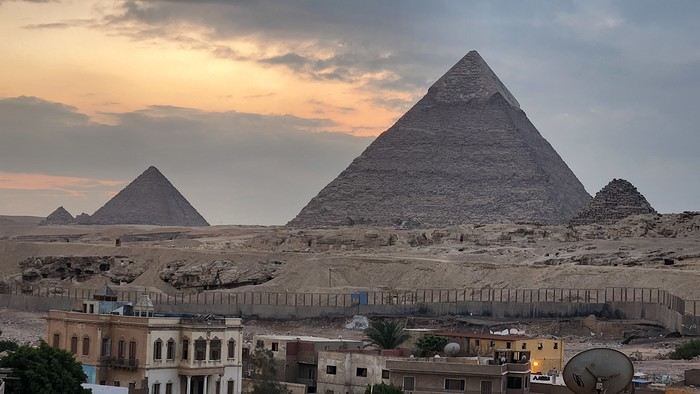
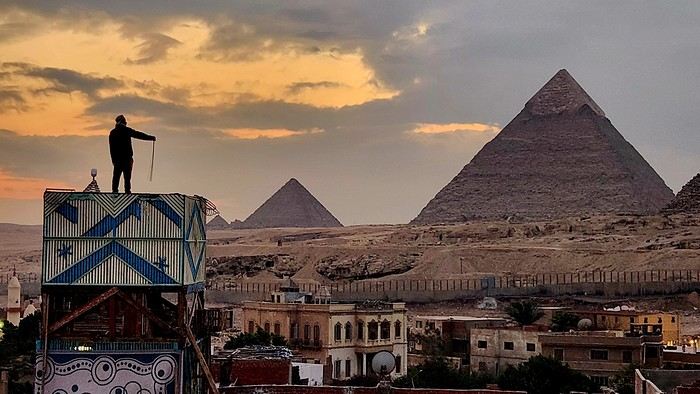
Oh, absolutely! And here it is: a full-on slap in the face for everyone! But just look at this view from our hotel terrace? For 20 € a night for four, even with this incredible view, I figured the room must be pretty shabby, right? Nope... Is the staff rude, then? Nope... Okay, so what’s the catch? You’re gonna tell me breakfast is included too? Well, yes! Honestly, this Egypt trip is off to a great start.
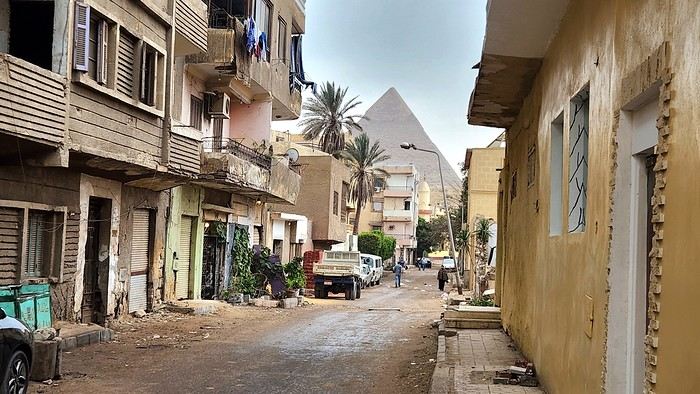
And the rest of the afternoon, spent rubbing shoulders with locals, only confirmed this vibe. After digesting our pyramid view, we dove into the hustle and bustle of our neighborhood with the goal of exchanging money, eating at street stalls, and testing the hospitality of the locals. Ten out of ten!
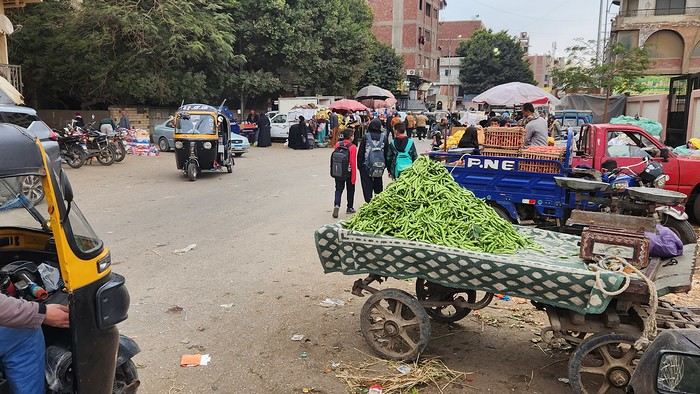
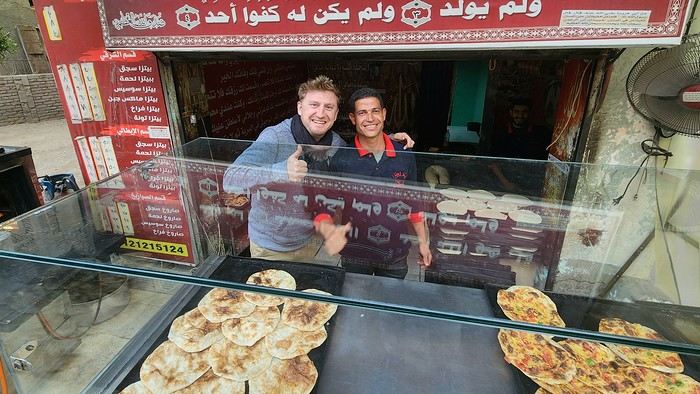
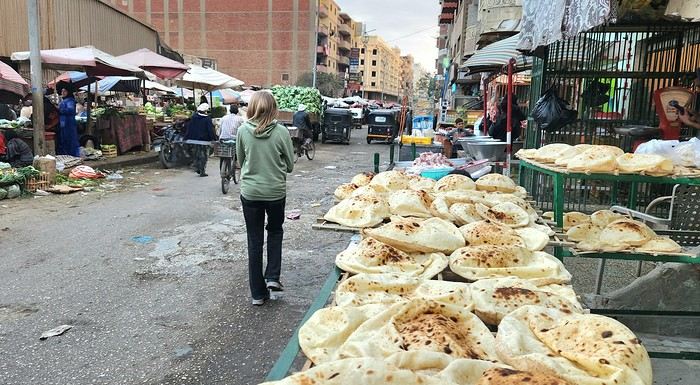
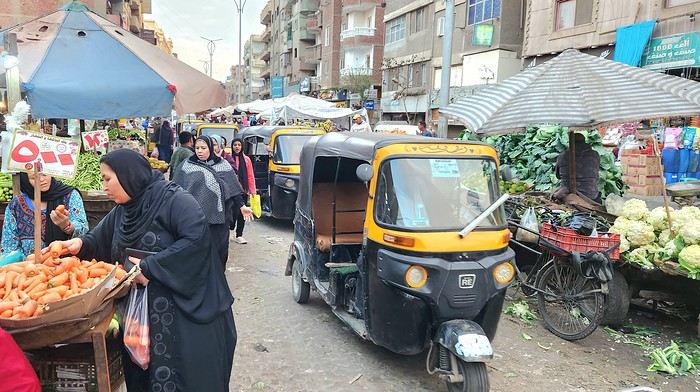
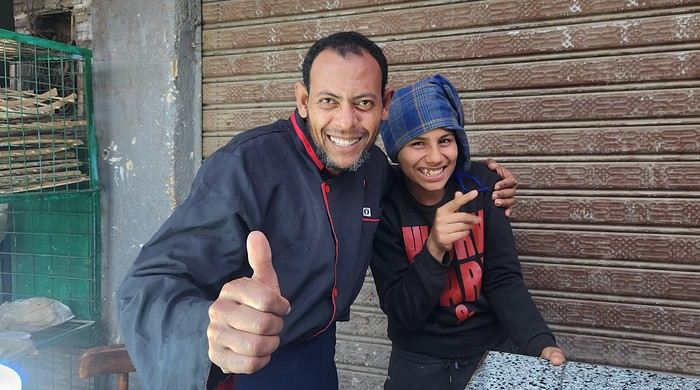
Eight little sun breads with baba ganoush and falafel? 80 pounds, or 1.5 €. A dozen Middle Eastern pastries? Same! 80 pounds! Two hawawshis, those little pita breads stuffed with meat and spices? 10 pounds each, or about twenty cents! Not to mention all those smiles and free "welcomes" left and right!!!
What a welcome! We end this first day with a sunset over the three sisters of Giza—where we’ll obviously be gawking tomorrow...
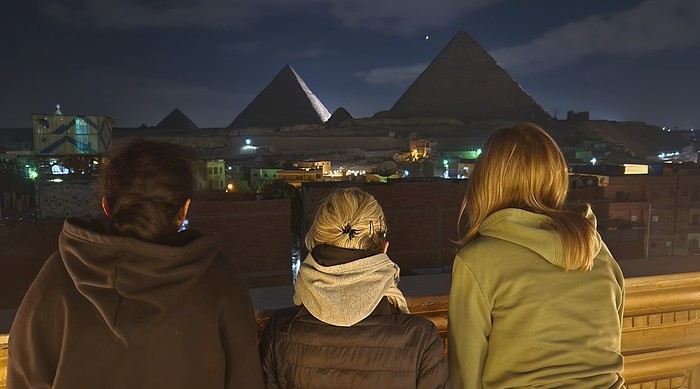
https://voyageforum.com/images/posts/small/1789072399-cCyLDYuFwPLAZTY.jpg
"So, my little wanderers, back at the decks? What’s this mystery destination you’ve got in store for us at the start of the year?"
Yes, the schoolyard bell’s ringing again! We’re hitting the road... or rather, the skies! At first glance, our destination might surprise more than a few. First off, simply because I was here exactly twenty years ago, and I don’t usually like retracing my own footsteps. Secondly, because the name of this place screams mass tourism—basically the opposite of what Flo and I look for.
Despite that, in this land of backsheesh, I’d promised myself I’d come back one day to experience it my way. And since Flo told me, during our wanderer chats, that this destination straddling Africa and the Middle East was in her top 2 travel dreams, the stars aligned for this roots-style trip to quickly make it onto our pharaonic festivities program! Unless you’re totally clueless in general knowledge, you’ve probably guessed by now—we’re off to Egypt! Of course, a few classics will be on our itinerary, but above all, we want to soak up a culture that can’t be appreciated in four-star resorts or on a Nile cruise boat. And let’s be clear, these next two weeks won’t be a walk in the park—neither for our two daughters who are joining us, nor for our bodies!
And that’s clear from the get-go: after our first flight, eight hours of trying (and failing) to sleep on Milan airport’s metal seats, our second flight, landing, passport stamps, our Uber ride, and our first Cairo kilometers, we finally drop our exhaustion at the little guesthouse we booked in Giza. Doesn’t all that energy deserve a little reward?
Oh, absolutely! And here it is: a full-on slap in the face for everyone! But just look at this view from our hotel terrace? For 20 € a night for four, even with this incredible view, I figured the room must be pretty shabby, right? Nope... Is the staff rude, then? Nope... Okay, so what’s the catch? You’re gonna tell me breakfast is included too? Well, yes! Honestly, this Egypt trip is off to a great start.
And the rest of the afternoon, spent rubbing shoulders with locals, only confirmed this vibe. After digesting our pyramid view, we dove into the hustle and bustle of our neighborhood with the goal of exchanging money, eating at street stalls, and testing the hospitality of the locals. Ten out of ten!
Eight little sun breads with baba ganoush and falafel? 80 pounds, or 1.5 €. A dozen Middle Eastern pastries? Same! 80 pounds! Two hawawshis, those little pita breads stuffed with meat and spices? 10 pounds each, or about twenty cents! Not to mention all those smiles and free "welcomes" left and right!!!
What a welcome! We end this first day with a sunset over the three sisters of Giza—where we’ll obviously be gawking tomorrow...
https://voyageforum.com/images/posts/small/1789072399-cCyLDYuFwPLAZTY.jpg
Back in Tunisia (live account)
Hi there,
On this forum, I shared my first trip to Tunisia from mid-February to early March (https://voyageforum.com/forum/impressions-tunisiennes-en-direct-d11460662/), a stay I enjoyed so much that six weeks later, I’m back in Tunisia for a full 15 days (I return on April 27).
This time, I landed in Monastir on a direct flight from Nice, again with Tunisair. We left about ten minutes late, and the flight lasted around 1 hour 30 minutes. A meal was served on board (cucumber salad with Edam-like cheese, carrots, and two small portions of dishes I couldn’t identify—semolina with peppers, olives, and parsley, two small rolls, a square of processed cheese, and a chocolate cake). It’s worth noting because it’s not common on flights this short.
In February, France and Tunisia were in the same time zone, but now Tunisia is one hour behind. This time difference and the flight duration work perfectly for a short 15-day trip since it takes me a few days to adjust to jet lag.
Luckily, I’d asked my hotel about the taxi fare from the airport because the drivers (there were several around me) didn’t hesitate to quote outrageous prices. The actual fare is 20 dinars, but one asked for 120 dinars. I refused, and another offered 60 dinars. I replied, "That’s too expensive—I’ll take the metro!" (Having tried the Tunis metro, I had no desire to repeat the experience in Monastir with a suitcase!). I started walking toward the metro, and one of the drivers caught up with me, saying, "20 dinars is fine!" I’ll skip the details, but the negotiation took a little while. When I arrived at the hotel, I told the receptionist someone had asked for 120 dinars. He put his hands to his head and said, "They’re awful!" He remembered our phone call two days earlier when I’d booked (he’s the one who told me I could take the metro).
The Mezri Hotel isn’t expensive. I got a sea-view room for 75 dinars (22 €). (I’d booked a balcony room for 90 dinars but wouldn’t have had time to enjoy it.) It’s well-located but noisy because there’s no double glazing. The receptionist is a very kind older gentleman. He called a friend whose wife is from Tozeur to find out if I should take a bus or a *louage* tomorrow and what time.
I arrived at the hotel around 7:00 PM and had time to stroll along the corniche to the ribat. Despite some run-down buildings, the seaside seemed livelier and cheerier than Sousse’s.
Monastir is the hometown of former president Bourguiba. I passed his mausoleum by taxi. There are Tunisian flags along the avenue by the sea because every year on April 6—the anniversary of Habib Bourguiba’s death—the president of the Republic visits the Bourguiba Mausoleum in Monastir to pay respects.
The taxi driver mentioned other Tunisian presidents. He complained about rising prices and insecurity, blaming President Kaïs Saïed (I’d already heard that security was better under Ben Ali).
At the end of my stay, I’ll take time to explore Monastir, but tomorrow morning, I’m off to Tozeur—a long bus ride awaits me.

TO BE CONTINUED....
On this forum, I shared my first trip to Tunisia from mid-February to early March (https://voyageforum.com/forum/impressions-tunisiennes-en-direct-d11460662/), a stay I enjoyed so much that six weeks later, I’m back in Tunisia for a full 15 days (I return on April 27).
This time, I landed in Monastir on a direct flight from Nice, again with Tunisair. We left about ten minutes late, and the flight lasted around 1 hour 30 minutes. A meal was served on board (cucumber salad with Edam-like cheese, carrots, and two small portions of dishes I couldn’t identify—semolina with peppers, olives, and parsley, two small rolls, a square of processed cheese, and a chocolate cake). It’s worth noting because it’s not common on flights this short.
In February, France and Tunisia were in the same time zone, but now Tunisia is one hour behind. This time difference and the flight duration work perfectly for a short 15-day trip since it takes me a few days to adjust to jet lag.
Luckily, I’d asked my hotel about the taxi fare from the airport because the drivers (there were several around me) didn’t hesitate to quote outrageous prices. The actual fare is 20 dinars, but one asked for 120 dinars. I refused, and another offered 60 dinars. I replied, "That’s too expensive—I’ll take the metro!" (Having tried the Tunis metro, I had no desire to repeat the experience in Monastir with a suitcase!). I started walking toward the metro, and one of the drivers caught up with me, saying, "20 dinars is fine!" I’ll skip the details, but the negotiation took a little while. When I arrived at the hotel, I told the receptionist someone had asked for 120 dinars. He put his hands to his head and said, "They’re awful!" He remembered our phone call two days earlier when I’d booked (he’s the one who told me I could take the metro).
The Mezri Hotel isn’t expensive. I got a sea-view room for 75 dinars (22 €). (I’d booked a balcony room for 90 dinars but wouldn’t have had time to enjoy it.) It’s well-located but noisy because there’s no double glazing. The receptionist is a very kind older gentleman. He called a friend whose wife is from Tozeur to find out if I should take a bus or a *louage* tomorrow and what time.
I arrived at the hotel around 7:00 PM and had time to stroll along the corniche to the ribat. Despite some run-down buildings, the seaside seemed livelier and cheerier than Sousse’s.
Monastir is the hometown of former president Bourguiba. I passed his mausoleum by taxi. There are Tunisian flags along the avenue by the sea because every year on April 6—the anniversary of Habib Bourguiba’s death—the president of the Republic visits the Bourguiba Mausoleum in Monastir to pay respects.
The taxi driver mentioned other Tunisian presidents. He complained about rising prices and insecurity, blaming President Kaïs Saïed (I’d already heard that security was better under Ben Ali).
At the end of my stay, I’ll take time to explore Monastir, but tomorrow morning, I’m off to Tozeur—a long bus ride awaits me.
TO BE CONTINUED....
Mamoudzou, Mayotte - December 2025
There exists a rare land where life expresses itself, a land where everything is destroyed, patched up, where everything is dirty and faded, yet paradoxically, each passing day is synonymous with light and joy. Seen from the sea, magnified by its translucent waters, the island is splendid; seen from inland, ochre and green dress a landscape one would wish to be pristine. As you approach the coast with the tides, countless boat wrecks never finish dying; returning from a hike, you know you’re nearing the city by the increasingly obvious proliferation of all kinds of trash. Overflowing the towns, makeshift homes made of corrugated iron stand here and there, wherever the eye lands; from a height, looking toward the horizon, you find the calm blue of the ocean and the beauty of infinity.
But where does all this corrugated iron come from? Blue, gray, red, or black, you find it pretty much everywhere—except, of course, on the island’s heights, where the heat is such that all life seems impossible. Yet, a few kilometers from the capital, more than an hour’s walk away, the corrugated iron is very much there, omnipresent, guaranteeing a land registry as hypothetical for us Europeans as it is very real for those who live there, far from civilization and comfort. I keep climbing. I’m precisely looking to meet these people who live on very little, if not nothing.
- Jéjé Mogné (Hello, sir in Shimahorais)! Where do you get water here, in this place? How do you drink, irrigate your plants?
- I wait for the rain. We have tanks that fill up well with each rainfall. But right now, it’s not raining much.
At the top of the next hill, lost in the bushes, it’s easier for me to guess the distant city, Mamoudzou, than the rest of the path, a remnant of a magnificent GR called the Island Tour, abandoned for the most part, sometimes maintained between two lost hamlets. The city, the pulse, water. Below, the ocean, running water, drinking water—despite regular interruptions; here, up high, an hour and a half’s walk away, tanks, arbitrariness. On other slopes, however, during another hike, I saw the water supply network, made of sturdy pipes tangled in the earth, right there by the path. It seems there are places where water climbs. Others not. Each to their own karma. In 2025. In a French department.
A path of misfortune, lost and regained, thanks to a sign, an inscription, or the compass’s directions. No one walks here anymore, except those who live here or come to harvest their crops. I remember that breathtaking hike in 2013, when I connected Bandrélé to Mamoudzou, passing by the peaks of Bénara (660m) and Bépilipili (643m), barely pausing at Tsararano and Vahibé: 34 km of intense effort on a rollercoaster path, along a trail that was still discernible. Today, it’s as if everything had disappeared. By also destroying the paths and vegetation, Chido* broke the last momentum of these cautious hikers: insecurity has made its way across the archipelago, and Sunday strolls are no longer the norm. Me, I keep going. I will have walked here and there during these three weeks to get an idea of the places, the people, the landscapes, and the superhuman effort required to move forward in over 40°C. To tell the truth, during my last hike, I cut my plans short and let myself be carried by a group of young people heading back to the city. The path is now just an inextricable network of small trails, the specter of Providence** comes to mind. True wisdom is knowing when to give up. I leave.
* A cyclone named "desire" (in Shona), which ravaged the island of Mayotte on December 14, 2024. ** June 2023, a very poorly prepared hike on Providence Island (Caribbean) from which I miraculously escaped.
On Petite-Terre, Marie takes me to visit some locals, white people who have lived there for a long time and make a living from their art; jewelry for her, all kinds of objects for him. We love this little shop, this oasis amid the chaos that embodies Dostoevsky’s phrase: "Beauty will save the world." It’s clean and tidy, beautiful, well-kept. Invariably, the question of insecurity resurfaces in the middle of the conversation. The woman says:
- I know someone who slipped in their bathtub. Still, I keep taking baths…
So, is this insecurity a myth or reality? I hear stories that are often true but sometimes seemingly exaggerated through the lens of misunderstanding and one-upmanship. Like that of this midwife assaulted one evening (it gets dark early) on her way home from work. Sometimes she was attacked on the path, dragged by the hair for several meters, sometimes she made it home, but it was her roommate who let the two men in. One version talks about a snatched phone and gratuitous violence, another about violence outright. In short, one thing is certain: walking around at night flaunting your phone isn’t a good idea, no more in Mamoudzou than in the rough neighborhoods of Nantes. Also, I played it safe: nothing flashy, nothing bling-bling, and always something to give if needed. I was never approached. It’s not easy to get a sense of the realities, between the hazy reports from journalists sensationalizing everything and the real lives of real people. But I know I can’t rely on these few ideas I’ve formed: I’m nobody, and above all, I don’t live here. What I do know, however, is that since my last visit to the island in 2017, over 80,000 babies have been born, and tens of thousands of immigrants have reached the archipelago’s shores. What’s also obvious is that poverty, hunger, and—let’s say it—indignity foster delinquency and insecurity. So, without taking journalists’ alarmist speeches at face value, we’ll try to keep in mind that a young person rendered orphaned by circumstances (parents expelled), poor and often hungry, involved more or less against their will in village wars and fueled by synthetic drugs*, will readily turn to violence when they truly have nothing to lose. We can trace the origin of this despair to the fact that in Mayotte, those without legal existence have virtually no hope of accessing anything.
* "Chimique" is a series of synthetic cannabinoids
Meanwhile, in the evening, it’s good to go home before the time of stone-throwing. From time to time, along the roads, gangs throw stones at vehicles and school buses, but mostly at police cars—almost all the white Dusters on the island! In front of the Mamoudzou police station, all parked vehicles—mostly Dusters—bear the scars of these attacks. Maybe it’s only at night that gangs unleash and all the burglaries happen? I saw nothing, heard nothing. I lived three weeks in a sort of bunker with no real access to outside light, protected by a fake wooden door doubled with a real metal door, both locked at all times. You don’t tempt fate. You endure it differently.
Today, extraordinarily, it’s raining. Yet, it’s the rainy season! But with my karma helping (what selfishness to want to walk dry when so many souls live off the rain) or is it climate change? The rain only falls once I’ve put on my horrible green pajamas. In front of the board outlining the program, I’m told that out of the six scheduled C-sections today (sic), they’ll probably only do two, maybe three. Because it’s raining. And when it rains, people don’t move around. Not for lack of will. Rather, for lack of means. And that ties into those sad days when the police patrol around the hospital: patients don’t come. They’ll come back tomorrow. To compensate, I’m happy at the thought of tackling the abscess program, but the sterilization unit is acting up and blocking the instrument trays. When it’s not the rain, it’s the unions. And when both finally quiet down, there’s always someone to find fault with the order of operations. You have to imagine an operating room where the question of urgency reigns supreme. Here, no surgery is scheduled more than 24 hours in advance—only emergencies, nothing but emergencies. So, following that reasonable adage that what’s done is no longer to be done, it’s sheer madness when the rain meets the interests of Force Ouvrière and the bad will of some combines with the laziness of others. To tell the truth, I’ve never seen so much energy expended to… do nothing. Hallucinating. But who am I, a small-time striver, an islander in my spare time, a temporary worker at the end of the world? I came, I saw, I was disappointed? Not really. Here again, I can’t judge a system in so little time. I can barely utter a few bitter words in front of obvious facts. But nothing will take away my joy of being here for three weeks. Here, they heal with somewhat outdated but still functional means. You do what you can with what you have, 8,000 km from the Métropole. Yes, the operating room doors hesitate, and the operating tables stutter, but in this blessed period, we lack neither medicines nor supplies. So we examine, anesthetize, and repair, far more undocumented people than French—if I may play with somewhat borderline statistics here; we deliver babies, dress wounds, and relieve pain in this hospital at the end of the world where neither white women nor Mahorais women would ever consider giving birth or getting treated.
What’s the solution? The obstetrician talks to the woman during a C-section under spinal anesthesia:
- Bouéni! (Madame, in Shimahorais) You need to think about tubal ligation. This is your fourth C-section. Your uterus is like tissue paper. Your next pregnancy will be very risky.
No answer. Culture. It’s all about culture. The funniest thing is that France also gets bogged down with the idea of other cultures’… cultures. The woman in question arrived illegally a few years ago to give birth to her first child. Since then, rejecting the very idea of contraception—her husband, for his part, will invoke God or Allah to refuse a vasectomy—she comes back every 12-14 months. And the obstetrician explains to me how his idea of making information about permanent contraception mandatory was deemed racist by associations. It’s always the same story. I suggest to the associations that they take charge of all these extra births, not only the medical costs but also the entire education, not just financial, of all these children doomed to live a life of misery on this forsaken archipelago. The probability that one of these offspring will emerge as a gifted, sensitive, and fiercely happy individual must truly be weighed against the degradation and abandonment that will invariably afflict the thousands of others living around him. In reality, simply mentioning a very real danger to the mother should be enough to impose sterilization. But we are a country whose greatness of soul is measured by the number of heads cut off to uphold the famous rights of man... Already a proponent at home of ending family allowances after the third child—you can’t subscribe to a certain idea of society and, at the same time, accept that tens of thousands of children are sacrificed on the altar of thoughtlessness and financial interest*—I will weakly advocate here for a controlled right to have children. Well, what will they say about me when I express the idea of imposing sterilization on women in irregular situations after the birth of their third child? National solidarity funds the noblest ideals? In Mayotte? Let’s be serious. It’s so much easier to hide behind the inalienable right of women to control their bodies than to acknowledge one’s own powerlessness to assume the consequences of such a policy. Because after 18 years of struggles as a second-class citizen, the young stateless person will have no choice but to live in hiding: faced with the impossibility of claiming birthright citizenship**, they will be deportable. In Mayotte, there aren’t enough schools, not enough housing, not enough projects for youth, not enough jobs, not enough money, not enough future… In Mayotte, an average of 5 children are born per woman. In reality, we never ask about the right of children to control their own lives.
* Single parent with 4 children: RSA at 1937 € + family allowances… ** Law of May 12, 2025 aiming to strengthen the conditions for accessing French nationality in Mayotte.
I live in the city in a clean apartment where air conditioning eases my aches and sweat, and where water flows abundantly, thanks to huge tanks that fill up between water cuts. On the hills of Koungou, I was struck by this image: there, women (a matriarchal society?) do the dishes in a miserable stream. Upstream of the same stream, the same image as downstream: disgusting water with bits of foam floating on it. A little further, however, there are taps with running water that children play with. Strange. In any case, water is a question. They tell me it’s drinkable; I doubt it. A system that’s regularly cut doesn’t seem reliable to me. In any case, I can’t help but think of the Canary Islands and their chronic water shortage, especially in Lanzarote. Without entering the debate on desalination plants—I’m quite ignorant about environmental repercussions—I’ll just say that in the Canary Islands, you can buy 8 L jugs of purified water for less than 2 €. Here, in Mayotte, the price of water—as is the price of gasoline—is the same everywhere: 0.65 € for a bottle of Cristaline (1 €/L)*. While I was walking up there with a couple of farmers shuttling between two remote spots, I know I hit the mark by offering them one of my two bottles I’d brought for the occasion.
* At home, we find Cristaline at 1.14 € for a 9 L pack, i.e., 0.13 € per liter.
Outside, everything is broken, abandoned, old, worn, torn, faded, heavy, dirty, forsaken. But life goes on. And that’s fascinating. At home, at 5:45 PM, people close their shutters and watch cable TV, sometimes late into the night, emptying the streets of any salutary clamor, unwittingly extinguishing the necessary pulse of life. At home, we die of boredom. In Mamoudzou, between two dying trash cans, metal frames laid on the ground are covered by the elements of a broken garden set. A bare concrete staircase, without railings, provides access to the upper floor of a dwelling. On the steps, you can read: Private space - Please take your trash with you. Metal rods protrude from the said dwelling. On the ground, it’s a festival of screws and nails… A cat passes by. It doesn’t look great. A madwoman crosses the street dancing. A slightly hurried driver brakes. A six- or seven-year-old boy comes out in his underwear from his low house made of corrugated iron. He smiles. He’s having fun doing acrobatic figures over an old mattress on the sidewalk. Forward roll, backward roll. You wonder if he eats enough. Different culture. Different customs.
I will remember for a long time this blinding morning light, a raw, vital, striking light. I almost forgot where I came from, the grayness and boredom of that continental European country where nothing really happens anymore. Here, I could join Camus, contemplating these people placed halfway between misery and the sun, resigned for the most part and, for the other part, not too unhappy with their lot. But the Mahorais discourse is unanimous: "France really screwed us over!" Today, more than half of the island’s inhabitants are undocumented; a tremendous amount of energy is spent expelling 20,000 to 25,000 of them each year; colossal sums are swallowed up to care for all these people, and the island is drifting. I talk with some gendarmes. One of them tells me:
- They intercept one kwassa* out of three… Can you explain to me why they can’t catch everyone? It’s 2025! Can’t they put the necessary boats in place?
Clearly, and this is also my opinion, this whole mess serves interests beyond us. For who can believe for a second that this glaring incompetence isn’t orchestrated? Shared interests between secret France and the Union of the Comoros? A desire to bring insecurity to its peak, either by the Comoros to eventually take back control of Mayotte, or by our own government, in a deliberate effort to see all the white people leave the archipelago and let the Mahorais fend for themselves? At one point, I’m even told about an extraordinary deposit beneath Mayotte’s soil, a promise of infinite wealth**. Not to infringe on human rights, to do some cleaning from time to time, to calm things down to avoid implosion, while waiting to go after this providential bounty? Decidedly, Mayotte hasn’t said its last word!
*What’s paradoxical is that in the early 2010s, to revive traditional fishing activity, the UN financed in Anjouan the construction of a factory to produce these light boats, 7-10m long and 1m wide, which largely served the interests of smugglers. This skiff owes its name to a Congolese dance known for being as rhythmic as it is jerky, much like the navigation experience offered during a crossing to Mayotte. ** A 2025 study revealed the existence of a gigantic magmatic reservoir located 23km beneath the archipelago. If the Icelandic experiment succeeds (Project KMT, see here), Mayotte will then possess almost unlimited energy.
Hell on earth. Paradise at sea. The world’s largest lagoon offering spectacular marine depths, Mayotte’s coral reef suffers less from the abundance of tourists* than from tropical storms**. So, let’s admit that Mayotte is best appreciated when approached from the lagoon. The heights are for old hands like me. The sea spray is rather for the snobs who shun the sun god Ra, risking too much exposure and ending up on sick leave for sunstroke! But I’m not exclusive: I twice don my snob attire and head out to tackle the waves, the seabeds, and the elusive. Because yes, underwater, we leave our landlubber reflexes behind, and flying over corals and other magnificent drop-offs, it’s as if we’re soaring, keeping in memory only what our eyes can store. Multicolored, even phosphorescent fish, sharks, rays, the immensity of the blue, and then, there, dolphins, just a few meters from me, underwater. Incredible.
* 70,000 tourists annually, mostly affinity tourism (links with family or an expatriate). ** Present almost at the water’s surface, the reefs were largely destroyed by Chido.
Paradise at sea? When you think that Mayotte comes from the Arabic Jazirat al Mawet—literally, Island of Death—because of its double coral barrier where many skiffs have run aground and continue to do so… Paradise. Eldorado. The Comoros now face an unprecedented influx of immigrants from the African Great Lakes. And Mayotte, for its part, continues to attract relentlessly, thanks to the evolution of the law*. In reality, whether hidden interests exist or not, France remains bound hand and foot by international, European, and French rules: it can’t do much. Barely has it boarded a kwassa when the one who flees by swimming cries attempted murder; barely has one been sent back to the Comoros when an association will look into their detention conditions and find a loophole; barely has one told a bouéni how her next pregnancy could be fatal when so-called human voices cry scandal.
* Regarding the Métropole, the rights of squatters and other bad payers against the notion of private property, legally violated in favor of the right to housing… ** You can read about France being condemned for its illegal practices of expelling Comorian minors. Inhumane treatment, arbitrary detention, collective expulsion.
Everyone forms their own idea of justice, and no one can claim a monopoly on good thinking. So, as long as I treat without prejudice, as long as my hands are sincerely guided by the love I bear for our humanity, I’ll allow myself to think what I think, understanding that I’m rather open to dialogue and that my opinions evolve with time and events. Today, Mayotte represents for me the failure of a model, a European one in this case, where opulence quickly meets its limits. For it’s not wrong to think that our society can’t share more than it produces, nor is it wrong to think that every human being has a right to their share of the pie; in Mayotte, you’ll find the proven result of our civilization: it doesn’t work. Exclusively financed by the right, the ideas of the left jam in Mayotte more than anywhere else: national solidarity coupled with a sense of guilt creates chaos. Political courage, or true social justice, would be to offer a future to those who have no choice—the one who’s already here, the child to be born—not to offer a present to those who can choose or to whom one can give keys to understanding—the woman of childbearing age, the candidate for exile. Ultimately, the Comoros’ coup d’état over France comes at the cost of many innocent victims, starting with the children*.
* Tens of thousands of deaths by drowning between Anjouan and Mayotte, tens of thousands of children left to fend for themselves and doomed to a non-existent future.
On the evening of the 31st, I go for my usual run and notice near a roundabout a fool in rags pedaling the wrong way. A police car passes by: the guy gets stopped. A rather quick identity check. The guy is taken away. Would he still be among us if he had ridden the right way? In the evening, the line is long in front of the club near the dock. Me, I’m just passing by, greeting my friends of the season, much more inclined to savor rest than to exhaust myself on an overheated dance floor. There, a man, thirty or forty years old, clearly in a world of his own, is searching the trash for something to eat. He’s barefoot. I console myself by thinking that at least he won’t die of cold. Out of ten children born in Mayotte, I can reasonably think that only one will be able to afford an existence that minimally meets any of our criteria.
It’s time to go home. After sweating and thinking so much about this gem of the Mozambique Channel, I spend peaceful hours by the pool at a hotel next to the airport. We checked out at 8 AM, and the flight is at 7 PM. The perfect opportunity to slack off and chat a bit more. I’m happy to get to know one of the co-pilots of tonight’s flight, staying at this hotel, while one of my flight attendant friends from this airline had already recommended me to the crew. But it’s not the captain’s day, who’s in a rather gloomy mood. I’ll travel in the back, up to the vertical of Cairo. Midnight has just struck; it’s January 2nd, my name day. Concerned about solving an unsolvable problem with a passenger, the crew asks me to give up my exit row seat and takes me to the front for the last four hours of the flight. In the end, the captain gave in? I laugh to myself: if there’s one thing I mustn’t forget, it’s that God never abandons me!
But where does all this corrugated iron come from? Blue, gray, red, or black, you find it pretty much everywhere—except, of course, on the island’s heights, where the heat is such that all life seems impossible. Yet, a few kilometers from the capital, more than an hour’s walk away, the corrugated iron is very much there, omnipresent, guaranteeing a land registry as hypothetical for us Europeans as it is very real for those who live there, far from civilization and comfort. I keep climbing. I’m precisely looking to meet these people who live on very little, if not nothing.
- Jéjé Mogné (Hello, sir in Shimahorais)! Where do you get water here, in this place? How do you drink, irrigate your plants?
- I wait for the rain. We have tanks that fill up well with each rainfall. But right now, it’s not raining much.
At the top of the next hill, lost in the bushes, it’s easier for me to guess the distant city, Mamoudzou, than the rest of the path, a remnant of a magnificent GR called the Island Tour, abandoned for the most part, sometimes maintained between two lost hamlets. The city, the pulse, water. Below, the ocean, running water, drinking water—despite regular interruptions; here, up high, an hour and a half’s walk away, tanks, arbitrariness. On other slopes, however, during another hike, I saw the water supply network, made of sturdy pipes tangled in the earth, right there by the path. It seems there are places where water climbs. Others not. Each to their own karma. In 2025. In a French department.
A path of misfortune, lost and regained, thanks to a sign, an inscription, or the compass’s directions. No one walks here anymore, except those who live here or come to harvest their crops. I remember that breathtaking hike in 2013, when I connected Bandrélé to Mamoudzou, passing by the peaks of Bénara (660m) and Bépilipili (643m), barely pausing at Tsararano and Vahibé: 34 km of intense effort on a rollercoaster path, along a trail that was still discernible. Today, it’s as if everything had disappeared. By also destroying the paths and vegetation, Chido* broke the last momentum of these cautious hikers: insecurity has made its way across the archipelago, and Sunday strolls are no longer the norm. Me, I keep going. I will have walked here and there during these three weeks to get an idea of the places, the people, the landscapes, and the superhuman effort required to move forward in over 40°C. To tell the truth, during my last hike, I cut my plans short and let myself be carried by a group of young people heading back to the city. The path is now just an inextricable network of small trails, the specter of Providence** comes to mind. True wisdom is knowing when to give up. I leave.
* A cyclone named "desire" (in Shona), which ravaged the island of Mayotte on December 14, 2024. ** June 2023, a very poorly prepared hike on Providence Island (Caribbean) from which I miraculously escaped.
On Petite-Terre, Marie takes me to visit some locals, white people who have lived there for a long time and make a living from their art; jewelry for her, all kinds of objects for him. We love this little shop, this oasis amid the chaos that embodies Dostoevsky’s phrase: "Beauty will save the world." It’s clean and tidy, beautiful, well-kept. Invariably, the question of insecurity resurfaces in the middle of the conversation. The woman says:
- I know someone who slipped in their bathtub. Still, I keep taking baths…
So, is this insecurity a myth or reality? I hear stories that are often true but sometimes seemingly exaggerated through the lens of misunderstanding and one-upmanship. Like that of this midwife assaulted one evening (it gets dark early) on her way home from work. Sometimes she was attacked on the path, dragged by the hair for several meters, sometimes she made it home, but it was her roommate who let the two men in. One version talks about a snatched phone and gratuitous violence, another about violence outright. In short, one thing is certain: walking around at night flaunting your phone isn’t a good idea, no more in Mamoudzou than in the rough neighborhoods of Nantes. Also, I played it safe: nothing flashy, nothing bling-bling, and always something to give if needed. I was never approached. It’s not easy to get a sense of the realities, between the hazy reports from journalists sensationalizing everything and the real lives of real people. But I know I can’t rely on these few ideas I’ve formed: I’m nobody, and above all, I don’t live here. What I do know, however, is that since my last visit to the island in 2017, over 80,000 babies have been born, and tens of thousands of immigrants have reached the archipelago’s shores. What’s also obvious is that poverty, hunger, and—let’s say it—indignity foster delinquency and insecurity. So, without taking journalists’ alarmist speeches at face value, we’ll try to keep in mind that a young person rendered orphaned by circumstances (parents expelled), poor and often hungry, involved more or less against their will in village wars and fueled by synthetic drugs*, will readily turn to violence when they truly have nothing to lose. We can trace the origin of this despair to the fact that in Mayotte, those without legal existence have virtually no hope of accessing anything.
* "Chimique" is a series of synthetic cannabinoids
Meanwhile, in the evening, it’s good to go home before the time of stone-throwing. From time to time, along the roads, gangs throw stones at vehicles and school buses, but mostly at police cars—almost all the white Dusters on the island! In front of the Mamoudzou police station, all parked vehicles—mostly Dusters—bear the scars of these attacks. Maybe it’s only at night that gangs unleash and all the burglaries happen? I saw nothing, heard nothing. I lived three weeks in a sort of bunker with no real access to outside light, protected by a fake wooden door doubled with a real metal door, both locked at all times. You don’t tempt fate. You endure it differently.
Today, extraordinarily, it’s raining. Yet, it’s the rainy season! But with my karma helping (what selfishness to want to walk dry when so many souls live off the rain) or is it climate change? The rain only falls once I’ve put on my horrible green pajamas. In front of the board outlining the program, I’m told that out of the six scheduled C-sections today (sic), they’ll probably only do two, maybe three. Because it’s raining. And when it rains, people don’t move around. Not for lack of will. Rather, for lack of means. And that ties into those sad days when the police patrol around the hospital: patients don’t come. They’ll come back tomorrow. To compensate, I’m happy at the thought of tackling the abscess program, but the sterilization unit is acting up and blocking the instrument trays. When it’s not the rain, it’s the unions. And when both finally quiet down, there’s always someone to find fault with the order of operations. You have to imagine an operating room where the question of urgency reigns supreme. Here, no surgery is scheduled more than 24 hours in advance—only emergencies, nothing but emergencies. So, following that reasonable adage that what’s done is no longer to be done, it’s sheer madness when the rain meets the interests of Force Ouvrière and the bad will of some combines with the laziness of others. To tell the truth, I’ve never seen so much energy expended to… do nothing. Hallucinating. But who am I, a small-time striver, an islander in my spare time, a temporary worker at the end of the world? I came, I saw, I was disappointed? Not really. Here again, I can’t judge a system in so little time. I can barely utter a few bitter words in front of obvious facts. But nothing will take away my joy of being here for three weeks. Here, they heal with somewhat outdated but still functional means. You do what you can with what you have, 8,000 km from the Métropole. Yes, the operating room doors hesitate, and the operating tables stutter, but in this blessed period, we lack neither medicines nor supplies. So we examine, anesthetize, and repair, far more undocumented people than French—if I may play with somewhat borderline statistics here; we deliver babies, dress wounds, and relieve pain in this hospital at the end of the world where neither white women nor Mahorais women would ever consider giving birth or getting treated.
What’s the solution? The obstetrician talks to the woman during a C-section under spinal anesthesia:
- Bouéni! (Madame, in Shimahorais) You need to think about tubal ligation. This is your fourth C-section. Your uterus is like tissue paper. Your next pregnancy will be very risky.
No answer. Culture. It’s all about culture. The funniest thing is that France also gets bogged down with the idea of other cultures’… cultures. The woman in question arrived illegally a few years ago to give birth to her first child. Since then, rejecting the very idea of contraception—her husband, for his part, will invoke God or Allah to refuse a vasectomy—she comes back every 12-14 months. And the obstetrician explains to me how his idea of making information about permanent contraception mandatory was deemed racist by associations. It’s always the same story. I suggest to the associations that they take charge of all these extra births, not only the medical costs but also the entire education, not just financial, of all these children doomed to live a life of misery on this forsaken archipelago. The probability that one of these offspring will emerge as a gifted, sensitive, and fiercely happy individual must truly be weighed against the degradation and abandonment that will invariably afflict the thousands of others living around him. In reality, simply mentioning a very real danger to the mother should be enough to impose sterilization. But we are a country whose greatness of soul is measured by the number of heads cut off to uphold the famous rights of man... Already a proponent at home of ending family allowances after the third child—you can’t subscribe to a certain idea of society and, at the same time, accept that tens of thousands of children are sacrificed on the altar of thoughtlessness and financial interest*—I will weakly advocate here for a controlled right to have children. Well, what will they say about me when I express the idea of imposing sterilization on women in irregular situations after the birth of their third child? National solidarity funds the noblest ideals? In Mayotte? Let’s be serious. It’s so much easier to hide behind the inalienable right of women to control their bodies than to acknowledge one’s own powerlessness to assume the consequences of such a policy. Because after 18 years of struggles as a second-class citizen, the young stateless person will have no choice but to live in hiding: faced with the impossibility of claiming birthright citizenship**, they will be deportable. In Mayotte, there aren’t enough schools, not enough housing, not enough projects for youth, not enough jobs, not enough money, not enough future… In Mayotte, an average of 5 children are born per woman. In reality, we never ask about the right of children to control their own lives.
* Single parent with 4 children: RSA at 1937 € + family allowances… ** Law of May 12, 2025 aiming to strengthen the conditions for accessing French nationality in Mayotte.
I live in the city in a clean apartment where air conditioning eases my aches and sweat, and where water flows abundantly, thanks to huge tanks that fill up between water cuts. On the hills of Koungou, I was struck by this image: there, women (a matriarchal society?) do the dishes in a miserable stream. Upstream of the same stream, the same image as downstream: disgusting water with bits of foam floating on it. A little further, however, there are taps with running water that children play with. Strange. In any case, water is a question. They tell me it’s drinkable; I doubt it. A system that’s regularly cut doesn’t seem reliable to me. In any case, I can’t help but think of the Canary Islands and their chronic water shortage, especially in Lanzarote. Without entering the debate on desalination plants—I’m quite ignorant about environmental repercussions—I’ll just say that in the Canary Islands, you can buy 8 L jugs of purified water for less than 2 €. Here, in Mayotte, the price of water—as is the price of gasoline—is the same everywhere: 0.65 € for a bottle of Cristaline (1 €/L)*. While I was walking up there with a couple of farmers shuttling between two remote spots, I know I hit the mark by offering them one of my two bottles I’d brought for the occasion.
* At home, we find Cristaline at 1.14 € for a 9 L pack, i.e., 0.13 € per liter.
Outside, everything is broken, abandoned, old, worn, torn, faded, heavy, dirty, forsaken. But life goes on. And that’s fascinating. At home, at 5:45 PM, people close their shutters and watch cable TV, sometimes late into the night, emptying the streets of any salutary clamor, unwittingly extinguishing the necessary pulse of life. At home, we die of boredom. In Mamoudzou, between two dying trash cans, metal frames laid on the ground are covered by the elements of a broken garden set. A bare concrete staircase, without railings, provides access to the upper floor of a dwelling. On the steps, you can read: Private space - Please take your trash with you. Metal rods protrude from the said dwelling. On the ground, it’s a festival of screws and nails… A cat passes by. It doesn’t look great. A madwoman crosses the street dancing. A slightly hurried driver brakes. A six- or seven-year-old boy comes out in his underwear from his low house made of corrugated iron. He smiles. He’s having fun doing acrobatic figures over an old mattress on the sidewalk. Forward roll, backward roll. You wonder if he eats enough. Different culture. Different customs.
I will remember for a long time this blinding morning light, a raw, vital, striking light. I almost forgot where I came from, the grayness and boredom of that continental European country where nothing really happens anymore. Here, I could join Camus, contemplating these people placed halfway between misery and the sun, resigned for the most part and, for the other part, not too unhappy with their lot. But the Mahorais discourse is unanimous: "France really screwed us over!" Today, more than half of the island’s inhabitants are undocumented; a tremendous amount of energy is spent expelling 20,000 to 25,000 of them each year; colossal sums are swallowed up to care for all these people, and the island is drifting. I talk with some gendarmes. One of them tells me:
- They intercept one kwassa* out of three… Can you explain to me why they can’t catch everyone? It’s 2025! Can’t they put the necessary boats in place?
Clearly, and this is also my opinion, this whole mess serves interests beyond us. For who can believe for a second that this glaring incompetence isn’t orchestrated? Shared interests between secret France and the Union of the Comoros? A desire to bring insecurity to its peak, either by the Comoros to eventually take back control of Mayotte, or by our own government, in a deliberate effort to see all the white people leave the archipelago and let the Mahorais fend for themselves? At one point, I’m even told about an extraordinary deposit beneath Mayotte’s soil, a promise of infinite wealth**. Not to infringe on human rights, to do some cleaning from time to time, to calm things down to avoid implosion, while waiting to go after this providential bounty? Decidedly, Mayotte hasn’t said its last word!
*What’s paradoxical is that in the early 2010s, to revive traditional fishing activity, the UN financed in Anjouan the construction of a factory to produce these light boats, 7-10m long and 1m wide, which largely served the interests of smugglers. This skiff owes its name to a Congolese dance known for being as rhythmic as it is jerky, much like the navigation experience offered during a crossing to Mayotte. ** A 2025 study revealed the existence of a gigantic magmatic reservoir located 23km beneath the archipelago. If the Icelandic experiment succeeds (Project KMT, see here), Mayotte will then possess almost unlimited energy.
Hell on earth. Paradise at sea. The world’s largest lagoon offering spectacular marine depths, Mayotte’s coral reef suffers less from the abundance of tourists* than from tropical storms**. So, let’s admit that Mayotte is best appreciated when approached from the lagoon. The heights are for old hands like me. The sea spray is rather for the snobs who shun the sun god Ra, risking too much exposure and ending up on sick leave for sunstroke! But I’m not exclusive: I twice don my snob attire and head out to tackle the waves, the seabeds, and the elusive. Because yes, underwater, we leave our landlubber reflexes behind, and flying over corals and other magnificent drop-offs, it’s as if we’re soaring, keeping in memory only what our eyes can store. Multicolored, even phosphorescent fish, sharks, rays, the immensity of the blue, and then, there, dolphins, just a few meters from me, underwater. Incredible.
* 70,000 tourists annually, mostly affinity tourism (links with family or an expatriate). ** Present almost at the water’s surface, the reefs were largely destroyed by Chido.
Paradise at sea? When you think that Mayotte comes from the Arabic Jazirat al Mawet—literally, Island of Death—because of its double coral barrier where many skiffs have run aground and continue to do so… Paradise. Eldorado. The Comoros now face an unprecedented influx of immigrants from the African Great Lakes. And Mayotte, for its part, continues to attract relentlessly, thanks to the evolution of the law*. In reality, whether hidden interests exist or not, France remains bound hand and foot by international, European, and French rules: it can’t do much. Barely has it boarded a kwassa when the one who flees by swimming cries attempted murder; barely has one been sent back to the Comoros when an association will look into their detention conditions and find a loophole; barely has one told a bouéni how her next pregnancy could be fatal when so-called human voices cry scandal.
* Regarding the Métropole, the rights of squatters and other bad payers against the notion of private property, legally violated in favor of the right to housing… ** You can read about France being condemned for its illegal practices of expelling Comorian minors. Inhumane treatment, arbitrary detention, collective expulsion.
Everyone forms their own idea of justice, and no one can claim a monopoly on good thinking. So, as long as I treat without prejudice, as long as my hands are sincerely guided by the love I bear for our humanity, I’ll allow myself to think what I think, understanding that I’m rather open to dialogue and that my opinions evolve with time and events. Today, Mayotte represents for me the failure of a model, a European one in this case, where opulence quickly meets its limits. For it’s not wrong to think that our society can’t share more than it produces, nor is it wrong to think that every human being has a right to their share of the pie; in Mayotte, you’ll find the proven result of our civilization: it doesn’t work. Exclusively financed by the right, the ideas of the left jam in Mayotte more than anywhere else: national solidarity coupled with a sense of guilt creates chaos. Political courage, or true social justice, would be to offer a future to those who have no choice—the one who’s already here, the child to be born—not to offer a present to those who can choose or to whom one can give keys to understanding—the woman of childbearing age, the candidate for exile. Ultimately, the Comoros’ coup d’état over France comes at the cost of many innocent victims, starting with the children*.
* Tens of thousands of deaths by drowning between Anjouan and Mayotte, tens of thousands of children left to fend for themselves and doomed to a non-existent future.
On the evening of the 31st, I go for my usual run and notice near a roundabout a fool in rags pedaling the wrong way. A police car passes by: the guy gets stopped. A rather quick identity check. The guy is taken away. Would he still be among us if he had ridden the right way? In the evening, the line is long in front of the club near the dock. Me, I’m just passing by, greeting my friends of the season, much more inclined to savor rest than to exhaust myself on an overheated dance floor. There, a man, thirty or forty years old, clearly in a world of his own, is searching the trash for something to eat. He’s barefoot. I console myself by thinking that at least he won’t die of cold. Out of ten children born in Mayotte, I can reasonably think that only one will be able to afford an existence that minimally meets any of our criteria.
It’s time to go home. After sweating and thinking so much about this gem of the Mozambique Channel, I spend peaceful hours by the pool at a hotel next to the airport. We checked out at 8 AM, and the flight is at 7 PM. The perfect opportunity to slack off and chat a bit more. I’m happy to get to know one of the co-pilots of tonight’s flight, staying at this hotel, while one of my flight attendant friends from this airline had already recommended me to the crew. But it’s not the captain’s day, who’s in a rather gloomy mood. I’ll travel in the back, up to the vertical of Cairo. Midnight has just struck; it’s January 2nd, my name day. Concerned about solving an unsolvable problem with a passenger, the crew asks me to give up my exit row seat and takes me to the front for the last four hours of the flight. In the end, the captain gave in? I laugh to myself: if there’s one thing I mustn’t forget, it’s that God never abandons me!
What payment method should I use in Egyptian hotels?
I’ve read everything and its opposite in travel guides and online. It seems that hotel owners—and the government—require tourists to pay in foreign currency rather than the local one (pounds). This is a huge problem for me since I’ll be in Egypt for 3 months. I can’t exactly walk around with thousands of dollars on me (I’m from Quebec). I could pay with a credit card—easier—but I think there’s an extra fee. Is that really the case? But what do I do if a small-town hotel doesn’t accept credit cards??? I thought about using a WISE debit card, but again, what if the place doesn’t have a payment terminal??? Can I hope that some establishments in less touristy areas might accept payment in pounds? And most importantly: does the same issue apply to paying for entry to archaeological sites??? A big thank you for your insights—I’m totally in the DARK here!!!
Marc Lamarre
Marc Lamarre
Dubai on a budget
Four days of beach relaxation in this truly curious place let me unwind 15 years ago after trekking through Asia or Africa: swimming in clear, clean water and easing jet lag was my goal; seeing that mirage in the middle of the desert also piqued my curiosity... And then Dubai developed, and now I go there once a year for 15 days without ever getting bored!! My backpacker budget doesn’t stop me from enjoying what I love about travel: discovering cultures, architecture, and beaches with turquoise waters.
I’m sharing my favorite spots here for those who love simplicity and the thrill of being amazed! Dubai stretches over 50 km long. I stay in the historic Bur Dubai neighborhood, which is very "Indian" and separated from Deira (the more "Arab/African" district) by a creek.
You cross from one side to the other on abras, small traditional wooden boats that run all day. My hotel is 4 minutes from the Al Ghubaiba bus station, 5 minutes from the Al Ghubaiba metro, and 6 minutes from the Al Ghubaiba boat station!!! It’s easy to get around from here, and at night, it’s lively—safe to go out, with few tourists but mostly the local middle class who built (and are still building) Dubai. It’s simple and very international.
- **Transport:** ...**Getting there:** I fly with Emirates from Paris. Taking the 9:30 PM flight, I sleep on the plane, land at 6:35 AM, exchange 200 euros once I’ve picked up my luggage, change in the restroom, grab a taxi to the hotel, drop off my suitcase, and head straight to the beach! ...**On the ground:** I buy a silver NOL card, which works for buses, metro, and boats. I top it up as needed—it’s valid for 2 years. ...**Taxis:** They have reliable meters. Pink ones are driven by women. Airport-to-hotel fare: 12 €. You’ll find them everywhere, and they don’t complain about short trips. Between 3 PM and 4 PM, it’s trickier because of shift changes.
- **Best times to visit:** For me, it’s April-May and October-November: not too hot for walking but warm enough to swim! Watch out for air conditioning—your worst enemy. It’s everywhere, even at bus stops. Bring a big scarf or sarong to cover your throat and head—going from 32°C to 16°C when you enter a mall, bus, or taxi is pretty harsh!
- **Hotel:** I stay at the Grand Astoria (Fahidi Street) because the value for price and location is great. It’s very clean, and I skip breakfast because near the bus station, there’s a big Carrefour hypermarket where I buy breakfast supplies, water, camel milk, and picnic snacks. There are two nightclubs downstairs—bring earplugs if you want to sleep before 2 AM. Wi-Fi is spotty; you have to change the password every two days. The staff is lovely. Rooms have a TV (4 Indian channels + BBC), a kettle with tea/coffee sachets, and a mini-fridge you fill yourself.
- **Bur Dubai: "My neighborhood"** In the morning, you can see kids in uniforms waiting for the school bus with their parents—second-generation migrants who’ve settled here. They speak English, Arabic, and their mother tongue, have great education, and are in high demand (I see job ads in the local newspapers in the hotel lobby). From the U.S. to the Middle East, Singapore to South Africa, they have bright futures. In the evenings, families stroll along the creek, and it’s common for bench neighbors to ask where you’re from. The whole world crosses paths here. Even with basic English, it’s friendly and warm—the "take care" as people go their separate ways is a nice touch.
Bur Dubai has plenty to explore if you don’t feel like going far: along the creek, there’s a cluster of reconstructed houses forming the Al Shindagha Museum. One ticket lets you visit all the houses, each with a theme tied to the history of the seven emirates (Dubai is one). It takes a full day, but if you stop for lunch, there are tons of restaurants for all budgets, some right by the water.
Walking in the opposite direction, you reach Al Seef, a reconstruction of old Dubai as a small pearl-fishing port. The architecture is lovely, with souvenir shops. My favorite is the Iranian grocery store, where you’ll find camel milk chocolate, black lemon, and sweets with rose, pistachio, and candied apricot. It’s peaceful to walk around here, even as a solo woman. There are free restrooms everywhere, wooden or stone benches, and a nice breeze in the evening. Plenty of waterfront restaurants or places to grab a drink, plus a few towers across the way—nothing spectacular, but they’re prettily lit. There’s a souk with souvenir shops for those who like that!
- **Restaurants:** Bur Dubai has restaurants representing regions of India and the Indian subcontinent. My favorites: Across from the hotel, Paklyari—a Pakistani spot with excellent mutton biryani for 5 €. At Al Seef, Nablus has a great setting by the water. Across in Deira, the Italian restaurant on the 18th floor of the Rotana—go half an hour before sunset for an amazing view of the creek and skyline. The truffle pizza is 24 €. You can take a taxi from Bur, and after dinner, get dropped off at Al Seef to walk back along the creek. For a great thali, Kathhiyawadi is a 10-minute walk from Burjuman metro. My latest discovery: Bordomavi (near the Rashid Al Hadees Masjid 1 bus stop). One of the servers is Algerian and speaks French. You can swim at the small beach with showers/toilets, then have lunch at the restaurant (57 € for two, with starter, main, dessert, and drinks). The setting is peaceful, in a little fishing port with a cool photo op—traditional boats with the modern skyline in the background!
- **Sunset drinks:** The terrace at Concorde Creek View (Bur Dubai) has a creek view, and Canopy by Hilton (Al Seef) overlooks the creek and skyline. You can get a day pass for the pool, including meals and drinks.
- **Lassi:** Near the hotel, SreeRaj Lassi Bar has great ice cream and lassi. *Tip: Everything is takeout-friendly, including leftovers—great for a picnic the next day.
- **Market:** Don’t miss the Waterfront Market—a huge hall where locals buy fish, meat, fruits, and vegetables from all over the world. I love buying fish, shrimp, and cuttlefish, then having it prepared at Yahya’s waterfront restaurant (grilled, in sauce, fried, etc.) with salad, hummus, tabbouleh, and rice. It’s on the way between "my" beach and the hotel, so I stop by easily. I stock up on fruit, and at the Lulu supermarket upstairs, I grab yogurt, water, etc. No need to carry everything—a taxi (available at the main exit) will drop me right at the hotel!
- **Beach:** My favorite: Al Mamzar Park (15-minute taxi ride, 9 €). It has four lifeguarded beaches with showers and restrooms. Opens at 8 AM, but note: Mondays and Wednesdays are for women and young children only! Entry is 1.50 €. On Beach #2, you can rent sun loungers and umbrellas. Beach #3 (the prettiest) has stone tables with benches under big umbrellas—free! I arrive at 8 AM, set up, and walk for an hour along the water, spotting starfish, colorful fish, birds, and occasionally small jellyfish. From bikinis to burkinis, everyone swims as they like! Dubai is judgment-free—no side-eye, just smiles and greetings. I love seeing joyful, full-figured women on women-only days, playing darbuka and singing. Indian women do yoga (even headstands!), Chinese women practice tai chi... I read a lot and swim far out to the buoy limits. Lifeguards keep watch. It’s safe on land too. Once, a 4x4 driver gave me a dirty look for "serving whisky" to my mom from a plastic bottle—until I made him smell it. It was mint tea! Embarrassed, he immediately called his brother, a gym teacher in Poitiers, to apologize in French! People in Dubai are smiley, polite, and very respectful of elders. On weekends, the park is packed with groups and families barbecuing—joyful chaos in every language!
By 1:30 PM, depending on my mood, I’ll get dropped off at the Waterfront Market for fish or a thali restaurant. Sometimes I take the bus—it stops near the abras on the Deira side. Just cross by boat, then it’s a 3-minute walk to the hotel. Takes 45 minutes (vs. 15 by taxi).
For a treat, try Kite Beach (Abu Manara Masjid bus stop). The SoleMio section offers comfy sun loungers, fluffy towels, and umbrellas for 80 € for two in the front row. Go early—you’ll feel like you have the place to yourself, with the Burj Al Arab in the background. It gets busy on weekends.
From there, you can take a taxi to Dubai Mall (not far) to check out the dancing fountains at sunset, for example.
You can also buy day passes at some hotels with sun loungers, towels, pool access, and lunch credit. I tried the Ritz-Carlton—decent (170 € for two, including meals). Lunch was fine, and the view of the lit-up towers at sunset, with the giant wheel, was stunning. I took the metro back in the evening.
There are plenty of free beaches too, like La Mer—worth seeing more for the decor than the beach itself.
- **Even though my main "sightseeing" involves walking around with my head up, admiring the towers in DIFC (amazing), visiting the stunning Mohammed bin Rashid Library (near Creek metro), wandering the souks (including Little India in Bur and the Iranian mosque), or the spice souks in Deira (go early when it’s quiet),** A day trip to Abu Dhabi is worth it. Take the Bur Dubai-Abu Dhabi bus (pay with your NOL card). If you leave early, you’ll see the sunrise over the desert. At the station, buy a bus ticket to the Louvre, cross the footbridge over the highway, and wait for the bus. After the museum, take a taxi to the Grand Mosque, then another taxi back to the bus station. A full but doable day—no need to stay overnight!
In the evening, I love taking the metro (mostly above ground) and passing between the towering, lit-up skyscrapers—it feels like a sci-fi movie. Just missing flying taxis (they’re in the works!)
Sharjah, the closest emirate, has a fantastic Orientalist museum. From Bur Dubai’s maritime station, boats go to Sharjah in 30 minutes, near the aquarium and maritime museum.
- **Shopping:** I buy Indian chai tea spices, incense, camel milk chocolate, Iranian sweets, and fabric from Indian shops selling saris and fabric by the meter. I have a tailor make shirts, tunics, etc. Some shops sell buttons and trimmings to jazz things up.
- **Malls:** To attract customers, mall owners come up with wild ideas: a ski slope at Dubai Mall (worth seeing once), pretty wooden souks at Madinat, and a giant aquarium at Dubai Mall. At sunset, you can watch the dancing fountains to popular global tunes at the foot of the world’s tallest tower. At its base, there’s an excellent Iraqi restaurant, Samad Al Iraki, where the tea server is Tunisian and speaks French! The Ibn Battuta Mall is unique—you can go there straight from Abu Dhabi by bus, for example. Malls have plenty of dining options and are a place to (finally) see locals... though they’re not that interesting. Malls are served by the metro, while buses run along the coast. In Burjuman Mall, there’s a cybercafé on the ground floor where you can print.
A few helpful sites: Visit Dubai - Official Tourism Site RTA (Roads and Transport Authority) - RTA Services
"But what do *you* do in Dubai?" my friends ask, surprised... Yes, I love traveling to countries where I ride on bumpy roads in buses that break down, sleep in places with mosquitoes and cockroaches, and swelter in heat and humidity. But even far from that kind of travel, Dubai has an exotic charm. There’s something for every taste and budget—once you get past the flight ticket (around 680 €, probably cheaper with a layover). Dubai is about relaxing, swimming, being amazed, chatting, and tasting... A safe, clean vacation with no rudeness, and as a woman, it’s a relief to let your guard down. You come back refreshed and at peace!
Hope my experience helps... Next trip: March 2026, with plans to visit the Guggenheim in Abu Dhabi and whatever other curiosities pop up like magic...
Feel free to add to my experience with your own! Happy travels, Laurence
I’m sharing my favorite spots here for those who love simplicity and the thrill of being amazed! Dubai stretches over 50 km long. I stay in the historic Bur Dubai neighborhood, which is very "Indian" and separated from Deira (the more "Arab/African" district) by a creek.
You cross from one side to the other on abras, small traditional wooden boats that run all day. My hotel is 4 minutes from the Al Ghubaiba bus station, 5 minutes from the Al Ghubaiba metro, and 6 minutes from the Al Ghubaiba boat station!!! It’s easy to get around from here, and at night, it’s lively—safe to go out, with few tourists but mostly the local middle class who built (and are still building) Dubai. It’s simple and very international.
- **Transport:** ...**Getting there:** I fly with Emirates from Paris. Taking the 9:30 PM flight, I sleep on the plane, land at 6:35 AM, exchange 200 euros once I’ve picked up my luggage, change in the restroom, grab a taxi to the hotel, drop off my suitcase, and head straight to the beach! ...**On the ground:** I buy a silver NOL card, which works for buses, metro, and boats. I top it up as needed—it’s valid for 2 years. ...**Taxis:** They have reliable meters. Pink ones are driven by women. Airport-to-hotel fare: 12 €. You’ll find them everywhere, and they don’t complain about short trips. Between 3 PM and 4 PM, it’s trickier because of shift changes.
- **Best times to visit:** For me, it’s April-May and October-November: not too hot for walking but warm enough to swim! Watch out for air conditioning—your worst enemy. It’s everywhere, even at bus stops. Bring a big scarf or sarong to cover your throat and head—going from 32°C to 16°C when you enter a mall, bus, or taxi is pretty harsh!
- **Hotel:** I stay at the Grand Astoria (Fahidi Street) because the value for price and location is great. It’s very clean, and I skip breakfast because near the bus station, there’s a big Carrefour hypermarket where I buy breakfast supplies, water, camel milk, and picnic snacks. There are two nightclubs downstairs—bring earplugs if you want to sleep before 2 AM. Wi-Fi is spotty; you have to change the password every two days. The staff is lovely. Rooms have a TV (4 Indian channels + BBC), a kettle with tea/coffee sachets, and a mini-fridge you fill yourself.
- **Bur Dubai: "My neighborhood"** In the morning, you can see kids in uniforms waiting for the school bus with their parents—second-generation migrants who’ve settled here. They speak English, Arabic, and their mother tongue, have great education, and are in high demand (I see job ads in the local newspapers in the hotel lobby). From the U.S. to the Middle East, Singapore to South Africa, they have bright futures. In the evenings, families stroll along the creek, and it’s common for bench neighbors to ask where you’re from. The whole world crosses paths here. Even with basic English, it’s friendly and warm—the "take care" as people go their separate ways is a nice touch.
Bur Dubai has plenty to explore if you don’t feel like going far: along the creek, there’s a cluster of reconstructed houses forming the Al Shindagha Museum. One ticket lets you visit all the houses, each with a theme tied to the history of the seven emirates (Dubai is one). It takes a full day, but if you stop for lunch, there are tons of restaurants for all budgets, some right by the water.
Walking in the opposite direction, you reach Al Seef, a reconstruction of old Dubai as a small pearl-fishing port. The architecture is lovely, with souvenir shops. My favorite is the Iranian grocery store, where you’ll find camel milk chocolate, black lemon, and sweets with rose, pistachio, and candied apricot. It’s peaceful to walk around here, even as a solo woman. There are free restrooms everywhere, wooden or stone benches, and a nice breeze in the evening. Plenty of waterfront restaurants or places to grab a drink, plus a few towers across the way—nothing spectacular, but they’re prettily lit. There’s a souk with souvenir shops for those who like that!
- **Restaurants:** Bur Dubai has restaurants representing regions of India and the Indian subcontinent. My favorites: Across from the hotel, Paklyari—a Pakistani spot with excellent mutton biryani for 5 €. At Al Seef, Nablus has a great setting by the water. Across in Deira, the Italian restaurant on the 18th floor of the Rotana—go half an hour before sunset for an amazing view of the creek and skyline. The truffle pizza is 24 €. You can take a taxi from Bur, and after dinner, get dropped off at Al Seef to walk back along the creek. For a great thali, Kathhiyawadi is a 10-minute walk from Burjuman metro. My latest discovery: Bordomavi (near the Rashid Al Hadees Masjid 1 bus stop). One of the servers is Algerian and speaks French. You can swim at the small beach with showers/toilets, then have lunch at the restaurant (57 € for two, with starter, main, dessert, and drinks). The setting is peaceful, in a little fishing port with a cool photo op—traditional boats with the modern skyline in the background!
- **Sunset drinks:** The terrace at Concorde Creek View (Bur Dubai) has a creek view, and Canopy by Hilton (Al Seef) overlooks the creek and skyline. You can get a day pass for the pool, including meals and drinks.
- **Lassi:** Near the hotel, SreeRaj Lassi Bar has great ice cream and lassi. *Tip: Everything is takeout-friendly, including leftovers—great for a picnic the next day.
- **Market:** Don’t miss the Waterfront Market—a huge hall where locals buy fish, meat, fruits, and vegetables from all over the world. I love buying fish, shrimp, and cuttlefish, then having it prepared at Yahya’s waterfront restaurant (grilled, in sauce, fried, etc.) with salad, hummus, tabbouleh, and rice. It’s on the way between "my" beach and the hotel, so I stop by easily. I stock up on fruit, and at the Lulu supermarket upstairs, I grab yogurt, water, etc. No need to carry everything—a taxi (available at the main exit) will drop me right at the hotel!
- **Beach:** My favorite: Al Mamzar Park (15-minute taxi ride, 9 €). It has four lifeguarded beaches with showers and restrooms. Opens at 8 AM, but note: Mondays and Wednesdays are for women and young children only! Entry is 1.50 €. On Beach #2, you can rent sun loungers and umbrellas. Beach #3 (the prettiest) has stone tables with benches under big umbrellas—free! I arrive at 8 AM, set up, and walk for an hour along the water, spotting starfish, colorful fish, birds, and occasionally small jellyfish. From bikinis to burkinis, everyone swims as they like! Dubai is judgment-free—no side-eye, just smiles and greetings. I love seeing joyful, full-figured women on women-only days, playing darbuka and singing. Indian women do yoga (even headstands!), Chinese women practice tai chi... I read a lot and swim far out to the buoy limits. Lifeguards keep watch. It’s safe on land too. Once, a 4x4 driver gave me a dirty look for "serving whisky" to my mom from a plastic bottle—until I made him smell it. It was mint tea! Embarrassed, he immediately called his brother, a gym teacher in Poitiers, to apologize in French! People in Dubai are smiley, polite, and very respectful of elders. On weekends, the park is packed with groups and families barbecuing—joyful chaos in every language!
By 1:30 PM, depending on my mood, I’ll get dropped off at the Waterfront Market for fish or a thali restaurant. Sometimes I take the bus—it stops near the abras on the Deira side. Just cross by boat, then it’s a 3-minute walk to the hotel. Takes 45 minutes (vs. 15 by taxi).
For a treat, try Kite Beach (Abu Manara Masjid bus stop). The SoleMio section offers comfy sun loungers, fluffy towels, and umbrellas for 80 € for two in the front row. Go early—you’ll feel like you have the place to yourself, with the Burj Al Arab in the background. It gets busy on weekends.
From there, you can take a taxi to Dubai Mall (not far) to check out the dancing fountains at sunset, for example.
You can also buy day passes at some hotels with sun loungers, towels, pool access, and lunch credit. I tried the Ritz-Carlton—decent (170 € for two, including meals). Lunch was fine, and the view of the lit-up towers at sunset, with the giant wheel, was stunning. I took the metro back in the evening.
There are plenty of free beaches too, like La Mer—worth seeing more for the decor than the beach itself.
- **Even though my main "sightseeing" involves walking around with my head up, admiring the towers in DIFC (amazing), visiting the stunning Mohammed bin Rashid Library (near Creek metro), wandering the souks (including Little India in Bur and the Iranian mosque), or the spice souks in Deira (go early when it’s quiet),** A day trip to Abu Dhabi is worth it. Take the Bur Dubai-Abu Dhabi bus (pay with your NOL card). If you leave early, you’ll see the sunrise over the desert. At the station, buy a bus ticket to the Louvre, cross the footbridge over the highway, and wait for the bus. After the museum, take a taxi to the Grand Mosque, then another taxi back to the bus station. A full but doable day—no need to stay overnight!
In the evening, I love taking the metro (mostly above ground) and passing between the towering, lit-up skyscrapers—it feels like a sci-fi movie. Just missing flying taxis (they’re in the works!)
Sharjah, the closest emirate, has a fantastic Orientalist museum. From Bur Dubai’s maritime station, boats go to Sharjah in 30 minutes, near the aquarium and maritime museum.
- **Shopping:** I buy Indian chai tea spices, incense, camel milk chocolate, Iranian sweets, and fabric from Indian shops selling saris and fabric by the meter. I have a tailor make shirts, tunics, etc. Some shops sell buttons and trimmings to jazz things up.
- **Malls:** To attract customers, mall owners come up with wild ideas: a ski slope at Dubai Mall (worth seeing once), pretty wooden souks at Madinat, and a giant aquarium at Dubai Mall. At sunset, you can watch the dancing fountains to popular global tunes at the foot of the world’s tallest tower. At its base, there’s an excellent Iraqi restaurant, Samad Al Iraki, where the tea server is Tunisian and speaks French! The Ibn Battuta Mall is unique—you can go there straight from Abu Dhabi by bus, for example. Malls have plenty of dining options and are a place to (finally) see locals... though they’re not that interesting. Malls are served by the metro, while buses run along the coast. In Burjuman Mall, there’s a cybercafé on the ground floor where you can print.
A few helpful sites: Visit Dubai - Official Tourism Site RTA (Roads and Transport Authority) - RTA Services
"But what do *you* do in Dubai?" my friends ask, surprised... Yes, I love traveling to countries where I ride on bumpy roads in buses that break down, sleep in places with mosquitoes and cockroaches, and swelter in heat and humidity. But even far from that kind of travel, Dubai has an exotic charm. There’s something for every taste and budget—once you get past the flight ticket (around 680 €, probably cheaper with a layover). Dubai is about relaxing, swimming, being amazed, chatting, and tasting... A safe, clean vacation with no rudeness, and as a woman, it’s a relief to let your guard down. You come back refreshed and at peace!
Hope my experience helps... Next trip: March 2026, with plans to visit the Guggenheim in Abu Dhabi and whatever other curiosities pop up like magic...
Feel free to add to my experience with your own! Happy travels, Laurence
What are the criteria that make you choose one destination over another?
Hi there,
The title might be a bit long, but I hope it’s completely understandable!
When it comes to choosing your next trip, what tips the scales in favor of Eritrea over Ibiza?
Why pick Canada over French Polynesia?
The price? A magazine or TV report, a travel journal, an Instagram ad? Ease of travel? Minimal time difference? The country that has the most in common with all the trip participants? Activities? Relaxation? The desire to push your limits?
A photo?
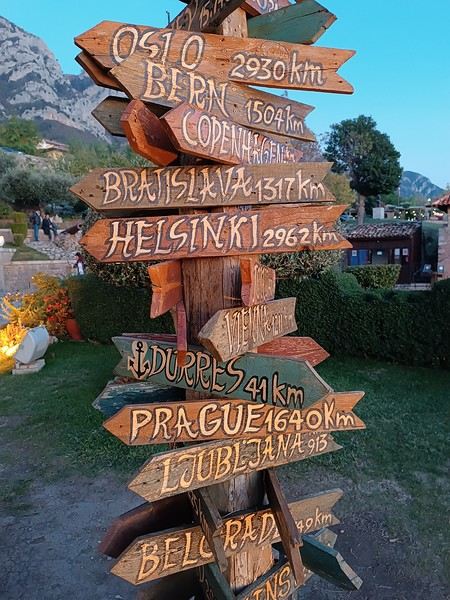
What else, I wonder...
Personally, I often prioritize simple destinations (no administrative hassles), where I’m not at risk (nothing extraordinary like getting kidnapped by Daesh or ending up in a jail cell because the current geopolitics aren’t favorable to my passport, etc.), and where I can drive.
Wide-open natural spaces are more my thing than urban anthills.
Finally, I try not to spend three days on a plane to reach my destination, and I aim for a maximum budget of 3500 € (for 3 weeks) in comfortable conditions—that means charming hotels, good meals, etc.
What about you?🙂
The title might be a bit long, but I hope it’s completely understandable!
When it comes to choosing your next trip, what tips the scales in favor of Eritrea over Ibiza?
Why pick Canada over French Polynesia?
The price? A magazine or TV report, a travel journal, an Instagram ad? Ease of travel? Minimal time difference? The country that has the most in common with all the trip participants? Activities? Relaxation? The desire to push your limits?
A photo?
What else, I wonder...
Personally, I often prioritize simple destinations (no administrative hassles), where I’m not at risk (nothing extraordinary like getting kidnapped by Daesh or ending up in a jail cell because the current geopolitics aren’t favorable to my passport, etc.), and where I can drive.
Wide-open natural spaces are more my thing than urban anthills.
Finally, I try not to spend three days on a plane to reach my destination, and I aim for a maximum budget of 3500 € (for 3 weeks) in comfortable conditions—that means charming hotels, good meals, etc.
What about you?🙂
So where are they and what are they doing?
This catchy and somewhat mysterious title comes from several questions I’ve been asking myself.
VF has been back open for a reasonable number of weeks and months now. The number of visitors overall matches past averages, but the number of members online in the last 24 hours seems relatively lower than what we used to see.
Yet, to my surprise, I’m seeing fewer travel journals, way fewer messages, and way fewer questions. I don’t see many new registered users online, and I notice a number of members who are logged in but either aren’t participating or have stopped participating.
Something’s not adding up for me because, in my opinion, VF is still appealing, and I don’t see which other sites could really compete.
Was there a real break between pre- and post-Covid? Does it just take more time for some people to discover the site or learn that it’s active again? Do people now prefer quick consumption on sites like FB or others I’m not familiar with? Where have the site’s old-timers gone, and what are they doing with their time now? What’s really going on here?
VF has been back open for a reasonable number of weeks and months now. The number of visitors overall matches past averages, but the number of members online in the last 24 hours seems relatively lower than what we used to see.
Yet, to my surprise, I’m seeing fewer travel journals, way fewer messages, and way fewer questions. I don’t see many new registered users online, and I notice a number of members who are logged in but either aren’t participating or have stopped participating.
Something’s not adding up for me because, in my opinion, VF is still appealing, and I don’t see which other sites could really compete.
Was there a real break between pre- and post-Covid? Does it just take more time for some people to discover the site or learn that it’s active again? Do people now prefer quick consumption on sites like FB or others I’m not familiar with? Where have the site’s old-timers gone, and what are they doing with their time now? What’s really going on here?
Morocco, an encounter...
Hello everyone,
I’ve been to Morocco about fifteen times, but I’ve never posted a travel journal here on Voyage Forum. Why? I have no idea… Maybe because this section was so active, with lots of stories and photos. I thought sharing my adventures in *al Maghrib* wouldn’t be very original. Today, this space feels quieter, so what if I tried to give it a little life back, modestly? With some help…
This trip will be different. From the start of my relationship with Richard, I was determined to introduce him to *my* Morocco. But he was a bit reluctant… He’ll tell you about our 2022 meeting, and I’ll illustrate it with my photos, just like we did with our India travel journal.
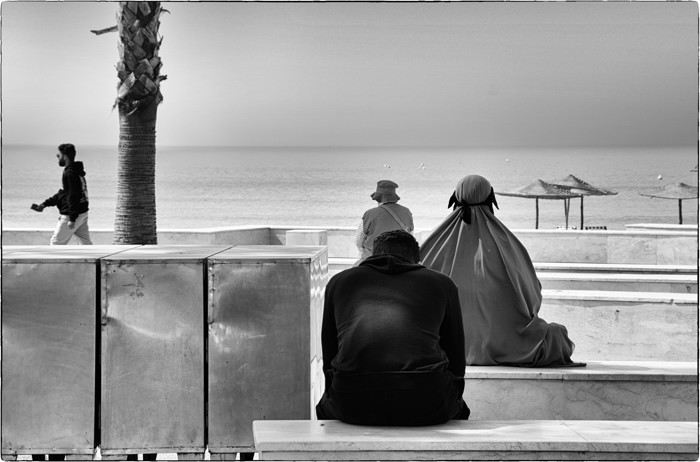
I’ve been to Morocco about fifteen times, but I’ve never posted a travel journal here on Voyage Forum. Why? I have no idea… Maybe because this section was so active, with lots of stories and photos. I thought sharing my adventures in *al Maghrib* wouldn’t be very original. Today, this space feels quieter, so what if I tried to give it a little life back, modestly? With some help…
This trip will be different. From the start of my relationship with Richard, I was determined to introduce him to *my* Morocco. But he was a bit reluctant… He’ll tell you about our 2022 meeting, and I’ll illustrate it with my photos, just like we did with our India travel journal.
Demander deux tampons à l'aéroport d'Amman English translation pending
Bonjour,
En janvier je pars au Proche Orient, j’atterris à Amman et je vais visiter la Jordanie, faire un saut en Israël (Jérusalem), revenir en Jordanie puis partir pour la Syrie.
J'ai deux passeports : l'un sur lequel sera apposé mon visa syrien et le deuxième vierge.
Problème : comme je veux aller et en Israël (d'abord) et en Syrie (ensuite), je voudrais savoir si je peux demander à l'aéroport d'Amman un tampon d'entrée jordanien sur mes deux passeports (celui avec le visa syrien et l'autre) ?
Je m'explique : je vais passer en Israël avec mon passeport vierge (pour éviter un interrogatoire, s'ils voient le visa syrien, c'est même pas la peine d'essayer), mais il faut que j'ai un tampon d'entrée en Jordanie, sinon ils (les gardes-frontière israéliens) vont trouver ça louche, à juste titre.
Si je fais l'aller-retour en Israël depuis la Jordanie, je n'aurai pas de tampon sur mon passeport (juste sur une feuille volante à conserver).
Par contre ensuite, lorsque je vais aller en Syrie, je n'aurai pas de tampon d'entrée jordanien sur mon passeport contenant le visa syrien, du coup pareil, ils vont trouver ça louche et je risque fort d'être refoulé.
Pensez-vous que je puisse obtenir ça en expliquant la situation à l'aéroport ? Ou demander une lettre de l'ambassade de Jordanie à Paris ?
Merci pour vos conseils, on ne sait jamais, qui ne tente rien n'a rien...
En janvier je pars au Proche Orient, j’atterris à Amman et je vais visiter la Jordanie, faire un saut en Israël (Jérusalem), revenir en Jordanie puis partir pour la Syrie.
J'ai deux passeports : l'un sur lequel sera apposé mon visa syrien et le deuxième vierge.
Problème : comme je veux aller et en Israël (d'abord) et en Syrie (ensuite), je voudrais savoir si je peux demander à l'aéroport d'Amman un tampon d'entrée jordanien sur mes deux passeports (celui avec le visa syrien et l'autre) ?
Je m'explique : je vais passer en Israël avec mon passeport vierge (pour éviter un interrogatoire, s'ils voient le visa syrien, c'est même pas la peine d'essayer), mais il faut que j'ai un tampon d'entrée en Jordanie, sinon ils (les gardes-frontière israéliens) vont trouver ça louche, à juste titre.
Si je fais l'aller-retour en Israël depuis la Jordanie, je n'aurai pas de tampon sur mon passeport (juste sur une feuille volante à conserver).
Par contre ensuite, lorsque je vais aller en Syrie, je n'aurai pas de tampon d'entrée jordanien sur mon passeport contenant le visa syrien, du coup pareil, ils vont trouver ça louche et je risque fort d'être refoulé.
Pensez-vous que je puisse obtenir ça en expliquant la situation à l'aéroport ? Ou demander une lettre de l'ambassade de Jordanie à Paris ?
Merci pour vos conseils, on ne sait jamais, qui ne tente rien n'a rien...
Qui a été remboursé par Turkish Airlines? English translation pending
Suite à l'annulation d'un vol prévu le 28 mars, Turkish Airlines m'a proposé un remboursement intégral. J'ai donc fait la démarche en ligne le 20 mars dernier et j'ai bien eu la confirmation que ma demande avait été acceptée avec le détail du montant qui me sera remboursé.
A ce jour, je n'ai pas encore reçu le remboursement mais il était indiqué que cela pouvait prendre jusqu'à 30 jours donc j'attends encore.
Est-ce que quelqu'un ici a également demandé un remboursement de la part de Turkish Airlines et l'a déjà reçu ? Cela pourrait être intéressant qu'on se tienne au courant pour voir si les personnes qui avaient comme moi demandé un remboursement l'ont obtenu.
Est-ce que quelqu'un ici a également demandé un remboursement de la part de Turkish Airlines et l'a déjà reçu ? Cela pourrait être intéressant qu'on se tienne au courant pour voir si les personnes qui avaient comme moi demandé un remboursement l'ont obtenu.