Results for "Tajin+|+46+>+100"
1551 results found.
Trajet Penjikent-Khojand au Tadjikistan English translation pending
Bonjour les routards!
Nous partons a deux en Asie Centrale a la fin Mai et cherchons quelques infos recentes sur le Tadjikistan. Nous pensons, entre autres, faire le trajet Penjikent-Khojand. Du point de vue archeologique, est-ce que ca vaut la peine? Est-ce-que quelqu' un connait le prix approximatif a payer pour un taxi? Propositions de logement abordable et sympa a Penjikent et Khojand? Merci a l' avance pour toute info. Isabelle
Nous partons a deux en Asie Centrale a la fin Mai et cherchons quelques infos recentes sur le Tadjikistan. Nous pensons, entre autres, faire le trajet Penjikent-Khojand. Du point de vue archeologique, est-ce que ca vaut la peine? Est-ce-que quelqu' un connait le prix approximatif a payer pour un taxi? Propositions de logement abordable et sympa a Penjikent et Khojand? Merci a l' avance pour toute info. Isabelle
Arequipa - Misti et/ou Canyon de Colca au Pérou English translation pending
Bonjour!
Dans mon itinéraire au Pérou, je serai de passage à Arequipa. J'hésite entre une expé au canyon ou au Misti.
Combien de jours pour une expé avec guide au Canyon?
Combien de jours pour l'ascencion du Misti?
Est-il réaliste de vouloir les faire les deux? En combien de jours serait-ce réalisable?
Merci pour les conseils!
Marie
Combien de jours pour une expé avec guide au Canyon?
Combien de jours pour l'ascencion du Misti?
Est-il réaliste de vouloir les faire les deux? En combien de jours serait-ce réalisable?
Merci pour les conseils!
Marie
Retour de l'hôtel Amine à Marrakech English translation pending
Bonsoir
Nous rentrons juste de Marrakech ou nous étions logés a l'hotel Amine.Nous nous ferons un plaisir de répondre à toutes les questions sur cette fabuleuse ville. Nous pouvons d'ore et déja vous conseiller un petit resto qui se trouve dans Gueliz a 500 m de l'hotel a l angle de 4 rues et qui s'appele "Chez Ali Baba"..25 DM le tajine ou les brochettes: succulents..
Juanpolito
Nous rentrons juste de Marrakech ou nous étions logés a l'hotel Amine.Nous nous ferons un plaisir de répondre à toutes les questions sur cette fabuleuse ville. Nous pouvons d'ore et déja vous conseiller un petit resto qui se trouve dans Gueliz a 500 m de l'hotel a l angle de 4 rues et qui s'appele "Chez Ali Baba"..25 DM le tajine ou les brochettes: succulents..
Juanpolito
Informations sur le permis GBAO au Tadjikistan English translation pending
Salut à toutes et tous,
Grrr je n'y comprends plus rien à ce satané permis GBAO... Quelqu'un a-t-il un résumé clair et simple pour cette nondidju de démarche ???
Un jour il est obligatoire, l'autre pas. Un jour il est délivré dans les ambassades, une autre fois il est a retirer sur place...
Qu'en est-il si je veux faire la route Korrhog-Osh via PamirHighway???
Merci d'avance.
Jex
Grrr je n'y comprends plus rien à ce satané permis GBAO... Quelqu'un a-t-il un résumé clair et simple pour cette nondidju de démarche ???
Un jour il est obligatoire, l'autre pas. Un jour il est délivré dans les ambassades, une autre fois il est a retirer sur place...
Qu'en est-il si je veux faire la route Korrhog-Osh via PamirHighway???
Merci d'avance.
Jex
Invitation officielle pour l'obtention du visa pour le Tadjikistan English translation pending
Bonjour,
j'aimerais me rendre au Tadjikistan, mais il faut une invitation officielle pour avoir le visa. Action-Visa n'en propose pas. Savez vous comment on peut en obtenir une rapidement?
merci pour l'info
fp
Conseils pour un périple dans le désert en Ouzbékistan English translation pending
Salut les routards,
Je viens de reserver mon billet d'avion pour Tashkent, je pars le 28 avril de Geneve, je rentre le 27 mai !!! Un mois !!! 🙂🙂🙂
J'ai l'habitude de voyager, mais c'est mon premier voyage en asie centrale.
Je me demandais ce que j'allais faire là-bas, et je me disais que je passerais bien une semaine dans le desert, alors je sais pas ce qu'il est possible de faire, merci de me faire part de vos experiences dans ce domaine... Je suppose qu'il faut faire ca avec une agence, que c'est sans doute à cheval ou en chameau. Quelqu'un a déjà essayé ?
Sinon, je me demandais ce que vous avez emmené comme guide de conversation ? Russe ? Vous avez trouvé un lexique Ouzbek ? Tajick?
Je me débrouille assez facilement dans les langues, mais j'ai encore jamais vécu l'experience de passer un mois dans un pays à la langue totalement etrangère...
Merci de vos infos,
Xavier.
Je viens de reserver mon billet d'avion pour Tashkent, je pars le 28 avril de Geneve, je rentre le 27 mai !!! Un mois !!! 🙂🙂🙂
J'ai l'habitude de voyager, mais c'est mon premier voyage en asie centrale.
Je me demandais ce que j'allais faire là-bas, et je me disais que je passerais bien une semaine dans le desert, alors je sais pas ce qu'il est possible de faire, merci de me faire part de vos experiences dans ce domaine... Je suppose qu'il faut faire ca avec une agence, que c'est sans doute à cheval ou en chameau. Quelqu'un a déjà essayé ?
Sinon, je me demandais ce que vous avez emmené comme guide de conversation ? Russe ? Vous avez trouvé un lexique Ouzbek ? Tajick?
Je me débrouille assez facilement dans les langues, mais j'ai encore jamais vécu l'experience de passer un mois dans un pays à la langue totalement etrangère...
Merci de vos infos,
Xavier.
Chemin de halage de Lyon à la mer English translation pending
un seule question cette fois : existe t il un chemin de halage allant de lyon à la mer praticable à vélo le long du rhône?
merci de vos (nombreuses!) réponses.
Gyms en Thaïlande English translation pending
Bonjour, je pars dans deux jours en thaialnde pour 3 semaines. Par contre, je suis vraiment accro à l'entrainement, et je dois m'entrainer 4-5 fois semaine. Y a t'il beaucoup de gym publics en thailande? Dans les hotels, est-ce que cets possible de payer pour seulement utiliser leur gym?
merci beaucoup!
ah aussi, combien je dois m'attendre à payer la course de taxi de l'aéroport à kao san road?
merci beaucoup!
ah aussi, combien je dois m'attendre à payer la course de taxi de l'aéroport à kao san road?
Train de Tunis à Alger English translation pending
chers des amis,
je voudrais savoir le moyen de aller de tunis a alger par train et le temps du trajet ou il y a l'autres moyens, par exemple, le louages. merci
je voudrais savoir le moyen de aller de tunis a alger par train et le temps du trajet ou il y a l'autres moyens, par exemple, le louages. merci
Resto sympa à Marrakech? English translation pending
Bonjour à tous
Nous partons une semaine à Marrakech. Nous y serons en octobre pendant la période du ramadan. Je recherche des adresses de restos pour le midi uniquement, les repas du soir seront pris à l'hôtel. Avez vous des adresses sympas à me donner ?
Merci de vos réponses
Le thé vert en Thailande: phénomène de mode? English translation pending
Depuis quelque temps .. il fleurit le phénomène thé vert en boisson (et pas mal de dérivées ). dans Bangkok et en Thailande en général .. es un phénomène de mode ??
En tout cas pour les voyageurs .. assoiffer .. lire ce petit article ( pris sur le net ) .. et si l'envie vois dit .. acheter ..
les prix vont entre 15 et 25 bt .. cela ne peut pas faire de mal ???.. d;'autant plus que indirectement vous favoriser l'économie des différentes ethnies du nord .. qui du coup ne sont pas obliger de se donner en spectacle pour les touristes .. et peuvent Bien subvenir a leur besoins, et garder leur traditions ..
c'est l'occasion se faire un petit intermède a coca. pepsi . et autres composantes chimiques .?
Plante utilisée par les chinois 2.500 ans avant J.C., le thé vert est apprécié depuis des siècles au Japon et ce sont les jésuites au XVème siècle qui l'ont introduit en occident. Les feuilles de thé vert sont recoltées jeunes et rapidement séchées et roulées. Contrairement au thé noir, il est non fermenté et donc riche en tanin. Ses principaux composants sont la théophylline et la théobromine. Le thé vert et aussi riche en caféine, théine et vitamine C. Le thé vert est stimulant, il a une action tonique et excitante pour lutter contre la fatigue. Des études ont mis en valeur le rôle antioxydant du thé vert, ainsi il peut être recommandé dans la prévention de l'apparition des maladies cardio-vasculaires et l'arthérosclerose. Le thé vert facilite l'élimination rénale de l'eau, il est connu aussi pour faciliter le métabolisme des graisses en réserve dans notre organisme et est donc très utile pour aider à la perte de poids dans certains types des surcharges pondérales généralisées (obésité) ou localisées (cellulite). Le thé vert est un véritable amincissant et tonique, mais il peut provoquer le soir des troubles du sommeil Pour le rendre moins excitant, il faut augmenter le temps d'infusion afin que les tanins puissent se diffuser plus largement.


Plante utilisée par les chinois 2.500 ans avant J.C., le thé vert est apprécié depuis des siècles au Japon et ce sont les jésuites au XVème siècle qui l'ont introduit en occident. Les feuilles de thé vert sont recoltées jeunes et rapidement séchées et roulées. Contrairement au thé noir, il est non fermenté et donc riche en tanin. Ses principaux composants sont la théophylline et la théobromine. Le thé vert et aussi riche en caféine, théine et vitamine C. Le thé vert est stimulant, il a une action tonique et excitante pour lutter contre la fatigue. Des études ont mis en valeur le rôle antioxydant du thé vert, ainsi il peut être recommandé dans la prévention de l'apparition des maladies cardio-vasculaires et l'arthérosclerose. Le thé vert facilite l'élimination rénale de l'eau, il est connu aussi pour faciliter le métabolisme des graisses en réserve dans notre organisme et est donc très utile pour aider à la perte de poids dans certains types des surcharges pondérales généralisées (obésité) ou localisées (cellulite). Le thé vert est un véritable amincissant et tonique, mais il peut provoquer le soir des troubles du sommeil Pour le rendre moins excitant, il faut augmenter le temps d'infusion afin que les tanins puissent se diffuser plus largement.
La cuisine marocaine English translation pending
Bonjour
voici un super site de cuisine marocaine avec forum
http://www.cuisine-marocaine.com/
Retour de Marrakech: je réponds aux questions English translation pending
Je reviens d'une semaine à Marrakech et c'était génial !
La ville est belle, les palais, la Medersa, les jardins ... A l'extérieur, la vallée de l'ourika, les cascades d'Ouzoud ...
Le dépaysement est total, dans la rue se mèlent les taxis, les mobylettes, les charrettes, les calèches, la circulation est complètement anarchique !
Il y aurait des tonnes de choses à dire alors si vous avez des questions, j'essaierai de vous répondre au mieux !
Permis GBAO non délivré au Tadjikistan English translation pending
Je viens d'appeller l'ambassade du Tadjikistan a Vienne. Ils ne delivrent plus de permit pour le GBAO! Il faut a nouveau passer par une agence de voyage, si l'on vient du kirghizstan.
Vous avez des echos differents?
PS: Oui, je sais, certains sur le forum de lonelyplanet disent avoir traverse le pamir sans ce permis.
Vous avez des echos differents?
PS: Oui, je sais, certains sur le forum de lonelyplanet disent avoir traverse le pamir sans ce permis.
Visas kirghyz tadjiks et ouzbeks depuis Almaty (Kazakhstan) English translation pending
salut .....
je suis en train d organiser une ballade en asie centrale depuis la turquie ou je me trouve actuellement et je constate qu il devient tres difficile d obtenir les lettres d intros des ambassades francaises qui sont pourtant indispensables a l obtention des visas d asie centrale...
il m a ete impossible d en obtenir pour l ouzbekistan mais suite a une longue negociation, je pourrai meme dire a un requisitoire agite j ai pu en extirper une pour le kazakhstan.
j aimerai savoir si depuis almaty quelqu un a pu recement( depuis le soulevement d andijan) se procurer les visas kirghyz tadjiks et ouzbeks.
merci a vous
je suis en train d organiser une ballade en asie centrale depuis la turquie ou je me trouve actuellement et je constate qu il devient tres difficile d obtenir les lettres d intros des ambassades francaises qui sont pourtant indispensables a l obtention des visas d asie centrale...
il m a ete impossible d en obtenir pour l ouzbekistan mais suite a une longue negociation, je pourrai meme dire a un requisitoire agite j ai pu en extirper une pour le kazakhstan.
j aimerai savoir si depuis almaty quelqu un a pu recement( depuis le soulevement d andijan) se procurer les visas kirghyz tadjiks et ouzbeks.
merci a vous
Visa Tadjikistan, frontière nord ouest Pakistan English translation pending
Bonjour,
Je souhaite me rendre au Pakistan cet été, et, si le temps le permet (ne sais pas encore pour combien de temps je pourrais partir) me rendre au Tadjikistan.
Quelqu'un peut-il me renseigner sur les conditions d'obtention d'un visa pour le Tadjikistan. N'est-il pas plus facile / possible de se le procurer du Pakistan voire Inde.
Aussi, est-il "aisé" de se rendre à Khorog ?
Autre question concernant le Pakistan : après 9/11, certaines régions frontalières ont été fermées. Est-ce que le Chittral, les vallées Kalash adjacentes et plus au nord le long dui Badakshan afghan les vallées de Yarkhund, Yasin sont accessibles aux étrangers ? Cela fait 4 ans que je n'ais pas mis les pieds par là-bas. Merci si vous pouvez me renseigner
Merci d'avance.
XOXOXO
Je souhaite me rendre au Pakistan cet été, et, si le temps le permet (ne sais pas encore pour combien de temps je pourrais partir) me rendre au Tadjikistan.
Quelqu'un peut-il me renseigner sur les conditions d'obtention d'un visa pour le Tadjikistan. N'est-il pas plus facile / possible de se le procurer du Pakistan voire Inde.
Aussi, est-il "aisé" de se rendre à Khorog ?
Autre question concernant le Pakistan : après 9/11, certaines régions frontalières ont été fermées. Est-ce que le Chittral, les vallées Kalash adjacentes et plus au nord le long dui Badakshan afghan les vallées de Yarkhund, Yasin sont accessibles aux étrangers ? Cela fait 4 ans que je n'ais pas mis les pieds par là-bas. Merci si vous pouvez me renseigner
Merci d'avance.
XOXOXO
Compte rendu du Riu Tikida Beach (Agadir) English translation pending
de retour du TIKIKA BEACH à AGADIR nous venons faire le compte rendu de notre séjour dans cet hôtel qui est superbe, pas trop grand, (233 chambres) toutes spacieuses, 40 m² environ, salle de bains et wc séparés (ce qui est rare), vue latérale sur la mer. Trois restaurants, mais nous n'en avons essayé que deux, cuisine raffinée et diversifiée (tajines excellentes), desserts succulents, crêpes et gauffres l'après midi, le thé à la menthe est très bon surtout celui fait par le monsieur dans le hall d'entrée.
L'animation est soft dans la journée et le soir (music live, charmeur de serpents, danseuse, mini disco pour les enfants, magicien, etc)
L'hôtel est situé dans la nouvelle zone balnéaire d'Agadir, qui est beaucoup plus belle que l'ancienne. Agadir n'est pas vraiment une très belle ville, mais nous avons fait l'excursion de TAROUDANT, qui est géniale, avec visite de Taroudant le matin et déjeuner chez l'habitant (tajine délicieuse) dans une oasis, où vous pouvez faire le tour à dos d'âne.
Le temps est beau à partir de midi, car le matin il fait de la brume mais vous en profiterez pour marcher sur l'immense plage où vous pourrez faire du chameau. Sinon l'après midi est trés ensoleillée à cette époque, et le soleil brûle même parfois.
Le personnel de l'hôtel est aux petits soins pour tout le monde, toujours prêt à vous faire plaisir (surtout le plagiste). Nous n'avons pas testé la thalassothérapie.
Nous avions un peignoir dans notre chambre qui était très propre et nettoyée tous les jours.
A l'intérieur de l'hôtel, se trouvent deux patios et cet hôtel a été décoré par un italien qui a aussi construit et décoré la nouvelle médina d'Agadir. Cet hôtel ressemble à un palais maure.
Le centre de la ville se trouve à 1 km par la plage, mais ça ne parait pas long.
La piscine est grande et très bien agencée en transats et parasols. Pour plus de renseignements n'hésitez pas à nous questionner. bonne soirée.
Mangez-vous salé et sucré à la fois? English translation pending
Bonsoir,
J'ai reçu à dîner un français en visite au Québec. Nous discutions de nos habitudes alimentaires. Or, puisque nous venions tout juste de terminer la saison du sirop d'érable, je lui ai donné un menu de cabane à sucre. Il était surpris par le fait que nous mettions du sirop d'érable avec des aliments salés. Ainsi, je lui ai donné une recette de jambon au sirop d'érable et ananas. Il avait des difficultés à imaginer manger un mets semblable.
Donc, je vous pose la question, principalement aux gens vivant à l'extérieur du Québec, mangez-vous salé et sucré à la fois?
Si oui, pouvez-vous donner vos mets préférés avec la recette?
Je commence en vous offrant celle-ci. (Voir le site qui suit)
http://www.recettes.qc.ca/recettes/index.php?id=2431
J'ai reçu à dîner un français en visite au Québec. Nous discutions de nos habitudes alimentaires. Or, puisque nous venions tout juste de terminer la saison du sirop d'érable, je lui ai donné un menu de cabane à sucre. Il était surpris par le fait que nous mettions du sirop d'érable avec des aliments salés. Ainsi, je lui ai donné une recette de jambon au sirop d'érable et ananas. Il avait des difficultés à imaginer manger un mets semblable.
Donc, je vous pose la question, principalement aux gens vivant à l'extérieur du Québec, mangez-vous salé et sucré à la fois?
Si oui, pouvez-vous donner vos mets préférés avec la recette?
Je commence en vous offrant celle-ci. (Voir le site qui suit)
http://www.recettes.qc.ca/recettes/index.php?id=2431
Visa Kirghiz/Tadjik(Pamir)/Chine à paris? English translation pending
Salut camarades,
je cherche des tuyaux pour obtenir les visas Kirghiz/Tadjik(Pamir) voir Chine.
Si possible sur Paris, le moins chère et tout à la fois (Visa tadjikistan + difficile ) ...
Ou alors sur place, mais je ne veux pas perdre du temps.
Muchas gracias
PS : Surement pour juillet cet été et en solo ...
je cherche des tuyaux pour obtenir les visas Kirghiz/Tadjik(Pamir) voir Chine.
Si possible sur Paris, le moins chère et tout à la fois (Visa tadjikistan + difficile ) ...
Ou alors sur place, mais je ne veux pas perdre du temps.
Muchas gracias
PS : Surement pour juillet cet été et en solo ...
voyage Maroc/Mauritanie English translation pending
Après dix ans d’interruption, j’ai l’intention d’aller passer une quinzaine de jours au Maroc dans la région de Ouarzazate.
Je n’ai plus de contact sur place.
Qui peut me donner une adresse d’hébergement sympathique chez l’habitant si possible ?
Par ailleurs est-il possible de passer en Mauritanie par le SUD et si oui qui peut me donner des renseignements à ce sujet ?
Par avance merci.
Je n’ai plus de contact sur place.
Qui peut me donner une adresse d’hébergement sympathique chez l’habitant si possible ?
Par ailleurs est-il possible de passer en Mauritanie par le SUD et si oui qui peut me donner des renseignements à ce sujet ?
Par avance merci.
First-timer's feedback on the Marrakech-Merzouga road trip by car
Hi everyone, just back from the 8-day Marrakech-Merzouga loop by car, and I’d love to share my feedback in case it helps some of you. Big thanks to all the forum members who kindly answered my questions!
Trip from Friday the 20th to Saturday the 28th, flying out of Marseille with Ryanair
- Landed late around 8 PM local time, exchanged some currency, and the rental agency (Magdaz Car, which I highly recommend) delivered the car straight to the airport with some great route tips (don’t blindly trust Maps.me). The night drive was a bit intense—lots of people out and about due to Ramadan. Stayed at Riad Midhou (really nice) on the outskirts of the city, which made it easy to hit the road the next morning.
- Day 1: Marrakech to Skoura. The drive was smooth, roads are great, but watch out for roundabout priority—it’s different from France. Beautiful route. Quick stop in Ouarzazate for lunch, Ait Benhaddou for the view (stunning), and the Fint Oasis (meh...). Spent the night at Taloute Ecolodge in Skoura, overlooking the palm grove (super cozy).
- Day 2: Skoura to Todgha Gorges via the Valley of Roses and Dades Gorges. Adventure-packed day! We crossed the Valley of Roses (pretty, but not as amazing as I’d hoped) and took a "shortcut" recommended by the *Routard* guide to reach the Dades Gorges without backtracking. After asking locals, they said, "It’s doable." Turns out it was a narrow, rocky cliffside track—no way to turn around! A stressful moment, with a nice scratch on the bumper and a good sweat. Fine in an SUV or 4x4, but not in a Logan... Then the Dades Gorges (nice) and a detour through the north to reach Todgha from above. Gorgeous mountain road and a quick stop on some snow patches—touching African snow! Spent the night at *Les Gorges de Todgha*—great place, except for the bathroom. The Todgha Gorges themselves are stunning!
Day 3: Todgha to Merzouga. Beautiful drive, and the view of the erg (sand dunes) on arrival is breathtaking! Totally worth the trip. Explored the desert and stayed at *Café du Sud* hotel just outside Merzouga—absolutely gorgeous.
Day 4: Merzouga. Desert exploration and chilling by the hotel pool (with a bonus sunburn). Lunch in Merzouga—I recommend *Dakar*—their lemon tajine was amazing. Spent the night in the hotel’s luxury camp, including a camel ride. The camp was beautiful, but I was disappointed we weren’t deeper in the desert given the price (100 € per person, including dinner, breakfast, and camel ride).
Day 5: Merzouga to Tamnougalt. Gorgeous route. First fine (a supposed stop sign...) but the officer was super nice—only 150 MAD. Stayed at *Kasbah Maktob*, right in the middle of ruins—really unique and beautiful!
Day 6: Tamnougalt to Marrakech. Another beautiful drive, and a second fine (minor speeding), same amount. Crossed a windy mountain pass during a big storm—traffic was blocked in the opposite direction (not sure why), causing massive jams for those coming from Marrakech. A few downed cables, but nothing serious. Arriving in Marrakech was tricky—hard to find the rental agency, and the traffic was intense (watch out for GPS trying to send you through the medina). Ask the rental company to meet you somewhere quiet. They didn’t even notice the damaged bumper... Stayed at *Riad Zifamo* in the heart of the medina. Big change of pace—so many people and so much hustle!
Day 7: Marrakech. Lots of wandering through the souk and a quick trip to Gueliz (not essential). A few tips for the medina: watch out for scooters weaving too fast, always negotiate prices (aim for at least 1/3 off what they ask, unless it’s a small amount), don’t buy spices—more expensive than in France! Head to the *Carrefour Market* in Gueliz for better prices. In the end, not many truly unique items—you’ll find more or less the same things everywhere.
Day 8: Early morning flight. We’d booked a car to the airport from the riad, but a taxi would’ve been fine—plenty available even at 7 AM. Security wasn’t an issue (we had lighters and liquids over 100 ml).
A few extra notes: Pleasantly surprised by the road quality—just a few potholes here and there, but overall very drivable. Watch out for the police—they’re everywhere! The car cost me 30 € per day (with the *Routard* discount) and about 90 € in gas. No safety concerns, no harassment, and no stomach issues, despite the ice in Marrakech. Breakfasts at the hotels were usually hearty—take advantage! The timing (end of February) was perfect—pleasant daytime temps and cool nights. Since it was Ramadan, nothing unusual to report, except it was hard to find food outside Marrakech at lunchtime. If I did it again, Merzouga is a must, but I’d spend a night in a real desert bivouac, deeper in the dunes. My stops (no more than 300 km a day) were well-paced, and with so few cars on the road, it wasn’t tiring—even though I’m not usually a fan of driving... Happy to answer any questions!
Trip from Friday the 20th to Saturday the 28th, flying out of Marseille with Ryanair
- Landed late around 8 PM local time, exchanged some currency, and the rental agency (Magdaz Car, which I highly recommend) delivered the car straight to the airport with some great route tips (don’t blindly trust Maps.me). The night drive was a bit intense—lots of people out and about due to Ramadan. Stayed at Riad Midhou (really nice) on the outskirts of the city, which made it easy to hit the road the next morning.
- Day 1: Marrakech to Skoura. The drive was smooth, roads are great, but watch out for roundabout priority—it’s different from France. Beautiful route. Quick stop in Ouarzazate for lunch, Ait Benhaddou for the view (stunning), and the Fint Oasis (meh...). Spent the night at Taloute Ecolodge in Skoura, overlooking the palm grove (super cozy).
- Day 2: Skoura to Todgha Gorges via the Valley of Roses and Dades Gorges. Adventure-packed day! We crossed the Valley of Roses (pretty, but not as amazing as I’d hoped) and took a "shortcut" recommended by the *Routard* guide to reach the Dades Gorges without backtracking. After asking locals, they said, "It’s doable." Turns out it was a narrow, rocky cliffside track—no way to turn around! A stressful moment, with a nice scratch on the bumper and a good sweat. Fine in an SUV or 4x4, but not in a Logan... Then the Dades Gorges (nice) and a detour through the north to reach Todgha from above. Gorgeous mountain road and a quick stop on some snow patches—touching African snow! Spent the night at *Les Gorges de Todgha*—great place, except for the bathroom. The Todgha Gorges themselves are stunning!
Day 3: Todgha to Merzouga. Beautiful drive, and the view of the erg (sand dunes) on arrival is breathtaking! Totally worth the trip. Explored the desert and stayed at *Café du Sud* hotel just outside Merzouga—absolutely gorgeous.
Day 4: Merzouga. Desert exploration and chilling by the hotel pool (with a bonus sunburn). Lunch in Merzouga—I recommend *Dakar*—their lemon tajine was amazing. Spent the night in the hotel’s luxury camp, including a camel ride. The camp was beautiful, but I was disappointed we weren’t deeper in the desert given the price (100 € per person, including dinner, breakfast, and camel ride).
Day 5: Merzouga to Tamnougalt. Gorgeous route. First fine (a supposed stop sign...) but the officer was super nice—only 150 MAD. Stayed at *Kasbah Maktob*, right in the middle of ruins—really unique and beautiful!
Day 6: Tamnougalt to Marrakech. Another beautiful drive, and a second fine (minor speeding), same amount. Crossed a windy mountain pass during a big storm—traffic was blocked in the opposite direction (not sure why), causing massive jams for those coming from Marrakech. A few downed cables, but nothing serious. Arriving in Marrakech was tricky—hard to find the rental agency, and the traffic was intense (watch out for GPS trying to send you through the medina). Ask the rental company to meet you somewhere quiet. They didn’t even notice the damaged bumper... Stayed at *Riad Zifamo* in the heart of the medina. Big change of pace—so many people and so much hustle!
Day 7: Marrakech. Lots of wandering through the souk and a quick trip to Gueliz (not essential). A few tips for the medina: watch out for scooters weaving too fast, always negotiate prices (aim for at least 1/3 off what they ask, unless it’s a small amount), don’t buy spices—more expensive than in France! Head to the *Carrefour Market* in Gueliz for better prices. In the end, not many truly unique items—you’ll find more or less the same things everywhere.
Day 8: Early morning flight. We’d booked a car to the airport from the riad, but a taxi would’ve been fine—plenty available even at 7 AM. Security wasn’t an issue (we had lighters and liquids over 100 ml).
A few extra notes: Pleasantly surprised by the road quality—just a few potholes here and there, but overall very drivable. Watch out for the police—they’re everywhere! The car cost me 30 € per day (with the *Routard* discount) and about 90 € in gas. No safety concerns, no harassment, and no stomach issues, despite the ice in Marrakech. Breakfasts at the hotels were usually hearty—take advantage! The timing (end of February) was perfect—pleasant daytime temps and cool nights. Since it was Ramadan, nothing unusual to report, except it was hard to find food outside Marrakech at lunchtime. If I did it again, Merzouga is a must, but I’d spend a night in a real desert bivouac, deeper in the dunes. My stops (no more than 300 km a day) were well-paced, and with so few cars on the road, it wasn’t tiring—even though I’m not usually a fan of driving... Happy to answer any questions!
Trip to Morocco in September-October 2025, in our camper van
Hi everyone,
We’re just back from a month-long trip to Morocco in our camper van.
After crossing France (we left from the Nantes area) and Spain, we arrived in Algeciras where we bought our boat tickets to Tangier. When we got to Tangier, as we were going through customs, you can imagine our surprise when the customs officer took our road map of Morocco and pointed out the label "Western Sahara" (just like in the forum’s destination section, by the way!).
He wanted it to say "Moroccan Sahara" instead!!! But there was nothing we could do—it was an old map... He wouldn’t listen, and after long discussions with the other (younger) customs officers, he finally gave it back and let us through... Unbelievable! Later, we heard that other travelers had their maps confiscated outright.
So, hide it well if you want to keep yours!!!
Anyway, we skirted around Tangier’s suburbs—pretty grim—and finally arrived in Asilah.
Following the coast and the long promenade along the beach, we reached the campsite. It was a bit crowded, not much shade, but it wasn’t far from the medina or the beach, and it wasn’t expensive. There’s some life here: Moroccan families seem to live on-site, in tents or basic bungalows. A woman was cooking tagine on a brazier—we were right in the atmosphere! The night was quiet, and we slept well. We set off on foot, walking along the seafront to the medina... We’d already been here in 2009. It was less touristy back then! Still, at this early hour, the little streets inside were very quiet. The walls had been freshly whitewashed, and there were even more murals than before. Around 11:30 AM, we strolled along the ramparts by the sea. There was a nice breeze! And a lot more people around. We enjoyed a milkshake on the terrace of a café overlooking the beach that stretches out at the foot of the medina. Some young guys were having fun diving off the rocks—and even off the top of the wall!
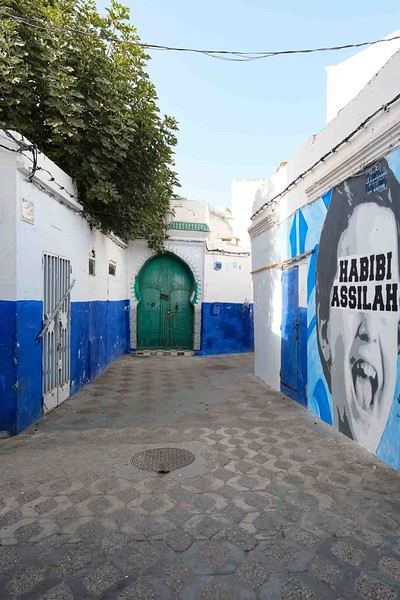
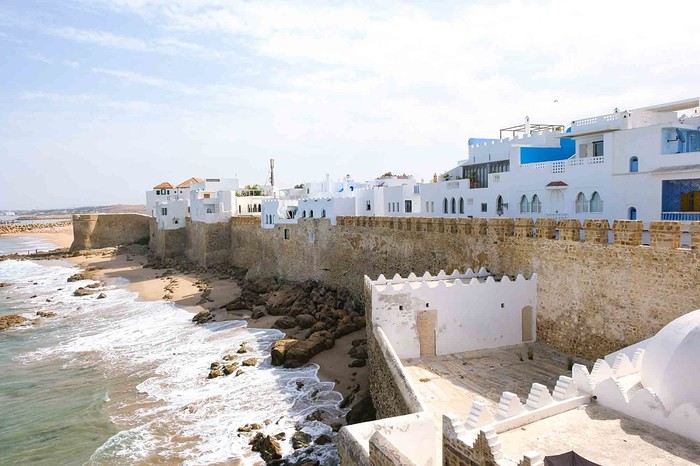
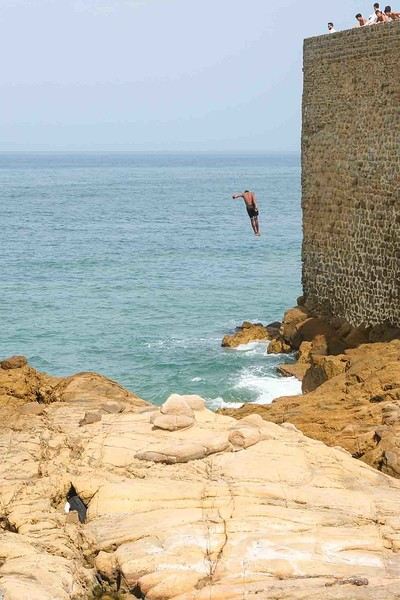
Anyway, we skirted around Tangier’s suburbs—pretty grim—and finally arrived in Asilah.
Following the coast and the long promenade along the beach, we reached the campsite. It was a bit crowded, not much shade, but it wasn’t far from the medina or the beach, and it wasn’t expensive. There’s some life here: Moroccan families seem to live on-site, in tents or basic bungalows. A woman was cooking tagine on a brazier—we were right in the atmosphere! The night was quiet, and we slept well. We set off on foot, walking along the seafront to the medina... We’d already been here in 2009. It was less touristy back then! Still, at this early hour, the little streets inside were very quiet. The walls had been freshly whitewashed, and there were even more murals than before. Around 11:30 AM, we strolled along the ramparts by the sea. There was a nice breeze! And a lot more people around. We enjoyed a milkshake on the terrace of a café overlooking the beach that stretches out at the foot of the medina. Some young guys were having fun diving off the rocks—and even off the top of the wall!
Your tips and recommendations for a trip through southern Morocco
Hello VF friends!
We’re planning to leave Marrakesh by rental car—this will be our second trip to Morocco. While we want to revisit some places, we also hope to explore new regions. Here’s the start of our itinerary, which could take 2 to 3 weeks. We don’t want to cover too many kilometers each day.
- Depart Marrakech for Essaouira, stopping to visit the Inzerki beehive. We’ll stay 3 nights in Essaouira to explore the city and the surrounding area. - Head toward Tamanar or that region for another 3 nights, exploring on a star-shaped route. We’d like to see the Paradise Valley and the coast. Not really keen on stopping in Agadir.
We’ve been to Tafraoute before, but I’d love to see some *greniers* (granaries) again, so we’re considering 1 or 2 nights there.
- Tiznit for 2 nights, making our way to Plage Blanche. - Guelmin and the Tighmert oasis for 2 nights. - Tata for 2 nights, visiting Akka Iguane and other villages.
After that, we’ll head east.
We’d love to hear about your experiences, great tips, and recommendations!
Thanks so much, and happy holidays!
- Depart Marrakech for Essaouira, stopping to visit the Inzerki beehive. We’ll stay 3 nights in Essaouira to explore the city and the surrounding area. - Head toward Tamanar or that region for another 3 nights, exploring on a star-shaped route. We’d like to see the Paradise Valley and the coast. Not really keen on stopping in Agadir.
We’ve been to Tafraoute before, but I’d love to see some *greniers* (granaries) again, so we’re considering 1 or 2 nights there.
- Tiznit for 2 nights, making our way to Plage Blanche. - Guelmin and the Tighmert oasis for 2 nights. - Tata for 2 nights, visiting Akka Iguane and other villages.
After that, we’ll head east.
We’d love to hear about your experiences, great tips, and recommendations!
Thanks so much, and happy holidays!
Travel tips and activities in Kota Kinabalu
Hi there,
I’d love to get your thoughts and advice/tips for my trip to Malaysia.
I’m heading to Malaysia for 20 days starting in mid-August with three other people.
My plan was to go straight to Kota Kinabalu. I’d like to go rafting (if you have any agencies to recommend, I’m all ears), climb Mount Kota Kinabalu (is it worth it? And again, if you have an agency in mind), and check out the night market (I’m not entirely sure what it’s like).
After that, I’d head to Sandakan (not sure how yet) and do a little 3-day, 2-night safari.
Then from Sandakan (still not sure how), go to Tawau to visit Sipadan for some diving.
And then head back home.
Nothing’s set in stone yet—I’m open to tons of suggestions. I feel like I could do more. I’d seen Taman Negara jungle, but it’s way off the route, so I’m not sure if it’s doable. I’d also love to find other interesting diving spots.
Thanks in advance for your help!
I’d love to get your thoughts and advice/tips for my trip to Malaysia.
I’m heading to Malaysia for 20 days starting in mid-August with three other people.
My plan was to go straight to Kota Kinabalu. I’d like to go rafting (if you have any agencies to recommend, I’m all ears), climb Mount Kota Kinabalu (is it worth it? And again, if you have an agency in mind), and check out the night market (I’m not entirely sure what it’s like).
After that, I’d head to Sandakan (not sure how yet) and do a little 3-day, 2-night safari.
Then from Sandakan (still not sure how), go to Tawau to visit Sipadan for some diving.
And then head back home.
Nothing’s set in stone yet—I’m open to tons of suggestions. I feel like I could do more. I’d seen Taman Negara jungle, but it’s way off the route, so I’m not sure if it’s doable. I’d also love to find other interesting diving spots.
Thanks in advance for your help!
Marrakech 2025: My First Steps as a Private Guide
Preamble:
.
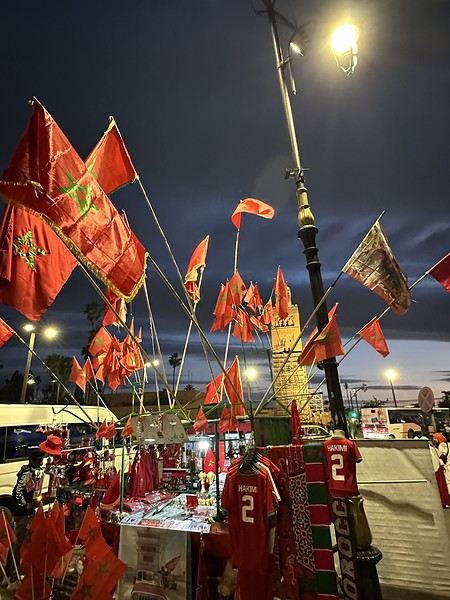
This isn’t about drumming up business for a new professional venture—just sharing, under pressure from eager Vf members hungry for juicy anecdotes, my 10-day trip to Marrakech with 10 friends.
I’d mentioned during the planning discussion for this trip ((https://voyageforum.com/forum/questions-excursions-autour-marrakech-d10685703/)) that there wouldn’t be a travel journal... And since I’m a man of my word—but also stuck with a nasty calf muscle tear at the end of the trip that’s keeping me immobile for 15 days (more on that later)—I’ve got some time to dedicate to this. So, after this preamble, off we go to the Medina!
 .
.
Day 1: Friday, May 2nd – The Day the Group Split
Before we dive in, let’s talk about the trip prep. Among my friends, I’ve got a rep as the go-to independent travel expert (thanks to a few trips, some with this same crew). So, naturally, the task of planning this one fell to me—and I took it on gladly (you’re never better served than by yourself, right?). The prep and itinerary were hashed out over multiple meet-ups (excuses?) during shared meals at one another’s places, guided by yours truly. Travel style, accommodation, sightseeing—all decisions were made together, trying to balance everyone’s wishes over a good bottle (generic term, not numerical!)
So, a group of five—including me and my girlfriend—set off for Geneva at 3 AM that Friday, while the rest would join us on Sunday due to family or work commitments. We’ll skip the EasyJet flight—it was nothing special, just a means to get us there safely (which, in itself, is already a win). We landed in Marrakech at 9 AM local time. There, a spotless Dacia Logan was waiting for us, chartered by MEDLOC, whose impeccable service I’ll praise here (thanks, friends, for the tip!). My first challenge, after loading the suitcases into the trunk: reaching the riad booked for our first two nights as the advance team. https://www.astradamusmarrakesh.top/fr/
I was a little nervous about driving here—Marrakech’s driving reputation precedes it. The hiccup? While setting up Google Maps for the route, I accidentally added a level-5 difficulty and enabled pedestrian mode... Imagine a rental car stubbornly trying for over half an hour to navigate the Medina (the riad was in the north), cursing all the pedestrians in streets too narrow for the car, and having to reverse multiple times because “it won’t fit,” ignoring the many Marrakechis waving to signal the street was impassable (but what are they trying to sell me now? 🤪)... Until my co-pilot, holding my phone, asked if it was “normal for the route to be dotted on Google Maps?” Yes, it’s normal—pedestrian mode was on.... We’ll still be laughing about this in the nursing home in 40 years, but at the time, I was genuinely surprised by what driving in Morocco had in store for me—and for good reason! After fixing the Google Maps settings, we arrived more calmly at the private parking lot (90 dirhams per night) and then at the riad, where we received a warm welcome while our rooms were being prepared.
After freshening up, we crossed the souks for the first time to have lunch at Jemaa el-Fna Square, at Zeitoun Café, where we enjoyed our first couscous or tagine on its terrace. We’d return to Jemaa el-Fna that evening after a restorative nap at the riad, another late afternoon in the souk, and an evening at this famous UNESCO World Heritage site. This time, it was the restaurant Lafarmacie (you can’t make this up!) that won us over, despite the lack of a rooftop. I recommend this place to everyone—the prices are great, the welcome is extraordinary, and the food is excellent...
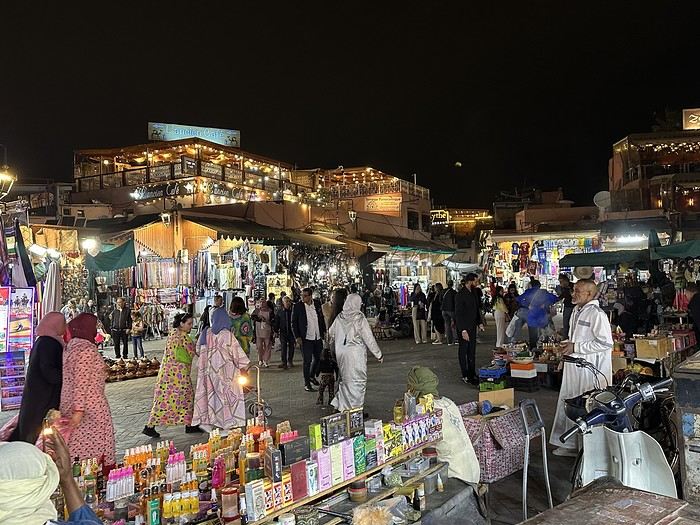
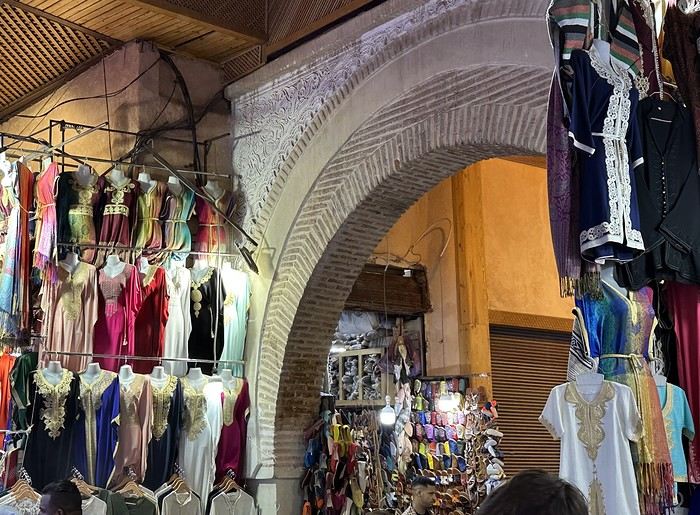
Returning after 11 PM, we learned the hard way that the souk has its own entry points and hours, and the path to our beds was full of detours and closed doors. Fortunately, we were guided by friendly locals who showed us the right way (in exchange for a fiercely negotiated tip each time...)
.Day 1: Friday, May 2nd – The Day the Group Split
Before we dive in, let’s talk about the trip prep. Among my friends, I’ve got a rep as the go-to independent travel expert (thanks to a few trips, some with this same crew). So, naturally, the task of planning this one fell to me—and I took it on gladly (you’re never better served than by yourself, right?). The prep and itinerary were hashed out over multiple meet-ups (excuses?) during shared meals at one another’s places, guided by yours truly. Travel style, accommodation, sightseeing—all decisions were made together, trying to balance everyone’s wishes over a good bottle (generic term, not numerical!)
So, a group of five—including me and my girlfriend—set off for Geneva at 3 AM that Friday, while the rest would join us on Sunday due to family or work commitments. We’ll skip the EasyJet flight—it was nothing special, just a means to get us there safely (which, in itself, is already a win). We landed in Marrakech at 9 AM local time. There, a spotless Dacia Logan was waiting for us, chartered by MEDLOC, whose impeccable service I’ll praise here (thanks, friends, for the tip!). My first challenge, after loading the suitcases into the trunk: reaching the riad booked for our first two nights as the advance team. https://www.astradamusmarrakesh.top/fr/
I was a little nervous about driving here—Marrakech’s driving reputation precedes it. The hiccup? While setting up Google Maps for the route, I accidentally added a level-5 difficulty and enabled pedestrian mode... Imagine a rental car stubbornly trying for over half an hour to navigate the Medina (the riad was in the north), cursing all the pedestrians in streets too narrow for the car, and having to reverse multiple times because “it won’t fit,” ignoring the many Marrakechis waving to signal the street was impassable (but what are they trying to sell me now? 🤪)... Until my co-pilot, holding my phone, asked if it was “normal for the route to be dotted on Google Maps?” Yes, it’s normal—pedestrian mode was on.... We’ll still be laughing about this in the nursing home in 40 years, but at the time, I was genuinely surprised by what driving in Morocco had in store for me—and for good reason! After fixing the Google Maps settings, we arrived more calmly at the private parking lot (90 dirhams per night) and then at the riad, where we received a warm welcome while our rooms were being prepared.
After freshening up, we crossed the souks for the first time to have lunch at Jemaa el-Fna Square, at Zeitoun Café, where we enjoyed our first couscous or tagine on its terrace. We’d return to Jemaa el-Fna that evening after a restorative nap at the riad, another late afternoon in the souk, and an evening at this famous UNESCO World Heritage site. This time, it was the restaurant Lafarmacie (you can’t make this up!) that won us over, despite the lack of a rooftop. I recommend this place to everyone—the prices are great, the welcome is extraordinary, and the food is excellent...
Returning after 11 PM, we learned the hard way that the souk has its own entry points and hours, and the path to our beds was full of detours and closed doors. Fortunately, we were guided by friendly locals who showed us the right way (in exchange for a fiercely negotiated tip each time...)
Review of my visit to Angkor
SIEM REAP
You can now rent scooters just about everywhere in Siem Reap, but at rip-off prices—$15–18 a day instead of $5–10 like everywhere else in Indochina. The best options are tuk-tuks or, even better, electric bikes ($12, but with a 50 km range, so they won’t let you go to Banteay Srei or the River of a Thousand Lingas in the Kulen Massif, which are too far). **WARNING:** Wear a helmet, or they *will* catch you. Scooters are banned from going from SR to the stunning temple of Koh Ker in the northeast and continuing to Battambang; no idea why!
My favorite little hotel in Siem Reap? The Neth Socheata, tucked in an alley off Thnou St near the market—lovely rooms, and the owner speaks great English. Then there’s the Ivy Guesthouse with its little garden, but it’s “always full,” according to the owner. For something upscale but still affordable, a fantastic spot is the Pavillon Indochine, tucked away on a quiet side street on the way to the airport—elegant, with incredible attention to decor, a terrace restaurant, garden, pool, etc. Everything you’d want for $70 including breakfast. I also spotted a hostel for backpackers, the Angkor Thom Hostel, with small 6-bed dorms for $4 with a fan or $6 with AC (18 Wat Bo St).
Food-wise, it’s all amazing! Pub Street has turned into a noise nightmare, with speakers blasting what’s supposed to be music but is just *boom, boom, boom, boom, boom*—run away, even though the pizzas at the Italian place Il Forno are really good. The famous and excellent Tigre de Papier has changed its name to Paper Tiger and is still just as good (lunch only, though, because across the street there’s a huge bar blasting *boom boom boom*, so you won’t be able to hear each other during dinner). On the other hand, the Italian-Cambodian El Toro on Pub Street is perfect, with fantastic pizzas and divine lasagna (go to the first-floor dining room—there’s a big bar across the street blasting *boom boom boom*, but at least you can still talk). Due to the lack of customers during COVID, all the French restaurants—Barrio (three times alas!), Les Deux Sœurs, Le Bel Air, and Le Mozart—have closed. The only one left is L’Olivier, which is pricey. I also discovered a great Moroccan restaurant (though run by a Sudanese man and his French wife), Le Tajine, on Strung Thmei St, 09 68 89 78 27. **WARNING:** For tagines and couscous, you need to order at least in the morning; wine and beer are fine. To get there, turn at the corner of the Cineplex behind the big market at the start of Sivatha Boulevard.
I finally went to the Khmer dance show. Beautiful dancers and dances, but **EAT BEFORE OR AFTER**—the meal is so awful that most Westerners leave it on their plates.
THE ANGKOR TEMPLES Use the excellent *Routard Cambodia* guide. Just a few tips: - Start with the pre-Angkorian Roluos group, 15 km before Siem Reap on the road to PP—it’s the “ancestor” of the temples.
- To avoid the big crowds at Angkor Wat, Bayon, and Ta Prohm, go between noon and 2 PM when everyone’s having lunch. - Speaking of lunch, the crowds flock to the hundred or so mediocre food stalls on the left side of Angkor Wat. Instead, head to Angkor Thom after the stunning Pre Rup temples, all the way to the small Sras Srang basin. Along the basin, there are several restaurants with terraces offering first-floor views of the water, and no crowds. Afterward, cross to the other side of the basin—you’ll end up in the countryside with charming villages where locals seem to live as they did during the temples’ golden age (at its peak, the population was estimated at 600,000–800,000, making it the largest city in the world. The theory for the abandonment is water shortages caused by overpopulation).
- I climbed Phnom Bakheng for the famous sunset, but the crowd was so ridiculous that instead of seeing the temple at sunset, you just see the heads and shoulders around you.
- There are tons of small temples that most people skip, and they’re missing out. My favorites: Thommanon, Neak Pean, Ta Som, and especially Pre Rup, an amazing brick complex with 14 towers.
**Big disappointment:** You can no longer climb to the first floor of Bayon, where you used to stand magically among the giant head statues. So, admire the beautiful bas-reliefs on the outside, but there’s no point going inside—you’ll just see a dark, square corridor with nothing interesting.
ANGKOR FURTHER AFIELD The wonderful Banteay Srei temple. A gem! I couldn’t find the bas-relief stolen by Malraux in the 1920s (fun fact: what he was doing in Indochina—stealing a bas-relief to sell for a fortune in France to cover his massive gambling debts on the stock market, where he ruined his very wealthy American wife—was an open secret. But the French authorities in Saigon, who hated him for his leftist views, decided to let him do it and catch him red-handed, which worked perfectly. He avoided jail only because all the leftist intellectuals in Saint-Germain, Sartre, Beauvoir, and co. cried scandal—though the real scandal was the looting).
30 km of excellent paved road further north, a great spot: the Kulen Massif and the River of a Thousand Lingas (at one point, you’ll come to a T-junction—turn left). Along the road at the foot of the massif, on your right, there’s a great restaurant, Bourey Sovann (where the food is excellent). The trail to the river starts just before it on the left. **Warning:** There are two sites for the River of a Thousand Lingas. One is accessible via a private road, so there’s a $20 toll, and you need to arrive before 11 AM because the road is narrow and traffic flows downhill after that. You’ll end up in a site full of shops, snack stalls, and two good restaurants, including one by a beautiful waterfall. However, the thousand lingas aren’t as spectacular there.
Banteay Srei + the River of a Thousand Lingas makes for a fantastic day. **WARNING:** You used to be able to go to the river and waterfall by scooter or tuk-tuk, but it’s now forbidden. So **go by taxi**—otherwise, you’ll be hiking 12 km round trip up a steep trail.
If you leave Siem Reap early, you can even add Beng Mealea temple on the way back, making a triangular route: SR-BS-Khulen-BM-SR (or the reverse).
If you have time, visit Banteay Samré temple, 10 km west of the Angkor Thom complex. A lovely site with very few visitors.
I’ve never been to the famous Preah Khan on a hill overlooking Thailand. There’s a big dispute between the two countries—the Thais insist the temple belongs to them because the entrance is in their country. There have been serious clashes in the recent past, and landmines are still abundant off the marked paths. They even claim the entire Siem Reap province is theirs and should be returned, arguing it was Thai in the past. It takes two days (6–7 hours each way), with an overnight stay in the nearby village (small hotels and one luxury option with a garden and pool, but it’s expensive).
TONLE SAP People talk about “floating villages,” but that’s a big mistake—these are actually villages of astonishing stilt houses, 4 meters high or more, due to the lake’s major floods. The most famous is Chong Khneas, which I skipped because it’s packed with tourists. Instead, I really liked Kampong Phluk, which is much quieter. To get there, continue on the road past the Roluos group until you reach a parking lot with pirogues lined up. They’ll take you down the river, stop at this amazing village for a walk, and then take you to the Tonle Sap, a true inland sea. At one point, you’ll pass through a flooded forest that you can explore by small boat. At the junction of the river and the Tonle Sap, and on the lake itself, there are floating restaurants where the food is great. Note that in the dry season, you can reach the village by scooter.
BACK TO PHNOM PENH AND ON TO SOUTHERN VIETNAM Since I’d planned at least 15 days in the Mekong Delta between Chau Doc and Saigon, I skipped Battambang, etc. With no desire to endure the dusty road from SR to PP again, I simply loaded my bike onto a bus with the great company Rith Monty (book at their office in SR on the small square at the start of Sivatha Boulevard—$10 for the bike and $6 for me), also known as Paramount. Their buses stop on 136 St right in the middle of PP. I’ll also mention the excellent Giant Ibis, with big modern buses that always leave on time—unlike the others.
I spent the night in PP, and the next morning took the fast boat from PP to Chau Doc with Hang Chau Tourist (buying the ticket the day before is recommended—$25—either at your hotel or the port, and they’ll pick you up at your hotel by tuk-tuk to take you to the port). Departure from PP at noon, arrival in Chau Doc around 4 PM. The boat is great—comfortable and fast. A crew member takes your passports for Cambodian exit formalities, and you handle Vietnamese immigration yourself—it all takes 15–20 minutes. The route isn’t on the Mekong but on the Bassac River to the border, then a wide north-south canal to Chau Doc (the arrival is really nice). In the Chau Doc-PP direction, the boat leaves Chau Doc at 7:30 AM.
My favorite little hotel in Siem Reap? The Neth Socheata, tucked in an alley off Thnou St near the market—lovely rooms, and the owner speaks great English. Then there’s the Ivy Guesthouse with its little garden, but it’s “always full,” according to the owner. For something upscale but still affordable, a fantastic spot is the Pavillon Indochine, tucked away on a quiet side street on the way to the airport—elegant, with incredible attention to decor, a terrace restaurant, garden, pool, etc. Everything you’d want for $70 including breakfast. I also spotted a hostel for backpackers, the Angkor Thom Hostel, with small 6-bed dorms for $4 with a fan or $6 with AC (18 Wat Bo St).
Food-wise, it’s all amazing! Pub Street has turned into a noise nightmare, with speakers blasting what’s supposed to be music but is just *boom, boom, boom, boom, boom*—run away, even though the pizzas at the Italian place Il Forno are really good. The famous and excellent Tigre de Papier has changed its name to Paper Tiger and is still just as good (lunch only, though, because across the street there’s a huge bar blasting *boom boom boom*, so you won’t be able to hear each other during dinner). On the other hand, the Italian-Cambodian El Toro on Pub Street is perfect, with fantastic pizzas and divine lasagna (go to the first-floor dining room—there’s a big bar across the street blasting *boom boom boom*, but at least you can still talk). Due to the lack of customers during COVID, all the French restaurants—Barrio (three times alas!), Les Deux Sœurs, Le Bel Air, and Le Mozart—have closed. The only one left is L’Olivier, which is pricey. I also discovered a great Moroccan restaurant (though run by a Sudanese man and his French wife), Le Tajine, on Strung Thmei St, 09 68 89 78 27. **WARNING:** For tagines and couscous, you need to order at least in the morning; wine and beer are fine. To get there, turn at the corner of the Cineplex behind the big market at the start of Sivatha Boulevard.
I finally went to the Khmer dance show. Beautiful dancers and dances, but **EAT BEFORE OR AFTER**—the meal is so awful that most Westerners leave it on their plates.
THE ANGKOR TEMPLES Use the excellent *Routard Cambodia* guide. Just a few tips: - Start with the pre-Angkorian Roluos group, 15 km before Siem Reap on the road to PP—it’s the “ancestor” of the temples.
- To avoid the big crowds at Angkor Wat, Bayon, and Ta Prohm, go between noon and 2 PM when everyone’s having lunch. - Speaking of lunch, the crowds flock to the hundred or so mediocre food stalls on the left side of Angkor Wat. Instead, head to Angkor Thom after the stunning Pre Rup temples, all the way to the small Sras Srang basin. Along the basin, there are several restaurants with terraces offering first-floor views of the water, and no crowds. Afterward, cross to the other side of the basin—you’ll end up in the countryside with charming villages where locals seem to live as they did during the temples’ golden age (at its peak, the population was estimated at 600,000–800,000, making it the largest city in the world. The theory for the abandonment is water shortages caused by overpopulation).
- I climbed Phnom Bakheng for the famous sunset, but the crowd was so ridiculous that instead of seeing the temple at sunset, you just see the heads and shoulders around you.
- There are tons of small temples that most people skip, and they’re missing out. My favorites: Thommanon, Neak Pean, Ta Som, and especially Pre Rup, an amazing brick complex with 14 towers.
**Big disappointment:** You can no longer climb to the first floor of Bayon, where you used to stand magically among the giant head statues. So, admire the beautiful bas-reliefs on the outside, but there’s no point going inside—you’ll just see a dark, square corridor with nothing interesting.
ANGKOR FURTHER AFIELD The wonderful Banteay Srei temple. A gem! I couldn’t find the bas-relief stolen by Malraux in the 1920s (fun fact: what he was doing in Indochina—stealing a bas-relief to sell for a fortune in France to cover his massive gambling debts on the stock market, where he ruined his very wealthy American wife—was an open secret. But the French authorities in Saigon, who hated him for his leftist views, decided to let him do it and catch him red-handed, which worked perfectly. He avoided jail only because all the leftist intellectuals in Saint-Germain, Sartre, Beauvoir, and co. cried scandal—though the real scandal was the looting).
30 km of excellent paved road further north, a great spot: the Kulen Massif and the River of a Thousand Lingas (at one point, you’ll come to a T-junction—turn left). Along the road at the foot of the massif, on your right, there’s a great restaurant, Bourey Sovann (where the food is excellent). The trail to the river starts just before it on the left. **Warning:** There are two sites for the River of a Thousand Lingas. One is accessible via a private road, so there’s a $20 toll, and you need to arrive before 11 AM because the road is narrow and traffic flows downhill after that. You’ll end up in a site full of shops, snack stalls, and two good restaurants, including one by a beautiful waterfall. However, the thousand lingas aren’t as spectacular there.
Banteay Srei + the River of a Thousand Lingas makes for a fantastic day. **WARNING:** You used to be able to go to the river and waterfall by scooter or tuk-tuk, but it’s now forbidden. So **go by taxi**—otherwise, you’ll be hiking 12 km round trip up a steep trail.
If you leave Siem Reap early, you can even add Beng Mealea temple on the way back, making a triangular route: SR-BS-Khulen-BM-SR (or the reverse).
If you have time, visit Banteay Samré temple, 10 km west of the Angkor Thom complex. A lovely site with very few visitors.
I’ve never been to the famous Preah Khan on a hill overlooking Thailand. There’s a big dispute between the two countries—the Thais insist the temple belongs to them because the entrance is in their country. There have been serious clashes in the recent past, and landmines are still abundant off the marked paths. They even claim the entire Siem Reap province is theirs and should be returned, arguing it was Thai in the past. It takes two days (6–7 hours each way), with an overnight stay in the nearby village (small hotels and one luxury option with a garden and pool, but it’s expensive).
TONLE SAP People talk about “floating villages,” but that’s a big mistake—these are actually villages of astonishing stilt houses, 4 meters high or more, due to the lake’s major floods. The most famous is Chong Khneas, which I skipped because it’s packed with tourists. Instead, I really liked Kampong Phluk, which is much quieter. To get there, continue on the road past the Roluos group until you reach a parking lot with pirogues lined up. They’ll take you down the river, stop at this amazing village for a walk, and then take you to the Tonle Sap, a true inland sea. At one point, you’ll pass through a flooded forest that you can explore by small boat. At the junction of the river and the Tonle Sap, and on the lake itself, there are floating restaurants where the food is great. Note that in the dry season, you can reach the village by scooter.
BACK TO PHNOM PENH AND ON TO SOUTHERN VIETNAM Since I’d planned at least 15 days in the Mekong Delta between Chau Doc and Saigon, I skipped Battambang, etc. With no desire to endure the dusty road from SR to PP again, I simply loaded my bike onto a bus with the great company Rith Monty (book at their office in SR on the small square at the start of Sivatha Boulevard—$10 for the bike and $6 for me), also known as Paramount. Their buses stop on 136 St right in the middle of PP. I’ll also mention the excellent Giant Ibis, with big modern buses that always leave on time—unlike the others.
I spent the night in PP, and the next morning took the fast boat from PP to Chau Doc with Hang Chau Tourist (buying the ticket the day before is recommended—$25—either at your hotel or the port, and they’ll pick you up at your hotel by tuk-tuk to take you to the port). Departure from PP at noon, arrival in Chau Doc around 4 PM. The boat is great—comfortable and fast. A crew member takes your passports for Cambodian exit formalities, and you handle Vietnamese immigration yourself—it all takes 15–20 minutes. The route isn’t on the Mekong but on the Bassac River to the border, then a wide north-south canal to Chau Doc (the arrival is really nice). In the Chau Doc-PP direction, the boat leaves Chau Doc at 7:30 AM.
Trans-Mongolian Railway trip, post-2022 info?
Hi,
I’m supposed to be going on a university exchange in Shanghai from February to June 2025, and I’d love to return to Europe afterward via the Trans-Mongolian Railway. My plan was to fly from China to Mongolia’s capital and maybe spend 3-4 days exploring the country. Then, I could take the train, with a stop in Irkutsk before heading to Moscow for a two-day visit, followed by two days in Saint Petersburg. After that, I’d take a bus to Tallinn and possibly fly home from there due to time constraints. I was thinking this whole trip would take about two weeks. This site: Russian Train Tickets - Online Booking for Russian Train Tickets seems useful for buying tickets (though the ones that go through Mongolia need to be booked via a form or on tutu.travel), and this one for the bus from Russia to Estonia: St. Petersburg - Tallinn buses and tickets.
From what I’ve gathered, Russia now offers an e-visa, and Mongolia has suspended visas for Europeans until the end of next year.
Would anyone have any info or advice? Given the current situation in Russia, everything is pretty complicated to research, and most of the information is outdated.
Thanks in advance, Alicia
I’m supposed to be going on a university exchange in Shanghai from February to June 2025, and I’d love to return to Europe afterward via the Trans-Mongolian Railway. My plan was to fly from China to Mongolia’s capital and maybe spend 3-4 days exploring the country. Then, I could take the train, with a stop in Irkutsk before heading to Moscow for a two-day visit, followed by two days in Saint Petersburg. After that, I’d take a bus to Tallinn and possibly fly home from there due to time constraints. I was thinking this whole trip would take about two weeks. This site: Russian Train Tickets - Online Booking for Russian Train Tickets seems useful for buying tickets (though the ones that go through Mongolia need to be booked via a form or on tutu.travel), and this one for the bus from Russia to Estonia: St. Petersburg - Tallinn buses and tickets.
From what I’ve gathered, Russia now offers an e-visa, and Mongolia has suspended visas for Europeans until the end of next year.
Would anyone have any info or advice? Given the current situation in Russia, everything is pretty complicated to research, and most of the information is outdated.
Thanks in advance, Alicia
Retour sur la France depuis le Maroc English translation pending
Bonjour amis voyageurs
Je me dirige actuellement vers le nord du Maroc afin de renter à la maison.un aimable voyageur qui serait soit sur ceuta ou melillia pourrait me donner les dernières infos, ?sortirdu Maroc entrer en Espagne .y a t il des bateaux pouvons nous circuler sur le territoire espagnol? Impossible d’avoir d es renseignements fiables par les services d’ambassade si tout est bloqué il est peut être préférable d’attendre un peu plus au sud merci d’avance pour des précieuses informations pape83
Agence pour excursion à Taroudant et Tiout au départ d'Agadir English translation pending
Bonjour
Je pars 5 jours à agadir en mai.
Je souhaiterais faire une excursion à Taroudant et Tiout ,
Aussi vers massa le petit désert . Avez vous une agence à me conseiller ?
Autre question pour la Vallee du paradis , en taxi de agadir c’est combien? Est ce faisable ?
Merciiiiiii de vos conseils
Autre question pour la Vallee du paradis , en taxi de agadir c’est combien? Est ce faisable ?
Merciiiiiii de vos conseils
Notre trip en Afrique du Sud, destination Le Cap English translation pending
Vendredi 28 nov, 7h, nous sommes réveillés depuis 1h. En attendant le breakfast de 8h, nous partons sur les hauteurs voir le phare et la côte sauvage, elle est magnifique, les vagues sont toutes argentées par les rayons de soleil. Il n'y a que les cris des oiseaux et le clapotis de l'eau.
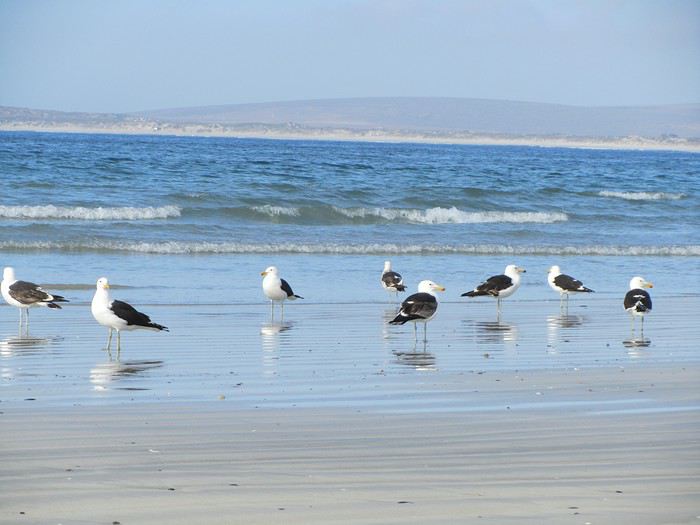 Nous avons découvert échouée sur le sable une famille de phoques , personne n'a su nous dire ce qui a causer leur mort et une énorme méduse au moins 30 cm de diamètre!
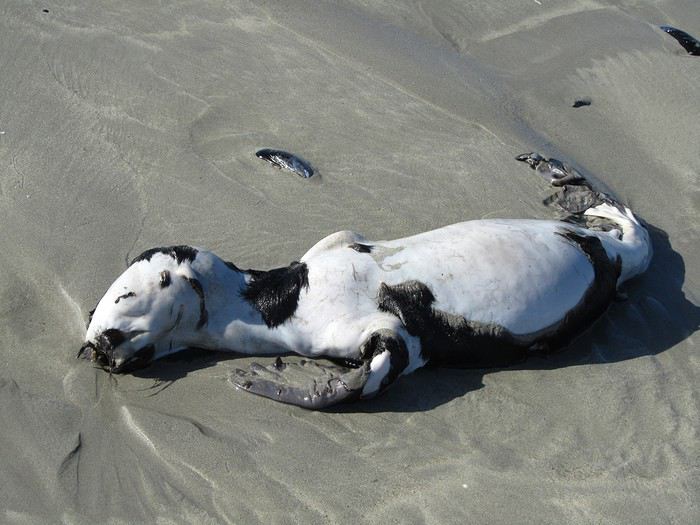


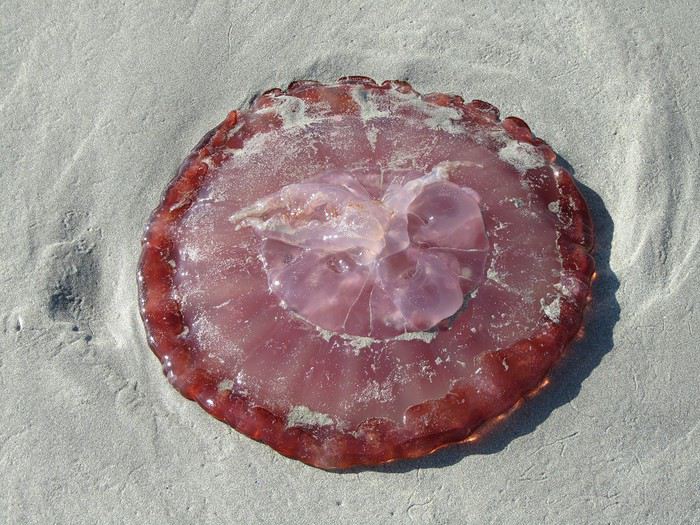
L'air marin a taquiné notre appétit, il fait bon être devant le petit déjeuner. Nous rencontrons un italien qui parle parfaitement le français, c'est un ami de la propriétaire, elle l'a appelé pour qu'il vienne nous faire la causette. Il est en Afrique du Sud depuis 40 ans, il connait bien Toulon, même au bout du monde, nous entendons parler de la France.
Nous les quittons à regrets, nous étions si bien dans ce petit village, mais il nous faut poursuivre notre balade vers Clanwilliam via Velddrif, Eland's Bay, la côte est splendide, pique -nique près de Lambert's Bay, royaume de la langouste, son port de pêche les exporte dans le monde entier; les amateurs de sensations fortes ne seront pas déçus par l'odeur qui y règne!
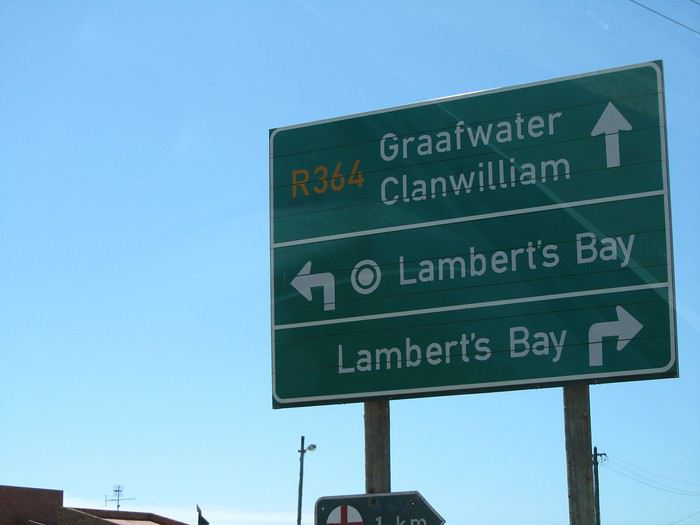
Nous atteignons Clanwillian , typique ambiance de ville d'Afrique. Pôle de la commercialisation du Rooibos, herbe rouge (ça ne se fume pas) le "thé" sud-africain par excellence, une plante locale dont la décoction, pauvre en tanin et exempte de caféine, est supposée avoir des vertus médicinales, est exportée dans le monde.
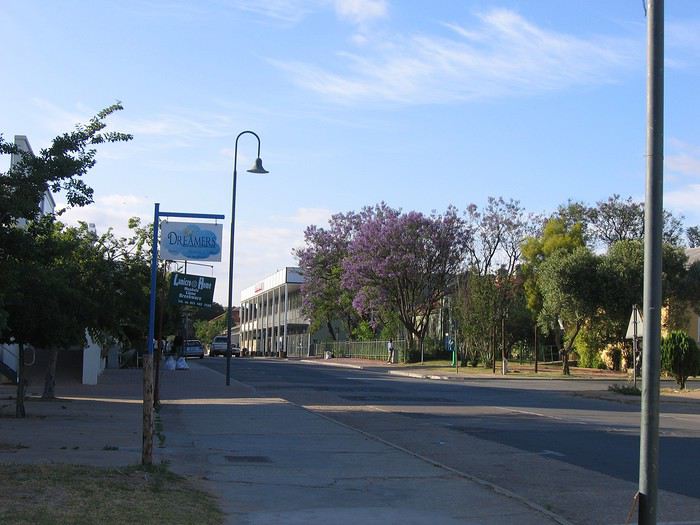
Tour de ville, recherche d'un B&B. Dans une rue calme et fleurie, bordée d'agréables maisons, nous remarquons "B&B ELEPHANT RIVER", c'est ici qu'il faut dormir!
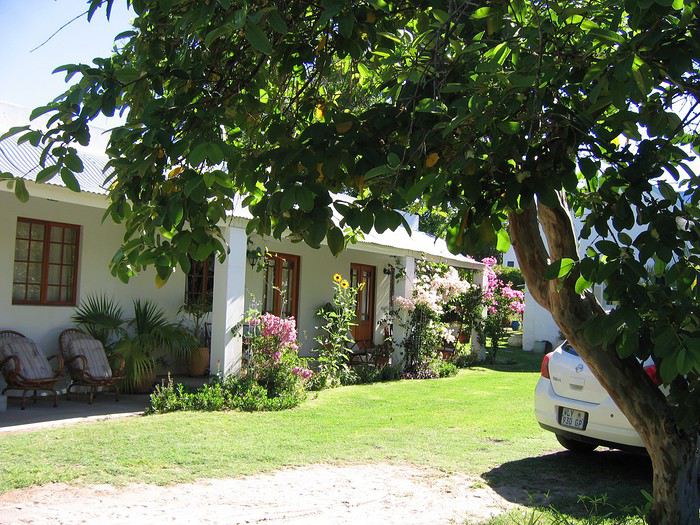
Mais il n'y a personne pour nous recevoir, le portail est fermé et les chiens dans le fond du jardin aboient à qui mieux mieux. Au bout de 10 mn d'attente, un ouvrier jardinier qui passait nous fait signe de rester et reprend son chemin... Quelques minutes plus tard, la propriétaire arrive à notre grand étonnement, ce monsieur était allé la prévenir! Elle nous fait visiter les trois lodges et choisir celui qui nous convient. Tarif défiant tout concurrence 500 rands la nuit. Nous ne rencontrons que des personnes avenantes et sympathiques. Après un douche qui n'était pas superflue, tour du quartier et du centre ville à pied.
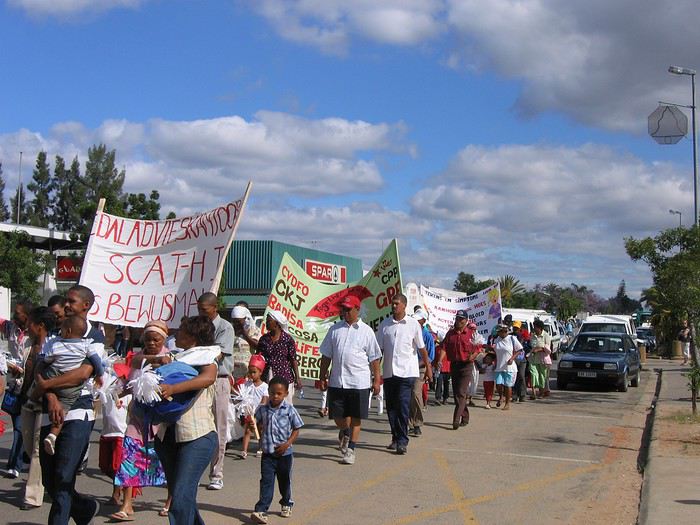
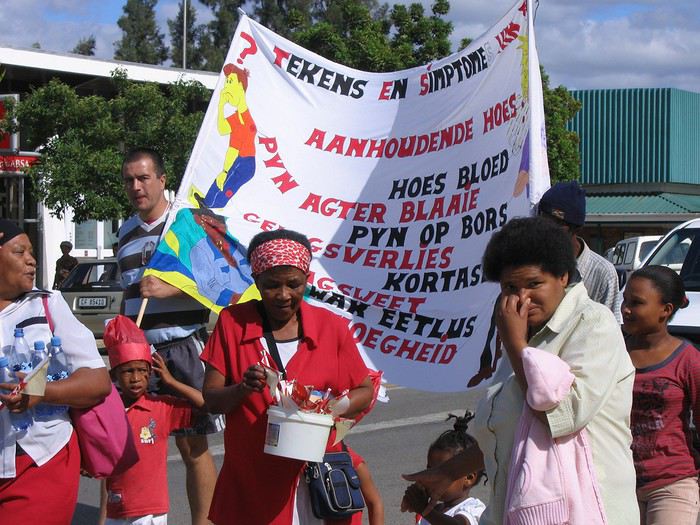
 nous rencontrons une manifestation pour le SIDA
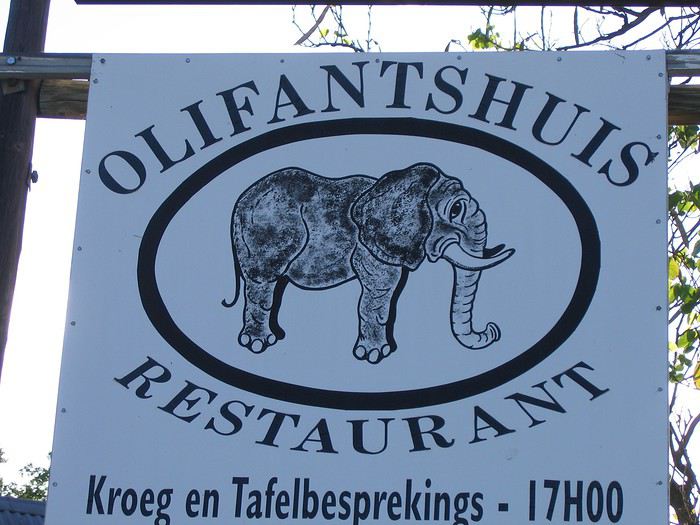
Tout près du lodge, nous avons repéré un resto accueillant et sympathique,
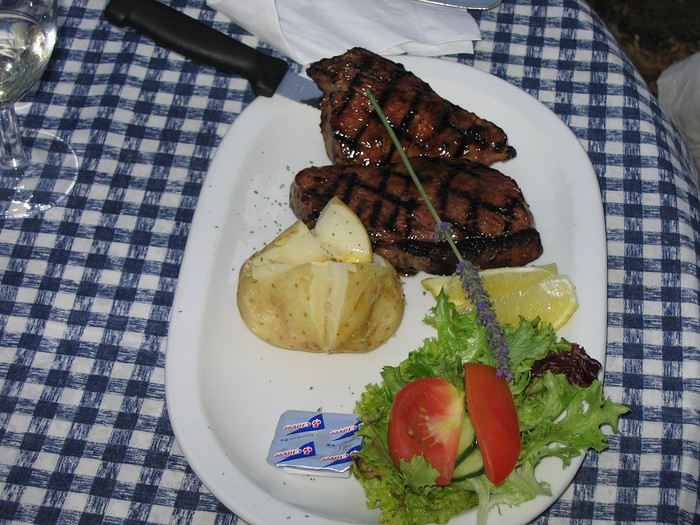
 encore une fois les steaks sont énormes 500gr, nous ne le cherchons pas sous les frites, c'est le contraire qui se produit
 Il est 21h30, le sommeil se fait sentir, il est vrai que nous sommes debout depuis 6h du matin. J'oublie de vous dire que nous avons un lit à baldaquin!!

Demain, une bonne journée nous attend.
Nous avons découvert échouée sur le sable une famille de phoques , personne n'a su nous dire ce qui a causer leur mort et une énorme méduse au moins 30 cm de diamètre!
L'air marin a taquiné notre appétit, il fait bon être devant le petit déjeuner. Nous rencontrons un italien qui parle parfaitement le français, c'est un ami de la propriétaire, elle l'a appelé pour qu'il vienne nous faire la causette. Il est en Afrique du Sud depuis 40 ans, il connait bien Toulon, même au bout du monde, nous entendons parler de la France.
Nous les quittons à regrets, nous étions si bien dans ce petit village, mais il nous faut poursuivre notre balade vers Clanwilliam via Velddrif, Eland's Bay, la côte est splendide, pique -nique près de Lambert's Bay, royaume de la langouste, son port de pêche les exporte dans le monde entier; les amateurs de sensations fortes ne seront pas déçus par l'odeur qui y règne!
Nous atteignons Clanwillian , typique ambiance de ville d'Afrique. Pôle de la commercialisation du Rooibos, herbe rouge (ça ne se fume pas) le "thé" sud-africain par excellence, une plante locale dont la décoction, pauvre en tanin et exempte de caféine, est supposée avoir des vertus médicinales, est exportée dans le monde.
Tour de ville, recherche d'un B&B. Dans une rue calme et fleurie, bordée d'agréables maisons, nous remarquons "B&B ELEPHANT RIVER", c'est ici qu'il faut dormir!
Mais il n'y a personne pour nous recevoir, le portail est fermé et les chiens dans le fond du jardin aboient à qui mieux mieux. Au bout de 10 mn d'attente, un ouvrier jardinier qui passait nous fait signe de rester et reprend son chemin... Quelques minutes plus tard, la propriétaire arrive à notre grand étonnement, ce monsieur était allé la prévenir! Elle nous fait visiter les trois lodges et choisir celui qui nous convient. Tarif défiant tout concurrence 500 rands la nuit. Nous ne rencontrons que des personnes avenantes et sympathiques. Après un douche qui n'était pas superflue, tour du quartier et du centre ville à pied.
nous rencontrons une manifestation pour le SIDA
Tout près du lodge, nous avons repéré un resto accueillant et sympathique,
encore une fois les steaks sont énormes 500gr, nous ne le cherchons pas sous les frites, c'est le contraire qui se produit
Il est 21h30, le sommeil se fait sentir, il est vrai que nous sommes debout depuis 6h du matin. J'oublie de vous dire que nous avons un lit à baldaquin!!
Demain, une bonne journée nous attend.