Results for "Cotinière+ou+(Saint-Pierre+Oléron)+|+127"
4479 results found.
Slovenia and Northern Italy without a car
Here’s the itinerary for a ten-day trip through Slovenia and Northern Italy using local transport.
Saturday, May 2: Arrival
Arrived in Ljubljana on a Transavia flight from Paris. I’d spotted a bus connection to the city center, but it’s worth noting there’s no dedicated line—most buses stopping at the airport come from Bled. On a sunny Saturday afternoon, the bus was already packed with people who’d headed to the lake for some fresh air. I ended up taking a shared van, with drivers actively offering transfers to travelers. I paid 12 € for the ride to the train station, then walked 15 minutes to Hotel Celica. It lives up to its description as a former prison turned hotel—close to the city center, clean, with a hearty breakfast. The rooms are basic, with beds 3 meters off the ground, accessible by a wooden ladder. For dinner, I opted for an Indian restaurant.
Sunday, May 3: Urban marathon
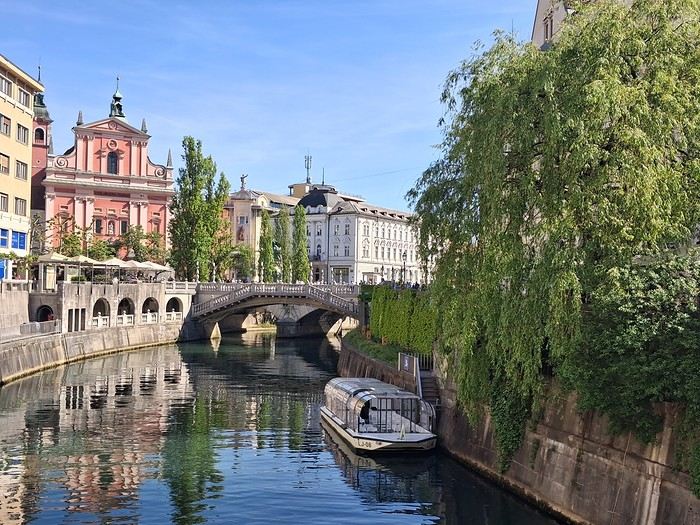
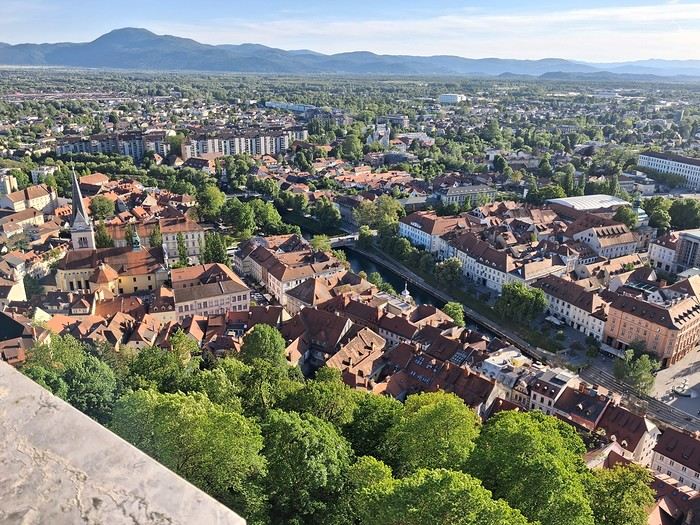
Good news: museums are free on the first Sunday of the month. I started with the National Gallery, then took a stroll through Tivoli Park, enjoying the outdoors. I tried grilling in the park before heading to the Museum of Modern Art and the eclectic National Museum of Slovenia, which was interesting for its architecture. Next up was the castle—you can enter the grounds for free; the only reason to pay is to access the keep for the city views.
Monday, May 4: Bled
I spent the morning exploring Ljubljana’s architecture but was disappointed by the Krakovo district, which guidebooks had hyped up.
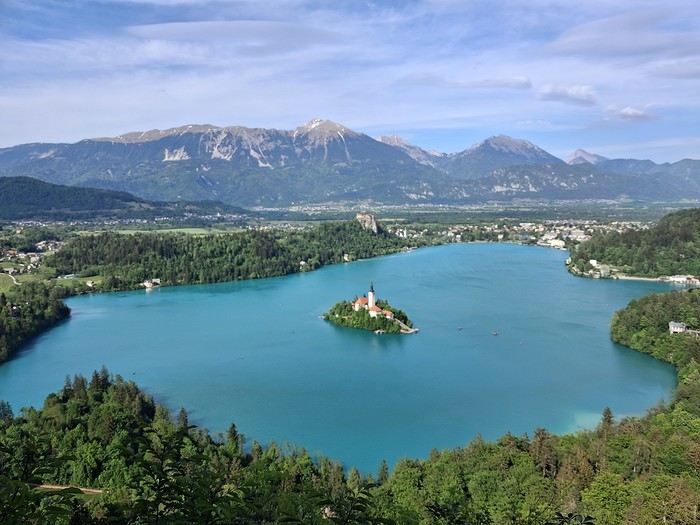
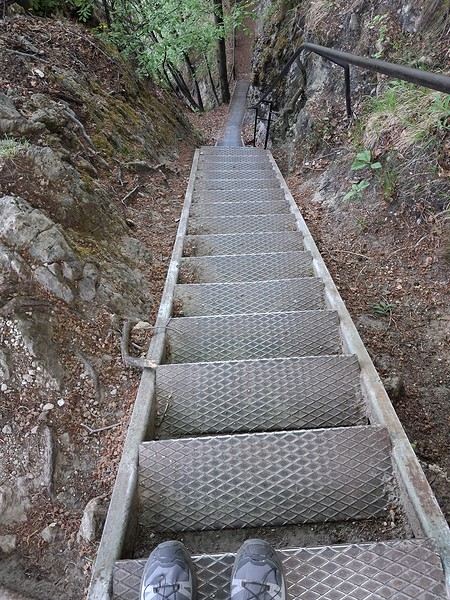
In the afternoon, I took the bus to Bled. The hostel was right at the bus station, and I soon realized I’d be the only guest—the owner was struggling to attract visitors. I walked around the lake and searched for the viewpoint access. It’s a steep climb with a staircase, but worth it.
Tuesday, May 5: Vintgar Gorge
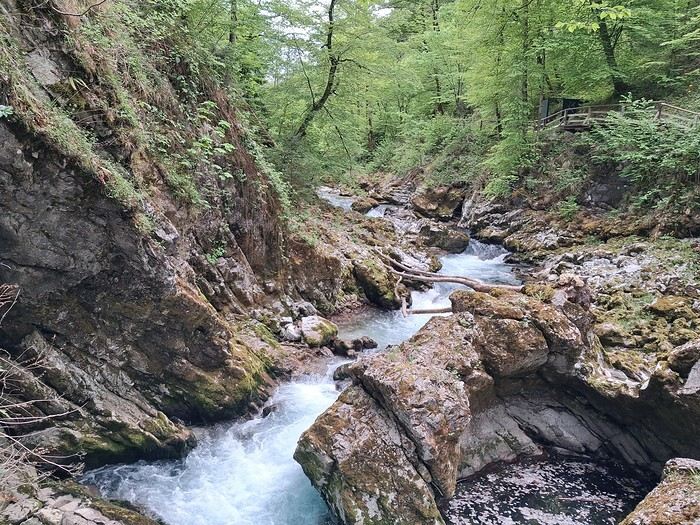
I headed to the gorges early in the morning via a shuttle, then walked back to Bled. It was stunning—it reminded me a bit of the Samaria Gorge I’d visited last year.
The bus took me straight to Stara Fužina near Lake Bohinj, where I stayed in a homestay. I loved it, even though there wasn’t much interaction with the hosts.
The weather was overcast and misty, giving the lake a Scottish vibe.
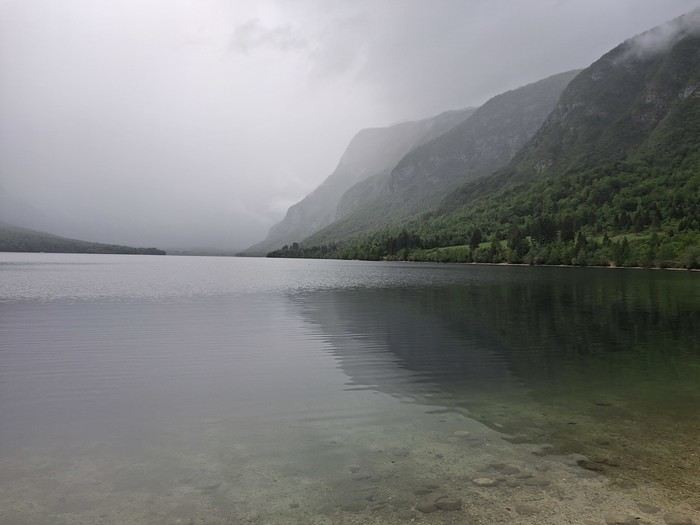
Wednesday, May 6: Bohinj
Rainy day, so I took the bus to Ukanc at the far end of the lake and walked back.
Thursday, May 7: Mostnica Gorge and the auto-train
I set off on foot for the gorges from Stara Fužina, taking a detour up to Planina Uskovnica, a steep and rarely used trail. The views of Triglav and the traditional alpine huts were incredible.
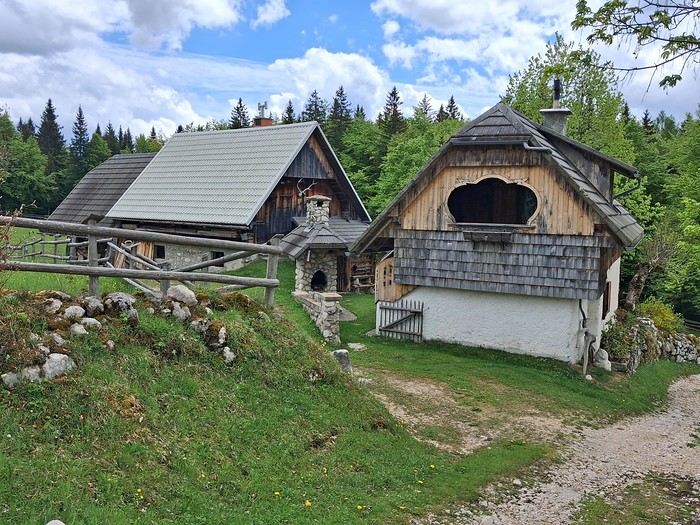
I then took the auto-train to Most na Soči. The passenger section has compartments, and the windows can be opened. The ride through the gorges was breathtaking. I stayed at a family-run guesthouse near the Most na Soči station—authentic and cozy.
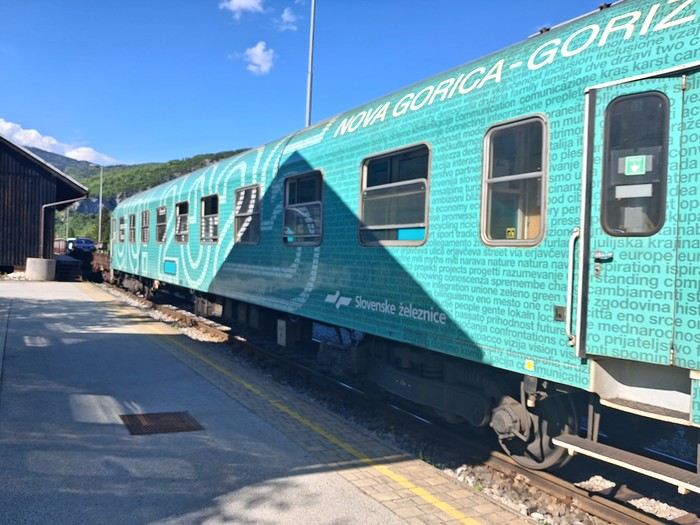
Friday, May 8: Tolmin Gorge and Nova Gorica
I took the bus to Tolmin, then walked 30 minutes to the gorges. The trail is well-maintained but short, so I extended my hike with a scenic loop through the gorges and nearby villages.
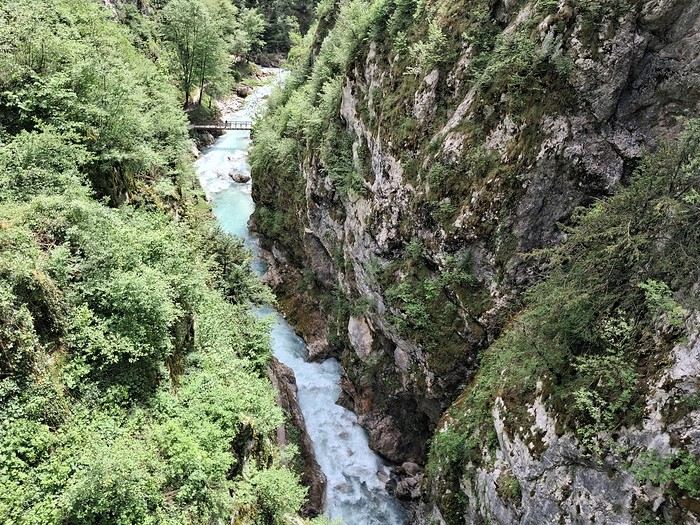
A quick train ride later, I was in Nova Gorica for the night, positioning myself to reach the Adriatic coast the next day. I explored at a fast pace—Villa Raffut on the Slovenian side, then crossed the border to visit Palazzo Attems-Petzenstein and grab an aperitivo in the main square. You could tell I was in Italy just by the vibe. The old border checkpoint is still there.
Saturday, May 9: Piran
Three trains and a bus later, I arrived. The journey was scenic, and it was worth it.
Piran is touristy but manageable. It feels like a mix of Croatia and Italy, with both influences evident. The maritime museum was fascinating, with its detailed ship models. There’s still a local feel—there was even a great blues concert by the harbor that evening.
Sunday, May 10: Piran
I walked to Izola along the coast—a beautiful route with paths, roads, and lakes. It was Sunday, and the tip of the village was lively with families picnicking. I decided to take the bus to Koper. The regional museum was quiet, but the garden was stunning.
Monday, May 11: Trieste
The bus connection from Koper was frequent and easy. Trieste is very open to the sea. I visited the castle and the massive Revoltella Museum—good timing, since it was raining. The collection spans everything from classical to contemporary art.
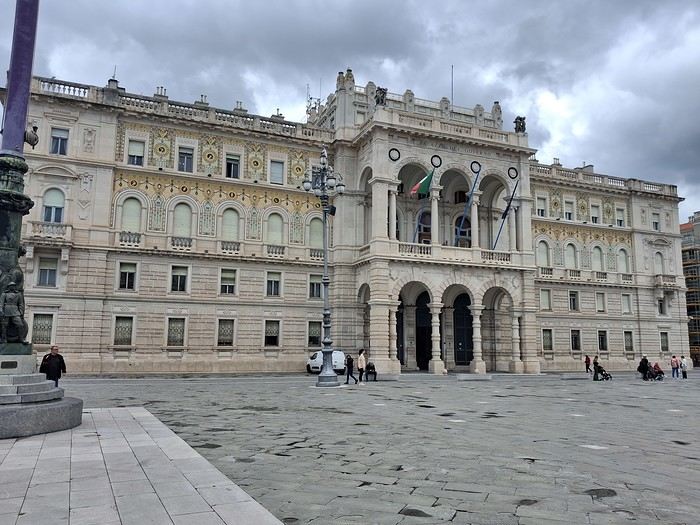
I missed my connection to Stresa later that day, so I had to improvise a night in a dorm near Milan’s train station.
Tuesday, May 12: Stresa
I came mainly for the Borromean Islands. First impressions weren’t great—crowded at the dock and windy. I didn’t like Isola Bella—too many people and too flashy. I much preferred Isola Madre, with its peaceful gardens where you can find solitude. On the way back, I stopped at Isola dei Pescatori after some hesitation, and it was worth it. Finally, I explored Stresa, with its colorful houses and grand palaces.
Wednesday, May 13: Heading to the Jura
I wrapped up my trip by taking the EuroCity train from Milan to Geneva via the Simplon Pass. From there, I headed to my vacation spot, taking the train from Nyon to La Cure (on the border). The rest of the journey was private.
Saturday, May 2: Arrival
Arrived in Ljubljana on a Transavia flight from Paris. I’d spotted a bus connection to the city center, but it’s worth noting there’s no dedicated line—most buses stopping at the airport come from Bled. On a sunny Saturday afternoon, the bus was already packed with people who’d headed to the lake for some fresh air. I ended up taking a shared van, with drivers actively offering transfers to travelers. I paid 12 € for the ride to the train station, then walked 15 minutes to Hotel Celica. It lives up to its description as a former prison turned hotel—close to the city center, clean, with a hearty breakfast. The rooms are basic, with beds 3 meters off the ground, accessible by a wooden ladder. For dinner, I opted for an Indian restaurant.
Sunday, May 3: Urban marathon
Good news: museums are free on the first Sunday of the month. I started with the National Gallery, then took a stroll through Tivoli Park, enjoying the outdoors. I tried grilling in the park before heading to the Museum of Modern Art and the eclectic National Museum of Slovenia, which was interesting for its architecture. Next up was the castle—you can enter the grounds for free; the only reason to pay is to access the keep for the city views.
Monday, May 4: Bled
I spent the morning exploring Ljubljana’s architecture but was disappointed by the Krakovo district, which guidebooks had hyped up.
In the afternoon, I took the bus to Bled. The hostel was right at the bus station, and I soon realized I’d be the only guest—the owner was struggling to attract visitors. I walked around the lake and searched for the viewpoint access. It’s a steep climb with a staircase, but worth it.
Tuesday, May 5: Vintgar Gorge
I headed to the gorges early in the morning via a shuttle, then walked back to Bled. It was stunning—it reminded me a bit of the Samaria Gorge I’d visited last year.
The bus took me straight to Stara Fužina near Lake Bohinj, where I stayed in a homestay. I loved it, even though there wasn’t much interaction with the hosts.
The weather was overcast and misty, giving the lake a Scottish vibe.
Wednesday, May 6: Bohinj
Rainy day, so I took the bus to Ukanc at the far end of the lake and walked back.
Thursday, May 7: Mostnica Gorge and the auto-train
I set off on foot for the gorges from Stara Fužina, taking a detour up to Planina Uskovnica, a steep and rarely used trail. The views of Triglav and the traditional alpine huts were incredible.
I then took the auto-train to Most na Soči. The passenger section has compartments, and the windows can be opened. The ride through the gorges was breathtaking. I stayed at a family-run guesthouse near the Most na Soči station—authentic and cozy.
Friday, May 8: Tolmin Gorge and Nova Gorica
I took the bus to Tolmin, then walked 30 minutes to the gorges. The trail is well-maintained but short, so I extended my hike with a scenic loop through the gorges and nearby villages.
A quick train ride later, I was in Nova Gorica for the night, positioning myself to reach the Adriatic coast the next day. I explored at a fast pace—Villa Raffut on the Slovenian side, then crossed the border to visit Palazzo Attems-Petzenstein and grab an aperitivo in the main square. You could tell I was in Italy just by the vibe. The old border checkpoint is still there.
Saturday, May 9: Piran
Three trains and a bus later, I arrived. The journey was scenic, and it was worth it.
Piran is touristy but manageable. It feels like a mix of Croatia and Italy, with both influences evident. The maritime museum was fascinating, with its detailed ship models. There’s still a local feel—there was even a great blues concert by the harbor that evening.
Sunday, May 10: Piran
I walked to Izola along the coast—a beautiful route with paths, roads, and lakes. It was Sunday, and the tip of the village was lively with families picnicking. I decided to take the bus to Koper. The regional museum was quiet, but the garden was stunning.
Monday, May 11: Trieste
The bus connection from Koper was frequent and easy. Trieste is very open to the sea. I visited the castle and the massive Revoltella Museum—good timing, since it was raining. The collection spans everything from classical to contemporary art.
I missed my connection to Stresa later that day, so I had to improvise a night in a dorm near Milan’s train station.
Tuesday, May 12: Stresa
I came mainly for the Borromean Islands. First impressions weren’t great—crowded at the dock and windy. I didn’t like Isola Bella—too many people and too flashy. I much preferred Isola Madre, with its peaceful gardens where you can find solitude. On the way back, I stopped at Isola dei Pescatori after some hesitation, and it was worth it. Finally, I explored Stresa, with its colorful houses and grand palaces.
Wednesday, May 13: Heading to the Jura
I wrapped up my trip by taking the EuroCity train from Milan to Geneva via the Simplon Pass. From there, I headed to my vacation spot, taking the train from Nyon to La Cure (on the border). The rest of the journey was private.
Trip report: Albania, April 2026
A little trip report from an 11-day journey to Albania at the end of April 2026, with two friends in their early sixties and beyond...
Our route: Berat, Gjirokastër, Himarë, Tirana
Here are some opinions, tips, and great deals to share:
Flight Round-trip Beauvais-Tirana: Ryanair, 260 € with checked baggage (20 kg) and seat selection. Flight was fine and on time. 2h 30min flight.
Exchange: 1 € was worth 95 lek in April 2026. We were advised to exchange in the airport hall at the Illiria counter (98 lek outside the security zone), saying we wouldn’t find a better rate. However, the exchange rate was 93 lek for 1 euro, while in the city it was 95...
Car rental at Tirana airport for 9 days via Booking.com: 144 € (56 € for the car rental and 88 € for optional full insurance deductible waiver).
Wheego agency: the car was fine, but be careful when signing the contract—they tried to convince us that the insurance taken through Booking didn’t cover everything and insisted we take their own insurance for 250 €... We refused.
After reading about driving in Tirana, instead of starting our trip by visiting the capital, we decided to head straight to Berat upon arrival and return the car at the end of the trip to explore the city on foot. This turned out to be a great choice!
Accommodations: All our stays were booked via Booking.com. Everyone prefers to be paid in euros and in cash—they mention this when booking.
Berat: 2-hour drive from the airport.
Accommodation: Vila Arben Elezi: 135 € for 3 nights with breakfast and private parking. The room was decent and clean but a bit dark, located slightly below ground level near the parking. However, the breakfast on the rooftop was excellent, especially with the stunning view of the "city of a thousand windows." Great location.
Berat was our favorite—there are lovely walks through the different neighborhoods on both sides of the river, each with a very different vibe. The citadel visit is also fascinating, as it’s like a small town within the fortress.
The walk along the river is pleasant, with plenty of restaurant choices. Other restaurants in the old town are also very nice. The White House Restaurant, on the first floor along the road, is good and offers a great view of the Gorica district.
Gjirokastër:
Accommodation: Te Ajdini Guest House: 120 € for 3 nights with breakfast. A private home stay. There’s free parking just before entering the city, a 5-minute walk from the accommodation, which is very convenient since the cobblestone streets are narrow and parking is tricky. Yes, it’s a climb to get to the place, but everything in this city is uphill... The room was bright and clean. Breakfast was very good, hearty, and served in the courtyard with a view of the castle. The guesthouse is a 5-minute walk from the city center (the bazaar) but in a quiet area.
Restaurants: Rrapi and Kujtimi—good and affordable with their little pergolas.
The old town of Gjirokastër is charming but very touristy, with streets packed with souvenir shops and restaurant tables and chairs. Lots of people.
-The bunker visit (near the tourist office) is very interesting: Cold War Tunnel.
The castle offers a beautiful view of the city.
-Visit to the Ottoman house Skenduli: very well done. Don’t forget to climb the ladder facing a trapdoor in the ceiling to see the roof’s framework—it’s like a forest of beams: impressive!
-The bridge Ura e Ali Pasha: A steep 45-minute climb from the city to the site is worth it, but once you reach the viewpoint (which is stunning), you have to go back down a path to reach the bridge. You can drive to the viewpoint, but parking is very tricky.
Around Gjirokastër:
-Just outside the city: Lake Liqeni i Viroit: a nice, ordinary-looking lake, but at the end, there’s a natural spring making the water crystal clear and a brilliant blue—really spectacular, like photos of Blue Eye near Sarandë.
-Drive to Përmet along the gorges: beautiful viewpoints along the way and lovely countryside.
Himarë:
Accommodation: Vila Kosteli: 120 € for 2 nights with breakfast—slightly overpriced for this type of place but very close to a small beach and not far from the promenade with all the restaurants. Private parking, but very tight (4 cars on a tiny lot along the road). The "sea view" room is a bit obstructed by the building across the street. However, the rooftop breakfast view is beautiful. Friendly staff.
Himarë is a pleasant seaside resort, quite calm (but it was April...). There’s a cute promenade with restaurants along the beach. The castle on the heights of Himarë is worth a visit.
Around Himarë:
-Qeparo is worth a quick stop, but Qeparo village is really worth the detour: a village lost in the heights after a scenic drive up from the coastal road—narrow but well-maintained. Beautiful view from the top and a charming village.
-The Big Bunker and Llogora Panorama: take a right turn several kilometers after Dhermi—a road that climbs steeply from the start... A breathtaking winding road that reaches 900 meters in altitude. The view is stunning.
-Several small villages between Dhermi and Himarë are worth a quick stop.
-Porto Palermo Castle is somewhat disappointing.
Tirana:
Taxi from Tirana airport to the city center: 15 € with electric taxis (Green Taxi, Bee Taxi, Do Taxi).
Accommodation: Hotel Nevi Apartment: 63 € for 2 nights. A private apartment in an older building but very clean and well-equipped, with a kitchen and small enclosed balcony.
Great welcome and contact—the owner even booked a taxi for our departure. Very well located, close to the main square, shops, and restaurants. A small supermarket nearby is perfect for stocking up on breakfast supplies.
The city is lively and dynamic, with plenty of green spaces and promenades. Buildings are popping up everywhere, often with surprising architecture—like a building shaped like a face, a huge golden cube, and many others under construction.
-Sky Tower: at the top, a rotating bar offers a 360° view of the city and its buildings. Drinks are a bit pricier than usual, but it’s totally worth it (6 € for a beer or a glass of white wine, 3 € for coffee). We were there for sunset, and it was amazing! A must-do. Arrive early, as it fills up quickly.
-The House of Leaves: a house used for secret surveillance and interrogations during the dictatorship... A great way to learn about the surveillance systems of that era.
-Bunk’Art 2: a bunker in the heart of the city—very interesting, covering the dictatorship period and its system...
-The Pazari i Ri Bazaar: the new bazaar district. The large hall is worth a visit, but souvenir prices are often higher than elsewhere... The area is nice.
Restaurant: Kastrati Restaurant—a bit like a canteen with lots of traditional dishes. It’s on the first floor of a building. Excellent value for money, and the waitress explains the dishes in French.
That’s a little overview of our trip and my personal impressions! Albania is a beautiful and pleasant country to visit. If you have any questions, feel free to ask!
That’s a little overview of our trip and my personal impressions! Albania is a beautiful and pleasant country to visit. If you have any questions, feel free to ask!
My Australia itinerary: What to do in 3 weeks between Sydney and Cairns?
Discover everything you can do during a three-week road trip between Sydney and Cairns on Australia’s east coast. All the steps for a memorable journey.
3-week road trip between Sydney and Cairns: itinerary tips A three-week stay in Australia is the perfect amount of time to explore part of the country. Just a part, because the territory is so vast that you could spend months there without seeing it all. For a first trip to this Oceanic country, the route between Sydney and Cairns is a classic. It offers a glimpse of what makes so many travelers dream, with legendary beaches, vibrant cities, tropical forests, paradise islands, and the unmissable Great Barrier Reef. This route along the East Coast alternates between natural landscapes and urban atmosphere, scenic roads, and relaxing days. Here’s a realistic itinerary designed for three weeks, with balanced stops and time to enjoy without feeling rushed.
Days 1 to 3 – Sydney, first steps in Australia Even before setting foot on Australian soil, travelers must have a valid passport and a visa. Australia doesn’t mess around with entry formalities, so it’s best to take care of this in advance. To apply for a tourist visa, the site aus-visa.org guides travelers step by step. Once this formality is sorted, it’s time to focus on the most exciting part: the trip itself. Arriving in Sydney is often a memorable step. You discover one of Australia’s most iconic cities and immediately feel far from Europe. The first few days are for adjusting to the time difference while exploring the city’s landmarks. There’s the Opera House, of course, but also the Harbour Bridge, which dominates the bay and gives Sydney its instantly recognizable silhouette. During these three days in Sydney, you can head to Circular Quay to take a ferry to Manly, just for the pleasure of crossing the bay and admiring the city from the water. You can also walk along Bondi Beach or lay out your towel, depending on the time of year. The coastal walk between Bondi and Coogee offers a spectacular view of the Australian coast. Of course, you won’t want to miss strolling through The Rocks district to soak up the buzz of the capital of New South Wales.
Days 4 to 6 – From Sydney to Byron Bay, the road trip begins The road trip kicks off heading north. The Pacific Highway unfolds its kilometers between the ocean and eucalyptus forests. You quickly realize that driving in Australia is a unique experience. Sure, the distances are long, but the landscapes make every stretch enjoyable. A first stop in Port Macquarie or Coffs Harbour lets you rest while discovering wild beaches. Then comes Byron Bay, the beach town often described as Australia’s surfing and alternative lifestyle capital. After Sydney, the vibe slows down. You wake up early to watch the sunrise near the lighthouse, then spend your days swimming, trying surfing, and exploring the tropical hinterland. You can also hike in nearby national parks to discover hidden waterfalls in the heart of wild landscapes. You might plan to spend one night in Byron Bay before hitting the road again, but it’s so nice that you end up staying for three days.
Days 7 to 9 – Gold Coast and Sunshine Coast, between modernity and nature Heading toward the Gold Coast, the contrast is striking again. Here, skyscrapers line the beach, and you stroll along wide avenues. The vibe is more urban. Surfers Paradise is another ideal stop for surfing. You can also enjoy a lively nightlife. Those who prefer tranquility can relax in Burleigh Heads, known for its beautiful beach and more local atmosphere. The hinterland also holds surprises. The lush forests of Springbrook National Park and its waterfalls remind you that Australia’s nature is everywhere, even near big cities. As you head up to the Sunshine Coast, we recommend stopping in Noosa to discover its elegant houses, peaceful beaches, and national park bordering the ocean. The coastal trails reveal exceptional marine landscapes. The locals’ hospitality is also remarkable.
Days 10 to 12 – Fraser Island, adventure on sand Get ready for a magical moment! From Hervey Bay, you board a ferry to Fraser Island—or K’gari—the world’s largest sand island. Once there, you drive a 4x4 on the beach and discover raw, almost surreal landscapes. Lake McKenzie, with its impressively clear water and dazzling white sand, remains one of the trip’s most memorable highlights. You swim, walk barefoot, observe dingoes from a distance, and feel a rare sense of isolation. It’s as if you’re far from civilization. After two intense days, you hit the road north again. The distances get longer, but the excitement grows as you approach the Whitsundays.
Days 13 to 15 – The Whitsundays, a giant postcard Airlie Beach is the gateway to the Whitsundays, a group of islands 55 km off the coast of Queensland. The water turns turquoise, lush green islands emerge on the horizon, and the sand at Whitehaven Beach looks too white to be real. What to do in the archipelago? Well, snorkel for hours over the coral, swim in secluded coves, and spend peaceful evenings watching the sunset. For those who love discovering hidden spots, head to Cedar Creek Falls for a picnic and a refreshing swim. These days at sea often rank among travelers’ favorite moments. You’ll understand why once you’re there.
Days 16 to 18 – Mission Beach, the tropical break After the magical moments in the Whitsundays, Mission Beach offers a quieter pause. Here, you enjoy a long palm-fringed beach and an almost intimate atmosphere. It’s the perfect spot between Sydney and Cairns to take time to do nothing. That means walking along the water at sunrise, then exploring the surroundings between tropical forest and isolated backroads. Thrill-seekers, however, can skydive over the beach. It’s a uniquely Australian experience that offers plenty of wow moments. This stop marks the entry into North Queensland’s tropical region, where many more wonders await travelers.
Days 19 to 21 – Cairns, the Great Barrier Reef, and the ancient rainforest Cairns is a city in Australia that’s loved for its lively markets, cafés, and beautiful beaches. It’s also the gateway to one of the world’s natural jewels: the Great Barrier Reef. A boat excursion lets you dive or snorkel over colorful reefs. Seeing the coral and fish in this crystal-clear water leaves a lasting impression. But you’ll also discover another wonder with the poetic name of Daintree Rainforest. It’s one of the oldest tropical forests on the planet. Walking under its dense canopy lets you feel the power of nature preserved in its original state. At Cape Tribulation, the forest meets the ocean in a spectacular setting. This end of the trip is packed with emotion.
Traveling from Sydney to Cairns in three weeks means exploring a contrasting and exotic Australia. You start in a dynamic metropolis, cross endless beaches, sail between paradise islands, and finish in an ancient tropical forest. Often, as soon as you’re back, you’re already thinking about returning.
3-week road trip between Sydney and Cairns: itinerary tips A three-week stay in Australia is the perfect amount of time to explore part of the country. Just a part, because the territory is so vast that you could spend months there without seeing it all. For a first trip to this Oceanic country, the route between Sydney and Cairns is a classic. It offers a glimpse of what makes so many travelers dream, with legendary beaches, vibrant cities, tropical forests, paradise islands, and the unmissable Great Barrier Reef. This route along the East Coast alternates between natural landscapes and urban atmosphere, scenic roads, and relaxing days. Here’s a realistic itinerary designed for three weeks, with balanced stops and time to enjoy without feeling rushed.
Days 1 to 3 – Sydney, first steps in Australia Even before setting foot on Australian soil, travelers must have a valid passport and a visa. Australia doesn’t mess around with entry formalities, so it’s best to take care of this in advance. To apply for a tourist visa, the site aus-visa.org guides travelers step by step. Once this formality is sorted, it’s time to focus on the most exciting part: the trip itself. Arriving in Sydney is often a memorable step. You discover one of Australia’s most iconic cities and immediately feel far from Europe. The first few days are for adjusting to the time difference while exploring the city’s landmarks. There’s the Opera House, of course, but also the Harbour Bridge, which dominates the bay and gives Sydney its instantly recognizable silhouette. During these three days in Sydney, you can head to Circular Quay to take a ferry to Manly, just for the pleasure of crossing the bay and admiring the city from the water. You can also walk along Bondi Beach or lay out your towel, depending on the time of year. The coastal walk between Bondi and Coogee offers a spectacular view of the Australian coast. Of course, you won’t want to miss strolling through The Rocks district to soak up the buzz of the capital of New South Wales.
Days 4 to 6 – From Sydney to Byron Bay, the road trip begins The road trip kicks off heading north. The Pacific Highway unfolds its kilometers between the ocean and eucalyptus forests. You quickly realize that driving in Australia is a unique experience. Sure, the distances are long, but the landscapes make every stretch enjoyable. A first stop in Port Macquarie or Coffs Harbour lets you rest while discovering wild beaches. Then comes Byron Bay, the beach town often described as Australia’s surfing and alternative lifestyle capital. After Sydney, the vibe slows down. You wake up early to watch the sunrise near the lighthouse, then spend your days swimming, trying surfing, and exploring the tropical hinterland. You can also hike in nearby national parks to discover hidden waterfalls in the heart of wild landscapes. You might plan to spend one night in Byron Bay before hitting the road again, but it’s so nice that you end up staying for three days.
Days 7 to 9 – Gold Coast and Sunshine Coast, between modernity and nature Heading toward the Gold Coast, the contrast is striking again. Here, skyscrapers line the beach, and you stroll along wide avenues. The vibe is more urban. Surfers Paradise is another ideal stop for surfing. You can also enjoy a lively nightlife. Those who prefer tranquility can relax in Burleigh Heads, known for its beautiful beach and more local atmosphere. The hinterland also holds surprises. The lush forests of Springbrook National Park and its waterfalls remind you that Australia’s nature is everywhere, even near big cities. As you head up to the Sunshine Coast, we recommend stopping in Noosa to discover its elegant houses, peaceful beaches, and national park bordering the ocean. The coastal trails reveal exceptional marine landscapes. The locals’ hospitality is also remarkable.
Days 10 to 12 – Fraser Island, adventure on sand Get ready for a magical moment! From Hervey Bay, you board a ferry to Fraser Island—or K’gari—the world’s largest sand island. Once there, you drive a 4x4 on the beach and discover raw, almost surreal landscapes. Lake McKenzie, with its impressively clear water and dazzling white sand, remains one of the trip’s most memorable highlights. You swim, walk barefoot, observe dingoes from a distance, and feel a rare sense of isolation. It’s as if you’re far from civilization. After two intense days, you hit the road north again. The distances get longer, but the excitement grows as you approach the Whitsundays.
Days 13 to 15 – The Whitsundays, a giant postcard Airlie Beach is the gateway to the Whitsundays, a group of islands 55 km off the coast of Queensland. The water turns turquoise, lush green islands emerge on the horizon, and the sand at Whitehaven Beach looks too white to be real. What to do in the archipelago? Well, snorkel for hours over the coral, swim in secluded coves, and spend peaceful evenings watching the sunset. For those who love discovering hidden spots, head to Cedar Creek Falls for a picnic and a refreshing swim. These days at sea often rank among travelers’ favorite moments. You’ll understand why once you’re there.
Days 16 to 18 – Mission Beach, the tropical break After the magical moments in the Whitsundays, Mission Beach offers a quieter pause. Here, you enjoy a long palm-fringed beach and an almost intimate atmosphere. It’s the perfect spot between Sydney and Cairns to take time to do nothing. That means walking along the water at sunrise, then exploring the surroundings between tropical forest and isolated backroads. Thrill-seekers, however, can skydive over the beach. It’s a uniquely Australian experience that offers plenty of wow moments. This stop marks the entry into North Queensland’s tropical region, where many more wonders await travelers.
Days 19 to 21 – Cairns, the Great Barrier Reef, and the ancient rainforest Cairns is a city in Australia that’s loved for its lively markets, cafés, and beautiful beaches. It’s also the gateway to one of the world’s natural jewels: the Great Barrier Reef. A boat excursion lets you dive or snorkel over colorful reefs. Seeing the coral and fish in this crystal-clear water leaves a lasting impression. But you’ll also discover another wonder with the poetic name of Daintree Rainforest. It’s one of the oldest tropical forests on the planet. Walking under its dense canopy lets you feel the power of nature preserved in its original state. At Cape Tribulation, the forest meets the ocean in a spectacular setting. This end of the trip is packed with emotion.
Traveling from Sydney to Cairns in three weeks means exploring a contrasting and exotic Australia. You start in a dynamic metropolis, cross endless beaches, sail between paradise islands, and finish in an ancient tropical forest. Often, as soon as you’re back, you’re already thinking about returning.
Trip report: Our South Africa journey in July
Hi there,
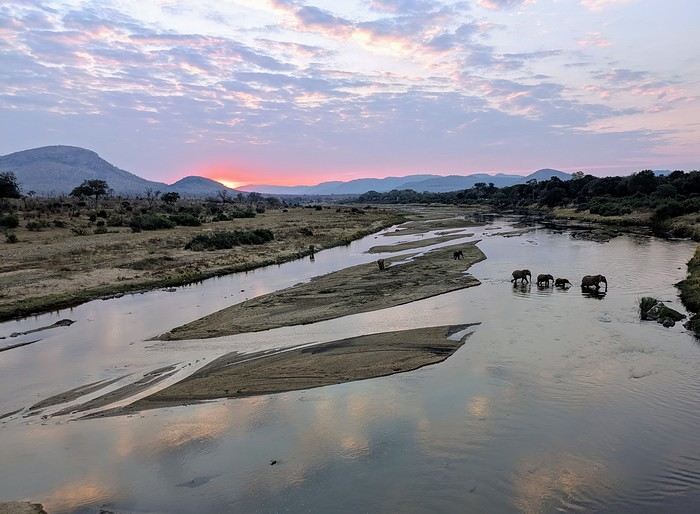
We’re back from our 3-week trip to South Africa in July. It was a family trip with our four grown-up kids (ages 18 to 25).
First off, I’d like to thank everyone on this forum for their great tips—they really helped us plan this trip!
The trip: We spent 15 days between Port Elizabeth and Cape Town, then a week around Kruger (including Blyde River Canyon). We found South Africans to be welcoming and always ready to help. We never felt unsafe (just followed basic safety rules). The police are very visible, especially on the roads.
Logistics: We’d booked our accommodations in advance but made a few changes on the spot based on how we felt at the time. We rented two vehicles from Firefly (Hertz). No complaints—recent cars, quick returns, and the deposit wasn’t charged. We’d gotten our international driver’s permits... which stayed in France! Luckily, no one asked for them. Driving on the left wasn’t an issue (it wasn’t our first time). The roads we took were in good, even great, condition. Only a few tracks to lodges or parks were rough and required extra caution. Lots of pedestrians on the sides of roads, even highways. And plenty of very slow trucks. But they pull over to let you pass. It’s also common for cars to cross into the opposite lane to overtake, even with white lines. We took two domestic flights: one early in the morning (Johannesburg to Port Elizabeth) and one in the late afternoon (Cape Town to Johannesburg) to save time.
We had some highlights and a few disappointments—all part of the journey! More details coming soon.
We’re back from our 3-week trip to South Africa in July. It was a family trip with our four grown-up kids (ages 18 to 25).
First off, I’d like to thank everyone on this forum for their great tips—they really helped us plan this trip!
The trip: We spent 15 days between Port Elizabeth and Cape Town, then a week around Kruger (including Blyde River Canyon). We found South Africans to be welcoming and always ready to help. We never felt unsafe (just followed basic safety rules). The police are very visible, especially on the roads.
Logistics: We’d booked our accommodations in advance but made a few changes on the spot based on how we felt at the time. We rented two vehicles from Firefly (Hertz). No complaints—recent cars, quick returns, and the deposit wasn’t charged. We’d gotten our international driver’s permits... which stayed in France! Luckily, no one asked for them. Driving on the left wasn’t an issue (it wasn’t our first time). The roads we took were in good, even great, condition. Only a few tracks to lodges or parks were rough and required extra caution. Lots of pedestrians on the sides of roads, even highways. And plenty of very slow trucks. But they pull over to let you pass. It’s also common for cars to cross into the opposite lane to overtake, even with white lines. We took two domestic flights: one early in the morning (Johannesburg to Port Elizabeth) and one in the late afternoon (Cape Town to Johannesburg) to save time.
We had some highlights and a few disappointments—all part of the journey! More details coming soon.
Madeira Between Lockdowns - July-August 2021
Hi there,
I'm starting a new travel journal with my itinerary and memories in mind, and maybe a few photos if I can find some.
The context:
April 2020, I was supposed to go to Uzbekistan, and October 2020 to Texas: both canceled due to COVID. Summer vacations in 2020 weren’t gonna be fun. Optimistic, I’d rescheduled both trips for roughly the same dates in 2021: the first was canceled again because of COVID, the second due to U.S. entry conditions (still COVID-related!). Summer vacations in 2021 *had* to be more fun, or I was gonna lose it!!! Plus, our parents are dealing with health issues, which is weighing us down—we really need to get away!
So I looked into where we could go, somewhere we could live almost normally. I saw that Madeira had implemented strict COVID measures but that life on the island was pretty chill afterward. For me, Madeira = sun + hiking + landscapes. BINGO.
Day 1: The flight and arrival on the island
Flight with TAP via Lisbon, departing around noon. We wore our masks properly on the plane. (My last flight was to Portugal, and I told myself I’d break the jinx and leave COVID behind us.) Layover in Lisbon, then an afternoon flight to Madeira. The landing went smoothly, no wind. Cristiano Ronaldo Airport in Funchal is known for being one of the trickiest in the world due to crosswinds. The checks were standard, except COVID added an extra step. Before the trip, I had to fill out a questionnaire (Madeira Safe). Once there, a group of young people—probably students—greeted us, each with a tablet. The health questionnaire and vaccine check were super quick. Then we saw a doctor, and just like that, we were wished a great stay. Honestly, it was so well organized that it only took 10 minutes. We wouldn’t put our masks back on until we returned!
A taxi took us to our hotel in the hills above Funchal—a pretty upscale place, which isn’t our usual style, but we needed it this time! Dinner on the hotel terrace with the city at our feet. Amazing!
HOTEL: Quinta da Bela Vista
The +: We’re traveling!!! The -: Nothing.
The context:
April 2020, I was supposed to go to Uzbekistan, and October 2020 to Texas: both canceled due to COVID. Summer vacations in 2020 weren’t gonna be fun. Optimistic, I’d rescheduled both trips for roughly the same dates in 2021: the first was canceled again because of COVID, the second due to U.S. entry conditions (still COVID-related!). Summer vacations in 2021 *had* to be more fun, or I was gonna lose it!!! Plus, our parents are dealing with health issues, which is weighing us down—we really need to get away!
So I looked into where we could go, somewhere we could live almost normally. I saw that Madeira had implemented strict COVID measures but that life on the island was pretty chill afterward. For me, Madeira = sun + hiking + landscapes. BINGO.
Day 1: The flight and arrival on the island
Flight with TAP via Lisbon, departing around noon. We wore our masks properly on the plane. (My last flight was to Portugal, and I told myself I’d break the jinx and leave COVID behind us.) Layover in Lisbon, then an afternoon flight to Madeira. The landing went smoothly, no wind. Cristiano Ronaldo Airport in Funchal is known for being one of the trickiest in the world due to crosswinds. The checks were standard, except COVID added an extra step. Before the trip, I had to fill out a questionnaire (Madeira Safe). Once there, a group of young people—probably students—greeted us, each with a tablet. The health questionnaire and vaccine check were super quick. Then we saw a doctor, and just like that, we were wished a great stay. Honestly, it was so well organized that it only took 10 minutes. We wouldn’t put our masks back on until we returned!
A taxi took us to our hotel in the hills above Funchal—a pretty upscale place, which isn’t our usual style, but we needed it this time! Dinner on the hotel terrace with the city at our feet. Amazing!
HOTEL: Quinta da Bela Vista
The +: We’re traveling!!! The -: Nothing.
The rule of the three unities
"In one place, in one day, a single deed accomplished,
May hold the theater filled until the end."
- Sunday morning, a chilly dawn - The kitchen - Smell of coffee and toast, a jar of honey on the table.
- Tits pecking at sunflower seeds in the transparent feeder stuck to the window.
- France Musique on the radio: Brahms, violin concerto by the lovely Hilary Hahn - Characters: - An old man in a plush dark blue dressing gown - An old woman in a worn-out duck-blue dressing gown. They dance cheek to cheek, the woman’s head resting on the old man’s broad chest. The old man breathes in the tangled hair of the lady. She smiles. Happy. Tomorrow, they’re off on a trip.
- Sunday morning, a chilly dawn - The kitchen - Smell of coffee and toast, a jar of honey on the table.
- Tits pecking at sunflower seeds in the transparent feeder stuck to the window.
- France Musique on the radio: Brahms, violin concerto by the lovely Hilary Hahn - Characters: - An old man in a plush dark blue dressing gown - An old woman in a worn-out duck-blue dressing gown. They dance cheek to cheek, the woman’s head resting on the old man’s broad chest. The old man breathes in the tangled hair of the lady. She smiles. Happy. Tomorrow, they’re off on a trip.
Eastern Crete in September 2024
Travel journal in Eastern Crete from September 8th to 29th, 2024
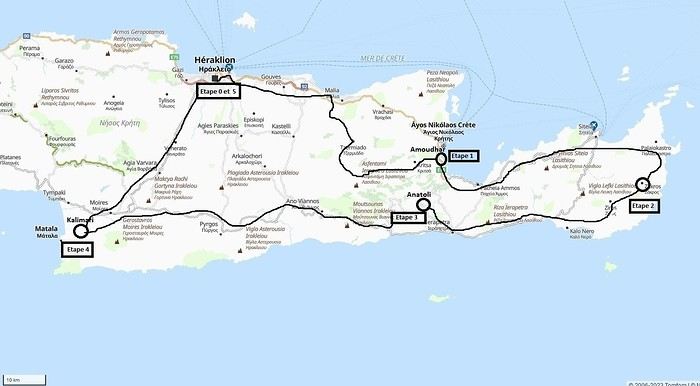 Our 21-day itinerary
Sunday, 08/09: Once again—and this is the eighth time—we’re setting off, the four of us: Patrick, Michelle, Jacques, and Monique, for the Greek islands. This time, we’ve chosen Crete. No need to wake up at 3 or 4 a.m. to reach Basel-Mulhouse Airport at dawn to catch the first flight to Greece at 6 a.m.! Given the prohibitive prices charged by EasyJet, we found flights that were half the price from Zurich Airport, which is accessible in 3 hours by train from Colmar. Pierre-Paul drives all four of us to Colmar train station, where we take the train to Basel and then, 20 minutes later, the direct train to Zurich Airport. After wandering around the airport, we go for a coffee at 6 € each! We’re in Switzerland, after all. The other dining areas all have vending machines for selecting and paying for meals—soon, there won’t be anyone left to serve you! After a short wait, we take off at 7:45 p.m. (20 minutes late) in an Aegean Airbus A321. Free in-flight meal service isn’t bad either! We land in Heraklion around 11:15 p.m. We pick up our rental car (a red Seat Ibiza) at the airport and head straight to our apartment, located 2 km from the city center. Thanks to the GPS, we find it quickly. It’s a beautiful, fully renovated apartment with all the comforts and well-equipped. On the table, there’s wine, bottles of water, jam, coffee, etc. Given the late hour, we won’t stay up long.
Monday, 09/09: To enhance our breakfast, Michelle and Monique set off to find a bakery nearby. They return with croissants and donuts—yum... Then we head to the west coast. The highway follows the coastline, but we prefer taking the old road to Malia, our first stop. We visit the major archaeological site of this Minoan city under the hot sun. The site covers a vast area, but the ruins aren’t very evocative except for a few beautiful amphorae scattered around. The explanations in a small house at the entrance are interesting and help us better understand the organization of the ancient city with its different districts. From there, we head toward the nearby mountains to see the thousand-year-old plane tree in the village of Krasi. We take the opportunity to enjoy an excellent lunch of moussaka and delicious gemista at the Krassopsychia taverna in the village center. Pleasant surprise: the prices are still reasonable, with a bill of 70 € for four, including wine and water. The friendly tradition of complimentary dessert and glasses of raki continues—great! We’ve set the bar high right away! Let’s hope the rest lives up to it! On the way back toward the Lassithi Plateau, we stop at the Kardiotisa Monastery perched high on the mountain to enjoy a magnificent view of the entire region. Just a little further, we arrive at the Lassithi Plateau: the presence of small windmills used to pump water from the ground is the typical feature of this plateau. We complete a full loop around the plateau, passing by numerous orchards and vegetable gardens that occupy the entire space. At the end of the plateau, we once again cross mountain passes via winding roads that bring us near Agios Nikolaos. Our apartment is located about ten kilometers further south in Amoudhara. The owner, who was notified, waits for us and shows us her superb apartment, whose large terrace overlooks the entire Mirabello Bay. She then gives us valuable information about the different beaches in the area. Dinner will be frugal, given our hearty lunch in Krasi!
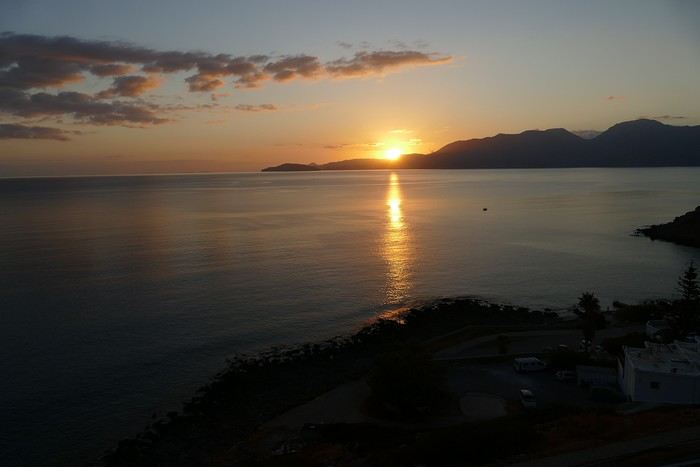 Sunset over Mirabello Bay
Tuesday, 10/09: A bit of a gray sky when we wake up around 8 a.m., but the sun will soon triumph over the scattered clouds. For our first swim, we opt for Voulisma Beach, even though our host warned us it was a bit “crowdy.” That’s understandable given the beautiful emerald color of the sea and the lovely curve of the beach. To avoid the big crowds, we move toward the eastern part of the beach, accessible via a steep staircase. The water is very warm, and this first dip is very pleasant. Before returning to the apartment, we stop at the bakery to buy spinach pies, essential ingredients to accompany our Greek salad for lunch. Of course, everything will be washed down with ouzo, which will remain our favorite drink for the next three weeks—but in moderation!!! A nap is in order after all that effort. In the late afternoon, we drive to Agios Nikolaos, the main seaside resort in Crete. We’re not too enthusiastic about visiting this mass-tourism resort, but the center of Agios, concentrated around the small inner harbor, is pleasant to see despite the plethora of shops and restaurants. We dine a little outside the harbor in the shaded courtyard of the Avli taverna: the oven-baked lamb, squid with spinach, and cuttlefish ink orzo pasta are all highly appreciated. We still stay under a 75 € bill for four.
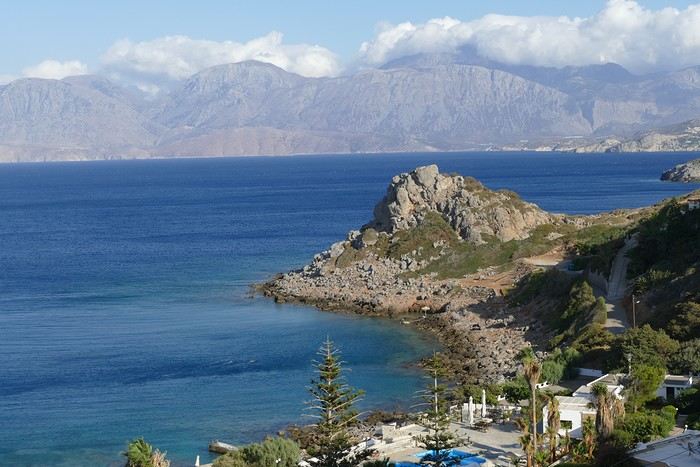 Mirabello Bay seen from our terrace
Wednesday, 11/09: At 8 a.m., the terrace is already bathed in sunlight, and it’s already quite hot. The small parasol barely gives us enough shade, but we’re not complaining! For our second swim, we head to a tiny beach recommended by our host, just 3 minutes by car from our place. The path leading to it is very discreet, and we don’t find it right away! It’s a small sandy cove with a few welcome tamarisk trees for shade. When we arrive, there are two swimmers, and there won’t be more than five or six in the morning. After lunch and a nap, we head to the beautiful village of Kritsa, just a few kilometers away. It’s too late to visit the beautiful church of Kera Panagia, which is already closed. We settle for the exterior, which is worth a look. The weather is clouding over, and big clouds are gathering. Upon arriving in Kritsa, a heavy shower forces us to take shelter in the Platanos taverna in the village center, and since it’s nearly 7 p.m., we decide to stay and dine there. Good choice—excellent meze: croquettes and stuffed zucchini flowers, gigantes beans, grilled tomatoes and feta, and pancetta as the main dish. The rain stops just as we decide to head back.
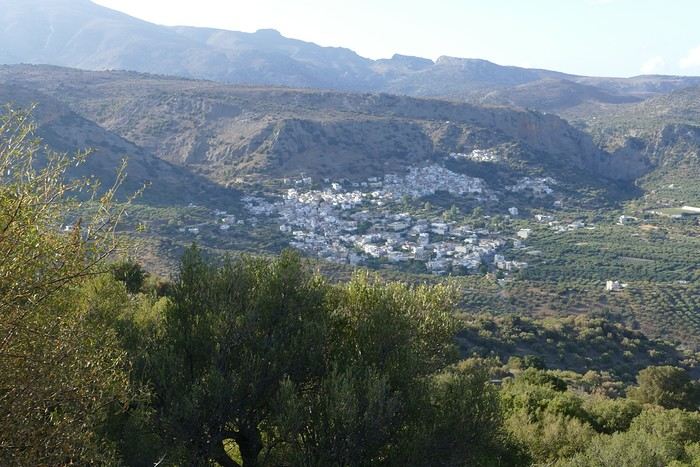 Village of Kritsa
Thursday, 12/09: Our terrace faces east, so we get to watch the sunrise around 7 a.m.—it’s truly a beautiful sight we never tire of. Around 9 a.m., we head to the village of Plaka, where boats depart for the island of Spinalonga, located north of Agios Nikolaos. We board the first boat, which sets sail at 10 a.m., and we’re not alone—the boat is practically full. After 10 minutes, we land on the island at the same time as several other boats from Elounda or Agios. Needless to say, there are already quite a few people walking through the streets of the leper village. The visit remains interesting and moving as we read the explanatory panels recounting the island’s history under Byzantine and then Turkish rule, followed by its transformation into a leper colony. As soon as we climb toward the top of the island via more or less maintained paths, there’s almost no one left. The 360° view from up there is stunning.
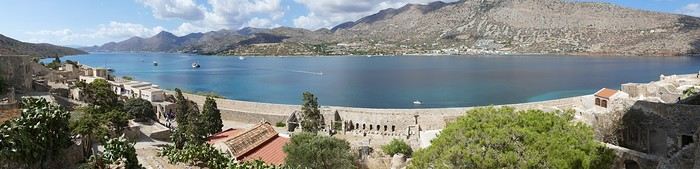
Spinalonga Island
The heat is now unbearable, and we can’t wait to get back home to have lunch on our terrace and rest. In the late afternoon, we go grocery shopping at the AB supermarket at the entrance of Agios. We had spotted another nice restaurant in our guide, but unfortunately, there’s a different one at the indicated location that doesn’t inspire us. So, we return to the Avli taverna for another dinner just as good as the first.
Friday, 13/09: We repeat yesterday’s successful program: a swim in our little cove, lunch on the terrace, a nap, and then, in the late afternoon, we discover another nearby village, Kroustas, nestled in the olive groves near Kritsa. Much less touristy than Kritsa, it’s mostly inhabited by locals, especially the elderly who are enjoying the cool air on their chairs—if you can call it cool given the still-high temperatures in the late afternoon! We then return to visit Kritsa, which we hadn’t been able to explore due to the rain. Dinner at a taverna in the village center at a very reasonable price.
Saturday, 14/09: Today, we move to our new base further east. We start with a high viewpoint at the Faneromeni Monastery, which overlooks Mirabello Bay. The monastery itself is of little interest as it’s under renovation with excessive concrete work. We continue to the village of Kavoussi to see another exceptional tree after a few kilometers on a dusty, bumpy track. It’s an olive tree said to be about 3,200 years old—impressive, and the countryside is very beautiful. It’s time to find a place for lunch. We find one in the charming little port of Mohlos, where a few tavernas surround a very nice small beach. Our choice falls on the Bogazzi taverna, where we enjoy fried fish. To reach our new base in Zakros, we still have to drive through the mountains before reaching Sitia, Paleokastro, and finally Zakros. The region is beautiful, with olive groves and rows of wind turbines taking advantage of the strong wind near the northern tip of the island. In Zakros, we’re greeted by our very friendly host. Here too, we have all the comforts and a beautiful terrace overlooking the village. The apartment has reversible air conditioners, but the overly simple instructions leave us puzzled. Thinking we’ve set it correctly, we realize a little too late that it’s blowing hot air over 30°C! After numerous attempts and testing several confusing programs, we finally succeed! Dinner on our new terrace.
Sunday, 15/09: This morning, we get up early to hike in the “Gorge of the Dead” while it’s still cool. The sky is blue as usual! We park in the nearest parking lot and start our descent via a beautiful path winding through the olive groves. A little further on, the landscape opens up, and the path, now a stony trail, begins the descent to the dry riverbed. On either side of the riverbed rise beautiful reddish cliffs.
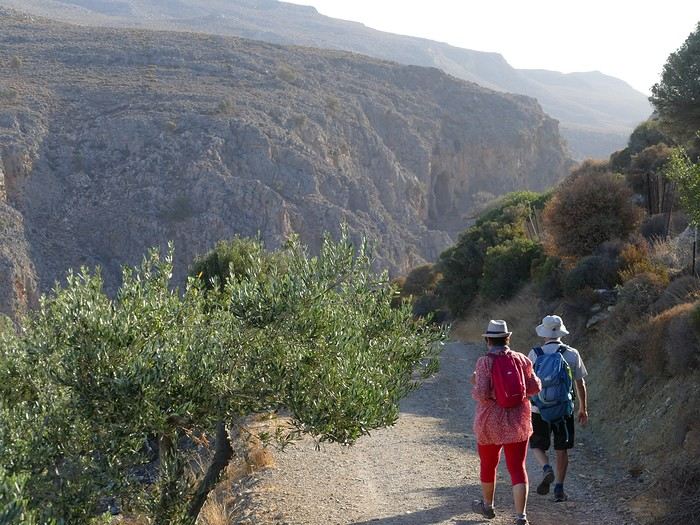
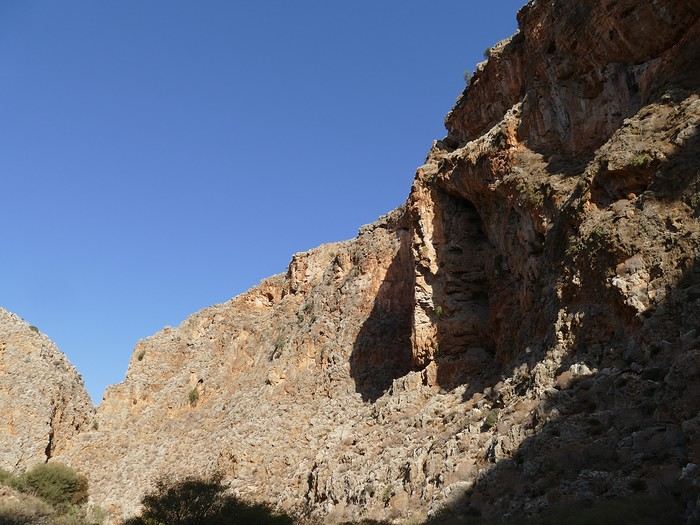
Gorge of the Dead
The trail winds its way through this narrow gorge with difficulty. It was in the many caves visible halfway up the slope that the Minoans buried their dead, hence the name “Gorge of the Dead.” The gorge opens onto a beautiful small pebble beach. A swim is welcome after this hike that made us sweat. The hike took us 1 hour and 25 minutes, and a little less on the way back. Meanwhile, Monique did some shopping and prepared an excellent lunch. In the late afternoon, we go down to dine at Platanakis, a taverna in the small village of Kato Zakros.
Monday, 16/09: This morning, we explore the northern part of the east coast near Palekastro. We start with a dip at the beautiful Hionia Beach near Palekastro. The water is still just as nice, but a light breeze is blowing—not enough to spoil our fun! Seeing all the wind turbines lining the ridges, it’s no surprise.
 Grocery shopping in Palekastro and return to Zakros. A little rain in the late afternoon and an excellent dinner at Iannis Mitsakakis’ Taverna in Adravastis. These are the kind of small tavernas we love—unpretentious, a few tables on a terrace, a warm welcome, a short menu guaranteeing freshness, tasty dishes prepared by the server’s mom, and a light bill. What more could you ask for!
Tuesday, 17/09: We head back toward Palekastro to do some shopping, but it’s also the road to the Toplou Monastery. There, we see a collection of magnificent icons dating from the 15th to the 20th century. We can also admire drawings of Orthodox religious architecture. We continue toward the Mavros Akrotiri headland to enjoy the view of the sea and rocky capes. On the way back to our place, we make a small detour to see the famous Vai palm grove. Meh... As for Vai Beach, it’s filled with paid umbrellas and sunbeds, and there are so many people that we flee. Plus, having to pay for parking is another reason to snub this trendy beach. We prefer our Hionia Beach, which we already appreciated the other day. In the late afternoon, Pat and I start the trail that begins at Kato Zakros Beach heading south. The poorly marked path crosses a plateau of sharp limestone. The paint and cairn markings are no longer very visible, and with dusk approaching, we turn back toward Kato Zakros. Dinner at the Platanakis taverna—less good than last time.
Wednesday, 18/09: To avoid the scorching sun, Pat, Mimi, and I get up earlier than usual to hike the Hohlakies Gorge. At this early hour, the sky is quite cloudy, and it’s drizzling. When we arrive in the village of Hohlakies, we park in front of a small chapel, the start of the hike. The sky is now completely clear. The trail starts among the olive groves, then after passing through a gate, we descend into the gorge filled with large rocks. We’re alone in the world, and the landscape is magnificent. A few wild goats clinging to the cliff watch us from above. After 1 hour and 15 minutes, we emerge onto the wonderful Karoumès Beach. A pleasant swim, then back to civilization! A walk in the late afternoon in Zakros to discover the beautiful springs route. Dinner in Adravastis.
Thursday, 19/09: Another move: Before heading to our next stop, we make a detour to see the beautiful Keratokampos Beach and can’t resist a swim in the still-warm, clear water. We continue our journey via Ziros, then reach the south coast and have lunch at the Stephi taverna in Ferma—excellent meal! The south coast is quite urbanized and has much less charm than the east coast we’ve just left! The numerous plastic greenhouses are partly to blame. We stop for groceries in Ierapetra. Around 3 p.m., we arrive at our destination in the small perched village of Anatoli. Our lodging is at the top of the village, and from the path leading to it, we have a magnificent view of the coastal plain, unfortunately overloaded with plastic greenhouses. It reminds us of the landscapes of El Ejido in Andalusia.
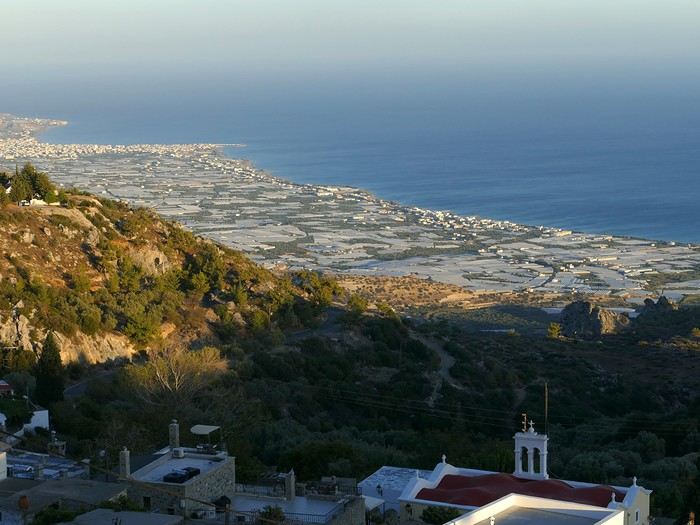 View of the Ierapetra coast from Anatoli
Friday, 20/09: A walk and discovery of the hamlet of Anatoli. There are few services—a tiny grocery store, a taverna, and that’s it. Fortunately, the traveling baker arrives and honks. We take the opportunity to buy fresh bread. Leaving the village, we take a path that should lead us to the hamlet of Drygies. The landscape is beautiful. We walk through a lovely pine forest before arriving at the hamlet. The path continues to a taverna that’s closed today, with a superb terrace overlooking the coast. Luckily, the owner arrives and informs us that the taverna will be open next Sunday and that we can enjoy barbecued meat. Noted! We head back to Anatoli via the small paved road with, fortunately, very limited traffic. Lunch on our terrace, then a dip in our private pool! The water is noticeably cooler than at the beach. Dinner at the village taverna: there’s only one menu—meze starters, souvlaki, water, wine, and bread—all for 35 €! We think we’re dreaming—was there a mistake? No.
Saturday, 21/09: We discover the beach of the village of Myrtos, a small seaside resort that’s quite touristy but on a human scale. We swim in the western part of the beach, and once again, we’re alone in the water. The best part: warm water and tamarisk trees for welcome shade. There’s even a shower to rinse off! In the late afternoon, Pat and I decide to go for a hike in the Selakano pine forest. To get there, we take a narrow, winding, and poorly paved road after the village of Christos. Plus, at this altitude, we encounter clouds clinging to the mountain, so it’s drizzling, and visibility is reduced. We decide to turn back and return to Anatoli. As compensation, we take the path that passes in front of the lodging and leads us to the Timios Stavros chapel, which crowns the summit of the nearby mountain. We arrive at the summit just in time for the sunset at 7 p.m. Breathtaking 360° panorama and magnificent colors!
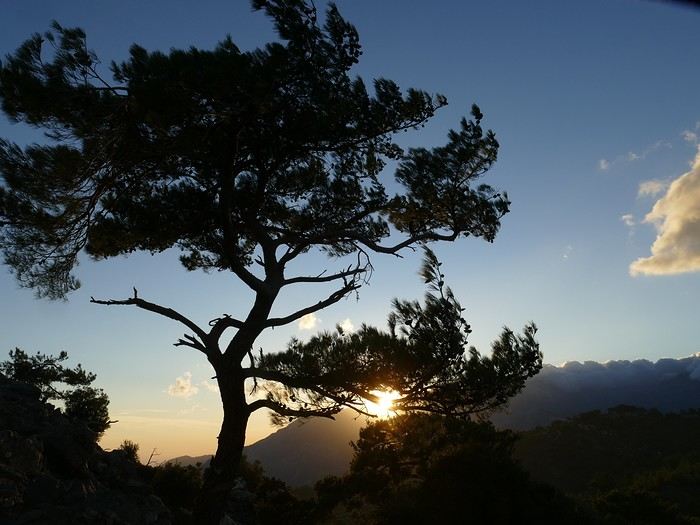 Sunset from Anatoli
Sunday, 22/09: This morning, Pat, Mimi, and I go for a hike in the Sarakina Gorge, located about 12 km from Anatoli via a beautiful road winding through irrigated olive groves. We park in the small parking lot before the trail. At the start, the path follows a levada (small irrigation canal) and quickly enters a very narrow gorge flanked by high cliffs. The riverbed is cluttered with huge rocks blocking the passage. No matter—in the technical sections, ropes or ladders allow us to overcome these obstacles with a bit of skill. You can imagine how quickly the riverbed must rise during a storm, given the narrowness of the gorge!
We progress slowly through this magnificent and impressive rocky chaos. At the exit of the gorge, we take another return path that partly follows the paved road. Back in Anatoli, we go to lunch at the Drygies taverna. We sit at the edge of the terrace under a huge tree that covers almost the entire terrace and order grilled lamb dishes prepared according to the ancient “antikristo” method.
Monday, 23/09: Departure for our last stop before Heraklion. We thought about swimming at Tertsa Beach, but it turns out to be less pleasant than expected, with pebbles and an uneven rocky plateau. So, we return to Myrtos Beach, which we know well and suits us perfectly. We head west, leaving the coast a bit. Around 3:30 p.m., we arrive at our destination in the village of Kamilari, near the famous Matala spot. We’ve rented a beautiful, modern, well-equipped apartment with a lovely shaded terrace. The owner is very friendly and explains everything necessary for a good stay. We explore the quite touristy village with its few tavernas, all full of tourists, mostly Germans.
Tuesday, 24/09: Visit to the village of Sivas, well restored thanks to the Germans, who have invested a lot here. We take the opportunity to scout out “friendly” tavernas, then go for a swim at Kalamaki Beach. Apart from a small sandy access, you have to enter the water via a chaotic limestone plateau—proof of this is that Monique trips slightly when entering the water. A group of very unfriendly German women blocks the sandy passage and doesn’t hesitate to push swimmers they deem too close. Back home, lunch, and a nap. In the late afternoon, we drive to visit the nearby Phaistos site. We benefit from very beautiful lighting. From the elevated site, we overlook the Messara Plain with a beautiful view of the olive grove checkerboards highlighted by the late afternoon sun. The site itself is quite vast, but to appreciate it, it’s better to read the explanatory panels placed throughout the different quarters. At this hour, the site is almost empty, and the beautiful light adds charm to the visit.
Wednesday, 25/09: Departure for the village of Matala, which doesn’t interest us in itself, having been there during the “hippie” era in 1976. However, going to Red Beach, only accessible by taking a path overlooking this area, appeals to us much more. We park in the large parking lot just outside the village and start our climb, which brings us to a pass from where we can admire this beautiful red-sand beach framed by beautiful cliffs plunging into the sea. The weather is magnificent, and at this early hour, there aren’t many people yet. We swim in the free part located near the cliff on the right when arriving at the beach. The sea is like glass, warm, and without a single ripple—a real treat! After half an hour, we turn back, and now there are many people rushing on this path, not at all made for feet in sandals or flip-flops, yet many vacationers venture out like this! Matala lives up to its image—a trendy place, full of shops, bars, and restaurants. You could be in any seaside resort with a standard global urbanism, lacking particular charm. Back home. In the late afternoon, a walk through the olive groves surrounding Kamilari, then dinner at Evangelina’s, who runs the Minoan Parassies taverna in the middle of the olive groves. Evangelina is quite a character: we came to reserve a table for 8 p.m. when it was only 7 p.m., but since we lingered near her restaurant, she prepares a table for us and urges us to sit down! And there she takes our order, and a little later, the meze arrive, followed by the main dishes. We finish this good dinner with several generous glasses of raki, accompanied by Evangelina’s encouragements, repeating “poya poya bravo bravo” in a loop. We’re in great shape too, by the way! We return in the middle of the night, on foot, fortunately, with the path vaguely lit by our phones...
Thursday, 26/09: This morning, we discover a new beach, Kommos Beach, not far from Kamilari either. It’s a long sandy beach, a small part of which is dedicated to paid umbrellas and sunbeds, and the rest is free. We spot a tamarisk tree to take shelter from the still-hot sun, and once again, we enjoy clear, warm water. The few swimmers spread out easily over nearly 500 meters of beach. In the late afternoon, Pat and I go to admire the sunset from the hill near our lodging. The hill, covered with olive trees, is threatened by a planned housing development of large cubic villas—trends dictate. Concrete never stops...
Friday, 27/09: We thought about leaving the car at the Odiyitria Monastery, the end of the paved road, but since the track descending to the cave remains drivable, we park 3 km further at the junction of the track leading to Kali Limenes Beach. We still have to walk for half an hour on a less drivable track, and then we’re at the entrance of the Farango Gorge. It’s a beautiful, easy hike since we follow the dry pebble riverbed. Before arriving at the beach, there’s a very beautiful small chapel sheltered under a large cliff, beautifully lit at this early hour.
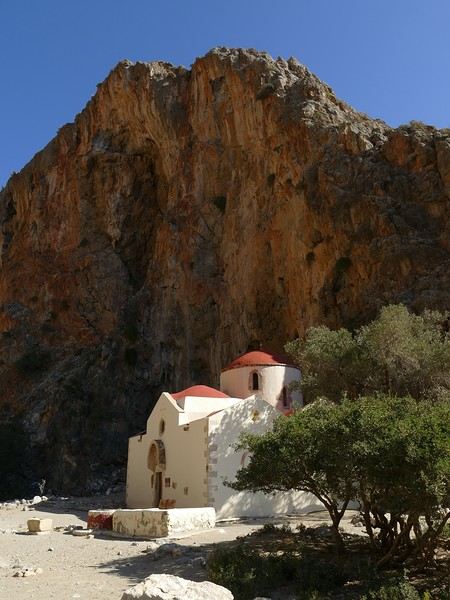
Agio Farango Chapel
A few climbers are scaling the cliff, and about ten swimmers are enjoying the sea. Return to the car under the hot sun. In the late afternoon, we all return to visit the interesting Odiyitria Monastery. Last swim at Kommos Beach and an excellent dinner at the Sigelakis taverna in Sivas.
Saturday, 28/09: There’s an end-of-vacation atmosphere... We pack our bags and head north. A short stop to see the village of Vorri, and a little over an hour later, we arrive in the big city of Heraklion. Since it’s too early to check into the apartment, we park in the city center to visit the famous archaeological museum. It’s indeed a must-see highlight of our stay in Crete. All four of us are amazed by the quantity and quality of the objects presented from the Minoan civilization. After more than 2 hours, we come out without having seen everything, but we’re a bit overwhelmed by all these wonders. Lunch at a nice little taverna very close to the Titus Church. We go to take possession of our apartment—the same as on the way there, still just as satisfying. In the late afternoon, I go alone for a walk in the historic district of the city, passing by the Morosini Fountain, which is bustling with people—some seated at café terraces, others standing and chatting. There’s a lively atmosphere here. A little further on are the Venetian loggia and the Agios Titos Church. I walk down to the old Venetian port to stroll along the jetty and admire the fortifications under beautiful late-afternoon lighting, then return to the apartment. Dinner near our place at Kiriakis, a “chic” restaurant but with very reasonable prices and excellent cuisine.
Sunday, 29/09: Wake-up at 3:30 a.m., quick coffee, and drive to the nearby airport. We leave the car in the parking lot. Already a lot of people at this early hour. Since we don’t have checked luggage, we go straight to security, which goes fairly quickly, then it’s waiting time and takeoff on time in an Airbus A321 for a 45-minute flight to Athens. We take off again in another Airbus A321 with a 50-minute delay to arrive in Zurich at 11:10 a.m. local time. Then we have to take the train to Basel and then the one to Colmar. With fewer Sunday services, we won’t arrive in Colmar until around 4 p.m.
Conclusion All four of us returned very satisfied with this stay in Crete for several reasons: - We found superb beaches with clear, warm water and often very few vacationers. - The few hikes we did were magnificent, especially those where the trails went through gorges leading to deserted beaches. - We greatly appreciated Cretan gastronomy—there were so few disappointments that we can count them on one hand. - All the accommodations we booked turned out to be superb, with the icing on the cake being the very friendly welcome from our hosts. - Generally, contacts with Cretans were always very warm despite the language barrier—we speak a little Greek. - We also appreciated the diversity of landscapes in this eastern part of Crete, with plateaus and mountains with splendid rugged reliefs.
Note: The photo album is available by clicking on this link: https://photos.app.goo.gl/hfdjQndA5eXkL5k7 Captions are only visible per photo by clicking on the circled “i” in the top right. Budget: approximately 3,300 € per couple for 21 days, including train and flights Budget details per couple: - Flight Zurich-Heraklion: 440 € - Trains Colmar-Basel-Zurich round trip for 4: 442.40 € (221 € per couple) - Accommodation: 2,431 € / 21 = 115.80 € per night for 4 (1,216 € per couple) - Car rental for 21 days: 684 € + 145 € fuel (1,150 km) (414 € per couple) - Restaurants, food, etc.: 1,009 €
Our 21-day itinerarySunday, 08/09: Once again—and this is the eighth time—we’re setting off, the four of us: Patrick, Michelle, Jacques, and Monique, for the Greek islands. This time, we’ve chosen Crete. No need to wake up at 3 or 4 a.m. to reach Basel-Mulhouse Airport at dawn to catch the first flight to Greece at 6 a.m.! Given the prohibitive prices charged by EasyJet, we found flights that were half the price from Zurich Airport, which is accessible in 3 hours by train from Colmar. Pierre-Paul drives all four of us to Colmar train station, where we take the train to Basel and then, 20 minutes later, the direct train to Zurich Airport. After wandering around the airport, we go for a coffee at 6 € each! We’re in Switzerland, after all. The other dining areas all have vending machines for selecting and paying for meals—soon, there won’t be anyone left to serve you! After a short wait, we take off at 7:45 p.m. (20 minutes late) in an Aegean Airbus A321. Free in-flight meal service isn’t bad either! We land in Heraklion around 11:15 p.m. We pick up our rental car (a red Seat Ibiza) at the airport and head straight to our apartment, located 2 km from the city center. Thanks to the GPS, we find it quickly. It’s a beautiful, fully renovated apartment with all the comforts and well-equipped. On the table, there’s wine, bottles of water, jam, coffee, etc. Given the late hour, we won’t stay up long.
Monday, 09/09: To enhance our breakfast, Michelle and Monique set off to find a bakery nearby. They return with croissants and donuts—yum... Then we head to the west coast. The highway follows the coastline, but we prefer taking the old road to Malia, our first stop. We visit the major archaeological site of this Minoan city under the hot sun. The site covers a vast area, but the ruins aren’t very evocative except for a few beautiful amphorae scattered around. The explanations in a small house at the entrance are interesting and help us better understand the organization of the ancient city with its different districts. From there, we head toward the nearby mountains to see the thousand-year-old plane tree in the village of Krasi. We take the opportunity to enjoy an excellent lunch of moussaka and delicious gemista at the Krassopsychia taverna in the village center. Pleasant surprise: the prices are still reasonable, with a bill of 70 € for four, including wine and water. The friendly tradition of complimentary dessert and glasses of raki continues—great! We’ve set the bar high right away! Let’s hope the rest lives up to it! On the way back toward the Lassithi Plateau, we stop at the Kardiotisa Monastery perched high on the mountain to enjoy a magnificent view of the entire region. Just a little further, we arrive at the Lassithi Plateau: the presence of small windmills used to pump water from the ground is the typical feature of this plateau. We complete a full loop around the plateau, passing by numerous orchards and vegetable gardens that occupy the entire space. At the end of the plateau, we once again cross mountain passes via winding roads that bring us near Agios Nikolaos. Our apartment is located about ten kilometers further south in Amoudhara. The owner, who was notified, waits for us and shows us her superb apartment, whose large terrace overlooks the entire Mirabello Bay. She then gives us valuable information about the different beaches in the area. Dinner will be frugal, given our hearty lunch in Krasi!
Sunset over Mirabello BayTuesday, 10/09: A bit of a gray sky when we wake up around 8 a.m., but the sun will soon triumph over the scattered clouds. For our first swim, we opt for Voulisma Beach, even though our host warned us it was a bit “crowdy.” That’s understandable given the beautiful emerald color of the sea and the lovely curve of the beach. To avoid the big crowds, we move toward the eastern part of the beach, accessible via a steep staircase. The water is very warm, and this first dip is very pleasant. Before returning to the apartment, we stop at the bakery to buy spinach pies, essential ingredients to accompany our Greek salad for lunch. Of course, everything will be washed down with ouzo, which will remain our favorite drink for the next three weeks—but in moderation!!! A nap is in order after all that effort. In the late afternoon, we drive to Agios Nikolaos, the main seaside resort in Crete. We’re not too enthusiastic about visiting this mass-tourism resort, but the center of Agios, concentrated around the small inner harbor, is pleasant to see despite the plethora of shops and restaurants. We dine a little outside the harbor in the shaded courtyard of the Avli taverna: the oven-baked lamb, squid with spinach, and cuttlefish ink orzo pasta are all highly appreciated. We still stay under a 75 € bill for four.
Mirabello Bay seen from our terraceWednesday, 11/09: At 8 a.m., the terrace is already bathed in sunlight, and it’s already quite hot. The small parasol barely gives us enough shade, but we’re not complaining! For our second swim, we head to a tiny beach recommended by our host, just 3 minutes by car from our place. The path leading to it is very discreet, and we don’t find it right away! It’s a small sandy cove with a few welcome tamarisk trees for shade. When we arrive, there are two swimmers, and there won’t be more than five or six in the morning. After lunch and a nap, we head to the beautiful village of Kritsa, just a few kilometers away. It’s too late to visit the beautiful church of Kera Panagia, which is already closed. We settle for the exterior, which is worth a look. The weather is clouding over, and big clouds are gathering. Upon arriving in Kritsa, a heavy shower forces us to take shelter in the Platanos taverna in the village center, and since it’s nearly 7 p.m., we decide to stay and dine there. Good choice—excellent meze: croquettes and stuffed zucchini flowers, gigantes beans, grilled tomatoes and feta, and pancetta as the main dish. The rain stops just as we decide to head back.
Village of KritsaThursday, 12/09: Our terrace faces east, so we get to watch the sunrise around 7 a.m.—it’s truly a beautiful sight we never tire of. Around 9 a.m., we head to the village of Plaka, where boats depart for the island of Spinalonga, located north of Agios Nikolaos. We board the first boat, which sets sail at 10 a.m., and we’re not alone—the boat is practically full. After 10 minutes, we land on the island at the same time as several other boats from Elounda or Agios. Needless to say, there are already quite a few people walking through the streets of the leper village. The visit remains interesting and moving as we read the explanatory panels recounting the island’s history under Byzantine and then Turkish rule, followed by its transformation into a leper colony. As soon as we climb toward the top of the island via more or less maintained paths, there’s almost no one left. The 360° view from up there is stunning.
Spinalonga Island
The heat is now unbearable, and we can’t wait to get back home to have lunch on our terrace and rest. In the late afternoon, we go grocery shopping at the AB supermarket at the entrance of Agios. We had spotted another nice restaurant in our guide, but unfortunately, there’s a different one at the indicated location that doesn’t inspire us. So, we return to the Avli taverna for another dinner just as good as the first.
Friday, 13/09: We repeat yesterday’s successful program: a swim in our little cove, lunch on the terrace, a nap, and then, in the late afternoon, we discover another nearby village, Kroustas, nestled in the olive groves near Kritsa. Much less touristy than Kritsa, it’s mostly inhabited by locals, especially the elderly who are enjoying the cool air on their chairs—if you can call it cool given the still-high temperatures in the late afternoon! We then return to visit Kritsa, which we hadn’t been able to explore due to the rain. Dinner at a taverna in the village center at a very reasonable price.
Saturday, 14/09: Today, we move to our new base further east. We start with a high viewpoint at the Faneromeni Monastery, which overlooks Mirabello Bay. The monastery itself is of little interest as it’s under renovation with excessive concrete work. We continue to the village of Kavoussi to see another exceptional tree after a few kilometers on a dusty, bumpy track. It’s an olive tree said to be about 3,200 years old—impressive, and the countryside is very beautiful. It’s time to find a place for lunch. We find one in the charming little port of Mohlos, where a few tavernas surround a very nice small beach. Our choice falls on the Bogazzi taverna, where we enjoy fried fish. To reach our new base in Zakros, we still have to drive through the mountains before reaching Sitia, Paleokastro, and finally Zakros. The region is beautiful, with olive groves and rows of wind turbines taking advantage of the strong wind near the northern tip of the island. In Zakros, we’re greeted by our very friendly host. Here too, we have all the comforts and a beautiful terrace overlooking the village. The apartment has reversible air conditioners, but the overly simple instructions leave us puzzled. Thinking we’ve set it correctly, we realize a little too late that it’s blowing hot air over 30°C! After numerous attempts and testing several confusing programs, we finally succeed! Dinner on our new terrace.
Sunday, 15/09: This morning, we get up early to hike in the “Gorge of the Dead” while it’s still cool. The sky is blue as usual! We park in the nearest parking lot and start our descent via a beautiful path winding through the olive groves. A little further on, the landscape opens up, and the path, now a stony trail, begins the descent to the dry riverbed. On either side of the riverbed rise beautiful reddish cliffs.
Gorge of the Dead
The trail winds its way through this narrow gorge with difficulty. It was in the many caves visible halfway up the slope that the Minoans buried their dead, hence the name “Gorge of the Dead.” The gorge opens onto a beautiful small pebble beach. A swim is welcome after this hike that made us sweat. The hike took us 1 hour and 25 minutes, and a little less on the way back. Meanwhile, Monique did some shopping and prepared an excellent lunch. In the late afternoon, we go down to dine at Platanakis, a taverna in the small village of Kato Zakros.
Monday, 16/09: This morning, we explore the northern part of the east coast near Palekastro. We start with a dip at the beautiful Hionia Beach near Palekastro. The water is still just as nice, but a light breeze is blowing—not enough to spoil our fun! Seeing all the wind turbines lining the ridges, it’s no surprise.
Grocery shopping in Palekastro and return to Zakros. A little rain in the late afternoon and an excellent dinner at Iannis Mitsakakis’ Taverna in Adravastis. These are the kind of small tavernas we love—unpretentious, a few tables on a terrace, a warm welcome, a short menu guaranteeing freshness, tasty dishes prepared by the server’s mom, and a light bill. What more could you ask for!Tuesday, 17/09: We head back toward Palekastro to do some shopping, but it’s also the road to the Toplou Monastery. There, we see a collection of magnificent icons dating from the 15th to the 20th century. We can also admire drawings of Orthodox religious architecture. We continue toward the Mavros Akrotiri headland to enjoy the view of the sea and rocky capes. On the way back to our place, we make a small detour to see the famous Vai palm grove. Meh... As for Vai Beach, it’s filled with paid umbrellas and sunbeds, and there are so many people that we flee. Plus, having to pay for parking is another reason to snub this trendy beach. We prefer our Hionia Beach, which we already appreciated the other day. In the late afternoon, Pat and I start the trail that begins at Kato Zakros Beach heading south. The poorly marked path crosses a plateau of sharp limestone. The paint and cairn markings are no longer very visible, and with dusk approaching, we turn back toward Kato Zakros. Dinner at the Platanakis taverna—less good than last time.
Wednesday, 18/09: To avoid the scorching sun, Pat, Mimi, and I get up earlier than usual to hike the Hohlakies Gorge. At this early hour, the sky is quite cloudy, and it’s drizzling. When we arrive in the village of Hohlakies, we park in front of a small chapel, the start of the hike. The sky is now completely clear. The trail starts among the olive groves, then after passing through a gate, we descend into the gorge filled with large rocks. We’re alone in the world, and the landscape is magnificent. A few wild goats clinging to the cliff watch us from above. After 1 hour and 15 minutes, we emerge onto the wonderful Karoumès Beach. A pleasant swim, then back to civilization! A walk in the late afternoon in Zakros to discover the beautiful springs route. Dinner in Adravastis.
Thursday, 19/09: Another move: Before heading to our next stop, we make a detour to see the beautiful Keratokampos Beach and can’t resist a swim in the still-warm, clear water. We continue our journey via Ziros, then reach the south coast and have lunch at the Stephi taverna in Ferma—excellent meal! The south coast is quite urbanized and has much less charm than the east coast we’ve just left! The numerous plastic greenhouses are partly to blame. We stop for groceries in Ierapetra. Around 3 p.m., we arrive at our destination in the small perched village of Anatoli. Our lodging is at the top of the village, and from the path leading to it, we have a magnificent view of the coastal plain, unfortunately overloaded with plastic greenhouses. It reminds us of the landscapes of El Ejido in Andalusia.
View of the Ierapetra coast from AnatoliFriday, 20/09: A walk and discovery of the hamlet of Anatoli. There are few services—a tiny grocery store, a taverna, and that’s it. Fortunately, the traveling baker arrives and honks. We take the opportunity to buy fresh bread. Leaving the village, we take a path that should lead us to the hamlet of Drygies. The landscape is beautiful. We walk through a lovely pine forest before arriving at the hamlet. The path continues to a taverna that’s closed today, with a superb terrace overlooking the coast. Luckily, the owner arrives and informs us that the taverna will be open next Sunday and that we can enjoy barbecued meat. Noted! We head back to Anatoli via the small paved road with, fortunately, very limited traffic. Lunch on our terrace, then a dip in our private pool! The water is noticeably cooler than at the beach. Dinner at the village taverna: there’s only one menu—meze starters, souvlaki, water, wine, and bread—all for 35 €! We think we’re dreaming—was there a mistake? No.
Saturday, 21/09: We discover the beach of the village of Myrtos, a small seaside resort that’s quite touristy but on a human scale. We swim in the western part of the beach, and once again, we’re alone in the water. The best part: warm water and tamarisk trees for welcome shade. There’s even a shower to rinse off! In the late afternoon, Pat and I decide to go for a hike in the Selakano pine forest. To get there, we take a narrow, winding, and poorly paved road after the village of Christos. Plus, at this altitude, we encounter clouds clinging to the mountain, so it’s drizzling, and visibility is reduced. We decide to turn back and return to Anatoli. As compensation, we take the path that passes in front of the lodging and leads us to the Timios Stavros chapel, which crowns the summit of the nearby mountain. We arrive at the summit just in time for the sunset at 7 p.m. Breathtaking 360° panorama and magnificent colors!
Sunset from AnatoliSunday, 22/09: This morning, Pat, Mimi, and I go for a hike in the Sarakina Gorge, located about 12 km from Anatoli via a beautiful road winding through irrigated olive groves. We park in the small parking lot before the trail. At the start, the path follows a levada (small irrigation canal) and quickly enters a very narrow gorge flanked by high cliffs. The riverbed is cluttered with huge rocks blocking the passage. No matter—in the technical sections, ropes or ladders allow us to overcome these obstacles with a bit of skill. You can imagine how quickly the riverbed must rise during a storm, given the narrowness of the gorge!
We progress slowly through this magnificent and impressive rocky chaos. At the exit of the gorge, we take another return path that partly follows the paved road. Back in Anatoli, we go to lunch at the Drygies taverna. We sit at the edge of the terrace under a huge tree that covers almost the entire terrace and order grilled lamb dishes prepared according to the ancient “antikristo” method.
Monday, 23/09: Departure for our last stop before Heraklion. We thought about swimming at Tertsa Beach, but it turns out to be less pleasant than expected, with pebbles and an uneven rocky plateau. So, we return to Myrtos Beach, which we know well and suits us perfectly. We head west, leaving the coast a bit. Around 3:30 p.m., we arrive at our destination in the village of Kamilari, near the famous Matala spot. We’ve rented a beautiful, modern, well-equipped apartment with a lovely shaded terrace. The owner is very friendly and explains everything necessary for a good stay. We explore the quite touristy village with its few tavernas, all full of tourists, mostly Germans.
Tuesday, 24/09: Visit to the village of Sivas, well restored thanks to the Germans, who have invested a lot here. We take the opportunity to scout out “friendly” tavernas, then go for a swim at Kalamaki Beach. Apart from a small sandy access, you have to enter the water via a chaotic limestone plateau—proof of this is that Monique trips slightly when entering the water. A group of very unfriendly German women blocks the sandy passage and doesn’t hesitate to push swimmers they deem too close. Back home, lunch, and a nap. In the late afternoon, we drive to visit the nearby Phaistos site. We benefit from very beautiful lighting. From the elevated site, we overlook the Messara Plain with a beautiful view of the olive grove checkerboards highlighted by the late afternoon sun. The site itself is quite vast, but to appreciate it, it’s better to read the explanatory panels placed throughout the different quarters. At this hour, the site is almost empty, and the beautiful light adds charm to the visit.
Wednesday, 25/09: Departure for the village of Matala, which doesn’t interest us in itself, having been there during the “hippie” era in 1976. However, going to Red Beach, only accessible by taking a path overlooking this area, appeals to us much more. We park in the large parking lot just outside the village and start our climb, which brings us to a pass from where we can admire this beautiful red-sand beach framed by beautiful cliffs plunging into the sea. The weather is magnificent, and at this early hour, there aren’t many people yet. We swim in the free part located near the cliff on the right when arriving at the beach. The sea is like glass, warm, and without a single ripple—a real treat! After half an hour, we turn back, and now there are many people rushing on this path, not at all made for feet in sandals or flip-flops, yet many vacationers venture out like this! Matala lives up to its image—a trendy place, full of shops, bars, and restaurants. You could be in any seaside resort with a standard global urbanism, lacking particular charm. Back home. In the late afternoon, a walk through the olive groves surrounding Kamilari, then dinner at Evangelina’s, who runs the Minoan Parassies taverna in the middle of the olive groves. Evangelina is quite a character: we came to reserve a table for 8 p.m. when it was only 7 p.m., but since we lingered near her restaurant, she prepares a table for us and urges us to sit down! And there she takes our order, and a little later, the meze arrive, followed by the main dishes. We finish this good dinner with several generous glasses of raki, accompanied by Evangelina’s encouragements, repeating “poya poya bravo bravo” in a loop. We’re in great shape too, by the way! We return in the middle of the night, on foot, fortunately, with the path vaguely lit by our phones...
Thursday, 26/09: This morning, we discover a new beach, Kommos Beach, not far from Kamilari either. It’s a long sandy beach, a small part of which is dedicated to paid umbrellas and sunbeds, and the rest is free. We spot a tamarisk tree to take shelter from the still-hot sun, and once again, we enjoy clear, warm water. The few swimmers spread out easily over nearly 500 meters of beach. In the late afternoon, Pat and I go to admire the sunset from the hill near our lodging. The hill, covered with olive trees, is threatened by a planned housing development of large cubic villas—trends dictate. Concrete never stops...
Friday, 27/09: We thought about leaving the car at the Odiyitria Monastery, the end of the paved road, but since the track descending to the cave remains drivable, we park 3 km further at the junction of the track leading to Kali Limenes Beach. We still have to walk for half an hour on a less drivable track, and then we’re at the entrance of the Farango Gorge. It’s a beautiful, easy hike since we follow the dry pebble riverbed. Before arriving at the beach, there’s a very beautiful small chapel sheltered under a large cliff, beautifully lit at this early hour.
Agio Farango Chapel
A few climbers are scaling the cliff, and about ten swimmers are enjoying the sea. Return to the car under the hot sun. In the late afternoon, we all return to visit the interesting Odiyitria Monastery. Last swim at Kommos Beach and an excellent dinner at the Sigelakis taverna in Sivas.
Saturday, 28/09: There’s an end-of-vacation atmosphere... We pack our bags and head north. A short stop to see the village of Vorri, and a little over an hour later, we arrive in the big city of Heraklion. Since it’s too early to check into the apartment, we park in the city center to visit the famous archaeological museum. It’s indeed a must-see highlight of our stay in Crete. All four of us are amazed by the quantity and quality of the objects presented from the Minoan civilization. After more than 2 hours, we come out without having seen everything, but we’re a bit overwhelmed by all these wonders. Lunch at a nice little taverna very close to the Titus Church. We go to take possession of our apartment—the same as on the way there, still just as satisfying. In the late afternoon, I go alone for a walk in the historic district of the city, passing by the Morosini Fountain, which is bustling with people—some seated at café terraces, others standing and chatting. There’s a lively atmosphere here. A little further on are the Venetian loggia and the Agios Titos Church. I walk down to the old Venetian port to stroll along the jetty and admire the fortifications under beautiful late-afternoon lighting, then return to the apartment. Dinner near our place at Kiriakis, a “chic” restaurant but with very reasonable prices and excellent cuisine.
Sunday, 29/09: Wake-up at 3:30 a.m., quick coffee, and drive to the nearby airport. We leave the car in the parking lot. Already a lot of people at this early hour. Since we don’t have checked luggage, we go straight to security, which goes fairly quickly, then it’s waiting time and takeoff on time in an Airbus A321 for a 45-minute flight to Athens. We take off again in another Airbus A321 with a 50-minute delay to arrive in Zurich at 11:10 a.m. local time. Then we have to take the train to Basel and then the one to Colmar. With fewer Sunday services, we won’t arrive in Colmar until around 4 p.m.
Conclusion All four of us returned very satisfied with this stay in Crete for several reasons: - We found superb beaches with clear, warm water and often very few vacationers. - The few hikes we did were magnificent, especially those where the trails went through gorges leading to deserted beaches. - We greatly appreciated Cretan gastronomy—there were so few disappointments that we can count them on one hand. - All the accommodations we booked turned out to be superb, with the icing on the cake being the very friendly welcome from our hosts. - Generally, contacts with Cretans were always very warm despite the language barrier—we speak a little Greek. - We also appreciated the diversity of landscapes in this eastern part of Crete, with plateaus and mountains with splendid rugged reliefs.
Note: The photo album is available by clicking on this link: https://photos.app.goo.gl/hfdjQndA5eXkL5k7 Captions are only visible per photo by clicking on the circled “i” in the top right. Budget: approximately 3,300 € per couple for 21 days, including train and flights Budget details per couple: - Flight Zurich-Heraklion: 440 € - Trains Colmar-Basel-Zurich round trip for 4: 442.40 € (221 € per couple) - Accommodation: 2,431 € / 21 = 115.80 € per night for 4 (1,216 € per couple) - Car rental for 21 days: 684 € + 145 € fuel (1,150 km) (414 € per couple) - Restaurants, food, etc.: 1,009 €
The Island of Pelops
October 7, 2023, is a sunny day in Milan. Since morning, in this light, I’m WhatsApping with Afrooz in Tehran, and I decide to call her. A lively, joyful conversation—French with that Farsi accent becomes a wonderful language. Suddenly, everything feels possible. Isfahan, Shiraz, Damavand, Yazd, Yazd, Yazd—a delicious word savored endlessly—become within reach. Iran, so longed for, is finally here. Pure joy, absolute enthusiasm. Six months to plan and relish a trip before living it.
Then I open *Le Monde*.
Aaaaaaaaaaaaaaaaaaaaaaaaaaaaaaaaaaaaaaaaaaaaaaaaaaaaaaaaaaaaaaaaaaaaaaaa
Frozen. Empty. No. We decide to wait, not to give up right away, pretending to believe—just a little, just to keep from collapsing—that with this wretched human race, the worst isn’t necessarily certain. It is.
So... meh, Madeira? The Azores? Uzbekistan (a pale substitute)? New Zealand? Greece. Again, always. Nestling into the only European promise we’ve been given. Indulging in illusions, for the pleasure of it.
So, train from Milan to Ancona (9 AM–12 PM), a typically Marchigiano lunch (Italy is paradise for food lovers), a stroll through the city, then at 4 PM boarding the *Olympic Champion*. Arrival in Patras the next afternoon, car rental, and off to Lepanto—Nafpaktos today—to reminisce about glorious victories and pay tribute to Cervantes, who lost a hand there before writing.
That’s the plan, anyway. The train is unusually on time. The ferry, replaced in the meantime by the *Hellenic Spirit* (why not? Even if it’s less suited to the season), is 3 hours late, then 4, no 5, then finally 6—oh wait, 7. And on top of that, it’s pouring rain in Ancona, and the port waiting room closes at 6 PM. Great...
At 11 PM, the ferry’s lights emerge in the pitch-black night. We jostle through the downpour, board, and sleep well in a cozy cabin with the white noise of the engines. Then:
 23 hours of rest. Of forgetting.
Then I open *Le Monde*.
Aaaaaaaaaaaaaaaaaaaaaaaaaaaaaaaaaaaaaaaaaaaaaaaaaaaaaaaaaaaaaaaaaaaaaaaa
Frozen. Empty. No. We decide to wait, not to give up right away, pretending to believe—just a little, just to keep from collapsing—that with this wretched human race, the worst isn’t necessarily certain. It is.
So... meh, Madeira? The Azores? Uzbekistan (a pale substitute)? New Zealand? Greece. Again, always. Nestling into the only European promise we’ve been given. Indulging in illusions, for the pleasure of it.
So, train from Milan to Ancona (9 AM–12 PM), a typically Marchigiano lunch (Italy is paradise for food lovers), a stroll through the city, then at 4 PM boarding the *Olympic Champion*. Arrival in Patras the next afternoon, car rental, and off to Lepanto—Nafpaktos today—to reminisce about glorious victories and pay tribute to Cervantes, who lost a hand there before writing.
That’s the plan, anyway. The train is unusually on time. The ferry, replaced in the meantime by the *Hellenic Spirit* (why not? Even if it’s less suited to the season), is 3 hours late, then 4, no 5, then finally 6—oh wait, 7. And on top of that, it’s pouring rain in Ancona, and the port waiting room closes at 6 PM. Great...
At 11 PM, the ferry’s lights emerge in the pitch-black night. We jostle through the downpour, board, and sleep well in a cozy cabin with the white noise of the engines. Then:
23 hours of rest. Of forgetting.
Itinéraire par la route et les villes au Pays Basque espagnol English translation pending
Bonjour,
En raison du Covid, j'ai dû laisser tomber mes projets voyages en Afrique et je me rabats donc (avec envie tout de même) sur le Pays Basque espagnol pour une petite semaine en novembre. Pour des raisons professionnelles le départ se ferait en voiture de Bordeaux et j'ai imaginé le circuit suivant, si les conditions sanitaires d'ici là le permettent ...
Jour 1 : Départ de Bordeaux pour San Sebastian en voiture, arrivée en début d'après-midi et visite de la ville
Jour 2 : Visite des environs de San Sebastian, avec deux options qui me font hésiter : - visiter l'est entre San Sebastian et la frontière française (Fontarrabie etc.) et revenir dormir sur San Sebastian - visiter l'ouest (Getaria, Zarautz, Orio) et dormir dans ce secteur
Jour 3 : Route vers Bilbao en passant par la côte avec un arrêt vers midi à Gernika et dans l'après midi la visite de San Gaztelugatxe par la route B2235 (a priori non accessible en novembre, y a t'il un intérêt à voir l'endroit ''de loin''?). Nuit à Bilbao avec retour par la route 3101.
Jour 4 : Visite de la biosphère d'Urdaibai dans l'après midi avec une visite de Bilbao dans la matinée.
Jour 5 : Route vers Pampelune en passant plus bas par l'Alava (un autre itinéraire serait-il plus sympa ? Des arrêts à conseiller sur la route ? ). Vaut-il mieux ''tracer'' la veille au soir vers Pampelune pour avoir une journée de plus dans ce secteur ?)
Jour 6 : Visite des Bardenas Reales par l'entrée nord avec un arrêt à Olite. Nuit à Pampelune (ou à Tudela?)
Jour 7 : Ce jour devrait nous permettre de remonter plus au nord, voire en France, pour une dernière halte avant le retour à Bordeaux. Petite hésitation entre passer par une vallée des Pyrénées genre Roncevaux (fin novembre) ou revenir sur la côte et s'arrêter vers Biarritz (peut être répétitif par rapport au reste du voyage ?)
Jour 8 : Route pour Bordeaux où nous devons arriver pour midi !
Voilà en gros ce que mes recherches ont donné avec beaucoup de ''trous''... Je suis ouverte à toutes les suggestions surtout pour les parties un peu floues de mon itinéraire... L'idée n'est pas d'avoir des vacances reposantes. Au niveau voyage, j'aime visiter par la ''route'', les villes sont plutôt pour moi à visiter en soirée autour d'un bon repas sans m'attarder dans les musées etc !
Merci pour votre aide,
Anna
En raison du Covid, j'ai dû laisser tomber mes projets voyages en Afrique et je me rabats donc (avec envie tout de même) sur le Pays Basque espagnol pour une petite semaine en novembre. Pour des raisons professionnelles le départ se ferait en voiture de Bordeaux et j'ai imaginé le circuit suivant, si les conditions sanitaires d'ici là le permettent ...
Jour 1 : Départ de Bordeaux pour San Sebastian en voiture, arrivée en début d'après-midi et visite de la ville
Jour 2 : Visite des environs de San Sebastian, avec deux options qui me font hésiter : - visiter l'est entre San Sebastian et la frontière française (Fontarrabie etc.) et revenir dormir sur San Sebastian - visiter l'ouest (Getaria, Zarautz, Orio) et dormir dans ce secteur
Jour 3 : Route vers Bilbao en passant par la côte avec un arrêt vers midi à Gernika et dans l'après midi la visite de San Gaztelugatxe par la route B2235 (a priori non accessible en novembre, y a t'il un intérêt à voir l'endroit ''de loin''?). Nuit à Bilbao avec retour par la route 3101.
Jour 4 : Visite de la biosphère d'Urdaibai dans l'après midi avec une visite de Bilbao dans la matinée.
Jour 5 : Route vers Pampelune en passant plus bas par l'Alava (un autre itinéraire serait-il plus sympa ? Des arrêts à conseiller sur la route ? ). Vaut-il mieux ''tracer'' la veille au soir vers Pampelune pour avoir une journée de plus dans ce secteur ?)
Jour 6 : Visite des Bardenas Reales par l'entrée nord avec un arrêt à Olite. Nuit à Pampelune (ou à Tudela?)
Jour 7 : Ce jour devrait nous permettre de remonter plus au nord, voire en France, pour une dernière halte avant le retour à Bordeaux. Petite hésitation entre passer par une vallée des Pyrénées genre Roncevaux (fin novembre) ou revenir sur la côte et s'arrêter vers Biarritz (peut être répétitif par rapport au reste du voyage ?)
Jour 8 : Route pour Bordeaux où nous devons arriver pour midi !
Voilà en gros ce que mes recherches ont donné avec beaucoup de ''trous''... Je suis ouverte à toutes les suggestions surtout pour les parties un peu floues de mon itinéraire... L'idée n'est pas d'avoir des vacances reposantes. Au niveau voyage, j'aime visiter par la ''route'', les villes sont plutôt pour moi à visiter en soirée autour d'un bon repas sans m'attarder dans les musées etc !
Merci pour votre aide,
Anna
Circuit découverte une semaine au départ d'Ajaccio en voiture English translation pending
Bonjour,
Je pars début septembre avec ma voiture en Corse pour 5 jours plein au départ d'Ajaccio avec mon compagnon.
Nous souhaiterions planifier un petit circuit pour découvrir quelques beaux endroits, pas trop fréquentés, crise du Covid oblige.
Nous sommes preneurs d'idées : circuits, plages, petites randonnées, hôtels et restaurants sympas.
Je ne connais pas du tout la Corse, 50 ans et marseillaise d'adoption..... Je compte sur vous pour réparer cette hérésie.....
Bien cordialement,
Maldemer
Ébauche d'un roadtrip de 15 jours à la dernière minute en Dalmatie (Croatie) English translation pending
Hello,
Supposant que mon vol pour le sud de la Pologne va etre annulé, je me donne 2 jours pour préparer mon back-up avec reservation d'hebergements (necessaire car deux enfants pas tres grands): la croatie. Et j'en viens a votre aide car pour une fois je n'aurais pas tout le temps de bien fignoler comme j'aime :(
En gros est ce que ce circuit parait coherant (les details suivront pour les autres):
- 3 nuits a Solin (Split, colline Marjan, trip d'un jour vers les Kornaki?, 2-3 villages a coté) - 2 nuits vers Lozovac (Krka, forteresses et environs) - 2 nuits a Vis (plage, nature, grotte bleue) -> avec ou sans la voiture ? - 3 nuits a Omis (balades, zipline, biokovo, peut etre rafting) - 3 nuits Dubrovnik (ou plutot 2 + 1 a Mjet?) (Dubrovnik, les environs, Mljet) - 1 nuit a Split
On aime pas trop le monde, on aime les beaux paysages, la nature, un peu de sport. Je peux étendre le sejour a +2 jours: ca vaudrait le coup de rajouter du style 2 nuits quelque part ? style zadar pour faire une excursion d'un jours vers Dugi otok ou /et les Kornati ?
merci beaucoup d'avance :)
Supposant que mon vol pour le sud de la Pologne va etre annulé, je me donne 2 jours pour préparer mon back-up avec reservation d'hebergements (necessaire car deux enfants pas tres grands): la croatie. Et j'en viens a votre aide car pour une fois je n'aurais pas tout le temps de bien fignoler comme j'aime :(
En gros est ce que ce circuit parait coherant (les details suivront pour les autres):
- 3 nuits a Solin (Split, colline Marjan, trip d'un jour vers les Kornaki?, 2-3 villages a coté) - 2 nuits vers Lozovac (Krka, forteresses et environs) - 2 nuits a Vis (plage, nature, grotte bleue) -> avec ou sans la voiture ? - 3 nuits a Omis (balades, zipline, biokovo, peut etre rafting) - 3 nuits Dubrovnik (ou plutot 2 + 1 a Mjet?) (Dubrovnik, les environs, Mljet) - 1 nuit a Split
On aime pas trop le monde, on aime les beaux paysages, la nature, un peu de sport. Je peux étendre le sejour a +2 jours: ca vaudrait le coup de rajouter du style 2 nuits quelque part ? style zadar pour faire une excursion d'un jours vers Dugi otok ou /et les Kornati ?
merci beaucoup d'avance :)
Oman entre montagne, désert et wadis English translation pending
Voyage organisé d’1 semaine en 4x4 et bivouacs
Samedi 26 janvier 2019 : Grosse frayeur avant de partir, dû fait du visa. Le site officiel pour obtenir ce foutu visa n’est pas super top. Il fallait indiquer tous nos prénoms. Comme mon troisième prénom est Robert, j’avais inscrit R, comme sur ma carte d’identité. J’avais envoyé la demande 3 semaines avant de partir. Au bout de 3 jours, j’ai reçu une réponse automatique « no valid » sans préciser le pourquoi. Après 3 mails de demande de renseignements, je me suis rendu au consulat qui ne comprenait pas pourquoi ils me l’avaient refusé, mais ne pouvait pas intervenir.
Seul un coup de fil à la police douanière Omanaise a pu m’aider. Encore fallait ils pouvoir les joindre à des heures acceptables, cad localement entre 8 et 9h du matin d’après le consulat, sinon ils ne décrocheraient pas. Ok mais avec le décalage horaire ça fait entre 5 et 6h du mat. Sachant aussi qu’entre le vendredi midi et dimanche c’est off pour les administrations. On est à 4 jours du départ. Le mercredi essai mais aucune réponse. Idem le jeudi. Ca commence à me stresser. Et miracle le vendredi, soit la veille du départ j’ai enfin un interlocuteur. Je ne comprend qu’à moitié son Anglais. Il me dit que la photo est ok mais après des minutes interminables, on tombe sur l’erreur. Je dois réenvoyer une demande sur le site. Ouf j’ai pu obtenir le visa à 11h, à 1h de la deadline…
Départ de Bruxelles à 12.30 vers Mascate avec transit par Istanbul. Arrivée à 1h du matin à Mascate. Passage de 0° à Bruxelles à 20 degrés en pleine nuit ici. notre guide nous attend ainsi que les autres membres du groupe. On sera 10 au total, répartis dans 3 4x4. Direction l’hotel pour un dodo bien mérité
Ci-dessous le circuit: 1:Mascate- Wadi Bani Awf 2:Wadi bani Awf- Djebel Shams 3:djebel Shams- Nizwa 4:Nizwa- Wahiba desert 5:Wahiba desert- Wadi bani khaled 6:Wadi bani khaled- wadi shaab 7:Wadi shaab- Mascate
Samedi 26 janvier 2019 : Grosse frayeur avant de partir, dû fait du visa. Le site officiel pour obtenir ce foutu visa n’est pas super top. Il fallait indiquer tous nos prénoms. Comme mon troisième prénom est Robert, j’avais inscrit R, comme sur ma carte d’identité. J’avais envoyé la demande 3 semaines avant de partir. Au bout de 3 jours, j’ai reçu une réponse automatique « no valid » sans préciser le pourquoi. Après 3 mails de demande de renseignements, je me suis rendu au consulat qui ne comprenait pas pourquoi ils me l’avaient refusé, mais ne pouvait pas intervenir.
Seul un coup de fil à la police douanière Omanaise a pu m’aider. Encore fallait ils pouvoir les joindre à des heures acceptables, cad localement entre 8 et 9h du matin d’après le consulat, sinon ils ne décrocheraient pas. Ok mais avec le décalage horaire ça fait entre 5 et 6h du mat. Sachant aussi qu’entre le vendredi midi et dimanche c’est off pour les administrations. On est à 4 jours du départ. Le mercredi essai mais aucune réponse. Idem le jeudi. Ca commence à me stresser. Et miracle le vendredi, soit la veille du départ j’ai enfin un interlocuteur. Je ne comprend qu’à moitié son Anglais. Il me dit que la photo est ok mais après des minutes interminables, on tombe sur l’erreur. Je dois réenvoyer une demande sur le site. Ouf j’ai pu obtenir le visa à 11h, à 1h de la deadline…
Départ de Bruxelles à 12.30 vers Mascate avec transit par Istanbul. Arrivée à 1h du matin à Mascate. Passage de 0° à Bruxelles à 20 degrés en pleine nuit ici. notre guide nous attend ainsi que les autres membres du groupe. On sera 10 au total, répartis dans 3 4x4. Direction l’hotel pour un dodo bien mérité
Ci-dessous le circuit: 1:Mascate- Wadi Bani Awf 2:Wadi bani Awf- Djebel Shams 3:djebel Shams- Nizwa 4:Nizwa- Wahiba desert 5:Wahiba desert- Wadi bani khaled 6:Wadi bani khaled- wadi shaab 7:Wadi shaab- Mascate
La Russie en camping-car English translation pending
Bonjour,
A travers différent forum , j'ai cru comprendre qu'un camping car ne pouvait circuler seul en Russie, sauf en passant par une agence qui convoie un groupe . Pouvez vous me dire ce qu'il en est ? si c'est le cas par quelle agence estes vous passée?
Le camping sauvage est -il autorisé ?
Merci Michel
A travers différent forum , j'ai cru comprendre qu'un camping car ne pouvait circuler seul en Russie, sauf en passant par une agence qui convoie un groupe . Pouvez vous me dire ce qu'il en est ? si c'est le cas par quelle agence estes vous passée?
Le camping sauvage est -il autorisé ?
Merci Michel
Sur le fleuve (Bénin et Niger) English translation pending
Un petit recit pour essayer de s s'évader un peu
Février 2012
Le bateau avance, silencieux sur le grand fleuve. (s'oubliait très vite le ronron du moteur) . Debout sur la poupe se tient le navigateur. Silencieux lui aussi. Le soleil est déjà bas sur l horizon et au dessus des arbres le ciel devient rose. Sur les berges on devine les villages : par-delà les hautes herbes on aperçoit les toits de chaume des cases, les feux commencent à s allumer et s s'élèvent des fumées blafardes : les femmes cuisinent. Le tout dans une sorte de halo crépusculaire. Nous parvient aussi le murmure des conversations et des rires d d'enfant.
Bien plus tôt dans l après-midi on avait chargé la profonde pirogue, des heures durant. Les sacs de riz s'étaient ajoutés aux sacs de farine et de haricots, puis des planches et tôles ondulées, des moteurs., des générateurs, de l outillage. des moulins électriques.... Les passagers étaient enfin montés . De la berge sur le bateau au moyen d une simple planche, ensuite chacun selon sa forme physique s est trouvé une place. Qui sur les quelques plateformes de bois, passerelles au dessus de la cale. Qui sur les sacs de farine et de grain accumulés jusqu'au plat bord. Chacun jouait le chat agile ou l ours empoté. Voyager sur une pirogue marchande, c'est sportif. Agnès et moi, ourses empotees avons joué la carte du confort en nous coinçant sur les réserves de riz : sièges et dossiers improvisés. Au fur et à mesure des déchargement successifs nous nous retrouverons, au terme du voyage, en fond d d'embarcation.. Comme tous les voyageurs nous avions acheté au marché du ravitaillement..du pain, des œufs durs, des yaourts à boire, des gâteaux, des fruits, des bonbons. On avait mit tout ca dans des seaux colorés à couvercles. Comme tout le monde. Des sachets de "piavatta" aussi , mot béninois pour nommer de la "purewater" . De l eau stérile en sachets souples.
Puis, le bateau chargé, matériel et gens, Il est parti. De longues perches nous ont éloignés du "port", le moteur a été mis en route et vogue la pirogue.
Tres rapidement le petit embarcadère de Malanville a disparu. Le Niger alors nous est apparu . Solide, large, lent. Comme le bateau. Un fleuve en qui on peut faire confiance. Comme au bateau, dirigé par des gens solides et compétents, emportant des marchandises indispensables aux gens des villages du fleuve. Emmenant des passagers gentils, civiques, bien élevés, organisés.
Quelle satisfaction profonde d etre la, après nos hésitations et un ridicule retour à l hotel.... nous hésitions devant cette petite équipée totalement improvisée, juste un nom sur une carte ... et puis nos regards se sont croisés qui disaient la même chose : quels regrets aurions nous, si, ... ? Alors on a bourré notre petit sac de ville de nos papiers, d un slip, d un pull, , d une brosse a dents et d un peigne et hop c'etait parti.
Bonheur total de se retrouver la, glissant sur le Niger, vers cette petite ville écrite en lettres grasses noires sur la carte : karimama. Etre parmi tous ces gens dont nous allions partager un petit bout de vie..
Entre chien et loup la pirogue s est arrêté plusieurs fois, sur une berge ou sur l autre, d un pays a l autre, du Niger au Benin, déchargeant marchandises et voyageurs. Des douaniers bonnasses, avachis sur des fauteuils de camping en plastique, surveillaient du coin de l œil ces déchargements et le petit commerce des femmes qui guettaient la clientèle : Qui vendaient des beignets, qui proposaient des fruits..mangues, cannes a sucre coupées en petits morceaux.
La nuit tombe vite en afrique. Apres quelques minutes d une flamboyance rouge orange violette le soleil d un coup s'est couché .. c est la nuit noire. Nous longeons tantôt la berge béninoise tantôt la berge nigérienne. Toujours en silence la pirogue avance sous un ciel étoilé que nous ne cessons d admirer. Une heureuse conjonction nous fait admirer en même temps la lune et Vénus, le premier astre. Puis les autres apparaissent peu à peu. Noir est le fleuve, noires sont les très hautes herbes des berges, noir est le ciel étincelant d d'étoiles : nous prenons un bain de voie lactée. Dire l'émotion, l impression de paix intérieure, la joie profonde d etre là, sans souci, sans problème, sans rien qui nous dissocie de cette atmosphère pour nous inconnue. Nous nous laissons comme couler sans retenue dans ce bain d d'émotions nouvelles .
A un signal que nous n avons pas perçu, la pirogue change de route et pique vers une des berges. Rien ne se voit ni ne s entend. tout d un coup les herbes noires s'écartent devant le bateau et s ouvrent sur une petite plage ou nous attendent quelques villageois. Certains avec une carriole tirée par un vélo, pour d autres le port de la marchanfise se fera sur la tête. Puis arrive un bel attelage : une carriole tirée par deux beaux zebus. C est au cœur de la nuit une vision irréelle. C est alors de vigoureux échanges entre notre équipage et les villageois. Dans les herbes , à la lueur des lampes électriques, chacun cherche son bien. On se trompe, on réclame, on cherche, on compte et.l on recompte les colis. on s entraide. C est un moment rapide, efficace, musclé (poids des charges) mais joyeux. Puis chacun repart sur un invisible chemin. Les bœufs en tête. Tous sont engloutis dans la végétation brune. Le silence retombe. La pirogue recule et repart .Les herbes se referment sur cette scène surréaliste et la nuit nous happe de nouveau sur le fleuve. Comme si rien ne s s'était passé.
Il est une heure du matin. Dans une heure nous serons à karimama. Nous sommes deja bien descendues dans notre cale.
Il a commencé à faire froid et les minces pull casés à la va vite dans nos sacs ne nous protègent pas bien. Sur l eau... c est bien frais. Nous arrivons enfin.
Karimama : un gros village sur le fleuve indiquait la carte. Hum hum Pas une lumière en vue. Pas de ponton Une simple berge herbeuse.
Moment de vague à l âme... qu est ce que nous sommes venues faire la ? Quelle est cette galère ? Fret déchargé et nous même hissées du fin fond de la pirogue, nous nous enquêrrons du village. "A trois km, suivez les deux mamas, elles vous indiqueront"
Il est plus de deux heures du matin. Nuit toujours noire, malgré un croissant de lune, et les deux mémés filent à un train d enfer. Nous cavalons derrière...
Nous avons eu plus d une fois envie de nous laisser choir comme des sacs au pied d un palmier et de dormir là. Je crois que la frousse de certains animaux de brousse nous a seule retenu.
Finalement nous arrivons, mais ce n est pas fini pour nous..
Nos deux guides réveillent un propriétaire de vélomoteur.
Trois heures du matin
Le vélomoteur nous charge tous les trois Le conducteur conduit Je suis assise derrière lui avec une lampe torche et j essaie d éclairer le sentier Agnès en troisième position essaie de ne pas tomber de la mob.
Voila qui nous remet les pieds et l esprit sur terre après notre poetique remontee du Niger.
Cahin caha on arrive en bonne santé près d une maison dont il faut réveiller le gardien . Malgré l heure il est charmant. Cette maison est l auberge communautaire du village destinée à héberger passants occasionnels (nous cette nuit), voyageurs de commerce etc Pas d eau pas d'électricité. Pas de soucis non plus : :notre hôte nous gâte avec chacune une lampe de camping et des bidons de 20 l d eau. 40 l chacune et des bouteilles d eau potable. Contre toute attente dans ce lieu improbable les chambres et lits sont nickels, les draps plus blancs que blancs. Une douche au seau, eau froide bien sur, et hop dodo. Nous nous endormons comme des bienheureuses. Demain sera un autre jour.
Le bateau avance, silencieux sur le grand fleuve. (s'oubliait très vite le ronron du moteur) . Debout sur la poupe se tient le navigateur. Silencieux lui aussi. Le soleil est déjà bas sur l horizon et au dessus des arbres le ciel devient rose. Sur les berges on devine les villages : par-delà les hautes herbes on aperçoit les toits de chaume des cases, les feux commencent à s allumer et s s'élèvent des fumées blafardes : les femmes cuisinent. Le tout dans une sorte de halo crépusculaire. Nous parvient aussi le murmure des conversations et des rires d d'enfant.
Bien plus tôt dans l après-midi on avait chargé la profonde pirogue, des heures durant. Les sacs de riz s'étaient ajoutés aux sacs de farine et de haricots, puis des planches et tôles ondulées, des moteurs., des générateurs, de l outillage. des moulins électriques.... Les passagers étaient enfin montés . De la berge sur le bateau au moyen d une simple planche, ensuite chacun selon sa forme physique s est trouvé une place. Qui sur les quelques plateformes de bois, passerelles au dessus de la cale. Qui sur les sacs de farine et de grain accumulés jusqu'au plat bord. Chacun jouait le chat agile ou l ours empoté. Voyager sur une pirogue marchande, c'est sportif. Agnès et moi, ourses empotees avons joué la carte du confort en nous coinçant sur les réserves de riz : sièges et dossiers improvisés. Au fur et à mesure des déchargement successifs nous nous retrouverons, au terme du voyage, en fond d d'embarcation.. Comme tous les voyageurs nous avions acheté au marché du ravitaillement..du pain, des œufs durs, des yaourts à boire, des gâteaux, des fruits, des bonbons. On avait mit tout ca dans des seaux colorés à couvercles. Comme tout le monde. Des sachets de "piavatta" aussi , mot béninois pour nommer de la "purewater" . De l eau stérile en sachets souples.
Puis, le bateau chargé, matériel et gens, Il est parti. De longues perches nous ont éloignés du "port", le moteur a été mis en route et vogue la pirogue.
Tres rapidement le petit embarcadère de Malanville a disparu. Le Niger alors nous est apparu . Solide, large, lent. Comme le bateau. Un fleuve en qui on peut faire confiance. Comme au bateau, dirigé par des gens solides et compétents, emportant des marchandises indispensables aux gens des villages du fleuve. Emmenant des passagers gentils, civiques, bien élevés, organisés.
Quelle satisfaction profonde d etre la, après nos hésitations et un ridicule retour à l hotel.... nous hésitions devant cette petite équipée totalement improvisée, juste un nom sur une carte ... et puis nos regards se sont croisés qui disaient la même chose : quels regrets aurions nous, si, ... ? Alors on a bourré notre petit sac de ville de nos papiers, d un slip, d un pull, , d une brosse a dents et d un peigne et hop c'etait parti.
Bonheur total de se retrouver la, glissant sur le Niger, vers cette petite ville écrite en lettres grasses noires sur la carte : karimama. Etre parmi tous ces gens dont nous allions partager un petit bout de vie..
Entre chien et loup la pirogue s est arrêté plusieurs fois, sur une berge ou sur l autre, d un pays a l autre, du Niger au Benin, déchargeant marchandises et voyageurs. Des douaniers bonnasses, avachis sur des fauteuils de camping en plastique, surveillaient du coin de l œil ces déchargements et le petit commerce des femmes qui guettaient la clientèle : Qui vendaient des beignets, qui proposaient des fruits..mangues, cannes a sucre coupées en petits morceaux.
La nuit tombe vite en afrique. Apres quelques minutes d une flamboyance rouge orange violette le soleil d un coup s'est couché .. c est la nuit noire. Nous longeons tantôt la berge béninoise tantôt la berge nigérienne. Toujours en silence la pirogue avance sous un ciel étoilé que nous ne cessons d admirer. Une heureuse conjonction nous fait admirer en même temps la lune et Vénus, le premier astre. Puis les autres apparaissent peu à peu. Noir est le fleuve, noires sont les très hautes herbes des berges, noir est le ciel étincelant d d'étoiles : nous prenons un bain de voie lactée. Dire l'émotion, l impression de paix intérieure, la joie profonde d etre là, sans souci, sans problème, sans rien qui nous dissocie de cette atmosphère pour nous inconnue. Nous nous laissons comme couler sans retenue dans ce bain d d'émotions nouvelles .
A un signal que nous n avons pas perçu, la pirogue change de route et pique vers une des berges. Rien ne se voit ni ne s entend. tout d un coup les herbes noires s'écartent devant le bateau et s ouvrent sur une petite plage ou nous attendent quelques villageois. Certains avec une carriole tirée par un vélo, pour d autres le port de la marchanfise se fera sur la tête. Puis arrive un bel attelage : une carriole tirée par deux beaux zebus. C est au cœur de la nuit une vision irréelle. C est alors de vigoureux échanges entre notre équipage et les villageois. Dans les herbes , à la lueur des lampes électriques, chacun cherche son bien. On se trompe, on réclame, on cherche, on compte et.l on recompte les colis. on s entraide. C est un moment rapide, efficace, musclé (poids des charges) mais joyeux. Puis chacun repart sur un invisible chemin. Les bœufs en tête. Tous sont engloutis dans la végétation brune. Le silence retombe. La pirogue recule et repart .Les herbes se referment sur cette scène surréaliste et la nuit nous happe de nouveau sur le fleuve. Comme si rien ne s s'était passé.
Il est une heure du matin. Dans une heure nous serons à karimama. Nous sommes deja bien descendues dans notre cale.
Il a commencé à faire froid et les minces pull casés à la va vite dans nos sacs ne nous protègent pas bien. Sur l eau... c est bien frais. Nous arrivons enfin.
Karimama : un gros village sur le fleuve indiquait la carte. Hum hum Pas une lumière en vue. Pas de ponton Une simple berge herbeuse.
Moment de vague à l âme... qu est ce que nous sommes venues faire la ? Quelle est cette galère ? Fret déchargé et nous même hissées du fin fond de la pirogue, nous nous enquêrrons du village. "A trois km, suivez les deux mamas, elles vous indiqueront"
Il est plus de deux heures du matin. Nuit toujours noire, malgré un croissant de lune, et les deux mémés filent à un train d enfer. Nous cavalons derrière...
Nous avons eu plus d une fois envie de nous laisser choir comme des sacs au pied d un palmier et de dormir là. Je crois que la frousse de certains animaux de brousse nous a seule retenu.
Finalement nous arrivons, mais ce n est pas fini pour nous..
Nos deux guides réveillent un propriétaire de vélomoteur.
Trois heures du matin
Le vélomoteur nous charge tous les trois Le conducteur conduit Je suis assise derrière lui avec une lampe torche et j essaie d éclairer le sentier Agnès en troisième position essaie de ne pas tomber de la mob.
Voila qui nous remet les pieds et l esprit sur terre après notre poetique remontee du Niger.
Cahin caha on arrive en bonne santé près d une maison dont il faut réveiller le gardien . Malgré l heure il est charmant. Cette maison est l auberge communautaire du village destinée à héberger passants occasionnels (nous cette nuit), voyageurs de commerce etc Pas d eau pas d'électricité. Pas de soucis non plus : :notre hôte nous gâte avec chacune une lampe de camping et des bidons de 20 l d eau. 40 l chacune et des bouteilles d eau potable. Contre toute attente dans ce lieu improbable les chambres et lits sont nickels, les draps plus blancs que blancs. Une douche au seau, eau froide bien sur, et hop dodo. Nous nous endormons comme des bienheureuses. Demain sera un autre jour.
L'Andalousie à vélo, le top c'est au printemps English translation pending
Printemps 2019 : De Séville à Séville par les villes et villages blancs, une Andalousie encore verte et vide de touristes. Séville, Cordoue, Gibraltar, Maroc (Tétouan, Tanger), Cadix, plus de 1500 km sur les pistes blanches de la vallée du Guadalquivir et les belles routes bosselées de montagne. Chroniques d'un sexagénaire en totale liberté.
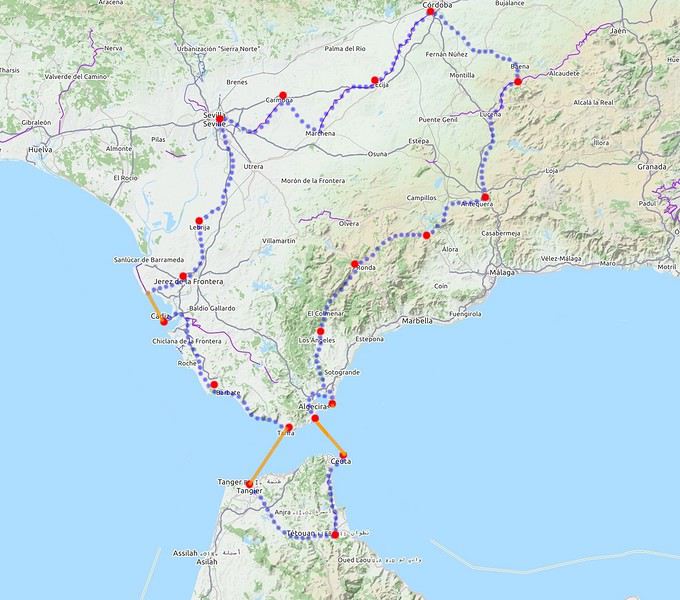
Venise - Slovénie - Croatie en août avec bébé 7 mois English translation pending
Bonsoir à tous,
J'organise mon un Road trip pour le mois d'août ( vacance imposée par l’employeur)Nous sommes un couple avec un bébé qui aura 7 mois au mois d'août.
On voudrait aller à Venise en Slovénie et en Croatie tous cela en 3 semaines.
Nous partirons en voiture de Paris.
Voici pour le moment voici mon Road trip:
-Venise 3 jours -Burano 2 nuits Direction la Slovénie
2 jours Ljubljana 3 jours Bled 2 jours Lac de Bohinj
Dubrovnik 5 jours
Avez-vous des conseils svp? Est ce que mon Road trip est réalisable avec un bébé en bas âge ?
Par avance merci 😊
J'organise mon un Road trip pour le mois d'août ( vacance imposée par l’employeur)Nous sommes un couple avec un bébé qui aura 7 mois au mois d'août.
On voudrait aller à Venise en Slovénie et en Croatie tous cela en 3 semaines.
Nous partirons en voiture de Paris.
Voici pour le moment voici mon Road trip:
-Venise 3 jours -Burano 2 nuits Direction la Slovénie
2 jours Ljubljana 3 jours Bled 2 jours Lac de Bohinj
Dubrovnik 5 jours
Avez-vous des conseils svp? Est ce que mon Road trip est réalisable avec un bébé en bas âge ?
Par avance merci 😊
Itinéraire et hébergements pour trois semaines cet été en Norvège English translation pending
bonjour à tous,
nous partons 3 semaines cet été, le 7 juillet exactement pour la Norvège. Nous sommes 2 adultes.
Ce qui est déjà réservé et prévu :
Vols Genève-Trondheim et retour.
Trondheim : 2 nuits réservées Voiture : réservée dès le 3ème jour et jusqu'à la fin (vraiment moins cher de louer en ville plutôt quà l'aéroport). Lofoten : hébergement réservé pour 6 nuits.
Itinéraire :
7-8 juillet : Trondheim 9-12 juillet : Route du littoral jusqu'à Bodø. 13-18 juillet : Lofoten, nous serons pour 6 nuits proche de Leknes (je voulais prendre 2 endroits mais nous avons trouvé un super endroit (enfin j'espère) et pas trop cher... donc voilà on y reste 6 nuits). 19-28 juillet : île de Senja, Tromsø, Veståralen et retour vers Trondheim 29 juillet : Tronhdeim - Genève
Voici donc mes questions :
Pour les 4 jours sur la route du littoral, pensez-vous qu'il faille réserver des hébergements ? Idem pour les ferrys, pensez-vous qu'il faille réserver ? Celui de Bodø-Lofoten, je pense le faire très vite.
Pour les 10 j. après les Lofoten, avez-vous des suggestions d'itinéraires ? faut-il réserver les hébergements aussi ?
Un grand merci d'avance pour vos idées et conseils. Sandrine
nous partons 3 semaines cet été, le 7 juillet exactement pour la Norvège. Nous sommes 2 adultes.
Ce qui est déjà réservé et prévu :
Vols Genève-Trondheim et retour.
Trondheim : 2 nuits réservées Voiture : réservée dès le 3ème jour et jusqu'à la fin (vraiment moins cher de louer en ville plutôt quà l'aéroport). Lofoten : hébergement réservé pour 6 nuits.
Itinéraire :
7-8 juillet : Trondheim 9-12 juillet : Route du littoral jusqu'à Bodø. 13-18 juillet : Lofoten, nous serons pour 6 nuits proche de Leknes (je voulais prendre 2 endroits mais nous avons trouvé un super endroit (enfin j'espère) et pas trop cher... donc voilà on y reste 6 nuits). 19-28 juillet : île de Senja, Tromsø, Veståralen et retour vers Trondheim 29 juillet : Tronhdeim - Genève
Voici donc mes questions :
Pour les 4 jours sur la route du littoral, pensez-vous qu'il faille réserver des hébergements ? Idem pour les ferrys, pensez-vous qu'il faille réserver ? Celui de Bodø-Lofoten, je pense le faire très vite.
Pour les 10 j. après les Lofoten, avez-vous des suggestions d'itinéraires ? faut-il réserver les hébergements aussi ?
Un grand merci d'avance pour vos idées et conseils. Sandrine
Trajet Croatie - Grèce à pied en un mois English translation pending
Bonjour à tous j'ai vu que la question du voyage en voiture de la Croatie à la Grèce a déjà été évoqué mais j'ai pour projet de descendre de la Croatie à la Grèce à pied en 1 mois et seul. C'est mon première vrai voyage et j'aurai aimé avoir quelques avis avant de me lancer dans le grand bain.
Merci d'avance à tous
L'Alaska en camping-car en juin 2019 English translation pending
Bonjour à tous,
Je parcours le forum depuis quelques années et je me suis dis : si j'écrivais un carnet de voyage!
Nous sommes allés plusieurs fois en Amérique du Nord, la quatrième fois dans l' Ouest USA en 2017.
Mon épouse me dit : et si l'on allait voir ailleurs: Moi 😕.
En été 2018 nous sommes en chambre d'hôte en Dordogne et partageons le repas du soir avec un couple d'Américain et de Néo Zélandais. Bien sur, le thème de la discussion est " les voyages".
Les 2 couples nous disent: pourquoi pas l'Alaska ? Vous qui aimez les paysages vous ne seriez pas déçus.
L'Alaska??? mais il fait froid. Pas en été! OK pour l'Alaska en plus c'est le 49ème état des USA. 😛
C'est comme cela que nous sommes allés en Alaska du 12 Juin au 1er Juillet 2019.
Un road trip de 20 jours en CAMPING CAR ou RV pour véhicule récréatif.
Notre choix s'est porté sur le RV, car après bien des infos sur le forum et autres, il ns semblait judicieux et intéressant d'opter pour ce moyen de transport, bien que ce soit la 1ère fois.
Donc, départ de RDC le 12 Juin avec une escale de 1h30 à Reykjavif en Islande avec Icelandair.
Au total un vol de 10h00 pour arriver à Anchorage en Alaska en début d'APM.
En sortant de l'aéroport, nous sommes surpris par la chaleur qu'il fait. Mais ns sommes en été !! oui mais en Alaska 😐! Il faut savoir que la température peut monter jusqu'à 30° dans certains endroits. Bon d'accord, ce n'est pas les 40 voir 50° de l'Utah ou du Névada 😎 Pour des raisons de sécurité Cruises América qui est le loueur du RV, impose une nuit de repos avant la prise en charge du véhicule. Ns avons donc réservé un chambre au Guest house inn à l'est de la ville. Et là 1ère surprise ns sommes à côté d'un magasin de vente de cannabis (vente libre en Alaska) ça sent la beuh!!! et tout ce qui va avec (les fumeurs un peu désœuvrés) Pendant la nuit ns entendrons des cris car en plus l'hôtel est situé à côté d'un foyer d'hébergement. Bonjour l'ambiance. Sandrine mon épouse n'est pas bien rassurée.Ns ne sommes pas bien loin du centre et allons faire un tour pour prendre la température des lieux. Anchorage = 300.000 habitants pour une population de 700.000 personnes sur le territoire Aléoutien et une superficie de 3 fois la France.
Jeudi 13 Juin. Ns prenons en charge notre RV avec un RDV à 9h00 du matin. L'employée de Cruises América ns fait faire le tour du propriétaire avec les explications d'usage. Sandrine a également imprimé le manuel en français qui ns sera bien utile. L'avantage réel du RV est que ns rangeons nos affaires une fois pour tout le voyage.
Après 2 heures de préparation, ns roulons enfin en direction du premier supermarché pour faire le plein de courses . Ce sera un Fred Meyers (à notre avis supérieur au Walmart, mais plus cher). Ns prenons enfin la route, direction Talkeetna au nord d'Anchorage à 184 kms pour notre 1ère étape. Ns avons réservé un vol chez Talkeetna air taxi pour survoler les montagnes et atterrir sur un glacier , qui est en fait le camp de base des alpinistes (c'est le vrai nom que l'on donne aux personnes qui gravissent les montagnes). Ns allons découvrir également les versants du Dénali qui est le plus haut sommet de l'Amérique du Nord (6.190m)
le sommet du Dénali.
Suite à ce vol extraordinaire, ns prenons nos quartiers sur le camping de Talkeetna pour une nuit.
Demain départ pour le parc du Dénali.
En sortant de l'aéroport, nous sommes surpris par la chaleur qu'il fait. Mais ns sommes en été !! oui mais en Alaska 😐! Il faut savoir que la température peut monter jusqu'à 30° dans certains endroits. Bon d'accord, ce n'est pas les 40 voir 50° de l'Utah ou du Névada 😎 Pour des raisons de sécurité Cruises América qui est le loueur du RV, impose une nuit de repos avant la prise en charge du véhicule. Ns avons donc réservé un chambre au Guest house inn à l'est de la ville. Et là 1ère surprise ns sommes à côté d'un magasin de vente de cannabis (vente libre en Alaska) ça sent la beuh!!! et tout ce qui va avec (les fumeurs un peu désœuvrés) Pendant la nuit ns entendrons des cris car en plus l'hôtel est situé à côté d'un foyer d'hébergement. Bonjour l'ambiance. Sandrine mon épouse n'est pas bien rassurée.Ns ne sommes pas bien loin du centre et allons faire un tour pour prendre la température des lieux. Anchorage = 300.000 habitants pour une population de 700.000 personnes sur le territoire Aléoutien et une superficie de 3 fois la France.
Jeudi 13 Juin. Ns prenons en charge notre RV avec un RDV à 9h00 du matin. L'employée de Cruises América ns fait faire le tour du propriétaire avec les explications d'usage. Sandrine a également imprimé le manuel en français qui ns sera bien utile. L'avantage réel du RV est que ns rangeons nos affaires une fois pour tout le voyage.
Après 2 heures de préparation, ns roulons enfin en direction du premier supermarché pour faire le plein de courses . Ce sera un Fred Meyers (à notre avis supérieur au Walmart, mais plus cher). Ns prenons enfin la route, direction Talkeetna au nord d'Anchorage à 184 kms pour notre 1ère étape. Ns avons réservé un vol chez Talkeetna air taxi pour survoler les montagnes et atterrir sur un glacier , qui est en fait le camp de base des alpinistes (c'est le vrai nom que l'on donne aux personnes qui gravissent les montagnes). Ns allons découvrir également les versants du Dénali qui est le plus haut sommet de l'Amérique du Nord (6.190m)
le sommet du Dénali.
Suite à ce vol extraordinaire, ns prenons nos quartiers sur le camping de Talkeetna pour une nuit.
Demain départ pour le parc du Dénali.
Projet de voyage en voiture en Algérie nord et sud English translation pending
J'ai un projet de voyage en voiture en Algérie, la partie nord entre Oran et Annaba, et une grande extension aller et retour jusqu'à Tamanrasset, pour visiter l'Assekrem, par exemple un trajet par Adrar, et l'autre par Ghardaïa. Je suis français et propriétaire d'une berline à motricité arrière, qui n'est pas un véhicule tout terrain.
D'après ce que je lis dans les discussions, pour obtenir un visa il suffit d'un document de réservation d'hôtel imprimé, réservation qui peut être annulée ensuite avant l'arrivée sur place, ce qui n'empêcherait pas de se déplacer librement, au moins dans la partie nord, est-ce bien cela?
J'ai lu quelque part qu'il fallait se déclarer ou s'enregistrer dans une wilaya après l'arrivée, alors où s'enregistrer si on se déplace en permanence?
J'ai aussi lu qu'il est indispensable d'être accompagné, pour des raisons de sécurité, par un guide à partir de... en direction du sud, où exactement, où sont les points de contrôle à partir desquels il faut être accompagné?
Enfin peut-on penser que le réseau routier est compatible avec ma voiture, partout, ou jusqu'où en direction du sud?
Je suis en contact avec une agence basée à Tamanrasset qui peut me prendre en charge à partir du lieu où il faut être accompagné, et aussi pour la visite locale. Cette agence ne peut pas me prendre en charge dans le nord, et d'ailleurs c'est inutile.
J'ai le choix par exemple entre utiliser ma voiture personnelle partout, utiliser ma voiture personnelle dans le nord puis louer une voiture adaptée au sud, laisser ma voiture en France et utiliser une voiture de location partout, ou enfin utiliser une voiture de location dans le nord et faire une extension en avion ou en autocar ou autre pour le sud.
Mon dernier voyage en Algérie remonte à 1988, et c'était une simple traversée en fin de voyage France , Algéciras, Tanger, Béchar, Adrar, Bamako, Ouagadougou, Niamey, Agadez, Alger, France (eh oui on croit rêver, les temps ont changé...), en véhicule tout terrain. La route n'était pas goudronnée, loin de là, jusqu'à Tamanrasset, elle était même extrêmement difficile pour cause de travaux dans la région et plus au nord. Je ne connais pas la situation actuelle des routes.
Merci d'avance pour des renseignements fiables et récents.
Itinéraires, visites et logement dans les Visayas (Philippines) English translation pending
Hello, nous nous rendons aux Philippines dans les visayas du 20 février au 7 mars 2020. J'ai une idée sur trois stop principaux pour lesquels nous aimerions prendre un logement et bouger à partir de cet endroit.
Il est prévu :
20 février : Trajet cebu-Bohol 21-22 : Quelques visites sur Bohol 23 : Trajet Bohol- Dumaguete 24, 25, 26 : Dumaguete 27 : Dumaguete - Siquijor 28,29,1ermars, 2 mars : trajet Siquijor-Bohol 4-5 :Bohol 6 ; trajet Bohol Cebu 7 Cebu (arrivée la veille pour assurer le coup) Niveau itinéraire cela vous paraît correct ? Avez vous une idée d hôtel central pour Bohol pratique pour les visites ? De même pour Dumaguete ?
J'ai bcp entendu parler du coco grove beach à Siquijor des expériences ?
Merci
Il est prévu :
20 février : Trajet cebu-Bohol 21-22 : Quelques visites sur Bohol 23 : Trajet Bohol- Dumaguete 24, 25, 26 : Dumaguete 27 : Dumaguete - Siquijor 28,29,1ermars, 2 mars : trajet Siquijor-Bohol 4-5 :Bohol 6 ; trajet Bohol Cebu 7 Cebu (arrivée la veille pour assurer le coup) Niveau itinéraire cela vous paraît correct ? Avez vous une idée d hôtel central pour Bohol pratique pour les visites ? De même pour Dumaguete ?
J'ai bcp entendu parler du coco grove beach à Siquijor des expériences ?
Merci
Voyages inter-îles en bateau Santiago, Sao Vicente et Sao Antao (Cap Vert) English translation pending
Bonjour, est-il nécessaire de réserver tous les trajets inter iles au Cap Vert à l'avance. Peut-on se permettre de compter sur les horaires et dates de départ annoncés et de choisir sa destination au jour le jour si on prévoit de visiter par exemple Santiago, Sao Vicente et Sao Antao en 12 jours? Merci
Herviche
État de la route 62 Cape Town - Huisrivier Pass - George (en 4x4) English translation pending
Bonjour à tous,
Nous prévoyons d'aller au Garden Route NP depuis le Cap début décembre.
La route 62 permet d'éviter de faire l'aller-retour par la N2.
Quel est l'état de cette route passant par Barrydale et Huisrivier Pass pour finir Outeniqua Pass ?
Un 4x4 est-il nécessaire ?
Merci d'avance pour vos avis.
Itinéraire du Cap à Port Elizabeth en deux semaines en mars English translation pending
Bonjour à tous 😎
Je viens vers vous pour avoir des suggestions concernant notre premier voyage en Afrique du Sud au mois de Mars prochain. Nous sommes un couple avec un bébé qui aura 16 mois au moment du voyage. Nous avons déjà réservé nos billets d'avion, nous avons pris un billet multi-destinations avec une arrivée au Cap et un départ de Port Elizabeth. Nous louerons donc une voiture, pour l'instant j'ai repéré Tempest car hire qui a de bons tarifs.
Je ne suis qu'au tout début de mes recherches, donc j'ai sûrement oublié des étapes, je n'ai pas encore écumé toutes les conversations du forum 😛 Si certains ont des petits avis, ça pourra m'aider à orienter mes recherches. Comme nous sommes avec bébé, nous souhaitons bien sûr ne pas trop nous presser.
Jour 1: arrivée au Cap vers 17h, nuit au Cap (4 nuits vers Camps bay ou Hout bay) Jour 2: Visite de la région et nuit au Cap Jour 3: Visite de la région et nuit au Cap Jour 4: Visite de la région et nuit au Cap Jour 5: Vignobles et nuit vers Franschhoek Jour 6: Vignobles et nuit vers Franschhoek Jour 7: Oudtshoorn (peut-être faudrait-il s'arrêter entre Franschhoek et Oudtshoorn?) Jour 8: Wilderness, Knysna + visite de monkeyland et birds of eden Jour 9: Swartberg Pass et nuit à Prince Albert (?) Jour 10: Karoo Jour 11: Karoo Jour 12: ? Jour 13: nuit à Addo Elephant park Jour 14: nuit à Addo Elephant park Jour 15: Départ vers 14h de Port Elizabeth
Bon je sens que ce n'est pas du tout abouti ! Des avis? Quel logement à l'intérieur du parc Addo? Nous avons repéré pour faire éventuellement une nuit en Safari tent et une nuit en Roundavel. J'hésite à faire une 3ème nuit à Addo...(J'imagine que ce n'est pas comparable mais en Namibie nous n'avions passé que 2 nuits à Etosha et j'aurais aimé y passer plus de temps, donc une nuit à Addo me paraît évidemment trop court) Faire une étape entre Franschhoek et Oudtshoorn ou entre le Karoo et Addo? 🏴☠️ A l'aiiide 😏
Je viens vers vous pour avoir des suggestions concernant notre premier voyage en Afrique du Sud au mois de Mars prochain. Nous sommes un couple avec un bébé qui aura 16 mois au moment du voyage. Nous avons déjà réservé nos billets d'avion, nous avons pris un billet multi-destinations avec une arrivée au Cap et un départ de Port Elizabeth. Nous louerons donc une voiture, pour l'instant j'ai repéré Tempest car hire qui a de bons tarifs.
Je ne suis qu'au tout début de mes recherches, donc j'ai sûrement oublié des étapes, je n'ai pas encore écumé toutes les conversations du forum 😛 Si certains ont des petits avis, ça pourra m'aider à orienter mes recherches. Comme nous sommes avec bébé, nous souhaitons bien sûr ne pas trop nous presser.
Jour 1: arrivée au Cap vers 17h, nuit au Cap (4 nuits vers Camps bay ou Hout bay) Jour 2: Visite de la région et nuit au Cap Jour 3: Visite de la région et nuit au Cap Jour 4: Visite de la région et nuit au Cap Jour 5: Vignobles et nuit vers Franschhoek Jour 6: Vignobles et nuit vers Franschhoek Jour 7: Oudtshoorn (peut-être faudrait-il s'arrêter entre Franschhoek et Oudtshoorn?) Jour 8: Wilderness, Knysna + visite de monkeyland et birds of eden Jour 9: Swartberg Pass et nuit à Prince Albert (?) Jour 10: Karoo Jour 11: Karoo Jour 12: ? Jour 13: nuit à Addo Elephant park Jour 14: nuit à Addo Elephant park Jour 15: Départ vers 14h de Port Elizabeth
Bon je sens que ce n'est pas du tout abouti ! Des avis? Quel logement à l'intérieur du parc Addo? Nous avons repéré pour faire éventuellement une nuit en Safari tent et une nuit en Roundavel. J'hésite à faire une 3ème nuit à Addo...(J'imagine que ce n'est pas comparable mais en Namibie nous n'avions passé que 2 nuits à Etosha et j'aurais aimé y passer plus de temps, donc une nuit à Addo me paraît évidemment trop court) Faire une étape entre Franschhoek et Oudtshoorn ou entre le Karoo et Addo? 🏴☠️ A l'aiiide 😏
Safari animalier au Chili, avec un peu de paysages... quand même! English translation pending
On parle souvent des safari animaliers en Afrique.... c'est certain qu'il y a de quoi faire.🤪
Mais cette année, je voulais aussi découvrir des coins pas touristiques au Chili, des paysages désertiques et colorés des Andes, et surtout je voulais un voyage soft, avec des temps de repos au bord de l'océan pacifique. Et bien, figurez-vous que tout près des 2 hôtels où nous avons résidé à Antofagasta et à Iquique, nous avons pu admirer des spectacles animaliers sympathiques.
Episode 1: Observation au terrado d'Antofagasta
Vous connaissez? Au chili, ils appellent ça "un Jote". En français on dit "urubu à tête rouge".
Et bien, ce charmant vautour est perché sur la rambarde de la piscine du terrado à Antofagasta. Figurez-vous qu'une colonie de ces charmants animaux a décidé de quitter les hauteurs des andes qui sont leur lieux de vie habituel, en cette période d'hiver austral peu propice à la nourriture, pour venir chercher des cieux plus cléments au bord du pacifique.
Et ne voilà-t-il pas que le terrado d'Antofagasta a eu l'idée géniale de construire une magnifique piscine remplie d'eau douce, juste là, à côté de la crique très riche en poissons. Ils ont la nourriture à satiété et l'eau douce à côté!!! Alors pourquoi aller plus loin???? Je trouve qu'ils ont bon goût!!!😄
Amusée par leurs activités, je me suis promenée près des fauteuils placés pour les clients de l'hôtel, et qui vu la température ambiante étaient plutôt désertés. Finalement, ai-je pensé heureusement qu'il y a quand même les oiseaux pour profiter de cette piscine!!!😏
De notre chambre au 10ème étage, Jf prend en photo un des vautours en plein vol, ce qui permet de voir toute l'envergure de ses ailes magnifiques. En effet, régulièrement, les gens de l'hôtel les font fuir. Ils vont se réfugier sur le toit du restaurant à côté.
Mais ce n'est que pour mieux revenir en faisant des arabesques au dessus de l'océan pacifique.
Certains tentent de faire valoir leur droit de dominant en s'esbroufant devant les autres. Parfois ça marche...
D'autres fois, certains se retrouvent en déséquilibre, pour avoir osé empiéter sur la place d'un autre.
Mais tous ne veulent qu'une chose, c'est pouvoir gouter à cette eau douce, si claire et si délicieuse. Miamm!!!!
Et ensuite ils vous regardent, perplexes, .... Pourquoi ces 2 humains ne les chassent-ils pas? Que font-ils avec leurs drôles de machines? En tout cas, tant que ces 2 là sont là, les gens de l'hôtel ne nous chassent pas.
Alors, ils continuent leur vie, rassurés!
D'autres oiseaux marins apprécient aussi la piscine pour venir y barboter.
Cette piscine est aussi un lieu de romance pour les pigeons.
Parfois c'est assez hard!
La baie dAntofagasta abrite également une colonie impressionnante de pélicans.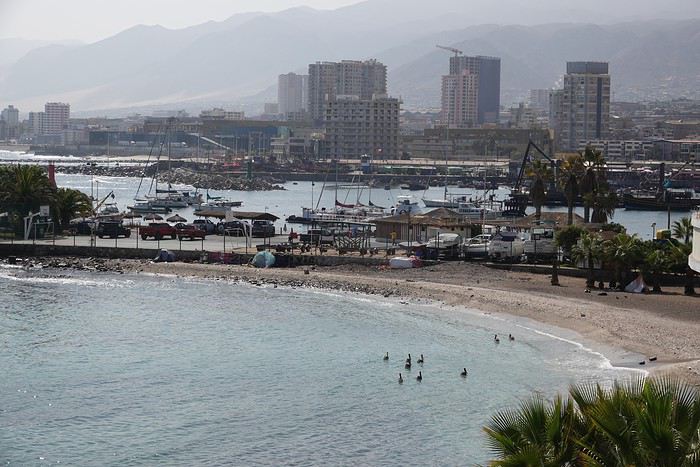
Et cette colonie se concentre sur les récifs à marée basse, profitant de l'aubaine du marnage très important qui caractérise ce lieu.
A marée haute, ils apprécient de pêcher et nous en profitons pleinement du restaurant de l'hôtel, pour les photographier.
En vol, en s'ébrouant, ...
En version solitaire,
Je suis beau et je le vaux bien!!
En couple, petite parade élégante..
Par marée haute, il y a même des surfeurs qui profitent des vagues.. Ce qui n'empêche pas nos pélicans de voler au dessus des flots!
Mais cette année, je voulais aussi découvrir des coins pas touristiques au Chili, des paysages désertiques et colorés des Andes, et surtout je voulais un voyage soft, avec des temps de repos au bord de l'océan pacifique. Et bien, figurez-vous que tout près des 2 hôtels où nous avons résidé à Antofagasta et à Iquique, nous avons pu admirer des spectacles animaliers sympathiques.
Episode 1: Observation au terrado d'Antofagasta
Vous connaissez? Au chili, ils appellent ça "un Jote". En français on dit "urubu à tête rouge".
Et bien, ce charmant vautour est perché sur la rambarde de la piscine du terrado à Antofagasta. Figurez-vous qu'une colonie de ces charmants animaux a décidé de quitter les hauteurs des andes qui sont leur lieux de vie habituel, en cette période d'hiver austral peu propice à la nourriture, pour venir chercher des cieux plus cléments au bord du pacifique.
Et ne voilà-t-il pas que le terrado d'Antofagasta a eu l'idée géniale de construire une magnifique piscine remplie d'eau douce, juste là, à côté de la crique très riche en poissons. Ils ont la nourriture à satiété et l'eau douce à côté!!! Alors pourquoi aller plus loin???? Je trouve qu'ils ont bon goût!!!😄
Amusée par leurs activités, je me suis promenée près des fauteuils placés pour les clients de l'hôtel, et qui vu la température ambiante étaient plutôt désertés. Finalement, ai-je pensé heureusement qu'il y a quand même les oiseaux pour profiter de cette piscine!!!😏
De notre chambre au 10ème étage, Jf prend en photo un des vautours en plein vol, ce qui permet de voir toute l'envergure de ses ailes magnifiques. En effet, régulièrement, les gens de l'hôtel les font fuir. Ils vont se réfugier sur le toit du restaurant à côté.
Mais ce n'est que pour mieux revenir en faisant des arabesques au dessus de l'océan pacifique.
Certains tentent de faire valoir leur droit de dominant en s'esbroufant devant les autres. Parfois ça marche...
D'autres fois, certains se retrouvent en déséquilibre, pour avoir osé empiéter sur la place d'un autre.
Mais tous ne veulent qu'une chose, c'est pouvoir gouter à cette eau douce, si claire et si délicieuse. Miamm!!!!
Et ensuite ils vous regardent, perplexes, .... Pourquoi ces 2 humains ne les chassent-ils pas? Que font-ils avec leurs drôles de machines? En tout cas, tant que ces 2 là sont là, les gens de l'hôtel ne nous chassent pas.
Alors, ils continuent leur vie, rassurés!
D'autres oiseaux marins apprécient aussi la piscine pour venir y barboter.
Cette piscine est aussi un lieu de romance pour les pigeons.
Parfois c'est assez hard!
La baie dAntofagasta abrite également une colonie impressionnante de pélicans.
Et cette colonie se concentre sur les récifs à marée basse, profitant de l'aubaine du marnage très important qui caractérise ce lieu.
A marée haute, ils apprécient de pêcher et nous en profitons pleinement du restaurant de l'hôtel, pour les photographier.
En vol, en s'ébrouant, ...
En version solitaire,
Je suis beau et je le vaux bien!!
En couple, petite parade élégante..
Par marée haute, il y a même des surfeurs qui profitent des vagues.. Ce qui n'empêche pas nos pélicans de voler au dessus des flots!
Informations pour 10 jours en Sardaigne English translation pending
Bonjour à tous,
Je pars du 7 au 17 septembre en Sardaigne, avec ma femme (enceinte de 6 mois à ce moment-là) et j'aimerais avoir vos recommandations et conseils.
En effet compte tenu de sa situation, pas de grosses randonnées comme on les aime pour cette année :) Nous avons choisi la Sardaigne car cela nous semble plus propice (versus Sicile / Pouilles) pour du repos, farniente, nature etc ..
Venons-en au fait 🙂 : auriez-vous des recommandations, sachant que nous ne voulons pas non plus nous disperser. A moins que ce soit possible en 10 jours.
D'après mes premières recherches, le nord semble plus nous convenir, notamment vers Alghero / Asinara ... et aussi la partie Est avec Maddalena.
Je reste cependant ouvert ! > avez-vous des conseils sur les endroits sympa à visiter (comme les grottes de neptune) ?
Nous sommes plus axés sur : - farniente (belles plages) - balade nature (légère cause enceinte) - déambuler dans petits villages sympa et animés - visites culturelles - gastrotomie
Pour le sud je sais qu'il y a la capitale Cagliari, mais le déplacement me semble important pour visiter une grande ville (je suis aussi certains que les alentours sont top, no offence).
Merci à tous pour vos conseils et avis ! > n'hésitez pas à me poser toutes les questions nécessaires
Belle journée Guillaume
Je pars du 7 au 17 septembre en Sardaigne, avec ma femme (enceinte de 6 mois à ce moment-là) et j'aimerais avoir vos recommandations et conseils.
En effet compte tenu de sa situation, pas de grosses randonnées comme on les aime pour cette année :) Nous avons choisi la Sardaigne car cela nous semble plus propice (versus Sicile / Pouilles) pour du repos, farniente, nature etc ..
Venons-en au fait 🙂 : auriez-vous des recommandations, sachant que nous ne voulons pas non plus nous disperser. A moins que ce soit possible en 10 jours.
D'après mes premières recherches, le nord semble plus nous convenir, notamment vers Alghero / Asinara ... et aussi la partie Est avec Maddalena.
Je reste cependant ouvert ! > avez-vous des conseils sur les endroits sympa à visiter (comme les grottes de neptune) ?
Nous sommes plus axés sur : - farniente (belles plages) - balade nature (légère cause enceinte) - déambuler dans petits villages sympa et animés - visites culturelles - gastrotomie
Pour le sud je sais qu'il y a la capitale Cagliari, mais le déplacement me semble important pour visiter une grande ville (je suis aussi certains que les alentours sont top, no offence).
Merci à tous pour vos conseils et avis ! > n'hésitez pas à me poser toutes les questions nécessaires
Belle journée Guillaume
Circuit de 15 jours en juillet en Dalmatie English translation pending
Bonjour,
J'ai pas mal potassé guides et forums et je cherche à conforter l'itinéraire que j'ai prévu pour cet été. Nous sommes 4 avec 2 enfants de 10 et 12 ans.
Je souhaite avoir votre avis sur le programme suivant et savoir s'il est nécessaire de réserver des logements, j'ai entendu tout et son contraire sur les possibilités de se loger chez l'habitant ...
- Jour 1 (17 Juillet) : Arrivée en avion à Dubrovnik 10h, récup voiture de loc et direction Mlini pour la nuit (Nuit à /Mlini)
- Jour 2 (18/07): Départ Dubrovnik en bateau ou en bus. Visite Dubrovnik toute la journée. Retour le soir à Mlini (Nuit à Mlini)
- Jour 3 (19/07): Départ tot le matin de Mlini et direction presqu'ile de Peljesac (region viticole), arrêt à Ston (60Km, 1H10 de trajet) visite de la grande Muraillle. Embarquement pour Mljet en ferry (avec voiture) balade, repos et à la baignade (nuit sur Mljet, Kozarica ou Polace ?)
- Jour 4 (20/07): repos, farniente, on profite de l'ile (nuit Mljet)
- Jour 5 (21/07): Ferry retour de Mljet, à Prapratno en journée. On file direction Orebic (1H05, 60km) plus loin sur la presqu’ile, on profite du coin. (Nuit proche Orebic)
- Jour 6 (22/07): Visite de l’ile de Korcula à la journée, traversée dure 20min, ferry toutes les 30 min (nuit proche Orebic)
- Jour 7 (23/07): Depart Orebic pour prendre le ferry à coté à Trpanj (20km, 25min) et couper toute la route et le passage par la frontière de Bosnie. Arrivée de l’autre coté à Ploce. Passage par la riviera de Makarska pour le paysage .. ou pas si circulation trop compliquée. Arrêt du coté d’Omis pour profiter de l’endroit (nuit proche Omis)
- Jour 8 (24/07): On profite d’Omis (nuit proche Omis)
- Jour 9 (25/07): Visite Split (nuit proche de Trogir/Split) => Solin conseillé (20 min de Split, 25min de Trogir, , plus calme..
- Jour 10 (26/07): Ile de Brac (nombreux ferries, traversée 1h) ou pas pour etre plus cool, dans ce cas-là, on remonte vers Trogir, etc .. (nuit Solin)
- Jour 11 (27/07): Visite Trogir, port de Slatine (nuit Solin)
- Jour 12 (28/07) : Départ, passage par la magistrale entre Split et Siblenik, passage par Primosten, visite Sibenik (Nuit proche Vodice/Pakostane), possibilité de louer un petit bateau sans permis.
- Jour 13 (29/07): Visite parc Krka (Nuit proche Vodice/Pakostane)
- Jour 14 (30/07): Excursion Ile Kornati ou journée à Dugi Otok ou glandouille (Nuit proche Vodice/Pakostane)
- Jour 15 (31 juillet): Depart, retour vers Split pour prendre l'avion à 11H30
merci
J'ai pas mal potassé guides et forums et je cherche à conforter l'itinéraire que j'ai prévu pour cet été. Nous sommes 4 avec 2 enfants de 10 et 12 ans.
Je souhaite avoir votre avis sur le programme suivant et savoir s'il est nécessaire de réserver des logements, j'ai entendu tout et son contraire sur les possibilités de se loger chez l'habitant ...
- Jour 1 (17 Juillet) : Arrivée en avion à Dubrovnik 10h, récup voiture de loc et direction Mlini pour la nuit (Nuit à /Mlini)
- Jour 2 (18/07): Départ Dubrovnik en bateau ou en bus. Visite Dubrovnik toute la journée. Retour le soir à Mlini (Nuit à Mlini)
- Jour 3 (19/07): Départ tot le matin de Mlini et direction presqu'ile de Peljesac (region viticole), arrêt à Ston (60Km, 1H10 de trajet) visite de la grande Muraillle. Embarquement pour Mljet en ferry (avec voiture) balade, repos et à la baignade (nuit sur Mljet, Kozarica ou Polace ?)
- Jour 4 (20/07): repos, farniente, on profite de l'ile (nuit Mljet)
- Jour 5 (21/07): Ferry retour de Mljet, à Prapratno en journée. On file direction Orebic (1H05, 60km) plus loin sur la presqu’ile, on profite du coin. (Nuit proche Orebic)
- Jour 6 (22/07): Visite de l’ile de Korcula à la journée, traversée dure 20min, ferry toutes les 30 min (nuit proche Orebic)
- Jour 7 (23/07): Depart Orebic pour prendre le ferry à coté à Trpanj (20km, 25min) et couper toute la route et le passage par la frontière de Bosnie. Arrivée de l’autre coté à Ploce. Passage par la riviera de Makarska pour le paysage .. ou pas si circulation trop compliquée. Arrêt du coté d’Omis pour profiter de l’endroit (nuit proche Omis)
- Jour 8 (24/07): On profite d’Omis (nuit proche Omis)
- Jour 9 (25/07): Visite Split (nuit proche de Trogir/Split) => Solin conseillé (20 min de Split, 25min de Trogir, , plus calme..
- Jour 10 (26/07): Ile de Brac (nombreux ferries, traversée 1h) ou pas pour etre plus cool, dans ce cas-là, on remonte vers Trogir, etc .. (nuit Solin)
- Jour 11 (27/07): Visite Trogir, port de Slatine (nuit Solin)
- Jour 12 (28/07) : Départ, passage par la magistrale entre Split et Siblenik, passage par Primosten, visite Sibenik (Nuit proche Vodice/Pakostane), possibilité de louer un petit bateau sans permis.
- Jour 13 (29/07): Visite parc Krka (Nuit proche Vodice/Pakostane)
- Jour 14 (30/07): Excursion Ile Kornati ou journée à Dugi Otok ou glandouille (Nuit proche Vodice/Pakostane)
- Jour 15 (31 juillet): Depart, retour vers Split pour prendre l'avion à 11H30
merci
Retour d'expérience circuit Yucatan English translation pending
Bonjour,
De retour d'un circuit individuel de 2 semaines au Yucatan durant la seconde quinzaine de mai, voici mon retour d'experience par rapport aux tracas/anarques qu'on lit sur les forums et qui m'inquiétaient donc un peu avant le départ:
- location de voiture chez Avis via BSP-auto : aucun problème et un tarif très interessant - controle police sur la route : arrêté une fois à la sortie de Campeche sur l'autoroute pour Mérida (avons alors payé 300 MXN...) - arnaque au billet de 500 MXN en station service : tentative juste le dernier jour pour faire le plein pour rendre le véhicule. Avons été fermes et la situation s'est arretée là.
Donc en résumé, pas de parano excessive mais il est bon d'être au courant et vigilant. En dehors de ces situations, aucun autre problème.
Sinon, un super séjour, plein de choses à voir, très facile à faire. N'hésitez pas à y aller.
De retour d'un circuit individuel de 2 semaines au Yucatan durant la seconde quinzaine de mai, voici mon retour d'experience par rapport aux tracas/anarques qu'on lit sur les forums et qui m'inquiétaient donc un peu avant le départ:
- location de voiture chez Avis via BSP-auto : aucun problème et un tarif très interessant - controle police sur la route : arrêté une fois à la sortie de Campeche sur l'autoroute pour Mérida (avons alors payé 300 MXN...) - arnaque au billet de 500 MXN en station service : tentative juste le dernier jour pour faire le plein pour rendre le véhicule. Avons été fermes et la situation s'est arretée là.
Donc en résumé, pas de parano excessive mais il est bon d'être au courant et vigilant. En dehors de ces situations, aucun autre problème.
Sinon, un super séjour, plein de choses à voir, très facile à faire. N'hésitez pas à y aller.
Séjour Ouest américain en novembre et itinéraire alternatif English translation pending
Bonjour,
Nous aimerions passer Thanksgiving chez de la famille du côté de Redding, à quelques heures de San Francisco.
Nous avons donc pensé profiter de ce voyage pour faire un tour dans le coin. Naivement nous nous étions dit que nous pourrions arriver à Los Angeles, aller vers Las Vegas en faisant un petit arrêt au milieu, remonter ensuite vers Redding en passant par la Death Valley, la forêt de Sequoia, Mammoth Lake, Yosemite, Mono Lake, Tahoe Lake. Puis passer quelques jours en famille, et redescendre vers San Francisco.
Mais si je comprends bien, les séquoias et Yosemite mi/fin-novembre ce n'est même pas la peine d'y penser, est-ce bien cela ?
Qu'en est-il de Mammoth Lake, Mono Lake, Tahoe Lake qui sont plus à l'est, sont-ils moins en altitude et envisageables (en soit pas de soucis avec le fait de mettre des chaines mais nous ne voudrions pas nous retrouver face à des routes fermées) ?
Si ce n'est pas le cas non plus, y a-t-il des choses à voir encore plus à l'est, en se décalant vers le Nevada, là où les conditions climatiques sont peut-être plus clémentes ? Nous nous en fichons un peu de collectionner les sites touristiques tant que les paysages valent le coup ;)
Si visiter le coin est vraiment inenvisageable à cette période de l'année, nous prendrons plus un vol aller/retour depuis San Francisco et puis basta, mais ce serait dommage...
Par avance merci pour vos réponses !
Nous aimerions passer Thanksgiving chez de la famille du côté de Redding, à quelques heures de San Francisco.
Nous avons donc pensé profiter de ce voyage pour faire un tour dans le coin. Naivement nous nous étions dit que nous pourrions arriver à Los Angeles, aller vers Las Vegas en faisant un petit arrêt au milieu, remonter ensuite vers Redding en passant par la Death Valley, la forêt de Sequoia, Mammoth Lake, Yosemite, Mono Lake, Tahoe Lake. Puis passer quelques jours en famille, et redescendre vers San Francisco.
Mais si je comprends bien, les séquoias et Yosemite mi/fin-novembre ce n'est même pas la peine d'y penser, est-ce bien cela ?
Qu'en est-il de Mammoth Lake, Mono Lake, Tahoe Lake qui sont plus à l'est, sont-ils moins en altitude et envisageables (en soit pas de soucis avec le fait de mettre des chaines mais nous ne voudrions pas nous retrouver face à des routes fermées) ?
Si ce n'est pas le cas non plus, y a-t-il des choses à voir encore plus à l'est, en se décalant vers le Nevada, là où les conditions climatiques sont peut-être plus clémentes ? Nous nous en fichons un peu de collectionner les sites touristiques tant que les paysages valent le coup ;)
Si visiter le coin est vraiment inenvisageable à cette période de l'année, nous prendrons plus un vol aller/retour depuis San Francisco et puis basta, mais ce serait dommage...
Par avance merci pour vos réponses !
Fuerteventura pour une semaine de découverte English translation pending
FUERTEVENTURA !!!
Cette île, au départ, ne méritait peut-être pas de s'y attarder plus que cela mais nous, nous avons beaucoup aimé !
Tout d'abord, quelques modestes lignes pour présenter ce magnifique archipel des Canaries composé de 7 îles espagnoles, qui se trouve dans l'Océan Atlantique, au large des côtes du Maroc (environ une centaine de kms pour Fuerteventura).
Fuerteventura, où nous allons séjourner pour la semaine, est la seconde plus grande île, après Ténérife mais l'une des moins peuplée. Toutes les îles sont d'origine volcanique mais chacune a sa propre particularité. Fuerteventura est la plus ancienne d'entre elles (20 millions d'années environ) et sera certainement la première à disparaître. Quant à ses plages, ce sont sans aucun doute les plus belles et les plus grandes de tout l'archipel.
Au début, les îles Canaries furent vraisemblablement peuplées par différentes populations venues d'Afrique du Nord, ensuite par des navigateurs Phéniciens, Egyptiens puis par les Carthaginois et les Romains. Platon y situera les vestiges de l'Atlantide, Juba II, roi de Namibie, fera une description de l'île au 1er siècle avant J.C. et Pline l'Ancien, s'inspirera de cette description et citera 2 des îles : Canaria pour le nombre important de chiens qui vivent à Grande Canarie et l'île Pourpre pour Fuerteventura en raison de sa couleur brune mais celle-ci portera également plusieurs autres noms dont Planaria, Herbania etc...
L'archipel tombe ensuite dans l'oubli et ce ne sera qu'à partir du XIIIe siècle que des aventuriers génois, portugais ou autres marins d'Europe du sud accostant sur l'île de Ténérife y découvriront les Guanches (les enfants du grand volcan) appelés également Majoreros, qui vivaient là depuis longtemps apparemment.
Même s'il y a beaucoup de vent à Fuerteventura, ce n'est pas la traduction de son nom. Fuerteventura s'appelait Fortaventure en français (dans le sens de forte bataille) mots qu'aurait prononcé un aventurier français, Jean de Béthencourt, en arrivant sur ses côtes à des fins de conquête en 1405. Et c'est lui qui lui donnera ainsi son nom actuel que l'Espagne conservera lorsqu'elle en prendra possession en 1424.
-1-
Après un vol matinal très agréable, nous atterrissons à PUERTO DEL ROSARIO, ville principale de FUERTEVENTURA !
Puis nous prenons la navette pour CALETA DES FUSTE que nous avons choisi pour sa situation géographique plutôt centrale. Cette première demi-journée est surtout dédiée à faire connaissance avec l'endroit où nous avons décidé de nous poser pour quelques jours car nous n'avons réservé notre voiture que pour le lendemain. Nous commençons donc par une balade autour de l'hôtel (notre chambre n'étant pas tout à fait prête) puis par le village construit uniquement pour le tourisme, où nous voulons nous restaurer un peu et, en fin d'après-midi, nous poursuivons par le bord de la très grande plage de sable blanc qui jouxte l'hôtel. Il fait très beau mais il y a beaucoup de vent. Il faut s'y habituer, c'est plutôt monnaie courante par ici surtout en cette période !

La plage depuis l'hôtel

Une partie de la plage côté port

La promenade le long de la plage
-2-
Ce matin, nous avons rendez-vous avec notre loueur de voiture.
Belle journée en perspective donc, sauf que le loueur de voiture n'est pas du tout à l'heure pour le rendez-vous (plus d'une heure de retard), que la voiture qu'il nous amène n'est pas celle demandée (twingo au lieu de clio !), qu'elle affiche beaucoup de kilomètres (11300 kms au compteur !!!), qu'elle est franchement sale à l'extérieur comme à l'intérieur et qu'elle a de nombreux coups et autres rayures un peu partout. Nous perdons ainsi toute notre matinée à essayer de résoudre ce problème, sans résultat efficace (évidemment dans ce cas-là, il ne parle ni français, ni même anglais!), sauf qu'il nous propose de nous la changer pour le lendemain…
Bref !
Nous décidons quand même de partir pour le centre de l'île.
Nous prenons la direction de BETANCURIA. De chaque côté de la route c'est très beau. Dommage pour les photos, il y a un voile de brume qui perturbe quelque peu les abords de l'horizon… Mais le soleil est là, accompagné de son grand copain le vent qui ne souffle apparemment pas assez fort pour dégager cette intruse dans le tableau…

Le Cuchillos (625m) depuis la FV20

Sur la FV30
Sur la route, avant BETANCURIA, deux étapes intéressantes pour découvrir un magnifique panorama :
D'abord, un arrêt obligatoire au « mirador de Morro Velosa »! Il faut prendre un chemin sur la gauche sur environ 1 km (cet accès n'est ouvert que pendant les heures d'ouverture du mirador, c'est-à-dire du mardi au samedi entre 10 et 18h). En haut, c'est trop beau ! Mais difficile de rester dehors à cause du vent plutôt violent et… Gla-gla ! Heureusement, c'est très bien aménagé et il y a plein d'explications intéressantes concernant la géologie des lieux à l'intérieur. J'ai lu quelque part que ce mirador avait été conçu par César Manrique, architecte, peintre, sculpteur espagnol du XXe et grand défenseur de la nature de son île Lanzarote. Le panorama est vraiment superbe : on se croirait presque dans un pastel géant tout autour de nous ! Même la brume tenace rajoute une sorte de magie… lunaire au tableau ! C'est un paysage plutôt valonné et désertique et ce n'est pas pour nous déplaire, bien au contraire !
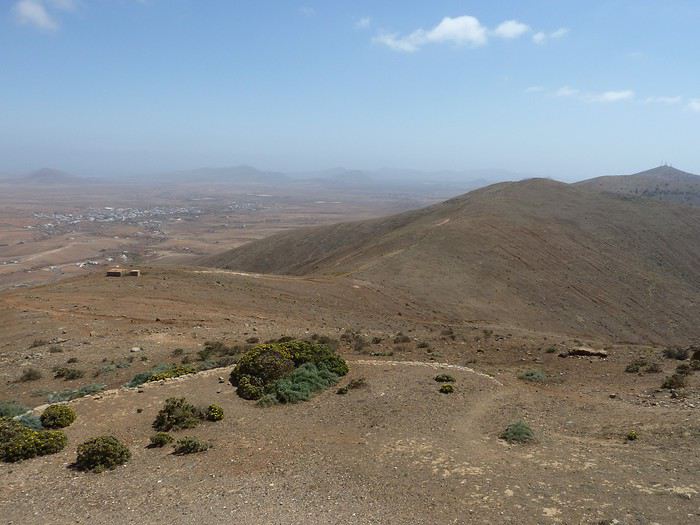


Nauplius sericeus (aster endémique de Fuerteventura)
Autre arrêt inévitable un peu plus loin sur la route : le « mirador Corrales de Guize » où nous trouvons deux immenses statues de Guanches (environ 4,50m de hauteur), les premiers hommes connus des îles. Ces deux statues sont l'oeuvre du sculpteur Emiliano Hernandez et se trouvent, apparemment, sur la ligne « frontière » des deux anciens royaumes. On aurait donc, à droite, le roi de Guize et, à gauche, le roi d'Ayoze.

Les Guanches : signifie « les hommes du grand volcan », nom donné aux premiers hommes des îles canariennes découverts par les premiers conquérants sur Ténérife. C'était un peuple de bergers et de guerriers qui vivait comme les hommes du néolithique et habitaient dans des grottes. Ils étaient connus pour être plutôt grands (au moins 1,80m) et blonds aux yeux bleux ! Au début du XVe siècle, il y avait 2 royaumes guanches (pas forcément les mêmes que sur Ténérife) qui se partageaient l'île : les Ayoze et les Guize, deux frères ennemis. Le roi de Guize régnait sur la partie nord de l'île, Maxorata et celui d'Ayoze sur la partie sud, Jandia. Au début du XVIe , après les massacres et les nombreuses déportations comme esclaves vers l'Europe, les Guanches furent finalement anéantis.
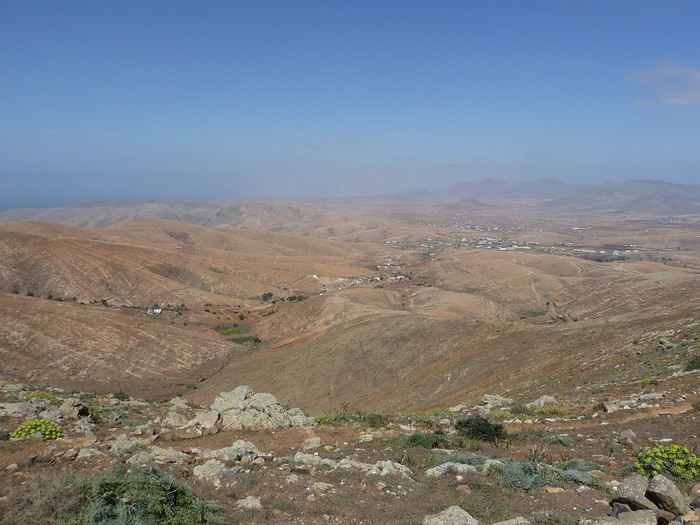 depuis le "mirador Corrales de Guize"
BETANCURIA :
C'est Jean de Bethencourt qui trouva cet endroit idéal, s'y installa en 1405 et lui donna son nom. Ce fut la capitale de l'île jusqu'en 1834. Elle fut mise à sac par les pirates européens ou marocains à plusieurs reprises.
On trouve une place de parking, à l'ombre, le long de la route et c'est à pied que nous montons visiter la partie historique de ce très joli petit village.

Belle église du XVIIe. Elle fut construite au XVe siècle, sur l'ordre de Jean de Béthencourt mais détruite au XVIe lors d'une incursion de pirates puis rebâtie au XVIIe. Seul le clocher est d'origine. Nous n'entrons pas à l'intérieur (fermé) mais remarquons la drôle de gargouille en bois sculpté et l'escalier plutôt raide du campanile (quasi à la verticale!)…


Jolie petite place ombragée avec une belle fontaine. Depuis cet endroit on a une vue originale sur l'église avec, à l'arrière, le sommet du Morro de la Cruz (676m).
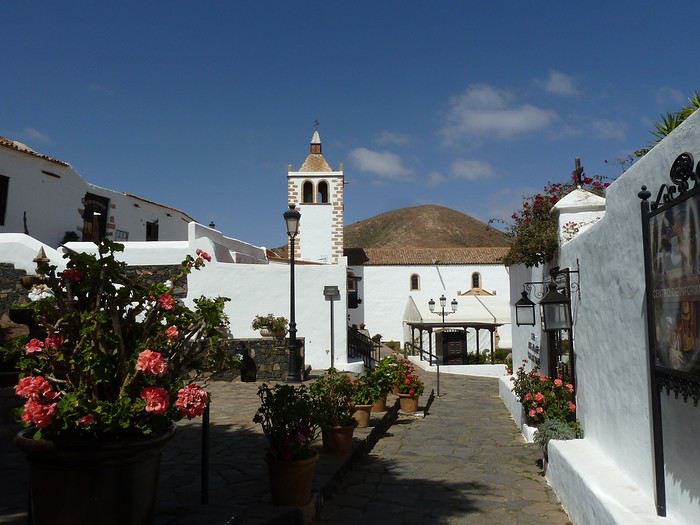
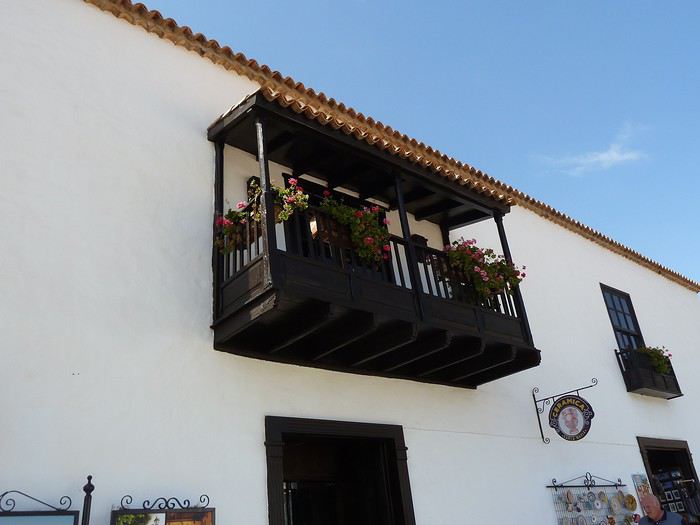
 Une oasis de verdure à Betancuria
C'est très agréable mais on en a vite fait le tour car c'est plutôt petit.
Cette île, au départ, ne méritait peut-être pas de s'y attarder plus que cela mais nous, nous avons beaucoup aimé !
Tout d'abord, quelques modestes lignes pour présenter ce magnifique archipel des Canaries composé de 7 îles espagnoles, qui se trouve dans l'Océan Atlantique, au large des côtes du Maroc (environ une centaine de kms pour Fuerteventura).
Fuerteventura, où nous allons séjourner pour la semaine, est la seconde plus grande île, après Ténérife mais l'une des moins peuplée. Toutes les îles sont d'origine volcanique mais chacune a sa propre particularité. Fuerteventura est la plus ancienne d'entre elles (20 millions d'années environ) et sera certainement la première à disparaître. Quant à ses plages, ce sont sans aucun doute les plus belles et les plus grandes de tout l'archipel.
Au début, les îles Canaries furent vraisemblablement peuplées par différentes populations venues d'Afrique du Nord, ensuite par des navigateurs Phéniciens, Egyptiens puis par les Carthaginois et les Romains. Platon y situera les vestiges de l'Atlantide, Juba II, roi de Namibie, fera une description de l'île au 1er siècle avant J.C. et Pline l'Ancien, s'inspirera de cette description et citera 2 des îles : Canaria pour le nombre important de chiens qui vivent à Grande Canarie et l'île Pourpre pour Fuerteventura en raison de sa couleur brune mais celle-ci portera également plusieurs autres noms dont Planaria, Herbania etc...
L'archipel tombe ensuite dans l'oubli et ce ne sera qu'à partir du XIIIe siècle que des aventuriers génois, portugais ou autres marins d'Europe du sud accostant sur l'île de Ténérife y découvriront les Guanches (les enfants du grand volcan) appelés également Majoreros, qui vivaient là depuis longtemps apparemment.
Même s'il y a beaucoup de vent à Fuerteventura, ce n'est pas la traduction de son nom. Fuerteventura s'appelait Fortaventure en français (dans le sens de forte bataille) mots qu'aurait prononcé un aventurier français, Jean de Béthencourt, en arrivant sur ses côtes à des fins de conquête en 1405. Et c'est lui qui lui donnera ainsi son nom actuel que l'Espagne conservera lorsqu'elle en prendra possession en 1424.
-1-
Après un vol matinal très agréable, nous atterrissons à PUERTO DEL ROSARIO, ville principale de FUERTEVENTURA !
Puis nous prenons la navette pour CALETA DES FUSTE que nous avons choisi pour sa situation géographique plutôt centrale. Cette première demi-journée est surtout dédiée à faire connaissance avec l'endroit où nous avons décidé de nous poser pour quelques jours car nous n'avons réservé notre voiture que pour le lendemain. Nous commençons donc par une balade autour de l'hôtel (notre chambre n'étant pas tout à fait prête) puis par le village construit uniquement pour le tourisme, où nous voulons nous restaurer un peu et, en fin d'après-midi, nous poursuivons par le bord de la très grande plage de sable blanc qui jouxte l'hôtel. Il fait très beau mais il y a beaucoup de vent. Il faut s'y habituer, c'est plutôt monnaie courante par ici surtout en cette période !
La plage depuis l'hôtel
Une partie de la plage côté port
La promenade le long de la plage
-2-
Ce matin, nous avons rendez-vous avec notre loueur de voiture.
Belle journée en perspective donc, sauf que le loueur de voiture n'est pas du tout à l'heure pour le rendez-vous (plus d'une heure de retard), que la voiture qu'il nous amène n'est pas celle demandée (twingo au lieu de clio !), qu'elle affiche beaucoup de kilomètres (11300 kms au compteur !!!), qu'elle est franchement sale à l'extérieur comme à l'intérieur et qu'elle a de nombreux coups et autres rayures un peu partout. Nous perdons ainsi toute notre matinée à essayer de résoudre ce problème, sans résultat efficace (évidemment dans ce cas-là, il ne parle ni français, ni même anglais!), sauf qu'il nous propose de nous la changer pour le lendemain…
Bref !
Nous décidons quand même de partir pour le centre de l'île.
Nous prenons la direction de BETANCURIA. De chaque côté de la route c'est très beau. Dommage pour les photos, il y a un voile de brume qui perturbe quelque peu les abords de l'horizon… Mais le soleil est là, accompagné de son grand copain le vent qui ne souffle apparemment pas assez fort pour dégager cette intruse dans le tableau…
Le Cuchillos (625m) depuis la FV20
Sur la FV30
Sur la route, avant BETANCURIA, deux étapes intéressantes pour découvrir un magnifique panorama :
D'abord, un arrêt obligatoire au « mirador de Morro Velosa »! Il faut prendre un chemin sur la gauche sur environ 1 km (cet accès n'est ouvert que pendant les heures d'ouverture du mirador, c'est-à-dire du mardi au samedi entre 10 et 18h). En haut, c'est trop beau ! Mais difficile de rester dehors à cause du vent plutôt violent et… Gla-gla ! Heureusement, c'est très bien aménagé et il y a plein d'explications intéressantes concernant la géologie des lieux à l'intérieur. J'ai lu quelque part que ce mirador avait été conçu par César Manrique, architecte, peintre, sculpteur espagnol du XXe et grand défenseur de la nature de son île Lanzarote. Le panorama est vraiment superbe : on se croirait presque dans un pastel géant tout autour de nous ! Même la brume tenace rajoute une sorte de magie… lunaire au tableau ! C'est un paysage plutôt valonné et désertique et ce n'est pas pour nous déplaire, bien au contraire !
Nauplius sericeus (aster endémique de Fuerteventura)
Autre arrêt inévitable un peu plus loin sur la route : le « mirador Corrales de Guize » où nous trouvons deux immenses statues de Guanches (environ 4,50m de hauteur), les premiers hommes connus des îles. Ces deux statues sont l'oeuvre du sculpteur Emiliano Hernandez et se trouvent, apparemment, sur la ligne « frontière » des deux anciens royaumes. On aurait donc, à droite, le roi de Guize et, à gauche, le roi d'Ayoze.
Les Guanches : signifie « les hommes du grand volcan », nom donné aux premiers hommes des îles canariennes découverts par les premiers conquérants sur Ténérife. C'était un peuple de bergers et de guerriers qui vivait comme les hommes du néolithique et habitaient dans des grottes. Ils étaient connus pour être plutôt grands (au moins 1,80m) et blonds aux yeux bleux ! Au début du XVe siècle, il y avait 2 royaumes guanches (pas forcément les mêmes que sur Ténérife) qui se partageaient l'île : les Ayoze et les Guize, deux frères ennemis. Le roi de Guize régnait sur la partie nord de l'île, Maxorata et celui d'Ayoze sur la partie sud, Jandia. Au début du XVIe , après les massacres et les nombreuses déportations comme esclaves vers l'Europe, les Guanches furent finalement anéantis.
depuis le "mirador Corrales de Guize"BETANCURIA :
C'est Jean de Bethencourt qui trouva cet endroit idéal, s'y installa en 1405 et lui donna son nom. Ce fut la capitale de l'île jusqu'en 1834. Elle fut mise à sac par les pirates européens ou marocains à plusieurs reprises.
On trouve une place de parking, à l'ombre, le long de la route et c'est à pied que nous montons visiter la partie historique de ce très joli petit village.
Belle église du XVIIe. Elle fut construite au XVe siècle, sur l'ordre de Jean de Béthencourt mais détruite au XVIe lors d'une incursion de pirates puis rebâtie au XVIIe. Seul le clocher est d'origine. Nous n'entrons pas à l'intérieur (fermé) mais remarquons la drôle de gargouille en bois sculpté et l'escalier plutôt raide du campanile (quasi à la verticale!)…
Jolie petite place ombragée avec une belle fontaine. Depuis cet endroit on a une vue originale sur l'église avec, à l'arrière, le sommet du Morro de la Cruz (676m).
Une oasis de verdure à BetancuriaC'est très agréable mais on en a vite fait le tour car c'est plutôt petit.