Results for "Manta+|+4+>+129"
4881 results found.
The Foam of Days
Now that the curtain has fallen on the past year, it’s time to see what’s happening around here.
It seems pretty quiet, but I’ll read more in detail later.
First, I need to tell you all an anecdote.
My eldest little girl, in her third year of law school, was really scared she wouldn’t pass the year. I told her: “Trust yourself, you’ve worked so hard, and worst case, if you fail, you’ll just redo the year.” “But I don’t think I’ll make it—they changed the rules, and if I mess up even one unit, I have to start all over.” I knew her grades weren’t exactly stellar, and with what I was about to say, I wasn’t taking much of a risk. “Here’s the deal, sweetheart: if you pass, I promise I’ll take you to India, just the two of us.” I have to admit, India is a country I’ve talked about so much to all my grandchildren that in their minds, it’s become a magical, mythical place (hmm).
July had barely begun when my phone rang, her name flashing on the screen. “Mamido, I did it!” My promise came rushing back—oh no, oh no, oh no! “Congratulations, sweetheart!” A little shyly, she said: “Is the India trip still on?”
And me, replying: “Of course it is!”
And that’s that—a promise is a promise, or you risk losing that precious trust that keeps hearts warm and at peace.
We’re leaving in February. Only 8 days—yikes, the carbon footprint! But we can’t miss her tutorials, or she’ll be kicked out. Personally, that works just fine for me.
Going to India has become a challenge for me. It’s far, it’s exhausting, I sweat, I hate mosquitoes, the spices bother my mouth when I used to love them. There’s noise all the time—at night, the dogs bark nonstop, and we almost get run over. I’ll get lost in the streets because my sense of direction has vanished. I don’t like rice anymore. All that chaos and those cultural differences that once enchanted me now just overwhelm me. But I promised.
The upside—and it’s a big one—Raman, the same driver I’ve had forever, will be at the airport with a sign with our names. We’ll stop at the same little shop for chai (or tea, plain and simple) with that aroma that intoxicates me, halfway through the trip.
It’ll be a tiny trip—staying with friends, I’ll show her a few places I love: Chidambaram, Mamallapuram, and the clinic where I worked. Then we’ll head back. My little girl will go home to her parents.
As for me, I’ll leave right away for our Scottish island with Homme for our chilly winter.
How can you love a country so much you want to live there, then suddenly reject it, no longer able to appreciate what once made it special? That’s the mystery of love, I guess.
First, I need to tell you all an anecdote.
My eldest little girl, in her third year of law school, was really scared she wouldn’t pass the year. I told her: “Trust yourself, you’ve worked so hard, and worst case, if you fail, you’ll just redo the year.” “But I don’t think I’ll make it—they changed the rules, and if I mess up even one unit, I have to start all over.” I knew her grades weren’t exactly stellar, and with what I was about to say, I wasn’t taking much of a risk. “Here’s the deal, sweetheart: if you pass, I promise I’ll take you to India, just the two of us.” I have to admit, India is a country I’ve talked about so much to all my grandchildren that in their minds, it’s become a magical, mythical place (hmm).
July had barely begun when my phone rang, her name flashing on the screen. “Mamido, I did it!” My promise came rushing back—oh no, oh no, oh no! “Congratulations, sweetheart!” A little shyly, she said: “Is the India trip still on?”
And me, replying: “Of course it is!”
And that’s that—a promise is a promise, or you risk losing that precious trust that keeps hearts warm and at peace.
We’re leaving in February. Only 8 days—yikes, the carbon footprint! But we can’t miss her tutorials, or she’ll be kicked out. Personally, that works just fine for me.
Going to India has become a challenge for me. It’s far, it’s exhausting, I sweat, I hate mosquitoes, the spices bother my mouth when I used to love them. There’s noise all the time—at night, the dogs bark nonstop, and we almost get run over. I’ll get lost in the streets because my sense of direction has vanished. I don’t like rice anymore. All that chaos and those cultural differences that once enchanted me now just overwhelm me. But I promised.
The upside—and it’s a big one—Raman, the same driver I’ve had forever, will be at the airport with a sign with our names. We’ll stop at the same little shop for chai (or tea, plain and simple) with that aroma that intoxicates me, halfway through the trip.
It’ll be a tiny trip—staying with friends, I’ll show her a few places I love: Chidambaram, Mamallapuram, and the clinic where I worked. Then we’ll head back. My little girl will go home to her parents.
As for me, I’ll leave right away for our Scottish island with Homme for our chilly winter.
How can you love a country so much you want to live there, then suddenly reject it, no longer able to appreciate what once made it special? That’s the mystery of love, I guess.
Martine from DD in Arizona and New Mexico
Good evening everyone! 🙂
We’re back from our September 2025 road trip, this time to explore Arizona and New Mexico, and it’s time for me to start my travel journal—especially since everything’s already booked for another trip in September 2026 (to California), and I need to get started on the planning.
I was a little worried this new visit to Uncle Sam’s country might not be as "wow" as the others, but we still discovered some incredible places.
For those who don’t know us, we’re a couple in our seventies who speak very little English, but that didn’t stop us from fully enjoying our stay.
For this 6th road trip in the U.S., we spent 21 nights there, drove 4,160 km by car, and walked nearly 160 km in a loop starting from Phoenix.
We’d been to Arizona before (but not this side) and never to New Mexico. This whole road trip was a huge discovery for us.
In the prices mentioned (some in euros, others in dollars), bank fees and exchange charges are included. The flights, car rental, and parking were all paid for in December 2024 when we booked.
We’d downloaded the MPC (Mobile Passport Control) app, but there wasn’t a dedicated line at Phoenix Airport. Still, we got through quickly with friendly, smiling agents.
I don’t drive at all (I hate it), so the stops were chosen based on activities but also, for some, to limit daily mileage for the sole driver. The kilometers listed in the itinerary are the daily distances.
We traveled from September 9th to 22nd, unfortunately once again without our dear friends Mimi and Maumau.
The itinerary
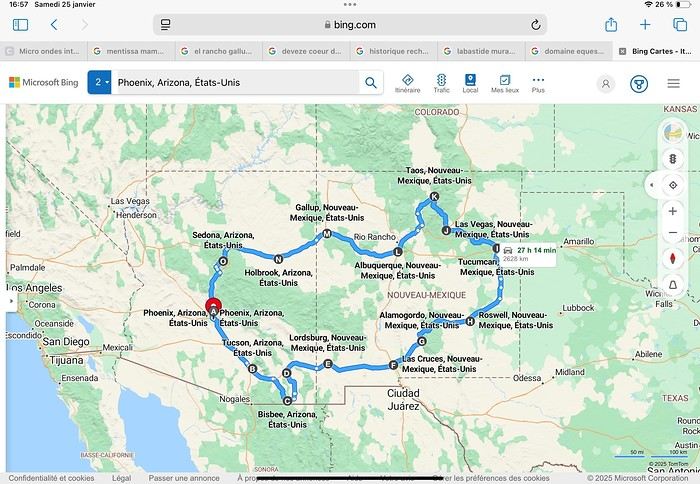
Day 1: Flight Marseille-Paris-Phoenix, then Gold Canyon (133 km) Day 2: Tucson (271 km) Lost Dutchman State Park Day 3: Tucson (155 km) Day 4: Tucson (34 km) Day 5: Bisbee (182 km) Day 6: Lordsburg (345 km) Day 7: Las Cruces (253 km) Day 8: Alamogordo (162 km) Day 9: Roswell (264 km) Day 10: Tucumcari (369 km) Day 11: Las Vegas (281 km) – the one in New Mexico Day 12: Taos (213 km) Day 13: Santa Fe (224 km) Day 14: Albuquerque (123 km) Day 15: Gallup (246 km) Day 16: Holbrook (224 km) Day 17: Flagstaff (179 km) Day 18: Sedona (118 km) Day 19: Sedona (48 km) Day 20: Sedona (41 km) Day 21: Phoenix (256 km) Day 22: Phoenix Airport (35 km)
📊 **Budget**: A little over 7,500 € for both of us, all included. The exchange rate was in our favor (1.17 dollars to 1 €). 📊 **Flights**: Marseille-Paris Charles de Gaulle-Phoenix: 1,787 € for two, with one checked bag each (Air France) 📊 **ESTA**: $42 📊 **America the Beautiful Pass**: $80 📊 **Parking**: 134 € (super eco at Marseille) 📊 **Car rental (Hertz)**: 865 €. Since there were no SUVs left in the reserved category (Nissan Rogue), we got an upgrade (4x4 Ford Explorer). We booked through Air France (15% discount). We’d originally reserved it in December for 1,140 €, but since prices dropped in March, we canceled and rebooked for 865 €. Hertz offers a free Hertz Gold Plus Rewards program, which gives you priority counter service when picking up the car. 📊 **Accommodation**: 2,400 € We stayed in hotels and motels of varying standards (from 60 to 203 € per night, depending on the city), all booked through Booking.com or Hotels.com. Out of 21 nights, only two didn’t include breakfast in the price. Booking.com sometimes offers slightly cheaper rates if you book by phone using the mobile app, and our Genius 3 status on the site also got us some preferential rates. 📊 **Supplementary insurance**: AVA 200 € for medical care if needed 📊 **Cash**: $2,078. We left with 1,000 € exchanged before departure and made two withdrawals of $500. This cash covered: - Evening restaurants and tips - Midday picnics - Gas: $298 for 4,160 km - Museum and private park entries (per person): - Lost Dutchman: $10 - Arizona-Sonora Desert Museum: $28 - Bird Cage Theater: $16 - Tombstone Shootout: $8 - New Mexico Farm & Ranch Museum: $12 - Roswell International UFO Museum: $5 - Billy the Kid Museum: $7 - Rancho de Taos: $22 - West Fork Oak Creek Trail entry: $15 We got a few discounts thanks to our senior age (+65). - Souvenirs and little treats
Like on our previous road trips, we didn’t rent a GPS. We got around using offline GPS apps Here WeGo and Organic Maps, with maps of the states we visited downloaded before we left (on our phones).
❤️❤️❤️ **Highlights** (there are so many!) 📍 Goldfield Ghost Town (even if it’s a reconstruction) 📍 The standing army of Saguaro cacti at Saguaro National Park West 📍 Diving into the cowboy universe of Tombstone 📍 The welcome from Rick and Henry at our guesthouse in Bisbee (Garden at Mile High Ranch) 📍 The tangled rocks of Chiricahua National Monument 📍 The flavored pistachios from Dwayne’s Fresh Jerky and Mac Ginnis Pistachioland 📍 Restaurants: La Posta (Las Cruces), Diner 66 (Albuquerque), and the Haunted Hamburger (Jerome) 📍 The old plazas of New Mexico 📍 The solitude and beauty of the white dunes at White Sands National Park 📍 Stepping back in time at the Billy the Kid Museum (Fort Stanton) 📍 Sections of historic Route 66 and the old motels of Tucumcari, especially at night when all the neon lights are on 📍 Taos Pueblo and diving into Native American culture 📍 After the Rio Grande Bridge, the descent via NM 567 to the very bottom of the Rio Grande Gorge, then the road along the riverbanks to Taos 📍 The tranquility of the Chimayo Sanctuary 📍 Discovering the ingenious native dwellings at Bandelier National Monument and Walnut Canyon National Park 📍 The small towns along the Turquoise Trail 📍 The red rocks of Red Rock Park and the Painted Desert 📍 The extraordinary colors of the petrified trees at Petrified Forest National Park 📍 Sedona, its red rocks, and the reward of the viewpoints at the end of hikes (Devil’s Bridge, The Subway, and West Fork Oak Creek) 📍 The immersion in Mexico when visiting Tlaquepaque 📍 The almost-ghost town of Jerome and its terraced streets 📍 The incredible kindness of Americans, always ready to help and up for a chat ❤️
☹️☹️☹️ **Flops** (there are very few) 📍 Several museums and churches being closed, so we couldn’t visit them 📍 Some museums and visitor centers opening late (10 AM) and closing early (4 PM) 📍 A 64 € phone roaming charge because we got near the Mexican border and picked up their cell tower 📍 The outrageous price ($5.99) for a gallon of gas at the Shell near Phoenix Airport
I hope this helps! Anyway, thanks for reading my long post. Don’t hesitate to reach out, even via PM, if you see I haven’t replied and you’d like more details. Have a great evening, everyone! 🙂
We’re back from our September 2025 road trip, this time to explore Arizona and New Mexico, and it’s time for me to start my travel journal—especially since everything’s already booked for another trip in September 2026 (to California), and I need to get started on the planning.
I was a little worried this new visit to Uncle Sam’s country might not be as "wow" as the others, but we still discovered some incredible places.
For those who don’t know us, we’re a couple in our seventies who speak very little English, but that didn’t stop us from fully enjoying our stay.
For this 6th road trip in the U.S., we spent 21 nights there, drove 4,160 km by car, and walked nearly 160 km in a loop starting from Phoenix.
We’d been to Arizona before (but not this side) and never to New Mexico. This whole road trip was a huge discovery for us.
In the prices mentioned (some in euros, others in dollars), bank fees and exchange charges are included. The flights, car rental, and parking were all paid for in December 2024 when we booked.
We’d downloaded the MPC (Mobile Passport Control) app, but there wasn’t a dedicated line at Phoenix Airport. Still, we got through quickly with friendly, smiling agents.
I don’t drive at all (I hate it), so the stops were chosen based on activities but also, for some, to limit daily mileage for the sole driver. The kilometers listed in the itinerary are the daily distances.
We traveled from September 9th to 22nd, unfortunately once again without our dear friends Mimi and Maumau.
The itinerary
Day 1: Flight Marseille-Paris-Phoenix, then Gold Canyon (133 km) Day 2: Tucson (271 km) Lost Dutchman State Park Day 3: Tucson (155 km) Day 4: Tucson (34 km) Day 5: Bisbee (182 km) Day 6: Lordsburg (345 km) Day 7: Las Cruces (253 km) Day 8: Alamogordo (162 km) Day 9: Roswell (264 km) Day 10: Tucumcari (369 km) Day 11: Las Vegas (281 km) – the one in New Mexico Day 12: Taos (213 km) Day 13: Santa Fe (224 km) Day 14: Albuquerque (123 km) Day 15: Gallup (246 km) Day 16: Holbrook (224 km) Day 17: Flagstaff (179 km) Day 18: Sedona (118 km) Day 19: Sedona (48 km) Day 20: Sedona (41 km) Day 21: Phoenix (256 km) Day 22: Phoenix Airport (35 km)
📊 **Budget**: A little over 7,500 € for both of us, all included. The exchange rate was in our favor (1.17 dollars to 1 €). 📊 **Flights**: Marseille-Paris Charles de Gaulle-Phoenix: 1,787 € for two, with one checked bag each (Air France) 📊 **ESTA**: $42 📊 **America the Beautiful Pass**: $80 📊 **Parking**: 134 € (super eco at Marseille) 📊 **Car rental (Hertz)**: 865 €. Since there were no SUVs left in the reserved category (Nissan Rogue), we got an upgrade (4x4 Ford Explorer). We booked through Air France (15% discount). We’d originally reserved it in December for 1,140 €, but since prices dropped in March, we canceled and rebooked for 865 €. Hertz offers a free Hertz Gold Plus Rewards program, which gives you priority counter service when picking up the car. 📊 **Accommodation**: 2,400 € We stayed in hotels and motels of varying standards (from 60 to 203 € per night, depending on the city), all booked through Booking.com or Hotels.com. Out of 21 nights, only two didn’t include breakfast in the price. Booking.com sometimes offers slightly cheaper rates if you book by phone using the mobile app, and our Genius 3 status on the site also got us some preferential rates. 📊 **Supplementary insurance**: AVA 200 € for medical care if needed 📊 **Cash**: $2,078. We left with 1,000 € exchanged before departure and made two withdrawals of $500. This cash covered: - Evening restaurants and tips - Midday picnics - Gas: $298 for 4,160 km - Museum and private park entries (per person): - Lost Dutchman: $10 - Arizona-Sonora Desert Museum: $28 - Bird Cage Theater: $16 - Tombstone Shootout: $8 - New Mexico Farm & Ranch Museum: $12 - Roswell International UFO Museum: $5 - Billy the Kid Museum: $7 - Rancho de Taos: $22 - West Fork Oak Creek Trail entry: $15 We got a few discounts thanks to our senior age (+65). - Souvenirs and little treats
Like on our previous road trips, we didn’t rent a GPS. We got around using offline GPS apps Here WeGo and Organic Maps, with maps of the states we visited downloaded before we left (on our phones).
❤️❤️❤️ **Highlights** (there are so many!) 📍 Goldfield Ghost Town (even if it’s a reconstruction) 📍 The standing army of Saguaro cacti at Saguaro National Park West 📍 Diving into the cowboy universe of Tombstone 📍 The welcome from Rick and Henry at our guesthouse in Bisbee (Garden at Mile High Ranch) 📍 The tangled rocks of Chiricahua National Monument 📍 The flavored pistachios from Dwayne’s Fresh Jerky and Mac Ginnis Pistachioland 📍 Restaurants: La Posta (Las Cruces), Diner 66 (Albuquerque), and the Haunted Hamburger (Jerome) 📍 The old plazas of New Mexico 📍 The solitude and beauty of the white dunes at White Sands National Park 📍 Stepping back in time at the Billy the Kid Museum (Fort Stanton) 📍 Sections of historic Route 66 and the old motels of Tucumcari, especially at night when all the neon lights are on 📍 Taos Pueblo and diving into Native American culture 📍 After the Rio Grande Bridge, the descent via NM 567 to the very bottom of the Rio Grande Gorge, then the road along the riverbanks to Taos 📍 The tranquility of the Chimayo Sanctuary 📍 Discovering the ingenious native dwellings at Bandelier National Monument and Walnut Canyon National Park 📍 The small towns along the Turquoise Trail 📍 The red rocks of Red Rock Park and the Painted Desert 📍 The extraordinary colors of the petrified trees at Petrified Forest National Park 📍 Sedona, its red rocks, and the reward of the viewpoints at the end of hikes (Devil’s Bridge, The Subway, and West Fork Oak Creek) 📍 The immersion in Mexico when visiting Tlaquepaque 📍 The almost-ghost town of Jerome and its terraced streets 📍 The incredible kindness of Americans, always ready to help and up for a chat ❤️
☹️☹️☹️ **Flops** (there are very few) 📍 Several museums and churches being closed, so we couldn’t visit them 📍 Some museums and visitor centers opening late (10 AM) and closing early (4 PM) 📍 A 64 € phone roaming charge because we got near the Mexican border and picked up their cell tower 📍 The outrageous price ($5.99) for a gallon of gas at the Shell near Phoenix Airport
I hope this helps! Anyway, thanks for reading my long post. Don’t hesitate to reach out, even via PM, if you see I haven’t replied and you’d like more details. Have a great evening, everyone! 🙂
7-week trip feedback: Rajasthan and Varanasi, October-November-December 2025
We traveled as a couple from October 20 to December 11, 2025, for our second trip to India and our first time in Rajasthan, plus Mathura and Agra, which are in Uttar Pradesh but right on the border, and a 4-day flight hop to Varanasi.
Here’s a non-detailed trip report—just to share some info we found useful for other travelers, along with a few places and addresses we particularly enjoyed.
First off, a big thank you to (I’m using usernames) Aleph240758, Solene40, Montagnard74, and Pagaljavab, who took the time to reply to me. Some of them even take the time to create detailed and illustrated travel stories. Since I only started planning the trip in mid-August, I didn’t have much time and used the trip reports on VoyageForum to build our itinerary.
One more note: everyone travels differently and has their own preferences... so I’ll just share our personal feelings, which are obviously subjective.
We bought a physical SIM card upon arriving at the airport. The Airtel stand only offers one package for 500 rupees (just under 5 €) for 28 days, with 1.5 GB of data, unlimited national SMS, and calls—more than enough. Contrary to what we’d read, we asked for activation at the counter, and it was active within 10 minutes. The SIM worked well everywhere. Watch out—like in all airports, there’s a tendency to take advantage of tourists. The Airtel counter offers to exchange money directly, and we saw people paying 20 € for the SIM.
Since we arrived at night, the metro wasn’t running anymore. Plus, if you don’t know the city, we’d recommend taking a prepaid taxi—the price is fixed, and the driver knows the destination. Be careful: the prepaid taxi counter is on the right as you exit the hall, with large fixed signs above. Many counters put out a card on the desk saying "prepaid taxi," and even the Airtel stand tries to offer supposedly prepaid taxis, which is completely false. The price they ask for could be double or triple.
Here’s an app that was super useful for us In most big cities, we used "Rapido," an Indian app like Uber, to book auto-rickshaws (you can also book motorbikes or cars). You need a local phone number for this. The big advantage? The price is fixed, though you can still leave a tip. It tracks your ride, and most importantly, the destination is entered—way more practical than hailing an auto-rickshaw on the street, where the driver says "yes, yes," gives a price, and then doesn’t know where to go once you’re on the way. No need to enter a credit card. There’s also OlaCabs, which is similar, but we couldn’t get it to work.
For transportation between stops, we used government buses (RSRTC, blue buses), sometimes taxis via apps or by asking the guesthouse for visits and hard-to-reach places. This choice was really personal and made on the spot. - **Pros:** Buses leave almost every 30 minutes everywhere, giving you a lot of freedom. Every time we left from the bus station (bus stand), we had seats. Several times, we even got to sit in the driver’s cabin! The trip takes longer than a taxi, but not *that* much longer. The price is ridiculously low—1.30 € for 100 km for men, 70 cents for women. The bus stations are in the city centers, unlike many private bus companies. We met some great people. - **Cons:** It’s not exactly clean, and you’re obviously not in the comfort of a taxi. It’s not door-to-door service, so you need to travel light. You can’t stop along the way. If you need to catch the bus mid-route, it’s usually full, and you’ll have to elbow your way in without hesitation. For a short trip, I think hiring a taxi for the whole stay makes sense. Like I said, there’s no one-size-fits-all choice, but there’s no need to be apprehensive about taking public buses.
Here’s our route map, showing the number of nights spent at each stop. Compared to our initial plan, we slept one night in Barmer instead of two because we had time to visit the market in the afternoon, saw the Kiradu site the next morning, and didn’t see the point in staying longer.
We cut two of the six nights in Shekhawati. After our flight to Varanasi was canceled, we had to stay in Delhi, which actually turned out well—it let us arrive in Varanasi earlier and more rested.
The timing worked well for us, with longer stops in Bundi and Udaipur.
Compared to our initial plan, we slept one night in Barmer instead of two because we had time to visit the market in the afternoon, saw the Kiradu site the next morning, and didn’t see the point in staying longer.
We cut two of the six nights in Shekhawati. After our flight to Varanasi was canceled, we had to stay in Delhi, which actually turned out well—it let us arrive in Varanasi earlier and more rested.
The timing worked well for us, with longer stops in Bundi and Udaipur.
I won’t go into detail about each stop here, but I’d be happy to answer any questions. The accommodations and restaurants mentioned are the ones that had that little something extra, and the hearts (❤️❤️❤️) mark the sites we particularly loved.
Tijana Fort Palace - Accommodation and recovery from the trip
Alwar - Palace with museum - Moosi Maharani Ki Chhatri - Large reservoir
Bharatpur Accommodation: Iora Guesthouse, 14 €/night without breakfast—great value, cheap, good meals, close to the reserve Morning at Keoladeo Reserve by bike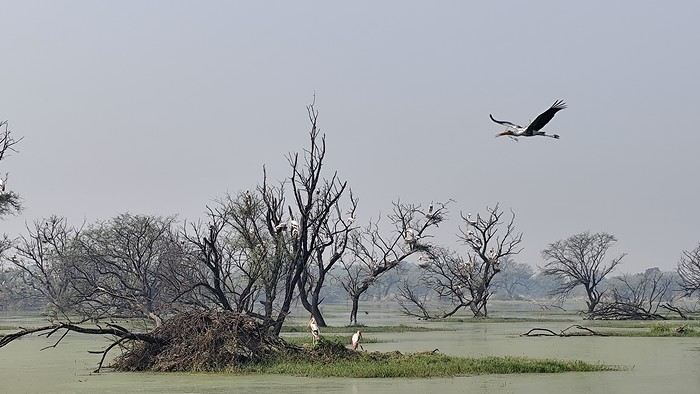
Mathura - Ghats (Yamuna Ghats, Vishram Ghat) to visit in the evening - Market (Chattu Bazar) - Hindu temple Shri Dwarkadheesh dedicated to Krishna - Vrindavan temple Banke Bihari, ❤️❤️❤️ a very important temple with incredible religious fervor - Vrindavan Hindu temple Balaram ISKCON
Agra Accommodation: Shivalayaa - The Divine Abode, 16 €/night with breakfast on Booking—welcoming, clean, close to the Taj Mahal - Mausoleum of Akbar the Great (in Sikandra) ❤️❤️❤️ - Mausoleum of Itimad-ud-Daulah (mini Taj) ❤️❤️❤️ - Visit the Taj early in the morning (closed on Fridays) ❤️❤️❤️ - Agra Fort ❤️❤️❤️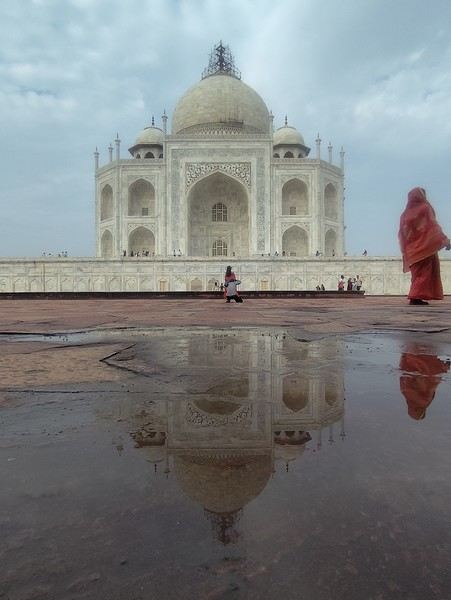
Dholpur - Machkund Temple with its water body - Clock Tower Ghanta Ghar - Royal stepwell Dhaulpur Bavdi
Karauli - City Palace, private visit with a guard ❤️❤️❤️ - Shri Madan Mohan Temple for the puja starting at 5:30 PM ❤️❤️❤️ - Wandering the streets We loved this stop, which is off the main tourist trail, for its pleasant atmosphere
Bhandarej This is a stop as a starting point to visit the Chand Baori stepwell in Abhaneri ❤️❤️❤️ Accommodation: Bhadrawati Palace, 53 €/night with breakfast in Bhandarej—nice, an old palace, warm welcome, booked via Hotels.com We were the only guests and had dinner with the current manager, the grandson of the Maharaja. There’s a pretty stepwell in the village, and we visited a tiny neighborhood temple where we were invited to join in the singing and dancing. Walking through the market was really enjoyable because of the kindness of the locals, who aren’t used to tourism ❤️❤️❤️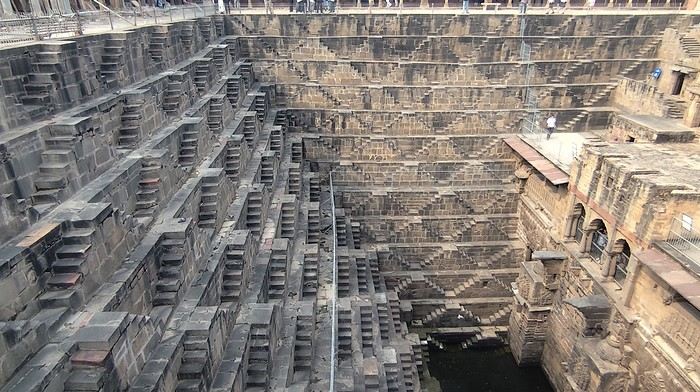
Jaipur - Hawa Mahal (Palace of Winds) - Jal Mahal - Gaitore Ki Chhatriyan ❤️❤️❤️ - Amber Fort ❤️❤️❤️ - Panna Meena Ka Kund stepwell - Galta Ji Temple (Monkey Temple) ❤️❤️❤️ - Bagru, 33 km away: visit to a fabric printing workshop with block prints (I’d noted some addresses on Google Maps). The first workshop wasn’t very welcoming and had no workers because of the humid weather. We were lucky to find another, more welcoming workshop. When the sun came out, the three female workers arrived and started their work—it was a great visit ❤️❤️❤️.
Bundi Accommodation: Hotel Bundi Inn, 25 €/night with breakfast—lovely room in a haveli, good meals with a rooftop view of the fort - Garh Palace Don’t miss: at the exit of the palace, to the left, you can access a beautiful garden with a pool and, at the back, a large hall called Chitrashala ❤️❤️❤️ - Raniji Ki Baori ❤️❤️❤️ - Nahar Dhunk Ki Baori - Chaurasi Khambun Ki Chhatri (cenotaph with 84 pillars) - Ksar Bagh, an interesting set of royal cenotaphs at the end of Jait Sagar Lake. On the other hand, we could’ve skipped Sukh Mahal and its museum. Bundi is still pleasant but is no longer a secret spot.
We bought a physical SIM card upon arriving at the airport. The Airtel stand only offers one package for 500 rupees (just under 5 €) for 28 days, with 1.5 GB of data, unlimited national SMS, and calls—more than enough. Contrary to what we’d read, we asked for activation at the counter, and it was active within 10 minutes. The SIM worked well everywhere. Watch out—like in all airports, there’s a tendency to take advantage of tourists. The Airtel counter offers to exchange money directly, and we saw people paying 20 € for the SIM.
Since we arrived at night, the metro wasn’t running anymore. Plus, if you don’t know the city, we’d recommend taking a prepaid taxi—the price is fixed, and the driver knows the destination. Be careful: the prepaid taxi counter is on the right as you exit the hall, with large fixed signs above. Many counters put out a card on the desk saying "prepaid taxi," and even the Airtel stand tries to offer supposedly prepaid taxis, which is completely false. The price they ask for could be double or triple.
Here’s an app that was super useful for us In most big cities, we used "Rapido," an Indian app like Uber, to book auto-rickshaws (you can also book motorbikes or cars). You need a local phone number for this. The big advantage? The price is fixed, though you can still leave a tip. It tracks your ride, and most importantly, the destination is entered—way more practical than hailing an auto-rickshaw on the street, where the driver says "yes, yes," gives a price, and then doesn’t know where to go once you’re on the way. No need to enter a credit card. There’s also OlaCabs, which is similar, but we couldn’t get it to work.
For transportation between stops, we used government buses (RSRTC, blue buses), sometimes taxis via apps or by asking the guesthouse for visits and hard-to-reach places. This choice was really personal and made on the spot. - **Pros:** Buses leave almost every 30 minutes everywhere, giving you a lot of freedom. Every time we left from the bus station (bus stand), we had seats. Several times, we even got to sit in the driver’s cabin! The trip takes longer than a taxi, but not *that* much longer. The price is ridiculously low—1.30 € for 100 km for men, 70 cents for women. The bus stations are in the city centers, unlike many private bus companies. We met some great people. - **Cons:** It’s not exactly clean, and you’re obviously not in the comfort of a taxi. It’s not door-to-door service, so you need to travel light. You can’t stop along the way. If you need to catch the bus mid-route, it’s usually full, and you’ll have to elbow your way in without hesitation. For a short trip, I think hiring a taxi for the whole stay makes sense. Like I said, there’s no one-size-fits-all choice, but there’s no need to be apprehensive about taking public buses.
Here’s our route map, showing the number of nights spent at each stop.
Compared to our initial plan, we slept one night in Barmer instead of two because we had time to visit the market in the afternoon, saw the Kiradu site the next morning, and didn’t see the point in staying longer.
We cut two of the six nights in Shekhawati. After our flight to Varanasi was canceled, we had to stay in Delhi, which actually turned out well—it let us arrive in Varanasi earlier and more rested.
The timing worked well for us, with longer stops in Bundi and Udaipur.I won’t go into detail about each stop here, but I’d be happy to answer any questions. The accommodations and restaurants mentioned are the ones that had that little something extra, and the hearts (❤️❤️❤️) mark the sites we particularly loved.
Tijana Fort Palace - Accommodation and recovery from the trip
Alwar - Palace with museum - Moosi Maharani Ki Chhatri - Large reservoir
Bharatpur Accommodation: Iora Guesthouse, 14 €/night without breakfast—great value, cheap, good meals, close to the reserve Morning at Keoladeo Reserve by bike
Mathura - Ghats (Yamuna Ghats, Vishram Ghat) to visit in the evening - Market (Chattu Bazar) - Hindu temple Shri Dwarkadheesh dedicated to Krishna - Vrindavan temple Banke Bihari, ❤️❤️❤️ a very important temple with incredible religious fervor - Vrindavan Hindu temple Balaram ISKCON
Agra Accommodation: Shivalayaa - The Divine Abode, 16 €/night with breakfast on Booking—welcoming, clean, close to the Taj Mahal - Mausoleum of Akbar the Great (in Sikandra) ❤️❤️❤️ - Mausoleum of Itimad-ud-Daulah (mini Taj) ❤️❤️❤️ - Visit the Taj early in the morning (closed on Fridays) ❤️❤️❤️ - Agra Fort ❤️❤️❤️
Dholpur - Machkund Temple with its water body - Clock Tower Ghanta Ghar - Royal stepwell Dhaulpur Bavdi
Karauli - City Palace, private visit with a guard ❤️❤️❤️ - Shri Madan Mohan Temple for the puja starting at 5:30 PM ❤️❤️❤️ - Wandering the streets We loved this stop, which is off the main tourist trail, for its pleasant atmosphere
Bhandarej This is a stop as a starting point to visit the Chand Baori stepwell in Abhaneri ❤️❤️❤️ Accommodation: Bhadrawati Palace, 53 €/night with breakfast in Bhandarej—nice, an old palace, warm welcome, booked via Hotels.com We were the only guests and had dinner with the current manager, the grandson of the Maharaja. There’s a pretty stepwell in the village, and we visited a tiny neighborhood temple where we were invited to join in the singing and dancing. Walking through the market was really enjoyable because of the kindness of the locals, who aren’t used to tourism ❤️❤️❤️
Jaipur - Hawa Mahal (Palace of Winds) - Jal Mahal - Gaitore Ki Chhatriyan ❤️❤️❤️ - Amber Fort ❤️❤️❤️ - Panna Meena Ka Kund stepwell - Galta Ji Temple (Monkey Temple) ❤️❤️❤️ - Bagru, 33 km away: visit to a fabric printing workshop with block prints (I’d noted some addresses on Google Maps). The first workshop wasn’t very welcoming and had no workers because of the humid weather. We were lucky to find another, more welcoming workshop. When the sun came out, the three female workers arrived and started their work—it was a great visit ❤️❤️❤️.
Bundi Accommodation: Hotel Bundi Inn, 25 €/night with breakfast—lovely room in a haveli, good meals with a rooftop view of the fort - Garh Palace Don’t miss: at the exit of the palace, to the left, you can access a beautiful garden with a pool and, at the back, a large hall called Chitrashala ❤️❤️❤️ - Raniji Ki Baori ❤️❤️❤️ - Nahar Dhunk Ki Baori - Chaurasi Khambun Ki Chhatri (cenotaph with 84 pillars) - Ksar Bagh, an interesting set of royal cenotaphs at the end of Jait Sagar Lake. On the other hand, we could’ve skipped Sukh Mahal and its museum. Bundi is still pleasant but is no longer a secret spot.
Renting a car in the USA and driver's civil liability.
Hi everyone.
I’ve been wondering: Is it still reasonable to rent a car in the U.S.?
Apparently, since early January 2025—and very quietly—the most important insurance coverage, namely the driver’s civil liability, has seen its coverage amount drop from $1 million to just $300,000. This coverage is supposed to protect us from damages we might be responsible for while driving. We can go decades without a single scrape (especially if it’s our fault), but anything can happen in a split second. A motorcycle appearing out of nowhere, a misjudgment at one of those huge intersections with staggered traffic lights, and suddenly we could be deemed at fault for the accident. We’d then have to pay out of pocket for the other party’s medical expenses. Given what hospitals charge... it can easily exceed $300,000 and turn into a nightmare in no time!!! Plus, anyone who’s driven on American roads has seen those billboards for lawyers offering their services to accident victims. So on top of the sky-high medical bill, the lawyer will demand compensation worthy of a Hollywood movie!!!! So, is it even worth getting behind the wheel in America anymore? Well... that’s just my take! And on top of that, I haven’t found any insurance company that offers such high civil liability coverage. Chapka and others do offer coverage in the millions, but motor vehicles are excluded.... So here’s the thing... Unless I’ve "missed something," I’ve come to this conclusion: Renting a car in the U.S. is like playing Russian roulette! But maybe I’m being too pessimistic? What do you think?
I’ve been wondering: Is it still reasonable to rent a car in the U.S.?
Apparently, since early January 2025—and very quietly—the most important insurance coverage, namely the driver’s civil liability, has seen its coverage amount drop from $1 million to just $300,000. This coverage is supposed to protect us from damages we might be responsible for while driving. We can go decades without a single scrape (especially if it’s our fault), but anything can happen in a split second. A motorcycle appearing out of nowhere, a misjudgment at one of those huge intersections with staggered traffic lights, and suddenly we could be deemed at fault for the accident. We’d then have to pay out of pocket for the other party’s medical expenses. Given what hospitals charge... it can easily exceed $300,000 and turn into a nightmare in no time!!! Plus, anyone who’s driven on American roads has seen those billboards for lawyers offering their services to accident victims. So on top of the sky-high medical bill, the lawyer will demand compensation worthy of a Hollywood movie!!!! So, is it even worth getting behind the wheel in America anymore? Well... that’s just my take! And on top of that, I haven’t found any insurance company that offers such high civil liability coverage. Chapka and others do offer coverage in the millions, but motor vehicles are excluded.... So here’s the thing... Unless I’ve "missed something," I’ve come to this conclusion: Renting a car in the U.S. is like playing Russian roulette! But maybe I’m being too pessimistic? What do you think?
The Two of Us in Istanbul: A Turkish Blue Round
Hello everyone,
I’m not really a regular contributor to VoyageForum, but every time Kate and I travel, she encourages me to write a travel journal and publish it. And I must admit, it’s a very enjoyable intellectual exercise, though not always easy. As a VF contributor whose journals I’ve read once said, this retrospective work not only helps preserve memories but also provides a fruitful moment of introspection by bringing back emotions and feelings.
Kate and I spent a week in Istanbul. For her, who had already visited, it was a return; for me, it was a discovery.
As we’ve now made a habit of, I write the texts, and she posts her photos. We hope this illustrated story, crafted together, will revive beautiful sensations for those who know the city and inspire others to discover it. Here we go!
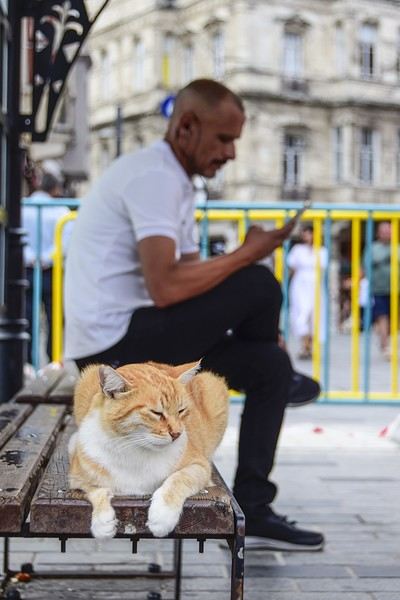
I’m not really a regular contributor to VoyageForum, but every time Kate and I travel, she encourages me to write a travel journal and publish it. And I must admit, it’s a very enjoyable intellectual exercise, though not always easy. As a VF contributor whose journals I’ve read once said, this retrospective work not only helps preserve memories but also provides a fruitful moment of introspection by bringing back emotions and feelings.
Kate and I spent a week in Istanbul. For her, who had already visited, it was a return; for me, it was a discovery.
As we’ve now made a habit of, I write the texts, and she posts her photos. We hope this illustrated story, crafted together, will revive beautiful sensations for those who know the city and inspire others to discover it. Here we go!
Two-week family trip to Colombia in August with 8-year-olds
Hi everyone,
I’d like to share my family trip to Colombia with kids aged 8. After spending hours browsing the forum and only having two weeks there, we decided to focus on two regions: the Coffee Zone for one week and the Caribbean coast for another. We traveled from August 8 to 23.
Day 1 – First stop: Bogotá
We arrived in Bogotá in the evening on an Air France flight—nothing to complain about, decent service, comfortable, and on time. However, the first night was a miss. We’d booked a hotel near the airport (Abitel Prime) for convenience, but the soundproofing was almost nonexistent; we heard planes as if we were on the runway. Luckily, exhaustion helped us sleep well anyway.
Day 2 – Off to the Coffee Zone and Salento
The next morning, we headed to the airport for a domestic flight to Pereira with LATAM. No issues: punctual and efficient, and in 30 minutes, we landed in Pereira. The landing already set a different mood: lush valleys, endless plantations, and humid air. We picked up our rental car from Localiza. Unfortunately, the experience wasn’t smooth—the paperwork took forever, and the wait tested our patience. Finally free, we hit the road to Salento, one of Quindío’s gems. We arrived in the late afternoon and discovered a colorful village bustling with artisan shops and cafés. Our first stroll helped us soak in the atmosphere before dinner at Bambú restaurant—a great surprise with careful cooking and local flavors. We spent the night at Casa Serafín, a charming little hotel, nicely decorated and well-located… but unfortunately very noisy.
Day 3 – The magic of Cocora Valley
This was one of the trip’s highlights. We set off early for Cocora Valley, famous for its giant wax palms, Colombia’s emblem. We chose the 12 km loop recommended by the *Routard*. The landscapes were spectacular: towering palms, rivers, suspension bridges. It felt like walking through a postcard. The weather was perfect. That evening, we dined at Barnabé restaurant—pleasant setting, decent food, but the bill was a bit steep for what it was. Back to Casa Serafín.
Day 4 – Coffee and panoramic views
The plan was a visit to Finca El Ocaso. For 1.5 hours, we followed a passionate guide who explained the entire coffee process, from harvest to cup. Very educational, accessible for both kids and adults, all in a stunning setting. The tour was in English for us, and we translated for our kids, who aren’t bilingual yet. In the afternoon, we climbed to Salento’s viewpoint. The valley view was superb. That evening, we ate at Veggie Garden, a simple and pleasant spot that was a nice change from the heavier meals of previous days.
Day 5 – Horseback ride to Santa Rita Waterfall
We booked a horseback ride with Cocora Magic. It was a real success: calm horses, a beautiful trail, mountain and meadow landscapes, and finally the refreshing and wild Santa Rita Waterfall. Without a doubt, one of the best moments of our time in the region. We even got a bonus ride up a 300-meter hill. We then headed to Filandia, less known than Salento but just as charming. We spent the late afternoon enjoying the pool at MuchoSur Filandia. The hotel is beautiful, in an idyllic setting. However, we also had soundproofing issues and could hear our neighbors.
Day 6 – Rainy detour through Filandia and Manizales
Rain caught up with us in the early morning: torrents of water made it impossible to go out. We stayed at the hotel, reading quietly. By noon, the rain let up: a quick walk in Filandia, a quick lunch, then off to Manizales. We chose to stay at El Otoño hot springs. Great choice: as soon as we arrived, we plunged into the hot pools, perfect after hours on the road.
Day 7 – Hiking and hot springs
In the morning, we hiked the Camino de Super Coco (found somewhat randomly on Google). A pleasant trail with mountain views and a peaceful atmosphere. The afternoon was spent in the hotel’s thermal pools, with a short marked hike down to the river. Dinner on-site at the hot springs’ restaurant. A simple but very relaxing day.
Day 8 – Rain, jacuzzi, and games
We continued to Finca Los Alpes. The rain greeted us again, but this time it turned into an asset: nothing like a steaming jacuzzi with a view of the misty mountains. The kids enjoyed the facilities too: mini-golf, ping-pong, billiards. Dinner and night at the hotel, cozy vibes.
Day 9 – Off to the Caribbean coast
Back to the airport to return the car (still a bit long). Flight to Cartagena with Avianca: punctual and comfortable. Upon arrival, we picked up another car and headed straight to the Hyatt Regency, a modern hotel with a pool. That evening, we dined at the hotel—practical after a travel day.
Day 10 – Colonial Cartagena
We set off to explore Cartagena’s old town. It was enchanting: colorful facades, flowered balconies, colonial charm—just magical. However, the heat was stifling and very humid. Afternoon relaxation by the pool. Dinner at Gestlani, a good restaurant in town.
Day 11 – Road to Barú
A hearty breakfast, then one last swim in the pool before heading to Barú. We checked into Las Islas Hotel. The setting was enchanting: wooden cabins nestled in the vegetation, a private beach, turquoise sea, impeccable service. Dinner at the hotel’s restaurant.
Day 12 – Beach and relaxation
A full beach day in Barú. Warm water, white sand, coconut trees, peace and quiet. A real postcard scene with iguanas and birds.
Day 13 – On to Santa Marta
Another morning at the beach before hitting the road to Santa Marta. The drive was a bit long (6 hours), especially with traffic jams in Barranquilla. It was the longest car ride of the trip. We spent the night at Villa María Tayrona, a beautiful place near the park.
Day 14 – Tayrona Park
We left early for Tayrona Park. We entered through **El Zaino**, parked the car, and set off on a hike to La Piscina (about 2 hours). We stopped along the way at Playa Arenilla, a stunning little beach, to rest. Lunch on-site, a swim, then back by 4 PM. The hike was a bit tiring, but the nature was spectacular: dense jungle, the sound of waves, and even a monkey encounter along the way. Evening and dinner at the hotel.
Day 15 – Last swim and return flight to Bogotá
Our last morning was split between the pool and the beach (the hotel has direct access via a 7-minute trail through vegetation and flowers)—hard to leave this paradise. We drove to Santa Marta’s airport to return the car, then flew back to Bogotá. We spent the night at Casa Dann Carlton, a comfortable hotel. We simply ordered room service, arriving too late to go out.
Day 16 – Bogotá and the end of the trip
Our last day in Colombia. After a good breakfast, we explored La Candelaria. Its cobbled streets and colorful houses were worth the visit. We visited the Botero Museum (free) and the Gold Museum, both fascinating. Back to the airport for our 11:55 PM Air France flight.
That’s a wrap on a varied trip—lush mountains, colorful villages, dream beaches, and tropical jungle. The pace was pretty relaxed, well-suited for our kids. They absolutely loved the trip to Colombia. Driving in Colombia was very easy, and we didn’t regret renting a car at all—it gave us more freedom to get around.
If I were to do it again, here’s what I’d change: - I’d spend less time in the Coffee Zone to stay a bit longer on the Caribbean coast, which was more relaxing for the kids. Or I’d head to Medellín, but I didn’t think the city was very kid-friendly. - Bogotá is a city that deserves a day’s visit, but it’s not a must-see. Maybe I’d have taken the KLM flight from Cartagena to Amsterdam instead.
If you have any questions, don’t hesitate!
Antoine
I’d like to share my family trip to Colombia with kids aged 8. After spending hours browsing the forum and only having two weeks there, we decided to focus on two regions: the Coffee Zone for one week and the Caribbean coast for another. We traveled from August 8 to 23.
Day 1 – First stop: Bogotá
We arrived in Bogotá in the evening on an Air France flight—nothing to complain about, decent service, comfortable, and on time. However, the first night was a miss. We’d booked a hotel near the airport (Abitel Prime) for convenience, but the soundproofing was almost nonexistent; we heard planes as if we were on the runway. Luckily, exhaustion helped us sleep well anyway.
Day 2 – Off to the Coffee Zone and Salento
The next morning, we headed to the airport for a domestic flight to Pereira with LATAM. No issues: punctual and efficient, and in 30 minutes, we landed in Pereira. The landing already set a different mood: lush valleys, endless plantations, and humid air. We picked up our rental car from Localiza. Unfortunately, the experience wasn’t smooth—the paperwork took forever, and the wait tested our patience. Finally free, we hit the road to Salento, one of Quindío’s gems. We arrived in the late afternoon and discovered a colorful village bustling with artisan shops and cafés. Our first stroll helped us soak in the atmosphere before dinner at Bambú restaurant—a great surprise with careful cooking and local flavors. We spent the night at Casa Serafín, a charming little hotel, nicely decorated and well-located… but unfortunately very noisy.
Day 3 – The magic of Cocora Valley
This was one of the trip’s highlights. We set off early for Cocora Valley, famous for its giant wax palms, Colombia’s emblem. We chose the 12 km loop recommended by the *Routard*. The landscapes were spectacular: towering palms, rivers, suspension bridges. It felt like walking through a postcard. The weather was perfect. That evening, we dined at Barnabé restaurant—pleasant setting, decent food, but the bill was a bit steep for what it was. Back to Casa Serafín.
Day 4 – Coffee and panoramic views
The plan was a visit to Finca El Ocaso. For 1.5 hours, we followed a passionate guide who explained the entire coffee process, from harvest to cup. Very educational, accessible for both kids and adults, all in a stunning setting. The tour was in English for us, and we translated for our kids, who aren’t bilingual yet. In the afternoon, we climbed to Salento’s viewpoint. The valley view was superb. That evening, we ate at Veggie Garden, a simple and pleasant spot that was a nice change from the heavier meals of previous days.
Day 5 – Horseback ride to Santa Rita Waterfall
We booked a horseback ride with Cocora Magic. It was a real success: calm horses, a beautiful trail, mountain and meadow landscapes, and finally the refreshing and wild Santa Rita Waterfall. Without a doubt, one of the best moments of our time in the region. We even got a bonus ride up a 300-meter hill. We then headed to Filandia, less known than Salento but just as charming. We spent the late afternoon enjoying the pool at MuchoSur Filandia. The hotel is beautiful, in an idyllic setting. However, we also had soundproofing issues and could hear our neighbors.
Day 6 – Rainy detour through Filandia and Manizales
Rain caught up with us in the early morning: torrents of water made it impossible to go out. We stayed at the hotel, reading quietly. By noon, the rain let up: a quick walk in Filandia, a quick lunch, then off to Manizales. We chose to stay at El Otoño hot springs. Great choice: as soon as we arrived, we plunged into the hot pools, perfect after hours on the road.
Day 7 – Hiking and hot springs
In the morning, we hiked the Camino de Super Coco (found somewhat randomly on Google). A pleasant trail with mountain views and a peaceful atmosphere. The afternoon was spent in the hotel’s thermal pools, with a short marked hike down to the river. Dinner on-site at the hot springs’ restaurant. A simple but very relaxing day.
Day 8 – Rain, jacuzzi, and games
We continued to Finca Los Alpes. The rain greeted us again, but this time it turned into an asset: nothing like a steaming jacuzzi with a view of the misty mountains. The kids enjoyed the facilities too: mini-golf, ping-pong, billiards. Dinner and night at the hotel, cozy vibes.
Day 9 – Off to the Caribbean coast
Back to the airport to return the car (still a bit long). Flight to Cartagena with Avianca: punctual and comfortable. Upon arrival, we picked up another car and headed straight to the Hyatt Regency, a modern hotel with a pool. That evening, we dined at the hotel—practical after a travel day.
Day 10 – Colonial Cartagena
We set off to explore Cartagena’s old town. It was enchanting: colorful facades, flowered balconies, colonial charm—just magical. However, the heat was stifling and very humid. Afternoon relaxation by the pool. Dinner at Gestlani, a good restaurant in town.
Day 11 – Road to Barú
A hearty breakfast, then one last swim in the pool before heading to Barú. We checked into Las Islas Hotel. The setting was enchanting: wooden cabins nestled in the vegetation, a private beach, turquoise sea, impeccable service. Dinner at the hotel’s restaurant.
Day 12 – Beach and relaxation
A full beach day in Barú. Warm water, white sand, coconut trees, peace and quiet. A real postcard scene with iguanas and birds.
Day 13 – On to Santa Marta
Another morning at the beach before hitting the road to Santa Marta. The drive was a bit long (6 hours), especially with traffic jams in Barranquilla. It was the longest car ride of the trip. We spent the night at Villa María Tayrona, a beautiful place near the park.
Day 14 – Tayrona Park
We left early for Tayrona Park. We entered through **El Zaino**, parked the car, and set off on a hike to La Piscina (about 2 hours). We stopped along the way at Playa Arenilla, a stunning little beach, to rest. Lunch on-site, a swim, then back by 4 PM. The hike was a bit tiring, but the nature was spectacular: dense jungle, the sound of waves, and even a monkey encounter along the way. Evening and dinner at the hotel.
Day 15 – Last swim and return flight to Bogotá
Our last morning was split between the pool and the beach (the hotel has direct access via a 7-minute trail through vegetation and flowers)—hard to leave this paradise. We drove to Santa Marta’s airport to return the car, then flew back to Bogotá. We spent the night at Casa Dann Carlton, a comfortable hotel. We simply ordered room service, arriving too late to go out.
Day 16 – Bogotá and the end of the trip
Our last day in Colombia. After a good breakfast, we explored La Candelaria. Its cobbled streets and colorful houses were worth the visit. We visited the Botero Museum (free) and the Gold Museum, both fascinating. Back to the airport for our 11:55 PM Air France flight.
That’s a wrap on a varied trip—lush mountains, colorful villages, dream beaches, and tropical jungle. The pace was pretty relaxed, well-suited for our kids. They absolutely loved the trip to Colombia. Driving in Colombia was very easy, and we didn’t regret renting a car at all—it gave us more freedom to get around.
If I were to do it again, here’s what I’d change: - I’d spend less time in the Coffee Zone to stay a bit longer on the Caribbean coast, which was more relaxing for the kids. Or I’d head to Medellín, but I didn’t think the city was very kid-friendly. - Bogotá is a city that deserves a day’s visit, but it’s not a must-see. Maybe I’d have taken the KLM flight from Cartagena to Amsterdam instead.
If you have any questions, don’t hesitate!
Antoine
Australia 2025: Discovering the 5th Continent
Hi everyone.
Because that’s also what sparks the desire in every traveler (well, at least for me) to set foot on Australian soil: discovering a new continent.
Right now, I’ve got some time on my hands—those who follow me know that. A nasty muscle tear (which really doesn’t want to heal) is keeping me grounded for another week, so I’ve decided to open a new travel journal, recounting my recent trip from December 14, 2024, to January 12, 2025, in Australia.
The origins of this trip started last May in Crete, an island I chose for a 10-day break. It’s really lovely, by the way, but that’s not the point… It’s around this time every year that we decide on our next winter destination, and Argentina was at the top of the list—Sydney wasn’t even on the radar… I’d been looking at flights to Buenos Aires for a while, and the prices were shocking… But by the pool one lazy afternoon, scrolling on my iPhone, a promo from Geneva to Sydney caught my eye. The deal ticked two boxes on my traveler’s bucket list: a flight to Australia and a flight with Singapore Airlines, often ranked as the world’s best airline. A quick chat with the missus (well, of course!) and the decision was made: off to the land of kangaroos! Now, once you add luggage and Economy Plus, it still comes to 1600 € per person, but that’s a reasonable price. Either way, we already know what we’re in for—Australia is a budget commitment!

Thanks to 123rf for the image loan 😛
Right now, I’ve got some time on my hands—those who follow me know that. A nasty muscle tear (which really doesn’t want to heal) is keeping me grounded for another week, so I’ve decided to open a new travel journal, recounting my recent trip from December 14, 2024, to January 12, 2025, in Australia.
The origins of this trip started last May in Crete, an island I chose for a 10-day break. It’s really lovely, by the way, but that’s not the point… It’s around this time every year that we decide on our next winter destination, and Argentina was at the top of the list—Sydney wasn’t even on the radar… I’d been looking at flights to Buenos Aires for a while, and the prices were shocking… But by the pool one lazy afternoon, scrolling on my iPhone, a promo from Geneva to Sydney caught my eye. The deal ticked two boxes on my traveler’s bucket list: a flight to Australia and a flight with Singapore Airlines, often ranked as the world’s best airline. A quick chat with the missus (well, of course!) and the decision was made: off to the land of kangaroos! Now, once you add luggage and Economy Plus, it still comes to 1600 € per person, but that’s a reasonable price. Either way, we already know what we’re in for—Australia is a budget commitment!
Thanks to 123rf for the image loan 😛
Zambia in Summer 2024 – Self-Drive Trip
Well, here we go,
despite the lack of info on Zambia, I managed to pull off this pretty special trip.
I’d posted asking for tips but got very few replies. So I leaned heavily on Giradhino’s travel journal to plan the route.
The context: After visiting Kenya, then Namibia, then Botswana, I wanted to see another Southern African country—hence Zambia. This time, we’re two couples: us (of course) and our friends we’ve traveled with to the last two countries mentioned. The idea was to do a self-drive trip, picking up a 4x4 at the airport and figuring it out as we went.
We rented our fully equipped vehicle from Hemingways, an agency in Livingstone. Great agency (really), I’ll talk more about them later. It came with rooftop tents and all the gear for cooking and everything... However, our goal was to sleep in lodges and only use the tents as a last resort. Mission accomplished—we never even unfolded the tents. Guess we’re getting old 🙂
The route (summary): Lusaka - Kasanka NP - Bangweulu NP - Mutinondo - Kapishya - North Luangwa - South Luangwa and back to Lusaka.
That said, let’s hit the road for this travel journal of a pretty lively trip. Reminder: I’m more of a filmmaker, so I’ve got tons of footage but very few photos. The ones I have were taken on my phone, so they’re not great quality. My wife’s the one who handles that side of things.
Day 1:
At 9 a.m. sharp (or close enough), we leave the Lyon area, heading to Paris CDG. Our flight’s at 9:30 p.m., but it’s a busy Saturday with holiday traffic, so we play it safe to avoid jams—especially since the Olympics (hosted in Paris, in case you didn’t know) are causing extra traffic issues.
We’re relaxed and happy to be on our way. The drive goes smoothly. We take the eastern route around Paris to reach a hotel with parking at a better price than the airport lots. We leave the car there, and a shuttle takes us to Terminal 2. Bad luck—we’re actually flying from Terminal 1! The transfer between terminals is quick, though, so no stress.
After the usual formalities (with Rwandair), we end up in the Duty Free.
A rare rant-free moment: Usually, I let off steam in my travel journals now and then, but this time it’s the opposite. I had a terrible memory of CDG and had been avoiding it for years. But this time—Olympics effect? A big change? What a pleasant surprise! The staff were plentiful and super friendly at every pre-flight step, making everything easier. Comfortable seats for waiting to board. Well done, CDG!
We buy Ricard, Jack Daniel’s, and Get 27 to handle any situation that might come up. We board on time, and that’s when our adventures with Rwandair really begin. Yep, the first hiccup!
We’d booked our tickets back in October and (since we don’t hold back!) had paid extra for preferred seats on all our flights. Since October, we’d received emails about schedule changes—just a few minutes here and there. Unfortunately, we never got an email saying that *on top of* the schedule change, the plane’s configuration had also changed. So when we boarded with our seats (all four of us together at row 25), we were furious to see that the preferred seats were now row 23. We’d been *completely* scammed. We’d paid extra to end up in seats we’d been trying to avoid! You could say Rwandair double-dipped on the same seats. What a rip-off! We tried to negotiate an upgrade, but the flight was full. So our flight to Kigali started with a real sense of anger.
The +: We’re on our way The -: Rwandair
The context: After visiting Kenya, then Namibia, then Botswana, I wanted to see another Southern African country—hence Zambia. This time, we’re two couples: us (of course) and our friends we’ve traveled with to the last two countries mentioned. The idea was to do a self-drive trip, picking up a 4x4 at the airport and figuring it out as we went.
We rented our fully equipped vehicle from Hemingways, an agency in Livingstone. Great agency (really), I’ll talk more about them later. It came with rooftop tents and all the gear for cooking and everything... However, our goal was to sleep in lodges and only use the tents as a last resort. Mission accomplished—we never even unfolded the tents. Guess we’re getting old 🙂
The route (summary): Lusaka - Kasanka NP - Bangweulu NP - Mutinondo - Kapishya - North Luangwa - South Luangwa and back to Lusaka.
That said, let’s hit the road for this travel journal of a pretty lively trip. Reminder: I’m more of a filmmaker, so I’ve got tons of footage but very few photos. The ones I have were taken on my phone, so they’re not great quality. My wife’s the one who handles that side of things.
Day 1:
At 9 a.m. sharp (or close enough), we leave the Lyon area, heading to Paris CDG. Our flight’s at 9:30 p.m., but it’s a busy Saturday with holiday traffic, so we play it safe to avoid jams—especially since the Olympics (hosted in Paris, in case you didn’t know) are causing extra traffic issues.
We’re relaxed and happy to be on our way. The drive goes smoothly. We take the eastern route around Paris to reach a hotel with parking at a better price than the airport lots. We leave the car there, and a shuttle takes us to Terminal 2. Bad luck—we’re actually flying from Terminal 1! The transfer between terminals is quick, though, so no stress.
After the usual formalities (with Rwandair), we end up in the Duty Free.
A rare rant-free moment: Usually, I let off steam in my travel journals now and then, but this time it’s the opposite. I had a terrible memory of CDG and had been avoiding it for years. But this time—Olympics effect? A big change? What a pleasant surprise! The staff were plentiful and super friendly at every pre-flight step, making everything easier. Comfortable seats for waiting to board. Well done, CDG!
We buy Ricard, Jack Daniel’s, and Get 27 to handle any situation that might come up. We board on time, and that’s when our adventures with Rwandair really begin. Yep, the first hiccup!
We’d booked our tickets back in October and (since we don’t hold back!) had paid extra for preferred seats on all our flights. Since October, we’d received emails about schedule changes—just a few minutes here and there. Unfortunately, we never got an email saying that *on top of* the schedule change, the plane’s configuration had also changed. So when we boarded with our seats (all four of us together at row 25), we were furious to see that the preferred seats were now row 23. We’d been *completely* scammed. We’d paid extra to end up in seats we’d been trying to avoid! You could say Rwandair double-dipped on the same seats. What a rip-off! We tried to negotiate an upgrade, but the flight was full. So our flight to Kigali started with a real sense of anger.
The +: We’re on our way The -: Rwandair
3 weeks in Colombia (August 2023)
Why Colombia?
It's quite simple. For the past few years, my daughter has been living with a Colombian from Bogotá. The idea was to discover his country, meet his family, and do part of the trip all four of us together.
We’re heading out first as scouts, then they’ll join us to continue the journey.
The itinerary was shared in another post—now it’s time for the impressions.
No photos, as for me, it’s video and nothing more!
Day 1: The big departure What was planned: A flight from Lyon Saint-Exupéry late morning heading to Frankfurt. Two hours of waiting in Frankfurt (just enough time to eat a pretzel!!) and then off to Bogotá for an arrival around 7 PM local time. I hadn’t done the Check-Mig (to be done 72 hours before the flight). I did it on my phone, giving a fake arrival date in Colombia, and the attendant told me there wouldn’t be any issues in Bogotá. Actually, two hours of delay at departure in Lyon because a sick passenger was on the plane—they had to evacuate him, and the ambulance that was supposed to be there didn’t have permission to come near the plane. Ah, French administrative formalities!!!!! Flight to Frankfurt with Lufthansa went smoothly. A sprint through the airport—very well organized. Connection secured, so we boarded the plane, and two hours later than scheduled, we took off for an 11-hour flight! Arrival in Bogotá, and the immigration process took over an hour and a half because of the crowds. However, no issues with the Check-Mig—they barely glanced at it. Our daughter’s father-in-law ended up waiting over 3 hours at the airport because of this!!! Surprise: No luggage. Luckily, we had packed essentials in our carry-ons! Quick administrative paperwork, and Lufthansa informed me our bags would be on the next flight, so no big deal. Off to our hotel in La Candelaria and a good night’s rest.
The plus: We’re in Bogotá! The minus: Flight delays are becoming more and more common.
Day 1: The big departure What was planned: A flight from Lyon Saint-Exupéry late morning heading to Frankfurt. Two hours of waiting in Frankfurt (just enough time to eat a pretzel!!) and then off to Bogotá for an arrival around 7 PM local time. I hadn’t done the Check-Mig (to be done 72 hours before the flight). I did it on my phone, giving a fake arrival date in Colombia, and the attendant told me there wouldn’t be any issues in Bogotá. Actually, two hours of delay at departure in Lyon because a sick passenger was on the plane—they had to evacuate him, and the ambulance that was supposed to be there didn’t have permission to come near the plane. Ah, French administrative formalities!!!!! Flight to Frankfurt with Lufthansa went smoothly. A sprint through the airport—very well organized. Connection secured, so we boarded the plane, and two hours later than scheduled, we took off for an 11-hour flight! Arrival in Bogotá, and the immigration process took over an hour and a half because of the crowds. However, no issues with the Check-Mig—they barely glanced at it. Our daughter’s father-in-law ended up waiting over 3 hours at the airport because of this!!! Surprise: No luggage. Luckily, we had packed essentials in our carry-ons! Quick administrative paperwork, and Lufthansa informed me our bags would be on the next flight, so no big deal. Off to our hotel in La Candelaria and a good night’s rest.
The plus: We’re in Bogotá! The minus: Flight delays are becoming more and more common.
Looking for advice and opinions on a 5-week itinerary in Madagascar
Hi everyone! I’ve put together an itinerary for Madagascar and would love to get your feedback if you can help—thanks!
December 6–9: Antananarivo 3 nights, sightseeing Andasibe-Mantadia National Park Rova of Antananarivo (Ambohimanga Fort) Lemurs’ Park
December 9–11: Fianarantsoa, 2 nights Ranomafana National Park
Ambalavao, December 11–13, 2 nights Andringitra National Park
December 13–15: Ranohira or Ilakaka, 2 nights Monkey Canyon visit Isalo National Park
December 15–18: Tulear, 3 nights Reniala Reserve visit Beach time, possible diving Antsokay Arboretum Ifaty Forest
December 18–19: Full day—take a flight to the capital and stay overnight Then on December 19, take the bus to Morondava
December 19–23: Morondava, 4 nights Kirindy Mitea National Park Avenue of the Baobabs Tsingy de Bemaraha National Park
12:30-hour bus ride from Morondava to the capital
Antananarivo, December 23–24 11:30-hour trip from the capital to Mahajanga
Mahajanga/Majunga, December 24–27, 3 nights Ankarafantsika National Park visit
Ambanja District, 3 nights December 27–30 Tsaratanana Nature Reserve visit Maromokotro trek
Nosy Be Island, December 30–January 7, 2026, 8 nights diving, beach time, relaxation, walks, hiking, snorkeling
Antsiranana, January 7–11, 4 nights Ambavanibe Bay visit Montagne d’Ambre National Park
Return to the capital for a flight home or a 28-hour bus ride
1 or 2 nights in Antananarivo depending on the return trip
January 13: Departure for France Arrival in Paris, France the next day
December 6–9: Antananarivo 3 nights, sightseeing Andasibe-Mantadia National Park Rova of Antananarivo (Ambohimanga Fort) Lemurs’ Park
December 9–11: Fianarantsoa, 2 nights Ranomafana National Park
Ambalavao, December 11–13, 2 nights Andringitra National Park
December 13–15: Ranohira or Ilakaka, 2 nights Monkey Canyon visit Isalo National Park
December 15–18: Tulear, 3 nights Reniala Reserve visit Beach time, possible diving Antsokay Arboretum Ifaty Forest
December 18–19: Full day—take a flight to the capital and stay overnight Then on December 19, take the bus to Morondava
December 19–23: Morondava, 4 nights Kirindy Mitea National Park Avenue of the Baobabs Tsingy de Bemaraha National Park
12:30-hour bus ride from Morondava to the capital
Antananarivo, December 23–24 11:30-hour trip from the capital to Mahajanga
Mahajanga/Majunga, December 24–27, 3 nights Ankarafantsika National Park visit
Ambanja District, 3 nights December 27–30 Tsaratanana Nature Reserve visit Maromokotro trek
Nosy Be Island, December 30–January 7, 2026, 8 nights diving, beach time, relaxation, walks, hiking, snorkeling
Antsiranana, January 7–11, 4 nights Ambavanibe Bay visit Montagne d’Ambre National Park
Return to the capital for a flight home or a 28-hour bus ride
1 or 2 nights in Antananarivo depending on the return trip
January 13: Departure for France Arrival in Paris, France the next day
Ten dream days at Disney World in Florida
Hi there!
It’s been nearly 6 years since I last posted here or on my travel blog. But I’m back, at least for one post! I’m returning with a dream trip we took in April 2023: a stay at Walt Disney World in Florida.
We went for 10 days. Ten days at an amusement park might seem like a lot, but you should know that Disney isn’t just one park—it’s 4 parks and 2 water parks (only one was open during our trip). So we split those 10 days across 5 parks, which worked out to about 2 days per park.
The four main parks each have a different vibe:
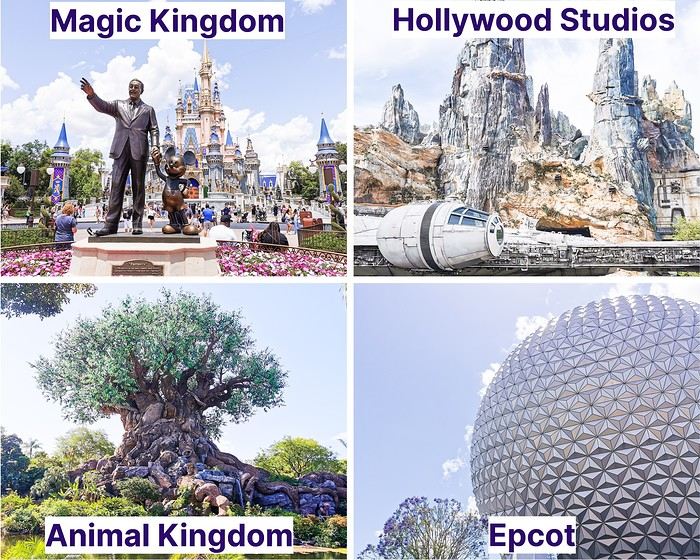
Magic Kingdom: The most famous one, the one that most resembles our Disneyland Paris. It’s home to several "lands" (Adventureland, Frontierland, Fantasyland, Tomorrowland, Liberty Square, and Main Street USA). This is the park where you’ll find the iconic castle, the symbol of the parks. Disney’s Hollywood Studios: It’s a bit like the studios at Disneyland Paris, with the well-known Tower of Terror and Toy Story Land. It also features the stunning Star Wars: Galaxy’s Edge (a must-see, even if you’re not a Star Wars fan). Animal Kingdom: A very nature-focused park, divided into several sections, including representations of Africa and Asia, as well as the breathtaking Pandora – The World of Avatar. Epcot: The park of countries, where different nations are represented around a large circular lake—including France!
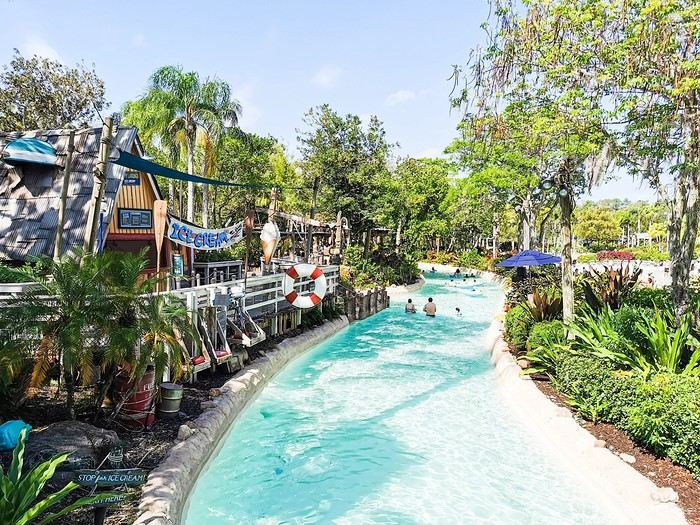
 The water park that was open during our stay was Typhoon Lagoon. We spent a morning there lounging and swimming before heading to Disney Springs (the equivalent of Disney Village in France). We’re not big on pools or chilling out, so we didn’t stay long, but there was no time limit.
 We chose to stay at the Disney’s Art of Animation hotel, a Resort (huge, like everything there!) with 4 themed areas: Nemo, Cars, The Lion King, and The Little Mermaid (where the rooms for 4 people or fewer are located).

Here’s the itinerary we followed for those 10 days:
Day 1: Flight at 7:35 AM–4:40 PM (with a layover in London), stroller pickup, then shuttle bus to our hotel Day 2: Day at Magic Kingdom Day 3: Day at Hollywood Studios Day 4: Day at Animal Kingdom Day 5: Day at Epcot Day 6: Day at Hollywood Studios Day 7: Relaxing day at Typhoon Lagoon and Disney Springs Day 8: Day at Magic Kingdom Day 9: Day at Epcot Day 10: Day at Magic Kingdom Day 11: Morning at Hollywood Studios, then shuttle bus to the airport, stroller return at the airport, flight at 7:05 PM–1:50 PM (next day)
We rented the stroller from Kingdom Stroller. The rental process was super easy—everything was done online. On the day we arrived and the day we left, there was no staff at the counter, but the stroller was ready with a tag bearing our name. When we left, we just dropped it off at the designated spot, still with no one checking... We used the Mears Connect shuttle: you pick a day and time for them to pick you up at the airport and your hotel. Everything went smoothly, no surprises.
For planning, you’ll need to decide in advance which parks you’ll visit each day because a reservation is required (just like in Paris now). I’d recommend making a schedule ahead of time. Same goes for restaurants—figure out which ones you’d like to eat at beforehand. Some work like fast food and don’t require reservations, while others, the "Table Service" restaurants, operate like traditional restaurants and need to be booked in advance to guarantee a spot. These can be reserved 60 days before the first day of your visit, and that applies to all the restaurants for your entire stay (e.g., if you’re going from February 1st to 11th, you can make reservations for the whole trip 60 days before February 1st).
Not essential, but we found them super handy: MagicBands. These are connected bracelets you buy on-site (not cheap, of course) that let you, once linked to your account in the app, open your hotel room, enter the parks, validate Lightning Lane reservations at attraction entrances, and even make purchases (if you’ve linked a credit card). We got the cheapest ones and loved them!
As for the trip’s wrap-up, if I were to do it again, ... I’d do almost everything the same: The schedule and restaurant reservations I planned were perfect! ... I’d change one thing: Maybe I wouldn’t plan two full days at Epcot because it was the park we enjoyed the least. Some attractions (like the amazing Guardians of the Galaxy: Cosmic Rewind) were great, but it was really hot, the park isn’t shaded, and it felt stifling when the weather was scorching. That said, I don’t regret it because a big storm hit on our second day, forcing us back to the hotel.
That’s all for now—I’ll be back soon with photos from each park and the hotel. You’ll see, it was incredible! See you soon! :)
Magic Kingdom: The most famous one, the one that most resembles our Disneyland Paris. It’s home to several "lands" (Adventureland, Frontierland, Fantasyland, Tomorrowland, Liberty Square, and Main Street USA). This is the park where you’ll find the iconic castle, the symbol of the parks. Disney’s Hollywood Studios: It’s a bit like the studios at Disneyland Paris, with the well-known Tower of Terror and Toy Story Land. It also features the stunning Star Wars: Galaxy’s Edge (a must-see, even if you’re not a Star Wars fan). Animal Kingdom: A very nature-focused park, divided into several sections, including representations of Africa and Asia, as well as the breathtaking Pandora – The World of Avatar. Epcot: The park of countries, where different nations are represented around a large circular lake—including France!
The water park that was open during our stay was Typhoon Lagoon. We spent a morning there lounging and swimming before heading to Disney Springs (the equivalent of Disney Village in France). We’re not big on pools or chilling out, so we didn’t stay long, but there was no time limit.
We chose to stay at the Disney’s Art of Animation hotel, a Resort (huge, like everything there!) with 4 themed areas: Nemo, Cars, The Lion King, and The Little Mermaid (where the rooms for 4 people or fewer are located).Here’s the itinerary we followed for those 10 days:
Day 1: Flight at 7:35 AM–4:40 PM (with a layover in London), stroller pickup, then shuttle bus to our hotel Day 2: Day at Magic Kingdom Day 3: Day at Hollywood Studios Day 4: Day at Animal Kingdom Day 5: Day at Epcot Day 6: Day at Hollywood Studios Day 7: Relaxing day at Typhoon Lagoon and Disney Springs Day 8: Day at Magic Kingdom Day 9: Day at Epcot Day 10: Day at Magic Kingdom Day 11: Morning at Hollywood Studios, then shuttle bus to the airport, stroller return at the airport, flight at 7:05 PM–1:50 PM (next day)
We rented the stroller from Kingdom Stroller. The rental process was super easy—everything was done online. On the day we arrived and the day we left, there was no staff at the counter, but the stroller was ready with a tag bearing our name. When we left, we just dropped it off at the designated spot, still with no one checking... We used the Mears Connect shuttle: you pick a day and time for them to pick you up at the airport and your hotel. Everything went smoothly, no surprises.
For planning, you’ll need to decide in advance which parks you’ll visit each day because a reservation is required (just like in Paris now). I’d recommend making a schedule ahead of time. Same goes for restaurants—figure out which ones you’d like to eat at beforehand. Some work like fast food and don’t require reservations, while others, the "Table Service" restaurants, operate like traditional restaurants and need to be booked in advance to guarantee a spot. These can be reserved 60 days before the first day of your visit, and that applies to all the restaurants for your entire stay (e.g., if you’re going from February 1st to 11th, you can make reservations for the whole trip 60 days before February 1st).
Not essential, but we found them super handy: MagicBands. These are connected bracelets you buy on-site (not cheap, of course) that let you, once linked to your account in the app, open your hotel room, enter the parks, validate Lightning Lane reservations at attraction entrances, and even make purchases (if you’ve linked a credit card). We got the cheapest ones and loved them!
As for the trip’s wrap-up, if I were to do it again, ... I’d do almost everything the same: The schedule and restaurant reservations I planned were perfect! ... I’d change one thing: Maybe I wouldn’t plan two full days at Epcot because it was the park we enjoyed the least. Some attractions (like the amazing Guardians of the Galaxy: Cosmic Rewind) were great, but it was really hot, the park isn’t shaded, and it felt stifling when the weather was scorching. That said, I don’t regret it because a big storm hit on our second day, forcing us back to the hotel.
That’s all for now—I’ll be back soon with photos from each park and the hotel. You’ll see, it was incredible! See you soon! :)
New Walks from Jodhpur to Narnaul (Feb 24)
I’ve been busy—here’s another travel journal on Rajasthan, with some new discoveries as always.
Thursday, January 25: I left home at 4:30 AM and headed to Barcelona airport. The roads weren’t blocked by farmers yet, so I made the trip without any issues. I arrived at the airport at 7:10 AM, called Parkvia, and someone picked up my car 15 minutes later. All that was left was to check in my luggage. My Etihad flight was at 10:25 AM, which gave me time for breakfast. We landed in Abu Dhabi at 7:30 PM. The flight to Delhi was at 10:15 PM, the transfer went smoothly without any stress, and we arrived in Delhi at 3:00 AM. I couldn’t waste any time upon arrival because I had a flight to Jodhpur at 6:55 AM. I got to customs, and what a nice surprise—the hall was empty. I went through immediately, had my passport and visa checked, and everything was fine. I grabbed my bag quickly and looked for the transfer to T2, which is outside. You have to walk along the taxi parking lot and take the long corridors—it’s well signposted, and the transfer took 10 minutes. At first, I was a little stressed, not knowing how long customs would take, but in the end, I was early for my 6:55 AM flight. I’m even glad I booked this one, as it got me to Jodhpur at 8:20 AM.
When I arrived, I took an auto-rickshaw to Jodhpur Palace GH, which I’d booked on Booking. The welcome was nice, and I was given a room right away. I was hoping to rest a bit, but unfortunately, it was very noisy. I settled in, took a shower, and was ready to go out and explore the city. The owner stopped me as I was leaving and told me I had to change rooms—I had to repack my bag before heading out. He showed me the way to the clock tower, which is about a 15-minute walk away.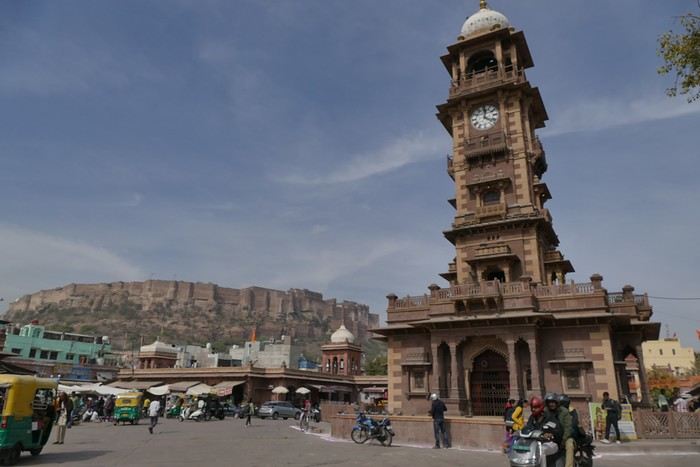
A market lines the street leading to the tower, and the traffic is intense.
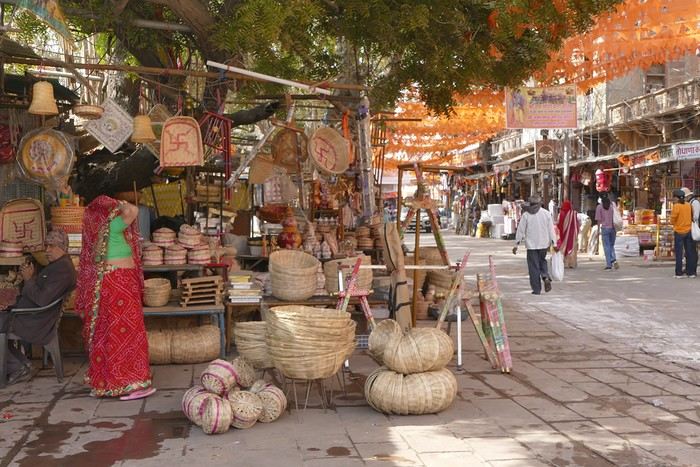
I set off in search of the stepwells and Gulab Sagar, a large basin with three water jets and a great view of Mehrangarh Fort. And yes, more baoris!
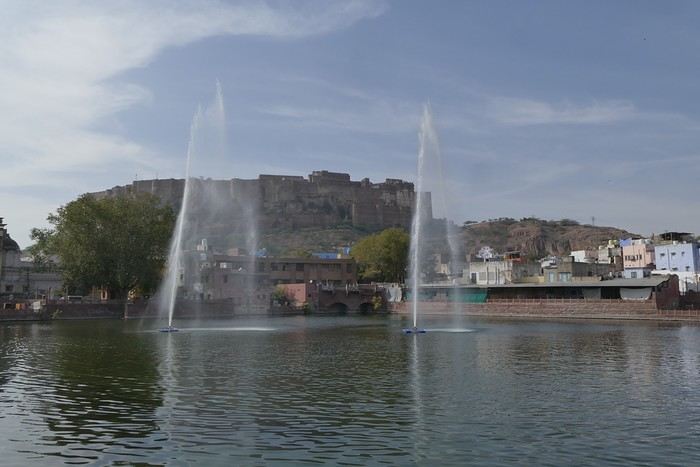
Toorji Ka Jhalra Bawdi isn’t far away. It’s a meet-up spot for tourists, with restaurants and terraces lining the area. The place is nice.
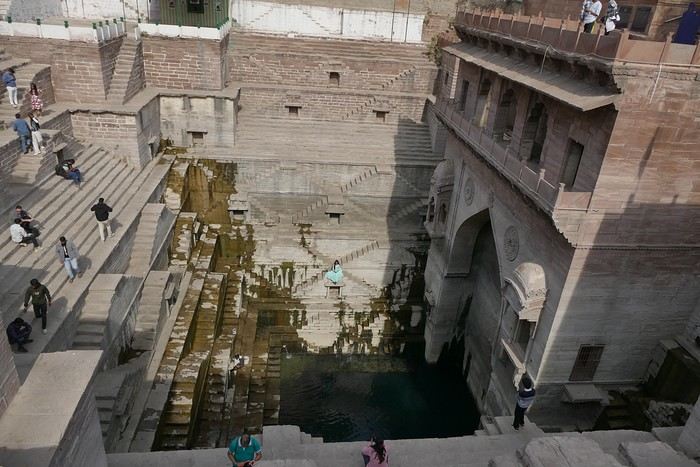
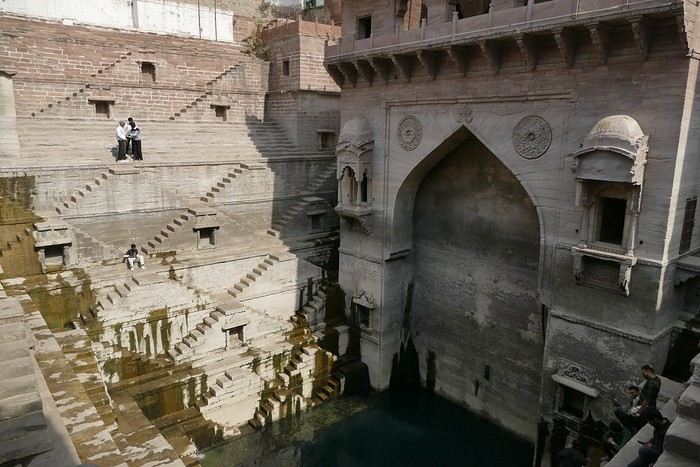
I looked for Mahila Bagh Ka Jhalra, went around in circles a bit, and finally found it right across from Gulab Sagar, where I’d already been. It’s not in good condition—it’s a shame it hasn’t been restored.
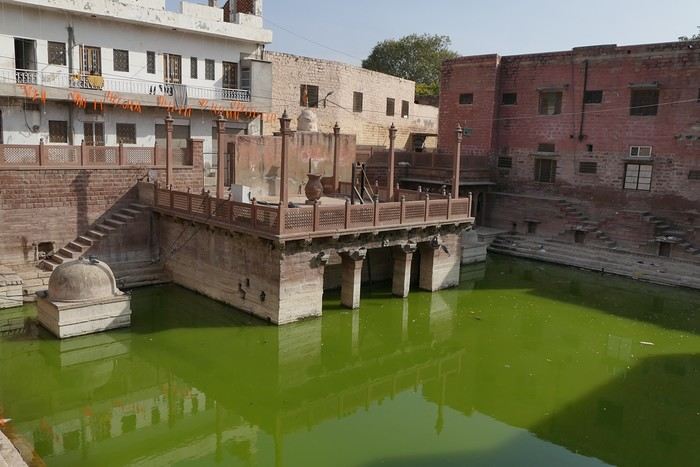
I went back through the clock tower area, found a currency exchange with a good rate, and booked my train tickets for the whole trip. The street was lively, with heavy traffic.
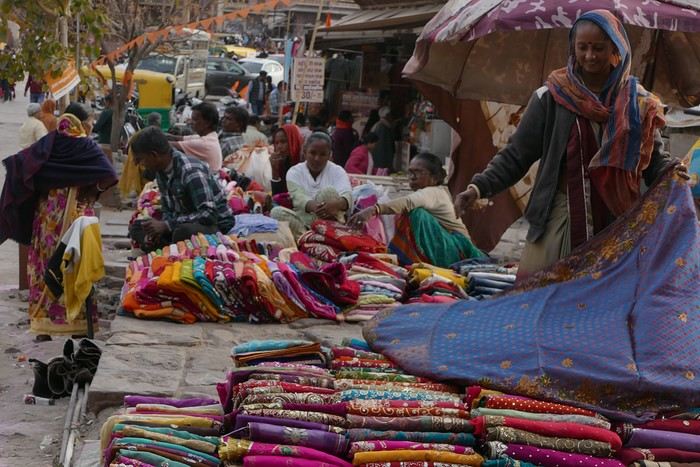
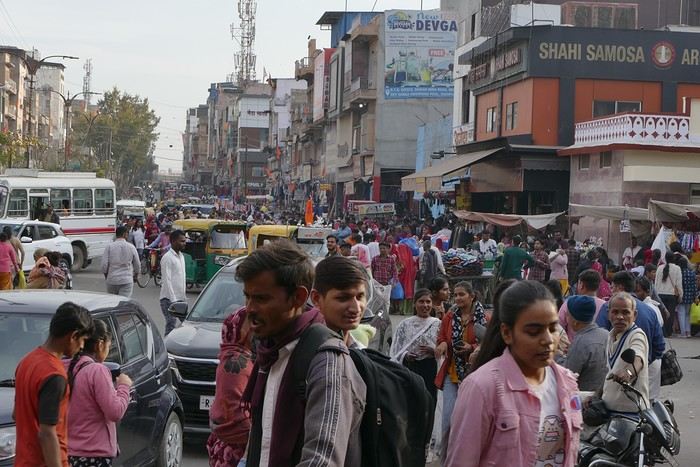
I was tired and headed back to the guesthouse. When I got there, I realized my phone wasn’t showing the right time, which gave me a chance to rest before going out for dinner. The Indigo restaurant is nearby and will be perfect.
Thursday, January 25: I left home at 4:30 AM and headed to Barcelona airport. The roads weren’t blocked by farmers yet, so I made the trip without any issues. I arrived at the airport at 7:10 AM, called Parkvia, and someone picked up my car 15 minutes later. All that was left was to check in my luggage. My Etihad flight was at 10:25 AM, which gave me time for breakfast. We landed in Abu Dhabi at 7:30 PM. The flight to Delhi was at 10:15 PM, the transfer went smoothly without any stress, and we arrived in Delhi at 3:00 AM. I couldn’t waste any time upon arrival because I had a flight to Jodhpur at 6:55 AM. I got to customs, and what a nice surprise—the hall was empty. I went through immediately, had my passport and visa checked, and everything was fine. I grabbed my bag quickly and looked for the transfer to T2, which is outside. You have to walk along the taxi parking lot and take the long corridors—it’s well signposted, and the transfer took 10 minutes. At first, I was a little stressed, not knowing how long customs would take, but in the end, I was early for my 6:55 AM flight. I’m even glad I booked this one, as it got me to Jodhpur at 8:20 AM.
When I arrived, I took an auto-rickshaw to Jodhpur Palace GH, which I’d booked on Booking. The welcome was nice, and I was given a room right away. I was hoping to rest a bit, but unfortunately, it was very noisy. I settled in, took a shower, and was ready to go out and explore the city. The owner stopped me as I was leaving and told me I had to change rooms—I had to repack my bag before heading out. He showed me the way to the clock tower, which is about a 15-minute walk away.
A market lines the street leading to the tower, and the traffic is intense.
I set off in search of the stepwells and Gulab Sagar, a large basin with three water jets and a great view of Mehrangarh Fort. And yes, more baoris!
Toorji Ka Jhalra Bawdi isn’t far away. It’s a meet-up spot for tourists, with restaurants and terraces lining the area. The place is nice.
I looked for Mahila Bagh Ka Jhalra, went around in circles a bit, and finally found it right across from Gulab Sagar, where I’d already been. It’s not in good condition—it’s a shame it hasn’t been restored.
I went back through the clock tower area, found a currency exchange with a good rate, and booked my train tickets for the whole trip. The street was lively, with heavy traffic.
I was tired and headed back to the guesthouse. When I got there, I realized my phone wasn’t showing the right time, which gave me a chance to rest before going out for dinner. The Indigo restaurant is nearby and will be perfect.
18 days in Cape Verde in January 2025
Hello,
We’ve just returned (2 senior couples) from 18 days in Cape Verde (21/01 to 7/02) that we really enjoyed. The temperature was great—20° to 27°—admittedly a bit windy at times, but the friendliness of the Cape Verdeans made up for it.
Paris Orly, direct flight with Transavia (cheap if you book in advance). We landed in São Vicente, with a 12 € city transfer. We had a fantastic 2-bedroom apartment in downtown Mindelo—Av. Fernando Ferreira Fortes, "Casa So Morabeza"—for 58 € per night. The owner lives in France and communicates instantly via WhatsApp.
We spent 2 days exploring the (beautiful) city of Mindelo and its port activity, plus a private taxi tour of the island (6000 CVE for the day).
Then we took the Armas ferry (recommended company—1500 CVE) to Santo Antão.
From there, a collectivo (450 CVE per person) took us to Ribeira Grande, a central base for hikes.
We stayed in a brand-new, modern, and well-equipped 2-bedroom apartment—*Apartamentos Modernos*—for 6770 CVE per night, staying 6 nights. I highly recommend it for its location in town and proximity to *aluguers* and *collectivos* for hiking.
The hikes were stunning:
- The coastal trail from Fontainhas to Cruzinha (taxi for 1500 CVE)
- The route from Corda to Coculi (taxi for 2000 CVE + 100 CVE per person for the return)
- The trail from Cova to Cidade de Pombas (taxi for 2000 CVE + 100 CVE per person for the return)
- The hike from Miradouro to Ribeira Grande (taxi for 2000 CVE)
- The coastal road from Ribeira Grande to Ponta do Sol (visit and lunch at *Mini Familiar* in the city center—excellent and affordable) for the round trip.
Ribeira Grande has plenty of restaurants, but avoid *5 de Julho*—it’s loud and slow.
We loved: *Bellcanto*, *Cantinho da Amizade*, and *Boca-Fina Churrasqueria*.
Meals with drinks cost around 800–1000 CVE.
Back to São Vicente by ferry (1500 CVE), then an airport transfer (12 €) and a flight (99 €) to Santiago’s Praia. The airport-to-city transfer was 15 €.
We stayed at *Kelly’s* in Plato, Praia, which was disappointing—not ideal for two couples—but well-located.
One day was spent visiting the massive *Suspicia* market, then a collectivo to Cidade Velha (2 x 200 CVE round trip per person). We hiked up to the fort, explored *Rua Banana*, and had lunch at *Praça do Mar* by the beach.
We rented a car for 6 days (29000 CVE) from *Slimpycar* in Praia.
On Saturday, we visited the huge *Assomada* market—don’t miss it!—then hiked to *Boa Entrada* and *Poilon*, the largest and most impressive tree we’ve ever seen.
We stayed for 2 nights (138 €) in a beautiful valley in *Picos*—a spacious, lovely house with 2 bedrooms, 2 bathrooms, and a large living area, surrounded by nature and animals.
Lina, the charming neighbor, prepared dinner (8.50 €) and breakfast (4.50 €) for us.
Next, we headed to *Tarrafal*, stopping to visit the concentration camp (500 CVE)—a must-see—before arriving.
We spent 3 nights (184 €) in a fantastic house called *"Maison Familiale"*—huge, with 3 bedrooms, 2 bathrooms, 2 kitchens, 5 toilets, and a large terrace with sea views. It was absolutely stunning and very close to the beach and numerous restaurants.
We did a beautiful 3.8 km hike to the *Farol da Ponta Preta* lighthouse.
Tarrafal’s beach is lively and pleasant, with bars, restaurants, and even acrobats!
We also explored *Ribeira da Prata* to see the *Piscina Natural de Cuba* (not easy to find).
We loved discovering isolated villages like *Ponta Furna*, *Ponta Labrão*, and *Fazenda*.
For food, I recommend *Mira Mar* at *Mama’s*.
On the way back to Praia, we took the east coast route via *Calheta de São Miguel*, *Pedra Badejo*, and *Praia Baixo*—nothing extraordinary, just a rugged, wild coastline with beaches that seemed a bit tricky to access.
Our last evening in Praia was nice. The seaside esplanade was lively, and many Cape Verdeans were swimming at *Prainha* beach, which seemed very accessible and safe.
If you’d like more info—addresses, etc.—feel free to message me privately. I’ll respond.
Jacquesler.
Unusual trip to Rajasthan November 2022
Friday, November 4
My flight Barcelona - Abu Dhabi - Delhi went smoothly, it’s on time, and here I am back in India after 3 long years.
As I step off the plane, we head toward customs. It’s 3 AM, I’m tired but happy. The huge customs hall is below ground level and buzzing with people who’ve just arrived. In the end, they’re well organized—Indians to the left, foreigners to the right, and all along the hall, the customs officers’ posts, who remain very zen despite the crowd. It took me less than 2 hours to get out of the airport, which was pretty quick.
For this return trip, I got in touch with a driver from the "Lovers of India" group who was supposed to take me from the airport to Udaipur, passing through non-touristy villages like I love. This French-speaking driver had convinced me to travel by car, which was supposed to make moving from village to village easier. Two or three days before departure, I receive a message from the driver saying he was sick with a cold and sending another driver, his very kind brother who knows Rajasthan well but doesn’t speak French. I’m a bit disappointed by this message and doubtful about the driver’s sincerity, but I don’t have time to find another driver, so I stick to my plans, though I’m not at ease.
At the exit, the driver hasn’t arrived, and I wait half an hour before seeing him show up with a big smile, "Namaste." We don’t waste time and head to the car, which is clean and new.
We get to know each other in the car and hit the road toward Alwar. Along the way, we stop for lunch and to taste my first masala chai, which wakes up my taste buds.
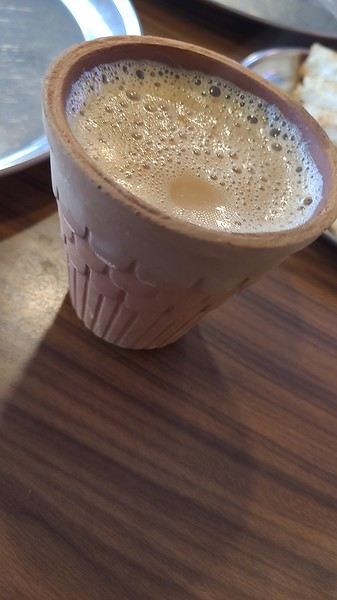
I doze off during the drive, and we arrive at the Atlantic Hotel in Alwar at 10:30 AM. My room is on the ground floor, and I settle in quickly. The Wi-Fi isn’t working, but the staff do everything they can to fix it. At noon, Gajender, the driver, suggests visiting the Qila Fort, which is on the heights of Alwar. The fort is closed for restoration, but safari tours are offered—jeep, guide, driver, and visit for 1600 Rs.
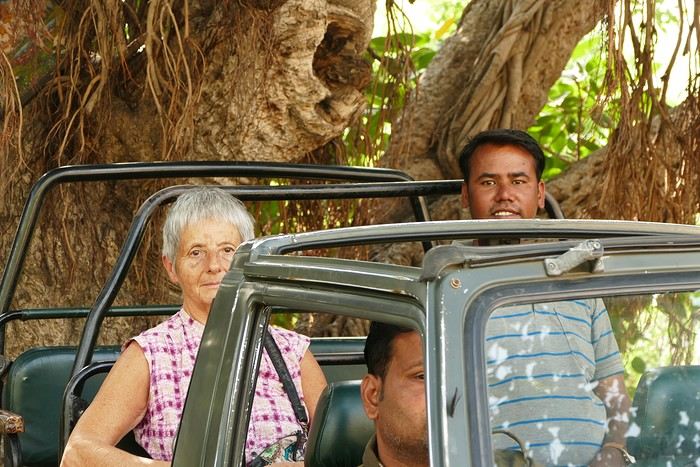
We follow the great wall, which is impressive—the second largest in India and the third in the world.
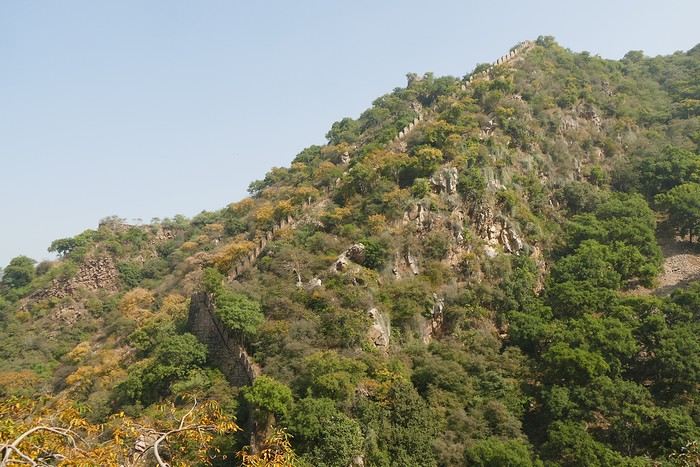
We spot peacocks and monkeys.
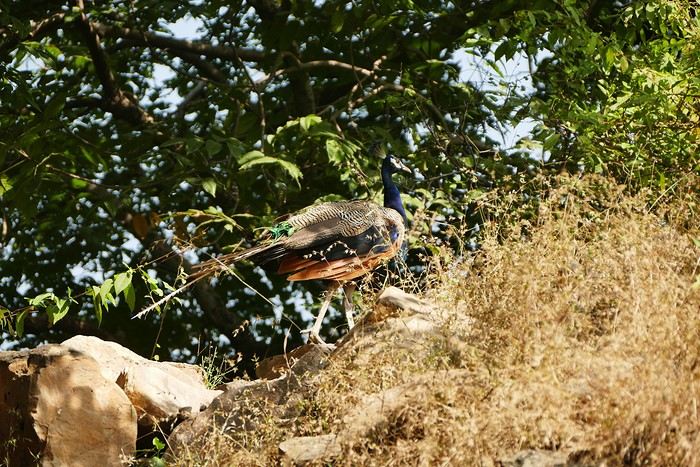
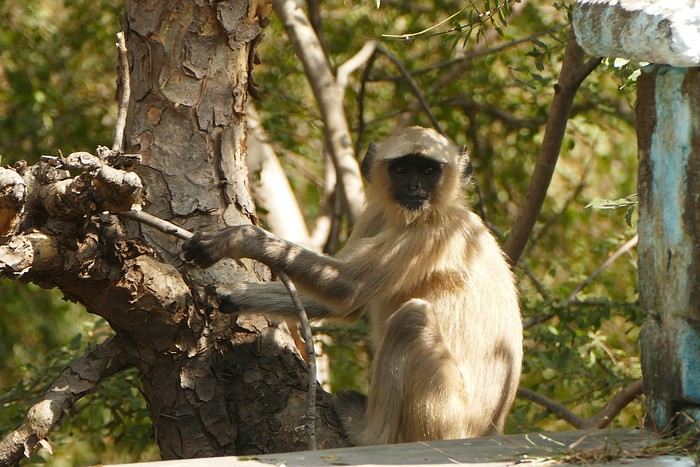
The guide shows me an old stepwell lost in nature. It’s always my thing to check out these baoris, which can be stunning, but this one isn’t anything special. We arrive at the palace overlooking the city.
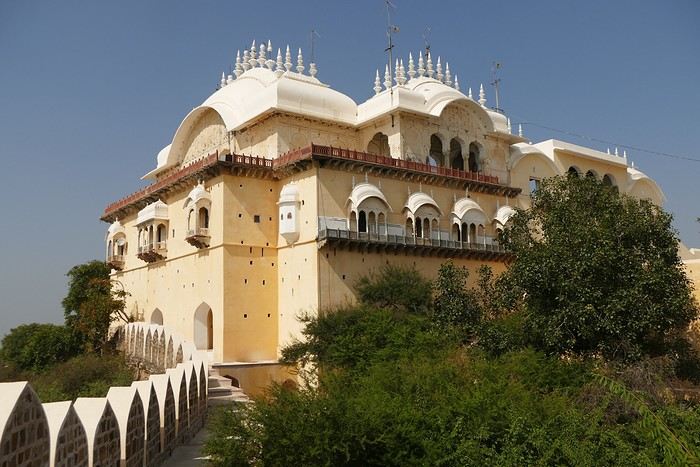
We walk around the palace, and I discover another stepwell that’s not worth lingering over.
The tour is over, and I had a great time despite the fatigue. We head back down to Alwar, near the City Palace, which has been turned into administrative offices. Gaju (the driver’s nickname) finds a parking spot near a dhaba where we have lunch (paneer masala, chapatis, chai)—it’s delicious. With my energy restored, we head to the palace. On the top floor is a museum that I visit.
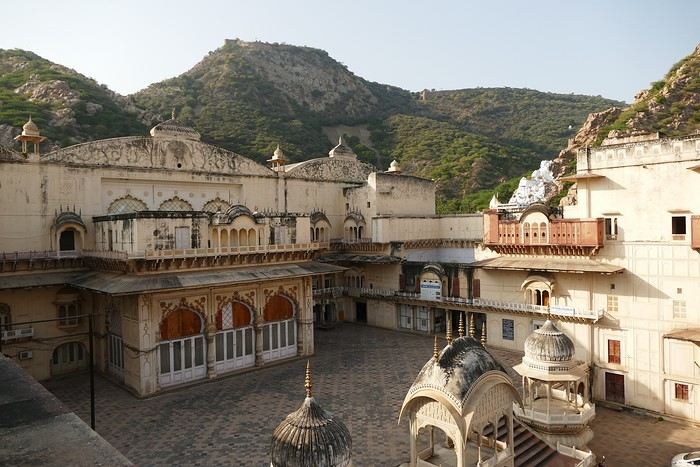
At the exit of the museum, we have to go back down and walk around the palace to get to the Moosi Maharani Chhatri. I’ve been here once before and really liked it, and the place is still the same—calm and relaxing.
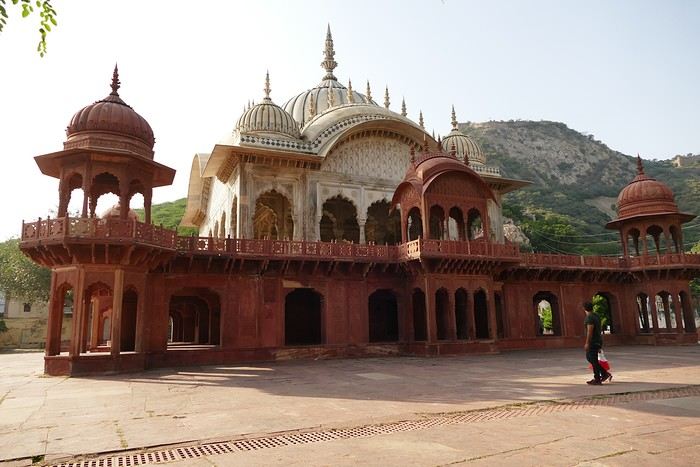
"This monument is the most artistic in Alwar and also the most royal, filled with fascinating history. Maharaja Vinay Singh of Alwar built this two-story cenotaph in 1815 in memory of his father, Maharaja Bakhtawar Singh. It’s also known as Moosi Maharani ki Chhatri, named after the king’s mistress, who performed sati upon his death. After the sati, she was accepted as the king’s wife. It’s an elegant monument, shaped like a flower and built with a mix of brown sandstone and white marble. The first floor is made of sandstone, while the upper floor and the chhatris (cenotaphs) are in white marble. Its sculpted pavilion has dome-shaped arches with intricate lace-like and exquisite floral patterns. There are complex motifs that shine brightly in the sunlight. The colorful circular ceiling is an important part of Moosi Maharani Ki Chhatri and is adorned with faded gold-leaf paintings of mythological figures and scenes. The footprints of Maharaja and Moosi Rani are engraved in marble inside the cenotaph, and locals pay their respects to them."
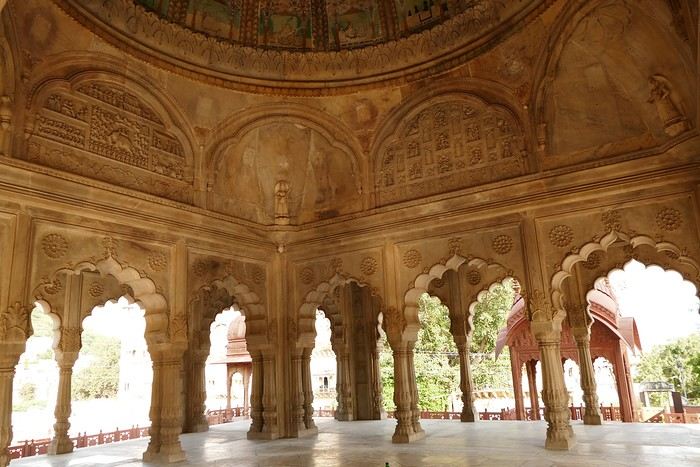
Near the chhatri, there’s a large water reservoir with a magnificent view. The place is peaceful and relaxing, and I stay here for a while, contemplating and daydreaming before heading back to the hotel for some well-deserved rest. The Wi-Fi is working now. I’m the only foreign guest, and since my room is near the entrance, I’ll be well taken care of throughout my stay.
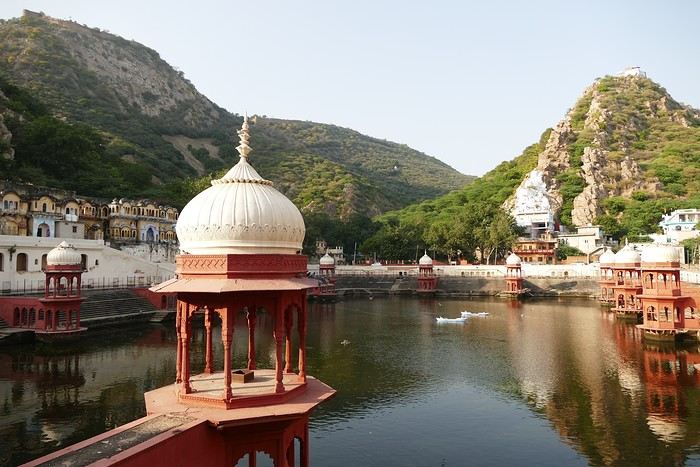
I doze off during the drive, and we arrive at the Atlantic Hotel in Alwar at 10:30 AM. My room is on the ground floor, and I settle in quickly. The Wi-Fi isn’t working, but the staff do everything they can to fix it. At noon, Gajender, the driver, suggests visiting the Qila Fort, which is on the heights of Alwar. The fort is closed for restoration, but safari tours are offered—jeep, guide, driver, and visit for 1600 Rs.
We follow the great wall, which is impressive—the second largest in India and the third in the world.
We spot peacocks and monkeys.
The guide shows me an old stepwell lost in nature. It’s always my thing to check out these baoris, which can be stunning, but this one isn’t anything special. We arrive at the palace overlooking the city.
We walk around the palace, and I discover another stepwell that’s not worth lingering over.
The tour is over, and I had a great time despite the fatigue. We head back down to Alwar, near the City Palace, which has been turned into administrative offices. Gaju (the driver’s nickname) finds a parking spot near a dhaba where we have lunch (paneer masala, chapatis, chai)—it’s delicious. With my energy restored, we head to the palace. On the top floor is a museum that I visit.
At the exit of the museum, we have to go back down and walk around the palace to get to the Moosi Maharani Chhatri. I’ve been here once before and really liked it, and the place is still the same—calm and relaxing.
"This monument is the most artistic in Alwar and also the most royal, filled with fascinating history. Maharaja Vinay Singh of Alwar built this two-story cenotaph in 1815 in memory of his father, Maharaja Bakhtawar Singh. It’s also known as Moosi Maharani ki Chhatri, named after the king’s mistress, who performed sati upon his death. After the sati, she was accepted as the king’s wife. It’s an elegant monument, shaped like a flower and built with a mix of brown sandstone and white marble. The first floor is made of sandstone, while the upper floor and the chhatris (cenotaphs) are in white marble. Its sculpted pavilion has dome-shaped arches with intricate lace-like and exquisite floral patterns. There are complex motifs that shine brightly in the sunlight. The colorful circular ceiling is an important part of Moosi Maharani Ki Chhatri and is adorned with faded gold-leaf paintings of mythological figures and scenes. The footprints of Maharaja and Moosi Rani are engraved in marble inside the cenotaph, and locals pay their respects to them."
Near the chhatri, there’s a large water reservoir with a magnificent view. The place is peaceful and relaxing, and I stay here for a while, contemplating and daydreaming before heading back to the hotel for some well-deserved rest. The Wi-Fi is working now. I’m the only foreign guest, and since my room is near the entrance, I’ll be well taken care of throughout my stay.
All Over Thailand
You can post your personal photos in the following thread: https://voyageforum.com/forum/quelque-part-en-thailande-d10655574/
This travel journal is therefore intended solely for my photos, to present a consistent style. All the shots were taken with a simple Samsung Galaxy smartphone and with whatever was at hand.
All stays combined, I’ve spent the equivalent of three years at most in Thailand, and I’m not a big expert on the country. However, after many trips, lots of reading on VoyageForum and other sites, and conversations with many locals as well as expats, my view of the country is becoming clearer, though it’s constantly evolving. You never stop discovering and learning.
I guess I wanted to piece together a puzzle, mainly for those who want to get an idea of the country here and for those who miss it. I don’t know if this minimalist sharing will interest anyone, but it’ll do me good to put it together. After so many months without traveling and then these other long months with VF closed, there’s plenty of material available.
There’ll be a mix of places, periods, and subjects, but it might well be intentional.
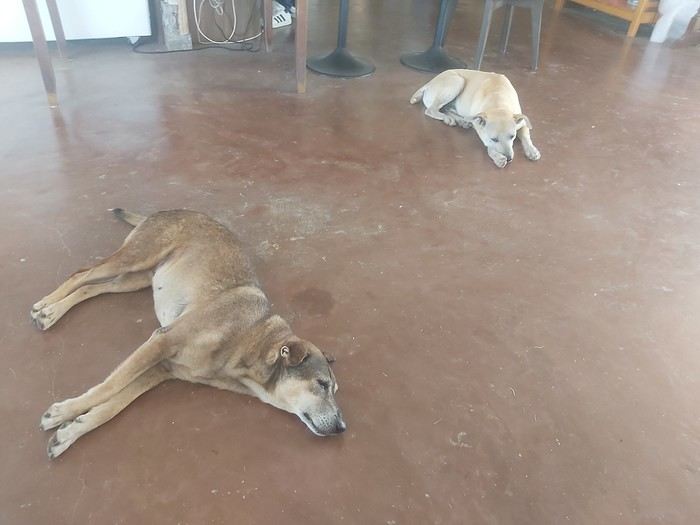
I suspect many Thais have dogs because they make excellent guards for the home. Nothing better to deter burglars or to signal the presence of a snake. You’ll often see Thais tapping the top of their dog’s head, but don’t be fooled: it’s a sign of affection from them. Judging by the dogs’ reactions, they’re used to it.
Thailand is one of the countries on the planet where rabies is still present, so keep that in mind. It’s not just bites that can be dangerous, so don’t let just any dog lick you. Especially on a wound, of course. Even though dogs often fear humans—this dangerous and unpredictable predator—we still need to stay cautious. Be careful when walking into alleys because the dog will defend its master’s big property, be careful at night, and be careful when they’re in packs. It sometimes crosses our minds that Thailand isn’t really made for walking around, and dogs are one of the reasons. That said, it’s not uncommon to see them chasing bikes or scooters. Cars, though, are much rarer—they’re too big.
It seems Thais prefer to give their dogs freedom by not locking them behind gates. Though sometimes the gate is closed, the little side door is wide open. Oh, and sometimes there’s no gate in front of the property, or it’s been broken for years.
You’ll often see dogs sleeping on the side of the road, sometimes right on the road. When you arrive, they move aside nonchalantly—or not at all. It’s less funny when they suddenly appear from thick vegetation, which reminds visitors not to drive too fast. As a result, you’ll notice that dogs with injuries or missing legs aren’t that rare.
Since they believe in reincarnation and respect for all forms of life, they don’t chase dog packs away too much, and they don’t sterilize them enough. Seeing a small pack roaming freely in the countryside, you might think it’s best not to cross paths with them at the edge of a field. A darker side of this is that euthanasia isn’t often practiced. Twice, we saw dogs at temples on the brink of death, enduring terrible suffering. No one did anything about it. The image (and the smell) of one of them, dying and emitting the stench of death, still comes back to me sometimes.
Some of you may have seen the YouTube vlog of a French woman living in Phuket who was given a little pig by her Thai friends. The well-fed animal quickly became a happy, enormous beast with its own garden. Yet, it didn’t take long for it to fall seriously ill and become incurable. In her video, the French woman described how difficult it was to find a vet willing to perform euthanasia.
You’ll often see bowls by the side of the road. Thais leave food and water in them for stray cats and dogs. Overall, they have a big heart for animals.
If you ever pop into a shopping mall, you might see people pushing their small dogs in strollers. It’s not a gimmick—it’s just that these strollers are provided for customers to put their pets in, otherwise you can’t bring them inside. It looks a bit odd when you expect to see a baby.
This travel journal is therefore intended solely for my photos, to present a consistent style. All the shots were taken with a simple Samsung Galaxy smartphone and with whatever was at hand.
All stays combined, I’ve spent the equivalent of three years at most in Thailand, and I’m not a big expert on the country. However, after many trips, lots of reading on VoyageForum and other sites, and conversations with many locals as well as expats, my view of the country is becoming clearer, though it’s constantly evolving. You never stop discovering and learning.
I guess I wanted to piece together a puzzle, mainly for those who want to get an idea of the country here and for those who miss it. I don’t know if this minimalist sharing will interest anyone, but it’ll do me good to put it together. After so many months without traveling and then these other long months with VF closed, there’s plenty of material available.
There’ll be a mix of places, periods, and subjects, but it might well be intentional.
I suspect many Thais have dogs because they make excellent guards for the home. Nothing better to deter burglars or to signal the presence of a snake. You’ll often see Thais tapping the top of their dog’s head, but don’t be fooled: it’s a sign of affection from them. Judging by the dogs’ reactions, they’re used to it.
Thailand is one of the countries on the planet where rabies is still present, so keep that in mind. It’s not just bites that can be dangerous, so don’t let just any dog lick you. Especially on a wound, of course. Even though dogs often fear humans—this dangerous and unpredictable predator—we still need to stay cautious. Be careful when walking into alleys because the dog will defend its master’s big property, be careful at night, and be careful when they’re in packs. It sometimes crosses our minds that Thailand isn’t really made for walking around, and dogs are one of the reasons. That said, it’s not uncommon to see them chasing bikes or scooters. Cars, though, are much rarer—they’re too big.
It seems Thais prefer to give their dogs freedom by not locking them behind gates. Though sometimes the gate is closed, the little side door is wide open. Oh, and sometimes there’s no gate in front of the property, or it’s been broken for years.
You’ll often see dogs sleeping on the side of the road, sometimes right on the road. When you arrive, they move aside nonchalantly—or not at all. It’s less funny when they suddenly appear from thick vegetation, which reminds visitors not to drive too fast. As a result, you’ll notice that dogs with injuries or missing legs aren’t that rare.
Since they believe in reincarnation and respect for all forms of life, they don’t chase dog packs away too much, and they don’t sterilize them enough. Seeing a small pack roaming freely in the countryside, you might think it’s best not to cross paths with them at the edge of a field. A darker side of this is that euthanasia isn’t often practiced. Twice, we saw dogs at temples on the brink of death, enduring terrible suffering. No one did anything about it. The image (and the smell) of one of them, dying and emitting the stench of death, still comes back to me sometimes.
Some of you may have seen the YouTube vlog of a French woman living in Phuket who was given a little pig by her Thai friends. The well-fed animal quickly became a happy, enormous beast with its own garden. Yet, it didn’t take long for it to fall seriously ill and become incurable. In her video, the French woman described how difficult it was to find a vet willing to perform euthanasia.
You’ll often see bowls by the side of the road. Thais leave food and water in them for stray cats and dogs. Overall, they have a big heart for animals.
If you ever pop into a shopping mall, you might see people pushing their small dogs in strollers. It’s not a gimmick—it’s just that these strollers are provided for customers to put their pets in, otherwise you can’t bring them inside. It looks a bit odd when you expect to see a baby.
A long journey around Australia
Sunday, October 1st, 2023
Mulhouse-London
We dumped our trash on our neighbors. We hugged, overflowing with emotion. Then Léa from Taxis S showed up. She knows us well. For ages, she’s been our driver. She was practically the official taxiwoman for the trips of the company where Dom and I met. She knew us when we were single! Almost teenagers! She knows everyone and fills in the biographies of people we’d forgotten.
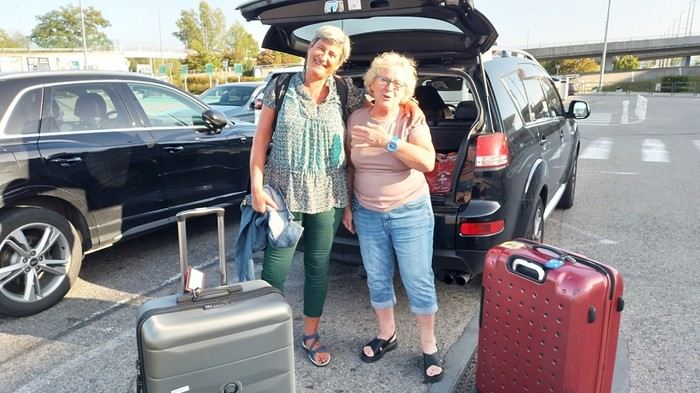 Across the street, while we loaded the luggage, S., perched in his window frame, waved a handkerchief. This wasn’t just any trip.
 Then things got tricky. It’s funny how fate sinks its teeth into our happy moments—there’s this whole intermediate phase where the poison seeps in unnoticed because you’re still in the dark...
First, there was a delay on our flight to London. Dom immediately went on high alert, while I stayed calm. In my mind, we had two hours. I knew we had to go from Terminal 5 to Terminal 4, but two hours—come on, that’s plenty, right?
Then things got tricky. It’s funny how fate sinks its teeth into our happy moments—there’s this whole intermediate phase where the poison seeps in unnoticed because you’re still in the dark...
First, there was a delay on our flight to London. Dom immediately went on high alert, while I stayed calm. In my mind, we had two hours. I knew we had to go from Terminal 5 to Terminal 4, but two hours—come on, that’s plenty, right?
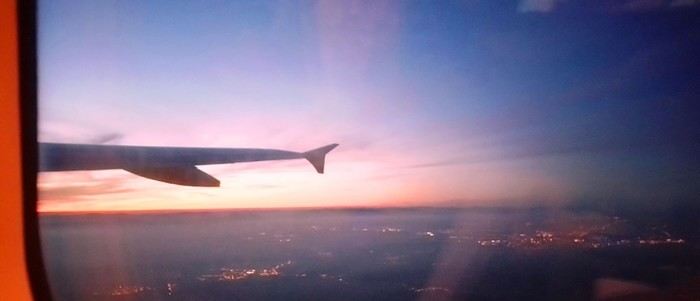
Bad calculation! Because those two hours were between the first flight’s landing and the second’s takeoff. But flights close at least half an hour before departure. Getting from one terminal to another means taking a shuttle bus. We waited for the one going to Terminal 4... until a young guy paid to direct people (who hadn’t seen us) informed us it was no longer possible to access Terminal 4 without going through Terminal 2 first for a connection! That really cranked up the pressure. We started installing a mental countdown with a programmed explosion at the end—guaranteed stress with added beads of sweat. The terminal bus was driven by a young Pakistani guy. We were *so* tense we bombarded him with our frantic, repetitive questions. “So? When are we getting there? What’s happening? Why aren’t we moving?” Our eyes were glued to our watches. The poor guy knew. Perfectly. Because it was obvious—no way around it. We weren’t going to make it. It was impossible. But Dom and I stubbornly refused to believe it. Then the kid stopped the bus. Me, hysterical: “What are you doing? What’s going on? Our plane takes off in... in... 4 minutes!!!! We’re gonna miss iiiiiit!” He wasn’t calm either. “You’ve already missed it!” He explained we had to cross a zone that required an escort car to clear a path through the runways. Impossible to do without. It’s forbidden. We had to WAIT (!!!). Then he got a radio call—he had to rush to Terminal 3 to pick up a passenger who was *super* tight on time. “Amir!!!! It’s RIGHT NOW!” they yelled in his already-red ears, thanks to the complaints of two hysterical Frenchies. Dom and I were in overdrive, hallucinating! We wanted to stop him, maybe even hit him to prevent him from turning around. He picked up the girl, whom we instantly hated like the most despicable witch. I turned on my data, searched for Malaysia Airlines’ number at Terminal 4, called, and actually got someone—quite a feat. A woman cut off my frantic rambling with a blunt “It’s over, the check-in is closed, the plane is about to take off.” I heard her but refused to accept it. I yelled, “We’re coming!” She shot back her monolithic “It’s over.” Finally at the doors of that damn Terminal 4, we ran—*really* ran—a marathon, Gate 6, security checks, pat-downs, “Take off your belts,” we asked questions, everyone seemed confident, we ran with one hand holding up our pants, the other clutching our belt, Gate 6—the room was empty. A girl was sitting there, calmly on the phone. We pounced on her. She calmed us down. Little by little, the light came back. Our brains rebooted. We finally understood it was over. We’d have to start crafting a new plan with the new reality. It started with a return to Terminal 5 to talk to British Airways, which took a good hour. With the same driver as before. We were alone with him. He took the time to apologize, to assure us it wasn’t his fault, that our problem had no solution, that nothing could’ve changed the outcome. At BA, we were exhausted. We were greeted by a handsome young man in a navy-blue uniform with gold stripes everywhere. We could’ve made a scene, but we were just relieved to find someone who’d take charge of our story. It was a minimal response, but it was *a* response. I suppose we could’ve demanded a business-class upgrade or a free trip, but we were just happy with a few vouchers for food, a hotel room with breakfast, and a little bag with plastic toys, a razor, toothbrush, hygiene products, and a T-shirt... Trinkets... But we were fine with it all—we said thank you eagerly because the essential was assured. He found us seats on flights tomorrow. *Tomorrow.* We were afraid to hope! We had the exact same flights but a day later. The same crappy times, but it was all good. We felt saved from the shipwreck, like survivors. - And what about the luggage? - .... !!!!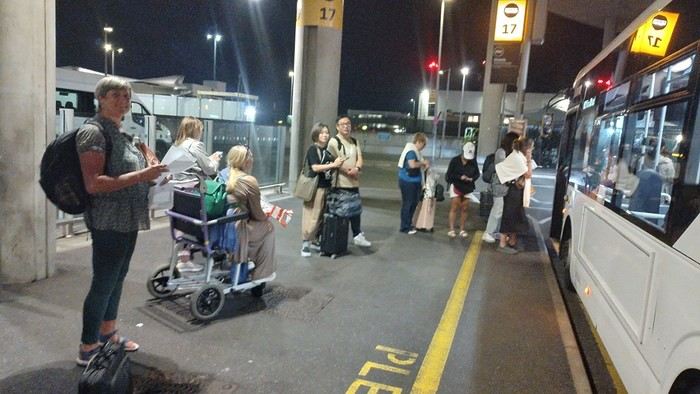
Monday, October 2nd, 2023 London - Kuala Lumpur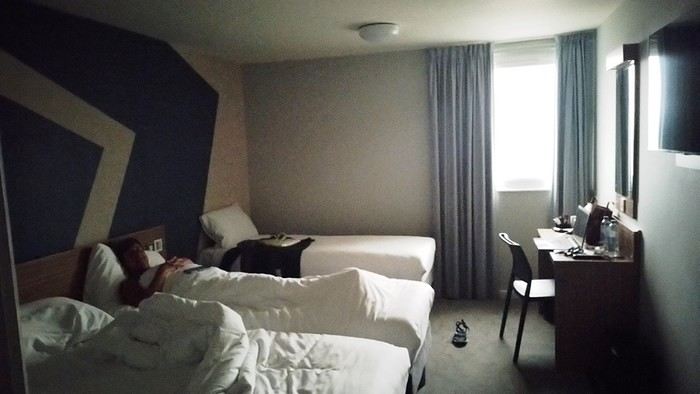
It wasn’t the Ritz, but with exhaustion on our side, we slept well. The continental breakfast was way better than we’d expected from an Ibis Budget. Still, it wasn’t enough to restore my joy for life. The course correction had turned into an arduous obstacle course. I scoured the car rental site every which way. Couldn’t reschedule the car. I’d done it before, but this time... Not to mention the laptop battery was complaining—the Brits have this quirk of making their power outlets incompatible with our chargers. Frustrated, I called them but ended up with a girl who declared herself incompetent and offered to have someone from Avis in Perth call me back—someone who’d supposedly handle rentals better. I decided to wait while taking a bath. Barely settled in, the phone rang. I was soaking wet, of course, and asked Dom to answer. Unfortunately, she’s known for disliking my phone, and in a clumsy move, she hung up. We got annoyed. She put dry towels on the edge of the bathtub, but—another false move—they fell in the water. The phone rang again... I completely redid the plans for the next two days, then transferred the files to my phone to consult them later offline. I plugged in my USB cable... *Plop!* The battery died abruptly—my PC shut down without any of the usual polite warnings! I looked around, hoping to find someone to strangle... Long story short, you can tell the day started under the worst omens. I was in a foul mood and spread my bad vibes to Dominique, who was initially in much better spirits... I called Mastercard, hoping to get a refund for the non-refundable night in Perth we’d already paid for. Same old song: “We’ll call you back”... Then... I’ll cut it short—buses, trains, lots of waiting... We rushed to reach the infamous Terminal 4.
We tried new options and convinced ourselves that a delayed departure flight is unrecoverable, no matter the scenario. We were furious that BA hadn’t bothered to tell us, leaving us to run around like rats in a burning house.
Tuesday, October 3rd, 2023 Kuala Lumpur-Perth
The flight was pretty nice. 13 hours, though. Dom and I were facing each other across the aisle. We could get up easily whenever we wanted without bothering anyone and chat when we felt like it. Besides, their chicken was amazing. They were kind enough to offer Dom a truly remarkable glass of rum. Good movies too, including the excellent *Prisoners* by Denis Villeneuve. At KL, during boarding, we developed a nagging worry about our luggage. We checked with some Malaysian Airlines staff. I sensed their hesitation. They made calls. Then changed their minds, giving us smiles and thumbs up...
Wednesday, October 4th, 2023 Perth
*Happy is the man who, like Ulysses, has had a fine voyage.* Well, for us, it wasn’t that. Finally arrived, we experienced the loneliness of tourists watching the baggage carousel spin, emptying of its precious containers one by one, until only a handful of travelers were left, staring at each other in disbelief. Without luggage, you’re kinda screwed. Not even a change of socks—our feet had been swimming in the same shoes for 3 days. No adapter, so no laptop. No toiletries. We could’ve cried! The lost luggage guy played his part. If you want compensation, fill out the disclaimer on the website made for that. And then, “Don’t worry, your luggage will arrive tomorrow!” “Don’t worry?!” From the start of the trip, we’ve been jerked around, fed lies. Tomorrow is the *absolute* last chance to get them back. Beyond that, we’d have to scramble a whole new trip. And lose a lot in the process! I have no idea how to go about it. Tomorrow... OMG... Tomorrow... We landed at 1 AM. Avis, the car rental place, opens at 6:30. Luckily, we found some decent breakfast. It cheered us up and gave us a second wind. Incorrigible, we started believing again! Well, then we just killed time. What else was there to do?

In front of Avis’s little shack, we were freezing. We’d been there since dawn. The girl who showed up, a Latina, immediately saw us as a nuisance who’d ruin her hopes of a peaceful start. Her face and tone were as unwelcoming as possible. You know us—it ended with hugs. She gave us a gorgeous, brand-new car! A hybrid with ultra-sophisticated features, all buttons you shouldn’t touch if you want to drive this thing without causing irreparable damage! We’re off! Driving on the left is easy at first. You think about it constantly. It’s counterintuitive, it takes effort. It’s later, when you get used to it and confidence sets in, that it becomes dangerous—old reflexes can send you into a wall. Anyway, the car and I immediately clicked.
In Perth, underground parking next to the hotel, friendly welcome—we ended up forgetting all the morning’s mishaps. Should we go sightseeing?
https://voyageforum.com/images/posts/small/1733767537-5Nwk6t3DsBZNOzf.jpg
Across the street, while we loaded the luggage, S., perched in his window frame, waved a handkerchief. This wasn’t just any trip.
Then things got tricky. It’s funny how fate sinks its teeth into our happy moments—there’s this whole intermediate phase where the poison seeps in unnoticed because you’re still in the dark...
First, there was a delay on our flight to London. Dom immediately went on high alert, while I stayed calm. In my mind, we had two hours. I knew we had to go from Terminal 5 to Terminal 4, but two hours—come on, that’s plenty, right?
Bad calculation! Because those two hours were between the first flight’s landing and the second’s takeoff. But flights close at least half an hour before departure. Getting from one terminal to another means taking a shuttle bus. We waited for the one going to Terminal 4... until a young guy paid to direct people (who hadn’t seen us) informed us it was no longer possible to access Terminal 4 without going through Terminal 2 first for a connection! That really cranked up the pressure. We started installing a mental countdown with a programmed explosion at the end—guaranteed stress with added beads of sweat. The terminal bus was driven by a young Pakistani guy. We were *so* tense we bombarded him with our frantic, repetitive questions. “So? When are we getting there? What’s happening? Why aren’t we moving?” Our eyes were glued to our watches. The poor guy knew. Perfectly. Because it was obvious—no way around it. We weren’t going to make it. It was impossible. But Dom and I stubbornly refused to believe it. Then the kid stopped the bus. Me, hysterical: “What are you doing? What’s going on? Our plane takes off in... in... 4 minutes!!!! We’re gonna miss iiiiiit!” He wasn’t calm either. “You’ve already missed it!” He explained we had to cross a zone that required an escort car to clear a path through the runways. Impossible to do without. It’s forbidden. We had to WAIT (!!!). Then he got a radio call—he had to rush to Terminal 3 to pick up a passenger who was *super* tight on time. “Amir!!!! It’s RIGHT NOW!” they yelled in his already-red ears, thanks to the complaints of two hysterical Frenchies. Dom and I were in overdrive, hallucinating! We wanted to stop him, maybe even hit him to prevent him from turning around. He picked up the girl, whom we instantly hated like the most despicable witch. I turned on my data, searched for Malaysia Airlines’ number at Terminal 4, called, and actually got someone—quite a feat. A woman cut off my frantic rambling with a blunt “It’s over, the check-in is closed, the plane is about to take off.” I heard her but refused to accept it. I yelled, “We’re coming!” She shot back her monolithic “It’s over.” Finally at the doors of that damn Terminal 4, we ran—*really* ran—a marathon, Gate 6, security checks, pat-downs, “Take off your belts,” we asked questions, everyone seemed confident, we ran with one hand holding up our pants, the other clutching our belt, Gate 6—the room was empty. A girl was sitting there, calmly on the phone. We pounced on her. She calmed us down. Little by little, the light came back. Our brains rebooted. We finally understood it was over. We’d have to start crafting a new plan with the new reality. It started with a return to Terminal 5 to talk to British Airways, which took a good hour. With the same driver as before. We were alone with him. He took the time to apologize, to assure us it wasn’t his fault, that our problem had no solution, that nothing could’ve changed the outcome. At BA, we were exhausted. We were greeted by a handsome young man in a navy-blue uniform with gold stripes everywhere. We could’ve made a scene, but we were just relieved to find someone who’d take charge of our story. It was a minimal response, but it was *a* response. I suppose we could’ve demanded a business-class upgrade or a free trip, but we were just happy with a few vouchers for food, a hotel room with breakfast, and a little bag with plastic toys, a razor, toothbrush, hygiene products, and a T-shirt... Trinkets... But we were fine with it all—we said thank you eagerly because the essential was assured. He found us seats on flights tomorrow. *Tomorrow.* We were afraid to hope! We had the exact same flights but a day later. The same crappy times, but it was all good. We felt saved from the shipwreck, like survivors. - And what about the luggage? - .... !!!!
Monday, October 2nd, 2023 London - Kuala Lumpur
It wasn’t the Ritz, but with exhaustion on our side, we slept well. The continental breakfast was way better than we’d expected from an Ibis Budget. Still, it wasn’t enough to restore my joy for life. The course correction had turned into an arduous obstacle course. I scoured the car rental site every which way. Couldn’t reschedule the car. I’d done it before, but this time... Not to mention the laptop battery was complaining—the Brits have this quirk of making their power outlets incompatible with our chargers. Frustrated, I called them but ended up with a girl who declared herself incompetent and offered to have someone from Avis in Perth call me back—someone who’d supposedly handle rentals better. I decided to wait while taking a bath. Barely settled in, the phone rang. I was soaking wet, of course, and asked Dom to answer. Unfortunately, she’s known for disliking my phone, and in a clumsy move, she hung up. We got annoyed. She put dry towels on the edge of the bathtub, but—another false move—they fell in the water. The phone rang again... I completely redid the plans for the next two days, then transferred the files to my phone to consult them later offline. I plugged in my USB cable... *Plop!* The battery died abruptly—my PC shut down without any of the usual polite warnings! I looked around, hoping to find someone to strangle... Long story short, you can tell the day started under the worst omens. I was in a foul mood and spread my bad vibes to Dominique, who was initially in much better spirits... I called Mastercard, hoping to get a refund for the non-refundable night in Perth we’d already paid for. Same old song: “We’ll call you back”... Then... I’ll cut it short—buses, trains, lots of waiting... We rushed to reach the infamous Terminal 4.
We tried new options and convinced ourselves that a delayed departure flight is unrecoverable, no matter the scenario. We were furious that BA hadn’t bothered to tell us, leaving us to run around like rats in a burning house.
Tuesday, October 3rd, 2023 Kuala Lumpur-Perth
The flight was pretty nice. 13 hours, though. Dom and I were facing each other across the aisle. We could get up easily whenever we wanted without bothering anyone and chat when we felt like it. Besides, their chicken was amazing. They were kind enough to offer Dom a truly remarkable glass of rum. Good movies too, including the excellent *Prisoners* by Denis Villeneuve. At KL, during boarding, we developed a nagging worry about our luggage. We checked with some Malaysian Airlines staff. I sensed their hesitation. They made calls. Then changed their minds, giving us smiles and thumbs up...
Wednesday, October 4th, 2023 Perth
*Happy is the man who, like Ulysses, has had a fine voyage.* Well, for us, it wasn’t that. Finally arrived, we experienced the loneliness of tourists watching the baggage carousel spin, emptying of its precious containers one by one, until only a handful of travelers were left, staring at each other in disbelief. Without luggage, you’re kinda screwed. Not even a change of socks—our feet had been swimming in the same shoes for 3 days. No adapter, so no laptop. No toiletries. We could’ve cried! The lost luggage guy played his part. If you want compensation, fill out the disclaimer on the website made for that. And then, “Don’t worry, your luggage will arrive tomorrow!” “Don’t worry?!” From the start of the trip, we’ve been jerked around, fed lies. Tomorrow is the *absolute* last chance to get them back. Beyond that, we’d have to scramble a whole new trip. And lose a lot in the process! I have no idea how to go about it. Tomorrow... OMG... Tomorrow... We landed at 1 AM. Avis, the car rental place, opens at 6:30. Luckily, we found some decent breakfast. It cheered us up and gave us a second wind. Incorrigible, we started believing again! Well, then we just killed time. What else was there to do?
In front of Avis’s little shack, we were freezing. We’d been there since dawn. The girl who showed up, a Latina, immediately saw us as a nuisance who’d ruin her hopes of a peaceful start. Her face and tone were as unwelcoming as possible. You know us—it ended with hugs. She gave us a gorgeous, brand-new car! A hybrid with ultra-sophisticated features, all buttons you shouldn’t touch if you want to drive this thing without causing irreparable damage! We’re off! Driving on the left is easy at first. You think about it constantly. It’s counterintuitive, it takes effort. It’s later, when you get used to it and confidence sets in, that it becomes dangerous—old reflexes can send you into a wall. Anyway, the car and I immediately clicked.
In Perth, underground parking next to the hotel, friendly welcome—we ended up forgetting all the morning’s mishaps. Should we go sightseeing?
https://voyageforum.com/images/posts/small/1733767537-5Nwk6t3DsBZNOzf.jpg
Southwest Part 2: 55 Days in Colorado, New Mexico, Arizona, Nevada, and Utah
This travel journal is the second part of the trip whose first part you can find here: 1st part...
Sunday, August 7: the day we discover a magical place... Edmaier's Secret...
We got up at 8:00 AM, had breakfast on the terrace of our tiny house, and then set off again toward yesterday’s trail. This time, we stopped after 4.5 miles on House Rock Valley Road at the Buckskin Gulch Trail parking lot. We weren’t interested in that trail today—the slot canyon is muddy anyway after the recent storms...
Instead, we explored a lesser-known area that became our playground. And what a playground it was, folks—an out-of-this-world spot, THE highlight of our trip!!! 😏
Just imagine being in the middle of these landscapes, and the cherry on top... no one else around!!!!! Well, we did meet a couple who were coming back—it was 9:30 AM 😮. Did they camp there? Did they turn back? 🙁
After paying the entry permit online, we set off with plenty of water (6L for the four of us) plus a gallon we hid along the way for the return trip. 😉 After a one-hour approach hike along a wash, we reached the sea of sand.
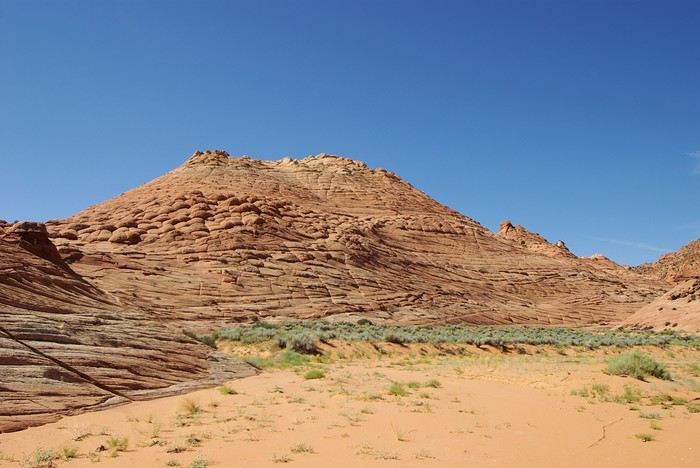
We had to cross it to reach our goal: a strip about 2 km long and 1 km wide that you can explore freely since there’s no marked trail... We entered a few GPS points into our Garmin Etrex, and off we went!!! 😎 It was... magical, enchanting, a true love-at-first-sight moment!
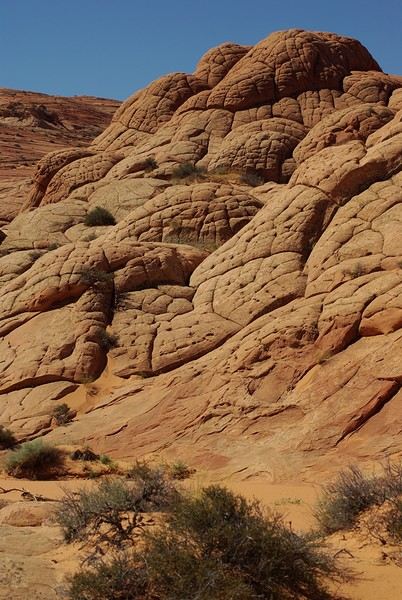
Brain Rock, waves, fine and brittle rock, colors—it goes up, it goes down.
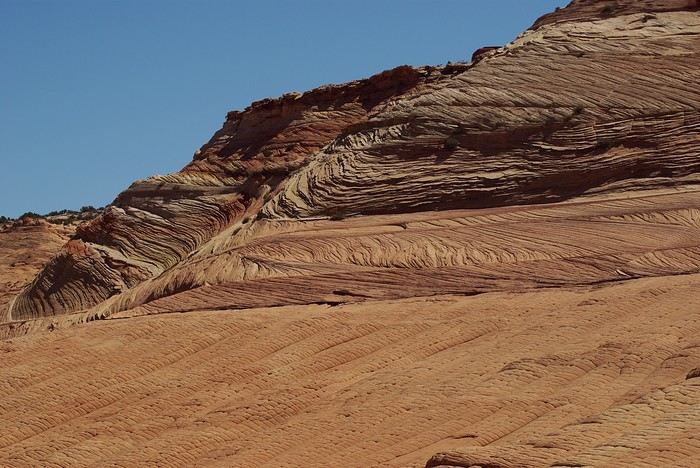
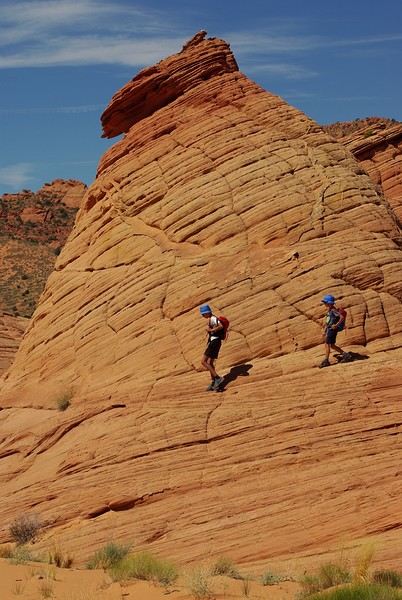
Just thinking about it gives me chills... I remember sitting still for two minutes, taking in these wonders with such emotion that I teared up...
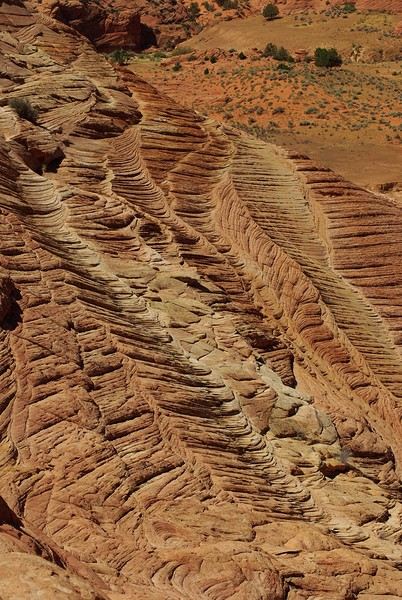
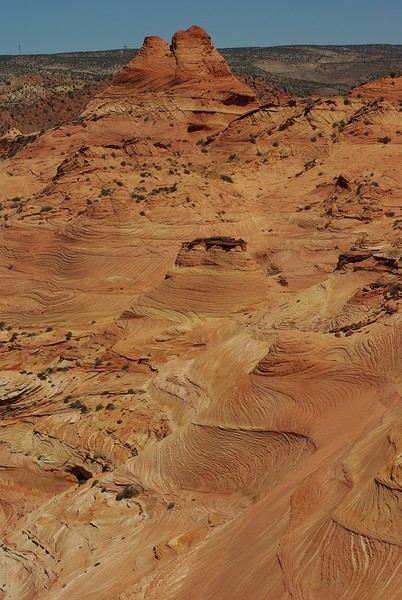
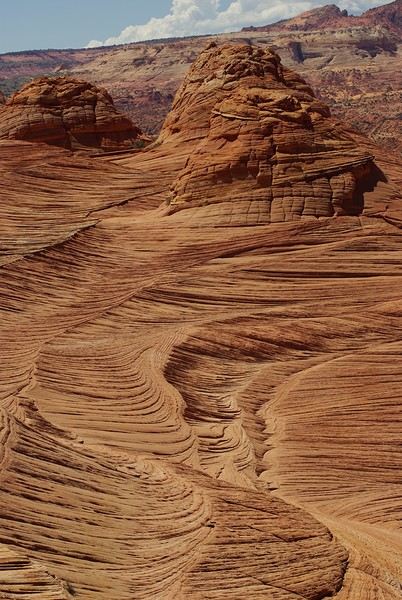
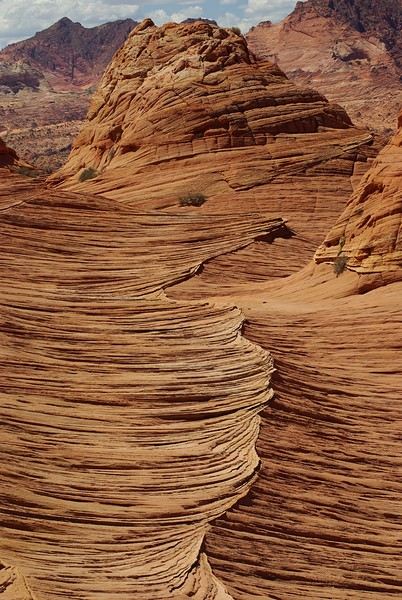
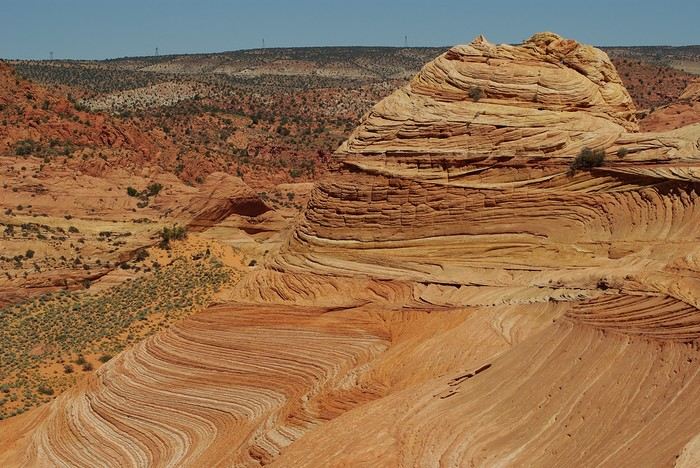
Sunday, August 7: the day we discover a magical place... Edmaier's Secret...
We got up at 8:00 AM, had breakfast on the terrace of our tiny house, and then set off again toward yesterday’s trail. This time, we stopped after 4.5 miles on House Rock Valley Road at the Buckskin Gulch Trail parking lot. We weren’t interested in that trail today—the slot canyon is muddy anyway after the recent storms...
Instead, we explored a lesser-known area that became our playground. And what a playground it was, folks—an out-of-this-world spot, THE highlight of our trip!!! 😏
Just imagine being in the middle of these landscapes, and the cherry on top... no one else around!!!!! Well, we did meet a couple who were coming back—it was 9:30 AM 😮. Did they camp there? Did they turn back? 🙁
After paying the entry permit online, we set off with plenty of water (6L for the four of us) plus a gallon we hid along the way for the return trip. 😉 After a one-hour approach hike along a wash, we reached the sea of sand.
We had to cross it to reach our goal: a strip about 2 km long and 1 km wide that you can explore freely since there’s no marked trail... We entered a few GPS points into our Garmin Etrex, and off we went!!! 😎 It was... magical, enchanting, a true love-at-first-sight moment!
Brain Rock, waves, fine and brittle rock, colors—it goes up, it goes down.
Just thinking about it gives me chills... I remember sitting still for two minutes, taking in these wonders with such emotion that I teared up...
3 weeks in Colombia in August 2024
Hi there,
This summer, we spent 3 weeks in northern Colombia. A vibrant trip that complemented our southern Peru adventure from the previous year perfectly. Two neighboring countries, but completely different.
To start, we had to make a choice because the country is vast.
So we focused on 3 different regions for our 3 weeks: - Week 1: Bogotá and the colonial villages (Villa de Leyva, Barichara) - Week 2: Medellín and the Coffee Region - Week 3: the Caribbean coast
We entrusted the organization to a small local agency that handled accommodations, guides, and transportation. Transportation is key. The country is large, the road network isn’t very efficient, and we spent a lot of time traveling (cars, planes, and boats...), but it was the price to pay to explore it.
The overall budget isn’t exactly "backpacker" level. We spent 7,500 € (excluding Air France) for our 3-week stay (hotels, drivers, guides, flights, visits, meals). But we treated ourselves to nice accommodations—you’ll see as we share more posts.
For vacations, I try to follow Philippe Noiret’s motto: "Travel is short. Let’s try to do it first class."
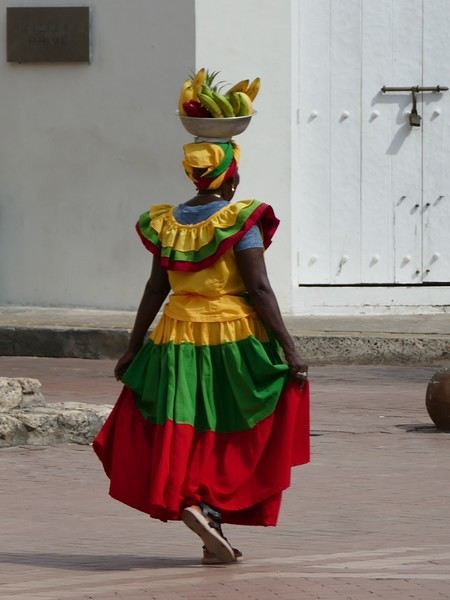
This summer, we spent 3 weeks in northern Colombia. A vibrant trip that complemented our southern Peru adventure from the previous year perfectly. Two neighboring countries, but completely different.
To start, we had to make a choice because the country is vast.
So we focused on 3 different regions for our 3 weeks: - Week 1: Bogotá and the colonial villages (Villa de Leyva, Barichara) - Week 2: Medellín and the Coffee Region - Week 3: the Caribbean coast
We entrusted the organization to a small local agency that handled accommodations, guides, and transportation. Transportation is key. The country is large, the road network isn’t very efficient, and we spent a lot of time traveling (cars, planes, and boats...), but it was the price to pay to explore it.
The overall budget isn’t exactly "backpacker" level. We spent 7,500 € (excluding Air France) for our 3-week stay (hotels, drivers, guides, flights, visits, meals). But we treated ourselves to nice accommodations—you’ll see as we share more posts.
For vacations, I try to follow Philippe Noiret’s motto: "Travel is short. Let’s try to do it first class."
Ce n'était pas mieux avant et ce n'est pas mieux après English translation pending
j ai connu un âge d or des voyages en pays etrangers. En gros des annees 1980 aux annees 2000.
avant c était les avions pour les privilégiés, des zones entieres sans hôtels , des chambres et des lits datant du moyen âge et parfois d immenses difficultés pour se comprendre. une bonne partie du monde pour des aventuriers au dos solide et au sommeil facile
apres c est devenu l invasion touristique , les paysages défigurés , la mer souillée , les bourrins en bus et sur paquebots , le tourisme local avec les défauts occidentaux et pas leurs qualités. une bonne partie du monde a vous gâcher le paysage avec leurs minables selfies
Il y a pour tout une période optimale. Avant c est trop tôt, apres ca devient difficile. Ce n est pas Voyagesforum qui me contredira........
avant c était les avions pour les privilégiés, des zones entieres sans hôtels , des chambres et des lits datant du moyen âge et parfois d immenses difficultés pour se comprendre. une bonne partie du monde pour des aventuriers au dos solide et au sommeil facile
apres c est devenu l invasion touristique , les paysages défigurés , la mer souillée , les bourrins en bus et sur paquebots , le tourisme local avec les défauts occidentaux et pas leurs qualités. une bonne partie du monde a vous gâcher le paysage avec leurs minables selfies
Il y a pour tout une période optimale. Avant c est trop tôt, apres ca devient difficile. Ce n est pas Voyagesforum qui me contredira........
Visite des quartiers Sinjuku, Shibuya... en 3 jours à Tokyo English translation pending
Bonjour,
Après plusieurs jours en Corée du Sud, j'ai pris la décision de partir 3 jours complet à Tokyo sachant que c'est pas loin.
Je voulais savoir si pour les quartiers comme Sinjuku ou Shibuya on pouvait les faire en une demi-journée ou plus la journée ? Car je souhaite faire les deux quartiers ainsi que Asakusa, Akihabara et Odaiba, est-ce jouable ?
Je compte me loger non loin de Sinjuku Station.
Merci
Après plusieurs jours en Corée du Sud, j'ai pris la décision de partir 3 jours complet à Tokyo sachant que c'est pas loin.
Je voulais savoir si pour les quartiers comme Sinjuku ou Shibuya on pouvait les faire en une demi-journée ou plus la journée ? Car je souhaite faire les deux quartiers ainsi que Asakusa, Akihabara et Odaiba, est-ce jouable ?
Je compte me loger non loin de Sinjuku Station.
Merci
Le Kansai un peu différent avec de jeunes enfants (Japon) English translation pending
bonjour,
nous espérons pouvoir nous rendre au Japon avec nos 2 enfants (7 et presque 4 ans au moment du voyage). les billets sont réservés avec Finn Air
Arrivée Osaka le 20/02/21 retour Osaka le 03/03/21
Nous avons l'habitude de voyager sans courir, ni faire trop de déplacements. Nous préférons rester plus longtemps au même endroit et "errer" au grès de nos envies en nous baladant hors des sentiers battus plutôt que d'enchainer les lieux et les visites "incontournables"et dire "ça je l'ai visité".
Notre idées c'était de rester du 20 au 25 à Osaka
le 20: arrivée vers midi à l’hôtel , repos l’après midi + balade suivant la fatigue 21: visite d'osaka 22: visite d'osaka 23: parc Universal studio 24: hime-ji
puis du 25 au 3 : kyoto
25: départ pour kyoto depuis Oksaka + visites 26 au 2/03: visites et balades 3 au matin : départ pour l’aéroport et décollage à midi
côté logements: - sur Osaka, pour l'instant je n'ai rien trouvé intéressant, donc si vous avez des bons plans de logement familial, nous sommes preneurs... - sur Kyoto nous aimerions loger dans le quartier nord-ouest, nous souhaitons volontairement sortir du quartier touristique. quelqu'un a-t-il déjà pris un logement avec Ben's Guesthouse ? Nous aurions souhaité un logement avec 2 "chambres séparées" mais je n'arrive pas à trouver mon bonheur dans ce qui colle dans mon budget. si vous avez des idées ....
concernant les visites: -Sur Kyoto nous avons 2-3 points que chacun souhaite voir mais nous n'allons pas enchainer les longues journées surtout avec nos 2 petits marcheurs (vraiment, la marche ce n'est pas leur truc). Nous verrons en fonction des envies de chacun. Pour les enfants nous avions vu le studio de film samouraï , si quelqu'un l'a testé, combien de temps avez vous mis pour le visiter? Seulement, Mon fils de 7 ans me supplie pour aller visiter la maison de Totoro en banlieue de Nagoya ainsi que la ville de Iga qui est une ancienne ville de Ninja (avec maison à visiter et musée) mais je ne sais pas trop où les caser ? depuis Kyoto? sachant que dans les 2 cas il faudrait compter 1 journée chaque... Il resterait 3.5 jours pour Kyoto, cela semble jouable mais dans ce cas j’enlève le studio de film et la journée à Ohara...Aller sur Iga permettra, du coup de découvrir la campagne japonaise de ce côté là. Ces 2 destinations sont elles facilement accessibles? -Pour Osaka, nous n'avons pas d'objectifs particulier si ce n'est le château d'Osaka, Universal studio et Himeji. pour le reste, on verra sur place. si nous avions eu un peu plus de temps, nous aurions aimé pousser jusqu'à la région autour de wakayama et nous y "perdre" en train le temps de 2 jours.
Un temps nous avions penser visiter osaka en 1ere partie et remplacer Kyoto par kanazawa et takayama. Mais nous avons peur que pour les enfants cette partie soit moins attractive, enfin surtout moins variée pour eux.
merci d'avance pour vos conseils
nous espérons pouvoir nous rendre au Japon avec nos 2 enfants (7 et presque 4 ans au moment du voyage). les billets sont réservés avec Finn Air
Arrivée Osaka le 20/02/21 retour Osaka le 03/03/21
Nous avons l'habitude de voyager sans courir, ni faire trop de déplacements. Nous préférons rester plus longtemps au même endroit et "errer" au grès de nos envies en nous baladant hors des sentiers battus plutôt que d'enchainer les lieux et les visites "incontournables"et dire "ça je l'ai visité".
Notre idées c'était de rester du 20 au 25 à Osaka
le 20: arrivée vers midi à l’hôtel , repos l’après midi + balade suivant la fatigue 21: visite d'osaka 22: visite d'osaka 23: parc Universal studio 24: hime-ji
puis du 25 au 3 : kyoto
25: départ pour kyoto depuis Oksaka + visites 26 au 2/03: visites et balades 3 au matin : départ pour l’aéroport et décollage à midi
côté logements: - sur Osaka, pour l'instant je n'ai rien trouvé intéressant, donc si vous avez des bons plans de logement familial, nous sommes preneurs... - sur Kyoto nous aimerions loger dans le quartier nord-ouest, nous souhaitons volontairement sortir du quartier touristique. quelqu'un a-t-il déjà pris un logement avec Ben's Guesthouse ? Nous aurions souhaité un logement avec 2 "chambres séparées" mais je n'arrive pas à trouver mon bonheur dans ce qui colle dans mon budget. si vous avez des idées ....
concernant les visites: -Sur Kyoto nous avons 2-3 points que chacun souhaite voir mais nous n'allons pas enchainer les longues journées surtout avec nos 2 petits marcheurs (vraiment, la marche ce n'est pas leur truc). Nous verrons en fonction des envies de chacun. Pour les enfants nous avions vu le studio de film samouraï , si quelqu'un l'a testé, combien de temps avez vous mis pour le visiter? Seulement, Mon fils de 7 ans me supplie pour aller visiter la maison de Totoro en banlieue de Nagoya ainsi que la ville de Iga qui est une ancienne ville de Ninja (avec maison à visiter et musée) mais je ne sais pas trop où les caser ? depuis Kyoto? sachant que dans les 2 cas il faudrait compter 1 journée chaque... Il resterait 3.5 jours pour Kyoto, cela semble jouable mais dans ce cas j’enlève le studio de film et la journée à Ohara...Aller sur Iga permettra, du coup de découvrir la campagne japonaise de ce côté là. Ces 2 destinations sont elles facilement accessibles? -Pour Osaka, nous n'avons pas d'objectifs particulier si ce n'est le château d'Osaka, Universal studio et Himeji. pour le reste, on verra sur place. si nous avions eu un peu plus de temps, nous aurions aimé pousser jusqu'à la région autour de wakayama et nous y "perdre" en train le temps de 2 jours.
Un temps nous avions penser visiter osaka en 1ere partie et remplacer Kyoto par kanazawa et takayama. Mais nous avons peur que pour les enfants cette partie soit moins attractive, enfin surtout moins variée pour eux.
merci d'avance pour vos conseils
Retour aux Marquises: les îles méridionales Hiva Oa, Tahuata et Fatu Iva English translation pending
INTRO
En ces temps épidémiques troublés, la Polynésie Française - et en particulier l' archipel des Marquises - ont des atouts exceptionnels en matière de tourisme. A ce jour, l' épidémie de Coronavirus a juste effleuré le Territoire -presque uniquement Tahiti et Moorea - dont les îles éloignées ont été strictement confinées dès le départ, les offres sanitaires et hospitalières sur place étant très limitées. Pour l' instant, la situation est sous contrôle.
Le tourisme retrouve lentement ses marques depuis la mi-juillet. Il s'agit actuellement plus de tourisme local que de tourisme international, bien que la destination Polynésie / Marquises soit attirante : beauté et unicité des paysages, authenticité d'un archipel, certes situé à 4 heures d'avion ATR de Tahiti, mais que l' on peut facilement découvrir en solo et donc en dehors de la très onéreuse croisière sur l' Aranui, sécurité physique mais aussi sanitaire. Les Européens - dont une majorité de Français - arrivent... Ils avaient déjà leurs billets depuis des mois et l' entrée sur le territoire est facilitée.
Nous devions faire ce second voyage aux Marquises en mai dernier, mais il fut annulé jusqu'à la reprise progressive des vols en interne.
Nous avons simplement acheté un billet Air Tahiti en ligne, sans utiliser le Pass Marquises qui ne permet pas de visiter les deux îles les plus méridionales, à savoir Tahuata et Fatu Iva, dépourvues d'aéroport. On ne peut y aller qu' en bateau, en excursion à la journée ( ou plus bien sur ) pour Tahuata et en navette municipale au départ de Hiva Oa pour aller à Fatu Iva.
Les horaires changeant fréquemment, la première chose à faire est de se renseigner sur les jours de passage vers Fatu Iva. En ce moment, il y en a trois : le lundi ( départ à 2 heures du matin ), le mardi ( départ à 6 heures ) et le samedi ( départ à 6 heures également ). Mais tout cela aura peut-être changé dans 3 mois. Il faut donc une stratégie d'approche !
On peut rajouter la visite de ces deux îles à celles qui sont incluses dans le Pass, à savoir Nuku Hiva, Ua Pou, Ua Huka et Hiva Oa. Prévoir alors une extension de 8 jours environ, à partir de Hiva Oa.
Pourquoi vouloir absolument visiter ces deux îles peu accessibles ? Justement parce qu'il faut les mériter ! Elles demeurent très différentes.
L' une, Tahuata, a un lagon, des plages de sable blanc, des falaises abruptes, des baies échancrées ourlées d'une végétation luxuriante, des couleurs uniques dans les bleus et turquoise et culmine à plus de 1000 mètres.
L' autre, Fatu Iva , est une beauté sauvage et altière avec ses à-pics qui dévalent vers l' océan bleu outremer ( ou 'moana' en tahitien ), connue surtout pour sa fameuse baie des Vierges, considérée par beaucoup - en particulier les navigateurs - comme la plus belle île de Polynésie.
Dans mon premier carnet sur les Marquises, j' avais déjà mentionné notre séjour à Hiva Oa, un peu trop court. Cette fois, entre notre arrivée et notre retour, nous passerons 4 nuits à Hiva Oa et 4 nuits à Fatu Iva. Une journée et demie sera consacrée aussi à Hiva Oa.
Avant de partir à la découverte de ces îles polynésiennes lointaines et peu visitées, quelques chiffres édifiants qui montrent que les Marquises ont échappé de peu à l' oubli, à la perte de leur identité singulière et à la disparition de leur culture. L' archipel comptait 20000 habitants en 1842, seulement 2000 en 1920, environ 8000 actuellement en 2020. Au début des années 1920, c'est grâce à la politique nataliste du Dr Rollin, administrateur des Marquises de l' époque, que la situation commença lentement à s' améliorer. Ensuite et paradoxalement, ce fut un évêque, Mgr Lecleac'h, qui s'érigea en animateur engagé du réveil identitaire, via la sauvegarde du patrimoine, la reconnaissance de la langue marquisienne ( et non tahitienne ), les danses ( jugées trop lascives par les missionnaires ), les chants, le tatouage, enfin l' artisanat inspiré des motifs et des symboles de la culture ancienne. L' icône du renouveau marquisien est sans conteste le tiki, demi-dieu et créateur de l' homme. En lui réside la divinité et les ancêtres légendaires.

TAHUATA ou Île Lumière
DANS LA LEGENDE DES MARQUISES C' est la plus petite île habitée des Marquises dont le nom signifie l' aube en marquisien. J' aurai, plus tard, l' occasion de revenir sur la légende de la création des Marquises : dans cette légende, Tahuata représente le dernier acte de la construction avant l' aube. La symbolique de son nom est liée à l' arrivée de la lumière du jour, signifiant la fin de la construction de la 'Grande Maison', alias l' archipel des Marquises.
UN PEU DE GEOLOGIE Tahuata et Fatu Iva sont soeurs géologiquement parlant. Ce sont des îles plus jeunes que celles du nord de l' archipel ( de 5, 5 millions d'années au Nord-Ouest à seulement 1,2 million d'années au Sud-Est ) L' activité volcanique passée s' est matérialisée sous la forme de volcans dits boucliers, différents des volcans hawaiïens ou tahitiens, qui , suite à des secousses sismiques violentes et répétées, se sont peu à peu effondrés, disparaissant sous les flots de la moitié voire davantage des boucliers initiaux. Résultat : les calderas sont imbriquées l'une dans l' autre , la caldeira initiale étant dotée d'un volcan interne plus petit et plus récent. C 'est le cas à Fatu Iva par exemple.
UN PEU DE GEOGRAPHIE
Située à seulement 4 kms de Hiva Oa , on ne peut rejoindre Tahuata que par mer après 40 à 60 mn de navigation selon le temps ( il existe un catamaran communal, le Tahuata Nui mais qui est souvent en panne pour une durée indéterminée... ). On choisira entre l' excursion à la journée ou le passage simple en speedboat privé, assez cher. Ou si l' on doit résider à Tahuata, on s'arrangera au préalable avec la pension de famille choisie pour discuter des modalités et du prix de la course aller-retour entre Tahuata et Hiva Oa. Le canal dit du Bordelais qui est emprunté par les bateaux peut être extrêmement agité par des courants violents et rallonger un peu la course. (Petite digression sur ce fameux canal du Bordelais... Qui est donc ce Bordelais ? Un certain Joseph Capri ( ou Kabri ou Kabris ), originaire de Bordeaux même, initialement matelot de son état sur un bâtiment baleinier qui fait naufrage sur la côte de Nuku Hiva. Kabri , capturé par les guerriers du roi anthropophage de NH, s'apprête à mourir et à finir rôti à la broche, mais est sauvé in extremis par la fille du roi qui demande sa grâce. Celle-ci est accordée, il épouse la belle dans la foulée, le roi tatoue son gendre lui-même, lui offre des parures en tapa et mousse et le nomme grand juge du pays. Il tue, torture, garrotte, découpe en morceaux. Il pacifie à sa manière ! La vie est douce et belle, il a six enfants de sa princesse marquisienne ... Et puis un jour où il sommeille dans la nature, il est kidnappé par le navigateur russe Krunsenstern qui, à coups de knout, le ramène au navire puis à St Petersbourg pour y être interrogé et jugé. Kabri parvient à s' échapper vers Paris, demande à rencontrer Louis XVIII qu'il traite comme son cousin. Ce dernier - contre toute attente - le reçoit et lui donne un peu d'argent, mais la chance a définitivement tourné pour Kabri qui se retrouve à Valenciennes, gagnant son pain comme bête de foire. Il mourra à 42 ans, épuisé et sans avoir pu repartir vers son île marquisienne et vers sa famille nombreuse. Les autorités lui éviteront post mortem l' infamie d'une exhumation et d'un empaillage, son tatouage corporel et facial ayant conquis un amateur !!! JB Kabri le Tatoué, dessin publié dans le livre de Von Langsdorff
Retour à Tahuata... L' île n'est entourée que partiellement de récifs coralliens ( comme Mangareva aux îles Gambier ) , et est agrémentée de magnifiques plages de sable blanc, en particulier celle de Hanamoenoa. Avec ses versants escarpés se terminant en falaises, des vallées étroites et profondes ouvrant sur des baies échancrées à la végétation dense telles celles jumelles de Iva Iva Nui et de Iva Iva Iti, Tahuata surprend et attire. ' C'est une des rares fois où j' eus le désir de posséder de la terre ', écrivit en son temps le navigateur Alain Gerbault, conquis par une île qu'il qualifiait d'enchanteresse. Son relief est très accidenté et les communications terrestres - sur des pistes improbables - entre les vallées sont difficiles. L' île culmine au Mont Tumu-Mea-Ufa à 1050 m. Sa superficie est de 60 km2, avec une population de 650 à 700 habitants environ. L' île comporte 4 villages : Vaitahu, petit port historique, avec son église aux murs de galets et un magnifique vitrail, son musée d'art et d'histoire, et sa proximité avec des sites archéologiques; Hapatoni, autre village avec sa voie pavée ou ' allée de la reine ', construite sur ordre de la reine Vaekehu II au 19ème siècle, bordée d'arbres centenaires de tamanu plantés par les anciens , et ses ' me'ae ' ( ou ' marae ' en tahitien). Egalement Motopu et Hanatetena, deux plus petits villages. Il y a d'autres chemins pavés dans l' île, à Hapatoni en particulier, et des pétroglyphes à Hanatahua. On peut donc passer plus d'une journée à Tahuata, y séjourner dans l' une de ses pensions. Les chemins et pistes de l' île se prêtent parfaitement à la randonnée pédestre.
UN PEU D HISTOIRE
Plusieurs édifices du village de Vaitahu commémorent un passé souvent tragique. On peut y voir les trois stèles érigées en souvenir de l' arrivée des Espagnols en 1595, puis de celle de militaires français en 1838 et enfin de la prise de possession de l' archipel par l' amiral Abel Dupetit-Thouars en 1842. Alvaro de Mendaña y Neira jeta l' ancre à Vaitahu en 1595, un premier contact avec ceux que l' on appelait à l' époque dans les mers du Sud et ailleurs ' les naturels ' qui tourna rapidement au massacre par les soldats espagnols de 200 villageois, guerriers et civils mélangés. On peut comprendre, dans ce contexte, que l' arrivée d'Occidentaux au 18ème siècle et au début du 19ème siècle ait suscité beaucoup de méfiance, d'animosité et d'hostilité de la part des habitants de Tahuata, et des autres îles également. Les premières tentatives d' évangélisation protestante d'abord en 1797 puis catholique en 1839 se soldèrent par un échec retentissant ( le gouvernement français avait l' habitude d'envoyer les missionnaires en éclaireurs afin de tâter le terrain.. ). Le religieux ayant failli à sa mission, il restait donc le politique et le militaire : l' expédition Dupetit-Thouars arrive en vue de Tahuata mi - avril 1842. Les Français sont dans un premier temps plutôt bien reçus par le chef / roi Iotete qui a récemment subi la pression de la marine américaine et qui se dit que la France le protégera. On attribue donc un terrain en hauteur aux Français pour la construction d'un fortin et d'une garnison. Dupetit-Thouars veut aller vite et propose à Iotete de se mettre sous la protection du roi de France, Louis-Philippe. Iotete accepte et, le 1er mai, est organisée une cérémonie pour la prise de possession officielle des îles Sud de l' archipel des Marquises - et par extension de tout l' archipel - par la France en présence des missionnaires et du neveu de Iotete, Maheono, également chef de Hanatetena. Et puis rapidement, un malaise grandissant s'installe, l' ambiance se dégrade, Iotete devient peu accommodant et versatile, ne supportant pas de se voir privé de son autorité de chef incontesté. Il fugue dans la montagne, organise la résistance aux Français que l' on vient pourtant de fêter, et finit par assiéger le fortin à moitié achevé avec ses guerriers. Résultat : des morts et des blessés des deux côtés et un chaos inattendu. Après palabres et promesses, l' amiral, fidèle à sa stratégie initiale, convainc Iotete - contacté et ramené à la raison par son neveu - de revenir à la table des négociations, et les termes d' une paix durable sont établis définitivement. Iotete a tenté de lutter mais a perdu et la guerre et son pouvoir, son ' mana '. Il mourra l' année suivante, une fin triste et sans avenir pour un chef qui ne sera pas élevé au rang de dieu le jour de ses funérailles.
 Prise de possession officielle de Tahuata
De g. à d. : Maheono, Iotete ( en habit militaire d'apparat à galons d'or époque Louis XV ), le père Baudichon, Abel Dupetit-Thouars
Prise de possession officielle de Tahuata
De g. à d. : Maheono, Iotete ( en habit militaire d'apparat à galons d'or époque Louis XV ), le père Baudichon, Abel Dupetit-Thouars
 Iotete le 1er Mais 1842 ( portrait par Max Radiguet )
 Iotete le 1er mai 1842 ( portrait par Max Radiguet )
 Maheono, neveu de Iotete et son saisissant tatouage facial
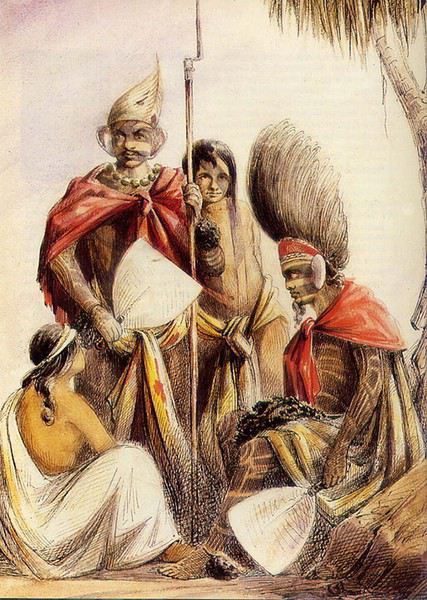 Guerriers marquisiens 19ème siècle
L' amiral repart bientôt sur son navire La Reine Blanche vers Tahiti où il va obtenir le 9 septembre 1842 de la reine Pomaré IV son acceptation formelle de placer son île sous protectorat français. C' est ainsi que Les Marquises alias La Terre des Hommes ( ou Te Fenua Enata en marquisien ) devient la première colonie française dans le Pacifique Sud un peu avant Tahiti.
FAUNE ET FLORE Depuis sa disparition de Hiva Oa, suite à l' introduction malheureuse d'un rapace nocturne, le grand-duc de Virginie ( ou Bubo Virginiasus en latin ), la seule population survivante de ' pahi ' ou martin-chasseur des Marquises, vit à Tahuata, en grand danger d'extinction, car en déclin lent mais constant. il ne resterait que 300 individus au mieux. La destruction du grand-duc est autorisée à cause de son impact fatal sur la faune aviaire locale. Des excursions à pied et à cheval, en excursion à la demi-journée ou à la journée entière, à la découverte du ' pahi ' sont possibles. Contacter le comité de tourisme de Tahuata.
ACTIVITES TRADITIONNELLES
Il y a à Tahuata plusieurs centres d'artisanat et ce dernier est le plus réputé des Marquises, en particulier pour la sculpture sur os. Dans l' île, on est souvent sculpteur de père en fils; les hommes travaillent le bois de rose, l' os de cheval, de chèvre et de mouton et le rostre d'espadon. Dans la vallée d'Hapatoni, ce sont surtout d' expertes sculptrices qui sont à l' oeuvre, souvent depuis des années. Au travail de l' os ou du rostre d'espadon, elles ajoutent la confection de bijoux originaux. La culture du coprah est bien présente à Tahuata et permet aux agriculteurs de gagner un revenu fixe. Les cultures vivrières et les récoltes d'agrumes tels les pamplemousses, très réputés permettent l' autosuffisance alimentaire des habitants de l' île et un peu d'exportation vers le marché et les supermarchés de Papeete ( via la diaspora marquisienne installée à Tahiti ). Pêche et chasse participent également, pleinement, de ce désir d'autosuffisance. La nature est généreuse et tout pousse à profusion et l' on vit simplement mais plutôt bien à Tahuata comme ailleurs aux Marquises, d'autant que désormais, les cargos mixtes apportent régulièrement de Tahiti ce qui manque aux îliens.
Fatu Iva L' île de tous les superlatifs / L'île érotique

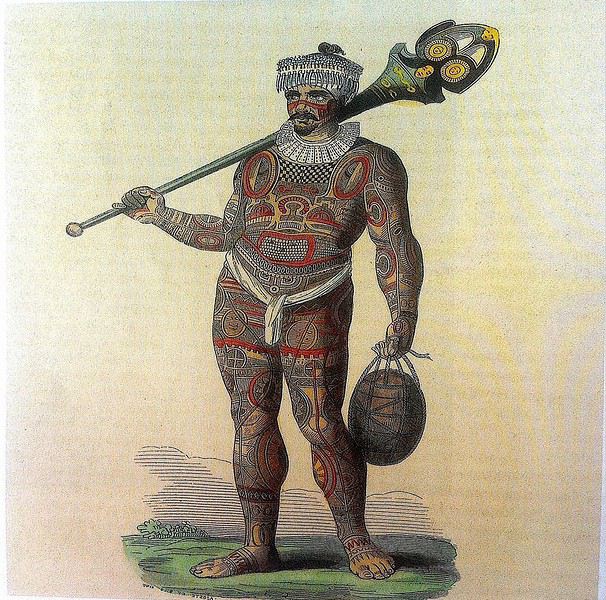
Guerrier marquisien tatoué originaire de Fatu Iva 19ème siècle On notera sur sa poitrine les motifs reconstitués d'une tête de tiki, que l' on retrouve aussi sur la crosse du casse-tête ( ou ' u'u ' en marquisien ), arme réservée au guerrier. Cette tête est supposée augmenter le ' mana ' ( alias la puissance ), les yeux en amande évoquent cette puissance surnaturelle tandis que la bouche étirée où apparaissent parfois langue et dents, est censée défier l' adversaire.
SELON LA LEGENDE Dans la légende de la construction de l' archipel des Marquises, selon laquelle chaque île est partie intégrante de la Maison des Dieux, Fatu Iva représente la toiture faite de 9 ( Iva ) tresses ( Fatu ) de feuilles de palmier. Elle s'est aussi appelée Santa Magdalena, nom donné par Alvaro de Mendaña en l' honneur de la sainte du même nom.
UN PEU DE GEOGRAPHIE Fatu Iva est une île située à 75 kms de Hiva Oa, d'une superficie de 84 km2. Longue de 10 kilomètres et large de 4, elle a la forme d'un croissant ou d'un haricot. Elle culmine au Mont Touaouoho à 960 mètres et héberge une population d'environ 600 habitants. C' est l' île la plus australe de l' archipel, la plus isolée aussi car il est impossible d'y construire un aéroport en raison du relief accidenté ou même un aérodrome comme à Ua Pou par exemple. C' est aussi la plus pluvieuse, étant la plus proche du tropique du Capricorne. Les pluies étant abondantes, l' île est recouverte d'une végétation luxuriante en particulier en son centre où prospère une forêt primaire tropicale dense. C' est aussi l'île la plus sauvage et la plus spectaculaire de l' archipel. Géologiquement parlant, elle est constituée de deux caldeiras volcaniques enchâssées l' une dans l' autre. La première date de 2 millions d'années environ, la seconde, deux fois plus petite est née d'une énorme éruption, comme en témoignent les massives chandelles basaltiques qui montent au ciel tout autour de la baie de Hanavave, dite baie des Vierges. Initialement appelée baie des Verges par les Marquisiens, elle a été rebaptisée par de pudibonds missionnaires, effarouchés par l' imagerie locale et ses sous-entendus. Fatu Iva n' a que deux villages situées chacun sur le bord extérieur des deux caldeiras : Hanavave aux colonnes basaltiques et Omoa, chef-lieu de l' île , village surplombé par un piton rocheux qui surprend par son profil rappelant la tête d'un moai de l' île de Pâques.
UN PEU D'HISTOIRE Comme les autres îles de l' archipel, Fatu Iva fut initialement peuplée par des Polynésiens venus de l' ouest. Les rivalités entre tribus étaient au départ incessantes et donnèrent lieu à des batailles sanglantes. C' est en juillet 1595 que l'île - tout comme celle de Tahuata - fut abordée pour la première fois par un occidental, le navigateur espagnol Alvaro de Mendaña de Neira , le premier du genre à avoir établi des contacts avec des populations polynésiennes. Mais il n' y débarqua pas. Il crût tout d'abord avoir découvert les Iles Salomon, le but ultime de son voyage, mais se rendit rapidement compte qu' il avait découvert une nouvelle terre dans un archipel d' îles auxquelles il donna le nom de ' Marquesas de Mendoza ' pour remercier le Vice-Roi du Pérou - alias Garcia Hurtado de Mendoza y Maurique, IV marquis de Cañete - qui l' avait aidé à monter et financer son expédition, et pour honorer en même temps son épouse et ses filles. En 1935, l' anthropologue norvégien Thor Heyerdahl - et futur aventurier du Kon Tiki - aborda Fatu Iva avec l' idée bien ancrée d' en faire son éden. Il y vécut un an avec sa femme, d'abord à Omoa, puis à Ouia, une vallée inconfortablement située sur la côte au vent et désormais retournée à l' état naturel, ayant été abandonnée par ses quelques habitants. Heyerdahl avait à l' époque avancé l' hypothèse erronée que les Maori descendaient des Indiens d'Amérique du Sud alors qu'ils sont originellement arrivés en pirogue de l' Asie du Sud-Est, et plus particulièrement de Taïwan. ( Je vous renvoie à mon carnet sur Taïwan où j' aborde ce sujet )
De 1960 à 1966, une majorité d'hommes de Fatu Iva partirent travailler au CEP de Mururoa, participant ainsi de l' émigration économique ayant commencé à l' époque, et s'étant poursuivie jusqu'à nos jours, les perspectives en termes d' emploi étant plus que limitées si l' on ne veut pas rester ou devenir agriculteur ou coprahculteur comme ses parents ou grands-parents.
FAUNE ET FLORE L' île est une terre d'abondance pour les agrumes, les fruits en général et les fleurs... Tout pousse ou presque. Elle possède une espèce endémique très menacée aujourd'hui : le Monarque ( ou oma'o ke'eke'e en marquisien ', dont il ne restait il y a peu que 6 couples au monde ! Le rat noir et le chat haret ont littéralement décimé cette espèce, dévorant oeufs, oisillons et même femelles en couvaison. Un programme de sauvegarde de l' espèce a été mis en place, avec des résultats encourageants, le nombre de couples ayant augmenté ces dernières années.
ECONOMIE L' île est ravitaillée uniquement par bateau. Une unique route partiellement bétonnée des deux côtés, et partiellement à l' état de piste, et longue de 17 kilomètres relie les deux villages. On peut également aller d'un village à l' autre par la mer en un quart d'heure de navigation. Le secteur primaire prévaut à Fatu Iva, en particulier la culture du coprah, et puis la pêche au thon, à l' espadon et au thazard. On y a cultivé le noni à outrance à une certaine époque mais celle-ci est un peu révolue, les bienfaits miraculeux du noni n' ayant pas vraiment été prouvés scientifiquement. Comme à Rurutu, on a abandonné la culture du café qui était pourtant prometteuse il y a une quarantaine d'années. En revanche, on trouve davantage de vergers et des vanillières. La chasse aux cochons et aux chèvres permet l' auto-suffisance en viande quand le ravitaillement venu de Tahiti vient à manquer ou arrive irrégulièrement. L' artisanat s'est développé grâce au tourisme et aux expositions semestrielles organisées à Papeete. La spécialité - principalement féminine - de Fatu Iva est le tapa dont les dessins s'inspirent des anciens tatouages marquisiens. La sculpture sur bois ou os ou noix de coco est plutôt réservée aux hommes, nourrie des anciennes figures et des symboles centenaires : tikis sculptés en bois de rose ou en bois noir, casse-tête, plats de présentation.
Suivez-moi en page 2.....
TAHUATA ou Île Lumière
DANS LA LEGENDE DES MARQUISES C' est la plus petite île habitée des Marquises dont le nom signifie l' aube en marquisien. J' aurai, plus tard, l' occasion de revenir sur la légende de la création des Marquises : dans cette légende, Tahuata représente le dernier acte de la construction avant l' aube. La symbolique de son nom est liée à l' arrivée de la lumière du jour, signifiant la fin de la construction de la 'Grande Maison', alias l' archipel des Marquises.
UN PEU DE GEOLOGIE Tahuata et Fatu Iva sont soeurs géologiquement parlant. Ce sont des îles plus jeunes que celles du nord de l' archipel ( de 5, 5 millions d'années au Nord-Ouest à seulement 1,2 million d'années au Sud-Est ) L' activité volcanique passée s' est matérialisée sous la forme de volcans dits boucliers, différents des volcans hawaiïens ou tahitiens, qui , suite à des secousses sismiques violentes et répétées, se sont peu à peu effondrés, disparaissant sous les flots de la moitié voire davantage des boucliers initiaux. Résultat : les calderas sont imbriquées l'une dans l' autre , la caldeira initiale étant dotée d'un volcan interne plus petit et plus récent. C 'est le cas à Fatu Iva par exemple.
UN PEU DE GEOGRAPHIE
Située à seulement 4 kms de Hiva Oa , on ne peut rejoindre Tahuata que par mer après 40 à 60 mn de navigation selon le temps ( il existe un catamaran communal, le Tahuata Nui mais qui est souvent en panne pour une durée indéterminée... ). On choisira entre l' excursion à la journée ou le passage simple en speedboat privé, assez cher. Ou si l' on doit résider à Tahuata, on s'arrangera au préalable avec la pension de famille choisie pour discuter des modalités et du prix de la course aller-retour entre Tahuata et Hiva Oa. Le canal dit du Bordelais qui est emprunté par les bateaux peut être extrêmement agité par des courants violents et rallonger un peu la course. (Petite digression sur ce fameux canal du Bordelais... Qui est donc ce Bordelais ? Un certain Joseph Capri ( ou Kabri ou Kabris ), originaire de Bordeaux même, initialement matelot de son état sur un bâtiment baleinier qui fait naufrage sur la côte de Nuku Hiva. Kabri , capturé par les guerriers du roi anthropophage de NH, s'apprête à mourir et à finir rôti à la broche, mais est sauvé in extremis par la fille du roi qui demande sa grâce. Celle-ci est accordée, il épouse la belle dans la foulée, le roi tatoue son gendre lui-même, lui offre des parures en tapa et mousse et le nomme grand juge du pays. Il tue, torture, garrotte, découpe en morceaux. Il pacifie à sa manière ! La vie est douce et belle, il a six enfants de sa princesse marquisienne ... Et puis un jour où il sommeille dans la nature, il est kidnappé par le navigateur russe Krunsenstern qui, à coups de knout, le ramène au navire puis à St Petersbourg pour y être interrogé et jugé. Kabri parvient à s' échapper vers Paris, demande à rencontrer Louis XVIII qu'il traite comme son cousin. Ce dernier - contre toute attente - le reçoit et lui donne un peu d'argent, mais la chance a définitivement tourné pour Kabri qui se retrouve à Valenciennes, gagnant son pain comme bête de foire. Il mourra à 42 ans, épuisé et sans avoir pu repartir vers son île marquisienne et vers sa famille nombreuse. Les autorités lui éviteront post mortem l' infamie d'une exhumation et d'un empaillage, son tatouage corporel et facial ayant conquis un amateur !!!
JB Kabri le Tatoué, dessin publié dans le livre de Von LangsdorffRetour à Tahuata... L' île n'est entourée que partiellement de récifs coralliens ( comme Mangareva aux îles Gambier ) , et est agrémentée de magnifiques plages de sable blanc, en particulier celle de Hanamoenoa. Avec ses versants escarpés se terminant en falaises, des vallées étroites et profondes ouvrant sur des baies échancrées à la végétation dense telles celles jumelles de Iva Iva Nui et de Iva Iva Iti, Tahuata surprend et attire. ' C'est une des rares fois où j' eus le désir de posséder de la terre ', écrivit en son temps le navigateur Alain Gerbault, conquis par une île qu'il qualifiait d'enchanteresse. Son relief est très accidenté et les communications terrestres - sur des pistes improbables - entre les vallées sont difficiles. L' île culmine au Mont Tumu-Mea-Ufa à 1050 m. Sa superficie est de 60 km2, avec une population de 650 à 700 habitants environ. L' île comporte 4 villages : Vaitahu, petit port historique, avec son église aux murs de galets et un magnifique vitrail, son musée d'art et d'histoire, et sa proximité avec des sites archéologiques; Hapatoni, autre village avec sa voie pavée ou ' allée de la reine ', construite sur ordre de la reine Vaekehu II au 19ème siècle, bordée d'arbres centenaires de tamanu plantés par les anciens , et ses ' me'ae ' ( ou ' marae ' en tahitien). Egalement Motopu et Hanatetena, deux plus petits villages. Il y a d'autres chemins pavés dans l' île, à Hapatoni en particulier, et des pétroglyphes à Hanatahua. On peut donc passer plus d'une journée à Tahuata, y séjourner dans l' une de ses pensions. Les chemins et pistes de l' île se prêtent parfaitement à la randonnée pédestre.
UN PEU D HISTOIRE
Plusieurs édifices du village de Vaitahu commémorent un passé souvent tragique. On peut y voir les trois stèles érigées en souvenir de l' arrivée des Espagnols en 1595, puis de celle de militaires français en 1838 et enfin de la prise de possession de l' archipel par l' amiral Abel Dupetit-Thouars en 1842. Alvaro de Mendaña y Neira jeta l' ancre à Vaitahu en 1595, un premier contact avec ceux que l' on appelait à l' époque dans les mers du Sud et ailleurs ' les naturels ' qui tourna rapidement au massacre par les soldats espagnols de 200 villageois, guerriers et civils mélangés. On peut comprendre, dans ce contexte, que l' arrivée d'Occidentaux au 18ème siècle et au début du 19ème siècle ait suscité beaucoup de méfiance, d'animosité et d'hostilité de la part des habitants de Tahuata, et des autres îles également. Les premières tentatives d' évangélisation protestante d'abord en 1797 puis catholique en 1839 se soldèrent par un échec retentissant ( le gouvernement français avait l' habitude d'envoyer les missionnaires en éclaireurs afin de tâter le terrain.. ). Le religieux ayant failli à sa mission, il restait donc le politique et le militaire : l' expédition Dupetit-Thouars arrive en vue de Tahuata mi - avril 1842. Les Français sont dans un premier temps plutôt bien reçus par le chef / roi Iotete qui a récemment subi la pression de la marine américaine et qui se dit que la France le protégera. On attribue donc un terrain en hauteur aux Français pour la construction d'un fortin et d'une garnison. Dupetit-Thouars veut aller vite et propose à Iotete de se mettre sous la protection du roi de France, Louis-Philippe. Iotete accepte et, le 1er mai, est organisée une cérémonie pour la prise de possession officielle des îles Sud de l' archipel des Marquises - et par extension de tout l' archipel - par la France en présence des missionnaires et du neveu de Iotete, Maheono, également chef de Hanatetena. Et puis rapidement, un malaise grandissant s'installe, l' ambiance se dégrade, Iotete devient peu accommodant et versatile, ne supportant pas de se voir privé de son autorité de chef incontesté. Il fugue dans la montagne, organise la résistance aux Français que l' on vient pourtant de fêter, et finit par assiéger le fortin à moitié achevé avec ses guerriers. Résultat : des morts et des blessés des deux côtés et un chaos inattendu. Après palabres et promesses, l' amiral, fidèle à sa stratégie initiale, convainc Iotete - contacté et ramené à la raison par son neveu - de revenir à la table des négociations, et les termes d' une paix durable sont établis définitivement. Iotete a tenté de lutter mais a perdu et la guerre et son pouvoir, son ' mana '. Il mourra l' année suivante, une fin triste et sans avenir pour un chef qui ne sera pas élevé au rang de dieu le jour de ses funérailles.
Prise de possession officielle de Tahuata
De g. à d. : Maheono, Iotete ( en habit militaire d'apparat à galons d'or époque Louis XV ), le père Baudichon, Abel Dupetit-Thouars
Iotete le 1er Mais 1842 ( portrait par Max Radiguet )
Iotete le 1er mai 1842 ( portrait par Max Radiguet )
Maheono, neveu de Iotete et son saisissant tatouage facial
Guerriers marquisiens 19ème siècleL' amiral repart bientôt sur son navire La Reine Blanche vers Tahiti où il va obtenir le 9 septembre 1842 de la reine Pomaré IV son acceptation formelle de placer son île sous protectorat français. C' est ainsi que Les Marquises alias La Terre des Hommes ( ou Te Fenua Enata en marquisien ) devient la première colonie française dans le Pacifique Sud un peu avant Tahiti.
FAUNE ET FLORE Depuis sa disparition de Hiva Oa, suite à l' introduction malheureuse d'un rapace nocturne, le grand-duc de Virginie ( ou Bubo Virginiasus en latin ), la seule population survivante de ' pahi ' ou martin-chasseur des Marquises, vit à Tahuata, en grand danger d'extinction, car en déclin lent mais constant. il ne resterait que 300 individus au mieux. La destruction du grand-duc est autorisée à cause de son impact fatal sur la faune aviaire locale. Des excursions à pied et à cheval, en excursion à la demi-journée ou à la journée entière, à la découverte du ' pahi ' sont possibles. Contacter le comité de tourisme de Tahuata.
ACTIVITES TRADITIONNELLES
Il y a à Tahuata plusieurs centres d'artisanat et ce dernier est le plus réputé des Marquises, en particulier pour la sculpture sur os. Dans l' île, on est souvent sculpteur de père en fils; les hommes travaillent le bois de rose, l' os de cheval, de chèvre et de mouton et le rostre d'espadon. Dans la vallée d'Hapatoni, ce sont surtout d' expertes sculptrices qui sont à l' oeuvre, souvent depuis des années. Au travail de l' os ou du rostre d'espadon, elles ajoutent la confection de bijoux originaux. La culture du coprah est bien présente à Tahuata et permet aux agriculteurs de gagner un revenu fixe. Les cultures vivrières et les récoltes d'agrumes tels les pamplemousses, très réputés permettent l' autosuffisance alimentaire des habitants de l' île et un peu d'exportation vers le marché et les supermarchés de Papeete ( via la diaspora marquisienne installée à Tahiti ). Pêche et chasse participent également, pleinement, de ce désir d'autosuffisance. La nature est généreuse et tout pousse à profusion et l' on vit simplement mais plutôt bien à Tahuata comme ailleurs aux Marquises, d'autant que désormais, les cargos mixtes apportent régulièrement de Tahiti ce qui manque aux îliens.
Fatu Iva L' île de tous les superlatifs / L'île érotique
Guerrier marquisien tatoué originaire de Fatu Iva 19ème siècle On notera sur sa poitrine les motifs reconstitués d'une tête de tiki, que l' on retrouve aussi sur la crosse du casse-tête ( ou ' u'u ' en marquisien ), arme réservée au guerrier. Cette tête est supposée augmenter le ' mana ' ( alias la puissance ), les yeux en amande évoquent cette puissance surnaturelle tandis que la bouche étirée où apparaissent parfois langue et dents, est censée défier l' adversaire.
SELON LA LEGENDE Dans la légende de la construction de l' archipel des Marquises, selon laquelle chaque île est partie intégrante de la Maison des Dieux, Fatu Iva représente la toiture faite de 9 ( Iva ) tresses ( Fatu ) de feuilles de palmier. Elle s'est aussi appelée Santa Magdalena, nom donné par Alvaro de Mendaña en l' honneur de la sainte du même nom.
UN PEU DE GEOGRAPHIE Fatu Iva est une île située à 75 kms de Hiva Oa, d'une superficie de 84 km2. Longue de 10 kilomètres et large de 4, elle a la forme d'un croissant ou d'un haricot. Elle culmine au Mont Touaouoho à 960 mètres et héberge une population d'environ 600 habitants. C' est l' île la plus australe de l' archipel, la plus isolée aussi car il est impossible d'y construire un aéroport en raison du relief accidenté ou même un aérodrome comme à Ua Pou par exemple. C' est aussi la plus pluvieuse, étant la plus proche du tropique du Capricorne. Les pluies étant abondantes, l' île est recouverte d'une végétation luxuriante en particulier en son centre où prospère une forêt primaire tropicale dense. C' est aussi l'île la plus sauvage et la plus spectaculaire de l' archipel. Géologiquement parlant, elle est constituée de deux caldeiras volcaniques enchâssées l' une dans l' autre. La première date de 2 millions d'années environ, la seconde, deux fois plus petite est née d'une énorme éruption, comme en témoignent les massives chandelles basaltiques qui montent au ciel tout autour de la baie de Hanavave, dite baie des Vierges. Initialement appelée baie des Verges par les Marquisiens, elle a été rebaptisée par de pudibonds missionnaires, effarouchés par l' imagerie locale et ses sous-entendus. Fatu Iva n' a que deux villages situées chacun sur le bord extérieur des deux caldeiras : Hanavave aux colonnes basaltiques et Omoa, chef-lieu de l' île , village surplombé par un piton rocheux qui surprend par son profil rappelant la tête d'un moai de l' île de Pâques.
UN PEU D'HISTOIRE Comme les autres îles de l' archipel, Fatu Iva fut initialement peuplée par des Polynésiens venus de l' ouest. Les rivalités entre tribus étaient au départ incessantes et donnèrent lieu à des batailles sanglantes. C' est en juillet 1595 que l'île - tout comme celle de Tahuata - fut abordée pour la première fois par un occidental, le navigateur espagnol Alvaro de Mendaña de Neira , le premier du genre à avoir établi des contacts avec des populations polynésiennes. Mais il n' y débarqua pas. Il crût tout d'abord avoir découvert les Iles Salomon, le but ultime de son voyage, mais se rendit rapidement compte qu' il avait découvert une nouvelle terre dans un archipel d' îles auxquelles il donna le nom de ' Marquesas de Mendoza ' pour remercier le Vice-Roi du Pérou - alias Garcia Hurtado de Mendoza y Maurique, IV marquis de Cañete - qui l' avait aidé à monter et financer son expédition, et pour honorer en même temps son épouse et ses filles. En 1935, l' anthropologue norvégien Thor Heyerdahl - et futur aventurier du Kon Tiki - aborda Fatu Iva avec l' idée bien ancrée d' en faire son éden. Il y vécut un an avec sa femme, d'abord à Omoa, puis à Ouia, une vallée inconfortablement située sur la côte au vent et désormais retournée à l' état naturel, ayant été abandonnée par ses quelques habitants. Heyerdahl avait à l' époque avancé l' hypothèse erronée que les Maori descendaient des Indiens d'Amérique du Sud alors qu'ils sont originellement arrivés en pirogue de l' Asie du Sud-Est, et plus particulièrement de Taïwan. ( Je vous renvoie à mon carnet sur Taïwan où j' aborde ce sujet )
De 1960 à 1966, une majorité d'hommes de Fatu Iva partirent travailler au CEP de Mururoa, participant ainsi de l' émigration économique ayant commencé à l' époque, et s'étant poursuivie jusqu'à nos jours, les perspectives en termes d' emploi étant plus que limitées si l' on ne veut pas rester ou devenir agriculteur ou coprahculteur comme ses parents ou grands-parents.
FAUNE ET FLORE L' île est une terre d'abondance pour les agrumes, les fruits en général et les fleurs... Tout pousse ou presque. Elle possède une espèce endémique très menacée aujourd'hui : le Monarque ( ou oma'o ke'eke'e en marquisien ', dont il ne restait il y a peu que 6 couples au monde ! Le rat noir et le chat haret ont littéralement décimé cette espèce, dévorant oeufs, oisillons et même femelles en couvaison. Un programme de sauvegarde de l' espèce a été mis en place, avec des résultats encourageants, le nombre de couples ayant augmenté ces dernières années.
ECONOMIE L' île est ravitaillée uniquement par bateau. Une unique route partiellement bétonnée des deux côtés, et partiellement à l' état de piste, et longue de 17 kilomètres relie les deux villages. On peut également aller d'un village à l' autre par la mer en un quart d'heure de navigation. Le secteur primaire prévaut à Fatu Iva, en particulier la culture du coprah, et puis la pêche au thon, à l' espadon et au thazard. On y a cultivé le noni à outrance à une certaine époque mais celle-ci est un peu révolue, les bienfaits miraculeux du noni n' ayant pas vraiment été prouvés scientifiquement. Comme à Rurutu, on a abandonné la culture du café qui était pourtant prometteuse il y a une quarantaine d'années. En revanche, on trouve davantage de vergers et des vanillières. La chasse aux cochons et aux chèvres permet l' auto-suffisance en viande quand le ravitaillement venu de Tahiti vient à manquer ou arrive irrégulièrement. L' artisanat s'est développé grâce au tourisme et aux expositions semestrielles organisées à Papeete. La spécialité - principalement féminine - de Fatu Iva est le tapa dont les dessins s'inspirent des anciens tatouages marquisiens. La sculpture sur bois ou os ou noix de coco est plutôt réservée aux hommes, nourrie des anciennes figures et des symboles centenaires : tikis sculptés en bois de rose ou en bois noir, casse-tête, plats de présentation.
Suivez-moi en page 2.....
Il est grand temps de rallumer les étoiles! English translation pending
Bonjour à tous
Le Vietnam pays magique multiculturel aux paysages diversifiés et époustouflants. Voilà ce que je vous invite à partager sans aborder s'il vous plaît ce qui aujourd'hui empêche la planète de vivre... Essayons d'être constructifs et positivons! Il est grand temps de rallumer les étoiles!
Pour commencer avec légèreté: La médecine des Dao, le bain aux herbes. C'est un moment délicieux après une journée de marche et de visites rien de tel pour vous requinquer! Ce bain est très souvent proposé aux touristes dans le nord, spécialité de l'ethnie Dao il est "accommodé" dans plusieurs maisons d'hôtes et hôtels aux besoins des touristes.
Traditionnellement les recettes sont destinées à chaque cas et en fonction de la pathologie: femmes enceintes ou qui viennent d'accoucher, nouveau-nés, malades, vieillards…les herbes seront donc choisies en fonction des besoins et du type de médication (orale, en bain, en emplâtre...). C'est dès l'aube que les femmes, les hommes, les chamanes iront cueillir ces plantes, racines et écorces dans la forêt, le tout sera combiné à un régime adapté (on ne mange pas de tout..) et souvent suivi d'un massage spécifique.
Nous en avons testé plusieurs à plusieurs endroits mais celui de la chamane Dao d'un petit village au nord de Muong Lay restera sans doute le plus authentique et le plus insolite.. On nous prend en main dès notre arrivée dans la maison de la chamane. Elle y vit avec sa fille et son gendre... Maison, je devrai plus dire assemblage de planches et de tôles et quand on connaît les rigueurs de l'hivers on peut rêver mieux. La pièce principale est bourrée de pots en tout genre remplis de décoctions plus ou moins troubles...ces sont les médications à avaler, beurk.. Il y a aussi de gros sacs (plastique) d'herbes, de racines, d'écorces, un vrai magasin d'herboriste (l'ordre et la propreté en moins) sans oublier bien sur l'hôtel des ancêtres. Derrière des rideaux, les couches des habitants, nous ne dormirons pas là, ouf.. Puis attenantes, les deux salles des bains avec 2 baquets chacune et entre les deux sous une pergola un énorme foyer construit en ciment surmonté d'une aussi énorme bassine où l'eau et les herbes "cuisent" jusqu'à parfois 12 heures...c'est là que l'on fait aussi cuire la soupe des cochons... Le feu est alimenté de poupée de maïs et de bois. C'est dans ces baquets que nous tromperont plus ou moins longtemps...le temps de "cuisson" est décidé par la chamane en fonction de chacun, jamais plus de 30 mm...et les herbes qui seront rajoutée dans les baquets seront aussi choisies en fonction de chaque "malade". C'est très très chaud, il faut vraiment se faire violence pour entrer là dedans et c'est sans compter qu'une fois immergés la dame ajoute de l'eau chaude bien sur...ouille. Une fois "les touristes bien cuits" on nous sort de là, inutile de préciser que nous ressemblons plus à des homards qu'à des visages pâles... Après cuisson, nous serons conduits ensuite vers le silo à grains, où une pièce spéciale massage à été aménagée à son top, on l'atteint via une échelle de bois...au sol deux couches. Ici commence le moment le plus douloureux de tous les massages faits au Vietnam par le gendre et la fille de la maison.. Pas de douces caresses, non, non, mais un pétrissage et un battage en bonne et due forme suivis de torsion, j'ai cru ma dernière heure arrivée... Pour clore la séance nous dînerons chez la chamane d'un souper spécial, la couleur des mets est importante, nous ne mangerons que du blanc et du vert....des légumes et des herbes inconnues de nous et un peu de poulet bouilli, élastique à souhait, sans doute celui que nous avons croisé sur le chemin en arrivant et des petits poissons frits (très bons). C'est sans conteste le meilleur soin reçu au Vietnam si l'on fait abstraction de la propreté des lieux, des serviettes (surtout apporter les siennes) et des moments douloureux.
Le Vietnam pays magique multiculturel aux paysages diversifiés et époustouflants. Voilà ce que je vous invite à partager sans aborder s'il vous plaît ce qui aujourd'hui empêche la planète de vivre... Essayons d'être constructifs et positivons! Il est grand temps de rallumer les étoiles!
Pour commencer avec légèreté: La médecine des Dao, le bain aux herbes. C'est un moment délicieux après une journée de marche et de visites rien de tel pour vous requinquer! Ce bain est très souvent proposé aux touristes dans le nord, spécialité de l'ethnie Dao il est "accommodé" dans plusieurs maisons d'hôtes et hôtels aux besoins des touristes.
Traditionnellement les recettes sont destinées à chaque cas et en fonction de la pathologie: femmes enceintes ou qui viennent d'accoucher, nouveau-nés, malades, vieillards…les herbes seront donc choisies en fonction des besoins et du type de médication (orale, en bain, en emplâtre...). C'est dès l'aube que les femmes, les hommes, les chamanes iront cueillir ces plantes, racines et écorces dans la forêt, le tout sera combiné à un régime adapté (on ne mange pas de tout..) et souvent suivi d'un massage spécifique.
Nous en avons testé plusieurs à plusieurs endroits mais celui de la chamane Dao d'un petit village au nord de Muong Lay restera sans doute le plus authentique et le plus insolite.. On nous prend en main dès notre arrivée dans la maison de la chamane. Elle y vit avec sa fille et son gendre... Maison, je devrai plus dire assemblage de planches et de tôles et quand on connaît les rigueurs de l'hivers on peut rêver mieux. La pièce principale est bourrée de pots en tout genre remplis de décoctions plus ou moins troubles...ces sont les médications à avaler, beurk.. Il y a aussi de gros sacs (plastique) d'herbes, de racines, d'écorces, un vrai magasin d'herboriste (l'ordre et la propreté en moins) sans oublier bien sur l'hôtel des ancêtres. Derrière des rideaux, les couches des habitants, nous ne dormirons pas là, ouf.. Puis attenantes, les deux salles des bains avec 2 baquets chacune et entre les deux sous une pergola un énorme foyer construit en ciment surmonté d'une aussi énorme bassine où l'eau et les herbes "cuisent" jusqu'à parfois 12 heures...c'est là que l'on fait aussi cuire la soupe des cochons... Le feu est alimenté de poupée de maïs et de bois. C'est dans ces baquets que nous tromperont plus ou moins longtemps...le temps de "cuisson" est décidé par la chamane en fonction de chacun, jamais plus de 30 mm...et les herbes qui seront rajoutée dans les baquets seront aussi choisies en fonction de chaque "malade". C'est très très chaud, il faut vraiment se faire violence pour entrer là dedans et c'est sans compter qu'une fois immergés la dame ajoute de l'eau chaude bien sur...ouille. Une fois "les touristes bien cuits" on nous sort de là, inutile de préciser que nous ressemblons plus à des homards qu'à des visages pâles... Après cuisson, nous serons conduits ensuite vers le silo à grains, où une pièce spéciale massage à été aménagée à son top, on l'atteint via une échelle de bois...au sol deux couches. Ici commence le moment le plus douloureux de tous les massages faits au Vietnam par le gendre et la fille de la maison.. Pas de douces caresses, non, non, mais un pétrissage et un battage en bonne et due forme suivis de torsion, j'ai cru ma dernière heure arrivée... Pour clore la séance nous dînerons chez la chamane d'un souper spécial, la couleur des mets est importante, nous ne mangerons que du blanc et du vert....des légumes et des herbes inconnues de nous et un peu de poulet bouilli, élastique à souhait, sans doute celui que nous avons croisé sur le chemin en arrivant et des petits poissons frits (très bons). C'est sans conteste le meilleur soin reçu au Vietnam si l'on fait abstraction de la propreté des lieux, des serviettes (surtout apporter les siennes) et des moments douloureux.
Plan de reprise des croisières Costa English translation pending
Bonjour
Voilà ce qui serait prévu à partir de la mi-août :
http://crew-center.com/costa-cruises-plans-re-start-voyages-7-ships-5-phases
Cordialement
Voilà ce qui serait prévu à partir de la mi-août :
http://crew-center.com/costa-cruises-plans-re-start-voyages-7-ships-5-phases
Cordialement
Redécouvrir la Corse, un vrai plaisir English translation pending
Après un départ manqué pour la Louisiane et deux mois de confinement, on avait comme beaucoup envie de changer d'air (encore que Hyères soit une ville extrêmement agréable, surtout quand la fréquentation reste modérée).
Début juin, il y avait peu d'opportunités d'évasion, sauf un tour en Corse qui paraissait une bonne solution. Mais c'était sans compter sur les atermoiements de l’exécutif Corse, avec la demande d'un passeport sanitaire (mais quel type de passeport, quels tests, quand, comment?) et le mutisme du gouvernement sur le même sujet.
Finalement, nous avons choisi de partir quand même le 22 juin, avec transport, hôtels, location tous annulables sans frais sous 48 h et, progressivement, les obstacles au départ ont été levés.
Malgré tout, petit suspense à l'embarquement à Toulon le 22 au soir : y aurait t'il un nouveau rebondissement dans la gestion Corse de l'épidémie ?
Finalement, tout se passe en douceur : accueil beaucoup moins stressé que d'habitude, que ce soit sur le port même, à l'embarquement, où souvent les garagistes de Corsica Ferries sont plutôt sur les dents, et également sur le bateau où le personnel est beaucoup plus aimable que d'habitude (facile diront les habitués de la traversée).
A bord, beaucoup moins de monde, port généralisé du masque, sauf quelques jeunes adultes qui s'estiment au dessus de ça.
On quitte le port de Toulon au soleil couchant, en saluant à tribord les fermes aquacoles des Tamaris
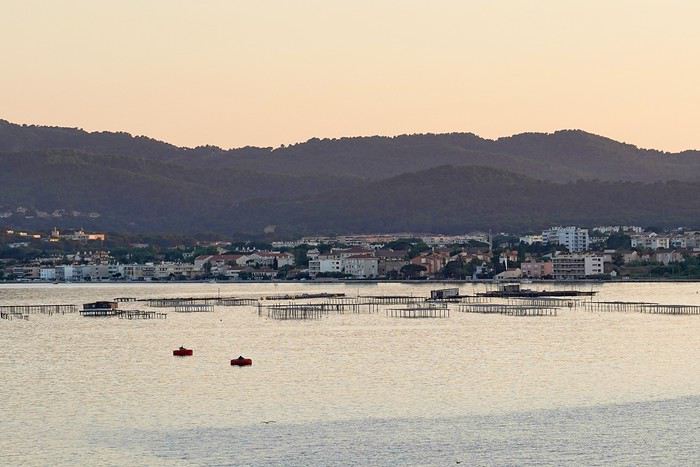 , puis les deux vieux bateaux de la Marine qui finissent leur carrière comme brise lames à la Seyne
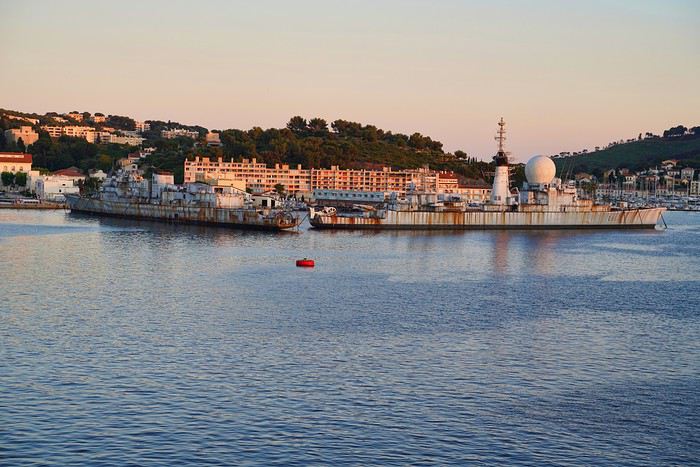 et on admire le départ toujours acrobatique du pilote
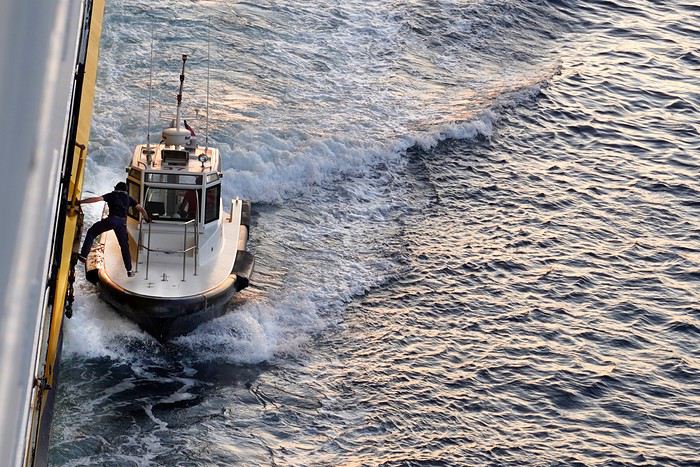 - Sommeil tranquille dans une cabine où personne n'a pris la peine de remplir les distributeurs de savon du lavabo et de la douche. Ce sera donc une toilette de chat.
On vire les Sanguinaires à 7 h du matin, par grand beau temps et mer plate,
- Sommeil tranquille dans une cabine où personne n'a pris la peine de remplir les distributeurs de savon du lavabo et de la douche. Ce sera donc une toilette de chat.
On vire les Sanguinaires à 7 h du matin, par grand beau temps et mer plate,
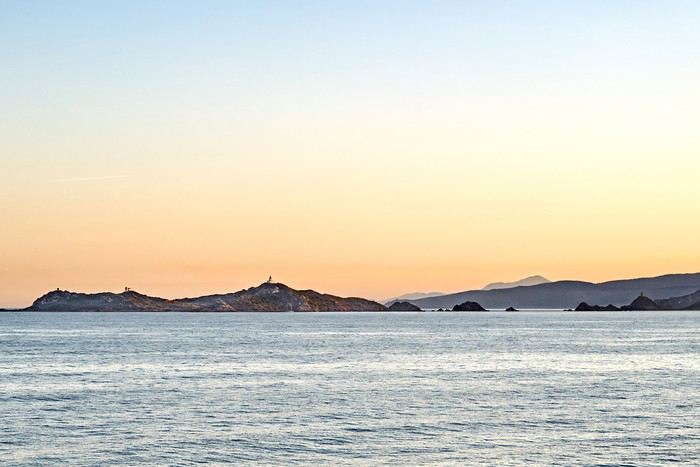 pour accoster comme prévu à Ajaccio à 7 h 30.
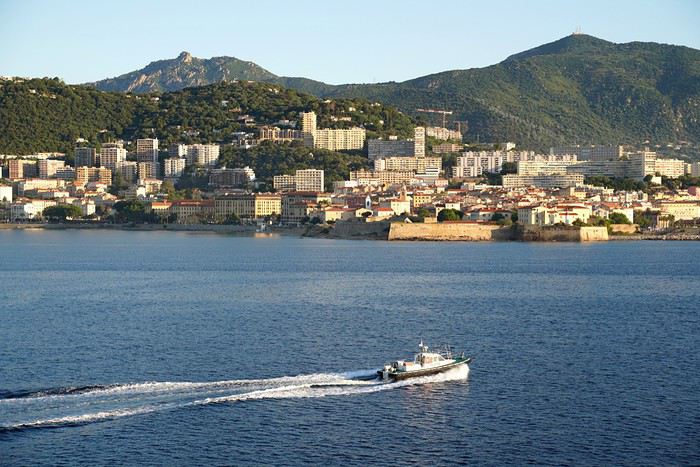 A 8 h, on met l'autoradio sur radio Corsica, ce qui nous met tout de suite dans l'ambiance (Non, rien de rien d'Edith Piaf chanté en Corse, ça vaut le déplacement!) et on roule tranquillement en direction de la Parata, avec très peu de trafic, pas de bus touristiques et sans l'affreux petit train sur pneus qui bloque habituellement la circulation.
Arrivé au parking de la Parata, les navettes électriques ne fonctionnent pas encore, on continue donc à pied vers la pointe, en admirant les Iles sanguinaires qui se reflètent dans l'eau lisse.
A 8 h, on met l'autoradio sur radio Corsica, ce qui nous met tout de suite dans l'ambiance (Non, rien de rien d'Edith Piaf chanté en Corse, ça vaut le déplacement!) et on roule tranquillement en direction de la Parata, avec très peu de trafic, pas de bus touristiques et sans l'affreux petit train sur pneus qui bloque habituellement la circulation.
Arrivé au parking de la Parata, les navettes électriques ne fonctionnent pas encore, on continue donc à pied vers la pointe, en admirant les Iles sanguinaires qui se reflètent dans l'eau lisse.
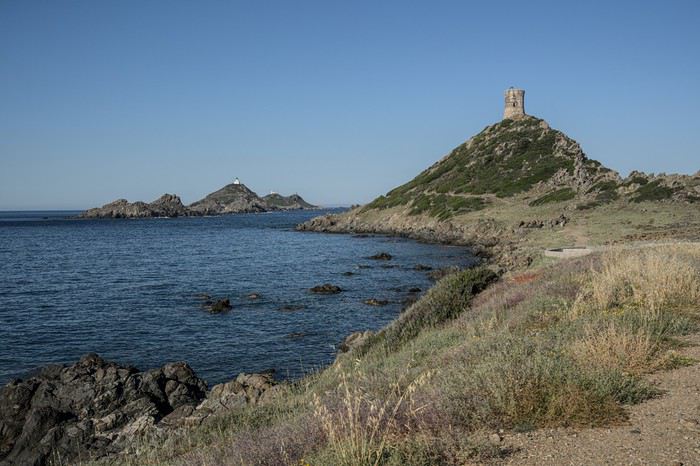
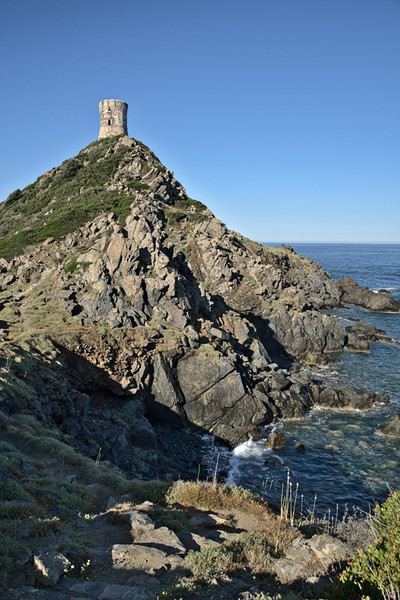
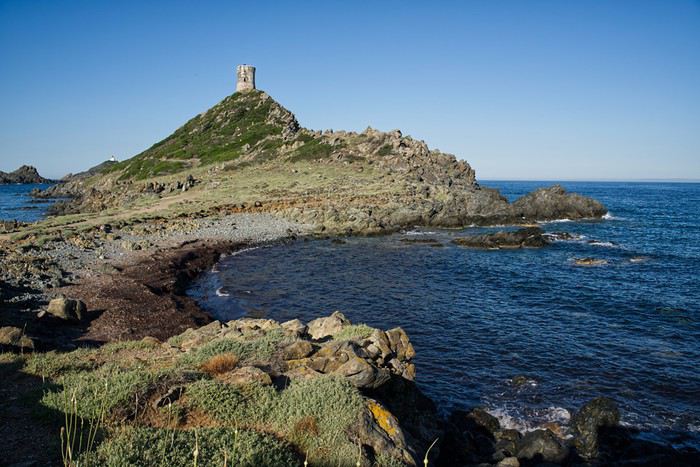
Après notre tour de la pointe, c'est l'heure du café, mais la brasserie est fermée, nous repartons vers Ajaccio et prenons notre café à Marinella, le petit bar de plage sympa à coté de l'ancienne propriété de Tino Rossi et de là embrayons direction Cargese avec quelques embouteillages pour quitter Ajaccio. A Cargese, nous saluons comme il se doit les deux églises jumelles, l'orthodoxe d'un coté, la catholique en face et nous descendons jusqu'au port qui visiblement tourne au ralenti. Nous déjeunons fort agréablement a U Rasaghiu. Dans le temps, nous avions l'habitude d'y aller souvent le soir, le patron laissait tomber le service pour pousser la chanson pour ses clients pinzutti, dont nous étions et nous ne nous lassions pas d'écouter la Boudeuse et la Vieille Guitare. L'établissement a été fort joliment modernisé, l'accueil et la cuisine y sont toujours excellents, mais la maison attend qu'il y ait plus de clients pour rentabiliser ses soirées Chansons Corses, ainsi va la vie.
Nous nous dirigeons ensuite vers Porto Ota en traversant au ralenti la zone des calanques de Piana, en profitant de la faible circulation pour nous arrêter sur les petites aires de stationnement et admirer le paysage, superbe sous le bel éclairage que nous avons la chance d'avoir aujourd'hui.
Dans le temps, nous avions l'habitude d'y aller souvent le soir, le patron laissait tomber le service pour pousser la chanson pour ses clients pinzutti, dont nous étions et nous ne nous lassions pas d'écouter la Boudeuse et la Vieille Guitare. L'établissement a été fort joliment modernisé, l'accueil et la cuisine y sont toujours excellents, mais la maison attend qu'il y ait plus de clients pour rentabiliser ses soirées Chansons Corses, ainsi va la vie.
Nous nous dirigeons ensuite vers Porto Ota en traversant au ralenti la zone des calanques de Piana, en profitant de la faible circulation pour nous arrêter sur les petites aires de stationnement et admirer le paysage, superbe sous le bel éclairage que nous avons la chance d'avoir aujourd'hui.
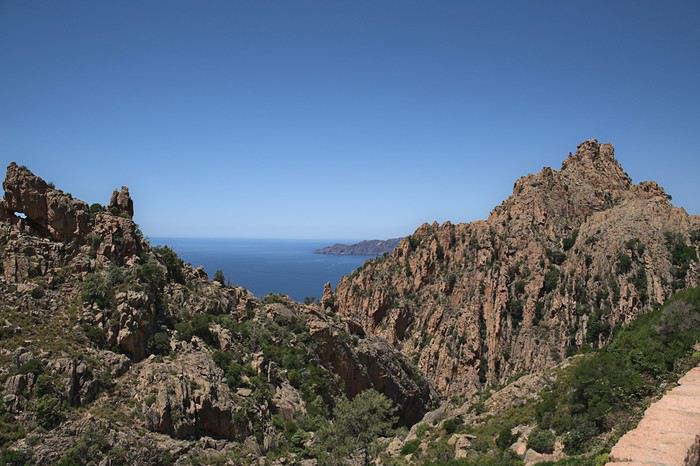
A suivre....
, puis les deux vieux bateaux de la Marine qui finissent leur carrière comme brise lames à la Seyne
et on admire le départ toujours acrobatique du pilote
- Sommeil tranquille dans une cabine où personne n'a pris la peine de remplir les distributeurs de savon du lavabo et de la douche. Ce sera donc une toilette de chat.
On vire les Sanguinaires à 7 h du matin, par grand beau temps et mer plate,
pour accoster comme prévu à Ajaccio à 7 h 30.
A 8 h, on met l'autoradio sur radio Corsica, ce qui nous met tout de suite dans l'ambiance (Non, rien de rien d'Edith Piaf chanté en Corse, ça vaut le déplacement!) et on roule tranquillement en direction de la Parata, avec très peu de trafic, pas de bus touristiques et sans l'affreux petit train sur pneus qui bloque habituellement la circulation.
Arrivé au parking de la Parata, les navettes électriques ne fonctionnent pas encore, on continue donc à pied vers la pointe, en admirant les Iles sanguinaires qui se reflètent dans l'eau lisse.
Après notre tour de la pointe, c'est l'heure du café, mais la brasserie est fermée, nous repartons vers Ajaccio et prenons notre café à Marinella, le petit bar de plage sympa à coté de l'ancienne propriété de Tino Rossi et de là embrayons direction Cargese avec quelques embouteillages pour quitter Ajaccio. A Cargese, nous saluons comme il se doit les deux églises jumelles, l'orthodoxe d'un coté, la catholique en face et nous descendons jusqu'au port qui visiblement tourne au ralenti. Nous déjeunons fort agréablement a U Rasaghiu.
Dans le temps, nous avions l'habitude d'y aller souvent le soir, le patron laissait tomber le service pour pousser la chanson pour ses clients pinzutti, dont nous étions et nous ne nous lassions pas d'écouter la Boudeuse et la Vieille Guitare. L'établissement a été fort joliment modernisé, l'accueil et la cuisine y sont toujours excellents, mais la maison attend qu'il y ait plus de clients pour rentabiliser ses soirées Chansons Corses, ainsi va la vie.
Nous nous dirigeons ensuite vers Porto Ota en traversant au ralenti la zone des calanques de Piana, en profitant de la faible circulation pour nous arrêter sur les petites aires de stationnement et admirer le paysage, superbe sous le bel éclairage que nous avons la chance d'avoir aujourd'hui.
A suivre....
Brazil 2020: Amazon, Northeast, Chapada, and Boipeba – a winning combo!
Hello everyone.
Preamble:
Sooner or later, you’ve got to take the plunge! I thought lockdown would be the perfect time to start this travel journal, but between working from home and gardening, I just didn’t have the time (or the motivation). Plus, long-haul trips weren’t really on the cards back then... But then I stumbled upon my photos and thought, "I’ve got to share my latest adventure in Brazil—you guessed it!"
First, a little flashback: some of you (yes, really, in DMs!) pointed out the big gaps in my travel journals—India in 2019, Vietnam in 2018, so many missed opportunities!
Truth is, for India, I traveled with a private guide and honestly didn’t have much to add to the tons of well-documented journals already out there. Plus, I still haven’t decided if I love or hate India... So, how do you share your feelings when you’re not even sure yourself? As for Vietnam, I had plenty to say—even though the itinerary was pretty classic—but I’ll admit the vibe on this part of the forum at the time kinda put me off for a while... And time flies, and memories fade... Anyway, just wanted to clear that up for my (many or few) readers. *Tudo bem*, let’s get started!!
Preamble:
Sooner or later, you’ve got to take the plunge! I thought lockdown would be the perfect time to start this travel journal, but between working from home and gardening, I just didn’t have the time (or the motivation). Plus, long-haul trips weren’t really on the cards back then... But then I stumbled upon my photos and thought, "I’ve got to share my latest adventure in Brazil—you guessed it!"
First, a little flashback: some of you (yes, really, in DMs!) pointed out the big gaps in my travel journals—India in 2019, Vietnam in 2018, so many missed opportunities!
Truth is, for India, I traveled with a private guide and honestly didn’t have much to add to the tons of well-documented journals already out there. Plus, I still haven’t decided if I love or hate India... So, how do you share your feelings when you’re not even sure yourself? As for Vietnam, I had plenty to say—even though the itinerary was pretty classic—but I’ll admit the vibe on this part of the forum at the time kinda put me off for a while... And time flies, and memories fade... Anyway, just wanted to clear that up for my (many or few) readers. *Tudo bem*, let’s get started!!
Botswana avril 2021... faut bien rêver English translation pending
Hello Tous,
J'hésite entre deux circuits, d'une durée de 14 jours chacun.
L'un faisant Kasane - Nata - Khubu Island - CKGR : Leopard Pan, Piper Pan, Xaxa Camp, Bape Camp - Kutse 5Molose et Moreswe) - Khama Rhino Sanctuary - Francistown - Nata - Kasane.
L'autre: Kasane - Gweta - Ghanzi - Kaa Secteur (Swartpan, Gnus Gnus, Zushwa) - CKGR (Xade - Piper Pan Leopard Pan) - Khubu Island - Kasane
Qu'en pensez-vous ? Ca fait beaucoup de route mais j'aimerais retour dans le Kalahari et la voiture est basée à Kasane.
Dans l'attente de vos commentaires, beaux rêves 🙂
J'hésite entre deux circuits, d'une durée de 14 jours chacun.
L'un faisant Kasane - Nata - Khubu Island - CKGR : Leopard Pan, Piper Pan, Xaxa Camp, Bape Camp - Kutse 5Molose et Moreswe) - Khama Rhino Sanctuary - Francistown - Nata - Kasane.
L'autre: Kasane - Gweta - Ghanzi - Kaa Secteur (Swartpan, Gnus Gnus, Zushwa) - CKGR (Xade - Piper Pan Leopard Pan) - Khubu Island - Kasane
Qu'en pensez-vous ? Ca fait beaucoup de route mais j'aimerais retour dans le Kalahari et la voiture est basée à Kasane.
Dans l'attente de vos commentaires, beaux rêves 🙂
Discussion au sujet du concours photo de juin 2020: "Multicolore" English translation pending
Hello,
C'est ici qu'on en parle.
Philippe
C'est ici qu'on en parle.
Philippe
Un choix de vos trois destinations préferées English translation pending
A cette question si personnelle et difficile je vous propose de choisir 3 destinations que vous conseilleriez.
Si possible en ajoutant quelques mots ouvrant la porte à des questions .
L'idée est une sélection mais pas un classement .
Mon choix : Nouvelle Zélande - Ile du Sud et Australie Probablement un art de vivre et des espaces diversifiés . Polynesie Des paysages exceptionnels , une simplicité de vie aux couleurs chantantes De San Francisco à Los Angeles (route du Grand Canyon- Road trip - Route mythiqueextraordinaire et variété de culture
Mon choix : Nouvelle Zélande - Ile du Sud et Australie Probablement un art de vivre et des espaces diversifiés . Polynesie Des paysages exceptionnels , une simplicité de vie aux couleurs chantantes De San Francisco à Los Angeles (route du Grand Canyon- Road trip - Route mythiqueextraordinaire et variété de culture
Des paquebots en attente au large des États-Unis English translation pending
Bonjour à tous,
On en parle peu, mais, d'après LCI, il y aurait actuellement 104 bateaux au large des Etats Unis, en attente de pouvoir bouger, ce qui représente 72 000 membres d'équipage qui non seulement s'angoissent, font des dépressions, mais ont aussi pour certains entamé une gréve de la faim. De plus quelques morts pouvant être secondaires à des suicides se seraient produites.
Merci de confirmer ces infos....c'est le côté sombre des croisières et la pression doit être forte pour que le silence règne !
Cordialement et restez vigilants
On en parle peu, mais, d'après LCI, il y aurait actuellement 104 bateaux au large des Etats Unis, en attente de pouvoir bouger, ce qui représente 72 000 membres d'équipage qui non seulement s'angoissent, font des dépressions, mais ont aussi pour certains entamé une gréve de la faim. De plus quelques morts pouvant être secondaires à des suicides se seraient produites.
Merci de confirmer ces infos....c'est le côté sombre des croisières et la pression doit être forte pour que le silence règne !
Cordialement et restez vigilants