Results for "Lille+|+127"
6150 results found.
Où suivre des cours de vietnamien? English translation pending
Salut!!
J'aimerais savoir si parmi vous certains ont suivi des cours de vietnamien. Si oui, où exactement. Jai beaucoup entendu parler de l'inalco, avez-vous des infos dessus?
Merci beaucoup.
Lilly
J'aimerais savoir si parmi vous certains ont suivi des cours de vietnamien. Si oui, où exactement. Jai beaucoup entendu parler de l'inalco, avez-vous des infos dessus?
Merci beaucoup.
Lilly
Vénézuela: Chichiriviche ou Tucacas? English translation pending
bonjour a tous!
je suis presentement au venezuela avec une amie depuis 6 semaines. il nous reste 3 semaines de voyage. et nous voulons faire de la plage encore. nous avons fait lile de margarita et le parc de mochima. Donc, dans les plages suposement cool du venezuela il reste Chichiriviche (en fait le parc national morocoy), et Puerto Columbia...
est-ce quil y en a dans vous qui y sont deja aller? car pour le moment nous somme a valencia et nous voulons pas y rester longtemps, car..it sucks!! hihi les plages de morocoy..est-ce si beau qeu ca?? est-ce facile dacces par bateau ou non? est-ce vraiment cher de sy rendre ou sest pas trop compliquer? et est ce quon peut rester dans la ville proche?
ca fait baeucoup de question mais bon on veut pas aller pour rien !!
et pour puerto columbia... ya til des belles plages? bref jattend des conseil puor chichiriviche et tucacas pour le moment... je vous remercie infiniment !!
est-ce quil y en a dans vous qui y sont deja aller? car pour le moment nous somme a valencia et nous voulons pas y rester longtemps, car..it sucks!! hihi les plages de morocoy..est-ce si beau qeu ca?? est-ce facile dacces par bateau ou non? est-ce vraiment cher de sy rendre ou sest pas trop compliquer? et est ce quon peut rester dans la ville proche?
ca fait baeucoup de question mais bon on veut pas aller pour rien !!
et pour puerto columbia... ya til des belles plages? bref jattend des conseil puor chichiriviche et tucacas pour le moment... je vous remercie infiniment !!
Climat aux Maldives en juin English translation pending
bonjour a tous
je compte reserver un sejour pour les maldives du 01 au 10 juin
sur l'ile de Rangalifinolhu a 30 minute de laéroport de Malé sur lile de rangali au sud de l'atoll d'ari
on am di ke le temps etait agréable las bas
mai bon tout le modne connai les conseillers dagence de voyages alors j'hésite un peu ....
estce que quelqu'un est deja parti la bas vers le mosi de juin ?
si oui quel temps fait-il?
est ce que ca vaut le coup d'y aller?
(je pars a l'hotel Hilton de l'ile)
je compte reserver un sejour pour les maldives du 01 au 10 juin
sur l'ile de Rangalifinolhu a 30 minute de laéroport de Malé sur lile de rangali au sud de l'atoll d'ari
on am di ke le temps etait agréable las bas
mai bon tout le modne connai les conseillers dagence de voyages alors j'hésite un peu ....
estce que quelqu'un est deja parti la bas vers le mosi de juin ?
si oui quel temps fait-il?
est ce que ca vaut le coup d'y aller?
(je pars a l'hotel Hilton de l'ile)
Réunion avec ou sans l'île Maurice? English translation pending
Voila alors ma famille et moi on a décidé de partir pendant les vacacances de Noel (15 jours). On a choisi de partir sur lîle de la Réunion mais on hésite à aller visiter également l'île Maurice! On est 8 dont un enfant de 6 ans et on ne sais pas trop ce qui serait le mieu (combiner les 2 îles ou uniquement l'île de la Réunion). On aimerait faire des randonnés mais aussi des jours de détentes (plages...).
Y a-t-il aussi de belles plages sur la Réunion? Est-ce que cela vaudrait aussi la peine de visiter l'île Maurice? Si vous avez pu visiter ces 2 iles, qu'est-ce que vous nous conseillez de faire?
Merci beaucoup!
Magali
Y a-t-il aussi de belles plages sur la Réunion? Est-ce que cela vaudrait aussi la peine de visiter l'île Maurice? Si vous avez pu visiter ces 2 iles, qu'est-ce que vous nous conseillez de faire?
Merci beaucoup!
Magali
Cueillette des fraises au Danemark English translation pending
bonjour nous sommes 2 et partons juin, juillet faire la cueillette des fraises.
est ce que quelqu'un pourrait nous éclairer sur les taxes du pays, retenues sur les salaires, etc.
merci d'avance.
est ce que quelqu'un pourrait nous éclairer sur les taxes du pays, retenues sur les salaires, etc.
merci d'avance.
billet d'avion Cuzco Lima English translation pending
Bonjour
Je pars au Pérou cet été
et j'aimerais savoir si qqn a une idée du prix d'un billet d'avion cuzco lima aller simple trajet que je ferais début aout . Est -ce que j'ai interet à le reserver dès maintenant?
merci de votre aide
Je pars au Pérou cet été
et j'aimerais savoir si qqn a une idée du prix d'un billet d'avion cuzco lima aller simple trajet que je ferais début aout . Est -ce que j'ai interet à le reserver dès maintenant?
merci de votre aide
combien de jour sur Phuket English translation pending
😉 bonjour tous le monde, j'aimerais savoir le nombre de jour ideal pour visiter cette ile 5, 6, 7, 8, sachant que je ne peux aller au delà.j'ai déja un circuit avant et je ne sais pas si je peux augmentermon nb de jour pour le circuit ne sachant pas exactement le nb de jour à passer sur l'ile pour ne pas courir et profiter.
merci
merci
Traveling solo in Mauritius
Hi,
Can you share some info about Mauritius, since I’m traveling alone and would like a local contact there?
Thanks.
Which Greek island to visit with kids?
Hi there
I hope you're starting this new year with your head full of travel memories or plans!!
I’d love to spend a week in July on a Greek island with my 8-year-old son. I’m totally in love with Amorgos, but not all the beaches are accessible for him. I’ve been to Santorini and Naxos before and don’t want to go back. Would you have an island to recommend that’s not too crowded 😕, with a few accessible beaches and where we won’t have to fight to get around or park?
Have a great day Christelle
I hope you're starting this new year with your head full of travel memories or plans!!
I’d love to spend a week in July on a Greek island with my 8-year-old son. I’m totally in love with Amorgos, but not all the beaches are accessible for him. I’ve been to Santorini and Naxos before and don’t want to go back. Would you have an island to recommend that’s not too crowded 😕, with a few accessible beaches and where we won’t have to fight to get around or park?
Have a great day Christelle
Bad news! Tax in Mauritius
Bad news: starting October 2025, the Mauritian tourism ministry is introducing a new tax of 3 € per night per traveler, on top of the existing 55 € fee. This could make other destinations like Madagascar—where no tourism tax is charged—more appealing.
What to visit in Koh Samui, Thailand?
Ideas for things to see and do
RV trip across Alaska
Hi everyone,
My husband and I are planning an RV trip to Alaska. If any of you have already done a road trip in that part of the world, could you share your experience with us? We’re planning to leave in mid-June (departing from Halifax).
Any tips or info would be greatly appreciated.
Annie
Crete Spring 2024
CRETE
Spring 2024 from April 11 to May 9
Thursday, April 11: Flight Montreal – Athens (Air Canada # AC 898) Flight Athens – Heraklion (Air Agean # A 3318) Fri 12, Sat 13, and Sun 14 April: Heraklion: Marin Dream Hotel: room great (a bit cramped); location great; breakfast excellent. Spectacular view (5th floor) of the port, balcony, close to the center and restaurants, cleanliness and comfort. I’ll definitely go back! We enjoyed this city, often unfairly criticized because it’s compared to the "three beauties." It’s a great entry point to the island, lets you catch your breath after a few hours of flying and jet lag, and you won’t get bored for 2-3 days. Monday, April 15 am: Car rental (pickup at the airport) Rental company: Auto Europe / Enterprise. Opel Corsica. Efficient and courteous service. Clean car in good condition. No issues. Quick return. I’ll rent again. PS: The two trips between the city center and the airport: public transport (bus): fast, efficient, and cheap.
Mon 15, Tue 16, and Wed 17 April: Agios Nikolaos Highlights: Kritsa, Knossos, Spinalonga, and Mochlos (for the breathtaking descent and the restaurant (Taverna Natural) a short distance from the descent). Accommodation in Ammoudara 72 100 (7-8 km from A.N.): Panorama Bay Villas Apartments. Location (elevated with a view of the blue sea), setting (unbeatable view), convenience, cleanliness, pool: Excellent. I’d run back here. A breakfast in Kritsa is lovely.
Thu 18 and Fri 19 April: Mirtos 720 56: A small seaside town, a bit sleepy, that can be summed up by a main street parallel and very close to the sea, with simple and smiling people. A base for lovely mountain hikes... and Gortyn. Accommodation: Hotel Mirtos: I’ve seen better! But it was only for 2 nights, and considering the rates, the enormous breakfast, and the kindness of the lady... it’s hard to complain. I’d go back if I’m in the area... for 1 or 2 nights. A taverna worth mentioning: Sigelakis, in Sivas. Sat 20, Sun 21, and Mon 22 April: Matala area: Matala: can someone explain the hype? But we were charmed by the region, its small villages (a little nod to Agia Galini), a small mountain school with its students and teacher, and its hidden little beaches... and a taverna (whose owner was a shepherd in another life) and a restaurant where we had our 3 dinners (no need to look elsewhere!). Accommodation in Kamilari(on) 700 20: Aelia Apartments: A long, narrow road through olive groves... the further we went, the more we thought we were on the wrong track! Phew! What an apartment (kitchenette, living room, two bedrooms including one in a mezzanine, balcony). Phew! What a setting, overlooking the surroundings from the terrace! I’d book again right away! Tue 23, Wed 24, and Thu 25 April: Plakias: A favorite! A lovely seaside walk with several terrace bars for an aperitif and really feeling on vacation. Morning hikes and discoveries, and in the afternoon, beach-pool at all-inclusive resorts a few kilometers away (one drink gets you in) and other small beaches. The charm of Spili, the softness of Loutro, and the enchantment of the Imbros Gorge. Accommodation: Horizon Beach Hotel: on the upper floor, a large bright room, a big balcony, and the vast sea right in front of us. Great location. A 10-15 minute walk from the center of Plakias. A great find: I’ll remember this address. In the center, on a street perpendicular to the sea, at the end of this street on your left (facing a tiny bar), one of our best dinners in Crete. The Plakias-Chora Sfakion road is breathtaking, but avoid the road—or rather the path—that hugs the sea too closely... which we didn’t do. Guaranteed sweating!
Fri 26, Sat 27, Sun 28, and Mon 29: Chania: The "big" city. The contrast with the Cretan countryside! Chania offers many attractions for tourists. We happily got "lost" in its alleys. We really enjoyed the quays for a drink at any time and for the lively atmosphere... but I wouldn’t want to be there in July! Accommodation: Boutique Hotel Del Doge. Good location. Close to the port and well soundproofed. A slightly faded decor but very decent. Spacious room and a somewhat narrow bathroom. Parking in a vacant lot along the sea: a 15-20 minute walk. I’d go back unless I find something better! Our favorite spots: we’ll remember Faka, To Stachi, and a restaurant in the center of a small square in the old part (every time we passed by, the TV was on a sports channel!) for the food, service, and friendliness of the staff. AND the ice cream! Great excursions to Valmos and Balos, Kefalas, Kaviles, Almirida, and Gavalochori. Three (3) days would have been enough to get a good sense of the city and the immediate area. It’s not a city—and I’m not even talking about the historic part—where it’s easy to drive. Tue 30, Wed May 1, and Thu 2: Paleochora. Or rather near Paleochora, in Kountoura Selinou (730 01), we stayed at Vienna Rooms Apartments. A few kilometers from the city, a short 10-minute drive, in a lovely olive grove that makes you forget the greenhouses that proliferate in the neighborhood. A large green garden, a big pool, tranquility, and the sea in front of you. Lovely apartments, well furnished, functional, and brand new (still smells new!) On the P-KS road, halfway, on the sea side, there’s a small, brand-new hotel where I’ll stop next time. What a view from the upper floor! Paleochora is a charming little town with a pleasant seaside promenade and an inner street parallel to it, lined with pretty shops. And an important detail: there’s a well-stocked wine bar, Monika Wine Bar, with attentive staff. A good selection of restaurants and a superb breakfast offering. What extraordinary excursions! Elafonissi, Sougia by boat, and up high, many tiny villages and breathtaking panoramas! Fri 03, Sat 04, and Happy Easter May 05: Rethymnon Accommodation: Hotel Casa dei Delfini. Very well located, comfortable, modern, with a certain prestige. A large dining room, stone walls, and a monumental staircase... feels like a castle (parador) in Spain... and a great breakfast. Friendly staff. The market where you can park is a 10-minute walk away. I’ll book again. Of the three "beauties" of Crete, this is our favorite. The center doesn’t (yet) have the "shopping mall" vibe that Chania has a bit too much. It feels good there. It has a cheerful air. Great restaurants. Easter day: visit around Arkadi. Otherwise, we strolled through the city to soak in the beauty of this island. Mon 06, Tue 07, and Wed 08 May: Athens. Flight Aegean #3307 (from Heraklion) Thu 09 May: Return flight: Athens-Montreal. Air Canada #899.
This was our second trip to Greece but our first to Crete. I say "first" because we’re seriously thinking of coming back in May 2025. We traveled in the blooming spring, so without the tourist crowds, and with restaurant and hotel staff in good shape... we could imagine what Crete must be like between July 15 and August 15!!! So our comments should be considered with that in mind. We’re a couple, she’s 76, and he—the driver, GPS, road map, and more—is 79. We’re living proof that Cretan roads are good. They wind, which is normal—we’re in the mountains—sometimes narrow, which is normal—we’re in the mountains—but they’re in very good condition, and Cretan drivers are respectful. Ideal travel climate: not a drop of rain or I don’t remember any! We’ll come back in May for a bit more warmth to enjoy the sea more. Food: the quality and quantity of breakfasts; dinners are good or even very good but sometimes a bit "copy-paste." Landscapes, green mountains, dark canyons (what we saw at 76+79), and endless deep blue, breathtaking. Tomatoes, olives, and honey: we’d want more. The trust restaurateurs show: you have to insist to get the bill!!! Easter: we were in Rethymnon: the crowd was much less oppressive than in Chania two weeks earlier. The kindness and eagerness of people in shops and on the street... which doubles or triples when you stammer a few words of Greek. Our favorites: Kamilari, Plakias, and... Heraklion, yes. In short, we loved it!
PS: Car rental: Why Auto Europe (Enterprise)? The ‘small local rental companies’ don’t rent (re: insurance) to people over 75 springs old!
Thursday, April 11: Flight Montreal – Athens (Air Canada # AC 898) Flight Athens – Heraklion (Air Agean # A 3318) Fri 12, Sat 13, and Sun 14 April: Heraklion: Marin Dream Hotel: room great (a bit cramped); location great; breakfast excellent. Spectacular view (5th floor) of the port, balcony, close to the center and restaurants, cleanliness and comfort. I’ll definitely go back! We enjoyed this city, often unfairly criticized because it’s compared to the "three beauties." It’s a great entry point to the island, lets you catch your breath after a few hours of flying and jet lag, and you won’t get bored for 2-3 days. Monday, April 15 am: Car rental (pickup at the airport) Rental company: Auto Europe / Enterprise. Opel Corsica. Efficient and courteous service. Clean car in good condition. No issues. Quick return. I’ll rent again. PS: The two trips between the city center and the airport: public transport (bus): fast, efficient, and cheap.
Mon 15, Tue 16, and Wed 17 April: Agios Nikolaos Highlights: Kritsa, Knossos, Spinalonga, and Mochlos (for the breathtaking descent and the restaurant (Taverna Natural) a short distance from the descent). Accommodation in Ammoudara 72 100 (7-8 km from A.N.): Panorama Bay Villas Apartments. Location (elevated with a view of the blue sea), setting (unbeatable view), convenience, cleanliness, pool: Excellent. I’d run back here. A breakfast in Kritsa is lovely.
Thu 18 and Fri 19 April: Mirtos 720 56: A small seaside town, a bit sleepy, that can be summed up by a main street parallel and very close to the sea, with simple and smiling people. A base for lovely mountain hikes... and Gortyn. Accommodation: Hotel Mirtos: I’ve seen better! But it was only for 2 nights, and considering the rates, the enormous breakfast, and the kindness of the lady... it’s hard to complain. I’d go back if I’m in the area... for 1 or 2 nights. A taverna worth mentioning: Sigelakis, in Sivas. Sat 20, Sun 21, and Mon 22 April: Matala area: Matala: can someone explain the hype? But we were charmed by the region, its small villages (a little nod to Agia Galini), a small mountain school with its students and teacher, and its hidden little beaches... and a taverna (whose owner was a shepherd in another life) and a restaurant where we had our 3 dinners (no need to look elsewhere!). Accommodation in Kamilari(on) 700 20: Aelia Apartments: A long, narrow road through olive groves... the further we went, the more we thought we were on the wrong track! Phew! What an apartment (kitchenette, living room, two bedrooms including one in a mezzanine, balcony). Phew! What a setting, overlooking the surroundings from the terrace! I’d book again right away! Tue 23, Wed 24, and Thu 25 April: Plakias: A favorite! A lovely seaside walk with several terrace bars for an aperitif and really feeling on vacation. Morning hikes and discoveries, and in the afternoon, beach-pool at all-inclusive resorts a few kilometers away (one drink gets you in) and other small beaches. The charm of Spili, the softness of Loutro, and the enchantment of the Imbros Gorge. Accommodation: Horizon Beach Hotel: on the upper floor, a large bright room, a big balcony, and the vast sea right in front of us. Great location. A 10-15 minute walk from the center of Plakias. A great find: I’ll remember this address. In the center, on a street perpendicular to the sea, at the end of this street on your left (facing a tiny bar), one of our best dinners in Crete. The Plakias-Chora Sfakion road is breathtaking, but avoid the road—or rather the path—that hugs the sea too closely... which we didn’t do. Guaranteed sweating!
Fri 26, Sat 27, Sun 28, and Mon 29: Chania: The "big" city. The contrast with the Cretan countryside! Chania offers many attractions for tourists. We happily got "lost" in its alleys. We really enjoyed the quays for a drink at any time and for the lively atmosphere... but I wouldn’t want to be there in July! Accommodation: Boutique Hotel Del Doge. Good location. Close to the port and well soundproofed. A slightly faded decor but very decent. Spacious room and a somewhat narrow bathroom. Parking in a vacant lot along the sea: a 15-20 minute walk. I’d go back unless I find something better! Our favorite spots: we’ll remember Faka, To Stachi, and a restaurant in the center of a small square in the old part (every time we passed by, the TV was on a sports channel!) for the food, service, and friendliness of the staff. AND the ice cream! Great excursions to Valmos and Balos, Kefalas, Kaviles, Almirida, and Gavalochori. Three (3) days would have been enough to get a good sense of the city and the immediate area. It’s not a city—and I’m not even talking about the historic part—where it’s easy to drive. Tue 30, Wed May 1, and Thu 2: Paleochora. Or rather near Paleochora, in Kountoura Selinou (730 01), we stayed at Vienna Rooms Apartments. A few kilometers from the city, a short 10-minute drive, in a lovely olive grove that makes you forget the greenhouses that proliferate in the neighborhood. A large green garden, a big pool, tranquility, and the sea in front of you. Lovely apartments, well furnished, functional, and brand new (still smells new!) On the P-KS road, halfway, on the sea side, there’s a small, brand-new hotel where I’ll stop next time. What a view from the upper floor! Paleochora is a charming little town with a pleasant seaside promenade and an inner street parallel to it, lined with pretty shops. And an important detail: there’s a well-stocked wine bar, Monika Wine Bar, with attentive staff. A good selection of restaurants and a superb breakfast offering. What extraordinary excursions! Elafonissi, Sougia by boat, and up high, many tiny villages and breathtaking panoramas! Fri 03, Sat 04, and Happy Easter May 05: Rethymnon Accommodation: Hotel Casa dei Delfini. Very well located, comfortable, modern, with a certain prestige. A large dining room, stone walls, and a monumental staircase... feels like a castle (parador) in Spain... and a great breakfast. Friendly staff. The market where you can park is a 10-minute walk away. I’ll book again. Of the three "beauties" of Crete, this is our favorite. The center doesn’t (yet) have the "shopping mall" vibe that Chania has a bit too much. It feels good there. It has a cheerful air. Great restaurants. Easter day: visit around Arkadi. Otherwise, we strolled through the city to soak in the beauty of this island. Mon 06, Tue 07, and Wed 08 May: Athens. Flight Aegean #3307 (from Heraklion) Thu 09 May: Return flight: Athens-Montreal. Air Canada #899.
This was our second trip to Greece but our first to Crete. I say "first" because we’re seriously thinking of coming back in May 2025. We traveled in the blooming spring, so without the tourist crowds, and with restaurant and hotel staff in good shape... we could imagine what Crete must be like between July 15 and August 15!!! So our comments should be considered with that in mind. We’re a couple, she’s 76, and he—the driver, GPS, road map, and more—is 79. We’re living proof that Cretan roads are good. They wind, which is normal—we’re in the mountains—sometimes narrow, which is normal—we’re in the mountains—but they’re in very good condition, and Cretan drivers are respectful. Ideal travel climate: not a drop of rain or I don’t remember any! We’ll come back in May for a bit more warmth to enjoy the sea more. Food: the quality and quantity of breakfasts; dinners are good or even very good but sometimes a bit "copy-paste." Landscapes, green mountains, dark canyons (what we saw at 76+79), and endless deep blue, breathtaking. Tomatoes, olives, and honey: we’d want more. The trust restaurateurs show: you have to insist to get the bill!!! Easter: we were in Rethymnon: the crowd was much less oppressive than in Chania two weeks earlier. The kindness and eagerness of people in shops and on the street... which doubles or triples when you stammer a few words of Greek. Our favorites: Kamilari, Plakias, and... Heraklion, yes. In short, we loved it!
PS: Car rental: Why Auto Europe (Enterprise)? The ‘small local rental companies’ don’t rent (re: insurance) to people over 75 springs old!
Recherche randonnées accessibles en train/bus en Irlande English translation pending
Bonjour,
Ma compagne et moi commençons à organiser un potentiel voyage en irlande pour le mois de septembre et nous cherchons quelques idées d'itinéraires !
Nous cherchons à faire des randonnées et nous ne possèdons pas le permis. Avez-vous des idées de coin accessible en transport en commun qui valent le coup d'oeil ?
Petite précision : nous ne faisons pas d'itinérance, mais de longues randonnée d'une journée ne nous dérange pas du tout !
Merci d'avance pour vos suggestions :)
Ma compagne et moi commençons à organiser un potentiel voyage en irlande pour le mois de septembre et nous cherchons quelques idées d'itinéraires !
Nous cherchons à faire des randonnées et nous ne possèdons pas le permis. Avez-vous des idées de coin accessible en transport en commun qui valent le coup d'oeil ?
Petite précision : nous ne faisons pas d'itinérance, mais de longues randonnée d'une journée ne nous dérange pas du tout !
Merci d'avance pour vos suggestions :)
Adventures of a Bygone Era: The Philippines in 1984
After several discussions on VF about travel journals from the Philippines, I decided to write this curiosity: a trip report from a journey made in 1984, when traveling to the Philippines was still an adventure.
A curiosity because writing a travel journal about a trip 35 years later isn’t common, but also (mostly?) because exploring the Philippines at that time had little in common with traveling there today.
Obviously, I’ve forgotten a number of facts, most of the details, but with the help of a few notes from that time and a stack of slides (yes, there was life before digital 😊), many memories came back and added to the highlights I’d never forgotten. The scanned slides aren’t always great quality, but there are still quite a few to brighten up this chatter. Back then, we didn’t snap photos like we do now—film was too expensive—so I don’t have pictures of every place we visited... too bad, comparing some of those spots to how they look today would’ve been interesting.
Why "Adventures"? Why call it "Adventures" in the Philippines in 1984, a word so often used for a simple exotic trip? - Because the lack of information (no *Guide du Routard*, no *Lonely Planet*, no *Michelin Guide*, nothing, and obviously no internet) gave this trip what’s at the heart of adventure: the unknown. - Because the political situation made the stay sometimes dangerous. - Because transportation conditions were always epic, often perilous. - Because the question of where we’d spend the night came up almost every evening. - And for... quite a few other reasons.
That said, we weren’t exactly explorers!
Why the Philippines? First of all, why go to the Philippines in 1984—a country not exactly set up for tourism and about which we knew very little? How could we get an idea of the beauty of the Philippines and its points of interest when we had no guides or photos?
The idea came to us from Thailand a year earlier, during our first long-haul trip. After touring the north of the country, we met a Frenchman living in Phuket, where there were only a few tourists in Patong, with just a few small hotels and guesthouses. Kata and Karon had no buildings or roads, Rawai only had three palm-thatched bungalows, including ours, and the other islands were unknown to tourists. There was plenty to discover, and we wanted to return to this beautiful country... but the Frenchman made us dream about the Philippines—a country to explore, with wild landscapes.
Long evenings of discussion over multiple Sprite-Mekong cocktails (what memories of those headaches!) finally convinced us we had to go to the Philippines.
Episode 0: Before Departure The decision was made: we’d go to the Philippines in May 1984. Our friends and family were surprised when we announced we were going on vacation to the Philippines (a bit like saying today we were going paddleboarding in the Kerguelen Islands 🤪).
These days, preparing for each of our trips takes long evenings of research, planning, and noting down good addresses... etc. But for the Philippines in 1984, preparation was quick: we had very little information about the country, we were leaving almost at random, and the discovery would only be more exciting.
We still had a few bits of info gathered here and there: the rice terraces in northern Luzon, volcanoes, Negros where we were supposed to visit an acquaintance, Cebu and its marine life (we ended up going elsewhere), and absolutely avoid Mindanao, which was practically at war with the regime. That was about it, but it was already a great itinerary.
Nothing was organized in advance; we’d see day by day. We had no idea about travel times or even the existence of transportation options. The main (and sometimes only) way to connect two islands was by overloaded, rusty ferry. Only the big cities had airports.
Let’s Go: Episode 1: Paris to Manila My travel journals always start after arriving at the airport—the Europe-to-“Other Continent” trip isn’t interesting—but the flight to the Philippines was already an adventure, so I’ll make an exception.
This was the era when only a few Asian airlines were on par with Western ones: Thai, Singapore Airlines, and Philippine Airlines. They had beautiful, brand-new planes, and to attract customers (almost exclusively “businessmen”) from the usual airlines (Air France, Lufthansa, British Airways), there was opulence on board: unlimited champagne, all sorts of cocktails... Compared to today’s long-haul flights, there was still one small difference: no personal screens, just one screen at the front of the cabin with one mandatory movie. And I don’t know why, but we only got James Bond films, both ways... that must’ve been the trend at the time.
The tourism boom to Southeast Asia hadn’t started yet, and the “Asian Tigers” weren’t a thing, so there weren’t many business trips. That meant long-haul flights made stops everywhere to fill the planes. Our Philippine Airlines Boeing 747 left London, picked us up in Paris, then stopped in Frankfurt to take on a few Germans. I don’t know why we then made a stop in Dubai—a totally exotic place at the time. There was nothing to do there... things have changed a lot since. It was a small town lost in the desert. The airport was tiny, with just one or two buildings and a supermarket. During the stopover, everyone had to get off the plane and walk to the supermarket. Photo and electronic equipment were dirt cheap—I guess that was the only reason for the stop. Maybe it was their first commercial move. Emirates didn’t exist yet, as I checked online, but anyway, the idea that such a remote place could have its own airline was unthinkable.
Online, I found this photo of Dubai Airport in 1980. Anyone who’s transited through today’s massive airport with its rows of A380s will appreciate it: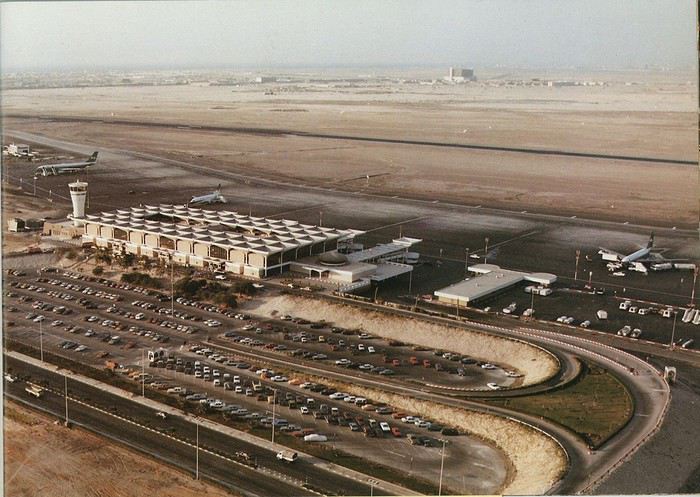
Next stop: New Delhi to drop off some Europeans and pick up a few Indians, and finally, the terminus: Manila. I don’t remember how long the trip took with its five stops—an unimaginable journey today. Despite all those stops to fill the plane, there was still enough space to stretch out on the four center seats of the 747, something that never happens these days despite all the flights in every direction.
So here we are, finally at Manila Airport around midnight.
Episode 1: Manila and Baguio To start, a quick note on the political and economic situation in the Philippines in 1984, which had consequences for us as tourists, as we’d soon realize upon arrival.
After several centuries of Spanish colonization, the Philippines became American at the start of the 20th century, then independent. In 1966, Marcos took power, and little by little, his regime sank into corruption and mismanagement, becoming a dictatorship with martial law, all for the benefit of his family and friends, who enriched themselves endlessly. The peak was the assassination of opposition leader Benigno Aquino in August 1983, which triggered harshly repressed protests. So we arrived a few months later in a very poor country, with omnipresent corruption and an extremely tense political situation, as we’d soon see for ourselves. Major protests took place in the main cities during our trip—I’ll come back to that. Two years later, Marcos fled to Hawaii after being forced out of power following rigged elections. This historical context explains a lot of the situations we found ourselves in over the following weeks.
Arriving in the middle of the night isn’t very cheerful. Manila was already a huge city with many slums, where you could find a few business hotels like the Hilton or Intercontinental—way out of our budget—and plenty of run-down hotels. Luckily, two Indians we’d chatted with on the plane offered to take us to their usual hotel. They came to Manila twice a year for business. We accepted their offer, relieved not to have to look for a place to stay in the middle of the night, figuring the address must be good since they came back every time... we were wrong 🙁
We left the airport and immediately got a taste of the local vibe when we got into the taxi: the police asked for our passports. We thought: what’s more normal than police in a dictatorship?
But that wasn’t it at all. Our two Indian friends explained that the police were noting our names along with the taxi number and time. Crime in Manila was so bad that the taxi driver would be held responsible if anything happened to us... welcome to the Philippines 😎 😎
Historically, the Philippines was a very violent country, where everything was settled with guns or machetes. Previous governments had banned carrying weapons, but Marcos later allowed the free sale and carrying of guns, and disputes were settled with pistols again (or worse, as we’d discover later). Since he’d released most of the criminals from prison to form a paramilitary militia at his service (I’ll talk about our encounter with these “heroes” later), it was pretty dangerous to go into many parts of Manila, where these “tonton macoutes” ruled.
We arrived at our hotel without incident... and then things started badly. The room was infested with big cockroaches—exactly what I hate most in those kinds of countries. No way to find another hotel at that hour. After the long flight, the urge to take a shower was so strong that we squeezed into the bathroom as best we could. After that, I don’t remember—I guess we must’ve fallen asleep exhausted under the sheets in the heat... air conditioning wasn’t widespread yet.
The next day, we just wanted to leave that dump as soon as possible. So we decided to head north right away, stopping in Baguio, and we’d visit Manila a bit on the way back.
When we stepped outside, we discovered a pretty run-down neighborhood with potholed streets. But we also discovered the jeepneys. They were everywhere, flooding the streets.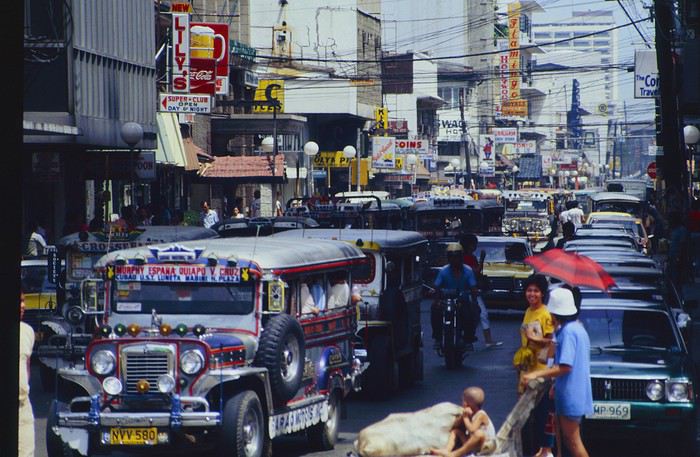
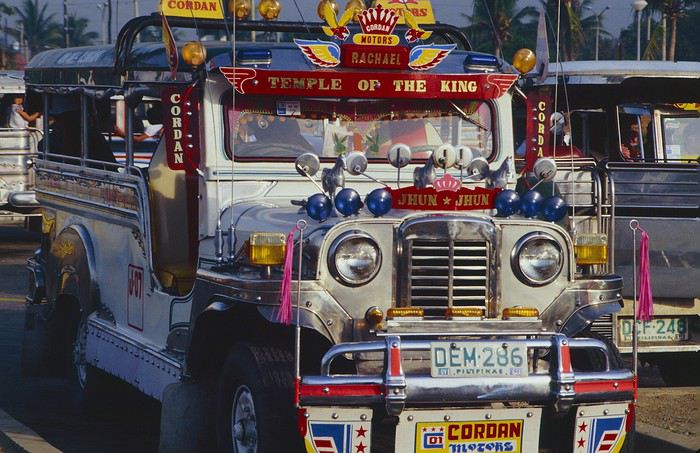
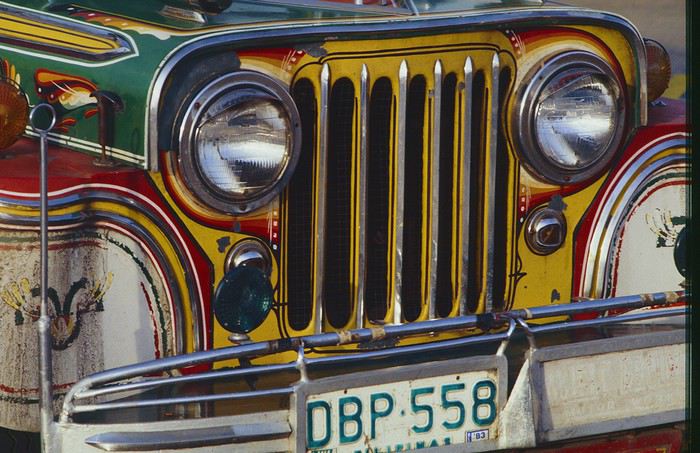
They had crazy sound systems, each one blasting louder than the last. The interiors were kitschy but fun. There weren’t many private cars—almost all transportation was by jeepney, with buses reserved for intercity trips.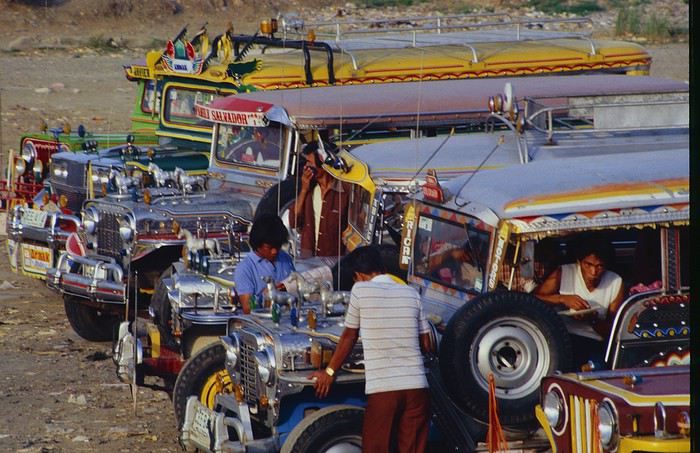
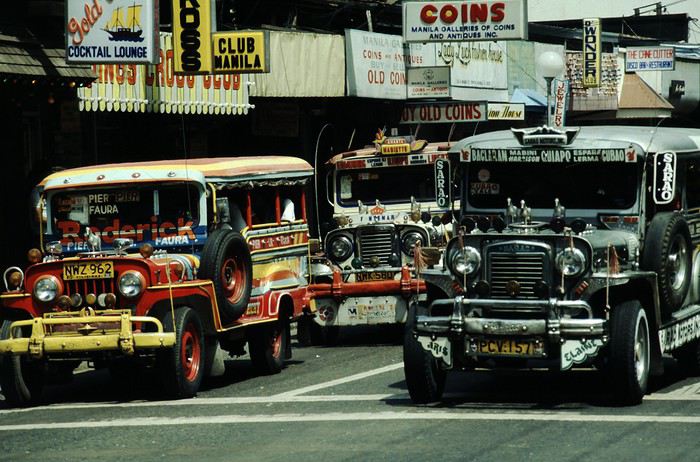
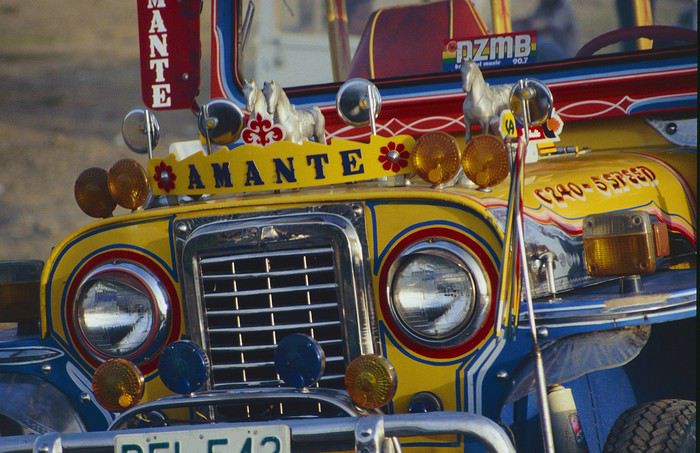
Before heading to the bus terminal for the north, somewhere on the outskirts of the city, we needed to exchange some money. I don’t remember how we ended up in a policeman’s jeep who offered his services: - Exchange money on the black market at a better rate than the banks. - Take us wherever we wanted, in this case, the bus terminal.
We accepted both offers (we’d still checked the official exchange rate from dollars to pesos). So we found ourselves in his jeep. After exchanging money, we left in his vehicle and stopped for gas. Without turning off the engine, he calmly smoked a cigarette while filling up. Since we were in a jeep with no doors or roof, we were ready to jump out if things went south, our travel bag in hand.
But we weren’t done with surprises yet. Once we left the small streets, we ended up in a neighborhood with wide avenues and not much traffic, which didn’t justify his incredible behavior. At every intersection, he made the sign of the cross, closed his eyes, and crossed without looking. I was more stunned than terrified! It wasn’t until we got out of the car later that I told Anne-Marie what had happened. I’d seen everything because the cop had put me in the front seat. Luckily, A-Marie hadn’t noticed anything from the back. Crossing Manila by trusting God rather than the rules of the road was ultimately effective. We were lucky—the trip was off to a good start. 🙂 🙂
We then passed through a neighborhood where slums stretched on for a while, and we left our policeman—friendly but a bit crazy—with relief.
A few hours by bus later, here we are in Baguio, cool in the mountains. My memories of Baguio are pretty fuzzy. I remember a small town. After some research while writing this journal, I found that the population was 120,000 in 1980. Given the population density in each home, that confirms my memory of a smallish town. Outside the “official” district with the president’s summer residence and government buildings, there were two or three paved streets with nice houses. The rest was very dirty and very poor, with lots of slums and dirt roads.
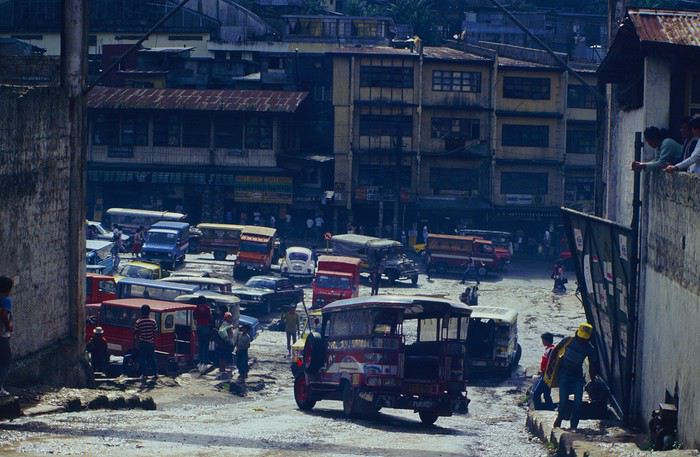
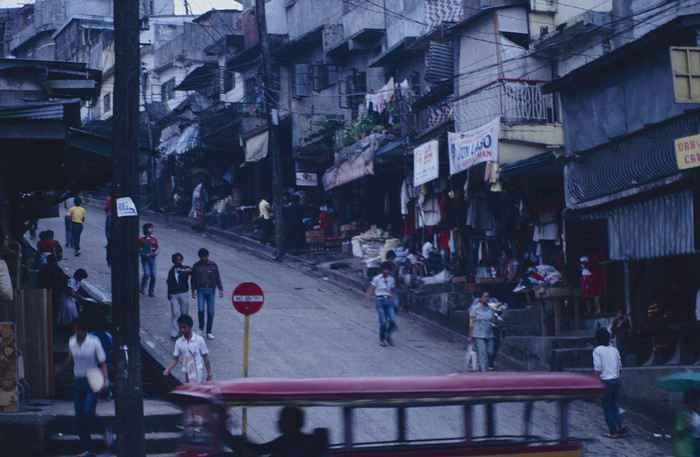
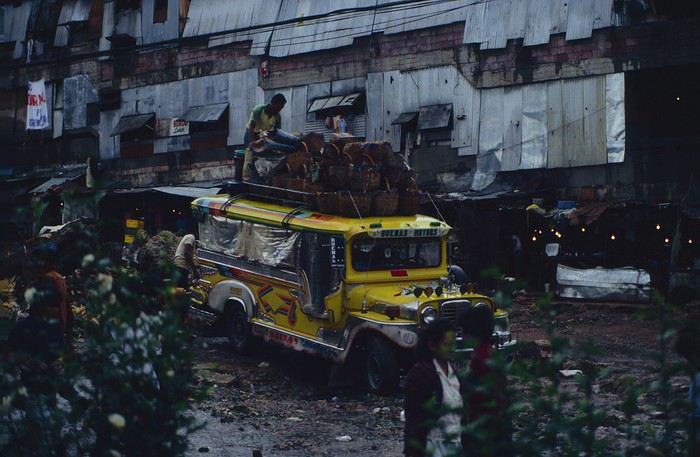
People we met on the street invited us to stay with them. These days, we wouldn’t just show up at strangers’ houses, which we should’ve done in Baguio—it would’ve saved us from an unimaginable and dangerous situation... which I won’t say anything about... !😊
The simple wooden house was on stilts at the edge of a hill with a view of the mountains. Since it was the start of the rainy season in a city that gets a lot of rain, we saw a lot of water. Our outings in town happened between downpours.
View from our lodging: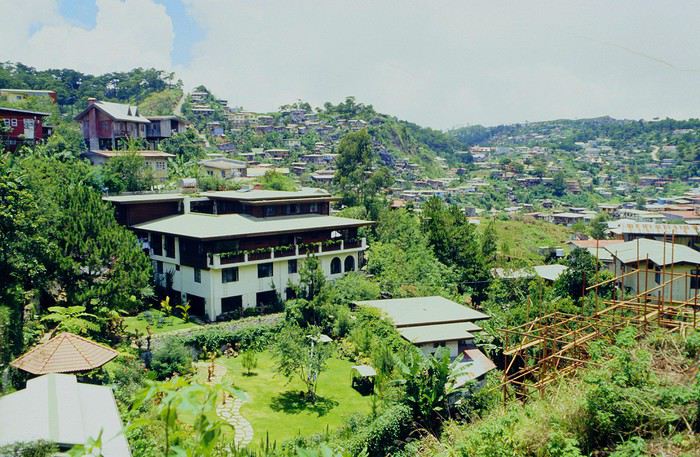
Episode 2: Baguio to Bontoc Aside from the situation briefly mentioned above, it was on the next leg to Bontoc that the adventure really began: an endless and dangerous road, a bus from another era, breathtaking landscapes, and surprising people.
We didn’t know the distance or how long it would take to get to Bontoc. When we arrived after about ten hours, we learned that Baguio to Bontoc was 140 km.
We got on a bus with wooden seats and settled in, two to a seat meant for two. As the bus filled up, passengers squeezed in three or four per seat, with chickens and baskets full of all sorts of things in the aisle. A little embarrassed, we didn’t know if we should squeeze in three on our seat. The seats were super tight (luckily, Filipinos are small), and I didn’t know where to put my legs given my height. I don’t remember if we stayed alone on our bench or if we ended up sharing with others.
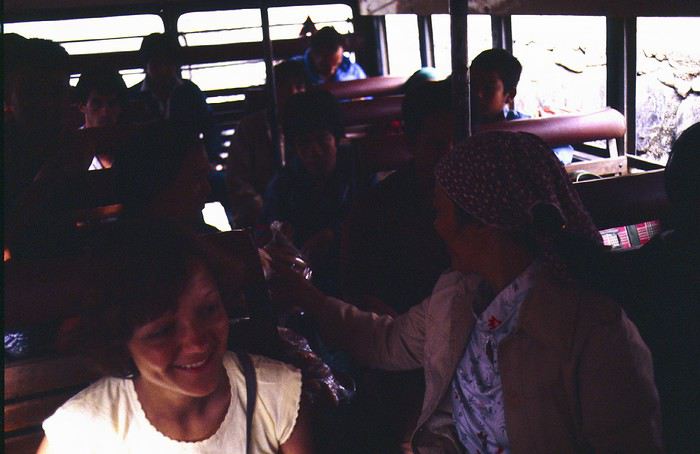
The “road” was a dirt track (or rather, a mud track) with endless turns. We held on as best we could to our slippery wooden seats—it was shaking in every direction. The woman behind us was carsick and throwing up... gross... but what were we doing there? Then we plunged into the Sierra Madre... just the name is dreamy!
Rice terraces started to appear: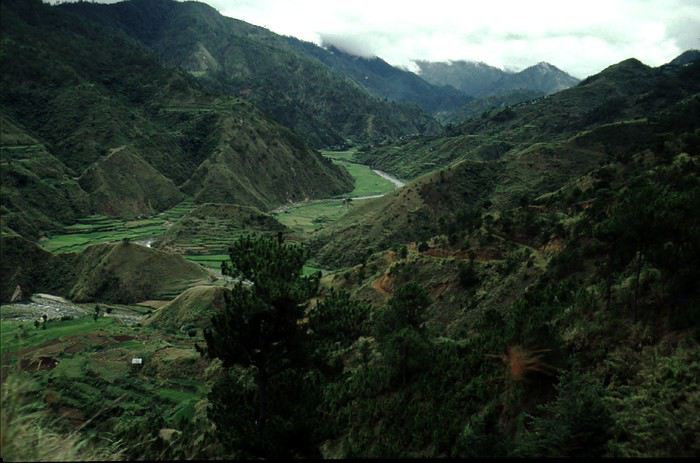
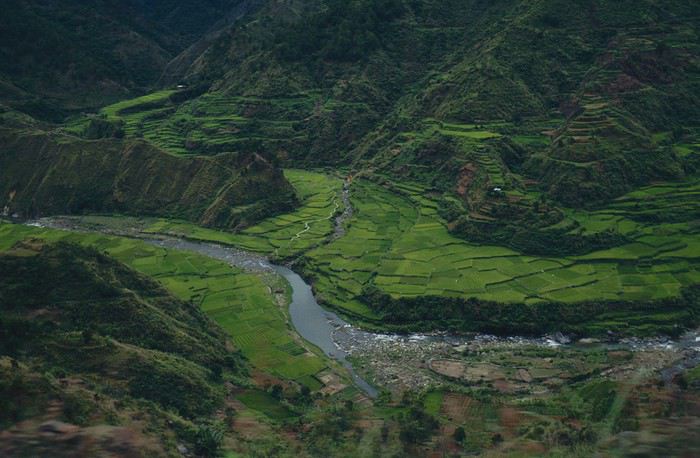
they took up more and more space along cliffs where we weren’t always reassured,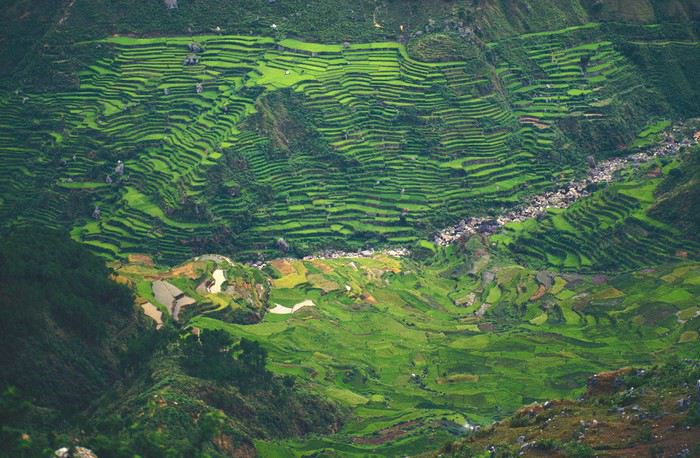
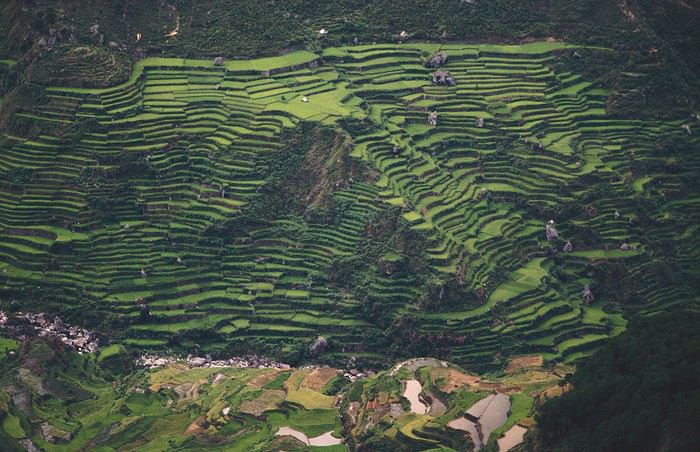
with lots of waterfalls (all that water had to go somewhere).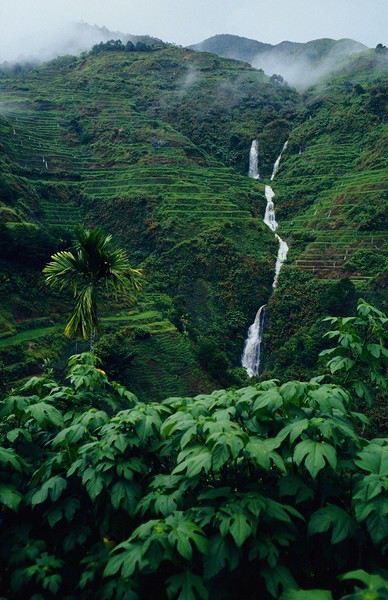
A few miserable villages stretched along the track, most often just a few houses balancing between the road and the drop. The bus stopped in every village—people got on or off and settled inside or on the roof. Street vendors offered their products to the bus passengers—a common sight in Asia, even today.
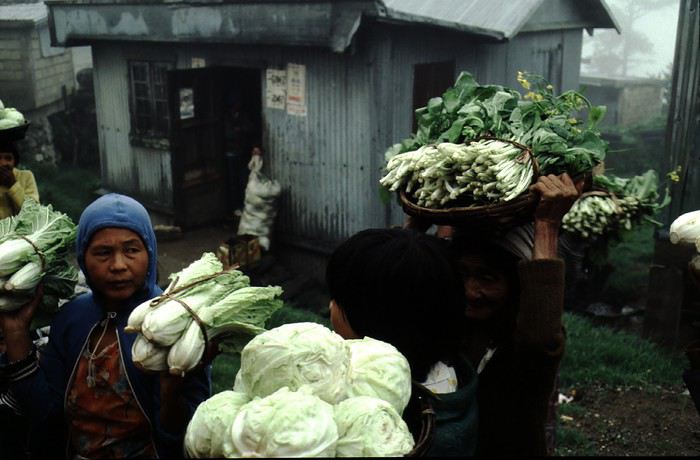
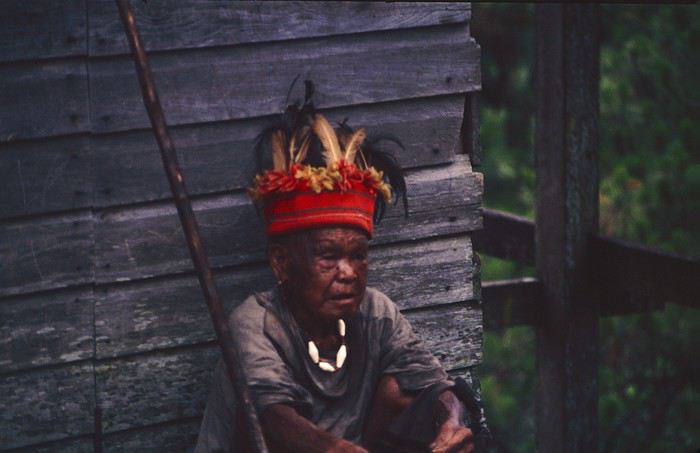
We were in another world—villagers were in loincloths, others had spears. The atmosphere was strange... but all good, we wanted exoticism, and we got it: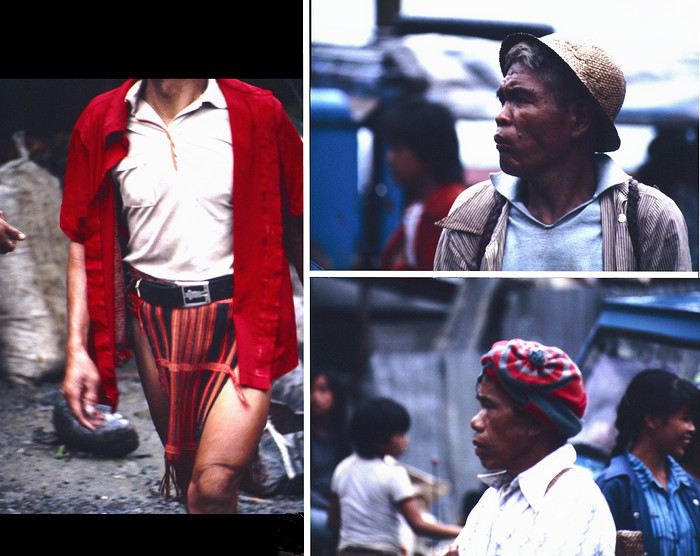
This so-called traditional outfit was everyday wear—it wasn’t for tourists since there weren’t any.
A curiosity because writing a travel journal about a trip 35 years later isn’t common, but also (mostly?) because exploring the Philippines at that time had little in common with traveling there today.
Obviously, I’ve forgotten a number of facts, most of the details, but with the help of a few notes from that time and a stack of slides (yes, there was life before digital 😊), many memories came back and added to the highlights I’d never forgotten. The scanned slides aren’t always great quality, but there are still quite a few to brighten up this chatter. Back then, we didn’t snap photos like we do now—film was too expensive—so I don’t have pictures of every place we visited... too bad, comparing some of those spots to how they look today would’ve been interesting.
Why "Adventures"? Why call it "Adventures" in the Philippines in 1984, a word so often used for a simple exotic trip? - Because the lack of information (no *Guide du Routard*, no *Lonely Planet*, no *Michelin Guide*, nothing, and obviously no internet) gave this trip what’s at the heart of adventure: the unknown. - Because the political situation made the stay sometimes dangerous. - Because transportation conditions were always epic, often perilous. - Because the question of where we’d spend the night came up almost every evening. - And for... quite a few other reasons.
That said, we weren’t exactly explorers!
Why the Philippines? First of all, why go to the Philippines in 1984—a country not exactly set up for tourism and about which we knew very little? How could we get an idea of the beauty of the Philippines and its points of interest when we had no guides or photos?
The idea came to us from Thailand a year earlier, during our first long-haul trip. After touring the north of the country, we met a Frenchman living in Phuket, where there were only a few tourists in Patong, with just a few small hotels and guesthouses. Kata and Karon had no buildings or roads, Rawai only had three palm-thatched bungalows, including ours, and the other islands were unknown to tourists. There was plenty to discover, and we wanted to return to this beautiful country... but the Frenchman made us dream about the Philippines—a country to explore, with wild landscapes.
Long evenings of discussion over multiple Sprite-Mekong cocktails (what memories of those headaches!) finally convinced us we had to go to the Philippines.
Episode 0: Before Departure The decision was made: we’d go to the Philippines in May 1984. Our friends and family were surprised when we announced we were going on vacation to the Philippines (a bit like saying today we were going paddleboarding in the Kerguelen Islands 🤪).
These days, preparing for each of our trips takes long evenings of research, planning, and noting down good addresses... etc. But for the Philippines in 1984, preparation was quick: we had very little information about the country, we were leaving almost at random, and the discovery would only be more exciting.
We still had a few bits of info gathered here and there: the rice terraces in northern Luzon, volcanoes, Negros where we were supposed to visit an acquaintance, Cebu and its marine life (we ended up going elsewhere), and absolutely avoid Mindanao, which was practically at war with the regime. That was about it, but it was already a great itinerary.
Nothing was organized in advance; we’d see day by day. We had no idea about travel times or even the existence of transportation options. The main (and sometimes only) way to connect two islands was by overloaded, rusty ferry. Only the big cities had airports.
Let’s Go: Episode 1: Paris to Manila My travel journals always start after arriving at the airport—the Europe-to-“Other Continent” trip isn’t interesting—but the flight to the Philippines was already an adventure, so I’ll make an exception.
This was the era when only a few Asian airlines were on par with Western ones: Thai, Singapore Airlines, and Philippine Airlines. They had beautiful, brand-new planes, and to attract customers (almost exclusively “businessmen”) from the usual airlines (Air France, Lufthansa, British Airways), there was opulence on board: unlimited champagne, all sorts of cocktails... Compared to today’s long-haul flights, there was still one small difference: no personal screens, just one screen at the front of the cabin with one mandatory movie. And I don’t know why, but we only got James Bond films, both ways... that must’ve been the trend at the time.
The tourism boom to Southeast Asia hadn’t started yet, and the “Asian Tigers” weren’t a thing, so there weren’t many business trips. That meant long-haul flights made stops everywhere to fill the planes. Our Philippine Airlines Boeing 747 left London, picked us up in Paris, then stopped in Frankfurt to take on a few Germans. I don’t know why we then made a stop in Dubai—a totally exotic place at the time. There was nothing to do there... things have changed a lot since. It was a small town lost in the desert. The airport was tiny, with just one or two buildings and a supermarket. During the stopover, everyone had to get off the plane and walk to the supermarket. Photo and electronic equipment were dirt cheap—I guess that was the only reason for the stop. Maybe it was their first commercial move. Emirates didn’t exist yet, as I checked online, but anyway, the idea that such a remote place could have its own airline was unthinkable.
Online, I found this photo of Dubai Airport in 1980. Anyone who’s transited through today’s massive airport with its rows of A380s will appreciate it:
Next stop: New Delhi to drop off some Europeans and pick up a few Indians, and finally, the terminus: Manila. I don’t remember how long the trip took with its five stops—an unimaginable journey today. Despite all those stops to fill the plane, there was still enough space to stretch out on the four center seats of the 747, something that never happens these days despite all the flights in every direction.
So here we are, finally at Manila Airport around midnight.
Episode 1: Manila and Baguio To start, a quick note on the political and economic situation in the Philippines in 1984, which had consequences for us as tourists, as we’d soon realize upon arrival.
After several centuries of Spanish colonization, the Philippines became American at the start of the 20th century, then independent. In 1966, Marcos took power, and little by little, his regime sank into corruption and mismanagement, becoming a dictatorship with martial law, all for the benefit of his family and friends, who enriched themselves endlessly. The peak was the assassination of opposition leader Benigno Aquino in August 1983, which triggered harshly repressed protests. So we arrived a few months later in a very poor country, with omnipresent corruption and an extremely tense political situation, as we’d soon see for ourselves. Major protests took place in the main cities during our trip—I’ll come back to that. Two years later, Marcos fled to Hawaii after being forced out of power following rigged elections. This historical context explains a lot of the situations we found ourselves in over the following weeks.
Arriving in the middle of the night isn’t very cheerful. Manila was already a huge city with many slums, where you could find a few business hotels like the Hilton or Intercontinental—way out of our budget—and plenty of run-down hotels. Luckily, two Indians we’d chatted with on the plane offered to take us to their usual hotel. They came to Manila twice a year for business. We accepted their offer, relieved not to have to look for a place to stay in the middle of the night, figuring the address must be good since they came back every time... we were wrong 🙁
We left the airport and immediately got a taste of the local vibe when we got into the taxi: the police asked for our passports. We thought: what’s more normal than police in a dictatorship?
But that wasn’t it at all. Our two Indian friends explained that the police were noting our names along with the taxi number and time. Crime in Manila was so bad that the taxi driver would be held responsible if anything happened to us... welcome to the Philippines 😎 😎
Historically, the Philippines was a very violent country, where everything was settled with guns or machetes. Previous governments had banned carrying weapons, but Marcos later allowed the free sale and carrying of guns, and disputes were settled with pistols again (or worse, as we’d discover later). Since he’d released most of the criminals from prison to form a paramilitary militia at his service (I’ll talk about our encounter with these “heroes” later), it was pretty dangerous to go into many parts of Manila, where these “tonton macoutes” ruled.
We arrived at our hotel without incident... and then things started badly. The room was infested with big cockroaches—exactly what I hate most in those kinds of countries. No way to find another hotel at that hour. After the long flight, the urge to take a shower was so strong that we squeezed into the bathroom as best we could. After that, I don’t remember—I guess we must’ve fallen asleep exhausted under the sheets in the heat... air conditioning wasn’t widespread yet.
The next day, we just wanted to leave that dump as soon as possible. So we decided to head north right away, stopping in Baguio, and we’d visit Manila a bit on the way back.
When we stepped outside, we discovered a pretty run-down neighborhood with potholed streets. But we also discovered the jeepneys. They were everywhere, flooding the streets.
They had crazy sound systems, each one blasting louder than the last. The interiors were kitschy but fun. There weren’t many private cars—almost all transportation was by jeepney, with buses reserved for intercity trips.
Before heading to the bus terminal for the north, somewhere on the outskirts of the city, we needed to exchange some money. I don’t remember how we ended up in a policeman’s jeep who offered his services: - Exchange money on the black market at a better rate than the banks. - Take us wherever we wanted, in this case, the bus terminal.
We accepted both offers (we’d still checked the official exchange rate from dollars to pesos). So we found ourselves in his jeep. After exchanging money, we left in his vehicle and stopped for gas. Without turning off the engine, he calmly smoked a cigarette while filling up. Since we were in a jeep with no doors or roof, we were ready to jump out if things went south, our travel bag in hand.
But we weren’t done with surprises yet. Once we left the small streets, we ended up in a neighborhood with wide avenues and not much traffic, which didn’t justify his incredible behavior. At every intersection, he made the sign of the cross, closed his eyes, and crossed without looking. I was more stunned than terrified! It wasn’t until we got out of the car later that I told Anne-Marie what had happened. I’d seen everything because the cop had put me in the front seat. Luckily, A-Marie hadn’t noticed anything from the back. Crossing Manila by trusting God rather than the rules of the road was ultimately effective. We were lucky—the trip was off to a good start. 🙂 🙂
We then passed through a neighborhood where slums stretched on for a while, and we left our policeman—friendly but a bit crazy—with relief.
A few hours by bus later, here we are in Baguio, cool in the mountains. My memories of Baguio are pretty fuzzy. I remember a small town. After some research while writing this journal, I found that the population was 120,000 in 1980. Given the population density in each home, that confirms my memory of a smallish town. Outside the “official” district with the president’s summer residence and government buildings, there were two or three paved streets with nice houses. The rest was very dirty and very poor, with lots of slums and dirt roads.
People we met on the street invited us to stay with them. These days, we wouldn’t just show up at strangers’ houses, which we should’ve done in Baguio—it would’ve saved us from an unimaginable and dangerous situation... which I won’t say anything about... !😊
The simple wooden house was on stilts at the edge of a hill with a view of the mountains. Since it was the start of the rainy season in a city that gets a lot of rain, we saw a lot of water. Our outings in town happened between downpours.
View from our lodging:
Episode 2: Baguio to Bontoc Aside from the situation briefly mentioned above, it was on the next leg to Bontoc that the adventure really began: an endless and dangerous road, a bus from another era, breathtaking landscapes, and surprising people.
We didn’t know the distance or how long it would take to get to Bontoc. When we arrived after about ten hours, we learned that Baguio to Bontoc was 140 km.
We got on a bus with wooden seats and settled in, two to a seat meant for two. As the bus filled up, passengers squeezed in three or four per seat, with chickens and baskets full of all sorts of things in the aisle. A little embarrassed, we didn’t know if we should squeeze in three on our seat. The seats were super tight (luckily, Filipinos are small), and I didn’t know where to put my legs given my height. I don’t remember if we stayed alone on our bench or if we ended up sharing with others.
The “road” was a dirt track (or rather, a mud track) with endless turns. We held on as best we could to our slippery wooden seats—it was shaking in every direction. The woman behind us was carsick and throwing up... gross... but what were we doing there? Then we plunged into the Sierra Madre... just the name is dreamy!
Rice terraces started to appear:
they took up more and more space along cliffs where we weren’t always reassured,
with lots of waterfalls (all that water had to go somewhere).
A few miserable villages stretched along the track, most often just a few houses balancing between the road and the drop. The bus stopped in every village—people got on or off and settled inside or on the roof. Street vendors offered their products to the bus passengers—a common sight in Asia, even today.
We were in another world—villagers were in loincloths, others had spears. The atmosphere was strange... but all good, we wanted exoticism, and we got it:
This so-called traditional outfit was everyday wear—it wasn’t for tourists since there weren’t any.
La radio partout dans le monde English translation pending
En ces moments de confinement, sans possibilité de voyages, Le monde entier chez vous en quelques secondes
Dans ce lien apparaît un globe terrestre comme celui de Google Earth, avec une infinité de points verts.
Au bout de 2 ou 3 minutes, vous pouvez zoomer de la même manière que dans Google Earth. Chaque point vert est une station de radio locale de n'importe où dans le monde. Lorsque vous cliquez sur le point, la station de radio est entendue immédiatement avec un bon son . C'est gratuit et sans virus 😉
http://radio.garden
Au bout de 2 ou 3 minutes, vous pouvez zoomer de la même manière que dans Google Earth. Chaque point vert est une station de radio locale de n'importe où dans le monde. Lorsque vous cliquez sur le point, la station de radio est entendue immédiatement avec un bon son . C'est gratuit et sans virus 😉
http://radio.garden
Road trip sur l’île de la Réunion en van English translation pending
Bonjour
Nous voudrions partir à la Réunion fin Mai pour 15 jours et louer un van aménagé afin de découvrir l’île .....
Nous avons vu qu'il n'y a que 2 agences de location de van .... Avez-vous des avis ?
Le mois de mai est-il un bon mois pour la rando ou faut-il décaler notre projet ?
Merci
Bonne journée
VIrginie
L'île de Madère English translation pending
Bonjour à tous,
En Avril 2018, nous avons séjourné sur l'île de Madère, fidèle à sa réputation d'île aux fleurs. Les paysages rencontrés furent très variés et sauvages et l'île est le paradis des randonneurs, tout ce que nous aimons. Ses multiples Levadas, réseaux de canaux d'irrigation de l'île, offrent des balades inoubliables au travers de tunnels creusés dans la montagne, et de petits chemins perdus dans la forêt. Nous garderons un super souvenir de cette île de l'atlantique.
Nous souhaitons partager avec vous la découverte de cette île magnifique à travers notre blog :
L'ILE DE MADERE
Nous sommes à votre disposition si vous avez des questions.
Myriam et Luc
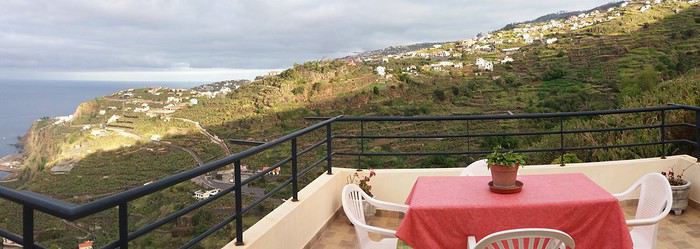
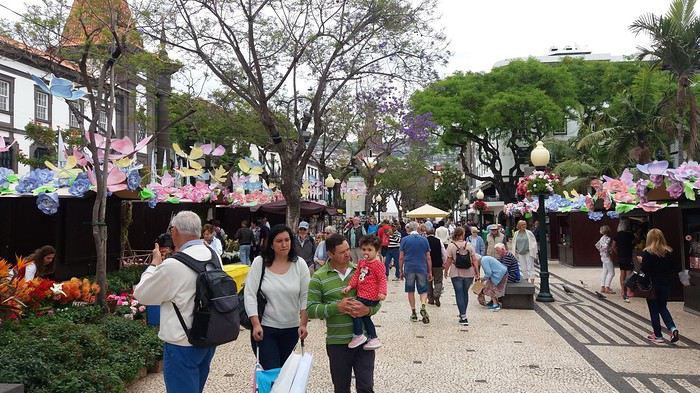
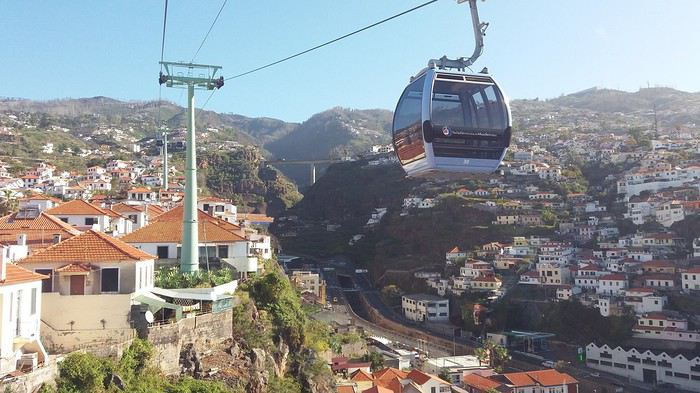
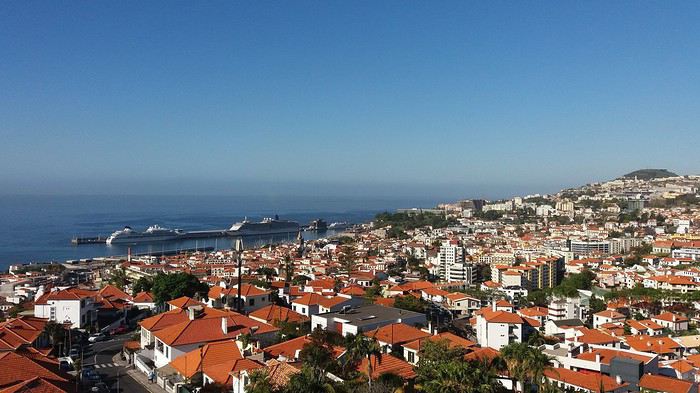
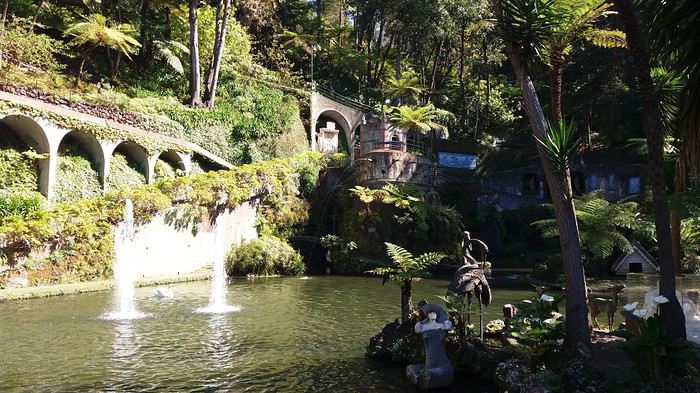
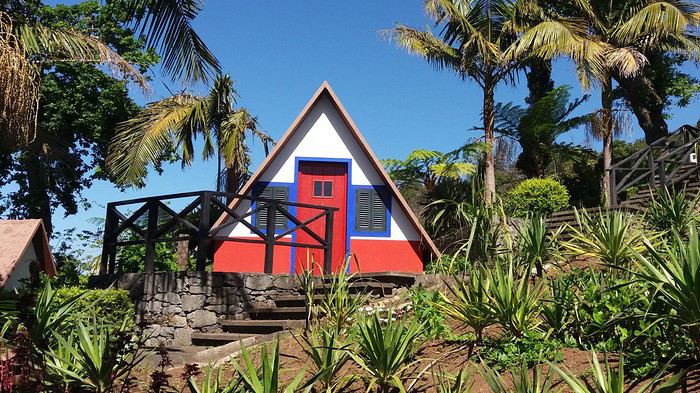
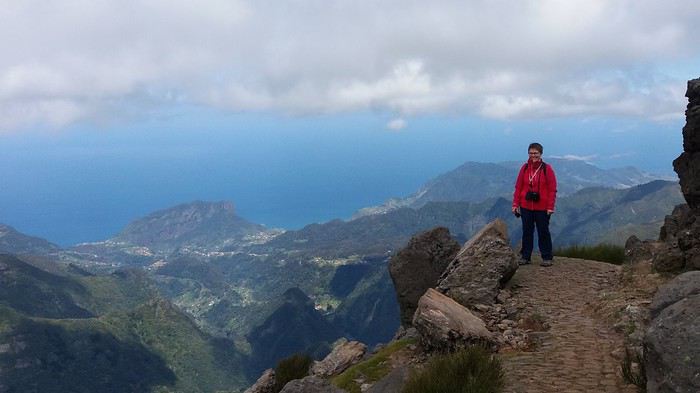
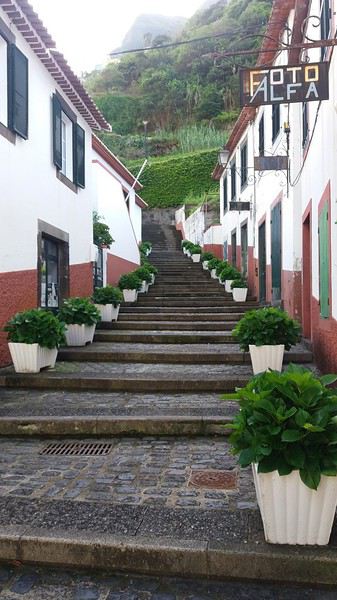
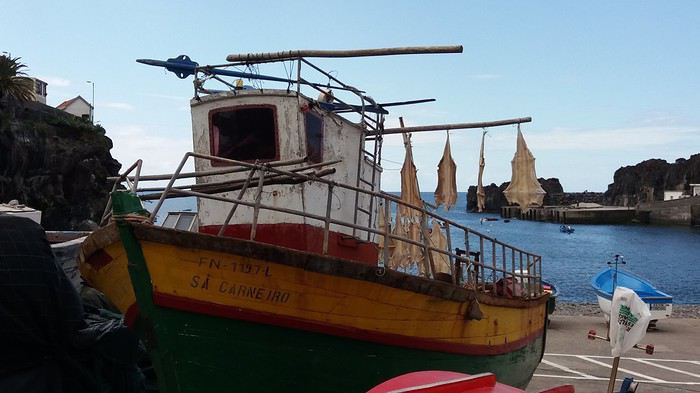
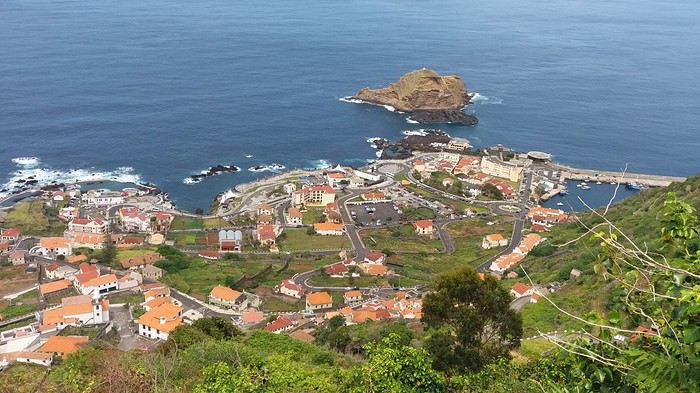
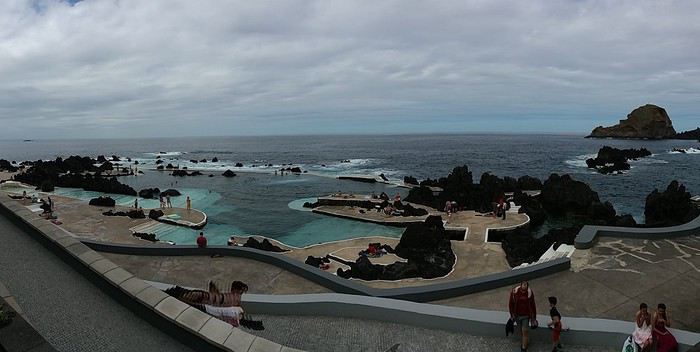
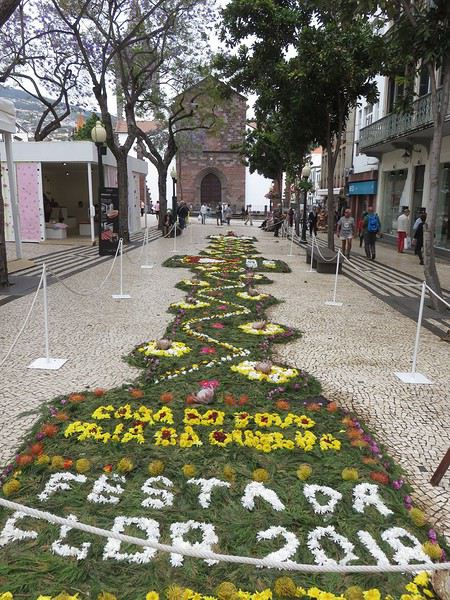
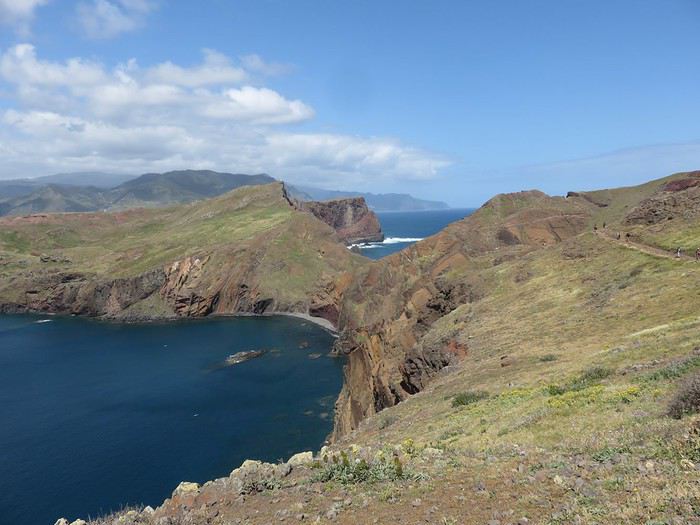
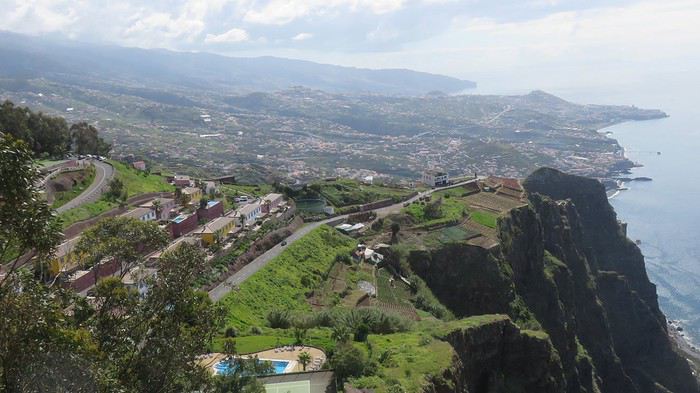
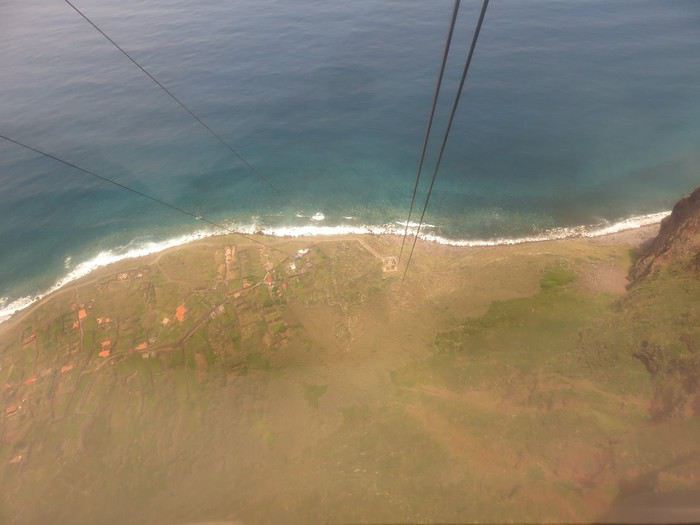
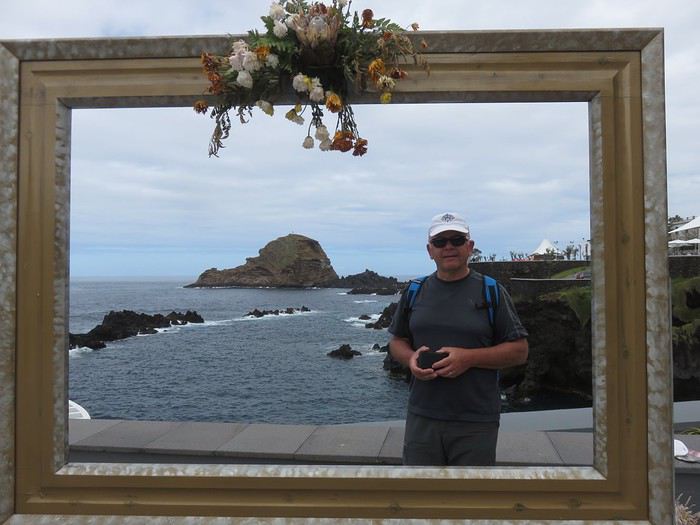
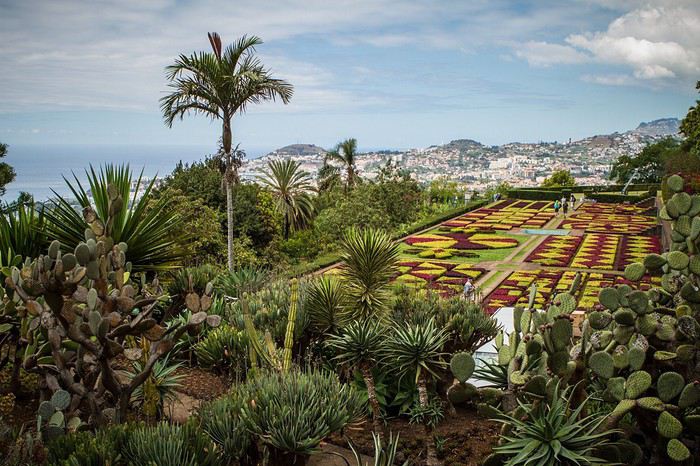
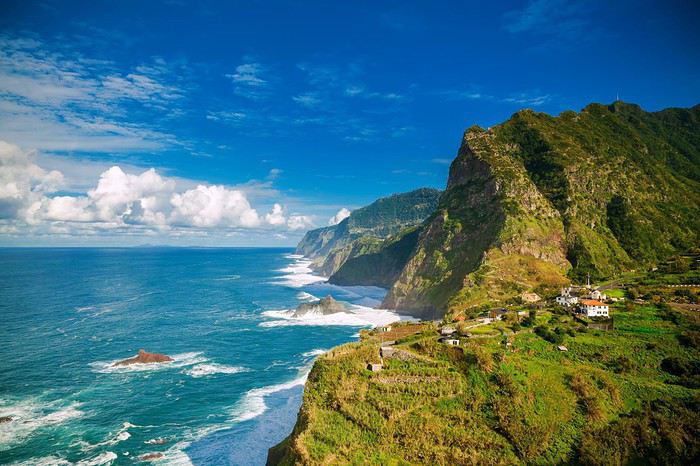
Nous souhaitons partager avec vous la découverte de cette île magnifique à travers notre blog :
L'ILE DE MADERE
Nous sommes à votre disposition si vous avez des questions.
Myriam et Luc
Eastern Canada and a few parks in September (Bic, Gaspésie, Forillon, Bonaventure Island...)
Eastern Canada: the Eastern Townships, Gaspésie, New Brunswick, Acadia, and Nova Scotia.
Forests, lakes, lighthouses, parks, and encounters. To sum up this trip: amazing encounters, stunning parks, wildlife, and passionate, fascinating Parks Rangers. Bic Park, Gaspésie, Forillon, Bonaventure Island, Cape Breton Highlands Park, Hopewell Rock
My tips:
Don’t hesitate to chat with the park rangers and check out the activities they organize—it’s really interesting.
If you want to see wildlife, get up early.
The kilometers go by pretty easily; driving 500 km in Canada with an automatic car on long, straight roads with light traffic isn’t much more tiring than doing 120 km on Ireland’s narrow roads...
Try to catch a Quebecois film at the cinema or on TV.
For the ferry, plan ahead. Taking it at least once is a great experience.
For the rest, once you know what you want to see, just go with your gut—it’s easy.
The Trip:
Arrived in Montreal on 09/02. Family meal where we tried homemade *pouding chômeur*.
We spent 3 days exploring the Eastern Townships: the Abbey of Saint-Benoît-du-Lac, Bolton, Magog (its wine fair and thunderstorms), Granby, Bromont and its little lake, and its spa…
Gaspésie, New Brunswick, Nova Scotia:
We didn’t stop in Quebec City or at the Montmorency Falls, as we’d already visited them on a previous trip. Otherwise, plan an extra day and a stop in the lovely city of Quebec.
Day 1: Left on 09/05 for Saint-Fabien and Bic Park, famous for its coastline, marshy landscapes, and harbor seals (brochure). About 500 km. Stayed overnight in Saint-Fabien.
Along the way, we saw *barachois*—bodies of water usually at the mouth of a river, separated from the sea by a gravel, sand, or pebble barrier. They can be freshwater or saltwater. The fresh water of the St. Lawrence River mixes with the sea up to Orléans Island. And there’s a measurable tide up to the Trois-Rivières bridge. Visited Bic Park and observed seals molting with the park rangers. More park photos.
Days 2 & 3: Headed to Sainte-Anne-des-Monts (about 200 km). The lighthouse route guided us 😊.
Two nights in Sainte-Anne-des-Monts for a short hike in Gaspésie Park (brochure) and its stunning landscapes between mountains, forests, rivers, and lakes. We didn’t see any caribou or moose, but from the top of Xalibu (a well-marked 5-hour round-trip hike), we had a 360° view of Mont Jacques-Cartier and Mont Albert. More photos. This was Muriel’s favorite park—it’s exactly what she imagined Canadian forests, rivers, and lakes to be. You can also stay overnight in the park (especially by Lac Cascapédia), which is better but pricier 😢.
Days 4 to 6: Left for Forillon Park (brochure) near Gaspé (200 km). Magical... We were lucky—we came face-to-face with a mother bear and her cubs (brown bears). It was incredible. We also saw beavers at work...
Our lodging was out of the ordinary—what luck! A ranch in the middle of the woods. We stayed 3 nights. This is my favorite park. More Forillon photos.
Gaspé in Mi’gmaq means "end of the land." But for Jacques Cartier, it was the beginning of the country. On July 6, 1534, he and his crew made contact with the first Indigenous people of the Mi’gmaq Nation off the Baie des Chaleurs. On July 24, 1534, he landed in Gaspé, planted a 30-foot cross, and claimed the region for the King of France, where they met the St. Lawrence Iroquoians. Visited Bonaventure Island (brochure) and its 100,000 northern gannets. Bonaventure Park photos.
Not to mention our first freshly caught and cooked lobster, bought at a fish market on the port.
Day 7: Finished the Gaspésie loop with a stop in Campbellton (300 km) before crossing into New Brunswick. Stopped at Bourdage Tradition farm. We could’ve gone as far as Caraquet, which would’ve been better. Rain all day.
Day 8: Headed to Cape Breton Highlands National Park in Nova Scotia. Overnight in Moncton to split the drive (500 km). We stopped in Acadia, a truly unique region with incredibly friendly and open people. New Brunswick is over 80% forest—it’s impressive how many trucks and dead raccoons you see on the side of the road.
Sunset at Hopewell Rock—bring mosquito repellent! There are thousands, it’s awful. Photos.
Days 9 to 11: Left for Sydney (500 km) for 3 days exploring Cape Breton Highlands Park. If you have time, stop at the "Train Station Inn in Tatamagouche"—I love the concept. You can eat there, sleep there, or just visit.
The Cape Breton Highlands Park loop is over 300 km. Photos. Our apartment was in North Sydney, a bit far from Chéticamp (2-hour drive) and 1.5 hours from the park entrance. But the road itself is beautiful. We should’ve found lodging in Chéticamp or Ingonish. At the time, we were also planning to visit Louisbourg, but it was too much.
Day 12: Time to head back, but there were still over 1,500 km to go. We’d planned to stop at "Le Pays de la Sagouine," a local heroine from Antonine Maillet’s imagination, played by the wonderful local actress Viola Léger. A fantastic place for shows and passion—don’t miss it if you get the chance. Another overnight in Moncton to split the trip (550 km).
Returned through Gaspésie and the Matapédia Valley, famous for its salmon fishing. We met a guy from Haute-Savoie who’d been living there for 15 years, making a living from fishing (he runs a shop) and dog sledding in winter.
Day 13: Things didn’t go exactly as planned. We were supposed to take the ferry from Rimouski to Tadoussac and the Saguenay Fjord. But due to Storm Florence, all boats were docked. We tried the ferry from Trois-Pistoles, but all crossings were canceled. The only other way was a 500 km detour to Quebec City. So we decided to spend the night of 09/17 in Trois-Pistoles (we’d already driven 600–700 km that day).
Days 14 & 15: We changed our plans, heading to Trois-Rivières and La Mauricie Park for a quick seaplane tour. There, we had an amazing encounter at the "Gîte de la Vieille Caisse" (the Old Bank Inn). The welcome was warm, breakfast was hearty, and the outdoor spa in the rain was great. We took our flight with Hydravion Aventure—the team was super friendly, and it was close to our inn. We’ll be back to explore this side of the St. Lawrence 😊.
Returned to family for a quiet end to the trip, with a little hike on Bromont Mountain, a visit to the Bombardier Museum, and a detour to local vineyards to buy a few bottles as souvenirs.
Bromont is the local ski resort, open until midnight on weekends.
We were 10 days too early for the fall colors and the cranberry harvest. I think it’s worth seeing.
If we go back, we’ll try to combine a trip to the north shore of the St. Lawrence (Mauricie, Lac Saint-Jean, Saguenay), the cranberry harvest, and a day at the Saint-Tite Festival. It must be amazing...
In summary: Parks, forests, but also plains, fields, farms, lighthouses, beaches, small fishing ports, hikes, family moments, and encounters...
Trip Cost:
We spent 3,400 € total for two, including souvenirs. The exchange rate with the Canadian dollar was pretty good.
Flights: 830 € for two.
Accommodations: 750 € for 14 nights, averaging 54 € per night in B&Bs and Airbnbs (family stays not included).
Car rental: 600 € for 3 weeks + 350 € for gas. We drove over 6,000 km—it’s a lot but doable. We wanted to go to New Brunswick and Nova Scotia.
Park entry fees were about 8 CAD per person. We didn’t get a pass because some parks are national (Forillon), others are Quebec national parks, and some are neither.
The seaplane cost 99 CAD per person for 30 minutes.
For meals, we had a cooler to do some basic cooking in apartments or hostels. We ate out 4 evenings.
Forests, lakes, lighthouses, parks, and encounters. To sum up this trip: amazing encounters, stunning parks, wildlife, and passionate, fascinating Parks Rangers. Bic Park, Gaspésie, Forillon, Bonaventure Island, Cape Breton Highlands Park, Hopewell Rock
My tips:
Don’t hesitate to chat with the park rangers and check out the activities they organize—it’s really interesting.
If you want to see wildlife, get up early.
The kilometers go by pretty easily; driving 500 km in Canada with an automatic car on long, straight roads with light traffic isn’t much more tiring than doing 120 km on Ireland’s narrow roads...
Try to catch a Quebecois film at the cinema or on TV.
For the ferry, plan ahead. Taking it at least once is a great experience.
For the rest, once you know what you want to see, just go with your gut—it’s easy.
The Trip:
Arrived in Montreal on 09/02. Family meal where we tried homemade *pouding chômeur*.
We spent 3 days exploring the Eastern Townships: the Abbey of Saint-Benoît-du-Lac, Bolton, Magog (its wine fair and thunderstorms), Granby, Bromont and its little lake, and its spa…
Gaspésie, New Brunswick, Nova Scotia:
We didn’t stop in Quebec City or at the Montmorency Falls, as we’d already visited them on a previous trip. Otherwise, plan an extra day and a stop in the lovely city of Quebec.
Day 1: Left on 09/05 for Saint-Fabien and Bic Park, famous for its coastline, marshy landscapes, and harbor seals (brochure). About 500 km. Stayed overnight in Saint-Fabien.
Along the way, we saw *barachois*—bodies of water usually at the mouth of a river, separated from the sea by a gravel, sand, or pebble barrier. They can be freshwater or saltwater. The fresh water of the St. Lawrence River mixes with the sea up to Orléans Island. And there’s a measurable tide up to the Trois-Rivières bridge. Visited Bic Park and observed seals molting with the park rangers. More park photos.
Days 2 & 3: Headed to Sainte-Anne-des-Monts (about 200 km). The lighthouse route guided us 😊.
Two nights in Sainte-Anne-des-Monts for a short hike in Gaspésie Park (brochure) and its stunning landscapes between mountains, forests, rivers, and lakes. We didn’t see any caribou or moose, but from the top of Xalibu (a well-marked 5-hour round-trip hike), we had a 360° view of Mont Jacques-Cartier and Mont Albert. More photos. This was Muriel’s favorite park—it’s exactly what she imagined Canadian forests, rivers, and lakes to be. You can also stay overnight in the park (especially by Lac Cascapédia), which is better but pricier 😢.
Days 4 to 6: Left for Forillon Park (brochure) near Gaspé (200 km). Magical... We were lucky—we came face-to-face with a mother bear and her cubs (brown bears). It was incredible. We also saw beavers at work...
Our lodging was out of the ordinary—what luck! A ranch in the middle of the woods. We stayed 3 nights. This is my favorite park. More Forillon photos.
Gaspé in Mi’gmaq means "end of the land." But for Jacques Cartier, it was the beginning of the country. On July 6, 1534, he and his crew made contact with the first Indigenous people of the Mi’gmaq Nation off the Baie des Chaleurs. On July 24, 1534, he landed in Gaspé, planted a 30-foot cross, and claimed the region for the King of France, where they met the St. Lawrence Iroquoians. Visited Bonaventure Island (brochure) and its 100,000 northern gannets. Bonaventure Park photos.
Not to mention our first freshly caught and cooked lobster, bought at a fish market on the port.
Day 7: Finished the Gaspésie loop with a stop in Campbellton (300 km) before crossing into New Brunswick. Stopped at Bourdage Tradition farm. We could’ve gone as far as Caraquet, which would’ve been better. Rain all day.
Day 8: Headed to Cape Breton Highlands National Park in Nova Scotia. Overnight in Moncton to split the drive (500 km). We stopped in Acadia, a truly unique region with incredibly friendly and open people. New Brunswick is over 80% forest—it’s impressive how many trucks and dead raccoons you see on the side of the road.
Sunset at Hopewell Rock—bring mosquito repellent! There are thousands, it’s awful. Photos.
Days 9 to 11: Left for Sydney (500 km) for 3 days exploring Cape Breton Highlands Park. If you have time, stop at the "Train Station Inn in Tatamagouche"—I love the concept. You can eat there, sleep there, or just visit.
The Cape Breton Highlands Park loop is over 300 km. Photos. Our apartment was in North Sydney, a bit far from Chéticamp (2-hour drive) and 1.5 hours from the park entrance. But the road itself is beautiful. We should’ve found lodging in Chéticamp or Ingonish. At the time, we were also planning to visit Louisbourg, but it was too much.
Day 12: Time to head back, but there were still over 1,500 km to go. We’d planned to stop at "Le Pays de la Sagouine," a local heroine from Antonine Maillet’s imagination, played by the wonderful local actress Viola Léger. A fantastic place for shows and passion—don’t miss it if you get the chance. Another overnight in Moncton to split the trip (550 km).
Returned through Gaspésie and the Matapédia Valley, famous for its salmon fishing. We met a guy from Haute-Savoie who’d been living there for 15 years, making a living from fishing (he runs a shop) and dog sledding in winter.
Day 13: Things didn’t go exactly as planned. We were supposed to take the ferry from Rimouski to Tadoussac and the Saguenay Fjord. But due to Storm Florence, all boats were docked. We tried the ferry from Trois-Pistoles, but all crossings were canceled. The only other way was a 500 km detour to Quebec City. So we decided to spend the night of 09/17 in Trois-Pistoles (we’d already driven 600–700 km that day).
Days 14 & 15: We changed our plans, heading to Trois-Rivières and La Mauricie Park for a quick seaplane tour. There, we had an amazing encounter at the "Gîte de la Vieille Caisse" (the Old Bank Inn). The welcome was warm, breakfast was hearty, and the outdoor spa in the rain was great. We took our flight with Hydravion Aventure—the team was super friendly, and it was close to our inn. We’ll be back to explore this side of the St. Lawrence 😊.
Returned to family for a quiet end to the trip, with a little hike on Bromont Mountain, a visit to the Bombardier Museum, and a detour to local vineyards to buy a few bottles as souvenirs.
Bromont is the local ski resort, open until midnight on weekends.
We were 10 days too early for the fall colors and the cranberry harvest. I think it’s worth seeing.
If we go back, we’ll try to combine a trip to the north shore of the St. Lawrence (Mauricie, Lac Saint-Jean, Saguenay), the cranberry harvest, and a day at the Saint-Tite Festival. It must be amazing...
In summary: Parks, forests, but also plains, fields, farms, lighthouses, beaches, small fishing ports, hikes, family moments, and encounters...
Trip Cost:
We spent 3,400 € total for two, including souvenirs. The exchange rate with the Canadian dollar was pretty good.
Flights: 830 € for two.
Accommodations: 750 € for 14 nights, averaging 54 € per night in B&Bs and Airbnbs (family stays not included).
Car rental: 600 € for 3 weeks + 350 € for gas. We drove over 6,000 km—it’s a lot but doable. We wanted to go to New Brunswick and Nova Scotia.
Park entry fees were about 8 CAD per person. We didn’t get a pass because some parks are national (Forillon), others are Quebec national parks, and some are neither.
The seaplane cost 99 CAD per person for 30 minutes.
For meals, we had a cooler to do some basic cooking in apartments or hostels. We ate out 4 evenings.
10 jours entre Abou Dhabi et Dubaï, les dunes du désert du Rub al-Khali et l'île de Sir Bani Yas English translation pending
L’ambiance dans ces 2 Émirats est très différente. Dubaï est plus la ville de la démesure, avec des malls, des fast-foods, des parcs à thème... Et ce n’est pas fini. Le quartier de Khor Dubaï se développe avec le projet de la Creek Tower une tour qui dépassera les 1000m et qui devrai être achevée en 2020 pour l’exposition universelle de Dubaï qui elle aussi a l’ambition d’être grandiose. Ils ont également le projet d'une ville dans la ville; une bulle entièrement climatisée... Abu Dhabi semble plus miser sur la culture et l'histoire. images sur mon blog
Notre désir était aussi d’aller sur l’Ile de Sir Banis Yas et les dunes du désert du Rub’ Al Khali. plus sur le séjour sur l'ile de Sir Bani Yas
Soit 4j à Abu dhabi avec :
-déambulation sur la corniche de l’Emirates Palace à Al Mina harbour et ses marchés (poisson, fruits au légume). Baignade -visites culturelles tel la visite du Louvre d’Abu Dhabi, de la Mosquée Cheikh Zayed, du Qasr Al Hosn, du Founder’s Memorial, Culture & Heritage Foundation… -vélo sur la piste du circuit de F1 Yas Marina -Ferrari World
Petite escapade de 3 j dans le désert et sur l’ile de Sir Bani Yas où nous avons fait une marche (découverte géologique) dans un Wadi en fin de journée, une Wildlife drive au levé de soleil, fait du quad dans les dunes au couché de soleil, profité de buffets déjeuner à tomber…
Une fois aux Émirats Arabes Unis, nous ne pouvions pas ne pas aller à Dubaï.
Nous y avons donc fait une halte de 2j. Où nous nous sommes offert un survol de la ville en hélicoptère (22 min) en plus d’avoir fait les classiques : spectacle des fontaines à la Burj, visite de qqs malls, déambulation à la marina et au souk (or et épice), pris un abra… On ne peut qu’être impressionné par les prouesses architecturales et effrayé de cette démesure. Vue du sol, et sur les lieux touristiques, on ne voit presque plus que ces villes sont construites sur un désert. Mais vu du ciel, on s’en rend mieux compte. on voit à quel point la Burj Khalifa dépasse les autres, que sur the Palm Jumeirah, chaque maison à sa plage privée… j'ai eu l'impression d'être sur un vaste terrain de jeu pour entrepreneurs, architectes, créateurs, investisseurs, financiers...
Si vous avez une escale de plus de 5h à Dubaï, il est possible d'aller en métro jusqu'à Dubaï mall et la Burj Khalifa. Le spectacle des fontaines est à partir de 18h, mais vous pouvez faire le tour du bassin, du Mall, son aquarium géant et sa patinoire.. Cette escapade va vous prendre 4h minimum. N'oubliez pas de bien charger votre Nol Card d'au moins 10AED, de la badger à la monté et à la descente si vous prenez le bus ou le tram. Le mall ouvre à 10h. la Burj Khalifa est ouverte 24/24
Voyager à Abu Dhabi et Dubaï est facile. Tout est traduit en Anglais, les chauffeurs de bus nous aident et nous conseillent. La signalisation est plutôt claire et standardisée.
Infos pratiques :
Aucun visa n’est nécessaire pour aller à Dubaï ou Abu Dhabi pour un séjour de moins de 90j. Par contre il est nécessaire d’en faire la demande pour aller à Oman.
un dirham (AED) vaut à peut près 0.25€
ATTENTION : Il n’est plus possible d’acheter directement les titres de transport dans le bus. La carte à recharger est indispensable. Elle se recharge dans de nombreux points et arrêts de bus.
A Dubaï, prendre la NOL card rechargeable grise. L'abonnement sur la semaine, est une bonne option dès que vous restez plus de 3j. Il faut badger à la monter et à la descente de chaque transport emprunté, et le coût des déplacements montent vite lorsqu’il y a des correspondances tram ou bus. Nous n’avons eu que les transports en bus qui ont réellement couté que 3AED, le reste était plus près des 5AED.
on peut aussi utiliser le transport par bateau (tarif plus élevé)
De même, dans le quartier du vieux Dubaï, il est possible de traverser la creeks en abra pour 3AED (avec la NOL card)
Pour les plus courageux, il y a possibilité de louer des vélos ou trottinettes à Abu Dhabi. et il y a des pistes cyclables (mais il fait très chaud).
A Abu Dhabi, il n’y a que des bus, et chaque trajet en ville est à 2AED. Il faut là aussi prendre une carte à recharger (différente de la NOL card).
Elles sont toutes 2 à vendre au point info des transports à l’aéroport d’Abu dhabi.
Si vous arrivez à Dubaï airport, le métro (ligne rouge), vous emmène directement en centre ville. Pour info, il faut bien compter 45 minutes pour arriver à la Burj Khalifa et le Dubaï mall.
Si vous arrivez à Abu Dhabi airport, des bus vous emmènent à Abu Dhabi 24/24 (A1 ou A2) pour moins de 10 AED en 1h. il y en a toutes les 30 min. ou à Dubaï (E102) pour 27AED en 1h30. Il y en a toutes les heures.
Le bus 94 relie la Mosquée Cheikh Zayed et le musée du Louvre. Vérifiez sur les sites des transports locaux avant votre départ, ça bouge régulièrement. À Dubaï, téléchargez l'appli RTA public transport, à Abu Dhabi, c'est l'appli DARB. Ces villes sont très connectées.
Il ne faut pas minimiser les temps de déplacements. Arriver à un arrêt de métro à Dubaï, n’est pas forcément être à destination. Avec une voie rapide qui traverse la ville et son lot d’échangeurs, il faut emprunter des couloirs qui parfois paraissent interminables. Quant aux bus et taxis, ils sont soumis à la fluidité du trafic. Dubaï c’est plus de 3 millions d’habitants (+ les touristes) et une superficie de plus de 4000 km², ce qui correspond à environ 40 fois la superficie de Paris (si mes calculs sont justes).
Conduire dans ces 2 villes est compliqué et peu rentable (parkings payants). Par contre, les autoroutes sont en très bon état. Certaines même éclairées la nuit , et 1L d’essence coute 0.5€. Nous avions loué une voiture pour 3 j et pris un GPS (bien utile selon moi). Il ne coute que 2.5€/j en plus de la location. La vitesse est limitée sur certaines autoroutes à 160 km/h. mais il y a des zones à 70 ou 80 Km/h notamment vers l’aéroport, avec des radars automatiques fréquents.
Si vous devez vous arrêter, restez bien au bord pour ne pas gêner la circulation et risquer un accident, mais ne mordez pas l’accotement, au risque de vous enliser. Sur l'Autoroute, comme en France, il est interdit de s'arrêter sur l'accotement.
Pour conduire votre voiture de location aux Émirats Arabes Unis, il est indispensable d'avoir un permis international valide (cad validité postérieure à la fin de votre location de voiture). Et il nous a fallu 3 mois pour obtenir le notre.
il y a parfois des péages pour rejoindre Dubaï (au niveau des ponts). Lorsque vous roulez avec une voiture de location, il suffit de passer dessous la salik gate (ou toll gate). Les véhicules sont équipés d'une puce permettant d'identifier les différents passages. Vous payez en rendant la voiture. Les péages sont très peu chers.
À l'aéroport, il y a un guichet Virgin mobile, on peut aussi acheter une carte téléphone prépayée avec très peu de crédits. Ça permet d’accéder à tous les spots Wifi gratuits. Ce qui n'est pas possible avec un n° de mobile étranger.
La ville d'Abou Dhabi est organisée "à l'américaine". La route N°1 borde la plage de la corniche, c’est la corniche street. Les n° des rues parallèles à la corniche sont impaires. Elles ont des noms, et un n°. Perpendiculairement à la Corniche, viennent les rues paires.
Le paramètre météo : en Octobre/novembre, il fait encore plus de 34°C (à l’ombre) en ville. Dans le désert, paradoxalement il fait moins chaud, et le soleil se couche à partir de 17h30-18h... Marcher au soleil entre 12h et 15h est relativement intenable. Imaginez ce que ça peut être en été. Il faut aussi tenir compte de ce paramètre. Beaucoup d’arrêts de bus sont climatisés.
Vendredi est férié, cela ne nous a pas impacté, mais il peut y avoir moins de transports en commun.
Enfin, d’un point de vue démographique, moins de 20% de la population serait Émiratie. Le pays fait appel à de la main-d’œuvre étrangère pour remplir les nombreux emplois (à mon sens pas toujours bien rémunérés et reconnus, avec des amplitudes de travail très importantes…). Dubaï est un champ de grues et d'immeubles en construction.
Cette main d’œuvre est surtout issue, pour la grande majorité et pour les petits boulots, du Pakistan, de l’Inde, de l’Iran. Les hommes viennent souvent seuls et donc le déséquilibre démographique homme/femme (70%/30%) est profond et très et perceptible. Les occidentaux auront des emplois hiérarchiquement plus élevé, ou plus en vogues. c'est une destination tendance pour être vu. Les opportunités semblent tellement vastes pour certains.
Coût du voyage(pour 2 adultes sur 11j): environ 3200€
Vol : 726€ de Lyon à Abu Dhabi Hébergement : 770 € pour 9 nuits (taxes et pourboires compris) Repas : 460 € Activités : 1040 € Voiture GPS et essence (pour 3j) : 110 € Transports en commun : 80 €
En détail : plus de photos sur mon blog
Nous avons trouvé des hébergements bien placés et avec piscine (proche de la corniche pour Abu Dhabi et proche de la Marina pour Dubaï) à 50€/nuit en appart’hotel. Il y a des magasins pour faire les courses de partout.
Par contre, nous avons craqué pour une nuit en Lodge 5* sur l'ile de Sir Bani Yas au Al Sahel Villa Resort dans le parc animalier, avec randonnée en levé et couché de soleil). plus d'info sur ces 24h
Et un Hôtel 4* (Tilal Liwa hotel). il y a un Camel ranch que l'on peut visiter juste à côté, et un camelodrome où l'on peut assister à des courses de dromadaire ou des entrainements certains jours et si l'on est matinal. Il n'y avait pas de visite possible le jour où nous y étions. L’hôtel communique assez mal sur les possibilités. Nous avons opté pour un tour en Quad dans le désert au couché de soleil, et profité de la piscine. En Réservant longtemps à l'avance, nous avons eu des tarifs intéressants.
Le lendemain, sur la route, nous avons croisés les dromadaires qui revenaient de l'entrainement.
La location de voiture se fait 24/24 à l’aéroport, par contre, beaucoup de contraintes horaires en ville (bien se renseigner avant)
Nous avons explosé notre budget activités du fait du survol en hélicoptère (500€ pour 2) et des activités sur l’ile de sir Bani Yas où hébergement, repas et activité nous ont couté 700€ pour 2. Ferrari World avec repas nous a couté environ 200€.
Le must a été de faire du vélo sur la piste de F1. C'est gratuit, le mardi et le dimanche soir à partir de 18h. Il faut d'abord s'inscrire en ligne (ou sur place à partir de 17h). C'est très bien organisé. Ils prêtent gratuitement vélos et casques. Il y a des points de ravitaillement. C’est grandiose de fouler ce circuit. Par contre, arrivez en avance, car il y a du monde, et lorsqu'il n'y a plus de vélo, il faut attendre que quelqu'un arrête.
Nous avons testé des repas dans de petits restaus très locaux très bons à 18AED pour 2 (soit 4.5 €), des restaurants plus classiques (marina, Ferrari world) des buffets à volontés, à moins de 20€/personnes.
Les jus de fruits maison sont vraiment excellents les prix commencent à 10 AED. Mais il y a tous les prix et toutes les cuisines du monde.J'ai pas bien aimé l'Arabian pikle.
Abu Dhabi
Beaucoup de visites culturelles sont gratuites à Abu Dhabi. Nos guides à Founder’s Memorial, Culture & Heritage Foundation et au centre d'artisanat des femmes étaient vraiment très sympa, disponibles, pleines d'humour. Les explications étaient claires et intéressantes. Culture & Heritage Foundation est dédié en partie à l'artiste Najat Makki, il y a une bibliothèque, des cours d'art (mosaïque, peinture, dessin...) y sont dispensés, et on peut assister à des concerts.
La visite du Qasr Al Hosn coute 30AED (mais entrée couplé avec House Of Artisans et la cérémonie du café). Cette visite permet de bien comprendre l'histoire du pays. L'entrée au Louvre coûte 62€/personne. La visite de la Mosquée est gratuite et magique au moment du couché de soleil. On y accède par un souterrain. L'entrée (south gate) est à la coupole en verre à gauche à l'entrée des parkings. Le Bus nous pose juste à côté.
Il est possible de rentrer dans Emirates palace ; tenue correcte exigée (pas de short), ça vaut le coup.
La corniche, ses bateaux, son palais, ses plages, Emirates Palace...
Petit tour en Yellow boat
Vers Qasr Al Hosn, Culture & Heritage Foundation, House of artisans. reposant, instructif. Découverte de l'Artisanat fait par des femmes.
L’autre bout de la corniche jusqu'à Al Mina Harbour, son marché au poisson et aux fruits & légumes.
Dubaï
Le Khor Dubaï est un bras de mer dans la ville. C’est vers son embouchure que l’on trouve les quartiers historiques de que sont Deira et Bur Dubaï et leurs souks. Je vous conseil d’utiliser les abras (bateau traditionnel) pour traverser d’une rive à l’autre au prix de 3 AED, entre le souk de l’or, le souk aux épices (côté Deira) et le quartier historique (côté Bur Dubaï.) L’abra se prend juste en face des souks de Deira. Le marché au poisson est un peu plus loin sur le port.
Le métro est aérien et donc permet de bien d'avoir déjà un bon aperçu des prouesses architecturales, et des constructions en cours.
Certaines scènes de Star Wars "le réveil de la force" ont été tournées dans le désert d'Abu Dhabi, sans oublier l'escalade de la Burj Khalifa par Tom Cruise dans "mission impossible protocole fantôme" et les Etihads Towers traversées en leu sommet, en voiture conduite par Vin Diesel dans "Fast and furious 7"... En plus d'être une destination tendance pour les acteurs de la télé réalité (pour Dubaï), Abu Dhabi Cherchent également à être une destination pour des tournages cinématographiques.
Notre désir était aussi d’aller sur l’Ile de Sir Banis Yas et les dunes du désert du Rub’ Al Khali. plus sur le séjour sur l'ile de Sir Bani Yas
Soit 4j à Abu dhabi avec :
-déambulation sur la corniche de l’Emirates Palace à Al Mina harbour et ses marchés (poisson, fruits au légume). Baignade -visites culturelles tel la visite du Louvre d’Abu Dhabi, de la Mosquée Cheikh Zayed, du Qasr Al Hosn, du Founder’s Memorial, Culture & Heritage Foundation… -vélo sur la piste du circuit de F1 Yas Marina -Ferrari World
Petite escapade de 3 j dans le désert et sur l’ile de Sir Bani Yas où nous avons fait une marche (découverte géologique) dans un Wadi en fin de journée, une Wildlife drive au levé de soleil, fait du quad dans les dunes au couché de soleil, profité de buffets déjeuner à tomber…
Une fois aux Émirats Arabes Unis, nous ne pouvions pas ne pas aller à Dubaï.
Nous y avons donc fait une halte de 2j. Où nous nous sommes offert un survol de la ville en hélicoptère (22 min) en plus d’avoir fait les classiques : spectacle des fontaines à la Burj, visite de qqs malls, déambulation à la marina et au souk (or et épice), pris un abra… On ne peut qu’être impressionné par les prouesses architecturales et effrayé de cette démesure. Vue du sol, et sur les lieux touristiques, on ne voit presque plus que ces villes sont construites sur un désert. Mais vu du ciel, on s’en rend mieux compte. on voit à quel point la Burj Khalifa dépasse les autres, que sur the Palm Jumeirah, chaque maison à sa plage privée… j'ai eu l'impression d'être sur un vaste terrain de jeu pour entrepreneurs, architectes, créateurs, investisseurs, financiers...
Si vous avez une escale de plus de 5h à Dubaï, il est possible d'aller en métro jusqu'à Dubaï mall et la Burj Khalifa. Le spectacle des fontaines est à partir de 18h, mais vous pouvez faire le tour du bassin, du Mall, son aquarium géant et sa patinoire.. Cette escapade va vous prendre 4h minimum. N'oubliez pas de bien charger votre Nol Card d'au moins 10AED, de la badger à la monté et à la descente si vous prenez le bus ou le tram. Le mall ouvre à 10h. la Burj Khalifa est ouverte 24/24
Voyager à Abu Dhabi et Dubaï est facile. Tout est traduit en Anglais, les chauffeurs de bus nous aident et nous conseillent. La signalisation est plutôt claire et standardisée.
Infos pratiques :
Aucun visa n’est nécessaire pour aller à Dubaï ou Abu Dhabi pour un séjour de moins de 90j. Par contre il est nécessaire d’en faire la demande pour aller à Oman.
un dirham (AED) vaut à peut près 0.25€
ATTENTION : Il n’est plus possible d’acheter directement les titres de transport dans le bus. La carte à recharger est indispensable. Elle se recharge dans de nombreux points et arrêts de bus.
A Dubaï, prendre la NOL card rechargeable grise. L'abonnement sur la semaine, est une bonne option dès que vous restez plus de 3j. Il faut badger à la monter et à la descente de chaque transport emprunté, et le coût des déplacements montent vite lorsqu’il y a des correspondances tram ou bus. Nous n’avons eu que les transports en bus qui ont réellement couté que 3AED, le reste était plus près des 5AED.
on peut aussi utiliser le transport par bateau (tarif plus élevé)
De même, dans le quartier du vieux Dubaï, il est possible de traverser la creeks en abra pour 3AED (avec la NOL card)
Pour les plus courageux, il y a possibilité de louer des vélos ou trottinettes à Abu Dhabi. et il y a des pistes cyclables (mais il fait très chaud).
A Abu Dhabi, il n’y a que des bus, et chaque trajet en ville est à 2AED. Il faut là aussi prendre une carte à recharger (différente de la NOL card).
Elles sont toutes 2 à vendre au point info des transports à l’aéroport d’Abu dhabi.
Si vous arrivez à Dubaï airport, le métro (ligne rouge), vous emmène directement en centre ville. Pour info, il faut bien compter 45 minutes pour arriver à la Burj Khalifa et le Dubaï mall.
Si vous arrivez à Abu Dhabi airport, des bus vous emmènent à Abu Dhabi 24/24 (A1 ou A2) pour moins de 10 AED en 1h. il y en a toutes les 30 min. ou à Dubaï (E102) pour 27AED en 1h30. Il y en a toutes les heures.
Le bus 94 relie la Mosquée Cheikh Zayed et le musée du Louvre. Vérifiez sur les sites des transports locaux avant votre départ, ça bouge régulièrement. À Dubaï, téléchargez l'appli RTA public transport, à Abu Dhabi, c'est l'appli DARB. Ces villes sont très connectées.
Il ne faut pas minimiser les temps de déplacements. Arriver à un arrêt de métro à Dubaï, n’est pas forcément être à destination. Avec une voie rapide qui traverse la ville et son lot d’échangeurs, il faut emprunter des couloirs qui parfois paraissent interminables. Quant aux bus et taxis, ils sont soumis à la fluidité du trafic. Dubaï c’est plus de 3 millions d’habitants (+ les touristes) et une superficie de plus de 4000 km², ce qui correspond à environ 40 fois la superficie de Paris (si mes calculs sont justes).
Conduire dans ces 2 villes est compliqué et peu rentable (parkings payants). Par contre, les autoroutes sont en très bon état. Certaines même éclairées la nuit , et 1L d’essence coute 0.5€. Nous avions loué une voiture pour 3 j et pris un GPS (bien utile selon moi). Il ne coute que 2.5€/j en plus de la location. La vitesse est limitée sur certaines autoroutes à 160 km/h. mais il y a des zones à 70 ou 80 Km/h notamment vers l’aéroport, avec des radars automatiques fréquents.
Si vous devez vous arrêter, restez bien au bord pour ne pas gêner la circulation et risquer un accident, mais ne mordez pas l’accotement, au risque de vous enliser. Sur l'Autoroute, comme en France, il est interdit de s'arrêter sur l'accotement.
Pour conduire votre voiture de location aux Émirats Arabes Unis, il est indispensable d'avoir un permis international valide (cad validité postérieure à la fin de votre location de voiture). Et il nous a fallu 3 mois pour obtenir le notre.
il y a parfois des péages pour rejoindre Dubaï (au niveau des ponts). Lorsque vous roulez avec une voiture de location, il suffit de passer dessous la salik gate (ou toll gate). Les véhicules sont équipés d'une puce permettant d'identifier les différents passages. Vous payez en rendant la voiture. Les péages sont très peu chers.
À l'aéroport, il y a un guichet Virgin mobile, on peut aussi acheter une carte téléphone prépayée avec très peu de crédits. Ça permet d’accéder à tous les spots Wifi gratuits. Ce qui n'est pas possible avec un n° de mobile étranger.
La ville d'Abou Dhabi est organisée "à l'américaine". La route N°1 borde la plage de la corniche, c’est la corniche street. Les n° des rues parallèles à la corniche sont impaires. Elles ont des noms, et un n°. Perpendiculairement à la Corniche, viennent les rues paires.
Le paramètre météo : en Octobre/novembre, il fait encore plus de 34°C (à l’ombre) en ville. Dans le désert, paradoxalement il fait moins chaud, et le soleil se couche à partir de 17h30-18h... Marcher au soleil entre 12h et 15h est relativement intenable. Imaginez ce que ça peut être en été. Il faut aussi tenir compte de ce paramètre. Beaucoup d’arrêts de bus sont climatisés.
Vendredi est férié, cela ne nous a pas impacté, mais il peut y avoir moins de transports en commun.
Enfin, d’un point de vue démographique, moins de 20% de la population serait Émiratie. Le pays fait appel à de la main-d’œuvre étrangère pour remplir les nombreux emplois (à mon sens pas toujours bien rémunérés et reconnus, avec des amplitudes de travail très importantes…). Dubaï est un champ de grues et d'immeubles en construction.
Cette main d’œuvre est surtout issue, pour la grande majorité et pour les petits boulots, du Pakistan, de l’Inde, de l’Iran. Les hommes viennent souvent seuls et donc le déséquilibre démographique homme/femme (70%/30%) est profond et très et perceptible. Les occidentaux auront des emplois hiérarchiquement plus élevé, ou plus en vogues. c'est une destination tendance pour être vu. Les opportunités semblent tellement vastes pour certains.
Coût du voyage(pour 2 adultes sur 11j): environ 3200€
Vol : 726€ de Lyon à Abu Dhabi Hébergement : 770 € pour 9 nuits (taxes et pourboires compris) Repas : 460 € Activités : 1040 € Voiture GPS et essence (pour 3j) : 110 € Transports en commun : 80 €
En détail : plus de photos sur mon blog
Nous avons trouvé des hébergements bien placés et avec piscine (proche de la corniche pour Abu Dhabi et proche de la Marina pour Dubaï) à 50€/nuit en appart’hotel. Il y a des magasins pour faire les courses de partout.
Par contre, nous avons craqué pour une nuit en Lodge 5* sur l'ile de Sir Bani Yas au Al Sahel Villa Resort dans le parc animalier, avec randonnée en levé et couché de soleil). plus d'info sur ces 24h
Et un Hôtel 4* (Tilal Liwa hotel). il y a un Camel ranch que l'on peut visiter juste à côté, et un camelodrome où l'on peut assister à des courses de dromadaire ou des entrainements certains jours et si l'on est matinal. Il n'y avait pas de visite possible le jour où nous y étions. L’hôtel communique assez mal sur les possibilités. Nous avons opté pour un tour en Quad dans le désert au couché de soleil, et profité de la piscine. En Réservant longtemps à l'avance, nous avons eu des tarifs intéressants.
Le lendemain, sur la route, nous avons croisés les dromadaires qui revenaient de l'entrainement.
La location de voiture se fait 24/24 à l’aéroport, par contre, beaucoup de contraintes horaires en ville (bien se renseigner avant)
Nous avons explosé notre budget activités du fait du survol en hélicoptère (500€ pour 2) et des activités sur l’ile de sir Bani Yas où hébergement, repas et activité nous ont couté 700€ pour 2. Ferrari World avec repas nous a couté environ 200€.
Le must a été de faire du vélo sur la piste de F1. C'est gratuit, le mardi et le dimanche soir à partir de 18h. Il faut d'abord s'inscrire en ligne (ou sur place à partir de 17h). C'est très bien organisé. Ils prêtent gratuitement vélos et casques. Il y a des points de ravitaillement. C’est grandiose de fouler ce circuit. Par contre, arrivez en avance, car il y a du monde, et lorsqu'il n'y a plus de vélo, il faut attendre que quelqu'un arrête.
Nous avons testé des repas dans de petits restaus très locaux très bons à 18AED pour 2 (soit 4.5 €), des restaurants plus classiques (marina, Ferrari world) des buffets à volontés, à moins de 20€/personnes.
Les jus de fruits maison sont vraiment excellents les prix commencent à 10 AED. Mais il y a tous les prix et toutes les cuisines du monde.J'ai pas bien aimé l'Arabian pikle.
Abu Dhabi
Beaucoup de visites culturelles sont gratuites à Abu Dhabi. Nos guides à Founder’s Memorial, Culture & Heritage Foundation et au centre d'artisanat des femmes étaient vraiment très sympa, disponibles, pleines d'humour. Les explications étaient claires et intéressantes. Culture & Heritage Foundation est dédié en partie à l'artiste Najat Makki, il y a une bibliothèque, des cours d'art (mosaïque, peinture, dessin...) y sont dispensés, et on peut assister à des concerts.
La visite du Qasr Al Hosn coute 30AED (mais entrée couplé avec House Of Artisans et la cérémonie du café). Cette visite permet de bien comprendre l'histoire du pays. L'entrée au Louvre coûte 62€/personne. La visite de la Mosquée est gratuite et magique au moment du couché de soleil. On y accède par un souterrain. L'entrée (south gate) est à la coupole en verre à gauche à l'entrée des parkings. Le Bus nous pose juste à côté.
Il est possible de rentrer dans Emirates palace ; tenue correcte exigée (pas de short), ça vaut le coup.
La corniche, ses bateaux, son palais, ses plages, Emirates Palace...
Petit tour en Yellow boat
Vers Qasr Al Hosn, Culture & Heritage Foundation, House of artisans. reposant, instructif. Découverte de l'Artisanat fait par des femmes.
L’autre bout de la corniche jusqu'à Al Mina Harbour, son marché au poisson et aux fruits & légumes.
Dubaï
Le Khor Dubaï est un bras de mer dans la ville. C’est vers son embouchure que l’on trouve les quartiers historiques de que sont Deira et Bur Dubaï et leurs souks. Je vous conseil d’utiliser les abras (bateau traditionnel) pour traverser d’une rive à l’autre au prix de 3 AED, entre le souk de l’or, le souk aux épices (côté Deira) et le quartier historique (côté Bur Dubaï.) L’abra se prend juste en face des souks de Deira. Le marché au poisson est un peu plus loin sur le port.
Le métro est aérien et donc permet de bien d'avoir déjà un bon aperçu des prouesses architecturales, et des constructions en cours.
Certaines scènes de Star Wars "le réveil de la force" ont été tournées dans le désert d'Abu Dhabi, sans oublier l'escalade de la Burj Khalifa par Tom Cruise dans "mission impossible protocole fantôme" et les Etihads Towers traversées en leu sommet, en voiture conduite par Vin Diesel dans "Fast and furious 7"... En plus d'être une destination tendance pour les acteurs de la télé réalité (pour Dubaï), Abu Dhabi Cherchent également à être une destination pour des tournages cinématographiques.
Isla Grande (côte Caraïbes) ou Isla Contadora (Pacifique) au Panama? (avec adolescents) English translation pending
bonjour
j hésité à passer deux nuits à isla grande ou contadora avec mes enfants ados.
nous tournons autour de panama et faisons les san blas , difficile de savoir si c’est mieux d aller vers isla grande ou le pacifique , très peu d’info là dessus .
merci
Pernes-les-Fontaines comme base pour 5 jours en famille en Provence? English translation pending
Que pensez vous de Pernes-les-Fontaines comme base pour 5 jours en famille en Provence ?
Visite du Colorado français, du pont de Gard, d'Arles, d'avignon et du Parc Sprirou ou autre attrait aquatique pour les enfants.
Pourquoi Pernes-Les-Fontaine: Joli village, pas trop touristique, joli logement pas trop cher qui permet à pied d'aller manger un morceau le soir.
Merci !
Visite du Colorado français, du pont de Gard, d'Arles, d'avignon et du Parc Sprirou ou autre attrait aquatique pour les enfants.
Pourquoi Pernes-Les-Fontaine: Joli village, pas trop touristique, joli logement pas trop cher qui permet à pied d'aller manger un morceau le soir.
Merci !
Rental car and taxi in Mauritius
We're looking for transportation options for Mauritius for 15 days and for 6 people.
Is there a taxi that can take us (6 people plus luggage) from the airport to Bain Boeuf?
(Where can we find a 9-seater rental car?)
After that, we'd like to rent a car for 6 people for the rest of the stay. For the return trip, we'd need the same taxi to take us back to the airport.
Thanks for the info!
Ch
Ch
Idée de restaurant atypique à Hong Kong English translation pending
Bonjour
Ma femme ma offert une semaine à Hong-Kong, début janvier, pour mes 40 ans.(oui je sais je suis un chanceux😉) J'aimerais à mon tour lui faire une belle suprise et lui offrir un beau restaurant lors de notre séjour là-bas. Je recherche quelque-chose d'atypique(d'un point de vue occidental!)donc un resto typique chinois ou hong-kongais ferait l'affaire. Inutile de préciser que je recherche en ce sens un cadre idyllique, dépaysant et cosy. Niveau budget, j'aimerai ne pas dépasser les 100€/ personne. J'avais repéré le Hutong. Merci d'avance pour vos idées.
Ma femme ma offert une semaine à Hong-Kong, début janvier, pour mes 40 ans.(oui je sais je suis un chanceux😉) J'aimerais à mon tour lui faire une belle suprise et lui offrir un beau restaurant lors de notre séjour là-bas. Je recherche quelque-chose d'atypique(d'un point de vue occidental!)donc un resto typique chinois ou hong-kongais ferait l'affaire. Inutile de préciser que je recherche en ce sens un cadre idyllique, dépaysant et cosy. Niveau budget, j'aimerai ne pas dépasser les 100€/ personne. J'avais repéré le Hutong. Merci d'avance pour vos idées.
Voyage de 10 jours en Thaïlande avec quelques jours sur la plage English translation pending
Bonjour à tous,
je commence à préparer mon voyage en thailande qui a lieu fin février début mars pour une période de 10 jours sur place (hors avion aller-retour). C'est court mais je n'ai pas pu avoir mieux :-( Nous sommes 2 adultes, sans enfants donc plus facile à bouger...
J'aimerais passer quelques jours sur la plage en fin de voyage (4 nuits je pense) mais pour le reste j'hésite : faut-il se contenter de Bangkok ou une escapade (peut être vers chiang mai) est-elle envisagable ? Combien de jours rester à Bangkok ? Je n'ai pas envie de tout faire au pas de course non plus...
Faut-il laisser tomber Chiang Mai (est-ce que je ne vais pas le regretter ?), et alors d'autres suggestions ?
Pour l'instant j'en suis là : J1 : arrivée 15h Bangkok J2 et 3 : Bangkok (Ayutthaya ?) J4 : départ pour Chiang Mai (peut être tardif ? genre 21h arrivée 22h) J5 et 6 : Chiang Mai J7 : transfert vers ko Ngai (départ 14h-arrivée 19h) J8 à 10 : nager avec nos amis les poissons ;-) J11 : retour sur Bangkok : matin midi ou soir tout est possible... J12 : départ matinal pour la France
Merci d'avance pour vos avis !
Pour l'instant j'en suis là : J1 : arrivée 15h Bangkok J2 et 3 : Bangkok (Ayutthaya ?) J4 : départ pour Chiang Mai (peut être tardif ? genre 21h arrivée 22h) J5 et 6 : Chiang Mai J7 : transfert vers ko Ngai (départ 14h-arrivée 19h) J8 à 10 : nager avec nos amis les poissons ;-) J11 : retour sur Bangkok : matin midi ou soir tout est possible... J12 : départ matinal pour la France
Merci d'avance pour vos avis !
Itinéraire de 15 jours en Thaïlande en février English translation pending
Bonjour,
Nous souhaitons partir à 4 visiter la Thaïlande et je souhaite être aidée à la création de mon itinéraire.
J'ai sélectionné plusieurs sites et j'aimerai savoir si cela en vaut le peine vu que nous serons 15 jours dans le pays (sans le voyage).
Je suis ouverte à d'autres propositions de circuit. Voici mes étapes Pour un séjour de 2 semaines sur place Arrivée à Bangkok le dimanche 1er février à 15h00 retour jeudi 20 février à 12h30.
La première semaine:Bangkok 2 jours, Ganesha Park 1J, les parcs historiques d’Ayutthaya 2J, et de Sukhothai 2J ainsi que la visite de Chiang Mai 3J dans le Nord et Chiang Rai (si on a le temps). Je recherche aussi un monastère pour séjourner une nuit.
La deuxième semaine : Les îles du Sud Koh Lanta 3 jours et une autre île (à définir).
Je devrai aussi trouver les modes de transport et l'hébergement. Connaissez vous ces étapes ? Qu'en pensez vous ? Avez vous des tuyaux ?
Nous n'avons pas l'habitude de voyager et votre soutien nous est précieux. Je vous remercie par avance de votre aide.
Je suis ouverte à d'autres propositions de circuit. Voici mes étapes Pour un séjour de 2 semaines sur place Arrivée à Bangkok le dimanche 1er février à 15h00 retour jeudi 20 février à 12h30.
La première semaine:Bangkok 2 jours, Ganesha Park 1J, les parcs historiques d’Ayutthaya 2J, et de Sukhothai 2J ainsi que la visite de Chiang Mai 3J dans le Nord et Chiang Rai (si on a le temps). Je recherche aussi un monastère pour séjourner une nuit.
La deuxième semaine : Les îles du Sud Koh Lanta 3 jours et une autre île (à définir).
Je devrai aussi trouver les modes de transport et l'hébergement. Connaissez vous ces étapes ? Qu'en pensez vous ? Avez vous des tuyaux ?
Nous n'avons pas l'habitude de voyager et votre soutien nous est précieux. Je vous remercie par avance de votre aide.
Cherche taxi ou similaire pour visite à la journée à l'île Maurice English translation pending
bonjour à tous
Nous partons pour la 1ere fois à l île Maurice fin septembre 2019 pour 9 jours et serons hébergés à Tamarin à l Ouest de l île
Nous aimerions savoir quelles sont les curiosités à voir impérativement à Maurice ?
Certains d entres vous connaîtraient ils des taxis ou similaires ( contacts/mails/telephone/site internet) à réserver à la journée pour des visites tranquilles à des prix abordables ?
Quelles sont les choses à rapporter de Maurice?
merci beaucoup par avance de vos retours
Nous aimerions savoir quelles sont les curiosités à voir impérativement à Maurice ?
Certains d entres vous connaîtraient ils des taxis ou similaires ( contacts/mails/telephone/site internet) à réserver à la journée pour des visites tranquilles à des prix abordables ?
Quelles sont les choses à rapporter de Maurice?
merci beaucoup par avance de vos retours
La Nouvelle-Angleterre pour 5 jours English translation pending
Bonjour à tous,
j'ai posté il y a peu de temps par rapport a une escapade à Washington que nous voulions faire mon mari, mes enfants et moi en Août, lors de notre séjour à NY. Nous avons changé complètement d'avis et on se dirige plutôt vers la nouvelle Angleterre pour 5 jours. Les enfants aimeraient en fait, une atmosphère plus "maritime" c'est pourquoi nous avons changé d'avis. Après avoir parcouru des forums et les guides, on se fixera plutôt sur Rhode Island, j'ai trouvé un hôtel sur Providence. pouvez vous me dire si ce que j'envisage est faisable. on aimerait faire Newport (cliff walk, les manoirs), providence, Narragansett ou litlle Compton et aller jusqu'à cap cod. je n'ai pas défini quel jour nous allons faire quoi, mais pensez vous qu'en 5 jours c'est faisable?
un aller retour providence/ Provincetown par exemple est faisable en une journée?
je vous remercie de vos retours.
j'ai posté il y a peu de temps par rapport a une escapade à Washington que nous voulions faire mon mari, mes enfants et moi en Août, lors de notre séjour à NY. Nous avons changé complètement d'avis et on se dirige plutôt vers la nouvelle Angleterre pour 5 jours. Les enfants aimeraient en fait, une atmosphère plus "maritime" c'est pourquoi nous avons changé d'avis. Après avoir parcouru des forums et les guides, on se fixera plutôt sur Rhode Island, j'ai trouvé un hôtel sur Providence. pouvez vous me dire si ce que j'envisage est faisable. on aimerait faire Newport (cliff walk, les manoirs), providence, Narragansett ou litlle Compton et aller jusqu'à cap cod. je n'ai pas défini quel jour nous allons faire quoi, mais pensez vous qu'en 5 jours c'est faisable?
un aller retour providence/ Provincetown par exemple est faisable en une journée?
je vous remercie de vos retours.
Campings à Hawaï: vos retours d'expérience? English translation pending
Bonjour !
Je m'apprêt à acheter des billets pour Hawai pour passer le temps de fêtes là bas ! Comme les hébergements sont quand même vraiment chers en général, j'aurais bien aimé faire principalement du camping, en plus on aime beaucoup ça. Je suis un peu déçue de lire à plusieurs endroits que le pays n'est pas tellement pourvu de campings, et mes quelques recherches sont d'accord avec ça, il n'y a pas grand chose d'autre que quelques state park campground répertoriés sur google. Est ce qu'il y en a ici qui ont tout de même réussi à organiser leur voyage à Hawai avec du camping ?
Je m'apprêt à acheter des billets pour Hawai pour passer le temps de fêtes là bas ! Comme les hébergements sont quand même vraiment chers en général, j'aurais bien aimé faire principalement du camping, en plus on aime beaucoup ça. Je suis un peu déçue de lire à plusieurs endroits que le pays n'est pas tellement pourvu de campings, et mes quelques recherches sont d'accord avec ça, il n'y a pas grand chose d'autre que quelques state park campground répertoriés sur google. Est ce qu'il y en a ici qui ont tout de même réussi à organiser leur voyage à Hawai avec du camping ?
Premium Economy Air France English translation pending
Bonjour tout le monde,
Je dois reserver des vols multi destinations PARIS /DUBAÏ et TOKYO /PARIS, et le prix proposé en classe Economy et en Premium Economy diffère de très peu. J'ai pris connaissance sur le site d'Air France des avantages liés à la classe Premium Economy, mais à la lecture de nombreux avis, il semble que les sieges sont souvent considérés comme inconfortables, et peu ou pas inclinables..
Pour celles et ceux qui auraient voyagé et "expérimenté" ces sièges, pourriez-vous vous me donner votre ressenti, à ce sujet, et vos avis sur la classe Premium d'Air France ?
Un grand merci par avance pour votre aide, et bonne journée à tous...
Yael
Un grand merci par avance pour votre aide, et bonne journée à tous...
Yael