Results for "Limbé+|+99+>+43"
930 results found.
Lettre d'une enfant d'Irak English translation pending
Nombre d'entre vous avez sans doute déjà reçu cette lettre envoyée le lendemain du premier attentat à Londres . Me sentant concernée (malgré nos convictions et pensées, nous faisons partie de " l'axe du bien " 🤪) et ayant été fortement touchée par ce message, je voulais le faire partager.
A Letter to the British People from a daughter of Iraq I'm sending this letter to the British people and in particular to the residents of London. For a period of hours, you have lived through moments of desperate anxiety and horror. In those hours you lost a member of your family or a friend, and we wish to tell you in total honesty that we too grieve when human lives pass away. I cannot tell you how much we hurt whenwe see desperation and pain on the face of another person. For we have lived through this situation - and continue to live through it every day - sinceyour country and the United States formed an alliance and laid plans to attack Iraq. The Prime Minister of your country, Tony Blair, said that those who carried out the explosions did so in the name of Islam. The Secretary of State ofthe United States, Condaleezza Rice, described the bombings as an act of barbarism. The United Nations Security Council met and unanimously condemned the event. I would like to ask you, the free British people, to allow me to inquire: in Whose name was our country blockaded for 12 years? In whose name were our cities bombed using internationally prohibited weapons? In whose name did the British army kill Iraqis and torture them? Was that in your name? Or in the name of religion? Or humanity? Or freedom? Or democracy? What do you call the killing of more than two million children? What do you call the pollution of the soil and the water with depleted uranium and other lethal substances? What do you call what happened in the prisons in Iraq - in Abu Ghraib, Camp Bucca and the many other prison camps? What do you call the torture of men, women, and children? What do you call tying bombs to the bodies of prisoners and blowing them apart? What do you call the refinement of methods of torture for use on Iraqi prisoners - such as pulling off limbs, gouging out eyes, putting out cigarettes on their skin, and using cigarette lighters to set fire to the hair on their heads? Does the word "barbaric" adequately describe the behavior of your troops in Iraq? May we ask why the Security Council did not condemn the massacre in al-Amiriyah and what happened in al-Fallujah, Tal'afar, Sadr City, and an-Najaf? Why does the world watch as our people are killed and tortured and not condemn the crimes being committed against us? Are you human beings and we something less? Do you think that only you can feel pain and we can't? In fact it is we who are most aware of how intense is the pain of the mother who has lost her child, or the father who has lost his family. We know very well how painful it is to lose those you love. You don't know our martyrs, but we know them. You don't remember them, but we remember them. You don't cry over them, but we cry over them. Have you heard the name of the little girl Hannan Salih Matrud? Or of the boy Ahmad Jabir Karim? Or Sa'id Shabram? Yes, our dead have names too. They have faces and stories and memories. There was a time when they were among us, laughing and playing. They had dreams, just as you have. They had a tomorrow awaiting them. But today they sleep among us with no tomorrow on which to wake. We don't hate the British people or the peoples of the world. This war was imposed upon us, but we are now fighting it in defense of our selves. Because we want to live in our homeland - the free land of Iraq - and to live as we want to live, not as your government or the American government wish. Let the families of those killed know that responsibility for the Thursday morning London bombings lies with Tony Blair and his policies. Stop your war against our people! Stop the daily killing that your troops commit! End your occupation of our homeland!
Iman al-Saadun, Friday, 8 July 2005
A Letter to the British People from a daughter of Iraq I'm sending this letter to the British people and in particular to the residents of London. For a period of hours, you have lived through moments of desperate anxiety and horror. In those hours you lost a member of your family or a friend, and we wish to tell you in total honesty that we too grieve when human lives pass away. I cannot tell you how much we hurt whenwe see desperation and pain on the face of another person. For we have lived through this situation - and continue to live through it every day - sinceyour country and the United States formed an alliance and laid plans to attack Iraq. The Prime Minister of your country, Tony Blair, said that those who carried out the explosions did so in the name of Islam. The Secretary of State ofthe United States, Condaleezza Rice, described the bombings as an act of barbarism. The United Nations Security Council met and unanimously condemned the event. I would like to ask you, the free British people, to allow me to inquire: in Whose name was our country blockaded for 12 years? In whose name were our cities bombed using internationally prohibited weapons? In whose name did the British army kill Iraqis and torture them? Was that in your name? Or in the name of religion? Or humanity? Or freedom? Or democracy? What do you call the killing of more than two million children? What do you call the pollution of the soil and the water with depleted uranium and other lethal substances? What do you call what happened in the prisons in Iraq - in Abu Ghraib, Camp Bucca and the many other prison camps? What do you call the torture of men, women, and children? What do you call tying bombs to the bodies of prisoners and blowing them apart? What do you call the refinement of methods of torture for use on Iraqi prisoners - such as pulling off limbs, gouging out eyes, putting out cigarettes on their skin, and using cigarette lighters to set fire to the hair on their heads? Does the word "barbaric" adequately describe the behavior of your troops in Iraq? May we ask why the Security Council did not condemn the massacre in al-Amiriyah and what happened in al-Fallujah, Tal'afar, Sadr City, and an-Najaf? Why does the world watch as our people are killed and tortured and not condemn the crimes being committed against us? Are you human beings and we something less? Do you think that only you can feel pain and we can't? In fact it is we who are most aware of how intense is the pain of the mother who has lost her child, or the father who has lost his family. We know very well how painful it is to lose those you love. You don't know our martyrs, but we know them. You don't remember them, but we remember them. You don't cry over them, but we cry over them. Have you heard the name of the little girl Hannan Salih Matrud? Or of the boy Ahmad Jabir Karim? Or Sa'id Shabram? Yes, our dead have names too. They have faces and stories and memories. There was a time when they were among us, laughing and playing. They had dreams, just as you have. They had a tomorrow awaiting them. But today they sleep among us with no tomorrow on which to wake. We don't hate the British people or the peoples of the world. This war was imposed upon us, but we are now fighting it in defense of our selves. Because we want to live in our homeland - the free land of Iraq - and to live as we want to live, not as your government or the American government wish. Let the families of those killed know that responsibility for the Thursday morning London bombings lies with Tony Blair and his policies. Stop your war against our people! Stop the daily killing that your troops commit! End your occupation of our homeland!
Iman al-Saadun, Friday, 8 July 2005
Inde: Alerte maximale English translation pending
Salut,
Suite l’attaque terroriste d’hier, les places comme Varanasi et Ujjain sont placées en alerte maximale.
Je viens d’ailleurs de le vérifier : que de beaux hommes fringants dans leurs uniformes avec, pour certains, la tenue pare-balles !
Ce matin, nous avions ville morte. Rajeindra qui me sert mom petit dèj m’a prévenu (en Hindi, ce ne fut pas simple) - aller d’ici à ton hôtel, Ok, mais pas au bazar et encore moins auShree Mahakaleshwar Mandir (le grand temple). C'est chaud. -
D’autant plus que nous sommes en période pré-électorale locale pour Ujjain (ambiance assez volatile)..
Si vous êtes arrêtés par des gens énervés vous pouvez dire
Mai(n) Hin(e)dou Man(e)dir kA Adar kartA hu(n). Le - n - est pour le nasalisation, les- e - entre parenthèses pour dire que les deux consonnes se prononcent, le A pour indiquer un a long. Le hu ressemble à in hou nasalisé. les - h -s'aspirent.
Ce qui signifie : je respecte les temples Hindou.
Sinon, s’il vous demandent de clamer jay (jai) shri (chri) rAm (victoire, longue vie au Dieu Ram). d’une voix forte, faites-le.
Je pense que la prudence est surtout de mise près des temples des villes saintes (regardons dans le guide, Dwarka, Nasik, Ujjain et quatre autres).
A+
Suite l’attaque terroriste d’hier, les places comme Varanasi et Ujjain sont placées en alerte maximale.
Je viens d’ailleurs de le vérifier : que de beaux hommes fringants dans leurs uniformes avec, pour certains, la tenue pare-balles !
Ce matin, nous avions ville morte. Rajeindra qui me sert mom petit dèj m’a prévenu (en Hindi, ce ne fut pas simple) - aller d’ici à ton hôtel, Ok, mais pas au bazar et encore moins auShree Mahakaleshwar Mandir (le grand temple). C'est chaud. -
D’autant plus que nous sommes en période pré-électorale locale pour Ujjain (ambiance assez volatile)..
Si vous êtes arrêtés par des gens énervés vous pouvez dire
Mai(n) Hin(e)dou Man(e)dir kA Adar kartA hu(n). Le - n - est pour le nasalisation, les- e - entre parenthèses pour dire que les deux consonnes se prononcent, le A pour indiquer un a long. Le hu ressemble à in hou nasalisé. les - h -s'aspirent.
Ce qui signifie : je respecte les temples Hindou.
Sinon, s’il vous demandent de clamer jay (jai) shri (chri) rAm (victoire, longue vie au Dieu Ram). d’une voix forte, faites-le.
Je pense que la prudence est surtout de mise près des temples des villes saintes (regardons dans le guide, Dwarka, Nasik, Ujjain et quatre autres).
A+
Les p'tits "je t'aime"... English translation pending
Quand on aime voyager, renconter du monde... on aime plus particulièrement la paix, l'amour... 😇😇
Je rigole, bien sûr... 😉😉
Je voulais proposer un petit sujet : vous qui parlez des tas de langues, comment dit-on "je t'aime" à l'étranger??
On m'avait parlé de quelque chose comme "Maya Lou" pour le népalais... Je trouvais d'ailleurs que ça faisait un très joli prénom... 😊😊😊😊
Merci de vos réponses!!
Je rigole, bien sûr... 😉😉
Je voulais proposer un petit sujet : vous qui parlez des tas de langues, comment dit-on "je t'aime" à l'étranger??
On m'avait parlé de quelque chose comme "Maya Lou" pour le népalais... Je trouvais d'ailleurs que ça faisait un très joli prénom... 😊😊😊😊
Merci de vos réponses!!
Outils et ustensiles d'ici et d'ailleurs English translation pending
Bonjour,
Je m’intéresse tout particulièrement aux outils (de toute sorte) ainsi qu’aux techniques de fabrication anciennes. Si vous avez des photos d’outils ou d’ustensiles qui viennent de loin ou d’à côté de chez vous, anciens ou plus récents, bizarres, surprenants… ce serait sympa de les mettre en ligne. Idem pour les photos représentant des scènes de travail ou des techniques de construction ancestrales encore en vigueur. Je ne suis pas certaine d’avoir beaucoup de réponses mais on ne sait jamais.
Je commence donc par un outil de charpentier (c’est ainsi qu’on me l’a présenté). Je l’ai trouvé en Chine et au-delà de son côté utilitaire je le trouve très joli. Il sert à tirer des traits sur une grande longueur avant la découpe des planches (si j’ai bien compris), une règle en quelque sorte.
Son principe de fonctionnement est très simple. Autour de la bobine est enroulée une ficelle (elle mesure environ 5 m de long). Lorsque vous la déroulez, elle traverse le réceptacle cylindrique qui contient un petit bout de chiffon sur lequel on a versé de l‘encre. Le fil s’imbibe. Une fois qu’il est tendu, vous l’appliquez sur la planche et (si vous avez le coup de main) vous avez tiré un trait droit. On m’a dit que ce type d’objet existait toujours mais il serait maintenant de facture plus industrielle. J’ignore par contre son nom et toute information sera la bienvenue. 🙂
Merci
Je m’intéresse tout particulièrement aux outils (de toute sorte) ainsi qu’aux techniques de fabrication anciennes. Si vous avez des photos d’outils ou d’ustensiles qui viennent de loin ou d’à côté de chez vous, anciens ou plus récents, bizarres, surprenants… ce serait sympa de les mettre en ligne. Idem pour les photos représentant des scènes de travail ou des techniques de construction ancestrales encore en vigueur. Je ne suis pas certaine d’avoir beaucoup de réponses mais on ne sait jamais.
Je commence donc par un outil de charpentier (c’est ainsi qu’on me l’a présenté). Je l’ai trouvé en Chine et au-delà de son côté utilitaire je le trouve très joli. Il sert à tirer des traits sur une grande longueur avant la découpe des planches (si j’ai bien compris), une règle en quelque sorte.
Son principe de fonctionnement est très simple. Autour de la bobine est enroulée une ficelle (elle mesure environ 5 m de long). Lorsque vous la déroulez, elle traverse le réceptacle cylindrique qui contient un petit bout de chiffon sur lequel on a versé de l‘encre. Le fil s’imbibe. Une fois qu’il est tendu, vous l’appliquez sur la planche et (si vous avez le coup de main) vous avez tiré un trait droit. On m’a dit que ce type d’objet existait toujours mais il serait maintenant de facture plus industrielle. J’ignore par contre son nom et toute information sera la bienvenue. 🙂
Merci
temperatures dans les soutes des avions English translation pending
Bonjour,
je pars pour un voyage de 13 heures d'avions en direction de l'amerique centrale et je souhaiterai emporter 1 bouteille de vin, 1 bouteille de champagne et des sodas francais dans mes valises pour les offrir aux amis que je vais visiter la bas. Mais, j'ai peur que tout n'arrive pas à terme à cause des températures des soutes .
Pouvez vous m'informer ?
merciiiii d'avance
Steph
je pars pour un voyage de 13 heures d'avions en direction de l'amerique centrale et je souhaiterai emporter 1 bouteille de vin, 1 bouteille de champagne et des sodas francais dans mes valises pour les offrir aux amis que je vais visiter la bas. Mais, j'ai peur que tout n'arrive pas à terme à cause des températures des soutes .
Pouvez vous m'informer ?
merciiiii d'avance
Steph
descente à Saint Louis en 4x4 English translation pending
bonjour,
je cherche quelques renseignements concernant la traversee du Maroc et de la Mauritanie.
combien de temps faut-il sachant que nous ne visiterons qu'au retour ...
la Mauritanie n'est plus un problème, quelqu'un a-t-il fait le trajet récemment
merci pour les réponses
je cherche quelques renseignements concernant la traversee du Maroc et de la Mauritanie.
combien de temps faut-il sachant que nous ne visiterons qu'au retour ...
la Mauritanie n'est plus un problème, quelqu'un a-t-il fait le trajet récemment
merci pour les réponses
Poulet au curry matsaman (Thaïlande) English translation pending
Poulet au curry matsaman (Thaïlande)
matsaman signifie musulman. Il s'agit d'un curry thaï fortement influencé par l'Inde avec une opposition entre la douceur de la cacahuète et du sucre face à l'acidité du tamarin et du citron vert.
INGREDIENTS : 2 C. à soupe d'huile végétale 1 poulet coupé en morceau 1 C. à soupe de pâte de curry matsaman (les thaïlandais en mettent 3) 1 boîte de lait de coco de 400 ml 10 petits oignons pelés et cuits 300 g de pommes de terre pelées, coupées en quartiers et cuites préalablement 2 c. à soupe de cachuètes grillées et grossièrement hachées 3 feuilles de bergamote 4 graines de cardamone verte 1 bâton de cannelle 3 c. à soupe de sucre en poudre 2 c. à soupe de jus de tamarin 2 c. à soupe de jus de citron vert 3 c. à soupe de nam pla (sauce de poisson)
1. Couper le poulet en morceaux de la taille d'une bouchée. Le faire cuire dans le lait de coco, puis retirer du feu quand il est à peine cuit.
2. Dans un autre récipient, verser un peu du lait de coco de la cuisson du poulet et faire revenir la pâte de curry. Attention à ne pas faire attacher.
3. Ajouter un peu du lait de coco pour obtenir une sauce épaisse. Ajouter le poulet et suffisamment de lait de coco pour recouvrir le poulet. Ajouter les cacahuètes et porter à ébullition.
4. Assaisonner avec le sucre, le jus de tamarin, le jus de citron et le nam pla. Porter à ébullition et laisser mijoter à feu doux jusqu'à ce que le poulet soit tendre.
5. Ajouter les pommes de terre, les oignons, les feuilles de makrut froissées, la cardamone et la cannelle. Laisser mijoter 5mn supplémentaires.
Ce curry est très doux, il peut être mangé en ragout avec des toasts ou avec du riz
matsaman signifie musulman. Il s'agit d'un curry thaï fortement influencé par l'Inde avec une opposition entre la douceur de la cacahuète et du sucre face à l'acidité du tamarin et du citron vert.
INGREDIENTS : 2 C. à soupe d'huile végétale 1 poulet coupé en morceau 1 C. à soupe de pâte de curry matsaman (les thaïlandais en mettent 3) 1 boîte de lait de coco de 400 ml 10 petits oignons pelés et cuits 300 g de pommes de terre pelées, coupées en quartiers et cuites préalablement 2 c. à soupe de cachuètes grillées et grossièrement hachées 3 feuilles de bergamote 4 graines de cardamone verte 1 bâton de cannelle 3 c. à soupe de sucre en poudre 2 c. à soupe de jus de tamarin 2 c. à soupe de jus de citron vert 3 c. à soupe de nam pla (sauce de poisson)
1. Couper le poulet en morceaux de la taille d'une bouchée. Le faire cuire dans le lait de coco, puis retirer du feu quand il est à peine cuit.
2. Dans un autre récipient, verser un peu du lait de coco de la cuisson du poulet et faire revenir la pâte de curry. Attention à ne pas faire attacher.
3. Ajouter un peu du lait de coco pour obtenir une sauce épaisse. Ajouter le poulet et suffisamment de lait de coco pour recouvrir le poulet. Ajouter les cacahuètes et porter à ébullition.
4. Assaisonner avec le sucre, le jus de tamarin, le jus de citron et le nam pla. Porter à ébullition et laisser mijoter à feu doux jusqu'à ce que le poulet soit tendre.
5. Ajouter les pommes de terre, les oignons, les feuilles de makrut froissées, la cardamone et la cannelle. Laisser mijoter 5mn supplémentaires.
Ce curry est très doux, il peut être mangé en ragout avec des toasts ou avec du riz
Couverts en métal des compagnies English translation pending
Bonjour,
Depuis le 11 septembre, beaucoup de compagnies ont abandonné les couverts en métal à bord des avions. A ma plus grande tristesse !!!😠
En effet, je collectionne les petites cuilleres des compagnies aériennes. Peut-être que quelqun d'entre vous en possède à la maison et pourrait m'aider dans ma collection !? Ou penser à moi lors d'un prochain voyage ?
Cela me ferait très plaisir ...
Merci d'avance et bon voyage !!!😉
Depuis le 11 septembre, beaucoup de compagnies ont abandonné les couverts en métal à bord des avions. A ma plus grande tristesse !!!😠
En effet, je collectionne les petites cuilleres des compagnies aériennes. Peut-être que quelqun d'entre vous en possède à la maison et pourrait m'aider dans ma collection !? Ou penser à moi lors d'un prochain voyage ?
Cela me ferait très plaisir ...
Merci d'avance et bon voyage !!!😉
Rattanakiri et Mondulkiri au Cambodge English translation pending
Bonjour
J'hésite entre Rattanakiri ou Mondulkiri ?
Avez vous été dans ces régions pendant la saison des moussons ?
Combien de temps de transport depuis Kratie ?
Quels conseils me donneriez vous ?
Merci
André
J'hésite entre Rattanakiri ou Mondulkiri ?
Avez vous été dans ces régions pendant la saison des moussons ?
Combien de temps de transport depuis Kratie ?
Quels conseils me donneriez vous ?
Merci
André
Nouvelle de Madagascar enfin.... English translation pending
Bonjour bonjour, j avais promis des nouvelles et j'ai tardé en a en donné mais voici un mail envoyé a tous mes amis que je vous joint pour vous dire que meme si on ne traine plus sur le site Ivo et moi on pense encore a vous... Bonne route a tous
Bonjour tous le monde,
Il y a très longtemps qu’on a pas écris ni moi ni Yves, on vous demande pardon, la raison première est que l’ordinateur portable de l’association a rendu l’âme du coup on ne peux plus écrire nos mails (si jamais y’a un d’entre vous qui a un vieux portable au fond d’une malle et qui se sent généreux faites le nous savoir on trouvera le moyen de le faire venir jusqu’ici) et en deuxième lieux on ne viens pas souvent a Morondave et quand on vient la connexion n’est pas toujours tip top quoi….Surtout pour Yves qui a en général à vraiment pas de bol.
Alors voila pour nous c’est l’été qui commence, bientôt (janvier) ce sera la saison des pluies, chaque jour que le bon dieu ouvre la chaleur monte sensiblement le record absolu pour le moment 42°, on s’y habitue tout doucement mais j’avoue que certain jour c’est un peu difficile.
Tout doucement la routine s’installe aussi, voila pourquoi on ne sait pas toujours quoi écrire a nos chères amis qui nous manquent.
Pour ma part ce mois ci c’est le rythme calme avant la tempête de la saison des pluies j’ai trouvé mes marques, le malgache s’intègre tout doucement se mélangeant au mots de népalais que je ne saurai plus parlé bientôt. Trois matins et 4 après midi par semaines ce sont les consultations au dispensaire bobo en tout genre parfois pas très ragoûtant mais on tiens le coup. Le mercredi journée vaccin a laquelle je vais bientôt aussi intégrer un relais santé dans les villages de brousse ou je me rend en vélo ; a pied en voiture ou en pirogue…
Parlant de pirogue hier un village est venue chercher une grosse armoire qu il on posé tant bien que mal sur la pirogue pour l amener a leur école … On ne sait pas si elle est arrivé a bon port mais des qu on aura la photo on vous la fera parvenir.
Parlant de photo si quelque un a encore les photos que nous vous avons fait parvenir dans leur boites mails ce serait sympa de reprendre toutes les adresses ici présentent et les faire suivre parce que certain ne les ont pas reçu….Azafady (pardon en malgache)…
Personnellement tout ça manque un peu d’action pour moi alors je songe a mettre de nouveau projet en place pour être le plus souvent occupé. Je ne sais pas trop encore sur quoi porterons ses projets mais sûrement sur le coté enseignement et prévention.
Yves quand a lui continue la formation de ses élèves en travaillant sur notre futur maison qui n est toujours pas prête parce qu’on a eu un petit problème de termites; du coup notre installation est encore reporté de quelques semaines du a ses locataires indésireux !!!!!Bouuuuuuuuuu
Pour ce qui est de la vie en communauté comme vous vous en doutez ça commence a faire un petit peu des ratés, mais nous sommes tous des êtres intelligent et doucement on répare les pots cassé en prenant le temps de parler entre nous, mais j avoue que personnellement mes amis me manque énormément, parfois avoir quelqu’un a qui parler ça ferait du bien.
Nos week end on organise ça entre travail a l’atelier pour construire nos meubles (superbe expérience) et promenade a moto en amoureux dans le sable…On voulait ce faire une semaine de moto vers Noël mais notre bonheur a été tuer dans l œufs déjà a ce moment la les routes seront impraticable donc impossible a moto bouuuuuuuuu on trouvera bien autre chose.
Quelques petites tranche de vie pèles mêles ; Hier soir vers 23 heures ( s’entend qu on se couche et se lève avec le soleil…) bien endormis malgré Yves qui ronfle dans un coin, notre ami le grillon caché dans les vêtements qui hurle a la mort et notre canard en pleine forme qui couac comme un con j’entend : Chantalie chantalie azafady marary marary village (un malade au village) faut l amener a Andranoumene voir la sorcière, hein quoi ? Je suis dans une brume totale Yves grogne roule sur le coté se remet a ronfler ; je sors des limbes dans une semi conscience ouvre la porte avec mon lambaone ( genre pareo ) a moitié mis correctement sur moi et demande ce que l’enfant a…… malheureusement vous ne pouvez pas voir mais ils font brrrr brrrrr (j essaie de ne pas rire ) je dis donc il fait de la fièvre ils me répondent non non brrrr brrrr… Je vais donc voir l enfant en voulant prendre au passage mon aide soignante qui est partie faire des choses pas catholique dans le bois (elle se fera d ailleurs engueuler par sa mère a cause de ça) et je descend en bas voir l enfant… Minimum 40° de fièvre emmitoufler dans au moins 20 couvertures j ai la frontale sur le front je suis blanche il hurle./…. Je suis retourner au lit après un suppositoire bien posé ou il fallait et ce matin tout le monde m appelle la sorcière…..hihihihih
Des petites tranches de vie comme ça il y en a plein, comme quand les patients viennent me voir parlant tout bas pour me dire qu’ils ont des boutons sur le pénis ou encore que la personnes qui travaille avec Yves lui dit ah non ça va pas non ça va pas (avec l’accent malgache je vous laisse l imaginer) parce qu il ne comprend pas ce que Yves lui raconte….
Parfois on se marre bien une fois je me suis retrouver dans une maison pour soigner un enfant dans l’incompréhension de langage je croyais qu’on me proposais un thé avant mon départ je dis oui malgré la chaleur extrême pour être polie et j attend… Tout le monde me regarde ne sachant pas trop que faire de moi alors tout le monde vaque a ses opérations et tout a coup je me sens bien conne parce que le thé ce n est pas a moi qu on le proposait mais on me demandais seulement si c’étais bon d’en donner au papy malade… oupssss
Voila notre petite vie ressemble a ça…..
On pense bien fort a vous tous, je vous redonne notre adresse pour ceux qui sentent leur doigts fourmiller et qui aurait envie de nous écrire
Centre Tsaravahiny
C/O Chantal Autotte Bouchard et Yves Carrasco
Boite Postale 222
Morondava 619
Madagascar
Bisou de nous deux Chantal et Yves xoxoxxoxoxoxoxoxox (MARSU ET IVO)
Bonjour tous le monde,
Il y a très longtemps qu’on a pas écris ni moi ni Yves, on vous demande pardon, la raison première est que l’ordinateur portable de l’association a rendu l’âme du coup on ne peux plus écrire nos mails (si jamais y’a un d’entre vous qui a un vieux portable au fond d’une malle et qui se sent généreux faites le nous savoir on trouvera le moyen de le faire venir jusqu’ici) et en deuxième lieux on ne viens pas souvent a Morondave et quand on vient la connexion n’est pas toujours tip top quoi….Surtout pour Yves qui a en général à vraiment pas de bol.
Alors voila pour nous c’est l’été qui commence, bientôt (janvier) ce sera la saison des pluies, chaque jour que le bon dieu ouvre la chaleur monte sensiblement le record absolu pour le moment 42°, on s’y habitue tout doucement mais j’avoue que certain jour c’est un peu difficile.
Tout doucement la routine s’installe aussi, voila pourquoi on ne sait pas toujours quoi écrire a nos chères amis qui nous manquent.
Pour ma part ce mois ci c’est le rythme calme avant la tempête de la saison des pluies j’ai trouvé mes marques, le malgache s’intègre tout doucement se mélangeant au mots de népalais que je ne saurai plus parlé bientôt. Trois matins et 4 après midi par semaines ce sont les consultations au dispensaire bobo en tout genre parfois pas très ragoûtant mais on tiens le coup. Le mercredi journée vaccin a laquelle je vais bientôt aussi intégrer un relais santé dans les villages de brousse ou je me rend en vélo ; a pied en voiture ou en pirogue…
Parlant de pirogue hier un village est venue chercher une grosse armoire qu il on posé tant bien que mal sur la pirogue pour l amener a leur école … On ne sait pas si elle est arrivé a bon port mais des qu on aura la photo on vous la fera parvenir.
Parlant de photo si quelque un a encore les photos que nous vous avons fait parvenir dans leur boites mails ce serait sympa de reprendre toutes les adresses ici présentent et les faire suivre parce que certain ne les ont pas reçu….Azafady (pardon en malgache)…
Personnellement tout ça manque un peu d’action pour moi alors je songe a mettre de nouveau projet en place pour être le plus souvent occupé. Je ne sais pas trop encore sur quoi porterons ses projets mais sûrement sur le coté enseignement et prévention.
Yves quand a lui continue la formation de ses élèves en travaillant sur notre futur maison qui n est toujours pas prête parce qu’on a eu un petit problème de termites; du coup notre installation est encore reporté de quelques semaines du a ses locataires indésireux !!!!!Bouuuuuuuuuu
Pour ce qui est de la vie en communauté comme vous vous en doutez ça commence a faire un petit peu des ratés, mais nous sommes tous des êtres intelligent et doucement on répare les pots cassé en prenant le temps de parler entre nous, mais j avoue que personnellement mes amis me manque énormément, parfois avoir quelqu’un a qui parler ça ferait du bien.
Nos week end on organise ça entre travail a l’atelier pour construire nos meubles (superbe expérience) et promenade a moto en amoureux dans le sable…On voulait ce faire une semaine de moto vers Noël mais notre bonheur a été tuer dans l œufs déjà a ce moment la les routes seront impraticable donc impossible a moto bouuuuuuuuu on trouvera bien autre chose.
Quelques petites tranche de vie pèles mêles ; Hier soir vers 23 heures ( s’entend qu on se couche et se lève avec le soleil…) bien endormis malgré Yves qui ronfle dans un coin, notre ami le grillon caché dans les vêtements qui hurle a la mort et notre canard en pleine forme qui couac comme un con j’entend : Chantalie chantalie azafady marary marary village (un malade au village) faut l amener a Andranoumene voir la sorcière, hein quoi ? Je suis dans une brume totale Yves grogne roule sur le coté se remet a ronfler ; je sors des limbes dans une semi conscience ouvre la porte avec mon lambaone ( genre pareo ) a moitié mis correctement sur moi et demande ce que l’enfant a…… malheureusement vous ne pouvez pas voir mais ils font brrrr brrrrr (j essaie de ne pas rire ) je dis donc il fait de la fièvre ils me répondent non non brrrr brrrr… Je vais donc voir l enfant en voulant prendre au passage mon aide soignante qui est partie faire des choses pas catholique dans le bois (elle se fera d ailleurs engueuler par sa mère a cause de ça) et je descend en bas voir l enfant… Minimum 40° de fièvre emmitoufler dans au moins 20 couvertures j ai la frontale sur le front je suis blanche il hurle./…. Je suis retourner au lit après un suppositoire bien posé ou il fallait et ce matin tout le monde m appelle la sorcière…..hihihihih
Des petites tranches de vie comme ça il y en a plein, comme quand les patients viennent me voir parlant tout bas pour me dire qu’ils ont des boutons sur le pénis ou encore que la personnes qui travaille avec Yves lui dit ah non ça va pas non ça va pas (avec l’accent malgache je vous laisse l imaginer) parce qu il ne comprend pas ce que Yves lui raconte….
Parfois on se marre bien une fois je me suis retrouver dans une maison pour soigner un enfant dans l’incompréhension de langage je croyais qu’on me proposais un thé avant mon départ je dis oui malgré la chaleur extrême pour être polie et j attend… Tout le monde me regarde ne sachant pas trop que faire de moi alors tout le monde vaque a ses opérations et tout a coup je me sens bien conne parce que le thé ce n est pas a moi qu on le proposait mais on me demandais seulement si c’étais bon d’en donner au papy malade… oupssss
Voila notre petite vie ressemble a ça…..
On pense bien fort a vous tous, je vous redonne notre adresse pour ceux qui sentent leur doigts fourmiller et qui aurait envie de nous écrire
Centre Tsaravahiny
C/O Chantal Autotte Bouchard et Yves Carrasco
Boite Postale 222
Morondava 619
Madagascar
Bisou de nous deux Chantal et Yves xoxoxxoxoxoxoxoxox (MARSU ET IVO)
Objets défendus en avion? English translation pending
Bonjour je n ai pas pris l avion depuis le 11 septembre 2001...je sais qu il y a des objets qu on ne peut amener...peut-on amener un coupe-ongle ou ciseau dans la valise ou c est completement defendu?
Mobilisation pour le Tibet English translation pending
bonjour,
lisez ces quelques lignes même si elles sont en anglais (si j'ai réussi à les lire vous pouvez largement en faire autant!). J'ai parfois l'impression que cela ne s'arretera jamais. hélas
Please take action today to demand a full investigation into the shooting of a monk in Tibet. A few weeks ago, the abbot of Golok Topden Monastery was shot by a police officer during what appears to have been an argument.
Please read "What's at Stake" and then take action immediately by following the instructions on how to send a message to China's Minister of Foreign Affairs.
Thank you for taking action for Tibet
What's At Stake:
On September 14th, the abbot of Golok Topden Monastery in Machen County, Tibet was shot and killed by a police officer. Several other monks were reportedly wounded. The precise circumstances surrounding the incident are still unclear; however, it appears that the monk was shot in the police station after he and several other monks who had been arrested and apparently severely beaten by police a few days prior, visited the station. They were attempting to convince officers that the police were responsible for medical bills incurred by the monks who had been beaten. The arrests had happened after a dispute with the owner of a guest house.
Local people in the area are reportedly very upset because of the shooting, and according to some sources, police reinforcements have been called into the area to prevent protests from occurring.
Please send the letter below to the Chinese Minister of Foreign Affairs, requesting a full investigation into the circumstances surrounding the shooting, and the suspension of the officer in question for the course of the investigation.
voila l'adresse du site. a defaut d'y trouver votre bonheur peut etre y trouverez vous de quoi faire bouger les choses :
http://www.studentsforafreetibet.org
a tous les peuples libres de la Terre battez vous pour ceux qui ne le sont pas.
lisez ces quelques lignes même si elles sont en anglais (si j'ai réussi à les lire vous pouvez largement en faire autant!). J'ai parfois l'impression que cela ne s'arretera jamais. hélas
Please take action today to demand a full investigation into the shooting of a monk in Tibet. A few weeks ago, the abbot of Golok Topden Monastery was shot by a police officer during what appears to have been an argument.
Please read "What's at Stake" and then take action immediately by following the instructions on how to send a message to China's Minister of Foreign Affairs.
Thank you for taking action for Tibet
What's At Stake:
On September 14th, the abbot of Golok Topden Monastery in Machen County, Tibet was shot and killed by a police officer. Several other monks were reportedly wounded. The precise circumstances surrounding the incident are still unclear; however, it appears that the monk was shot in the police station after he and several other monks who had been arrested and apparently severely beaten by police a few days prior, visited the station. They were attempting to convince officers that the police were responsible for medical bills incurred by the monks who had been beaten. The arrests had happened after a dispute with the owner of a guest house.
Local people in the area are reportedly very upset because of the shooting, and according to some sources, police reinforcements have been called into the area to prevent protests from occurring.
Please send the letter below to the Chinese Minister of Foreign Affairs, requesting a full investigation into the circumstances surrounding the shooting, and the suspension of the officer in question for the course of the investigation.
voila l'adresse du site. a defaut d'y trouver votre bonheur peut etre y trouverez vous de quoi faire bouger les choses :
http://www.studentsforafreetibet.org
a tous les peuples libres de la Terre battez vous pour ceux qui ne le sont pas.
Rainbow Family 2004 - Bulgarie English translation pending
Alors voilà. J'ai des amis qui compte aller au rassemblement Rainbow Family en Bulgarie cet été. Et j'aimerai savoir ce que vous en savez et votre opinion personnel.
Moi ce que j'en sais : c'est un rassemblement de personnes qui a lieu regulierement dans le monde entier. Il n'a aucun but precis si ce n'est de regrouper des gens.
J'aimerai aussi savoir Qu'est-ce qu'il faut prévoir (là bas pour ceux qu'ils connaissent) pour faire le trajet Nantes-Bulgarie avec pour seul moyende transport des chausses voir le stop.
Merci.
Mojenn
Moi ce que j'en sais : c'est un rassemblement de personnes qui a lieu regulierement dans le monde entier. Il n'a aucun but precis si ce n'est de regrouper des gens.
J'aimerai aussi savoir Qu'est-ce qu'il faut prévoir (là bas pour ceux qu'ils connaissent) pour faire le trajet Nantes-Bulgarie avec pour seul moyende transport des chausses voir le stop.
Merci.
Mojenn
Holguin au Playa Pesquero Resort English translation pending
Salut tout le monde, first, ce site est vraiment utile et ca nous permet de faire un bon choix en ayant l'avis de différents types de personnes.
Je pars, avec ma copine pour Holguin au Playa Pesquero Resort samedi prochain, soit le 28 février! Dans 4 dodos!!! Comme je veux des vacances sans aucun stress, ça m'a l'air d'être la place rêvée. Mais j'aurais quand même quelques petites question: Est ce que c'est possible d'avoir accès à Internet au Resort, si oui combien ça coûte? Est-ce que tout le monde est couché à 21h00 ou quoi? Ce que je lis ne laisse rien présager de trop hot! Type de vacanciers: Un peu de tout ou plus du genre 55 ans et +? Est-ce qu'un couple de 30 ans va se retrouver juste avec des flo des 20 ans ou justes des retraités!!! (Je ne porte ici aucun préjugés concernant l'âge, le sexe ou la couleur des gens!) Y a tu ben des kids? Pcq moi ma blonde, c'est un babe magnet au sens littéraire. Elle attire les kids! Au pire, je la laisserai au jardin d'enfants et j'irai faire un tour au très recommandé Beer Garden!!! G trop hâte de partir!!! Comment faire pour faire passer plus vite le temps avant le départ ... Si y en a qui partent le 28 février, faites-moi signe, question de patienter ensemble. Ca va donner un break à mes collègues de bureau qui doivent être écoeuré de m'entendre parlé de Cuba, de plage, de bikinis, de rhum, de daiquiri (y en as tu là-bas des Daiquiri pcq y a rien de mieux qu'un Daiquiri à la lime, assis dans une chaise avec les vagues qui viennent te chatouiller les orteils...) Cuba...si!
Je pars, avec ma copine pour Holguin au Playa Pesquero Resort samedi prochain, soit le 28 février! Dans 4 dodos!!! Comme je veux des vacances sans aucun stress, ça m'a l'air d'être la place rêvée. Mais j'aurais quand même quelques petites question: Est ce que c'est possible d'avoir accès à Internet au Resort, si oui combien ça coûte? Est-ce que tout le monde est couché à 21h00 ou quoi? Ce que je lis ne laisse rien présager de trop hot! Type de vacanciers: Un peu de tout ou plus du genre 55 ans et +? Est-ce qu'un couple de 30 ans va se retrouver juste avec des flo des 20 ans ou justes des retraités!!! (Je ne porte ici aucun préjugés concernant l'âge, le sexe ou la couleur des gens!) Y a tu ben des kids? Pcq moi ma blonde, c'est un babe magnet au sens littéraire. Elle attire les kids! Au pire, je la laisserai au jardin d'enfants et j'irai faire un tour au très recommandé Beer Garden!!! G trop hâte de partir!!! Comment faire pour faire passer plus vite le temps avant le départ ... Si y en a qui partent le 28 février, faites-moi signe, question de patienter ensemble. Ca va donner un break à mes collègues de bureau qui doivent être écoeuré de m'entendre parlé de Cuba, de plage, de bikinis, de rhum, de daiquiri (y en as tu là-bas des Daiquiri pcq y a rien de mieux qu'un Daiquiri à la lime, assis dans une chaise avec les vagues qui viennent te chatouiller les orteils...) Cuba...si!
Cambodge en août, mousson? English translation pending
Que pensez vous de partir début aout au cambodge?
La mousson est elle trop forte et la lumiere trop faible pour se ballader a Angkor vat?
"Glory": an Animal Farm for Zimbabwe—and the world
"400 pages of verbal pyrotechnics and animal magic" — The Times
"Bulawayo leans into exaggeration and irony to tell hard truths. *Glory* is jam-packed with comedy and farce, poking fun at an autocratic regime while illustrating the absurdity and surreal nature of a police state." — The Guardian
The cruelty and savagery of Zimbabwe’s (and Africa’s in general) "powerful animals"
Zimbabwean author NoViolet Bulawayo has written a novel that illustrates better than any documentary the complexity of colonial legacy. In doing so, she revisits George Orwell’s Animal Farm. Her novel *Glory* is a political satire about Zimbabwe—and it’s brimming with humor.
For thirty years, Zimbabwe has been stagnating under Robert Mugabe’s presidency. Human rights violations, corruption, and international sanctions have kept the population mired in poverty and oppression, while the regime exploits the meager earnings of the economy. As the 2017 elections approach, a power struggle erupts over the succession of the very elderly Father of the Nation (Mugabe). On the streets, people hope for long-awaited reforms; the people feel their moment has come.
And indeed, the army ousts Mugabe and his wife—"with her Gucci heels" (p.32)—who was positioning herself for the presidency. Hopes are dashed, however. The generals install former vice-president Emmerson Mnangagwa in power; the regime merely changes faces, but the problems remain the same.
In the novel, the country is called "Jidada, with a -da and another -da" (p.1); there’s no mistaking that this fictional state is Zimbabwe.
For *Glory*, her second novel, NoViolet Bulawayo invents a whole series of codes whose strength lies precisely in how easy they are to decipher. Like George Orwell’s Animal Farm, the characters populating Bulawayo’s universe aren’t humans but horses, goats, or crocodiles with all-too-human traits. Mugabe and Mnangagwa are horses, the spiritual leader is a pig, the soldiers are all bloodthirsty dogs, while the populace consists of goats, chickens, donkeys, and cats. The shift to the animal world serves only to better grasp the laws of despotism—and to ridicule real-life models. On one hand, the animals are humanized: they tweet, torture, travel in private jets. On the other, their greed, stupidity, and brutality stem from their animal nature.
It’s the old trick of fable: dressing men in animal disguises to make them easier to recognize. That’s how Orwell, in Animal Farm, traced how the promise of liberation from the Russian Revolution turned into Stalinist terror. In his 1945 fable, George Orwell describes how the animals of a farm drive out their farmer to organize the exploitation themselves, collectively. For a time, they truly taste freedom, but a clique of pigs ends up taking control. The central figures of the Soviet story—Stalin, Trotsky, Molotov—were easily recognizable.
Yet Bulawayo departs sharply from Orwell. She’s less concerned with precision and the force of argument than with satirical exaggeration. The deposed president is a senile old man who believes he can control even the sun’s course. The new stallion in power is a greedy debaucher. His soldiers sniff respectfully at his tail and backside.
In Bulawayo’s *Glory*, things are more complicated, but her novel also tells of a failed, incomplete liberation. In the author’s Animal Farm, Jidada, the colonial exploiters are followed by new forms of oppression. Because the former liberators become tyrants themselves. And because global power dynamics persist in neocolonial structures.
Wouldn’t that be enough to fuel a deeply depressing narrative? No—Bulawayo turns it into a blazing satire, full of wit and uncompromising criticism of power, a thread running through contemporary (not just) Zimbabwean history. The old warhorses in NoViolet Bulawayo’s Jidada, who continue to act as pack leaders, are easily recognizable as caricatures of the longtime dictator Robert Mugabe and his successor, current president Emmerson Mnangagwa.
The plot kicks off in high gear with independence day festivities. From the crack of dawn, everyone waits on Jidada Square for the Old Horse, the Father of the Nation and former liberator, whose reign "was nearing all of—not one, not two, not three, but four solid decades" (p.1). Everywhere, the colors of the Jidada Party shine; everywhere, true supporters cheer. Even the scorching sun plays its part: "At this point the sun, upon seeing arrive the leader who was decreed by God himself to rule and rule and keep ruling, a leader who'd in turn decreed the very sun to head his cheerleading squad, took a deep, deep breath and thoroughly blazed to impress" (p.2).
Finally, the Old Horse’s luxury carriage approaches "with the slowness of a hearse" (p.2), and "hoping to catch a glimpse of the legendary Father of the Nation," which causes "the animals fell over themselves like intoxicated frogs" (p.2). The sovereign’s speech is delayed a moment longer: "what I really want is a nap," groans the Old Horse as he takes his seat with such care "like his backside was made of expensive porcelain" (p.6).
Meanwhile, Bulawayo parades his entourage: the president’s wife (who earns her doctorate at Jidada University faster than "you could say diss, for dissertation. Tholukuthi it was as easy as ordering from a KFC drive-through, or perhaps even easier being that it was cheaper than KFC; it in fact cost her nothing and the degree actually came with a zero-calorie Diet Coke and a purple straw" (p.41), and she’s now known as Dr Sweet Mother. The cabinet includes "the Minister of the Revolution, the Minister of Corruption, the Minister of Order, the Minister of Things, the Minister of Nothing, the Minister of Propaganda, the Minister of Homophobic Affairs, the Minister of Disinformation and the Minister of Looting" (p.9). And of course the vice-president, who will soon become interim president when the Old Horse finally kicks the bucket—and then settle in as the new long-term president, who in the novel is called Tuvius Delight Shasha, or "Tuvy" for short (p.253), none other than Emmerson Mnangagwa. It’s him Bulawayo reserves her most merciless character description for.
"New Dispensation" (p.109) is Tuvy’s slogan for Jidada, and he loves repeating it so much he even named his parrot after it ("So inspired was Tuvy by the realisation that he rechristened his new pet parrot with the name New Dispensation—tholukuthi the bird having been acquired explicitly for the purposes of tweeting eulogies and accordingly glorifying the Saviour throughout the airs and skies of the nation. Tuvy then went on to hire a lecturer in English from the University of Jidada to teach New Dispensation to say the phrase 'New Dispensation'" p.110). But Tuvy’s Zimbabwe remains a nation without free, fair, and credible elections ("#freefairncredibleelection" p.161), and the promised equal treatment applies only insofar as Zimbabweans now queue up without discrimination in endless lines—and everyone is as poor as the next in the "queuenation" (p.283). Except for the powerful. They can "yes, tholukuthi, her immeasurable riches theirs to take. And take they did—
just take—take—take—take—take—take—take—take—take—take—take—take—take—take—take—take—take—take—take—take—take—take—take—take—take—take—take" (p.249-250).
In short: Bulawayo brilliantly depicts how former independence fighters become exploiters themselves. And how the country threatens to suffocate under the weight of corruption and repression. But she also literally stages the polyphony with which the people oppose imposed obedience to the official line.
Controversial online discussions keep interrupting the narrative—dialogues and social threads (see photo below) that Bulawayo masterfully integrates. From a literary standpoint, it’s a brilliant idea. And it shows, above all, that the author’s sympathy—so likeable—goes to all those who refuse to let their dream of true freedom be stolen, not even by the corrupt elites of their own country.
In the book’s acknowledgments, the first tribute goes to "The Jidadas of the world, clamouring for freedom on many fronts—A luta continua." (p.401) This reflects the realization that, not only in Jidada-Zimbabwe but in many other corners of the world, the end of colonial domination is still far from meaning the freedom hoped for by the vast majority of people. But it also means, more broadly, that this freedom must be won "on many fronts" (see above), both domestically and geopolitically.
That’s precisely what *Glory* so vividly highlights: how complex the project behind the term "postcolonialism" really is. With *Glory*, Bulawayo also delivers a scathing critique of the persistence of colonial mindsets in the West.
In the novel, the murder of George Floyd, racist police violence, and white-supremacist ideology in Trump’s United States perfectly illustrate the persistence of racism. It’s especially in the final chapters that Bulawayo lets Jidada’s inhabitants explicitly and unflinchingly criticize a neocolonial world order:
"It was not lost on us how the West, which loved to 'save' Africa and announce every action to the whole world, did so with one limb while manipulating, looting and fleecing us with the rest of its limbs so that more money in fact poured out of the continent than trickled in." (p.376)
"It was no mistake that multinational corporations yearly reaped and shipped colossal profits from Africa back to their countries as had been the case during colonial times. Even the sticks and stones would tell you that the African earth at any given time howled and shook and heaved from the extraction of its precious minerals that rarely benefited its own miserable children." (p.376)
"(...) we vowed to wage yet another war for Africa's second Liberation from neocolonial oppression. From exploitation. From plunder. From Western dominion. From indignity. From Abuse. We wanted real freedom. We wanted greedy, thieving paws off our wealth. We wanted Justice. We wanted a new world; we wanted a brand-new world so much we didn't sleep a wink that night." (p.377)
The Jidadas of this world must fight two enemies: Western neocolonialism and the autocratic instrumentalization of that argument; the persistence of Western racism and the populist appropriation of that humiliation by tyrants from their own ranks. Neither of these obstacles to freedom diminishes the historical and current guilt of the other. But the path to postcolonial liberation must overcome all these forms of oppression. After all, the colonizers didn’t bequeath democracies to formerly dominated nations, but instability and the principles of oppression and exploitation—which the so-called liberators have also internalized. Yet the fact that a satirical novel can capture the complexity of historical relationships while remaining, despite all the darkness of the subject, hilarious—well, that’s truly astonishing.
Finally, *Glory* ties into a major trauma in Zimbabwe’s post-independence history: the so-called Gukurahundi massacres. Between 1983 and 1987, tens of thousands of civilians were murdered by Mugabe’s bloody henchmen, most of them Ndebele. The State Security Minister and head of secret services at the time? You guessed it—Emmerson Mnangagwa.
When *Glory* turns to the massacres, the novel’s tone shifts completely. The story is now told through the narrative of the goat called Destiny, who, like NoViolet Bulawayo herself, left her home country at 18 for the United States and only returned after 13 years. In the book, the city of Bulawayo becomes a village where Destiny retraces her family’s history—and learns that part of it was also brutally murdered during the massacres.
The abuse of power and life under a dictatorship, dispossession, and a fiercely proud awareness of the psychological wounds and emotional vulnerability of a uprooted and disenfranchised people who had to forge a new language—a new set of names—to express their lived experiences are at the heart of this wonderful Zimbabwean author’s literary work, NoViolet Bulawayo. Shortly after her studies, she was already writing short stories about postcolonial power dynamics in Africa. But her playful, masterful, and often unconventional approach to language also plays a key role in her work. With virtuosity, she shifts from cynical images of power-obsessed elites to compassionate descriptions of the people’s suffering, ending with a hopeful sermon on courage—the courage to break free from fear and thus gain the strength for change ("And every one of them understood that whatever they heard within those hearts was the new national anthem, tholukuthi an anthem that spoke of the kind of glory that burns eternal and glows with living light." p.400). This novel is a genuine pleasure to read. And it’s exceptional. Good, African...
Book info (original English and German translation):
NoViolet Bulawayo. Glory. Chatto & Windus, 2022. NoViolet Bulawayo. Glory. Suhrkamp, 2023.
Hery
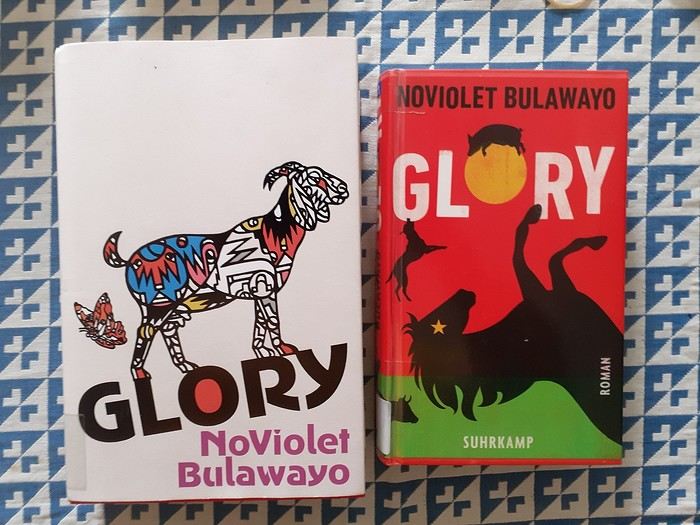 The books (in English, in German)
 Author NoViolet Bulawayo, Zimbabwe
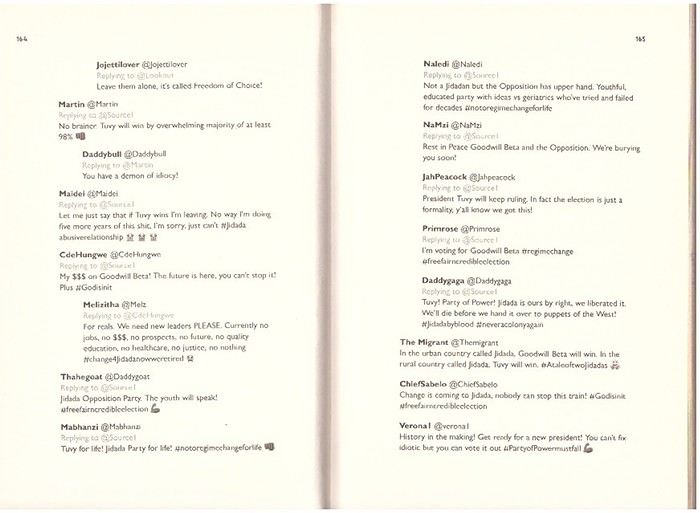 Threads (p.164-165)
"Bulawayo leans into exaggeration and irony to tell hard truths. *Glory* is jam-packed with comedy and farce, poking fun at an autocratic regime while illustrating the absurdity and surreal nature of a police state." — The Guardian
The cruelty and savagery of Zimbabwe’s (and Africa’s in general) "powerful animals"
Zimbabwean author NoViolet Bulawayo has written a novel that illustrates better than any documentary the complexity of colonial legacy. In doing so, she revisits George Orwell’s Animal Farm. Her novel *Glory* is a political satire about Zimbabwe—and it’s brimming with humor.
For thirty years, Zimbabwe has been stagnating under Robert Mugabe’s presidency. Human rights violations, corruption, and international sanctions have kept the population mired in poverty and oppression, while the regime exploits the meager earnings of the economy. As the 2017 elections approach, a power struggle erupts over the succession of the very elderly Father of the Nation (Mugabe). On the streets, people hope for long-awaited reforms; the people feel their moment has come.
And indeed, the army ousts Mugabe and his wife—"with her Gucci heels" (p.32)—who was positioning herself for the presidency. Hopes are dashed, however. The generals install former vice-president Emmerson Mnangagwa in power; the regime merely changes faces, but the problems remain the same.
In the novel, the country is called "Jidada, with a -da and another -da" (p.1); there’s no mistaking that this fictional state is Zimbabwe.
For *Glory*, her second novel, NoViolet Bulawayo invents a whole series of codes whose strength lies precisely in how easy they are to decipher. Like George Orwell’s Animal Farm, the characters populating Bulawayo’s universe aren’t humans but horses, goats, or crocodiles with all-too-human traits. Mugabe and Mnangagwa are horses, the spiritual leader is a pig, the soldiers are all bloodthirsty dogs, while the populace consists of goats, chickens, donkeys, and cats. The shift to the animal world serves only to better grasp the laws of despotism—and to ridicule real-life models. On one hand, the animals are humanized: they tweet, torture, travel in private jets. On the other, their greed, stupidity, and brutality stem from their animal nature.
It’s the old trick of fable: dressing men in animal disguises to make them easier to recognize. That’s how Orwell, in Animal Farm, traced how the promise of liberation from the Russian Revolution turned into Stalinist terror. In his 1945 fable, George Orwell describes how the animals of a farm drive out their farmer to organize the exploitation themselves, collectively. For a time, they truly taste freedom, but a clique of pigs ends up taking control. The central figures of the Soviet story—Stalin, Trotsky, Molotov—were easily recognizable.
Yet Bulawayo departs sharply from Orwell. She’s less concerned with precision and the force of argument than with satirical exaggeration. The deposed president is a senile old man who believes he can control even the sun’s course. The new stallion in power is a greedy debaucher. His soldiers sniff respectfully at his tail and backside.
In Bulawayo’s *Glory*, things are more complicated, but her novel also tells of a failed, incomplete liberation. In the author’s Animal Farm, Jidada, the colonial exploiters are followed by new forms of oppression. Because the former liberators become tyrants themselves. And because global power dynamics persist in neocolonial structures.
Wouldn’t that be enough to fuel a deeply depressing narrative? No—Bulawayo turns it into a blazing satire, full of wit and uncompromising criticism of power, a thread running through contemporary (not just) Zimbabwean history. The old warhorses in NoViolet Bulawayo’s Jidada, who continue to act as pack leaders, are easily recognizable as caricatures of the longtime dictator Robert Mugabe and his successor, current president Emmerson Mnangagwa.
The plot kicks off in high gear with independence day festivities. From the crack of dawn, everyone waits on Jidada Square for the Old Horse, the Father of the Nation and former liberator, whose reign "was nearing all of—not one, not two, not three, but four solid decades" (p.1). Everywhere, the colors of the Jidada Party shine; everywhere, true supporters cheer. Even the scorching sun plays its part: "At this point the sun, upon seeing arrive the leader who was decreed by God himself to rule and rule and keep ruling, a leader who'd in turn decreed the very sun to head his cheerleading squad, took a deep, deep breath and thoroughly blazed to impress" (p.2).
Finally, the Old Horse’s luxury carriage approaches "with the slowness of a hearse" (p.2), and "hoping to catch a glimpse of the legendary Father of the Nation," which causes "the animals fell over themselves like intoxicated frogs" (p.2). The sovereign’s speech is delayed a moment longer: "what I really want is a nap," groans the Old Horse as he takes his seat with such care "like his backside was made of expensive porcelain" (p.6).
Meanwhile, Bulawayo parades his entourage: the president’s wife (who earns her doctorate at Jidada University faster than "you could say diss, for dissertation. Tholukuthi it was as easy as ordering from a KFC drive-through, or perhaps even easier being that it was cheaper than KFC; it in fact cost her nothing and the degree actually came with a zero-calorie Diet Coke and a purple straw" (p.41), and she’s now known as Dr Sweet Mother. The cabinet includes "the Minister of the Revolution, the Minister of Corruption, the Minister of Order, the Minister of Things, the Minister of Nothing, the Minister of Propaganda, the Minister of Homophobic Affairs, the Minister of Disinformation and the Minister of Looting" (p.9). And of course the vice-president, who will soon become interim president when the Old Horse finally kicks the bucket—and then settle in as the new long-term president, who in the novel is called Tuvius Delight Shasha, or "Tuvy" for short (p.253), none other than Emmerson Mnangagwa. It’s him Bulawayo reserves her most merciless character description for.
"New Dispensation" (p.109) is Tuvy’s slogan for Jidada, and he loves repeating it so much he even named his parrot after it ("So inspired was Tuvy by the realisation that he rechristened his new pet parrot with the name New Dispensation—tholukuthi the bird having been acquired explicitly for the purposes of tweeting eulogies and accordingly glorifying the Saviour throughout the airs and skies of the nation. Tuvy then went on to hire a lecturer in English from the University of Jidada to teach New Dispensation to say the phrase 'New Dispensation'" p.110). But Tuvy’s Zimbabwe remains a nation without free, fair, and credible elections ("#freefairncredibleelection" p.161), and the promised equal treatment applies only insofar as Zimbabweans now queue up without discrimination in endless lines—and everyone is as poor as the next in the "queuenation" (p.283). Except for the powerful. They can "yes, tholukuthi, her immeasurable riches theirs to take. And take they did—
just take—take—take—take—take—take—take—take—take—take—take—take—take—take—take—take—take—take—take—take—take—take—take—take—take—take—take" (p.249-250).
In short: Bulawayo brilliantly depicts how former independence fighters become exploiters themselves. And how the country threatens to suffocate under the weight of corruption and repression. But she also literally stages the polyphony with which the people oppose imposed obedience to the official line.
Controversial online discussions keep interrupting the narrative—dialogues and social threads (see photo below) that Bulawayo masterfully integrates. From a literary standpoint, it’s a brilliant idea. And it shows, above all, that the author’s sympathy—so likeable—goes to all those who refuse to let their dream of true freedom be stolen, not even by the corrupt elites of their own country.
In the book’s acknowledgments, the first tribute goes to "The Jidadas of the world, clamouring for freedom on many fronts—A luta continua." (p.401) This reflects the realization that, not only in Jidada-Zimbabwe but in many other corners of the world, the end of colonial domination is still far from meaning the freedom hoped for by the vast majority of people. But it also means, more broadly, that this freedom must be won "on many fronts" (see above), both domestically and geopolitically.
That’s precisely what *Glory* so vividly highlights: how complex the project behind the term "postcolonialism" really is. With *Glory*, Bulawayo also delivers a scathing critique of the persistence of colonial mindsets in the West.
In the novel, the murder of George Floyd, racist police violence, and white-supremacist ideology in Trump’s United States perfectly illustrate the persistence of racism. It’s especially in the final chapters that Bulawayo lets Jidada’s inhabitants explicitly and unflinchingly criticize a neocolonial world order:
"It was not lost on us how the West, which loved to 'save' Africa and announce every action to the whole world, did so with one limb while manipulating, looting and fleecing us with the rest of its limbs so that more money in fact poured out of the continent than trickled in." (p.376)
"It was no mistake that multinational corporations yearly reaped and shipped colossal profits from Africa back to their countries as had been the case during colonial times. Even the sticks and stones would tell you that the African earth at any given time howled and shook and heaved from the extraction of its precious minerals that rarely benefited its own miserable children." (p.376)
"(...) we vowed to wage yet another war for Africa's second Liberation from neocolonial oppression. From exploitation. From plunder. From Western dominion. From indignity. From Abuse. We wanted real freedom. We wanted greedy, thieving paws off our wealth. We wanted Justice. We wanted a new world; we wanted a brand-new world so much we didn't sleep a wink that night." (p.377)
The Jidadas of this world must fight two enemies: Western neocolonialism and the autocratic instrumentalization of that argument; the persistence of Western racism and the populist appropriation of that humiliation by tyrants from their own ranks. Neither of these obstacles to freedom diminishes the historical and current guilt of the other. But the path to postcolonial liberation must overcome all these forms of oppression. After all, the colonizers didn’t bequeath democracies to formerly dominated nations, but instability and the principles of oppression and exploitation—which the so-called liberators have also internalized. Yet the fact that a satirical novel can capture the complexity of historical relationships while remaining, despite all the darkness of the subject, hilarious—well, that’s truly astonishing.
Finally, *Glory* ties into a major trauma in Zimbabwe’s post-independence history: the so-called Gukurahundi massacres. Between 1983 and 1987, tens of thousands of civilians were murdered by Mugabe’s bloody henchmen, most of them Ndebele. The State Security Minister and head of secret services at the time? You guessed it—Emmerson Mnangagwa.
When *Glory* turns to the massacres, the novel’s tone shifts completely. The story is now told through the narrative of the goat called Destiny, who, like NoViolet Bulawayo herself, left her home country at 18 for the United States and only returned after 13 years. In the book, the city of Bulawayo becomes a village where Destiny retraces her family’s history—and learns that part of it was also brutally murdered during the massacres.
The abuse of power and life under a dictatorship, dispossession, and a fiercely proud awareness of the psychological wounds and emotional vulnerability of a uprooted and disenfranchised people who had to forge a new language—a new set of names—to express their lived experiences are at the heart of this wonderful Zimbabwean author’s literary work, NoViolet Bulawayo. Shortly after her studies, she was already writing short stories about postcolonial power dynamics in Africa. But her playful, masterful, and often unconventional approach to language also plays a key role in her work. With virtuosity, she shifts from cynical images of power-obsessed elites to compassionate descriptions of the people’s suffering, ending with a hopeful sermon on courage—the courage to break free from fear and thus gain the strength for change ("And every one of them understood that whatever they heard within those hearts was the new national anthem, tholukuthi an anthem that spoke of the kind of glory that burns eternal and glows with living light." p.400). This novel is a genuine pleasure to read. And it’s exceptional. Good, African...
Book info (original English and German translation):
NoViolet Bulawayo. Glory. Chatto & Windus, 2022. NoViolet Bulawayo. Glory. Suhrkamp, 2023.
Hery
The books (in English, in German)
Author NoViolet Bulawayo, Zimbabwe
Threads (p.164-165)Practical aspects spring 2026: border to Murmansk, to Pskov, SIM cards, internet.
I took a few days to get some fresh air outside the Schengen-NATO prison. Between March 18, 2026, and March 25, 2026, as shown by the passport stamps:

Borisoglebsk is the Russian border checkpoint after Kirkenes, on the road to Murmansk.
Kirkenes is a tiny town with a correspondingly small airport. Nothing has changed there: the minibuses to Murmansk wait on the right as you exit the airport. They’re synchronized with the two daily flights from Oslo—the SAS around 11:00 AM and Norwegian around 11:30 AM. They stop in Kirkenes at the corner of the Scandic for an hour, where other passengers can board, then head straight to the nearby border.
This is the least hassle Frontex/Schengen border. The Norwegian agent quickly scans your passport, and that’s it. No customs, since Norway is Schengen but not in the EU. On the Russian side, there’s a passport check and a quick customs inspection. All in all, crossing both the Norwegian and Russian checkpoints takes about 15 minutes.
A paper visa is required; e-visas aren’t accepted.
Two companies run the route: Avto Ekspress and Borodin: https://ae51.ru/routes/kirkenes-murmansk/ https://borodinbus.com/
The one-way fare is 5,500 ₽. You can either buy it online in rubles with a MIR card or make a formal reservation and pay in NOK cash to the driver. I took Borodin, and the price in NOK was much more expensive than in ₽.
=========================
On March 25, I left from Pskov via the Estonian border post at Luhaama. I spent three days in Murmansk, flew to St. Petersburg (SPB), stayed there for two days, then took an evening train to Pskov.
Since the end of February—and reportedly until the end of May—the Estonians have restricted the opening hours of the two border crossings near Pskov: Koidula (Pechory on the Russian side) and Luhaama (Izborsk on the Russian side). They’re closed at night between 7:00 PM and 7:00 AM. Right now, there’s a bus from Pskov at 7:00 AM to the border. It drops you off at the end of the road where truckers—many Kazakh and Serbian—are parked on the side. You finish the rest on foot to the barrier, where there’s a quick initial check for Ukrainian stamps in passports. Then you walk to the customs building, followed by passport control at the kiosk for motorists. After that, it’s a 500-meter walk to the Estonian checkpoint. At the moment, things seem calmer. Passport control is quick. The usual silly questions in English: "Where were you? Where are you going?" I just gave my most clueless smile: "Sorry, I don’t understand." Yeah, right—I don’t speak English, especially not at an Estonian border with a French passport. If they’re in a mood, though... A very quick bag inspection. Once you exit the Estonian post, walk to the bus stop sign by the road where another coach takes you to Riga.
The catch: in my case, last Wednesday, there were two passengers (Russians) with old Ukrainian stamps in their passports. The bus from the Estonian post to Riga was supposed to leave around 9:30 AM. We ended up leaving around noon after the two were grilled by the FSB. Since it was a weekday outside of holidays, the bus was half-empty. The fuller the bus and the more people with Ukrainian stamps, the worse the nightmare. Don’t book a same-day flight from Riga. I had a flight at 6:00 PM, so it worked out.
=============
The Kirkenes-Murmansk route is still clearly the easiest and fastest. But it’s not the most convenient since it’s way up north.
Next, I’d say the Gdansk-Kaliningrad route in the middle of the week. Avoid weekends and holiday departures/returns.
Avoid the Narva-Ivangorod route during Christmas, Easter, May 9, and *all* summer.
==============
About flights from Murmansk to St. Petersburg: prices are good. I bought my ticket the day before departure on Rossiya for 7,500 ₽, including 10 kg of luggage + a handbag.
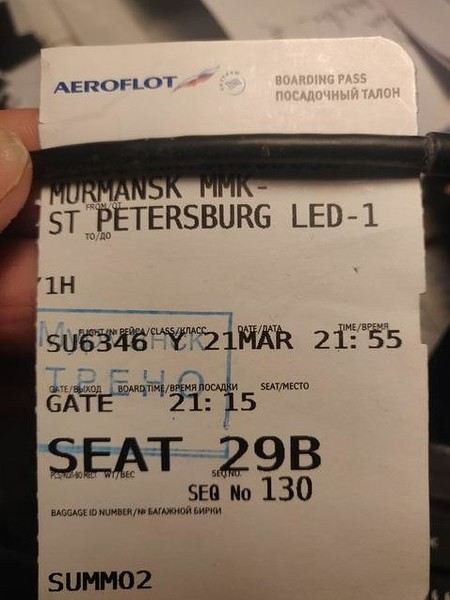
It’s the tail end of the northern lights season, and there were still crowds of Chinese tourists.
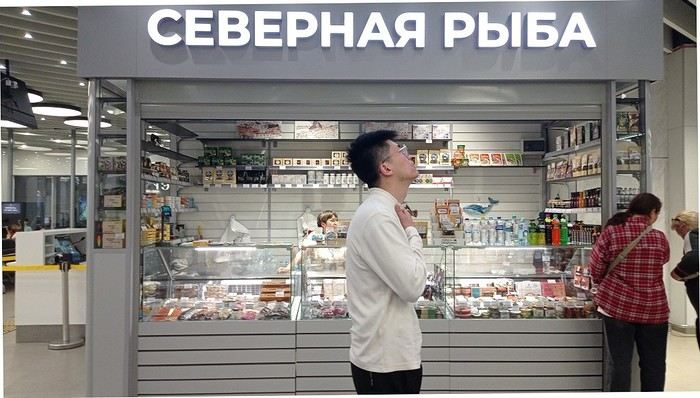
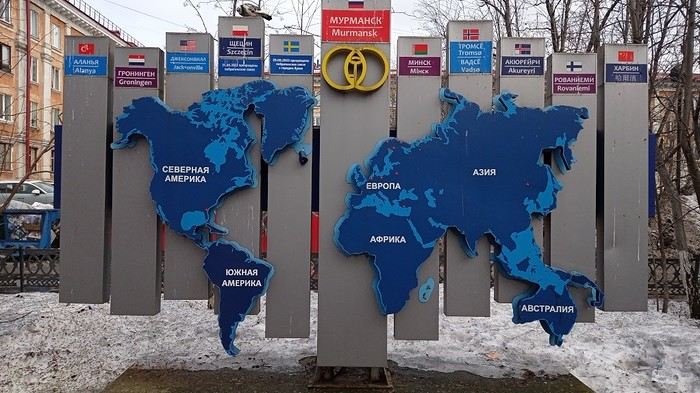
By the way, Murmansk is twinned with Harbin:
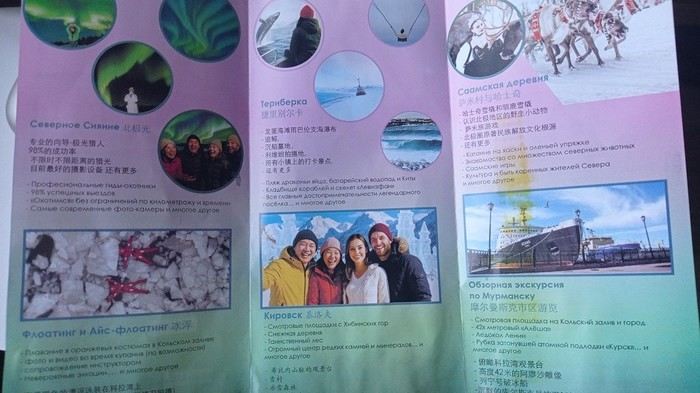
Chinese tourists are the largest foreign group, followed by Indians, then a mix of others from the Far East, Turks, Arabs, etc. Brochures are bilingual—Russian and Chinese:
============================
But let’s talk practical stuff. --
My domestic SIM card was restricted for SMS and internet for 24 hours. After that, if you want to keep using SMS, don’t turn off your phone—restarting triggers another 24-hour purgatory.
My Russian SIM cards (Megafon, MTS, Beeline) were activated as soon as I logged into their respective apps with my credentials.
Internet --
Telegram is heavily slowed down by authorities. To use it, you need to connect through proxy servers, which you load into the latest version of the app. Traffic is then rerouted internally within Telegram to servers outside Russia (Germany, Poland, Sweden, etc.). You can find these proxies on various channels. One is ChatVPN—check their website too.
For general internet use, like browsing the web, VPNs that work right now use the VLESS protocol. You can find several on Telegram by searching "VPN." A few free days, then payment in rubles or crypto.
Rozkomnadzor’s team are experts at this, so things can change. It’s a constant cat-and-mouse game.
Pskov is a special case. The city is near Estonia and has a large military base. Depending on NATO drone swarms launched from the Baltics, Wi-Fi can be completely suspended except for the most essential mobile apps. The drone swarms use the 4G network, and the powerful electronic jamming and drone suppression systems cause periods without Wi-Fi—including in hotels. Wired connections aren’t affected.
Borisoglebsk is the Russian border checkpoint after Kirkenes, on the road to Murmansk.
Kirkenes is a tiny town with a correspondingly small airport. Nothing has changed there: the minibuses to Murmansk wait on the right as you exit the airport. They’re synchronized with the two daily flights from Oslo—the SAS around 11:00 AM and Norwegian around 11:30 AM. They stop in Kirkenes at the corner of the Scandic for an hour, where other passengers can board, then head straight to the nearby border.
This is the least hassle Frontex/Schengen border. The Norwegian agent quickly scans your passport, and that’s it. No customs, since Norway is Schengen but not in the EU. On the Russian side, there’s a passport check and a quick customs inspection. All in all, crossing both the Norwegian and Russian checkpoints takes about 15 minutes.
A paper visa is required; e-visas aren’t accepted.
Two companies run the route: Avto Ekspress and Borodin: https://ae51.ru/routes/kirkenes-murmansk/ https://borodinbus.com/
The one-way fare is 5,500 ₽. You can either buy it online in rubles with a MIR card or make a formal reservation and pay in NOK cash to the driver. I took Borodin, and the price in NOK was much more expensive than in ₽.
=========================
On March 25, I left from Pskov via the Estonian border post at Luhaama. I spent three days in Murmansk, flew to St. Petersburg (SPB), stayed there for two days, then took an evening train to Pskov.
Since the end of February—and reportedly until the end of May—the Estonians have restricted the opening hours of the two border crossings near Pskov: Koidula (Pechory on the Russian side) and Luhaama (Izborsk on the Russian side). They’re closed at night between 7:00 PM and 7:00 AM. Right now, there’s a bus from Pskov at 7:00 AM to the border. It drops you off at the end of the road where truckers—many Kazakh and Serbian—are parked on the side. You finish the rest on foot to the barrier, where there’s a quick initial check for Ukrainian stamps in passports. Then you walk to the customs building, followed by passport control at the kiosk for motorists. After that, it’s a 500-meter walk to the Estonian checkpoint. At the moment, things seem calmer. Passport control is quick. The usual silly questions in English: "Where were you? Where are you going?" I just gave my most clueless smile: "Sorry, I don’t understand." Yeah, right—I don’t speak English, especially not at an Estonian border with a French passport. If they’re in a mood, though... A very quick bag inspection. Once you exit the Estonian post, walk to the bus stop sign by the road where another coach takes you to Riga.
The catch: in my case, last Wednesday, there were two passengers (Russians) with old Ukrainian stamps in their passports. The bus from the Estonian post to Riga was supposed to leave around 9:30 AM. We ended up leaving around noon after the two were grilled by the FSB. Since it was a weekday outside of holidays, the bus was half-empty. The fuller the bus and the more people with Ukrainian stamps, the worse the nightmare. Don’t book a same-day flight from Riga. I had a flight at 6:00 PM, so it worked out.
=============
The Kirkenes-Murmansk route is still clearly the easiest and fastest. But it’s not the most convenient since it’s way up north.
Next, I’d say the Gdansk-Kaliningrad route in the middle of the week. Avoid weekends and holiday departures/returns.
Avoid the Narva-Ivangorod route during Christmas, Easter, May 9, and *all* summer.
==============
About flights from Murmansk to St. Petersburg: prices are good. I bought my ticket the day before departure on Rossiya for 7,500 ₽, including 10 kg of luggage + a handbag.
It’s the tail end of the northern lights season, and there were still crowds of Chinese tourists.
By the way, Murmansk is twinned with Harbin:
Chinese tourists are the largest foreign group, followed by Indians, then a mix of others from the Far East, Turks, Arabs, etc. Brochures are bilingual—Russian and Chinese:
============================
But let’s talk practical stuff. --
My domestic SIM card was restricted for SMS and internet for 24 hours. After that, if you want to keep using SMS, don’t turn off your phone—restarting triggers another 24-hour purgatory.
My Russian SIM cards (Megafon, MTS, Beeline) were activated as soon as I logged into their respective apps with my credentials.
Internet --
Telegram is heavily slowed down by authorities. To use it, you need to connect through proxy servers, which you load into the latest version of the app. Traffic is then rerouted internally within Telegram to servers outside Russia (Germany, Poland, Sweden, etc.). You can find these proxies on various channels. One is ChatVPN—check their website too.
For general internet use, like browsing the web, VPNs that work right now use the VLESS protocol. You can find several on Telegram by searching "VPN." A few free days, then payment in rubles or crypto.
Rozkomnadzor’s team are experts at this, so things can change. It’s a constant cat-and-mouse game.
Pskov is a special case. The city is near Estonia and has a large military base. Depending on NATO drone swarms launched from the Baltics, Wi-Fi can be completely suspended except for the most essential mobile apps. The drone swarms use the 4G network, and the powerful electronic jamming and drone suppression systems cause periods without Wi-Fi—including in hotels. Wired connections aren’t affected.
Solo traveler safety in Colombia
Hi there,
I’m planning a trip to Colombia this summer. I’ve been reading a lot about safety in Colombia—everything and its opposite.
For those of you who know Colombia, currently, would you say it’s a country where you can travel safely? I don’t plan on going to narco or paramilitary zones. What about the political situation? I’m traveling as a couple, without any tour organization.
I just signed up and I’m still figuring out how this forum works—I didn’t know where to look for answers.
Thanks.
Langtang – Trekking in the Rain
We did the Langtang trek (hike) from September 10th to 17th, with the first and last days being the trip from Kathmandu and back—so 6 days of actual walking. It’s a fairly well-known trek but certainly not as famous or crowded as those in the Annapurna or Everest regions, which is why we chose it.
In theory, it’s mandatory to have a guide for this trek. In reality, it seems there are ways to bypass the regulations: we met at least two people hiking without a guide—a South Korean, a New Zealander, and possibly also a couple of English women and an American couple, though we’re not sure if they had a guide.
The agency we booked with had told us it was an affordable trek for relatively older people in good shape—which is our case (I’m 72 myself). I have to say upfront that we found it quite challenging, maybe because we didn’t have good weather—it was the end of the monsoon season. To be clear, no matter your fitness level, I’d say doing this trek in the middle of the monsoon season would be suicidal.
Day 1 – Journey from Kathmandu to Syapru Besi
On Monday, September 8th, there had been violent protests in Kathmandu against the government, which had, among other things, blocked access to social media and been accused of nepotism and corruption. There were 19 deaths. The situation was very tense on the day of our departure, Wednesday the 10th. The agency warned us that public transport was very unreliable. So, we decided to take a jeep, at an additional cost of $100 ($160 minus what was already budgeted for the bus).
We left a little before 7 a.m. and it took us a good hour just to reach the outskirts of Kathmandu. Along the way, we saw several houses and vehicles set on fire by protesters.
The road to Syapru Besi is only 120 km, but it’s frankly awful. It’s always narrow, winds through endless mountains, and the shoulders range from bad to confusing to nonexistent. Several sections are just dirt tracks. We didn’t regret opting for the jeep, as we could stop several times at our convenience—if only to let Y (my Thai partner) throw up everything she had. She’d taken her usual motion sickness medication, but the constant turns, accelerations, and braking eventually made her terribly carsick.
In Nuwakot, we stopped for breakfast at a nice little restaurant, Jimbu. It was around 8:30 a.m., and we’d barely covered 60 km. The restaurant has a lovely garden overlooking the Trishuli Ganga, the river flowing down from Syapru Besi. First photo: the river in the bottom right corner, mist and clouds over the mountain on the other side.
An hour later, my second photo: the hills along the Trishuli Ganga. You can see the different crops—lush green rice paddies in the lower right and corn, already yellowed and likely harvested, in the foreground on the left. And of course, the mist and clouds through which you can glimpse the mountain on the other side of the river.
In theory, it’s mandatory to have a guide for this trek. In reality, it seems there are ways to bypass the regulations: we met at least two people hiking without a guide—a South Korean, a New Zealander, and possibly also a couple of English women and an American couple, though we’re not sure if they had a guide.
The agency we booked with had told us it was an affordable trek for relatively older people in good shape—which is our case (I’m 72 myself). I have to say upfront that we found it quite challenging, maybe because we didn’t have good weather—it was the end of the monsoon season. To be clear, no matter your fitness level, I’d say doing this trek in the middle of the monsoon season would be suicidal.
Day 1 – Journey from Kathmandu to Syapru Besi
On Monday, September 8th, there had been violent protests in Kathmandu against the government, which had, among other things, blocked access to social media and been accused of nepotism and corruption. There were 19 deaths. The situation was very tense on the day of our departure, Wednesday the 10th. The agency warned us that public transport was very unreliable. So, we decided to take a jeep, at an additional cost of $100 ($160 minus what was already budgeted for the bus).
We left a little before 7 a.m. and it took us a good hour just to reach the outskirts of Kathmandu. Along the way, we saw several houses and vehicles set on fire by protesters.
The road to Syapru Besi is only 120 km, but it’s frankly awful. It’s always narrow, winds through endless mountains, and the shoulders range from bad to confusing to nonexistent. Several sections are just dirt tracks. We didn’t regret opting for the jeep, as we could stop several times at our convenience—if only to let Y (my Thai partner) throw up everything she had. She’d taken her usual motion sickness medication, but the constant turns, accelerations, and braking eventually made her terribly carsick.
In Nuwakot, we stopped for breakfast at a nice little restaurant, Jimbu. It was around 8:30 a.m., and we’d barely covered 60 km. The restaurant has a lovely garden overlooking the Trishuli Ganga, the river flowing down from Syapru Besi. First photo: the river in the bottom right corner, mist and clouds over the mountain on the other side.
An hour later, my second photo: the hills along the Trishuli Ganga. You can see the different crops—lush green rice paddies in the lower right and corn, already yellowed and likely harvested, in the foreground on the left. And of course, the mist and clouds through which you can glimpse the mountain on the other side of the river.
Another side of my trip to Thailand: Villages, nature, countryside, mountains...
February 9th is a pivotal day during my trip to Thailand. Up until this date, my focus had been on cities, temples, and other urban landmarks. Starting February 10th, I’ll finally leave the city behind for the outskirts—one town, one life, farther from tourism, more real, more authentic... Then comes the bucolic surroundings of Chiang Mai, nature, the countryside, the mountains.
This morning, I head to visit the ethnographic museum. I’d been told about another one, but it’s permanently closed. I wonder if it’s the same one that might have changed its name and location.
I thoroughly enjoy visiting this museum. At first, I’m a bit annoyed because the place is packed with noisy school groups blocking the display cases without even showing the slightest interest. But soon, their chaperones manage to lead them into another room, giving me some peace. They maintain this distance throughout the tour, allowing me to explore the museum in complete tranquility. I really appreciate their tact.
I’m amazed by the absolutely stunning fabric displays and the countless everyday objects, especially the very old pottery. There’s so much beautiful basketry and intricately carved wood. The statues are also incredible... After seeing all of them, I no longer feel like buying any from the shops.
On my way back, not far from my hotel, I discover a rather unique place that only serves one drink, which they’ve made their specialty: egg coffee! A pretty surprising novelty. I have to try it.

At the bottom of the cup, they pour a layer of milk, topped with a layer of liquid coffee, followed by a layer of egg yolk, and finally a top layer that turns out to be a mix of coffee and cocoa powder. It’s a cold drink that, in the end, doesn’t have much flavor, and the price is pretty steep for such a small cup. You’re paying for the exclusivity!
Later in the day, I venture once again into small alleys, something I love doing when exploring a new city—no specific goal, just wandering east of the city, outside the walls.

I encounter very few tourists there and discover unsuspected little shops overflowing with lovely items, much cheaper than what you find in the heart of the tourist district. Then I wander through the floors of Warorot Market. I discover another kind of temple there: the temple of good deals. I love finding clothes that are really original for locals, not the flood of shirts and pants that tourists love but no Thai would ever buy, which invade the shops in the "Historic Square." I stop in my tracks in front of a stall with beautiful shirts featuring stunning geometric patterns in elegant color combinations and very short sleeves. Hmm, these would be perfect for showing off my biceps, one of which is adorned with the magnificent Ganesh tattoo I got last year in Bali. "When you’ve got nice things, you’ve got to show them off!" he said. 😜🙏💪 I pick out two for 380 baht and negotiate them down to 300. But the seller won’t go any lower. I understand I’ve reached the limit of her commercial possibilities. Just as I’m leaving the shop, happy with my purchase, my ever-helpful inner voice, Petite Voix, suggests: - You didn’t try them on because you were too lazy to take off the one you’re wearing and also because of the sweat, but you could just put one on over the one you’re wearing. It’s light enough that it won’t bother you.
I go back to the two sellers, who burst out laughing when I ask to try them on. - Oh no, it’s way too small for you! It’s a women’s shirt! - But they don’t look particularly feminine in style! And I chose XXL... I put the shirt on, and of course, it won’t close. Then I notice the buttons are on the wrong side. That’s why the sleeves seemed so short!!! They put the shirts back on the rack and refund me without any fuss, commenting amid total hilarity: - Well, thank goodness you tried it on just as you were leaving the shop!
Since I don’t want to walk too much before tomorrow’s first Big Outing with the driver, I end my stroll with a visit to two very pretty temples recommended by Joël.

I’d rather not post more temple photos. But these ones smell like village and countryside...


I’ve never seen anything like Wat Ket Karam, so extravagant...


And I end my day with two other lesser-known temples: Wat Noung Kham, simple and finally free of gold and glitter,

and Wat Dap Phai, where an intimate ceremony is taking place at the end of the day.
This morning, I head to visit the ethnographic museum. I’d been told about another one, but it’s permanently closed. I wonder if it’s the same one that might have changed its name and location.
I thoroughly enjoy visiting this museum. At first, I’m a bit annoyed because the place is packed with noisy school groups blocking the display cases without even showing the slightest interest. But soon, their chaperones manage to lead them into another room, giving me some peace. They maintain this distance throughout the tour, allowing me to explore the museum in complete tranquility. I really appreciate their tact.
I’m amazed by the absolutely stunning fabric displays and the countless everyday objects, especially the very old pottery. There’s so much beautiful basketry and intricately carved wood. The statues are also incredible... After seeing all of them, I no longer feel like buying any from the shops.
On my way back, not far from my hotel, I discover a rather unique place that only serves one drink, which they’ve made their specialty: egg coffee! A pretty surprising novelty. I have to try it.
At the bottom of the cup, they pour a layer of milk, topped with a layer of liquid coffee, followed by a layer of egg yolk, and finally a top layer that turns out to be a mix of coffee and cocoa powder. It’s a cold drink that, in the end, doesn’t have much flavor, and the price is pretty steep for such a small cup. You’re paying for the exclusivity!
Later in the day, I venture once again into small alleys, something I love doing when exploring a new city—no specific goal, just wandering east of the city, outside the walls.
I encounter very few tourists there and discover unsuspected little shops overflowing with lovely items, much cheaper than what you find in the heart of the tourist district. Then I wander through the floors of Warorot Market. I discover another kind of temple there: the temple of good deals. I love finding clothes that are really original for locals, not the flood of shirts and pants that tourists love but no Thai would ever buy, which invade the shops in the "Historic Square." I stop in my tracks in front of a stall with beautiful shirts featuring stunning geometric patterns in elegant color combinations and very short sleeves. Hmm, these would be perfect for showing off my biceps, one of which is adorned with the magnificent Ganesh tattoo I got last year in Bali. "When you’ve got nice things, you’ve got to show them off!" he said. 😜🙏💪 I pick out two for 380 baht and negotiate them down to 300. But the seller won’t go any lower. I understand I’ve reached the limit of her commercial possibilities. Just as I’m leaving the shop, happy with my purchase, my ever-helpful inner voice, Petite Voix, suggests: - You didn’t try them on because you were too lazy to take off the one you’re wearing and also because of the sweat, but you could just put one on over the one you’re wearing. It’s light enough that it won’t bother you.
I go back to the two sellers, who burst out laughing when I ask to try them on. - Oh no, it’s way too small for you! It’s a women’s shirt! - But they don’t look particularly feminine in style! And I chose XXL... I put the shirt on, and of course, it won’t close. Then I notice the buttons are on the wrong side. That’s why the sleeves seemed so short!!! They put the shirts back on the rack and refund me without any fuss, commenting amid total hilarity: - Well, thank goodness you tried it on just as you were leaving the shop!
Since I don’t want to walk too much before tomorrow’s first Big Outing with the driver, I end my stroll with a visit to two very pretty temples recommended by Joël.
I’d rather not post more temple photos. But these ones smell like village and countryside...
I’ve never seen anything like Wat Ket Karam, so extravagant...
And I end my day with two other lesser-known temples: Wat Noung Kham, simple and finally free of gold and glitter,
and Wat Dap Phai, where an intimate ceremony is taking place at the end of the day.
Kattegat Tour and Norway’s Majestic Fjords – 32 Days (Denmark, Sweden, Norway)
Kattegat isn’t just the name of the village in the TV series *Vikings*—it’s also the stretch of water separating Denmark from Sweden... the sea, basically! And further north, you’ve got Norway and its fjords!
Originally, I’d planned to just do a loop around Kattegat, with the *Under* restaurant in Lindesnes as our anniversary treat... but along the way, we thought, why not "push" a little further north, keeping an eye on the budget since we’d chosen to travel by car in June 2025 through Scandinavia.
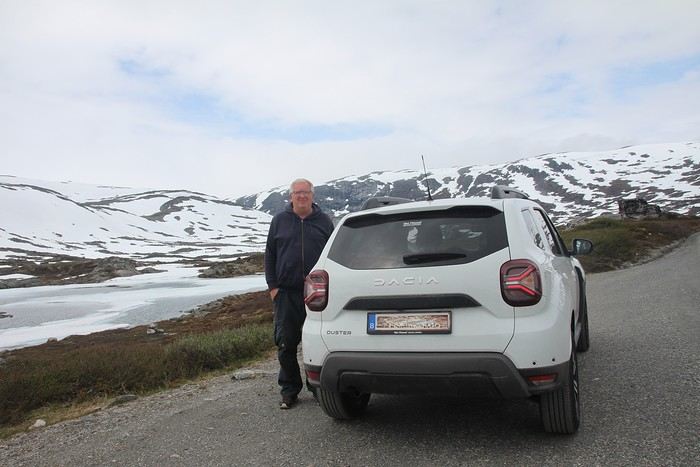
Why by car when most travelers opt for a camper van, while others prefer the comfort of cruises? Well, because we don’t own a camper van, renting one is pricey, and then you’ve got to add fuel costs (those things guzzle gas!), ferry fees, and other "tolls." All things considered, we went for mostly rentals—especially since there were four of us at the start of the trip. We spent the first week in Denmark with our daughter and son-in-law. Then they flew back to Belgium, and we continued our adventure as a couple. For accommodation, we mainly booked Airbnb apartments, which helped keep costs down and, most importantly, let us prepare our own meals (diet, diet!). In this travel journal, you’ll discover (or rediscover, for those who followed my older ones) our unbridled love for theme parks, museums, unique experiences, and—especially in Denmark—Legos! Unfortunately, we didn’t do any hikes this year because the unpredictable weather had made the trails slippery, and since I’d already taken three tumbles during the trip, I didn’t want to risk another! In the end, we traveled for 32 days, covered 6,200 km, and most importantly, discovered the charming country of Denmark, marveled at Norway’s breathtaking fjords—all without suffering the heatwave that hit France and Belgium that June! If you’ve got any questions, don’t hesitate to ask!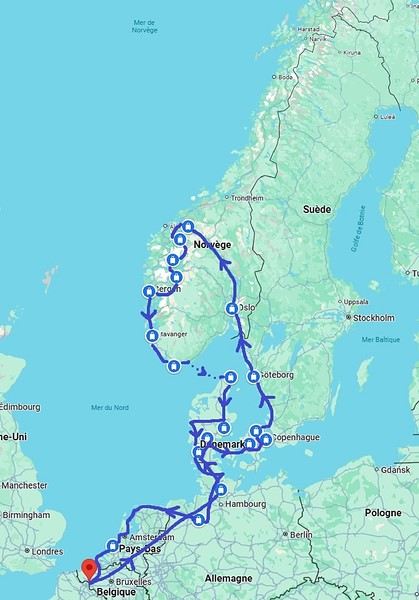
Why by car when most travelers opt for a camper van, while others prefer the comfort of cruises? Well, because we don’t own a camper van, renting one is pricey, and then you’ve got to add fuel costs (those things guzzle gas!), ferry fees, and other "tolls." All things considered, we went for mostly rentals—especially since there were four of us at the start of the trip. We spent the first week in Denmark with our daughter and son-in-law. Then they flew back to Belgium, and we continued our adventure as a couple. For accommodation, we mainly booked Airbnb apartments, which helped keep costs down and, most importantly, let us prepare our own meals (diet, diet!). In this travel journal, you’ll discover (or rediscover, for those who followed my older ones) our unbridled love for theme parks, museums, unique experiences, and—especially in Denmark—Legos! Unfortunately, we didn’t do any hikes this year because the unpredictable weather had made the trails slippery, and since I’d already taken three tumbles during the trip, I didn’t want to risk another! In the end, we traveled for 32 days, covered 6,200 km, and most importantly, discovered the charming country of Denmark, marveled at Norway’s breathtaking fjords—all without suffering the heatwave that hit France and Belgium that June! If you’ve got any questions, don’t hesitate to ask!
Meghalaya: A Very Rainy Week
Friday, April 18
Night in Guwahati
Before leaving the guesthouse, I drop off a small bag that I’ll pick up when I return.
I take a tuk-tuk at 7:40 AM to get to the sumo departure point for Shillong, the capital of Meghalaya.
My bag is loaded onto the roof, my seat is assigned, and we have to wait for the car to fill up.
While waiting, I watch the street come to life. I have fun photographing the different modes of transport passing by.
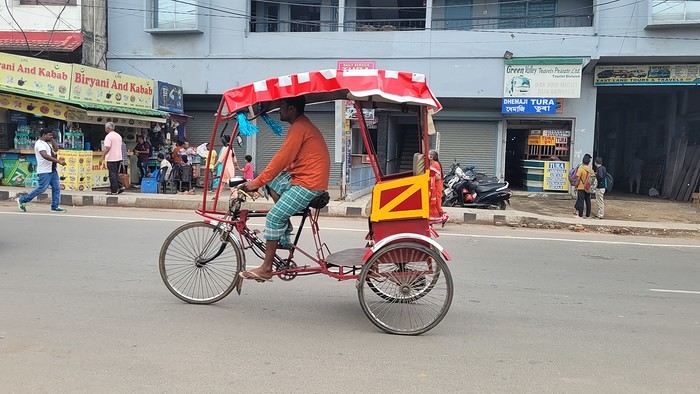
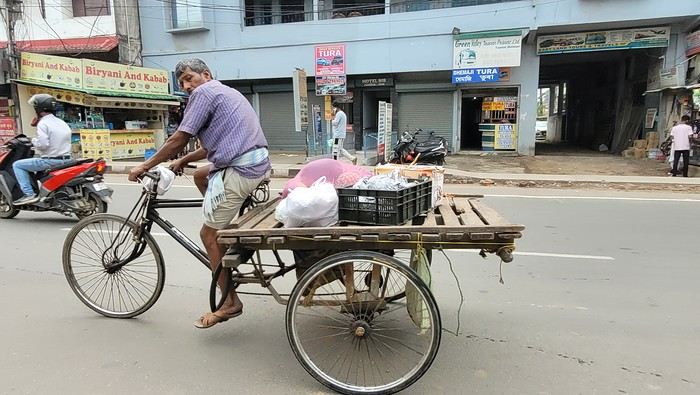
Time passes faster when you’re occupied. We leave at 8:20 AM, and the driver does door-to-door service along the way. We make our first stop for 25 minutes at 9:10 AM, then another for breakfast at 10:10 AM. The scenery is very different from Assam and Nagaland. We drive alongside a pine forest and a large lake. There are beautiful viewpoints, but the driver isn’t stopping for sightseeing, so I have to settle for looking through the car windows.
We finally arrive in Shillong at 11:45 AM. The driver stops in the middle of nowhere, so I have to walk up the street to find a taxi. I flag one down, and he agrees to take me to my new guesthouse, the Rockski Boutique Bed & Breakfast. No sooner do I arrive than a storm with a heavy downpour welcomes me. When I arrived in Guwahati at the end of October, I’d booked a guide with a car for this week. There’s no public transport to get from village to village, so I had to take a car to visit. The tourism manager, Sachin, sent me a message to let me know that the driver, Welbis, will pick me up tomorrow morning at 8 AM. The temperature is much cooler here—only 19°C. At 2:30 PM, the rain stops, and I take the opportunity to explore the city. I start with the cathedral. Today is Good Friday, so I’m going to see how it’s celebrated here. Meghalaya is a Catholic state. The cathedral isn’t far from the guesthouse—it’s huge and all blue.
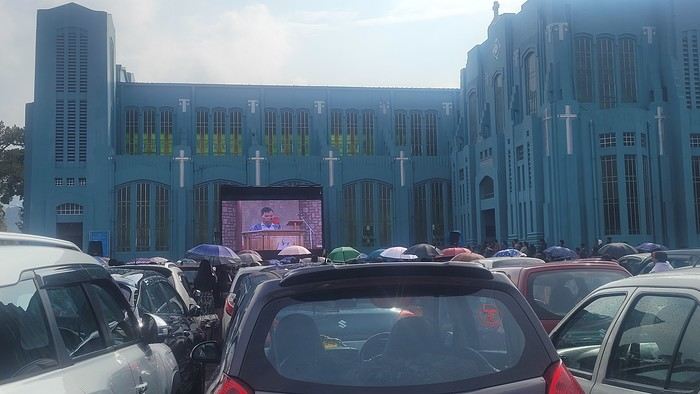
I arrive during mass, and it’s impossible to enter—the faithful are numerous outside in the parking lot. Giant screens broadcast the ceremony.

While waiting, I watch the street come to life. I have fun photographing the different modes of transport passing by.
Time passes faster when you’re occupied. We leave at 8:20 AM, and the driver does door-to-door service along the way. We make our first stop for 25 minutes at 9:10 AM, then another for breakfast at 10:10 AM. The scenery is very different from Assam and Nagaland. We drive alongside a pine forest and a large lake. There are beautiful viewpoints, but the driver isn’t stopping for sightseeing, so I have to settle for looking through the car windows.
We finally arrive in Shillong at 11:45 AM. The driver stops in the middle of nowhere, so I have to walk up the street to find a taxi. I flag one down, and he agrees to take me to my new guesthouse, the Rockski Boutique Bed & Breakfast. No sooner do I arrive than a storm with a heavy downpour welcomes me. When I arrived in Guwahati at the end of October, I’d booked a guide with a car for this week. There’s no public transport to get from village to village, so I had to take a car to visit. The tourism manager, Sachin, sent me a message to let me know that the driver, Welbis, will pick me up tomorrow morning at 8 AM. The temperature is much cooler here—only 19°C. At 2:30 PM, the rain stops, and I take the opportunity to explore the city. I start with the cathedral. Today is Good Friday, so I’m going to see how it’s celebrated here. Meghalaya is a Catholic state. The cathedral isn’t far from the guesthouse—it’s huge and all blue.
I arrive during mass, and it’s impossible to enter—the faithful are numerous outside in the parking lot. Giant screens broadcast the ceremony.
3-Week West USA Road Trip Itinerary
Hi there,
Alright, here’s my own road book for 3 weeks (late June – mid-July 2025) — looking forward to your feedback!
We’re not hikers or hardcore adventurers, so I’ve focused the itinerary on what we consider the essentials. We’re flying into SF and out of Las Vegas (because of airfare prices!) and also because I’m skipping Yosemite (doesn’t really tempt us). I’m planning a day trip to Death Valley from LV (been there before — it lets you see the highlights, and that was enough for me at the time). We’re not going as far as Canyon de Chelly — already done, and it didn’t really wow me. Just to note, this is pretty similar to a trip I’ve done before that worked well for us, but I’m open to tweaking it based on your suggestions. The duration (23 days) isn’t flexible — even one extra day sends the ticket prices skyrocketing.
Here’s what it looks like: Day 1: Arrival in SF Day 2 – Day 4: SF Day 5: Monterey (the Aquarium and the bay) – Overnight in Monterey Day 6 – Day 7: Drive down Highway 1 to Los Angeles – Overnight Day 6, e.g., in St. Simeon or nearby, and Day 7 in LA Day 8 – Day 9: LA (possibly an extra day) – Overnights in LA Day 10: Drive to Kingman and sightseeing – Overnight in Kingman Day 11: Drive to Grand Canyon and start exploring GC – Overnight in Tusayan Day 12: Explore GC – Overnight in Tusayan Day 13: Drive to Monument Valley and visit – Overnight nearby (Mexican Hat, Kayenta, etc.) Day 14: More sightseeing in the area (Valley of the Gods, Gooseneck Park) and drive to Mesa Verde – Overnight in Cortez Day 15: Visit Mesa Verde – Overnight in Cortez Day 16: Drive to Page and sightseeing – Overnight in Page Day 17: Antelope Canyon, Horseshoe Bend – Overnight in Page Day 18: Drive to Bryce Canyon NP and start exploring Bryce – Overnight in the area! Day 19: Explore Bryce => Question: It’s a 2.5-hour drive from Page to Bryce. If we leave early, can we see the highlights of Bryce on Day 18 and skip Day 19? I’ll admit, I don’t remember much (it was back in 2009!) Day 20: Drive to Las Vegas with stops along the way (a quick detour to Zion just to say we’ve been, Valley of Fire) – Overnight in LV Day 21: LV; Cirque du Soleil show in the evening – Overnight in LV Day 22: Day trip to Death Valley (or a lazy day and outlet shopping!) – Overnight in LV Day 23: Flight back at 4:10 PM, which still gives us time to enjoy the morning.
What do you think? Best regards,
Alright, here’s my own road book for 3 weeks (late June – mid-July 2025) — looking forward to your feedback!
We’re not hikers or hardcore adventurers, so I’ve focused the itinerary on what we consider the essentials. We’re flying into SF and out of Las Vegas (because of airfare prices!) and also because I’m skipping Yosemite (doesn’t really tempt us). I’m planning a day trip to Death Valley from LV (been there before — it lets you see the highlights, and that was enough for me at the time). We’re not going as far as Canyon de Chelly — already done, and it didn’t really wow me. Just to note, this is pretty similar to a trip I’ve done before that worked well for us, but I’m open to tweaking it based on your suggestions. The duration (23 days) isn’t flexible — even one extra day sends the ticket prices skyrocketing.
Here’s what it looks like: Day 1: Arrival in SF Day 2 – Day 4: SF Day 5: Monterey (the Aquarium and the bay) – Overnight in Monterey Day 6 – Day 7: Drive down Highway 1 to Los Angeles – Overnight Day 6, e.g., in St. Simeon or nearby, and Day 7 in LA Day 8 – Day 9: LA (possibly an extra day) – Overnights in LA Day 10: Drive to Kingman and sightseeing – Overnight in Kingman Day 11: Drive to Grand Canyon and start exploring GC – Overnight in Tusayan Day 12: Explore GC – Overnight in Tusayan Day 13: Drive to Monument Valley and visit – Overnight nearby (Mexican Hat, Kayenta, etc.) Day 14: More sightseeing in the area (Valley of the Gods, Gooseneck Park) and drive to Mesa Verde – Overnight in Cortez Day 15: Visit Mesa Verde – Overnight in Cortez Day 16: Drive to Page and sightseeing – Overnight in Page Day 17: Antelope Canyon, Horseshoe Bend – Overnight in Page Day 18: Drive to Bryce Canyon NP and start exploring Bryce – Overnight in the area! Day 19: Explore Bryce => Question: It’s a 2.5-hour drive from Page to Bryce. If we leave early, can we see the highlights of Bryce on Day 18 and skip Day 19? I’ll admit, I don’t remember much (it was back in 2009!) Day 20: Drive to Las Vegas with stops along the way (a quick detour to Zion just to say we’ve been, Valley of Fire) – Overnight in LV Day 21: LV; Cirque du Soleil show in the evening – Overnight in LV Day 22: Day trip to Death Valley (or a lazy day and outlet shopping!) – Overnight in LV Day 23: Flight back at 4:10 PM, which still gives us time to enjoy the morning.
What do you think? Best regards,
My Battle with Excess Weight (How I Lost 5 Kilos in 2 Days, by Bike)
New, seen on TV, you won't believe it. Click here.
During my recent trek, I found that my bike—and my luggage—were heavy. Until now, the weight of my gear hadn’t been an issue. Maybe I’m getting old, or maybe I just can’t handle the SNCF’s stairs anymore.
It hit me in Toulouse. A 3-minute stop turned into a 6-hour delay because of a fire that was hard to control between Toulouse and Montauban. Eventually, our train was canceled, and we were told to take another train that was also waiting for the same destination. It was my fourth train of the day. It was 9:30 PM, and I’d left at 9:30 AM that morning. Suddenly, exhaustion took over.
That’s when I met two bike-packers who, without hesitation, lifted their bikes with all their gear attached, carried them down the steps of the Corail train, and then down the stairs to the underground passage. They were young and fit (they smelled like warm sand), and I definitely wasn’t. It was in that scorching heat, struggling up and down all those stairs (Oh Toulouse, as Nougaro would say, may you be cursed for seven generations), that I decided to go on a diet.
It’s a diet anyone can do, it works, and it’s free. So I’m sharing it right away.
No need to exercise or restrict yourself. No, all you have to do is think and do some research. You need a chair, a table, a scale, a computer, and a spreadsheet. Make a list of everything you’ve brought and weigh it all. Set a goal based on the type of trek and your comfort level. Remove everything that doesn’t help you reach that goal.
My goal: - Trekking in France from May to September, in the plains or at most on a plateau like Mont Aubrac, where at 800 m altitude, it can drop to 10 °C at night even in the middle of summer.
- Sleeping in a tent on a good mattress in a sleeping bag (I’m not changing that). Someone suggested I could sleep under the stars on bubble wrap. No way, are you crazy?
- Not cooking. I buy lunch on the way in the morning and dinner on the way in the afternoon (I’m not changing that either). Someone suggested Ducasse delivers everywhere in France. Uh, have you been smoking lemon weed?
That’s how I lost 5 kg, going from 17.7 kg to 12.8 kg, including luggage but not food or water. But I also reduced the volume and quantity of my gear.
Here are the before photos:
https://photos.app.goo.gl/XDfKaoVvHFNxDXrq5
And after:
https://photos.app.goo.gl/STRVKaWuVcNVeCfS9
of my bike.
You can see that a duffel bag is gone, as well as the extra bags behind the panniers. I don’t even use the mesh pockets at the bottom of each pannier anymore. You can also see I’m still carrying my 1 kg U-lock. I know, it’s unforgivable. I’m on the verge of being banned.
So I might do another trek in September to validate my choices.
For the rear panniers, I can save between 1 and 1.5 kg depending on the solution: Arkel Dry-lites (28 L pair, 0.540 kg) or Vaude Aqua Light (38 L pair, 1.080 kg).
I also need to cut down on the tools I bring. I should be able to shave off about 0.5 kg.
And the bike? I’m thinking about it. Someone suggested the folding Savadeck Z2, which only weighs 10 kg. Carbon? Oh, don’t spread the word—it’s even more taboo than aluminum in some circles, and I won’t even mention the belt drive.
During my recent trek, I found that my bike—and my luggage—were heavy. Until now, the weight of my gear hadn’t been an issue. Maybe I’m getting old, or maybe I just can’t handle the SNCF’s stairs anymore.
It hit me in Toulouse. A 3-minute stop turned into a 6-hour delay because of a fire that was hard to control between Toulouse and Montauban. Eventually, our train was canceled, and we were told to take another train that was also waiting for the same destination. It was my fourth train of the day. It was 9:30 PM, and I’d left at 9:30 AM that morning. Suddenly, exhaustion took over.
That’s when I met two bike-packers who, without hesitation, lifted their bikes with all their gear attached, carried them down the steps of the Corail train, and then down the stairs to the underground passage. They were young and fit (they smelled like warm sand), and I definitely wasn’t. It was in that scorching heat, struggling up and down all those stairs (Oh Toulouse, as Nougaro would say, may you be cursed for seven generations), that I decided to go on a diet.
It’s a diet anyone can do, it works, and it’s free. So I’m sharing it right away.
No need to exercise or restrict yourself. No, all you have to do is think and do some research. You need a chair, a table, a scale, a computer, and a spreadsheet. Make a list of everything you’ve brought and weigh it all. Set a goal based on the type of trek and your comfort level. Remove everything that doesn’t help you reach that goal.
My goal: - Trekking in France from May to September, in the plains or at most on a plateau like Mont Aubrac, where at 800 m altitude, it can drop to 10 °C at night even in the middle of summer.
- Sleeping in a tent on a good mattress in a sleeping bag (I’m not changing that). Someone suggested I could sleep under the stars on bubble wrap. No way, are you crazy?
- Not cooking. I buy lunch on the way in the morning and dinner on the way in the afternoon (I’m not changing that either). Someone suggested Ducasse delivers everywhere in France. Uh, have you been smoking lemon weed?
That’s how I lost 5 kg, going from 17.7 kg to 12.8 kg, including luggage but not food or water. But I also reduced the volume and quantity of my gear.
Here are the before photos:
https://photos.app.goo.gl/XDfKaoVvHFNxDXrq5
And after:
https://photos.app.goo.gl/STRVKaWuVcNVeCfS9
of my bike.
You can see that a duffel bag is gone, as well as the extra bags behind the panniers. I don’t even use the mesh pockets at the bottom of each pannier anymore. You can also see I’m still carrying my 1 kg U-lock. I know, it’s unforgivable. I’m on the verge of being banned.
So I might do another trek in September to validate my choices.
For the rear panniers, I can save between 1 and 1.5 kg depending on the solution: Arkel Dry-lites (28 L pair, 0.540 kg) or Vaude Aqua Light (38 L pair, 1.080 kg).
I also need to cut down on the tools I bring. I should be able to shave off about 0.5 kg.
And the bike? I’m thinking about it. Someone suggested the folding Savadeck Z2, which only weighs 10 kg. Carbon? Oh, don’t spread the word—it’s even more taboo than aluminum in some circles, and I won’t even mention the belt drive.
Discussion parallèle au concours photo d'août: "Noir & Blanc" English translation pending
Je vous donne rendez-vous ici pour vos photos hors concours, pour discuter, échanger, conseiller, apprendre et s'amuser 😛
Le concours se passe par-là: https://voyageforum.com/v.f?post=10330487;a=10330487
Le concours se passe par-là: https://voyageforum.com/v.f?post=10330487;a=10330487
Quel patin pour quelle jante? (à vélo) English translation pending
Voilà, cet automne je me suis fait construire deux belles roues en prévision d'un nouveau long voyage à vélo et 2000 kms plus tard je m'aperçois que mes jantes consomment de la gomme à une vitesse folle 😕.
Je suis toujours un peu un blaireau des bois concernant tout ce qui est un tant soit peu technique, donc j'ai besoin des lumières des mécanos virtuoses de ce fil.
J'ai un système de freins sur jante " classique " à cantilevers Deore LX.
Mes jeux de roues précédents, sur lesquels je faisais environ 30 000 kms avant de les remiser au grenier, avaient pour base des jantes Ryde Big Bull. Je n'ai jamais eu aucun souci avec elles, et mes patins duraient vraiment longtemps, même en montagne ou sur des pistes bien poussiéreuses ou boueuses.
Cette fois mon artisan a utilisé des jantes Ryde 19 C x 559. M'apercevant que le freinage n'était pas aussi performant et que je devais ajuster l'étrier en permanence j'ai inspecté ces jantes et je me suis aperçu qu'elles étaient légèrement rainurées ( elles ne sont pas lisses comme celles que j'avais auparavant ). Je pense que c'est ce grain sur la surface qui accélère l'usure de la gomme. Cela va vraiment très vite !
Voici mes questions :
- Quel est l'intérêt de concevoir de telles jantes ? - Y-a-t-il différentes qualités de gomme suivant les marques de patins ( je les achète nus, sans les boîtiers ) ?
L.
Je suis toujours un peu un blaireau des bois concernant tout ce qui est un tant soit peu technique, donc j'ai besoin des lumières des mécanos virtuoses de ce fil.
J'ai un système de freins sur jante " classique " à cantilevers Deore LX.
Mes jeux de roues précédents, sur lesquels je faisais environ 30 000 kms avant de les remiser au grenier, avaient pour base des jantes Ryde Big Bull. Je n'ai jamais eu aucun souci avec elles, et mes patins duraient vraiment longtemps, même en montagne ou sur des pistes bien poussiéreuses ou boueuses.
Cette fois mon artisan a utilisé des jantes Ryde 19 C x 559. M'apercevant que le freinage n'était pas aussi performant et que je devais ajuster l'étrier en permanence j'ai inspecté ces jantes et je me suis aperçu qu'elles étaient légèrement rainurées ( elles ne sont pas lisses comme celles que j'avais auparavant ). Je pense que c'est ce grain sur la surface qui accélère l'usure de la gomme. Cela va vraiment très vite !
Voici mes questions :
- Quel est l'intérêt de concevoir de telles jantes ? - Y-a-t-il différentes qualités de gomme suivant les marques de patins ( je les achète nus, sans les boîtiers ) ?
L.
La prière dans le monde! English translation pending
La nuit tombe d’un coup et je suis sans cesse étonnée de passer ainsi du clair au noir.
Après cette journée fatigante, je rentre à la maison et jette mes sandales dans un coin.
Dans son petit bassin de bronze, la fleur de lotus est déjà refermée.
Tout est silencieux mais j’entends le léger murmure incantatoire de Tiago.
Il prie.
Assis devant son petit autel, les volutes odorantes des bâtonnets d’encens s’enroulent autour de ses cheveux noirs. Son dos dur et sombre luit et la lueur de la flamme dans la coupelle de ghee danse sur ses épaules.
La grande image de Shiva fixée au mur se décolle dans un angle, pliant les pointes du trident.
Le dieu garde ses yeux mi-clos sur la création du monde et les cycles de l’univers.
Dans sa longue chevelure, au sommet de sa tête s’enroule un serpent.
Un dieu coloré bienveillant dans cette représentation, l’une de ses quatre mains ouverte sur le genou.
Tiago a posé son offrande, une noix de coco est une guirlande de fleurs jaune dont je ne retiens jamais le nom.
Immobile.
Il prie.
__
J’ai vu des gens agenouillés, des gens couchés face contre terre, assis en tailleur, assis mains jointes. J’ai vu des gens danser, j’ai vu des processions colorées, j’ai entendu des mélopées hypnotiques, j’ai écouté des cymbales, des trompettes, de grandes orgues, des chants liturgiques, des psaumes, le fanbai, des chants grégoriens et des gospels, des chants diphoniques qui remuent le ventre.
J’ai vu des flèches perçant les nuages, des coupoles dorées, des dômes de pierre, des cathédrales, des temples, des autels flamboyant de dorures, des allées de chevaux de pierre, des temples de feu et des chapelles de pierre blotties sous les ombrages, de bois ensevelies sous la neige, des cryptes froides et silencieuses, des maisons d’adoration sans effigie, des monastères accrochés à la montagne , des cloîtres dans la ville.
j’ai vu des costumes de cérémonies multicolores, des tenues de fourrure, des saris de fêtes soyeux, des chapeaux rouge étranges, des plumets et des têtes rasées. J’ai vu des hommes tirer des chars la peau du dos distendue par des crochets, j’ai été subjuguée par des mandala de sable, tout est éphémère.
Partout où mes pas ont foulé d’autres terres, j’ai vu des croyants réunis, rassemblés, unis, bruyants, silencieux, exaltés, recueillis.
J’ai touché des chapelets de buis, d’ivoire, en corail, en noyaux, les perles égrenant le nom divin, les mantras, les prières, tenu des croix de roseaux, de feuilles de maïs, porté des couronnes de fleurs, tenu des moulins de prière. J’ai regardé des dieux vêtus d’oripeaux décolorés, vêtus d’habits précieux, nus ceints d’un pagne, l’arbre à souhaits aux rubans multicolores agités par les tourbillons de neige.
J’ai respiré l’odeur de l’encens, j’ai respiré l’odeur de la cire fondue, j’ai respiré le parfum des fleurs fraîches et l’odeur surette des offrandes pourrissantes.
J’ai fermé les yeux, souvent, pour mieux entendre, pour mieux comprendre.
Et je sais, qu’aujourd’hui, je ne sais rien de cette ferveur puissante qui soulève et porte et emporte les peuples du monde. Je sais aussi que le tremblement de mes jambes et les yeux qui picotent devant la ferveur de Tiago, ce soir là, il y a des lustres, huit peut-être, c’est tellement loin, fut ce qui s’approchait le plus d’une prière. Ou, peut-être étais-je secrètement amoureuse...
Ainsi, je crois que beaucoup ont vécu ces instants étranges de communion, d’observation respectueuse, que beaucoup connaissent les rites et rituels, les byzantins, coptes, maronites, et tant d’autres, des rites de passage et des rites d’intercessions appelant la pluie, la fécondité . Ces rites qui rythment la vie dans tous ces pays que je n’aurais plus le temps de connaître.
Comment se vit la prière en Afrique, chez les aborigènes d’Australie, à Madagascar, à Cuba, en Chine, au Japon, en Indonésie ou ailleurs ?. Comment se vit-elle, la prière, aujourd’hui où partout des moments religieux forts s’annoncent ? Monothéiste, animiste, shintoïsme, bouddhisme, syncrétisme religieux, l’aspect religieux est toujours présents dans mes voyages, l’est-il pour vous aussi ?
Z’avez lu jusqu’au bout ? Bravo, vous avez gagné une image pieuse ou non. Pour ce faire, aller dans la rubrique -jeux voyages – sur le fil -défilés et processions -, il y en a des magnifiques.
J’ai vu des gens agenouillés, des gens couchés face contre terre, assis en tailleur, assis mains jointes. J’ai vu des gens danser, j’ai vu des processions colorées, j’ai entendu des mélopées hypnotiques, j’ai écouté des cymbales, des trompettes, de grandes orgues, des chants liturgiques, des psaumes, le fanbai, des chants grégoriens et des gospels, des chants diphoniques qui remuent le ventre.
J’ai vu des flèches perçant les nuages, des coupoles dorées, des dômes de pierre, des cathédrales, des temples, des autels flamboyant de dorures, des allées de chevaux de pierre, des temples de feu et des chapelles de pierre blotties sous les ombrages, de bois ensevelies sous la neige, des cryptes froides et silencieuses, des maisons d’adoration sans effigie, des monastères accrochés à la montagne , des cloîtres dans la ville.
j’ai vu des costumes de cérémonies multicolores, des tenues de fourrure, des saris de fêtes soyeux, des chapeaux rouge étranges, des plumets et des têtes rasées. J’ai vu des hommes tirer des chars la peau du dos distendue par des crochets, j’ai été subjuguée par des mandala de sable, tout est éphémère.
Partout où mes pas ont foulé d’autres terres, j’ai vu des croyants réunis, rassemblés, unis, bruyants, silencieux, exaltés, recueillis.
J’ai touché des chapelets de buis, d’ivoire, en corail, en noyaux, les perles égrenant le nom divin, les mantras, les prières, tenu des croix de roseaux, de feuilles de maïs, porté des couronnes de fleurs, tenu des moulins de prière. J’ai regardé des dieux vêtus d’oripeaux décolorés, vêtus d’habits précieux, nus ceints d’un pagne, l’arbre à souhaits aux rubans multicolores agités par les tourbillons de neige.
J’ai respiré l’odeur de l’encens, j’ai respiré l’odeur de la cire fondue, j’ai respiré le parfum des fleurs fraîches et l’odeur surette des offrandes pourrissantes.
J’ai fermé les yeux, souvent, pour mieux entendre, pour mieux comprendre.
Et je sais, qu’aujourd’hui, je ne sais rien de cette ferveur puissante qui soulève et porte et emporte les peuples du monde. Je sais aussi que le tremblement de mes jambes et les yeux qui picotent devant la ferveur de Tiago, ce soir là, il y a des lustres, huit peut-être, c’est tellement loin, fut ce qui s’approchait le plus d’une prière. Ou, peut-être étais-je secrètement amoureuse...
Ainsi, je crois que beaucoup ont vécu ces instants étranges de communion, d’observation respectueuse, que beaucoup connaissent les rites et rituels, les byzantins, coptes, maronites, et tant d’autres, des rites de passage et des rites d’intercessions appelant la pluie, la fécondité . Ces rites qui rythment la vie dans tous ces pays que je n’aurais plus le temps de connaître.
Comment se vit la prière en Afrique, chez les aborigènes d’Australie, à Madagascar, à Cuba, en Chine, au Japon, en Indonésie ou ailleurs ?. Comment se vit-elle, la prière, aujourd’hui où partout des moments religieux forts s’annoncent ? Monothéiste, animiste, shintoïsme, bouddhisme, syncrétisme religieux, l’aspect religieux est toujours présents dans mes voyages, l’est-il pour vous aussi ?
Z’avez lu jusqu’au bout ? Bravo, vous avez gagné une image pieuse ou non. Pour ce faire, aller dans la rubrique -jeux voyages – sur le fil -défilés et processions -, il y en a des magnifiques.
Vos photos du Maroc English translation pending
bonjour
merci de partager si vous le voulez , vos photos et adresses sympa !
en premier évidemment mon village préféré !
AÏt Benhaddou , découvert en 202015 ...2 ou 3 auberges à l'époque ! j'étais à la Baraka ! à l'entrée du village ! c'était tellement cool à cette époque ! je faisais la cuisine avec Mohamed le cuisinier , dans la cuisine de l'auberge !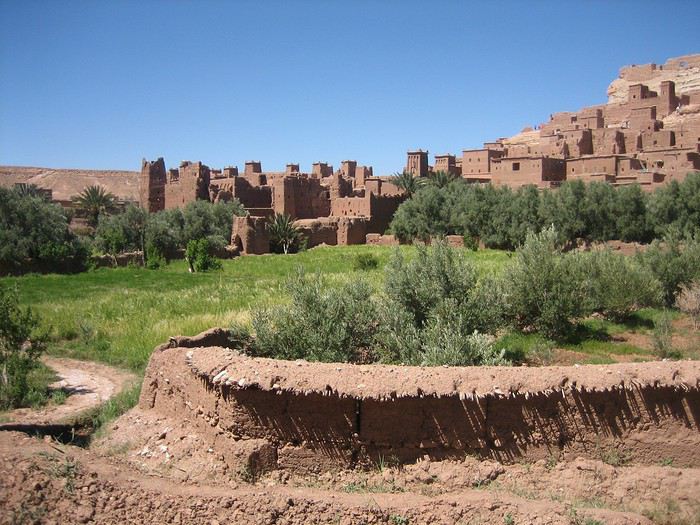
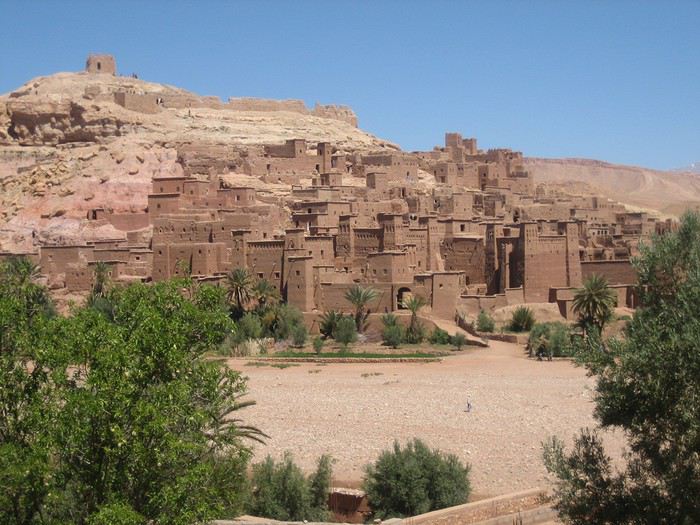
l'équipe de l'auberge " la baraka "
 A gauche , Brahim Bolkaid qui est le patron de l'auberge actuelle " maison d'hôtes panoramic "
en bas à droite le cuisinier !
j'en ai passer des heures dans la cuisine !
à cette période , il y avait des énormes bus d'Allemands , qui arrivaient avec toute leur nourriture !
ils consommaient très peu !
mais on leur servaient surtout des salades fraiches , des boisons ...
ils restaient 3 heures : boissons , pipi , visite du ksar et hop ils repartaient !
A gauche , Brahim Bolkaid qui est le patron de l'auberge actuelle " maison d'hôtes panoramic "
en bas à droite le cuisinier !
j'en ai passer des heures dans la cuisine !
à cette période , il y avait des énormes bus d'Allemands , qui arrivaient avec toute leur nourriture !
ils consommaient très peu !
mais on leur servaient surtout des salades fraiches , des boisons ...
ils restaient 3 heures : boissons , pipi , visite du ksar et hop ils repartaient !
la fresque chez Brahim !
AÏt Benhaddou , découvert en 202015 ...2 ou 3 auberges à l'époque ! j'étais à la Baraka ! à l'entrée du village ! c'était tellement cool à cette époque ! je faisais la cuisine avec Mohamed le cuisinier , dans la cuisine de l'auberge !
l'équipe de l'auberge " la baraka "
A gauche , Brahim Bolkaid qui est le patron de l'auberge actuelle " maison d'hôtes panoramic "
en bas à droite le cuisinier !
j'en ai passer des heures dans la cuisine !
à cette période , il y avait des énormes bus d'Allemands , qui arrivaient avec toute leur nourriture !
ils consommaient très peu !
mais on leur servaient surtout des salades fraiches , des boisons ...
ils restaient 3 heures : boissons , pipi , visite du ksar et hop ils repartaient !la fresque chez Brahim !
Adventures of a Bygone Era: The Philippines in 1984
After several discussions on VF about travel journals from the Philippines, I decided to write this curiosity: a trip report from a journey made in 1984, when traveling to the Philippines was still an adventure.
A curiosity because writing a travel journal about a trip 35 years later isn’t common, but also (mostly?) because exploring the Philippines at that time had little in common with traveling there today.
Obviously, I’ve forgotten a number of facts, most of the details, but with the help of a few notes from that time and a stack of slides (yes, there was life before digital 😊), many memories came back and added to the highlights I’d never forgotten. The scanned slides aren’t always great quality, but there are still quite a few to brighten up this chatter. Back then, we didn’t snap photos like we do now—film was too expensive—so I don’t have pictures of every place we visited... too bad, comparing some of those spots to how they look today would’ve been interesting.
Why "Adventures"? Why call it "Adventures" in the Philippines in 1984, a word so often used for a simple exotic trip? - Because the lack of information (no *Guide du Routard*, no *Lonely Planet*, no *Michelin Guide*, nothing, and obviously no internet) gave this trip what’s at the heart of adventure: the unknown. - Because the political situation made the stay sometimes dangerous. - Because transportation conditions were always epic, often perilous. - Because the question of where we’d spend the night came up almost every evening. - And for... quite a few other reasons.
That said, we weren’t exactly explorers!
Why the Philippines? First of all, why go to the Philippines in 1984—a country not exactly set up for tourism and about which we knew very little? How could we get an idea of the beauty of the Philippines and its points of interest when we had no guides or photos?
The idea came to us from Thailand a year earlier, during our first long-haul trip. After touring the north of the country, we met a Frenchman living in Phuket, where there were only a few tourists in Patong, with just a few small hotels and guesthouses. Kata and Karon had no buildings or roads, Rawai only had three palm-thatched bungalows, including ours, and the other islands were unknown to tourists. There was plenty to discover, and we wanted to return to this beautiful country... but the Frenchman made us dream about the Philippines—a country to explore, with wild landscapes.
Long evenings of discussion over multiple Sprite-Mekong cocktails (what memories of those headaches!) finally convinced us we had to go to the Philippines.
Episode 0: Before Departure The decision was made: we’d go to the Philippines in May 1984. Our friends and family were surprised when we announced we were going on vacation to the Philippines (a bit like saying today we were going paddleboarding in the Kerguelen Islands 🤪).
These days, preparing for each of our trips takes long evenings of research, planning, and noting down good addresses... etc. But for the Philippines in 1984, preparation was quick: we had very little information about the country, we were leaving almost at random, and the discovery would only be more exciting.
We still had a few bits of info gathered here and there: the rice terraces in northern Luzon, volcanoes, Negros where we were supposed to visit an acquaintance, Cebu and its marine life (we ended up going elsewhere), and absolutely avoid Mindanao, which was practically at war with the regime. That was about it, but it was already a great itinerary.
Nothing was organized in advance; we’d see day by day. We had no idea about travel times or even the existence of transportation options. The main (and sometimes only) way to connect two islands was by overloaded, rusty ferry. Only the big cities had airports.
Let’s Go: Episode 1: Paris to Manila My travel journals always start after arriving at the airport—the Europe-to-“Other Continent” trip isn’t interesting—but the flight to the Philippines was already an adventure, so I’ll make an exception.
This was the era when only a few Asian airlines were on par with Western ones: Thai, Singapore Airlines, and Philippine Airlines. They had beautiful, brand-new planes, and to attract customers (almost exclusively “businessmen”) from the usual airlines (Air France, Lufthansa, British Airways), there was opulence on board: unlimited champagne, all sorts of cocktails... Compared to today’s long-haul flights, there was still one small difference: no personal screens, just one screen at the front of the cabin with one mandatory movie. And I don’t know why, but we only got James Bond films, both ways... that must’ve been the trend at the time.
The tourism boom to Southeast Asia hadn’t started yet, and the “Asian Tigers” weren’t a thing, so there weren’t many business trips. That meant long-haul flights made stops everywhere to fill the planes. Our Philippine Airlines Boeing 747 left London, picked us up in Paris, then stopped in Frankfurt to take on a few Germans. I don’t know why we then made a stop in Dubai—a totally exotic place at the time. There was nothing to do there... things have changed a lot since. It was a small town lost in the desert. The airport was tiny, with just one or two buildings and a supermarket. During the stopover, everyone had to get off the plane and walk to the supermarket. Photo and electronic equipment were dirt cheap—I guess that was the only reason for the stop. Maybe it was their first commercial move. Emirates didn’t exist yet, as I checked online, but anyway, the idea that such a remote place could have its own airline was unthinkable.
Online, I found this photo of Dubai Airport in 1980. Anyone who’s transited through today’s massive airport with its rows of A380s will appreciate it: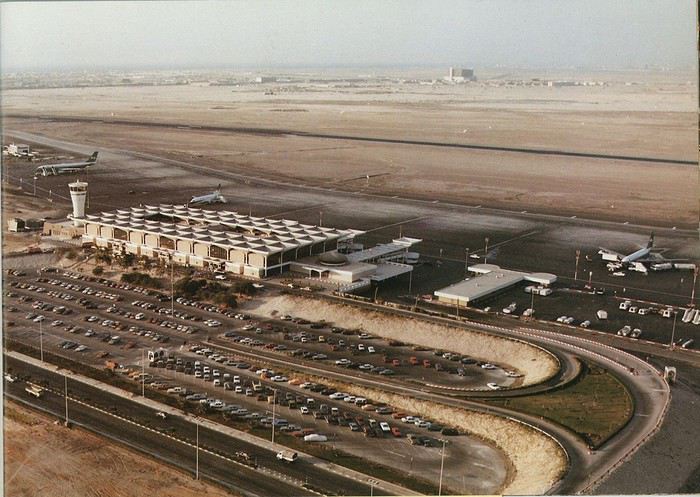
Next stop: New Delhi to drop off some Europeans and pick up a few Indians, and finally, the terminus: Manila. I don’t remember how long the trip took with its five stops—an unimaginable journey today. Despite all those stops to fill the plane, there was still enough space to stretch out on the four center seats of the 747, something that never happens these days despite all the flights in every direction.
So here we are, finally at Manila Airport around midnight.
Episode 1: Manila and Baguio To start, a quick note on the political and economic situation in the Philippines in 1984, which had consequences for us as tourists, as we’d soon realize upon arrival.
After several centuries of Spanish colonization, the Philippines became American at the start of the 20th century, then independent. In 1966, Marcos took power, and little by little, his regime sank into corruption and mismanagement, becoming a dictatorship with martial law, all for the benefit of his family and friends, who enriched themselves endlessly. The peak was the assassination of opposition leader Benigno Aquino in August 1983, which triggered harshly repressed protests. So we arrived a few months later in a very poor country, with omnipresent corruption and an extremely tense political situation, as we’d soon see for ourselves. Major protests took place in the main cities during our trip—I’ll come back to that. Two years later, Marcos fled to Hawaii after being forced out of power following rigged elections. This historical context explains a lot of the situations we found ourselves in over the following weeks.
Arriving in the middle of the night isn’t very cheerful. Manila was already a huge city with many slums, where you could find a few business hotels like the Hilton or Intercontinental—way out of our budget—and plenty of run-down hotels. Luckily, two Indians we’d chatted with on the plane offered to take us to their usual hotel. They came to Manila twice a year for business. We accepted their offer, relieved not to have to look for a place to stay in the middle of the night, figuring the address must be good since they came back every time... we were wrong 🙁
We left the airport and immediately got a taste of the local vibe when we got into the taxi: the police asked for our passports. We thought: what’s more normal than police in a dictatorship?
But that wasn’t it at all. Our two Indian friends explained that the police were noting our names along with the taxi number and time. Crime in Manila was so bad that the taxi driver would be held responsible if anything happened to us... welcome to the Philippines 😎 😎
Historically, the Philippines was a very violent country, where everything was settled with guns or machetes. Previous governments had banned carrying weapons, but Marcos later allowed the free sale and carrying of guns, and disputes were settled with pistols again (or worse, as we’d discover later). Since he’d released most of the criminals from prison to form a paramilitary militia at his service (I’ll talk about our encounter with these “heroes” later), it was pretty dangerous to go into many parts of Manila, where these “tonton macoutes” ruled.
We arrived at our hotel without incident... and then things started badly. The room was infested with big cockroaches—exactly what I hate most in those kinds of countries. No way to find another hotel at that hour. After the long flight, the urge to take a shower was so strong that we squeezed into the bathroom as best we could. After that, I don’t remember—I guess we must’ve fallen asleep exhausted under the sheets in the heat... air conditioning wasn’t widespread yet.
The next day, we just wanted to leave that dump as soon as possible. So we decided to head north right away, stopping in Baguio, and we’d visit Manila a bit on the way back.
When we stepped outside, we discovered a pretty run-down neighborhood with potholed streets. But we also discovered the jeepneys. They were everywhere, flooding the streets.
They had crazy sound systems, each one blasting louder than the last. The interiors were kitschy but fun. There weren’t many private cars—almost all transportation was by jeepney, with buses reserved for intercity trips.
Before heading to the bus terminal for the north, somewhere on the outskirts of the city, we needed to exchange some money. I don’t remember how we ended up in a policeman’s jeep who offered his services: - Exchange money on the black market at a better rate than the banks. - Take us wherever we wanted, in this case, the bus terminal.
We accepted both offers (we’d still checked the official exchange rate from dollars to pesos). So we found ourselves in his jeep. After exchanging money, we left in his vehicle and stopped for gas. Without turning off the engine, he calmly smoked a cigarette while filling up. Since we were in a jeep with no doors or roof, we were ready to jump out if things went south, our travel bag in hand.
But we weren’t done with surprises yet. Once we left the small streets, we ended up in a neighborhood with wide avenues and not much traffic, which didn’t justify his incredible behavior. At every intersection, he made the sign of the cross, closed his eyes, and crossed without looking. I was more stunned than terrified! It wasn’t until we got out of the car later that I told Anne-Marie what had happened. I’d seen everything because the cop had put me in the front seat. Luckily, A-Marie hadn’t noticed anything from the back. Crossing Manila by trusting God rather than the rules of the road was ultimately effective. We were lucky—the trip was off to a good start. 🙂 🙂
We then passed through a neighborhood where slums stretched on for a while, and we left our policeman—friendly but a bit crazy—with relief.
A few hours by bus later, here we are in Baguio, cool in the mountains. My memories of Baguio are pretty fuzzy. I remember a small town. After some research while writing this journal, I found that the population was 120,000 in 1980. Given the population density in each home, that confirms my memory of a smallish town. Outside the “official” district with the president’s summer residence and government buildings, there were two or three paved streets with nice houses. The rest was very dirty and very poor, with lots of slums and dirt roads.
People we met on the street invited us to stay with them. These days, we wouldn’t just show up at strangers’ houses, which we should’ve done in Baguio—it would’ve saved us from an unimaginable and dangerous situation... which I won’t say anything about... !😊
The simple wooden house was on stilts at the edge of a hill with a view of the mountains. Since it was the start of the rainy season in a city that gets a lot of rain, we saw a lot of water. Our outings in town happened between downpours.
View from our lodging:
Episode 2: Baguio to Bontoc Aside from the situation briefly mentioned above, it was on the next leg to Bontoc that the adventure really began: an endless and dangerous road, a bus from another era, breathtaking landscapes, and surprising people.
We didn’t know the distance or how long it would take to get to Bontoc. When we arrived after about ten hours, we learned that Baguio to Bontoc was 140 km.
We got on a bus with wooden seats and settled in, two to a seat meant for two. As the bus filled up, passengers squeezed in three or four per seat, with chickens and baskets full of all sorts of things in the aisle. A little embarrassed, we didn’t know if we should squeeze in three on our seat. The seats were super tight (luckily, Filipinos are small), and I didn’t know where to put my legs given my height. I don’t remember if we stayed alone on our bench or if we ended up sharing with others.
The “road” was a dirt track (or rather, a mud track) with endless turns. We held on as best we could to our slippery wooden seats—it was shaking in every direction. The woman behind us was carsick and throwing up... gross... but what were we doing there? Then we plunged into the Sierra Madre... just the name is dreamy!
Rice terraces started to appear:
they took up more and more space along cliffs where we weren’t always reassured,
with lots of waterfalls (all that water had to go somewhere).
A few miserable villages stretched along the track, most often just a few houses balancing between the road and the drop. The bus stopped in every village—people got on or off and settled inside or on the roof. Street vendors offered their products to the bus passengers—a common sight in Asia, even today.
We were in another world—villagers were in loincloths, others had spears. The atmosphere was strange... but all good, we wanted exoticism, and we got it:
This so-called traditional outfit was everyday wear—it wasn’t for tourists since there weren’t any.
A curiosity because writing a travel journal about a trip 35 years later isn’t common, but also (mostly?) because exploring the Philippines at that time had little in common with traveling there today.
Obviously, I’ve forgotten a number of facts, most of the details, but with the help of a few notes from that time and a stack of slides (yes, there was life before digital 😊), many memories came back and added to the highlights I’d never forgotten. The scanned slides aren’t always great quality, but there are still quite a few to brighten up this chatter. Back then, we didn’t snap photos like we do now—film was too expensive—so I don’t have pictures of every place we visited... too bad, comparing some of those spots to how they look today would’ve been interesting.
Why "Adventures"? Why call it "Adventures" in the Philippines in 1984, a word so often used for a simple exotic trip? - Because the lack of information (no *Guide du Routard*, no *Lonely Planet*, no *Michelin Guide*, nothing, and obviously no internet) gave this trip what’s at the heart of adventure: the unknown. - Because the political situation made the stay sometimes dangerous. - Because transportation conditions were always epic, often perilous. - Because the question of where we’d spend the night came up almost every evening. - And for... quite a few other reasons.
That said, we weren’t exactly explorers!
Why the Philippines? First of all, why go to the Philippines in 1984—a country not exactly set up for tourism and about which we knew very little? How could we get an idea of the beauty of the Philippines and its points of interest when we had no guides or photos?
The idea came to us from Thailand a year earlier, during our first long-haul trip. After touring the north of the country, we met a Frenchman living in Phuket, where there were only a few tourists in Patong, with just a few small hotels and guesthouses. Kata and Karon had no buildings or roads, Rawai only had three palm-thatched bungalows, including ours, and the other islands were unknown to tourists. There was plenty to discover, and we wanted to return to this beautiful country... but the Frenchman made us dream about the Philippines—a country to explore, with wild landscapes.
Long evenings of discussion over multiple Sprite-Mekong cocktails (what memories of those headaches!) finally convinced us we had to go to the Philippines.
Episode 0: Before Departure The decision was made: we’d go to the Philippines in May 1984. Our friends and family were surprised when we announced we were going on vacation to the Philippines (a bit like saying today we were going paddleboarding in the Kerguelen Islands 🤪).
These days, preparing for each of our trips takes long evenings of research, planning, and noting down good addresses... etc. But for the Philippines in 1984, preparation was quick: we had very little information about the country, we were leaving almost at random, and the discovery would only be more exciting.
We still had a few bits of info gathered here and there: the rice terraces in northern Luzon, volcanoes, Negros where we were supposed to visit an acquaintance, Cebu and its marine life (we ended up going elsewhere), and absolutely avoid Mindanao, which was practically at war with the regime. That was about it, but it was already a great itinerary.
Nothing was organized in advance; we’d see day by day. We had no idea about travel times or even the existence of transportation options. The main (and sometimes only) way to connect two islands was by overloaded, rusty ferry. Only the big cities had airports.
Let’s Go: Episode 1: Paris to Manila My travel journals always start after arriving at the airport—the Europe-to-“Other Continent” trip isn’t interesting—but the flight to the Philippines was already an adventure, so I’ll make an exception.
This was the era when only a few Asian airlines were on par with Western ones: Thai, Singapore Airlines, and Philippine Airlines. They had beautiful, brand-new planes, and to attract customers (almost exclusively “businessmen”) from the usual airlines (Air France, Lufthansa, British Airways), there was opulence on board: unlimited champagne, all sorts of cocktails... Compared to today’s long-haul flights, there was still one small difference: no personal screens, just one screen at the front of the cabin with one mandatory movie. And I don’t know why, but we only got James Bond films, both ways... that must’ve been the trend at the time.
The tourism boom to Southeast Asia hadn’t started yet, and the “Asian Tigers” weren’t a thing, so there weren’t many business trips. That meant long-haul flights made stops everywhere to fill the planes. Our Philippine Airlines Boeing 747 left London, picked us up in Paris, then stopped in Frankfurt to take on a few Germans. I don’t know why we then made a stop in Dubai—a totally exotic place at the time. There was nothing to do there... things have changed a lot since. It was a small town lost in the desert. The airport was tiny, with just one or two buildings and a supermarket. During the stopover, everyone had to get off the plane and walk to the supermarket. Photo and electronic equipment were dirt cheap—I guess that was the only reason for the stop. Maybe it was their first commercial move. Emirates didn’t exist yet, as I checked online, but anyway, the idea that such a remote place could have its own airline was unthinkable.
Online, I found this photo of Dubai Airport in 1980. Anyone who’s transited through today’s massive airport with its rows of A380s will appreciate it:
Next stop: New Delhi to drop off some Europeans and pick up a few Indians, and finally, the terminus: Manila. I don’t remember how long the trip took with its five stops—an unimaginable journey today. Despite all those stops to fill the plane, there was still enough space to stretch out on the four center seats of the 747, something that never happens these days despite all the flights in every direction.
So here we are, finally at Manila Airport around midnight.
Episode 1: Manila and Baguio To start, a quick note on the political and economic situation in the Philippines in 1984, which had consequences for us as tourists, as we’d soon realize upon arrival.
After several centuries of Spanish colonization, the Philippines became American at the start of the 20th century, then independent. In 1966, Marcos took power, and little by little, his regime sank into corruption and mismanagement, becoming a dictatorship with martial law, all for the benefit of his family and friends, who enriched themselves endlessly. The peak was the assassination of opposition leader Benigno Aquino in August 1983, which triggered harshly repressed protests. So we arrived a few months later in a very poor country, with omnipresent corruption and an extremely tense political situation, as we’d soon see for ourselves. Major protests took place in the main cities during our trip—I’ll come back to that. Two years later, Marcos fled to Hawaii after being forced out of power following rigged elections. This historical context explains a lot of the situations we found ourselves in over the following weeks.
Arriving in the middle of the night isn’t very cheerful. Manila was already a huge city with many slums, where you could find a few business hotels like the Hilton or Intercontinental—way out of our budget—and plenty of run-down hotels. Luckily, two Indians we’d chatted with on the plane offered to take us to their usual hotel. They came to Manila twice a year for business. We accepted their offer, relieved not to have to look for a place to stay in the middle of the night, figuring the address must be good since they came back every time... we were wrong 🙁
We left the airport and immediately got a taste of the local vibe when we got into the taxi: the police asked for our passports. We thought: what’s more normal than police in a dictatorship?
But that wasn’t it at all. Our two Indian friends explained that the police were noting our names along with the taxi number and time. Crime in Manila was so bad that the taxi driver would be held responsible if anything happened to us... welcome to the Philippines 😎 😎
Historically, the Philippines was a very violent country, where everything was settled with guns or machetes. Previous governments had banned carrying weapons, but Marcos later allowed the free sale and carrying of guns, and disputes were settled with pistols again (or worse, as we’d discover later). Since he’d released most of the criminals from prison to form a paramilitary militia at his service (I’ll talk about our encounter with these “heroes” later), it was pretty dangerous to go into many parts of Manila, where these “tonton macoutes” ruled.
We arrived at our hotel without incident... and then things started badly. The room was infested with big cockroaches—exactly what I hate most in those kinds of countries. No way to find another hotel at that hour. After the long flight, the urge to take a shower was so strong that we squeezed into the bathroom as best we could. After that, I don’t remember—I guess we must’ve fallen asleep exhausted under the sheets in the heat... air conditioning wasn’t widespread yet.
The next day, we just wanted to leave that dump as soon as possible. So we decided to head north right away, stopping in Baguio, and we’d visit Manila a bit on the way back.
When we stepped outside, we discovered a pretty run-down neighborhood with potholed streets. But we also discovered the jeepneys. They were everywhere, flooding the streets.
They had crazy sound systems, each one blasting louder than the last. The interiors were kitschy but fun. There weren’t many private cars—almost all transportation was by jeepney, with buses reserved for intercity trips.
Before heading to the bus terminal for the north, somewhere on the outskirts of the city, we needed to exchange some money. I don’t remember how we ended up in a policeman’s jeep who offered his services: - Exchange money on the black market at a better rate than the banks. - Take us wherever we wanted, in this case, the bus terminal.
We accepted both offers (we’d still checked the official exchange rate from dollars to pesos). So we found ourselves in his jeep. After exchanging money, we left in his vehicle and stopped for gas. Without turning off the engine, he calmly smoked a cigarette while filling up. Since we were in a jeep with no doors or roof, we were ready to jump out if things went south, our travel bag in hand.
But we weren’t done with surprises yet. Once we left the small streets, we ended up in a neighborhood with wide avenues and not much traffic, which didn’t justify his incredible behavior. At every intersection, he made the sign of the cross, closed his eyes, and crossed without looking. I was more stunned than terrified! It wasn’t until we got out of the car later that I told Anne-Marie what had happened. I’d seen everything because the cop had put me in the front seat. Luckily, A-Marie hadn’t noticed anything from the back. Crossing Manila by trusting God rather than the rules of the road was ultimately effective. We were lucky—the trip was off to a good start. 🙂 🙂
We then passed through a neighborhood where slums stretched on for a while, and we left our policeman—friendly but a bit crazy—with relief.
A few hours by bus later, here we are in Baguio, cool in the mountains. My memories of Baguio are pretty fuzzy. I remember a small town. After some research while writing this journal, I found that the population was 120,000 in 1980. Given the population density in each home, that confirms my memory of a smallish town. Outside the “official” district with the president’s summer residence and government buildings, there were two or three paved streets with nice houses. The rest was very dirty and very poor, with lots of slums and dirt roads.
People we met on the street invited us to stay with them. These days, we wouldn’t just show up at strangers’ houses, which we should’ve done in Baguio—it would’ve saved us from an unimaginable and dangerous situation... which I won’t say anything about... !😊
The simple wooden house was on stilts at the edge of a hill with a view of the mountains. Since it was the start of the rainy season in a city that gets a lot of rain, we saw a lot of water. Our outings in town happened between downpours.
View from our lodging:
Episode 2: Baguio to Bontoc Aside from the situation briefly mentioned above, it was on the next leg to Bontoc that the adventure really began: an endless and dangerous road, a bus from another era, breathtaking landscapes, and surprising people.
We didn’t know the distance or how long it would take to get to Bontoc. When we arrived after about ten hours, we learned that Baguio to Bontoc was 140 km.
We got on a bus with wooden seats and settled in, two to a seat meant for two. As the bus filled up, passengers squeezed in three or four per seat, with chickens and baskets full of all sorts of things in the aisle. A little embarrassed, we didn’t know if we should squeeze in three on our seat. The seats were super tight (luckily, Filipinos are small), and I didn’t know where to put my legs given my height. I don’t remember if we stayed alone on our bench or if we ended up sharing with others.
The “road” was a dirt track (or rather, a mud track) with endless turns. We held on as best we could to our slippery wooden seats—it was shaking in every direction. The woman behind us was carsick and throwing up... gross... but what were we doing there? Then we plunged into the Sierra Madre... just the name is dreamy!
Rice terraces started to appear:
they took up more and more space along cliffs where we weren’t always reassured,
with lots of waterfalls (all that water had to go somewhere).
A few miserable villages stretched along the track, most often just a few houses balancing between the road and the drop. The bus stopped in every village—people got on or off and settled inside or on the roof. Street vendors offered their products to the bus passengers—a common sight in Asia, even today.
We were in another world—villagers were in loincloths, others had spears. The atmosphere was strange... but all good, we wanted exoticism, and we got it:
This so-called traditional outfit was everyday wear—it wasn’t for tourists since there weren’t any.
Un mois au Mozambique: logistique et réflexions English translation pending
Bonjour
Les retours de voyages au Mozambique sont peu nombreux sur VF, aussi je propose le mien qui s’est déroulé du 1 février au 29 février 2020. C’est la saison des pluies, ce n’est pas la saison touristique, on rencontre très peu de touristes, voire aucun, mais il y a beaucoup de soleil.
Je vais d’abord présenter la logistique, puis proposer quelques réflexions plus tard.
Visa. J’ai obtenu le visa très facilement au consulat de Mozambique à Zanzibar en 7 jours, le temps de visiter tranquillement l’île. Le visa a une durée de 90 jours, pour une visite de 30 jours maximum, il coûte 60 euros. Il semble que le e-visa soit pas facile à obtenir; en Europe, il faut se rendre au consulat du pays. Le visa à la frontière terrestre n’est pas possible.
Les gens. La population, bien que très pauvre, est d’un naturel souriant, aimable et serviable. On vous propose souvent de l’aide de façon désintéressée. La politesse est de mise en toutes circonstances. Aucune insécurité dans les campagnes ni même dans les villes, mais nous ne sortions pas le soir. Ce qui ne veut pas dire que le dangé soit inexistant, simplement qu’il y a moyen de l’éviter. La promiscuité très grande dans les chapas n’engendre aucun geste déplacé envers les femmes. Bien que la langue officielle soit le portugais, la plupart des gens parlent des dialectes bantous différents selon les régions. Il est parfois nécessaire de recourir au langage des signes en plus de quelques mots portugais. Sauf dans les hôtels et les comptoirs qui vendent les billets de bus, l’anglais est rarement pratiqué, mais les chauffeurs de chapas et les petits commerçants se débrouillent avec quelques mots. Les enfants vous lanceront spontanément des « how are you » auxquels il convient de répondre. On nous appelle Papa ou Mama – nous sommes les deux retraités -, une formule à la fois familière et respectueuse. Comme partout en Afrique, on vit dehors. Une occasion pour le voyageur d’observer respectueusement les comportements et de se comporter en conséquence.
Les livres. On avait deux livres, l’un excellent, le Bradt (éd.2017), l’autre minable : le Petit Futé (PF). Pour le montrer, je prends un seul exemple. Page 231 du PF, édition 2017 - celle vendue pour l’édition 2019-2020 -, on lit : « Pour aller vers le Sud, la route est relativement longue, avec un obstacle de taille : le Zambèze. En effet, il lui manquerait un pont [ … ] de nombreux chapas direction Beira attendent tous les futés ( je souligne ) qui ont décidé de ne pas rester assis deux heures inutilement dans le bus. ». Or il y a un pont qui permet de traverser le Zambèze depuis 2009 ! CQFD.
Les sous. Tous les ATM ne conviennent pas aux touristes. Millennium (en couleur rose) accepte les cartes visa et master étrangères, retrait de 10 000 meticals (mzn) maximum, 200 mzn de frais fixes. Du coup on n’a pas essayé d’autres banques, ces conditions sont excellentes, Millennium est partout présent au Mozambique. On peut payer sans frais avec sa carte bancaire dans de nombreux hôtels, restaurants et magasins, même pour quelques euros. Si on privilégie ce mode de paiement, alors les mzn retirés dans les ATM deviennent de l’argent de poche, pour les achats sur les marchés, payer les chapas, etc… ; ainsi on limite le recours aux ATM et on minimise les frais.
Le transport. Pour les machibombos (de grands bus confortables) on nous demande de venir à 5 h du matin. Il faut comprendre que la vente des billets restants se fait à partir de 5 h ; le bus est susceptible de partir dès qu’il est plein, à défaut, il partira à 6 h au plus tard et prendra des passagers en route. Les gens qui ont pris leur billet la veille arrivent vers les 5h 45. Si vous n’avez pas de billet, venir tôt permet d’obtenir les meilleures places libres.
Pour les chapas, idem, sauf qu’ils se remplissent plus vite. On achète le billet toujours sur place ou dans le chapa. Il y a de nombreux chapas le matin, ils se font plus rares l’après-midi. Le nombre de passagers n’est pas limité. Les meilleures places sont celles à partir du deuxième rang, côté vitre, ainsi vous ne serez pas gênés par les nombreuses sorties-entrées des passagers et vous aurez un peu d‘air si la vitre s’ouvre. Les 2 places de devant sont les meilleures. Contrairement à ce que j’ai lu sur VF, on n’a jamais rien payé pour les bagages.
Le logement. On choisit des logements corrects, dans la catégorie « prix moyen », avec une bonne literie, une chambre toujours très propre - draps et serviettes de bains changés -, la wifi, une salle de bain non partagée, l’eau chaude, la climatisation - à défaut un ventilateur, souvent les deux à la fois -, une moustiquaire, mais sans personnalité, pour un prix correct, autour de 3 000 mzn pour une chambre double, soit 40 euros. Mais on peut se loger pour beaucoup moins cher, dans des dortoirs ou des chambres moins bien équipées, voire camper. Le Mozambique peut être une destination pour routards.
La météo. L’été austral est la saison des pluies. Sauf en cas de dépression – comme ce fut le cas fin janvier dans la partie nord – les pluies peuvent être fortes mais elles ne durent jamais longtemps. Il y a surtout du soleil, ainsi on n’a eu que peu ou pas de pluie au total et beaucoup de soleil. Le jour se lève tôt, le soleil frappe fort assez rapidement, il fait très chaud dès le matin ; aussi les Mozambicains se lèvent tôt. C’est surtout la chaleur et le soleil, bien plus que la pluie, qui peuvent rendre les conditions du voyage difficiles sauf pour la route.
Le passage de la frontière. On vient de Tanzanie et nous traversons la frontière par la côte, à Kiranbo. Nous passons notre dernière nuit tanzanienne à Mtwara, au Lole grand lodge : 30000 tsh, breakfast inclus ; chambre un peu petite mais confortable ; excellent wifi ; bon breakfast ; bonne situation ; bon rapport qualité prix. De l’hôtel nous réservons un dalla dalla pour le lendemain matin 5 heures (h) qui ne viendra pas. L’unique dalla-dalla qui va à la frontière stationne dans une rue à droite de l’entrée de la gare routière des dalla-dalla. A 5 h effectivement, là, un taxi collectif attend les passagers. Il part à 6 h sans être plein, aussi il passe à la gare routière des bus pour finir de se remplir.
Le dalla-dalla s’arrête pour les formalités au poste frontière, puis continue jusqu’à la rivière Ruvuma, son terminus où attend une embarcation. Ici le Bradt conseille de faire le change, pour mon malheur. Le prix de la traversée est de 1 000 shillings (tsh), payable en tsh « uniquement ». Comme j’avais changé tous mes tsh, j’ai voulu payer en USD, et ce fut une palabre des plus désagréables pour y arriver.
Du côté Mozambique on arrive au milieu de nulle part. Il faut marcher sur un sentier rendu glissant par la pluie pour atteindre la route. Les militaires font une première vérification méticuleuse de nos papiers et bagages. On monte dans un taxi collectif qui attend. Il stoppe un peu plus loin au vrai poste frontière en dur - nouvelles vérifications méticuleuses – et va jusqu’à Mocimboa da Praia son terminus. La route en terre est épouvantable jusqu’à Palma, ensuite on trouve le goudron. Le prix du trajet revient à 1 000 mzn, le chauffeur nous demandera 2 500 mzn, après discussion, on paiera 1 500 mzn chacun.
On ne s’est pas arrêté à Palma où l’on voit quelques guest houses correctes de l’extérieur. La route est longue jusqu’à Mocimboa, le taxi assez confortable, mais on n’a pas à changer de véhicule, un avantage certain. On a été trop souvent arrêtés par l’armée sur ce tronçon avec à chaque fois une vérification minutieuse de nos passeports. Un des postes a été jusqu’à téléphoner au consulat de Zanzibar ! A croire que les touristes qui viennent par la frontière tanzanienne sont suspects. Cependant, le climat politique dans la province du Cabo Delgado explique cette suspicion.
Le Nord.
Mocimboa da praia. On descend au Vumba complex, seul hôtel convenable à notre avis : 3750 mzn breakfast inclus ; chambre immense, mais tout est déglingué dans la salle de bains : ni eau, ni électricité, seau d’eau et lampe de poche. En revanche, très bon restaurant-bar avec wifi. Le prix trop élevé. L’environnement est misérable, la plage une décharge, l’hôtel loin du centre. La ville ne présente pas d’intérêt particulier, sauf le soir son petit marché et l’ATM Millennium.
Macomia. Pour rejoindre le village étape, on doit faire un détour par Mueda, à cause de l’état de la route, nous dit-on. Pas de chapa, on prend le premier petit camion bâché avec les chèvres et les bidons d’essence. À Mueda on reste de longues heures à attendre que l’on puisse monter à l’arrière d’un camion non bâché, surchargé de voyageurs, dans des conditions précaires. La route pour rejoindre la nationale est en fin de construction, aussi seuls les camions 4X4 peuvent circuler sur le bas-côté. Sur la nationale on doit changer de chapa pour traverser le Rio Messalo (nom incertain) sur une pirogue traditionnelle (100 mzn) : il n’y a pas de pont. On arrive à Macomia à la nuit. On nous recommande le 2M hôtel : 2000 mzn sans breakfast ; chambre moderne avec salle de bains récente, très bonne douche ; mais le tout très humide et oppressant ; wifi. Le village est tout simple, on trouve des marchands de brochettes et d’autres en-cas, et aussi de la bière - la 2 M, qui est bonne -
Pemba. La route ne se fait qu’en chapa, le pont de la rivière Montepuez (nom certain) s’est cassé à la dernière dépression. On arrive 1 h avant que les embarcations officielles s’activent. On prend place dans la file indienne, sous un soleil qui tue, dans une chaleur moite, c’est le quotidien de la population. Une fois la rivière traversée (gratuit), il faut suivre un sentier boueux et chaotique, pour prendre un nouveau chapa qui va à Pemba. (À la fin du séjour, à Maputo, nous avons vu à la TV l’inauguration d’une digue permettant de traverser le Rio à sec. Digue qui était en préparation lors de notre passage.)
À Pemba on a choisi l’Hôtel Saruma : 3000 mzn par nuit au lieu de 3 200, breakfast inclus. L’hôtel est moderne avec piscine ; confort moyen ; problèmes wifi résolus le deuxième jour ; bon restaurant ; breakfast de base gratuit mais payant si on ajoute une commande… Situation en bout de plage qui rend l’hôtel plus attractif que ceux de la ville moite et poussiéreuse. Proximité Shoprite (Hyper). Loin de la gare routière et du centre-ville, le trajet se fait cependant facilement en chapa pour quelques mzn. Pemba possède une plage qui pourrait être agréable si elle était propre.
On prend la veille les billets de bus pour Namialo, dans une rue juste avant la place des héros. On nous demande d’être près de l’aéroport à 5h et de fait le bus part à l’heure, sauf qu’il retourne en ville pour prendre les passagers et attend pour se remplir, de sorte que ce n’est que vers 6 h que nous partons vraiment.
À partir de Pemba il est possible de prendre des machibombos pour les longs trajets, puis les chapas pour les terminer, un luxe sans pareil. On refusera de monter dans les camions, même si l’on doit attendre un peu plus de temps, l’expérience de Mueda nous a totalement dégoûtés.
Isla de Mozambique. Pour se rendre dans l’ile, on s’arrête à Namiolo et on termine le trajet en chapa. Il faut faire attention parce que tous les chapas crient Isla ! Cependant ils ne vont pas tous à Isla, certains vont à Quixaxe et vous déposent au carrefour pour Isla, ou encore, un peu plus loin à un autre carrefour pour Isla s’ils vont à Nacala. De là il faudra prendre un autre chapa ou un camion alors que d’autres chapas vont directement de Namiolo à Isla ; il faut donc demander le terminus du chapa. On a dû finir le trajet en camion non bâché… le dernier !
Puis on prend un autre véhicule pour le pont et parcourir la ville. Nous sommes descendus au Café central : 3000 mzn au lieu de 3200, Breakfast inclus. Magnifique maison ancienne superbement restaurée par un Autrichien des plus sympathiques parlant le français – mais l’hôtel est très humide ; piscine ; wifi dans la chambre. Très agréable, si on excepte l’humidité. Restaurant et bar excellents, breakfast somptueux ; service impeccable.
Isla de Mozambique est inscrite à l’Unesco ce qui se justifie. On a surtout apprécié la visite du musée dans le palais Sao Paulo et sa très belle chapelle ; les balades dans l’ile ; moins le fort qui est vide - la restauration est incomplète, voire laissée à l’abandon -. Isla possède un énorme potentiel architectural. Je souligne la nette séparation du village autochtone avec la partie touristique de l’ile. Il est agréable de prendre une bière face à la mer.
NB. Un beau documentaire sur Isla Mozambique a été diffusé sur la chaîne Ô : https://www.france.tv/documentaires/voyages/1319865-a-la-decouverte-de-l-ile-de-mozambique.html
Le centre
Nampula. Vers 5 h on prend un chapa pour rejoindre le continent. Le chapa cherche de rares clients et fait plusieurs fois le tour de l’Ile. Puis il s’arrête encore, on est dans le chapa depuis 1 h. On décide de le quitter pour se mettre à l’entrée du pont, où une moto nous prend rapidement. Dans la foulée, sur le continent, un autre chapa ira directement à Nampula. On trouvera l’Hôtel Lucio, un peu au culot : 3000 mzn obtenus du patron - un marocain qui parle bien le français - au lieu de 4000, breakfast inclus ; situation centrale ; bon confort ; wifi dans la chambre ; breakfast un peu basique et solennel mais correct. Nampula est la première vraie ville où on s’arrête, avec de larges avenues. On a apprécié la visite du musée et le restaurant Copacabana.
Ici nous nous séparons, mon amie et moi. Elle préfère prendre l’avion pour Beira, 1 000 km plus loin, moins fatigant, plus sécuritaire. Moi je continue en bus, 2 fois 500 Km, avec un arrêt à Quelimane.
Quelimane. Je prends un bus qui part à 6 h (j’y étais comme tous les autres à 5 h) pour 6 heures de trajet. J’arrive donc à destination à midi. Je m’installe à la Pensao ideal, 1 500 mzn, chambre petite, clim, salle de bain correcte mais basique. L’hôtel est en rénovation. Je pensais rester 2 nuits pour me reposer une journée entre deux trajets en bus, la ville ne le mérite même pas. La vieille église ne se visite plus. Je suis surpris de voir des immeubles totalement glauques et repoussants, pourtant habités - j’ai eu cette impression en Russie -. Il semble que cet état soit dû aux cyclones qui ont pourri ces immeubles ; à côté, il y a des bâtiments modernes. De plus c’est dimanche, il n’y a personne dans la ville, tout est fermé. Aussi, face à l’ambiance pesante de la ville, je décide de repartir le lendemain, en bus, pour Beira.
En Avion. De son côté, mon amie prend le vol Nampula-Maputo, avec une escale à Beira : Ethiopian Airlines, un petit avion neuf, 9000 mzn, le billet est pris à l’aéroport sans réservation. L’aéroport de Nampula est moderne avec une bonne organisation, alors que mon amie s’attendait à un vieux coucou et une atmosphère chaotique. En fait les lignes intérieures mozambicaines sont bien développées, les gens qui le peuvent les empruntent de préférence aux bus. Le temps est dégagé, le paysage est magnifique, notamment le delta du Zambèze. À Beira, seulement deux personnes descendent, aéroport endormi, pas de chapa pour la ville, 10km plus loin. Le taxi revient à 800 mzn, prix affiché, on a intérêt à être plusieurs…
Beira. Je retrouve mon amie au VIP Inn : 4000 mzn au lieu de 4500, breakfast inclus ; hôtel classe un peu triste (parce que vide, hors saison ?) ; chambre et salle de bains impeccables ; wifi dans la chambre ; restaurant tristounet et breakfast aussi, mais tout est très correct. L’environnement est décourageant, route en mauvais état, immeubles en ruine, ordures à ciel ouvert, et le VIP INN apparaît comme un havre de luxe au milieu de cette désolation. Le centre-ville a dû être très agréable autrefois pour une promenade. Elle a, nous a-t-on dit, souffert du cyclone dévastateur de 2019 et la reconstruction est lente. Il reste quelques vestiges coloniaux intéressants. Les livres conseillent la visite de la maison de la culture que l’on repère de loin par des tags sur les murs : bof, tout est vide, un peu triste, sauf 2 pièces qui exposent des objets à vendre. Comme la maison de la culture est en retrait de la route, c’est agréable de prendre une bière, au calme, avant de repartir. Quand on s’écarte du centre-ville, pour rejoindre la plage, on retrouve ces immeubles délabrés comme ceux de Quelimane. L’ensemble ressemble plus à un « bidonville » qu’à une « résidence », face à une plage sale, très sale. Tout cela est bien triste.
Le sud, les plages
Vilankulo. On fait le trajet Beira-Vilankulo en machibombo. On descend au Baobab Backpackers : 3 000 mzn au lieu de 3200, breakfast payant ; paillote super confortable en bord de plage, salon terrasse. Restaurant et bar agréables ; très bonne cuisine ; wifi capricieuse au bar, magasin ; service agréable. Un magnifique endroit, à conseiller. Possibilité de dortoirs. Un peu loin du centre et de la gare routière. Pour y arriver, au T - qui est aussi un carrefour -, prendre à droite jusqu’au marché, puis la 2 ème rue à gauche. Ensuite c’est vaguement indiqué. Assez loin, devant une ruine, prendre le chemin de sable en face, enfin après une petite boutique, prendre à droite, vous y êtes tout de suite La plage est immense, tout en longueur à marée haute, tout en profondeur à marée basse. Comme certaines plages de Zanzibar, la mer se retire très loin. La plage alors devient un jeu de couleur, le vert et le bleu dominant dans un dégradé infini, un paysage pour les peintres impressionnistes. Sur la plage quelques bateaux se reposent ou flottent. Quand la mer est haute, les pêcheurs reviennent de la pêche.
Tofo. Certains posts sur VF expliquent bien que, venant de Beira, il faut descendre à Maxixe pour embarquer sur une coquille de noix surchargée afin de rejoindre Inhambane, un raccourci. De là un gros bus de ville, surchargé aussi, va à Tofo. Le trajet en bus a été pénible à cause des secousses de la route - on est debout –, et de la chaleur. La récompense fut Liquid dive (tout près du Fatima’s Nest, un centre de plongée ; 6 300 mzn, breakfast inclus. Bungalow en dur tout confort, en face de la plage, le rêve. Excellents restaurant (végétarien) et breakfast ; piscine ; activités diverses en rapport avec la plongée, wifi à la réception. Le village de Tofo est minuscule et très agréable. La plage est immense, avec du sable blanc fin, les dunes une bonne surprise, une plage très différente de celle de Vilankulo. On peut regretter la proximité des hôtels qui mangent la plage.
Imhabane. Comme on n’a pas visité la ville à l’aller, que faire le trajet Tofo-Imhabane pour attraper un bus pour Xai-Xai tôt le matin est impossible, on en profite pour ne pas se presser. La visite de la ville se justifie par sa bibliothèque, sa baie, ses maisons, son petit musée, dense, intéressant, à la gloire du parti Frelimo et de ses leaders. On descend à l’Hôtel Africa Tropical : 3 000 mzn, breakfast inclus ; chambre agréable dans un jardin, tout correct ; wifi dans la chambre ; le week-end musique en live dans le café-restaurant. On n’a pas profité du breakfast, départ matinal. On a acheté le billet de bus la veille avec l’aide d’un policier ; il sera là pour nous indiquer le bus à prendre à 5 h du matin ; une fois installés le bus démarre. Incroyable, il nous attendait ! Le bus nous dépose à l’entrée de Xai Xai, pour prendre un chapa en direction de la plage, 10 km.
Xai Xai. On descend au Complex Halley 3000 mzn au lieu de 3500 breakfast inclus, centre de vacances à la plage, vide parce que hors saison. Un semblant de luxe agréable ; excellent restaurant un peu cher ; wifi dans la chambre ; service stylé. La plage de Xai Xai est particulière. Elle est vaste et déserte en cette saison, le sable un peu granulé et épais, pas comme celui de Tofo. Une barre de rochers délimite un bassin plus tranquille où jouent les enfants qui semblent ignorer l’école. La mer est sauvage surtout au-delà de la barre, les vagues s’écrasant sur les rochers de façon spectaculaire. La localité se compose de résidences secondaires et de quelques ruines. Tout est fermé. Petit magasin au village local, loin de la mer. Atmosphère pour films nostalgiques, pas pour nous déplaire.
Maputo. De la plage de Xai Xai, on prend un chapa pour rejoindre la ville de Xai Xai, il nous dépose à la sortie de la ville, près du pont du Limpopo, où on attend le bus confortable que nous avons pris il y a 2 jours, venant d’Imhabane. Le bus s’arrête à la demande … on sait qu’il passe vers 9h, le chauffeur nous reconnaît. Vous devez refuser toutes les propositions de chapas, nettement moins pratiques, sans doute moins chers ; le bus les dépassera sur la route. La gare routière de Maputo, du moins celle où s’arrête le bus, est à la périphérie du bidonville que nous avons traversé et qui encercle la capitale. On a pris un taxi collectif pour se rendre à l’hôtel et négocié le prix. On s’installe à l’hôtel Santa Cruz, 2500 mzn au lieu de 2800 à condition de réserver 5 nuits, breakfast inclus. La situation centrale est idéale pour visiter la ville. Wifi dans la chambre ; ascenseur. Confort correct mais chambre petite et salle de bains trop petite et vieillotte. Breakfast basique. Dîner très moyen. Bon rapport qualité prix mais pas très classe On a apprécié la découverte de la vieille ville, les musées, le marché artisanal idéal pour les cadeaux, les vestiges de la colonisation portugaise, la gare avec son très intéressant musée qui explique le développement du pays par le développement du chemin de fer, le fort, la ville moderne et ses grandes avenues. Maputo a plusieurs visages, quartiers résidentiels, quartiers défavorisés, comme toute grande ville, mais somme toute une ville agréable. La plage – Costa do sol - est une longue barre de sable qui s’étend très loin à marée basse, déserte à cette période de l’année. Il semble que cette plage soit le lieu de la future croissance de Maputo : on y trouve déjà un casino, des grandes enseignes d’hyper, des immeubles d’habitation, souvent vides. Se déplacer en transport en commun est facile, il y a des plans affichés à chaque arrêt de bus : les bus et chapas ont souvent leur terminus à la gare. Pour se rendre vers le N-E de Maputo, où se trouvent : - le marché artisanal ; - la Présidence ; - l’hôtel Polana Serena magnifique par son architecture, son histoire, sa situation ; - la Costa do Sol ; on prend un bus ou un chapa indiquant do Sol, sur l’avenida Eduardo Mondlane, et on descend au bon arrêt, par exemple, pour le marché artisanal, le premier arrêt sur avenida Julius Nyerere, et continuer à pied, les chauffeurs vous aideront. Toutefois, la ville historique (Baixa) se visite facilement à pied.
Ponta do Ouro. Mon amie est retournée chez elle, fatiguée : les 2500 km parcourus ont été une épreuve, qui aujourd’hui l’étonnent de s’être si bien comportée. Il me reste quelques jours et je décide de visiter la dernière plage du sud du pays avant mon passage en Afrique du Sud (AS). Je quitte l’hôtel Santa Cruz pour prendre un autre hôtel juste à côté du Musée de la Monnaie – j’ai oublié le nom -, rue Bagamoyo. L’hôtel a accepté de garder mon sac à dos avant de prendre la chambre. Je me rends à la Gare pour un bus en direction de Catembe, avant 7 h. Je descends au grand rond-point après le grand pont suspendu où arrive bientôt le bus de ville qui se rend à Ouro - départ régulier toutes les heures, aussi la visite de Ouro peut-elle se faire dans la journée de Maputo, ce qui est suffisant - ; le bus passe d’abord par la frontière. Au retour pareil : on descend à ce grand rond-point (le bus Maputo-Ouro ne passe pas par la gare) pour prendre la correspondance gratuite pour la gare, c’est la même compagnie. À Ouro, je m’installe au Underwater Explorer, pas cher, 12 euros, une petite chambre très basique pour backpacker, avec douches partagées, ventilateur, mais cuisine et réfrigérateur, la plage juste derrière ; c’est surtout un centre de plongée. La plage do Ouro est très belle, l’océan agité, du déjà vu. Le fait marquant vient de ce que l’on est déjà « plus tout à fait » au Mozambique mais « déjà un peu » en AS tant la présence des Sud-Africains est visible par leurs « gros tubes 4x4 », ou encore par leur vedette-hors-bord qu’ils font glisser sur le sable en sortant de l’eau à toute vitesse : bonjour les « musclors ». Certains SA possèdent des maisons secondaires à Ouro. Un peu comme à Las Vegas, on est dans un environnement surfait.
L'Afrique su Sud. De retour à Maputo, avec le bus Intercape, je passe en AS. La formalité à la frontière est simple … juste un tampon sur le passeport. Un mot pour souligner l’incroyable différence entre les deux pays. L’AS est bien le pays le plus développé de l’Afrique australe, c’est une évidence dès les premiers Km dans le pays, en regardant par la fenêtre les champs de maïs ou de bananes bien alignés, bien entretenus.
Limites. On n’a pas visité les réserves, fermées ; ni la région de Tete pour notre sécurité, à cause aussi de la saison des pluies qui devait rendre les déplacements difficiles – même par temps sec comme l’indiquent certains posts sur VF les transports sont épuisants - ; ni le train qui nous a bien tentés ; ni les îles qui sont hors de prix pour nous. Nous ne parlons pas le portugais, nos échanges avec la population étaient limités, on a beaucoup appris par l’observation cependant.
Remerciements. Je remercie Alice2017, Emersmile, Bof et tous les autres forumistes pour leurs carnets qui m’ont aidé dans la préparation du voyage.
Les retours de voyages au Mozambique sont peu nombreux sur VF, aussi je propose le mien qui s’est déroulé du 1 février au 29 février 2020. C’est la saison des pluies, ce n’est pas la saison touristique, on rencontre très peu de touristes, voire aucun, mais il y a beaucoup de soleil.
Je vais d’abord présenter la logistique, puis proposer quelques réflexions plus tard.
Visa. J’ai obtenu le visa très facilement au consulat de Mozambique à Zanzibar en 7 jours, le temps de visiter tranquillement l’île. Le visa a une durée de 90 jours, pour une visite de 30 jours maximum, il coûte 60 euros. Il semble que le e-visa soit pas facile à obtenir; en Europe, il faut se rendre au consulat du pays. Le visa à la frontière terrestre n’est pas possible.
Les gens. La population, bien que très pauvre, est d’un naturel souriant, aimable et serviable. On vous propose souvent de l’aide de façon désintéressée. La politesse est de mise en toutes circonstances. Aucune insécurité dans les campagnes ni même dans les villes, mais nous ne sortions pas le soir. Ce qui ne veut pas dire que le dangé soit inexistant, simplement qu’il y a moyen de l’éviter. La promiscuité très grande dans les chapas n’engendre aucun geste déplacé envers les femmes. Bien que la langue officielle soit le portugais, la plupart des gens parlent des dialectes bantous différents selon les régions. Il est parfois nécessaire de recourir au langage des signes en plus de quelques mots portugais. Sauf dans les hôtels et les comptoirs qui vendent les billets de bus, l’anglais est rarement pratiqué, mais les chauffeurs de chapas et les petits commerçants se débrouillent avec quelques mots. Les enfants vous lanceront spontanément des « how are you » auxquels il convient de répondre. On nous appelle Papa ou Mama – nous sommes les deux retraités -, une formule à la fois familière et respectueuse. Comme partout en Afrique, on vit dehors. Une occasion pour le voyageur d’observer respectueusement les comportements et de se comporter en conséquence.
Les livres. On avait deux livres, l’un excellent, le Bradt (éd.2017), l’autre minable : le Petit Futé (PF). Pour le montrer, je prends un seul exemple. Page 231 du PF, édition 2017 - celle vendue pour l’édition 2019-2020 -, on lit : « Pour aller vers le Sud, la route est relativement longue, avec un obstacle de taille : le Zambèze. En effet, il lui manquerait un pont [ … ] de nombreux chapas direction Beira attendent tous les futés ( je souligne ) qui ont décidé de ne pas rester assis deux heures inutilement dans le bus. ». Or il y a un pont qui permet de traverser le Zambèze depuis 2009 ! CQFD.
Les sous. Tous les ATM ne conviennent pas aux touristes. Millennium (en couleur rose) accepte les cartes visa et master étrangères, retrait de 10 000 meticals (mzn) maximum, 200 mzn de frais fixes. Du coup on n’a pas essayé d’autres banques, ces conditions sont excellentes, Millennium est partout présent au Mozambique. On peut payer sans frais avec sa carte bancaire dans de nombreux hôtels, restaurants et magasins, même pour quelques euros. Si on privilégie ce mode de paiement, alors les mzn retirés dans les ATM deviennent de l’argent de poche, pour les achats sur les marchés, payer les chapas, etc… ; ainsi on limite le recours aux ATM et on minimise les frais.
Le transport. Pour les machibombos (de grands bus confortables) on nous demande de venir à 5 h du matin. Il faut comprendre que la vente des billets restants se fait à partir de 5 h ; le bus est susceptible de partir dès qu’il est plein, à défaut, il partira à 6 h au plus tard et prendra des passagers en route. Les gens qui ont pris leur billet la veille arrivent vers les 5h 45. Si vous n’avez pas de billet, venir tôt permet d’obtenir les meilleures places libres.
Pour les chapas, idem, sauf qu’ils se remplissent plus vite. On achète le billet toujours sur place ou dans le chapa. Il y a de nombreux chapas le matin, ils se font plus rares l’après-midi. Le nombre de passagers n’est pas limité. Les meilleures places sont celles à partir du deuxième rang, côté vitre, ainsi vous ne serez pas gênés par les nombreuses sorties-entrées des passagers et vous aurez un peu d‘air si la vitre s’ouvre. Les 2 places de devant sont les meilleures. Contrairement à ce que j’ai lu sur VF, on n’a jamais rien payé pour les bagages.
Le logement. On choisit des logements corrects, dans la catégorie « prix moyen », avec une bonne literie, une chambre toujours très propre - draps et serviettes de bains changés -, la wifi, une salle de bain non partagée, l’eau chaude, la climatisation - à défaut un ventilateur, souvent les deux à la fois -, une moustiquaire, mais sans personnalité, pour un prix correct, autour de 3 000 mzn pour une chambre double, soit 40 euros. Mais on peut se loger pour beaucoup moins cher, dans des dortoirs ou des chambres moins bien équipées, voire camper. Le Mozambique peut être une destination pour routards.
La météo. L’été austral est la saison des pluies. Sauf en cas de dépression – comme ce fut le cas fin janvier dans la partie nord – les pluies peuvent être fortes mais elles ne durent jamais longtemps. Il y a surtout du soleil, ainsi on n’a eu que peu ou pas de pluie au total et beaucoup de soleil. Le jour se lève tôt, le soleil frappe fort assez rapidement, il fait très chaud dès le matin ; aussi les Mozambicains se lèvent tôt. C’est surtout la chaleur et le soleil, bien plus que la pluie, qui peuvent rendre les conditions du voyage difficiles sauf pour la route.
Le passage de la frontière. On vient de Tanzanie et nous traversons la frontière par la côte, à Kiranbo. Nous passons notre dernière nuit tanzanienne à Mtwara, au Lole grand lodge : 30000 tsh, breakfast inclus ; chambre un peu petite mais confortable ; excellent wifi ; bon breakfast ; bonne situation ; bon rapport qualité prix. De l’hôtel nous réservons un dalla dalla pour le lendemain matin 5 heures (h) qui ne viendra pas. L’unique dalla-dalla qui va à la frontière stationne dans une rue à droite de l’entrée de la gare routière des dalla-dalla. A 5 h effectivement, là, un taxi collectif attend les passagers. Il part à 6 h sans être plein, aussi il passe à la gare routière des bus pour finir de se remplir.
Le dalla-dalla s’arrête pour les formalités au poste frontière, puis continue jusqu’à la rivière Ruvuma, son terminus où attend une embarcation. Ici le Bradt conseille de faire le change, pour mon malheur. Le prix de la traversée est de 1 000 shillings (tsh), payable en tsh « uniquement ». Comme j’avais changé tous mes tsh, j’ai voulu payer en USD, et ce fut une palabre des plus désagréables pour y arriver.
Du côté Mozambique on arrive au milieu de nulle part. Il faut marcher sur un sentier rendu glissant par la pluie pour atteindre la route. Les militaires font une première vérification méticuleuse de nos papiers et bagages. On monte dans un taxi collectif qui attend. Il stoppe un peu plus loin au vrai poste frontière en dur - nouvelles vérifications méticuleuses – et va jusqu’à Mocimboa da Praia son terminus. La route en terre est épouvantable jusqu’à Palma, ensuite on trouve le goudron. Le prix du trajet revient à 1 000 mzn, le chauffeur nous demandera 2 500 mzn, après discussion, on paiera 1 500 mzn chacun.
On ne s’est pas arrêté à Palma où l’on voit quelques guest houses correctes de l’extérieur. La route est longue jusqu’à Mocimboa, le taxi assez confortable, mais on n’a pas à changer de véhicule, un avantage certain. On a été trop souvent arrêtés par l’armée sur ce tronçon avec à chaque fois une vérification minutieuse de nos passeports. Un des postes a été jusqu’à téléphoner au consulat de Zanzibar ! A croire que les touristes qui viennent par la frontière tanzanienne sont suspects. Cependant, le climat politique dans la province du Cabo Delgado explique cette suspicion.
Le Nord.
Mocimboa da praia. On descend au Vumba complex, seul hôtel convenable à notre avis : 3750 mzn breakfast inclus ; chambre immense, mais tout est déglingué dans la salle de bains : ni eau, ni électricité, seau d’eau et lampe de poche. En revanche, très bon restaurant-bar avec wifi. Le prix trop élevé. L’environnement est misérable, la plage une décharge, l’hôtel loin du centre. La ville ne présente pas d’intérêt particulier, sauf le soir son petit marché et l’ATM Millennium.
Macomia. Pour rejoindre le village étape, on doit faire un détour par Mueda, à cause de l’état de la route, nous dit-on. Pas de chapa, on prend le premier petit camion bâché avec les chèvres et les bidons d’essence. À Mueda on reste de longues heures à attendre que l’on puisse monter à l’arrière d’un camion non bâché, surchargé de voyageurs, dans des conditions précaires. La route pour rejoindre la nationale est en fin de construction, aussi seuls les camions 4X4 peuvent circuler sur le bas-côté. Sur la nationale on doit changer de chapa pour traverser le Rio Messalo (nom incertain) sur une pirogue traditionnelle (100 mzn) : il n’y a pas de pont. On arrive à Macomia à la nuit. On nous recommande le 2M hôtel : 2000 mzn sans breakfast ; chambre moderne avec salle de bains récente, très bonne douche ; mais le tout très humide et oppressant ; wifi. Le village est tout simple, on trouve des marchands de brochettes et d’autres en-cas, et aussi de la bière - la 2 M, qui est bonne -
Pemba. La route ne se fait qu’en chapa, le pont de la rivière Montepuez (nom certain) s’est cassé à la dernière dépression. On arrive 1 h avant que les embarcations officielles s’activent. On prend place dans la file indienne, sous un soleil qui tue, dans une chaleur moite, c’est le quotidien de la population. Une fois la rivière traversée (gratuit), il faut suivre un sentier boueux et chaotique, pour prendre un nouveau chapa qui va à Pemba. (À la fin du séjour, à Maputo, nous avons vu à la TV l’inauguration d’une digue permettant de traverser le Rio à sec. Digue qui était en préparation lors de notre passage.)
À Pemba on a choisi l’Hôtel Saruma : 3000 mzn par nuit au lieu de 3 200, breakfast inclus. L’hôtel est moderne avec piscine ; confort moyen ; problèmes wifi résolus le deuxième jour ; bon restaurant ; breakfast de base gratuit mais payant si on ajoute une commande… Situation en bout de plage qui rend l’hôtel plus attractif que ceux de la ville moite et poussiéreuse. Proximité Shoprite (Hyper). Loin de la gare routière et du centre-ville, le trajet se fait cependant facilement en chapa pour quelques mzn. Pemba possède une plage qui pourrait être agréable si elle était propre.
On prend la veille les billets de bus pour Namialo, dans une rue juste avant la place des héros. On nous demande d’être près de l’aéroport à 5h et de fait le bus part à l’heure, sauf qu’il retourne en ville pour prendre les passagers et attend pour se remplir, de sorte que ce n’est que vers 6 h que nous partons vraiment.
À partir de Pemba il est possible de prendre des machibombos pour les longs trajets, puis les chapas pour les terminer, un luxe sans pareil. On refusera de monter dans les camions, même si l’on doit attendre un peu plus de temps, l’expérience de Mueda nous a totalement dégoûtés.
Isla de Mozambique. Pour se rendre dans l’ile, on s’arrête à Namiolo et on termine le trajet en chapa. Il faut faire attention parce que tous les chapas crient Isla ! Cependant ils ne vont pas tous à Isla, certains vont à Quixaxe et vous déposent au carrefour pour Isla, ou encore, un peu plus loin à un autre carrefour pour Isla s’ils vont à Nacala. De là il faudra prendre un autre chapa ou un camion alors que d’autres chapas vont directement de Namiolo à Isla ; il faut donc demander le terminus du chapa. On a dû finir le trajet en camion non bâché… le dernier !
Puis on prend un autre véhicule pour le pont et parcourir la ville. Nous sommes descendus au Café central : 3000 mzn au lieu de 3200, Breakfast inclus. Magnifique maison ancienne superbement restaurée par un Autrichien des plus sympathiques parlant le français – mais l’hôtel est très humide ; piscine ; wifi dans la chambre. Très agréable, si on excepte l’humidité. Restaurant et bar excellents, breakfast somptueux ; service impeccable.
Isla de Mozambique est inscrite à l’Unesco ce qui se justifie. On a surtout apprécié la visite du musée dans le palais Sao Paulo et sa très belle chapelle ; les balades dans l’ile ; moins le fort qui est vide - la restauration est incomplète, voire laissée à l’abandon -. Isla possède un énorme potentiel architectural. Je souligne la nette séparation du village autochtone avec la partie touristique de l’ile. Il est agréable de prendre une bière face à la mer.
NB. Un beau documentaire sur Isla Mozambique a été diffusé sur la chaîne Ô : https://www.france.tv/documentaires/voyages/1319865-a-la-decouverte-de-l-ile-de-mozambique.html
Le centre
Nampula. Vers 5 h on prend un chapa pour rejoindre le continent. Le chapa cherche de rares clients et fait plusieurs fois le tour de l’Ile. Puis il s’arrête encore, on est dans le chapa depuis 1 h. On décide de le quitter pour se mettre à l’entrée du pont, où une moto nous prend rapidement. Dans la foulée, sur le continent, un autre chapa ira directement à Nampula. On trouvera l’Hôtel Lucio, un peu au culot : 3000 mzn obtenus du patron - un marocain qui parle bien le français - au lieu de 4000, breakfast inclus ; situation centrale ; bon confort ; wifi dans la chambre ; breakfast un peu basique et solennel mais correct. Nampula est la première vraie ville où on s’arrête, avec de larges avenues. On a apprécié la visite du musée et le restaurant Copacabana.
Ici nous nous séparons, mon amie et moi. Elle préfère prendre l’avion pour Beira, 1 000 km plus loin, moins fatigant, plus sécuritaire. Moi je continue en bus, 2 fois 500 Km, avec un arrêt à Quelimane.
Quelimane. Je prends un bus qui part à 6 h (j’y étais comme tous les autres à 5 h) pour 6 heures de trajet. J’arrive donc à destination à midi. Je m’installe à la Pensao ideal, 1 500 mzn, chambre petite, clim, salle de bain correcte mais basique. L’hôtel est en rénovation. Je pensais rester 2 nuits pour me reposer une journée entre deux trajets en bus, la ville ne le mérite même pas. La vieille église ne se visite plus. Je suis surpris de voir des immeubles totalement glauques et repoussants, pourtant habités - j’ai eu cette impression en Russie -. Il semble que cet état soit dû aux cyclones qui ont pourri ces immeubles ; à côté, il y a des bâtiments modernes. De plus c’est dimanche, il n’y a personne dans la ville, tout est fermé. Aussi, face à l’ambiance pesante de la ville, je décide de repartir le lendemain, en bus, pour Beira.
En Avion. De son côté, mon amie prend le vol Nampula-Maputo, avec une escale à Beira : Ethiopian Airlines, un petit avion neuf, 9000 mzn, le billet est pris à l’aéroport sans réservation. L’aéroport de Nampula est moderne avec une bonne organisation, alors que mon amie s’attendait à un vieux coucou et une atmosphère chaotique. En fait les lignes intérieures mozambicaines sont bien développées, les gens qui le peuvent les empruntent de préférence aux bus. Le temps est dégagé, le paysage est magnifique, notamment le delta du Zambèze. À Beira, seulement deux personnes descendent, aéroport endormi, pas de chapa pour la ville, 10km plus loin. Le taxi revient à 800 mzn, prix affiché, on a intérêt à être plusieurs…
Beira. Je retrouve mon amie au VIP Inn : 4000 mzn au lieu de 4500, breakfast inclus ; hôtel classe un peu triste (parce que vide, hors saison ?) ; chambre et salle de bains impeccables ; wifi dans la chambre ; restaurant tristounet et breakfast aussi, mais tout est très correct. L’environnement est décourageant, route en mauvais état, immeubles en ruine, ordures à ciel ouvert, et le VIP INN apparaît comme un havre de luxe au milieu de cette désolation. Le centre-ville a dû être très agréable autrefois pour une promenade. Elle a, nous a-t-on dit, souffert du cyclone dévastateur de 2019 et la reconstruction est lente. Il reste quelques vestiges coloniaux intéressants. Les livres conseillent la visite de la maison de la culture que l’on repère de loin par des tags sur les murs : bof, tout est vide, un peu triste, sauf 2 pièces qui exposent des objets à vendre. Comme la maison de la culture est en retrait de la route, c’est agréable de prendre une bière, au calme, avant de repartir. Quand on s’écarte du centre-ville, pour rejoindre la plage, on retrouve ces immeubles délabrés comme ceux de Quelimane. L’ensemble ressemble plus à un « bidonville » qu’à une « résidence », face à une plage sale, très sale. Tout cela est bien triste.
Le sud, les plages
Vilankulo. On fait le trajet Beira-Vilankulo en machibombo. On descend au Baobab Backpackers : 3 000 mzn au lieu de 3200, breakfast payant ; paillote super confortable en bord de plage, salon terrasse. Restaurant et bar agréables ; très bonne cuisine ; wifi capricieuse au bar, magasin ; service agréable. Un magnifique endroit, à conseiller. Possibilité de dortoirs. Un peu loin du centre et de la gare routière. Pour y arriver, au T - qui est aussi un carrefour -, prendre à droite jusqu’au marché, puis la 2 ème rue à gauche. Ensuite c’est vaguement indiqué. Assez loin, devant une ruine, prendre le chemin de sable en face, enfin après une petite boutique, prendre à droite, vous y êtes tout de suite La plage est immense, tout en longueur à marée haute, tout en profondeur à marée basse. Comme certaines plages de Zanzibar, la mer se retire très loin. La plage alors devient un jeu de couleur, le vert et le bleu dominant dans un dégradé infini, un paysage pour les peintres impressionnistes. Sur la plage quelques bateaux se reposent ou flottent. Quand la mer est haute, les pêcheurs reviennent de la pêche.
Tofo. Certains posts sur VF expliquent bien que, venant de Beira, il faut descendre à Maxixe pour embarquer sur une coquille de noix surchargée afin de rejoindre Inhambane, un raccourci. De là un gros bus de ville, surchargé aussi, va à Tofo. Le trajet en bus a été pénible à cause des secousses de la route - on est debout –, et de la chaleur. La récompense fut Liquid dive (tout près du Fatima’s Nest, un centre de plongée ; 6 300 mzn, breakfast inclus. Bungalow en dur tout confort, en face de la plage, le rêve. Excellents restaurant (végétarien) et breakfast ; piscine ; activités diverses en rapport avec la plongée, wifi à la réception. Le village de Tofo est minuscule et très agréable. La plage est immense, avec du sable blanc fin, les dunes une bonne surprise, une plage très différente de celle de Vilankulo. On peut regretter la proximité des hôtels qui mangent la plage.
Imhabane. Comme on n’a pas visité la ville à l’aller, que faire le trajet Tofo-Imhabane pour attraper un bus pour Xai-Xai tôt le matin est impossible, on en profite pour ne pas se presser. La visite de la ville se justifie par sa bibliothèque, sa baie, ses maisons, son petit musée, dense, intéressant, à la gloire du parti Frelimo et de ses leaders. On descend à l’Hôtel Africa Tropical : 3 000 mzn, breakfast inclus ; chambre agréable dans un jardin, tout correct ; wifi dans la chambre ; le week-end musique en live dans le café-restaurant. On n’a pas profité du breakfast, départ matinal. On a acheté le billet de bus la veille avec l’aide d’un policier ; il sera là pour nous indiquer le bus à prendre à 5 h du matin ; une fois installés le bus démarre. Incroyable, il nous attendait ! Le bus nous dépose à l’entrée de Xai Xai, pour prendre un chapa en direction de la plage, 10 km.
Xai Xai. On descend au Complex Halley 3000 mzn au lieu de 3500 breakfast inclus, centre de vacances à la plage, vide parce que hors saison. Un semblant de luxe agréable ; excellent restaurant un peu cher ; wifi dans la chambre ; service stylé. La plage de Xai Xai est particulière. Elle est vaste et déserte en cette saison, le sable un peu granulé et épais, pas comme celui de Tofo. Une barre de rochers délimite un bassin plus tranquille où jouent les enfants qui semblent ignorer l’école. La mer est sauvage surtout au-delà de la barre, les vagues s’écrasant sur les rochers de façon spectaculaire. La localité se compose de résidences secondaires et de quelques ruines. Tout est fermé. Petit magasin au village local, loin de la mer. Atmosphère pour films nostalgiques, pas pour nous déplaire.
Maputo. De la plage de Xai Xai, on prend un chapa pour rejoindre la ville de Xai Xai, il nous dépose à la sortie de la ville, près du pont du Limpopo, où on attend le bus confortable que nous avons pris il y a 2 jours, venant d’Imhabane. Le bus s’arrête à la demande … on sait qu’il passe vers 9h, le chauffeur nous reconnaît. Vous devez refuser toutes les propositions de chapas, nettement moins pratiques, sans doute moins chers ; le bus les dépassera sur la route. La gare routière de Maputo, du moins celle où s’arrête le bus, est à la périphérie du bidonville que nous avons traversé et qui encercle la capitale. On a pris un taxi collectif pour se rendre à l’hôtel et négocié le prix. On s’installe à l’hôtel Santa Cruz, 2500 mzn au lieu de 2800 à condition de réserver 5 nuits, breakfast inclus. La situation centrale est idéale pour visiter la ville. Wifi dans la chambre ; ascenseur. Confort correct mais chambre petite et salle de bains trop petite et vieillotte. Breakfast basique. Dîner très moyen. Bon rapport qualité prix mais pas très classe On a apprécié la découverte de la vieille ville, les musées, le marché artisanal idéal pour les cadeaux, les vestiges de la colonisation portugaise, la gare avec son très intéressant musée qui explique le développement du pays par le développement du chemin de fer, le fort, la ville moderne et ses grandes avenues. Maputo a plusieurs visages, quartiers résidentiels, quartiers défavorisés, comme toute grande ville, mais somme toute une ville agréable. La plage – Costa do sol - est une longue barre de sable qui s’étend très loin à marée basse, déserte à cette période de l’année. Il semble que cette plage soit le lieu de la future croissance de Maputo : on y trouve déjà un casino, des grandes enseignes d’hyper, des immeubles d’habitation, souvent vides. Se déplacer en transport en commun est facile, il y a des plans affichés à chaque arrêt de bus : les bus et chapas ont souvent leur terminus à la gare. Pour se rendre vers le N-E de Maputo, où se trouvent : - le marché artisanal ; - la Présidence ; - l’hôtel Polana Serena magnifique par son architecture, son histoire, sa situation ; - la Costa do Sol ; on prend un bus ou un chapa indiquant do Sol, sur l’avenida Eduardo Mondlane, et on descend au bon arrêt, par exemple, pour le marché artisanal, le premier arrêt sur avenida Julius Nyerere, et continuer à pied, les chauffeurs vous aideront. Toutefois, la ville historique (Baixa) se visite facilement à pied.
Ponta do Ouro. Mon amie est retournée chez elle, fatiguée : les 2500 km parcourus ont été une épreuve, qui aujourd’hui l’étonnent de s’être si bien comportée. Il me reste quelques jours et je décide de visiter la dernière plage du sud du pays avant mon passage en Afrique du Sud (AS). Je quitte l’hôtel Santa Cruz pour prendre un autre hôtel juste à côté du Musée de la Monnaie – j’ai oublié le nom -, rue Bagamoyo. L’hôtel a accepté de garder mon sac à dos avant de prendre la chambre. Je me rends à la Gare pour un bus en direction de Catembe, avant 7 h. Je descends au grand rond-point après le grand pont suspendu où arrive bientôt le bus de ville qui se rend à Ouro - départ régulier toutes les heures, aussi la visite de Ouro peut-elle se faire dans la journée de Maputo, ce qui est suffisant - ; le bus passe d’abord par la frontière. Au retour pareil : on descend à ce grand rond-point (le bus Maputo-Ouro ne passe pas par la gare) pour prendre la correspondance gratuite pour la gare, c’est la même compagnie. À Ouro, je m’installe au Underwater Explorer, pas cher, 12 euros, une petite chambre très basique pour backpacker, avec douches partagées, ventilateur, mais cuisine et réfrigérateur, la plage juste derrière ; c’est surtout un centre de plongée. La plage do Ouro est très belle, l’océan agité, du déjà vu. Le fait marquant vient de ce que l’on est déjà « plus tout à fait » au Mozambique mais « déjà un peu » en AS tant la présence des Sud-Africains est visible par leurs « gros tubes 4x4 », ou encore par leur vedette-hors-bord qu’ils font glisser sur le sable en sortant de l’eau à toute vitesse : bonjour les « musclors ». Certains SA possèdent des maisons secondaires à Ouro. Un peu comme à Las Vegas, on est dans un environnement surfait.
L'Afrique su Sud. De retour à Maputo, avec le bus Intercape, je passe en AS. La formalité à la frontière est simple … juste un tampon sur le passeport. Un mot pour souligner l’incroyable différence entre les deux pays. L’AS est bien le pays le plus développé de l’Afrique australe, c’est une évidence dès les premiers Km dans le pays, en regardant par la fenêtre les champs de maïs ou de bananes bien alignés, bien entretenus.
Limites. On n’a pas visité les réserves, fermées ; ni la région de Tete pour notre sécurité, à cause aussi de la saison des pluies qui devait rendre les déplacements difficiles – même par temps sec comme l’indiquent certains posts sur VF les transports sont épuisants - ; ni le train qui nous a bien tentés ; ni les îles qui sont hors de prix pour nous. Nous ne parlons pas le portugais, nos échanges avec la population étaient limités, on a beaucoup appris par l’observation cependant.
Remerciements. Je remercie Alice2017, Emersmile, Bof et tous les autres forumistes pour leurs carnets qui m’ont aidé dans la préparation du voyage.