Results for "Langres+|+127"
12714 results found.
Logement et job en Irlande? English translation pending
Bonjour,
Après le rêve de partir en sac a dos...loin...je reviens à la réalité, pour partir il faut de l'argent, au moins un peu...du coup je pense les choses par étapes, la première étant d'améliorer mon anglais, pour pouvoir trouver plus facilement du travail à l'étranger. L'Irlande n'est peut-être pas très original mais c'est un pays qui me tente beaucoup, si quelqu'un a des renseignements sur des cours qui ne coûtent pas une fortune, les possibilités de trouver des jobs (si ça se passe comme en France, faire le porte à porte des bars par exemple...), les logements abordables... Mon idée première est l'Irlande, mais si quelqu'un connaît d'autres plans sympas, je suis également prenante. Je pense partir vers la mi-janvier, le temps de quitter mon travail actuel!
Après le rêve de partir en sac a dos...loin...je reviens à la réalité, pour partir il faut de l'argent, au moins un peu...du coup je pense les choses par étapes, la première étant d'améliorer mon anglais, pour pouvoir trouver plus facilement du travail à l'étranger. L'Irlande n'est peut-être pas très original mais c'est un pays qui me tente beaucoup, si quelqu'un a des renseignements sur des cours qui ne coûtent pas une fortune, les possibilités de trouver des jobs (si ça se passe comme en France, faire le porte à porte des bars par exemple...), les logements abordables... Mon idée première est l'Irlande, mais si quelqu'un connaît d'autres plans sympas, je suis également prenante. Je pense partir vers la mi-janvier, le temps de quitter mon travail actuel!
Travailler à l'alliance française English translation pending
Les alliances francaises prennent n'importe quel bac +4 comme prof.
Traitement palu et grossesse? English translation pending
Salut !
Savarine et grossesse font ils bon ménage ? J'ai lu à ce sujet des infos contradictoires. La notice de la savarine n'indique pas de contre indication (au contraire même !). Peut être avez vous été confronté à la même question et avez vous obtenu des réponses fiables ?
Merci de vos conseils !😇
Savarine et grossesse font ils bon ménage ? J'ai lu à ce sujet des infos contradictoires. La notice de la savarine n'indique pas de contre indication (au contraire même !). Peut être avez vous été confronté à la même question et avez vous obtenu des réponses fiables ?
Merci de vos conseils !😇
Jeszcze Raz et la Rukétanou English translation pending
Bonjour,
j'aimerais vous faire part de quelques groupes musicaux et artistes qui me font voyager rien que par leur jolie musique. J'aimerais bien que vous ayez la gentillesse de partager vous aussi vos trésors, vos musiques et vos bohèmes.
Éric
Aujourd'hui, Jeszcze Raz...
La formation montréalaise nous offre BALAGANE, qui signifie bordel en hébreu comme en polonais, deux des quatre langues qu’on retrouve sur cet album d’inspiration plurielle.
À conseiller à ceux et celles qui s'ennivrent de musique tziganne, yiddish, aux accents du monde.
Pour en connaître un peu plus visitez ce site
http://www.audiogram.com/artist/jeszczeraz/
Vous trouverez sur ce site plusieurs grands artistes Québecois qui font battre le coeur de la musique de mon pays.
...Et la Rukétanou!
Trois musiciens, deux guitares et un accordéon, des histoires mises en chanson, la fête à tout les coups... voilà la rukétanou, groupe de nouvelle chanson réaliste, qui avec un petit accent de bohème, d'andalousie et de social... J'aime particulièrement l'oiseau sans plumes sur leur premier album.
http://www.sonymusic.fr/larueketanou/
Dans la prochaine livraison, Polémil Bazar et la B.O.F. de Frida.
Ciao!
j'aimerais vous faire part de quelques groupes musicaux et artistes qui me font voyager rien que par leur jolie musique. J'aimerais bien que vous ayez la gentillesse de partager vous aussi vos trésors, vos musiques et vos bohèmes.
Éric
Aujourd'hui, Jeszcze Raz...
La formation montréalaise nous offre BALAGANE, qui signifie bordel en hébreu comme en polonais, deux des quatre langues qu’on retrouve sur cet album d’inspiration plurielle.
À conseiller à ceux et celles qui s'ennivrent de musique tziganne, yiddish, aux accents du monde.
Pour en connaître un peu plus visitez ce site
http://www.audiogram.com/artist/jeszczeraz/
Vous trouverez sur ce site plusieurs grands artistes Québecois qui font battre le coeur de la musique de mon pays.
...Et la Rukétanou!
Trois musiciens, deux guitares et un accordéon, des histoires mises en chanson, la fête à tout les coups... voilà la rukétanou, groupe de nouvelle chanson réaliste, qui avec un petit accent de bohème, d'andalousie et de social... J'aime particulièrement l'oiseau sans plumes sur leur premier album.
http://www.sonymusic.fr/larueketanou/
Dans la prochaine livraison, Polémil Bazar et la B.O.F. de Frida.
Ciao!
Un bon moyen, le stop English translation pending
... ou le pouce, pour nos amis québécois.
Un bon moyen de voyager pour pas cher, tout en faisant des rencontres intéressantes, puisque par définition, ceux qui prennent sont des originaux. Evidemment, on peut tomber sur des gars un peu jetés, mais c'est aussi ce qui fait le piment du voyage. Pour ma part, j'ai pas mal expérimenté ce moyen, et j'en garde de très bon souvenirs. Entre le couple de retraités super sympas qui nous donnent des oranges au moment de nous quitter, le mafioso en mercédès noire qui roule à 180 et qui paye en liquide avec des liasses de billets de 200 € au péage, les camionneurs-bricoleurs-ingénieur-recycleurs ayant trois nationalité et parlant quatre langues à la frontière espagnole, etc... on ne s'ennuie pas! A faire à deux (deux filles, ou un mec et une fille) ou un mec seul. Deux mecs, j'ai fait, mais c'est plus dur de se faire prendre (même si j'ai fait ça plusieurs fois). Une fille seule, à ne pas faire. Deux filles, succès assuré et pas si dangereux.
Vos avis? Vos récits de stop?
Un bon moyen de voyager pour pas cher, tout en faisant des rencontres intéressantes, puisque par définition, ceux qui prennent sont des originaux. Evidemment, on peut tomber sur des gars un peu jetés, mais c'est aussi ce qui fait le piment du voyage. Pour ma part, j'ai pas mal expérimenté ce moyen, et j'en garde de très bon souvenirs. Entre le couple de retraités super sympas qui nous donnent des oranges au moment de nous quitter, le mafioso en mercédès noire qui roule à 180 et qui paye en liquide avec des liasses de billets de 200 € au péage, les camionneurs-bricoleurs-ingénieur-recycleurs ayant trois nationalité et parlant quatre langues à la frontière espagnole, etc... on ne s'ennuie pas! A faire à deux (deux filles, ou un mec et une fille) ou un mec seul. Deux mecs, j'ai fait, mais c'est plus dur de se faire prendre (même si j'ai fait ça plusieurs fois). Une fille seule, à ne pas faire. Deux filles, succès assuré et pas si dangereux.
Vos avis? Vos récits de stop?
Réchaud en voyage English translation pending
Salut tout le monde
Ce printemps je vais faire un petite voyage en europ de 3 mois France Italie Suisse. Donc un mois dans les alpe Française. Dans certaine partie de mon trajet je ferais du camping et a mangé avec mon Réchaud alpin MSR Model 311015 DragonFly Stove
Mon problème c'est que j'ai perdue le livre d'instruction de mon Réchaud Alpin. Dans ce livre il m'expliquais comment remplire mes bouteille avec de différente essence de différent payes dans différente langue.
J'aimerais savoir si c'est information sont retrouvable sur Internet ou si une personne peux mes communiquer. 🙂
Ce printemps je vais faire un petite voyage en europ de 3 mois France Italie Suisse. Donc un mois dans les alpe Française. Dans certaine partie de mon trajet je ferais du camping et a mangé avec mon Réchaud alpin MSR Model 311015 DragonFly Stove
Mon problème c'est que j'ai perdue le livre d'instruction de mon Réchaud Alpin. Dans ce livre il m'expliquais comment remplire mes bouteille avec de différente essence de différent payes dans différente langue.
J'aimerais savoir si c'est information sont retrouvable sur Internet ou si une personne peux mes communiquer. 🙂
Communiquer avec les habitants en Thaïlande et au Vietnam English translation pending
Bonjour!!
Dans la préparation de mon périple, je suis arrivé devant une grosse difficulté...
COmment je fais pour communiquer dans ces pays??? J'ai les guides Lonely Planet, mais comment je fais pour prononcer les mots?? Pareil comme ils sont écrits ou avec un genre d'accent asiatique🤪🤪🤪🤪😕
Dans la préparation de mon périple, je suis arrivé devant une grosse difficulté...
COmment je fais pour communiquer dans ces pays??? J'ai les guides Lonely Planet, mais comment je fais pour prononcer les mots?? Pareil comme ils sont écrits ou avec un genre d'accent asiatique🤪🤪🤪🤪😕
Népal, Tibet, Yunnan et Vietnam en deux mois? English translation pending
Bonjour à tous, Je suis un petit nouveau et je trouve se site bien sympa,
Je compte faire Katmandu - Hanoi en passant par le tibet et le yunnan l'été prochain. seulement voilà: j'ais à pène deux mois, et ça me parrais un peut cours pour faire tous ça ! (même si je ne compte pas resté plus de quelques jours au Népal)
Alors je me demande se que vous en pensez. Je me pose aussi plein de question pratique, en vrac: Quelle langue parle on au tibet ? mandarin, cantonais ou... que tibetain 🙁 Pour se qui est des langues dans le yunnan, c'est cantonais ? et au vietnam ? l'anglais sufit t-il ? Comment avoir des devises chinoises en arivant par le tibet ? C'est sans doute facile a lhassa, mais c'est tres loin de la frontière, comment fait on avant ? Passe t'on facilement les frontières ? ça va je crois, non ?
Et surtout, quel sont les conseils, bon plan a faire ou a voir qui ne sont pas marqué dans la plusparts des guides touristiques ! (et tous se que j'ais oublier de demander 🙂)
Pour les billets d'avions, c'est moi ou c'est déjà tous complet pour le retour d'Hanoi ? Y-a d'autre ville dans le coin (ou plus près du tibet) qui possède un aéroport international ?
Merci pour avoir tous lu, il ne vous reste plus qu'a écrire une petite note pour me combler !
Vincent
Je compte faire Katmandu - Hanoi en passant par le tibet et le yunnan l'été prochain. seulement voilà: j'ais à pène deux mois, et ça me parrais un peut cours pour faire tous ça ! (même si je ne compte pas resté plus de quelques jours au Népal)
Alors je me demande se que vous en pensez. Je me pose aussi plein de question pratique, en vrac: Quelle langue parle on au tibet ? mandarin, cantonais ou... que tibetain 🙁 Pour se qui est des langues dans le yunnan, c'est cantonais ? et au vietnam ? l'anglais sufit t-il ? Comment avoir des devises chinoises en arivant par le tibet ? C'est sans doute facile a lhassa, mais c'est tres loin de la frontière, comment fait on avant ? Passe t'on facilement les frontières ? ça va je crois, non ?
Et surtout, quel sont les conseils, bon plan a faire ou a voir qui ne sont pas marqué dans la plusparts des guides touristiques ! (et tous se que j'ais oublier de demander 🙂)
Pour les billets d'avions, c'est moi ou c'est déjà tous complet pour le retour d'Hanoi ? Y-a d'autre ville dans le coin (ou plus près du tibet) qui possède un aéroport international ?
Merci pour avoir tous lu, il ne vous reste plus qu'a écrire une petite note pour me combler !
Vincent
Excessive Abbreviations
Hello everyone on this forum!
I know in advance that what I'm about to say here won't please everyone, but honesty is a virtue, isn't it?
Here's the thing: for many years now, I've noticed a habit in French-speaking posts of using abbreviations left and right, as if to show that we're "in the know." Let me explain with a few examples:
- - In discussions about Peru, I see "Aguas" for "Aguas Calientes." And if it's Mexico, well, it'll be "Aguas" for "Aguascalientes"!
- - For Guatemala, "travelers" will say "Guaté." Come on, saying "Guatemalas" would maybe be the undeniable sign that you know nothing about the country???
- - Back from Indonesia, many will talk about how familiar they've become with the country's language: "bahasa." Of course, everyone will know what you're talking about, but it still gets on my nerves because the language (one of the many languages) of Indonesia is "bahasa Indonesia." "Bahasa" actually means "language," and you'll find this word of Indian origin ‘Bhāṣā’ (it's Sanskrit originally) outside Indonesia too: in Thailand, for example, any language will be "phasa" as in "phasa thai" (official Thai), "phasa isan" (what's spoken in northeastern Thailand), "phasa angkrit" = English, etc.
Am I an incorrigible nitpicker? Maybe. But I'd also find it ridiculous if a foreigner came and told me they visited "Monte" during their trip to France, when it was actually Monte Carlo.
I read a lot in English and don't think I've encountered such a habit among English speakers.
The 2026 Southwest USA Road Trip
Hi everyone, we're back from a DIY USA road trip we organized from July 31, 2026, to August 26, 2026.
The destination: The Southwest USA, including Texas, Arizona, and New Mexico. Roughly 7,000 kilometers covered.
The car: A Chevrolet Equinox for two, rented through BSP Auto and Avis. Inside, we had 2 suitcases, a travel bag, two carry-on bags, a Walmart cooler, photo gear, and water bottles (a 40-pack).
The route: Dallas DFW, Fort Worth, Houston, Austin, San Antonio, Alpine, El Paso, Tucson, Sedona, Albuquerque, Amarillo, and back to Dallas to finish with a departure from DFW.
The travelers: Two seniors well advanced in years (73 and 75) but still active (nothing too physically demanding—to stay alive and fund our trips), fully independent physically, though a bit less so mentally. Big USA fans, a country where anything is possible. More walkers than hikers, preferring 3-star hotels over roadside motels, Italian restaurants over US food, frequent stops for photos, museums over nothing, naps over forced marches. Not too whiny, just enough to stay French in the land of the "great Satan," as they say. Not great with languages—street English (but handy), and my Spanish is non-existent except for: "Hola! Una cerveza por favor!" That’s about it. My wife understands everything but refuses to speak.
The cost of the road trip: Around 12,000 €, including AF flights, the car, gas, gifts, visits, and everything else. Well managed, since we’d budgeted 13,500 € initially.
The positive side: A delight, with those endless open roads. Museums to discover. The realization of the Hispanic presence and its important history in this part of America. Lovely locals. Tourists who were more or less friendly. A terrible Texan accent that was hard to understand. Gas stations that were like real stores, with prepared food, alcohol sold in Arizona and New Mexico, and employees who were always up for a laugh!
The negative side: The heat throughout the trip... 43°C in Dallas at the end. Impossible to walk the streets. Lots of homeless people in downtown Dallas. Hotel breakfasts that were always the same. You get used to it.
So, it was positive overall, but the concept is starting to wear us out. We might rethink the DIY road trip model for next time. If the man upstairs grants us more time.
Next up, we’ll wait for the first batch of sorted photos to go through the wringer.
See you soon.
The destination: The Southwest USA, including Texas, Arizona, and New Mexico. Roughly 7,000 kilometers covered.
The car: A Chevrolet Equinox for two, rented through BSP Auto and Avis. Inside, we had 2 suitcases, a travel bag, two carry-on bags, a Walmart cooler, photo gear, and water bottles (a 40-pack).
The route: Dallas DFW, Fort Worth, Houston, Austin, San Antonio, Alpine, El Paso, Tucson, Sedona, Albuquerque, Amarillo, and back to Dallas to finish with a departure from DFW.
The travelers: Two seniors well advanced in years (73 and 75) but still active (nothing too physically demanding—to stay alive and fund our trips), fully independent physically, though a bit less so mentally. Big USA fans, a country where anything is possible. More walkers than hikers, preferring 3-star hotels over roadside motels, Italian restaurants over US food, frequent stops for photos, museums over nothing, naps over forced marches. Not too whiny, just enough to stay French in the land of the "great Satan," as they say. Not great with languages—street English (but handy), and my Spanish is non-existent except for: "Hola! Una cerveza por favor!" That’s about it. My wife understands everything but refuses to speak.
The cost of the road trip: Around 12,000 €, including AF flights, the car, gas, gifts, visits, and everything else. Well managed, since we’d budgeted 13,500 € initially.
The positive side: A delight, with those endless open roads. Museums to discover. The realization of the Hispanic presence and its important history in this part of America. Lovely locals. Tourists who were more or less friendly. A terrible Texan accent that was hard to understand. Gas stations that were like real stores, with prepared food, alcohol sold in Arizona and New Mexico, and employees who were always up for a laugh!
The negative side: The heat throughout the trip... 43°C in Dallas at the end. Impossible to walk the streets. Lots of homeless people in downtown Dallas. Hotel breakfasts that were always the same. You get used to it.
So, it was positive overall, but the concept is starting to wear us out. We might rethink the DIY road trip model for next time. If the man upstairs grants us more time.
Next up, we’ll wait for the first batch of sorted photos to go through the wringer.
See you soon.
Question about name matching between flight ticket and passport
Hi there,
We're leaving for Albania on June 18th. When I validated the flight tickets with Wizz Air on Booking, I only put my son's first name but forgot to include his other three first names on the ticket. On the passport: SURNAME: Dupont, FIRST NAMES: toto titi tutu tata On the flight ticket: SURNAME: Dupont, FIRST NAME: toto I can't seem to reach anyone at Wizz Air to get an answer. Booking and Wizz Air's chat say I need to modify it, but ChatGPT says it should be fine. I wanted to know if he can fly like this or if I need to change his ticket? (It costs 140 €, I know I shouldn't have made a mistake🙁)
Thanks for your feedback.
We're leaving for Albania on June 18th. When I validated the flight tickets with Wizz Air on Booking, I only put my son's first name but forgot to include his other three first names on the ticket. On the passport: SURNAME: Dupont, FIRST NAMES: toto titi tutu tata On the flight ticket: SURNAME: Dupont, FIRST NAME: toto I can't seem to reach anyone at Wizz Air to get an answer. Booking and Wizz Air's chat say I need to modify it, but ChatGPT says it should be fine. I wanted to know if he can fly like this or if I need to change his ticket? (It costs 140 €, I know I shouldn't have made a mistake🙁)
Thanks for your feedback.
Africa: A Heartfelt Love for a Continent
“When the Whites came to Africa, we had the land and they had the Bible. They taught us to pray with our eyes closed: when we opened them, the Whites had the land and we had the Bible.” Jomo Kenyatta (p.7)
The Maggi cube, an unchallenged hegemony, and so much more
“The hopeless continent,” headlined The Economist, a British magazine, in July 2000 about Africa. Eleven years later, the same magazine headlined “Africa rising” instead. Images of Africa in the prosperous North constantly oscillate between apocalyptic scenarios and enthusiastic projections. A key issue with such images lies in the generalization they entail. If you look at the continent, considerable contrasts emerge depending on space and time. It’s no surprise that a region of the world encompassing such diverse ecological zones, maintaining such varied ties with other continents, comprising nearly fifty nation-states in sub-Saharan Africa alone, and characterized by a great diversity of languages, belief systems, and historical paths, doesn’t share a single destiny.
And yet, for many people outside Africa, as well as for many Africans, the continent constitutes a single entity, defined by criteria such as skin color, a colonial past, poverty, and the art of survival. Until now, these perspectives were generally accompanied by the idea that Africa had to—or should have—followed a single path together, sometimes called development, sometimes modernization, sometimes liberation, then a market economy. None of these paths delivered on their promises.
The two writers Alain Mabanckou and Abdourahman Waberi—one from Congo, the other raised in Djibouti, both long settled in France and now professors at renowned North American universities (Los Angeles, Washington)—have had enough of pessimistic scenarios: “We are aware that Africa is in the world and the world is in Africa. The same goes for all other continents, as our destinies are inextricably linked for better or worse. We refuse to see Africa as a reservoir of misfortunes or a continent cursed by atavistic misfortune and characterized by ethnic conflicts. [...] It’s this passionate flame we wanted to capture in a book [...] a kind of stroll through African cultures, without any demands, each letter of the alphabet leading us to a notion, a practice, a concept, a moment in history, literature, painting, politics, economics, cuisine, etc.” (p.10-11). Africa, they write, is on the verge of “imposing a signature, a style, a way of being in the world and in relation to the rest of the world.” (p.11) To put words to the continent’s diversity and dynamism, the two authors created a “rambling ABC,” a kind of portrait—or more precisely, a mythography—that lets you see and feel the pulse of a vast continent whose cultural power is unfolding before our eyes. Once marginalized or even mocked, the voice and importance of the Continent in global affairs are now undeniable” (p.11), containing over a hundred entries, mostly concise, written in a relaxed and casual style. The optimistic, even exuberant tone is set from the brief introduction. The duo of authors wants to “sing a love song to the cultures of our continent, to its inhabitants past and present, to its exceptional resources and its spectacular globalization despite a certain pollution that still clouds our skies due to the unmatched duration of dictatorships in some of our regions.” (p.12) In doing so, they don’t want to be too distracted by today’s Afewerki-Biya-Bongo-Déby & Co. ...
Of course, you’ll find tributes to great precursors like Frantz Fanon (“[...] it was a love story and admiration that wasn’t dimmed by the four decades separating his birth from ours. Let’s add that we were born while the native of Fort-de-France had left the world’s stage four years earlier, in the prime of life” p.141), Mongo Beti (“You must read and reread Mongo Beti, a genius who used his fame to support often just causes in Africa, like defending oppressed groups. His place is already in History. His oppressors, like the dictators Ahmadou Ahidjo and Paul Biya, can’t compete in the same category” p.64), the Malian Amadou Hampâté Bâ
(“Posterity remembers him mainly as an tireless defender of African cultures. His plea for the collection and preservation of traditional African knowledge remains a major event for all men and women of good will. One day in 1960, at the UNESCO podium, the native of Bandiagara sounded the alarm: ‘[...] Since we’ve admitted that the humanity of each people is the heritage of all humanity, if African traditions aren’t collected in time and written down, they’ll one day be missing from the universal archives of humanity.’” p.51),
Kwame Nkrumah, “one of the founders of Pan-Africanism, father of Ghana’s independence” (p.239), as well as the historian Cheikh Anta Diop, the writer, poet, and politician Aimé Césaire, and the economist and thinker Samir Amin, but also very warm tributes to certain contemporary African intellectuals like Souleymane Bachir Diagne and Achille Mbembe
(“A few years ago, in dominant economic circles, a rumor often resurfaced, usually disguised as a cold and scientifically proven analysis: Africa is useless. It’s a burden for the rest of the human community. With its 2% share in world trade, it would disappear from stock market radars without anyone noticing. So? Maybe it’ll be pulled up by other continents. Wanting to surpass itself is a crazy bet for Africans, they concluded. Arrogant or clueless, President Nicolas Sarkozy declared before an audience of students and teachers at Cheikh Anta Diop University in Dakar: ‘The African man hasn’t entered history enough [...] He only knows the eternal repetition of time marked by the endless repetition of the same gestures and words.’ That was in 2007. For decades, armed only with reason, an intellectual often steps up to debunk prejudices, lazy readings, and dishonest frameworks used as false fronts by those who, like Nicolas Sarkozy or former journalist Stephen Smith, out of ignorance, contempt, or condescension, distort African reality. This intellectual is none other than the historian and political scientist Achille Mbembe. This heir of Frantz Fanon, Amílcar Cabral, Jean-Marc Ela, and Fabien Eboussi-Boulaga was born in 1957 in Cameroon, in the Bassa region. Marked early by the upheavals of a fratricidal war, Achille Mbembe became the guardian of the memory of martyrs. After brilliant studies in Paris, he went on to teach at the best American universities, but the call of the Continent was stronger than anything else. In Dakar, he once directed CODESRIA (Council for the Development of Social Science Research in Africa) before joining the University of the Witwatersrand in Johannesburg, South Africa. Even though the author of *Critique of Black Reason* (Éditions La Découverte, 2015) spends a few months at Duke University in North Carolina, his observation post remains South Africa. From Johannesburg, Achille Mbembe scrutinizes Africa and the whole world. A lucid observer with an elegant and generous pen, Achille Mbembe knows how to blend big and small history: ‘I was born one day in July, as the month was drawing to a close. It was 1957, in that part of Africa recently named ‘Cameroon,’ a memory of the wonder that seized Portuguese sailors in the 15th century when, sailing up the river near Douala, they couldn’t help but note the presence of a multitude of crustaceans, and named it *Rio dos Camarões*, meaning ‘River of Shrimp.’ I grew up in the shadow of this nameless land, since, in a way, the name it bears is only the product of someone else’s astonishment: a lexical mistake, if you will.’ From this mistake or wound, he made leaven, a springboard to compose a rich work, recognized worldwide. To denounce barriers and barbarians too. But that’s not enough. Among his peers in circles of thought and action, Achille Mbembe passionately and consistently defends human dignity and the beauty of the world. In doing so, he fulfills the mission Frantz Fanon entrusted to him.” (p.227-229),
as well as entries dedicated to lesser-known artists and intellectuals, like the French journalist and activist Rokhaya Diallo, daughter of Senegalese and Gambian parents, or the Ethiopian filmmaker Haile Gerima, who has long lived in the United States. Other names from politics, sports, music, art, and literature: Kofi Annan, p.36; Barack Obama, p.243; Thomas Sankara, p.277; Ousmane Sow, p.285; Yambo Ouologuem, p.250; Léopold Sédar Senghor, p.282; Muhammad Ali, p.30; Nuruddin Farah, p.146; Salif Keita, p.203; Ahmadou Kourouma, p.206; Ngũgĩ wa Thiong’o, p.236; Winnie Mandela, p.224; Kylian Mbappé, p.226 ...
The authors, who resolutely commit to a “mythography” (p.11) of Africa, also pay special attention to local social movements, cultural events, and aspects of daily life. *Y’en a marre*, “which also meant ‘we’re fed up with sitting on our hands’” (p.320-321), emerged about a decade ago in Senegal as a citizen movement of peaceful resistance and symbolizes, the authors emphasize, the fact that African youth are increasingly fed up “with the political circus deployed in Africa since independence, as our parents would say, ‘since the White man left’...” (p.321). A full entry is dedicated to the Maggi bouillon cube, which has flooded African markets for about forty years and enjoys immense popularity (“It’s everywhere in Africa, from Dakar to Djibouti, and from Tangier to Cape Town. It’s in every pot, every stew. Little hands put it in every sauce, every local or adapted dish. An unchallenged hegemony! You’ll find it in diasporas too. The culinary strolls in Paris, in the [...] neighborhood” p.90). Critics blame it not only for impoverishing the aromatic diversity of local dishes but also for being harmful to health. And yet, “he poorest Africans, those who eat only once a day, a few spoonfuls of white beans and a ball of *foufou*, for example, are the most fervent users of the magic cube.” (p.92-93)
For *fonio*, “the new trendy cereal. [...] From the millet family, fonio is probably the oldest cereal cultivated in West Africa, and mainly in its sub-Saharan part, for millennia. [...] Easy to grow, water-efficient, fonio grows everywhere except on clay soils. Long neglected because it was considered the poor man’s crop, fonio is now a source of pride for the farmers who cultivate it and cherish it like the apple of their eye” (p.156-157), the authors immediately offer a detailed recipe, letting the reader know that “e can’t resist sharing this fonio with chicken recipe from Mali with you:
Ingredients: 1 chicken 3 large ripe red tomatoes 4 tbsp tomato paste 4 large onions 1 garlic clove 1/2 cup oil 2 Maggi cubes or salt 2 large carrots 1 turnip 1 large cabbage 2 large potatoes 1 celery stalk 1 packet pre-cooked fonio 4 okra (or okra powder) salt, pepper
Preparation: 1. Prepare the sauce: wash and cut the chicken. Peel the onions, garlic, and vegetables. 2. In a pot, fry the chicken pieces. 3. Dice the onions, tomatoes, carrots, and turnip very small and add them to the pot. 4. Add the tomato paste, salt, and pepper. 5. Simmer for 15 min, then add 2 L of water and the cooked chicken pieces. 6. Simmer for 30 min, then add the crushed garlic and celery, plus the cabbage cut into 4 and the potatoes cut in half. 7. Prepare the fonio: cover it with warm water, let it rest for 15 min, and cook it over low heat. 8. In a small pot, boil the okra and crush them. 9. Mix the crushed okra with the cooked fonio, then salt. Serve hot.” (p.158-159)
The comedy *Black Mic Mac*, released in French theaters in 1986 and addressing France’s increasingly restrictive immigration policy at the time, also gets an entry, as do *Tintin in the Congo*, the popular comic, and *Jip’s Café* (“[...] a little Africa in the heart of Paris, with passersby stopping to admire the ‘ambianceurs’ on the dance floor or attend the cultural events offered by the place” (p.194), an African establishment in Paris that Alain Mabanckou already immortalized in one of his novels.
The duo of authors also tackles thorny subjects like jihadism (p.119), the Rwandan genocide (p.272), the CFA franc (p.82), and dictatorship (p.110). While the two strike the right tone here, many entries leave a slightly bitter taste. Two examples: why doesn’t the text on Barack Obama mention the great disappointment of many people in Africa, who expected more from the African policy of the first U.S. president with African roots than just occasional warm words? Why do the comments on Winnie Mandela gloss over the fact that she was a highly controversial icon of the anti-apartheid movement due to her involvement in kidnappings, acts of torture, and murders of alleged apartheid collaborators? Instead, there’s a compassion that brings tears to the eyes: “She was often reduced to a secondary role, the wife of a great man” or “When victory came, she didn’t taste its fruits. Divorced, isolated. She would never be a ‘first lady’ in an evening gown, posing before a bed of chrysanthemums. They’d keep her far from the circles of power” (p.224-225). At this point, I would’ve liked the authors to take a slightly more critical stance...
That said, these “weaknesses” (if you can call them that) shouldn’t overshadow the book as a whole. It remains an informative, sometimes very entertaining, and often even original work in its own way.
Book information (the original French and the German translation):
Alain Mabanckou/Abdourahman Waberi. Dictionnaire enjoué des cultures africaines. Fayard, 2019. Alain Mabanckou/Abdourahman Waberi. Der Puls Afrikas. Eine Liebeserklärung von A bis Z. Reclam, 2022.
Hery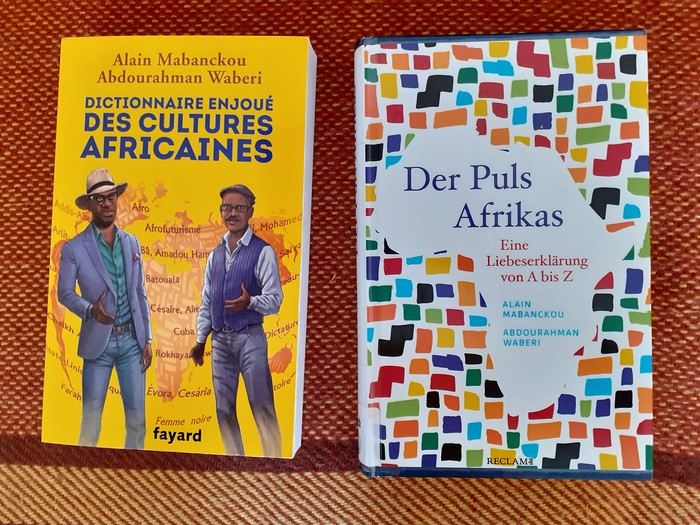
The Maggi cube, an unchallenged hegemony, and so much more
“The hopeless continent,” headlined The Economist, a British magazine, in July 2000 about Africa. Eleven years later, the same magazine headlined “Africa rising” instead. Images of Africa in the prosperous North constantly oscillate between apocalyptic scenarios and enthusiastic projections. A key issue with such images lies in the generalization they entail. If you look at the continent, considerable contrasts emerge depending on space and time. It’s no surprise that a region of the world encompassing such diverse ecological zones, maintaining such varied ties with other continents, comprising nearly fifty nation-states in sub-Saharan Africa alone, and characterized by a great diversity of languages, belief systems, and historical paths, doesn’t share a single destiny.
And yet, for many people outside Africa, as well as for many Africans, the continent constitutes a single entity, defined by criteria such as skin color, a colonial past, poverty, and the art of survival. Until now, these perspectives were generally accompanied by the idea that Africa had to—or should have—followed a single path together, sometimes called development, sometimes modernization, sometimes liberation, then a market economy. None of these paths delivered on their promises.
The two writers Alain Mabanckou and Abdourahman Waberi—one from Congo, the other raised in Djibouti, both long settled in France and now professors at renowned North American universities (Los Angeles, Washington)—have had enough of pessimistic scenarios: “We are aware that Africa is in the world and the world is in Africa. The same goes for all other continents, as our destinies are inextricably linked for better or worse. We refuse to see Africa as a reservoir of misfortunes or a continent cursed by atavistic misfortune and characterized by ethnic conflicts. [...] It’s this passionate flame we wanted to capture in a book [...] a kind of stroll through African cultures, without any demands, each letter of the alphabet leading us to a notion, a practice, a concept, a moment in history, literature, painting, politics, economics, cuisine, etc.” (p.10-11). Africa, they write, is on the verge of “imposing a signature, a style, a way of being in the world and in relation to the rest of the world.” (p.11) To put words to the continent’s diversity and dynamism, the two authors created a “rambling ABC,” a kind of portrait—or more precisely, a mythography—that lets you see and feel the pulse of a vast continent whose cultural power is unfolding before our eyes. Once marginalized or even mocked, the voice and importance of the Continent in global affairs are now undeniable” (p.11), containing over a hundred entries, mostly concise, written in a relaxed and casual style. The optimistic, even exuberant tone is set from the brief introduction. The duo of authors wants to “sing a love song to the cultures of our continent, to its inhabitants past and present, to its exceptional resources and its spectacular globalization despite a certain pollution that still clouds our skies due to the unmatched duration of dictatorships in some of our regions.” (p.12) In doing so, they don’t want to be too distracted by today’s Afewerki-Biya-Bongo-Déby & Co. ...
Of course, you’ll find tributes to great precursors like Frantz Fanon (“[...] it was a love story and admiration that wasn’t dimmed by the four decades separating his birth from ours. Let’s add that we were born while the native of Fort-de-France had left the world’s stage four years earlier, in the prime of life” p.141), Mongo Beti (“You must read and reread Mongo Beti, a genius who used his fame to support often just causes in Africa, like defending oppressed groups. His place is already in History. His oppressors, like the dictators Ahmadou Ahidjo and Paul Biya, can’t compete in the same category” p.64), the Malian Amadou Hampâté Bâ
(“Posterity remembers him mainly as an tireless defender of African cultures. His plea for the collection and preservation of traditional African knowledge remains a major event for all men and women of good will. One day in 1960, at the UNESCO podium, the native of Bandiagara sounded the alarm: ‘[...] Since we’ve admitted that the humanity of each people is the heritage of all humanity, if African traditions aren’t collected in time and written down, they’ll one day be missing from the universal archives of humanity.’” p.51),
Kwame Nkrumah, “one of the founders of Pan-Africanism, father of Ghana’s independence” (p.239), as well as the historian Cheikh Anta Diop, the writer, poet, and politician Aimé Césaire, and the economist and thinker Samir Amin, but also very warm tributes to certain contemporary African intellectuals like Souleymane Bachir Diagne and Achille Mbembe
(“A few years ago, in dominant economic circles, a rumor often resurfaced, usually disguised as a cold and scientifically proven analysis: Africa is useless. It’s a burden for the rest of the human community. With its 2% share in world trade, it would disappear from stock market radars without anyone noticing. So? Maybe it’ll be pulled up by other continents. Wanting to surpass itself is a crazy bet for Africans, they concluded. Arrogant or clueless, President Nicolas Sarkozy declared before an audience of students and teachers at Cheikh Anta Diop University in Dakar: ‘The African man hasn’t entered history enough [...] He only knows the eternal repetition of time marked by the endless repetition of the same gestures and words.’ That was in 2007. For decades, armed only with reason, an intellectual often steps up to debunk prejudices, lazy readings, and dishonest frameworks used as false fronts by those who, like Nicolas Sarkozy or former journalist Stephen Smith, out of ignorance, contempt, or condescension, distort African reality. This intellectual is none other than the historian and political scientist Achille Mbembe. This heir of Frantz Fanon, Amílcar Cabral, Jean-Marc Ela, and Fabien Eboussi-Boulaga was born in 1957 in Cameroon, in the Bassa region. Marked early by the upheavals of a fratricidal war, Achille Mbembe became the guardian of the memory of martyrs. After brilliant studies in Paris, he went on to teach at the best American universities, but the call of the Continent was stronger than anything else. In Dakar, he once directed CODESRIA (Council for the Development of Social Science Research in Africa) before joining the University of the Witwatersrand in Johannesburg, South Africa. Even though the author of *Critique of Black Reason* (Éditions La Découverte, 2015) spends a few months at Duke University in North Carolina, his observation post remains South Africa. From Johannesburg, Achille Mbembe scrutinizes Africa and the whole world. A lucid observer with an elegant and generous pen, Achille Mbembe knows how to blend big and small history: ‘I was born one day in July, as the month was drawing to a close. It was 1957, in that part of Africa recently named ‘Cameroon,’ a memory of the wonder that seized Portuguese sailors in the 15th century when, sailing up the river near Douala, they couldn’t help but note the presence of a multitude of crustaceans, and named it *Rio dos Camarões*, meaning ‘River of Shrimp.’ I grew up in the shadow of this nameless land, since, in a way, the name it bears is only the product of someone else’s astonishment: a lexical mistake, if you will.’ From this mistake or wound, he made leaven, a springboard to compose a rich work, recognized worldwide. To denounce barriers and barbarians too. But that’s not enough. Among his peers in circles of thought and action, Achille Mbembe passionately and consistently defends human dignity and the beauty of the world. In doing so, he fulfills the mission Frantz Fanon entrusted to him.” (p.227-229),
as well as entries dedicated to lesser-known artists and intellectuals, like the French journalist and activist Rokhaya Diallo, daughter of Senegalese and Gambian parents, or the Ethiopian filmmaker Haile Gerima, who has long lived in the United States. Other names from politics, sports, music, art, and literature: Kofi Annan, p.36; Barack Obama, p.243; Thomas Sankara, p.277; Ousmane Sow, p.285; Yambo Ouologuem, p.250; Léopold Sédar Senghor, p.282; Muhammad Ali, p.30; Nuruddin Farah, p.146; Salif Keita, p.203; Ahmadou Kourouma, p.206; Ngũgĩ wa Thiong’o, p.236; Winnie Mandela, p.224; Kylian Mbappé, p.226 ...
The authors, who resolutely commit to a “mythography” (p.11) of Africa, also pay special attention to local social movements, cultural events, and aspects of daily life. *Y’en a marre*, “which also meant ‘we’re fed up with sitting on our hands’” (p.320-321), emerged about a decade ago in Senegal as a citizen movement of peaceful resistance and symbolizes, the authors emphasize, the fact that African youth are increasingly fed up “with the political circus deployed in Africa since independence, as our parents would say, ‘since the White man left’...” (p.321). A full entry is dedicated to the Maggi bouillon cube, which has flooded African markets for about forty years and enjoys immense popularity (“It’s everywhere in Africa, from Dakar to Djibouti, and from Tangier to Cape Town. It’s in every pot, every stew. Little hands put it in every sauce, every local or adapted dish. An unchallenged hegemony! You’ll find it in diasporas too. The culinary strolls in Paris, in the [...] neighborhood” p.90). Critics blame it not only for impoverishing the aromatic diversity of local dishes but also for being harmful to health. And yet, “he poorest Africans, those who eat only once a day, a few spoonfuls of white beans and a ball of *foufou*, for example, are the most fervent users of the magic cube.” (p.92-93)
For *fonio*, “the new trendy cereal. [...] From the millet family, fonio is probably the oldest cereal cultivated in West Africa, and mainly in its sub-Saharan part, for millennia. [...] Easy to grow, water-efficient, fonio grows everywhere except on clay soils. Long neglected because it was considered the poor man’s crop, fonio is now a source of pride for the farmers who cultivate it and cherish it like the apple of their eye” (p.156-157), the authors immediately offer a detailed recipe, letting the reader know that “e can’t resist sharing this fonio with chicken recipe from Mali with you:
Ingredients: 1 chicken 3 large ripe red tomatoes 4 tbsp tomato paste 4 large onions 1 garlic clove 1/2 cup oil 2 Maggi cubes or salt 2 large carrots 1 turnip 1 large cabbage 2 large potatoes 1 celery stalk 1 packet pre-cooked fonio 4 okra (or okra powder) salt, pepper
Preparation: 1. Prepare the sauce: wash and cut the chicken. Peel the onions, garlic, and vegetables. 2. In a pot, fry the chicken pieces. 3. Dice the onions, tomatoes, carrots, and turnip very small and add them to the pot. 4. Add the tomato paste, salt, and pepper. 5. Simmer for 15 min, then add 2 L of water and the cooked chicken pieces. 6. Simmer for 30 min, then add the crushed garlic and celery, plus the cabbage cut into 4 and the potatoes cut in half. 7. Prepare the fonio: cover it with warm water, let it rest for 15 min, and cook it over low heat. 8. In a small pot, boil the okra and crush them. 9. Mix the crushed okra with the cooked fonio, then salt. Serve hot.” (p.158-159)
The comedy *Black Mic Mac*, released in French theaters in 1986 and addressing France’s increasingly restrictive immigration policy at the time, also gets an entry, as do *Tintin in the Congo*, the popular comic, and *Jip’s Café* (“[...] a little Africa in the heart of Paris, with passersby stopping to admire the ‘ambianceurs’ on the dance floor or attend the cultural events offered by the place” (p.194), an African establishment in Paris that Alain Mabanckou already immortalized in one of his novels.
The duo of authors also tackles thorny subjects like jihadism (p.119), the Rwandan genocide (p.272), the CFA franc (p.82), and dictatorship (p.110). While the two strike the right tone here, many entries leave a slightly bitter taste. Two examples: why doesn’t the text on Barack Obama mention the great disappointment of many people in Africa, who expected more from the African policy of the first U.S. president with African roots than just occasional warm words? Why do the comments on Winnie Mandela gloss over the fact that she was a highly controversial icon of the anti-apartheid movement due to her involvement in kidnappings, acts of torture, and murders of alleged apartheid collaborators? Instead, there’s a compassion that brings tears to the eyes: “She was often reduced to a secondary role, the wife of a great man” or “When victory came, she didn’t taste its fruits. Divorced, isolated. She would never be a ‘first lady’ in an evening gown, posing before a bed of chrysanthemums. They’d keep her far from the circles of power” (p.224-225). At this point, I would’ve liked the authors to take a slightly more critical stance...
That said, these “weaknesses” (if you can call them that) shouldn’t overshadow the book as a whole. It remains an informative, sometimes very entertaining, and often even original work in its own way.
Book information (the original French and the German translation):
Alain Mabanckou/Abdourahman Waberi. Dictionnaire enjoué des cultures africaines. Fayard, 2019. Alain Mabanckou/Abdourahman Waberi. Der Puls Afrikas. Eine Liebeserklärung von A bis Z. Reclam, 2022.
Hery
Recommendations for planning a trip to Japan: any agencies to recommend?
Hello everyone,
I’m reaching out to you because I’m planning our next big trip (Japan is really tempting us for the autumn!) and I have to admit, I’m feeling a bit overwhelmed.
My husband and I have always loved traveling, and at 75, we have no intention of stopping... But I find that everything’s getting so complicated. I try to be "modern" by booking online, but as soon as there’s a problem, we hit a wall.
A friend nearly missed her departure last year because of a visa issue that wasn’t explained properly on a website... and no one to call for help, just automated messages.
It makes me a little nervous to be alone in front of a screen so far away, especially since at our age, we like knowing there’s real support if our health takes a turn while we’re there.
Anyway, I’m tired of seeing my file passed from one person to another without ever having the same contact... Do you know of any small, trustworthy agencies or people who still work the "old-fashioned" way and really look after their clients? I love my independence, but I need a real face behind my project.
Thanks in advance for your advice, and I look forward to reading your replies, Catherine
I’m reaching out to you because I’m planning our next big trip (Japan is really tempting us for the autumn!) and I have to admit, I’m feeling a bit overwhelmed.
My husband and I have always loved traveling, and at 75, we have no intention of stopping... But I find that everything’s getting so complicated. I try to be "modern" by booking online, but as soon as there’s a problem, we hit a wall.
A friend nearly missed her departure last year because of a visa issue that wasn’t explained properly on a website... and no one to call for help, just automated messages.
It makes me a little nervous to be alone in front of a screen so far away, especially since at our age, we like knowing there’s real support if our health takes a turn while we’re there.
Anyway, I’m tired of seeing my file passed from one person to another without ever having the same contact... Do you know of any small, trustworthy agencies or people who still work the "old-fashioned" way and really look after their clients? I love my independence, but I need a real face behind my project.
Thanks in advance for your advice, and I look forward to reading your replies, Catherine
Where to stay quietly in Zanzibar for Christmas?
Hi everyone,
We have the opportunity to spend about ten days somewhere for Christmas, and I’m really tempted by Zanzibar. I’ve been dreaming for a long time about the Spice Island, Stone Town, diving...
Which hotels could you recommend? Not a big "resort"—we’re more into "boutique hotels" or even an Airbnb house. Somewhere quiet (we’re not party animals).
I’m thinking of staying the first few nights in Stone Town and then moving to a beach, preferably one where we can swim regardless of the tides, without ending up in seaweed and mud at low tide.
I’m a bit lost with all the beaches because apparently, the north is very crowded, the south is very windy, and the east has some good and some not-so-good spots, with big tides or not... HELP! 🤪
I’d like to limit myself to a maximum of 2 different places to stay over the 10 days.
Thanks in advance! 😉
We have the opportunity to spend about ten days somewhere for Christmas, and I’m really tempted by Zanzibar. I’ve been dreaming for a long time about the Spice Island, Stone Town, diving...
Which hotels could you recommend? Not a big "resort"—we’re more into "boutique hotels" or even an Airbnb house. Somewhere quiet (we’re not party animals).
I’m thinking of staying the first few nights in Stone Town and then moving to a beach, preferably one where we can swim regardless of the tides, without ending up in seaweed and mud at low tide.
I’m a bit lost with all the beaches because apparently, the north is very crowded, the south is very windy, and the east has some good and some not-so-good spots, with big tides or not... HELP! 🤪
I’d like to limit myself to a maximum of 2 different places to stay over the 10 days.
Thanks in advance! 😉
Car Rental Requirements in the USA - Colorado
Hi everyone,
I’m heading to the United States in August, specifically Grand Junction, Colorado, and I’d love to hear about your experiences with renting a car in this slightly tricky situation:
I still have my old French driver’s license (the pink paper version, still valid),
I didn’t have time to get an International Driving Permit (IDP),
And I plan to use a Visa debit card, not a credit card.
I’ve booked a car with Budget. I’ve seen that they *can* accept debit cards under certain conditions, especially at airport locations, but there are often high hold amounts for the deposit, and sometimes requirements like a return ticket or an extra ID. - Has anyone rented a car in the US under these conditions before? - Was the paper license accepted without any issues? - Did the debit card cause problems when putting down the security deposit? Any tips, personal stories, or warnings are super welcome! 😊 Thanks in advance!
I still have my old French driver’s license (the pink paper version, still valid),
I didn’t have time to get an International Driving Permit (IDP),
And I plan to use a Visa debit card, not a credit card.
I’ve booked a car with Budget. I’ve seen that they *can* accept debit cards under certain conditions, especially at airport locations, but there are often high hold amounts for the deposit, and sometimes requirements like a return ticket or an extra ID. - Has anyone rented a car in the US under these conditions before? - Was the paper license accepted without any issues? - Did the debit card cause problems when putting down the security deposit? Any tips, personal stories, or warnings are super welcome! 😊 Thanks in advance!
Traffic fine budget for Morocco
Hi there, if you're planning to rent a car to get around in Morocco, make sure to budget for "fines" even if you drive perfectly. For example, getting caught going 5 km/h over the speed limit 500 meters before you see the sign dropping the limit to 60 km/h—while being overtaken by a packed taxi with no seatbelts. Or, say, stopping at a stop sign for 3 seconds but not long enough, even though no helmetless motorcyclists were stopping either (yes, helmets are mandatory in Morocco)... Anyway, plan a "fine" budget for your Moroccan "vacation."
10-day independent trip to Brazil
hi,
We’re planning a trip to Brazil in March 2026, just the two of us, for 10 days without using an agency. Rio, the falls, and Bahia too. How can we get around there? Train? Car rental? Plane? Are the roads easy to drive on? Is Rio safe to explore on our own? We’d love any travel journals with ideas for places to see, as well as books to help us plan the whole trip. Thanks in advance for all your tips! See you soon, cheers
We’re planning a trip to Brazil in March 2026, just the two of us, for 10 days without using an agency. Rio, the falls, and Bahia too. How can we get around there? Train? Car rental? Plane? Are the roads easy to drive on? Is Rio safe to explore on our own? We’d love any travel journals with ideas for places to see, as well as books to help us plan the whole trip. Thanks in advance for all your tips! See you soon, cheers
Northern Vietnam by motorbike in January 2026: tips and riding partner?
Hi there,
In January 2026, I’m planning a motorbike trip through northern Vietnam for 3–4 weeks.
Must-dos: Hanoi, RC4, Dien Bien Phu, and of course the must-see landscapes.
I’m looking for any great tips, ideas… and maybe even a riding partner.
Cheers
In January 2026, I’m planning a motorbike trip through northern Vietnam for 3–4 weeks.
Must-dos: Hanoi, RC4, Dien Bien Phu, and of course the must-see landscapes.
I’m looking for any great tips, ideas… and maybe even a riding partner.
Cheers
Withdrawing Money in Uzbekistan
Hi there,
It’s been a while since I’ve traveled outside an area packed with ATMs, so I’m wondering about Uzbekistan and the best exchange options. The guidebooks aren’t very chatty on the topic.
From what I gather, transport and hotels will be booked and paid via bank transfer to a local agency. For personal expenses, is it better to bring euros, dollars, or can we still find ATMs along the Silk Road cities to withdraw cash with our bank card?
Catherine
It’s been a while since I’ve traveled outside an area packed with ATMs, so I’m wondering about Uzbekistan and the best exchange options. The guidebooks aren’t very chatty on the topic.
From what I gather, transport and hotels will be booked and paid via bank transfer to a local agency. For personal expenses, is it better to bring euros, dollars, or can we still find ATMs along the Silk Road cities to withdraw cash with our bank card?
Catherine
Information about the San Blas Islands before booking your excursion (Panama)
I’ve put together this information sheet based on my own experience, feedback from my clients, and reviews from travelers on various travel forums and social media.
I think it’s important to share the reality of these postcard-perfect little islands with their white sandy beaches and palm trees before you set off. That way, you can make the most of your trip to the San Blas Islands, know exactly what to expect, and decide if this destination is right for you.
The San Blas Islands are run by the indigenous Guna people. They have their own rules, and Panamanian law doesn’t really apply. Today, their main income comes from tourism, so please note that foreigners aren’t allowed to operate cabanas there. This means that as soon as you board their small boats, you’re in the hands of the Gunas, and it’ll be tough to complain about delays, logistical issues, or refunds. Wait times can be long, and the Gunas are pretty informal—at first glance, they might even seem unwelcoming. But you have to understand that their culture and way of life are simply different from yours.
You’ll find plenty of tour operators offering day trips or one- or two-night stays on the same islands at different prices. I think all these listings create confusion and uncertainty for travelers. You can book with operators who care about their clients and deal directly with them, while others act only as intermediaries or booking systems between travelers, the Gunas, and transport companies without providing any follow-up during your stay. Don’t forget that all the San Blas Islands are beautiful, and your choice shouldn’t be based on which of the 365 islands is the prettiest, but on the hospitality of the Guna family, the accommodation, and the service they provide. I also recommend avoiding San Blas on weekends and public holidays.
To explain the sometimes "low" level of service mentioned in traveler reviews, you need to understand that the San Blas Islands are very basic and rustic—that’s also the charm of the experience, which, for some of you, will push you out of your comfort zone. Not all huts have electricity, or even light. If you want to charge your phone, ask the island owner, who might charge you a small fee. Needless to say, WiFi isn’t available on all islands.
Not all Gunas working there have studied hospitality management, logistics, gastronomy, or tourism. There’s been a big "boom" in the last 10 years, and they haven’t been trained for it.
Regarding the 4x4 road transport, expect to be a bit cramped since the car can fit 6 passengers. Also, you might face delays, or the car might already be waiting for you because the pickup route can change, and sometimes other passengers are late, causing delays. To avoid this, I recommend paying extra for private transport—it’ll make your trip smoother and save you frustration before arriving in San Blas, as well as on your return to Panama City, which can sometimes be chaotic.
Stay flexible! Expect delays, lack of communication, waiting for someone or something without knowing why, rustic cabanas, no fish but pasta instead (yes! sometimes the fish season is low!), fried eggs and bread for breakfast—but in the end, everything works out if you can accept these little inconveniences. Just enjoy the adventure!
Finally, the San Blas Islands have a waste collection problem, so you might see trash on the islands, especially during the summer season due to strong currents. Most of the waste comes from the sea and the mainland. For the sake of the island, please take your trash with you.
I think it’s important to share the reality of these postcard-perfect little islands with their white sandy beaches and palm trees before you set off. That way, you can make the most of your trip to the San Blas Islands, know exactly what to expect, and decide if this destination is right for you.
The San Blas Islands are run by the indigenous Guna people. They have their own rules, and Panamanian law doesn’t really apply. Today, their main income comes from tourism, so please note that foreigners aren’t allowed to operate cabanas there. This means that as soon as you board their small boats, you’re in the hands of the Gunas, and it’ll be tough to complain about delays, logistical issues, or refunds. Wait times can be long, and the Gunas are pretty informal—at first glance, they might even seem unwelcoming. But you have to understand that their culture and way of life are simply different from yours.
You’ll find plenty of tour operators offering day trips or one- or two-night stays on the same islands at different prices. I think all these listings create confusion and uncertainty for travelers. You can book with operators who care about their clients and deal directly with them, while others act only as intermediaries or booking systems between travelers, the Gunas, and transport companies without providing any follow-up during your stay. Don’t forget that all the San Blas Islands are beautiful, and your choice shouldn’t be based on which of the 365 islands is the prettiest, but on the hospitality of the Guna family, the accommodation, and the service they provide. I also recommend avoiding San Blas on weekends and public holidays.
To explain the sometimes "low" level of service mentioned in traveler reviews, you need to understand that the San Blas Islands are very basic and rustic—that’s also the charm of the experience, which, for some of you, will push you out of your comfort zone. Not all huts have electricity, or even light. If you want to charge your phone, ask the island owner, who might charge you a small fee. Needless to say, WiFi isn’t available on all islands.
Not all Gunas working there have studied hospitality management, logistics, gastronomy, or tourism. There’s been a big "boom" in the last 10 years, and they haven’t been trained for it.
Regarding the 4x4 road transport, expect to be a bit cramped since the car can fit 6 passengers. Also, you might face delays, or the car might already be waiting for you because the pickup route can change, and sometimes other passengers are late, causing delays. To avoid this, I recommend paying extra for private transport—it’ll make your trip smoother and save you frustration before arriving in San Blas, as well as on your return to Panama City, which can sometimes be chaotic.
Stay flexible! Expect delays, lack of communication, waiting for someone or something without knowing why, rustic cabanas, no fish but pasta instead (yes! sometimes the fish season is low!), fried eggs and bread for breakfast—but in the end, everything works out if you can accept these little inconveniences. Just enjoy the adventure!
Finally, the San Blas Islands have a waste collection problem, so you might see trash on the islands, especially during the summer season due to strong currents. Most of the waste comes from the sea and the mainland. For the sake of the island, please take your trash with you.
Abdulrazak Gurnah, an author with a unique journey and identity (Tanzania)
(A belated tribute on this forum)
Abdulrazak Gurnah, an author with a unique journey and identity (Tanzania)
Big surprise in Stockholm: the 2021 Nobel Prize in Literature was awarded to novelist Abdulrazak Gurnah. The Tanzanian author, who writes in English, is best known for his novels Paradise (1994) and By the Sea (2001). He was recognized for his "uncompromising and compassionate portrayal of the effects of colonialism and the fate of refugees caught between cultures and continents", according to the Nobel Committee.His work moves away from "stereotypical descriptions and opens our eyes to a culturally diverse East Africa that is little known in many parts of the world".
Gurnah is the first African author since 2003 to win the prestigious prize, and the fifth from the African continent overall—following Wole Soyinka (1986), Naguib Mahfouz (1988), Nadine Gordimer (1991), and J.M. Coetzee (2003). Once again, the prize passed over Kenyan Ngugi wa Thiong’o, who has long been among the favorites for the award.
Born in Zanzibar (now part of Tanzania) in 1948, Abdulrazak Gurnah grew up in an Arab family originally from Yemen. He sought refuge in the UK in the late 1960s, a few years after independence, at a time when the Muslim minority there was being persecuted. He wasn’t able to return to Zanzibar until 1984.
Since 1987, he has published around ten novels and several short stories in English (his native language is Swahili). None have become bestsellers, but his body of work as a whole offers a different perspective on issues like immigration and cultural diversity. His work sheds light on the effects of colonialism, exile, and the plight of refugees, "speaking" of his love for Africa and his fight against neocolonialism. Though Gurnah’s stories aren’t explicitly autobiographical, they’re inspired by his life as an immigrant in the UK.
Gurnah was also a professor of English and postcolonial literature at the University of Kent in Canterbury until his recent retirement.
Does this award bring more attention to African literature? Who knows? At the very least, it might give it a boost. If African literature is less visible in the West, it’s partly because it isn’t widely accessible: Gurnah is rarely translated into French or German, and not at all into Arabic.
In Tanzania and its Zanzibar archipelago, he’s being celebrated with joy. "This means a lot for Zanzibar’s struggle for self-determination," says Ismail Jussa, a literary critic from Zanzibar. "It helps put Zanzibar back on the map." The Swedish Committee acknowledged that his work has helped understand "the divisions caused by colonialists, but also the heartbreak of being torn between the homeland one comes from and the life of exile one is forced into."
By the Sea. Bloomsbury Publishing, 2001 (Fr.: Près de la Mer. Galaade Éd., 2006)
Paradise. Bloomsbury Publishing, 1994/2004 (Fr.: Paradis. Motifs, 1999)
Desertion. Bloomsbury Publishing, 2005 (Fr.: Adieu Zanzibar. Galaade Éd., 2009)
Afterlives. Bloomsbury Publishing, 2020 (Fr.: Les vies d’après. Denoël, 2023)
Hery
Abdulrazak Gurnah, an author with a unique journey and identity (Tanzania)
Big surprise in Stockholm: the 2021 Nobel Prize in Literature was awarded to novelist Abdulrazak Gurnah. The Tanzanian author, who writes in English, is best known for his novels Paradise (1994) and By the Sea (2001). He was recognized for his "uncompromising and compassionate portrayal of the effects of colonialism and the fate of refugees caught between cultures and continents", according to the Nobel Committee.His work moves away from "stereotypical descriptions and opens our eyes to a culturally diverse East Africa that is little known in many parts of the world".
Gurnah is the first African author since 2003 to win the prestigious prize, and the fifth from the African continent overall—following Wole Soyinka (1986), Naguib Mahfouz (1988), Nadine Gordimer (1991), and J.M. Coetzee (2003). Once again, the prize passed over Kenyan Ngugi wa Thiong’o, who has long been among the favorites for the award.
Born in Zanzibar (now part of Tanzania) in 1948, Abdulrazak Gurnah grew up in an Arab family originally from Yemen. He sought refuge in the UK in the late 1960s, a few years after independence, at a time when the Muslim minority there was being persecuted. He wasn’t able to return to Zanzibar until 1984.
Since 1987, he has published around ten novels and several short stories in English (his native language is Swahili). None have become bestsellers, but his body of work as a whole offers a different perspective on issues like immigration and cultural diversity. His work sheds light on the effects of colonialism, exile, and the plight of refugees, "speaking" of his love for Africa and his fight against neocolonialism. Though Gurnah’s stories aren’t explicitly autobiographical, they’re inspired by his life as an immigrant in the UK.
Gurnah was also a professor of English and postcolonial literature at the University of Kent in Canterbury until his recent retirement.
Does this award bring more attention to African literature? Who knows? At the very least, it might give it a boost. If African literature is less visible in the West, it’s partly because it isn’t widely accessible: Gurnah is rarely translated into French or German, and not at all into Arabic.
In Tanzania and its Zanzibar archipelago, he’s being celebrated with joy. "This means a lot for Zanzibar’s struggle for self-determination," says Ismail Jussa, a literary critic from Zanzibar. "It helps put Zanzibar back on the map." The Swedish Committee acknowledged that his work has helped understand "the divisions caused by colonialists, but also the heartbreak of being torn between the homeland one comes from and the life of exile one is forced into."
By the Sea. Bloomsbury Publishing, 2001 (Fr.: Près de la Mer. Galaade Éd., 2006)
Paradise. Bloomsbury Publishing, 1994/2004 (Fr.: Paradis. Motifs, 1999)
Desertion. Bloomsbury Publishing, 2005 (Fr.: Adieu Zanzibar. Galaade Éd., 2009)
Afterlives. Bloomsbury Publishing, 2020 (Fr.: Les vies d’après. Denoël, 2023)
Hery
Sandflies in Southern Thailand
Hi there,
I’m heading back to Thailand soon, and from what I’ve been reading, it seems some beaches/islands are infested with these dreaded sandflies!
I’ve noted the remedy: rub the bitten area with 90% alcohol, then apply soothing cream.
But prevention is better than cure!
Which areas should I avoid right now?
Are there seasons that are more prone to these itchy invasions than others?
I’ve already stayed in Hua Hin, Koh Samui, Koh Phangan, Koh Tao, Krabi, and Phuket without any issues like this.
I’d love to keep it that way...
Thanks
I’m heading back to Thailand soon, and from what I’ve been reading, it seems some beaches/islands are infested with these dreaded sandflies!
I’ve noted the remedy: rub the bitten area with 90% alcohol, then apply soothing cream.
But prevention is better than cure!
Which areas should I avoid right now?
Are there seasons that are more prone to these itchy invasions than others?
I’ve already stayed in Hua Hin, Koh Samui, Koh Phangan, Koh Tao, Krabi, and Phuket without any issues like this.
I’d love to keep it that way...
Thanks
Dress code for gala evenings on the Queen Mary 2
We’ve booked the transatlantic crossing on the Queen Mary. I understand that for the gala evenings, we need to wear a tuxedo and an evening gown.
Do we need a very expensive chic evening gown, or can a more modest one still be tasteful? And where can I buy one? I have the same question about the tuxedo. Thanks!
Baggage fee on the JR from Tokyo airport to downtown
Hi,
Just so you know, when you take the JR from the airport to central Tokyo, the company has introduced a baggage fee of 900 yen (5.50 €) per person for foreigners. There’s a dedicated line for this, and you’re directed by a JR agent.
If you take the Keisei network from Narita, there’s no fee for now.
As a reminder, the JR Pass has tripled in price since October 2023. It’s not essential if you’re staying less than 3 weeks—consider the bus instead, which is much cheaper. Sure, it takes longer, but it’s budget-friendly.
Since October 1, 2024, agents have been handing out flyers to tourists at airport arrivals with recommendations about theft in hotels. Over the past few months, there’s been a rise in stolen phones, laptops, and other electronics from rooms. The advice is to lock everything in a suitcase with a key or code when you’re not around to avoid issues. Japan’s economy isn’t doing well right now, and some locals are struggling financially, blaming tourists for rising prices. Of course, the current exchange rate is great for us—165 yen to the euro lets us eat ramen for next to nothing—but inflation has hit them hard.
Since October 1, 2024, agents have been handing out flyers to tourists at airport arrivals with recommendations about theft in hotels. Over the past few months, there’s been a rise in stolen phones, laptops, and other electronics from rooms. The advice is to lock everything in a suitcase with a key or code when you’re not around to avoid issues. Japan’s economy isn’t doing well right now, and some locals are struggling financially, blaming tourists for rising prices. Of course, the current exchange rate is great for us—165 yen to the euro lets us eat ramen for next to nothing—but inflation has hit them hard.
Moving to another country: your experiences
Hello,
My wife and I are looking to move to another country.
Please share your experiences and give us some advice!
See you soon
My wife and I are looking to move to another country.
Please share your experiences and give us some advice!
See you soon
Small hostels in Morocco: what's become of them?
On this forum, we’ve all shared our favorite spots. Today, I’m wondering what’s happening with those small hostels and how they’re coping with the crisis.
I’m thinking especially of Hussein, the owner of the guesthouse in Ijoukak; Majhid from L’Arganier in Tafraout;
the family running Escale Rando in Taliouine; and so many others.
Through hard work, they’d created welcoming hostels where it was great to stop for a few days.
Has anyone heard from them lately?
Thanks in advance for your replies—the list isn’t exhaustive, there are plenty more.
Quand l'été s'achève... English translation pending
Ce n’est pas un carnet de voyage.
C’est un petit carnet de vacances.
Et, peut-être, avez-vous aussi vécu des instants, des heures, des jours, des semaines comme les miennes.
Sur place, sans voiture, sans train, sans avion, sans vélo.
Enveloppé de joie, de vie, de sourires, de douceur, de tendresse.
Un été entre parenthèse.
...
Dans la grange, la deuxième couvée d’hirondelles apprend à voler. Les parents perchés sur la poutre, pépient avec ardeur et les oisillons semblent écouter. Encore quinze jours et c’est l’envol pour l’Afrique.
Dans la maison, notre volière estivale, le silence s’est installé. Enfants et petits-enfant ont migré vers la ville. Un silence si parfait que j’entends Tiko, l’animal favori de Petit Jules. Tiko est un escargot des haies. Sa coquille jaune vif cerclée de fines bandes noires à ne pas confondre avec l’escargot des jardins, arbore un minuscule morceau de sparadrap. J’ai la garde de Tiko jusqu’en Octobre, nouvelles vacances d’automne. Il croque la salade vert tendre et l’infime bruit de ses mandibules fait écho aux touches de mon clavier.
Notre saison s’est achevée sur le spectacle de théâtre, rituel familial. Pour la première fois les enfants étaient les seuls scénaristes et je n’ai fait qu’orchestrer les répétitions. L’affiche était : « Les virus et les médecins » et l’action se déroulait en 1398 durant la peste noire entre le médecin à cape et bec noir et le médecin du futur, 2020. Les cinq plus jeunes étaient des virus et avaient fabriqué de larges masques ronds et colorés avec deux trous pour les yeux, attachés avec de la ficelle. C’étaient Zika, Ebola, chikungunya, variole et covid (corona pour les intimes, dans le texte). Tous les adultes présents, les parents, ont beaucoup ri et la parodie était parfaite sans qu'ils en aient conscience.
La conclusion était qu’il fallait utiliser les moyens connus au moyen âge et ceux d’aujourd’hui et ils ont fabriqué sur scène une poudre de rat malade à boire diluée dans de l’eau. Astucieux ces petits. Zika, Ebola, chikungunya, les virus africains, trépignaient en disant « pour nous aussi, on nous oublie toujours, c’est pas juste »
Bref, quelle longue digression pour vous dire que même dans le monde magique de l’enfance, ceux-ci sont bien marqués par l’épidémie dont on nous remplit le tête et les oreilles. Ils appréhendent la rentrée masquée au collège, craignent de ne pas se reconnaître dans les nouvelles classes constituées et se demandent comment les profs les reconnaîtront. Et des questions fusaient : « Comment on va faire l’hiver, faudra mette le masque par-dessus l’écharpe dans le bus ? » « Et quand il pleut, comment mon masque va tenir quand il est tout mouillé » « Et pourquoi on peut manger tous ensemble à la cantine sans masque, on est tous collés à la cantine » « Et si j’ai pas ma règle, je pourrais prendre celle de ma copine ? » « Et Jules, il a dix ans et il sera au collège avec ceux de 11ans, il sera obligé de mettre le masque ? ».
Ici dans notre Morvan écrasé de chaleur, pourtant, tout l’été nous avons voyagé. Voyage immobile, sans avion, sans test, sans masque, dans les rires, les cris, les cavalcades, un bazar, un souk, un cirque permanent.
Italie : pizza maison (ahhh les pizzas de Papiluc!) Japon : sushi (beurq, c’était pas ma fête) Inde :poulet byriani (tu mets pas du piment hein mamido) Russie : pelmini ( 480 pelmini, 32 mains pour les faire, 6h pour les préparer) Argentine : asado (souvent et pratique) Grèce : moussaka France : ratatouille
Ainsi, les enfants fabriquaient les petits drapeaux correspondants pour décorer la table et les adultes inventaient des mini quizz sur chaque pays.
On s’est bien marré et l’été s’achève.
Notre maison, comme un coeur palpitant depuis mars, où se sont retrouvés toutes les générations, est redevenue silencieuse.
Je me sens remplie et vide. J’crois bien que si l’on approche un doigt sur mes antennes, j’vais rentrer dans ma coquille, comme Tiko. Mais pour l’heure, ce n’est pas le temps de l’hibernation et je ne vais pas fabriquer mon épiphragme protecteur.
On est bien sur vf, chuis en vacances, en vacance. Contente de vous retrouver.
Crouchhhh, crouchhhh, Tiko poursuit son festin.
A bientôt !
...
Dans la grange, la deuxième couvée d’hirondelles apprend à voler. Les parents perchés sur la poutre, pépient avec ardeur et les oisillons semblent écouter. Encore quinze jours et c’est l’envol pour l’Afrique.
Dans la maison, notre volière estivale, le silence s’est installé. Enfants et petits-enfant ont migré vers la ville. Un silence si parfait que j’entends Tiko, l’animal favori de Petit Jules. Tiko est un escargot des haies. Sa coquille jaune vif cerclée de fines bandes noires à ne pas confondre avec l’escargot des jardins, arbore un minuscule morceau de sparadrap. J’ai la garde de Tiko jusqu’en Octobre, nouvelles vacances d’automne. Il croque la salade vert tendre et l’infime bruit de ses mandibules fait écho aux touches de mon clavier.
Notre saison s’est achevée sur le spectacle de théâtre, rituel familial. Pour la première fois les enfants étaient les seuls scénaristes et je n’ai fait qu’orchestrer les répétitions. L’affiche était : « Les virus et les médecins » et l’action se déroulait en 1398 durant la peste noire entre le médecin à cape et bec noir et le médecin du futur, 2020. Les cinq plus jeunes étaient des virus et avaient fabriqué de larges masques ronds et colorés avec deux trous pour les yeux, attachés avec de la ficelle. C’étaient Zika, Ebola, chikungunya, variole et covid (corona pour les intimes, dans le texte). Tous les adultes présents, les parents, ont beaucoup ri et la parodie était parfaite sans qu'ils en aient conscience.
La conclusion était qu’il fallait utiliser les moyens connus au moyen âge et ceux d’aujourd’hui et ils ont fabriqué sur scène une poudre de rat malade à boire diluée dans de l’eau. Astucieux ces petits. Zika, Ebola, chikungunya, les virus africains, trépignaient en disant « pour nous aussi, on nous oublie toujours, c’est pas juste »
Bref, quelle longue digression pour vous dire que même dans le monde magique de l’enfance, ceux-ci sont bien marqués par l’épidémie dont on nous remplit le tête et les oreilles. Ils appréhendent la rentrée masquée au collège, craignent de ne pas se reconnaître dans les nouvelles classes constituées et se demandent comment les profs les reconnaîtront. Et des questions fusaient : « Comment on va faire l’hiver, faudra mette le masque par-dessus l’écharpe dans le bus ? » « Et quand il pleut, comment mon masque va tenir quand il est tout mouillé » « Et pourquoi on peut manger tous ensemble à la cantine sans masque, on est tous collés à la cantine » « Et si j’ai pas ma règle, je pourrais prendre celle de ma copine ? » « Et Jules, il a dix ans et il sera au collège avec ceux de 11ans, il sera obligé de mettre le masque ? ».
Ici dans notre Morvan écrasé de chaleur, pourtant, tout l’été nous avons voyagé. Voyage immobile, sans avion, sans test, sans masque, dans les rires, les cris, les cavalcades, un bazar, un souk, un cirque permanent.
Italie : pizza maison (ahhh les pizzas de Papiluc!) Japon : sushi (beurq, c’était pas ma fête) Inde :poulet byriani (tu mets pas du piment hein mamido) Russie : pelmini ( 480 pelmini, 32 mains pour les faire, 6h pour les préparer) Argentine : asado (souvent et pratique) Grèce : moussaka France : ratatouille
Ainsi, les enfants fabriquaient les petits drapeaux correspondants pour décorer la table et les adultes inventaient des mini quizz sur chaque pays.
On s’est bien marré et l’été s’achève.
Notre maison, comme un coeur palpitant depuis mars, où se sont retrouvés toutes les générations, est redevenue silencieuse.
Je me sens remplie et vide. J’crois bien que si l’on approche un doigt sur mes antennes, j’vais rentrer dans ma coquille, comme Tiko. Mais pour l’heure, ce n’est pas le temps de l’hibernation et je ne vais pas fabriquer mon épiphragme protecteur.
On est bien sur vf, chuis en vacances, en vacance. Contente de vous retrouver.
Crouchhhh, crouchhhh, Tiko poursuit son festin.
A bientôt !
Le Nord de l'Italie English translation pending
Bonjour tout le monde !
Les vacances ont pris un virage particulier cette année. Grâce ou à cause d'un virus qui fait peur à beaucoup. Justifié ou pas. Il a donc fallu changer les plans. Pas de séjour au Moyen-orient, vu que les aéroports sont fermés et donc, après moultes réflexions, et au vu des pays assez sûrs pour nous laisser la possibilité de ne pas trop souffrir du port du masque, nous avons choisi le Nord de l'Italie.
Au Sud des Dolomites plus précisément. Avec un arrêt à l'aller sur Varazze et la côte Ligure. Et au retour un arrêt sur Arenzzano. Que je vais d'ailleurs rayer de mes fichiers. Très mauvaise expérience cette dernière ville.
Bref et en détail, le suivi du carnet sera le suivant :
Sud de la France vers Montpellier, Varazze (Hotel 2 nuits), Pescheria del Garde, en courant d'air, Trente (Hotel 10 nuits), Molveno/Andolo et les lacs, Le Lac de Garde, Venise (en train), Bolzano (en train), Verone (en train), Merano, San Candido, Levico Terme et les Lacs, Aranzzano, Retour France.
En résumé que dire ?
La côte reste la côte. avec ses qualités et ses défauts. Mais c'est l'Italie que l'on aime. Ses bains privés, ses morceaux (2 mètres😎 ) de plage publique pour le peuple, ses cris, ses odeurs... et sa circulation automobile anarchique au possible.
Le Nord en revanche est assez....coincé, et même assez "Bobo". Très allemand aussi car la région du Trentin/Haut-Adige n'est Italienne que depuis 1918. Tout ici respire l'ordre et la méthode. En clair, vous pouvez déguster une pizza mais avec de la viande fumée au lieu du Chorizo😎 . Humour ! On parle Allemand et après Italien. Tout est en deux langues. Même les pompiers de San Candido parlent allemand entre eux.
Au bord des routes, on vend des sacs de patates en lieu et place de fruits et légumes.
Le pire dans le coin étant les sportifs en vélo ! Dans le Nord, les pistes cyclables sont légions. Et s'il n'y en a pas, on prends le trottoir. Je suis en vélo, donc j'ai tous les droits. Comme sur Amsterdam. Il faut faire attention de ne pas froisser les cyclistes. Pas trop écolos car beaucoup de vélo électriques...Qui doivent bien se recharger quelque part... Marrant le type qui vient prendre son petit-déjeuner avec les chaussures à cales sur un parquet ancien et bien entretenu. Très classe !!! Les motards sont plus civilisés ! Même une horde sauvage de 30 Harleys qui passe dans un petit village avec un bruit ... d'Harley ! 😎
Sinon, le coin est sympa.
Ha, j'allais oublier.
Un mot pour nos ami(e)s camping-caristes. Dans le Nord et sur quasiment toutes les villes (au moins) que j'ai pu visiter, il y a des parcs pour les CC. On ne se pose pas où l'on veut. Et pas de discussions !!! 😎 Molveno par exemple ou les CC sont en rang d'oignons avec juste de quoi ouvrir la porte ou poser une table de camping. La nuit, ce doit être marrant😏
Nous commencerons donc demain par Varazze. 2600 photos à trier et classer... c'est long. Juste une pour commencer.
Les vacances ont pris un virage particulier cette année. Grâce ou à cause d'un virus qui fait peur à beaucoup. Justifié ou pas. Il a donc fallu changer les plans. Pas de séjour au Moyen-orient, vu que les aéroports sont fermés et donc, après moultes réflexions, et au vu des pays assez sûrs pour nous laisser la possibilité de ne pas trop souffrir du port du masque, nous avons choisi le Nord de l'Italie.
Au Sud des Dolomites plus précisément. Avec un arrêt à l'aller sur Varazze et la côte Ligure. Et au retour un arrêt sur Arenzzano. Que je vais d'ailleurs rayer de mes fichiers. Très mauvaise expérience cette dernière ville.
Bref et en détail, le suivi du carnet sera le suivant :
Sud de la France vers Montpellier, Varazze (Hotel 2 nuits), Pescheria del Garde, en courant d'air, Trente (Hotel 10 nuits), Molveno/Andolo et les lacs, Le Lac de Garde, Venise (en train), Bolzano (en train), Verone (en train), Merano, San Candido, Levico Terme et les Lacs, Aranzzano, Retour France.
En résumé que dire ?
La côte reste la côte. avec ses qualités et ses défauts. Mais c'est l'Italie que l'on aime. Ses bains privés, ses morceaux (2 mètres😎 ) de plage publique pour le peuple, ses cris, ses odeurs... et sa circulation automobile anarchique au possible.
Le Nord en revanche est assez....coincé, et même assez "Bobo". Très allemand aussi car la région du Trentin/Haut-Adige n'est Italienne que depuis 1918. Tout ici respire l'ordre et la méthode. En clair, vous pouvez déguster une pizza mais avec de la viande fumée au lieu du Chorizo😎 . Humour ! On parle Allemand et après Italien. Tout est en deux langues. Même les pompiers de San Candido parlent allemand entre eux.
Au bord des routes, on vend des sacs de patates en lieu et place de fruits et légumes.
Le pire dans le coin étant les sportifs en vélo ! Dans le Nord, les pistes cyclables sont légions. Et s'il n'y en a pas, on prends le trottoir. Je suis en vélo, donc j'ai tous les droits. Comme sur Amsterdam. Il faut faire attention de ne pas froisser les cyclistes. Pas trop écolos car beaucoup de vélo électriques...Qui doivent bien se recharger quelque part... Marrant le type qui vient prendre son petit-déjeuner avec les chaussures à cales sur un parquet ancien et bien entretenu. Très classe !!! Les motards sont plus civilisés ! Même une horde sauvage de 30 Harleys qui passe dans un petit village avec un bruit ... d'Harley ! 😎
Sinon, le coin est sympa.
Ha, j'allais oublier.
Un mot pour nos ami(e)s camping-caristes. Dans le Nord et sur quasiment toutes les villes (au moins) que j'ai pu visiter, il y a des parcs pour les CC. On ne se pose pas où l'on veut. Et pas de discussions !!! 😎 Molveno par exemple ou les CC sont en rang d'oignons avec juste de quoi ouvrir la porte ou poser une table de camping. La nuit, ce doit être marrant😏
Nous commencerons donc demain par Varazze. 2600 photos à trier et classer... c'est long. Juste une pour commencer.
Continuer mes études à l'étranger et travailler en même temps English translation pending
Bonjour je suis tunisienne jai un bts en agence de voyage
jai etudie a l'institut superieure du tourisme a sidi dhrif
Jai travailler en tant que chef dagence pendant quelques bonnes annees jai ete la gerante dune agence de voyage jai aussi travailler ds une ecole privee en tant q'unstitutrice je pratique la langue francaise langlais et un oeu l'italien jaime bien ameliorer mon cv
je demande ci c' est possible de continuer mes etudes a letranger et travailler en meme temps .
Merci
Formulaire obligatoire pour les voyages en Belgique et les retours des Belges de l'étranger English translation pending
Ce formulaire a été annonce hier. Le formulaire en ligne devrait être prêt lundi et sera obligatoire à partir du 1er aout.
Ne regardez pas la version actuelle du formulaire, elle est obsolète.
Quelques détails: https://www.vrt.be/vrtnws/nl/2020/07/23/al-wie-terugkeert-uit-buitenlandse-vakantie-moet-formulier-invul/
Pour tout voyage de plus de 48 heures à l'étranger.
Mais aussi pour tous les étrangers qui entrent en Belgique de plus de 24 heures.