Results for "Guise+|+127"
83516 results found.
Niger dans l'Air English translation pending
Bonjour,
quelqu'un a déjà été marcher dans l'Air? nous recherchons un guide sur Niamey
Merci!
quelqu'un a déjà été marcher dans l'Air? nous recherchons un guide sur Niamey
Merci!
Bons plans à Delhi English translation pending
bonjour à tous, je pars quelques jours en inde du nord, avec pour seul guide le lonely planet (que je n'ai pas encore acheté, j'y vais demain promis). Quelqu'un aurait il des infos sur ce qui doit etre vu visité absolument car je ne reste que dix jours, s'il vaut mieux des travellers ou changer sur place, de bonnes adresses d'hotels ou auberges
je m'envole le 10 septembre, merci à tous pour l'aide que vous pourriez m'apporter et je vous raconterai tout à mon retour
à bientot
latee
je m'envole le 10 septembre, merci à tous pour l'aide que vous pourriez m'apporter et je vous raconterai tout à mon retour
à bientot
latee
Montants dans le Lonely Planet sur la Nouvelle-Zélande English translation pending
Bonjour à tous,
J'aimerais savoir si les montants inscrits dans le guide Lonely Planet sur la Nouvelle-Zélande sont en $US ou en $NZ?
Merci d'avance pour une réponse
Tapou
J'aimerais savoir si les montants inscrits dans le guide Lonely Planet sur la Nouvelle-Zélande sont en $US ou en $NZ?
Merci d'avance pour une réponse
Tapou
Argent en Syrie English translation pending
Bonjour à tous, je pars en Syrie pour un mois et d'après mon guide il n'est pas possible d'avoir de l'argent avec une carte de crédit en Syrie. Je voudrais savoir si vous avez déjà essayé de retirer de l'argent avec une carte (pas seulement dans un distributeur, à l'intérieur d'une banque?) et sinon quelles sont les solutions que vous avez choisies: travellers, envoi d'argent (y a-t-il des western union en Syrie? ) ...? Est-il facile de changer des euros?
Autre question qui n'a rien à voir: j'arrive à 3h du matin: pensez-vous qu'il est facile de finir ma nuit à l'aéroport? Connaissez-vous des hotels sympas ouverts la nuit?
Et enfin, dans mon guide, il est dit que tout se marchande, même les nuits d'hôtel, les restos... qu'en est-il de vos expériences à ce sujet?
Je vous remercie d'avance pour vos réponses.
Sécurité au Népal English translation pending
Bonjour a tous
je dois partir faire le tour des annapurnas(sans agence ni guide) début septembre, et de plus en plus je vois des articles concernant l'insecurité au nepal (dernier trek magazine ) le ministere des affaires étrangère déconseille fortement de ci rendre,
quelqu'un as t'il eu des echos a ce sujet
merci d'avance
Observation d'oiseaux en République Dominicaine English translation pending
 bonjour pourriez vous me parler d'observation d'oiseau avec guide en république? 😄catie au petits oiseaux..
Legionelose au Viva Dominicus English translation pending
Bonjour,
J'ai lu pas plus tard que lundi sur le forum du guide du routard que deux cas de léginoélose s'étaient révélés au viva dominicus. C'est une personne vivant sur place qui a donné l'information. Ces propos ont été confirmé par une certaine "NICOLE" qui doit s'y rendre le 16 avril prochain tout comme moi. Apparemment elle a réussi à avoir le directeur de l'hôtel qui lui a avoué les faits. En ce moment des gens sont sur place pour savoir si la légonélose a été contracté sur place ou pas.
Toute information sera la bien venue.
Merci encore.
Routard ou Lonely planet pour l'Inde du Sud? English translation pending
BONJOUR
je pars en juillet en inde du sud, avant d'acheter le guide pour preparer mes vacances quelques conseils, lequel acheter, le routard, le lonely plaNet, les deux, quels avis sur ces guides ?? les prix mentionnés dessus sont il encore d'actualité ??d'autres guides peut etre ?
ENFIN JE PRENDS TOUS VOS AVIS !!!
merci
philippe
Bons plans pour Oman English translation pending
Bonjour,
je voudrais partir à Oman en janvier, je n'ai pas trouvé de guide, est ce que quelqu'un pourrait me donner des plans (où aller en priorité, les combines, le problème de l'hébergement, la plongée, les sites les plus beaux).
Merci beaucoup
David
je voudrais partir à Oman en janvier, je n'ai pas trouvé de guide, est ce que quelqu'un pourrait me donner des plans (où aller en priorité, les combines, le problème de l'hébergement, la plongée, les sites les plus beaux).
Merci beaucoup
David
Villages around Hazaribagh in West Bengal
Wednesday, April 1st
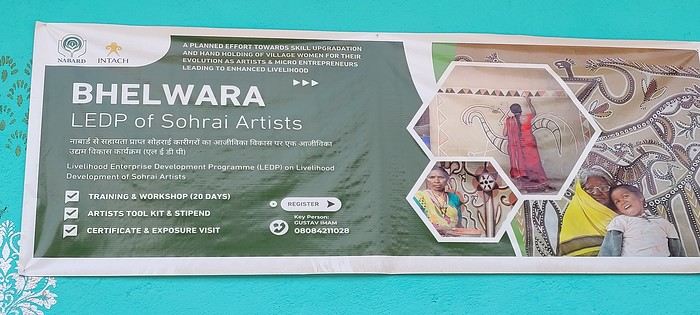
Hazaribagh I’ve got a meet-up with Adam Iman, a guide and painter. He picks me up from the hotel at 10 AM. Another traveler from Bangalore is supposed to join us, but while we wait for him to arrive, Adam takes me to see the paintings his mother and sister created at Hazaribagh station. The town became famous thanks to these murals, which can also be found in several surrounding villages. This art form has earned recognition and is now protected, a sign of its cultural importance. Once the visit is over, we go to pick up the other traveler and then head to our first village: Belwara, where Sohrai art is practiced. At the entrance, a sign proudly announces that we’re entering an artists’ village, where this art is created by women organized into micro-enterprises. Some even offer workshops for those who’d like to learn this tradition.
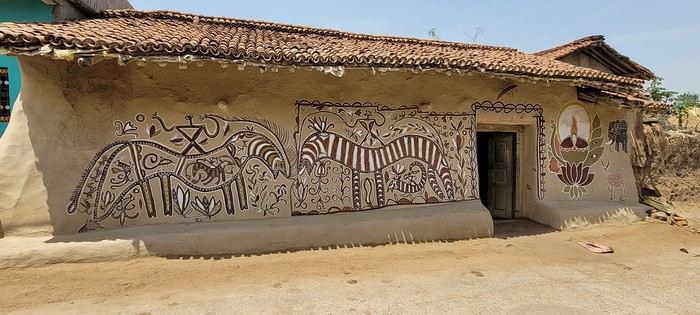
Sohrai art is tied to the harvest season, from October to mid-November. The motifs, in natural colors, celebrate fertility and abundance. The artists use pigments from the earth: red oxides, ochre, white kaolin, and black manganese. On the walls, you’ll see animals, fish, birds—all symbols of life and prosperity. As I look closer at the murals, I start to realize that each motif tells a story. Large animals like cows or bulls often take center stage. Their bodies are filled with intricate, almost hypnotic patterns. They symbolize wealth and prosperity for the household, as well as the deep respect for cattle, which are essential to daily life. On some facades, elephants stand out—massive and decorated with the same precision. They evoke quiet strength and protection. But it’s when I stop in front of one of the houses that I really take the time to look. The wall, a soft ochre, is entirely covered in murals. Two large animals stretch out on either side of the door, their elongated bodies fitting the length of the wall. Their silhouettes are filled with geometric patterns and incredibly fine curved lines, as if every space was patiently filled. Around them, stylized plants, flowers, and small decorative elements fill every gap. The door, dark and worn, becomes almost the silent center of the composition, framed by these living, protective forms. To the right, a more colorful motif catches the eye—a flower or a stylized lamp—like a touch of light on the earth. The whole thing gives an impression of perfect balance, between the rigor of the patterns and the freedom of the gesture.
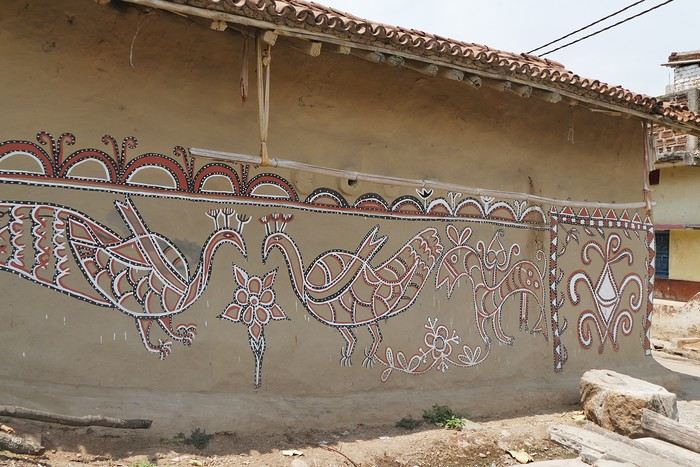
Elsewhere, birds and freer forms bring movement. Peacocks, recognizable by their stylized silhouettes, embody beauty and vitality, while fish symbolize water, fertility, and the continuity of life.
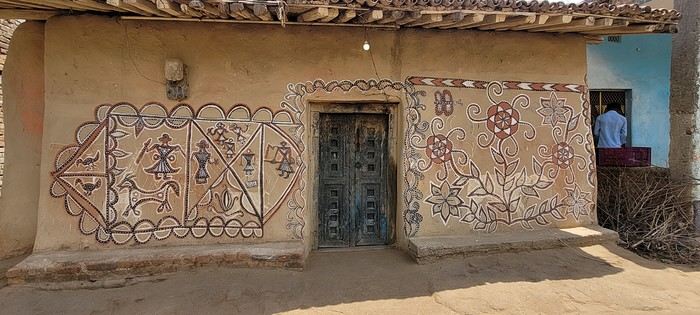
 On some paintings, the scenes become almost narrative: you can make out figures, everyday gestures, like a memory of the village inscribed in the walls. The decorative frames around the doors aren’t left to chance either—they symbolically protect the house, like a boundary between the inside and the outside world.
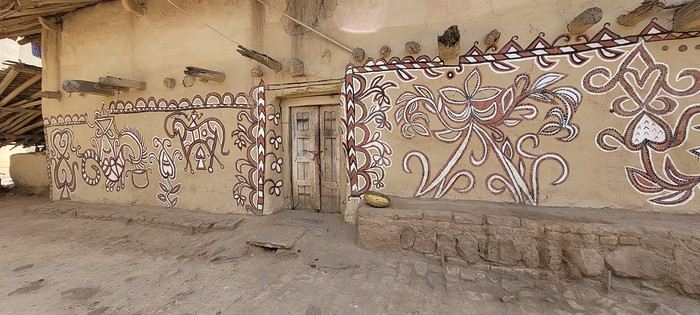
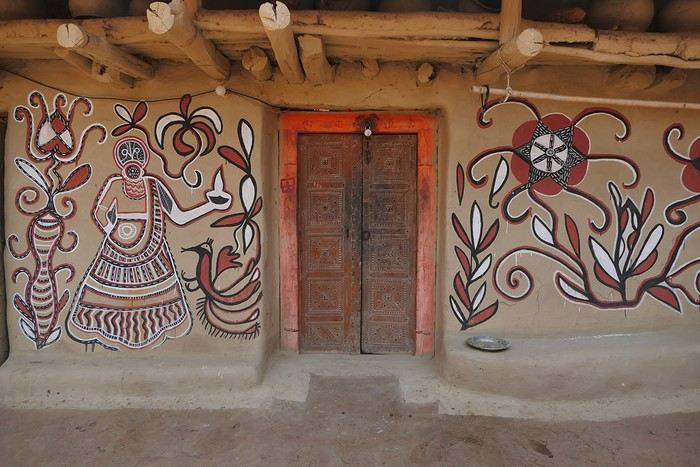
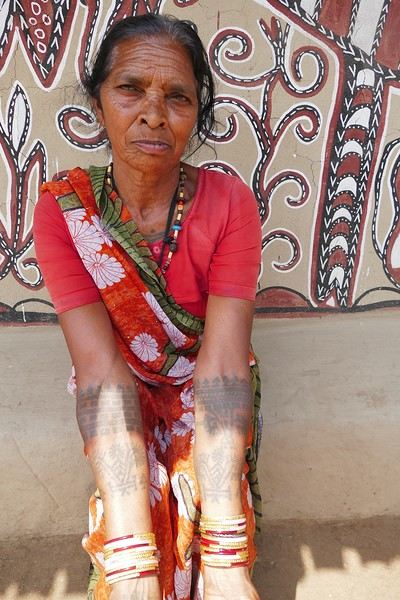
During the Sohrai festival, cattle are led into the jungle in the morning. Meanwhile, the women finish the *aripans*—these floor paintings—and continue the wall murals. Around noon, the animals return to the village, and the bulls’ horns are anointed with oil and vermilion in a gesture of gratitude, amid the vibrant colors adorning the houses. We visit several artists, including Parvat Devi, a well-known woman who has received many awards. Her arms are adorned with intriguing tattoos, which I’ll talk about in more detail later.
On another wall, the style changes completely. Here, no massive animals—just birds occupying the space, light and graceful, as if caught in mid-movement. Two silhouettes face each other, their long necks arched almost like mirrors, while their outstretched wings seem to vibrate with the patterns that compose them.
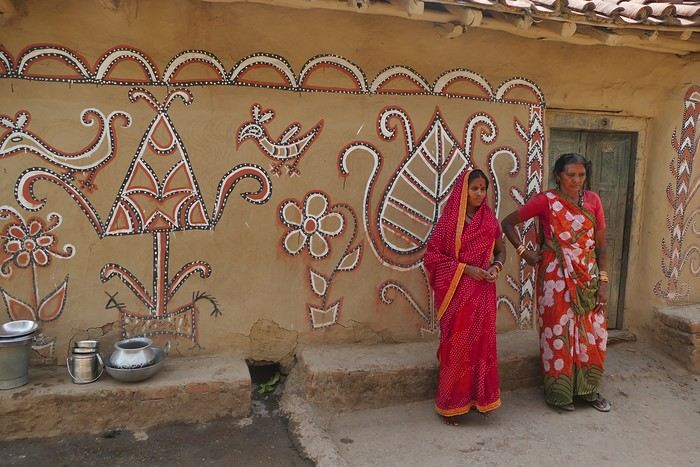
The design is more graphic, almost airy. The lines are smoother, more fluid, as if drawn in one confident stroke. The birds’ bodies aren’t solid—they’re filled with repetitive motifs like scales, stylized feathers, and spirals, giving a sense of continuous movement. Around them, everything comes to life: flowers burst open, arabesques swirl, and even the simplest shapes seem alive. What strikes me here is the sense of lightness. Where the large animals evoked stability and grounding, these birds bring something freer, almost joyful. They seem to embody movement, the circulation of life, like a breath flowing through the village.
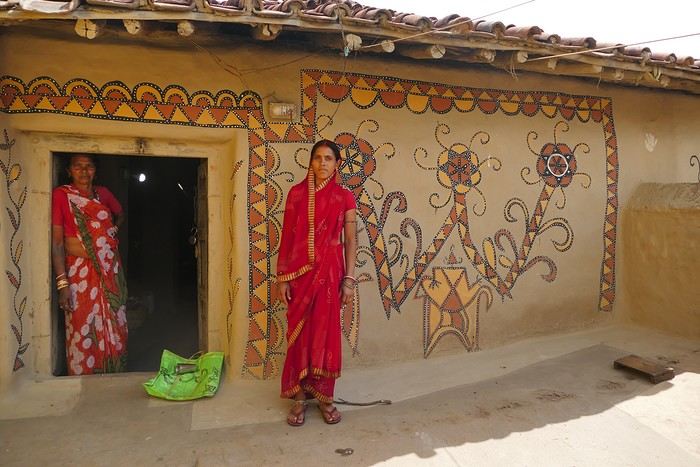
The colors remain the same—deep reds, intense blacks, and chalky white—but the rhythm is different. Faster, more spontaneous. As if each wall had its own personality, while still speaking the same language.
That’s probably why I’m so moved. I’d heard about these paintings from my friend Raja, and last year, I saw an exhibition in a village near my home. That first encounter made me want to come here. But seeing them in person is a whole different experience. These paintings are unique. This ancient art is passed down from mother to daughter, or mother-in-law to daughter-in-law, in a quiet, deeply living continuity. At first glance, it might seem almost childlike in its simplicity and pared-down forms. And yet, everything is thought out, balanced, mastered. Nothing is left to chance.
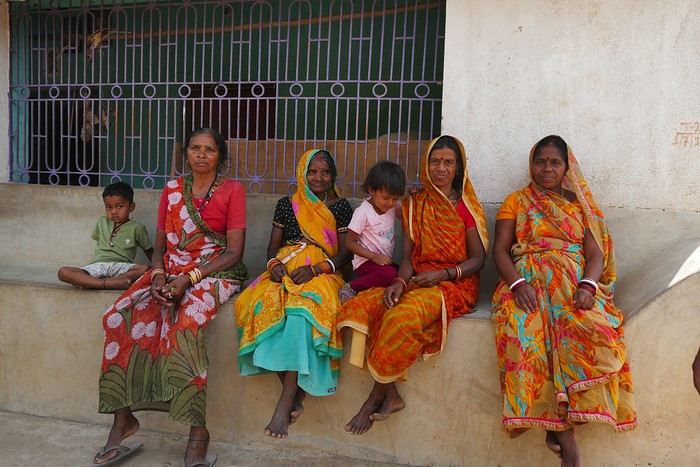
That apparent simplicity, combined with such rich symbolism, touches me deeply. There’s something sincere and essential in these walls—and that’s what moves me.
Hazaribagh I’ve got a meet-up with Adam Iman, a guide and painter. He picks me up from the hotel at 10 AM. Another traveler from Bangalore is supposed to join us, but while we wait for him to arrive, Adam takes me to see the paintings his mother and sister created at Hazaribagh station. The town became famous thanks to these murals, which can also be found in several surrounding villages. This art form has earned recognition and is now protected, a sign of its cultural importance. Once the visit is over, we go to pick up the other traveler and then head to our first village: Belwara, where Sohrai art is practiced. At the entrance, a sign proudly announces that we’re entering an artists’ village, where this art is created by women organized into micro-enterprises. Some even offer workshops for those who’d like to learn this tradition.
Sohrai art is tied to the harvest season, from October to mid-November. The motifs, in natural colors, celebrate fertility and abundance. The artists use pigments from the earth: red oxides, ochre, white kaolin, and black manganese. On the walls, you’ll see animals, fish, birds—all symbols of life and prosperity. As I look closer at the murals, I start to realize that each motif tells a story. Large animals like cows or bulls often take center stage. Their bodies are filled with intricate, almost hypnotic patterns. They symbolize wealth and prosperity for the household, as well as the deep respect for cattle, which are essential to daily life. On some facades, elephants stand out—massive and decorated with the same precision. They evoke quiet strength and protection. But it’s when I stop in front of one of the houses that I really take the time to look. The wall, a soft ochre, is entirely covered in murals. Two large animals stretch out on either side of the door, their elongated bodies fitting the length of the wall. Their silhouettes are filled with geometric patterns and incredibly fine curved lines, as if every space was patiently filled. Around them, stylized plants, flowers, and small decorative elements fill every gap. The door, dark and worn, becomes almost the silent center of the composition, framed by these living, protective forms. To the right, a more colorful motif catches the eye—a flower or a stylized lamp—like a touch of light on the earth. The whole thing gives an impression of perfect balance, between the rigor of the patterns and the freedom of the gesture.
Elsewhere, birds and freer forms bring movement. Peacocks, recognizable by their stylized silhouettes, embody beauty and vitality, while fish symbolize water, fertility, and the continuity of life.
On some paintings, the scenes become almost narrative: you can make out figures, everyday gestures, like a memory of the village inscribed in the walls. The decorative frames around the doors aren’t left to chance either—they symbolically protect the house, like a boundary between the inside and the outside world.During the Sohrai festival, cattle are led into the jungle in the morning. Meanwhile, the women finish the *aripans*—these floor paintings—and continue the wall murals. Around noon, the animals return to the village, and the bulls’ horns are anointed with oil and vermilion in a gesture of gratitude, amid the vibrant colors adorning the houses. We visit several artists, including Parvat Devi, a well-known woman who has received many awards. Her arms are adorned with intriguing tattoos, which I’ll talk about in more detail later.
On another wall, the style changes completely. Here, no massive animals—just birds occupying the space, light and graceful, as if caught in mid-movement. Two silhouettes face each other, their long necks arched almost like mirrors, while their outstretched wings seem to vibrate with the patterns that compose them.
The design is more graphic, almost airy. The lines are smoother, more fluid, as if drawn in one confident stroke. The birds’ bodies aren’t solid—they’re filled with repetitive motifs like scales, stylized feathers, and spirals, giving a sense of continuous movement. Around them, everything comes to life: flowers burst open, arabesques swirl, and even the simplest shapes seem alive. What strikes me here is the sense of lightness. Where the large animals evoked stability and grounding, these birds bring something freer, almost joyful. They seem to embody movement, the circulation of life, like a breath flowing through the village.
The colors remain the same—deep reds, intense blacks, and chalky white—but the rhythm is different. Faster, more spontaneous. As if each wall had its own personality, while still speaking the same language.
That’s probably why I’m so moved. I’d heard about these paintings from my friend Raja, and last year, I saw an exhibition in a village near my home. That first encounter made me want to come here. But seeing them in person is a whole different experience. These paintings are unique. This ancient art is passed down from mother to daughter, or mother-in-law to daughter-in-law, in a quiet, deeply living continuity. At first glance, it might seem almost childlike in its simplicity and pared-down forms. And yet, everything is thought out, balanced, mastered. Nothing is left to chance.
That apparent simplicity, combined with such rich symbolism, touches me deeply. There’s something sincere and essential in these walls—and that’s what moves me.
Are there any tricky sections on the GRR2?
Hi there,
We’re planning to hike the GRR2 this summer with a local agency that offers a self-guided south-to-north route. We’re active and hike regularly, but we’ve never done a trek just the two of us without a guide.
I’d love to know if this trail has any dangerous areas? Drop-offs? Are there spots where it’s easy to lose the path?
I’ve seen that some agencies offer a GPS app—does the signal even reach everywhere inland? 🤪
Thanks! 😄
Looking forward to hearing from you! !
Visiting the GEM in Cairo – is the audio guide included?
With the admission price for the new Grand Egyptian Museum in Cairo, is an audio guide included, or can we get one as an extra? (I can’t find the info anywhere.)
Thanks
Anyone know the provider Bali Rêve?
Hi everyone,
I’m trying to make sure this provider is reliable—they organize private tours in Bali with French-speaking guides. I’m currently in touch with them for a 15-day/14-night trip in May 2026.
If you’ve heard of them, I’d really appreciate your feedback—it’ll help put my mind at ease (or not...).
Looking forward to your replies,
Backpacking itinerary in Tunisia
Hi there,
I'm urgently planning a trip to Tunisia in November, backpacker-style (no agency, no guide or taxi, public transport, youth hostels or small hotels, local restaurants). I'm not interested in the beach, and I like to take my time at archaeological sites and museums (twice as long as the average visitor). I'm aiming for about two weeks, give or take.
First, I'm trying to roughly outline a route/schedule so I can book my flight as soon as possible (no desert in the south this time—I went there years ago and want to stay independent). I’ve sketched out the following itinerary, knowing that apparently, there are quite a few towns without budget-friendly hotels (even on Airbnb), which means I’ll be staying longer where they’re available. Three questions: 1. Does this seem reasonable overall (time spent in each city)? 2. Should I add other cities, maybe in the northwest? 3. For hotels, in November, is it better to scout options on booking sites first, then book on the spot for cheaper rates (no site commission + possible negotiation)? Also, are hotels not listed online and found randomly on-site much cheaper?
ROUGH ITINERARY (order to be confirmed)
TUNIS 5 days (cheap accommodations: 13 or 19 €) 2 days: Medina, souks, Bardo Museum, Royal Mausoleum of Tourbet El Bey, Zitouna Mosque (exterior) 1 day: Sidi Bou Said 1 day: Carthage 1 day: A-R Dougga (bus to Tebersouk 2h + taxi) – pack a picnic + option: hike to Zaghouan (750m+, 10km round trip) – worth it? Doable alone?
KAIROUAN 2 days (very expensive room: 40-50 €!) Great Mosque, Medina, Three Doors Mosque, medieval cemetery, Sidi Sahbi Mosque...
SOUSSE 3 days (room 15 €) 2 days: Medina, archaeological museum, Port El Kantaoui, the Ribat (fortress), Contemporary Art Museum Dar Am Taïeb, Dar Essid (17th-century traditional house) 1 day: A-R El Jem (60km away) + option: 1 day A-R Monastir? Worth it? + option: 1 day A-R Mahdia (or 2 days sleeping there)?
OPTIONS -> Gabes to mix things up? But is it easy to find cheap lodging and get around/visit alone? -> Other sights or stops to sleep: Sfax, El Kef, others? -> Kerkenna Islands (easy accommodation?)
Thanks for your thoughts and opinions on these options. Once I’ve adjusted the duration, I’ll book my tickets for early November! (By the way, do you think I should arrive and depart from two different airports?)
What about crossing the Lofoten Islands on foot?
While planning a trip to the LOFOTEN for summer 2023 using the excellent guide *Hiking in the Lofoten*, we discovered this trek.
Sure, it’s rated as difficult, but it lets you cross the LOFOTEN on foot from north to south in 11 stages, covering 160 km and 9,193 m of elevation gain (or the reverse, of course).
So, it’s a multi-day hike, with wild camping, and no need to rent a car. Perfect...
What’s making us hesitate a bit are the island transfers (okay, I’ll admit, the difficulty is also a factor for me). These transfers require taking public transport and/or hitchhiking. But the stages are designed with this in mind, and the transfers are well explained. Plus, water isn’t an issue, and you can resupply several times, which helps keep the pack weight down.
For Jean Marie, my partner, this will be his first multi-day trek, but he’s an experienced and hardy hiker. As for me, even though I’m not as tough, I’ve already done some multi-day hikes. So, we should complement each other well.
So, are we going for it? Sold!!
Here’s the trek map: HERE
03/08 – Day 1 - Delp – Sandsletta 04/08 - Day 2 – Sandsletta – Svolvaer 05/08 - Day 3 – Svolvaer – Kleppstad + transfer to the start of Day 4 06/08 – Day 4 – Vikjorda hamlet – Store Lake 07/08 – Day 5 – Store Lake – Leknes - Transfer to Napp on Flakstadøya Island 08/08 – Day 6 – Napp – Nusfjord 09/08 – Day 7 – Nusfjord – Ramberg 10/08 – Day 8 – Ramberg – Selfjord Bay (Moskenesøya Island) 11/08 – Day 9 - Selfjord – Bunes Beach 12/08 – Day 10 - Bunes Beach - Krokvatnet Lake 13/08 – Day 11 - Krokvatnet Lake – Moskenes (campsite) and round trip to Å by bus 14/08 – Day 12 – Hike up Reinebringen – Reine – Tour of Agvatnet Lake 15/08 – Return to Bodø - flight back to France on 16/08 And here’s the inevitable recap
Guided taxi contacts and half-board hotels on Santiago Island
Which hotels offer half-board on Santiago Island?
Also, I’d love some contacts for guide-taxis—I’m traveling solo and really want to discover authentic spots.
Which island should I visit first to discover Cape Verde?
Hi there,
Which island would be best for a one-week solo trip at the end of November?
I’d like to explore with a local guide who can help me discover Cape Verdean culture.
It’s still just the beginning of the plan…
Thanks to anyone who’d like to share some tips!
No vouchers before departure to Indonesia
Hi everyone, our travel agency informed us that the accommodation vouchers and others will be given to us by our guide upon arrival, not before our departure. Does this seem normal to you?
Accommodation in Ha Giang loop
Hi everyone,
In November, we’re planning to do the Ha Giang loop and the RC4 by motorbike without a guide. 😎 We’re looking for a decent place to stay/rent in Ha Giang.
If anyone has any info, we’d be really interested.
Thanks in advance! 😉 Ladava
In November, we’re planning to do the Ha Giang loop and the RC4 by motorbike without a guide. 😎 We’re looking for a decent place to stay/rent in Ha Giang.
If anyone has any info, we’d be really interested.
Thanks in advance! 😉 Ladava
Looking for participants for a Tanzania safari in early 2026
Hello.
I’m looking for participants for a safari in Tanzania in the first quarter of 2026. I’m in direct negotiations with a local guide. Below is the description (via a draft service contract). If you’re interested, reply to me. We’ll then communicate via private email.
Between the undersigned:
Ms./Mr. (provide the provider’s name), representing the company (specify), whose registered office is located at (provide the address), Hereinafter referred to as The Provider
And,
Ms./Mr. (provide the client’s name and contact details), Hereinafter referred to as The Client
The following has been agreed:
I. Purpose This service contract covers the organization of a safari in Tanzania by The Provider for the benefit of The Client.
II. Duration This contract is concluded for a duration of (specify). It takes effect from day J1: (specify the date) and will end on (specify the date). Unless otherwise agreed between the two parties, this contract is not subject to any automatic renewal.
III. Execution Terms The Provider undertakes to carry out the tasks assigned by The Client with professionalism and rigor, in accordance with best practices. They also agree to comply with all applicable regulations and standards for their tasks. To fulfill their duties, The Provider will mobilize all necessary resources. The Client, for their part, agrees to collaborate with The Provider and provide all useful information for the smooth execution of the tasks. IV. Payment The Client will pay The Provider the sum of (specify), according to the following terms: (specify). In case of late payment, The Provider reserves the right to claim penalties in the amount of (specify). V. Confidentiality The Provider agrees not to disclose any information or documents provided by The Client. Upon completion of their task, they will destroy all documents in their possession. VI. Service Details Accommodation during the stay (excluding days 1, 2, and 9): participants will sleep in tents, with 2 people per tent. A sleeping bag and an inflatable mattress will be provided. They will have water for washing and access to toilets. Tents will be set up and taken down during each transfer. It will be possible to charge camera batteries. Day 1: ARRIVAL AND TRANSFER Welcome at Kilimanjaro Airport for transfer to Arusha and overnight at Green Mountain Hotel (breakfast included) - https://greenmountainhotel.co.tz/ Day 2: HIKE ON THE TRAILS OF KILIMANJARO. Pick-up from your hotel in Arusha to the village of Moshi Materuni, at the foot of Kilimanjaro. You’ll begin a day of hiking toward the impressive waterfalls in one of the country’s highest regions, where crystal-clear glacial water cascades from 70 meters high. The beautiful trail leads to the Materuni waterfalls, located at 2,500 meters altitude. To reach these falls, you’ll cross valleys and hills covered in tropical forest, coffee, avocado, and banana plantations. On a clear day, you’ll enjoy a breathtaking view of Kibo, the highest peak of Kilimanjaro. You’ll also learn how to prepare and taste coffee. In the evening, you’ll be picked up in Arusha and spend the night at Green Mountain Hotel. Day 3: HIKE IN A MAASAI VILLAGE After breakfast around 8:30 AM, you’ll be picked up from your hotel for a walking hike in the wild nature of the village. You’ll visit local primary schools, meet traditional healers, and discover their techniques. You’ll also visit one of the local livestock markets. Dinner and overnight at the Maasai village house in Boma. Day 4: WILDLIFE IN 4X4 ALONG THE TARANGIRE RIVER Around 8 AM, you’ll be picked up from your hotel in Arusha and drive for 2 hours to Tarangire National Park for a day of wildlife viewing. The park is known for its dense wildlife along the Tarangire River. It’s home to a large number of elephants in the northern circuit and hosts 550 bird species. You’ll also observe herds of impalas, hartebeests, wildebeests, kudus, oryxes, gerenuks, zebras, buffaloes, and giraffes. Predators like lions, leopards, cheetahs, hyenas, and massive African baobabs can also be spotted. Dinner and overnight at Lake Manyara Fig Tree Lodge. Day 5: LAKE MANYARA PARK - WILDLIFE VIEWING IN THE RIFT VALLEY Around 8 AM, departure from your camp to Lake Manyara Park (at the foot of a 600-meter escarpment in the Great Rift Valley) for a day of safaris. You’ll see giraffes, buffaloes, groups of baboons, tree-climbing lions, and many other animals. Dinner and overnight at Lake Manyara Fig Tree Lodge. Day 6: WILDLIFE IN SERENGETI In the morning, you’ll drive for 5 hours to the magnificent Serengeti National Park, passing through the archaeological site of Olduvai Gorge. This park is arguably the world’s most famous wildlife reserve. It’s home to over 3 million large mammals, and you’ll quickly spot the "Big Five": buffaloes, elephants, black rhinos of the Moru Kopjes, lions, and leopards. Over 500 bird species have been recorded here. You’ll also witness the spectacular wildebeest migration in the western Serengeti. Dinner and overnight at Serengeti Nyani campsite. Day 7: MAGNIFICENT WILDLIFE AT SUNRISE IN SERENGETI Stunning sunrise safaris in the golden savanna of the endless plains of Serengeti National Park, all day long, following the animals’ movements. You’ll spend the night at the campsite and share your exceptional experience so far at Serengeti Nyani campsite. Day 8: MAJESTIC EXCURSION IN THE SERENGETI PLAINS Wake-up at 6 AM, coffee at the campsite, then departure for a sunrise safari in the Serengeti. Our guide will take you to the best spots to admire the sunrise and observe predators, as most of them, like lions, are very active at this time of day. You’ll return to the campsite around 10 AM for brunch, then load your belongings into the jeep for a 2-hour safari on the way to the Ngorongoro Conservation Area. Dinner and overnight at Ngorongoro Simba Lodge. Day 9: SPECTACULAR EXCURSION TO NGORONGORO CRATER Shortly after breakfast, you’ll descend into the Ngorongoro Crater for a sunrise safari in the world’s largest uninterrupted caldera, surrounded by steep walls rising 610 meters from the crater floor. This natural wonder measures 19.2 km in diameter and covers 304 km². You’ll go on safaris and discover rare species like black rhinos, wildebeests, giraffes, ostriches, bustards, lions, cheetahs, and flamingos in the Soda Lake. In the afternoon, you’ll return to Arusha, arriving in the evening for your private activities. Accommodation in half-board (dinner, overnight, breakfast) Day 10: TRANSFER TO KILIMANJARO AIRPORT Breakfast and transfer to Kilimanjaro Airport. VII- RATES: The package price is 2030 USD (approximately per person in a double room). VIII- THE PRICE INCLUDES: - Provision of sealed water bottles for participants - Park entry fees. - Transfer from Kilimanjaro Airport. - Accommodation in Arusha (breakfast included). - Village development fees. - Accommodation in camps/lodges (breakfast, lunch, dinner). - Transport in a 4x4 Land Cruiser with a pop-up roof in national parks. - Government taxes. - Activities detailed in the itinerary. - Safari guides. - Transfer from Arusha to Kilimanjaro Airport on day 10.
IX- THE PRICE DOES NOT INCLUDE: - Alcoholic beverages. - International flights. - Personal items such as visas, laundry, etc. - Tips.
Done at Done at
Date: Date: Provider’s Signature: Client’s Signature:
Visiting Mudumalai Reserve: practical info and online booking?
Hi everyone,
I’m in Masinagudi. I’d love to visit the Mudumalai Reserve. I’ve got conflicting info.
My guidebook (Lonely Planet) says you can buy tickets on the spot, but apparently it’s online-only now—and no availability…
Any useful tips?
Thanks! :)
Your thoughts on a trip to Croatia
Hi there,
We were planning to spend a month in June exploring Croatia (Istria for 1 week, Plitvice Park, Zadar, Split, the islands, Dubrovnik…) and Montenegro, and we’ve already made good progress on our plans. But after reading the forum, we got a bit worried—there are so many negative reviews. Apparently, tourism has exploded, and Croatians are getting more and more fed up (which we totally get), becoming aggressive and disrespectful. The euro has sent prices skyrocketing, and scams of all kinds are popping up—even car vandalism is being mentioned!!
Here’s what we had in mind: Day 1: Our trip was supposed to start from Nice by car, with a stop in Verona to arrive in Croatia the next day. Days 2–6: First possible detour to visit Postojna Cave in Slovenia (or later from Rijeka... but I’ve heard border crossings can be super long!!!) and a 5-night stay in Rovinj (visiting Rovinj, Bale, Poreč, Grožnjan, and other small villages, Pula, maybe Cape Kamenjak, relaxing on beaches, possibly Cres Island). - Days 7–8: Head toward Rijeka and Plitvice Lakes National Park via the coastal road; 2 nights outside the park (given the prices!!!) and visit the park the next day. Do we need to book park entry way in advance for June? - Days 9–11 or 12: Leave for Zadar for 4 nights—one island (Dugi Otok, Pašman Island, Kornati Islands National Park, Silba, Molat, Olib, Premuda, Sakarun Bay, Veli Žal Beach, Iž Island, Ugljan Island), explore the city, and check out the surroundings. - Days 13–15: Head to Split, visit Šibenik, Split, and Trogir. - Days 16–17: Hvar Island. - Days 18–21 or 22: Head to Dubrovnik, explore the city, cross over to Korčula, Prapatno port at the start of the Pelješac Peninsula, via Ston, Mljet Island (Konavle and Cavtat port?).
- Then return to Split to catch the ferry to Ancona or head to Montenegro for 5–7 days.
If you’ve visited Croatia since 2023 (when it joined the Schengen Zone), we’d love to hear your thoughts on traveling there in June. Françoise
Traveling to Mongolia in Winter: Practical Info and Experience Feedback
Hi everyone, here are some practical tips from my 5 weeks in Mongolia in February.
The famous Lonely Planet paper guide mostly gives wrong information—we often got let down.
From the airport to the city center (25 km), there are normally buses, but it’s not straightforward, especially for your return trip. Check with the tourism office on Genghis Khan Square.
If you need to stay more than 30 days, your hotel can request an extension for you online. Do this immediately because it can take time. At customs, you’ll get an extra stamp. Each day costs a very small fee, and no photo is needed.
I only travel by public transport. Don’t follow the paper guide, and remember there are buses running daily between Ulaanbaatar and Ölgii (and other routes).
The main issue is finding out the departure time and location. Insist strongly with your hotel—the bus might pass in the middle of the night. Locals have the drivers’ numbers and will let them know there are passengers to pick up. You pay on the bus.
From Karakorum Monastery, if you want to reach Arvaikheer via the mountains, the route is truly stunning. The postal service has a 6-seater van that leaves around 1 PM from the post office—ask around. This avoids going back to Ulaanbaatar. Plus, the van stops right in the center of Arvaikheer, next to a hotel that’s a really ugly red but has good rooms, great prices, and friendly staff.
The Black Market isn’t far, and neither are the city’s two museums.
The yurt camp next to the monastery is well-maintained, with very kind people. It gets too hot in winter, so you’ll have to sleep with the door open.
Ulaanbaatar There are two main long-distance bus stations: "Dragon Station." They’re far from the city center, so take a bus or a taxi—allow plenty of time to get there.
The city is constantly congested and polluted. Climate change is a very visible issue here.
To see a wrestling match in Ulaanbaatar, go directly to the "stadium" on Peace Avenue. Matches often take place at 11 AM, and tickets are sold on-site. Bus No. 1 goes there, among others.
For the Black Market, taking the bus is faster. You’ll find everything for daily life—fabrics, dishes, etc. But be careful: the "antique dealers" don’t provide authenticity papers, and you could get stopped at customs. Stick to the antique dealers in the city center.
I was really disappointed by the Lunar New Year—nothing happens outside, shops and banks are closed. Make sure to bring food, though ATMs work.
To exchange money, go to the 4th floor of the "state store" across from Beatles Park on Peace Avenue. The exchange rate seems good.
There are many great museums in Ulaanbaatar and smaller towns—worth a visit, even if you sometimes have to hunt for the keys and lights. However, the art galleries in Ulaanbaatar no longer exist (at least not when I was there).
I stayed at GoldenGobi Guesthouse—very family-like atmosphere, right in the center, and budget-friendly. They can also help organize things. There’s a kitchen and a terrace for summer, and it’s just a short walk from the "state store" and museums.
The Thousand Camel Festival in Dalanzadgad takes place at the end of January—check the dates, as climate change may shift them.
There’s a direct bus from "Dragon Station" very early in the morning. For accommodation, I stayed at "Happy Bee Hostel," which is well-located on the festival route. It has 3 nice dorms and a small kitchen, and the owner is very friendly. The place was clean.
The festival is 5 km away, but hitchhiking works really well. It lasts 3 days and is free. Day 1: Introductions, networking, and handicrafts. Day 2: Archery (men’s and women’s), camel presentations, and camel polo. Day 3: Camel races, beauty contests, and training demonstrations. There are several yurts where you can enjoy culinary tastings—very pleasant when it’s a bit windy and cold.
You can eat on-site throughout the festival.
There’s also the Ice Festival in the north, which lasts 3 weeks—look into it.
Alcohol (vodka and very strong Mongolian alcohol—cheap) I never encountered any issues on the road—there are lots of police checks. However, I did witness several nighttime fights in hotels. I always made sure my door locked and let the shouting and punches fly. I only took out my whistle if I heard a woman screaming, but usually, it’s just men drinking in their rooms.
I didn’t experience any specific issues as a woman.
Health: Don’t forget your prescriptions. I used SMECTA (a digestive aid), which helped when I couldn’t refuse mutton dumplings—I’m not a big meat eater.
That’s all—I’m sure I forgot some things. I chose winter to attend the Camel Festival and also because there are no tourists or 4x4s everywhere. The downside is that there’s a lot of snow, especially near the Kazakh region, and sometimes it’s impossible to go off the beaten path. Near Ölgii, summer must offer some great hikes. Marie
Getting to Rome from the port of Civitavecchia
Does anyone have any tips for visiting Rome from the Civitavecchia port of call with a guide taxi?
Thanks for your reply! M.B
Malaysia or Thailand from January 17 to February 1, 2025?
Hi there,
Anyone up for a trip to Malaysia or Thailand from January 17 to February 1, 2025? It’ll depend on the flight tickets and how long we want to travel—ideally, two weeks to explore at our own pace.
I’m a Parisian in my 40s, non-smoker, love walking, cultural outings, the beach, and trying local food.
If any fellow traveler’s interested in planning a trip together, let me know!
Looking forward to it, future travel buddy! 😎
Tips for our Québec itinerary
Hello,
We’re a couple in our 70s planning to visit Québec this summer. We only do short hikes of about 6 km round trip.
What do you think of our itinerary? Thanks so much for your advice!
Day 1: FRANCE/MONTREAL
Days 2 & 3: MONTREAL
Day 4: MONTREAL/BAIE ST PAUL – 2 nights
Day 5: BAIE ST PAUL
Day 6: BAIE ST PAUL/La Malbaie/Port-au-Persil/BAIE STE CATHERINE – 2 nights
Day 7: BAIE STE CATHERINE/TADOUSSAC/BAIE STE CATHERINE
Day 8: BAIE STE CATHERINE/SACRÉ-CŒUR/LES BERGERONNES – 2 nights
Day 9: LES BERGERONNES/ferry LES ESCOUMINS/BIC NATIONAL PARK – 2 nights in Rimouski
Day 10: BIC NATIONAL PARK
Day 11: BIC NATIONAL PARK/CARLETON-SUR-MER – 1 night
Day 12: CARLETON-SUR-MER/PERCÉ – 2 nights
Day 13: PERCÉ
Day 14: PERCÉ/GASPÉ/CAP DES ROSIERS – 1 night
Visit Forillon Park
Day 15: CAP DES ROSIERS/GASPÉSIE PARK – 2 nights in Sainte-Anne-des-Monts Day 16: GASPÉSIE PARK Day 17: GASPÉSIE PARK/KAMOURASKA – 1 night Day 17: KAMOURASKA/QUÉBEC CITY Days 18 & 19: QUÉBEC CITY Day 20: QUÉBEC CITY/AIRPORT MONTREAL for France
Visit Forillon Park
Day 15: CAP DES ROSIERS/GASPÉSIE PARK – 2 nights in Sainte-Anne-des-Monts Day 16: GASPÉSIE PARK Day 17: GASPÉSIE PARK/KAMOURASKA – 1 night Day 17: KAMOURASKA/QUÉBEC CITY Days 18 & 19: QUÉBEC CITY Day 20: QUÉBEC CITY/AIRPORT MONTREAL for France
French-language food and history tour in New Orleans
We're planning a trip through Louisiana and would love to do a food and history tour led by a guide—but I’m only finding options in English. Do any of you have recommendations for an experience where the guide spoke French and the food was good?
Thanks for your help
Comment vidanger ses eaux grises en camping-car en Amérique du Nord? English translation pending
Bonjour,
Nous allons partir avec notre camping-car/van européen en Amérique du Nord. L’évacuation de son eau grise se fait par une vanne/trappe située sous le véhicule et en son milieu. En effet presque tous les campings en Europe ont une grille sur laquelle on roule pour y arrêter son véhicule. On ouvre la trappe Eau Grise quand on est au-dessus de la grille et l'eau s'évacue.
En Amérique du Nord, la plupart des campings ont une dump station et/ou une décharge sur le coté de son emplacement. On vide alors son Eau Grise par un tuyau souple que l'on raccorde au bout de la vanne Eau Grise du véhicule. La plupart des camper-vans US et Canadiens ont, pour des raisons de facilités, l’évacuation Eau Grise sur le coté et non sous le véhicule comme en Europe.
Ma seule question: Comment avez-vous fait pour cette Eau Grise aux US avec votre van/fourgon européen (ayant l’évacuation sous le véhicule)?
Me suggérer de prolonger l’évacuation Eau Grise avec un tuyau rigide de milieu du véhicule jusque sur le coté du véhicule me semble difficile du fait de la petite garde au sol (risque d'arrachage du cette rallonge/tuyau lorsqu'on roule). Me suggérer de fixer un tuyau souple à l'embout au milieu du véhicule (lors des vidanges) n'est pas pratique puisqu'il faudrait alors se coucher et ramper sous le véhicule pour fixer ce tuyau souple.
Merci déjà pour votre réaction. Bonne journée, Eric
Visites guidées et activités à Sousse et environs English translation pending
Bonjour à toutes/tous,
Je pars pour Sousse ce week end et j'aimerai savoir s'il est possible de recruter un guide ou un accompagnateur pour des visites des trucs intéressants dans la région, les agences proposent des visites guidées mais je préférerais quelque chose de plus personnel. Peut-être en demandant au personnel de l'hotel??
Y a-t-il des treks en montagne dans ce secteur? Je veux aussi aller jouer au golf, une suggestion?
Merci
Bruno😉
Bivouaquer au Refugio El Pilar à La Palma (GR 131) English translation pending
Bonjour, nous comptons faire le GR 131 de La Palma prochainement et bivouaquer au refugio de El Pilar.
Dans le topo guide , il parle de "permis" à demander au ministère de l'environnement pour pouvoir passer la nuit dans cette aire de camping.
Je n'arrive pas à les contacter.
Quelqu'un a-t-il déjà bivouaqué dans cet endroit?