Results for "Vence+|+127"
30225 results found.
Inde du Nord (Rajasthan) et Himalaya English translation pending
bonjour a tous,
l Inde me fascine, tant au niveau de la culture historique qu humanitairement parlant. Je pense que leurs conditions de vie st une bonne relativisation de notre oppulence occidentale et une lecon d humilite. J aimerai la decouvrir l ete 2004 et ne possede que peu d infos pratiques pour un tel voyage, que peut on apporter, et que peut on leur laisser?. Je projette de me faire un circuit en train a travers l inde du nord.
Merci
JG
Parc Akagera (Rwanda) par les frères Vienne English translation pending
😉 Bonjour à tous,
Je recherche depuis tant d'années les reportages (films) des frères Vienne sur le Parc Akagera au Rwanda.
J'étais au Rwanda, quand ils les ont tourné ...Et le Parc Akagera fait partie intégrale de mon enfance ...
Si quelqu'un peut me renseigner où me les procurer ...Ce serait un véritable cadeau. Merci.
PS : toutes les pistes ...sont les bienvenues ...
Palu, monastères et conseils sur le Népal English translation pending
Bonjour,
je pars dans 5 jours au Nepal et me demande s'il faut prendre un traitement anti palu ?
De plus, je n'es pas d'itinéraires précis, avez vous des conseils à me donner pas forcément pour les trecks, pour des visites de villes ou autres (je pars 3 semaines) ?
J'ai envie de voir des monastères à flan de montagne, où puis je voir cela ? Y a t il un treck spécial ?
Avez vous des bonnes adresses pour trouver de belles antiquités, bien sur pour pas trop cher !
MERCI D'AVANCE,
Benoît
Cartes bancaires du Québec en France English translation pending
Bonjour,
Une petite information : la carte bancaire de mon institution financière (au Québec) comporte un NIP (numéro d'identification personnel) à 5 chiffres. Si je ne me trompe pas, les cartes bancaires en France ont des NIP à 4 chiffres; croyez-vous que cela pourrait me causer des problèmes? Mon institution financière me dit que non, mais j'aurais besoin de "témoignages".
Est-ce que d'autres voyageurs du Québec qui sont déjà allés en France ont eu des problèmes d'accès à des fonds avec leur carte Desjardins?
Merci d'avance.
France: recherche château digne des films d'Hollywood English translation pending
En France, je recherche un château digne des films d'Hollywood. Comme les châteaux de France sont nombreux, je recherche la bonne adresse, j'ai juste une chance de réussir mon voyage de noces.
Plus précisément, je recherche un château de grande taille, hall impressionnant, chambre d'exception, le prix et l'endroit importe peu.
Un manoir avec les mêmes critères conviendrait aussi.
Plus précisément, je recherche un château de grande taille, hall impressionnant, chambre d'exception, le prix et l'endroit importe peu.
Un manoir avec les mêmes critères conviendrait aussi.
Népal: vol Pokhara - Jomsom English translation pending
Bonjour,
Pourriez-vous m'indiquer le prix du vol Pokhara-Jomsom ?
Est-ce-que ce vol existe même en décembre ?
Fait-il réserver ?
Y-aurait-il un site web de la compagnie aérienne (je doute) ?
Merci beaucoup, Car je projete de partir au Népal en Décembre.
Pourriez-vous m'indiquer le prix du vol Pokhara-Jomsom ?
Est-ce-que ce vol existe même en décembre ?
Fait-il réserver ?
Y-aurait-il un site web de la compagnie aérienne (je doute) ?
Merci beaucoup, Car je projete de partir au Népal en Décembre.
Danger Turquie = prison pour les touristes English translation pending
c’est en réponse à une certaine Anne vivant en Turquie et qui considère que c’est une affabulation que de dire que l’on peux aller en prison pour un simple fossile d’oursin acheté légalement dans une boutique à touriste.
Je suis désolé de la contrarier, je m’appel Marc et c’est à moi que cette histoire est arrivée. Je viens de sortir de prison grâce à une caution de 6000 euros que m’on père à du payer pour m’a libération.
Vous allez croire peut-être, que j’avais acheté une véritable antiquité d’une valeur inestimable et bien non c’était un simple fossile d’oursin qui se vend par centaines pour une valeur entre 1 et 5 millions de livres turque. Notre guide ne nous a rien dit, pourtant il en connaissait les conséquence. La vente est interdite, pourtant les commerçants non jamais été inquiété. La seul chose que je sais, s’est qu’a l’aéroport d’Antalya on a fouillé mes bagages, que l’on a sorti mon fossile et que l’on m’a arrêté.
La première nuit j’ai dormi sur une planche en bois. Le lendemain j’ai du subir tout se que l’on fait subir aux pires criminels. Après quoi on m’a jeté dans la prison D’Antalya. Nous étions 15 dans la cellules que des étranger. C’est là que j’ai appris qu’il était monnaie courante que d’arrêter de temps en temps un touriste pour ces raisons. Une centaine par an pas plus n’y moins.
J’encourais une peine de prison allant de 5 à 10 ans et que seul mon jugement déterminerait si l’on m’accorderai de sortir ou pas en payant une caution de 6000 euros.Vous devinerez les angoisses que j’ai du subir pendant les 43 jours que j’ai attendu avant d’être jugé. Pas le droit de téléphoner pas le droit d’écrir sauf en Turc un isolement total accompagné de malnutrition, racket, la douche tout les 10 jours il fallait tout payer même son électricité.
Un Allemand de 37 ans s’est pendu dans la cellule. Il avait ramassé un caillou, non, pas une pierre antique, non un caillou et s’était là, la raison de son incarcération.
Mon avocat sur place a fait un très bon travail, il a rassemblé beaucoup de preuves, il est même retourné en Cappadoce prendre des photos des étalages des commerçants. Accompagné de la police et d’un arquéologue il a fait faire une déposition au vendeur qui m’avait vendu le fossile.
Mais tout ça n’a servi a rien.Le but final de se complot était de me soutirer 6000 euros. Mais cette histoire m’a coûté bien plus, 12000 euros, un casier judiciaire et un préjudice morale et physique du au condition de tétention.
Marc
Marc
Climat au Brésil en août? English translation pending
bonjour,
j'ai bien lu vos differentes discussions sur le bresil.
J'aimerais y aller au mois d'aout. Estce une période favorable?
j'ai bien lu vos differentes discussions sur le bresil.
J'aimerais y aller au mois d'aout. Estce une période favorable?
Choix d'hôtels sur Cuba? English translation pending
😉 Nous souhaiterons avoir des bons plans pour cuba sur les hotels en paticulier
d'avance merci
d'avance merci
Les îles Malouines English translation pending
Récit de voyage aux île Malouines (long... très long...)
(et pour voir les photos de ce voyage: http://www.mysterra.org/reportage/iles_malouines.html)
La visite des Malouines est motivée, pour la majorité des visiteurs, par l’intérêt pour la nature et la faune. Pour une plus petite partie des touristes, c’est un conflit vieux de 20 ans, mais encore étonnamment présent dans la mémoire de tous, qui attire les amateurs d’histoire.
Le premier sentiment qui frappe notre esprit c’est l’isolement, la solitude presque jusqu’à l’angoisse, la toute puissance de la nature sur l’homme, qui pour se rassurer tente de reproduire les modèles d’organisation propre à nos amis anglo-saxons où tout est codifié.
C’est aussi des îles uniquement composées de terres privées dont les droits ont été acquis, il y a plus de 100 ans. Des terres sauvages mais étroitement contrôlées où le moindre profit peut être réalisé.
Des gens simples comme des agriculteurs vivant proche de la nature, doivent depuis 1982 composer avec un développement trop rapide et artificiel: la présence militaire a permis la modernisation et l’extension des infrastructures des îles. Economiquement, l’activité traditionnelle (l’élevage de moutons pour la laine) est en perte de vitesse. A court terme la vente de licences pour la pêche industrielle fournit au Gouvernement des ressources suffisantes. A moyen terme, il ne semble pas exister d’autres possibilités que le développement du tourisme, sous quelle forme et avec quels moyens la question reste ouverte. A plus long terme l’avenir reste flou; certains rêvent aux revenus de l’or noir, sans penser aux nuisances. La prospérité de ces îles passe par la normalisation des rapports avec ses grands voisins d’Amérique du sud et l’établissement de relations commerciales. L’avenir nous le dira!
Cette société vit sans réel avenir, sous perfusion d’un état éloigné de 14’000 km, coupé d’une Amérique latine et particulièrement de l’Argentine, si proche, qui pourrait beaucoup lui apporter.
Visiter ces îles laisse beaucoup d’images fortes: de terre, de mer, de lumière, de faune mais trop peu de souvenirs de ses habitants qui se cachent derrière une identité nationale héritée d’un conflit bien actuel. Il faudrait sûrement plus de temps pour percer cette méfiance latente, elle aussi héritée de ce conflit.
Le voyage
Dès notre arrivée à l’aéroport de Brize Norton (Angleterre) et jusqu’à notre sortie de l’aérogare de Mont Pleasant aux Malouines nous sommes complètement pris en charge, dirigés, nourris et logés (à Brize Norton la nuit avant le départ et lors du transit à l’île de l’Ascension) par la Royal Air Force. Il n’est pas nécessaire de penser à quoique que ce soit, pire, penser ne ferait que nous poser des problèmes bien inutiles, nous suivons donc comme des moutons les instructions fournies par des membres de la RAF. L’impression qui subsiste est un voyage agréable avec comme seul stress la stratégie à employer pour ne pas avoir à payer de surtaxe pour le poids excessif de nos bagages (100kg)!
L’omniprésence de l’armée saute aux yeux à l’arrivée aux Malouines. Tout de suite l’histoire nous rattrape et le conflit, vieux de près de 20 ans, est bien présent. Avant d’atterrir sur l’aéroport de Mount Pleasant, nous sommes escortés par deux jets “tornado” qui vont nous accompagner pour les 15 dernières minutes de vol. A peine foulé le sol des Malouines et avant les formalités douanières, un sergent de la RAF nous informe des dangers des mines et autres munitions qui peuvent encore être présentes sur l’île. Il est intéressant de savoir que cette mise en garde très militaire n’est faite qu’aux voyageurs arrivant avec le Tristar de la RAF et non à ceux en provenance du Chili (avec Lan Chile)! En fait, nous supposons que ces informations sont surtout destinée aux soldats qui constituent la majorité des passagers de l’avion. Pour nous l’ambiance est quand même un peu particulière et nous montre bien que ces îles vivent encore dans la réalité du conflit anglo-argentin.
Premières impressions
Sur la route entre Mont Pleasant et la “ville” de Stanley, nous prenons enfin conscience d’être arrivés. Le temps est gris et la température fraîche. L’isolement de ces îles au bout du monde engendre presque de l’angoisse et des questions du genre “que va-t-on bien pouvoir faire pendant trois semaines ici?” ou “était-ce vraiment une bonne idée de venir ici?”. De plus cette route est interminable, le seul décor des paysages arides et monotones augmente la sensation de terre perdue et de désolation. On se demande aussi ce qui a bien pu pousser des hommes à venir se battre dans cette région, il y a 20 ans. Rien ici ne peut attiser la convoitise, la nature sauvage pousserait plutôt l’homme à s’unir pour survivre.
Stanley, la capitale de 2’000 habitants est très calme, presque déserte, mais bien organisée, trop peut être. Des interdits, des signaux de danger partout, une police bon enfant mais très présente. Une micro-société impersonnelle est qui semble, de prime abord, impénétrable. Dans la baie, plusieurs épaves, vestiges d'un port beaucoup plus actif, renforce l'atmosphère assez sinistre du site. Plus loin, étrange surprise, dans la vitrine d’un commerce un texte écrit en grosses lettres sur une pancarte s’adresse au peuple argentin, comme si le conflit ne s’était terminé que la veille. Un pamphlet qui invite les Argentins à rester chez eux, tant que leur gouvernement et la population n’aura pas officiellement reconnu la souveraineté britannique sur les îles Malouines. Cette pancarte est-elle le fait d’un individu isolé ou alors le reflet de la mentalité qui règne ici? Une chose est sûre, vu le nombre de drapeaux britanniques flottants à Stanley, l’attachement et le patriotisme de la population envers la Grande-Bretagne est évident, mais quel est le degré de tolérance vis-à-vis de l’Argentine?
Rencontre avec les gens
Pas facile ! Bien que petite, cette société a ses propres règles, elle considère le touriste plus comme une vache à lait que comme un partenaire avec qui l’on peut partagé un moment de vie (cette remarque est d’ailleurs aussi applicable à certaines régions de notre pays!). Cette impression nous l’avions déjà eue lors de nos contacts par Internet pour la préparation du voyage. La majorité de ces contacts n’étaient que commerciaux et pas faciles. Il semble que peu d’autochtones aient la bosse des affaires et du tourisme.
Si cette difficulté d’approche resta présente lors de tout notre séjour, elle nous permit d’apprécier d’autant plus nos rencontres avec des personnes qui tranchent complètement avec l’impression générale. Nous ne pouvons ici que remercier ces personnes et conseiller à tous les futurs visiteurs de conserver un peu de temps pour les rencontrer. Kay, cette grand-mère qui tient un Bed&Breakfast, accueille ses hôtes sans affectation, avec une simplicité qui met tout le monde à l’aise dès les premières minutes. Mick, le plongeur, et ses amis qui sans nous connaître nous prêteront un matériel très onéreux sans aucune hésitation. Nick, l’agriculteur qui nous reçoit avec enthousiasme et nous ouvre ses terres, alors que d’autres ont fait du droit de passage leur principal revenu. Robin, en pleine tonte de moutons, n’hésitera pas à nous consacrer du temps pour nous expliquer avec chaleur son activité, ses difficultés et ses projets. Mais aussi d’autres rencontres, plus brèves, avec des gens accueillants et ravis de pouvoir échanger quelques paroles avec des étrangers. Après avoir rencontrés toutes ces personnes nous constatons l'existence de deux types de mentalités opposées: l’une liée à des valeurs de simplicité et de spontanéité, l’autre obnubilée par l'exploitation mercantile des touristes.
Découverte des terres
Notre première exploration se déroule sur la “presque-île” à l’Est de Stanley. Etonnant d’observer sur une si petite surface (environ 7 kilomètres de longueur sur 2 kilomètres de largeur) une telle variété de paysages: terres arides, champs d'herbe ou de broussaille, étangs, rochers, falaises, plages et dunes de sable.
De grandes plages de sable blanc donnent à cet endroit un petit air paradisiaque, il ne manque que les palmiers. Malheureusement, elles ne sont pas accessibles, les Argentins craignant un débarquement anglais aux alentours de Stanley les ont truffées des mines lors du conflit de 1982. Toutes sont clairement signalées et clôturées et ne semblent pas poser de problème à la population.
La découverte du trois mats “Lady Elisabeth” nous fait faire un bond dans le passé. Jadis, au temps de la marine à voile, Stanley était un port d’intense activité. Une escale, d’où l’on embarquait des vivres frais, mais aussi un terminus pour les navires venus s’échouer dans un état déplorable, après avoir lutté des semaines pour franchir le Cap Horn. Aujourd’hui, en témoignage de cette époque, de nombreuses épaves jonchent les côtes des Malouines. Un parfum d’aventure hante chacun de ces navires. Explorer ces carcasses de rouille chatoyante et découvrir leur histoire rocambolesque est une expérience inoubliable.
En s’éloignant de Stanley et des côtes, les paysages dans les terres deviennent plus monotones. Landes en fleurs et pâturages d’un vert éclatant donnent aux Malouines un petit air d’Irlande. Nous roulons des heures sans croiser le moindre véhicule et sans apercevoir âme qui vive. Sensation d’être les seules personnes en vie dans cet immense paysage mais ceci toujours dans un sentiment de totale sécurité, lequel est malheureusement de plus en plus rare dans notre monde.
A l’approche d’une colonie de fermes (“settlement”) perdues au milieu de nullepart, l’élevage des moutons prédomine. Ces animaux peureux broutent en toute liberté l’herbes des plaines jusqu’au bord des côtes, quelque fois en compagnie de manchots. Les fermes sont modestes et semblent d’une autre époque mais les domaines sont si grands que les bergers se déplacent à moto, en quad ou à l’aide de 4x4.
Lors de nos explorations dans les terres nous constatons que le réseau routier est limité et que l’état des pistes impose un véhicule 4x4. La solitude des grands espaces balayés par les vents est notre compagne de voyage. Où se cachent donc les gens? Certains “settlements” nous offrent un spectacle de désolation, bâtiments délabrés et habitants invisibles, véritable ville fantôme! Les îles portent encore les cicatrices du conflit de 1982, à tout moments des symboles de cette guerre, qui refuse de se faire oublier, sont bien présents: monuments, cimetières, carcasses d’avions, d’hélicoptères et plus de 150 champs de mines protégés par des barbelés.
Découverte de la faune
Si un animal devait figurer sur le drapeau des Malouines se serait sans hésitation le manchot. On le trouve un peu partout sur l'île où son observation est toujours un plaisir rafraîchissant. Mais ce n'est de loin pas sur la plage qu'il est le plus présent, il est le sujet incontournable de toutes les conversations. Gare à celui qui n'aura pas révisé son manuel d'ornithologie car il sera vite perdu dans les discussions d'initiés entre ornithologues professionnels et amateurs. L'ornithologue est d'ailleurs en nombre la deuxième “espèce” vivant sur les îles et la seule qui ne soit pas menacée d'extinction! Plus sérieusement, les Malouines offrent une occasion exceptionnelle d'observer des animaux comme les lions de mer, éléphants de mer, manchots, cormorans et albatros pour ne citer que les plus connus. La relative difficulté d'accès - la plupart des colonies se trouvent soit dans des lieux éloignés des routes soit sur de petites Îles atteignables uniquement par avion - limite le nombre de touristes et permet d'approcher en toute tranquillité une faune peu méfiante.
En arrivant aux Malouines nous pensions trouver des manchots partout. En réalité, mis à part la réserve de Gypsy Cove, proche de Stanley, la faune se cache dans des lieux éloignés et difficilement accessibles. Pour l’observer un puissant 4x4 ou un bateau s’impose; à notre grand regret, notre petite jeep Suzuki, pourtant très maniable, ne suffira pas. Le désir d’observer la plus grande colonie de manchots royaux des Malouines, située à Volunteer Point, nous a obligés à louer les services d’un chauffeur et de son véhicule. Lors de cette excursion pour une des destinations les plus touristiques de l’île nous avons eu l’occasion d’assister à un événement assez insolite: ce matin-là, trois véhicules doivent se rendre à Volunteer Point, mais les trois chauffeurs n’ont pas eu l’idée d’organiser un déplacement en commun. Bob, notre guide, a même fait venir son fils avec un deuxième véhicule pour nous dépanner en cas d’embourbement. Ce n’est qu’après deux heures de route et de nombreuses discussions par radio que les 3 chauffeurs décident de s’attendre et de se regrouper! Sagesse bien récompensée puisqu’au retour chaque véhicule s’enlisa à tour de rôle. Sans l’aide d’un deuxième véhicule nous serions encore en train d’essayer d’extraire notre jeep d’un terrain complètement détrempé. Cette anecdote démontre bien que l’organisation du tourisme s’avère défaillante et irrationnelle.
Bien que Volunteer Point soit d’un intérêt certain, le fait de dépendre d’une tierce personne pour s’y rendre, réduit considérablement notre liberté d’action: horaire à respecter, lieu d’arrivée imposé, temps sur place trop court pour bien explorer la région et dépendance d’une météo capricieuse sans possibilité d’annuler ou de repousser l’excursion. L’idéal aurait été de séjourner quelques jours sur place, mais le seul toit pouvant nous abriter est loué à des prix totalement prohibitifs par les propriétaires des lieux, qui soit dit en passant demandent déjà un droit de passage de 10£ par personne (chauffeur compris!) juste pour traverser leurs terres. La seule solution est, comme l’a expérimenté un couple de Français rencontré sur place, le camping. Au vu de l’état déplorable de nos deux amis et de leur matériel, il était difficilement envisageable d’exposer notre équipement photo et vidéo aux violentes intempéries.
Revenons à nos moutons, ou plutôt à nos manchots! Pour observer en toute liberté la faune des Malouines, un séjour sur une petite île éloignée s’avère être la solution idéale. Nous avons eu la chance de nous rendre sur l’île de Sealion. Après avoir survolé quelques bras de mer dans notre petit avion de la “Figas”, nous arrivons à l’extrémité sud de l’archipel. Quelques sueurs à l’attérissage sur une piste de terre et nous voilà déjà en train de parcourir cette petite île de sept kilomètres de long sur environ deux de large. Sept habitants, une quinzaine de touristes et des milliers d’animaux.
Pendant notre séjour, nous allons découvrir à quelques pas de notre confortable logement une faune surprenante. De nombreux oiseaux dont le “caracara austral”, ce rapace, d’une agilité et rapidité saisissante, prendra un malin plaisir à nous voler nos bonnets. Parmi trois espèces de manchots, le “papou” est notre favori, assez méfiant, il nous observe prêt à déguerpir clopin-clopant vers l’océan. Mais si nous nous couchons immobiles sur le sol, il accourt, curieux d’observer ces étranges créatures que nous sommes. Une fois extirpé d’un champ de “tussock” (une touffe d’herbe des îles sub-antarctiques), nous marchons le long d’une falaise érodée par les vents et la puissance de la mer. Le paysage est très beau, sauvage et aride. Au bas des falaises, des lions de mer menaçants nous observent. Ce grand phoque mérite bien son nom: crinière imposante, rapidité étonnante et rugissement tonitruant. Pas question d’entrer dans leur territoire, ils protègent leurs petits. Sealion Island devrait plutôt se nommer Elephant Seal Island, en raison du nombre considérable d’éléphants de mer présents sur cette île. Impressionnants par leur poids mais attachants par leurs attitudes, les éléphants de mer sont très amusants à observer. Couchés dans l’eau ou dans le sable, ils se grattent avec délicatesse en prenant des attitudes très humaines! Sous ses airs de gros pataud on découvre un animal sensible, quelquefois timide ou même peureux.
Sealion offre un très bel aperçu de la faune des Malouines, la proximité des colonies d’animaux en fait un lieu idéal d’observation. Les quatre jours passés sur cette île nous ont suffi pour effectuer la quasi totalité des photos animalières, preuve de la richesse des lieux.
Conclusion
Lors de notre départ, sur le chemin de l’aéroport, nous redécouvrons la route qui nous amena 20 jours plus tôt à Stanley. La sensations de malaise a disparu, des sentiments de bonheur et des regrets persistent. La découverte de ces terres inconnues et de leur faune exceptionnelle nous a procuré d’intenses moments d’émotion. Les regrets sont aussi présents: trop peu de souvenirs de leurs habitants. Une organisation différente de notre voyage aurait peut-être permis une meilleure approche des autochtones, mais comment le deviner avant, si ce n’est avec l’aide des organismes de tourisme installés sur place ou en Angleterre? Malheureusement, ceux-ci considèrent les Malouines comme une terre intéressante à visiter pour sa nature et sa faune, et non pour ses habitants au mode de vie trop proche de notre monde occidental. Et s’ils avaient raison?
Vous avez lu jusqu'au bout?!? Merci!!!
😉
Fabrice
A Week in Lanzarote in Late September
Lanzarote Travel Journal
Trip Planning My partner and I are heading to the Canary Islands for a week at the end of September, specifically to Lanzarote. We chose this island over the more crowded ones for its volcanic landscape and the variety of hikes it offers. I booked everything through Expedia: our hotel stay, car rental, and Ryanair flight tickets departing from Marseille. It was the only way to get a direct flight. To make getting around easier during our stay, I picked a hotel located in the center of the island from the wide selection available. It’s part of the Barceló chain, specifically the "Barceló Teguise Beach Adults Only" in Teguise Beach, which turned out to be an excellent choice.
The Trip
Sunday, September 21 - Monday, September 22 Departure It’s 2:15 PM, and we’re at the Avignon TGV station. Danielle picked us up earlier due to the weather—thunderstorms and heavy rain all the way to the station. The TGV was on time, and it only took 30 minutes to reach Marseille Saint-Charles. The shuttle to the airport is quick and convenient, right behind the station. The bus leaves for the airport in the middle of the storm, with flooded roads and cars stuck in some spots. We get soaked making our way to the terminal. Two hours to wait before the flight. The plane finally takes off at midnight, but just before landing, the pilot announces that the destination airport is closed, and we’re being diverted to Tenerife. Ryanair will re-route us as soon as possible. We end up waiting 2 hours, and Ryanair kindly gives us a 4 € voucher. We re-board around 5:15 AM and take off at 6:00 AM. About 45 minutes to reach Lanzarote. After collecting our luggage, we head to the car rental desk. The counter in the terminal is closed, and we’re directed to parking lot P4—it takes us a while to find it. I’m a bit worried about the rental company’s reaction since the car was supposed to be picked up 7 hours earlier, but it’s not a problem. A woman next to us is furious because she’s in the same situation, and her rental was canceled. Anne-Marie translates for her, but nothing changes. We pick up a brand-new Toyota Aigo and head to the hotel. After checking in, we cross the garden, walking alongside the large pool to reach our room. A lovely first-floor room with a jacuzzi and a sea view. It’s early, so we head to breakfast—a generously stocked and varied buffet with everything you could want. Afterward, we drive to Cueva de los Verdes, but it’s packed with people and a long wait. We decide to come back another day. Next, we visit Mirador Del Rio. This rocky viewpoint at the edge of the island has breathtaking cliffs plunging 500 meters into the ocean. The view is stunning and impressive. A panoramic bar lets you cool off while enjoying the scenery. We return to the hotel for a short walk around the neighborhood and enjoy the beautiful pool with its pleasant water temperature. Relaxing by the pool, sun loungers, and all. In the evening, a very varied buffet at the restaurant. Then early to bed to recover from the sleepless night before.
Tuesday, September 23 After a restful night, we enjoy another varied and hearty breakfast. The terrace seating is very pleasant. We take an inland road leading to Timanfaya National Park. The road near the park runs alongside vineyards where the vines are surrounded by lava stone walls to protect them from the prevailing winds. Our first stop is at the visitor center, where the island’s volcanic activity is well-documented. Next, we stop at an area where you can take a short camel ride—two seats are installed on either side of the camel’s hump. This little ride offers a great view of the volcanic landscape from a higher vantage point. A fair price of 11 € per seat for a 20-minute ride. We then head to the park entrance via the road leading to the parking lot, where only authorized buses can take the winding route inside the park. It’s crowded, and we wait about 45 minutes with several stops before reaching the parking lot. We board the bus, and the route offers beautiful views of this volcanic area and its many craters. The journey is very interesting, with several stops for photos. At the parking lot, a guide shows us how the heat from the rocks beneath the surface can ignite dry vegetation. Water poured into holes in the ground immediately creates geysers and jets of steam. The building next to the parking lot has a restaurant where meat is cooked using the heat from a well dug into the volcanic rock. On our way back, we drive to Playa Blanca, a seaside town with a small sandy beach.
Back at the hotel in the late afternoon for dinner.
Wednesday, September 24 We wake up early and have a quick breakfast—few people are around at this hour. Two days ago, we booked a 10:00 AM visit to Los Verdes, lava tunnels created by eruptions and lava flows from the La Corona volcano, which extended all the way to the coast. When the lava came into contact with the air, it solidified on the surface while continuing to flow underneath. The lava tunnels stretch for 8 kilometers to the volcano, but we only walk one kilometer. The inside of the tunnel is impressive, with narrow passages and larger chambers. You can see traces left by the flowing liquid lava—varied colors and twisted shapes. At the end of the path, a large chamber has been turned into a concert hall with perfect acoustics. Next, we visit Jameo Del Agua. This is a continuation of the lava tunnel, developed by Manrique. There are beautifully designed bar and restaurant areas, as well as an underground lake where you can see small blind white crabs—a protected species in this very pure water. Higher up, there’s a lovely space with a central pool that could double as a swimming area, surrounded by beautifully designed white pathways that contrast with the blue water. Further on, you reach a large space inside the lava tunnel, set up as a performance hall with perfect acoustics. Stairs let you view this beautiful space from above. A gap in the lava landscape reveals the ocean on the horizon. We head back toward the village of Yé, at the foot of the La Corona volcano. A 160-meter walk from the church, a path crosses vineyard plots and then climbs to the top of the volcano’s crater in about 30 minutes. It’s the island’s highest volcano. When you reach the edge of the crater, you see how deep it is, with steep slopes inside forming a large circular opening. The place is breathtaking and awe-inspiring. We drive back to the hotel via a road that climbs quickly, offering a beautiful view of the island’s northern part.
Thursday, September 25 After another enjoyable and varied breakfast, we head to the center of the island toward the volcano park and stop at a roadside parking lot where a path leads to the Montana Cuervo volcano. This is a crater that opened on one side. During an eruption, an explosion created a breach in the crater. Huge blocks of rock were thrown dozens of meters away. The path goes through the breach and descends into the crater, allowing you to walk around it. It’s impressive, and you really feel small and fragile in this environment. The crater walls, with their different colors, highlight the rock formations. The crater is surrounded by a sea of lava with sharp, jagged rocks. You can walk around the outside of the crater, but it’s not very interesting. We then head to the west coast, stopping at a spot with a small green lake next to a beautiful black sand beach. Next, we stop at Salinas de Janubio, a lovely viewpoint overlooking the salt marshes with different water colors. A small shop sells various local products. We then head to the famous Papagayo beach. The road ends at a booth where they charge 3 € to continue. From here, the land is private, and you have to pay to drive down a 3-kilometer rocky dirt road. Quite a few cars are driving along it, kicking up clouds of dust. The car gets a dusty makeover. We arrive at a large parking area, with several paths leading to different small beaches. We go to Papagayo, a small blonde sand beach surrounded by red rocks. The beach slopes gently into the water, which is a pleasant temperature. The setting is charming and peaceful. We stay for a while before heading back to the hotel.
Friday, September 26 We start with a visit to the César Manrique Foundation in Tahiche. This was originally one of his homes. The modern construction spans several levels and is integrated into the lava flow, using the gaps to create living spaces. Large windows make the rooms bright and open to the scenery. The place is pleasant, with flower-filled gardens outside. It’s well worth a visit. Next, we drive to Las Grietas, where a path leads to a narrow crack in the volcanic rock, forming a tight passage where only one person can walk at a time. The passage isn’t very long, but progress is slow due to the endless selfies being taken here. We then stop at Casa Del Camposino, a renovated farm that houses several artisan shops. We taste a local wine recommended by a charming woman and buy two bottles of Lanzarote red wine on her advice. Now, we head to Tamara beach, a beautiful and wide beach at the foot of high cliffs. There are always great waves here, making it a surfer’s paradise. On the way back to the hotel, we stop at the cactus garden, César Manrique’s final creation. Designed with a great sense of aesthetics around an old windmill, it features 4,500 varieties of cacti in various shapes, all in a beautiful setting. We return to the hotel in the late afternoon for the evening.
Saturday, September 27 After another hearty breakfast, we head north to Haria. We stumble upon another of César Manrique’s homes, where he lived for a long time. This house is more traditional than the previous one but still has large, modern, and very pleasant rooms. At the back of the garden is his large studio, where he created his works. Next, we visit the craft market—this was our original plan. Various stalls offer local items, and it’s very crowded. No room at the café terraces to sit down. We then return to Famara beach for a long stay. There are always great waves here, much to the surfers’ delight. The water temperature is pleasant, and we enjoy it. On the way back to the hotel, we stop at a gas station to refill the car, which has been very fuel-efficient. Gas is also much cheaper here than in France—1.16 € per liter of SP95. We also wash the car, which was very dusty after the long dirt road to Papagayo beach. At the hotel, we enjoy a farewell cocktail before dinner.
Sunday, September 28 We spend the morning by the hotel pool before checking out at noon. For lunch, we go to a restaurant called "Dona Lola," near the hotel, with a terrace offering a view of the coast. We order tuna carpaccio, which is delicious. We then head to the airport, just 15 minutes away. We return the rental car and go to the airport. A long line to check in our luggage. The return flight is on time. A shuttle bus takes us to Saint-Charles station. We then head to our overnight rental. The boulevard slopes down, making it easier with the suitcases. The rental is between the old port and the train station. Once there, we pick up the keys and make one last effort to carry the luggage up to the third floor. The studio is nice, clean, and simply equipped—perfect for one night.
A little piece of Sulawesi with the family: Rantepao and Selayar
I’d been wanting to discover Sulawesi for years. But then life happened—COVID, the cost of flight tickets, you name it. Long story short, years went by, but we finally set off as a family for a three-week trip in southern Sulawesi: Rammang Rammang, Rantepao, Sengkang, Bira, and Selayar.
I like to spend a good amount of time in the places I visit, giving myself the chance to really get to know the area and meet locals. So no island-hopping this time—just the south. But when I say "just," it’s not restrictive at all, given how rich this island is in landscapes, little encounters, and magical moments.
Wednesday 07/08 - Thursday 07/09: We left Montpellier for what was supposed to be five flights, though we only took four to start, landing in Jakarta. We picked up our luggage there to catch a flight to Makassar the next day. That’s the only way we could get an affordable ticket (702 €). I won’t bore you with the flight details—there’s not much to say. We arrived at 7 PM and considered heading straight to Makassar that evening. But we opted for a recovery night before taking off again. Good thing we did, because my son’s suitcase was missing... First contact with the locals was a bit stressful—a trip without your luggage isn’t exactly fun. But right away, a woman reassured us: the suitcase was just enjoying some extra time in Singapore. Maybe it was doing some last-minute shopping. Anyway, nothing serious—it was supposed to arrive at 9 AM the next day. That gave us some breathing room since our flight wasn’t until noon. So off we went to our hotel (Days Hotel & Suites) near the airport. It was cheap (40 € for three rooms—my kids are older and need their space), but it wasn’t worth much more. The place had definitely seen better days. But no big deal—we were only there for the night, and... we got to watch France beat Morocco in the World Cup live at 3 AM. That’s what really mattered!
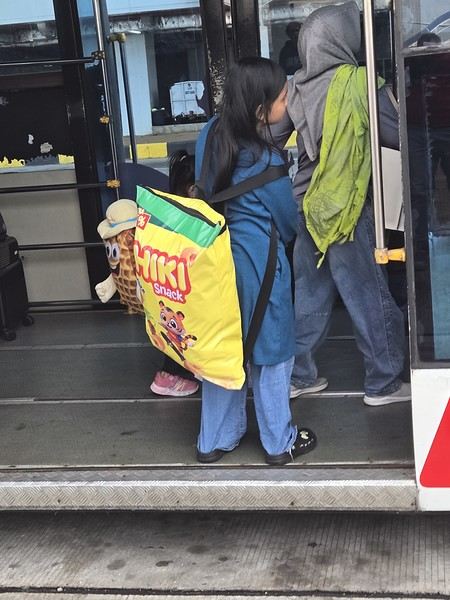
Friday 07/10: In search of the lost suitcase First challenge of the morning: finding our missing suitcase. They sent us to the airport basement, to the staff entrance. We were greeted with smiles, and an airport employee led me through the underground corridors back to the baggage claim. Right on time at 9 AM, the suitcase arrived, just like they’d promised. We were finally complete! Off we went to change terminals, grab a well-deserved meal, and board our fifth flight to Makassar. Little side note: I struggled for a while trying to book domestic flights directly on the airlines’ websites with no luck. Without meaning to advertise (though I guess I am a little), I realized it’d be easier to use sites like tiket.com or Traveloka. That turned out to be a great choice—I even ended up booking hotels through them later in the trip. 12:40 PM: We were on our way to Makassar. First good news: we were the only tourists. Well, the only European tourists on the flight, anyway. No, you’re not dreaming—the bag is full of... potato chip packets. To each their own souvenirs, I guess...
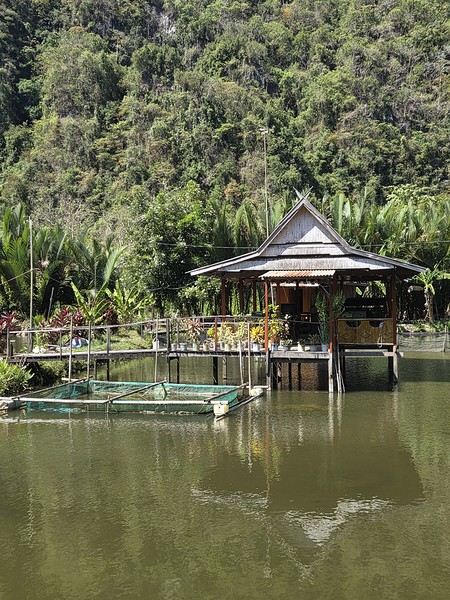
When we arrived in Makassar, a driver was waiting to take us straight to Rammang Rammang: 250,000 IDR (12 €) to our guesthouse (Rammang Rammang House). Forget about meeting people on the bus—we were headed straight to the first stop of our trip, and it was already stunning.
My kids’ guesthouse: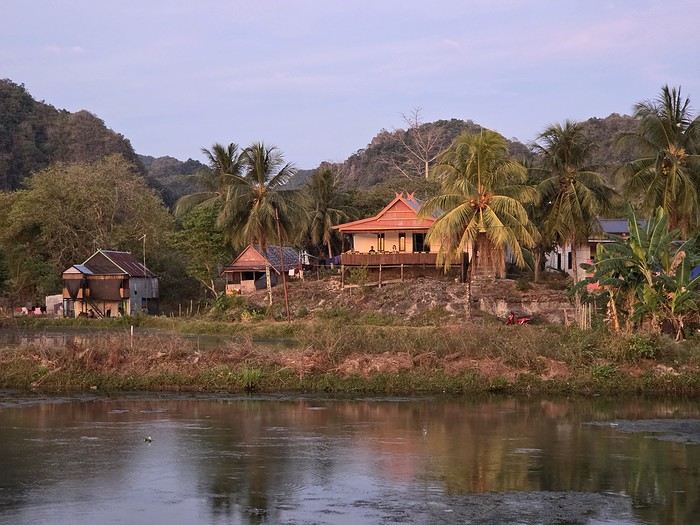
Ours: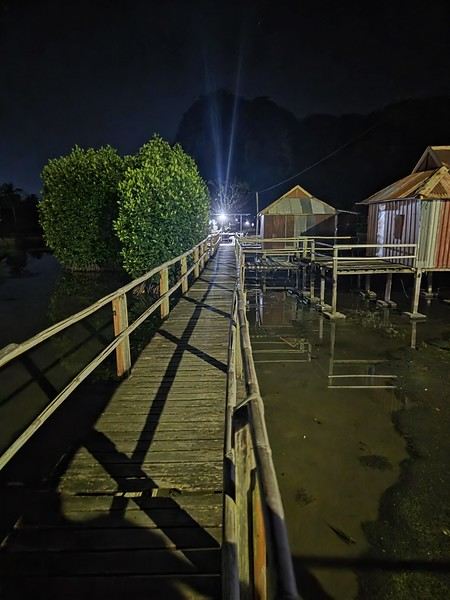
View of the little lake: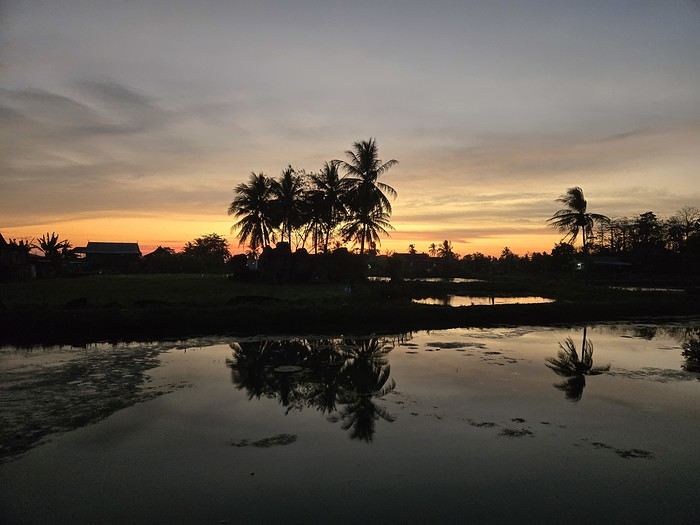
But not everything is straightforward around here. I wanted to get a local SIM card for internet and calls. I found them expensive at Jakarta’s airport (20 € for 20 GB), so I decided to wait. Well, no luck in Rammang Rammang either. You can’t just buy one from the local shop—you need a Telkomsat store (they have the best coverage). So we’d have to wait for Rantepao to get Wi-Fi... When I say "local shop," I mean the little shack around the corner. No big deal—we’d find one easily in Rantepao for 5 € and 25 GB. So there we were, offline, just the four of us enjoying the amazing view.
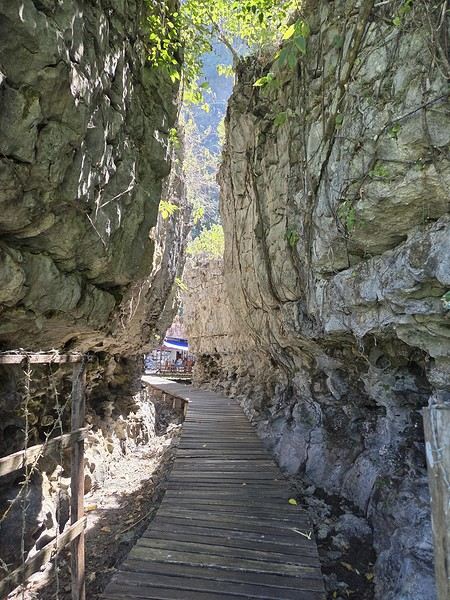
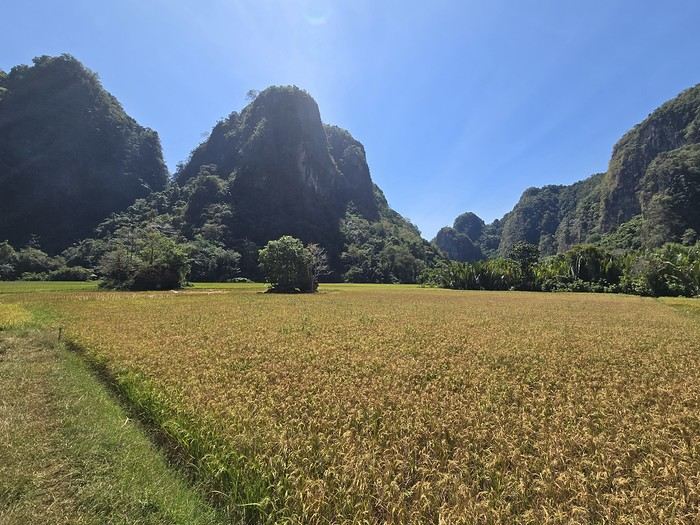
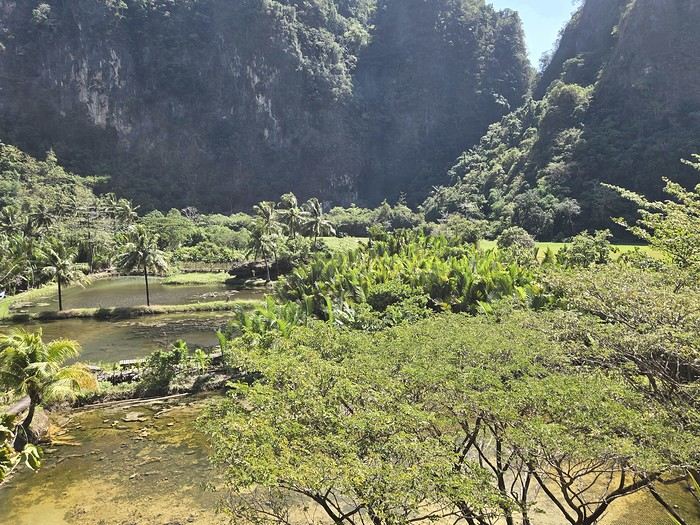
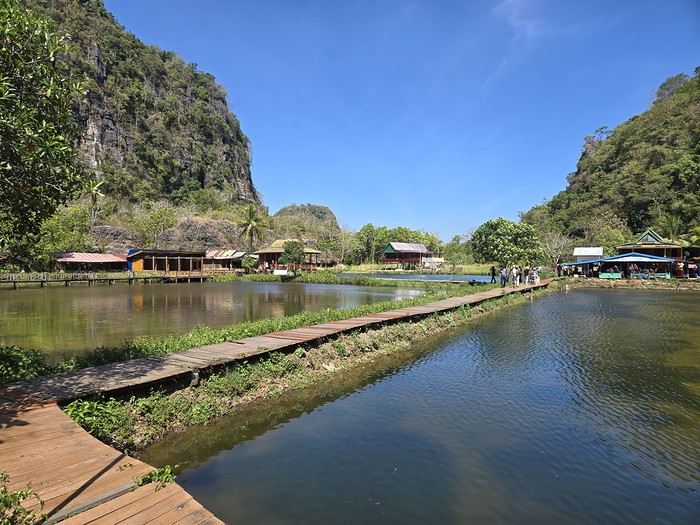
Saturday 07/11: Rammang Rammang We woke up early to the sound of wedding music blasting through the village (everyone’s invited!). Off we went to explore the area. A little walking, a little boat ride (shared with a French tourist and a Polish one—yes, there *are* tourists here, just not many; 750,000 IDR for up to 8 people) through a lovely canal, and we discovered the karst site. It was peaceful and beautiful. The river: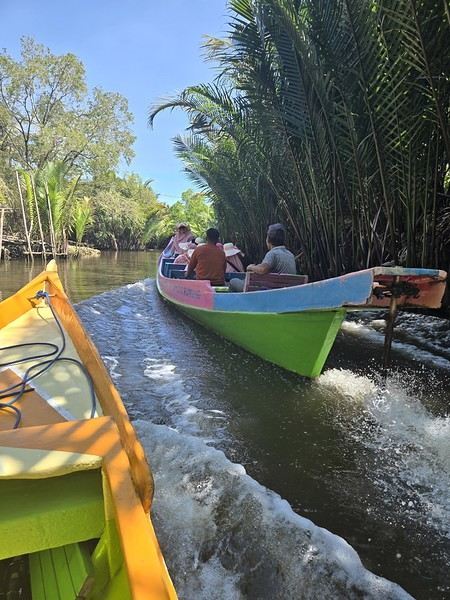 The karst site:
Wednesday 07/08 - Thursday 07/09: We left Montpellier for what was supposed to be five flights, though we only took four to start, landing in Jakarta. We picked up our luggage there to catch a flight to Makassar the next day. That’s the only way we could get an affordable ticket (702 €). I won’t bore you with the flight details—there’s not much to say. We arrived at 7 PM and considered heading straight to Makassar that evening. But we opted for a recovery night before taking off again. Good thing we did, because my son’s suitcase was missing... First contact with the locals was a bit stressful—a trip without your luggage isn’t exactly fun. But right away, a woman reassured us: the suitcase was just enjoying some extra time in Singapore. Maybe it was doing some last-minute shopping. Anyway, nothing serious—it was supposed to arrive at 9 AM the next day. That gave us some breathing room since our flight wasn’t until noon. So off we went to our hotel (Days Hotel & Suites) near the airport. It was cheap (40 € for three rooms—my kids are older and need their space), but it wasn’t worth much more. The place had definitely seen better days. But no big deal—we were only there for the night, and... we got to watch France beat Morocco in the World Cup live at 3 AM. That’s what really mattered!
Friday 07/10: In search of the lost suitcase First challenge of the morning: finding our missing suitcase. They sent us to the airport basement, to the staff entrance. We were greeted with smiles, and an airport employee led me through the underground corridors back to the baggage claim. Right on time at 9 AM, the suitcase arrived, just like they’d promised. We were finally complete! Off we went to change terminals, grab a well-deserved meal, and board our fifth flight to Makassar. Little side note: I struggled for a while trying to book domestic flights directly on the airlines’ websites with no luck. Without meaning to advertise (though I guess I am a little), I realized it’d be easier to use sites like tiket.com or Traveloka. That turned out to be a great choice—I even ended up booking hotels through them later in the trip. 12:40 PM: We were on our way to Makassar. First good news: we were the only tourists. Well, the only European tourists on the flight, anyway. No, you’re not dreaming—the bag is full of... potato chip packets. To each their own souvenirs, I guess...
When we arrived in Makassar, a driver was waiting to take us straight to Rammang Rammang: 250,000 IDR (12 €) to our guesthouse (Rammang Rammang House). Forget about meeting people on the bus—we were headed straight to the first stop of our trip, and it was already stunning.
My kids’ guesthouse:
Ours:
View of the little lake:
But not everything is straightforward around here. I wanted to get a local SIM card for internet and calls. I found them expensive at Jakarta’s airport (20 € for 20 GB), so I decided to wait. Well, no luck in Rammang Rammang either. You can’t just buy one from the local shop—you need a Telkomsat store (they have the best coverage). So we’d have to wait for Rantepao to get Wi-Fi... When I say "local shop," I mean the little shack around the corner. No big deal—we’d find one easily in Rantepao for 5 € and 25 GB. So there we were, offline, just the four of us enjoying the amazing view.
Saturday 07/11: Rammang Rammang We woke up early to the sound of wedding music blasting through the village (everyone’s invited!). Off we went to explore the area. A little walking, a little boat ride (shared with a French tourist and a Polish one—yes, there *are* tourists here, just not many; 750,000 IDR for up to 8 people) through a lovely canal, and we discovered the karst site. It was peaceful and beautiful. The river:
The karst site:
Does anyone have spare parts for an MSR bike tent to sell?
Hi,
We bought the MSR bike tent model (2-person + large awning that can fit 2 bikes) back in 2005. It’s served us really well, especially during a year-long trip in Africa. Now, one of the poles is broken, and we’d love to replace it since that’s the only issue with the tent—we still love it! The poles are 9.35 mm in diameter, with 8 sections of 49 cm and 2 sections of 28 cm. Total length when assembled: 416 cm. Actually, two large sections are broken: one straight and one curved. It’s a pain to find replacements since this model is no longer sold anywhere.
Would anyone have this model lying around unused and be willing to sell me a pole?
Improvisations on the Gayageum (Zither on a Curved Table)
New album from Korean artist DoYeon Kim, featuring an exceptional lineup
The "gayageum" is the name given to the zither on a curved table, a chordophone played across Central Asia (Vietnam, China, Korea, and Japan), existing in versions with 12 and 25 strings. It’s practically unknown in contemporary improvisational music, though Chinese musician Xu Fengxia has long demonstrated how brilliantly this instrument can be used in improvisations. Now, DoYeon Kim is following in her footsteps.
The Korean artist learned the gayageum traditionally. When DoYeon Kim moved to the United States a few years ago to study music, she began incorporating this plucked string instrument into contemporary music and experimenting with unconventional playing techniques.
Now based in Brooklyn, New York, DoYeon Kim recorded her new album Wellspring with an exceptional trio: Mat Maneri (viola), Tyshawn Sorey (drums), and Henry Fraser (bass). Four compositions are written and performed with precision and attention to detail, following the score, while the gayageum player also reveals herself as a dynamic vocalist. Three other tracks (Whispers Among Dawn, Diffraction, Linear System) are collective improvisations, each opening into a distinct sound world. One piece unfolds almost monochromatically from the sounds of bowed strings, while another features crackling gayageum notes, highlighted by glissandos and pronounced vibrato. In this track, the other instruments step back to let the earthy, woody tones of the strings fully blossom.
Wellspring, released in May 2026 on TAO Forms, marks her debut as a bandleader on record—and immediately establishes itself as a bold statement of intent. DoYeon Kim and her three fellow musicians craft an acoustic universe that draws from Korean traditions, the provocative energy of New York’s No Wave scene, and the open interactions of free jazz...

https://www.nytimes.com/video/arts/music/100000010874960/doyeon-kim-wellspring-gayageum.html
Audio:
https://www.youtube.com/playlist?list=OLAK5uy_kcUlgyo60w6WoKisn-30TLMyo7NA2ep_Q
https://www.wrti.org/podcast/late-set/2026-08-04/wellspring-with-doyeon-kim
The "gayageum" is the name given to the zither on a curved table, a chordophone played across Central Asia (Vietnam, China, Korea, and Japan), existing in versions with 12 and 25 strings. It’s practically unknown in contemporary improvisational music, though Chinese musician Xu Fengxia has long demonstrated how brilliantly this instrument can be used in improvisations. Now, DoYeon Kim is following in her footsteps.
The Korean artist learned the gayageum traditionally. When DoYeon Kim moved to the United States a few years ago to study music, she began incorporating this plucked string instrument into contemporary music and experimenting with unconventional playing techniques.
Now based in Brooklyn, New York, DoYeon Kim recorded her new album Wellspring with an exceptional trio: Mat Maneri (viola), Tyshawn Sorey (drums), and Henry Fraser (bass). Four compositions are written and performed with precision and attention to detail, following the score, while the gayageum player also reveals herself as a dynamic vocalist. Three other tracks (Whispers Among Dawn, Diffraction, Linear System) are collective improvisations, each opening into a distinct sound world. One piece unfolds almost monochromatically from the sounds of bowed strings, while another features crackling gayageum notes, highlighted by glissandos and pronounced vibrato. In this track, the other instruments step back to let the earthy, woody tones of the strings fully blossom.
Wellspring, released in May 2026 on TAO Forms, marks her debut as a bandleader on record—and immediately establishes itself as a bold statement of intent. DoYeon Kim and her three fellow musicians craft an acoustic universe that draws from Korean traditions, the provocative energy of New York’s No Wave scene, and the open interactions of free jazz...
https://www.nytimes.com/video/arts/music/100000010874960/doyeon-kim-wellspring-gayageum.html
Audio:
https://www.youtube.com/playlist?list=OLAK5uy_kcUlgyo60w6WoKisn-30TLMyo7NA2ep_Q
https://www.wrti.org/podcast/late-set/2026-08-04/wellspring-with-doyeon-kim
Booking Tabsa ferry from Punta Arenas
Hi,
We’ve planned our road trip in Chile, and the only thing left is to book the TABSA ferry from Punta Arenas to Puerto Williams. Problem: the ferry that leaves Punta Arenas at 1 AM isn’t available for booking, no matter the day or month. All the other departures can be booked, though. On top of that, Tabsa isn’t responding to any messages.
Does anyone know more about this?
Thanks in advance. Anne Marie
Messages disappearing
I’m reporting to VF that my message count dropped from around 5,160 to 5,090 over the last three days.
Is there now an issue with the message count, an unintended disappearance, or some kind of pruning?
I’m asking because I haven’t received any info about this.
Is there now an issue with the message count, an unintended disappearance, or some kind of pruning?
I’m asking because I haven’t received any info about this.
Kazakhstan backpacking itinerary choices with a child
Hi there,
I’m planning a backpacking trip to Kazakhstan with my 8-year-old daughter this summer. She’s used to backpacking trips. I’m brainstorming the sights to see and could really use some advice.
Ideally, I’d like to visit:
8 days in the Almaty region (Charyn, Kolsai, Kaindy, Altyn Emel, etc.) 1 day in Turkestan (mausoleum, caravanserai) (overnight train from Almaty, 16 hours) 1 day in Aktau (overnight train from Turkestan, 35 hours!!) 1 day in Mangystau 1 day in Astana (flight from Aktau) 1 day in Burabay (by train)
The distances are huge, especially between Almaty and Aktau, and Aktau to Astana.
Is the Aktau stop essential, given that the Mangystau desert looks stunning (but the excursion is expensive—300 € for three people), while Aktau itself seems pretty dull (a run-down Soviet city)?
Are Astana and Burabay (which also looks amazing) must-sees?
Is Turkestan worth it if we’ve already seen Uzbekistan and its wonders?
I’m torn between four scenarios:
1. Almaty + train to Astana and return to France from Astana: simple and not too expensive 2. Almaty-Turkestan-Aktau-Astana (train + flight = very expensive!!) 3. Almaty-Aktau-Astana (flights—very, very expensive but fast) 4. Almaty-Turkestan-Aktau and return to France from Aktau, but that means combining two different airlines with two one-way tickets and all the risks that entails...
Right now, only Flyarystan has released tickets for this summer, and the Almaty-Aktau-Astana flights cost nearly 1000 € for three people with luggage (200 € per person round-trip).
For the Almaty region, I could even spend two weeks there—there’s so much to do and see. That’d be a fifth scenario, but I’d really like to take the overnight train and see the capital and the Mangystau desert too.
International flights are operated by Turkish Airlines to Astana and Almaty, but they don’t serve Aktau. Pegasus flies to Aktau but not to Almaty or Astana on the days I’d want.
So, I’m looking for feedback from people who’ve visited Mangystau and Burabay—is it worth investing the time and money in those excursions, or is the Almaty region alone enough for the trip?
Thanks to all the great travel journals I’ve read—they’ve already given me plenty of ideas!
Survey on Enotourism in France - Your Habits and Expectations (4-5 minutes)
Hello everyone!
As part of my MBA in Wine & Spirits at the Académie des Vins in Alsace, I’m conducting a study on the evolution of enotourism in France.
The goal is to better understand what attracts visitors, their habits, and their expectations when exploring our wine regions.
Whether you're a wine lover, a travel enthusiast, or just curious, your input matters. (Even if you’ve never visited a wine estate, you can take part!)
Anonymous survey / 4 to 5 minutes
To complete the survey:
https://docs.google.com/forms/d/e/1FAIpQLSc-loQM0O6NWvXRd6J1XrFXLBNbXHTcR5UT1JTFUnX4aeFK0w/viewform?usp=header
A huge thank you for your participation and for any shares! This will really help me with my study.
Note: No advertising, promotions, product sales, or service offers are included 2.16.1.2
Note: No advertising, promotions, product sales, or service offers are included 2.16.1.2
Martine et DD en Californie English translation pending
Bonsoir à tous 🙂
En septembre 2026, pour notre 7 eme RT au pays de l’oncle Sam, nous avions choisi la Californie et une nouvelle fois cette boucle depuis San Francisco aura été bien au delà de nos attentes, en nous offrant de fabuleux paysages et des américains toujours aussi sympathiques et désireux d’échanger quelques mots avec nous .
Nous avions dejà séjourné quelques jours dans cet état lors de notre tout premier RT mais nous n’étions pas allés voir les séquoias, et une tempête de neige venue du Yellowstone le 20 septembre 2017 nous avait empêché de découvrir le Yosemite puisque la Tioga Road était fermée à la circulation. De plus c’est avec grand plaisir que nous avons revu certains coins et nous en avons découvert d’autres tout aussi « waouh » que les précédents.
Nous sommes un couple de « jeunes sexagénaires « et malgré le temps qui passe depuis notre premier RT je parle toujours aussi mal l’anglais ce qui ne nous a pas empêché de profiter pleinement de notre séjour.
Nous avons passé 21 nuits sur place et parcouru 3935 km en voiture et un peu plus de 140 km à pieds .
L’avion, la voiture et le parking de Marseille ont été réservés et payés en décembre 2025.
Malgré l’absence de file dédiée aux possesseurs du MPC ( Mobile Passeport Control ) à S F nous sommes passés rapidement à l’immigration et notre agent était souriant et nous a même dit quelques mots en français
Le circuit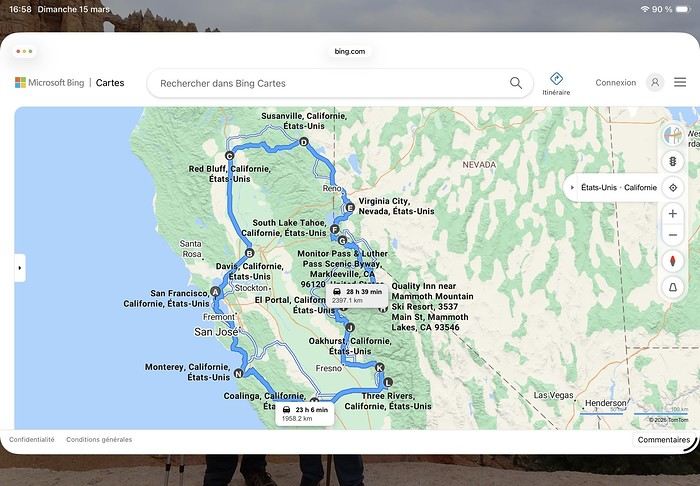 Nous sommes partis du 6 au 22 septembre
J1 Vol Marseille -Paris- San Francisco puis Davis ( 166 km)
J2 Red Bluff ( 397 km avec visite du Lassen National parc )
J3 Susanville (246 km avec visite du Lassen National parc )
J4 Susanville (158 km avec rando au Cinder cône )
J5 Susanville (182 km avec rando Warner Valley )
J6 South Lake Tahoe ( 271 km en passant par Virginia City )
J7 South Lake Tahoe ( 150 km : tour du lac )
J8 Mammoth Lake (299 km en passant par Monitor Pass )
J9 Mammoth Lake ( 152 km Mono Lake )
J10 El Portal ( 206 km incursion Yosemite )
J 11 El Portal ( 134 km Glacier Point et rando Taft point )
J 12 El Portal ( 70 km rando Vernal Falls )
J13 Oakhurst ( 106 km : visite Mariposa Grove )
J 14 Miramonte ( 297 km visite King canyon national parc )
J15 Three Rivers ( 160 km visite Séquoia National parc )
J16 Three Rivers ( 112 km visite Sequoia National parc )
J 17 Coalinga ( 166 km )
J18 Monterey ( 249 km visite East Pinnacles National parc )
J19 Monterey ( 186 km : Pacific coast hwy jusqu’à Mc way water fall )
J 20 San Francisco ( 206 km par la côte )
J21 San Francisco ( à pieds )
J 22 aéroport ( 22 km )
Le budget
📌 le budget : un peu plus de 8640 euros pour nous deux tout compris. Nous avons bénéficié d’un change entre 1,13 et 1,17 pour un euro
📌 l’avion : Marseille- Paris Charles de Gaulle - San Francisco 2052 € pour deux avec un bagage en soute chacun ( Air France )
📌 ESTA : acheté en 2025 et encore validé
📌 Carte America the Beautiful : acheté en 2025 et encore validé
📌 Parking : 128 € (super eco à Marseille )
📌 Voiture Hertz : 837 € pour un SUV Chevrolet Trailblazer ( même catégorie que le Nissan Rogue). Nous sommes passés par Air France pour la réservation ( 15 % de réduction) et avons récupéré quelques miles. On l’avait réservée en décembre pour 1270 € mais en surveillant la baisse des prix on a pu annuler l’annuler et refaire la réservation en mars pour 837 €. Hertz propose un programme gratuit Hertz Plus Rewards qui permet d’avoir un comptoir prioritaire pour la réceptionner nous faisant gagner beaucoup de temps à l’aéroport.
📌 Hébergement : 3746 €
Nous avons dormi dans des hôtels et motels de différentes gammes ( de 112 à 244 € la nuitée ). Sur 21 nuits réservées avec Booking , nous en avons eu 11 avec petits déjeuners compris.
Booking propose parfois des hébergements moins chers si on les réserve par le téléphone sur l’application « Booking Mobile «
Notre statut de Genius 3 nous a aussi permis d’avoir des tarifs préférentiels sur certaines nuitées
📌 Assurance : 200 € pour nous deux pour une assurance complémentaire pour le cas où nous aurions besoin de soins médicaux
📌 Argent liquide : 50O euros changés avant le départ et 2 retraits sur place ( 1000 $ et 500 $). La banque Wells Fargo prend 5 dollars de frais quelle que soit la somme retirée mais propose le choix de la langue pour la transaction ( très pratique pour ceux qui parle mal l’anglais comme nous. 
Cet cash nous aura permis de payer:
Les restaurants du soir et leurs tips et les pique nique du midi
L’essence : 403 $ pour 3935 km avec un gallon entre 5,39 et 6,79 $ selon les endroits. C’est le double de ce que nous avions payé en 2025 pour un peu moins de km . Le site Gasbuddy est assez fiable pour nous donner les prix des différentes stations .
. Les parkings et les entrées des States Park
 Parking Virginia City ( 10 $)
Parking Donner Mémorial Park (10 $)
Bodie State Park ( 8 dollars par personne )
17 Miles Road à Monterey ( 12,50 $ pour la voiture )
Pass illimité pour le câble car à SF ( 15 dollars par personne pour la journée
Les souvenirs et les petits plaisirs notamment leurs excellentes glaces et fudges .
Comme lors de nos précédents RT nous n’avons pas loué de GPS . Nous avons circulé grâce aux deux GPS hors connexion Here We Go et Organics Maps dont nous avions téléchargé les cartes des deux états traversés ( Californie et Nevada )
❤️❤️❤️ les coups de cœur ( ils sont nombreux ) 📌Lassen Volcanic parc et ses phénomènes géothermiques 📌le Cinder cône et sa vue sur les Painted hills depuis le sommet 📌Virginia City et son côté Far West 📌 Eagle Lake au lac Tahoe 📌 la route scénique par le Monitor Pass pour rejoindre Bridgeport 📌 l’émouvante ville fantôme de Bodie et son retour dans le passé 📌 les sources chaudes en pleine nature de Travertine Hot Springs 📌 les extraordinaires et étranges formations rocheuses du South Tufa trail et tous les oiseaux qu’on y découvre 📌 l’expérience de flottaison extrême dans les eaux hyper salées de Mono Lake 📌 la fabuleuse Tioga Road ses lacs, ses dalles et ses falaises de granit, ses pics et ses prairies d’altitude 📌 Yosemite et ses monolithes de granit, ses cascades et ses rando extraordinaires. 📌 la rencontre avec les séquoias dans les forêts de Yosemite et du Séquoias national parc , ces géants de bois qui auraient tant de choses à raconter 📌 le Moro Rock si bien aménagé pour une vue sans danger à 360 degrés sur la Sierra Nevada ses montagnes et ses canyons 📌les grottes et le petit lac de la Mose Spring Loop au Pinnacles National parc monument ( entrée Est ) 📌 la vie tranquille de Monterey avec ses jolies maisons, sa faune et son littoral sauvage 📌 les Fisherman’s Wharf de Monterey et San Francisco où nos papilles peuvent s’en donner à coeur joie au milieu des effluves iodées et sous l’œil des oiseaux et des aboiements des lions de mer 📌 les extraordinaires paysages que nos rando nous ont offerts 📌 les restau le Lumberjack ’s restaurant ( Susanville ) et le Pier market sea food ( Pier 39 de San Francisco ) 📌 nos aller retour avec le Câble car à SF 📌 ❤️❤️ et bien sûr la grande gentillesse des américains que nous avons rencontré toujours prêts à rendre service et partant pour échanger quelques mots
🙁🙁🙁 les flops ( il y en a très peu ) 📌 la côte privatisée par les riches demeures de l’ouest du lac Tahoe et les parkings bondés et payants de ses States parc de l’est nous les rendant inaccessibles tout comme au Point Lobos .📌 le prix exorbitant des hébergements a l’intérieur des parcs ce qui nous a obligé à faire de nombreux aller retour très chronophages et avaleurs de kms de route 📌 l’absence d’indications des points d’intérêts de la Ca 1 📌 les fermes géantes où les pauvres vaches passent leur vie, parquées dans des hangars en tôle sans accès aux prairies 📌et surtout la vision quotidienne sur les versants (certaines randonnées ) des cicatrices des forêts detruites par tous ces feux dont souffre la Californie depuis des années .
J’espère que ça pourra vous aider un peu. N’hésitez pas à me contacter si vous voulez des précisions, même en MP si vous voyez que je ne vous réponds pas. Bonne journée à tous et surtout prenez soin de vous
Le circuit
Nous sommes partis du 6 au 22 septembre
J1 Vol Marseille -Paris- San Francisco puis Davis ( 166 km)
J2 Red Bluff ( 397 km avec visite du Lassen National parc )
J3 Susanville (246 km avec visite du Lassen National parc )
J4 Susanville (158 km avec rando au Cinder cône )
J5 Susanville (182 km avec rando Warner Valley )
J6 South Lake Tahoe ( 271 km en passant par Virginia City )
J7 South Lake Tahoe ( 150 km : tour du lac )
J8 Mammoth Lake (299 km en passant par Monitor Pass )
J9 Mammoth Lake ( 152 km Mono Lake )
J10 El Portal ( 206 km incursion Yosemite )
J 11 El Portal ( 134 km Glacier Point et rando Taft point )
J 12 El Portal ( 70 km rando Vernal Falls )
J13 Oakhurst ( 106 km : visite Mariposa Grove )
J 14 Miramonte ( 297 km visite King canyon national parc )
J15 Three Rivers ( 160 km visite Séquoia National parc )
J16 Three Rivers ( 112 km visite Sequoia National parc )
J 17 Coalinga ( 166 km )
J18 Monterey ( 249 km visite East Pinnacles National parc )
J19 Monterey ( 186 km : Pacific coast hwy jusqu’à Mc way water fall )
J 20 San Francisco ( 206 km par la côte )
J21 San Francisco ( à pieds )
J 22 aéroport ( 22 km )
Le budget
📌 le budget : un peu plus de 8640 euros pour nous deux tout compris. Nous avons bénéficié d’un change entre 1,13 et 1,17 pour un euro
📌 l’avion : Marseille- Paris Charles de Gaulle - San Francisco 2052 € pour deux avec un bagage en soute chacun ( Air France )
📌 ESTA : acheté en 2025 et encore validé
📌 Carte America the Beautiful : acheté en 2025 et encore validé
📌 Parking : 128 € (super eco à Marseille )
📌 Voiture Hertz : 837 € pour un SUV Chevrolet Trailblazer ( même catégorie que le Nissan Rogue). Nous sommes passés par Air France pour la réservation ( 15 % de réduction) et avons récupéré quelques miles. On l’avait réservée en décembre pour 1270 € mais en surveillant la baisse des prix on a pu annuler l’annuler et refaire la réservation en mars pour 837 €. Hertz propose un programme gratuit Hertz Plus Rewards qui permet d’avoir un comptoir prioritaire pour la réceptionner nous faisant gagner beaucoup de temps à l’aéroport.
📌 Hébergement : 3746 €
Nous avons dormi dans des hôtels et motels de différentes gammes ( de 112 à 244 € la nuitée ). Sur 21 nuits réservées avec Booking , nous en avons eu 11 avec petits déjeuners compris.
Booking propose parfois des hébergements moins chers si on les réserve par le téléphone sur l’application « Booking Mobile «
Notre statut de Genius 3 nous a aussi permis d’avoir des tarifs préférentiels sur certaines nuitées
📌 Assurance : 200 € pour nous deux pour une assurance complémentaire pour le cas où nous aurions besoin de soins médicaux
📌 Argent liquide : 50O euros changés avant le départ et 2 retraits sur place ( 1000 $ et 500 $). La banque Wells Fargo prend 5 dollars de frais quelle que soit la somme retirée mais propose le choix de la langue pour la transaction ( très pratique pour ceux qui parle mal l’anglais comme nous. 
Cet cash nous aura permis de payer:
Les restaurants du soir et leurs tips et les pique nique du midi
L’essence : 403 $ pour 3935 km avec un gallon entre 5,39 et 6,79 $ selon les endroits. C’est le double de ce que nous avions payé en 2025 pour un peu moins de km . Le site Gasbuddy est assez fiable pour nous donner les prix des différentes stations .
. Les parkings et les entrées des States Park
 Parking Virginia City ( 10 $)
Parking Donner Mémorial Park (10 $)
Bodie State Park ( 8 dollars par personne )
17 Miles Road à Monterey ( 12,50 $ pour la voiture )
Pass illimité pour le câble car à SF ( 15 dollars par personne pour la journée
Les souvenirs et les petits plaisirs notamment leurs excellentes glaces et fudges .Comme lors de nos précédents RT nous n’avons pas loué de GPS . Nous avons circulé grâce aux deux GPS hors connexion Here We Go et Organics Maps dont nous avions téléchargé les cartes des deux états traversés ( Californie et Nevada )
❤️❤️❤️ les coups de cœur ( ils sont nombreux ) 📌Lassen Volcanic parc et ses phénomènes géothermiques 📌le Cinder cône et sa vue sur les Painted hills depuis le sommet 📌Virginia City et son côté Far West 📌 Eagle Lake au lac Tahoe 📌 la route scénique par le Monitor Pass pour rejoindre Bridgeport 📌 l’émouvante ville fantôme de Bodie et son retour dans le passé 📌 les sources chaudes en pleine nature de Travertine Hot Springs 📌 les extraordinaires et étranges formations rocheuses du South Tufa trail et tous les oiseaux qu’on y découvre 📌 l’expérience de flottaison extrême dans les eaux hyper salées de Mono Lake 📌 la fabuleuse Tioga Road ses lacs, ses dalles et ses falaises de granit, ses pics et ses prairies d’altitude 📌 Yosemite et ses monolithes de granit, ses cascades et ses rando extraordinaires. 📌 la rencontre avec les séquoias dans les forêts de Yosemite et du Séquoias national parc , ces géants de bois qui auraient tant de choses à raconter 📌 le Moro Rock si bien aménagé pour une vue sans danger à 360 degrés sur la Sierra Nevada ses montagnes et ses canyons 📌les grottes et le petit lac de la Mose Spring Loop au Pinnacles National parc monument ( entrée Est ) 📌 la vie tranquille de Monterey avec ses jolies maisons, sa faune et son littoral sauvage 📌 les Fisherman’s Wharf de Monterey et San Francisco où nos papilles peuvent s’en donner à coeur joie au milieu des effluves iodées et sous l’œil des oiseaux et des aboiements des lions de mer 📌 les extraordinaires paysages que nos rando nous ont offerts 📌 les restau le Lumberjack ’s restaurant ( Susanville ) et le Pier market sea food ( Pier 39 de San Francisco ) 📌 nos aller retour avec le Câble car à SF 📌 ❤️❤️ et bien sûr la grande gentillesse des américains que nous avons rencontré toujours prêts à rendre service et partant pour échanger quelques mots
🙁🙁🙁 les flops ( il y en a très peu ) 📌 la côte privatisée par les riches demeures de l’ouest du lac Tahoe et les parkings bondés et payants de ses States parc de l’est nous les rendant inaccessibles tout comme au Point Lobos .📌 le prix exorbitant des hébergements a l’intérieur des parcs ce qui nous a obligé à faire de nombreux aller retour très chronophages et avaleurs de kms de route 📌 l’absence d’indications des points d’intérêts de la Ca 1 📌 les fermes géantes où les pauvres vaches passent leur vie, parquées dans des hangars en tôle sans accès aux prairies 📌et surtout la vision quotidienne sur les versants (certaines randonnées ) des cicatrices des forêts detruites par tous ces feux dont souffre la Californie depuis des années .
J’espère que ça pourra vous aider un peu. N’hésitez pas à me contacter si vous voulez des précisions, même en MP si vous voyez que je ne vous réponds pas. Bonne journée à tous et surtout prenez soin de vous
Which destination to prioritize in Southeast Asia in June/July/August/September?
🙂 Hi everyone!
Hope you're all doing well! It's been a while since I last traveled, but I'm finally heading out again soon!
For those familiar with SOUTHEAST ASIA, I'm planning to leave in mid-June (with the trip ending at the latest in November), and I don’t have a precise idea of exact places or itineraries yet. The thing is, this period is usually the rainy season...
Any advice? I was thinking of Malaysia or Indonesia, like Sulawesi, for example (all countries and islands in Southeast Asia interest me except Bali).
Any recommendations? I’m doing my research online, but if anyone here has the time and knowledge, I’d love to hear from you.
Thanks everyone, take care and stay happy! ❤️
How much time should we plan for a visit to Lisbon in autumn?
Hi everyone
We’re thinking of a getaway to Lisbon in October—how much time should we plan? Any great tips or must-see spots?
Thanks!
We’re thinking of a getaway to Lisbon in October—how much time should we plan? Any great tips or must-see spots?
Thanks!
Crossing the Mercantour: Are there any exposed sections?
Hi there,
I’m planning to do the Mercantour crossing following the Randoxygène route in mid-July. I’m used to hiking in the mountains, but I sometimes get vertigo, for example on ridges with drops on both sides. I wanted to check if there are any T4 or T3-T4 sections and find out if there are any very exposed passages—and if so, where—so I can plan an alternative route. Can anyone give me some info on this? Thanks!
I’m planning to do the Mercantour crossing following the Randoxygène route in mid-July. I’m used to hiking in the mountains, but I sometimes get vertigo, for example on ridges with drops on both sides. I wanted to check if there are any T4 or T3-T4 sections and find out if there are any very exposed passages—and if so, where—so I can plan an alternative route. Can anyone give me some info on this? Thanks!
Rome: Feedback on my 7-day itinerary
Hello,
We’re heading to Rome from 21/09, arriving in the early afternoon, and returning on 28/09, leaving in the morning. We’ve already booked our flight tickets and our accommodation in the city center: Via Ezio.
I’d love to get your feedback on our itinerary and if there are any visits we should book right now:
Monday 21 afternoon:
Largo di Torre Argentina: a sacred spot for cats.
Tuesday 22:
The Vatican: Vatican Museums and Sistine Chapel in the morning. Afternoon: St. Peter’s Basilica, the dome, and if possible, the necropolis.
Wednesday 23:
Morning: Colosseum, Roman Forum, and Palatine Hill. Afternoon: Trastevere neighborhood and the Monumento a Garibaldi.
Thursday 24:
Piazza Navona, Church of St. Louis of the French, the Pantheon, Campo de’ Fiori, Piazza Venezia, Piazza Santa Maria Maggiore, Trevi Fountain.
Friday 25:
Villa Borghese, Piazza del Popolo, Spanish Steps, Quirinale, Piazza della Repubblica, and Santa Maria degli Angeli.
Saturday 26:
Aventine and Testaccio neighborhoods, the Capuchin Crypt.
Sunday 27:
Ostia.
Monday 28:
Departure.
Are any days too packed, or should we add more visits?
Thanks for your input and help!
Cheers!
Anne
3-month visa on arrival in Rwanda
Hi
Has anyone been to Rwanda recently and gotten a 3-month visa on arrival easily?
Thanks
What do you really remember about Vietnam?
I've traveled quite a bit in Vietnam over the past few years—from the southern delta to bustling cities and even some small islands—but what really sticks with me is the north, the high mountains.
Up there, there's something different—maybe slower, more raw. The morning markets with ethnic groups, women in traditional clothes, the colors...
The stilt houses, kids following you and laughing for no reason, the terraced rice fields—it almost feels unreal at times, so vast and quiet, yet so human and simple.
You often hear that Sapa has become too touristy, and that's partly true, especially in the center. But as soon as you move a little farther away, everything changes quickly. The landscapes open up, encounters feel more natural, and you rediscover something truly authentic.
I think it's that contrast that struck me—the difference between what you imagine before going and what you actually discover when you take the time.
And you—what memory do you hold onto from Vietnam? A particular place that touched you more than others?
Booking visits in Rome: which providers to choose?
Hi everyone,
I’m heading back to Rome soon, but this time we’re bringing our teens. Instead of wandering the streets like I usually love doing in this city, we’ll be hitting the "must-see" sights with them: the Colosseum and the Vatican.
And that’s where it gets tricky—apparently, we need to book everything in advance. We’re getting lost among all the offers, official sites, GetYourGuide and the like, packages, with prices ranging from one to three times as much and different tour options...
Could you share your booking experiences for: - Colosseum visit, including the underground level - St. Peter’s Basilica, including the dome - Vatican Museums
Thanks! 🙂
Booking a visit to the Acropolis
I’d like to book tickets for a visit to the Acropolis at the end of April. The official site is down. What do you think of agencies like Get Your Guide? Are they reliable? It’s a lot more expensive. The audio guide option is tempting, but is that reliable too? We’re a bit older and like to take our time...
Do the other museums (National Archaeological Museum and Museum of Cycladic Art) also require reservations? We visited Athens 50 years ago, and it seems like things have changed a lot.
Thanks for any help!
Do the other museums (National Archaeological Museum and Museum of Cycladic Art) also require reservations? We visited Athens 50 years ago, and it seems like things have changed a lot.
Thanks for any help!
Flight reservation pending on Booking
Hi,
I made a flight reservation on Booking, but my reservation hasn't been confirmed and is still pending confirmation by the airline. It's been almost a full day now, and I haven't heard anything—I'm waiting for I don't even know what response... Will my reservation be canceled? In the meantime, I can't book another flight in case I end up paying twice... Has this ever happened to anyone? What should I do?
Arusha, Tanzania - October 2025
I would wish never to go to bed where I had woken up, to wander my tent from the shores of Egypt to those of the Persian Gulf; to have no goal for the evening other than the evening itself; to traverse on foot, with my eyes and my heart, all these unknown lands, all these races of people so different from my own; to contemplate humanity, God’s finest creation, in all its forms.
Lamartine in Fatalla Sayeghir’s Account (1861)
As soon as it’s about flying, I lose all willpower. Being reasonable and thoughtful, I still lose all my composure at the mere possibility of a flight—especially if it’s piloted by F.—and even more so if that flight can take me to unexplored lands. I’ve long wanted to unravel the mystery of animal tourism, and why not in Tanzania, following up on my trip from four years ago, when I was already questioning the glaring inequalities in Zanzibar: the coastal strip sacrificed to capitalism, and the inland areas, just a hundred meters from the waves, where you find—though a bit more peaceful than elsewhere on the continent—the chaos of Africa.
I’m an adventurer at heart. When it comes to the terrain, though, it’s a whole different story. I see people setting off for months at a time; I know my endurance doesn’t last beyond three days. It’s not that I’m afraid of this unfamiliar environment when it comes to embracing different realities. I’m mostly afraid of myself—of this heightened sensitivity that makes me see things I’d rather not see and understand others that sometimes overwhelm me.
After an absolutely fantastic daytime flight, I land in Zanzibar and have to resign myself—this is the whole point of the trip—to what feels like a real spacewalk. I’m alone. My lucky star, backed up by my phone, will serve as my lifeline. I step out of the airport and breathe in the scent of Africa full-on: a mix of exotic perfumes, baked earth, and poorly refined fuel, inevitably mingled with the smell of wood smoke. So many images come flooding back. So many stories. Another world.
I head to Arusha the very next day. The gateway to the country’s northern national parks, this city of half a million offers one of those rare breath-holding dives that Africa keeps secret. As the only white person walking the streets, I know I’m visible and vulnerable, yet I move forward confidently, barely bothered. But where are all my fellow Westerners? While this city draws countless tourists, I only cross paths with one white couple in nearly three hours of walking. Because you have to hold on tight to wander here. You have to stay alert. The traffic is dense and erratic—don’t even trust the fact that in Tanzania, people drive on the left. That can change from one minute to the next, especially with motorbikes. With barely centimeters between vehicles, I weave my way through the urban jungle, trying not to stumble into the huge ditch on my left or get sideswiped by cars brushing past me on the right. Speakers blare music, ads, or political speeches at will—the explosion of yellow and green tells us we’re on the eve of the presidential election—but they barely compete with the calls to prayer, nearly nonstop on this holy Friday. The vital space is as saturated as the sound. Imagine an unbroken line of shops and stalls of every kind—supermarkets haven’t made it here yet—where you can find just about anything: phones, copper pipes, Chinese-made hardware, shoes, clothes, basins, and professional tools… The luckiest own a big store; others spend their lives trying to survive on the profits from selling toothbrushes one at a time on the streets. But maybe it’s more lucrative than spending the day slumped on the sidewalk, preferably missing a limb, trusting your survival to the mercy of passersby.
I think I’ll escape the street by slipping into the narrow alleys of the central market. Here, I know I won’t run into anyone like me! The vendors’ stalls start at waist height; the sellers, perched higher up, haggle or not while discussing prices. Here, colorful fruits and vegetables; there, huge piles of dried fish. Spices, seeds, roots. Smells. Noises. Africa. Life. Further on, the fresh fish aisle makes a right angle with the butchers’. Everywhere, flies—everywhere, the same gesture from vendors swatting blindly at these relentless pests. Aware that I’ll be eating this same meat within the hour, displayed with total disregard for basic hygiene, I reassure myself that Arusha sits at 1400m altitude. Yes, we can probably do without a fridge.
*
It’s time to leave the city and go wildlife spotting in the surrounding parks. To that end, I’ve negotiated a package deal with a local agency that prides itself on grouping solo travelers into a vehicle meant for seven. We leave behind the imposing masses of Mount Meru and Kilimanjaro, peaking at 4565m and 5895m respectively, and head west to conquer Tarangire and Ngorongoro parks. I’ve been promised a spectacle; I remain cautious. I’ve read rave reviews; I know how to temper my expectations. Above all, I know what I came for—and paradoxically, my hopes are less about animals than strictly anthropological. So I’m sure I won’t go home disappointed.
I’m in the thick of it. Since 2021, tourism has been booming: I’m one of the two million tourists who come here every year seeking thrills. I also contribute, in a small way, to the 20% of the country’s GDP generated by tourism revenue. Around 3 billion € annually… Tanzania has 16 national parks, twice as many reserves; it charges meticulously for every entry, every night, every activity, to the tune of several dozen euros. I calculated that Tarangire Park alone rakes in around 15 million € a year. Mind-boggling. Yet to get there, a dusty, rickety old track is used daily by hundreds of vehicles that literally saturate the surrounding area with white dust and exhaust fumes. At the park entrance, we wait a good hour while the driver pays the entry fees. Then it’s a free-for-all: dozens of 4x4s try to enter at the same time through the single access point, to the left of the building, while the three barriers are stuck due to a computer glitch. It’s pure chaos: no way to buy your ticket in advance—the QR code revolution hasn’t arrived; no smart layout before the barriers; nothing smooth, nothing practical, everything improvised.
So, the animals? Given the time and money involved, I’d be tempted to say it’s not worth the hassle and there’s really no need to break five legs off one of the too-many zebras we pass. Hours and hours of travel to get to Tanzania, specifically Arusha; hours and hours on the road—up to 12 hours a day—to spend barely three in the parks; at least 200 € per day for the most basic option, so 400 € in my case, and up to several thousand for those wealthy couples opting for the luxury package with a private vehicle. Sure, I saw zebras and elephants in their natural habitat, wildebeest, buffalo, and a few hippos, but I didn’t feel the thrill touted in the articles or even by my two-day trip organizer. Would I have been more satisfied if I’d seen the lion, the leopard, and the rhino? Maybe. But the story won’t be rewritten in light of those assumptions.
Yet I’m not disappointed. As I said earlier: I know what I came for. I wanted to see the world as it is with my own eyes. And the safari world fascinates me more for its anthropological aspect than for what it offers. Yes, the fact that people from all over the world come here, juggling hotels and big 4x4s—while notably avoiding the streets of cities and villages—truly fascinates me. Two worlds coexist on either side of a barely porous border. As soon as the tourist sets foot in the airport, they’re whisked away, sight unseen, into a tourist vehicle. Dropped off at the hotel, they rest there, shielded from view, until the 4x4 departs. Then they speed through those same cities and villages they scorn out of fear or disdain, leaving on the roadside the Maasai herding their flocks and all those poignant or mundane scenes that make up daily African life. In the evening, in their lodge, far from the city’s pulse, they fall asleep thinking about the images they’ve collected, those long hours on the road, the wait for the animals. And the days go by… Maybe the term *luxury*, whether for food or accommodation, refers to what we experience as utterly ordinary in the West? Forgetting that you’re there, in Africa, just steps away from poverty and a certain arbitrariness. And at the end of the journey: back to the airport, back to normal life.
Maybe we need to take a broader view. All that money seems invisible, yet it must serve the population at some point, right? The main roads are passable, the power grid seems well-maintained—I can tell by the excellent condition of the high-voltage transmission towers. Is it really too expensive to significantly improve all the infrastructure? I hoped this windfall would truly serve the people’s interests. The driver taking me back to the airport on the last evening dashes my sweet illusions: « All this is bad. Africa is bad. But you have no choice. The hospitals don’t work, the schools don’t work, the roads don’t work (just as he says this, roadworks force us onto a terrible detour for several kilometers—a rutted track, in fact), and if you say anything, if you speak up too much, they come for you and then you disappear. » That’s just one opinion. Nothing empirical. But I don’t need to be a West Point graduate to realize how rampant corruption is in these regions: while the muezzin bellows the greatness of Allah, I consider the dilapidated equipment and the energy expended by the masses just to survive here. But maybe all that money keeps the country afloat by paying civil servants’ salaries? Meanwhile, one thing is certain: regardless of where the profits go, tourism supports millions of people, and I’m in no position to judge this system too harshly. Maybe I’m too much of an aesthete to appreciate the almost exclusive use of corrugated iron at its true value…
*
I’ll give this system credit for one thing: the chance to set foot in spaces impossible to visit otherwise. At one point, in the heart of the Ngorongoro Crater—a vast 20km-wide plain topped by a 600m-high caldera—I was simply happy to be there. Barely bothered by the constant ballet of 4x4s—the space is vast—I contemplate the simple life of the local animals. Buffalo, wildebeest, zebras as numerous as the flamingos patiently standing on one leg, waiting for the day to pass. Over there, you can make out a few hyenas with vultures circling above. Finally, in a large body of water, hippos surface at regular intervals. I’m aware of my luck. I’m especially aware that, unlike all the people I’ve met there, a lot of money and a little resourcefulness greatly favor the luck factor.
I’m heading home. I soak up the last images of this improbable Africa as night falls quickly over the countryside. I’m fascinated by the number of Maasai herding their livestock along the main road. Some pass the time, globalization obliges, on an old phone; others, sometimes as young as my eldest—barely 10 years old—watch us pass, indifferent. We overtake or are overtaken; the two-lane road is the stage for a majestic ballet of semi-trailers, *dalas-dalas*, and other 4x4s, as numerous as the names of their companies: Leopard Tours, Climbing Kilimanjaro, Smiling Zebra, Nomad Life Enhanced, Elephant Roaming, Mountain Warrior, Master of the Ambush… They drop me off at the hotel, where I have an hour to shower and change into clean clothes before my return flight. Already, I’m slipping back into my own world without really seeing it, leaving behind the hotel’s glass window that African life to which nothing truly binds me. Then that chaotic, suffocating nighttime drive to the airport. Check-in; the stupid questions (« Where are you going? »); the slow police officer who, in the end, stamps my passport anywhere; the idiocy of the security agent (my empty 33cl bottle is forbidden); the rather shabby lounge at Kilimanjaro Airport. Then the return to the vessel—to the Air France plane that left Zanzibar an hour earlier—after this 72-hour spacewalk without a real lifeline. I’ve never been so happy to see F. again.
Pet carrier size for in-cabin dog on Air Caraïbes
Hi there, we're flying with Air Caraïbes and bringing our dog—he'll be traveling in the cabin with us. The airline recommends a carrier size of 43×35×20 cm, but despite calling them several times, we can’t figure out if the 20 cm is the height or width, or if the carrier can be slightly larger. Thanks to anyone who replies and has flown with Air Caraïbes before!