Results for "stop+|+8+>+190"
22879 results found.
Stop pour une femme seule en Albanie, Turquie, Iran...? English translation pending
Bonjour!
Je dois être en Arménie en Janvier 2008, pour effectuer un SVE de 9 mois.
Or, je compte avant cela me rendre en Serbie où je passerai un petit mois, puis de là rejoindre l'arménie en passant par la grèce, la turquie et l'iran (puisque les seules frontières ouvertes de l'arménie sont celles avec l'Iran et la Géorgie).
Je fais beaucoup de stop seule, je suis déjà allée en stop en Serbie par deux fois. Mais je me demandais comment ça se passe ensuite plus à l'est. Est-ce que traverser l'Albanie en stop pour une fille seule est vraiment une bonne idée? Pour la Grèce je ne me fais pas trop de soucis, mais ensuite la turquie? Quant à l'Iran? Voilà j'aimerais savoir si certain-e-s l'ont déjà fait, et seul-e-s. Inutile de répondre ici pour me dire que je suis folle de faire du stop seule, je suis grande et n'ai pas besoin de mises en garde, je souhaite juste avoir des retours d'expériences de personnes l'ayant déjà fait, ou connaissant bien ces pays et ayant déjà une expérience du stop, car je ne suis jamais allée si loin, je ne connais donc pas les dangers, ni les mentalités. Par exemple l'Italie, qui a beau être en Europe, est un très mauvais pays pour le stop. Donc voilà, j'attends vos réponses. Merci d'avance! Giulia
Je fais beaucoup de stop seule, je suis déjà allée en stop en Serbie par deux fois. Mais je me demandais comment ça se passe ensuite plus à l'est. Est-ce que traverser l'Albanie en stop pour une fille seule est vraiment une bonne idée? Pour la Grèce je ne me fais pas trop de soucis, mais ensuite la turquie? Quant à l'Iran? Voilà j'aimerais savoir si certain-e-s l'ont déjà fait, et seul-e-s. Inutile de répondre ici pour me dire que je suis folle de faire du stop seule, je suis grande et n'ai pas besoin de mises en garde, je souhaite juste avoir des retours d'expériences de personnes l'ayant déjà fait, ou connaissant bien ces pays et ayant déjà une expérience du stop, car je ne suis jamais allée si loin, je ne connais donc pas les dangers, ni les mentalités. Par exemple l'Italie, qui a beau être en Europe, est un très mauvais pays pour le stop. Donc voilà, j'attends vos réponses. Merci d'avance! Giulia
Stop et campings en Espagne English translation pending
Bonjour à tous,
Mon mari et moi pensons partir en Espagne en stop debut aout pour une dizaine de jours voir un peu plus. Avez-vous des conseils concernant le stop et des plans de camping pas cher, et un itinéraire conseillé?
Merci d'avance
Lise-Marie
Mon mari et moi pensons partir en Espagne en stop debut aout pour une dizaine de jours voir un peu plus. Avez-vous des conseils concernant le stop et des plans de camping pas cher, et un itinéraire conseillé?
Merci d'avance
Lise-Marie
Stop à Bangkok? English translation pending
J'arrive à Bangkok à 15 H et je repars le lendemain à 7H15 direction Rangoon(du nouvel aéroport)... Cela vaut-il le coup d'aller dans le centre ou bien compte tenu de la distance avec le nouvel aéroport mieux vaut loger à coté??
D'avance merci pour les conseils.
Olivier.
Stop de 15 heures à Mascate (Oman) English translation pending
je fais un stop à mascate de 15 h et je me demande bien ce que je pourrais faire ???
L'aéroport est il loin de la ville?
Faut il un visa ?
Prix d'un taxi?
Qu'y faire ???
Enfin, voilà, une foule de questions se bousculent et je suis preneur d'infos de toutes sortes;;;;
d'avance merci
olivier
Stop de quelques jours au Chili? English translation pending
Bonjour,
Je vais faire une escale au Chili. Est ce qu´ il est interessent d´y rester pour 3 ou 4 jours. Et si oui que peut t-on voir? Si non, quel est le nb de jours minimum à prévoir pour visiter qq trucs sympas?
J´y serai fin octobre / debut novembre.
Merci pour vos réponses.
A bientôt
Je vais faire une escale au Chili. Est ce qu´ il est interessent d´y rester pour 3 ou 4 jours. Et si oui que peut t-on voir? Si non, quel est le nb de jours minimum à prévoir pour visiter qq trucs sympas?
J´y serai fin octobre / debut novembre.
Merci pour vos réponses.
A bientôt
Stop de deux-trois jours, mais où? English translation pending
Bonjour à tous ... C'est une question un peu général que je me pose, car je vais (très bientôt) rentrer en France ...
Je suis actuellement en Australie (Très chouette pays au passage ..) et au lieu de me taper 24 heures de voyage, je souhaite en profiter pour faire un stop quelque part. Quitte à attérir dans une grande ville, autant y rester 2-3 jours (ou un peu plus) et la visiter ...
J'ai été voir une agence, et pour faire un Melbourne - Paris j'ai le choix de m'arrêter entre les villes suivantes :Singapour Kuala Lumpur (Malaisie)Séoul (Corée)Bali (Indonésie)HongKong Tokyo (Japon)Manille (Philipines)et Shanghai (Chine) et Bangkok (Thailande) que j'ai déjà fait ...
J'ai adoré Bangkok (2 jours, beaucoup d'animation, plein de truc à voir ... chaud ) mais pas Shanghai (que du béton/building ... et il pleuvait 🙁 ) Sinon, je connais bien la Chine ... ayant vécu 5 mois à Pékin.
Bref, parmi les 7 restants je n'arrive vraiment pas à me décider ... Je ne connais aucune de ces villes/pays mis à part leur situation géographique ... J'aimerai bien une ville animé comme Bangkok par exemple ... un truc dépaysant pour 2 jours.
Comme ça direct, que me conseillerez vous ? Qu'est ce qui vous tenterez ?
PS : Pas de problème de visa .. pour aucune des villes ..
Je suis actuellement en Australie (Très chouette pays au passage ..) et au lieu de me taper 24 heures de voyage, je souhaite en profiter pour faire un stop quelque part. Quitte à attérir dans une grande ville, autant y rester 2-3 jours (ou un peu plus) et la visiter ...
J'ai été voir une agence, et pour faire un Melbourne - Paris j'ai le choix de m'arrêter entre les villes suivantes :Singapour Kuala Lumpur (Malaisie)Séoul (Corée)Bali (Indonésie)HongKong Tokyo (Japon)Manille (Philipines)et Shanghai (Chine) et Bangkok (Thailande) que j'ai déjà fait ...
J'ai adoré Bangkok (2 jours, beaucoup d'animation, plein de truc à voir ... chaud ) mais pas Shanghai (que du béton/building ... et il pleuvait 🙁 ) Sinon, je connais bien la Chine ... ayant vécu 5 mois à Pékin.
Bref, parmi les 7 restants je n'arrive vraiment pas à me décider ... Je ne connais aucune de ces villes/pays mis à part leur situation géographique ... J'aimerai bien une ville animé comme Bangkok par exemple ... un truc dépaysant pour 2 jours.
Comme ça direct, que me conseillerez vous ? Qu'est ce qui vous tenterez ?
PS : Pas de problème de visa .. pour aucune des villes ..
Stop dans l'Ouest américain English translation pending
Est-ce vraiment faisable de faire du stop à deux (un couple) pour visiter l'ouest américain (les parcs, LV, LA et SF) ??? en sachant qu'on part en car de montréal et on arrive à salt lake city et qu'on a un mois pour visiter tout ça.
merci pour vos réponses.
stef et mika
merci pour vos réponses.
stef et mika
"Stop Sell" pour l'hôtel NH Krystal? English translation pending
Bonjour,
Depuis vendredi dernier (17 mars) il semblerait que air transat avec les grossistes tel que Nolitour, TMR, et autres grossistes faisant affaire avec eux ont été contraint de faire un "stop sell" pour au moins tout le mois d'avril.
Mon agence me dit que ceux qui veulent y aller doit absoluement faire affaire avec skyservice comme transporteur. Elle m'a aussi dit qu'il semblerait que ceux qui ont acheté serait probablement changé.
Est ce que quelqu'un est au courant ??? car je m'apprêtais à réserver pour le 7 avril avec nolitour/air transat et il n'y a plus rien de disponible. Je dois absoluement prendre nolitour/skyservice pour un départ le 6 avril.
J'ai envoyé un courriel hier, à des amis à l'hotel et malheureusement j'ai pas de nouvelles et je veux réserver alors dites moi si vous pouvez me renseigner un peut plus sur ce qui se passe.
Merci beaucoup
Depuis vendredi dernier (17 mars) il semblerait que air transat avec les grossistes tel que Nolitour, TMR, et autres grossistes faisant affaire avec eux ont été contraint de faire un "stop sell" pour au moins tout le mois d'avril.
Mon agence me dit que ceux qui veulent y aller doit absoluement faire affaire avec skyservice comme transporteur. Elle m'a aussi dit qu'il semblerait que ceux qui ont acheté serait probablement changé.
Est ce que quelqu'un est au courant ??? car je m'apprêtais à réserver pour le 7 avril avec nolitour/air transat et il n'y a plus rien de disponible. Je dois absoluement prendre nolitour/skyservice pour un départ le 6 avril.
J'ai envoyé un courriel hier, à des amis à l'hotel et malheureusement j'ai pas de nouvelles et je veux réserver alors dites moi si vous pouvez me renseigner un peut plus sur ce qui se passe.
Merci beaucoup
Stop à la paranoïa English translation pending
Ca suffit !!!
Des passagers qui refusent d'embarquer !!
Qui prennent à partie le commandant de bord alors qu'il a respecté les consignes !!!
Mais où va t on ?
Tous les jours des avions ont des avaries minimes !
Tous les jours certains font demi-tour pour réparer !
Avec tous ce tatage, ce qui risque d'arriver ce sera que les pilotes n'auront pas le droit de faire demi tour car ça donne une mauvaise image à la compagnie !!! Et là, le risque sera réel !!!
Au lieu de raller et refuser d'embarquer, les gens devraient remercier l'équipage de son professionnalisme !!! Vous aurriez préféré voler, ne rien savoir, et peut être ne pas arriver ????
Je trouve ridicule d'alimenter la paranoia sur les avions !
Pour ma part, je fais confiance à l'équipage, j'estime qu'ils ne sont pas là pour se suicider et feront le nécessaire pour nous faire arriver à bon port ! Ayant volé à Cuba sur des Atonov 26, de magnifiques avions russes..... j'ai survécu !!! 😉
Bien sur la sécurité doit être maximal mais jamais elle ne le sera à 100%, les avions ne sont que des machines ! Même une navette vérifié des milliers de foi arrive à se crasher !!
Avec tous ce tatage, ce qui risque d'arriver ce sera que les pilotes n'auront pas le droit de faire demi tour car ça donne une mauvaise image à la compagnie !!! Et là, le risque sera réel !!!
Au lieu de raller et refuser d'embarquer, les gens devraient remercier l'équipage de son professionnalisme !!! Vous aurriez préféré voler, ne rien savoir, et peut être ne pas arriver ????
Je trouve ridicule d'alimenter la paranoia sur les avions !
Pour ma part, je fais confiance à l'équipage, j'estime qu'ils ne sont pas là pour se suicider et feront le nécessaire pour nous faire arriver à bon port ! Ayant volé à Cuba sur des Atonov 26, de magnifiques avions russes..... j'ai survécu !!! 😉
Bien sur la sécurité doit être maximal mais jamais elle ne le sera à 100%, les avions ne sont que des machines ! Même une navette vérifié des milliers de foi arrive à se crasher !!
Stop aux charter et touriste sac à dos a l'Ile Maurice English translation pending
les mauriciens ne veulent pas entendre parlé de charter et de touriste sac a dos comme ils disent vulgairement ça les fait bondir ... il veulent uniquement des compagnie aerien régulier et faire du tourisme haut gamme ..
corsair qui toujours envie deservir maurice depuis un beau moment, a beaucoup mal d'avoir une autorisation
les autorité mauriciens qualifie corsair de transporteur de masse et pour client des touriste sac a dos qui dépense rien ..
stop pour aller au Danemark et en Hongrie English translation pending
je compte partir seul d'ici deux mois en stop pour les cueillettes (d'ailleurs je suis pas trop renseigner a mon avis faut aller voir sur place) au danmark puis aller au festival de sziget (hongrie). Pour ce qui l'aurait déjà fait, pourriez vous me renseigner??
Ca m'aiderai beaucoup
Ca m'aiderai beaucoup
Stop de deux jours à Hong Kong English translation pending
Bonjour,
Je parts le 21 fevrier au Vietnam et je m'arréte 2 jours a HKG
Que faut-il faire en priorité ?
Merci de d'avance de vos conseils
Je parts le 21 fevrier au Vietnam et je m'arréte 2 jours a HKG
Que faut-il faire en priorité ?
Merci de d'avance de vos conseils
Stop de deux jours à Singapour English translation pending
J'ai la possibilité de faire un stop à Singapour lors d'un retrour Bali Paris. 2 jours sont envisageables...
Est-ce interessant ou suffisant ?
A+++
Georges
Est-ce interessant ou suffisant ?
A+++
Georges
Stop en Amérique Centrale? English translation pending
ola j ai eu petite question pour les routards aguerris: le stop marche t il bien ds la région, notemment le long de la panaméricaine? c est pas trop craignos? J aimerais avoir vos expériences, ca me serait bien pratique... muchas gracias
pura vida
pura vida
Stop a Sana'a (Djibouti) English translation pending
Bjr
Il est possible que je parte a Djibouti en octobre/novembre pour un séjour professionnel. Au retour j'aimerais faire un court stop de 2 / 3 jours a Sana'a (stop sur billet Yemenia Djibouti / Paris) est ce interessant ou stupide de rester que 2 / 3 jours à Sana'a. En fait j'ai pas trop le choix sur la durée.
Que faire en une si courte visite Merci
Il est possible que je parte a Djibouti en octobre/novembre pour un séjour professionnel. Au retour j'aimerais faire un court stop de 2 / 3 jours a Sana'a (stop sur billet Yemenia Djibouti / Paris) est ce interessant ou stupide de rester que 2 / 3 jours à Sana'a. En fait j'ai pas trop le choix sur la durée.
Que faire en une si courte visite Merci
Stop à Tahiti en juillet English translation pending
Bonjour, je me prépare pour un tour du monde de 6/8 mois. Je veux faire un stop en juillet à Tahiti. Est ce une destination facile pour les petits budgets (pas plus de 30 euros/jour) ? Vous avez des bons plans tatouage ? Merci et salut à tous.
Short stop in Bali: stay in Denpasar or go to Ubud?
Hi everyone,
This September, my partner and I are heading to North Sulawesi for 3 weeks. Our international flight is with Malaysia Airlines, departing from Paris. We have a layover in KL, then fly to Denpasar, followed by a domestic flight from Denpasar to Manado. We land in Bali Denpasar on 05/09 around 12:00 PM, and our flight to Manado is on 07/09 at 1:30 AM. The plan was to have at least one night (from the 5th to the 6th of September) between our international flight and our flight to Manado, just to recharge a bit since we're not 20 anymore 😛. My question is, given the very short stop in Bali (a day and a half), is it better to stay in Denpasar rather than go to Ubud for the night? I’ve been to Bali before, and from what I remember, even though the distances are short, transfers take a long time because of the extremely heavy traffic—but I was there in July, not September. I’m not sure if that makes a big difference? If the answer is "it’s better to stay in Denpasar," are there any nice places to visit? There’s very little feedback about the city since tourists usually don’t stick around. Thanks in advance for your replies.
This September, my partner and I are heading to North Sulawesi for 3 weeks. Our international flight is with Malaysia Airlines, departing from Paris. We have a layover in KL, then fly to Denpasar, followed by a domestic flight from Denpasar to Manado. We land in Bali Denpasar on 05/09 around 12:00 PM, and our flight to Manado is on 07/09 at 1:30 AM. The plan was to have at least one night (from the 5th to the 6th of September) between our international flight and our flight to Manado, just to recharge a bit since we're not 20 anymore 😛. My question is, given the very short stop in Bali (a day and a half), is it better to stay in Denpasar rather than go to Ubud for the night? I’ve been to Bali before, and from what I remember, even though the distances are short, transfers take a long time because of the extremely heavy traffic—but I was there in July, not September. I’m not sure if that makes a big difference? If the answer is "it’s better to stay in Denpasar," are there any nice places to visit? There’s very little feedback about the city since tourists usually don’t stick around. Thanks in advance for your replies.
Hitchhiking in Thailand
Is hitchhiking in Thailand a good idea? A bad one? Safe or not?
Instead of sharing my thoughts on the subject, I’ll tell you about my four short hitchhiking "adventures" over 40 years of traveling there. Hopefully, this will help you form your own opinion.
First, a general rule I always follow in Southeast Asia: whether you're a woman or a man, in the city or the countryside, if you're a foreigner—even in a small group—never let yourself get completely isolated once night falls.
Okay, here we go.
My first time:
This happened in the late 80s in Kanchanaburi province, on route 3272/4088, somewhere between the charming Thong Pha Phum and that spot on the Burmese border where a gas pipeline—owned at the time by a major French company—crosses. I don’t remember why or how I ended up on that remote road, but since I love getting lost, it was fine. Except that it was already mid-afternoon, no songthaew had shown up after an hour of waiting, and I wanted to get back to T.P. Phum before dark. So I started walking, keeping an ear out for any approaching engine to flag down (hand flat, palm down, waving as if saying goodbye). Soon after, a slightly upscale car stopped—a high-end Japanese model. Inside was a couple in their thirties. "You guys headin’ to Thong Pha Phum?" "Sure, no problem, my good farang, hop in." I was saved. We drove for 20-30 kilometers, then the guy pulled over: "Come on, let’s grab a drink..." Later, I’d learn we were near the spot where they were spending a short vacation, south of the reservoir stretching from T.P.P. to Sangkhlaburi—a place (that part of the lake) known for its waterfront resorts for couples, families (next stop...), and other Thais out for a good time (I’d stay there myself a weekend a few years later, in a dorm room with about thirty Thai friends). We had a drink. The woman barely sipped hers. We had a second. She didn’t say anything, but I could read in her eyes what she was thinking (no language barrier for that kind of communication). Then he ordered a third. She shot her husband a disapproving, embarrassed look. As for me, aware I was still far from "home" and that night was falling, I started pretending to drink too. You can guess the rest: the guy kept ordering, got drunker and drunker, and his wife didn’t dare scold him in front of me, but the looks she gave him—and her discomfort around the other people in the roadside joint—spoke volumes.
After a (very) long while, the woman couldn’t take it anymore and finally reminded him, I assume, that they still had to take me to T.P.P. But given his state, it was unanimously decided—by both of us—that there was no way he was driving. I felt stuck, especially since I don’t drive. And her? Oh, she could. I helped the guy as best I could, and the joint’s owner, taking pity on me, lent a hand. We got him into the back seat, where he fell asleep almost immediately. It was around 8 PM when, with her husband still snoring in the back, she dropped me off at the entrance of the guesthouse in Thong Pha Phum, near the market square. I thanked her, feeling a pang of sympathy for the moment she’d have to haul her husband from the car to their room. They drove off. I was hungry. At the far end of the market square was a great restaurant with a direct view of the Mae Nam Khwae. I headed that way.
Instead of sharing my thoughts on the subject, I’ll tell you about my four short hitchhiking "adventures" over 40 years of traveling there. Hopefully, this will help you form your own opinion.
First, a general rule I always follow in Southeast Asia: whether you're a woman or a man, in the city or the countryside, if you're a foreigner—even in a small group—never let yourself get completely isolated once night falls.
Okay, here we go.
My first time:
This happened in the late 80s in Kanchanaburi province, on route 3272/4088, somewhere between the charming Thong Pha Phum and that spot on the Burmese border where a gas pipeline—owned at the time by a major French company—crosses. I don’t remember why or how I ended up on that remote road, but since I love getting lost, it was fine. Except that it was already mid-afternoon, no songthaew had shown up after an hour of waiting, and I wanted to get back to T.P. Phum before dark. So I started walking, keeping an ear out for any approaching engine to flag down (hand flat, palm down, waving as if saying goodbye). Soon after, a slightly upscale car stopped—a high-end Japanese model. Inside was a couple in their thirties. "You guys headin’ to Thong Pha Phum?" "Sure, no problem, my good farang, hop in." I was saved. We drove for 20-30 kilometers, then the guy pulled over: "Come on, let’s grab a drink..." Later, I’d learn we were near the spot where they were spending a short vacation, south of the reservoir stretching from T.P.P. to Sangkhlaburi—a place (that part of the lake) known for its waterfront resorts for couples, families (next stop...), and other Thais out for a good time (I’d stay there myself a weekend a few years later, in a dorm room with about thirty Thai friends). We had a drink. The woman barely sipped hers. We had a second. She didn’t say anything, but I could read in her eyes what she was thinking (no language barrier for that kind of communication). Then he ordered a third. She shot her husband a disapproving, embarrassed look. As for me, aware I was still far from "home" and that night was falling, I started pretending to drink too. You can guess the rest: the guy kept ordering, got drunker and drunker, and his wife didn’t dare scold him in front of me, but the looks she gave him—and her discomfort around the other people in the roadside joint—spoke volumes.
After a (very) long while, the woman couldn’t take it anymore and finally reminded him, I assume, that they still had to take me to T.P.P. But given his state, it was unanimously decided—by both of us—that there was no way he was driving. I felt stuck, especially since I don’t drive. And her? Oh, she could. I helped the guy as best I could, and the joint’s owner, taking pity on me, lent a hand. We got him into the back seat, where he fell asleep almost immediately. It was around 8 PM when, with her husband still snoring in the back, she dropped me off at the entrance of the guesthouse in Thong Pha Phum, near the market square. I thanked her, feeling a pang of sympathy for the moment she’d have to haul her husband from the car to their room. They drove off. I was hungry. At the far end of the market square was a great restaurant with a direct view of the Mae Nam Khwae. I headed that way.
Hitchhiking in the 70s-80s
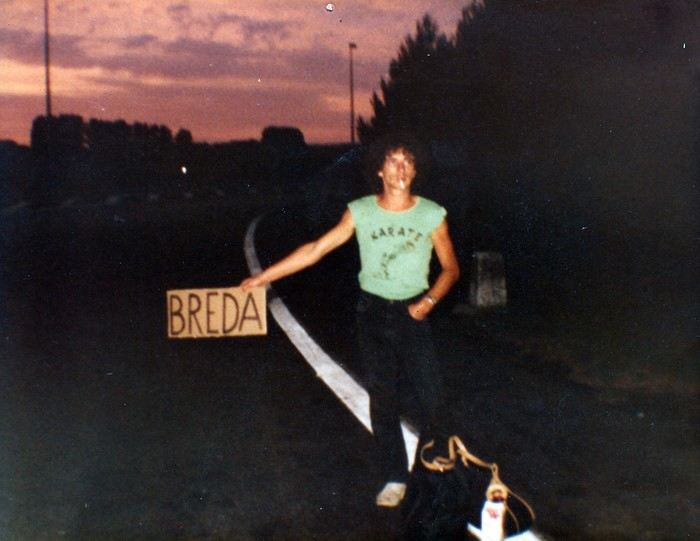
“Hey, your Marker... - My Marker? - The one you used to make hitchhiking signs.”
The marker in question is sitting proudly on the kitchen table. Marielle found it at the bottom of a moving box.
I’ve been meaning to tell the long story of my love affair with hitchhiking for years. Here we go.
To be honest, I’m not quite sure when it started. My earliest memory goes back to a fair with a bike race in my maternal grandparents’ village. I was with my cousin, my little sister, and three girl cousins. There were six of us, ages ranging from six or seven to thirteen or fourteen. Our parents stayed at the fair, and we’d had enough. So we decided to walk home. Only it was four kilometers away. So we hitchhiked. A guy driving an old car picked us all up and dropped us off at the farm. He probably found it amusing to see us thumbing a ride by the side of the road, but maybe it also worried him a bit. With everything you read in the papers...
Around fifteen or sixteen, I started hitchhiking regularly, alone or with a friend, to go to the nearby town. But it was especially when I started boarding school in Orléans that it became more regular. The first year, I’d leave Monday morning and come back Saturday noon by bus. It was an old, uncomfortable bus where we froze in winter. To make matters worse, I often got motion sickness if, as was too often the case, I ended up sitting in the back. In the spring, a high school friend suggested I hitchhike back. It meant a slight detour, but the advantage was taking only national roads.
So that’s how, from the end of tenth grade to twelfth grade, I’d thumb a ride every Saturday on the Pont de Bourgogne. Drivers were used to seeing young people hitchhiking, and it worked pretty well. Our biggest fear? Soldiers! At that time, military service was still mandatory, and on weekends, it wasn’t rare to see them competing with us. They’d keep their uniforms on to go home. That gave people confidence—with everything you read in the papers—and they’d rarely wait more than five minutes. We, with our long hair, were definitely less popular. From time to time, three big red-faced guys in a van coming back from a construction site would flip us off, yelling things like “go get a haircut, you bums!” Those were the good old days.
We still had a good laugh, though. Patrice, the friend I’d hitchhike back from school with on Saturdays, is a musician—I’d later discover he’s an excellent composer. A die-hard Beatles fan, he knows their repertoire by heart and spends his time singing at the top of his lungs while we thumb a ride. One Saturday late morning, we’d been waiting for a while at the exit of Châteauneuf-sur-Loire when a little lady came up to him and asked if he could please sing a little quieter: a baby was sleeping in the house. He put on the most sorry face: “Oh, sorry ma’am, we didn’t realize.” No sooner had the lady gone back inside than he started again. Luckily, a car stopped just then, sparing me the embarrassment of seeing the lady come back out.
Saturday was also the day when the cigarette pack was dangerously low. So before leaving, we’d go buy some “Parisiennes,” the “P4s” as we called them back then. They were slightly thinner cigarettes with a mix of tobacco scraps. Sometimes they tasted like light tobacco, sometimes like dark. Not great, but by the end of the week, our pocket money was gone. They were sold in small packs of four, hence the name P4. We’d only pay 20 centimes. On Saturdays, it was rare for the two of us to manage to scrape together 1.50 F to buy a whole pack of Gauloises...
The last twenty kilometers, I’d usually do alone, Patrice having reached his destination. From time to time, luck would smile on me: an acquaintance would just happen to pass by and stop. One January Saturday, at the exit of Gien, I ran into another guy from Argenton whom I knew a little. That day, the weather was nice, but the temperature was well below zero. It was around noon, and it was the off-peak hour. We were shivering, stamping our feet by the side of the road, when a Citroën “Tube” arrived: it was his father’s boss’s, a mason. They were both sitting in the front, but since they were obese, they had us climb onto the open back. Even though we huddled against the cab to shelter from the wind, the twenty kilometers felt very long, especially since we were only going sixty kilometers an hour. Our hands and cheeks were blue when we finally arrived.
The year I took my baccalaureate, a friend with a 2CV would take me Monday mornings with one or two others we’d pick up in nearby villages. We’d share the gas costs, but it was still cheaper than the bus. And in winter, the bus was my nightmare. You had to get up at five to catch it at six. Not enough sleep, and outside it was freezing or raining—or both. The 2CV was luxury. Plus, Philippe would pick me up at home. On the other hand, since I didn’t have class Saturday mornings—well, I did, but we only had PE the first two hours and nothing after—I’d skip class and slip out right after breakfast to thumb a ride at the Pont de Bourgogne.
Those three high school years were formative in this optional subject that was hitchhiking. Little by little, I learned the rules of the game. First, you shouldn’t walk along the road while thumbing. Cars go too fast and can’t stop easily. Accepting a ride that’s too short is also a no-go. The guy who offers to take you a little way but drops you off at some vague crossroads in the middle of nowhere? No thanks. You need to get dropped off in a town. If it’s a fairly big city, you often have to cross it from one end to the other, but it’s better. At the exit, you have to choose your spot well. Actually, you have to put yourself in the driver’s shoes: they need to see you early enough, not be going too fast, and be able to stop easily without risking an accident. So when leaving a city, it’s better not to go too far. It’s wiser to find a spot where cars go slowly and can stop easily. And preferably near a café. The café is for when you still have a few coins for a coffee and need to warm up. From time to time, you’d run into someone nice who’d make a detour to drop you off at a better spot to start again. Finally, if possible, avoid hitchhiking on Sundays. Cars are packed with whole families who, most of the time, aren’t going far. And then there’s the little worry of those people who rarely leave home: with everything you read in the papers...
During those high school years, it was only short trips, rarely exceeding a hundred kilometers. Later, I aimed bigger, and things were a bit different. In 1973-74, I crossed part of France for the first time on two or three occasions, coming back from the German border or returning to Bordeaux, where we lived briefly. Since there weren’t many highways back then, we took national roads. It was during these trips that I realized it was better to leave in the evening. As I said earlier, Sunday is to be avoided, but on weekdays, there’s another problem: if you leave in the morning, you only make short hops. First, it often takes longer to get going because drivers are people going to work nearby. Which brings us back to those who drop you off in a bad spot, far from everything. There, you have to know how to refuse. You thank the driver for stopping—oh, if only everyone could be like you—while explaining why you’d rather stay put. People don’t take offense, by the way. Those who pick up hitchhikers often hitchhiked themselves when they were in the military or before they had a car. In the late afternoon, you’d often run into salespeople or truckers, in other words, people who drive a lot. At that time, salespeople no longer had appointments and were more relaxed. They wanted to talk about something other than the merits of their products. On the radio, it was time for *Les Grosses Têtes*. You’d also quite often run into small business owners, professionals, or even hippies. The conversations were pleasant and often enriching. A little later in the evening, truckers would take over. They’d already driven a few hundred kilometers, and the depot or customs was still far away. So they’d gladly take a hitchhiker to stay awake at the wheel and chat. The radio with Max Ménier’s show *Les routiers sont sympas*, you’d eventually get tired of it. So a hitchhiker was a change. Others, who’d hit the road at midnight to be at their destination by morning, were nice and offered to let you lie down on the bunk while they drove. When you’d been hitchhiking since six in the evening, freezing in the wind between two vehicles, you weren’t unhappy to take a little nap.
Speaking of Max Ménier, he’d often make announcements for hitchhikers. One evening, I called him. It was getting late, and I still had quite a way to go. No luck: the show had ended for good the day before!
In short, it’s better not to rush, sleep in, and leave after lunch, or better yet, in the late afternoon. Obviously, I’m talking about when you have several hundred kilometers to cover. That’s when you have to play it pro.
First thing, especially at night, but it also applies in the middle of summer when the light is blinding: dress to be seen from far away. I’ll admit I have an advantage over most other hitchhikers: I’m small and don’t scare people. To balance that out, racist drivers often take me for an Arab and are less likely to pick me up, but overall, the balance tips in my favor. Back to the need to be seen: at night, I wear light-colored clothes. In headlights, you can see me from far away.
Second thing: travel light. Forget the big backpack with a frame. Drivers don’t always have room in the trunk or on the back seat, especially if it’s rained and the ground is wet. Plus, it forces them to get out of the car. If they’re nice enough to pick up a hitchhiker, you shouldn’t ask for too much either.
Third thing: bring a cardboard sign and a big marker—like the ones in the photo at the start of this post—to write the name of your destination. In the early 80s, I ran a tourist house in the Cher, but I lived in the Netherlands. In the off-season, it was only open on weekends. On Fridays, I’d leave Holland and return on Mondays. 1200 km round trip. On the way there, in Paris, I’d stand at Porte de la Chapelle. At that spot, the road is very wide, and drivers could stop easily. Obviously, on the sign, I didn’t write Eindhoven, which not everyone knows, and even less Amsterdam because of its seedy reputation. In that case, you’d expect to see a police car stop and two officers in kepis ask for your papers. So as a first destination, I’d write Compiègne. We were well out of Paris, and since it wasn’t too far, a trucker or salesperson was less reluctant to stop. Once past Compiègne, I’d take out my Lille sign. Once in Belgium, it wasn’t really necessary to use a sign anymore, since everyone was going in the same direction. Usually, the guy who picked me up at Porte de la Chapelle would say he wasn’t going far but could take me a little way. Before that, I’d still ask if there was a gas station on the highway where he could drop me off before exiting. While talking, the guy would realize he wasn’t dealing with a dangerous criminal. He’d pretend to check his watch, think for a moment, then say that actually, he was going to Belgium and could take me to the border or a little beyond. To leave Paris on the way back, I’d take the train to Melun, where it was easier to hitchhike than at Porte d’Italie.
Over all those years, I think I was pretty lucky. Or maybe philosophical enough not to imagine a car would stop after a few minutes. An hour’s wait was average. Sure, I sometimes waited three, four, or five hours. Most often at odd hours and in terrible weather. When it doesn’t work, it doesn’t work. But there’s always a moment when things pick up. Sure, when you’re soaked in freezing rain in the early morning after a sleepless night, you’re less philosophical than when I’m writing these lines comfortably at my computer, but it still holds true.
Earlier, I mentioned clothing and the importance of being well-rested before leaving. When you’ve eaten well and just gotten out of the shower, shaved, you’re in a better mood. And somehow, drivers sense it. Or at least, that’s the impression I’ve always had. It’s better to look in shape than disgusted at standing there, half-heartedly thumbing a ride. In short, when I’d start to get fed up with waiting, I’d go into the first café I saw for a coffee. Coming back out, I’d be refreshed, and most of the time, a car would stop within minutes. I’ve often said that when I stood by the side of the road thumbing a ride, I felt a bit like a gambler in front of a slot machine. It was a matter of giving luck a chance. And well, it worked out pretty well.
Then, there are countries where hitchhiking works really well and others where it’s harder. In the 70s-80s, it worked best in Germany and England. In the late afternoon, it wasn’t rare to be invited for tea. Well, that was in England. Tea meant being offered room and board. In Germany, they’d offer you coffee. Once there, they’d first show you the guest room and point out the bathroom before sitting you down in front of a big plate of cold cuts. In the evening, they’d go out in town, and the next morning, they’d usually drop you off at a good spot for hitchhiking. On the other hand, in Mediterranean and Scandinavian countries, you’d better be patient. In Spain or Italy, it’s better to take the train, which was dirt cheap back then. However, if you’re a couple traveling light, it’s already easier in most countries.
In 1982, I went on a trip around Turkey with my girlfriend. We only had two small bags, which was plenty. It was November-December, and we wore our warm, bulky clothes. Leaving Eindhoven at nine in the morning, we arrived in Graz, near the Yugoslav border, at eleven at night. 1300 km in a day! In just four or five vehicles. One to the German border, about fifty kilometers from Eindhoven, the second to Hagen in the Ruhr, the third to Salzburg, and the last to Graz at the Yugoslav border. Record broken. During the night crossing of Yugoslavia, we ran into a trucker close to retirement who lent us the truck’s bunk. So we arrived fresh and rested near Skopje the next morning. We continued to Thessaloniki in northern Greece before taking the train to Istanbul. In Turkey, we traveled a good part of the country by hitchhiking too. With truckers in old, overloaded, slow trucks that climbed hills at fifteen kilometers an hour, but also in cars where five or six people were already crammed in. And every time, we were invited for tea. Once, we were even picked up by a big shot in his Mercedes with a chauffeur. Until then, the average speed was around fifty kilometers an hour. There, we were going two hundred. On a national road, not a nice European highway.
I’ve also hitchhiked in Nepal, from Lumbini, Buddha’s birthplace, to a village on the way to Pokhara. It must have been midday. No bus until the next day. I gave it a try. A small truck overloaded with rice sacks, with two or three young people already perched on top, stopped. I rode on the roof of the cab. At fifty kilometers an hour when it was going well, with a breathtaking view. Coming back from India, I also crossed part of Iran by hitchhiking, from Tehran to the Turkish border. I did this trip with an Austrian I met at the hotel who, like me, had to watch his pennies. We gave it a shot. There was almost no traffic, but to our great surprise, the first car that passed in the area would always stop. They’d just ask for a modest contribution for gas, and it cost next to nothing.
Sometimes, you get scared too. After leaving Turkey in early December 82, we spent about two weeks in the southern Peloponnese harvesting olives. A few days before Christmas, we hitchhiked back to Holland. A girl picked us up in her little Fiat 500. We were driving on a mountain road, and that morning there was a bit of black ice. After crossing a pass, we saw the old Ford Taunus ahead of us at fifty meters start to skid. The driver let out a “heeee!” while grabbing my knees. I reflexively grabbed the wheel. Finally, the Taunus got back on track. And we didn’t swerve. But those few seconds felt very long.
In January 77, while I’d been living in Germany for a few months, I decided to spend a few days in Italy. By hitchhiking, of course. I left in the early afternoon, and by ten at night, I wasn’t far from Frankfurt. I saw a big Mercedes stop. The four or five young people crammed inside were listening to Schlager at full volume. Beer cans littered the floor. They didn’t have a precise destination, and as long as they were going south, that was fine with me. They’d finished their military service that very day and had clearly already celebrated their discharge. The driver was going 160, zigzagging dangerously from one side of the highway to the other. I should have realized he wasn’t entirely sober either. Luckily, there was almost no traffic. Finally, I managed to get dropped off at a gas station just before Frankfurt, relieved. I hope their trip didn’t end tragically.
Another time, coming back from Holland with my wife, we were picked up early in the morning near Senlis by two guys from Lille. They were going to work near Tours and could drop us off at Porte d’Italie. Apparently, they were coworkers but barely knew each other. The driver offered us a beer—at six in the morning, sure!—before opening another can for himself. He was clearly having trouble staying in the right lane. We politely declined, the passenger too. Everyone was tense. Luckily, it was rush hour on the ring road, and we were going slowly. When we got out of the car, the passenger said goodbye with the look of a guy being offered the condemned man’s rum and cigarette.
Finally, there are the annoying remarks from drivers who are either gay when you’re alone or turned on by the sight of your girlfriend when you’re a couple. In those cases, I’d get in the back so the guy wouldn’t feel too confident. And if the conversation got a little too suggestive, we’d deflect until we got dropped off.
And luckily, there are the times, not so rare after all, when you run into really nice people who invite you to eat and sleep at their place and drive you to a good spot the next morning. In Germany and England, that was common. And then there are the big strokes of luck, like during our trip to Turkey when we crossed most of Germany in one car, or that other time when some Germans drove me from the exit of Geneva all the way to the Costa Brava.
Going back to “with everything you read in the papers” and its variant “with everything you see on TV”—and now on the internet—it’s always left me perplexed. Personally, I’ve never heard of hitchhikers assaulting drivers, even if it may have happened. On the other hand, what was most common were hitchhikers being assaulted, especially girls. Anyway, even armed, it seems a bit stupid to assault the driver—wouldn’t that risk causing an accident?
Finally, since that time, I’ve occasionally wanted to hitchhike somewhere far away in France. Most often, too busy with work, it never happened, but the nostalgia hasn’t completely disappeared.
* * *
Other Hitchhikers
And then one day, I... settled down to become a driver myself. Ten years had passed, and you saw fewer and fewer hitchhikers. Or maybe I saw fewer because I had a regular job and wasn’t traveling the same way. And then I understood a few things.
Several times, I was tempted to pick up a hitchhiker, but they didn’t meet the required conditions. They were walking along the road instead of staying at the exit of the previous town. Hard to stop without risking an accident. Or the guy looked really scruffy. Or he was sulking, if not both. Then you think of that famous “with everything you read in the papers.” Not that I was scared, but unfortunately, the few hitchhikers I did pick up later were rarely interesting.
A few years ago, we picked up a young guy at the exit of a small town in Sologne. Not an easy spot for hitchhiking. Bad luck, he was a pretentious little jerk. He was barely 20 or 25 and talked like a bitter old man. He was a waiter in a restaurant. According to him, it was lucky he was there, otherwise the boss would have closed up shop long ago. You’d think he had thirty or forty years of professional experience behind him. As we approached Blois, he started ranting about Arabs, blaming them for all evils. And he laid it on thick. That morning, we were going to a teenager’s funeral who had just committed suicide, so he really got on our nerves, Mr. Know-It-All. Out of anger, I dropped him off next to a shopping center a few kilometers from downtown. Not nice, but it felt good.
Some time ago, we were driving around the Limousin on a Sunday to try out the used Twingo we’d just bought. We picked up a guy in his forties. A German who spoke French well. He started talking about the environment. He was a green Khmer. He got worked up all by himself with his pseudo-eco rant and, after a few kilometers, was almost yelling at us. As we were about to leave the main road for a small one, I dropped him off at a crossroads in the middle of nowhere. Normally, I would have made a little detour to take him to a better spot, but this time, I didn’t feel like doing the... eco-warrior a favor.
On the other hand, I’ve still done my good deed a few times. One June morning, coming back from Orléans, I saw a man in his sixties hitchhiking. The poor guy had had a rough time. He was from Montpellier and was coming back from Caen, where he’d been promised a job. Once there, they bluntly told him the position was already taken, and he had to go back. Except he didn’t have enough money left for the train. He’d spent the night hitchhiking without success. I could only take him as far as Lamotte-Beuvron, where I dropped him off near the fire station. Apparently, there was some vague shelter there or something, but it only opened a few hours later. In the meantime, he settled on the grass in a corner to sleep a little. While he was doing that, I quickly went to the train station to check the price of a ticket to Montpellier. It was within my means. Since he was sound asleep, I slipped the train ticket and 100 francs into his pocket. I couldn’t imagine him continuing to hitchhike all the way to Montpellier. And I bet he didn’t even have a piece of cardboard and a marker!
When we go to Brazil, we usually rent a small car. One day, we were coming back from Paracuru to Fortaleza when we saw a whole family hitchhiking. Two adults and two or three small children. Here near the equator, the sun sets very quickly, and it would soon be night. There was little traffic, and trucks wouldn’t stop because there was no room in the cab. As for the rich people driving big 4x4s, they wouldn’t stoop to picking up the lower classes. The only hope for this kind of family was usually a farmer or artisan who’d let them ride in the back of his pickup. Obviously, they were a bit surprised to see us. Everyone crammed in as best they could in the back of our little car. When we dropped them off, we got a whole string of “Deus lhes abençõe”—God bless you.
Still in Brazil, we were on the road from Barreirinhas to São Luís do Maranhão. About 150 km of deserted road with an isolated mud house here and there. A young woman flagged us down. She was very pregnant and had to get to the clinic twenty or thirty kilometers away to give birth. Someone was supposed to drive her, but the first signs of labor started earlier than expected, and the driver was unavailable. Even driving fast, we weren’t feeling great: it would be just our luck if she gave birth in the car!
Today, we’re in the age of smartphones and carpooling apps. Safety. With everything you see on TV... Three or four years ago, we signed up on a platform. Our first, and only, “client” was a little jerk who didn’t say a word the whole trip. No hello, no goodbye, and certainly no thank you. The next day, we found his Ray-Bans in the car. We didn’t run after him to give them back. Ha!
Quel stop suggerez-vous entre Nikko et Takayama? (avec enfant de 7 ans) English translation pending
Bonjour,
Ma famille : 2 adultes et une enfant globetrotteuse de 7 ans.
Nous partons les 3 en avril pour un voyage déjà bien préparé par mes propres soins.
L'itinéraire initial est le suivant :
Tokyo 5 nuits Nikko 1 nuit Matsumoto 1 nuit Takayama 2 nuits Kanazawa 1 nuit Kyoto 3 nuits Osaka 2 nuits
JR pass 7 jours validé dès le dernier jour à Tokyo (il tiendra jusqu'au jour d'arrivée à Kyoto)
A Tokyo, on prévoit 3 jours complets de visites en ville déjà tout organisé par mes soins encore une fois (selon quartiers et intérêts) + 1 journée à Kamakura, et c'est là qu'on validera le JR pass.
A Nikko et Kanazawa nous avons réservé des AirBnb dans des maisons typiques (les propriétaires sont déjà aux petits soins et nous proposent un accueil et transferts gratuit depuis la gare... J'adooooooooooore !)
Mais voilà, je suis entrain de construire mes horaires sur Hyperdia et là me me rends compte que le Nikko - Matsumoto - Takayama, c'est pas si simple en train JR pass (avec 2 grosses valises) ! Je commence à me dire qu'on aura pas la force de faire autant d'heures de train avec 3 ou 4 stops, sur 2 jours de suite.
Alors je cherche une alternative pour simplifier ce voyage. Dois-je remplacer ma nuit à Mastumoto par Nagano ? ou pas ? ou ailleurs ? des avis ?
(PS : Matusmoto était un stop pour son Chateau, Nagano semble avoir un joli temple bouddhiste... mais après Nikko cela vaut-il la peine ?)
Merci beaucoup pour votre aide !
Par la suite, et si cela intéresse certaines personnes, je pourrais poser mon organisation jour par jour, (surtout après le voyage et avec les commentaire si cela est facile ou pas avec une fille de 7 ans)
Belle journée,
Julie
Ma famille : 2 adultes et une enfant globetrotteuse de 7 ans.
Nous partons les 3 en avril pour un voyage déjà bien préparé par mes propres soins.
L'itinéraire initial est le suivant :
Tokyo 5 nuits Nikko 1 nuit Matsumoto 1 nuit Takayama 2 nuits Kanazawa 1 nuit Kyoto 3 nuits Osaka 2 nuits
JR pass 7 jours validé dès le dernier jour à Tokyo (il tiendra jusqu'au jour d'arrivée à Kyoto)
A Tokyo, on prévoit 3 jours complets de visites en ville déjà tout organisé par mes soins encore une fois (selon quartiers et intérêts) + 1 journée à Kamakura, et c'est là qu'on validera le JR pass.
A Nikko et Kanazawa nous avons réservé des AirBnb dans des maisons typiques (les propriétaires sont déjà aux petits soins et nous proposent un accueil et transferts gratuit depuis la gare... J'adooooooooooore !)
Mais voilà, je suis entrain de construire mes horaires sur Hyperdia et là me me rends compte que le Nikko - Matsumoto - Takayama, c'est pas si simple en train JR pass (avec 2 grosses valises) ! Je commence à me dire qu'on aura pas la force de faire autant d'heures de train avec 3 ou 4 stops, sur 2 jours de suite.
Alors je cherche une alternative pour simplifier ce voyage. Dois-je remplacer ma nuit à Mastumoto par Nagano ? ou pas ? ou ailleurs ? des avis ?
(PS : Matusmoto était un stop pour son Chateau, Nagano semble avoir un joli temple bouddhiste... mais après Nikko cela vaut-il la peine ?)
Merci beaucoup pour votre aide !
Par la suite, et si cela intéresse certaines personnes, je pourrais poser mon organisation jour par jour, (surtout après le voyage et avec les commentaire si cela est facile ou pas avec une fille de 7 ans)
Belle journée,
Julie
Bateau-stop Europe - Amérique (voilier) English translation pending
Bonjour !
Je souhaite partir en avril en Amérique du sud sans prendre d'avion. De plus je me dis qu'un voyage en bateau est quelque chose qui doit être super et ça nous rend conscient que l'Amérique c'est pas à deux pas de chez sois ! Je viens vous donc pour avoir des infos sur comment trouver un bateau partant d'Europe et se rendant en Amérique. Y a t-il est sites spécialisés sur les transatlantiques ou la recherche de coéquipiers ? Dois je me rendre directement dans un port ? Si oui lesquels ?
Merci d'avance ! Théo
Je souhaite partir en avril en Amérique du sud sans prendre d'avion. De plus je me dis qu'un voyage en bateau est quelque chose qui doit être super et ça nous rend conscient que l'Amérique c'est pas à deux pas de chez sois ! Je viens vous donc pour avoir des infos sur comment trouver un bateau partant d'Europe et se rendant en Amérique. Y a t-il est sites spécialisés sur les transatlantiques ou la recherche de coéquipiers ? Dois je me rendre directement dans un port ? Si oui lesquels ?
Merci d'avance ! Théo
Bateau-stop Chypre-Israël (voilier) English translation pending
Bonjour à toutes et à tous,
Nous sommes Anais et Ludovic, deux cyclo-voyageurs. Nous sommes en route depuis la France vers la Chine a velo et sommes actuellement en Grece. Nous avons eu vent de possible départ de Chypre vers Israël en bateau à voile et aimerions faire du bateau-stop. Nous pensons arriver à Chypre en octobre-novembre, pensez-vous qu'il y a aura encore des voiliers effectuant la traversée ? Si non, quelles seraient les bonnes périodes ?
Merci :)
Nous sommes Anais et Ludovic, deux cyclo-voyageurs. Nous sommes en route depuis la France vers la Chine a velo et sommes actuellement en Grece. Nous avons eu vent de possible départ de Chypre vers Israël en bateau à voile et aimerions faire du bateau-stop. Nous pensons arriver à Chypre en octobre-novembre, pensez-vous qu'il y a aura encore des voiliers effectuant la traversée ? Si non, quelles seraient les bonnes périodes ?
Merci :)
Un stop intéressant (en train) entre Lampang et Bangkok? English translation pending
Bonjour à tous,
un message de plus, une nouvelle fois, nous sommes perdus. Voyager avec un bébé rend définitivement le choix d'un itinéraire beaucoup plus difficile.
Nous souhaitons éviter les trajets par la route pour cette année car notre bébé n'aura que 2 ans au moment de notre voyage et le train nous paraît être la solution la plus sécuritaire.
Nous avons donc choisi de suivre la ligne de train, et de faire 4 stops au total pour ne pas courir. Bangkok, Chiang Mai, Lampang, et Sukhothai qui était au programme nous paraît bien compliqué maintenant que nous regardons les trajets d'un peu plus près... De Lampang à Sukhothai, c'est 5h de train et ensuite 1h30 de bus, donc en tout casiment 7h de transport, avec un bébé de 2 ans, ça fait beaucoup, et si nous avions vraiment très envie de voir Sukhothai on en vient à se demander si ça vaut vraiment le coup dans ces conditions. Est-ce qu'on ne programmerai pas Sukhothai dans 5-6 ans quand notre fille sera plus grande et que les trajets en bus seront plus adaptés (et qu'elle fera du vélo).
Mais si nous faisons une croix sur Sukhothai, alors quel serait notre 4ème stop? Sur le chemin de Lampang à Bangkok en train, y'a t-il un arrêt qui vaut le détour pour quelques jours? Lam Phun? Ou peut-être un point d'intêret plus bas que Bangkok?
Merci d'avance pour votre aide, c'est parfois plus facile de réfléchir à plusieurs...
un message de plus, une nouvelle fois, nous sommes perdus. Voyager avec un bébé rend définitivement le choix d'un itinéraire beaucoup plus difficile.
Nous souhaitons éviter les trajets par la route pour cette année car notre bébé n'aura que 2 ans au moment de notre voyage et le train nous paraît être la solution la plus sécuritaire.
Nous avons donc choisi de suivre la ligne de train, et de faire 4 stops au total pour ne pas courir. Bangkok, Chiang Mai, Lampang, et Sukhothai qui était au programme nous paraît bien compliqué maintenant que nous regardons les trajets d'un peu plus près... De Lampang à Sukhothai, c'est 5h de train et ensuite 1h30 de bus, donc en tout casiment 7h de transport, avec un bébé de 2 ans, ça fait beaucoup, et si nous avions vraiment très envie de voir Sukhothai on en vient à se demander si ça vaut vraiment le coup dans ces conditions. Est-ce qu'on ne programmerai pas Sukhothai dans 5-6 ans quand notre fille sera plus grande et que les trajets en bus seront plus adaptés (et qu'elle fera du vélo).
Mais si nous faisons une croix sur Sukhothai, alors quel serait notre 4ème stop? Sur le chemin de Lampang à Bangkok en train, y'a t-il un arrêt qui vaut le détour pour quelques jours? Lam Phun? Ou peut-être un point d'intêret plus bas que Bangkok?
Merci d'avance pour votre aide, c'est parfois plus facile de réfléchir à plusieurs...
Bateau-stop pour le détroit de Béring English translation pending
Bonjour,
je suis un grand rêveur et je rêve de faire un tour du monde en stop. Pour petit à petit, mener ce projet à du concret je m'interroge sur un sujet bien particulier. Je me demande comment traverser l'océan Pacifique de l'Amérique vers l'Asie ou inversement. Au fil des forums et expériences de voyageurs, j'ai trouvé nombreuses solutions pour l'océan Atlantique (en espérant que se soit toujours d'actualité 😄) mais pour l'océan Pacifique, il y a bien moins de solutions... J'en ai vu certaines mais qui paraissent assez longues et compliquées (très), alors je me demandais s'il était possible de passer par le détroit de Béring. La zone est certes assez désertique mais seulement 92 km séparent les deux continent, avez-vous une idée sur la question ? Tous les autres conseils pour franchir l'océan Pacifique en stop sont les bienvenues 😊
Merci pour votre aide future,
Simon
je suis un grand rêveur et je rêve de faire un tour du monde en stop. Pour petit à petit, mener ce projet à du concret je m'interroge sur un sujet bien particulier. Je me demande comment traverser l'océan Pacifique de l'Amérique vers l'Asie ou inversement. Au fil des forums et expériences de voyageurs, j'ai trouvé nombreuses solutions pour l'océan Atlantique (en espérant que se soit toujours d'actualité 😄) mais pour l'océan Pacifique, il y a bien moins de solutions... J'en ai vu certaines mais qui paraissent assez longues et compliquées (très), alors je me demandais s'il était possible de passer par le détroit de Béring. La zone est certes assez désertique mais seulement 92 km séparent les deux continent, avez-vous une idée sur la question ? Tous les autres conseils pour franchir l'océan Pacifique en stop sont les bienvenues 😊
Merci pour votre aide future,
Simon
Bateau-stop au départ de la France (transatlantique) English translation pending
Ohé matelots !
Depuis plusieurs années, un projet me trotte dans la tête : celui de faire le tour du monde. Après quelques voyages et de nombreuses réflexions : j'ai décidé de faire le grand saut. Ce voyage sera pour moi l'occasion de rencontrer de nouvelles personnes, de découvrir de nouveaux horizons, d'apprendre et de partager.
Je vais bientôt me lancer et le premier défi consiste à traverser l'Atlantique à bord d'un voilier. Je suis disponible dès début janvier pile dans la saison des alizés ! À défaut d'avoir une expérience en navigation, je vous propose ma bonne humeur, ma débrouillardise, et mon insatiable envie d'apprendre.
Alors si vous êtes capitaine à la recherche d'un matelot ou si vous connaissez un capitaine qui a besoin d'un équipier : contactez-moi (par message privé) ! Je vous serais extrêmement reconnaissant et vous me donneriez un sérieux coup d'pouce pour ma grande aventure (sans vouloir faire de jeux de mots 😇) !
À défaut si vous avez des informations pour faire du bateau-stop directement au port (quels sont les marinas les plus propices pour un départ depuis la France?, des conseils ?) je suis preneur !
En vous remerciant par avance pour votre précieux coup d'pouce !
Timothée
Depuis plusieurs années, un projet me trotte dans la tête : celui de faire le tour du monde. Après quelques voyages et de nombreuses réflexions : j'ai décidé de faire le grand saut. Ce voyage sera pour moi l'occasion de rencontrer de nouvelles personnes, de découvrir de nouveaux horizons, d'apprendre et de partager.
Je vais bientôt me lancer et le premier défi consiste à traverser l'Atlantique à bord d'un voilier. Je suis disponible dès début janvier pile dans la saison des alizés ! À défaut d'avoir une expérience en navigation, je vous propose ma bonne humeur, ma débrouillardise, et mon insatiable envie d'apprendre.
Alors si vous êtes capitaine à la recherche d'un matelot ou si vous connaissez un capitaine qui a besoin d'un équipier : contactez-moi (par message privé) ! Je vous serais extrêmement reconnaissant et vous me donneriez un sérieux coup d'pouce pour ma grande aventure (sans vouloir faire de jeux de mots 😇) !
À défaut si vous avez des informations pour faire du bateau-stop directement au port (quels sont les marinas les plus propices pour un départ depuis la France?, des conseils ?) je suis preneur !
En vous remerciant par avance pour votre précieux coup d'pouce !
Timothée
Auto-stop en Asie Centrale: itinéraire, frontières et sécurité English translation pending
Bonjour à toutes et à tous,
Je me permets de créer une nouvelle discussion car je suis à la recherche d'informations que je n'ai pas trouvé ailleurs.
Je résume brièvement mon projet afin que vous compreniez la raison de mon post. Je partirai début mai 2019 depuis la France pour rejoindre l'Asie du Sud Est en autostop, néanmoins mes questions ici concernent seulement les pays d'Asie Centrale. Voici mon itinéraire (prévisionnel) : France, pays des Balkans, Turquie, Géorgie, Arménie, Azerbaïdjan, Iran, Turkménistan, Ouzbékistan, Kirghizistan, Tadjikistan, Afghanistan, Pakistan, Inde, puis vers l'est.
Avant toute chose, je tiens à préciser que c'est un projet - à petit budget - en construction et que je suis donc ouvert à toutes vos remarques et commentaires, susceptibles de faire évoluer l'itinéraire prévu (par exemple passer par la Chine pour rejoindre l'Asie du Sud Est plutôt que Afghanistan-Pakistan-Inde, néanmoins ce sont les pays qui me motivent le plus pour ce voyage...)
Voici mes questions:
Concernant le Turkménistan, Ouzbékistan, Kirghizistan, Tadjikistan : d'après ce que j'ai lu sur internet, la pratique dans l'autostop dans ces pays ne pose pas de problème, confirmez-vous cela?
En Afghanistan : - Arriver par l'Afghanistan en autostop depuis le Tadjikistan en passant par la route Douchanbé-Kondoz est-il envisageable?
- pour des questions de sécurité la pratique de l'autostop me semble être à proscrire, néanmoins est-elle possible? Est-il possible de se déplacer en bus locaux? (habillé en local...)
- J'aimerai aller dans les villes/ régions suivantes : Mazâr-e-Charif, lac de Band-e-Amir, Whakan, en gros le nord, l'est et le nord-est du pays (puisque c'est celles qui semblent le plus accessibles), qu'en pensez-vous? Recommandez-vous d'autres endroits à visiter?
- d'après ce que j'ai lu, il faut surtout éviter les zones contrôlées par les Talibans, c'est à dire le sud du pays. Ainsi vous semble t-il envisageable de rejoindre le Pakistan en passant par la route Kondoz-Kabul-Jalalabad-Peshawar ?
- Pakistan : plus ou moins les mêmes questions que pour l'Afghanistan, c'est à dire : zones à éviter? zones "recommandées" ? routes dangereuses ? autostop possible ?
- Pakistan-Inde: quel(s) poste(s) frontière recommandez vous pour passer du Pakistan à l'Inde ? est-ce préférable de passer par le nord du pays ? (Lahore - Wagah- Amritsar par exemple)
Si vous pensez à des choses que je n'aurais mentionné, n'hésitez pas à en parler. Notamment concernant des questions de géopolitique, si certains d'entre vous sont passés par ces pays récemment.
En vous remerciant par avance pour vos réponses, Bonne journée à toutes et à tous,
Hugo.
Je me permets de créer une nouvelle discussion car je suis à la recherche d'informations que je n'ai pas trouvé ailleurs.
Je résume brièvement mon projet afin que vous compreniez la raison de mon post. Je partirai début mai 2019 depuis la France pour rejoindre l'Asie du Sud Est en autostop, néanmoins mes questions ici concernent seulement les pays d'Asie Centrale. Voici mon itinéraire (prévisionnel) : France, pays des Balkans, Turquie, Géorgie, Arménie, Azerbaïdjan, Iran, Turkménistan, Ouzbékistan, Kirghizistan, Tadjikistan, Afghanistan, Pakistan, Inde, puis vers l'est.
Avant toute chose, je tiens à préciser que c'est un projet - à petit budget - en construction et que je suis donc ouvert à toutes vos remarques et commentaires, susceptibles de faire évoluer l'itinéraire prévu (par exemple passer par la Chine pour rejoindre l'Asie du Sud Est plutôt que Afghanistan-Pakistan-Inde, néanmoins ce sont les pays qui me motivent le plus pour ce voyage...)
Voici mes questions:
Concernant le Turkménistan, Ouzbékistan, Kirghizistan, Tadjikistan : d'après ce que j'ai lu sur internet, la pratique dans l'autostop dans ces pays ne pose pas de problème, confirmez-vous cela?
En Afghanistan : - Arriver par l'Afghanistan en autostop depuis le Tadjikistan en passant par la route Douchanbé-Kondoz est-il envisageable?
- pour des questions de sécurité la pratique de l'autostop me semble être à proscrire, néanmoins est-elle possible? Est-il possible de se déplacer en bus locaux? (habillé en local...)
- J'aimerai aller dans les villes/ régions suivantes : Mazâr-e-Charif, lac de Band-e-Amir, Whakan, en gros le nord, l'est et le nord-est du pays (puisque c'est celles qui semblent le plus accessibles), qu'en pensez-vous? Recommandez-vous d'autres endroits à visiter?
- d'après ce que j'ai lu, il faut surtout éviter les zones contrôlées par les Talibans, c'est à dire le sud du pays. Ainsi vous semble t-il envisageable de rejoindre le Pakistan en passant par la route Kondoz-Kabul-Jalalabad-Peshawar ?
- Pakistan : plus ou moins les mêmes questions que pour l'Afghanistan, c'est à dire : zones à éviter? zones "recommandées" ? routes dangereuses ? autostop possible ?
- Pakistan-Inde: quel(s) poste(s) frontière recommandez vous pour passer du Pakistan à l'Inde ? est-ce préférable de passer par le nord du pays ? (Lahore - Wagah- Amritsar par exemple)
Si vous pensez à des choses que je n'aurais mentionné, n'hésitez pas à en parler. Notamment concernant des questions de géopolitique, si certains d'entre vous sont passés par ces pays récemment.
En vous remerciant par avance pour vos réponses, Bonne journée à toutes et à tous,
Hugo.
Nature, stop, camping et sac à dos: Açores ou Madère? English translation pending
Bonjour,
Je suis en train de préparer les prochaines vacances d'été (oui, leur perspective me permet de mieux appréhender l'hiver approchant). Je souhaiterais partir avec ma copine pendant 15-20 jours au mois d'août, vers une destination nature. Plus précisément, nous aimons randonner dans les montagnes, loin des foules, découvrir de petits villages authentiques, mais également faire du snorkeling et de la plongée sous-marine. Ayant un budget serré (la plongée sera le seul extra, mais nous sommes passionnés) et par goût du voyage non-organisé, nous souhaiterions bouger en stop, dormir sous la tente (en camping sauvage ou non), etc... J'ai vu plusieurs topics sur les voyages "routard" du genre aux Açores, qui m'ont fortement emballé ! J'aurais voulu savoir si cela était aussi envisageable à Madère, et ce que vous recommanderiez à deux amoureux de la nature (quel archipel, quelle(s) île(s), sites de plongée, coups de coeur). Je vous remercie beaucoup !
Benjamin
Je suis en train de préparer les prochaines vacances d'été (oui, leur perspective me permet de mieux appréhender l'hiver approchant). Je souhaiterais partir avec ma copine pendant 15-20 jours au mois d'août, vers une destination nature. Plus précisément, nous aimons randonner dans les montagnes, loin des foules, découvrir de petits villages authentiques, mais également faire du snorkeling et de la plongée sous-marine. Ayant un budget serré (la plongée sera le seul extra, mais nous sommes passionnés) et par goût du voyage non-organisé, nous souhaiterions bouger en stop, dormir sous la tente (en camping sauvage ou non), etc... J'ai vu plusieurs topics sur les voyages "routard" du genre aux Açores, qui m'ont fortement emballé ! J'aurais voulu savoir si cela était aussi envisageable à Madère, et ce que vous recommanderiez à deux amoureux de la nature (quel archipel, quelle(s) île(s), sites de plongée, coups de coeur). Je vous remercie beaucoup !
Benjamin
Le stop avec notre destination sur un carton? English translation pending
Bonjour,
Étant adepte du stop et n'ayant jamais utilisé de carton avec ma destination marquée dessus, je me demandais si cela était utile ? Outre le fait que j'ai toujours réussi à me déplacer sans ça, j'ai aussi toujours pu donner une fausse destination quand un automobiliste ne m’inspirait pas confiance. Je pense même que c'est un avantage pour refuser que quelqu'un nous prenne (si le feeling n'est pas bon toute suite) .
Ma réflexion est donc la suivante, est ce que voyager en stop avec des feuilles pour noter la destination est bien utile ou au contraire plus dangereux ?
Bonne journée !
Xavier du blog jesuisterrien.com
Étant adepte du stop et n'ayant jamais utilisé de carton avec ma destination marquée dessus, je me demandais si cela était utile ? Outre le fait que j'ai toujours réussi à me déplacer sans ça, j'ai aussi toujours pu donner une fausse destination quand un automobiliste ne m’inspirait pas confiance. Je pense même que c'est un avantage pour refuser que quelqu'un nous prenne (si le feeling n'est pas bon toute suite) .
Ma réflexion est donc la suivante, est ce que voyager en stop avec des feuilles pour noter la destination est bien utile ou au contraire plus dangereux ?
Bonne journée !
Xavier du blog jesuisterrien.com
Auto-stop Krakow - Lviv English translation pending
Bonjour voyageurs,
J'habite à Cracovie et j'aimerais savoir si l'un de vous a déjà fait du stop en Pologne jusqu'au la frontière ukrainienne. J'aimerais éviter de prendre le bus et aller à Lviv en stop de Cracovie. J'arrive malheureusement pas à trouver d'informations en ligne, les sites proposent le train ou bus.
Il y a 3heures d'attente à la frontière et je voulais aussi savoir, si jamais l'un d'entre vous a déjà fait le trajet, si passer la frontière à pieds permet de gagner du temps.
Merci de votre réponse,
Océane
Bateau-stop de Guadeloupe à la Martinique English translation pending
Bonjour tout le monde,
Alors voilà je partirai de Guadeloupe le 19 ou 20 avril et je voudrais faire du bateau-stop direct dans la marina de pointe-a-pitre pour aller en Martinique. Le problème est que l'on m'attend là-bas pour le 1er mai. Ma question: pensez-vous que 10 jours suffisent pour faire le trajet en bateau ou bien par manque de temps je ferais mieux de prendre l'avion?
Et pensez-vous qu'il soit facile d'être prise en bateau direct de la marina? c'est la première fois que je vais faire du bateau-stop, je ne sais pas trop comment m'y prendre et ha oui, point pas très avantageux pour moi: je n'y connais rien dans ce milieu, je n'ai aucunes connaissances nautiques :( mais je souhaiterais apprendre et aider de mon mieux.
Merci d'avance pour vos réponses :)
Alors voilà je partirai de Guadeloupe le 19 ou 20 avril et je voudrais faire du bateau-stop direct dans la marina de pointe-a-pitre pour aller en Martinique. Le problème est que l'on m'attend là-bas pour le 1er mai. Ma question: pensez-vous que 10 jours suffisent pour faire le trajet en bateau ou bien par manque de temps je ferais mieux de prendre l'avion?
Et pensez-vous qu'il soit facile d'être prise en bateau direct de la marina? c'est la première fois que je vais faire du bateau-stop, je ne sais pas trop comment m'y prendre et ha oui, point pas très avantageux pour moi: je n'y connais rien dans ce milieu, je n'ai aucunes connaissances nautiques :( mais je souhaiterais apprendre et aider de mon mieux.
Merci d'avance pour vos réponses :)