Results for "gite"
11356 results found.
Carte de L'Adrar - Mauritanie English translation pending
Bonjour à tous,
Je reviens d'un trek de 15 jours en Mauritanie, et je suis à la recherche d'une carte d'une région de la Mauritanie : l'Adrar. L'IGN ne la fait pas. Savez-vous où je pourrais m'en procurer une ? Merci d'avance.
Je reviens d'un trek de 15 jours en Mauritanie, et je suis à la recherche d'une carte d'une région de la Mauritanie : l'Adrar. L'IGN ne la fait pas. Savez-vous où je pourrais m'en procurer une ? Merci d'avance.
Moustiques au Québec English translation pending
Bonjour,
Nous venons en famille, en vacances, au Quebec la seconde quinzaine d'aout 2004.Nous comptons circuler dans le sud de votre province. Une de mes fille est tres sensible aux attaques de moustiques.On m'a annoncé que les moustiques sont un fléaux chez vous.Pourriez-vous me donner une info fiable sur ce probleme.Petite précision, nous voyagerons en motorisé.Merci de votre aide.
Nous venons en famille, en vacances, au Quebec la seconde quinzaine d'aout 2004.Nous comptons circuler dans le sud de votre province. Une de mes fille est tres sensible aux attaques de moustiques.On m'a annoncé que les moustiques sont un fléaux chez vous.Pourriez-vous me donner une info fiable sur ce probleme.Petite précision, nous voyagerons en motorisé.Merci de votre aide.
Treks en Inde et au Népal English translation pending
bonjour a tous,
je compte partir faire un tour d'Asie d'une durée d'au moins un an avec mon amie ... au programme : Inde du Nord, Nepal, Laos, Cambodge, Vietnam, Malaisie, Indonesie, Thailande et Birmanie ...
c'est la trame initiale ...
vous allez donc souvent me voir dans les forums poser des questions :-) ....
nous sommes juste en train de regarder la faisabilité de certains projets, donc si je demande ou dis des betises, pardonnez moi et ne tirez pas a vue 😉😉
nous comptons faire des treks au Nepal (Annapurna, Everest ???) et en Inde du Nord (Zanskar, Nanda Devi, Sikkim ???) mais nous n'avons pas encore choisi lesquels, ni les itineraires, bref on est en plein doute ... euh sur les itineraires et autres, pas sur le voyage :-) ) je sais que sur le trek des annapurnas, il y a des guesthouses tout le long, si quelqu'un pouvait m'indiquer le prix d'une nuitée pour deux avec repas pour deux trekkeurs près de leur sous, ca serait sympa .... ensuite, qu'en est t'il pour celui de l'everest ???? et tarif d'un porteu
en gros, est ce que l'on a besoin d'une tente au Nepal ???? si non, budget pour dormir ???
a titre indicatif, tarif d'un porteur pour ces deux treks ...
de plus, comme l'on arrivera d'inde, et que dans les treks indiens nous aurons besoin de la tente, est ce que l'on peut revendre facilement la tente sur place dans une ville, ou alors reexpedition en France ??? histoire de ne pas se trimbaler la tente durant le reste de notre periple ....
et de même en Inde, tarif d'un porteur pour les trois trek sus cités .....
par avance Merci de vos renseignements ....
vincent
"trop de gens attendent tout du voyage sans jamais s'être souciés de ce que le voyage attend d'eux. ils souhaitent que le dépaysement les guérisse d'insuffisances qui ne sont pas nationales mais humaines"
Je vous conseille la Corse... English translation pending
Pour ceux qui cherche une belle destination, chaude, avec une mer incroyable et de la rando...c'est le paradis. On y trouve de beaux camping.Les Québecquois y sont extrèmement bien acceuillis(d'alleurs il y en a beaucoup).
Si vous avez des questions ecrivez moi.
Erika
Si vous avez des questions ecrivez moi.
Erika
Conseils pour le nord et est du Sénégal? English translation pending
Je fais au mois d'août le tour du SENEGAL. DAKAR-DAKAR avant sans doute m'y installer (inch'allah) le dernier repèrage en quelque sorte
Avez vous quelques bons plans pour la partie PODOR, MATAN, BAKEL, KEDOUGOU, TAMBACOUNDA, KOLDA ? Autrement dit sur le Nord et l'est: les lieux à ne pas rater, les bons camps, le meilleur moyen de circuler, etc etc...Sur le trajet sud et west je pense pouvoir m'en sortir seul ayant déjà bougé dans le coin.
Peut-on circuler en GAMBIE sans risque? Qu'y a t-il a voir ?
Meilleur transport pour visiter le Canada? English translation pending
bonjour,
Nous sommes une famille avec trois enfants( bb de 15 mois +2 ados) et nous souhaitons visiter le canada cet été .
Quelle est la formule la plus aisée pour circuler au canada ?
Camping car, autotour ..., location puis rayonner
Merci de vos réponse
Polynesie en octobre/Novembre English translation pending
Bonjour, je cherche des conseils au sujet d'un voyage en polynesie
je reside au Japon et partirai de tokyo
sur place je souhaite 6 jours environ en club pour le repos et ensuite 6/8 jours a visiter deux ou 3 iles
que me conseillez vous, marie, deux enfants ..
merci
je reside au Japon et partirai de tokyo
sur place je souhaite 6 jours environ en club pour le repos et ensuite 6/8 jours a visiter deux ou 3 iles
que me conseillez vous, marie, deux enfants ..
merci
Croisière St-Martin - Ste Lucie, Barbades, St Thomas, St Kitts English translation pending
Bonjour Voyageurs !!😎
Nous ferons en janvier prochain notre première croisière ! Nous aimerions avoir des informations, des expériences vécues sur le monde des croisières. Nous partirons pour 10 jours à bord du Summit de Celebrity en partance de Fort Lauderdale en Floride et ferons escales à St-Martin, Ste-Lucie, Barbades, St-Thomas et St-Kitts.
Nous avons déjà faits plusieurs voyages dans le sud mais c'est la première fois que nous partirons "en mer" et que nous irons dans les antilles du sud !
Alors si avez de l'information soit, sur la compagniie de croisière, le bateau, la vie à bord ou sur les différentes escales (excursions à faire ou choses à voir) nous en serions bien reconnaissants !! 🙂
Quelle île au sud de la Thaïlande? English translation pending
Salut!!
Y a-t-il quelqu'un, quelque part, qui soit deja alle dans le Sud de la Thailande? Si oui, avez-vous des suggestions d'iles moins touristiques que Phuket?
Merci beaucoup!!!!!
Mari
Y a-t-il quelqu'un, quelque part, qui soit deja alle dans le Sud de la Thailande? Si oui, avez-vous des suggestions d'iles moins touristiques que Phuket?
Merci beaucoup!!!!!
Mari
Où dormir à bas prix en Europe? English translation pending
Bonjour,
Je pars avec NatduQuebec pour 3 semaines en Europe (surtout la France). Nous somme supposés aller à Bruxelles, Amsterdam, Paris, Bordeaux, Lyon, Marseille, Perpignan, Nice. Nous voulons voyager à petit budget côté hébergement. Nous avons constaté que les places en auberge de jeunesse s’envolent rapidement et nous ne voulons pas tout réserver d’avance afin de garder une certaine flexibilité pour le voyage. Avez-vous des suggestions d’endroit où dormir pour pas trop chère dans les régions mentionnées plus haut? Pas nécessaire que ce soit directement dans les grands centres urbains ou touristiques. Devrait-on tout réserver d’avance?
Merci
Voyage en France - 3 jours à combler en Provence English translation pending
Bonjour à vous tous,
Il s'agit de ma première intervention et elle concerne mon premier voyage en Europe. Moi et ma conjointe passerons un peu plus de 3 semaines en France de la mi-juillet à la mi-août environ : 1 semaine à Paris, 1 semaine en Provence-Côte d'Azur (au Lavandou, à 40 km de Toulon environ) et 1 semaine en Périgord (région de Sarlat). Nos billets d'avions sont achetés depuis longtemps (vol Montréal-Paris et Paris-Marseille), tout comme notre voiture (pour le Sud), et nos campings, réservés depuis longtemps aussi. Ce sera un voyage de camping (sauf à Paris, bien sûr!), et nous comptons faire beaucoup de randonnées et de vélo (sans compter la plage).
Cependant, il y a trois jours en Provence où nous ne sommes pas certains de l'endroit où aller et où nous n'avons réservé aucun hébergement (les réservations de moins d'une semaine ne sont pas acceptées). Nous avons d'abord pensé à Aix-en-Provence, pour la ville et pour le massif de la Sainte-Victoire. Étant donné que nous avons une voiture, nous avons la possibilité de choisir un autre endroit qui ne constituerait pas trop un détour vers notre autre destination, le Périgord.
Entre le parc du Lubéron et les gorges du Verdon, quechoisir? Est-ce que notre miniscule véhicule (une Peugeot 106 à 60 cv!) sera en mesure de se rendre en altitude si nous choisissons le Verdon? Y a-t-il d'autres endroits dans la région qui vaillent la peine d'êtres visitées pour 2-3 jours? Enfin, puisque nous n'avons pas pu réserver de camping pour ces 2-3 jours, est-ce que je peux m'attendre à trouver tout de même un emplacement en me présentant sur place?
Merci d'avance.
Idées pour vacances sympas en Europe English translation pending
Bonjour!
Je suis à la recherche d'idées de destinations sympas et originales ( France ou Europe) pour partir cet été entre amis.
Petites précisions ( qui peuvent avoir leur importance! ;-)): nous avons en moyenne 25 ans, notre budget est limité, et nous n'aimons pas trop les coins à touristes...
Je suis à la recherche d'idées de destinations sympas et originales ( France ou Europe) pour partir cet été entre amis.
Petites précisions ( qui peuvent avoir leur importance! ;-)): nous avons en moyenne 25 ans, notre budget est limité, et nous n'aimons pas trop les coins à touristes...
Nouvelle-Zélande - Novembre 2002 English translation pending
Je rentre d'un voyage de 4 semaines en NZ. Voici quelques infos pratiques qui vous aideront peut-être à préparer ce magnifique voyage.
Je répondrai avec plaisir à toutes vos questions complémentaires.
TRANSPORTS :
1 - Vols Nous avons fait le choix de Singapore Airlines : http://www.singaporeair.com/saa/app/saa Billets achetés auprès de Voyageurs du Monde (Charlotte Lesartre) : http://www.vdm.com/vdm/index.asp A l'aller Paris/Singapour/Christchurch (8 ou 9 heures d'escale à Singapour - Hôtel et navette mis à disposition gracieusement par Singapor Airline - Nous a permis la visite de la ville) Au retour Auckland/Singapour/Paris (2 heures d'escale) Environ 24 heures de vol (hors escale) à chaque voyage. Pas forcément le moins cher (1300 € l'A/R), mais un des plus rapides par une compagnie fiable et en vol de nuit.
2 - Ferry inter ïles A réserver à l'avance, surtout s'il faut passer un camping car http://www.interislandline.co.nz/ Simple et pratique via internet ; attention, ils encaissent le montant dès la réservation
3 - Sur place Nous avions opté pour la location de voiture. Catégorie B (Ka, Ford - 2 portes !) chez Hertz (environ 1700 NZ$ pour 4 semaines) Professionalisme de Hertz - voiture quasi neuve Présent dans les aéroports et aux ports d'embarquement des ferrys (pas de passage de la voiture sur le ferry) Permis internationaux nécessaires - Pas de surcoût pour le conducteur additionnel Réservation effectuée en France par tel au 01.39.38.38.38 Essence : 1 litre = 1NZ$ Réseau routier excellent - Pompes à essence fréquentes, un peu moins dans le sud de l'île du Sud Conduite à gauche - Facile même en ville, les NZ sont cools au volant. Location de camping car également très répandue.
BUDGET :
1 NZ$ = 0, 5 € Distributeurs de cash partout - Paiement avec CB très très répandu (Visa-Eurocard-un peu moins fréquent Amex) Niveau de vie élevé. Un des moyens pour limiter les dépenses est de faire soi-même ses repas. A la différence des USA, l'entrée dans les Parcs Nationaux est gratuite, les randonnées sont elles-aussi gratuites. Par contre, les sites volcaniques de l'ile du N sont payants et chers (toutes les activités payantes sont chères). C'est globalement un voyage qui coûte cher (en comparaison à l'Asie ou l'Amérique du Sud) ...
HEBERGEMENT : Les B&B sont chers (100 - 150 $) Motels : pour les camping cars, les tentes ou les voitures !.... Chaîne Holiday Park Top 10 - Carte Club à 20$ = 10% de réduc (+ réduc sur bcp de sites dans lîle du N), hyper rentable Logements spacieux (de 30 à 50 m2 : 1 coin salon, 1 parfois 2 chambres, 1sdb, 1 cuisine équipée), modernes, pratiques, bon marché (45 à 95 $, 70 $ en moyenne) Réservation indispensable assurée par leurs soins, gratuitement et toujours très gentiment Possibilité de louer des cabines : logement simple avec lit et matelas uniquement. Ca suppose qu'on a un sac de couchage et qu'on utilise les parties communes (toujours propres)
REPAS :
Restaurants chers : plat principal autour de 20 $ Gastronomie quelconque, anglo-saxone : pané et frit ... pas géniale ... Fast food, surtout MacDo, Pizza Hut, Kentucky Fried Chicken très présents Bons plans : les chinois et les indiens (notamment la chaine Little India, excellente qualité), Pizza Hut formule à volonté pas chère ... Le diner se tient plus tôt que chez nous : les restaurants ouvrent le soir parfois à 17h30 ! Possibilité de cuisiner dans les logements des motels (cuisine perso complète : plaques électriques, micro-onde, frigo, vaiselle ...) Eau du robinet potable et bonne. Vins agréables, très souvent vendus au verre (entre 6 et 8 $ le verre), à partir de 15 $ une bonne bouteille au supermarché. Pratique répandue du BYO (Bring Your Own) qui consiste à apporter sa propre bouteille de vin au restaurant. En bons Français, ... on ne l'a jamais fait ... à tort !
ACTIVITES :
Un bon réflexe : dès l'arrivée dans un nouveau coin, aller faire un tour au DOC (Visitors Center). Ce sont des mines d'informations, très agréables. Ils proposent, entre autres, pour chaque région des brochures détaillant les randos du coin. Aucune brochure en Français. Attention, ils ferment parfois très tôt (16h30). De nombreuses possibilités de randonnées, partout. De 10 minutes à plusieurs heures, voire plusieurs jours (mais, dans ce cas, résa des gîtes à l'avance nécessaire) Les randos sont toujours bien fléchées, propres (ultra propres !), extrêmement agréables et toujours gratuites !
Les points forts de notre voyage :
D'une façon générale, la beauté et la variété des paysages, les sommets enneigés, la Rain Forest, les phénomènes volcaniques, la beauté et le soin avec lequel les randonnées sont aménagées, la qualité de vie (douceur et serviabilité des NZ).
L'ile du N et l'ile du S sont très différentes et très complémentaires. Je n'ai pas de préférence ...
ILE DU SUD
Punakaïki : en plus des Pancakes Rocks, rando sympa le long du torrent. Un petit café/restau, en face du sentier menant à Pancakes Rocks a l'excellente idée de servir des ... pancakes ... absolument délicieuses !
Glaciers (Franz Joseph et Fox Glacier) : attention, on reste à qq dizaines de mètres du front des glaciers ... un peu frustrant. Pour aller plus loin, il faut prévoir une rando accompagnée (et payante) sur le glacier. Pas fait ... (trop mauvais temps)
Fjordland : Croisière sur Milford Sound - Incontournable s'il fait beau ! En plus, la route jusqu'à Milford Sound est très belle.
Pas fait Doubtful Sound. Un peu cher ...
Grotte de Te Anau : glowworm (vers luisants) : cher (traversée du lac) et moins spectaculaire que Waitomo (Ile du N) -
Catlins NP et Southern Scenic Drive : attention, assez longue partie de la route gravillonnée (pénible surtout par mauvais temps - prévoir du temps). Nous, on a fait Te Anau/Dunedin par cette route en une seule étape, c'était épuisant !
Nugget Point : colonie de fur seals et de sea lions en contre bas (prévoir jumelles et coupe-vent !). Ils sont loin mais nombreux et dans un très bel environnement. Sympa.
Péninsule d'Otago : paysages superbes ! Le DOC de Dunedin offre une carte de la péninsule indiquant les endroits où se trouve la faune. Nous avons réussi à voir les fameux mais craintifs Yellow Eyed Pingouins dans une réserve, en milieu naturel. Assez cher (27 $ je crois) mais seul moyen pour nous ... Mieux et gratuit pour ceux qui ont le temps : sur les plages, mais seulement en fin d'apm quand ils remontent de leur journée de pêche en mer ...
Moeraki Boulders : phénomène géologique extraordinaire. De gros rochers hémi-sphériques ou sphériques parsemés sur une plage. Surréaliste et très photogénique !
Kaikoura : petite ville balnéaire "offrant" (!) la logistique pour approcher les mammifères marins (baleines et dauphins) Nous avions réservé depuis Paris un tour pour nager avec les dauphins (plus petits que Flipper !) : http://www.dolphin.co.nz/ (98 $ / p) Réservation obligatoire - Départ dépendant des conditions météo ... Carte débitée après l'activité. Moment magique mais attention au mal de mer !!... . Pas vu de baleines : http://www.whalewatch.co.nz/ - Trop cher.
Abel Tasman NP : superbes plages dorées ... où les touristes portaient, non pas un maillot de bain, mais des chaussures de marche ! Rando le long de la côte magnifique. Incontournable. Rando à la journée possible en organisant son transport avec Aqua Taxi. Résa conseillée (les bateaux sont tout petits !) Rando Bark Bay - Torrent Bay splendide !! Prévoir un bon bouquin pour attendre ensuite la navette. Dans un tel cadre, c'est un plaisir.
ILE DU NORD
Tongariro NP : Le DOC de Whakapapa fournit une excellente brochure sur la Tongariro Crossing, the most famous NZ's one day trek ! Logistique assurée à Whakapapa pour cette randonée INCONTOURNABLE S'IL FAIT BEAU !! Paysages hallucinants, à couper le souffle. 17 km, 800 mètres de dénivelé, 6h30 de marche, 2 pentes très raides dont une sur des scories ... Chaussures de marche indispensables, bonne condition physique (pas besoin d'être marathonien non plus ...) et plusieurs pellicules photos ! Cette randonnée, à elle seule, justifie le voyage en NZ. S'il fait beau !
Tama Lakes : rando de 5 heures dans un paysage de buissons (tussocks). 2 beaux lacs récompensent l'effort fourni. Bonne préparation pour la TCrossing.
Rotorua : Petite ville, morte après 18h, au coeur d'une région volcanique. Nombreux parcs (payants, assez chers, entre 15 et 20 $). Prévoir 2 heures pour chacun, un peu plus pour Wai O Tapu. Wai O Tapu (Le geyser Lady Knox, à qq km du parc, est déclenché "manuellement" tous les jours à 10h15). Parc désert avant 10h15 (et on peut y retourner après Lady Knox) - Le plus coloré, très photogénique - A ne pas manquer. Whakawerawera : attention 2 entrées distinctes qui ne communiquent pas. Entrer par l'institut et non pas par le village pour voir de près l'attraction majeure, le Pohutu, beau geyser. La visite du village n'est pas intéressante sauf pour y voir le petit concert maori (30 minutes). Hell's Gate : ambiance démoniaque assurée. A faire, même s'il pleut. Orakei Korako : accès sympathique par un petit bateau (qq minutes pour traverser un petit lac). En retrait, peu de monde. Craters of the moon (dans Wharakei NP - Taupo - entrée libre) : de vrais grands cratères. Encore une balade dans un paysage tourmenté et vaporeux. Waimangu : pas vu (mauvais temps) mais je pense que le grand lac bouillonnnant vaut le coup.
Waitomo Caves : à 2 heures à l'Ouest de Rotorua. Une grotte que l'on découvre d'abord à pied, puis dans un canot. Voute couverte de glowworms. Entrée chère (25$). Vraiment surprenant et assez émouvant. Petit film au musée expliquant le phénomène. Par ailleurs, à quelques km, une randonnée en boucle dans le bush permet d'admirer les glowworms dans un autre environnement (sur les falaises, sous les roches, dans des tunnels naturels) à la nuit tombée. Ambiance garantie. Gratuit. Spectacle inoubliable et finalement aussi impressionnant (plus peut-être) que la grotte. L'intérêt de cette rando par rapport à la grotte : on peut voir les glowworms de tout près en leur mettant un coup de torche dans la figure et voir les fameux "fils de pêche". Autre intérêt, majeur à mon goût : on est seul !
Les points faibles :
D'une façon générale, la gastronomie, la pluie trop fréquente et les petites villes sans charme et bien peu animées. L'artisanat de qualité est absolument hors de prix et ce qui est abordable est assez banal ... Enfin, 4 semaines, c'est encore trop court et on n'a pas eu le temps de faire un tour dans le Northland (Nord de l'ile du N) ....
Wellington : le musée Te Papa ne nous a pas plu. Pas suffisamment didactique à notre goût, notamment concernant l'histoire et la culture des Maoris.
Rotorua : Whakarewarewa, côté village et surtout la soirée Hangi (concert et repas traditionnel). Le concert est à peine mieux que celui du village de Whaka (gratuit !) et le repas traditionnel est un buffet sympathique mais qui n'a rien de traditionnel !.... Le seul vrai regret de notre voyage.
Bon voyage à tous !!
First trip to Cape Verde: which islands to choose?
Hi there,
We're planning a 2-week trip to Cape Verde, departing from Nantes in February 2027.
The only direct flight from Nantes goes to SAO VICENTE.
We'd like to visit a maximum of 3 or 4 islands—could you guide us in our choices?
THANKS SO MUCH TO FELLOW TRAVELERS!!!!!!!
C & JP
From Avignon to Casamance Without Flying
Hi there,
Last February, I made a trip using "public transport" from France to southern Senegal via Spain, Morocco, Western Sahara, and Mauritania.
It’s a journey of about 5,000 km, where I took trains (as far as Marrakech), ferries (to cross Gibraltar and then to reach Casamance from Dakar), and mostly buses on the long desert straightaways. I hadn’t planned any stops in advance or booked any hotels, except for the very first train to Spain, which left plenty of room for the unexpected. Why travel by land and sea? In recent years, flight-free travel has been gaining popularity. On social media, posts explaining how to cross Europe by train as quickly as possible go viral. Traveling without flying—and making sure people know about it—has become a great way to earn a badge of eco-responsibility: an essential totem for anyone wanting to prove both their dedication to the ecological cause and the wisdom of slow travel. I haven’t flown in years, and this journey to West Africa could easily be filed under "responsible travel." But it wouldn’t be honest to say that: in reality, it wasn’t really my aversion to flying that motivated this long trek. I see overland travel primarily as a way to experience the world’s geography at a grounded, earthly pace—the pace of the locals. Besides, I’ll be flying back, which disqualifies any claim to being a model of sustainability. So no eco-badge, and no adventurer’s badge either: you won’t find any heroic tales of camel rides in lost lands or mineral train wagons in this account (popular with influencers, the Mauritania iron ore train now attracts tourists from all over the world, turning "the experience" into something you "have to do at least once in your life"). This five-part story, written on the road, has no other ambition than to recount a journey through places and people, and to share the thoughts they inspire in me. As simply and, I hope, as humbly as possible.
I’m posting the episodes here, which you can also find on my blog (with more photos) at the following links:
Episode 1: Spain, from Avignon to Algeciras
Episode 2: Morocco, from Tangier to Tarfaya
Episode 3: Western Sahara, from Tarfaya to Guerguerat
Episode 4: Mauritania, from Guerguerat to Nouakchott
Episode 5: Senegal, from Rosso to Saloulou
To help those who might want to make the same trip, I’ve also put together a summary of the route with recommendations—you can read it at the end of the story and on the blog: From France to Senegal Without Flying: Route and Itinerary Recommendations
Happy reading, and safe travels!
What mental and physical preparation for a humanitarian trek to Everest Base Camp?
Hi everyone!
New to this forum, I’m planning a pretty big project for 2028. I’m heading to Nepal to do a trek from Kathmandu all the way to Everest Base Camp (a cool 5,300 m 😄). This trek is a bit special because even though I’ll be part of a group, I’m going solo (so far, no problem—I’m used to it). But it’s my first real trek, and it’s also a humanitarian one: once I reach base camp, I’ll stay an extra week to help clean up the waste left by tens of thousands of climbers! Since I’m originally from South America, from two countries that share the Andes, I have a deep respect for mountains—they fascinate me. So Everest… it’s kind of the trip of a lifetime!
So, a little question for those who’ve done treks to Everest before… any tips for good mental preparation (I’m already working on the physical side)?
Thanks in advance for your advice! 🙂
Planning a 17-day trip to Quebec
Hi, I’d like to plan a trip for 4 adults. 14 days.
From June 4–6 to June 21, 2026
Arriving in Montreal
Then Quebec City... Gaspésie, Lac Saint-Jean
Looking for a loop route starting and ending in Montreal
Where to sleep... where to stay 1 day or more
Thanks for your ideas!
Nature, hiking, a little city time—but not too much.
Jean-Yves. B ARBRISSEL
Hitchhiking in the 70s-80s
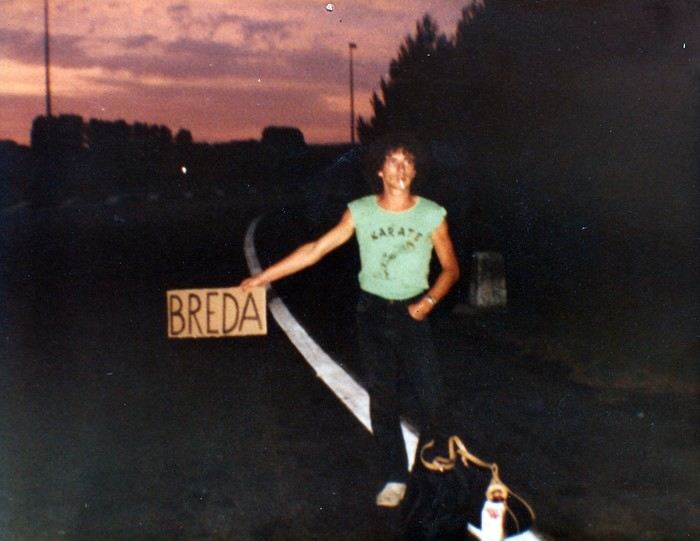
“Hey, your Marker... - My Marker? - The one you used to make hitchhiking signs.”
The marker in question is sitting proudly on the kitchen table. Marielle found it at the bottom of a moving box.
I’ve been meaning to tell the long story of my love affair with hitchhiking for years. Here we go.
To be honest, I’m not quite sure when it started. My earliest memory goes back to a fair with a bike race in my maternal grandparents’ village. I was with my cousin, my little sister, and three girl cousins. There were six of us, ages ranging from six or seven to thirteen or fourteen. Our parents stayed at the fair, and we’d had enough. So we decided to walk home. Only it was four kilometers away. So we hitchhiked. A guy driving an old car picked us all up and dropped us off at the farm. He probably found it amusing to see us thumbing a ride by the side of the road, but maybe it also worried him a bit. With everything you read in the papers...
Around fifteen or sixteen, I started hitchhiking regularly, alone or with a friend, to go to the nearby town. But it was especially when I started boarding school in Orléans that it became more regular. The first year, I’d leave Monday morning and come back Saturday noon by bus. It was an old, uncomfortable bus where we froze in winter. To make matters worse, I often got motion sickness if, as was too often the case, I ended up sitting in the back. In the spring, a high school friend suggested I hitchhike back. It meant a slight detour, but the advantage was taking only national roads.
So that’s how, from the end of tenth grade to twelfth grade, I’d thumb a ride every Saturday on the Pont de Bourgogne. Drivers were used to seeing young people hitchhiking, and it worked pretty well. Our biggest fear? Soldiers! At that time, military service was still mandatory, and on weekends, it wasn’t rare to see them competing with us. They’d keep their uniforms on to go home. That gave people confidence—with everything you read in the papers—and they’d rarely wait more than five minutes. We, with our long hair, were definitely less popular. From time to time, three big red-faced guys in a van coming back from a construction site would flip us off, yelling things like “go get a haircut, you bums!” Those were the good old days.
We still had a good laugh, though. Patrice, the friend I’d hitchhike back from school with on Saturdays, is a musician—I’d later discover he’s an excellent composer. A die-hard Beatles fan, he knows their repertoire by heart and spends his time singing at the top of his lungs while we thumb a ride. One Saturday late morning, we’d been waiting for a while at the exit of Châteauneuf-sur-Loire when a little lady came up to him and asked if he could please sing a little quieter: a baby was sleeping in the house. He put on the most sorry face: “Oh, sorry ma’am, we didn’t realize.” No sooner had the lady gone back inside than he started again. Luckily, a car stopped just then, sparing me the embarrassment of seeing the lady come back out.
Saturday was also the day when the cigarette pack was dangerously low. So before leaving, we’d go buy some “Parisiennes,” the “P4s” as we called them back then. They were slightly thinner cigarettes with a mix of tobacco scraps. Sometimes they tasted like light tobacco, sometimes like dark. Not great, but by the end of the week, our pocket money was gone. They were sold in small packs of four, hence the name P4. We’d only pay 20 centimes. On Saturdays, it was rare for the two of us to manage to scrape together 1.50 F to buy a whole pack of Gauloises...
The last twenty kilometers, I’d usually do alone, Patrice having reached his destination. From time to time, luck would smile on me: an acquaintance would just happen to pass by and stop. One January Saturday, at the exit of Gien, I ran into another guy from Argenton whom I knew a little. That day, the weather was nice, but the temperature was well below zero. It was around noon, and it was the off-peak hour. We were shivering, stamping our feet by the side of the road, when a Citroën “Tube” arrived: it was his father’s boss’s, a mason. They were both sitting in the front, but since they were obese, they had us climb onto the open back. Even though we huddled against the cab to shelter from the wind, the twenty kilometers felt very long, especially since we were only going sixty kilometers an hour. Our hands and cheeks were blue when we finally arrived.
The year I took my baccalaureate, a friend with a 2CV would take me Monday mornings with one or two others we’d pick up in nearby villages. We’d share the gas costs, but it was still cheaper than the bus. And in winter, the bus was my nightmare. You had to get up at five to catch it at six. Not enough sleep, and outside it was freezing or raining—or both. The 2CV was luxury. Plus, Philippe would pick me up at home. On the other hand, since I didn’t have class Saturday mornings—well, I did, but we only had PE the first two hours and nothing after—I’d skip class and slip out right after breakfast to thumb a ride at the Pont de Bourgogne.
Those three high school years were formative in this optional subject that was hitchhiking. Little by little, I learned the rules of the game. First, you shouldn’t walk along the road while thumbing. Cars go too fast and can’t stop easily. Accepting a ride that’s too short is also a no-go. The guy who offers to take you a little way but drops you off at some vague crossroads in the middle of nowhere? No thanks. You need to get dropped off in a town. If it’s a fairly big city, you often have to cross it from one end to the other, but it’s better. At the exit, you have to choose your spot well. Actually, you have to put yourself in the driver’s shoes: they need to see you early enough, not be going too fast, and be able to stop easily without risking an accident. So when leaving a city, it’s better not to go too far. It’s wiser to find a spot where cars go slowly and can stop easily. And preferably near a café. The café is for when you still have a few coins for a coffee and need to warm up. From time to time, you’d run into someone nice who’d make a detour to drop you off at a better spot to start again. Finally, if possible, avoid hitchhiking on Sundays. Cars are packed with whole families who, most of the time, aren’t going far. And then there’s the little worry of those people who rarely leave home: with everything you read in the papers...
During those high school years, it was only short trips, rarely exceeding a hundred kilometers. Later, I aimed bigger, and things were a bit different. In 1973-74, I crossed part of France for the first time on two or three occasions, coming back from the German border or returning to Bordeaux, where we lived briefly. Since there weren’t many highways back then, we took national roads. It was during these trips that I realized it was better to leave in the evening. As I said earlier, Sunday is to be avoided, but on weekdays, there’s another problem: if you leave in the morning, you only make short hops. First, it often takes longer to get going because drivers are people going to work nearby. Which brings us back to those who drop you off in a bad spot, far from everything. There, you have to know how to refuse. You thank the driver for stopping—oh, if only everyone could be like you—while explaining why you’d rather stay put. People don’t take offense, by the way. Those who pick up hitchhikers often hitchhiked themselves when they were in the military or before they had a car. In the late afternoon, you’d often run into salespeople or truckers, in other words, people who drive a lot. At that time, salespeople no longer had appointments and were more relaxed. They wanted to talk about something other than the merits of their products. On the radio, it was time for *Les Grosses Têtes*. You’d also quite often run into small business owners, professionals, or even hippies. The conversations were pleasant and often enriching. A little later in the evening, truckers would take over. They’d already driven a few hundred kilometers, and the depot or customs was still far away. So they’d gladly take a hitchhiker to stay awake at the wheel and chat. The radio with Max Ménier’s show *Les routiers sont sympas*, you’d eventually get tired of it. So a hitchhiker was a change. Others, who’d hit the road at midnight to be at their destination by morning, were nice and offered to let you lie down on the bunk while they drove. When you’d been hitchhiking since six in the evening, freezing in the wind between two vehicles, you weren’t unhappy to take a little nap.
Speaking of Max Ménier, he’d often make announcements for hitchhikers. One evening, I called him. It was getting late, and I still had quite a way to go. No luck: the show had ended for good the day before!
In short, it’s better not to rush, sleep in, and leave after lunch, or better yet, in the late afternoon. Obviously, I’m talking about when you have several hundred kilometers to cover. That’s when you have to play it pro.
First thing, especially at night, but it also applies in the middle of summer when the light is blinding: dress to be seen from far away. I’ll admit I have an advantage over most other hitchhikers: I’m small and don’t scare people. To balance that out, racist drivers often take me for an Arab and are less likely to pick me up, but overall, the balance tips in my favor. Back to the need to be seen: at night, I wear light-colored clothes. In headlights, you can see me from far away.
Second thing: travel light. Forget the big backpack with a frame. Drivers don’t always have room in the trunk or on the back seat, especially if it’s rained and the ground is wet. Plus, it forces them to get out of the car. If they’re nice enough to pick up a hitchhiker, you shouldn’t ask for too much either.
Third thing: bring a cardboard sign and a big marker—like the ones in the photo at the start of this post—to write the name of your destination. In the early 80s, I ran a tourist house in the Cher, but I lived in the Netherlands. In the off-season, it was only open on weekends. On Fridays, I’d leave Holland and return on Mondays. 1200 km round trip. On the way there, in Paris, I’d stand at Porte de la Chapelle. At that spot, the road is very wide, and drivers could stop easily. Obviously, on the sign, I didn’t write Eindhoven, which not everyone knows, and even less Amsterdam because of its seedy reputation. In that case, you’d expect to see a police car stop and two officers in kepis ask for your papers. So as a first destination, I’d write Compiègne. We were well out of Paris, and since it wasn’t too far, a trucker or salesperson was less reluctant to stop. Once past Compiègne, I’d take out my Lille sign. Once in Belgium, it wasn’t really necessary to use a sign anymore, since everyone was going in the same direction. Usually, the guy who picked me up at Porte de la Chapelle would say he wasn’t going far but could take me a little way. Before that, I’d still ask if there was a gas station on the highway where he could drop me off before exiting. While talking, the guy would realize he wasn’t dealing with a dangerous criminal. He’d pretend to check his watch, think for a moment, then say that actually, he was going to Belgium and could take me to the border or a little beyond. To leave Paris on the way back, I’d take the train to Melun, where it was easier to hitchhike than at Porte d’Italie.
Over all those years, I think I was pretty lucky. Or maybe philosophical enough not to imagine a car would stop after a few minutes. An hour’s wait was average. Sure, I sometimes waited three, four, or five hours. Most often at odd hours and in terrible weather. When it doesn’t work, it doesn’t work. But there’s always a moment when things pick up. Sure, when you’re soaked in freezing rain in the early morning after a sleepless night, you’re less philosophical than when I’m writing these lines comfortably at my computer, but it still holds true.
Earlier, I mentioned clothing and the importance of being well-rested before leaving. When you’ve eaten well and just gotten out of the shower, shaved, you’re in a better mood. And somehow, drivers sense it. Or at least, that’s the impression I’ve always had. It’s better to look in shape than disgusted at standing there, half-heartedly thumbing a ride. In short, when I’d start to get fed up with waiting, I’d go into the first café I saw for a coffee. Coming back out, I’d be refreshed, and most of the time, a car would stop within minutes. I’ve often said that when I stood by the side of the road thumbing a ride, I felt a bit like a gambler in front of a slot machine. It was a matter of giving luck a chance. And well, it worked out pretty well.
Then, there are countries where hitchhiking works really well and others where it’s harder. In the 70s-80s, it worked best in Germany and England. In the late afternoon, it wasn’t rare to be invited for tea. Well, that was in England. Tea meant being offered room and board. In Germany, they’d offer you coffee. Once there, they’d first show you the guest room and point out the bathroom before sitting you down in front of a big plate of cold cuts. In the evening, they’d go out in town, and the next morning, they’d usually drop you off at a good spot for hitchhiking. On the other hand, in Mediterranean and Scandinavian countries, you’d better be patient. In Spain or Italy, it’s better to take the train, which was dirt cheap back then. However, if you’re a couple traveling light, it’s already easier in most countries.
In 1982, I went on a trip around Turkey with my girlfriend. We only had two small bags, which was plenty. It was November-December, and we wore our warm, bulky clothes. Leaving Eindhoven at nine in the morning, we arrived in Graz, near the Yugoslav border, at eleven at night. 1300 km in a day! In just four or five vehicles. One to the German border, about fifty kilometers from Eindhoven, the second to Hagen in the Ruhr, the third to Salzburg, and the last to Graz at the Yugoslav border. Record broken. During the night crossing of Yugoslavia, we ran into a trucker close to retirement who lent us the truck’s bunk. So we arrived fresh and rested near Skopje the next morning. We continued to Thessaloniki in northern Greece before taking the train to Istanbul. In Turkey, we traveled a good part of the country by hitchhiking too. With truckers in old, overloaded, slow trucks that climbed hills at fifteen kilometers an hour, but also in cars where five or six people were already crammed in. And every time, we were invited for tea. Once, we were even picked up by a big shot in his Mercedes with a chauffeur. Until then, the average speed was around fifty kilometers an hour. There, we were going two hundred. On a national road, not a nice European highway.
I’ve also hitchhiked in Nepal, from Lumbini, Buddha’s birthplace, to a village on the way to Pokhara. It must have been midday. No bus until the next day. I gave it a try. A small truck overloaded with rice sacks, with two or three young people already perched on top, stopped. I rode on the roof of the cab. At fifty kilometers an hour when it was going well, with a breathtaking view. Coming back from India, I also crossed part of Iran by hitchhiking, from Tehran to the Turkish border. I did this trip with an Austrian I met at the hotel who, like me, had to watch his pennies. We gave it a shot. There was almost no traffic, but to our great surprise, the first car that passed in the area would always stop. They’d just ask for a modest contribution for gas, and it cost next to nothing.
Sometimes, you get scared too. After leaving Turkey in early December 82, we spent about two weeks in the southern Peloponnese harvesting olives. A few days before Christmas, we hitchhiked back to Holland. A girl picked us up in her little Fiat 500. We were driving on a mountain road, and that morning there was a bit of black ice. After crossing a pass, we saw the old Ford Taunus ahead of us at fifty meters start to skid. The driver let out a “heeee!” while grabbing my knees. I reflexively grabbed the wheel. Finally, the Taunus got back on track. And we didn’t swerve. But those few seconds felt very long.
In January 77, while I’d been living in Germany for a few months, I decided to spend a few days in Italy. By hitchhiking, of course. I left in the early afternoon, and by ten at night, I wasn’t far from Frankfurt. I saw a big Mercedes stop. The four or five young people crammed inside were listening to Schlager at full volume. Beer cans littered the floor. They didn’t have a precise destination, and as long as they were going south, that was fine with me. They’d finished their military service that very day and had clearly already celebrated their discharge. The driver was going 160, zigzagging dangerously from one side of the highway to the other. I should have realized he wasn’t entirely sober either. Luckily, there was almost no traffic. Finally, I managed to get dropped off at a gas station just before Frankfurt, relieved. I hope their trip didn’t end tragically.
Another time, coming back from Holland with my wife, we were picked up early in the morning near Senlis by two guys from Lille. They were going to work near Tours and could drop us off at Porte d’Italie. Apparently, they were coworkers but barely knew each other. The driver offered us a beer—at six in the morning, sure!—before opening another can for himself. He was clearly having trouble staying in the right lane. We politely declined, the passenger too. Everyone was tense. Luckily, it was rush hour on the ring road, and we were going slowly. When we got out of the car, the passenger said goodbye with the look of a guy being offered the condemned man’s rum and cigarette.
Finally, there are the annoying remarks from drivers who are either gay when you’re alone or turned on by the sight of your girlfriend when you’re a couple. In those cases, I’d get in the back so the guy wouldn’t feel too confident. And if the conversation got a little too suggestive, we’d deflect until we got dropped off.
And luckily, there are the times, not so rare after all, when you run into really nice people who invite you to eat and sleep at their place and drive you to a good spot the next morning. In Germany and England, that was common. And then there are the big strokes of luck, like during our trip to Turkey when we crossed most of Germany in one car, or that other time when some Germans drove me from the exit of Geneva all the way to the Costa Brava.
Going back to “with everything you read in the papers” and its variant “with everything you see on TV”—and now on the internet—it’s always left me perplexed. Personally, I’ve never heard of hitchhikers assaulting drivers, even if it may have happened. On the other hand, what was most common were hitchhikers being assaulted, especially girls. Anyway, even armed, it seems a bit stupid to assault the driver—wouldn’t that risk causing an accident?
Finally, since that time, I’ve occasionally wanted to hitchhike somewhere far away in France. Most often, too busy with work, it never happened, but the nostalgia hasn’t completely disappeared.
* * *
Other Hitchhikers
And then one day, I... settled down to become a driver myself. Ten years had passed, and you saw fewer and fewer hitchhikers. Or maybe I saw fewer because I had a regular job and wasn’t traveling the same way. And then I understood a few things.
Several times, I was tempted to pick up a hitchhiker, but they didn’t meet the required conditions. They were walking along the road instead of staying at the exit of the previous town. Hard to stop without risking an accident. Or the guy looked really scruffy. Or he was sulking, if not both. Then you think of that famous “with everything you read in the papers.” Not that I was scared, but unfortunately, the few hitchhikers I did pick up later were rarely interesting.
A few years ago, we picked up a young guy at the exit of a small town in Sologne. Not an easy spot for hitchhiking. Bad luck, he was a pretentious little jerk. He was barely 20 or 25 and talked like a bitter old man. He was a waiter in a restaurant. According to him, it was lucky he was there, otherwise the boss would have closed up shop long ago. You’d think he had thirty or forty years of professional experience behind him. As we approached Blois, he started ranting about Arabs, blaming them for all evils. And he laid it on thick. That morning, we were going to a teenager’s funeral who had just committed suicide, so he really got on our nerves, Mr. Know-It-All. Out of anger, I dropped him off next to a shopping center a few kilometers from downtown. Not nice, but it felt good.
Some time ago, we were driving around the Limousin on a Sunday to try out the used Twingo we’d just bought. We picked up a guy in his forties. A German who spoke French well. He started talking about the environment. He was a green Khmer. He got worked up all by himself with his pseudo-eco rant and, after a few kilometers, was almost yelling at us. As we were about to leave the main road for a small one, I dropped him off at a crossroads in the middle of nowhere. Normally, I would have made a little detour to take him to a better spot, but this time, I didn’t feel like doing the... eco-warrior a favor.
On the other hand, I’ve still done my good deed a few times. One June morning, coming back from Orléans, I saw a man in his sixties hitchhiking. The poor guy had had a rough time. He was from Montpellier and was coming back from Caen, where he’d been promised a job. Once there, they bluntly told him the position was already taken, and he had to go back. Except he didn’t have enough money left for the train. He’d spent the night hitchhiking without success. I could only take him as far as Lamotte-Beuvron, where I dropped him off near the fire station. Apparently, there was some vague shelter there or something, but it only opened a few hours later. In the meantime, he settled on the grass in a corner to sleep a little. While he was doing that, I quickly went to the train station to check the price of a ticket to Montpellier. It was within my means. Since he was sound asleep, I slipped the train ticket and 100 francs into his pocket. I couldn’t imagine him continuing to hitchhike all the way to Montpellier. And I bet he didn’t even have a piece of cardboard and a marker!
When we go to Brazil, we usually rent a small car. One day, we were coming back from Paracuru to Fortaleza when we saw a whole family hitchhiking. Two adults and two or three small children. Here near the equator, the sun sets very quickly, and it would soon be night. There was little traffic, and trucks wouldn’t stop because there was no room in the cab. As for the rich people driving big 4x4s, they wouldn’t stoop to picking up the lower classes. The only hope for this kind of family was usually a farmer or artisan who’d let them ride in the back of his pickup. Obviously, they were a bit surprised to see us. Everyone crammed in as best they could in the back of our little car. When we dropped them off, we got a whole string of “Deus lhes abençõe”—God bless you.
Still in Brazil, we were on the road from Barreirinhas to São Luís do Maranhão. About 150 km of deserted road with an isolated mud house here and there. A young woman flagged us down. She was very pregnant and had to get to the clinic twenty or thirty kilometers away to give birth. Someone was supposed to drive her, but the first signs of labor started earlier than expected, and the driver was unavailable. Even driving fast, we weren’t feeling great: it would be just our luck if she gave birth in the car!
Today, we’re in the age of smartphones and carpooling apps. Safety. With everything you see on TV... Three or four years ago, we signed up on a platform. Our first, and only, “client” was a little jerk who didn’t say a word the whole trip. No hello, no goodbye, and certainly no thank you. The next day, we found his Ray-Bans in the car. We didn’t run after him to give them back. Ha!
Preparing for Quebec: 1 month with the family
Hello everyone,
We’ve decided to head to Quebec next year—it’s been a dream for the whole family (after watching so many travel shows and the like...). There’ll be five of us: 2 adults, 2 teens (16 and 13), and a child (8 years old). We’re all pretty good walkers, though maybe the teens a little less so—it’s just that age, you know? 😊 That said, they’ve got no problem doing 15 km hikes, just not every single day.
We’re planning to go from July 23 to August 14, arriving and departing from Montreal, so almost 3 weeks. I’ve started looking into logistics and accommodation prices, but before I dive into bookings, I’d love some advice on the itinerary. I’ve read a few threads here and there. Our idea is to visit between 3 and 5 different places over the 3 weeks, so that means the same number of accommodations. The goal is to optimize travel as much as possible—I’ve realized that getting around can take a long time. I think the first two days will be in Montreal to adjust to the time difference, and the last two in Quebec City, though that’s not set in stone.
Anyway, I’m not really sure about the route. I’ve got time to plan everything, but I know the longer we wait, the more expensive and scarce accommodations will get. Same goes for budget—we’ve set aside a mid-range budget, flights included: 3k per person (1k for the flight). So if you’ve got any great tips or advice, we’re all ears!
I was thinking of going up the St. Lawrence River, but I’m not sure how long that takes or where to stop. Maybe there are other places worth visiting farther away...
Anyway, thanks for reading this far! If you’ve got any questions, don’t hesitate.
Thanks, everyone.
Review of a Norway cruise on the Emerald Princess in June 2025 (1)
Hello everyone,
I’ve wanted to take this Norway cruise for a very long time. The first time I booked it was in July 2020 with Azamara. Unfortunately, it was canceled, as everyone remembers. When I tried to book it again, the prices (already a bit high with Azamara) had simply doubled. So, since then, I’ve been keeping an eye out every year for any opportunities...
The last time we sailed with Princess was eleven years ago, and things didn’t go very well. I came back pretty unhappy with their service and quite disappointed. Despite the $600 they gave me as credit for a future cruise, I’d never set foot on one of their ships again.
But this time, the opportunity arose—a fantastic itinerary with lots of stops, a reasonable price for 16 nights (I’ll share the details in the conclusion), and a ship that’s not too big, so to speak, with only 3,000 passengers. I’m not expecting much from the cruise line this time and am boarding the ship with low expectations beyond the itinerary.
Princess has introduced an app to download before the cruise. It’s essential because online check-in is no longer available, and the agency doesn’t send a travel journal. Everything is done through the app. After completing the check-in on the app, we only know that we’ll need to pick up our key, the Medallion, at embarkation by following the blue line in the terminal and presenting our passport.
Up until our departure, the weather forecast for the coming week in Norway is disastrous—rain, rain, and more rain. It was pretty much the same two years ago before our Iceland cruise, and in the end, the weather turned out fine.
If you’re ready to embark on the Emerald Princess to discover this beautiful cruise and the stunning landscapes of Norway, let’s go!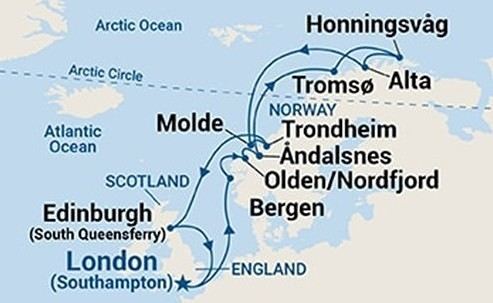
Southampton - Sea day - Bergen - Olden - Åndalsnes - Sea day - Tromsø - Honningsvåg (North Cape) - Alta - Sea day - Molde - Trondheim - Two sea days - Edinburgh - Sea day - Southampton
I’ve wanted to take this Norway cruise for a very long time. The first time I booked it was in July 2020 with Azamara. Unfortunately, it was canceled, as everyone remembers. When I tried to book it again, the prices (already a bit high with Azamara) had simply doubled. So, since then, I’ve been keeping an eye out every year for any opportunities...
The last time we sailed with Princess was eleven years ago, and things didn’t go very well. I came back pretty unhappy with their service and quite disappointed. Despite the $600 they gave me as credit for a future cruise, I’d never set foot on one of their ships again.
But this time, the opportunity arose—a fantastic itinerary with lots of stops, a reasonable price for 16 nights (I’ll share the details in the conclusion), and a ship that’s not too big, so to speak, with only 3,000 passengers. I’m not expecting much from the cruise line this time and am boarding the ship with low expectations beyond the itinerary.
Princess has introduced an app to download before the cruise. It’s essential because online check-in is no longer available, and the agency doesn’t send a travel journal. Everything is done through the app. After completing the check-in on the app, we only know that we’ll need to pick up our key, the Medallion, at embarkation by following the blue line in the terminal and presenting our passport.
Up until our departure, the weather forecast for the coming week in Norway is disastrous—rain, rain, and more rain. It was pretty much the same two years ago before our Iceland cruise, and in the end, the weather turned out fine.
If you’re ready to embark on the Emerald Princess to discover this beautiful cruise and the stunning landscapes of Norway, let’s go!
Southampton - Sea day - Bergen - Olden - Åndalsnes - Sea day - Tromsø - Honningsvåg (North Cape) - Alta - Sea day - Molde - Trondheim - Two sea days - Edinburgh - Sea day - Southampton
Croatia, Montenegro – two victims of overtourism?
Mid-June, two Auvergnats on the starting blocks—off we go to the former Yugoslavia!
We’d already explored some nooks and crannies of northern Croatia back in 2019, so we’re keeping the momentum going by planning a trip to the south of the country and then Montenegro.
On the way back, we’ll drift into Bosnia-Herzegovina just to mix things up a bit!
We’re a little unsure about what to expect in terms of tourist crowds.
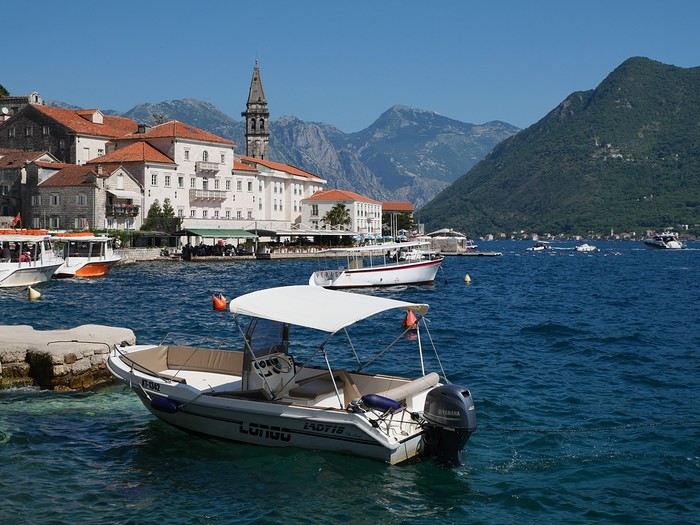
Dubrovnik has a reputation for being the hardest-hit city by overtourism, and Kotor and the whole Dalmatian coast aren’t exactly empty...
Luckily, most European countries haven’t started school holidays yet, and some measures seem to have been put in place to limit the flow (like restrictions on the number of cruise ships allowed to dock at the same time).
Maybe we’ll manage to escape the promised hell?
For now, we’re slamming the doors of the Scirocco and heading off to our first stop: northern Italy!
On the way back, we’ll drift into Bosnia-Herzegovina just to mix things up a bit!
We’re a little unsure about what to expect in terms of tourist crowds.
Dubrovnik has a reputation for being the hardest-hit city by overtourism, and Kotor and the whole Dalmatian coast aren’t exactly empty...
Luckily, most European countries haven’t started school holidays yet, and some measures seem to have been put in place to limit the flow (like restrictions on the number of cruise ships allowed to dock at the same time).
Maybe we’ll manage to escape the promised hell?
For now, we’re slamming the doors of the Scirocco and heading off to our first stop: northern Italy!
Kattegat Tour and Norway’s Majestic Fjords – 32 Days (Denmark, Sweden, Norway)
Kattegat isn’t just the name of the village in the TV series *Vikings*—it’s also the stretch of water separating Denmark from Sweden... the sea, basically! And further north, you’ve got Norway and its fjords!
Originally, I’d planned to just do a loop around Kattegat, with the *Under* restaurant in Lindesnes as our anniversary treat... but along the way, we thought, why not "push" a little further north, keeping an eye on the budget since we’d chosen to travel by car in June 2025 through Scandinavia.
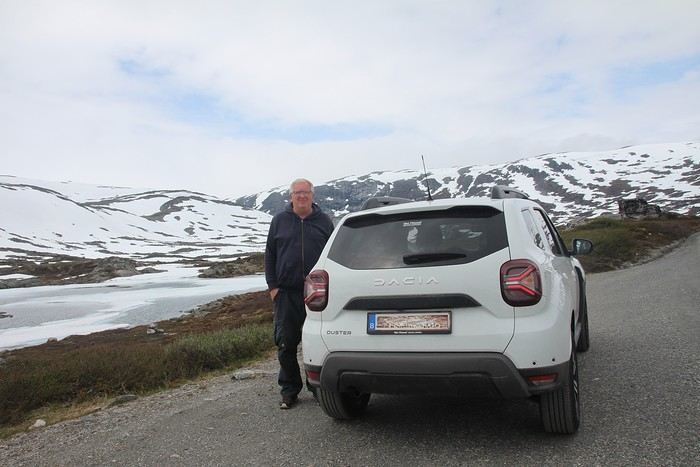
Why by car when most travelers opt for a camper van, while others prefer the comfort of cruises? Well, because we don’t own a camper van, renting one is pricey, and then you’ve got to add fuel costs (those things guzzle gas!), ferry fees, and other "tolls." All things considered, we went for mostly rentals—especially since there were four of us at the start of the trip. We spent the first week in Denmark with our daughter and son-in-law. Then they flew back to Belgium, and we continued our adventure as a couple. For accommodation, we mainly booked Airbnb apartments, which helped keep costs down and, most importantly, let us prepare our own meals (diet, diet!). In this travel journal, you’ll discover (or rediscover, for those who followed my older ones) our unbridled love for theme parks, museums, unique experiences, and—especially in Denmark—Legos! Unfortunately, we didn’t do any hikes this year because the unpredictable weather had made the trails slippery, and since I’d already taken three tumbles during the trip, I didn’t want to risk another! In the end, we traveled for 32 days, covered 6,200 km, and most importantly, discovered the charming country of Denmark, marveled at Norway’s breathtaking fjords—all without suffering the heatwave that hit France and Belgium that June! If you’ve got any questions, don’t hesitate to ask!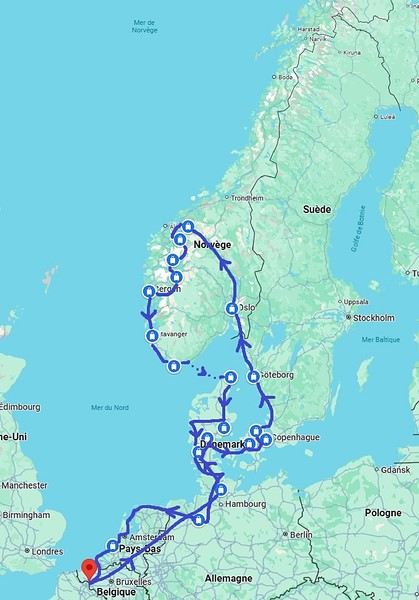
Why by car when most travelers opt for a camper van, while others prefer the comfort of cruises? Well, because we don’t own a camper van, renting one is pricey, and then you’ve got to add fuel costs (those things guzzle gas!), ferry fees, and other "tolls." All things considered, we went for mostly rentals—especially since there were four of us at the start of the trip. We spent the first week in Denmark with our daughter and son-in-law. Then they flew back to Belgium, and we continued our adventure as a couple. For accommodation, we mainly booked Airbnb apartments, which helped keep costs down and, most importantly, let us prepare our own meals (diet, diet!). In this travel journal, you’ll discover (or rediscover, for those who followed my older ones) our unbridled love for theme parks, museums, unique experiences, and—especially in Denmark—Legos! Unfortunately, we didn’t do any hikes this year because the unpredictable weather had made the trails slippery, and since I’d already taken three tumbles during the trip, I didn’t want to risk another! In the end, we traveled for 32 days, covered 6,200 km, and most importantly, discovered the charming country of Denmark, marveled at Norway’s breathtaking fjords—all without suffering the heatwave that hit France and Belgium that June! If you’ve got any questions, don’t hesitate to ask!
2 weeks in the Cyclades
Hi everyone!
Blue skies (lots of them), whitewashed villages with steep alleyways, hundreds of churches, and... thousands of stairs? Welcome to the Cyclades! 🙂
We’d been dreaming about this for a while, but in July-August—with the crowds—no way! Now that I can travel outside school holidays, the Cyclades are back on the agenda. And so begins a loooong period of planning and second-guessing, with countless itinerary changes: the Cyclades, yes, but which ones? I was fixated on Folegandros (we won’t be going after all) and really wanted to visit Delos. So, for this first trip, it’ll be: Mykonos (and Delos)-Naxos-Amorgos-Santorini.
Saturday 24/05: Departure from Orly on a Transavia flight, arriving in Mykonos in the late afternoon. We found a hotel that offers free transfers (pretty rare and not insignificant—it’s 25 € each way for just a few kilometers 😠) and at a reasonable price (83 € per night for B&B). Time for dinner already: Greek salad and souvlaki (we’re in Greece, right?)
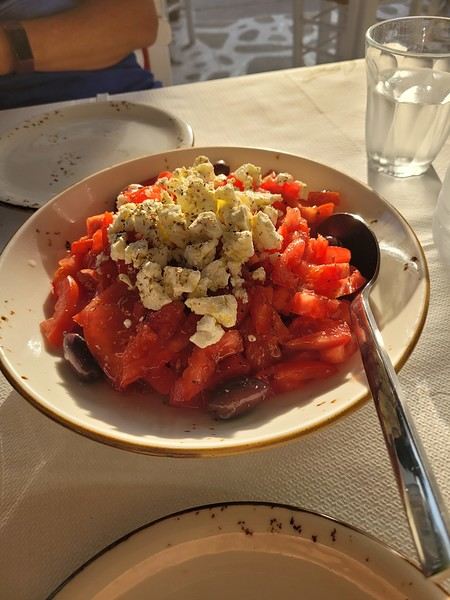 (Okay, this is actually a dakos with Naxos cheese, but I don’t have a photo of a Greek salad 😏).
Blue skies (lots of them), whitewashed villages with steep alleyways, hundreds of churches, and... thousands of stairs? Welcome to the Cyclades! 🙂
We’d been dreaming about this for a while, but in July-August—with the crowds—no way! Now that I can travel outside school holidays, the Cyclades are back on the agenda. And so begins a loooong period of planning and second-guessing, with countless itinerary changes: the Cyclades, yes, but which ones? I was fixated on Folegandros (we won’t be going after all) and really wanted to visit Delos. So, for this first trip, it’ll be: Mykonos (and Delos)-Naxos-Amorgos-Santorini.
Saturday 24/05: Departure from Orly on a Transavia flight, arriving in Mykonos in the late afternoon. We found a hotel that offers free transfers (pretty rare and not insignificant—it’s 25 € each way for just a few kilometers 😠) and at a reasonable price (83 € per night for B&B). Time for dinner already: Greek salad and souvlaki (we’re in Greece, right?)
(Okay, this is actually a dakos with Naxos cheese, but I don’t have a photo of a Greek salad 😏).Exploring the Lower North Shore and Labrador – Come Join the Adventure!
After visiting Newfoundland Island, we took the ferry to Blanc-Sablon, a municipality located on the Lower North Shore in Quebec, Canada.
Instead of heading back to Quebec via Sydney in Nova Scotia, we decided to explore the Lower North Shore—the least-known region of Quebec—as well as Labrador, which is part of the province of Newfoundland and Labrador.
From Blanc-Sablon, we drove to the municipality of Vieux-Fort via Route 138. This road ends in that municipality.
Afterward, we crossed Labrador to return to the Old Capital. Only one road allows this route. It wasn’t fully paved during our trip, but it is now.
We made stops in different areas to go on hikes that let us discover some incredible landscapes.
I hope this travel journal inspires you to venture into these stunning regions.
Videos are embedded throughout the summary. Click on the image to start the video.
Lower North Shore:
Lower North Shore - Blanc-Sablon - Brador Falls Lookout Lower North Shore - Blanc-Sablon - Astragalus Trail (Milk-Vetch Trail) Lower North Shore - Bonne-Espérance - Granny Hill Trail
Labrador:
Red Bay - Tracey Hill Trail Mary's Harbour - White Water Falls Trail Mary's Harbour - Gin Cove Hiking Trail Mary's Harbour - Dr. Moret Hiking Trail Happy Valley-Goose Bay - Birch Island Walk North West River - Sunday Hill Lookout Trail Churchill Falls - Bowdoin Canyon Nature Trail Labrador City - Tanya Lake Loop Trail Labrador City - Crystal Falls Hiking Trail
North Shore
North Shore - Manic 2, 3, 5 Hydroelectric Plants and Daniel-Johnson Dam Baie-Comeau - Pioneers Park Tadoussac Village
**********
More landscapes of the Lower North Shore, Labrador, and the North Shore
Hiking from Orléans to Tours: GR 3 or GR 655?
Hi there,
I’m planning a 6-day trip from Orléans to Tours.
There are very few detailed maps to figure out the main stages and what you’ll find along the way. Even though I’ve downloaded the Miam Miam Dodo app, it’s pretty tedious (everything is split into small map sections).
I’ve settled on the first leg: Orléans to Meung-sur-Loire, about 18 km. For the next one, I’m hesitating because I’d like to do around 20–25 km, but I see Beaugency is only about 10 km away, and Mer is almost 30 km. So, I’m stuck.
On top of that, I’m torn between taking the GR 3 route or the GR 655 (south).
If any of you know the area or have already done this hike/pilgrimage, I’d love to hear your tips for this section that goes through Blois and ends in Tours.
For the last legs, I’ve planned Blois -> ? Chaumont (no accommodations) -> Amboise -> Tours, knowing the final stage is about 30 km.
Thanks in advance for your help! 😉
Thanks in advance for your help! 😉
Uzbekistan - Finally made it - Summer 2022
Another trip planned during Covid. Actually, for 2020, I had three trips booked, with tickets purchased and everything.
This one to Uzbekistan was planned for April 2020. We postponed it to April 2021, but it was canceled again, and we couldn’t reschedule for April 2022 because our friends who were coming with us were busy. So, we chose summer, knowing the temperatures would likely be very high.
We left as a group of five: a couple we usually travel with and one of their friends, whom I knew. She was traveling alone and had dreamed of this trip but didn’t want to go by herself.
For organization, we went through an agency to handle the train tickets and our trip to the Aral Sea. It’s not my usual style, but back in 2020, we were already in touch with them, and they were very understanding during the two cancellations. It wasn’t easy, given the economic crisis Covid caused, especially in Uzbekistan.
Again, I’m writing this travel journal from memory since I didn’t take any notes. (It’s good to give your brain a workout now and then!)
Day 1: Off to Tashkent
We flew in the afternoon to Istanbul, had a 2-hour-15-minute layover in Turkey, and then took an overnight flight to arrive early in the morning in Tashkent. Problem (again): just before taking off from Saint-Exupéry, the plane had an issue with the landing gear. We waited two hours, and after a few hammer and wrench adjustments, we finally took off. Of course, by the time we arrived in Istanbul, it was a mad dash through the airport to catch our connecting flight. We landed at 7:30 AM in Tashkent, and of the five suitcases in our little group, two were missing (one of ours and the solo traveler’s). Big problem because we were leaving at 2:30 PM by train for the Aral Sea, and we wouldn’t be near an airport again for three days. Plus, at the small airport in the Uzbek capital, no one spoke English (or French, or the Ardèche dialect). Fortunately, we had booked a guide for a quick morning tour of the capital. We had seven hours to kill, and it seemed smart to do it this way (and yes, sometimes we do think ahead). With him speaking English and, more importantly, Uzbek, the delivery of our suitcases was arranged.
So, we set off to explore the capital. It’s very Soviet in design—wide avenues and ugly buildings.
We visited the Khasti Imam historical complex (first name to pronounce at your own risk—there will be plenty more during the trip). Lots of "oohs" and "aahs" about how beautiful it was, but in the end, compared to what we saw later, it was really just small potatoes.
We checked out Chorsu Bazaar, the city’s large covered market. The guide was friendly and gave us plenty of tips for the rest of the trip. He suggested a restaurant, which we accepted, so we could get familiar with local customs. The good thing was, it didn’t seem like a tourist trap.
Next, we headed to the train station because our train was at 2:30 PM. The guide left us, and then another problem arose. While going through security, one of the staff made it clear that our train was canceled and our ticket needed to be changed to the train leaving around 8:20 PM. Heatwave moment (it was 38°C). Our issue was that we were supposed to arrive in Nukus (our destination) at 6:00 AM and take a minibus for a round trip to Moynaq and the Aral Sea (four hours each way). The plan was to spend 2-3 hours there and return, so a 10-11-hour timeline. Leaving at 6:00 AM made it doable, but with the train now leaving at 8:20 PM, we’d arrive in Nukus at noon, which messed up the rest of the plan.
I was fuming at the agency (I really don’t like using agencies), so I called the local contact, who quickly sent our guide back (because trying to communicate, change tickets, and get information was tough).
I asked the manager to find us flight tickets to make up for the delay, but nothing—zilch—was possible. We were stuck! My buddy and I were determined to get to Moynaq, but the women in the group were less motivated.
No choice but to board the train for an overnight journey. We had a cabin for two (and our friend had one to herself). Big scare at first—no AC, and it felt like 150°. They told us it would work once the train started moving, which it did. A frugal meal in the dining car (spaghetti with meat—the only dish on offer) and we had a good night’s sleep.
The +: Finally, we’re here! The -: A lot of hassles to start the trip
Feedback on Quebec itinerary in September-October
Hello,
I need some advice because I can't decide on an itinerary. We're going to join our son around September 20th, who's spending a year in Canada on a working holiday visa. I did the classic Quebec loop over 30 years ago, so I’m ruling out the Saguenay Fjord and Lac Saint-Jean right away. Here are the stops (overnights) I’ve tentatively planned:
D1-2-3: Quebec City D4: Malbaie Gorges National Park via Routes 360 and 362 D5: Malbaie Gorges National Park (fishing and canoeing) D6: Tadoussac (walks and whale watching from the shore, hiking up to Cap du Bon Désir) D7: Whale-watching zodiac excursion – ferry – Bic National Park D8: Bic National Park D9: Carleton-sur-Mer via the Matapedia Valley D10: Percé D11: Percé (Bonaventure Island excursion) D12: Forillon National Park D13: Forillon National Park D14: Sainte-Anne-des-Monts via Route 132 D15: Sainte-Anne-des-Monts (Gaspésie National Park) D16: Kamouraska D17: Quebec City D18-19-20: Montreal
I feel like one night in Tadoussac is too short. Wouldn’t it be better to add another night there and only spend one night in Sainte-Anne-des-Monts, skipping Gaspésie National Park? Just to clarify, we love nature and hiking but limit ourselves to about 10 km per day.
Also, I’m wondering about the distances (even though I tried to keep them reasonable), the short stops (max 2 nights except in Quebec City and Montreal, so not much time to settle in), and the weather in Gaspésie in late September-October (my husband doesn’t handle the cold well). Maybe it’d be better to only go as far as Bic National Park, then head back, and add more nights at Malbaie Gorges National Park (I didn’t stay in a park on my first trip, and my son, who got his fishing license, would be proud to bring us dinner 😊), Tadoussac, and maybe around Bic/Rimouski?
One last detail: the plan is to land in Quebec City, rent a car on D4, return it on D17, and take the train or bus to Montreal the next day, where we’ll catch our flight 4 days later. This is to cut down on rental costs and avoid having a car in Quebec City.
Thanks for reading this far—I hope I can count on your advice! 😊
Claire
3 weeks in Kazakhstan and Kyrgyzstan, preliminary travel questions
Hi there, 🙂
I’m thinking of taking a trip to these two countries in 2026 (late spring to early summer).
I’d arrive in Almaty and leave from Bishkek, and I’d be driving myself.
I plan to spend 1 week in Kazakhstan and 2 in Kyrgyzstan. The itinerary isn’t set yet.
My preliminary questions are about formalities, hassle levels, and the car.
From what I understand, no visa is needed, the passport must be valid for 6 months after entry, and there’s no longer a requirement to register with the authorities at each stop. In short, once you’re in, no administrative headaches.
Except for permits needed to drive in certain regions?
---/---
About crossing between the two countries:
- On foot - In a rental car
Quick? Easy?
---/---
Are both countries safe? (Meaning you don’t have to stay on guard all the time.) Are the cops corrupt? (A little, a lot, passionately, not at all?)
---/---
Is it better to rent a car for both countries or rent a vehicle in each country?
A 4x4 or something else?
Is accommodation plentiful enough that I can skip a rooftop tent, or is it better to rent a 4x4 with one?
I’ll definitely have more questions later...😉
Thanks for your answers !
Tips for a 10-day Southern Morocco itinerary
Hi there,
We’re planning to visit southern Morocco from April 30th to May 11th (10 full days). I’d love to hear your thoughts and advice on the itinerary I’ve planned. We’ll be arriving in Ouarzazate and departing from Agadir. We’re thinking of renting a Dacia for this little road trip. Thanks in advance for your tips!
**Ouarzazate** – Arrival at 7:00 PM. Dinner in Ouarzazate, then drive to Ait Ben Haddou. **Night in Ait Ben Haddou** – To visit in Ait Ben Haddou: - The Ksar of Ait Ben Haddou - The Kasbah of Tifoultoute (on the way down to Ouarzazate) In Ouarzazate itself: - Visit the Kasbah Taourirt (gorgeous) 30 minutes south of Ouarzazate: - Fint Oasis Leaving Ouarzazate (eastbound): Route of the 1,000 Kasbahs - Kasbah Amridil (just before arriving in Skoura) - Skoura Palm Grove (a must-see) **Valley of the Roses** – Tamellalt / Boulmane Dadès – Night in Tamellalt? Boulmane Dadès? **Dadès Gorges**: 2–3 hour hike/walk (in the Valley of the Monkey Fingers) Then head toward the Todgha Gorges Arrival at the Todgha Gorges/Tinghir in the late afternoon (3-hour drive) **Visit Todgha Gorges**: no particular activity—it’s the road that’s stunning. **Tinghir** – Night in Tinghir? The next morning, head toward either: - Zagora (3h20 – 208 km) - Or M’Hamid (4h48 – 305 km) **Night in Zagora? M’Hamid?** **Drive to the Sahara Desert** – First night in the desert: camels, oasis, etc. Second night in the desert Return to Zagora or M’Hamid, then depending on arrival time, drive to Agdz? Taliouine, or Taroudant (a bit far) **Night in Agdz? Taliouine? Taroudant?** Then drive to Taghazout **Night in Taghazout** Drive to Essaouira **Visit Essaouira the next day** **Night in Essaouira** Return to Taghazout the following morning **Night in Taghazout** One extra day (buffer) **May 11th** – Drive to Agadir for morning flight departure
Tips for a 9-day itinerary in southern Morocco
Hi there!
As mentioned in a previous post, we're heading to Morocco in April for 9 days instead of the originally planned 7.
Here's the itinerary I've mapped out to ideally have a complete trip, but I think it might be too ambitious. What do you think? Here's the itinerary (click)
For those who can't open the link: Marrakech (the afternoon of our arrival + 1 day, we’ve already been there without the kids, the goal is not to stay too long) – night Aït Ben Haddou Ouarzazate Skoura – night Oasis de Fint Dadès Gorges Tinghir – night Merzouga – night Zagora – night M’hamid – ideally a night in the desert Agdz Marrakech – night (itinerary via Telouet)
What do you think of this plan? Will it feel too rushed, or is it manageable? Since we don’t know the places, it’s hard to tell if we’ll want to stop everywhere along the way or if there’s enough time to spend at each spot. I’ve included some night-stop assumptions (1 or 2 nights).
We’d love to hear your thoughts! We’re traveling with my wife, a 13-year-old teen, and a 10-year-old. We’ll have our own rental car.
Thanks! !