Results for "Parnu+|+123+>+207"
5503 results found.
El Portillo Hôtel English translation pending
El Portillo rouvre le lundi 15 novembre. Apparemment les gars ont bossé de 6h du matin à minuit pour tout rénover.
Il faut que les premiers vacanciers à séjourner dans cet hotel nous donnent leurs impressions.
Il faut que les premiers vacanciers à séjourner dans cet hotel nous donnent leurs impressions.
Pérou: de Puno à Cusco English translation pending
salut a tous...😉
quelle est la meilleure façon d'aller de puno à cusco:
soit le petit train des andes environ 10 heures de trajet ou bien en bus(proposé en organisé)
quelle est la meilleure façon d'aller de puno à cusco:
soit le petit train des andes environ 10 heures de trajet ou bien en bus(proposé en organisé)
Brisbane ou Perth en Australie English translation pending
Salut à tous
D'ici août ou septembre 2005 je pars quelques mois en Australie ( entre 9 et 12). Je n'arrive pas à me décider entre Brisbane et Perth car ces deux villes me paraissent géniales. Alors si vous avez des infos intéressantes pour moi qui pourraient m'aider à choisir..... Pour info, je suis une passionnée de sport et ne compte pas diminuer mon nombre d'heures par semaines quand je serai là-bas.
Merci!!!
D'ici août ou septembre 2005 je pars quelques mois en Australie ( entre 9 et 12). Je n'arrive pas à me décider entre Brisbane et Perth car ces deux villes me paraissent géniales. Alors si vous avez des infos intéressantes pour moi qui pourraient m'aider à choisir..... Pour info, je suis une passionnée de sport et ne compte pas diminuer mon nombre d'heures par semaines quand je serai là-bas.
Merci!!!
Billet d'avion Argentine English translation pending
Je pars en Argentine en avril prochain et je voudrais quelques tuyaux pour les billets d'avion...
Je vais prendre un A/R Toulouse-Buenos Aires... IL vaut mieux que je l'achète maintenant? par les agences de voyages? les compagnies aériennes? Qu'est ce qui est le plus avantageux?? Et au niveaux du prix vous auriez une idée de combien ça coûte? ET comment je peux faire pour payer le moins chers? Vous avez des bons plans? Il vaut peut-être mieux que j'attende le dernier moment???
Bon, vous l'aurez compris je n'ai aucune idée de comment il faut qure je m'y prenne et je voudrais avoir plusieurs avis pour mez renseigner..
Merci d'avance...
Je vais prendre un A/R Toulouse-Buenos Aires... IL vaut mieux que je l'achète maintenant? par les agences de voyages? les compagnies aériennes? Qu'est ce qui est le plus avantageux?? Et au niveaux du prix vous auriez une idée de combien ça coûte? ET comment je peux faire pour payer le moins chers? Vous avez des bons plans? Il vaut peut-être mieux que j'attende le dernier moment???
Bon, vous l'aurez compris je n'ai aucune idée de comment il faut qure je m'y prenne et je voudrais avoir plusieurs avis pour mez renseigner..
Merci d'avance...
Go Travel Direct...Une chance à prendre! English translation pending
J AI UNE QUESTION POUR TOUS CEUX QUI TROUVERONT LE DEAL DU SIECLE SUR GO TRAVEL DIRECT MAIS ETES VOUS AU COURANT QU'iLS N'ONT QU'UN SEUL APPAREIL POUR LEUR DESTINATIONS????SI IL BRISE OU QU'IL A QUELQUES HEURES DE RETARD...QU'ARRIVERA-T-IL AUX PAUVRES VOYAGEURS?
Risques en République dominicaine et aider suite à la catastrophe English translation pending
Je viens d apprendre la catastrophe de cette semaine en RD avec la tempête et les inondations qui ont fait 1 centaine de mort
je pars a punta cana le 3 juin, je souhaiterais savoir si il y aura encore des risques de ce genre à cette date car je n ai pas pris d assurance annulation
Et aussi comment apporter notre aide
merci pour tous ces renseignements
je pars a punta cana le 3 juin, je souhaiterais savoir si il y aura encore des risques de ce genre à cette date car je n ai pas pris d assurance annulation
Et aussi comment apporter notre aide
merci pour tous ces renseignements
République Dominicaine ou Mexique? English translation pending
🙂 bonjour, nous envisageons 1 voyage pour fevrier 2005, mais nous hesitons sur le mexique, surtout que notre dernier voyage etait en rep domini a bayahibe et ns ns etions regales, alors ns avons peur d'etre decu qui pourait ns eclaire ; on aimerait bien 1 hotel comme en rep domin (dominicus palace chaine viva) merci d'avance😉
Température de l'eau à Praia da Rocha/Faro au Portugal en juillet? English translation pending
😎 quel est la temp. de l'eau en mois de juilliet vers praia da rocha ou Faro?
Bons plans à Oulan Bator en Mongolie English translation pending
bonjour,
je compte partir fin mars- début avril dans le cadre d'un association pour aider au fonctionnement d'un orphelinat à Oulan Bator (mongolie) pour 15 jours
après avoir visité le site du ministère des affaires étrangères, je me suis fait un peu peur (tuberculose, hépatite B, brucellose, fièver aphteuse...)
j'ai deux interrogations avant de me décider : quelqu'un pourrait il me renseigner sur les points suivants :
* tourisme à Oulan Bator : quel intérêt pour cette ville - je compte rester 4 à 5 jours de +, que faire dans les proches environs ?
* conditions sanitaires : celà craint-il vraiment ? pour ceux qui y sont restés quelles impressions générales ?
Je remercie d'avance tous ceux qui pourront m'éclairer sur le sujet - bons rêves et bonnes chevauchées lointaines à tous
ps : j'ai aussi la possibilité de travailler le même temps dans une ferme coopérativeau Népal(Pokhara ou Chitwan) - est-ce mieux de prendre ce choix (plus sûr ?!)
pollux
je compte partir fin mars- début avril dans le cadre d'un association pour aider au fonctionnement d'un orphelinat à Oulan Bator (mongolie) pour 15 jours
après avoir visité le site du ministère des affaires étrangères, je me suis fait un peu peur (tuberculose, hépatite B, brucellose, fièver aphteuse...)
j'ai deux interrogations avant de me décider : quelqu'un pourrait il me renseigner sur les points suivants :
* tourisme à Oulan Bator : quel intérêt pour cette ville - je compte rester 4 à 5 jours de +, que faire dans les proches environs ?
* conditions sanitaires : celà craint-il vraiment ? pour ceux qui y sont restés quelles impressions générales ?
Je remercie d'avance tous ceux qui pourront m'éclairer sur le sujet - bons rêves et bonnes chevauchées lointaines à tous
ps : j'ai aussi la possibilité de travailler le même temps dans une ferme coopérativeau Népal(Pokhara ou Chitwan) - est-ce mieux de prendre ce choix (plus sûr ?!)
pollux
Informations sur la côte de Ste Luce en Martinique English translation pending
bonjour,
je souhaite partir en martinique sur la cote sud du cote de ste luce pour mon voyage de noce.
auriez vous des information à partager?
quel agence de voyage?
quel prix pour 15 jours?
quel hotel?
merci pour vos reponses
Restaurant canadien à Paris? English translation pending
Est ce quelqu'un connait un resto canadien à Paris, pour retrouver l'ambiance et la cuisine de là bas?
Merci.🙂
Aller vivre en Nouvelle-Calédonie English translation pending
Bonjour le monde,
voilà, cela fait 24 ans que je vis en Belgique (et 30 que je suis sur notre belle planète) et j'ai vraiment envie de bouger un peu, vivre et travailler autre part. J'ai déjà éssayé le canada mais ca parait compromis, les îles francaises m'ont beaucoup attiré mais ma préférence va à la nouvelle calédonie qui m'a l'air d'être paradisiaque...même si y vivre est moins facile que dans nos rêves.
Si quelqu'un pouvait m'aider, me renseigner ou me guider pour que je sache par quoi et où commencer, je l'en remercierai jamais assez...et qui sais, si vous faite un crochet par la Belgique (petit pays mais très sympathique), faite le moi savoir. 😉
Merci à tous.
Quiètude.
voilà, cela fait 24 ans que je vis en Belgique (et 30 que je suis sur notre belle planète) et j'ai vraiment envie de bouger un peu, vivre et travailler autre part. J'ai déjà éssayé le canada mais ca parait compromis, les îles francaises m'ont beaucoup attiré mais ma préférence va à la nouvelle calédonie qui m'a l'air d'être paradisiaque...même si y vivre est moins facile que dans nos rêves.
Si quelqu'un pouvait m'aider, me renseigner ou me guider pour que je sache par quoi et où commencer, je l'en remercierai jamais assez...et qui sais, si vous faite un crochet par la Belgique (petit pays mais très sympathique), faite le moi savoir. 😉
Merci à tous.
Quiètude.
Qui connait les Açores? English translation pending
Bonjour à tous,
J'aimerai discuter "Açores" avec vous si vous connaissez un peu l'endroit! 😎
J'avoue, je n'en suis qu'au tout début de la préparation de mon voyage, ça n'est même pas encore décidé (peut-être au printemps 2004?), mais je SAIS que je vais y aller un jour! 😉 Alors de toute façon, si vous avez des conseils, ça me servira, je les note et rien ne sera perdu! A vos bonnes volontés Msieur Dame!
Alors voila, comme il existe assez peu de guides de voyage sur ces ïles (mis à part le Petit Futé que j'ai déjà acheté), je voudrais savoir : quelles îles avez-vous visité? combien de temps? avez-vous visité Corvo et Flores, les îles les plus éloignées? quels moyens de transport inter-îles avez-vous pris : avion? bateau? vous souvenez-vous du budget correspondant? avez-vous testé le camping : sauvage, pas sauvage, j'ai lu qu'il y avait assez peu de terrains aménagés et que sur plusieurs îles c'était sauvage ou bien négocier un bout de terrain chez l'habitant. avez-vous logé chez l'habitant, à l'hotel ? Les prix vous ont ils paru très "touristiques" ou non? avez-vous été en voiture, en bus, en stop, ou bien à pied? et enfin : quelles îles, villes, endroits, randos, ont été vos coups de coeur ? ah oui une petite dernière question pratique : je comptais acheter en ligne le guide de voyage "Bradt" (en anglais) car je n'ai rien trouvé d'autre d'intéressant sur les Açores (notamment pour les itinéraires de rando). Avez-vous un avis sur les guides existants? (celui-là ou un autre que vous me conseilleriez?)
Merci d'avance pour vos réponses, il est tellement difficile de se faire une idée à travers des guides de voyage, que vos expériences peuvent vraiment m'aider à faire le tri ! 😉
J'aimerai discuter "Açores" avec vous si vous connaissez un peu l'endroit! 😎
J'avoue, je n'en suis qu'au tout début de la préparation de mon voyage, ça n'est même pas encore décidé (peut-être au printemps 2004?), mais je SAIS que je vais y aller un jour! 😉 Alors de toute façon, si vous avez des conseils, ça me servira, je les note et rien ne sera perdu! A vos bonnes volontés Msieur Dame!
Alors voila, comme il existe assez peu de guides de voyage sur ces ïles (mis à part le Petit Futé que j'ai déjà acheté), je voudrais savoir : quelles îles avez-vous visité? combien de temps? avez-vous visité Corvo et Flores, les îles les plus éloignées? quels moyens de transport inter-îles avez-vous pris : avion? bateau? vous souvenez-vous du budget correspondant? avez-vous testé le camping : sauvage, pas sauvage, j'ai lu qu'il y avait assez peu de terrains aménagés et que sur plusieurs îles c'était sauvage ou bien négocier un bout de terrain chez l'habitant. avez-vous logé chez l'habitant, à l'hotel ? Les prix vous ont ils paru très "touristiques" ou non? avez-vous été en voiture, en bus, en stop, ou bien à pied? et enfin : quelles îles, villes, endroits, randos, ont été vos coups de coeur ? ah oui une petite dernière question pratique : je comptais acheter en ligne le guide de voyage "Bradt" (en anglais) car je n'ai rien trouvé d'autre d'intéressant sur les Açores (notamment pour les itinéraires de rando). Avez-vous un avis sur les guides existants? (celui-là ou un autre que vous me conseilleriez?)
Merci d'avance pour vos réponses, il est tellement difficile de se faire une idée à travers des guides de voyage, que vos expériences peuvent vraiment m'aider à faire le tri ! 😉
Souhaite apprendre l'anglais en Nouvelle-Zélande English translation pending
🙂🙂 bonjour,
je souhaite comme noté ci-dessus apprendre l'anglais en Nouvelle-Zealand.
j'aimerais être accueillie dans une famille si possible et suivre des cours en école.
Help Help Help ...à quel organisme puis-je m'adresser?
avez-vous une ou des adresses sympa à me refiler?
connaissez-vous qqn
qui pourraient m'aider à concrétiser cette aventure.
merci les amis
anne
je souhaite comme noté ci-dessus apprendre l'anglais en Nouvelle-Zealand.
j'aimerais être accueillie dans une famille si possible et suivre des cours en école.
Help Help Help ...à quel organisme puis-je m'adresser?
avez-vous une ou des adresses sympa à me refiler?
connaissez-vous qqn
qui pourraient m'aider à concrétiser cette aventure.
merci les amis
anne
Already twenty years...
« Ali is not dead; he continues to inspire many talented musicians. There’s a new generation of artists who have their own style, but they’ve all listened to Ali Farka Touré. » (Ms. Kuypers-Touré, widow of Ali Farka Touré)
Ali Farka Touré (1939-2006)
Recognized worldwide as one of the most important musicians from Africa, his guitar playing earned him the nickname “the African John Lee Hooker.” But Ali Farka Touré preferred to flip the script and highlight the roots of Southern U.S. music in the Sahel region: « I have the roots and the trunk; they only have the leaves and branches. » In other words, what John Lee Hooker played was an echo of a distant African past. Ali Farka Touré was the guardian of traditions, and even though his sound resembled the blues, it remained deeply tied to the land of his ancestors—in Africa, in Mali. A farmer at heart, the famous Malian singer and guitarist continued to cultivate the land until his hospitalization for cancer, from which he passed away on March 7, 2006, in Bamako at the age of 66.
The son of a soldier who fell in combat while serving in the French army, he was born in 1939 in Kanau, near Timbuktu, then part of French Sudan (a subdivision of French West Africa, now Mali). He was raised by an uncle with harsh teaching methods and a grandmother who was “strong in voodoo,” communicating with spirits. At ten years old, he had a revelation for the single-string lute djurkel, “the instrument of the spirits,” and for the fiddle njarka. Seven years later, while training as a driver at a clinic, he fell in love with a colleague’s guitar. It wasn’t until 1968, when he was to represent Mali in Bulgaria, that he finally had the chance to acquire his first six-string guitar. International acclaim came later, following numerous concerts in the UK in the mid-1980s, at the invitation of World Circuit, the independent English label to which he remained loyal his entire life.
Several times, Ali Farka Touré announced his plan to stop making music. « It’s time for me to focus on my own. I don’t want Europe to tear me away from Africa. [...] Me, I love cultivating the land. In my life, if I’m not in the fields, I’m fishing or in the garden! »
Yet, Ali Farka Touré regularly returned to perform in Europe and the U.S. In 1995, he won his first Grammy Award for the album Talking Timbuktu, recorded in 1993 with bassist John Patitucci, percussionist Jim Keltner, the great Californian guitarist Ry Cooder, and the venerable guitarist Clarence Gatemouth Brown. His last three years were extraordinarily productive. Back to back, he recorded his best albums: In the Heart of the Moon (2004), Ali & Toumani (released in 2010), both duets with kora player Toumani Diabaté, and Savane (2005), dedicated to the traditional Peul and Songhai repertoires. At the same time, he tirelessly devoted himself to his agricultural work and his duties as mayor, a role he had held since 2004.
A multi-instrumentalist, he was a self-taught musician with an impressive musical culture. His discography includes around fifteen albums and several timeless hits used in films or as TV program themes. A universal symbol of West African sound heritage, his presence and his role in spreading a centuries-old legacy are undeniable. His son, also a musician, Vieux Farka Touré, now bears the heavy responsibility of carrying on his illustrious father’s message and legacy. His album Les Racines, released in 2002, is his contribution to preserving an instantly recognizable sound.
Meanwhile, his country, Mali, has paid tribute to him: for several years now, a square and a street in Bamako, the capital of Mali, have borne his name (both located in the Lafiabougou district).
In 2023, World Circuit released a new posthumous album, Voyageur, the first to feature previously unreleased tracks since 2010. It includes pieces composed and recorded spontaneously over the last 15 years, whether during his many tours or in the studio. These tracks once again showcase Touré’s passion for the musical traditions of his homeland and for the creativity and cultural diversity of West Africa. Below, an excerpt from this album: the beautiful song Chérie (with a very young Oumou Sangaré)—magnificent!!!
hgb
Ali Farka Touré feat. Oumou Sangaré: Chérie
Ali Farka Touré (1939-2006)
Recognized worldwide as one of the most important musicians from Africa, his guitar playing earned him the nickname “the African John Lee Hooker.” But Ali Farka Touré preferred to flip the script and highlight the roots of Southern U.S. music in the Sahel region: « I have the roots and the trunk; they only have the leaves and branches. » In other words, what John Lee Hooker played was an echo of a distant African past. Ali Farka Touré was the guardian of traditions, and even though his sound resembled the blues, it remained deeply tied to the land of his ancestors—in Africa, in Mali. A farmer at heart, the famous Malian singer and guitarist continued to cultivate the land until his hospitalization for cancer, from which he passed away on March 7, 2006, in Bamako at the age of 66.
The son of a soldier who fell in combat while serving in the French army, he was born in 1939 in Kanau, near Timbuktu, then part of French Sudan (a subdivision of French West Africa, now Mali). He was raised by an uncle with harsh teaching methods and a grandmother who was “strong in voodoo,” communicating with spirits. At ten years old, he had a revelation for the single-string lute djurkel, “the instrument of the spirits,” and for the fiddle njarka. Seven years later, while training as a driver at a clinic, he fell in love with a colleague’s guitar. It wasn’t until 1968, when he was to represent Mali in Bulgaria, that he finally had the chance to acquire his first six-string guitar. International acclaim came later, following numerous concerts in the UK in the mid-1980s, at the invitation of World Circuit, the independent English label to which he remained loyal his entire life.
Several times, Ali Farka Touré announced his plan to stop making music. « It’s time for me to focus on my own. I don’t want Europe to tear me away from Africa. [...] Me, I love cultivating the land. In my life, if I’m not in the fields, I’m fishing or in the garden! »
Yet, Ali Farka Touré regularly returned to perform in Europe and the U.S. In 1995, he won his first Grammy Award for the album Talking Timbuktu, recorded in 1993 with bassist John Patitucci, percussionist Jim Keltner, the great Californian guitarist Ry Cooder, and the venerable guitarist Clarence Gatemouth Brown. His last three years were extraordinarily productive. Back to back, he recorded his best albums: In the Heart of the Moon (2004), Ali & Toumani (released in 2010), both duets with kora player Toumani Diabaté, and Savane (2005), dedicated to the traditional Peul and Songhai repertoires. At the same time, he tirelessly devoted himself to his agricultural work and his duties as mayor, a role he had held since 2004.
A multi-instrumentalist, he was a self-taught musician with an impressive musical culture. His discography includes around fifteen albums and several timeless hits used in films or as TV program themes. A universal symbol of West African sound heritage, his presence and his role in spreading a centuries-old legacy are undeniable. His son, also a musician, Vieux Farka Touré, now bears the heavy responsibility of carrying on his illustrious father’s message and legacy. His album Les Racines, released in 2002, is his contribution to preserving an instantly recognizable sound.
Meanwhile, his country, Mali, has paid tribute to him: for several years now, a square and a street in Bamako, the capital of Mali, have borne his name (both located in the Lafiabougou district).
In 2023, World Circuit released a new posthumous album, Voyageur, the first to feature previously unreleased tracks since 2010. It includes pieces composed and recorded spontaneously over the last 15 years, whether during his many tours or in the studio. These tracks once again showcase Touré’s passion for the musical traditions of his homeland and for the creativity and cultural diversity of West Africa. Below, an excerpt from this album: the beautiful song Chérie (with a very young Oumou Sangaré)—magnificent!!!
hgb
Ali Farka Touré feat. Oumou Sangaré: Chérie
Thailand itinerary advice for island visits
Hello,
We’re heading to Thailand for 26 days (excluding flights) next July with our two teens (12 and 15 years old).
My husband and I have been there several times before they were born—so that’s 15 years ago—and I’m a bit worried about some of the changes that might have happened since, especially with the rise in tourism...
I’d also like to keep a pace that allows us to settle in a bit and enjoy local life beyond just the main sights. Plus, we’re pretty active.
For now, our plan looks like this:
Arrival in Bangkok, where we’re thinking of spending several days (minimum 4) Chiang Mai for about a week 2 or 3 islands in the Gulf Return to Bangkok for 2 days before departure.
We’re pretty set on Bangkok and Chiang Mai, but we’re unsure about which islands to visit—I’ve read such mixed things that I’m even wondering if we should consider the coast instead. Organization-wise, I’d love any tips or feedback on whether we need to book in advance at this time of year, which transport options to prioritize (train, bus, or plane), and of course, any suggestions for stops or routes. Thanks in advance to anyone kind enough to help us prepare for this amazing trip!
Arrival in Bangkok, where we’re thinking of spending several days (minimum 4) Chiang Mai for about a week 2 or 3 islands in the Gulf Return to Bangkok for 2 days before departure.
We’re pretty set on Bangkok and Chiang Mai, but we’re unsure about which islands to visit—I’ve read such mixed things that I’m even wondering if we should consider the coast instead. Organization-wise, I’d love any tips or feedback on whether we need to book in advance at this time of year, which transport options to prioritize (train, bus, or plane), and of course, any suggestions for stops or routes. Thanks in advance to anyone kind enough to help us prepare for this amazing trip!
Which Greek island to visit with kids?
Hi there
I hope you're starting this new year with your head full of travel memories or plans!!
I’d love to spend a week in July on a Greek island with my 8-year-old son. I’m totally in love with Amorgos, but not all the beaches are accessible for him. I’ve been to Santorini and Naxos before and don’t want to go back. Would you have an island to recommend that’s not too crowded 😕, with a few accessible beaches and where we won’t have to fight to get around or park?
Have a great day Christelle
I hope you're starting this new year with your head full of travel memories or plans!!
I’d love to spend a week in July on a Greek island with my 8-year-old son. I’m totally in love with Amorgos, but not all the beaches are accessible for him. I’ve been to Santorini and Naxos before and don’t want to go back. Would you have an island to recommend that’s not too crowded 😕, with a few accessible beaches and where we won’t have to fight to get around or park?
Have a great day Christelle
Berlin impressions (live)
Hi there,
I arrived in Berlin last night. In another discussion, I shared how much of a "nightmare" the flights from Nice were.
I’ll be posting some impressions here—what I liked and what I didn’t like as much.
This is my first time in Berlin. I’m staying for two weeks. For now, I’m alone, but I’ll be joined by someone in a few days.
Just to clarify, I won’t be posting any photos because my camera gave up the ghost the day before I left. It refused to read memory cards, and I don’t have a smartphone—just a tablet that I leave at the hotel.
Speaking of photos, a few years ago, at the Ducasse d’Ath in Belgium, I met a retired teacher who wasn’t taking any pictures of the festival. I asked her, "You’re not taking any photos?" She told me that during a trip to Nicaragua, she’d photographed howler monkeys and only noticed when looking at the pictures later that the males had huge testicles—something she hadn’t realized in person. She said, "Since then, I don’t bother with photos anymore!" I’ve thought about that often and wonder if I should do the same and stop taking pictures. Still, I’ll probably get a smartphone since it’s hard to go without one these days.
I arrived in Berlin last night. In another discussion, I shared how much of a "nightmare" the flights from Nice were.
I’ll be posting some impressions here—what I liked and what I didn’t like as much.
This is my first time in Berlin. I’m staying for two weeks. For now, I’m alone, but I’ll be joined by someone in a few days.
Just to clarify, I won’t be posting any photos because my camera gave up the ghost the day before I left. It refused to read memory cards, and I don’t have a smartphone—just a tablet that I leave at the hotel.
Speaking of photos, a few years ago, at the Ducasse d’Ath in Belgium, I met a retired teacher who wasn’t taking any pictures of the festival. I asked her, "You’re not taking any photos?" She told me that during a trip to Nicaragua, she’d photographed howler monkeys and only noticed when looking at the pictures later that the males had huge testicles—something she hadn’t realized in person. She said, "Since then, I don’t bother with photos anymore!" I’ve thought about that often and wonder if I should do the same and stop taking pictures. Still, I’ll probably get a smartphone since it’s hard to go without one these days.
Trip Report: Silk Road Journey in China
Hi everyone,
This trip report covers a journey along the Silk Road in China (see detailed description below) undertaken in October 2025. The goal isn’t to recount the trip but to provide information that might help those who want to take a similar journey. Much of the information is valid for any trip to China.
Who we are: a retired couple, aged 63 and 65 (age gives discounts on entry to various sites and museums in China, which is why I won’t list prices here—I don’t know them, but you can easily find them online). We’re used to traveling independently. We speak English, which is the only foreign language spoken in China, though by very few people. I speak and read a little Chinese, which helped, but you can easily get by without it (without any English at all, I think it would be more difficult).
Period: We arrived just after "Golden Week," when all of China is on vacation, and after the summer, when schools are out, so we encountered very few tourists (99.99% of whom were Chinese). Our experience with booking visits in advance (which we didn’t need to do) isn’t representative for those who want to travel in the summer! The October-November period was perfect for our trip—it wasn’t too hot or too cold (one day of snow on the Tibetan Plateau), though it was only a few degrees on the Tibetan part, with altitudes between 2,000 and 3,000 meters. The trees were beautifully colored.
General remarks: Everyone we dealt with was very kind and perfectly honest. If you order a meal without really understanding what to do and the person modifies your order, trust them—the result is what you need. If a taxi driver signals that they’ll wait for you to finish your visit and pick you up afterward, trust them. It means there aren’t many taxis where you are, and it’ll be more convenient. For prices at street vendors, we always found the right ballpark, and sometimes they even added a little extra to please us. A taxi driver treated us to lunch, and an employee drove us back to the hotel after a visit because there were no taxis. If you struggle to buy a ticket online because there’s no counter, someone will come to help. People even spontaneously ask if everything’s okay and if you need anything.
Everywhere we went was very clean, including restrooms (trains, stations, hotels, museums, tourist sites) and streets. The old stereotypes about this no longer apply.
The trip can be challenging for those who have difficulty walking. The distances to cover on foot in stations, to access sites, and within the sites themselves can sometimes be really long.
We used the Lonely Planet guide in English (published at the end of August 2025) a little for preparation, but mostly relied on the internet.
Before leaving: No visa is needed for French citizens for stays under 30 days. You get a stamp on your passport upon arrival and departure, and the formalities themselves are very quick in both directions (excluding any potential queues). Just a photo and fingerprints upon arrival, and welcome to China’s facial recognition system.
Money: All your payments (see below) will go through your Visa card—there will be hundreds, including many payments of 20 cents to a few euros. So, you need an international option that allows unlimited card transactions. Since cash is rarely needed, the allowed number of ATM withdrawals can be low. We made 3 withdrawals totaling 800 € for a month and could have managed with just 2. The exchange rate charged on our Visa card was 12 € for 100 RMB (yuan).
Install the following apps on your smartphone before leaving (otherwise, you’ll only have access to the Chinese versions, if available): - Alipay, which is used to pay everywhere in China (details below). You need to link it to your credit card, then provide proof of identity by uploading a passport photo and completing a facial recognition session. Alipay gives access to Didi (China’s Uber), public transport (metro/bus), and can also translate phrases. - WeChat (Weixin in Chinese, pronounced *weishin*), which is also used for payments but also replaces WhatsApp. Unfortunately, to activate your account, you need someone who already has WeChat to sponsor you (preferably a Chinese person). We asked someone at our first accommodations to do this—no problem. By sharing your WeChat number with accommodations, they can send you messages that are automatically translated, and you can communicate with people thanks to the translation (translation to French is very poor; it’s much better in English, but unfortunately, WeChat detects your phone’s language). Alipay and WeChat are accepted almost everywhere, but some places only accept WeChat. - Amap, the international version of Baidu Maps, which replaces Google Maps (not at all up-to-date in China). The English names of hotels often have little to do with the Chinese names except for a phonetic resemblance. To find them on Amap, it’s best to copy the Chinese name found on your Trip reservation under "show address in Chinese." - A VPN. We had CyberGhost, which didn’t work, but according to other travelers, NordVPN and Windscribe do. Without a VPN, you can’t access Google services, on WhatsApp you can send and receive text but not photos, and you can’t send or receive emails on Gmail addresses. We managed without a VPN by using Firefox as a browser and Bing as a search engine. - Trip, for booking trains and accommodations, and buying some tickets. It’s the equivalent of Booking for accommodations, but Booking has very few listings in China, while Trip has hundreds in every city. Most hotels and trains are exchangeable and refundable until the day before, with no or minimal fees.
You don’t need contactless (NFC) payment on your phone. Either you scan a barcode and enter the amount to pay, or you display a barcode, and they scan it with a scanner, and the amount is deducted directly.
Upon arrival: - Buy a Chinese SIM card: 100 RMB for 300 GB of data and several hours of talk time (we didn’t use it). Set the Chinese number as a reference on Alipay, WeChat, and Amap. - Find someone to sponsor you on WeChat.
Transportation: - **Plane**: China Eastern, Paris-Canton then Canton-Urumqi on the way out, and Xian-Canton then Canton-Paris on the way back. International flights were smooth, but the schedules for the two domestic flights were changed. It was fine on the way out because we had some leeway, but on the way back, we were notified the morning of that our flight was canceled and replaced with one that didn’t allow for the connection. We called and changed to an earlier flight (I think we were lucky to find available seats). - **Train**: Most long distances were covered by high-speed trains (called D or G in China) at 240 or 300 km/h. Second class is perfect—just as comfortable and clean as our TGVs. The only advantage of first class is the wider seats for larger people, but the downside is that seats are often booked in advance and thus less available. You can book trains long in advance on Trip, but they only go on sale in China 15 days before departure, so that’s when you’ll know if you have a ticket. Initially, we booked first class, but there were no seats available on the day, so we ended up booking everything in second class, which was perfect. There’s no paper ticket—if you’ve bought one, you go to the station, show your passport, and enter. You do the same to access the platform 15 minutes before the train, and that’s it. Our train was canceled twice, but no problem—we went to the ticket counter, got a refund, and were offered a replacement. It didn’t delay us by more than an hour (maybe it would be harder in peak season). For prices, check Trip.com, but it’s significantly cheaper than in France. - **Bus**: We took the bus between Xining and Tongren, Tongren to Xiahe, and Hezuo to Lanzhou—about 3 hours each time for 200 km, 6 € per person, and departures were right on time. - **Taxi**: For trips between the station and hotel, or hotel and visits. If you take a Didi via the Alipay app, you activate your location, enter your destination, and it offers several taxis. You accept, and you get the car’s license plate and its real-time position on the map. When you get in, the driver often asks for the last four digits of your phone number to confirm. Otherwise, you go to the taxi stand outside the station. The price per kilometer is around 20 cents, so for a 30 km trip from the station to the hotel, you’ll pay about 6 €. We never tried to save more by taking local buses, but since the metro in Xian costs 25 cents per trip, it’s probably in the same ballpark. Amap provides public transport routes like Google Maps. - **Driver**: We hired a taxi/driver for the day several times for sightseeing. Prices ranged from 350 to 1,000 RMB (the most expensive was arranged through the Sofitel Xining concierge) for trips ranging from a few hours to a full day, sometimes covering over 300 km (see the detailed trip description).
Accommodations: All booked in advance on Trip, but several were changed during the trip. Off-season, there were no issues. We mostly stayed in upscale places, but in China, that means 50 to 60 € per night in the most central or convenient neighborhood. Note: Almost all hotels have a 5/5 rating on Trip, but it seems the Chinese avoid giving lower ratings to be polite. So, you have to read the comments to realize that in France, we might have given a 2 or 3!
Food: At the table, you’re served hot water or a hot infusion, presumably made with purified water. We never got sick from drinking it, but don’t drink tap water. Purified or mineral water is easy to find.
In restaurants, you can manage by pointing to the dish you want from another diner, on the wall where there are photos, or on the menu with pictures. The food in the region isn’t often spicy, and people usually ask or signal before adding the red spicy sauce, so you should be able to handle it if you don’t like chili at all.
The "fake old quarters" in several cities are great places to find all kinds of restaurants (see detailed trip below).
Like Google Maps, Amap can show you nearby restaurants.
Shopping: For dried fruits, buy them in Turfan—you won’t find the same variety and quality even in Xian. Generally, if you like something, buy it. If you wait, you might not find it outside the region where you are.
In Xian, there’s a "Tea City" where you can find all kinds of tea (from cheap to very expensive).
The trip in more detail: I won’t dwell on the beauty or interest of the sites here since that’s a matter of personal taste. However, I will do so for lesser-known places to give an idea to those who might be interested.
For many sites, there are shuttles (sometimes not included in the ticket price but costing around 1 €) that take you to the interesting spots. We always took them—it saves you from walking past countless shops or along uninteresting paths.
- **Urumqi**: We spent only one night there, arriving in the middle of the afternoon and leaving the next morning. We stayed at the Dana Hotel in the bazaar. Given the size of the city, it’s a good option because I don’t think there are many other interesting places. The bazaar is brand new and not at all "typical" (Turfan’s bazaar is infinitely more interesting), but the dining area is very nice.
- **Turfan**: Stayed at the New Dap Hostel, which was great. The neighborhood is nice, not far from the city, and easy to find food. The museum is closed until 2026 (Amap provides museum hours and closures). We took a day trip (for the two of us) with a driver to the Bezeklik Caves, Flaming Mountains, the abandoned city of Gaochang, the Tuyuk Village Museum, and the Emin Minaret for 500 RMB from 9 AM to 8 PM (arranged by the hostel). The landscape during the excursion was quite fabulous. We also visited the Karez Museum and the abandoned city of Jiaohe on our own the next day. At this time of year, the sun sets around 6 PM, and there’s often haze after 5 PM, so for Jiaohe, for example, which takes about 3 hours to visit, it’s best to be there by 1 or 2 PM at the latest.
The Dahua Market area is perfect for dried fruits (including the famous grapes), and you can eat there among locals in their traditional costumes. Next to it, there are buildings full of shops selling made-in-China items—it kept us busy for a good half-day, if not more.
- **Dunhuang**: Stayed in a guesthouse near the dunes—the city center isn’t far but seems quite artificial. Visited the dunes, with a ticket valid for 3 days. Lots of Chinese tourists—very typical and interesting from an ethnological perspective 😊. We got up early one morning to climb the highest dune, just beyond the one everyone goes to. It’s a bit long and tiring, but the view is worth it. Visited the Mogao Caves, buying the ticket on-site (no chance in season without booking in advance). We met two other French people and got a French-speaking guide (by pretending not to understand English). It was really worth it—a group of 4 instead of 20, and they took their time (2 hours) for the visit. We took a day trip to the Yulin Caves (2.5 hours by road and 160 km one way) with a driver for 350 RMB. We liked it a lot, but if the Mogao Caves are enough for you, it’s not very different.
- **Jiayuguan**: Stayed in a city-center hotel. Visited the Wei and Jin tombs (actually just one)—that’s where we were told the taxi should wait to take us back to the city. We went down into a crypt with lots of decorated bricks from the 3rd century. We really liked it, but it’s not as spectacular as the fort if you’re not a fan. Visited the Jiayuguan Fort and, with the same ticket, climbed a small section of the Great Wall 10 km away. Plan at least 3 good hours for all this—there’s plenty to see.
- **Zhangye**: Stayed at The Silk Road Travelers Hostel, rustic but very nice and organizes excursions. Visited the Danxia (colored mountains)—just as spectacular as the photos. You can easily spend 3 hours there, so plan to finish before sunset to avoid the haze (you can always stay longer for the sunset if the weather’s nice). The next day, visited the Mati Si Temple in the cliff. The 10,000 Buddha Caves are under renovation, but the setting and the main temple are well worth the visit (the paths through the cliff tunnels must be hellish in peak season). You can probably organize these two excursions yourself by asking any taxi driver. Also visited the Giant Buddha Temple in the city center—really worth it.
- **Xining**: Stayed in a city-center hotel. Visited the Tibetan Medicine Museum to see the world’s largest thangka (1 km long), made over 40 years by renowned artists. It’s absolutely magnificent, on par with the virtuosity (but over 1 km) of the thangkas painted by famous artists in Xiahe (see below). Hired a female taxi driver for the day to visit Kumbum Monastery (Ta’er Si in Chinese) and the Danxia area in Guide, 50 km beyond the monastery. It’s less spectacular than Zhangye’s Danxia, but we really liked it (including the journey’s landscape). The next day, visited the old Ming-era Qutan Monastery—no visitors, with beautiful murals (half under renovation). Accessible by train to Haidong or Ledu, then a taxi. Xining’s mosque is of no interest, but there’s a pedestrian street with food stalls nearby that’s very nice.
- **Tongren**: Stayed near the main monastery. Visited Longwu Monastery (several hours), with lots of nice shops along the street leading to it. Then visited Wutun Monastery, which is less lively but beautiful and close to thangka workshops. You can go in and watch the painters at work. For a thangka made by a renowned artist, count about a year of work for 1 m² and around 10,000 €.
- **Xiahe**: Stayed in a city-center hotel. Visited Labrang Monastery—very nice but not as much as Tongren’s because many halls were closed. I think it’s better to go in season and take an English-guided tour (but it’s still worth the trip, even off-season).
- **Langmusi**: Took a taxi, but you can also take a bus (though very early in the morning and longer). Particularly beautiful for us because we woke up to bright sunshine and 5 cm of snow everywhere. Visited the two temples (really nice) and did the classic hike in the gorges starting at the Fairy Cave. For those interested, we continued along the canyon path, and after the meadow where marmots are clearly visible in summer, we climbed toward a pass on the left at 3,800 meters. The view of Langmusi and, above all, the vast grasslands and distant mountains was fabulous (3 hours round trip from the temple). You could probably reach the 4,000-meter summit by continuing up the valley instead of turning left, but according to guides, it’s better to count 7 hours round trip (no technical difficulty). You can leave Langmusi by bus, but off-season, you first have to take a taxi to a stop outside the city and wait for the bus. We didn’t try and took a taxi to Hezuo instead.
Note on this region: A high-speed train is under construction from Xining to Langmusi and beyond (never seen such an impressive construction site!). When it’s operational (in one or two years, I think), access to the area will be revolutionized, and perhaps some of the charm will be lost.
- **Hezuo**: Stopped on the way from Langmusi to Lanzhou. Visited the Milarepa Pagoda, entirely destroyed during the Cultural Revolution and since rebuilt. We liked it since we were passing through, but it doesn’t necessarily justify a long detour.
- **Lanzhou**: Reached by one of the many buses from Hezuo. Stayed in the "fake old quarter," which is extremely pleasant, especially in the evening with restaurants, groups of Chinese women dancing to loud music, etc. Visited Bingling Si with a driver, 120 km away—the landscape and site are absolutely magnificent, with no one around at our time of year. Visited the Gansu Museum (where the famous Flying Horse is, but it’s a replica). We bought the ticket on entry, but in season, you probably need to book in advance.
- **Yinchuan**: Stayed in the city center. A city we discovered by chance in the Lonely Planet—worth it if you have time. On the way, we stopped for a few hours in Zhongwei, where there’s an incredible Taoist temple (I’ll let you be surprised). Visited the Western Xia tombs—we took the short option, which visits Tomb 3. We think the others are similar but less impressive. The surrounding landscape and site are quite spectacular. Visited the film sets (really fun if you like Chinese movies), the short but interesting Ningxia Museum, and finally the modern art museum. The architecture is avant-garde, and there are some beautiful works (we like it, but it’s far from the center—hire a driver who waits, or you might have to wait for an employee to offer a ride back).
- **Tianshui**: Stayed in the suburbs, but you should find a hotel near the "fake old quarter" between the Fu Xi Temples and the Taoist temple—it’s a very nice area, and the two temples (especially the Taoist one) are within walking distance. Visited the Maijishan Caves—the ticket includes the shuttle to get there. Took a taxi from Lanzhou for about 10 € in 45 minutes. We found these caves fabulous.
- **Xi’an**: Stayed 500 meters from the Bell Tower at Hantang Inn—very convenient. We’d been before, so we didn’t revisit the Terracotta Army. The calligraphy district is worth it, as is the Muslim Quarter, though it’s very touristy. The area indicated on the Lonely Planet’s walking tour near the old fruit and vegetable market isn’t very interesting. To buy tea, you can go to the Northwest International Tea City, with dozens of shops. We chose one at random, tasted, and bought various teas. There’s everything from cheap to extremely expensive, but you can find reasonable prices even in seemingly luxurious shops. Along the street north of this area, there are large stores with tons of Chinese goods selling dishes, wedding items, etc. We spent hours there. In the city center, there are only malls with more or less international brands.
- **Longmen Grottoes**: Visited as a round trip by high-speed train from Xian—1 hour 15 minutes to Longmen’s high-speed train station, and the site entrance is 15 minutes by taxi.
We didn’t go to Mount Hua Shan, but there’s a high-speed train station nearby, and there were people on the train who were clearly going there. So, you can probably do this excursion in a day from Xian as well.
Conclusion: We hope this report makes you want to go or helps you if you’re already planning to. If you have questions that you can’t find the answer to by searching properly online and we can answer, don’t hesitate.
This trip report covers a journey along the Silk Road in China (see detailed description below) undertaken in October 2025. The goal isn’t to recount the trip but to provide information that might help those who want to take a similar journey. Much of the information is valid for any trip to China.
Who we are: a retired couple, aged 63 and 65 (age gives discounts on entry to various sites and museums in China, which is why I won’t list prices here—I don’t know them, but you can easily find them online). We’re used to traveling independently. We speak English, which is the only foreign language spoken in China, though by very few people. I speak and read a little Chinese, which helped, but you can easily get by without it (without any English at all, I think it would be more difficult).
Period: We arrived just after "Golden Week," when all of China is on vacation, and after the summer, when schools are out, so we encountered very few tourists (99.99% of whom were Chinese). Our experience with booking visits in advance (which we didn’t need to do) isn’t representative for those who want to travel in the summer! The October-November period was perfect for our trip—it wasn’t too hot or too cold (one day of snow on the Tibetan Plateau), though it was only a few degrees on the Tibetan part, with altitudes between 2,000 and 3,000 meters. The trees were beautifully colored.
General remarks: Everyone we dealt with was very kind and perfectly honest. If you order a meal without really understanding what to do and the person modifies your order, trust them—the result is what you need. If a taxi driver signals that they’ll wait for you to finish your visit and pick you up afterward, trust them. It means there aren’t many taxis where you are, and it’ll be more convenient. For prices at street vendors, we always found the right ballpark, and sometimes they even added a little extra to please us. A taxi driver treated us to lunch, and an employee drove us back to the hotel after a visit because there were no taxis. If you struggle to buy a ticket online because there’s no counter, someone will come to help. People even spontaneously ask if everything’s okay and if you need anything.
Everywhere we went was very clean, including restrooms (trains, stations, hotels, museums, tourist sites) and streets. The old stereotypes about this no longer apply.
The trip can be challenging for those who have difficulty walking. The distances to cover on foot in stations, to access sites, and within the sites themselves can sometimes be really long.
We used the Lonely Planet guide in English (published at the end of August 2025) a little for preparation, but mostly relied on the internet.
Before leaving: No visa is needed for French citizens for stays under 30 days. You get a stamp on your passport upon arrival and departure, and the formalities themselves are very quick in both directions (excluding any potential queues). Just a photo and fingerprints upon arrival, and welcome to China’s facial recognition system.
Money: All your payments (see below) will go through your Visa card—there will be hundreds, including many payments of 20 cents to a few euros. So, you need an international option that allows unlimited card transactions. Since cash is rarely needed, the allowed number of ATM withdrawals can be low. We made 3 withdrawals totaling 800 € for a month and could have managed with just 2. The exchange rate charged on our Visa card was 12 € for 100 RMB (yuan).
Install the following apps on your smartphone before leaving (otherwise, you’ll only have access to the Chinese versions, if available): - Alipay, which is used to pay everywhere in China (details below). You need to link it to your credit card, then provide proof of identity by uploading a passport photo and completing a facial recognition session. Alipay gives access to Didi (China’s Uber), public transport (metro/bus), and can also translate phrases. - WeChat (Weixin in Chinese, pronounced *weishin*), which is also used for payments but also replaces WhatsApp. Unfortunately, to activate your account, you need someone who already has WeChat to sponsor you (preferably a Chinese person). We asked someone at our first accommodations to do this—no problem. By sharing your WeChat number with accommodations, they can send you messages that are automatically translated, and you can communicate with people thanks to the translation (translation to French is very poor; it’s much better in English, but unfortunately, WeChat detects your phone’s language). Alipay and WeChat are accepted almost everywhere, but some places only accept WeChat. - Amap, the international version of Baidu Maps, which replaces Google Maps (not at all up-to-date in China). The English names of hotels often have little to do with the Chinese names except for a phonetic resemblance. To find them on Amap, it’s best to copy the Chinese name found on your Trip reservation under "show address in Chinese." - A VPN. We had CyberGhost, which didn’t work, but according to other travelers, NordVPN and Windscribe do. Without a VPN, you can’t access Google services, on WhatsApp you can send and receive text but not photos, and you can’t send or receive emails on Gmail addresses. We managed without a VPN by using Firefox as a browser and Bing as a search engine. - Trip, for booking trains and accommodations, and buying some tickets. It’s the equivalent of Booking for accommodations, but Booking has very few listings in China, while Trip has hundreds in every city. Most hotels and trains are exchangeable and refundable until the day before, with no or minimal fees.
You don’t need contactless (NFC) payment on your phone. Either you scan a barcode and enter the amount to pay, or you display a barcode, and they scan it with a scanner, and the amount is deducted directly.
Upon arrival: - Buy a Chinese SIM card: 100 RMB for 300 GB of data and several hours of talk time (we didn’t use it). Set the Chinese number as a reference on Alipay, WeChat, and Amap. - Find someone to sponsor you on WeChat.
Transportation: - **Plane**: China Eastern, Paris-Canton then Canton-Urumqi on the way out, and Xian-Canton then Canton-Paris on the way back. International flights were smooth, but the schedules for the two domestic flights were changed. It was fine on the way out because we had some leeway, but on the way back, we were notified the morning of that our flight was canceled and replaced with one that didn’t allow for the connection. We called and changed to an earlier flight (I think we were lucky to find available seats). - **Train**: Most long distances were covered by high-speed trains (called D or G in China) at 240 or 300 km/h. Second class is perfect—just as comfortable and clean as our TGVs. The only advantage of first class is the wider seats for larger people, but the downside is that seats are often booked in advance and thus less available. You can book trains long in advance on Trip, but they only go on sale in China 15 days before departure, so that’s when you’ll know if you have a ticket. Initially, we booked first class, but there were no seats available on the day, so we ended up booking everything in second class, which was perfect. There’s no paper ticket—if you’ve bought one, you go to the station, show your passport, and enter. You do the same to access the platform 15 minutes before the train, and that’s it. Our train was canceled twice, but no problem—we went to the ticket counter, got a refund, and were offered a replacement. It didn’t delay us by more than an hour (maybe it would be harder in peak season). For prices, check Trip.com, but it’s significantly cheaper than in France. - **Bus**: We took the bus between Xining and Tongren, Tongren to Xiahe, and Hezuo to Lanzhou—about 3 hours each time for 200 km, 6 € per person, and departures were right on time. - **Taxi**: For trips between the station and hotel, or hotel and visits. If you take a Didi via the Alipay app, you activate your location, enter your destination, and it offers several taxis. You accept, and you get the car’s license plate and its real-time position on the map. When you get in, the driver often asks for the last four digits of your phone number to confirm. Otherwise, you go to the taxi stand outside the station. The price per kilometer is around 20 cents, so for a 30 km trip from the station to the hotel, you’ll pay about 6 €. We never tried to save more by taking local buses, but since the metro in Xian costs 25 cents per trip, it’s probably in the same ballpark. Amap provides public transport routes like Google Maps. - **Driver**: We hired a taxi/driver for the day several times for sightseeing. Prices ranged from 350 to 1,000 RMB (the most expensive was arranged through the Sofitel Xining concierge) for trips ranging from a few hours to a full day, sometimes covering over 300 km (see the detailed trip description).
Accommodations: All booked in advance on Trip, but several were changed during the trip. Off-season, there were no issues. We mostly stayed in upscale places, but in China, that means 50 to 60 € per night in the most central or convenient neighborhood. Note: Almost all hotels have a 5/5 rating on Trip, but it seems the Chinese avoid giving lower ratings to be polite. So, you have to read the comments to realize that in France, we might have given a 2 or 3!
Food: At the table, you’re served hot water or a hot infusion, presumably made with purified water. We never got sick from drinking it, but don’t drink tap water. Purified or mineral water is easy to find.
In restaurants, you can manage by pointing to the dish you want from another diner, on the wall where there are photos, or on the menu with pictures. The food in the region isn’t often spicy, and people usually ask or signal before adding the red spicy sauce, so you should be able to handle it if you don’t like chili at all.
The "fake old quarters" in several cities are great places to find all kinds of restaurants (see detailed trip below).
Like Google Maps, Amap can show you nearby restaurants.
Shopping: For dried fruits, buy them in Turfan—you won’t find the same variety and quality even in Xian. Generally, if you like something, buy it. If you wait, you might not find it outside the region where you are.
In Xian, there’s a "Tea City" where you can find all kinds of tea (from cheap to very expensive).
The trip in more detail: I won’t dwell on the beauty or interest of the sites here since that’s a matter of personal taste. However, I will do so for lesser-known places to give an idea to those who might be interested.
For many sites, there are shuttles (sometimes not included in the ticket price but costing around 1 €) that take you to the interesting spots. We always took them—it saves you from walking past countless shops or along uninteresting paths.
- **Urumqi**: We spent only one night there, arriving in the middle of the afternoon and leaving the next morning. We stayed at the Dana Hotel in the bazaar. Given the size of the city, it’s a good option because I don’t think there are many other interesting places. The bazaar is brand new and not at all "typical" (Turfan’s bazaar is infinitely more interesting), but the dining area is very nice.
- **Turfan**: Stayed at the New Dap Hostel, which was great. The neighborhood is nice, not far from the city, and easy to find food. The museum is closed until 2026 (Amap provides museum hours and closures). We took a day trip (for the two of us) with a driver to the Bezeklik Caves, Flaming Mountains, the abandoned city of Gaochang, the Tuyuk Village Museum, and the Emin Minaret for 500 RMB from 9 AM to 8 PM (arranged by the hostel). The landscape during the excursion was quite fabulous. We also visited the Karez Museum and the abandoned city of Jiaohe on our own the next day. At this time of year, the sun sets around 6 PM, and there’s often haze after 5 PM, so for Jiaohe, for example, which takes about 3 hours to visit, it’s best to be there by 1 or 2 PM at the latest.
The Dahua Market area is perfect for dried fruits (including the famous grapes), and you can eat there among locals in their traditional costumes. Next to it, there are buildings full of shops selling made-in-China items—it kept us busy for a good half-day, if not more.
- **Dunhuang**: Stayed in a guesthouse near the dunes—the city center isn’t far but seems quite artificial. Visited the dunes, with a ticket valid for 3 days. Lots of Chinese tourists—very typical and interesting from an ethnological perspective 😊. We got up early one morning to climb the highest dune, just beyond the one everyone goes to. It’s a bit long and tiring, but the view is worth it. Visited the Mogao Caves, buying the ticket on-site (no chance in season without booking in advance). We met two other French people and got a French-speaking guide (by pretending not to understand English). It was really worth it—a group of 4 instead of 20, and they took their time (2 hours) for the visit. We took a day trip to the Yulin Caves (2.5 hours by road and 160 km one way) with a driver for 350 RMB. We liked it a lot, but if the Mogao Caves are enough for you, it’s not very different.
- **Jiayuguan**: Stayed in a city-center hotel. Visited the Wei and Jin tombs (actually just one)—that’s where we were told the taxi should wait to take us back to the city. We went down into a crypt with lots of decorated bricks from the 3rd century. We really liked it, but it’s not as spectacular as the fort if you’re not a fan. Visited the Jiayuguan Fort and, with the same ticket, climbed a small section of the Great Wall 10 km away. Plan at least 3 good hours for all this—there’s plenty to see.
- **Zhangye**: Stayed at The Silk Road Travelers Hostel, rustic but very nice and organizes excursions. Visited the Danxia (colored mountains)—just as spectacular as the photos. You can easily spend 3 hours there, so plan to finish before sunset to avoid the haze (you can always stay longer for the sunset if the weather’s nice). The next day, visited the Mati Si Temple in the cliff. The 10,000 Buddha Caves are under renovation, but the setting and the main temple are well worth the visit (the paths through the cliff tunnels must be hellish in peak season). You can probably organize these two excursions yourself by asking any taxi driver. Also visited the Giant Buddha Temple in the city center—really worth it.
- **Xining**: Stayed in a city-center hotel. Visited the Tibetan Medicine Museum to see the world’s largest thangka (1 km long), made over 40 years by renowned artists. It’s absolutely magnificent, on par with the virtuosity (but over 1 km) of the thangkas painted by famous artists in Xiahe (see below). Hired a female taxi driver for the day to visit Kumbum Monastery (Ta’er Si in Chinese) and the Danxia area in Guide, 50 km beyond the monastery. It’s less spectacular than Zhangye’s Danxia, but we really liked it (including the journey’s landscape). The next day, visited the old Ming-era Qutan Monastery—no visitors, with beautiful murals (half under renovation). Accessible by train to Haidong or Ledu, then a taxi. Xining’s mosque is of no interest, but there’s a pedestrian street with food stalls nearby that’s very nice.
- **Tongren**: Stayed near the main monastery. Visited Longwu Monastery (several hours), with lots of nice shops along the street leading to it. Then visited Wutun Monastery, which is less lively but beautiful and close to thangka workshops. You can go in and watch the painters at work. For a thangka made by a renowned artist, count about a year of work for 1 m² and around 10,000 €.
- **Xiahe**: Stayed in a city-center hotel. Visited Labrang Monastery—very nice but not as much as Tongren’s because many halls were closed. I think it’s better to go in season and take an English-guided tour (but it’s still worth the trip, even off-season).
- **Langmusi**: Took a taxi, but you can also take a bus (though very early in the morning and longer). Particularly beautiful for us because we woke up to bright sunshine and 5 cm of snow everywhere. Visited the two temples (really nice) and did the classic hike in the gorges starting at the Fairy Cave. For those interested, we continued along the canyon path, and after the meadow where marmots are clearly visible in summer, we climbed toward a pass on the left at 3,800 meters. The view of Langmusi and, above all, the vast grasslands and distant mountains was fabulous (3 hours round trip from the temple). You could probably reach the 4,000-meter summit by continuing up the valley instead of turning left, but according to guides, it’s better to count 7 hours round trip (no technical difficulty). You can leave Langmusi by bus, but off-season, you first have to take a taxi to a stop outside the city and wait for the bus. We didn’t try and took a taxi to Hezuo instead.
Note on this region: A high-speed train is under construction from Xining to Langmusi and beyond (never seen such an impressive construction site!). When it’s operational (in one or two years, I think), access to the area will be revolutionized, and perhaps some of the charm will be lost.
- **Hezuo**: Stopped on the way from Langmusi to Lanzhou. Visited the Milarepa Pagoda, entirely destroyed during the Cultural Revolution and since rebuilt. We liked it since we were passing through, but it doesn’t necessarily justify a long detour.
- **Lanzhou**: Reached by one of the many buses from Hezuo. Stayed in the "fake old quarter," which is extremely pleasant, especially in the evening with restaurants, groups of Chinese women dancing to loud music, etc. Visited Bingling Si with a driver, 120 km away—the landscape and site are absolutely magnificent, with no one around at our time of year. Visited the Gansu Museum (where the famous Flying Horse is, but it’s a replica). We bought the ticket on entry, but in season, you probably need to book in advance.
- **Yinchuan**: Stayed in the city center. A city we discovered by chance in the Lonely Planet—worth it if you have time. On the way, we stopped for a few hours in Zhongwei, where there’s an incredible Taoist temple (I’ll let you be surprised). Visited the Western Xia tombs—we took the short option, which visits Tomb 3. We think the others are similar but less impressive. The surrounding landscape and site are quite spectacular. Visited the film sets (really fun if you like Chinese movies), the short but interesting Ningxia Museum, and finally the modern art museum. The architecture is avant-garde, and there are some beautiful works (we like it, but it’s far from the center—hire a driver who waits, or you might have to wait for an employee to offer a ride back).
- **Tianshui**: Stayed in the suburbs, but you should find a hotel near the "fake old quarter" between the Fu Xi Temples and the Taoist temple—it’s a very nice area, and the two temples (especially the Taoist one) are within walking distance. Visited the Maijishan Caves—the ticket includes the shuttle to get there. Took a taxi from Lanzhou for about 10 € in 45 minutes. We found these caves fabulous.
- **Xi’an**: Stayed 500 meters from the Bell Tower at Hantang Inn—very convenient. We’d been before, so we didn’t revisit the Terracotta Army. The calligraphy district is worth it, as is the Muslim Quarter, though it’s very touristy. The area indicated on the Lonely Planet’s walking tour near the old fruit and vegetable market isn’t very interesting. To buy tea, you can go to the Northwest International Tea City, with dozens of shops. We chose one at random, tasted, and bought various teas. There’s everything from cheap to extremely expensive, but you can find reasonable prices even in seemingly luxurious shops. Along the street north of this area, there are large stores with tons of Chinese goods selling dishes, wedding items, etc. We spent hours there. In the city center, there are only malls with more or less international brands.
- **Longmen Grottoes**: Visited as a round trip by high-speed train from Xian—1 hour 15 minutes to Longmen’s high-speed train station, and the site entrance is 15 minutes by taxi.
We didn’t go to Mount Hua Shan, but there’s a high-speed train station nearby, and there were people on the train who were clearly going there. So, you can probably do this excursion in a day from Xian as well.
Conclusion: We hope this report makes you want to go or helps you if you’re already planning to. If you have questions that you can’t find the answer to by searching properly online and we can answer, don’t hesitate.
Questions about the route between Kosy Bay and Kruger
Hi there. We’ll be in South Africa at the end of February ’26 with a rental car—not a 4x4.
What’s the best route between Kosy Bay and the southern part of Kruger Park?
Is the Mozambique route via Maputo a good option?
What are the formalities for crossing into Mozambique?
Is the Kosy Bay area worth a detour?
We’ll be entering Kruger from the south for 4 days. Any recommendations for routes/campsites? Lower Sabie, Satara?
Do we really need to book accommodations in Kruger in February? And what about safaris?
Thanks for your input!
Franz
A Month of Volunteering in Iceland
🎭 She wanted to see Auxerre, we saw Auxerre
I wanted to see Spain, we saw Iceland
As always... 🎭
That’s how this Icelandic adventure could begin. Choosing, did you say?
Indeed, while we’d planned for months to go to Spain, while the volunteer gigs had been sorted (and for 4 months before the date), I one day announced, “I don’t want to. I don’t find any meaning in it.” Meaning, a word I’ve been using a lot for months. What’s the meaning of life? What’s the meaning of MY life? For a long time, I’ve felt this need for adventures—adventures with a capital A. For a change of scenery with a sense of the unknown. To feel that thrill of events you can’t control, of people you meet and don’t understand, and customs you don’t know.
I still announced it properly, though. Not by saying: No, we’re not going to Spain. I did it with a certain class—not sure Mélanie would say that…
I chose a country she’d dreamed of going to: Iceland was high on the list. I sent volunteer requests on the site helpx.net before telling her, so I could be proactive and not just the person who complains and whines all the time.
We’d decided that September and October would be dedicated to traveling outside France and volunteering. A method I love for traveling. Discovering locals, the culture, cool places while helping and being housed and fed. What could be better?! After volunteering for a few days in Morocco last year on a lemon plantation, after 15 days on an organic market garden in the South Morvan this August, we really appreciate this way of traveling—which is why it was the plan: Volunteering in Spain at a Buddhist meditation center, with a short volunteer stint somewhere else beforehand.
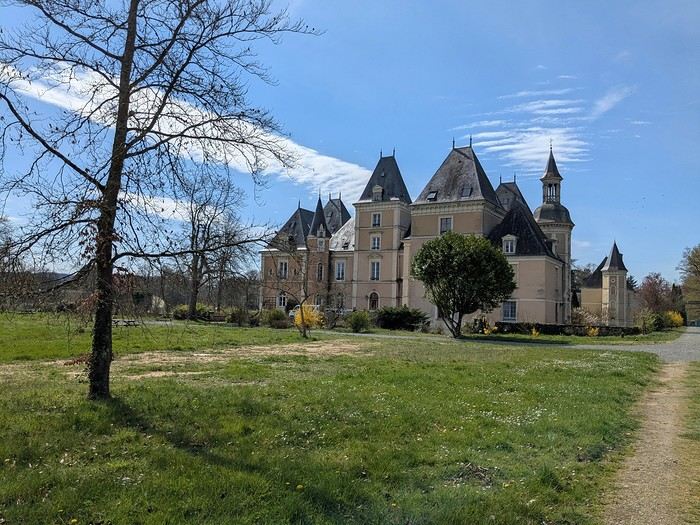
Photo taken at the Kadampa Center France in April 2025 Well, I’d be lying if I said the responses to my requests came quickly. No. They took their time. I even had to follow up with everyone I’d contacted. Internet connection issues in Iceland? But miraculously, a week later, on a Friday in Auvergne, while I’m talking to my dad, the answer arrives. “Yes, it’s okay.” My heart skips a beat. My lungs relax. Finally, I find meaning in this trip. Me, always searching for meaning—my meaning, not the universal one—I’m going to explore distant lands with a culture different from France’s. He said YES! Indeed, the person who said yes—Björn*—lives in northwestern Iceland, an area known for its fjords, and which seems a bit remote. Proof: in the ad, it says the nearest town is 35 km away, and only two buses, one on Friday and one on Sunday, go there or leave. PERFECT! It also mentions taking a kayak to collect feathers from eider duck nests and taking care of rainbow trout. Things I don’t know how to do! And She said yes! So I tell Mélanie, who’d known about my last-minute change of mind since the day before—for the umpteenth time, I must admit. A little dilemma: our month of volunteering in Spain had just been sorted, so should we cancel it? Yes! The pull of Iceland and adventure is stronger! Change of plans, then. Normally, we’d continue our route to Montauban for the 400 Coups festival with friends, then stay in the south for the Mantra festival before heading to southern Spain toward Malaga. Now, the migration will be more northward since we’re returning to Rennes Monday morning (after the 400 Coups festival, which we wouldn’t have missed for the world!!) to change our wardrobe. Indeed, the weather won’t be the same between southern Spain and northern Iceland. It was September 12, and we were leaving on the 20th! Because, yes, that same evening, after arriving at our friends’ place and quickly summarizing the situation—even trying to convince one of them to join us—we start looking at bookings.
First thing: flight tickets—which I’d already more or less looked at and knew weren’t that expensive, thanks to low-cost airlines—,
Second thing: train tickets to Paris, and oh, miracle, they’re not expensive at all. 25 € per person one way! What’s happening at SNCF?!
Third thing: accommodation for Saturday night so we could take the bus on Sunday—which I hadn’t looked at and seemed quite pricey for just a bed in a dorm—.
Sometimes, we spend months and months planning a vacation (only to change everything at the last minute… We still remember the trip to Churchill…), and here, in one day, it’s almost done. Welcome to my life. Build, deconstruct, and rebuild. Why don’t I plan ahead? You have the answer. The week in Rennes does us good. Coming back to a familiar place after a month and a half of wandering around France. Resting because we’re accumulating fatigue. I also take the opportunity to have sessions with the few people who contacted me during our August road trip, see some friends, binge on galettes (5 galette meals in 9 meals—I went all out!), and realize we really need to take winter clothes—5°C expected in Iceland—. And boom, Saturday arrives. Like a calm river? Boom ??? No, that would’ve been too simple, too idyllic. Indeed, on Wednesday, a little message from Björn—who’s the intermediary between the volunteer site owner and us—tells us the owner no longer wants to host volunteers, so it’s off for us, and he’s really sorry. And that he can try to see with a friend if they can host us, if we want. What?! Uh, that’s not possible. Me, who changed all the plans at the last minute, how do I tell Mélanie we’ve got nothing left? That’ll teach me to never be satisfied with what I have and to always plan everything at the last minute. Take a breath: after all, the situation isn’t ruined. He has a friend who might host us, and maybe there are other ads I haven’t seen. So I tell him yes, and a few minutes later, he confirms it’s good, his friend is okay to take us starting October 1st, and he’ll host us until September 30th. Phew!!! The plan seems twisted, we still don’t know what we’ll be doing, or with whom, or where, but at least we haven’t thrown money out the airplane windows. After double-checking that I understood everything correctly, after confirming we still need to go to H in northwestern Iceland, it’s good, the clouds are clearing again.
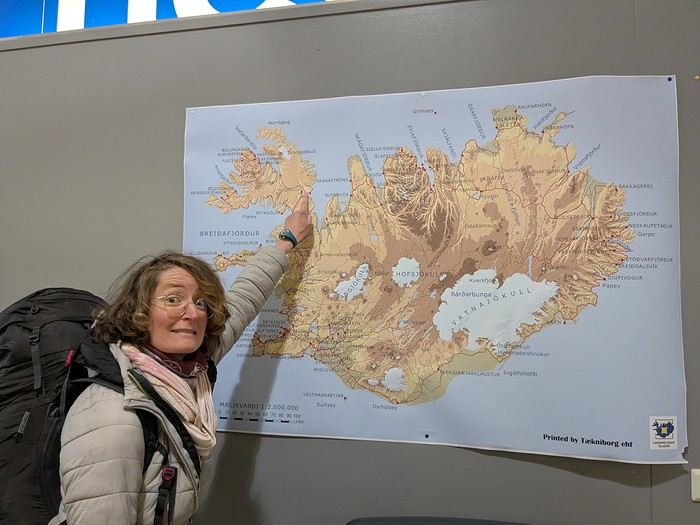
I chose a country she’d dreamed of going to: Iceland was high on the list. I sent volunteer requests on the site helpx.net before telling her, so I could be proactive and not just the person who complains and whines all the time.
We’d decided that September and October would be dedicated to traveling outside France and volunteering. A method I love for traveling. Discovering locals, the culture, cool places while helping and being housed and fed. What could be better?! After volunteering for a few days in Morocco last year on a lemon plantation, after 15 days on an organic market garden in the South Morvan this August, we really appreciate this way of traveling—which is why it was the plan: Volunteering in Spain at a Buddhist meditation center, with a short volunteer stint somewhere else beforehand.
Photo taken at the Kadampa Center France in April 2025 Well, I’d be lying if I said the responses to my requests came quickly. No. They took their time. I even had to follow up with everyone I’d contacted. Internet connection issues in Iceland? But miraculously, a week later, on a Friday in Auvergne, while I’m talking to my dad, the answer arrives. “Yes, it’s okay.” My heart skips a beat. My lungs relax. Finally, I find meaning in this trip. Me, always searching for meaning—my meaning, not the universal one—I’m going to explore distant lands with a culture different from France’s. He said YES! Indeed, the person who said yes—Björn*—lives in northwestern Iceland, an area known for its fjords, and which seems a bit remote. Proof: in the ad, it says the nearest town is 35 km away, and only two buses, one on Friday and one on Sunday, go there or leave. PERFECT! It also mentions taking a kayak to collect feathers from eider duck nests and taking care of rainbow trout. Things I don’t know how to do! And She said yes! So I tell Mélanie, who’d known about my last-minute change of mind since the day before—for the umpteenth time, I must admit. A little dilemma: our month of volunteering in Spain had just been sorted, so should we cancel it? Yes! The pull of Iceland and adventure is stronger! Change of plans, then. Normally, we’d continue our route to Montauban for the 400 Coups festival with friends, then stay in the south for the Mantra festival before heading to southern Spain toward Malaga. Now, the migration will be more northward since we’re returning to Rennes Monday morning (after the 400 Coups festival, which we wouldn’t have missed for the world!!) to change our wardrobe. Indeed, the weather won’t be the same between southern Spain and northern Iceland. It was September 12, and we were leaving on the 20th! Because, yes, that same evening, after arriving at our friends’ place and quickly summarizing the situation—even trying to convince one of them to join us—we start looking at bookings.
First thing: flight tickets—which I’d already more or less looked at and knew weren’t that expensive, thanks to low-cost airlines—,
Second thing: train tickets to Paris, and oh, miracle, they’re not expensive at all. 25 € per person one way! What’s happening at SNCF?!
Third thing: accommodation for Saturday night so we could take the bus on Sunday—which I hadn’t looked at and seemed quite pricey for just a bed in a dorm—.
Sometimes, we spend months and months planning a vacation (only to change everything at the last minute… We still remember the trip to Churchill…), and here, in one day, it’s almost done. Welcome to my life. Build, deconstruct, and rebuild. Why don’t I plan ahead? You have the answer. The week in Rennes does us good. Coming back to a familiar place after a month and a half of wandering around France. Resting because we’re accumulating fatigue. I also take the opportunity to have sessions with the few people who contacted me during our August road trip, see some friends, binge on galettes (5 galette meals in 9 meals—I went all out!), and realize we really need to take winter clothes—5°C expected in Iceland—. And boom, Saturday arrives. Like a calm river? Boom ??? No, that would’ve been too simple, too idyllic. Indeed, on Wednesday, a little message from Björn—who’s the intermediary between the volunteer site owner and us—tells us the owner no longer wants to host volunteers, so it’s off for us, and he’s really sorry. And that he can try to see with a friend if they can host us, if we want. What?! Uh, that’s not possible. Me, who changed all the plans at the last minute, how do I tell Mélanie we’ve got nothing left? That’ll teach me to never be satisfied with what I have and to always plan everything at the last minute. Take a breath: after all, the situation isn’t ruined. He has a friend who might host us, and maybe there are other ads I haven’t seen. So I tell him yes, and a few minutes later, he confirms it’s good, his friend is okay to take us starting October 1st, and he’ll host us until September 30th. Phew!!! The plan seems twisted, we still don’t know what we’ll be doing, or with whom, or where, but at least we haven’t thrown money out the airplane windows. After double-checking that I understood everything correctly, after confirming we still need to go to H in northwestern Iceland, it’s good, the clouds are clearing again.
Traveling by train and bus in Rajasthan
Hi everyone,
For traveling in Rajasthan by train and bus, could you give me some info: where to buy tickets, cost, purchase locations, websites, etc.?
Any tips you have would be super helpful.
Thanks
Another side of my trip to Thailand: Villages, nature, countryside, mountains...
February 9th is a pivotal day during my trip to Thailand. Up until this date, my focus had been on cities, temples, and other urban landmarks. Starting February 10th, I’ll finally leave the city behind for the outskirts—one town, one life, farther from tourism, more real, more authentic... Then comes the bucolic surroundings of Chiang Mai, nature, the countryside, the mountains.
This morning, I head to visit the ethnographic museum. I’d been told about another one, but it’s permanently closed. I wonder if it’s the same one that might have changed its name and location.
I thoroughly enjoy visiting this museum. At first, I’m a bit annoyed because the place is packed with noisy school groups blocking the display cases without even showing the slightest interest. But soon, their chaperones manage to lead them into another room, giving me some peace. They maintain this distance throughout the tour, allowing me to explore the museum in complete tranquility. I really appreciate their tact.
I’m amazed by the absolutely stunning fabric displays and the countless everyday objects, especially the very old pottery. There’s so much beautiful basketry and intricately carved wood. The statues are also incredible... After seeing all of them, I no longer feel like buying any from the shops.
On my way back, not far from my hotel, I discover a rather unique place that only serves one drink, which they’ve made their specialty: egg coffee! A pretty surprising novelty. I have to try it.

At the bottom of the cup, they pour a layer of milk, topped with a layer of liquid coffee, followed by a layer of egg yolk, and finally a top layer that turns out to be a mix of coffee and cocoa powder. It’s a cold drink that, in the end, doesn’t have much flavor, and the price is pretty steep for such a small cup. You’re paying for the exclusivity!
Later in the day, I venture once again into small alleys, something I love doing when exploring a new city—no specific goal, just wandering east of the city, outside the walls.

I encounter very few tourists there and discover unsuspected little shops overflowing with lovely items, much cheaper than what you find in the heart of the tourist district. Then I wander through the floors of Warorot Market. I discover another kind of temple there: the temple of good deals. I love finding clothes that are really original for locals, not the flood of shirts and pants that tourists love but no Thai would ever buy, which invade the shops in the "Historic Square." I stop in my tracks in front of a stall with beautiful shirts featuring stunning geometric patterns in elegant color combinations and very short sleeves. Hmm, these would be perfect for showing off my biceps, one of which is adorned with the magnificent Ganesh tattoo I got last year in Bali. "When you’ve got nice things, you’ve got to show them off!" he said. 😜🙏💪 I pick out two for 380 baht and negotiate them down to 300. But the seller won’t go any lower. I understand I’ve reached the limit of her commercial possibilities. Just as I’m leaving the shop, happy with my purchase, my ever-helpful inner voice, Petite Voix, suggests: - You didn’t try them on because you were too lazy to take off the one you’re wearing and also because of the sweat, but you could just put one on over the one you’re wearing. It’s light enough that it won’t bother you.
I go back to the two sellers, who burst out laughing when I ask to try them on. - Oh no, it’s way too small for you! It’s a women’s shirt! - But they don’t look particularly feminine in style! And I chose XXL... I put the shirt on, and of course, it won’t close. Then I notice the buttons are on the wrong side. That’s why the sleeves seemed so short!!! They put the shirts back on the rack and refund me without any fuss, commenting amid total hilarity: - Well, thank goodness you tried it on just as you were leaving the shop!
Since I don’t want to walk too much before tomorrow’s first Big Outing with the driver, I end my stroll with a visit to two very pretty temples recommended by Joël.

I’d rather not post more temple photos. But these ones smell like village and countryside...


I’ve never seen anything like Wat Ket Karam, so extravagant...


And I end my day with two other lesser-known temples: Wat Noung Kham, simple and finally free of gold and glitter,

and Wat Dap Phai, where an intimate ceremony is taking place at the end of the day.
This morning, I head to visit the ethnographic museum. I’d been told about another one, but it’s permanently closed. I wonder if it’s the same one that might have changed its name and location.
I thoroughly enjoy visiting this museum. At first, I’m a bit annoyed because the place is packed with noisy school groups blocking the display cases without even showing the slightest interest. But soon, their chaperones manage to lead them into another room, giving me some peace. They maintain this distance throughout the tour, allowing me to explore the museum in complete tranquility. I really appreciate their tact.
I’m amazed by the absolutely stunning fabric displays and the countless everyday objects, especially the very old pottery. There’s so much beautiful basketry and intricately carved wood. The statues are also incredible... After seeing all of them, I no longer feel like buying any from the shops.
On my way back, not far from my hotel, I discover a rather unique place that only serves one drink, which they’ve made their specialty: egg coffee! A pretty surprising novelty. I have to try it.
At the bottom of the cup, they pour a layer of milk, topped with a layer of liquid coffee, followed by a layer of egg yolk, and finally a top layer that turns out to be a mix of coffee and cocoa powder. It’s a cold drink that, in the end, doesn’t have much flavor, and the price is pretty steep for such a small cup. You’re paying for the exclusivity!
Later in the day, I venture once again into small alleys, something I love doing when exploring a new city—no specific goal, just wandering east of the city, outside the walls.
I encounter very few tourists there and discover unsuspected little shops overflowing with lovely items, much cheaper than what you find in the heart of the tourist district. Then I wander through the floors of Warorot Market. I discover another kind of temple there: the temple of good deals. I love finding clothes that are really original for locals, not the flood of shirts and pants that tourists love but no Thai would ever buy, which invade the shops in the "Historic Square." I stop in my tracks in front of a stall with beautiful shirts featuring stunning geometric patterns in elegant color combinations and very short sleeves. Hmm, these would be perfect for showing off my biceps, one of which is adorned with the magnificent Ganesh tattoo I got last year in Bali. "When you’ve got nice things, you’ve got to show them off!" he said. 😜🙏💪 I pick out two for 380 baht and negotiate them down to 300. But the seller won’t go any lower. I understand I’ve reached the limit of her commercial possibilities. Just as I’m leaving the shop, happy with my purchase, my ever-helpful inner voice, Petite Voix, suggests: - You didn’t try them on because you were too lazy to take off the one you’re wearing and also because of the sweat, but you could just put one on over the one you’re wearing. It’s light enough that it won’t bother you.
I go back to the two sellers, who burst out laughing when I ask to try them on. - Oh no, it’s way too small for you! It’s a women’s shirt! - But they don’t look particularly feminine in style! And I chose XXL... I put the shirt on, and of course, it won’t close. Then I notice the buttons are on the wrong side. That’s why the sleeves seemed so short!!! They put the shirts back on the rack and refund me without any fuss, commenting amid total hilarity: - Well, thank goodness you tried it on just as you were leaving the shop!
Since I don’t want to walk too much before tomorrow’s first Big Outing with the driver, I end my stroll with a visit to two very pretty temples recommended by Joël.
I’d rather not post more temple photos. But these ones smell like village and countryside...
I’ve never seen anything like Wat Ket Karam, so extravagant...
And I end my day with two other lesser-known temples: Wat Noung Kham, simple and finally free of gold and glitter,
and Wat Dap Phai, where an intimate ceremony is taking place at the end of the day.
Slovak travel journal
Hello and welcome aboard this travel journal.
We’re heading to Slovakia together!
 Why this country?
After visiting Hungary, Slovenia, Romania, and Poland in recent years, I’ve fallen in love with Eastern European countries. I adore the Slavic soul, its Austro-Hungarian villages, the gentle landscapes, the Carpathian Mountains, and that slightly mysterious atmosphere.
Slovakia evokes a certain imagination with its deep forests, medieval castles, and cobbled villages.
After seeing photos of the High Tatras—especially Lake Štrbské Pleso and Spiš Castle—I thought, "Let’s do it! We’re going!"
So, will Slovakia live up to what I imagine?
We’ll find out together.
We decided to travel as a group of six (five adults and a six-year-old child), by car (we needed two).
Here’s the day-by-day itinerary for this family trip, which started with a 3-day stay in Vienna (see the dedicated travel journal):
Why this country?
After visiting Hungary, Slovenia, Romania, and Poland in recent years, I’ve fallen in love with Eastern European countries. I adore the Slavic soul, its Austro-Hungarian villages, the gentle landscapes, the Carpathian Mountains, and that slightly mysterious atmosphere.
Slovakia evokes a certain imagination with its deep forests, medieval castles, and cobbled villages.
After seeing photos of the High Tatras—especially Lake Štrbské Pleso and Spiš Castle—I thought, "Let’s do it! We’re going!"
So, will Slovakia live up to what I imagine?
We’ll find out together.
We decided to travel as a group of six (five adults and a six-year-old child), by car (we needed two).
Here’s the day-by-day itinerary for this family trip, which started with a 3-day stay in Vienna (see the dedicated travel journal):
The itinerary: Day 1: Drive from Vienna to Banská Štiavnica and visit the town, then drive to Handlová Day 2: Bojnice Castle, the village of Čičmany, and a walk in the treetops at Bojnice, return to Handlová Day 3: Depart for Orava, visit Orava Castle and the Orava Skansen, drive to Veľký Slavkov Day 4: Visit Slovak Paradise—its gorges, lakes, and ice cave—overnight in Veľký Slavkov Day 5: Visit Bardejov, the "Death Road," wooden churches, and Ľubovňa Castle, overnight in Veľký Slavkov Day 6: Walks and hikes in the High Tatras, Lake Štrbské Pleso, Solisko summit, treetop walk in Ždiar, overnight in Veľký Slavkov Day 7: Drive to Košice, visit Spiš Castle, Tokaj wine route in Veľká Trňa, overnight in Košice Day 8: Visit Košice, overnight in Košice Day 9: Drive to Bratislava, stop at the Aragonite Cave in the Slovak Karst, overnight in Bratislava Day 10: Visit Bratislava, overnight stay Day 11 and 12: Return to France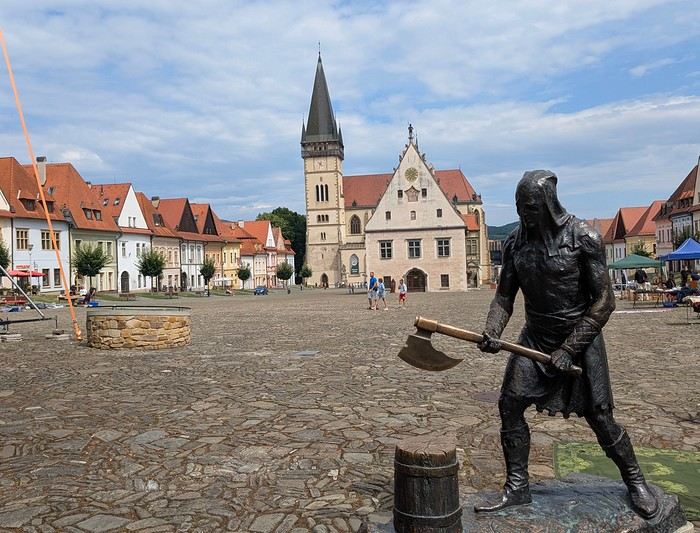
Budget: I’m giving prices for 2 adults / 1 child. Slovakia is more expensive than it seems, and some expenses shouldn’t be underestimated. Transportation: Tolls and gas from France: 500 € round trip Slovak vignette for one month: 17.10 € Gas is fixed at 1.49 € per liter (E10) Parking at sites (all paid by the day, even in the most remote villages, even if you stay for just an hour). Payment is often required in cash upon arrival: total 63 € We didn’t pay at Spiš (we arrived before the cashier) or Ľubovňa (we arrived after the cashier left). Parking at Orava Village was free. In Košice and Bratislava, we parked for free at our accommodations. Public transport in Bratislava and Košice: 1-1.2 € for a bus ticket. Vending machines are available at some stops; otherwise, buy via SMS (Slovak phones only) or official sales points.
Accommodation: We mostly chose houses so we could cook ourselves and save on food. I’ve rated our satisfaction with these accommodations from 1 to 5 stars. Padua: DC Hotel: 1 night, 77 € ***** Handlová: Chata Remata: 2 nights, 120 € ***** Veľký Slavkov: Aplend: 4 nights, 220 € ** Košice: Luxury Old Town Loft 320m²: 2 nights, 120 € ***** Bratislava: Hotel Viktor: 2 nights, 138 € *** Brescia: Hotel Antica Fonte: 1 night, 82 € ***** Total: 757 €
Food: Groceries at Lidl for 5 meals for 3: 100 € (really cheap) Restaurants: 10-15 € per dish, ice cream 1-2.4 € per scoop, crêpes 8-12 €, a glass of wine 6-10 €... total: 500 €
Visits: There are discounts for seniors and children, which is great. We spent nearly 600 € in total, which is a lot. However, it’s a cultural destination with many castles, museums, caves, wine cellars, and nature activities: cable cars, canopy walks, paid hikes (Slovak Paradise gorges)... In the end, this trip to Slovakia cost nearly 2500 € for 3. We also need to add the Vienna portion to that. Now, here’s the day-by-day account of this beautiful journey.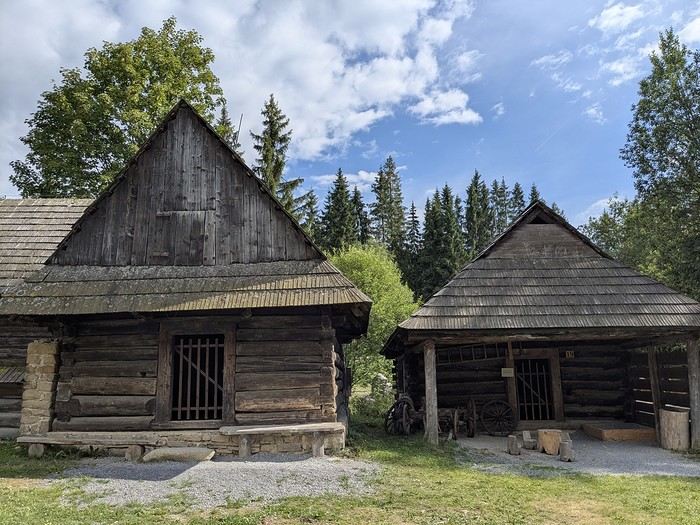
Why this country?
After visiting Hungary, Slovenia, Romania, and Poland in recent years, I’ve fallen in love with Eastern European countries. I adore the Slavic soul, its Austro-Hungarian villages, the gentle landscapes, the Carpathian Mountains, and that slightly mysterious atmosphere.
Slovakia evokes a certain imagination with its deep forests, medieval castles, and cobbled villages.
After seeing photos of the High Tatras—especially Lake Štrbské Pleso and Spiš Castle—I thought, "Let’s do it! We’re going!"
So, will Slovakia live up to what I imagine?
We’ll find out together.
We decided to travel as a group of six (five adults and a six-year-old child), by car (we needed two).
Here’s the day-by-day itinerary for this family trip, which started with a 3-day stay in Vienna (see the dedicated travel journal):
The itinerary: Day 1: Drive from Vienna to Banská Štiavnica and visit the town, then drive to Handlová Day 2: Bojnice Castle, the village of Čičmany, and a walk in the treetops at Bojnice, return to Handlová Day 3: Depart for Orava, visit Orava Castle and the Orava Skansen, drive to Veľký Slavkov Day 4: Visit Slovak Paradise—its gorges, lakes, and ice cave—overnight in Veľký Slavkov Day 5: Visit Bardejov, the "Death Road," wooden churches, and Ľubovňa Castle, overnight in Veľký Slavkov Day 6: Walks and hikes in the High Tatras, Lake Štrbské Pleso, Solisko summit, treetop walk in Ždiar, overnight in Veľký Slavkov Day 7: Drive to Košice, visit Spiš Castle, Tokaj wine route in Veľká Trňa, overnight in Košice Day 8: Visit Košice, overnight in Košice Day 9: Drive to Bratislava, stop at the Aragonite Cave in the Slovak Karst, overnight in Bratislava Day 10: Visit Bratislava, overnight stay Day 11 and 12: Return to France
Budget: I’m giving prices for 2 adults / 1 child. Slovakia is more expensive than it seems, and some expenses shouldn’t be underestimated. Transportation: Tolls and gas from France: 500 € round trip Slovak vignette for one month: 17.10 € Gas is fixed at 1.49 € per liter (E10) Parking at sites (all paid by the day, even in the most remote villages, even if you stay for just an hour). Payment is often required in cash upon arrival: total 63 € We didn’t pay at Spiš (we arrived before the cashier) or Ľubovňa (we arrived after the cashier left). Parking at Orava Village was free. In Košice and Bratislava, we parked for free at our accommodations. Public transport in Bratislava and Košice: 1-1.2 € for a bus ticket. Vending machines are available at some stops; otherwise, buy via SMS (Slovak phones only) or official sales points.
Accommodation: We mostly chose houses so we could cook ourselves and save on food. I’ve rated our satisfaction with these accommodations from 1 to 5 stars. Padua: DC Hotel: 1 night, 77 € ***** Handlová: Chata Remata: 2 nights, 120 € ***** Veľký Slavkov: Aplend: 4 nights, 220 € ** Košice: Luxury Old Town Loft 320m²: 2 nights, 120 € ***** Bratislava: Hotel Viktor: 2 nights, 138 € *** Brescia: Hotel Antica Fonte: 1 night, 82 € ***** Total: 757 €
Food: Groceries at Lidl for 5 meals for 3: 100 € (really cheap) Restaurants: 10-15 € per dish, ice cream 1-2.4 € per scoop, crêpes 8-12 €, a glass of wine 6-10 €... total: 500 €
Visits: There are discounts for seniors and children, which is great. We spent nearly 600 € in total, which is a lot. However, it’s a cultural destination with many castles, museums, caves, wine cellars, and nature activities: cable cars, canopy walks, paid hikes (Slovak Paradise gorges)... In the end, this trip to Slovakia cost nearly 2500 € for 3. We also need to add the Vienna portion to that. Now, here’s the day-by-day account of this beautiful journey.
Route from Windhoek to Namaqualand (Africa)
Hi there,
From Windhoek to Namaqualand, is it possible to take a route further east than the B1 national road, and are there any points of interest along that way?
Thanks in advance.
Second trip to Sardinia from 05/01/25 to 05/11/25
Following my first trip from May 1st to 11th, 2025:
-Flight: easyJet Geneva-Olbia 11:50 AM-1:20 PM (306 € for 2) + 102 € for checked baggage (408 € total)
-Flight: easyJet Cagliari-Geneva 12:45 PM-2:25 PM (308 € for 2)
-Car rental: Olbia-Cagliari (rental: 338.31 € + 120 € for one-way drop-off) + 320 € mandatory insurance imposed by Centauro) 778.31 € total
*May 1st: ***OLBIA: arrived at the airport at 3:15 PM: 1-hour delay with EasyJet! 😕 Car rental issue** Big scam with B Rent (hard to find their counter because of poor signage—they demanded an extra 320 €! But after 5.5 hours, Centauro also charged 320 € for insurance!!!) On top of that, we only got the car at 6:30 PM. Due to the delay, we went straight to our accommodation after grocery shopping. -Bandi House via Mastru Giogliu, San Teodoro 0039 338 852 8569 70 € (very nice apartment, spacious, great welcome from Paola but hard to find) -Nearby: San Teodoro: stagno (birds) Lonely Planet p.159
*May 2nd: -Heading to Isola Tavolara: boat from San Paolo. It was a holiday weekend, and all the Sardinians plus tourists were heading to the island. Everyone wanted to visit the cave and all the beaches—so crowded we gave up. Plus, we had to wait for the first departure at 11 AM with a return no earlier than 2 PM, and all boats left at the same time, so everyone ended up at the cave simultaneously! GUIDES: Green Guide p.140 and Lonely Planet p.158 -Capo Coda Cavallo: beautiful spot with a stunning beach (reserve) -EAST COAST: Budoni, Posada, La Caletta (port) with many white sand beaches
*Orosei (Green Guide p.102, Lonely Planet p.201) and Galtelli (lovely medieval village) *Dorgali (Green Guide p.96, Lonely Planet p.205): don’t skip Pasticceria Mulas (exceptional pastries at very reasonable prices) -Agriturismo Nennelle in Loculi: great welcome at this fairly new site—a farm with sheep. Large room with private bathroom and outdoor tables/chairs. Small fridge, kettle, and coffee machine. 54 0039 3495343765 €
***May 3rd:*** -Hike to Gola Su Gorropu: magnificent 4-hour trek (Lonely Planet p.205, Green Guide p.96)
-Arbatax: Rocce Rosse: stunning red porphyry rocks at the end of the port (Green Guide p.87, Lonely Planet p.210) -Aer Sana in Arzana: a remote village with a very narrow, picturesque road (there’s actually a second one). Via Don Bosco No. 12. 68.60 € 0039 347 9601599 Great welcome from Bruna/message—decorated with lots of taste and care. One room with private bathroom and a super well-equipped shared kitchen.
***May 4th:*** -Supramonte National Park and Gulf of Orosei (Green Guide p.98, Lonely Planet p.201) -Arzana-Ussassai-Seui-Sadali-Goldoni -Aritzo: small village on a slope—very friendly locals -Antonio Mura Museum: Sardinian expressionist painter -Ethnographic Museum: quite comprehensive -Spanish Prison "Sa Bovida" (prison under Spanish rule where people were imprisoned for witchcraft) -Antico Restauro: Via Umberto 38, Fonni. Small Sardinian house in the village with little light but tastefully decorated. Warm welcome from Mario Loddo. 65.02 €
*May 5th: Gennargentu Massif and Supramonte -Orgosolo: Lonely Planet p.190, Green Guide p.123 -Nuraghe di Tiscali (Green Guide p.122, Lonely Planet p.207): allow over 1 hour of hiking to reach a slope with a cave (good shoes required) -Arrival in Nuoro: large city. Via Salvatore Manniri 39 (0039 33118617847). French expat living in Sardinia—very large, well-designed apartment on the 5th floor. 73 €
*May 6th: -NUORO (Lonely Planet p.186, Green Guide p.112) .Museum of Sardinian writer Grazia Deledda (1871-1936), Nobel Prize in Literature 1927 .Sardinian Ethnographic Museum -Ulassai: Stazione dell’Arte Maria Lai (1919-2013) (Lonely Planet p.212, Green Guide p.85). Major climbing spot in a charming little village -Jerzu: "La Finestra sulla Volla" Via Umberto I 551 0039 3403754751 72 € apartment with 1 bedroom, 1 bathroom, and 1 kitchen
*May 7th: OGLIASTRA: -Jerzu to Tortolì via Barisardo: quite difficult route through narrow streets in various villages! Return to Porto Corallo, Capo Ferrato (Green Guide p.64) -Hotel in San Vito: "Su Furriadroxiu" Via Lamarmora 35/37 0039 3501041432 61.20 € (Green Guide p.65)
*May 8th: -San Vito -Armungia (Green Guide p.65): small village at 566 m with nuraghe and museum + fresco "Homage to the Sassari Brigade" -Goni: cork oak forests and Nuraghe di Pranu Muteddu (60 aligned menhirs and tombs) (Green Guide p.66, Lonely Planet p.197) -San Vito: restaurant "La Capinera" Via Nazionale 80, 09040: very good -From Villasimius to Costa Rei: Lonely Planet p.65, Green Guide p.60 .Punta Molentis: white sand, rocks, but very touristy -Capo Carbonara: military zone, not much to see -Accommodation in Cagliari: Villa Volta 18, Monserrato 0039 3480640592: 74.70 € Well-equipped studio, city center, quiet
*May 9th: -Visit to Cagliari with underground tunnels Regina at the foot of the citadel (elevator) (Lonely Planet p.48, Green Guide p.32) .Castello, prefecture, San Maria church .Charming and picturesque Villanova district -Barumini (Green Guide p.70, Lonely Planet p.90): Nuraghe di Su Nuraxi, 1500 BC with its tower and fortifications—the largest Sardinian site (UNESCO) Entry: 15 € with mandatory guided tour -Parco della Giara di Gesturi (basaltic plateau): great for hiking Presence of the Sardinian pony: small Sardinian horse -Accommodation in Sanluri: 2 Via Giacomo Mozart 0039 3495343765: 80 €
*May 10th: -Beautiful Isola di San Pietro: ferry from Portovesme to Carloforte (round trip) 33.50 € with car (Green Guide p.318, Lonely Planet p.81) 15 km long and 15 km wide .Carloforte: peaceful little town with its palazzi and colorful houses .Tonnara della Punta: former tuna cannery—can be visited by reservation .Capo Sandalo: with its lighthouse (nice little trail to hike) .La Caletta: beaches and cliffs .Punta delle Colonne: 2 trachyte formations—very pretty
-TOTAL: 2432 € for 2 -1400 km by car: 160 € for gas (between 1.60 and 1.76 €/L) -Food, including 2 restaurants: 265 € -Accommodation via Booking: 685 € -Flights: 614 € for 2 -Car: 708.50 € + one-way drop-off: 120 € + mandatory insurance of 320 € (not planned!)
*May 1st: ***OLBIA: arrived at the airport at 3:15 PM: 1-hour delay with EasyJet! 😕 Car rental issue** Big scam with B Rent (hard to find their counter because of poor signage—they demanded an extra 320 €! But after 5.5 hours, Centauro also charged 320 € for insurance!!!) On top of that, we only got the car at 6:30 PM. Due to the delay, we went straight to our accommodation after grocery shopping. -Bandi House via Mastru Giogliu, San Teodoro 0039 338 852 8569 70 € (very nice apartment, spacious, great welcome from Paola but hard to find) -Nearby: San Teodoro: stagno (birds) Lonely Planet p.159
*May 2nd: -Heading to Isola Tavolara: boat from San Paolo. It was a holiday weekend, and all the Sardinians plus tourists were heading to the island. Everyone wanted to visit the cave and all the beaches—so crowded we gave up. Plus, we had to wait for the first departure at 11 AM with a return no earlier than 2 PM, and all boats left at the same time, so everyone ended up at the cave simultaneously! GUIDES: Green Guide p.140 and Lonely Planet p.158 -Capo Coda Cavallo: beautiful spot with a stunning beach (reserve) -EAST COAST: Budoni, Posada, La Caletta (port) with many white sand beaches
*Orosei (Green Guide p.102, Lonely Planet p.201) and Galtelli (lovely medieval village) *Dorgali (Green Guide p.96, Lonely Planet p.205): don’t skip Pasticceria Mulas (exceptional pastries at very reasonable prices) -Agriturismo Nennelle in Loculi: great welcome at this fairly new site—a farm with sheep. Large room with private bathroom and outdoor tables/chairs. Small fridge, kettle, and coffee machine. 54 0039 3495343765 €
***May 3rd:*** -Hike to Gola Su Gorropu: magnificent 4-hour trek (Lonely Planet p.205, Green Guide p.96)
-Arbatax: Rocce Rosse: stunning red porphyry rocks at the end of the port (Green Guide p.87, Lonely Planet p.210) -Aer Sana in Arzana: a remote village with a very narrow, picturesque road (there’s actually a second one). Via Don Bosco No. 12. 68.60 € 0039 347 9601599 Great welcome from Bruna/message—decorated with lots of taste and care. One room with private bathroom and a super well-equipped shared kitchen.
***May 4th:*** -Supramonte National Park and Gulf of Orosei (Green Guide p.98, Lonely Planet p.201) -Arzana-Ussassai-Seui-Sadali-Goldoni -Aritzo: small village on a slope—very friendly locals -Antonio Mura Museum: Sardinian expressionist painter -Ethnographic Museum: quite comprehensive -Spanish Prison "Sa Bovida" (prison under Spanish rule where people were imprisoned for witchcraft) -Antico Restauro: Via Umberto 38, Fonni. Small Sardinian house in the village with little light but tastefully decorated. Warm welcome from Mario Loddo. 65.02 €
*May 5th: Gennargentu Massif and Supramonte -Orgosolo: Lonely Planet p.190, Green Guide p.123 -Nuraghe di Tiscali (Green Guide p.122, Lonely Planet p.207): allow over 1 hour of hiking to reach a slope with a cave (good shoes required) -Arrival in Nuoro: large city. Via Salvatore Manniri 39 (0039 33118617847). French expat living in Sardinia—very large, well-designed apartment on the 5th floor. 73 €
*May 6th: -NUORO (Lonely Planet p.186, Green Guide p.112) .Museum of Sardinian writer Grazia Deledda (1871-1936), Nobel Prize in Literature 1927 .Sardinian Ethnographic Museum -Ulassai: Stazione dell’Arte Maria Lai (1919-2013) (Lonely Planet p.212, Green Guide p.85). Major climbing spot in a charming little village -Jerzu: "La Finestra sulla Volla" Via Umberto I 551 0039 3403754751 72 € apartment with 1 bedroom, 1 bathroom, and 1 kitchen
*May 7th: OGLIASTRA: -Jerzu to Tortolì via Barisardo: quite difficult route through narrow streets in various villages! Return to Porto Corallo, Capo Ferrato (Green Guide p.64) -Hotel in San Vito: "Su Furriadroxiu" Via Lamarmora 35/37 0039 3501041432 61.20 € (Green Guide p.65)
*May 8th: -San Vito -Armungia (Green Guide p.65): small village at 566 m with nuraghe and museum + fresco "Homage to the Sassari Brigade" -Goni: cork oak forests and Nuraghe di Pranu Muteddu (60 aligned menhirs and tombs) (Green Guide p.66, Lonely Planet p.197) -San Vito: restaurant "La Capinera" Via Nazionale 80, 09040: very good -From Villasimius to Costa Rei: Lonely Planet p.65, Green Guide p.60 .Punta Molentis: white sand, rocks, but very touristy -Capo Carbonara: military zone, not much to see -Accommodation in Cagliari: Villa Volta 18, Monserrato 0039 3480640592: 74.70 € Well-equipped studio, city center, quiet
*May 9th: -Visit to Cagliari with underground tunnels Regina at the foot of the citadel (elevator) (Lonely Planet p.48, Green Guide p.32) .Castello, prefecture, San Maria church .Charming and picturesque Villanova district -Barumini (Green Guide p.70, Lonely Planet p.90): Nuraghe di Su Nuraxi, 1500 BC with its tower and fortifications—the largest Sardinian site (UNESCO) Entry: 15 € with mandatory guided tour -Parco della Giara di Gesturi (basaltic plateau): great for hiking Presence of the Sardinian pony: small Sardinian horse -Accommodation in Sanluri: 2 Via Giacomo Mozart 0039 3495343765: 80 €
*May 10th: -Beautiful Isola di San Pietro: ferry from Portovesme to Carloforte (round trip) 33.50 € with car (Green Guide p.318, Lonely Planet p.81) 15 km long and 15 km wide .Carloforte: peaceful little town with its palazzi and colorful houses .Tonnara della Punta: former tuna cannery—can be visited by reservation .Capo Sandalo: with its lighthouse (nice little trail to hike) .La Caletta: beaches and cliffs .Punta delle Colonne: 2 trachyte formations—very pretty
-TOTAL: 2432 € for 2 -1400 km by car: 160 € for gas (between 1.60 and 1.76 €/L) -Food, including 2 restaurants: 265 € -Accommodation via Booking: 685 € -Flights: 614 € for 2 -Car: 708.50 € + one-way drop-off: 120 € + mandatory insurance of 320 € (not planned!)
Uzbekistan - Finally made it - Summer 2022
Another trip planned during Covid. Actually, for 2020, I had three trips booked, with tickets purchased and everything.
This one to Uzbekistan was planned for April 2020. We postponed it to April 2021, but it was canceled again, and we couldn’t reschedule for April 2022 because our friends who were coming with us were busy. So, we chose summer, knowing the temperatures would likely be very high.
We left as a group of five: a couple we usually travel with and one of their friends, whom I knew. She was traveling alone and had dreamed of this trip but didn’t want to go by herself.
For organization, we went through an agency to handle the train tickets and our trip to the Aral Sea. It’s not my usual style, but back in 2020, we were already in touch with them, and they were very understanding during the two cancellations. It wasn’t easy, given the economic crisis Covid caused, especially in Uzbekistan.
Again, I’m writing this travel journal from memory since I didn’t take any notes. (It’s good to give your brain a workout now and then!)
Day 1: Off to Tashkent
We flew in the afternoon to Istanbul, had a 2-hour-15-minute layover in Turkey, and then took an overnight flight to arrive early in the morning in Tashkent. Problem (again): just before taking off from Saint-Exupéry, the plane had an issue with the landing gear. We waited two hours, and after a few hammer and wrench adjustments, we finally took off. Of course, by the time we arrived in Istanbul, it was a mad dash through the airport to catch our connecting flight. We landed at 7:30 AM in Tashkent, and of the five suitcases in our little group, two were missing (one of ours and the solo traveler’s). Big problem because we were leaving at 2:30 PM by train for the Aral Sea, and we wouldn’t be near an airport again for three days. Plus, at the small airport in the Uzbek capital, no one spoke English (or French, or the Ardèche dialect). Fortunately, we had booked a guide for a quick morning tour of the capital. We had seven hours to kill, and it seemed smart to do it this way (and yes, sometimes we do think ahead). With him speaking English and, more importantly, Uzbek, the delivery of our suitcases was arranged.
So, we set off to explore the capital. It’s very Soviet in design—wide avenues and ugly buildings.
We visited the Khasti Imam historical complex (first name to pronounce at your own risk—there will be plenty more during the trip). Lots of "oohs" and "aahs" about how beautiful it was, but in the end, compared to what we saw later, it was really just small potatoes.
We checked out Chorsu Bazaar, the city’s large covered market. The guide was friendly and gave us plenty of tips for the rest of the trip. He suggested a restaurant, which we accepted, so we could get familiar with local customs. The good thing was, it didn’t seem like a tourist trap.
Next, we headed to the train station because our train was at 2:30 PM. The guide left us, and then another problem arose. While going through security, one of the staff made it clear that our train was canceled and our ticket needed to be changed to the train leaving around 8:20 PM. Heatwave moment (it was 38°C). Our issue was that we were supposed to arrive in Nukus (our destination) at 6:00 AM and take a minibus for a round trip to Moynaq and the Aral Sea (four hours each way). The plan was to spend 2-3 hours there and return, so a 10-11-hour timeline. Leaving at 6:00 AM made it doable, but with the train now leaving at 8:20 PM, we’d arrive in Nukus at noon, which messed up the rest of the plan.
I was fuming at the agency (I really don’t like using agencies), so I called the local contact, who quickly sent our guide back (because trying to communicate, change tickets, and get information was tough).
I asked the manager to find us flight tickets to make up for the delay, but nothing—zilch—was possible. We were stuck! My buddy and I were determined to get to Moynaq, but the women in the group were less motivated.
No choice but to board the train for an overnight journey. We had a cabin for two (and our friend had one to herself). Big scare at first—no AC, and it felt like 150°. They told us it would work once the train started moving, which it did. A frugal meal in the dining car (spaghetti with meat—the only dish on offer) and we had a good night’s sleep.
The +: Finally, we’re here! The -: A lot of hassles to start the trip
We left as a group of five: a couple we usually travel with and one of their friends, whom I knew. She was traveling alone and had dreamed of this trip but didn’t want to go by herself.
For organization, we went through an agency to handle the train tickets and our trip to the Aral Sea. It’s not my usual style, but back in 2020, we were already in touch with them, and they were very understanding during the two cancellations. It wasn’t easy, given the economic crisis Covid caused, especially in Uzbekistan.
Again, I’m writing this travel journal from memory since I didn’t take any notes. (It’s good to give your brain a workout now and then!)
Day 1: Off to Tashkent
We flew in the afternoon to Istanbul, had a 2-hour-15-minute layover in Turkey, and then took an overnight flight to arrive early in the morning in Tashkent. Problem (again): just before taking off from Saint-Exupéry, the plane had an issue with the landing gear. We waited two hours, and after a few hammer and wrench adjustments, we finally took off. Of course, by the time we arrived in Istanbul, it was a mad dash through the airport to catch our connecting flight. We landed at 7:30 AM in Tashkent, and of the five suitcases in our little group, two were missing (one of ours and the solo traveler’s). Big problem because we were leaving at 2:30 PM by train for the Aral Sea, and we wouldn’t be near an airport again for three days. Plus, at the small airport in the Uzbek capital, no one spoke English (or French, or the Ardèche dialect). Fortunately, we had booked a guide for a quick morning tour of the capital. We had seven hours to kill, and it seemed smart to do it this way (and yes, sometimes we do think ahead). With him speaking English and, more importantly, Uzbek, the delivery of our suitcases was arranged.
So, we set off to explore the capital. It’s very Soviet in design—wide avenues and ugly buildings.
We visited the Khasti Imam historical complex (first name to pronounce at your own risk—there will be plenty more during the trip). Lots of "oohs" and "aahs" about how beautiful it was, but in the end, compared to what we saw later, it was really just small potatoes.
We checked out Chorsu Bazaar, the city’s large covered market. The guide was friendly and gave us plenty of tips for the rest of the trip. He suggested a restaurant, which we accepted, so we could get familiar with local customs. The good thing was, it didn’t seem like a tourist trap.
Next, we headed to the train station because our train was at 2:30 PM. The guide left us, and then another problem arose. While going through security, one of the staff made it clear that our train was canceled and our ticket needed to be changed to the train leaving around 8:20 PM. Heatwave moment (it was 38°C). Our issue was that we were supposed to arrive in Nukus (our destination) at 6:00 AM and take a minibus for a round trip to Moynaq and the Aral Sea (four hours each way). The plan was to spend 2-3 hours there and return, so a 10-11-hour timeline. Leaving at 6:00 AM made it doable, but with the train now leaving at 8:20 PM, we’d arrive in Nukus at noon, which messed up the rest of the plan.
I was fuming at the agency (I really don’t like using agencies), so I called the local contact, who quickly sent our guide back (because trying to communicate, change tickets, and get information was tough).
I asked the manager to find us flight tickets to make up for the delay, but nothing—zilch—was possible. We were stuck! My buddy and I were determined to get to Moynaq, but the women in the group were less motivated.
No choice but to board the train for an overnight journey. We had a cabin for two (and our friend had one to herself). Big scare at first—no AC, and it felt like 150°. They told us it would work once the train started moving, which it did. A frugal meal in the dining car (spaghetti with meat—the only dish on offer) and we had a good night’s sleep.
The +: Finally, we’re here! The -: A lot of hassles to start the trip
Feedback on Livingston-Cape Town itinerary (Africa)
My partner and I are planning a 21-day self-drive trip from Victoria Falls to Cape Town, flying from Montreal to Victoria Falls and renting a 4x4. I’d love to hear members’ thoughts on our itinerary and its feasibility, along with your recommendations for must-see spots, essential parks, lodges, etc.
Our ideal is to start our stay at the falls and head south to South Africa, finishing in Cape Town by the sea for two days of relaxation before returning to Canada. We’re big on photography, not so much on cities, and we usually book accommodations where we can prepare our own dinner. Is this itinerary too ambitious? I’ve read a lot of travel journals and sometimes it seems very doable, other times completely the opposite...
Proposed itinerary: 17 October: Montreal-Livingstone, Zambia (Z) 18-19 Oct.: Victoria Falls, Z 20 Oct.: Kasane, Botswana (BO) 21-22 Oct.: Chobe Park, BO 23 Oct.: Francistown, BO 24 Oct.: Khama Rhino Sanctuary, BO 25 Oct.: Palapye, BO 26 Oct.: Polokwane, South Africa (SA) 27 Oct.: Phalaborwa, SA 28-29 Oct.: Kruger Park, SA 30 Oct.: Malelane Gate, SA 31 Oct.: Winburg, SA 1 November: Bloemfontein, SA 2 November: Beaufort West, SA 3-5 November: Cape Town, SA
Our ideal is to start our stay at the falls and head south to South Africa, finishing in Cape Town by the sea for two days of relaxation before returning to Canada. We’re big on photography, not so much on cities, and we usually book accommodations where we can prepare our own dinner. Is this itinerary too ambitious? I’ve read a lot of travel journals and sometimes it seems very doable, other times completely the opposite...
Proposed itinerary: 17 October: Montreal-Livingstone, Zambia (Z) 18-19 Oct.: Victoria Falls, Z 20 Oct.: Kasane, Botswana (BO) 21-22 Oct.: Chobe Park, BO 23 Oct.: Francistown, BO 24 Oct.: Khama Rhino Sanctuary, BO 25 Oct.: Palapye, BO 26 Oct.: Polokwane, South Africa (SA) 27 Oct.: Phalaborwa, SA 28-29 Oct.: Kruger Park, SA 30 Oct.: Malelane Gate, SA 31 Oct.: Winburg, SA 1 November: Bloemfontein, SA 2 November: Beaufort West, SA 3-5 November: Cape Town, SA
CFC Viking Legends Cruise
Hi there,
We’ve booked the CFC Viking Legends cruise (departing on 03/31/25), and the excursions have just been posted on the CFC website. What a disappointment... Stop in Copenhagen: 2 excursions offered, one of which includes +1.5 hours of walking Stop in Oslo: 2 excursions, one of which is a hike Stop in Sandnes (Stavanger): 2 excursions, one of which is a hike Lysekil (Sweden): 1 excursion, same as in Kristiansand and Zeebrugge.
We hesitated to book without knowing the excursions in advance, but the itinerary interested us. We were expecting more options for excursions... Since the ship leaves the day before from Zeebrugge, let’s hope there’s still space for the excursions. I’ll share our experience after we return from this first CFC discovery. MUM49
We’ve booked the CFC Viking Legends cruise (departing on 03/31/25), and the excursions have just been posted on the CFC website. What a disappointment... Stop in Copenhagen: 2 excursions offered, one of which includes +1.5 hours of walking Stop in Oslo: 2 excursions, one of which is a hike Stop in Sandnes (Stavanger): 2 excursions, one of which is a hike Lysekil (Sweden): 1 excursion, same as in Kristiansand and Zeebrugge.
We hesitated to book without knowing the excursions in advance, but the itinerary interested us. We were expecting more options for excursions... Since the ship leaves the day before from Zeebrugge, let’s hope there’s still space for the excursions. I’ll share our experience after we return from this first CFC discovery. MUM49
Japan: First Discovery!
Here’s a little story about my first trip to Japan with my partner.
We went for our first visit from October 29 to November 13, 2024.
I had planned this entire trip back in November 2020, but given the health situation at the time, I had to cancel...
Here’s the classic route we took: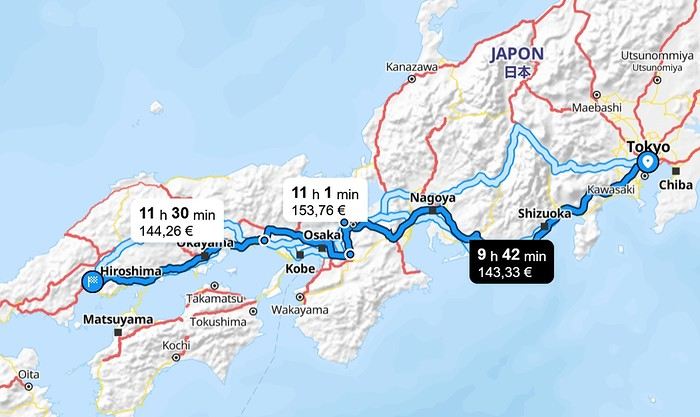
We booked everything ourselves and got a regional pass for the area from Kyoto to Hiroshima. The hotels were reserved 3 months in advance on Book... and Agod... (1030 € for 2 people for 13 nights = 80 €/night). For the flight, we chose a Qatar Airways flight with a layover to break up the long journey (950 € per person). We also got a pass on the same site (Japan-Experience) to take the train connecting Narita Airport to Shibuya Station (the N'EX Narita Express). Since the airport is 75 km from central Tokyo, we opted for this mode of transport, even though there are cheaper alternatives. After reading various posts on VoyageForum, I understood how important it was to have a Welcome Suica card to pay for public transport (subway, tram, bus, boat throughout the country), and we were able to buy one at Narita Airport. It turned out to be super useful! After a long but smooth journey, we found ourselves at Narita Airport in the evening. Even though we had a pass for the Narita Express, we had to go to a counter to make a reservation for the train (mandatory). Then, once we arrived at Shibuya Station, we took the subway for 2 stops and finally reached our hotel, exhausted (Hotel Asia Center of Japan – 270 € for 3 nights with breakfast included).
I had planned this entire trip back in November 2020, but given the health situation at the time, I had to cancel...
Here’s the classic route we took:
We booked everything ourselves and got a regional pass for the area from Kyoto to Hiroshima. The hotels were reserved 3 months in advance on Book... and Agod... (1030 € for 2 people for 13 nights = 80 €/night). For the flight, we chose a Qatar Airways flight with a layover to break up the long journey (950 € per person). We also got a pass on the same site (Japan-Experience) to take the train connecting Narita Airport to Shibuya Station (the N'EX Narita Express). Since the airport is 75 km from central Tokyo, we opted for this mode of transport, even though there are cheaper alternatives. After reading various posts on VoyageForum, I understood how important it was to have a Welcome Suica card to pay for public transport (subway, tram, bus, boat throughout the country), and we were able to buy one at Narita Airport. It turned out to be super useful! After a long but smooth journey, we found ourselves at Narita Airport in the evening. Even though we had a pass for the Narita Express, we had to go to a counter to make a reservation for the train (mandatory). Then, once we arrived at Shibuya Station, we took the subway for 2 stops and finally reached our hotel, exhausted (Hotel Asia Center of Japan – 270 € for 3 nights with breakfast included).