Results for "Hierro+|+101+>+261"
156 results found.
Mais, il est où l'endroit idéal... English translation pending
Bonjour, je vous invite, si vous le voulez bien, à répondre à un petit test afin de vous faire partager mon désarroi face à une interrogation qui m'a été soumise et dont la reflexion est la suivante : "Ne sommes nous pas, nous français, belges, hollandais, ... au paradis simplement chez nous ?"
Imaginons donc la donne et le profil suivant : Vous êtes un couple quadra avec enfant (pré ado). Vous souhaitez développer un guest house, b&b ou petite hotellerie avec association active d'un(e) habitant(e) locale, honnête et loyal (comme de bien entendu) ... Votre budget fond propre approximatif €500K (ca ce complique). Vous ne cherchez pas à faire fortune mais, tout de même, à vivre convenablement du produit de votre petite affaire dont vous êtes propriétaire des murs et du sol (et non pas l'état). Vous ne souhaitez pas vous éloigner d'un lycée français voire international. Vous aspirez à vous retrouver proche de la mer et ne supportez pas le harcelement ni le racket à chaque carrefour. Il est évident que vous privilégiez les régimes politiquement et économiquement stables et fiables ainsi qu'une évidente pseudo sécurité. En résumé, de la démocratie, de la sécurité, le droit à l'aquisition, du potentiel économique et, tant soit peu culturel et avec tout celà, du soleil et des cocotiers ... Vous parlez anglais et baragouinez en espagnol alors, pour vous, si il existe, il est où l'endroit idéal ?
Merci de vous prêter à cette interrogation qui, somme toute, n'est pas tout à fait dénuer d'intérêt ...
Merci aussi de ne pas vous agacer du caractère naïvement exposé de la présente.
Bonne journée
Imaginons donc la donne et le profil suivant : Vous êtes un couple quadra avec enfant (pré ado). Vous souhaitez développer un guest house, b&b ou petite hotellerie avec association active d'un(e) habitant(e) locale, honnête et loyal (comme de bien entendu) ... Votre budget fond propre approximatif €500K (ca ce complique). Vous ne cherchez pas à faire fortune mais, tout de même, à vivre convenablement du produit de votre petite affaire dont vous êtes propriétaire des murs et du sol (et non pas l'état). Vous ne souhaitez pas vous éloigner d'un lycée français voire international. Vous aspirez à vous retrouver proche de la mer et ne supportez pas le harcelement ni le racket à chaque carrefour. Il est évident que vous privilégiez les régimes politiquement et économiquement stables et fiables ainsi qu'une évidente pseudo sécurité. En résumé, de la démocratie, de la sécurité, le droit à l'aquisition, du potentiel économique et, tant soit peu culturel et avec tout celà, du soleil et des cocotiers ... Vous parlez anglais et baragouinez en espagnol alors, pour vous, si il existe, il est où l'endroit idéal ?
Merci de vous prêter à cette interrogation qui, somme toute, n'est pas tout à fait dénuer d'intérêt ...
Merci aussi de ne pas vous agacer du caractère naïvement exposé de la présente.
Bonne journée
Où sont les plages de sables fins et l'eau turquoise aux Îles Canaries? English translation pending
Bonjour,
Je parts à tenerife, Las americas, ((pour faire plaisir à tout le monde (ambiance oblige)) meme si j'aurais préféré fuerteventura) avec 4 amis cet été (petit budget (max 600€)) du 23 au 30 aout. On a pas le choix sur d'autres dates! En gros on veux tout!! Je sais c gourmand!! Mais c pas facile de leurs faire comprendre!! Il veulent des activités, des boites, des plages de sables fin, du monde (mais pouvant y échaper) C'est pourquoi j'ai choisi Tenerife. Jme suis dit que l'on pouvait trouver tout ca! Et c'est aussi pour me faire plaisir que j'ai choisi les canaries (magnifique paysage).
Ils souhaites voir de l'eau turqoise et du sable fin mais apparement à tenerife il n'y a que du noir! ou des plages artificielles et noir de monde! Je me suis renseigné sur fuerteventura mais de tenerife en bateau ou en avion ca fait loin et cher!
Je me demandais si dans les iles proches (el hierrro, gran canaria...) il n'y avait pas des plages comme celles de fuerteventura? mais apparament c'est plutot montagne...
Je ne souhaites pas aller à fuerteventura trop calme et trop agé et trop loin de tenerife une nuit de bateau!
Si vous en connaissez un coin d'esu turqoise sur n'importe quelle ile environante ou meme sur tenerife je vous
Merci
Ps : si vous avez des infos sur la location d'appart, villa ... à los cristianos ou las americas à tenerife vous pouvez poster!! Si vous avez des infos sur les vols pas cher, vous pouvez poster!! Si vous avez des infos sur les truc à voir, visiter, vous pouvez poster!!
Bref, je suis à l'écoute de tout!!
Merci d'avance
Je parts à tenerife, Las americas, ((pour faire plaisir à tout le monde (ambiance oblige)) meme si j'aurais préféré fuerteventura) avec 4 amis cet été (petit budget (max 600€)) du 23 au 30 aout. On a pas le choix sur d'autres dates! En gros on veux tout!! Je sais c gourmand!! Mais c pas facile de leurs faire comprendre!! Il veulent des activités, des boites, des plages de sables fin, du monde (mais pouvant y échaper) C'est pourquoi j'ai choisi Tenerife. Jme suis dit que l'on pouvait trouver tout ca! Et c'est aussi pour me faire plaisir que j'ai choisi les canaries (magnifique paysage).
Ils souhaites voir de l'eau turqoise et du sable fin mais apparement à tenerife il n'y a que du noir! ou des plages artificielles et noir de monde! Je me suis renseigné sur fuerteventura mais de tenerife en bateau ou en avion ca fait loin et cher!
Je me demandais si dans les iles proches (el hierrro, gran canaria...) il n'y avait pas des plages comme celles de fuerteventura? mais apparament c'est plutot montagne...
Je ne souhaites pas aller à fuerteventura trop calme et trop agé et trop loin de tenerife une nuit de bateau!
Si vous en connaissez un coin d'esu turqoise sur n'importe quelle ile environante ou meme sur tenerife je vous
Merci
Ps : si vous avez des infos sur la location d'appart, villa ... à los cristianos ou las americas à tenerife vous pouvez poster!! Si vous avez des infos sur les vols pas cher, vous pouvez poster!! Si vous avez des infos sur les truc à voir, visiter, vous pouvez poster!!
Bref, je suis à l'écoute de tout!!
Merci d'avance
Location de voiture et ferry aux Canaries English translation pending
Bonjour,
Je compte louer une voiture 8 jours à TENERIFE et 6, 5 jours à la PALMA. Les offres de ORCAR sont très intéressantes, défiant toute concurrence, mais visiblement cette agence ne se trouve pas à la PALMA. Sur cette dernière, j’ai trouvé l’agence OASIS intéressante aussi mais uniquement sur cette île.
Est-ce que quelqu’un connaît une agence qui peut combiner la location sur les 2 îles ou faire une offre intéressante ?
Je compte aussi faire une excursion d’une journée à la Gomera à partir de Tenerife. Puisque j’ai une location de voiture, j’ai regardé les prix pour l’embarquer à bord mais ça revient cher (Fred Olsen et Navieras Armas). Par contre, la cie Garajonay propose un forfait A/R pour 2 + location de voiture à 109 € (ce qui ramène la location de la voiture à 26 € pour 1 jour).
Sinon, est-ce qu’il y a possibilité de louer un 2 roues motorisé à l’arrivée à San Sebastian de la Gomera ? Si quelqu’un a des tuyaux ou des adresses, je suis preneuse.
Merci
Recherche désespérément le hit de Cuba English translation pending
Je reviens tout juste du Sol Cayo Guillermo a Cayo Coco et je cherche le nom d'une chanson que j'ai entendue a la discotheque toute la semaine. Tout les cubains la chante, il parrait que c 'est le gros hit en ce moment. Malheureusement je ne la trouve nul part sur internet et j'ai completement oublier le nom! Si quelqu'un peut m'aider s.v.p????
Merci
Monter le volcan Teide sur Ténérife (Îles Canaries) English translation pending
Salut, en partance pour Tenerife dans une quinzaine, nous souhaiterions monter sur le fameux cratère du Teide, aussi après de multiples recherches, de nombreuses questions nous restent en suspend :
Est-il possible, et alors comment faire pour monter à pied en pleine journée sur le cratère et descendre par le téléphérique ?
Beaucoup de gens disent qu'il faut y aller la nuit et s'arrêter au refuge, nous ne comprenons pas pourquoi, nous souhaiterions y monter a pied et durant la journée. Comment de temps faut t' il y consacrer?
La célèbre route "Carretera dorsale" est traverser en combien de temps également ??
Merci, nous somment complètement perdu, comment faire ( s'il vous plaît, pas de : il faut s'arrêter au refuge et y passer la nuit pour repartir au petit matin ..... )
Est-il possible, et alors comment faire pour monter à pied en pleine journée sur le cratère et descendre par le téléphérique ?
Beaucoup de gens disent qu'il faut y aller la nuit et s'arrêter au refuge, nous ne comprenons pas pourquoi, nous souhaiterions y monter a pied et durant la journée. Comment de temps faut t' il y consacrer?
La célèbre route "Carretera dorsale" est traverser en combien de temps également ??
Merci, nous somment complètement perdu, comment faire ( s'il vous plaît, pas de : il faut s'arrêter au refuge et y passer la nuit pour repartir au petit matin ..... )
Snorkeling et plongée aux Îles Canaries English translation pending
Bonjour,
Nous serons aux îles canaries dans quelques jours et comme nous sommes des adèptes de plongée et snorkeling nous souhaiterions avoir vos impressions et vos bons plans tout particulièrement pour Ténérife et Gomera.
Quels types de requins et autres poissons avons nous la chance de trouver?
Merci pour vos réponses.😉
Quels types de requins et autres poissons avons nous la chance de trouver?
Merci pour vos réponses.😉
Ténérife autrement English translation pending
Voici quelques photos de Ténérife, Iles Canaries, prises à Noel 2005.
Les Canaries? Bof, côtes bétonnées, étalage de cellulite!
Certes!
Mais il suffit de s'éloigner des côtes pour découvrir des paysages volcaniques surprenants.
PAISAGE LUNAR au sud du Teide:


Ballade dans la caldeira du Teide : LOS ROQUES DE GARCIA

Le Teide après la tempête:

Vue du sommet de la montagne Guajara (2715m), plus haut sommet du bord de la Caldeira : à droite le Teide et à sa gauche le Pico Viejo 3134 m

Quelques fleurs dans ce paysage minéral:

Au fond de la caldeira, parfois inondée:

Au premier plan LA CATEDRAL et au fond LE TEIDE

Le fond de la Caldeira

Sur le flanc ouest du Teide, la Montana Reventada:


Il est possible de monter en téléphérique à 3555m, sous le sommet du teide (3718 m) que l'on voit au loin et de descendre à pied par le cratère secondaire du Pico Viejo situé à l'ouest du Teide puis par les Narices del Teide(2600m) (sur l'image au sommet de la coulée récente) jusqu'au fond de la Caldeira à 2055 m. Nous n'avons pas pu le faire car tous les sentiers étaient fermés pour cause de glace. Dommage!
PAISAGE LUNAR au sud du Teide:
Ballade dans la caldeira du Teide : LOS ROQUES DE GARCIA
Le Teide après la tempête:
Vue du sommet de la montagne Guajara (2715m), plus haut sommet du bord de la Caldeira : à droite le Teide et à sa gauche le Pico Viejo 3134 m
Quelques fleurs dans ce paysage minéral:
Au fond de la caldeira, parfois inondée:
Au premier plan LA CATEDRAL et au fond LE TEIDE
Le fond de la Caldeira
Sur le flanc ouest du Teide, la Montana Reventada:
Il est possible de monter en téléphérique à 3555m, sous le sommet du teide (3718 m) que l'on voit au loin et de descendre à pied par le cratère secondaire du Pico Viejo situé à l'ouest du Teide puis par les Narices del Teide(2600m) (sur l'image au sommet de la coulée récente) jusqu'au fond de la Caldeira à 2055 m. Nous n'avons pas pu le faire car tous les sentiers étaient fermés pour cause de glace. Dommage!
Voyage scolaire aux Canaries English translation pending
Bonjour à tous!
En octobre/novembre, je vais faire un voyage à l'étranger et j'ai choisi d'aller aux canaries.
Je fais donc appel à tous ceux qui connaissent un peu l'archipel pour pouvoir organiser ce voyage.
En priorité je souhaite connaitre :les tarifs et compagnies de avionssi la vie est chère là bas comparé à la france? 'donnez moi des exemples de prix de produits quotidiens tels que le pain, le bus, la nourriture...)les logement PAS CHER (les étudiants sont pas très riches!!!)
De plus, je dois trouver un sujet d'étude et je n'ai pas d'idée vu que je ne connais pas le pays. Vous en avez des idées de sujet? (se rapportant plutot à l'agriculture, l'élevage, l'environnement... ou autres)
Bref, tout ce que vous savez, dites-le moi!!! Peu importe, je veux tout savoir!!! merci à tous!
De plus, je dois trouver un sujet d'étude et je n'ai pas d'idée vu que je ne connais pas le pays. Vous en avez des idées de sujet? (se rapportant plutot à l'agriculture, l'élevage, l'environnement... ou autres)
Bref, tout ce que vous savez, dites-le moi!!! Peu importe, je veux tout savoir!!! merci à tous!
Endroits de plongée en Europe? English translation pending
Bonjour, avez-vous des bonnes suggestions de place de plongée en Europe!?? 😉 Plus spécifiquement en Italie et/ou en France et/ou Espagne
Merci!!
Merci!!
Région la plus ensoleillée d'Espagne en février? English translation pending
holaaaaaaaaa!
j'ai envie d'aller en espagne à l'endroit le plus chaud ou du moins le plus ensoleillé...marre du gris!
alors, auriez vous un bon plan pour se ballader tranquille en fourgon se perdre dans les champs d'oliviers ou autre campagne de reve?
merci merci merci
🙂
Cherche à vivre dans les îles... English translation pending
bonjour a tous!
je vis actuellement en France mais il semble que jai tres froid!!😉
Par conséquent je souhaiterais partir dans les îles mais je ne sais ou, ne connaisant pas les niveaux de vie, les situation vis à vis de l'emploi...
si vous etes dans les îles svp aidez moi et dites moi comment vous vivez la ba....
en vous remerciant à bientôt et pe etre au soleil...😏
Topo guide de randonnée aux Canaries English translation pending
Je compte faire un séjour de 2 semaines sur les différentes îles des Canaries et je cherche à savoir s'il est possible de se procurer ici en France ou sur place des topo guide pour nous guider et rester autonome.
Merci.
Infos et hôtel sur l'île de Fuerteventura aux Canaries English translation pending
<bonjour,
je cherche des infos sur cette ile dont je n avais jamais entendu parler jusqu'a présent. Nous voudrions y partir 13jours vers le 10 aout ave notre fille de 3 ans. Est-ce que cela risque d'etre trop pour cette ile qui semble quasi désertique et plate? Le vent est-il aussi présent et gênant qu'on le dit? Beaucoup d'hotels semblent déja complets et la seule offre que nous ayons pour l'instant est de l'Atlantis Fuerteventura Resort dans le nord de l ile, à Coraleto). Quelqu'un connait-il? Y-a-t il de belles plages alentour? Pour ceux qui connaissent bien les canaries, quelle est votre ile préféree? pensez-vous qu'avec un enfant de 3 ans, Fuerteventura soit l'endroit ou passer de bonnes vacances?
Merci à tous ceux qui pourront m'aider!!!
Yin
je cherche des infos sur cette ile dont je n avais jamais entendu parler jusqu'a présent. Nous voudrions y partir 13jours vers le 10 aout ave notre fille de 3 ans. Est-ce que cela risque d'etre trop pour cette ile qui semble quasi désertique et plate? Le vent est-il aussi présent et gênant qu'on le dit? Beaucoup d'hotels semblent déja complets et la seule offre que nous ayons pour l'instant est de l'Atlantis Fuerteventura Resort dans le nord de l ile, à Coraleto). Quelqu'un connait-il? Y-a-t il de belles plages alentour? Pour ceux qui connaissent bien les canaries, quelle est votre ile préféree? pensez-vous qu'avec un enfant de 3 ans, Fuerteventura soit l'endroit ou passer de bonnes vacances?
Merci à tous ceux qui pourront m'aider!!!
Yin
Visiter les Iles Canaries en juillet-août? English translation pending
Bonjour,
Nous pensons partir aux iles Canaries une semaine cet été. Comme nous n'aimons pas trop le tourisme de masse, on a un peu eu peur quand on a commencé à regarder les propositions de logement.
Quelqu'un peut il nous renseigner : y'a t il une ile à éviter ou une à préférer pour se poser? Est ce que c'est encore vivable en juillet août ou est ce qu'il y a vraiment trop de monde ? J'opterai bien pour la solution gîte rural si éventuellement vous avez une adresse à nous conseiller on est partant (nous partons à 4).
Et puis tout simplement qu'avez vous pensez de votre expérience là-bas ?
Merci pour vos infos...
Karine
Nous pensons partir aux iles Canaries une semaine cet été. Comme nous n'aimons pas trop le tourisme de masse, on a un peu eu peur quand on a commencé à regarder les propositions de logement.
Quelqu'un peut il nous renseigner : y'a t il une ile à éviter ou une à préférer pour se poser? Est ce que c'est encore vivable en juillet août ou est ce qu'il y a vraiment trop de monde ? J'opterai bien pour la solution gîte rural si éventuellement vous avez une adresse à nous conseiller on est partant (nous partons à 4).
Et puis tout simplement qu'avez vous pensez de votre expérience là-bas ?
Merci pour vos infos...
Karine
Sud de la Grande Canarie English translation pending
Hmme parisien parlant l'espagnol cherche infos et conseils + hébergement au Sud de la Grande Canarie.
Autres propositions s'abstenir.
D'avance merci !!
Contact direct : fmortier1@caramail.com
Autres propositions s'abstenir.
D'avance merci !!
Contact direct : fmortier1@caramail.com
Rando aux Canaries English translation pending
J'ai un vol sec pour Ténérife à Noël .
L'an dernier j'ai fait des balades agréables, trouvé sans pb des hébergements bon marché, loin des sites trop touristiques .
Qui peut me conseiller sur une autre ile (Ténérife ? La palma ? ....) où je puisse faire de belles balades (et aussi me baigner en mer ) et trouver à me loger pas trop cher ?
Merci
L'an dernier j'ai fait des balades agréables, trouvé sans pb des hébergements bon marché, loin des sites trop touristiques .
Qui peut me conseiller sur une autre ile (Ténérife ? La palma ? ....) où je puisse faire de belles balades (et aussi me baigner en mer ) et trouver à me loger pas trop cher ?
Merci
Tour de l'ile de Lanzarote en vélo (Canaries) English translation pending
Salut salut
Je pars (nous partons) pour faire le tour de l'ile de Lanzarote en vélo fin cotobre
Si vous avez des petits conseils ou des tuyaux
merci d'avance
christophe - catof@free.fr - www.catof.net
Je pars (nous partons) pour faire le tour de l'ile de Lanzarote en vélo fin cotobre
Si vous avez des petits conseils ou des tuyaux
merci d'avance
christophe - catof@free.fr - www.catof.net
June 2026 Theme Thread: Such a Beautiful Landscape
This is where we chat.
Cape Verde island duo: which to choose based on my criteria?
Hi there,
I’ve been looking for a destination for a 2-week trip early next spring, and Cape Verde has been growing on me. (The flight isn’t too long, the temperatures are more than pleasant, and it’s an unknown country for me.)
The thing is, Cape Verde is pretty complicated when it comes to inter-island transfers, and I don’t want to spend my time in airports or on ferries—especially since those transfers aren’t exactly known for their reliability...
So, I’d like to limit internal flights to just 2, meaning the island I arrive on plus one other.
I’ve ruled out the all-inclusive islands: Sal and Boa Vista.
I’m torn between combining Santo Antão + São Vicente or Fogo + Santiago.
The goal of the trip is to see beautiful landscapes, go on day hikes (nothing multi-day), swim a little—though I prefer quiet spots—and enjoy 1 or 2 days in a city, but not much more than that!
In your opinion, which option would be the best, and why?
Thanks! :)
I’ve been looking for a destination for a 2-week trip early next spring, and Cape Verde has been growing on me. (The flight isn’t too long, the temperatures are more than pleasant, and it’s an unknown country for me.)
The thing is, Cape Verde is pretty complicated when it comes to inter-island transfers, and I don’t want to spend my time in airports or on ferries—especially since those transfers aren’t exactly known for their reliability...
So, I’d like to limit internal flights to just 2, meaning the island I arrive on plus one other.
I’ve ruled out the all-inclusive islands: Sal and Boa Vista.
I’m torn between combining Santo Antão + São Vicente or Fogo + Santiago.
The goal of the trip is to see beautiful landscapes, go on day hikes (nothing multi-day), swim a little—though I prefer quiet spots—and enjoy 1 or 2 days in a city, but not much more than that!
In your opinion, which option would be the best, and why?
Thanks! :)
A Bold Combo: Southern Peru, Bolivia, and Northern Chile
Hello everyone,
For our latest 3-week family trip (yes, the kids are growing up, and two of them are about to enter the working world), we’re heading to South America! For our first time on this continent, I had planned a classic 3-week loop in Peru.
But since we won’t be returning to this part of the world anytime soon, I thought: why not follow in the footsteps of Franck, aka Bibouns51, who, in 18 days, didn’t just stick to Peru but also added two of the planet’s most stunning landscapes to his itinerary... the Salar de Uyuni in Bolivia and its neighbor, the fabulous Atacama Desert in northern Chile !!
So, I set about the tricky task of limiting the regions we’d visit in Peru to those we considered must-sees, to avoid rushing too much. The visit schedules were optimized, including several comfortable overnight buses that have the huge advantage of letting us hop between regions.
So, we’re off on a somewhat adventurous trip with three domestic flights (two on the first day and one on the last), two overnight buses for quick hops, several car rentals, the services of a few drivers to make the trip more comfortable, and even a tour operator for crossing the Salar...
Our main concern is altitude sickness, and we’re bringing Diamox, aspirin, etc., just in case.
Our second worry before departure was not even getting off the ground... Yes, for once, we’re leaving from France—Marseille, to be exact. The week before our departure, with the surprise air traffic controllers’ strike, I remembered why we usually prefer to leave from abroad, like Turin or Barcelona... In the end, it wasn’t the air traffic controllers who made us nervous but the early July wildfires that paralyzed the airport a few days before our departure. Fortunately, the fires were quickly brought under control, and on the big day, everything was smooth sailing!
Detailed itinerary (which changed on Day 1 due to departure hiccups): Day 0: Flight Marseille - Madrid - Lima PERU Theoretical and abandoned Day 1: Flight Lima - Cuzco and visit Cuzco (Puka Pukara, Tambomachay, Cristo Blanco Observatory, Sacsayhuaman sunset) - Night in Cuzco Day 2: Taxi -> Chinchero - Moray - Maras Salt Mines - Ollantaytambo - Train to Aguas Calientes Day 3: Machu Picchu - Return train to Ollantaytambo Day 4: 2-day taxi -> Pisac - Tipon - Andahuaylillas - Huaro - Night in San Pedro Day 5: Palcoyo - Checacupe - Vinicunca - Return and night in Cuzco Day 6: Day in Cuzco (catch-up on Sacsayhuaman, San Blas district, Temple of the Sun) - Overnight bus to Arequipa Day 7: Rental car -> On the road to Colca Canyon, night in Cabanaconde Day 8: Descent to the bottom of Colca Canyon, night at Oasis Sangalle Day 9: Ascent from the canyon - Maca - Chivay - Return and night in Arequipa Day 10: Visit Arequipa (Santa Catalina Convent, La Recoleta Church and Monastery, La Compañía Church, Cathedral) - Overnight bus to Puno Day 11: Lake Titicaca - Night in Puno BOLIVIA Day 12: Shared taxi -> Road to La Paz, visit downtown La Paz - Night 1 in La Paz Day 13: Moon Valley and Las Animas Valley - Night 2 in La Paz Day 14: Day in La Paz - Night 3 in La Paz Day 15: Flight to Uyuni - Day 1 of Salar de Uyuni tour - Night at the edge of the Salar Day 16: Crossing the Lipez region and lagoons - Night near Laguna Colorada Day 17: Sol de Mañana CHILE Day 17 cont.: Pre-booked transfer to SPDA - 4x4 rental - Pukara de Quitor - Stargazing tour - Night 1 in SPDA Day 18: Death Valley and Moon Valley - Night 2 in SPDA Day 19: Miscanti and Miniques Lagoons, Salar de Aguas Calientes and its Piedra Roja, Tebenquiche Lagoon and Quebrada del Diablo - Night 3 in SPDA Day 20: Rainbow Valley and swim in the Puritama River - Night 4 in SPDA Day 21: Tebenquiche Lagoon - Bus to Calama - Flight to Santiago Day 22: Return Santiago - Madrid - Marseille
Day 0 - 11/07: Destination Lima
Our first flight from Marseille went smoothly to our Iberia layover in Madrid.
In Madrid, just after getting off the plane around 8 PM, and as we were walking through the terminal, we got a rude awakening!!
We saw the word "Cancelled" next to our flight number on the display boards. Thinking it must be a glitch, we checked another screen, but the system was stubborn, and the same dreaded word appeared !
So, we headed to the Iberia counter, where an agent confirmed that our Friday evening flight was canceled and rescheduled for the next morning. The reason? A breakdown and no replacement plane, even though we were in Madrid, Iberia’s home base!
To make matters worse, I remembered our super-tight schedule, planned to the minute, with no buffer day in Lima. Since I’m a bit phobic of megacities and hadn’t found anything appealing in the Peruvian capital in our guidebooks, we’d planned to leave Lima as soon as possible for Cusco, the heart of the Sacred Valley, to spend our first day there.
Bad idea, because we already knew the 4-hour buffer wouldn’t be enough, and we’d miss the domestic flight, which was, of course, non-refundable and non-changeable. So, we had to call LATAM from Madrid to find another flight for Saturday evening and negotiate a rate to recover some of our initial outlay.
After an hour on the phone with customer service, several endless holds, and three failed attempts to dictate our credit card number over the phone to a Spaniard speaking English with a thick accent, we finally managed to confirm the transaction, securing our new flight tickets for a moderate extra cost of just 150 € total.
At first, we were pretty bummed about losing a day and incurring extra fees to reschedule the domestic flight, but then, when we learned from an Iberia customer service rep that we’d receive the max compensation of 600 € per traveler, we even ended up grinning... because 3000 € in refunds for only losing the first day in Cusco? We’d sign up for that 10 times over!!
Iberia then took care of us, putting us up in a hotel where we had dinner before a short 5-hour night and an early morning departure. I took the opportunity to improvise a quick day of sightseeing in Lima, focusing on the Barranco and Miraflores districts.
For our latest 3-week family trip (yes, the kids are growing up, and two of them are about to enter the working world), we’re heading to South America! For our first time on this continent, I had planned a classic 3-week loop in Peru.
But since we won’t be returning to this part of the world anytime soon, I thought: why not follow in the footsteps of Franck, aka Bibouns51, who, in 18 days, didn’t just stick to Peru but also added two of the planet’s most stunning landscapes to his itinerary... the Salar de Uyuni in Bolivia and its neighbor, the fabulous Atacama Desert in northern Chile !!
So, I set about the tricky task of limiting the regions we’d visit in Peru to those we considered must-sees, to avoid rushing too much. The visit schedules were optimized, including several comfortable overnight buses that have the huge advantage of letting us hop between regions.
So, we’re off on a somewhat adventurous trip with three domestic flights (two on the first day and one on the last), two overnight buses for quick hops, several car rentals, the services of a few drivers to make the trip more comfortable, and even a tour operator for crossing the Salar...
Our main concern is altitude sickness, and we’re bringing Diamox, aspirin, etc., just in case.
Our second worry before departure was not even getting off the ground... Yes, for once, we’re leaving from France—Marseille, to be exact. The week before our departure, with the surprise air traffic controllers’ strike, I remembered why we usually prefer to leave from abroad, like Turin or Barcelona... In the end, it wasn’t the air traffic controllers who made us nervous but the early July wildfires that paralyzed the airport a few days before our departure. Fortunately, the fires were quickly brought under control, and on the big day, everything was smooth sailing!
Detailed itinerary (which changed on Day 1 due to departure hiccups): Day 0: Flight Marseille - Madrid - Lima PERU Theoretical and abandoned Day 1: Flight Lima - Cuzco and visit Cuzco (Puka Pukara, Tambomachay, Cristo Blanco Observatory, Sacsayhuaman sunset) - Night in Cuzco Day 2: Taxi -> Chinchero - Moray - Maras Salt Mines - Ollantaytambo - Train to Aguas Calientes Day 3: Machu Picchu - Return train to Ollantaytambo Day 4: 2-day taxi -> Pisac - Tipon - Andahuaylillas - Huaro - Night in San Pedro Day 5: Palcoyo - Checacupe - Vinicunca - Return and night in Cuzco Day 6: Day in Cuzco (catch-up on Sacsayhuaman, San Blas district, Temple of the Sun) - Overnight bus to Arequipa Day 7: Rental car -> On the road to Colca Canyon, night in Cabanaconde Day 8: Descent to the bottom of Colca Canyon, night at Oasis Sangalle Day 9: Ascent from the canyon - Maca - Chivay - Return and night in Arequipa Day 10: Visit Arequipa (Santa Catalina Convent, La Recoleta Church and Monastery, La Compañía Church, Cathedral) - Overnight bus to Puno Day 11: Lake Titicaca - Night in Puno BOLIVIA Day 12: Shared taxi -> Road to La Paz, visit downtown La Paz - Night 1 in La Paz Day 13: Moon Valley and Las Animas Valley - Night 2 in La Paz Day 14: Day in La Paz - Night 3 in La Paz Day 15: Flight to Uyuni - Day 1 of Salar de Uyuni tour - Night at the edge of the Salar Day 16: Crossing the Lipez region and lagoons - Night near Laguna Colorada Day 17: Sol de Mañana CHILE Day 17 cont.: Pre-booked transfer to SPDA - 4x4 rental - Pukara de Quitor - Stargazing tour - Night 1 in SPDA Day 18: Death Valley and Moon Valley - Night 2 in SPDA Day 19: Miscanti and Miniques Lagoons, Salar de Aguas Calientes and its Piedra Roja, Tebenquiche Lagoon and Quebrada del Diablo - Night 3 in SPDA Day 20: Rainbow Valley and swim in the Puritama River - Night 4 in SPDA Day 21: Tebenquiche Lagoon - Bus to Calama - Flight to Santiago Day 22: Return Santiago - Madrid - Marseille
Day 0 - 11/07: Destination Lima
Our first flight from Marseille went smoothly to our Iberia layover in Madrid.
In Madrid, just after getting off the plane around 8 PM, and as we were walking through the terminal, we got a rude awakening!!
We saw the word "Cancelled" next to our flight number on the display boards. Thinking it must be a glitch, we checked another screen, but the system was stubborn, and the same dreaded word appeared !
So, we headed to the Iberia counter, where an agent confirmed that our Friday evening flight was canceled and rescheduled for the next morning. The reason? A breakdown and no replacement plane, even though we were in Madrid, Iberia’s home base!
To make matters worse, I remembered our super-tight schedule, planned to the minute, with no buffer day in Lima. Since I’m a bit phobic of megacities and hadn’t found anything appealing in the Peruvian capital in our guidebooks, we’d planned to leave Lima as soon as possible for Cusco, the heart of the Sacred Valley, to spend our first day there.
Bad idea, because we already knew the 4-hour buffer wouldn’t be enough, and we’d miss the domestic flight, which was, of course, non-refundable and non-changeable. So, we had to call LATAM from Madrid to find another flight for Saturday evening and negotiate a rate to recover some of our initial outlay.
After an hour on the phone with customer service, several endless holds, and three failed attempts to dictate our credit card number over the phone to a Spaniard speaking English with a thick accent, we finally managed to confirm the transaction, securing our new flight tickets for a moderate extra cost of just 150 € total.
At first, we were pretty bummed about losing a day and incurring extra fees to reschedule the domestic flight, but then, when we learned from an Iberia customer service rep that we’d receive the max compensation of 600 € per traveler, we even ended up grinning... because 3000 € in refunds for only losing the first day in Cusco? We’d sign up for that 10 times over!!
Iberia then took care of us, putting us up in a hotel where we had dinner before a short 5-hour night and an early morning departure. I took the opportunity to improvise a quick day of sightseeing in Lima, focusing on the Barranco and Miraflores districts.
21-Day Trip to La Gomera and La Palma
Travel Journal: 21 Days in La Gomera and La Palma
From February 6 to February 26, 2024
Tuesday, February 6 We left around 9 AM with our car, along with Pierre-Paul and Patricia, heading to the Bluepark parking lot in Bartenheim. As expected, we were awaited and left promptly for EuroAirport Basel. Took off at 12:25 PM for a 4-hour-15-minute flight under excellent conditions. Beautiful arrival in Tenerife with Teide in sight under a clear blue sky. Fifteen minutes later, we waited for bus No. 40 to Los Cristianos with quite a few other tourists, but we managed to find four seats. From the bus station, it was a 20-minute walk to our hotel. We checked into a lovely apartment for the four of us, complete with all the comforts. Outside, it was quite warm—at least 25°C! After dropping off our luggage, we went for a stroll. The immediate surroundings of the hotel held no interest for us: a modern, concrete area filled with hotels, bars, tourist agencies, and unappealing restaurants all offering the same bland international cuisine. Pat went to cool off at the pool, unfortunately overrun by loud, drunk English tourists. I took a walk to the paseo maritimo that leads to the port, skirting the seafront. The promenade was pleasant, but it could have been any seaside resort in the world—same old scene: a succession of bars with blaring music where many elderly people sipped cold beers waiting for the sunset, the backdrop a wall of resort-style hotels resembling rabbit hutches! Upon reaching the port, I scouted the route we’d take the next day to the Fred Olsen ferry. Back at the apartment, in the early evening, we looked for a non-touristy restaurant for dinner. Monique stopped a woman to ask her opinion! In this area, she told us, there’s no restaurant that serves Canarian or Spanish cuisine! The only place with decent restaurants is at the port. Off we went to the port, where we sat down at Al Bordo restaurant and ordered a seafood paella for four. Excellent, and at a very reasonable price (36 € for two). We returned to the hotel along the seafront.
Wednesday, February 7
Woke up at 6 AM. Had breakfast in the apartment with what we’d bought the day before at a supermarket. It was still dark when we left on foot toward the port, walking along the calm seafront at this early hour. Forty minutes later, we arrived and waited 10 minutes before the ferry docked. At 9:30 AM, we left the port of Los Cristianos for a 50-minute crossing on a calm sea under a beautiful blue sky. There were quite a few people on this large ferry, but many had no luggage, meaning they were visiting La Gomera for the day and would take the ferry back in the evening. Upon disembarking, we went straight to our rental car agency to pick up the car we’d booked online a few months earlier. It was a nice Peugeot 2008, spacious enough for the four of us and our luggage. We immediately took the beautiful road from San Sebastián that climbs directly into the mountains toward our rental in Vallehermoso. The road was in perfect condition—it seemed brand new, like all the others we’d take on this island later. This side of the island is very arid with little vegetation, and the terrain is particularly rugged, as it is throughout the island. We stopped at our first miradors, which would be followed by many more throughout our Canarian trip. Our first visit was to the small village of Agulo, perched on a promontory above the sea and at the foot of a high cliff. The village features typical Canarian houses with windows flush with the façade and black volcanic stone masonry on white or reddish-brown walls. The first recommended restaurant was already booked for a group, so we settled for the shaded terrace of the excellent El Alameda bar-restaurant. From Agulo, you can access the Abrante viewpoint via a winding road, where the view of Agulo, 600 meters below, is exceptional. A glass ledge over the void lets you test your fear of heights!
We drove to Vallehermoso to do our grocery shopping at the supermarket—a habit that would continue until the end of the trip. Our little house, "Casa rural El Encatadora," is located in a beautiful flower-filled valley a few kilometers west of Vallehermoso. Each of us had a bedroom with an en-suite bathroom, plus a living room, kitchen, and a small terrace overlooking the quiet street at the valley’s end, which didn’t bother us at all.
Thursday, February 8 The good weather seemed to follow us since our arrival in the Canary Islands. This morning, we took the road—still as beautiful and new—toward Arure, high up to the west. The landscape was magnificent, with breathtaking glimpses of the sea far below. In Arure, we parked in front of Conchita’s bar, where a hike (Rother No. 30) starts toward two viewpoints: Alojera, which we reached after 45 minutes on a lovely path. Monique, tired from the first steep climb, stopped at the first viewpoint and hitchhiked back to Arure. Meanwhile, we continued toward the second viewpoint, Los Barranquillos, where the view of the surroundings was partially hidden by misty clouds rising from the sea. The entire mountain is sculpted by ancient, endless terraces climbing until the slope becomes too steep for construction—visible traces of the hard work of past inhabitants trying to survive in a harsh environment. We had a decent lunch at La Conchita bar, then drove to the small seaside town of Puerto la Caleta, sheltered by an immense cliff plunging into the sea. Black sand beach, rough sea—despite our encouragement, Pat didn’t dare to swim! As for the old village of Caleta, it’s perched on the mountainside, and visiting it requires climbing steep, stair-filled alleys to discover a few traditional houses. Back at the casa, dinner in, and card games...
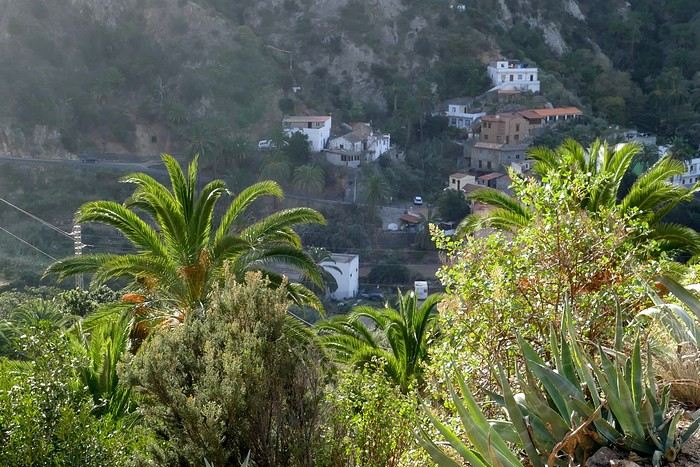 Vallehermoso
Friday, February 9 This morning, the sky was overcast, and the peaks around us were shrouded in clouds. We took the same road as yesterday to hike Las Creces. Quickly gaining altitude, we entered a thick fog—visibility was very limited. We stopped at the Las Creces parking lot; visibility improved, and the sun wasn’t far off. The hike is entirely within a beautiful laurel forest, with the sun playing hide-and-seek, but it wasn’t cold despite the altitude. After finishing the loop trail, we decided to picnic—not there, as it was too chilly—but on Vallehermoso’s beach, where we found a nice picnic area sheltered by large black rocks. A short digestive walk on the surrounding hill to admire the little beach from above. Back in Vallehermoso, we did some grocery shopping, then tried to return to the casa—only to find ourselves locked out because we’d left the key in the lock inside! After several attempts and with the help of Yéli, a relative of the owner we called for help, we were finally able to get back in!
Saturday, February 10
It rained last night, and the sky remained overcast. Monique decided to rest this morning. PP, Pat, and I set off on the hike that starts from the house toward the Marichal reservoir. The sun wasn’t far off, and by 11 AM, it was fully out. The pleasant hike passed by many flower-filled gardens and orchards—orange, lemon, and mandarin trees in fruit. The path climbed gently toward the reservoir, where the view of the Cano rock dominating the landscape was magnificent. The last part of the climb was a bit tough, overgrown with lush vegetation, and the trail was slippery from last night’s rain. We descended via a different, much more pleasant path and returned to the casa just in time for lunch, prepared by Monique. This valley is rich with its many farmers and market gardeners who’ve cultivated the entire valley, taking advantage of the water flowing down from the mountain, captured upstream and redistributed through countless pipes snaking along the paths. Numerous tanks also store water during dry periods. The houses are scattered across both sides of the valley, and these colorful little homes add a beautiful touch to the landscape. The many palm trees give this valley a distinctly tropical feel—you could almost imagine yourself in the Caribbean. Add to that some salsa music drifting from a hut where farmers were working, and the picture is complete. A well-chilled beer apéro capped off a lovely morning. The afternoon was dedicated to rest, relaxation, reading, and games.
Sunday, February 11 The blue sky returned, though a few clouds still capped the highest peaks. Today, we visited Garajonay National Park, which covers the highest central mountains. Up there, we were above the clouds, and the panoramas from the various viewpoints were stunning: first, Cherelepin, accessible from the Laguna Grande parking lot, then Alto de Garajonay, offering an exceptional view of Teide—over 3,000 meters high—emerging from the clouds on Tenerife, far in the distance. We continued to the Los Roques viewpoints, then stopped for lunch at the Degollada de Peraza restaurant, where the view of the barranco was impressive. We descended toward San Sebastián and checked into our new lodging, La Cabezada, located in the countryside about 3 km above San Sebastián. It’s a small apartment adjacent to the owner’s, with a lovely terrace overlooking the surrounding mountains and surrounded by a beautiful garden. Apéro, then dinner on our beautiful terrace.
Monday, February 12 This morning, we went down to visit San Sebastián de La Gomera: its old tower, main street with some beautiful traditional houses, and the Church of the Assumption. Back at the casa for lunch. In the afternoon, Pat, PP, and I set off on the short hike from San Sebastián beach to La Guancha beach. We drove down and parked on the beach. The path climbs along the hill overlooking San Sebastián, passes by the tall Christ statue dominating the landscape, and roughly follows the coast down to the isolated Guancha beach. A beautiful hike under a hot sun, and a swim was welcome, even if the beach and sea access weren’t very comfortable due to large pebbles and quickly deepening water. Apart from two nudist bathers, there was no one on this beach. We returned the same way.
Tuesday, February 13 Rest day. We went down to town to stroll and do some shopping. I took the opportunity to visit the parador, beautifully situated above the city in a lovely garden overlooking the port and town. Together, we went for a cuba libre at the "Cuba Libre" bar, then had lunch at Breñusca (mediocre paella!). Back at the casa, then we went back down to town to see a carnival parade, a "passacalles," which actually passed an hour earlier than scheduled. Oh well.
Wednesday, February 14 Each to their own program this morning. Pat went swimming at San Sebastián beach, Monique rested at the casa, and PP and I set off on the hike from Playa de Avalos to the Ermita de Guadalupe on Playa del Cangrejo. It wasn’t easy to find the right road or the parking spot, but we managed. The path seemed to have suffered landslides, according to a sign at the trailhead! We decided to check it out, ready to turn back if it seemed too dangerous. In the end, apart from one or two slightly tricky spots where we had to climb a pile of rocks, the trail remained passable, though a bit vertigo-inducing in places. The narrow path clings to very vertical cliffs nearly 300 meters above sea level! But what a magnificent view. At one point, the trail runs alongside a wall of basaltic pipes. We returned via the drivable track that parallels the trail a bit lower. Back at the house for lunch. In the late afternoon, we returned to town to attend the "Entierro de las Sardinas" (Burial of the Sardine), which closes the Canarian carnival festivities. While waiting, we strolled through the parador’s gardens and had mojitos in town. Around 9 PM, we heard the noise and cries of the mourners. The procession advanced, led by a large papier-mâché sardine on a float, surrounded by wailing mourners. The procession headed toward the sea, where the sardine was burned, and a mini fireworks display ended the procession. It was all very good-natured, and everyone had fun. We ended the evening with dinner at a good fish restaurant, El Pajar.
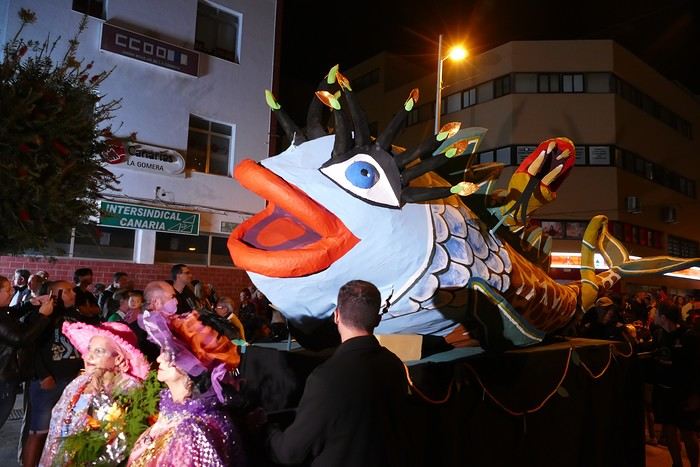 Entierro de la Sardina in San Sebastián de La Gomera
Thursday, February 15
Woke up at 5:15 AM. The only suitable ferry was at 7 AM, which would get us to La Palma by late morning rather than evening. We packed our bags, had breakfast, then headed to the port, left our rental car, and boarded the ferry to Tenerife, from where we’d continue to La Palma. Calm sea, beautiful sun—by 10:30 AM, we disembarked in La Palma. We picked up our car and immediately headed to our new apartment in Breña Alta. It’s a large apartment with a superb terrace facing the sea, fully equipped and very comfortable. The hosts recommended Casa Goyo restaurant, near the airport and close to us. It’s a restaurant with many small rooms, some of which can be reserved for families. The fish-based cuisine (chipirones, pulpo) was excellent, hearty, and reasonably priced. Since it’s in the airport’s flight path, we occasionally heard planes landing. Quick and efficient service. Afterward, we visited Santa Cruz de La Palma, which reminded us of the historic quarters of La Orotava in Tenerife or the capital of Gran Canaria.
Friday, February 16
Beautiful weather, blue sky. We headed to the San Bartolo viewpoint toward the northeast coast, then to the lovely village of San Andrés, which we explored. From there, we walked along the shore to the natural pools of Charco Azul, where we swam in the cool but "swimmable" sea. Back in San Andrés for lunch at the "San Andrés" restaurant on the beautiful church square. Very good fish-based meal. We got back in the car and continued along the north coast to the port of Espindola and the natural pools of Fajana near the Cumplida lighthouse. A fairly strong wind whipped up beautiful waves crashing onto the rocky coast in bursts of foam. Back in Santa Cruz, we stopped at the Mercadona supermarket to buy fresh shrimp for dinner.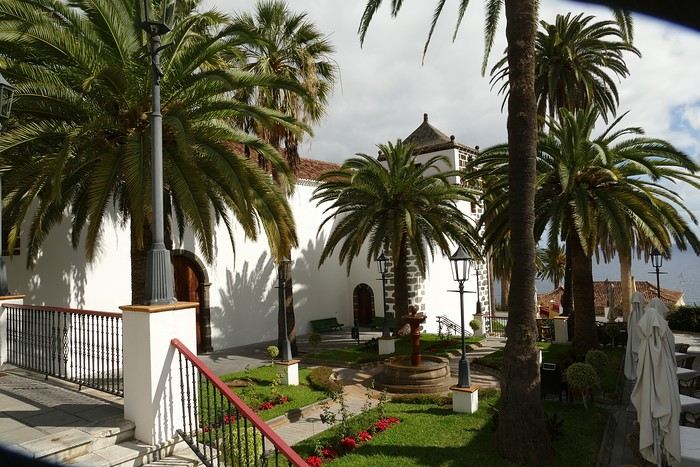 San Andrés
Saturday, February 17
Uniform blue sky, even on the heights. We took the beautiful road that winds up to the summit of the Caldera de Taburiente. Several viewpoints offer 360° views of the entire island and beyond: you can make out La Gomera, El Hierro, and, of course, Tenerife with the perfect triangle of Teide. We parked at the Los Andes viewpoint parking lot and started our hike to Pico de la Cruz along a trail following the ridge, offering superb views into the caldera. We got back in the car and passed by the Roque de los Muchachos astronomical complex, composed of numerous observatories, some with very aesthetic mirror telescopes. We hiked from the Roque de los Muchachos parking lot to the various viewpoints, always as impressive. Picnic on site, then back to Santa Cruz. We stopped by our car dealer because the oil warning light came on—better safe than sorry. The representative reassured us but preferred to give us a Fiat Cross SUV instead.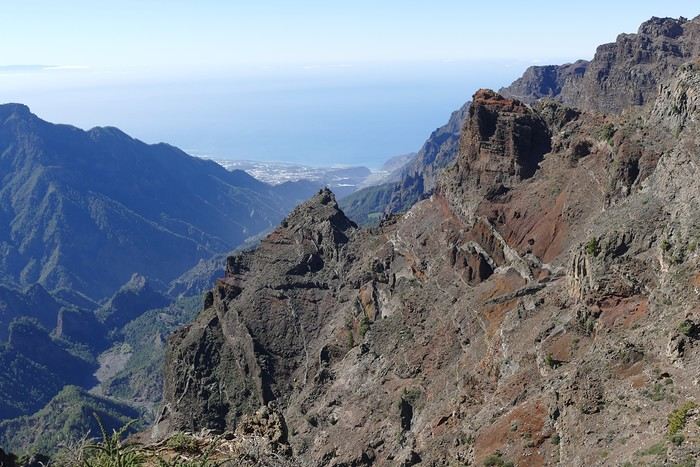 The Caldera de Taburiente
Sunday, February 18 The weather was a bit mixed, with cloudy patches. We set off to hike the Barranco de la Cuba de Galga. Unfortunately, the Los Tilos trail had been closed for several months due to a major landslide. The parking lot by the road was already quite full, and indeed, we crossed paths with many hikers along the way—it’s an easy hike with little elevation gain, which is rare here in La Palma! The beautiful path winds through a very narrow, deep gorge covered in lush tropical vegetation—you’d think you were in a Southeast Asian forest, especially with the humidity in the gorge bringing out earthy and floral scents. Halfway through, Monique turned back while the rest of us continued to the Cuba de Galga. A light drizzle accompanied us on the return. For lunch, we went to Chipi Chipi restaurant in the heights of Santa Cruz. The cool air forced us to leave the lovely terrace for the slightly noisy dining room. The meal was very good and hearty. Afternoon spent resting at our house.
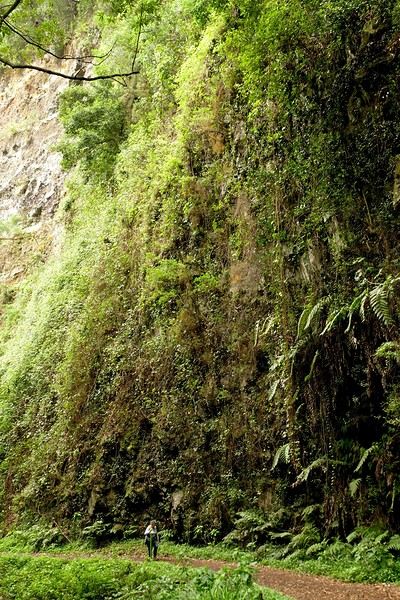 La Cuba de la Galga
Monday, February 19 A few clouds still clung to the nearby mountain peaks. We headed south to Los Canarios. We stopped in front of the small San Antonio Abad church, where a path leads to the viewpoint in 15 minutes. Then we visited the San Antonio Volcano Interpretation Center and climbed to the viewpoint via the trail along the crater’s edge, offering a plunging view into the crater. Then PP, Pat, and I headed toward the Teneguía volcano but turned back given the remaining distance and the intense heat bearing down on us! Plus, the landscape was rather arid and not very interesting. We got back in the car and drove down to the salt flats at the island’s southern tip. The ocean crashes here in large waves, exploding against the volcanic rocks and feeding a "blowhole" carved into the rock. We stopped for drinks at the salt flats restaurant, then headed home.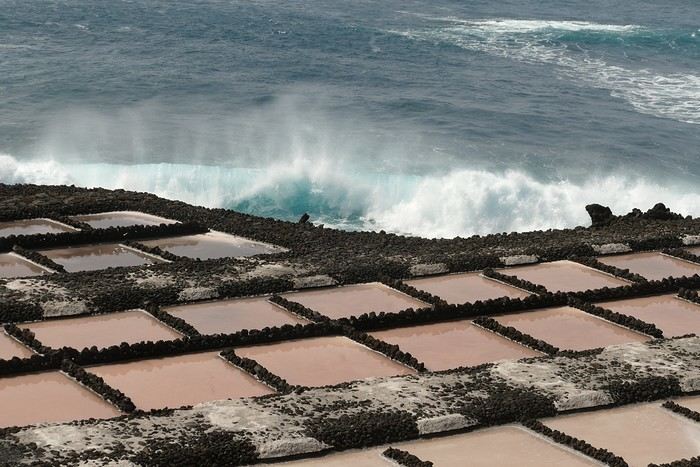 The salt flats in Fuencaliente
Tuesday, February 20 Beautiful weather with a few clouds clinging to the mountains, as usual. A relaxed morning since my parking reservation at La Cumbrecita didn’t start until 1 PM. It takes about 30 minutes from Santa Cruz to reach the valley floor via a beautiful but narrow road toward the end, though there’s very little traffic. Meanwhile, the clouds had disappeared, and the view from the La Cumbrecita viewpoint was superb. We recognized Pico de la Cruz in the distance, where we’d been a few days earlier. We then took the path leading to the Las Chozas viewpoint through a magnificent Canarian pine forest. We picnicked on site, then took the path to the Los Roques viewpoint. We returned the same way since the direct route was closed for construction. Back in Santa Cruz, we visited the Sanctuary of Las Nieves, with its beautiful golden Baroque altar.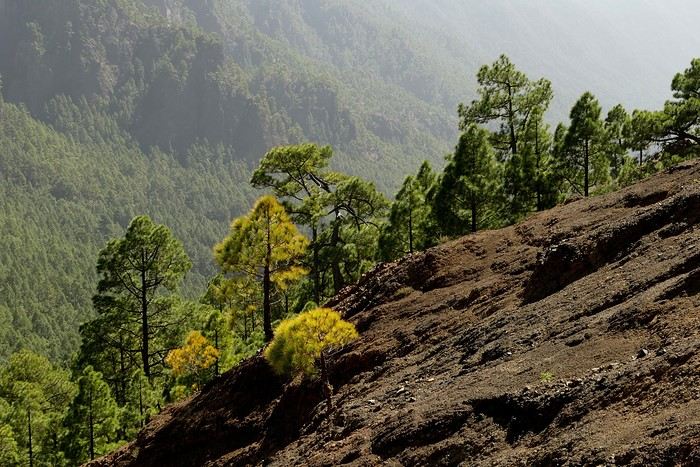 Hike from La Cumbrecita
Wednesday, February 21 After packing our things and loading the car, we left Santa Cruz under a very blue sky for Los Llanos de Aridane, where we stopped to visit this lovely town. The Church of Nuestra Señora de los Remedios has a beautiful coffered ceiling and an original papier-mâché Christ statue from the 16th century. Around it, colorful old Canarian houses brighten the streets of the town center. We took the opportunity to stroll, do some shopping, and finally sat down at La Pergola restaurant for a mediocre lunch. We got back in the car to check into our new house in Arecida. On the way, we stopped at the Mirador del Time, which once again offered an impressive panorama, allowing us—for the first time—to see the damage caused by the Tajogaite volcano eruption in 2021. You can clearly see the still-smoking crater and the large black lava flow covering the landscape down to the sea. We really liked our new accommodation: a local house that’s been renovated on the heights of Arecida, not far from the Canarian pine forest. From several terraces, we have a 360° view of the sea and mountains. We even have a private pool! There are two beautiful, brand-new bedrooms, each with its own bathroom—the best. Plus, we’re on the GR 131 trail that runs along the Barranco de las Angustias toward the northeast.
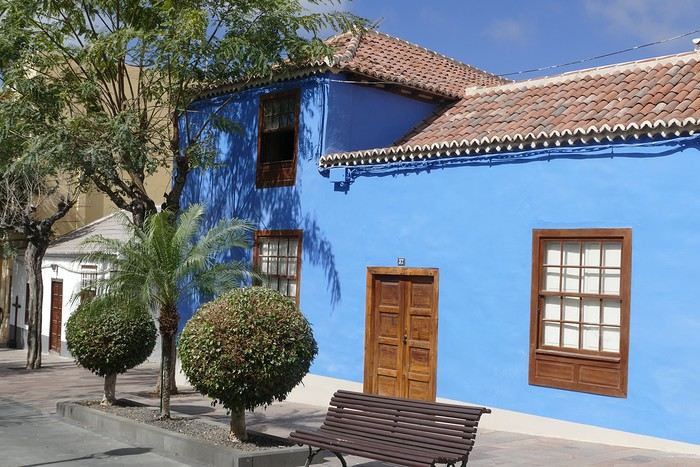 Los Llanos de Aridane
Thursday, February 22 Once again, beautiful weather greeted us when we woke up. We started the GR 131 with the goal of reaching the Torre del Time viewpoint—about 400 meters of elevation gain. The path, quite steep at first, winds through a superb Canarian pine forest. A few viewpoints let you appreciate the sheer drop of the Barranco de las Angustias—watch out for vertigo! At the Torre del Time viewpoint, there’s a nearly 1,000-meter vertical drop. We returned via another path, the PLP1, which meanders first through this beautiful forest, then along lovely flower-filled gardens adjacent to beautiful properties that cascade from the forest down to the road serving these neighborhoods. This afternoon, we tried to get closer to the area devastated by the 2021 lava flows. Several roads are still closed or reserved for residents, while others—brand new—have been rebuilt to open up this densely populated and cultivated region. In some places, the lava flow slightly diverted, sparing some properties that logically should have disappeared. Now, they’re encircled by a massive cooled lava field. In other spots, twisted and charred metal scraps or greenhouse remains protrude from the lava—all that’s left of the former banana plantations. A little higher up, you can see the slightly smoking crater of Tajogaite, responsible for this disaster. Back to Casa Barreros.
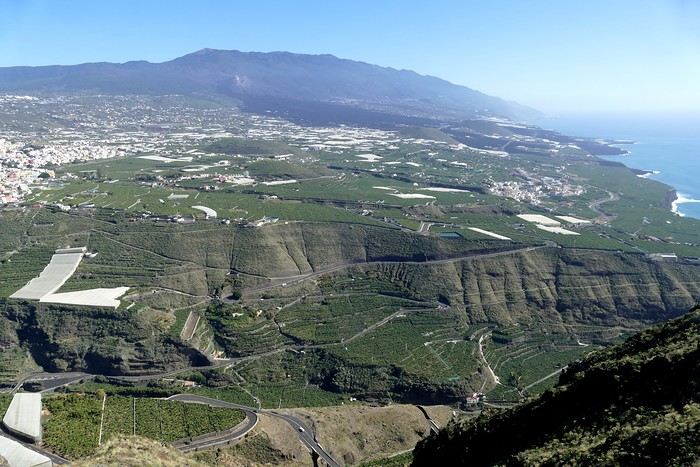 View of Los Llanos and, in the background, the 2021 lava flow
Friday, February 23
Though the sky was still blue, the temperature had dropped due to a chilly wind. By midday, it still rose to 22°C. Today, we headed north, specifically to the town of Tijarafe, where a very narrow road descends to the small port, Porís de Candelaria. The 3.7-kilometer road drops 700 meters in elevation, with gradients up to 30%—it was going to be intense! Indeed, the descent was scary, with the void right next to the very narrow road where passing was impossible except at a few rare spots. Everything went well—there was little traffic at this early hour. From the parking lot at the bottom, a path leads to Porís de Candelaria. It’s surprising to see this small fishing hamlet nestled in the shelter of an immense cave opening onto the sea, which was quite rough today. The sun, at this time of year, would appear late in the cave, which remained in shadow for much of the day. We returned via the same road, strolled through the small town of Puntagorda, and had lunch at El Jardín de los Naranjos restaurant—excellent meal.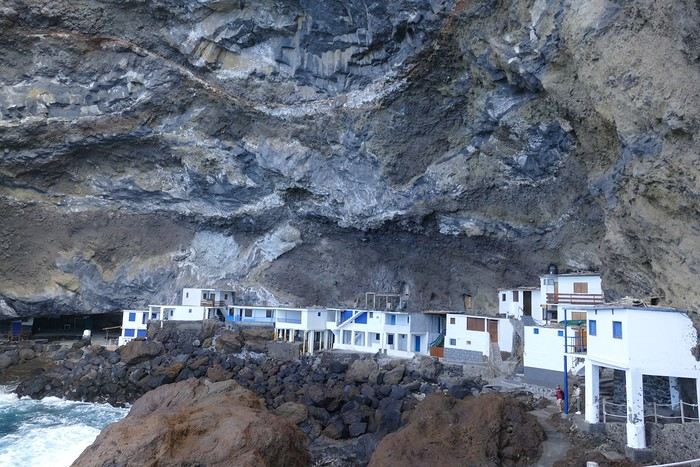 Fishing hamlet of Candelaria
Saturday, February 24 The air was still cool, but the sun was beautiful. While Monique stayed home to rest, the three of us headed to the village of Las Tricias to hike the Buracas Caves trail. We left the car parked on the LP1 road and took the small paved road down to the sign marking the trail’s start. The signage for all the trails we took here, as in La Gomera, was very well done. The path descended steadily, then more steeply toward the caves where the island’s first inhabitants lived—some petroglyphs are still visible in certain caves. The path then climbed back up, passing magnificent dragon trees and more or less elaborate huts occupied by Germans who’ve lived here for many years. Back at Casa Barreros for some rest.
Sunday, February 25 The weather once again blessed us with a beautiful day. This morning, we visited the local produce market held on weekends in Puntagorda. You’ll find agricultural products, crafts, and food to keep you going. A little further on, there’s a glass viewpoint overlooking the barranco plunging toward the sea, with a view of the thrill-seekers trying the zip line right next to it. Lunch at Naranjos—definitely a good spot—with their shrimp and spice tagliatelle. Back home for an afternoon of relaxation.
Monday, February 26 We left Arecida under a cloudy sky. Driving up from Los Llanos de Aridane toward the east, an enormous cascade of clouds poured from the mountain peaks into the Los Llanos plain—very impressive. Arriving in Santa Cruz, we went for a stroll, did some last-minute shopping, then had a final good-quality paella at La Chalana on the paseo maritimo. We left the car in the parking lot and took the 5 PM Olsen ferry to Tenerife on a slightly choppy sea, but the ferry didn’t rock too much. Arriving at 7:15 PM, we dropped off our things near the port in our reserved apartment and went for dinner at Abordo—rubbery chipirones. A digestive stroll among the ever-increasing number of tourists in Los Cristianos—restaurants were packed to the brim, the season is in full swing here. Gone is the calm of La Gomera and La Palma, and the laid-back tourism of German hikers among whom a few French were hiding!
Tuesday, February 27 To make our homemade breakfast more enjoyable, we went to buy pastries at the local bakery, then took one last walk on the paseo along the beaches, mingling with the many mobility scooters driven by elderly or disabled people, joggers, and tourists. Last apéro near the bus station, then off to the airport. After a smooth 4-hour-30-minute flight, we arrived in Basel-Mulhouse at 10:20 PM.
THE END
Conclusion A fantastic trip to two islands with magnificent and diverse nature, where landscapes range from desert-like to tropical depending on exposure to winds and clouds. Thanks to the many beautiful viewpoints, you can truly appreciate these exceptionally dynamic reliefs. A hiker’s paradise, the trails are all very well marked, though the choice of easy or moderate paths for "casual walkers" is quite limited. Another notable advantage, in our opinion, is that these islands are very lightly developed—you’ll hardly see any of those ugly hotel blocks that spoil the landscapes of some other Canary Islands. It’s true that the beaches on these two islands don’t meet traditional international tourism criteria: they’re small, with black sand, and often difficult to access. Special mention for the quality of the road network (except for a few small local roads), which seems brand new, well-paved, and well-signposted. We also enjoyed exceptional weather for February, with fewer than three days of gray or rainy weather out of 21.
Almost all the accommodations we chose met or exceeded our expectations, often at reasonable prices: an average of 98 € per night for an apartment or house with two bedrooms for four people.
All photos can be viewed by clicking this link: https://photos.app.goo.gl/G44pPk4g9PW1rNzg8
Tuesday, February 6 We left around 9 AM with our car, along with Pierre-Paul and Patricia, heading to the Bluepark parking lot in Bartenheim. As expected, we were awaited and left promptly for EuroAirport Basel. Took off at 12:25 PM for a 4-hour-15-minute flight under excellent conditions. Beautiful arrival in Tenerife with Teide in sight under a clear blue sky. Fifteen minutes later, we waited for bus No. 40 to Los Cristianos with quite a few other tourists, but we managed to find four seats. From the bus station, it was a 20-minute walk to our hotel. We checked into a lovely apartment for the four of us, complete with all the comforts. Outside, it was quite warm—at least 25°C! After dropping off our luggage, we went for a stroll. The immediate surroundings of the hotel held no interest for us: a modern, concrete area filled with hotels, bars, tourist agencies, and unappealing restaurants all offering the same bland international cuisine. Pat went to cool off at the pool, unfortunately overrun by loud, drunk English tourists. I took a walk to the paseo maritimo that leads to the port, skirting the seafront. The promenade was pleasant, but it could have been any seaside resort in the world—same old scene: a succession of bars with blaring music where many elderly people sipped cold beers waiting for the sunset, the backdrop a wall of resort-style hotels resembling rabbit hutches! Upon reaching the port, I scouted the route we’d take the next day to the Fred Olsen ferry. Back at the apartment, in the early evening, we looked for a non-touristy restaurant for dinner. Monique stopped a woman to ask her opinion! In this area, she told us, there’s no restaurant that serves Canarian or Spanish cuisine! The only place with decent restaurants is at the port. Off we went to the port, where we sat down at Al Bordo restaurant and ordered a seafood paella for four. Excellent, and at a very reasonable price (36 € for two). We returned to the hotel along the seafront.
Wednesday, February 7
Woke up at 6 AM. Had breakfast in the apartment with what we’d bought the day before at a supermarket. It was still dark when we left on foot toward the port, walking along the calm seafront at this early hour. Forty minutes later, we arrived and waited 10 minutes before the ferry docked. At 9:30 AM, we left the port of Los Cristianos for a 50-minute crossing on a calm sea under a beautiful blue sky. There were quite a few people on this large ferry, but many had no luggage, meaning they were visiting La Gomera for the day and would take the ferry back in the evening. Upon disembarking, we went straight to our rental car agency to pick up the car we’d booked online a few months earlier. It was a nice Peugeot 2008, spacious enough for the four of us and our luggage. We immediately took the beautiful road from San Sebastián that climbs directly into the mountains toward our rental in Vallehermoso. The road was in perfect condition—it seemed brand new, like all the others we’d take on this island later. This side of the island is very arid with little vegetation, and the terrain is particularly rugged, as it is throughout the island. We stopped at our first miradors, which would be followed by many more throughout our Canarian trip. Our first visit was to the small village of Agulo, perched on a promontory above the sea and at the foot of a high cliff. The village features typical Canarian houses with windows flush with the façade and black volcanic stone masonry on white or reddish-brown walls. The first recommended restaurant was already booked for a group, so we settled for the shaded terrace of the excellent El Alameda bar-restaurant. From Agulo, you can access the Abrante viewpoint via a winding road, where the view of Agulo, 600 meters below, is exceptional. A glass ledge over the void lets you test your fear of heights!
We drove to Vallehermoso to do our grocery shopping at the supermarket—a habit that would continue until the end of the trip. Our little house, "Casa rural El Encatadora," is located in a beautiful flower-filled valley a few kilometers west of Vallehermoso. Each of us had a bedroom with an en-suite bathroom, plus a living room, kitchen, and a small terrace overlooking the quiet street at the valley’s end, which didn’t bother us at all.
Thursday, February 8 The good weather seemed to follow us since our arrival in the Canary Islands. This morning, we took the road—still as beautiful and new—toward Arure, high up to the west. The landscape was magnificent, with breathtaking glimpses of the sea far below. In Arure, we parked in front of Conchita’s bar, where a hike (Rother No. 30) starts toward two viewpoints: Alojera, which we reached after 45 minutes on a lovely path. Monique, tired from the first steep climb, stopped at the first viewpoint and hitchhiked back to Arure. Meanwhile, we continued toward the second viewpoint, Los Barranquillos, where the view of the surroundings was partially hidden by misty clouds rising from the sea. The entire mountain is sculpted by ancient, endless terraces climbing until the slope becomes too steep for construction—visible traces of the hard work of past inhabitants trying to survive in a harsh environment. We had a decent lunch at La Conchita bar, then drove to the small seaside town of Puerto la Caleta, sheltered by an immense cliff plunging into the sea. Black sand beach, rough sea—despite our encouragement, Pat didn’t dare to swim! As for the old village of Caleta, it’s perched on the mountainside, and visiting it requires climbing steep, stair-filled alleys to discover a few traditional houses. Back at the casa, dinner in, and card games...
VallehermosoFriday, February 9 This morning, the sky was overcast, and the peaks around us were shrouded in clouds. We took the same road as yesterday to hike Las Creces. Quickly gaining altitude, we entered a thick fog—visibility was very limited. We stopped at the Las Creces parking lot; visibility improved, and the sun wasn’t far off. The hike is entirely within a beautiful laurel forest, with the sun playing hide-and-seek, but it wasn’t cold despite the altitude. After finishing the loop trail, we decided to picnic—not there, as it was too chilly—but on Vallehermoso’s beach, where we found a nice picnic area sheltered by large black rocks. A short digestive walk on the surrounding hill to admire the little beach from above. Back in Vallehermoso, we did some grocery shopping, then tried to return to the casa—only to find ourselves locked out because we’d left the key in the lock inside! After several attempts and with the help of Yéli, a relative of the owner we called for help, we were finally able to get back in!
Saturday, February 10
It rained last night, and the sky remained overcast. Monique decided to rest this morning. PP, Pat, and I set off on the hike that starts from the house toward the Marichal reservoir. The sun wasn’t far off, and by 11 AM, it was fully out. The pleasant hike passed by many flower-filled gardens and orchards—orange, lemon, and mandarin trees in fruit. The path climbed gently toward the reservoir, where the view of the Cano rock dominating the landscape was magnificent. The last part of the climb was a bit tough, overgrown with lush vegetation, and the trail was slippery from last night’s rain. We descended via a different, much more pleasant path and returned to the casa just in time for lunch, prepared by Monique. This valley is rich with its many farmers and market gardeners who’ve cultivated the entire valley, taking advantage of the water flowing down from the mountain, captured upstream and redistributed through countless pipes snaking along the paths. Numerous tanks also store water during dry periods. The houses are scattered across both sides of the valley, and these colorful little homes add a beautiful touch to the landscape. The many palm trees give this valley a distinctly tropical feel—you could almost imagine yourself in the Caribbean. Add to that some salsa music drifting from a hut where farmers were working, and the picture is complete. A well-chilled beer apéro capped off a lovely morning. The afternoon was dedicated to rest, relaxation, reading, and games.
Sunday, February 11 The blue sky returned, though a few clouds still capped the highest peaks. Today, we visited Garajonay National Park, which covers the highest central mountains. Up there, we were above the clouds, and the panoramas from the various viewpoints were stunning: first, Cherelepin, accessible from the Laguna Grande parking lot, then Alto de Garajonay, offering an exceptional view of Teide—over 3,000 meters high—emerging from the clouds on Tenerife, far in the distance. We continued to the Los Roques viewpoints, then stopped for lunch at the Degollada de Peraza restaurant, where the view of the barranco was impressive. We descended toward San Sebastián and checked into our new lodging, La Cabezada, located in the countryside about 3 km above San Sebastián. It’s a small apartment adjacent to the owner’s, with a lovely terrace overlooking the surrounding mountains and surrounded by a beautiful garden. Apéro, then dinner on our beautiful terrace.
Monday, February 12 This morning, we went down to visit San Sebastián de La Gomera: its old tower, main street with some beautiful traditional houses, and the Church of the Assumption. Back at the casa for lunch. In the afternoon, Pat, PP, and I set off on the short hike from San Sebastián beach to La Guancha beach. We drove down and parked on the beach. The path climbs along the hill overlooking San Sebastián, passes by the tall Christ statue dominating the landscape, and roughly follows the coast down to the isolated Guancha beach. A beautiful hike under a hot sun, and a swim was welcome, even if the beach and sea access weren’t very comfortable due to large pebbles and quickly deepening water. Apart from two nudist bathers, there was no one on this beach. We returned the same way.
Tuesday, February 13 Rest day. We went down to town to stroll and do some shopping. I took the opportunity to visit the parador, beautifully situated above the city in a lovely garden overlooking the port and town. Together, we went for a cuba libre at the "Cuba Libre" bar, then had lunch at Breñusca (mediocre paella!). Back at the casa, then we went back down to town to see a carnival parade, a "passacalles," which actually passed an hour earlier than scheduled. Oh well.
Wednesday, February 14 Each to their own program this morning. Pat went swimming at San Sebastián beach, Monique rested at the casa, and PP and I set off on the hike from Playa de Avalos to the Ermita de Guadalupe on Playa del Cangrejo. It wasn’t easy to find the right road or the parking spot, but we managed. The path seemed to have suffered landslides, according to a sign at the trailhead! We decided to check it out, ready to turn back if it seemed too dangerous. In the end, apart from one or two slightly tricky spots where we had to climb a pile of rocks, the trail remained passable, though a bit vertigo-inducing in places. The narrow path clings to very vertical cliffs nearly 300 meters above sea level! But what a magnificent view. At one point, the trail runs alongside a wall of basaltic pipes. We returned via the drivable track that parallels the trail a bit lower. Back at the house for lunch. In the late afternoon, we returned to town to attend the "Entierro de las Sardinas" (Burial of the Sardine), which closes the Canarian carnival festivities. While waiting, we strolled through the parador’s gardens and had mojitos in town. Around 9 PM, we heard the noise and cries of the mourners. The procession advanced, led by a large papier-mâché sardine on a float, surrounded by wailing mourners. The procession headed toward the sea, where the sardine was burned, and a mini fireworks display ended the procession. It was all very good-natured, and everyone had fun. We ended the evening with dinner at a good fish restaurant, El Pajar.
Entierro de la Sardina in San Sebastián de La GomeraThursday, February 15
Woke up at 5:15 AM. The only suitable ferry was at 7 AM, which would get us to La Palma by late morning rather than evening. We packed our bags, had breakfast, then headed to the port, left our rental car, and boarded the ferry to Tenerife, from where we’d continue to La Palma. Calm sea, beautiful sun—by 10:30 AM, we disembarked in La Palma. We picked up our car and immediately headed to our new apartment in Breña Alta. It’s a large apartment with a superb terrace facing the sea, fully equipped and very comfortable. The hosts recommended Casa Goyo restaurant, near the airport and close to us. It’s a restaurant with many small rooms, some of which can be reserved for families. The fish-based cuisine (chipirones, pulpo) was excellent, hearty, and reasonably priced. Since it’s in the airport’s flight path, we occasionally heard planes landing. Quick and efficient service. Afterward, we visited Santa Cruz de La Palma, which reminded us of the historic quarters of La Orotava in Tenerife or the capital of Gran Canaria.
Friday, February 16
Beautiful weather, blue sky. We headed to the San Bartolo viewpoint toward the northeast coast, then to the lovely village of San Andrés, which we explored. From there, we walked along the shore to the natural pools of Charco Azul, where we swam in the cool but "swimmable" sea. Back in San Andrés for lunch at the "San Andrés" restaurant on the beautiful church square. Very good fish-based meal. We got back in the car and continued along the north coast to the port of Espindola and the natural pools of Fajana near the Cumplida lighthouse. A fairly strong wind whipped up beautiful waves crashing onto the rocky coast in bursts of foam. Back in Santa Cruz, we stopped at the Mercadona supermarket to buy fresh shrimp for dinner.
San AndrésSaturday, February 17
Uniform blue sky, even on the heights. We took the beautiful road that winds up to the summit of the Caldera de Taburiente. Several viewpoints offer 360° views of the entire island and beyond: you can make out La Gomera, El Hierro, and, of course, Tenerife with the perfect triangle of Teide. We parked at the Los Andes viewpoint parking lot and started our hike to Pico de la Cruz along a trail following the ridge, offering superb views into the caldera. We got back in the car and passed by the Roque de los Muchachos astronomical complex, composed of numerous observatories, some with very aesthetic mirror telescopes. We hiked from the Roque de los Muchachos parking lot to the various viewpoints, always as impressive. Picnic on site, then back to Santa Cruz. We stopped by our car dealer because the oil warning light came on—better safe than sorry. The representative reassured us but preferred to give us a Fiat Cross SUV instead.
The Caldera de TaburienteSunday, February 18 The weather was a bit mixed, with cloudy patches. We set off to hike the Barranco de la Cuba de Galga. Unfortunately, the Los Tilos trail had been closed for several months due to a major landslide. The parking lot by the road was already quite full, and indeed, we crossed paths with many hikers along the way—it’s an easy hike with little elevation gain, which is rare here in La Palma! The beautiful path winds through a very narrow, deep gorge covered in lush tropical vegetation—you’d think you were in a Southeast Asian forest, especially with the humidity in the gorge bringing out earthy and floral scents. Halfway through, Monique turned back while the rest of us continued to the Cuba de Galga. A light drizzle accompanied us on the return. For lunch, we went to Chipi Chipi restaurant in the heights of Santa Cruz. The cool air forced us to leave the lovely terrace for the slightly noisy dining room. The meal was very good and hearty. Afternoon spent resting at our house.
La Cuba de la GalgaMonday, February 19 A few clouds still clung to the nearby mountain peaks. We headed south to Los Canarios. We stopped in front of the small San Antonio Abad church, where a path leads to the viewpoint in 15 minutes. Then we visited the San Antonio Volcano Interpretation Center and climbed to the viewpoint via the trail along the crater’s edge, offering a plunging view into the crater. Then PP, Pat, and I headed toward the Teneguía volcano but turned back given the remaining distance and the intense heat bearing down on us! Plus, the landscape was rather arid and not very interesting. We got back in the car and drove down to the salt flats at the island’s southern tip. The ocean crashes here in large waves, exploding against the volcanic rocks and feeding a "blowhole" carved into the rock. We stopped for drinks at the salt flats restaurant, then headed home.
The salt flats in FuencalienteTuesday, February 20 Beautiful weather with a few clouds clinging to the mountains, as usual. A relaxed morning since my parking reservation at La Cumbrecita didn’t start until 1 PM. It takes about 30 minutes from Santa Cruz to reach the valley floor via a beautiful but narrow road toward the end, though there’s very little traffic. Meanwhile, the clouds had disappeared, and the view from the La Cumbrecita viewpoint was superb. We recognized Pico de la Cruz in the distance, where we’d been a few days earlier. We then took the path leading to the Las Chozas viewpoint through a magnificent Canarian pine forest. We picnicked on site, then took the path to the Los Roques viewpoint. We returned the same way since the direct route was closed for construction. Back in Santa Cruz, we visited the Sanctuary of Las Nieves, with its beautiful golden Baroque altar.
Hike from La CumbrecitaWednesday, February 21 After packing our things and loading the car, we left Santa Cruz under a very blue sky for Los Llanos de Aridane, where we stopped to visit this lovely town. The Church of Nuestra Señora de los Remedios has a beautiful coffered ceiling and an original papier-mâché Christ statue from the 16th century. Around it, colorful old Canarian houses brighten the streets of the town center. We took the opportunity to stroll, do some shopping, and finally sat down at La Pergola restaurant for a mediocre lunch. We got back in the car to check into our new house in Arecida. On the way, we stopped at the Mirador del Time, which once again offered an impressive panorama, allowing us—for the first time—to see the damage caused by the Tajogaite volcano eruption in 2021. You can clearly see the still-smoking crater and the large black lava flow covering the landscape down to the sea. We really liked our new accommodation: a local house that’s been renovated on the heights of Arecida, not far from the Canarian pine forest. From several terraces, we have a 360° view of the sea and mountains. We even have a private pool! There are two beautiful, brand-new bedrooms, each with its own bathroom—the best. Plus, we’re on the GR 131 trail that runs along the Barranco de las Angustias toward the northeast.
Los Llanos de AridaneThursday, February 22 Once again, beautiful weather greeted us when we woke up. We started the GR 131 with the goal of reaching the Torre del Time viewpoint—about 400 meters of elevation gain. The path, quite steep at first, winds through a superb Canarian pine forest. A few viewpoints let you appreciate the sheer drop of the Barranco de las Angustias—watch out for vertigo! At the Torre del Time viewpoint, there’s a nearly 1,000-meter vertical drop. We returned via another path, the PLP1, which meanders first through this beautiful forest, then along lovely flower-filled gardens adjacent to beautiful properties that cascade from the forest down to the road serving these neighborhoods. This afternoon, we tried to get closer to the area devastated by the 2021 lava flows. Several roads are still closed or reserved for residents, while others—brand new—have been rebuilt to open up this densely populated and cultivated region. In some places, the lava flow slightly diverted, sparing some properties that logically should have disappeared. Now, they’re encircled by a massive cooled lava field. In other spots, twisted and charred metal scraps or greenhouse remains protrude from the lava—all that’s left of the former banana plantations. A little higher up, you can see the slightly smoking crater of Tajogaite, responsible for this disaster. Back to Casa Barreros.
View of Los Llanos and, in the background, the 2021 lava flowFriday, February 23
Though the sky was still blue, the temperature had dropped due to a chilly wind. By midday, it still rose to 22°C. Today, we headed north, specifically to the town of Tijarafe, where a very narrow road descends to the small port, Porís de Candelaria. The 3.7-kilometer road drops 700 meters in elevation, with gradients up to 30%—it was going to be intense! Indeed, the descent was scary, with the void right next to the very narrow road where passing was impossible except at a few rare spots. Everything went well—there was little traffic at this early hour. From the parking lot at the bottom, a path leads to Porís de Candelaria. It’s surprising to see this small fishing hamlet nestled in the shelter of an immense cave opening onto the sea, which was quite rough today. The sun, at this time of year, would appear late in the cave, which remained in shadow for much of the day. We returned via the same road, strolled through the small town of Puntagorda, and had lunch at El Jardín de los Naranjos restaurant—excellent meal.
Fishing hamlet of CandelariaSaturday, February 24 The air was still cool, but the sun was beautiful. While Monique stayed home to rest, the three of us headed to the village of Las Tricias to hike the Buracas Caves trail. We left the car parked on the LP1 road and took the small paved road down to the sign marking the trail’s start. The signage for all the trails we took here, as in La Gomera, was very well done. The path descended steadily, then more steeply toward the caves where the island’s first inhabitants lived—some petroglyphs are still visible in certain caves. The path then climbed back up, passing magnificent dragon trees and more or less elaborate huts occupied by Germans who’ve lived here for many years. Back at Casa Barreros for some rest.
Sunday, February 25 The weather once again blessed us with a beautiful day. This morning, we visited the local produce market held on weekends in Puntagorda. You’ll find agricultural products, crafts, and food to keep you going. A little further on, there’s a glass viewpoint overlooking the barranco plunging toward the sea, with a view of the thrill-seekers trying the zip line right next to it. Lunch at Naranjos—definitely a good spot—with their shrimp and spice tagliatelle. Back home for an afternoon of relaxation.
Monday, February 26 We left Arecida under a cloudy sky. Driving up from Los Llanos de Aridane toward the east, an enormous cascade of clouds poured from the mountain peaks into the Los Llanos plain—very impressive. Arriving in Santa Cruz, we went for a stroll, did some last-minute shopping, then had a final good-quality paella at La Chalana on the paseo maritimo. We left the car in the parking lot and took the 5 PM Olsen ferry to Tenerife on a slightly choppy sea, but the ferry didn’t rock too much. Arriving at 7:15 PM, we dropped off our things near the port in our reserved apartment and went for dinner at Abordo—rubbery chipirones. A digestive stroll among the ever-increasing number of tourists in Los Cristianos—restaurants were packed to the brim, the season is in full swing here. Gone is the calm of La Gomera and La Palma, and the laid-back tourism of German hikers among whom a few French were hiding!
Tuesday, February 27 To make our homemade breakfast more enjoyable, we went to buy pastries at the local bakery, then took one last walk on the paseo along the beaches, mingling with the many mobility scooters driven by elderly or disabled people, joggers, and tourists. Last apéro near the bus station, then off to the airport. After a smooth 4-hour-30-minute flight, we arrived in Basel-Mulhouse at 10:20 PM.
THE END
Conclusion A fantastic trip to two islands with magnificent and diverse nature, where landscapes range from desert-like to tropical depending on exposure to winds and clouds. Thanks to the many beautiful viewpoints, you can truly appreciate these exceptionally dynamic reliefs. A hiker’s paradise, the trails are all very well marked, though the choice of easy or moderate paths for "casual walkers" is quite limited. Another notable advantage, in our opinion, is that these islands are very lightly developed—you’ll hardly see any of those ugly hotel blocks that spoil the landscapes of some other Canary Islands. It’s true that the beaches on these two islands don’t meet traditional international tourism criteria: they’re small, with black sand, and often difficult to access. Special mention for the quality of the road network (except for a few small local roads), which seems brand new, well-paved, and well-signposted. We also enjoyed exceptional weather for February, with fewer than three days of gray or rainy weather out of 21.
Almost all the accommodations we chose met or exceeded our expectations, often at reasonable prices: an average of 98 € per night for an apartment or house with two bedrooms for four people.
All photos can be viewed by clicking this link: https://photos.app.goo.gl/G44pPk4g9PW1rNzg8
Andalusia with family (and two families) by car, late April 2019
Hi everyone,
Just back from two weeks in Andalusia, and I wanted to share this experience with you—maybe it’ll help with planning a trip. I’ll start with a quick recap in this post and try to add photos and day-by-day details later (still sorting through them). Hope I don’t bore you too much! 😎
Trip details:
April 20 to May 4, 2019:
7 days on the Costa de la Luz (El Puerto de Santa María) in an Airbnb,
4 days at the junction of the Costa del Sol and Costa Tropical (Salobreña) in an Airbnb,
3 days at Cabo de Gata for some rest at a campsite in Los Escullos.
Two families of four, each with our own car: three 9-year-old boys and a 6-year-old girl. One family was more into city exploration (not us, but we’re working on it), and the other preferred relaxation and nature (that’s us). We speak a little Spanish.
Over 5,000 km, including 2,500 km for the round trip from Carcassonne.
The weather: Variable, but we expected better for this region in late April. The first week on the Costa de la Luz was sometimes chilly (< 20°C), and the second week was warmer but not excessive (< 25°C). At least we didn’t get much rain!
Our budget: Around 2600 € per family:
700 € for accommodations, about 50 € per night,
1000 € for meals and restaurants. We usually spent around 50 € per family at restaurants—we ate out for lunch (except for 2–3 picnics) and cooked at home in the evenings, trying to be back by 6 PM.
600 € for activities: Río Tinto, a flamenco show, visits to the Alhambra, Giralda, and Alcázar, Oasis Park with meals, and a kayaking trip.
300 € for gas and tolls.
Preparation: A few months ahead with bookings for accommodations and tickets for the Alhambra, Giralda, and Alcázar. We used a few travel guides—I like the *Évasion* guide for initial planning. *Géoguide* was okay, but our friends’ *Routard* was the most useful. We also spent three months brushing up on Spanish with Mosalingua (a great spaced-repetition method, max 10 minutes a day). Downloaded Maps.me and the Andalusia map in advance—essential. And we used Tricount to track shared expenses with friends—super handy.
What we did/saw:
3 city visits (Seville, Granada, and Cádiz) + Málaga for our friends (we vetoed Córdoba—too many cities for us).
4 white villages (Vejer de la Frontera, Arcos de la Frontera, Grazalema, Ronda) + Tarifa for our friends.
Beaches (Tarifa and Bolonia, Matalascañas, Nerja, Cabo de Gata).
Nature and fun moments: Doñana National Park, a kayaking trip along the rocky coast near Nerja, and the Wild West/animal park in the Tabernas Desert.
A little culture: Río Tinto mines, the archaeological site of Itálica, Columbus’s caravels, Nerja Cave for us, and the Picasso Museum in Málaga for our friends. Plus, seeing the ham-drying process in the Alpujarras (for our friends).
Our highlights
Nerja and the surrounding villages: The rocky coast was amazing, and we loved the kayaking trip, even if the water was freezing for snorkeling. The beaches are sheltered from the wind, the town is charming, and the cave is incredible.
El Rocío and Doñana National Park. El Rocío has a timeless, almost Wild West vibe—we could’ve stayed a day or two. The quiet and pine scents reminded us of the Landes region.
What we didn’t love as much:
Río Tinto mines: Not super exciting, and the guides’ nonstop chatter kind of ruined the "nature" experience.
Our little regrets (for next time):
Forgetting our passports and missing a day trip to Tangier from Tarifa.
Not having an extra day around Nerja to go snowboarding in the Sierra Nevada—just 1.5 hours away (the kayak guide suggested it).
Not spending at least one night in El Rocío to explore Doñana National Park at dawn.
Antequera with the Guadalhorce reservoir and the Caminito del Rey (but it would’ve meant 2 more hours of driving, and we didn’t have the energy).
My general impressions of Andalusia and Spain
Landscapes: A feeling of extreme concentration of a single activity in some areas—endless olive groves, wind farms on the Costa de la Luz (which I thought were well-integrated), rows of buildings along the Costa del Sol (yikes, glad we didn’t stop there), greenhouses around Almería (a shame to have frozen the coast for so many kilometers), and the massive industrial port of Huelva.
What surprised us compared to France was the lack of small hamlets—villages are clearly defined, and people cluster there, leaving vast landscapes without human presence. In France, you find houses scattered everywhere.
Roads: Relatively few tolls. Sure, rest areas aren’t as nice as in France, but the roads are in good condition, and our wallet was happy. The roads are pretty straight with countless bridges and tunnels—the upside (besides fast travel) is that there aren’t many secondary roads disrupting the scenery.
Tourism and activities: A huge variety and richness. Feels like everyone can find something they like, and 15 days barely scratched the surface. It’s amazing how quickly you go from the coast to snow-capped peaks (Sierra Nevada) or from farmland to desert (Tabernas). And the mix of European and Arabic architecture in the same city is really special.
One small regret: Not interacting more with locals. We didn’t luck out with our Airbnbs. But shopkeepers were great—very patient with my broken Spanish! :-)
Overall, I think our choice to stay on the Costa de la Luz and then near Nerja worked well. We could explore pretty easily (even if we logged a lot of kilometers), and the settings were fantastic. The 3 days of total relaxation at Cabo de Gata were perfect.
If you prefer shorter stops, you could try staying in El Rocío (easy access to Seville and great for an early visit to Doñana National Park) or maybe Grazalema for a hike in the mountains (weather-dependent). And of course, Tarifa for a day trip to Tangier or Gibraltar.
More details and photos to come soon!
Laurent
Just back from two weeks in Andalusia, and I wanted to share this experience with you—maybe it’ll help with planning a trip. I’ll start with a quick recap in this post and try to add photos and day-by-day details later (still sorting through them). Hope I don’t bore you too much! 😎
Trip details:
April 20 to May 4, 2019:
7 days on the Costa de la Luz (El Puerto de Santa María) in an Airbnb,
4 days at the junction of the Costa del Sol and Costa Tropical (Salobreña) in an Airbnb,
3 days at Cabo de Gata for some rest at a campsite in Los Escullos.
Two families of four, each with our own car: three 9-year-old boys and a 6-year-old girl. One family was more into city exploration (not us, but we’re working on it), and the other preferred relaxation and nature (that’s us). We speak a little Spanish.
Over 5,000 km, including 2,500 km for the round trip from Carcassonne.
The weather: Variable, but we expected better for this region in late April. The first week on the Costa de la Luz was sometimes chilly (< 20°C), and the second week was warmer but not excessive (< 25°C). At least we didn’t get much rain!
Our budget: Around 2600 € per family:
700 € for accommodations, about 50 € per night,
1000 € for meals and restaurants. We usually spent around 50 € per family at restaurants—we ate out for lunch (except for 2–3 picnics) and cooked at home in the evenings, trying to be back by 6 PM.
600 € for activities: Río Tinto, a flamenco show, visits to the Alhambra, Giralda, and Alcázar, Oasis Park with meals, and a kayaking trip.
300 € for gas and tolls.
Preparation: A few months ahead with bookings for accommodations and tickets for the Alhambra, Giralda, and Alcázar. We used a few travel guides—I like the *Évasion* guide for initial planning. *Géoguide* was okay, but our friends’ *Routard* was the most useful. We also spent three months brushing up on Spanish with Mosalingua (a great spaced-repetition method, max 10 minutes a day). Downloaded Maps.me and the Andalusia map in advance—essential. And we used Tricount to track shared expenses with friends—super handy.
What we did/saw:
3 city visits (Seville, Granada, and Cádiz) + Málaga for our friends (we vetoed Córdoba—too many cities for us).
4 white villages (Vejer de la Frontera, Arcos de la Frontera, Grazalema, Ronda) + Tarifa for our friends.
Beaches (Tarifa and Bolonia, Matalascañas, Nerja, Cabo de Gata).
Nature and fun moments: Doñana National Park, a kayaking trip along the rocky coast near Nerja, and the Wild West/animal park in the Tabernas Desert.
A little culture: Río Tinto mines, the archaeological site of Itálica, Columbus’s caravels, Nerja Cave for us, and the Picasso Museum in Málaga for our friends. Plus, seeing the ham-drying process in the Alpujarras (for our friends).
Our highlights
Nerja and the surrounding villages: The rocky coast was amazing, and we loved the kayaking trip, even if the water was freezing for snorkeling. The beaches are sheltered from the wind, the town is charming, and the cave is incredible.
El Rocío and Doñana National Park. El Rocío has a timeless, almost Wild West vibe—we could’ve stayed a day or two. The quiet and pine scents reminded us of the Landes region.
What we didn’t love as much:
Río Tinto mines: Not super exciting, and the guides’ nonstop chatter kind of ruined the "nature" experience.
Our little regrets (for next time):
Forgetting our passports and missing a day trip to Tangier from Tarifa.
Not having an extra day around Nerja to go snowboarding in the Sierra Nevada—just 1.5 hours away (the kayak guide suggested it).
Not spending at least one night in El Rocío to explore Doñana National Park at dawn.
Antequera with the Guadalhorce reservoir and the Caminito del Rey (but it would’ve meant 2 more hours of driving, and we didn’t have the energy).
My general impressions of Andalusia and Spain
Landscapes: A feeling of extreme concentration of a single activity in some areas—endless olive groves, wind farms on the Costa de la Luz (which I thought were well-integrated), rows of buildings along the Costa del Sol (yikes, glad we didn’t stop there), greenhouses around Almería (a shame to have frozen the coast for so many kilometers), and the massive industrial port of Huelva.
What surprised us compared to France was the lack of small hamlets—villages are clearly defined, and people cluster there, leaving vast landscapes without human presence. In France, you find houses scattered everywhere.
Roads: Relatively few tolls. Sure, rest areas aren’t as nice as in France, but the roads are in good condition, and our wallet was happy. The roads are pretty straight with countless bridges and tunnels—the upside (besides fast travel) is that there aren’t many secondary roads disrupting the scenery.
Tourism and activities: A huge variety and richness. Feels like everyone can find something they like, and 15 days barely scratched the surface. It’s amazing how quickly you go from the coast to snow-capped peaks (Sierra Nevada) or from farmland to desert (Tabernas). And the mix of European and Arabic architecture in the same city is really special.
One small regret: Not interacting more with locals. We didn’t luck out with our Airbnbs. But shopkeepers were great—very patient with my broken Spanish! :-)
Overall, I think our choice to stay on the Costa de la Luz and then near Nerja worked well. We could explore pretty easily (even if we logged a lot of kilometers), and the settings were fantastic. The 3 days of total relaxation at Cabo de Gata were perfect.
If you prefer shorter stops, you could try staying in El Rocío (easy access to Seville and great for an early visit to Doñana National Park) or maybe Grazalema for a hike in the mountains (weather-dependent). And of course, Tarifa for a day trip to Tangier or Gibraltar.
More details and photos to come soon!
Laurent
Après Ténérife et Lanzarote, faire Fuerteventura ou Gran Canaria? English translation pending
Bonsoir,
Ca fait des semaines et des semaines que je n'arrive pas à me décider entre Fuerteventura et Gran canaria pour nos vacances fin Mai et Madame en a marre ! Aidez moi, par solidarité masculine ... ou féminine (pour abréger ses souffrances !).
Nous avons adoré Lanzarote pour son côté extraordinaire et la beauté du Timanfaya. Nous avons au moins autant été subjugués par la beauté de Tenerife et du Teide.
Mais maintenant, nous devons choisir entre Fuerteventura et Gran Canaria. Par défaut nous étions parti sur la seconde mais le fait qu'elle n'ait rien d'extraordinaire en soit me freine. Ce que je veux dire, c'est que Lanzarote a un volcan et des caves géniales, Tenerife a son volcan, sa montagne et son plateau désertique uniques, Fuerte semble remplie de paysages lunaires, mais Gran Canaria ? Qu'a t elle qui vaille le voyage ?
J'ai un petit souci de santé alors la rando sportive n'est pas pour moi mais j'adore la marche facile (=> même niveau qu'un enfant de 10 ans) et qui donne accès à des paysages superbes. J'aime les endroits hors du commun mais qui ont aussi des quartiers bien touristiques.
Quelle ile nous conseillez vous et pourquoi ?
Merci
Ca fait des semaines et des semaines que je n'arrive pas à me décider entre Fuerteventura et Gran canaria pour nos vacances fin Mai et Madame en a marre ! Aidez moi, par solidarité masculine ... ou féminine (pour abréger ses souffrances !).
Nous avons adoré Lanzarote pour son côté extraordinaire et la beauté du Timanfaya. Nous avons au moins autant été subjugués par la beauté de Tenerife et du Teide.
Mais maintenant, nous devons choisir entre Fuerteventura et Gran Canaria. Par défaut nous étions parti sur la seconde mais le fait qu'elle n'ait rien d'extraordinaire en soit me freine. Ce que je veux dire, c'est que Lanzarote a un volcan et des caves géniales, Tenerife a son volcan, sa montagne et son plateau désertique uniques, Fuerte semble remplie de paysages lunaires, mais Gran Canaria ? Qu'a t elle qui vaille le voyage ?
J'ai un petit souci de santé alors la rando sportive n'est pas pour moi mais j'adore la marche facile (=> même niveau qu'un enfant de 10 ans) et qui donne accès à des paysages superbes. J'aime les endroits hors du commun mais qui ont aussi des quartiers bien touristiques.
Quelle ile nous conseillez vous et pourquoi ?
Merci
Fuerteventura en janvier 2015 English translation pending
Bonjour à tous
Allez, première contribution à la « carnethèque » de VF, en guise de remerciement à tous ceux qui m'ont donné des idées...Merci de votre indulgence, photos d'amateur, juste pour donner un aperçu !
Tout a commencé par une furieuse envie de soleil... Comment nous, qui n'aimons que notre tente 2 secondes, nous sommes-nous retrouvés, un bracelet autour du poignet attestant notr' all inclusive, dans un 3* avec piscine ??...Il aura suffi de quelques clics aléatoires, les Iles de l'éternel printemps...et nous n'étions qu'en janvier. Banco ! Après une nuit blanche à Roissy, tarif oblige, nous voilà transportés en quelques heures vers un univers plus lumineux, plus sauvage, un ailleurs...A 100 km des côtes africaines, Fuerteventura, l'île volcanique des Mahos, des chèvres, du vent, des couleurs, des formes et des remous. J'oublierai le béton par endroits, nous avons tourné la tête. Une semaine sans ennui, pour peu que l'on aille à la rencontre de l'île. Quitter la grand route, prendre un bateau, une piste, et ouvrir ses yeux. 150 km ou 2h30 en voiture en axe Nord – Sud, une cinquantaine pour traverser d'Est en Ouest, et un bon réseau routier. Destination de hasard, qui ne faisait pas l'objet de nos rêves, mais incontestablement une belle découverte à laquelle on ne s'attendait pas tant que cela.
Côté pratique:
Budget (8 jours 9 nuits) : 500 euros par personne, voiture comprise. Atterrissage : Puerto del Rosario, par Air Méditerranée. TO : Travel 24 : pas de souci majeur, si ce n'est le transfert hôtel>aéroport opéré sans préavis avec 15mn d'avance. Tout va bien, nous attendions sagement... Voiture : comparateur : locationdevoiture, prestataire : Orlando. RAS. Hébergement: Dunas Caleta Club à Corralejo.
 Du classique. Repas sous la tonnelle et possibilité d'emporter son picnic quand on part à la journée. Buffet peu varié mais bien cuisiné : poissons et viandes, paêlla et barbec, vin canarien... Pas si mal. Au calme, à deux pas de la mer et du centre de Corralejo, avec ses loueurs de voiture (pratique), son quai promenade sinueux, quelques musiciens de rue, ses boutiques et ses restos : ma foi, on n'en attendait pas plus et ça nous a convenu.


Proximité oblige, nous sautons dans la Clio et commençons par le Parc Naturel des Dunes de Corralejo. Ca décoiffe dans tous les sens du terme...Beaucoup, beaucoup de vent, (cercles de pierre un peu partout pour s'abriter), d'où bien sûr le nom de l'île. Des dunes mordorées, « jables », sur 8km, parfois piquetées de cailloux de lave, et un arrière plan terrestre de « digues », coulées de laves et vieux volcans qui vous plantent immédiatement le décor. Côté maritime, vues croisées de l'île de Lobos et de Lanzarote émergeant d'une eau toujours tumultueuse d'un turquoise profond.


Direction Tétir, changement de décor : Montana Roja, couleurs de Guisguey et glissements de terrain caractéristiques sur les cônes.


Nous consacrons une journée entière au Sud de l'île. Première halte au Parc Naturel Risco Del Paso


Puis nous quittons la FV 2 à Morro Jable pour 20km de piste en terre battue direction Cofete, (4X4 inutile). D'un côté la mer, de l'autre, les montagnes de lave noire. Arrêt au col, la Clio qui tangue sous l'effet du vent, et nous encore plus, les photos sont difficiles à prendre, mais la vue est superbe. Nous repartons et au bout du bout : le village perdu de Cofete et sa magnifique plage volcanique : 14km de long sur 60m de large. Quand même.


A suivre...
Tout a commencé par une furieuse envie de soleil... Comment nous, qui n'aimons que notre tente 2 secondes, nous sommes-nous retrouvés, un bracelet autour du poignet attestant notr' all inclusive, dans un 3* avec piscine ??...Il aura suffi de quelques clics aléatoires, les Iles de l'éternel printemps...et nous n'étions qu'en janvier. Banco ! Après une nuit blanche à Roissy, tarif oblige, nous voilà transportés en quelques heures vers un univers plus lumineux, plus sauvage, un ailleurs...A 100 km des côtes africaines, Fuerteventura, l'île volcanique des Mahos, des chèvres, du vent, des couleurs, des formes et des remous. J'oublierai le béton par endroits, nous avons tourné la tête. Une semaine sans ennui, pour peu que l'on aille à la rencontre de l'île. Quitter la grand route, prendre un bateau, une piste, et ouvrir ses yeux. 150 km ou 2h30 en voiture en axe Nord – Sud, une cinquantaine pour traverser d'Est en Ouest, et un bon réseau routier. Destination de hasard, qui ne faisait pas l'objet de nos rêves, mais incontestablement une belle découverte à laquelle on ne s'attendait pas tant que cela.
Côté pratique:
Budget (8 jours 9 nuits) : 500 euros par personne, voiture comprise. Atterrissage : Puerto del Rosario, par Air Méditerranée. TO : Travel 24 : pas de souci majeur, si ce n'est le transfert hôtel>aéroport opéré sans préavis avec 15mn d'avance. Tout va bien, nous attendions sagement... Voiture : comparateur : locationdevoiture, prestataire : Orlando. RAS. Hébergement: Dunas Caleta Club à Corralejo.
Du classique. Repas sous la tonnelle et possibilité d'emporter son picnic quand on part à la journée. Buffet peu varié mais bien cuisiné : poissons et viandes, paêlla et barbec, vin canarien... Pas si mal. Au calme, à deux pas de la mer et du centre de Corralejo, avec ses loueurs de voiture (pratique), son quai promenade sinueux, quelques musiciens de rue, ses boutiques et ses restos : ma foi, on n'en attendait pas plus et ça nous a convenu.
Proximité oblige, nous sautons dans la Clio et commençons par le Parc Naturel des Dunes de Corralejo. Ca décoiffe dans tous les sens du terme...Beaucoup, beaucoup de vent, (cercles de pierre un peu partout pour s'abriter), d'où bien sûr le nom de l'île. Des dunes mordorées, « jables », sur 8km, parfois piquetées de cailloux de lave, et un arrière plan terrestre de « digues », coulées de laves et vieux volcans qui vous plantent immédiatement le décor. Côté maritime, vues croisées de l'île de Lobos et de Lanzarote émergeant d'une eau toujours tumultueuse d'un turquoise profond.
Direction Tétir, changement de décor : Montana Roja, couleurs de Guisguey et glissements de terrain caractéristiques sur les cônes.
Nous consacrons une journée entière au Sud de l'île. Première halte au Parc Naturel Risco Del Paso
Puis nous quittons la FV 2 à Morro Jable pour 20km de piste en terre battue direction Cofete, (4X4 inutile). D'un côté la mer, de l'autre, les montagnes de lave noire. Arrêt au col, la Clio qui tangue sous l'effet du vent, et nous encore plus, les photos sont difficiles à prendre, mais la vue est superbe. Nous repartons et au bout du bout : le village perdu de Cofete et sa magnifique plage volcanique : 14km de long sur 60m de large. Quand même.
A suivre...
Gomera et Ténérife à vélo avril 2014 English translation pending
Deux semaines aux Canaries à vélo
Gomera et Tenerife
Première partie La Gomera
En ce début avril 2014 nous sommes partis Gérard et moi deux semaines aux Canaries dans le but de faire un joli périple à vélo. Nous n’avons pas de programme bien établi. En effet, nous savons que les dénivelés sont importants sur certaines îles et qu’il faut tenir compte des contraintes de transfert par bateau. Donc nous aviserons sur place au gré du déroulement des événements. Nous sommes partis de Lyon par Air Méditerranée, avec deux vélos compris, le vol pour deux personnes nous a coûté en tout 720 euros, dont 140 pour les vélos. Le système d’enregistrement des vélos par internet est très pratique avec cette compagnie. Après avoir pris les billets deux mois auparavant, à quinze jours du départ j’ai reçu un mail concernant d’éventuels bagages spéciaux et en trois minutes nos vélos étaient pris en compte. Avec d’autres compagnies j’ai eu plus à batailler sans être toujours certain qu’en finale les vélos étaient bien enregistrés. De fait deux semaines c’est court, surtout qu’à l’arrivée à Tenerife au montage de nos montures Gérard a constaté que sa patte de dérailleur était cassée. Nous étions dimanche matin. Nous avons attendu lundi pour aller à Medano, où un vélociste belge très compétent et sympathique a résolu le problème rapidement. Donc c’est avec un peu de retard que nous commençons notre balade. Nous ferons 650 km et 15600 m de dénivelé. Nous laissons la housse de Gérard et mon carton à l’hostal ‘Los Amigos’, ce qui est très pratique pour le retour, car il n’y a pas l’angoisse de rechercher et de ne pas trouver de quoi empaqueter son vélo.
Lundi 7 avril direction La Gomera
Après avoir réparé le vélo de Gérard nous mettons le cap sur le port de Los Cristianos en démarrant vers 11 heures de l’hostal ‘Los Amigos’. 17 km et quelques centaines de dénivelé plus tard nous embarquons à 14 h à bord d’un bateau de la compagnie Armas pour l’île de La Gomera, départ. Prix de l’aller-retour 50 euros chacun, vélo compris. Particularité, les bateaux partent vraiment à l’heure, voire même avec 10 minutes d’avance, donc ne pas arriver trop à la bourre ! Le navire est presque désert. Vers 15 h nous débarquons à San Sebastan, adorable petite ville. Mon camarde Jean qui habite l’île nous attend. En guise de bienvenue nous allons prendre un verre au centre-ville sous des arbres multi-centenaires. La première chose qui frappe en arrivant sur cette île, c’est le calme des habitants. Les voitures roulent lentement, voire moins encore. Elles s’arrêtent systématiquement aux passages cloutés alors que les passants ne sont pas encore engagés. Quant aux vélos, je n’en reviens toujours pas, elles restent de longs moments derrière attendant une portion de route droite et complètement dégagée pour entamer un dépassement en prenant des précautions infinies. En France on aurait pas mal à apprendre en matière de civisme routier de ces îliens. Après une visite de cette petite cité pleine de charmes, Jean nous conduit chez lui. Il habite une maison à quatre kilomètres au milieu des terres dans un coin reculé. Les quelques centaines de mètres en finale pour arriver chez lui sont sportives, surtout avec nos montures chargées. Il nous faut traverser un rio à sec, plein de gros cailloux. Les jours de grande pluie, Jean est isolé sur son flanc de montagne. Mais le tempérament de La Gomera il en est complètement imprégné, et si ce n’est demain ce sera un peu plus tard. Il suffit d’avoir des réserves alimentaires pour tenir quelques jours. Nous faisons une courte balade à vélo sans nos bagages dans la belle vallée de la Laja, une dizaine de kilomètres pour 500 m de dénivelé. Je ne connais pas l’île de la Réunion, mais les différents reportages vus ainsi que les descriptions de ma belle-sœur, native de cette île, me permettent de m’en faire une idée. Eh bien, la Gomera, en particulier ce premier contact, m’y fait réellement penser. Ce sentiment ne fera que se renforcer au cours des jours suivants.
Mardi 8 avril -56 km -1600 m de dénivelé de San Sebastian à Vallehermoso
Jean ne peut nous accompagner, il nous indique un itinéraire particulièrement intéressant pour faire un tour de l’île sportif. Nous démarrons par la route TF-711. Après la borne indiquant le kilomètre 7, nous abandonnons cet itinéraire important à la pente raide pour une piste dans la montagne. Au départ elle est dallée, elle monte vraiment dans le ciel ! Mais heureusement cela ne va pas durer. Rapidement elle perd son inclinaison et se transforme en piste à travers des flancs de montagne déserts. Après une vingtaine de kilomètres nous atteignons un collet, à partir duquel la descente sur Las Hermiguas commence. La vue sur Tenerife et le volcan Teide culminant à 3718 mètres est saisissante. Cette piste de descente est abominable. Je vais tomber cinq fois, et même à pied, à deux reprises le vélo m’échappera. Je croyais m’y connaître en pistes défoncées avec ma traversée récente du désert de l’Atacama et du Sud Lipez, eh bien j’ai trouvé mieux ! Mais heureusement cela ne dure que quelques kilomètres. Nous ne voyons quasiment personne jusqu’au village précité. Cette première partie, surtout la descente, je l’ai trouvée éprouvante. Il nous reste une belle côte sur route goudronnée (à nouveau la TF-711) pour rejoindre notre étape de ce jour, la petite ville de Vallehermoso. Le soleil cogne fort, mais le spectacle est magnifique sur les villages colorés et les criques à la pierre sombre que nous dominons, et puis toujours en arrière-plan le Teide et ses formes élancées qui jaillit au-dessus de l’océan. Cette ville est adorable, toute entourée de montagnes aux teintes rouges. Nous logeons dans un hôtel au charme tranquille ‘Pension Amaya’ sur la place centrale, nous y sommes très bien pour un prix modique.
Mercredi 9 avril -51 km-1700 m de dénivelé de Vallehermoso à Valle Gran Rey
Nous partons sans nous presser vers les neuf heures par la RT-713 en direction d’Alojera, village situé sur la côte ouest. Une montée de 700 mètres nous conduit à un col, d’où une longue descente donne accès à la plage d’Alojera une quinzaine de kilomètres plus loin et mille mètres de dénivelé plus bas. Le coin est splendide et la plage enserrée par de larges falaises noires a vraiment du cachet. De plus, une belle houle déferle sur les galets, et le bruit des vagues résonne et s’amplifie dans ce monde minéral. Bien évidemment il n’y a personne, à part des bandes de chats à qui nous jetons nos croûtes de fromage. Nous comptions y faire étape, mais tout est fermé, donc pas moyen de se ravitailler. Nous décidons de remonter les mille mètres de dénivelé et de partir sur Valle Gran Rey. La remontée s’avère moins difficile que ce à quoi nous nous attendions. Avant de plonger dans la belle vallée de Valle Gran Rey, nous traversons une vaste forêt manifestement bien humide. Les différences de climat d’un versant à l’autre de l’île sont saisissantes. Il en résulte des variations de végétation énormes. La descente dans cette nouvelle vallée est un vrai régal. Nous nous enfonçons dans une gorge profonde tout au bout de laquelle nous distinguons l’océan. Sur les renseignements de Jean, nous allons dans une pension bien sympathique au prix léger. Je ne me souviens pas du nom. Mais elle est facile à trouver, lorsqu’on arrive au bas de la longue descente, un large rond point, partir à droite et une centaine de mètres plus loin en débouchant sur la plage elle se situe à gauche pratiquement sur la grève. De plus chaque soir, sur le trottoir servant de terrasse, un orchestre de chanteurs avec guitares se produit. La prestation est de belle qualité. Il est donc facile à trouver. Le village est dominé par une immense falaise qui doit bien culminer à 700, mètres sans doute plus, décor vraiment très impressionnant.
Jeudi 10 avril -64 km -1664 m de dénivelé de Valle Gran Rey à San Sebastian
Ce matin nous partons vers les huit heures pour retourner vers San Sebastian. Jean nous attendra à mi-parcours. Aujourd’hui encore principalement des pentes à n’en plus finir. Dans un premier temps il nous faut remonter les mille mètres descendus hier. Ensuite il nous faut continuer vers un col situé à 1300 mètres d’altitude. La végétation une fois encore va nous surprendre. Nous traversons des zones de grandes prairies bien vertes. S’il n’y avait pas des palmiers, par-ci par-là, au beau milieu de l’herbe, on pourrait se croire dans le Jura ou le Massif Central. Et cela d’autant plus que nous sommes dans le brouillard et que la visibilité est limitée. Nous trouvons effectivement Jean qui nous attend dans un village un peu avant le col. Une fois arrivés à ce dernier, nous faisons une petite randonnée à pied qui nous conduit au point culminant de l’île vers les 1500 mètres. La vue y est prodigieuse à 360 degrés. Bien évidemment Tenerife et son volcan nous sautent à la figure, et à l’opposé les îles de La Palma et El Hierro se discernent entre les bancs de brouillard et de nuages. Nous entamons ensuite une belle descente sur San Sebastian en passant par des endroits superbes, en particulier de grandes falaises en forme de pain de sucre qui se développent en bordure de route.
Vendredi 11 journée à San Sebastian -40km -500m de dénivelé Le matin, balade tranquille à travers cette petite capitale de l’île où il fait bon flâner au gré des rues et des places, parmi une population peu pressée. L’après-midi, nous prenons nos vélos et nous rendons à la Punta Llana sur la côte est de l’île. Magnifique parcours le long d’une route raide puis d’un chemin très aérien qui surplombe la mer. Toute la magie de cette terre volcanique réside dans ce mélange de montagne et d’océan, où grandes falaises et vagues frangées d’écume s’affrontent en permanence.
Samedi 12 retour sur Tenerife
Notre bateau quitte le port à 7 heures, il fait encore nuit. Pour ne pas le louper, des fois qu’il appareille en avance, nous partons de chez Jean à 6h15 à la lampe frontale. A 7 heures pétantes le navire quitte le quai et nous retournons à Tenerife pour de nouvelles aventures.
Première partie La Gomera
En ce début avril 2014 nous sommes partis Gérard et moi deux semaines aux Canaries dans le but de faire un joli périple à vélo. Nous n’avons pas de programme bien établi. En effet, nous savons que les dénivelés sont importants sur certaines îles et qu’il faut tenir compte des contraintes de transfert par bateau. Donc nous aviserons sur place au gré du déroulement des événements. Nous sommes partis de Lyon par Air Méditerranée, avec deux vélos compris, le vol pour deux personnes nous a coûté en tout 720 euros, dont 140 pour les vélos. Le système d’enregistrement des vélos par internet est très pratique avec cette compagnie. Après avoir pris les billets deux mois auparavant, à quinze jours du départ j’ai reçu un mail concernant d’éventuels bagages spéciaux et en trois minutes nos vélos étaient pris en compte. Avec d’autres compagnies j’ai eu plus à batailler sans être toujours certain qu’en finale les vélos étaient bien enregistrés. De fait deux semaines c’est court, surtout qu’à l’arrivée à Tenerife au montage de nos montures Gérard a constaté que sa patte de dérailleur était cassée. Nous étions dimanche matin. Nous avons attendu lundi pour aller à Medano, où un vélociste belge très compétent et sympathique a résolu le problème rapidement. Donc c’est avec un peu de retard que nous commençons notre balade. Nous ferons 650 km et 15600 m de dénivelé. Nous laissons la housse de Gérard et mon carton à l’hostal ‘Los Amigos’, ce qui est très pratique pour le retour, car il n’y a pas l’angoisse de rechercher et de ne pas trouver de quoi empaqueter son vélo.
Lundi 7 avril direction La Gomera
Après avoir réparé le vélo de Gérard nous mettons le cap sur le port de Los Cristianos en démarrant vers 11 heures de l’hostal ‘Los Amigos’. 17 km et quelques centaines de dénivelé plus tard nous embarquons à 14 h à bord d’un bateau de la compagnie Armas pour l’île de La Gomera, départ. Prix de l’aller-retour 50 euros chacun, vélo compris. Particularité, les bateaux partent vraiment à l’heure, voire même avec 10 minutes d’avance, donc ne pas arriver trop à la bourre ! Le navire est presque désert. Vers 15 h nous débarquons à San Sebastan, adorable petite ville. Mon camarde Jean qui habite l’île nous attend. En guise de bienvenue nous allons prendre un verre au centre-ville sous des arbres multi-centenaires. La première chose qui frappe en arrivant sur cette île, c’est le calme des habitants. Les voitures roulent lentement, voire moins encore. Elles s’arrêtent systématiquement aux passages cloutés alors que les passants ne sont pas encore engagés. Quant aux vélos, je n’en reviens toujours pas, elles restent de longs moments derrière attendant une portion de route droite et complètement dégagée pour entamer un dépassement en prenant des précautions infinies. En France on aurait pas mal à apprendre en matière de civisme routier de ces îliens. Après une visite de cette petite cité pleine de charmes, Jean nous conduit chez lui. Il habite une maison à quatre kilomètres au milieu des terres dans un coin reculé. Les quelques centaines de mètres en finale pour arriver chez lui sont sportives, surtout avec nos montures chargées. Il nous faut traverser un rio à sec, plein de gros cailloux. Les jours de grande pluie, Jean est isolé sur son flanc de montagne. Mais le tempérament de La Gomera il en est complètement imprégné, et si ce n’est demain ce sera un peu plus tard. Il suffit d’avoir des réserves alimentaires pour tenir quelques jours. Nous faisons une courte balade à vélo sans nos bagages dans la belle vallée de la Laja, une dizaine de kilomètres pour 500 m de dénivelé. Je ne connais pas l’île de la Réunion, mais les différents reportages vus ainsi que les descriptions de ma belle-sœur, native de cette île, me permettent de m’en faire une idée. Eh bien, la Gomera, en particulier ce premier contact, m’y fait réellement penser. Ce sentiment ne fera que se renforcer au cours des jours suivants.
Mardi 8 avril -56 km -1600 m de dénivelé de San Sebastian à Vallehermoso
Jean ne peut nous accompagner, il nous indique un itinéraire particulièrement intéressant pour faire un tour de l’île sportif. Nous démarrons par la route TF-711. Après la borne indiquant le kilomètre 7, nous abandonnons cet itinéraire important à la pente raide pour une piste dans la montagne. Au départ elle est dallée, elle monte vraiment dans le ciel ! Mais heureusement cela ne va pas durer. Rapidement elle perd son inclinaison et se transforme en piste à travers des flancs de montagne déserts. Après une vingtaine de kilomètres nous atteignons un collet, à partir duquel la descente sur Las Hermiguas commence. La vue sur Tenerife et le volcan Teide culminant à 3718 mètres est saisissante. Cette piste de descente est abominable. Je vais tomber cinq fois, et même à pied, à deux reprises le vélo m’échappera. Je croyais m’y connaître en pistes défoncées avec ma traversée récente du désert de l’Atacama et du Sud Lipez, eh bien j’ai trouvé mieux ! Mais heureusement cela ne dure que quelques kilomètres. Nous ne voyons quasiment personne jusqu’au village précité. Cette première partie, surtout la descente, je l’ai trouvée éprouvante. Il nous reste une belle côte sur route goudronnée (à nouveau la TF-711) pour rejoindre notre étape de ce jour, la petite ville de Vallehermoso. Le soleil cogne fort, mais le spectacle est magnifique sur les villages colorés et les criques à la pierre sombre que nous dominons, et puis toujours en arrière-plan le Teide et ses formes élancées qui jaillit au-dessus de l’océan. Cette ville est adorable, toute entourée de montagnes aux teintes rouges. Nous logeons dans un hôtel au charme tranquille ‘Pension Amaya’ sur la place centrale, nous y sommes très bien pour un prix modique.
Mercredi 9 avril -51 km-1700 m de dénivelé de Vallehermoso à Valle Gran Rey
Nous partons sans nous presser vers les neuf heures par la RT-713 en direction d’Alojera, village situé sur la côte ouest. Une montée de 700 mètres nous conduit à un col, d’où une longue descente donne accès à la plage d’Alojera une quinzaine de kilomètres plus loin et mille mètres de dénivelé plus bas. Le coin est splendide et la plage enserrée par de larges falaises noires a vraiment du cachet. De plus, une belle houle déferle sur les galets, et le bruit des vagues résonne et s’amplifie dans ce monde minéral. Bien évidemment il n’y a personne, à part des bandes de chats à qui nous jetons nos croûtes de fromage. Nous comptions y faire étape, mais tout est fermé, donc pas moyen de se ravitailler. Nous décidons de remonter les mille mètres de dénivelé et de partir sur Valle Gran Rey. La remontée s’avère moins difficile que ce à quoi nous nous attendions. Avant de plonger dans la belle vallée de Valle Gran Rey, nous traversons une vaste forêt manifestement bien humide. Les différences de climat d’un versant à l’autre de l’île sont saisissantes. Il en résulte des variations de végétation énormes. La descente dans cette nouvelle vallée est un vrai régal. Nous nous enfonçons dans une gorge profonde tout au bout de laquelle nous distinguons l’océan. Sur les renseignements de Jean, nous allons dans une pension bien sympathique au prix léger. Je ne me souviens pas du nom. Mais elle est facile à trouver, lorsqu’on arrive au bas de la longue descente, un large rond point, partir à droite et une centaine de mètres plus loin en débouchant sur la plage elle se situe à gauche pratiquement sur la grève. De plus chaque soir, sur le trottoir servant de terrasse, un orchestre de chanteurs avec guitares se produit. La prestation est de belle qualité. Il est donc facile à trouver. Le village est dominé par une immense falaise qui doit bien culminer à 700, mètres sans doute plus, décor vraiment très impressionnant.
Jeudi 10 avril -64 km -1664 m de dénivelé de Valle Gran Rey à San Sebastian
Ce matin nous partons vers les huit heures pour retourner vers San Sebastian. Jean nous attendra à mi-parcours. Aujourd’hui encore principalement des pentes à n’en plus finir. Dans un premier temps il nous faut remonter les mille mètres descendus hier. Ensuite il nous faut continuer vers un col situé à 1300 mètres d’altitude. La végétation une fois encore va nous surprendre. Nous traversons des zones de grandes prairies bien vertes. S’il n’y avait pas des palmiers, par-ci par-là, au beau milieu de l’herbe, on pourrait se croire dans le Jura ou le Massif Central. Et cela d’autant plus que nous sommes dans le brouillard et que la visibilité est limitée. Nous trouvons effectivement Jean qui nous attend dans un village un peu avant le col. Une fois arrivés à ce dernier, nous faisons une petite randonnée à pied qui nous conduit au point culminant de l’île vers les 1500 mètres. La vue y est prodigieuse à 360 degrés. Bien évidemment Tenerife et son volcan nous sautent à la figure, et à l’opposé les îles de La Palma et El Hierro se discernent entre les bancs de brouillard et de nuages. Nous entamons ensuite une belle descente sur San Sebastian en passant par des endroits superbes, en particulier de grandes falaises en forme de pain de sucre qui se développent en bordure de route.
Vendredi 11 journée à San Sebastian -40km -500m de dénivelé Le matin, balade tranquille à travers cette petite capitale de l’île où il fait bon flâner au gré des rues et des places, parmi une population peu pressée. L’après-midi, nous prenons nos vélos et nous rendons à la Punta Llana sur la côte est de l’île. Magnifique parcours le long d’une route raide puis d’un chemin très aérien qui surplombe la mer. Toute la magie de cette terre volcanique réside dans ce mélange de montagne et d’océan, où grandes falaises et vagues frangées d’écume s’affrontent en permanence.
Samedi 12 retour sur Tenerife
Notre bateau quitte le port à 7 heures, il fait encore nuit. Pour ne pas le louper, des fois qu’il appareille en avance, nous partons de chez Jean à 6h15 à la lampe frontale. A 7 heures pétantes le navire quitte le quai et nous retournons à Tenerife pour de nouvelles aventures.
Randonnée à Tenerife English translation pending
Bonjour, je pars seule à Tenerife mi février.
y a -t-il des risques à randonner seule ?
Pouvez-vous me donner des indications sur la randonnée de Masca (je suis sujette au vertige.....)
Merci
Compte rendu de croisière Luminosa transatlantique Antilles English translation pending
bonjour a tous , on vient de rentrer de 20 jours de croisiere sur le luminosa
tout d'abord merci a tous les forumeurs de m'avoir aidé a préparer et a choisir notre 1ere croisiere (je ne cite personne car je ne voudrais pas oublier quelqu'un)
1er jour il est 4 heure du matin petit déj , départ 5h30, 15 mn après nous sommes a l’aéroport de lorient en ce samedi matin il n’y a pas grand monde
Décollage 7h et arrivée une heure après a paris orly en plein brouillard les lumieres de la piste ne sont apparues qu’une minute avant que l’avion se pose .
Une de nos fille avec son copain qui travaille a paris est venue nous accueillir et nous souhaiter bon voyage. Bon on a qu’une heure de transit alors on fait vite et redecollage vol 1h3O et arrivée a nice sous le soleil, des bagages et hop madame costa nous agrafe nos étiquettes et nous voila dans le bus ça ne traine pas les bagages dans la soute et on est parti .2 heures de bus et nous sommes a savonne.nous avons le ticket n°19 une bonne heure d’attente et embarquement a bord du luminosa, découverte de la cabine puis direction la cafétaria car il est 15h et on crit famine !
Aussitôt reunion d’info au grand theatre phoenix avec cédric et lindsay de 15H30 a 17H
Dans la foulée exercice d’abondon du navire en meme temps que nous quittons savone la mer est calme . le méditéranéa est parti juste avant nous
21H15 nous arrivons au restaurant taurus il est magnifique nous avons la table 261 , une table ronde a 6 a l’étage, 2 couples arrivent ce sont des personnes qui font beaucoup de croisieres environ 3 par ans, nous c’est notre premiere , le diner est bon tout va bien
Ha si nos deux valises ont été bien endommagées , entre l’aeroport et notre cabine .
Dodo il est minuit, la journée a été longue, nuit dans le golfe de lion
1er jour il est 4 heure du matin petit déj , départ 5h30, 15 mn après nous sommes a l’aéroport de lorient en ce samedi matin il n’y a pas grand monde
Décollage 7h et arrivée une heure après a paris orly en plein brouillard les lumieres de la piste ne sont apparues qu’une minute avant que l’avion se pose .
Une de nos fille avec son copain qui travaille a paris est venue nous accueillir et nous souhaiter bon voyage. Bon on a qu’une heure de transit alors on fait vite et redecollage vol 1h3O et arrivée a nice sous le soleil, des bagages et hop madame costa nous agrafe nos étiquettes et nous voila dans le bus ça ne traine pas les bagages dans la soute et on est parti .2 heures de bus et nous sommes a savonne.nous avons le ticket n°19 une bonne heure d’attente et embarquement a bord du luminosa, découverte de la cabine puis direction la cafétaria car il est 15h et on crit famine !
Aussitôt reunion d’info au grand theatre phoenix avec cédric et lindsay de 15H30 a 17H
Dans la foulée exercice d’abondon du navire en meme temps que nous quittons savone la mer est calme . le méditéranéa est parti juste avant nous
21H15 nous arrivons au restaurant taurus il est magnifique nous avons la table 261 , une table ronde a 6 a l’étage, 2 couples arrivent ce sont des personnes qui font beaucoup de croisieres environ 3 par ans, nous c’est notre premiere , le diner est bon tout va bien
Ha si nos deux valises ont été bien endommagées , entre l’aeroport et notre cabine .
Dodo il est minuit, la journée a été longue, nuit dans le golfe de lion
Cherche destination pour randonnée en Europe English translation pending
Bonjour,
Je fais appel à tous les amateurs de voyage et surtout de randonnées. Amatrice de randonnées dans les alpes, avec une bonne condition physique, je cherche à réaliser un beau voyage pour découvrir d'autres paysages. Je pensais me rendre à La réunion, mais j'ai finalement décidé de rester en Europe (raisons économiques, envie d'une destination moins touristique...). Je ne sais pas trop ou aller, j'ai pensé comme ça à la Grèce, ou dans le Caucase, ou... ?
Mes critères sont : - paysages montagneux différents des alpes - pas trop froid (voyage prévu en été) - location de voiture possible - budget de 700euros/personne tout compris (nous serons 2) - le petit plus facultatif : jolis fonds marins à explorer
Je serai ravie si mon message vous évoque quelques destinations parcourues et que vous les partagiez ici...
Je fais appel à tous les amateurs de voyage et surtout de randonnées. Amatrice de randonnées dans les alpes, avec une bonne condition physique, je cherche à réaliser un beau voyage pour découvrir d'autres paysages. Je pensais me rendre à La réunion, mais j'ai finalement décidé de rester en Europe (raisons économiques, envie d'une destination moins touristique...). Je ne sais pas trop ou aller, j'ai pensé comme ça à la Grèce, ou dans le Caucase, ou... ?
Mes critères sont : - paysages montagneux différents des alpes - pas trop froid (voyage prévu en été) - location de voiture possible - budget de 700euros/personne tout compris (nous serons 2) - le petit plus facultatif : jolis fonds marins à explorer
Je serai ravie si mon message vous évoque quelques destinations parcourues et que vous les partagiez ici...
Ce qui nous reste de nos plus belles photos argentiques de voyage English translation pending
Selon la formule consacrée, "tout est dans le titre"
Alors ici oublions le numérique, pour nous replonger quelques années en arrière et partager nos plus beaux quartiers de pellicules Agfa, Kodak, Ilford etc...
A vos scanners 😉
Alors ici oublions le numérique, pour nous replonger quelques années en arrière et partager nos plus beaux quartiers de pellicules Agfa, Kodak, Ilford etc...
A vos scanners 😉
Petits coins de paradis au Pérou? English translation pending
Bonjour à tous ^^
Cet été, c'est destination Bolivie-Pérou! Nous partons avec mon ami en direction du sud de l'Amérique pour 50 jours de voyage. Nous avons chacun fait un saut sur le continent mais pas encore le Pérou pour moi, c'est la grande première et là, j'ai besoin de vos bons petits conseils :) La partie Bolivienne est prévue par les amis qui nous reçoivent (mariage du frangin là bas) donc ils connaissent déjà les endroits qui sortent un peu de l'ordinaire train-train touristique, et surtout gros mélange avec la population locale. Pour le Pérou, on se base pour l'instant sur l'expérience de mon ami qui y a été pendant 20 jours, mais dans le circuit bateau et surfait des touristes. Ce coup-ci, on veut sortir un peu des sentiers tous tracés, malgré les immanquables gros spots du pays !!!
Nous sommes des étudiants en archéologie, donc passionnés d'histoire et d'anciennes civilisations. Pour ma part, j'affectionne la photographie et compte bien revenir avec un chouette album photo. Pour cela, avez vous quelques coins à ne pas manquer ? Le petit village qui n'est pas répertorié sur les guides ? Même des petits restos ou chambres d'hôtes qui seraient sympas et relativement typiques ?
On n'a pas vraiment d'itinéraire, mais grosso-modo, on va remonter depuis La Paz jusqu'à Lima, et si on a le temps peut-être faire un peu plus le nord.
L’Amazonie, vous auriez quelques avis? Cela vaut-il le coup d'y consacrer 5-6 jours ?
Voili voilou, on prendra tous vos petits conseils pour faire un beau voyage. Et malgré le manque de précision, si vous êtes dans le pays, en mal de français, on peut toujours se débrouiller pour faire un bout de chemin ou boire un verre :)
Zia & TibO
Cet été, c'est destination Bolivie-Pérou! Nous partons avec mon ami en direction du sud de l'Amérique pour 50 jours de voyage. Nous avons chacun fait un saut sur le continent mais pas encore le Pérou pour moi, c'est la grande première et là, j'ai besoin de vos bons petits conseils :) La partie Bolivienne est prévue par les amis qui nous reçoivent (mariage du frangin là bas) donc ils connaissent déjà les endroits qui sortent un peu de l'ordinaire train-train touristique, et surtout gros mélange avec la population locale. Pour le Pérou, on se base pour l'instant sur l'expérience de mon ami qui y a été pendant 20 jours, mais dans le circuit bateau et surfait des touristes. Ce coup-ci, on veut sortir un peu des sentiers tous tracés, malgré les immanquables gros spots du pays !!!
Nous sommes des étudiants en archéologie, donc passionnés d'histoire et d'anciennes civilisations. Pour ma part, j'affectionne la photographie et compte bien revenir avec un chouette album photo. Pour cela, avez vous quelques coins à ne pas manquer ? Le petit village qui n'est pas répertorié sur les guides ? Même des petits restos ou chambres d'hôtes qui seraient sympas et relativement typiques ?
On n'a pas vraiment d'itinéraire, mais grosso-modo, on va remonter depuis La Paz jusqu'à Lima, et si on a le temps peut-être faire un peu plus le nord.
L’Amazonie, vous auriez quelques avis? Cela vaut-il le coup d'y consacrer 5-6 jours ?
Voili voilou, on prendra tous vos petits conseils pour faire un beau voyage. Et malgré le manque de précision, si vous êtes dans le pays, en mal de français, on peut toujours se débrouiller pour faire un bout de chemin ou boire un verre :)
Zia & TibO