Results for "Bishkek+|+59+>+181"
1265 results found.
Meilleur itinéraire Chine-Turquie par voie terrestre? English translation pending
Bonjour!
Je vais essayer d'etre le moins vague possible, mais je ne garantis rien 😉
J'ai besoin de vous pour m'aider a planifier un trajet Chine-France par voie terrestre (je suis venu par la Russie et la Mongolie). C'est pour dans quelques mois, et je dois admettre que je ne n'ai pas encore pris le temps de me renseigner sur les frontieres entre ces pays, ou bien sur le cout de la vie par exemple... Pour l'instant je n'ai qu'une carte sous les yeux, et je suis perplexe...
Sachant que je serais un peu presse, et franchement pas riche 😕 voici ma question:
Je passe par ou? 😄 Ah oui, pardon, j'avais dit le moins vague possible...
Hum... Quel est le meilleur itineraire au niveaux facilites de transport et cout de la vie?
J'avais pense a quelque chose comme ca:Les "Stans", je sais pas encore lesquelsbateau pour l'Azerbaijian puis Armenie - ou bien IranTurquieet apres on verra plus tard...
Voila je demande juste votre avis sur ce trajet, et si vous en avez d'autres a proposer n'hesitez pas...
Chers VFistes, je vous remercie d'avance! Raphael.
Hum... Quel est le meilleur itineraire au niveaux facilites de transport et cout de la vie?
J'avais pense a quelque chose comme ca:Les "Stans", je sais pas encore lesquelsbateau pour l'Azerbaijian puis Armenie - ou bien IranTurquieet apres on verra plus tard...
Voila je demande juste votre avis sur ce trajet, et si vous en avez d'autres a proposer n'hesitez pas...
Chers VFistes, je vous remercie d'avance! Raphael.
Alternative au Torugart pour passer en Chine à vélo? English translation pending
Bonjour a tous,
Je suis en route pour la Chine et voudrais savoir si l un d entre vous a deja passe la frontiere entre la Chine et le Khirghizstan ailleurs qu au Torugart. Sur ma carte il y a deux cols plus au sud, mais je ne sais pas s il y a un poste frontiere et surtout s il laisse passer les cyclistes. Il y en a un sur la A371 entre erkech tam et Simhana et un autre sur la A370 pres de talgiy Shankou.... Merci d avance pour vos reponses et bon voyage a tous.
Philippe
Je suis en route pour la Chine et voudrais savoir si l un d entre vous a deja passe la frontiere entre la Chine et le Khirghizstan ailleurs qu au Torugart. Sur ma carte il y a deux cols plus au sud, mais je ne sais pas s il y a un poste frontiere et surtout s il laisse passer les cyclistes. Il y en a un sur la A371 entre erkech tam et Simhana et un autre sur la A370 pres de talgiy Shankou.... Merci d avance pour vos reponses et bon voyage a tous.
Philippe
De la Sibérie à l'Europe via l'Asie centrale English translation pending
Bonjour a tous,
Je pars (probablement) pour la Sibérie (Ulan Ude) courant octobre pour trois ptits mois, et j’envisage de revenir a partir de janvier dans cette chère vieille Europe par voie terrestre via l’Asie centrale.
L’idée est de passer par le Kazakhstan via Novossibirsk, puis Kirghizstan, ouzbekistan, la suite reste encore incertaine. Plusieurs questions se posent : 1. Visas J’aurai probablement un visa business de trois mois pour la russie. Pour choper les visas kgz et uzbk a priori il est pas trop difficile de les obtenir dans les pays voisins ou a la frontière. Par contre ou est il possible de choper un visa kazakh en Russie, pour l’instant j ai juste vu ambassade a Moscou et consulat a Astrakhan….ce qui n’est pas vraiment la porte a coté… 2. Apres ouzbekistan… En gros deux options, soit remonter par le kzk et la Russie, mais ca me branche pas trop parce que le visa russe c’est rigolo une fois mais pas deux…soit choper un visa de transit pour le turkmenistan (ou ca, en uzb ?) prendre le bateau pour Bakou (s’il existe ???) et revenir via Azerbaïdjan (visa en turkmenistan ou en uzb ????) puis soit la Georgie/ armenie (visas ou ca ???) puis retour via la Turquie…. Pour l’obtention et les conditions des visas des pays sus-cités, j’ai trouvé peu d’infos sur le site car je n’ai aucune idée de quand je serai sur place, donc je ne peux les demander a partir de la russie et a fortiori de la France. L’idée et d’improviser au maximum dans les limites que laisse la bureaucratie post-sovietique ; donc si des gens ont deja effectuer un parcours similaire sans avoir les visas auparavant ; je crach pas sur un petit topo…. 3. Frontières J’ignore ce qui en est du passage des frontières, notamment kgz/kzk et kgz/uzb du fait que je serai la haut en hiver (janvier avril a priori) mais je suppose que certaines routes seront fermées ? y a til toujours des problemes dans la vallée du Ferghana ? possibilité de passer ? Pour le caucase, la frontiere azeri-georgienne est elle ouverte ? si oui, c’est galere ? Beaucoup de questions surement prématurées, mais bon ca m’a l’air d’un sacré casse-tete….donc autant prevoir. Merci d’avance pour toute info. TIbo
L’idée est de passer par le Kazakhstan via Novossibirsk, puis Kirghizstan, ouzbekistan, la suite reste encore incertaine. Plusieurs questions se posent : 1. Visas J’aurai probablement un visa business de trois mois pour la russie. Pour choper les visas kgz et uzbk a priori il est pas trop difficile de les obtenir dans les pays voisins ou a la frontière. Par contre ou est il possible de choper un visa kazakh en Russie, pour l’instant j ai juste vu ambassade a Moscou et consulat a Astrakhan….ce qui n’est pas vraiment la porte a coté… 2. Apres ouzbekistan… En gros deux options, soit remonter par le kzk et la Russie, mais ca me branche pas trop parce que le visa russe c’est rigolo une fois mais pas deux…soit choper un visa de transit pour le turkmenistan (ou ca, en uzb ?) prendre le bateau pour Bakou (s’il existe ???) et revenir via Azerbaïdjan (visa en turkmenistan ou en uzb ????) puis soit la Georgie/ armenie (visas ou ca ???) puis retour via la Turquie…. Pour l’obtention et les conditions des visas des pays sus-cités, j’ai trouvé peu d’infos sur le site car je n’ai aucune idée de quand je serai sur place, donc je ne peux les demander a partir de la russie et a fortiori de la France. L’idée et d’improviser au maximum dans les limites que laisse la bureaucratie post-sovietique ; donc si des gens ont deja effectuer un parcours similaire sans avoir les visas auparavant ; je crach pas sur un petit topo…. 3. Frontières J’ignore ce qui en est du passage des frontières, notamment kgz/kzk et kgz/uzb du fait que je serai la haut en hiver (janvier avril a priori) mais je suppose que certaines routes seront fermées ? y a til toujours des problemes dans la vallée du Ferghana ? possibilité de passer ? Pour le caucase, la frontiere azeri-georgienne est elle ouverte ? si oui, c’est galere ? Beaucoup de questions surement prématurées, mais bon ca m’a l’air d’un sacré casse-tete….donc autant prevoir. Merci d’avance pour toute info. TIbo
Devises pour l'Ouzbékistan et le Kirghizistan English translation pending
Bonjour,
En prévision d'un prochain voyage, je voulais avoir qques renseignements sur les moyens les plus commodes de se débrouiller au niveau argent : ESt-ce qu'avec des euros, on peut arriver à se débrouiller en Ouz et Kz ? Ou bien vaut-il mieux arriver des dollars ?
Et ensuite, faut-il changer à l'aéroport en arrivant ? Visiblement, il y a très peu de distributeurs CB ? Est-ce la même chose dans les 2 pays ?
Merci d'avance Gael
En prévision d'un prochain voyage, je voulais avoir qques renseignements sur les moyens les plus commodes de se débrouiller au niveau argent : ESt-ce qu'avec des euros, on peut arriver à se débrouiller en Ouz et Kz ? Ou bien vaut-il mieux arriver des dollars ?
Et ensuite, faut-il changer à l'aéroport en arrivant ? Visiblement, il y a très peu de distributeurs CB ? Est-ce la même chose dans les 2 pays ?
Merci d'avance Gael
Cartes précises pour randonner en Ouzbékistan English translation pending
Bonjour,
Problème récurrent : est-ce que qq'un sait comment se procurer des cartes un peu précises pour randonner en Uz? Vous-êtes vous déjà servi du serveur http://mapy.mk.cvut.cz/index_e.html? Si oui, lesquelles couvrent l'Uz? Les avez-vous déjà imprimées? Idem pour le Kg.
Question subsidiaire : est-ce que qq'un pourrait me rencarder sur l'obtention du visa Kirghize à Tashkent : (seul endroit où l'obtenir en Uz, non? Pas possible aux frontières terrestres?) : délai, documents nécessaires, difficultés éventuelles? Gardent-ils le passeports pendant ce délai?
Merci d'avance de votre aide, Gaël
Question subsidiaire : est-ce que qq'un pourrait me rencarder sur l'obtention du visa Kirghize à Tashkent : (seul endroit où l'obtenir en Uz, non? Pas possible aux frontières terrestres?) : délai, documents nécessaires, difficultés éventuelles? Gardent-ils le passeports pendant ce délai?
Merci d'avance de votre aide, Gaël
Ouzbékistan et Kirghizistan en Renault 4L English translation pending
bonjour
je m'appelle Nicolas, et je suis francais.
Cela fait maintenant 3 mois que je parcours le monde a bord de ma renault 4L. Et oui elle a tenu le coup. La je suis a Symkent et je vais demain sur Taschkent.
J'aurais besoin de conseils sur la faisabilite de parcourir l'ouzbekistan en 4L, du moins jusqu'a Buchara, et dans la vallee du fergana dóu je pense franchir la frontiere kirghise. Quelle est la route la plus sur pour passer la frontiere. Est-je besoin d'un guide? Je me pose la question car je suis tout seul et j'avoue avoir un peu peur.
Ensuite je voudrais franchir la frontiere chinoise. Certaines personnes me soutiennent que c'est possible, d'autres que ca ne l'est pas du tout. Quand est-il reellement?
Est-il possible de vendre la voiture a un chinois qui franchira la frontiere sans moi, et que je la recupere en chine, a Kashgar par exemple. Cést tordu je sais, mais je trouve dommage de laisser ma 4L dans un fossee apres tant d'aventures et de mesaventures. Paris - Pekin en 4L, ca le ferait quand meme.
Il y a-t-il des francais a Tashkent ou meme a Symkent qui seraient volontaire pour me faire decouvrir la region a bord dune charmante 4L... Je suis preneur, car je nái pas envie de visiter l'ouzbekistan et le kirghizstan tout seul.
A bon entendeur
salut et merci d'avance
Nicolas
email : nicokenherve@hotmail.com
site web : http://perso.top-depart.com/cromagnon
Visa kirghiz à partir de la Chine? English translation pending
Bonjour,
Je prevois de traverser la Chine en fourgon à partir du Nepal, traverser le Tibet jusqu'à Golmud et piquer plein ouest vers le Kirghizistan (donc sans passer par Pekin). Y a t il moyen d'obtenir des visas à la frontiere Chine/Kirghizistan ou peut on se les procurer à Urumqi (en chine)?
Si vous avez des info sur ce point je suis tres preneur
D'avance merci
Vincent
Hôtel à Moscou et tuyaux pour le Kirghizistan English translation pending
Bonjour,
nous partons tout le mois d'aout au Kirghizstan et pour celà, nous avons une escale à Moscou pour une nuit.
Est-ce que quelqu'un aurait un tuyau pour un hôtel pas cher et à côté de l'aéroport de Moscou (car l'avion du lendemain part tôt)?
Merci
Nico et =Marion
Itinéraire en Asie Centrale et himalaya English translation pending
bonjour
mon voyage prend forme mais j ai de grosses interrogations par rapport au temp qu il fera et au budget.
* depart le 5 sept paris almaty (kazakstan)
lac balkacht/kaysan et montagne puis vers l'est pour la mer d' aral
* 1er octobre passage en ousbekistan du cote de la mer d aral khiva, boukhara/samarcande/tachkent. (hesitation pour la kirguisie ou turkmenistan, securite et froid?)
* 1er nov vol vers le nepal ou dehli???(afin d heviter l afganistan et le pakistan) * dans le cas de dehli, route vers le nepal en bus/train en 5 ou 6 jours .
* 5 nov / 31 dec nepal trek annapurna, langtang .
pour janvier cela se complique:soit passer dirctement au tibet vers lhassa mais je crains le froid et la faisabilite...soit passer au sikkim /darrjeling (inde) et rentrer doucement vers dehli (avion vers fin fevrier)
budget sur place (hebergement/alimentation/transport locaux) 1 mois kazakstan......450 euros 1mois ousbekistan....500 1, 5 mois en inde........470 2 mois au nepal.........450 (sans compter permis) 15 j tibet .................150 (sans les permis) c' est encore le gros flou alors si vous avez fait une partie de ce parcours n hesiter pas a critiquer....
merci leti
* 1er octobre passage en ousbekistan du cote de la mer d aral khiva, boukhara/samarcande/tachkent. (hesitation pour la kirguisie ou turkmenistan, securite et froid?)
* 1er nov vol vers le nepal ou dehli???(afin d heviter l afganistan et le pakistan) * dans le cas de dehli, route vers le nepal en bus/train en 5 ou 6 jours .
* 5 nov / 31 dec nepal trek annapurna, langtang .
pour janvier cela se complique:soit passer dirctement au tibet vers lhassa mais je crains le froid et la faisabilite...soit passer au sikkim /darrjeling (inde) et rentrer doucement vers dehli (avion vers fin fevrier)
budget sur place (hebergement/alimentation/transport locaux) 1 mois kazakstan......450 euros 1mois ousbekistan....500 1, 5 mois en inde........470 2 mois au nepal.........450 (sans compter permis) 15 j tibet .................150 (sans les permis) c' est encore le gros flou alors si vous avez fait une partie de ce parcours n hesiter pas a critiquer....
merci leti
Postes frontières entre le Kirghizistan et le Tadjikistan English translation pending
Bonjour,
Je pars au tadjikistan en juillet aout. Nous sommes actuellement entrain de faire les démarches + l'itinéraire et nous souhaiterions connaitre les postes frontières qui existent entre le kirgistan et le tadjikistan. Merci de votre aide.
skolet
Visa pour le Kirghizistan en Ouzbékistan English translation pending
Bonjour
Je vais partir pour l'ouzbekistan et le khirghistan au mois de juin et je voulais si c'etait possible et pas trop compliqué d'obtenir un visa khirghize en Ouzbekistan. Car l'ambassade a Bruxelles demande les dates precises d'entrée et de sortie du pays, je prefererai donc faire le visa en route pour ne pas avoir une contrainte de temps a gerer pendant le voyage.
Merci pour vos infos
Lio
Visa de transit au Turkménistan English translation pending
Bonjour, est-il necessaire de preciser la date exacte d'entrée et de sortie du territoire pour obtenir le visa de transit (5 jours) ?
comment faire quand on voyage par la route et que le voyage n'est pas planifié à la seconde :-)
Vacances et trek au Kirghizistan English translation pending
Bonjour à tous,
Je souhaite aller passer 2 semaines au Kirghistan avec ma femme et ma petite fille qui aura 10 mois. Pensez-vous que ce soit jouable, sachant que nous aimerions faire un trek et vivre un peu sous la yourte? Merci pour votre aide!
Je souhaite aller passer 2 semaines au Kirghistan avec ma femme et ma petite fille qui aura 10 mois. Pensez-vous que ce soit jouable, sachant que nous aimerions faire un trek et vivre un peu sous la yourte? Merci pour votre aide!
Quel guide pour le Kirghizistan? English translation pending
Salut,
voilà la question est dans le titre !! On a vu qu'il y avait le lonely sur l'asie centrale mais il n'y a qu'une quarantaine de pages sur ce pays, sinon on a vu un guide en eanglais qui s'appelle the Kyrgyz republic, est-ce qu'il est bien ?
Sinon est-ce que vous en connaissez un autre ? Merci
A+
Sinon est-ce que vous en connaissez un autre ? Merci
A+
Conseils pour passage Tadjikistan-Inde English translation pending
namaste,
je prepare une petite ballade pour 2006, apres l iran, turkmenistan, uzbekistan et tadjikistan, je voudrais continuer jusqu en inde via le pakistan, deux solution,
l une n est pas envisageable pour moi car il faudrait que je passe par la chine, et je ne veux point....
l autre solution est de couper par l afghanistan, est ce faisable????
sinon savez vous si il y a un bateau d iran en inde?
merci de vos conseils...
tout de bon pour vous et les votres.....
Itinéraire en Ouzbékistan English translation pending
Je pars avec ma copine ce samedi pour Tashkent avec l’Aéroflot. Ci-dessous une idée d’itinéraire et j’aimerais bien avoir les conseils de personnes connaissant l’Ouzbékistan. On adore marcher et on souhaiterait faire des petites excursions à la journée.
Je me débrouille moyennement en turc et on aimerait bien aller dans des petits villages typiques avec de beaux paysages (différents de nos montagnes) et prendre le temps de parler avec les Ouzbeks (une fois que j’aurais assimilé les différences entre le turc et l’ouzbek).
Une forte chaleur pourrait nous pousser à passer plus de temps dans le Ferghana, mais sans passer au Kirghizstan, est-ce que cette région en vaut la peine ? Si à Khiva on décide d’aller au Ferghana Kirghiz, est-ce qu’on pourra obtenir un visa dans la ville de Ferghana ou est-ce qu’il nous faudra repasser par Tachkent obligatoirement ?
J’ai lu Que Kounia Ourgentch au Turkmenistan était très joli. Mais est-ce que ça vaut la peine de passer du temps pour obtenir un visa, passer une frontière, changer de l’argent, etc. juste pour voir d’autres mausolées ou d’autres mosquées ?
Est-ce que la mer d’Aral vaut le déplacement ? Si ceux sont juste quelques bateaux rouillés et qu’on n'a que 2h30 sur place pour les voir je me pose des questions. Par contre si le paysage est lunaire, l’atmosphère spéciale, etc. on fera le déplacement.
ITINERAIRE 01 Tashkent (1j) 02 Samarcande (3j) 05 Village de Yangigazgan, désert de Kyzykkum et lac Aïdarkul (4j) 09 Boukhara (3j) 13 Khiva (3j) 16 Ferghana (6j répartis entre la ville de Ferghana, Margilan et Kokand, excursions souhaitées) 21 Tashkent (1j retour en France)
Christophe
Est-ce que la mer d’Aral vaut le déplacement ? Si ceux sont juste quelques bateaux rouillés et qu’on n'a que 2h30 sur place pour les voir je me pose des questions. Par contre si le paysage est lunaire, l’atmosphère spéciale, etc. on fera le déplacement.
ITINERAIRE 01 Tashkent (1j) 02 Samarcande (3j) 05 Village de Yangigazgan, désert de Kyzykkum et lac Aïdarkul (4j) 09 Boukhara (3j) 13 Khiva (3j) 16 Ferghana (6j répartis entre la ville de Ferghana, Margilan et Kokand, excursions souhaitées) 21 Tashkent (1j retour en France)
Christophe
Ouzbékistan en août: est-ce possible?? English translation pending
j ai pris un billet pour tashkent y a quatre mois malheureusement j ai vu ce qui s est passé a andjian. J avoue avoir quelque doutes quand a mon voyage? Est ce que je peux y aller? sinon que puis je faire? Merci beaucoup
Frontière Kazakhstan-Kirghizistan English translation pending
hello, 🙂
je veux me rendre depuis le Pakistan au Kirghizistan, mais j'hesite entre passer par la route par la Chine et la solution aerienne depuis le Pakistan jusqu'au Kazakhstan, puis par la route. Pour la Chine, j'ai les infos, mais pas du tout pour la seconde option. Le Kazakhstan exige-t-il une lettre d'invitation? Le passage de la frontiere semble soumis a un permis. Cout? Tracasseries ? Transport depuis Almaty? Bref, j'ai pas le lonely planet asie centrale, et je crois que les frontieres sont a nouveau ouvertes apres les premiers evenements de la Revolution des Tulipes, d'apres le site du quai d'Orsay.
Cout des visas?😉
Merci a tous, alain.
je veux me rendre depuis le Pakistan au Kirghizistan, mais j'hesite entre passer par la route par la Chine et la solution aerienne depuis le Pakistan jusqu'au Kazakhstan, puis par la route. Pour la Chine, j'ai les infos, mais pas du tout pour la seconde option. Le Kazakhstan exige-t-il une lettre d'invitation? Le passage de la frontiere semble soumis a un permis. Cout? Tracasseries ? Transport depuis Almaty? Bref, j'ai pas le lonely planet asie centrale, et je crois que les frontieres sont a nouveau ouvertes apres les premiers evenements de la Revolution des Tulipes, d'apres le site du quai d'Orsay.
Cout des visas?😉
Merci a tous, alain.
problème d'invitation en Ouzbekistan en ayant déjà le visa touriste? English translation pending
bonjour bonjour tout le monde, voilà je m'apprete à partir en Ouzbekistan pour 20 jours du 7 au 27 mai 2005, mis à part que c la 1ere fois que je pars et que j'ai la trouille, je suis relativement impatient, avec tout ce que j'ai pu lire ici! Mais voilà j'ai un petit soucis, et j'espere que ma requete n'est pas redondante pour les habitués, sinon navré, j'ai fais la connaissance d'une ouzbeque sur internet qui me propose de me loger sur place, et je n'ai pas d'invitation, parce que j'ai demandé le visa touriste. alors que dois je faire pour l'OVIR parce que il est evident que je compte profiter de cette proposition avantageuse. Quelles sont les solutions? merci d'avance :)
Liaision Moscou-Asie centrale English translation pending
j'aimerais partir début octobre en Asie centrale et arriver soit à Tashkent, soit à Bishkent en train en provenance de Moscou.Je crois que c'est la ligne saratov-syr Daria.
Est-ce que quelqu'un en a l'expérience? le coût?
Et de Moscou est-ce gualère d'obtenir le billet?
Et est-ce que je dois avoir mon visa pour le Kirghistan en poche, je sais qu'en arrivant par avion on peut faire les démarches à l'aeroport, mais par le train?
merci de me répondre
One-month itinerary in Central Asia
Hello! I’m so excited to be back on this forum—it’s helped me so much in the past! I need your expert advice for our next trip, which will take us to Central Asia: Uzbekistan, Tajikistan, Kyrgyzstan, and Kazakhstan.
We have a month, and here’s the itinerary I have in mind: Arrival in Tashkent – 2 days Bukhara – 2 days Samarkand – 3 days Panjakent – 1 day The Seven Lakes + Iskanderkul – 3 days Khujand – 2 days Fergana Valley – 3 days Song Kol Lake – 2 days Issyk-Kul Lake – 3 days Charyn Canyon – 1 day Kaindy Lake – 1 day Altyn Emel Park – 1 day Almaty – 1 day and departure
I know the travel times, especially in the mountains, can be long, but I’ve tried to optimize it so we can rest after the long drives. Our family includes three kids aged 5, 13, and 17. We’re used to backpacking. But I have *so* many questions: -Will it be extremely hot in Uzbekistan, but manageable in the other regions on my itinerary? -I’ve read conflicting things about trains in Uzbekistan: is it possible to book train tickets in advance from France? -For the Seven Lakes and Iskanderkul, do I need to hire a driver? Is it easy to find one? Since there are five of us, we’d need a large car… or is it possible to rent a car in Panjakent and drop it off in Khujand? -What’s worth visiting in the Fergana Valley? -I’d prefer to avoid domestic flights, so I planned to break up the Osh-Issyk-Kul Lake route by stopping at Song Kol Lake and taking a horseback ride. Is that realistic? Again, do I need to find a driver, or can we do it independently? -Where’s the best base for Issyk-Kul Lake? The main goal is to relax and swim (is it acceptable for women to wear swimsuits in these regions?) -For the last part of the trip—Charyn Canyon and Kaindy Lake from Issyk-Kul—is it doable, or do I need a driver once more? -Is Altyn Emel Park doable in the summer, or is it too hot? The idea is to see the views and do a short 3-hour hike.
Thanks so much for any firsthand tips or experiences you can share!
We have a month, and here’s the itinerary I have in mind: Arrival in Tashkent – 2 days Bukhara – 2 days Samarkand – 3 days Panjakent – 1 day The Seven Lakes + Iskanderkul – 3 days Khujand – 2 days Fergana Valley – 3 days Song Kol Lake – 2 days Issyk-Kul Lake – 3 days Charyn Canyon – 1 day Kaindy Lake – 1 day Altyn Emel Park – 1 day Almaty – 1 day and departure
I know the travel times, especially in the mountains, can be long, but I’ve tried to optimize it so we can rest after the long drives. Our family includes three kids aged 5, 13, and 17. We’re used to backpacking. But I have *so* many questions: -Will it be extremely hot in Uzbekistan, but manageable in the other regions on my itinerary? -I’ve read conflicting things about trains in Uzbekistan: is it possible to book train tickets in advance from France? -For the Seven Lakes and Iskanderkul, do I need to hire a driver? Is it easy to find one? Since there are five of us, we’d need a large car… or is it possible to rent a car in Panjakent and drop it off in Khujand? -What’s worth visiting in the Fergana Valley? -I’d prefer to avoid domestic flights, so I planned to break up the Osh-Issyk-Kul Lake route by stopping at Song Kol Lake and taking a horseback ride. Is that realistic? Again, do I need to find a driver, or can we do it independently? -Where’s the best base for Issyk-Kul Lake? The main goal is to relax and swim (is it acceptable for women to wear swimsuits in these regions?) -For the last part of the trip—Charyn Canyon and Kaindy Lake from Issyk-Kul—is it doable, or do I need a driver once more? -Is Altyn Emel Park doable in the summer, or is it too hot? The idea is to see the views and do a short 3-hour hike.
Thanks so much for any firsthand tips or experiences you can share!
On the Silk Road: Chronicles of a Sixty-Something Traveling Completely Independently
From Beijing to Khiva: China, Kyrgyzstan, Tajikistan, Uzbekistan
Chronicle of anecdotes, highlights, and other adventures that marked this eight-week journey in 2018.
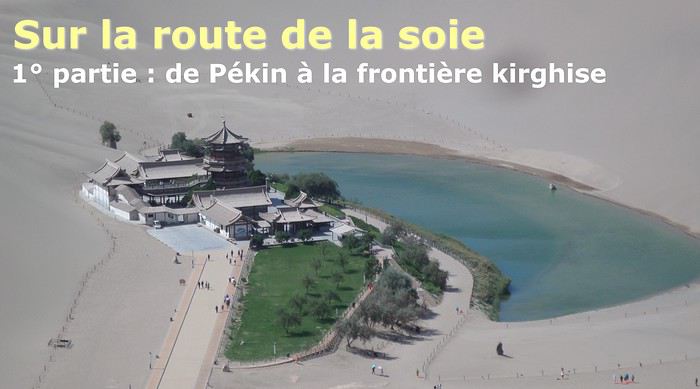
The Chinese Far West More than 30 years after my first trip to eastern China, I finally fulfilled an old dream: traveling solo from Beijing to the far west, discovering Xinjiang, the Uyghur people and the oppression they endure, the oases of Turpan and Kashgar, the Taklamakan Desert, the end of the Great Wall... The route was covered by train.
MENU PART 1: CHINA
1- Beijing (Jiankou) : the authentic Great Wall, without tourists 2- Cycling in Beijing, the best way to get around 3- Beijing : departure for the far west 4- Jiayuguan : getting by without English 5- Jiayuguan : scams and heritage 6- Dunhuang : abundance in the middle of the desert 7- Turpan : the Uyghurs under heavy surveillance 8- Kashgar : love at first sight for the old city 9- Kashgar : China’s recipe for controlling the populace 10- Tashkurgan : what on earth was I thinking going there! Kyrgyz border: a surreal epic Photo album from the 80s, contributions from other travelers (page 2)
1- JIANKOU Finding the authentic Great Wall, without tourists or a guide Friday, August 24, 2018 Thirty years later, I didn’t feel like revisiting the Great Wall at Badaling or any other overcrowded site. I chose to explore it at Jiankou, in its wildest, most authentic, and unrestored section, starting from a lost village deep in a valley—though it wasn’t *that* lost, since it had everything for communication.
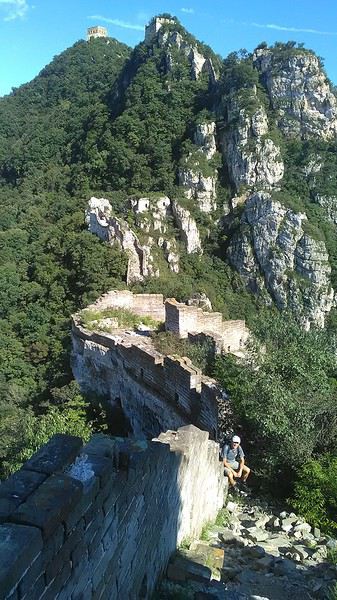
No need to pay for a taxi to get there—by timing it right, you can take the bus for just a few yuan. You have to get off at Xizhazi, the bus terminus. Be careful, there are only two buses a day in each direction. At the Xizhazi bus stop, I met a young couple who’d arrived with zero information about what to expect. We hiked the three of us toward the restored section of Mutianyu.
Still, be cautious With GPS and a topographic map (OpenTopoMap), you can set off without a problem or guide. The trail up to Jiankou is easy and well-marked. The trails down are too. But be careful—once you’re on the Wall, it’s real mountain hiking, with easy but dangerous climbing sections (over sheer drops). Not for amateurs or those afraid of heights! But what a reward. The Wall all to yourself, where it’s at its most daring. Truly mesmerizing.
More photos...
2- BEIJING The best way to get around the capital Sunday, August 26 The best way to explore the city is still by bike. Most are in a bike-share system, but you need to use an app—WeChat, the app that does everything, like monitoring your every move. No way I was installing that.
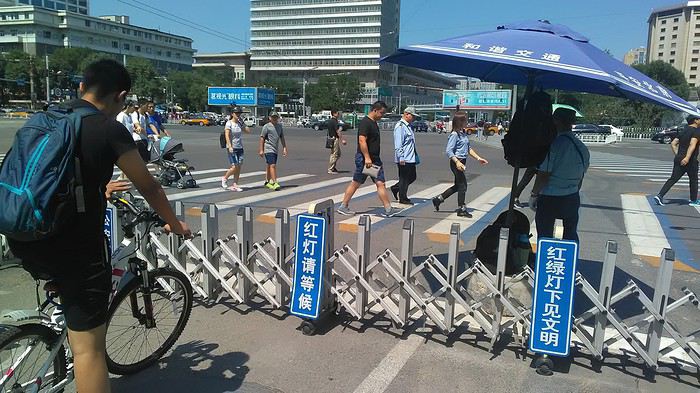
I found one at a rental shop near the hostel. The key is to quickly learn local traffic customs to minimize risks. Bike lanes are wide along the avenues.
But you still have to: - Watch out for anything parked on the bike paths—the most annoying are people napping or talking on the phone in their cars - Keep an eye on everything coming the wrong way—the list is long - The worst is right turns on red, which in Chinese traffic rules seem to have priority Once you get the hang of it, it’s fine. The city is huge but flat, so you can just wing it.
3- BEIJING By train to the far west Sunday, August 26 Beijing West Station is the size and operates like an airport. With your e-ticket from the agency, you first have to pick up your ticket at the special "English" counter, after passing through security. With your ticket in hand, you have to exit and enter through the boarding waiting area—not the platform—after a second security check.
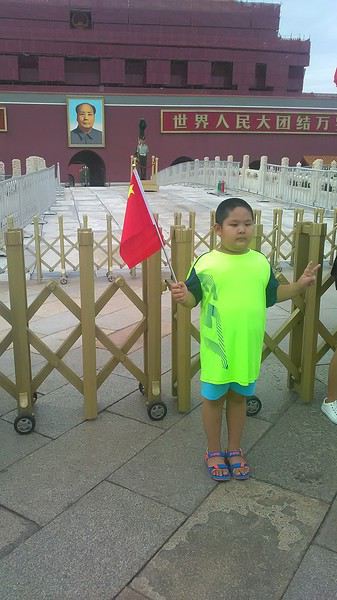 Then you find the right hall and wait for the sign to finally access the platform. In the end, it works pretty well given the incredible number of passengers to manage. Everywhere in Beijing, I saw that the Chinese have mastered crowd flow management.
Nice surprise: second-class carriages are clean, air-conditioned, and bright. Perfect, since I was in for 20 hours. One uniformed attendant per carriage, mobile meal service—luxury! Small downside: no luggage space. Hauling your suitcase up to the top bunk is quite a workout. I was in the middle, so it wasn’t too bad. The landscape, though, whether rural or urban, is pretty bleak. That should change once we leave the eastern plains.
Of course, I got my first police visit, with a thorough passport check and bag search. I was warned—going to the Chinese far west exposes you to this kind of hassle. But they were polite and respectful.
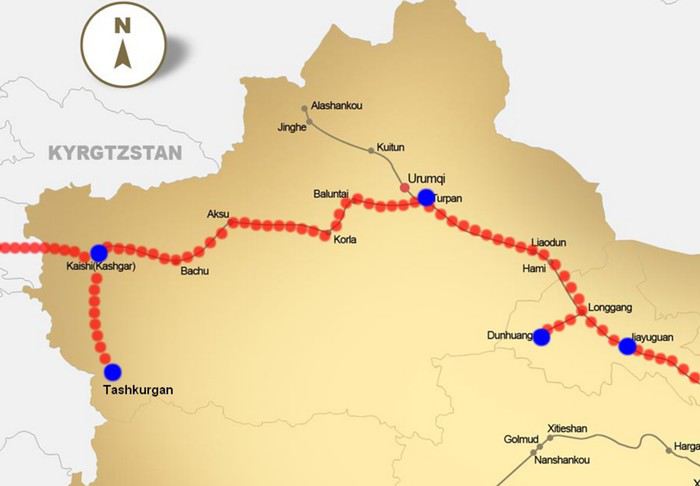 The Chinese Far West
4- JIAYUGUAN Getting by without English Monday, August 27 At the gates of two deserts (Gobi and Taklamakan) and at the foot of the Tibetan highlands, the Great Wall ends at Jiayuguan. Here, I found the deeper China I’d somewhat rediscovered during my bike ride, even if now everyone gets around on electric bikes and I’m no longer stared at like an alien.
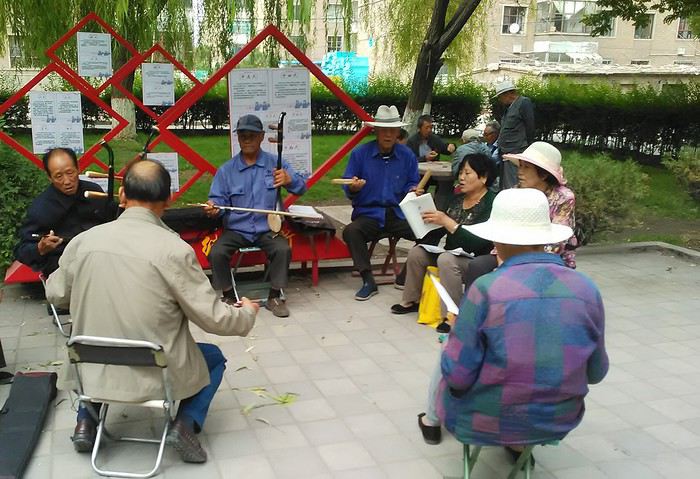
Prices are nothing like Beijing: you can find a full meal for 2 €, and my bike cost 7 € for two days. Plus, few people speak English—neither the owner of the HI hostel where I stayed, nor the ticket sellers at the sites, let alone the servers at the small eateries where I ate. Everything is written in Chinese. So I had to use the little Chinese I know to communicate about essentials. It makes the locals laugh to see a European trying to speak their language, but it earns respect. With Google Translate’s help, I managed.
Rant: With their avenues blocked for construction for kilometers without warning, and new roads not yet on maps, I must’ve taken 15 km of detours. More photos...
5- JIAYUGUAN Scams and heritage Tuesday, August 28 The Great Wall doesn’t exactly end at the fort I visited yesterday but 10 km further, at the entrance to a river gorge at the foot of the mountains. All that’s left is a badly damaged tower (more like a mound of earth) and a section of clay wall, similar to the one I biked yesterday.
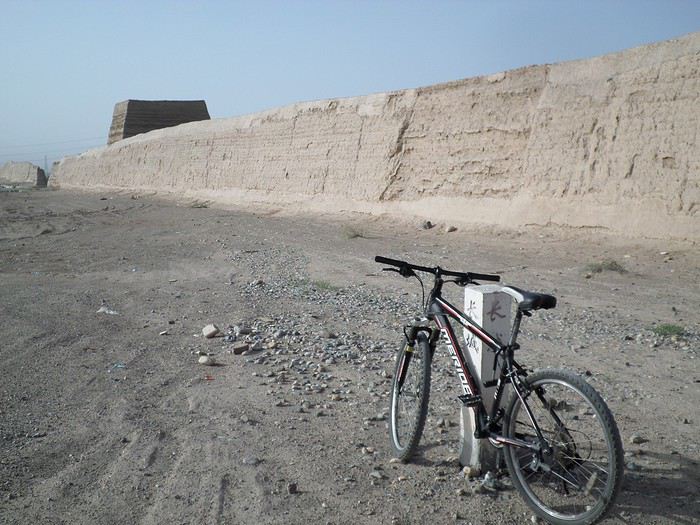
This morning, I hopped on my bike, determined to venture into the desert to see this highly symbolic site. First, you access it via a wide, brand-new road with not a soul in sight. Just before the site, I came across a grand welcome gate, very period-style, but it’s actually the inevitable toll booth.
Behind the gate, the road continues straight to the site, which you can see in the distance—at least 2 km away—the remains of the tower and wall. I had to leave my bike here. Fine. I went to the ticket counter and asked the price: 120 yuan! I couldn’t believe it—over 15 € for a simple mound of earth.
I showed my displeasure to the attendant, who couldn’t care less, and immediately turned back. 120 yuan—that’s the price for a new road, a fancy gate planted 2 km before the site just to force you to take a shuttle, and employees with nothing to do all day... Now I understand why I didn’t meet anyone!
Heritage China is a bit pricey Generally, sites are expensive for the country’s standard of living, but travelers are supposed to have money, so why hold back? I even gave up on the Forbidden City—reservations required days in advance (or on the black market at an impossible price). I prefer to keep the memory of my first visit, when entry must’ve cost a few dozen cents, and there were only a handful of visitors.
This morning, I took a taxi to see remarkable tombs of common people from the 3rd to 6th centuries. They’re small vaulted caves made of painted bricks, depicting scenes of daily life. Very pretty and moving. But even here, though the price was more reasonable, I was left wanting—only one of the 16 tombs is open to visitors, and it’s apparently not the most beautiful.
The authentic China—at least what’s left of it... Wandering the impersonal avenues of the city, you stumble upon a market. There, you still find traditional China—small shops with questionable hygiene, Go players, musicians, and even a dental prosthetist. The last refuge for those untouched by modernity. More photos...
6- DUNHUANG Abundance in the middle of the desert Wednesday, August 29 Well, I thought the landscape would be less bleak as I headed west. Nope. The only distraction in this expanse of dark, clayey sand is the forests of pylons and wind turbines, plus wild camels racing each other.
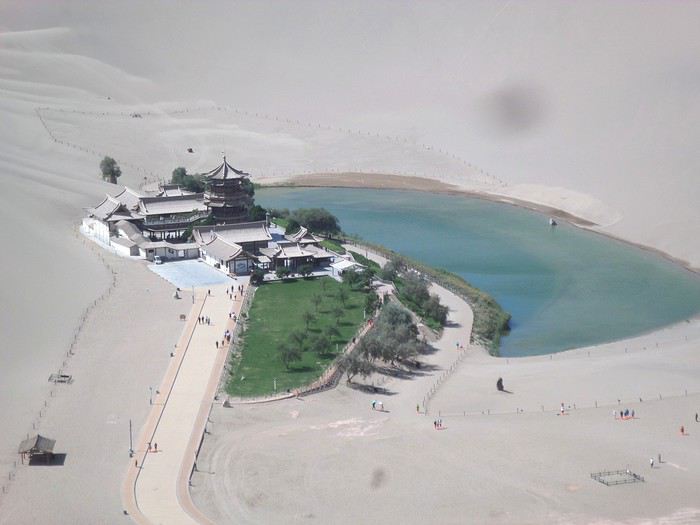 However, Dunhuang, the gateway to the Taklamakan, is by far the most pleasant Chinese city I know. There’s a real city center you can explore on foot. It’s hot but not unbearable, with a light, dry breeze. Much nicer than Beijing. The Han Chinese are still the majority, but the Muslim Uyghurs are more numerous, and the muezzin’s call to prayer echoes around the mosque.
The most surprising thing is the abundance and diversity of fruits and vegetables. You wonder how it all grows here. Well-irrigated, the desert sands are very fertile. Here, raisins have subtle, mysterious flavors, and the lamb really tastes like lamb.
Today, I visited the must-see Mingshashan, a dune complex next to which Pila is a molehill. The Basque Country, but covered in sand... More photos...
7- TURPAN The Uyghurs under heavy surveillance Friday, August 31 Surveillance cameras everywhere in the city, armed police stationed at intersections, in front of public buildings, at the entrance and inside tourist sites, police stations on every corner, patrols on foot or by car, khaki uniforms even for middle schoolers... here, the Han Chinese are in the minority, and you can feel it. Turpan feels like a city under siege.
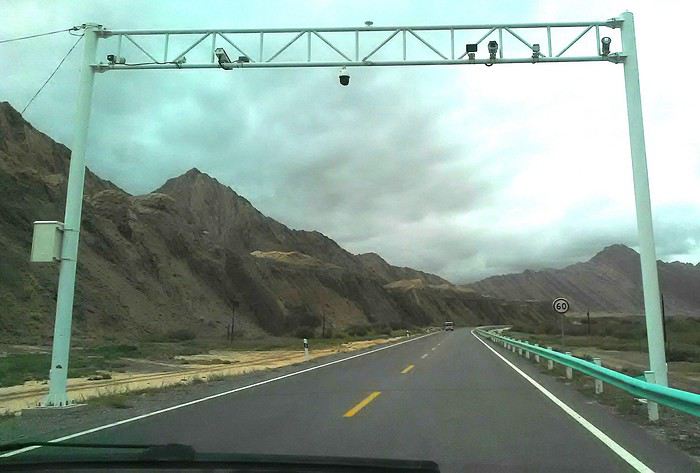
To enter the youth hostel where I stayed, there’s even a security gate, and the receptionist (a Han, like everyone in tourism) wears a bulletproof vest! Reassuring. Still, you don’t feel particularly threatened here, especially as a European. The troublemakers are the Chinese, not the Uyghurs. Generally, China is a very safe country for visitors.
Smile, you’re on camera! I was biking on an avenue when the car in front of me got flashed for driving slowly. I quickly understood why when I got flashed too.
Here, the official time is Beijing time, but it gets dark two hours later. It’ll be even worse in Kashgar. Trickier to manage: everything is displayed in Chinese and Arabic. Nothing in English. Choosing a menu is a shot in the dark. Apart from a few young Chinese, no one here speaks English, and my Chinese doesn’t seem very understandable...
Mogao, the end of the road for the Han Yesterday, near Dunhuang, I went to Mogao, a complex of decorated caves with Buddha sculptures and paintings. Stunning, but so crowded! Luckily, here in Turpan, Chinese tourists barely venture out. So I visited a Silk Road ghost town with only a handful of other visitors and under a howling wind.
The modern Chinese city is swallowing up the old Uyghur neighborhoods—only a museum-like district remains in the center, and pockets of resistance on the outskirts are doomed to disappear soon. More photos...
8- KASHGAR A (relative) love at first sight for the old city Sunday, September 2 After three overnight trains, here I am in the far west of China, nearly 4,000 km from the capital. Despite the omnipresent police and an old city preserved UNESCO-style, Kashgar is my Chinese love at first sight.
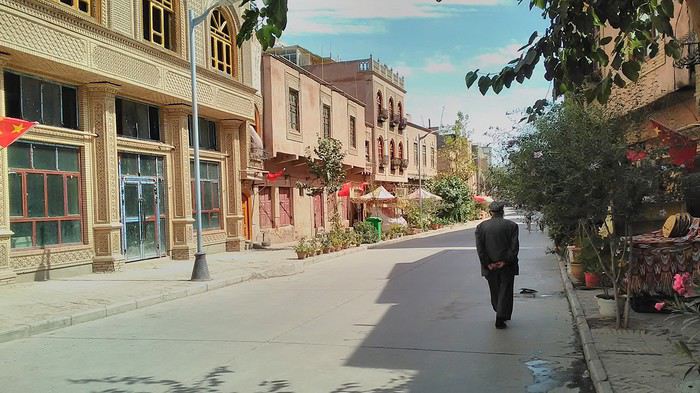
Finally, Chinese... well, sort of, because we’re in Uyghur territory here—a Turkic people with nothing culturally in common with the Han, the eastern Chinese. It started badly yesterday at Turfan station, where after three security gate passes, at least five passport checks, and a bag search, three adorable policewomen confiscated my antibacterial lotion because it had a flammable logo...
Then came the welcoming committee of armed cops at Kashgar station. Once all that was over, they left me alone—except you still have to go through security checks like everyone else to enter the old city, the bazaar, the livestock market... The further west you go, the more the siege mentality is evident. Luckily, the border isn’t far...
Despite the inevitable destruction-reconstruction, the city center has been well preserved. Thankfully, because it’s a very original style, a mix of local and colonial. I love it, even if it’s a bit too artificial, sanitized, and watered-down, and rather empty of residents. On the Silk Road, the city was famous for its great food. And it still is—rarely have I seen such richness and abundance of food! And not just scorpions or snakes. More photos...
9- KASHGAR China’s recipe for controlling the populace Saturday, September 1 Xinjiang, along with Tibet, is a "sensitive" area of rebellion in the eyes of Chinese authorities. As a result, the state has these regions and their populations under total control. Tourists also feel the consequences, even if they’re not at risk of re-education camps.
 - Putting barbed wire and anti-ramming barriers around sensitive sites (schools, big hotels, government buildings...)
- Installing traffic surveillance gates with cameras and photo flashes (for all vehicles passing, including bikes) throughout the city and even in the countryside
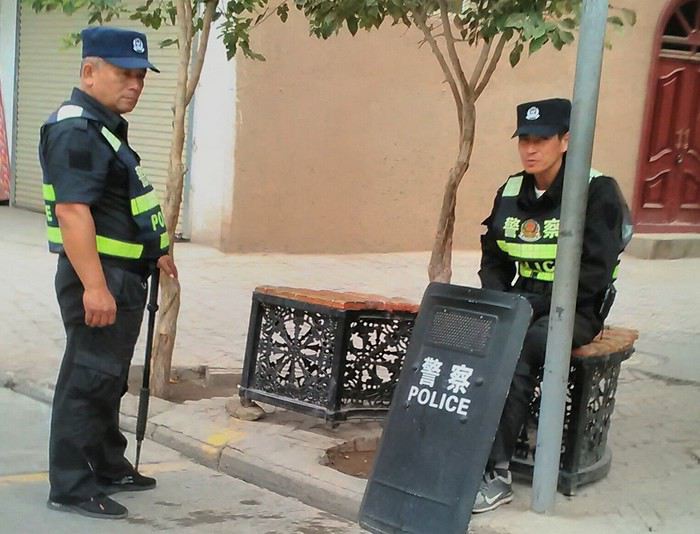
- Posting uniformed guards with tasers, batons, or huge baseball bats every 100 meters
- Training the Han population (ethnic Chinese) in self-defense with sticks, preferably in the morning on the street. Men and women of all ages
- Starting school with the national anthem, doing military exercises, and receiving political indoctrination, all neatly lined up in the courtyard. (The dream school for any teacher)
- Placing a snitch in uniform (a pseudo-guard) in public gathering places, like youth hostels. Mine spends the day loafing around the courtyard
- Putting Chinese flags everywhere on the streets to remind everyone who’s in charge
- Installing security gates at every entrance to areas frequented by tourists (thanks for that) but not just there
- Never photographing cops, or else! I tried, but it’s not easy...
- Putting barbed wire and anti-ramming barriers around sensitive sites (schools, big hotels, government buildings...)
- Installing traffic surveillance gates with cameras and photo flashes (for all vehicles passing, including bikes) throughout the city and even in the countryside
- Posting uniformed guards with tasers, batons, or huge baseball bats every 100 meters
- Training the Han population (ethnic Chinese) in self-defense with sticks, preferably in the morning on the street. Men and women of all ages
- Starting school with the national anthem, doing military exercises, and receiving political indoctrination, all neatly lined up in the courtyard. (The dream school for any teacher)
- Placing a snitch in uniform (a pseudo-guard) in public gathering places, like youth hostels. Mine spends the day loafing around the courtyard
- Putting Chinese flags everywhere on the streets to remind everyone who’s in charge
- Installing security gates at every entrance to areas frequented by tourists (thanks for that) but not just there
- Never photographing cops, or else! I tried, but it’s not easy...
With all that, you can stroll around safely Not much crime! As for the amount the Chinese state spends to maintain such a system, it’s staggering! A third of the Han living in Xinjiang work in security. Today, I wandered freely around old Kashgar, which is quite large after all. More photos...
10- TASHKURGAN What on earth was I thinking going there! Wednesday, September 5 First, there’s the taxi—pretty crappy, with a driver who doesn’t speak a word of English and won’t stop smoking. Over six hours in that... shared with a completely out-of-it American.
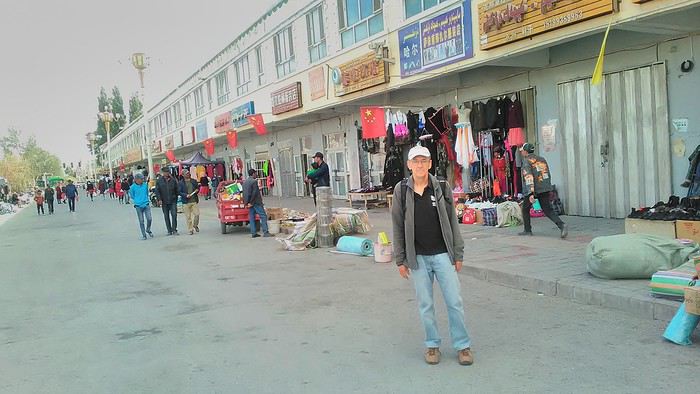
Then there are all the checkpoints along the way. I won’t go on—you know the drill by now.
After that, there’s Tashkurgan—a town with nothing to see, nothing to do. Deserted as soon as night falls. There’s this huge youth hostel and a few lost Chinese tapping away on their smartphones, chain-smoking. This lost American-European crowd, swapping tips on how to enter Pakistan or Tajikistan.
Luckily, there’s the Chinese Pamir Highway, lined with peaks over 7,000m. There’s the feeling of no longer being in China, with a population whose features are Middle Eastern. And these Tajik women with their stunning hairstyles and vibrant costumes. There’s the fact of having reached the westernmost Chinese city, far from crowds and tourist sites. A sort of end of the world. More photos...
11- KYRGYZ BORDER A surreal epic Thursday, September 6 The road from Kashgar to the Kyrgyzstan border is a little over 200 km and passes through beautiful landscapes of colorful, desert-like mountains with acrobatic folds. That’s the bucolic part of the trip.
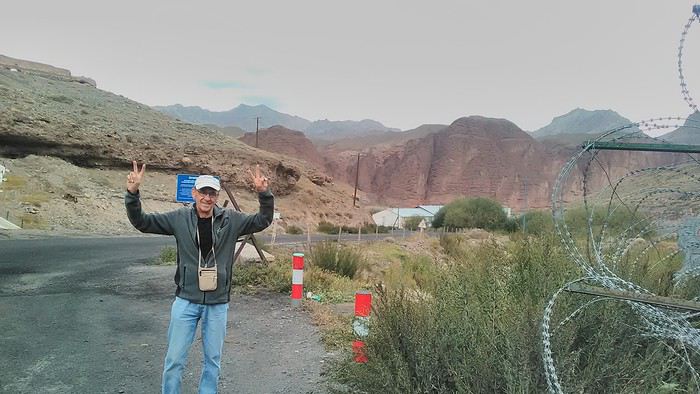 Yesterday, I managed to gather four people to rent a minibus to reach the border more easily: a Spaniard and an Argentine I’d already met in Turpan, and two New Zealanders who responded to the ad left at the hostel.
Absurdity and paranoia of Chinese authorities The highlight was crossing the town of Wuqia, 50 km past Kashgar. After tallying up with my fellow sufferers, we must’ve passed about ten checkpoints with: - Passport checks: 14 times, sometimes by two cops side by side - Bag checks: 4 times - Smartphone checks: 2 times, with deletion of "non-compliant" photos, and registration of your IMEI in the exit log!... Absurd and surreal at the same time, since my camera stayed in my bag, my apps are in French, and my photos have been online for ages...
With all that, we arrived just as the last checkpoint before the no man’s land marking the border between the two countries was on lunch break. And bam! Another 1.5-hour wait, alongside truckers who were much more used to this than we were.
What to think? The cops themselves aren’t fooled. They play the role they’re asked to, but sometimes you can coax a smile out of them—they realize how ridiculous the situation is.
What’s the point? That’s the big question my companions and I were tempted to answer with "to piss people off." To show you your place isn’t here, but with the other tourists, over there in the east, in Shanghai, Xi’an, or Guangzhou.
As for you, a traveler from a democratic country, you really experience this as aggression, humiliation, a violation of your private space. And yet, I’m respected, they speak to me properly. Today, I better understand what a Palestinian or a citizen of an occupied country might feel daily. A unique experience! Thanks, China.
And to top it off, the cherry on the cake! It’s still this glowing button you press to rate your passage after clearing the last obstacle before the exit stamp. I was so surprised it turned off before I could react. The Spaniard, with great humor and irony, had time to vote "excellent." In the end, he wasn’t wrong—you can hardly do better!
PS: I ditched my buddies at the border. They didn’t want to pay for a taxi to continue. So I took a direct taxi to Osh. The first 100 km are fabulous. I couldn’t take many photos, but I’ll be back on Monday to go to Tajikistan.
More photos...
The rest of the Silk Road, Part 2, in these travel journals: Kyrgyzstan, Tajikistan, Uzbekistan.
The Chinese Far West More than 30 years after my first trip to eastern China, I finally fulfilled an old dream: traveling solo from Beijing to the far west, discovering Xinjiang, the Uyghur people and the oppression they endure, the oases of Turpan and Kashgar, the Taklamakan Desert, the end of the Great Wall... The route was covered by train.
MENU PART 1: CHINA
1- Beijing (Jiankou) : the authentic Great Wall, without tourists 2- Cycling in Beijing, the best way to get around 3- Beijing : departure for the far west 4- Jiayuguan : getting by without English 5- Jiayuguan : scams and heritage 6- Dunhuang : abundance in the middle of the desert 7- Turpan : the Uyghurs under heavy surveillance 8- Kashgar : love at first sight for the old city 9- Kashgar : China’s recipe for controlling the populace 10- Tashkurgan : what on earth was I thinking going there! Kyrgyz border: a surreal epic Photo album from the 80s, contributions from other travelers (page 2)
1- JIANKOU Finding the authentic Great Wall, without tourists or a guide Friday, August 24, 2018 Thirty years later, I didn’t feel like revisiting the Great Wall at Badaling or any other overcrowded site. I chose to explore it at Jiankou, in its wildest, most authentic, and unrestored section, starting from a lost village deep in a valley—though it wasn’t *that* lost, since it had everything for communication.
No need to pay for a taxi to get there—by timing it right, you can take the bus for just a few yuan. You have to get off at Xizhazi, the bus terminus. Be careful, there are only two buses a day in each direction. At the Xizhazi bus stop, I met a young couple who’d arrived with zero information about what to expect. We hiked the three of us toward the restored section of Mutianyu.
Still, be cautious With GPS and a topographic map (OpenTopoMap), you can set off without a problem or guide. The trail up to Jiankou is easy and well-marked. The trails down are too. But be careful—once you’re on the Wall, it’s real mountain hiking, with easy but dangerous climbing sections (over sheer drops). Not for amateurs or those afraid of heights! But what a reward. The Wall all to yourself, where it’s at its most daring. Truly mesmerizing.
More photos...
2- BEIJING The best way to get around the capital Sunday, August 26 The best way to explore the city is still by bike. Most are in a bike-share system, but you need to use an app—WeChat, the app that does everything, like monitoring your every move. No way I was installing that.
I found one at a rental shop near the hostel. The key is to quickly learn local traffic customs to minimize risks. Bike lanes are wide along the avenues.
But you still have to: - Watch out for anything parked on the bike paths—the most annoying are people napping or talking on the phone in their cars - Keep an eye on everything coming the wrong way—the list is long - The worst is right turns on red, which in Chinese traffic rules seem to have priority Once you get the hang of it, it’s fine. The city is huge but flat, so you can just wing it.
3- BEIJING By train to the far west Sunday, August 26 Beijing West Station is the size and operates like an airport. With your e-ticket from the agency, you first have to pick up your ticket at the special "English" counter, after passing through security. With your ticket in hand, you have to exit and enter through the boarding waiting area—not the platform—after a second security check.
Then you find the right hall and wait for the sign to finally access the platform. In the end, it works pretty well given the incredible number of passengers to manage. Everywhere in Beijing, I saw that the Chinese have mastered crowd flow management.Nice surprise: second-class carriages are clean, air-conditioned, and bright. Perfect, since I was in for 20 hours. One uniformed attendant per carriage, mobile meal service—luxury! Small downside: no luggage space. Hauling your suitcase up to the top bunk is quite a workout. I was in the middle, so it wasn’t too bad. The landscape, though, whether rural or urban, is pretty bleak. That should change once we leave the eastern plains.
Of course, I got my first police visit, with a thorough passport check and bag search. I was warned—going to the Chinese far west exposes you to this kind of hassle. But they were polite and respectful.
The Chinese Far West4- JIAYUGUAN Getting by without English Monday, August 27 At the gates of two deserts (Gobi and Taklamakan) and at the foot of the Tibetan highlands, the Great Wall ends at Jiayuguan. Here, I found the deeper China I’d somewhat rediscovered during my bike ride, even if now everyone gets around on electric bikes and I’m no longer stared at like an alien.
Prices are nothing like Beijing: you can find a full meal for 2 €, and my bike cost 7 € for two days. Plus, few people speak English—neither the owner of the HI hostel where I stayed, nor the ticket sellers at the sites, let alone the servers at the small eateries where I ate. Everything is written in Chinese. So I had to use the little Chinese I know to communicate about essentials. It makes the locals laugh to see a European trying to speak their language, but it earns respect. With Google Translate’s help, I managed.
Rant: With their avenues blocked for construction for kilometers without warning, and new roads not yet on maps, I must’ve taken 15 km of detours. More photos...
5- JIAYUGUAN Scams and heritage Tuesday, August 28 The Great Wall doesn’t exactly end at the fort I visited yesterday but 10 km further, at the entrance to a river gorge at the foot of the mountains. All that’s left is a badly damaged tower (more like a mound of earth) and a section of clay wall, similar to the one I biked yesterday.
This morning, I hopped on my bike, determined to venture into the desert to see this highly symbolic site. First, you access it via a wide, brand-new road with not a soul in sight. Just before the site, I came across a grand welcome gate, very period-style, but it’s actually the inevitable toll booth.
Behind the gate, the road continues straight to the site, which you can see in the distance—at least 2 km away—the remains of the tower and wall. I had to leave my bike here. Fine. I went to the ticket counter and asked the price: 120 yuan! I couldn’t believe it—over 15 € for a simple mound of earth.
I showed my displeasure to the attendant, who couldn’t care less, and immediately turned back. 120 yuan—that’s the price for a new road, a fancy gate planted 2 km before the site just to force you to take a shuttle, and employees with nothing to do all day... Now I understand why I didn’t meet anyone!
Heritage China is a bit pricey Generally, sites are expensive for the country’s standard of living, but travelers are supposed to have money, so why hold back? I even gave up on the Forbidden City—reservations required days in advance (or on the black market at an impossible price). I prefer to keep the memory of my first visit, when entry must’ve cost a few dozen cents, and there were only a handful of visitors.
This morning, I took a taxi to see remarkable tombs of common people from the 3rd to 6th centuries. They’re small vaulted caves made of painted bricks, depicting scenes of daily life. Very pretty and moving. But even here, though the price was more reasonable, I was left wanting—only one of the 16 tombs is open to visitors, and it’s apparently not the most beautiful.
The authentic China—at least what’s left of it... Wandering the impersonal avenues of the city, you stumble upon a market. There, you still find traditional China—small shops with questionable hygiene, Go players, musicians, and even a dental prosthetist. The last refuge for those untouched by modernity. More photos...
6- DUNHUANG Abundance in the middle of the desert Wednesday, August 29 Well, I thought the landscape would be less bleak as I headed west. Nope. The only distraction in this expanse of dark, clayey sand is the forests of pylons and wind turbines, plus wild camels racing each other.
However, Dunhuang, the gateway to the Taklamakan, is by far the most pleasant Chinese city I know. There’s a real city center you can explore on foot. It’s hot but not unbearable, with a light, dry breeze. Much nicer than Beijing. The Han Chinese are still the majority, but the Muslim Uyghurs are more numerous, and the muezzin’s call to prayer echoes around the mosque.The most surprising thing is the abundance and diversity of fruits and vegetables. You wonder how it all grows here. Well-irrigated, the desert sands are very fertile. Here, raisins have subtle, mysterious flavors, and the lamb really tastes like lamb.
Today, I visited the must-see Mingshashan, a dune complex next to which Pila is a molehill. The Basque Country, but covered in sand... More photos...
7- TURPAN The Uyghurs under heavy surveillance Friday, August 31 Surveillance cameras everywhere in the city, armed police stationed at intersections, in front of public buildings, at the entrance and inside tourist sites, police stations on every corner, patrols on foot or by car, khaki uniforms even for middle schoolers... here, the Han Chinese are in the minority, and you can feel it. Turpan feels like a city under siege.
To enter the youth hostel where I stayed, there’s even a security gate, and the receptionist (a Han, like everyone in tourism) wears a bulletproof vest! Reassuring. Still, you don’t feel particularly threatened here, especially as a European. The troublemakers are the Chinese, not the Uyghurs. Generally, China is a very safe country for visitors.
Smile, you’re on camera! I was biking on an avenue when the car in front of me got flashed for driving slowly. I quickly understood why when I got flashed too.
Here, the official time is Beijing time, but it gets dark two hours later. It’ll be even worse in Kashgar. Trickier to manage: everything is displayed in Chinese and Arabic. Nothing in English. Choosing a menu is a shot in the dark. Apart from a few young Chinese, no one here speaks English, and my Chinese doesn’t seem very understandable...
Mogao, the end of the road for the Han Yesterday, near Dunhuang, I went to Mogao, a complex of decorated caves with Buddha sculptures and paintings. Stunning, but so crowded! Luckily, here in Turpan, Chinese tourists barely venture out. So I visited a Silk Road ghost town with only a handful of other visitors and under a howling wind.
The modern Chinese city is swallowing up the old Uyghur neighborhoods—only a museum-like district remains in the center, and pockets of resistance on the outskirts are doomed to disappear soon. More photos...
8- KASHGAR A (relative) love at first sight for the old city Sunday, September 2 After three overnight trains, here I am in the far west of China, nearly 4,000 km from the capital. Despite the omnipresent police and an old city preserved UNESCO-style, Kashgar is my Chinese love at first sight.
Finally, Chinese... well, sort of, because we’re in Uyghur territory here—a Turkic people with nothing culturally in common with the Han, the eastern Chinese. It started badly yesterday at Turfan station, where after three security gate passes, at least five passport checks, and a bag search, three adorable policewomen confiscated my antibacterial lotion because it had a flammable logo...
Then came the welcoming committee of armed cops at Kashgar station. Once all that was over, they left me alone—except you still have to go through security checks like everyone else to enter the old city, the bazaar, the livestock market... The further west you go, the more the siege mentality is evident. Luckily, the border isn’t far...
Despite the inevitable destruction-reconstruction, the city center has been well preserved. Thankfully, because it’s a very original style, a mix of local and colonial. I love it, even if it’s a bit too artificial, sanitized, and watered-down, and rather empty of residents. On the Silk Road, the city was famous for its great food. And it still is—rarely have I seen such richness and abundance of food! And not just scorpions or snakes. More photos...
9- KASHGAR China’s recipe for controlling the populace Saturday, September 1 Xinjiang, along with Tibet, is a "sensitive" area of rebellion in the eyes of Chinese authorities. As a result, the state has these regions and their populations under total control. Tourists also feel the consequences, even if they’re not at risk of re-education camps.
- Putting barbed wire and anti-ramming barriers around sensitive sites (schools, big hotels, government buildings...)
- Installing traffic surveillance gates with cameras and photo flashes (for all vehicles passing, including bikes) throughout the city and even in the countryside
- Posting uniformed guards with tasers, batons, or huge baseball bats every 100 meters
- Training the Han population (ethnic Chinese) in self-defense with sticks, preferably in the morning on the street. Men and women of all ages
- Starting school with the national anthem, doing military exercises, and receiving political indoctrination, all neatly lined up in the courtyard. (The dream school for any teacher)
- Placing a snitch in uniform (a pseudo-guard) in public gathering places, like youth hostels. Mine spends the day loafing around the courtyard
- Putting Chinese flags everywhere on the streets to remind everyone who’s in charge
- Installing security gates at every entrance to areas frequented by tourists (thanks for that) but not just there
- Never photographing cops, or else! I tried, but it’s not easy...With all that, you can stroll around safely Not much crime! As for the amount the Chinese state spends to maintain such a system, it’s staggering! A third of the Han living in Xinjiang work in security. Today, I wandered freely around old Kashgar, which is quite large after all. More photos...
10- TASHKURGAN What on earth was I thinking going there! Wednesday, September 5 First, there’s the taxi—pretty crappy, with a driver who doesn’t speak a word of English and won’t stop smoking. Over six hours in that... shared with a completely out-of-it American.
Then there are all the checkpoints along the way. I won’t go on—you know the drill by now.
After that, there’s Tashkurgan—a town with nothing to see, nothing to do. Deserted as soon as night falls. There’s this huge youth hostel and a few lost Chinese tapping away on their smartphones, chain-smoking. This lost American-European crowd, swapping tips on how to enter Pakistan or Tajikistan.
Luckily, there’s the Chinese Pamir Highway, lined with peaks over 7,000m. There’s the feeling of no longer being in China, with a population whose features are Middle Eastern. And these Tajik women with their stunning hairstyles and vibrant costumes. There’s the fact of having reached the westernmost Chinese city, far from crowds and tourist sites. A sort of end of the world. More photos...
11- KYRGYZ BORDER A surreal epic Thursday, September 6 The road from Kashgar to the Kyrgyzstan border is a little over 200 km and passes through beautiful landscapes of colorful, desert-like mountains with acrobatic folds. That’s the bucolic part of the trip.
Yesterday, I managed to gather four people to rent a minibus to reach the border more easily: a Spaniard and an Argentine I’d already met in Turpan, and two New Zealanders who responded to the ad left at the hostel.Absurdity and paranoia of Chinese authorities The highlight was crossing the town of Wuqia, 50 km past Kashgar. After tallying up with my fellow sufferers, we must’ve passed about ten checkpoints with: - Passport checks: 14 times, sometimes by two cops side by side - Bag checks: 4 times - Smartphone checks: 2 times, with deletion of "non-compliant" photos, and registration of your IMEI in the exit log!... Absurd and surreal at the same time, since my camera stayed in my bag, my apps are in French, and my photos have been online for ages...
With all that, we arrived just as the last checkpoint before the no man’s land marking the border between the two countries was on lunch break. And bam! Another 1.5-hour wait, alongside truckers who were much more used to this than we were.
What to think? The cops themselves aren’t fooled. They play the role they’re asked to, but sometimes you can coax a smile out of them—they realize how ridiculous the situation is.
What’s the point? That’s the big question my companions and I were tempted to answer with "to piss people off." To show you your place isn’t here, but with the other tourists, over there in the east, in Shanghai, Xi’an, or Guangzhou.
As for you, a traveler from a democratic country, you really experience this as aggression, humiliation, a violation of your private space. And yet, I’m respected, they speak to me properly. Today, I better understand what a Palestinian or a citizen of an occupied country might feel daily. A unique experience! Thanks, China.
And to top it off, the cherry on the cake! It’s still this glowing button you press to rate your passage after clearing the last obstacle before the exit stamp. I was so surprised it turned off before I could react. The Spaniard, with great humor and irony, had time to vote "excellent." In the end, he wasn’t wrong—you can hardly do better!
PS: I ditched my buddies at the border. They didn’t want to pay for a taxi to continue. So I took a direct taxi to Osh. The first 100 km are fabulous. I couldn’t take many photos, but I’ll be back on Monday to go to Tajikistan.
More photos...
The rest of the Silk Road, Part 2, in these travel journals: Kyrgyzstan, Tajikistan, Uzbekistan.
Retour d'un voyage sur la Route de la soie Tachkent - Khiva à vélo English translation pending
Je rentre d'un voyage à vélo en Ouzbékistan le long de la partie de la Route de la Soie entre Tachkent (où je suis arrivé par avion) et Khiva (que j'ai quitté par train de nuit pour retourner à Tachkent prendre l'avion de retour). Ci-dessous un résumé qui pourrait servir à ceux qui envisagent de faire le même trajet.
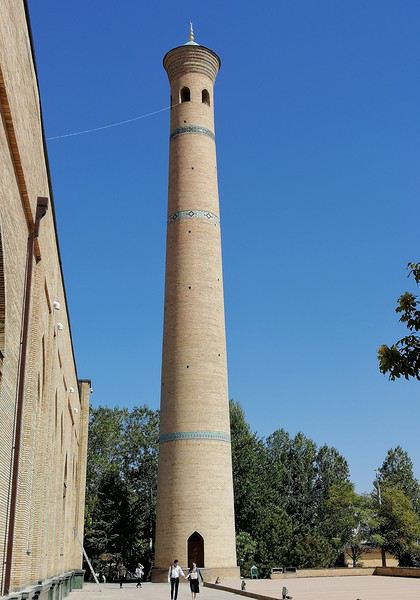
1. Aspects généraux : - A l'arrivée, j'avais organisé avec un taxi suffisamment grand pour charger le vélo dans son carton (10$ depuis l'aéroport) avec l'hôtel Art. L'hôtel m'a aussi permis de laisser le carton pendant ma randonnée, pour le retrouver à l'arrivée. L'hôtel est en fait un groupe d'hôtels, comprenant entre autres un hostel (chambres communes, 12 US$/nuit) et des hôtels plus classiques (dont l'hôtel Art, Rakatboshi Street, que j'ai utilisé, 27 US$/nuit). J'ai fait les réservations par Whattsap au +998 90 167 8337. - J'ai pu changer des dollars contre des sums dans un petit guichet situé à l'arrivée-bagages. Le guichet était ouvert à 5h du matin. - Il n'y a aucun formulaire de déclaration de devises à remplir. Comme citoyen suisse, je n'ai pas eu besoin de visa. J'ai passé la douane en une minute avec mon carton, en passant du côté vert "Nothing to declare". Tout cela est assez inattendu, il y a d'habitude beaucoup plus de complications à l'arrivée dans les pays de l'ex-URSS. - Il ne faut prendre que des dollars US : cette monnaie représente la seconde monnaie du pays. L'euro est quasiment inconnu en dehors des banques. Beaucoup de services peuvent se payer indifféremment en dollars ou en sums; il n'y a pas de marché parallèle (le taux officiel s'étant aligné sur le taux du marché noir il y a quelques années; en septembre - octobre 2019 le taux était environ de 9'400 sums pour un dollar US). -Les hôtels sont censés délivrer un coupon attestant de votre séjour dans leur établissement ("Registration slip"), la police des frontières étant censée vérifier qu'on a dormi chaque soir dans un hôtel (sous peine de complications au moment de quitter le pays). J'ai donc benoîtement collectionné ces coupons pour les montrer à la sortie du territoire. Le policier qui a tamponné mon passeport n'y a pas jeté le moindre coup d’œil, et a même haussé les épaules quand je lui ai montré les coupons. - Je n'ai pas pris de tente, mais seulement un sac de couchage. Le seul endroit où la tente aurait été très utile aura été pendant les 300 kms de la traversée du désert du Kyzylkum, entre Gazni et Tortkol. J'ai dormi à Gazni dans une tchaikhana, la première à droite dans la direction de Tortkol. J'ai vu le lendemain, quand j'ai quitté cette tchaikhana, une enseigne indiquant "Hostel" environ 300 m plus loin, toujours sur la droite. Je n'ai pas vérifié si l'hostel fonctionnait réellement. J'ai dormi dans une seconde tchaikhana le lendemain (d'autres établissements ne m'ont pas permis d'utiliser leur installation pour sortir mon sac de couchage). - Le voyage m'a coûté en moyenne 30 dollars par jour (incluant hôtels, repas, entrées dans les sites touristiques, train de nuit Khiva-Tachkent), en comprenant des arrêts de 3-4 jours à Tachkent, Samarcande, Boukhara et Khiva. - J'ai acheté une carte SIM locale chez Ucell à Tachkent (métro Abdulla Qodirii, coordonnées GPS : 41°19'01''N, 69°16'56.02''E), avec 8GB de données pour 105'000 sums (environ 16 $US). La couverture réseau (accès à Internet a été bonne à moyenne pendant tout le trajet.
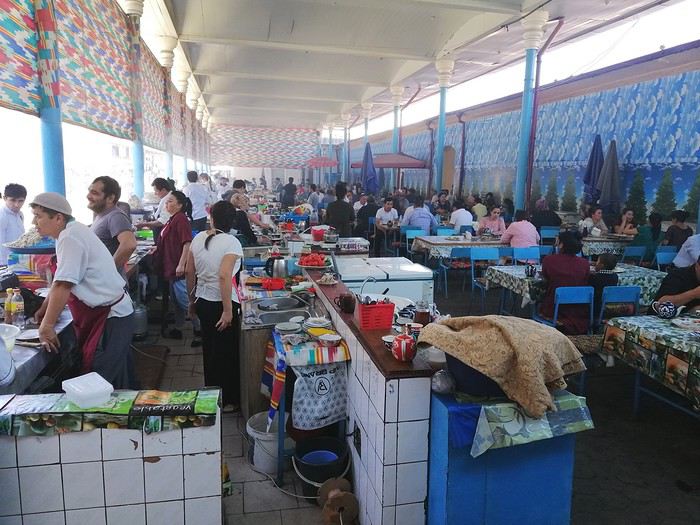
2. Le trajet en vélo : - Le trajet Tachkent - Khiva (1'100 km) a été bouclé en 9 étapes. - On peut circuler à vélo sur toutes les routes. Celles reliant les principales villes sont comparables à ce qu'on appelle des "quatre-voies" en France. Ces routes ont un revêtement allant de très mauvais à moyen-bas, sauf les 200 kms de route qui traverse le désert du Kyzylkum, qui sont un véritable billard. - Les routes sont surchargées, et les Ouzbeks conduisent de façon dangereuse (y compris pour eux-mêmes : personne ne porte la ceinture de sécurité dans les véhicules). De plus, à part dans les villages, aucun Ouzbek ne va à vélo, ce qui fait que les conducteurs fonctionnent comme si les cyclistes étaient transparents. Un rétroviseur sur le vélo est essentiel. Il y n'y a pratiquement pas d'itinéraires secondaires, les routes alternatives ne sont pas entretenues et sont habituellement en très mauvais état. Il faut noter plusieurs villages dans la même province peuvent porter le même nom, ce qui peut compliquer la navigation GPS (c'est vrai autour de Tachkent, et je ne me suis rendu compte que je me dirigeais sur le mauvais village pour sortir de la ville qu'après une quinzaine de kms). - Il fait chaud à très chaud pendant la seconde moitié de septembre. La température descend au-dessous de 30°C pendant la journée au cours de la première semaine d'octobre. On trouve à boire sans problème le long des routes; il faut cependant noter que les tchaikhanas indiqués par Open Street Map lors de la traversée du Kyzylkum sont souvent désaffectées ou abandonnées. Les nuits peuvent être fraîches à partir de début octobre. Pas de pluie pendant mon trajet; le vent peut être d'intensité moyenne, sa direction est variable (j'ai eu un vent de 3/4 face pendant la traversée du Kyzylkum). - On trouve généralement des hôtels de confort moyen à bas dans les villes. Il n'y a en général pas de problèmes de restauration : les tchaikhanas servent habituellement un excellent lagman (soupe aux nouilles); les plovs sont proposés moins souvent. Les samosas (comca en caractères cyrilliques) sont proposés partout; c'est ce que les Ouzbeks souvent prennent au petit-déjeuner. - Les trains prennent les vélos sans problèmes (en tout cas le train de nuit Khiva-Tachkent).
En résumé : - Le trajet en lui-même en vélo n'est pas intéressant. Ce millier de kilomètres est très plat et très monotone (même la montée vers Samarcande, qui est à 800 m d’altitude), et rendu compliqué par la conduite automobile agressive. - Les villes principales le long de la Route de la Soie sont très belles, au moins leur partie ancienne. Les petites villes ou villages traversés en chemin n'offre à-peu-près aucun intérêt. - Je ne me suis jamais senti en insécurité en Ouzbékistan (sauf sur le vélo et dans le trafic automobile local).
1. Aspects généraux : - A l'arrivée, j'avais organisé avec un taxi suffisamment grand pour charger le vélo dans son carton (10$ depuis l'aéroport) avec l'hôtel Art. L'hôtel m'a aussi permis de laisser le carton pendant ma randonnée, pour le retrouver à l'arrivée. L'hôtel est en fait un groupe d'hôtels, comprenant entre autres un hostel (chambres communes, 12 US$/nuit) et des hôtels plus classiques (dont l'hôtel Art, Rakatboshi Street, que j'ai utilisé, 27 US$/nuit). J'ai fait les réservations par Whattsap au +998 90 167 8337. - J'ai pu changer des dollars contre des sums dans un petit guichet situé à l'arrivée-bagages. Le guichet était ouvert à 5h du matin. - Il n'y a aucun formulaire de déclaration de devises à remplir. Comme citoyen suisse, je n'ai pas eu besoin de visa. J'ai passé la douane en une minute avec mon carton, en passant du côté vert "Nothing to declare". Tout cela est assez inattendu, il y a d'habitude beaucoup plus de complications à l'arrivée dans les pays de l'ex-URSS. - Il ne faut prendre que des dollars US : cette monnaie représente la seconde monnaie du pays. L'euro est quasiment inconnu en dehors des banques. Beaucoup de services peuvent se payer indifféremment en dollars ou en sums; il n'y a pas de marché parallèle (le taux officiel s'étant aligné sur le taux du marché noir il y a quelques années; en septembre - octobre 2019 le taux était environ de 9'400 sums pour un dollar US). -Les hôtels sont censés délivrer un coupon attestant de votre séjour dans leur établissement ("Registration slip"), la police des frontières étant censée vérifier qu'on a dormi chaque soir dans un hôtel (sous peine de complications au moment de quitter le pays). J'ai donc benoîtement collectionné ces coupons pour les montrer à la sortie du territoire. Le policier qui a tamponné mon passeport n'y a pas jeté le moindre coup d’œil, et a même haussé les épaules quand je lui ai montré les coupons. - Je n'ai pas pris de tente, mais seulement un sac de couchage. Le seul endroit où la tente aurait été très utile aura été pendant les 300 kms de la traversée du désert du Kyzylkum, entre Gazni et Tortkol. J'ai dormi à Gazni dans une tchaikhana, la première à droite dans la direction de Tortkol. J'ai vu le lendemain, quand j'ai quitté cette tchaikhana, une enseigne indiquant "Hostel" environ 300 m plus loin, toujours sur la droite. Je n'ai pas vérifié si l'hostel fonctionnait réellement. J'ai dormi dans une seconde tchaikhana le lendemain (d'autres établissements ne m'ont pas permis d'utiliser leur installation pour sortir mon sac de couchage). - Le voyage m'a coûté en moyenne 30 dollars par jour (incluant hôtels, repas, entrées dans les sites touristiques, train de nuit Khiva-Tachkent), en comprenant des arrêts de 3-4 jours à Tachkent, Samarcande, Boukhara et Khiva. - J'ai acheté une carte SIM locale chez Ucell à Tachkent (métro Abdulla Qodirii, coordonnées GPS : 41°19'01''N, 69°16'56.02''E), avec 8GB de données pour 105'000 sums (environ 16 $US). La couverture réseau (accès à Internet a été bonne à moyenne pendant tout le trajet.
2. Le trajet en vélo : - Le trajet Tachkent - Khiva (1'100 km) a été bouclé en 9 étapes. - On peut circuler à vélo sur toutes les routes. Celles reliant les principales villes sont comparables à ce qu'on appelle des "quatre-voies" en France. Ces routes ont un revêtement allant de très mauvais à moyen-bas, sauf les 200 kms de route qui traverse le désert du Kyzylkum, qui sont un véritable billard. - Les routes sont surchargées, et les Ouzbeks conduisent de façon dangereuse (y compris pour eux-mêmes : personne ne porte la ceinture de sécurité dans les véhicules). De plus, à part dans les villages, aucun Ouzbek ne va à vélo, ce qui fait que les conducteurs fonctionnent comme si les cyclistes étaient transparents. Un rétroviseur sur le vélo est essentiel. Il y n'y a pratiquement pas d'itinéraires secondaires, les routes alternatives ne sont pas entretenues et sont habituellement en très mauvais état. Il faut noter plusieurs villages dans la même province peuvent porter le même nom, ce qui peut compliquer la navigation GPS (c'est vrai autour de Tachkent, et je ne me suis rendu compte que je me dirigeais sur le mauvais village pour sortir de la ville qu'après une quinzaine de kms). - Il fait chaud à très chaud pendant la seconde moitié de septembre. La température descend au-dessous de 30°C pendant la journée au cours de la première semaine d'octobre. On trouve à boire sans problème le long des routes; il faut cependant noter que les tchaikhanas indiqués par Open Street Map lors de la traversée du Kyzylkum sont souvent désaffectées ou abandonnées. Les nuits peuvent être fraîches à partir de début octobre. Pas de pluie pendant mon trajet; le vent peut être d'intensité moyenne, sa direction est variable (j'ai eu un vent de 3/4 face pendant la traversée du Kyzylkum). - On trouve généralement des hôtels de confort moyen à bas dans les villes. Il n'y a en général pas de problèmes de restauration : les tchaikhanas servent habituellement un excellent lagman (soupe aux nouilles); les plovs sont proposés moins souvent. Les samosas (comca en caractères cyrilliques) sont proposés partout; c'est ce que les Ouzbeks souvent prennent au petit-déjeuner. - Les trains prennent les vélos sans problèmes (en tout cas le train de nuit Khiva-Tachkent).
En résumé : - Le trajet en lui-même en vélo n'est pas intéressant. Ce millier de kilomètres est très plat et très monotone (même la montée vers Samarcande, qui est à 800 m d’altitude), et rendu compliqué par la conduite automobile agressive. - Les villes principales le long de la Route de la Soie sont très belles, au moins leur partie ancienne. Les petites villes ou villages traversés en chemin n'offre à-peu-près aucun intérêt. - Je ne me suis jamais senti en insécurité en Ouzbékistan (sauf sur le vélo et dans le trafic automobile local).
Pamir Highway à vélo Douchanbé (Tadjikistan) à Och (Kirghizistan) en août English translation pending
Bonjour,
Je vais parcourir la Pamir Highway à vélo en autonomie dans le sens Douchanbé - Och, au mois d'août.
J'ai du mal à évaluer précisément le temps nécessaire pour réaliser le parcours en fonction du dénivelé et de l'état de la route. Ma compréhension est que cela représente 1300 km (en majorité asphalté) pour 10 km de dénivelé positif
En comparaison j'ai traversé cet hiver en autonomie le sud-ouest de la Bolivie (Oruro-Salars-Sud Lipez) puis la Cordillères des Andes (de San Pedro de Atacama au Chili à Salta en Argentine) avec une moyenne de 55-60km/jour pédalé (1000 km de pistes en terre/sable + 500 km de route asphaltée, 11 km de dénivelé positif)
Sur la base d'une route majoritairement asphalté j'imagine une moyenne raisonnable de 65km/jour pédalé, soit 20 jours hors repos. Qu'en pensez-vous ?
Par ailleurs, Avez-vous des informations récentes sur la sécurité hors circulation (agression, terrorisme) sur la Pamir Highway ?
Merci beaucoup Clément
Je vais parcourir la Pamir Highway à vélo en autonomie dans le sens Douchanbé - Och, au mois d'août.
J'ai du mal à évaluer précisément le temps nécessaire pour réaliser le parcours en fonction du dénivelé et de l'état de la route. Ma compréhension est que cela représente 1300 km (en majorité asphalté) pour 10 km de dénivelé positif
En comparaison j'ai traversé cet hiver en autonomie le sud-ouest de la Bolivie (Oruro-Salars-Sud Lipez) puis la Cordillères des Andes (de San Pedro de Atacama au Chili à Salta en Argentine) avec une moyenne de 55-60km/jour pédalé (1000 km de pistes en terre/sable + 500 km de route asphaltée, 11 km de dénivelé positif)
Sur la base d'une route majoritairement asphalté j'imagine une moyenne raisonnable de 65km/jour pédalé, soit 20 jours hors repos. Qu'en pensez-vous ?
Par ailleurs, Avez-vous des informations récentes sur la sécurité hors circulation (agression, terrorisme) sur la Pamir Highway ?
Merci beaucoup Clément
La Russie sans parler le russe... English translation pending
Bonjour,
je prépare un voyage en Russie, Moscou et St Petersbourg avec un trajet en train Safran entre ces 2 villes. J'envigeage peut-être une escape de Carélie depuis Spb, peut-on louer raisonablement une voiture pour cette région ? Ni mon épouse ni moi ne parlons le russe...Est-ce possible de s'y retrouver dans ces 2 villes, pour les visites et dans les gares pour prendre le train ? L'anglais est-il un peu parlé dans les hôtels ?
A l'avance merci pour vos réponses.
Bons Voyages
je prépare un voyage en Russie, Moscou et St Petersbourg avec un trajet en train Safran entre ces 2 villes. J'envigeage peut-être une escape de Carélie depuis Spb, peut-on louer raisonablement une voiture pour cette région ? Ni mon épouse ni moi ne parlons le russe...Est-ce possible de s'y retrouver dans ces 2 villes, pour les visites et dans les gares pour prendre le train ? L'anglais est-il un peu parlé dans les hôtels ?
A l'avance merci pour vos réponses.
Bons Voyages
Auto-stop en Asie Centrale: itinéraire, frontières et sécurité English translation pending
Bonjour à toutes et à tous,
Je me permets de créer une nouvelle discussion car je suis à la recherche d'informations que je n'ai pas trouvé ailleurs.
Je résume brièvement mon projet afin que vous compreniez la raison de mon post. Je partirai début mai 2019 depuis la France pour rejoindre l'Asie du Sud Est en autostop, néanmoins mes questions ici concernent seulement les pays d'Asie Centrale. Voici mon itinéraire (prévisionnel) : France, pays des Balkans, Turquie, Géorgie, Arménie, Azerbaïdjan, Iran, Turkménistan, Ouzbékistan, Kirghizistan, Tadjikistan, Afghanistan, Pakistan, Inde, puis vers l'est.
Avant toute chose, je tiens à préciser que c'est un projet - à petit budget - en construction et que je suis donc ouvert à toutes vos remarques et commentaires, susceptibles de faire évoluer l'itinéraire prévu (par exemple passer par la Chine pour rejoindre l'Asie du Sud Est plutôt que Afghanistan-Pakistan-Inde, néanmoins ce sont les pays qui me motivent le plus pour ce voyage...)
Voici mes questions:
Concernant le Turkménistan, Ouzbékistan, Kirghizistan, Tadjikistan : d'après ce que j'ai lu sur internet, la pratique dans l'autostop dans ces pays ne pose pas de problème, confirmez-vous cela?
En Afghanistan : - Arriver par l'Afghanistan en autostop depuis le Tadjikistan en passant par la route Douchanbé-Kondoz est-il envisageable?
- pour des questions de sécurité la pratique de l'autostop me semble être à proscrire, néanmoins est-elle possible? Est-il possible de se déplacer en bus locaux? (habillé en local...)
- J'aimerai aller dans les villes/ régions suivantes : Mazâr-e-Charif, lac de Band-e-Amir, Whakan, en gros le nord, l'est et le nord-est du pays (puisque c'est celles qui semblent le plus accessibles), qu'en pensez-vous? Recommandez-vous d'autres endroits à visiter?
- d'après ce que j'ai lu, il faut surtout éviter les zones contrôlées par les Talibans, c'est à dire le sud du pays. Ainsi vous semble t-il envisageable de rejoindre le Pakistan en passant par la route Kondoz-Kabul-Jalalabad-Peshawar ?
- Pakistan : plus ou moins les mêmes questions que pour l'Afghanistan, c'est à dire : zones à éviter? zones "recommandées" ? routes dangereuses ? autostop possible ?
- Pakistan-Inde: quel(s) poste(s) frontière recommandez vous pour passer du Pakistan à l'Inde ? est-ce préférable de passer par le nord du pays ? (Lahore - Wagah- Amritsar par exemple)
Si vous pensez à des choses que je n'aurais mentionné, n'hésitez pas à en parler. Notamment concernant des questions de géopolitique, si certains d'entre vous sont passés par ces pays récemment.
En vous remerciant par avance pour vos réponses, Bonne journée à toutes et à tous,
Hugo.
Je me permets de créer une nouvelle discussion car je suis à la recherche d'informations que je n'ai pas trouvé ailleurs.
Je résume brièvement mon projet afin que vous compreniez la raison de mon post. Je partirai début mai 2019 depuis la France pour rejoindre l'Asie du Sud Est en autostop, néanmoins mes questions ici concernent seulement les pays d'Asie Centrale. Voici mon itinéraire (prévisionnel) : France, pays des Balkans, Turquie, Géorgie, Arménie, Azerbaïdjan, Iran, Turkménistan, Ouzbékistan, Kirghizistan, Tadjikistan, Afghanistan, Pakistan, Inde, puis vers l'est.
Avant toute chose, je tiens à préciser que c'est un projet - à petit budget - en construction et que je suis donc ouvert à toutes vos remarques et commentaires, susceptibles de faire évoluer l'itinéraire prévu (par exemple passer par la Chine pour rejoindre l'Asie du Sud Est plutôt que Afghanistan-Pakistan-Inde, néanmoins ce sont les pays qui me motivent le plus pour ce voyage...)
Voici mes questions:
Concernant le Turkménistan, Ouzbékistan, Kirghizistan, Tadjikistan : d'après ce que j'ai lu sur internet, la pratique dans l'autostop dans ces pays ne pose pas de problème, confirmez-vous cela?
En Afghanistan : - Arriver par l'Afghanistan en autostop depuis le Tadjikistan en passant par la route Douchanbé-Kondoz est-il envisageable?
- pour des questions de sécurité la pratique de l'autostop me semble être à proscrire, néanmoins est-elle possible? Est-il possible de se déplacer en bus locaux? (habillé en local...)
- J'aimerai aller dans les villes/ régions suivantes : Mazâr-e-Charif, lac de Band-e-Amir, Whakan, en gros le nord, l'est et le nord-est du pays (puisque c'est celles qui semblent le plus accessibles), qu'en pensez-vous? Recommandez-vous d'autres endroits à visiter?
- d'après ce que j'ai lu, il faut surtout éviter les zones contrôlées par les Talibans, c'est à dire le sud du pays. Ainsi vous semble t-il envisageable de rejoindre le Pakistan en passant par la route Kondoz-Kabul-Jalalabad-Peshawar ?
- Pakistan : plus ou moins les mêmes questions que pour l'Afghanistan, c'est à dire : zones à éviter? zones "recommandées" ? routes dangereuses ? autostop possible ?
- Pakistan-Inde: quel(s) poste(s) frontière recommandez vous pour passer du Pakistan à l'Inde ? est-ce préférable de passer par le nord du pays ? (Lahore - Wagah- Amritsar par exemple)
Si vous pensez à des choses que je n'aurais mentionné, n'hésitez pas à en parler. Notamment concernant des questions de géopolitique, si certains d'entre vous sont passés par ces pays récemment.
En vous remerciant par avance pour vos réponses, Bonne journée à toutes et à tous,
Hugo.
Louer une voiture en Russie English translation pending
J'aimerai louer une voiture en Russie, c'est possible de conduire avec le permis français ? Et si vous avez des conseils, je suis preneur. Merci.
No, I Won’t Be Going Back to China
Hello forum,
Did any of you feel the same things we did in China?
We spent a good twenty days there in August. First, we traveled solo around Chengdu, then joined an organized tour for 12 days (Beijing, Pingyao, Xi'an, Guilin, Xingping, Yangshuo, Shanghai, Wuzhen) and extended our stay by 4 extra days to visit Zhangjiajie.
The landscapes were stunning, and we have unforgettable memories... but we were really disappointed by the following points:
- The food: way too spicy. Lacking in flavor, not much taste. I’m speaking "in general" because we did enjoy some good steamed dumplings, smoked pork, and other dumplings... But compared to Thailand, Cambodia, or India, Chinese cuisine didn’t impress us at all.
- The behavior of the Chinese: disrespectful, rushed, agitated. You constantly have to fight—people push, crowd, and overwhelm you... At the entrance to the Terracotta Army (and other sites), it’s a human tidal wave... and I mean that literally. We were carried by the crowd without even touching the ground. It was like a situation where you have one bowl of rice and 20,000 starving people diving for it...
You’re at a ticket counter, and they cut in front of you. You’re in line for boarding, suitcase ready to go on the conveyor belt, and someone shows up out of nowhere to put THEIR suitcase down... even though they have a flight ticket with THEIR seat number and won’t be leaving before you!!!! You’re getting on the bus, and someone shoves past you just so they don’t end up behind you.
It’s like these people only think about themselves. I didn’t see a single person let someone else go first or even ask—it’s as if politeness and respect are completely foreign to them.
It’s honestly exhausting and draining...
- Communication: In every other country we’ve visited, whether in Asia or Europe, we always manage—with English, a few words of Italian, French, or Spanish. In China, I’ll be blunt: if you don’t speak Chinese, you’re screwed. And yet, a pair of kids around ten or twelve years old asked us in English where we were from :)
- Understanding: Here’s the rule. Even if the person you’re talking to speaks a little English and says they understand you... make sure they *really* do, because 9 times out of 10, they don’t. Out of pride or just cluelessness, they’ll give you a big smile and nod, but in reality, they didn’t get what you were saying.
Several times with our group, in the evening at a restaurant, if we hadn’t been helped by someone at another table who spoke a little English, we’d still be there. The classic example: the waiter brings one menu (for 10 people at the table), and we’re all trying to explain that we need 4 or more menus. Five minutes later, he’s still staring at us with that same blank smile...
In 3* or 4* hotels, you go to the front desk for a hot water or AC issue. Three or four staff members just stand there beaming at you. You try to explain with photos or a translator, but in the end, you leave with the problem unresolved.
They don’t speak—they shout... on buses, in hotels...
We were also surprised to find that self-service laundromats were almost nonexistent. We got scammed once at a hotel with an astronomical bill!
As for flights, we flew Air China on the way there and Austrian Airlines on the way back—no comparison. Air China had zero service and food that was "baby food" quality. Austrian Airlines had multiple services, a decent meal, and smiling flight attendants.
I don’t know if any of you had the same experience in this country, but I’m definitely not eager to go back. Whereas if someone offered me India, Thailand, or Vietnam tomorrow, I’d be there in a heartbeat!!!
Did any of you feel the same things we did in China?
We spent a good twenty days there in August. First, we traveled solo around Chengdu, then joined an organized tour for 12 days (Beijing, Pingyao, Xi'an, Guilin, Xingping, Yangshuo, Shanghai, Wuzhen) and extended our stay by 4 extra days to visit Zhangjiajie.
The landscapes were stunning, and we have unforgettable memories... but we were really disappointed by the following points:
- The food: way too spicy. Lacking in flavor, not much taste. I’m speaking "in general" because we did enjoy some good steamed dumplings, smoked pork, and other dumplings... But compared to Thailand, Cambodia, or India, Chinese cuisine didn’t impress us at all.
- The behavior of the Chinese: disrespectful, rushed, agitated. You constantly have to fight—people push, crowd, and overwhelm you... At the entrance to the Terracotta Army (and other sites), it’s a human tidal wave... and I mean that literally. We were carried by the crowd without even touching the ground. It was like a situation where you have one bowl of rice and 20,000 starving people diving for it...
You’re at a ticket counter, and they cut in front of you. You’re in line for boarding, suitcase ready to go on the conveyor belt, and someone shows up out of nowhere to put THEIR suitcase down... even though they have a flight ticket with THEIR seat number and won’t be leaving before you!!!! You’re getting on the bus, and someone shoves past you just so they don’t end up behind you.
It’s like these people only think about themselves. I didn’t see a single person let someone else go first or even ask—it’s as if politeness and respect are completely foreign to them.
It’s honestly exhausting and draining...
- Communication: In every other country we’ve visited, whether in Asia or Europe, we always manage—with English, a few words of Italian, French, or Spanish. In China, I’ll be blunt: if you don’t speak Chinese, you’re screwed. And yet, a pair of kids around ten or twelve years old asked us in English where we were from :)
- Understanding: Here’s the rule. Even if the person you’re talking to speaks a little English and says they understand you... make sure they *really* do, because 9 times out of 10, they don’t. Out of pride or just cluelessness, they’ll give you a big smile and nod, but in reality, they didn’t get what you were saying.
Several times with our group, in the evening at a restaurant, if we hadn’t been helped by someone at another table who spoke a little English, we’d still be there. The classic example: the waiter brings one menu (for 10 people at the table), and we’re all trying to explain that we need 4 or more menus. Five minutes later, he’s still staring at us with that same blank smile...
In 3* or 4* hotels, you go to the front desk for a hot water or AC issue. Three or four staff members just stand there beaming at you. You try to explain with photos or a translator, but in the end, you leave with the problem unresolved.
They don’t speak—they shout... on buses, in hotels...
We were also surprised to find that self-service laundromats were almost nonexistent. We got scammed once at a hotel with an astronomical bill!
As for flights, we flew Air China on the way there and Austrian Airlines on the way back—no comparison. Air China had zero service and food that was "baby food" quality. Austrian Airlines had multiple services, a decent meal, and smiling flight attendants.
I don’t know if any of you had the same experience in this country, but I’m definitely not eager to go back. Whereas if someone offered me India, Thailand, or Vietnam tomorrow, I’d be there in a heartbeat!!!
Album photo Kirghizistan 2017 English translation pending
Nous avons fait un très beau voyage durant l'été 2017 avec un 4X4 loué sans chauffeur.
Avant un nouveau départ dès ce mois d’août qui fera l'objet d'un reportage sur un blog, voilà l'album de notre 1er voyage.
https://www.flickr.com/photos/165572989@N03/albums
Crossing China with your vehicle from Mongolia to Nepal
Hi,
Has anyone here already crossed China with your own vehicle (with a guide and in a group, etc.) to get from Mongolia to Nepal?
And on top of that, with a dog on board?
Thanks in advance for your feedback.